WO2014205930A1 - 无线通信方法、装置及系统 - Google Patents
无线通信方法、装置及系统 Download PDFInfo
- Publication number
- WO2014205930A1 WO2014205930A1 PCT/CN2013/084010 CN2013084010W WO2014205930A1 WO 2014205930 A1 WO2014205930 A1 WO 2014205930A1 CN 2013084010 W CN2013084010 W CN 2013084010W WO 2014205930 A1 WO2014205930 A1 WO 2014205930A1
- Authority
- WO
- WIPO (PCT)
- Prior art keywords
- subframe
- tpc
- pdcch
- uplink
- tpc command
- Prior art date
- Legal status (The legal status is an assumption and is not a legal conclusion. Google has not performed a legal analysis and makes no representation as to the accuracy of the status listed.)
- Ceased
Links
Classifications
-
- H—ELECTRICITY
- H04—ELECTRIC COMMUNICATION TECHNIQUE
- H04W—WIRELESS COMMUNICATION NETWORKS
- H04W52/00—Power management, e.g. Transmission Power Control [TPC] or power classes
- H04W52/04—Transmission power control [TPC]
- H04W52/06—TPC algorithms
- H04W52/14—Separate analysis of uplink or downlink
- H04W52/146—Uplink power control
-
- H—ELECTRICITY
- H04—ELECTRIC COMMUNICATION TECHNIQUE
- H04L—TRANSMISSION OF DIGITAL INFORMATION, e.g. TELEGRAPHIC COMMUNICATION
- H04L5/00—Arrangements affording multiple use of the transmission path
- H04L5/14—Two-way operation using the same type of signal, i.e. duplex
- H04L5/1469—Two-way operation using the same type of signal, i.e. duplex using time-sharing
-
- H—ELECTRICITY
- H04—ELECTRIC COMMUNICATION TECHNIQUE
- H04W—WIRELESS COMMUNICATION NETWORKS
- H04W52/00—Power management, e.g. Transmission Power Control [TPC] or power classes
- H04W52/04—Transmission power control [TPC]
- H04W52/06—TPC algorithms
- H04W52/16—Deriving transmission power values from another channel
-
- H—ELECTRICITY
- H04—ELECTRIC COMMUNICATION TECHNIQUE
- H04W—WIRELESS COMMUNICATION NETWORKS
- H04W52/00—Power management, e.g. Transmission Power Control [TPC] or power classes
- H04W52/04—Transmission power control [TPC]
- H04W52/54—Signalisation aspects of the TPC commands, e.g. frame structure
-
- H—ELECTRICITY
- H04—ELECTRIC COMMUNICATION TECHNIQUE
- H04W—WIRELESS COMMUNICATION NETWORKS
- H04W72/00—Local resource management
- H04W72/20—Control channels or signalling for resource management
- H04W72/23—Control channels or signalling for resource management in the downlink direction of a wireless link, i.e. towards a terminal
Definitions
- the embodiments of the present invention relate to the field of communications technologies, and in particular, to a wireless communication method, apparatus, and system. Background technique
- the Long Term Evolution (LTE) system supports Time Division Duplexing (TDD), that is, the uplink and downlink use different time slots of the same frequency.
- TDD Time Division Duplexing
- the LTE TDD system can be configured with the uplink and downlink configuration (Uplink-Downlink Configuration) according to the service type.
- Uplink-Downlink Configuration Uplink-Downlink Configuration
- the uplink and downlink ratios used are semi-statically configured, they cannot be dynamically If the change is made, the current uplink-downlink ratio does not match the instantaneous uplink and downlink traffic, and the resources cannot be effectively utilized, especially for a cell with a small number of users.
- a dynamic TDD uplink-downlink subframe matching concept is introduced, that is, some flexible subframes are configured in a radio frame, where each flexible subframe can be dynamically configured as an uplink sub-frame. Frame or downlink subframe.
- the user equipment (User Equipment, hereinafter referred to as UE) needs to configure the transmission of the uplink signal according to the Transmit Power Control Command (hereinafter referred to as TPC command) notified by the base station when transmitting the uplink signal.
- TPC command the Transmit Power Control Command
- the power is such that the uplink signal arrives at the base station (Evolved Node B, hereinafter referred to as eNB), and satisfies the receiving power requirement of the base station.
- the TPC command sent by the base station is carried in a physical downlink control channel (Physical Downlink Control Channel, hereinafter referred to as PDCCH) in the format of the downlink control information format 3/3A (Downlink Control Information Format, DCI format 3/3 A).
- PDCCH Physical Downlink Control Channel
- DCI format 3/3 A Downlink Control Information Format
- the UE when the subframe in which the DCI format 3/3A is transmitted is dynamically configured as an uplink subframe, the UE cannot obtain the uplink.
- the TPC command required for the signal will eventually cause the base station to fail to receive the uplink signal.
- the embodiment of the invention provides a wireless communication method, device and system, which solves the problem that a base station fails to receive an uplink signal in a scenario where a dynamic TDD uplink and downlink subframe ratio application is applied.
- an embodiment of the present invention provides a wireless communication method, including:
- the base station And receiving, by the base station, the at least one transmit power control TPC command sent by the base station, where the at least one TPC command is carried in the physical downlink control channel PDCCH in the format of the downlink control information format DCI format 3/3A, where The TPC command includes the TPC command of the uplink signal sent in the uplink subframe of the subframe number, where different TPC commands are used to indicate the transmit power of the uplink signal sent on different uplink subframes.
- the method further includes:
- the first indication information is used to indicate that the first TPC-RNTI scrambled format is the first PDCCH of the DCI format 3/3A for carrying the first TPC command, where
- the second TPDCCH of the second TPC-RNTI scrambling format is DCI format 3/3A for carrying the second TPC command;
- At least one transmit power control TPC command sent by the base station in a fixed downlink subframe with a subframe number of - including:
- the At least one transmit power control TPC sent by the receiving base station on the fixed downlink subframe also includes:
- the base station Receiving, by the base station, a first TPC index, a second TPC index, and second indication information, where the second indication information is used to indicate that: the first TPC index is used to indicate that the first TPC command is in the format DCI a location in the third PDCCH of format 3/3A, where the second TPC index is used to indicate a location of the second TPC command in the third PDCCH of the format DCI format 3/3A;
- At least one transmit power control TPC command sent by the base station in a fixed downlink subframe with a subframe number of - including:
- the uplink signal is a physical uplink shared channel PUSCH
- the value of the ⁇ includes:
- the value of £ includes:
- the uplink When the signal is the SRS, if the PUSCH is sent in the subframe with the subframe number, the TPC command for determining the subframe number according to the TPC command of the uplink signal sent in the uplink subframe of the subframe number is determined.
- the transmit power of the uplink signal sent on the subframe includes: determining, according to each of the TPC commands, a transmit power of a PUSCH on a subframe with a subframe number;
- the TPC command of the uplink signal sent in the uplink subframe with the subframe number is determined, and the location sent by the uplink subframe is determined.
- the transmit power of the uplink signal including:
- the transmission power of the SRS on the subframe with the subframe number is determined.
- the second embodiment of the present invention provides a wireless communication method, including:
- At least one of the TPC commands is carried in a physical downlink control channel PDCCH in the downlink control information format DCI format 3/3A, and at least one of the TPC commands includes an uplink signal sent in an uplink subframe with a subframe number of The TPC command, the different TPC commands are used to indicate the transmit power of the uplink signal sent on different uplink subframes;
- the subframe number is ⁇
- the method further includes:
- the UE Sending, to the UE, a first TPC radio network temporary identifier TPC-RNTI, a second TPC-RNTI, and first indication information, where the first indication information is used to indicate that: the first TPC-RNTI scrambling format is DCI
- the first PDCCH of the format 3/3A is used to carry the first TPC command
- the second PDCCH in which the second TPC-RNTI is scrambled in the format of the DCI format 3/3A is used to carry the second TPC command;
- At least one transmit power control TPC command where the subframe number is a fixed downlink subframe, including:
- a PDCCH and/or the second PDCCH after the UE receives the first PDCCH and/or the second PDCCH, acquiring the first TPC command from the first PDCCH, and/or And acquiring the second TPC command from the second PDCCH.
- the second indication information is used to indicate that: the first TPC index is used to indicate that the first TPC command is in the format DCI format a location in a third PDCCH of 3/3A, where the second TPC index is used to indicate a location of the second TPC command in the third PDCCH of the format DCI format 3/3A;
- At least one transmit power control TPC command where the subframe number is a fixed downlink subframe, including:
- the uplink signal is a physical uplink shared channel PUSCH, physical When the uplink control channel PUCCH or the sounding reference signal SRS is used,
- the values of ⁇ are:
- the method of any one of the second aspect, wherein the uplink signal is the PUSCH, PUCCH or SRS in the fourth possible implementation manner of the second aspect includes:
- the uplink signal is a PUCCH
- the PUCCH is sent only on a fixed uplink subframe
- an embodiment of the present invention provides a user equipment, including:
- the receiving module is configured to receive, by using a fixed downlink subframe with a subframe number of -, at least one transmit power control TPC command sent by the base station, where the at least one TPC command is carried in a physical format of the downlink control information format DCI format 3/3A
- the at least one TPC command includes a TPC command for an uplink signal sent in an uplink subframe with a subframe number, where different TPC commands are used to indicate uplink signals sent in different uplink subframes.
- a processing module configured to determine, according to the TPC command of the uplink signal sent by the uplink subframe in the subframe number, the transmit power of the uplink signal sent by the uplink subframe, where the subframe number is The uplink subframe with the subframe number is the ⁇ subframes after the subframe number is a fixed downlink subframe, where the value of the ⁇ is on the subframe of the time division duplex TDD system.
- the down ratio is irrelevant;
- a sending module configured to send, according to the transmit power, the uplink signal on a subframe in which the subframe number is.
- the receiving module is further configured to: before receiving, by the base station, the at least one transmit power control TPC command sent by the base station, where the subframe number is a fixed downlink subframe,
- the first TPC radio network temporarily identifies the TPC-RNTK second TPC-RNTI and the first indication information, where the first indication information is used to indicate that the format of the first TPC-RNTI scrambling is DCI format 3/3A
- the first PDCCH is used to carry the first TPC command
- the second PDCCH in which the second TPC-RNTI is scrambled in the format of DCI format 3/3A is used to carry the second TPC command;
- the receiving module is configured to:
- the receiving module is further configured to:
- first TPC index is used to indicate a location of the first TPC command in the third PDCCH of the format DCI format 3/3A
- second TPC index is used to indicate that the second TPC command is in the The location in the third PDCCH in the format DCI format 3/3A
- the receiving module is configured to:
- the uplink signal is a physical uplink shared channel PUSCH
- the value of £ includes:
- the processing module when the uplink signal is the SRS, if the subframe number is sent in a subframe PUSCH, the processing module is used to:
- the processing module is used to:
- the transmission power of the SRS on the subframe with the subframe number is determined.
- the ⁇ "£ values include: a fourth aspect, embodiments of the present invention provides a base station, comprising:
- a sending module configured to send to the user equipment UE on the fixed downlink subframe with the subframe number Sending at least one transmit power control TPC command, so that the UE determines, according to the TPC command of the uplink signal sent in the uplink subframe with the subframe number, the uplink sent on the uplink subframe with the subframe number being The transmit power of the signal, wherein the value of the ⁇ ⁇ is independent of the uplink-downlink ratio of the subframe of the time division duplex TDD system;
- At least one of the TPC commands is carried in a physical downlink control channel PDCCH in the downlink control information format DCI format 3/3A, and at least one of the TPC commands includes an uplink signal sent in an uplink subframe with a subframe number of The TPC command, the different TPC commands are used to indicate the transmit power of the uplink signal sent on different uplink subframes;
- a receiving module configured to receive, according to the subframe with the subframe number, the uplink signal sent by the UE.
- the sending module is further configured to: before the at least one transmit power control TPC command is sent to the user equipment UE, where the subframe number is a fixed downlink subframe, to the UE Sending a first TPC radio network temporary identifier TPC-RNTK second TPC-RNTI and first indication information, where the first indication information is used to indicate that the format of the first TPC-RNTI scrambling is DCI format 3/3A
- the first PDCCH is used to carry the first TPC command
- the second PDCCH in which the second TPC-RNTI is scrambled in the format of DCI format 3/3A is used to carry the second TPC command;
- the sending module is used to:
- the first TPC command is obtained from the first PDCCH
- the second TPC command is obtained from the second PDCCH
- the sending module is further configured to:
- the second indication information is used to indicate that the first TPC index is used to indicate a location of the first TPC command in the third PDCCH of the format DCI format 3/3A, and the second TPC index is used to indicate the second TPC index.
- the sending module is used to:
- the uplink signal is a physical uplink shared channel (PUSCH), a physical uplink control channel (PUCCH), or a sounding reference.
- PUSCH physical uplink shared channel
- PUCCH physical uplink control channel
- Values when the uplink signal is the PUSCH, PUCCH, or SRS, Values include:
- the value of the ⁇ includes: PUCCH is only sent on a fixed uplink subframe;
- an embodiment of the present invention provides a wireless communication method, including:
- the base station And receiving, by the base station, the at least one transmit power control TPC command sent by the base station, where the at least one TPC command is carried in the physical downlink control channel PDCCH in the format of the downlink control information format DCI format 3/3A, where
- the at least one TPC command includes a TPC command for an uplink signal sent on an uplink subframe with a subframe number, where Different TPC commands are used to indicate the transmit power of the uplink signal sent on different uplink subframes, where the uplink signal is a physical uplink shared channel PUSCH or a sounding reference signal SRS;
- the uplink subframe is the K UL subframe after the fixed downlink subframe of the subframe number is the K UL , where the value of the ⁇ ⁇ is a value defined by the time division duplex TDD ratio 0;
- the value of the ⁇ is a value defined by the time division duplex TDD ratio 0, and includes:
- the receiving, by the base station, the at least one of the fixed downlink subframes with the subframe number being - Before a transmit power control TPC command it also includes:
- the base station Receiving, by the base station, a first TPC radio network temporary identifier TPC-RNTI, a second TPC-RNTI, and first indication information, where the first indication information is used to indicate that: the first TPC-RNTI scrambling format is The first PDCCH of the DCI format 3/3A is used to carry the first TPC command, and the second PDCCH in which the second TPC-RNTI is scrambled in the format of the DCI format 3/3A is used to carry the second TPC command;
- At least one transmit power control TPC command sent by the base station in a fixed downlink subframe with a subframe number of - including:
- the receiving, by the base station, the fixed downlink subframe in the subframe number is ⁇ Before at least one transmit power control TPC command, the method further includes:
- the base station Receiving, by the base station, a first TPC index, a second TPC index, and second indication information, where the second indication information is used to indicate that: the first TPC index is used to indicate that the first TPC command is in the format DCI a location in the third PDCCH of format 3/3A, where the second TPC index is used to indicate that the second TPC command is in the third PDCCH of the format DCI format 3/3A Position in
- At least one transmit power control TPC command sent by the base station in a fixed downlink subframe with a subframe number of - including:
- the TPC command of the uplink signal sent in the uplink subframe with the subframe number is determined, and the location sent by the uplink subframe is determined.
- the transmit power of the uplink signal including:
- the transmission power of the SRS on the subframe with the subframe number is determined.
- a seventh aspect of the present invention provides a wireless communication method, including:
- a channel PUSCH or a sounding reference signal SRS wherein, at least one of the TPC commands is carried in a physical downlink control channel PDCCH in a format of a downlink control information format DCI format 3/3A, and at least one of the TPC commands is included in a subframe number a TPC command of the uplink signal sent in the uplink subframe, where the different TPC commands are used to indicate the transmit power of the uplink signal sent in different uplink subframes; Receiving, by the subframe, the uplink signal sent by the UE.
- the value of the ⁇ is a value defined by the time division duplex TDD ratio 0, and the value includes:
- the sending in the fixed downlink subframe with the subframe number being -, to the user equipment UE Before at least one transmit power control TPC command, the method further includes:
- the UE Sending, to the UE, a first TPC radio network temporary identifier TPC-RNTI, a second TPC-RNTI, and first indication information, where the first indication information is used to indicate that: the first TPC-RNTI scrambling format is DCI
- the first PDCCH of the format 3/3A is used to carry the first TPC command
- the second PDCCH in which the second TPC-RNTI is scrambled in the format of the DCI format 3/3A is used to carry the second TPC command;
- At least one transmit power control TPC command where the subframe number is a fixed downlink subframe, including:
- a PDCCH and/or the second PDCCH after the UE receives the first PDCCH and/or the second PDCCH, acquiring the first TPC command from the first PDCCH, and/or And acquiring the second TPC command from the second PDCCH.
- the user equipment UE is in the fixed downlink subframe with the subframe number ⁇ Before sending at least one transmit power control TPC command, it also includes:
- the second indication information is used to indicate that: the first TPC index is used to indicate that the first TPC command is in the format DCI format a location in a third PDCCH of 3/3A, where the second TPC index is used to indicate a location of the second TPC command in the third PDCCH of the format DCI format 3/3A;
- At least one transmit power control TPC command where the subframe number is a fixed downlink subframe, including:
- the eighth aspect of the present invention provides a user equipment, including:
- the receiving module is configured to receive, by using a fixed downlink subframe with a subframe number of -, at least one transmit power control TPC command sent by the base station, where the at least one TPC command is carried in a physical format of the downlink control information format DCI format 3/3A
- the at least one TPC command includes a TPC command for an uplink signal sent in an uplink subframe with a subframe number, where different TPC commands are used to indicate uplink signals sent in different uplink subframes.
- the uplink signal is a physical uplink shared channel PUSCH or a sounding reference signal SRS;
- a processing module configured to determine, according to the TPC command of the uplink signal sent by the uplink subframe in the subframe number, the transmit power of the uplink signal sent by the uplink subframe, where the subframe number is The uplink subframe whose subframe number is the subframe number is the ⁇ subframes after the fixed downlink subframe, where the value of ⁇ is the value defined by the time division duplex TDD ratio 0;
- a sending module configured to send, according to the transmit power, the uplink signal on a subframe in which the subframe number is.
- the value of the ⁇ is a value defined by the time division duplex TDD ratio 0, and includes:
- the receiving module is further configured to: in a fixed downlink subframe with a subframe number of - Before receiving the at least one transmit power control TPC command sent by the base station, receiving, by the base station, a first TPC radio network temporary identifier TPC-RNTI, a second TPC-RNTI, and first indication information, where the first indication information is used
- the first TPC-RNTI scrambled format is the first PDCCH of the DCI format 3/3A for carrying the first TPC command
- the second TPC-RNTI scrambled format is the DCI format 3/3A
- the second PDCCH is used to carry the second TPC command.
- the receiving module is configured to:
- the receiving module is further configured to: in a fixed downlink subframe with a subframe number of - Before receiving the at least one transmit power control TPC command sent by the base station, receiving the first TPC index, the second TPC index, and the second indication information that are sent by the base station, where the second indication information is used to indicate: the first TPC The index is used to indicate a location of the first TPC command in the third PDCCH of the format DCI format 3/3A, and the second TPC index is used to indicate that the second TPC command is in the format DCI format 3/3A a location in the third PDCCH;
- the receiving module is configured to:
- the uplink signal is the SRS
- the PUSCH is sent in a subframe with a subframe number
- the The TPC command of the uplink signal sent on the uplink subframe with the subframe number is used by the processing module to:
- the processing module is used to:
- the transmission power of the SRS on the subframe with the subframe number is determined.
- a ninth aspect, the embodiment of the present invention provides a base station, including:
- a sending module configured to send, by using, at least one transmit power control TPC command to the user equipment UE, in the subframe number being a fixed downlink subframe, to enable the UE to use the TPC of the uplink signal sent on the uplink subframe that is the subframe number a command, determining, according to the transmit power of the uplink signal sent in an uplink subframe where the subframe number is, where the value of ⁇ is a time division duplex TDD The value defined by the ratio is 0, and the uplink signal is a physical uplink shared channel PUSCH or a sounding reference signal SRS;
- At least one of the TPC commands is carried in a physical downlink control channel PDCCH in the downlink control information format DCI format 3/3A, and at least one of the TPC commands includes an uplink signal sent in an uplink subframe with a subframe number of The TPC command, the different TPC commands are used to indicate the transmit power of the uplink signal sent on different uplink subframes;
- a receiving module configured to receive, according to the subframe with the subframe number, the uplink signal sent by the UE.
- the value of the ⁇ is a value defined by the time division duplex TDD ratio 0, and the value includes:
- the sending module is further configured to:
- the first TPC radio network temporary identifier TPC-RNTK second TPC-RNTI and the first indication information are sent to the UE, where the subframe number is a fixed downlink subframe,
- the first indication information is used to indicate that the format of the first TPC-RNTI scrambling is that the first PDCCH of the DCI format 3/3A is used to carry the first TPC command, and the second TPC-RNTI is scrambled.
- the second PDCCH that is the DCI format 3/3A is used to carry the second TPC command.
- the sending module is used to:
- the first TPC command is obtained from the first PDCCH
- the second TPC command is obtained from the second PDCCH
- the sending module is further configured to:
- the first TPC index, the second TPC index, and the second indication information Before sending the at least one transmit power control TPC command to the user equipment UE, the first TPC index, the second TPC index, and the second indication information, where the second indication information is sent to the UE, before the subframe number is a fixed downlink subframe
- the first TPC index is used to indicate a bit of the first TPC command in the third PDCCH of the format DCI format 3/3A
- the second TPC index is used to indicate a location of the second TPC command in the third PDCCH of the format DCI format 3/3A;
- the sending module is used to:
- the embodiment of the present invention provides a communication system, comprising the user equipment according to any one of the third aspect to the eighth aspect, and the ninth to ninth aspects A base station according to any of the third possible embodiments.
- the wireless communication method, device, and system provided by the embodiment of the present invention receive, by the UE, at least one TPC command sent by the base station, where the subframe number is a fixed downlink subframe, and the TPC command is carried in the PDCCH in the format DCI format 3/3A.
- the UE determines, according to each TPC command, the transmit power of the uplink signal in the subframe with the subframe number corresponding to each TPC command, and the subframe with the subframe number is the fixed downlink subframe with the subframe number of ⁇ . After the ⁇ th subframe, the UE transmits the corresponding uplink signal on the subframe with the subframe number according to the transmit power of each uplink signal.
- the present embodiment further defines a timing relationship between the TPC command transmission and the uplink signal transmission, and the UE can obtain TPC commands in different uplink subframes according to the timing relationship.
- Embodiment 1 is a flowchart of Embodiment 1 of a method for wireless communication according to the present invention
- Embodiment 2 is a flowchart of Embodiment 2 of a method for wireless communication according to the present invention
- 3 is a flowchart of Embodiment 3 of a method for wireless communication according to the present invention
- Embodiment 1 of a user equipment according to the present invention is a schematic structural diagram of Embodiment 1 of a user equipment according to the present invention.
- FIG. 5 is a schematic structural diagram of Embodiment 1 of a base station according to the present invention.
- Embodiment 2 of a user equipment according to the present invention.
- FIG. 7 is a schematic structural diagram of Embodiment 2 of a base station according to the present invention. detailed description
- the time domain in the system is composed of radio frames, and the radio frame is identified by the system frame number.
- the radio frame is identified by the system frame number.
- one subframe is determined by the system frame number and each radio frame.
- the sub-frame number identifier is used to identify the time domain in the system.
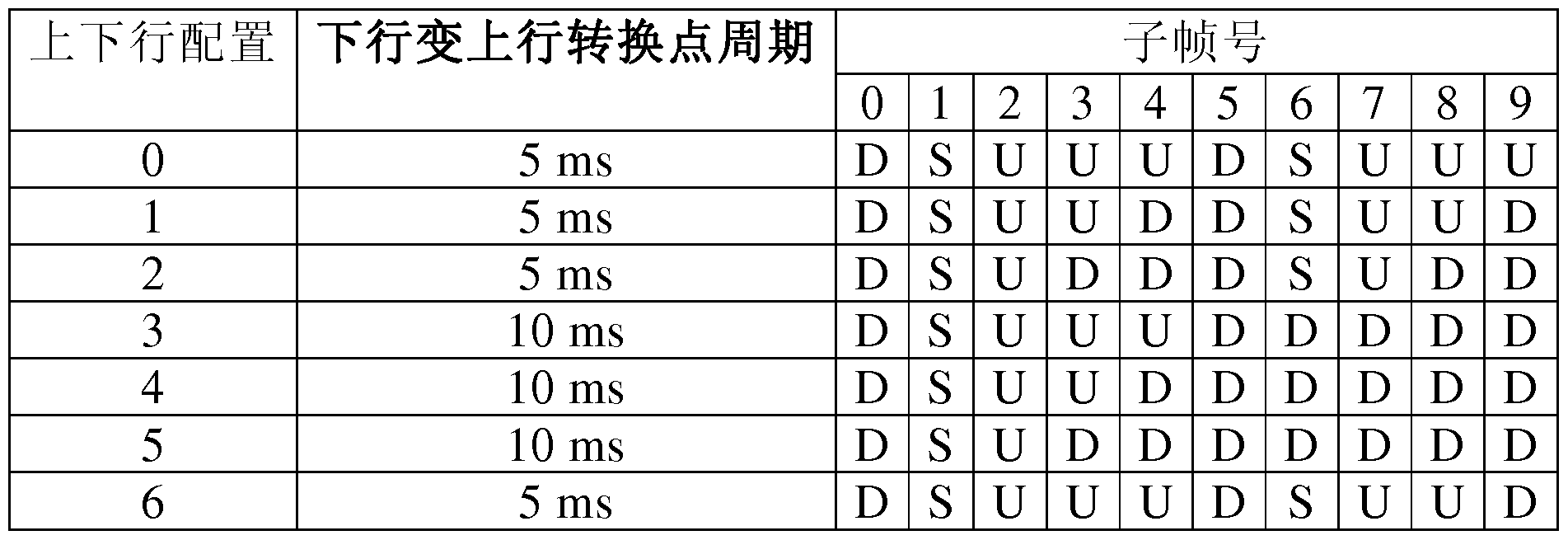
- the current TDD system supports the uplink and downlink ratio of 7 seed frames, as shown in Table 1 below, where 'D' denotes a downlink subframe, 'U' denotes an uplink subframe, 'S' denotes a special subframe, and 'S' is mainly used for Downlink transmission.
- the system can dynamically notify the UE of different uplink-downlink subframe ratios, which can be existing 7 ratios, or can be added with downlink subframes. ratio.
- the fixed subframe in the embodiment of the present invention refers to a subframe in which the subframe attribute is fixed, that is, a subframe in which the subframe attribute does not change as the uplink and downlink ratio changes.
- Fixed subframes are always fixed as uplink subframes or downlink subframes, or are always fixed as special subframes, which are respectively called fixed Row subframe, fixed downlink subframe, fixed special subframe.
- the flexible subframe in the embodiment of the present invention refers to a subframe in which a subframe attribute can be dynamically changed, and the flexible subframe can be configured as at least two of an uplink subframe, a downlink subframe, a special subframe, and an empty subframe.
- a flexible subframe refers to a subframe that can be dynamically configured as an uplink subframe or a downlink subframe
- a flexible subframe refers to a subframe that can be dynamically configured as an uplink subframe, a downlink subframe, or a special subframe.
- a null subframe refers to a subframe in which no uplink data or downlink data is transmitted.
- a flexible subframe configured as an uplink subframe is referred to as a flexible uplink subframe
- a flexible subframe configured as a downlink subframe is referred to as a flexible downlink subframe
- a flexible subframe configured as a special subframe is referred to as a flexible special subframe.
- a flexible subframe configured as an empty subframe is called a flexible null subframe.
- the determination of the fixed subframe and the flexible subframe in the present invention can be determined by the uplink and downlink subframe ratio supported by the existing version system and the evolved version system. For example, when both the existing system and the evolved system support only the seven uplink and downlink configurations in Table 1 above, subframes 0, 1, 2, and 5 can be regarded as fixed subframes, and subframes 3, 4, 6, 7 , 8 and 9 can be regarded as flexible subframes; when the existing system and the evolved system support only four uplink and downlink subframe configurations of 0, 1, 2 and 6, subframes 0, 1, 2, 5, 6 and 7 can be regarded as a fixed subframe, and subframes 3, 4, 8 and 9 can be regarded as flexible subframes.
- the special subframe is mainly used for downlink transmission, so the special subframe can also be regarded as the downlink subframe, so that when the existing system and the evolved system are notified according to the seven configurations, the subframes 0, 1, 2, 5 and 6 can be regarded as fixed subframes, and subframes 3, 4, 7, 8 and 9 can be regarded as flexible subframes.
- SIB 1 System Information Block 1
- the downlink subframe or the special subframe indicated in SIB 1 cannot be changed into an uplink subframe, so the indication indicated in SIB 1
- a downlink subframe or a special subframe may be referred to as a fixed downlink subframe.
- the downlink subframe or the special subframe indicated in the Radio Resource Configuration Common SCell Information Element of the secondary cell (SCell, Secondary Cell), RadioResourceConfigCommonSCell IE (the Radio Resource Configuration Common SCell Information Element) cannot be changed into an uplink subframe, therefore,
- the downlink subframe or the special subframe indicated in the RadioResourceConfigCommonSCell IE may be referred to as a fixed downlink subframe.
- FIG. 1 is a flowchart of Embodiment 1 of a method for wireless communication according to the present invention.
- a UE is used as an execution entity as an example.
- the method in this embodiment may include:
- the UE receives at least one TPC command sent by the base station in a fixed downlink subframe with the subframe number ⁇ , and the at least one TPC command is carried in the PDCCH in the format DCI format 3/3A.
- At least one TPC command includes an uplink signal sent on an uplink subframe with a subframe number of The TPC command, where different TPC commands are used to indicate the transmit power of the uplink signals transmitted on different uplink subframes.
- the UE receives the TPC command only in the fixed downlink subframe with the subframe number ⁇ , that is, the TPC command is not carried in the flexible downlink subframe, so that the flexible subframe is prevented from becoming the uplink subframe. Unable to get the problem with the TPC command.
- the flexible subframe can be configured as an uplink subframe, the number of fixed downlink subframes is less than all possible uplink subframes (including fixed uplink subframes and flexible subframes that can be configured as uplink subframes). The number, such a fixed downlink subframe may need to carry TPC commands of multiple uplink subframes.
- a fixed downlink subframe may need to carry TPC commands of two flexible uplink subframes, or a fixed downlink subframe may need to carry a flexible uplink subframe TPC command and 1 TPC command for fixed uplink subframes.
- a fixed downlink subframe needs to carry a TPC command of two flexible uplink subframes, or when a fixed downlink subframe may need to carry a TPC command of one flexible uplink subframe and a TPC command of one fixed uplink subframe.
- the method further includes:
- the UE receives a first TPC radio network temporary identifier (TPC-Radio Network Temporary Identifier, hereinafter referred to as TPC-RNTI), a second TPC-RNTI, and first indication information, where the first indication information is used to indicate:
- TPC-RNTI TPC-Radio Network Temporary Identifier
- a TPC-RNTI scrambled format is that the first PDCCH of the DCI format 3/3A is used to carry the first TPC command
- the second PDCCH of the second TPC-RNTI is formatted as the second PDCCH of the DCI format 3/3A for carrying the second PDCCH.
- the first TPC command and the second TPC command are used by the UE to determine the transmit power of the uplink signal on different subframes.
- the first TPC command is used by the UE to determine the transmit power of the uplink signal on the subframe i
- the second TPC command is used by the UE to determine the transmit power of the uplink signal on the subframe j
- the subframe i and the subframe j are different
- the uplink signal on j and the uplink signal on subframe i may be different.
- the uplink signal on subframe j is a sounding reference signal (SRS)
- the uplink signal on subframe i is a physical uplink. Shared Channel (Physical Uplink Shared Channel, hereinafter referred to as PUSCH).
- SRS sounding reference signal
- PUSCH Physical Uplink Shared Channel
- the first TPC command and the second TPC command may be configured as the same TPC command.
- a TPC command can be used to indicate the transmit power of the uplink signals on the two flexible uplink subframes, thereby saving control signals. Make the cost.
- S101 is specifically:
- the UE receives the first PDCCH and/or the second PDCCH sent by the base station, and obtains the first TPC command from the first PDCCH, and/or from the second PDCCH, in the fixed downlink subframe with the subframe number being ⁇ . Get the second TPC command.
- the UE descrambles all possible PDCCHs by using the first TPC-RNTI, and then performs decoding, Cyclic Redundancy Check (referred to as: CRC)
- CRC Cyclic Redundancy Check
- the correct PDCCH is the first PDCCH in which the first TPC-RNTI is scrambled in the format of DCI format 3/3A.
- the first TPC command is then obtained from the first PDCCH.
- the method further includes:
- the UE receives the first TPC index, the second TPC index, and the second indication information that are sent by the base station, where the second indication information is used to indicate that: the first TPC index is used to indicate that the first TPC command is in the format of DCI format 3/3A.
- the location in the third PDCCH, the second TPC index is used to indicate the location of the second TPC command in the third PDCCH formatted as DCI format 3/3A.
- the base station may configure multiple TPC indexes, which respectively correspond to TPC commands of multiple uplink subframes.
- the first TPC command and the second TPC command are used by the UE to determine the transmit power of the uplink signal on different subframes.
- the first TPC command and the second TPC command may be configured as the same TPC command.
- a TPC command can be used to indicate the transmit power of the uplink signals on the two flexible uplink subframes, thereby saving control signaling overhead.
- S101 is specifically:
- the UE receives the third PDCCH sent by the base station in the fixed downlink subframe with the subframe number ⁇ , and obtains the first TPC command at the location indicated by the first TPC index, and/or the second TPC index indication. Get the second TPC command on the location.
- the third PDCCH in the format of the DCI format 3/3A can carry multiple TPC commands, and the location of each TPC command is identified by the TPC index. Therefore, after receiving the TPC index, the UE can acquire the TPC at the corresponding location. command.
- the TPC life of the uplink signal sent by the UE according to the uplink subframe in the subframe number is Let, determine the transmit power of the uplink signal sent in the uplink subframe with the subframe number being, and the subframe with the subframe number as the ⁇ subframes after the fixed downlink subframe with the subframe number -. Among them, the value of ⁇ has nothing to do with the uplink and downlink ratio of the TDD system subframe.
- the uplink-downlink ratio of the TDD system subframe is the TDD uplink-downlink ratio indicated by the physical layer signaling, and the physical layer signaling is a PDCCH or an ePDCCH (enhanced PDCCH) bearer.
- the UE is configured according to each TPC command.
- this embodiment determines, by each TPC command, the transmit power of the uplink signal, and the subframe with the subframe number being the ⁇ subframes after the fixed downlink subframe with the subframe number being -, for the value of ⁇ condiment £ , this embodiment
- the following three methods are implemented:
- the value of the TPC command of the flexible uplink subframe and the fixed uplink subframe is to be carried in different fixed downlink subframes, and the embodiment is applicable to
- the uplink signal is PUSCH, PUCCH or SRS.
- the value of £ in this solution can ensure the minimum delay between the TPC command and the uplink signal transmission, further ensuring the timeliness of the uplink power control, that is, the UE can obtain the most accurate TPC command.
- the embodiment is applicable to the uplink signal being the PUSCH, the PUCCH, or the SRS.
- the TPC commands of the flexible uplink subframe and the fixed uplink subframe appear in the same subframe.
- the value of K UL is the value of the TDD ratio 0 defined by the existing version, as shown in Table 6 below:
- the TDD ratio can be the TDD uplink and downlink ratio indicated by the ratio information of the physical layer channel bearer
- the timing relationship between 0 and 0 can solve the problem that the TPC command cannot be obtained.
- the TDD ratio of UEs in the existing version is configured to TDD ratio 0, which can maintain forward and backward compatibility well.
- the S102 determines, according to each TPC command, the subframe number of the subframe.
- the transmit power of the uplink signal is specifically as follows:
- the S102 determines, according to each TPC command, the transmit power of the uplink signal on the subframe with the subframe number, which is specifically: According to each TPC command, the transmit power of the SRS on the subframe with the subframe number is determined.
- the above method in the solution can solve the TPC command of the SRS even if the PUSCH is not sent.
- the UE sends an uplink signal according to the transmit power in a subframe with the subframe number i.
- the UE receives at least one TPC command sent by the base station in a fixed downlink subframe with the subframe number ⁇ , and the TPC command is carried in the PDCCH in the format DCI format 3/3A, and then the UE is configured according to the UE.
- the transmit power of the uplink signal on the subframe corresponding to the subframe number corresponding to each TPC command is determined, and the subframe with the subframe number is the second subframe after the fixed downlink subframe with the subframe number being - ⁇ subframes, the UE transmits the corresponding uplink signal on the subframe with the subframe number according to the transmit power of each uplink signal.
- the embodiment further defines a timing relationship between the TPC command transmission and the uplink signal transmission, and the UE can obtain TPC commands in different uplink subframes according to the timing relationship.
- FIG. 2 is a flowchart of Embodiment 2 of the method for wireless communication according to the present invention.
- a base station is used as an execution entity as an example.
- the method in this embodiment may include:
- the base station sends, to the user equipment UE, at least one TPC command on the fixed downlink subframe with the subframe number i ⁇ , so that the UE determines the subframe according to the TPC command of the uplink signal sent in the uplink subframe with the subframe number being the uplink subframe.
- the transmit power of the uplink signal transmitted on the uplink subframe whose frame number is. Among them, the value is independent of the uplink and downlink ratio of the time division duplex TDD system subframe.
- the uplink-downlink ratio of the TDD system subframe is a TDD uplink-downlink ratio indicated by the physical layer signaling, where the physical layer signaling is a PDCCH or an ePDCCH (enhanced PDCCH) bearer, wherein at least one TPC command is carried in a format of In the PDCCH of the DCI format 3/3A, at least one TPC command includes a TPC command for an uplink signal transmitted on an uplink subframe of subframe number i, and different TPC commands are used to indicate an uplink signal transmitted on different uplink subframes. Transmit power.
- the base station sends the TPC command only when the subframe number is a fixed downlink subframe, that is, the TPC command is not carried in the flexible downlink subframe, so that the TCP cannot be acquired after the flexible subframe becomes the uplink subframe.
- the flexible subframe can be configured as an uplink subframe
- the number of fixed downlink subframes is less than all possible uplink subframes (including fixed uplink subframes and flexible subframes that can be configured as uplink subframes).
- the number, such a fixed downlink subframe may need to carry TPC commands of multiple uplink subframes.
- a fixed downlink subframe may need to carry TPC commands of two flexible uplink subframes, or a fixed downlink subframe may need to carry a flexible uplink subframe TPC command and When a TPC command is fixed for an uplink subframe.
- a fixed downlink subframe needs to carry a TPC command of two flexible uplink subframes, or when a fixed downlink subframe may need to carry a TPC command of one flexible uplink subframe and a TPC command of one fixed uplink subframe.
- the method further includes:
- the first TPC-RNTI, the second TPC-RNTI, and the first indication information are sent to the UE, where the first indication information is used to indicate that: the format of the first TPC-RNTI scrambling is the first PDCCH of the DCI format 3/3A
- the second PDCCH in the format of DCI format 3/3A, which is in the second TPC-RNTI scrambling mode, is used to carry the second TPC command.
- the first TPC command and the second TPC command are used by the UE to determine the transmit power of the uplink signal on different subframes.
- the first TPC command and the second TPC command are the same TPC command. In this way, a TPC command can be used to indicate the transmit power of the uplink signals on the two flexible uplink subframes, thus saving control signaling overhead.
- S201 is specifically:
- the base station sends the first PDCCH and/or the second PDCCH to the UE on the fixed downlink subframe with the subframe number being ⁇ , so that the UE receives the first PDCCH and/or the second PDCCH, and then from the first PDCCH.
- the method further includes:
- the base station sends a first TPC index, a second TPC index, and second indication information to the UE, where the second indication information is used to indicate that: the first TPC index is used to indicate that the first TPC command is in the grid
- the location is the location in the third PDCCH of the DCI format 3/3A
- the second TPC index is used to indicate the location of the second TPC command in the third PDCCH of the format DCI format 3/3A.
- the base station may configure multiple TPC indexes, which respectively correspond to TPC commands of multiple uplink subframes.
- the first TPC command and the second TPC command are used by the UE to determine the transmit power of the uplink signal on different subframes.
- the first TPC index and the second TPC index configured by the base station are the same, the first TPC command and the second TPC command are the same TPC command. In this way, a TPC command can be used to indicate the transmit power of the uplink signals on the two flexible uplink subframes, thereby saving control signaling overhead.
- S201 is specifically:
- S201b Send a third PDCCH to the UE on the fixed downlink subframe with the subframe number, so that after receiving the third PDCCH, the UE acquires the first TPC command at the location indicated by the first TPC index, and/or The second TPC command is obtained at the location indicated by the second TPC index.
- the subframe with the subframe number is the ⁇ subframe after the fixed downlink subframe whose subframe number is -, and the value of the subframe is to ensure that the TPC commands of the flexible uplink subframe and the fixed uplink subframe are carried in different fixed downlinks.
- the present embodiment has the following three implementation manners: In the first implementation manner, the implementation manner is applicable to the uplink signal being PUSCH, PUCCH, or SRS. In this embodiment, there are three types. happening:
- the implementation manner is applicable to the uplink signal being PUSCH,
- the value of the PUCCH or SRS is the value of the TDD ratio 0 defined by the existing version, as shown in Table 6 above:
- the TDD ratio can be the TDD uplink and downlink ratio indicated by the matching information carried by the physical layer channel
- the timing relationship of 0 is used, which can solve the problem that the TPC command cannot be obtained.
- the TDD ratio of UEs in the existing version is configured to TDD ratio 0, which can maintain forward and backward compatibility well.
- the base station receives an uplink signal sent by the UE in a subframe with the subframe number i.
- the base station sends at least one transmit power control TPC command to the user equipment UE in the subframe number of the fixed downlink subframe, so that the UE sends the uplink subframe according to the subframe number.
- the TPC command of the uplink signal determines the transmit power of the uplink signal sent in the uplink subframe whose subframe number is, and the subframe number of the subframe number is the ⁇ subframes after the fixed downlink subframe whose subframe number is -. Then, the base station receives the uplink signal sent by the UE on the subframe with the subframe number being.
- the embodiment further defines a timing relationship between the TPC command transmission and the uplink signal transmission, and the UE can obtain the TPC command in different uplink subframes according to the timing relationship.
- FIG. 3 is a flowchart of Embodiment 3 of a method for wireless communication according to the present invention, as shown in FIG.
- the information exchange between the UE and the base station is used as an example.
- the method in this embodiment may include:
- the base station sends at least one TPC command to the user equipment UE in a fixed downlink subframe with the subframe number i ⁇ , and the TPC command is carried in the PDCCH in the format DCI format 3/3A.
- S302 The UE receives at least one TPC command sent by the base station in a fixed downlink subframe with a subframe number of ⁇ .
- the UE determines, according to the TPC command of the uplink signal sent by the uplink subframe in the subframe number, the transmit power of the uplink signal sent by the uplink subframe in the subframe number, and the subframe with the subframe number is the subframe.
- the value is independent of the time-division duplex TDD system subframe up-down ratio.
- the TDD system uplink-downlink ratio is the TDD uplink-downlink ratio indicated by the physical layer signaling, and the physical layer signaling is the signaling carried by the PDCCH or the ePDCCH (enhanced PDCCH).
- S304 The UE sends an uplink signal according to the transmit power in a subframe with the subframe number i.
- the base station receives the uplink signal sent by the UE in the subframe with the subframe number being.
- the base station sends the first TPC-RNTI, the second TPC-RNTI, and the first indication information to the UE, where the first indication information is used to indicate that: the format of the first TPC-RNTI scrambling is the first PDCCH of the DCI format 3/3A
- the second PDCCH for carrying the first TPC command, the second TPC-RNTI scrambling format is DCI format 3/3A, for carrying the second TPC command.
- the base station sends the first PDCCH and/or the second PDCCH to the UE in a fixed downlink subframe with a subframe number of ⁇ .
- the UE receives the first PDCCH and/or the second PDCCH sent by the base station, and obtains the first TPC command from the first PDCCH, and/or from the second PDCCH, in the fixed downlink subframe with the subframe number being ⁇ . Get the second TPC command.
- the base station sends a first TPC index, a second TPC index, and second indication information to the UE, where the second indication information is used to indicate that: the first TPC index is used to indicate that the first TPC command is in the format of DCI format 3/3A.
- the second TPC index is used to indicate The location of the second TPC command in the third PDCCH in the format DCI format 3/3A.
- the base station sends a third PDCCH to the UE in a fixed downlink subframe with a subframe number of ⁇ .
- the UE receives the third PDCCH sent by the base station in the fixed downlink subframe with the subframe number of the ⁇ , and obtains the first TPC command at the location indicated by the first TPC index, and/or the second TPC index indication. Get the second TPC command on the location.
- the subframe with the subframe number is the subframe after the fixed downlink subframe with the subframe number being -, and for the value of ⁇ , the following three implementation manners are available in this embodiment:
- the value is to ensure that the TPC commands of the flexible uplink subframe and the fixed uplink subframe are carried in different fixed downlink subframes, and the embodiment is applicable to the uplink signal being PUSCH, PUCCH, or SRS. There are three cases under this embodiment:
- the value of £ in this solution can ensure the minimum delay between the TPC command and the uplink signal transmission, further ensuring the timeliness of the uplink power control, that is, the UE can obtain the most accurate TPC command.
- the present embodiment is applicable to the uplink signal being the PUSCH, the PUCCH, or the SRS.
- the TPC commands of the flexible uplink subframe and the fixed uplink subframe appear in the same subframe.
- the timing relationship in the ratio 0 is used in any TDD ratio, which can solve the problem that the TPC command cannot be obtained.
- the TDD ratio of UEs in the existing version is configured to TDD ratio 0, which can maintain forward and backward compatibility well.
- the apparatus in this embodiment may include: a receiving module 11, a processing module 12, and a sending module 13, where the receiving module 11 is used in a subframe.
- At least one TPC command sent by the base station is received on the fixed downlink subframe of the number - at least one TPC command is carried in the physical downlink control channel PDCCH in the format DCI format 3/3A, and at least one TPC command is included in the subframe number
- the TPC command of the uplink signal sent on the uplink subframe where different TPC commands are used to indicate the transmit power of the uplink signal sent on different uplink subframes.
- the processing module 12 is configured to determine, according to the TPC command of the uplink signal sent in the uplink subframe with the subframe number, the transmit power of the uplink signal sent by the uplink subframe with the subframe number being the uplink subframe of the subframe number.
- the ⁇ th subframe after the fixed downlink subframe whose subframe number is - ⁇ , where the value of ⁇ is independent of the uplink-downlink ratio of the TDD system subframe, that is, the fixed downlink subframe whose subframe number is ⁇ The frame occurs earlier than the uplink subframe with the subframe number, and the two are separated by ⁇ -1 subframes.
- the uplink and downlink ratio of the TDD system subframe is a TDD uplink and downlink ratio indicated by the physical layer signaling, and the physical layer signaling is a signaling carried by the PDCCH or the ePDCCH (enhanced PDCCH).
- the sending module 13 is configured to send an uplink signal on the subframe with the subframe number according to the transmit power.
- the receiving module 11 is further configured to:
- the first TPC-RNTI scrambled format is that the first PDCCH of the DCI format 3/3A is used to carry the first TPC command
- the second TPC-RNTI scrambled format is the second PDCCH of the DCI format 3/3A. Host the second TPC command.
- the receiving module 11 is used to:
- the receiving module 11 is further configured to:
- the first TPC index is used to indicate the location of the first TPC command in the third PDCCH formatted as DCI format 3/3A
- the second TPC index is used to indicate that the second TPC command is in the third PDCCH format of DCI format 3/3A The location in .
- the receiving module 11 is used to:
- the value of £ includes:
- the values include:
- the processing module 12 is configured to: Determining, according to each TPC command, a transmit power of a PUSCH on a subframe whose subframe number is;
- the processing module is used to:
- the transmit power of the SRS on the subframe with the subframe number is determined.
- the uplink signal is a PUCCH
- the PUCCH is sent only in the fixed uplink subframe, and the value includes:
- the device in this embodiment may be used to implement the technical solution of the method embodiment shown in FIG. 1.
- the implementation principle is similar, and details are not described herein again.
- the user equipment receives, by the receiving module, at least one TPC command sent by the base station, where the subframe number is a fixed downlink subframe, and the TPC command is carried in the PDCCH in the format DCI format 3/3A, and then the processing module according to each a TPC command, determining a transmit power of an uplink signal on a subframe corresponding to a subframe number corresponding to each TPC command, and a subframe having a subframe number of ⁇ is a fixed downlink subframe after the subframe number is a B UL In the first subframe, the last sending module sends each corresponding uplink signal in the subframe with the subframe number according to the transmit power of each uplink signal.
- the embodiment further defines a timing relationship between the TPC command transmission and the uplink signal transmission, and the UE can obtain the TPC commands in different uplink subframes according to the timing relationship.
- FIG. 5 is a schematic structural diagram of Embodiment 1 of a base station according to the present invention.
- the apparatus in this embodiment includes: a sending module 21 and a receiving module 22, where the sending module 21 is configured to fix the subframe number ⁇ .
- the transmit power where the value of ⁇ is independent of the uplink and downlink ratio of the TDD system subframe.
- the uplink-downlink ratio of the TDD system subframe is a TDD uplink-downlink ratio indicated by the physical layer signaling, and the physical layer signaling is a signaling carried by the PDCCH or the ePDCCH (enhanced PDCCH).
- the at least one TPC command is carried in the physical downlink control channel PDCCH in the format of DCI format 3/3A, and the at least one TPC command includes the TPC command of the uplink signal sent in the uplink subframe with the subframe number, and different TPC commands. It is used to indicate the transmit power of the uplink signal transmitted on different uplink subframes.
- the receiving module 22 is configured to receive an uplink signal sent by the UE on the subframe with the subframe number being. Further, the sending module 21 is further configured to:
- the first TPC-RNTI, the second TPC-RNTI, and the first indication information are sent to the UE, where the first indication information is used.
- the first TPC-RNTI scrambled format is that the first PDCCH of the DCI format 3/3A is used to carry the first TPC command
- the second TPC-RNTI scrambled format is the second PDCCH of the DCI format 3/3A. Host the second TPC command.
- the sending module 21 is used to:
- the sending module 21 is further configured to:
- the first TPC index, the second TPC index, and the second indication information are sent to the UE, where the second indication information is used to indicate:
- the first TPC index is used to indicate the location of the first TPC command in the third PDCCH formatted as DCI format 3/3A
- the second TPC index is used to indicate that the second TPC command is in the third PDCCH format of DCI format 3/3A The location in .
- the sending module 21 is used to:
- the values include:
- the values include:
- the values include:
- PUCCH is only sent on a fixed uplink subframe
- the device in this embodiment may be used to implement the technical solution of the method embodiment shown in FIG. 2, and the implementation principle and the technical effect are similar, and details are not described herein again.
- the base station provided by the embodiment sends the at least one transmit power control TPC command to the user equipment UE in the fixed downlink subframe with the subframe number being -, so that the UE sends the uplink subframe according to the subframe number.
- the TPC command of the uplink signal determines the transmit power of the uplink signal transmitted on the uplink subframe whose subframe number is, and the subframe whose subframe number is the ⁇ sub-frame after the fixed downlink subframe whose subframe number is ⁇ frame.
- the receiving module then receives the uplink signal sent by the UE on the subframe with the subframe number being. Since the base station sends the TPC command only on the fixed downlink subframe, the flexible downlink subframe does not carry the TPC command.
- the present embodiment further defines a timing relationship between the TPC command transmission and the uplink signal transmission, and the UE can obtain TPC commands in different uplink subframes according to the timing relationship.
- the communication system provided by the embodiment of the present invention includes the user equipment shown in FIG. 4 and the base station shown in FIG. 5.
- FIG. 6 is a schematic structural diagram of Embodiment 2 of a user equipment according to the present invention.
- the apparatus in this embodiment may include: a receiver 31, a processor 32, and a transmitter 33, where the receiver 31 is configured to be in a subframe.
- the at least one TPC command is carried in the physical downlink control channel PDCCH in the format of the DCI format 3/3A, and the at least one TPC command includes the TPC command of the uplink signal sent in the uplink subframe of the subframe number, where different
- the TPC command is used to indicate the transmit power of the uplink signal transmitted on different uplink subframes.
- the processor 32 is configured to determine, according to the TPC command of the uplink signal sent in the uplink subframe with the subframe number, the transmit power of the uplink signal sent in the uplink subframe with the subframe number being the uplink subframe of the subframe number. It is the ⁇ th subframe after the fixed downlink subframe whose subframe number is -, where the value is independent of the uplink and downlink ratio of the TDD system subframe.
- the uplink-downlink ratio of the TDD system subframe is a TDD uplink-downlink ratio indicated by the physical layer signaling, and the physical layer signaling is a signaling carried by a PDCCH or an ePDCCH (enhanced PDCCH).
- the transmitter 33 is configured to send an uplink signal on the subframe whose subframe number is according to the transmission power.
- receiver 31 is further configured to:
- the first TPC-RNTI scrambled format is that the first PDCCH of the DCI format 3/3A is used to carry the first TPC command
- the second TPC-RNTI scrambled format is the second PDCCH of the DCI format 3/3A. Host the second TPC command.
- Receiver 31 is used to:
- the receiver 31 is further configured to:
- the first TPC index is used to indicate the location of the first TPC command in the third PDCCH formatted as DCI format 3/3A
- the second TPC index is used to indicate that the second TPC command is in the third PDCCH format of DCI format 3/3A The location in .
- Receiver 31 is used to:
- the values include:
- the value of £ includes:
- the processor 32 is configured to:
- the processing module is used to:
- the transmit power of the SRS on the subframe with the subframe number is determined.
- the uplink signal is a PUCCH
- the PUCCH is sent only in the fixed uplink subframe, and the value includes:
- the device in this embodiment may be used to implement the technical solution of the method embodiment shown in FIG. 1.
- the implementation principle is similar, and details are not described herein again.
- the user equipment provided in this embodiment receives, by the receiver, at least one TPC command sent by the base station in a fixed downlink subframe with the subframe number -, and the TPC command is carried in the PDCCH in the format DCI format 3/3A, and then the processor Determine each one according to each TPC command
- the sub-frame number corresponding to the TPC command is the transmit power of the uplink signal
- the sub-frame number is the ⁇ sub-frame after the fixed downlink sub-frame with the sub-frame number being -
- the transmitter is based on The transmit power of each uplink signal is transmitted on each subframe corresponding to the subframe number. Since the UE receives the TPC command only on the fixed downlink subframe, the flexible downlink subframe does not carry the TPC command.
- the embodiment further defines a timing relationship between the TPC command transmission and the uplink signal transmission, and the UE can obtain the TPC commands in different uplink subframes according to the timing relationship.
- FIG. 7 is a schematic structural diagram of Embodiment 2 of a base station according to the present invention.
- the apparatus in this embodiment includes: a transmitter 41 and a receiver 42, wherein the transmitter 41 is configured to fix the subframe number ⁇ ⁇ Sending, by the UE, the at least one TPC command to the user equipment UE in the downlink subframe, so that the UE determines, according to the TPC command of the uplink signal sent in the uplink subframe with the subframe number, the uplink signal sent in the uplink subframe with the subframe number being The transmit power, where the value of ⁇ is independent of the uplink and downlink ratio of the TDD system subframe.
- the uplink and downlink ratio of the TDD system subframe is the TDD uplink and downlink ratio indicated by the physical layer signaling, and the physical layer signaling is the signaling carried by the PDCCH or the enhanced PDCCH.
- the at least one TPC command is carried in the physical downlink control channel PDCCH in the format of DCI format 3/3A, and the at least one TPC command includes the TPC command of the uplink signal sent in the uplink subframe with the subframe number, and different TPC commands. It is used to indicate the transmit power of the uplink signal transmitted on different uplink subframes.
- the receiver 42 is configured to receive the uplink signal sent by the UE on the subframe with the subframe number i.
- the transmitter 41 is further configured to:
- the first TPC-RNTI, the second TPC-RNTI, and the first indication information are sent to the UE, where the first indication information is used.
- the first TPC-RNTI scrambled format is that the first PDCCH of the DCI format 3/3A is used to carry the first TPC command
- the second TPC-RNTI scrambled format is the second PDCCH of the DCI format 3/3A. Host the second TPC command.
- Transmitter 41 is used to:
- the transmitter 41 is further configured to:
- the first TPC index, the second TPC index, and the second indication information are sent to the UE, where the second indication information is used to indicate:
- the first TPC index is used to indicate the location of the first TPC command in the third PDCCH formatted as DCI format 3/3A
- the second TPC index is used to indicate that the second TPC command is in the third PDCCH format of DCI format 3/3A
- Transmitter 41 is used to:
- the values include:
- the values include:
- the values include:
- the PUCCH is sent only on a fixed uplink subframe.
- the device in this embodiment may be used to implement the technical solution of the method embodiment shown in FIG.
- the implementation principle is similar to the technical effect, and will not be described here.
- the base station provided in this embodiment sends, by using a transmitter, at least one transmit power control TPC command to the user equipment UE in the subframe number of the fixed downlink subframe, so that the UE sends the uplink according to the uplink subframe in the subframe number.
- the TPC command of the signal determines the transmit power of the uplink signal sent on the uplink subframe with the subframe number being, and the subframe with the subframe number is the ⁇ subframe after the fixed downlink subframe with the subframe number -.
- the receiver then receives the uplink signal sent by the UE on the subframe with the subframe number of .
- the present embodiment further defines a timing relationship between the TPC command transmission and the uplink signal transmission, and the UE can obtain TPC commands on different uplink subframes according to the timing relationship.
- the communication system provided by the embodiment of the present invention includes the user equipment shown in FIG. 6 and the base station shown in FIG. 7.
- the disclosed apparatus and method may be implemented in other manners.
- the device embodiments described above are merely illustrative.
- the division of the unit is only a logical function division.
- there may be another division manner for example, multiple units or components may be combined or Can be integrated into another system, or some features can be ignored, or not executed.
- the mutual coupling or direct coupling or communication connection shown or discussed may be an indirect coupling or communication connection through some interface, device or unit, and may be in an electrical, mechanical or other form.
- the units described as separate components may or may not be physically separate, and the components displayed as units may or may not be physical units, i.e., may be located in one place, or may be distributed over multiple network units. Some or all of the units may be selected according to actual needs to achieve the purpose of the solution of the embodiment.
- each functional unit in each embodiment of the present invention may be integrated into one processing unit, or each unit may exist physically separately, or two or more units may be integrated into one unit.
- the above integrated unit can be implemented in the form of hardware or in the form of a hardware plus software functional unit.
- the above-described integrated unit implemented in the form of a software functional unit can be stored in a computer readable storage medium.
- the above software functional unit is stored in a storage medium and includes a plurality of instructions for causing a computer device (which may be a personal computer, a server, or a network) A device or the like) or a processor performs part of the steps of the method described in various embodiments of the present invention.
- the foregoing storage medium includes: a USB flash drive, a removable hard disk, a read-only memory (ROM), a random access memory (RAM), a magnetic disk or an optical disk, and the like, which can store program codes. medium.
Landscapes
- Engineering & Computer Science (AREA)
- Signal Processing (AREA)
- Computer Networks & Wireless Communication (AREA)
- Mobile Radio Communication Systems (AREA)
Abstract
Description




Claims
Priority Applications (6)
| Application Number | Priority Date | Filing Date | Title |
|---|---|---|---|
| CA2916401A CA2916401A1 (en) | 2013-06-24 | 2013-09-23 | Wireless communication method, apparatus, and system |
| KR1020167000392A KR101781013B1 (ko) | 2013-06-24 | 2013-09-23 | 무선 통신 방법, 장치, 및 시스템 |
| CN201380002693.1A CN104813720B (zh) | 2013-06-24 | 2013-09-23 | 无线通信方法、装置及系统 |
| EP13887921.8A EP2999278B1 (en) | 2013-06-24 | 2013-09-23 | Method, device, and system for radio communications |
| JP2016520237A JP2016525293A (ja) | 2013-06-24 | 2013-09-23 | ワイヤレス通信方法、装置、及びシステム |
| US14/757,677 US9674791B2 (en) | 2013-06-24 | 2015-12-23 | Wireless communication method, apparatus, and system |
Applications Claiming Priority (2)
| Application Number | Priority Date | Filing Date | Title |
|---|---|---|---|
| CNPCT/CN2013/077786 | 2013-06-24 | ||
| PCT/CN2013/077786 WO2014205630A1 (zh) | 2013-06-24 | 2013-06-24 | 无线通信方法、装置及系统 |
Related Child Applications (1)
| Application Number | Title | Priority Date | Filing Date |
|---|---|---|---|
| US14/757,677 Continuation US9674791B2 (en) | 2013-06-24 | 2015-12-23 | Wireless communication method, apparatus, and system |
Publications (1)
| Publication Number | Publication Date |
|---|---|
| WO2014205930A1 true WO2014205930A1 (zh) | 2014-12-31 |
Family
ID=52140755
Family Applications (2)
| Application Number | Title | Priority Date | Filing Date |
|---|---|---|---|
| PCT/CN2013/077786 Ceased WO2014205630A1 (zh) | 2013-06-24 | 2013-06-24 | 无线通信方法、装置及系统 |
| PCT/CN2013/084010 Ceased WO2014205930A1 (zh) | 2013-06-24 | 2013-09-23 | 无线通信方法、装置及系统 |
Family Applications Before (1)
| Application Number | Title | Priority Date | Filing Date |
|---|---|---|---|
| PCT/CN2013/077786 Ceased WO2014205630A1 (zh) | 2013-06-24 | 2013-06-24 | 无线通信方法、装置及系统 |
Country Status (6)
| Country | Link |
|---|---|
| US (1) | US9674791B2 (zh) |
| EP (1) | EP2999278B1 (zh) |
| JP (1) | JP2016525293A (zh) |
| KR (1) | KR101781013B1 (zh) |
| CA (1) | CA2916401A1 (zh) |
| WO (2) | WO2014205630A1 (zh) |
Families Citing this family (10)
| Publication number | Priority date | Publication date | Assignee | Title |
|---|---|---|---|---|
| CN103929803B (zh) * | 2013-01-10 | 2018-03-23 | 电信科学技术研究院 | 一种上行功率控制命令传输方法及装置 |
| US10149255B2 (en) | 2015-05-01 | 2018-12-04 | Qualcomm Incorporated | Low latency uplink power control |
| JP2019096921A (ja) * | 2016-04-07 | 2019-06-20 | シャープ株式会社 | 端末装置、基地局装置、通信方法、および、集積回路 |
| US10687319B2 (en) * | 2016-08-08 | 2020-06-16 | Comcast Cable Communications, Llc | Group power control for a secondary cell |
| CN108632965B (zh) | 2017-03-24 | 2023-08-22 | 华为技术有限公司 | 一种上行发射功率控制的方法和设备 |
| CN110621063B (zh) | 2017-05-05 | 2022-06-07 | 华为技术有限公司 | 上行链路传输的功率控制方法 |
| EP4366400A3 (en) | 2017-11-23 | 2024-07-24 | Toyota Jidosha Kabushiki Kaisha | Signal transmission method, terminal device, and network device |
| US10820342B2 (en) * | 2018-02-13 | 2020-10-27 | Mediatek Singapore Pte. Ltd. | Method and apparatus for flexible scheduling of uplink transmissions in mobile communications |
| US10757656B2 (en) * | 2018-04-05 | 2020-08-25 | Qualcomm Incorporated | Loop index and time gap for group power control |
| US11595912B2 (en) | 2019-08-13 | 2023-02-28 | Qualcomm Incorporated | Sidelink power control |
Citations (3)
| Publication number | Priority date | Publication date | Assignee | Title |
|---|---|---|---|---|
| CN102201859A (zh) * | 2011-06-03 | 2011-09-28 | 电信科学技术研究院 | 一种数据传输的方法及装置 |
| CN102742331A (zh) * | 2010-04-01 | 2012-10-17 | Lg电子株式会社 | 在无线接入系统中控制上行功率的方法和装置 |
| CN102761948A (zh) * | 2011-04-27 | 2012-10-31 | 华为技术有限公司 | 时分双工模式下基于灵活子帧的上行功率控制方法和装置 |
Family Cites Families (16)
| Publication number | Priority date | Publication date | Assignee | Title |
|---|---|---|---|---|
| KR101459147B1 (ko) * | 2008-02-04 | 2014-11-10 | 엘지전자 주식회사 | 무선통신 시스템에서 전송 파워 제어 명령 전송 방법 |
| CN101567713B (zh) * | 2008-04-25 | 2012-10-03 | 电信科学技术研究院 | 时分双工系统中上行传输功率的确定方法、系统及装置 |
| US8494572B2 (en) * | 2008-06-24 | 2013-07-23 | Qualcomm Incorporated | Method and apparatus for power control of first data transmission in random access procedure of FDMA communication system |
| EP2496026A4 (en) * | 2009-10-29 | 2015-04-01 | Lg Electronics Inc | APPARATUS AND METHOD FOR TRANSMITTING UPGRADE TRANSMISSION POWER CONTROL INFORMATION TRANSMISSION INFORMATION IN A MULTI-CARRIER COMMUNICATION SYSTEM |
| JP5588236B2 (ja) * | 2010-06-21 | 2014-09-10 | 株式会社Nttドコモ | 送信電力制御方法、移動端末装置及び無線基地局装置 |
| US20130114562A1 (en) * | 2010-07-16 | 2013-05-09 | Lg Electronics Inc. | Method and apparatus for controlling uplink transmission power in wireless communication system |
| JP2012114901A (ja) * | 2010-11-05 | 2012-06-14 | Sharp Corp | 移動局装置、基地局装置、方法および集積回路 |
| CN104868975B (zh) | 2011-03-31 | 2019-07-19 | 华为技术有限公司 | 时分双工系统中子帧配置的方法、基站及用户设备 |
| CN103493419B (zh) * | 2011-05-17 | 2016-08-17 | Lg电子株式会社 | 发送控制信息的方法和用于该方法的装置 |
| KR20130018052A (ko) * | 2011-08-12 | 2013-02-20 | 주식회사 팬택 | 다중 요소 반송파 시스템에서 데이터 전송 방법 및 장치 |
| WO2013004007A1 (en) * | 2011-07-05 | 2013-01-10 | Renesas Mobile Corporation | Mechanism for enhancing power control in time division based communications |
| US10237833B2 (en) * | 2011-07-28 | 2019-03-19 | Nokia Technologies Oy | Apparatus and method for uplink power control for variable interference conditions |
| CN102340858B (zh) * | 2011-09-30 | 2014-11-05 | 电信科学技术研究院 | 一种pusch功率控制中目标sinr设置方法及装置 |
| CN102612129B (zh) * | 2012-03-07 | 2014-12-10 | 电信科学技术研究院 | 一种上行闭环功率控制方法及其设备 |
| WO2014137129A2 (ko) * | 2013-03-04 | 2014-09-12 | 엘지전자 주식회사 | 무선 통신 시스템에서 상향링크 전력 제어 방법 및 이를 위한 장치 |
| JP6244009B2 (ja) * | 2013-04-03 | 2017-12-06 | インターデイジタル パテント ホールディングス インコーポレイテッド | 累積された送信電力制御コマンドおよび対応するアップリンクサブフレームセットに基づいてアップリンク送信電力を制御するための方法および装置 |
-
2013
- 2013-06-24 WO PCT/CN2013/077786 patent/WO2014205630A1/zh not_active Ceased
- 2013-09-23 CA CA2916401A patent/CA2916401A1/en not_active Abandoned
- 2013-09-23 JP JP2016520237A patent/JP2016525293A/ja active Pending
- 2013-09-23 WO PCT/CN2013/084010 patent/WO2014205930A1/zh not_active Ceased
- 2013-09-23 KR KR1020167000392A patent/KR101781013B1/ko active Active
- 2013-09-23 EP EP13887921.8A patent/EP2999278B1/en active Active
-
2015
- 2015-12-23 US US14/757,677 patent/US9674791B2/en active Active
Patent Citations (3)
| Publication number | Priority date | Publication date | Assignee | Title |
|---|---|---|---|---|
| CN102742331A (zh) * | 2010-04-01 | 2012-10-17 | Lg电子株式会社 | 在无线接入系统中控制上行功率的方法和装置 |
| CN102761948A (zh) * | 2011-04-27 | 2012-10-31 | 华为技术有限公司 | 时分双工模式下基于灵活子帧的上行功率控制方法和装置 |
| CN102201859A (zh) * | 2011-06-03 | 2011-09-28 | 电信科学技术研究院 | 一种数据传输的方法及装置 |
Non-Patent Citations (1)
| Title |
|---|
| See also references of EP2999278A4 * |
Also Published As
| Publication number | Publication date |
|---|---|
| US20160127999A1 (en) | 2016-05-05 |
| EP2999278A1 (en) | 2016-03-23 |
| EP2999278B1 (en) | 2019-01-09 |
| KR101781013B1 (ko) | 2017-09-25 |
| JP2016525293A (ja) | 2016-08-22 |
| CA2916401A1 (en) | 2014-12-31 |
| KR20160021439A (ko) | 2016-02-25 |
| US9674791B2 (en) | 2017-06-06 |
| WO2014205630A1 (zh) | 2014-12-31 |
| EP2999278A4 (en) | 2016-05-11 |
Similar Documents
| Publication | Publication Date | Title |
|---|---|---|
| CN104904305B (zh) | 用于设备到设备通信的方法 | |
| CN104885554B (zh) | 用于设备间通信的参考信号测量 | |
| EP3160197B1 (en) | Terminal device, base-station device, and communication method | |
| KR101781013B1 (ko) | 무선 통신 방법, 장치, 및 시스템 | |
| EP3032909B1 (en) | Method and apparatus for requesting scheduling in cellular mobile communication system | |
| US9769771B2 (en) | Terminal device, base station device, and communication method | |
| EP2939359A2 (en) | Method and apparatus for device-to-device communication | |
| CN106416390B (zh) | 终端装置、基站装置以及通信方法 | |
| US20170230913A1 (en) | Terminal device, base station device, and method | |
| WO2015020108A1 (ja) | 端末、基地局、集積回路、および通信方法 | |
| WO2022201106A1 (en) | Resource determination for tb over multiple slots | |
| CN107852715B (zh) | 终端装置以及通信方法 | |
| WO2016047747A1 (ja) | 端末装置、基地局装置、および通信方法 | |
| WO2015194662A1 (ja) | 端末装置、基地局装置、および通信方法 | |
| CN106031216B (zh) | 终端装置、集成电路以及无线通信方法 | |
| WO2013166765A1 (zh) | Pucch资源映射、配置方法及装置、用户设备、基站 | |
| CN108029111B (zh) | 终端装置以及通信方法 | |
| WO2025200119A1 (en) | Method, apparatus, and system for flexible scheduling | |
| CN104813720B (zh) | 无线通信方法、装置及系统 |
Legal Events
| Date | Code | Title | Description |
|---|---|---|---|
| 121 | Ep: the epo has been informed by wipo that ep was designated in this application |
Ref document number: 13887921 Country of ref document: EP Kind code of ref document: A1 |
|
| WWE | Wipo information: entry into national phase |
Ref document number: 2013887921 Country of ref document: EP |
|
| ENP | Entry into the national phase |
Ref document number: 2916401 Country of ref document: CA |
|
| ENP | Entry into the national phase |
Ref document number: 2016520237 Country of ref document: JP Kind code of ref document: A |
|
| NENP | Non-entry into the national phase |
Ref country code: DE |
|
| ENP | Entry into the national phase |
Ref document number: 20167000392 Country of ref document: KR Kind code of ref document: A |