WO2015002271A1 - 装置および認証システム - Google Patents
装置および認証システム Download PDFInfo
- Publication number
- WO2015002271A1 WO2015002271A1 PCT/JP2014/067801 JP2014067801W WO2015002271A1 WO 2015002271 A1 WO2015002271 A1 WO 2015002271A1 JP 2014067801 W JP2014067801 W JP 2014067801W WO 2015002271 A1 WO2015002271 A1 WO 2015002271A1
- Authority
- WO
- WIPO (PCT)
- Prior art keywords
- challenge
- generated
- response
- authentication
- unit
- Prior art date
- Legal status (The legal status is an assumption and is not a legal conclusion. Google has not performed a legal analysis and makes no representation as to the accuracy of the status listed.)
- Ceased
Links
Images






Classifications
-
- H—ELECTRICITY
- H04—ELECTRIC COMMUNICATION TECHNIQUE
- H04L—TRANSMISSION OF DIGITAL INFORMATION, e.g. TELEGRAPHIC COMMUNICATION
- H04L63/00—Network architectures or network communication protocols for network security
- H04L63/08—Network architectures or network communication protocols for network security for authentication of entities
- H04L63/0876—Network architectures or network communication protocols for network security for authentication of entities based on the identity of the terminal or configuration, e.g. MAC address, hardware or software configuration or device fingerprint
-
- G—PHYSICS
- G06—COMPUTING OR CALCULATING; COUNTING
- G06F—ELECTRIC DIGITAL DATA PROCESSING
- G06F21/00—Security arrangements for protecting computers, components thereof, programs or data against unauthorised activity
- G06F21/30—Authentication, i.e. establishing the identity or authorisation of security principals
- G06F21/44—Program or device authentication
-
- H—ELECTRICITY
- H04—ELECTRIC COMMUNICATION TECHNIQUE
- H04L—TRANSMISSION OF DIGITAL INFORMATION, e.g. TELEGRAPHIC COMMUNICATION
- H04L9/00—Cryptographic mechanisms or cryptographic arrangements for secret or secure communications; Network security protocols
- H04L9/32—Cryptographic mechanisms or cryptographic arrangements for secret or secure communications; Network security protocols including means for verifying the identity or authority of a user of the system or for message authentication, e.g. authorization, entity authentication, data integrity or data verification, non-repudiation, key authentication or verification of credentials
- H04L9/3271—Cryptographic mechanisms or cryptographic arrangements for secret or secure communications; Network security protocols including means for verifying the identity or authority of a user of the system or for message authentication, e.g. authorization, entity authentication, data integrity or data verification, non-repudiation, key authentication or verification of credentials using challenge-response
-
- H—ELECTRICITY
- H04—ELECTRIC COMMUNICATION TECHNIQUE
- H04L—TRANSMISSION OF DIGITAL INFORMATION, e.g. TELEGRAPHIC COMMUNICATION
- H04L9/00—Cryptographic mechanisms or cryptographic arrangements for secret or secure communications; Network security protocols
- H04L9/32—Cryptographic mechanisms or cryptographic arrangements for secret or secure communications; Network security protocols including means for verifying the identity or authority of a user of the system or for message authentication, e.g. authorization, entity authentication, data integrity or data verification, non-repudiation, key authentication or verification of credentials
- H04L9/3271—Cryptographic mechanisms or cryptographic arrangements for secret or secure communications; Network security protocols including means for verifying the identity or authority of a user of the system or for message authentication, e.g. authorization, entity authentication, data integrity or data verification, non-repudiation, key authentication or verification of credentials using challenge-response
- H04L9/3278—Cryptographic mechanisms or cryptographic arrangements for secret or secure communications; Network security protocols including means for verifying the identity or authority of a user of the system or for message authentication, e.g. authorization, entity authentication, data integrity or data verification, non-repudiation, key authentication or verification of credentials using challenge-response using physically unclonable functions [PUF]
Definitions
- the present invention relates to an apparatus and an authentication system.
- an authentication method based on a challenge response method is known (for example, see Patent Document 1).
- an information processing device such as an IC card or an IC tag to be authenticated sends an authentication request to an authentication device such as an IC reader, and the authentication device returns a random value challenge to the information processing device.
- the information processing apparatus generates a response that is a value obtained by processing the received challenge and the specific value according to the authentication algorithm, and transmits the generated response to the authentication apparatus.
- the authentication device similarly generates a response using the challenge transmitted to the information processing device and a specific value registered in advance in the authentication device, and the generated response and the response sent from the information processing device And compare. If the two responses match, the authentication is successful, and if the two responses do not match, the authentication fails.
- An object of the present invention is to provide an apparatus and an authentication system that can realize high security even when a combination of a challenge and a response is intercepted or eavesdropped.
- An apparatus for solving the above problems includes a storage unit that stores a generated challenge that is a challenge generated until the previous time, a determination unit that determines whether the challenge generated this time matches the generated challenge, and When the determination unit determines that the challenge generated this time does not match the generated challenge, the output unit outputs the challenge generated this time as an unused challenge, and the determination unit generates the current generation challenge. And a registration unit that stores the challenge generated this time as a new generated challenge in the storage unit when it is determined that the generated challenge does not match the generated challenge.
- the registration unit deletes the generated challenge from the storage unit when a predetermined period has elapsed.
- the apparatus is a challenge generation unit that generates a challenge, wherein the challenge generated by the challenge generation unit is the challenge generated this time, and the unused challenge output from the output unit
- a challenge transmitter that transmits to an external device, a response receiver that receives a response generated using the unused challenge from the external device, the unused challenge, and a response received from the external device
- an authentication processing unit that performs authentication using.
- the device transmits a challenge to the external device, a challenge receiving unit that receives a challenge from an external device, a response generation unit that generates a response using the unused challenge output from the output unit, and the response to the external device
- a response transmission unit wherein the determination unit uses the challenge received from the external device as the challenge generated this time, and whether the challenge generated this time matches the generated challenge. Judgment may be made.
- An authentication system that solves the above problem is an authentication system that includes a first device and a second device, wherein the first device generates a challenge generation unit that generates the challenge, and receives a response. And an authentication processing unit that performs authentication using the challenge and the response, and one of the first device and the second device is a challenge generated up to the previous time
- a storage unit that stores the completed challenge, a determination unit that determines whether or not the challenge generated this time matches the generated challenge, and the determination unit determines that the challenge generated this time is the generated challenge
- the output unit outputs the challenge generated this time as an unused challenge, and the determination unit generates the current generation
- a registration unit that stores the challenge generated this time in the storage unit as a new generated challenge when it is determined that the generated challenge does not match the generated challenge
- the second device includes: A response generation unit configured to generate the response using an unused challenge; and a response transmission unit configured to transmit the response.
- the registration unit preferably deletes the generated challenge from the storage unit when a predetermined period has elapsed.
- the second device includes a PUF
- the response generation unit generates the response using the unused challenge using the PUF
- the first device A storage unit that stores PUF information indicating the characteristics of the PUF included in the second device; and the authentication processing unit includes the unused challenge, the PUF information, and a response received from the second device. May be used for authentication.
- the first device includes a PUF
- the authentication processing unit performs the authentication using the PUF
- the second device includes the PUF included in the first device.
- the response generation unit may generate the response using the unused challenge and the PUF information.
- the authentication system further includes a relay device, the relay device receiving the challenge from the first device, and the challenge received by the relay challenge receiver to the second device.
- a relay challenge transmitter for transmitting; a relay response receiver for receiving the response from the second device; a relay response transmitter for transmitting the response received by the relay response receiver to the first device;
- the first device transmits the challenge to the second device via the relay device, and the second device transmits the challenge to the first device via the relay device. It is preferable to send a response.
- the relay device uses a PUF, a storage unit that stores the challenge received from the first device, and the PUF included in the relay device to respond using the unused challenge.
- a relay response generating unit that generates the response received from the second device and the response generated by the relay response generating unit to the first device.
- the authentication processing unit of the first device generates the unused challenge, the response generated by the response generation unit of the second device, and the relay response generation unit of the relay device. It is preferable to perform authentication using the response.
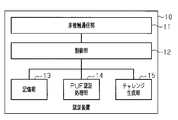
- the authentication system includes an authentication device 10 and an information processing device 20.
- An example of the authentication device 10 is an IC reader / writer, and an example of the information processing device 20 is an IC tag.
- the authentication device 10 includes a non-contact communication unit 11, a control unit 12, a storage unit 13, a PUF authentication processing unit 14 that is an example of an authentication processing unit, and a challenge generation unit 15. I have.
- a challenge response authentication method using a PUF Physical Unclonable Function
- the characteristics of the IC extracted by the PUF are physical characteristics that are caused by variations and the like that occur during the manufacture of the IC, and are characteristics that are difficult to replicate that differ for each individual IC.
- a PUF circuit which is a specific circuit that outputs a different value for each individual IC, is formed in the IC, and the individual identification of the IC is performed using the output value of the PUF circuit.
- a delay time difference detection type arbiter PUF that generates a response from information on a delay time difference between signals generated in the PUF circuit is used.
- the non-contact communication unit 11 has a function as an interface for the authentication device 10 to perform non-contact communication with the information processing device 20, and functions as a challenge transmission unit and a response reception unit.
- the control unit 12 controls communication and information processing, and functions as a determination unit, a registration unit, and an output unit.
- the challenge generation unit 15 generates a challenge used for authentication.
- the challenge is random data that changes every time it is generated, and is typically a random number. When a 32-bit challenge is used for authentication, there are about 4.3 billion random numbers that the challenge generator 15 can generate as a challenge.
- the storage unit 13 stores challenges generated by the challenge generation unit 15 in the past. As illustrated in FIG. 3, the challenge generated by the challenge generation unit 15 in the past may be stored in a state associated with the ID of the information processing apparatus 20 that is the transmission destination of the challenge.
- the ID of the information processing device 20 is identification information of the information processing device 20 and is assigned to each information processing device 20.
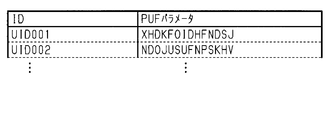
- the storage unit 13 When a challenge response authentication method using PUF is used, the storage unit 13 includes an ID of the information processing device 20 and input data in a PUF circuit included in the information processing device 20 as illustrated in FIG.
- the parameters indicating the characteristics of the correlation with the output data are stored in association with each other.
- the parameter is an example of PUF information that is information indicating the characteristics of the PUF.
- the PUF authentication processing unit 14 functions as a comparison response generating unit. Specifically, when the PUF authentication processing unit 14 receives a response from the information processing device 20, the PUF authentication processing unit 14 reads the parameter associated with the ID of the information processing device 20 from the storage unit 13 and transmits the challenge to the information processing device 20. A comparison response is generated from the read parameters. Then, the PUF authentication processing unit 14 compares the generated comparison response with the response received from the information processing apparatus 20, and determines whether or not the comparison response matches the received response.
- the authentication device 10 can start processing. Examples of the process started by the authentication device 10 include reading and writing of data included in the information processing device 20. Specifically, processing such as ID management and money and point management is performed. As a result of the comparison, when the two responses do not match, the authentication fails. Note that, when the degree of coincidence between two responses is equal to or greater than a predetermined threshold, the PUF authentication processing unit 14 may determine that the two responses coincide.
- the authentication device 10 is not limited to an IC reader / writer, and may be a mobile terminal such as a smartphone or a tablet personal computer, or may be a stationary device. Further, the authentication device 10 may perform contact-type communication with the information processing device 20, and in this case, the authentication device 10 is in place of the non-contact communication unit 11 or in addition to the non-contact communication unit 11.
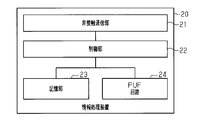
- the information processing apparatus 20 includes a non-contact communication unit 21, a control unit 22, a storage unit 23, and the above-described PUF circuit 24.
- the non-contact communication unit 21 has a function as an interface for the information processing device 20 to perform non-contact communication with the authentication device 10 and functions as a challenge reception unit and a response transmission unit.
- the control unit 22 controls communication and information processing, and functions as a response generation unit.
- the storage unit 23 stores data such as the ID of the information processing apparatus 20 described above.
- the PUF circuit 24 outputs an output value unique to each information processing apparatus 20. By using this output value, the individual identification of the IC becomes possible, and as a result, the individual identification of the information processing apparatus 20 becomes possible.
- the information processing apparatus 20 is not limited to an IC tag, and may be an IC card, a mobile terminal such as a smartphone, a mobile phone, or a tablet personal computer on which an IC is mounted. Further, the authentication device 10 may perform contact communication with the information processing device 20. In this case, the information processing device 20 replaces the non-contact communication unit 21 or in addition to the non-contact communication unit 21, A contact communication unit having a function as an interface for performing contact type communication is provided.
- step S101 communication is started when the information processing apparatus 20 is brought close to the authentication apparatus 10 or when the information processing apparatus 20 is connected to the authentication apparatus 10 (step S101).
- the authentication device 10 requests the information processing device 20 for the ID of the information processing device 20 (step S102).
- the information processing apparatus 20 transmits the ID of the information processing apparatus 20 to the authentication apparatus 10 in response to a request from the authentication apparatus 10 (step S103).
- the challenge generation unit 15 of the authentication device 10 generates a challenge (step S104). And the control part 12 of the authentication apparatus 10 confirms whether the produced
- step S104 the authentication apparatus 10 generates a challenge again and generates it as the process of step S105.
- step S104 the authentication apparatus 10 repeats the process of step S104 and step S105 until the challenge different from the challenge produced
- the authentication device 10 compares each challenge included in the generated challenge list with the challenge generated this time, and if the challenge generated this time does not match any of the generated challenges.
- the challenge generated this time may be regarded as an unused challenge.
- the authentication device 10 may confirm the challenge for each ID of the information processing device 20. That is, the authentication device 10 received from the information processing device 20 in the process of step S103, that is, the ID of the information processing device 20 to be authenticated this time among the generated challenges stored in the storage unit 13. Each challenge associated with the same ID as the ID is compared with the challenge generated this time. If there is no generated challenge that matches the challenge generated this time as a result of the comparison, a challenge that matches the challenge generated this time is among the generated challenges associated with the IDs of the other information processing devices 20. Even if there is, the authentication device 10 regards the challenge generated this time as an unused challenge.
- the authentication device 10 may erase the generated challenge stored in the storage unit 13 when there is no unused challenge or when a predetermined period has elapsed. For example, when the assumed usage period of the IC tag as the information processing device 20 is one year, the control unit 12 of the authentication device 10 deletes the challenge from the storage unit 13 after one year has elapsed since the challenge was generated. To do.
- the start of measurement in a predetermined period is not limited to the time when a challenge is generated, but may be set as appropriate.
- the control unit 22 of the information processing device 20 When the non-contact communication unit 21 of the information processing device 20 receives a challenge from the authentication device 10, the control unit 22 of the information processing device 20 generates a response using the received challenge (step S107).
- the information processing apparatus 20 When an authentication method using PUF is used, the information processing apparatus 20 generates a response using an output value from the PUF circuit 24 obtained using the received challenge as an input value.
- the response generated by the information processing device 20 is transmitted from the non-contact communication unit 21 of the information processing device 20 to the authentication device 10 (step S108).
- the PUF authentication processing unit 14 of the authentication device 10 performs authentication using the response received from the information processing device 20 by the non-contact communication unit 11 of the authentication device 10 (step S109).
- the storage unit 13 of the authentication device 10 stores the PUF parameters stored in association with the same ID as the ID received from the information processing device 20 in the process of step S103, and the information processing device 20.
- a comparison response is generated from the challenge sent to.
- the authentication device 10 compares the generated comparison response with the response received from the information processing device 20, and determines whether or not the comparison response matches the received response.
- step S110 When the two responses match, the authentication is successful, and the authentication apparatus 10 starts processing (step S110).
- the two responses do not match as a result of the comparison, the authentication fails.
- the authentication device 10 authenticates the information processing device 20
- so-called mutual authentication in which the information processing device 20 also authenticates the authentication device 10 may be performed.
- a known method can be used as the authentication method of the authentication device 10 by the information processing device 20.
- the authentication device 10 is an example of a first device
- the information processing device 20 is an example of a second device. Then, the first device determines whether the challenge generated this time matches the generated challenge.
- the authentication system includes an authentication device 10, an information processing device 20, and a relay device 30.
- An example of the authentication device 10 is a server
- an example of the information processing device 20 is an IC tag
- an example of the relay device 30 is an IC reader / writer.
- the authentication device 10 and the relay device 30 are connected to a network NW such as the Internet.
- the authentication device 10 can transmit one challenge to the relay device 30, and the relay device 30 can transmit the challenge to a plurality of information processing devices 20. Therefore, one challenge can be applied to a plurality of information processing devices 20 without the authentication device 10 generating a challenge for each information processing device 20.
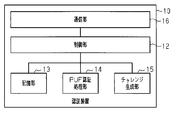
- the authentication device 10 includes a communication unit 16, a control unit 12 having the same configuration as that of the first embodiment, a storage unit 13, a PUF authentication processing unit 14 that is an example of an authentication processing unit, And a challenge generation unit 15.
- a communication unit 16 the authentication device 10 includes a communication unit 16, a control unit 12 having the same configuration as that of the first embodiment, a storage unit 13, a PUF authentication processing unit 14 that is an example of an authentication processing unit, And a challenge generation unit 15.
- a challenge response authentication method using PUF is used in the second embodiment. Only the information processing device 20 may have a PUF, or each of the information processing device 20 and the relay device 30 may have a PUF.
- the communication unit 16 has a function as an interface for the authentication device 10 to communicate with the relay device 30, and functions as a challenge transmission unit and a response reception unit.
- the control unit 12 controls communication and information processing, and functions as a determination unit, a registration unit, and an output unit.
- the challenge generation unit 15 generates a challenge used for authentication.
- the storage unit 13 stores challenges generated by the challenge generation unit 15 in the past.
- Challenges generated by the challenge generation unit 15 in the past may be stored in a state associated with the ID of the information processing apparatus 20 that is the transmission destination of the challenge.
- the challenge generated by the challenge generation unit 15 in the past may be stored in a state associated with the ID of the relay device 30 that is the transmission destination of the challenge.
- the ID of the relay device 30 is identification information of the relay device 30 and is assigned to each relay device 30.
- the storage unit 13 When the challenge response authentication method using the PUF of the information processing apparatus 20 is used, the storage unit 13 includes an ID of the information processing apparatus 20 and a parameter indicating the characteristics of the PUF of the information processing apparatus 20. It is stored in the associated state.
- the PUF authentication processing unit 14 functions as a comparison response generating unit. Specifically, when receiving a response from the information processing device 20 via the relay device 30, the PUF authentication processing unit 14 reads a parameter associated with the ID of the information processing device 20 from the storage unit 13, and relays the relay device. A comparison response is generated from the challenge transmitted to the information processing apparatus 20 via 30 and the read parameters. Then, the PUF authentication processing unit 14 compares the generated comparison response with the response received from the information processing device 20 via the relay device 30, and determines whether or not the comparison response matches the received response. To do.
- the PUF authentication processing unit 14 may determine that the two responses coincide.
- the storage unit 13 stores the ID of the relay device 30 and the PUF of the relay device 30.
- the parameter indicating the feature is stored in a state of being associated.
- the PUF authentication processing unit 14 When the PUF authentication processing unit 14 receives a response from the relay device 30, the PUF authentication processing unit 14 reads the parameter associated with the ID of the relay device 30 from the storage unit 13, the challenge transmitted to the relay device 30, and the read parameter A response for comparison is generated from the above. Then, the PUF authentication processing unit 14 compares the generated comparison response with the response received from the relay device 30, and determines whether or not the comparison response matches the received response.
- the PUF authentication processing unit 14 may determine that the two responses coincide.
- the authentication device 10 is not limited to a server, and may be a mobile terminal such as a smartphone or a tablet personal computer.
- the information processing apparatus 20 has the same configuration as the information processing apparatus 20 of the first embodiment shown in FIG. However, the non-contact communication unit 21 performs non-contact communication with the relay device 30. Note that the relay device 30 may perform contact communication with the information processing device 20, and in this case, the information processing device 20 includes a contact communication unit.
- the relay device 30 includes a non-contact communication unit 31, a control unit 32, a storage unit 33, a PUF circuit 34, and a communication unit 35.
- the non-contact communication unit 31 has a function as an interface for the relay device 30 to perform non-contact communication with the information processing device 20, and functions as a relay challenge transmission unit and a relay response reception unit.
- the control unit 32 controls communication and information processing, and functions as a relay response generation unit.
- the storage unit 33 stores data such as the ID of the relay device 30 described above.
- the PUF circuit 34 outputs a unique output value for each relay device 30. By using this output value, the individual identification of the IC becomes possible, and as a result, the individual identification of the relay device 30 becomes possible.
- the authentication method using the PUF of the relay device 30 is used, whereby the relay device 30 can be authenticated. Specifically, when an unauthorized relay device 30 is used, it can be detected that the relay device 30 is an unauthorized relay device 30. Note that if the authentication of the relay device 30 using the PUF is not performed, the relay device 30 may not include the PUF circuit 34.
- the communication unit 35 has a function as an interface for the relay device 30 to communicate with the authentication device 10, and functions as a relay challenge reception unit and a relay response transmission unit.
- the relay device 30 is not limited to an IC reader / writer, and may be a mobile terminal such as a smartphone or a tablet personal computer, or may be a stationary device.
- the relay device 30 may perform contact-type communication with the information processing device 20.
- the relay device 30 is in contact with the non-contact communication unit 31 instead of or in addition to the non-contact communication unit 31.
- a contact communication unit having a function as an interface for performing type communication.
- step S ⁇ b> 201 communication is started when the information processing device 20 is brought close to the relay device 30 or when the information processing device 20 is connected to the relay device 30.
- the relay device 30 requests the information processing device 20 for the ID of the information processing device 20 (step S202).
- the information processing device 20 transmits the ID of the information processing device 20 to the relay device 30 in response to a request from the relay device 30 (step S203).
- the relay device 30 transmits the ID of the information processing device 20 received from the information processing device 20 and the ID of the relay device 30 to the authentication device 10 (step S204).
- the processes of step S201 to step S204 are repeated by the number of information processing devices 20.
- the challenge generation unit 15 of the authentication device 10 generates a challenge (step S205). And the control part 12 of the authentication apparatus 10 confirms whether the produced
- step S205 the authentication apparatus 10 generates a challenge again and generates it as the process of step S206.
- step S205 the authentication apparatus 10 repeats the process of step S205 and step S206 until the challenge different from the challenge produced
- the authentication device 10 may compare each challenge included in the generated challenge list with the challenge generated this time.
- the authentication device 10 may confirm the challenge for each ID of the information processing device 20 or each ID of the relay device 30. Note that security is enhanced in the configuration in which each challenge included in the generated challenge list is compared with the challenge generated this time.
- the authentication device 10 may erase the generated challenge stored in the storage unit 13 when there is no unused challenge or when a predetermined period has elapsed. For example, when the assumed usage period of the IC tag as the information processing device 20 is one year, the control unit 12 of the authentication device 10 deletes the challenge from the storage unit 13 after one year has elapsed since the challenge was generated. To do. Note that the start of measurement in a predetermined period is not limited to the time when a challenge is generated, but may be set as appropriate.
- the relay device 30 When the communication unit 35 of the relay device 30 receives the challenge from the authentication device 10, the relay device 30 stores the received challenge in the storage unit 33, thereby saving the challenge (step S208). Then, the non-contact communication unit 31 of the relay device 30 transmits the challenge received from the authentication device 10 to the information processing device 20 (step S209). When there are a plurality of information processing apparatuses 20, the relay apparatus 30 transmits a challenge to each information processing apparatus 20.
- the control unit 22 of the information processing device 20 When the non-contact communication unit 21 of the information processing device 20 receives a challenge from the relay device 30, the control unit 22 of the information processing device 20 generates a response using the received challenge (step S210). When an authentication method using PUF is used, the information processing apparatus 20 generates a response using an output value from the PUF circuit 24 obtained using the received challenge as an input value.
- the response generated by the information processing device 20 is transmitted from the non-contact communication unit 21 of the information processing device 20 to the relay device 30 (step S211).
- each of the information processing devices 20 generates a response and transmits the response to the relay device 30.
- control unit 32 of the relay device 30 generates a response using the challenge stored in step S208 (step S212).
- the relay device 30 When authentication of the relay device 30 using PUF is performed, the relay device 30 generates a response using an output value from the PUF circuit 34 obtained by using the saved challenge as an input value.
- the communication unit 35 of the relay device 30 transmits the response generated by the information processing device 20 and the response generated by the relay device 30 to the authentication device 10 (step S213).
- the PUF authentication processing unit 14 of the authentication device 10 performs authentication using the two responses received from the relay device 30 by the communication unit 16 of the authentication device 10 (step S214).
- the storage unit 13 of the authentication device 10 stores the PUF parameter stored in association with the same ID as the ID of the information processing device 20 received in step S204, and the information processing device 20.
- a comparison response is generated from the challenge sent to.
- the authentication device 10 compares the generated comparison response with the response generated by the information processing device 20, and determines whether or not the comparison response matches the response generated by the information processing device 20.
- the storage unit 13 of the authentication device 10 stores the PUF parameter stored in association with the same ID as the relay device 30 received in the process of step S204, the challenge transmitted to the relay device 30, and Generate response for comparison. Then, the authentication device 10 compares the generated comparison response with the response generated by the relay device 30, and determines whether or not the comparison response matches the response generated by the relay device 30.
- the authentication device 10 transmits the authentication result to the relay device 30 (step S215).
- the relay apparatus 30 starts a process (step S216). Examples of the process started by the relay device 30 include reading and writing of data included in the information processing device 20.
- the example in which the relay device 30 is authenticated that is, the example in which the relay device 30 generates a response has been described.
- the relay device 30 does not generate a response, and the relay device 30 Authentication may not be performed.
- authentication is performed using only the response generated by the information processing apparatus 20.
- use of the unauthorized relay device 30 can be suppressed, so that security is improved.
- the authentication device 10 may first authenticate the relay device 30 and may authenticate the information processing device 20 when the authentication of the relay device 30 is successful.
- the authentication device 10 authenticates the relay device 30 and the information processing device 20.
- the relay device 30 and the information processing device 20 also authenticate the authentication device 10, so-called mutual authentication. May be performed.
- the authentication method of the authentication device 10 by the relay device 30 and the information processing device 20 a known method can be used.
- the authentication device 10 is an example of a first device
- the information processing device 20 is an example of a second device. Then, the first device determines whether the challenge generated this time matches the generated challenge.
- the authentication system includes a communication device 40 that is, for example, an IC reader / writer, and an information processing device 20 that is, for example, an IC tag.
- a communication device 40 that is, for example, an IC reader / writer
- an information processing device 20 that is, for example, an IC tag.
- the communication device 40 includes a non-contact communication unit 41, a control unit 42, and a storage unit 43.
- the non-contact communication unit 41 has a function as an interface for the communication device 40 to perform non-contact communication with the information processing device 20, and functions as a challenge reception unit and a response transmission unit.
- the control unit 42 controls communication and information processing, and functions as a determination unit, a registration unit, an output unit, and a response generation unit.
- the storage unit 43 stores a challenge that the communication device 40 has received from the information processing device 20 in the past, that is, a challenge that the information processing device 20 has generated in the past. Challenges generated in the past by the information processing apparatus 20 may be stored in a state associated with the ID of the information processing apparatus 20 that is the generation source of the challenge. When a challenge response authentication method using PUF is used, the storage unit 43 is associated with an ID of the information processing device 20 and a parameter indicating the PUF characteristic of the information processing device 20. It is remembered.
- the communication device 40 is not limited to an IC reader / writer, and may be a mobile terminal such as a smartphone or a tablet personal computer, or may be a stationary device. Further, the communication device 40 may perform contact-type communication with the information processing device 20, and in this case, the communication device 40 is in place of the non-contact communication unit 41 or in addition to the non-contact communication unit 41.
- the information processing apparatus 20 includes a non-contact communication unit 21, a control unit 22, a storage unit 23, a PUF circuit 24, a PUF authentication processing unit 25 that is an example of an authentication processing unit, And a challenge generation unit 26.
- the non-contact communication unit 21 has a function as an interface for the information processing device 20 to perform non-contact communication with the communication device 40, and functions as a challenge transmission unit and a response reception unit.
- the control unit 22 controls communication and information processing.
- the storage unit 23 stores data such as the ID of the information processing apparatus 20.
- the PUF circuit 24 outputs a unique output value for each information processing apparatus 20.
- the challenge generation unit 26 generates a challenge used for authentication.
- the PUF authentication processing unit 25 functions as a comparison response generation unit, and generates a comparison response from the challenge transmitted to the communication device 40 using the PUF circuit 24. Then, the PUF authentication processing unit 25 compares the generated comparison response with the response received from the communication device 40, and determines whether or not the comparison response matches the received response.
- the PUF authentication processing unit 25 may determine that the two responses coincide.
- the information processing apparatus 20 is not limited to an IC tag, and may be an IC card, a mobile terminal such as a smartphone, a mobile phone, or a tablet personal computer on which an IC is mounted. Further, the communication device 40 may perform contact type communication with the information processing device 20. In this case, the information processing device 20 replaces the non-contact communication unit 21 or in addition to the non-contact communication unit 21. A contact communication unit having a function as an interface for performing contact type communication is provided.
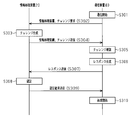
- step S ⁇ b> 301 communication is started when the information processing apparatus 20 is brought close to the communication apparatus 40 or when the information processing apparatus 20 is connected to the communication apparatus 40.
- the communication device 40 requests the information processing device 20 to transmit the ID and challenge of the information processing device 20 (step S302).
- the challenge generation unit 26 of the information processing device 20 Upon receiving a request from the communication device 40, the challenge generation unit 26 of the information processing device 20 generates a challenge (step S303). Then, the non-contact communication unit 21 of the information processing device 20 transmits the generated challenge and the ID of the information processing device 20 to the communication device 40 (step S304).
- the control unit 42 of the communication device 40 confirms whether or not the challenge received by the non-contact communication unit 41 of the communication device 40 from the information processing device 20 is the same as the challenge generated in the past (step). S305). Specifically, the communication device 40 compares the list of generated challenges, which are challenges generated up to the previous time stored in the storage unit 43, with the challenge generated this time by the information processing apparatus 20. As a result of the comparison, when the challenge generated this time does not match the generated challenge, the control unit 42 of the communication device 40 outputs the challenge generated this time as an unused challenge. Further, the control unit 42 of the communication device 40 adds the challenge generated this time to the list of generated challenges by causing the storage unit 13 to store the challenge as a new generated challenge.
- step S302 when the challenge generated this time matches the challenge generated up to the previous time, the process returns to step S302, and the communication device 40 requests the information processing device 20 to transmit the challenge again. Then, generation of a challenge in the information processing device 20 and confirmation of the challenge in the communication device 40 are repeated. In this way, the processes in steps S302 to S305 are repeated until a challenge different from the challenge generated in the past is generated.
- the communication device 40 may compare each challenge included in the generated challenge list with the challenge generated this time, or confirm the challenge for each ID of the information processing device 20. Also good.
- the communication device 40 may erase the generated challenge stored in the storage unit 43 when there is no unused challenge or when a predetermined period has elapsed. For example, when the assumed usage period of the IC tag as the information processing device 20 is one year, the control unit 42 of the communication device 40 deletes the challenge from the storage unit 43 after one year has elapsed since the challenge was generated. To do. Note that the start of measurement in a predetermined period is not limited to the time when a challenge is generated, but may be set as appropriate.
- control unit 42 of the communication device 40 generates a response using the unused challenge (step S306).
- the storage unit 43 of the communication device 40 stores the PUF parameters stored in association with the same ID as the information processing device 20 received in the process of step S304, the unused challenge, and the like. Generate response from.
- the non-contact communication part 41 of the communication apparatus 40 transmits the produced
- the PUF authentication processing unit 25 of the information processing device 20 performs authentication using the response received from the communication device 40 by the non-contact communication unit 21 of the information processing device 20 (step S308). Specifically, the information processing device 20 generates a comparison response using the challenge transmitted to the communication device 40. When the authentication method using the PUF is used, the information processing apparatus 20 generates a response for comparison using the output value from the PUF circuit 24 obtained by using the challenge transmitted to the communication apparatus 40 as an input value. To do. Then, the information processing device 20 compares the comparison response with the response received from the communication device 40, and determines whether or not the comparison response matches the received response.
- step S309 the authentication is successful, and the information processing apparatus 20 transmits the authentication result to the communication apparatus 40 (step S309). And the communication apparatus 40 starts a process (step S310). Examples of processing that the communication device 40 starts include reading and writing data included in the information processing device 20. As a result of the comparison, when the two responses do not match, the authentication fails.
- the information processing apparatus 20 performs authentication has been described.
- mutual authentication may be performed by the communication apparatus 40 also performing authentication.
- the information processing device 20 is an example of a first device
- the communication device 40 is an example of a second device. Then, the second device determines whether the challenge generated this time matches the generated challenge.
- the above embodiment can be implemented with the following modifications. -In 3rd Embodiment, it may replace with the communication apparatus 40 and the information processing apparatus 20 may confirm a challenge.
- a challenge generated in the past by the information processing apparatus 20 is stored in the storage unit 23 of the information processing apparatus 20. Since the generated challenge stored in the storage unit 23 is only a challenge generated in the past in the information processing apparatus 20, the generated challenge needs to be stored in association with the ID of the information processing apparatus 20. Absent.
- the information processing device 20 generates a challenge, confirms the challenge, and transmits the challenge output as an unused challenge to the communication device 40. Then, the communication device 40 generates a response using the unused challenge, and transmits the generated response to the information processing device 20. Thereafter, the information processing apparatus 20 performs authentication using the response received from the communication apparatus 40 and the comparison response generated by the information processing apparatus 20.
- the information processing device 20 is an example of a first device
- the communication device 40 is an example of a second device. Then, the first device determines whether the challenge generated this time matches the generated challenge.
- transmission and reception of challenges and responses may be performed via the relay device 30 as in the second embodiment.
- the information processing apparatus 20 transmits a challenge to the communication apparatus 40 via the relay apparatus 30, and the communication apparatus 40 uses the unused challenge after confirming the challenge. Generate a response.
- the communication device 40 transmits a response to the information processing device 20 via the relay device 30, and the information processing device 20 receives the response received from the communication device 40 and the comparison response generated by the information processing device 20.
- the non-contact communication unit 31 of the relay device 30 functions as a relay challenge reception unit and a relay response transmission unit
- the communication unit 35 of the relay device 30 functions as a relay challenge transmission unit and a relay response reception unit.
- the relay device 30 may store the challenge, and the authentication of the relay device 30 may be performed by transmitting a response generated using the challenge to the information processing device 20.
- the information processing apparatus 20 may confirm the challenge.
- the challenge generated by the authentication device 10 in the past is stored in the storage unit 23 of the information processing device 20.
- the authentication device 10 transmits the generated challenge to the information processing device 20, and after confirming the challenge, the information processing device 20 generates a response using the unused challenge. .
- the information processing apparatus 20 transmits a response to the authentication apparatus 10, and the authentication apparatus 10 performs authentication using the response received from the information processing apparatus 20 and the comparison response generated by the authentication apparatus 10.
- the authentication device 10 is an example of a first device
- the information processing device 20 is an example of a second device. Then, the second device determines whether the challenge generated this time matches the generated challenge.
- the authentication method used in the authentication system is not limited to the challenge response authentication method using PUF, and may be a method of generating a response from the challenge using a predetermined authentication algorithm.
Landscapes
- Engineering & Computer Science (AREA)
- Computer Security & Cryptography (AREA)
- Computer Networks & Wireless Communication (AREA)
- Signal Processing (AREA)
- Theoretical Computer Science (AREA)
- General Engineering & Computer Science (AREA)
- Computer Hardware Design (AREA)
- Physics & Mathematics (AREA)
- Software Systems (AREA)
- General Physics & Mathematics (AREA)
- Computing Systems (AREA)
- Power Engineering (AREA)
- Telephone Function (AREA)
- Lock And Its Accessories (AREA)
Abstract
Description
上記装置は、チャレンジを生成するチャレンジ生成部であって、前記チャレンジ生成部の生成したチャレンジが前記今回生成されたチャレンジである前記チャレンジ生成部と、前記出力部から出力された前記未使用チャレンジを外部の装置に送信するチャレンジ送信部と、前記外部の装置から、前記未使用チャレンジを用いて生成されたレスポンスを受信するレスポンス受信部と、前記未使用チャレンジと、前記外部の装置から受信したレスポンスとを用いて認証を行う認証処理部と、をさらに備えてもよい。
上記認証システムにおいて、前記第2の装置は、PUFを備え、前記レスポンス生成部は、前記PUFを利用して、前記未使用チャレンジを用いて前記レスポンスを生成し、前記第1の装置は、前記第2の装置が有する前記PUFの特徴を示すPUF情報を記憶する記憶部を備え、前記認証処理部は、前記未使用チャレンジと、前記PUF情報と、前記第2の装置から受信したレスポンスとを用いて認証を行ってもよい。
以下、第1の実施形態について、図面を参照しながら説明する。
図1に示されるように、認証システムは、認証装置10と情報処理装置20とを備える。認証装置10の一例は、ICリーダー/ライターであり、情報処理装置20の一例は、ICタグである。
チャレンジ生成部15は、認証に用いるチャレンジを生成する。チャレンジは、生成の度に変わるランダムなデータであって、典型的には乱数である。なお、認証に32bitのチャレンジが用いられる場合、チャレンジ生成部15がチャレンジとして生成可能な乱数は、約43億通りである。
また、認証装置10が情報処理装置20と接触型の通信を行ってもよく、この場合、認証装置10は、非接触通信部11に代えて、あるいは、非接触通信部11に加えて、接触型の通信を行うためのインタフェースとしての機能を有する接触通信部を備える。
非接触通信部21は、情報処理装置20が認証装置10と非接触型の通信を行うためのインタフェースとしての機能を有し、チャレンジ受信部およびレスポンス送信部として機能する。
記憶部23には、上述の情報処理装置20のID等のデータが記憶されている。
PUF回路24は、上述のように、情報処理装置20毎に特有な出力値を出力する。この出力値を利用することによって、ICの個体識別が可能となり、結果として、情報処理装置20の個体識別が可能となる。
また、認証装置10が情報処理装置20と接触型の通信を行ってもよく、この場合、情報処理装置20は、非接触通信部21に代えて、あるいは、非接触通信部21に加えて、接触型の通信を行うためのインタフェースとしての機能を有する接触通信部を備える。
図6に示されるように、まず、認証装置10に情報処理装置20が近づけられる、または、認証装置10に情報処理装置20が接続されることによって、通信が開始される(ステップS101)。通信が開始されると、認証装置10は、情報処理装置20に、情報処理装置20のIDを要求する(ステップS102)。情報処理装置20は、認証装置10の要求に応じ、認証装置10に情報処理装置20のIDを送信する(ステップS103)。
なお、認証装置10は、未使用チャレンジがない場合、または、所定の期間が経過した場合に、記憶部13に記憶されている生成済みチャレンジを消去してもよい。例えば、情報処理装置20としてのICタグの想定使用期間が1年である場合に、認証装置10の制御部12は、チャレンジが生成されてから1年経過後に、当該チャレンジを記憶部13から消去する。なお、所定の期間の計測の始期は、チャレンジの生成時に限らず、適宜設定されればよい。
認証装置10のPUF認証処理部14は、認証装置10の非接触通信部11が情報処理装置20から受信したレスポンスを用いて認証を行う(ステップS109)。具体的には、認証装置10の記憶部13は、ステップS103の処理にて情報処理装置20から受信したIDと同一のIDと対応付けられて記憶されているPUFのパラメータと、情報処理装置20に送信したチャレンジとから比較用レスポンスを生成する。そして、認証装置10は、生成した比較用レスポンスと、情報処理装置20から受信したレスポンスとを比較し、比較用レスポンスが受信したレスポンスと一致するか否かを判断する。
以下、第2の実施形態について、図面を参照しながら説明する。なお、第1の実施形態と同様の構成については同じ符号を付してその説明を省略する。
制御部12は、通信や情報処理を制御し、判断部、登録部、および、出力部として機能する。
記憶部13には、チャレンジ生成部15が過去に生成したチャレンジが記憶されている。チャレンジ生成部15が過去に生成したチャレンジは、そのチャレンジの送信先である情報処理装置20のIDと対応付けられた状態で記憶されていてもよい。さらに、チャレンジ生成部15が過去に生成したチャレンジは、そのチャレンジの送信先である中継装置30のIDと対応付けられた状態で記憶されていてもよい。中継装置30のIDは、中継装置30の識別情報であって、中継装置30ごとに割り当てられている。
情報処理装置20は、図5に示された第1の実施形態の情報処理装置20と同様の構成を有する。ただし、非接触通信部21は、中継装置30と非接触型の通信を行う。なお、中継装置30が情報処理装置20と接触型の通信を行ってもよく、この場合、情報処理装置20は、接触通信部を備える。
非接触通信部31は、中継装置30が情報処理装置20と非接触型の通信を行うためのインタフェースとしての機能を有し、中継チャレンジ送信部および中継レスポンス受信部として機能する。
記憶部33には、上述の中継装置30のID等のデータが記憶されている。
PUF回路34は、上述のように、中継装置30毎に特有な出力値を出力する。この出力値を利用することによって、ICの個体識別が可能となり、結果として、中継装置30の個体識別が可能となる。中継装置30の有するPUFを利用した認証方式が用いられることによって、中継装置30の認証を行うことが可能となる。具体的には、不正な中継装置30が用いられた場合に、その中継装置30が不正な中継装置30であることを検出することができる。なお、PUFを利用した中継装置30の認証が行われない場合には、中継装置30は、PUF回路34を備えなくてもよい。
なお、中継装置30は、ICリーダー/ライターに限らず、スマートフォンやタブレットパソコン等の携帯端末であってもよいし、設置型の装置であってもよい。
図10に示されるように、まず、中継装置30に情報処理装置20が近づけられる、または、中継装置30に情報処理装置20が接続されることによって、通信が開始される(ステップS201)。通信が開始されると、中継装置30は、情報処理装置20に、情報処理装置20のIDを要求する(ステップS202)。情報処理装置20は、中継装置30の要求に応じ、中継装置30に情報処理装置20のIDを送信する(ステップS203)。
認証装置10のPUF認証処理部14は、認証装置10の通信部16が中継装置30から受信した2つのレスポンスを用いて認証を行う(ステップS214)。具体的には、認証装置10の記憶部13は、ステップS204の処理にて受信した情報処理装置20のIDと同一のIDと対応付けられて記憶されているPUFのパラメータと、情報処理装置20に送信したチャレンジとから比較用レスポンスを生成する。そして、認証装置10は、生成した比較用レスポンスと、情報処理装置20が生成したレスポンスとを比較し、比較用レスポンスが、情報処理装置20が生成したレスポンスと一致するか否かを判断する。
こうした構成によっても、既に認証に使用されたチャレンジが、再び認証に使用されることが起こらないため、使用されたチャレンジとレスポンスとの組が傍受あるいは盗聴された場合であっても、高いセキュリティを実現することができる。
以下、第3の実施形態について、第1の実施形態との相違点を中心に、図面を参照しながら説明する。なお、第1の実施形態と同様の構成については同じ符号を付してその説明を省略する。
非接触通信部41は、通信装置40が情報処理装置20と非接触型の通信を行うためのインタフェースとしての機能を有し、チャレンジ受信部およびレスポンス送信部として機能する。
記憶部43には、通信装置40が情報処理装置20から過去に受信したチャレンジ、すなわち、情報処理装置20が過去に生成したチャレンジが記憶されている。情報処理装置20が過去に生成したチャレンジは、そのチャレンジの生成元である情報処理装置20のIDと対応付けられた状態で記憶されていてもよい。また、PUFを利用したチャレンジレスポンス認証方式が用いられる場合、記憶部43には、情報処理装置20のIDと、その情報処理装置20が有するPUFの特徴を示すパラメータとが対応付けられた状態で記憶されている。
また、通信装置40が情報処理装置20と接触型の通信を行ってもよく、この場合、通信装置40は、非接触通信部41に代えて、あるいは、非接触通信部41に加えて、接触型の通信を行うためのインタフェースとしての機能を有する接触通信部を備える。
記憶部23には、情報処理装置20のID等のデータが記憶されている。
PUF回路24は、情報処理装置20毎に特有な出力値を出力する。
PUF認証処理部25は、比較用レスポンス生成部として機能し、通信装置40に送信したチャレンジからPUF回路24を用いて比較用レスポンスを生成する。そして、PUF認証処理部25は、生成した比較用レスポンスと、通信装置40から受信したレスポンスとを比較し、比較用レスポンスが受信したレスポンスと一致するか否かを判断する。
また、通信装置40が情報処理装置20と接触型の通信を行ってもよく、この場合、情報処理装置20は、非接触通信部21に代えて、あるいは、非接触通信部21に加えて、接触型の通信を行うためのインタフェースとしての機能を有する接触通信部を備える。
図13に示されるように、まず、通信装置40に情報処理装置20が近づけられる、または、通信装置40に情報処理装置20が接続されることによって、通信が開始される(ステップS301)。通信が開始されると、通信装置40は、情報処理装置20に、情報処理装置20のIDとチャレンジの送信を要求する(ステップS302)。
第3の実施形態では、情報処理装置20が第1の装置の一例であり、通信装置40が、第2の装置の一例である。そして、第2の装置が、今回生成されたチャレンジが生成済みチャレンジと一致するか否かの判断を行う。
上記実施形態は、以下のように変更して実施することが可能である。
・第3の実施形態において、通信装置40に代えて、情報処理装置20がチャレンジの確認を行ってもよい。この場合、情報処理装置20の記憶部23には、情報処理装置20が過去に生成したチャレンジが記憶されている。記憶部23に記憶されている生成済みチャレンジは、その情報処理装置20にて過去に生成されたチャレンジのみであるから、生成済みチャレンジが情報処理装置20のIDと対応付けて記憶される必要はない。こうした形態において、情報処理装置20は、チャレンジを生成した後、チャレンジの確認を行って、未使用チャレンジとして出力されたチャレンジを通信装置40に送信する。そして、通信装置40は、未使用チャレンジを用いてレスポンスを生成し、生成されたレスポンスを情報処理装置20に送信する。その後、情報処理装置20は、通信装置40から受信したレスポンスと、情報処理装置20が生成した比較用レスポンスとを用いて認証を行う。
Claims (10)
- 前回までに生成されたチャレンジである生成済みチャレンジを記憶する記憶部と、
今回生成されたチャレンジが、前記生成済みチャレンジと一致するか否かを判断する判断部と、
前記判断部が、前記今回生成されたチャレンジが前記生成済みチャレンジと一致しないと判断したとき、前記今回生成されたチャレンジを未使用チャレンジとして出力する出力部と、
前記判断部が、前記今回生成されたチャレンジが前記生成済みチャレンジと一致しないと判断したとき、前記今回生成されたチャレンジを新たな生成済みチャレンジとして前記記憶部に記憶させる登録部と、
を備える装置。 - 前記登録部は、所定の期間が経過したときに、前記生成済みチャレンジを前記記憶部から消去する
請求項1に記載の装置。 - チャレンジを生成するチャレンジ生成部であって、前記チャレンジ生成部の生成したチャレンジが前記今回生成されたチャレンジである前記チャレンジ生成部と、
前記出力部から出力された前記未使用チャレンジを外部の装置に送信するチャレンジ送信部と、
前記外部の装置から、前記未使用チャレンジを用いて生成されたレスポンスを受信するレスポンス受信部と、
前記未使用チャレンジと、前記外部の装置から受信したレスポンスとを用いて認証を行う認証処理部と、
をさらに備える請求項1または2に記載の装置。 - 外部の装置からチャレンジを受信するチャレンジ受信部と、
前記出力部から出力された前記未使用チャレンジを用いてレスポンスを生成するレスポンス生成部と、
前記レスポンスを前記外部の装置に送信するレスポンス送信部と、
をさらに備え、
前記判断部は、前記外部の装置から受信したチャレンジを、前記今回生成されたチャレンジとして使用し、前記今回生成されたチャレンジが前記生成済みチャレンジと一致するか否かの判断を行う
請求項1または2に記載の装置。 - 第1の装置と第2の装置とを備える認証システムであって、
前記第1の装置は、
チャレンジを生成するチャレンジ生成部と、
レスポンスを受信するレスポンス受信部と、
前記チャレンジと前記レスポンスとを用いて認証を行う認証処理部と、を備え、
前記第1の装置および前記第2の装置のいずれか一方は、
前回までに生成されたチャレンジである生成済みチャレンジを記憶する記憶部と、
今回生成されたチャレンジが、前記生成済みチャレンジと一致するか否かを判断する判断部と、
前記判断部が、前記今回生成されたチャレンジが前記生成済みチャレンジと一致しないと判断したとき、前記今回生成されたチャレンジを未使用チャレンジとして出力する出力部と、
前記判断部が、前記今回生成されたチャレンジが前記生成済みチャレンジと一致しないと判断したとき、前記今回生成されたチャレンジを新たな生成済みチャレンジとして前記記憶部に記憶させる登録部と、を備え、
前記第2の装置は、
前記未使用チャレンジを用いて前記レスポンスを生成するレスポンス生成部と、
前記レスポンスを送信するレスポンス送信部と、を備える
認証システム。 - 前記登録部は、所定の期間が経過したときに、前記生成済みチャレンジを前記記憶部から消去する
請求項5に記載の認証システム。 - 前記第2の装置は、
PUFを備え、
前記レスポンス生成部は、前記PUFを利用して、前記未使用チャレンジを用いて前記レスポンスを生成し、
前記第1の装置は、
前記第2の装置が有する前記PUFの特徴を示すPUF情報を記憶する記憶部を備え、
前記認証処理部は、前記未使用チャレンジと、前記PUF情報と、前記第2の装置から受信したレスポンスとを用いて認証を行う
請求項5または6に記載の認証システム。 - 前記第1の装置は、
PUFを備え、
前記認証処理部は、前記PUFを利用して、前記認証を行い、
前記第2の装置は、
前記第1の装置が有する前記PUFの特徴を示すPUF情報を記憶する記憶部を備え、
前記レスポンス生成部は、前記未使用チャレンジと前記PUF情報とを用いて前記レスポンスを生成する
請求項5または6に記載の認証システム。 - 前記認証システムは、中継装置をさらに備え、
前記中継装置は、
前記第1の装置から前記チャレンジを受信する中継チャレンジ受信部と、
前記中継チャレンジ受信部が受信した前記チャレンジを前記第2の装置へ送信する中継チャレンジ送信部と、
前記第2の装置から前記レスポンスを受信する中継レスポンス受信部と、
前記中継レスポンス受信部が受信した前記レスポンスを前記第1の装置へ送信する中継レスポンス送信部と、を備え、
前記第1の装置は、前記中継装置を介して、前記第2の装置に前記チャレンジを送信し、
前記第2の装置は、前記中継装置を介して、前記第1の装置に前記レスポンスを送信する
請求項5~8のいずれか一項に記載の認証システム。 - 前記中継装置は、
PUFと、
前記第1の装置から受信した前記チャレンジを記憶する記憶部と、
前記中継装置の備える前記PUFを利用して、前記未使用チャレンジを用いてレスポンスを生成する中継レスポンス生成部と、を備え、
前記中継レスポンス送信部は、前記第2の装置から受信した前記レスポンスと、前記中継レスポンス生成部が生成した前記レスポンスとを、前記第1の装置に送信し、
前記第1の装置の前記認証処理部は、前記未使用チャレンジと、前記第2の装置の前記レスポンス生成部が生成した前記レスポンスと、前記中継装置の前記中継レスポンス生成部が生成した前記レスポンスと、を用いて認証を行う
請求項9に記載の認証システム。
Priority Applications (4)
| Application Number | Priority Date | Filing Date | Title |
|---|---|---|---|
| JP2015525274A JP6617556B2 (ja) | 2013-07-04 | 2014-07-03 | 装置および認証システム |
| EP14819443.4A EP3018607B1 (en) | 2013-07-04 | 2014-07-03 | Device and authentication system |
| CN201480035811.3A CN105324777A (zh) | 2013-07-04 | 2014-07-03 | 装置及认证系统 |
| US14/973,529 US10057262B2 (en) | 2013-07-04 | 2015-12-17 | Device and authentication system |
Applications Claiming Priority (2)
| Application Number | Priority Date | Filing Date | Title |
|---|---|---|---|
| JP2013-140582 | 2013-07-04 | ||
| JP2013140582 | 2013-07-04 |
Related Child Applications (1)
| Application Number | Title | Priority Date | Filing Date |
|---|---|---|---|
| US14/973,529 Continuation US10057262B2 (en) | 2013-07-04 | 2015-12-17 | Device and authentication system |
Publications (1)
| Publication Number | Publication Date |
|---|---|
| WO2015002271A1 true WO2015002271A1 (ja) | 2015-01-08 |
Family
ID=52143840
Family Applications (1)
| Application Number | Title | Priority Date | Filing Date |
|---|---|---|---|
| PCT/JP2014/067801 Ceased WO2015002271A1 (ja) | 2013-07-04 | 2014-07-03 | 装置および認証システム |
Country Status (5)
| Country | Link |
|---|---|
| US (1) | US10057262B2 (ja) |
| EP (1) | EP3018607B1 (ja) |
| JP (1) | JP6617556B2 (ja) |
| CN (1) | CN105324777A (ja) |
| WO (1) | WO2015002271A1 (ja) |
Cited By (4)
| Publication number | Priority date | Publication date | Assignee | Title |
|---|---|---|---|---|
| WO2017084895A1 (en) * | 2015-11-20 | 2017-05-26 | Intrinsic Id B.V. | Puf identifier assignment and testing method and device |
| CN108241794A (zh) * | 2016-12-27 | 2018-07-03 | 本田技研工业株式会社 | 被认证装置、通信系统、通信方法及计算机可读记录介质 |
| US10521616B2 (en) | 2017-11-08 | 2019-12-31 | Analog Devices, Inc. | Remote re-enrollment of physical unclonable functions |
| JP2022144156A (ja) * | 2021-03-18 | 2022-10-03 | グローリー株式会社 | 認証システム及び認証方法 |
Families Citing this family (5)
| Publication number | Priority date | Publication date | Assignee | Title |
|---|---|---|---|---|
| CN107493572B (zh) * | 2016-06-13 | 2021-04-02 | 上海复旦微电子集团股份有限公司 | 一种无线射频设备、认证服务器及认证方法 |
| CN107493171A (zh) * | 2016-06-13 | 2017-12-19 | 上海复旦微电子集团股份有限公司 | 无线射频设备、认证服务器及认证方法 |
| FR3068150B1 (fr) * | 2017-06-21 | 2020-02-07 | Commissariat A L'energie Atomique Et Aux Energies Alternatives | Procede de securisation de maniere constructive d'un circuit integre lors de sa realisation |
| CN112286463A (zh) * | 2020-10-30 | 2021-01-29 | 南方电网科学研究院有限责任公司 | 一种数据处理方法、装置、设备和存储介质 |
| US12041050B2 (en) * | 2022-02-16 | 2024-07-16 | International Business Machines Corporation | Wireless power transmission signal based authentication |
Citations (4)
| Publication number | Priority date | Publication date | Assignee | Title |
|---|---|---|---|---|
| JPH10247140A (ja) | 1997-03-04 | 1998-09-14 | Matsushita Electric Ind Co Ltd | 乱数生成装置 |
| JPH10322327A (ja) * | 1997-05-20 | 1998-12-04 | Enii Kk | 暗号通信システム |
| JP2007049649A (ja) * | 2005-08-12 | 2007-02-22 | Sharp Corp | 通信媒介装置、データ提供装置およびデータ提供システム |
| JP2010226603A (ja) * | 2009-03-25 | 2010-10-07 | Sony Corp | 集積回路、暗号通信装置、暗号通信システム、情報処理方法、及び暗号通信方法 |
Family Cites Families (10)
| Publication number | Priority date | Publication date | Assignee | Title |
|---|---|---|---|---|
| US7958347B1 (en) * | 2005-02-04 | 2011-06-07 | F5 Networks, Inc. | Methods and apparatus for implementing authentication |
| JP4222403B2 (ja) * | 2006-10-16 | 2009-02-12 | 沖電気工業株式会社 | 不正端末推定システム、不正端末推定装置及び通信端末装置 |
| US20110002461A1 (en) * | 2007-05-11 | 2011-01-06 | Validity Sensors, Inc. | Method and System for Electronically Securing an Electronic Biometric Device Using Physically Unclonable Functions |
| EP2174255B1 (en) * | 2007-06-14 | 2017-05-24 | Intrinsic ID B.V. | Method and device for providing digital security |
| CN101542496B (zh) * | 2007-09-19 | 2012-09-05 | 美国威诚股份有限公司 | 利用物理不可克隆功能的身份验证 |
| JP5330026B2 (ja) * | 2009-02-25 | 2013-10-30 | 株式会社エヌ・ティ・ティ・ドコモ | 登録要求システム、登録要求サーバ装置、サーバ装置の登録要求制御方法 |
| JP5499358B2 (ja) * | 2010-03-24 | 2014-05-21 | 独立行政法人産業技術総合研究所 | 認証処理方法及び装置 |
| WO2013096601A1 (en) * | 2011-12-20 | 2013-06-27 | Visa International Service Association | Familiar dynamic human challenge response test content |
| AU2013217048B2 (en) * | 2012-02-07 | 2017-03-09 | Visa International Service Association | Mobile human challenge-response test |
| US9219732B2 (en) * | 2012-12-28 | 2015-12-22 | Nok Nok Labs, Inc. | System and method for processing random challenges within an authentication framework |
-
2014
- 2014-07-03 EP EP14819443.4A patent/EP3018607B1/en active Active
- 2014-07-03 CN CN201480035811.3A patent/CN105324777A/zh active Pending
- 2014-07-03 WO PCT/JP2014/067801 patent/WO2015002271A1/ja not_active Ceased
- 2014-07-03 JP JP2015525274A patent/JP6617556B2/ja active Active
-
2015
- 2015-12-17 US US14/973,529 patent/US10057262B2/en active Active
Patent Citations (4)
| Publication number | Priority date | Publication date | Assignee | Title |
|---|---|---|---|---|
| JPH10247140A (ja) | 1997-03-04 | 1998-09-14 | Matsushita Electric Ind Co Ltd | 乱数生成装置 |
| JPH10322327A (ja) * | 1997-05-20 | 1998-12-04 | Enii Kk | 暗号通信システム |
| JP2007049649A (ja) * | 2005-08-12 | 2007-02-22 | Sharp Corp | 通信媒介装置、データ提供装置およびデータ提供システム |
| JP2010226603A (ja) * | 2009-03-25 | 2010-10-07 | Sony Corp | 集積回路、暗号通信装置、暗号通信システム、情報処理方法、及び暗号通信方法 |
Non-Patent Citations (1)
| Title |
|---|
| See also references of EP3018607A4 |
Cited By (10)
| Publication number | Priority date | Publication date | Assignee | Title |
|---|---|---|---|---|
| WO2017084895A1 (en) * | 2015-11-20 | 2017-05-26 | Intrinsic Id B.V. | Puf identifier assignment and testing method and device |
| CN108475481A (zh) * | 2015-11-20 | 2018-08-31 | 本质Id有限责任公司 | Puf标识符赋值和测试方法及设备 |
| CN108475481B (zh) * | 2015-11-20 | 2021-08-13 | 本质Id有限责任公司 | Puf标识符赋值和测试方法及设备 |
| US11429624B2 (en) | 2015-11-20 | 2022-08-30 | Intrinsic Id B.V. | Assigning device |
| US12353426B2 (en) | 2015-11-20 | 2025-07-08 | Synopsys, Inc. | Assigning device |
| CN108241794A (zh) * | 2016-12-27 | 2018-07-03 | 本田技研工业株式会社 | 被认证装置、通信系统、通信方法及计算机可读记录介质 |
| JP2018107668A (ja) * | 2016-12-27 | 2018-07-05 | 本田技研工業株式会社 | 被認証装置、通信システム、通信方法、及びプログラム |
| US10521616B2 (en) | 2017-11-08 | 2019-12-31 | Analog Devices, Inc. | Remote re-enrollment of physical unclonable functions |
| JP2022144156A (ja) * | 2021-03-18 | 2022-10-03 | グローリー株式会社 | 認証システム及び認証方法 |
| JP7624332B2 (ja) | 2021-03-18 | 2025-01-30 | グローリー株式会社 | 認証システム及び認証方法 |
Also Published As
| Publication number | Publication date |
|---|---|
| US10057262B2 (en) | 2018-08-21 |
| US20160105437A1 (en) | 2016-04-14 |
| EP3018607B1 (en) | 2020-10-14 |
| EP3018607A1 (en) | 2016-05-11 |
| EP3018607A4 (en) | 2017-03-01 |
| JPWO2015002271A1 (ja) | 2017-02-23 |
| CN105324777A (zh) | 2016-02-10 |
| JP6617556B2 (ja) | 2019-12-11 |
Similar Documents
| Publication | Publication Date | Title |
|---|---|---|
| JP6617556B2 (ja) | 装置および認証システム | |
| JP6629952B2 (ja) | モバイルアプリケーションの安全性を確保する方法および装置 | |
| US10115243B2 (en) | Near field communication system | |
| JP5959410B2 (ja) | 決済方法、これを実行する決済サーバ、これを実行するためのプログラム及びこれを実行するシステム | |
| US10237072B2 (en) | Signatures for near field communications | |
| JP6284088B2 (ja) | 1回限りのランダムキーを用いた本人確認及び盗用防止システムならびに方法 | |
| CN102802156B (zh) | 一种鉴权方法和相关设备 | |
| JP2015537476A (ja) | Nfcに基いた指紋認証システム及び指紋認証方法 | |
| US8886928B2 (en) | Method and system for device authentication | |
| CN106921640A (zh) | 身份认证方法、认证装置及认证系统 | |
| KR101499906B1 (ko) | Otp 생성기능을 구비한 스마트카드 및 otp 인증서버 | |
| CN106548338B (zh) | 资源数值转移的方法和系统 | |
| CN102833074A (zh) | 一种鉴权方法和相关设备 | |
| JP2015194879A (ja) | 認証システム、方法、及び提供装置 | |
| KR102308859B1 (ko) | 생체 정보 기반 대리 인증 서비스 시스템 및 방법 | |
| US8601270B2 (en) | Method for the preparation of a chip card for electronic signature services | |
| EP2960842A1 (en) | Time entry recording system | |
| JPWO2015068452A1 (ja) | 無線通信システム及びワンタイムパスワードの生成、認証方法 | |
| KR20140020337A (ko) | 사용자 장치를 이용한 본인인증방법, 이를 위한 디지털 시스템 및 인증 시스템 | |
| JP5553914B1 (ja) | 認証システム、認証装置、及び認証方法 | |
| KR102021956B1 (ko) | 스마트 카드 기반 인증 시스템, 장치 및 인증 방법 | |
| KR101879842B1 (ko) | Otp를 이용한 사용자 인증 방법 및 시스템 | |
| CN110462596B (zh) | 通信装置、信息处理装置和数据处理系统 | |
| JP2010134493A (ja) | 認証システム、無線通信端末、認証サーバ、認証方法及びプログラム | |
| Shemaili et al. | Enhancing the security of the shrinking generator based lightweight mutual authentication rfid protocol |
Legal Events
| Date | Code | Title | Description |
|---|---|---|---|
| WWE | Wipo information: entry into national phase |
Ref document number: 201480035811.3 Country of ref document: CN |
|
| 121 | Ep: the epo has been informed by wipo that ep was designated in this application |
Ref document number: 14819443 Country of ref document: EP Kind code of ref document: A1 |
|
| ENP | Entry into the national phase |
Ref document number: 2015525274 Country of ref document: JP Kind code of ref document: A |
|
| NENP | Non-entry into the national phase |
Ref country code: DE |
|
| WWE | Wipo information: entry into national phase |
Ref document number: 2014819443 Country of ref document: EP |