WO2015003066A1 - Corrosion resistant coatings for metal surfaces - Google Patents
Corrosion resistant coatings for metal surfaces Download PDFInfo
- Publication number
- WO2015003066A1 WO2015003066A1 PCT/US2014/045268 US2014045268W WO2015003066A1 WO 2015003066 A1 WO2015003066 A1 WO 2015003066A1 US 2014045268 W US2014045268 W US 2014045268W WO 2015003066 A1 WO2015003066 A1 WO 2015003066A1
- Authority
- WO
- WIPO (PCT)
- Prior art keywords
- paint
- vci
- amine carboxylate
- solvent
- solution
- Prior art date
- Legal status (The legal status is an assumption and is not a legal conclusion. Google has not performed a legal analysis and makes no representation as to the accuracy of the status listed.)
- Ceased
Links
Classifications
-
- C—CHEMISTRY; METALLURGY
- C09—DYES; PAINTS; POLISHES; NATURAL RESINS; ADHESIVES; COMPOSITIONS NOT OTHERWISE PROVIDED FOR; APPLICATIONS OF MATERIALS NOT OTHERWISE PROVIDED FOR
- C09D—COATING COMPOSITIONS, e.g. PAINTS, VARNISHES OR LACQUERS; FILLING PASTES; CHEMICAL PAINT OR INK REMOVERS; INKS; CORRECTING FLUIDS; WOODSTAINS; PASTES OR SOLIDS FOR COLOURING OR PRINTING; USE OF MATERIALS THEREFOR
- C09D5/00—Coating compositions, e.g. paints, varnishes or lacquers, characterised by their physical nature or the effects produced; Filling pastes
- C09D5/08—Anti-corrosive paints
- C09D5/082—Anti-corrosive paints characterised by the anti-corrosive pigment
- C09D5/086—Organic or non-macromolecular compounds
-
- C—CHEMISTRY; METALLURGY
- C09—DYES; PAINTS; POLISHES; NATURAL RESINS; ADHESIVES; COMPOSITIONS NOT OTHERWISE PROVIDED FOR; APPLICATIONS OF MATERIALS NOT OTHERWISE PROVIDED FOR
- C09D—COATING COMPOSITIONS, e.g. PAINTS, VARNISHES OR LACQUERS; FILLING PASTES; CHEMICAL PAINT OR INK REMOVERS; INKS; CORRECTING FLUIDS; WOODSTAINS; PASTES OR SOLIDS FOR COLOURING OR PRINTING; USE OF MATERIALS THEREFOR
- C09D163/00—Coating compositions based on epoxy resins; Coating compositions based on derivatives of epoxy resins
-
- C—CHEMISTRY; METALLURGY
- C08—ORGANIC MACROMOLECULAR COMPOUNDS; THEIR PREPARATION OR CHEMICAL WORKING-UP; COMPOSITIONS BASED THEREON
- C08K—Use of inorganic or non-macromolecular organic substances as compounding ingredients
- C08K5/00—Use of organic ingredients
- C08K5/16—Nitrogen-containing compounds
- C08K5/205—Compounds containing groups, e.g. carbamates
Definitions
- the present invention relates to a corrosion resistant coating (e.g. paint) additive and the preparation of a corrosion resistant coating (e.g. paint) for metal surfaces containing the additive.
- a corrosion resistant coating e.g. paint
- the invention relates to a paint comprising a compatible additive which contains a concentrated solution of a migratory vapor phase corrosion inhibitor.
- Corrosion is an electrochemical process which leads to the deterioration and eventual destruction of exposed metal surfaces.
- the presence of conducting electrolyte, moisture and oxygen to successfully complete the electrical circuit on the thermodynamically unstable metal surface are the main factors of a corrosion process.
- corrosion inhibitor pigments such as zinc, aluminum, zinc oxide, modified zinc oxide and calcium ion-exchanged amorphous silica gel.
- Using corrosion inhibitor pigments has several disadvantages. Some pigments contain metals that are toxic. Several, including metallic zinc, have high densities and settle. A number of pigments react with resins in the coating. Additional pigmentation also requires added wetting agents that may affect corrosion resistance. Furthermore, such solid corrosion inhibitors require direct application to and contact with the metal surface in order to perform effectively.
- Migratory vapor phase corrosion inhibitors have also been developed as additives to coatings to improve the corrosion resistant effect of the coating.
- These corrosion inhibitors are organic compounds that protect metal surfaces by emitting vapor such as an amine-based compound.
- the nitrogen on the amine has two electrons that are attracted to the polar metal surface.
- the corrosion inhibitor migrates to the surface of the metal surface, and when at the surface the rest of the molecule is very hydrophobic and repels water to significantly retard corrosion.
- US Patent No. 4,812,503 describes certain migratory vapor phase corrosion inhibitors, such as amine carboxylates formed by reacting a secondary amine such as dicyclohexylamine with a carboxylic acid, and has shown them to migrate through the paint film following application to a metal surface to form an additional coating where the corrosion inhibitor is in direct contact with the metal surface and further protects the same from corrosion.
- a drawback of the corrosion inhibitor systems described in US Patent No. 4,812,503 is that the inhibitor is generally dissolved in a hydrocarbon solvent, such as naphtha or mineral spirits, before mixing with the paint and only achieves a concentration of inhibitor in solution of around 5 to 10 weight percent (wt.%).
- the migratory vapor phase corrosion inhibitor is an amine carboxylate prepared from readily available secondary amines and carboxylic acids under standard condensation conditions and is hereinafter referred to as the "amine carboxylate VCI".
- the solvent is one that provides a concentration of amine carboxylate VCI greater than about 25 wt. % and is compatible with paint solvents and thinners common in the paint industry.
- the present invention also describes coatings prepared by blending the new amine carboxylate VCI solution with compatible paints, such as 2-part epoxy paints, and their protective effect on non-corroded and corroded metal surfaces, especially ferrous metal surfaces, using standardized tests.
- compatible paints such as 2-part epoxy paints
- a solution suitable for use as part of a corrosion resistant coating for metal surfaces comprising an amine carboxylate VCI in a solvent wherein the concentration of the amine carboxylate VCI in solution is from about 25 wt. % to about 50 wt. %, especially about 40 wt. %.
- the amine carboxylate VCI is a corrosion inhibitor capable of forming a vapor that migrates through paint and other sufficiently porous surfaces, such as corroded metal, including rust, to form a protective barrier coating on the surface of the metal.
- the amine carboxylate VCI is a compound of the formula (I)
- R C0 2 NR 2 R 3 (I) in which R 1 is a straight or branched chain alkyl group containing 6 to 18 carbon atoms, and R 2 and R 3 are each independently a straight or branched chain alkyl group containing 3 to 8 carbon atoms, or R 2 and R 3 are each independently a Cs to Cs cycloalkyi ring optionally substituted by a straight or branched chain alkyl group containing 1 to 3 carbon atoms and/or optionally containing an oxygen atom (-0-) to replace one of the ring methylene groups (-CH2-).
- R 1 is, in particular, a straight chain alkyl group containing 8 to 14 carbon atoms, such as a C8, C10, C12 or C14 alkyl group, and is preferably a straight chain C12 alkyl group.
- R 2 and R 3 are, in particular, each independently a Cs to Cs cycloalkyi ring optionally substituted by methyl, and are each preferably cyclohexyl.
- the amine carboxylate VCI is a compound of formula (I) in which R 1 is a straight chain alkyl group containing 8 to 14 carbon atoms, especially having 12 carbon atoms, and R 2 and R 3 are both cyclohexyl.
- Solvents suitable for use according to this invention to dissolve the amine carboxylate VCI to produce the desired concentration, are moderately polar and include (i) alcohols of the formula R-OH where R is a straight or branched chain C2 to Cs alkyl group optionally substituted by hydroxyl or phenoxy or contains a carbonyl group or R is a group -(CH2)30(CH2)30(CH2)3CH3 (ii) n-butyl acetate or (iii) para-chlorobenzotrifluoride.
- R is a C2 to Cs alkyl group such as ethyl, isopropyl or n-butyl.
- R is n-butyl and the alcohol is therefore n-butanol.
- the amine carboxylate VCI is a compound of formula (I), including a compound of formula (la), in which R 1 is straight chain C12 alkyl and R 2 and R 3 are both cyclohexyl.
- this amine carboxylate VCI is dissolved in n-butanol, especially at a concentration of from about 25 wt. % to about 50 wt. % (e.g. about 40 wt. %).
- Paints or coatings of the epoxy, urethane, vinyl, alkyd and acrylic types when applied to clean metal surfaces in a manner where there are no defects in the coating may furnish a high level of protection of the metal from corrosion. However, if the coating suffers damage and the metal surface is exposed, corrosion may take place and the coating may delaminate from the surface. Similarly, if the metal is in a corrosion active state as the result of having been exposed to a corrosive environment, such as seawater, or has a metal alloy content that forms anodic zones, further corrosion may take place under a fully intact coating due to the corrosion action of the metal and will lead to blistering and failure of the coating.
- coatings blended with the amine carboxylate VCI solution of the present invention significantly enhance the ability of the coating to resist metal corrosion when applied to both clean metal surfaces and metal surfaces which are damaged and/or corroded.
- the amine carboxylate VCI-containing coating still has a beneficial corrosion resistant effect when the damaged and/or corroded metal has been previously coated with a paint that does not contain a corrosion inhibitor.
- a corrosion resistant coating for metal surfaces comprising a blend of the amine carboxylate VCI solution and a paint, wherein said paint includes an organic solvent that is compatible with the amine carboxylate VCI solvent.
- the paint may be any which uses a solvent that is compatible with the solvent used to dissolve the amine carboxylate VCI.
- compatible means that the organic solvent is one which enables the paint and the amine carboxylate VCI to be blended to form a homogeneous mixture.
- the paint solvent is the same solvent as that which is used to dissolve the amine carboxylate VCI.
- the paint is preferably an epoxy paint, such as a 2-part polyamide epoxy paint Suitable examples include 2-part polyamide epoxy paints of the military specification class of MIL-DTL-24441 .
- Metals which may be protected by the amine carboxylate VCIs of this invention are those metals which are normally corroded by water vapor in the air. Included are ferrous metals such as cast iron, steel, ferrous alloys such as galvanized steel and galvanized iron, and the like. Non-ferrous metals may also be protected and include copper and aluminum.
- the amine carboxylate VCIs of the present invention are particularly effective when applied to ferrous metal surfaces such as steel surfaces.
- a corrosion resistant coating for ferrous metal surfaces consisting essentially of a blend of the amine carboxylate VCI solution of this invention and a paint, wherein said paint includes an organic solvent that is compatible with the amine carboxylate VCI solvent.
- the amine carboxylate VCI solution of this invention and the paint are preferably mixed in amounts that will, when coated onto the metal surface, achieve a concentration of amine carboxylate VCI solids equal to about 1 wt. % to about 5 wt. % of total coated dry film solids, and particularly about 2 wt. % to about 3 wt. %.
- a process for making an amine carboxylate VCI solution from a combination of one of a C-8, C-10, C-12 or C-14 carboxylic acid with an organic secondary amine such as dicyclohexylamine (DCA), by adding the starting materials in about equimolar amounts to the solvent in a total quantity to achieve about a 40 wt. % solution of the amine carboxylate VCI.
- DCA dicyclohexylamine
- the solvent (or thinner) used in Part A and/or Part B is the same solvent as that which is used as the amine carboxylate VCI solvent.
- amine carboxylate VCIs are examples of corrosion inhibitors.
- they can perform effectively as corrosion inhibitors without the coating containing the amine carboxylate VCI being in direct contact with the metal surface.
- suitable additional agents which may enhance the overall performance the paint containing the amine carboxylate VCI solution of the present invention include one or more of (a) pigments normally added to give body to the paint, provide a decorative effect and help protect the metal surface and the dry film coat from ultra violet rays, and colorants (b) inorganic corrosion inhibitors, including: chromates such as zinc chromate; nitrates such as ferric nitrate; phosphates such as polyphosphates and oxides thereof; molybdates such as zinc molybdates; borates such as zinc borates and so on (c) fungicides (d) dryers (e) mildewcides (f) ultra violet absorbers (g) anti-skimming agents etc.
- inorganic corrosion inhibitors including: chromates such as zinc chromate; nitrates such as ferric nitrate; phosphates such as polyphosphates and oxides thereof; molybdates such as zinc molybdates; borates
- Solutions of 4 types of amine carboxylate VCIs were made by separately reacting dicyclohexylamine (DCA) dissolved in n-butyl alcohol (NBA) with each of the following organic acids: octanoic acid (C-8), decanoic acid (C-10), dodecanoic acid (C-12) and tetradecanoic acid (C-14) in a 50/50 molar ratio to form a 40 wt. % solution of the product amine carboxylate VCI in NBA.
- DCA was added to NBA followed by the relevant organic acid with mixing to form a clear solution of the product amine carboxylate VCI.
- Table I records the weights of the ingredients used to make the 40 wt. % solutions of the amine carboxylate VCIs.
- Part A primer was mixed with the amine carboxylate VCI solution at each of the above ratios and then separately combined with Part B in a 1 :1 volume ratio to provide a volume of paint sufficient to feed an airless spray system for application of the primer paint to steel test panels.
- ASTM D1654 is a Standard Test Method for the valuation of painted or coated specimens subject to corrosive environments.
- ASTM D610 describes the standard practice for evaluating the degree of rusting on painted steel surfaces.
- ASTM D3359 describes the Standard Test Method for measuring adhesion by a tape test.
- ASTM B1 17 describes the standard procedure for operating a salt spray (fog) apparatus. The apparatus consists of a closed chamber wherein a 5% salt solution is atomized onto test specimens via spray nozzles. The temperature is maintained at about 37°C and the volume of solution is about 400 liters.
- Performance is measured in terms of the number of hours of exposure.
- Steel panels are X scribed on one side to facilitate measurement of the impact of corrosion on creep of the coating away from the X scribe area on a scale of 0 to 10 where 10 is no creep per ASTM D1654.
- the amount of corrosion on the non- scribed side is observed and measured on a scale of 0 to 10 where 10 is no observable rust per the method described in ASTM D610.
- the level of paint adhesion to the steel panels is measured in accordance with ASTM D3359 where a rating of 5B equals no loss of coating and 100% adhesion.
- Exhibits 1 and 2 Abraded white steel panels coated with epoxy primer containing the C-10 amine carboxylate VCI (Example 2 in Table 1 ) vs. a coated control
- Table 5 presents the test results for all 10 of the test panel groups exposed to the salt (fog) chamber test. The numerical results shown are the averaged results from all of the test panel experiments. Although there may be some minor variation between individual results, the results individually and as averaged consistently show that addition of 2.5 wt. % and 3.0 wt. % of the amine carboxylate VCI reduced the degree of paint failure and steel corrosion as measured in terms of coating creep and formation of rust spots on the coated surface.
- Exhibit 1 control
- Exhibit 2 shows that the addition of 2.5wt% of C-10 type amine carboxylate VCI to the epoxy primer applied on black beauty abraded steel panels reduces the degree of creep from 5.0 to 6.5 and the level of observed corrosion on coating surface from 4 to 9.
- Exhibit 3 control
- Exhibit 4 shows that addition of 2.5wt% of the C-10 amine carboxylate VCIs resulted in a significant reduction in the level of creep and rust spot formation. Creep scale level changed from 3.5 to 6, and the degree of observed corrosion changed from 3 to 7.
- Exhibit 5 demonstrates that the C-12 amine carboxylate VCI at 2.5 wt. % further improves corrosion resistance with the degree of observed corrosion changed to 9. These results establish the C- 12 amine carboxylate VCI at 2.5 wt. % in the final dry paint film as preferred.
- Exhibit 6 demonstrates how the addition of a 2 part urethane top-coat to the epoxy primer of Exhibit 4 slightly improves the creep level and significantly improves the observed corrosion level (from 7 to 9).
- Exhibit 7 control
- Exhibit 8 shows that the C-8 amine carboxylate VCI, while not having a measurable impact on creep, did reduce the amount of observed corrosion on the coating surface.
- Exhibit 9 demonstrates an improvement in creep when the amount of C-8 amine carboxylate VCI is increased to 3 wt. %. The most significant results are the large reduction in the impact of creep and corrosion by the addition of 2.5 wt. % of the C-10 amine carboxylate VCI (Exhibit 10). Creep was reduced from a scale level of 6 to 9 and the observed formation of rust spots was reduced from 7 to 10.
Landscapes
- Chemical & Material Sciences (AREA)
- Life Sciences & Earth Sciences (AREA)
- Engineering & Computer Science (AREA)
- Materials Engineering (AREA)
- Wood Science & Technology (AREA)
- Organic Chemistry (AREA)
- Paints Or Removers (AREA)
Abstract
A novel solution of an amine carboxylate type of vapor phase migratory corrosion inhibitor (VCI), suitable for use as part of a corrosion resistant coating for metal surfaces. The solution contains a high concentration of the amine carboxylate VCI, thus facilitating, on application of the coating, a dry film coat containing an effective corrosion-inhibiting amount of the amine carboxylate VCI.
Description
CORROSION RESISTANT COATINGS FOR METAL SURFACES
FIELD OF THE INVENTION
The present invention relates to a corrosion resistant coating (e.g. paint) additive and the preparation of a corrosion resistant coating (e.g. paint) for metal surfaces containing the additive. In particular, the invention relates to a paint comprising a compatible additive which contains a concentrated solution of a migratory vapor phase corrosion inhibitor.
BACKGROUND OF THE INVENTION
Corrosion is an electrochemical process which leads to the deterioration and eventual destruction of exposed metal surfaces. The presence of conducting electrolyte, moisture and oxygen to successfully complete the electrical circuit on the thermodynamically unstable metal surface are the main factors of a corrosion process.
One of the most efficient ways to thwart corrosion is to shield metal surfaces from the environment with protective coatings. These coatings are of great importance for numerous civilian and military uses, including use on ship hulls and topside exterior surfaces, car underbodies, offshore drilling decks, bridges and supports, various fuel, potable water, chemical and sewage tanks, numerous structural and building uses, etc.
Over the years, coatings based on alkyd, urethane, vinyl, acrylic and epoxy paints and other technologies have been developed, and often have included corrosion inhibitor pigments such as zinc, aluminum, zinc oxide, modified zinc oxide and calcium ion-exchanged amorphous silica gel. Using corrosion inhibitor pigments
has several disadvantages. Some pigments contain metals that are toxic. Several, including metallic zinc, have high densities and settle. A number of pigments react with resins in the coating. Additional pigmentation also requires added wetting agents that may affect corrosion resistance. Furthermore, such solid corrosion inhibitors require direct application to and contact with the metal surface in order to perform effectively.
Migratory vapor phase corrosion inhibitors have also been developed as additives to coatings to improve the corrosion resistant effect of the coating. These corrosion inhibitors are organic compounds that protect metal surfaces by emitting vapor such as an amine-based compound. The nitrogen on the amine has two electrons that are attracted to the polar metal surface. The corrosion inhibitor migrates to the surface of the metal surface, and when at the surface the rest of the molecule is very hydrophobic and repels water to significantly retard corrosion.
US Patent No. 4,812,503 describes certain migratory vapor phase corrosion inhibitors, such as amine carboxylates formed by reacting a secondary amine such as dicyclohexylamine with a carboxylic acid, and has shown them to migrate through the paint film following application to a metal surface to form an additional coating where the corrosion inhibitor is in direct contact with the metal surface and further protects the same from corrosion. However, a drawback of the corrosion inhibitor systems described in US Patent No. 4,812,503 is that the inhibitor is generally dissolved in a hydrocarbon solvent, such as naphtha or mineral spirits, before mixing with the paint and only achieves a concentration of inhibitor in solution of around 5 to 10 weight percent (wt.%). As such, it is necessary to add a large amount of the inhibitor-containing solution to the paint in order to obtain a sufficient concentration of inhibitor in the paint for it to be effective as a metal corrosion inhibitor. Having to add such a large volume of solvent lowers the paint solids content and reduces the dry film coverage per coat to an unacceptable level.
SUMMARY OF THE INVENTION
We have now found a solution product which can achieve concentrations of certain migratory vapor phase corrosion inhibitors in solution up to about 50 wt. %, and may therefore be used as an additive for compatible paints at significantly lower solution volumes than has been previously possible. The migratory vapor phase corrosion inhibitor is an amine carboxylate prepared from readily available secondary amines and carboxylic acids under standard condensation conditions and is hereinafter referred to as the "amine carboxylate VCI". The solvent is one that provides a concentration of amine carboxylate VCI greater than about 25 wt. % and is compatible with paint solvents and thinners common in the paint industry.
The present invention also describes coatings prepared by blending the new amine carboxylate VCI solution with compatible paints, such as 2-part epoxy paints, and their protective effect on non-corroded and corroded metal surfaces, especially ferrous metal surfaces, using standardized tests.
DETAILED DESCRIPTION OF THE INVENTION
The description is not to be taken in a limiting sense, but is made merely for the purpose of illustrating the general principles of the invention.
In a first aspect of the invention, we describe a solution suitable for use as part of a corrosion resistant coating for metal surfaces, comprising an amine carboxylate VCI in a solvent wherein the concentration of the amine carboxylate VCI in solution is from about 25 wt. % to about 50 wt. %, especially about 40 wt. %.
As used herein, the amine carboxylate VCI is a corrosion inhibitor capable of forming a vapor that migrates through paint and other sufficiently porous surfaces,
such as corroded metal, including rust, to form a protective barrier coating on the surface of the metal.
In one embodiment, the amine carboxylate VCI is a compound of the formula (I)
R C02NR2R3 (I) in which R1 is a straight or branched chain alkyl group containing 6 to 18 carbon atoms, and R2 and R3 are each independently a straight or branched chain alkyl group containing 3 to 8 carbon atoms, or R2 and R3 are each independently a Cs to Cs cycloalkyi ring optionally substituted by a straight or branched chain alkyl group containing 1 to 3 carbon atoms and/or optionally containing an oxygen atom (-0-) to replace one of the ring methylene groups (-CH2-).
R1 is, in particular, a straight chain alkyl group containing 8 to 14 carbon atoms, such as a C8, C10, C12 or C14 alkyl group, and is preferably a straight chain C12 alkyl group.
R2 and R3 are, in particular, each independently a Cs to Cs cycloalkyi ring optionally substituted by methyl, and are each preferably cyclohexyl.
In a preferred embodiment, the amine carboxylate VCI is a compound of formula (I) in which R1 is a straight chain alkyl group containing 8 to 14 carbon atoms, especially having 12 carbon atoms, and R2 and R3 are both cyclohexyl.
It will be appreciated that, in solution, a compound of formula (I) may exist in the hydrated ionized form represented below as formula (la). It is to be understood that formula (I) herein is intended to embrace the corresponding hydrated compounds of formula (la):
R C02- HN+HR2R3 (la)
Solvents suitable for use according to this invention, to dissolve the amine carboxylate VCI to produce the desired concentration, are moderately polar and include (i) alcohols of the formula R-OH where R is a straight or branched chain C2 to Cs alkyl group optionally substituted by hydroxyl or phenoxy or contains a carbonyl group or R is a group -(CH2)30(CH2)30(CH2)3CH3 (ii) n-butyl acetate or (iii) para-chlorobenzotrifluoride.
In one embodiment, R is a C2 to Cs alkyl group such as ethyl, isopropyl or n-butyl. Preferably, R is n-butyl and the alcohol is therefore n-butanol.
In a particularly embodiment, the amine carboxylate VCI is a compound of formula (I), including a compound of formula (la), in which R1 is straight chain C12 alkyl and R2 and R3 are both cyclohexyl. In a preferred embodiment, this amine carboxylate VCI is dissolved in n-butanol, especially at a concentration of from about 25 wt. % to about 50 wt. % (e.g. about 40 wt. %).
Paints or coatings of the epoxy, urethane, vinyl, alkyd and acrylic types when applied to clean metal surfaces in a manner where there are no defects in the coating may furnish a high level of protection of the metal from corrosion. However, if the coating suffers damage and the metal surface is exposed, corrosion may take place and the coating may delaminate from the surface. Similarly, if the metal is in a corrosion active state as the result of having been exposed to a corrosive environment, such as seawater, or has a metal alloy content that forms anodic zones, further corrosion may take place under a fully intact coating due to the corrosion action of the metal and will lead to blistering and failure of the coating.
We have surprisingly found that coatings blended with the amine carboxylate VCI solution of the present invention significantly enhance the ability of the coating to resist metal corrosion when applied to both clean metal surfaces and metal surfaces which are damaged and/or corroded. Indeed, and very surprisingly, the amine carboxylate VCI-containing coating still has a beneficial corrosion resistant effect when the damaged and/or corroded metal has been previously coated with a paint that does not contain a corrosion inhibitor.
Thus, in another embodiment, we provide a corrosion resistant coating for metal surfaces comprising a blend of the amine carboxylate VCI solution and a paint, wherein said paint includes an organic solvent that is compatible with the amine carboxylate VCI solvent.
The paint may be any which uses a solvent that is compatible with the solvent used to dissolve the amine carboxylate VCI. The term "compatible" means that the organic solvent is one which enables the paint and the amine carboxylate VCI to be blended to form a homogeneous mixture. Preferably, the paint solvent is the same solvent as that which is used to dissolve the amine carboxylate VCI.
The paint is preferably an epoxy paint, such as a 2-part polyamide epoxy paint Suitable examples include 2-part polyamide epoxy paints of the military specification class of MIL-DTL-24441 .
Metals which may be protected by the amine carboxylate VCIs of this invention are those metals which are normally corroded by water vapor in the air. Included are ferrous metals such as cast iron, steel, ferrous alloys such as galvanized steel and galvanized iron, and the like. Non-ferrous metals may also be protected and include copper and aluminum. The amine carboxylate VCIs of the present
invention are particularly effective when applied to ferrous metal surfaces such as steel surfaces.
In another embodiment, we provide a corrosion resistant coating for ferrous metal surfaces consisting essentially of a blend of the amine carboxylate VCI solution of this invention and a paint, wherein said paint includes an organic solvent that is compatible with the amine carboxylate VCI solvent.
The amine carboxylate VCI solution of this invention and the paint are preferably mixed in amounts that will, when coated onto the metal surface, achieve a concentration of amine carboxylate VCI solids equal to about 1 wt. % to about 5 wt. % of total coated dry film solids, and particularly about 2 wt. % to about 3 wt. %.
In another embodiment, we provide a process for preparing a corrosion resistant coating for metal surfaces comprising:
a. reacting a carboxylic acid R1C02H (in which R1 is a straight or branched chain alkyl group containing 6 to 18 carbon atoms) with a solution of an amine R2R3NH (in which R2 and R3 are each independently a straight or branched chain alkyl group containing 3 to 8 carbon atoms, or R2 and R3 are each independently a Cs-Cs cycloalkyl ring optionally substituted by a straight or branched chain alkyl group containing 1 to 3 carbon atoms and/or optionally containing an oxygen atom (-0-) to replace one of the ring methylene groups (-CH2-)) in a solvent selected from (i) R-OH (wherein R is a straight or branched chain C2 to Cs alkyl group optionally substituted by hydroxyl or phenoxy or contains a carbonyl group or R is a group -(CH2)30(CH2)30(CH2)3CH3) (ii) n-butyl
acetate and (iii) para-chlorobenzotrifluoride), to provide a solution of a compound of formula (I)
R C02NR2R3 (I) ; and b. blending the formed amine carboxylate VCI solution with a paint, including blending with Part A and/or Part B of a 2-part paint when used;
followed by combining Part A and Part B of a 2-part paint when used.
In a particular embodiment, we provide a process for making an amine carboxylate VCI solution from a combination of one of a C-8, C-10, C-12 or C-14 carboxylic acid with an organic secondary amine such as dicyclohexylamine (DCA), by adding the starting materials in about equimolar amounts to the solvent in a total quantity to achieve about a 40 wt. % solution of the amine carboxylate VCI.
It is important when a 2-part epoxy coating is used for the amine carboxylate VCI solution to be compatible with at least Part A and/or Part B of the two part paint. Preferably, the solvent (or thinner) used in Part A and/or Part B is the same solvent as that which is used as the amine carboxylate VCI solvent.
In certain embodiments, other types of corrosion inhibitors may be added to paint such as zinc and aluminum pigments and chromates. However, for these to perform they need to be in direct contact with the metal surface. A further advantage of amine carboxylate VCIs is that they can perform effectively as corrosion inhibitors without the coating containing the amine carboxylate VCI being in direct contact with the metal surface.
Thus, suitable additional agents which may enhance the overall performance
the paint containing the amine carboxylate VCI solution of the present invention include one or more of (a) pigments normally added to give body to the paint, provide a decorative effect and help protect the metal surface and the dry film coat from ultra violet rays, and colorants (b) inorganic corrosion inhibitors, including: chromates such as zinc chromate; nitrates such as ferric nitrate; phosphates such as polyphosphates and oxides thereof; molybdates such as zinc molybdates; borates such as zinc borates and so on (c) fungicides (d) dryers (e) mildewcides (f) ultra violet absorbers (g) anti-skimming agents etc.
EXAMPLES
(A) PREPARATION OF AMINE CARBOXYLATE VCI SOLUTIONS
Solutions of 4 types of amine carboxylate VCIs were made by separately reacting dicyclohexylamine (DCA) dissolved in n-butyl alcohol (NBA) with each of the following organic acids: octanoic acid (C-8), decanoic acid (C-10), dodecanoic acid (C-12) and tetradecanoic acid (C-14) in a 50/50 molar ratio to form a 40 wt. % solution of the product amine carboxylate VCI in NBA. DCA was added to NBA followed by the relevant organic acid with mixing to form a clear solution of the product amine carboxylate VCI. Table I records the weights of the ingredients used to make the 40 wt. % solutions of the amine carboxylate VCIs.
Table 1

40 wt. % solutions of the C-12 amine carboxylate VCI were similarly prepared in alternative solvents. Table 2 records the weights of the ingredients used to make the solutions.
Table 2
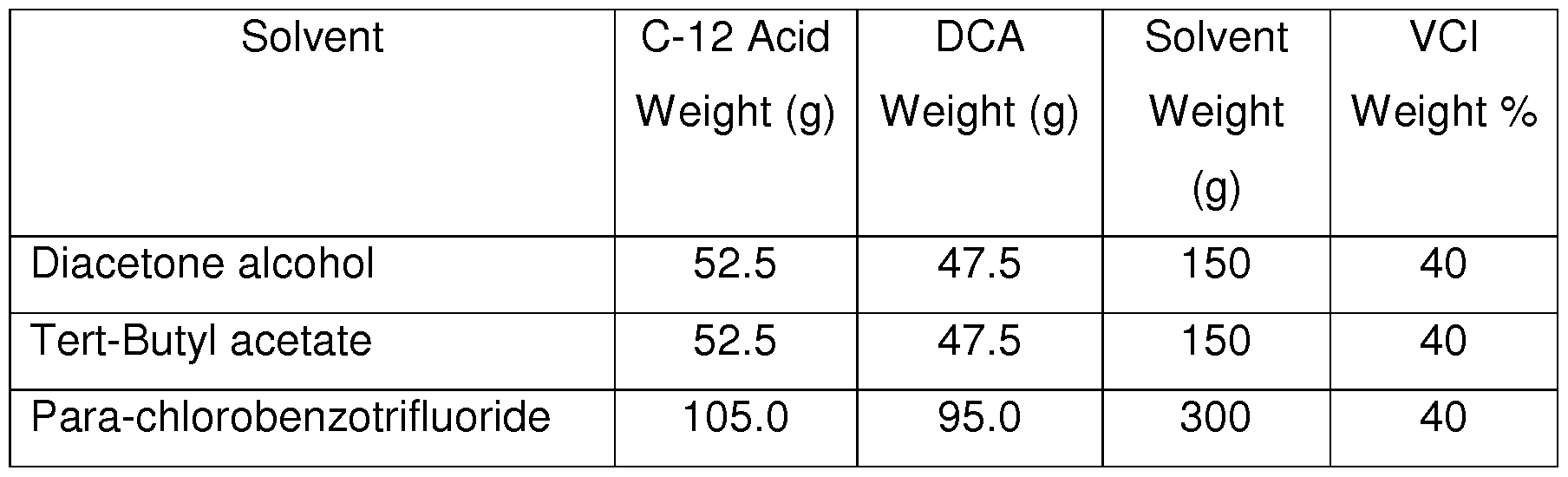
Other solvents, including ketones, naphtha and alternative acetates, were tested for their ability to dissolve amine carboxylate VCIs. However, these were found to be unacceptable. For example, when the concentration of the C-8 amine carboxylate VCI reached about 10% the solid amine carboxylate VCI precipitated out from these solutions.
(B) PREPARATION OF COATINGS CONTAINING AMINE CARBOXYLATE VCIs The 40 wt. % solutions of the amine carboxylate VCIs prepared in (A) above were each separately added to part A of a 2 part polyamide epoxy primer paint MIL- DTL-4441 /20A, formula 150, Type III in a quantity to achieve a 2 to 3 wt. % of amine carboxylate VCI solids in the final dry film when the Parts A and B were combined and the paint was applied to a metal surface and allowed to dry and cure. Table 3 documents the amounts of each amine carboxylate VCI solution and the primer paint Part A that were used to make paint samples for coating steel
test panels.
Table 3

The Part A primer was mixed with the amine carboxylate VCI solution at each of the above ratios and then separately combined with Part B in a 1 :1 volume ratio to provide a volume of paint sufficient to feed an airless spray system for application of the primer paint to steel test panels.
(C) PERFORMANCE TEST METHODS
The following processes use standard methodologies available from the American Section for Testing Materials known as ASTM. Details on these standards can be obtained from the ASTM web site www.ASTM.org. For example, ASTM D1654 is a Standard Test Method for the valuation of painted or coated specimens subject to corrosive environments. ASTM D610 describes the standard practice for evaluating the degree of rusting on painted steel surfaces. ASTM D3359 describes the Standard Test Method for measuring adhesion by a tape test. ASTM B1 17 describes the standard procedure for operating a salt spray (fog) apparatus. The apparatus consists of a closed chamber wherein a 5% salt solution is atomized onto test specimens via spray nozzles. The temperature is maintained at about 37°C and the volume of solution is about 400 liters. Performance is measured in terms of the number of hours of exposure.
Steel panels are X scribed on one side to facilitate measurement of the impact of corrosion on creep of the coating away from the X scribe area on a scale of 0 to 10 where 10 is no creep per ASTM D1654. The amount of corrosion on the non- scribed side is observed and measured on a scale of 0 to 10 where 10 is no observable rust per the method described in ASTM D610. The level of paint adhesion to the steel panels is measured in accordance with ASTM D3359 where a rating of 5B equals no loss of coating and 100% adhesion.
D) PERFORMANCE RESULTS
The tests hereinafter were performed using a salt (fog) chamber. This is an accelerated exposure test designed to exaggerate the impact of corrosive damage caused by salt water, and to demonstrate the unique value of adding amine carboxylate VCI agents to coatings to protect steel already in a corrosion active state as well as protect fresh steel surfaces from corrosion. A 5% sodium chloride solution is misted on the test panels set at a 15 degree angle at 37°C (98°F) for the relevant period of time. The panels are removed, rinsed and rated for the degree of corrosion damage.
Exhibits 1 and 2: Abraded white steel panels coated with epoxy primer containing the C-10 amine carboxylate VCI (Example 2 in Table 1 ) vs. a coated control
Five ASTM A1008 steel panels that had previously had the surface abraded by exposure to 80 grit black beauty per MIL 23331 were coated with the epoxy primer containing 2.5 wt.% amine carboxylate VCI equivalent of the C-10 amine carboxylate VCI (Exhibit 2 hereinafter) and were X scribed on one side. Five similar panels were coated with a control (Exhibit 1 ) using the same epoxy primer (without the amine carboxylate VCI) containing NBA in the same quantity as in Exhibit 2. The panels were allowed to dry and cure for seven day and were then X scribed on one side. Four of each set of panels were placed in the salt (fog)
chamber and exposed for 500 hours. One panel from each set was used to measure the film adhesion level and thickness.
Exhibits 3 to 6: Salt (fog) corroded abraded steel panels coated with epoxy primer containing the C-10 and C-12 amine carboxylate VCIs (Examples 2 and 3 of Table 1 ) vs. a coated control
Twenty black beauty abraded ASTM A1008 steel panels were first exposed to salt water in a salt (fog) chamber for 24 hours to cause surface corrosion and salt contamination. The panels were rinsed and loose rust was removed using an abrasive pad. Five of each panel were then either coated with the epoxy primer containing the C-10 and C-12 amine carboxylate VCIs (Exhibits 4 and 5 respectively hereinafter), or coated with the epoxy primer containing the C-10 amine carboxylate VCI followed by a top-coat of MIL-PRE-85285 (Exhibit 6 hereinafter), or coated with a control (Exhibit 3 hereinafter) using the same epoxy primer (without the amine carboxylate VCI) containing NBA in the same quantity as in Exhibits 4, 5 and 6. The panels were allowed to dry and cure for seven day and were then X scribed on one side. Four of each set of panels were placed in the salt (fog) chamber and exposed for 500 hours. One panel from each set was used to measure the film adhesion level and thickness.
Exhibits 7 to 10: Salt (fog) corroded smooth steel panels coated with epoxy primer containing the C-8 and C-10 amine carboxylate VCIs (Examples 1 and 2 of Table 1 ) vs. a coated control
Twenty smooth steel panels were exposed in salt (fog) chamber for 24 hours to cause surface corrosion and salt contamination. The panels were rinsed and loose rust was removed using an abrasive pad. Five of each panel were then either coated with epoxy primer containing the C-8 amine carboxylate VCI added
to achieve a 2.0 wt. % or 3.0 wt. % in the dry film (Exhibits 8 and 9 respectively hereinafter), or coated with the C-10 amine carboxylate VCI added to achieve a 2.0 wt.% in the dry film (Exhibit 10 hereinafter), or coated with a control (Exhibit 7 hereinafter) using the same epoxy primer (without the amine carboxylate VCI) containing NBA in the same quantity as in Exhibits 7, 8 and 9. The panels were allowed to dry and cure for seven day and were then X scribed on one side. Four of each set of panels were placed in the salt (fog) chamber and exposed for 500 hours. One panel from each set was used to measure the film adhesion level and thickness.
Table 4

* NBA added
** With a 2-part urethane top-coat MIL-PRE-85285 (an aliphatic polyurethane paint)
Table 5 presents the test results for all 10 of the test panel groups exposed to the salt (fog) chamber test. The numerical results shown are the averaged results
from all of the test panel experiments. Although there may be some minor variation between individual results, the results individually and as averaged consistently show that addition of 2.5 wt. % and 3.0 wt. % of the amine carboxylate VCI reduced the degree of paint failure and steel corrosion as measured in terms of coating creep and formation of rust spots on the coated surface.
Table 5

Comparison of Exhibit 1 (control) and Exhibit 2 shows that the addition of 2.5wt% of C-10 type amine carboxylate VCI to the epoxy primer applied on black beauty abraded steel panels reduces the degree of creep from 5.0 to 6.5 and the level of observed corrosion on coating surface from 4 to 9.
Comparison of Exhibit 3 (control) and Exhibit 4 shows that addition of 2.5wt% of the C-10 amine carboxylate VCIs resulted in a significant reduction in the level of
creep and rust spot formation. Creep scale level changed from 3.5 to 6, and the degree of observed corrosion changed from 3 to 7. Exhibit 5 demonstrates that the C-12 amine carboxylate VCI at 2.5 wt. % further improves corrosion resistance with the degree of observed corrosion changed to 9. These results establish the C- 12 amine carboxylate VCI at 2.5 wt. % in the final dry paint film as preferred.
Exhibit 6 demonstrates how the addition of a 2 part urethane top-coat to the epoxy primer of Exhibit 4 slightly improves the creep level and significantly improves the observed corrosion level (from 7 to 9).
Comparison of Exhibit 7 (control) and Exhibit 8 shows that the C-8 amine carboxylate VCI, while not having a measurable impact on creep, did reduce the amount of observed corrosion on the coating surface. Exhibit 9 demonstrates an improvement in creep when the amount of C-8 amine carboxylate VCI is increased to 3 wt. %. The most significant results are the large reduction in the impact of creep and corrosion by the addition of 2.5 wt. % of the C-10 amine carboxylate VCI (Exhibit 10). Creep was reduced from a scale level of 6 to 9 and the observed formation of rust spots was reduced from 7 to 10.
It should be understood, of course, that the foregoing relates to exemplary embodiments of the invention and that modifications may be made without departing from the spirit and scope of the invention as set forth in the following claims.
Claims
1 . A highly concentrated solution suitable for use as part of a corrosion resistant coating for metal surfaces, comprising an amine carboxylate VCI in a solvent, wherein the concentration of the amine carboxylate VCI in solution is from about 25 wt. % to about 50 wt. %.
2. A solution according to Claim 1 , wherein the amine carboxylate VCI is a compound of the formula (I)
R1C02NR2R3 (I) in which R1 is a straight or branched chain alkyl group containing 6 to 18 carbon atoms, and R2 and R3 are each independently a straight or branched chain alkyl group containing 3 to 8 carbon atoms, or R2 and R3 are each independently a Cs-s cycloalkyl ring optionally substituted by a straight or branched chain alkyl group containing 1 to 3 carbon atoms and/or optionally containing an oxygen atom (-0-) to replace one of the ring methylene groups (-CH2-).
3. A solution according to Claim 2, wherein R1 is a straight chain alkyl group containing 8 to 14 carbon atoms.
4. A solution according to Claim 2, wherein R1 is a straight chain alkyl group containing 12 carbon atoms.
5. A solution according to Claim 2, wherein R2 and R3 are both C5-8 cycloalkyl groups optionally substituted by methyl.
6. A solution according to Claim 2, wherein R1 is a straight chain alkyl group containing 8 to 14 carbon atoms and R2 and R3 are both cyclohexyl.
7. A solution according to Claim 1 wherein the solvent is selected from (i) alcohols of the formula R-OH where R is a straight or branched chain C2 to C5 alkyl group substituted by hydroxyl or phenoxy or contains a carbonyl group or R is a group -(CH2)3O(CH2)3O(CH2)3CH3 (ii) n-butyl acetate or (iii) para-chlorobenzotrifluoride.
8. A solution according to Claim 7 wherein the said solvent is an alcohol of the formula R-OH where R is a straight or branched chain C2 to C5 alkyl group.
9. A solution according to Claim 7 wherein the said solvent is n- butanol.
10. A solution according to any one of Claims 1 to 9, wherein the amine carboxylate VCI is present at a concentration of about 40 wt%.
1 1 . A corrosion resistant coating for metal surfaces comprising a blend of a solution according to any one of Claims 1 to 10 and a paint, wherein said paint includes an organic solvent that is compatible with the amine carboxylate VCI solvent.
12. A corrosion resistant coating according to Claim 1 1 , wherein said paint includes the same solvent as the amine carboxylate VCI solvent.
13. A corrosion resistant coating according to Claim 1 1 , wherein said paint includes n-butanol as the solvent.
14. A corrosion resistant coating according to Claim 1 1 , wherein said paint an epoxy paint.
15. A corrosion resistant coating according to Claim 1 1 , wherein said paint is a 2-part polyamide epoxy primer paint.
16. A corrosion resistant coating according to Claim 1 1 , wherein said paint is the 2-part polyamide epoxy primer paint MIL-DTL-4441 /20A.
17. A corrosion resistant coating for ferrous metal surfaces consisting essentially of a blend of a solution according to any one of Claims 1 to 10 and a paint, wherein said paint includes an organic solvent that is compatible with the amine carboxylate VCI solvent.
18. A corrosion resistant paint composition, comprising a highly concentrated solution of an amine carboxylate VCI in a solvent, wherein the concentration of the amine carboxylate VCI in solution is from about 25 wt. % to about 50 wt. %, blended with a two-part epoxy polyamide paint.
19. A corrosion resistant coating for corroded ferrous metal surfaces consisting essentially of a blend of a highly concentrated solution of an amine carboxylate VCI according to any one of Claims 1 to 10 and a paint, wherein said paint includes an organic solvent that is compatible with the amine carboxylate VCI solvent.
20. A coating according to Claim 19 which, on application to the said ferrous metal surface, achieves a concentration of amine carboxylate VCI solids equal to about 1 wt. % to about 5 wt. % of total coated dry film solids.
21 . A coating according to Claim 20 which achieves a concentration of amine carboxylate VCI solids equal to about 2 wt. % to about 3 wt. % of total coated dry film solids.
22. A process for preparing a corrosion resistant coating for metal surfaces comprising:
a. reacting a carboxylic acid R1C02H (in which R1 is a straight or branched chain alkyl group containing 6 to 18 carbon atoms) with a solution of an amine R2R3NH (in which R2 and R3 are each independently a straight or branched chain alkyl group containing 3 to 8 carbon atoms, or R2 and R3 are each independently a Cs-Cs cycloalkyl ring optionally substituted by a straight or branched chain alkyl group containing 1 to 3 carbon atoms and/or optionally containing an oxygen atom (-0-) to replace one of the ring methylene groups (-CH2-)) in a solvent selected from (i) R-OH (wherein R is a straight or branched chain C2 to Cs alkyl group optionally substituted by hydroxyl or phenoxy or contains a carbonyl group or R is a group -(CH2)30(CH2)30(CH2)3CH3) (ii) n-butyl acetate and (iii) para- chlorobenzotrifluoride), to provide a solution of a compound of formula (I)
R1C02NR2R3 (I) ; and b. blending the said amine carboxylate type of vapor phase migratory corrosion inhibitor solution with a paint (including blending with Part A and/or Part B of a 2-part paint when used); and optionally
c. combining Part A and Part B of a 2-part paint when used.
Priority Applications (4)
| Application Number | Priority Date | Filing Date | Title |
|---|---|---|---|
| EP14820187.4A EP3017007B1 (en) | 2013-07-02 | 2014-07-02 | Corrosion resistant coatings for metal surfaces |
| US14/757,110 US20160075886A1 (en) | 2014-07-02 | 2015-11-19 | Corrosion resistant coatings for metal surfaces |
| US16/047,327 US10669434B2 (en) | 2014-07-02 | 2018-07-27 | Corrosion resistant coatings for metal surfaces |
| US16/857,040 US20200255673A1 (en) | 2014-07-02 | 2020-04-23 | Corrosion inhibitor for anti-corrosion coatings |
Applications Claiming Priority (2)
| Application Number | Priority Date | Filing Date | Title |
|---|---|---|---|
| US201361842227P | 2013-07-02 | 2013-07-02 | |
| US61/842,227 | 2013-07-02 |
Related Child Applications (1)
| Application Number | Title | Priority Date | Filing Date |
|---|---|---|---|
| US14/757,110 Continuation-In-Part US20160075886A1 (en) | 2014-07-02 | 2015-11-19 | Corrosion resistant coatings for metal surfaces |
Publications (1)
| Publication Number | Publication Date |
|---|---|
| WO2015003066A1 true WO2015003066A1 (en) | 2015-01-08 |
Family
ID=52144196
Family Applications (1)
| Application Number | Title | Priority Date | Filing Date |
|---|---|---|---|
| PCT/US2014/045268 Ceased WO2015003066A1 (en) | 2013-07-02 | 2014-07-02 | Corrosion resistant coatings for metal surfaces |
Country Status (2)
| Country | Link |
|---|---|
| EP (1) | EP3017007B1 (en) |
| WO (1) | WO2015003066A1 (en) |
Cited By (2)
| Publication number | Priority date | Publication date | Assignee | Title |
|---|---|---|---|---|
| WO2019189668A1 (en) * | 2018-03-30 | 2019-10-03 | ダイキン工業株式会社 | Refrigerant pipe, heat exchanger, and method for manufacturing refigerant pipe |
| CN112044719A (en) * | 2020-09-28 | 2020-12-08 | 广船国际有限公司 | Rudder blade coating method |
Citations (6)
| Publication number | Priority date | Publication date | Assignee | Title |
|---|---|---|---|---|
| US4072626A (en) | 1976-04-12 | 1978-02-07 | A. F. Industries, Inc. | Amine salt composition useful in inhibiting metal corrosion |
| US4101328A (en) * | 1976-07-09 | 1978-07-18 | A. F. Industries, Inc. | White rust inhibitor |
| US5041241A (en) * | 1987-11-07 | 1991-08-20 | The British Petroleum Company, P.L.C. | Corrosion-inhibiting composition |
| EP1078963A2 (en) | 1999-08-26 | 2001-02-28 | Usinor | Treatment composition based on pregelatinised starch and process for applying on a metallic surface , in particular steel |
| WO2006110961A2 (en) | 2005-04-22 | 2006-10-26 | A J Scientific Pty Ltd | Novel corrosion inhibiting materials |
| WO2009097562A1 (en) | 2008-01-31 | 2009-08-06 | Georgia-Pacific Chemicals Llc | Oxidized and maleated derivative composition |
-
2014
- 2014-07-02 WO PCT/US2014/045268 patent/WO2015003066A1/en not_active Ceased
- 2014-07-02 EP EP14820187.4A patent/EP3017007B1/en active Active
Patent Citations (6)
| Publication number | Priority date | Publication date | Assignee | Title |
|---|---|---|---|---|
| US4072626A (en) | 1976-04-12 | 1978-02-07 | A. F. Industries, Inc. | Amine salt composition useful in inhibiting metal corrosion |
| US4101328A (en) * | 1976-07-09 | 1978-07-18 | A. F. Industries, Inc. | White rust inhibitor |
| US5041241A (en) * | 1987-11-07 | 1991-08-20 | The British Petroleum Company, P.L.C. | Corrosion-inhibiting composition |
| EP1078963A2 (en) | 1999-08-26 | 2001-02-28 | Usinor | Treatment composition based on pregelatinised starch and process for applying on a metallic surface , in particular steel |
| WO2006110961A2 (en) | 2005-04-22 | 2006-10-26 | A J Scientific Pty Ltd | Novel corrosion inhibiting materials |
| WO2009097562A1 (en) | 2008-01-31 | 2009-08-06 | Georgia-Pacific Chemicals Llc | Oxidized and maleated derivative composition |
Cited By (3)
| Publication number | Priority date | Publication date | Assignee | Title |
|---|---|---|---|---|
| WO2019189668A1 (en) * | 2018-03-30 | 2019-10-03 | ダイキン工業株式会社 | Refrigerant pipe, heat exchanger, and method for manufacturing refigerant pipe |
| JP2019183274A (en) * | 2018-03-30 | 2019-10-24 | ダイキン工業株式会社 | Refrigerant piping, heat exchanger, and manufacturing method for refrigerant piping |
| CN112044719A (en) * | 2020-09-28 | 2020-12-08 | 广船国际有限公司 | Rudder blade coating method |
Also Published As
| Publication number | Publication date |
|---|---|
| EP3017007B1 (en) | 2019-01-02 |
| EP3017007A1 (en) | 2016-05-11 |
| EP3017007A4 (en) | 2017-02-22 |
Similar Documents
| Publication | Publication Date | Title |
|---|---|---|
| Del Amo et al. | High performance water-based paints with non-toxic anticorrosive pigments | |
| RU2269556C2 (en) | Aqueous epoxide corrosion-stable priming | |
| JP2025074210A (en) | Corrosion protection for metal substrates | |
| US20210079231A1 (en) | Corrosion protection for metallic substrates comprising one or more 2d material platelets | |
| Vega et al. | Corrosion inhibition of aluminum by coatings formulated with Al–Zn–vanadate hydrotalcite | |
| Hadzich et al. | Study of zinc tannates prepared with Tara powder (Caesalpinia spinosa) as anticorrosive pigments in alkyd paints and wash primer formulations | |
| Balaskas et al. | Improving the corrosion protection properties of organically modified silicate–epoxy coatings by incorporation of organic and inorganic inhibitors | |
| Byrne et al. | Primers based on tara and quebracho tannins for poorly prepared steel surfaces | |
| JP2016065118A (en) | WEAK SOLVENT SHAPE HIGH CORROSION RESISTANT COATING COMPOSITION USING Sn ION | |
| Roselli et al. | Painting rusted steel: The role of aluminum phosphosilicate | |
| EP3017007B1 (en) | Corrosion resistant coatings for metal surfaces | |
| US7306663B2 (en) | Corrosion inhibitor | |
| EP0206716A1 (en) | Anti-corrosion metal complex compositions and use thereof | |
| US10669434B2 (en) | Corrosion resistant coatings for metal surfaces | |
| CN108795224B (en) | Coating and method for using and producing the same | |
| JP4455712B2 (en) | Coated steel with atmospheric corrosion resistance | |
| Markley et al. | Multifunctional rare earth organic corrosion inhibitors | |
| US20160075886A1 (en) | Corrosion resistant coatings for metal surfaces | |
| KR20130048554A (en) | Coating composition for zinc plating materails | |
| RU2441044C1 (en) | Protective nano-inhibited lacquer | |
| US20200255673A1 (en) | Corrosion inhibitor for anti-corrosion coatings | |
| JP3385934B2 (en) | Corrosion protection method for steel structures and inner surfaces of steel tanks, steel towers and steel structures | |
| JP2024131966A (en) | Corrosion prevention composition, method for inhibiting corrosion of metal materials, and method for repairing reinforced concrete structures | |
| JP2001234351A (en) | Coated steel excellent in corrosion resistance | |
| EP0322183A2 (en) | Method of inhibiting corrosion |
Legal Events
| Date | Code | Title | Description |
|---|---|---|---|
| 121 | Ep: the epo has been informed by wipo that ep was designated in this application |
Ref document number: 14820187 Country of ref document: EP Kind code of ref document: A1 |
|
| NENP | Non-entry into the national phase |
Ref country code: DE |
|
| WWE | Wipo information: entry into national phase |
Ref document number: 2014820187 Country of ref document: EP |