WO2015004396A1 - Nouveaux catalyseurs a ligand silylene - Google Patents
Nouveaux catalyseurs a ligand silylene Download PDFInfo
- Publication number
- WO2015004396A1 WO2015004396A1 PCT/FR2014/051787 FR2014051787W WO2015004396A1 WO 2015004396 A1 WO2015004396 A1 WO 2015004396A1 FR 2014051787 W FR2014051787 W FR 2014051787W WO 2015004396 A1 WO2015004396 A1 WO 2015004396A1
- Authority
- WO
- WIPO (PCT)
- Prior art keywords
- group
- compound
- alkyl group
- aryl
- metal complex
- Prior art date
- Legal status (The legal status is an assumption and is not a legal conclusion. Google has not performed a legal analysis and makes no representation as to the accuracy of the status listed.)
- Ceased
Links
- MXYAGOSDNROCFM-UHFFFAOYSA-N C[N](C)(C=C)O[N](C)(C)C=C Chemical compound C[N](C)(C=C)O[N](C)(C)C=C MXYAGOSDNROCFM-UHFFFAOYSA-N 0.000 description 2
- PEZUAXFVUFJLFM-UHFFFAOYSA-N CC(C)(C)N([Si](C)(C)N1C(C)(C)C)P1(C)=C Chemical compound CC(C)(C)N([Si](C)(C)N1C(C)(C)C)P1(C)=C PEZUAXFVUFJLFM-UHFFFAOYSA-N 0.000 description 1
Classifications
-
- C—CHEMISTRY; METALLURGY
- C07—ORGANIC CHEMISTRY
- C07F—ACYCLIC, CARBOCYCLIC OR HETEROCYCLIC COMPOUNDS CONTAINING ELEMENTS OTHER THAN CARBON, HYDROGEN, HALOGEN, OXYGEN, NITROGEN, SULFUR, SELENIUM OR TELLURIUM
- C07F7/00—Compounds containing elements of Groups 4 or 14 of the Periodic Table
- C07F7/02—Silicon compounds
- C07F7/08—Compounds having one or more C—Si linkages
- C07F7/0834—Compounds having one or more O-Si linkage
- C07F7/0838—Compounds with one or more Si-O-Si sequences
- C07F7/0872—Preparation and treatment thereof
- C07F7/0876—Reactions involving the formation of bonds to a Si atom of a Si-O-Si sequence other than a bond of the Si-O-Si linkage
- C07F7/0878—Si-C bond
- C07F7/0879—Hydrosilylation reactions
-
- B—PERFORMING OPERATIONS; TRANSPORTING
- B01—PHYSICAL OR CHEMICAL PROCESSES OR APPARATUS IN GENERAL
- B01J—CHEMICAL OR PHYSICAL PROCESSES, e.g. CATALYSIS OR COLLOID CHEMISTRY; THEIR RELEVANT APPARATUS
- B01J31/00—Catalysts comprising hydrides, coordination complexes or organic compounds
- B01J31/16—Catalysts comprising hydrides, coordination complexes or organic compounds containing coordination complexes
- B01J31/1608—Catalysts comprising hydrides, coordination complexes or organic compounds containing coordination complexes the ligands containing silicon
-
- B—PERFORMING OPERATIONS; TRANSPORTING
- B01—PHYSICAL OR CHEMICAL PROCESSES OR APPARATUS IN GENERAL
- B01J—CHEMICAL OR PHYSICAL PROCESSES, e.g. CATALYSIS OR COLLOID CHEMISTRY; THEIR RELEVANT APPARATUS
- B01J31/00—Catalysts comprising hydrides, coordination complexes or organic compounds
- B01J31/16—Catalysts comprising hydrides, coordination complexes or organic compounds containing coordination complexes
- B01J31/22—Organic complexes
-
- B—PERFORMING OPERATIONS; TRANSPORTING
- B01—PHYSICAL OR CHEMICAL PROCESSES OR APPARATUS IN GENERAL
- B01J—CHEMICAL OR PHYSICAL PROCESSES, e.g. CATALYSIS OR COLLOID CHEMISTRY; THEIR RELEVANT APPARATUS
- B01J31/00—Catalysts comprising hydrides, coordination complexes or organic compounds
- B01J31/16—Catalysts comprising hydrides, coordination complexes or organic compounds containing coordination complexes
- B01J31/22—Organic complexes
- B01J31/2265—Carbenes or carbynes, i.e.(image)
-
- B—PERFORMING OPERATIONS; TRANSPORTING
- B01—PHYSICAL OR CHEMICAL PROCESSES OR APPARATUS IN GENERAL
- B01J—CHEMICAL OR PHYSICAL PROCESSES, e.g. CATALYSIS OR COLLOID CHEMISTRY; THEIR RELEVANT APPARATUS
- B01J31/00—Catalysts comprising hydrides, coordination complexes or organic compounds
- B01J31/16—Catalysts comprising hydrides, coordination complexes or organic compounds containing coordination complexes
- B01J31/22—Organic complexes
- B01J31/2282—Unsaturated compounds used as ligands
- B01J31/2291—Olefins
-
- C—CHEMISTRY; METALLURGY
- C07—ORGANIC CHEMISTRY
- C07F—ACYCLIC, CARBOCYCLIC OR HETEROCYCLIC COMPOUNDS CONTAINING ELEMENTS OTHER THAN CARBON, HYDROGEN, HALOGEN, OXYGEN, NITROGEN, SULFUR, SELENIUM OR TELLURIUM
- C07F15/00—Compounds containing elements of Groups 8, 9, 10 or 18 of the Periodic Table
- C07F15/0006—Compounds containing elements of Groups 8, 9, 10 or 18 of the Periodic Table compounds of the platinum group
- C07F15/0086—Platinum compounds
-
- C—CHEMISTRY; METALLURGY
- C08—ORGANIC MACROMOLECULAR COMPOUNDS; THEIR PREPARATION OR CHEMICAL WORKING-UP; COMPOSITIONS BASED THEREON
- C08G—MACROMOLECULAR COMPOUNDS OBTAINED OTHERWISE THAN BY REACTIONS ONLY INVOLVING UNSATURATED CARBON-TO-CARBON BONDS
- C08G77/00—Macromolecular compounds obtained by reactions forming a linkage containing silicon with or without sulfur, nitrogen, oxygen or carbon in the main chain of the macromolecule
- C08G77/04—Polysiloxanes
- C08G77/06—Preparatory processes
- C08G77/08—Preparatory processes characterised by the catalysts used
-
- B—PERFORMING OPERATIONS; TRANSPORTING
- B01—PHYSICAL OR CHEMICAL PROCESSES OR APPARATUS IN GENERAL
- B01J—CHEMICAL OR PHYSICAL PROCESSES, e.g. CATALYSIS OR COLLOID CHEMISTRY; THEIR RELEVANT APPARATUS
- B01J2231/00—Catalytic reactions performed with catalysts classified in B01J31/00
- B01J2231/30—Addition reactions at carbon centres, i.e. to either C-C or C-X multiple bonds
- B01J2231/32—Addition reactions to C=C or C-C triple bonds
- B01J2231/323—Hydrometalation, e.g. bor-, alumin-, silyl-, zirconation or analoguous reactions like carbometalation, hydrocarbation
-
- B—PERFORMING OPERATIONS; TRANSPORTING
- B01—PHYSICAL OR CHEMICAL PROCESSES OR APPARATUS IN GENERAL
- B01J—CHEMICAL OR PHYSICAL PROCESSES, e.g. CATALYSIS OR COLLOID CHEMISTRY; THEIR RELEVANT APPARATUS
- B01J2531/00—Additional information regarding catalytic systems classified in B01J31/00
- B01J2531/80—Complexes comprising metals of Group VIII as the central metal
- B01J2531/82—Metals of the platinum group
- B01J2531/828—Platinum
Definitions
- the invention relates to a new type of metal complexes that can be used as catalysts, especially as hydrosilylation catalysts. More specifically, the present invention relates to metal complexes having at least one silylene ligand.
- a compound comprising at least one unsaturation reacts with a compound comprising at least one hydrogenosilyl function, that is to say a hydrogen atom bonded to a silicon atom .
- This reaction can for example be described in the case of alkene-type unsaturation by:
- the hydrosilylation of unsaturated compounds is carried out by catalysis.
- the catalyst suitable for this reaction is a platinum catalyst.
- Pt 2 divinyltetramethyldisiloxane
- DVT abbreviated Pt 2 (DVTMS) 3 ):
- one of the objectives of the present invention is to propose a new type of catalyst, particularly adapted to the catalysis of hydrosilylation reactions.
- this catalyst can be used in a smaller quantity than the existing catalysts, while maintaining the same efficiency.
- the new catalyst may advantageously be stable in the reaction medium, do not form colloids, and allow to limit the side reactions.
- the inventors have been interested in metal complexes having silylenes as ligands.
- Silylenes are the higher homologous chemical compounds of carbenes. These are divalent neutral silicon species with six valence electrons. Unlike carbenes, the number of stable silylenes described in the literature is very limited.
- the N-heterocyclic silylene NHSi the higher homologue of the NHC heterocyclic carbene, has been the most studied, and it has been found that the silylene NHSi forms much less stable complexes than the complexes formed with NHC.
- silylene ligands stabilized with Lewis bases Some stable metal complexes coordinated by a silylene ligand stabilized by a Lewis base have been described in the literature, in particular in R. Rodriguez, T. Troadec, T. Kato, N. Saffon-Merceron, J-M.Sotiropoulos, A. Baceiredo, Angew. Chem. Int. Ed. 2012, 51, 7158.
- the inventors have prepared for the first time metal complexes of which at least one of the ligands is a cyclic silylene compound stabilized with a Lewis base. They found that, quite surprisingly, the cyclic structure of these stabilized silylenes made it possible to obtain particularly stable metal complexes.
- the subject of the present invention is a metal complex comprising at least one metal atom chosen from the metals of columns 8, 9 and 10 of the periodic table of the elements and one or more ligands, characterized in that at least one ligand comprises a silylene structure cyclic and a donor base of a doublet of electrons at the silicon atom of said cyclic silylene structure.
- the subject of the invention is also a method for hydrosilylation of an unsaturated compound comprising at least one alkene functional group and / or at least one alkyne functional group, with a compound comprising at least one hydrogenosilyl function, said process being characterized in that it is catalyzed by a metal complex as defined above, and on the other hand a composition comprising:
- At least one unsaturated compound comprising at least one alkene functional group and / or at least one alkyne functional group
- the present invention relates to a metal complex comprising at least one metal atom chosen from the metals of columns 8, 9 and 10 of the periodic table of the elements and one or more ligands, characterized in that at least one ligand comprises a cyclic silylene structure and a Lewis donor base of an electron pair to the silicon atom of said cyclic silylene structure.
- This metal complex can be represented by the general formula (I):
- M represents a metal chosen from the metals of columns 8, 9 and 10 of the periodic table of the elements
- Lig represents a ligand of the metal M
- b is an integer ranging from 1 to a number equal to 5 times the value of a
- c is the total charge of the metal complex which can be 0 or a positive integer from +1 to +6;
- Lig can represent identical or different ligands
- Lig ligand is a ligand which comprises a cyclic silylene structure and a Lewis base donor of an electron pair to the silicon atom of said cyclic silylene structure.
- the metals of columns 8, 9 and 10 of the periodic table of the elements are iron (Fe), ruthenium (Ru), osmium (Os), hassium (Hs), cobalt (Co) ), rhodium (Rh), iridium (Ir), meitnerium (Mt), nickel (Ni), palladium (Pd), platinum (Pt) and darmstadtium (Ds).
- the metal of the metal complex according to the invention is chosen from the group consisting of Pt, Pd, Ni, Rh, Ru, Os and Ir, more preferentially in the group consisting of Pt, Pd, Ni, Rh and Ru, and even more preferably in the group consisting of Pt, Pd and Ru.
- the metal is Pt and the metal complex of the present invention is a platinum complex.
- the complex may comprise a single metal atom, which means that the symbol "a” is 1 in the general formula (I).
- the metal complex comprises several metal atoms, especially if at least one of the ligands of the complex is a bridging ligand or a polydentate ligand.
- the metal complex according to the invention can be neutral (which means that the symbol “c” is 0 in the general formula (I)), or charged (the symbol “c” in the general formula (I) is different from 0, and is +1, +2, +3, +4, +5 or +6). In the latter case, the metal complex may be associated with one or more counterions.
- One or more ligands complex the metal atom (s).
- the metal complex according to the invention is characterized in that at least one ligand comprises a cyclic silylene structure and a donor Lewis base of a pair of electrons at the silicon atom of said cyclic silylene structure.
- this ligand is noted “L s ".
- a silylene compound is a chemical compound comprising a bivalent silicon atom, electrically neutral and on which are located two non-binding electrons.
- cyclic silylene structure is meant a silylene compound in which the divalent silicon atom is part of a ring consisting of 3 to 6 atoms linked by covalent bonds.
- a cyclic silylene structure can be schematically represented by:
- Lewis base is meant a chemical group capable of providing a doublet of electrons.
- a Lewis base can be represented by "B
- the Lewis base of the ligand gives its electron pair to the silicon atom of the cyclic silylene structure. This can be represented schematically by:
- the presence of the Lewis base in the ligand L s of the invention has the function of stabilizing the cyclic structure silylene.
- L s can be a compound of formula (II):
- Y 1 and Y 2 independently of one another, represent O, NR a or CR a 2
- Z is such that Y -ZY together form a chain , n being 0, 1, 2 or 3, each m being independently 0, 1, or 2, one or more carbon atoms of this chain may be replaced by a heteroatom selected from O, N, Si and P, and the chain may comprise one or more unsaturations, provided that the number m of R group carried by each atom of the chain is adapted to coordinate this atom,
- B can be bonded to Y 1, Y 2 and / or Z by a covalent bond
- each R a being independently selectable from:
- a halogen atom an alkyl group, optionally substituted one or more times by a halogen atom, a haloalkyl group, a cycloalkyl group, a cycloalkyl-alkyl group, an aryl group, an aryl-alkyl group, an acyl group; by an amino group, a hydroxy group or an alkoxy group,
- a cycloalkyl group optionally substituted one or more times with a halogen atom, with an alkyl group, with a haloalkyl group, with a cycloalkyl group, with a cycloalkyl-alkyl group, with an aryl group, with an aryl-alkyl group; with an acyl group, an amino group, a hydroxy group or an alkoxy group,
- a cycloalkyl-alkyl group optionally substituted one or more times on the cycloalkyl part and / or on the alkyl part by a halogen atom, by an alkyl group, by a haloalkyl group, by a cycloalkyl group, by a cycloalkyl group; alkyl, an aryl group, an aryl-alkyl group, an acyl group, an amino group, a hydroxy group or an alkoxy group, an aryl group, optionally substituted one or more times with a halogen atom with an alkyl group, a haloalkyl group, a cycloalkyl group, a cycloalkyl-alkyl group, an aryl group, an aryl-alkyl group, an acyl group, an amino group, a hydroxy group or by an alkoxy group,
- an aryl-alkyl group optionally substituted one or more times on the aryl part and / or on the alkyl part by a halogen atom, by an alkyl group, by a haloalkyl group, by a cycloalkyl group, by a cycloalkyl group; alkyl, aryl, aryl-alkyl, acyl, amino, hydroxy or alkoxy,
- an acyl group optionally substituted one or more times with a halogen atom, with an alkyl group, with a haloalkyl group, with a cycloalkyl group, with a cycloalkyl-alkyl group, with an aryl group, with an aryl-alkyl group; with an acyl group, an amino group, a hydroxy group or an alkoxy group,
- an alkoxy group optionally substituted one or more times on the alkyl part by a halogen atom, an alkyl group, a haloalkyl group, a cycloalkyl group, a cycloalkyl-alkyl group, an aryl group, an aryl-alkyl group, an acyl group, an amino group, a hydroxyl group or an alkoxy group,
- an amine, imine or amide group optionally substituted one or more times with a halogen atom, with an alkyl group, with a haloalkyl group, with a cycloalkyl group, with a cycloalkyl-alkyl group, with an aryl group, with an aryl-alkyl group, with an acyl group, with an amino group, with a hydroxy group or with an alkoxy group, and
- a phosphine, phosphite, phosphorane or phosphorus ylide group optionally substituted one or more times with a halogen atom, with an alkyl group, with a cycloalkyl group, with a cycloalkyl-alkyl group, with an aryl group, with a group aryl-alkyl, with an acyl group, an amino group, a hydroxy group or an alkoxy group;
- one or more carbon atoms may be replaced by a silicon atom Si,
- each group R a one or more unsaturations may be present,
- halogen atom is meant according to the invention an atom selected from the group consisting of fluorine, chlorine, bromine and iodine.
- alkyl is meant according to the invention a saturated hydrocarbon chain, linear or branched containing from 1 to 20 carbon atoms, preferably from 1 to 8 carbon atoms.
- An alkyl group may be selected from the group consisting of methyl, ethyl, isopropyl, n-propyl, tert-butyl, isobutyl, n-butyl, n-pentyl, isoamyl and 1,1-dimethylpropyl.
- cycloalkyl is meant according to the invention a monocyclic or polycyclic saturated hydrocarbon group, preferably monocyclic or bicyclic, containing 3 carbon atoms. to 20 carbon atoms, preferably 3 to 8 carbon atoms.
- the multiple ring nuclei may be attached to each other by a covalent bond and / or a spiral atom and / or be condensed to each other.
- Cycloalkyl may be selected from the group consisting of cyclopropyl, cyclobutyl, cyclopentyl, cyclohexyl, cycloheptyl, cyclooctyl, adamantane and norborane.
- cycloalkyl-alkyl is meant according to the invention an alkyl group as defined above substituted by a cycloalkyl group also as defined above.
- aryl is meant according to the invention an aromatic hydrocarbon group containing from 5 to 18 carbon atoms, monocyclic or polycyclic.
- An aryl group may be selected from the group consisting of phenyl, naphthyl, anthracenyl and phenanthryl.
- arylalkyl is meant according to the invention an alkyl group as defined above substituted with a cycloalkyl group also as defined above.
- alkoxy is meant according to the invention an alkyl group as defined above bonded to an oxygen atom.
- An alkoxy group may be selected from the group consisting of methoxy, ethoxy, propoxy and butoxy.
- amine means a primary amine group or a secondary, tertiary or quaternary amine group whose substituent (s) is (are) chosen from an alkyl group as defined above.
- Y 1 and Y 2 are preferably CR a 2 .
- n is preferably 0 or 1.
- the cyclic silylene structure of L s is a silylene compound in which the bivalent silicon atom, electrically neutral and on which are located two non-binding electrons, is part of a ring consisting of 3 linked atoms. by covalent bonds. Of these three atoms constituting the ring, one is the silicon atom in silylene form, and the other two may be selected from C, N and O.
- Ls may be a compound of formula (II) as defined herein. above in which the symbol n is 0. Z represents in this case a covalent bond.
- Ls can be a compound of formula (Ha): wherein B, Y 1 and Y 2 have the meanings given above.
- the cyclic silylene structure is a sila-cyclopropylidene, that is to say a 3-membered ring formed of the silicon atom in silylene form and of two carbon atoms:
- L s can be a compound of formula (III)
- each R b can be independently selected from:
- an alkyl group optionally substituted one or more times by a halogen atom, a haloalkyl group, a cycloalkyl group, a cycloalkyl-alkyl group, an aryl group, an aryl-alkyl group, an acyl group; by an amino group, a hydroxy group or an alkoxy group,
- a cycloalkyl group optionally substituted one or more times with a halogen atom, with an alkyl group, with a haloalkyl group, with a cycloalkyl group, with a cycloalkyl-alkyl group, with an aryl group, with an aryl-alkyl group; with an acyl group, an amino group, a hydroxy group or an alkoxy group, a cycloalkyl-alkyl group, optionally substituted one or more times on the cycloalkyl part and / or on the alkyl part by a halogen atom, by an alkyl group, by a haloalkyl group, by a cycloalkyl group, by a cycloalkyl group; alkyl, an aryl group, an aryl-alkyl group, an acyl group, an amine group, a hydroxy group or an alkoxy group, an aryl group, optionally substituted
- an aryl-alkyl group optionally substituted one or more times on the aryl part and / or on the alkyl part by a halogen atom, by an alkyl group, by a haloalkyl group, by a cycloalkyl group, by a cycloalkyl group; alkyl, aryl, aryl-alkyl, acyl, amine, hydroxy or alkoxy,
- an acyl group optionally substituted one or more times with a halogen atom, with an alkyl group, with a haloalkyl group, with a cycloalkyl group, with a cycloalkyl-alkyl group, with an aryl group, with an aryl-alkyl group; with an acyl group, an amine group, a hydroxy group or an alkoxy group,
- an alkoxy group optionally substituted one or more times on the alkyl part by a halogen atom, an alkyl group, a haloalkyl group, a cycloalkyl group, a cycloalkyl-alkyl group, an aryl group, a aryl-alkyl group, with an acyl group, an amine group, a hydroxyl group or an alkoxy group,
- an amine, imine or amide group optionally substituted one or more times with a halogen atom, with an alkyl group, with a haloalkyl group, with a cycloalkyl group, with a cycloalkyl-alkyl group, with an aryl group, with an aryl-alkyl group, with an acyl group, an amine group, a hydroxy group or an alkoxy group, and
- a phosphine, phosphite, phosphorane or phosphorus ylide group optionally substituted one or more times with a halogen atom, with an alkyl group, with a cycloalkyl group, with a cycloalkyl-alkyl group, with a aryl group, with an aryl-alkyl group, an acyl group, an amino group, a hydroxy group or an alkoxy group;
- each R b group one or more carbon atoms may be replaced by a silicon atom Si,
- each group R b one or more unsaturations may be present,
- two or more groups selected from R b groups, with the atoms to which they are attached, can form a monocyclic or polycyclic ring, consisting of 3 to 20 members, optionally comprising one or more unsaturations, and optionally comprising one or more selected heteroatoms; from O, N, Si and P, the monocyclic or polycyclic ring group possibly being substituted one or more times with a halogen atom, with an alkyl group, with a cycloalkyl group, with a cycloalkyl-alkyl group, with a group aryl, aryl-alkyl, acyl, amino, hydroxy or alkoxy.
- B may be linked to one or more groups R b by a covalent bond.
- the Lewis B base can be chosen from the group consisting of:
- each R c independently represents a hydrogen atom, a halogen atom, or a group selected from: an alkyl group, a haloalkyl group, a cycloalkyl group, optionally substituted one or more times by a halogen atom and / or by an alkyl group, a cycloalkyl-alkyl group, optionally substituted one or more times on the cycloalkyl part and / or on the alkyl part by a halogen atom and / or with an alkyl group, an aryl group optionally substituted one or more times with a halogen atom and / or with an alkyl group, an aryl-alkyl group optionally substituted one or more times on the aryl part and / or on the alkyl part by a halogen atom and / or an alkyl group, an acyl group, an amino group and a hydroxy group.
- the cyclic silylene structure and the Lewis base included in the ligand Ls are only bound by the dative coordination intervening between the Lewis base and the silicon atom in silylene form.
- the Lewis base included in the ligand L s is linked to at least one atom of the cyclic silylene structure other than the silicon atom in silylene form. This means that, in addition to the dative coordination between the Lewis base and the silicon atom in silylene form, the cyclic silylene structure and the Lewis base are linked by a covalent bond.
- the ligand Ls can be a compound of formula (IV):
- each R b is, independently, as described above,
- -R d -B is a radical obtained by substituting B for a group chosen from:
- an alkyl group optionally substituted one or more times by a halogen atom, a haloalkyl group, a cycloalkyl group, a cycloalkyl-alkyl group, an aryl group, an aryl-alkyl group or an acyl group; by an amino group, a hydroxy group or an alkoxy group,
- a cycloalkyl group optionally substituted one or more times with a halogen atom, with an alkyl group, with a haloalkyl group, with a cycloalkyl group, with a cycloalkyl-alkyl group, with an aryl group, with a group aryl-alkyl, with an acyl group, an amine group, a hydroxy group or an alkoxy group,
- a cycloalkyl-alkyl group optionally substituted one or more times on the cycloalkyl part and / or on the alkyl part by a halogen atom, by an alkyl group, by a haloalkyl group, by a cycloalkyl group, by a cycloalkyl group; alkyl, an aryl group, an aryl-alkyl group, an acyl group, an amine group, a hydroxy group or an alkoxy group, an aryl group, optionally substituted one or more times with a halogen atom with an alkyl group, a haloalkyl group, a cycloalkyl group, a cycloalkyl-alkyl group, an aryl group, an aryl-alkyl group, an acyl group, an amine group, a hydroxy group or by an alkoxy group,
- an aryl-alkyl group optionally substituted one or more times on the aryl part and / or on the alkyl part by a halogen atom, by an alkyl group, by a haloalkyl group, by a cycloalkyl group, by a cycloalkyl group; alkyl, aryl, aryl-alkyl, acyl, amine, hydroxy or alkoxy,
- an acyl group optionally substituted one or more times with a halogen atom, with an alkyl group, with a haloalkyl group, with a cycloalkyl group, with a cycloalkyl-alkyl group, with an aryl group, with an aryl-alkyl group; with an acyl group, an amine group, a hydroxy group or an alkoxy group,
- an alkoxy group optionally substituted one or more times on the alkyl part by a halogen atom, an alkyl group, a haloalkyl group, a cycloalkyl group, a cycloalkyl-alkyl group, an aryl group, a aryl-alkyl group, with an acyl group, an amine group, a hydroxyl group or an alkoxy group,
- an amine, imine or amide group optionally substituted one or more times with a halogen atom, with an alkyl group, with a haloalkyl group, with a cycloalkyl group, with a cycloalkyl-alkyl group, with an aryl group, with an aryl-alkyl group, with an acyl group, an amine group, a hydroxy group or an alkoxy group, and
- a phosphine, phosphite, phosphorane or phosphorus ylide group optionally substituted one or more times with a halogen atom, with a alkyl group, cycloalkyl group, cycloalkyl-alkyl group, aryl group, aryl-alkyl group, acyl group, amine group, hydroxy group or alkoxy group;
- B being a group selected from:
- a sulphide optionally substituted with a halogen atom or with a group chosen from: an alkyl group, a haloalkyl group, a cycloalkyl group, optionally substituted one or more times with a halogen atom and / or with an alkyl group a cycloalkyl-alkyl group optionally substituted one or more times on the cycloalkyl part and / or on the alkyl part by a halogen atom and / or by an alkyl group, an aryl group optionally substituted one or more times by an atom of halogen and / or an alkyl group, an aryl-alkyl group optionally substituted one or more times on the aryl part and / or on the alkyl part by a halogen atom and / or by an alkyl group, an acyl group and a hydroxy group;
- a phosphine optionally substituted with a halogen atom or with a group chosen from: an alkyl group, a haloalkyl group, a cycloalkyl group, optionally substituted one or more times by a halogen atom and / or by an alkyl group a cycloalkyl-alkyl group optionally substituted one or more times on the cycloalkyl part and / or on the alkyl part by a halogen atom and / or by an alkyl group, an aryl group optionally substituted one or more times by an atom of halogen and / or an alkyl group, an aryl-alkyl group optionally substituted one or more times on the aryl part and / or on the alkyl part by a halogen atom and / or by an alkyl group, an acyl group and a hydroxy group;
- a phosphoalkene optionally substituted with a halogen atom or with a group chosen from: an alkyl group, a haloalkyl group, a cycloalkyl group, optionally substituted one or more times by a halogen atom and / or by a alkyl group, a cycloalkyl-alkyl group, optionally substituted one or more times on the cycloalkyl part and / or on the alkyl part by a halogen atom and / or by an alkyl group, an aryl group optionally substituted one or more times by a halogen atom and / or an alkyl group, an aryl-alkyl group optionally substituted one or more times on the aryl part and / or on the alkyl part by a halogen atom and / or by an alkyl group, a acyl group and a hydroxy group; an amine, optionally substituted with a halogen atom or
- an imine optionally substituted with a halogen atom or with a group selected from: an alkyl group, a haloalkyl group, a cycloalkyl group, optionally substituted one or more times by a halogen atom and / or by an alkyl group, a cycloalkyl-alkyl group, optionally substituted one or more times on the cycloalkyl part and / or on the alkyl part by a halogen atom and / or by an alkyl group, an aryl group optionally substituted one or more times with a halogen atom; halogen and / or an alkyl group, an aryl-alkyl group optionally substituted one or more times on the aryl part and / or on the alkyl part by a halogen atom and / or by an alkyl group, an acyl group and a hydroxy group.
- the ligand L s can be a compound of formula (V):
- each R b is independently as described above, and each R e independently represents a group selected from a hydrogen atom, a halogen atom, or a group selected from: an alkyl group, a haloalkyl group a cycloalkyl group, optionally substituted one or more times by a halogen atom and / or by an alkyl group, a cycloalkyl-alkyl group, optionally substituted one or more times on the cycloalkyl part and / or on the alkyl part by a halogen atom and / or with an alkyl group, an aryl group optionally substituted one or more times with a halogen atom and / or with an alkyl group, an aryl-alkyl group optionally substituted one or more times on the aryl part and / or on the alkyl part by a halogen atom and / or by an alkyl group, an acyl group and a hydroxy group, or two
- the ligand L s can be the compound of formula (VI):
- L s contains asymmetric atoms (in particular carbon, nitrogen or phosphorus)
- L s can be a pure isomer, for example an enantiomer or a diastereomer, or a mixture of isomers, in particular a racemic mixture. It may be particularly advantageous to have the ligand Ls in the form of a pure isomer because the metal complexes comprising this ligand may have interesting properties in synthesis and in asymmetric catalysis.
- the ligand Ls which comprises a cyclic silylene structure and a Lewis base donor of a pair of electrons at the silicon atom of said cyclic silylene structure, can be prepared according to the methods conventionally used to prepare silylene compounds, in particular by photolysis, by thermolysis or by reduction.
- the ligand L s can be prepared from a precursor which comprises a cyclic dihalo-silane structure and a Lewis donor base of an electron pair to the silicon atom of said cyclic di-halosilane structure.
- the cyclic dihalosilane structure contains at least one ring consisting of 3 to 6 atoms linked by covalent bonds and at least one of these atoms is a tetravalent silicon atom bound to two halogen atoms, preferably two atoms. chlorine or bromine, and more preferably two chlorine atoms.
- the ligand precursor Ls can be schematically represented by:
- the symbols "X" represent, independently of one another, a halogen atom preferably chosen from chlorine and bromine, and preferably representing chlorine.
- the precursors may be prepared conventionally, by synthesis routes known to those skilled in the art.
- the ligand Ls can be prepared by reducing the precursor defined above by using alkali or alkaline earth metals, such as potassium, sodium, lithium or magnesium. For example, it is possible to carry out the reduction of the precursor in a solvent at room temperature using magnesium powder. This reduction reaction can be schematically represented by:
- ligand L s can be prepared from a Lewis base-stabilized non-cyclic silylene compound, which is converted to the cyclic silylene compound.
- the metal complex that is the subject of the present invention comprises at least one metal atom chosen from the metals of columns 8, 9 and 10 of the periodic table of elements and at least one ligand Ls as defined above.
- the complexation of the metal atom by the ligand L s is made by the silicon atom in silylene form.
- the metal complex may comprise a single ligand L s or more ligands Ls. If several ligands Ls are present, these may be identical or different.
- the metal complex according to the invention may comprise one or more other ligands. The number and nature of the ligands are adapted to the valence of the metal atom.
- the metal complex according to the invention comprises one or more other ligands chosen independently of each other from the group consisting of carbon monoxide, phosphines, amines, dihydrogen, halogens, carboxylate ions, ions sulfonates, amide radicals, alcoholic radicals, acetylacetonate radicals, alkyl radicals having 1 to 7 carbon atoms, nitric oxide, nitriles, isonitriles, mono and di-olefins, alkynes and radicals aromatics.
- the ligand may be monodentate or polydentate, in particular bidentate, tridentate or quadridentate.
- the metal complex according to the invention can comprise as ligand divinlytetramethyldisiloxane (DVTMS), of formula:
- the metal complex is the compound of formula (VII):
- the metal complexes according to the invention can be prepared from complexes known from the state of the art by ligand exchange, that is to say by adding at least one ligand L s to a suitable precursor metal complex. , in solution.
- the precursor metal complex may in particular be chosen from divinyl ligand metal complexes, cyclooctadiene ligand metal complexes and olefin and bisphosphine ligand metal complexes.
- the precursor metal complex is chosen from metal complexes of formula M (COD) 2 and metal complexes of formula M 2 (DVTMS) 3, "M” representing a metal of columns 8, 9 and 10 of the periodic table of elements, "COD” representing the cycloocta-1,5-diene ligand and "DVTMS” representing the 1,3-divinyl-1,1,3,3-tetramethyldisiloxane ligand.
- the precursor metal complex is the platinum complex of Karstedt Pt 2 (DVTMS) 3 .
- the metal complexes as described above are particularly interesting because they are stable. The use of these metal complexes as catalysts is an object of the present invention.
- they may be catalysts for reactions known to those skilled in the art that may be catalyzed by organometallic catalysts with carbene type ligands.
- the present invention may also relate to a catalyst comprising at least one metal complex as described above, and a method for carrying out a chemical reaction, characterized in that the reaction is catalyzed by one of these metal complexes.
- the subject of the invention is particularly a method for hydrosilylation of an unsaturated compound comprising at least one alkene functional group and / or at least one alkyne functional group, with a compound comprising at least one hydrogenosilyl function ( ⁇ Si-H), said characterized in that it is catalyzed by a metal complex such as defined above.
- the metal complex is preferably a platinum complex.
- the metal complexes according to the invention make it possible to catalyze reactions such as hydrosilylation in a manner as erased and sometimes even more effective than the catalysts conventionally used, such as the catalyst of Karstedt, while using a smaller amount of catalyst.
- This result is particularly advantageous because it makes it possible to reduce the concentration of catalyst, therefore platinum, in the reaction medium without affecting the reaction yield.
- the formation of colloids has not been observed and the formation of by-products has not been favored or even decreased compared with that obtained with the catalysts conventionally used. , such as Karstedt's catalyst.
- the compound comprising at least one hydrogenosilyl function is a silane or polysilane compound comprising at least one hydrogen atom bonded to a silicon atom.
- silane compound is meant in the present invention the chemical compounds comprising a silicon atom bonded to four hydrogen atoms or to organic substituents.
- polysilane compound is meant in the present invention chemical compounds having at least one Si-Si ⁇ unit.
- the compound comprising at least one hydrogenosilyl function is a siloxane compound comprising at least one hydrogen atom bonded to a silicon atom.
- siloxane compound is meant in the present invention chemical compounds having at least one ⁇ Si-O-Si ⁇ unit.
- the siloxane compound comprises at least two silicon atoms, preferably at least 3 silicon atoms or more.
- Said siloxane compound may advantageously be a polyorganosiloxane (commonly referred to as POS) comprising at least one unit of formula (VIII):
- U represents a monovalent radical different from a hydrogen atom
- d and e represent integers, d being 1 or 2, e being 0, 1 or 2 and (d + e) equaling 1, 2 or 3;
- U may represent a monovalent radical selected from the group consisting of an alkyl group having 1 to 8 carbon atoms, optionally substituted by at least one halogen atom. , and an aryl group. U may advantageously represent a monovalent radical chosen from the group consisting of methyl, ethyl, propyl, 3,3,3-trifluoropropyl, xylyl, tolyl and phenyl. Examples of units of formula (VIII) are as follows: HCH 3 S1O 2/2 and
- the polyorganosiloxane may have a linear, branched, cyclic or network structure.
- polyorganosiloxanes that may be siloxane compounds comprising at least one hydrogen atom bonded to a silicon atom are:
- the compound comprising at least one hydrogenosilyl functional group is a polyorganosiloxane compound comprising, per molecule, at least two hydrogenosilyl functions (Si-H).
- the compound comprising at least one hydrogenosilyl function is an organic polymer comprising hydrogenosilyl functions in terminal positions.
- the organic polymer may for example be a polyoxoalkylene, a saturated hydrocarbon polymer or a poly (meth) acrylate.
- Organic polymers comprising reactive functions in terminal positions are described in particular in patent applications US 2009/0182099 and US 2009/0182091.
- the second of the reagents of the hydrosilylation reaction is an unsaturated compound.
- the unsaturated compound according to the invention is a chemical compound comprising at least one unsaturation not forming part of an aromatic ring.
- the unsaturated compound comprises at least one alkene function and / or an alkyne function. Any compound comprising at least one alkene function and / or an alkyne function can be used in the process according to the invention, insofar as it does not contain a reactive chemical function which can hinder or even prevent the hydrosilylation reaction.
- the unsaturated compound comprises one or more alkene functions and from 2 to 40 carbon atoms. According to another embodiment, the unsaturated compound comprises one or more alkyne functions and from 2 to 40 carbon atoms.
- the unsaturated compound may preferably be selected from the group consisting of acetylene, C 1 -C 4 alkyl acrylates and methacrylates, acrylic or methacrylic acid, alkenes, preferably octene and more preferably 1-octene, allyl alcohol, allylamine, allyl and glycidyl ether, allyl and piperidine ether, preferentially sterically hindered allyl and piperidine ether, styrenes, preferentially alpha-methyl-styrene, 1,2-epoxy-4-vinylcyclohexane, allyl chloride, chlorinated alkenes, preferably allyl chloride, and fluorinated alkenes, preferably 4,4,5 , 5,6,6,7,7,7-nonafluoro-1-heptene.
- the unsaturated compound may also be chosen from compounds comprising several alkene functional groups, preferably two or three alkene functional groups, and particularly preferably chosen from the following compounds:
- the unsaturated compound may also be chosen from polyorganosiloxane compounds (commonly referred to as POS) containing units of formula (X):
- radicals A which are similar or different, represent a linear or branched alkenyl or alkynyl radical containing between 2 and 6 carbon atoms; the radicals U, which are similar or different, represent a monovalent radical different from a hydrogen atom,
- g and h are integers, where g is 1 or 2, h is 0, 1 or 2 and (g + h) is 1, 2 or 3;
- U may be a monovalent radical selected from the group consisting of an alkyl group having 1 to 8 carbon atoms, optionally substituted with at least one halogen atom, and an aryl group.
- U may advantageously represent a monovalent radical chosen from the group consisting of methyl, ethyl, propyl, 3,3,3-trifluoropropyl, xylyl, tolyl and phenyl.
- Examples of polyorganosiloxanes which may be unsaturated compounds are:
- dimethylvinylsilyl-terminated poly dimethylsiloxane-co-methylphenylsiloxane
- dimethylvinylsilyl-terminated poly dimethylsiloxane-co-methylvinylsiloxane
- the unsaturated compound comprising at least one alkene functional group and / or at least one alkyne functional group
- the compound comprising at least one hydrogenosilyl function to be one and the same compound, comprising on the one hand at least one alkene function and / or at least one alkyne function, and secondly at least one silicon atom and at least one hydrogen atom bonded to the silicon atom.
- This compound can then be called "bifunctional", and it is likely to react on itself by hydrosilylation reaction.
- the invention may therefore also relate to a process for the hydrosilylation of a bifunctional compound with itself, said bifunctional compound comprising on the one hand at least one alkene function and / or at least one alkyne function, and on the other hand to at least one silicon atom and at least one hydrogen atom bonded to the silicon atom, said process being characterized by the fact that it is catalyzed by a metal complex as described above.
- a metal complex as described above.
- the hydrosilylation reaction can be carried out in a solvent or in the absence of a solvent.
- one of the reagents for example the unsaturated compound, may act as a solvent.
- Suitable solvents are miscible solvents with the compound comprising at least one hydrogenosilyl function.
- the hydrosilylation reaction may be carried out at a temperature of between 15 ° C. and 300 ° C., preferably between 20 ° C. and 240 ° C., more preferably between 70 ° C. and 200 ° C., more preferably between 50 ° C. and 140 ° C. ° C, and even more preferably between 50 ° C and 100 ° C.
- the present invention also relates to a means specially designed for the implementation of the hydrosilylation process described above.
- This means consists of a composition comprising: at least one unsaturated compound comprising at least one alkene function and / or at least one alkyne function,
- At least one compound comprising at least one hydrogenosilyl function ( ⁇ Si-H)
- a catalyst chosen from the metal complexes that are the subject of the present invention.
- This composition forms the reaction medium in which the hydrosilylation reaction according to the invention can take place. To do this, this composition can be heated as described above.
- the relative amount of unsaturated compound and compound comprising at least one hydrogenosilyl function can be controlled to provide a reaction rate of unsaturations with hydrogenosilyl functions.
- the molar ratio of the Si-H functions of the compounds comprising at least one hydrogenosilyl function to the alkenes and alkynes functions of the unsaturated compounds is preferably between 1: 100 and 100: 1, and more preferably between 1: 10 and 10. According to one embodiment, the molar ratio of the Si-H functions of the compounds comprising at least one hydrogenosilyl function to the alkenes and alkynes functions of the unsaturated compounds is strictly less than 1.
- the Si-H functions are here in default by relation to unsaturated functions.
- the molar ratio of the Si-H functions of the compounds comprising at least one hydrogenosilyl function on the alkenes and alkynes functions of the unsaturated compounds is strictly greater than 1.
- the Si-H functions are then in excess with respect to unsaturated functions.
- the hydrosilylation reaction is carried out in the presence of a catalytic amount of one or more complexes according to the invention.
- catalytic amount is meant less than one molar equivalent of metal relative to the amount of unsaturations present in the reaction medium.
- the catalyst concentration in the composition according to the invention may be typically between 5 ppm and 10 ppm by weight, based on the unsaturated reagent.
- the inventors have discovered that particularly low levels of catalyst according to the invention are sufficient to obtain a high conversion rate and a high hydrosilylation yield.
- the catalyst concentration in the composition according to the invention can very advantageously be less than 10 ppm by weight, more preferably less than 5 ppm by weight, more preferably between 0.1 ppm and 3 ppm. mass, and even more preferably between 0.1 ppm and 1 ppm by weight relative to the mass of unsaturated reagent.
- this composition may optionally comprise additives.
- an inhibitor or retarder of the hydrosilylation reaction it is possible to add to the composition according to the invention an inhibitor or retarder of the hydrosilylation reaction.
- These compounds are known to those skilled in the art and are commercially available.
- the following compounds may be mentioned, for example: polyorganosiloxanes substituted with at least one alkenyl which may optionally be in cyclic form, tetramethylvinyltetrasiloxane being particularly preferred; pyridine; phosphines and organic phosphites; unsaturated amides; alkylated maleates; and acetylenic alcohols.
- acetylenic alcohols (described for example in patent documents FR 1 528 464 and FR 2 372 874), which form part of the preferred hydrosilylation reaction heat blockers, have the formula:
- R ' (R ') (R ") C (OH) -C ⁇ CH
- R' is a linear or branched alkyl radical, or a phenyl radical
- R" is a hydrogen atom or a linear or branched alkyl radical , or a phenyl radical
- the radicals R ', R "and the carbon atom located in alpha of the triple bond possibly being able to form a ring, the total number of carbon atoms contained in R' and R" being at least 5, preferably from 9 to 20.
- acetylenic alcohols examples that may be mentioned include:
- compositions of the invention may further comprise conventional functional additives.
- conventional functional additives As families of usual functional additives, mention may be made of:
- additives for heat resistance, resistance to oils or fire resistance for example metal oxides.
- the charges possibly provided are preferably mineral. They can be especially siliceous. As for siliceous materials, they can act as reinforcing or semi-reinforcing filler.
- the reinforcing siliceous fillers are chosen from colloidal silicas, silica powders for combustion and precipitation, or mixtures thereof. These powders have an average particle size generally less than 0.1 ⁇ (micrometers) and a BET specific surface area greater than 30 m 2 / g, preferably between 30 and 350 m 2 / g.
- Semi-reinforcing siliceous fillers such as diatomaceous earth or ground quartz can also be used.
- non-siliceous mineral materials they can be used as semi-reinforcing mineral filler or stuffing.
- these non-siliceous fillers that can be used alone or in a mixture are carbon black, titanium dioxide, aluminum oxide, hydrated alumina, expanded vermiculite, unexpanded vermiculite, and optionally treated calcium carbonate. on the surface with fatty acids, zinc oxide, mica, talc, iron oxide, barium sulphate and slaked lime.
- These fillers have a particle size generally between 0.001 and 300 ⁇ (micrometers) and a BET surface area of less than 100 m / g.
- the fillers used may be a mixture of quartz and silica. Charges can be processed by any suitable product. In terms of weight, it is preferred to use a quantity of filler of between 1% and 50% by weight, preferably between 1% and 40% by weight relative to all the constituents of the composition.
- the compositions according to the invention may have standard proportions in the technical field considered, knowing that one must also take into account the intended application.
- the metal complex which is the subject of the present invention can also be used as a catalyst for coupling reactions, in particular the reactions chosen from the group consisting of: the Heck reaction, the Suzuki reaction, the amination of aryl halide, amide alpha arylation, Sonogashira coupling, Kumada coupling, Stille reaction, and alkyne coupling reactions.
- the Heck reaction is a coupling between an unsaturated halogenated derivative, in particular an aryl halide or an unsaturated triflate and an alkene
- the Suzuki reaction is a coupling between two aryl groups, in particular between a boronic acid and a halogenated derivative
- Sonogashira coupling is a direct coupling reaction between an aryl or vinyl halide and a terminal alkyne
- Kumada coupling is a cross - coupling reaction between an alkyl or aryl Grignard reagent and an aryl or vinyl halide
- the Stille reaction is a coupling between an organotin compound and a halide.
- Coupling reactions on an alkyne are particularly useful for furan synthesis.
- the metal complex object of the present invention can also be used as a catalyst for metathesis reactions of olefins.
- Metathesis of olefins consists of cleavage of the alkene double bond, followed by redistribution of the formed alkylidene moieties.
- reactions involving the metathesis of olefins mention may be made of:
- RCM ring closure metathesis
- CM cross-metathesis
- the metal complex object of the present invention can also be used as a catalyst for polymerization reactions, for example the copolymerization of ethylene and carbon monoxide to form polyketones and radical transfer polymerization (ATRP), as catalyst for the hydrogenation and hydroformylation of alkenes and arenes, as a dehalogenation catalyst for aryl halides, as a catalyst for the cyclopropanation of olefins with a diazoalkane, or as a catalyst for the arylation and alkenylation of aldehydes, in particular by boronic acid derivatives.
- the subject of the present invention is also any one of the reactions mentioned above, characterized in that it is catalyzed by a metal complex which is the subject of the present invention.
- metal complexes according to the invention may be particularly advantageous when the catalyzed reaction is an asymmetric synthesis reaction.
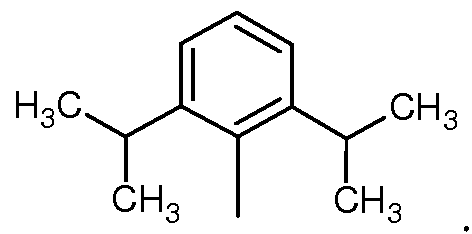
- Chlorophosphine (a) was filtered and extracted with twice 100 ml of pentane. The pentane was evaporated in vacuo and purified by vacuum distillation to give a colorless oil (18.27 g, Yield: 56.6%).
- Product 1 consists of 2 isomers: a majority isomer at 92% and a minority isomer at 8%.
- the metal complex 2 thus obtained is stable in air. Characterization of the majority product 2:
- Example 2 the product 2 obtained in Example 2 was used as a catalyst.
- Solutions containing different concentrations of product 2 in xylene were prepared: A solution at 0.005 M was obtained by dissolving 26 mg (0.025 mmol) of the product 2 in 5 mL of xylene. Solutions at 0.0005 M and 0.00005 M were prepared from the first solution by diluting 0.1 mL of the first solution in respectively 1 mL and 10 mL.
Landscapes
- Chemical & Material Sciences (AREA)
- Organic Chemistry (AREA)
- Chemical Kinetics & Catalysis (AREA)
- Inorganic Chemistry (AREA)
- Engineering & Computer Science (AREA)
- Materials Engineering (AREA)
- Health & Medical Sciences (AREA)
- Medicinal Chemistry (AREA)
- Polymers & Plastics (AREA)
- Catalysts (AREA)
Abstract
Description


Claims




Priority Applications (5)
| Application Number | Priority Date | Filing Date | Title |
|---|---|---|---|
| KR1020167003485A KR102338544B1 (ko) | 2013-07-12 | 2014-07-11 | 실릴렌 리간드를 가지는 신규한 촉매 |
| EP14758601.0A EP3019272B1 (fr) | 2013-07-12 | 2014-07-11 | Nouveaux catalyseurs a ligand silylene |
| US14/903,421 US9938304B2 (en) | 2013-07-12 | 2014-07-11 | Catalysts with a silylene ligand |
| CN201480039842.6A CN105579139B (zh) | 2013-07-12 | 2014-07-11 | 具有硅宾配体的新型催化剂 |
| JP2016524880A JP6502339B2 (ja) | 2013-07-12 | 2014-07-11 | シリレンリガンドを有する新規な触媒 |
Applications Claiming Priority (2)
| Application Number | Priority Date | Filing Date | Title |
|---|---|---|---|
| FR1356885 | 2013-07-12 | ||
| FR1356885A FR3008324B1 (fr) | 2013-07-12 | 2013-07-12 | Nouveaux catalyseurs a ligand silylene |
Publications (1)
| Publication Number | Publication Date |
|---|---|
| WO2015004396A1 true WO2015004396A1 (fr) | 2015-01-15 |
Family
ID=49510284
Family Applications (1)
| Application Number | Title | Priority Date | Filing Date |
|---|---|---|---|
| PCT/FR2014/051787 Ceased WO2015004396A1 (fr) | 2013-07-12 | 2014-07-11 | Nouveaux catalyseurs a ligand silylene |
Country Status (7)
| Country | Link |
|---|---|
| US (1) | US9938304B2 (fr) |
| EP (1) | EP3019272B1 (fr) |
| JP (1) | JP6502339B2 (fr) |
| KR (1) | KR102338544B1 (fr) |
| CN (1) | CN105579139B (fr) |
| FR (1) | FR3008324B1 (fr) |
| WO (1) | WO2015004396A1 (fr) |
Cited By (15)
| Publication number | Priority date | Publication date | Assignee | Title |
|---|---|---|---|---|
| WO2017220871A1 (fr) | 2016-06-21 | 2017-12-28 | Bluestar Silicones France Sas | Procédé de lutte contre l'apparition de brouillard dans un dispositif à cylindres lors de l'enduction de supports flexibles avec une composition silicone liquide réticulable |
| WO2020127818A1 (fr) | 2018-12-20 | 2020-06-25 | Elkem Silicones France Sas | Procédé de lutte contre l'apparition de brouillard dans un dispositif a cylindres lors de l'enduction de supports flexibles avec une composition silicone liquide réticulable |
| WO2021014058A1 (fr) | 2019-07-25 | 2021-01-28 | Elkem Silicones France Sas | Composition silicone pour mousse elastomere |
| WO2021260279A1 (fr) | 2020-06-25 | 2021-12-30 | Elkem Silicones France Sas | Compositions silicones thermoconductrices |
| WO2022129348A1 (fr) | 2020-12-16 | 2022-06-23 | Elkem Silicones France Sas | Composition silicone biocide applicable sur des surfaces |
| WO2023111405A1 (fr) | 2021-12-17 | 2023-06-22 | Elkem Silicones France Sas | Procédé de préparation de mousse silicone |
| WO2023214130A1 (fr) | 2022-05-03 | 2023-11-09 | Elkem Silicones France Sas | Article apte au contact alimentaire et son procédé de fabrication |
| WO2024026456A1 (fr) | 2022-07-28 | 2024-02-01 | Elkem Silicones USA Corp. | Compositions de mousse de silicone |
| EP4344873A1 (fr) | 2022-09-27 | 2024-04-03 | Elkem Silicones France SAS | Post-traitement d'un article en silicone élastomère imprimé en 3d |
| FR3144920A1 (fr) | 2023-01-16 | 2024-07-19 | Elkem Silicones France Sas | Dispositif de protection passive contre l’incendie comprenant une mousse silicone |
| EP4410869A1 (fr) | 2023-02-03 | 2024-08-07 | Elkem Silicones France SAS | Nouveaux composés organopolysiloxane fonctionnalisés, leur procédé de fabrication et leurs utilisations |
| WO2025133480A1 (fr) | 2023-12-22 | 2025-06-26 | Elkem Silicones France Sas | Composition silicone réticulable par polyaddition pour la préparation d'élastomère silicone thermoconducteur |
| WO2025133478A1 (fr) | 2023-12-22 | 2025-06-26 | Elkem Silicones France Sas | Procédé de préparation d'un article comprenant une couche de mousse silicone |
| WO2025133477A1 (fr) | 2023-12-22 | 2025-06-26 | Elkem Silicones France Sas | Gel silicone adhésif à la peau |
| WO2025202552A1 (fr) | 2024-03-25 | 2025-10-02 | Elkem Silicones France Sas | Méthode de recyclage d'un matériau silicone |
Families Citing this family (2)
| Publication number | Priority date | Publication date | Assignee | Title |
|---|---|---|---|---|
| JP2019163228A (ja) * | 2018-03-20 | 2019-09-26 | 株式会社東芝 | 金属有機構造体、蛍光体膜、および分子検出装置 |
| CN111477869B (zh) * | 2020-04-17 | 2021-03-05 | 杭州师范大学 | 有机硅宾化合物在制备锂离子电池负极材料中的应用 |
Citations (2)
| Publication number | Priority date | Publication date | Assignee | Title |
|---|---|---|---|---|
| WO2001042258A1 (fr) * | 1999-12-07 | 2001-06-14 | Rhodia Chimie | Catalyseurs pour reactions d'hydrosilylation |
| US20040236054A1 (en) * | 2001-06-07 | 2004-11-25 | Catherine George | Silicone composition crosslinkable into elastomer by hydrosilylation, in the presence of carbene-based metal catalysts, and catalysts |
Family Cites Families (6)
| Publication number | Priority date | Publication date | Assignee | Title |
|---|---|---|---|---|
| FR1528464A (fr) | 1966-06-23 | 1968-06-07 | Dow Corning | Compositions d'organopolysiloxanes durcissables à une partie composante |
| DE2654893A1 (de) | 1976-12-03 | 1978-06-15 | Wacker Chemie Gmbh | Verfahren zum herstellen von klebrige stoffe abweisenden ueberzuegen |
| US5260399A (en) * | 1992-06-08 | 1993-11-09 | General Electric Company | Regiospecific catalyst for the synthesis of epoxysiloxane monomers and polymers |
| US6809213B2 (en) * | 2000-05-05 | 2004-10-26 | General Electric Company | Preparation of secondary aminoisobutylalkoxysilanes |
| JP5420896B2 (ja) | 2006-02-16 | 2014-02-19 | 株式会社カネカ | 硬化性組成物 |
| FR2943344B1 (fr) * | 2009-03-18 | 2011-04-15 | Commissariat Energie Atomique | Nouveaux composes silanes porteurs d'une chaine carbonee cyclique comprenant une fonction alcyne pour fonctionnaliser des supports solides et immobiliser sur ces supports des molecules biologiques |
-
2013
- 2013-07-12 FR FR1356885A patent/FR3008324B1/fr active Active
-
2014
- 2014-07-11 WO PCT/FR2014/051787 patent/WO2015004396A1/fr not_active Ceased
- 2014-07-11 EP EP14758601.0A patent/EP3019272B1/fr active Active
- 2014-07-11 JP JP2016524880A patent/JP6502339B2/ja active Active
- 2014-07-11 KR KR1020167003485A patent/KR102338544B1/ko active Active
- 2014-07-11 US US14/903,421 patent/US9938304B2/en active Active
- 2014-07-11 CN CN201480039842.6A patent/CN105579139B/zh active Active
Patent Citations (2)
| Publication number | Priority date | Publication date | Assignee | Title |
|---|---|---|---|---|
| WO2001042258A1 (fr) * | 1999-12-07 | 2001-06-14 | Rhodia Chimie | Catalyseurs pour reactions d'hydrosilylation |
| US20040236054A1 (en) * | 2001-06-07 | 2004-11-25 | Catherine George | Silicone composition crosslinkable into elastomer by hydrosilylation, in the presence of carbene-based metal catalysts, and catalysts |
Non-Patent Citations (2)
| Title |
|---|
| RICARDO RODRIGUEZ ET AL: "Synthesis of a Donor-Stabilized Silacyclopropan-1-one", ANGEWANDTE CHEMIE INTERNATIONAL EDITION, vol. 52, no. 16, 15 April 2013 (2013-04-15), pages 4426 - 4430, XP055107848, ISSN: 1433-7851, DOI: 10.1002/anie.201210010 * |
| RODRIGUEZ, R. ET AL: "Synthesis and Characterization of an isolable base-stabilized silacycloprop-1-ylidene", ANGEW. CHEM. INT. ED., vol. 51, 27 April 2012 (2012-04-27), pages 7158 - 7161, XP002721830 * |
Cited By (22)
| Publication number | Priority date | Publication date | Assignee | Title |
|---|---|---|---|---|
| WO2017220871A1 (fr) | 2016-06-21 | 2017-12-28 | Bluestar Silicones France Sas | Procédé de lutte contre l'apparition de brouillard dans un dispositif à cylindres lors de l'enduction de supports flexibles avec une composition silicone liquide réticulable |
| US11078379B2 (en) | 2016-06-21 | 2021-08-03 | Elkem Silicones France Sas | Method for the prevention of mist formation in a device comprising rolls during the coating of flexible media with a crosslinkable liquid silicone composition |
| WO2020127818A1 (fr) | 2018-12-20 | 2020-06-25 | Elkem Silicones France Sas | Procédé de lutte contre l'apparition de brouillard dans un dispositif a cylindres lors de l'enduction de supports flexibles avec une composition silicone liquide réticulable |
| WO2021014058A1 (fr) | 2019-07-25 | 2021-01-28 | Elkem Silicones France Sas | Composition silicone pour mousse elastomere |
| FR3099165A1 (fr) | 2019-07-25 | 2021-01-29 | Elkem Silicones France Sas | Composition silicone pour mousse elastomere. |
| WO2021260279A1 (fr) | 2020-06-25 | 2021-12-30 | Elkem Silicones France Sas | Compositions silicones thermoconductrices |
| WO2022129348A1 (fr) | 2020-12-16 | 2022-06-23 | Elkem Silicones France Sas | Composition silicone biocide applicable sur des surfaces |
| WO2023111405A1 (fr) | 2021-12-17 | 2023-06-22 | Elkem Silicones France Sas | Procédé de préparation de mousse silicone |
| WO2023214130A1 (fr) | 2022-05-03 | 2023-11-09 | Elkem Silicones France Sas | Article apte au contact alimentaire et son procédé de fabrication |
| WO2024026459A1 (fr) | 2022-07-28 | 2024-02-01 | Elkem Silicones USA Corp. | Implants comprenant une mousse de silicone |
| WO2024026456A1 (fr) | 2022-07-28 | 2024-02-01 | Elkem Silicones USA Corp. | Compositions de mousse de silicone |
| EP4344873A1 (fr) | 2022-09-27 | 2024-04-03 | Elkem Silicones France SAS | Post-traitement d'un article en silicone élastomère imprimé en 3d |
| WO2024068044A1 (fr) | 2022-09-27 | 2024-04-04 | Elkem Silicones France Sas | Post-traitement d'un article en silicone élastomère imprimé en 3d |
| FR3144920A1 (fr) | 2023-01-16 | 2024-07-19 | Elkem Silicones France Sas | Dispositif de protection passive contre l’incendie comprenant une mousse silicone |
| WO2024153869A1 (fr) | 2023-01-16 | 2024-07-25 | Elkem Silicones France Sas | Dispositif de protection passive contre l'incendie comprenant une mousse silicone |
| EP4410869A1 (fr) | 2023-02-03 | 2024-08-07 | Elkem Silicones France SAS | Nouveaux composés organopolysiloxane fonctionnalisés, leur procédé de fabrication et leurs utilisations |
| WO2024160473A1 (fr) | 2023-02-03 | 2024-08-08 | Elkem Silicones France Sas | Nouveaux composés d'organopolysiloxane fonctionnalisés, procédé de fabrication et utilisations de ceux-ci |
| WO2025133480A1 (fr) | 2023-12-22 | 2025-06-26 | Elkem Silicones France Sas | Composition silicone réticulable par polyaddition pour la préparation d'élastomère silicone thermoconducteur |
| WO2025133479A1 (fr) | 2023-12-22 | 2025-06-26 | Elkem Silicones France Sas | Composition silicone réticulable par polyaddition pour la préparation d'élastomère silicone thermoconducteur |
| WO2025133478A1 (fr) | 2023-12-22 | 2025-06-26 | Elkem Silicones France Sas | Procédé de préparation d'un article comprenant une couche de mousse silicone |
| WO2025133477A1 (fr) | 2023-12-22 | 2025-06-26 | Elkem Silicones France Sas | Gel silicone adhésif à la peau |
| WO2025202552A1 (fr) | 2024-03-25 | 2025-10-02 | Elkem Silicones France Sas | Méthode de recyclage d'un matériau silicone |
Also Published As
| Publication number | Publication date |
|---|---|
| KR20160058087A (ko) | 2016-05-24 |
| EP3019272A1 (fr) | 2016-05-18 |
| CN105579139A (zh) | 2016-05-11 |
| JP2016530237A (ja) | 2016-09-29 |
| FR3008324B1 (fr) | 2019-10-04 |
| JP6502339B2 (ja) | 2019-04-17 |
| KR102338544B1 (ko) | 2021-12-14 |
| FR3008324A1 (fr) | 2015-01-16 |
| US20160159830A1 (en) | 2016-06-09 |
| CN105579139B (zh) | 2019-08-13 |
| US9938304B2 (en) | 2018-04-10 |
| EP3019272B1 (fr) | 2021-03-24 |
Similar Documents
| Publication | Publication Date | Title |
|---|---|---|
| FR3008324B1 (fr) | Nouveaux catalyseurs a ligand silylene | |
| FR3008325B1 (fr) | Nouveaux catalyseurs a ligand silene | |
| CA2393629C (fr) | Catalyseurs pour reactions d'hydrosilylation | |
| EP3218384B1 (fr) | Procédé d'hydrosilylation mettant en oeuvre un catalyseur organique dérivé de germylene | |
| EP1401964B1 (fr) | Composition silicone reticulable en elastomere par hydrosilylation, en presence de catalyseurs metalliques a base de carbenes, et catalyseurs de ce type | |
| JP6327426B2 (ja) | ヒドロシリル化反応触媒 | |
| EP3406616B1 (fr) | Nouveau composé d'isocyanure et catalyseur de réaction d'hydrosilylation | |
| JP5429745B2 (ja) | 脱水素シリル化反応用触媒、及び有機ケイ素化合物の製造方法 | |
| EP3455228B1 (fr) | Procédé d'hydrosilylation mettant en oeuvre un catalyseur organique derivé de germylène | |
| EP3507292B1 (fr) | Utilisation de formiates silylés comme équivalents d'hydrosilanes | |
| FR2996846A1 (fr) | Procede de preparation de formamidines |
Legal Events
| Date | Code | Title | Description |
|---|---|---|---|
| WWE | Wipo information: entry into national phase |
Ref document number: 201480039842.6 Country of ref document: CN |
|
| 121 | Ep: the epo has been informed by wipo that ep was designated in this application |
Ref document number: 14758601 Country of ref document: EP Kind code of ref document: A1 |
|
| WWE | Wipo information: entry into national phase |
Ref document number: 14903421 Country of ref document: US |
|
| ENP | Entry into the national phase |
Ref document number: 2016524880 Country of ref document: JP Kind code of ref document: A |
|
| NENP | Non-entry into the national phase |
Ref country code: DE |
|
| WWE | Wipo information: entry into national phase |
Ref document number: 2014758601 Country of ref document: EP |
|
| ENP | Entry into the national phase |
Ref document number: 20167003485 Country of ref document: KR Kind code of ref document: A |