WO2015015147A1 - Process for the preparation of morphinan-6-one compounds - Google Patents
Process for the preparation of morphinan-6-one compounds Download PDFInfo
- Publication number
- WO2015015147A1 WO2015015147A1 PCT/GB2014/050324 GB2014050324W WO2015015147A1 WO 2015015147 A1 WO2015015147 A1 WO 2015015147A1 GB 2014050324 W GB2014050324 W GB 2014050324W WO 2015015147 A1 WO2015015147 A1 WO 2015015147A1
- Authority
- WO
- WIPO (PCT)
- Prior art keywords
- compound
- formula
- area
- process according
- acidic solution
- Prior art date
- Legal status (The legal status is an assumption and is not a legal conclusion. Google has not performed a legal analysis and makes no representation as to the accuracy of the status listed.)
- Ceased
Links
- 0 *[C@]([C@@](C1)N(*)CC2)([C@]22c3c1ccc(*)c3O[C@]21)C=CC1=O Chemical compound *[C@]([C@@](C1)N(*)CC2)([C@]22c3c1ccc(*)c3O[C@]21)C=CC1=O 0.000 description 4
Classifications
-
- C—CHEMISTRY; METALLURGY
- C07—ORGANIC CHEMISTRY
- C07D—HETEROCYCLIC COMPOUNDS
- C07D489/00—Heterocyclic compounds containing 4aH-8, 9 c- Iminoethano-phenanthro [4, 5-b, c, d] furan ring systems, e.g. derivatives of [4, 5-epoxy]-morphinan of the formula:
- C07D489/06—Heterocyclic compounds containing 4aH-8, 9 c- Iminoethano-phenanthro [4, 5-b, c, d] furan ring systems, e.g. derivatives of [4, 5-epoxy]-morphinan of the formula: with a hetero atom directly attached in position 14
- C07D489/08—Oxygen atom
-
- C—CHEMISTRY; METALLURGY
- C07—ORGANIC CHEMISTRY
- C07D—HETEROCYCLIC COMPOUNDS
- C07D498/00—Heterocyclic compounds containing in the condensed system at least one hetero ring having nitrogen and oxygen atoms as the only ring hetero atoms
- C07D498/02—Heterocyclic compounds containing in the condensed system at least one hetero ring having nitrogen and oxygen atoms as the only ring hetero atoms in which the condensed system contains two hetero rings
-
- C—CHEMISTRY; METALLURGY
- C07—ORGANIC CHEMISTRY
- C07D—HETEROCYCLIC COMPOUNDS
- C07D489/00—Heterocyclic compounds containing 4aH-8, 9 c- Iminoethano-phenanthro [4, 5-b, c, d] furan ring systems, e.g. derivatives of [4, 5-epoxy]-morphinan of the formula:
- C07D489/02—Heterocyclic compounds containing 4aH-8, 9 c- Iminoethano-phenanthro [4, 5-b, c, d] furan ring systems, e.g. derivatives of [4, 5-epoxy]-morphinan of the formula: with oxygen atoms attached in positions 3 and 6, e.g. morphine, morphinone
-
- C—CHEMISTRY; METALLURGY
- C07—ORGANIC CHEMISTRY
- C07D—HETEROCYCLIC COMPOUNDS
- C07D498/00—Heterocyclic compounds containing in the condensed system at least one hetero ring having nitrogen and oxygen atoms as the only ring hetero atoms
- C07D498/02—Heterocyclic compounds containing in the condensed system at least one hetero ring having nitrogen and oxygen atoms as the only ring hetero atoms in which the condensed system contains two hetero rings
- C07D498/08—Bridged systems
Definitions
- the present invention concerns processes for the synthesis of morphinan-6-one compounds, in particular noroxymorphone and salts thereof, having improved impurity profiles.
- APIs Active Pharmaceutical Ingredients
- PKIs genotoxic impurities
- Compounds which contain an ⁇ , ⁇ -unsaturated ketone moiety have been identified as potential genotoxins which need to be controlled.
- Routes to semi-synthetic opiate alkaloid APIs often involve intermediate compounds which contain an ⁇ , ⁇ -unsaturated ketone (ABUK).
- ABUK ⁇ , ⁇ -unsaturated ketone
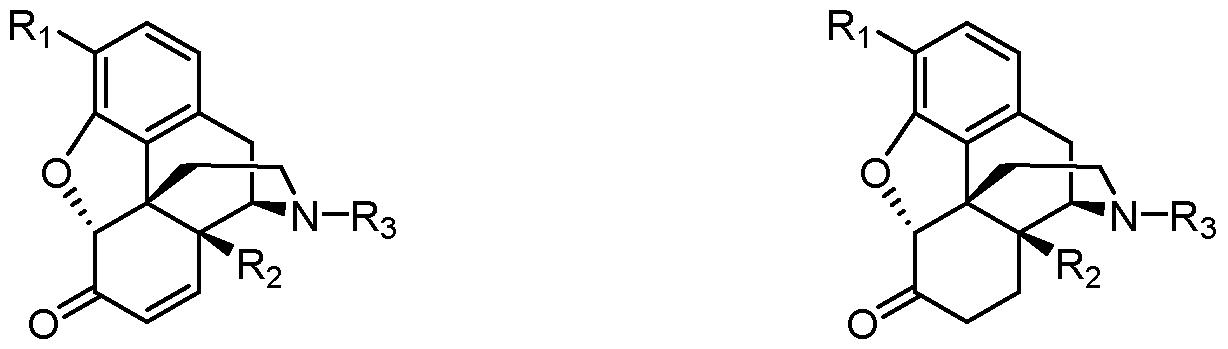
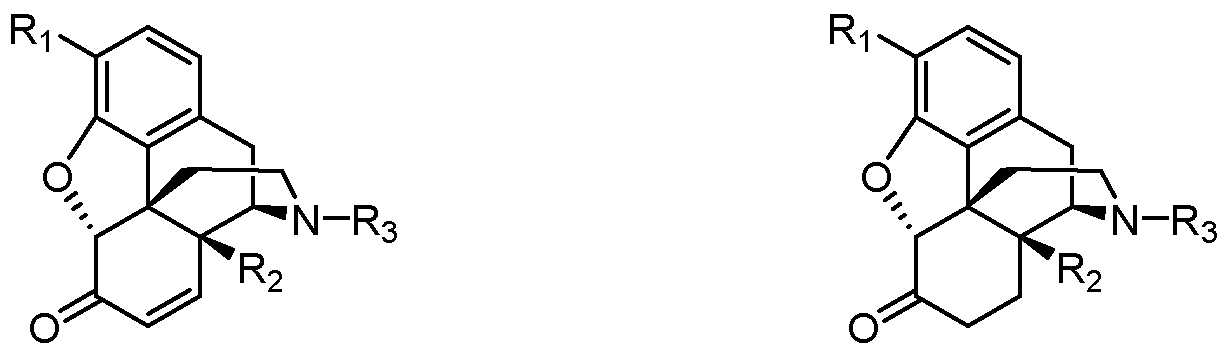
- the invention provides a process for preparing a compound of formula (3), the process comprising the steps of:
- step (b) treating the aqueous acidic solution of step (a) such that the compound of formula (2) dehydrates to form a compound of formula (1) and the compound of formula (1) is reduced to form an aqueous acidic solution of the compound of formula (3),
- step (b) is carried out at one or more temperatures greater than ambient in the presence of a hydrogenation catalyst and hydrogen gas;
- i) is -OH, R 2 is -OH and R 3 -H; or
- ii) is -OCH 3 , R 2 is -H and R 3 -CH 3 ; or
- RT is -OH, R 2 is -H and R3 -CH 3 ; or
- R is -OCH 3 , R 2 is -H and R 3 -H; or
- RT is -OH, R 2 is -H and R 3 -H; or
- R is -OCH 3
- R 2 is -OH
- R 3 -H
- R ⁇ is -OH
- R 2 is -OH
- R 3 -H for the compounds (1 ), (2) and (3).
- the chemical names for the compounds (1), (2) and (3) are set out below:
- step (a) the process comprises providing an aqueous acidic solution comprising a compound of formula (1) and, as an impurity, a compound of formula (2).
- the compounds of formula (1) may be prepared by known methods.
- nor-14- hydroxymorphinone and nor-14-hydroxycodeinone may be prepared by the methods described in
- the compound (2) is an impurity.
- impurity we mean a compound which is undesirably present and typically occurs in small quantities.
- the impurity may be present in the starting material, produced during the course of the reaction and/or is present in the product.
- the inventors believe the compound (2) may originate from two sources - first, it may be formed during the synthesis of compound (1). Secondly, it is believed that under aqueous acidic conditions an equilibrium occurs between the compounds (1) and (2). This means that the compound (2) can be formed from the compound (1) when the compound (1) is treated with an aqueous acid:
- the aqueous acid solution may be prepared from water and an acid selected from the group consisting of acetic acid, phosphoric acid, citric acid, tartaric acid, oxalic acid, hydrochloric acid and hydrobromic acid.
- the acid is acetic acid.
- the acid is phosphoric acid.
- the acid is hydrochloric acid.
- any suitable v/v ratio of water : acid may be used.
- the v/v ratio of water : acid may be from about 100 : 0.01 to about 0.01 : 100, such as about 100 : 1 to about 1 : 100.
- the v/v ratio of water : acid is from about 40 : 1 to about 60 : 1 .
- the quantities of water and/or acid are not particularly limiting provided there is enough water and/or acid to substantially dissolve the compound (1 ) (and compound (2)) and the water and/or acid do not significantly adversely affect the reaction.
- the quantity of water present in the catalyst and/or compound (1) (which may also be used wet) may be taken into account when calculating the total quantity of water to be used.
- the quantity of water present in the acid may also be taken into account when calculating the total quantity of water to be used.
- the wt/wt ratio of compound (1) : acid may be in the range of about 0.01 : 200 g/g to about 200 : 0.1 g/g, such as about 100 : 1 .
- the ratio of compound (1) : water may be in the range of about to about 20 : 0.005 to about 0.005 : 20, such as about 0.75 :15 to about 15 : 0.75 g/g, for example about 1 : 10 to about 1 : 15 g/g.
- the compound (1) (and compound (2)) is substantially dissolved in the water and acid.
- the dissolution of the compound (1) may be encouraged through the use of an aid such as stirring and/or sonication.
- the pH of the initial reaction mixture may be any suitable pH which does not adversely affect the impurity profile of the reaction.
- the pH of the initial reaction mixture may be in the range of about > 1 .0 to about ⁇ 7.0.
- the pH may be > about 1 .5.
- the pH may be > about 2.0.
- the pH may be ⁇ about 6.5.
- the pH may be ⁇ about 6.0.
- the pH may be ⁇ about 5.5.
- the pH of the initial reaction mixture may be in the range of about > 2.0 to about ⁇ about 5.0.
- the pH of the reaction mixture may increase during the course of the reaction and, if desired, the pH may be lowered through the addition of further acid or a solution of acid/water.
- step (b) the aqueous acidic solution of step (a) is treated such that the compound of formula (2) dehydrates to form a compound of formula (1) and the compound of formula (1 ) is reduced to form the aqueous acidic solution of the compound of formula (3).
- the level of the compound (1) may increase in the compound (3) when the compound (3) is subjected to certain conditions which are commonly used in industry during the preparation of the compounds (3). These conditions include increasing the pH of an acidic solution of a compound (3) in order to precipitate it out of solution and/or drying the so formed free alkaloid. In the present instance, however, the process is carried out under forcing conditions such that the compound (2) dehydrates to the compound (1).
- the compound (1) is then chemically reduced by hydrogenating the compound (1) in the presence of a hydrogenation catalyst and hydrogen gas to form the compound (3).
- the product i.e. the compound of formula (3)
- ABUK regrowth may be assessed by heating samples of the compound (3) at 80 °C overnight in order to force the growth of ABUK. This is known as "stress testing”. Stress testing, therefore, is a method for assessing the propensity of a sample of compound (3) to undergo ABUK regrowth.
- ambient temperature we mean a temperature of 30°C or less, such as 0°C to 30°C, for example 10°C to 30°C.
- the hydrogenation is carried out at one or more temperatures greater than ambient temperature i.e. greater than 30 °C and below the boiling point of the reaction mixture.
- the boiling point of the reaction mixture may vary depending on the pressure under which the hydrogenation reaction is conducted.
- the hydrogenation may be carried out at one or more temperatures in the range of > about 75 °C to about ⁇ about 100 °C.
- the hydrogenation is carried out at one or more temperatures > about 76 °C.
- the hydrogenation is carried out at one or more temperatures > about 77 °C.
- the hydrogenation is carried out at one or more temperatures ⁇ about 95 °C. In some embodiments, the hydrogenation is carried out at one or more temperatures ⁇ about 90 °C. In some embodiments, the hydrogenation is carried out at one or more temperatures ⁇ about 85 °C. In one preferred embodiment, the hydrogenation is carried out at one or more temperatures in the range of > about 77 °C to about ⁇ 85 °C, such as about 80 ⁇ 2 °C.
- the reaction mixture is generally heated to temperature before the hydrogenation reaction starts. Heating the reaction mixture to temperature may be carried out by purging the reaction vessel with one or more nitrogen/vacuum cycles (e.g. one, two, three or four cycles), optionally followed by one or more hydrogen/vacuum cycles (e.g. one, two or three cycles).
- the use of hydrogen in the purge cycles may be used on a small scale. However, on a larger, or indeed industrial scale, the hydrogen/vacuum cycles are generally not performed.
- the reaction mixture may be agitated to encourage removal of dissolved oxygen. After the final purge cycle the vessel may be left under vacuum and agitated (by either stirring or shaking) whilst the vessel is heated. Once the reaction mixture reaches the desired temperature, the hydrogenation reaction may begin by exposing the reaction mixture to hydrogen gas.
- the hydrogenation catalyst may be a heterogeneous or homogeneous catalyst, preferably a heterogeneous catalyst.
- the heterogeneous catalyst is a heterogeneous platinum group metal (PGM) catalyst, for example, a heterogeneous palladium or platinum catalyst.
- the heterogeneous catalyst is a heterogeneous palladium catalyst. Examples of palladium catalysts include but are not limited to colloidal palladium, palladium sponge, palladium plate or palladium wire. Examples of platinum catalysts include but are not limited to colloidal platinum, platinum sponge, platinum plate or platinum wire.
- the heterogeneous PGM catalyst may be a PGM on a solid support.
- the support may be selected from the group consisting of carbon, alumina, calcium carbonate, barium carbonate, barium sulfate, titania, silica, zirconia, ceria and a combination thereof.
- the alumina may be in the form of alpha-AI 2 0 3 , beta-AI 2 0 3 , gamma-AI 2 0 3 , delta-AI 2 0 3 , theta-AI 2 0 3 or a combination thereof.
- the support is carbon, the carbon may be in the form of activated carbon (e.g. neutral, basic or acidic activated carbon), carbon black or graphite (e.g. natural or synthetic graphite).
- An example of a heterogeneous PGM catalyst is palladium on carbon.
- An example of another heterogeneous PGM catalyst is platinum on carbon.
- the catalyst loading may be up to about 20 mole%. In one embodiment, the catalyst loading may be up to 10 mole% and, in another embodiment, may be in the range of about 0.001 -10 mole %, for example, 0.01 -10 mole %. In another embodiment, the catalyst loading may be in the range of about 0.1 -10.0 mole %.
- the hydrogenation may conveniently be carried out with an initial hydrogen pressure in the range of up to about 100 psi e.g. about 40 ⁇ 5 psi.
- protecting groups are generally not required in the present process, if it is found that the compound (1) has one or more substituents which may be adversely affected during the reduction, such as 3-hydroxy or 17-NH groups, these may be protected in a conventional manner. Alternatively, if these substituents have been protected prior to the present process (for example, in steps leading to the synthesis of the compound (1)), the protecting group(s) may be selected such that simultaneous hydrogenation of the compound (1 ) and deprotection occurs to form the compound (3). Suitable protecting groups which are capable of withstanding hydrogenation or are removed during hydrogenation are known in the art (see, for example, "Protective Groups in Organic Chemistry", Peter G. M. Wuts and Theodora W. Greene, Wiley Blackwell) and include unsubstituted or substituted benzyl groups.
- the hydrogenation reaction is carried out for a period of time until it is determined that the reaction is complete. Completion of the reaction may be determined by in-process analysis or by identifying that there is no longer an uptake of hydrogen gas. Typically the hydrogenation is complete within about 4 hours or less. The period of time over which the hydrogenation is carried out should be taken in account when carrying out the present process as it may adversely affect the impurity profile of the resulting compound (3). For example, when the compound (1) is nor-14-hydroxymorphinone and the compound (3) is noroxymorphone, it is generally not desirable to extend the duration of the hydrogenation as it has been found that this may lead to increased levels of 6p-noroxymorphol.
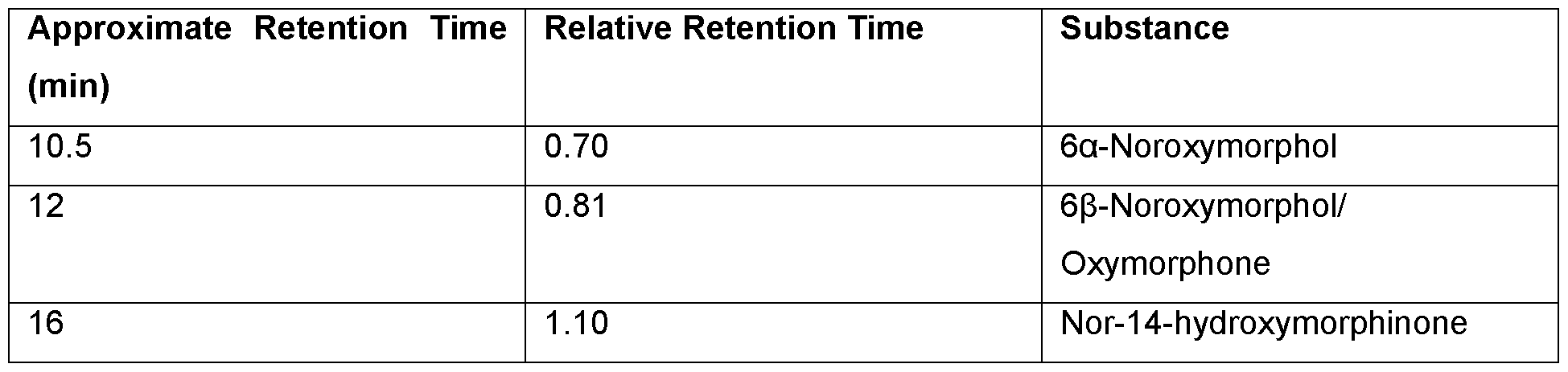
- 6 ⁇ - Noroxymorphol is a known impurity in the synthesis of noroxymorphone and which may be identified using the HPLC method provided below. Without wishing to be bound by theory, it is believed that ⁇ - noroxymorphol may be produced from noroxymorphone via the ketone reduction at C-6 (see Figure 1). Extended hydrogenation therefore may lower the yield of the desired product through its further reaction, as well as generating an increased level of an unwanted impurity.
- the reaction vessel may be cooled and purged to remove excess hydrogen gas (or vice versa).
- the hydrogenation catalyst may be removed by any appropriate method, such as filtration, and the filtrate (containing the compound (3)) may be further treated as desired.
- the present process provides an aqueous acidic solution of compound (3) comprising ⁇ about 0.05 area % of the compound of formula (1) as determined by HPLC, such ⁇ about 0.04 area %, for example, ⁇ about 0.03 area %.
- the process provides an aqueous acidic solution of compound (3) comprising ⁇ about 0.02 area % of the compound of formula (1), for example, ⁇ about 0.01 area %.
- the process could provide an aqueous acidic solution of compound (3) comprising ⁇ about 0.005 area % of the compound of formula (1), such as ⁇ about 0.004 area %, for example ⁇ about 0.003 area % e.g. ⁇ about 0.002 area % or ⁇ about 0.001 area %.
- the process may provide an aqueous acidic solution of compound (3) comprising compound of formula (1) in a non-detectable amount (as determined by HPLC).
- the process further comprises treating the aqueous acidic solution of compound (3) to form solid salts of compound (3) (i.e. acid adducts of the compound (3) which are in a solid form, such as a precipitate).
- solid salts include but are not limited to noroxymorphone acetate or noroxymorphone hydrochloride.
- the aqueous acidic solution compound (3) may undergo a salt exchange to form an aqueous acidic solution of compound (3) comprising a different acid.
- a solution of noroxymorphone acetate may undergo a salt exchange to form a solution of noroxymorphone hydrochloride.
- the solid salt of compound (3) comprises ⁇ about 0.05 area % of the compound of formula (1 ) as determined by HPLC, such ⁇ about 0.04 area %, for example, ⁇ about 0.03 area %. In some embodiments, the solid salt of compound (3) comprises ⁇ about 0.02 area % of the compound of formula (1), for example, ⁇ about 0.01 area %. It is envisaged that, in some embodiments, the process could provide a solid salt of compound (3) comprising ⁇ about 0.005 area % of the compound of formula (1 ), such as ⁇ about 0.004 area %, for example ⁇ about 0.003 area % e.g. ⁇ about 0.002 area % or ⁇ about 0.001 area %. In some embodiments, the process may provide an aqueous acidic solution of compound (3) comprising compound of formula (1 ) in a non-detectable amount (as determined by HPLC).
- the process further comprises treating the aqueous acidic solution of compound (3) at about 45-50 °C with a base to form the alkaloid of compound (3).
- a suitable base is ammonium hydroxide.
- Sufficient base is typically added so that the compound (3) precipitates out of solution.
- precipitates of compound (3) start to become visible at about pH 7 and typically sufficient base is added to increase the pH to about 8.5-9.0 or above. This ensures that the compound (3) is in free base form, as well as allowing maximum recovery of the compound (3).
- the alkaloid of compound (3) may be collected (e.g. by filtration), optionally washed one or more times (e.g. with Alcohol M, which is 96% ethanol denatured with 4% methanol) and dried.
- the process further comprises treating the solid salt of compound (3) to form the free alkaloid.
- This may be carried out by redissolving the solid salt to form a solution of the salt of compound (3) and treating the solution with a base as described above.
- the alkaloid of the compound (3) may be collected (e.g. by filtration), optionally washed one or more times and dried. Howsoever the alkaloid of compound (3) is prepared, the alkaloid may comprise ⁇ about 0.05 area % of the compound of formula (1) as determined by HPLC, such ⁇ about 0.04 area %, for example, ⁇ about 0.03 area %.
- the alkaloid of compound (3) comprises ⁇ about 0.02 area % of the compound of formula (1), for example, ⁇ about 0.01 area %. It is envisaged that, in some embodiments, the process could provide the alkaloid of compound (3) comprising ⁇ about 0.005 area % of the compound of formula (1), such as ⁇ about 0.004 area %, for example ⁇ about 0.003 area % e.g. ⁇ about 0.002 area % or ⁇ about 0.001 area %. In some embodiments, the process may provide the alkaloid of compound (3) comprising compound of formula (1) in a non-detectable amount (as determined by HPLC). In a second aspect, the invention provides a process for preparing a compound of formula (3), the process comprising the steps of:
- step (II) hydrogenating the product of step (I) at one or more temperatures greater than ambient temperature in the presence of a hydrogenation catalyst and hydrogen gas to form an aqueous acidic solution of the compound of formula (3) comprising ⁇ 0.05 area % of the compound of formula (1) as determined by HPLC and ⁇ 2.00 area % of a compound of formula (4) as determined by HPLC,
- i) is -OH, R 2 is -OH and R 3 -H; or
- ii) is -OCH 3 , R 2 is -H and R 3 -CH 3 ; or
- RT is -OH, R 2 is -H and R3 -CH 3 ; or
- R is -OCH 3 , R 2 is -H and R 3 -H; or
- R is -OH, R 2 is -H and R 3 -H; or
- R ⁇ is -OH
- R 2 is -OH
- R 3 -H for the compounds (1), (2), (3) and (4).
- the compound of formula (4) is produced as an impurity in the transformation of compound (1) to compound (3).
- the compound (4) contains a hydroxy substituent at C-6 and, as such, may comprise a 6a-isomer, a 6p-isomer or a combination thereof.
- Carrying out a hydrogenation reaction at temperatures greater than ambient on some compounds of formula (1) may result in increased levels of the compound of formula (4) being produced.
- increased levels of 6a-noroxymorphol may occur during the hydrogenation of nor-14-hydroxymorphinone at one or more temperatures above ambient.
- Figure 1 without wishing to be bound by theory, it is believed that 6a- noroxymorphol is generated from 14-hydroxynormorphinone and that 6p-noroxymorphol from noroxymorphone. Accordingly, it is desirable to develop a process which is capable of minimising or eliminating the production of the compound (4).
- the two-step process is suitable for (a) minimising or eliminating the production of compound (4) from compound (1), (b) dehydrating compound (2) to compound (1) under forcing conditions, and (c) chemically reducing compound (1 ) to form compound (3).
- the product of the reaction i.e. the compound of formula (3)
- step (I) the aqueous acidic solution comprising the compound of formula (1) and, as an impurity, the compound of formula (2) is hydrogenated at ambient temperature in the presence of a hydrogenation catalyst and hydrogen gas.
- ambient temperature we mean a temperature of 30°C or less such as 0°C to 30°C, for example 10°C to 30°C.
- the hydrogenation conditions described above for the first aspect (other than the temperature) generally apply to this aspect of the invention.
- step (II) the product of step (I) is hydrogenated at one or more temperatures greater than ambient temperature in the presence of a hydrogenation catalyst and hydrogen gas to form an aqueous acidic solution of the compound of formula (3) comprising ⁇ 0.05 area % of the compound of formula (1) as determined by HPLC and ⁇ 2.00 area % of a compound of formula (4) as determined by HPLC.
- the hydrogenation conditions described above for the first aspect (including the temperature) generally apply to this aspect of the invention.
- the hydrogen gas present in step (I) may be substantially removed from the reaction vessel before the reaction mixture is heated to one or more temperatures above ambient.
- the hydrogen gas may be removed from the reaction vessel by purging. Once the reaction mixture is at the desired temperature, the reaction mixture may be exposed once again to hydrogen.
- the reaction vessel may be cooled and purged to remove excess hydrogen gas (or vice versa).
- the hydrogenation catalyst may be removed by any appropriate method, such as filtration, and the filtrate (containing the compound (3)) may be further treated as desired.
- the process forms an aqueous acidic solution of the compound of formula (3) comprising ⁇ 0.05 area % of the compound of formula (1) as determined by HPLC and ⁇ 2.00 area % of a compound of formula (4) as determined by HPLC.
- the process provides an aqueous acidic solution of compound (3) comprising ⁇ about 0.04 area % of compound (1) as determined by HPLC, for example, ⁇ about 0.03 area %.
- the process provides an aqueous acidic solution of compound (3) comprising ⁇ about 0.02 area % of the compound of formula (1), for example, ⁇ about 0.01 area %.
- the process could provide an aqueous acidic solution of compound (3) comprising ⁇ about 0.005 area % of the compound of formula (1), such as ⁇ about 0.004 area %, for example ⁇ about 0.003 area % e.g. ⁇ about 0.002 area % or ⁇ about 0.001 area %.
- the process may provide an aqueous acidic solution of compound (3) comprising compound of formula (1) in a non-detectable amount (as determined by HPLC).
- the process provides an aqueous acidic solution of comprising ⁇ 1 .75 area % of a compound of formula (4) as determined by HPLC, such as ⁇ 1 .50 area %, for example, ⁇ 1 .25 area % or ⁇ 1 .00 area %.
- the process further comprises treating the aqueous acidic solution of compound (3) to form solid salts of compound (3) (i.e. acid adducts of the compound (3) which are in a solid form, such as a precipitate).
- solid salts include but are not limited to noroxymorphone acetate or noroxymorphone hydrochloride.
- aqueous acidic solution compound (3) may undergo a salt exchange to form an aqueous acidic solution of compound (3) comprising a different acid.
- a solution of noroxymorphone acetate may undergo a salt exchange to form a solution of noroxymorphone hydrochloride.
- the solid salt of compound (3) comprises ⁇ about 0.05 area % of the compound of formula (1 ) as determined by HPLC, such ⁇ about 0.04 area %, for example, ⁇ about 0.03 area %. In some embodiments, the solid salt of compound (3) comprises ⁇ about 0.02 area % of the compound of formula (1), for example, ⁇ about 0.01 area %. It is envisaged that, in some embodiments, the process could provide a solid salt of compound (3) comprising ⁇ about 0.005 area % of the compound of formula (1), such as ⁇ about 0.004 area %, for example ⁇ about 0.003 area % e.g. ⁇ about 0.002 area % or ⁇ about 0.001 area %. In some embodiments, the process may provide a solid salt of compound (3) comprising compound of formula (1) in a non-detectable amount (as determined by HPLC).
- the solid salt of compound (3) comprises ⁇ 1 .75 area % of a compound of formula (4) as determined by HPLC, such as ⁇ 1 .50 area %, for example, ⁇ 1 .25 area % or ⁇ 1 .00 area %.
- the solid salt of compound (3) comprises ⁇ 1 .00 area % of the 6a- isomer of a compound of formula (4), such as ⁇ 0.75 area %, for example, ⁇ 0.50 area % or ⁇ 0.40 area %.
- the solid salt of compound (3) comprises ⁇ 1 .00 area % of the 6 ⁇ - isomer of a compound of formula (4), such as ⁇ 0.75 area %, for example, ⁇ 0.50 area % or ⁇ 0.40 area %.
- the process further comprises treating the aqueous acidic solution of compound (3) at about 45-50 °C with a base to form the alkaloid of compound (3).
- a suitable base is ammonium hydroxide.
- Sufficient base is typically added so that the compound (3) precipitates out of solution. Generally, precipitates of compound (3) start to become visible at about pH 7 and typically sufficient base is added to increase the pH to about 9.
- the alkaloid of compound (3) may be collected (e.g. by filtration), optionally washed one or more times (e.g. with Alcohol M) and dried.
- the process further comprises treating the solid salt of compound (3) to form the free alkaloid. This may be carried out by redissolving the solid salt to form a solution of the salt of compound (3) and treating the solution with a base as described above.
- the compound (3) alkaloid may be collected (e.g. by filtration), optionally washed one or more times and dried.
- the alkaloid may comprise ⁇ about 0.05 area % of the compound of formula (1) as determined by HPLC, such ⁇ about 0.04 area %, for example, ⁇ about 0.03 area %.
- the alkaloid of compound (3) comprises ⁇ about 0.02 area % of the compound of formula (1), for example, ⁇ about 0.01 area %. It is envisaged that, in some embodiments, the process could provide the alkaloid of compound (3) comprising ⁇ about 0.005 area % of the compound of formula (1), such as ⁇ about 0.004 area %, for example ⁇ about 0.003 area % e.g. ⁇ about 0.002 area % or ⁇ about 0.001 area %.
- the process may provide the alkaloid of compound (3) comprising compound of formula (1) in a non-detectable amount (as determined by HPLC).
- the alkaloid of compound (3) comprises ⁇ 1 .75 area % of a compound of formula (4) as determined by HPLC, such as ⁇ 1 .50 area %, for example, ⁇ 1 .25 area % or ⁇ 1 .00 area %.
- the solid salt of compound (3) comprises ⁇ 1 .00 area % of the 6a- isomer of a compound of formula (4), such as ⁇ 0.75 area %, for example, ⁇ 0.50 area % or ⁇ 0.40 area %.
- the solid salt of compound (3) comprises ⁇ 1 .00 area % of the 6 ⁇ - isomer of a compound of formula (4), such as ⁇ 0.75 area %, for example, ⁇ 0.50 area % or ⁇ 0.40 area %.
- the present invention provides a compound of formula (3) comprising a compound of formula (1) in an amount ⁇ 0.01 area % as determined by HPLC,
- i) is -OH, R 2 is -OH and R 3 -H; or
- ii) is -OCH 3 , R 2 is -H and R 3 -CH 3 ; or
- RT is -OH, R 2 is -H and R 3 -CH 3 ; or
- R is -OCH 3 , R 2 is -H and R 3 -H; or
- R is -OH, R 2 is -H and R 3 -H; or
- R is -OCH 3
- R 2 is -OH
- R 3 -H
- R ⁇ is -OH
- R 2 is -OH
- R 3 -H for the compounds (1 ) and (3).
- the compound of formula (3) and compound of formula (1) (if present) are solid salts (i.e. are acid adducts and are in a solid form, such as a precipitate).
- the solid salts may be selected from the group consisting of the acetate, phosphate, tartrate, citrate, hydrochloride or hydrobromide.
- the solid salt may be an acetate salt.
- the solid salt may be a phosphate salt.
- the solid salt may be a tartrate salt.
- the solid salt may be a hydrochloride salt.
- the compound of formula (3) and compound of formula (1) (if present) are solid alkaloids (i.e. are free bases and are in solid form, such as a precipitate).
- the compound of formula (1) is present in an amount ⁇ 0.01 area % as determined by HPLC. It is envisaged that, in some embodiments, the compound (1) may be present in an amount ⁇ about 0.005 area %, such as ⁇ about 0.004 area %, for example ⁇ about 0.003 area % e.g. ⁇ about 0.002 area % or ⁇ about 0.001 area %. In some embodiments, the compound (1) may be present in a non- detectable amount (as determined by HPLC).
- Compound (3) or salt thereof may be suitable as intermediates for the preparation of other morphinan-6-one compounds.
- noroxymorphone is a key intermediate in the synthesis of naltrexone, naloxone, nalmefene and 6- keto-nalbuphine:
- Naloxone, naltrexone, nalmefene, and 6-keto-nalbuphine may be prepared by known methods.
- naloxone may be prepared by reacting noroxymorphone with sodium hydrogencarbonate and allyl bromide (see for example US3254088 to Lewenstein et al).
- Naltrexone and 6-keto- nalbuphine may be prepared according to the reductive alkylation method described in US8318937 and US81 19803 (to Johnson Matthey PLC).
- Nalmefene may be prepared from naltrexone using methylenetriphenylphosphorane (Hahn et al, J. Med. Chem., 18, 259 (1975)).
- Noroxymorphone prepared according to the processes of the present invention comprises a low level of ABUK and, furthermore, displays a greater resistance to ABUK regrowth. As such, products prepared from noroxymorphone may also exhibit lower levels of ABUK and a greater resistance to ABUK regrowth.
- noroxymorphone prepared according to the processes of the present invention has been allylated to prepare naloxone comprising ⁇ 35 ppm of the ABUK 7,8- didehydronaloxone.
- Figure 1 illustrates the conversion of nor-14-hydroxymorphinone (a compound of formula (1)) to noroxymorphone (a compound of formula (3)).
- the figure also illustrates 8,14-dihydroxy-7,8- dihydromorphinone (a compound of formula (2)) and the equilibrium between it and nor-14- hydroxymorphinone.
- the formation of a-noroxymorphol and ⁇ -noroxymorphol is also shown.
- Figure 2 is a graph comparing related substances levels (6a-noroxymorphol, and 6 ⁇ - noroxymorphol/oxymorphone) in hydrogenation liquors where the duration of the 80 °C hydrogenation was varied. Examples
- the hydrogenation liquors were sampled (100 mL) and diluted in a 5 mL volumetric flask with 0.1 M HCI to the mark.
- the hydrogenations were carried out on either a Parr Shaker or Stirrer hydrogenator. All basifications were carried out in appropriately sized flange flasks fitted with a thermocouple, condenser and a temperature controlled isomantle.
- Isolation of Noroxymorphone Alkaloid 14 Charge the hydrogenation liquors to an appropriately sized flange flask, fitted with a thermocouple, temperature controlled isomantle, stirrer and condenser.
- Alcohol M is 96% ethanol denaturated with 4% methanol.
- Example 2 was carried out where the duration of the ambient phase of the hydrogenation was kept at 2 hours and the length of the 80 °C hydrogenation of Method B was varied at 2, 4 and 10 hours.
- the hydrogenation liquors were analysed for related substances using the European Pharmacopeia HPLC Method provided above.
- the experiment was carried out using a Parr Shaker hydrogenator.
- Figure 2 illustrates the results provided in the table above where it can be seen that the level of a- noroxymorphol does not substantially increase greatly after the 2 hours 80 °C.
- the ABUK level in the hydrogenation liquors appeared low at 41 .8 ppm. However, regrowth of the ABUK occurred upon basification of the liquors at 45 °C with the ABUK level increasing to 280 ppm. Furthermore, on stress-testing the isolated noroxymorphone at 80 °C, the ABUK level increased even more to 301 .52 ppm.
- Example 2 This Example can be compared with Example 2 where the ABUK level consistently remained at 0.01 area % (i.e. 100 ppm) or less throughout the experiment. In Examples 2.2-2.4 and 2.7, the ABUK was non-detectable by HPLC.
Landscapes
- Chemical & Material Sciences (AREA)
- Organic Chemistry (AREA)
- Pharmaceuticals Containing Other Organic And Inorganic Compounds (AREA)
- Low-Molecular Organic Synthesis Reactions Using Catalysts (AREA)
- Organic Low-Molecular-Weight Compounds And Preparation Thereof (AREA)
- Other In-Based Heterocyclic Compounds (AREA)
Abstract
Description







Claims


Priority Applications (8)
| Application Number | Priority Date | Filing Date | Title |
|---|---|---|---|
| US14/909,573 US9908891B2 (en) | 2013-08-02 | 2014-02-05 | Process for the preparation of morphinan-6-one compounds |
| AU2014298258A AU2014298258B2 (en) | 2013-08-02 | 2014-02-05 | Process for the preparation of morphinan-6-one compounds |
| RU2016107381A RU2652786C2 (en) | 2013-08-02 | 2014-02-05 | Method for obtaining compounds of morfinan-6-one |
| CN201480043663.XA CN105452254B (en) | 2013-08-02 | 2014-02-05 | The method for preparing morphinan-6-ones compound |
| EP14704633.8A EP3027621A1 (en) | 2013-08-02 | 2014-02-05 | Process for the preparation of morphinan-6-one compounds |
| BR112016002078A BR112016002078A2 (en) | 2013-08-02 | 2014-02-05 | PROCÉDÉ DE PREPARATION DE COMPOSÉS MORPHINAN-6-ONES |
| CA2919606A CA2919606C (en) | 2013-08-02 | 2014-02-05 | Process for the preparation of morphinan-6-one compounds |
| EP22204999.1A EP4174072A3 (en) | 2013-08-02 | 2014-02-05 | Process for the preparation of morphinan-6-one compounds |
Applications Claiming Priority (2)
| Application Number | Priority Date | Filing Date | Title |
|---|---|---|---|
| GB1313915.9 | 2013-08-02 | ||
| GBGB1313915.9A GB201313915D0 (en) | 2013-08-02 | 2013-08-02 | Process |
Publications (1)
| Publication Number | Publication Date |
|---|---|
| WO2015015147A1 true WO2015015147A1 (en) | 2015-02-05 |
Family
ID=49224110
Family Applications (1)
| Application Number | Title | Priority Date | Filing Date |
|---|---|---|---|
| PCT/GB2014/050324 Ceased WO2015015147A1 (en) | 2013-08-02 | 2014-02-05 | Process for the preparation of morphinan-6-one compounds |
Country Status (9)
| Country | Link |
|---|---|
| US (1) | US9908891B2 (en) |
| EP (2) | EP4174072A3 (en) |
| CN (1) | CN105452254B (en) |
| AU (1) | AU2014298258B2 (en) |
| BR (1) | BR112016002078A2 (en) |
| CA (1) | CA2919606C (en) |
| GB (2) | GB201313915D0 (en) |
| RU (1) | RU2652786C2 (en) |
| WO (1) | WO2015015147A1 (en) |
Cited By (3)
| Publication number | Priority date | Publication date | Assignee | Title |
|---|---|---|---|---|
| WO2016005923A1 (en) | 2014-07-09 | 2016-01-14 | Rhodes Technologies | Reduction of alpha, beta-unsaturated ketone levels in morphinan derivative compositions |
| EP3252055A1 (en) | 2016-05-31 | 2017-12-06 | Alcaliber Investigacion Desarrollo e Innovacion, S.L. | Process for obtaining 3,14-diacetyloxymorphone from oripavine |
| EP3495371A1 (en) | 2017-12-05 | 2019-06-12 | Siegfried AG | Synthesis of noroxymorphone |
Families Citing this family (3)
| Publication number | Priority date | Publication date | Assignee | Title |
|---|---|---|---|---|
| CN107033155B (en) * | 2016-02-04 | 2019-04-26 | 国药集团国瑞药业有限公司 | A kind of stereoselective reduction method of morphone compounds |
| EP3642207B1 (en) | 2017-06-20 | 2022-08-31 | Johnson Matthey Public Limited Company | Hydrogenation process for preparing oxycodone hydrochloride from 14-hydroxycodeinone |
| CN108164540B (en) * | 2017-12-14 | 2019-08-13 | 宜昌人福药业有限责任公司 | A method of synthesis Hydromorphone |
Citations (6)
| Publication number | Priority date | Publication date | Assignee | Title |
|---|---|---|---|---|
| DE2205225A1 (en) * | 1972-02-04 | 1973-08-09 | Hoechst Ag | 3-hydroxycyclohexanone prodn - by passing 2-cycloxhexenone and water over ion-exchangers |
| US4272541A (en) * | 1978-06-02 | 1981-06-09 | Miles Laboratories, Inc. | 7,8 and 7-8 Substituted 4,5α-epoxymorphinan-6-one compounds, and methods of treating pain and drug dependence with them |
| WO2008072018A1 (en) * | 2006-12-14 | 2008-06-19 | Johnson Matthey Public Limited Company | Improved method for making analgesics |
| US20080206883A1 (en) * | 2007-02-26 | 2008-08-28 | Cody Laboratories, Inc. | Hplc method for separation and detection of hydromorphone and related opioid pharmacophores |
| WO2008118654A1 (en) * | 2007-03-23 | 2008-10-02 | Mallinckrodt Inc. | Improved preparation of oxymorphone from oripavine |
| US20130102784A1 (en) * | 2010-06-11 | 2013-04-25 | Rhodes Technologies | Process for n-dealkylation of tertiary amines |
Family Cites Families (17)
| Publication number | Priority date | Publication date | Assignee | Title |
|---|---|---|---|---|
| US3254088A (en) | 1961-03-14 | 1966-05-31 | Lewenstein | Morphine derivative |
| US4861921A (en) * | 1986-03-18 | 1989-08-29 | Catalytica Associates | Process for manufacture of resorcinol |
| CA2539659C (en) | 2003-09-22 | 2013-03-26 | Johnson Matthey Public Limited Company | Process for the synthesis of morphinane compounds and intermediates thereof |
| TW201509943A (en) * | 2004-03-30 | 2015-03-16 | Euro Celtique Sa | Oxycodone hydrochloride composition, pharmaceutical dosage form, sustained release oral dosage form and pharmaceutically acceptable package having less than 25 PPM 14-hydroxycodeinone |
| GB0421687D0 (en) | 2004-09-30 | 2004-11-03 | Johnson Matthey Plc | Preparation of opiate analgesics |
| WO2006084389A1 (en) * | 2005-02-11 | 2006-08-17 | Cilag Ltd. | Method for purifying noroxymorphone compounds |
| CN101395159A (en) * | 2006-03-02 | 2009-03-25 | 马林克罗特公司 | Processes for preparing morphinan-6-one products with low levels of alpha, beta-unsaturated ketone compounds |
| WO2008070656A2 (en) | 2006-12-04 | 2008-06-12 | Noramco, Inc | Process for reducing impurities in oxycodone base |
| EP2062896A1 (en) * | 2007-11-26 | 2009-05-27 | Siegfried Ltd. | Demethylation of 14-hydroxy substituted alkaloid derivatives |
| KR20110014974A (en) * | 2008-03-31 | 2011-02-14 | 썬 파마슈티컬 인더스트리스 리미티드 | Improved Method of Making Morfinan Analogs |
| EP2477984B1 (en) | 2009-09-16 | 2016-08-03 | Monash University | A method for the n-demethylation of n-methyl heterocycles |
| US9700508B2 (en) * | 2010-05-10 | 2017-07-11 | Euro-Celtique S.A. | Pharmaceutical compositions comprising hydromorphone and naloxone |
| PL2588481T3 (en) * | 2010-07-02 | 2018-05-30 | Johnson Matthey Public Limited Company | Process for the synthesis and purification of oxycodone |
| WO2012149633A1 (en) * | 2011-05-02 | 2012-11-08 | Brock University | Processes and intermediates in the preparation of morphine analogs via n-demethylation of n-oxides using cyclodehydration reagents |
| AU2013274407B2 (en) | 2012-06-11 | 2017-06-22 | Siegfried Ag | Improved method of preparing oxymorphone |
| PL2880037T3 (en) * | 2012-08-03 | 2019-07-31 | Johnson Matthey Public Limited Company | A method for preparing oxycodone |
| CA2919602C (en) * | 2013-08-02 | 2018-03-13 | Johnson Matthey Public Limited Company | Process for the preparation of oxymorphone |
-
2013
- 2013-08-02 GB GBGB1313915.9A patent/GB201313915D0/en not_active Ceased
-
2014
- 2014-02-05 CA CA2919606A patent/CA2919606C/en active Active
- 2014-02-05 US US14/909,573 patent/US9908891B2/en active Active
- 2014-02-05 EP EP22204999.1A patent/EP4174072A3/en not_active Withdrawn
- 2014-02-05 GB GB1401963.2A patent/GB2517001B/en active Active
- 2014-02-05 CN CN201480043663.XA patent/CN105452254B/en active Active
- 2014-02-05 AU AU2014298258A patent/AU2014298258B2/en active Active
- 2014-02-05 WO PCT/GB2014/050324 patent/WO2015015147A1/en not_active Ceased
- 2014-02-05 BR BR112016002078A patent/BR112016002078A2/en not_active Application Discontinuation
- 2014-02-05 RU RU2016107381A patent/RU2652786C2/en active
- 2014-02-05 EP EP14704633.8A patent/EP3027621A1/en not_active Ceased
Patent Citations (6)
| Publication number | Priority date | Publication date | Assignee | Title |
|---|---|---|---|---|
| DE2205225A1 (en) * | 1972-02-04 | 1973-08-09 | Hoechst Ag | 3-hydroxycyclohexanone prodn - by passing 2-cycloxhexenone and water over ion-exchangers |
| US4272541A (en) * | 1978-06-02 | 1981-06-09 | Miles Laboratories, Inc. | 7,8 and 7-8 Substituted 4,5α-epoxymorphinan-6-one compounds, and methods of treating pain and drug dependence with them |
| WO2008072018A1 (en) * | 2006-12-14 | 2008-06-19 | Johnson Matthey Public Limited Company | Improved method for making analgesics |
| US20080206883A1 (en) * | 2007-02-26 | 2008-08-28 | Cody Laboratories, Inc. | Hplc method for separation and detection of hydromorphone and related opioid pharmacophores |
| WO2008118654A1 (en) * | 2007-03-23 | 2008-10-02 | Mallinckrodt Inc. | Improved preparation of oxymorphone from oripavine |
| US20130102784A1 (en) * | 2010-06-11 | 2013-04-25 | Rhodes Technologies | Process for n-dealkylation of tertiary amines |
Non-Patent Citations (1)
| Title |
|---|
| See also references of EP3027621A1 * |
Cited By (6)
| Publication number | Priority date | Publication date | Assignee | Title |
|---|---|---|---|---|
| WO2016005923A1 (en) | 2014-07-09 | 2016-01-14 | Rhodes Technologies | Reduction of alpha, beta-unsaturated ketone levels in morphinan derivative compositions |
| EP3252055A1 (en) | 2016-05-31 | 2017-12-06 | Alcaliber Investigacion Desarrollo e Innovacion, S.L. | Process for obtaining 3,14-diacetyloxymorphone from oripavine |
| WO2017207519A1 (en) | 2016-05-31 | 2017-12-07 | Alcaliber Investigación Desarrollo E Innovación, S.L. | Process for obtaining 3,14-diacetyloxymorphone from oripavine |
| EP3495371A1 (en) | 2017-12-05 | 2019-06-12 | Siegfried AG | Synthesis of noroxymorphone |
| WO2019110413A1 (en) | 2017-12-05 | 2019-06-13 | Siegfried Ag | Synthesis of noroxymorphone |
| US10927122B2 (en) | 2017-12-05 | 2021-02-23 | Siegfried Ag | Synthesis of noroxymorphone |
Also Published As
| Publication number | Publication date |
|---|---|
| GB2517001A (en) | 2015-02-11 |
| AU2014298258B2 (en) | 2018-03-08 |
| RU2652786C2 (en) | 2018-05-03 |
| CA2919606C (en) | 2021-05-11 |
| EP4174072A3 (en) | 2023-07-19 |
| CN105452254A (en) | 2016-03-30 |
| CA2919606A1 (en) | 2015-02-05 |
| RU2016107381A (en) | 2017-09-07 |
| EP3027621A1 (en) | 2016-06-08 |
| US9908891B2 (en) | 2018-03-06 |
| AU2014298258A1 (en) | 2016-02-18 |
| GB201313915D0 (en) | 2013-09-18 |
| GB2517001B (en) | 2018-03-07 |
| BR112016002078A2 (en) | 2017-09-05 |
| CN105452254B (en) | 2018-07-31 |
| US20160176887A1 (en) | 2016-06-23 |
| GB201401963D0 (en) | 2014-03-19 |
| EP4174072A2 (en) | 2023-05-03 |
Similar Documents
| Publication | Publication Date | Title |
|---|---|---|
| CA2919606C (en) | Process for the preparation of morphinan-6-one compounds | |
| CN101027307B (en) | Preparation of opiate analgesics by reductive alkylation | |
| US7153966B2 (en) | Preparation of oxycodone | |
| JP5736040B2 (en) | Transition metal catalyzed process and its use for the preparation of N-allyl compounds | |
| AU2014298257B2 (en) | Process for the preparation of oxymorphone | |
| CA2880446C (en) | A method for preparing oxycodone | |
| EP3642207B1 (en) | Hydrogenation process for preparing oxycodone hydrochloride from 14-hydroxycodeinone | |
| EP3024834B1 (en) | Preparation of saturated ketone morphinan compounds by catalytic isomerisation | |
| CN114621239A (en) | Preparation method of naltrexone |
Legal Events
| Date | Code | Title | Description |
|---|---|---|---|
| WWE | Wipo information: entry into national phase |
Ref document number: 201480043663.X Country of ref document: CN |
|
| 121 | Ep: the epo has been informed by wipo that ep was designated in this application |
Ref document number: 14704633 Country of ref document: EP Kind code of ref document: A1 |
|
| ENP | Entry into the national phase |
Ref document number: 2919606 Country of ref document: CA |
|
| NENP | Non-entry into the national phase |
Ref country code: DE |
|
| WWE | Wipo information: entry into national phase |
Ref document number: 14909573 Country of ref document: US |
|
| REG | Reference to national code |
Ref country code: BR Ref legal event code: B01A Ref document number: 112016002078 Country of ref document: BR |
|
| WWE | Wipo information: entry into national phase |
Ref document number: 2014704633 Country of ref document: EP |
|
| ENP | Entry into the national phase |
Ref document number: 2014298258 Country of ref document: AU Date of ref document: 20140205 Kind code of ref document: A |
|
| ENP | Entry into the national phase |
Ref document number: 2016107381 Country of ref document: RU Kind code of ref document: A |
|
| ENP | Entry into the national phase |
Ref document number: 112016002078 Country of ref document: BR Kind code of ref document: A2 Effective date: 20160129 |