WO2015018861A1 - Method for detection of pyrethroid resistance in crustaceans and oligonucleotide sequences useful in detection of pyrethroid resistance. - Google Patents
Method for detection of pyrethroid resistance in crustaceans and oligonucleotide sequences useful in detection of pyrethroid resistance. Download PDFInfo
- Publication number
- WO2015018861A1 WO2015018861A1 PCT/EP2014/066895 EP2014066895W WO2015018861A1 WO 2015018861 A1 WO2015018861 A1 WO 2015018861A1 EP 2014066895 W EP2014066895 W EP 2014066895W WO 2015018861 A1 WO2015018861 A1 WO 2015018861A1
- Authority
- WO
- WIPO (PCT)
- Prior art keywords
- seq
- sequence
- snp
- sea lice
- resistant
- Prior art date
- Legal status (The legal status is an assumption and is not a legal conclusion. Google has not performed a legal analysis and makes no representation as to the accuracy of the status listed.)
- Ceased
Links
Classifications
-
- C—CHEMISTRY; METALLURGY
- C12—BIOCHEMISTRY; BEER; SPIRITS; WINE; VINEGAR; MICROBIOLOGY; ENZYMOLOGY; MUTATION OR GENETIC ENGINEERING
- C12Q—MEASURING OR TESTING PROCESSES INVOLVING ENZYMES, NUCLEIC ACIDS OR MICROORGANISMS; COMPOSITIONS OR TEST PAPERS THEREFOR; PROCESSES OF PREPARING SUCH COMPOSITIONS; CONDITION-RESPONSIVE CONTROL IN MICROBIOLOGICAL OR ENZYMOLOGICAL PROCESSES
- C12Q1/00—Measuring or testing processes involving enzymes, nucleic acids or microorganisms; Compositions therefor; Processes of preparing such compositions
- C12Q1/68—Measuring or testing processes involving enzymes, nucleic acids or microorganisms; Compositions therefor; Processes of preparing such compositions involving nucleic acids
- C12Q1/6876—Nucleic acid products used in the analysis of nucleic acids, e.g. primers or probes
- C12Q1/6888—Nucleic acid products used in the analysis of nucleic acids, e.g. primers or probes for detection or identification of organisms
-
- C—CHEMISTRY; METALLURGY
- C12—BIOCHEMISTRY; BEER; SPIRITS; WINE; VINEGAR; MICROBIOLOGY; ENZYMOLOGY; MUTATION OR GENETIC ENGINEERING
- C12Q—MEASURING OR TESTING PROCESSES INVOLVING ENZYMES, NUCLEIC ACIDS OR MICROORGANISMS; COMPOSITIONS OR TEST PAPERS THEREFOR; PROCESSES OF PREPARING SUCH COMPOSITIONS; CONDITION-RESPONSIVE CONTROL IN MICROBIOLOGICAL OR ENZYMOLOGICAL PROCESSES
- C12Q1/00—Measuring or testing processes involving enzymes, nucleic acids or microorganisms; Compositions therefor; Processes of preparing such compositions
- C12Q1/68—Measuring or testing processes involving enzymes, nucleic acids or microorganisms; Compositions therefor; Processes of preparing such compositions involving nucleic acids
-
- C—CHEMISTRY; METALLURGY
- C12—BIOCHEMISTRY; BEER; SPIRITS; WINE; VINEGAR; MICROBIOLOGY; ENZYMOLOGY; MUTATION OR GENETIC ENGINEERING
- C12Q—MEASURING OR TESTING PROCESSES INVOLVING ENZYMES, NUCLEIC ACIDS OR MICROORGANISMS; COMPOSITIONS OR TEST PAPERS THEREFOR; PROCESSES OF PREPARING SUCH COMPOSITIONS; CONDITION-RESPONSIVE CONTROL IN MICROBIOLOGICAL OR ENZYMOLOGICAL PROCESSES
- C12Q2600/00—Oligonucleotides characterized by their use
- C12Q2600/156—Polymorphic or mutational markers
Definitions
- the present invention relates to a method for detection of single polymorphisms associated with pyrethroid resistant Lepeophteirus salmonis, and oligonucleotide sequences and kits useful in the method of the present invention.
- the present invention furthermore provides kits and reagents useful for the detection of pyrethroid resistance associated SNPs,
- chemotherapeutants have been in use in the aquaculture industry for more than 30 years, it is only during the last 15 years that such use has been part of some kind of integrated pest management system.
- Management practices include coordinated salmon production within a defined area, use of single year class of fish, limited production period, fallowing, coordinated restocking, use of wrasse, synchronized treatments during the winter and targeting female lice to reduce the impact of settlement during the spring (Pike A., Wadsworth S. L., (2000), Sea Lice: A review. Advances in Parasitology. Academic Press. 44. 232-337). Further controls are required to progress towards a true integrated pest management (IPM) system common to other forms of food production.
- IPM integrated pest management
- bioassays can detect any type of resistance to a given drug, such methods are not very accurate or sensitive.
- a mutation may results in an evolutionary advantage or disadvantage relative to a progenitor form or may be neutral.
- a variant that result in an evolutionary advantage may eventually be incorporated in many members of the species and may thus effectively become the progenitor form.
- various variant forms survive and coexist in a species population.
- the coexistence of multiple forms of a genetic sequence gives rise to genetic polymorphism, including single-nucleotide polymorphisms (SNPs).
- SNPs single-nucleotide polymorphisms
- a single-nucleotide polymorphism is a DNA sequence variation occurring when a single nucleotide— A, T, C or G— in the genome (or other shared sequence) differs between members of a biological species or paired chromosomes in an organism.
- SNP single-nucleotide polymorphism
- SNPs usually occur in non-coding regions more frequently than in coding regions or, in general, where natural selection is acting and fixating the allele of the SNP that constitutes the most favorable genetic adaptation (Adapted from Wikipedia).
- Pyrethroids are one type of chemotherapeutics used for delousing of commercial salmon aquaculture sites infested with sea lice. In Norway, the synthetic deltamethrin
- the present invention is based on the surprising finding that resistance towards chemotherapeutics commonly used to combat sea lice infestation is linked to mutations in the mitochondrion genome of the sea lice Lepeophtheirus salmonis. More particularly, the present invention is based on the identification of novel single-nucleotide polymorphisms (SNPs) in the mitochondrion genome of the sea lice Lepeophtheirus salmonis shown to be involved in the resistance towards pyrethroid-based chemotherapy.
- SNPs single-nucleotide polymorphisms
- the present inventors have identified two pyrethroid resistance-associated SNPs located in the mitochondrial Col gene (T8605C, A9035G) and three pyrethroid resistance-associated SNP in the mitochondrial Cyt b gene (C13957T, A 14017G and C 14065T).
- the present invention thus provides an in vitro method for determination of pyrethroid resistance in crustaceans, comprising the steps of detecting single nucleotide polymorphism (SNP) associated with pyrethroid resistance in the mitochondrial genome of the crustaceans to be analyzed.
- SNP single nucleotide polymorphism
- the present invention furthermore provides for novel isolated sequences comprising SNPs involved in the resistance towards pyrethroid-based chemotherapy, and their use in determination of pyrethroid resistance in crustaceans.
- said method is useful for detection of pyrethroid resistance in copepods, in particular copepods belonging to the family Caligidae, in particular species selected from the group consisting of Lepeophteirus salmonis, Caligus elongatus, and Caligus rogercresseyi.
- the present invention provides a method for detection of pyrethroid resistance in sea lice, comprising the steps of detecting single nucleotide polymorphism (SNP) associated with pyrethroid resistance in the mitochondrial genome of a sea lice to be analyzed, wherein said sea lice is resistant to pyrethroids if at least one of the following nucleotides:
- SNP single nucleotide polymorphism
- the pyrethroid resistance linked SNPs mentioned above is detected in Lepeophteirus salmonis.
- a method comprising the steps of: a) collecting sea lice from infested fish or water samples; b) isolating mitochondrial genomic material from any life stage of collected sea lice; c) determining the nucleotide
- said step c) is performed using a primer selected from the group consisting of SEQ ID No. 6-15.
- step c) is performed using at least one probe selected from the group consisting of SEQ ID No. 16-20.
- said step c) comprises nucleic acid amplification, e.g. using polymerase chain reaction.
- said step c) is performed by contacting
- said mitochondrial DNA sequence of the sea lice to be analyzed with a detection reagent, and determining which nucleotide is present in position 8605, 9035, 1.3957, 14017 and 14065.
- said detection reagent is an oligonucleotide probe.
- said step c) is performed using SNP specific probe hybridization, SNP specific primer extension, SPN specific amplification, sequencing, 5' nuclease digestion, molecular beacon assay, oligonucleotide ligation assay, size analysis, single-stranded conformation polymorphism analysis, denaturing gradient gel
- the pyrethroid is selected from the group consisting of deltamethrin, and cis-cypermefhrin.
- the present invention provides an isolated
- oligonucleotide sequence comprising small nucleotide polymorphism (SNP) associated with pyrethroid resistance in crustaceans, such as copepods, in particular copepods belonging to the family Caligidae, in particular species selected from the group consisting of Lepeophteirus salmonis, Caligus elongatus, and Caligus rogercresseyi,
- SNP small nucleotide polymorphism
- said isolated oligonucleotide sequence comprises nucleotides that distinguishes sea lice which are resistant to pyrethroids from non-resistance to pyrethroids, and wherein the SNP are present in the mitochondrial DNA of the organism.
- the oligonucleotide of the present invention comprises a single-nucleotide polymorphism (SNP) associated with pyrethroid resistance in sea lice, wherein said isolated oligonucleotide sequence comprises nucleotides that distinguishes sea lice which are resistant to pyrethroids from non-resistant sea lice, and which is identical or has at least 80% sequence identity with a sequence selected from the group consisting of SEQ ID No. 4 and 5 or a fragment thereof, and complementary sequences of SEQ ID No.
- SNP single-nucleotide polymorphism
- SNPs selected from the group of SNPs consisting of T8605C (U8605C in case of RNA), A9035G, C 13957T (U13957T in case of RNA), A14017G, and C14065T (C 14065U in case of RNA) is present, and wherein the numbering of said positions is in accordance with the sequence depicted in SEQ ID No. 1.
- an oligonucleotide probe or oligonucleotide primer comprising a oligonucleotide sequence being homologous to a fragment of an isolated oligonucleotide sequence according to the present invention, said probe or primer being specific for a mitochondrial DNA sequence of sea lice associated with pyrethroid resistance comprising at least one SNPs selected from the group consisting of T8605C and A9035G of SEQ ID No. 4, andC13957T, A14017G, and C 14065T of SEQ ID 5, and wherein the numbering of said positions is in accordance with the sequence depicted in SEQ ID No. 1.
- the probe or primer according to the present invention comprising at least 8 contiguous nucleotides of SEQ ID No. 1 , including at least one of the nucleotide C, G, T, G, and T (U), or a complementary oligonucleotide thereof in the position corresponding to position 8605, 9035, 13957, 14017 and 14065, respectively, of SEQ ID 1.
- a probe is provided, wherein the sequence of said probe is selected from the group consisting of SEQ ID No. 16, SEQ ID No. 17, SEQ ID No. 18, SEQ ID No. 1 and SEQ ID No. 20, and sequences having at least 80 % sequence identity therewith.
- a primer is provided, wherein the sequence is selected from the group consisting of SEQ ID No. 6, SEQ ID No. 7, SEQ ID No. 8, SEQ ID No. 9, SEQ ID No. 10, SEQ ID No. 1 1 , SEQ ID No. 12, SEQ ID No. 13 and SEQ ID No. 14, and SEQ ID No. 15, and sequences having at least 80 % sequence identity therewith.
- the present invention provides a kit for detection of pyrethroid resistance in crustaceans, such as copepods, e.g. in sea lice (Lepeophteirus salmonis), comprising a probe or primers according to the present invention.
- the present invention provides an isolated oligonucleotide sequence comprising at least 8 contiguous nucleotides of the sequence selected from the group consisting of SEQ ID No. 4and SEQ ID No. 5, and wherein said sequence comprises at least one of the nucleotide C, G, C, A, and T (U) or a complementary oligonucleotide thereof in the position corresponding to position 8605, 90 5 and 14065, and wherein the numbering of said positions is in accordance with the sequence depicted in SEQ ID No. 1.
- Figure 1 illustrates the hybridization experiment showing that pyrethroid resistance characteristics are transmitted from female sea lice to their progenies.
- FIG. 2 illustrates the experiment flow of the hybridization experiment.
- Two field- collected strains of lice were initially used to create two hybrid strains: ZsHybridG with ZsGulen as its maternal strain, and ZsHybridV with ZsVikna as its maternal strain.
- Figure 3 show percent active lice in deltamethrin bioassays 1 and 2.
- bioassay 1 the concentrations 0.5 and 20 ppb were not included, and in bioassay 2 LsGulen F7 was not tested for 20 ppb.
- FIG. 4 shows the organization of mitochondrial DNA of L. salmonis.
- the present invention provides an in vitro method for determination of pyrethroid resistance in crustaceans, including copepods, in particular Lepeophtheirus salmonis, and novel SNPs, based on the surprising findings that mutations linked with resistance against pyrethroid in Lepeophtheirus salmonis were found in mitochondrial DNA.
- pyrethroid resistance linked SNPs presented in the experimental data was identified in the sea lice species Lepeophtheirus salmonis, the skilled person will acknowledge, based on the teaching herein, that the present method and the present oligonucleotides may be used to determine pyrethroid resistance in crustaceans, in particular copepods, in particular copepods belonging to the family Caligidae.
- the present method and the present oligonucleotides may be used to determine pyrethroid resistance in copepods affecting farmed fish, such as fish belonging to the family Salmonidae.
- the present method and present oligonucleotides are useful for detection of pyrethroid resistance in copepod selected from the group consisting of Lepeophteirus salmonis, Caligus elongatus, and Caligus rogercresseyi.
- sea lice refers to the specie Lepeophtheirus salmonis.
- the present inventors where able to show that the resistant female sea lice transmitted their pyrethroid resistant characteristics to their progenies (cf. figure 1 , example 1 ).
- Resistant adult male sea lice did not transfer their pyrethroid resistant characteristics when crossed with sensitive females. The mechanism of action could therefore be linked to the mitochondrion of the sea louse.
- sequences from 180 individual L. salmonis obtained from 6 different locations (see Tjensvoll et al 2006, supra) from Col and cyt b were compared to sequences from pyrethroid sensitive and resistant lice and the newly identified SNPs characteristic for resistant strains are only present in the resistant populations.
- Two of the SNPs uniquely associated with resistance to pyrethroids are found in the Col gene, more specifically in position ⁇ 605 and position 9035 (T8605C, A9035G).
- Three SNPs found to be uniquely associated with resistance to pyrethroids is found in the cyt b gene, more specifically in position 13957 (C13957T), 14017 (A 14017G), and 14065 (C14065T).
- the start point of the mitochondrial DNA sequence of SEQ ID No. 1 is in the D-loop (i.e. the non-coding region of the mtD A).
- the numbering of the positions of the identified SNPs are based of the mitochondrial sequence of Tjensvoll et al, 2005, supra, deposited with the GenBank Acc. No. NC 007215 as depicted in SEQ ID No. 1. It is to be understood that whenever referring to the positions of the SNPs identified according to the present invention, the numbering is throughout the present description made according to the numbering of the reference strain sequence (GenBank Acc. No. NC_007215) if not otherwise stated.
- a method for determination of pyrethroid resistance in crustaceans, such as copepods, in particular in sea lice, e.g. Lepeophtheirus salmonis PRLS have been provided. More particular, a method for detection of PRLS is provided comprising the steps of detecting single nucleotide polymorphism (SNP) associated with pyrethroid resistance in the mitochondrial DNA of a sea lice to be analyzed, wherein said sea lice is resistant to pyrethroids if at least one of the following nucleotides:
- SNP single nucleotide polymorphism
- the present invention also provides for a method for gradation of crustaceans population being susceptible of developing resistance, i.e. taking into account the composition of haplotypes that are determined within a crustaceans population (see example 3 for practical details).
- SNP single-nucleotide polymorphisms
- A, T (U), C or G in the genome or other shared sequences (e.g. RNA) or fragments thereof, differs between members of a biological species, such as between variants of Lepeophtheirus salmonis.
- SNPs may fall within coding sequences of genes, or non-coding regions of genes, or in the regions between the genes in a genome.
- the five SNPs identified according to the present invention fall within the genes encoding the cytochrome oxidase subunit 1 (Col) and cytochrome B (Cytb), respectively.
- an "oligonucleotide sequence” or “nucleic acid sequence” is generally an oligonucleotide sequence or a nucleic acid sequence containing a SNP described herein, or one that hybridizes to such molecule such as a nucleic acid sequence with a complementary sequence.
- nucleic acid molecules may be double- stranded or single-stranded, and that reference to a particular site of one strand refers, as well, to the corresponding site on a complementary strand.
- reference to an adenine (A), a thymine (T) (uridine (U)), a cytosine (C) or a guanine (G) at a particular site on one strand of a nucleic acid is also to be understood to define a thymine (uridine), adenine, guanine, or cytosine, respectively, at the
- oligonucleotide probes and oligonucleotide primers according to the present invention may be designed to hybridize to either strand, and SNP detection methods disclosed herein may thus also in general target either strand.
- isolated nucleic acid is generally one that contains at least one of the SNPs described herein or one that hybridizes to such molecule, e.g. a nucleic acid with a complementary sequence, and is separated from most other nucleic acids present in the natural source of the nucleic acid, and is thus substantially free of other cellular material.
- the present invention provides oligonucleotide probes and oligonucleotide primers that may be used for detection of the presence of the SNPs according to the present invention in mitochondrial DNA of a sea lice to be tested, and thus for determination of pyrethroid resistance.
- the detection of nucleic acids present in a biological sample is widely applied in both human and veterinary diagnosis, wherein nucleic acids from e.g. pathogens present in biological samples are isolated and hybridized to one or more hybridizing probes or primers are used in order to amplify a target sequence.
- One or more oligonucleotide probes may be constructed based on the teaching herein and used in hybridization based detection methods where upon the binding of the
- oligonucleotides to the target sequence enables detection of the presence of at least one of the SNPs described herein if present in the sample to be tested.
- an oligonucleotide probe according to the present invention may be a fragment of DNA or RNA of variable length used herein in order to detect an SNP in a target sequence, e.g. single-stranded mitochondrial DNA or RNA, upon hybridization of the oligonucleotide probe to complementary sequence(s) of the said target sequence to be analyzed.
- the oligonucleotide probe according to the present invention may furthermore be labeled with a molecular marker in order to easily visualize that hybridization, and thus detection of the SNPs disclosed herein, have been achieved.
- Molecular markers commonly known to the skilled person may be used, e.g. a radiolabel, and more preferably, a luminescent molecule or a fluorescent molecule enabling the visualisation of the binding of the probe(s) to a target sequence.
- a oligonucleotide probe according to the present invention is able to hybridize to another nucleic acid molecule, such as the single strand of mitochondrial DNA or RNA originating from a sea lice to be analysed, under appropriate conditions of temperature and solution ionic strength, cf. e.g. Sambrook et al., Molecular Cloning: A laboratory Manual (third edition), 2001 , CSHL Press, (ISBN 978-087969577-4).
- the condition of temperature and ionic strength determine what the skilled person will recognise as the "stringency" of the hybridization.
- the suitable stringency for hybridisation of a probe to target nucleic acids depends on inter alia the length of the probe and the degree of complementation, variables well known to the skilled person.
- a oligonucleotide probe according to the present invention typically comprises a nucleotide sequence which under stringent conditions hybridize to at least 8, 10, 12, 1 6, 20, 22, 25, 30, 40, 50 (or any other number in-between) or more consecutive nucleotides in a target nucleic acid molecule, e.g. single-stranded mitochondrial DNA or RNA isolated from the sea lice to be analyzed according to the present invention.
- a target nucleic acid molecule e.g. single-stranded mitochondrial DNA or RNA isolated from the sea lice to be analyzed according to the present invention.
- the oligonucleotide probe according to the present invention comprises about 13 to 25 consecutive nucleotides. It is to be understood that the oligonucleotide probe according one embodiment comprise one of the SNPs described herein or the complement thereof.
- LNA hybridization probes allow for the use of extremely short oligonucleotide probes (You Y.; Moreira B.G.; Behfke M.A. and Owczarzy R. (2006), "Design of LNA probes that improve mismatch discrimination, Nucleic Acids Res. 34 (8): e60)
- probes are provided which are selected from the group consisting of SEQ ID No. 16-20.
- the present invention furthermore provides oligonucleotide primers useful for amplification of any given region of a nucleotide sequence, in particular a region containing one of the SNPs described herein.
- An oligonucleotide primer according to the present invention typically comprises a nucleotide sequence at least 8, 10, 12, 16, 20, 22, 25, 30, 40, 50 (or any other number in-between) or more consecutive nucleotides.
- the oligonucleotide primer according to the present invention comprises about 18 - 25 consecutive nucleotides, more preferably about 20 nucleotides.
- oligonucleotide primer is to be understood to refer to a nucleic acid sequence suitable for directing an activity to a region of a nucleic acid, e.g. for amplification of a target nucleic acid sequence by polymerase chain reaction (PCR).
- PCR polymerase chain reaction
- oligonucleotide primer pairs is provided suitable for amplification of a region of mitochondrial genome material comprising the SNPs according to the present invention.
- an oligonucleotide primer according to the present invention may be a fragment of DNA or RNA of variable length used herein in order to detect an SNP in a target sequence, e.g. single-stranded mitochondrial DNA or RNA, upon alignment of the oligonucleotide probe to complementary sequence(s) of the said target sequence to be analyzed.
- An oligonucleotide primer according to the present invention may furthermore be labeled with a molecular marker in order to enable visualization of the results obtained.
- Various molecular markers or labels are available, dependent on the SNP detection method used.
- an oligonucleotide primer according to the present invention typically comprises the appropriate number of nucleotides allowing that said primer align with the target sequence to be analyzed. It is to be understood that the oligonucleotide primer according to the present invention according to one embodiment comprises the SNP described, herein or the complement thereof. According to one embodiment, the probes useful in order to determine pyrethroid resistant sea lice is selected from the group consisting of SEQ ID No. 16, SEQ ID No.17, SEQ ID No.18, SEQ ID No.19, and SEQ ID No.20.
- primer pairs are provided selected from the group consisting of SEQ ID No. 6 - SEQ ID No. 15 (see also table 5 below).
- Oli onucleotide probes and oligonucleotide primers according to the present invention may be synthesized according to methods well known to the skilled person.
- the present invention furthermore relates to isolated nucleic acid sequences and variants or fragments thereof having at least 70% identity with the nucleic acid sequences depicted in SEQ ID NO. 4, or SEQ ID No. 5, or fragments thereof.
- the term "% identity" is to be understood to refer to the percentage of nucleotides that two or more sequences or fragments thereof contains, that are the same.
- a specified percentage of nucleotides can be referred to as e.g. 70% identity, 80% identity, 85% identity, 90% identity, 95% identity, 99% identity or more (or any number in between) over a specified region when compared and aligned for maximum correspondence.
- a useful computer homology or identity program useful for determining the percent homology between sequences includes the Basic Local Alignment Search Tool
- BLAST Altschul et al., 1990, J. of Molec. Biol., 215:403-410, "The BLAST Algorithm; Altschul et al conflict 1 997, Nuc. Acids Res. 25:3389-3402, , Karlin and Altschul 1990, Proc. Nat'l Acad. Sci. USA, 87:2264-68; 1993, Proc. Natl Acad. Sci. USA 90:5873-77).
- PCR polymerase chain reaction
- Perkin Elmer Life Sciences provides SNP detection kit that may be used in order to determine whether a sea louse is pyrethroid resistant (AcycloPrimeTM-FP SNP Detection).
- a thermostable polymerase is used which extends an oligonucleotide primer according to the present invention by one base, then ending the oligonucleotide primer one nucleotide immediately upstream of the relevant SNP position by the incorporation of fluorescent dye-labeled terminators.
- the identity of the base added is then determined by the increase fluorescence polarization of its linked dye
- Oligonucleotide primers according to the present invention useful in such a method would thus be constructed in order to facilitate the extension of the primer by one base in the position selected from the group 8605, 9035, 13957, 14017, or 14064, relative to SEQ ID No. 1.
- restriction fragment length Another enzyme based method that may be used is restriction fragment length
- RLFP polymorphism
- annealing with a target sequence comprising the SNP of interest triggers cleavage by the target DNA
- Yet another method applicable in respect of the present invention is based on the use of TaqMan® Assays (Invitrogen).
- the oligonucleotide primers used in order to detect an SNP is labeled in both the 5' - and the 3 ' end, i.e. with a fiuorophoie at the 5 ' end of the oligonucleotide primer, and a quencher at the 3'-end of the oligonucleotide primer.
- the Taq polymerase Upon annealing of the oligonucleotide primer with a target sequence, the Taq polymerase will extend the oligonucleotide primer and form a nascent strand, followed by degradation of the oligonucleotide primer being annealed to the target, said degradation eventually resulting in the release of the fluorophore and provide a cleavage close to the quencher.
- the fluorescence signal produced is proportional to the fluorophore released.
- Various fluorophore labels may be used, such as e.g. 6-carboxyfluorescein, tetrafluorofluorescein.
- quenchers tetramethylrhodamine or dihydrocyclopyrroloindol may be used.
- oligonucleotide primers may be synthesized comprising complementary regions at each end allowing the formation of a hairpin loop, and wherein a fluorophore is attached at one end of the oligonucleotide primer, and a quenching agent is attached to the other end, and wherein fluorescence signal is produced upon binding to a DNA target of interest, i.e. mitochondrial genomic material isolated from the sea louse to be analyzed.
- a DNA target of interest i.e. mitochondrial genomic material isolated from the sea louse to be analyzed.
- Yet another method applicable in respect of the present invention is based on DNA or RNA sequencing, which is the process of determining the precise order of nucleotides within a molecule. It includes any method or technology that is used to determine the order of the four bases (adenine, guanine, cytosine, and thymine) in a strand of DNA.
- the skilled person is well known with the various commonly known DNA and RNA sequencing methods that may be used according to the present invention, such as e.g. shotgun sequencing or bridge PCR sequencing. isolation of sea lice genomic material
- the method according to the present invention may according to one embodiment involve the isolation of a biological sample from a sea lice and testing for the presence of a SNP associated with PRLS in the mitochondrial genome.
- the skilled person will acknowledge that the SNPs identified according to the present invention may be detected by analyzing mitochondrial DNA as well as mitochondrial RNA, dependent upon the detection method used.
- mitochondrial genomic material may be isolated.
- Various methods for obtaining genomic material well known to the skilled person are available. The skilled person will acknowledge that any tissue (i.e. any part of the sea lice) may be used in order to extract mitochondrial genomic material.
- the mitochondrial genomic material to be analyzed according to the present invention may be obtained from sea lice of any life stages, e.g. the free swimming stages (nauplius stage I and li), the copepod stage, the pre-adult (chalimus stages 1-4), or the adult stage (adult male or adult female).
- tissue removed from sea lice to be tested is maintained in 70% ethanol or other conservation liquid prior to further isolation of genomic material.
- DNA may be extracted from the obtained tissue using commonly available DNA extraction/isolation methods, such as e.g. DNeasy DNA Tissue Kit according to the protocol of the manufacturer (http://lycofs01 .lvcoming.edu/ ⁇ gcat- seek/protocols/DNeasy_Blood_& Tissue_Handbook.pdf)
- HRM High Resolution Melting Analysis
- the first step of a HRM protocol consist often of amplification of the region of interest, using standard nucleotide sequence amplification techniques well known to the skilled person, and wherein the amplification is performed in the presence of a specialized double-stranded DNA binding dye being highly fluorescent when bound to dsDNA and poorly fluorescent in unbound state. This difference provides for the monitoring of the
- DNA amplification After amplification, the target is gradually denatured by increasing the temperature in small increments, resulting in a characteristic melting profile. As the amplified DNA is denatured gradually, dye is released, thus resulting in a drop in fluorescence.
- detection reagents can be developed and used to determine any SNP described herein individually or in combination, and that such detection reagents can be readily incorporated into kits used for SNP detection known in the art.
- kit as used herein in the context of SNP detection reagents are intended to cover e.g.
- SNP detection reagents such as oligonucleotide probe(s) and oligonucleotide primer(s) or primer sets, arrays/microarrays of nucleic acid molecules, and beads that contain one ore more oligonucleotide probe(s), oligonucleotide primer(s) or other detection reagents useful in the method of the present invention.
- SNP detection reagents in a kit according to the present invention may furthermore include other components commonly included in such kits, e.g.
- kits which comprises the necessary reagents to carry out one or more assays in order to detect the SNP disclosed herein according to the method of the present invention.
- a kit according to the present invention may preferably comprise one or more oligonucleotide probes that hybridize to a nucleic acid target molecule (i.e.
- the probes contained in the kit according to the present invention may according to one embodiment be immobilized on a carrier, such as e.g. an array or a bead.
- the oligonucleotide probes are suitable for the detection of the SNP T8605C. According to another embodiment, the oligonucleotide probes are suitable for the detection of the SNP A9035G. According to yet another embodiment, the oligonucleotide probes is suitable for the detection of the SNP C 13957T. According to yet another embodiment, the oligonucleotide probes is suitable for the detection of the SNP A 1401.7G. According to yet another embodiment, the oligonucleotide probes is suitable for the detection of the SNP C14065T. According to yet another embodiment, the kit according to the present invention comprises oligonucleotide probes suitable for detection of all the SNPs described herein.
- a kit according to the present invention comprises oligonucleotide primer(s) and optionally further SNP detection reagents useful in SNP detection methods utilizing oligonucleotide primers or primer pair(s).
- the kit according to the present invention comprises a forward primer and a reverse primer for amplifying a region containing a SNP selected from SNP selected from the group of SNPs consisting of T8605C, (U8605C in case of RNA), A9035G, C13957T (or U 13957T in case of RNA), A14017G, or C14065T (C14065U in case of RNA).
- Said kit may furthermore optionally comprise further SNP detection reagents (enzymes and nucleotide triphosphates) necessary for conducting PCR or real time PCR.
- the primer pairs are suitable for the detection of the SNP T8605C.
- the primer pairs are suitable for the detection of the SNP A9035G. According to yet another embodiment, the primer pairs is suitable for the detection of the SNP C13957T. According to yet another embod iment, the primer pairs is suitable for the detection of the SNP A14017G. According to yet another embodiment, the primer pairs is suitable for the detection of the SNP C14065T. According to yet another embodiment, the kit according to the present invention comprises primer pairs suitable for detection of all the SNPs described herein. Table 1 Sequences related to the invention
- the method according to the invention may be used to determine resistance towards various types of pyrethroids in crustaceans, such as e.g. allethrin, bifenthrin, cyfluthrin, cyphenothrin, esfenvalerat, etofenoprox, fenpropathrin, fenvalerate, flumethrin,
- flucythrinate imiprothrin, lamda-cyhalothrin, metofluthrin, permethrin, prallethrin, resmethrin, silafiuofen, sumithrin, fluvalinate, teflutrhin, and tetramethrin.
- Example 1 Hybridization of sensitive and pyrethroid resistant sea lice
- the pyrethroid sensitive strain (hereon also referred to as ZsGulen) was collected in June 2006 from newly slaughtered rainbow trout from Gulen in western Norway.
- the pyrethroid resistant strain (hereon also referred to as ZsVikna) was collected in February 2009 from a salmon farm in Vikna, North Trondelag, Norway.
- the resistant strain was collected on the basis of suspected reduced sensitivity to pyrethroids due to the fact that there had been reported a treatment failure on the farm from which it was collected. This was subsequently confirmed in bioassays with ZsGulen as sensitive control.
- ZsGulen and ZsVikna had been cultivated in laboratory for 13 and 4 generations respectively under standard rearing conditions at the Institute of Marine Research (IMR), Norway (Harare et al., 2009, Establishment and characterisation of salmon louse (Lepeophtheirus salmonis (Kroyer 1837)) laboratory strains. Parasitology International, 58, 451-460).
- the parental strains were first synchronised and multiplied up in numbers by simultaneously infecting 20 Atlantic salmon with copepods. In total, 1000 copepods per strain were added.
- the subsequent generation (F2, Fig. 2) were both produced using the general procedure described above, although the hybrid strains were only crossed back to themselves to create multiple generation-hybrids. Collection of egg strings, which marked the establishment of a new generation, was done at 55 and 56 dpi respectively. Salmon that hosted the previous generation were re-used for reinfection with the next generation, but hosted only the same experimental strain.
- Each strain, including both types of hybrids obtained in example 1 were quantified in their tolerance of deltamethrin at sampling points 1 and 2 representing the Fl and F2 generations for the hybrids (Fig. 1 and 2).
- Bioassays were performed according to standard guidelines (SEARCH Consortium, 2006, Sea lice resistance to chemotherapeutants: A handbook in resistance management. 2 ed.), with minor modifications. Only adult male lice were used for the bioassay, which after sampling (at 55 or 56 dpi) had been incubated overnight in running seawater (ca. 10 °C). The 30 min exposure to the prepared deltamethrin concentration was also carried out at ca. 10 °C, and higher concentrations than those described in the given protocol were included (Table S3).
- the four experimental strains were successfully cultured through the two generations and exposed to two separate bioassays. At the control and lowest concentration (O. lppb), no differences in lice activity was observed between the four strains. This was the case for both sampling 1 and 2. However, at concentrations between 0.3 and 1 ppb, clear differences were observed between the strains (Fig. 2). Above 1 ppb, only lice from the resistant strain and its maternal hybrid strain survived the bioassay, while the sensitive strain and its associated maternal hybrid strain displayed 100% mortality. No differences between the hybrid strain and its maternal founder strain were observed for either strain, demonstrating that the resistance followed a maternal pattern of inheritance.
- the presented outcome of crossing resistant and sensitive lice showed that the mitochondria genome encodes the resistance.
- the L. salmonis mtDNA was characterized by Tjensvoll et al (2005) and encodes 13 proteins, two r NAs and 22 tRNA genes.
- the first approach to identify genetic differences between the LsSensitive (LsGulen) and Ls Resistent (LsVikna) was by sequencing a 1000 bp fragment from cytB from 6 L.
- L. salmonis is ZZ (male)/Z0 (female) the maternally encoded resistance properties must be in the mtDNA.
- the L. salmonis mtDNA was characterized by Tjensvoll et al (2005) and encodes 13 proteins, two rRNAs and 22 tRNA genes.
- sea lice were sampled from fish farms on the west coast of Norway. Sea lice were collected using forceps, and approximately 10-50 lice per site were conserved in 70% ethanol and kept at 4 ° C. Samples were sent refrigerated to PatoGen by express mail carrier.
- RNA and/or DNA were extracted from samples by methods well known to the skilled person.
- tissue samples were transferred to Micro Collection Tubes and lysed and homogenized using QIAzol Lysis Reagent, steel beads and vigorous shaking using a TissueLyser system, followed by nucleic acid extraction using an RNAeasy kit (Qiagen) or DNAeasy kit (Qiagen), all according to the manufacturer's instructions, and by methods well known to the skilled person. Chloroform were added to the samples and shaken vigorously.
- RNA or DNA were collected for further extraction of either RNA or DNA by vacuum technology using a Qiagen robot system, all according to the manufacturer's instructions, and by methods well known to the skilled person.
- nucleic acids were eluted in 25 ml of elution buffer and used for PCR by methods well known to the skilled person.
- the primers and probes listed in table 5 are TaqMan® MGB Probe SNP Genotyping Assays using TaqMan® 5' nuclease assay chemistry for amplifying and detecting specific SNP alleles in purified genomic DNA or RNA.
- primers and probes SNP- 14017, SNP- 14065, & SNP-9035 listed in table 1 were ordered from Life Technologies Corporation.
- the primers and probes listed in table 1 for SNP-8605 and SNP-13957 serves as examples of assays for these SNPs, but were not included in this study.
- the results from Real-Time PCR-assays are interpreted by looking at the deviation in Ct- values between the probes detecting the two variants of the SNP.
- sensitive lice has a deviation lower than -2
- resistant sea lice has a deviation higher than -2.
- sensitive lice has a deviation lower than zero
- resistant sea lice has a deviation higher than zero.
- highly resistant strains have a higher deviation value than moderately resistant sea lice.
- genetically resistant strains that have not been exposed to pyrethroids for some time has a lower deviation value than genetically resistant strains that been repeatedly and newly exposed to pyrethroids.
- analyses performed on a higher number of sampled field strains showed good correlation with the known resistance status and as shown in Table 8.
- analyses were performed using SNP- 14065, and RNA as template.
- the prevalence of sensitive versus resistant sea lice in a population, and the deviation value for individual lice or average deviation values for populations, can be used to predict the best possible outcome of a treatment using pyrethroids in the population.
- the technique can become an important tool for optimizing sea lice treatments using pyrethroids, and to monitor the resistant status of populations of sea lice before treatment.
- the Real-Time PCR SNP-assay directed towards SNP-14017 gave correlating results using DNA or RNA, and correlated with the results from SNP-14065 & SNP-9035 for all but one sea lice sample (sample 17).
- SNP-analyses correlate well with known resistance status. SNP-analyses using SNP 14065 correlates with known resistance status in sea lice (I. salmonis) from the sea lice lab at the University of Bergen (based on bioassays and field observations), and with genotyping performed by the University of Bergen. Bioassays, genotyping and SNP- analyses are all based on different lice from the same populations, and thus the results cannot be correlated on individual sea lice level.
- populations A, B and C represent surviving sea lice fi-om the same original population, but A, B and C are surviving lice that has been exposed to different concentrations of pyrethroid in a bioassay.
- the results show that pyrethroid treatment selects for more resistant sea lice, and this is reflected in both the prevalence of genetically resistant lice, and in the total average deviation in Ct-values between the probes detecting the two variants of the SNP.
- Patentin version 3.5 ⁇ 210> 1 ⁇ 211> 15445 ⁇ 212> DNA
Landscapes
- Chemical & Material Sciences (AREA)
- Life Sciences & Earth Sciences (AREA)
- Organic Chemistry (AREA)
- Proteomics, Peptides & Aminoacids (AREA)
- Analytical Chemistry (AREA)
- Zoology (AREA)
- Health & Medical Sciences (AREA)
- Engineering & Computer Science (AREA)
- Wood Science & Technology (AREA)
- Microbiology (AREA)
- Physics & Mathematics (AREA)
- Molecular Biology (AREA)
- Immunology (AREA)
- Biotechnology (AREA)
- Biophysics (AREA)
- Biochemistry (AREA)
- Bioinformatics & Cheminformatics (AREA)
- General Engineering & Computer Science (AREA)
- General Health & Medical Sciences (AREA)
- Genetics & Genomics (AREA)
- Measuring Or Testing Involving Enzymes Or Micro-Organisms (AREA)
Abstract
The present invention relates to methods for detecting pyrethroid resistance in crustaceans, such as copepods, including copepods belonging to the family Caligidae, and oligonucleotide sequences comprising small nucleotide polymorphism (SNPs) associated therewith.
Description
Method for detection of pyrethroid resistance in crustaceans and oligonucleotide sequences useful in detection of pyrethroid resistance.
Field of the invention
The present invention relates to a method for detection of single polymorphisms associated with pyrethroid resistant Lepeophteirus salmonis, and oligonucleotide sequences and kits useful in the method of the present invention. The present invention furthermore provides kits and reagents useful for the detection of pyrethroid resistance associated SNPs,
Background of the invention
Infestations of the parasitic copepod Lepeophtheirus salmonis, commonly referred to as sea lice, represent a major challenge to commercial salmon aquaculture. Control measures have been reliant upon the use of a limited number of chemotherapeutants since the 1 70' s, and reduced efficacy has now been reported for the majority of these compounds. Reduced sensitivity and potential resistance to currently available medicines are constant threats to maintaining control of sea lice populations in Atlantic salmon farms. Today, resistance against most of the available treatment options is widespread in almost every region where salmonids are cultured in sea water. Double- or triple resistance, in which sea lice is resistant to more than one type of chemotherapeutant, have been verified. Sea lice {Lepeophtheirus salmonis and Caligus spp.) are the major pathogens affecting global salmon farming industry and have a significant impact in many areas. The annual loss has recently been estimated to€300 million (Costello M. J. (2099). The global economic cost of sea lice to the salmonid fanning industry. Journal of Fish Diseases. 32. 115-118) and the aquaculture industry relays heavily on a few chemotherapeutants for lice control.
Emerging resistance development to these drugs increase the necessity to develop new treatment methods (biological, prophylactic and drugs) and tools to avoid increased loss due to sea lice and to ensure a sustainable salmon farming industry in the future. Control measures have relied upon a limited number of chemotherapeutants since the 1970s. Parasite resistance and reduced efficacy have now been reported for the majority of these compounds (Sevatdal S., Copley L., Wallace C, Jackson D., Horsberg T.E. (2005). Monitoring of the sensitivity of sea lice {Lepeophtheirus salmonis) to pyrethroids in Norway, Ireland and Scotland using bioassays and probit modeling). Aquaculture 244. 19-27). In many regions, the recent development of resistance to emamectin benzoate has resulted in heavy mortalities, significant economic impact as well as increased prevalence of other infectious diseases (Bravo S., Erranz F., Lagos C. (2009) A comparison of sea lice,
Caligus rogercresseyi, fecundity in four areas in southern Chile. Journal of Fish Diseases. 32. 107-1 13).
Although various chemotherapeutants have been in use in the aquaculture industry for more than 30 years, it is only during the last 15 years that such use has been part of some kind of integrated pest management system. Management practices include coordinated salmon production within a defined area, use of single year class of fish, limited production period, fallowing, coordinated restocking, use of wrasse, synchronized treatments during
the winter and targeting female lice to reduce the impact of settlement during the spring (Pike A., Wadsworth S. L., (2000), Sea Lice: A review. Advances in Parasitology. Academic Press. 44. 232-337). Further controls are required to progress towards a true integrated pest management (IPM) system common to other forms of food production. One key to succeeding with a IPM is to develop tools for the management of resistance to the medicines in use (Brook K. (2009). Considerations in developing an integrated pest management program for control of sea lice on farmed salmon in Pacific Canada. Journal of Fish Diseases. 32. 59-73). So far, drug resistance in sea lice has been detected by various types of bioassays as a significant increase in
EC50/LC50. Although the bioassays can detect any type of resistance to a given drug, such methods are not very accurate or sensitive.
The genomes of all organisms undergo spontaneous mutations during their continuing evolution, forming variant forms of progenitor genetic sequences. A mutation may results in an evolutionary advantage or disadvantage relative to a progenitor form or may be neutral. A variant that result in an evolutionary advantage may eventually be incorporated in many members of the species and may thus effectively become the progenitor form. Furthermore, often various variant forms survive and coexist in a species population. The coexistence of multiple forms of a genetic sequence gives rise to genetic polymorphism, including single-nucleotide polymorphisms (SNPs).
A single-nucleotide polymorphism (SNP) is a DNA sequence variation occurring when a single nucleotide— A, T, C or G— in the genome (or other shared sequence) differs between members of a biological species or paired chromosomes in an organism. For example, two DNA fragments from different individuals, AAGCCTA to AAGCTTA, contain a difference in a single nucleotide, commonly referred to as two alleles. Almost all common SNPs have only two alleles. The genomic distribution of SNPs is not
homogenous; SNPs usually occur in non-coding regions more frequently than in coding regions or, in general, where natural selection is acting and fixating the allele of the SNP that constitutes the most favorable genetic adaptation (Adapted from Wikipedia).
Previously, non-mendelian inheritance of resistance by reciprocal crosses between resistant and spider mite susceptible of being resistant towards a hydrazine carbazate derivate have been linked to mutations in mitochondrial DNA of the spider mite (Van Leeuwen, T., Vanholme, B., Van Pottelberge, S., Van Nieuwenhuyse, P., Nauen, R., Tirry, L., &
Denholm, I. (2008). Mitochondrial heteroplasmy and the evolution of insecticide resistance: non-Mendelian inheritance in action. Proceedings of the National Academy of Sciences of the United States of America, 105(16), 5980-5). This represents the only other known example of mutations in mitochondrial DNA linked to resistance towards an insecticide apart from the study presented here in sea lice. The spider mite however showed resistance towards a hydrazine carbazate derivate, and not towards pyrethroids as shown for in sea lice in the present application. Spidermite and sea lice are distantly related. Up to date, no SNPs consequently associated with chemotherapeutant resistance in sea lice have been reported, and particularly, no SNPs in the mitochondrial DNA has been linked to
pyrethroid resistance in any species. However, in many arthropods, specific mutations in the gene coding for the voltage gated sodium channel have been reported to result in an altered function of this channel, resulting in a decreased ability for pyrethroids to interfere with its function (Zlotkiii E, ( 1999), "The insect voltage-gated sodium channel as target of insecticides", Annu Rev Entomol. 44:429-55).
Another mechanism which has been suspected to contribute in the resistance towards pyrethroids is enhanced detoxification capability by the parasite. From other arthropods, increased activities of monooxydases and unspecific esterases have been identified as mechanisms in question. However, esterases seem to play an insignificant role in sea lice, as the parasite has a very low background activity of these enzymes. On the other hand, unspecific monooxidases seem to play a significant role, indicated by a correlation between enzyme activity and reduced sensitivity. The mitochondrial genes COI, A6, Cytb and 16sRNA of Lepeophtheirus salmonis has shown to display high levels of polymorphisms (Tjensvoll et ah, 2006, Diseases of Aquatic Organisms, vol, 68, pp. 251 - 259), resulting in a significant number of haplotypes.
However, the prior art is silent as to whether the large number of polymorphic sites have had any effects on the characteristics of the sea lice.
Pyrethroids are one type of chemotherapeutics used for delousing of commercial salmon aquaculture sites infested with sea lice. In Norway, the synthetic deltamethrin
(AlphaMax™) and cis-cypermethrin (BetaMax™) are the most widely used pyrethroids. In Scotland and Ireland, cypermethrin (ExisTM) has been commonly used. The pyrethroids affect the sodium channels thus inhibiting the transmittal of nerve impulses in the synapses. Failure of pyrethroid treatment has been reported in Norway (deltamethrin and cis-cypermethrin) since turn of the century (Sevatdal and Horsberg, 2000, Norsk
Fiskeoppdrett, vol. 12, pp. 34-35), and reduced sensitivity towards pyrethroids was documented in 2003 (Sevatdal og Horsberg, 2003, Aquaqulture, vol. 218, pp. 21-31). Efficient and sensitive methods for diagnosing resistance are crucial in order to manage and control drug resistance. Early detection of reduced sensitivity to a chemical can enable effective countermeasures to be enforced at a time point when these have a greater probability of being effective. Therefore, accurate and speedy identification of pyrethroid resistant Lepeoptheirus salmonis (P LS) is crucial. Detection of PRLS prior to treatment, and the use of such analyses after treatment to evaluate treatment efficacy constitutes an important determinant for the integrated pest management (IPM) in the aquaculture industry.
Summary of invention
The present invention is based on the surprising finding that resistance towards chemotherapeutics commonly used to combat sea lice infestation is linked to mutations in the mitochondrion genome of the sea lice Lepeophtheirus salmonis. More particularly, the present invention is based on the identification of novel single-nucleotide polymorphisms (SNPs) in the mitochondrion genome of the sea lice Lepeophtheirus salmonis shown to be
involved in the resistance towards pyrethroid-based chemotherapy. Specifically, the present inventors have identified two pyrethroid resistance-associated SNPs located in the mitochondrial Col gene (T8605C, A9035G) and three pyrethroid resistance-associated SNP in the mitochondrial Cyt b gene (C13957T, A 14017G and C 14065T).
It is further noted that the identification of the SNPs involved in pyrethroid resistance in the mitochondrial genome proved to be challenging due to unexpected characteristics such as numerous repeats etc. of the non coding parts of the mitochondrial genom (D-loop). The present invention thus provides an in vitro method for determination of pyrethroid resistance in crustaceans, comprising the steps of detecting single nucleotide polymorphism (SNP) associated with pyrethroid resistance in the mitochondrial genome of the crustaceans to be analyzed. The present invention furthermore provides for novel isolated sequences comprising SNPs involved in the resistance towards pyrethroid-based chemotherapy, and their use in determination of pyrethroid resistance in crustaceans. In particular, said method is useful for detection of pyrethroid resistance in copepods, in particular copepods belonging to the family Caligidae, in particular species selected from the group consisting of Lepeophteirus salmonis, Caligus elongatus, and Caligus rogercresseyi.
According to one embodiment, the present invention provides a method for detection of pyrethroid resistance in sea lice, comprising the steps of detecting single nucleotide polymorphism (SNP) associated with pyrethroid resistance in the mitochondrial genome of a sea lice to be analyzed, wherein said sea lice is resistant to pyrethroids if at least one of the following nucleotides:
i. C in position 8605;
ii. G in position 9035;
iii. T in position 13957;
iv. G in position 14017;
v. T in position 14065;
or the complementary oligonucleotide thereof, is present in the mitochondrial genome sequence of the one or more sea lice to be analyzed, and wherein the numbering of said positions is in accordance with the sequence depicted in SEQ ID No. 1. According to one embodiment, the pyrethroid resistance linked SNPs mentioned above is detected in Lepeophteirus salmonis.
According to yet another aspect, a method is provided, comprising the steps of: a) collecting sea lice from infested fish or water samples; b) isolating mitochondrial genomic material from any life stage of collected sea lice; c) determining the nucleotide
polymorphic site at the positions 8605, 9035 and 14065 of the isolated mitochondrial DNA compared with of the mitochondrial nucleic acid sequence SEQ ID No. 1 , wherein said sea lice is resistant to pyrethroids if at least one of the nucleotide C, G, T, G, and T (U), or a complementary oligonucleotide thereof, is present in position 8605, 9035, 13957, 1401 7, and 14065, respectively.
According to one embodiment of the above method, said step c) is performed using a primer selected from the group consisting of SEQ ID No. 6-15.
A method according to yet another embodiment, said step c) is performed using at least one probe selected from the group consisting of SEQ ID No. 16-20.
According to yet another embodiment, said step c) comprises nucleic acid amplification, e.g. using polymerase chain reaction.
According to yet another embodiment, said step c) is performed by contacting
mitochondrial DNA sequence of the sea lice to be analyzed with a detection reagent, and determining which nucleotide is present in position 8605, 9035, 1.3957, 14017 and 14065. According to yet another embodiment, said detection reagent is an oligonucleotide probe.
According to yet another embodiment, said step c) is performed using SNP specific probe hybridization, SNP specific primer extension, SPN specific amplification, sequencing, 5' nuclease digestion, molecular beacon assay, oligonucleotide ligation assay, size analysis, single-stranded conformation polymorphism analysis, denaturing gradient gel
electrophoresis.
According to another embodiment of the present method of the invention, the pyrethroid is selected from the group consisting of deltamethrin, and cis-cypermefhrin.
According to another embodiment, the present invention provides an isolated
oligonucleotide sequence comprising small nucleotide polymorphism (SNP) associated with pyrethroid resistance in crustaceans, such as copepods, in particular copepods belonging to the family Caligidae, in particular species selected from the group consisting of Lepeophteirus salmonis, Caligus elongatus, and Caligus rogercresseyi,
, wherein said isolated oligonucleotide sequence comprises nucleotides that distinguishes sea lice which are resistant to pyrethroids from non-resistance to pyrethroids, and wherein the SNP are present in the mitochondrial DNA of the organism.
According to one embodiment, the oligonucleotide of the present invention comprises a single-nucleotide polymorphism (SNP) associated with pyrethroid resistance in sea lice, wherein said isolated oligonucleotide sequence comprises nucleotides that distinguishes sea lice which are resistant to pyrethroids from non-resistant sea lice, and which is identical or has at least 80% sequence identity with a sequence selected from the group consisting of SEQ ID No. 4 and 5 or a fragment thereof, and complementary sequences of SEQ ID No. 4 and 5 and fragments thereof, provided that at least one SNP selected from the group of SNPs consisting of T8605C (U8605C in case of RNA), A9035G, C 13957T (U13957T in case of RNA), A14017G, and C14065T (C 14065U in case of RNA) is present, and wherein the numbering of said positions is in accordance with the sequence depicted in SEQ ID No. 1.
According to one embodiment, an oligonucleotide probe or oligonucleotide primer is provided comprising a oligonucleotide sequence being homologous to a fragment of an isolated oligonucleotide sequence according to the present invention, said probe or primer being specific for a mitochondrial DNA sequence of sea lice associated with pyrethroid resistance comprising at least one SNPs selected from the group consisting of T8605C and A9035G of SEQ ID No. 4, andC13957T, A14017G, and C 14065T of SEQ ID 5, and
wherein the numbering of said positions is in accordance with the sequence depicted in SEQ ID No. 1.
According to yet another embodiment, the probe or primer according to the present invention comprising at least 8 contiguous nucleotides of SEQ ID No. 1 , including at least one of the nucleotide C, G, T, G, and T (U), or a complementary oligonucleotide thereof in the position corresponding to position 8605, 9035, 13957, 14017 and 14065, respectively, of SEQ ID 1.
According to one embodiment, a probe is provided, wherein the sequence of said probe is selected from the group consisting of SEQ ID No. 16, SEQ ID No. 17, SEQ ID No. 18, SEQ ID No. 1 and SEQ ID No. 20, and sequences having at least 80 % sequence identity therewith.
According to one embodiment, a primer is provided, wherein the sequence is selected from the group consisting of SEQ ID No. 6, SEQ ID No. 7, SEQ ID No. 8, SEQ ID No. 9, SEQ ID No. 10, SEQ ID No. 1 1 , SEQ ID No. 12, SEQ ID No. 13 and SEQ ID No. 14, and SEQ ID No. 15, and sequences having at least 80 % sequence identity therewith.
Furthermore, the present invention provides a kit for detection of pyrethroid resistance in crustaceans, such as copepods, e.g. in sea lice (Lepeophteirus salmonis), comprising a probe or primers according to the present invention.
Finally, the present invention provides an isolated oligonucleotide sequence comprising at least 8 contiguous nucleotides of the sequence selected from the group consisting of SEQ ID No. 4and SEQ ID No. 5, and wherein said sequence comprises at least one of the nucleotide C, G, C, A, and T (U) or a complementary oligonucleotide thereof in the position corresponding to position 8605, 90 5 and 14065, and wherein the numbering of said positions is in accordance with the sequence depicted in SEQ ID No. 1.
Figures
Figure 1 illustrates the hybridization experiment showing that pyrethroid resistance characteristics are transmitted from female sea lice to their progenies.
Figure 2 illustrates the experiment flow of the hybridization experiment. Two field- collected strains of lice were initially used to create two hybrid strains: ZsHybridG with ZsGulen as its maternal strain, and ZsHybridV with ZsVikna as its maternal strain.
Figure 3 show percent active lice in deltamethrin bioassays 1 and 2. In bioassay 1 the concentrations 0.5 and 20 ppb were not included, and in bioassay 2 LsGulen F7 was not tested for 20 ppb.
Figure 4 shows the organization of mitochondrial DNA of L. salmonis.
Figur 5 shows an alignment of mitochondria sequences from L. salmonis. The upper sequence is the reference sequence of the L. salmonis mtDNA deposited by Tjensvoll et al (2005) with NCBI accession number NC_007215
(http://www.ncbi.nlm.nih. o v/nuccore/NC _ 007215.1 ), corresponding to SEQ ID No. 1. The start point in this sequence is in the D-loop (i.e. the non-coding region of the mtDNA). The sequence named LsGulen2 is isolated from a pyrethroid sensitive strain and is depicted
in SEQ ID No. 2 and 3. The sequence named LsViknal is isolated from a strain resistant to pyrethroids, and is depicted in SEQ ID No. 4 and 5.
The present invention and its various embodiments will be described in more detail in the following.
Detailed description of the invention
The present invention provides an in vitro method for determination of pyrethroid resistance in crustaceans, including copepods, in particular Lepeophtheirus salmonis, and novel SNPs, based on the surprising findings that mutations linked with resistance against pyrethroid in Lepeophtheirus salmonis were found in mitochondrial DNA.
Although pyrethroid resistance linked SNPs presented in the experimental data was identified in the sea lice species Lepeophtheirus salmonis, the skilled person will acknowledge, based on the teaching herein, that the present method and the present oligonucleotides may be used to determine pyrethroid resistance in crustaceans, in particular copepods, in particular copepods belonging to the family Caligidae. In particular, it is to be understood that the present method and the present oligonucleotides may be used to determine pyrethroid resistance in copepods affecting farmed fish, such as fish belonging to the family Salmonidae. According to one embodiment, the present method and present oligonucleotides are useful for detection of pyrethroid resistance in copepod selected from the group consisting of Lepeophteirus salmonis, Caligus elongatus, and Caligus rogercresseyi.
Throughout the application, the term "sea lice" is to be understood to mean any copepod belonging to the family Caligidae. However, whenever the term "sea lice" is used in connection with the experimental data in the present application, sea lice refers to the specie Lepeophtheirus salmonis.' y hybridization of adult male sea lice shown to be sensitive to pyrethroids with preadult female sea lice shown to be resistant towards pyrethroids, the present inventors where able to show that the resistant female sea lice transmitted their pyrethroid resistant characteristics to their progenies (cf. figure 1 , example 1 ). Resistant adult male sea lice did not transfer their pyrethroid resistant characteristics when crossed with sensitive females. The mechanism of action could therefore be linked to the mitochondrion of the sea louse. Based on further extensive sequence analysis of mitochondrial genomes of pyrethroid resistant sea lice, and comparison with the mitochondrial genomic sequence of a known reference strain
(GenBank acc. No. NC_007215 (Tjensvoll et al, 2005, Gene, 353 (2), 218-230), SEQ ID No. 1 ) and mitochondrial sequences of a pyrethroid sensitive sea lice strain (SEQ ID No. 2 and 3), the present inventors have identified five single nucleotide polymorphism sites that are clearly linked to pyrethroid resistance (figure 5) in sea lice.
More particularly, sequences from 180 individual L. salmonis obtained from 6 different locations (see Tjensvoll et al 2006, supra) from Col and cyt b were compared to sequences from pyrethroid sensitive and resistant lice and the newly identified SNPs characteristic for resistant strains are only present in the resistant populations. Two of the SNPs uniquely associated with resistance to pyrethroids are found in the Col gene, more specifically in position §605 and position 9035 (T8605C, A9035G). Three SNPs found to be uniquely
associated with resistance to pyrethroids is found in the cyt b gene, more specifically in position 13957 (C13957T), 14017 (A 14017G), and 14065 (C14065T).
The start point of the mitochondrial DNA sequence of SEQ ID No. 1 is in the D-loop (i.e. the non-coding region of the mtD A). The numbering of the positions of the identified SNPs are based of the mitochondrial sequence of Tjensvoll et al, 2005, supra, deposited with the GenBank Acc. No. NC 007215 as depicted in SEQ ID No. 1. It is to be understood that whenever referring to the positions of the SNPs identified according to the present invention, the numbering is throughout the present description made according to the numbering of the reference strain sequence (GenBank Acc. No. NC_007215) if not otherwise stated.
Based on the identification of the five SNPs responsible for pyrethroid resistance in sea lice, a method for determination of pyrethroid resistance in crustaceans, such as copepods, in particular in sea lice, e.g. Lepeophtheirus salmonis PRLS have been provided. More particular, a method for detection of PRLS is provided comprising the steps of detecting single nucleotide polymorphism (SNP) associated with pyrethroid resistance in the mitochondrial DNA of a sea lice to be analyzed, wherein said sea lice is resistant to pyrethroids if at least one of the following nucleotides:
i. C in position 8605;
ii. G in position 9035;
iii. T in position 13957;
iv. G in position 14017;
v. T in position 14065;
or the complementary oligonucleotide thereof,
is present in the mitochondrial DN A sequence of the sea lice, and wherein the numbering of said positions is in accordance with the sequence depicted in SEQ ID No. 1.
In addition to the qualitative determination of the SNPs involved in pyrethroid resistance according to the present invention, the present invention also provides for a method for gradation of crustaceans population being susceptible of developing resistance, i.e. taking into account the composition of haplotypes that are determined within a crustaceans population (see example 3 for practical details).
According to the present invention, "single-nucleotide polymorphisms (SNP)" is to be understood to refer to a nucleotide sequence variation occurring when a singe nucleotide, A, T (U), C or G in the genome, or other shared sequences (e.g. RNA) or fragments thereof, differs between members of a biological species, such as between variants of Lepeophtheirus salmonis. SNPs may fall within coding sequences of genes, or non-coding regions of genes, or in the regions between the genes in a genome. The five SNPs identified according to the present invention fall within the genes encoding the cytochrome oxidase subunit 1 (Col) and cytochrome B (Cytb), respectively.
Furthermore, as used herein, an "oligonucleotide sequence" or "nucleic acid sequence" is generally an oligonucleotide sequence or a nucleic acid sequence containing a SNP
described herein, or one that hybridizes to such molecule such as a nucleic acid sequence with a complementary sequence.
The skilled person is well aware of the fact that nucleic acid molecules may be double- stranded or single-stranded, and that reference to a particular site of one strand refers, as well, to the corresponding site on a complementary strand. Thus, when defining a SNP position, reference to an adenine (A), a thymine (T) (uridine (U)), a cytosine (C) or a guanine (G) at a particular site on one strand of a nucleic acid is also to be understood to define a thymine (uridine), adenine, guanine, or cytosine, respectively, at the
corresponding site on a complementary strand of the nucleic acid molecule. Thus, reference may be made to either strand in order to refer to a particular SNP position. The
oligonucleotide probes and oligonucleotide primers according to the present invention may be designed to hybridize to either strand, and SNP detection methods disclosed herein may thus also in general target either strand.
An "isolated nucleic acid" as used herein is generally one that contains at least one of the SNPs described herein or one that hybridizes to such molecule, e.g. a nucleic acid with a complementary sequence, and is separated from most other nucleic acids present in the natural source of the nucleic acid, and is thus substantially free of other cellular material.
Oligonucleotide probes and oligonucleotide primers
The present invention provides oligonucleotide probes and oligonucleotide primers that may be used for detection of the presence of the SNPs according to the present invention in mitochondrial DNA of a sea lice to be tested, and thus for determination of pyrethroid resistance. The detection of nucleic acids present in a biological sample is widely applied in both human and veterinary diagnosis, wherein nucleic acids from e.g. pathogens present in biological samples are isolated and hybridized to one or more hybridizing probes or primers are used in order to amplify a target sequence.
One or more oligonucleotide probes may be constructed based on the teaching herein and used in hybridization based detection methods where upon the binding of the
oligonucleotides to the target sequence enables detection of the presence of at least one of the SNPs described herein if present in the sample to be tested.
The skilled person will acknowledge that an oligonucleotide probe according to the present invention may be a fragment of DNA or RNA of variable length used herein in order to detect an SNP in a target sequence, e.g. single-stranded mitochondrial DNA or RNA, upon hybridization of the oligonucleotide probe to complementary sequence(s) of the said target sequence to be analyzed. The oligonucleotide probe according to the present invention may furthermore be labeled with a molecular marker in order to easily visualize that hybridization, and thus detection of the SNPs disclosed herein, have been achieved.
Molecular markers commonly known to the skilled person may be used, e.g. a radiolabel, and more preferably, a luminescent molecule or a fluorescent molecule enabling the visualisation of the binding of the probe(s) to a target sequence.
A oligonucleotide probe according to the present invention is able to hybridize to another nucleic acid molecule, such as the single strand of mitochondrial DNA or RNA originating from a sea lice to be analysed, under appropriate conditions of temperature and solution
ionic strength, cf. e.g. Sambrook et al., Molecular Cloning: A laboratory Manual (third edition), 2001 , CSHL Press, (ISBN 978-087969577-4). The condition of temperature and ionic strength determine what the skilled person will recognise as the "stringency" of the hybridization. The suitable stringency for hybridisation of a probe to target nucleic acids depends on inter alia the length of the probe and the degree of complementation, variables well known to the skilled person. A oligonucleotide probe according to the present invention typically comprises a nucleotide sequence which under stringent conditions hybridize to at least 8, 10, 12, 1 6, 20, 22, 25, 30, 40, 50 (or any other number in-between) or more consecutive nucleotides in a target nucleic acid molecule, e.g. single-stranded mitochondrial DNA or RNA isolated from the sea lice to be analyzed according to the present invention. According to one embodiment, the oligonucleotide probe according to the present invention comprises about 13 to 25 consecutive nucleotides. It is to be understood that the oligonucleotide probe according one embodiment comprise one of the SNPs described herein or the complement thereof. New technology like specific Locked Nucleic Acid (LNA) hybridization probes allows for the use of extremely short oligonucleotide probes (You Y.; Moreira B.G.; Behfke M.A. and Owczarzy R. (2006), "Design of LNA probes that improve mismatch discrimination, Nucleic Acids Res. 34 (8): e60) According to one embodiment, probes are provided which are selected from the group consisting of SEQ ID No. 16-20.
The present invention furthermore provides oligonucleotide primers useful for amplification of any given region of a nucleotide sequence, in particular a region containing one of the SNPs described herein. An oligonucleotide primer according to the present invention typically comprises a nucleotide sequence at least 8, 10, 12, 16, 20, 22, 25, 30, 40, 50 (or any other number in-between) or more consecutive nucleotides.
According to one embodiment, the oligonucleotide primer according to the present invention comprises about 18 - 25 consecutive nucleotides, more preferably about 20 nucleotides.
As used herein, the term "oligonucleotide primer" is to be understood to refer to a nucleic acid sequence suitable for directing an activity to a region of a nucleic acid, e.g. for amplification of a target nucleic acid sequence by polymerase chain reaction (PCR). According to one embodiment of the present invention, "oligonucleotide primer pairs" is provided suitable for amplification of a region of mitochondrial genome material comprising the SNPs according to the present invention.
The skilled person will acknowledge that an oligonucleotide primer according to the present invention may be a fragment of DNA or RNA of variable length used herein in order to detect an SNP in a target sequence, e.g. single-stranded mitochondrial DNA or RNA, upon alignment of the oligonucleotide probe to complementary sequence(s) of the said target sequence to be analyzed. An oligonucleotide primer according to the present invention may furthermore be labeled with a molecular marker in order to enable visualization of the results obtained. Various molecular markers or labels are available, dependent on the SNP detection method used.
An oligonucleotide primer according to the present invention typically comprises the appropriate number of nucleotides allowing that said primer align with the target sequence
to be analyzed. It is to be understood that the oligonucleotide primer according to the present invention according to one embodiment comprises the SNP described, herein or the complement thereof. According to one embodiment, the probes useful in order to determine pyrethroid resistant sea lice is selected from the group consisting of SEQ ID No. 16, SEQ ID No.17, SEQ ID No.18, SEQ ID No.19, and SEQ ID No.20.
According to one embodiment of the present invention, primer pairs are provided selected from the group consisting of SEQ ID No. 6 - SEQ ID No. 15 (see also table 5 below).
Oli onucleotide probes and oligonucleotide primers according to the present invention may be synthesized according to methods well known to the skilled person.
The present invention furthermore relates to isolated nucleic acid sequences and variants or fragments thereof having at least 70% identity with the nucleic acid sequences depicted in SEQ ID NO. 4, or SEQ ID No. 5, or fragments thereof. The term "% identity" is to be understood to refer to the percentage of nucleotides that two or more sequences or fragments thereof contains, that are the same. A specified percentage of nucleotides can be referred to as e.g. 70% identity, 80% identity, 85% identity, 90% identity, 95% identity, 99% identity or more (or any number in between) over a specified region when compared and aligned for maximum correspondence. The skilled person will acknowledge that various means for comparing sequences are available. For example, one non-limiting example of a useful computer homology or identity program useful for determining the percent homology between sequences includes the Basic Local Alignment Search Tool
(BLAST) (Altschul et al., 1990, J. of Molec. Biol., 215:403-410, "The BLAST Algorithm; Altschul et al„ 1 997, Nuc. Acids Res. 25:3389-3402, , Karlin and Altschul 1990, Proc. Nat'l Acad. Sci. USA, 87:2264-68; 1993, Proc. Natl Acad. Sci. USA 90:5873-77). SN identification methods
Upon the identification of the SNPs associated with pyrethroid resistance in sea lice according to the present invention, the skilled person will acknowledge that various methods commonly used in order to detect polymorphisms within a population of sea lice may be used. Both methods based on genome sequencing, hybridization and enzyme based methods are applicable for determining whether a sea louse is pyrethroid resistant in accordance with the present inventions.
Various enzyme based methods are available for the skilled person, of which a number of polymerase chain reaction (PCR) based methods are available.
For example, Perkin Elmer Life Sciences provides SNP detection kit that may be used in order to determine whether a sea louse is pyrethroid resistant (AcycloPrime™-FP SNP Detection). In said method, a thermostable polymerase is used which extends an oligonucleotide primer according to the present invention by one base, then ending the oligonucleotide primer one nucleotide immediately upstream of the relevant SNP position by the incorporation of fluorescent dye-labeled terminators. The identity of the base added is then determined by the increase fluorescence polarization of its linked dye
(http://shop.perkinelmer.com/ContentyManua1s/MAN_AcvcloPrimeSNPKit.pdf).
Oligonucleotide primers according to the present invention useful in such a method would thus be constructed in order to facilitate the extension of the primer by one base in the
position selected from the group 8605, 9035, 13957, 14017, or 14064, relative to SEQ ID No. 1.
Another enzyme based method that may be used is restriction fragment length
polymorphism (RLFP), utilizing that various, highly specific endonuclease upon digestion of the target sample, i.e. mitochondrial genome, results in different fragments that may be separated by gel electrophoresis.
Yet another enzyme based method that may be utilized in accordance with the present invention is the flap endocuclease (FEN) method. In said method, a structure-specific endonuclease is used to cleave a three-dimensional complex formed by hybridization with the target DNA, e.g. mitochondrial genomic material from sea lice, and where annealing with a target sequence comprising the SNP of interest triggers cleavage by the
endonuclease (Oliver, 2005, Mutat. Res., vol. 573 (1 -2), pp. 103- 1 10).
Yet another method applicable in respect of the present invention is based on the use of TaqMan® Assays (Invitrogen). In said assay the oligonucleotide primers used in order to detect an SNP is labeled in both the 5' - and the 3 ' end, i.e. with a fiuorophoie at the 5 ' end of the oligonucleotide primer, and a quencher at the 3'-end of the oligonucleotide primer. Upon annealing of the oligonucleotide primer with a target sequence, the Taq polymerase will extend the oligonucleotide primer and form a nascent strand, followed by degradation of the oligonucleotide primer being annealed to the target, said degradation eventually resulting in the release of the fluorophore and provide a cleavage close to the quencher. The fluorescence signal produced is proportional to the fluorophore released. Various fluorophore labels may be used, such as e.g. 6-carboxyfluorescein, tetrafluorofluorescein. As quenchers, tetramethylrhodamine or dihydrocyclopyrroloindol may be used.
Several hybridization methods for detection of SNPs are available to the skilled person, and which may be utilized in accordance with the method of the present invention. For example, the SNPs according to the present invention may be detected utilizing molecular beacon technology. According to this aspect of the present invention, oligonucleotide primers may be synthesized comprising complementary regions at each end allowing the formation of a hairpin loop, and wherein a fluorophore is attached at one end of the oligonucleotide primer, and a quenching agent is attached to the other end, and wherein fluorescence signal is produced upon binding to a DNA target of interest, i.e. mitochondrial genomic material isolated from the sea louse to be analyzed.
Yet another method applicable in respect of the present invention is based on DNA or RNA sequencing, which is the process of determining the precise order of nucleotides within a molecule. It includes any method or technology that is used to determine the order of the four bases (adenine, guanine, cytosine, and thymine) in a strand of DNA. The skilled person is well known with the various commonly known DNA and RNA sequencing methods that may be used according to the present invention, such as e.g. shotgun sequencing or bridge PCR sequencing. isolation of sea lice genomic material
The method according to the present invention may according to one embodiment involve the isolation of a biological sample from a sea lice and testing for the presence of a SNP
associated with PRLS in the mitochondrial genome. The skilled person will acknowledge that the SNPs identified according to the present invention may be detected by analyzing mitochondrial DNA as well as mitochondrial RNA, dependent upon the detection method used.
In order to determine whether a sea louse is pyrethroid resistant in accordance with the present invention, mitochondrial genomic material may be isolated. Various methods for obtaining genomic material well known to the skilled person are available. The skilled person will acknowledge that any tissue (i.e. any part of the sea lice) may be used in order to extract mitochondrial genomic material. Furthermore, the mitochondrial genomic material to be analyzed according to the present invention may be obtained from sea lice of any life stages, e.g. the free swimming stages (nauplius stage I and li), the copepod stage, the pre-adult (chalimus stages 1-4), or the adult stage (adult male or adult female).
According to one embodiment, tissue removed from sea lice to be tested is maintained in 70% ethanol or other conservation liquid prior to further isolation of genomic material. DNA may be extracted from the obtained tissue using commonly available DNA extraction/isolation methods, such as e.g. DNeasy DNA Tissue Kit according to the protocol of the manufacturer (http://lycofs01 .lvcoming.edu/~gcat- seek/protocols/DNeasy_Blood_& Tissue_Handbook.pdf)
Still another method applicable for detecting SNP is High Resolution Melting Analysis (HRM) enabling rapid detection of SNPs and determination of genetic variation within a population. The first step of a HRM protocol consist often of amplification of the region of interest, using standard nucleotide sequence amplification techniques well known to the skilled person, and wherein the amplification is performed in the presence of a specialized double-stranded DNA binding dye being highly fluorescent when bound to dsDNA and poorly fluorescent in unbound state. This difference provides for the monitoring of the
DNA amplification. After amplification, the target is gradually denatured by increasing the temperature in small increments, resulting in a characteristic melting profile. As the amplified DNA is denatured gradually, dye is released, thus resulting in a drop in fluorescence.
SNP detection Kits
Based on the teaching herein, the skilled person will acknowledge that , based on the identified SNPs and associated sequence information disclosed herein, detection reagents can be developed and used to determine any SNP described herein individually or in combination, and that such detection reagents can be readily incorporated into kits used for SNP detection known in the art. The term "kit" as used herein in the context of SNP detection reagents are intended to cover e.g. combinations of multiple SNP detection reagents, or one or more SNP detection reagents, such as oligonucleotide probe(s) and oligonucleotide primer(s) or primer sets, arrays/microarrays of nucleic acid molecules, and beads that contain one ore more oligonucleotide probe(s), oligonucleotide primer(s) or other detection reagents useful in the method of the present invention. It is furthermore to be understood that the SNP detection reagents in a kit according to the present invention may furthermore include other components commonly included in such kits, e.g. such as various types of biochemical reagents (buffers, DNA polymerase, ligase, deoxynucleotide
triphosphates for chain extension/amplification, etc.), containers, packages, substrates to which SNP detection reagents are attached., etc. necessary to carry the method according to the present invention. According to one embodiment of the present invention, a kit is provided which comprises the necessary reagents to carry out one or more assays in order to detect the SNP disclosed herein according to the method of the present invention. A kit according to the present invention may preferably comprise one or more oligonucleotide probes that hybridize to a nucleic acid target molecule (i.e. mitochondrial genetic material) enabling detection of each target SNP position if present in the material analyzed. Multiple pairs of probes may be included in the kit to simultaneously analyze for the presence of the SNP disclosed herein at the same time. The probes contained in the kit according to the present invention may according to one embodiment be immobilized on a carrier, such as e.g. an array or a bead.
According to one embodiment, the oligonucleotide probes are suitable for the detection of the SNP T8605C. According to another embodiment, the oligonucleotide probes are suitable for the detection of the SNP A9035G. According to yet another embodiment, the oligonucleotide probes is suitable for the detection of the SNP C 13957T. According to yet another embodiment, the oligonucleotide probes is suitable for the detection of the SNP A 1401.7G. According to yet another embodiment, the oligonucleotide probes is suitable for the detection of the SNP C14065T. According to yet another embodiment, the kit according to the present invention comprises oligonucleotide probes suitable for detection of all the SNPs described herein.
According to one embodiment, a kit according to the present invention comprises oligonucleotide primer(s) and optionally further SNP detection reagents useful in SNP detection methods utilizing oligonucleotide primers or primer pair(s). According to one embodiment, the kit according to the present invention comprises a forward primer and a reverse primer for amplifying a region containing a SNP selected from SNP selected from the group of SNPs consisting of T8605C, (U8605C in case of RNA), A9035G, C13957T (or U 13957T in case of RNA), A14017G, or C14065T (C14065U in case of RNA). Said kit may furthermore optionally comprise further SNP detection reagents (enzymes and nucleotide triphosphates) necessary for conducting PCR or real time PCR. According to one embodiment, the primer pairs are suitable for the detection of the SNP T8605C.
According to another embodiment, the primer pairs are suitable for the detection of the SNP A9035G. According to yet another embodiment, the primer pairs is suitable for the detection of the SNP C13957T. According to yet another embod iment, the primer pairs is suitable for the detection of the SNP A14017G. According to yet another embodiment, the primer pairs is suitable for the detection of the SNP C14065T. According to yet another embodiment, the kit according to the present invention comprises primer pairs suitable for detection of all the SNPs described herein.
Table 1 Sequences related to the invention
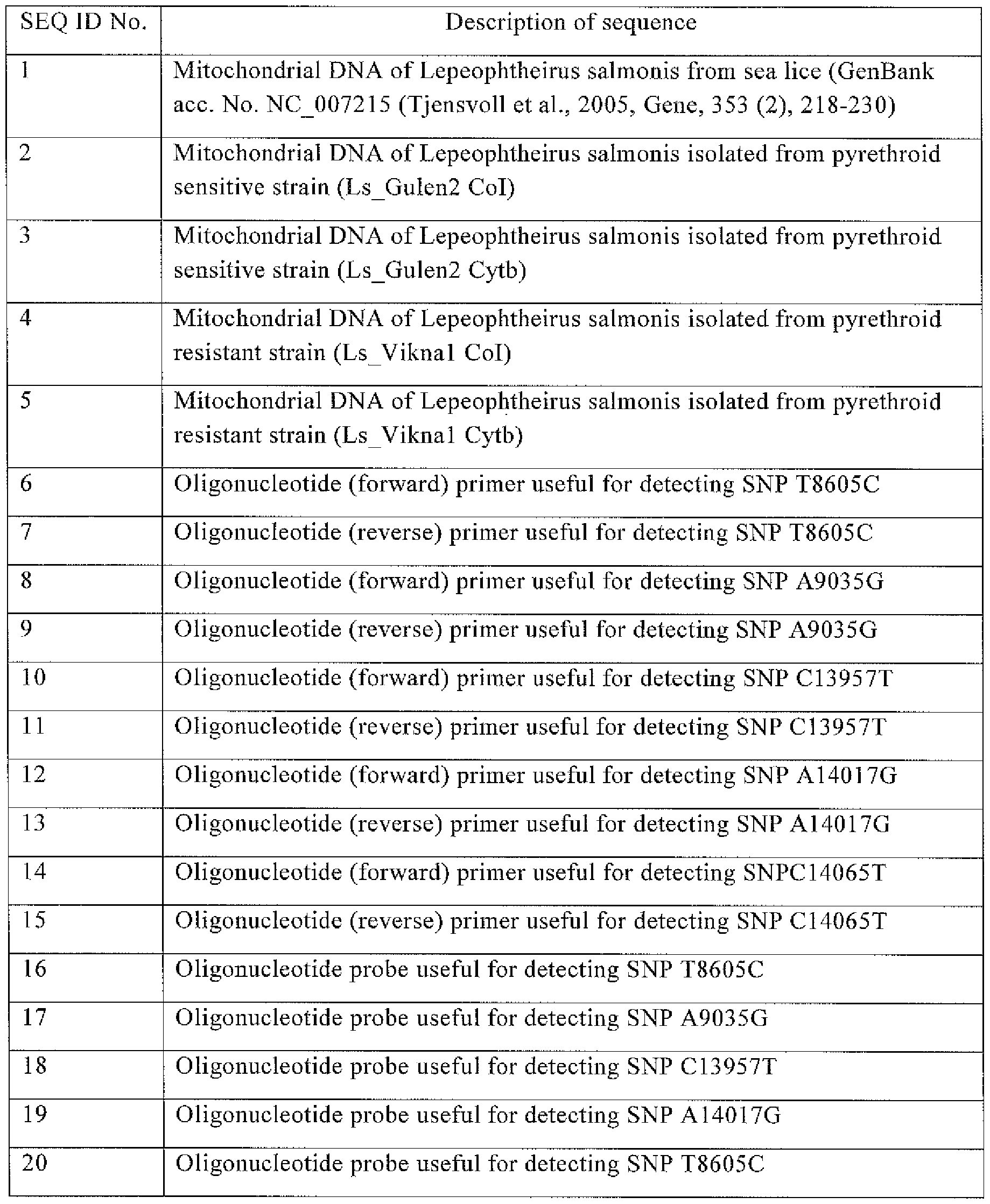
According to one embodiment of the present invention, a method is provided for detection of the pyrethroids deltamethrin (CAS No. 52918-63-5) and cis-cypermethrin (CAS No. 523 15-07-8). It is well known that resistance against one type of pyrethroid in general provides the possibility of resistance also against all type of pyrethroids; see e.g. Sevatdal S, Fallang A, Ingebrigtsen , Horsberg TE. 2005. Monooxygenase mediated pyrethroid detoxification in sea lice {Lepeophtheirus salmonis). Pest Manag Sci. 2005 Aug;61(8):772- 8, Du Y, Nomura Y, Satar G, Hu Z, Nauen R, He SY, Zhorov BS, Doug K. 2013.
Molecular evidence for dual pyrethro id-receptor sites on a mosquito sodium channel. Proc
Natl Acad Sci U S A. 2013 Jul 2. [Epub ahead of print], and Zhu F, Gujar H, Gordon JR, Haynes KF, Potter MF, Palli SR. 2013. Bed bugs evolved unique adaptive strategy to resist pyrethroid insecticides. Sci Rep. 2013; 3 : 1456. doi: 10.1038/srepO l 456.
The skilled person will thus acknowledge, based on the teaching of the present invention, that the method according to the invention may be used to determine resistance towards various types of pyrethroids in crustaceans, such as e.g. allethrin, bifenthrin, cyfluthrin, cyphenothrin, esfenvalerat, etofenoprox, fenpropathrin, fenvalerate, flumethrin,
flucythrinate, imiprothrin, lamda-cyhalothrin, metofluthrin, permethrin, prallethrin, resmethrin, silafiuofen, sumithrin, fluvalinate, teflutrhin, and tetramethrin.
Examples
Example 1: Hybridization of sensitive and pyrethroid resistant sea lice
Crossing experiment
In order to investigate the inheritance and mechanism of pyrethroid resistance in Z.
salmonis, two strains (sensitive and resistant) and their reciprocal hybrids were used for a two-generation breeding experiment complimented with bioassays to measure tolerance (Fig. 2). The pyrethroid sensitive strain (hereon also referred to as ZsGulen) was collected in June 2006 from newly slaughtered rainbow trout from Gulen in western Norway. The pyrethroid resistant strain (hereon also referred to as ZsVikna) was collected in February 2009 from a salmon farm in Vikna, North Trondelag, Norway. The resistant strain was collected on the basis of suspected reduced sensitivity to pyrethroids due to the fact that there had been reported a treatment failure on the farm from which it was collected. This was subsequently confirmed in bioassays with ZsGulen as sensitive control.
Prior to the initiation of the present study, ZsGulen and ZsVikna had been cultivated in laboratory for 13 and 4 generations respectively under standard rearing conditions at the Institute of Marine Research (IMR), Norway (Harare et al., 2009, Establishment and characterisation of salmon louse (Lepeophtheirus salmonis (Kroyer 1837)) laboratory strains. Parasitology International, 58, 451-460). In order to hybridise the lice strains for the inheritance experiment, the parental strains were first synchronised and multiplied up in numbers by simultaneously infecting 20 Atlantic salmon with copepods. In total, 1000 copepods per strain were added. At 32 days post infection (dpi), all salmon were anaesthetised and approximately half of the lice were carefully removed using tweezers. At this stage, lice were predominantly preadult 2 females and adult males, with a few percent adult females and preadult 2 males. The lice removed from the salmon were sexed, and then used to create the reciprocal hybrid strains. This was achieved by combining 4—5 females from the resistant strain and 4-5 males from the sensitive strain (ZsHybridV), and 4-5 females from the sensitive strain and 4-5 males from the resistant strain (ZsHybridG). Only preadult 2 females were used. These combinations were each placed into 2 replicate tanks in order to make two hybrid strains (4 groups and 8 tanks at this stage). At 67-68 dpi, all lice were removed from the four strains. Egg strings were removed from adult females and incubated in containers containing a
single strain each. The number of adult lice, and harvested egg strings varied, but incubated (Table 2).
Table 2. Number of egg strings collected from each
strain. Egg strings from replicate tanks were pooled.
Most egg strings were part of a pair.
Strain Generation Egg strings (n)
ZsGulen F 14 133
ZsVikna F5 106
liHybridG P 96
ZsHybridV P 60
The subsequent generation (F2, Fig. 2) were both produced using the general procedure described above, although the hybrid strains were only crossed back to themselves to create multiple generation-hybrids. Collection of egg strings, which marked the establishment of a new generation, was done at 55 and 56 dpi respectively. Salmon that hosted the previous generation were re-used for reinfection with the next generation, but hosted only the same experimental strain.
Bio ass ay test
Each strain, including both types of hybrids obtained in example 1 were quantified in their tolerance of deltamethrin at sampling points 1 and 2 representing the Fl and F2 generations for the hybrids (Fig. 1 and 2). Bioassays were performed according to standard guidelines (SEARCH Consortium, 2006, Sea lice resistance to chemotherapeutants: A handbook in resistance management. 2 ed.), with minor modifications. Only adult male lice were used for the bioassay, which after sampling (at 55 or 56 dpi) had been incubated overnight in running seawater (ca. 10 °C). The 30 min exposure to the prepared deltamethrin concentration was also carried out at ca. 10 °C, and higher concentrations than those described in the given protocol were included (Table S3). After exposure to deltamethrin, the lice were kept in running seawater (24 h at ca. 10 °C) until evaluation of the bioassays. At evaluation, lice were characterised as active, or inactive (moribund and dead lice pooled). ECso values were calculated using probit analysis (PoloPlus 2.0; LeOra Software, CA, USA). The results of two deltamethrin bioassay sets are shown in table 3a and 3b below.
Table 3a. De!tamethrin bioassays performed on sampling set 1
Lice: LsHybridG
Generation: F1
Fish tank: 01
Dose (ppb) Active (n) Inactive (n) % inactive
0 17 0 0
0.1 16 0 0
0.3 32 9 21
1 0 35 100
3 0 28 100
6 0 18 100
12 0 27 100
Lice: LsHybridV
Generation: F1
Fish tank: 02
Dose (ppb) Active (n) Inactive (n) % Inactive
0 16 0 0
0.1 17 0 0
0.3 44 0 0
1 56 3 5
3 33 5 13
6 17 1 5
12 15 7 31
Lice: LsGulen
Generation: F15
Fish tank: 04
Dose (ppb) Active (n) Inactive (n) % Inactive
0 9 0 0
0.1 40 0 0
0.3 29 27 48
1 0 37 100
3 0 20 100
6 0 14 100
12 0 9 100
Lice: LsVikna
Generation: F6
Fish tank: 05
Dose (ppb) Active (n) Inactive (n) % Inactive
0 12 0 0
0.1 16 0 0
0.3 9 0 0
1 21 3 12
3 29 11 27
6 18 10 35
12 7 5 41
Lice: LsHybridV
Generation
Fish tank:
Dose (ppb) Active (n) Inactive (n) % Inactive
0 26 0 0
0.1 17 0 0
0.3 45 0 0
1 39 3 7
3 36 1 2
6 19 2 9
12 19 9 32
Lice: LsHybridG
Generation: F1
Fish tank: 07
Dose (ppb) Active (n) Inactive (n) % Inactive
0 14 0 0
0.1 18 4 18
0.3 21 10 32
1 0 38 100
3 0 46 100
6 0 21 100
12 0 20 100
Lice: LsVikna
Generation: F6
Fish tank: 09
Dose (ppb) Active (n) Inactive (n) % Inactive
0 16 0 0
0.1 21 1 4
0.3 15 0 0
1 26 3 10
3 17 4 19
6 23 7 23
12 5 2 28
Lice: LsGulen
Generation: F15
Fish tank: 10
Dose (ppb) Active (n) Inactive (n) % Inactive
0 13 0 0
0.1 26 0 0
0.3 10 10 50
1 0 41 100
3 0 9 100
6 0 17 100
12 0 22 100
Table 3b. Deltamethrin bioassays performed on sampling set 2.
Lice: LsGulen
Generation: F16
Fish tank: 03
Dose (ppb) Active (n) Inactive (n) % Inactive
0 19 0 0
0.1 16 1 5
0.3 28 26 48
0.5 7 43 86
1 0 18 00
3 0 23 100
6 0 7 100
Lice: LsGulen
Generation: F16
Fish tank: 04
Dose (ppb) Active (n) Inactive (n) % Inactive
0 24 0 0
0.1 23 2 8
0.3 16 20 55
0.5 1 20 95
1 0 16 100
3 0 15 100
6 0 6 100
12 0 3 100
Lice: LsHybridV
Generation: F2
Fish tank: 06
Dose (ppb) Active (n) Inactive (n) % inactive
0 19 0 0
0.1 13 0 0
0.3 14 0 0
0.5 15 0 0
1 32 0 0
3 25 5 16
6 22 1 4
12 1 1 3 21
20 6 4 40
Lice: LsHybridG
Generation: F2
Fish tank: 07
Dose (ppb) Active (n) Inactive (n) % Inactive
0 22 0 0
0.1 17 0 0
0.3 14 14 50
0.5 1 6 85
1 1 10 90
3 0 18 100
6 0 32 100
12 0 27 100
20 0 32 100
Lice: LsVikna
Generation: F7
Fish tank: 08
Dose (ppb) Active (n) Inactive (n) % Inactive
0 35 0 0
0.1 9 0 0
0.3 27 0 0
0.5 6 0 0
1 12 0 0
3 14 1 6
6 22 5 18
12 6 0 0
20 17 1 1 39
Lice: LsHybridV
Generation: F2
Fish tank: 09
Dose (ppb) Active (n) inactive (n) % Inactive
0 16 0 0
0.1 12 2 14
0.3 1 1 0 0
0,5 28 1 3
1 17 1 5
3 17 0 0
6 25 6 19
12 1 1 1 8
20 14 17 54
Lice: LsHybridG
Generation: F2
Fish tank: 10
Dose (ppb) Active (n) Inactive (n) % Inactive
0 10 0 0
0.1 19 1 5
0.3 25 19 43
0.5 6 16 72
1 0 10 100
3 0 23 100
6 0 19 100
12 0 25 100
20 0 10 100
The four experimental strains were successfully cultured through the two generations and exposed to two separate bioassays. At the control and lowest concentration (O. lppb), no differences in lice activity was observed between the four strains. This was the case for both sampling 1 and 2. However, at concentrations between 0.3 and 1 ppb, clear
differences were observed between the strains (Fig. 2). Above 1 ppb, only lice from the resistant strain and its maternal hybrid strain survived the bioassay, while the sensitive strain and its associated maternal hybrid strain displayed 100% mortality. No differences between the hybrid strain and its maternal founder strain were observed for either strain, demonstrating that the resistance followed a maternal pattern of inheritance.
Exem le 2: Identification of SNPs associated with pyrethroid resistance
The presented outcome of crossing resistant and sensitive lice (example 1) showed that the mitochondria genome encodes the resistance. The L. salmonis mtDNA was characterized by Tjensvoll et al (2005) and encodes 13 proteins, two r NAs and 22 tRNA genes.
The first approach to identify genetic differences between the LsSensitive (LsGulen) and Ls Resistent (LsVikna) was by sequencing a 1000 bp fragment from cytB from 6 L.
salmonis specimens (3 sensitive and 3 resistant). The sequencing revealed 3 unique SNPs in the cytB from the LsResistent strain. We sequenced the cytB from 10 more individual from the LsResistent strain, which revealed that all except 1 individual had the same unique SNP (C14065T) in the cytB. This single atypical LsVikna individual was sampled from the control group during the bioassay (i.e. LsVikna incubated without deltamethrin). Tjensvoll et al (2006) sequenced cytB, A6. col and 16S from 180 L. salmonis specimens from six locations in the North Atlantic that were collected in 2000 or 2002. We aligned our cytB (from LsSensitive and LsResistent) sequences to these 180 cytB sequences from Tjensvoll et al (2006). None of the 180 cytB sequences from historic samples had the C14065T SNP. To further validate if the C14065T SNP is unique in resistant lice we obtained samples from 9 different lice strains, including several field strains with reduced sensitivity towards deltamethrin or cis-cypermethrin.
The presented outcome of crossing resistant and sensitive lice showed that the
mitochondria genome encodes the resistance. Since L. salmonis is ZZ (male)/Z0 (female) the maternally encoded resistance properties must be in the mtDNA. The L. salmonis mtDNA was characterized by Tjensvoll et al (2005) and encodes 13 proteins, two rRNAs and 22 tRNA genes.
Genetic variation within the mtDNA
Tjensvoll et al (2006), supra, identified 158 haplotypes for cytb and 164 haplotypes for COL In 19 L. salmonis individuals with know deltamethrin resistance only 2 haplotypes for COI were identified. The cytB was sequenced from 29 individuals with known
deltamethrin resistance and only 1 haplotype was identified. Among 19 sensitive specimens 9 different haplotypes for cytB was present (Table 4).
Table 4. Number of haplotypes identified for each of CytB and Col in sensitive sea lice and resistant sea lice.

Example 3: Testing for PRLS
Based on the identification of SNPs responsible for pyrethroid resistance in L. salmonis, we developed several sensitive Real-Time PCR (TaqMan) 5'-nuclease assays for single nucleotide polymorphism (SNP) detection (Real-Time PCR SNP-assay) (Table 1), and successfully applied these to differentiate between pyrethroid resistant and sensitive sea lice. Fluorogenic PCR probes, chemically modified with a minor groove binding agent to increase duplex stability, were used in single and multiplex probe closed tube formats. The probes were tested in a commercially available thermocycling fluorimeter (Applied Biosystems 7500 Real-Time PCR System) at PatoGen Analyse AS laboratory in Alesund. All assays were used qualitatively to determine the relative amount of the SNP- in individual samples, and samples from different life stages of sea lice were use. Comparison of results obtained using sea lice samples with different Real-Time PCR SNP-assays detecting different SNPs specific for pyrethroid resistant sea lice showed no discrepancies from results obtained by genome sequencing. The reported SNPs and the relevant Real- Time PCR SNP-assays are ideal for the differentiating between pyrethroid resistant and sensitive sea lice in the aquaculture industry.
Sampling of sea lice
Sea lice samples were collected from sea lice with known sensitivity status to pyrethroids, cultivated in The Sea Lice Research Centre laboratories at the University of Bergen. The sea lice had been tested with respect to sensitivity to pyrethroids by bioassays as previously described in example 1 above. Also, the genome sequences for the relevant genes were known from previous genomic sequencing performed as described in example 1 above.
In addition, sea lice were sampled from fish farms on the west coast of Norway. Sea lice were collected using forceps, and approximately 10-50 lice per site were conserved in 70% ethanol and kept at 4°C. Samples were sent refrigerated to PatoGen by express mail carrier.
Nucleic acid purification
In PatoGens laboratory, RNA and/or DNA were extracted from samples by methods well known to the skilled person. In short, tissue samples were transferred to Micro Collection Tubes and lysed and homogenized using QIAzol Lysis Reagent, steel beads and vigorous shaking using a TissueLyser system, followed by nucleic acid extraction using an RNAeasy kit (Qiagen) or DNAeasy kit (Qiagen), all according to the manufacturer's instructions, and by methods well known to the skilled person. Chloroform were added to the samples and shaken vigorously. After resting and centrifuging, the relevant liquid phase
were collected for further extraction of either RNA or DNA by vacuum technology using a Qiagen robot system, all according to the manufacturer's instructions, and by methods well known to the skilled person. Finally, nucleic acids were eluted in 25 ml of elution buffer and used for PCR by methods well known to the skilled person.
SNP-detection by Real-Time PCR
The primers and probes listed in table 5 are TaqMan® MGB Probe SNP Genotyping Assays using TaqMan® 5' nuclease assay chemistry for amplifying and detecting specific SNP alleles in purified genomic DNA or RNA. In this study, primers and probes SNP- 14017, SNP- 14065, & SNP-9035 listed in table 1 were ordered from Life Technologies Corporation. The primers and probes listed in table 1 for SNP-8605 and SNP-13957 serves as examples of assays for these SNPs, but were not included in this study. One-step amplification (45 cycles) was performed on an Applied Biosystems 7500 Real-Time PCR System performed at PatoGen Analyse AS laboratory in Alesund, all according to the manufacturer's instructions, and by methods well known to the skilled person. All assays were tested on both RNA and DNA, and used qualitatively to determine the relative amount of the relevant SNPs in individual samples.
Table 5: Primers and probes. Listing of primers and probes for each SNP identified. Probes are both listed with lUPAC nucleotide codes for SNPs, and with the alternative nucleotides for each position as indicated. IUPAC codes used are in accordance with Nomenclature for Incompletely Specified Bases in Nucleic Acid Sequences, of which the following are relevant here: Y = C or T, R = A or G (Nomenclature Committee of the International Union of Biochemistry (NC-IUB) ( 1984)
http://www.chem.qmul.ac.uk/iubmb/misc/naseq.htinl').

Results
The results from Real-Time PCR-assays are interpreted by looking at the deviation in Ct- values between the probes detecting the two variants of the SNP. For the Real-Time PCR- assay towards SNP- 14017 performed using RNA or DNA, sensitive lice has a deviation lower than -2, and resistant sea lice has a deviation higher than -2. For the Real-Time PCR- assays towards SNP- 14065 & SNP-9035 performed using RNA or DNA, sensitive lice has
a deviation lower than zero, and resistant sea lice has a deviation higher than zero. In addition, there is a quantitative aspect where the highly resistant strains have a higher deviation value than moderately resistant sea lice. Most likely, genetically resistant strains that have not been exposed to pyrethroids for some time has a lower deviation value than genetically resistant strains that been repeatedly and newly exposed to pyrethroids.
The results from the Real-Time PGR SNP-analyses using assays directed towards SNP- 14065 & SNP-9035 (according to Table 5) using RNA or DNA from sea lice samples with known sensitivity to pyrethroids showed good correlation with results obtained by genome sequencing, and correlated with the known resistance status in sea lice populations (Table 6 & 7). The Real-Time PCR SNP-assay directed towards SNP- 14017 (according to Table 5) gave the same results using DNA or RNA, and correlated with the results from SNP-14065 & SNP-9035 for all but one sea lice sample (Table 6).
Also, analyses performed on a higher number of sampled field strains showed good correlation with the known resistance status and as shown in Table 8. Here, analyses were performed using SNP- 14065, and RNA as template.
All tested Real-Time PCR-SNP-assays show very promising results, and we believe that these SNPs can be used separately and/or in combination with other SNPs to serve as a tool in the practical differentiation between pyrethroid- sensitive and resistant sea lice.
Thus the reported SNPs and the relevant Real-Time PCR SNP-assays represent an ideal tool for differentiating between pyrethroid resistant and sensitive sea lice in the
aquaculture industry. Also, the prevalence of sensitive versus resistant sea lice in a population, and the deviation value for individual lice or average deviation values for populations, can be used to predict the best possible outcome of a treatment using pyrethroids in the population. Also, the technique can become an important tool for optimizing sea lice treatments using pyrethroids, and to monitor the resistant status of populations of sea lice before treatment.
The Real-Time PCR SNP-assay directed towards SNP-14017 (according to Table 5) gave correlating results using DNA or RNA, and correlated with the results from SNP-14065 & SNP-9035 for all but one sea lice sample (sample 17).
Table 6. Conclusions regarding resistance status showed good correlations between differeat assays directed towards differeat SNFs, and regardless of w&eiker RJNA or BNA was used as a tempiate. The results from the Real-Time PGR SNP-analyses using assays directed towards SNP-14065 & SNP-9035 (according to Table 5) using RNA or DNA from sea lice samples with known sensitivity to pyrethroids showed full correlation.
Samples from Sea lice lab at Concluding results from Real-Time PC -SNP-analyses using RNA or DMA as the University of Bergen template
Lice SNP-14017 - SNP-14017 - SNP-14065 - SNP-14065 - SNP-9035 - SNP-9035 - ode Nr population RNA DNA RNA DNA RNA DNA label Conclusion Conclusion Conclusion Conclusion Conclusion Conclusion
AB45310871 1 A Resistant Resistant Resistant Resistant Resistant Resistant
AB44028166 2 A Resistant Resistant Resistant Resistant Resistant Resistant
AB38571165 3 A Resistant Resistant Resistant Resistant Resistant Resistant
AB44589338 4 A Resistant Resistant Resistant Resistant Resistant Resistant
AB44028181 5 A Resistant Resistant Resistant Resistant Resistant Resistant
AB45310863 6 B Sensitive Sensitive Sensitive Sensitive Sensitive Sensitive
AB38571150 7 B Resistant Resistant Resistant Resistant Resistant Resistant
AB44045872 3 B Resistant Resistant Resistant Resistant Resistant Resistant
AB44028185 9 B Resistant Resistant Resistant Resistant Resistant Resistant
AB45310870 10 B Sensitive Sensitive Sensitive Sensitive Sensitive Sensitive
AB45310855 11 B Resistant Resistant Resistant Resistant Resistant Resistant
AB45313574 12 C Sensitive Sensitive Sensitive Sensitive Sensitive Sensitive
AB38571164 13 C Resistant Resistant Resistant Resistant Resistant Resistant
AB45313582 14 C Resistant Resistant Resistant Resistant Resistant Resistant
AB45310865 15 C Resistant Resistant Resistant Resistant Resistant Resistant
AB45428417 16 C Sensitive Sensitive Sensitive Sensitive Sensitive Sensitive
AB45310852 17 C Resistant Resistant Sensitive Sensitive Sensitive Sensitive
AB45310038 18 C Sensitive Sensitive Sensitive Sensitive Sensitive Sensitive
AB45666543 19 D Resistant Resistant Resistant Resistant Resistant Resistant
AB44045871 20 D Sensitive Sensitive Sensitive Sensitive Sensitive Sensitive
AB44589289 21 D Sensitive Sensitive Sensitive Sensitive Sensitive Sensitive
AB 4506537 22 D Sensitive Sensitive Sensitive Sensitive Sensitive Sensitive
AB45108831 23 D Sensitive Sensitive Sensitive Sensitive Sensitive Sensitive
AB44028226 24 D Sensitive Sensitive Sensitive Sensitive Sensitive Sensitive
AB45312384 25 E Sensitive Sensitive Sensitive Sensitive Sensitive Sensitive
AB44001158 26 E Sensitive Sensitive Sensitive Sensitive Sensitive Sensitive
AB44035432 27 E Sensitive Sensitive Sensitive Sensitive Sensitive Sensitive
AB45312386 28 E Sensitive Sensitive Sensitive Sensitive Sensitive Sensitive
AB44506534 29 E Sensitive Sensitive Sensitive Sensitive Sensitive Sensitive
AB44589313 30 E Sensitive Sensitive Sensitive Sensitive Sensitive Sensitive
AB45313587 31 E Sensitive Sensitive Sensitive Sensitive Sensitive Sensitive
AB45428414 32 F Resistant Resistant Resistant Resistant Resistant Resistant
AB41018802 33 F Resistant Resistant Resistant Resistant Resistant Resistant
AB44589322 34 F Resistant Resistant Resistant Resistant Resistant Resistant
AB44035431 35 F Resistant Resistant Resistant Resistant Resistant Resistant
AB45310868 36 F Resistant Resistant Resistant Resistant Resistant Resistant
AB45309850 37 G Resistant Resistant Resistant Resistant Resistant Resistant
AB41018811 38 G Resistant Resistant Resistant Resistant Resistant Resistant
AB44594130 39 G Resistant Resistant Resistant Resistant Resistant Resistant
AB45310851 40 G Resistant Resistant Resistant Resistant Resistant Resistant
AB44506582 41 G Resistant Resistant Resistant Resistant Resistant Resistant
AB45443862 42 G Resistant Resistant Resistant Resistant Resistant Resistant
AB41018799 43 G Resistant Resistant Resistant Resistant Resistant Resistant
Table 7. SNP-analyses correlate well with known resistance status. SNP-analyses using SNP 14065 correlates with known resistance status in sea lice (I. salmonis) from the sea lice lab at the University of Bergen (based on bioassays and field observations), and with genotyping performed by the University of Bergen. Bioassays, genotyping and SNP- analyses are all based on different lice from the same populations, and thus the results cannot be correlated on individual sea lice level. Also, since the number of samples is very low, the slight differences with respect to prevalence of resistant genotype observed between sequencing and Real-Time PCR SNP-14065-analysis must be attributed to the low number of samples tested, and this is especially the case for lice population D. Still, the conclusions with respect to population resistance level correlates well. Also, populations A, B and C represent surviving sea lice fi-om the same original population, but A, B and C are surviving lice that has been exposed to different concentrations of pyrethroid in a bioassay. The results show that pyrethroid treatment selects for more resistant sea lice, and this is reflected in both the prevalence of genetically resistant lice, and in the total average deviation in Ct-values between the probes detecting the two variants of the SNP.

Table 8. SNP-analyses correlate well with known resistance status in field strains. Field strains of sea lice (X. salmonis) were characterized with respect to sensitivity to pyrethroids at the University of Bergen sea lice lab, and with the exception of strain P, all strains have been cultivated for one or more generations in the lab (up to 34 generations) before sampling. The conclusions from Real-Time PCR analyses towards SNP-14065 correlates very well with the known resistance characteristics from bioassays and field observations.

SEQUENCE LISTING
<110> PatoGen Analyse AS
<120> method for detection of pyrethroid resistance in crustaceans and oligonucleotide sequences useful in detection of pyrethroid resistance <130> P23343PC00
<160> 20
<170> Patentin version 3.5 <210> 1 <211> 15445 <212> DNA
<213> Lepeophthei rus salmonis <400> 1 agccccctat ttaggtgcag ttaaataaat atatttattt aaattaacta tgtacctata 60 tgagtcgccc tagaatcaat aaagttaagg caatgggagc atagtttaat tatagtgttg 120 agaaaagggg aggattatac ctttatacgg acgtggccac gggcattcaa tggcaggttc 180 tagacatata ttgaggaggg ggggggggag attaggtaat aaatttattt aaatttatta 240 tatgctcgca aagttgaatt aggggtaata gggagtatac ggcttaacta tagtgtctag 300 ggtaaatcag tattagaagc tacgtctccc aaagctataa gttctggaca actagcttct 360 acccgaagaa ggtataaagt caagttcctt taataaagaa tattatgaaa ataatacaag 420 ttcgaaagga tagaggacta agtaagattt aggcatttat aagcttagct aataccaggt 480 ttaggttcta tttaataaaa gatttggaaa gtcaaggagg tgattactta tagagtaagg 540 ttatcttctc cttcaaagta actttttccc tagggagtag ccaggtcagc ctttcaggct 600 tataaaaaga ttagaataag cagggaaaat ctttgagtta aatttaaggt ttagaactaa 660 agaggactat tatttttttt tttttttttt tgagcatgtc atgaaaagtc taggagagag 720 gctgacgagc aatctatcct tctgagcagt tgtgtgaatt ctctgggctt agggagtaat 780
taaatgcttt tatttaaatc aatctgcgaa gggggcaata aggtatgtta ttaataaata 840 aggtttggag ctttaaatct aaagttgggg atatgtggac tgattaaccc agaataatat 900 atatatatgc agtgctcaaa agcttgttgt caaaagaaag ccaggggcgg gcgcagagct 960 gagacgcagt ccacgtgcta aaaaattact atgggggtag caaatatcaa taacaccgaa 1020 gacaaaatat ggaaagctgc cgaaaagaaa aaagttaagg gaattgaagt taattgaata 1080 agattttctc tagaatttcc ttgcgaagca actgaaaata attttatatt aaatagtatc 1140 ccgagaatta aggcaatcga gattggaagt aggaaaagga ggaataaatt gagtaaagtt 1200 atagtagaga gaatctcggc tataagattt atagtggggg gccctccagc attgagtaag 1260 caagctaaga atcagatttt tactaacgta ggctgggtag taattatgcc cttatttaaa 1320 ataatgtgac gagtcccaga ggacaagtaa aatataccag cggcgagaaa tatcaaagag 1380 gaagtaaatc cgtgagccac aaagttaatt atggctctag aagttcctgt ggaagagaga 1440 gagaaaactg tagcagaagc tatagacatg tgacctacgg aggagtaagc aataataacc 1500 ttcatatcta cttgagttac gcaaagcatt atagccaagg ctgccacaac tacggagaaa 1560 gagattatta ccttggtaaa aaatcctaaa aaaaaagagt ttatatggac aaatcgaata 1620 agcccatacc cccccaactt aagcaaaact cctgccagga ttatagaccc cataagaggg 1680 gcctctacgt gagctaaggg aagtcataaa tgtagggaaa agatgggcaa ctttacaaga 1740 aatgctataa aagtcattaa aagaataata ggggaagggg aggatgattg ggcgataaaa 1800 aaaaaagtga aataggagag atgggggcca gcaatgataa caaaaaggag gggcaaagag 1860 cctattaaag tatatataat tattattttg ttagcaaaaa ttcgttctgg ctgatagcct 1920 caacccaaaa tgattaaaaa aatagggata aggtttagct cgaaagcaat ataaaaaaaa 1980 aggatattag agacagagaa agtcaaaact gaaaaaaaaa aaagtaagtt cgagtagaaa 2040 gaggttaaag ccgctatttc gatagaaatc aacaaaagaa tagtcataga aagaataggg 2100 gctctaacct cgtccaagaa aaaagaagag gagaggttaa aggagatgtc ataaatggga 2160 atcagggtta taaaagaaaa aattaaagga aaagagataa gaaaattggg taatgaacta 2220
ttaaaagctg taaaaaaagc tttaagtaaa aaggaggata taaggaaaaa aataagtttt 2280 aaactagaag ttaattcata ataagttaat tttgagaaga ggtctagggg ctagggtgct 2340 aattggactt acaagaagca gattttttat tttttggagg gctgtcgaac taaatactat 2400 cctgtttatt gtgatgttgt ggttagaggg ggagaaaggc tccgagttga ggggaataaa 2460 atacttctta attcaagggt ttaggtccct attaatagtc tgaggagtct tttattatat 2520 aggattttta ataatagtag ggggtctttt aaagttagga gtgtttcctt tccatttatg 2580 aagtctagat ttagcagtaa ggagaagatg ggattgctgg ctgtatttaa tgagtttaca 2640 aaaagtccta cccctacacc tagtagtaaa tgtaagagaa ggaagtaggg ttttgagggg 2700 tgtaactcta cttaatttgg tagttaggtg cttagggagg cttcataaaa gtatattaaa 2760 ggaattatta ttttattctt cactatttaa cataagatta ttgttgctat tgaggagctc 2820 gcactctatc ctagtttttt ttttccttat ttataggaga ttattaattc cttgttgggg 2880 gattttaaaa aactccgagg tagactacct gcagcaagta catctaagaa gagggggatt 2940 attagctttt ctgtcgctga gagggttccc tcctagtctg gggtttttgt acaagtatgg 3000 gctattcaga cttttagtca gcttaaatta tggagtgtta tactgttgta gggttatact 3060 cctcagtctc tttatatttt atatttattt aagagtgttt ttacagctga aattaatcgg 3120 aagacgaaca tttatgccaa ggatgagggg gaaagggggc tatctacttg ccccccaagc 3180 atttctaatg attaggggaa gattgattct atatagcttt taaaagacta ttttgaaaat 3240 agtcaatgga gtttcttcaa agctatttgt ctaacgtaac tcgccaccct ttccatttag 3300 ttgatgagtc tccttggcct ctattaaggt cttttgctgg agggtttgtg gctttaggcc 3360 tattaggctt atttttaaac agaagaagga gcctaatttt tacttccctg atttttttag 3420 ccctaattat aatccagtga tggttagatg tttcggttga gggcacttat caagggcttc 3480 attcaaaagt cgttcaaatt gggctaagat gagggataat cttatttatt agatcagaag 3540 ttttgttctt ctttagtttt ttttggggat attttcatag cagattagta ccaagagtag 3600 aaattggagg aggggagtgg ccccctttag gggttacagg cctcagagct tgagaaatcc 3660
ctttactcaa tacaatcatt ctgttgagat cgggggtgag agtcacttga agacatcaca 3720 gattagtaat aggtaaacat caaaatgcat ctttaagatt actgattact gtattactag 3780 gaggttattt tacttgtctg cagggagtag agtacttcga agcaagattc agtattagag 3840 atagagtgta cggttcaact ttcttcttac taacaggatt ccatggttta cacgtgctag 3900 taggggccac ttttttaggg gtctgttact tccgaatagt gtctgggcat tttggtaaca 3960 gccaccattt tgggtttgaa gcggctgcgt ggtattgaca ctttgtagat gttgtttgac 4020 tatttttatt tttgggggtt tactgcttag taaaaaaagg ctgttattag agtagtttat 4080 caaaatatta actttgggag ttaaagaaaa ctttagttct ctgataggtt agtaatttat 4140 acaaaatatt agcttgtcaa gccaaaaaaa aggaactcct tttagcctgg gaaacttaag 4200 ttaataaaac tatcagtctt caaaactgac aataaaccct tttagcttcc gaattactat 4260 aacttataaa gagtattaca ttgaagctgt aaaggaggct tagcctagta ataatttttt 4320 tattcttatg ggtgttaggt ctaagcttta ctatttcctt attaatcata ttactaggtt 4380 attctttaag acgaaggggg gaggcgaatt tagataagtt aagacctttt gagtgtggat 4440 tcaatcctaa tgcaggtcat cgaaagatat tttctttaca tttcttccta gtctctttgg 4500 tgtttttagt cttcgattta gagttggtaa ttcttttccc ctttctaagt gtaggaggag 4560 tggggaggag ggtagaaaga tacttaaggt gtgttttatt tttgtttgta ttaggattag 4620 gccttttata cgagtggtta ataaaaagtt tagagtgatg tgattaaatg taaaatacaa 4680 atttttaatt taaatttccg ggggttatgg cttgttttga gaaggttttg agtactgggg 4740 ggggttttaa tattcctttc agcttttagg agtttaaagg aatcctcaat actagtattg 4800 agagcaaaac taagaatttc aaatttggaa ctagaagtca gagggttggg tgacttttac 4860 tctatatcct tcaggggagt tgtgataata attaggggtt cagtgtatct ctactccctt 4920 aggtatatag aaactgaaaa gtattttaat cgatttatga ctctcgttag gttgtttatt 4980 tttagaatgc tagtgttaat ttacagaggg gatgtggtac aattaattct agggtgggat 5040 ggcttaggtc ttaggtctta tttactagtt tgttactata ataataggaa ttcttctaat 5100
gcaggggcac taacccttat actaaaccgt ttaggggatg tgggtttgtt tttaagaatt 5160 tacgttatag taaattccag gcattcaatt aacaggttca taagcatctc tagggtaata 5220 ggaaggctat tattatttgt agcttttact aaaagggctc aattgccctt tagggcttgg 5280 ttacccgcag caatagctgc tcctactcct gtgtcttctc tagtccattc ctcaactttg 5340 gttactgcag gagtctacgt attaattcga ttttatgaca ggctaatttc tgtgttatga 5400 attaggttaa ttgtaggagt ctctactaga agattagcga ctttagtagc aatagctgaa 5460 cgcgacataa aaaaaattgt agctttctca actttaagac atttaggaat tataataagt 5520 attctgagat taggttgagt cgaactagcc tttaggcatt taattttcca tgcttttttt 5580 aaagcgttat tatttctagt agtggggtat tgaatccaca gctcctgcgg ttatcaagac 5640 ctattaaaaa ttaatttgtt gagtaggcaa gagccagtaa tcagaagtct tggcggagtt 5700 tctataataa gtctttgtgg acttccctat ttaactgggt tttatagaaa agacttattt 5760 atagaagcaa gtgtgcagtt taggagaagt cttcttggat taggttttat tttaagaagt 5820 tgtgtaggtt cagtaatgta tagaattcgg atgtttctaa tagttaataa agtgggaagt 5880 gtctcaaggc ttttaaattg aggagggtct tttaaatttt accagttaag tataagctta 5940 ttatacttct tttccattat aggaggtaga ttttggagaa acttctgagt tacttccggg 6000 agagttttat atgtcttttg agaagtaaaa atagtgatta ttaggttaat cacatgcagg 6060 gggttgctag gagcttatct taggaataca ggggtaaaaa acaggttttt gagtaaacta 6120 gggtacctaa gagacataag aatccggctc cccaacatcc tcagaaaatc cttgataagc 6180 aaaagagtaa aattagataa ttcttttctt agcagccatt acaataaata ctacagagta 6240 gaaggaggaa aatatttatt aaatagaggt aacttaaggt attctgaact aatcttagta 6300 atattctttt tttatgtgat attatatgtg ctcagggggt aattgttcct caagcagaag 6360 tagtatattg aaacataatt ttttgtctat gtgtcggtag tattggtgtt agggtattaa 6420 aattatattt tttgtaaaga ggtaagctaa aaaagctgat agactcataa tctatctata 6480 ggatcccttc tctttaaagc ttaaaagagg aaatttctaa tttctttatg gcttaggtcg 6540
agcttttagc taataaaaag ggaattgcaa actccctatt cctcacaggg ttagcttgtt 6600 taggtaattt atataaaatg cccaattgtg gagtgggtaa agcatcttgc cttaaacata 6660 tgcctacttg atctcagttt agtttccaag atgcttcctc cccagtaata gaagagttta 6720 ttttattcca tgatgtgatt atagtttgtt taggccttat cttagtatcc gtagggggta 6780 tattaggggc agtgtttgta gaggggcctt atgtaggagg tttaatcgac ggagagtgac 6840 tagagtgaat ttgaacagct ttacctggtt tagtactatt tggggtagct ataccctctt 6900 tatctttatt atatatatac gatgaaataa caaattttga tttgggggta aaagtaaatg 6960 ggtatcagtg atattggagc tacgagatac ccttagcaga gggccttgtg ttagattgtt 70Z0 ttatggtccc cagaagggat acaaagttag gacaaatgcg cttacttgaa agagatgtgg 7080 ctttaacttt acctattaaa agaatgctgc agttgatagt gtcttcaaag gatgtattac 7140 atgcttgggc ggtccctagc ttaggggtta aaatagacgc tgtgccagga cgaattaata 7200 ccctatcaat atatagattt cggccgggat tgtattttgg gcaatgttca gaaatttgtg 7260 gggcacatca taggtttatg cctattttac tagagatagt aagggttgac gattttgcta 7320 ggtgattaaa gttagtgaga gaagaataag cataaagtgc attgttatta aagtgttgta 7380 ggtttttaat catcaggatt cctgtacttg taaatgttgc gtttattacc ctactagaac 7440 gaaaaattat tggttactct caagcacgta aaggacccaa taaggtgtct tttttaggga 7500 ttcttcagcc tttctccgat gctattaaat tatttgtaaa agaagtaggc aggttcagat 7560 ttgtaaatta cagagtctac tggatttctc ccgtagtggg tctaagggtg gcactactaa 7620 tctgaaatgt ctatccctta gagataaggt ttggatcttg aagaatttct tgacttggac 7680 tgttagcggg gataagagta agagtttacc ccttatttct tagagggtga aggtctaatt 7740 gtgtgtattc acatattgga ggagtgcgag gagttgctca agtaatctcc tacgaagtag 7800 tttttactat cctagtattt tctttaataa gattaagagg aagcttaact ttagtgggga 7860 gtatactatt tagggagtat ttttatgttt acatattaag tcctttatta gtgtacctat 7920 gattcctaac aggtctagcg gagaccaacc gaactccctt tgatttctct gagggggaaa 7980
gagagttagt gtccggattc aatacagagt atgggggcag ggggtttgct ttaattttta 8040 tagcacagta tgcttcgatc ttattgttaa gaagtttatt tagattattt ttacttaaaa 8100 gaagaggact tttgttttat gtaattagaa ggttaggagg gttcttgtga gtgtgaaggc 8160 gggttactta ccctcggcac cggtatgact gattaataag attatgttga aaatctcttt 8220 taccaagaat tctactcggg ggagggggaa taattttaat aataataaga atttaattgt 8280 caactataaa aaagtgatta tgatcttgca accataaaga tattgggact ctatacctac 8340 taagtggatt ttgatctgga ttagtgggtt tagctataag agtcatcatc cgtcttgagc 8400 tgtctcagcc gggagcatat ttaggggatt cccaggttta taatgttatt gtaactgctc 8460 atgccttcat tataatcttt ttcatagtaa tacctgtatt aattgggggt tttggaaatt 8520 gattagttcc tttaatactg ggggcacctg acatagcttt cccccgctta aacaatataa 8580 gattttggtt tttaataccc tctttgagtt tattgcttat aagggcatta gtagaaagtg 8640 gtgcaggaac tgggtgaaca gtataccccc ccctgtcttc gggagttttt cactccgggg 8700 cttcagtaga ttttgcgatt ttttccctcc acttagctgg agtgtcttct ttattagggg 8760 ctgtaaactt tattagaact attacaaatt tacggtgctt gggactttta gtggggcaaa 8820 tgccaatatt cccctgatcc gttttaatca ctgctgtgct tttactcttg tctttaccag 8880 tgttagcggg agcaattact atacttctta ctgatcgaaa tttaaataca actttttttg 8940 accctagagg tggaggggac cccattttat accagcattt attttgattt ttcgggcacc 9000 ctgaagttta tattctaatt cttccagggt ttggattaat ctctcagatt attacccaag 9060 aaacttgtaa agatgaggct tttggttcgc ttggtataat ttatgcaata gtagcaattg 9120 gagtattggg atttattgtt tgagctcatc acatgtttac agttgggtta gactcagaca 9180 ctcgagcgta ttttacggca gccactatag taattgctat ccctacaggg attaaagtat 9240 ttagttgatt agggacttta tatggaagta agattattta taccccctca atttattggg 9300 tggtagggtt tctgtttctt tttacagtgg gaggattaac aggtattgta ttagctaact 9360 ctgccttgga tatgactttg catgacactt actatgtagt tgcccacttt cactatgttc 9420
ttagaatagg agcagttttt gccctaatag cgggattcac tcactgatac ccccttttga 9480 caggtttaag aatgaactta actataagga aagcgcagtt tatcctaata tttattggtg 9540 taaatttaac gttttttcct atgtacttcc tagggttagc aggtatacct cggcggtata 9600 gggattaccc agacttctat tatttgtgga atcaggtagc tagtttcggt tcttacctaa 9660 ctttattttc tgtggtagta tttgtaggga taatttgaga gtctatagtt aggttacgac 9720 cagtattagc ggtatttgat aggggaagat ccatcgagtt caaacatacg tgtcctccgt 9780 ataaccattc ttataactcc tgcccccgac tgactttagc ataaataaat taatttaaaa 9840 aaatacctaa aattagttat tttcctttcg tactaataag taagtaaaag ccctgagata 9900 gaaaccaatc tgacttacgt cgatcttaac tcaaatcatg taagtacgaa aagtcgaaca 9960 gacttaaaat aggaccttct gcagcactat attacttaat tcaacatcga ggtcacgaat 10020 atcttttaaa taagagctct aaaagtatta cgcgctgtta tccctaaggt acctatgtgt 10080 agcaaaataa ttggttcaga ataactaagg tttctttatt atattaagtg ggctatccca 10140 gccaaacatg gtaaaggtct tagggtctta tcgtcttcgg agagtatatc agcgtttgta 10200 ctgatagcta agattcaaga gataagaata aacatgatta accaatgcta gcttcataca 10260 ggtttacaat taataaacta attattgcgc tactttaaag ccataaaaaa tcattcattg 10320 ggcagataca tcagacacag tcttactatg tctttgttaa acagtttgga gaatctcaag 10380 ttatttagtt tatatttaat ttaaaattaa taaaagttat ttaagtaagg aaataataaa 10440 agtatattta ctagtgtaaa caagttataa ttctcagaat taactaccca aataataaga 10500 gaagcttaat aaataaatta ggtcaataat aatttattat aacagagggg actattattc 10560 ctgaaatatt tttagactag ttgctcacta atgtatactc agcataagct aaatacatta 10620 ttttaaaatt cattctaaaa tgttttattt ctttgggaac cagattttaa aaagtaccat 10680 atatcgtgtt catccttgtc ttatagctta gttttctacc taggcttaga gagaggatag 10740 atatttttaa tcgggaaagt ttttattgat actaattgtt tacccatgat gcaaaaggta 10800 agagttctta tactactttg aaggattact aataggggca gttcgcataa ctatcctatc 10860
aagatggccc ctatacttcg ggcaccctat attttaaagg gggtggccca tgtctagcac 10920 ttaaagctag tgcactttct ctgccacttt aaaaataatt tattaaataa aagattaagg 10980 ataatctacg ataagcttct cccatagaga agtaaagcat aaagcagatt aagttactta 11040 ttgagaataa tagcctatat aaaattctaa tttacatgca atgaaattgg actcgcagta 11100 tatggattta ctaaataaaa aaagaagtag agatttttaa gttctgaata agaaagtgcc 11160 agcattcgcg gttatacttt tagaaaaata ggcatttaaa tctcaaaaat taacatttca 11220 tgaggtcaaa tttaaaaaat gttagtaaaa tttgatgaaa atagtccagt gaatcggatt 11280 agtccccgag taataaagat aagtttttta gtagtactga atagaaaact aaactcaaat 11340 ggcagaatta tctctcaaat tagggaaacc tgtattaaca gaatttactc tttagatttt 11400 aattttttta aagtatggct gtcttacttt attcagaaat tgtcttagtc aagtaatatt 11460 ttatataatt aatatttata ggttgcatta aattataaaa tagagtattt aatagtaagc 11520 taaaaaacgc tgaatatttt agtaattagt tcaaattgtc cgtcactctc ttaggagata 11580 agtcgtagca aagtaatagt tatggaaata gctattaaat ttcttttgaa gaaatttttt 11640 ttaaattaat agttatttcg agagttgctt gtactataat tcttgggctg attcctagtc 11700 ctttcatgtt gtgtttatta attgtagtat taactagagt tagatgtggg atagtaagga 11760 ttttttgtag ccagtggtta agctacgctt tagtaattgt attcttgggg ggtataatag 11820 tattgtttac ttacgcttca agaataagag tatcagataa attgacaaaa agaaggagat 11880 gaaaaagact atttgtattt ctgattatgg ggttaacttc aagggccccc agaggattta 11940 aagtttatat aggaagacta tattcaaata atgggggggt tatactttca atcttaacct 12000 tttatttact cctgtgccta tttagagtgg taaaaatagt agaagtgaga aaaggggctt 12060 tgatttctta gggttaacat aatttaattt gcatttaaag cttgccgttt ggctaacctt 12120 acttttagag tgtaatcacg ttataatttt attataaaaa tagcttaaag cttaaaagta 12180 tattttaagg tgtttagcac ataggatttt gagtcctaag gagttaagaa attatctaaa 12240
ataattattt gggctaaagc atctagtatt tacaaaatac tcattttagt taaactacca 12300 aataaagtta gcctaataag taaaaaaagt ggagttggat agttcagtag actttgaacg 12360 gattgaagag ataagggcag caagccctat acatgcttca cagactataa ctgtcacaaa 12420 taaaaatctg atagttgagt aggttatact gaagaccgaa aaaaaaatgc aaataggaat 12480 tatggtagct gtaagagctt ctaataaaag tagcctgata agcaagtgcc ctttattaaa 12540 taaaaatcac ctagaggtga ataaaggagg gagagctaac aagtataaac tgctaaggtg 12600 aggtaaaaaa aaaatgagta caagagttgt taaaatagtt ctcatagagt ataaaaacaa 12660 tagctgttag cttaaaagat aatctaataa agatgttaaa tttttacttt aattatggaa 12720 ggtcctcttt taatccccta attatttaag gtcttgcatt agacgtttca ctgttaatga 12780 aaagaagagt ttctctaaat attcagttag tataagaatt acacttaatt tccaattaag 12840 agatttaaaa gttaaactga ctattaatca tagtaaattt tatatttcac ttacaatgaa 12900 aaggtgccaa tggctgatta attcttatcg agctcctatc aattaagtag tttaataaaa 12960 accttaaatt gtaaatttaa aattagattt tctcttaatt aaagccttag ggagtactaa 13020 tgaattcttt attttccaga tttgatgcta acggattgac aaactgatac ttaccttctt 13080 tagcaagagg tttattacta tttccaaggt attgattagc gggtaataca ttaggctcca 13140 tgtgaagagg ggtttttagg gctattcatt ccgatgtaaa aattatattt agtgaagggg 13200 cagggtttat gcttatgaga ttatttttaa gggttctaag aatgaatttt ctagggcttt 13260 ttccgtacat ttttactagg agtaggcaca tctgtgtgag attaggtata gggctgcctt 13320 tatgattagg cagtcaaata gtttgttgag tatacaggag agagcaaagg tttgcccacc 13380 tagttccaga gggggctcct agaggtttaa ttcctctttt ggttttaatt gaaagaatta 13440 gaaggttaat ccgacctcta accctaaggg ttcggcttat agctaatata attgcaggcc 13500 acctactact aattttactt ggtagtaatg ctagagtggg gtcccctctt agaattctat 13560 taactatgtt aggattatta ttcttagtcc tactagagtt aggggtgagt ctaattcaga 13620 gatacgtttt tatattatta agctctttat atgttaggga gactcttcac taatgaattt 13680
tgttactgtc ctagtttcga cctaggctta ggttttaacc agcaaaataa tctaattatt 13740 tatgtttgtg taatgcgggc agttattacg cctgtcaaat gacttcaaac taataaaagt 13800 ttagctcaca atccgtctga gtaaggtaag gacagtccta ctctgaagta taagacagta 13860 aaaacttggc ccaggaaaat atagtttccc tctacaggtt ttgctccaat ccaggttaaa 13920 agaaaaaaaa tcccgataaa agctcaaaac ataagcattt tcgaagggtt aaatgtagca 13980 tgtacggcgg ctcttttatc ccccagcaaa aatggaaaaa aaaacaaaat tcttacagac 14040 aaagctaaag ccactacccc ccccaactta tttgggatag accgcaaaat agcataagca 14100 aacaaaaaat accattcagg ttgaatgtga gcaggagtta ctaaaggatt agctggaata 14160 aagttttcag ggtctgctaa taatcaggga gagtaagaaa ctaaagctcc catgagacaa 14220 aaaataagac cgaagccaaa ggcgtcttta aaggtatagt aagggtcaaa aggaatctta 14280 taatagtttc ctggaacccc caatggattt gaggaccctg ttgaatgaag aaaaattgta 14340 tgagctataa ctccaactgt ggacaaaaga ggaatgaggt aatgaagagc aaagaatcgc 14400 cttaaagtag ctttgtccac cctaaacccc ccccaaagtc aaattacaat ttcgtcccca 14460 ataccaggga tgacagaaaa tagatttgta ataaccgtag ctcctcagaa agatatctgg 14520 ccccagggga gcacatagcc caaaaaagct ctggctatga ttaaaattaa aatcgtagag 14580 cctacaactc aaacaggagt aagcttatac gaagaatagt aaaggccccg acccgtatga 14640 atgtataaac acataaaaaa taacctcacg gtgttgctat gaatagctcg aattcctcac 14700 ccataattaa catcccgcat gatatggtct acggataaaa acgctgtaga aatctctctt 14760 gaataatgca tagccaaaaa aattccggtc ataatctggg taataagaca tagcccaagt 14820 aaagacccaa agttccaccc cgacgaaata ttaactgggg tgggaagtgt tagaagagga 14880 ttatagatag aaagagtttt ataagaattc ataaatggag ctttctggca gaaaaagtgc 14940 gttaatttta gaaattaagt ataagagatt cttgtaagct acaacatact acttaatagt 15000 atttattaaa ctcataggag ttaacaaata gtcttgatcc ataagattta ctgtgtgcaa 15060 acggctagat tattagttta gtatattaac tagaacaaaa tagttagtta atatttatta 15120
aaagtttaac caagttaagt ggaggaggct tctgtagtaa ccgcggagtt tggtttaatg 15180 agaactctct taaagctaac cgaaactagg ttgatcttca aaatattttt taagattggt 15240 ttaagctatg cacaagttgc taatatttat taaaagattt aaataagtag aaagtttaga 15300 tttaatacta agaagaatta ctagagaata aagccagacc aaatatttat ttaaagattt 15360 agataagtag ctacggctag gtggtgggga caaggtgcat aatcaataca agtgagttgg 15420 gggggggggg tatggggggg gatta 15445
<210> 2
<211> 1056
<212> DNA
<213> Lepeophthei rus salmonis
<400> 2
ctgtctcagc cgggggcata tttaggggat tcccaggttt ataatgttat tgtaactgct 60 catgccttca ttataatctt tttcatagta atacctgtat taattggggg gtttggaaat 120 tgattagttc ctttaatact gggggcacct gacatagctt tccctcgctt aaacaatata 180 agattttggt ttttaatacc ctctttgagt ttattggtta taagggcatt agtagaaagt 240 ggtgcaggaa ctgggtgaac agtatacccc cccctgtctt cgggagtttt tcactccggg 300 gcttcagtag attttgcgat tttttccctc cacttagctg gagtgtcttc tttattaggg 360 gctgtaaact ttattagaac tattacaaat ttacggtgct tgggactttt agtggggcaa 420 atgccaatat tcccctgatc cgttttaatc actgctgtgc ttttactctt gtctttacca 480 gtgttagcgg gagcaattac tatacttctt actgatcgaa atttaaatac aacttttttt 540 gaccctagag gtggagggga tcccatttta taccagcatt tattttgatt tttcgggcac 600 cctgaagttt atattctaat tcttccaggg tttggattaa tctctcagat tattacccaa 660 gaaacttgta aagatgaggc ttttggttcg cttggtataa tttatgcaat agtagcaatt 720
ggagtattgg gatttattgt ttgagctcat cacatgttta cagttgggtt agactcagac 780 actcgagcgt attttacggc agccactata gtaattgcta tccctacagg gattaaagta 840 tttagttgat tagggccttt atatggaagt aagattattt ataccccctc aatttattgg 900 gtggtagggt ttctgtttct ttttacagtg gggggattaa caggtattgt attagctaac 960 tctgccttgg atatgacttt gcatgacact tactatgtag ttgcccactt tcactatgtt 1020 cttagaatag gagcagtttt tcgacctagg cttagg 1056
<210> 3
<211> 996
<212> DNA
<213> Lepeophthei rus salmonis
<400> 3
ttttaaccag caaaataatc taattattta tgtttgtgta atgcgggcag ttattacgcc 60 tgtcaaatga cttcaaacta ataaaagttt agctcacaat ccgtctgagt aaggtaagga 120 cagccctact ctgaagtata agacagtaaa aacttggccc aggaaaatat agtttccctc 180 tacaggtttt gctccaatcc aggttaaaag aaaaaaaatc ccgataaaag ctcaaaacat 240 aagcattttc gaggggttaa atgtagcagg tacggcggtt cttttatccc ccagcaaaaa 300 tggaaaaaaa aacaaaattc ttacagacaa agctaaagcc actacccccc ccaacttatt 360 tgggatagac cgcaaaatag cataagcaaa caaaaaatac cattcaggtt gaatgtgagc 420 aggagttact aaaggattag ctggaataaa gttttcaggg tctgctaata atcagggaga 480 gtaagaaact aaagctccca tgagacaaaa aataagaccg aagccaaagg cgtctttaaa 540 ggtatagtaa gggtcaaaag gaatcttata atagtttcct ggaaccccca atggatttga 600 ggaccctgtt gaatgaagaa aaattgtatg agctataact ccaactgtgg acaaaagagg 660
aatgaggtaa tgaagagcaa agaatcgcct taaagtagct ttgtccaccc taaacccccc 720 ccaaagtcaa attacaattt cgtccccaat accagggatg acagaaaata gatttgtaat 780 aaccgtagct ccccagaaag atatctggcc ccaggggagc acatagccca aaaaagctct 840 ggctatgatt aaaattaaaa tcgtagagcc tacaactcaa acaggagtaa gcttatacga 900 agaatagtaa aggccccgac ccgtatgaat gtataaacac ataaaaaata acctcgcggt 960 gttgctatga atagctcgaa ttcctcaccc ataata 996
<210> 4
<211> 1115
<212> DNA
<213> Lepeophthei rus salmonis
<400> 4
ctaagtggat tttgatctgg attagtgggt ttagctataa gagtcatcat ccgtcttgag 60 ctgtctcagc cgggagcata tttaggagat tcccaggttt ataatgttat tgtaactgct 120 catgccttca ttataatctt tttcatagta atacctgtat taattggggg gtttggaaat 180 tgattagttc ctttaatact gggggcacct gacatagctt tcccccgctt aaacaatata 240 agattttggt ttttaatacc ctcttcgagt ttattactta taagggcatt agtagaaagt 300 ggtgcaggaa ctgggtgaac agtatatccc cccctgtctt cgggagtttt tcactccggg 360 gcttcagtag attttgcgat tttttccctc cacttagctg gagtgtcttc tttattaggg 420 gctgtaaact ttattagaac tattacaaat ttacggtgct tgggactttt agtggggcaa 480 atgccaatat tcccctgatc cgttttaatt actgctgtgc ttttactctt gtctttacca 540 gtgttagcgg gagcaattac tatacttctt actgatcgaa atttaaatac aacttttttt 600 gaccctagag gtggggggga tcctatttta taccagcatt tattttgatt tttcgggcac 660 cctgaagttt atattctaat tcttccaggg tttgggttaa tctctcagat tattacccaa 720
gaaacttgta aagatgaggc ttttggttcg cttggtataa tttatgcaat agtagcaatt 780 ggagtattgg ggtttattgt ttgagctcat cacatgttta cagttgggtt agactcagac 840 actcgagcgt attttacggc agccactata gtaattgcta tccctacagg gattaaagta 900 tttagttgat tagggacttt atatggaagt aagattattt ataccccctc aatttattgg 960 gtggtagggt ttctgtttct ttttacagtg ggaggattaa caggtattgt attagctaac 1020 tctgccttgg atatgacttt gcatgacact tactacgtag ttgcccactt tcactatgtt 1080 cttagaatag gggcagtttt tgccctaata gcggg 1115
<210> 5
<211> 1255
<212> DNA
<213> Lepeophthei rus salmonis
<400> 5
caaaataatc taattattta tgtttgtgta atgcgggcag ttattacgcc tgtcaaatga 60 cttcaaacta ataaaagttt agctcacaat ccgtctgagt aaggtaagga cagccctact 120 ctgaagtata agacagtaaa aacttggccc aggaaaatat agtttccctc tacaggtttt 180 gctccaatcc aggttaaaag aaaaaaaatc ccgataaaag ctcaaaacat aagtattttc 240 gaggggttaa atgtagcagg tacggcggtt cttttatccc ccagcaaaaa tgggaaaaaa 300 aacaaaattc ttacagacaa agctaaagcc actacccccc ctaacttatt tgggatagac 360 cgcaaaatag cataagcaaa caaaaaatac cattcaggtt gaatgtgagc aggagttact 420 aaaggattag ctggaataaa gttttcaggg tctgctaata atcagggaga gtaagaaact 480 aaagctccca tgagacaaaa aataagaccg aagccaaagg cgtctttaaa ggtatagtaa 540 gggtcaaaag gaatcttata atagtttcct ggaaccccca atggatttga ggaccctgtt 600 gaatgaagaa aaattgtatg agctataact ccaactgtgg acaaaagagg aatgaggtaa 660
tgaagagcaa agaatcgcct taaagtagct ttgtccaccc taaaaccccc tcaaagtcaa 720 attacaattt cgtccccaat accagggatg acagaaaata gatttgtaat aaccgtagct 780 cctcagaaag atatctggcc ccaggggagc acatagccca aaaaagctct ggctatgatt 840 aaaattaaaa tcgtagagcc tacaactcaa acaggagtaa gcttatacga agaatagtaa 900 aggccccgac ccgtatgaat gtataaacac ataaaaaata acctcgcggt gttgctatga 960 atagctcgaa ttcctcaccc ataattaaca tcccgcatga tatggtctac ggataaaaac 1020 gctgtagaaa tttctcttga ataatgcata gccaaaaaaa ttccggtcat aatttgggta 1080 ataagacata gcccaagtaa agacccaaag ttccaccccg acgaaatatt aactggggtg 1140 ggaagtgtta gaagaggatt atagatagaa agagttttat aagaattcat aaatggagct 1200 ttctggcaga aaaagtgcgt taattttaga aattaagtat aagagattct tgtaa 1255
<210> 6
<211> 18
<212> DNA
<213> Lepeophthei rus salmonis
<400> 6
ttaaacaata taagattt 18 <210> 7
<211> 24
<212> DNA
<213> Lepeophthe rus salmonis
<400> 7
tagaaagtgg tgcaggaact gggt 24
<210> 8
<211> 26
<212> DNA
<213> Lepeophthe rus salmonis
<400> 8
gggcaccctg aagtttatat tctaat 26 <210> 9
<211> 26
<212> DNA
<213> Lepeophthei rus salmonis
<400> 9
aaccaaaagc ctcatcttta caagtt 26
<210> 10
<211> 21
<212> DNA
<213> Lepeophthei rus salmonis
<400> 10
aggttaaaga aaaaaaatcc c 21
<210> 11
<211> 21
<212> DNA
<213> Lepeophthei rus salmoni s
<400> 11
taaatgtagc agtacggcgg t 21
<210> 12
<211> 19
<212> DNA
<213> Lepeophthei rus sal moni s
<400> 12
gcaggtacgg cggttcttt 19
<210> 13
<211> 28
<212> DNA
<213> Lepeophthe rus sal moni s
<400> 13
gctttagctt tgtctgtaag aattttgt
<210> 14
<211> 27
<212> DNA
<213> Lepeophthei rus sal moni s
<400> 14
ttcttacaga caaagctaaa gccacta 27
<210> 15
<211> 25
<212> DNA
<213> Lepeophthei rus salmonis
<400> 15
agtaactcct gctcacattc aacct 25
<210> 16
<211> 16
<212> DNA
<213> Lepeophthei rus salmonis
<400> 16
cctcttygag tttatt 16
<210> 17
<211> 17
<212> DNA
<213> Lepeophthei rus salmonis
<400> 17
ttccagggtt tggrtta 17
<210> 18
<211> 19
<212> DNA
<213> Lepeophthei rus salmonis <400> 18
caaaacataa gycattttc
<210> 19
<211> 15
<212> DNA
<213> Lepeophthei rus salmonis <400> 19
cagcaaaaat ggraa
<210> 20
<211> 14
<212> DNA
<213> Lepeophthei rus salmonis <400> 20
ccccccyaac ttat
Claims
1. An in vitro method for detection of pyrethroid resistance in one or more
crustaceans, comprising the steps of
a. analyzing the mitochondrial genomic material of the crustacean, b. detecting one or more single nucleotide polymorphisms (SNP) in the
mitochondrial DNA of the crustacean,
c. determining that one or more of the detected SNP's is associated with
pyrethroid resistance of the crustacean.
2. A method according to claim 1, wherein the crustaceans is one or more copepods.
3. A method according to claim 2, wherein the copepod belongs to the family
Caligidae.
4. A method according to claim 4, wherein the copepod is selected from the group consisting of Lepeophteirus salmonis, Caligus elongat s, and Caligus rogercresseyi.
5. A method according to claim 3, comprising the steps of detecting single nucleotide polymorphism (SNP) associated with pyrethroid resistance in the mitochondrial genome of a sea lice to be analyzed, wherein said sea lice is resistant to pyrethroids if at least one of the following nucleotides:
i. C in position 8605;
ii. G in position 9035;
iii. T in position 13957;
iv. G in position 14017;
v. T in position 14065;
or the complementary oligonucleotide thereof,
is present in the mitochondrial genome sequence of the one or more sea lice to be analyzed, and wherein the numbering of said positions is in accordance with the sequence depicted in SEQ ID No. 1 .
6. A method according to any of the claims 1 -4, wherein the crustacean is a sea lice, and further comprising the steps of:
a) collecting sea lice from infested fish or water samples;
b) isolating mitochondrial genomic material from any life stage of collected sea lice c) determining the nucleotide polymorphic site at the positions 8605, 9035 and
14065 of the isolated mitochondrial DNA compared with of the mitochondrial nucleic acid sequence SEQ ID No. 1 , wherein said sea lice is resistant to pyrethroids if at least one of the nucleotide C, G, T, G and T (U), or a
complementary oligonucleotide thereof, is present in position 8605, 9035, 13957,
1401 7, and 14065, respectively.
7. A method according to claim 6, wherein step c) is performed using a primer selected from the group consisting of SEQ ID No. 6-15.
8. A method according to claim 6, wherein step c) is performed using at least one probe selected from the group consisting of SEQ ID No. 16-20.
9. A method according to claim 6, wherein step c) comprises nucleic acid
amplification.
10. A method according to claim 9, wherein the nucleic acid amplification is performed using polymerase chain reaction.
1 1 . A method according to any of claims 6-10, wherein step c) is performed by contacting mitochondrial DNA sequence of the sea lice to be analyzed with a detection reagent, and determining which nucleotide is present in position 8605, 9035, 13957, 1401 7 and 14065.
12. A method according to claim 1 1 , wherein said detection reagent is an oligonucleotide probe.
13. A method according to claim 6, wherein step c) is performed , wherein step c) is performed using SNP specific probe hybridization, SNP specific primer extension, SNP specific amplification, sequencing, 5 ' nuclease digestion, molecular beacon assay, oligonucleotide ligation assay, size analysis, single- stranded conformation polymorphism analysis, denaturing gradient gel electrophoresis.
14. A method according to any of the above claims, wherein the pyrethroid is selected from the group consisting of deltamethrin, and cis-cypermethrin.
1 5. An isolated oligonucleotide sequence comprising small nucleotide polymorphism (SNP) associated with pyrethroid resistance in crustaceans, wherein said isolated oligonucleotide sequence comprises nucleotides that distinguishes crustaceans which are resistant to pyrethroids from non-resistance to pyrethroids, and wherein the SNP are present in the mitochondrial DNA of the crustaceans.
16. An isolated oligonucleotide sequence according to claim 15, wherein the crustacean is a copepod.
17. An isolated oligonucleotide sequence according to claim 16, wherein the copepod belongs to the family Caligidae.
1 8. An isolated oligonucleotide sequence according to claim 16, wherein the copepod is selected from the group consisting of Lepeophieirus salmonis, Caligus elongatus, and Caligus rogercresseyi.
19. An isolated oligonucleotide sequence according to any of the claim 15- 18, comprising a single-nucleotide polymorphism (SNP) associated with pyrethroid resistance in sea lice, wherein said isolated oligonucleotide sequence comprises nucleotides that distinguishes sea lice which are resistant to pyrethroids from non-resistant sea lice, and which is identical or has at least 80% sequence identity with a sequence selected from the group consisting of SEQ ID No. 4 and 5 or a fragment thereof, and complementary sequences of SEQ ID No. 4and 5 and fragments thereof, provided that at least one SNP selected from the group of
SNPs consisting of T8605C (U8605C in case of RNA), A9035G, C 13957T (U 13957T in case of RNA), A14017G, and C 14065T (C 14065U in case of RNA) is present, and wherein the numbering of said positions is in accordance with the sequence depicted in SEQ ID No. 1.
20. A oligonucleotide probe or oligonucleotide primer comprising a oligonucleotide sequence being homologous to a fragment of an isolated oligonucleotide sequence according to claim 19, said probe or primer being specific for a mitochondrial DNA sequence of sea lice associated with pyrethroid resistance comprising at least one SNPs selected from the group consisting of T8605C and A9035G of SEQ ID No. 4, and
C 13957T, A 14017G, and C 14065T of SEQ ID5, and wherein the numbering of said positions is in accordance with the sequence depicted in SEQ ID No. 1.
21. A probe or primer according to claim 20 comprising at least 8 contiguous nucleotides.
22. A probe according to claim 20, wherein the sequence of said probe is selected from the group consisting of SEQ ID No. 16, SEQ ID No. 1 7, SEQ ID No. 18, SEQ ID No. 19 and
SEQ ID No. 20, and sequences having at least 80 % sequence identity therewith.
23. A oligonucleotide primer, wherein the sequence is selected from the group consisting of SEQ ID No. 6, SEQ ID No. 7, SEQ ID No. 8, SEQ ID No. 9, SEQ ID No. 10, SEQ ID No. 1 1, SEQ ID No. 12, SEQ ID No. 13 and SEQ ID No. 14, and SEQ ID No. 15, and sequences having at least 80 % sequence identity therewith.
24. A kit for detection of pyrethroid resistance in crustaceans, such as copepods, e.g. in sea lice (Lepeoptheirus salmonis), which comprises at least one oligonucleotide sequence or probe or primer according to any of the claims 15-23.
25. The use of an isolated oligonucleotide sequence comprising at least 8 contiguous nucleotides of the sequence selected from the group consisting of SEQ ID No. 3 or SEQ ID No. 4, and wherein said sequence comprises at least one of the nucleotide C, G, T, G and T (U), or a complementary oligonucleotide thereof, is present in position 8605, 9035, 13957, 1401 7, and 14065, respectively, and wherein the numbering of said positions is in accordance with the sequence depicted in SEQ ID No. 1.
Priority Applications (3)
| Application Number | Priority Date | Filing Date | Title |
|---|---|---|---|
| CA2920588A CA2920588A1 (en) | 2013-08-06 | 2014-08-06 | Method for detection of pyrethroid resistance in crustaceans and oligonucleotide sequences useful in detection of pyrethroid resistance. |
| DKPA201600137A DK179775B1 (en) | 2013-08-06 | 2014-08-06 | Method for detection of pyrethroid resistance in crustaceans and oligonucleotide sequences useful in detection of pyrethroid resistance |
| EP14750187.8A EP3030674B1 (en) | 2013-08-06 | 2014-08-06 | Method for detection of pyrethroid resistance in crustaceans and oligonucleotide sequences useful in detection of pyrethroid resistance. |
Applications Claiming Priority (2)
| Application Number | Priority Date | Filing Date | Title |
|---|---|---|---|
| NO20131075 | 2013-08-06 | ||
| NO20131075 | 2013-08-06 |
Publications (1)
| Publication Number | Publication Date |
|---|---|
| WO2015018861A1 true WO2015018861A1 (en) | 2015-02-12 |
Family
ID=51301266
Family Applications (1)
| Application Number | Title | Priority Date | Filing Date |
|---|---|---|---|
| PCT/EP2014/066895 Ceased WO2015018861A1 (en) | 2013-08-06 | 2014-08-06 | Method for detection of pyrethroid resistance in crustaceans and oligonucleotide sequences useful in detection of pyrethroid resistance. |
Country Status (5)
| Country | Link |
|---|---|
| EP (1) | EP3030674B1 (en) |
| CA (1) | CA2920588A1 (en) |
| CL (1) | CL2016000299A1 (en) |
| DK (1) | DK179775B1 (en) |
| WO (1) | WO2015018861A1 (en) |
Families Citing this family (2)
| Publication number | Priority date | Publication date | Assignee | Title |
|---|---|---|---|---|
| EP4085155A1 (en) | 2020-01-02 | 2022-11-09 | Patogen As | Method for detecting hydrogen peroxide resistance in crustaceans |
| CN112301098A (en) * | 2020-10-22 | 2021-02-02 | 深圳市卫生健康发展研究中心 | A method for amplifying the whole sequence of human mitochondrial DNA and a kit for amplifying the whole sequence of human mitochondrial DNA |
Citations (1)
| Publication number | Priority date | Publication date | Assignee | Title |
|---|---|---|---|---|
| EP0615976A1 (en) * | 1992-12-30 | 1994-09-21 | American Cyanamid Company | Method for monitoring pesticide resistance |
Family Cites Families (3)
| Publication number | Priority date | Publication date | Assignee | Title |
|---|---|---|---|---|
| WO2001014592A2 (en) * | 1999-08-25 | 2001-03-01 | Clarity Biosciences, Inc. | Identifying organisms by detecting intronic nucleic acid or encoded proteins |
| US8178503B2 (en) * | 2006-03-03 | 2012-05-15 | International Business Machines Corporation | Ribonucleic acid interference molecules and binding sites derived by analyzing intergenic and intronic regions of genomes |
| US7901882B2 (en) * | 2006-03-31 | 2011-03-08 | Affymetrix, Inc. | Analysis of methylation using nucleic acid arrays |
-
2014
- 2014-08-06 DK DKPA201600137A patent/DK179775B1/en not_active IP Right Cessation
- 2014-08-06 WO PCT/EP2014/066895 patent/WO2015018861A1/en not_active Ceased
- 2014-08-06 EP EP14750187.8A patent/EP3030674B1/en active Active
- 2014-08-06 CA CA2920588A patent/CA2920588A1/en not_active Abandoned
-
2016
- 2016-02-05 CL CL2016000299A patent/CL2016000299A1/en unknown
Patent Citations (1)
| Publication number | Priority date | Publication date | Assignee | Title |
|---|---|---|---|---|
| EP0615976A1 (en) * | 1992-12-30 | 1994-09-21 | American Cyanamid Company | Method for monitoring pesticide resistance |
Non-Patent Citations (5)
| Title |
|---|
| DATABASE EMBL [Online] EBI; 3 February 2006 (2006-02-03), "Lepeophtheirus salmonis isolated cytb gene", XP002731859, Database accession no. AY602377 * |
| DATABASE EMBL [Online] EBI; 3 February 2006 (2006-02-03), "Lepeophtheirus salmonis isolated cytb gene", XP002731860, Database accession no. AY602296 * |
| TJENSVOLL KJERSTI ET AL: "Sequence variation in four mitochondrial genes of the salmon louse Lepeophtheirus salmonis", DISEASES OF AQUATIC ORGANISMS, INTER-RESEARCH, DE, vol. 68, no. 3, 2 March 2006 (2006-03-02), pages 251 - 259, XP002731812, ISSN: 0177-5103 * |
| VAN LEEUWEN THOMAS ET AL: "Acaricide resistance mechanisms in the two-spotted spider mite Tetranychus urticae and other important Acari: a review", INSECT BIOCHEMISTRY AND MOLECULAR BIOLOGY AUG 2010,, vol. 40, no. 8, 1 August 2010 (2010-08-01), pages 563 - 572, XP002731810, ISSN: 1879-0240 * |
| VAN LEEUWEN THOMAS ET AL: "Mitochondrial heteroplasmy and the evolution of insecticide resistance: non-Mendelian inheritance in action", NATIONAL ACADEMY OF SCIENCES. PROCEEDINGS, NATIONAL ACADEMY OF SCIENCES, UNITED STATES, vol. 105, no. 16, 22 April 2008 (2008-04-22), pages 5980 - 5985, XP002731811, ISSN: 1091-6490 * |
Also Published As
| Publication number | Publication date |
|---|---|
| EP3030674A1 (en) | 2016-06-15 |
| DK201600137A1 (en) | 2016-04-04 |
| CL2016000299A1 (en) | 2016-11-04 |
| CA2920588A1 (en) | 2015-02-12 |
| EP3030674B1 (en) | 2021-04-14 |
| DK179775B1 (en) | 2019-05-22 |
Similar Documents
| Publication | Publication Date | Title |
|---|---|---|
| Cnaani et al. | Detection of a chromosomal region with two quantitative trait loci, affecting cold tolerance and fish size, in an F2 tilapia hybrid | |
| Behura | Molecular marker systems in insects: current trends and future avenues | |
| Czarnetzki et al. | Detection and phylogenetic analysis of Wolbachia in Collembola | |
| Walton et al. | Molecular identification of mosquito species | |
| Widmer | Genetic heterogeneity and PCR detection of Cryptosporidium parvum | |
| CN101801175B (en) | Methods to identify soybean aphid resistant quantitative trait loci in soybean and compositions thereof | |
| Obura et al. | Detection of phytoplasma by loop-mediated isothermal amplification of DNA (LAMP) | |
| AU2008300011A1 (en) | Methods of using genetic markers and related epistatic interactions | |
| Bahary et al. | The Zon laboratory guide to positional cloning in zebrafish | |
| Langar et al. | Combined mapping of DALP and AFLP markers in cultivated sunflower using F9 recombinant inbred lines | |
| Henshaw | Microsatellite loci for the social wasp Polistes dominulus and their application in other polistine wasps | |
| Sabir et al. | Applying molecular tools for improving livestock performance: From DNA markers to next generation sequencing technologies | |
| Canario et al. | Genomics toolbox for farmed fish | |
| WO2017196720A1 (en) | High throughput method to genotype plants | |
| Akinkuotu et al. | Multi-locus genotyping and phylogenetic analyses of Giardia intestinalis isolates from indigenous goats in Ogun State, Nigeria | |
| RU2717017C2 (en) | Molecular markers for blackleg resistance gene rlm2 in brassica napus and methods of use thereof | |
| Laoprom et al. | Microsatellite loci in the carcinogenic liver fluke, Opisthorchis viverrini and their application as population genetic markers | |
| DK179538B1 (en) | Screening and identification of resistant markers in crustacean | |
| EP3030674B1 (en) | Method for detection of pyrethroid resistance in crustaceans and oligonucleotide sequences useful in detection of pyrethroid resistance. | |
| RU2718584C2 (en) | Molecular markers of rlm4 gene of brassica napus black stem resistance and methods of using them | |
| Dor et al. | Development of genetic markers for the white grouper (Epinephelus aeneus) | |
| MX2007008623A (en) | Dna markers for cattle growth. | |
| Tran-Nguyen et al. | Optimizing phytoplasma DNA purification for genome analysis | |
| RU2754039C2 (en) | Method for predicting resistance | |
| EP0857219B1 (en) | Microsatellite sequences for canine genotyping |
Legal Events
| Date | Code | Title | Description |
|---|---|---|---|
| 121 | Ep: the epo has been informed by wipo that ep was designated in this application |
Ref document number: 14750187 Country of ref document: EP Kind code of ref document: A1 |
|
| ENP | Entry into the national phase |
Ref document number: 2920588 Country of ref document: CA |
|
| NENP | Non-entry into the national phase |
Ref country code: DE |
|
| WWE | Wipo information: entry into national phase |
Ref document number: 2014750187 Country of ref document: EP |