WO2015020014A1 - ゼオライト及びその製造方法と用途 - Google Patents
ゼオライト及びその製造方法と用途 Download PDFInfo
- Publication number
- WO2015020014A1 WO2015020014A1 PCT/JP2014/070527 JP2014070527W WO2015020014A1 WO 2015020014 A1 WO2015020014 A1 WO 2015020014A1 JP 2014070527 W JP2014070527 W JP 2014070527W WO 2015020014 A1 WO2015020014 A1 WO 2015020014A1
- Authority
- WO
- WIPO (PCT)
- Prior art keywords
- zeolite
- catalyst
- raw material
- molar ratio
- metal
- Prior art date
- Legal status (The legal status is an assumption and is not a legal conclusion. Google has not performed a legal analysis and makes no representation as to the accuracy of the status listed.)
- Ceased
Links
Images






Classifications
-
- B—PERFORMING OPERATIONS; TRANSPORTING
- B01—PHYSICAL OR CHEMICAL PROCESSES OR APPARATUS IN GENERAL
- B01J—CHEMICAL OR PHYSICAL PROCESSES, e.g. CATALYSIS OR COLLOID CHEMISTRY; THEIR RELEVANT APPARATUS
- B01J29/00—Catalysts comprising molecular sieves
- B01J29/04—Catalysts comprising molecular sieves having base-exchange properties, e.g. crystalline zeolites
- B01J29/06—Crystalline aluminosilicate zeolites; Isomorphous compounds thereof
- B01J29/70—Crystalline aluminosilicate zeolites; Isomorphous compounds thereof of types characterised by their specific structure not provided for in groups B01J29/08 - B01J29/65
- B01J29/72—Crystalline aluminosilicate zeolites; Isomorphous compounds thereof of types characterised by their specific structure not provided for in groups B01J29/08 - B01J29/65 containing iron group metals, noble metals or copper
- B01J29/76—Iron group metals or copper
-
- B—PERFORMING OPERATIONS; TRANSPORTING
- B01—PHYSICAL OR CHEMICAL PROCESSES OR APPARATUS IN GENERAL
- B01D—SEPARATION
- B01D53/00—Separation of gases or vapours; Recovering vapours of volatile solvents from gases; Chemical or biological purification of waste gases, e.g. engine exhaust gases, smoke, fumes, flue gases, aerosols
- B01D53/34—Chemical or biological purification of waste gases
- B01D53/92—Chemical or biological purification of waste gases of engine exhaust gases
- B01D53/94—Chemical or biological purification of waste gases of engine exhaust gases by catalytic processes
- B01D53/9404—Removing only nitrogen compounds
- B01D53/9409—Nitrogen oxides
- B01D53/9413—Processes characterised by a specific catalyst
- B01D53/9418—Processes characterised by a specific catalyst for removing nitrogen oxides by selective catalytic reduction [SCR] using a reducing agent in a lean exhaust gas
-
- B—PERFORMING OPERATIONS; TRANSPORTING
- B01—PHYSICAL OR CHEMICAL PROCESSES OR APPARATUS IN GENERAL
- B01J—CHEMICAL OR PHYSICAL PROCESSES, e.g. CATALYSIS OR COLLOID CHEMISTRY; THEIR RELEVANT APPARATUS
- B01J37/00—Processes, in general, for preparing catalysts; Processes, in general, for activation of catalysts
- B01J37/08—Heat treatment
- B01J37/10—Heat treatment in the presence of water, e.g. steam
-
- C—CHEMISTRY; METALLURGY
- C01—INORGANIC CHEMISTRY
- C01B—NON-METALLIC ELEMENTS; COMPOUNDS THEREOF; METALLOIDS OR COMPOUNDS THEREOF NOT COVERED BY SUBCLASS C01C
- C01B39/00—Compounds having molecular sieve and base-exchange properties, e.g. crystalline zeolites; Their preparation; After-treatment, e.g. ion-exchange or dealumination
- C01B39/02—Crystalline aluminosilicate zeolites; Isomorphous compounds thereof; Direct preparation thereof; Preparation thereof starting from a reaction mixture containing a crystalline zeolite of another type, or from preformed reactants; After-treatment thereof
- C01B39/46—Other types characterised by their X-ray diffraction pattern and their defined composition
- C01B39/48—Other types characterised by their X-ray diffraction pattern and their defined composition using at least one organic template directing agent
-
- B—PERFORMING OPERATIONS; TRANSPORTING
- B01—PHYSICAL OR CHEMICAL PROCESSES OR APPARATUS IN GENERAL
- B01D—SEPARATION
- B01D2251/00—Reactants
- B01D2251/20—Reductants
- B01D2251/206—Ammonium compounds
- B01D2251/2062—Ammonia
-
- B—PERFORMING OPERATIONS; TRANSPORTING
- B01—PHYSICAL OR CHEMICAL PROCESSES OR APPARATUS IN GENERAL
- B01D—SEPARATION
- B01D2251/00—Reactants
- B01D2251/20—Reductants
- B01D2251/206—Ammonium compounds
- B01D2251/2067—Urea
-
- B—PERFORMING OPERATIONS; TRANSPORTING
- B01—PHYSICAL OR CHEMICAL PROCESSES OR APPARATUS IN GENERAL
- B01D—SEPARATION
- B01D2251/00—Reactants
- B01D2251/20—Reductants
- B01D2251/208—Hydrocarbons
-
- B—PERFORMING OPERATIONS; TRANSPORTING
- B01—PHYSICAL OR CHEMICAL PROCESSES OR APPARATUS IN GENERAL
- B01D—SEPARATION
- B01D2255/00—Catalysts
- B01D2255/20—Metals or compounds thereof
- B01D2255/207—Transition metals
- B01D2255/20761—Copper
-
- B—PERFORMING OPERATIONS; TRANSPORTING
- B01—PHYSICAL OR CHEMICAL PROCESSES OR APPARATUS IN GENERAL
- B01D—SEPARATION
- B01D2255/00—Catalysts
- B01D2255/50—Zeolites
-
- B—PERFORMING OPERATIONS; TRANSPORTING
- B01—PHYSICAL OR CHEMICAL PROCESSES OR APPARATUS IN GENERAL
- B01D—SEPARATION
- B01D2258/00—Sources of waste gases
- B01D2258/01—Engine exhaust gases
- B01D2258/012—Diesel engines and lean burn gasoline engines
-
- B—PERFORMING OPERATIONS; TRANSPORTING
- B01—PHYSICAL OR CHEMICAL PROCESSES OR APPARATUS IN GENERAL
- B01J—CHEMICAL OR PHYSICAL PROCESSES, e.g. CATALYSIS OR COLLOID CHEMISTRY; THEIR RELEVANT APPARATUS
- B01J2229/00—Aspects of molecular sieve catalysts not covered by B01J29/00
- B01J2229/10—After treatment, characterised by the effect to be obtained
- B01J2229/18—After treatment, characterised by the effect to be obtained to introduce other elements into or onto the molecular sieve itself
- B01J2229/183—After treatment, characterised by the effect to be obtained to introduce other elements into or onto the molecular sieve itself in framework positions
Definitions
- the present invention relates to a novel high silica zeolite and its production method and application.
- Zeolite has characteristics such as molecular sieving effect due to pores derived from its skeletal structure, ion exchange ability, catalytic ability, adsorption ability, etc., and is currently widely used as an adsorbent, ion exchange agent, industrial catalyst, environmental catalyst. .
- the basic unit of the zeolite structure is a tetrahedral structure of SiO 4 or AlO 4 (also referred to as “TO 4 tetrahedron”).
- RHO-type zeolites are composed of truncated octahedrons or ⁇ -cage body-centered cubic arrays joined by double 8-membered rings.
- RHO-type aluminosilicate zeolites are attracting attention as separation materials because of their unique skeletal structure and excellent flexibility for cations, gas molecules, water molecules, and the like (Patent Documents 1 and 2).
- a zeolite having a high SiO 2 / Al 2 O 3 molar ratio (hereinafter referred to as “SAR”) is practically demanded from the viewpoints of the stability and catalytic performance of the zeolite.
- SAR SiO 2 / Al 2 O 3 molar ratio
- the trivalent element-oxygen-tetravalent element bond (for example, Al-O-Si) of the zeolite is broken under high temperature and moisture conditions when used for applications such as exhaust purification catalysts. It is believed that a trivalent element (for example, Al) is removed, which lowers the activity of the metal supported as a catalyst and lowers its ability as a catalyst.
- Non-patent Document 2 Synthesized a high SAR RHO type zeolite with SAR of 8.8 using 18-crown-6-ether as SDA. After that, researchers examined various synthesis conditions and tried to synthesize RHO-type zeolite having higher SAR, but no SAR of synthesized RHO-type zeolite exceeded 8.8. (Non-patent documents 3 to 6).
- Non-Patent Documents 7 to 9 the synthesized RHO-type aluminosilicate zeolite is subjected to high-temperature steaming to extract a part of Al atoms in the skeleton from the skeleton of the zeolite.
- a method for synthesizing zeolites with high SAR and producing RHO type aluminosilicate zeolite having high stability has been proposed.
- the overall SAR of the zeolite including the inside and outside of the framework may be increased.
- the AlOx species molecules are prevented from entering and exiting the inner cage and the pores of the zeolite, and the performances such as ion exchange ability, catalytic ability, and adsorption separation ability as zeolite cannot be sufficiently obtained.
- the present invention provides a novel zeolite which is a RHO type zeolite and has a high molar ratio of tetravalent element Y to trivalent element X in terms of oxide, particularly high silica zeolite in which Y is mainly silicon. Is an issue.
- the present inventors have optimized the mixing procedure of the zeolite synthesis raw material, whereby a novel zeolite having a molar ratio of tetravalent element Y to trivalent element X in terms of oxide of 9.5 or more, It has been found that preferably a high silica zeolite can be synthesized and the above-mentioned problems can be solved.
- the present invention has been achieved on the basis of such findings, and the gist thereof is as follows.
- a zeolite having at least a trivalent element X and a tetravalent element Y, having an oxide equivalent molar ratio n YO 2 / X 2 O 3 of 9.5 or more and having an RHO type structure.
- a catalyst comprising the zeolite according to any one of [1] to [8].
- a hydrothermal synthesis of an aqueous gel prepared by adding a mixed solution of crown ether, alkali and water to a solution containing an aluminum atomic raw material and then dropping a silicon atomic raw material-containing liquid.
- a method for producing zeolite Further, the following gist is also included.
- the molar ratio of the oxide of the tetravalent element Y to the oxide of the trivalent element X is 9.5 or more and has an RHO type structure, or the tetravalent element Y to the oxide of the trivalent element X
- novel zeolites having a specific oxide X-ray diffraction (XRD) pattern, a high hydrothermal durability and a high catalytic activity, particularly preferably a high silica zeolite. be able to.
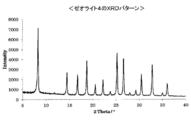
- FIG. 1 is a chart showing the XRD pattern of zeolite 1.
- FIG. 2 is a chart showing the XRD pattern of zeolite 2.
- FIG. 3 is a chart showing the XRD pattern of zeolite 3.
- FIG. 4 is a chart showing the XRD pattern of zeolite 4.
- FIG. 5 is a chart showing the XRD pattern of zeolite 5.
- FIG. 6 is a chart showing the XRD pattern of zeolite 6.
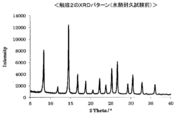
- FIG. 7 is a chart showing an XRD pattern of the catalyst 2 before the hydrothermal durability test.
- FIG. 8 is a chart showing an XRD pattern of the catalyst 2 after the hydrothermal durability test.
- FIG. 9 is a chart showing the XRD pattern of zeolite 9.
- FIG. 10 is a chart showing the XRD pattern of zeolite 10.
- the RHO type zeolite is a code that defines the structure of the zeolite defined by the International Zeolite Association (IZA) and indicates an RHO type. Its structure is characterized by X-ray diffraction data.
- IZA International Zeolite Association
- the actually produced zeolite it is influenced by the growth direction of the zeolite, the ratio of the constituent elements, the adsorbed substance, the presence of defects, etc. Therefore, the same numerical value as that of each parameter of the RHO structure described in the regulations of IZA is not obtained.
- the Rietveld analysis can be performed on the assumption that the result of XRD is the space group lm-3m, and the length in each axial direction is 10%. If the values agree with each other below, it can be said that the crystal is RHO type. For example, specifically, a range of 14.919 mm ⁇ 1.4 mm is allowed, and it can be determined that the RHO type. It should be noted that the correction of 2 ⁇ can be performed by specifying together with a standard product such as Si if necessary.
- the analysis is not particularly limited. For example, “RIETAN” developed by Dr. Fujio Izumi may be used.
- the measurement by the powder X-ray diffraction method is not particularly limited.
- X-rays using CuK ⁇ as a radiation source are applied to a powder sample packed in a flat sample holder made of metal or glass, and the scanning axis is ⁇ / 2 ⁇ .
- the radiation source is not limited to CuK ⁇ , and CoK ⁇ , MoK ⁇ , AgK ⁇ , or the like can also be used.
- the sample may be pulverized with an alumina mortar or an agate mortar to form a powder.
- the zeolite of the present invention may be a zeolite containing an organic template generally used for synthesis of zeolite, or may be a zeolite containing no template.
- the zeolite of the present invention containing no template may be a zeolite synthesized without using a template, or may be obtained by removing a template from a zeolite synthesized using a template.
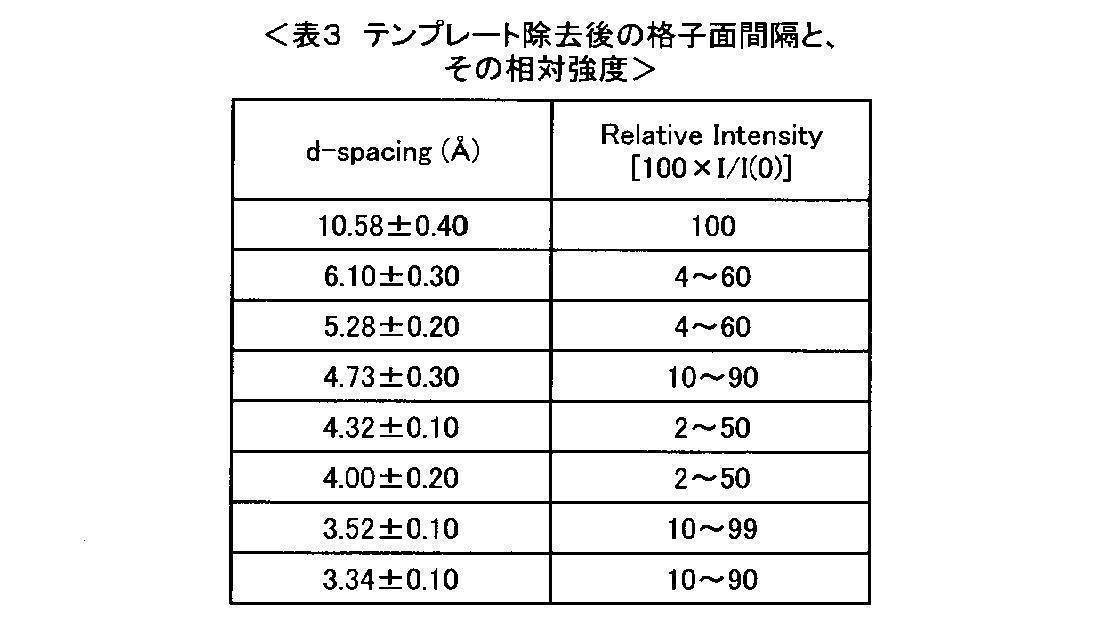
- the zeolite of the present invention is particularly preferably synthesized using an organic template, and the zeolite of the present invention containing a template immediately after hydrothermal synthesis is measured by the powder X-ray diffraction method as follows: It is preferable to have a crystal structure represented by a diffraction pattern (peak position and intensity) shown in Table 2>, and the zeolite of the present invention after removing the template from the zeolite containing such a template is a powder. It is preferable to have a crystal structure represented by a diffraction pattern (peak position and intensity) shown in the following ⁇ Table 3> as measured by an X-ray diffraction method.
- the preferred zeolite of the present invention has a peak (maximum peak) that serves as a reference for relative intensity (relative intensity) before and after removing the template.
- peak intensity refers to the value obtained by subtracting the background value from the measured value.
- each diffraction pattern is described as follows. For example, in the powder X-ray diffraction pattern as shown in ⁇ Table 2>, there is a peak having a lattice spacing (d-spacing (angstrom)) of 10.58 ⁇ 0.40 and a relative intensity of 20 to 80 (relative intensity).
- the maximum value of the peak at the position (2 ⁇ ) corresponding to the lattice spacing of 10.58 ⁇ 0.40 angstroms is determined by the powder X-ray diffraction method as the reference lattice spacing of 3.52 ⁇ 0. It means that the relative intensity is 20 or more and 80 or less when the maximum value of a peak at 10 angstroms is 100.
- the reason why there is an allowable width ( ⁇ 0.10, ⁇ 0.40, etc.) in the lattice spacing value due to this peak position is derived from the difference in the size of different skeleton atoms or the difference in the dry state of the zeolite. This is because there may be a shift of the X-ray diffraction peak (when water or the like is adsorbed).
- the powder X-ray diffraction pattern of this zeolite coincides with the powder X-ray diffraction pattern expected from the structure of the RHO zeolite indicated by the code defined by International Zeolite Association (IZA).
- the molar ratio m Q / X 2 O 3 between the template Q and X 2 O 3 is preferably larger than 0 and smaller than 6. That is, the zeolite of the present invention containing the template Q preferably has the following chemical composition expressed in molar ratio.
- the above X is a trivalent element. Although it does not specifically limit as a trivalent element, Usually, boron, aluminum, iron, and gallium are preferable, and boron, aluminum, and gallium are especially preferable from points, such as the ease of producing
- Y is a tetravalent element.
- the tetravalent element is not particularly limited, but usually silicon, germanium, tin, titanium, and zirconium are preferable, and silicon, germanium, tin, and titanium are particularly preferable from the viewpoint of ease of formation of zeolite crystals. .
- These tetravalent elements may be used alone or in combination with two or more tetravalent elements.
- the zeolite of the present invention contains silicon as the tetravalent element Y, and preferably silicon is 50 mol% or more, more preferably 80 mol% or more of the entire Y.
- Q is a template, and a macrocycle represented by crown ether is preferably used as the template.
- the macrocyclic compound is not particularly limited, but a macrocyclic compound having a heteroatom such as oxygen, nitrogen, or sulfur as an electron donating (donor) atom is preferable, and from the viewpoint of ease of forming a zeolite crystal, In particular, 12-crown-4-ether, 15-crown-5-ether, 18-crown-6-ether, 24-crown-8-ether, dibenzo-18-crown-6-ether, cryptand [2.2], Cryptand [2.2.2] is preferred. Only 1 type may be used for a template and it may use 2 or more types together by arbitrary ratios.
- n represents a molar ratio of tetravalent element Y to trivalent element X in terms of oxide, and is 9.5 or more, preferably 9.8 or more, more preferably 10 or more, and still more preferably. Although it is 10.5 or more and the upper limit is not particularly provided, it is usually 500 or less, preferably 100 or less, more preferably 80 or less, and further preferably 50 or less. A value of n equal to or higher than the lower limit is preferable because of excellent hydrothermal durability. On the other hand, when it is not more than the above upper limit, crystallization is easy and preferable.
- n is preferably 100 or less.
- the value of n represents the SiO 2 / Al 2 O 3 molar ratio “SAR” when the trivalent element X is an aluminum atom and the tetravalent element Y is a silicon atom.
- the value of m is preferably larger than 0 and smaller than 6, more preferably 0.1 or more, further preferably 0.3 or more, more preferably 5 or less, and further preferably 4 or less. Since the zeolite of the present invention is synthesized using a template, it is possible to easily synthesize a desired zeolite having a high molar ratio of tetravalent element Y oxide to trivalent element X oxide. Since it is preferable at this point, it is preferable that the value of m of the zeolite before removing the template immediately after the synthesis is not less than the above lower limit.
- the value of m of the zeolite before removing the template immediately after the synthesis is not more than the above upper limit.
- Zeolite of m 0 obtained by removing the template from the zeolite containing the template in such a ratio is also included in the zeolite of the present invention.
- the zeolite of the present invention may contain a metal element other than the trivalent element X and the tetravalent element Y.
- a metal element other than the trivalent element X and the tetravalent element Y.
- Such “including a metal element” may be either a case where the metal element is present in the skeleton or a case where the metal element is present outside the skeleton, and also includes a mixture.
- the metal elements are not particularly limited, but are usually iron, cobalt, magnesium, zinc from the viewpoint of properties in adsorbent applications and catalyst applications.
- transition metals belonging to Group 3 to 12 of the periodic table preferably periodic table 8
- transition metals belonging to Group 3 to 12 of the periodic table preferably periodic table 8
- the transition metal contained in the zeolite may be one of these, or a combination of two or more transition metals may be contained in the zeolite. Of these transition metals, iron and / or copper is particularly preferable, and copper is particularly preferable.
- ICP emission spectroscopic analysis ICP analysis
- the largest component usually silicon (not a metal but the most abundant and cation) among trivalent or tetravalent metal elements) Therefore, when an element other than (a) described here for convenience) and aluminum) is included, and the peak of the metal element or the compound of the metal element is not detected as a result of XRD measurement, It is considered that the metal element is part of the zeolite, that is, exists in the zeolite framework, and is handled as the trivalent element X or the tetravalent element Y.
- the metal element or the compound of the metal element exists on the surface of the zeolite. Treated as a metal element other than valent element X or tetravalent element Y.
- the content of other metal elements in the zeolite is preferably 0.1% by weight or more in the total amount of zeolite under anhydrous conditions, and 0.3% by weight or more is preferable. More preferably, it is preferably 0.5% by weight or more, more preferably 20% by weight or less, and particularly preferably 10% by weight or less.
- other metal elements such as iron and copper
- an effect of generating an active site of the catalyst is obtained, but by containing the content of the content above the lower limit, an excellent catalytic effect can be obtained, and the upper limit described above. By making it below, it becomes easy to uniformly disperse the metal element in the zeolite, and an excellent catalytic activity is obtained, which is preferable.
- the zeolite of the present invention may contain a metal cation such as sodium, potassium or cesium, or may contain a nonmetal cation such as ammonium ion (NH 4 + , hydrogen ion (H + ). Also, a metal cation and a nonmetal cation may be contained at the same time, and the cation in the zeolite crystal can be replaced with other ions by ion exchange.
- a metal cation such as sodium, potassium or cesium
- a nonmetal cation such as ammonium ion (NH 4 + , hydrogen ion (H + ).
- a metal cation and a nonmetal cation may be contained at the same time, and the cation in the zeolite crystal can be replaced with other ions by ion exchange.
- the zeolite of the present invention is characterized by having an X-ray powder diffraction pattern shown in the above ⁇ Table 1> regardless of whether other metal elements or metal cations are contained or not.
- composition analysis of the zeolite of the present invention and the analysis of the content of other metal elements can be performed by the methods described in the Examples section below.
- For the template content remove the template from the zeolite containing the template according to the template removal method described below, calculate the template weight from the weight of the zeolite before and after template removal, and convert this to a molar ratio. Can determine m.
- Whether it is the zeolite of the present invention can be determined, for example, as follows. First, XRD measurement is performed on the sample. It is confirmed that the result has the lattice spacing of ⁇ Table 1> defined in the present invention, that is, RHO type zeolite. Thereafter, ICP analysis is performed to measure the type and amount of anionic elements. Among the measured trivalent elements and tetravalent elements, except for those in which the peak of the metal element or the compound of the metal element is detected by XRD measurement, the tetravalent element is Y 2 O 3 if it is a trivalent element.
- the zeolite of the present invention the total number of moles of Al and Si is preferably 50 mol% or more, more preferably 80 mol% or more, based on the total number of moles of cations obtained by this ICP analysis.
- the mol% of the total amount of Al and Si in the cation is 50% or more, more preferably 80 mol% or more, which is a metal for use in a catalyst or the like. It is determined that the metal is not used in the skeleton, and the cations used in the skeleton are almost all Al and Si. Therefore, calculation is performed considering only Al and Si. May be.
- Patent Document 2 and Non-Patent Documents 2 to 8 hydrothermal synthesis of zeolite from an aqueous gel prepared by mixing crown ether, alkali, aluminum atom raw material solution and water, and then dropping the silicon atom raw material containing liquid. How to do is described.
- the SAR of zeolite synthesized by this method is as low as less than 9.
- crown ether, alkali and water are mixed to prepare a crown ether-alkali aqueous solution composed of a mixed solution thereof. Then, this crown ether-alkaline aqueous solution is added to the aluminum atom raw material solution, mixed uniformly, and then hydrothermally synthesized an aqueous gel prepared by dropping the silicon atom raw material-containing liquid, whereby the trivalent element X
- the molar ratio of the tetravalent element Y in terms of oxide is high, and the zeolite of the present invention having an RHO type structure is obtained.
- the raw material used for producing the zeolite of the present invention is basically composed of a raw material containing the tetravalent element Y, a raw material containing the trivalent element X, an alkali, a crown ether which is an organic template, and water.
- silicon is used as a typical tetravalent element Y and aluminum is used as a typical trivalent element X, that is, a silicon atom raw material as a raw material containing the tetravalent element Y and an aluminum atomic raw material as a raw material containing the trivalent element X.
- a component having a crystallization promoting action such as a seed crystal may be added.
- silicon atom raw material one or more of colloidal silica, amorphous silica, sodium silicate, trimethylethoxysilane, tetraethylorthosilicate, aluminosilicate gel and the like can be used.
- aluminum atomic raw material one or more of aluminum sulfate, aluminum nitrate, sodium aluminate, aluminum oxide, aluminum hydroxide, boehmite, aluminum chloride, aluminosilicate gel, metal aluminum and the like can be used. Of these, those having a form that can be sufficiently uniformly mixed with other components are desirable, and in particular, a raw material that is easily dissolved in water is preferable.
- alkali examples include sodium hydroxide, potassium hydroxide, rubidium hydroxide, cesium hydroxide, aluminate of the above aluminum atom raw material, alkali component in silicate of silicon atom raw material, alkali component in aluminosilicate gel, etc. 1 type (s) or 2 or more types can be used.
- at least one alkali metal ion selected from the group consisting of lithium, sodium, potassium, rubidium, cesium, calcium, magnesium, strontium and barium is used as the alkali metal ion or alkaline earth metal ion. It is preferable to crystallize in the presence of. By including these alkali metal ions, the progress of crystallization is facilitated, and by-products (impurity crystals) are hardly generated.
- the crown ether is not particularly limited, but as described above, a macrocyclic compound having a heteroatom such as oxygen, nitrogen, or sulfur as the electron donating (donor) atom is preferable, and it is easy to form a zeolite crystal.
- a macrocyclic compound having a heteroatom such as oxygen, nitrogen, or sulfur as the electron donating (donor) atom
- it is easy to form a zeolite crystal in particular, 12-crown-4-ether, 15-crown-5-ether, 18-crown-6-ether, 24-crown-8-ether, dibenzo-18-crown-6-ether, cryptand [ 2.2] and cryptand [2.2.2] are preferable.
- the raw material of these other metal elements is not particularly limited, and usually transition metal sulfate, nitrate, phosphate, chloride
- Inorganic acid salts such as bromide, organic acid salts such as acetate, oxalate and citrate, and organometallic compounds such as pentacarbonyl and ferrocene are used.
- inorganic acid salts and organic acid salts are preferred from the viewpoint of solubility in water.
- a colloidal oxide or a fine powdered oxide may be used.
- the raw material is preferably copper nitrate (II) or copper acetate (II), more preferably copper acetate (II).
- the raw material is preferably iron nitrate (II) or iron acetate (II) like copper.
- the raw material two or more kinds of different metal species or compound species may be used in combination.
- the mixing order of each raw material is not limited and may be appropriately selected depending on the conditions to be used.
- the crown ether is first dissolved in water, and then the alkali source is added. Add and mix. At this time, the mixture may be mixed at room temperature.
- the mixing temperature is usually 50 ° C. or higher, preferably 60 ° C. or higher. Is 150 ° C. or lower, particularly preferably 100 ° C. or lower. Note that the room temperature is a temperature when the temperature is not strictly controlled in the laboratory.
- the concentration of each component in the crown ether-alkali aqueous solution is such that the crown ether concentration in the crown ether-alkali aqueous solution is 10% by weight or more, particularly 20% by weight or more from the viewpoint of the ease of formation of zeolite crystals. It is preferably 80% by weight or less, particularly preferably 70% by weight or less, and the alkali has a molar ratio of the amount of alkali metal in the aqueous gel subjected to hydrothermal synthesis to the silicon atoms in the aqueous gel. Is preferably 0.1 or more, particularly preferably 0.2 or more, and is preferably 0.7 or less, particularly preferably 0.6 or less, from the viewpoint of easy formation of zeolite crystals. Therefore, when an aluminum atom raw material or a silicon atom raw material containing an alkali component is used, it is preferable to use the alkali metal content in total with the alkali component in these raw materials.
- the crown ether-alkali aqueous solution does not substantially contain an aluminum atom raw material and a silicon atom raw material.
- substantially free means that the content in the crown ether-alkali aqueous solution is 0.1% by weight or less, preferably not contained at all.
- the aluminum atomic raw material solution is prepared by dissolving the aforementioned aluminum atomic raw material in water.
- the aluminum atomic raw material concentration of the aluminum atomic raw material solution is preferably 5 to 50% by weight, particularly 10 to 40% by weight, from the viewpoint of ease of gel preparation and production efficiency.
- the aluminum atom raw material solution does not substantially contain crown ether or silicon atom raw material.
- substantially does not contain means that the content in the aluminum atom raw material solution is 1% by weight or less, preferably not contained at all.
- the addition rate is not limited and may be appropriately selected depending on the conditions to be used. Even when the silicon atom raw material-containing liquid is dropped into the mixed liquid of the aluminum atomic raw material solution and the crown ether-alkaline aqueous solution, the addition rate is not limited and may be appropriately selected depending on the conditions used. In order to obtain a more uniform aqueous gel, it is preferable to set conditions such as increasing the stirring speed and slowly dropping the silicon atom raw material-containing liquid. There is no particular limitation on the temperature at which the aqueous gel is prepared, and it is usually performed at room temperature (about 0 to 50 ° C.).
- the silicon atom raw material-containing liquid if the silicon atom raw material is already an aqueous dispersion of silica of about 5 to 60% by weight like silica sol, it can be used as it is.
- the silicon atom raw material concentration should be prepared as an aqueous solution or water dispersion having a concentration of 5% by weight or more, particularly 10% by weight or more and 60% by weight or less, particularly 50% by weight or less. Is preferred.
- this silicon atom raw material containing liquid is substantially free of aluminum atom raw material and crown ether.
- “substantially does not contain” means that the content in the silicon atom raw material containing liquid is 0.1% by weight or less, preferably not contained at all.
- the aqueous gel used for hydrothermal synthesis is prepared by dropping a silicon atom raw material-containing liquid into a mixed liquid of an aluminum atomic raw material solution and a crown ether-alkali aqueous solution.
- Each raw material concentration is appropriately determined so that the obtained zeolite satisfies the above-mentioned n value and m value.
- the ratio of silicon atoms to aluminum atoms in the aqueous gel is usually 5 or more, preferably 9 or more, more preferably expressed as a molar ratio of oxides of the respective elements, that is, SiO 2 / Al 2 O 3 molar ratio. 9.5 or more.
- the aqueous gel subjected to hydrothermal synthesis is 20% by weight or more, particularly 30% by weight or more, and 80% by weight or less, particularly 70% by weight or less in terms of ease of formation of zeolite crystals and production cost. It is preferable.
- the aqueous gel prepared as described above may be hydrothermally synthesized immediately after preparation, but is preferably aged for a certain time under a predetermined temperature condition in order to obtain a zeolite having high crystallinity.
- the aging temperature is usually 100 ° C. or lower, preferably 80 ° C. or lower, more preferably 60 ° C. or lower, and there is no particular lower limit, but it is usually 0 ° C. or higher, preferably 10 ° C. or higher.
- the aging temperature may be constant during aging, or may be changed stepwise or continuously.
- the aging time is not particularly limited, but is usually 2 hours or more, preferably 3 hours or more, more preferably 5 hours or more, and usually 30 days or less, preferably 10 days or less, more preferably 4 days or less.
- hydrothermal synthesis the aqueous gel prepared as described above is placed in a pressure-resistant container, and is stirred or rotated or rocked under a self-generated pressure or a gas pressure that does not inhibit crystallization. It is carried out by holding a predetermined temperature while standing or standing.
- the reaction temperature during hydrothermal synthesis is usually 90 ° C. or higher, preferably 120 ° C. or higher, more preferably 150 ° C. or higher, and usually 300 ° C. or lower, preferably 250 ° C. or lower, more preferably 220 ° C. or lower.
- the reaction time is not particularly limited, but is usually 2 hours or longer, preferably 3 hours or longer, more preferably 5 hours or longer, and is usually 30 days or shorter, preferably 10 days or shorter, more preferably 6 days or shorter.
- the reaction temperature may be constant during the reaction, or may be changed stepwise or continuously. By making it react on said conditions, it becomes difficult to produce
- the product zeolite is separated from the hydrothermal synthesis reaction solution.
- the obtained zeolite (hereinafter referred to as “template-containing zeolite”) contains both or one of the crown ether and alkali metal of the template in the pores.
- the method for separating the template-containing zeolite from the hydrothermal synthesis reaction liquid is not particularly limited, and usually includes a method by filtration, decantation, direct drying, or the like.
- the template-containing zeolite separated and recovered from the hydrothermal synthesis reaction solution can be washed with water, dried and calcined, if necessary, in order to remove the crown ether and the like of the template used in the production.
- a catalyst including a catalyst carrier
- an adsorbent it is preferably used after being removed.
- the template and / or alkali metal removal treatment can employ a liquid phase treatment using a chemical solution containing an acidic solution or a template decomposition component, an ion exchange treatment using a resin, or a thermal decomposition treatment. May be used in combination.
- organic substances contained by a method such as baking in air or oxygen-containing inert gas or inert gas atmosphere at a temperature of 300 ° C. to 1000 ° C. or extraction with an organic solvent such as an aqueous ethanol solution. (Such as a template) can be removed.
- the firing temperature is preferably 400 ° C. or higher, more preferably 450 ° C.
- the alkali metal part can be converted into H type or NH 4 type by utilizing the ion exchange ability of zeolite, and a known technique can be adopted as the method. For example, it can be carried out by a method such as washing with water after treatment at room temperature to 100 ° C. with an acid such as NH 4 NO 3 or NaNO 3 or an ammonium salt or hydrochloric acid.
- metal materials When producing a zeolite containing the above-mentioned other metal elements, other metal element materials (hereinafter referred to as “metal materials”) are added to an aqueous gel used for hydrothermal synthesis, and then hydrothermal synthesis is performed. It may be manufactured. In this case, if the other metal element added is a trivalent or tetravalent metal element, most of the element is incorporated into the skeleton structure.
- the zeolite of the present invention obtained by hydrothermal synthesis is dispersed in an aqueous solution of a metal raw material containing the metal raw material at a concentration of about 0.5 wt% or more and 80 wt% or less, and impregnation or ion exchange is performed.
- Zeolite containing other metal elements may be produced by a supporting method.
- a method of baking at 300 ° C. or higher, preferably 400 ° C. or higher, and 1000 ° C. or lower, preferably 900 ° C. or lower, usually 0.5 hours or longer, preferably 1 hour or longer, and within 24 hours, preferably within 12 hours. Can be adopted.
- zeolite of the present invention Although there is no restriction
- the zeolite of the present invention When the zeolite of the present invention is used as an exhaust gas treatment catalyst such as an automobile exhaust gas purification catalyst, the zeolite of the present invention may be used as it is, or a metal may be further supported on the zeolite as necessary. Furthermore, it can be mixed with a binder such as silica, alumina, clay mineral, etc., and granulated or molded for use. Moreover, it can also be formed into a predetermined shape using a coating method or a forming method, and preferably formed into a honeycomb shape.
- a binder such as silica, alumina, clay mineral, etc.
- a molded article of a catalyst containing the zeolite of the present invention is obtained by a coating method
- the zeolite of the present invention and an inorganic binder such as silica and alumina are mixed to prepare a slurry, which is made of an inorganic material such as cordierite. It is produced by applying to the surface of the molded body and firing, and preferably, at this time, the honeycomb-shaped catalyst can be obtained by applying to the honeycomb-shaped molded body.
- the zeolite When a molded article of a catalyst containing the zeolite of the present invention is obtained by molding, the zeolite is usually kneaded with an inorganic binder such as silica or alumina, or inorganic fibers such as alumina fiber or glass fiber, and molded by an extrusion method or a compression method. And then firing, and preferably formed into a honeycomb shape at this time, a honeycomb catalyst can be obtained.
- an inorganic binder such as silica or alumina, or inorganic fibers such as alumina fiber or glass fiber
- the catalyst containing zeolite of the present invention is effective as a NOx selective reduction catalyst such as an automobile exhaust purification catalyst that purifies nitrogen oxides by contacting exhaust gas containing nitrogen oxides.
- the zeolite of the present invention containing the other metal elements described above is effective as an exhaust gas treatment catalyst.
- it is effective as a selective reduction catalyst for NOx.
- X contains at least aluminum
- Y contains at least silicon
- other metal elements are preferably transition metals.
- iron, copper, iron and copper are preferably used in combination.
- the content of other metal elements is usually 0.1% by weight or more, preferably 0.3% by weight or more, more preferably 0.5% by weight or more in the total amount of zeolite containing other metal elements under anhydrous conditions. It is usually 20% by weight or less, preferably 10% by weight or less.
- An exhaust gas treatment catalyst obtained by loading another metal on the zeolite of the present invention is also particularly effective as a NOx selective reduction catalyst.
- X contains at least aluminum
- Y contains at least silicon
- the metal element to be supported is preferably a transition metal, and among them, iron, copper, iron and copper in combination are preferable.
- the content of other metal elements is 0.1% by weight or more, preferably 0.3% by weight or more, more preferably 0.5% by weight based on the total amount of zeolite loaded with other metal elements in an anhydrous state. %, Usually 20% by weight or less, preferably 10% by weight or less.
- the exhaust gas may contain components other than nitrogen oxides, and may contain, for example, hydrocarbons, carbon monoxide, carbon dioxide, hydrogen, nitrogen, oxygen, sulfur oxides, and water. Moreover, you may use well-known reducing agents, such as nitrogen-containing compounds, such as hydrocarbon, ammonia, and urea.
- the exhaust gas treatment catalyst of the present invention diesel vehicles, gasoline vehicles, stationary diesel generators, ships, agricultural machinery, construction machinery, motorcycles, various diesel engines for aircraft, boilers, gas turbines, etc.
- Nitrogen oxides contained in various exhaust gases can be purified.
- the catalyst for purifying nitrogen oxides for example, it is not consumed in the purification of nitrogen oxides in the subsequent step of purifying the nitrogen oxides using the catalyst for purifying nitrogen oxides of the present invention.
- It can be used for an oxidation catalyst that oxidizes excess reducing agent (for example, ammonia).
- the catalyst containing the zeolite of the present invention can oxidize excess reducing agent as an oxidation catalyst and reduce the reducing agent in the exhaust gas.
- a catalyst in which a metal such as a platinum group is supported on a support such as zeolite for adsorbing a reducing agent as an oxidation catalyst can be used.
- the zeolite of the present invention can be used as the support, or a nitrogen oxidation can be performed.
- the catalyst of the present invention for example, supporting iron and / or copper, which is used as a selective reduction catalyst for a product, can further use a catalyst supporting a metal such as the platinum group.
- the contact condition between the catalyst and the exhaust gas when using the catalyst containing the zeolite of the present invention is not particularly limited, but the space velocity of the exhaust gas is usually 100 / h or more, preferably 1000 / h or more,
- the temperature is usually 500,000 / h or less, preferably 100,000 / h or less, and the temperature is usually 100 ° C. or higher, preferably 150 ° C. or higher, usually 700 ° C. or lower, preferably 500 ° C. or lower.
- NO purification rate (%) ⁇ (Inlet NO concentration)-(Outlet NO concentration) ⁇ / (Inlet NO concentration) ⁇ 100
- the nitrogen oxide removal activity (catalytic activity before the hydrothermal durability test) of the zeolite sample was evaluated based on the value of.
- the sample was evaluated for nitrogen oxide removal activity (catalytic activity after hydrothermal durability test).
- Example 1 5.2 g of 18-crown-6-ether (manufactured by Tokyo Chemical Industry) was dissolved in 8 g of water, and 1.3 g of NaOH (manufactured by Wako Pure Chemical Industries) and 2.0 g of CsOH.H 2 O were dissolved in the resulting solution. (Mitsuwa Chemical Co., Ltd.) was added and stirred at 80 ° C. for 3 hours to obtain a crown ether-alkali aqueous solution.
- the aqueous gel was aged at room temperature for 24 hours, then placed in a pressure vessel and hydrothermally synthesized for 72 hours while rotating in an oven at 125 ° C. (15 rpm). After this hydrothermal synthesis reaction, the reaction solution was cooled and the crystals produced by filtration were collected. After the recovered crystals were dried at 100 ° C. for 12 hours, the XRD of the obtained zeolite powder was measured, and the XRD pattern having a peak and a relative intensity at a position shown in ⁇ Table 6> in terms of lattice spacing was shown. Zeolite 1 could be synthesized. The XRD pattern of this zeolite 1 is shown in FIG. The SAR of zeolite 1 as measured by XRF analysis was 9.9.
- the zeolite 1 was calcined for 6 hours in an air stream at 550 ° C. to remove organic substances, and the zeolite 2 was obtained.
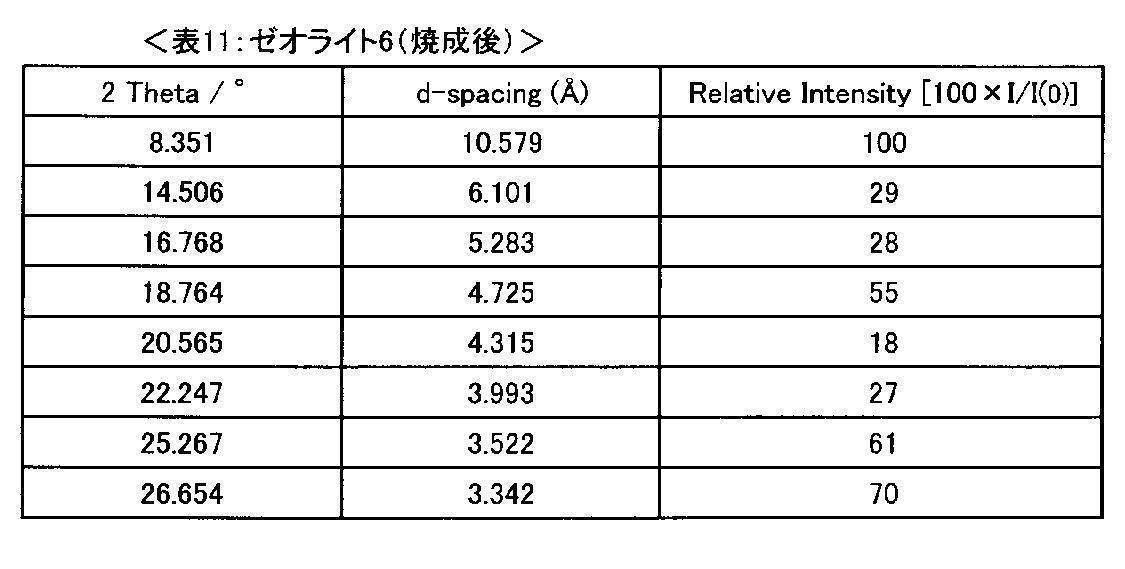
- XRD of the zeolite 2 thus obtained was measured, an XRD pattern having peaks and relative intensities at positions as shown in ⁇ Table 7> in terms of lattice spacing was shown.
- the XRD pattern of zeolite 2 is shown in FIG.
- the SAR of zeolite 2 was 9.9 by XRF analysis.
- m calculated from the weight difference between zeolite 1 and zeolite 2 was 0.30.
- Example 2 9.4 g of 18-crown-6-ether (manufactured by Tokyo Chemical Industry) was dissolved in 8.2 g of water, and 1.3 g of NaOH (manufactured by Wako Pure Chemical Industries) and 2.0 g of CsOH ⁇ H were dissolved in the resulting solution. 2 O (manufactured by Mitsuwa Chemical) was added and stirred at 80 ° C. for 3 hours to obtain a crown ether-alkali aqueous solution.
- NaOH manufactured by Wako Pure Chemical Industries
- 2 O manufactured by Mitsuwa Chemical
- the aqueous gel was aged at room temperature for 24 hours, then placed in a pressure vessel and hydrothermally synthesized for 70 hours while rotating in an oven at 155 ° C. (15 rpm). After this hydrothermal synthesis reaction, the reaction solution was cooled and the crystals produced by filtration were collected. After the collected crystals were dried at 100 ° C. for 12 hours, the XRD of the obtained zeolite powder was measured, and the XRD pattern having peaks and relative intensities at the positions shown in ⁇ Table 8> in the lattice spacing display. Zeolite 3 could be synthesized. The XRD pattern of this zeolite 3 is shown in FIG. The SAR of zeolite 3 by XRF analysis was 16.6.
- the zeolite 3 was calcined for 6 hours in an air stream at 550 ° C. to remove organic substances, and zeolite 4 was obtained.
- XRD of the zeolite 4 thus obtained was measured, an XRD pattern having a peak and a relative intensity at positions shown in ⁇ Table 9> in terms of lattice spacing was shown.
- the XRD pattern of zeolite 4 is shown in FIG.
- SAR of the zeolite 4 by XRF analysis was 15.3.
- m calculated from the weight difference between zeolite 3 and zeolite 4 was 0.55.
- Example 3 7.8 g of 18-crown-6-ether (manufactured by Tokyo Chemical Industry) was dissolved in 8 g of water, and 1.1 g of NaOH (manufactured by Wako Pure Chemical Industries) and 1.66 g of CsOH.H 2 O were dissolved in the resulting solution. (Mitsuwa Chemical Co., Ltd.) was added and stirred at 80 ° C. for 3 hours to obtain a crown ether-alkali aqueous solution.
- This aqueous gel was aged at room temperature for 24 hours, then placed in a pressure vessel and hydrothermally synthesized for 72 hours while rotating in an oven at 170 ° C. (15 rpm). After this hydrothermal synthesis reaction, the reaction solution was cooled and the crystals produced by filtration were collected. After the collected crystals were dried at 100 ° C. for 12 hours, the XRD of the obtained zeolite powder was measured, and the XRD pattern having peaks and relative intensities at the positions shown in ⁇ Table 10> in the lattice spacing display. Zeolite 5 could be synthesized. The XRD pattern of this zeolite 5 is shown in FIG. The SAR of zeolite 7 by XRF analysis was 20.6.
- the zeolite was calcined for 6 hours in an air stream at 550 ° C. to remove organic substances, and zeolite 6 was obtained.
- XRD of the zeolite 8 thus obtained was measured, an XRD pattern having peaks and relative intensities at positions shown in ⁇ Table 11> in terms of lattice spacing was shown.
- the XRD pattern of zeolite 6 is shown in FIG.
- SAR of the zeolite 6 by XRF analysis was 18.8.
- m calculated from the weight difference between zeolite 5 and zeolite 6 was 0.58.
- Example 4 In order to remove Cs ions and Na ions in the zeolite, the zeolite 2 produced in Example 1 was dispersed in a 6M NH 4 Cl aqueous solution, and ion exchange was performed at 80 ° C. for 1 hour. The zeolite was recovered by filtration and washed with ion-exchanged water three times. Thereafter, the above ion exchange and washing were repeated three times. The obtained zeolite powder was dried at 100 ° C. for 12 hours to obtain NH 4 type zeolite 7.
- a copper nitrate (II) aqueous solution composed of 10 g of Cu (NO 3 ) 2 .3H 2 O and 10 g of water, and ion exchange was performed at 80 ° C. for 1 hour.
- the zeolite is recovered by filtration, washed with ion-exchanged water three times, and the resulting zeolite powder is dried at 100 ° C. for 12 hours and then calcined in air at 500 ° C. for 1 hour, thereby containing Cu.
- a catalyst 1 made of zeolite was obtained.
- the content of Cu in catalyst 1 by XRF analysis was 2.5% by weight.
- Example 5 In the same manner as in Example 4, the zeolite 4 produced in Example 2 was dispersed in a 6M NH 4 Cl aqueous solution and subjected to ion exchange and washing, whereby NH 4 type zeolite 8 was obtained. 0.22 g of Cu (OAc) 2 .H 2 O (manufactured by Kishida Chemical) was dissolved in 3.2 g of water to obtain a copper (II) acetate aqueous solution. 2.3 g of zeolite 8 was added to and mixed with the aqueous copper (II) acetate solution. Then, it filtered, dried at 100 degreeC for 10 hours, and baked at 750 degreeC in the air for 2 hours, and obtained the catalyst 2.
- Cu (OAc) 2 .H 2 O manufactured by Kishida Chemical
- the content of Cu in catalyst 2 by the XRF analysis was 3.2% by weight.
- the XRD measurement result of the catalyst 2 is shown in FIG. Further, the catalytic activity of the catalyst 2 before and after the hydrothermal durability test was examined, and the results are shown in Table 13. Moreover, the XRD measurement result of the catalyst 2 after a hydrothermal durability test is shown in FIG.
- silica sol (silica concentration: 40% by weight, SN-40, manufactured by Nissan Chemical Industries) was added dropwise to the obtained mixed solution with stirring to obtain an aqueous gel having the following composition.
- SiO 2 : Al 2 O 3 : Cs 2 O: 18-crown-6-ether: H 2 O 10: 1: 0.3: 0.5: 100 (molar ratio)
- This aqueous gel was aged at room temperature for 24 hours, and then placed in a pressure vessel, and hydrothermal synthesis was performed for 96 hours while rotating in an oven at 110 ° C. (15 rpm). After this hydrothermal synthesis reaction, the reaction solution was cooled and the crystals produced by filtration were collected. The recovered crystals were dried at 100 ° C. for 12 hours to obtain zeolite 9.
- the XRD measurement result of the obtained zeolite 9 is shown in FIG.
- the SAR of zeolite 9 was 8.0 by XRF analysis. Further, the zeolite 9 was calcined in an air stream at 550 ° C. for 6 hours to remove organic substances, whereby zeolite 10 was obtained.
- zeolite 12 was obtained by performing high-temperature steaming treatment in the same manner as in Non-Patent Documents 7 to 9.
- the BET specific surface area of the zeolite 12 was measured and found to be 854 m 2 / g. This result proves that the zeolite structure is maintained even after the steaming treatment.
- the SAR of zeolite 12 by XRF analysis was 8.0.
- the zeolite of the present invention has a high molar ratio of the tetravalent element Y oxide to the trivalent element X oxide, and has high hydrothermal durability and high catalytic activity.
- the use of the zeolite of the present invention is not particularly limited, but the zeolite of the present invention is suitably used as a catalyst, an adsorbent, a separation material and the like because it has a unique crystal structure. In addition, since it has high high-temperature hydrothermal durability, it is particularly suitable for exhaust gas purification catalysts for automobiles and the like.
Landscapes
- Chemical & Material Sciences (AREA)
- Engineering & Computer Science (AREA)
- Organic Chemistry (AREA)
- Chemical Kinetics & Catalysis (AREA)
- Materials Engineering (AREA)
- Life Sciences & Earth Sciences (AREA)
- General Life Sciences & Earth Sciences (AREA)
- Geology (AREA)
- Inorganic Chemistry (AREA)
- Crystallography & Structural Chemistry (AREA)
- Environmental & Geological Engineering (AREA)
- Combustion & Propulsion (AREA)
- Health & Medical Sciences (AREA)
- Biomedical Technology (AREA)
- Analytical Chemistry (AREA)
- General Chemical & Material Sciences (AREA)
- Oil, Petroleum & Natural Gas (AREA)
- Thermal Sciences (AREA)
- Physics & Mathematics (AREA)
- Silicates, Zeolites, And Molecular Sieves (AREA)
- Catalysts (AREA)
- Exhaust Gas Treatment By Means Of Catalyst (AREA)
Abstract
Description

また、更に以下の要旨をも含む。
本発明において、RHO型のゼオライトとは、International Zeolite Association(IZA)が定めるゼオライトの構造を規定するコードでRHO構造のものを示す。その構造は、X線回折のデータにより特徴付けられる。もちろん、実際に作製されたゼオライトを測定する場合には、ゼオライトの成長方向や、構成する元素の比、吸着した物質、欠陥の存在などの影響を受け、各ピークの強度比やピーク位置に若干のずれを生じるため、IZAの規定に記載されたRHO構造の各パラメータと全く同じ数値が得られるわけではない。したがって、実際に判断する場合には、例えば具体的には、XRDの結果を空間群lm-3mであると仮定してリートベルト解析することができ、かつ各軸方向の長さが、10%程度以下で一致する場合には、RHO型の結晶型であるということができる。例えば具体的にはそれぞれ14.919ű1.4Åの範囲になるものは許容され、RHO型であると判断することができる。尚、必要に応じSiのような標準品と共に特定することにより、2θの補正を行うこともできる。
解析については、特に限定するわけではないが、例えば泉富士夫博士の開発した「RIETAN」等を用いるとよい。
本発明のゼオライトは、少なくとも三価元素Xと四価元素Yとを含み、酸化物換算のモル比n=YO2/X2O3が9.5以上、即ち、化学組成X2O3:(n)YO2において、n≧9.5であり、RHO型構造を有するゼオライトであるか、または粉末X線回折法による測定で、少なくとも前記<表1>に示す格子面間隔d(Å)が検出されるものであることを特徴とする。
本実施態様において、粉末X線回折法による測定は、特に限定されない。通常は、金属製やガラス製などの平板状の試料ホルダーに充填した粉末試料にCuKαを線源とするX線を照射して、走査軸をθ/2θとして行う。なお、線源は、CuKαに限定されず、CoKα、MoKα、AgKαなどを用いることもできる。試料は、例えば、アルミナ乳鉢やめのう乳鉢で粉砕して、粉末にすればよい。
本発明のゼオライトは、特に、有機テンプレートを使用して合成されたものであることが好ましく、水熱合成直後のテンプレートを含んだ本発明のゼオライトは、粉末X線回折法による測定で、下記<表2>に示される回折パターン(ピーク位置及び強度)で表される結晶構造を有するものであることが好ましく、このようなテンプレートを含むゼオライトからテンプレートを除去した後の本発明のゼオライトは、粉末X線回折法による測定で、下記<表3>に示される回折パターン(ピーク位置及び強度)で表される結晶構造を有することが好ましい。
本発明の好ましいゼオライトは、<表2>と<表3>との対比から明らかなように、テンプレートを除去する前と後で、相対強度(Relative Intensity)の基準となるピーク(最大ピーク)が異なる。この理由は、テンプレートを除去すると、RHO型ゼオライトの(110)面(d(Å)=10.58±0.4)に由来するX線回析強度が高くなることによる。テンプレートを含まないRHO型ゼオライト中では、(110)面に由来するX線回析強度が最も高い場合が多い。ここで、ピークの強度は、測定値からバックグラウンドの値を引いたものをさす。

また、このピーク位置によって、格子面間隔の値に許容幅(±0.10や±0.40等)がある理由は、異なる骨格原子の大きさの違い、或いはゼオライトの乾燥状態の違いに由来する(水などが吸着すると)X線回析ピークのシフトがある場合があるからである。
このゼオライトの粉末X線回折パターンは、International Zeolite Association(IZA)が定めるコードで示すRHO型ゼオライトの構造から予想される粉末X線回折パターンと一致する。すなわち、本発明のゼオライトは、三価元素Xと四価元素Yとを含み、酸化物換算のモル比n=YO2/X2O3が9.5以上であり、RHO型構造を有するゼオライトである。
mQ:X2O3:(n)YO2(0<m<6、n≧9.5)
また、テンプレートの含有量については、テンプレートを含むゼオライトから後述のテンプレートの除去方法に従ってテンプレートを除去し、テンプレート除去前後のゼオライトの重量から、テンプレートの含有重量を算出し、これをモル比換算することによりmを求めることができる。
まず、試料についてXRD測定を行う。
その結果が本発明で規定する前記<表1>の格子面間隔を有すること、すなわちRHO型のゼオライトであることを確認する。
その後、ICP分析を行うことにより、アニオンの元素の種類と量を測定する。測定された三価元素と四価元素のうち、XRD測定によりその金属元素又はその金属元素の化合物のピークが検出されるものを除き、三価元素であればY2O3として、四価元素であればXO2として考え、そのモル比n=YO2/X2O3が9.5以上になることを確認する。
XRD測定の結果とICP分析の結果が本発明の規定を満たすものであれば本発明のゼオライトであると判断することができる。
本発明のゼオライトは、このICP分析により得られたカチオン全体のモル数に対し、AlとSiのモル数の合計が50モル%以上であることが好ましく、より好ましくは80モル%以上である。
また、酸化物換算のモル比nを求める場合、カチオン中でのAlとSiの合計量のモル%が50%以上、より好ましくは80モル%以上であって、触媒等に使用するために金属等を担持する場合には、その金属は骨格に使用されていないと判断でき、骨格に使用されているカチオンはほぼ全てAlとSiであると考えられるため、AlとSiのみを考えて計算してもよい。
特許文献2及び非特許文献2~8には、クラウンエーテルとアルカリとアルミニウム原子原料溶液と水を混合し、その後、ケイ素原子原料含有液を滴下することで調製した水性ゲルからゼオライトを水熱合成する方法が記載されている。この方法で合成したゼオライトのSARは9未満と低い。
このように、原料の混合手順を変更することで、三価元素Xに対する四価元素Yの酸化物換算のモル比の高いRHO型ゼオライトを製造することができる理由の詳細は明らかではないが、このような混合手順であると、クラウンエーテルがアルミニウム原子原料及びケイ素原子原料とより強く相互作用し、三価元素Xに対する四価元素Yの酸化物換算のモル比の高い新規RHO型ゼオライトを製造できるものと推測される。
本発明のゼオライトの製造に用いる原料は、四価元素Yを含む原料、三価元素Xを含む原料、アルカリ、有機テンプレートであるクラウンエーテルと、水から基本的に構成される。以下では四価元素Yの典型としてケイ素を用い、三価元素Xの典型としてアルミニウムを用いた場合、すなわち四価元素Yを含む原料としてケイ素原子原料、三価元素Xを含む原料としてアルミニウム原子原料を用いた場合を例示して説明する。また、本発明においては種晶などの結晶化促進作用を有する成分を添加してもよい。
他の金属原料としては、金属種、或いは化合物種の異なるものを2種以上併用してもよい。
本発明において、クラウンエーテル-アルカリ水溶液を調製する際、各原料の混合順序は制限がなく、用いる条件により適宜選択すればよいが、通常は、まず水にクラウンエーテルを溶解し、その後、アルカリ源を添加して混合する。この際、室温で混合してもよいが、原料をよく溶解させるために、混合温度は通常50℃以上、好ましくは60℃以上であり、その上限は特に設けないが、通常200℃以下、好ましくは150℃以下、特に好ましくは100℃以下である。なお、室温とは、実験室内で厳密な温度管理をしない状態に置いたときの温度である。
従って、アルミニウム原子原料やケイ素原子原料としてアルカリ成分を含むものを用いる場合は、これらの原料中のアルカリ成分との合計で上記アルカリ金属含有量となるように用いることが好ましい。
アルミニウム原子原料溶液は、前述のアルミニウム原子原料を水に溶解させて調製される。アルミニウム原子原料溶液のアルミニウム原子原料濃度は、ゲル調製しやすさや生産効率の点から5~50重量%、特に10~40重量%であることが好ましい。
なお、このアルミニウム原子原料溶液は、クラウンエーテル及びケイ素原子原料を実質的に含有しない。ここで、「実質的に含有しない」とは、アルミニウム原子原料溶液中の含有量が1重量%以下であることを言い、好ましくは全く含有しないことをさす。
アルミニウム原子原料溶液にクラウンエーテル-アルカリ水溶液を添加する際、その添加速度は制限がなく、用いる条件により適宜選択すればよい。アルミニウム原子原料溶液とクラウンエーテル-アルカリ水溶液との混合液にケイ素原子原料含有液を滴下する際も、その添加速度は制限がなく、用いる条件により適宜選択すればよい。より均一な水性ゲルを得るために、撹拌速度を上げる、ケイ素原子原料含有液をゆっくり滴下するといった条件設定を行うことが好ましい。水性ゲル調製時の温度には特に制限はなく、通常、常温(0~50℃程度)で行われる。
アルミニウム原子原料溶液と同様に、このケイ素原子原料含有液は、アルミニウム原子原料及びクラウンエーテルを実質的に含有しない。ここで、「実質的に含有しない」とは、ケイ素原子原料含有液中の含有量が0.1重量%以下であることを言い、好ましくは全く含有しないことをさす。
また、水熱合成に供する水性ゲルの水含有量はゼオライト結晶の生成しやすさや製造コストの点において20重量%以上、特に30重量%以上、かつ80重量%以下、特に70重量%以下であることが好ましい。
水熱合成は、上記のようにして調製された水性ゲルを耐圧容器に入れ、自己発生圧力下、又は結晶化を阻害しない程度の気体加圧下で、攪拌下、又は、容器を回転ないしは揺動させながら、或いは静置状態で、所定温度を保持することにより行われる。
更にはゼオライトのイオン交換能を利用してアルカリ金属部分をH型やNH4型に変換して用いることもでき、その方法は公知の技術を採用することができる。例えば、NH4NO3、NaNO3などアンモニウム塩あるいは塩酸などの酸で、通常、室温から100℃で処理後、水洗する方法などにより行うことができる。
前述の他の金属元素を含有するゼオライトを製造する場合には、他の金属元素原料(以下「金属原料」と称す)を水熱合成に供される水性ゲルに添加し、その後水熱合成することで製造してもよい。この場合、添加した他の金属元素が3価又は4価の金属元素であれば、その多くは骨格構造に組み込まれることになる。
あるいは、金属原料を0.5重量%以上、80重量%以下程度の濃度で含む金属原料の水溶液に、水熱合成により得られた本発明のゼオライトを分散させ、含浸、或いはイオン交換するなどの担持方法で他の金属元素を含有するゼオライトを製造してもよい。
この場合、ゼオライトを金属原料溶液に分散させた後濾過し、濾別したゼオライトを水洗する操作を1回又は必要に応じて複数回繰り返し行った後、60℃以上200℃以下で乾燥し、通常300℃以上、好ましくは400℃以上で、かつ1000℃以下、好ましくは900℃以下で、通常0.5時間以上、好ましくは1時間以上、かつ24時間以内、好ましくは12時間以内程度焼成する方法を採用することができる。
本発明のゼオライトの用途としては特に制限はないが、本発明のゼオライトは、特有な結晶構造を持つことから、触媒、吸着材、分離材料などとして、好適に用いられる。また高い高温水熱耐久性を有することから、特に自動車等の排ガス浄化用触媒等に好適に用いられる。
本発明のゼオライトを自動車排気浄化触媒等の排ガス処理用触媒として用いる場合、本発明のゼオライトはそのままで用いてもよく、必要に応じてゼオライトにさらに金属を担持して用いてもよい。さらに、シリカ、アルミナ、粘土鉱物等のバインダーと混合し、造粒や成形を行って使用することもできる。また、塗布法や、成形法を用いて所定の形状に成形して用いることもでき、好ましくはハニカム状に成形して用いることができる。
特に前述の他の金属元素を含有する本発明のゼオライトは、排ガス処理用触媒として有効である。特に、NOxの選択的還元触媒として有効である。このような排ガス処理用触媒としては、Xは少なくともアルミニウムを含み、Yは少なくともケイ素を含み、他の金属元素としては遷移金属が好ましく、中でも、鉄、銅、鉄及び銅の併用が好ましい。他の金属元素の含有量は、無水状態下での他の金属元素を含むゼオライト全量中、通常0.1重量%以上、好ましくは0.3重量%以上、より好ましくは0.5重量%以上であり、通常20重量%以下、好ましくは10重量%以下である。
また、本発明のゼオライトに他の金属を担持させてなる排ガス処理用触媒も、NOxの選択的還元触媒として、特に有効である。このような排ガス処理用触媒としては、Xは少なくともアルミニウムを含み、Yは少なくともケイ素を含み、担持させる金属元素としては遷移金属が好ましく、中でも、鉄、銅、鉄及び銅の併用が好ましい。他の金属元素の含有量は、無水状態下での他の金属元素を担持させてなるゼオライト全量中、0.1重量%以上、好ましくは0.3重量%以上、より好ましくは0.5重量%以上であり、通常20重量%以下、好ましくは10重量%以下である。
該排ガスには窒素酸化物以外の成分が含まれていてもよく、例えば炭化水素、一酸化炭素、二酸化炭素、水素、窒素、酸素、硫黄酸化物、水が含まれていてもよい。また、炭化水素、アンモニア、尿素等の窒素含有化合物等の公知の還元剤を使用してもよい。具体的には、本発明の排ガス処理用触媒により、ディーゼル自動車、ガソリン自動車、定置発電・船舶・農業機械・建設機械・二輪車・航空機用の各種ディーゼルエンジン、ボイラー、ガスタービン等から排出される多種多様の排ガスに含まれる窒素酸化物を浄化することができる。
本発明においては、窒素酸化物浄化用触媒用途以外に、例えば、本発明の窒素酸化物浄化用触媒を用いて窒素酸化物の浄化を行った後段の工程において、窒素酸化物浄化で消費されなかった余剰の還元剤(例えばアンモニア)を酸化する酸化触媒用途に用いることができる。このように、本発明のゼオライトを含む触媒は酸化触媒として余剰の還元剤を酸化し、排ガス中の還元剤を減少させることができる。その場合、酸化触媒として還元剤を吸着させるためのゼオライト等の担体に白金族等の金属を担持した触媒を用いることができるが、本発明のゼオライトを該担体として使用したり、また、窒素酸化物の選択的還元触媒として使用される、例えば鉄及び/または銅を担持した本発明のゼオライトに、更に該白金族等の金属を担持した触媒を使用することができる。
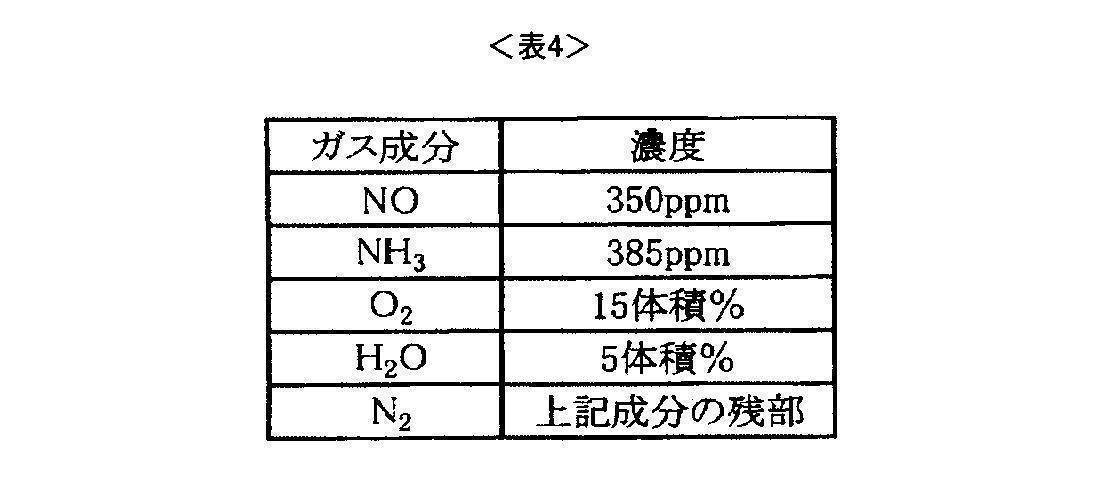
調製したゼオライト試料をプレス成形後、破砕して篩を通し、0.6~1mmに整粒した。整粒したゼオライト試料1mlを常圧固定床流通式反応管に充填した。ゼオライト層に下記<表4>の組成のガスを空間速度SV=100000/hで流通させながら、ゼオライト層を加熱した。175℃、200℃、300℃、400℃、又は500℃の各温度において、出口NO濃度が一定となったとき、
NO浄化率(%)
={(入口NO濃度)-(出口NO濃度)}/(入口NO濃度) ×100
の値によって、ゼオライト試料の窒素酸化物除去活性(水熱耐久試験前の触媒活性)を評価した。
また、ゼオライト試料を、10体積%の水蒸気を含む800℃の空気気流(空間速度SV=3000/h)の雰囲気下に、5時間晒す水熱耐久試験を行った後、上記と同様にしてゼオライト試料の窒素酸化物除去活性(水熱耐久試験後の触媒活性)を評価した。
<試料の調製>
めのう乳鉢を用いて人力で粉砕したゼオライト試料約100mgを同一形状のサンプルホルダーを用いて試料量が一定となるようにした。
粉末XRD測定装置仕様及び測定条件は以下の通りである。

大倉理研社製 全自動粉体比表面積測定装置(AMS1000)を用いて、流通式一点法により測定を行った。
標準試料であるゼオライト中のシリコンとアルミニウム含有量、及び担持された銅原子の元素分析は以下の通りとした。
ゼオライト試料を塩酸水溶液で加熱溶解させた後、ICP分析によりケイ素原子、アルミニウム原子とCu原子の含有量W1(重量%)を求めた。そして、標準試料中の分析元素の蛍光X線強度と分析元素の原子濃度との検量線を作成した。この検量線により、蛍光X線分析法(XRF)でゼオライト試料中のケイ素原子、アルミニウム原子及び銅原子の含有量W1(重量%)を求めた。ICP分析は、株式会社堀場製作所製ULTIMA 2Cを用いて行った。XRFは、株式会社島津製作所製EDX-700を用いて行った。
一方、熱重量分析(TG)により試料中の水分WH2O(重量%)を求め、下記式(I)で、無水状態下での遷移金属含有ゼオライト中の骨格構造の各原子とCuの含有量W(重量%)を算出した。TGは、株式会社島津製作所製TGA-50を用いて行った。
W=W1/(1-WH2O) ・・・(I)
5.2gの18-クラウン-6-エーテル(東京化成製)を8gの水に溶解し、得られた溶液に1.3gのNaOH(和光純薬製)及び2.0gのCsOH・H2O(三津和化学製)を添加し、80℃で3時間撹拌することにより、クラウンエーテル-アルカリ水溶液を得た。
1.5gのNaAlO2(純度:70重量%以上、キシダ化学製)を5gの水に溶解した後、この溶液に、12.7gの上記クラウンエーテル-アルカリ水溶液を添加し、得られた混合溶液に、撹拌下、15gのシリカゾル(シリカ濃度:40重量%、LUDOX(登録商標)HS-40、Aldrich社製)を滴下して水性ゲルを得た。


9.4gの18-クラウン-6-エーテル(東京化成製)を8.2gの水に溶解し、得られた溶液に1.3gのNaOH(和光純薬製)及び2.0gのCsOH・H2O(三津和化学製)を添加し、80℃で3時間撹拌することにより、クラウンエーテル-アルカリ水溶液を得た。
1.1gのNaAlO2(純度:70重量%以上、キシダ化学製)を5gの水に溶解した後、17.7gの上記クラウンエーテル-アルカリ水溶液を添加し、得られた混合溶液に、撹拌下、15gのシリカゾル(シリカ濃度:40重量%、LUDOX(登録商標)HS-40、Aldrich社製)を滴下して水性ゲルを得た。


7.8gの18-クラウン-6-エーテル(東京化成製)を8gの水に溶解し、得られた溶液に1.1gのNaOH(和光純薬製)及び1.66gのCsOH・H2O(三津和化学製)を添加し、80℃で3時間撹拌することにより、クラウンエーテル-アルカリ水溶液を得た。
0.44gのNaAlO2(純度:70重量%以上、キシダ化学製)を2.5gの水に溶解した後、この溶液に、7.4gの上記クラウンエーテル-アルカリ水溶液を添加し、得られた混合溶液に、撹拌下、7.5gのシリカゾル(シリカ濃度:40重量%、LUDOX(登録商標)HS-40、Aldrich社製)を滴下して水性ゲルを得た。

ゼオライト中のCsイオン、Naイオンを除去するために、実施例1で製造したゼオライト2を6MのNH4Cl水溶液に分散させ、80℃で1時間イオン交換を行った。濾過によりゼオライトを回収し、イオン交換水での洗浄を3回行った。その後、前記のイオン交換と洗浄を繰り返し3回行った。得られたゼオライト粉を100℃で12時間乾燥して、NH4型のゼオライト7を得た。
実施例2で製造したゼオライト4を、実施例4と同様に、6MのNH4Cl水溶液に分散させてイオン交換、洗浄を行って、NH4型のゼオライト8を得た。
0.22gのCu(OAc)2・H2O(キシダ化学製)を3.2gの水に溶解して酢酸銅(II)水溶液を得た。2.3gのゼオライト8をこの酢酸銅(II)水溶液に添加、混合した。その後、濾過して100℃で10時間乾燥し、空気中にて750℃で2時間焼成して触媒2を得た。XRF分析による触媒2のCuの含有量は3.2重量%であった。触媒2のXRD測定結果を図7に示す。
また、触媒2の水熱耐久試験前後の触媒活性を調べ、結果を<表13>に示した。
また、水熱耐久試験後の触媒2のXRD測定結果を図8に示す。
非特許文献4と同様にRHO型ゼオライトを合成した。2.6gの18-クラウン-6-エーテル(東京化成製)を18gの水に溶解し、得られた溶液に1.3gのNaOH(和光純薬製)、4.7gのNaAlO2(純度:70重量%以上、キシダ化学製)及び2.0gのCsOH・H2O(三津和化学製)を添加し、80℃で3時間撹拌した。その後、得られた混合溶液に、撹拌下、30gのシリカゾル(シリカ濃度:40重量%、SN-40、日産化学製)を滴下し、以下の組成を有する水性ゲルを得た。
SiO2:Al2O3:Cs2O:18-クラウン-6-エーテル:H2O
=10:1:0.3:0.5:100(モル比)
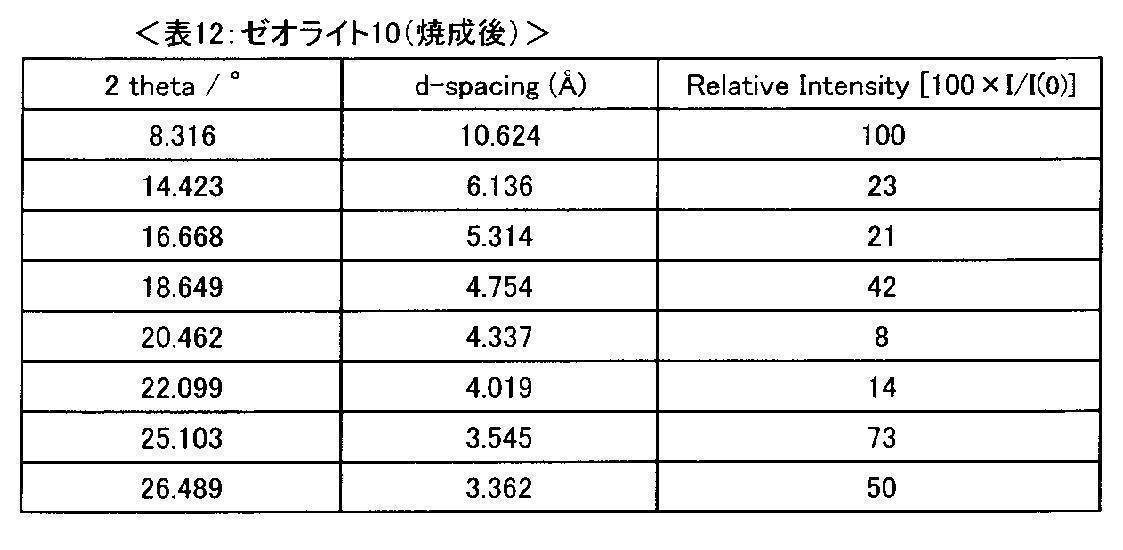
さらにゼオライト9を550℃の空気気流下で6時間焼成して有機物を除去し、ゼオライト10を得た。こうして得られたゼオライト10のXRDを測定したところ、格子面間隔表示で<表12>に示すような位置にピーク及び相対強度を有するXRDパターンを示した。ゼオライト10のXRDパターンを図10に示す。また、XRF分析によるゼオライト10のSARは8.1であった。
ゼオライト10を3MのNH4Cl水溶液に分散させ、60℃で5時間イオン交換を行った。濾過によりゼオライトを回収し、イオン交換水での洗浄を3回行った。その後、前記のイオン交換と洗浄を繰り返し5回行った。得られたゼオライト粉を100℃で12時間乾燥して、NH4型のゼオライト11を得た。XRF分析の結果、98%のCsイオンが除去されたことが確認された。
触媒3の水熱耐久試験前後の触媒活性を調べ、結果を<表13>に示した。
比較例2で製造したゼオライト11を空気中にて500℃で2時間焼成した後、600℃にて、10体積%の水蒸気を含む空気に、空間速度SV=3000/hの雰囲気下、5時間水熱処理することで、非特許文献7~9と同様に高温スチーミング処理を行ってゼオライト12を得た。ゼオライト12のBET比表面積を測定した結果:854m2/gであった。この結果は、スチーミング処理後も、ゼオライト構造を維持していることを証する。XRF分析によるゼオライト12のSARは8.0であった。
1gのCu(OAc)2・H2O(キシダ化学製)を15gの水に溶解して酢酸銅(II)水溶液を得た。1.2gのゼオライト12を酢酸銅(II)水溶液に分散させ、60℃で4時間イオン交換を行った。濾過によりゼオライトを回収し、イオン交換水での洗浄を3回行った。その後、前記のイオン交換と洗浄を繰り返し2回行って、Cu含有ゼオライトよりなる触媒4を得た。XRF分析による触媒4のCuの含有量は2.0重量%であった。触媒4のBET比表面積を測定した結果:802m2/gであった。触媒4の触媒活性の測定結果を<表13>に示す。

Claims (12)
- 少なくとも三価元素Xと四価元素Yとを含み、酸化物換算のモル比n=YO2/X2O3が9.5以上であり、RHO型構造を有するゼオライト。
- 少なくとも三価元素Xと四価元素Yとを含み、酸化物換算のモル比n=YO2/X2O3が9.5以上であり、かつ粉末X線回折法による測定で、少なくとも下記<表1>に示す格子面間隔d(Å)が検出されるものであるゼオライト。

- 更にテンプレートQを含み、モル比m=Q/X2O3が0より大きく6より小さいことを特徴とする請求項1又は2に記載のゼオライト。
- Xは少なくともアルミニウムを含む請求項1ないし3の何れか1項に記載のゼオライト。
- Yは少なくともケイ素を含む請求項1ないし4の何れか1項に記載のゼオライト。
- 更に他の金属元素を含む請求項1ないし5の何れか1項に記載のゼオライト。
- 他の金属元素が鉄及び/又は銅である請求項6に記載のゼオライト。
- 他の金属元素の含有量が、無水状態下でのゼオライト全量中の0.5~10重量%である請求項6又は7に記載のゼオライト。
- 請求項1ないし8の何れか1項に記載のゼオライトを含む触媒。
- 請求項1ないし8の何れか1項に記載のゼオライトを含む排ガス処理用触媒。
- 窒素酸化物を含む排ガスの選択的還元触媒である請求項10に記載の排ガス処理用触媒。
- アルミニウム原子原料を含む溶液に、クラウンエーテルとアルカリと水からなる混合溶液を添加した後、ケイ素原子原料含有液を滴下することにより調製した水性ゲルを水熱合成することを特徴とするゼオライトの製造方法。
Priority Applications (4)
| Application Number | Priority Date | Filing Date | Title |
|---|---|---|---|
| EP14834021.9A EP3031777A4 (en) | 2013-08-05 | 2014-08-04 | ZEOLITE AND MANUFACTURING METHOD AND USE THEREOF |
| JP2015530888A JP6394601B2 (ja) | 2013-08-05 | 2014-08-04 | ゼオライト及びその製造方法と用途 |
| CN201480044417.6A CN105452168B (zh) | 2013-08-05 | 2014-08-04 | 沸石以及其制造方法和用途 |
| US15/016,423 US9919297B2 (en) | 2013-08-05 | 2016-02-05 | Zeolite, and production method and use therefor |
Applications Claiming Priority (2)
| Application Number | Priority Date | Filing Date | Title |
|---|---|---|---|
| JP2013162439 | 2013-08-05 | ||
| JP2013-162439 | 2013-08-05 |
Related Child Applications (1)
| Application Number | Title | Priority Date | Filing Date |
|---|---|---|---|
| US15/016,423 Continuation US9919297B2 (en) | 2013-08-05 | 2016-02-05 | Zeolite, and production method and use therefor |
Publications (1)
| Publication Number | Publication Date |
|---|---|
| WO2015020014A1 true WO2015020014A1 (ja) | 2015-02-12 |
Family
ID=52461346
Family Applications (1)
| Application Number | Title | Priority Date | Filing Date |
|---|---|---|---|
| PCT/JP2014/070527 Ceased WO2015020014A1 (ja) | 2013-08-05 | 2014-08-04 | ゼオライト及びその製造方法と用途 |
Country Status (5)
| Country | Link |
|---|---|
| US (1) | US9919297B2 (ja) |
| EP (1) | EP3031777A4 (ja) |
| JP (2) | JP6394601B2 (ja) |
| CN (1) | CN105452168B (ja) |
| WO (1) | WO2015020014A1 (ja) |
Cited By (9)
| Publication number | Priority date | Publication date | Assignee | Title |
|---|---|---|---|---|
| CN106799202A (zh) * | 2015-11-18 | 2017-06-06 | 中国科学院大连化学物理研究所 | 一种用于气体分离的分子筛及其制备和应用 |
| JP2018130719A (ja) * | 2017-02-17 | 2018-08-23 | 三菱ケミカル株式会社 | 多孔質支持体−ゼオライト膜複合体、rho型ゼオライトの製造方法及び分離方法 |
| WO2018230737A1 (ja) | 2017-06-15 | 2018-12-20 | 三菱ケミカル株式会社 | アンモニアの分離方法およびゼオライト |
| JP2019014826A (ja) * | 2017-07-07 | 2019-01-31 | 旭化成株式会社 | 複合体 |
| CN109422276A (zh) * | 2017-08-30 | 2019-03-05 | 中国科学院大连化学物理研究所 | 一种掺杂过渡金属的分子筛及其制备方法和应用 |
| EP3461555A1 (en) | 2017-09-28 | 2019-04-03 | Air Products And Chemicals, Inc. | Improved rho adsorbent compositions, methods of making and using them |
| EP3461550A1 (en) | 2017-09-28 | 2019-04-03 | Air Products and Chemicals, Inc. | Processes for adsorbing oxygen using improved rho adsorbent compositions |
| JP2020066564A (ja) * | 2018-10-26 | 2020-04-30 | 東ソー株式会社 | Rho型ゼオライト及びその製造方法 |
| JP2022511672A (ja) * | 2018-11-01 | 2022-02-01 | エクソンモービル リサーチ アンド エンジニアリング カンパニー | ゼオライトrhoの高ケイ質形態 |
Families Citing this family (4)
| Publication number | Priority date | Publication date | Assignee | Title |
|---|---|---|---|---|
| US10654024B2 (en) * | 2018-09-28 | 2020-05-19 | Air Products And Chemicals, Inc. | RHO zeolites and method of making the same |
| US11883804B2 (en) | 2018-10-29 | 2024-01-30 | Pacific Industrial Development Corporation | Method of making SSZ-13 zeolites with high acidity and low silica to alumina ratio (SAR) |
| CN112683938B (zh) * | 2020-09-21 | 2023-04-25 | 复榆(张家港)新材料科技有限公司 | 高硅沸石硅铝摩尔比的测定方法 |
| CN114105166B (zh) * | 2021-12-24 | 2023-03-17 | 吉林大学 | 一种有机模板剂及其制备方法和应用以及高硅kfi沸石分子筛及其制备方法和应用 |
Citations (4)
| Publication number | Priority date | Publication date | Assignee | Title |
|---|---|---|---|---|
| US3904738A (en) | 1973-06-21 | 1975-09-09 | Exxon Research Engineering Co | Zeolite RHO |
| WO2002016028A1 (en) | 2000-08-18 | 2002-02-28 | E.I. Du Pont De Nemours And Company | Gas separation process |
| CN1792793A (zh) * | 2005-12-29 | 2006-06-28 | 吉林大学 | 一种硅铝骨架的Na-RHO沸石的制备方法 |
| WO2010119163A1 (es) | 2009-04-17 | 2010-10-21 | Universidad Politécnica De Valencia (Upv) (50%) | Uso de un material cristalino microporoso de naturaleza zeolítica con estructura rho en tratamiento de gas natural |
Family Cites Families (30)
| Publication number | Priority date | Publication date | Assignee | Title |
|---|---|---|---|---|
| US4610856A (en) * | 1981-10-28 | 1986-09-09 | Union Carbide Corporation | Silicon substituted zeolite compositions and process for preparing same |
| US4683334A (en) * | 1985-04-30 | 1987-07-28 | E. I. Du Pont De Nemours & Company | Modified 8-ring zeolites as catalysts for conversion of methanol and ammonia to dimethylamine |
| JPS61158811A (ja) * | 1985-09-11 | 1986-07-18 | ユニオン・カ−バイド・コ−ポレ−シヨン | 珪素置換ゼオライト組成物 |
| GB9013859D0 (en) | 1990-06-21 | 1990-08-15 | Ici Plc | Zeolites |
| US5371311A (en) | 1990-12-17 | 1994-12-06 | Uop | Modified zeolite omega and processes for preparing and using same |
| US5536895A (en) | 1990-12-17 | 1996-07-16 | Uop | Isomerization process using modified zeolite Omega |
| US5230790A (en) | 1990-12-17 | 1993-07-27 | Uop | Hydrocarbon conversion processes using modified zeolite Omega |
| AU643908B1 (en) | 1990-12-17 | 1993-11-25 | Uop | Modified zeolite omega and methods for preparing and for using same |
| US5139761A (en) | 1990-12-17 | 1992-08-18 | Uop | Modified zeolite omega and processes for preparing and using same |
| JPH06126183A (ja) | 1992-10-13 | 1994-05-10 | Idemitsu Kosan Co Ltd | 排ガス浄化用触媒、この触媒の製造方法及びこの触媒を使用した排ガスの浄化方法 |
| FR2697241B1 (fr) | 1992-10-26 | 1994-12-16 | Elf Aquitaine | Procédé de synthèse de zéolithes appartenant à la famille structurale de la faujasite. |
| DE4304821A1 (de) * | 1993-02-17 | 1994-08-18 | Degussa | Verfahren zum Modifizieren von Molekularsieben mittels Ionenaustausch |
| JP3737155B2 (ja) | 1995-02-27 | 2006-01-18 | 触媒化成工業株式会社 | 炭化水素接触分解用触媒組成物 |
| JPH11502804A (ja) | 1995-03-17 | 1999-03-09 | シェブロン ユー.エス.エー.インコーポレイテッド | 有機テンプレート及びアミンを用いたゼオライトの製造 |
| JPH0938464A (ja) | 1995-07-27 | 1997-02-10 | Idemitsu Kosan Co Ltd | 排ガス浄化用触媒及びこれを使用した排ガスの浄化方法 |
| JP3684265B2 (ja) | 1996-03-26 | 2005-08-17 | 触媒化成工業株式会社 | 均一なミクロポアと均一なメソポアの2種類の細孔を有するフォージャサイト型ゼオライトおよびその製造方法 |
| US6350428B1 (en) | 1997-05-29 | 2002-02-26 | Exxonmobil Chemical Patents Inc. | Preparation of zeolite-bound FAU structure type zeolite and use thereof |
| JP4123546B2 (ja) | 1997-08-08 | 2008-07-23 | 東ソー株式会社 | ゼオライトou−1およびその合成方法 |
| FR2840296B1 (fr) | 2002-06-03 | 2004-08-20 | Inst Francais Du Petrole | Procede de preparation d'une membrane zeolithique de faible epaisseur |
| US6818333B2 (en) | 2002-06-03 | 2004-11-16 | Institut Francais Du Petrole | Thin zeolite membrane, its preparation and its use in separation |
| US7476635B2 (en) | 2002-06-03 | 2009-01-13 | Institut Francais Du Petrole | Process for making supported thin zeolite membrane |
| JP4159853B2 (ja) | 2002-10-28 | 2008-10-01 | 出光興産株式会社 | 炭化水素の接触分解用触媒及びこれを使用する接触分解方法 |
| EP2944377A1 (en) * | 2007-03-26 | 2015-11-18 | PQ Corporation | Novel microporous crystalline material comprising a molecular sieve or zeolite having an 8-ring pore opening structure and methods of making and using same |
| JP5482179B2 (ja) | 2008-12-22 | 2014-04-23 | 東ソー株式会社 | チャバザイト型ゼオライト及びその製造方法 |
| EP3305396B1 (en) | 2009-02-27 | 2022-03-30 | Mitsubishi Chemical Corporation | Inorganic porous support-zeolite membrane composite, production method therof, and separation method using the composite |
| JP5593964B2 (ja) | 2009-11-11 | 2014-09-24 | 三菱化学株式会社 | 多孔質支持体−ゼオライト膜複合体の製造方法 |
| US8409546B2 (en) | 2009-11-24 | 2013-04-02 | Basf Se | Process for the preparation of zeolites having B-CHA structure |
| CN102442681B (zh) | 2010-10-13 | 2013-06-05 | 中国石油化工股份有限公司 | 一种nu-85分子筛及其制备方法 |
| CN102530987A (zh) * | 2010-12-29 | 2012-07-04 | 中国科学院大连化学物理研究所 | Sapo分子筛的溶剂热合成方法及由其制备的催化剂 |
| CN106423258B (zh) * | 2011-06-05 | 2019-03-08 | 庄信万丰股份有限公司 | 用于处理废气的pgm催化剂 |
-
2014
- 2014-08-04 CN CN201480044417.6A patent/CN105452168B/zh active Active
- 2014-08-04 EP EP14834021.9A patent/EP3031777A4/en not_active Withdrawn
- 2014-08-04 WO PCT/JP2014/070527 patent/WO2015020014A1/ja not_active Ceased
- 2014-08-04 JP JP2015530888A patent/JP6394601B2/ja active Active
-
2016
- 2016-02-05 US US15/016,423 patent/US9919297B2/en not_active Expired - Fee Related
-
2018
- 2018-07-31 JP JP2018143410A patent/JP6631663B2/ja active Active
Patent Citations (5)
| Publication number | Priority date | Publication date | Assignee | Title |
|---|---|---|---|---|
| US3904738A (en) | 1973-06-21 | 1975-09-09 | Exxon Research Engineering Co | Zeolite RHO |
| WO2002016028A1 (en) | 2000-08-18 | 2002-02-28 | E.I. Du Pont De Nemours And Company | Gas separation process |
| CN1792793A (zh) * | 2005-12-29 | 2006-06-28 | 吉林大学 | 一种硅铝骨架的Na-RHO沸石的制备方法 |
| WO2010119163A1 (es) | 2009-04-17 | 2010-10-21 | Universidad Politécnica De Valencia (Upv) (50%) | Uso de un material cristalino microporoso de naturaleza zeolítica con estructura rho en tratamiento de gas natural |
| JP2012524048A (ja) * | 2009-04-17 | 2012-10-11 | ウニベルシダッド・ポリテクニカ・デ・バレンシア | 天然ガス処理における、rho構造を備えるゼオライト特性の微孔性結晶性材料の使用 |
Non-Patent Citations (12)
| Title |
|---|
| "Adv. Chem. Ser.", vol. 121, 1973, article "Molecular Sieves", pages: 106 |
| BEATRIZ OMAIRA HINCAPIE PALACIO: "Synthesis and Characterization of Nanocrystalline Mordenite, High Silica Zeolite RHO, and Copper Faujasite", A DISSERTATION SUBMITTED IN PARTIAL FULFILLMENT OF THE REQUIREMENTS FOR THE DEGREE OF DOCTOR OF PHILOSOPHY AT THE UNIVERSITY OF CONNECTICUT, January 2005 (2005-01-01), pages 1 - 103, XP055258373 * |
| CHEMICAL COMMUNICATIONS, vol. 48, 2012, pages 215 - 217 |
| HINCAPIE PALACIO; BEATRIZ OMAIRA: "Synthesis and characterization of nanocrystalline mordenite, high silica zeolite RHO, and copper faujasite", DOCTORAL DISSERTATIONS, 2005 |
| JOURNAL OF COLLOID AND INTERFACE SCIENCE, vol. 376, 2012, pages 28 - 33 |
| JOURNAL OF COLLOID AND INTERFACE SCIENCE, vol. 388, 2012, pages 185 - 190 |
| JOURNAL OF PHYSICAL CHEMISTRY, vol. 90, 1986, pages 4414 - 4423 |
| JOURNAL OF PHYSICAL CHEMISTRY, vol. 91, 1987, pages 2227 - 2230 |
| JOURNAL OF THE AMERICAN CHEMICAL SOCIETY, vol. 134, 2012, pages 17628 - 17642 |
| MICROPOROUS MATERIALS, vol. 4, 1995, pages 231 - 238 |
| See also references of EP3031777A4 * |
| T. CHATELAIN ET AL.: "Synthesis and characterization of high-silica zeolite RHO prepared in the presence of 18-crown-6 ether as organic template", MICROPOROUS MATERIALS, vol. 4, no. 2-3, June 1995 (1995-06-01), pages 231 - 238, XP055258382 * |
Cited By (21)
| Publication number | Priority date | Publication date | Assignee | Title |
|---|---|---|---|---|
| CN106799202A (zh) * | 2015-11-18 | 2017-06-06 | 中国科学院大连化学物理研究所 | 一种用于气体分离的分子筛及其制备和应用 |
| CN106799202B (zh) * | 2015-11-18 | 2019-12-27 | 中国科学院大连化学物理研究所 | 一种用于气体分离的分子筛及其制备和应用 |
| JP7106883B2 (ja) | 2017-02-17 | 2022-07-27 | 三菱ケミカル株式会社 | 多孔質支持体-ゼオライト膜複合体、rho型ゼオライトの製造方法及び分離方法 |
| JP2018130719A (ja) * | 2017-02-17 | 2018-08-23 | 三菱ケミカル株式会社 | 多孔質支持体−ゼオライト膜複合体、rho型ゼオライトの製造方法及び分離方法 |
| JP7416135B2 (ja) | 2017-02-17 | 2024-01-17 | 三菱ケミカル株式会社 | Rho型ゼオライトの製造方法 |
| JP2022132360A (ja) * | 2017-02-17 | 2022-09-08 | 三菱ケミカル株式会社 | Rho型ゼオライトの製造方法 |
| WO2018230737A1 (ja) | 2017-06-15 | 2018-12-20 | 三菱ケミカル株式会社 | アンモニアの分離方法およびゼオライト |
| EP4234493A2 (en) | 2017-06-15 | 2023-08-30 | Mitsubishi Chemical Corporation | Ammonia separation method and zeolite |
| JP2019014826A (ja) * | 2017-07-07 | 2019-01-31 | 旭化成株式会社 | 複合体 |
| CN109422276A (zh) * | 2017-08-30 | 2019-03-05 | 中国科学院大连化学物理研究所 | 一种掺杂过渡金属的分子筛及其制备方法和应用 |
| CN109422276B (zh) * | 2017-08-30 | 2022-10-18 | 中国科学院大连化学物理研究所 | 一种掺杂过渡金属的分子筛及其制备方法和应用 |
| EP3461555A1 (en) | 2017-09-28 | 2019-04-03 | Air Products And Chemicals, Inc. | Improved rho adsorbent compositions, methods of making and using them |
| US10646848B2 (en) | 2017-09-28 | 2020-05-12 | Air Products And Chemicals, Inc. | RHO adsorbent compositions, methods of making and using them |
| RU2696385C1 (ru) * | 2017-09-28 | 2019-08-01 | Эр Продактс Энд Кемикалз, Инк. | Способы с применением улучшенных композиций адсорбентов rho |
| US10343139B2 (en) | 2017-09-28 | 2019-07-09 | Air Products And Chemicals, Inc. | Processes using improved RHO adsorbent compositions |
| EP3461550A1 (en) | 2017-09-28 | 2019-04-03 | Air Products and Chemicals, Inc. | Processes for adsorbing oxygen using improved rho adsorbent compositions |
| JP7109023B2 (ja) | 2018-10-26 | 2022-07-29 | 東ソー株式会社 | Rho型ゼオライト及びその製造方法 |
| JP2020066564A (ja) * | 2018-10-26 | 2020-04-30 | 東ソー株式会社 | Rho型ゼオライト及びその製造方法 |
| JP2022511672A (ja) * | 2018-11-01 | 2022-02-01 | エクソンモービル リサーチ アンド エンジニアリング カンパニー | ゼオライトrhoの高ケイ質形態 |
| JP7397076B2 (ja) | 2018-11-01 | 2023-12-12 | エクソンモービル テクノロジー アンド エンジニアリング カンパニー | ゼオライトrhoの高ケイ質形態 |
| US11939225B2 (en) * | 2018-11-01 | 2024-03-26 | ExxonMobil Technology and Engineering Company | Highly siliceous form of zeolite RHO |
Also Published As
| Publication number | Publication date |
|---|---|
| US20160151772A1 (en) | 2016-06-02 |
| US9919297B2 (en) | 2018-03-20 |
| EP3031777A4 (en) | 2016-08-03 |
| JP2019001707A (ja) | 2019-01-10 |
| JP6394601B2 (ja) | 2018-09-26 |
| EP3031777A1 (en) | 2016-06-15 |
| JPWO2015020014A1 (ja) | 2017-03-02 |
| CN105452168A (zh) | 2016-03-30 |
| CN105452168B (zh) | 2018-02-27 |
| JP6631663B2 (ja) | 2020-01-15 |
Similar Documents
| Publication | Publication Date | Title |
|---|---|---|
| JP6394601B2 (ja) | ゼオライト及びその製造方法と用途 | |
| JP6572751B2 (ja) | Aei型ゼオライト及びその製造方法と用途 | |
| JP7283046B2 (ja) | 金属含有cha型ゼオライト及びその製造方法 | |
| KR102219718B1 (ko) | Lev 형 제올라이트 및 그 제조 방법 | |
| WO2011078149A1 (ja) | 新規メタロシリケート、その製造方法、窒素酸化物浄化触媒、その製造方法、及びそれを用いた窒素酸化物浄化方法 | |
| JP7251471B2 (ja) | 遷移金属担持ゼオライト及びその製造方法、並びに窒素酸化物浄化用触媒及びその使用方法 | |
| JP7501763B2 (ja) | ゼオライト及びその製造方法 | |
| JP6817022B2 (ja) | 高耐水熱性チャバザイト型ゼオライトおよびその製造方法 | |
| JP2014122142A (ja) | 遷移金属含有ゼオライト、及びその製造方法 | |
| JP2021161019A (ja) | 複合材、窒素酸化物吸着材、窒素酸化物の吸着方法、及び窒素酸化物の除去装置 | |
| JP5594121B2 (ja) | 新規メタロシリケート及び窒素酸化物浄化触媒 | |
| US11879374B2 (en) | STA-30, a new member of the SWY family of molecular sieves, methods of preparation and use | |
| CN113713851B (zh) | 一种提高抗硫抗水性能的In/H-β催化剂制备方法 | |
| JP2021161022A (ja) | Yfi構造を有するゼオライト組成物、炭化水素吸着剤及び炭化水素の吸着方法 | |
| JP7091768B2 (ja) | ゼオライト粉体 | |
| JP7113821B2 (ja) | Cha型アルミノ珪酸塩の製造方法 | |
| WO2021201018A1 (ja) | 炭化水素吸着剤及び炭化水素の吸着方法 | |
| WO2017213022A1 (ja) | 高耐水熱性チャバザイト型ゼオライトおよびその製造方法 | |
| JP7104298B2 (ja) | 新規ゼオライト及びこれを含む炭化水素吸着剤 | |
| JP2017206417A (ja) | Aei型ゼオライトの製造方法 | |
| JP7753795B2 (ja) | Cha型ゼオライト及びその製造方法 | |
| JP7679603B2 (ja) | Aei型ゼオライトの製造方法、触媒、及び吸着材 | |
| JP4841768B2 (ja) | 含クロム酸化物からなる窒素酸化物吸着剤及びその製造方法 |
Legal Events
| Date | Code | Title | Description |
|---|---|---|---|
| WWE | Wipo information: entry into national phase |
Ref document number: 201480044417.6 Country of ref document: CN |
|
| 121 | Ep: the epo has been informed by wipo that ep was designated in this application |
Ref document number: 14834021 Country of ref document: EP Kind code of ref document: A1 |
|
| ENP | Entry into the national phase |
Ref document number: 2015530888 Country of ref document: JP Kind code of ref document: A |
|
| NENP | Non-entry into the national phase |
Ref country code: DE |
|
| WWE | Wipo information: entry into national phase |
Ref document number: 2014834021 Country of ref document: EP |