WO2015033609A1 - 情報処理装置、入力方法およびプログラム - Google Patents
情報処理装置、入力方法およびプログラム Download PDFInfo
- Publication number
- WO2015033609A1 WO2015033609A1 PCT/JP2014/060371 JP2014060371W WO2015033609A1 WO 2015033609 A1 WO2015033609 A1 WO 2015033609A1 JP 2014060371 W JP2014060371 W JP 2014060371W WO 2015033609 A1 WO2015033609 A1 WO 2015033609A1
- Authority
- WO
- WIPO (PCT)
- Prior art keywords
- contact
- sound
- input
- waveform
- information processing
- Prior art date
- Legal status (The legal status is an assumption and is not a legal conclusion. Google has not performed a legal analysis and makes no representation as to the accuracy of the status listed.)
- Ceased
Links
Images




Classifications
-
- G—PHYSICS
- G06—COMPUTING OR CALCULATING; COUNTING
- G06F—ELECTRIC DIGITAL DATA PROCESSING
- G06F3/00—Input arrangements for transferring data to be processed into a form capable of being handled by the computer; Output arrangements for transferring data from processing unit to output unit, e.g. interface arrangements
- G06F3/01—Input arrangements or combined input and output arrangements for interaction between user and computer
- G06F3/03—Arrangements for converting the position or the displacement of a member into a coded form
- G06F3/041—Digitisers, e.g. for touch screens or touch pads, characterised by the transducing means
- G06F3/043—Digitisers, e.g. for touch screens or touch pads, characterised by the transducing means using propagating acoustic waves
-
- G—PHYSICS
- G06—COMPUTING OR CALCULATING; COUNTING
- G06F—ELECTRIC DIGITAL DATA PROCESSING
- G06F3/00—Input arrangements for transferring data to be processed into a form capable of being handled by the computer; Output arrangements for transferring data from processing unit to output unit, e.g. interface arrangements
- G06F3/01—Input arrangements or combined input and output arrangements for interaction between user and computer
- G06F3/03—Arrangements for converting the position or the displacement of a member into a coded form
- G06F3/041—Digitisers, e.g. for touch screens or touch pads, characterised by the transducing means
- G06F3/0412—Digitisers structurally integrated in a display
-
- G—PHYSICS
- G06—COMPUTING OR CALCULATING; COUNTING
- G06F—ELECTRIC DIGITAL DATA PROCESSING
- G06F3/00—Input arrangements for transferring data to be processed into a form capable of being handled by the computer; Output arrangements for transferring data from processing unit to output unit, e.g. interface arrangements
- G06F3/01—Input arrangements or combined input and output arrangements for interaction between user and computer
- G06F3/03—Arrangements for converting the position or the displacement of a member into a coded form
- G06F3/041—Digitisers, e.g. for touch screens or touch pads, characterised by the transducing means
- G06F3/0416—Control or interface arrangements specially adapted for digitisers
-
- G—PHYSICS
- G06—COMPUTING OR CALCULATING; COUNTING
- G06F—ELECTRIC DIGITAL DATA PROCESSING
- G06F3/00—Input arrangements for transferring data to be processed into a form capable of being handled by the computer; Output arrangements for transferring data from processing unit to output unit, e.g. interface arrangements
- G06F3/16—Sound input; Sound output
-
- G—PHYSICS
- G06—COMPUTING OR CALCULATING; COUNTING
- G06F—ELECTRIC DIGITAL DATA PROCESSING
- G06F3/00—Input arrangements for transferring data to be processed into a form capable of being handled by the computer; Output arrangements for transferring data from processing unit to output unit, e.g. interface arrangements
- G06F3/16—Sound input; Sound output
- G06F3/167—Audio in a user interface, e.g. using voice commands for navigating, audio feedback
-
- G—PHYSICS
- G06—COMPUTING OR CALCULATING; COUNTING
- G06F—ELECTRIC DIGITAL DATA PROCESSING
- G06F2200/00—Indexing scheme relating to G06F1/04 - G06F1/32
- G06F2200/16—Indexing scheme relating to G06F1/16 - G06F1/18
- G06F2200/163—Indexing scheme relating to constructional details of the computer
- G06F2200/1636—Sensing arrangement for detection of a tap gesture on the housing
-
- G—PHYSICS
- G06—COMPUTING OR CALCULATING; COUNTING
- G06F—ELECTRIC DIGITAL DATA PROCESSING
- G06F2203/00—Indexing scheme relating to G06F3/00 - G06F3/048
- G06F2203/041—Indexing scheme relating to G06F3/041 - G06F3/045
- G06F2203/04106—Multi-sensing digitiser, i.e. digitiser using at least two different sensing technologies simultaneously or alternatively, e.g. for detecting pen and finger, for saving power or for improving position detection
Definitions
- the present invention relates to an information processing apparatus including a touch input device.
- touch-type input devices have detected a contact position where an input means such as a finger or a stylus is in contact, but there has been a problem that input operations by the input means are limited only by detecting the contact position. .
- Patent Document 1 describes an information processing apparatus that detects vibration information related to a contact sound that is generated when an operating body that is an input means contacts an operation surface, instead of detecting a contact area.
- the information processing apparatus classifies the operating body into one of two predetermined types by comparing the volume of the contact sound with a threshold value based on the detected vibration information, and operates according to the type. is doing.
- the operation body is simply classified into one of two predetermined types by comparing the volume of the contact sound and the threshold value. There is a problem that it cannot be realized.
- An object of the present invention is to provide an information processing apparatus, an input method, and a program that can solve the above-described problem that a fine input operation cannot be realized.
- the information processing apparatus includes: a contact detection unit that detects contact by an input unit; a sound detection unit that detects sound generated according to the contact; and the input based on the sound waveform and the contact. And an input determination unit that determines an input operation by means.
- the input method detects a contact by the input means, detects a sound generated in response to the contact, and determines an input operation by the input means based on the waveform of the sound and the contact.
- the program according to the present invention is a program for detecting a contact by an input unit, a procedure for detecting a sound generated in response to the contact, a waveform of the sound, and the input by the input unit. And a procedure for determining an operation.
- FIG. 1 is a block diagram showing the configuration of the information processing apparatus according to the first embodiment of the present invention.
- An information processing apparatus 10 illustrated in FIG. 1 includes a contact detection unit 1, a sound detection unit 2, a storage unit 3, a display unit 4, and an input determination unit 5.
- the information processing apparatus 10 is, for example, a mobile phone, a smartphone, a game machine, a PC (Personal Computer), a PDA (Personal Digital Assistant: portable information terminal), or the like.
- the PC includes a tablet PC and a notebook PC.
- the contact detection unit 1 detects contact by the input means and outputs a detection signal indicating the detection result.
- the detection signal indicates, for example, a contact position or a contact area where the input unit is in contact as a detection result.
- the contact detection unit 1 is, for example, a touch panel or a touch sensor. Further, the detection method for detecting contact is not particularly limited, but for example, a capacitance method or the like.
- the input means is, for example, a finger or a stylus.
- the sound detection unit 2 detects a generated sound that is a sound generated in response to contact with the contact detection unit 1 of the input means, and outputs a generated sound signal indicating the generated sound.
- the information processing apparatus 10 is a mobile phone or the like
- the information processing apparatus 10 may be provided with a microphone for performing transmission or the like.
- the sound detection unit 2 may be shared with the microphone or may be provided separately from the microphone.
- the storage unit 3 stores various information.
- the storage unit 3 stores a plurality of registered sound information indicating each of the plurality of registered sounds.
- the registered sound is a sound corresponding to a contact type in which the input unit contacts the contact detection unit 1, and the storage unit 3 stores registered sound information for each contact type.
- the contact type is, for example, a type in which the contact detection unit 1 is contacted with the belly of the finger, a type in which the contact detection unit 1 is contacted with the fingernail. Further, the contact type is a type in which the contact detection unit 1 is pressed with the finger pad, a type in which the contact detection unit 1 is rubbed with the finger pad, a type in which the contact detection unit 1 is hit with the fingernail, and the contact detection unit 1 with the fingernail. For example, the contact detection unit 1 may be struck with a stylus, or the contact detection unit 1 may be rubbed with a stylus.
- the registered sound information may be stored in advance in the storage unit 3 or may be registered by a user who uses the information processing apparatus 10.
- the display unit 4 displays various information.
- the display unit 4 is, for example, an LCD (Liquid Crystal Display).
- the contact detection unit 1 may be integrally formed with the display unit 4, may be attached so as to overlap with the display unit 4, or is provided at a location different from the display unit 4. Also good.
- examples of the method for integrally molding the contact detection unit 1 and the display unit 4 include an on-cell type and an in-cell type.
- the input determination unit 5 determines an input operation by the input unit based on the waveform of the generated sound detected by the sound detection unit 2 and the contact detected by the sound detection unit 2.
- the input determination unit 5 determines an input operation as follows.
- the input determination unit 5 determines the waveform of the generated sound indicated by the generated sound signal output from the sound detection unit 2. At this time, the input determination unit 5 may determine the waveform of the generated sound detected within a predetermined time from the detection time when the contact is detected by the contact detection unit 1, or the generated sound signal is detected from the detection time. You may discriminate
- the input determination unit 5 compares the waveform of the generated sound with the waveform of each registered sound of the registered sound information stored in the storage unit 3, and based on the comparison result and the contact. The input operation is determined.
- the input determination unit 5 first compares the waveform of the generated sound with the waveform of each registered sound, and calculates the similarity between the waveform of the generated sound and the waveform of the registered sound.
- the method for calculating the similarity is not particularly limited, and examples thereof include a method for calculating a correlation function between the waveform of the generated sound and the waveform of the registered sound as the similarity.
- the input determination unit 5 determines that the contact is made in the contact type corresponding to the registered sound having the waveform having the highest similarity with the waveform of the generated sound, and the input operation is performed based on the contact type and the contact. Determine. For example, the input determination unit 5 determines, as an input operation, the contact position and the contact type that the input unit has contacted based on the contact type and the contact.
- the input determination unit 5 may determine that contact has been made in a contact format corresponding to a registered sound having a waveform with the highest similarity when the highest similarity is equal to or greater than a predetermined threshold. At this time, when the highest similarity is less than the threshold, the input determination unit 5 may determine that contact has been performed in a predetermined contact format, or may determine that an input operation has not been performed. Good. If it is determined that an input operation has not been performed, the input determination unit 5 may display error information indicating an error on the display unit 4.
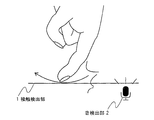
- FIG. 2 is a diagram for explaining an example of the operation of the information processing apparatus 10. In the following operation, an operation when the user scratches the contact detection unit 1 with a nail as shown in FIG. 3 will be described.
- the contact detection unit 1 detects the contact with the nail and outputs a detection signal indicating the detection result to the input determination unit 5 (step S201).
- the sound detection unit 2 detects a generated sound generated when the contact detection unit 1 is scratched with a nail, and outputs a generated sound signal indicating the generated sound to the input determination unit 5 (step S202).
- the input determining unit 5 determines the waveform of the generated sound indicated by the generated sound signal (step S203).
- the input determination unit 5 compares the waveform of the generated sound with the waveform of each registered sound indicated by each registered sound information stored in the storage unit 3, and determines the waveform of the generated sound and the waveform of each registered sound. Is calculated (step S204).
- the input determination unit 5 determines whether or not the highest similarity among the calculated similarities is greater than or equal to a threshold value (step S205).
- the input determination unit 5 displays error information on the display unit 4 (step S206), and ends the process.
- the input determination unit 5 determines that the contact has been made in the contact format corresponding to the registered sound having the waveform having the highest similarity with the waveform of the generated sound. Then, the input determination unit 5 determines an input operation based on the determined contact type and the detection result indicated by the detection signal (step S207), and ends the process.
- the input determination unit 5 does not compare the waveform of the generated sound with the waveform of the registered sound, but extracts a change in a specific frequency component from the waveform of the generated sound, and based on the change in the frequency component, the contact format May be judged.
- the storage unit 3 stores, as registered sound information, information indicating a change in frequency corresponding to the contact type for each contact type.
- the storage unit 3 may store information indicating the characteristics of the frequency component change according to the contact type as registered sound information. .
- the input operation is determined based on the contact by the input means and the waveform of the sound generated in response to the contact, there are various types in which the waveform changes. Since different input operations can be realized depending on the contact type, it is possible to realize fine input operations.
- the input operation is determined based on the comparison result obtained by comparing the waveform of the generated sound and the waveform of each registered sound and the contact, it is possible to determine the input operation more accurately. Become.
- the waveform of the generated sound is compared with the waveform of each registered sound, and the similarity between the waveform of the generated sound and each registered sound is calculated, so that the input operation can be determined more accurately. Is possible.
- the input operation is determined based on the contact type and the contact corresponding to the registered sound having the waveform having the highest similarity, the input operation can be determined more accurately. .
- the input operation is determined based on the waveform of the generated sound and the contact detected within a predetermined time from when the contact is detected, it is possible to quickly determine the input operation. It becomes possible.
- the input operation is determined based on the waveform of the generated sound and the contact from when the contact is detected until the volume of the generated sound becomes a predetermined value or less. Can be determined.
- FIG. 4 is a block diagram showing the configuration of the information processing apparatus according to the second embodiment of the present invention.
- the information processing apparatus 20 illustrated in FIG. 4 includes a contact detection unit 21, a sound detection unit 22, and an input determination unit 23.
- Contact detection unit 21 detects contact by an input means.
- the sound detection unit 22 detects sound generated in response to contact with the contact detection unit 21 by the input means.
- the input determination unit 23 determines an input operation by the input unit based on the sound waveform detected by the sound detection unit 22 and the contact detected by the contact detection unit 21.
- FIG. 5 is a flowchart for explaining the operation of the information processing apparatus 20.
- the contact detection unit 1 detects contact by the input means, it outputs a detection signal indicating the detection result to the input determination unit 23 (step S501).
- the sound detection unit 2 detects a sound generated in response to the contact with the contact detection unit 1 by the input means, and outputs a generated sound signal indicating the sound to the input determination unit 23 (step S502).
- the input determining unit 23 determines an input operation by the input means based on the sound waveform indicated by the generated sound signal and the contact indicated by the detection signal (step S503), and processing Exit.
- the input operation is determined based on the contact by the input means and the waveform of the sound generated in response to the contact.
- An input operation can be realized.
- the functions of the information information devices 10 and 20 record a program for realizing the functions on a computer-readable recording medium, and cause the computer to read and execute the program recorded on the recording medium. That may be realized.
Landscapes
- Engineering & Computer Science (AREA)
- Theoretical Computer Science (AREA)
- General Engineering & Computer Science (AREA)
- Physics & Mathematics (AREA)
- Human Computer Interaction (AREA)
- General Physics & Mathematics (AREA)
- Health & Medical Sciences (AREA)
- Audiology, Speech & Language Pathology (AREA)
- General Health & Medical Sciences (AREA)
- Acoustics & Sound (AREA)
- Multimedia (AREA)
- User Interface Of Digital Computer (AREA)
Abstract
Description
2、22 音検出部
3 記憶部
4 表示部
5、23 入力判定部
10、20 情報処理装置
Claims (9)
- 入力手段による接触を検出する接触検出部と、
前記接触に応じて発生する音を検出する音検出部と、
前記音の波形と前記接触とに基づいて、前記入力手段による入力操作を判定する入力判定部と、を有する情報処理装置。 - 複数の登録音のそれぞれを示す複数の登録音情報を記憶する記憶部をさらに有し、
前記入力判定部は、前記音の波形と各登録音の波形とを比較し、当該比較結果と前記接触とに基づいて、前記入力操作を判定する、請求項1に記載の情報処理装置。 - 前記入力判定部は、前記音の波形と各登録音の波形とを比較して、前記音の波形と各登録音の波形との類似度を算出する、請求項2に記載の情報処理装置。
- 前記記憶部は、入力手段が前記接触検出部に接触する接触形式ごとに、当該接触形式に応じた音を前記登録音として示す登録音情報を記憶し、
前記入力判定部は、前記類似度が最も高い波形を有する登録音に応じた接触形式と前記接触とに基づいて、前記入力操作を判定する、請求項3に記載の情報処理装置。 - 前記入力判定部は、前記類似度のうち最も高い類似度が閾値以上の場合、当該類似度の波形を有する登録音に応じた接触形式と前記接触とに基づいて、前記入力操作を判定する、請求項4に記載の情報処理装置。
- 前記入力判定部は、前記接触が検出された時点から所定の時間内に検出された音の波形と前記接触とに基づいて、前記入力操作を判定する、請求項1ないし5のいずれか1項に記載の情報処理装置。
- 前記入力判定部は、前記接触が検出された時点から前記音の音量が所定値以下になるまでの前記音の波形と前記接触とに基づいて、前記入力操作を判定する、請求項1ないし5のいずれか1項に記載の情報処理装置。
- 入力手段による接触を検出し、
前記接触に応じて発生する音を検出し、
前記音の波形と前記接触とに基づいて、前記入力手段による入力操作を判定する、入力方法。 - コンピュータに、
入力手段による接触を検出する手順と、
前記接触に応じて発生する音を検出する手順と、
前記音の波形と前記接触とに基づいて、前記入力手段による入力操作を判定する手順とを実行させるためのプログラム。
Priority Applications (4)
| Application Number | Priority Date | Filing Date | Title |
|---|---|---|---|
| JP2015535336A JPWO2015033609A1 (ja) | 2013-09-09 | 2014-04-10 | 情報処理装置、入力方法およびプログラム |
| CN201480049590.5A CN105683881A (zh) | 2013-09-09 | 2014-04-10 | 信息处理装置、输入方法和程序 |
| US14/911,073 US20160179239A1 (en) | 2013-09-09 | 2014-04-10 | Information processing apparatus, input method and program |
| EP14841796.7A EP3046009A4 (en) | 2013-09-09 | 2014-04-10 | Information processing device, input method, and program |
Applications Claiming Priority (2)
| Application Number | Priority Date | Filing Date | Title |
|---|---|---|---|
| JP2013-185919 | 2013-09-09 | ||
| JP2013185919 | 2013-09-09 |
Publications (1)
| Publication Number | Publication Date |
|---|---|
| WO2015033609A1 true WO2015033609A1 (ja) | 2015-03-12 |
Family
ID=52628101
Family Applications (1)
| Application Number | Title | Priority Date | Filing Date |
|---|---|---|---|
| PCT/JP2014/060371 Ceased WO2015033609A1 (ja) | 2013-09-09 | 2014-04-10 | 情報処理装置、入力方法およびプログラム |
Country Status (5)
| Country | Link |
|---|---|
| US (1) | US20160179239A1 (ja) |
| EP (1) | EP3046009A4 (ja) |
| JP (1) | JPWO2015033609A1 (ja) |
| CN (1) | CN105683881A (ja) |
| WO (1) | WO2015033609A1 (ja) |
Cited By (4)
| Publication number | Priority date | Publication date | Assignee | Title |
|---|---|---|---|---|
| WO2016148120A1 (ja) * | 2015-03-17 | 2016-09-22 | 株式会社メガチップス | 情報受付システム、記録媒体および情報入力方法 |
| JP2016173687A (ja) * | 2015-03-17 | 2016-09-29 | 株式会社メガチップス | 情報受付システム、プログラムおよび情報入力方法 |
| JP2016173688A (ja) * | 2015-03-17 | 2016-09-29 | 株式会社メガチップス | 情報受付システム、プログラムおよび情報入力方法 |
| CN106339113A (zh) * | 2015-07-06 | 2017-01-18 | 宝德科技股份有限公司 | 具有使用习性调适的输入装置及其调适方法 |
Families Citing this family (6)
| Publication number | Priority date | Publication date | Assignee | Title |
|---|---|---|---|---|
| JP5197521B2 (ja) * | 2009-07-29 | 2013-05-15 | 京セラ株式会社 | 入力装置 |
| KR20160120560A (ko) * | 2015-04-08 | 2016-10-18 | 현대자동차주식회사 | 사용자 입력 인식장치 및 방법 |
| CN106095203B (zh) * | 2016-07-21 | 2019-07-09 | 范思慧 | 感测触摸声音作为用户手势输入的计算设备及方法 |
| KR102561781B1 (ko) | 2018-10-24 | 2023-08-02 | 삼성전자주식회사 | 송수신 경로의 이상을 결정할 수 있는 통신 모듈을 포함하는 안테나 모듈 |
| CN113253884A (zh) * | 2021-05-24 | 2021-08-13 | 维沃移动通信(杭州)有限公司 | 触控方法、触控装置和电子设备 |
| CN114371796B (zh) * | 2022-01-10 | 2024-06-04 | 深聪半导体(江苏)有限公司 | 一种识别触摸位置的方法、设备和存储介质 |
Citations (2)
| Publication number | Priority date | Publication date | Assignee | Title |
|---|---|---|---|---|
| JPH01321499A (ja) * | 1988-06-23 | 1989-12-27 | Matsushita Electric Ind Co Ltd | 音声認識装置 |
| JP2011028555A (ja) | 2009-07-27 | 2011-02-10 | Sony Corp | 情報処理装置および情報処理方法 |
Family Cites Families (3)
| Publication number | Priority date | Publication date | Assignee | Title |
|---|---|---|---|---|
| JP2011123581A (ja) * | 2009-12-09 | 2011-06-23 | Panasonic Corp | 入力装置および入力方法 |
| KR101997034B1 (ko) * | 2010-04-19 | 2019-10-18 | 삼성전자주식회사 | 인터페이스 방법 및 장치 |
| CN108762577A (zh) * | 2011-10-18 | 2018-11-06 | 卡内基梅隆大学 | 用于分类触敏表面上的触摸事件的方法和设备 |
-
2014
- 2014-04-10 EP EP14841796.7A patent/EP3046009A4/en not_active Withdrawn
- 2014-04-10 US US14/911,073 patent/US20160179239A1/en not_active Abandoned
- 2014-04-10 WO PCT/JP2014/060371 patent/WO2015033609A1/ja not_active Ceased
- 2014-04-10 JP JP2015535336A patent/JPWO2015033609A1/ja active Pending
- 2014-04-10 CN CN201480049590.5A patent/CN105683881A/zh active Pending
Patent Citations (2)
| Publication number | Priority date | Publication date | Assignee | Title |
|---|---|---|---|---|
| JPH01321499A (ja) * | 1988-06-23 | 1989-12-27 | Matsushita Electric Ind Co Ltd | 音声認識装置 |
| JP2011028555A (ja) | 2009-07-27 | 2011-02-10 | Sony Corp | 情報処理装置および情報処理方法 |
Non-Patent Citations (1)
| Title |
|---|
| See also references of EP3046009A4 * |
Cited By (6)
| Publication number | Priority date | Publication date | Assignee | Title |
|---|---|---|---|---|
| WO2016148120A1 (ja) * | 2015-03-17 | 2016-09-22 | 株式会社メガチップス | 情報受付システム、記録媒体および情報入力方法 |
| JP2016173687A (ja) * | 2015-03-17 | 2016-09-29 | 株式会社メガチップス | 情報受付システム、プログラムおよび情報入力方法 |
| JP2016173688A (ja) * | 2015-03-17 | 2016-09-29 | 株式会社メガチップス | 情報受付システム、プログラムおよび情報入力方法 |
| US10474292B2 (en) | 2015-03-17 | 2019-11-12 | Megachips Corporation | Information reception system, recording medium, and information input method |
| CN106339113A (zh) * | 2015-07-06 | 2017-01-18 | 宝德科技股份有限公司 | 具有使用习性调适的输入装置及其调适方法 |
| CN106339113B (zh) * | 2015-07-06 | 2019-04-19 | 宝德科技股份有限公司 | 具有使用习性调适的输入装置及其调适方法 |
Also Published As
| Publication number | Publication date |
|---|---|
| US20160179239A1 (en) | 2016-06-23 |
| EP3046009A1 (en) | 2016-07-20 |
| EP3046009A4 (en) | 2017-04-12 |
| CN105683881A (zh) | 2016-06-15 |
| JPWO2015033609A1 (ja) | 2017-03-02 |
Similar Documents
| Publication | Publication Date | Title |
|---|---|---|
| JPWO2015033609A1 (ja) | 情報処理装置、入力方法およびプログラム | |
| JP6429981B2 (ja) | ユーザ入力の意図の分類 | |
| KR101442936B1 (ko) | 힘 감응 입력을 제공하는 사용자 인터페이스 방법 및 시스템 | |
| KR101220633B1 (ko) | 소리를 이용한 터치세기 검출방법, 이를 위한 입력장치 및 사용자 단말 | |
| KR102056316B1 (ko) | 터치 스크린 동작 방법 및 그 전자 장치 | |
| JP5481581B2 (ja) | タッチ検出方法およびタッチ制御装置 | |
| KR101770309B1 (ko) | 촉각 입력 디바이스를 통해 받아들인 입력 판정 | |
| US8638297B2 (en) | Portable electronic device and method therefor | |
| US20100309158A1 (en) | Input apparatus, input determining method, and storage medium storing input program | |
| US9423883B2 (en) | Electronic apparatus and method for determining validity of touch key input used for the electronic apparatus | |
| JP2017535831A (ja) | タッチ入力の非意図的または意図的なものとしての分類 | |
| KR20100129124A (ko) | 전자 디바이스 터치스크린을 위한 사용자 인터페이스 장치 및 방법 | |
| CN101488069A (zh) | 功能切换方法及系统 | |
| WO2017161817A1 (zh) | 一种终端的控制方法及装置 | |
| CN106468780A (zh) | 可携带装置与相关的震动侦测方法 | |
| US20160342275A1 (en) | Method and device for processing touch signal | |
| US20130050094A1 (en) | Method and apparatus for preventing malfunction of touchpad in electronic device | |
| JP2013004001A5 (ja) | ||
| JPWO2013121649A1 (ja) | 情報処理装置 | |
| Ikematsu et al. | Leveraging Screen-Integrated Speakers for Hand-Pose Recognition in Mobile Interfaces | |
| JP6281745B2 (ja) | 摺動操作検出装置、電子機器及びプログラム | |
| JP2021026673A (ja) | 携帯端末装置、情報処理方法および情報処理プログラム | |
| JP2016173687A (ja) | 情報受付システム、プログラムおよび情報入力方法 |
Legal Events
| Date | Code | Title | Description |
|---|---|---|---|
| 121 | Ep: the epo has been informed by wipo that ep was designated in this application |
Ref document number: 14841796 Country of ref document: EP Kind code of ref document: A1 |
|
| WWE | Wipo information: entry into national phase |
Ref document number: 14911073 Country of ref document: US |
|
| REEP | Request for entry into the european phase |
Ref document number: 2014841796 Country of ref document: EP |
|
| WWE | Wipo information: entry into national phase |
Ref document number: 2014841796 Country of ref document: EP |
|
| ENP | Entry into the national phase |
Ref document number: 2015535336 Country of ref document: JP Kind code of ref document: A |
|
| NENP | Non-entry into the national phase |
Ref country code: DE |