WO2015037679A1 - 乳化組成物および乳飲料 - Google Patents
乳化組成物および乳飲料 Download PDFInfo
- Publication number
- WO2015037679A1 WO2015037679A1 PCT/JP2014/074139 JP2014074139W WO2015037679A1 WO 2015037679 A1 WO2015037679 A1 WO 2015037679A1 JP 2014074139 W JP2014074139 W JP 2014074139W WO 2015037679 A1 WO2015037679 A1 WO 2015037679A1
- Authority
- WO
- WIPO (PCT)
- Prior art keywords
- magnesium
- mass
- milk
- fat
- content
- Prior art date
- Legal status (The legal status is an assumption and is not a legal conclusion. Google has not performed a legal analysis and makes no representation as to the accuracy of the status listed.)
- Ceased
Links
Classifications
-
- A—HUMAN NECESSITIES
- A23—FOODS OR FOODSTUFFS; TREATMENT THEREOF, NOT COVERED BY OTHER CLASSES
- A23L—FOODS, FOODSTUFFS OR NON-ALCOHOLIC BEVERAGES, NOT OTHERWISE PROVIDED FOR; PREPARATION OR TREATMENT THEREOF
- A23L2/00—Non-alcoholic beverages; Dry compositions or concentrates therefor; Preparation or treatment thereof
- A23L2/52—Adding ingredients
-
- A—HUMAN NECESSITIES
- A23—FOODS OR FOODSTUFFS; TREATMENT THEREOF, NOT COVERED BY OTHER CLASSES
- A23L—FOODS, FOODSTUFFS OR NON-ALCOHOLIC BEVERAGES, NOT OTHERWISE PROVIDED FOR; PREPARATION OR TREATMENT THEREOF
- A23L2/00—Non-alcoholic beverages; Dry compositions or concentrates therefor; Preparation or treatment thereof
- A23L2/38—Other non-alcoholic beverages
-
- A—HUMAN NECESSITIES
- A23—FOODS OR FOODSTUFFS; TREATMENT THEREOF, NOT COVERED BY OTHER CLASSES
- A23C—DAIRY PRODUCTS, e.g. MILK, BUTTER OR CHEESE; MILK OR CHEESE SUBSTITUTES; PREPARATION THEREOF
- A23C13/00—Cream; Cream preparations; Making thereof
- A23C13/12—Cream preparations
- A23C13/14—Cream preparations containing milk products or non-fat milk components
-
- A—HUMAN NECESSITIES
- A23—FOODS OR FOODSTUFFS; TREATMENT THEREOF, NOT COVERED BY OTHER CLASSES
- A23C—DAIRY PRODUCTS, e.g. MILK, BUTTER OR CHEESE; MILK OR CHEESE SUBSTITUTES; PREPARATION THEREOF
- A23C19/00—Cheese; Cheese preparations; Making thereof
- A23C19/06—Treating cheese curd after whey separation; Products obtained thereby
- A23C19/09—Other cheese preparations; Mixtures of cheese with other foodstuffs
- A23C19/0904—Liquid cheese products, e.g. beverages, sauces
-
- A—HUMAN NECESSITIES
- A23—FOODS OR FOODSTUFFS; TREATMENT THEREOF, NOT COVERED BY OTHER CLASSES
- A23C—DAIRY PRODUCTS, e.g. MILK, BUTTER OR CHEESE; MILK OR CHEESE SUBSTITUTES; PREPARATION THEREOF
- A23C19/00—Cheese; Cheese preparations; Making thereof
- A23C19/06—Treating cheese curd after whey separation; Products obtained thereby
- A23C19/09—Other cheese preparations; Mixtures of cheese with other foodstuffs
- A23C19/0917—Addition, to cheese or curd, of whey, whey components, substances recovered from separated whey, isolated or concentrated proteins from milk
-
- A—HUMAN NECESSITIES
- A23—FOODS OR FOODSTUFFS; TREATMENT THEREOF, NOT COVERED BY OTHER CLASSES
- A23C—DAIRY PRODUCTS, e.g. MILK, BUTTER OR CHEESE; MILK OR CHEESE SUBSTITUTES; PREPARATION THEREOF
- A23C19/00—Cheese; Cheese preparations; Making thereof
- A23C19/06—Treating cheese curd after whey separation; Products obtained thereby
- A23C19/09—Other cheese preparations; Mixtures of cheese with other foodstuffs
- A23C19/0925—Addition, to cheese or curd, of colours, synthetic flavours or artificial sweeteners, including sugar alcohols
-
- A—HUMAN NECESSITIES
- A23—FOODS OR FOODSTUFFS; TREATMENT THEREOF, NOT COVERED BY OTHER CLASSES
- A23F—COFFEE; TEA; THEIR SUBSTITUTES; MANUFACTURE, PREPARATION, OR INFUSION THEREOF
- A23F5/00—Coffee; Coffee substitutes; Preparations thereof
- A23F5/24—Extraction of coffee; Coffee extracts; Making instant coffee
- A23F5/36—Further treatment of dried coffee extract; Preparations produced thereby, e.g. instant coffee
- A23F5/40—Further treatment of dried coffee extract; Preparations produced thereby, e.g. instant coffee using organic additives, e.g. milk, sugar
-
- A—HUMAN NECESSITIES
- A23—FOODS OR FOODSTUFFS; TREATMENT THEREOF, NOT COVERED BY OTHER CLASSES
- A23L—FOODS, FOODSTUFFS OR NON-ALCOHOLIC BEVERAGES, NOT OTHERWISE PROVIDED FOR; PREPARATION OR TREATMENT THEREOF
- A23L33/00—Modifying nutritive qualities of foods; Dietetic products; Preparation or treatment thereof
- A23L33/10—Modifying nutritive qualities of foods; Dietetic products; Preparation or treatment thereof using additives
- A23L33/16—Inorganic salts, minerals or trace elements
Definitions
- the present invention relates to an emulsion composition containing a dairy product and an emulsifier, and more particularly to an emulsion composition containing a magnesium material.
- milk products milk, fresh cream, whole milk powder, nonfat dry milk, concentrated milk, sweetened condensed milk, non-sugar condensed milk, nonfat concentrated milk, etc.
- dairy products such as fresh cheese with merit
- an emulsified composition having improved dispersibility and emulsion stability using organic acid monoglyceride, an emulsifier of HLB 10 or higher, and sodium caseinate for a fresh cheese with a high milk fat content Patent Document 1
- Patent Document 2 a first step composed of an emulsifier of HLB 8-14, fresh cheese, and water, and the emulsifier is dispersed in water to form vesicles having an average particle diameter of 10 to 600 nm;
- Fresh cheese prepared from the second step of adding and emulsifying fresh cheese to the emulsifier-dispersed aqueous solution prepared by the process Higher concentrations, preferably used at a concentration of 50% or more, good flavor and excellent storage stability cheese emulsion (Patent Document 3), and the like.
- these conventional emulsified compositions are certainly excellent in emulsification stability, but when actually used in foods and drinks, especially when used at a low concentration, and as a milk component, dairy products such as fresh cheese are mainly used.
- dairy products such as fresh cheese are mainly used.
- As a component when the amount of dairy ingredients other than dairy products such as fresh cheese is small or not used at all, compared to conventional food and drink, there is a lack of richness and milk flavor, giving a watery impression, etc. As a substitute for dairy products, it was difficult to reproduce the same taste quality.
- the content of non-fat milk solids in the concentrated milk-like composition is 15% by weight or less, the concentrated milk-like composition contains 0.3% by weight or more of potassium and sodium, and the sodium and the potassium
- the concentrated milk-like composition having a good milk flavor (Patent Document 4), a dairy product, and an added product, although the non-fat milk solid content is low Beverage containing at least one salt selected from the group consisting of sodium salt, potassium salt, calcium salt and magnesium salt, wherein the added salt content is 0.0005 to the total beverage amount Beverage (Patent Document 5), whey mineral, preferably calcium in solid content, which has a milk-like richness despite having a low dairy content, characterized by being 0.1% by mass Content is 2 mass Less than whey minerals, preferably 0.1 to 5% by weight as solids, more preferably 0.3 to 2.5% by weight and sweeteners, preferably
- This invention makes it a subject to improve taste qualities, such as richness and milk flavor, in the emulsion composition using dairy products, such as fresh cheese, and a milk drink using the same.
- An emulsified composition comprising a dairy product, an emulsifier and a magnesium material
- the dairy product is a dairy product having a total solid content of 20% by mass or more and a ratio of milk fat to the total solid content of 30% by mass or more
- the emulsified composition wherein the mass ratio of magnesium to fat in the emulsified composition (fat content: magnesium) is from 1: 0.0003 to 1: 0.01.
- the mass ratio of sodium to fat in the emulsified composition (fat content: sodium) is 1: 0.0001 to 1: 0.02, and the mass ratio of potassium (fat content: potassium) is 1.
- the magnesium material is whey mineral, magnesium chloride, magnesium oxide, magnesium carbonate, magnesium sulfate, bitter, dolomite, crude salt, magnesium stearate, magnesium monohydrogen phosphate, trimagnesium phosphate, magnesium silicate, water
- the emulsion composition according to any one of [1] to [4].
- [6] A milk beverage produced using the emulsion composition according to any one of [1] to [5].
- a method for producing an emulsified composition comprising mixing a dairy product, an emulsifier and a magnesium material, wherein the dairy product has a total solid content of 20% by mass or more and a ratio of milk fat to the total solid content of 30% by mass.
- the taste quality such as richness and milk flavor equivalent to those using conventional milk components such as milk is obtained. Obtainable.
- the emulsified composition of the present invention is an emulsified composition containing a dairy product, an emulsifier and a magnesium material, and the dairy product has a total solid content of 20% by mass or more and a ratio of milk fat to the total solid content of 30% by mass.
- the dairy product is characterized in that the mass ratio of magnesium to fat in the composition (fat content: magnesium) is 1: 0.0003 to 1: 0.01.
- the dairy product used in the present invention is a dairy product having a total solid content of 20% by mass or more and a ratio of milk fat to the total solid content of 30% by mass or more.
- the total solid content here means a value obtained by subtracting the water content from the total weight of the dairy product.
- the total solid content of the dairy product may be 20% by mass or more, preferably 30% by mass or more, more preferably 40% by mass or more, particularly preferably 50% by mass or more, most preferably 55% by mass or more, preferably 99%. It is 95 mass% or less, More preferably, it is 95 mass% or less, Most preferably, it is 90 mass% or less.
- the ratio of milk fat to the total solid content may be 30% by mass or more, preferably 35% by mass or more, more preferably 40% by mass or more, particularly preferably 45% by mass or more, and most preferably 50% by mass. As mentioned above, Preferably it is 99 mass% or less, More preferably, it is 95 mass% or less, Most preferably, it is 90 mass% or less.
- milk fat means a value measured based on an analysis method stipulated in a ministerial ordinance regarding milk and dairy product ingredient standards in Japan (Ministerial Ordinance on Milk, etc.).
- the dairy product used in the present invention is animal milk or a processed product thereof.
- dairy products having a total solid content of 20% by mass or more and a ratio of milk fat to the total solid content of 30% by mass or more include cheeses such as fresh cheese, cream (fresh cream, double cream, clotted cream, etc.), Dairy products selected from butter, butter oil, etc.
- cheeses such as fresh cheese, cream (fresh cream, double cream, clotted cream, etc.), Dairy products selected from butter, butter oil, etc.
- cream, butter, fresh cheese, etc. are mentioned, Most preferably, cream, fresh cheese is mentioned.
- Two or more dairy products may be used in combination, and the ratio of total solids and milk fat in that case is calculated from the total amount of the two or more dairy products.
- the content of the dairy product in the emulsion composition is not particularly limited, but is preferably 1% by mass or more, more preferably 10% by mass or more, further preferably 20% by mass or more, and preferably 99% by mass or less. More preferably, it is 90 mass% or less, More preferably, it is 80 mass% or less.
- Fresh cheese will be described.
- the fresh cheese in the present invention is a kind of natural cheese, which is a non-ripe molded cheese that does not take a ripening process.
- the fresh cheese used in the present invention is preferably non-fermented because it can obtain a mild and light flavor.
- the non-fermented type is produced by using a production technique including coagulation without fermenting milk, buttermilk or fresh cream with lactic acid bacteria, and is the same as that fermented with lactic acid bacteria. It has chemical, physical and sensory properties.
- fresh cheese examples include cream cheese, mozzarella cheese, cottage cheese, ricotta, mascarpone, fromage blanc, paneer, rubin, etc.
- cream cheese that has little influence on the taste of food and drink is preferred, non-fermented A type of cream cheese is particularly preferred.
- the total solid content of the fresh cheese is not particularly specified, but is preferably 90% by mass or less, more preferably 80% by mass or less, and most preferably 75% by mass or less. Moreover, the minimum is 20 mass% normally, Preferably it is 30 mass%, More preferably, it is 40 mass%. When the total solid content is within this range, the flavor unique to cheese is increased and the flavor is better.
- the total solid content here means a value obtained by subtracting the amount of water from the total mass of fresh cheese.
- the ratio of milk fat to the total solid content of fresh cheese used in the present invention is usually 30% by mass or more, preferably 40% by mass or more, more preferably 50% by mass or more, and the upper limit is usually 90% by mass. %.
- the ratio of the milk fat content is within this range, it is preferable from the standpoint that the cost per milk fat content is low and the production of the fresh cheese itself is easy.
- the milk fat content here means the value measured based on the analysis method of the process cheese prescribed
- the emulsifier is not particularly limited as long as it is an emulsifier that can be used in foods.
- fatty acid esters such as sucrose fatty acid ester, polysorbate (polyoxyethylene sorbitan acid ester), glycerin fatty acid ester (monoglyceride, organic acid monoglyceride, polyglycerin fatty acid ester), sorbitan fatty acid ester, propylene glycol fatty acid ester, etc.
- fatty acid esters such as sucrose fatty acid ester, polysorbate (polyoxyethylene sorbitan acid ester), glycerin fatty acid ester (monoglyceride, organic acid monoglyceride, polyglycerin fatty acid ester), sorbitan fatty acid ester, propylene glycol fatty acid ester, etc.
- sucrose fatty acid esters, organic acid monoglycerides, polyglycerin fatty acid esters, and sorbitan fatty acid esters are preferable, and sucrose fatty acid esters, organic acid monoglycerides, and polyglycerin fatty acid esters are emulsified compositions and milk beverages using the same. It is more preferable because the emulsion stability is good.
- toxic germ in a drink can also be used individually or in combination.
- any emulsifier for food having the effect can be used without particular limitation, but sucrose fatty acid ester, polyglycerin fatty acid ester, and organic acid monoglyceride include In particular, sucrose fatty acid esters, polyglycerin fatty acid esters, and organic acid monoglycerides having 14 to 22 carbon atoms in the constituting fatty acid are more preferred, and sucrose fatty acid esters having 16 to 18 carbon atoms in the constituting fatty acid, Polyglycerin fatty acid esters are more preferred, and these are preferred because of their high effectiveness against bacteria.
- the monoester content is usually 50% by mass or more, preferably 60% by mass or more, and more preferably 70% by mass or more, because the effectiveness against bacteria is high. Is preferred.
- the polyglycerol fatty acid ester the average degree of polymerization of polyglycerol is preferably 2 to 5, and more preferably 2 to 3 because of its high effectiveness against bacteria.
- the amount of the emulsifier used (content in the emulsion composition) is usually 0.01% by mass or more, preferably 0.05% by mass or more, more preferably 0.1% by mass or more, and usually 10% by mass or less, preferably Is 5% by mass or less, more preferably 3% by mass or less.
- the content ratio of the dairy product and the emulsifier in the emulsified composition is 1: 0.0001 to 1:10, preferably 1: 0.001 to 1: 1, and 1: 0. 0.005 to 1: 0.1 is more preferable.
- the content ratio of milk fat and emulsifier in the emulsified composition is 1: 0.0001 to 1: 100, preferably 1: 0.001 to 1:10, and 1: 0. 0.005 to 1: 1 is more preferable, and 1: 0.01 to 1: 0.1 is most preferable.
- the content ratio of the emulsifier to the magnesium material in the emulsified composition is 1: 0.00001 to 1: 100, preferably 1: 0.0001 to 1:10, and 1: 0. 001 to 1: 1 is more preferable, and 1: 0.01 to 1: 0.5 is particularly preferable.
- a magnesium material that is a mineral material is used.
- Mineral materials are edible minerals, water from rivers, oceans, and other sources of biological minerals such as animals and plants that are easily used for food by chemical, physical treatment, purification, and concentration. .
- Magnesium materials include whey minerals, magnesium chloride, magnesium oxide, magnesium carbonate, magnesium sulfate, bitter (crude seawater magnesium chloride), dolomite, crude salt, magnesium stearate, magnesium monohydrogen phosphate, trimagnesium phosphate, silicic acid Examples include materials selected from magnesium, magnesium hydroxide, magnesium acetate, magnesium citrate, magnesium malate, magnesium benzoate, magnesium gluconate, magnesium L-glutamate, sepiolite, talc, and phytin. Other edible organic acids, inorganic acid salt materials, and powdered materials such as cyclodextrin and trehalose.
- the whey mineral here is obtained from minerals contained in animal milk, and by a specific operation, the content of milk fat, protein, lactose, etc. is reduced, and the mineral content exceeds the raw materials used. Is contained. For example, for milk itself or whey (substances that are produced when casein or cheese is produced from milk), temperature changes such as heating and cooling, and separation operations using centrifugal force, membranes, resins, etc. are applied alone or in combination. Thus, whey minerals can be obtained. Specific examples of whey minerals include whey minerals and concentrates thereof, mineral concentrated whey and powders thereof, permeates (including crudely refined lactose), and the like.
- the mass ratio of the mineral to the solid content of the whey mineral is usually 1.5 times or more, preferably 2.0 times or more, more preferably 2.5 times the mass ratio of the mineral to the solid content of the raw material used. As described above, particularly preferably 3.0 times or more, and most preferably 4.0 times or more is suitable as a whey mineral with good addition efficiency and low cost.
- magnesium materials whey minerals, magnesium chloride, magnesium sulfate, magnesium gluconate, magnesium acetate, magnesium citrate, magnesium malate, bitter (crude seawater magnesium chloride) and magnesium L-glutamate have high solubility in water.
- magnesium chloride, magnesium sulfate and bitter are particularly preferred, and magnesium chloride is most preferred.
- the magnesium material is a material containing magnesium.
- the material contains 0.01% by mass or more, preferably 0.1% by mass or more, particularly preferably 1% by mass or more, and most preferably 5% by mass or more.
- the amount of the magnesium material used (content in the emulsified composition) is usually 0.0001% by mass or more, preferably 0.001% by mass or more, more preferably 0.005% by mass or more, most preferably in terms of magnesium. Is 0.01% by mass or more, usually 1% by mass or less, preferably 0.5% by mass or less, more preferably 0.25% by mass or less.
- minerals may be contained, and examples of the mineral include elements such as zinc, potassium, calcium, chromium, selenium, iron, copper, sodium, manganese, molybdenum, iodine, and phosphorus. Of these, sodium and potassium are preferably used.
- magnesium material contains these minerals
- these minerals can also be included in the composition by using the magnesium material.
- materials containing these minerals may be mixed into the composition.
- mineral-containing materials include calcium monohydrogen phosphate, calcium chloride, calcium sulfate, calcium oxide, calcined calcium, calcium carbonate, calcium citrate, calcium lactate, calcium hydroxide, sodium ferrous citrate, lactic acid
- examples thereof include iron, ferric chloride, heme iron, magnesium carbonate, trimagnesium phosphate, potassium gluconate, calcium gluconate, zinc gluconate, copper gluconate, coral uncalcined calcium, shell powder, and eggshell powder. These may be used alone or in combination of two or more.
- the magnesium material include bitter juice, dolomite, whey mineral, crude salt, phytin and the like, including minerals other than magnesium.
- the whey mineral containing magnesium, sodium, and potassium it is preferable to use the whey mineral containing magnesium, sodium, and potassium. Moreover, it is preferable to further use a sodium material containing sodium and / or a potassium material containing potassium.
- the sodium material and the potassium material are materials containing sodium or potassium, respectively. For example, 0.01% by mass or more, preferably 0.1% by mass or more, most preferably 1% by mass or more of sodium or potassium in the material.
- the content of sodium in the emulsion composition is usually 0.0001% by mass or more, preferably 0.001% by mass or more, more preferably 0.01% by mass or more, usually 2% by mass or less, preferably in terms of sodium. 1 mass% or less, More preferably, it is 0.5 mass% or less.
- the content of potassium in the emulsion composition is usually 0.0001% by mass or more, preferably 0.001% by mass or more, more preferably 0.01% by mass or more, usually 4% by mass or less, preferably in terms of potassium. It is 2 mass% or less, More preferably, it is 1 mass% or less.
- the emulsified composition of the present invention is preferably produced by mixing at least the aforementioned dairy product, emulsifier and magnesium material.
- the mass ratio of magnesium to fat in the emulsion composition is 1: 0.0003 to 1: 0.01. By being in this range, the balance between fat and magnesium is good, and the effect of enhancing richness and milk flavor without feeling the unpleasant taste caused by magnesium can be obtained.
- the fat content is, for example, a fat content derived from dairy products and other components, and is the total amount in the emulsified composition.
- Magnesium is a total amount in the composition containing magnesium derived from the magnesium material, dairy products and magnesium derived from other components.
- the mass ratio of magnesium to fat in the emulsified composition is preferably 1: 0.0005 to 1: 0.008, more preferably 1: 0.001 to 1: 0.005.
- the mass ratio of sodium to fat in the emulsion composition is preferably 1: 0.0001 to 1: 0.02. By being in this range, the effect of enhancing the richness and milk flavor enhancement effect by magnesium without obtaining the nasty taste of sodium can be obtained.
- the ratio is preferably 1: 0.001 to 1: 0.015, more preferably 1: 0.003 to 1: 0.01.
- the mass ratio of potassium to fat in the emulsion composition is preferably 1: 0.0001 to 1: 0.04. By being in this range, the effect of further enhancing the richness and milk flavor enhancing effect of magnesium without obtaining the taste of potassium.
- the ratio is preferably 1: 0.001 to 1: 0.03, more preferably 1: 0.005 to 1: 0.02.
- the emulsified composition of the present invention is preferably produced by mixing the aforementioned dairy product, emulsifier and magnesium material.
- the emulsified composition of the present invention may be obtained by simply emulsifying a dairy product, an emulsifier and a magnesium material, and stirring them using a homomixer or a homogenizer.
- an emulsifier is added to water to obtain a dispersion containing an emulsifier, and a dairy product is added to the dispersion and emulsified by stirring with a homomixer or a homogenizer.
- a composition (composition A) containing is obtained.
- the composition A can be mixed with a magnesium material to obtain the emulsion composition of the present invention.
- the composition A may be mixed with a liquid serving as a beverage base and other components, and then mixed with a magnesium material to form the emulsified composition of the present invention.
- the emulsifier may form a self-assembly such as a vesicle in the dispersion containing the emulsifier.
- a plurality of stirring and emulsifying steps may be performed, such as main emulsification using a homogenizer.
- the emulsification step using the homogenizer may be performed once, but more preferably two or more times, in order to improve the stability of the resulting emulsified composition and milk beverage using the same.
- the emulsification step using a homogenizer may be performed either before or after the sterilization step, but is preferably performed before the sterilization step because management of the manufacturing process is easy.
- the emulsification step is usually carried out under heating conditions of 40 to 80 ° C., and the emulsification step using a homogenizer is usually carried out under high pressure conditions of 5 to 200 MPa, preferably 10 to 100 MPa.
- components other than the above may be included.
- milk components other than dairy products, or vegetable fats can be added.
- milk proteins such as milk, whole milk fat, skim milk, concentrated milk, skim milk concentrate, whole milk powder, skim milk powder, casein, whey, its salts, lactose, etc. are mentioned.
- the vegetable fat is not limited as long as it is a plant-derived fat.
- vegetable oils and fats such as oil and rapeseed oil, and oils and fats refined from these vegetable oils and processed by hydrogenation or transesterification.
- the total amount of these components and the dairy product in the emulsion composition is preferably 1% by mass or more, more preferably 10% by mass or more, further preferably 20% by mass or more, preferably 99% by mass or less, more preferably It is 90 mass% or less, More preferably, it is 80 mass% or less.
- emulsified composition in addition to dairy products, water, emulsifiers, and other dairy components other than the dairy products described above, other additives may be included.
- examples include antioxidants, thickening stabilizers, pH adjusters such as organic acids and inorganic acids, and fragrances.
- casein or salt of casein include sodium caseinate, potassium casein, caseene magnesium, and casein calcium.
- Sodium caseinate and potassium caseinate have good solubility in water, emulsifying power, and emulsion stabilizing effect. Therefore, it is preferable.
- the content of casein and casein salt in the emulsion composition is preferably 0.001% by mass or more, more preferably 0.01% by mass or more, most preferably 0.1% by mass or more, and preferably 10% by mass or less. 5 mass% or less is more preferable, and 3 mass% or less is the most preferable.
- the solid content in the emulsion composition is preferably 1% by mass or more, more preferably 5% by mass or more, still more preferably 10% by mass or more, preferably 99% by mass or less, more preferably 95% by mass. Hereinafter, it is more preferably 90% by mass or less.
- the solid content in the emulsified composition is at least the lower limit, the milk flavor is not reduced and the cost per milk solid content is more suitable.
- the water content is too low. Therefore, the stability is not easily lowered and the manufacturing tends to be easy.
- the obtained emulsified composition may be sterilized by a sterilization method commonly used in foods such as low temperature sterilization, high temperature sterilization, high temperature short time sterilization, and ultra high temperature instantaneous sterilization.
- the sterilization method is not particularly limited, but ultra-high temperature instantaneous sterilization is preferable in that the flavor deterioration due to heat is small. Further, as the ultra-high temperature instantaneous sterilization method, tube type indirect sterilization method, injection, infusion type direct The sterilization method and the Joule type sterilization method are preferable.
- the milk drink of this invention is manufactured using the said emulsion composition.
- the emulsified composition may be used as it is as a milk beverage, or after the emulsion composition is produced, components necessary for the milk beverage may be mixed to obtain a milk beverage.
- a dairy product it is preferable to mix a dairy product as an emulsified composition obtained by emulsifying it in terms of ease of production, emulsion stability during storage of the milk beverage, and flavor. That is, when producing the milk beverage of the present invention, it is preferable to mix the emulsion composition produced in advance with the liquid (water, coffee extract, tea extract, etc.) and other additives that are the base of the beverage. .
- the milk beverage of the present invention preferably contains one or more components selected from the group consisting of (A), (B), (D), and (E) below. If these components apply to the definition of the magnesium material, a magnesium material can be used.
- component (A) Polysaccharide (hereinafter sometimes referred to as “component (A)”)
- component (B) Milk flavor (hereinafter sometimes referred to as “component (B)”)
- component (E) Yeasts hereinafter sometimes referred to as “component (E)”.
- the polysaccharide is preferably dietary fiber or starch.
- Dietary fiber is a polysaccharide contained in food that is not digested by human digestive enzymes, and most are polysaccharides derived from plants or microorganisms. Specifically, pectin, agarose, glucomannan, polydextrose, indigestible dextrin, sodium alginate, inulin, carrageenan, guar gum, locust bean gum, tara gum, xanthan gum, gellan gum, fermented cellulose, pullulan, soybean polysaccharide, etc. And water-insoluble dietary fibers such as cellulose, lignin, chitin, and chitosan. Of these dietary fibers, water-soluble dietary fibers are preferred for use in milk beverages.
- starches examples include starch and processed products thereof, and starch hydrolysates.
- starch there are no particular restrictions on the raw material, but typical raw materials include potato, wheat, corn, straw corn, high amylose corn, sweet potato, rice, sticky rice, cassava, kudzu, katakuri, mung bean, sago palm, Examples include bracken and green lily.
- processed starch products include processed starch that has been subjected to various processing (enzymatic, physical, and chemical) on starch by a wet method or a dry method to improve properties or impart functionality.
- enzyme-treated starch starch sodium phosphate, starch phosphate sodium ester, acetylated adipic acid crosslinked starch, acetylated phosphate crosslinked starch, acetylated oxidized starch, hydroxypropylated phosphate crosslinked starch, monophosphate Esterified phosphate-crosslinked starch, phosphorylated starch, phosphate-crosslinked starch, starch acetate, hydroxypropyl starch, starch sodium octenyl succinate, oxidized starch, acid-treated starch, pregelatinized starch, dried starch, heat-treated starch, oil-modified starch, Granulated starch, oil-absorbing starch, etc. It is below. Of these starches and processed products thereof, those having high water solubility and emulsifiability are preferred for use in milk beverages, and starch sodium octenyl succinate is preferred.
- the starch hydrolyzate is a general term for a product obtained by hydrolyzing polysaccharides such as amylose and amylopectin in starch with heat, acid, alkali, enzyme, etc., and is also called dextrin, in which glucose is ⁇ -1,4 bonded or 1 , 6-linked polysaccharides are the main components, specifically soluble starch, thin starch starch, amylodextrin, white dextrin, yellow dextrin, britesh gum, erythrodextrin, acrodextrin, maltodextrin, enzyme modified malt Examples thereof include dextrin, starch syrup, maltose liquid sugar and the like, and reduced starch saccharified products thereof, reduced maltose starch syrup, reduced polydextrose and the like.
- starch hydrolysates those having high water solubility are preferred for use in milk beverages.
- the inclusion of polysaccharides in which glucose having high affinity for water is linked by ⁇ -1,6 bonds is preferably 80% or more, more preferably 85% or more, particularly preferably 90% or more, and most preferably 95% or more. It is preferred to use starch.
- starch hydrolyzate having a high content of low-molecular-weight polysaccharides that are easily dissolved those having a dextrose equivalent of 3 or more, which is an index indicating the degree of hydrolysis of starch measured by the Lane Einon method or the Somogy method
- dextrose equivalent of 3 or more which is an index indicating the degree of hydrolysis of starch measured by the Lane Einon method or the Somogy method
- 8 or more is more preferable, and 15 or more is most preferable.
- water solubility can be increased by modifying the binding state of glucose with an enzyme or the like.
- starch hydrolysates examples include “Paindex # 3” and “Paindex # 100” manufactured by Matsutani Chemical Industry Co., Ltd., “Fuji Oligo G67”, “Eclipse Branch Oligo”, “Eclipse Clear Tooth” manufactured by Nippon Shokuhin Kako Co., Ltd., Sanwa Starch “Sandeck # 30”, “Sandeck # 70", “Sandeck # 70FN”, “Sandeck # 150", “Sandeck # 180”, “Sandeck # 250", “Sandeck # 300", “Oligotose liquid”, “Oligotose powder”, Saneigen F -"Smart taste” etc. by F eye company etc. are marketed, and these can be used.
- polysaccharides because they are used in milk beverages, water-soluble dietary fiber, starch sodium octenyl succinate, and starch hydrolyzate are preferable, and starch hydrolyzate is more preferable.
- Said polysaccharide may be used individually by 1 type, and 2 or more types may be mixed and used for it.
- Milk perfume is a perfume having a fragrance component of milk and is not particularly limited as long as it contains a flavor component characteristic of milk, but short chain free fatty acids such as butyric acid, valeric acid, caproic acid,
- a fresh milk flavor with a fresh milk flavor, such as its esters, is preferred, and content of flavor components with the flavor of fermented cheese such as aldehydes such as ⁇ -methyl ketones and 3-methylbutanal More preferably, there is little.
- a commercially available product can be used as the milk flavor.
- As a method for producing an aroma component contained in a milk flavor chemical synthesis, extraction from milk, purification, or a mixture thereof may be used.
- a milk flavor produced by reacting an enzyme with a milk component is more preferable because it can reproduce the natural flavor of milk. These may be used alone or in combination of two or more.
- Buttermilk is a liquid component called buttermilk or butterserum that is separated when milk fat is taken out as butter by churning or the like from cream produced by centrifugation from milk.
- butter milk used in the present invention is such fermentation and acid addition Butter milk that has not been subjected to is preferred.
- Commercially available products such as “Buttermilk powder” manufactured by Yotsuba Milk Industry Co., Ltd. can be used as the buttermilk.
- Yeasts include yeast, crushed yeast that has been crushed and decomposed by self-digestion, yeast lysates that have been decomposed by treatment with enzymes and hot water, and yeast and its crushed and decomposed products.
- the yeast extract which extracted, refine
- the yeast used in the present invention is not particularly limited as long as it is a yeast that is traditionally used in foods. Specific examples include brewer's yeast, baker's yeast, torula yeast, and dairy yeast. Among them, dairy yeast is preferred. These may be used alone or in combination of two or more.
- the yeast used in the present invention is particularly preferably a yeast having a high degree of protein degradation and reduced bitterness and the like. Further, yeasts containing ⁇ -glutamyl peptides such as glutatin are preferable, and those having a ⁇ -glutamyl peptide content of 1 ppm or more are more preferable.
- yeasts examples include “Kokubase LYC-P”, “Kokubase LYM-P”, “Kokubase LYS-P”, “Kokubase LYS-H” manufactured by Dainippon Meiji Sugar Co., “Agilex NH” manufactured by Kojin Life Science Co., Ltd.
- Commercial products can be used. Some yeast products contain added salt as a secondary ingredient to yeasts, but when the amount of sodium is large, the effect of excess sodium on the flavor is worse than the effect of yeasts. Therefore, the salt content in the yeast is preferably 10% by mass or less, more preferably 5% by mass or less, particularly preferably 3% by mass or less, and 1% by mass or less. Most preferably.
- the above components (A), (B), (D), (E) component may be contained in the milk beverage of the present invention only in one kind, or in combination with two or more kinds of ingredients, When two or more types are included, the total amount is preferably 0.0001% by mass or more, more preferably 0.001% by mass or more, and more preferably 0.001% by mass or more. It is particularly preferable that the content is 0.01% by mass or more. Moreover, it is preferable that 5.0 mass% or less is contained, It is more preferable that 2.0 mass% or less is contained, It is especially preferable that 1.0 mass% or less is contained.
- the milk beverage of the present invention preferably contains (A) component among (A), (B), (D), and (E) components, and contains (A) component and (D) component in combination. Is more preferable, and it is most preferable that the component (A), the component (B), and the component (D) are included in combination.
- the content is 0.001% by mass or more, particularly 0.01% by mass or more, and 5.0% by mass or less, particularly 2.0% by mass or less. It is preferable that Further, when the milk beverage of the present invention contains the component (B), the content is 0.0001% by mass or more, particularly 0.001% by mass or more, and 5.0% by mass or less, particularly 2.0% by mass or less.
- the content thereof is 0.0001% by mass or more, particularly 0.001% by mass or more and 5.0% by mass or less, particularly 2.
- the content is 0.0001% by mass or more, particularly 0.001% by mass or more and 5.0% by mass or less. In particular, it is preferably 2.0% by mass or less.
- the content ratio of the dairy product and the components (A), (B), (D), and (E) in the milk beverage of the present invention is (A), (B), (D), (E )
- the mass ratio of the components is preferably 0.000005 or more, more preferably 0.00005 or more, still more preferably 0.0001 or more, and particularly preferably 0.0005 or more.
- 0.001 or more is most preferable, 1000 or less is preferable, 200 or less is more preferable, 20 or less is further preferable, 2 or less is particularly preferable, and 0.2 or less is most preferable.
- (A), (B), (D), and the content ratio of (E) component are in this range, the effect of improving the taste quality by imparting richness and milk flavor without impairing the flavor of dairy products Is easy to obtain.
- (A), (B), (D), (E) component used by this invention you may make it contain in an emulsion composition, and, after manufacturing an emulsion composition, it adds with other components. And you may make it contain in a milk drink.
- the components (D) and (E), which are effective in a relatively small amount, are preferably contained in the emulsion composition from the viewpoint of handling.
- the component (B), which may volatilize over time and over time, and needs to be determined in consideration of the overall flavor of the dairy drink, is prepared after the emulsion composition is produced. It is preferable to add together and to make it contain in a milk drink.
- dairy ingredients include dairy ingredients, monosaccharides, disaccharides, oligosaccharides, sugars such as sugar alcohols, sweeteners such as high-intensity sweeteners, pH adjusters, emulsifiers, and thickeners.
- a base material for a beverage such as an agent, animal and / or vegetable protein, animal and / or vegetable fat, and antioxidant.
- these materials or materials described in detail below may be contained in the emulsion composition, or after the emulsion composition is produced, it may be added together with other components and contained in the milk beverage.
- milk components pH adjusters, emulsifiers, thickening stabilizers, animal and / or vegetable proteins, animal and / or vegetable fats, and antioxidants are included in the emulsion composition.
- the thing similar to what was illustrated as components other than fresh cheese can be used, and it is the same also about the preferable thing in an example thing.
- sugars other than the sugar alcohol described below include glucose, fructose, isomerized liquid sugar, arabinose, mannose, galactose, xylose, psicose, allose, tagatose, lactose, sucrose, maltose, trehalose, cellobiose, nigerose, isomaltose, gentibiose. , Palatinose, mannobiose, fructooligosaccharide, soybean oligosaccharide, galactooligosaccharide, dairy oligosaccharide, xylo-oligosaccharide, raffinose, manno-oligosaccharide and the like can be used.
- glucose, lactose, sucrose, and isomerized liquid sugar are preferable, glucose and isomerized liquid sugar are more preferable, and glucose is most preferable.
- the sugar alcohol one or more monosaccharides or disaccharide alcohols such as erythritol, maltitol, xylitol, lactitol, mannitol, sorbitol, and reduced palatinose can be used.
- the milk beverage of the present invention contains a sugar alcohol
- the content of the sugar alcohol in the milk beverage is preferably 0.001% by mass or more, more preferably 0.01% by mass or more, and further 0.05% by mass or more.
- it is preferably 30% by mass or less, more preferably 20% by mass or less, and further preferably 10% by mass or less.
- the high-intensity sweetener one or more of stevia, licorice, acesulfame K, sucralose, neotame, aspartame, saccharin and the like can be used.
- sweetness can be imparted while suppressing the total calories of the milk beverage.
- the content of the high-intensity sweetener in the milk beverage is preferably 0.00001% by mass or more, more preferably 0.00005% by mass or more.
- It is more preferably 0001% by mass or more, preferably 1.0% by mass or less, more preferably 0.5% by mass or less, and further preferably 0.1% by mass or less.
- content of the high-intensity sweetener in the milk beverage is within this range, it is possible to obtain a milk beverage with sufficient sweetness without using high-calorie sugars and without impairing the flavor. preferable.
- the content of the emulsifier in the milk beverage of the present invention is usually preferably 0.0005% by mass or more, more preferably 0.001% by mass or more, preferably 1% by mass or less, and more preferably 0.5% by mass or less.
- content of the emulsifier of a milk drink here means content of the total emulsifier also including the emulsifier, when the above-mentioned emulsification composition contains an emulsifier.
- the content of the dairy product in the milk beverage is preferably 0.005% by mass or more, more preferably 0.01% by mass or more, particularly preferably 0.05% by mass or more, and preferably 30% by mass or less. More preferably, it is not more than 15% by mass, and particularly preferably not more than 15% by mass.
- the amount of milk solids in the milk beverage of the present invention is not particularly limited, but when a richer milk flavor is required, it is usually 5.0% by mass or more, preferably 5.5% by mass or more, more preferably 6.0% by mass or more, most preferably 6.5% by mass or more, usually 15.0% by mass or less, preferably 13.0% by mass or less, more preferably 10.0% by mass or less, most preferably 9 0.0 mass% or less.
- the product is preferable because a stable and rich milk flavor can be obtained.
- the non-fat milk solid content in the milk solid content is preferably 65% by mass or less, more preferably 60% by mass or less, particularly preferably 55% by mass or less, and 10% by mass or more. It is preferable that it is 20 mass% or more, and it is especially preferable that it is 30 mass% or more. It is preferable that the non-fat milk solid content in the milk solid content is within this range since it has a rich milk flavor and can prevent formation of aggregates and precipitation during high-temperature sterilization and high-temperature storage.
- the pH of the milk beverage of the present invention is not particularly limited, but the bactericidal strength is lowered by making the natural flavor of coffee or tea active or lower than the optimum pH range of heat-resistant bacteria that are harmful bacteria in beverages. As a result, it is preferably 6.1 or less, more preferably 6.0 or less, and further preferably 5.9 or less for the purpose of suppressing flavor deterioration of the milk beverage due to heat. More preferably, it is most preferably 5.8 or less.
- the lower limit of the pH is usually 5.0, preferably 5.3, and most preferably 5.5.
- the pH of the milk beverage can be adjusted by adding the above-mentioned additives such as baking soda.
- additives such as baking soda.
- These additives may be added in advance to a liquid, water, coffee extract, black tea extract, dairy component, vegetable oil and / or emulsified composition thereof, etc., which is the base of the beverage, or finally. It may be added after the composition of the milk beverage has been determined.
- the milk beverage of the present invention preferably has a total calorie per 100 ml of less than 5.0 kcal, more preferably less than 4.5 kcal.
- a milk beverage having a total calorie per 100 ml of less than 5.0 kcal can be adapted to the recent demand for a low calorie beverage of a favorite beverage.
- the milk beverage of the present invention is produced, for example, by adding a liquid serving as a base of the beverage, the emulsion composition, the additive, water, and the like and then performing a homogenization treatment using a homogenizer or the like. Can do.
- This homogenization treatment is performed under a heating condition of 40 to 80 ° C., and the emulsification step using a homogenizer is usually preferably 5 MPa or more, more preferably 10 MPa or more, preferably 200 MPa or less, preferably 100 MPa or less as a high pressure condition. Is preferred.
- the necessary bactericidal strength F 0 value is usually 5 or more, preferably 10 or more as a countermeasure against deterioration due to bacteria.
- milk drink of the present invention examples include coffee drinks, tea drinks, cocoa drinks, and acidic milk drinks.
- composition 1 fat content: 31 Mass%, Mg: 0.0072 mass%, Na: 0.068 mass%, K: 0.101 mass%) (hereinafter referred to as “Composition 1”).
- Examples 1 to 4 Comparative Examples 1 to 6>
- the obtained milk drinks were sampled at room temperature by four panelists, and then evaluated according to the following evaluation criteria. The results are shown in Table 1. From the results in Table 1, it was found that it is important to contain Mg at a certain mass ratio with respect to lipid, particularly for milk flavor.
- the milk beverage using the emulsified composition of the present invention was found to have a good milk flavor.
- composition 2 milk fat content: 31% by mass
- magnesium chloride Mg content: 12% by mass
- the milk drink was sampled by three people and evaluated according to the following criteria. The results are shown in Table 2. It has been found that the amount of magnesium added has an optimum range depending on the lipid concentration, which is a range in which the mass ratio of magnesium to fat is a constant value regardless of the concentration of the lipid concentration.
- ⁇ Taste Discomfort due to the richness and mineral content of milk> ⁇ : There is a milky body and there is no particular discomfort ⁇ : There is a milky body and feels slightly uncomfortable, but acceptable ⁇ : There is a slightly milky body but weak or slightly mineral taste X: It is not rich and watery, or it has a strong taste of minerals and has a taste quality that is clearly different from that of milk.
- the reference example is an example in which no magnesium material is mixed.
- composition 2 sodium chloride (Na content: 39% by mass), potassium chloride (K content: 52% by mass) and water were mixed at an arbitrary ratio.
- sodium chloride Na content: 39% by mass
- potassium chloride K content: 52% by mass
- water water
- Table 3 milk beverages having different mass ratios of sodium and potassium to fat were prepared and evaluated.
- the results are shown in Table 3. Similar to magnesium, there is an optimum range for the amount of sodium and potassium added depending on the lipid concentration. This is a range in which the mass ratio of sodium or potassium to fat is a constant value regardless of the concentration of lipid concentration. It turns out that.
- Examples 23 to 28> The combinations of materials (additives) shown in Table 4 were evaluated using the same methods and standards as in Examples 1 to 4. The results are shown in Table 4. It has been found that containing Mg at a constant mass ratio with respect to lipids and using A component: polysaccharide in combination imparts richness to the milk flavor. Furthermore, it has been found that the combination of D component: buttermilk and / or B component: milk flavor is important to achieve better taste quality.
- Pre-emulsification was performed at 8000 rpm for 5 minutes. Further, water was added to adjust the total amount to 1000 g, homogenized twice at 65 ° C. and 20 MPa with a high-pressure homogenizer, and sterilized at 90 ° C. for 15 minutes to give composition 3 (milk fat content: 9.7 Mass%). 5 g of the obtained composition 3 was mixed with magnesium chloride, sodium chloride, potassium chloride, and water to prepare an emulsified composition of the present invention so that the total amount was 15 g. 15 g of the obtained emulsified composition and 15 g of an instant coffee 1.5% by mass aqueous solution were mixed to prepare a coffee beverage (milk beverage).
- Table 5 shows the concentrations of magnesium chloride, sodium chloride, and potassium chloride in the coffee beverage, and the mass ratio of the emulsified composition and the coffee beverage to the fat content of magnesium, sodium, and potassium, respectively.
- the emulsified composition and coffee drink were sampled by three people, and evaluation was performed according to the same criteria as in Examples 5 to 22 and Comparative Examples 7 to 13. The results are shown in Table 5.
- the coffee beverage was sampled by three people and evaluated according to the same criteria as in Examples 5 to 22 and Comparative Examples 7 to 13. The results are shown in Table 5.
- % In the table represents mass%.
- Both are emulsified compositions or coffee beverages with good milk flavor because magnesium materials are in a suitable range, but especially in coffee beverages, they are affected by the potassium content derived from coffee and excessive potassium materials are used. In other words, it has been found that it is preferable to use an optimal amount of the potassium material because there is a tendency that the off-flavor due to potassium tends to become strong.
- MPC Melk Protein Concentrate
- Example 35 After adjusting pH by adding sodium bicarbonate previously dissolved in hot water to 480 g of coffee extract (Bx2.9), Erythritol 7.0 g, Acesulfame K 0.15 g, Stevia 0.08 g, Composition 1 obtained in Production Example 1 ( Mixing 2.6g, polysaccharide 1 0.3g, whey mineral 0.1g, buttermilk powder 0.05g, fragrance 1 0.05g and appropriate amount of water added The solution was dissolved and water was added to make the total amount 1000 g. The mass ratio of fat and magnesium contained in the material at this time was Mg / fat content: 0.00033.
- This liquid was heated to 65 ° C., homogenized at a pressure of 20 MPa with a high-pressure homogenizer, filled into a can, and sterilized by retort at 121 ° C. for 30 minutes to prepare a canned milk coffee (milk beverage). .
- the pH of the sterilized milk beverage was 6.0.
- the obtained canned milk coffee was sterilized, stored at 5 ° C. for 1 day, then opened, sampled by 4 panelists, and evaluated in the same manner as in Example 1. Moreover, while calculating the total calories per 100 ml from the calorie
- Example 35 the same method except that the addition amount of the composition 1 (containing 60% by weight of cream cheese) is 0.33 g and the polysaccharide 1, whey mineral, buttermilk powder, and fragrance 1 are not added.
- a canned milk coffee was prepared.
- the mass ratio of fat and magnesium contained in the material at this time was Mg / fat content: 0.00023.
- the pH of the sterilized beverage was 5.9.
- the obtained canned milk coffee was evaluated for tasting by 4 panelists in the same manner as in Example 18 after storage at 5 ° C. for 1 day. Similarly, the total calories per 100 ml and the ratio of the non-fat milk solid content in the milk solid content were determined. The results are shown in Table 6.
- the milk beverage of the present invention is a milk beverage using fresh cheese, but has no off-flavor and odor, and is excellent in taste quality such as richness and milk flavor.
Landscapes
- Life Sciences & Earth Sciences (AREA)
- Chemical & Material Sciences (AREA)
- Engineering & Computer Science (AREA)
- Food Science & Technology (AREA)
- Polymers & Plastics (AREA)
- Health & Medical Sciences (AREA)
- Nutrition Science (AREA)
- Inorganic Chemistry (AREA)
- Mycology (AREA)
- Dairy Products (AREA)
- Non-Alcoholic Beverages (AREA)
- Tea And Coffee (AREA)
Abstract
Description
例えば、濃縮牛乳状組成物中の無脂乳固形分の含有量を15重量%以下とし、濃縮牛乳状組成物にカリウムを0.3重量%以上及びナトリウムを含有させ、且つ該ナトリウムと該カリウムとの重量比が1:1~10となるようにする、無脂乳固形分が少ないにも拘わらず、良好な乳風味を有する濃縮牛乳状組成物(特許文献4)、乳製品及び添加された塩類(ナトリウム塩、カリウム塩、カルシウム塩及びマグネシウム塩からなる群から選ばれる少なくとも1種である)を含む飲料であって、添加された塩類の含有量が飲料全量に対して0.0005~0.1質量%であることを特徴とする、乳製品含量が少ないにもかかわらず、乳様の濃厚感が付与された飲料(特許文献5)、乳清ミネラル、好ましくは固形分中のカルシウム含量が2質量%未満の乳清ミネラルを、好ましくは固形分として0.1~5質量%、より好ましくは0.3~2.5質量%及び甘味料、好ましくは、一部又は全部が乳糖又は高甘味度甘味料である甘味料を、好ましくは甘味度としてのショ糖換算で0.08~12%、より好ましくは0.2~6%含有し、乳タンパク質及び乳脂を含有しないにも係らず、牛乳同様の風味を有する新規な乳風味飲料、また、該乳風味飲料を使用した飲食品(特許文献6)などがある。
[1] 乳製品、乳化剤及びマグネシウム材料を含む乳化組成物であって、
前記乳製品は、全固形分が20質量%以上で、全固形分に対する乳脂肪の比率が30質量%以上の乳製品であり、
前記乳化組成物中の脂肪分に対するマグネシウムの質量比率(脂肪分:マグネシウム)が1:0.0003~1:0.01である、乳化組成物。
[2] さらに、乳化組成物中の脂肪分に対するナトリウムの質量比率(脂肪分:ナトリウム)が1:0.0001~1:0.02であり、カリウムの質量比率(脂肪分:カリウム)が1:0.0001~1:0.04である、
[1]に記載の乳化組成物。
[3] 前記乳製品がフレッシュチーズまたはクリームである、[1]または[2]に記載の乳化組成物。
[4] さらに、カゼイン及びカゼインの塩のうち少なくとも一方を含む、[1]~[3]のいずれか一項に記載の乳化組成物。
[5] 前記マグネシウム材料が、乳清ミネラル、塩化マグネシウム、酸化マグネシウム、炭酸マグネシウム、硫酸マグネシウム、苦汁、ドロマイト、粗塩、ステアリン酸マグネシウム、リン酸一水素マグネシウム、リン酸三マグネシウム、ケイ酸マグネシウム、水酸化マグネシウム、酢酸マグネシウム、クエン酸マグネシウム、リンゴ酸マグネシウム、安息香酸マグネシウム、グルコン酸マグネシウム、L-グルタミン酸マグネシウム、セピオライト、タルク、フィチンからなる群から選ばれる材料、または該材料の有機酸もしくは無機酸の塩である、
[1]~[4]のいずれか一項に記載の乳化組成物。
[6] [1]~[5]のいずれか一項に記載の乳化組成物を用いて製造された、乳飲料。
[7] コーヒー抽出物または紅茶抽出物を含有する、[6]に記載の乳飲料。
[8] 乳製品、乳化剤及びマグネシウム材料を混合する乳化組成物の製造方法であって、前記乳製品は、全固形分が20質量%以上で、全固形分に対する乳脂肪の比率が30質量%以上の乳製品であり、前記乳化組成物中の脂肪分に対するマグネシウムの質量比率(脂肪分:マグネシウム)を1:0.0003~1:0.01とする、乳化組成物の製造方法。
ここで、本明細書において“質量%”と“重量%”とは同義である。
本発明の乳化組成物は、乳製品、乳化剤及びマグネシウム材料を含む乳化組成物であって、乳製品は、全固形分が20質量%以上で、全固形分に対する乳脂肪の比率が30質量%以上の乳製品であり、組成物中の脂肪分に対するマグネシウムの質量比率(脂肪分:マグネシウム)が、1:0.0003~1:0.01であることを特徴とする。
まず、本発明で用いる乳製品について説明する。
本発明で用いる乳製品は、全固形分が20質量%以上で、全固形分に対する乳脂肪の比率が30質量%以上の乳製品である。ここでいう全固形分量とは、乳製品の総重量から、水分量を差し引いた値を意味する。
乳製品の全固形分は20質量%以上であればよく、好ましくは30質量%以上、より好ましくは40質量%以上、特に好ましくは50質量%以上、最も好ましくは55質量%以上、好ましくは99質量%以下、より好ましくは95質量%以下であり、特に好ましくは90質量%以下である。この範囲であることにより、乳化組成物の主原料である乳製品中の水分が適切な量となるため、より濃縮度が高く濃厚で、かつ低コストな乳化組成物を、粘性等による問題が少なく、効率よく製造できるため好ましい。
また、全固形分に対する乳脂肪の比率は、30質量%以上であればよく、好ましくは35質量%以上、より好ましくは40質量%以上、特に好ましくは45質量%以上、最も好ましくは50質量%以上、好ましくは99質量%以下、より好ましくは95質量%以下、特に好ましくは90質量%以下である。この範囲であることにより、乳脂肪を豊富に含むため、濃厚な風味を持ち、低コストで、かつ後述のマグネシウム材料の添加による風味増強効果が充分に発揮されるため好ましい。ここでいう乳脂肪分とは、日本国における乳及び乳製品の成分規格等に関する省令(乳等省令)に定める分析法に基づき測定した値を意味する。
尚、乳製品は2種以上を組み合わせて用いてもよく、その場合の全固形分及び乳脂肪の比率は2種以上の乳製品の合計量から算出される。
フレッシュチーズについて説明する。本発明におけるフレッシュチーズとは、ナチュラルチーズの1種であり、熟成工程をとらない非熟成型のチーズである。
乳化剤としては、食品に使用可能な乳化剤であれば特に制限はなく使用することができる。例示するならば、ショ糖脂肪酸エステル、ポリソルベート(ポリオキシエチレンソルビタン酸エステル)、グリセリン脂肪酸エステル(モノグリセリド、有機酸モノグリセリド、ポリグリセリン脂肪酸エステル)、ソルビタン脂肪酸エステル、プロピレングリコール脂肪酸エステル、などの脂肪酸エステル類、ステアロイル乳酸ナトリウム、ステアロイル乳酸カルシウム、酵素分解レシチン、レシチン、サポニンなどが挙げられる。これらは1種を単独で用いてもよく、2種以上を併用してもよい。
これらの中では、ショ糖脂肪酸エステル、有機酸モノグリセリド、ポリグリセリン脂肪酸エステル、ソルビタン脂肪酸エステルが好ましく、ショ糖脂肪酸エステル、有機酸モノグリセリド、ポリグリセリン脂肪酸エステルが、乳化組成物およびそれを用いた乳飲料中の乳化安定性がよいため更に好ましい。
使用するショ糖脂肪酸エステル、ポリグリセリン脂肪酸エステルとしては、モノエステル含量が通常50質量%以上、好ましくは60質量%以上、さらに好ましくは70質量%以上であることが、菌に対する有効性が高いため好適である。ポリグリセリン脂肪酸エステルとしては、ポリグリセリンの平均重合度が2~5であることが好ましく、さらに2~3であることが、菌に対する有効性が高いため最も好ましい。
乳化組成物中の乳化剤の含有量をこの範囲とすることにより、味に影響を及ぼしたり、粘度を過度に高くしたりすることなく、良好な取り扱い性のもとに、乳化剤による乳化安定化の効果を有効に得ることができる。
乳化組成物中における乳製品と乳化剤の含有比(乳製品:乳化剤、質量比)は、1:0.0001~1:10であり、1:0.001~1:1が好ましく、1:0.005~1:0.1がより好ましい。
乳化組成物中における乳脂肪と乳化剤の含有比(乳脂肪:乳化剤、質量比)は、1:0.0001~1:100であり、1:0.001~1:10が好ましく、1:0.005~1:1がより好ましく、1:0.01~1:0.1が最も好ましい。
乳化組成物中における乳化剤とマグネシウム材料の含有比(乳化剤:マグネシウム材料、質量比)は1:0.00001~1:100であり、1:0.0001~1:10が好ましく、1:0.001~1:1がより好ましく、1:0.01~1:0.5が特に好ましい。
本発明では、ミネラル素材であるマグネシウム材料を使用することを特徴とする。
ミネラル素材とは、食用可能な鉱物、河川、海洋等の水、動植物等の生物由来のミネラル源を、化学的、物理的処理や精製、濃縮などにより食品に使用しやすい形態としたものをいう。
マグネシウム材料としては、乳清ミネラル、塩化マグネシウム、酸化マグネシウム、炭酸マグネシウム、硫酸マグネシウム、苦汁(粗製海水塩化マグネシウム)、ドロマイト、粗塩、ステアリン酸マグネシウム、リン酸一水素マグネシウム、リン酸三マグネシウム、ケイ酸マグネシウム、水酸化マグネシウム、酢酸マグネシウム、クエン酸マグネシウム、リンゴ酸マグネシウム、安息香酸マグネシウム、グルコン酸マグネシウム、L-グルタミン酸マグネシウム、セピオライト、タルク、フィチンから選ばれる材料が挙げられ、またこれらを原料として用い、他の食用可能な有機酸、無機酸の塩とした材料、シクロデキストリンやトレハロース等を用い粉末化した材料が挙げられる。
該マグネシウム材料の使用量(乳化組成物中の含有量)は、マグネシウム換算で、通常0.0001質量%以上、好ましくは0.001質量%以上、より好ましくは0.005質量%以上、最も好ましくは0.01質量%以上、通常1質量%以下、好ましくは0.5質量%以下、より好ましくは0.25質量%以下である。
乳化組成物中のマグネシウムの含有量をこの範囲とすることにより、マグネシウムに起因する異味を感じず、コクや乳風味を増強する効果を得ることができる。
マグネシウム材料として例示した、苦汁、ドロマイト、乳清ミネラル、粗塩、フィチンなどはマグネシウム以外のミネラルも含む。
本発明においては、マグネシウム、ナトリウム、及びカリウムを含有する乳清ミネラルを使用することが好ましい。また、ナトリウムを含有するナトリウム材料及び/またはカリウムを含有するカリウム材料をさらに用いることが好ましい。ナトリウム材料及びカリウム材料とは、それぞれナトリウムまたはカリウムを含有する材料であり、例えば材料中に0.01質量%以上、好ましくは0.1質量%以上、最も好ましくは1質量%以上のナトリウムまたはカリウムを含有する材料をいう。
乳化組成物中の乳化剤の含有量をこの範囲とすることにより、ナトリウムに起因する異味を感じず、マグネシウムによるコク、乳風味増強効果をさらに高める効果を得ることができる。
乳化組成物中の乳化剤の含有量をこの範囲とすることにより、カリウムに起因する異味を感じず、マグネシウムによるコク、乳風味増強効果をさらに高める効果を得ることができる。
本発明の乳化組成物は、少なくとも、上述の乳製品、乳化剤及びマグネシウム材料を混合して製造されることが好ましい。
本発明では、乳化組成物中の脂肪分に対するマグネシウムの質量比率(脂肪分:マグネシウム)が、1:0.0003~1:0.01であることを特徴とする。この範囲であることにより、脂肪分とマグネシウムのバランスがよく、マグネシウムに起因する異味を感じず、コクや乳風味を増強する効果が得られる。
脂肪分とは、例えば、乳製品とその他成分由来の脂肪分であり、乳化組成物中の合計量である。
また、マグネシウムは、上記マグネシウム材料由来のマグネシウム、乳製品およびその他成分由来のマグネシウムを含む、組成物中の合計量である。
乳化組成物中の脂肪分に対するマグネシウムの質量比率(脂肪分:マグネシウム)は好ましくは1:0.0005~1:0.008、より好ましくは1:0.001~1:0.005である。
本発明の乳化組成物は、単に乳製品、乳化剤及びマグネシウム材料を混合しホモミキサーやホモジナイザーを用いて撹拌することにより乳化させて得られるものであってもよい。
また、例えば、乳化剤を水に添加して、乳化剤含有の分散液とし、この分散液に乳製品を添加して、ホモミキサーやホモジナイザーを用いて撹拌することにより乳化させ、水、乳製品及び乳化剤を含有する組成物(組成物A)を得る。この組成物Aにマグネシウム材料を混合して、本発明の乳化組成物を得ることも出来る。
下記詳述する水、コーヒー抽出物、紅茶抽出物のような飲料のベースとなる液体やその他の成分を組成物Aを製造する段階で混合してもよい。組成物Aと飲料のベースとなる液体やその他の成分を混合した後に、マグネシウム材料を混合し本発明の乳化組成物としてもよい。
例えば、さらにカゼイン及びカゼインの塩のうち少なくとも一方を含むことが好ましい。カゼインまたはカゼインの塩としては、カゼインナトリウム、カゼインカリウム、カゼンマグネシウム、カゼインカルシウムなどが挙げられ、カゼインナトリウム、カゼインカリウムが、その水への溶解性や、乳化力、乳化安定化効果が良好なため好ましい。乳化組成物中のカゼイン及びカゼインの塩の含有量は、0.001質量%以上が好ましく、0.01質量%以上がより好ましく、0.1質量%以上が最も好ましく、10質量%以下が好ましく、5質量%以下がより好ましく、3質量%以下が最も好ましい。
次に、本発明の乳飲料について説明する。
本発明の乳飲料は、上記乳化組成物を用いて製造されるものである。乳化組成物をそのまま乳飲料としてもよいし、乳化組成物を製造した後に乳飲料に必要な成分を混合して乳飲料としてもよい。
乳飲料において、乳製品は、これを乳化させた乳化組成物として混合することが、製造簡便性や、乳飲料の保存時の乳化安定性および風味を良好とする上で好ましい。
即ち、本発明の乳飲料の製造に際しては、予め製造した乳化組成物と、飲料のベースとなる液体(水、コーヒー抽出物、紅茶抽出物など)及びその他の添加剤とを混合することが好ましい。
本発明の乳飲料には、以下(A)、(B)、(D)、(E)からなる群から選ばれる1以上の成分を含有することが好ましい。これら成分が上記マグネシウム材料の定義に当てはまれば、マグネシウム材料とすることもできる。
(A)多糖類(以下「(A)成分」と称す場合がある。)
(B)ミルク香料(以下「(B)成分」と称す場合がある。)
(D)バターミルク類(以下「(D)成分」と称す場合がある。)
(E)酵母類(以下「(E)成分」と称す場合がある。)
多糖類としては、食物繊維または澱粉類であることが好ましい。
食物繊維は、人の消化酵素によって消化されない食物に含まれる多糖類であり、多くは植物または微生物由来の多糖類である。具体的にはぺクチン、アガロース、グルコマンナン、ポリデキストロース、難消化性デキストリン、アルギン酸ナトリウム、イヌリン、カラギーナン、グアーガム、ローカストビーンガム、タラガム、キサンタンガム、ジェランガム、発酵セルロース、プルラン、大豆多糖類などの水溶性食物繊維と、セルロース、リグニン、キチン、キトサンなどの水不溶性食物繊維が挙げられる。
これらの食物繊維のうち、乳飲料に用いるため、水溶性食物繊維が好ましい。
澱粉類としては、澱粉およびその加工品、澱粉加水分解物などが挙げられる。
澱粉加工品としては、湿式法または乾式法にて、澱粉に各種加工(酵素的、物理的、化学的)を施し、性質を改善したり、機能性を付与したりした加工澱粉が挙げられ、具体的には酵素処理デンプン、デンプングルコール酸ナトリウム、デンプンリン酸エステルナトリウム、アセチル化アジピン酸架橋デンプン、アセチル化リン酸架橋デンプン、アセチル化酸化デンプン、ヒドロキシプロピル化リン酸架橋デンプン、リン酸モノエステル化リン酸架橋デンプン、リン酸化デンプン、リン酸架橋デンプン、酢酸デンプン、ヒドロキシプロピルデンプン、オクテニルコハク酸デンプンナトリウム、酸化デンプン、酸処理デンプン、アルファ化デンプン、乾燥デンプン、加熱処理デンプン、油脂加工デンプン、造粒デンプン、吸油性デンプンなどが挙げられる。
これらの澱粉およびその加工品のうち、乳飲料に用いるため、水溶解性や乳化性が高いものが好ましく、オクテニルコハク酸デンプンナトリウムが好ましい。
上記の多糖類は、1種を単独で用いてもよく、2種以上を混合して用いてもよい。
ミルク香料とは、ミルクの芳香成分を有する香料であり、乳に特徴的な香気成分を含んだ香料であれば特に制限はないが、酪酸、吉草酸、カプロン酸などの短鎖遊離脂肪酸類やそのエステル類等の、特に新鮮な乳の風味をもったフレッシュなミルク香料が好ましく、α-メチルケトン類や3-メチルブタナール等のアルデヒド類等の発酵チーズの風味を持った香気成分の含有量が少ないことがさらに好ましい。
ミルク香料としては、市販品を用いることができる。ミルク香料に含まれる香気成分の製造方法としては、化学合成でもよいし、乳より抽出、精製されたものでもよいし、それらの混合物であってもよいが、乳を原料としたものがより好ましく、乳成分に酵素を反応させて製造されたミルク香料が、自然な乳の風味を再現できるため、さらに好ましい。これらは1種を単独で用いてもよく、2種以上を混合して用いてもよい。
バターミルクとは、牛乳から遠心分離等で製造されたクリームから、チャーニング等により乳脂肪部分をバターとして取り出した際に分離されるバターミルク、バターセーラムと呼ばれる液体分のことで、それを濃縮した液状の濃縮バターミルクと、さらに噴霧乾燥を行った粉末状のバターミルクパウダーがある。これらは、1種を単独で用いてもよく、2種以上を混合して用いてもよい。
別途、牛乳からクリームやバターを分離する過程で、酸を生成する菌による発酵や、有機酸等の酸を添加する場合があるが、本発明で用いるバターミルクは、そのような発酵や酸添加を行っていないバターミルクが好ましい。
バターミルク類としては、よつ葉乳業社製「バターミルクパウダー」等の市販品を用いることができる。
酵母類には、酵母の他、酵母を破砕し自己消化により内容成分を分解した酵母破砕物、酵素や熱水による処理で内容成分を分解した酵母分解物、さらに酵母およびその破砕物、分解物から内容成分を抽出、精製、濃縮等をした酵母抽出物が含まれる。
本発明で用いる酵母は、特にタンパク質の分解度が高く、苦みを呈するペプチド等が低減されている酵母類が好ましい。
また、グルタチン等のγグルタミルペプチドを含有する酵母類が好ましく、さらにγグルタミルペプチドの含有量が1ppm以上であるものがさらに好ましい。
酵母類としては、大日本明治製糖社製「コクベースLYC-P」、「コクベースLYM-P」、「コクベースLYS-P」「コクベースLYS-H」、興人ライフサイエンス社製「アジレックスNH」等の市販品を用いることができる。
酵母類の市販品の中には、酵母類に副原料として、食塩を添加しているものがあるが、ナトリウム量が多い場合は、酵母類による効果よりも、過剰なナトリウムによる風味への悪影響が大きくなるため、酵母類中の食塩含有量は、10質量%以下であることが好ましく、5質量%以下であることがさらに好ましく、3質量%以下であることが特に好ましく、1質量%以下であることが最も好ましい。
上記(A)、(B)、(D)、(E)成分は、本発明の乳飲料中に1種のみ含まれていてもよく、2種以上の成分が含まれていてもよいが、2種以上含まれている場合は、その合計で、本発明の乳飲料中に0.0001質量%以上含まれていることが好ましく、0.001質量%以上含まれていることがより好ましく、0.01質量%以上含まれていることが特に好ましい。また、5.0質量%以下含まれていることが好ましく、2.0質量%以下含まれていることがより好ましく、1.0質量%以下含まれていることが特に好ましい。(A)、(B)、(D)、(E)成分の含有量がこの範囲であることにより、いやな風味などで味のバランスを壊すことなくコクや乳風味などを付与し味質を改善するという効果が得られやすい。
本発明の乳飲料は、特に(A)、(B)、(D)、(E)成分のうち(A)成分を含むことが好ましく、(A)成分と(D)成分を組み合わせて含むことがさらに好ましく、(A)成分と(B)成分と(D)成分を組み合わせて含むことが最も好ましい。
尚、本発明で用いる(A)、(B)、(D)、(E)成分については、乳化組成物中に含有させてもよいし、乳化組成物を製造した後に、その他の成分とともに添加して乳飲料中に含有させてもよい。
もちろん、これら材料または以下詳述する材料は乳化組成物中に含有させてもよいし、乳化組成物を製造した後に、その他の成分とともに添加して乳飲料中に含有させてもよい。
乳飲料が糖アルコールを含有すると乳飲料の総カロリーを低減することができるため、好ましい。本発明の乳飲料が糖アルコールを含有する場合、糖アルコールの乳飲料における含有量は、0.001質量%以上が好ましく、0.01質量%以上がより好ましく、0.05質量%以上がさらに好ましく、30質量%以下であることが好ましく、20質量%以下であることがより好ましく、10質量%以下であることが更に好ましい。乳飲料中の糖アルコールの含有量がこの範囲であると、糖アルコール自体の味が乳飲料の味のバランスを崩すことなく、風味が良く総カロリーが低減された乳飲料が製造できるという点において好ましい。
乳飲料が高甘味度甘味料を含有すると、乳飲料の総カロリーを抑えた上で、甘味を付与することができる。本発明の乳飲料が高甘味度甘味料を含有する場合、高甘味度甘味料の乳飲料における含有量は、0.00001質量%以上が好ましく、0.00005質量%以上がより好ましく、0.0001質量%以上がさらに好ましく、1.0質量%以下であることが好ましく、0.5質量%以下であることがより好ましく、0.1質量%以下であることが更に好ましい。乳飲料中の高甘味度甘味料の含有量がこの範囲であると、高カロリーの糖類を用いることなく、また、風味を損なうことなく、十分な甘味のある乳飲料とすることができる点において好ましい。
乳飲料中の乳製品の含有量は、0.005質量%以上が好ましく、0.01質量%以上がより好ましく、0.05質量%以上が特に好ましく、また、30質量%以下が好ましく、20質量%以下がより好ましく、15質量%以下が特に好ましい。
(B)、(C)、(D)成分はマグネシウム材料に該当する。
多糖類1:澱粉加水分解物(デキストロース当量:23)
品名「日食ブランチオリゴ」日本食品加工製
多糖類2:澱粉加水分解物
品名「日食クリアトース#56」日本食品加工製
<(B)ミルク香料>
香料1:品名「ミルクリッチベースL」共同乳業製
(マグネシウム含有量:0.04質量%)
香料2:品名「ミルクコンクベースKB」共同乳業製
(マグネシウム含有量:0.01質量%)
<(C)ミネラル素材>
乳清ミネラル:品名「NWL-6」共同乳業製
(マグネシウム含有量:0.02質量%)
<(D)バターミルク類>
バターミルクパウダー:よつば乳業製
(マグネシウム含有量:0.1質量%)
<(E)酵母類>
酵母抽出物1:酵母エキス 品名「コクベースLYC-P」大日本明治製糖製
酵母抽出物2:酵母エキス 品名「コクベースLYM-P」大日本明治製糖製
酵母抽出物1:酵母エキス 品名「コクベースLYS-P」大日本明治製糖製
予め、カゼインナトリウム12g、ショ糖脂肪酸エステル(脂肪酸の炭素数=16および18、モノエステル含量=77質量%)13g、ポリグリセリン脂肪酸エステル(リョートー(登録商標)ポリグリエステルS-10D、三菱化学フーズ社製)3g及びコハク酸モノグリセリド(脂肪酸の炭素数=16および18)2gを分散させた水相300gを65℃に加熱した後、乳と生クリームを原料とする非発酵型のクリームチーズ(全固形分量:61質量%、乳脂肪分含有量:51質量%)600gを投入し、ホモミキサーを用い、回転数8000rpmで5分間予備乳化した。更に水を加えて全量を1000gに調整し、高圧ホモジナイザーで65℃、20MPaにて2回均質化後、容器に充填し、90℃で15分間殺菌処理して、組成物1(脂肪分:31質量%、Mg:0.0072質量%、Na:0.068質量%、K:0.101質量%)(以下、「組成物1」と称す。)を得た。
コーヒー抽出物としてインスタントコーヒー1.5g、製造例1で得られた組成物1(クリームチーズを60質量%含有)0.28g、重曹0.056gを水に混合、溶解した液に、表1に示す添加剤を加え、充分混合、溶解した後、更に水を加えて総量を100gとし、本発明の乳化組成物(=乳飲料)を得た。
◎:濃厚感あり
○:やや濃厚感あり
△:やや水っぽい
×:水っぽい
<乳風味>
◎:乳風味強い
○:やや乳風味強い
△:乳風味が弱い
×:乳風味がない
<ミルクコーヒーとしての異味異臭>
◎:異味異臭がない
○:ほとんど異味異臭がない
△:やや異味異臭がある
×:異味異臭が強い

予め、カゼインナトリウム12g、ショ糖脂肪酸エステル(脂肪酸の炭素数=16および18、モノエステル含量=77質量%)17g、ポリグリセリン脂肪酸エステル(リョートー(登録商標)ポリグリエステルSWA-10D、三菱化学フーズ社製)7.5g及びコハク酸モノグリセリド(脂肪酸の炭素数=16および18)2gを分散させた水相300gを65℃に加熱した後、乳と生クリームを原料とする非発酵型のクリームチーズ(全固形分量:61質量%、乳脂肪分含有量:51質量%)600gを投入し、ホモミキサーを用い、回転数8000rpmで5分間予備乳化した。更に水を加えて全量を1000gに調整し、高圧ホモジナイザーで65℃、20MPaにて2回均質化後、90℃で15分間殺菌処理して、組成物2(乳脂肪分含有量:31質量%)を得た。
組成物2と塩化マグネシウム(Mg含有量:12質量%)と水を任意の比率で混合し、表2に示すような、脂肪分に対するマグネシウムの質量比率が異なる本発明の乳化組成物(=乳飲料)を調製した。
当該乳飲料を、3名で試飲し、以下の基準で評価を行った。結果を表2に示す。
マグネシウムの添加量は、脂質濃度によって最適な範囲があり、それは、脂質濃度の濃淡によらず、脂肪分に対するマグネシウムの質量比率が一定の数値となる範囲であることが分かった。
◎:乳様のコクがあり、特に違和感がない
○:乳様のコクがあり、わずかに違和感を感じるが、許容できる
△:わずかに乳様のコクがあるが弱い、または、ややミネラルの味を感じ、違和感がある
×:コクがなく水っぽい、または、ミネラルの味を強く感じ、乳とは明らかに異なる味質である
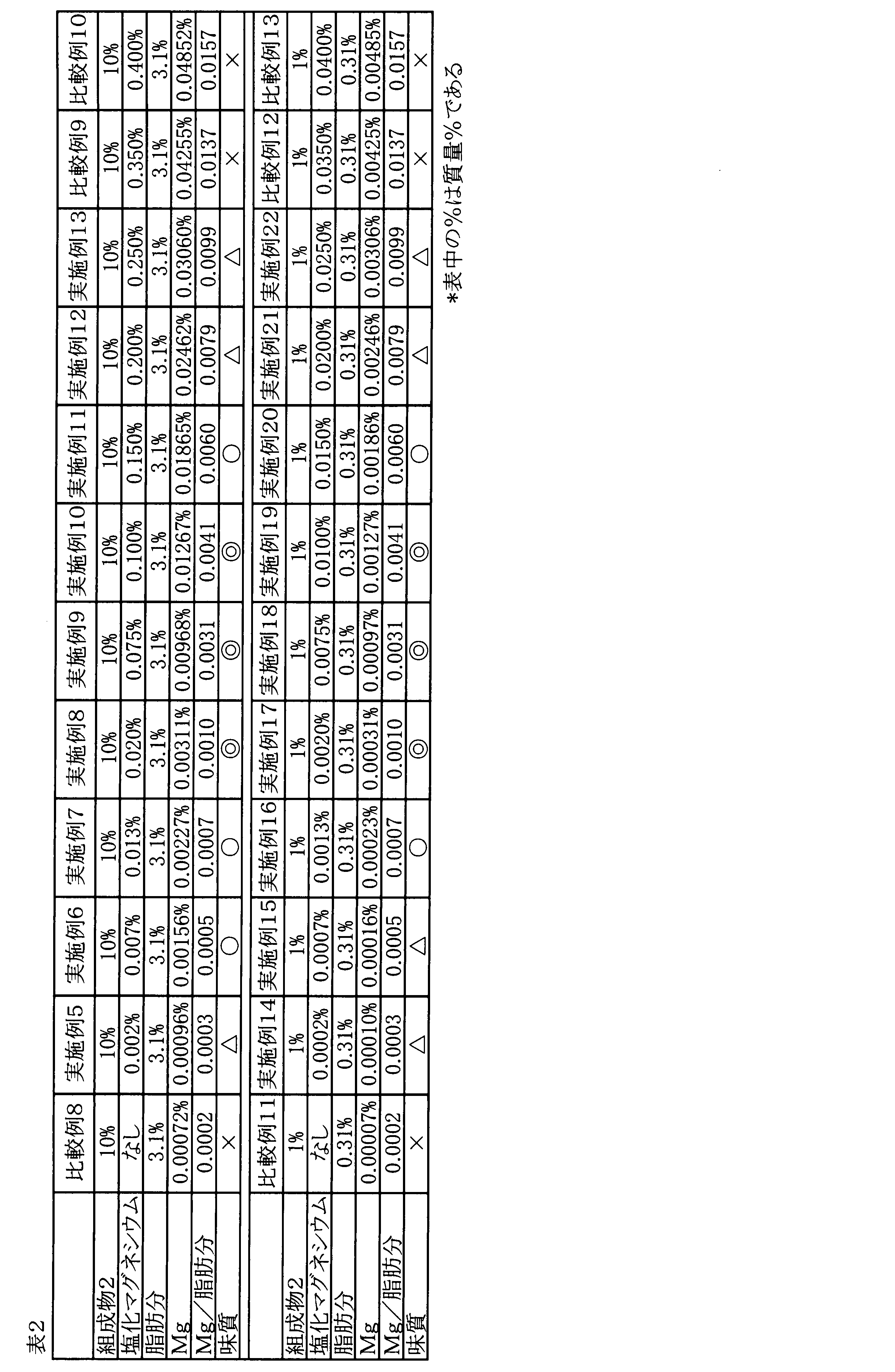
参考例はマグネシウム材料を混合していない例である。
実施例5~22、比較例7~13と同様に、組成物2と塩化ナトリウム(Na含有量:39質量%)、塩化カリウム(K含有量:52質量%)と水を任意の比率で混合し、表3に示すような、脂肪分に対するナトリウム、カリウムの質量比率が異なる乳飲料を調製し、評価した。結果を表3に示す。
ナトリウム、カリウムの添加量についても、マグネシウムと同様に、脂質濃度によって最適な範囲があり、それは、脂質濃度の濃淡によらず、脂肪分に対するナトリウム、またはカリウムの質量比率が一定の数値となる範囲であることが分かった。
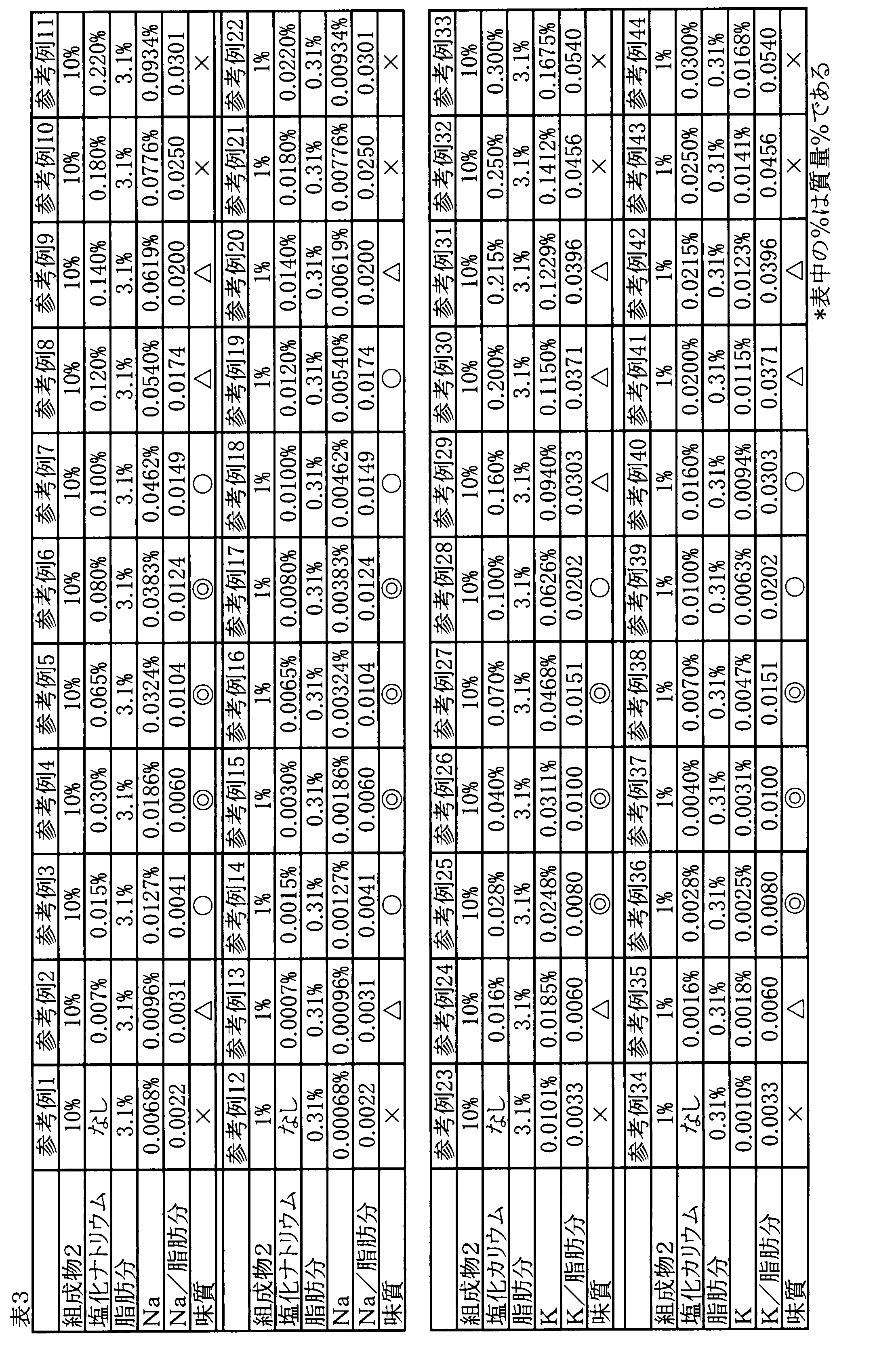
実施例1~4と同様の方法、基準にて、表4に示す材料(添加剤)の組合せについて評価を行った。結果を表4に示す。
脂質に対する一定の質量比率でMgを含有しており、かつ、A成分:多糖類を併用することが、乳風味にさらにコクを付与することが分かった。さらに、D成分:バターミルクおよび/またはB成分:ミルク香料を併用することが、より良好な味質を達成するために重要であることが分かった。
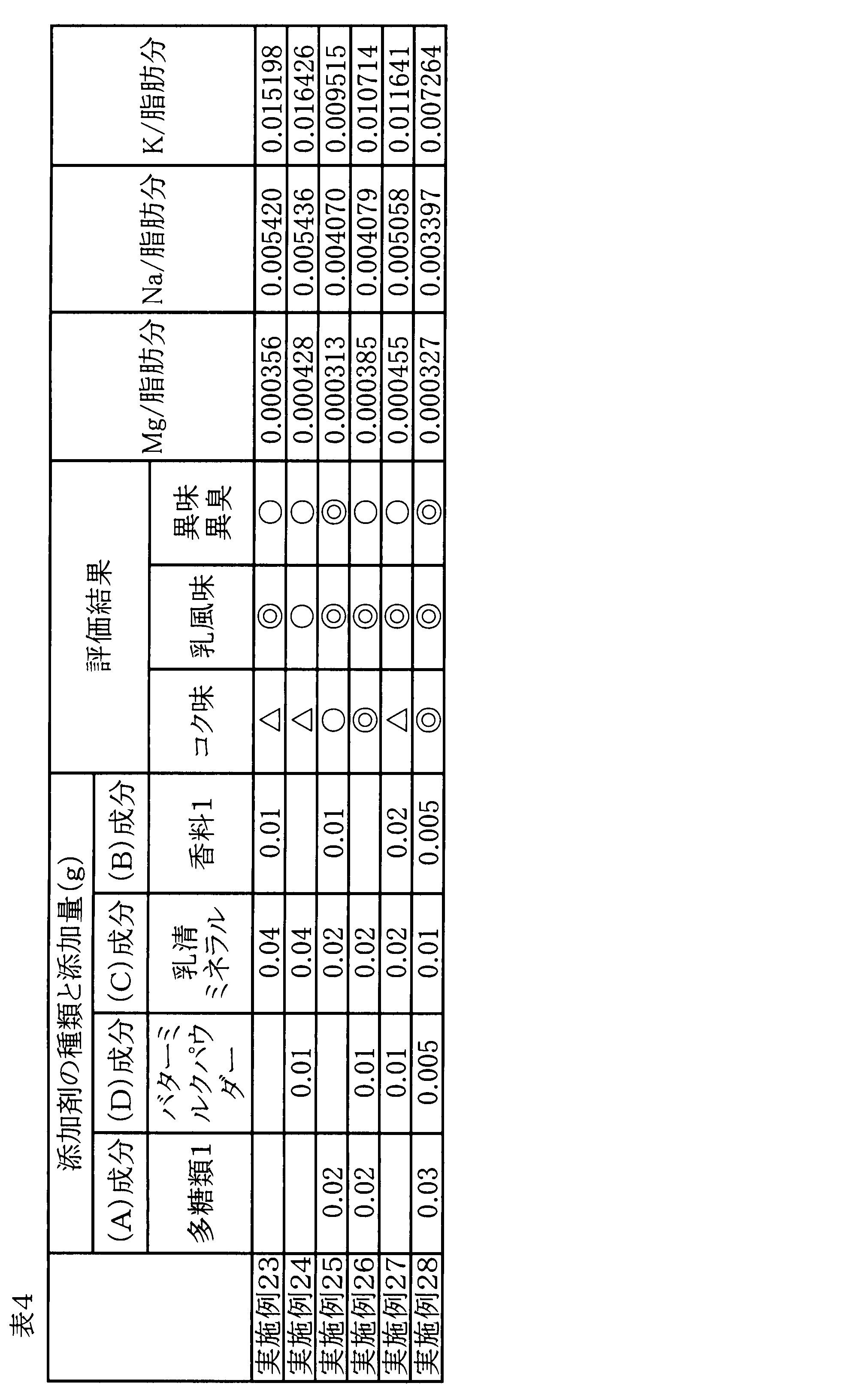
予め、カゼインナトリウム8g、ショ糖脂肪酸エステル(脂肪酸の炭素数=16および18、モノエステル含量=77質量%)10g、ポリグリセリン脂肪酸エステル(リョートー(登録商標)ポリグリエステルSWA-10D、三菱化学フーズ社製)5g及びコハク酸モノグリセリド(脂肪酸の炭素数=16および18)1.5gを分散させた水相300gを65℃に加熱した後、脱脂粉乳15g、乳糖9g、MPC(Milk Protein Concentrate)45g、砂糖6gを加え、さらに乳と生クリームを原料とする非発酵型のクリームチーズ(全固形分量:61質量%、乳脂肪分含有量:51質量%)190gを投入し、ホモミキサーを用い、回転数8000rpmで5分間予備乳化した。更に水を加えて全量を1000gに調整し、高圧ホモジナイザーで65℃、20MPaにて2回均質化後、90℃で15分間殺菌処理して、組成物3(乳脂肪分含有量:9.7質量%)を得た。
得られた組成物3を5gと、塩化マグネシウム、塩化ナトリウム、塩化カリウム、および水を混合し、全量が15gとなるように、本発明の乳化組成物を調製した。得られた乳化組成物15gと、インスタントコーヒー1.5質量%水溶液15gを混合し、コーヒー飲料(乳飲料)を調製した。
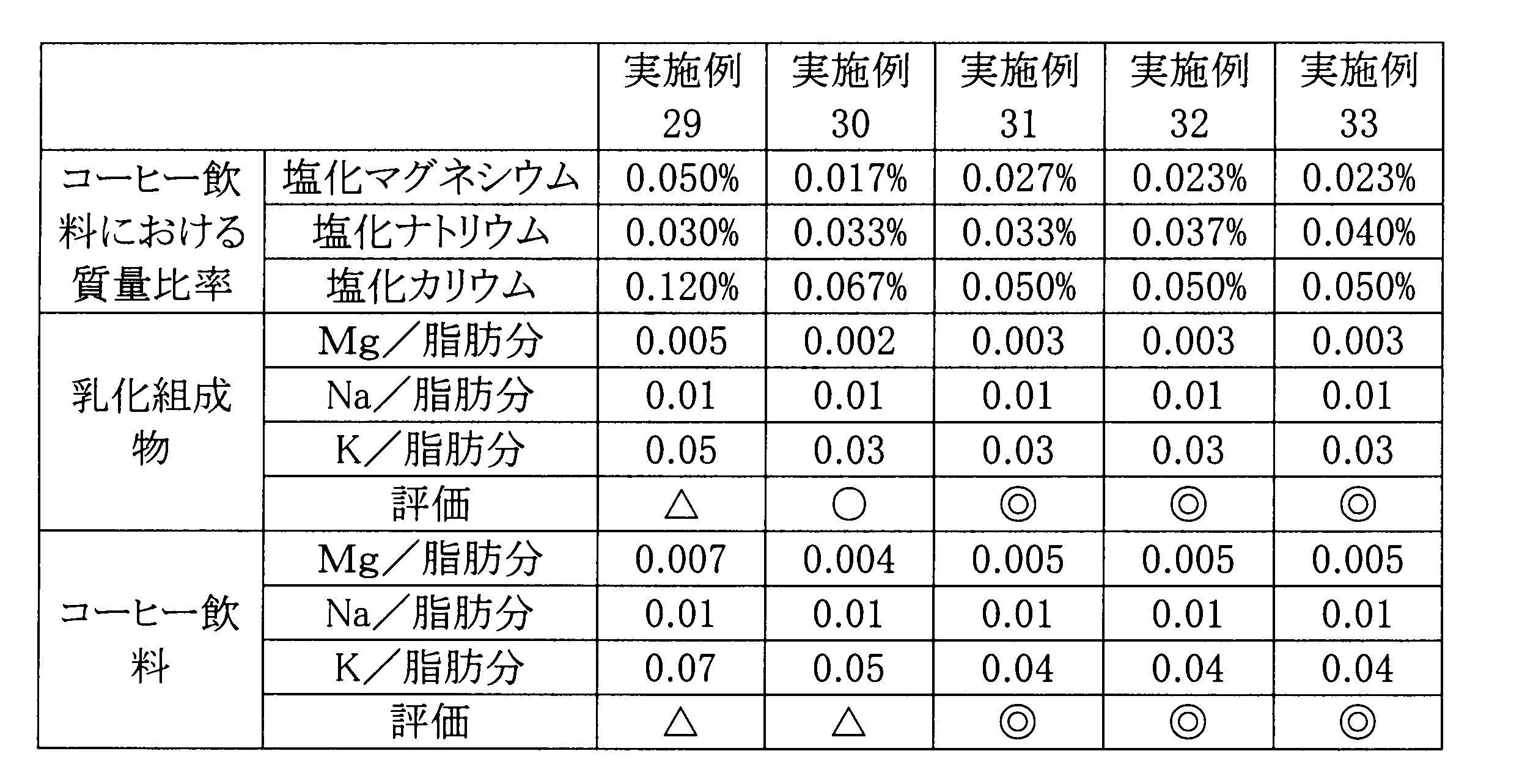
コーヒー飲料における、塩化マグネシウム、塩化ナトリウム、塩化カリウムの濃度と、乳化組成物およびコーヒー飲料、各々におけるマグネシウム、ナトリウム、カリウムの脂肪分に対する質量比率を、表5に示す。
当該乳化組成物と、コーヒー飲料を、3名で試飲し、実施例5~22、比較例7~13と同様の基準で評価を行った。結果を表5に示す。
当該コーヒー飲料を、3名で試飲し、実施例5~22、比較例7~13と同様の基準で評価を行った。結果を表5に示す。表中の%は質量%を表す。
いずれも、マグネシウム材料が好適な範囲にあるため、良好な乳風味をもった乳化組成物またはコーヒー飲料であるが、特にコーヒー飲料において、コーヒーに由来するカリウム分の影響を受け、カリウム材料を過剰にいれると、カリウムに起因する異味が強くなってしまう傾向があるため、カリウム材料を最適な量にすることが好適であることが分かった。
予め、カゼインナトリウム8g、ショ糖脂肪酸エステル(脂肪酸の炭素数=16および18、モノエステル含量=77質量%)10g、ポリグリセリン脂肪酸エステル(リョートー(登録商標)ポリグリエステルSWA-10D、三菱化学フーズ社製)5g及びコハク酸モノグリセリド(脂肪酸の炭素数=16および18)1.5gを分散させた水相300gを65℃に加熱した後、バターミルクパウダー15g、乳糖9g、MPC(Milk Protein Concentrate)45g、砂糖6gを加え、さらに乳と生クリームを原料とする非発酵型のクリームチーズ(全固形分量:61質量%、乳脂肪分含有量:51質量%)190gを投入し、ホモミキサーを用い、回転数8000rpmで5分間予備乳化した。更に水を加えて全量を1000gに調整し、高圧ホモジナイザーで65℃、20MPaにて2回均質化後、90℃で15分間殺菌処理して、本発明の乳化組成物(乳脂肪分含有量:9.7質量%、Mg/脂肪分:0.0009、K/脂肪分:0.01、Na/脂肪分:0.004)を得た。
当該乳化組成物は、異味を感じず、良好な乳風味とコクがあった。
コーヒー抽出液(Bx2.9)480gに、予め熱水で溶解した重曹を加えpH調整後、エリスリトール7.0g、アセスルファムK0.15g、ステビア0.08g、製造例1で得られた組成物1(クリームチーズを60質量%含有)2.6g、多糖類1を0.3g、乳清ミネラル0.1g、バターミルクパウダー0.05g、香料1を0.05g及び水を適量加えた材料を、混合、溶解し、さらに水を加え全量を1000gとした。
この時の当該材料に含まれる脂肪分とマグネシウムの質量比率は、Mg/脂肪分:0.00033であった。本液を65℃に昇温し、高圧ホモジナイザーにて20MPaの圧力で均質化後、缶容器に充填し、121℃、30分間のレトルト殺菌を行い、缶入りミルクコーヒー(乳飲料)を調製した。殺菌後の乳飲料のpHは6.0であった。
得られた缶入りミルクコーヒーを、上記殺菌後、5℃で1日保存後に開缶し、パネラー4名で試飲し、実施例1と同様の基準で評価した。また、添加した各成分の熱量から、100mlあたりの総カロリーを計算すると共に、用いた原材料の構成成分から計算にて、乳固形分中の無脂乳固形分の割合を求めた。結果を表6に示す。
実施例35において、組成物1(クリームチーズを60質量%含有)の添加量を0.33gとし、多糖類1、乳清ミネラル、バターミルクパウダー、及び香料1を添加しない以外は、同様の方法で、缶入りミルクコーヒーを調製した。この時の当該材料に含まれる脂肪分とマグネシウムの質量比率は、Mg/脂肪分:0.00023であった。殺菌後の飲料のpHは5.9であった。
得られた缶入りミルクコーヒーについて、5℃で1日保存後に実施例18と同様にパネラー4名で試飲評価した。また、同様に100mlあたりの総カロリーと乳固形分中の無脂乳固形分の割合を求めた。結果を表6に示す。

Claims (8)
- 乳製品、乳化剤及びマグネシウム材料を含む乳化組成物であって、
前記乳製品は、全固形分が20質量%以上で、全固形分に対する乳脂肪の比率が30質量%以上の乳製品であり、
前記乳化組成物中の脂肪分に対するマグネシウムの質量比率(脂肪分:マグネシウム)が1:0.0003~1:0.01である、乳化組成物。 - さらに、乳化組成物中の脂肪分に対するナトリウムの質量比率(脂肪分:ナトリウム)が1:0.0001~1:0.02であり、
カリウムの質量比率(脂肪分:カリウム)が1:0.0001~1:0.04である、請求項1に記載の乳化組成物。 - 前記乳製品がフレッシュチーズまたはクリームである、請求項1または2に記載の乳化組成物。
- さらに、カゼイン及びカゼインの塩のうち少なくとも一方を含む、請求項1~3のいずれか一項に記載の乳化組成物。
- 前記マグネシウム材料が、乳清ミネラル、塩化マグネシウム、酸化マグネシウム、炭酸マグネシウム、硫酸マグネシウム、苦汁、ドロマイト、粗塩、ステアリン酸マグネシウム、リン酸一水素マグネシウム、リン酸三マグネシウム、ケイ酸マグネシウム、水酸化マグネシウム、酢酸マグネシウム、クエン酸マグネシウム、リンゴ酸マグネシウム、安息香酸マグネシウム、グルコン酸マグネシウム、L-グルタミン酸マグネシウム、セピオライト、タルク、フィチンからなる群から選ばれる材料、または該材料の有機酸もしくは無機酸の塩である、
請求項1~4のいずれか一項に記載の乳化組成物。 - 請求項1~5のいずれか一項に記載の乳化組成物を用いて製造された、乳飲料。
- コーヒー抽出物または紅茶抽出物を含有する、請求項6に記載の乳飲料。
- 乳製品、乳化剤及びマグネシウム材料を混合する乳化組成物の製造方法であって、
前記乳製品は、全固形分が20質量%以上で、全固形分に対する乳脂肪の比率が30質量%以上の乳製品であり、
前記乳化組成物中の脂肪分に対するマグネシウムの質量比率(脂肪分:マグネシウム)を1:0.0003~1:0.01とする、乳化組成物の製造方法。
Priority Applications (8)
| Application Number | Priority Date | Filing Date | Title |
|---|---|---|---|
| DK14844955.6T DK3045047T4 (da) | 2013-09-13 | 2014-09-11 | Emulgeret sammensætning og mælkedrik |
| EP14844955.6A EP3045047B2 (en) | 2013-09-13 | 2014-09-11 | Emulsified composition and milk drink |
| CN201480049614.7A CN105530817B (zh) | 2013-09-13 | 2014-09-11 | 乳化组合物和乳饮料 |
| AU2014319372A AU2014319372B2 (en) | 2013-09-13 | 2014-09-11 | Emulsified composition and milk drink |
| EP18207527.5A EP3461340A1 (en) | 2013-09-13 | 2014-09-11 | Milk drink |
| JP2015536632A JP6462575B2 (ja) | 2013-09-13 | 2014-09-11 | 乳化組成物および乳飲料 |
| NZ717799A NZ717799A (en) | 2013-09-13 | 2014-09-11 | Emulsified composition and milk beverage |
| AU2017265063A AU2017265063B2 (en) | 2013-09-13 | 2017-11-22 | Emulsified composition and milk drink |
Applications Claiming Priority (2)
| Application Number | Priority Date | Filing Date | Title |
|---|---|---|---|
| JP2013-190561 | 2013-09-13 | ||
| JP2013190561 | 2013-09-13 |
Publications (1)
| Publication Number | Publication Date |
|---|---|
| WO2015037679A1 true WO2015037679A1 (ja) | 2015-03-19 |
Family
ID=52665779
Family Applications (1)
| Application Number | Title | Priority Date | Filing Date |
|---|---|---|---|
| PCT/JP2014/074139 Ceased WO2015037679A1 (ja) | 2013-09-13 | 2014-09-11 | 乳化組成物および乳飲料 |
Country Status (7)
| Country | Link |
|---|---|
| EP (2) | EP3461340A1 (ja) |
| JP (2) | JP6462575B2 (ja) |
| CN (2) | CN112841323A (ja) |
| AU (2) | AU2014319372B2 (ja) |
| DK (1) | DK3045047T4 (ja) |
| NZ (2) | NZ717799A (ja) |
| WO (1) | WO2015037679A1 (ja) |
Cited By (9)
| Publication number | Priority date | Publication date | Assignee | Title |
|---|---|---|---|---|
| JP2018068236A (ja) * | 2016-10-31 | 2018-05-10 | 株式会社Adeka | 甘味質改善剤 |
| JP2018078849A (ja) * | 2016-11-17 | 2018-05-24 | 株式会社Adeka | 乳清ミネラル組成物 |
| JP2018099066A (ja) * | 2016-12-20 | 2018-06-28 | 物産フードサイエンス株式会社 | ミルク感増強用組成物 |
| JP2018121632A (ja) * | 2017-02-02 | 2018-08-09 | 味の素株式会社 | インスタントコーヒー飲料用組成物及びその製造方法 |
| JP2019517786A (ja) * | 2016-05-04 | 2019-06-27 | シージェイ チェイルジェダン コーポレーションCj Cheiljedang Corporation | コーヒー及びタガトースを含有する血糖上昇抑制用の健康機能性食品 |
| JP2022044983A (ja) * | 2020-09-08 | 2022-03-18 | 日本食品化工株式会社 | コーヒー風味飲食品 |
| CN114938820A (zh) * | 2022-06-09 | 2022-08-26 | 河北养元智汇饮品股份有限公司 | 一种红茶核桃乳及其制备方法 |
| WO2026013877A1 (ja) * | 2024-07-12 | 2026-01-15 | サントリーホールディングス株式会社 | 植物油脂を含有する加熱殺菌済みコーヒー飲料 |
| WO2026058948A1 (ja) * | 2024-09-12 | 2026-03-19 | サントリーホールディングス株式会社 | 植物油脂を含有する加熱殺菌済み飲料 |
Families Citing this family (5)
| Publication number | Priority date | Publication date | Assignee | Title |
|---|---|---|---|---|
| JP7651276B2 (ja) * | 2019-09-04 | 2025-03-26 | 三栄源エフ・エフ・アイ株式会社 | 容器詰め乳成分入り飲料 |
| JP2023532520A (ja) * | 2020-07-01 | 2023-07-28 | ザ コカ・コーラ カンパニー | 味が改善されたアルコール炭酸飲料 |
| AU2023242334A1 (en) * | 2022-03-31 | 2024-10-17 | Suntory Holdings Limited | Beer-flavored beverage |
| JP2023150923A (ja) * | 2022-03-31 | 2023-10-16 | サントリーホールディングス株式会社 | ビールテイスト飲料 |
| JPWO2024204313A1 (ja) * | 2023-03-27 | 2024-10-03 |
Citations (7)
| Publication number | Priority date | Publication date | Assignee | Title |
|---|---|---|---|---|
| JP2002223697A (ja) | 2001-01-31 | 2002-08-13 | Asahi Denka Kogyo Kk | 濃縮牛乳状組成物 |
| JP2004267013A (ja) | 2003-03-05 | 2004-09-30 | Taiyo Kagaku Co Ltd | 飲料用組成物 |
| JP2007215451A (ja) | 2006-02-15 | 2007-08-30 | Matsutani Chem Ind Ltd | 塩類添加乳飲料及び飲料の風味改善方法 |
| WO2010101143A1 (ja) | 2009-03-04 | 2010-09-10 | 株式会社Adeka | 乳風味飲料 |
| JP2011045364A (ja) | 2009-07-31 | 2011-03-10 | Mitsubishi-Kagaku Foods Corp | 飲食品用乳化組成物 |
| JP2011234697A (ja) | 2010-05-13 | 2011-11-24 | Taiyo Kagaku Co Ltd | チーズ乳化物の製造方法及びチーズ乳化物、並びにこれを用いた乳含有飲料 |
| JP2012170415A (ja) * | 2011-02-23 | 2012-09-10 | Fuji Oil Co Ltd | 無脂乳固形分含有水中油型乳化物 |
Family Cites Families (7)
| Publication number | Priority date | Publication date | Assignee | Title |
|---|---|---|---|---|
| WO2007046333A1 (ja) † | 2005-10-19 | 2007-04-26 | San-Ei Gen F.F.I., Inc. | 乳化剤およびそれを用いて調製される乳化組成物 |
| JP4750738B2 (ja) * | 2007-03-07 | 2011-08-17 | 株式会社日清煉乳 | 濃縮乳タイプ乳化物およびそれを用いたミルク入り飲料 |
| JP5657200B2 (ja) * | 2008-09-05 | 2015-01-21 | サントリー食品インターナショナル株式会社 | 乳清タンパク質の含有量が低減された乳組成物及び乳入り飲料 |
| BRPI1014851A2 (pt) * | 2009-04-03 | 2017-09-26 | Nestec Sa | bebidas semelhantes a leite |
| US10834935B2 (en) | 2012-02-01 | 2020-11-17 | Koninklijke Douwe Egberts B.V. | Dairy mineral-fortified liquid dairy products and methods of making |
| BR112014019857A8 (pt) * | 2012-02-16 | 2017-07-11 | Nestec Sa | Métodos para fabricar bebidas semelhantes ao leite |
| JP2013190561A (ja) | 2012-03-13 | 2013-09-26 | Toppan Printing Co Ltd | 反射防止フィルム及びその製造方法、偏光板、透過型液晶ディスプレイ |
-
2014
- 2014-09-11 DK DK14844955.6T patent/DK3045047T4/da active
- 2014-09-11 AU AU2014319372A patent/AU2014319372B2/en active Active
- 2014-09-11 CN CN202110169945.6A patent/CN112841323A/zh active Pending
- 2014-09-11 EP EP18207527.5A patent/EP3461340A1/en active Pending
- 2014-09-11 NZ NZ717799A patent/NZ717799A/en unknown
- 2014-09-11 NZ NZ755496A patent/NZ755496A/en unknown
- 2014-09-11 CN CN201480049614.7A patent/CN105530817B/zh active Active
- 2014-09-11 JP JP2015536632A patent/JP6462575B2/ja active Active
- 2014-09-11 WO PCT/JP2014/074139 patent/WO2015037679A1/ja not_active Ceased
- 2014-09-11 EP EP14844955.6A patent/EP3045047B2/en active Active
-
2017
- 2017-11-22 AU AU2017265063A patent/AU2017265063B2/en active Active
-
2018
- 2018-12-25 JP JP2018241395A patent/JP6787987B2/ja active Active
Patent Citations (7)
| Publication number | Priority date | Publication date | Assignee | Title |
|---|---|---|---|---|
| JP2002223697A (ja) | 2001-01-31 | 2002-08-13 | Asahi Denka Kogyo Kk | 濃縮牛乳状組成物 |
| JP2004267013A (ja) | 2003-03-05 | 2004-09-30 | Taiyo Kagaku Co Ltd | 飲料用組成物 |
| JP2007215451A (ja) | 2006-02-15 | 2007-08-30 | Matsutani Chem Ind Ltd | 塩類添加乳飲料及び飲料の風味改善方法 |
| WO2010101143A1 (ja) | 2009-03-04 | 2010-09-10 | 株式会社Adeka | 乳風味飲料 |
| JP2011045364A (ja) | 2009-07-31 | 2011-03-10 | Mitsubishi-Kagaku Foods Corp | 飲食品用乳化組成物 |
| JP2011234697A (ja) | 2010-05-13 | 2011-11-24 | Taiyo Kagaku Co Ltd | チーズ乳化物の製造方法及びチーズ乳化物、並びにこれを用いた乳含有飲料 |
| JP2012170415A (ja) * | 2011-02-23 | 2012-09-10 | Fuji Oil Co Ltd | 無脂乳固形分含有水中油型乳化物 |
Non-Patent Citations (1)
| Title |
|---|
| See also references of EP3045047A4 |
Cited By (11)
| Publication number | Priority date | Publication date | Assignee | Title |
|---|---|---|---|---|
| JP2019517786A (ja) * | 2016-05-04 | 2019-06-27 | シージェイ チェイルジェダン コーポレーションCj Cheiljedang Corporation | コーヒー及びタガトースを含有する血糖上昇抑制用の健康機能性食品 |
| US11406680B2 (en) | 2016-05-04 | 2022-08-09 | Cj Cheiljedang Corporation | Health functional food for inhibiting rise of blood glucose containing coffee and tagatose |
| JP2018068236A (ja) * | 2016-10-31 | 2018-05-10 | 株式会社Adeka | 甘味質改善剤 |
| JP2018078849A (ja) * | 2016-11-17 | 2018-05-24 | 株式会社Adeka | 乳清ミネラル組成物 |
| JP2018099066A (ja) * | 2016-12-20 | 2018-06-28 | 物産フードサイエンス株式会社 | ミルク感増強用組成物 |
| JP2018121632A (ja) * | 2017-02-02 | 2018-08-09 | 味の素株式会社 | インスタントコーヒー飲料用組成物及びその製造方法 |
| JP2022044983A (ja) * | 2020-09-08 | 2022-03-18 | 日本食品化工株式会社 | コーヒー風味飲食品 |
| JP7712068B2 (ja) | 2020-09-08 | 2025-07-23 | 日本食品化工株式会社 | コーヒー風味飲食品 |
| CN114938820A (zh) * | 2022-06-09 | 2022-08-26 | 河北养元智汇饮品股份有限公司 | 一种红茶核桃乳及其制备方法 |
| WO2026013877A1 (ja) * | 2024-07-12 | 2026-01-15 | サントリーホールディングス株式会社 | 植物油脂を含有する加熱殺菌済みコーヒー飲料 |
| WO2026058948A1 (ja) * | 2024-09-12 | 2026-03-19 | サントリーホールディングス株式会社 | 植物油脂を含有する加熱殺菌済み飲料 |
Also Published As
| Publication number | Publication date |
|---|---|
| EP3045047B1 (en) | 2019-01-09 |
| JPWO2015037679A1 (ja) | 2017-03-02 |
| EP3461340A1 (en) | 2019-04-03 |
| DK3045047T4 (da) | 2025-01-13 |
| EP3045047A4 (en) | 2016-08-24 |
| CN105530817A (zh) | 2016-04-27 |
| JP6462575B2 (ja) | 2019-01-30 |
| CN112841323A (zh) | 2021-05-28 |
| AU2014319372B2 (en) | 2017-08-31 |
| AU2014319372A1 (en) | 2016-04-07 |
| EP3045047A1 (en) | 2016-07-20 |
| JP2019058188A (ja) | 2019-04-18 |
| NZ717799A (en) | 2021-07-30 |
| DK3045047T3 (en) | 2019-04-15 |
| EP3045047B2 (en) | 2024-11-06 |
| NZ755496A (en) | 2021-07-30 |
| JP6787987B2 (ja) | 2020-11-18 |
| CN105530817B (zh) | 2021-03-05 |
| AU2017265063A1 (en) | 2017-12-14 |
| AU2017265063B2 (en) | 2018-10-25 |
Similar Documents
| Publication | Publication Date | Title |
|---|---|---|
| JP6787987B2 (ja) | 乳化組成物および乳飲料 | |
| ES3058179T3 (en) | Use of a high protein denatured whey protein composition | |
| JP5714234B2 (ja) | 乳風味飲料 | |
| JP6564110B2 (ja) | 飲食品用乳化組成物、飲食品用乳化組成物の製造方法、飲食品及び乳飲料 | |
| US20170013855A1 (en) | Food using soybean powder and method for manufacturing thereof | |
| JP6113986B2 (ja) | 乳風味増強方法及び飲食品 | |
| JP2014233261A (ja) | ココナッツミルク含有飲食品及びその製造方法 | |
| JP2014050336A (ja) | 乳風味増強剤 | |
| TW202320636A (zh) | 水中油型乳化物 | |
| JP6490944B2 (ja) | 乳風味付与材 | |
| JP5714290B2 (ja) | 起泡性水中油型乳化組成物 | |
| JP3839746B2 (ja) | ココナッツミルク含有飲食品及びその製造方法 | |
| JP2004261139A (ja) | 酸性豆乳飲料およびその製造方法 | |
| JP2014050337A (ja) | 乳風味付与剤 | |
| JP2010075083A (ja) | 殺菌済濃縮牛乳状組成物 | |
| JP6625860B2 (ja) | レトルト処理食品用水中油型乳化物 | |
| JP2025059466A (ja) | ブルーベリージャム入りヨーグルト | |
| WO2025079667A1 (ja) | 水中油型乳化組成物およびそれを含む含水チョコレート様食品 | |
| JPWO2018030284A1 (ja) | 酸性液状栄養組成物 | |
| JP2013111026A (ja) | 脂肪代替組成物 |
Legal Events
| Date | Code | Title | Description |
|---|---|---|---|
| WWE | Wipo information: entry into national phase |
Ref document number: 201480049614.7 Country of ref document: CN |
|
| 121 | Ep: the epo has been informed by wipo that ep was designated in this application |
Ref document number: 14844955 Country of ref document: EP Kind code of ref document: A1 |
|
| ENP | Entry into the national phase |
Ref document number: 2015536632 Country of ref document: JP Kind code of ref document: A |
|
| REEP | Request for entry into the european phase |
Ref document number: 2014844955 Country of ref document: EP |
|
| WWE | Wipo information: entry into national phase |
Ref document number: 2014844955 Country of ref document: EP |
|
| NENP | Non-entry into the national phase |
Ref country code: DE |
|
| ENP | Entry into the national phase |
Ref document number: 2014319372 Country of ref document: AU Date of ref document: 20140911 Kind code of ref document: A |