WO2015046403A1 - 環状アミン誘導体及びその医薬用途 - Google Patents
環状アミン誘導体及びその医薬用途 Download PDFInfo
- Publication number
- WO2015046403A1 WO2015046403A1 PCT/JP2014/075569 JP2014075569W WO2015046403A1 WO 2015046403 A1 WO2015046403 A1 WO 2015046403A1 JP 2014075569 W JP2014075569 W JP 2014075569W WO 2015046403 A1 WO2015046403 A1 WO 2015046403A1
- Authority
- WO
- WIPO (PCT)
- Prior art keywords
- mmol
- reaction
- group
- compound
- imidazol
- Prior art date
- Legal status (The legal status is an assumption and is not a legal conclusion. Google has not performed a legal analysis and makes no representation as to the accuracy of the status listed.)
- Ceased
Links
- MANMRAKMJZODOX-UHFFFAOYSA-N CN(C)C(CC1)CCN1C(CCc1ncc[n]1CC(OCC(N(C)C)=O)=O)=O Chemical compound CN(C)C(CC1)CCN1C(CCc1ncc[n]1CC(OCC(N(C)C)=O)=O)=O MANMRAKMJZODOX-UHFFFAOYSA-N 0.000 description 2
- FPXXYUFKAXTPIM-UHFFFAOYSA-N CC(C)(C)C(OCOC(C[n]1c(CCC(N(CC2)CCC2N(C)C)=O)ncc1)=O)=O Chemical compound CC(C)(C)C(OCOC(C[n]1c(CCC(N(CC2)CCC2N(C)C)=O)ncc1)=O)=O FPXXYUFKAXTPIM-UHFFFAOYSA-N 0.000 description 1
- ZKURTVAQTOHZAW-UHFFFAOYSA-N CC(N(C)C(CC1)CCN1C(CCc1ncc[n]1C)=O)O Chemical compound CC(N(C)C(CC1)CCN1C(CCc1ncc[n]1C)=O)O ZKURTVAQTOHZAW-UHFFFAOYSA-N 0.000 description 1
- XULKWDFDIQQJSF-UHFFFAOYSA-N CCCOC(C[n]1c(CCC(N(CC2)CCC2N(C)C)=O)ncc1)=O Chemical compound CCCOC(C[n]1c(CCC(N(CC2)CCC2N(C)C)=O)ncc1)=O XULKWDFDIQQJSF-UHFFFAOYSA-N 0.000 description 1
- PYGVHSHHMAJANU-CMDGGOBGSA-N CCOC(CC[n]1c(/C=C/C(OCc2ccccc2)=O)ncc1)=O Chemical compound CCOC(CC[n]1c(/C=C/C(OCc2ccccc2)=O)ncc1)=O PYGVHSHHMAJANU-CMDGGOBGSA-N 0.000 description 1
- 0 CN(*)C(CC1)CCN1C(CCc1ncc(*)[n]1*)=O Chemical compound CN(*)C(CC1)CCN1C(CCc1ncc(*)[n]1*)=O 0.000 description 1
- IUEIKQRTUANFKQ-UHFFFAOYSA-N CN(C)C(CC1)CCN1C(CCc1ncc[n]1CCC(O)=O)=O Chemical compound CN(C)C(CC1)CCN1C(CCc1ncc[n]1CCC(O)=O)=O IUEIKQRTUANFKQ-UHFFFAOYSA-N 0.000 description 1
- KDLFUYDHMFJMDF-UHFFFAOYSA-N C[Si+](C)OCC[n]1c(C=O)ncc1 Chemical compound C[Si+](C)OCC[n]1c(C=O)ncc1 KDLFUYDHMFJMDF-UHFFFAOYSA-N 0.000 description 1
Images


Classifications
-
- C—CHEMISTRY; METALLURGY
- C07—ORGANIC CHEMISTRY
- C07D—HETEROCYCLIC COMPOUNDS
- C07D401/00—Heterocyclic compounds containing two or more hetero rings, having nitrogen atoms as the only ring hetero atoms, at least one ring being a six-membered ring with only one nitrogen atom
- C07D401/02—Heterocyclic compounds containing two or more hetero rings, having nitrogen atoms as the only ring hetero atoms, at least one ring being a six-membered ring with only one nitrogen atom containing two hetero rings
- C07D401/06—Heterocyclic compounds containing two or more hetero rings, having nitrogen atoms as the only ring hetero atoms, at least one ring being a six-membered ring with only one nitrogen atom containing two hetero rings linked by a carbon chain containing only aliphatic carbon atoms
-
- A—HUMAN NECESSITIES
- A61—MEDICAL OR VETERINARY SCIENCE; HYGIENE
- A61K—PREPARATIONS FOR MEDICAL, DENTAL OR TOILETRY PURPOSES
- A61K31/00—Medicinal preparations containing organic active ingredients
- A61K31/33—Heterocyclic compounds
- A61K31/335—Heterocyclic compounds having oxygen as the only ring hetero atom, e.g. fungichromin
- A61K31/34—Heterocyclic compounds having oxygen as the only ring hetero atom, e.g. fungichromin having five-membered rings with one oxygen as the only ring hetero atom, e.g. isosorbide
-
- A—HUMAN NECESSITIES
- A61—MEDICAL OR VETERINARY SCIENCE; HYGIENE
- A61K—PREPARATIONS FOR MEDICAL, DENTAL OR TOILETRY PURPOSES
- A61K31/00—Medicinal preparations containing organic active ingredients
- A61K31/33—Heterocyclic compounds
- A61K31/335—Heterocyclic compounds having oxygen as the only ring hetero atom, e.g. fungichromin
- A61K31/357—Heterocyclic compounds having oxygen as the only ring hetero atom, e.g. fungichromin having two or more oxygen atoms in the same ring, e.g. crown ethers, guanadrel
-
- A—HUMAN NECESSITIES
- A61—MEDICAL OR VETERINARY SCIENCE; HYGIENE
- A61K—PREPARATIONS FOR MEDICAL, DENTAL OR TOILETRY PURPOSES
- A61K31/00—Medicinal preparations containing organic active ingredients
- A61K31/33—Heterocyclic compounds
- A61K31/395—Heterocyclic compounds having nitrogen as a ring hetero atom, e.g. guanethidine or rifamycins
- A61K31/40—Heterocyclic compounds having nitrogen as a ring hetero atom, e.g. guanethidine or rifamycins having five-membered rings with one nitrogen as the only ring hetero atom, e.g. sulpiride, succinimide, tolmetin, buflomedil
- A61K31/4025—Heterocyclic compounds having nitrogen as a ring hetero atom, e.g. guanethidine or rifamycins having five-membered rings with one nitrogen as the only ring hetero atom, e.g. sulpiride, succinimide, tolmetin, buflomedil not condensed and containing further heterocyclic rings, e.g. cromakalim
-
- A—HUMAN NECESSITIES
- A61—MEDICAL OR VETERINARY SCIENCE; HYGIENE
- A61K—PREPARATIONS FOR MEDICAL, DENTAL OR TOILETRY PURPOSES
- A61K31/00—Medicinal preparations containing organic active ingredients
- A61K31/33—Heterocyclic compounds
- A61K31/395—Heterocyclic compounds having nitrogen as a ring hetero atom, e.g. guanethidine or rifamycins
- A61K31/41—Heterocyclic compounds having nitrogen as a ring hetero atom, e.g. guanethidine or rifamycins having five-membered rings with two or more ring hetero atoms, at least one of which being nitrogen, e.g. tetrazole
- A61K31/4164—1,3-Diazoles
- A61K31/4178—1,3-Diazoles not condensed 1,3-diazoles and containing further heterocyclic rings, e.g. pilocarpine, nitrofurantoin
-
- A—HUMAN NECESSITIES
- A61—MEDICAL OR VETERINARY SCIENCE; HYGIENE
- A61K—PREPARATIONS FOR MEDICAL, DENTAL OR TOILETRY PURPOSES
- A61K31/00—Medicinal preparations containing organic active ingredients
- A61K31/33—Heterocyclic compounds
- A61K31/395—Heterocyclic compounds having nitrogen as a ring hetero atom, e.g. guanethidine or rifamycins
- A61K31/435—Heterocyclic compounds having nitrogen as a ring hetero atom, e.g. guanethidine or rifamycins having six-membered rings with one nitrogen as the only ring hetero atom
- A61K31/44—Non condensed pyridines; Hydrogenated derivatives thereof
- A61K31/445—Non condensed piperidines, e.g. piperocaine
- A61K31/4523—Non condensed piperidines, e.g. piperocaine containing further heterocyclic ring systems
- A61K31/454—Non condensed piperidines, e.g. piperocaine containing further heterocyclic ring systems containing a five-membered ring with nitrogen as a ring hetero atom, e.g. pimozide, domperidone
-
- A—HUMAN NECESSITIES
- A61—MEDICAL OR VETERINARY SCIENCE; HYGIENE
- A61K—PREPARATIONS FOR MEDICAL, DENTAL OR TOILETRY PURPOSES
- A61K31/00—Medicinal preparations containing organic active ingredients
- A61K31/33—Heterocyclic compounds
- A61K31/395—Heterocyclic compounds having nitrogen as a ring hetero atom, e.g. guanethidine or rifamycins
- A61K31/435—Heterocyclic compounds having nitrogen as a ring hetero atom, e.g. guanethidine or rifamycins having six-membered rings with one nitrogen as the only ring hetero atom
- A61K31/44—Non condensed pyridines; Hydrogenated derivatives thereof
- A61K31/445—Non condensed piperidines, e.g. piperocaine
- A61K31/4523—Non condensed piperidines, e.g. piperocaine containing further heterocyclic ring systems
- A61K31/4545—Non condensed piperidines, e.g. piperocaine containing further heterocyclic ring systems containing a six-membered ring with nitrogen as a ring hetero atom, e.g. pipamperone, anabasine
-
- A—HUMAN NECESSITIES
- A61—MEDICAL OR VETERINARY SCIENCE; HYGIENE
- A61K—PREPARATIONS FOR MEDICAL, DENTAL OR TOILETRY PURPOSES
- A61K31/00—Medicinal preparations containing organic active ingredients
- A61K31/33—Heterocyclic compounds
- A61K31/395—Heterocyclic compounds having nitrogen as a ring hetero atom, e.g. guanethidine or rifamycins
- A61K31/495—Heterocyclic compounds having nitrogen as a ring hetero atom, e.g. guanethidine or rifamycins having six-membered rings with two or more nitrogen atoms as the only ring heteroatoms, e.g. piperazine or tetrazines
- A61K31/496—Non-condensed piperazines containing further heterocyclic rings, e.g. rifampin, thiothixene or sparfloxacin
-
- A—HUMAN NECESSITIES
- A61—MEDICAL OR VETERINARY SCIENCE; HYGIENE
- A61K—PREPARATIONS FOR MEDICAL, DENTAL OR TOILETRY PURPOSES
- A61K31/00—Medicinal preparations containing organic active ingredients
- A61K31/33—Heterocyclic compounds
- A61K31/395—Heterocyclic compounds having nitrogen as a ring hetero atom, e.g. guanethidine or rifamycins
- A61K31/535—Heterocyclic compounds having nitrogen as a ring hetero atom, e.g. guanethidine or rifamycins having six-membered rings with at least one nitrogen and one oxygen as the ring hetero atoms, e.g. 1,2-oxazines
- A61K31/5375—1,4-Oxazines, e.g. morpholine
- A61K31/5377—1,4-Oxazines, e.g. morpholine not condensed and containing further heterocyclic rings, e.g. timolol
-
- A—HUMAN NECESSITIES
- A61—MEDICAL OR VETERINARY SCIENCE; HYGIENE
- A61P—SPECIFIC THERAPEUTIC ACTIVITY OF CHEMICAL COMPOUNDS OR MEDICINAL PREPARATIONS
- A61P29/00—Non-central analgesic, antipyretic or antiinflammatory agents, e.g. antirheumatic agents; Non-steroidal antiinflammatory drugs [NSAID]
-
- C—CHEMISTRY; METALLURGY
- C07—ORGANIC CHEMISTRY
- C07D—HETEROCYCLIC COMPOUNDS
- C07D401/00—Heterocyclic compounds containing two or more hetero rings, having nitrogen atoms as the only ring hetero atoms, at least one ring being a six-membered ring with only one nitrogen atom
- C07D401/14—Heterocyclic compounds containing two or more hetero rings, having nitrogen atoms as the only ring hetero atoms, at least one ring being a six-membered ring with only one nitrogen atom containing three or more hetero rings
-
- C—CHEMISTRY; METALLURGY
- C07—ORGANIC CHEMISTRY
- C07D—HETEROCYCLIC COMPOUNDS
- C07D403/00—Heterocyclic compounds containing two or more hetero rings, having nitrogen atoms as the only ring hetero atoms, not provided for by group C07D401/00
- C07D403/02—Heterocyclic compounds containing two or more hetero rings, having nitrogen atoms as the only ring hetero atoms, not provided for by group C07D401/00 containing two hetero rings
- C07D403/06—Heterocyclic compounds containing two or more hetero rings, having nitrogen atoms as the only ring hetero atoms, not provided for by group C07D401/00 containing two hetero rings linked by a carbon chain containing only aliphatic carbon atoms
-
- C—CHEMISTRY; METALLURGY
- C07—ORGANIC CHEMISTRY
- C07D—HETEROCYCLIC COMPOUNDS
- C07D403/00—Heterocyclic compounds containing two or more hetero rings, having nitrogen atoms as the only ring hetero atoms, not provided for by group C07D401/00
- C07D403/14—Heterocyclic compounds containing two or more hetero rings, having nitrogen atoms as the only ring hetero atoms, not provided for by group C07D401/00 containing three or more hetero rings
-
- C—CHEMISTRY; METALLURGY
- C07—ORGANIC CHEMISTRY
- C07D—HETEROCYCLIC COMPOUNDS
- C07D405/00—Heterocyclic compounds containing both one or more hetero rings having oxygen atoms as the only ring hetero atoms, and one or more rings having nitrogen as the only ring hetero atom
- C07D405/14—Heterocyclic compounds containing both one or more hetero rings having oxygen atoms as the only ring hetero atoms, and one or more rings having nitrogen as the only ring hetero atom containing three or more hetero rings
-
- C—CHEMISTRY; METALLURGY
- C07—ORGANIC CHEMISTRY
- C07D—HETEROCYCLIC COMPOUNDS
- C07D413/00—Heterocyclic compounds containing two or more hetero rings, at least one ring having nitrogen and oxygen atoms as the only ring hetero atoms
- C07D413/14—Heterocyclic compounds containing two or more hetero rings, at least one ring having nitrogen and oxygen atoms as the only ring hetero atoms containing three or more hetero rings
Definitions
- the present invention relates to a cyclic amine derivative and its pharmaceutical use.
- Pain is an experience with an unpleasant sensation or an unpleasant emotion that occurs when tissue damage is or is likely to occur. Pain is mainly classified as nociceptive pain, neuropathic pain or psychogenic pain, depending on the cause. In addition, fibromyalgia is known as a pain of unknown cause.
- Neuropathic pain is pathological pain caused by abnormal functioning of the peripheral or central nervous system itself, and is caused by direct damage or compression of nerve tissue even though nociceptors are not subjected to noxious stimulation. This refers to the pain that occurs.
- anticonvulsants, antidepressants, anxiolytics or antiepileptic drugs such as gabapentin or pregabalin are used.
- Fibromyalgia is a disease with systemic pain as the main symptom and psychological and autonomic nervous system symptoms as secondary symptoms.
- Pregabalin approved in the United States and Japan, duloxetine and milnacipran approved in the United States are mainly used as treatments for fibromyalgia and are not approved for treatment of fibromyalgia. It is also used for steroidal anti-inflammatory drugs, opioid compounds, antidepressants, anticonvulsants and antiepileptic drugs. However, the therapeutic effects of nonsteroidal anti-inflammatory drugs and opioid compounds are generally considered to be low (Non-patent Document 1).
- Patent Document 1 discloses that certain substituted piperidines have cardiotonic activity
- Patent Document 2 discloses that an imidazole derivative exhibits an FXa inhibitory action
- Patent Document 3 suggests that substituted piperidines may have a medicinal effect on overweight or obesity.
- neuropathic pain treatments often involve central side effects such as dizziness, nausea, or vomiting, which makes it difficult to administer for a long time. Is desired.
- an object of the present invention is to provide a compound showing a strong analgesic action against pain, particularly neuropathic pain and / or fibromyalgia.
- a cyclic amine derivative having a strong analgesic action against pain, particularly neuropathic pain and / or fibromyalgia.
- the present invention provides a cyclic amine derivative represented by the following general formula (I) or a pharmacologically acceptable salt thereof.
- A represents a group represented by the general formula (IIa), (IIb) or (IIc);
- R 1 represents an alkyl group having 1 to 6 carbon atoms which may be substituted with a halogen atom, a hydroxyl group, an amino group or a carboxyl group.
- R 2 represents a hydrogen atom or a halogen atom
- R 3 represents a hydrogen atom or an alkyl group having 1 to 6 carbon atoms
- R 4 represents a hydrogen atom or an alkylcarbonyl group having 2 to 6 carbon atoms
- n represents 1 or 2
- R 3 and R 4 are each independently
- R 1 represents an alkyl group having 1 to 6 carbon atoms substituted with a hydroxyl group, an amino group or a carboxyl group
- A is represented by the general formula (IIc).
- R 1 is Represents a substituted alkyl group having 1 to 6 carbon atoms in the carboxyl group
- R 2 represents a hydrogen atom or a halogen atom
- X is, represents CH 2, O or -NR 5
- R 5 is C 1 -C Represents an alkyl group of ⁇ 6.
- A is preferably the general formula (IIa) or (IIb), in which case R 3 is more preferably a hydrogen atom, a methyl group or an ethyl group, and R 2 is a hydrogen atom. Or a chlorine atom, R 3 is a hydrogen atom or a methyl group, and R 4 is an alkyl having 1 to 6 carbon atoms optionally substituted with a hydrogen atom, a methylcarbonyl group, or a methylcarbonylamino group More preferably, it is a group.
- a cyclic amine derivative represented by the following general formula (Ia) or (Ib) or a pharmacologically acceptable salt thereof is preferred
- R 2 is a hydrogen atom or a chlorine atom
- R 2 3 is a hydrogen atom or a methyl group
- R 4 is a hydrogen atom, a methylcarbonyl group, or an alkyl group having 1 to 6 carbon atoms which may be substituted with a methylcarbonylamino group
- R 3 and R When both 4 are methyl groups, R 1 is particularly preferably an alkyl group having 1 to 6 carbon atoms substituted with a hydroxyl group, an amino group or a carboxyl group.
- R 1 represents an alkyl group having 1 to 6 carbon atoms which may be substituted with a halogen atom, a hydroxyl group, an amino group or a carboxyl group
- R 2 represents a hydrogen atom or a halogen atom
- R 3 Represents a hydrogen atom or an alkyl group having 1 to 6 carbon atoms
- R 4 is substituted with a hydrogen atom, an alkylcarbonyl group having 2 to 6 carbon atoms, or an alkylcarbonylamino group having 2 to 6 carbon atoms.
- R 3 and R 4 each independently represents an alkyl group having 1 to 6 carbon atoms
- R 1 is substituted with a hydroxyl group, an amino group or a carboxyl group.
- R 1 represents an alkyl group having 1 to 6 carbon atoms which may be substituted with a halogen atom, a hydroxyl group, an amino group or a carboxyl group
- R 2 represents a hydrogen atom or a halogen atom
- R 3 Represents a hydrogen atom or an alkyl group having 1 to 6 carbon atoms
- R 4 is substituted with a hydrogen atom, an alkylcarbonyl group having 2 to 6 carbon atoms, or an alkylcarbonylamino group having 2 to 6 carbon atoms.
- R 3 and R 4 each independently represents an alkyl group having 1 to 6 carbon atoms
- R 1 is substituted with a hydroxyl group, an amino group or a carboxyl group. Represents an alkyl group having 1 to 6 carbon atoms.
- the analgesic action can be enhanced by limiting to these.
- A is preferably the general formula (IIc), R 2 is preferably a hydrogen atom or a chlorine atom, and R 5 is more preferably a methyl group.
- a cyclic amine derivative represented by the following general formula (Ic) or a pharmacologically acceptable salt thereof is preferable, R 2 is a hydrogen atom or a chlorine atom, and R 5 is methyl. More preferably, it is a group.
- R 1 represents an alkyl group having 1 to 6 carbon atoms substituted with a carboxyl group
- R 2 represents a hydrogen atom or a halogen atom
- X represents CH 2 , O or —NR 5 .
- R 5 represents an alkyl group having 1 to 6 carbon atoms.
- the analgesic action can be enhanced by limiting to these.
- the present invention also provides a prodrug of the above cyclic amine derivative or a pharmacologically acceptable salt thereof.
- This prodrug is preferably a prodrug in which the carboxyl group of the cyclic amine derivative is esterified.
- the present invention also provides a pharmaceutical containing the cyclic amine derivative represented by the above general formula (I), a prodrug of the cyclic amine derivative or a pharmacologically acceptable salt thereof as an active ingredient.
- the drug is preferably an analgesic, and more preferably a neuropathic pain therapeutic agent or a fibromyalgia therapeutic agent.
- the cyclic amine derivative of the present invention or a prodrug thereof or a pharmacologically acceptable salt thereof exhibits a strong analgesic action against pain, particularly neuropathic pain and fibromyalgia, and reduces central side effects. And can be used as an analgesic that can be administered for a long time, particularly as a therapeutic agent for neuropathic pain or a therapeutic agent for fibromyalgia.
- the cyclic amine derivative of the present invention is characterized by being represented by the following general formula (I).
- A represents a group represented by the general formula (IIa), (IIb) or (IIc);
- R 1 represents an alkyl group having 1 to 6 carbon atoms which may be substituted with a halogen atom, a hydroxyl group, an amino group or a carboxyl group.
- R 2 represents a hydrogen atom or a halogen atom
- R 3 represents a hydrogen atom or an alkyl group having 1 to 6 carbon atoms
- R 4 represents a hydrogen atom or an alkylcarbonyl group having 2 to 6 carbon atoms
- n represents 1 or 2
- R 3 and R 4 are each independently
- R 1 represents an alkyl group having 1 to 6 carbon atoms substituted with a hydroxyl group, an amino group or a carboxyl group
- A is represented by the general formula (IIc).
- R 1 is Represents a substituted alkyl group having 1 to 6 carbon atoms in the carboxyl group
- R 2 represents a hydrogen atom or a halogen atom
- X is, represents CH 2, O or -NR 5
- R 5 is C 1 -C Represents an alkyl group of ⁇ 6.
- A is the general formula (IIa) or (IIb), R 3 is preferably a hydrogen atom, a methyl group or an ethyl group, and R 2 is a hydrogen atom or a chlorine atom.
- R 3 represents a hydrogen atom or a methyl group
- R 4 represents a hydrogen atom, a methylcarbonyl group, or an alkyl group having 1 to 6 carbon atoms which may be substituted with a methylcarbonylamino group. More preferred.
- A is preferably the general formula (IIc), R 2 is a hydrogen atom or a chlorine atom, and R 5 is preferably a methyl group.
- Halogen atom means a fluorine atom, a chlorine atom, a bromine atom or an iodine atom.
- C 1-6 alkyl group means a straight, branched or cyclic saturated hydrocarbon group having 1 to 6 carbon atoms, such as a methyl group, an ethyl group, an n-propyl group, Examples include isopropyl group, cyclopropyl group, cyclopropylmethyl group, n-butyl group, sec-butyl group, tert-butyl group, n-pentyl group, isopentyl group, n-hexyl group, isohexyl group or cyclohexyl group.
- halogen atom, hydroxyl group, amino group or carboxyl group optionally substituted with 1 to 6 carbon atoms means that the hydrogen atom independently represents the above halogen atom, hydroxyl group, amino group or carboxyl group.
- C2-C6 alkylcarbonyl group means a group in which a linear, branched or cyclic saturated hydrocarbon group having 1 to 5 carbon atoms is bonded to a carbonyl group, such as an acetyl group, Examples thereof include n-propionyl group, n-butyryl group and isobutyryl group.
- C2-C6 alkylcarbonylamino group means a group in which the above-mentioned C2-C6 alkylcarbonyl group is bonded to an amino group, such as a methylcarbonylamino group, an ethylcarbonylamino group, n -Propylcarbonylamino group or isopropylcarbonylamino group.
- alkyl group having 1 to 6 carbon atoms which may be substituted with an alkylcarbonylamino group having 2 to 6 carbon atoms may be substituted with the above alkylcarbonylamino group having 2 to 6 carbon atoms.
- Means an alkyl group having 1 to 6 carbon atoms for example, methyl group, ethyl group, n-propyl group, isopropyl group, cyclopropyl group, cyclopropylmethyl group, n-butyl group, sec-butyl group, tert -Butyl group, n-pentyl group, isopentyl group, n-hexyl group, isohexyl group or cyclohexyl group, 2- (methylcarbonylamino) ethyl group, 2- (ethylcarbonylamino) ethyl group, 2- (n-propylcarbonyl) Amino) ethyl group, 2- (isopropylcarbonylamino) ethyl group, 3- (methylcarbonylamino) propyl group Ku 4- include (methyl carbonylamino) butyl group.
- cyclic amine derivative (I) Specific examples of preferable compounds of the cyclic amine derivative represented by the above general formula (I) (hereinafter, cyclic amine derivative (I)) are shown in Table 1-1 to Table 1-3, but the present invention is not limited to these. It is not something.
- the present invention also includes a prodrug of the cyclic amine derivative (I) or a pharmacologically acceptable salt thereof.
- the prodrug of the cyclic amine derivative (I) is a compound that is enzymatically or chemically converted into the cyclic amine derivative (I) in vivo.
- the active body of the prodrug of the cyclic amine derivative (I) is the cyclic amine derivative (I), but the prodrug itself of the cyclic amine derivative (I) may have activity.
- Examples of the prodrug of the cyclic amine derivative (I) include a compound in which the hydroxyl group or amino group of the cyclic amine derivative (I) is acylated, alkylated, phosphorylated or borated, or the carboxyl group is esterified. Or an amidated compound, and a compound in which a carboxyl group is esterified is preferable. These compounds can be synthesized from the cyclic amine derivative (I) according to a known method.
- Compounds in which the carboxyl group of the cyclic amine derivative (I) is esterified include methyl esterification, ethyl esterification, n-propyl esterification, isopropyl esterification, cyclopropyl esterification, n-butyl esterification, isobutyl esterification , Sec-butyl esterification, tert-butyl esterification, cyclopropylmethyl esterification, n-pentyl esterification, isopentyl esterification, cyclopentyl esterification, n-hexyl esterification, isohexyl esterification, cyclohexyl esterification, n -Heptyl esterification, n-octyl esterification, (5-methyl-2-oxo-1,3-dioxolen-4-yl) methyl esterification, acetyloxymethyl esterification, 1-acetyloxy
- prodrugs of the cyclic amine derivative (I) are known in the literature ("Development of pharmaceuticals", Hirokawa Shoten, 1990, Vol. 7, pp. 163 to 198 and Prog. Med. 5, 1985, p. 2157. To a cyclic amine derivative (I) under the physiological conditions described in ⁇ 2161).
- the cyclic amine derivative (I) or a prodrug thereof may be labeled with a radioisotope, and examples of the radioisotope to be labeled include 3 H, 14 C and / or 125 I.
- cyclic amine derivative (I) or a prodrug thereof may be a deuterium converter.
- Examples of the pharmacologically acceptable salt of the cyclic amine derivative (I) include inorganic acid salts such as hydrochloride, sulfate, phosphate and hydrobromide, or oxalate and malonate. Citrate, fumarate, lactate, malate, succinate, tartrate, acetate, trifluoroacetate, maleate, gluconate, benzoate, salicylate, xinafoate, Examples thereof include organic acid salts such as pamoate, ascorbate, adipate, methanesulfonate, p-toluenesulfonate, and cinnamate. In addition, these salts may form hydrates, solvates or crystalline polymorphs.
- the cyclic amine derivative (I) or a prodrug thereof can be synthesized according to the production method described below.
- the cyclic amine derivative (I) or prodrug thereof obtained by the following production method can be isolated and purified by a known means such as solvent extraction, recrystallization and / or chromatography, and the known method or a method equivalent thereto.
- the cyclic amine derivative (I) or a prodrug thereof can be converted by a known method or a method analogous thereto. Can be converted to drugs or other salts of interest.
- a protecting group may be introduced into these groups, and the protecting group is deprotected as necessary after the reaction. By doing so, the target compound can be obtained.
- the cyclic amine derivative (I) of the cyclic amine derivative (I) can be obtained without deprotecting the protecting group introduced into these groups. Prodrugs can also be obtained.
- hydroxyl-protecting group examples include a trityl group, an aralkyl group having 7 to 10 carbon atoms (eg, benzyl group), or a substituted silyl group (eg, trimethylsilyl group, triethylsilyl group, or tert-butyldimethylsilyl group). .
- Examples of the protecting group for the amino group include an alkylcarbonyl group having 2 to 6 carbon atoms (for example, acetyl group), a benzoyl group, an alkyloxycarbonyl group having 1 to 6 carbon atoms (for example, a tert-butoxycarbonyl group or benzyloxy group). Carbonyl group), an aralkyl group having 7 to 10 carbon atoms (for example, benzyl group) or a phthaloyl group.
- an alkylcarbonyl group having 2 to 6 carbon atoms for example, acetyl group
- a benzoyl group an alkyloxycarbonyl group having 1 to 6 carbon atoms (for example, a tert-butoxycarbonyl group or benzyloxy group).
- Carbonyl group an aralkyl group having 7 to 10 carbon atoms (for example, benzyl group) or a phthaloyl group.
- Examples of the protecting group for the carboxyl group include an alkyl group having 1 to 6 carbon atoms (for example, a methyl group, an ethyl group, or a tert-butyl group) or an aralkyl group having 7 to 10 carbon atoms (for example, a benzyl group).
- the deprotection of the protecting group varies depending on the type of the protecting group, but is in accordance with a known method (for example, Greene, TW, “Green's Protective Groups in Organic Synthesis”, Wiley-Interscience) or a method equivalent thereto. It can be carried out.
- Compound (Ia) can be synthesized according to the production method described below.
- compound (IIa-a) and a salt thereof can be used.
- the salt in this case include the same salts as the above pharmacologically acceptable salts.
- Examples of the base used in the condensation reaction include aromatic amines such as pyridine and lutidine, or triethylamine, triisopropylamine, tributylamine, cyclohexyldimethylamine, 4-dimethylaminopyridine, N, N-dimethylaniline, and N-methylpiperidine. And tertiary amines such as N-methylpyrrolidine, N-methylmorpholine or diisopropylethylamine (DIEA).
- aromatic amines such as pyridine and lutidine, or triethylamine, triisopropylamine, tributylamine, cyclohexyldimethylamine, 4-dimethylaminopyridine, N, N-dimethylaniline, and N-methylpiperidine.
- tertiary amines such as N-methylpyrrolidine, N-methylmorpholine or diisopropylethylamine (DIEA).
- the amount of base used in the condensation reaction is preferably 0.5 to 10 mol, more preferably 0.8 to 5.0 mol, relative to 1 mol of compound (IIa-a).
- Examples of the condensing agent used in the condensation reaction include O- (benzotriazol-1-yl) -N, N, N ′, N′-tetramethyluronium hexafluorophosphate (HBTU), cyclohexylcarbodiimide (DCC), N- (3-dimethylaminopropyl) -N′-ethylcarbodiimide (EDC) or its hydrochloride, 2-ethoxy-1-ethoxycarbonyl-1,2-dihydroxyquinoline (EEDQ), carbonyldiimidazole (CDI), diethyl Phosphorylcyanide, benzotriazol-1-yloxytrispyrrolidinophosphonium hexafluorophosphate (PyBOP), diphenylphosphoryl azide (DPPA), 4- (4,6-dimethoxy-1,3,5-triazin-2-yl) -4-Methylmorpholinium Rorido (DMTMM), isobut
- condensing agents can be used alone or in combination with N-hydroxysuccinimide (HONSu), hydroxybenzotriazole (HOBT), 3-hydroxy-4-oxo-3,4-dihydro-1,2,3-benzotriazine (HOOBT). ) Or an additive such as 4-dimethylaminopyridine (DMAP).
- HONSu N-hydroxysuccinimide
- HOBT hydroxybenzotriazole
- HOOBT 3-hydroxy-4-oxo-3,4-dihydro-1,2,3-benzotriazine
- DMAP 4-dimethylaminopyridine
- the amount of the condensing agent used in the condensation reaction is preferably 0.5 to 10 mol, more preferably 0.8 to 5.0 mol, relative to 1 mol of compound (IIa-a).
- the amount of compound (III) used in the condensation reaction is preferably 0.5 to 3 mol, more preferably 0.8 to 1.5 mol, relative to 1 mol of compound (IIa-a).
- the condensation reaction is generally performed in a solvent, and a solvent that does not inhibit the reaction is appropriately selected.
- solvents include aromatic amines such as pyridine, halogenated hydrocarbons such as dichloromethane, chloroform or 1,2-dichloroethane, ethers such as tetrahydrofuran or 1,4-dioxane, N, N—
- aromatic amines such as pyridine
- halogenated hydrocarbons such as dichloromethane, chloroform or 1,2-dichloroethane
- ethers such as tetrahydrofuran or 1,4-dioxane
- amides such as dimethylformamide or N-methylpyrrolidone
- alcohols such as methanol, ethanol or 2-propanol
- aliphatic nitriles such as acetonitrile or propionitrile
- the reaction temperature in the condensation reaction is preferably ⁇ 20 ° C. to 150 ° C., more preferably 0 to 100 ° C.
- the reaction time in the condensation reaction varies depending on the reaction conditions, but is preferably 5 minutes to 72 hours, more preferably 30 minutes to 48 hours.
- compound (IIa-b) and a salt thereof can be used.
- the salt in this case include the same salts as the above pharmacologically acceptable salts.
- Examples of the base used in the condensation reaction include aromatic amines such as pyridine and lutidine, or triethylamine, triisopropylamine, tributylamine, cyclohexyldimethylamine, 4-dimethylaminopyridine, N, N-dimethylaniline, and N-methylpiperidine. And tertiary amines such as N-methylpyrrolidine, N-methylmorpholine or diisopropylethylamine (DIEA).
- aromatic amines such as pyridine and lutidine, or triethylamine, triisopropylamine, tributylamine, cyclohexyldimethylamine, 4-dimethylaminopyridine, N, N-dimethylaniline, and N-methylpiperidine.
- tertiary amines such as N-methylpyrrolidine, N-methylmorpholine or diisopropylethylamine (DIEA).
- the amount of base used in the condensation reaction is preferably 0.5 to 10 mol, more preferably 0.8 to 5.0 mol, relative to 1 mol of compound (IIa-b).
- Examples of the condensing agent used in the condensation reaction include O- (benzotriazol-1-yl) -N, N, N ′, N′-tetramethyluronium hexafluorophosphate (HBTU), cyclohexylcarbodiimide (DCC), N- (3-dimethylaminopropyl) -N′-ethylcarbodiimide (EDC) or its hydrochloride, 2-ethoxy-1-ethoxycarbonyl-1,2-dihydroxyquinoline (EEDQ), carbonyldiimidazole (CDI), diethyl Phosphorylcyanide, benzotriazol-1-yloxytrispyrrolidinophosphonium hexafluorophosphate (PyBOP), diphenylphosphoryl azide (DPPA), 4- (4,6-dimethoxy-1,3,5-triazin-2-yl) -4-Methylmorpholinium Rorido (DMTMM), isobut
- condensing agents can be used alone or in combination with N-hydroxysuccinimide (HONSu), hydroxybenzotriazole (HOBT), 3-hydroxy-4-oxo-3,4-dihydro-1,2,3-benzotriazine (HOOBT). ) Or an additive such as 4-dimethylaminopyridine (DMAP).
- HONSu N-hydroxysuccinimide
- HOBT hydroxybenzotriazole
- HOOBT 3-hydroxy-4-oxo-3,4-dihydro-1,2,3-benzotriazine
- DMAP 4-dimethylaminopyridine
- the amount of the condensing agent used in the condensation reaction is preferably 0.5 to 10 mol, more preferably 0.8 to 5.0 mol, relative to 1 mol of compound (IIa-b).
- the amount of compound (III) used in the condensation reaction is preferably 0.5 to 3 mol, more preferably 0.8 to 1.5 mol, relative to 1 mol of compound (IIa-b).
- the condensation reaction is generally performed in a solvent, and a solvent that does not inhibit the reaction is appropriately selected.
- solvents include aromatic amines such as pyridine, halogenated hydrocarbons such as dichloromethane, chloroform or 1,2-dichloroethane, ethers such as tetrahydrofuran or 1,4-dioxane, N, N—
- aromatic amines such as pyridine
- halogenated hydrocarbons such as dichloromethane, chloroform or 1,2-dichloroethane
- ethers such as tetrahydrofuran or 1,4-dioxane
- amides such as dimethylformamide or N-methylpyrrolidone
- alcohols such as methanol, ethanol or 2-propanol
- aliphatic nitriles such as acetonitrile or propionitrile
- the reaction temperature in the condensation reaction is preferably ⁇ 20 ° C. to 150 ° C., more preferably 0 to 100 ° C.
- the reaction time in the condensation reaction varies depending on the reaction conditions, but is preferably 5 minutes to 72 hours, more preferably 30 minutes to 48 hours.
- the deprotection of the protecting group varies depending on the type of the protecting group, but is in accordance with a known method (for example, Greene, TW, “Green's Protective Groups in Organic Synthesis”, Wiley-Interscience) or a method equivalent thereto. It can be carried out.
- the compound (Ia-d) in which A is a group represented by the general formula (IIa) and R 4 is an alkylcarbonyl group having 2 to 6 carbon atoms includes, for example, a base It is obtained by reacting compound (Ia-c) with an acylating agent such as a carboxylic acid halide having 2 to 6 carbon atoms or an acid anhydride in the presence.
- an acylating agent such as a carboxylic acid halide having 2 to 6 carbon atoms or an acid anhydride in the presence.
- compound (Ia-c) and a salt thereof can be used.
- the salt in this case include the same salts as the above pharmacologically acceptable salts.
- Examples of the base used in the acylation reaction include pyridine, triethylamine, diisopropylethylamine, and N, N-dimethylaminopyridine.
- the amount of base used in the acylation reaction is preferably 0.5 to 10 mol, more preferably 0.8 to 5.0 mol, relative to 1 mol of compound (Ia-c).
- the acylation reaction is generally performed in a solvent, and a solvent that does not inhibit the reaction is appropriately selected.
- solvents include aromatic amines such as pyridine, halogenated hydrocarbons such as dichloromethane, chloroform or 1,2-dichloroethane, ethers such as tetrahydrofuran or 1,4-dioxane, acetonitrile or propio.
- aromatic amines such as pyridine
- halogenated hydrocarbons such as dichloromethane, chloroform or 1,2-dichloroethane
- ethers such as tetrahydrofuran or 1,4-dioxane
- acetonitrile or propio acetonitrile or propio.
- Aliphatic nitriles such as nitriles may be mentioned, and a mixed solvent thereof may be used.
- an aromatic amine such as pyridine
- the acylation reaction can also be performed in the absence of a
- Chlorination step of compounds (Ia-a), (Ia-b), (Ia-c) and (Ia-d) The pharmacologically acceptable salts of compounds (Ia-a), (Ia-b), (Ia-c) and (Ia-d) are, for example, compounds (Ia-a), (Ia-b), It can be obtained by a chlorination reaction by mixing (Ia-c) or (Ia-d) with an acid.
- Examples of the acid used for the chlorination reaction include inorganic acids such as hydrochloric acid, sulfuric acid, phosphoric acid or hydrobromic acid, or oxalic acid, malonic acid, citric acid, fumaric acid, lactic acid, malic acid, succinic acid, tartaric acid, acetic acid, Examples thereof include organic acids such as trifluoroacetic acid, maleic acid, gluconic acid, benzoic acid, salicylic acid, xinafoic acid, pamoic acid, ascorbic acid, adipic acid, methanesulfonic acid, p-toluenesulfonic acid and cinnamic acid.
- inorganic acids such as hydrochloric acid, sulfuric acid, phosphoric acid or hydrobromic acid, or oxalic acid, malonic acid, citric acid, fumaric acid, lactic acid, malic acid, succinic acid, tartaric acid, acetic acid
- organic acids such as trifluoro
- the chlorination reaction is generally performed in a solvent, and a solvent that does not inhibit the reaction is appropriately selected.
- a solvent include aliphatic alcohols such as methanol, ethanol or isopropanol, ethers such as diethyl ether, tetrahydrofuran, 1,4-dioxane or ethylene glycol dimethyl ether, N, N-dimethylformamide or N-methyl.
- Amides such as pyrrolidone, sulfoxides such as dimethyl sulfoxide, aliphatic nitriles such as acetonitrile or propionitrile, ketones such as acetone or 2-butanone, esters such as ethyl acetate, methyl acetate or n-butyl acetate, or Water may be mentioned, and a mixed solvent thereof may be used.
- Compound (IIa) can be synthesized according to the production method described below. 2-1. Production method of compound (IIa-a): [Wherein each symbol has the same definition as above. ] (Process 4) Compound (VIA) is obtained by a reductive amination reaction between compound (IVA) and compound (VA).
- the compound (VA) used for the reductive amination reaction a commercially available product can be used as it is.
- the reductive amination reaction can be carried out according to a known method (for example, Journal of Organic Chemistry, 2003, Vol. 68, p. 770-779) or a method analogous thereto.
- the deprotection of the protecting group varies depending on the type of the protecting group, but is in accordance with a known method (for example, Greene, TW, “Green's Protective Groups in Organic Synthesis”, Wiley-Interscience) or a method equivalent thereto. It can be carried out.
- Step 6 Compound (VIIIA) is obtained by a reductive amination reaction between compound (IVA) and compound (VIIA).
- the reductive amination reaction can be carried out according to a known method (for example, Journal of Organic Chemistry, 2003, Vol. 68, p. 770-779) or a method analogous thereto.
- Step 7 Compound (IIa-b) is obtained by deprotection of compound (VIIIA).
- the deprotection of the protecting group varies depending on the type of the protecting group, but is in accordance with a known method (for example, Greene, TW, “Green's Protective Groups in Organic Synthesis”, Wiley-Interscience) or a method equivalent thereto. It can be carried out.
- L represents a leaving group, for example, a chlorine atom, a bromine atom, or an iodine atom is mentioned.
- R 6 represents an alkyl group having 1 to 6 carbon atoms or an aralkyl group having 7 to 10 carbon atoms, and examples thereof include a methyl group, an ethyl group, an n-propyl group, an n-butyl group, and a benzyl group. Each other symbol has the same definition as above.
- Compound (X) can be obtained by an alkylation reaction in which an alkylating reagent (LI) is allowed to act after deprotonation of compound (IX) with a base.
- Examples of the base used in the alkylation reaction include alkali metal hydrides such as sodium hydride or potassium hydride, and butyl lithiums such as n-butyllithium, sec-butyllithium or tert-butyllithium.
- the amount of base used in the alkylation reaction is preferably 0.5 to 3.0 mol, more preferably 0.8 to 2.0 mol, relative to 1 mol of compound (IX).
- a commercially available compound can be used as the alkylating reagent (LI) used in the alkylation reaction.
- the amount of the alkylating reagent (LI) used in the alkylation reaction is preferably 0.5 to 10.0 mol, more preferably 0.8 to 5.0 mol, relative to 1 mol of compound (IX).
- the alkylation reaction is generally performed in a solvent, and a solvent that does not inhibit the reaction is appropriately selected.
- a solvent include aliphatic hydrocarbons such as heptane or hexane or ethers such as tetrahydrofuran, diethyl ether or 1,4-dioxane, and a mixed solvent thereof may be used.
- the reaction temperature in the alkylation reaction is preferably ⁇ 20 ° C. to 150 ° C., more preferably 0 to 100 ° C.
- the reaction time in the alkylation reaction varies depending on the reaction conditions, but is preferably 5 minutes to 72 hours, more preferably 30 minutes to 48 hours.
- Step 9 Compound (XI) is obtained by a formylation reaction in which a formyl group introduction reagent is allowed to act after deprotonation of compound (X) with a base.
- Examples of the base used in the formylation reaction include n-butyllithium, sec-butyllithium, and tert-butyllithium.
- the amount of the base used in the formylation reaction is preferably 0.5 to 3.0 mol, more preferably 0.8 to 2.0 mol, relative to 1 mol of compound (X).
- Examples of the formyl group introduction reagent used in the formylation reaction include N, N-dimethylformamide.
- N, N-dimethylformamide a commercially available compound can be used.
- the amount of formyl group introduction reagent used in the formylation reaction is preferably 0.5 to 3.0 mol, more preferably 0.8 to 2.0 mol, relative to 1 mol of compound (X).
- the formylation reaction is generally performed in a solvent, and a solvent that does not inhibit the reaction is appropriately selected.
- a solvent include aliphatic hydrocarbons such as heptane or hexane or ethers such as tetrahydrofuran, diethyl ether or 1,4-dioxane, and a mixed solvent thereof may be used.
- the reaction temperature in the deprotonation of the formylation reaction is preferably ⁇ 100 to 0 ° C., more preferably ⁇ 80 to ⁇ 20 ° C.
- the reaction temperature in the formylation of the formylation reaction is preferably ⁇ 20 ° C. to 150 ° C., more preferably 0 to 100 ° C.
- the reaction time of the formylation reaction varies depending on the reaction conditions, but is preferably 5 minutes to 72 hours, more preferably 30 minutes to 48 hours.
- Compound (XI) is obtained by an alkylation reaction in which an alkylating reagent (LI) is allowed to act after deprotonation of compound (XII) with a base.
- an alkylating reagent (LI) is allowed to act after deprotonation of compound (XII) with a base.
- Examples of the base used in the alkylation reaction include metal carbonates such as sodium carbonate, potassium carbonate or cesium carbonate, or alkali metal hydroxides such as sodium hydroxide or potassium hydroxide.
- the amount of base used in the alkylation reaction is preferably 0.5 to 3.0 mol, more preferably 0.8 to 2.0 mol, relative to 1 mol of compound (XII).
- the amount of the alkylating reagent (LI) used in the alkylation reaction is preferably 0.5 to 3.0 mol, more preferably 0.8 to 2.0 mol, relative to 1 mol of compound (XII).
- the alkylation reaction is generally performed in a solvent, and a solvent that does not inhibit the reaction is appropriately selected.
- solvents include ethers such as tetrahydrofuran or 1,4-dioxane, amides such as N, N-dimethylformamide or N-methylpyrrolidone, or aliphatic nitriles such as acetonitrile or propionitrile. These mixed solvents may be used.
- the reaction temperature in the alkylation reaction is preferably ⁇ 20 ° C. to 150 ° C., more preferably 0 to 100 ° C.
- the reaction time in the alkylation reaction varies depending on the reaction conditions, but is preferably 5 minutes to 72 hours, more preferably 30 minutes to 48 hours.
- Step 11 Compound (XIII) can be obtained by olefination reaction of compound (XI).
- Examples of the reagent used for the olefination reaction include Wittig reagent such as methyl 2- (triphenylphosphoranylidene) acetate or Horner-Emmons reagent such as ethyl diethylphosphonoacetate.
- Wittig reagent or Horner-Emmons reagent a commercially available product can be used as it is.
- the amount of Wittig reagent or Horner-Emmons reagent used in the olefination reaction is preferably 0.5 to 3.0 mol, more preferably 0.8 to 2.0 mol, relative to 1 mol of compound (XI).
- the olefination reaction is generally performed in a solvent, and a solvent that does not inhibit the reaction is appropriately selected.
- solvents include aromatic hydrocarbons such as toluene, chlorobenzene or xylene, ethers such as tetrahydrofuran or 1,4-dioxane, amides such as N, N-dimethylformamide or N-methylpyrrolidone, or the like.
- Aliphatic nitriles such as acetonitrile or propionitrile are exemplified, and a mixed solvent thereof may be used.
- the reaction temperature in the olefination reaction is preferably ⁇ 20 ° C. to 150 ° C., more preferably 0 to 100 ° C.
- the reaction time in the olefination reaction varies depending on the reaction conditions, but is preferably 5 minutes to 72 hours, more preferably 30 minutes to 48 hours.
- Compound (XIV) is obtained by reduction reaction of Compound (XIII) using a transition metal catalyst in a hydrogen atmosphere.
- transition metal catalyst used in the reduction reaction examples include palladium-carbon.
- the amount of the transition metal catalyst used in the reduction reaction is preferably from 0.1 to 100% by weight, more preferably from 1 to 50% by weight, based on the compound (XIII).
- the reduction reaction is generally performed in a solvent, and a solvent that does not inhibit the reaction is appropriately selected.
- a solvent include aliphatic hydrocarbons such as heptane or hexane or aliphatic alcohols such as methanol, ethanol or propanol, and a mixed solvent thereof may be used.
- the reaction temperature in the reduction reaction is preferably 0 to 80 ° C, more preferably 10 to 40 ° C.
- the reaction time in the reduction reaction varies depending on the reaction conditions, but is preferably 5 minutes to 72 hours, more preferably 30 minutes to 48 hours.
- Step 13 Among compounds (III), compound (IIIa) in which R 2 is a hydrogen atom is obtained by hydrolysis reaction of compound (XIV).
- Examples of the base used for the hydrolysis reaction include lithium hydroxide, potassium hydroxide, and sodium hydroxide.
- the amount of base used in the hydrolysis reaction is preferably 0.5 to 3.0 mol, more preferably 0.8 to 2.0 mol, relative to 1 mol of compound (XIV).
- the hydrolysis reaction is generally performed in a solvent, and a solvent that does not inhibit the reaction is appropriately selected.
- a solvent include aliphatic alcohols such as methanol, ethanol or propanol, or water, and a mixed solvent thereof may be used.
- the reaction temperature in the hydrolysis reaction is preferably ⁇ 20 ° C. to 150 ° C., more preferably 0 to 100 ° C.
- the reaction time of the hydrolysis reaction varies depending on the reaction conditions, but is preferably 5 minutes to 72 hours, more preferably 30 minutes to 48 hours.
- Step 14 Compound (XVI) is obtained by an alkylation reaction in which an alkylating reagent (LI) is allowed to act after deprotonation of compound (XV) with a base.
- Examples of the base used in the alkylation reaction include metal carbonates such as sodium carbonate, potassium carbonate or cesium carbonate, or alkali metal hydroxides such as sodium hydroxide or potassium hydroxide.
- the amount of base used in the alkylation reaction is preferably 0.5 to 3.0 mol, more preferably 0.8 to 2.0 mol, relative to 1 mol of compound (XV).
- the amount of the alkylating reagent (LI) used in the alkylation reaction is preferably 0.5 to 3.0 mol, more preferably 0.8 to 2.0 mol, relative to 1 mol of the compound (XV).
- the alkylation reaction is generally performed in a solvent, and a solvent that does not inhibit the reaction is appropriately selected.
- solvents include ethers such as tetrahydrofuran or 1,4-dioxane, amides such as N, N-dimethylformamide or N-methylpyrrolidone, or aliphatic nitriles such as acetonitrile or propionitrile. These mixed solvents may be used.
- the reaction temperature in the alkylation reaction is preferably ⁇ 20 ° C. to 150 ° C., more preferably 0 to 100 ° C.
- the reaction time in the alkylation reaction varies depending on the reaction conditions, but is preferably 5 minutes to 72 hours, more preferably 30 minutes to 48 hours.
- Step 15 Compound (XVI) is obtained by the oxidation reaction of compound (XVII).
- oxidizing agent used in the oxidation reaction examples include sulfur trioxide-pyridine, activated dimethyl sulfoxide, and desmartin reagent.
- the amount of the oxidizing agent used in the oxidation reaction is preferably 0.5 to 3.0 mol, more preferably 0.8 to 2.0 mol, relative to 1 mol of compound (XVII).
- the oxidation reaction is generally performed in a solvent, and a solvent that does not inhibit the reaction is appropriately selected.
- solvents include aromatic amines such as pyridine, halogenated hydrocarbons such as dichloromethane, chloroform or 1,2-dichloroethane, ethers such as tetrahydrofuran or 1,4-dioxane, acetonitrile or propio.
- aromatic amines such as pyridine
- halogenated hydrocarbons such as dichloromethane, chloroform or 1,2-dichloroethane
- ethers such as tetrahydrofuran or 1,4-dioxane
- acetonitrile or propio acetonitrile or propio.
- Aliphatic nitriles such as nitriles may be mentioned, and a mixed solvent thereof may be used.
- the reaction temperature in the oxidation reaction is preferably ⁇ 78 ° C. to 100 ° C., more preferably ⁇ 78 ° C. to 40 ° C.
- the reaction time in the oxidation reaction varies depending on the reaction conditions, but is preferably 5 minutes to 72 hours, more preferably 30 minutes to 48 hours.
- Step 16 Compound (XVIII) is obtained by olefination reaction of compound (XVI).
- Examples of the reagent used for the olefination reaction include Wittig reagent such as methyl 2- (triphenylphosphoranylidene) acetate or Horner-Emmons reagent such as ethyl diethylphosphonoacetate.
- Wittig reagent or Horner-Emmons reagent a commercially available product can be used as it is.
- the amount of Wittig reagent or Horner-Emmons reagent used in the olefination reaction is preferably 0.5 to 3.0 mol, more preferably 0.8 to 2.0 mol, relative to 1 mol of compound (XVI).
- the olefination reaction is generally performed in a solvent, and a solvent that does not inhibit the reaction is appropriately selected.
- solvents include aromatic hydrocarbons such as toluene, chlorobenzene or xylene, ethers such as tetrahydrofuran or 1,4-dioxane, amides such as N, N-dimethylformamide or N-methylpyrrolidone, or the like.
- Aliphatic nitriles such as acetonitrile or propionitrile are exemplified, and a mixed solvent thereof may be used.
- the reaction temperature in the olefination reaction is preferably ⁇ 20 ° C. to 150 ° C., more preferably 0 to 100 ° C.
- the reaction time in the olefination reaction varies depending on the reaction conditions, but is preferably 5 minutes to 72 hours, more preferably 30 minutes to 48 hours.
- Step 17 Compound (XIX) can be obtained by reduction reaction of Compound (XVIII) using a transition metal catalyst in a hydrogen atmosphere.
- transition metal catalyst used in the reduction reaction examples include palladium-carbon.
- the amount of transition metal catalyst used in the reduction reaction is preferably from 0.1 to 100% by weight, more preferably from 1 to 50% by weight, based on the compound (XVIII).
- the reduction reaction is generally performed in a solvent, and a solvent that does not inhibit the reaction is appropriately selected.
- a solvent include aliphatic hydrocarbons such as heptane or hexane or aliphatic alcohols such as methanol, ethanol or propanol, and a mixed solvent thereof may be used.
- the reaction temperature in the reduction reaction is preferably 0 to 80 ° C, more preferably 10 to 40 ° C.
- the reaction time in the reduction reaction varies depending on the reaction conditions, but is preferably 5 minutes to 72 hours, more preferably 30 minutes to 48 hours.
- Step 18 Compound (III) is obtained by hydrolysis reaction of compound (XIX).
- Examples of the base used for the hydrolysis reaction include lithium hydroxide, potassium hydroxide, and sodium hydroxide.
- the amount of base used in the hydrolysis reaction is preferably 0.5 to 3.0 mol, more preferably 0.8 to 2.0 mol, relative to 1 mol of compound (XIX).
- the hydrolysis reaction is generally performed in a solvent, and a solvent that does not inhibit the reaction is appropriately selected.
- a solvent include aliphatic alcohols such as methanol, ethanol or propanol, or water, and a mixed solvent thereof may be used.
- the reaction temperature in the hydrolysis reaction is preferably ⁇ 20 ° C. to 150 ° C., more preferably 0 to 100 ° C.
- the reaction time of the hydrolysis reaction varies depending on the reaction conditions, but is preferably 5 minutes to 72 hours, more preferably 30 minutes to 48 hours.
- Examples of the reagent used for the olefination reaction include Wittig reagent such as methyl 2- (triphenylphosphoranylidene) acetate or Horner-Emmons reagent such as ethyl diethylphosphonoacetate.
- Wittig reagent or Horner-Emmons reagent a commercially available product can be used as it is.
- the amount of Wittig reagent or Horner-Emmons reagent used in the olefination reaction is preferably 0.5 to 3.0 mol, more preferably 0.8 to 2.0 mol, relative to 1 mol of compound (XII).
- the olefination reaction is generally performed in a solvent, and a solvent that does not inhibit the reaction is appropriately selected.
- solvents include aromatic hydrocarbons such as toluene, chlorobenzene or xylene, ethers such as tetrahydrofuran or 1,4-dioxane, amides such as N, N-dimethylformamide or N-methylpyrrolidone, or the like.
- Aliphatic nitriles such as acetonitrile or propionitrile are exemplified, and a mixed solvent thereof may be used.
- the reaction temperature in the olefination reaction is preferably ⁇ 20 ° C. to 150 ° C., more preferably 0 to 100 ° C.
- the reaction time in the olefination reaction varies depending on the reaction conditions, but is preferably 5 minutes to 72 hours, more preferably 30 minutes to 48 hours.
- Step 20 Compound (XIII) is obtained by an alkylation reaction in which an alkylating reagent (LI) is allowed to act after deprotonation of compound (XX) with a base.
- an alkylating reagent (LI) is allowed to act after deprotonation of compound (XX) with a base.
- Examples of the base used in the alkylation reaction include metal carbonates such as sodium carbonate, potassium carbonate or cesium carbonate, or alkali metal hydroxides such as sodium hydroxide or potassium hydroxide.
- the amount of base used in the alkylation reaction is preferably 0.5 to 3.0 mol, more preferably 0.8 to 2.0 mol, relative to 1 mol of compound (XX).
- the amount of the alkylating reagent (LI) used in the alkylation reaction is preferably 0.5 to 3.0 mol, more preferably 0.8 to 2.0 mol, relative to 1 mol of compound (XX).
- the alkylation reaction is generally performed in a solvent, and a solvent that does not inhibit the reaction is appropriately selected.
- solvents include ethers such as tetrahydrofuran or 1,4-dioxane, amides such as N, N-dimethylformamide or N-methylpyrrolidone, or aliphatic nitriles such as acetonitrile or propionitrile. These mixed solvents may be used.
- the reaction temperature in the alkylation reaction is preferably ⁇ 20 ° C. to 150 ° C., more preferably 0 to 100 ° C.
- the reaction time in the alkylation reaction varies depending on the reaction conditions, but is preferably 5 minutes to 72 hours, more preferably 30 minutes to 48 hours.
- oxidizing agent used in the oxidation reaction examples include sulfur trioxide-pyridine, activated dimethyl sulfoxide, and desmartin reagent.
- the amount of the oxidizing agent used in the oxidation reaction is preferably 0.5 to 3.0 mol, more preferably 0.8 to 2.0 mol, relative to 1 mol of compound (XXI).
- the oxidation reaction is generally performed in a solvent, and a solvent that does not inhibit the reaction is appropriately selected.
- solvents include aromatic amines such as pyridine, halogenated hydrocarbons such as dichloromethane, chloroform or 1,2-dichloroethane, ethers such as tetrahydrofuran or 1,4-dioxane, acetonitrile or propio.
- aromatic amines such as pyridine
- halogenated hydrocarbons such as dichloromethane, chloroform or 1,2-dichloroethane
- ethers such as tetrahydrofuran or 1,4-dioxane
- acetonitrile or propio acetonitrile or propio.
- Aliphatic nitriles such as nitriles may be mentioned, and a mixed solvent thereof may be used.
- the reaction temperature in the oxidation reaction is preferably ⁇ 78 ° C. to 100 ° C., more preferably ⁇ 78 ° C. to 40 ° C.
- the reaction time in the oxidation reaction varies depending on the reaction conditions, but is preferably 5 minutes to 72 hours, more preferably 30 minutes to 48 hours.
- Step 22 Compound (XXIII) is obtained by olefination reaction of compound (XXII).
- Examples of the reagent used for the olefination reaction include Wittig reagent such as methyl 2- (triphenylphosphoranylidene) acetate or Horner-Emmons reagent such as ethyl diethylphosphonoacetate.
- Wittig reagent or Horner-Emmons reagent a commercially available product can be used as it is.
- the amount of Wittig reagent or Horner-Emmons reagent used in the olefination reaction is preferably 0.5 to 3.0 mol, more preferably 0.8 to 2.0 mol, relative to 1 mol of compound (XXII).
- the olefination reaction is generally performed in a solvent, and a solvent that does not inhibit the reaction is appropriately selected.
- solvents include aromatic hydrocarbons such as toluene, chlorobenzene or xylene, ethers such as tetrahydrofuran or 1,4-dioxane, amides such as N, N-dimethylformamide or N-methylpyrrolidone, or the like.
- Aliphatic nitriles such as acetonitrile or propionitrile are exemplified, and a mixed solvent thereof may be used.
- the reaction temperature in the olefination reaction is preferably ⁇ 20 ° C. to 150 ° C., more preferably 0 to 100 ° C.
- the reaction time in the olefination reaction varies depending on the reaction conditions, but is preferably 5 minutes to 72 hours, more preferably 30 minutes to 48 hours.
- Step 23 Compound (XVIII) is obtained by an alkylation reaction in which an alkylating reagent (LI) is allowed to act after deprotonation of compound (XXIII) with a base.
- an alkylating reagent (LI) is allowed to act after deprotonation of compound (XXIII) with a base.
- Examples of the base used in the alkylation reaction include metal carbonates such as sodium carbonate, potassium carbonate or cesium carbonate, or alkali metal hydroxides such as sodium hydroxide or potassium hydroxide.
- the amount of base used in the alkylation reaction is preferably 0.5 to 3.0 mol, more preferably 0.8 to 2.0 mol, relative to 1 mol of compound (XXIII).
- the amount of the alkylating reagent (LI) used in the alkylation reaction is preferably 0.5 to 3.0 mol, more preferably 0.8 to 2.0 mol, relative to 1 mol of compound (XXIII).
- the alkylation reaction is generally performed in a solvent, and a solvent that does not inhibit the reaction is appropriately selected.
- solvents include ethers such as tetrahydrofuran or 1,4-dioxane, amides such as N, N-dimethylformamide or N-methylpyrrolidone, or aliphatic nitriles such as acetonitrile or propionitrile. These mixed solvents may be used.
- the reaction temperature in the alkylation reaction is preferably ⁇ 20 ° C. to 150 ° C., more preferably 0 to 100 ° C.
- the reaction time in the alkylation reaction varies depending on the reaction conditions, but is preferably 5 minutes to 72 hours, more preferably 30 minutes to 48 hours.
- Compound (Ib) can be synthesized according to the production method described below. 7-1. Production method of compound (Ib-a): [Wherein each symbol has the same definition as above. ]
- A represents a group represented by the general formula (IIb), and R 4 may be substituted with an alkylcarbonylamino group having 2 to 6 carbon atoms.
- the compound (Ib-a) representing the alkyl group can be obtained, for example, by subjecting compound (IIb-a) and compound (III) to a condensation reaction using a condensing agent in the presence or absence of a base.
- compound (IIb-a) and a salt thereof can be used.
- the salt in this case include the same salts as the above pharmacologically acceptable salts.
- compound (IIb-a) and compound (III) used in the condensation reaction commercially available products can be used as they are.
- compound (IIb-a) can be synthesized according to the production method described below
- compound (III) Can be synthesized according to the above production method.
- Examples of the base used in the condensation reaction include aromatic amines such as pyridine and lutidine, or triethylamine, triisopropylamine, tributylamine, cyclohexyldimethylamine, 4-dimethylaminopyridine, N, N-dimethylaniline, and N-methylpiperidine. And tertiary amines such as N-methylpyrrolidine, N-methylmorpholine or diisopropylethylamine (DIEA).
- aromatic amines such as pyridine and lutidine, or triethylamine, triisopropylamine, tributylamine, cyclohexyldimethylamine, 4-dimethylaminopyridine, N, N-dimethylaniline, and N-methylpiperidine.
- tertiary amines such as N-methylpyrrolidine, N-methylmorpholine or diisopropylethylamine (DIEA).
- the amount of base used in the condensation reaction is preferably 0.5 to 10 mol, more preferably 0.8 to 5.0 mol, relative to 1 mol of compound (IIb-a).
- Examples of the condensing agent used in the condensation reaction include O- (benzotriazol-1-yl) -N, N, N ′, N′-tetramethyluronium hexafluorophosphate (HBTU), cyclohexylcarbodiimide (DCC), N- (3-dimethylaminopropyl) -N′-ethylcarbodiimide (EDC) or its hydrochloride, 2-ethoxy-1-ethoxycarbonyl-1,2-dihydroxyquinoline (EEDQ), carbonyldiimidazole (CDI), diethyl Phosphorylcyanide, benzotriazol-1-yloxytrispyrrolidinophosphonium hexafluorophosphate (PyBOP), diphenylphosphoryl azide (DPPA), 4- (4,6-dimethoxy-1,3,5-triazin-2-yl) -4-Methylmorpholinium Rorido (DMTMM), isobut
- condensing agents can be used alone or in combination with N-hydroxysuccinimide (HONSu), hydroxybenzotriazole (HOBT), 3-hydroxy-4-oxo-3,4-dihydro-1,2,3-benzotriazine (HOOBT). ) Or an additive such as 4-dimethylaminopyridine (DMAP).
- HONSu N-hydroxysuccinimide
- HOBT hydroxybenzotriazole
- HOOBT 3-hydroxy-4-oxo-3,4-dihydro-1,2,3-benzotriazine
- DMAP 4-dimethylaminopyridine
- the amount of the condensing agent used in the condensation reaction is preferably 0.5 to 10 mol, more preferably 0.8 to 5.0 mol, relative to 1 mol of compound (IIb-a).
- the amount of compound (III) used in the condensation reaction is preferably 0.5 to 3 mol, more preferably 0.8 to 1.5 mol, relative to 1 mol of compound (IIb-a).
- the condensation reaction is generally performed in a solvent, and a solvent that does not inhibit the reaction is appropriately selected.
- solvents include aromatic amines such as pyridine, halogenated hydrocarbons such as dichloromethane, chloroform or 1,2-dichloroethane, ethers such as tetrahydrofuran or 1,4-dioxane, N, N—
- aromatic amines such as pyridine
- halogenated hydrocarbons such as dichloromethane, chloroform or 1,2-dichloroethane
- ethers such as tetrahydrofuran or 1,4-dioxane
- amides such as dimethylformamide or N-methylpyrrolidone
- alcohols such as methanol, ethanol or 2-propanol
- aliphatic nitriles such as acetonitrile or propionitrile
- the reaction temperature in the condensation reaction is preferably ⁇ 20 ° C. to 150 ° C., more preferably 0 to 100 ° C.
- the reaction time in the condensation reaction varies depending on the reaction conditions, but is preferably 5 minutes to 72 hours, more preferably 30 minutes to 48 hours.
- Step 24 Compound (Ib-b) can be obtained, for example, by subjecting compound (IIb-b) and compound (III) to a condensation reaction using a condensing agent in the presence or absence of a base.
- compound (IIb-b) and a salt thereof can be used.
- the salt in this case include the same salts as the above pharmacologically acceptable salts.
- compound (IIb-b) and compound (III) used in the condensation reaction commercially available products can be used as they are.
- compound (IIb-b) can be synthesized according to the production method described below
- compound (III) Can be synthesized according to the above production method.
- Examples of the base used in the condensation reaction include aromatic amines such as pyridine and lutidine, or triethylamine, triisopropylamine, tributylamine, cyclohexyldimethylamine, 4-dimethylaminopyridine, N, N-dimethylaniline, and N-methylpiperidine. And tertiary amines such as N-methylpyrrolidine, N-methylmorpholine or diisopropylethylamine (DIEA).
- aromatic amines such as pyridine and lutidine, or triethylamine, triisopropylamine, tributylamine, cyclohexyldimethylamine, 4-dimethylaminopyridine, N, N-dimethylaniline, and N-methylpiperidine.
- tertiary amines such as N-methylpyrrolidine, N-methylmorpholine or diisopropylethylamine (DIEA).
- the amount of base used in the condensation reaction is preferably 0.5 to 10 mol, more preferably 0.8 to 5.0 mol, relative to 1 mol of compound (IIb-b).
- Examples of the condensing agent used in the condensation reaction include O- (benzotriazol-1-yl) -N, N, N ′, N′-tetramethyluronium hexafluorophosphate (HBTU), cyclohexylcarbodiimide (DCC), N- (3-dimethylaminopropyl) -N′-ethylcarbodiimide (EDC) or its hydrochloride, 2-ethoxy-1-ethoxycarbonyl-1,2-dihydroxyquinoline (EEDQ), carbonyldiimidazole (CDI), diethyl Phosphorylcyanide, benzotriazol-1-yloxytrispyrrolidinophosphonium hexafluorophosphate (PyBOP), diphenylphosphoryl azide (DPPA), 4- (4,6-dimethoxy-1,3,5-triazin-2-yl) -4-Methylmorpholinium Rorido (DMTMM), isobut
- condensing agents can be used alone or in combination with N-hydroxysuccinimide (HONSu), hydroxybenzotriazole (HOBT), 3-hydroxy-4-oxo-3,4-dihydro-1,2,3-benzotriazine (HOOBT). ) Or an additive such as 4-dimethylaminopyridine (DMAP).
- HONSu N-hydroxysuccinimide
- HOBT hydroxybenzotriazole
- HOOBT 3-hydroxy-4-oxo-3,4-dihydro-1,2,3-benzotriazine
- DMAP 4-dimethylaminopyridine
- the amount of the condensing agent used in the condensation reaction is preferably 0.5 to 10 mol, more preferably 0.8 to 5.0 mol, relative to 1 mol of compound (IIb-b).
- the amount of compound (III) used in the condensation reaction is preferably 0.5 to 3 mol, more preferably 0.8 to 1.5 mol, relative to 1 mol of compound (IIb-b).
- the condensation reaction is generally performed in a solvent, and a solvent that does not inhibit the reaction is appropriately selected.
- solvents include aromatic amines such as pyridine, halogenated hydrocarbons such as dichloromethane, chloroform or 1,2-dichloroethane, ethers such as tetrahydrofuran or 1,4-dioxane, N, N—
- aromatic amines such as pyridine
- halogenated hydrocarbons such as dichloromethane, chloroform or 1,2-dichloroethane
- ethers such as tetrahydrofuran or 1,4-dioxane
- amides such as dimethylformamide or N-methylpyrrolidone
- alcohols such as methanol, ethanol or 2-propanol
- aliphatic nitriles such as acetonitrile or propionitrile
- the reaction temperature in the condensation reaction is preferably ⁇ 20 ° C. to 150 ° C., more preferably 0 to 100 ° C.
- the reaction time in the condensation reaction varies depending on the reaction conditions, but is preferably 5 minutes to 72 hours, more preferably 30 minutes to 48 hours.
- Step 25 Among the cyclic amine derivatives (I), the compound (Ib-c) in which A is a group represented by the general formula (IIb) and R 4 is a hydrogen atom is obtained by deprotection of the compound (Ib-b). can get.
- the deprotection of the protecting group varies depending on the type of the protecting group, but is in accordance with a known method (for example, Greene, TW, “Green's Protective Groups in Organic Synthesis”, Wiley-Interscience) or a method equivalent thereto. It can be carried out.
- the compound (Ib-d) in which A is a group represented by the general formula (IIb) and R 4 is an alkylcarbonyl group having 2 to 6 carbon atoms includes, for example, a base It can be obtained by reacting compound (Ib-c) with an acylating agent such as a carboxylic acid halide having 2 to 6 carbon atoms or an acid anhydride in the presence.
- an acylating agent such as a carboxylic acid halide having 2 to 6 carbon atoms or an acid anhydride in the presence.
- compound (Ib-c) and a salt thereof can be used.
- the salt in this case include the same salts as the above pharmacologically acceptable salts.
- Examples of the base used in the acylation reaction include pyridine, triethylamine, diisopropylethylamine, and N, N-dimethylaminopyridine.
- the amount of base used in the acylation reaction is preferably 0.5 to 10 mol, more preferably 0.8 to 5.0 mol, relative to 1 mol of compound (Ib-c).
- the acylation reaction is generally performed in a solvent, and a solvent that does not inhibit the reaction is appropriately selected.
- solvents include aromatic amines such as pyridine, halogenated hydrocarbons such as dichloromethane, chloroform or 1,2-dichloroethane, ethers such as tetrahydrofuran or 1,4-dioxane, acetonitrile or propio.
- aromatic amines such as pyridine
- halogenated hydrocarbons such as dichloromethane, chloroform or 1,2-dichloroethane
- ethers such as tetrahydrofuran or 1,4-dioxane
- acetonitrile or propio acetonitrile or propio.
- Aliphatic nitriles such as nitriles may be mentioned, and a mixed solvent thereof may be used.
- an aromatic amine such as pyridine
- the acylation reaction can also be performed in the absence of a
- Chlorination step of compounds (Ib-a), (Ib-b), (Ib-c) and (Ib-d) The pharmacologically acceptable salts of the compounds (Ib-a), (Ib-b), (Ib-c) and (Ib-d) are, for example, the compounds (Ib-a), (Ib-b), It can be obtained by a chlorination reaction by mixing (Ib-c) or (Ib-d) with an acid.
- Examples of the acid used for the chlorination reaction include inorganic acids such as hydrochloric acid, sulfuric acid, phosphoric acid or hydrobromic acid, or oxalic acid, malonic acid, citric acid, fumaric acid, lactic acid, malic acid, succinic acid, tartaric acid, acetic acid, Examples thereof include organic acids such as trifluoroacetic acid, maleic acid, gluconic acid, benzoic acid, salicylic acid, xinafoic acid, pamoic acid, ascorbic acid, adipic acid, methanesulfonic acid, p-toluenesulfonic acid and cinnamic acid.
- inorganic acids such as hydrochloric acid, sulfuric acid, phosphoric acid or hydrobromic acid, or oxalic acid, malonic acid, citric acid, fumaric acid, lactic acid, malic acid, succinic acid, tartaric acid, acetic acid
- organic acids such as trifluoro
- the chlorination reaction is generally performed in a solvent, and a solvent that does not inhibit the reaction is appropriately selected.
- a solvent include aliphatic alcohols such as methanol, ethanol or isopropanol, ethers such as diethyl ether, tetrahydrofuran, 1,4-dioxane or ethylene glycol dimethyl ether, N, N-dimethylformamide or N-methyl.
- Amides such as pyrrolidone, sulfoxides such as dimethyl sulfoxide, aliphatic nitriles such as acetonitrile or propionitrile, ketones such as acetone or 2-butanone, esters such as ethyl acetate, methyl acetate or n-butyl acetate, or Water may be mentioned, and a mixed solvent thereof may be used.
- Compound (IIb) can be synthesized according to the production method described below. 8-1. Production method of compound (IIb-a): [Wherein each symbol has the same definition as above. ] (Step 27) Compound (VIB) is obtained by a reductive amination reaction between compound (IVB) and compound (VB).
- the compound (VB) used for the reductive amination reaction a commercially available product can be used as it is.
- the reductive amination reaction can be carried out according to a known method (for example, Journal of Organic Chemistry, 2003, Vol. 68, p. 770-779) or a method analogous thereto.
- Step 28 Compound (IIb-a) is obtained by deprotection of compound (VIB).
- Step 29 Compound (XXV1) is obtained by reductive amination reaction between compound (XXIV) and compound (XXV).
- the reductive amination reaction can be performed according to a known method (for example, Journal of Organic Chemistry, 2003, 68, p. 770-779) or a method analogous thereto.
- Compound (VIB) is obtained by a reductive amination reaction of compound (XXVI) and compound (XXVII).
- the reductive amination reaction can be carried out according to a known method (for example, Journal of Organic Chemistry, 2003, Vol. 68, p. 770-779) or a method analogous thereto.
- Step 31 Compound (VIIIB) is obtained by a reductive amination reaction between compound (IVB) and compound (VIIB).
- the reductive amination reaction can be carried out according to a known method (for example, Journal of Organic Chemistry, 2003, Vol. 68, p. 770-779) or a method analogous thereto.
- the deprotection of the protecting group varies depending on the type of the protecting group, but is in accordance with a known method (for example, Greene, TW, “Green's Protective Groups in Organic Synthesis”, Wiley-Interscience) or a method equivalent thereto. It can be carried out.
- Compound (Ic) can be synthesized according to the production method described below. 9-1. Production method of compound (Ic): [Wherein each symbol has the same definition as above. ] Among the cyclic amine derivatives (I), the compound (Ic) in which A represents a group represented by the general formula (IIc) is, for example, in the presence or absence of a base, the compound (IIc-a), the compound (III), Can be obtained by a condensation reaction using a condensing agent.
- compound (IIc-a) and a salt thereof can be used.
- the salt in this case include the same salts as the above pharmacologically acceptable salts.
- compound (IIc-a) and compound (III) used in the condensation reaction commercially available products can be used as they are.
- compound (IIc-a) can be synthesized according to the production method described below
- compound (III) Can be synthesized according to the above production method.
- Examples of the base used in the condensation reaction include aromatic amines such as pyridine and lutidine, or triethylamine, triisopropylamine, tributylamine, cyclohexyldimethylamine, 4-dimethylaminopyridine, N, N-dimethylaniline, and N-methylpiperidine. And tertiary amines such as N-methylpyrrolidine, N-methylmorpholine or diisopropylethylamine (DIEA).
- aromatic amines such as pyridine and lutidine, or triethylamine, triisopropylamine, tributylamine, cyclohexyldimethylamine, 4-dimethylaminopyridine, N, N-dimethylaniline, and N-methylpiperidine.
- tertiary amines such as N-methylpyrrolidine, N-methylmorpholine or diisopropylethylamine (DIEA).
- the amount of base used in the condensation reaction is preferably 0.5 to 10 mol, more preferably 0.8 to 5.0 mol, relative to 1 mol of compound (IIc-a).
- Examples of the condensing agent used in the condensation reaction include O- (benzotriazol-1-yl) -N, N, N ′, N′-tetramethyluronium hexafluorophosphate (HBTU), cyclohexylcarbodiimide (DCC), N- (3-dimethylaminopropyl) -N′-ethylcarbodiimide (EDC) or its hydrochloride, 2-ethoxy-1-ethoxycarbonyl-1,2-dihydroxyquinoline (EEDQ), carbonyldiimidazole (CDI), diethyl Phosphorylcyanide, benzotriazol-1-yloxytrispyrrolidinophosphonium hexafluorophosphate (PyBOP), diphenylphosphoryl azide (DPPA), 4- (4,6-dimethoxy-1,3,5-triazin-2-yl) -4-Methylmorpholinium Rorido (DMTMM), isobut
- condensing agents can be used alone or in combination with N-hydroxysuccinimide (HONSu), hydroxybenzotriazole (HOBT), 3-hydroxy-4-oxo-3,4-dihydro-1,2,3-benzotriazine (HOOBT). ) Or an additive such as 4-dimethylaminopyridine (DMAP).
- HONSu N-hydroxysuccinimide
- HOBT hydroxybenzotriazole
- HOOBT 3-hydroxy-4-oxo-3,4-dihydro-1,2,3-benzotriazine
- DMAP 4-dimethylaminopyridine
- the amount of the condensing agent used in the condensation reaction is preferably 0.5 to 10 mol, more preferably 0.8 to 5.0 mol, relative to 1 mol of the compound (IIc-a).
- the amount of compound (III) used in the condensation reaction is preferably 0.5 to 3 mol, more preferably 0.8 to 1.5 mol, relative to 1 mol of compound (IIc-a).
- the condensation reaction is generally performed in a solvent, and a solvent that does not inhibit the reaction is appropriately selected.
- solvents include aromatic amines such as pyridine, halogenated hydrocarbons such as dichloromethane, chloroform or 1,2-dichloroethane, ethers such as tetrahydrofuran or 1,4-dioxane, N, N—
- aromatic amines such as pyridine
- halogenated hydrocarbons such as dichloromethane, chloroform or 1,2-dichloroethane
- ethers such as tetrahydrofuran or 1,4-dioxane
- amides such as dimethylformamide or N-methylpyrrolidone
- alcohols such as methanol, ethanol or 2-propanol
- aliphatic nitriles such as acetonitrile or propionitrile
- the reaction temperature in the condensation reaction is preferably ⁇ 20 ° C. to 150 ° C., more preferably 0 to 100 ° C.
- the reaction time in the condensation reaction varies depending on the reaction conditions, but is preferably 5 minutes to 72 hours, more preferably 30 minutes to 48 hours.
- Step of chlorinating compound (Ic) A pharmacologically acceptable salt of compound (Ic) can be obtained, for example, by a chlorination reaction by mixing compound (Ic) and an acid.
- Examples of the acid used for the chlorination reaction include inorganic acids such as hydrochloric acid, sulfuric acid, phosphoric acid or hydrobromic acid, or oxalic acid, malonic acid, citric acid, fumaric acid, lactic acid, malic acid, succinic acid, tartaric acid, acetic acid, Examples thereof include organic acids such as trifluoroacetic acid, maleic acid, gluconic acid, benzoic acid, salicylic acid, xinafoic acid, pamoic acid, ascorbic acid, adipic acid, methanesulfonic acid, p-toluenesulfonic acid and cinnamic acid.
- inorganic acids such as hydrochloric acid, sulfuric acid, phosphoric acid or hydrobromic acid, or oxalic acid, malonic acid, citric acid, fumaric acid, lactic acid, malic acid, succinic acid, tartaric acid, acetic acid
- organic acids such as trifluoro
- the chlorination reaction is generally performed in a solvent, and a solvent that does not inhibit the reaction is appropriately selected.
- a solvent include aliphatic alcohols such as methanol, ethanol or isopropanol, ethers such as diethyl ether, tetrahydrofuran, 1,4-dioxane or ethylene glycol dimethyl ether, N, N-dimethylformamide or N-methyl.
- Amides such as pyrrolidone, sulfoxides such as dimethyl sulfoxide, aliphatic nitriles such as acetonitrile or propionitrile, ketones such as acetone or 2-butanone, esters such as ethyl acetate, methyl acetate or n-butyl acetate, or Water may be mentioned, and a mixed solvent thereof may be used.
- Step 33 Compound (VIC) is obtained by a reductive amination reaction between compound (IVA) and compound (VC).
- the compound (VC) used for the reductive amination reaction a commercially available product can be used as it is.
- the reductive amination reaction can be carried out according to a known method (for example, Journal of Organic Chemistry, 2003, Vol. 68, p. 770-779) or a method analogous thereto.
- the deprotection of the protecting group varies depending on the type of the protecting group, but is in accordance with a known method (for example, Greene, TW, “Green's Protective Groups in Organic Synthesis”, Wiley-Interscience) or a method equivalent thereto. It can be carried out.
- the analgesic action of the cyclic amine derivative (I) or a prodrug thereof or a pharmacologically acceptable salt thereof, particularly the therapeutic effect of neuropathic pain and fibromyalgia can be evaluated using an appropriate animal model.
- Suitable animal models for neuropathic pain include, for example, the mouse or rat sciatic partial ligation model (Malberg et al., Pain, 1998, Vol. 76, p. 215-222) or mouse or rat spinal nerve ligation. Models (Kim et al., Pain, 1992, 50, p.
- suitable animal models for fibromyalgia include, for example, the rat fibromyalgia model (Sluka et al., Journal). of Pharmacology and Experimental Therapeutics, 2002, 302, p. 1146-50; Nagakura et al., Pain, 2009, 146, p. 26-33; Sluka et al., Pain, 2009, 146, p. 3-4) .
- the cyclic amine derivative (I) or a prodrug thereof or a pharmacologically acceptable salt thereof has an excellent analgesic action, particularly a therapeutic effect for neuropathic pain or fibromyalgia
- It can be used and is preferably used as an analgesic, and particularly preferably used as a therapeutic agent for neuropathic pain or a therapeutic agent for fibromyalgia.
- the prodrug of the cyclic amine derivative (I) is converted into the cyclic amine derivative (I) in the living body and exhibits an excellent analgesic action.
- the prodrug itself of the cyclic amine derivative (I) exhibits an analgesic action. You may have.
- neuropathic pain examples include cancer pain, herpes zoster pain, postherpetic neuralgia, AIDS-related neuralgia, diabetic neuropathic pain, or trigeminal neuralgia.
- Fibromyalgia refers to symptoms diagnosed by a specialist as fibromyalgia. Diagnosis by a specialist is generally performed with reference to classification criteria of the American College of Rheumatology.
- the cyclic amine derivative (I) or a prodrug thereof or a pharmacologically acceptable salt thereof is also useful for the treatment of acute and chronic pain.
- Acute pain is usually short-term, but includes post-operative pain, post-extraction pain, or trigeminal neuralgia.
- Chronic pain is usually defined as pain lasting for 3-6 months and includes somatic and psychogenic pain, including rheumatoid arthritis, osteoarthritis or postherpetic neuralgia .
- a pharmaceutical containing a cyclic amine derivative (I) or a prodrug thereof or a pharmacologically acceptable salt thereof as an active ingredient is a mammal (eg, mouse, rat, hamster, rabbit, cat, dog, cow, sheep, When administered to monkeys or humans, particularly humans, it exhibits an excellent analgesic action, particularly a therapeutic effect on neuropathic pain or fibromyalgia.
- the cyclic amine derivative (I) or a prodrug thereof or a pharmacologically acceptable salt thereof can be used as it is or It can be administered orally or parenterally with a pharmaceutically acceptable carrier.
- the prodrug of the cyclic amine derivative (I) or a pharmacologically acceptable salt thereof is used as a medicine, it is preferably administered orally.
- Examples of the dosage form when orally administering a pharmaceutical containing the cyclic amine derivative (I) or a prodrug thereof or a pharmacologically acceptable salt thereof as an active ingredient include tablets (including sugar-coated tablets and film-coated tablets). Pills, granules, powders, capsules (including soft capsules and microcapsules), syrups, emulsions or suspensions.
- Examples of dosage forms for parenteral administration of a pharmaceutical containing the cyclic amine derivative (I) or a prodrug thereof or a pharmacologically acceptable salt thereof as an active ingredient include, for example, injections, infusions, and infusions. Suppository, suppository, coating agent or patch.
- a suitable base for example, a polymer of butyric acid, a polymer of glycolic acid, a copolymer of butyric acid-glycolic acid, a mixture of a polymer of butyric acid and a polymer of glycolic acid, or a polyglycerol fatty acid ester
- a suitable base for example, a polymer of butyric acid, a polymer of glycolic acid, a copolymer of butyric acid-glycolic acid, a mixture of a polymer of butyric acid and a polymer of glycolic acid, or a polyglycerol fatty acid ester
- the preparation of the above dosage form can be performed according to a known production method generally used in the pharmaceutical field. In this case, if necessary, it is produced by containing excipients, binders, lubricants, disintegrants, sweeteners, surfactants, suspending agents, emulsifiers and the like generally used in the pharmaceutical field. be able to.
- Tablets can be prepared, for example, containing excipients, binders, disintegrants or lubricants, and pills and granules can be prepared, for example, with excipients, binders or disintegrants. It can be made to contain.
- Preparation of powders and capsules is, for example, excipients, preparation of syrups, for example, sweeteners, preparation of emulsions or suspensions, for example, surfactants, suspending agents or emulsifiers. Can be carried out.
- excipient examples include lactose, glucose, starch, sucrose, microcrystalline cellulose, licorice powder, mannitol, sodium bicarbonate, calcium phosphate or calcium sulfate.
- binder examples include starch paste, gum arabic solution, gelatin solution, tragacanth solution, carboxymethyl cellulose solution, sodium alginate solution, and glycerin.
- disintegrant examples include starch and calcium carbonate.
- Examples of the lubricant include magnesium stearate, stearic acid, calcium stearate, and purified talc.
- sweetener examples include glucose, fructose, invert sugar, sorbitol, xylitol, glycerin and simple syrup.
- surfactant examples include sodium lauryl sulfate, polysorbate 80, sorbitan monofatty acid ester, and polyoxyl 40 stearate.
- suspending agent examples include gum arabic, sodium alginate, sodium carboxymethyl cellulose, methyl cellulose, and bentonite.
- emulsifier examples include gum arabic, tragacanth, gelatin, and polysorbate 80.
- a pharmaceutical containing the cyclic amine derivative (I) or a prodrug thereof or a pharmacologically acceptable salt thereof as an active ingredient is prepared in the above dosage form, it is generally used in the pharmaceutical field. Coloring agents, preservatives, fragrances, flavoring agents, stabilizers, thickeners, and the like can be added.
- the daily dose of a pharmaceutical containing the cyclic amine derivative (I) or a prodrug thereof or a pharmacologically acceptable salt thereof as an active ingredient depends on the condition or body weight of the patient, the type of compound or the route of administration, etc.
- the cyclic amine derivative (I), a prodrug thereof, or a pharmacologically acceptable salt thereof is in the range of 1-1000 mg as an active ingredient amount. It is preferably administered in 1 to 3 divided doses.
- the cyclic amine derivative (I) or a prodrug thereof or a pharmacological agent thereof Is preferably administered by intravenous injection in the range of 0.01 to 100 mg / kg body weight as the amount of the active ingredient.
- the cyclic amine derivative (I) or a prodrug thereof or a pharmacologically acceptable salt thereof may be used in combination with or combined with other drugs in an appropriate amount to supplement or enhance the therapeutic or prophylactic effect, or to reduce the dose. It doesn't matter.
- Other drugs in this case include, for example, antidepressants such as amitriptyline, milnacipran or duloxetine, anxiolytics such as alprazolam, anticonvulsants such as carbamazepine, local anesthetics such as lidocaine, and sympathetic nerves such as adrenaline.
- NMDA receptor antagonists such as ketamine
- GABA transaminase inhibitors such as sodium valproate
- calcium channel blockers such as pregabalin, serotonin receptor antagonists such as risperidone, GABA receptor function promoters such as diazepam, or diclofenac
- GABA receptor function promoters such as diazepam, or diclofenac
- other anti-inflammatory drugs such as NMDA receptor antagonists such as ketamine, GABA transaminase inhibitors such as sodium valproate, calcium channel blockers such as pregabalin, serotonin receptor antagonists such as risperidone, GABA receptor function promoters such as diazepam, or diclofenac And other anti-inflammatory drugs.
- the solvent name shown in the NMR data indicates the solvent used for the measurement.
- the 400 MHz NMR spectrum was measured using a JNM-AL400 type nuclear magnetic resonance apparatus (JEOL Ltd.).
- the chemical shift is represented by ⁇ (unit: ppm) based on tetramethylsilane, and the signals are s (single line), d (double line), t (triple line), q (quadruplex line), quint, respectively.
- ESI-MS spectrum was measured using Agilent Technologies 1200 Series, G6130A (manufactured by Agilent Technology). All solvents were commercially available. For flash chromatography, YFLC W-prep2XY (Yamazensha) was used.
- the starting material and intermediate of the cyclic amine derivative (I) and its prodrug were synthesized by the method described in the following Reference Examples.
- the commercially available compound was used about the compound which is used for the synthesis
- the organic layer was dried over anhydrous sodium sulfate and filtered, and the filtrate was concentrated under reduced pressure.
- the residue was dissolved in hydrochloric acid (1.0N) and extracted with ethyl acetate.
- the aqueous layer was made basic by adding a 48% aqueous sodium hydroxide solution, and extracted with dichloromethane.
- the organic layer was dried over anhydrous sodium sulfate and filtered, and the filtrate was concentrated under reduced pressure.
- the residue was dissolved in methanol (25.0 mL), concentrated hydrochloric acid (5.0 mL) was added, and the mixture was stirred at 40 ° C. for 12 hr.
- the reaction solution was concentrated to dryness and then dissolved in distilled water.
- the organic layer was dried over anhydrous sodium sulfate and filtered, and the filtrate was concentrated under reduced pressure.
- the residue was dissolved in hydrochloric acid (1.0N) and extracted with ethyl acetate.
- the aqueous layer was made basic by adding a 48% aqueous sodium hydroxide solution, and extracted with dichloromethane.
- the organic layer was dried over anhydrous sodium sulfate and filtered, and the filtrate was concentrated under reduced pressure.
- the residue was dissolved in methanol (25.0 mL), concentrated hydrochloric acid (5.0 mL) was added, and the mixture was stirred at 40 ° C. for 12 hr.
- the reaction solution was concentrated to dryness and then dissolved in distilled water.
- the organic layer was dried over anhydrous sodium sulfate and filtered, and the filtrate was concentrated under reduced pressure.
- the residue was dissolved in hydrochloric acid (1.0N) and extracted with ethyl acetate.
- the aqueous layer was made basic by adding a 48% aqueous sodium hydroxide solution, and extracted with dichloromethane.
- the organic layer was dried over anhydrous sodium sulfate and filtered, and the filtrate was concentrated under reduced pressure.
- the residue was dissolved in methanol (25.0 mL), concentrated hydrochloric acid (5.0 mL) was added, and the mixture was stirred at 40 ° C. for 12 hr.
- the reaction solution was concentrated to dryness and then dissolved in distilled water.
- Distilled water was added to the residue, and the mixture was extracted with ethyl acetate. The organic layer was washed with 10% aqueous sodium chloride solution, dried over anhydrous sodium sulfate and filtered, and the filtrate was concentrated under reduced pressure. Methanol (10.0 mL) was added to the obtained residue at room temperature and dissolved. Distilled water (3.0 mL) and concentrated hydrochloric acid (0.120 mL, 3.95 mmol) were added to the reaction solution at room temperature, and the mixture was stirred at the same temperature for 3 hours. Distilled water was added to the reaction mixture, and the mixture was concentrated under reduced pressure. Distilled water was added to the residue, and the mixture was extracted with ethyl acetate.
- Example 1 Synthesis of 3- (1-methyl-1H-imidazol-2-yl) -1- (4- (methylamino) piperidin-1-yl) propan-1-one: 1- (4-Benzyl (methyl) aminopiperidin-1-yl) -3- (1-methyl-1H-imidazol-2-yl) propan-1-one (0.200 g, 0.587 mmol) in ethanol (2 0.0 mL) solution was added palladium hydroxide / carbon (10% wet, 0.0820 g, 0.0587 mmol) at room temperature, and the mixture was stirred under a hydrogen atmosphere for 3 hours. The reaction solution was filtered through Celite, and the filtrate was concentrated under reduced pressure.
- the precipitated white solid was collected by filtration, washed with diethyl ether (6.0 mL), dried at room temperature for 36 hours, and then N-methyl-N- (1- (3- (1-methyl-1H-imidazole-2- Yl) propanoyl) piperidin-4-yl) acetamide hydrochloride (0.0397 g, 0.121 mmol, 71%) (hereinafter the compound of Example 4) was obtained as a white solid.
- the precipitated white solid was collected by filtration, washed with diethyl ether (6.0 mL), dried at room temperature for 36 hours, and then N- (2- (methyl (1- (3- (1-methyl-1H-imidazole-2) -Yl) propanoyl) piperidin-4-yl) amino) ethyl) acetamide hydrochloride (0.0211 g, 0.0517 mmol, 39%) (hereinafter the compound of Example 6) was obtained as a white solid.
- Example 7 Synthesis of 1- (4-aminopiperidin-1-yl) -3- (1-methyl-1H-imidazol-2-yl) propan-1-one: To a solution of 3- (1-methyl-1H-imidazol-2-yl) propanoic acid (0.160 g, 1.04 mmol) in chloroform (6.0 mL), diisopropylethylamine (0.544 mL, 3.11 mmol), HBTU (0.472 g, 1.25 mmol) and tert-butyl piperidin-4-ylcarbamate (0.208 g, 1.04 mmol) were added at room temperature and the reaction was stirred at the same temperature for 60 hours.
- Example 8 Synthesis of 1- (4-aminopiperidin-1-yl) -3- (1-methyl-1H-imidazol-2-yl) propan-1-one hydrochloride: 1- (4-Aminopiperidin-1-yl) -3- (1-methyl-1H-imidazol-2-yl) propan-1-one (0.0430 g, 0.182 mmol) in diethyl ether (2.0 mL) To the solution was added hydrogen chloride in diethyl ether (2.0 N, 0.227 mL, 0.455 mmol) at 0 ° C. The reaction was stirred at the same temperature for 30 minutes and then at room temperature for 1 hour.
- the precipitated white solid was collected by filtration, washed with diethyl ether, dried at room temperature, and then 1- (4-aminopiperidin-1-yl) -3- (1-methyl-1H-imidazol-2-yl) propane- 1-one hydrochloride (0.0420 g, 0.136 mmol, 75%) (hereinafter, the compound of Example 8) was obtained as a white solid.
- Example 14 Synthesis of 3- (1- (2-aminoethyl) -1H-imidazol-2-yl) -1- (4- (dimethylamino) piperidin-1-yl) propan-1-one: 1- (4- (Dimethylamino) piperidin-1-yl) -3- (1- (2-hydroxyethyl) -1H-imidazol-2-yl) propan-1-one (0.660 g, 2.24 mmol) Trichloroamine (0.342 mL, 2.47 mmol) and methanesulfonyl chloride (0.191 mL, 2.47 mmol) were added to a dichloromethane (11.0 mL) solution at 0 ° C., and the mixture was warmed to room temperature and stirred for 1 hour.
- a saturated aqueous potassium carbonate solution was added to the reaction mixture, and the mixture was extracted with dichloromethane. The organic layer was dried over anhydrous sodium sulfate and filtered, and the filtrate was concentrated under reduced pressure. Acetonitrile (10.8 mL) was added to the resulting residue and dissolved. Potassium phthalimide (0.452 g, 2.44 mmol) was added at room temperature and heated to reflux for 3 hours. The reaction mixture was concentrated under reduced pressure, dichloromethane and saturated aqueous potassium carbonate were added to the residue, and the mixture was extracted with dichloromethane. The organic layer was dried over anhydrous sodium sulfate and filtered, and the filtrate was concentrated under reduced pressure.
- Example 58 (2- (2- (3- (4- (dimethylamino) piperidin-1-yl) Synthesis of -3-oxopropyl) -1H-imidazol-1-yl) acetoxy) methyl pivalate: 2- (2- (3- (4- (dimethylamino) piperidin-1-yl) -3-oxopropyl) -1H-imidazol-1-yl) acetic acid (0.0980 g, 0.276 mmol) in DMF (2 0.0 mL) solution was added potassium carbonate (0.0760 g, 0.553 mmol), chloromethyl pivalate (0.0400 mL, 0.276 mmol) and sodium iodide (0.0414 g, 0.276 mmol) at room temperature, and the reaction The solution was stirred at the same temperature for 12 hours.
- Example 59 (5-Methyl-2-oxo-1,3-dioxol-4-yl) methyl 2- (2- (3- (4- (dimethylamino) piperidin-1-yl) -3-oxo Synthesis of Propyl) -1H-imidazol-1-yl) acetate: 2- (2- (3- (4- (dimethylamino) piperidin-1-yl) -3-oxopropyl) -1H-imidazol-1-yl) acetic acid (0.100 g, 0.324 mmol) in chloroform (3 Solution), diisopropylethylamine (0.113 mL, 0.649 mmol), HBTU (0.184 g, 0.486 mmol) and crude 4- (hydroxymethyl) -5-methyl-1,3-dioxol-2-one (0.0840 g, 0.649 mmol) was added at room temperature and the reaction was stirred at the same temperature for 16 hours.
- Example 60 2- (Dimethylamino) -2-oxoethyl 2- (2- (3- (4- (dimethylamino) piperidin-1-yl) -3-oxopropyl) -1H-imidazol-1-yl Acetate synthesis: 2- (2- (3- (4- (Dimethylamino) piperidin-1-yl) -3-oxopropyl) -1H-imidazol-1-yl) acetic acid (0.100 g, 0.324 mmol) in chloroform (6 Solution) with diisopropylethylamine (0.142 mL, 0.811 mmol), HBTU (0.184 g, 0.486 mmol) and crude 2-hydroxy-N, N-dimethylacetamide (0.0500 g, 0.486 mmol).
- Example 62 3-Oxo-2,3-dihydroisobenzofuran-2-yl 2- (2- (3- (4- (dimethylamino) piperidin-1-yl) -3-oxopropyl) -1H- Synthesis of imidazol-1-yl) acetate: 2- (2- (3- (4- (dimethylamino) piperidin-1-yl) -3-oxopropyl) -1H-imidazol-1-yl) acetic acid (0.100 g, 0.324 mmol) in DMF (3 .2 mL) solution was added potassium carbonate (0.0900 g, 0.649 mmol), 3-bromophthalide (0.0691 g, 0.324 mmol) and sodium iodide (0.0486 g, 0.324 mmol) at room temperature.
- Example 65 Synthesis of 3- (2- (3- (4- (dimethylamino) piperidin-1-yl) -3-oxopropyl) -1H-imidazol-1-yl) propanoic acid: Ethanol of ethyl 3- (2- (3- (4- (dimethylamino) piperidin-1-yl) -3-oxopropyl) -1H-imidazol-1-yl) propanoate (0.120 g, 0.342 mmol) To the (3.0 mL) solution was added aqueous sodium hydroxide (1.0 N, 0.377 mL, 0.377 mmol) at room temperature, and the reaction was stirred at the same temperature for 4 hours.
- aqueous sodium hydroxide 1.0 N, 0.377 mL, 0.377 mmol
- Example 70 (S) -3- (2- (3- (3- (Dimethylamino) pyrrolidin-1-yl) -3-oxopropyl) -1H-imidazol-1-yl) propanoic acid hydrochloride Synthesis: (S) -3- (2- (3- (3- (Dimethylamino) pyrrolidin-1-yl) -3-oxopropyl) -1H-imidazol-1-yl) ethyl propanoate (0.100 g, 0. 297 mmol) was added aqueous sodium hydroxide solution (1.0 N, 0.446 mL, 0.446 mmol) at room temperature and the reaction was stirred at the same temperature for 4 hours.
- aqueous sodium hydroxide solution 1.0 N, 0.446 mL, 0.446 mmol
- mice 71 Effect on mouse sciatic nerve partial ligation model: Using a mouse partial sciatic nerve ligation model (Seltzer model) that can evaluate neuropathic pain, the analgesic action of the cyclic amine derivative (I), a prodrug thereof, or a pharmacologically acceptable salt thereof was examined.
- Skzer model mouse partial sciatic nerve ligation model
- Examples of the cyclic amine derivative (I) or a pharmacologically acceptable salt thereof include Examples 2, 4, 6, 8, 10, 12, 13, 15, 18, 22, 25, 27, 29, 31, 33. , 66, 68 or 70 were used for the evaluation.
- the prodrug of the cyclic amine derivative (I) or a pharmacologically acceptable salt thereof the compound of Example 38 was used for evaluation.
- the compound of Example 38 is a prodrug hydrochloride in which the carboxyl group of the compound of Example 39 is ethyl esterified.
- mice partial sciatic nerve ligation model was prepared according to the method of Seltzer et al. (Malberg et al., Pain, 1998, Vol. 76, p. 215-222).
- neuropathic pain (hereinafter referred to as von Frey test) was performed by acclimating a mouse for at least 2 hours in a measurement acrylic cage (Natsume Seisakusho) installed on a net, and then applying a filament (0.16 g pressure) Using North Coast Medical or neuroscience), mechanical tactile stimulation that presses the filament to the sole of the right hind limb for 3 seconds is repeated 3 times at intervals of 3 seconds, and the strength of escape behavior when mechanical tactile stimulation is applied is scored (0: no response, 1: slow and slight escape behavior with respect to the stimulus, 2: quick escape behavior with respect to the stimulus without flinching (behavior shaking the foot quickly) or licking (foot licking behavior), 3 : Quick escape action with flinching or licking), and the total of the three scores (hereinafter, It was the score) as an indicator of pain.
- mice in the sciatic nerve partial ligation group were treated with the compound of Example 8 (the compound of Example 8 was 10 mg / kg) or pregabalin (10 mg / kg; Bosche as a positive control). (Scientific) was orally administered after dissolving in distilled water.
- the group in which the compound of Example 8 was administered to mice in the sciatic nerve partial ligation group was referred to as the “sciatic nerve partial ligation + compound of Example 8” group, and the group in which pregabalin was administered was referred to as “sciatic nerve partial ligation + pregabalin”. Grouped.
- the group in which distilled water was orally administered to mice in the sciatic nerve partial ligation group was referred to as the “sciatic nerve partial ligation + distilled water” group
- the group in which distilled water was orally administered to mice in the sham operation group was referred to as “sham surgery + Distilled water "group.
- mice in the sciatic nerve partial ligation group were treated with the compound of Example 38 (0.138 mg / kg of the compound of Example 38) or pregabalin (10 mg / kg; KEMPROTEC) as a positive control.
- the group in which the compound of Example 38 was administered to mice in the sciatic nerve partial ligation group was designated as the “sciatic nerve partial ligation + compound of Example 38” group, and the group in which pregabalin was administered was designated as “sciatic nerve partial ligation + pregabalin”. Grouped.
- the group in which distilled water was orally administered to mice in the sciatic nerve partial ligation group was referred to as the “sciatic nerve partial ligation + distilled water” group
- the group in which distilled water was orally administered to mice in the sham operation group was referred to as “sham surgery + Distilled water "group.
- the von Frey test was conducted before oral administration of the test compound (pre value), 1 hour, 2 hours and 3 hours after oral administration.
- mice of the sciatic nerve partial ligation group were treated with Examples 2, 4, 13, 18, 22, 25, 27, 29, 31, 33, 66, 68 or 70.
- the compounds of Examples 2 and 4 were 0.1 to 10 mg / kg
- the compound of Example 13 was 0.01 to 1 mg / kg
- the compounds of Examples 18 and 22 were 0.1 and 10 respectively.
- compounds of Examples 25, 27, 29, 31, 33, 66, 68 and 70 are 0.1 mg / kg, respectively, or pregabalin (1 mg / kg; Bosch Scientific or 3 mg / kg; KEMPROTEC as a positive control)
- pregabalin (1 mg / kg; Bosch Scientific or 3 mg / kg; KEMPROTEC as a positive control
- the group in which physiological saline was intravenously administered to mice in the sciatic nerve partial ligation group was referred to as the “sciatic nerve partial ligation + physiological saline” group, and the group in which physiological saline was intravenously administered to mice in the sham operation group And “sham surgery + saline solution” group.
- the von Frey test was performed for the compound of Example 2 or 4 before intravenous administration of the test compound (pre value), 30 minutes and 60 minutes after intravenous administration, and Examples 13, 18, 22, 25, For 27, 29, 31, 33, 66, 68 or 70 compounds, the test compound was administered before intravenous administration (pre value), 30 minutes after intravenous administration and 2 hours after.
- Partial ligation + compound of Example 4 group “sciatic nerve partial ligation + compound of example 6” group, “sciatic nerve partial ligation + compound of example 10” group, “sciatic nerve partial ligation + compound of example 12” ”Group,“ sciatic nerve partial ligation + compound of Example 13 ”group, and“ sciatic nerve partial ligation + compound of Example 15 ”group.
- the group in which physiological saline was administered into the sciatic nerve partially ligated mice into the sciatic nerve partial ligation + physiological saline group and the group in which the physiological saline was administered into the sham-operated mice in the ventricles And “sham surgery + saline solution” group.
- the von Frey test was performed before intraventricular administration (pre value) of the test compound, 15 minutes, 30 minutes and 60 minutes after intraventricular administration.
- results Oral administration The results are shown in FIGS.
- the horizontal axis shows the time (hr) after administration of the test compound.
- the efficacy evaluation was carried out by using the “sciatic nerve partial ligation + distilled water” group (“sciatic nerve partial ligation + distilled water” in the figure) for each measurement time as a control, and two unmatched t-test or Welch test ( Figure Statistical processing was performed by 1) or t-test (corrected by Dunnett) without correspondence among multiple groups (FIG. 11). The * mark in the figure indicates that it is statistically significant (p ⁇ 0.05) in comparison with the “sciatic nerve partial ligation + distilled water” group.
- sciatic nerve partial ligation + pregabalin the “sciatic nerve partial ligation + physiological saline” group
- sciatic nerve partial ligation + Statistical treatment was performed by t-test or Welch's test of two unmatched groups using “saline solution”) as a control.
- the # mark in the figure indicates statistical significance in comparison with the “sciatic nerve partial ligation + saline solution” group (Williams test or Shirley-Williams test (p ⁇ 0.025) or Welch test). (P ⁇ 0.05)).
- FIGS. Intraventricular administration
- the horizontal axis represents the time (min) after administration of the test compound.
- the efficacy evaluation was carried out by t-test or Welch test of two unmatched groups with the “sciatic nerve partial ligation + physiological saline” group (“sciatic nerve partial ligation + physiological saline” in the figure) at each measurement time as a control. Statistical processing was performed. The * mark in the figure indicates that it is statistically significant (p ⁇ 0.05) compared with the “sciatic nerve partial ligation + physiological saline” group.
- Example 2 the compound of Example 2, 4, 6, 10, 12, 13 or 15 was orally administered (“sciatic nerve partial ligation + Examples 2, 4, 6, 10, 12 in the figure). , 13 or 15 ”) showed a statistically significant analgesic effect.
- Example 72 Effect on rat fibromyalgia model: Using a rat fibromyalgia model capable of evaluating fibromyalgia, the analgesic action of the cyclic amine derivative (I) or a prodrug thereof or a pharmacologically acceptable salt thereof was examined.
- the compound of Example 13 was used for evaluation.
- the prodrug of the cyclic amine derivative (I) or a pharmacologically acceptable salt thereof the compound of Example 38 was used for evaluation.
- the compound of Example 38 is a prodrug hydrochloride in which the carboxyl group of the compound of Example 39 is ethyl esterified.
- Allodynia in each rat was measured on the 7th day from the first administration of acidic physiological saline, and fibromyalgia was observed in rats with a 50% response threshold (average value of right hind limb and left hind limb) of 2 g to 6 g.
- the rats were selected as onset fibromyalgia model rats and used in the following administration experiments.
- Allodynia was measured using a von Frey filament (North Coast Medical) according to the method described in publicly known literature (Chaplan et al., Journal of Neuroscience Methods, 1994, Vol. 53, p.55-63). .
- the fibromyalgia model rats thus obtained were divided into groups so that the 50% response threshold (average value of right hind limb and left hind limb) was equal between groups, and 7 days from the first administration of acidic physiological saline. Eyes were administered test compounds to fibromyalgia model rats.
- Example 13 The compound of Example 13 (3 and 10 mg / kg) was dissolved in physiological saline and administered to the fibromyalgia model rat from the tail vein (intravenous administration) (“Acid physiological saline—execution in FIG. 23). Compound of Example 13)).
- acid physiological saline As a positive control, pregabalin (10 mg / kg; KEMPROTEC) was dissolved in physiological saline and administered intravenously (“acidic physiological saline—pregabalin” in FIG. 23).
- physiological saline was intravenously administered to fibromyalgia model rats (“acidic physiological saline-solvent” in FIG. 23).
- physiological saline was intravenously administered to rats in which fibromyalgia did not develop (“physiological saline-solvent” in FIG. 23).
- the analgesic effect was evaluated by measuring the allodynia of each rat 30 minutes after intravenous administration.
- the compound of Example 38 (10 mg / kg) was dissolved in distilled water and orally administered to a fibromyalgia model rat (“acidic physiological saline—the compound of Example 38” in FIG. 24).
- pregabalin (10 mg / kg; KEMPROTEC) was dissolved in distilled water and orally administered (“acidic saline-pregabalin” in FIG. 24).
- distilled water was orally administered to a fibromyalgia model rat (“acidic physiological saline-solvent” in FIG. 24).
- distilled water was orally administered to rats in which fibromyalgia did not develop (“physiological saline-solvent” in FIG. 24).
- the analgesic effect was evaluated by measuring the allodynia of each rat 1 hour and 3 hours after oral administration. At that time, the 50% reaction threshold value in the allodynia measurement before the oral administration of the test compound on the seventh day from the first administration day of the acidic physiological saline was defined as the pre value.
- FIG. 23 shows the results 30 minutes after intravenous administration of the compound of Example 13.
- the $ sign in the figure is statistically significant as a result of t-test of two unmatched groups using the “saline solution-solvent” group (“saline solution-solvent” in the figure) as a control. It is present ($: p ⁇ 0.05).
- the # mark in the figure is statistically significant as a result of the Shirley-Williams test using the “acidic saline-solvent” group (“acidic saline-solvent” in the figure) as a control. #: P ⁇ 0.025).
- the mark * in the figure is statistically significant as a result of the Welch test using the “acidic saline-solvent” group (“acidic saline-solvent” in the figure) as a control (*: p ⁇ 0.05).
- FIG. 24 shows the results of oral administration of the compound of Example 38.
- the horizontal axis of the figure shows the pre-oral administration (pre value) of the compound of Example 38 and the elapsed time (hr) from the oral administration.
- the asterisk indicates an unmatched t-test (corrected by Dunnett) with the “acidic saline-solvent” group (“acidic saline-solvent” in the figure) at each measurement time as a control.
- it is statistically significant (*: p ⁇ 0.05).
- the group in which the compound of Example 13 was intravenously administered (“acidic physiological saline in FIG. 23—the compound in Example 13”) and the group in which the compound of Example 38 was orally administered (“acidic physiological saline in FIG. 24)” -"Compound of Example 38" is a fibromyalgia model rat in the same manner as in the group to which the positive control pregabalin was administered intravenously or orally ("acidic saline-pregabalin" in Figs. 23 and 24).
- the allodynia observed in the group was statistically significantly improved as compared with the “acidic saline-solvent” group.
- Example 73 Pharmacokinetics in Rats of Prodrug of Cyclic Amine Derivative (I) or Pharmacologically Acceptable Salt thereof:
- the compound of Example 38 which is a pharmacologically acceptable salt of a prodrug in which the carboxyl group of the cyclic amine derivative (I) is esterified, was orally administered to rats, and plasma was analyzed by LC / MS / MS. As a result, it was confirmed that the compound of Example 38 was converted into the compound of Example 39, which is a cyclic amine derivative (I), in the rat body.
- the cyclic amine derivative of the present invention or a pharmacologically acceptable salt thereof can exert an analgesic action on pain, particularly neuropathic pain or fibromyalgia, it can be used as a medicament for pain symptoms.
Landscapes
- Chemical & Material Sciences (AREA)
- Organic Chemistry (AREA)
- Health & Medical Sciences (AREA)
- Medicinal Chemistry (AREA)
- Pharmacology & Pharmacy (AREA)
- Life Sciences & Earth Sciences (AREA)
- Animal Behavior & Ethology (AREA)
- General Health & Medical Sciences (AREA)
- Public Health (AREA)
- Veterinary Medicine (AREA)
- Epidemiology (AREA)
- Pain & Pain Management (AREA)
- Rheumatology (AREA)
- Chemical Kinetics & Catalysis (AREA)
- General Chemical & Material Sciences (AREA)
- Nuclear Medicine, Radiotherapy & Molecular Imaging (AREA)
- Pharmaceuticals Containing Other Organic And Inorganic Compounds (AREA)
- Plural Heterocyclic Compounds (AREA)
- Heterocyclic Carbon Compounds Containing A Hetero Ring Having Oxygen Or Sulfur (AREA)
Abstract
Description

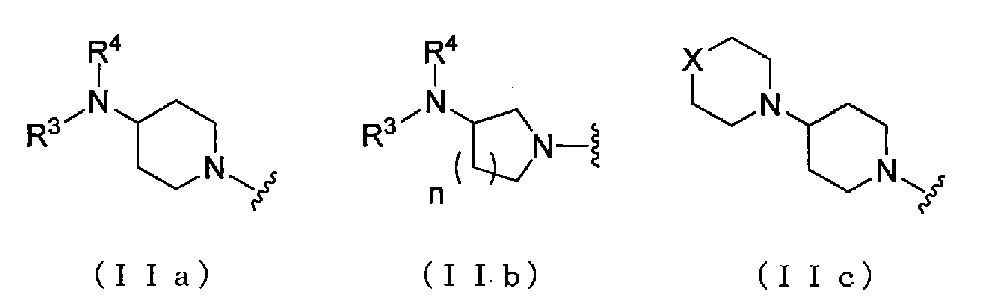


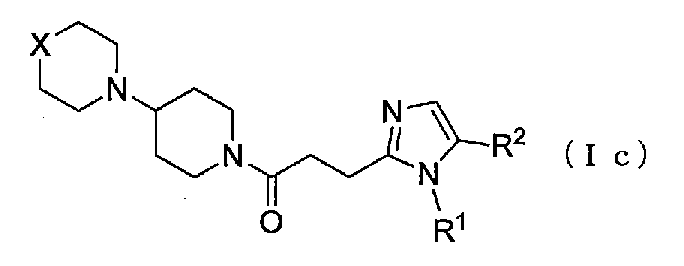


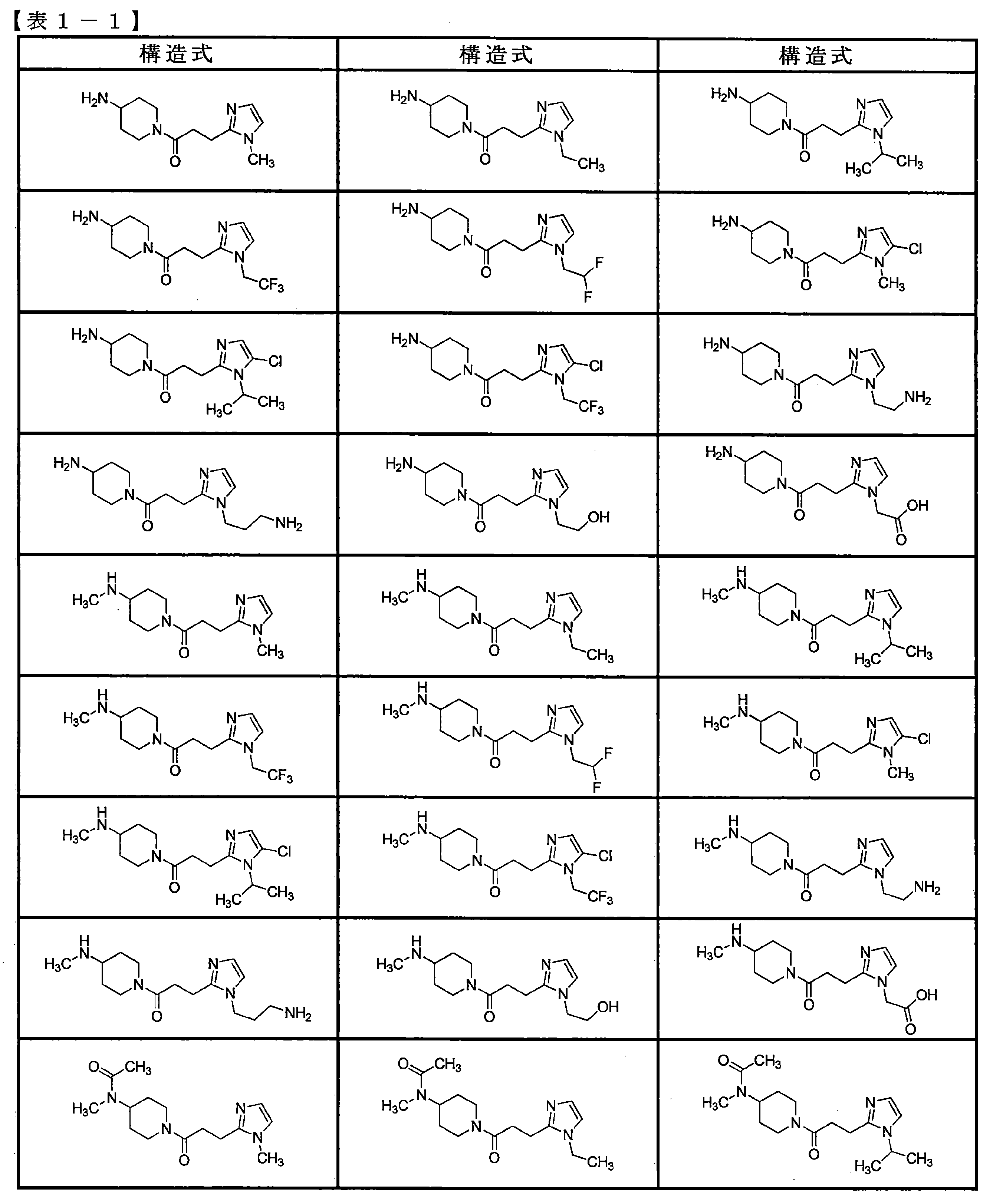
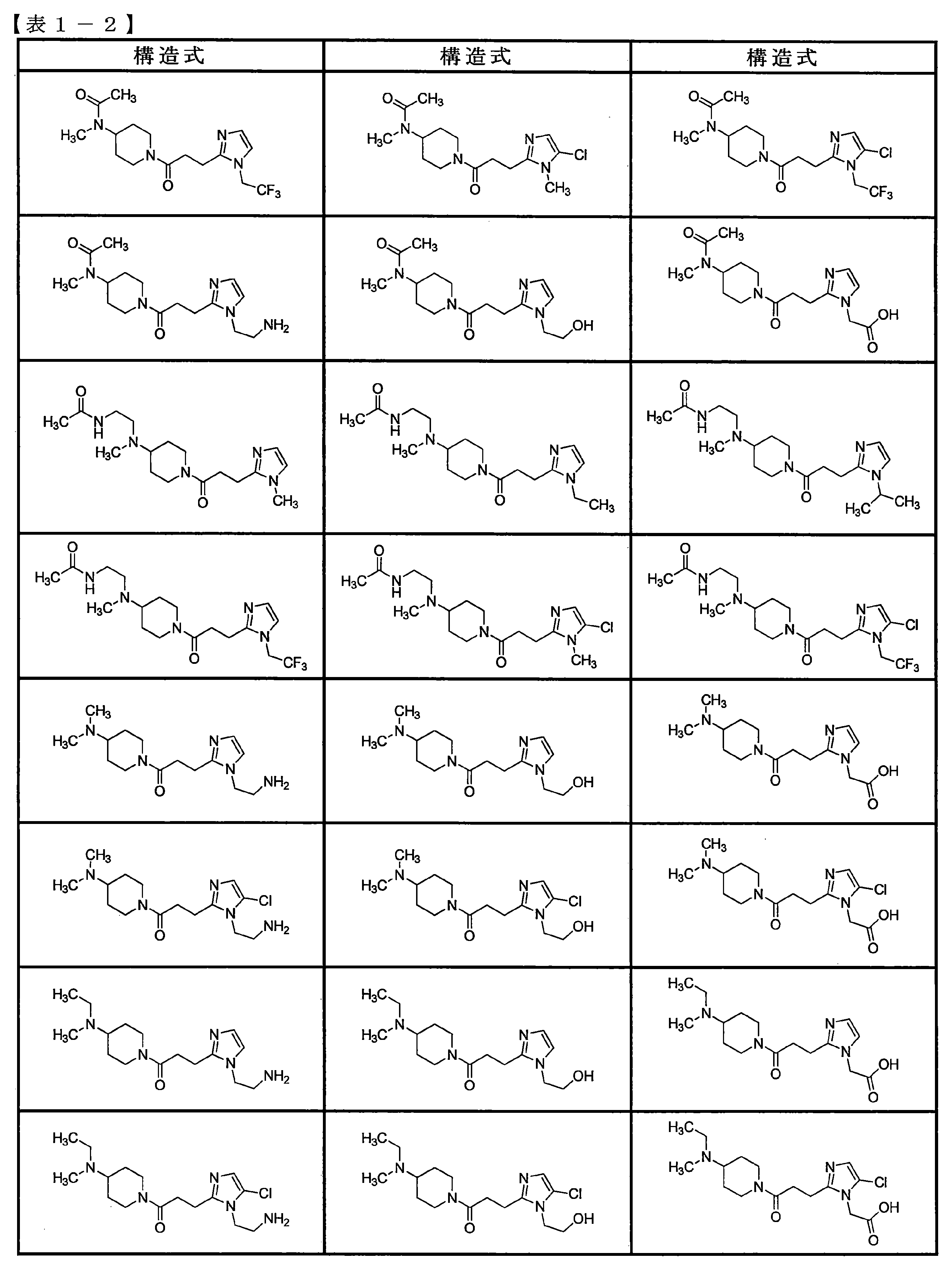
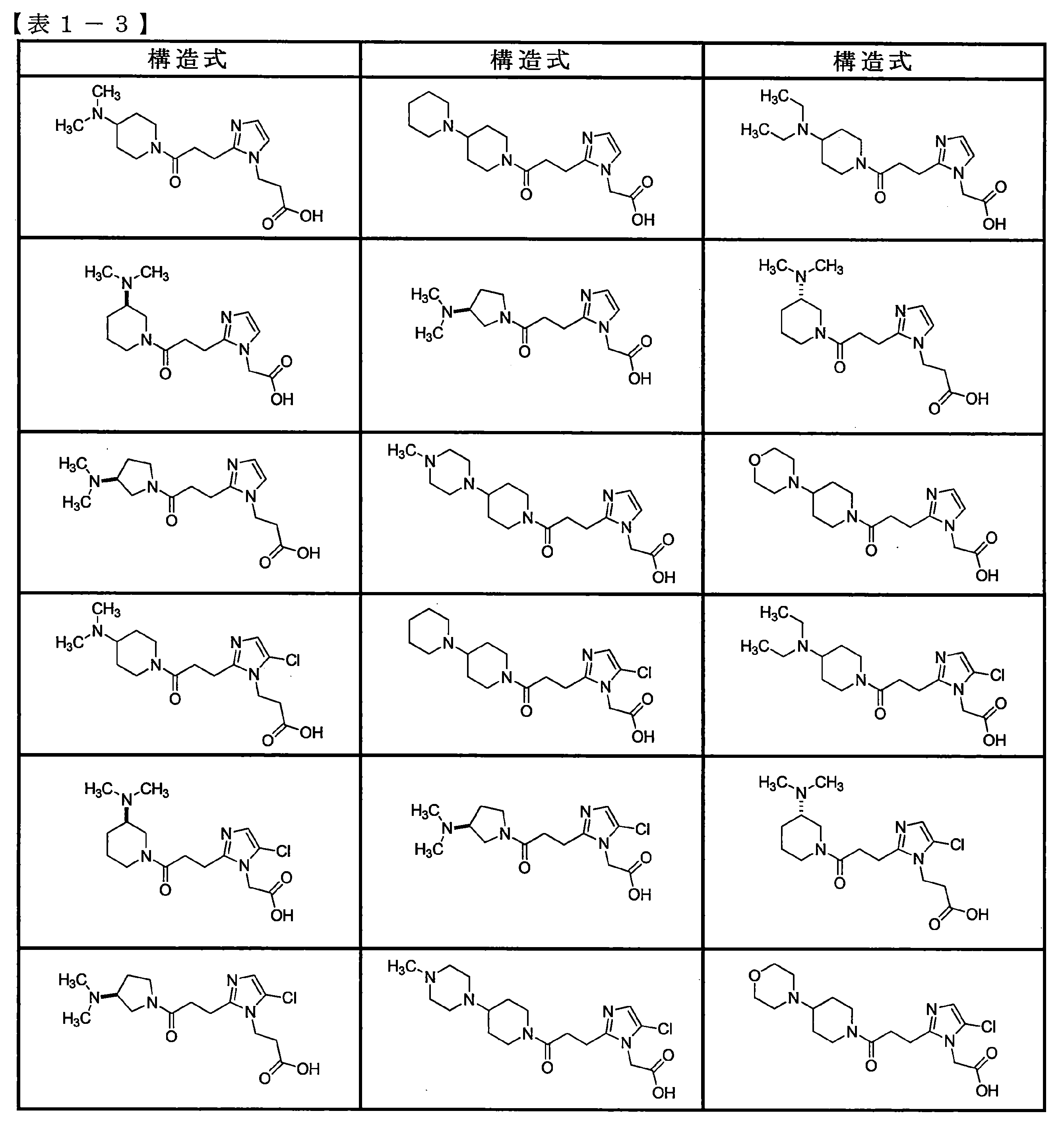
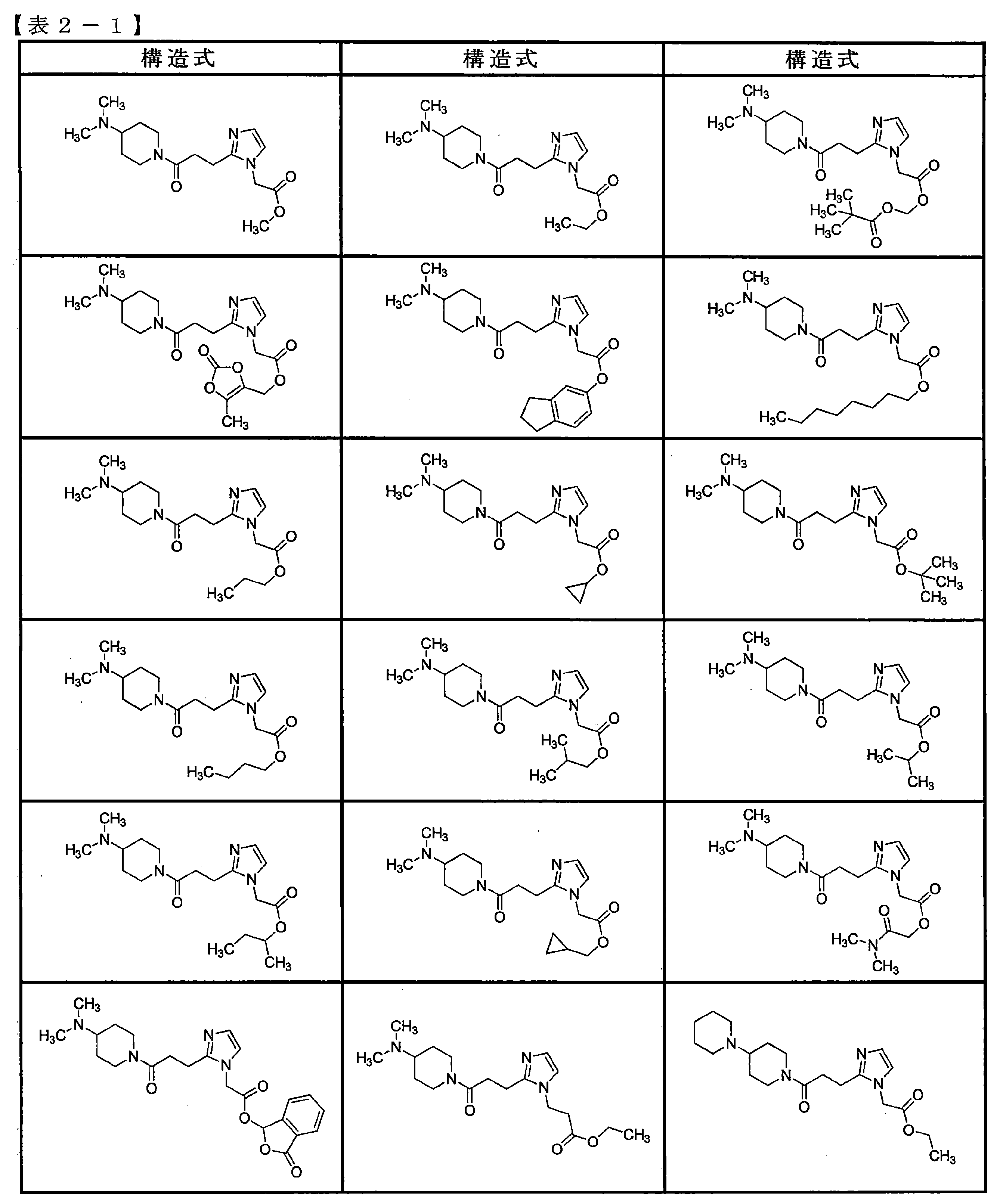
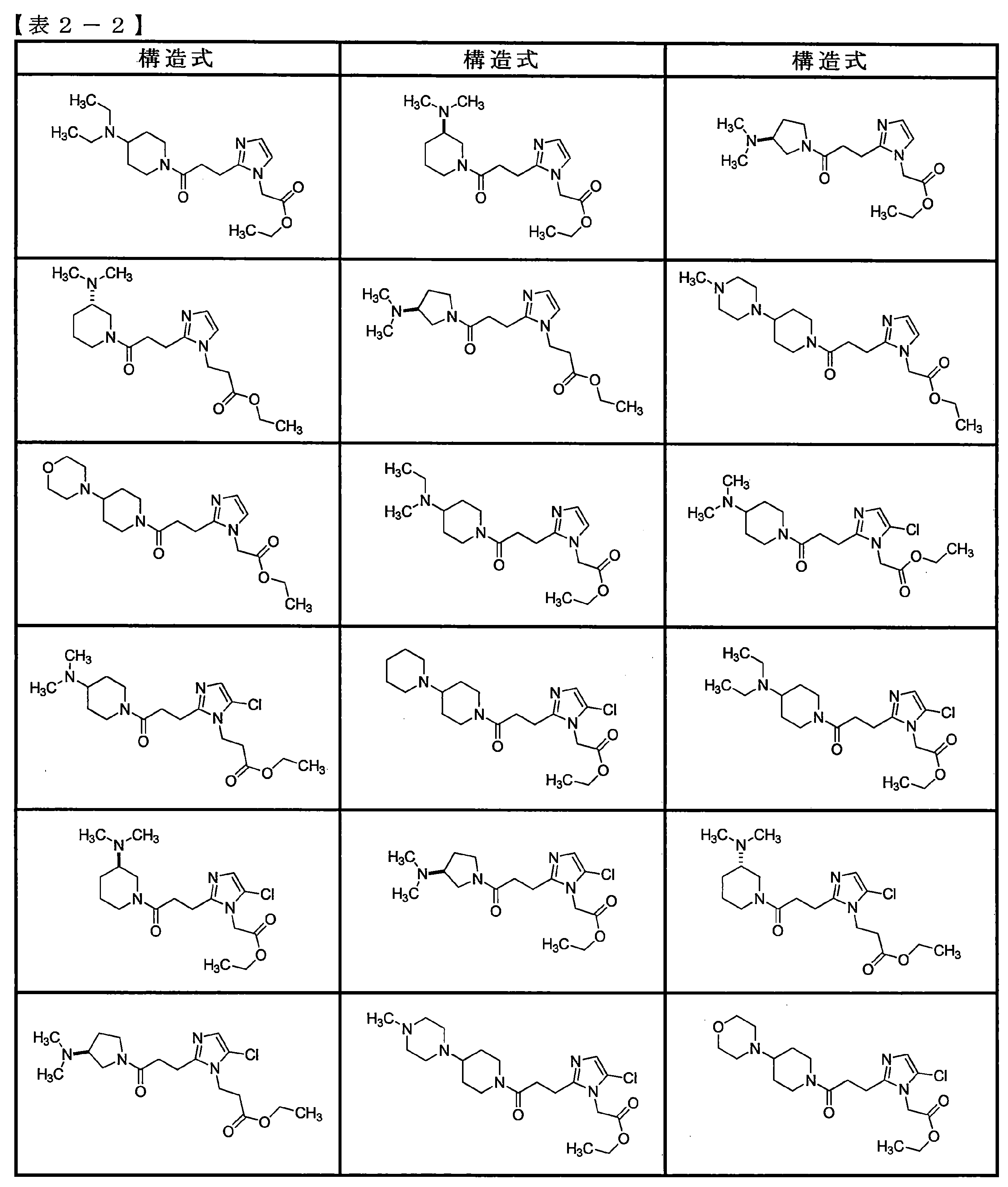
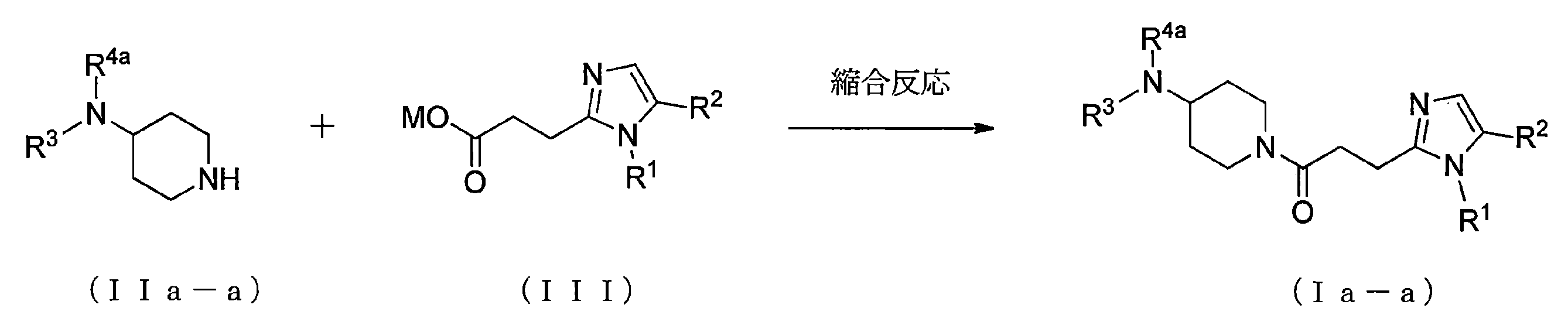
環状アミン誘導体(I)のうち、Aが一般式(IIa)で示される基を表し、かつ、R4が炭素数2~6のアルキルカルボニルアミノ基で置換されていてもよい炭素数1~6のアルキル基を表す化合物(Ia-a)は、例えば、塩基存在下又は非存在下、化合物(IIa-a)と化合物(III)とを縮合剤を用いて縮合反応することにより得られる。

(工程1)
化合物(Ia-b)は、例えば、塩基存在下又は非存在下、化合物(IIa-b)と化合物(III)とを縮合剤を用いて縮合反応することにより得られる。
環状アミン誘導体(I)のうち、Aが一般式(IIa)で示される基であり、かつ、R4が水素原子である化合物(Ia-c)は、化合物(Ia-b)の脱保護により得られる。
環状アミン誘導体(I)のうち、Aが一般式(IIa)で示される基であり、かつ、R4が炭素数2~6のアルキルカルボニル基である化合物(Ia-d)は、例えば、塩基存在下、化合物(Ia-c)と炭素数2~6のカルボン酸ハロゲン化物又は酸無水物等のアシル化剤とを反応させることにより得られる。
化合物(Ia-a)、(Ia-b)、(Ia-c)及び(Ia-d)の薬理学的に許容される塩は、例えば、化合物(Ia-a)、(Ia-b)、(Ia-c)又は(Ia-d)と酸とを混合することによる塩化反応により得られる。
2-1.化合物(IIa-a)の製造方法:

(工程4)
化合物(VIA)は、化合物(IVA)と化合物(VA)との還元的アミノ化反応により得られる。
化合物(IIa-a)は、化合物(VIA)の脱保護により得られる。

(工程6)
化合物(VIIIA)は、化合物(IVA)と化合物(VIIA)との還元的アミノ化反応により得られる。
化合物(IIa-b)は、化合物(VIIIA)の脱保護により得られる。

(工程8)
化合物(X)は、化合物(IX)の塩基による脱プロトン化後にアルキル化試薬(LI)を作用させるアルキル化反応により得られる。
化合物(XI)は、化合物(X)の塩基による脱プロトン化後にホルミル基導入試薬を作用させるホルミル化反応により得られる。
化合物(XI)は、化合物(XII)の塩基による脱プロトン化後にアルキル化試薬(LI)を作用させるアルキル化反応により得られる。
化合物(XIII)は、化合物(XI)のオレフィン化反応により得られる。
(工程12)
化合物(III)のうち、R2が水素原子である化合物(IIIa)は、化合物(XIV)の加水分解反応により得られる。

(工程14)
化合物(XVI)は、化合物(XV)の塩基による脱プロトン化後にアルキル化試薬(LI)を作用させるアルキル化反応により得られる。
化合物(XVI)は、化合物(XVII)の酸化反応により得られる。
化合物(XVIII)は、化合物(XVI)のオレフィン化反応により得られる。
化合物(XIX)は、化合物(XVIII)に対し、水素雰囲気下で遷移金属触媒を用いる還元反応により得られる。
化合物(III)は、化合物(XIX)の加水分解反応により得られる。

(工程19)
化合物(XX)は、化合物(XII)のオレフィン化反応により得られる。
化合物(XIII)は、化合物(XX)の塩基による脱プロトン化後にアルキル化試薬(LI)を作用させるアルキル化反応により得られる。

(工程21)
化合物(XXII)は、化合物(XXI)の酸化反応により得られる。
化合物(XXIII)は、化合物(XXII)のオレフィン化反応により得られる。
化合物(XVIII)は、化合物(XXIII)の塩基による脱プロトン化後にアルキル化試薬(LI)を作用させるアルキル化反応により得られる。
7-1.化合物(Ib-a)の製造方法:
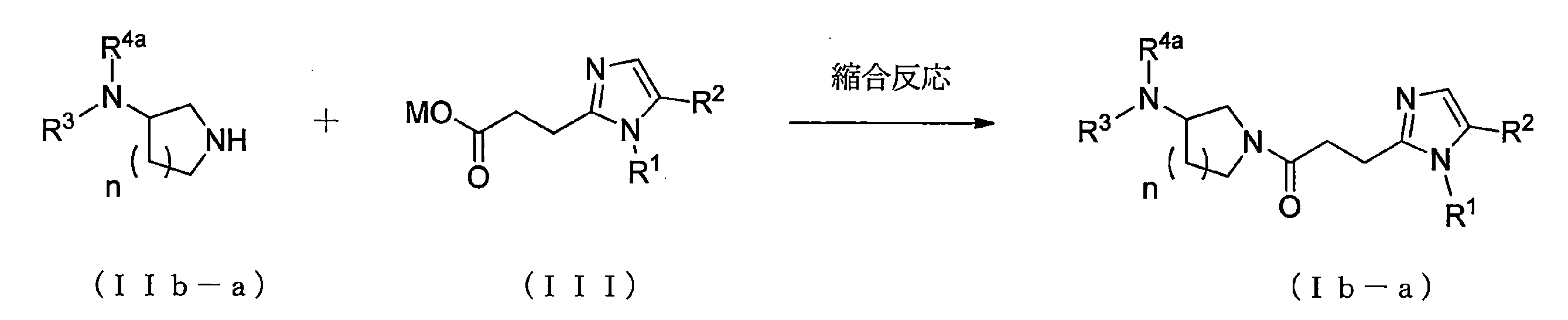
環状アミン誘導体(I)のうち、Aが一般式(IIb)で示される基を表し、かつ、R4が炭素数2~6のアルキルカルボニルアミノ基で置換されていてもよい炭素数1~6のアルキル基を表す化合物(Ib-a)は、例えば、塩基存在下又は非存在下、化合物(IIb-a)と化合物(III)とを縮合剤を用いて縮合反応することにより得られる。

(工程24)
化合物(Ib-b)は、例えば、塩基存在下又は非存在下、化合物(IIb-b)と化合物(III)とを縮合剤を用いて縮合反応することにより得られる。
環状アミン誘導体(I)のうち、Aが一般式(IIb)で示される基であり、かつ、R4が水素原子である化合物(Ib-c)は、化合物(Ib-b)の脱保護により得られる。
環状アミン誘導体(I)のうち、Aが一般式(IIb)で示される基であり、かつ、R4が炭素数2~6のアルキルカルボニル基である化合物(Ib-d)は、例えば、塩基存在下、化合物(Ib-c)と炭素数2~6のカルボン酸ハロゲン化物又は酸無水物等のアシル化剤とを反応させることにより得られる。
化合物(Ib-a)、(Ib-b)、(Ib-c)及び(Ib-d)の薬理学的に許容される塩は、例えば、化合物(Ib-a)、(Ib-b)、(Ib-c)又は(Ib-d)と酸とを混合することによる塩化反応により得られる。
8-1.化合物(IIb-a)の製造方法:
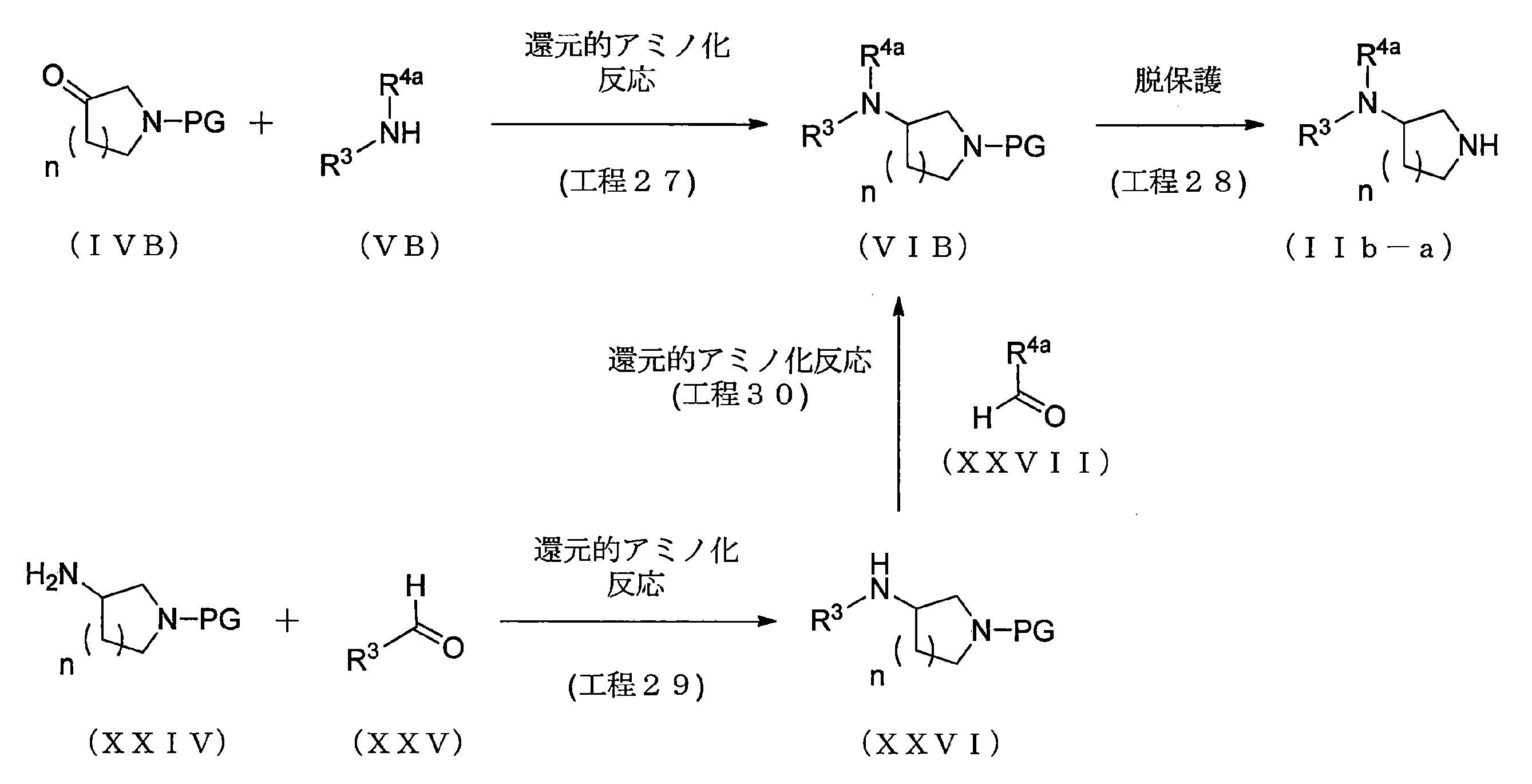
(工程27)
化合物(VIB)は、化合物(IVB)と化合物(VB)との還元的アミノ化反応により得られる。
化合物(IIb-a)は、化合物(VIB)の脱保護により得られる。
(工程29)
化合物(XXV1)は、化合物(XXIV)と化合物(XXV)との還元的アミノ化反応により得られる。
(工程30)
化合物(VIB)は、化合物(XXVI)と化合物(XXVII)との還元的アミノ化反応により得られる。

(工程31)
化合物(VIIIB)は、化合物(IVB)と化合物(VIIB)との還元的アミノ化反応により得られる。
化合物(IIb-b)は、化合物(VIIIB)の脱保護により得られる。
9-1.化合物(Ic)の製造方法:

環状アミン誘導体(I)のうち、Aが一般式(IIc)で示される基を表す化合物(Ic)は、例えば、塩基存在下又は非存在下、化合物(IIc-a)と化合物(III)とを縮合剤を用いて縮合反応することにより得られる。
化合物(Ic)の薬理学的に許容される塩は、例えば、化合物(Ic)と酸とを混合することによる塩化反応により得られる。

(工程33)
化合物(VIC)は、化合物(IVA)と化合物(VC)との還元的アミノ化反応により得られる。
化合物(IIc-a)は、化合物(VIC)の脱保護により得られる。
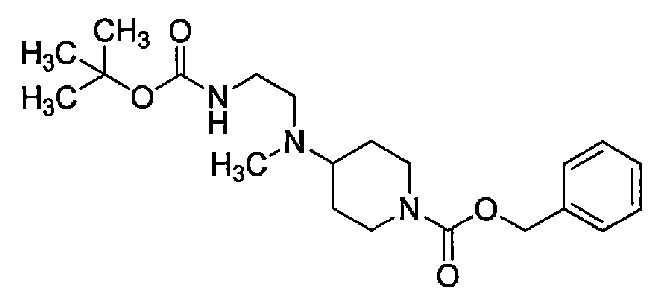
1H-NMR (400 MHz, CDCl3) δ: 1.38-1.46(11H, m), 1.67-1.76(2H, m), 2.22(3H, s), 2.47-2.55(3H, m), 2.64-2.82(2H, m), 3.12-3.21(2H, m), 4.16-4.32(2H, m), 4.90-5.00(1H, m), 5.12 (2H, s), 7.30-7.37(5H, m).
ESI-MS: m/z= 392 (M+H)+.
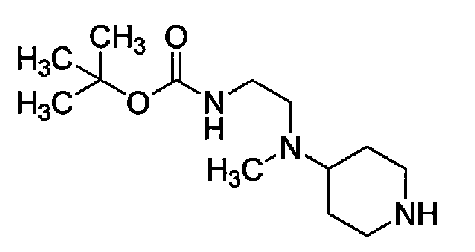
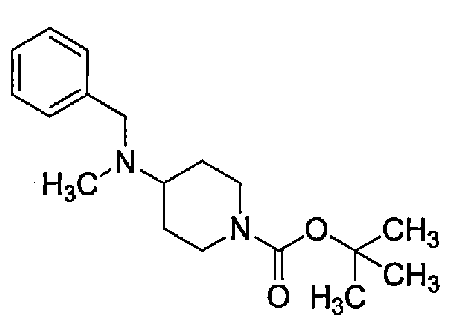
1H-NMR (400 MHz, CDCl3) δ: 1.46(9H, s), 1.48-1.58(2H, m), 1.76-1.84(2H, m), 2.19(3H, s), 2.54-2.75(3H, m), 3.57(2H, s), 4.05-4.25(2H, m), 7.21-7.32(5H, m).
ESI-MS: m/z= 305 (M+H)+.
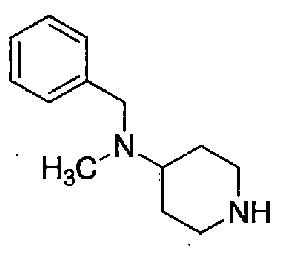
1H-NMR (400 MHz, CDCl3) δ: 1.44-1.56(3H, m), 1.80-1.88(2H, m), 2.21(3H, s), 2.49-2.63(3H, m), 3.12-3.19(2H, m), 3.58(2H, s), 7.22-7.32(5H, m).
ESI-MS: m/z= 205 (M+H)+.
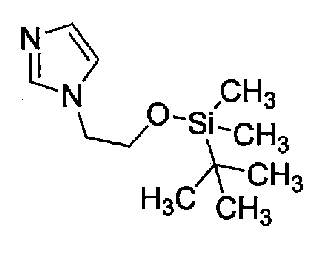
1H-NMR (400 MHz, CDCl3) δ: -0.03 (6H, s), 0.86 (9H, s), 3.84 (2H, t, J=5.1 Hz), 4.03 (2H, t, J=5.1 Hz), 6.95 (1H, s), 7.05 (1H, s), 7.51 (1H, s).
ESI-MS: m/z= 227 (M+H)+.
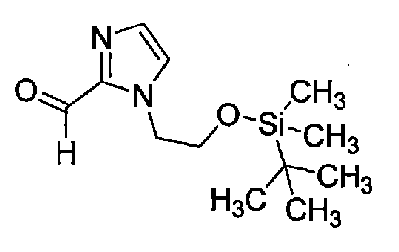
1H-NMR (400 MHz, CDCl3) δ: -0.09 (6H, s), 0.83 (9H, s), 3.88 (2H, t, J=4.9 Hz), 4.51 (2H, t, J=4.9 Hz), 7.23 (1H, s), 7.27 (1H, s), 9.81 (1H, s).
ESI-MS: m/z= 255 (M+H)+.
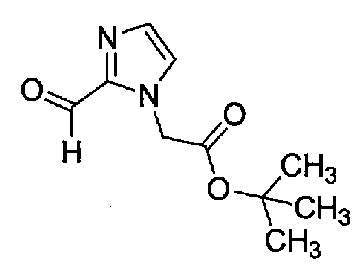
1H-NMR (400 MHz, CDCl3) δ: 1.48 (9H, s), 5.03 (2H, s), 7.13 (1H, s), 7.32 (1H, s), 9.80 (1H, s).
ESI-MS: m/z= 211 (M+H)+.
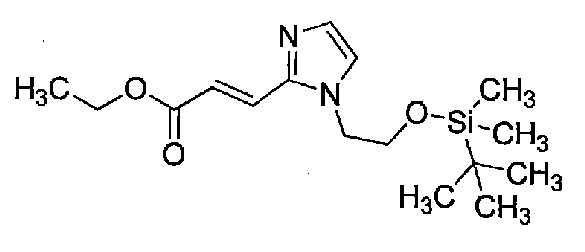
1H-NMR (400 MHz, CDCl3) δ: -0.08 (6H, s), 0.86 (9H, s), 1.32 (3H, t, J=7.1 Hz), 3.84 (2H, t, J=5.1 Hz), 4.15 (2H, t, J=5.1 Hz), 4.26 (3H, q, J=7.1 Hz), 6.84 (1H, d, J=15.4 Hz), 7.04 (1H, s), 7.16 (1H, s), 7.52 (1H, d, J=15.4 Hz).
ESI-MS: m/z= 325 (M+H)+.
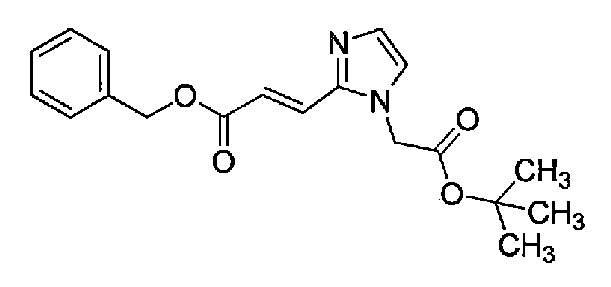
1H-NMR (400 MHz, CDCl3) δ: 1.45 (9H, s), 4.67 (2H, s), 5.25 (2H, s), 6.90 (1H, d, J=15.4 Hz), 7.01 (1H, s), 7.20 (1H, s), 7.31-7.44 (6H, s).
ESI-MS: m/z= 343 (M+H)+.
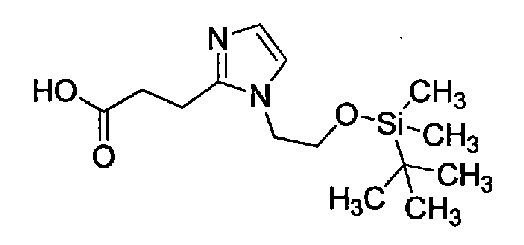


1H-NMR (400 MHz, CDCl3) δ: 1.43-1.56(2H, m), 1.80-1.88(2H, m), 2.18(3H, s), 2.51-2.70(2H, m), 2.88-3.05(5H, m), 3.56(2H, s), 3.62(3H, s), 4.00-4.07(1H, m), 4.62-4.69(1H, m), 6.79(1H, d, J=1.2Hz), 6.91(1H, d, J=1.2Hz), 7.22-7.34(5H, m).
ESI-MS: m/z= 341 (M+H)+.
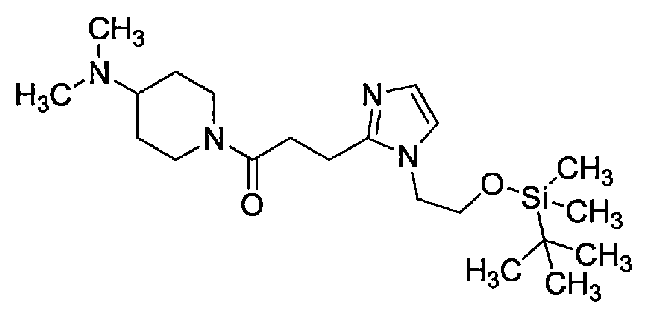
1H-NMR (400 MHz, CDCl3) δ: -0.05 (6H, s), 0.84 (9H, s), 1.30-1.42 (2H, m), 1.82-1.85 (2H, m), 2.27-2.36 (7H, m), 2.55-2.63 (1H, m), 2.90-3.03 (5H, m), 3.82 (2H, t, J=5.4 Hz), 4.01-4.05 (3H, m), 4.60-4.63 (1H, m), 6.88 (1H, d, J=1.2 Hz), 6.92 (1H, d, J=1.2 Hz).
ESI-MS: m/z= 409 (M+H)+.

1H-NMR (400 MHz, CDCl3) δ: 1.29-1.42 (2H, m), 1.47 (9H, s), 1.81-1.83 (2H, m), 2.27-2.36 (7H, m), 2.55-2.62 (1H, m), 2.91 (4H, s), 2.96-3.03 (1H, m), 3.98-4.01 (1H, m), 4.57-4.60 (1H, m), 4.63 (2H, s), 6.81 (1H, d, J=1.2 Hz), 6.96 (1H, d, J=1.2 Hz).

1H-NMR (400 MHz, CDCl3) δ: 1.34-1.46(11H, m), 1.71-1.80(2H, m), 2.19-2.23(3H, m), 2.47-2.60(4H, m), 2.88-3.00(5H, m), 3.12-3.20(2H, m), 3.62(3H, s), 4.00-4.08(1H, m), 4.62-4.70(1H, m), 4.91-4.98(1H, m), 6.79(1H, d, J=1.2Hz), 6.91(1H, d, J=1.2Hz).
ESI-MS: m/z= 394 (M+H)+.

1H-NMR (400 MHz, CDCl3) δ: 1.31-1.46(2H, m), 1.64-1.85(2H, m), 2.20(3H, m), 2.43-2.60(4H, m), 2.68-2.74(2H, m), 2.86-3.00(5H, m), 3.60(3H, s), 3.96-4.06(1H, m), 4.60-4.68(1H, m), 6.77(1H, brs), 6.88(1H, brs).
ESI-MS: m/z= 294 (M+H)+.
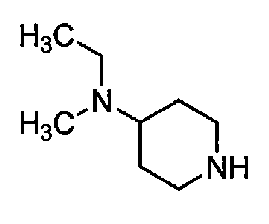
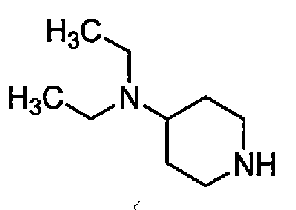

1H-NMR (400 MHz, CDCl3) δ: 1.35-1.50 (4H, m), 1.53-1.67 (4H, m), 1.82 (2H, d, J=12.4 Hz), 2.34 (1H, tt, J=11.2, 4.0 Hz), 2.45-2.65(6H, m), 3.13 (2H, d, J=12.4 Hz).
ESI-MS: m/z= 169 (M+H)+.
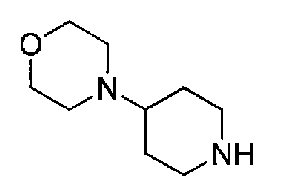
1H-NMR (400 MHz, CDCl3) δ: 1.34 (2H, dd, J=12.0, 4.0 Hz), 1.40 (2H, dd, J=12.0, 4.0 Hz), 1.85 (2H, d, J=12.4 Hz), 2.28 (1H, tt, J=11.2, 4.0 Hz), 3.53-3.63 (6H, m), 3.15 (2H, d, J=12.4 Hz), 3.73 (4H, t, J=4.4 Hz).
ESI-MS: m/z= 171 (M+H)+
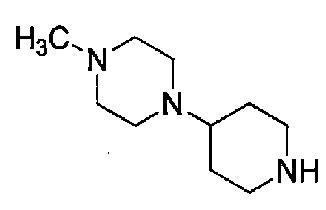
1H-NMR (400 MHz, CDCl3) δ: 1.35 (2H, dd, J=12.0, 3.6 Hz), 1.41 (2H, dd, J=12.0, 3.6 Hz), 1.85 (2H, d, J=12.8 Hz), 1.96-2.06 (2H, br), 2.28 (3H, s), 2.32 (1H, tt, J=11.6, 3.6 Hz), 3.37-3.70 (8H, m), 3.14 (2H, d, J=12.8 Hz).
ESI-MS: m/z= 169 (M+H)+.
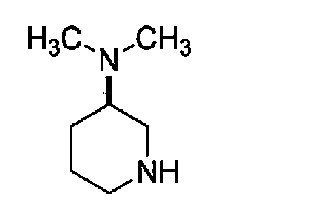
1H-NMR (400 MHz, CDCl3) δ: 1.22-1.50 (2H, m), 1.73-1.78 (1H, m), 1.93-2.01 (1H, m), 2.15 (1H, tt, J=10.0, 3.6 Hz), 2.29 (6H, s), 2.45-2.53 (2H, m), 2.92-2.96 (1H, m), 3.15-3.22 (1H, m).
ESI-MS: m/z= 129 (M+H)+.

1H-NMR (400 MHz, CDCl3) δ: 1.22-1.50 (2H, m), 1.73-1.78 (1H, m), 1.93-2.01 (1H, m), 2.15 (1H, tt, J=10.0, 3.6 Hz), 2.29 (6H, s), 2.45-2.53 (2H, m), 2.92-2.96 (1H, m), 3.15-3.22 (1H, m).
ESI-MS: m/z= 129 (M+H)+.
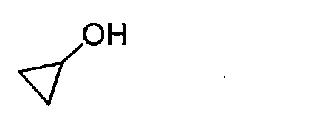


1H-NMR (400 MHz, CDCl3) δ: 2.88 (3H, s), 3.03 (3H, s), 4.14 (2H, brs).

1H-NMR (400 MHz, CDCl3) δ: 1.29 (3H, t, J=7.2 Hz), 4.25 (2H, q, J=7.2 Hz), 5.14 (2H, s), 7.15 (1H, brs), 7.33 (1H, s), 9.79-9.91 (1H, m).
ESI-MS: m/z= 183 (M+H)+.
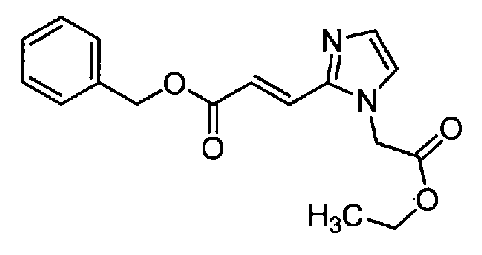
1H-NMR (400 MHz, CDCl3) δ: 1.28 (3H, t, J=7.2 Hz), 4.24 (2H, q, J=7.2 Hz), 4.77 (2H, s), 5.25 (2H, s), 6.92 (1H, d, J=15.6 Hz), 7.02 (1H, brs), 7.21 (1H, brs), 7.28-7.45 (6H, m).
ESI-MS: m/z= 315 (M+H)+.
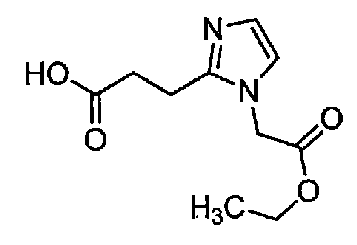

1H-NMR (400 MHz, CDCl3) δ: 5.25 (2H, s), 6.62 (1H, d, J=15.6 Hz), 7.14-7.23(2H, m), 7.28-7.43 (5H, m), 7.57 (1H, d, J=16.0 Hz).
ESI-MS: m/z= 229 (M+H)+.
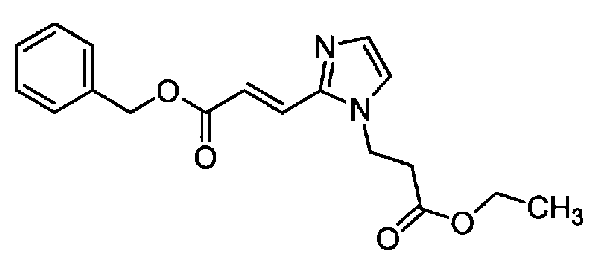
1H-NMR (400 MHz, CDCl3) δ: 1.23 (3H, t, J=7.2 Hz), 2.76 (2H, t, J=7.2 Hz), 4.13 (2H, q, J=7.2 Hz), 4.35 (2H, t, J=7.2 Hz), 5.26 (2H, s), 6.91 (1H, d, J=15.6 Hz), 7.06 (1H, brs), 7.15 (1H, brs), 7.30-7.42 (5H, m), 7.55 (1H, d, J=15.6 Hz).
ESI-MS: m/z= 329 (M+H)+.

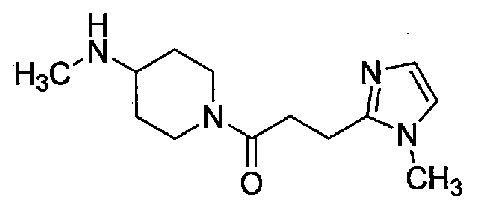
1H-NMR (400 MHz, CDCl3) δ: 1.17-1.28(2H, m), 1.85-1.94(2H, m), 2.44(3H, s), 2.54-2.62(1H, m), 2.72-2.81(1H, m), 2.88-3.00(4H, m), 3.03-3.13(1H, m), 3.62(3H, s), 3.90-3.98(1H, m), 4.41-4.49(1H, m), 6.79(1H, d, J=1.2Hz), 6.91(1H, d, J=1.2Hz).
ESI-MS: m/z= 251 (M+H)+.
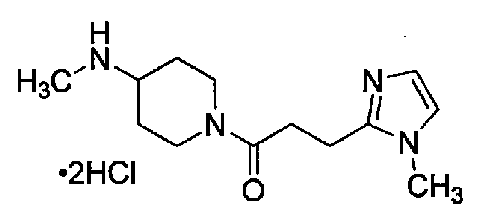
1H-NMR (400 MHz, D2O) δ: 1.40-1.68(2H, m), 2.13-2.26(2H, m), 2.72-2.80(4H, m), 3.01-3.08(2H, m), 3.15-3.26(3H, m), 3.33-3.43(1H, m), 3.82(3H, s), 4.01-4.13(1H, m), 4.43-4.52(1H, m), 7.28-7.34(2H, m).
ESI-MS: 3-(1-メチル-1H-イミダゾール-2-イル)-1-(4-(メチルアミノ)ピペリジン-1-イル)プロパン-1-オンとして: m/z= 251 (M+H)+.
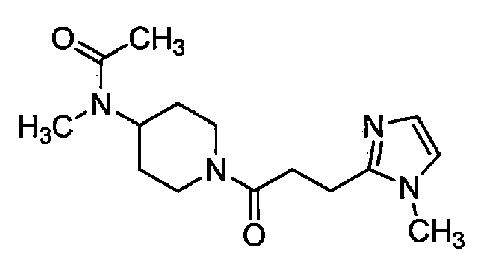
1H-NMR (400 MHz, CD3OD) δ: 1.43-1.72(4H, m), 2.01-2.12(3H, m), 2.52-2.93(8H, m), 3.00-3.14(1H, m), 3.59-3.61(3H, m), 3.96-4.05(1H, m), 4.47-4.60(2H, m), 6.74-6.78(1H, m), 6.87-6.90(1H, m).
ESI-MS: m/z= 293 (M+H)+.

1H-NMR (400 MHz, D2O) δ: 1.55-1.85(4H, m), 2.08-2.19(3H, m), 2.66-2.89(4H, m), 2.98-3.05(2H, m), 3.13-3.25(3H, m), 3.80(3H, s), 3.95-4.05(1H, m), 4.38-4.53(2H, m), 7.27-7.30(2H, m).
ESI-MS: N-メチル-N-(1-(3-(1-メチル-1H-イミダゾール-2-イル)プロパノイル)ピペリジン-4-イル)アセトアミドとして: m/z= 293 (M+H)+.
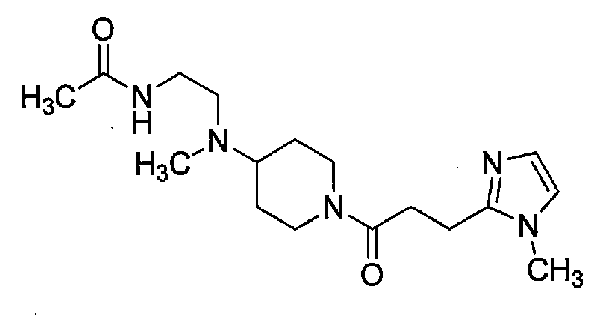
1H-NMR (400 MHz, CDCl3) δ: 1.30-1.42(2H, m), 1.70-1.80(2H, m), 1.97 (3H, s), 2.21(3H, m), 2.46-2.62(4H, m), 2.87-3.01(5H, m), 3.25-3.32(2H, m), 3.61(3H, s), 4.00-4.08(1H, m), 4.63-4.72(1H, m), 5.97-6.05(1H, m), 6.78(1H, d, J=1.2Hz), 6.90(1H, d, J=1.2Hz).
ESI-MS: m/z= 336 (M+H)+.
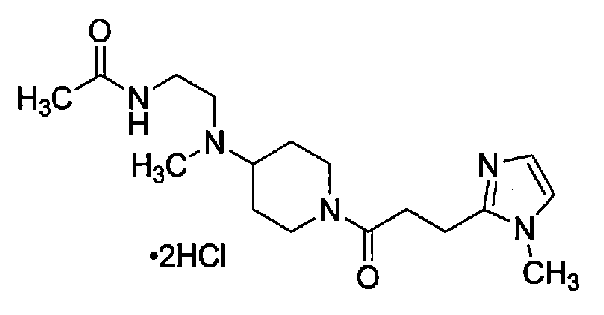
1H-NMR (400 MHz, D2O) δ: 1.60-1.85(2H, m), 2.04(3H, s), 2.07-2.20(2H, m), 2.70-2.80(1H, m), 2.88(3H, s), 3.02-3.10(2H, m), 3.18-3.30(4H, m), 3.40-3.52(1H, m), 3.60-3.75(3H, m), 3.84(3H, s), 4.10-4.18(1H, m), 7.31-7.35(2H, m), 7.52-7.60(1H, m).
ESI-MS: N-(2-(メチル(1-(3-(1-メチル-1H-イミダゾール-2-イル)プロパノイル)ピペリジン-4-イル)アミノ)エチル)アセトアミドとして: m/z= 336 (M+H)+.
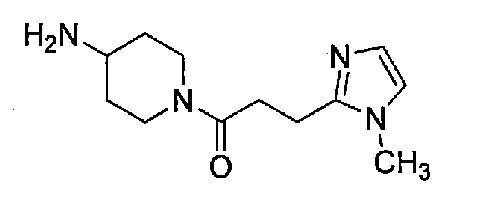
1H-NMR (400 MHz, CDCl3) δ: 1.16-1.28(2H, m), 1.79-1.89(2H, m), 2.65-2.75(1H, m), 2.85-3.10(6H, m), 3.62(3H, s), 3.90-3.98(1H, m), 4.45-4.54(1H, m), 6.79(1H, d, J=1.2Hz), 6.91(1H, d, J=1.2Hz).
ESI-MS: m/z= 237 (M+H)+.
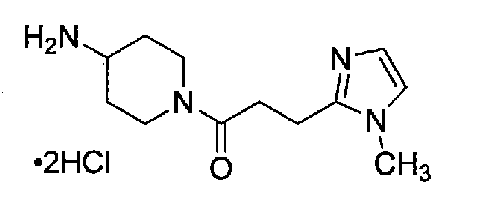
1H-NMR (400 MHz, D2O) δ: 1.46-1.69 (2H, m), 2.09-2.16 (2H, m), 2.76-2.83 (1H, m), 3.04-3.07 (2H, m), 3.20-3.25 (3H, m), 3.48-3.53 (1H, m), 3.84 (3H, s), 4.02-4.06 (1H, m), 4.43-4.46 (2H, m), 7.26 (2H, s).
ESI-MS: 1-(4-アミノピペリジン-1-イル)-3-(1-メチル-1H-イミダゾール-2-イル)プロパン-1-オンとして: m/z= 237 (M+H)+.

1H-NMR (400 MHz, CDCl3) δ: 1.19-1.34(2H, m), 1.88-2.02(4H, m), 2.07-2.20(1H, m), 2.65-2.75(1H, m), 2.82-3.02(4H, m), 3.05-3.15(1H, m), 3.60(3H, s), 3.88-4.02(2H, m), 4.45-4.55(1H, m), 5.68-5.82(1H, m), 6.77(1H, d, J=1.2Hz), 6.87(1H, d, J=1.2Hz).
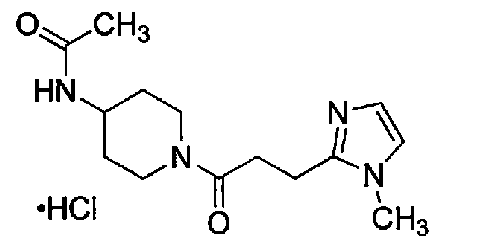
1H-NMR (400 MHz, D2O) δ: 1.30-1.50(2H, m), 1.85-1.99(5H, m), 2.83-2.94(1H, m), 2.97-3.06(2H, m), 3.17-3.30(3H, m), 3.79-3.93(5H, m), 4.17-4.27(1H, m), 7.27-7.33(2H, m).
ESI-MS: N-(1-(3-(1-メチル-1H-イミダゾール-2-イル)プロパノイル)ピペリジン-4-イル)アセトアミドとして: m/z= 279 (M+H)+.
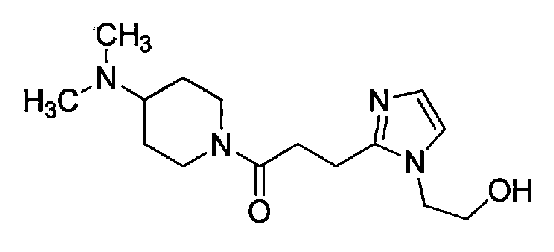
1H-NMR (400 MHz, CDCl3) δ: 1.26-1.41 (2H, m), 1.78-1.86 (2H, m), 2.26-2.36 (7H, m), 2.52-2.59 (1H, m), 2.95-3.03 (5H, m), 3.88 (2H, t, J=4.9 Hz), 3.96-4.00 (1H, m), 4.09 (2H, t, J=4.9 Hz), 4.51-4.55 (1H, m), 6.85 (1H, s), 6.90 (1H, s).
ESI-MS: m/z= 295 (M+H)+.

1H-NMR (400 MHz, D2O) δ: 1.54-1.76 (2H, m), 2.13-2.20 (2H, m), 2.70-2.78 (1H, m), 2.87 (6H, s), 3.05-3.08 (2H, m), 3.16-3.30 (3H, m), 3.52 (2H, tt, J=12.0, 4.0 Hz), 3.96 (2H, t, J=5.0 Hz), 4.09-4.12 (1H, m), 4.33 (2H, t, J=5.0 Hz), 4.53-4.57 (1H, m), 7.37-7.44 (2H, m).
ESI-MS: 1-(4-(ジメチルアミノ)ピペリジン-1-イル)-3-(1-(2-ヒドロキシエチル)-1H-イミダゾール-2-イル)プロパン-1-オンとして:m/z= 295 (M+H)+.

1H-NMR (400 MHz, D2O) δ: 1.54-1.76 (2H, m), 2.13-2.19 (2H, m), 2.70-2.76 (1H, m), 2.87 (6H, s), 2.99-3.02 (2H, m), 3.15-3.24 (3H, m), 3.47-3.55 (1H, m), 4.06-4.10 (1H, m), 4.53-4.56 (1H, m), 5.02 (2H, s), 7.39 (2H, s).
ESI-MS: 2-(2-(3-(4-(ジメチルアミノ)ピペリジン-1-イル)-3-オキソプロピル)-1H-イミダゾール-1-イル)酢酸として:m/z= 307 (M-H)-.

1H-NMR (400 MHz, CDCl3) δ: 1.30-1.43 (2H, m), 1.81-1.87 (2H, m), 2.27 (6H, s), 2.34 (1H, tt, J=11.0, 3.8 Hz) 2.56-2.63 (1H, m), 2.92-3.05 (7H, m), 3.98-4.04 (3H, m), 4.59-4.62 (1H, m), 6.88 (1H, t, J=1.2 Hz), 6.96 (1H, t, J=1.2 Hz).
ESI-MS: m/z= 294 (M+H)+.
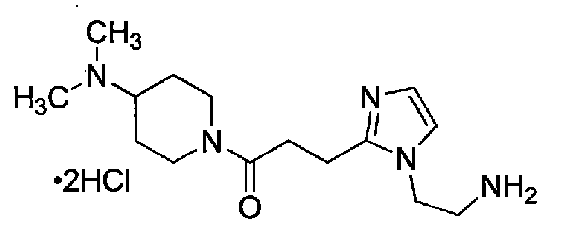
1H-NMR (400 MHz, D2O) δ: 1.55-1.81 (2H, m), 2.14-2.22 (2H, m), 2.71-2.77 (1H, m), 2.88 (6H, s), 3.06-3.31 (5H, m), 3.50-3.60 (3H, m), 4.12-4.15 (1H, m), 4.52-4.55 (1H, m), 4.61 (2H, t, J=6.6 Hz), 7.44-7.51 (2H, m).
ESI-MS: 3-(1-(2-(アミノエチル)-1H-イミダゾール-2-イル)-1-(4-(ジメチルアミノ)ピペリジン-1-イル)プロパン-1-オンとして:m/z= 294 (M+H)+.

1H-NMR (400 MHz, CDCl3) δ: 1.06 (3H, t, J=7.2 Hz), 1.25-1.45 (5H, m), 1.73-1.83 (2H, m), 2.23 (3H, s), 2.48-2.63 (4H, m), 2.88-3.03 (5H, m), 3.97-4.05 (1H, m), 4.19-4.26 (2H, m), 4.58-4.65 (1H, m), 4.75 (2H, s), 6.80-6.82 (1H, m), 6.95-6.97 (1H, m).
ESI-MS: m/z= 351 (M+H)+.

1H-NMR (400 MHz, DMSO-d6) δ: 1.15-1.24 (3H, m), 1.33-1.65 (2H, m), 1.86-1.97 (2H, m), 2.25-2.70 (6H, m), 2.72-2.80 (3H, m), 2.95-3.12 (3H, m), 3.95-4.05 (1H, m), 4.44-4.54 (1H, m), 4.76-4.83 (2H, m), 6.74-6.85 (1H, m), 7.00-7.09 (1H, m).
ESI-MS: m/z= 323 (M+H)+.
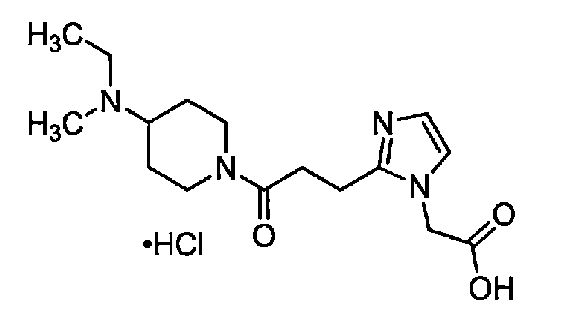
1H-NMR (400 MHz, D2O) δ: 1.28-1.35 (3H, m), 1.54-1.82 (2H, m), 2.05-2.16 (2H, m), 2.68-2.81 (4H, m), 2.96-3.04 (2H, m), 3.12-3.24 (4H, m), 3.28-3.38 (1H, m), 3.54-3.64 (1H, m), 4.02-4.10 (1H, m), 4.48-4.58 (1H, m), 4.98 (2H, s), 7.35-7.38 (2H, m).
ESI-MS: 2-(2-(3-(4-(エチルメチルアミノ)ピペリジン-1-イル)-3-オキソプロピル)-1H-イミダゾール-1-イル)酢酸として: m/z= 323 (M+H)+.
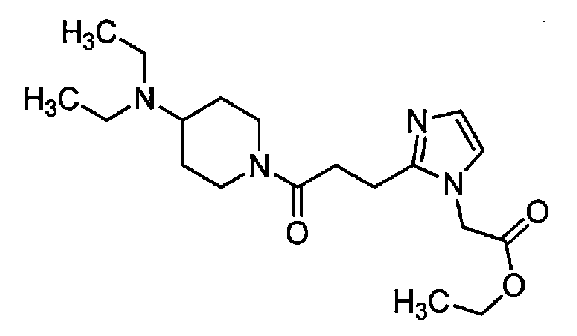
1H-NMR (400 MHz, CDCl3) δ: 1.03 (6H, t, J=7.2 Hz), 1.25-1.43 (5H, m), 1.72-1.82 (2H, m), 2.47-2.58 (4H, m), 2.65-2.77 (1H, m), 2.88-3.00 (6H, m), 3.95-4.04 (1H, m), 4.23 (2H, q, J=6.8 Hz), 4.58-4.65 (1H, m), 4.75 (2H, s), 6.80-6.83 (1H, m),6.95-6.97 (1H, m).
ESI-MS: m/z= 365 (M+H)+.

1H-NMR (400 MHz, D2O) δ: 1.25-1.36 (9H, m), 1.55-1.78 (2H, m), 2.08-2.18 (2H, m), 2.68-2.77 (1H, m), 2.95-3.05 (2H, m), 3.13-3.35 (7H, m),3.60-3.70 (1H, m), 4.02-4.08 (1H, m), 4.29 (2H, q, J=7.6 Hz), 4.48-4.55 (1H, m), 5.17 (2H, m), 7.34-7.40 (2H, m).
ESI-MS: 2-(2-(3-(4-(ジエチルアミノ)ピペリジン-1-イル)-3-オキソプロピル)-1H-イミダゾール-1-イル)酢酸エチルとして: m/z=365 (M+H)+

1H-NMR (400 MHz, CD3OD) δ: 1.36 (3H, t, J=7.6 Hz), 1.56-1.86 (2H, m), 2.03-2.13 (2H, m), 2.64-2.75 (1H, m), 2.87-3.06 (2H, m), 3.12-3.28 (10H, m), 3.58-3.66 (1H, m), 4.02-4.10 (1H, m), 4.62-4.70 (1H, m), 5.05 (2H, s), 7.42-7.47 (2H, m).
ESI-MS: m/z= 337 (M+H)+.
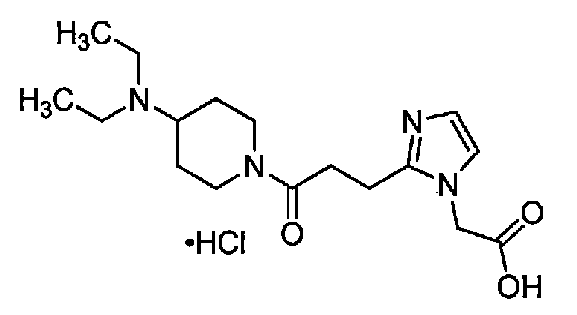
1H-NMR (400 MHz, D2O) δ: 1.27-1.34 (6H, m), 1.55-1.80 (2H, m), 2.06-2.17 (2H, m), 2.68-2.76 (1H, m), 2.95-3.02 (2H, m), 3.13-3.35 (7H, m), 3.59-3.69 (1H, m), 4.01-4.08 (1H, m), 4.48-4.56 (1H, m), 4.95 (2H, s), 7.33-7.36 (2H, m).
ESI-MS: 2-(2-(3-(4-(ジエチルアミノ)ピペリジン-1-イル)-3-オキソプロピル)-1H-イミダゾール-1-イル)酢酸として: m/z= 337 (M+H)+.
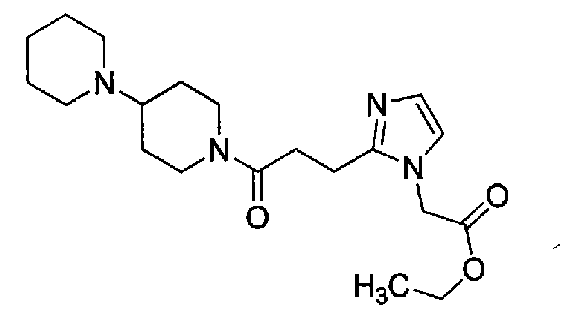
1H-NMR (400 MHz, CDCl3) δ: 1.29 (3H, t, J=7.2 Hz), 1.36-1.48 (4H, m), 1.54-1.63 (4H, m), 1.7-1.86 (2H, m), 2.40-2.58 (6H, m), 2.85-3.00 (1H, m), 2.91 (4H, s), 3.96-4.03 (1H, m), 4.23 (2H, t, J=7.2 Hz), 4.57-4.65 (1H, m), 4.75 (2H, q, J=7.2 Hz), 6.82 (1H, d, J=1.2 Hz), 6.97 (1H, d, J=1.2 Hz).
ESI-MS: m/z= 377 (M+H)+.

1H-NMR (400 MHz, D2O) δ: 1.35-1.90 (8H, m), 1.93-2.03 (2H, m), 2.55 (1H, t, J=12.0 Hz), 3.30 (1H, tt, J=12.0, 3.6 Hz), 3.88-4.00 (1H, m), 4.36-4.45 (1H, m), 4.48 (1H, s), 6.84 (1H, d, J=1.2 Hz), 6.92 (1H, d, J=1.2 Hz).
ESI-MS: m/z= 349 (M+H)+.
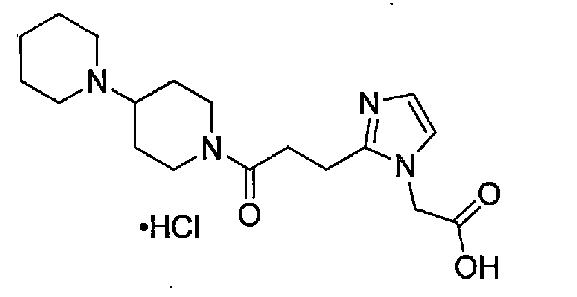
1H-NMR (400 MHz, D2O) δ: 1.26-1.72 (6H, m), 1.83 (2H, d, J=14.4 Hz), 2.02 (2H, t, J=12.8 Hz), 2.57 (1H, t, J=12.8 Hz), 2.83-2.95 (4H, m), 2.97-3.14 (3H, m), 3.27-3.43 (3H, m), 3.88-3.98 (1H, m), 4.33-4.43 (1H, m), 4.99 (2H, s), 7.27 (2H, s).
ESI-MS: 2-(2-(3-(4-(ピペリジン-1-イル)ピペリジン-1-イル)-3-オキソプロピル)-1H-イミダゾール-1-イル)酢酸として: 349 (M+H)+.

1H-NMR (400 MHz, CDCl3) δ: 1.29 (3H, t, J=7.2 Hz), 1.30-1.45 (2H, m), 1.81-1.92 (2H, m), 2.39 (1H, tt, J=10.8, 3.6 Hz), 2.53 (4H, t, J=4.8 Hz), 2.59 (1H, td, J=13.2, 2.8 Hz), 2.91 (4H, s), 3.01 (1H, td, J=13.2, 2.8 Hz), 3.71 (4H, t, J=4.8 Hz), 3.97-4.04 (1H, m), 4.23 (2H, q, J=7.2 Hz), 4.54-4.62 (1H, m), 4.75 (2H, s), 6.82 (1H, d, J=1.6 Hz), 6.96 (1H, d, J=1.6 Hz).
ESI-MS: m/z= 379 (M+H)+.
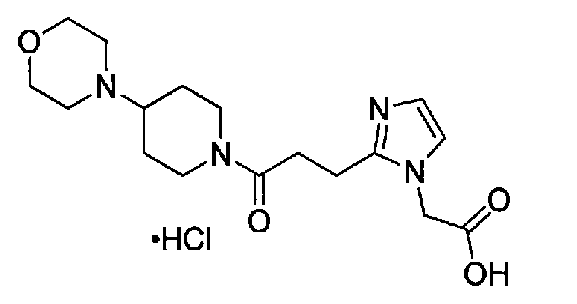
1H-NMR (400 MHz, D2O) δ: 1.44 (1H, ddd, J=25.4, 12.4, 4.4 Hz), 1.57 (1H, ddd, J=25.4, 12.4, 4.4 Hz), 2.11 (2H, t, J=12.8 Hz), 2.58 (1H, t, J=13.2 Hz), 2.98-3.17 (5H, m), 3.35-3.47 (3H, m), 3.68 (2H, t, J=12.4 Hz), 3.89-3.96 (1H, m), 3.97-4.06 (2H, m), 4.38-4.45 (1H, m), 4.68 (2H, s), 7.20 (1H, d, J=1.6 Hz), 7.21(1H, d, 1.6 Hz).
ESI-MS: 2-(2-(3-(4-(モルホリン-4-イル)ピペリジン-1-イル)-3-オキソプロピル)-1H-イミダゾール-1-イル)酢酸として: 351 (M+H)+.
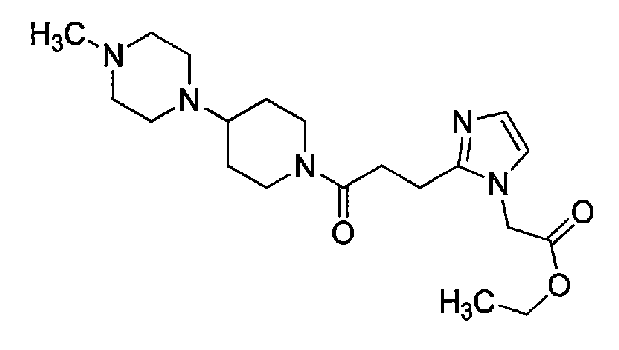
1H-NMR (400 MHz, CDCl3) δ: 1.29 (3H, t, J=7.6 Hz), 1.32-1.46 (2H, m), 1.81-1.91 (2H, m), 2.28 (3H, s), 2.36-2.64 (10H, m), 2.91 (4H, s), 2.95-3.03 (1H, m), 3.97-4.04 (1H, m), 4.23 (2H, q, J=7.6 Hz), 4.54-4.62 (1H, m), 4.75 (2H, s), 6.82 (1H, d, J=1.2 Hz), 6.96 (1H, d, J=1.2 Hz).
ESI-MS: m/z= 392 (M+H)+.
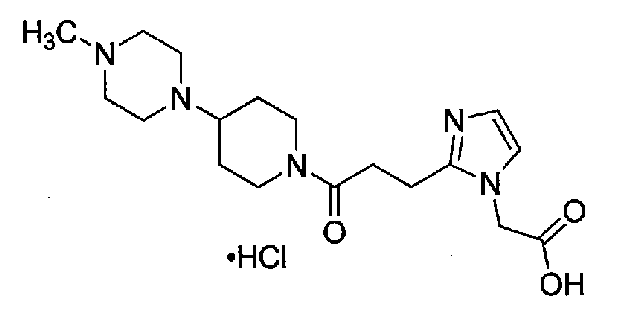
1H-NMR (400 MHz, D2O) δ: 1.26(1H, ddd, J=24.4, 12.4, 4.0 Hz), 1.36(1H, ddd, J=24.4, 12.4, 4.0 Hz), 1.91(2H, t, J=13.2 Hz), 2.55(1H, t, 12.4 Hz), 2.60-3.30(9H, m), 2.70(1H, s), 2.83(2H, t, J=6.8 Hz), 3.04(2H, t, J=6.8 Hz), 3.82-3.89(1H, m), 4.27-4.36 (1H, s), 4.66(2H, s), 7.19(1H, d, J=1.6 Hz), 7.21(1H, d, J=1.6 Hz).
ESI-MS: 2-(2-(3-(4-(1-メチルピペラジン-4-イル)ピペリジン-1-イル)-3-オキソプロピル)-1H-イミダゾール-1-イル)酢酸として: 364 (M+H)+.
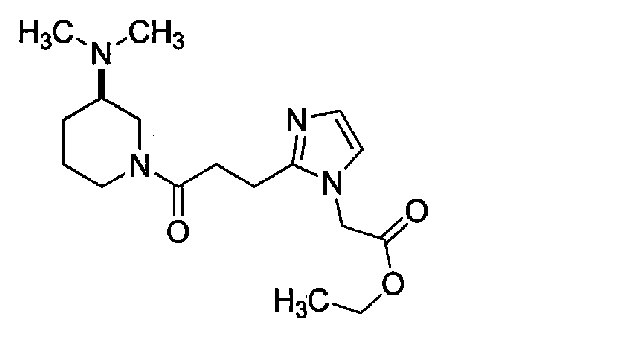
1H-NMR (400 MHz, CDCl3) δ: 1.29 (3H, t, J=7.2 Hz), 1.36-1.48 (2H, m), 1.95-2.00 (2H, m), 2.32 (6H, s), 2.40-2.55 (1H, m), 2.78-3.00 (6H, m), 3.80-4.05 (1H, m), 4.23 (2H, q, J=7.2), 4.45-4.67 (1H, m), 4.71-4.80 (2H, m), 6.80-6.85 (1H, m), 6.97 (1H, d, J=1.2 Hz).
ESI-MS: m/z= 337 (M+H)+.
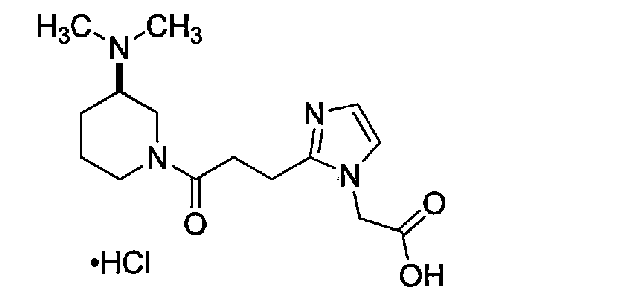
1H-NMR (400 MHz, D2O) δ: 1.02-1.87 (3H, m), 2.00-2.15 (1H, m), 2.55-2.95 (7H, m), 3.05-3.30 (5H, m), 3.47-3.62 (1H, m), 3.95-4.20 (1H, m), 4.99 (2H, s), 7.26 (2H, s).
ESI-MS: 2-(2-(3-((R)-3-ジメチルアミノピペリジン-1-イル)-3-オキソプロピル)-1H-イミダゾール-1-イル)酢酸として: 309 (M+H)+.

1H-NMR (400 MHz, CDCl3) δ: 1.30 (3H, t, J =7.3 Hz), 1.71-1.84 (1H, m), 2.09-2.28 (7H, m), 2.61-2.96 (5H, m), 3.02-3.46 (2H, m), 3.64-3.82 (2H, m), 4.23 (2H, q, J=7.3 Hz), 4.72-4.77 (2H, m), 6.81-6.82 (1H, m), 6.95-6.98 (1H, m).
ESI-MS: m/z= 323 (M+H)+.
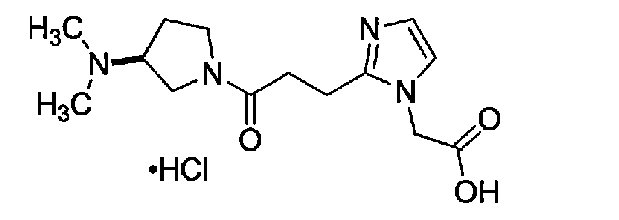
1H-NMR (400 MHz, D2O) δ: 1.95-2.18 (1H, m), 2.34-2.44 (1H, m), 2.67-2.90 (8H, m), 3.05-3.11 (2H, m),3.29-3.67 (3H, m), 3.78-3.93 (2H, m), 4.80 (2H, s), 7.22-7.26 (2H, m).
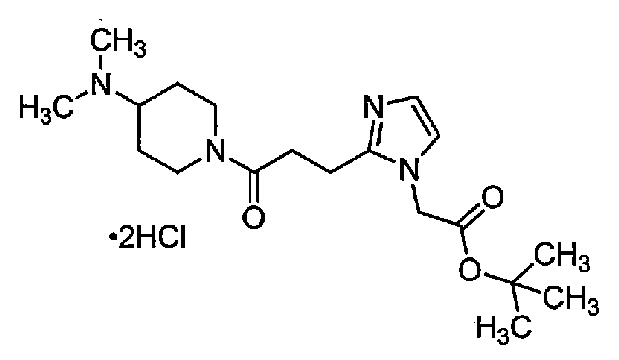
1H-NMR (400 MHz, D2O) δ: 1.48-1.72 (11H, m), 2.10-2.17 (2H, m), 2.66-2.74 (1H, m), 2.84 (6H, s), 2.90-3.25 (5H, m), 3.45-3.55 (1H, m), 4.00-4.10 (1H, m), 4.45-4.55 (1H, m), 5.08 (2H, s), 7.37-7.39 (2H, m).
ESI-MS: 2-(2-(3-(4-(ジメチルアミノ)ピペリジン-1-イル)-3-オキソプロピル)-1H-イミダゾール-1-イル)酢酸tert-ブチルとして: m/z= 365 (M+H)+
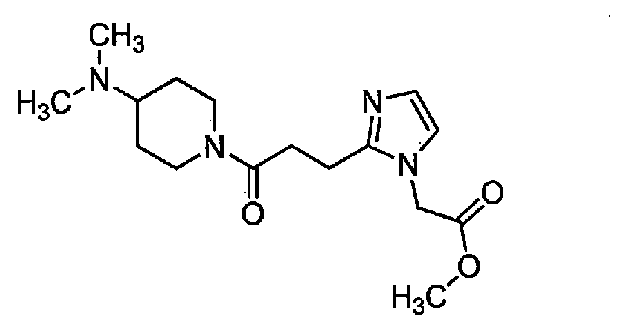
1H-NMR (400 MHz, CDCl3) δ: 1.29-1.42 (2H, m), 1.81-1.86 (2H, m), 2.27 (6H, s), 2.33 (1H, tt, J=11.1, 3.5 Hz), 2.55-2.62 (1H, m), 2.92 (4H, s), 2.96-3.03 (1H, m), 3.78 (3H, s), 3.97-4.01 (1H, m), 4.56-4.59 (1H, m), 4.78 (2H, s), 6.82 (1H, d, J=0.7 Hz), 6.97 (1H, d, J=0.7 Hz).
ESI-MS: m/z= 323 (M+H)+.
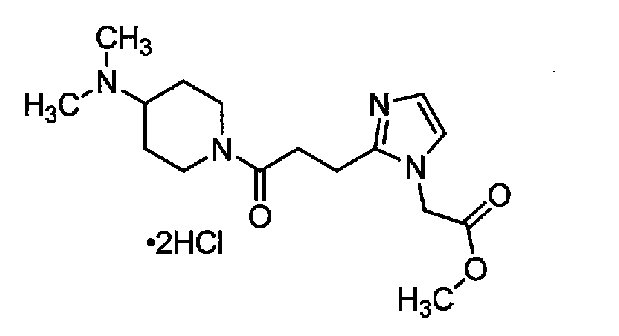
1H-NMR (400 MHz, D2O) δ: 1.54-1.77 (2H, m), 2.13-2.20 (2H, m), 2.69-2.76 (1H, m), 2.87 (6H, s), 3.04 (2H, t, J=6.6 Hz), 3.16-3.25 (3H, m), 3.52 (1H, tt, J=12.1, 3.7 Hz), 3.85 (3H, s), 4.08-4.11 (1H, m), 4.52-4.55 (1H, m), 5.22 (2H, s), 7.41-7.42 (2H, m).
ESI-MS: 2-(2-(3-(4-(ジメチルアミノ)ピペリジン-1-イル)-3-オキソプロピル)-1H-イミダゾール-1-イル)酢酸メチルとして:m/z= 323 (M+H)+.
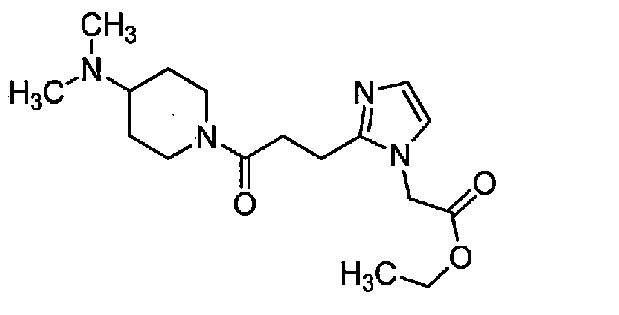
1H-NMR (400 MHz, CDCl3) δ: 1.22-1.42 (5H, m), 1.77-1.87 (2H, m), 2.24-2.36 (7H, m), 2.54-2.64 (1H, m), 2.89-3.04 (5H, m), 3.95-4.04 (1H, m), 4.22 (2H, q, J=7.2 Hz), 4.53-4.62 (1H, m), 4.74 (2H, s), 6.80-6.82 (1H, m), 6.96-6.97 (1H, m).
ESI-MS: m/z= 337 (M+H)+.
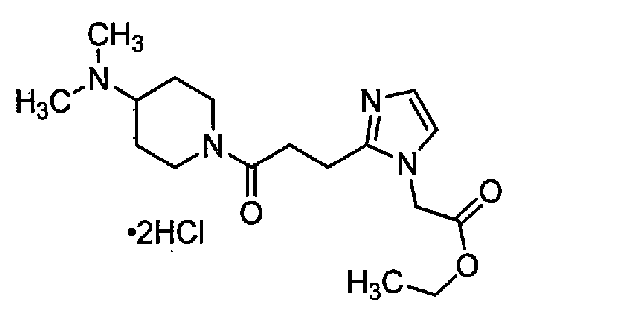
1H-NMR (400 MHz, D2O) δ: 1.27 (3H, t, J=7.2 Hz), 1.50-1.73 (2H, m), 2.09-2.17 (2H, m), 2.66-2.73 (1H, m), 2.84 (6H, s), 2.98-3.05 (5H, m), 3.45-3.55 (1H, m), 4.02-4.09 (1H, m), 4.28 (2H, q, J=7.2 Hz), 4.47-4.53 (1H, m), 5.17 (2H, s), 7.37-7.39 (2H, m).
ESI-MS: 2-(2-(3-(4-(ジメチルアミノ)ピペリジン-1-イル)-3-オキソプロピル)-1H-イミダゾール-1-イル)酢酸エチルとして: m/z= 337 (M+H)+.
1H-NMR (400 MHz, CD3OD) δ: 1.40-1.67 (2H, m), 1.95-2.04 (2H, m), 2.50-2.60 (1H, m), 2.73-2.88 (8H, m), 2.95-3.12 (3H, m), 3.20-3.35 (1H, m), 3.93-4.03 (1H, m), 4.54-4.64 (3H, m), 7.12-7.15 (1H, m), 7.18-7.21 (1H, m).
ESI-MS: m/z= 307 (M-H)-.

1H-NMR (400 MHz, CDCl3) δ: 0.92 (3H, t, J=7.6 Hz), 1.22-1.44 (2H, m), 1.60-1.70 (2H, m), 1.76-1.86 (2H, m), 2.23-2.34 (7H, m), 2.52-2.62 (1H, m), 2.88-3.02 (5H, m), 3.92-4.02 (1H, m), 4.11 (2H, t, J=7.2 Hz), 4.51-4.61 (1H, m), 6.72-6.76 (2H, m), 6.80-6.81 (1H, m), 6.94-6.95 (1H, m).
ESI-MS: m/z= 351 (M+H)+.
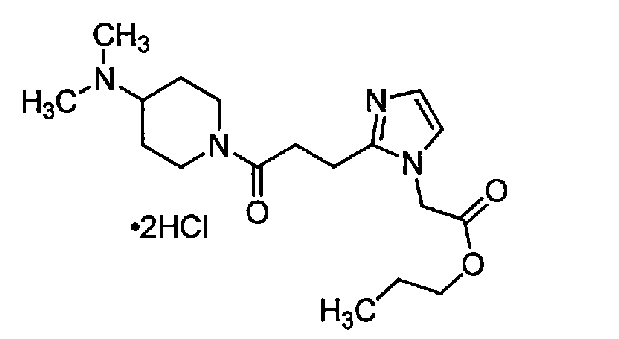
1H-NMR (400 MHz, D2O) δ: 0.91 (3H, t, J=7.2 Hz), 1.52-1.75 (4H, m), 2.08-2.24 (2H, m), 2.68-2.76 (1H, m), 2.86 (6H, s), 2.99-3.06 (2H, m), 3.13-3.26 (3H, m), 3.45-3.60 (1H, m), 4.02-4.12 (1H, m), 4.18-4.24 (2H, m), 4.48-4.58 (1H, m), 5.21 (2H, s), 7.39-7.43 (2H, m).
ESI-MS: 2-(2-(3-(4-(ジメチルアミノ)ピペリジン-1-イル)-3-オキソプロピル)-1H-イミダゾール-1-イル)酢酸プロピルとして: m/z= 351 (M+H)+.
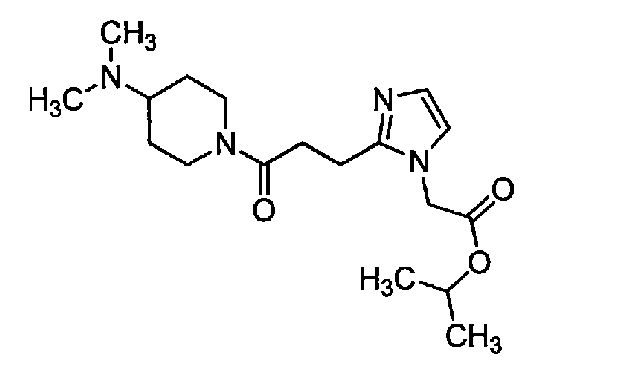
1H-NMR (400 MHz, CDCl3) δ: 1.22-1.38 (8H, m), 1.76-1.88 (2H, m), 2.24-2.38 (7H, m), 2.52-2.62 (1H, m), 2.88-3.02 (5H, m), 3.94-4.04 (1H, m), 4.52-4.62 (1H, m), 4.69 (2H, s), 5.00-5.10 (1H, m), 6.78-6.82 (1H, m), 6.92-6.96 (1H, m).
ESI-MS: m/z= 351 (M+H)+.

1H-NMR (400 MHz, D2O) δ: 1.30 (6H, d, J=6.4 Hz), 1.52-1.76 (2H, m), 2.10-2.22 (2H, m), 2.68-2.78 (1H, m), 2.87 (6H, s), 2.98-3.05 (2H, m), 3.14-3.24 (3H, m), 3.46-3.56 (1H, m), 4.04-4.14 (1H, m), 4.50-4.57 (1H, m), 5.08-5.18 (3H, m), 7.36-7.42 (2H, m).
ESI-MS: 2-(2-(3-(4-(ジメチルアミノ)ピペリジン-1-イル)-3-オキソプロピル)-1H-イミダゾール-1-イル)酢酸イソプロピルとして: m/z= 351 (M+H)+.
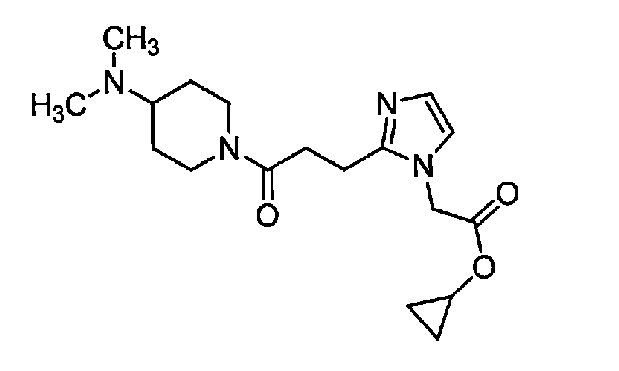
1H-NMR (400 MHz, CDCl3) δ: 0.70-0.78 (4H, m), 1.25-1.45 (2H, m), 1.78-1.87 (2H, m), 2.25-2.38 (7H, m), 2.52-2.62 (1H, m), 2.88-3.05 (5H, m), 3.94-4.04 (1H, m), 4.18-4.26 (1H, m), 4.54-4.62 (1H, m), 4.73 (2H, s), 6.80 (1H, brs), 6.96 (1H, brs).
ESI-MS: m/z= 349 (M+H)+.

1H-NMR (400 MHz, D2O) δ: 0.78-0.85 (4H, m), 1.53-1.80 (2H, m), 2.10-2.24 (2H, m), 2.68-2.90 (7H, m), 2.99-3.06 (2H, m), 3.13-3.27 (3H, m), 3.45-3.60 (1H, m), 4.04-4.14 (1H, m), 4.22-4.28 (1H, m), 4.50-4.58 (1H, m), 5.19 (2H, s), 7.38-7.45 (2H, m).
ESI-MS: 2-(2-(3-(4-(ジメチルアミノ)ピペリジン-1-イル)-3-オキソプロピル)-1H-イミダゾール-1-イル)酢酸シクロプロピルとして: m/z= 349 (M+H)+.
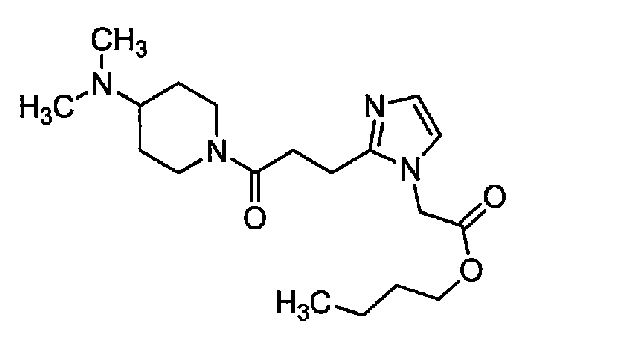
1H-NMR (400 MHz, CDCl3) δ: 0.92 (3H, t, J=7.2 Hz), 1.27-1.42 (4H, m), 1.57-1.65 (2H, m), 1.76-1.86 (2H, m), 2.22-2.34 (7H, m), 2.53-2.62 (1H, m), 2.88-3.03 (5H, m), 3.93-4.02 (1H, m), 4.15 (2H, t, J=6.4 Hz), 4.52-4.60 (1H, m), 4.74 (2H, s), 6.76-6.80 (1H, m), 6.95-6.96 (1H, m).
ESI-MS: m/z= 365 (M+H)+.
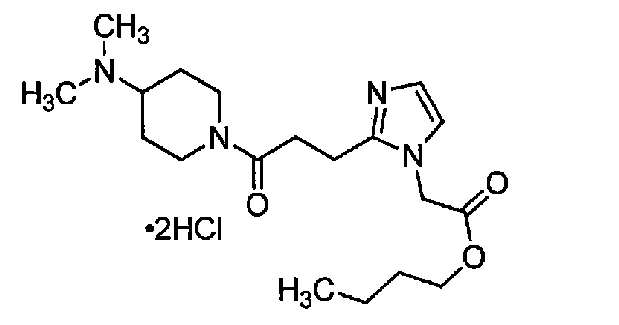
1H-NMR (400 MHz, D2O) δ: 0.89 (3H, t, J=7.2 Hz), 1.28-1.40 (2H, m), 1.52-1.75 (4H, m), 2.10-2.20 (2H, m), 2.66-2.76 (1H, m), 2.86 (6H, s), 2.96-3.04 (2H, m), 3.11-3.22 (3H, m), 3.45-3.56 (1H, m), 4.34-4.43 (1H, m), 4.26 (2H, t, J=6.0 Hz), 4.49-4.58 (1H, m), 5.15 (2H, s), 7.26-7.38 (2H, m).
ESI-MS: 2-(2-(3-(4-(ジメチルアミノ)ピペリジン-1-イル)-3-オキソプロピル)-1H-イミダゾール-1-イル)酢酸ブチルとして: m/z= 365 (M+H)+.

1H-NMR (400 MHz, CDCl3) δ: 0.85-0.89 (6H, m), 1.20-1.36 (2H, m), 1.74-1.95 (3H, m), 2.22-2.34 (7H, m), 2.48-2.58 (1H, m), 2.86-3.00 (5H, m), 3.88-3.98 (3H, m), 4.50-4.57 (1H, m), 4.73 (2H, s), 6.76-6.80 (1H, m), 6.90-6.94 (1H, m).
ESI-MS: m/z= 365 (M+H)+.
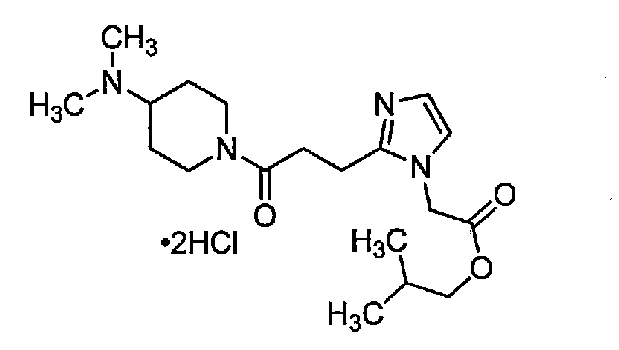
1H-NMR (400 MHz, D2O) δ: 0.88-0.94 (6H, m), 1.52-1.77 (2H, m), 1.92-2.02 (1H, m), 2.12-2.22 (2H, m), 2.68-2.78 (1H, m), 2.86 (6H, s), 2.98-3.05 (2H, m), 3.12-3.28 (3H, m), 3.46-3.56 (1H, m), 4.32-4.42 (3H, m), 4.48-4.58 (1H, m), 5.23 (2H, s), 7.40-7.44 (2H, m).
ESI-MS: 2-(2-(3-(4-(ジメチルアミノ)ピペリジン-1-イル)-3-オキソプロピル)-1H-イミダゾール-1-イル)酢酸イソブチルとして: m/z= 365 (M+H)+.

1H-NMR (400 MHz, CDCl3) δ: 0.23-0.29 (2H, m), 0.53-0.60 (2H, m), 1.05-1.16 (1H, m), 1.20-1.40 (2H, m), 1.74-1.85 (2H, m), 2.20-2.34 (7H, m), 2.50-2.60 (1H, m), 2.87-3.02 (5H, m), 3.93-4.00 (3H, m), 4.52-4.60 (1H, m), 4.75 (2H, s), 6.78-6.82 (1H, m), 6.92-6.96 (1H, m).
ESI-MS: m/z= 363 (M+H)+.

1H-NMR (400 MHz, D2O) δ: 0.30-0.35 (2H, m), 0.58-0.65 (2H, m), 1.15-1.25 (1H, m), 1.52-1.75 (2H, m), 2.10-2.20 (2H, m), 2.67-2.76 (1H, m), 2.86 (6H, s), 2.99-3.06 (2H, m), 3.13-3.25 (3H, m), 3.44-3.56 (1H, m), 4.05-4.12 (3H, m), 4.49-4.57 (1H, m), 5.20 (2H, s), 7.39-7.41 (2H, m).
ESI-MS: 2-(2-(3-(4-(ジメチルアミノ)ピペリジン-1-イル)-3-オキソプロピル)-1H-イミダゾール-1-イル)酢酸シクロプロピルメチルとして: m/z= 363 (M+H)+.
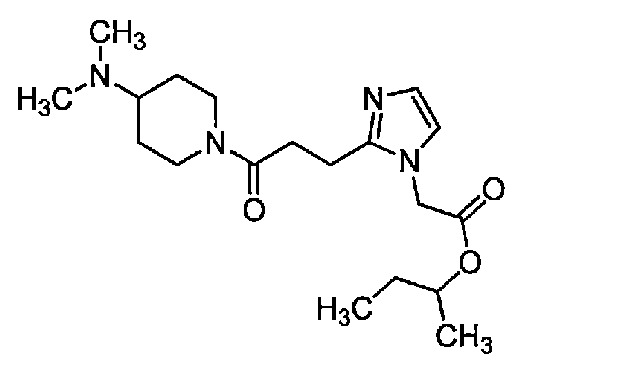
1H-NMR (400 MHz, CDCl3) δ: 0.87 (3H, t, J=7.6 Hz), 1.20-1.40 (5H, m), 1.50-1.65 (2H, m), 1.78-1.86 (2H, m), 2.23-2.35 (7H, m), 2.54-2.62 (1H, m), 2.88-3.04 (5H, m), 3.95-4.02 (1H, m), 4.54-4.60 (1H, m), 4.72 (2H, s), 4.85-4.95 (1H, m), 6.81 (1H, brs), 6.96 (1H, brs).
ESI-MS: m/z= 365 (M+H)+.
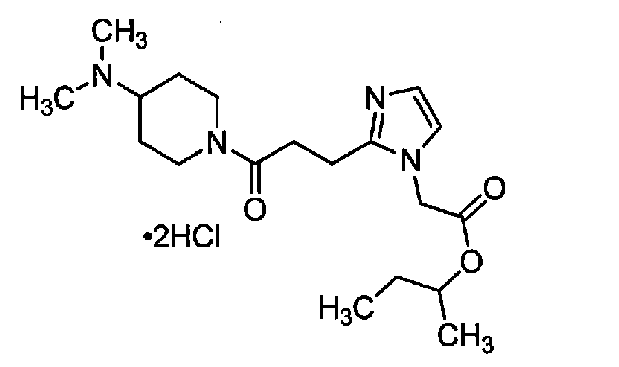
1H-NMR (400 MHz, D2O) δ: 0.87 (3H, t, J=7.6 Hz), 1.27 (3H, d, J=6.0 Hz). 1.50-1.76 (4H, m), 2.66-2.75 (2H, m), 2.80-2.90 (7H, m), 2.98-3.05 (2H, m), 3.13-3.25 (3H, m), 3.45-3.57 (1H, m), 4.03-4.12 (1H, m), 4.48-4.58 (1H, m), 4.93-5.00 (1H, m), 5.19 (2H, s), 7.37-7.42 (2H, m).
ESI-MS: 2-(2-(3-(4-(ジメチルアミノ)ピペリジン-1-イル)-3-オキソプロピル)-1H-イミダゾール-1-イル)酢酸sec-ブチルとして: m/z= 365 (M+H)+.

1H-NMR (400 MHz, CDCl3) δ: 0.85-0.93 (3H, m), 1.23-1.43 (12H, m), 1.58-1.68 (2H, m), 1.77-1.87 (2H, m), 2.25-2.40 (7H, m), 2.54-2.64 (1H, m), 2.88-3.04 (5H, m), 3.94-4.04 (1H, m), 4.12-4.17 (2H, m), 4.53-4.65 (1H, m), 4.74 (2H, s), 6.80-6.83 (1H, m), 6.94-6.98 (1H, m).
ESI-MS: m/z= 421 (M+H)+.

1H-NMR (400 MHz, D2O) δ: 0.84-0.89 (3H, m), 1.14-1.37 (10H, m), 1.54-1.76 (4H, m), 2.10-2.22 (2H, m), 2.65-2.77 (1H, m), 2.87 (6H, s), 3.00-3.05 (2H, m), 3.13-3.28 (3H, m), 3.46-3.58 (1H, m), 4.03-4.11 (1H, m), 4.26 (2H, t, J=6.8 Hz), 4.49-4.57 (1H, m), 5.21 (2H, s), 7.40-7.44 (2H, m).
ESI-MS: 2-(2-(3-(4-(ジメチルアミノ)ピペリジン-1-イル)-3-オキソプロピル)-1H-イミダゾール-1-イル)酢酸オクチルとして: m/z= 421 (M+H)+.

1H-NMR (400 MHz, CDCl3) δ: 1.19-1.42 (2H, m), 1.76-1.87 (2H, m), 2.02-2.14 (2H, m), 2.24-2.40 (7H, m), 2.50-2.64 (1H, m), 2.83-3.03 (9H, m), 3.93-4.03 (1H, m), 4.53-4.62 (1H, m), 4.98-5.03 (2H, m), 6.82-7.02 (4H, m), 7.18 (1H, d, J=8.0 Hz).
ESI-MS: m/z= 425 (M+H)+.
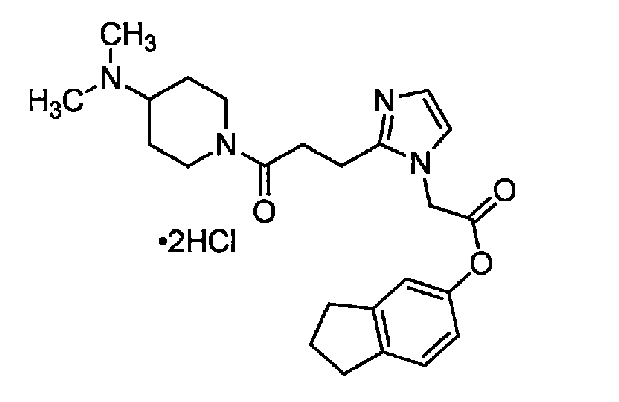
1H-NMR (400 MHz, D2O) δ: 1.30-1.62 (2H, m), 1.94-2.16 (4H, m), 2.58-2.78 (7H, m), 2.87-3.15 (7H, m), 3.25-3.50 (3H, m), 3.97-4.05 (1H, m), 4.43-4.50 (1H, m), 5.50 (2H, s), 6.97-7.02 (1H, m), 7.11-7.14 (1H, m), 7.33-7.37 (1H, m), 7.43-7.51 (2H, m).
ESI-MS: 2,3-ジヒドロ-1H-インデン-5-イル 2-(2-(3-(4-(ジメチルアミノ)ピペリジン-1-イル)-3-オキソプロピル)-1H-イミダゾール-1-イル)アセテートとして: m/z= 425 (M+H)+.
-3-オキソプロピル)-1H-イミダゾール-1-イル)アセトキシ)メチルピバレートの合成:
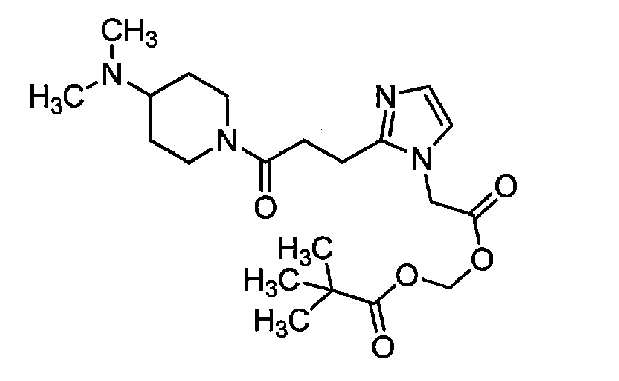
1H-NMR (400 MHz, CDCl3) δ: 1.19-1.45 (11H, m), 1.75-1.90 (2H, m), 2.22-2.40 (7H, m), 2.53-2.63 (1H, m), 2.88-3.02 (5H, m), 3.92-4.02 (1H, m), 4.52-4.62 (1H, m), 4.84 (2H, s), 5.81 (2H, s), 6.81 (1H, brs), 6.97 (1H, brs).
ESI-MS: m/z= 423 (M+H)+.

1H-NMR (400 MHz, CDCl3) δ: 1.16-1.44 (2H, m), 1.77-1.90 (2H, m), 2.16 (3H, s), 2.20-2.42 (7H, m), 2.52-2.62 (1H, m), 2.86-3.04 (5H, m), 3.92-4.04 (1H, m), 4.50-4.62 (1H, m), 4.84 (2H, s), 4.92 (2H, s), 6.78-6.83 (1H, m), 6.95-6.98 (1H, m).
ESI-MS: m/z= 421 (M+H)+.
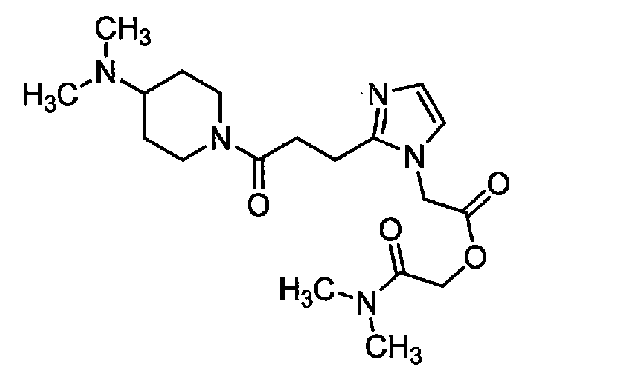
1H-NMR (400 MHz, CDCl3) δ: 1.24-1.44 (2H, m), 1.78-1.86 (2H, m), 2.25-2.40 (7H, m), 2.52-2.62 (1H, m), 2.78-3.05 (12H, m), 3.95-4.05 (1H, m), 4.79 (2H, m), 4.90-4.94 (2H, m), 6.86-6.88 (1H, m), 6.94-6.96 (1H, m).
ESI-MS: m/z= 394 (M+H)+.
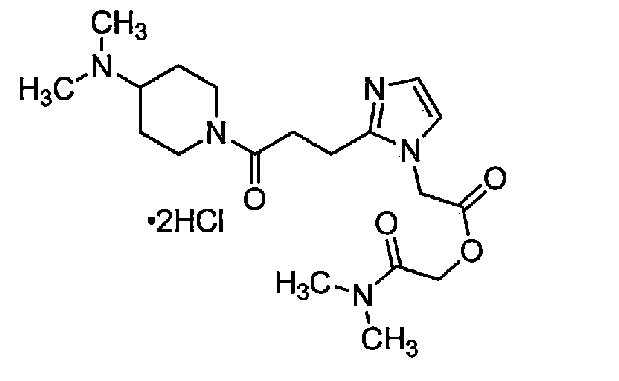
1H-NMR (400 MHz, D2O) δ: 1.54-1.78 (2H, m), 2.10-2.23 (2H, m), 2.67-2.80 (1H, m), 2.85-3.05 (14H, m), 3.13-3.28 (3H, m), 3.47-3.57 (1H, m), 4.05-4.15 (1H, m), 4.50-4.60 (1H, m), 5.05 (2H, s), 5.36 (2H, m), 7.40-7.46 (2H, m).
ESI-MS: 2-(ジメチルアミノ)-2-オキソエチル 2-(2-(3-(4-(ジメチルアミノ)ピペリジン-1-イル)-3-オキソプロピル)-1H-イミダゾール-1-イル)アセテートとして: m/z= 394 (M+H)+.

1H-NMR (400 MHz, DMSO-d6) δ: 1.10-1.38 (2H, m), 1.65-1.80 (2H, m), 2.15 (6H, s), 2.22-2.36 (1H, m), 2.45-2.81 (5H, m), 2.90-3.03 (1H, m), 3.85-3.93 (1H, m), 4.15 (2H, s), 4.30-4.40 (1H, m), 6.62 (1H, s), 6.85 (1H, s), 7.36 (1H, t, J=7.2 Hz), 7.45-7.55 (2H, m), 7.71 (1H, d, J=7.2 Hz), 10.64 (1H, s).
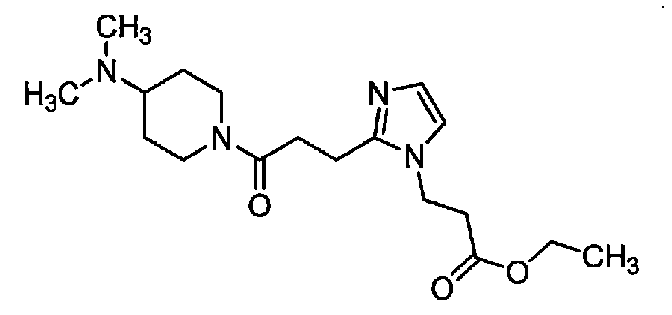
1H-NMR (400 MHz, CDCl3) δ: 1.21-1.45 (5H, m), 1.78-1.88 (2H, m), 2.25-2.38 (7H, m), 2.55-2.64 (1H, m), 2.74 (2H, t, J=7.2 Hz), 2.90-3.05 (5H, m), 3.98-4.18 (3H, m), 4.24 (2H, t, J=7.2 Hz), 4.56-4.65 (1H, m), 6.84-6.86 (1H, m), 6.90-6.92 (1H, m).
ESI-MS: m/z= 351 (M+H)+.
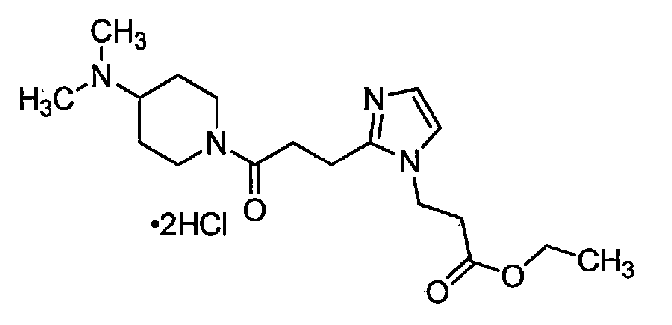
1H-NMR (400 MHz, D2O) δ: 1.19-1.25 (3H, m), 1.53-1.80 (2H, m), 2.10-2.23 (2H, m), 2.67-2.78 (1H, m), 2.87 (6H, s), 3.00-3.10 (4H, m), 3.15-3.34 (3H, m), 3.47-3.57 (1H, m), 4.07-4.20 (3H, m), 4.45-4.58 (3H, m), 7.32-7.36 (1H, m), 7.42-7.45 (1H, m).
ESI-MS: 3-(2-(3-(4-(ジメチルアミノ)ピペリジン-1-イル)-3-オキソプロピル)-1H-イミダゾール-1-イル)プロパン酸エチルとして: m/z= 351 (M+H)+.
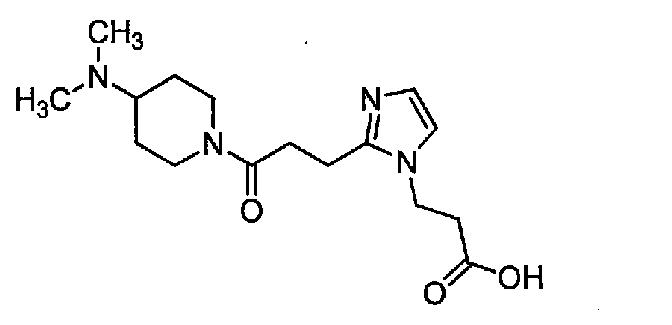
1H-NMR (400 MHz, DMSO-d6) δ: 1.34-1.47 (1H, m), 1.54-1.69 (1H, m), 1.95-2.08 (2H, m), 2.60-2.68 (8H, m), 2.75-3.05 (7H, m), 3.96-4.06 (1H, m), 4.21 (2H, t, J=6.8 Hz), 4.42-4.51 (1H, m), 7.13 (1H, brs), 7.33 (1H, brs).
ESI-MS: m/z= 323 (M+H)+.

1H-NMR (400 MHz, D2O) δ: 1.53-1.80 (2H, m), 2.12-2.24 (2H, m), 2.68-2.78 (1H, m), 2.87 (6H, s), 2.98-3.34 (7H, m), 3.45-3.58 (1H, m), 4.07-4.17 (1H, m), 4.43-4.58 (3H, m), 7.34 (1H, brs), 7.43 (1H, brs).
ESI-MS: 3-(2-(3-(4-(ジメチルアミノ)ピペリジン-1-イル)-3-オキソプロピル)-1H-イミダゾール-1-イル)プロパン酸として: m/z= 323 (M+H)+.
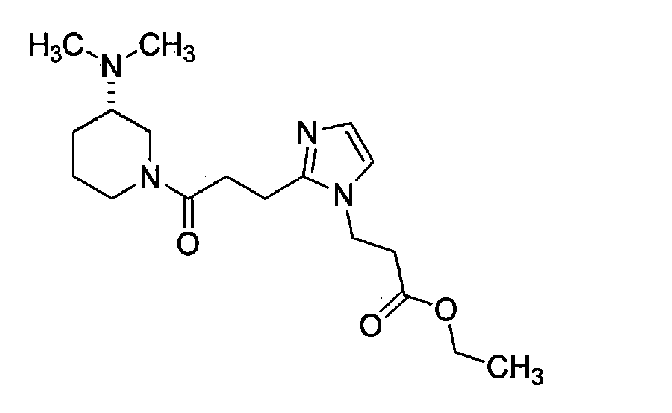
1H-NMR (400 MHz, CDCl3) δ: 1.24 (3H, t, J=7.2 Hz), 1.36-1.50 (2H, m), 1.70-1.85 (1H, m), 1.95-2.05 (1H, m), 2.07-2.23 (2H, m), 2.32 (6H, s), 2.43-2.60 (1H, m), 2.73-2.78 (2H, m), 2.81-3.03 (5H, m), 3.83-4.06 (1H, m), 4.14 (2H, q, J=7.2 Hz), 4.22-4.28 (2H, m), 4.47-4.68 (1H, m), 6.84-6.88 (1H, m), 6.91 (1H, d, J=1.2 Hz).
ESI-MS: m/z= 351 (M+H)+.
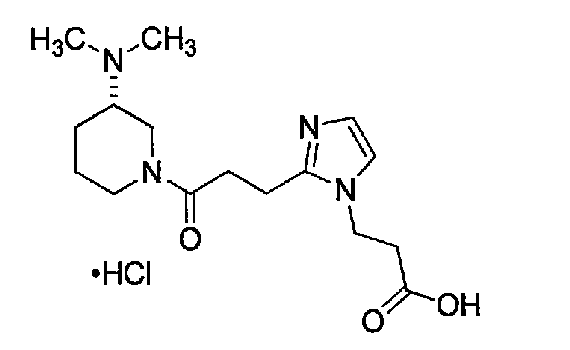
1H-NMR (400 MHz, D2O) δ: 1.02-1.87 (3H, m), 2.00-2.15 (1H, m), 2.55-2.95 (7H, m), 3.05-3.30 (7H, m), 3.47-3.62 (1H, m), 3.95-4.20 (1H, m), 4.99 (2H, s), 7.26 (2H, s).
ESI-MS: 3-(2-(3-((S)-3-ジメチルアミノピペリジン-1-イル)-3-オキソプロピル)-1H-イミダゾール-1-イル)プロパン酸として: 323 (M+H)+.
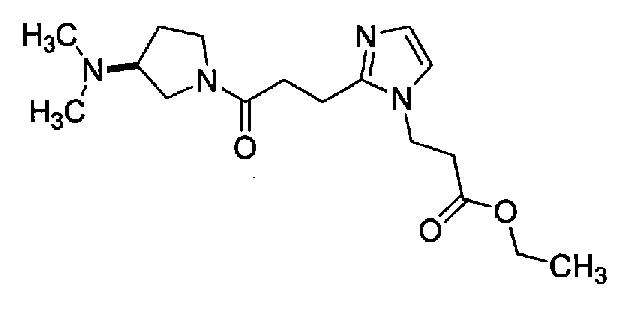
1H-NMR (400 MHz, CDCl3) δ:1.23-1.27 (3H, m), 1.67-1.91 (1H, m), 2.06-2.26 (7H, m), 2.58-3.36 (9H, m), 3.43-3.83 (2H, m), 4.12-4.28 (4H, m), 6.85-6.93 (2H, m).
ESI-MS: m/z= 337 (M+H)+.
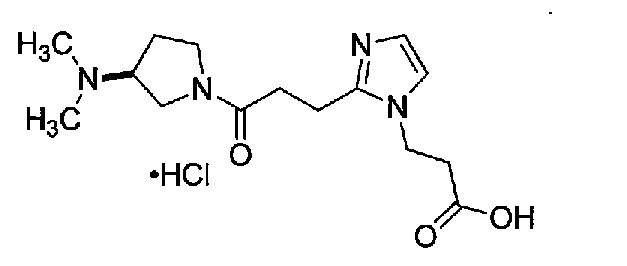
1H-NMR (400 MHz, D2O) δ: 1.95-2.21 (1H, m), 2.35-2.49 (1H, m), 2.64-2.94 (10H, m), 3.15-3.19 (2H, m), 3.29-4.08 (5H, m), 4.30-4.33 (2H, m), 7.23 (1H, s), 7.31 (1H, s).
神経障害性疼痛を評価できるマウス坐骨神経部分結紮モデル(Seltzerモデル)を用い、環状アミン誘導体(I)若しくはそのプロドラッグ又はその薬理学的に許容される塩の鎮痛作用を検討した。
マウス坐骨神経部分結紮モデルは、Seltzerらの方法(Malmbergら、Pain、1998年、第76巻、p.215-222)に従って作製した。
坐骨神経結紮手術7日後に、坐骨神経部分結紮群のマウスに、実施例8の化合物(実施例8の化合物は、10mg/kg)又は陽性対照としてプレガバリン(10mg/kg;Bosche Scientific)を、蒸留水に溶解して経口投与した。坐骨神経部分結紮群のマウスに、実施例8の化合物を投与した群を、「坐骨神経部分結紮+実施例8の化合物」群とし、プレガバリンを投与した群を、「坐骨神経部分結紮+プレガバリン」群とした。また、坐骨神経部分結紮群のマウスに蒸留水を経口投与した群を、「坐骨神経部分結紮+蒸留水」群とし、偽手術群のマウスに蒸留水を経口投与した群を、「偽手術+蒸留水」群とした。
坐骨神経結紮手術7日後に、坐骨神経部分結紮群のマウスに、実施例2、4、13、18、22、25、27、29、31、33、66、68若しくは70の化合物(実施例2及び4の化合物は、それぞれ0.1~10mg/kg、実施例13の化合物は、0.01~1mg/kg、実施例18及び22の化合物は、それぞれ0.1及び1mg/kg、実施例25、27、29、31、33、66、68及び70の化合物は、それぞれ0.1mg/kg)又は陽性対照としてプレガバリン(1mg/kg;Bosche Scientific又は3mg/kg;KEMPROTEC)を、生理食塩液に溶解して尾静脈より投与した。坐骨神経部分結紮群のマウスに、実施例2、4、13、18、22、25、27、29、31、33、66、68又は70の化合物を投与した群を、それぞれ「坐骨神経部分結紮+実施例2の化合物」群、「坐骨神経部分結紮+実施例4の化合物」群、「坐骨神経部分結紮+実施例13の化合物」群、「坐骨神経部分結紮+実施例18の化合物」群、「坐骨神経部分結紮+実施例22の化合物」群、「坐骨神経部分結紮+実施例25の化合物」群、「坐骨神経部分結紮+実施例27の化合物」群、「坐骨神経部分結紮+実施例29の化合物」群、「坐骨神経部分結紮+実施例31の化合物」群、「坐骨神経部分結紮+実施例33の化合物」群、「坐骨神経部分結紮+実施例66の化合物」群、「坐骨神経部分結紮+実施例68の化合物」群、「坐骨神経部分結紮+実施例70の化合物」群とし、プレガバリンを投与した群を、「坐骨神経部分結紮+プレガバリン」群とした。また、坐骨神経部分結紮群のマウスに生理食塩液を静脈内投与した群を、「坐骨神経部分結紮+生理食塩液」群とし、偽手術群のマウスに生理食塩液を静脈内投与した群を、「偽手術+生理食塩液」群とした。
坐骨神経結紮手術7日後に、坐骨神経部分結紮群のマウスに、実施例2、4、6、10、12、13又は15の化合物(10μg/site)を、生理食塩液に溶解して脳室内投与した。坐骨神経部分結紮群のマウスに、実施例2、4、6、10、12、13又は15の化合物を投与した群を、それぞれ「坐骨神経部分結紮+実施例2の化合物」群、「坐骨神経部分結紮+実施例4の化合物」群、「坐骨神経部分結紮+実施例6の化合物」群、「坐骨神経部分結紮+実施例10の化合物」群、「坐骨神経部分結紮+実施例12の化合物」群、「坐骨神経部分結紮+実施例13の化合物」群、「坐骨神経部分結紮+実施例15の化合物」群とした。また、坐骨神経部分結紮群のマウスに生理食塩液を脳室内投与した群を、「坐骨神経部分結紮+生理食塩液」群とし、偽手術群のマウスに生理食塩液を脳室内投与した群を、「偽手術+生理食塩液」群とした。
(1)経口投与
結果を図1及び図11に示す。図において、縦軸はvon Frey試験の総スコア(平均値±標準誤差;図1は、n=5、図11は、n=4~5である。)を示し、数値が高いほど痛みが強いことを示す。横軸には被験化合物投与後の時間(hr)を示す。薬効評価は、測定時間毎の「坐骨神経部分結紮+蒸留水」群(図中の「坐骨神経部分結紮+蒸留水」)を対照として、対応のない2群のt検定若しくはWelch検定、(図1)、又は、多群の対応のないt検定(Dunnettによる補正)(図11)により統計処理を行った。図中の*印は、「坐骨神経部分結紮+蒸留水」群との比較で統計学的に有意である(p<0.05)ことを示す。
結果を図2、図3及び図12~22に示す。図において、縦軸はvon Frey試験の総スコア(平均値±標準誤差;図2及び図3は、n=5~6である。、図12~22は、n=4~7)を示し、数値が高いほど痛みが強いことを示す。横軸には被験化合物投与後の時間(min又はhr)を示す。薬効評価は、プレガバリンを投与した群(図中の「坐骨神経部分結紮+プレガバリン」)については、測定時間毎の「坐骨神経部分結紮+生理食塩液」群(図中の「坐骨神経部分結紮+生理食塩液」)を対照として、対応のない2群のt検定又はWelch検定により統計処理を行った。一方、実施例2又は4の化合物を投与した群(図中の「坐骨神経部分結紮+実施例2の化合物」又は「坐骨神経部分結紮+実施例4の化合物」)については、測定時間毎の「坐骨神経部分結紮+生理食塩液」群(図中の「坐骨神経部分結紮+生理食塩液」)を対照として、Williams検定又はShirley-Williams検定により統計処理を行った。また、実施例13、18、22、25、27、29、31、33、66、68又は70の化合物を投与した群(図中の「坐骨神経部分結紮+実施例13、18、22、25、27、29、31、33、66、68又は70の化合物」)については、測定時間毎の「坐骨神経部分結紮+生理食塩液」群(図中の「坐骨神経部分結紮+生理食塩液」)を対照として、Shirley-Williams検定又はWelch検定により統計処理を行った。図中の*印は、「坐骨神経部分結紮+生理食塩液」群との比較で統計学的に有意である(p<0.05)ことを示す(対応のない2群のt検定又はWelch検定)。図中の#印は、「坐骨神経部分結紮+生理食塩液」群との比較で統計学的に有意であることを示す(Williams検定若しくはShirley-Williams検定(p<0.025)又はWelch検定(p<0.05))。
結果を図4~10に示す。図において、縦軸はvon Frey試験の総スコア(平均値±標準誤差;図4~10は、n=4~5である。)を示し、数値が高いほど痛みが強いことを示す。横軸には被験化合物投与後の時間(min)を示す。薬効評価は、測定時間毎の「坐骨神経部分結紮+生理食塩液」群(図中の「坐骨神経部分結紮+生理食塩液」)を対照として、対応のない2群のt検定又はWelch検定により統計処理を行った。図中の*印は、「坐骨神経部分結紮+生理食塩液」群との比較で統計学的に有意である(p<0.05)ことを示す。
線維筋痛症を評価できるラット線維筋痛症モデルを用い、環状アミン誘導体(I)若しくはそのプロドラッグ又はその薬理学的に許容される塩の鎮痛作用を検討した。
線維筋痛症の基礎研究において一般に広く用いられる線維筋痛症モデルラット(Slukaら、Journal of Pharmacology and Experimental Therapeutics、2002年、第302巻、p.1146-50;Nagakuraら、Pain、2009年、第146巻、p.26-33;Slukaら、Pain、2009年、第146巻、p.3-4)を作製するために、pH4.0に調整した酸性生理食塩液100μLをイソフルラン持続吸入麻酔下のCrl:CD(SD)ラット(6~7週齢、オス;日本チャールス・リバー)の右側後肢腓腹筋に2回(酸性生理食塩液の初回投与日を1日目として、1日目と6日目にそれぞれ1回ずつ)筋肉内注射し、室内温度21~25℃、室内湿度40~70%に調節された飼育室で、自由摂餌・摂水させながら飼育した。また、酸性生理食塩液の代わりに生理食塩液を同様に筋肉内注射して飼育した線維筋痛症が発症していないラット(図23及び図24の「生理食塩液-溶媒」群)を実験に使用した。
結果を図23及び図24に示す。図において、縦軸は50%反応閾値(右側後肢と左側後肢の平均値)(g)(平均値±標準誤差、n=5~6)を示し、数値が高いほど線維筋痛症モデルラットにおいて認められたアロディニアが改善されていることを示す。
環状アミン誘導体(I)のカルボキシル基がエステル化されたプロドラッグの薬理学的に許容される塩である実施例38の化合物を、ラットに経口投与し、血漿をLC/MS/MS分析した。その結果、実施例38の化合物は、ラット体内で環状アミン誘導体(I)である実施例39の化合物に変換されることを確認した。
Claims (12)
- 一般式(I)で示される環状アミン誘導体又はその薬理学的に許容される塩。
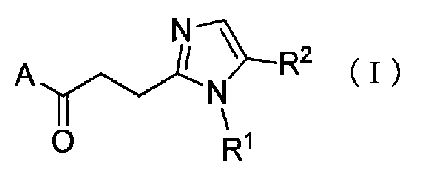

Aが一般式(IIc)で示される基を表す場合は、R1は、カルボキシル基で置換された炭素数1~6のアルキル基を表し、R2は、水素原子又はハロゲン原子を表し、Xは、CH2、O又は-NR5を表し、R5は、炭素数1~6のアルキル基を表す。] - Aは、一般式(IIa)又は(IIb)である、請求項1記載の環状アミン誘導体又はその薬理学的に許容される塩。
- R3は、水素原子、メチル基又はエチル基である、請求項2記載の環状アミン誘導体又はその薬理学的に許容される塩。
- R2は、水素原子又は塩素原子であり、
R3は、水素原子又はメチル基であり、
R4は、水素原子若しくはメチルカルボニル基、又は、メチルカルボニルアミノ基で置換されていてもよい炭素数1~6のアルキル基である、請求項2記載の環状アミン誘導体又はその薬理学的に許容される塩。 - Aは、一般式(IIc)である、請求項1記載の環状アミン誘導体又はその薬理学的に許容される塩。
- R2は、水素原子又は塩素原子であり、
R5は、メチル基である、請求項5記載の環状アミン誘導体又はその薬理学的に許容される塩。 - 請求項1~6のいずれか一項記載の環状アミン誘導体のプロドラッグ又はその薬理学的に許容される塩。
- 請求項1~6のいずれか一項記載の環状アミン誘導体のカルボキシル基がエステル化されたプロドラッグ又はその薬理学的に許容される塩。
- 請求項1~8のいずれか一項記載の環状アミン誘導体、該環状アミン誘導体のプロドラッグ又はそれらの薬理学的に許容される塩を有効成分として含有する、医薬。
- 請求項1~8のいずれか一項記載の環状アミン誘導体、該環状アミン誘導体のプロドラッグ又はそれらの薬理学的に許容される塩を有効成分として含有する、鎮痛薬。
- 請求項1~8のいずれか一項記載の環状アミン誘導体、該環状アミン誘導体のプロドラッグ又はそれらの薬理学的に許容される塩を有効成分として含有する、神経障害性疼痛治療薬。
- 請求項1~8のいずれか一項記載の環状アミン誘導体、該環状アミン誘導体のプロドラッグ又はそれらの薬理学的に許容される塩を有効成分として含有する、線維筋痛症治療薬。
Priority Applications (15)
| Application Number | Priority Date | Filing Date | Title |
|---|---|---|---|
| JP2014547208A JP6409573B2 (ja) | 2013-09-26 | 2014-09-26 | 環状アミン誘導体及びその医薬用途 |
| EP19160334.9A EP3511002B1 (en) | 2013-09-26 | 2014-09-26 | Cyclic amine derivative and pharmaceutical use thereof |
| KR1020167004551A KR102276072B1 (ko) | 2013-09-26 | 2014-09-26 | 환상 아민 유도체 및 그 의약 용도 |
| MX2016003432A MX371281B (es) | 2013-09-26 | 2014-09-26 | Derivado de amina ciclica y uso farmaceutico del mismo. |
| AU2014325146A AU2014325146B2 (en) | 2013-09-26 | 2014-09-26 | Cyclic amine derivative and pharmaceutical use thereof |
| CA2924789A CA2924789C (en) | 2013-09-26 | 2014-09-26 | Cyclic amine derivative and pharmaceutical use thereof |
| DK14849588.0T DK3050877T3 (da) | 2013-09-26 | 2014-09-26 | Cyklisk aminderivat og farmaceutisk anvendelse deraf |
| RU2016116036A RU2638549C2 (ru) | 2013-09-26 | 2014-09-26 | Производное циклического амина и его фармацевтическое применение |
| US15/024,185 US9505740B2 (en) | 2013-09-26 | 2014-09-26 | Cyclic amine derivative and pharmaceutical use thereof |
| PL14849588T PL3050877T3 (pl) | 2013-09-26 | 2014-09-26 | Pochodna aminy cyklicznej i jej farmaceutyczne zastosowanie |
| CN201480052613.8A CN105555778B (zh) | 2013-09-26 | 2014-09-26 | 环状胺衍生物及其药物用途 |
| BR112016006258-2A BR112016006258B1 (pt) | 2013-09-26 | 2014-09-26 | Derivado de amina cíclica, pró-droga, medicamento, e, agentes analgésico e terapêutico |
| EP14849588.0A EP3050877B1 (en) | 2013-09-26 | 2014-09-26 | Cyclic amine derivative and pharmaceutical use thereof |
| ES14849588T ES2759236T3 (es) | 2013-09-26 | 2014-09-26 | Derivado de amina cíclica y utilización farmacéutica del mismo |
| EP19160339.8A EP3511003B1 (en) | 2013-09-26 | 2014-09-26 | Cyclic amine derivative and pharmaceutical use thereof |
Applications Claiming Priority (2)
| Application Number | Priority Date | Filing Date | Title |
|---|---|---|---|
| JP2013-199853 | 2013-09-26 | ||
| JP2013199853 | 2013-09-26 |
Publications (1)
| Publication Number | Publication Date |
|---|---|
| WO2015046403A1 true WO2015046403A1 (ja) | 2015-04-02 |
Family
ID=52743529
Family Applications (1)
| Application Number | Title | Priority Date | Filing Date |
|---|---|---|---|
| PCT/JP2014/075569 Ceased WO2015046403A1 (ja) | 2013-09-26 | 2014-09-26 | 環状アミン誘導体及びその医薬用途 |
Country Status (17)
| Country | Link |
|---|---|
| US (1) | US9505740B2 (ja) |
| EP (3) | EP3050877B1 (ja) |
| JP (1) | JP6409573B2 (ja) |
| KR (1) | KR102276072B1 (ja) |
| CN (1) | CN105555778B (ja) |
| AU (1) | AU2014325146B2 (ja) |
| BR (1) | BR112016006258B1 (ja) |
| CA (1) | CA2924789C (ja) |
| DK (1) | DK3050877T3 (ja) |
| ES (3) | ES2829286T3 (ja) |
| HU (1) | HUE046485T2 (ja) |
| MX (3) | MX371281B (ja) |
| PL (1) | PL3050877T3 (ja) |
| PT (1) | PT3050877T (ja) |
| RU (1) | RU2638549C2 (ja) |
| TW (1) | TWI652264B (ja) |
| WO (1) | WO2015046403A1 (ja) |
Cited By (5)
| Publication number | Priority date | Publication date | Assignee | Title |
|---|---|---|---|---|
| WO2016136944A1 (ja) * | 2015-02-27 | 2016-09-01 | 東レ株式会社 | 環状アミン誘導体及びその医薬用途 |
| WO2016152952A1 (ja) * | 2015-03-24 | 2016-09-29 | 東レ株式会社 | 環状アミン誘導体及びその医薬用途 |
| WO2016152955A1 (ja) * | 2015-03-24 | 2016-09-29 | 東レ株式会社 | 環状アミン誘導体及びその医薬用途 |
| WO2018038255A1 (ja) | 2016-08-26 | 2018-03-01 | 東レ株式会社 | 環状アミン誘導体の結晶及びその医薬用途 |
| WO2021172488A1 (ja) * | 2020-02-28 | 2021-09-02 | 東レ株式会社 | 環状アミン誘導体及びその医薬用途 |
Families Citing this family (1)
| Publication number | Priority date | Publication date | Assignee | Title |
|---|---|---|---|---|
| EP3603639A4 (en) * | 2017-03-31 | 2021-01-27 | Toray Industries, Inc. | THERAPEUTIC OR PROPHYLACTIC FOR PERIPHERAL NEUROPATHIA |
Citations (7)
| Publication number | Priority date | Publication date | Assignee | Title |
|---|---|---|---|---|
| FR2567885A1 (fr) | 1984-07-19 | 1986-01-24 | Sandoz Sa | Derives 3-aminopropoxyaryliques, leur preparation, leur application comme medicaments et compositions pharmaceutiques les contenant |
| WO2003031432A1 (en) | 2001-10-12 | 2003-04-17 | Novo Nordisk A/S | Substituted piperidines and their use for the treatment of diseases related to the histamine h3 receptor |
| WO2004074283A1 (en) * | 2003-02-21 | 2004-09-02 | Pfizer Inc. | N-heterocyclyl-substituted amino-thiazole derivatives as protein kinase inhibitors |
| JP2006008664A (ja) | 2004-05-21 | 2006-01-12 | Takeda Chem Ind Ltd | イミダゾール誘導体、その製造法及び用途 |
| WO2008077089A1 (en) * | 2006-12-19 | 2008-06-26 | Smithkline Beecham Corporation | Pyrrolidinanilines |
| WO2009158587A1 (en) * | 2008-06-26 | 2009-12-30 | Inspire Pharmaceuticals, Inc. | Method for treating pulmonary diseases using rho kinase inhibitor compounds |
| WO2013147160A1 (ja) * | 2012-03-29 | 2013-10-03 | 東レ株式会社 | 環状アミン誘導体及びその医薬用途 |
Family Cites Families (6)
| Publication number | Priority date | Publication date | Assignee | Title |
|---|---|---|---|---|
| JP2567885Y2 (ja) | 1991-03-15 | 1998-04-08 | ソニー株式会社 | ビデオモニタ装置 |
| GB0017256D0 (en) * | 2000-07-13 | 2000-08-30 | Merck Sharp & Dohme | Therapeutic agents |
| ES2278065T3 (es) * | 2001-10-15 | 2007-08-01 | Janssen Pharmaceutica N.V. | Nuevos derivados de 4-fenil-4-(1h-imidazol-2-il)-piperidina sustituida y su uso como agonistas selectivos de opioides delta no peptidos. |
| US7026312B2 (en) * | 2002-03-14 | 2006-04-11 | Boehringer Ingelheim Pharma Gmbh & Co. Kg | Substituted piperidines, pharmaceutical compositions containing these compounds, their use and processes for the preparation thereof |
| AU2004253245B2 (en) * | 2003-06-17 | 2010-02-11 | F. Hoffmann-La Roche Ag | CIS-imidazolines as MDM2 inhibitors |
| US20050009841A1 (en) * | 2003-07-11 | 2005-01-13 | Zheng Guo Zhu | Novel amides useful for treating pain |
-
2014
- 2014-09-25 TW TW103133137A patent/TWI652264B/zh active
- 2014-09-26 CN CN201480052613.8A patent/CN105555778B/zh active Active
- 2014-09-26 JP JP2014547208A patent/JP6409573B2/ja active Active
- 2014-09-26 PT PT148495880T patent/PT3050877T/pt unknown
- 2014-09-26 PL PL14849588T patent/PL3050877T3/pl unknown
- 2014-09-26 RU RU2016116036A patent/RU2638549C2/ru active
- 2014-09-26 CA CA2924789A patent/CA2924789C/en active Active
- 2014-09-26 WO PCT/JP2014/075569 patent/WO2015046403A1/ja not_active Ceased
- 2014-09-26 EP EP14849588.0A patent/EP3050877B1/en active Active
- 2014-09-26 EP EP19160334.9A patent/EP3511002B1/en active Active
- 2014-09-26 EP EP19160339.8A patent/EP3511003B1/en active Active
- 2014-09-26 AU AU2014325146A patent/AU2014325146B2/en active Active
- 2014-09-26 MX MX2016003432A patent/MX371281B/es active IP Right Grant
- 2014-09-26 ES ES19160334T patent/ES2829286T3/es active Active
- 2014-09-26 DK DK14849588.0T patent/DK3050877T3/da active
- 2014-09-26 ES ES19160339T patent/ES2869136T3/es active Active
- 2014-09-26 KR KR1020167004551A patent/KR102276072B1/ko active Active
- 2014-09-26 HU HUE14849588A patent/HUE046485T2/hu unknown
- 2014-09-26 US US15/024,185 patent/US9505740B2/en active Active
- 2014-09-26 BR BR112016006258-2A patent/BR112016006258B1/pt active IP Right Grant
- 2014-09-26 ES ES14849588T patent/ES2759236T3/es active Active
-
2016
- 2016-03-16 MX MX2019010485A patent/MX2019010485A/es active IP Right Grant
- 2016-03-16 MX MX2019010487A patent/MX2019010487A/es active IP Right Grant
Patent Citations (7)
| Publication number | Priority date | Publication date | Assignee | Title |
|---|---|---|---|---|
| FR2567885A1 (fr) | 1984-07-19 | 1986-01-24 | Sandoz Sa | Derives 3-aminopropoxyaryliques, leur preparation, leur application comme medicaments et compositions pharmaceutiques les contenant |
| WO2003031432A1 (en) | 2001-10-12 | 2003-04-17 | Novo Nordisk A/S | Substituted piperidines and their use for the treatment of diseases related to the histamine h3 receptor |
| WO2004074283A1 (en) * | 2003-02-21 | 2004-09-02 | Pfizer Inc. | N-heterocyclyl-substituted amino-thiazole derivatives as protein kinase inhibitors |
| JP2006008664A (ja) | 2004-05-21 | 2006-01-12 | Takeda Chem Ind Ltd | イミダゾール誘導体、その製造法及び用途 |
| WO2008077089A1 (en) * | 2006-12-19 | 2008-06-26 | Smithkline Beecham Corporation | Pyrrolidinanilines |
| WO2009158587A1 (en) * | 2008-06-26 | 2009-12-30 | Inspire Pharmaceuticals, Inc. | Method for treating pulmonary diseases using rho kinase inhibitor compounds |
| WO2013147160A1 (ja) * | 2012-03-29 | 2013-10-03 | 東レ株式会社 | 環状アミン誘導体及びその医薬用途 |
Non-Patent Citations (12)
| Title |
|---|
| "Development of pharmaceutical products", vol. 7, 1990, HIROKAWA-SHOTEN LTD., pages: 163 - 198 |
| CHAPLAN ET AL., JOURNAL OF NEUROSCIENCE METHODS, vol. 53, 1994, pages 55 - 63 |
| GREENE, T. W.: "Greene's Protective Groups in Organic Synthesis", WILEY-INTERSCIENCE |
| JOURNAL OF ORGANIC CHEMISTRY, vol. 68, 2003, pages 770 - 779 |
| KIM ET AL., PAIN, vol. 50, 1992, pages 355 - 363 |
| MALMBERG ET AL., PAIN, vol. 76, 1998, pages 215 - 222 |
| NAGAKURA ET AL., PAIN, vol. 146, 2009, pages 26 - 33 |
| PROG. MED., vol. 5, 1985, pages 2157 - 2161 |
| RECLA, JOURNAL OF PAIN RESEARCH, vol. 3, 2010, pages 89 - 103 |
| See also references of EP3050877A4 |
| SLUKA ET AL., JOURNAL OF PHARMACOLOGY AND EXPERIMENTAL THERAPEUTICS, vol. 302, 2002, pages 1146 - 50 |
| SLUKA ET AL., PAIN, vol. 146, 2009, pages 3 - 4 |
Cited By (18)
| Publication number | Priority date | Publication date | Assignee | Title |
|---|---|---|---|---|
| KR20170122712A (ko) * | 2015-02-27 | 2017-11-06 | 도레이 카부시키가이샤 | 환상 아민 유도체 및 그 의약용도 |
| KR102488848B1 (ko) | 2015-02-27 | 2023-01-17 | 도레이 카부시키가이샤 | 환상 아민 유도체 및 그 의약용도 |
| US10173999B2 (en) | 2015-02-27 | 2019-01-08 | Toray Industries, Inc. | Cyclic amine derivative and pharmaceutical use thereof |
| AU2016224420B2 (en) * | 2015-02-27 | 2019-08-22 | Toray Industries, Inc. | Cyclic amine derivative and pharmaceutical use thereof |
| WO2016136944A1 (ja) * | 2015-02-27 | 2016-09-01 | 東レ株式会社 | 環状アミン誘導体及びその医薬用途 |
| US10253014B2 (en) | 2015-03-24 | 2019-04-09 | Toray Industries, Inc. | Cyclic amine derivative and pharmaceutical use thereof |
| WO2016152952A1 (ja) * | 2015-03-24 | 2016-09-29 | 東レ株式会社 | 環状アミン誘導体及びその医薬用途 |
| WO2016152955A1 (ja) * | 2015-03-24 | 2016-09-29 | 東レ株式会社 | 環状アミン誘導体及びその医薬用途 |
| US10117853B2 (en) | 2015-03-24 | 2018-11-06 | Toray Industries, Inc. | Cyclic amine derivative and pharmaceutical use thereof |
| KR20190034609A (ko) | 2016-08-26 | 2019-04-02 | 도레이 카부시키가이샤 | 환상 아민 유도체의 결정 및 그 의약 용도 |
| CN109563072A (zh) * | 2016-08-26 | 2019-04-02 | 东丽株式会社 | 环状胺衍生物的结晶及其医药用途 |
| JPWO2018038255A1 (ja) * | 2016-08-26 | 2019-02-28 | 東レ株式会社 | 環状アミン誘導体の結晶及びその医薬用途 |
| RU2719384C1 (ru) * | 2016-08-26 | 2020-04-17 | Торэй Индастриз, Инк. | Кристаллы производного циклического амина и их фармацевтическое применение |
| US10961217B2 (en) | 2016-08-26 | 2021-03-30 | Toray Industries, Inc. | Crystals of cyclic amine derivative and pharmaceutical use thereof |
| CN109563072B (zh) * | 2016-08-26 | 2021-05-11 | 东丽株式会社 | 环状胺衍生物的结晶及其医药用途 |
| WO2018038255A1 (ja) | 2016-08-26 | 2018-03-01 | 東レ株式会社 | 環状アミン誘導体の結晶及びその医薬用途 |
| US11834431B2 (en) | 2016-08-26 | 2023-12-05 | Toray Industries, Inc. | Crystals of cyclic amine derivative and pharmaceutical use thereof |
| WO2021172488A1 (ja) * | 2020-02-28 | 2021-09-02 | 東レ株式会社 | 環状アミン誘導体及びその医薬用途 |
Also Published As
Similar Documents
| Publication | Publication Date | Title |
|---|---|---|
| JP6569671B2 (ja) | 環状アミン誘導体及びその医薬用途 | |
| JP6409573B2 (ja) | 環状アミン誘導体及びその医薬用途 | |
| WO2013147160A1 (ja) | 環状アミン誘導体及びその医薬用途 | |
| JP6642422B2 (ja) | 環状アミン誘導体及びその医薬用途 | |
| JP6645425B2 (ja) | 環状アミン誘導体及びその医薬用途 | |
| WO2021172488A1 (ja) | 環状アミン誘導体及びその医薬用途 |
Legal Events
| Date | Code | Title | Description |
|---|---|---|---|
| WWE | Wipo information: entry into national phase |
Ref document number: 201480052613.8 Country of ref document: CN |
|
| ENP | Entry into the national phase |
Ref document number: 2014547208 Country of ref document: JP Kind code of ref document: A |
|
| 121 | Ep: the epo has been informed by wipo that ep was designated in this application |
Ref document number: 14849588 Country of ref document: EP Kind code of ref document: A1 |
|
| ENP | Entry into the national phase |
Ref document number: 20167004551 Country of ref document: KR Kind code of ref document: A |
|
| WWE | Wipo information: entry into national phase |
Ref document number: MX/A/2016/003432 Country of ref document: MX |
|
| ENP | Entry into the national phase |
Ref document number: 2924789 Country of ref document: CA |
|
| WWE | Wipo information: entry into national phase |
Ref document number: 15024185 Country of ref document: US |
|
| NENP | Non-entry into the national phase |
Ref country code: DE |
|
| REG | Reference to national code |
Ref country code: BR Ref legal event code: B01A Ref document number: 112016006258 Country of ref document: BR |
|
| ENP | Entry into the national phase |
Ref document number: 2014325146 Country of ref document: AU Date of ref document: 20140926 Kind code of ref document: A |
|
| REEP | Request for entry into the european phase |
Ref document number: 2014849588 Country of ref document: EP |
|
| WWE | Wipo information: entry into national phase |
Ref document number: 2014849588 Country of ref document: EP |
|
| ENP | Entry into the national phase |
Ref document number: 2016116036 Country of ref document: RU Kind code of ref document: A |
|
| ENP | Entry into the national phase |
Ref document number: 112016006258 Country of ref document: BR Kind code of ref document: A2 Effective date: 20160322 |
|
| ENPC | Correction to former announcement of entry into national phase, pct application did not enter into the national phase |
Ref country code: BR Free format text: ANULADA A PUBLICACAO CODIGO 1.3 NA RPI NO 2430 DE 01/08/2017 POR TER SIDO INDEVIDA. |
|
| REG | Reference to national code |
Ref country code: BR Ref legal event code: B01E Ref document number: 112016006258 Country of ref document: BR Kind code of ref document: A2 Free format text: APRESENTE TRADUCAO SIMPLES DA CERTIDAO DE DEPOSITO DA PRIORIDADE NO PAIS DE ORIGEM OU DECLARACAO ASSINADA, AMBAS CONTENDO TODOS OS DADOS IDENTIFICADORES DA PRIORIDADE CONFORME ART. 16, 2O, DA LPI. |
|
| ENP | Entry into the national phase |
Ref document number: 112016006258 Country of ref document: BR Kind code of ref document: A2 Effective date: 20160322 |