WO2015048621A1 - Conductive die attach film for large die semiconductor packages and compositions useful for the preparation thereof - Google Patents
Conductive die attach film for large die semiconductor packages and compositions useful for the preparation thereof Download PDFInfo
- Publication number
- WO2015048621A1 WO2015048621A1 PCT/US2014/058000 US2014058000W WO2015048621A1 WO 2015048621 A1 WO2015048621 A1 WO 2015048621A1 US 2014058000 W US2014058000 W US 2014058000W WO 2015048621 A1 WO2015048621 A1 WO 2015048621A1
- Authority
- WO
- WIPO (PCT)
- Prior art keywords
- composition
- die attach
- conductive
- nadimide
- maleimide
- Prior art date
- Legal status (The legal status is an assumption and is not a legal conclusion. Google has not performed a legal analysis and makes no representation as to the accuracy of the status listed.)
- Ceased
Links
Classifications
-
- C—CHEMISTRY; METALLURGY
- C08—ORGANIC MACROMOLECULAR COMPOUNDS; THEIR PREPARATION OR CHEMICAL WORKING-UP; COMPOSITIONS BASED THEREON
- C08L—COMPOSITIONS OF MACROMOLECULAR COMPOUNDS
- C08L63/00—Compositions of epoxy resins; Compositions of derivatives of epoxy resins
- C08L63/10—Epoxy resins modified by unsaturated compounds
-
- C—CHEMISTRY; METALLURGY
- C08—ORGANIC MACROMOLECULAR COMPOUNDS; THEIR PREPARATION OR CHEMICAL WORKING-UP; COMPOSITIONS BASED THEREON
- C08G—MACROMOLECULAR COMPOUNDS OBTAINED OTHERWISE THAN BY REACTIONS ONLY INVOLVING UNSATURATED CARBON-TO-CARBON BONDS
- C08G59/00—Polycondensates containing more than one epoxy group per molecule; Macromolecules obtained by polymerising compounds containing more than one epoxy group per molecule using curing agents or catalysts which react with the epoxy groups
- C08G59/18—Macromolecules obtained by polymerising compounds containing more than one epoxy group per molecule using curing agents or catalysts which react with the epoxy groups ; e.g. general methods of curing
- C08G59/20—Macromolecules obtained by polymerising compounds containing more than one epoxy group per molecule using curing agents or catalysts which react with the epoxy groups ; e.g. general methods of curing characterised by the epoxy compounds used
- C08G59/32—Epoxy compounds containing three or more epoxy groups
- C08G59/34—Epoxy compounds containing three or more epoxy groups obtained by epoxidation of an unsaturated polymer
-
- C—CHEMISTRY; METALLURGY
- C08—ORGANIC MACROMOLECULAR COMPOUNDS; THEIR PREPARATION OR CHEMICAL WORKING-UP; COMPOSITIONS BASED THEREON
- C08K—Use of inorganic or non-macromolecular organic substances as compounding ingredients
- C08K3/00—Use of inorganic substances as compounding ingredients
- C08K3/02—Elements
- C08K3/08—Metals
-
- C—CHEMISTRY; METALLURGY
- C08—ORGANIC MACROMOLECULAR COMPOUNDS; THEIR PREPARATION OR CHEMICAL WORKING-UP; COMPOSITIONS BASED THEREON
- C08K—Use of inorganic or non-macromolecular organic substances as compounding ingredients
- C08K3/00—Use of inorganic substances as compounding ingredients
- C08K3/10—Metal compounds
-
- C—CHEMISTRY; METALLURGY
- C08—ORGANIC MACROMOLECULAR COMPOUNDS; THEIR PREPARATION OR CHEMICAL WORKING-UP; COMPOSITIONS BASED THEREON
- C08L—COMPOSITIONS OF MACROMOLECULAR COMPOUNDS
- C08L33/00—Compositions of homopolymers or copolymers of compounds having one or more unsaturated aliphatic radicals, each having only one carbon-to-carbon double bond, and only one being terminated by only one carboxyl radical, or of salts, anhydrides, esters, amides, imides or nitriles thereof; Compositions of derivatives of such polymers
- C08L33/04—Homopolymers or copolymers of esters
- C08L33/06—Homopolymers or copolymers of esters of esters containing only carbon, hydrogen and oxygen, which oxygen atoms are present only as part of the carboxyl radical
- C08L33/062—Copolymers with monomers not covered by C08L33/06
- C08L33/064—Copolymers with monomers not covered by C08L33/06 containing anhydride, COOH or COOM groups, with M being metal or onium-cation
-
- C—CHEMISTRY; METALLURGY
- C08—ORGANIC MACROMOLECULAR COMPOUNDS; THEIR PREPARATION OR CHEMICAL WORKING-UP; COMPOSITIONS BASED THEREON
- C08L—COMPOSITIONS OF MACROMOLECULAR COMPOUNDS
- C08L33/00—Compositions of homopolymers or copolymers of compounds having one or more unsaturated aliphatic radicals, each having only one carbon-to-carbon double bond, and only one being terminated by only one carboxyl radical, or of salts, anhydrides, esters, amides, imides or nitriles thereof; Compositions of derivatives of such polymers
- C08L33/04—Homopolymers or copolymers of esters
- C08L33/06—Homopolymers or copolymers of esters of esters containing only carbon, hydrogen and oxygen, which oxygen atoms are present only as part of the carboxyl radical
- C08L33/062—Copolymers with monomers not covered by C08L33/06
- C08L33/068—Copolymers with monomers not covered by C08L33/06 containing glycidyl groups
-
- C—CHEMISTRY; METALLURGY
- C08—ORGANIC MACROMOLECULAR COMPOUNDS; THEIR PREPARATION OR CHEMICAL WORKING-UP; COMPOSITIONS BASED THEREON
- C08L—COMPOSITIONS OF MACROMOLECULAR COMPOUNDS
- C08L63/00—Compositions of epoxy resins; Compositions of derivatives of epoxy resins
-
- C—CHEMISTRY; METALLURGY
- C08—ORGANIC MACROMOLECULAR COMPOUNDS; THEIR PREPARATION OR CHEMICAL WORKING-UP; COMPOSITIONS BASED THEREON
- C08L—COMPOSITIONS OF MACROMOLECULAR COMPOUNDS
- C08L79/00—Compositions of macromolecular compounds obtained by reactions forming in the main chain of the macromolecule a linkage containing nitrogen with or without oxygen or carbon only, not provided for in groups C08L61/00 - C08L77/00
- C08L79/04—Polycondensates having nitrogen-containing heterocyclic rings in the main chain; Polyhydrazides; Polyamide acids or similar polyimide precursors
- C08L79/08—Polyimides; Polyester-imides; Polyamide-imides; Polyamide acids or similar polyimide precursors
-
- C—CHEMISTRY; METALLURGY
- C08—ORGANIC MACROMOLECULAR COMPOUNDS; THEIR PREPARATION OR CHEMICAL WORKING-UP; COMPOSITIONS BASED THEREON
- C08L—COMPOSITIONS OF MACROMOLECULAR COMPOUNDS
- C08L79/00—Compositions of macromolecular compounds obtained by reactions forming in the main chain of the macromolecule a linkage containing nitrogen with or without oxygen or carbon only, not provided for in groups C08L61/00 - C08L77/00
- C08L79/04—Polycondensates having nitrogen-containing heterocyclic rings in the main chain; Polyhydrazides; Polyamide acids or similar polyimide precursors
- C08L79/08—Polyimides; Polyester-imides; Polyamide-imides; Polyamide acids or similar polyimide precursors
- C08L79/085—Unsaturated polyimide precursors
-
- C—CHEMISTRY; METALLURGY
- C09—DYES; PAINTS; POLISHES; NATURAL RESINS; ADHESIVES; COMPOSITIONS NOT OTHERWISE PROVIDED FOR; APPLICATIONS OF MATERIALS NOT OTHERWISE PROVIDED FOR
- C09J—ADHESIVES; NON-MECHANICAL ASPECTS OF ADHESIVE PROCESSES IN GENERAL; ADHESIVE PROCESSES NOT PROVIDED FOR ELSEWHERE; USE OF MATERIALS AS ADHESIVES
- C09J163/00—Adhesives based on epoxy resins; Adhesives based on derivatives of epoxy resins
- C09J163/10—Epoxy resins modified by unsaturated compounds
-
- H—ELECTRICITY
- H01—ELECTRIC ELEMENTS
- H01B—CABLES; CONDUCTORS; INSULATORS; SELECTION OF MATERIALS FOR THEIR CONDUCTIVE, INSULATING OR DIELECTRIC PROPERTIES
- H01B1/00—Conductors or conductive bodies characterised by the conductive materials; Selection of materials as conductors
- H01B1/20—Conductive material dispersed in non-conductive organic material
- H01B1/22—Conductive material dispersed in non-conductive organic material the conductive material comprising metals or alloys
-
- C—CHEMISTRY; METALLURGY
- C08—ORGANIC MACROMOLECULAR COMPOUNDS; THEIR PREPARATION OR CHEMICAL WORKING-UP; COMPOSITIONS BASED THEREON
- C08K—Use of inorganic or non-macromolecular organic substances as compounding ingredients
- C08K3/00—Use of inorganic substances as compounding ingredients
- C08K3/02—Elements
- C08K3/08—Metals
- C08K2003/0806—Silver
-
- C—CHEMISTRY; METALLURGY
- C08—ORGANIC MACROMOLECULAR COMPOUNDS; THEIR PREPARATION OR CHEMICAL WORKING-UP; COMPOSITIONS BASED THEREON
- C08K—Use of inorganic or non-macromolecular organic substances as compounding ingredients
- C08K2201/00—Specific properties of additives
- C08K2201/001—Conductive additives
-
- C—CHEMISTRY; METALLURGY
- C08—ORGANIC MACROMOLECULAR COMPOUNDS; THEIR PREPARATION OR CHEMICAL WORKING-UP; COMPOSITIONS BASED THEREON
- C08L—COMPOSITIONS OF MACROMOLECULAR COMPOUNDS
- C08L2203/00—Applications
- C08L2203/16—Applications used for films
-
- C—CHEMISTRY; METALLURGY
- C08—ORGANIC MACROMOLECULAR COMPOUNDS; THEIR PREPARATION OR CHEMICAL WORKING-UP; COMPOSITIONS BASED THEREON
- C08L—COMPOSITIONS OF MACROMOLECULAR COMPOUNDS
- C08L2205/00—Polymer mixtures characterised by other features
- C08L2205/02—Polymer mixtures characterised by other features containing two or more polymers of the same C08L -group
-
- H—ELECTRICITY
- H10—SEMICONDUCTOR DEVICES; ELECTRIC SOLID-STATE DEVICES NOT OTHERWISE PROVIDED FOR
- H10W—GENERIC PACKAGES, INTERCONNECTIONS, CONNECTORS OR OTHER CONSTRUCTIONAL DETAILS OF DEVICES COVERED BY CLASS H10
- H10W72/00—Interconnections or connectors in packages
- H10W72/01—Manufacture or treatment
- H10W72/013—Manufacture or treatment of die-attach connectors
-
- H—ELECTRICITY
- H10—SEMICONDUCTOR DEVICES; ELECTRIC SOLID-STATE DEVICES NOT OTHERWISE PROVIDED FOR
- H10W—GENERIC PACKAGES, INTERCONNECTIONS, CONNECTORS OR OTHER CONSTRUCTIONAL DETAILS OF DEVICES COVERED BY CLASS H10
- H10W72/00—Interconnections or connectors in packages
- H10W72/01—Manufacture or treatment
- H10W72/013—Manufacture or treatment of die-attach connectors
- H10W72/01321—Manufacture or treatment of die-attach connectors using local deposition
- H10W72/01325—Manufacture or treatment of die-attach connectors using local deposition in solid form
-
- H—ELECTRICITY
- H10—SEMICONDUCTOR DEVICES; ELECTRIC SOLID-STATE DEVICES NOT OTHERWISE PROVIDED FOR
- H10W—GENERIC PACKAGES, INTERCONNECTIONS, CONNECTORS OR OTHER CONSTRUCTIONAL DETAILS OF DEVICES COVERED BY CLASS H10
- H10W72/00—Interconnections or connectors in packages
- H10W72/01—Manufacture or treatment
- H10W72/013—Manufacture or treatment of die-attach connectors
- H10W72/01331—Manufacture or treatment of die-attach connectors using blanket deposition
- H10W72/01333—Manufacture or treatment of die-attach connectors using blanket deposition in liquid form, e.g. spin coating, spray coating or immersion coating
-
- H—ELECTRICITY
- H10—SEMICONDUCTOR DEVICES; ELECTRIC SOLID-STATE DEVICES NOT OTHERWISE PROVIDED FOR
- H10W—GENERIC PACKAGES, INTERCONNECTIONS, CONNECTORS OR OTHER CONSTRUCTIONAL DETAILS OF DEVICES COVERED BY CLASS H10
- H10W72/00—Interconnections or connectors in packages
- H10W72/01—Manufacture or treatment
- H10W72/013—Manufacture or treatment of die-attach connectors
- H10W72/01365—Thermally treating
-
- H—ELECTRICITY
- H10—SEMICONDUCTOR DEVICES; ELECTRIC SOLID-STATE DEVICES NOT OTHERWISE PROVIDED FOR
- H10W—GENERIC PACKAGES, INTERCONNECTIONS, CONNECTORS OR OTHER CONSTRUCTIONAL DETAILS OF DEVICES COVERED BY CLASS H10
- H10W72/00—Interconnections or connectors in packages
- H10W72/071—Connecting or disconnecting
- H10W72/073—Connecting or disconnecting of die-attach connectors
-
- H—ELECTRICITY
- H10—SEMICONDUCTOR DEVICES; ELECTRIC SOLID-STATE DEVICES NOT OTHERWISE PROVIDED FOR
- H10W—GENERIC PACKAGES, INTERCONNECTIONS, CONNECTORS OR OTHER CONSTRUCTIONAL DETAILS OF DEVICES COVERED BY CLASS H10
- H10W72/00—Interconnections or connectors in packages
- H10W72/071—Connecting or disconnecting
- H10W72/073—Connecting or disconnecting of die-attach connectors
- H10W72/07331—Connecting techniques
- H10W72/07332—Compression bonding, e.g. thermocompression bonding
-
- H—ELECTRICITY
- H10—SEMICONDUCTOR DEVICES; ELECTRIC SOLID-STATE DEVICES NOT OTHERWISE PROVIDED FOR
- H10W—GENERIC PACKAGES, INTERCONNECTIONS, CONNECTORS OR OTHER CONSTRUCTIONAL DETAILS OF DEVICES COVERED BY CLASS H10
- H10W72/00—Interconnections or connectors in packages
- H10W72/071—Connecting or disconnecting
- H10W72/073—Connecting or disconnecting of die-attach connectors
- H10W72/07331—Connecting techniques
- H10W72/07337—Connecting techniques using a polymer adhesive, e.g. an adhesive based on silicone or epoxy
- H10W72/07338—Connecting techniques using a polymer adhesive, e.g. an adhesive based on silicone or epoxy hardening the adhesive by curing, e.g. thermosetting
-
- H—ELECTRICITY
- H10—SEMICONDUCTOR DEVICES; ELECTRIC SOLID-STATE DEVICES NOT OTHERWISE PROVIDED FOR
- H10W—GENERIC PACKAGES, INTERCONNECTIONS, CONNECTORS OR OTHER CONSTRUCTIONAL DETAILS OF DEVICES COVERED BY CLASS H10
- H10W72/00—Interconnections or connectors in packages
- H10W72/071—Connecting or disconnecting
- H10W72/073—Connecting or disconnecting of die-attach connectors
- H10W72/07351—Connecting or disconnecting of die-attach connectors characterised by changes in properties of the die-attach connectors during connecting
-
- H—ELECTRICITY
- H10—SEMICONDUCTOR DEVICES; ELECTRIC SOLID-STATE DEVICES NOT OTHERWISE PROVIDED FOR
- H10W—GENERIC PACKAGES, INTERCONNECTIONS, CONNECTORS OR OTHER CONSTRUCTIONAL DETAILS OF DEVICES COVERED BY CLASS H10
- H10W72/00—Interconnections or connectors in packages
- H10W72/30—Die-attach connectors
-
- H—ELECTRICITY
- H10—SEMICONDUCTOR DEVICES; ELECTRIC SOLID-STATE DEVICES NOT OTHERWISE PROVIDED FOR
- H10W—GENERIC PACKAGES, INTERCONNECTIONS, CONNECTORS OR OTHER CONSTRUCTIONAL DETAILS OF DEVICES COVERED BY CLASS H10
- H10W72/00—Interconnections or connectors in packages
- H10W72/30—Die-attach connectors
- H10W72/321—Structures or relative sizes of die-attach connectors
- H10W72/325—Die-attach connectors having a filler embedded in a matrix
-
- H—ELECTRICITY
- H10—SEMICONDUCTOR DEVICES; ELECTRIC SOLID-STATE DEVICES NOT OTHERWISE PROVIDED FOR
- H10W—GENERIC PACKAGES, INTERCONNECTIONS, CONNECTORS OR OTHER CONSTRUCTIONAL DETAILS OF DEVICES COVERED BY CLASS H10
- H10W72/00—Interconnections or connectors in packages
- H10W72/30—Die-attach connectors
- H10W72/351—Materials of die-attach connectors
-
- H—ELECTRICITY
- H10—SEMICONDUCTOR DEVICES; ELECTRIC SOLID-STATE DEVICES NOT OTHERWISE PROVIDED FOR
- H10W—GENERIC PACKAGES, INTERCONNECTIONS, CONNECTORS OR OTHER CONSTRUCTIONAL DETAILS OF DEVICES COVERED BY CLASS H10
- H10W72/00—Interconnections or connectors in packages
- H10W72/30—Die-attach connectors
- H10W72/351—Materials of die-attach connectors
- H10W72/352—Materials of die-attach connectors comprising metals or metalloids, e.g. solders
-
- H—ELECTRICITY
- H10—SEMICONDUCTOR DEVICES; ELECTRIC SOLID-STATE DEVICES NOT OTHERWISE PROVIDED FOR
- H10W—GENERIC PACKAGES, INTERCONNECTIONS, CONNECTORS OR OTHER CONSTRUCTIONAL DETAILS OF DEVICES COVERED BY CLASS H10
- H10W72/00—Interconnections or connectors in packages
- H10W72/30—Die-attach connectors
- H10W72/351—Materials of die-attach connectors
- H10W72/353—Materials of die-attach connectors not comprising solid metals or solid metalloids, e.g. ceramics
-
- H—ELECTRICITY
- H10—SEMICONDUCTOR DEVICES; ELECTRIC SOLID-STATE DEVICES NOT OTHERWISE PROVIDED FOR
- H10W—GENERIC PACKAGES, INTERCONNECTIONS, CONNECTORS OR OTHER CONSTRUCTIONAL DETAILS OF DEVICES COVERED BY CLASS H10
- H10W72/00—Interconnections or connectors in packages
- H10W72/30—Die-attach connectors
- H10W72/351—Materials of die-attach connectors
- H10W72/353—Materials of die-attach connectors not comprising solid metals or solid metalloids, e.g. ceramics
- H10W72/354—Materials of die-attach connectors not comprising solid metals or solid metalloids, e.g. ceramics comprising polymers
-
- H—ELECTRICITY
- H10—SEMICONDUCTOR DEVICES; ELECTRIC SOLID-STATE DEVICES NOT OTHERWISE PROVIDED FOR
- H10W—GENERIC PACKAGES, INTERCONNECTIONS, CONNECTORS OR OTHER CONSTRUCTIONAL DETAILS OF DEVICES COVERED BY CLASS H10
- H10W72/00—Interconnections or connectors in packages
- H10W72/90—Bond pads, in general
- H10W72/951—Materials of bond pads
- H10W72/952—Materials of bond pads comprising metals or metalloids, e.g. PbSn, Ag or Cu
-
- H—ELECTRICITY
- H10—SEMICONDUCTOR DEVICES; ELECTRIC SOLID-STATE DEVICES NOT OTHERWISE PROVIDED FOR
- H10W—GENERIC PACKAGES, INTERCONNECTIONS, CONNECTORS OR OTHER CONSTRUCTIONAL DETAILS OF DEVICES COVERED BY CLASS H10
- H10W90/00—Package configurations
- H10W90/701—Package configurations characterised by the relative positions of pads or connectors relative to package parts
- H10W90/731—Package configurations characterised by the relative positions of pads or connectors relative to package parts of die-attach connectors
- H10W90/734—Package configurations characterised by the relative positions of pads or connectors relative to package parts of die-attach connectors between a chip and a stacked insulating package substrate, interposer or RDL
-
- H—ELECTRICITY
- H10—SEMICONDUCTOR DEVICES; ELECTRIC SOLID-STATE DEVICES NOT OTHERWISE PROVIDED FOR
- H10W—GENERIC PACKAGES, INTERCONNECTIONS, CONNECTORS OR OTHER CONSTRUCTIONAL DETAILS OF DEVICES COVERED BY CLASS H10
- H10W90/00—Package configurations
- H10W90/701—Package configurations characterised by the relative positions of pads or connectors relative to package parts
- H10W90/731—Package configurations characterised by the relative positions of pads or connectors relative to package parts of die-attach connectors
- H10W90/736—Package configurations characterised by the relative positions of pads or connectors relative to package parts of die-attach connectors between a chip and a stacked lead frame, conducting package substrate or heat sink
Definitions
- the present invention relates to conductive die attach films and formulations useful for the preparation of such films.
- the invention relates to methods for making such formulations.
- the invention relates to conductive networks prepared from compositions according to the present invention, and methods for making same.
- the invention relates to articles comprising invention conductive die attach films adhered to a suitable substrate therefor, and methods for making same.
- conductive die attach films having advantageous properties for use in large die semiconductor packages. Also provided are formulations useful for the preparation of such films, as well as methods for making such formulations.
- conductive networks prepared from compositions according to the present invention.
- the invention relates to articles comprising such conductive die attach films adhered to a suitable substrate therefor.
- compositions comprising:
- a first maleimide, nadimide or itaconimide wherein said first maleimide, nadimide or itaconimide has an aromatic backbone, and the degree of substitution of imide moieties on the backbone of said first maleimide, nadimide or itaconimide is at least 0.5 imide moieties per repeat unit of said backbone , a second maleimide, nadimide or itaconimide, wherein said second maleimide, nadimide or itaconimide has a flexible aliphatic or aliphatic/aromatic backbone, wherein the backbone of said second maleimide, nadimide or itaconimide includes straight or branched chain hydrocarbyl segments, wherein each hydrocarbyl segment has at least 20 carbons,
- first epoxy resin wherein said first epoxy resin is rubber or elastomer-modified
- second epoxy resin wherein said second epoxy resin has a flexible aliphatic or aliphatic/aromatic backbone, wherein the backbone of said second epoxy resin includes straight or branched chain hydrocarbyl segments, wherein each hydrocarbyl segment has at least 20 carbons, backbone,
- composition when cured, has a modulus less than about lGPa when tested by dynamic mechanical analysis (DMA) at 260°C.
- DMA dynamic mechanical analysis
- the degree of substitution of imide moieties on the backbone of the first maleimide, nadimide or itaconimide is at least 0.8 imide moieties per repeat unit of said backbone; in certain embodiments, the degree of substitution on the backbone of the first maleimide, nadimide or itaconamide is at least 1 imide moiety per repeat unit of said backbone.
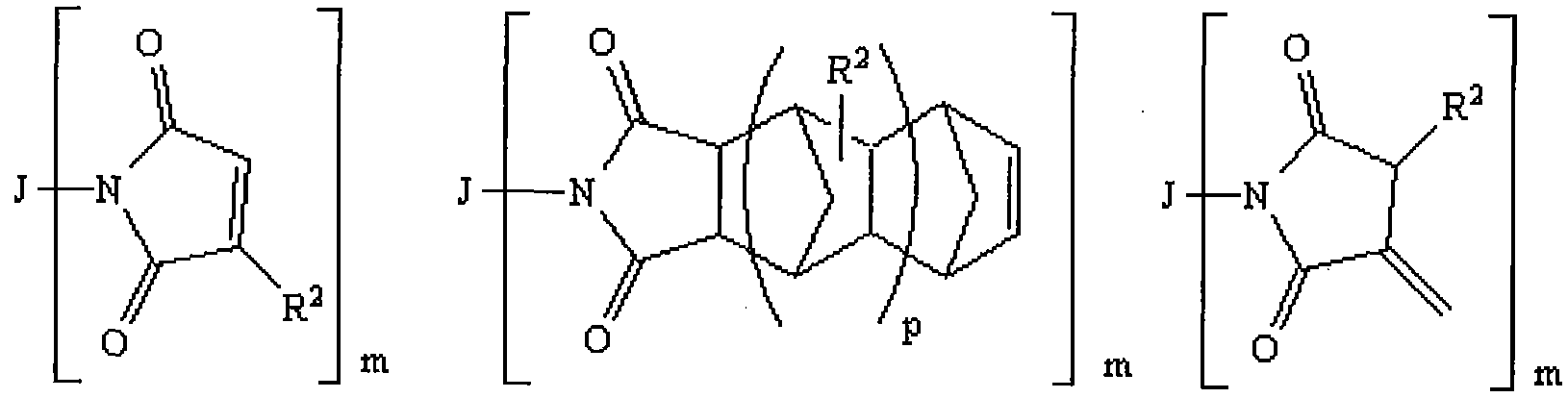
- the first maleimide, nadimide or itaconimide contemplated for use in the practice of the present invention has the structure:
- n 1-15
- p 0-15
- each R 2 is independently selected from hydrogen or lower alkyl
- J is a monovalent or a polyvalent radical selected from:
- aromatic hydrocarbyl or substituted aromatic hydrocarbyl species having in the range of about 6 up to about 300 carbon atoms, where the aromatic hydrocarbyl species is selected from aryl, alkylaryl, arylalkyl, aryalkenyl, alkenylaryl, arylalkynyl or alkynylaryl;
- aromatic hydrocarbylene species are selected from arylene, alkylarylene, arylalkylene, arylalkenylene, alkenylarylene, arylalkynylene or alkynylarylene,
- heterocyclic or substituted heterocyclic species having in the range of about 6 up to about 300 carbon atoms
- linker selected from a covalent bond, -O- , -S-, -NR-, -NR-C(O)-, -NR-C(0)-0-, -NR-C(0)-NR-, -S-C(O)-, -S-C(0)-0-, -S-C(O)- NR-, -0-S(0) 2 -, -0-S(0) 2 -O, -0-S(0) 2 -NR-, -O-S(O)-, -0-S(0)-0-, -0-S(0)-NR-, -O-NR-C(O)-, -0-NR-C(0)-0-, -0-NR-C(0)-NR-, -NR-O-C(O)-, -NR-0-C(0)-0-, -NR-C(0)-NR-, -NR-O-C(O)-, -NR-0-C(0)-0-, -NR-0-C(0)-NR-, -NR-O-C(O)-,
- J of the above-described maleimide, nadimide or itaconimide is heterocyclic, oxyheterocyclic, thioheterocyclic, aminoheterocyclic, carboxyheterocyclic, oxyaryl, thioaryl, aminoaryl, carboxyaryl, heteroaryl, oxyheteroaryl, thioheteroaryl, aminoheteroaryl, carboxyheteroaryl, oxyalkylaryl, thioalkylaryl, aminoalkylaryl, carboxyalkylaryl, oxyarylalkyl, thioarylalkyl, aminoarylalkyl, carboxyarylalkyl, oxyarylalkenyl, thioarylalkenyl, aminoarylalkenyl, carboxyarylalkenyl, oxyalkenylaryl, thioalkenylaryl, aminoalkenylaryl,
- oxyheteroatom-containing di- or polyvalent cyclic moiety t oheteroatom-containing di- or polyvalent cyclic moiety, ammoheteiOatom-containing di- or polyvalent cyclic moiety, or a carboxyheteroatom-containing di- or polyvalent cyclic moiety.
- first maleimide nadimide, or itaconamide contemplated for use herein include:
- the backbone of the second maleimide, nadimide or itaconimide contemplated for use herein contains straight or branched chain hydrocarbyl segments, wherein each hydrocarbyl segment has at least 30 carbons, thereby enhancing the flexibility thereof.
- the second maleimide, nadimide or itaconimide contemplated for use herein has the structure:
- n 1-15
- p 0-15
- each R 2 is independently selected from hydrogen or lower alkyl
- J is a monovalent or a polyvalent radical selected from:
- non-aromatic hydrocarbyl or substituted non-aromatic hydrocarbyl species having in the range of about 20 up to about 500 carbon atoms, where the non- aromatic hydrocarbyl species is selected from alkyl, alkenyl, alkynyl, cycloalkyl, or cycloalkenyl;
- non-aromatic hydrocarbylene or substituted non-aromatic hydrocarbylene species having in the range of about 20 up to about 500 carbon atoms, where the non-aromatic hydrocarbylene species are selected from alkylene, alkenylene, alkynylene, cycloalkylene, or cycloalkenylene,
- heterocyclic or substituted heterocyclic species having in the range of about 20 up to about 500 carbon atoms
- linker selected from a covalent bond, -O- , -S-, -NR-, -NR-C(O)-, -NR-C(0)-0-, -NR-C(0)-NR-, -S-C(O)-, -S-C(0)-0-, -S-C(O)- NR-, -0-S(0) 2 -, -0-S(0) 2 -0-, -0-S(0) 2 -NR-, -O-S(O)-, -0-S(0)-NR-, -O-NR-C(O)-, -0-NR-C(0)-0-, -0-NR-C(0)-NR-, -NR-O-C(O)-, -NR-0-C(0)-0-, -0-NR-C(0)-NR-, -NR-O-C(O)-, -NR-0-C(0)-0-, - R-0-C(0)-NR-, -O-NR-C(S)-, -0-NR-C(
- J of the above-described maleimide, nadimide or itaconimide is oxyalkyl, thioalkyl, aminoalkyl, carboxylalkyl, oxyalkenyl, thioalkenyl, aminoalkenyl, carboxyalkenyl, oxyalkynyl, thioalkynyl, aminoalkynyl, carboxyalkynyl, pxycycloalkyl, thiocycloalkyl, aminocycloalkyl, carboxycycloalkyl, oxycloalkenyl, thiocycloalkenyl, aminocycloalkenyl, carboxycycloalkenyl, heterocyclic, oxyheterocyclic, thioheterocyclic, aminoheterocyclic, carboxyheterocyclic, oxyalkylene, thioalkylene, aminoalkylene, carboxyalkylene, oxyalkenylene,
- carboxycycloalkenylene heteroatom-containing di- or polyvalent cyclic moiety, oxyheteroatom-containing di- or polyvalent cyclic moiety, thioheteroatom-containing di- or polyvalent cyclic moiety, aminoheteroatom-containing di- or polyvalent cyclic moiety, or a carboxyheteroatom-containing di- or polyvalent cyclic moiety.
- Examples of second maleimide, nadimide, itaconamide contemplated for use herein include:
- the first epoxy resin contemplated for use herein is an epoxidized carboxyl-terminated butadiene-acrylonitrile (CTBN) oligomer or polymer.
- CBN carboxyl-terminated butadiene-acrylonitrile
- the epoxidized CTBN oligomer or polymer is an epoxy- containing derivative of an oligomeric or polymeric precursor having the structure:
- each Bu is a butylene moiety (e.g., 1 ,2-butadienyl or 1,4-butadienyl), each ACN is an acrylonitrile moiety,
- epoxidized CTBN oligomers or polymers can be made in a variety of ways, e.g., from (1) a carboxyl teiminated butadiene/acrylonitrile copolymer, (2) an epoxy resin and (3) bisphenol A:
- Examples of the first epoxy resin include epoxidized CTBN oligomers or polymers made from (1) a carboxyl terminated butadiene/acrylonitrile copolymer, (2) an epoxy resin and (3) bisphenol A as described above; HyproTM Epoxy-Functional Butadiene-Aciylonitrile Polymers (formerly Hycar® ETBN), and the like.
- Rubber or elastomer-modified epoxies include epoxidized derivatives of:
- conjugated diene butyl elastomers such as copolymers consisting of from 85 to 99.5% by weight of a C 4 -C 5 olefin combined with about 0.5 to about 15% by weight of a conjugated multi-olefin having 4 to 14 carbon atoms, copolymers of isobutylene and isoprene where a major portion of the isoprene units combined therein have conjugated diene unsaturation (see, for example, U.S. Pat. No.
- the second epoxy resin is an epoxidized polybutadiene diglycidylether oligomer or polymer.
- epoxidized polybutadiene diglycidylether oligomers contemplated for use herein have the structure:
- R 1 and R 2 are each independently H or lower alkyl
- R 3 is H, saturated or unsaturated hydrocarbyl, or epoxy
- At least 1 epoxy-containing repeating unit set forth above, and at least one olefinic repeating unit set forth above are present in each oligomer, and, when present, in the range of 1-10 of each repeating unit is present, and
- n falls in the range of 2 - 150.
- epoxidized polybutadiene diglycidylether oligomer or polymer contemplated for use in the practice of the present invention has the structure:
- R is H, OH, lower alkyl, epoxy, oxirane-substituted lower alkyl, aryl, alkaryl, and the like.
- Examples of the second epoxy resin contemplated for use herein i.e., epoxy having a flexible backbone
- examples of the second epoxy resin contemplated for use herein include:
- additional epoxy materials may be included in invention formulations.
- epoxy- functionalized resins are contemplated for use herein, e.g., epoxy resins based on bisphenol A (e.g., Epon Resin 834), epoxy resins based on bisphenol F (e.g., RSL-1739), multifunctional epoxy resins based on phenol-novolac resin, dicyclopentadiene-type epoxy resins (e.g., Epiclon HP-7200L), naphthalene-type epoxy resins, and the like, as well as mixtures of any two or more thereof.
- bisphenol A e.g., Epon Resin 834
- epoxy resins based on bisphenol F e.g., RSL-1739
- multifunctional epoxy resins based on phenol-novolac resin e.g., dicyclopentadiene-type epoxy resins (e.g., Epiclon HP-7200L), naphthalene-type epoxy resins, and the like, as well as mixtures
- Exemplary epoxy-functionalized resins contemplated for use herein include the diepoxide of the cycloaliphatic alcohol, hydrogenated bisphenol A (commercially available as Epalloy 5000), a difunctional cycloaliphatic glycidyl ester of
- Conductive fillers contemplated for use in the practice of the present invention include silver, nickel, cobalt, copper, gold, palladium, platinum, carbon black, carbon fiber, graphite, carbon nanotubes, aluminum, indium tin oxide, silver-coated copper, silver-coated aluminum, silver-coated graphite, nickel-coated graphite, bismuth, tin, bismuth-tin alloy, metal-coated glass spheressilver-coated fiber, silver-coated spheres, antimony doped tin oxide, carbon nanotubes, conductive nanofiUers, alloys of such metals, and the like, as well as mixtures of any two or more thereof.
- Curing agents contemplated for use in the practice of the present invention include ureas, aliphatic and aromatic amines, polyamides, imidazoles, dicyandiamides,
- Exemplary free radical initiators include peroxy esters, peroxy carbonates, hydroperoxides, alkylperoxides, arylperoxides, azo compounds, and the like.
- Non-reactive diluents when present, include aromatic hydrocarbons (e.g., benzene, toluene, xylene, and the like), saturated hydrocarbons (e.g., hexane, cyclohexane, heptane, tetradecane), chlorinated hydrocarbons (e.g., methylene chloride, chloroform, carbon tetrachloride, dichloroethane, trichloroethylene, and the like), ethers (e.g., diethyl ether, tetrahydrofuran, dioxane, glycol ethers, monoalkyl or dialkyl ethers of ethylene glycol, and the like), esters (e.g., ethyl acetate, butyl acetate, methoxy propyl acetate, and the like); dibasic esters, alpha-terpineol, beta-terpineol,
- the amount of non-reactive diluent contemplated for use in accordance with the present invention can vary widely, so long as a sufficient quantity is employed to dissolve and/or disperse the components of invention compositions.
- the amount of non-reactive diluent employed typically falls in the range of about 2 up to about 25 weight percent of the composition. In certain embodiments, the amount of non-reactive diluent falls in the range of about 5 up to 20 weight percent of the total composition. In some embodiments, the amount of non-reactive diluent falls in the range of about 10 up to about 18 weight percent of the total composition.
- invention compositions contain substantially no diluent therein. Even if diluent is, at one time, present, it is typically removed once manipulation of invention compositions (e.g., by coating as a film on a suitable substrate) has been completed.
- compositions according to the present invention further comprise up to about 4 wt % acrylic polymer.
- Acrylates contemplated for use in the practice of the present invention are well known in the art. See, for example, US Pat. No. 5,717,034, the entire contents of which are hereby incorporated by reference herein.
- acrylic polymers have a molecular weight in the range of about 100,000 up to about 1,000,000 and a Tg in the range of about -40°C up to about 20°C.
- acrylic polymers contemplated for optional use herein have a molecular weight in the range of about 200,000 up to about 900,000 and a Tg in the range of about -40°C up to about 20°C.
- compositions according to the present invention further comprise up to about 4 wt % polyurethane, polysiloxane, or the like.
- polyurethane refers to polymers composed of a chain of organic units joined by carbamate (also known as “urethane") linkers.
- Polyurethane polymers can be formed by reacting an isocyanate with a polyol. Both the isocyanates and polyols used to make polyurethanes typically contain on average two or more functional groups per molecule.
- compositions according to the present invention optionally further comprise one or more flow additives, adhesion promoters, conductivity additives, rheology modifiers, or the like, as well as mixtures of any two or more thereof.
- flow additives refers to silicon polymers, ethyl acrylate/2- ethylhexyl acrylate copolymers, alkylol ammonium salt of phosphoric acid esters of ketoxime, and the like, as well as combinations of any two or more thereof.
- compositions comprise: at least 1 wt % of said first maleimide, nadimide or itaconimide, at least 1 wt % of said second maleimide, nadimide or itaconimide, at least 2 wt % of said first epoxy resin (i.e., said rubber or elastomer- modified epoxy),
- said second epoxy resin i.e., said epoxy resin having a flexible aliphatic or aliphatic/aromatic backbone
- the amount of each component of invention compositions falls in the range of about:
- said first epoxy resin i.e., said rubber or elastomer-modified epoxy
- said second epoxy resin i.e., said epoxy resin having a
- the amount of each component of invention compositions falls in the range of about:
- said first epoxy resin i.e., said rubber or elastomer-modified epoxy
- said second epoxy resin i.e., said epoxy resin having a flexible aliphatic or aliphatic/aromatic backbone
- invention compositions provide a number of useful performance properties. For example, when applied at a thickness of 0.2mm on a suitable 10x10mm copper substrate pad and cured at 200°C for 60 minutes, invention compositions undergo less than 58 micron warpage.
- inventions described herein comprise subjecting the contemplated combination of components to high shear mixing for a time sufficient to obtain a substantially homogeneous blend.
- compositions as described herein are applied to a suitable substrate (e.g., a release liner), then b-staged at elevated temperature to remove substantially all of the solvent therefrom.
- a suitable substrate e.g., a release liner
- conductive die attach films comprising the reaction product obtained upon removing substantially all of the solvent/diluent from the above-described b-staged compositions.
- Exemplary conductive die attach films contemplated herein include films produced when said composition is cured at a temperature in the range of about 160 - 230°C for a time in the range of about 30 minutes - 2 hours.
- conductive die attach films include those produced when compositions according to the present invention are cured at a temperature in the range of about 175-200°C for about 1 hour.
- Conductive die attach films according to the present invention after cure, typically absorb less than about 1.2 % by weight moisture when exposed to 85°C at 85% relative humidity in a Dynamic Vapor Sorption Analyzer. In some embodiments, conductive die attach films according to the present invention, upon cure, absorb less than about 0.7% by weight moisture when exposed to 85°C at 85% relative humidity in a Dynamic Vapor Sorption Analyzer.
- Conductive die attach films according to the present invention upon cure, typically have a Tg (as determined by thermomechanical analysis; TMA) of less than about 40°C; in some embodiments, the Tg as determined by TMA is less than about 20°C.
- TMA thermomechanical analysis
- TMA Thermomechanical analysis
- conductive die attach films according to the present invention upon cure, typically have a Tan Delta Tg (as determined by dynamic mechanical analysis; DMA) of less than about 100°C; in some embodiments, the Tan Delta Tg is less than about 80°C.
- Dynamic mechanical analysis is a technique used to determine the viscoelasticity of polymers. See an exemplary protocol therefor in Example 1 herein.
- Conductive die attach films according to the present invention can also be characterized, upon cure, with reference to the tensile modulus thereof; in some embodiments, the tensile modulus of invention films (at 260°C) is less than IGPa; in some embodiments, the tensile modulus (at 260°C) is less than 500 Mpa.
- Conductive die attach films according to the present invention, upon cure, can also be characterized with reference to the hot die shear thereof; in some embodiments, the hot die shear of said cured film at 260°C is at least 0.5 kg/mm 2 ; in some embodiments, the hot die shear of said film is at least 0.8 kg/mm 2 .
- Conductive die attach films according to the present invention upon cure, can also be characterized with reference to the hot, wet die shear thereof at 260°C after exposure to 85°C at 85% relative humidity for about 3 days; in some embodiments, the hot, wet die shear of said film after exposure to such conditions is at least 0.5 kg/mm 2 ; in some embodiments, the hot, wet die shear of said film after exposure to such conditions is at least 0.65 kg/mm 2 .
- methods for preparing conductive die attach films comprising curing the above-described compositions after application thereof to a suitable substrate, after optional b-staging thereof.
- b-staging is carried out prior to curing of the above-described compositions.
- Suitable substrates contemplated for use herein include lead-frame(s), laminate substrate(s) designed for semiconductor packages (e.g., BT substrate, FR4 substrate, and the like), polyethylene terephthalate, polymethyl methacrylate, polyethylene,
- polypropylene polycarbonate, an epoxy resin, polyimide, polyamide, polyester, glass, and the like.
- lead-frame(s) comprise a base plate consisting of copper or copper alloys, and a protective coating formed on the upper (or both) surface(s) of the base plate.
- the protective coating is composed of at least one metal selected from the group consisting of gold, gold alloy, silver, silver alloy, palladium or palladium alloy, and has a thickness of about 10-500 angstrom.
- the protective coating is formed by suitable means, e.g., by vapor deposition. It is possible to form an intermediate coating of nickel or nickel alloys between the surface of the base plate and the protective coating, by means of vapor deposition or wet plating. A suitable thickness for the intermediate coating is within the range of about 50-20,000 angstrom. See, for example, U.S. Pat. No. 5,510,197, the entire contents of which are hereby incorporated by reference herein.
- articles comprising conductive die attach films as described herein adhered to a suitable substrate therefor.
- Articles according to the present invention can be characterized in terms of the adhesion of the cured conductive die attach film to the substrate; typically the adhesion is at least about 0.5 kg/mm 2 at 260°C; in some embodiments, the adhesion is at least about 0.8 kg/mm 2 at 260°C.
- Articles according to the present invention can also be characterized in terms of the Tg of the cured conductive die attach film, with a Tg (as determined by thermomechanical analysis; TMA) typically being less than about 40°C; in some embodiments, the Tg is less than about 20°C.
- Tg as determined by thermomechanical analysis
- Articles according to the present invention can alternatively be characterized with reference to the Tan Delta Tg of the cured conductive die attach film; typically, the conductive die attach film of invention articles has a Tan Delta Tg (as determined by dynamic mechanical analysis; DMA) of less than about 100°C; in some embodiments, the Tg is less than about 80°C.
- DMA dynamic mechanical analysis
- Articles according to the present invention can be further characterized with reference to the tensile modulus of said cured conductive die attach film at 260°C;
- the tensile modulus is less than about lGPa; in some embodiments, the tensile modulus is less than about 500 MPa.
- invention articles can vary over a wide range.
- a particular advantage of invention formulations is their suitability for preparation of large dies.
- Exemplary articles typically have a surface area of at least 6 mm 2 , and can be 2.5x2.5 mm, or 3x3 mm, or 4x4 mm, or 5x5 mm, or 6x6 mm, or 7x7mm, or 8x8 mm, or 9x9 mm, or 10x10 mm, or the like.
- methods for preparing a conductive network comprising: applying a composition as described herein to a suitable substrate in a
- Comparison formulations and formulations according to the invention were prepared by combining the components set forth in Table 1, as follows.
- Solid resins were pre-dissolved in suitable solvent as follows. The required amounts of the organic components were weighed into a container, hand mixed for about 5 minutes, then sufficient solvent was added to fill 5-25 % of the container. Pre-mixing continued for about 5-10 minutes with a high speed mixer. The required amount of fillier was then added to the container, and the contents thereof subjected to high speed mixing (about 1000-3000 rpm) for about one hour. The resulting slurry was de-gassed by subjecting same to reduced pressure for about 1-10 minutes.
- Conductive films were prepared by pouring the slurry onto a clean, prepared surface using a coating machine. The slurry was subsequently heated in a retort oven to produce a stable coating film that is well bonded to the substrate (the release liner). A cover liner is than applied onto the film to protect the surface thereof. In some circumstances, it may be desirable to laminate the film under heat and pressure to promote the formation of substantially even film coatings.
- thermomechanical analysis (TMA) on a Perkin-Elmer Instrument with an expansion fixture with an applied force of 20mN.
- TMA thermomechanical analysis
- Tg glass transition temperature
- CTE1 coefficient of thermal expansion 1
- CTE2 coeffecient of thermal expansion 2
- DMA analysis of tensile modulus was performed on film samples employing a TA Instruments, TA-Q800 using a flat edge tension film fixture on the TA -Q800. Sample dimensions were approximately (24 x 8 x 0.2 mm). Samples were cured by subjecting them to a 30-45min ramp from room temperature to 200°C, then soaked for about lhr at 200°C.
- DMA was carried out at a ramp rate of 5.0°C/min starting at -70°C up to 300°C.
- the frequency was 10 Hz and 5 microns was applied for strain amplitude. Results are presented in Table 2. Table 2
- MSL moisture sensitivity levels
- MSL1 85°C and 85% relative humidity for 168 hours;
- MSL2 85°C and 60% relative humidity for 168 hours
- MSL3 30°C and 60% relative humidity for 192 hours. The results are summarized below:
- invention formulations e.g., Formulation C
- e.g., Formulation C perform very well when subjected to multiple temperature cycles, providing far better adhesion than comparative formulations lacking one or more of the components required by invention formulations.
- Patents and publications mentioned in the specification are indicative of the levels of those skilled in the art to which the invention pertains. These patents and publications are incorporated herein by reference to the same extent as if each individual application or publication was specifically and individually incorporated herein by reference.
Landscapes
- Chemical & Material Sciences (AREA)
- Organic Chemistry (AREA)
- Health & Medical Sciences (AREA)
- Chemical Kinetics & Catalysis (AREA)
- Medicinal Chemistry (AREA)
- Polymers & Plastics (AREA)
- Spectroscopy & Molecular Physics (AREA)
- Dispersion Chemistry (AREA)
- Physics & Mathematics (AREA)
- Compositions Of Macromolecular Compounds (AREA)
- Conductive Materials (AREA)
- Engineering & Computer Science (AREA)
- Manufacturing & Machinery (AREA)
- Adhesives Or Adhesive Processes (AREA)
- Manufacture Of Macromolecular Shaped Articles (AREA)
- Manufacturing Of Electric Cables (AREA)
Abstract
Description




Claims


Priority Applications (5)
| Application Number | Priority Date | Filing Date | Title |
|---|---|---|---|
| JP2016545261A JP6378346B2 (en) | 2013-09-30 | 2014-09-29 | Conductive die attach films for large die semiconductor packages and compositions useful for their preparation |
| CN201480042671.2A CN105473657B (en) | 2013-09-30 | 2014-09-29 | Composition for the conductive wafer adhesive film of larger wafers package semiconductor and for preparing conductive wafer adhesive film |
| EP14847431.5A EP3052566B1 (en) | 2013-09-30 | 2014-09-29 | Conductive die attach film for large die semiconductor packages and compositions useful for the preparation thereof |
| KR1020167007600A KR101909353B1 (en) | 2013-09-30 | 2014-09-29 | Conductive die attach film for large die semiconductor packages and compositions useful for the preparation thereof |
| US15/010,531 US9449938B2 (en) | 2013-09-30 | 2016-01-29 | Conductive die attach film for large die semiconductor packages and compositions useful for the preparation thereof |
Applications Claiming Priority (2)
| Application Number | Priority Date | Filing Date | Title |
|---|---|---|---|
| US201361884844P | 2013-09-30 | 2013-09-30 | |
| US61/884,844 | 2013-09-30 |
Related Child Applications (1)
| Application Number | Title | Priority Date | Filing Date |
|---|---|---|---|
| US15/010,531 Continuation US9449938B2 (en) | 2013-09-30 | 2016-01-29 | Conductive die attach film for large die semiconductor packages and compositions useful for the preparation thereof |
Publications (1)
| Publication Number | Publication Date |
|---|---|
| WO2015048621A1 true WO2015048621A1 (en) | 2015-04-02 |
Family
ID=52744560
Family Applications (1)
| Application Number | Title | Priority Date | Filing Date |
|---|---|---|---|
| PCT/US2014/058000 Ceased WO2015048621A1 (en) | 2013-09-30 | 2014-09-29 | Conductive die attach film for large die semiconductor packages and compositions useful for the preparation thereof |
Country Status (7)
| Country | Link |
|---|---|
| US (1) | US9449938B2 (en) |
| EP (1) | EP3052566B1 (en) |
| JP (1) | JP6378346B2 (en) |
| KR (1) | KR101909353B1 (en) |
| CN (1) | CN105473657B (en) |
| TW (1) | TWI651387B (en) |
| WO (1) | WO2015048621A1 (en) |
Cited By (1)
| Publication number | Priority date | Publication date | Assignee | Title |
|---|---|---|---|---|
| WO2017066563A1 (en) | 2015-10-15 | 2017-04-20 | Henkel IP & Holding GmbH | Use of nickel and nickel-containing alloys as conductive fillers in adhesive formulations |
Families Citing this family (16)
| Publication number | Priority date | Publication date | Assignee | Title |
|---|---|---|---|---|
| US9672798B1 (en) * | 2012-11-29 | 2017-06-06 | Flexcon Company, Inc. | Systems and methods for providing decorative drum shell wraps |
| JP2019511587A (en) * | 2016-02-04 | 2019-04-25 | ヘンケル アイピー アンド ホールディング ゲゼルシャフト ミット ベシュレンクテル ハフツング | Peelable adhesive and its high temperature use |
| US9892999B2 (en) * | 2016-06-07 | 2018-02-13 | Globalfoundries Inc. | Producing wafer level packaging using leadframe strip and related device |
| CN120003120A (en) * | 2017-03-17 | 2025-05-16 | 汉高股份有限及两合公司 | Improved working life of multilayer articles and method for preparing and using the same |
| KR102351843B1 (en) * | 2017-06-07 | 2022-01-18 | 쇼와덴코머티리얼즈가부시끼가이샤 | Film adhesive for semiconductor, semiconductor device manufacturing method and semiconductor device |
| KR102156470B1 (en) * | 2017-09-11 | 2020-09-15 | 주식회사 엘지화학 | Selection method of adhesive agents having improved folding stability |
| US11791237B2 (en) * | 2018-06-27 | 2023-10-17 | Intel Corporation | Microelectronic assemblies including a thermal interface material |
| JP7164386B2 (en) * | 2018-10-04 | 2022-11-01 | タツタ電線株式会社 | conductive paint |
| CN109971175B (en) * | 2019-03-18 | 2021-09-21 | 苏州生益科技有限公司 | Modified maleimide resin composition, prepreg and laminated board prepared from same |
| US12166004B2 (en) | 2019-05-08 | 2024-12-10 | Intel Corporation | Solder thermal interface material (STIM) with dopant |
| US12272614B2 (en) | 2019-05-28 | 2025-04-08 | Intel Corporation | Integrated circuit packages with solder thermal interface materials with embedded particles |
| US11682605B2 (en) | 2019-05-28 | 2023-06-20 | Intel Corporation | Integrated circuit packages with asymmetric adhesion material regions |
| CN112011181A (en) * | 2019-05-31 | 2020-12-01 | 台光电子材料(昆山)有限公司 | Resin composition and product thereof |
| JP7442669B2 (en) * | 2020-03-12 | 2024-03-04 | ドゥーサン コーポレイション | Adhesive composition, coverlay film containing the same, and printed circuit board |
| WO2025106944A1 (en) * | 2023-11-16 | 2025-05-22 | Henkel Ag & Co. Kgaa | Flexible conductive adhesive compositions |
| TW202547929A (en) * | 2024-03-28 | 2025-12-16 | 德商漢高股份有限及兩合公司 | Thermal conductivity promoter for electrically conductive compositions |
Citations (12)
| Publication number | Priority date | Publication date | Assignee | Title |
|---|---|---|---|---|
| US4020036A (en) | 1976-04-22 | 1977-04-26 | Phillips Petroleum Company | Thermosetting polyester composition containing normally solid carboxy-containing diene polymer |
| US4101604A (en) | 1977-07-18 | 1978-07-18 | The B. F. Goodrich Company | Unsaturated polyester molding compositions |
| US4160759A (en) | 1978-01-30 | 1979-07-10 | Exxon Research & Engineering Co. | Elastomer modified polyester molding compound |
| US4161471A (en) | 1978-04-13 | 1979-07-17 | E. I. Du Pont De Nemours And Company | Elastomer modified unsaturated molding compositions |
| US5397618A (en) | 1991-07-11 | 1995-03-14 | The Dexter Corporation | Multilayer composite article containing a multimodal combination of filler particles |
| US5510197A (en) | 1993-04-28 | 1996-04-23 | Mitsubishi Shindoh Co., Ltd. | Lead frame material and lead frame for semiconductor device |
| US5717034A (en) | 1996-07-29 | 1998-02-10 | Quantum Materials, Inc. | Perfluorinated hydrocarbon polymer-filled adhesive formulations and uses therefor |
| US20050288457A1 (en) * | 2002-10-22 | 2005-12-29 | Puwei Liu | Co-curable compositions |
| US7037447B1 (en) * | 2003-07-23 | 2006-05-02 | Henkel Corporation | Conductive ink compositions |
| EP1715004A1 (en) | 2005-04-18 | 2006-10-25 | National Starch and Chemical Investment Holding Corporation | Die attach adhesives with improved stress performance |
| WO2012022011A1 (en) * | 2010-08-20 | 2012-02-23 | Ablestik (Shanghai) Limited | Stabilized, silver coated filler-containing curable compositions |
| WO2013015469A1 (en) | 2011-07-28 | 2013-01-31 | Protavic Korea Co., Ltd. | Flexible bismaleimide, benzoxazine, epoxy-anhydride adduct hybrid adhesive |
Family Cites Families (18)
| Publication number | Priority date | Publication date | Assignee | Title |
|---|---|---|---|---|
| JPS57205413A (en) * | 1981-06-11 | 1982-12-16 | Mitsui Toatsu Chem Inc | Curable resin composition |
| US6750301B1 (en) * | 2000-07-07 | 2004-06-15 | National Starch And Chemical Investment Holding Corporation | Die attach adhesives with epoxy compound or resin having allyl or vinyl groups |
| US6583201B2 (en) * | 2001-04-25 | 2003-06-24 | National Starch And Chemical Investment Holding Corporation | Conductive materials with electrical stability for use in electronics devices |
| US6831132B2 (en) | 2002-03-28 | 2004-12-14 | Henkel Corporation | Film adhesives containing maleimide compounds and methods for use thereof |
| US7176044B2 (en) | 2002-11-25 | 2007-02-13 | Henkel Corporation | B-stageable die attach adhesives |
| US7326369B2 (en) | 2005-03-07 | 2008-02-05 | National Starch And Chemical Investment Holding Corporation | Low stress conductive adhesive |
| JP5228320B2 (en) * | 2006-12-13 | 2013-07-03 | 住友ベークライト株式会社 | Resin composition, insulating material with supporting substrate, and metal-clad laminate for flexible printed circuit board |
| US7422707B2 (en) * | 2007-01-10 | 2008-09-09 | National Starch And Chemical Investment Holding Corporation | Highly conductive composition for wafer coating |
| KR20140143430A (en) * | 2007-07-26 | 2014-12-16 | 헨켈 아게 운트 코. 카게아아 | Alcohols containing imide moieties and reactive oligomers prepared therefrom |
| WO2009117345A2 (en) * | 2008-03-17 | 2009-09-24 | Henkel Corporation | Adhesive compositions for use in die attach applications |
| KR101990258B1 (en) * | 2008-08-08 | 2019-06-17 | 헨켈 아이피 앤드 홀딩 게엠베하 | Low temperature curing compositions |
| JP5482077B2 (en) * | 2009-10-09 | 2014-04-23 | 住友ベークライト株式会社 | Resin composition and semiconductor device produced using resin composition |
| JP5356326B2 (en) * | 2010-07-20 | 2013-12-04 | 日東電工株式会社 | Manufacturing method of semiconductor device |
| SG188309A1 (en) * | 2010-09-07 | 2013-04-30 | Sumitomo Bakelite Co | Resin composition and semiconductor device produced using resin composition |
| CN102199413A (en) * | 2011-03-26 | 2011-09-28 | 舟山维特新材料科技有限公司 | Modified epoxy resin adhesive used for polyimide flexible copper-clad plate |
| TWI569381B (en) * | 2011-05-27 | 2017-02-01 | 住友電木股份有限公司 | Semiconductor device |
| US20140120356A1 (en) * | 2012-06-18 | 2014-05-01 | Ormet Circuits, Inc. | Conductive film adhesive |
| JP6272729B2 (en) * | 2014-05-16 | 2018-01-31 | 日東電工株式会社 | Dicing tape-integrated film for semiconductor back surface and method for manufacturing semiconductor device |
-
2014
- 2014-07-28 TW TW103125744A patent/TWI651387B/en active
- 2014-09-29 WO PCT/US2014/058000 patent/WO2015048621A1/en not_active Ceased
- 2014-09-29 CN CN201480042671.2A patent/CN105473657B/en active Active
- 2014-09-29 KR KR1020167007600A patent/KR101909353B1/en active Active
- 2014-09-29 JP JP2016545261A patent/JP6378346B2/en active Active
- 2014-09-29 EP EP14847431.5A patent/EP3052566B1/en active Active
-
2016
- 2016-01-29 US US15/010,531 patent/US9449938B2/en active Active
Patent Citations (12)
| Publication number | Priority date | Publication date | Assignee | Title |
|---|---|---|---|---|
| US4020036A (en) | 1976-04-22 | 1977-04-26 | Phillips Petroleum Company | Thermosetting polyester composition containing normally solid carboxy-containing diene polymer |
| US4101604A (en) | 1977-07-18 | 1978-07-18 | The B. F. Goodrich Company | Unsaturated polyester molding compositions |
| US4160759A (en) | 1978-01-30 | 1979-07-10 | Exxon Research & Engineering Co. | Elastomer modified polyester molding compound |
| US4161471A (en) | 1978-04-13 | 1979-07-17 | E. I. Du Pont De Nemours And Company | Elastomer modified unsaturated molding compositions |
| US5397618A (en) | 1991-07-11 | 1995-03-14 | The Dexter Corporation | Multilayer composite article containing a multimodal combination of filler particles |
| US5510197A (en) | 1993-04-28 | 1996-04-23 | Mitsubishi Shindoh Co., Ltd. | Lead frame material and lead frame for semiconductor device |
| US5717034A (en) | 1996-07-29 | 1998-02-10 | Quantum Materials, Inc. | Perfluorinated hydrocarbon polymer-filled adhesive formulations and uses therefor |
| US20050288457A1 (en) * | 2002-10-22 | 2005-12-29 | Puwei Liu | Co-curable compositions |
| US7037447B1 (en) * | 2003-07-23 | 2006-05-02 | Henkel Corporation | Conductive ink compositions |
| EP1715004A1 (en) | 2005-04-18 | 2006-10-25 | National Starch and Chemical Investment Holding Corporation | Die attach adhesives with improved stress performance |
| WO2012022011A1 (en) * | 2010-08-20 | 2012-02-23 | Ablestik (Shanghai) Limited | Stabilized, silver coated filler-containing curable compositions |
| WO2013015469A1 (en) | 2011-07-28 | 2013-01-31 | Protavic Korea Co., Ltd. | Flexible bismaleimide, benzoxazine, epoxy-anhydride adduct hybrid adhesive |
Cited By (3)
| Publication number | Priority date | Publication date | Assignee | Title |
|---|---|---|---|---|
| WO2017066563A1 (en) | 2015-10-15 | 2017-04-20 | Henkel IP & Holding GmbH | Use of nickel and nickel-containing alloys as conductive fillers in adhesive formulations |
| CN108779373A (en) * | 2015-10-15 | 2018-11-09 | 汉高知识产权控股有限责任公司 | Nickel and contain purposes of the alloy of nickel as conductive filler in adhesive formulation |
| EP3362530A4 (en) * | 2015-10-15 | 2019-06-05 | Henkel IP & Holding GmbH | USE OF NICKEL AND ALLOYS CONTAINING NICKEL AS CONDUCTIVE LOADS IN ADHESIVE FORMULATIONS |
Also Published As
| Publication number | Publication date |
|---|---|
| TW201512367A (en) | 2015-04-01 |
| US9449938B2 (en) | 2016-09-20 |
| KR101909353B1 (en) | 2018-10-17 |
| TWI651387B (en) | 2019-02-21 |
| JP2016533422A (en) | 2016-10-27 |
| CN105473657B (en) | 2017-12-22 |
| EP3052566B1 (en) | 2018-11-07 |
| EP3052566A4 (en) | 2017-05-31 |
| JP6378346B2 (en) | 2018-08-22 |
| KR20160065828A (en) | 2016-06-09 |
| US20160148894A1 (en) | 2016-05-26 |
| EP3052566A1 (en) | 2016-08-10 |
| CN105473657A (en) | 2016-04-06 |
Similar Documents
| Publication | Publication Date | Title |
|---|---|---|
| EP3052566B1 (en) | Conductive die attach film for large die semiconductor packages and compositions useful for the preparation thereof | |
| US12042883B2 (en) | Sinterable films and pastes and methods for use thereof | |
| US20120172495A1 (en) | Underfill for high density interconnect flip chips | |
| US10242923B2 (en) | Formulations containing mixed resin systems and the use thereof for wafer-level underfill for 3D TSV packages | |
| TWI790188B (en) | Methods for improving performance properties of thermoset polymer resins | |
| US20180340102A1 (en) | Use of nickel and nickel-containing alloys as conductive fillers in adhesive formulations | |
| KR20020038532A (en) | Liquid Epoxy Resin Compositions and Semiconductor Devices | |
| KR20060048870A (en) | Composition for semiconductor package containing oxetane compound | |
| JP2008274090A (en) | Adhesive composition and method of using the same | |
| US10927249B2 (en) | Resin compositions for underfill film for three dimensional through silica via (TSV) packages and compositions useful for the preparation thereof | |
| JP5099850B2 (en) | Semiconductor element sealing composition | |
| US20110166258A1 (en) | Resin composition for no-flow underfill, no-flow underfill flim using the same and manufacturing method thereof | |
| WO2025106944A1 (en) | Flexible conductive adhesive compositions | |
| TWI752195B (en) | Worklife improvement for multilayer articles comprising at least one underfill film and methods for the preparation and use thereof | |
| KR20260025081A (en) | Thermally conductive die attach film |
Legal Events
| Date | Code | Title | Description |
|---|---|---|---|
| WWE | Wipo information: entry into national phase |
Ref document number: 201480042671.2 Country of ref document: CN |
|
| 121 | Ep: the epo has been informed by wipo that ep was designated in this application |
Ref document number: 14847431 Country of ref document: EP Kind code of ref document: A1 |
|
| REEP | Request for entry into the european phase |
Ref document number: 2014847431 Country of ref document: EP |
|
| WWE | Wipo information: entry into national phase |
Ref document number: 2014847431 Country of ref document: EP |
|
| ENP | Entry into the national phase |
Ref document number: 20167007600 Country of ref document: KR Kind code of ref document: A |
|
| ENP | Entry into the national phase |
Ref document number: 2016545261 Country of ref document: JP Kind code of ref document: A |
|
| NENP | Non-entry into the national phase |
Ref country code: DE |