WO2015056559A1 - ケミカルフィルタ - Google Patents
ケミカルフィルタ Download PDFInfo
- Publication number
- WO2015056559A1 WO2015056559A1 PCT/JP2014/075994 JP2014075994W WO2015056559A1 WO 2015056559 A1 WO2015056559 A1 WO 2015056559A1 JP 2014075994 W JP2014075994 W JP 2014075994W WO 2015056559 A1 WO2015056559 A1 WO 2015056559A1
- Authority
- WO
- WIPO (PCT)
- Prior art keywords
- chemical filter
- adsorbent
- silanol compound
- silica
- porous material
- Prior art date
- Legal status (The legal status is an assumption and is not a legal conclusion. Google has not performed a legal analysis and makes no representation as to the accuracy of the status listed.)
- Ceased
Links
Images




Classifications
-
- B—PERFORMING OPERATIONS; TRANSPORTING
- B01—PHYSICAL OR CHEMICAL PROCESSES OR APPARATUS IN GENERAL
- B01J—CHEMICAL OR PHYSICAL PROCESSES, e.g. CATALYSIS OR COLLOID CHEMISTRY; THEIR RELEVANT APPARATUS
- B01J20/00—Solid sorbent compositions or filter aid compositions; Sorbents for chromatography; Processes for preparing, regenerating or reactivating thereof
- B01J20/02—Solid sorbent compositions or filter aid compositions; Sorbents for chromatography; Processes for preparing, regenerating or reactivating thereof comprising inorganic material
- B01J20/10—Solid sorbent compositions or filter aid compositions; Sorbents for chromatography; Processes for preparing, regenerating or reactivating thereof comprising inorganic material comprising silica or silicate
- B01J20/12—Naturally occurring clays or bleaching earth
-
- B—PERFORMING OPERATIONS; TRANSPORTING
- B01—PHYSICAL OR CHEMICAL PROCESSES OR APPARATUS IN GENERAL
- B01D—SEPARATION
- B01D53/00—Separation of gases or vapours; Recovering vapours of volatile solvents from gases; Chemical or biological purification of waste gases, e.g. engine exhaust gases, smoke, fumes, flue gases, aerosols
- B01D53/34—Chemical or biological purification of waste gases
- B01D53/46—Removing components of defined structure
- B01D53/68—Halogens or halogen compounds
- B01D53/70—Organic halogen compounds
-
- B—PERFORMING OPERATIONS; TRANSPORTING
- B01—PHYSICAL OR CHEMICAL PROCESSES OR APPARATUS IN GENERAL
- B01J—CHEMICAL OR PHYSICAL PROCESSES, e.g. CATALYSIS OR COLLOID CHEMISTRY; THEIR RELEVANT APPARATUS
- B01J20/00—Solid sorbent compositions or filter aid compositions; Sorbents for chromatography; Processes for preparing, regenerating or reactivating thereof
- B01J20/02—Solid sorbent compositions or filter aid compositions; Sorbents for chromatography; Processes for preparing, regenerating or reactivating thereof comprising inorganic material
- B01J20/10—Solid sorbent compositions or filter aid compositions; Sorbents for chromatography; Processes for preparing, regenerating or reactivating thereof comprising inorganic material comprising silica or silicate
- B01J20/103—Solid sorbent compositions or filter aid compositions; Sorbents for chromatography; Processes for preparing, regenerating or reactivating thereof comprising inorganic material comprising silica or silicate comprising silica
-
- B—PERFORMING OPERATIONS; TRANSPORTING
- B01—PHYSICAL OR CHEMICAL PROCESSES OR APPARATUS IN GENERAL
- B01J—CHEMICAL OR PHYSICAL PROCESSES, e.g. CATALYSIS OR COLLOID CHEMISTRY; THEIR RELEVANT APPARATUS
- B01J20/00—Solid sorbent compositions or filter aid compositions; Sorbents for chromatography; Processes for preparing, regenerating or reactivating thereof
- B01J20/02—Solid sorbent compositions or filter aid compositions; Sorbents for chromatography; Processes for preparing, regenerating or reactivating thereof comprising inorganic material
- B01J20/10—Solid sorbent compositions or filter aid compositions; Sorbents for chromatography; Processes for preparing, regenerating or reactivating thereof comprising inorganic material comprising silica or silicate
- B01J20/14—Diatomaceous earth
-
- B—PERFORMING OPERATIONS; TRANSPORTING
- B01—PHYSICAL OR CHEMICAL PROCESSES OR APPARATUS IN GENERAL
- B01J—CHEMICAL OR PHYSICAL PROCESSES, e.g. CATALYSIS OR COLLOID CHEMISTRY; THEIR RELEVANT APPARATUS
- B01J20/00—Solid sorbent compositions or filter aid compositions; Sorbents for chromatography; Processes for preparing, regenerating or reactivating thereof
- B01J20/02—Solid sorbent compositions or filter aid compositions; Sorbents for chromatography; Processes for preparing, regenerating or reactivating thereof comprising inorganic material
- B01J20/10—Solid sorbent compositions or filter aid compositions; Sorbents for chromatography; Processes for preparing, regenerating or reactivating thereof comprising inorganic material comprising silica or silicate
- B01J20/16—Alumino-silicates
- B01J20/18—Synthetic zeolitic molecular sieves
-
- B—PERFORMING OPERATIONS; TRANSPORTING
- B01—PHYSICAL OR CHEMICAL PROCESSES OR APPARATUS IN GENERAL
- B01J—CHEMICAL OR PHYSICAL PROCESSES, e.g. CATALYSIS OR COLLOID CHEMISTRY; THEIR RELEVANT APPARATUS
- B01J20/00—Solid sorbent compositions or filter aid compositions; Sorbents for chromatography; Processes for preparing, regenerating or reactivating thereof
- B01J20/28—Solid sorbent compositions or filter aid compositions; Sorbents for chromatography; Processes for preparing, regenerating or reactivating thereof characterised by their form or physical properties
- B01J20/28014—Solid sorbent compositions or filter aid compositions; Sorbents for chromatography; Processes for preparing, regenerating or reactivating thereof characterised by their form or physical properties characterised by their form
- B01J20/2803—Sorbents comprising a binder, e.g. for forming aggregated, agglomerated or granulated products
-
- B—PERFORMING OPERATIONS; TRANSPORTING
- B01—PHYSICAL OR CHEMICAL PROCESSES OR APPARATUS IN GENERAL
- B01J—CHEMICAL OR PHYSICAL PROCESSES, e.g. CATALYSIS OR COLLOID CHEMISTRY; THEIR RELEVANT APPARATUS
- B01J20/00—Solid sorbent compositions or filter aid compositions; Sorbents for chromatography; Processes for preparing, regenerating or reactivating thereof
- B01J20/28—Solid sorbent compositions or filter aid compositions; Sorbents for chromatography; Processes for preparing, regenerating or reactivating thereof characterised by their form or physical properties
- B01J20/28014—Solid sorbent compositions or filter aid compositions; Sorbents for chromatography; Processes for preparing, regenerating or reactivating thereof characterised by their form or physical properties characterised by their form
- B01J20/28042—Shaped bodies; Monolithic structures
-
- B—PERFORMING OPERATIONS; TRANSPORTING
- B01—PHYSICAL OR CHEMICAL PROCESSES OR APPARATUS IN GENERAL
- B01J—CHEMICAL OR PHYSICAL PROCESSES, e.g. CATALYSIS OR COLLOID CHEMISTRY; THEIR RELEVANT APPARATUS
- B01J20/00—Solid sorbent compositions or filter aid compositions; Sorbents for chromatography; Processes for preparing, regenerating or reactivating thereof
- B01J20/28—Solid sorbent compositions or filter aid compositions; Sorbents for chromatography; Processes for preparing, regenerating or reactivating thereof characterised by their form or physical properties
- B01J20/28014—Solid sorbent compositions or filter aid compositions; Sorbents for chromatography; Processes for preparing, regenerating or reactivating thereof characterised by their form or physical properties characterised by their form
- B01J20/28042—Shaped bodies; Monolithic structures
- B01J20/28045—Honeycomb or cellular structures; Solid foams or sponges
-
- B—PERFORMING OPERATIONS; TRANSPORTING
- B01—PHYSICAL OR CHEMICAL PROCESSES OR APPARATUS IN GENERAL
- B01D—SEPARATION
- B01D2253/00—Adsorbents used in seperation treatment of gases and vapours
- B01D2253/10—Inorganic adsorbents
- B01D2253/106—Silica or silicates
-
- B—PERFORMING OPERATIONS; TRANSPORTING
- B01—PHYSICAL OR CHEMICAL PROCESSES OR APPARATUS IN GENERAL
- B01D—SEPARATION
- B01D2253/00—Adsorbents used in seperation treatment of gases and vapours
- B01D2253/10—Inorganic adsorbents
- B01D2253/106—Silica or silicates
- B01D2253/108—Zeolites
- B01D2253/1085—Zeolites characterized by a silicon-aluminium ratio
-
- B—PERFORMING OPERATIONS; TRANSPORTING
- B01—PHYSICAL OR CHEMICAL PROCESSES OR APPARATUS IN GENERAL
- B01D—SEPARATION
- B01D2253/00—Adsorbents used in seperation treatment of gases and vapours
- B01D2253/10—Inorganic adsorbents
- B01D2253/106—Silica or silicates
- B01D2253/11—Clays
-
- B—PERFORMING OPERATIONS; TRANSPORTING
- B01—PHYSICAL OR CHEMICAL PROCESSES OR APPARATUS IN GENERAL
- B01D—SEPARATION
- B01D2257/00—Components to be removed
- B01D2257/55—Compounds of silicon, phosphorus, germanium or arsenic
- B01D2257/553—Compounds comprising hydrogen, e.g. silanes
-
- B—PERFORMING OPERATIONS; TRANSPORTING
- B01—PHYSICAL OR CHEMICAL PROCESSES OR APPARATUS IN GENERAL
- B01D—SEPARATION
- B01D2258/00—Sources of waste gases
- B01D2258/02—Other waste gases
- B01D2258/0216—Other waste gases from CVD treatment or semi-conductor manufacturing
-
- B—PERFORMING OPERATIONS; TRANSPORTING
- B01—PHYSICAL OR CHEMICAL PROCESSES OR APPARATUS IN GENERAL
- B01D—SEPARATION
- B01D2259/00—Type of treatment
- B01D2259/40—Further details for adsorption processes and devices
- B01D2259/406—Further details for adsorption processes and devices using more than four beds
- B01D2259/4062—Further details for adsorption processes and devices using more than four beds using six beds
-
- B—PERFORMING OPERATIONS; TRANSPORTING
- B01—PHYSICAL OR CHEMICAL PROCESSES OR APPARATUS IN GENERAL
- B01J—CHEMICAL OR PHYSICAL PROCESSES, e.g. CATALYSIS OR COLLOID CHEMISTRY; THEIR RELEVANT APPARATUS
- B01J2220/00—Aspects relating to sorbent materials
- B01J2220/50—Aspects relating to the use of sorbent or filter aid materials
- B01J2220/60—Use in several different columns
- B01J2220/603—Use in several different columns serially disposed columns
-
- B—PERFORMING OPERATIONS; TRANSPORTING
- B01—PHYSICAL OR CHEMICAL PROCESSES OR APPARATUS IN GENERAL
- B01J—CHEMICAL OR PHYSICAL PROCESSES, e.g. CATALYSIS OR COLLOID CHEMISTRY; THEIR RELEVANT APPARATUS
- B01J2220/00—Aspects relating to sorbent materials
- B01J2220/50—Aspects relating to the use of sorbent or filter aid materials
- B01J2220/60—Use in several different columns
- B01J2220/606—Use in several different columns parallel disposed columns
Definitions
- the present invention relates to a chemical filter for removing silanol compounds from the air. Further, the present invention controls an air purification method using the chemical filter, an exposure apparatus including the chemical filter, a coating and developing apparatus including the chemical filter, and a gaseous pollutant including the chemical filter. Regarding clean rooms.
- HMDS hexamethyldisilazane
- TMS low molecular weight trimethylsilanol
- Floating TMS is decomposed upon receiving the energy of short-wavelength light such as excimer lasers used in exposure equipment, etc., and the decomposed product binds to the surface of the lens, etc., causing lens fogging and exposure failure. It may cause etc.
- the air that has passed through a chemical filter having an adsorbent such as activated carbon is usually supplied into the chamber of the exposure apparatus where the exposure process is performed.
- gaseous impurities such as TMS are removed by a chemical filter, so that the inside of the chamber is maintained at a certain level of cleanliness, thereby preventing exposure failure and the like (see, for example, Patent Document 1).
- TMS is a volatile substance with a low molecular weight, and it is difficult to adsorb on activated carbon, which is a general chemical filter adsorbent. Is difficult. Therefore, conventionally, in order to remove the necessary amount of TMS, it has been necessary to use a large amount of activated carbon such as thickening the chemical filter or increasing the capacity.
- Patent Document 2 discloses a chemical filter using an acidic additive.
- silanol compounds contained in the air are dimerized by an acidic additive and adsorbed.
- this method does not necessarily provide sufficient removal efficiency.
- an object of the present invention is to provide a silanol compound removing chemical filter capable of efficiently removing a silanol compound such as TMS.
- Another object of the present invention is to provide an air purification method capable of efficiently removing silanol compounds such as TMS present in the air.
- Still another object of the present invention is to provide an exposure apparatus provided with the above chemical filter, a coating and developing apparatus, and a clean room in which gaseous contaminants are controlled.
- the present inventors have found that when an inorganic silica-based porous material having a pH of a water mixture with pure water of 7 or less is used as an adsorbent, silanol such as TMS in the air is used.
- silanol such as TMS in the air is used.
- the present inventors have found that the compound can be removed extremely efficiently and completed the present invention.
- the present invention is a first silanol compound removal chemical using as an adsorbent an inorganic silica-based porous material whose pH of a water mixture (content ratio: 5 wt%) obtained by mixing with pure water is 7 or less. Provide a filter.
- the inorganic silica based porous material is zeolite, silica gel, silica alumina, aluminum silicate, porous glass, diatomaceous earth, hydrous magnesium silicate clay mineral, acidic clay, activated clay, active It may be at least one or two or more inorganic silica-based porous materials selected from the group consisting of bentonite, mesoporous silica, aluminosilicate, and fumed silica.
- the silanol compound removing chemical filter may use another adsorbent as the adsorbent together with the inorganic silica porous material having a pH of 7 or less in the water mixture (content ratio: 5 wt%).
- the silanol compound removal chemical filter includes synthetic zeolite as the inorganic silica-based porous material, and the content of the synthetic zeolite in the adsorbent is 10% by weight or more based on the total weight of the adsorbent. Also good.
- the silanol compound removal chemical filter includes synthetic zeolite as the inorganic silica-based porous material, and the ratio (molar ratio) of SiO 2 to Al 2 O 3 in the synthetic zeolite [SiO 2 / Al 2 O 3 ] is It may be 4 to 2000.
- the silanol compound removing chemical filter includes synthetic zeolite as the inorganic silica-based porous material, and the synthetic zeolite is type A, ferrierite, MCM-22, ZSM-5, ZSM-11, SAPO-11, mordenite. , A synthetic zeolite having at least one skeleton structure selected from the group consisting of beta-type, X-type, Y-type, L-type, chabazite, and offretite.
- the chemical filter for removing the silanol compound may be a chemical filter in which the adsorbent is attached to a filter base material with a binder.
- the silanol compound removing chemical filter may be a binder in which a pH of a water mixture (content ratio: 5 wt%) obtained by mixing the binder with pure water is 7 or less.
- the binder may be an inorganic binder.
- the inorganic binder may be colloidal inorganic oxide particles.
- the chemical filter may have a honeycomb structure, a pleated structure, or a three-dimensional network structure.
- the honeycomb structure has a honeycomb structure, or a cross section having a lattice shape, a circular shape, a wave shape, a polygonal shape, an indefinite shape, or a shape having a curved surface in whole or in part.
- the structure may be such that air passes through cells that are elements of the structure.
- the silanol compound removing chemical filter may be a chemical filter containing the adsorbent pelletized.
- the silanol compound removing chemical filter may use a binder whose pH of a water mixture (content ratio: 5 wt%) obtained by mixing with pure water is 7 or less for the pelletization.
- the structure of the filter containing the pelletized adsorbent may be at least one structure selected from the group consisting of a pleat structure, a pellet filling structure, and a three-dimensional network structure. Good.
- the chemical filter for removing silanol compounds may be a chemical filter manufactured by a papermaking method.
- the silanol compound removing chemical filter may be a ceramic type chemical filter.
- the chemical filter for removing the silanol compound may be a chemical filter in which the adsorbent is adhered to a filter base material without using a binder.
- the present invention also relates to a chemical filter in which an inorganic silica-based porous material is used as an adsorbent, and water obtained by mixing a mixture containing an adsorbent separated from the chemical filter with pure water.
- a second silanol compound removal chemical filter in which the pH of the mixture (content ratio: 5 wt%) is 7 or less.
- the inorganic silica based porous material is zeolite, silica gel, silica alumina, aluminum silicate, porous glass, diatomaceous earth, hydrous magnesium silicate clay mineral, acidic clay, activated clay, active It may be at least one inorganic silica-based porous material selected from the group consisting of bentonite, mesoporous silica, aluminosilicate, and fumed silica.
- the present invention also relates to a chemical filter in which an inorganic silica-based porous material is used as an adsorbent, and an immersion liquid (chemical filter) obtained by immersing a piece of the chemical filter containing the adsorbent in pure water.
- a third silanol compound removal chemical filter having a pH of 7 or less.
- the inorganic silica based porous material is zeolite, silica gel, silica alumina, aluminum silicate, porous glass, diatomaceous earth, hydrous magnesium silicate clay mineral, acidic clay, activated clay, active It may be at least one inorganic silica-based porous material selected from the group consisting of bentonite, mesoporous silica, aluminosilicate, and fumed silica.
- the present invention further provides an exposure apparatus provided with the above-described chemical filter for removing silanol compounds.
- the present invention further provides a coating and developing apparatus provided with the above-described silanol compound removing chemical filter.
- the present invention further provides a clean room in which a gaseous pollutant is controlled, which includes the above-described chemical filter for removing silanol compounds.
- the removal effect lasts longer than that of activated carbon. That is, the removal efficiency does not decrease in a short time, but decreases gently, and TMS is released like activated carbon and does not have a negative effect (a phenomenon in which the concentration on the downstream side is higher than that on the upstream side of the filter). .
- the chemical filter of the present invention since the silanol compound in the air can be removed extremely efficiently, the amount of adsorbent used can be made extremely small, and the number of filter base materials can be reduced. Energy saving, low cost, and space saving.
- FIG. 1 is a schematic view of an aeration test apparatus used in Example 1.
- FIG. 1 is a partial schematic cross-sectional view of a ventilation test apparatus used in Example 1.
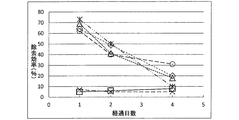
- FIG. It is a graph (relationship between pH of a water mixture of zeolite and removal efficiency) showing aeration test results of Example 1. It is a graph (The relationship between the pH and removal efficiency of the water mixture of silica gel, acid clay, activated clay, diatomaceous earth, fumed silica, and talc) of the air permeability test result of Example 1. It is a graph (relationship (time change) between pH of zeolite water mixture and removal efficiency) showing the aeration test result of Example 2.
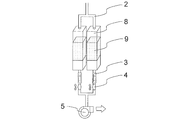
- FIG. 5 is a schematic view of an aeration test apparatus used in Example 4. It is a graph (time change of the removal efficiency of TMS) which shows the ventilation test result of Example 4.
- 6 is a graph showing the aeration test results of Example 5 (relationship between pH and removal efficiency of binder water mixture (time change)).
- 10 is a graph showing the results of an aeration test in Example 6 (relationship between content of synthetic zeolite and removal efficiency (time change)).
- the first silanol compound removal chemical filter of the present invention uses, as an adsorbent, an inorganic silica-based porous material whose pH of a water mixture (content ratio: 5 wt%) obtained by mixing with pure water is 7 or less. This is a chemical filter for removing silanol compounds.
- the second silanol compound removal chemical filter of the present invention is a chemical filter in which an inorganic silica-based porous material is used as an adsorbent, and is a pure filter of a mixture containing the adsorbent separated from the chemical filter. It is a silanol compound removal chemical filter whose pH of the water mixture (content rate: 5 wt%) obtained by mixing with water is 7 or less.
- the water mixture is, for example, added pure water to 5 g of the adsorbent mixture to make the entire water mixture 100 g, so that the content ratio of the adsorbent mixture with respect to the entire water mixture is 5 wt% and sufficiently stirred. You can get it later.
- the third silanol compound removing chemical filter of the present invention is a chemical filter in which an inorganic silica-based porous material is used as an adsorbent, and a piece of the chemical filter containing the adsorbent is immersed in pure water.
- the silanol compound removing chemical filter has a pH of the immersion liquid (chemical filter content: 5 wt%) of 7 or less.
- the immersion liquid for example, by adding pure water to 5 g of the chemical filter piece containing the adsorbent and making the entire immersion liquid 100 g, the content ratio of the chemical filter piece containing the adsorbent to the entire immersion liquid is 5 wt%. Can be obtained after thorough stirring.
- the first silanol compound removal chemical filter of the present invention “the second silanol compound removal chemical filter of the present invention”, and “the third silanol compound removal chemical filter of the present invention” "May be collectively referred to as” chemical filter of the present invention ".
- an adsorbent using an inorganic silica porous material having a pH of 7 or less in a water mixture (content ratio: 5 wt%) obtained by mixing with pure water is referred to as “the adsorbent of the present invention. May be called.
- “pH of water mixture” means “pH of water mixture (content ratio: 5 wt%)” unless otherwise specified.
- “pH of immersion liquid” means “pH of immersion liquid (chemical filter ratio: 5 wt%)” unless otherwise specified.
- the chemical filter of the present invention uses an inorganic silica-based porous material as an essential adsorbent.
- an inorganic silica type porous material only 1 type may be used and 2 or more types may be used.
- the inorganic silica-based porous material has a pH of a water mixture (content ratio: 5 wt%) obtained by mixing with pure water of 7 or less (for example, 3 to 3 7), preferably less than 7 (for example, 3 or more and less than 7), more preferably 3 to 6.5, and still more preferably 4 to 6.
- a pH of a water mixture obtained by mixing with pure water of 7 or less (for example, 3 to 3 7), preferably less than 7 (for example, 3 or more and less than 7), more preferably 3 to 6.5, and still more preferably 4 to 6.
- the pH of the water mixture (content ratio: 5 wt%) obtained by mixing with pure water is the content ratio of the substance (target substance) mixed in the water mixture with respect to the entire water mixture.
- the pH when measured under the condition of 5 wt%.
- the pH of the water mixture (content ratio: 5 wt%) obtained by mixing the inorganic silica porous material with pure water is measured under the condition that the content ratio of the inorganic silica porous material is 5 wt%.
- the pH of the water mixture can be measured using, for example, a pH meter.
- the above “pH of water mixture obtained by mixing with pure water (content ratio: 5 wt%)” is A water mixture (content ratio: 5 wt%) obtained by mixing inorganic silica based porous material in a state before adhering an additive or the like (that is, no adhering agent or the like) with pure water. Let us say pH.
- the water mixture (content ratio: 5 wt%) can be produced, for example, by the following “method for producing water mixture (content ratio: 5 wt%)”.
- Preparation method of water mixture (content ratio: 5 wt%)
- the above water mixture (content ratio: 5 wt%) is, for example, a sample (“object” for measuring the pH of the water mixture so that the content ratio is 5 wt%.
- the sample may be referred to as “sample”) and mixed with pure water, stirred sufficiently, and allowed to stand for preparation.
- pure water is used for preparation of the water mixture
- a mixed solvent of an organic solvent and pure water may be used.
- the acid dissociation constant varies greatly depending on the type and concentration of the organic solvent. Therefore, it is generally a water-soluble organic solvent such as alcohol and does not have a large effect on pH. Concentration.
- the “wt%” has the same meaning as “wt%”.
- a water mixture having a content ratio of 5 wt% specifically, for example, 5 g of the target sample is weighed using a scale, and pure water is added to make the whole 100 g, and the liquid is sufficiently mixed. It can be produced by stirring.
- the inorganic silica-based porous material water mixture (content ratio: 5 wt%) can be produced using the inorganic silica-based porous material as the target sample.
- the inorganic silica-based porous material used in the chemical filter of the present invention is not particularly limited, but has a specific surface area (BET specific surface area) of 10 m 2 / g or more (for example, 10 to 800 m 2 / g). It is preferably 50 m 2 / g or more (for example, 50 to 750 m 2 / g), more preferably 100 m 2 / g or more (for example, 100 to 700 m 2 / g).
- the inorganic silica based porous material is not particularly limited, but the content of SiO 2 in the porous material may be 5% by weight or more (for example, 5 to 100% by weight), preferably 10% by weight or more. More preferred is an inorganic silica-based porous material that is more preferably 20% by weight or more, and still more preferably 50% by weight or more.
- the inorganic silica-based porous material is not particularly limited.
- zeolite for example, synthetic zeolite, natural zeolite, etc.
- silica gel for example, silica alumina, aluminum silicate, porous glass, diatomaceous earth, hydrous magnesium silicate clay Minerals (for example, talc), acid clay, activated clay, activated bentonite, mesoporous silica, aluminosilicate, fumed silica and the like
- zeolite for example, synthetic zeolite, natural zeolite, etc.
- silica gel silica alumina
- aluminum silicate for example, porous glass
- diatomaceous earth for example, hydrous magnesium silicate clay Minerals (for example, talc)
- acid clay for example, talc
- activated clay activated clay
- activated bentonite mesoporous silica, aluminosilicate, fumed silica and the like
- the silanol compound can be efficiently removed over a longer period of time. Only 1 type may be used for the said inorganic silica type porous material, and 2 or more types may be used for it.
- the synthetic zeolite includes artificial zeolite.
- the synthetic zeolite is not particularly limited.
- the said synthetic zeolite may use the zeolite of 1 type of frame structure, and may use it in combination of 2 or more types of zeolite.
- Examples of the artificial zeolite generally include zeolite produced from wastes containing silicon and aluminum, such as coal ash discharged from a coal-fired power plant and paper sludge incinerated ash discharged from a paper mill. .
- the artificial zeolite may be used alone or in combination of two or more.
- the natural zeolite is not particularly limited, and examples thereof include clinoptilolite (clinoptilolite), mordenite (mordenite), chabazite, natrolite, gonnardite, edding tonite, analsim, leucite, yugawaralite, gismondine, porinite. , Philipsite, Chabazite, Elionite, Haujasite, Ferrierite, Mutinaite, Chernihito, Huerudite, Stillebite, Koureite, Aluminosilicate, Berylsilicate (Rogianite, Shanhalite, etc.), Zinccosilicate (Gaultite) ) And the like.
- the natural zeolite may be used alone or in combination of two or more.
- an acid-treated product obtained by acid treatment of the natural zeolite or a proton type zeolite in which the cation in the natural zeolite is replaced with hydrogen may be used.
- the proton-type zeolite can be produced using, for example, a method in which cations such as sodium ions in natural zeolite are ion-exchanged with ammonium ions and then calcined.
- the above zeolite has a water mixture (content ratio: 5 wt%) obtained by mixing with pure water having a pH of 7 or less (eg, 3 to 7), preferably less than 7 (eg, 3 or more and less than 7), more It is preferably 3 to 6.8, more preferably 3.5 to 6.7, and particularly preferably 4 to 6.5.
- the water mixture (content ratio: 5 wt%) of zeolite can be prepared using zeolite as a target sample by the above “method for preparing water mixture (content ratio: 5 wt%)”.
- the ratio of SiO 2 and Al 2 O 3 in the composite zeolite (molar ratio) [SiO 2 / Al 2 O 3] is not particularly limited, from the viewpoint of the removal efficiency of the silanol compound may be 4-2000 , Preferably 10 to 1500, more preferably 15 to 1000, and still more preferably 100 to 500.
- the zeolite is not particularly limited, but the skeleton structure may contain a cation.
- the cation include, but are not limited to, hydrogen ions; ammonium ions; alkali metal ions such as lithium ions, sodium ions, and potassium ions; alkaline earth metal ions such as magnesium ions, calcium ions, and barium ions; zinc Examples thereof include transition metal ions such as ions, tin ions, iron ions, platinum ions, palladium ions, titanium ions, silver ions, copper ions, and manganese ions.
- One kind of the cation may be contained, or two or more kinds may be contained.
- the content of the cation in the zeolite is not particularly limited.
- the specific surface area (BET specific surface area), average particle diameter (average particle diameter), average pore diameter (diameter), total pore volume, etc. of the zeolite are not particularly limited. Moreover, the said zeolite may use only 1 type and may use 2 or more types.
- the acid clay is not particularly limited, and acid clay produced in various places can be used. Examples include acid clay from Niigata Prefecture and acid clay from Yamagata Prefecture. Only 1 type may be used for the said acid clay, and 2 or more types may be used for it.
- the activated clay is obtained by acid-treating the acid clay.
- the acid clay is acid-treated with a mineral acid such as sulfuric acid so as not to destroy all of the basic structure of montmorillonite.
- a mineral acid such as sulfuric acid
- examples include those in which a metal oxide such as an oxide is eluted and the specific surface area and pore volume are increased. Only 1 type may be used for the said activated clay, and 2 or more types may be used for it.
- the diatomaceous earth is not particularly limited, and diatomaceous earth produced in various places can be used.
- diatomaceous earth diatom shale
- diatomaceous earth from Wakkanai, Hokkaido, diatomaceous earth from Tsukiko, Akita Prefecture, diatomaceous earth from Ulsan, Okayama Prefecture, diatomaceous earth from Kuju, Oita Prefecture, diatomaceous earth (diatomaceous mudstone) from Noto, Ishikawa Prefecture, etc. May be. Only 1 type may be used for the said diatomaceous earth, and 2 or more types may be used for it.
- the inorganic silica-based porous material other than the synthetic zeolite has a pH of a water mixture (content ratio: 5 wt%) obtained by mixing with pure water of 7 or less (for example, 3 to 3 7), preferably less than 7 (for example, 3 or more and less than 7), more preferably 3 to 6.5, still more preferably 3.5 to 6.3, and particularly preferably 4 to 6.
- the water mixture (content ratio: 5 wt%) of other inorganic silica-based porous materials is a target sample of other inorganic silica-based porous materials according to the above “method for producing water mixture (content ratio: 5 wt%)”. Can be produced.
- the content of SiO 2 is not particularly limited, but is 50% by weight or more with respect to the total weight (100% by weight) of the inorganic silica-based porous material (for example, 50 to 100% by weight), preferably 60% by weight or more, more preferably 70% by weight or more.
- the inorganic silica-based porous material is not particularly limited, but it is preferable that an additive or the like is not attached. That is, it is preferable that the inorganic silica-based porous material to which an additive or the like is added is excluded from the inorganic silica-based porous material.
- the additive include an acidic substance additive and a basic substance additive. When an acidic substance additive is added, the skeleton of the inorganic silica-based porous material may change.
- the adsorbent of the present invention is not particularly limited, but may contain an adsorbent (other adsorbent) other than the inorganic silica-based porous material whose pH of the water mixture is 7 or less, if necessary. That is, as the adsorbent of the present invention, other adsorbents may be used together with the inorganic silica-based porous material whose pH of the water mixture is 7 or less. Examples of the other adsorbent include porous materials other than inorganic silica-based porous materials whose pH of the water mixture is 7 or less, other silicas, clay minerals, activated carbon, alumina, and glass. By using the other adsorbents as the adsorbent, in addition to the effects of the present invention, a chemical filter having the effects of other adsorbents can be obtained.
- the content of the inorganic silica-based porous material in which the pH of the water mixture in the adsorbent of the present invention (in all adsorbents) is 7 or less is not particularly limited, but from the viewpoint of the silanol compound removal efficiency, the adsorbent
- the total weight (100% by weight) is preferably 30% by weight or more (for example, 30 to 100% by weight), more preferably 50% by weight or more, and still more preferably 70% by weight or more.
- the content of the synthetic zeolite in the adsorbent of the present invention is not particularly limited, but from the viewpoint of the silanol compound removal efficiency, it is 10 wt% with respect to the total weight (100 wt%) of the adsorbent. % Or more (for example, 10 to 100% by weight) is preferable, more preferably 50% by weight or more, and still more preferably 70% by weight or more.
- the chemical filter of the present invention is not particularly limited as long as it uses an inorganic silica-based porous material having a pH of a water mixture (content ratio: 5 wt%) of 7 or less as an adsorbent.
- Examples of the chemical filter include a chemical filter in which the adsorbent of the present invention is attached (fixed) to a filter base material.
- the adsorbent of the present invention also has a function as a binder, the adsorbent can be attached to the filter base material without using a binder. It is preferable that it adheres to the material.
- the chemical filter may be a chemical filter in which the adsorbent of the present invention is attached to the filter substrate without using a binder (or only the adsorbent of the present invention is attached).
- a chemical filter in which the adsorbent of the present invention is attached to a filter base material using a binder is preferable.
- the adsorbent of the present invention is not particularly limited, but may be pelletized. That is, the adsorbent of the present invention may be a pelletized adsorbent. That is, the chemical filter of the present invention may contain the pelletized adsorbent of the present invention.
- the pelletization can be performed, for example, by granulating the adsorbent powder of the present invention using the binder.
- Filter base material It does not specifically limit as said filter base material, What is generally used as a filter base material of a chemical filter can be used.
- the filter base material include fibrous base materials (woven fabric or non-woven fabric) composed of fibers such as organic fibers and inorganic fibers, foams composed of polyurethane foam, refractory metal oxides, and refractory inorganic materials.
- fibrous base materials woven fabric or non-woven fabric
- a fibrous substrate is preferable as the filter substrate, and a glass cloth (glass cloth) is particularly preferable.
- the fiber in the fibrous base material examples include inorganic fibers such as silica alumina fiber, silica fiber, alumina fiber, mullite fiber, glass fiber, rock wool fiber, and carbon fiber; polyethylene fiber, polypropylene fiber, nylon fiber, and polyester fiber.
- inorganic fibers such as silica alumina fiber, silica fiber, alumina fiber, mullite fiber, glass fiber, rock wool fiber, and carbon fiber
- polyethylene fiber polypropylene fiber
- nylon fiber such as polypropylene fiber, nylon fiber, and polyester fiber.
- organic fiber such as polyvinyl alcohol fiber, aramid fiber, pulp fiber, rayon fiber, etc.
- inorganic fibers are preferable from the viewpoint of increasing the strength of the chemical filter and from the viewpoint of less contamination due to outgas from the fibers.
- the said fiber may use only 1 type and may use it in combination of 2 or more type.
- shape of the said inorganic fiber and the said organic fiber is not specifically limited.
- the binder can be used for promoting adhesion of the adsorbent to the filter base material or pelletizing the adsorbent.
- the binder is not particularly limited, and a known or commonly used binder for a filter (for example, for an air filter or a chemical filter) can be used.
- the binder may be an organic binder or an inorganic binder.
- the binder is not particularly limited, but is preferably an inorganic binder.
- the said binder may use only 1 type and may use 2 or more types.
- the binder may be acidic or basic, but is preferably acidic from the viewpoint of maintaining a low pH of the inorganic silica-based porous material.
- the acidic binder has a pH of a water mixture (content ratio: 5 wt%) obtained by mixing with pure water of 7 or less (eg, 3 to 7), preferably less than 7 (eg, 3 or more and less than 7), It is more preferably 3 to 6.8, further preferably 3.5 to 6.7, and particularly preferably 4 to 6.5.
- the water mixture (content ratio: 5 wt%) of the binder can be manufactured using the binder as a target sample by the above-described “method for manufacturing the water mixture (content ratio: 5 wt%)”.
- the said binder is a binder containing solvents, such as colloidal silica
- the said content rate is a content rate of the solid content in the said binder with respect to the said water mixture.
- organic binder examples include polyethylene resins, polypropylene resins, acrylic resins such as methyl methacrylate, ABS resins, polyester resins such as PET, cellulose such as polyvinyl alcohol and carboxymethyl cellulose, and arabic rubber.
- the said organic binder may use only 1 type and may use 2 or more types.
- the inorganic binder is preferably in the form of particles that do not completely cover the surface of the inorganic silica-based porous material.
- sodium silicate, silica sol, alumina sol, colloidal silica, colloidal alumina, colloidal tin oxide, colloidal Examples thereof include inorganic oxide particles such as titanium oxide.
- colloidal inorganic oxide particles such as colloidal silica, colloidal alumina, colloidal tin oxide and colloidal titanium oxide are preferable. Of these, colloidal silica is preferable.
- the said inorganic binder may use only 1 type and may use 2 or more types.
- the average particle diameter (primary particle diameter), specific surface area (BET specific surface area), average pore diameter (diameter), total pore volume, etc. of the inorganic binder are not particularly limited.
- the structure of the chemical filter of the present invention is not particularly limited, and may be any of a honeycomb structure, a pleated structure, a pellet filling structure, a three-dimensional network structure, and the like. Among these, a honeycomb structure, a pleated structure, and a three-dimensional network structure are preferable, and a honeycomb structure is particularly preferable from the viewpoint of suppressing pressure loss.
- the pelletized adsorbent pellet
- it is not particularly limited, but a pleated structure, a pellet filling structure, and a three-dimensional network structure are preferable.
- the structure may be only one structure or a combination of two or more structures.
- the honeycomb structure includes, for example, a cross-sectional lattice shape, a circular shape, a wave shape, a polygonal shape, an indefinite shape, a shape having a curved surface in whole or in part, and the structure of air. All structures that can pass through cells that are elements of the body are included.
- honeycomb structure examples include a structure obtained by alternately laminating corrugated sheets and flat sheets formed by corrugating (corrugated honeycomb structure), and includes a pleated sheet and a flat sheet.
- honeycomb structure examples include a structure in which a pleated sheet and a flat sheet are sequentially laminated at right angles to the ventilation direction.
- the pleated structure includes, for example, a structure having a bellows shape processed so that a waveform or a V-shape is continuous in order to efficiently expand a filtration area in a limited space.
- the pellet filling structure includes, for example, a structure in which the pelletized adsorbent is filled in a casing having a structure that allows gas to pass through the inside.
- the powder is not pelletized and the powder is filled in the casing.
- the three-dimensional network structure is, for example, a filter base of a network structure prepared by three-dimensionally processing a foam composed of the polyurethane foam or the like, glass wool or rock wool fibers, or fibers of the fibrous base material.
- Preferred examples include a structure having a material, or polytetrafluoroethylene made into a needle-like fiber.
- the manufacturing method of the chemical filter of this invention is not specifically limited, The manufacturing method of the chemical filter which has a well-known thru
- the chemical filter of this invention is not specifically limited, For example, it has at least the process (adsorbent adhesion process) which makes the adsorbent of this invention adhere to a filter base material.
- the manufacturing method of the chemical filter of this invention is not specifically limited, You may have processes (other processes) other than the said adsorption agent adhesion process.
- the said filter base material may purchase a commercially available filter base material, and may use it as it is.
- the adsorbent of the present invention is adhered to the filter base material in a suspension containing the adsorbent of the present invention, water, and, if necessary, the binder or adhesive. After dipping, it can be carried out by removing from the suspension and drying.
- the suspension may contain an antisettling agent as long as the effects of the present invention are not impaired.
- the adsorbent of the present invention is attached to the filter base material after being immersed in the suspension containing the binder resin and water, and then taken out from the suspension, dried, and then applied to the filter base material surface. It can also be carried out by dispersing and adhering the adsorbent of the present invention.
- the adsorbent of the present invention can be attached to the above filter base material by adhering pellets produced by granulating the adsorbent powder of the present invention with an adhesive or filling the inside of the filter base material. It can also be done.
- the binder may be mixed as necessary.
- the adsorbent powder of the present invention, the binder, and water are mixed in an appropriate amount, the clay-like viscosity and plasticity are exhibited and granulation becomes possible.
- the adsorbent of the present invention can be attached by using a polytetrafluoroethylene resin that has been made into acicular fibers and capturing and adsorbing the adsorbent of the present invention on the acicular fibers.
- the adsorbent of the present invention is adhered to, for example, by adhering the adsorbent powder or pelletized adsorbent of the present invention between two non-woven filter substrates. It can also be performed by sandwiching with an agent or the like.
- Examples of the other steps include a step of processing a filter base material (filter base material processing step).
- the order of the filter base material processing step and the adsorbent attachment step is not particularly limited, but the order of the filter base material processing step and the adsorbent attachment step is preferable from the viewpoint of workability.
- Examples of the filter base material processing step include a step of corrugating the filter base material, a step of forming a honeycomb structure, and a step of providing pores in the filter base material as described above.
- the said filter base-material processing process may perform only 1 process, and may perform the same or different 2 processes or more. Also when performing the said filter base-material process process 2 steps or more, the order is not specifically limited.
- the chemical filter of the present invention may be a chemical filter manufactured by a papermaking method.
- the chemical filter manufactured by the papermaking method is, for example, a chemical filter having at least a fibrous base material and the adsorbent of the present invention, and contains the fibers constituting the fibrous base material and the adsorbent of the present invention.
- the floc produced by adding a flocculant to the suspension is formed into a sheet by a wet papermaking method and then heat-treated.
- the ceramic filter of the present invention may be a ceramic type chemical filter.
- the ceramic-type chemical filter can be produced by a known or common processing method for ceramic materials.
- the adsorbent of the present invention can be produced by molding and firing together with a ceramic raw material. Specifically, for example, after preparing the clay by weighing and kneading the adsorbent of the present invention, the binder, the pore former, and other ceramic raw materials as required, the clay is extruded by screw type extrusion. Extrusion is performed by an extruder such as a machine to produce a molded body. The obtained molded body is dried and fired to obtain a porous ceramic type chemical filter.
- the ceramic type chemical filter is not particularly limited, but a ceramic type chemical filter having a honeycomb structure is preferable.
- the ceramic-type chemical filter can be processed into a predetermined length by a grinding tool such as a diamond cutter or a diamond saw as appropriate.
- the chemical filter of the present invention is particularly preferably a chemical filter having a honeycomb structure in which a plurality of corrugated sheets each having the adsorbent of the present invention attached to its surface with an inorganic binder are laminated via thin sheet sheets.
- the first chemical filter of the present invention uses an inorganic silica-based porous material whose pH of the water mixture is 7 or less as an adsorbent.
- the first chemical filter of the present invention acts as a solid acid due to the presence of the surface of the inorganic silica-based porous material having a pH of the water mixture of 7 or less in the chemical filter, and dehydration condensation of the silanol compound. Therefore, it is presumed that the silanol compound can be effectively removed because the silanol compound is strongly adsorbed.
- the silanol compound is effectively removed because the surface of the inorganic silica-based porous material having a pH of the water mixture of 7 or less exists in the chemical filter. The effect that it can be removed can be maintained.
- the pH of the water mixture (content ratio: 5 wt%) obtained by mixing the adsorbent-containing mixture separated from the chemical filter with pure water is 7 Or less (for example, 3 to 7), preferably less than 7 (for example, 3 or more and less than 7), more preferably 3 to 6.5, and still more preferably 4 to 6.
- the pH is 7 or less, the silanol compound can be removed with high efficiency.
- the adsorbent contains the inorganic silica-based porous material.
- the water mixture (content ratio: 5 wt%) is prepared, for example, by the method described in “Method for preparing water mixture (content ratio: 5 wt%)”. can do. Specifically, a mixture containing an adsorbent can be prepared as a target sample.
- the separation is performed by, for example, immersing a chemical filter in which an inorganic silica-based porous material is used as an adsorbent in an organic solvent such as methanol or acetone, or water.
- the chemical filter can be shaken in an organic solvent or water.
- the chemical filter may be shaken in the air.
- the pH of the immersion liquid (chemical filter content: 5 wt%) obtained by immersing one piece of the chemical filter containing the adsorbent in pure water is 7 or less ( For example, it is 3 to 7), preferably less than 7 (for example, 3 or more and less than 7), more preferably 3 to 6.5, and further preferably 4 to 6.
- the pH is 7 or less, the silanol compound can be removed with high efficiency.
- the adsorbent contains the inorganic silica-based porous material.
- the pH of the immersion liquid (chemical filter ratio: 5 wt%) obtained by immersing a piece of the chemical filter containing the adsorbent in pure water is the amount of the immersion liquid in the immersion liquid relative to the total weight of the immersion liquid.
- the pH of the immersion liquid can be measured using, for example, a pH meter.
- the above immersion liquid (chemical filter ratio: 5 wt%) is, for example, a piece of chemical filter containing an adsorbent is mixed with pure water so that the chemical filter ratio is 5 wt%, and is sufficiently left to stand after stirring. Can be produced.
- the “wt%” has the same meaning as “wt%”.
- a piece of a chemical filter containing an adsorbent is pulverized, etc., measured by 5 g using a scale, and pure water is added.
- the total weight of the immersion liquid is 100 g, and the immersion liquid can be sufficiently stirred.
- the inorganic silica-based porous material is not particularly limited, but the pH of the water mixture (content ratio: 5 wt%) obtained by mixing with pure water is 7 or less. (For example, 3 to 7) is preferable, more preferably less than 7 (for example, 3 or more and less than 7), further preferably 3 to 6.5, and particularly preferably 4 to 6.
- the said adsorbent is not specifically limited, It is preferable that another adsorbent is used with the inorganic silica type porous material whose pH of the said water mixture (content rate: 5 wt%) is 7 or less.
- the second silanol compound removal chemical filter of the present invention and the third silanol compound removal chemical filter of the present invention are used, for example, as an adsorbent in the first silanol compound removal chemical filter of the present invention. It can manufacture by using the inorganic silica type porous material whose pH of the said water mixture is 7 or less.
- the chemical filter of the present invention does not include an adsorbent to which an acidic material additive is attached.
- the chemical filter of the present invention is preferably excluded from the one provided with an adsorbent to which an acidic substance is added.
- the chemical filter of the present invention is a chemical filter in a clean room (especially, an internal chemical filter in an exposure apparatus, an internal chemical filter in a coating and developing apparatus), a chemical filter in a sewage treatment plant, a chemical filter in a landfill, and the like. It can be particularly preferably used as an application for which removal is required.
- the chemical filter of the present invention can be particularly preferably used for air purification for such applications.
- the chemical filter in the clean room is preferably a chemical filter for an exposure apparatus used in an exposure process of a semiconductor manufacturing process, or a chemical filter for an application / development apparatus.
- TMS may occur in the exposure apparatus used in the exposure process of the semiconductor manufacturing process, or in the coating and developing apparatus (coater developer) and others.
- the floating TMS is decomposed, and the decomposed one is converted into a lens or the like. If combined, it may cause fogging, which may cause exposure failure.
- the chemical filter of the present invention in the exposure apparatus or in the coating and developing apparatus the exposure apparatus of the present invention or the coating and developing apparatus of the present invention can be obtained.
- the chemical filter of the present invention As a method for using the chemical filter of the present invention, for example, air containing a substance to be removed is forcibly introduced into the inside of the apparatus equipped with the chemical filter using power such as a ventilation fan, In addition to the ventilation method to remove substances, air is not introduced into the inside of a device equipped with a chemical filter by using power, but the substance to be removed is removed by contact with only natural diffusion or natural convection. Law. That is, the chemical filter of the present invention can be used by either the ventilation method or the stationary method.
- the exposure apparatus of the present invention includes the chemical filter of the present invention.
- the exposure apparatus is not particularly limited as long as it is an exposure apparatus having the chemical filter of the present invention.
- the coating and developing apparatus of the present invention includes the chemical filter of the present invention.
- the coating and developing apparatus is not particularly limited as long as it is a coating and developing apparatus having the chemical filter of the present invention.
- the chemical filter of the present invention using an inorganic silica-based porous material whose pH of the water mixture is 7 or less as an adsorbent is used.
- silanol compounds such as TMS in the air can be efficiently removed as compared with an exposure apparatus and a coating and developing apparatus using a conventional chemical filter using activated carbon as an adsorbent.
- the removal efficiency of the silanol compound does not decrease in a short time, and TMS is not released like activated carbon, resulting in a negative efficiency (higher concentration on the downstream side than on the upstream side of the filter).
- the silanol compound can be adsorbed without dimerization, it can be efficiently removed even if the silanol compound in the air has a low concentration. For this reason, it is possible to remarkably suppress exposure obstacles and the like caused by silanol compounds in the air.
- Example 1 The gas removal efficiency of the adsorbent was measured using an aeration test apparatus as shown in FIG. That is, two acrylic cylindrical test columns (inner diameter 50 mm, length 30 cm) 1 connected in series are arranged in 6 series in parallel, and a gas supply tube 2 is attached to the upstream side of the column, On the downstream side of the column, a flow meter 3, a flow rate adjustment valve 4, and a pump 5 were attached in this order.
- the nonwoven fabric 6 was sandwiched between two columns connected in series, a test sample (adsorbent) 7 was laid on the nonwoven fabric 6 with a thickness of 5 mm, and the flow rate was adjusted so that the filtration wind speed of the test sample was 5 cm / s. Air was blown.
- TMS3 ppb and VOC 250 ppb were mixed with air adjusted to a temperature of 23 ° C. and a humidity of 50% using a constant temperature and humidity chamber.
- a schematic cross-sectional view (for one series) of the aeration test apparatus is shown in FIG.
- zeolites synthetic zeolites
- a plurality of zeolites having different pH values in the water mixture (content ratio: 5 wt%) shown in Table 1 and the water mixture (containing) shown in Table 2
- a plurality of silica gels, acid clay, activated clay, diatomaceous earth, fumed silica, and talc average particle diameter: 5 to 30 ⁇ m having different pH at a ratio of 5 wt% were used.
- the fumed silica used what was processed into the pellet form. The removal efficiency was measured for every six test samples, and each of the six test samples to be measured was used for each column 1 arranged in parallel in six series.
- FIG. 4 (silica gel, acid clay, activated clay, diatomaceous earth, fumed silica, talc).
- square marks ( ⁇ ) indicate silica gel data
- triangle marks ( ⁇ ) indicate acid clay data
- circle marks ( ⁇ ) indicate active clay data
- cross marks ( ⁇ ) indicate diatomaceous earth data
- diamond marks ( ⁇ ) Indicates fumed silica data
- asterisk (*) indicates talc data.
- the horizontal axis of the graph is the pH of the water mixture of the test sample, and the vertical axis is the removal efficiency (%).
- the zeolite whose pH of the water mixture is 7 or less has remarkably large TMS removal efficiency compared to the zeolite whose pH of the water mixture exceeds 7. Also, the zeolite with lower pH of the water mixture tends to have higher TMS removal efficiency. As shown in FIG. 4, the inorganic silica-based porous material having a lower pH tends to have higher TMS removal efficiency.
- Example 2 As the air flowing through the column, a mixture of TMS7 ppb and VOC 200 ppb mixed with air adjusted to a temperature of 23 ° C. and a humidity of 50% using a constant temperature and humidity chamber is used so that the filtration wind speed of the test sample is 3 cm / s.
- the gas removal efficiency of the adsorbent was measured using an aeration test apparatus as shown in FIG. 1 in the same manner as in Example 1 except that air with an adjusted flow rate was flowed.
- a test sample (adsorbent) among those shown in Tables 1 and 2, specific zeolite, silica gel, acid clay, activated clay, and diatomaceous earth were used.
- the upstream and downstream air of the column was collected by an adsorption tube, and the adsorption tube that collected the air was subjected to gas analysis by ATD (thermal desorption device) -GC / MS to measure the gas concentration of TMS.
- FIG. 5 zeolite
- FIG. 6 siliconca gel, acid clay, activated clay, diatomaceous earth.
- the cross mark ( ⁇ ) is the data of zeolite A
- the diamond mark ( ⁇ ) is the data of zeolite B
- the asterisk mark (*) is the data of zeolite C
- the triangle mark ( ⁇ ) is the data of zeolite D
- the square mark ( ⁇ ) shows the data of zeolite G, respectively.
- rhombus marks ( ⁇ ) indicate data for silica gel A
- square marks ( ⁇ ) indicate data for silica gel C
- triangle marks ( ⁇ ) indicate data for acid clay A
- cross marks ( ⁇ ) indicate data for acid clay B
- An asterisk mark (*) indicates data of activated clay B
- a circle mark ( ⁇ ) indicates data of diatomaceous earth A.
- the horizontal axis of the graph is the number of days elapsed (day)
- the vertical axis is the removal efficiency (%).
- the zeolite (zeolite A, zeolite B, zeolite C, zeolite D) whose pH of the water mixture is 7 or less is compared with the zeolite (zeolite G) whose pH of the water mixture is more than 7. Even after the elapse of time, the removal efficiency of TMS is remarkably large.
- silica gel (silica gel A), acid clay (acid clay A), activated clay (active clay B), and diatomaceous earth (diatomaceous earth A) having a pH of 7 or less are mixed with the water mixture.
- silica gel (silica gel C) and acidic clay (acid clay B) having a pH of more than 7 the removal efficiency of TMS is large even after days.
- Example 3 Zeolite A after completion of the aeration test of Example 2 was placed in 30 ml of acetone solvent and shaken for 2 hours. Thereafter, the supernatant was subjected to GC-FID analysis. Table 3 shows area values measured by GC-FID of TMS. In addition, as a comparison object, a coconut shell activated carbon (trade name “Dazai CB”, manufactured by Futamura Chemical Co., Ltd.) was used as an adsorbent, and the same aeration test as in Example 2 was performed. Table 3 shows area values measured by GC-FID.
- TMS is adsorbed to zeolite with a water mixture having a pH of 7 or less with an extremely strong force as compared with activated carbon.
- Example 4 After the glass cloth (filter base material) is formed into a corrugated shape, it is laminated via a sheet-like glass cloth (fixed with an adhesive), and this laminate is made of zeolite A and an inorganic binder (colloidal silica, Nissan Chemical Industries ( The product was made in a suspension containing a product name “Snowtex O”) and water, taken out from the suspension, and dried to prepare a filter structure A having a honeycomb structure.
- the cross section of the vent hole (ventilation path) of the filter structure A is corrugated, the length of the base of the corrugation is 1 to 5 mm, and the height is 1 to 5 mm.
- the pulverized filter structure A was immersed in pure water to prepare an immersion liquid (the ratio of the filter structure A: 5 wt%), and the pH of the immersion liquid was measured to be 4.81.
- a filter structure B in which a coconut shell activated carbon (trade name “Dazai CB” manufactured by Futamura Chemical Co., Ltd.) was similarly formed into a honeycomb structure was used.
- the gas removal efficiency of the filter structure was measured using a ventilation test apparatus as shown in FIG. That is, two rectangular test columns (19 mm ⁇ 19 mm ⁇ length 20 cm) 8 made of acrylic are arranged in parallel, a tube 2 for gas supply is attached on the upstream side of the column, and a flow rate is provided on the downstream side of the column.
- a total of 3, a flow rate adjusting valve 4 and a pump 5 were attached in this order.
- a filter structure (length 80 mm) 9 was placed in the column. Air whose flow rate was adjusted to flow so that the filtration wind speed of the filter structure was 0.5 m / s was flowed.
- TMS7 ppb and VOC 250 ppb were mixed with air adjusted to a temperature of 23 ° C. and a humidity of 50% using a constant temperature and humidity chamber.
- the filter structure the filter structure A and the filter structure B produced above were used. The two filter structures described above were used for each column 1 arranged in parallel.
- the upstream and downstream air of the column was collected by an adsorption tube, and the adsorption tube that collected the air was subjected to gas analysis by ATD (thermal desorption device) -GC / MS to measure the gas concentration of TMS.
- a triangle mark ( ⁇ ) indicates data of the filter structure A
- a diamond mark (() indicates data of the filter structure B.
- the horizontal axis of the graph is the elapsed days (days), and the vertical axis is the removal efficiency (%).
- the filter structure A using zeolite A has a much lower rate of TMS removal efficiency over time than the filter structure B using activated carbon.
- the removal efficiency becomes negative after a certain number of days. That is, once adsorbed TMS is desorbed and released.
- the removal efficiency does not become negative even after 40 days.
- Example 5 60 parts by weight of zeolite A as an inorganic silica-based porous material, 25 parts by weight of kaolinite which is clay as a binder and 15 parts by weight of colloidal silica were mixed, and pure water was added to prepare a clay-like sample.
- This clay-like sample is threaded through a mesh, thoroughly dried in an oven, pulverized in a mortar, and collected with a sieve having a particle size of 200 to 500 ⁇ m to obtain a pelletized adsorbent (pellet) It was.
- Three types of pellets (pellets A to C) were prepared using three colloidal silicas having different pHs as the colloidal silica.
- the gas removal of the adsorbent was performed in the same manner as in Example 2 using a ventilation test apparatus as shown in FIG. Efficiency was measured.
- the upstream and downstream air of the column was collected by an adsorption tube, and the adsorption tube that collected the air was subjected to gas analysis by ATD (thermal desorption device) -GC / MS to measure the gas concentration of TMS.
- ATD thermal desorption device
- the removal efficiency of TMS was calculated from the measured TMS gas concentration on the upstream side and downstream side of the column by the following formula, and a graph of the time change of the test sample was created.
- Removal efficiency (%) ⁇ (Upstream gas concentration ⁇ Downstream gas concentration) / Upstream gas concentration ⁇ ⁇ 100
- rhombus marks ( ⁇ ) indicate data for pellet A
- square marks ( ⁇ ) indicate data for pellet B
- triangle marks ( ⁇ ) indicate data for pellet C.
- the horizontal axis of the graph is the elapsed days (days)
- the vertical axis is the removal efficiency (%).
- the adsorbent pelletized with zeolite (zeolite A) whose pH of the water mixture is 7 or less is the same as that of TMS even if the number of days elapses regardless of the pH value of the binder water mixture.
- pellets produced using a binder having a low pH of the water mixture tend to have higher TMS removal efficiency.
- Example 6 Adsorption using a ventilation test apparatus as shown in FIG. 1 in the same manner as in Example 2 except that a mixture of zeolite A, which is a synthetic zeolite, and natural zeolite (mixed zeolite) was used as a test sample. The gas removal efficiency of the agent was measured. In addition, mixed zeolite A (mixing ratio: 10% by weight of zeolite A, 90% by weight of natural zeolite) and mixed zeolite B (mixing ratio: 15% by weight of zeolite A, 85% by weight of natural zeolite) are used as mixed zeolite as a test sample. It was.
- zeolite A which is a synthetic zeolite
- natural zeolite mixed zeolite
- the upstream and downstream air of the column was collected by an adsorption tube, and the adsorption tube that collected the air was subjected to gas analysis by ATD (thermal desorption device) -GC / MS to measure the gas concentration of TMS.
- the triangle mark ( ⁇ ) indicates the data of the mixed zeolite A
- the square mark ( ⁇ ) indicates the data of the mixed zeolite B.
- the horizontal axis of the graph is the elapsed days (days)
- the vertical axis is the removal efficiency (%).
- the removal effect lasts longer than that of activated carbon. That is, the removal efficiency does not decrease in a short time, but decreases gently, and TMS is released like activated carbon and does not have a negative effect (a phenomenon in which the concentration on the downstream side is higher than that on the upstream side of the filter). .
- the chemical filter of the present invention is a silanol compound such as a chemical filter in a clean room (in particular, an internal chemical filter of an exposure apparatus, an internal chemical filter of a coating and developing apparatus), a chemical filter of a sewage treatment plant, or a chemical filter of a landfill site. It can be particularly preferably used as an application for which removal of selenium is required. Furthermore, according to the chemical filter of the present invention, since the silanol compound in the air can be removed extremely efficiently, the amount of adsorbent used can be made extremely small, and the number of filter base materials can be reduced. Energy saving, low cost, and space saving.
Landscapes
- Chemical & Material Sciences (AREA)
- Analytical Chemistry (AREA)
- Chemical Kinetics & Catalysis (AREA)
- Organic Chemistry (AREA)
- Inorganic Chemistry (AREA)
- Geochemistry & Mineralogy (AREA)
- Life Sciences & Earth Sciences (AREA)
- Engineering & Computer Science (AREA)
- Dispersion Chemistry (AREA)
- Health & Medical Sciences (AREA)
- Biomedical Technology (AREA)
- Environmental & Geological Engineering (AREA)
- General Chemical & Material Sciences (AREA)
- Oil, Petroleum & Natural Gas (AREA)
- Solid-Sorbent Or Filter-Aiding Compositions (AREA)
Abstract
Description
本発明の他の目的は、空気中に存在するTMS等のシラノール化合物を効率的に除去できる空気浄化方法を提供することにある。
本発明のさらに他の目的は、上記ケミカルフィルタを備えた露光装置、塗布現像装置、及びガス状汚染物質が制御されたクリーンルームを提供することにある。
本発明の第一のシラノール化合物除去用ケミカルフィルタは、純水と混合させて得られる水混合物(含有割合:5wt%)のpHが7以下である無機シリカ系多孔質材料を吸着剤として用いているシラノール化合物除去用ケミカルフィルタである。
本発明のケミカルフィルタは、無機シリカ系多孔質材料を必須の吸着剤として用いている。上記無機シリカ系多孔質材料は、1種のみを用いてもよいし、2種以上を用いてもよい。
上記水混合物(含有割合:5wt%)は、例えば、含有割合が5wt%となるように、水混合物のpHの測定の対象とするサンプル(「対象サンプル」と称する場合がある)を純水に混合し、十分に撹拌したのち静置して作製することができる。上記水混合物の作製には純水を使用するが、有機溶媒と純水との混合溶媒を使用してもよい。ただし、有機溶媒を使用する場合、有機溶媒の種類や濃度によっては酸解離定数が大きく変動するため、一般的に、アルコールなどの水溶性の有機溶媒であって、pHに大きな影響を与えない範囲の濃度とする。なお、上記「wt%」は、「重量%」と同一の意味である。含有割合が5wt%である水混合物を作製するには、具体的には、例えば、対象サンプルを、秤などを用いて5g計り取り、さらに純水を加え、全体を100gとし、液を十分に撹拌することで作製することができる。例えば、無機シリカ系多孔質材料の水混合物(含有割合:5wt%)は、無機シリカ系多孔質材料を上記対象サンプルとして作製することができる。
上記フィルタ基材としては、特に限定されず、ケミカルフィルタのフィルタ基材として一般に用いられるものを使用できる。上記フィルタ基材として、例えば、有機繊維や無機繊維等の繊維から構成される繊維状基材(織布あるいは不織布)、ポリウレタンフォーム等から構成される発泡体、耐火性金属酸化物や耐火性無機物を使用したフィルタ基材などが挙げられる。中でも、上記フィルタ基材として、繊維状基材が好ましく、特にガラスクロス(ガラス布)が好ましい。
上記バインダは、吸着剤のフィルタ基材への付着を促進させることや、吸着剤のペレット化に使用することができる。上記バインダとしては、特に限定されず、公知乃至慣用のフィルタ用(例えば、エアフィルタ用、ケミカルフィルタ用等)のバインダを用いることができる。上記バインダとしては、有機バインダであってもよいし、無機バインダであってもよい。上記バインダは、特に限定されないが、無機バインダであることが好ましい。上記バインダは、1種のみを使用してもよいし、2種以上を使用してもよい。
本発明のケミカルフィルタの構造は、特に限定されず、ハニカム構造、プリーツ構造、ペレット充填構造、三次元網目構造等のいずれであってもよい。これらの中でも、ハニカム構造、プリーツ構造、三次元網目構造が好ましく、圧力損失を抑制する観点から、ハニカム構造が特に好ましい。本発明の吸着剤として、ペレット化された吸着剤(ペレット)を用いる場合は、特に限定されないが、プリーツ構造、ペレット充填構造、三次元網目構造であることが好ましい。上記構造は、1の構造のみであってもよいし、2以上の構造を組み合わせたものであってもよい。
本発明のケミカルフィルタの製造方法は、特に限定されず、公知乃至慣用の吸着剤を有するケミカルフィルタの製造方法を用いることができる。本発明のケミカルフィルタは、特に限定されないが、例えば、フィルタ基材に本発明の吸着剤を付着させる工程(吸着剤付着工程)を少なくとも有する。本発明のケミカルフィルタの製造方法は、特に限定されないが、上記吸着剤付着工程以外の工程(他の工程)を有していてもよい。また、上記フィルタ基材は、市販のフィルタ基材を購入してそのまま使用してもよい。
本発明の空気浄化方法では、本発明のケミカルフィルタを用いて空気中のシラノール化合物を除去する。このため、本発明のケミカルフィルタは、空気中のシラノール化合物を除去するため適宜な場所に設置できる。例えば、本発明のケミカルフィルタは、クリーンルーム内のケミカルフィルタ(特に、露光装置の内部ケミカルフィルタ、塗布現像装置の内部ケミカルフィルタ)、下水処理場のケミカルフィルタ、埋め立て地のケミカルフィルタなど、シラノール化合物の除去が求められている用途として、特に好ましく用いることができる。
本発明の露光装置は、本発明のケミカルフィルタを備えている。上記露光装置は、本発明のケミカルフィルタを有する露光装置であれば特に限定されない。また、本発明の塗布現像装置は、本発明のケミカルフィルタを備えている。上記塗布現像装置は、本発明のケミカルフィルタを有する塗布現像装置であれば特に限定されない。本発明の露光装置及び本発明の塗布現像装置によれば、内部ケミカルフィルタとして、水混合物のpHが7以下である無機シリカ系多孔質材料を吸着剤として用いた本発明のケミカルフィルタが用いられているため、活性炭を吸着剤とする従来のケミカルフィルタを用いた露光装置及び塗布現像装置と比較して、空気中のTMS等のシラノール化合物を効率よく除去できる。特に、シラノール化合物の除去効率は短時間で低下することはなく、活性炭のようにTMSを放出してマイナス効率(フィルタ上流よりも下流側の方が高濃度)になることがない。また、シラノール化合物を二量化せずに吸着できるので、空気中のシラノール化合物が低濃度であっても効率よく除去できる。そのため、空気中のシラノール化合物に起因する露光障害等を顕著に抑制できる。
図1に示すような通気試験装置を用いて、吸着剤のガス除去効率を測定した。
すなわち、2本のアクリル製の円筒状の試験カラム(内径50mm、長さ30cm)1を直列につないだものを6系列並列に配置し、カラムの上流側にガス供給用のチューブ2を取り付け、カラムの下流側に、流量計3、流量調整バルブ4、ポンプ5をこの順に取り付けた。直列につないだ2本のカラムの間に不織布6を挟み、不織布6上に試験サンプル(吸着剤)7を5mm厚で敷き、試験サンプルのろ過風速が5cm/sとなるように流量を調整したエアを流した。カラムに流すエアは、恒温恒湿槽を用いて温度23℃、湿度50%に調整した空気に、TMS3ppb、VOC250ppbを混ぜて使用した。上記通気試験装置の概略断面図(1系列分)を図2に示す。
試験サンプル(吸着剤)として、表1に示す水混合物(含有割合:5wt%)のpHが異なる複数のゼオライト(合成ゼオライト)(平均粒子径:3~20μm)、表2に示す水混合物(含有割合:5wt%)のpHが異なる複数のシリカゲル、酸性白土、活性白土、珪藻土、ヒュームドシリカ、及びタルク(平均粒子径:5~30μm)を用いた。なお、ヒュームドシリカは、ペレット状に加工したものを用いた。試験サンプル6つごとに除去効率の測定を行い、測定を行う6つの試験サンプルをそれぞれ、6系列並列に配置したそれぞれのカラム1に用いた。
通気試験開始後3日目に、カラムの上流側、下流側のエアを吸着管により捕集し、エアを捕集した吸着管をATD(加熱脱着装置)-GC/MSによるガス分析に付し、TMSのガス濃度を測定した。測定したカラムの上流側、下流側のTMSのガス濃度からTMSの除去効率を下記式で算出し、試験サンプルの水混合物のpHと除去効率の関係のグラフを作成した。
除去効率(%)={(上流側のガス濃度-下流側のガス濃度)/上流側のガス濃度}×100
結果を図3(ゼオライト)、図4(シリカゲル、酸性白土、活性白土、珪藻土、ヒュームドシリカ、タルク)に示す。図4中、四角印(□)はシリカゲルのデータ、三角印(△)は酸性白土のデータ、丸印(○)は活性白土のデータ、バツ印(×)は珪藻土のデータ、菱形印(◇)はヒュームドシリカのデータ、アスタリスク印(*)はタルクのデータをそれぞれ示す。グラフの横軸は試験サンプルの水混合物のpH、縦軸は除去効率(%)である。


カラムに流すエアとして、恒温恒湿槽を用いて温度23℃、湿度50%に調整した空気に、TMS7ppb、VOC200ppbを混ぜたものを使用し、試験サンプルのろ過風速が3cm/sとなるように流量を調整したエアを流したこと以外は、実施例1と同様に、図1に示すような通気試験装置を用いて、吸着剤のガス除去効率を測定した。
試験サンプル(吸着剤)として、表1及び表2に示す中でも、特定のゼオライト、シリカゲル、酸性白土、活性白土、珪藻土をそれぞれ用いた。
カラムの上流側、下流側のエアを吸着管により捕集し、エアを捕集した吸着管をATD(加熱脱着装置)-GC/MSによるガス分析に付し、TMSのガス濃度を測定した。測定したカラムの上流側、下流側のTMSのガス濃度からTMSの除去効率を下記式で算出し、試験サンプルの時間変化のグラフを作成した。
除去効率(%)={(上流側のガス濃度-下流側のガス濃度)/上流側のガス濃度}×100
結果を図5(ゼオライト)、図6(シリカゲル、酸性白土、活性白土、珪藻土)に示す。図5中、バツ印(×)はゼオライトAのデータ、菱形印(◇)はゼオライトBのデータ、アスタリスク印(*)はゼオライトCのデータ、三角印(△)はゼオライトDのデータ、四角印(□)はゼオライトGのデータをそれぞれ示す。図6中、菱形印(◇)はシリカゲルAのデータ、四角印(□)はシリカゲルCのデータ、三角印(△)は酸性白土Aのデータ、バツ印(×)は酸性白土Bのデータ、アスタリスク印(*)は活性白土Bのデータ、丸印(○)は珪藻土Aのデータをそれぞれ示す。また、図5及び図6中、グラフの横軸は経過日数(日)、縦軸は除去効率(%)である。
実施例2の通気試験の終了後のゼオライトAを30mlのアセトン溶媒に入れ、2時間振とうした。その後、上澄み液をGC-FID分析に付した。TMSのGC-FIDで測定した面積値を表3に示した。なお、比較対象として、ヤシ殻活性炭(フタムラ化学(株)製、商品名「太閤CB」)を吸着剤として、実施例2と同様の通気試験を行った後、上記測定サンプルと同様にTMSのGC-FIDで測定した面積値を表3に示した。

ガラスクロス(フィルタ基材)を波型に成形した後、シート状のガラスクロスを介して積層し(接着剤で固定)、この積層体を、ゼオライトAと無機バインダ(コロイダルシリカ、日産化学工業(株)製、商品名「スノーテックスO」)と水を含む懸濁液中に浸漬した後、懸濁液から取り出し、乾燥して、ハニカム構造のフィルタ構造体Aを作製した。フィルタ構造体Aの通気孔(通気路)の断面は波形であり、該波形の底辺の長さは1~5mm、高さは1~5mmである。上記フィルタ構造体Aを粉砕したものを純水に浸漬して浸漬液(フィルタ構造体Aの割合:5wt%)を作製し、当該浸漬液のpHを測定したところ、4.81であった。なお、比較材料として、ヤシ殻活性炭(フタムラ化学(株)製、商品名「太閤CB」)を同様にハニカム構造化したフィルタ構造体Bを用いた。
図7に示すような通気試験装置を用いて、フィルタ構造体のガス除去効率を測定した。
すなわち、アクリル製の四角筒状の試験カラム(19mm×19mm×長さ20cm)8を2本並列に配置し、カラムの上流側にガス供給用のチューブ2を取り付け、カラムの下流側に、流量計3、流量調整バルブ4、ポンプ5をこの順に取り付けた。カラムの中にフィルタ構造体(長さ80mm)9を入れた。フィルタ構造体のろ過風速が0.5m/sとなるように流量を調整したエアを流した。カラムに流すエアは、恒温恒湿槽を用いて温度23℃、湿度50%に調整した空気に、TMS7ppb、VOC250ppbを混ぜて使用した。
フィルタ構造体として、上記で作製したフィルタ構造体A、フィルタ構造体Bを用いた。上記の2つのフィルタ構造体を、2本並列に配置したそれぞれのカラム1に用いた。
カラムの上流側、下流側のエアを吸着管により捕集し、エアを捕集した吸着管をATD(加熱脱着装置)-GC/MSによるガス分析に付し、TMSのガス濃度を測定した。測定したカラムの上流側、下流側のTMSのガス濃度からTMSの除去効率を下記式で算出し、時間変化のグラフを作成した。
除去効率(%)={(上流側のガス濃度-下流側のガス濃度)/上流側のガス濃度}×100
結果を図8に示す。図中、三角印(△)はフィルタ構造体Aのデータを示し、菱形印(◇)はフィルタ構造体Bのデータを示す。グラフの横軸は経過日数(日)、縦軸は除去効率(%)である。
無機シリカ系多孔質材料としてゼオライトAを60重量部、バインダとして粘土であるカオリン石25重量部とコロイダルシリカ15重量部を混合し、純水を加えて粘土状の試料を作製した。この粘土状の試料を網目に通して糸状にし、オーブンで十分に乾燥した後乳鉢で粉砕し、ふるいで粒径200~500μmのものを採取して、ペレット化された吸着剤(ペレット)を得た。なお、上記コロイダルシリカとして、pHの異なる3つのコロイダルシリカをそれぞれ用いて、3種類のペレット(ペレットA~C)を作製した。
上記で得られた、表4に示すペレットA~Cを試験サンプルとして用いたこと以外は、実施例2と同様にして、図1に示すような通気試験装置を用いて、吸着剤のガス除去効率を測定した。
カラムの上流側、下流側のエアを吸着管により捕集し、エアを捕集した吸着管をATD(加熱脱着装置)-GC/MSによるガス分析に付し、TMSのガス濃度を測定した。測定したカラムの上流側、下流側のTMSのガス濃度からTMSの除去効率を下記式で算出し、試験サンプルの時間変化のグラフを作成した。
除去効率(%)={(上流側のガス濃度-下流側のガス濃度)/上流側のガス濃度}×100
結果を図9に示す。図9中、菱形印(◇)はペレットAのデータ、四角印(□)はペレットBのデータ、三角印(△)はペレットCのデータをそれぞれ示す。また、図9中、グラフの横軸は経過日数(日)、縦軸は除去効率(%)である。

合成ゼオライトであるゼオライトAと天然ゼオライトとを混合したもの(混合ゼオライト)を試験サンプルとして用いたこと以外は、実施例2と同様にして、図1に示すような通気試験装置を用いて、吸着剤のガス除去効率を測定した。なお、試験サンプルとする混合ゼオライトとして、混合ゼオライトA(混合割合:ゼオライトA10重量%、天然ゼオライト90重量%)、及び混合ゼオライトB(混合割合:ゼオライトA15重量%、天然ゼオライト85重量%)を用いた。
カラムの上流側、下流側のエアを吸着管により捕集し、エアを捕集した吸着管をATD(加熱脱着装置)-GC/MSによるガス分析に付し、TMSのガス濃度を測定した。測定したカラムの上流側、下流側のTMSのガス濃度からTMSの除去効率を下記式で算出し、試験サンプルの時間変化のグラフを作成した。
除去効率(%)={(上流側のガス濃度-下流側のガス濃度)/上流側のガス濃度}×100
結果を表5及び図10に示す。図10中、三角印(△)は混合ゼオライトAのデータ、四角印(□)は混合ゼオライトBのデータをそれぞれ示す。また、図10中、グラフの横軸は経過日数(日)、縦軸は除去効率(%)である。

2 チューブ
3 流量計
4 流量調整バルブ
5 ポンプ
6 不織布
7 試験サンプル(吸着剤)
8 カラム
9 フィルタ構造体
Claims (25)
- 純水と混合させて得られる水混合物(含有割合:5wt%)のpHが7以下である無機シリカ系多孔質材料を吸着剤として用いたシラノール化合物除去用ケミカルフィルタ。
- 前記無機シリカ系多孔質材料が、ゼオライト、シリカゲル、シリカアルミナ、ケイ酸アルミニウム、多孔質ガラス、珪藻土、含水ケイ酸マグネシウム質粘土鉱物、酸性白土、活性白土、活性ベントナイト、メソポーラスシリカ、アルミノケイ酸塩、及びヒュームドシリカからなる群より選ばれた少なくとも1種あるいは2種以上の無機シリカ系多孔質材料である請求項1に記載のシラノール化合物除去用ケミカルフィルタ。
- 前記吸着剤として、前記水混合物(含有割合:5wt%)のpHが7以下である無機シリカ系多孔質材料とともに、他の吸着剤を用いた請求項1又は2に記載のシラノール化合物除去用ケミカルフィルタ。
- 前記無機シリカ系多孔質材料として合成ゼオライトを含み、前記吸着剤中の合成ゼオライトの含有量が、吸着剤の総重量に対して、10重量%以上である請求項1~3の何れか1項に記載のシラノール化合物除去用ケミカルフィルタ。
- 前記無機シリカ系多孔質材料として合成ゼオライトを含み、前記合成ゼオライトにおけるSiO2とAl2O3の比(モル比)[SiO2/Al2O3]が、4~2000である請求項1~4の何れか1項に記載のシラノール化合物除去用ケミカルフィルタ。
- 前記無機シリカ系多孔質材料として合成ゼオライトを含み、前記合成ゼオライトが、A型、フェリエライト、MCM-22、ZSM-5、ZSM-11、SAPO-11、モルデナイト、ベータ型、X型、Y型、L型、チャバザイト、及びオフレタイトからなる群から選ばれた少なくとも1の骨格構造を有する合成ゼオライトである請求項1~5の何れか1項に記載のシラノール化合物除去用ケミカルフィルタ。
- 前記ケミカルフィルタが、フィルタ基材に前記吸着剤がバインダにより付着されている請求項1~6の何れか1項に記載のシラノール化合物除去用ケミカルフィルタ。
- 前記バインダが、純水と混合させて得られる水混合物(含有割合:5wt%)のpHが7以下であるバインダである請求項7に記載のシラノール化合物除去用ケミカルフィルタ。
- 前記バインダが、無機バインダである請求項7又は8に記載のシラノール化合物除去用ケミカルフィルタ。
- 前記無機バインダが、コロイド状の無機酸化物粒子である請求項9に記載のシラノール化合物除去用ケミカルフィルタ。
- 前記ケミカルフィルタの構造が、ハニカム構造、プリーツ構造、又は三次元網目構造である請求項1~10の何れか1項に記載のシラノール化合物除去用ケミカルフィルタ。
- 前記ハニカム構造が、蜂の巣状の構造、又は、断面が格子状、円形状、波形状、多角形状、不定形状、若しくは全部あるいは一部に曲面を有する形状であって、空気が構造体の要素となるセルを通過する構造である請求項11に記載のシラノール化合物除去用ケミカルフィルタ。
- 前記シラノール化合物除去用ケミカルフィルタが、ペレット化された前記吸着剤を含む請求項1~6の何れか1項に記載のシラノール化合物除去用ケミカルフィルタ。
- 前記ペレット化に、純水と混合させて得られる水混合物(含有割合:5wt%)のpHが7以下であるバインダを用いる請求項13に記載のシラノール化合物除去用ケミカルフィルタ。
- 前記ペレット化された吸着剤を含むフィルタの構造が、プリーツ構造、ペレット充填構造、及び三次元網目構造からなる群より選ばれた少なくとも1つの構造である請求項13又は14に記載のシラノール化合物除去用ケミカルフィルタ。
- 前記シラノール化合物除去用ケミカルフィルタが、抄紙法により製造された請求項1~6の何れか1項に記載のシラノール化合物除去用ケミカルフィルタ。
- 前記シラノール化合物除去用ケミカルフィルタが、セラミック型である請求項1~6の何れか1項に記載のシラノール化合物除去用ケミカルフィルタ。
- 前記シラノール化合物除去用ケミカルフィルタが、フィルタ基材に、バインダを用いずに前記吸着剤が付着されている請求項1~6の何れか1項に記載のシラノール化合物除去用ケミカルフィルタ。
- 無機シリカ系多孔質材料が吸着剤として用いられているケミカルフィルタであって、前記ケミカルフィルタから分離させた、吸着剤を含む混合物の、純水と混合させて得られる水混合物(含有割合:5wt%)のpHが7以下である、シラノール化合物除去用ケミカルフィルタ。
- 前記無機シリカ系多孔質材料が、ゼオライト、シリカゲル、シリカアルミナ、ケイ酸アルミニウム、多孔質ガラス、珪藻土、含水ケイ酸マグネシウム質粘土鉱物、酸性白土、活性白土、活性ベントナイト、メソポーラスシリカ、アルミノケイ酸塩、及びヒュームドシリカからなる群より選ばれた少なくとも1種の無機シリカ系多孔質材料である請求項19に記載のシラノール化合物除去用ケミカルフィルタ。
- 無機シリカ系多孔質材料が吸着剤として用いられているケミカルフィルタであって、前記吸着剤を含む前記ケミカルフィルタの一片を純水に浸漬して得られる浸漬液(ケミカルフィルタの割合:5wt%)のpHが7以下である、シラノール化合物除去用ケミカルフィルタ。
- 前記無機シリカ系多孔質材料が、ゼオライト、シリカゲル、シリカアルミナ、ケイ酸アルミニウム、多孔質ガラス、珪藻土、含水ケイ酸マグネシウム質粘土鉱物、酸性白土、活性白土、活性ベントナイト、メソポーラスシリカ、アルミノケイ酸塩、及びヒュームドシリカからなる群より選ばれた少なくとも1種の無機シリカ系多孔質材料である請求項21に記載のシラノール化合物除去用ケミカルフィルタ。
- 請求項1~22の何れか1項に記載のシラノール化合物除去用ケミカルフィルタを備えた露光装置。
- 請求項1~22の何れか1項に記載のシラノール化合物除去用ケミカルフィルタを備えた塗布現像装置。
- 請求項1~22の何れか1項に記載のシラノール化合物除去用ケミカルフィルタを備えたガス状汚染物質が制御されたクリーンルーム。
Priority Applications (3)
| Application Number | Priority Date | Filing Date | Title |
|---|---|---|---|
| KR1020167012487A KR102269799B1 (ko) | 2013-10-17 | 2014-09-30 | 케미컬 필터 |
| EP14854059.4A EP3059000A4 (en) | 2013-10-17 | 2014-09-30 | Chemical filter |
| US15/029,933 US20160279597A1 (en) | 2013-10-17 | 2014-09-30 | Chemical filter |
Applications Claiming Priority (6)
| Application Number | Priority Date | Filing Date | Title |
|---|---|---|---|
| JP2013216025 | 2013-10-17 | ||
| JP2013-216026 | 2013-10-17 | ||
| JP2013-216025 | 2013-10-17 | ||
| JP2013216026 | 2013-10-17 | ||
| JP2014114338A JP5721885B1 (ja) | 2013-10-17 | 2014-06-02 | ケミカルフィルタ |
| JP2014-114338 | 2014-06-02 |
Publications (1)
| Publication Number | Publication Date |
|---|---|
| WO2015056559A1 true WO2015056559A1 (ja) | 2015-04-23 |
Family
ID=52828008
Family Applications (1)
| Application Number | Title | Priority Date | Filing Date |
|---|---|---|---|
| PCT/JP2014/075994 Ceased WO2015056559A1 (ja) | 2013-10-17 | 2014-09-30 | ケミカルフィルタ |
Country Status (1)
| Country | Link |
|---|---|
| WO (1) | WO2015056559A1 (ja) |
Cited By (1)
| Publication number | Priority date | Publication date | Assignee | Title |
|---|---|---|---|---|
| CN108778465A (zh) * | 2017-02-24 | 2018-11-09 | 布劳恩惰性气体系统有限公司 | 用于惰性气体壳体的气体清洁装置 |
Citations (7)
| Publication number | Priority date | Publication date | Assignee | Title |
|---|---|---|---|---|
| JP2007538192A (ja) * | 2004-05-18 | 2007-12-27 | ジーエム グローバル テクノロジー オペレーションズ,インク. | 粒子フィルター再生中のpah排出の最小限化 |
| JP2008181968A (ja) | 2007-01-23 | 2008-08-07 | Toshiba Corp | 半導体製造システムおよび半導体装置の製造方法 |
| JP2009165998A (ja) * | 2008-01-18 | 2009-07-30 | Takasago Thermal Eng Co Ltd | 低露点高圧ガス清浄用のフィルタ素材及びフィルタ |
| WO2011099616A1 (ja) | 2010-02-15 | 2011-08-18 | ニッタ株式会社 | 酸性添着剤を用いたケミカルフィルタ |
| JP2011166085A (ja) * | 2010-02-15 | 2011-08-25 | Nitta Corp | 金属触媒担持ケミカルフィルタ |
| JP2012030163A (ja) * | 2010-07-29 | 2012-02-16 | Nitta Corp | 空気浄化システム |
| JP2012055807A (ja) * | 2010-09-07 | 2012-03-22 | Kureha Corp | トリメチルシラノール用吸着剤、及びそれを担持したケミカルフィルタ |
-
2014
- 2014-09-30 WO PCT/JP2014/075994 patent/WO2015056559A1/ja not_active Ceased
Patent Citations (7)
| Publication number | Priority date | Publication date | Assignee | Title |
|---|---|---|---|---|
| JP2007538192A (ja) * | 2004-05-18 | 2007-12-27 | ジーエム グローバル テクノロジー オペレーションズ,インク. | 粒子フィルター再生中のpah排出の最小限化 |
| JP2008181968A (ja) | 2007-01-23 | 2008-08-07 | Toshiba Corp | 半導体製造システムおよび半導体装置の製造方法 |
| JP2009165998A (ja) * | 2008-01-18 | 2009-07-30 | Takasago Thermal Eng Co Ltd | 低露点高圧ガス清浄用のフィルタ素材及びフィルタ |
| WO2011099616A1 (ja) | 2010-02-15 | 2011-08-18 | ニッタ株式会社 | 酸性添着剤を用いたケミカルフィルタ |
| JP2011166085A (ja) * | 2010-02-15 | 2011-08-25 | Nitta Corp | 金属触媒担持ケミカルフィルタ |
| JP2012030163A (ja) * | 2010-07-29 | 2012-02-16 | Nitta Corp | 空気浄化システム |
| JP2012055807A (ja) * | 2010-09-07 | 2012-03-22 | Kureha Corp | トリメチルシラノール用吸着剤、及びそれを担持したケミカルフィルタ |
Non-Patent Citations (1)
| Title |
|---|
| See also references of EP3059000A4 * |
Cited By (2)
| Publication number | Priority date | Publication date | Assignee | Title |
|---|---|---|---|---|
| CN108778465A (zh) * | 2017-02-24 | 2018-11-09 | 布劳恩惰性气体系统有限公司 | 用于惰性气体壳体的气体清洁装置 |
| CN108778465B (zh) * | 2017-02-24 | 2021-08-17 | 布劳恩惰性气体系统有限公司 | 用于惰性气体壳体的气体清洁装置 |
Similar Documents
| Publication | Publication Date | Title |
|---|---|---|
| KR102269799B1 (ko) | 케미컬 필터 | |
| JP6657184B2 (ja) | ケミカルフィルタ | |
| TW422725B (en) | An air filter, the manufacturing method, and a high efficiency air cleaning apparatus | |
| US20090211453A1 (en) | Filtration Media for the Removal of Basic Molecular Contaminants for Use in a Clean Environment | |
| US7559981B2 (en) | Air filtration media comprising oxidizing agent-treated metal-doped silicon-based gel and zeolite materials | |
| WO1999001201A1 (en) | Air-cleaning filtre, method of producing the same, and high-level cleaning device | |
| US9610561B2 (en) | Method of making a honeycomb having channels containing a porous adsorbent | |
| WO2020086525A1 (en) | Catalyst-adsorbent filter for air purification | |
| MX2012004401A (es) | Matriz en forma de panal que comprende desecante macroporosa, proceso y uso del mismo. | |
| EP3870338A1 (en) | Catalyst-adsorbent filter for air purification | |
| JP6761999B2 (ja) | 非晶質アルミニウムケイ酸塩の造粒体に吸湿性の塩を担持させた水蒸気吸着材 | |
| US20080156194A1 (en) | Air filtration media comprising metal-doped silicon-based gel and/or zeolite materials treated with nitric acid and/or potassium persulfate | |
| JP2017064602A (ja) | シロキサン化合物除去設備 | |
| JP2016179461A (ja) | ケミカルフィルタ | |
| JP2017064618A (ja) | 有機ケイ素化合物除去設備 | |
| CN101203288A (zh) | 包含金属掺杂的硅基凝胶材料的空气过滤介质 | |
| WO2015056559A1 (ja) | ケミカルフィルタ | |
| JP5721885B1 (ja) | ケミカルフィルタ | |
| JP2016203063A (ja) | ケミカルフィルタの製造方法、及び吸着剤組成物 | |
| WO2007108872A2 (en) | Air filtration media comprising metal-doped silicon-based gel and zeolite materials | |
| JP2016068083A (ja) | シラノール化合物除去設備 | |
| JP2017176936A (ja) | ケミカルフィルタ | |
| JP2017064619A (ja) | 流体浄化装置 | |
| WO2007108870A2 (en) | Air filtration media comprising metal-doped silicon-based gel and zeolite materials | |
| JP2002336632A (ja) | フィルタ及び清浄装置 |
Legal Events
| Date | Code | Title | Description |
|---|---|---|---|
| 121 | Ep: the epo has been informed by wipo that ep was designated in this application |
Ref document number: 14854059 Country of ref document: EP Kind code of ref document: A1 |
|
| WWE | Wipo information: entry into national phase |
Ref document number: 15029933 Country of ref document: US |
|
| NENP | Non-entry into the national phase |
Ref country code: DE |
|
| REEP | Request for entry into the european phase |
Ref document number: 2014854059 Country of ref document: EP |
|
| WWE | Wipo information: entry into national phase |
Ref document number: 2014854059 Country of ref document: EP |
|
| ENP | Entry into the national phase |
Ref document number: 20167012487 Country of ref document: KR Kind code of ref document: A |