WO2015056603A1 - 新規細胞分離フィルター材およびそれを積層したフィルター - Google Patents
新規細胞分離フィルター材およびそれを積層したフィルター Download PDFInfo
- Publication number
- WO2015056603A1 WO2015056603A1 PCT/JP2014/076798 JP2014076798W WO2015056603A1 WO 2015056603 A1 WO2015056603 A1 WO 2015056603A1 JP 2014076798 W JP2014076798 W JP 2014076798W WO 2015056603 A1 WO2015056603 A1 WO 2015056603A1
- Authority
- WO
- WIPO (PCT)
- Prior art keywords
- filter
- filter material
- size index
- floc size
- thickness
- Prior art date
- Legal status (The legal status is an assumption and is not a legal conclusion. Google has not performed a legal analysis and makes no representation as to the accuracy of the status listed.)
- Ceased
Links
Images
Classifications
-
- A—HUMAN NECESSITIES
- A61—MEDICAL OR VETERINARY SCIENCE; HYGIENE
- A61M—DEVICES FOR INTRODUCING MEDIA INTO, OR ONTO, THE BODY; DEVICES FOR TRANSDUCING BODY MEDIA OR FOR TAKING MEDIA FROM THE BODY; DEVICES FOR PRODUCING OR ENDING SLEEP OR STUPOR
- A61M1/00—Suction or pumping devices for medical purposes; Devices for carrying-off, for treatment of, or for carrying-over, body-liquids; Drainage systems
- A61M1/36—Other treatment of blood in a by-pass of the natural circulatory system, e.g. temperature adaptation, irradiation ; Extra-corporeal blood circuits
- A61M1/3621—Extra-corporeal blood circuits
- A61M1/3627—Degassing devices; Buffer reservoirs; Drip chambers; Blood filters
- A61M1/3633—Blood component filters, e.g. leukocyte filters
-
- A—HUMAN NECESSITIES
- A61—MEDICAL OR VETERINARY SCIENCE; HYGIENE
- A61M—DEVICES FOR INTRODUCING MEDIA INTO, OR ONTO, THE BODY; DEVICES FOR TRANSDUCING BODY MEDIA OR FOR TAKING MEDIA FROM THE BODY; DEVICES FOR PRODUCING OR ENDING SLEEP OR STUPOR
- A61M1/00—Suction or pumping devices for medical purposes; Devices for carrying-off, for treatment of, or for carrying-over, body-liquids; Drainage systems
- A61M1/02—Blood transfusion apparatus
- A61M1/0209—Multiple bag systems for separating or storing blood components
- A61M1/0218—Multiple bag systems for separating or storing blood components with filters
-
- A—HUMAN NECESSITIES
- A61—MEDICAL OR VETERINARY SCIENCE; HYGIENE
- A61M—DEVICES FOR INTRODUCING MEDIA INTO, OR ONTO, THE BODY; DEVICES FOR TRANSDUCING BODY MEDIA OR FOR TAKING MEDIA FROM THE BODY; DEVICES FOR PRODUCING OR ENDING SLEEP OR STUPOR
- A61M1/00—Suction or pumping devices for medical purposes; Devices for carrying-off, for treatment of, or for carrying-over, body-liquids; Drainage systems
- A61M1/34—Filtering material out of the blood by passing it through a membrane, i.e. hemofiltration or diafiltration
- A61M1/3496—Plasmapheresis; Leucopheresis; Lymphopheresis
-
- A—HUMAN NECESSITIES
- A61—MEDICAL OR VETERINARY SCIENCE; HYGIENE
- A61M—DEVICES FOR INTRODUCING MEDIA INTO, OR ONTO, THE BODY; DEVICES FOR TRANSDUCING BODY MEDIA OR FOR TAKING MEDIA FROM THE BODY; DEVICES FOR PRODUCING OR ENDING SLEEP OR STUPOR
- A61M1/00—Suction or pumping devices for medical purposes; Devices for carrying-off, for treatment of, or for carrying-over, body-liquids; Drainage systems
- A61M1/36—Other treatment of blood in a by-pass of the natural circulatory system, e.g. temperature adaptation, irradiation ; Extra-corporeal blood circuits
- A61M1/3621—Extra-corporeal blood circuits
- A61M1/3627—Degassing devices; Buffer reservoirs; Drip chambers; Blood filters
- A61M1/3633—Blood component filters, e.g. leukocyte filters
- A61M1/3635—Constructional details
-
- A—HUMAN NECESSITIES
- A61—MEDICAL OR VETERINARY SCIENCE; HYGIENE
- A61M—DEVICES FOR INTRODUCING MEDIA INTO, OR ONTO, THE BODY; DEVICES FOR TRANSDUCING BODY MEDIA OR FOR TAKING MEDIA FROM THE BODY; DEVICES FOR PRODUCING OR ENDING SLEEP OR STUPOR
- A61M1/00—Suction or pumping devices for medical purposes; Devices for carrying-off, for treatment of, or for carrying-over, body-liquids; Drainage systems
- A61M1/36—Other treatment of blood in a by-pass of the natural circulatory system, e.g. temperature adaptation, irradiation ; Extra-corporeal blood circuits
- A61M1/3672—Means preventing coagulation
-
- A—HUMAN NECESSITIES
- A61—MEDICAL OR VETERINARY SCIENCE; HYGIENE
- A61M—DEVICES FOR INTRODUCING MEDIA INTO, OR ONTO, THE BODY; DEVICES FOR TRANSDUCING BODY MEDIA OR FOR TAKING MEDIA FROM THE BODY; DEVICES FOR PRODUCING OR ENDING SLEEP OR STUPOR
- A61M1/00—Suction or pumping devices for medical purposes; Devices for carrying-off, for treatment of, or for carrying-over, body-liquids; Drainage systems
- A61M1/36—Other treatment of blood in a by-pass of the natural circulatory system, e.g. temperature adaptation, irradiation ; Extra-corporeal blood circuits
- A61M1/38—Removing constituents from donor blood and storing or returning remainder to body, e.g. for transfusion
-
- B—PERFORMING OPERATIONS; TRANSPORTING
- B01—PHYSICAL OR CHEMICAL PROCESSES OR APPARATUS IN GENERAL
- B01D—SEPARATION
- B01D39/00—Filtering material for liquid or gaseous fluids
- B01D39/14—Other self-supporting filtering material ; Other filtering material
- B01D39/16—Other self-supporting filtering material ; Other filtering material of organic material, e.g. synthetic fibres
- B01D39/1607—Other self-supporting filtering material ; Other filtering material of organic material, e.g. synthetic fibres the material being fibrous
- B01D39/1623—Other self-supporting filtering material ; Other filtering material of organic material, e.g. synthetic fibres the material being fibrous of synthetic origin
-
- A—HUMAN NECESSITIES
- A61—MEDICAL OR VETERINARY SCIENCE; HYGIENE
- A61M—DEVICES FOR INTRODUCING MEDIA INTO, OR ONTO, THE BODY; DEVICES FOR TRANSDUCING BODY MEDIA OR FOR TAKING MEDIA FROM THE BODY; DEVICES FOR PRODUCING OR ENDING SLEEP OR STUPOR
- A61M2202/00—Special media to be introduced, removed or treated
- A61M2202/0014—Special media to be introduced, removed or treated removed from the body
-
- A—HUMAN NECESSITIES
- A61—MEDICAL OR VETERINARY SCIENCE; HYGIENE
- A61M—DEVICES FOR INTRODUCING MEDIA INTO, OR ONTO, THE BODY; DEVICES FOR TRANSDUCING BODY MEDIA OR FOR TAKING MEDIA FROM THE BODY; DEVICES FOR PRODUCING OR ENDING SLEEP OR STUPOR
- A61M2202/00—Special media to be introduced, removed or treated
- A61M2202/0028—Special media to be introduced, removed or treated fluid entering a filter
-
- A—HUMAN NECESSITIES
- A61—MEDICAL OR VETERINARY SCIENCE; HYGIENE
- A61M—DEVICES FOR INTRODUCING MEDIA INTO, OR ONTO, THE BODY; DEVICES FOR TRANSDUCING BODY MEDIA OR FOR TAKING MEDIA FROM THE BODY; DEVICES FOR PRODUCING OR ENDING SLEEP OR STUPOR
- A61M2205/00—General characteristics of the apparatus
- A61M2205/75—General characteristics of the apparatus with filters
-
- A—HUMAN NECESSITIES
- A61—MEDICAL OR VETERINARY SCIENCE; HYGIENE
- A61M—DEVICES FOR INTRODUCING MEDIA INTO, OR ONTO, THE BODY; DEVICES FOR TRANSDUCING BODY MEDIA OR FOR TAKING MEDIA FROM THE BODY; DEVICES FOR PRODUCING OR ENDING SLEEP OR STUPOR
- A61M2205/00—General characteristics of the apparatus
- A61M2205/75—General characteristics of the apparatus with filters
- A61M2205/7527—General characteristics of the apparatus with filters liquophilic, hydrophilic
-
- B—PERFORMING OPERATIONS; TRANSPORTING
- B01—PHYSICAL OR CHEMICAL PROCESSES OR APPARATUS IN GENERAL
- B01D—SEPARATION
- B01D2239/00—Aspects relating to filtering material for liquid or gaseous fluids
- B01D2239/12—Special parameters characterising the filtering material
- B01D2239/1216—Pore size
-
- B—PERFORMING OPERATIONS; TRANSPORTING
- B01—PHYSICAL OR CHEMICAL PROCESSES OR APPARATUS IN GENERAL
- B01D—SEPARATION
- B01D2239/00—Aspects relating to filtering material for liquid or gaseous fluids
- B01D2239/12—Special parameters characterising the filtering material
- B01D2239/1233—Fibre diameter
-
- B—PERFORMING OPERATIONS; TRANSPORTING
- B01—PHYSICAL OR CHEMICAL PROCESSES OR APPARATUS IN GENERAL
- B01D—SEPARATION
- B01D2239/00—Aspects relating to filtering material for liquid or gaseous fluids
- B01D2239/12—Special parameters characterising the filtering material
- B01D2239/1291—Other parameters
Definitions
- the present invention relates to a novel filter material for separating cells from a cell-containing solution and a filter in which the filter material is laminated.
- Patent Documents 1 to 4 a method of making both the diameter and the basis weight uniform.
- the objective of this invention is providing the novel filter material which solves the said subject, and the filter using the same. Specifically, it is to provide a filter material that can be processed in a short time without clogging the filter while maintaining high cell separation performance, and a filter using the same. More specifically, it is to provide a filter material in which a lump of fibers (floc) is uniformly distributed and a filter using the same.
- the present inventors have newly used a filter material with a uniform distribution of fiber mass (floc), so that the cell separation performance is high and clogging does not occur.
- the present inventors have found that a cell separation filter that can be processed in a short time can be obtained, and have completed the present invention.
- the present invention is characterized in that the average fiber diameter is 0.3 to 5.0 ⁇ m, the thickness is 0.10 to 0.60 mm, and the average floc size index is 1.0 to 4.0. It relates to the filter material.
- the floc size index ratio is preferably 0.78 to 1.02.
- an average value of floc size index corresponding to a thickness of 0.30 mm is 1.0 to 3.0.
- the floc size index ratio corresponding to a thickness of 0.30 mm is preferably 0.84 to 1.02.
- the filter material is preferably a nonwoven fabric.
- the present invention comprises a filter material having an average fiber diameter of 0.3 to 30 ⁇ m and a basis weight of 10 to 100 g / m 2 , and an average value of a floc size index is 1.0 to
- the present invention relates to a filter having a liquid inlet and outlet port having a filter material of 4.0.
- the filter preferably has a filter material having a floc size index ratio of 0.78 to 1.02 in at least a part of the filter material.
- the filter it is preferable that at least a part of the filter material has a filter material having a floc size index average value of 1.0 to 3.0 corresponding to a thickness of 0.30 mm.
- the filter it is preferable that at least a part of the filter material has a filter material having a floc size index ratio corresponding to a thickness of 0.30 mm of 0.84 to 1.02.
- the filter material is preferably laminated in the liquid flow direction.
- the filter it is preferable that different types of filter materials are included on the inlet side and / or the outlet side of the filter.
- a filter material having a large average fiber diameter is disposed on the inlet side of the filter and a filter material having a small average fiber diameter is disposed on the outlet side of the filter.
- a prefilter material for removing fine aggregates is included on the inlet side of the filter.
- the present invention also relates to a filter system in which a blood collection bag is connected to the inlet side of the filter and at least one blood bag is connected to the outlet port side of the filter.
- a novel filter material having excellent cell separation performance and liquid flow performance, and a novel filter in which the filter materials are laminated, regardless of the filter design matters known before the filing of the present invention. Can be used to provide an efficient cell separation method.
- the filter material of the present invention is a filter material for selectively separating cells from a cell-containing solution, and excellent cell separation regardless of the design matters of the filter known before the time of filing according to the present invention. It means a novel filter material having performance and liquid passing performance, and a novel filter in which the filter materials are laminated. For example, it is a novel filter material having an excellent cell separation ability and liquid passing performance regardless of the formation index.
- the cell-containing solution of the present invention is a generic term for body fluids and synthetic fluids containing cells, and cultured cell fluids, such as whole blood, erythrocyte concentrate, washed erythrocyte suspension, thawed erythrocyte concentrate, synthetic blood, Single or multiple blood components prepared from whole blood and whole blood, such as platelet poor plasma (PPP), platelet rich plasma (PRP), plasma, frozen plasma, platelet concentrate and buffy coat (BC) Or a solution prepared by adding an anticoagulant or a preservation solution to these liquids, a whole blood preparation, a red blood cell preparation, a platelet preparation, a plasma preparation, a bone marrow fluid, an umbilical cord blood, a biological tissue treatment solution, or an ES cell , IPS cells, adult stem cells, solutions of cultured somatic cells, and the like.
- PPP platelet poor plasma
- PRP platelet rich plasma
- BC buffy coat
- a solution prepared by adding an anticoagulant or a preservation solution to these liquids,
- cell types can be selectively separated by passing the cell-containing solution through a filter material.
- Cell types to be selectively separated include ES cells, iPS cells, adult stem cells (mesenchymal stem cells, hematopoietic stem cells, etc.), somatic cells (leukocytes, erythrocytes, platelets, monocytes, mononuclear cells, lymphocytes, epithelium).
- leukocytes, platelets, hematopoietic stem cells, and circulating tumor cells are particularly preferable because they can be easily separated by the filter material of the present invention.
- a floc size index average value which is an index indicating the size of a fiber mass (floc)
- a floc size index ratio for evaluating directionality are in a specific range.
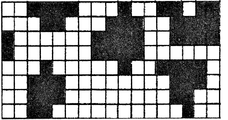
- the average value of the floc size index refers to the absorbance detected by each pixel of the CCD camera by applying light from below the filter material and detecting the transmitted light with a charge coupled device camera (hereinafter abbreviated as a CCD camera). 1. After using the binarized image as shown in FIG. 1, all the binarized pixels are scanned in the width method (CD) and the flow direction (MD), and the number of continuous black dots is averaged. By the average value of the floc size index, it is possible to grasp the size and distribution of the fiber mass (floc) of the filter material.
- the floc size index ratio in the present invention is a value obtained by dividing the average floc size index value in the width direction by the average floc size index value in the flow direction, and the directionality of the fibers of the filter material can be grasped.
- a specific calculation method is as shown in the following calculation formulas (1) to (6).
- the transmittance of each pixel by a CCD camera, Transmittance (light intensity when turned on-light intensity when turned off) / (light quantity when turned on without sample-light quantity when turned off without sample) x 100 (%) Ask for.
- the average transmittance (average value of transmittance measured in all pixels) is obtained.
- a binary image is formed with a pixel having a higher transmittance than the average transmittance as a white point and a lower pixel as a black point.
- the average value of the floc size index and the floc size index ratio are measured by a formation tester FMT-MIII (manufactured by Nomura Corporation).
- the basic setting of the measuring device is not changed from the time of shipment from the factory, and the measurement is performed with the total number of pixels of the CCD camera being about 3400.
- the measurement size may be changed so that the total number of pixels becomes equal to the shape of the sample.
- the average value of the floc size index and the floc size index ratio are calculated by the following method. First, three filter materials having the same filter material material, fiber diameter, filling rate, and thickness are prepared, and the respective floc size index average values and floc size index ratios are measured by the above method. Next, the average value of the three floc size index values and the average floc size index ratio of the three filter materials is taken as the floc size index average value and the floc size index ratio of the filter material. If the required amount of filter material cannot be obtained from the same filter, measurement may be performed by combining filter materials of the same type of filter.
- the higher the floc size index average value the larger the fiber mass (floc) of the filter material, which means that the fiber distribution of the filter material is biased.
- the cell-containing liquid is allowed to flow through this filter material, the flow concentrates on the portion where the fiber density is low and the blood flow resistance is low, and the portion where the fiber density is high and the blood flow resistance is high is not fully utilized.
- the entire surface of the filter material cannot be effectively used, the cell separation performance of the filter is reduced.
- clogging occurs due to the flow of the cell-containing liquid concentrated on a part of the filter, and the liquid passing speed of the filter is reduced.
- the lower the floc size index average value the smaller the fiber mass (floc) of the filter material, which means that the fibers of the filter material are evenly distributed.
- the cell-containing liquid flows evenly through the filter material.
- the entire surface of the filter material is effectively used, the cell separation performance of the filter is enhanced.
- the flow of the cell-containing liquid is dispersed and clogging of the filter is difficult to occur, the liquid passing performance of the filter is improved.
- the filter material of the present invention is characterized in that the average value of the floc size index is 1.0 to 4.0. Since it is difficult to stably produce a filter material having a flock size index average value of less than 1.0, a preferable lower limit value of the flock size index average value is 1.0 or more, more preferably 2.3 or more. More preferably, it is 2.6 or more, particularly preferably 2.7 or more, and still more preferably 2.8 or more. If the average value of the floc size index is larger than 4.0, the cell-containing liquid does not flow evenly through the filter material, so that sufficient cell separation performance cannot be obtained, and the actual liquid passing area is easily reduced or clogged. Thus, the processing speed decreases. Therefore, the upper limit value of the preferable average floc size index is 4.0 or less, more preferably 3.4 or less, and still more preferably 3.1 or less.
- the floc size index ratio when the floc size index ratio is around 1, there is no directionality, and in other cases, there is a flow in a direction where the index is large.
- the filter material has directionality, the cell-containing liquid flows along the direction of the filter material, so that a single flow occurs.
- the cell separation performance of the filter is degraded.
- clogging occurs due to the flow of the cell-containing liquid concentrated on a part of the filter material, and the liquid passing speed of the filter decreases.
- the filter material when the filter material has no directionality, the cell-containing liquid flows evenly through the filter material.
- the entire surface of the filter material is effectively used, the cell separation performance of the filter is enhanced.
- the flow of the cell-containing liquid is dispersed and clogging of the filter is difficult to occur, the liquid passing performance of the filter is improved.
- the filter material of the present invention has a floc size index ratio of 0.78 to 1.02.
- the floc size index ratio is larger than 1.02, there is directionality in the width direction of the filter material, and the flow of cell-containing liquid is concentrated in the width direction, so that the liquid passage area is reduced and clogging is likely to occur. Therefore, sufficient cell separation performance is not obtained, and the liquid passing area is easily reduced or clogged, and the processing speed is reduced. Therefore, a preferable upper limit value of the floc size index ratio is 1.02.
- the lower limit value of the preferred floc size index ratio is 0.78, more preferably 0.87 or more, still more preferably 0.90 or more, and particularly preferably 0.98 or more.
- the filter material of the present invention has a thickness of 0.10 to 0.60 mm.
- the lower limit of the thickness is 0.10 mm or more, preferably 0.12 mm or more, and more preferably 0.14 mm or more. If the thickness is less than 0.10, it is difficult to stably produce the filter material, which is not preferable.
- the upper limit of the thickness is 0.60 mm or less, preferably 0.55 mm or less, and more preferably 0.50 mm or less. Those having a thickness exceeding 0.60 mm are not preferable because the basis weight of the filter material tends to be non-uniform.
- the thickness in this invention means the value calculated
- the average value of the floc size index and the floc size index ratio should be calculated with a filter material having a thickness of 0.10 mm to 0.60 mm. It is more preferable to calculate a floc size index average value and a floc size index ratio corresponding to 0.30 mm which is an intermediate value between the upper limit and the lower limit of the thickness.
- the average value of the floc size index corresponding to 0.30 mm means the average value of the floc size index having a thickness of 0.30 mm calculated from the regression linear equation obtained from the thickness and the average value of the floc size index.
- the floc size index ratio corresponding to 0.30 mm means a floc size index ratio of 0.30 mm calculated from a regression linear equation obtained from the thickness and the floc size index ratio.
- a floc size index average value and a floc size index ratio corresponding to a thickness of 0.30 mm were also calculated by the following method.
- two of the three filter materials measured are overlapped, and the average value of the floc size index, the floc size index ratio, and the thickness are measured.
- the filter material of the present invention is characterized in that an average value of floc size index corresponding to a thickness of 0.30 mm is 1.0 to 3.0. Since it is difficult to stably produce a filter material having a floc size index average value less than 1.0 corresponding to a thickness of 0.30 mm, the lower limit value of the average flock size index value equivalent to a thickness of 0.30 mm is 1. It is 0 or more, more preferably 2.4 or more. If the average value of the floc size index corresponding to a thickness of 0.30 mm is larger than 3.0, the structure of the filter material is not uniform in the direction of the filtration surface, and the cell-containing liquid does not flow evenly through the filter material.
- the upper limit value of the average floc size index corresponding to a preferable thickness of 0.30 mm is 3.0 or less, more preferably 2.8 or less, and still more preferably 2.7 or less.
- the filter material of the present invention is characterized in that the floc size index ratio corresponding to a thickness of 0.30 mm is 0.84 to 1.02.
- the floc size index ratio corresponding to a thickness of 0.30 mm is larger than 1.02, there is directionality in the width direction of the filter material, and the flow of cell-containing liquid is concentrated in the width direction, so that the substantial liquid passing area is reduced. Reduction and clogging are likely to occur, so that sufficient cell separation performance cannot be obtained, and a substantial liquid passage area or clogging is likely to occur, resulting in a reduction in processing speed. Therefore, the upper limit value of the floc size index ratio corresponding to a preferable thickness of 0.30 mm is 1.02.
- the floc size index ratio corresponding to a thickness of 0.30 mm is smaller than 0.84, directionality exists in the flow direction of the filter material, and the flow of the cell-containing liquid is concentrated in the flow direction, so Since the reduction of the area and clogging are likely to occur, the cell separation performance cannot be sufficiently obtained, and the actual liquid passing area is easily reduced and clogging is likely to occur, resulting in a reduction in the processing speed. Therefore, the lower limit value of the floc size index ratio corresponding to a preferable thickness of 0.30 mm is 0.84 or more, more preferably 0.85 or more, still more preferably 0.90 or more, and particularly preferably 0.98 or more.
- the shape of the filter material of the present invention desirably has a large surface area from the viewpoint of contact frequency in order to make contact with the cell-containing solution.
- fibrous structures such as a woven fabric, a nonwoven fabric, fibrous form, and cotton form.
- woven fabrics and non-woven fabrics are preferred.
- Nonwoven fabrics are most preferred because they can make multipoint contact with cells.
- nonwoven fabric refers to a cloth-like material in which fibers or aggregates of fibers are chemically, thermally, or mechanically bonded regardless of knitting. The case where the fiber and the fiber maintain a certain shape by friction caused by contact with each other or entanglement with each other is also included in the mechanical connection.
- the filter support base material constituting the filter material is not particularly limited as long as it does not easily damage cells.
- polyester, polyolefin, polyacrylonitrile, polyamide, polystyrene, polyalkyl (meth) acrylate, polyvinyl chloride examples include polychloroprene, polyurethane, polyvinyl alcohol, polyvinyl acetate, polysulfone, polyethersulfone, polybutadiene, butadiene-acrylonitrile copolymer, styrene-butadiene copolymer, ethylene-vinyl alcohol copolymer, cellulose diacetate, and ethyl cellulose.
- Polyester and polyolefin are preferable, and polyester is particularly preferable.
- Polyester is also preferably polyethylene terephthalate or polybutylene terephthalate, and particularly preferably polyethylene terephthalate.
- the nonwoven fabric can be produced by either a wet method or a dry method, but in terms of obtaining ultrafine fibers, the melt blow method, the flash spinning method, the papermaking method, and the like are particularly preferable.
- a method for producing the nonwoven fabric an example of a melt blow method is shown below.
- thermoplastic resin melted in the extruder is blown out from the melt blow die in a high-temperature and high-speed air stream, and the fibers stretched into fibers are collected on the conveyor, causing entanglement and fusion between the fibers, and no binder A self-adhesive ultrafine fiber nonwoven fabric is obtained.
- the resin viscosity, melting temperature, discharge rate, hot air temperature, wind pressure, DCD (distance from the spinneret and the surface to the conveyor), etc. the fiber diameter, basis weight, fiber orientation, and fiber dispersibility of the nonwoven fabric can be adjusted. Can be controlled.
- the thickness and average pore diameter of the nonwoven fabric can be controlled by hot pressing, tentering, or the like.
- the filter material of the present invention is characterized in that the average fiber diameter is 0.3 to 5.0 ⁇ m.
- the lower limit of the average fiber diameter is 0.3 ⁇ m or more, more preferably 0.4 ⁇ m or more, still more preferably 0.5 ⁇ m or more, particularly preferably 1.0 ⁇ m or more, and particularly preferably 1.2 or more.
- Those having an average fiber diameter of less than 0.3 ⁇ m are not preferred because it is difficult to produce a filter material stably and the viscosity resistance of the cell-containing liquid tends to be too high.
- the upper limit of the average fiber diameter is 5.0 ⁇ m or less, preferably 4.0 ⁇ m or less.
- the viscous resistance of the cell-containing liquid can be evaluated by, for example, the pressure loss of the filter, and the cell separation performance can be evaluated by, for example, the cell separation rate.
- the average fiber diameter in this invention means the value calculated
- the average pore diameter of the filter material of the present invention is preferably 4.0 ⁇ m or more as a lower limit, more preferably 4.5 ⁇ m or more, and further preferably 5.0 ⁇ m or more. Those having an average pore diameter of less than 4.0 ⁇ m are not preferable because liquid passing performance tends to be low.
- the upper limit value of the average pore diameter is preferably 30.0 ⁇ m or less, more preferably 20.0 ⁇ m or less, still more preferably 15.0 ⁇ m or less, and particularly preferably 10.0 ⁇ m or less. Those having an average pore diameter exceeding 30.0 ⁇ m are not preferred because cell separation performance tends to be low.
- the liquid passing performance can be evaluated by, for example, the filtration time.
- the average pore diameter of the filter material in the present invention means the mean flow pore size measured by a palm porometer (manufactured by PMI).
- the bulk density of the filter material of the present invention 0.05 g / cm 3 or more is preferable as the lower limit, more preferably 0.06 g / cm 3 or more, further preferably 0.07 g / cm 3 or more.
- the upper limit of the bulk density is preferably 0.40 g / cm 3 or less, more preferably 0.35 g / cm 3 or less, and still more preferably 0.30 g / cm 3 or less. Those having a bulk density exceeding 0.40 g / cm 3 are not preferable because the fiber spacing tends to be dense and blood circulation performance tends to be low. Note that the bulk density in the present invention refers to the weight measured values per filter material 1 cm 3.
- the surface of the filter material of the present invention is preferably modified by graft polymerization, polymer coating, chemical treatment such as alkali or acid, plasma treatment or the like.
- the polymer coating is preferable because it is a simple and excellent modification method for modifying the surface of the polymer material into a preferable structure.
- the filter material of the present invention preferably has a hydrophilic polymer at least on the surface, and the polymer used for the surface coating is not particularly limited as long as the load on the cells is not particularly large as long as it is a hydrophilic polymer.
- Copolymers of monomers such as hydroxyethyl (meth) acrylate having a functional group and dimethylaminoethyl (meth) acrylate or diethylaminoethyl (meth) acrylate having a basic functional group, and polyvinylpyrrolidone make the surface of the material hydrophilic.
- it is particularly preferable because it can improve the cell capture performance by introducing a charged functional group.
- a method of impregnating a filter support substrate with a solution in which a polymer is dissolved a method of spraying a solution in which a polymer is dissolved on a filter support substrate, and applying and transferring a solution in which a polymer is dissolved to a filter support substrate using a gravure roll
- a method of impregnating a filter support base material with a solution in which a polymer is dissolved is preferable because of excellent continuous productivity and low cost.
- the solvent for dissolving the polymer is not particularly limited as long as it does not significantly dissolve the filter support base.
- amides such as N, N-dimethylformamide and N, N-dimethylacetamide
- sulfoxides such as dimethyl sulfoxide.
- Alcohols such as methanol, ethanol, propanol and butanol, ketones such as acetone and methyl ethyl ketone, esters such as methyl acetate and ethyl acetate, hydrocarbons such as toluene and cyclohexane, halogenated hydrocarbons such as chloroform and dichloromethane And water, and a mixture of the above-mentioned plurality of solvents in a soluble range. Alcohols such as methanol, ethanol, propanol and butanol are preferable, and methanol and ethanol are particularly preferable.
- the filter of the present invention is made of a filter material having an average fiber diameter of 0.3 to 30 ⁇ m and a basis weight of 10 to 100 g / m 2 , and an average value of floc size index is 1.0 to at least part of the filter material. It is a filter provided with the inlet and outlet of the liquid which has a filter material which is 4.0.
- the lower limit of the average fiber diameter of the filter material contained in the filter is 0.3 ⁇ m or more, more preferably 0.4 ⁇ m or more, still more preferably 0.5 ⁇ m or more, particularly preferably 1.0 ⁇ m or more, and particularly preferably 1. 2 ⁇ m or more. Those having an average fiber diameter of less than 0.3 ⁇ m are not preferred because it is difficult to produce a filter material stably and the viscosity resistance of the cell-containing liquid tends to be too high.
- the upper limit of the average fiber diameter is 30 ⁇ m or less, preferably 25 ⁇ m or less, more preferably 20 ⁇ m or less, and particularly preferably 15 ⁇ m or less. A fiber having an average fiber diameter exceeding 30 ⁇ m is not preferable because of low cell separation performance.
- the lower limit value of the basis weight of the filter material contained in the filter is 10 g / m 2 or more, preferably 20 g / m 2 or more, more preferably 30 g / m 2 or more. Those having a basis weight of less than 10 g / m 2 are not preferable because it is difficult to stably produce a filter material.
- the upper limit of the basis weight is at 100 g / m 2 or less, preferably 90 g / m 2 or less, more preferably 80 g / m 2 or less, more preferably 70 g / m 2 or less.
- “at least part of the filter material” means a floc size index average value, a floc size index ratio, a floc size index average value corresponding to a thickness of 0.30 mm, and a floc size corresponding to a thickness of 0.30 mm.
- One of the index ratios indicates that one or more filter materials satisfying a specific numerical range in the present invention are included. More specifically, 1% or more is contained in the filter material, preferably 5% or more in the filter material, more preferably 6.2% or more in the filter material, and further preferably 10% or more in the filter material. Particularly preferably, it is 50% or more in the filter material, more preferably 75% in the filter material, particularly preferably 81% or more in the filter material, and most preferably 85% or more in the filter material.
- the lower limit value of the average floc size index value of some filter materials included in the filter is 1.0 or more, more preferably 2.3 or more, still more preferably 2.6 or more, and particularly preferably 2 .7 or more, more preferably 2.8 or more.
- Filter materials having an average floc size index value of less than 1.0 for all filter materials are not preferable because it is difficult to produce them stably.
- the upper limit of the average flock size index is 4.0 or less, more preferably 3.4 or less, and still more preferably 3.1 or less. If the average floc size index of all filter materials is greater than 4.0, the cell-containing solution will not flow evenly through the filter, so that sufficient cell separation performance will not be obtained, and there will be a substantial decrease in the flow area. It is not preferable because clogging is likely to occur and the processing speed is reduced.
- the filter container can take any form such as a sphere, container, cassette, bag, tube, column, etc.
- a transparent or translucent cylindrical shape with a capacity of about 0.1 to 1000 mL and a diameter of about 0.1 to 15 cm.
- a container or a square or rectangular shape with a length of about 0.1 to 20 cm and a rectangular column shape with a thickness of about 0.1 to 5 cm is preferable.
- the filter of the present invention is characterized by having a filter material having a floc size index ratio of 0.78 to 1.02 in at least a part of the filter material.
- the floc size index ratio of all the filter materials included in the filter is larger than 1.02, there is directionality in the width direction of the filter, and the flow area by the concentration of the cell-containing liquid flow in the width direction is reduced. Reduction and clogging are likely to occur, so that sufficient cell separation performance cannot be obtained, and the liquid passing area is easily reduced and clogging occurs, resulting in a reduction in processing speed. Therefore, a preferable upper limit value of the floc size index ratio is 1.02.
- the floc size index ratio of all the filter materials is less than 0.78, there is directionality in the flow direction of the filter, and the flow of cell-containing liquid concentrates in the flow direction, thereby reducing the liquid passage area and clogging. Therefore, the cell separation performance is not sufficiently obtained, the liquid passage area is reduced and clogging is likely to occur, and the processing speed is lowered. Therefore, the lower limit of the preferred floc size index ratio is 0.78, more preferably 0.87 or more.
- the filter of the present invention is characterized in that at least a part of the filter material has a filter material having a floc size index average value of 1.0 to 3.0 corresponding to a thickness of 0.30 mm.
- a preferable thickness of some filter materials included in the filter is 0.
- the lower limit value of the average value of the floc size index corresponding to .30 mm is 1.0 or more, more preferably 2.4 or more.
- the average floc size index value corresponding to a thickness of 0.30 mm of all the filter materials is larger than 3.0, the structure of the filter is not uniform with respect to the direction of the filtration surface, and the cell-containing liquid makes the filter even Since it does not flow, the cell separation performance cannot be sufficiently obtained, the substantial liquid passage area is easily reduced and clogging is likely to occur, and the processing speed is lowered. Therefore, the upper limit value of the average floc size index corresponding to a preferable thickness of 0.30 mm is 3.0 or less, more preferably 2.8 or less, and still more preferably 2.7 or less.
- the filter of the present invention is characterized in that at least a part of the filter material has a filter material having a floc size index ratio corresponding to a thickness of 0.30 mm of 0.84 to 1.02.
- the floc size index ratio corresponding to a thickness of 0.30 mm of all the filter materials is larger than 1.02, directionality exists in the width direction of the filter, and the flow of the cell-containing liquid concentrates in the width direction. Since the liquid passing area is easily reduced and clogging is likely to occur, sufficient cell separation performance cannot be obtained, and the substantial liquid passing area is easily reduced and clogging is likely to occur, resulting in a reduction in processing speed. Therefore, the upper limit value of the floc size index ratio corresponding to a preferable thickness of 0.30 mm is 1.02.
- the floc size index ratio corresponding to a thickness of 0.30 mm of all the filter materials is smaller than 0.84, there is directionality in the flow direction of the filter, and the flow of cell-containing liquid is concentrated in the flow direction. Therefore, cell separation performance is not sufficiently obtained, and a substantial liquid passage area is easily reduced and clogging is likely to occur, resulting in a reduction in processing speed. Therefore, the lower limit value of the floc size index ratio corresponding to a preferable thickness of 0.30 mm is 0.84 or more, more preferably 0.85 or more, still more preferably 0.90 or more, and particularly preferably 0.98 or more.
- filter materials may be stacked in the liquid flow direction and filled in a container.
- the lower limit of the number of filter materials to be stacked is one, but it is preferably 5 or more, more preferably 10 from the viewpoint of cell separation performance.
- the upper limit of the number of laminated filter materials is preferably 100 or less, more preferably 70 or less, and still more preferably 50 or less. If the number of laminated filter materials exceeds 100, there is a problem that the liquid passing performance deteriorates.
- the filter of the present invention may further include different types of filter materials on the inlet side and / or outlet side of the filter. For example, by arranging a filter material having an average fiber diameter larger than that of the main filter material on the inlet side, effects such as further improvement in blood permeation performance are expected.
- a filter material having a large average fiber diameter may be disposed on the inlet side of the filter, and a filter material having a small average fiber diameter may be disposed on the outlet side of the filter.
- the filter material on the outlet side is the first filter material
- the filter material on the inlet side is the second filter material.
- the average fiber diameter of the first filter material is 0.3 to 5.0 ⁇ m, the average fiber diameter is 1.0 to 10.0 ⁇ m on the inlet side of the first filter material, and the average fiber diameter is When a second filter material larger than the first filter material is disposed, an effect of further improving the liquid passing performance can be obtained.
- the lower limit value of the average fiber diameter of the second filter material is 1.0 ⁇ m or more, more preferably 1.2 ⁇ m or more, and further preferably 1.5 ⁇ m or more. Those having an average fiber diameter of less than 1.0 ⁇ m are not preferable because the degree of improvement in liquid passing performance is low.
- the upper limit of the average fiber diameter is 10.0 ⁇ m or less, and more preferably 8.0 ⁇ m or less. More preferably, it is 5.0 micrometers or less, More preferably, it is 3.0 micrometers or less. Those having an average fiber diameter of more than 10.0 ⁇ m are not preferable because the degree of improvement in liquid passing performance is low.
- the filter of the present invention may include a prefilter material for removing fine aggregates on the inlet side of the filter. Since the cell-containing liquid often contains microaggregates, it is preferably removed using a prefilter.
- a prefilter for example, an aggregate of fibers having an average fiber diameter of 3 to 50 ⁇ m or a continuous porous body having pores having an average pore diameter of 20 to 200 ⁇ m is preferable.
- the filter system of the present invention is characterized in that a blood collection bag is connected to the inlet side of the filter, and at least one blood bag is connected to the outlet port side of the filter.
- the blood collection bag is, for example, a bag in which a blood collection tube including a blood collection needle is connected, and an anticoagulant such as ACD (acid cytolate dextrose) or CPD (cytophosphate phosphate dextrose) is enclosed therein, A blood collection bag used for general blood collection can also be used.
- the blood bag is a bag for storing whole blood, concentrated red blood cells, concentrated platelet plasma, plasma, and the like, and a commonly used blood bag can be used.
- PET non-woven fabric The following polyethylene terephthalate (hereinafter abbreviated as PET) non-woven fabric produced by a melt blow method was used.
- Prefilter material PET nonwoven fabric having an average fiber diameter of 15 ⁇ m and a basis weight of 30 g / m 2
- Second filter material Average fiber diameter of 1.8 ⁇ m, basis weight of 70 g / m 2 , average pore diameter of 7.7 ⁇ m, bulk density of 0.20 g / cm 3 , thickness 0.35 mm, floc size index average value 2.6, floc size index ratio 0.98, floc size index average value 2.7 equivalent to thickness 0.30 mm, floc size equivalent to thickness 0.30 mm PET nonwoven fabric with an index ratio of 0.98 / first filter material: average fiber diameter of 1.4 ⁇ m, basis weight of 40 g / m 2 , average pore diameter of 4.9 ⁇ m, bulk density of 0.18 g / cm 3 , thickness of 0.22 mm, flock size Index average value
- HEDM 2-hydroxyethyl methacrylate and N, N-dimethylaminoethyl methacrylate
- ⁇ Nonwoven fabric coating process> The second filter material and the first filter material were immersed in a HEDM coating solution at 20 ° C. for 5 minutes, then placed in a stainless steel basket and dried at 50 ° C. for 1.5 hours. Subsequently, each nonwoven fabric was washed with water, placed in a stainless steel basket, and dried at 50 ° C. for 3 hours.
- each nonwoven fabric was punched into a circle with a diameter of 18 mm to produce a disk-shaped prefilter material, a second filter material, and a first filter material.
- ⁇ Filter production process Six pre-filter materials and two second filter materials (occupying 6.25% of the filter material) in order from the inlet side to the outlet side in a cylindrical housing with an inner diameter of 18 mm, the first filter material Were inserted (accounting for 75% of the filter material) to produce a filter.
- the inlet of the filter and the blood storage container were connected with a 60 cm long vinyl chloride tube (outer diameter 5 mm, inner diameter 3 mm), and the tube was closed with a clamp.
- a blood sample was prepared by adding 10% 5% trisodium citrate aqueous solution as an anticoagulant to bovine blood. After the blood sample was brought to 28 ° C. using a thermostatic bath, 24 mL of the blood sample was put into a blood storage container, natural falling filtration with a drop of 60 cm was performed, and 22 mL of filtered blood was collected with a receiver. The time from the start of filtration to the emptying of the blood storage container was defined as the filtration time.
- the leukocyte concentration before filtration, the erythrocyte concentration before and after filtration, and the platelet concentration were measured using a blood cell counter (manufactured by Sysmex Corporation, K-4500), and the leukocyte concentration after filtration was measured by the LeucoCOUNT kit and FACSCalibur (both Becton Dickinson) ) Using a flow cytometry method.
- Leukocyte separation performance -Log (b / a)
- Red blood cell recovery rate d / c x 100 (%)
- Platelet separation rate (e ⁇ f) / e ⁇ 100 (%) It calculated
- Example 2 Average fiber diameter 1.3 ⁇ m, basis weight 40 g / m 2 , average pore diameter 6.8 ⁇ m, bulk density 0.13 g / cm 3 , thickness 0.30 mm, floc size index average value 2.7, floc size index ratio 1.02, Example 1 except that 24 PET non-woven fabrics having a floc size index average value of 2.7 corresponding to a thickness of 0.30 mm and a floc size index ratio of 1.02 corresponding to a thickness of 0.30 mm were used as the first filter material.
- a filter was produced in the same manner. The produced filter was evaluated in the same manner as in Example 1, and the results are shown in Table 1.
- Example 3 Average fiber diameter 1.3 ⁇ m, basis weight 40 g / m 2 , average pore diameter 7.0 ⁇ m, bulk density 0.11 g / cm 3 , thickness 0.35 mm, floc size index average value 2.7, floc size index ratio 0.99, Example 1 except that 24 PET non-woven fabrics having a floc size index average value of 2.7 corresponding to a thickness of 0.30 mm and a floc size index ratio of 0.99 corresponding to a thickness of 0.30 mm were used as the first filter material.
- a filter was produced in the same manner. The produced filter was evaluated in the same manner as in Example 1, and the results are shown in Table 1.
- Example 4 The average fiber diameter of 1.3 .mu.m, basis weight 40 g / m 2, an average pore diameter of 6.0 .mu.m, a bulk density of 0.10 g / cm 3, thickness 0.40 mm, floc size exponential average value 2.8, floc size index ratio 0.98, Example 1 except that 24 PET non-woven fabrics having a floc size index average value of 3.0 corresponding to a thickness of 0.30 mm and a floc size index ratio of 0.98 corresponding to a thickness of 0.30 mm were used as the first filter material.
- a filter was produced in the same manner. The produced filter was evaluated in the same manner as in Example 1, and the results are shown in Table 1.
- Example 5 Average fiber diameter 1.5 ⁇ m, basis weight 40 g / m 2 , average pore diameter 5.2 ⁇ m, bulk density 0.11 g / cm 3 , thickness 0.38 mm, floc size index average value 2.3, floc size index ratio 0.87, Example 1 except that 24 PET non-woven fabrics having a floc size index average value of 2.4 corresponding to a thickness of 0.30 mm and a floc size index ratio of 0.85 corresponding to a thickness of 0.30 mm were used as the first filter material. A filter was produced in the same manner. The produced filter was evaluated in the same manner as in Example 1, and the results are shown in Table 1.
- Example 6 The average fiber diameter of 1.5 [mu] m, basis weight 40 g / m 2, an average pore diameter of 4.7 [mu] m, a bulk density of 0.08 g / cm 3, thickness 0.55 mm, floc size exponential average value 2.6, floc size index ratio 0.90, Example 1 except that 24 PET non-woven fabrics having a floc size index average value of 2.7 corresponding to a thickness of 0.30 mm and a floc size index ratio of 0.90 corresponding to a thickness of 0.30 mm were used as the first filter material. A filter was produced in the same manner. The produced filter was evaluated in the same manner as in Example 1, and the results are shown in Table 1.
- Example 7 Average fiber diameter 1.2 ⁇ m, basis weight 40 g / m 2 , average pore diameter 5.1 ⁇ m, bulk density 0.19 g / cm 3 , thickness 0.21 mm, floc size index average value 3.4, floc size index ratio 0.78, Example 1 except that 24 PET non-woven fabrics having a floc size index average value of 3.0 corresponding to a thickness of 0.30 mm and a floc size index ratio of 0.84 corresponding to a thickness of 0.30 mm were used as the first filter material. A filter was produced in the same manner. The produced filter was evaluated in the same manner as in Example 1, and the results are shown in Table 1.
- Example 1 Average fiber diameter 1.3 ⁇ m, basis weight 40 g / m 2 , average pore diameter 4.9 ⁇ m, bulk density 0.20 g / cm 3 , thickness 0.20 mm, floc size index average value 4.1, floc size index ratio 1.13, Example 1 except that 24 PET non-woven fabrics having a floc size index average value of 3.4 corresponding to a thickness of 0.30 mm and a floc size index ratio of 1.11 corresponding to a thickness of 0.30 mm were used as the first filter material. A filter was produced in the same manner.
- Example 2 Average fiber diameter 1.1 ⁇ m, basis weight 30 g / m 2 , average pore diameter 5.1 ⁇ m, bulk density 0.20 g / cm 3 , thickness 0.15 mm, floc size index average value 4.6, floc size index ratio 1.03, Example 1 except that 32 PET non-woven fabrics having a floc size index average value of 4.4 corresponding to a thickness of 0.30 mm and a floc size index ratio of 1.02 corresponding to a thickness of 0.30 mm were used as the first filter material. A filter was produced in the same manner.
- Example 3 Average fiber diameter 1.3 ⁇ m, basis weight 50 g / m 2 , average pore diameter 4.7 ⁇ m, bulk density 0.21 g / cm 3 , thickness 0.23 mm, floc size index average value 4.3, floc size index ratio 0.97, Example 1 except that 19 PET non-woven fabrics having a floc size index average value of 3.9 corresponding to a thickness of 0.30 mm and a floc size index ratio of 0.98 corresponding to a thickness of 0.30 mm were used as the first filter material. A filter was produced in the same manner.
- Prefilter material PET nonwoven fabric having an average fiber diameter of 15 ⁇ m and a basis weight of 30 g / m 2
- Second filter material Average fiber diameter of 1.8 ⁇ m, basis weight of 70 g / m 2 , average pore diameter of 7.7 ⁇ m, bulk density of 0.20 g / cm 3 , thickness 0.35 mm, floc size index average value 2.6, floc size index ratio 0.98, floc size index average value 2.7 equivalent to thickness 0.30 mm, floc size equivalent to thickness 0.30 mm PET nonwoven fabric with an index ratio of 0.98 / first filter material: average fiber diameter of 1.4 ⁇ m, basis weight of 40 g / m 2 , average pore diameter of 4.9 ⁇ m, bulk density of 0.18 g / cm 3 , thickness of 0.22 mm, flock size Index average value 3.1, floc size index ratio
- ⁇ Nonwoven fabric coating process> The second filter material and the first filter material were immersed in a HEDM coating solution at 20 ° C. for 5 minutes, then placed in a stainless steel basket and dried at 50 ° C. for 1.5 hours. Subsequently, each nonwoven fabric was washed with water, placed in a stainless steel basket, and dried at 50 ° C. for 3 hours.
- each non-woven fabric was punched into a 7.2 cm ⁇ 7.2 cm square to produce a disk-shaped prefilter material, a second filter material, and a first filter material.
- ⁇ Filter production process Insert the 6 pre-filter materials, 2 second filter materials, and 32 first filter materials into the 7.2 cm x 7.2 cm square housing in order from the inlet side to the outlet side.
- the inlet of the filter and the blood bag were connected with a 60 cm long vinyl chloride tube (outer diameter 5 mm, inner diameter 3 mm), and the tube was closed with a clamp.
- a blood sample was prepared by adding 10% of a 5% trisodium citrate aqueous solution as an anticoagulant to bovine whole blood.
- a blood sample of 456 mL was placed in a blood bag, the blood sample was brought to 28 ° C. using a thermostatic bath, and then subjected to natural fall filtration with a drop of 60 cm using the above filter.
- the white blood cell separation performance (-Log) was 5.29, the red blood cell recovery rate was 100%, the platelet separation rate was 86.6%, and the filtration time was 14.5 minutes.
- Example 9 Evaluation using human blood A filter was produced in the same manner as in Example 1 except that 32 first filter materials were used.
- a blood bag containing 200 mL of human whole blood and 28 mL of anticoagulant CPD solution (Terumo blood bag CPD, composition: sodium citrate hydrate 2.63 w / v%, citric acid hydrate 0.327 w / v%, A blood sample was prepared by collecting and mixing blood glucose (2.32 w / v%, sodium dihydrogen phosphate 0.251 w / v%). After the blood sample was brought to 28 ° C. using a thermostatic bath, 24 mL of the blood sample was put into a blood storage container, natural falling filtration with a drop of 60 cm was performed, and 22 mL of filtered blood was collected with a receiver. As a result, the white blood cell separation performance (-Log) was 5.27, the red blood cell recovery rate was 100%, the platelet separation rate was 100%, and the filtration time was 26.3 minutes.
Landscapes
- Health & Medical Sciences (AREA)
- Heart & Thoracic Surgery (AREA)
- Vascular Medicine (AREA)
- Life Sciences & Earth Sciences (AREA)
- General Health & Medical Sciences (AREA)
- Anesthesiology (AREA)
- Biomedical Technology (AREA)
- Hematology (AREA)
- Veterinary Medicine (AREA)
- Animal Behavior & Ethology (AREA)
- Engineering & Computer Science (AREA)
- Public Health (AREA)
- Cardiology (AREA)
- Chemical & Material Sciences (AREA)
- Chemical Kinetics & Catalysis (AREA)
- Filtering Materials (AREA)
- External Artificial Organs (AREA)
- Apparatus Associated With Microorganisms And Enzymes (AREA)
Abstract
Description
(1)CCDカメラにより、各画素の透過率、
透過率=(点灯時の光量-消灯時の光量)/(サンプルがない状態での点灯時の光量-サンプルがない状態での消灯時の光量)×100(%)
を求める。
(2)平均透過率(全画素で測定された透過率の平均値)を求める。
(3)平均透過率より高い透過率の画素を白点、低い画素を黒点として二値化像にする。
(4)二値化後の全画素を巾方向(CD)および流れ方向(MD)に走査して、連続する黒点の数を平均し、巾方向の平均、流れ方向の平均および両方向の平均を求める。
(5)以下の式よりフロックサイズ指数平均値を求める。
フロックサイズ指数平均値=(巾方向のフロックサイズ指数平均値+流れ方向のフロックサイズ指数平均値)/2
(6)以下の式より、巾方向と流れ方向の指数比(縦横比)を求める。
フロックサイズ指数比=巾方向のフロックサイズ指数平均値/流れ方向のフロックサイズ指数平均値
<不織布の作製>
メルトブロー法で作製した以下のポリエチレンテレフタレート(以下PETと略す)不織布を使用した。
・プレフィルター材:平均繊維直径15μm、目付け30g/m2のPET不織布
・第2のフィルター材:平均繊維直径1.8μm、目付け70g/m2、平均孔径7.7μm、嵩密度0.20g/cm3、厚み0.35mm、フロックサイズ指数平均値2.6、フロックサイズ指数比0.98、厚さ0.30mm相当のフロックサイズ指数平均値2.7、厚さ0.30mm相当のフロックサイズ指数比0.98のPET不織布
・第1のフィルター材:平均繊維直径1.4μm、目付け40g/m2、平均孔径4.9μm、嵩密度0.18g/cm3、厚み0.22mm、フロックサイズ指数平均値3.1、フロックサイズ指数比0.98、厚さ0.30mm相当のフロックサイズ指数平均値2.8、厚さ0.30mm相当のフロックサイズ指数比0.98のPET不織布
特級エタノール中に2-ヒドロキシエチルメタクリレートを0.95モル/L、2-ジメチルアミノエチルメタクリレートを0.05モル/Lの濃度になるように加え、全量を300mLとした。重合開始剤として2,2’-アゾビス(2,4-ジメチルバレロニトリル)(V-65)を0.005モル/Lの濃度になるように加え、窒素雰囲気下、45℃にて15時間重合させた後、過剰のn-ヘキサンに注いでポリマーを析出させて回収した。得られたポリマーをエタノールに再溶解させ、n-ヘキサンに注いで析出したポリマーを75℃にて4時間乾燥し、2-ヒドロキシエチルメタクリレートとN,N-ジメチルアミノエチルメタクリレートから成る共重合体(以下HEDMと略す)を得た。HEDMを濃度が1.0g/Lになるようにエタノールに溶解し、HEDMコーティング溶液を調製した。
第2のフィルター材および第1のフィルター材をHEDMコーティング溶液に20℃にて5分間浸漬した後、ステンレス製バスケットに入れ、50℃にて1.5時間乾燥した。続いて、各不織布を水洗した後、ステンレス製バスケットに入れ、50℃にて3時間乾燥した。
ポンチを用いて、各不織布を直径18mmの円形に打抜き、ディスク状のプレフィルター材、第2のフィルター材、第1のフィルター材を作製した。
内径18mmの円柱ハウジング内に導入口側から導出口側へ順に、プレフィルター材を6枚、第2のフィルター材を2枚(フィルター材中の6.25%を占める)、第1のフィルター材を24枚挿入し(フィルター材中の75%を占める)、フィルターを作製した。フィルターの導入口と血液貯留容器を長さ60cmの塩化ビニル製チューブ(外径5mm、内径3mm)で接続し、クランプでチューブを閉じた。
ウシ血液に対して抗凝固剤として5%クエン酸三ナトリウム水溶液を10%添加して血液試料を調製した。恒温槽を用いて血液試料を28℃にした後、その血液試料24mLを血液貯留容器へ入れ、落差60cmの自然落下濾過を実施し、受器で濾過血液を22mL回収した。なお、濾過を開始してから血液貯留容器が空になるまでの時間を濾過時間とした。濾過前の白血球濃度、濾過前後の赤血球濃度、血小板濃度は血球カウンター(シスメックス(株)製、K-4500)を用いて測定し、濾過後の白血球濃度はLeucoCOUNTキットおよびFACSCalibur(共にベクトン・ディッキンソン社)を用いて、フローサイトメトリー法にて測定した。
a=濾過前血液の白血球濃度、b=濾過後血液の白血球濃度、c=濾過前血液の赤血球濃度、d=濾過後血液の赤血球濃度、e=濾過前血液の血小板濃度、f=濾過後血液の血小板濃度とするとき、それぞれ、
白血球分離性能=-Log(b/a)
赤血球回収率=d/c×100(%)
血小板分離率=(e-f)/e×100(%)
で表される式によって求めた。結果を表1に示した。
平均繊維直径1.3μm、目付け40g/m2、平均孔径6.8μm、嵩密度0.13g/cm3、厚み0.30mm、フロックサイズ指数平均値2.7、フロックサイズ指数比1.02、厚さ0.30mm相当のフロックサイズ指数平均値2.7、厚さ0.30mm相当のフロックサイズ指数比1.02のPET不織布を第1のフィルター材として24枚用いた以外は実施例1と同様にして、フィルターを作製した。作製したフィルターについて実施例1と同様の評価を行い、結果を表1に示した。
平均繊維直径1.3μm、目付け40g/m2、平均孔径7.0μm、嵩密度0.11g/cm3、厚み0.35mm、フロックサイズ指数平均値2.7、フロックサイズ指数比0.99、厚さ0.30mm相当のフロックサイズ指数平均値2.7、厚さ0.30mm相当のフロックサイズ指数比0.99のPET不織布を第1のフィルター材として24枚用いた以外は実施例1と同様にして、フィルターを作製した。作製したフィルターについて実施例1と同様の評価を行い、結果を表1に示した。
平均繊維直径1.3μm、目付け40g/m2、平均孔径6.0μm、嵩密度0.10g/cm3、厚み0.40mm、フロックサイズ指数平均値2.8、フロックサイズ指数比0.98、厚さ0.30mm相当のフロックサイズ指数平均値3.0、厚さ0.30mm相当のフロックサイズ指数比0.98のPET不織布を第1のフィルター材として24枚用いた以外は実施例1と同様にして、フィルターを作製した。作製したフィルターについて実施例1と同様の評価を行い、結果を表1に示した。
平均繊維直径1.5μm、目付け40g/m2、平均孔径5.2μm、嵩密度0.11g/cm3、厚み0.38mm、フロックサイズ指数平均値2.3、フロックサイズ指数比0.87、厚さ0.30mm相当のフロックサイズ指数平均値2.4、厚さ0.30mm相当のフロックサイズ指数比0.85のPET不織布を第1のフィルター材として24枚用いた以外は実施例1と同様にして、フィルターを作製した。作製したフィルターについて実施例1と同様の評価を行い、結果を表1に示した。
平均繊維直径1.5μm、目付け40g/m2、平均孔径4.7μm、嵩密度0.08g/cm3、厚み0.55mm、フロックサイズ指数平均値2.6、フロックサイズ指数比0.90、厚さ0.30mm相当のフロックサイズ指数平均値2.7、厚さ0.30mm相当のフロックサイズ指数比0.90のPET不織布を第1のフィルター材として24枚用いた以外は実施例1と同様にして、フィルターを作製した。作製したフィルターについて実施例1と同様の評価を行い、結果を表1に示した。
平均繊維直径1.2μm、目付け40g/m2、平均孔径5.1μm、嵩密度0.19g/cm3、厚み0.21mm、フロックサイズ指数平均値3.4、フロックサイズ指数比0.78、厚さ0.30mm相当のフロックサイズ指数平均値3.0、厚さ0.30mm相当のフロックサイズ指数比0.84のPET不織布を第1のフィルター材として24枚用いた以外は実施例1と同様にして、フィルターを作製した。作製したフィルターについて実施例1と同様の評価を行い、結果を表1に示した。
平均繊維直径1.3μm、目付け40g/m2、平均孔径4.9μm、嵩密度0.20g/cm3、厚み0.20mm、フロックサイズ指数平均値4.1、フロックサイズ指数比1.13、厚さ0.30mm相当のフロックサイズ指数平均値3.4、厚さ0.30mm相当のフロックサイズ指数比1.11のPET不織布を第1のフィルター材として24枚用いた以外は実施例1と同様にして、フィルターを作製した。
平均繊維直径1.1μm、目付け30g/m2、平均孔径5.1μm、嵩密度0.20g/cm3、厚み0.15mm、フロックサイズ指数平均値4.6、フロックサイズ指数比1.03、厚さ0.30mm相当のフロックサイズ指数平均値4.4、厚さ0.30mm相当のフロックサイズ指数比1.02のPET不織布を第1のフィルター材として32枚用いた以外は実施例1と同様にして、フィルターを作製した。
平均繊維直径1.3μm、目付け50g/m2、平均孔径4.7μm、嵩密度0.21g/cm3、厚み0.23mm、フロックサイズ指数平均値4.3、フロックサイズ指数比0.97、厚さ0.30mm相当のフロックサイズ指数平均値3.9、厚さ0.30mm相当のフロックサイズ指数比0.98のPET不織布を第1のフィルター材として19枚用いた以外は実施例1と同様にして、フィルターを作製した。

<不織布の作製>
メルトブロー法で作製した以下のPET不織布を使用した。
・プレフィルター材:平均繊維直径15μm、目付け30g/m2のPET不織布
・第2のフィルター材:平均繊維直径1.8μm、目付け70g/m2、平均孔径7.7μm、嵩密度0.20g/cm3、厚み0.35mm、フロックサイズ指数平均値2.6、フロックサイズ指数比0.98、厚さ0.30mm相当のフロックサイズ指数平均値2.7、厚さ0.30mm相当のフロックサイズ指数比0.98のPET不織布
・第1のフィルター材:平均繊維直径1.4μm、目付け40g/m2、平均孔径4.9μm、嵩密度0.18g/cm3、厚み0.22mm、フロックサイズ指数平均値3.1、フロックサイズ指数比0.98、厚さ0.30mm相当のフロックサイズ指数平均値2.8、厚さ0.30mm相当のフロックサイズ指数比0.98のPET不織布
第2のフィルター材および第1のフィルター材をHEDMコーティング溶液に20℃にて5分間浸漬した後、ステンレス製バスケットに入れ、50℃にて1.5時間乾燥した。続いて、各不織布を水洗した後、ステンレス製バスケットに入れ、50℃にて3時間乾燥した。
ポンチを用いて、各不織布を7.2cm×7.2cmの正方形に打抜き、ディスク状のプレフィルター材、第2のフィルター材、第1のフィルター材を作製した。
7.2cm×7.2cmの正方形ハウジング内に導入口側から導出口側へ順に、プレフィルター材を6枚、第2のフィルター材を2枚、第1のフィルター材を32枚挿入し、フィルターを作製した。フィルターの導入口と血液バッグを長さ60cmの塩化ビニル製チューブ(外径5mm、内径3mm)で接続し、クランプでチューブを閉じた。
ウシ全血に対して抗凝固剤として5%クエン酸三ナトリウム水溶液を10%添加して血液試料を調製した。血液試料456mLを血液バッグに入れ、恒温槽を用いて血液試料を28℃にした後、上記のフィルターで落差60cmの自然落下濾過を実施した。その結果、白血球分離性能(-Log)は5.29、赤血球回収率は100%、血小板分離率は86.6%、濾過時間は14.5分であった。
第1のフィルター材を32枚用いた以外は実施例1と同様にして、フィルターを作製した。
ヒト全血200mLを抗凝固剤CPD液28mLが入った血液バッグ(テルモ製血液バッグCPD、組成:クエン酸ナトリウム水和物2.63w/v%、クエン酸水和物0.327w/v%、ブドウ糖2.32w/v%、リン酸二水素ナトリウム0.251w/v%)に採血、混和し、血液試料を調製した。恒温槽を用いて血液試料を28℃にした後、その血液試料24mLを血液貯留容器へ入れ、落差60cmの自然落下濾過を実施し、受器で濾過血液を22mL回収した。その結果、白血球分離性能(-Log)は5.27、赤血球回収率は100%、血小板分離率は100%、濾過時間は26.3分であった。
Claims (15)
- 平均繊維直径が0.3~5.0μmであり、厚さが0.10~0.60mmであり、フロックサイズ指数平均値が1.0~4.0であることを特徴とするフィルター材。
- フロックサイズ指数比が0.78~1.02であることを特徴とする請求項1に記載のフィルター材。
- 厚さ0.30mm相当のフロックサイズ指数平均値が1.0~3.0であることを特徴とする請求項1または2に記載のフィルター材。
- 厚さ0.30mm相当のフロックサイズ指数比が0.84~1.02であることを特徴とする請求項1~3のいずれかに記載のフィルター材。
- フィルター材の少なくとも表面に親水性ポリマーを有することを特徴とする請求項1~4のいずれかに記載のフィルター材。
- 不織布であることを特徴とする請求項1~5のいずれかに記載のフィルター材。
- 平均繊維直径が0.3~30μm、目付けが10~100g/m2であるフィルター材からなり、前記フィルター材中の少なくとも一部にフロックサイズ指数平均値が1.0~4.0であるフィルター材を有する液の導入口および導出口を備えたフィルター。
- フィルター材中の少なくとも一部にフロックサイズ指数比が0.78~1.02であるフィルター材を有する請求項7に記載のフィルター。
- フィルター材中の少なくとも一部に厚さ0.30mm相当のフロックサイズ指数平均値が1.0~3.0であるフィルター材を有する請求項7または8に記載のフィルター。
- フィルター材中の少なくとも一部に厚さ0.30mm相当のフロックサイズ指数比が0.84~1.02であるフィルター材を有する請求項7~9のいずれかに記載のフィルター。
- フィルター材が、液の流れ方向に積層されていることを特徴とする請求項7~10のいずれかに記載のフィルター。
- フィルターの導入口側および/または導出口側に、異なる種類のフィルター材を含む請求項7~11のいずれかに記載のフィルター。
- フィルターの導入口側に平均繊維直径が大きなフィルター材を配置し、フィルターの導出口側に平均繊維直径が小さなフィルター材を配置した請求項7~12のいずれかに記載のフィルター。
- フィルターの導入口側に微小凝集物除去のためのプレフィルター材を含む請求項7~13のいずれかに記載のフィルター。
- 請求項7~14のいずれかに記載のフィルターの導入口側に採血バッグが接続され、該フィルターの導出口側に少なくとも1つの血液バッグが接続されてなるフィルターシステム。
Priority Applications (4)
| Application Number | Priority Date | Filing Date | Title |
|---|---|---|---|
| US15/030,130 US10478537B2 (en) | 2013-10-18 | 2014-10-07 | Cell separation filter material and filter obtained by layering same |
| CN201480057166.5A CN105658253A (zh) | 2013-10-18 | 2014-10-07 | 新型细胞分离滤材及由其层叠而成的滤器 |
| EP14853828.3A EP3058965A4 (en) | 2013-10-18 | 2014-10-07 | Novel cell separation filter material and filter obtained by layering same |
| JP2015542582A JPWO2015056603A1 (ja) | 2013-10-18 | 2014-10-07 | 新規細胞分離フィルター材およびそれを積層したフィルター |
Applications Claiming Priority (2)
| Application Number | Priority Date | Filing Date | Title |
|---|---|---|---|
| JP2013217672 | 2013-10-18 | ||
| JP2013-217672 | 2013-10-18 |
Publications (1)
| Publication Number | Publication Date |
|---|---|
| WO2015056603A1 true WO2015056603A1 (ja) | 2015-04-23 |
Family
ID=52828049
Family Applications (1)
| Application Number | Title | Priority Date | Filing Date |
|---|---|---|---|
| PCT/JP2014/076798 Ceased WO2015056603A1 (ja) | 2013-10-18 | 2014-10-07 | 新規細胞分離フィルター材およびそれを積層したフィルター |
Country Status (5)
| Country | Link |
|---|---|
| US (1) | US10478537B2 (ja) |
| EP (1) | EP3058965A4 (ja) |
| JP (2) | JPWO2015056603A1 (ja) |
| CN (1) | CN105658253A (ja) |
| WO (1) | WO2015056603A1 (ja) |
Cited By (7)
| Publication number | Priority date | Publication date | Assignee | Title |
|---|---|---|---|---|
| KR101772885B1 (ko) * | 2015-12-29 | 2017-08-30 | 한국과학기술원 | 바이오 필터 시트 |
| CN108601869A (zh) * | 2016-02-15 | 2018-09-28 | 旭化成医疗株式会社 | 血液处理过滤器 |
| WO2018207564A1 (ja) * | 2017-05-12 | 2018-11-15 | 富士フイルム株式会社 | 分離基材、細胞分離フィルターおよび血小板の製造方法 |
| JPWO2018101156A1 (ja) * | 2016-11-29 | 2019-10-24 | 富士フイルム株式会社 | 血液成分選択吸着濾材および血液フィルター |
| JP2020044095A (ja) * | 2018-09-19 | 2020-03-26 | テルモ株式会社 | Ctc採取システム及びctc採取方法 |
| JPWO2020196649A1 (ja) * | 2019-03-27 | 2020-10-01 | ||
| US10907284B2 (en) | 2015-03-16 | 2021-02-02 | Toray Fine Chemicals Co., Ltd. | Nonwoven fabric and method of manufacturing same |
Families Citing this family (3)
| Publication number | Priority date | Publication date | Assignee | Title |
|---|---|---|---|---|
| JPWO2018003476A1 (ja) * | 2016-06-30 | 2019-01-17 | 富士フイルム株式会社 | 細胞懸濁液の膜分離方法及び細胞培養装置 |
| CN108801746A (zh) * | 2017-05-05 | 2018-11-13 | 中国科学院半导体研究所 | 一种分离和富集体液成分的装置 |
| JP7555082B1 (ja) | 2023-12-21 | 2024-09-24 | 学校法人藤田学園 | 幹細胞付着用シート |
Citations (8)
| Publication number | Priority date | Publication date | Assignee | Title |
|---|---|---|---|---|
| JPS63175156A (ja) | 1987-01-05 | 1988-07-19 | 東洋紡績株式会社 | 不織布 |
| JPH02203909A (ja) | 1989-01-30 | 1990-08-13 | Toyobo Co Ltd | 白血球除去用繊維及び白血球除去フィルター |
| WO1996003194A1 (en) | 1994-07-28 | 1996-02-08 | Pall Corporation | Fibrous web and process of preparing same |
| JPH09155127A (ja) | 1995-12-12 | 1997-06-17 | Mitsubishi Paper Mills Ltd | 濾 材 |
| WO2004050146A1 (ja) * | 2002-12-02 | 2004-06-17 | Asahi Medical Co., Ltd. | 白血球除去方法、白血球除去フィルター及びその使用 |
| WO2005120600A1 (ja) * | 2004-06-09 | 2005-12-22 | Asahi Kasei Medical Co., Ltd. | 白血球除去方法およびその方法に用いられるフィルター |
| WO2012057029A1 (ja) * | 2010-10-25 | 2012-05-03 | 株式会社カネカ | 新規白血球除去フィルター |
| JP2012183237A (ja) * | 2011-03-07 | 2012-09-27 | Kaneka Corp | 新規白血球除去フィルター |
Family Cites Families (10)
| Publication number | Priority date | Publication date | Assignee | Title |
|---|---|---|---|---|
| US4701267B1 (en) * | 1984-03-15 | 1996-03-12 | Asahi Medical Co | Method for removing leukocytes |
| EP0811412B1 (en) | 1995-12-26 | 2003-07-30 | Asahi Medical Co., Ltd. | Filter medium for leukocyte removal |
| DE19636006A1 (de) | 1996-09-05 | 1998-03-12 | Sartorius Gmbh | Filtrationseinheit mit plissierten Filterelementen |
| JPH1194767A (ja) | 1997-09-19 | 1999-04-09 | Omron Corp | 地合検査方法および装置 |
| US7534348B2 (en) | 2003-09-12 | 2009-05-19 | Fenwal, Inc. | Flow-through removal device and system using such device |
| AU2005323672B2 (en) | 2005-01-06 | 2008-12-18 | Asahi Kasei Medical Co., Ltd. | Method of removing leukocyte |
| US7655146B2 (en) | 2006-02-20 | 2010-02-02 | Asahi Kasei Medical Co., Ltd. | Method for filtering blood or blood components using leukocyte-removing filter and filter device |
| WO2009128435A1 (ja) | 2008-04-14 | 2009-10-22 | 旭化成メディカル株式会社 | 凝集物除去フィルター材及び血液製剤のろ過方法 |
| US8811759B2 (en) * | 2011-01-13 | 2014-08-19 | Sony Corporation | System and method for effectively performing an intra prediction procedure |
| JP5905400B2 (ja) * | 2011-01-28 | 2016-04-20 | タピルス株式会社 | 極細繊維からなるメルトブロー不織布の製造方法及び極細繊維からなるメルトブロー不織布を製造するための装置 |
-
2014
- 2014-10-07 WO PCT/JP2014/076798 patent/WO2015056603A1/ja not_active Ceased
- 2014-10-07 EP EP14853828.3A patent/EP3058965A4/en not_active Withdrawn
- 2014-10-07 JP JP2015542582A patent/JPWO2015056603A1/ja active Pending
- 2014-10-07 CN CN201480057166.5A patent/CN105658253A/zh active Pending
- 2014-10-07 US US15/030,130 patent/US10478537B2/en active Active
-
2020
- 2020-01-08 JP JP2020001671A patent/JP2020048587A/ja not_active Withdrawn
Patent Citations (9)
| Publication number | Priority date | Publication date | Assignee | Title |
|---|---|---|---|---|
| JPS63175156A (ja) | 1987-01-05 | 1988-07-19 | 東洋紡績株式会社 | 不織布 |
| JPH02203909A (ja) | 1989-01-30 | 1990-08-13 | Toyobo Co Ltd | 白血球除去用繊維及び白血球除去フィルター |
| WO1996003194A1 (en) | 1994-07-28 | 1996-02-08 | Pall Corporation | Fibrous web and process of preparing same |
| JPH09155127A (ja) | 1995-12-12 | 1997-06-17 | Mitsubishi Paper Mills Ltd | 濾 材 |
| WO2004050146A1 (ja) * | 2002-12-02 | 2004-06-17 | Asahi Medical Co., Ltd. | 白血球除去方法、白血球除去フィルター及びその使用 |
| JP4134043B2 (ja) | 2002-12-02 | 2008-08-13 | 旭化成メディカル株式会社 | 白血球除去方法、白血球除去フィルター及びその使用 |
| WO2005120600A1 (ja) * | 2004-06-09 | 2005-12-22 | Asahi Kasei Medical Co., Ltd. | 白血球除去方法およびその方法に用いられるフィルター |
| WO2012057029A1 (ja) * | 2010-10-25 | 2012-05-03 | 株式会社カネカ | 新規白血球除去フィルター |
| JP2012183237A (ja) * | 2011-03-07 | 2012-09-27 | Kaneka Corp | 新規白血球除去フィルター |
Cited By (14)
| Publication number | Priority date | Publication date | Assignee | Title |
|---|---|---|---|---|
| US10907284B2 (en) | 2015-03-16 | 2021-02-02 | Toray Fine Chemicals Co., Ltd. | Nonwoven fabric and method of manufacturing same |
| KR101772885B1 (ko) * | 2015-12-29 | 2017-08-30 | 한국과학기술원 | 바이오 필터 시트 |
| EP3417892A4 (en) * | 2016-02-15 | 2019-07-31 | Asahi Kasei Medical Co., Ltd. | BLOOD TREATMENT FILTER |
| CN108601869A (zh) * | 2016-02-15 | 2018-09-28 | 旭化成医疗株式会社 | 血液处理过滤器 |
| US11246970B2 (en) * | 2016-02-15 | 2022-02-15 | Asahi Kasei Medical Co., Ltd. | Blood processing filter |
| JPWO2018101156A1 (ja) * | 2016-11-29 | 2019-10-24 | 富士フイルム株式会社 | 血液成分選択吸着濾材および血液フィルター |
| WO2018207564A1 (ja) * | 2017-05-12 | 2018-11-15 | 富士フイルム株式会社 | 分離基材、細胞分離フィルターおよび血小板の製造方法 |
| JPWO2018207564A1 (ja) * | 2017-05-12 | 2020-02-27 | 富士フイルム株式会社 | 分離基材、細胞分離フィルターおよび血小板の製造方法 |
| US11512275B2 (en) | 2017-05-12 | 2022-11-29 | Fujifilm Corporation | Separation substrate, cell separation filter, and method for producing platelet |
| JP2020044095A (ja) * | 2018-09-19 | 2020-03-26 | テルモ株式会社 | Ctc採取システム及びctc採取方法 |
| JP7133411B2 (ja) | 2018-09-19 | 2022-09-08 | テルモ株式会社 | Ctc採取システム及びctc採取システムの作動方法 |
| JPWO2020196649A1 (ja) * | 2019-03-27 | 2020-10-01 | ||
| WO2020196649A1 (ja) * | 2019-03-27 | 2020-10-01 | 株式会社カネカ | 細胞製造装置、細胞製造方法並びにこれに用いられるサーバ、システムおよび装置 |
| JP7483687B2 (ja) | 2019-03-27 | 2024-05-15 | 株式会社カネカ | 細胞製造装置、細胞製造方法並びにこれに用いられるサーバ、システムおよび装置 |
Also Published As
| Publication number | Publication date |
|---|---|
| US10478537B2 (en) | 2019-11-19 |
| US20160263297A1 (en) | 2016-09-15 |
| CN105658253A (zh) | 2016-06-08 |
| JP2020048587A (ja) | 2020-04-02 |
| JPWO2015056603A1 (ja) | 2017-03-09 |
| EP3058965A4 (en) | 2017-06-14 |
| EP3058965A1 (en) | 2016-08-24 |
Similar Documents
| Publication | Publication Date | Title |
|---|---|---|
| JPWO2015056603A1 (ja) | 新規細胞分離フィルター材およびそれを積層したフィルター | |
| JP5886753B2 (ja) | 新規白血球除去フィルター | |
| JP4134043B2 (ja) | 白血球除去方法、白血球除去フィルター及びその使用 | |
| JP5422554B2 (ja) | 凝集物除去フィルター材及び血液製剤のろ過方法 | |
| KR101759459B1 (ko) | 백혈구 제거 필터재, 및 백혈구를 제거하는 방법 | |
| JP6613897B2 (ja) | 多孔質繊維、吸着材料及び浄化カラム | |
| JP2012183237A (ja) | 新規白血球除去フィルター | |
| US8900462B2 (en) | Method for removing leukocyte and filter for use therein | |
| CN100500232C (zh) | 从血液产品中去除物质的过滤器 | |
| CN109562210B (zh) | 血液处理过滤器用过滤器元件、血液处理过滤器、及白血球去除方法 | |
| JP6919563B2 (ja) | 多孔質繊維、吸着材料及び浄化カラム | |
| EP3241574B1 (en) | Method of manufacturing a blood filter | |
| JP7019054B2 (ja) | 血液処理フィルター及び血液処理フィルターの製造方法 | |
| Pourbaghi et al. | Evaluation of polyacrylonitrile electrospun nano‐fibrous mats as leukocyte removal filter media | |
| JP2009195443A (ja) | 炎症性疾患処置用の血液成分処理カラム | |
| JP2001347116A (ja) | 白血球除去フィルター装置 | |
| JPH0277263A (ja) | 血球分離材および血球分離フィルター | |
| Steneker et al. | BY FILTRATION |
Legal Events
| Date | Code | Title | Description |
|---|---|---|---|
| 121 | Ep: the epo has been informed by wipo that ep was designated in this application |
Ref document number: 14853828 Country of ref document: EP Kind code of ref document: A1 |
|
| ENP | Entry into the national phase |
Ref document number: 2015542582 Country of ref document: JP Kind code of ref document: A |
|
| NENP | Non-entry into the national phase |
Ref country code: DE |
|
| WWE | Wipo information: entry into national phase |
Ref document number: 15030130 Country of ref document: US |
|
| REEP | Request for entry into the european phase |
Ref document number: 2014853828 Country of ref document: EP |
|
| WWE | Wipo information: entry into national phase |
Ref document number: 2014853828 Country of ref document: EP |