WO2015056974A1 - 혼성 담지 메탈로센 촉매의 제조방법 - Google Patents
혼성 담지 메탈로센 촉매의 제조방법 Download PDFInfo
- Publication number
- WO2015056974A1 WO2015056974A1 PCT/KR2014/009680 KR2014009680W WO2015056974A1 WO 2015056974 A1 WO2015056974 A1 WO 2015056974A1 KR 2014009680 W KR2014009680 W KR 2014009680W WO 2015056974 A1 WO2015056974 A1 WO 2015056974A1
- Authority
- WO
- WIPO (PCT)
- Prior art keywords
- group
- substituted
- aryl
- compound
- alkyl
- Prior art date
- Legal status (The legal status is an assumption and is not a legal conclusion. Google has not performed a legal analysis and makes no representation as to the accuracy of the status listed.)
- Ceased
Links
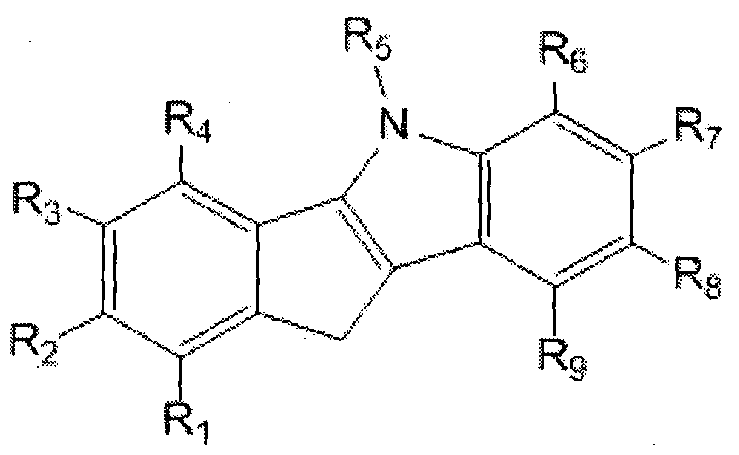
- 0 CC(CC1)C2C1C2* Chemical compound CC(CC1)C2C1C2* 0.000 description 8
- HGUVIIJUGQHQIN-UHFFFAOYSA-N CNCC1PC1 Chemical compound CNCC1PC1 HGUVIIJUGQHQIN-UHFFFAOYSA-N 0.000 description 1
Classifications
-
- C—CHEMISTRY; METALLURGY
- C07—ORGANIC CHEMISTRY
- C07F—ACYCLIC, CARBOCYCLIC OR HETEROCYCLIC COMPOUNDS CONTAINING ELEMENTS OTHER THAN CARBON, HYDROGEN, HALOGEN, OXYGEN, NITROGEN, SULFUR, SELENIUM OR TELLURIUM
- C07F7/00—Compounds containing elements of Groups 4 or 14 of the Periodic Table
- C07F7/02—Silicon compounds
- C07F7/08—Compounds having one or more C—Si linkages
- C07F7/0803—Compounds with Si-C or Si-Si linkages
-
- B—PERFORMING OPERATIONS; TRANSPORTING
- B01—PHYSICAL OR CHEMICAL PROCESSES OR APPARATUS IN GENERAL
- B01J—CHEMICAL OR PHYSICAL PROCESSES, e.g. CATALYSIS OR COLLOID CHEMISTRY; THEIR RELEVANT APPARATUS
- B01J31/00—Catalysts comprising hydrides, coordination complexes or organic compounds
- B01J31/16—Catalysts comprising hydrides, coordination complexes or organic compounds containing coordination complexes
- B01J31/22—Organic complexes
- B01J31/2282—Unsaturated compounds used as ligands
- B01J31/2295—Cyclic compounds, e.g. cyclopentadienyls
-
- C—CHEMISTRY; METALLURGY
- C08—ORGANIC MACROMOLECULAR COMPOUNDS; THEIR PREPARATION OR CHEMICAL WORKING-UP; COMPOSITIONS BASED THEREON
- C08F—MACROMOLECULAR COMPOUNDS OBTAINED BY REACTIONS ONLY INVOLVING CARBON-TO-CARBON UNSATURATED BONDS
- C08F2420/00—Metallocene catalysts
- C08F2420/02—Cp or analog bridged to a non-Cp X anionic donor
-
- C—CHEMISTRY; METALLURGY
- C08—ORGANIC MACROMOLECULAR COMPOUNDS; THEIR PREPARATION OR CHEMICAL WORKING-UP; COMPOSITIONS BASED THEREON
- C08F—MACROMOLECULAR COMPOUNDS OBTAINED BY REACTIONS ONLY INVOLVING CARBON-TO-CARBON UNSATURATED BONDS
- C08F4/00—Polymerisation catalysts
- C08F4/42—Metals; Metal hydrides; Metallo-organic compounds; Use thereof as catalyst precursors
- C08F4/44—Metals; Metal hydrides; Metallo-organic compounds; Use thereof as catalyst precursors selected from light metals, zinc, cadmium, mercury, copper, silver, gold, boron, gallium, indium, thallium, rare earths or actinides
- C08F4/60—Metals; Metal hydrides; Metallo-organic compounds; Use thereof as catalyst precursors selected from light metals, zinc, cadmium, mercury, copper, silver, gold, boron, gallium, indium, thallium, rare earths or actinides together with refractory metals, iron group metals, platinum group metals, manganese, rhenium technetium or compounds thereof
- C08F4/62—Refractory metals or compounds thereof
- C08F4/64—Titanium, zirconium, hafnium or compounds thereof
- C08F4/659—Component covered by group C08F4/64 containing a transition metal-carbon bond
- C08F4/6592—Component covered by group C08F4/64 containing a transition metal-carbon bond containing at least one cyclopentadienyl ring, condensed or not, e.g. an indenyl or a fluorenyl ring
-
- C—CHEMISTRY; METALLURGY
- C08—ORGANIC MACROMOLECULAR COMPOUNDS; THEIR PREPARATION OR CHEMICAL WORKING-UP; COMPOSITIONS BASED THEREON
- C08F—MACROMOLECULAR COMPOUNDS OBTAINED BY REACTIONS ONLY INVOLVING CARBON-TO-CARBON UNSATURATED BONDS
- C08F4/00—Polymerisation catalysts
- C08F4/42—Metals; Metal hydrides; Metallo-organic compounds; Use thereof as catalyst precursors
- C08F4/44—Metals; Metal hydrides; Metallo-organic compounds; Use thereof as catalyst precursors selected from light metals, zinc, cadmium, mercury, copper, silver, gold, boron, gallium, indium, thallium, rare earths or actinides
- C08F4/60—Metals; Metal hydrides; Metallo-organic compounds; Use thereof as catalyst precursors selected from light metals, zinc, cadmium, mercury, copper, silver, gold, boron, gallium, indium, thallium, rare earths or actinides together with refractory metals, iron group metals, platinum group metals, manganese, rhenium technetium or compounds thereof
- C08F4/62—Refractory metals or compounds thereof
- C08F4/64—Titanium, zirconium, hafnium or compounds thereof
- C08F4/659—Component covered by group C08F4/64 containing a transition metal-carbon bond
- C08F4/6592—Component covered by group C08F4/64 containing a transition metal-carbon bond containing at least one cyclopentadienyl ring, condensed or not, e.g. an indenyl or a fluorenyl ring
- C08F4/65922—Component covered by group C08F4/64 containing a transition metal-carbon bond containing at least one cyclopentadienyl ring, condensed or not, e.g. an indenyl or a fluorenyl ring containing at least two cyclopentadienyl rings, fused or not
- C08F4/65925—Component covered by group C08F4/64 containing a transition metal-carbon bond containing at least one cyclopentadienyl ring, condensed or not, e.g. an indenyl or a fluorenyl ring containing at least two cyclopentadienyl rings, fused or not two cyclopentadienyl rings being mutually non-bridged
Definitions
- the present invention relates to a method for preparing a common supported metallocene catalyst. More particularly, the present invention relates to a method for preparing a common supported metallocene catalyst which can be used for preparing an olefin polymer.
- the metallocene catalyst is composed of a combination of a main catalyst composed mainly of a transition metal compound and a cocatalyst composed of an organometallic compound composed mainly of aluminum, and such a catalyst is a single site catalyst as a homogeneous complex catalyst.
- the polymer has a narrow molecular weight distribution according to the characteristics of a single active site and a homogeneous composition of the comonomer, and the stereoregularity, copolymerization characteristics, molecular weight, It has the property to change the crystallinity.
- U. S. Patent No. 5,032, 562 describes a process for preparing a polymerization catalyst by supporting two different transition metal catalysts on one supported catalyst. It is a method of producing a bimodal distribution polymer by supporting a titanium (Ti) -based Ziegler-Natta catalyst generating high molecular weight and a zirconium (Zr) -based metallocene catalyst generating low molecular weight on one support. As a result, the supporting process is complicated, and the morphology of the polymer is deteriorated due to the promoter.
- Ti titanium
- Zr zirconium
- 5,525,678 describes a method of using a catalyst system for olefine polymerization in which a high molecular weight polymer and a low molecular weight polymer can be simultaneously polymerized by simultaneously supporting a metallocene compound and a nonmetallocene compound on a carrier. . It is a metallocene compound and a nonmetallocene . There is a disadvantage in that the compounds must be supported separately, and the carrier must be pretreated with various compounds for supporting reaction.
- U.S. Patent No. 5,914,289 describes a method for controlling the molecular weight and molecular weight distribution of a polymer using a metallocene catalyst supported on each carrier, but the amount of solvent used and the time required for preparing the supported catalyst are high. The hassle of having to support the metallocene catalyst to be used on the carrier, respectively.
- Korean Patent Application No. 2003-12308 discloses a method of controlling the molecular weight distribution by supporting a double-nucleated metallocene catalyst and a mononuclear metallocene catalyst on a carrier together with an activator to polymerize by changing the combination of catalysts in the reactor. have.
- this method is limited in realizing the characteristics of each catalyst at the same time, and also has a disadvantage in that the metallocene catalyst portion is liberated in the carrier component of the finished catalyst, causing fouling.
- the present invention is to provide a method for producing a common supported metallocene catalyst that can be produced an olefin polymer having excellent activity, high molecular weight and desired physical properties.
- the first cocatalyst compound, the first metallocene compound, and the second metallocene It provides a method for preparing a common supported metallocene catalyst comprising the step of supporting a second cocatalyst compound on a carrier on which the compound is supported.
- the common supported metallocene catalyst obtained according to the production method of the present invention includes two or more different metallocene compounds, and in particular, one metallocene compound is an indeno indole derivative and / or flu
- one metallocene compound is an indeno indole derivative and / or flu
- a ligand compound in which an fluorene derivative forms a crosslinked structure by a bridge it exhibits high polymerization activity even when supported, and is excellent in activity, and can be used for polymerization of an ultra high molecular weight olefin polymer.
- A is hydrogen, halogen, C1 to C20 alkyl group, C2 to C20 alkenyl group, C6 to C20 aryl group, C7 to C20 alkylaryl group, C7 to C20 arylalkyl group, C1 to C20 alkoxy group, C2 to C20 C20 alkoxyalkyl group, C3 to C20 heterocycloalkyl group, or C5 to C20 heteroaryl group;
- D is -0-, -S-, -N (R)-or -Si (R) (R, wherein R and R 'are the same as or different from each other, and each independently hydrogen, halogen, C1 to C20 alkyl group , An alkenyl group of C2 to C20, or an aryl group of C6 to C20;
- L is a C1 to C10 straight or branched chain alkylene group
- B is carbon, silicon. Or germanium
- Q is hydrogen, halogen, C1 to C20 alkyl group, C2 to C20 alkenyl group, C6 to C20 aryl group, C7 to C20 alkylaryl group, or C7 to C20 arylalkyl group;
- M is a Group 4 transition metal
- X 1 and X 2 are the same as or different from each other, and each independently halogen, C1 to C20 alkyl group, C2 to C20 alkenyl group, C6 to C20 aryl group, nitro group, amido group, C1 to C20 alkylsilyl group , A C1 to C20 alkoxy group, or a C1 to C20 sulfonate group;
- C 1 and C 2 are the same as or different from each other, and are each independently represented by one of the following Chemical Formula 2a, Chemical Formula 2b, or Chemical Formula 2c, except that both C 1 and C 2 are Chemical Formula 2c;
- Rl to R17 and Rl 'to R9' are the same as or different from each other, and each independently hydrogen, halogen, an alkyl group of C1 to C20, an alkenyl group of C2 to C20, and an alkyl of C1 to C20.
- Silyl group C1 to C20 silylalkyl group, C1 to C20 alkoxysilyl group, C1 to C20 alkoxy group, C6 to C20 aryl group, C7 to C20 alkylaryl group, or C7 to C20 arylalkyl group, Two or more adjacent to each other of R10 to R17 may be linked to each other to form a substituted or unsubstituted aliphatic or aromatic ring; .
- M 1 is a Group 4 transition metal
- Cp 1 and Cp 2 are the same as or different from each other, and each independently Cyclopentadienyl, indenyl, 4,5,6,7-tetrahydro-1 -indenyl, and fluorenyl radicals, and any one selected from the group consisting of hydrocarbons having 1 to 20 carbon atoms, ;
- R a and R b are the same as or different from each other, and each independently hydrogen, C 1 to C 20 alkyl, C 1 to C 10 alkoxy, C 2 to C 20 alkoxyalkyl, C 6 to C 20 aryl, C 6 to C 10 aryloxy, C2 to C20 alkenyl, C7 to C40 alkylaryl, C7 to C40 arylalkyl, C8 to C40 arylalkenyl, or C2 to C10 alkynyl;
- Z 1 is a halogen atom, C1 to C20 alkyl, C2 to C10 alkenyl, C7 to C40 alkylaryl, C7 to C40 arylalkyl, C6 to C20 aryl, substituted or unsubstituted C1 to C20 alkylidene , Substituted or unsubstituted amino group, C2 to C20 alkylalkoxy, or C7 to C40 arylalkoxy;
- n 1 or 0;
- M 2 is a Group 4 transition metal
- Cp 3 and Cp 4 are the same as or different from each other, and are each independently selected from the group consisting of cyclopentadienyl, indenyl, 4,5,6,7-tetrahydro-1-indenyl and fluorenyl radicals They may be substituted with a hydrocarbon having 1 to 20 carbon atoms;
- R c and R d are the same as or different from each other, and each independently hydrogen, C1 to C20 alkyl, C1 to C10 alkoxy, C2 to C20 alkoxyalkyl, C6 to C20 aryl, C6 to C10 aryloxy, C2 To alkenyl of C20, alkylaryl of C7 to C40, arylalkyl of C7 to C40, arylalkenyl of C8 to C40, or alkynyl of C2 to C10;
- Z 2 is a halogen atom, C1 to C20 alkyl, C2 to C10 alkenyl, C7 to C40 alkylaryl, C7 to C40 arylalkyl, C6 to C20 aryl, substituted or unsubstituted C1 to C20 alkylidene Or a substituted or unsubstituted amino group, C2 to C20 alkylalkoxy, or C7 to C40 arylalkoxy;
- B 1 is one or more of a carbon, germanium, silicon, phosphorus or nitrogen atom containing radical which crosslinks the Cp 3 R c ring with the Cp 4 R d ring or crosslinks one Cp 4 R d ring with M 2 Or a combination thereof;
- n 1 or 0;
- M 3 is a Group 4 transition metal
- Cp 5 is any one selected from the group consisting of cyclopentadienyl, indenyl, 4,5,6,7-tetrahydro-1-indenyl and fluorenyl radicals, which are substituted with hydrocarbons having 1 to 20 carbon atoms Can be;
- R e is hydrogen, C1 to C20 alkyl, C1 to C10 alkoxy, C2 to C20 alkoxyalkyl, C6 to C20 aryl, C6 to C10 aryloxy, C2 to C20 alkenyl, C7 to C40 alkylaryl C7-C40 arylalkyl, C8-C40 arylalkenyl, or C2-C10 alkynyl;
- Z 3 is a halogen atom, C1 to C20 alkyl, C2 to C10 alkenyl, C7 to C40 alkylaryl, C7 to C40 arylalkyl, C6 to C20 aryl, substituted or unsubstituted C1 to C20 alkylidene A substituted or unsubstituted amino group, C2 to C20 alkylalkoxy, or C7 to C40 arylalkoxy;
- B 2 is at least one or a combination of carbon, germanium, silicon, phosphorus or nitrogen atom containing radicals which crosslink the Cp 5 R e ring and J;
- J is any one selected from the group consisting of NR f , 0, PR f and S, wherein R f is C1 to C20 alkyl, aryl, substituted alkyl or substituted aryl.
- the C1 to C20 alkyl group includes a linear or branched alkyl group, specifically, methyl group, ethyl group, propyl group, isopropyl group, n-butyl group, tert-butyl group, pentyl group, nucleosil group, heptyl group, An octyl group etc. are mentioned, but it is not limited to this.
- the alkenyl group of Q to C20 includes a straight or branched alkenyl group, and specifically, an allyl group, ethenyl group, propenyl group, butenyl group, pentenyl group, and the like But it is not limited thereto.
- the C6 to C20 aryl group includes a monocyclic or condensed aryl group, and specifically includes a phenyl group, a biphenyl group, a naphthyl group, a phenanthrenyl group, a fluorenyl group, and the like, but is not limited thereto.
- the C5 to C20 heteroaryl group includes a monocyclic or condensed heteroaryl group, and includes a carbazolyl group, a pyridyl group, a quinoline group, an isoquinoline group, a thiophenyl group, a furanyl group, an imidazole group, an oxazolyl group, a thiazolyl group , Triazine group, tetrahydropyranyl group, tetrahydrofuranyl group and the like, but are not limited thereto.
- alkoxy group for C 1 to C 20 examples include a methoxy group, an hydroxy group, a phenyloxy group, a cyclonuxyloxy group, and the like, but are not limited thereto.
- Group 4 transition metal examples include titanium, zirconium, and hafnium, but are not limited thereto.
- R1 to R17 and R1 'to R9' of Formulas 2a, 2b and 2c are each independently hydrogen, methyl group, ethyl group, propyl group, isopropyl group, n-butyl group, tert-butyl group, pentyl group, nucleosil group, heptyl group, octyl group, phenyl group, halogen group, trimethylsilyl group, triethylsilyl group, tripropylsilyl group, tributylsilyl group, triisopropylsilyl
- the group, trimethylsilylmethyl group, mesophilic group, or hydroxy group is more preferable, but is not limited thereto.
- L of Formula 1 is more preferably a straight or branched chain alkylene group of C4 to C8, but is not limited thereto.
- the alkylene group is C1 to
- An alkyl group of C20, an alkenyl group of C2 to C20, or an aryl group of C6 to C20 may be substituted or unsubstituted.
- a in Formula 1 is hydrogen, methyl, ethyl, propyl, isopropyl, n-butyl, tert-butyl, methoxymethyl, tert-butoxymethyl, 1-ethoxyethyl, 1-methyl It is preferable that it is a 1- methoxyethyl group, a tetrahydropyranyl group, or a tetrahydrofuranyl group, but it is not limited to this.
- B of Formula 1 is preferably silicon, but is not limited thereto.
- the first metallocene compound of Formula 1 is indeno indole Derivatives and / or fluorene derivatives form a crosslinked structure by the bridge, and have a non-covalent electron pair that can act as a Lewis base in the ligand structure, so that it is supported on the surface having the Lewis acid characteristics of the carrier and is highly supported. It shows polymerization activity.
- the activity is high, and due to the proper steric hindrance and the electronic effect of the ligand, the hydrogen reaction is low and high activity is maintained even in the presence of hydrogen. .
- the beta-hydrogen of the polymer chain in which the nitrogen atom of the indeno indole derivative is grown is stabilized by hydrogen bonding, thereby inhibiting beta-hydrogen elimination, thereby polymerizing ultra high molecular weight olepin-based polymer.
- specific examples of the compound represented by Chemical Formula 2a may include a compound represented by one of the following structural formulas, but the present invention is not limited thereto.
- specific examples of the compound represented by Chemical Formula 2b may include a compound represented by one of the following structural formulas.
- specific examples of the compound represented by Chemical Formula 2c may include a compound represented by one of the following structural formulas, but the present invention
- specific examples of the first metallocene compound represented by Chemical Formula 1 may include a compound represented by one of the following structural formulas,
- the first metallocene compound of Chemical Formula 1 has excellent activity and may polymerize a high molecular weight olefin-based polymer. In particular, even when used on a carrier, it exhibits high polymerization activity, and thus an ultrahigh molecular weight polyolefin polymer can be prepared.
- the first metallocene compound of the formula according to the present invention exhibits low hydrogen reaction properties. It is still possible to polymerize ultra high molecular weight olepin-based polymers with high activity. Therefore, even when used in combination with a catalyst having different properties, it is possible to prepare an ' ulrepin-based polymer that satisfies the high molecular weight characteristics without degrading the activity, and thus contains an olefinic polymer of the polymer and has a wide molecular weight distribution. System polymers can be easily produced.
- the first metallocene compound of Chemical Formula 1 may be prepared by connecting an indenoindole derivative and / or fluorene derivative with a bridge compound to prepare a ligand compound, and then performing metallation by introducing a metal precursor compound. Can be. The manufacturing method of the said 1st metallocene compound is demonstrated to an Example mentioned later.
- the second metallocene compound may be at least one selected from compounds represented by the following Chemical Formulas 3 to 5.
- M 1 is a Group 4 transition metal
- Cp l and Cp 2 are the same as or different from each other, and each independently selected from the group consisting of cyclopentadienyl, indenyl, 4,5,6,7-tetrahydro-1-indenyl, and pulluorenyl radicals One, they may be substituted with a hydrocarbon having 1 to 20 carbon atoms;
- R a and R b are the same as or different from each other, and each independently hydrogen, C1 to
- C20 alkyl C1 to C10 alkoxy, C2 to C20 alkoxyalkyl, C6 to C20 aryl, C6 to C10 aryloxy, C2 to C20 alkenyl, C7 to C40 alkylaryl, C7 to C40 arylalkyl Arylalkenyl of C8 to C40, or alkynyl of C2 to C10;
- Z 1 is a halogen atom, C 1 to C 20 alkyl, C 2 to C 10 alkenyl, C 7 to
- C40 alkylaryl C7 to C40 arylalkyl, C6 to C20 aryl, substituted or unsubstituted C1 to C20 alkylidene, substituted or unsubstituted amino group, C2 to C20 alkylalkoxy, or C7 to C40 aryl Alkoxy;
- n 1 or 0;
- M 2 is a Group 4 transition metal
- Cp 3 and Cp 4 are the same as or different from each other, and are each independently selected from the group consisting of cyclopentadienyl, indenyl, 4,5,6,7-tetrahydro-1-indenyl and fluorenyl radicals They may be substituted with a hydrocarbon having 1 to 20 carbon atoms;
- R c and R d are the same as or different from each other, and each independently hydrogen, C1 to C20 alkyl, C1 to C10 alkoxy, C2 to C20 alkoxyalkyl, C6 to C20 aryl, C6 to C10 aryloxy, C2 to C20 alkenyl, C7 to C40 alkylaryl, C7 to C40 arylalkyl, C8 to C40 arylalkenyl, or C2 to C10 alkynyl;
- Z 2 is a halogen atom, C1 to C20 alkyl, C2 to C10 alkenyl, C7 to C40 alkylaryl, C7 to C40 arylalkyl, C6 to C20 aryl, substituted or unsubstituted C1 to C20 alkylidene , Substituted or unsubstituted amino group, C2 Alkylalkoxy to C20 or arylalkoxy of C7 to C40;
- B 1 is one or more of a carbon, germanium, silicon, phosphorus or nitrogen atom containing radical which crosslinks the Cp 3 R c ring and the Cp 4 R d ring or crosslinks one Cp 4 R d ring with M 2 Or a combination thereof;
- n 1 or 0;
- M 3 is a Group 4 transition metal
- Cp 5 is any one selected from the group consisting of cyclopentadienyl, indenyl, 4,5,6, gtetrahydro-1-indenyl and fluorenyl radicals, which may be substituted with hydrocarbons having 1 to 20 carbon atoms And;
- R e is hydrogen, C1 to C20 alkyl, C1 to C10 alkoxy, C2 to C20 alkoxyalkyl, C6 to C20 aryl, C6 to C10 aryloxy, C2 to C20 alkenyl, C7 to C40 alkylaryl , C7-C40 arylalkyl, C8.
- Z 3 is a halogen atom, C1 to C20 alkyl, C2 to C10 alkenyl, C7 to C40 alkylaryl, C7 to C40 arylalkyl, C6 to C20 aryl, substituted or unsubstituted C1 to C20 alkylidene , Substituted or unsubstituted amino group, C2 to C20 alkylalkoxy, or C7 to C40 arylalkoxy;
- B 2 is one or more or a combination of carbon, germanium, silicon, phosphorus or nitrogen atom containing radicals which crosslink the Cp 5 R e ring and J;
- J is any one selected from the group consisting of NR f , 0, PR f and S, wherein R f is C1 to C20 alkyl, aryl, substituted alkyl or substituted aryl.
- the compound represented by Chemical Formula 3 may be, for example, a compound represented by one of the following structural formulas, but is not limited thereto.
- the compound represented by Chemical Formula 4 may be, for example, a compound represented by one of the following structural formulas, but is not limited thereto.
- the compound may be represented, but is not limited thereto.
- the common supported metallocene catalyst may include at least one of the first metallocene compound represented by Formula 1 and at least one of the second metallocene compound selected from the compounds represented by Formulas 3 to 5. It is commonly supported on the carrier together with all cocatalyst compounds.
- the first metallocene compound represented by Formula 1 of the common supported metallocene catalyst contributes to making a high molecular weight co-polymer having a high SCB (short chain branch) content, and the second metal represented by Formula 3 Sen compound is mainly low
- the second metallocene compound represented by Formula 4 or 5 may contribute to making a low molecular weight copolymer having a moderate SCB content.
- the -commonly supported metallocene catalyst may include at least one first metallocene compound of Formula 1 and at least one second metallocene compound of Formula 3.
- the common supported metallocene catalyst is In addition to at least one first metallocene compound of formula i and at least one second metallocene compound of formula 3, at least one second metallocene compound of formula 4 or formula 5 may be included. .
- the first metallocene compound forms a ligand structure in which an indeno indole derivative and a fluorene derivative are crosslinked by a bridge compound, and a Lewis base in the ligand structure.
- a non-covalent electron pair that can act as a support on the surface having the Lewis acid characteristics of the carrier it shows a high polymerization activity even when supported.
- it is highly active as it contains an electronically rich indeno indole group and / or fluorene group, and due to proper steric hindrance and the electronic effect of the ligand, the hydrogen reactivity is low and the activity is maintained even in the presence of hydrogen.
- the common supported metallocene catalyst obtained according to the preparation method of the present invention includes a first metallocene compound represented by Chemical Formula 1 and a second metallocene compound represented by Chemical Formulas 3 to 5, and different from each other.
- a first metallocene compound represented by Chemical Formula 1 and a second metallocene compound represented by Chemical Formulas 3 to 5, and different from each other.
- the cocatalyst supported on a carrier for activating the metallocene compound is an organometallic compound containing a Group 13 metal, and a general metallocene catalyst. It will not be specifically limited if it can be used when superposing
- the cocatalyst compound may include at least one of an aluminum-containing first cocatalyst of Formula 6 and a borate-based second cocatalyst of Formula 7 below.
- each R 1S is independently halogen, halogen substituted or unsubstituted.
- T + is a + monovalent polyatomic ion
- B is boron in the +3 oxidation state
- G is independently a hydride group, a dialkylamido group, a halide group, an alkoxide group, an aryl oxide group, a hydrocar It is selected from the group consisting of bil group, halocarbyl group and halo-substituted hydrocarbyl group, wherein G has 20 carbons or less, but at one or less positions, G is a halide group.
- the molecular weight distribution of the finally produced polyolefin can be made more uniform, and the polymerization activity can be improved.
- the first cocatalyst of Chemical Formula 6 may be an alkylaluminoxane compound having a repeating unit bonded in a linear, circular, or reticular form.
- Specific examples of the first cocatalyst include methylaluminoxane (MAO) and ethylalumina. Noxic acid, isobutyl aluminoxane, or butyl aluminoxane etc. are mentioned.
- the second cocatalyst of Formula 7 may be a borate-based compound in the form of a trisubstituted ammonium salt, or a dialkyl ammonium salt, a trisubstituted phosphonium salt.
- Such a second cocatalyst include trimetalammonium tetraphenylborate, methyldioctadecylammonium tetraphenylborate, triethylammonium tetraphenylborate, tripropylammonium tetraphenylborate, tri (n-butyl) ammonium tetraphenylborate , Methyltetracyclooctadecylammonium tetraphenylborate , ⁇ , ⁇ -dimethylanile tetraphenylborate, ⁇ , ⁇ -diethylaninynium tetraphenylborate , ⁇ , ⁇ -dimethyl (2,4,6-trimethylaninium Tetraphenylborate, trimethylammonium tetrakis (pentafluorophenyl) borate, methylditetradecylammonium tetrakis
- Tripropylammonium tetrakis (pentafluorophenyl) borate tri ( ⁇ -butyl) ammonium tetrakis (pentafluorophenyl) borate, tri (secondary-butyl) ammonium tetrakis (pentafluorophenyl) borate , ⁇ , ⁇ -dimethylaninium tetrakis (pentafluorophenyl) borate, ⁇ , ⁇ - Diethylaninium tetrakis (pentafluorophenyl) borate, N, N-dimethyl (2,4,6-trimethylaninynium) tetrakis (pentafluorophenyl) borate,
- the common supported metallocene catalyst as described above may include the steps of: supporting a first cocatalyst compound on a carrier; at least one first metallocene compound represented by the following Formula 1 on a carrier on which the first cocatalyst compound is supported: And supporting at least one second metallocene compound selected from compounds represented by Formulas 3 to 5; And supporting the second cocatalyst compound on a carrier on which the first cocatalyst compound, the first metallocene compound, and the sieve 2 metallocene association " are supported.
- the first cocatalyst compound represented by Chemical Formula 6 is first supported on the prepared carrier.
- the first metallocene compound and the second metallocene compound are supported on the carrier on which the first cocatalyst compound is supported.
- the supporting order between the first and second metallocene compounds is not limited, and the first metallocene compound may be first supported or the second metallocene compound may be first supported.
- all of the first cocatalyst compound, the first metallocene compound, and the second metallocene compound are supported.
- the carrier carries the second cocatalyst compound represented by the formula (7).
- the first supported promoter compound is reacted with the hydroxy group on the surface of the carrier in advance.
- it can help to prepare a uniform catalyst by acting as a scavenger for impurities such as moisture and catalyst foreign matter. Accordingly, the possibility of deactivating the first and second metallocene catalysts supported after the supporting of the first cocatalyst compound can be reduced, thereby preparing a supported catalyst having high activity.
- the total transition metal to the carrier contained in the first metallocene compound represented by Formula 1 and the second metallocene compound represented by Formulas 3 to 5 The mass ratio may be 1:10 to 1: 1.000.
- the carrier and the metallocene compound are included in the mass ratio, the optimum shape can be exhibited.
- the mass ratio of the promoter compound to the carrier may be from 1: 1 to 1: 100.
- the mass ratio of the first metallocene compound represented by Formula 1 to the second metallocene compound represented by Formulas 3 to 5 is 10: 1 to 1:10, preferably 5: 1 to 1: 5 days. have.
- a carrier containing a hydroxyl group on the surface may be used, and preferably, a semi-astringent hydride is dried to remove moisture from the surface.
- the carrier which has a hydroxy group and a siloxane group can be used.
- silica, silica-alumina, silica-magnesia, etc., dried at a high temperature may be used, which are typically oxides, carbonates, such as Na 2 O, K 2 C0 3 , BaS0 4 , and Mg (N0 3 ) 2 , Sulfate, and nitrate components.
- the drying temperature of the carrier is preferably 200 to 800 ° C., more preferably 300 to 600 ° C., most preferably 300 to 400 ° C.
- the drying temperature of the carrier is less than 200 ° C, there is too much moisture to react with the surface moisture and the promoter, and when it exceeds 80 CTC, the surface area decreases as the pores on the surface of the carrier are combined, and more hydroxyl groups are present on the surface. Disappear and only siloxane remains, and with the promoter It is not desirable because the reaction sign is reduced.
- the amount of hydroxy groups on the surface of the carrier is preferably 0.1 to 10 mmol / g, more preferably 0.5 to 5 mmol / g.
- the amount of hydroxyl groups on the surface of the carrier can be controlled by the method and conditions for preparing the carrier or by drying conditions such as silver, time, vacuum or spray drying.
- the amount of the hydroxy group is less than 0.1 'mmol / g, the reaction space with the promoter is small, and if the amount of the hydroxy group is more than 10 mmol / g, it may be due to moisture other than the hydroxyl group present on the surface of the carrier particle. Not.
- the common supported metallocene catalyst obtained according to the preparation method of the present invention can be used by itself for the polymerization of .lefin-based monomers.
- the common supported metallocene catalyst according to the present invention may be prepared by using a pre-polymerized catalyst in contact with an olefinic monomer.
- the catalyst may be used separately from ethylene, propylene, 1-butene, 1-hexene, and 1-octene. It may be prepared and used as a prepolymerized catalyst by contacting with an olefinic monomer such as the like.
- the order of the step of supporting the first metallocene compound and the step of supporting the second metallocene compound may be changed as necessary. That is, the first metallocene compound is first supported on a carrier, and then the second metallocene compound is further supported to prepare a common supported metallocene catalyst, or the second metallocene compound is supported on the carrier. After supporting first, the common metallocene catalyst may be prepared by further supporting the first metallocene compound.
- the temperature may be performed at a condition of about 0 to about 100 ° C. and a pressure of normal pressure, but is not limited thereto.
- the olefinic polymer can be prepared by polymerizing the olefinic monomers.
- the olefinic monomer may be ethylene, alpha-olefin, cyclic olefin, diene olefin or triene olefin having two or more double bonds.
- olefin monomers include ethylene, propylene, 1-butene, 1-pentene, 4-methyl-1-pentene, 1-nuxene, 1-heptene, 1-octene, 1-decene, 1-undecene, 1-dodecene, 1-tetradecene, 1-nucleadecene, 1-aitosen, norbornene, norbonadiene, ethylidene norbornene, phenylnorbornene, Vinylnorbornene, dicyclopentadiene, 1,4-butadiene, 1,5-pentadiene, 1,6-nuxadiene, styrene, alpha-methylstyrene, divinylbenzene, 3-chloromethylstyrene, and the like. You may mix and copolymerize 2 or more types of these monomers.
- the polymerization reaction may be carried out by homopolymerization with one olefinic monomer or copolymerization with two or more monomers using one continuous slurry polymerization reactor, a loop slurry reactor, a gas phase reactor or a solution reactor.
- the common supported metallocene catalyst is an aliphatic hydrocarbon solvent having 5 to 12 carbon atoms, for example, pentane, nucleic acid, heptane, nonane, decane, and isomers thereof, and aromatic hydrocarbon solvents such as toluene and benzene, dichloromethane and chlorobenzene. It may be dissolved or diluted and injected into a hydrocarbon solvent substituted with a chlorine atom such as.
- the solvent used herein is preferably used by removing a small amount of water or air, which acts as a catalyst poison, by using a small amount of alkyl aluminum, and may be carried out by further using a promoter.
- a low molecular weight portion has a wide molecular weight distribution of the BOCD structure having a low SCB content and a high SCB content of the high molecular weight portion.
- Eggplant can produce an olefin-based polymer.
- the olefin polymer not only has excellent physical properties but also has excellent workability.
- olefinic polymers prepared using common supported metallocene catalysts obtained in accordance with the process of the present invention have a high content of at least about 300,000 or at least about 350,000. Increased average molecular weight can be indicated.
- a broad molecular weight distribution (PDI) of about 3.0 to about 8.0, preferably about 4.0 to about 8.0, more preferably 5.0 to about 8.0 can be seen to show excellent processability.
- PDI molecular weight distribution
- the solution was changed to violet color at room temperature overnight.
- the reaction solution was filtered to remove LiCl.
- the toluene of the filtrate was removed by vacuum drying, and the nucleic acid was added and sonicated for 1 hour.
- the slurry was filtered to obtain 6 g of a dark violet metallocene compound (Mw 758.02, 7.92 mmol, yield 66 mol%). Two isomers were observed on 1 H-NMR.
- t-Butyl-0- (CH 2 ) 6 -C 5 H 5 was dissolved in THF at -78 ° C, and normal butyllithium (n-BuLi) was slowly added, followed by heating to room temperature, followed by an 8 hour reaction. I was. The solution was slowly added to a pre-synthesized lithium salt solution at -78 ° C to a suspension solution of ZrCl 4 (THF) 2 (1.70 g, 4.50 mmol) / THF (30 m) at room temperature. Recoiled for 6 hours more.
- THF ZrCl 4
- 6-t-butoxynucleic acid (6-t-buthoxyhexane) was confirmed by 1 H-NMR. It can be seen that the Gringanrd reaction progressed well from the 6 ′ t-subspecific nucleic acid. Thus 6-t-buthoxyhexyl magnesium chloride was synthesized.
- the reaction temperature was adjusted to -20 ° C.
- 560 g of the synthesized 6-t-subsilicate magnesium chloride was added to the reaction vessel at a rate of 5 mL / min using a feeding pump. After feeding the Grignard reagent, the reaction mixture was stirred for 12 hours while slowly raising the temperature to room temperature. After 12 hours, it was confirmed that a white MgCl 2 salt was produced.
- 4 L of nucleic acid was added to remove the salt through a labdori to obtain a filter solution. After adding the obtained filter solution to the reactor, the nucleic acid was removed at 70 ° C to obtain a pale yellow liquid.
- the yellow solution obtained was identified as methyl (6-t-butoxynucleosil) (tetramethyl CpH) t-butylaminosilane (Methyl (6-t-buthoxyhexyl) (tetramethylCpH) t-Butylaminosilane) compound by 1 H-NMR. .
- TiCl 3 (THF) 3 (10 mmol) was rapidly added to the dilithium salt of 8 ° C ligand synthesized from (Dirnethyl (tetramethylCpH) t-Butylaminosilane) in THF solution.
- the reaction solution was stirred for 12 hours while slowly raising the temperature to -78 ° C.
- an equivalent amount of PbCl 2 (10 mmol) was added to the semi-aqueous solution in silver, followed by stirring for 12 hours. After stirring for 12 hours, the blue vagina obtained a black solution.
- nucleic acid was added to filter the product.
- Silica (SYLOPOL 948, manufactured by Grace Davison) was dehydrated under vacuum at a temperature of 400 ° C. for 15 hours.
- the supported catalyst was prepared in the same manner as in Example 1, except that 0.25 mmd of the metallocene catalyst of Preparation Example 2 was used instead of 0.25 mmol of the metallocene catalyst of Preparation Example 1 in Example 1.
- Example 3
- Example 4 After 1 hour of 0.25 mmol reaction of the metallocene catalyst of Preparation Example 1 in Example 1 was completed, the reaction of 0.25 mmol of the metallocene catalyst of Preparation Example 4 was further performed. Thereafter, the metallocene catalyst 0.25 of Preparation Example 3. The supported catalyst was prepared in the same manner except that the mmol reaction was carried out.
- Example 4
- the supported catalyst was prepared in the same manner as in Example 3, except that 0.25 mmol reaction of the metallocene catalyst of Preparation Example 2 was used instead of 0.25 mmol of the metallocene catalyst of Preparation Example 1 initially reacted.
- Example 5
- Example 2 instead of 0.25 mmol of the metallocene catalyst of Preparation Example 1, which was initially reacted in Example 3, 0.25 mmol of the metallocene catalyst of Preparation Example 2 was first performed. Thereafter, 0.25 mmol of the metallocene catalyst of Preparation Example 1 was used as the second catalyst, and finally, the supported catalyst was prepared in the same manner except that the metallocene catalyst of Preparation Example 3 was used.
- Comparative Example 1 10 g of dried silica is placed in a glass reactor, and 100 ml of toluene is added and stirred. 50 mL of 10 wt% methylaluminoxane (MAO) / luene solution was added thereto, followed by slow reaction at 40 ° C.
- MAO wt% methylaluminoxane
- the supported catalyst was prepared in the same manner except that 0.25 mmol reaction of the metallocene catalyst of Preparation Example 4 was used instead of 0.25 mmol of the metallocene catalyst of Preparation Example 3, which was initially reacted in Comparative Example 1. Comparative Example 3
- the supported catalyst was prepared in the same manner as in Comparative Example 3, except that 1.0 mmol of anilinium borate ( ⁇ , ⁇ -dimethylanilinium tetrakis (pentafluorophenyl) borate, AB) was finally added.
- the polymer obtained therefrom was filtered off to remove most of the polymerization solvent and then dried in an 80 " C vacuum oven for 4 hours.
- Examples 1 to 5 for the common supported catalyst of the present invention include two or more metallocene compounds, but have a much higher activity than the comparative example including only a single catalyst or a second metallocene compound. It can be seen that a polymer having a high molecular weight and a broad molecular weight distribution can be prepared.
Landscapes
- Chemical & Material Sciences (AREA)
- Organic Chemistry (AREA)
- Transition And Organic Metals Composition Catalysts For Addition Polymerization (AREA)
Abstract
Description




Claims


Priority Applications (3)
| Application Number | Priority Date | Filing Date | Title |
|---|---|---|---|
| US15/029,196 US9902789B2 (en) | 2013-10-18 | 2014-10-15 | Method for preparing hybrid supported metallocene catalyst |
| JP2016518114A JP6247751B2 (ja) | 2013-10-18 | 2014-10-15 | 混成担持メタロセン触媒の製造方法 |
| EP14853376.3A EP3040124B1 (en) | 2013-10-18 | 2014-10-15 | Method for producing hybrid-supported metallocene catalyst |
Applications Claiming Priority (4)
| Application Number | Priority Date | Filing Date | Title |
|---|---|---|---|
| KR20130124517 | 2013-10-18 | ||
| KR10-2013-0124517 | 2013-10-18 | ||
| KR1020140138347A KR101631700B1 (ko) | 2013-10-18 | 2014-10-14 | 혼성 담지 메탈로센 촉매의 제조방법 |
| KR10-2014-0138347 | 2014-10-14 |
Publications (1)
| Publication Number | Publication Date |
|---|---|
| WO2015056974A1 true WO2015056974A1 (ko) | 2015-04-23 |
Family
ID=52828352
Family Applications (1)
| Application Number | Title | Priority Date | Filing Date |
|---|---|---|---|
| PCT/KR2014/009680 Ceased WO2015056974A1 (ko) | 2013-10-18 | 2014-10-15 | 혼성 담지 메탈로센 촉매의 제조방법 |
Country Status (1)
| Country | Link |
|---|---|
| WO (1) | WO2015056974A1 (ko) |
Cited By (1)
| Publication number | Priority date | Publication date | Assignee | Title |
|---|---|---|---|---|
| JP2018529826A (ja) * | 2016-02-24 | 2018-10-11 | エルジー・ケム・リミテッド | 混成担持メタロセン触媒およびこれを利用したポリオレフィンの製造方法 |
Citations (9)
| Publication number | Priority date | Publication date | Assignee | Title |
|---|---|---|---|---|
| US5032562A (en) | 1989-12-27 | 1991-07-16 | Mobil Oil Corporation | Catalyst composition and process for polymerizing polymers having multimodal molecular weight distribution |
| US5525678A (en) | 1994-09-22 | 1996-06-11 | Mobil Oil Corporation | Process for controlling the MWD of a broad/bimodal resin produced in a single reactor |
| US5914289A (en) | 1996-02-19 | 1999-06-22 | Fina Research, S.A. | Supported metallocene-alumoxane catalysts for the preparation of polyethylene having a broad monomodal molecular weight distribution |
| KR20030012308A (ko) | 2001-07-31 | 2003-02-12 | 주식회사 예스아이비 | 배팅형 복권 시스템 및 배팅 방법 |
| KR20110035968A (ko) * | 2009-09-29 | 2011-04-06 | 주식회사 엘지화학 | 3종 혼성 메탈로센 담지 촉매 및 그의 제조방법 |
| US20120059135A1 (en) * | 2009-03-30 | 2012-03-08 | Mitsui Chemicals, Inc. | Copolymer of olefin and conjugated diene, and process for producing the same |
| KR20120076156A (ko) * | 2010-12-29 | 2012-07-09 | 주식회사 엘지화학 | 혼성 담지 메탈로센 촉매의 제조방법 및 이를 이용하여 제조된 혼성 담지 메탈로센 촉매 |
| KR20120087706A (ko) * | 2011-01-28 | 2012-08-07 | 주식회사 엘지화학 | 메탈로센 화합물 및 이를 이용하여 제조되는 올레핀계 중합체 |
| WO2013133595A1 (en) * | 2012-03-06 | 2013-09-12 | Sk Innovation Co., Ltd. | Hybrid supported metallocene catalyst, method for preparing the same, and process for preparing polyolefin using the same |
-
2014
- 2014-10-15 WO PCT/KR2014/009680 patent/WO2015056974A1/ko not_active Ceased
Patent Citations (9)
| Publication number | Priority date | Publication date | Assignee | Title |
|---|---|---|---|---|
| US5032562A (en) | 1989-12-27 | 1991-07-16 | Mobil Oil Corporation | Catalyst composition and process for polymerizing polymers having multimodal molecular weight distribution |
| US5525678A (en) | 1994-09-22 | 1996-06-11 | Mobil Oil Corporation | Process for controlling the MWD of a broad/bimodal resin produced in a single reactor |
| US5914289A (en) | 1996-02-19 | 1999-06-22 | Fina Research, S.A. | Supported metallocene-alumoxane catalysts for the preparation of polyethylene having a broad monomodal molecular weight distribution |
| KR20030012308A (ko) | 2001-07-31 | 2003-02-12 | 주식회사 예스아이비 | 배팅형 복권 시스템 및 배팅 방법 |
| US20120059135A1 (en) * | 2009-03-30 | 2012-03-08 | Mitsui Chemicals, Inc. | Copolymer of olefin and conjugated diene, and process for producing the same |
| KR20110035968A (ko) * | 2009-09-29 | 2011-04-06 | 주식회사 엘지화학 | 3종 혼성 메탈로센 담지 촉매 및 그의 제조방법 |
| KR20120076156A (ko) * | 2010-12-29 | 2012-07-09 | 주식회사 엘지화학 | 혼성 담지 메탈로센 촉매의 제조방법 및 이를 이용하여 제조된 혼성 담지 메탈로센 촉매 |
| KR20120087706A (ko) * | 2011-01-28 | 2012-08-07 | 주식회사 엘지화학 | 메탈로센 화합물 및 이를 이용하여 제조되는 올레핀계 중합체 |
| WO2013133595A1 (en) * | 2012-03-06 | 2013-09-12 | Sk Innovation Co., Ltd. | Hybrid supported metallocene catalyst, method for preparing the same, and process for preparing polyolefin using the same |
Non-Patent Citations (2)
| Title |
|---|
| See also references of EP3040124A4 * |
| TETRAHEDRON LETT., 1988, pages 2951 |
Cited By (2)
| Publication number | Priority date | Publication date | Assignee | Title |
|---|---|---|---|---|
| JP2018529826A (ja) * | 2016-02-24 | 2018-10-11 | エルジー・ケム・リミテッド | 混成担持メタロセン触媒およびこれを利用したポリオレフィンの製造方法 |
| US11091568B2 (en) | 2016-02-24 | 2021-08-17 | Lg Chem, Ltd. | Hybrid supported metallocene catalyst and polyolefin preparation method using same |
Similar Documents
| Publication | Publication Date | Title |
|---|---|---|
| JP6282341B2 (ja) | 混成担持メタロセン触媒 | |
| JP6247751B2 (ja) | 混成担持メタロセン触媒の製造方法 | |
| JP6458050B2 (ja) | ポリオレフィンの製造方法およびこれから製造されたポリオレフィン | |
| KR101726820B1 (ko) | 가공성 및 환경 응력 균열 저항성이 우수한 에틸렌/1-헥센 또는 에틸렌/1-부텐 공중합체 | |
| JP6681462B2 (ja) | エチレンスラリー重合用混成担持触媒システムおよびこれを用いたエチレン重合体の製造方法 | |
| KR101606825B1 (ko) | 혼성 담지 메탈로센 촉매의 제조방법 | |
| WO2017146375A1 (ko) | 혼성 담지 메탈로센 촉매 및 이를 이용한 폴리올레핀의 제조 방법 | |
| JP6440832B2 (ja) | メタロセン化合物、メタロセン担持触媒およびこれを用いるポリオレフィンの製造方法 | |
| WO2016036204A1 (ko) | 가공성이 우수한 올레핀계 중합체 | |
| JP6499280B2 (ja) | メタロセン担持触媒およびこれを用いるポリオレフィンの製造方法 | |
| KR102028736B1 (ko) | 혼성 담지 메탈로센 촉매의 제조방법 및 이를 이용하여 제조된 혼성 담지 메탈로센 촉매 | |
| KR20160067508A (ko) | 혼성 담지 메탈로센 촉매의 제조방법 및 이를 이용하여 제조된 혼성 담지 메탈로센 촉매 | |
| WO2015056975A1 (ko) | 혼성 담지 메탈로센 촉매 | |
| KR102727526B1 (ko) | 혼성 담지 메탈로센 촉매의 제조 방법 및 이를 이용한 올레핀 중합체의 제조 방법 | |
| US10550207B2 (en) | Method for preparing supported hybrid metallocene catalyst, and supported hybrid metallocene catalyst using the same | |
| WO2015056974A1 (ko) | 혼성 담지 메탈로센 촉매의 제조방법 | |
| WO2015186970A1 (ko) | 폴리올레핀의 제조 방법 및 이로부터 제조된 폴리올레핀 | |
| KR101953768B1 (ko) | 혼성 담지 메탈로센 촉매의 제조방법 및 이를 이용하여 제조된 혼성 담지 메탈로센 촉매 | |
| KR101949456B1 (ko) | 혼성 담지 메탈로센 촉매의 제조 방법 및 이를 이용하여 제조된 혼성 담지 메탈로센 촉매 | |
| WO2017155211A1 (ko) | 에틸렌 슬러리 중합용 혼성 담지 촉매 시스템 및 이를 이용한 에틸렌 중합체의 제조 방법 |
Legal Events
| Date | Code | Title | Description |
|---|---|---|---|
| 121 | Ep: the epo has been informed by wipo that ep was designated in this application |
Ref document number: 14853376 Country of ref document: EP Kind code of ref document: A1 |
|
| ENP | Entry into the national phase |
Ref document number: 2016518114 Country of ref document: JP Kind code of ref document: A |
|
| REEP | Request for entry into the european phase |
Ref document number: 2014853376 Country of ref document: EP |
|
| WWE | Wipo information: entry into national phase |
Ref document number: 2014853376 Country of ref document: EP |
|
| WWE | Wipo information: entry into national phase |
Ref document number: 15029196 Country of ref document: US |
|
| NENP | Non-entry into the national phase |
Ref country code: DE |