WO2015064109A1 - 精子運動性改善剤 - Google Patents
精子運動性改善剤 Download PDFInfo
- Publication number
- WO2015064109A1 WO2015064109A1 PCT/JP2014/005506 JP2014005506W WO2015064109A1 WO 2015064109 A1 WO2015064109 A1 WO 2015064109A1 JP 2014005506 W JP2014005506 W JP 2014005506W WO 2015064109 A1 WO2015064109 A1 WO 2015064109A1
- Authority
- WO
- WIPO (PCT)
- Prior art keywords
- sperm
- motility
- gas
- treatment
- improving agent
- Prior art date
- Legal status (The legal status is an assumption and is not a legal conclusion. Google has not performed a legal analysis and makes no representation as to the accuracy of the status listed.)
- Ceased
Links
Images




Classifications
-
- C—CHEMISTRY; METALLURGY
- C12—BIOCHEMISTRY; BEER; SPIRITS; WINE; VINEGAR; MICROBIOLOGY; ENZYMOLOGY; MUTATION OR GENETIC ENGINEERING
- C12N—MICROORGANISMS OR ENZYMES; COMPOSITIONS THEREOF; PROPAGATING, PRESERVING, OR MAINTAINING MICROORGANISMS; MUTATION OR GENETIC ENGINEERING; CULTURE MEDIA
- C12N5/00—Undifferentiated human, animal or plant cells, e.g. cell lines; Tissues; Cultivation or maintenance thereof; Culture media therefor
- C12N5/06—Animal cells or tissues; Human cells or tissues
- C12N5/0602—Vertebrate cells
- C12N5/0608—Germ cells
- C12N5/061—Sperm cells, spermatogonia
-
- A—HUMAN NECESSITIES
- A61—MEDICAL OR VETERINARY SCIENCE; HYGIENE
- A61K—PREPARATIONS FOR MEDICAL, DENTAL OR TOILETRY PURPOSES
- A61K33/00—Medicinal preparations containing inorganic active ingredients
-
- A—HUMAN NECESSITIES
- A61—MEDICAL OR VETERINARY SCIENCE; HYGIENE
- A61P—SPECIFIC THERAPEUTIC ACTIVITY OF CHEMICAL COMPOUNDS OR MEDICINAL PREPARATIONS
- A61P15/00—Drugs for genital or sexual disorders; Contraceptives
- A61P15/08—Drugs for genital or sexual disorders; Contraceptives for gonadal disorders or for enhancing fertility, e.g. inducers of ovulation or of spermatogenesis
-
- C—CHEMISTRY; METALLURGY
- C12—BIOCHEMISTRY; BEER; SPIRITS; WINE; VINEGAR; MICROBIOLOGY; ENZYMOLOGY; MUTATION OR GENETIC ENGINEERING
- C12N—MICROORGANISMS OR ENZYMES; COMPOSITIONS THEREOF; PROPAGATING, PRESERVING, OR MAINTAINING MICROORGANISMS; MUTATION OR GENETIC ENGINEERING; CULTURE MEDIA
- C12N2500/00—Specific components of cell culture medium
- C12N2500/02—Atmosphere, e.g. low oxygen conditions
Definitions
- the present invention relates to a sperm motility improving agent that improves the sperm motility, particularly the forward motility and the movement distance of sperm moving forward, and increases the fertilization rate, containing hydrogen molecules as an active ingredient.
- the cause of male infertility is classified as sperm reduction when the amount of semen that has been ejaculated is small, oligospermia when the number of sperm is small, and azoospermia when no sperm is present in the semen. If sperm motility is low, it is diagnosed as asthenozoospermia. However, the reason why the number of spermatozoa is reduced and the motility rate is reduced is relatively small, and 60% of male infertility is unknown.
- Azoospermia is further divided into two categories: obstructive azoospermia and non-obstructive azoospermia.
- Obstructive azoospermia is a condition in which sperm is normally formed in the testis but sperm does not come out in the ejected semen due to abnormalities in the epididymis or vas deferens.
- Non-obstructive azoospermia is a condition in which sperm cannot be produced because of impaired spermatogenic function of the testis itself.
- Serum gonadotropin is an index of spermatogenic function at that time, so if FSH is within the normal value range with azoospermia, it means that sperm is produced but does not come out in the injected semen, Diagnosed as obstructive azoospermia.
- FSH gonadotropins
- sperm that has been cryopreserved is routinely used for reproductive treatment.
- freezing has been reported to cause changes in sperm morphology, including mitochondrial damage in sperm, and in particular, has been reported to have a significant impact on sperm motility [O'Connell M, et al., Hum Reprod. 2002; 17: 704-9.] [Boitrelle F, et al. J Androl. 2012; 33: 1371-8.].
- No clinically effective approach has been reported to activate the low motility of frozen sperm.
- Flagellar movement which is the driving force of sperm motility, is the tube that forms the cytoskeleton microtubules that play the role of dynein [Gibbons IR, et al., Science, 1965; 149: 424-426.] It is caused by the action of Lin [Mohri H, Nature, 1968; 217: 1053-54.].
- the basic flagellar movement is the sliding of microtubules by the action of dynein [Summers KE, et al., Proc. Nat. Acad. Sci.
- Oxygen is necessary for ATP production in mitochondria.
- sperm is also known to be affected by reactive oxygen species such as hydrogen peroxide, superoxide anion, and hydroxy radical [Aitken, et al., J. Reprod. Fertil ., 1987; 81: 459-469.].
- Superoxide anions and the like have roles such as superactivation of sperm and acquisition of fertility, but their functions differ depending on the site of action and duration of action.
- seminal plasma contains catalase, superoxide dismutase (SOD), and the like that remove reactive oxygen species, and removes excess reactive oxygen species. For this reason, sperm from which seminal plasma has been washed away for use in infertility treatment is likely to be exposed to reactive oxygen species.
- Oxidative stress is caused by excessive generation of reactive oxygen species and free radicals with strong oxidizing power.
- strong hydroxy radicals are known to have various adverse effects on the living body, and attempts to eliminate hydroxy radicals using antioxidants and their effects have been studied.
- studies using the properties of hydrogen molecules that selectively reduce and deactivate highly toxic radicals such as hydroxy radicals showed suppression of ischemia / reperfusion injury in the brain and atherosclerosis.
- improvement of lipid metabolism [Patent Document 1]
- the ability to use hydrogen-containing drugs for lung inflammation treatment [Patent Document 2], the body of hydrogen gas aimed at promoting health
- an inhalation method [Patent Document 3].
- Non-Patent Document 2 it has been reported that the addition of myo-inositol to the sperm suspension promotes the recovery of mitochondrial function and improves sperm motility [Non-Patent Document 2], but in vitro fertilization.
- sperm motility since it is a study of sperm having motility ejected on the day of collection that can be used for the treatment of microinsemination, it cannot be a solution to the problem of clinical use of immobile sperm.
- An object of the present invention is to provide a sperm motility improving agent, particularly a sperm forward motility improving agent for sperm with reduced motility in male infertility treatment.
- the present inventors have conducted intensive research to solve the above problems.
- sperm that has been collected for infertility treatment and discarded as surplus and whose motility has deteriorated significantly for more than 5 days after ejaculation is used as a subject, and a gas containing hydrogen molecules at a high concentration is used as a sperm suspension.
- a gas containing hydrogen molecules at a high concentration is used as a sperm suspension.
- forward motility was restored when sperm with reduced motor function was brought into contact with a culture solution in which hydrogen molecules were dissolved.
- forward mobility was recovered.
- the present invention has been completed based on these findings.
- the present invention is as follows. (1) A sperm motility improving agent comprising a gas containing 1 (v / v)% or more of hydrogen molecules, (2) The sperm motility improving agent according to (1) above, wherein the gas containing 1 (v / v)% or more of hydrogen molecules is a gas containing 45 to 55 (v / v)% of hydrogen molecules , (3) The sperm motility improving agent according to (1) or (2) above, wherein the gas is a mixed gas of hydrogen gas, oxygen gas, carbon dioxide gas and nitrogen gas, (4) a sperm motility improver comprising a liquid containing hydrogen molecules at a saturation solubility of 1% or more, (5) The sperm motility improving agent according to (4) above, which is a liquid in which hydrogen molecules are dissolved by bubbling, (6) The sperm motility improving agent according to (4) or (5) above, wherein the liquid is a physiological saline containing hydrogen molecules, a culture solution or a buffer solution, (7) The sperm motility
- a method for improving sperm motility which comprises bringing the sperm motility improving agent according to any one of (1) to (9) above into contact with sperm in vitro, (11) The method according to (10) above, wherein the sperm motility improving agent is contacted with sperm multiple times. (12) Use of a hydrogen molecule in the preparation of a gaseous or liquid sperm motility improving agent, (13) Hydrogen molecules for improving sperm motility, (14) The present invention relates to a treatment container for improving sperm motility, which is provided with a gas inlet containing hydrogen molecules and a gas outlet.
- a new treatment method for recovering forward motility for immovable spermatozoa that have no motility that currently has no reliable countermeasures.
- the pregnancy rate is extremely inferior compared with the case of using sperm having forward motility, and the cause is that the male side has to use sperm without motility for microinsemination.
- Infertility treatment cases, especially sperm with no motor function, such as sperm in testis, and male infertility patients who are forced to use immature circular sperm cells as sperm for treatment A promising technology is expected to improve.
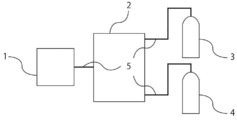
- FIG. 1 is a schematic view of an apparatus for treatment with a sperm motility improving agent of the present invention.
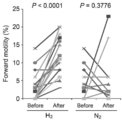
- FIG. (A) is a diagram showing the forward motile sperm rate of H 2 treatment and N 2 after treatment sperm elapsed harvested after 5 days or more.
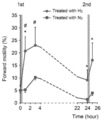
- (B) in H 2 treated sperm After lapse harvested after 5 days or more, is a diagram showing the relationship between treatment time and forward motion sperm rate. Before and after H 2 treatment and N 2 treatment has elapsed harvested after 5 days or more sperm, the forward movement sperm ratio is a diagram showing by analyte.
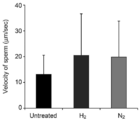
- H 2 treatment and N 2 treated sperm After lapse harvested after 5 days or more, it is a diagram showing the movement distance per one second forward motile sperm.
- Sperm treated with (a) no treatment, (b) H 2 treatment, and (c) N 2 treatment were co-stained with a mitochondrial membrane potential-dependent dye, and then photographed with a laser scanning confocal microscope. It is an image.
- (D) It is the graph which semi-quantified the fluorescence intensity of the sperm dye
- the sperm was freeze-thaw process is a diagram illustrating a forward motion sperm rate when treated with different concentration of H 2 by the analyte.
- (A) is a specimen obtained from a patient having a forward movement sperm rate of 50% or more
- (b) is a specimen obtained from a patient having a forward movement sperm ratio of less than 50%.
- the sperm motility improving agent of the present invention comprises a gas containing 1 (v / v)% or more of hydrogen molecules or a liquid containing 1% or more of hydrogen molecules in saturation solubility, and the sperm is contacted with hydrogen molecules.
- the sperm motility improving agent of the present invention is not particularly limited as long as it can be used, and restores motility, particularly forward motility, in sperm derived from male infertile patients, and increases the possibility of establishment of pregnancy by microinsemination. Can do.
- sperm motility improvement refers to semen test standardization guidelines (Kanehara Publishing, Tokyo, 2003) supervised by the Japanese Urological Association, or WHO semen test laboratory manual 5th edition (World Health Organization publication, Advanced Reproductive Medicine).
- B: Low speed, or good straightness Categorized into four categories: non-movable spermatozoa, C: head or tail movement, but not moving forward
- D non-motile immobile spermatozoa
- the forward movement sperm rate% is represented by A + B / A + B + C + D.
- 10 ⁇ l of liquefied semen is preferably placed on a calculation board while maintaining heat retention at 37 ° C. and covered with a cover glass, and at 5 or more sites under a 200 or 400 magnification microscope.
- About 100 spermatozoa in the visual field can be classified into the above four items, and an average value calculation method in which this is repeated 2 to 3 times can be preferably exemplified.
- it can replace with the said semen and can use the semen diluted to the density
- the sperm is preferably collected by a method based on the sample collection method described in the semen test standardization guideline or the WHO semen test lab manual, and specifically, it is at least 2 days and at most 7 days.
- a male patient who has passed the ascetic period preferably in a dedicated semen collection site, collected by masturbation in a clean glass or plastic wide-mouth container, consisting of one production process, more preferably within 4 hours after injection within 3 hours, particularly preferably within 2 hours, most preferably within 1 hour, sperm in the semen sample (ejected sperm), sperm collected by intra-testicular sperm collection or microscopic intra-testicular sperm collection (intestinal Sperm) can be preferably exemplified.
- sperm obtained by freezing and storing sperm after collection by these methods is particularly preferable from the viewpoint of reducing the burden on sperm collection of male patients, and the effects of the present invention can be enjoyed.
- the conditions for the freezing treatment are not particularly limited.
- the collected sperm is suspended in a cryopreservation buffer such as a test yoke buffer (Refrigeratin Medium-TEST Yolk Buffer, Irvine Scientific, California, USA).
- thawing sperm for example, a method can be mentioned in which a cryotube in which sperm is dispensed is heated and melted in 37 ° C. warm water. Freeze-thawed sperm can be used in the method for improving the motility of sperm of the present invention in the same manner as sperm not subjected to freezing treatment.
- humans can be most preferably exemplified, but in addition, mammals generally used as laboratory animals, livestock, pets, for example, rats, mice, rabbits, sheep, etc. Pigs, cows, horses, goats, cats, dogs, monkeys, and the like.
- mammals generally used as laboratory animals, livestock, pets, for example, rats, mice, rabbits, sheep, etc. Pigs, cows, horses, goats, cats, dogs, monkeys, and the like.
- sperm collected by methods such as an artificial vagina method, an electrical stimulation method, a vas deferens massage method, and a palm compression method can be preferably exemplified.
- the lower limit of the hydrogen gas concentration is preferably 10 (v / v)% or more, more preferably 20 (v / v)% or more, more preferably 30 (v / v)% or more, especially 40 (v / v)% or more of the mixed gas, while the upper limit of the hydrogen gas concentration is in consideration of safety. Under a safe condition determined so that static electricity is not generated under sealed conditions, it may be 100 (v / v)%. However, in consideration of practical use, a hydrogen gas concentration of 80 (v / v)% or less, preferably 60% (v / v)% or less.
- a mixed gas having a hydrogen gas concentration of 45 to 55 (v / v)% can be particularly preferably mentioned.
- gas components other than hydrogen gas in the mixed gas include oxygen gas, carbon dioxide gas, and inert gas.
- inert gas include nitrogen gas, helium gas, and argon gas.
- Nitrogen gas which is inexpensive and is an air composition, is preferred.
- the content of gas components other than hydrogen gas can be arbitrarily set by those skilled in the art, but a mixed gas of 50% hydrogen gas, 25% nitrogen gas, 20% oxygen gas, and 5% carbon dioxide gas Is preferred.
- Examples of the sperm motility improving agent comprising a liquid containing hydrogen molecules at a saturation solubility of 1% or more include a liquid obtained by dissolving hydrogen gas or a hydrogen-containing mixed gas in physiological saline, culture solution, buffer solution, or the like by bubbling or the like. be able to.
- the solubility of hydrogen molecules is 0.00162 g (about 1.6 ppm, 0.8 mM) with respect to 1000 g of water when the hydrogen partial pressure is 0.101 MPa (1 atm) and 20 ° C. Those having a large dissolved amount of dissolved hydrogen are preferred.
- the concentration is about 0.4 mM.
- the physiological saline is not particularly limited as long as it is 0.9% (w / v) sodium chloride, and the culture solution is preferably a culture solution prepared for in vitro fertilization.
- 10% plasma protein fraction PPF: plasma protein fraction
- PPF plasma protein fraction
- buffering action is obtained by adding 20 mM mM HEPES [4- (2-hydroxyethyl) -1-piperazineethanesulfonic acid] to human oviduct fluid culture medium (HTF).
- the most preferable examples include those obtained by adding 10% heated human plasma protein [plasma protein fraction (PPF); Sakai Baxter, California, USA] to the culture medium or buffer. It is desirable to have been inactivated by drawing, heat treatment, S / D treatment or the like.
- the liquid sperm motility improving agent of the present invention can be provided as a container (bottle) containing a liquid in which hydrogen molecules are dissolved, preferably a sterilized liquid.
- a method for producing such a liquid sperm motility improving agent in a container a method in which a hydrogen gas-dissolved liquid is filled in a container formed of a hydrogen non-permeable material or a hydrogen permeable material containing a liquid is used. And a method of maintaining the container in a hydrogen gas atmosphere. Examples of the method for maintaining the hydrogen gas atmosphere include a method of storing a bottle formed of a hydrogen-permeable material containing a liquid in a packaging pack formed of a hydrogen-impermeable material. .
- Examples of the hydrogen non-permeable material include aluminum (can, foil), aluminum alloy (can, foil), carbon FRP in which high-strength carbon fiber impregnated with epoxy resin is wound on the entire surface of an aluminum liner, and synthetic resin.
- Examples thereof include an aluminum pouch obtained by laminating (pressing) an aluminum foil on a film, and a laminate in which an aluminum foil is sandwiched between paper and polyethylene.
- Examples of the hydrogen permeable material include PET (polyethylene terephthalate / polyester), polyethylene, polypropylene, ethylene-vinyl acetate copolymer, and cyclic olefin copolymer.
- the method for improving the sperm motility of the present invention is not particularly limited as long as it is a method for bringing the gaseous sperm motility improving agent or the liquid sperm motility improving agent of the present invention into contact with sperm in vitro.
- a treatment container for improving sperm motility
- the sperm suspension can be allowed to stand in the container for a predetermined time, for example, 10 to 120 minutes, and gas equilibration can be performed.
- the sperm and the liquid sperm motility improving agent can be brought into contact with each other by using the liquid sperm motility improving agent as a semen washing solution or a diluting solution.
- the contact between the sperm motility improving agent and the sperm can be performed a plurality of times at a predetermined interval, for example, at an interval of 12 to 48 hours. By re-treatment with a sperm motility improving agent, sperm motility can be restored again.
- the precipitated pellet was diluted with 6 ml of Cleavage Medium with 10% PPF, and centrifuged at 400 g for 5 minutes. Discard the supernatant, add Cleavage Medium supplemented with 10% PPF to the pelleted pellet, dilute to a concentration of 1 ⁇ 10 6 cells / ml when used for in vitro fertilization, and final for microinsemination. The volume was adjusted to 0.05 ml. In the following examinations in Examples 2 to 8, the remaining sperm suspension after use for in vitro fertilization and microinsemination was stored at room temperature for 5 days or more.
- a sperm suspension was not treated, and a mixed gas treatment group (hereinafter referred to as 5% CO 2 , 20% O 2 , 50% hydrogen (H 2 ), 25% N 2 ).
- H 2 treatment group 3 groups of mixed gas treatment group (hereinafter referred to as N 2 treatment group) consisting of 5% CO 2 , 20% O 2 , 75% N 2, and the sperm motility rate (forward motion) in each group Rate and non-advanced movement rate) and immobility.
- N 2 treatment group consisting of 5% CO 2 , 20% O 2 , 75% N 2
- sperm suspension 100 ⁇ l of sperm suspension was dropped into a 1008 dish and placed in an acrylic box before aeration of mixed gas. Each H 2 treatment group and N 2 treatment groups were treated for 40 minutes. After 40 minutes, each sperm suspension was mixed well by pipetting, and several ⁇ l was dropped into the McLa chamber, and the sperm concentration, the number of forward moving sperm, the number of non-forward moving sperm, and the number of immobile sperm were visually measured. . Similarly, in the untreated group using the sperm suspension as it was, the sperm concentration, the number of forwardly moving sperm, the number of non-forwardingly moving sperm, and the number of non-moving sperm were visually measured.
- sperm that has passed for more than 5 days since collection and whose motility has almost disappeared is used as a subject, and samples that have a forward motility rate of more than 15% in the untreated group are excluded.
- One specimen was divided into three treatment groups and measured twice for each treatment group. That is, for each sample, the ratio of the number of sperm with forward motility to the total number of sperm in the visual field is defined as the forward motility sperm rate, and the number of sperm with motility (without flagellar movement) that does not show forward motility The ratio was defined as the rate of non-advanced motility, and the ratio of the number of sperm that did not exhibit motility was defined as the rate of immobile sperm.
- the forward movement sperm rate according to specimen is shown in FIG. It can be seen that the H 2 treatment targeting 17 samples obtained from patients with a forward movement sperm rate of less than 15% increased the forward movement sperm rate in 16 samples. In contrast, in the N 2 treatment group, the rate of forward movement sperm increased in 4 samples, but all of these 4 samples were samples in which the rate of forward movement sperm increased even with H 2 treatment. Further, the average rate of forward sperm in the H 2 treatment group was 11%, while that in the N 2 treatment group was 3.6% on average. From this, it was shown that the improvement of sperm motility is effectively performed by H 2 treatment.
- FIG. 3 (b) shows a comparison result of the forward movement sperm rate by patient at the H 2 treatment time of 5, 30, and 60 minutes.
- the rate of forward motility relative to the control (no treatment group) rather tended to decline.
- the forward movement rate increased from the control in about 70% of the samples. From this, it was shown that sperm motility was sufficiently improved by 30 minutes of H 2 treatment.
- the forward motility sperm rate was 0% before washing, but the mixed gas bubbling culture solution containing hydrogen.
- the 5 min wash treatment increased the forward motility rate to 47%.
- the hydrogen concentration after 5 minutes was 150 ⁇ M by centrifugation at 400 g ⁇ 5 minutes, and decreased to 100 ⁇ M when centrifuged again. From this, it was found that the centrifugal treatment becomes an element for dispersing hydrogen from the culture solution.
- FIG. 3 (b) the sperm motility was observed in the treatment with the gaseous sperm motility improving agent for 5 minutes.
- the sperm motility was enhanced by a 5-minute washing treatment with a liquid sperm motility improving agent.
- FIGS. 7 (a) to (c) The results of co-staining are shown in FIGS. 7 (a) to (c).
- (A) is an untreated group
- (b) is an H 2 treated group
- (c) is an N 2 treated group.
- An image by differential interference is shown as DIC (Differential interference contrast).
- the bar is 10 ⁇ m.
- (D) is a graph obtained by semiquantifying the fluorescence intensity of TMRM-stained sperm using ImageJ. Compared to the untreated group and the N 2 treated group, the H 2 treated group showed strong TMRM fluorescence intensity (P ⁇ 0.001).
- Sperm motility depends on ATP content. It was shown that the fluorescence intensity of TMRM depending on the mitochondrial membrane potential was increased in the sperm of the H 2 treatment group than in the other groups. From these results, it was suggested that the mitochondrial function of spermatozoa is increased and the motility is increased by H 2 treatment.
- Cleavage Medium saturated with H 2 and Cleavage Medium equilibrated with 5% CO 2 were mixed to prepare a sperm washing medium.
- a sperm washing medium those having a mixing ratio of H 2 saturated release medium of 50%, 75%, and 100% were prepared.
- the dispensed sperm suspension was washed with a sperm washing medium for 5 minutes, and then sperm motility was measured.
- FIG. (A) The measurement result of the motility of the frozen and thawed sperm is shown in FIG. (A) is intended for 6 specimens obtained from patients with a forward movement sperm rate of 50% or more, and (b) is intended for 15 specimens obtained from patients with a forward movement sperm ratio of less than 50%.
- the average rate of forward sperm without H 2 treatment was 27.5%, but after H 2 50% washing medium treatment, 61.3%, H 2 75% washing medium treatment Thereafter, it increased to 71.0% and 70.0% after treatment with 100% H 2 washing medium, respectively.
- the present invention provides an agent for improving sperm motility against immobile sperm, which is determined to be dead sperm in male infertility treatment.
- the present invention is expected to restore the motor function of immobile sperm and improve the pregnancy rate by microinsemination-embryo transfer therapy.
Landscapes
- Health & Medical Sciences (AREA)
- Life Sciences & Earth Sciences (AREA)
- Engineering & Computer Science (AREA)
- Chemical & Material Sciences (AREA)
- General Health & Medical Sciences (AREA)
- Biomedical Technology (AREA)
- Bioinformatics & Cheminformatics (AREA)
- Organic Chemistry (AREA)
- Reproductive Health (AREA)
- Medicinal Chemistry (AREA)
- Pharmacology & Pharmacy (AREA)
- Animal Behavior & Ethology (AREA)
- Public Health (AREA)
- Veterinary Medicine (AREA)
- Biotechnology (AREA)
- Genetics & Genomics (AREA)
- Wood Science & Technology (AREA)
- Zoology (AREA)
- Epidemiology (AREA)
- Inorganic Chemistry (AREA)
- Cell Biology (AREA)
- Microbiology (AREA)
- General Engineering & Computer Science (AREA)
- Biochemistry (AREA)
- Developmental Biology & Embryology (AREA)
- Chemical Kinetics & Catalysis (AREA)
- Endocrinology (AREA)
- Pregnancy & Childbirth (AREA)
- Gynecology & Obstetrics (AREA)
- General Chemical & Material Sciences (AREA)
- Nuclear Medicine, Radiotherapy & Molecular Imaging (AREA)
- Pharmaceuticals Containing Other Organic And Inorganic Compounds (AREA)
- Medicines Containing Material From Animals Or Micro-Organisms (AREA)
- Medicinal Preparation (AREA)
Abstract
Description
(1)水素分子を1(v/v)%以上含む気体からなる精子運動性改善剤、
(2)水素分子を1(v/v)%以上含む気体が、水素分子を45~55(v/v)%含む気体であることを特徴とする上記(1)記載の精子運動性改善剤、
(3)気体が、水素ガスと酸素ガスと炭酸ガスと窒素ガスとの混合ガスであることを特徴とする上記(1)又は(2)記載の精子運動性改善剤、
(4)水素分子を飽和溶解度の1%以上含む液体からなる精子運動性改善剤、
(5)水素分子をバブリングにより溶解した液体であることを特徴とする上記(4)記載の精子運動性改善剤、
(6)液体が、水素分子を含む生理食塩水、培養液又は緩衝液であることを特徴とする上記(4)又は(5)記載の精子運動性改善剤、
(7)容器に収納されていることを特徴とする上記(4)~(6)のいずれか記載の精子運動性改善剤、
(8)精子の前進運動性を改善することを特徴とする上記(1)~(7)のいずれか記載の精子運動性改善剤、
(9)精子が凍結保存した精子であることを特徴とする上記(1)~(8)のいずれか記載の精子運動性改善剤、
(10)上記(1)~(9)のいずれか記載の精子運動性改善剤を、生体外で精子と接触させることを特徴とする精子の運動性を改善する方法、
(11)精子運動性改善剤を複数回精子と接触させることを特徴とする上記(10)記載の方法、
(12)気体状又は液体状の精子運動性改善剤の調製における水素分子の使用、
(13)精子の運動性を改善するための水素分子、
(14)水素分子を含む気体の導入口と導入気体の排出口を備えた、精子の運動性を改善するための処置容器に関する。
また、これら方法で採取後の精子を凍結処理し保存した精子が、男性患者の精子採取における負担を軽減する観点で特に好ましく、本発明の効果を享受することができる。凍結処理の条件は特に制限されることはないが、例えば、採取した精子をテストヨークバッファー[Refrigeratin Medium-TEST Yolk Buffer, Irvine Scientific、カリフォルニア、米国)]などの凍結保存用緩衝液に懸濁した後クライオチューブに分注し、液体窒素下にて凍結する方法を挙げることができる。精子を解凍する際には、例えば、精子が分注されているクライオチューブを37℃の温水中で加熱し融解する方法を挙げることができる。凍結融解した精子は、凍結処理を行っていない精子と同様に本発明の精子の運動性を改善する方法に用いることが可能である。
3日以上7日以内の禁欲期間を経た男性患者から、マスターベーションにより射出精子を採取した。射出から4時間以内にクリニックに搬送された精液を、37.5℃、5%二酸化炭素(CO2)、5%酸素(O2)、90%窒素(N2)でガス平衡を24時間行った1.5mlの10%PPF添加のSAGE(登録商標)Cleavage Medium(CooperSurgical,Inc.、コネチカット、米国)にて希釈を行った。15mlの遠心菅に80%Sperm Filter、続いて60%Sperm Filterの上に希釈精液を重層し、600g×15分の条件で遠心分離を行った。遠心後、上澄みを捨て、沈殿したペレットを6mlの10%PPF添加のCleavage Mediumにて希釈し、400g、5分の条件で遠心分離を行った。上澄みを捨て、沈殿したペレットに10%PPF添加のCleavage Mediumを添加し、体外受精に使用する場合には、1×10⁶個/mlの濃度に希釈し、顕微授精用の場合には、最終容量が0.05mlになるように調整した。
以下実施例2~8においての検討には、体外受精や顕微授精に使用した後の残余の精子懸濁液を、室温で5日以上保管したものを用いた。
精子懸濁液を無処置群、5%CO2、20%O2、50%水素(H2)、25%N2からなる混合ガス処置群(以下、H2処置群)、5%CO2、20%O2、75%N2からなる混合ガス処置群(以下、N2処置群)の3群に分け、各群における精子の運動率(前進運動率及び非前進運動率)と不動率の比較を行った。混合ガスは、MIGM Incubation Gas Mixer (株式会社トッケン、千葉、日本)と流量計により、5%CO2、20%O2のガスを調整し、5%CO2、20%O2の流量が安定したことを確認した後、H2ガスのボンベを開き、密閉したフラスコ内の水にH2ガスを通気し、フラスコ内で、H2ガスを含む混合ガスを作製した。フラスコからつながれたルートをアクリルボックスに接着し、密閉したアクリルボックス内にH2ガスを含む混合ガスを通気した。アクリルボックスに通気されているかどうかの確認のため、もう一つのルートを水の入ったビーカーに挿入した。そのルートからビーカー内の水にバブリングが起こることで通気されていることを確認した。N2ガスについても同様に行い、すべて室温で行った。1008ディッシュに100μlの精子懸濁液を滴下し、混合ガス通気前にアクリルボックスに入れた。H2処置群及びN2処置群それぞれ40分間処置した。40分経過後、それぞれの精子懸濁液をピペッティングによりよく混和し、数μlをマクラーチャンバーに滴下し、精子濃度、前進運動精子数、非前進運動精子数、不動精子数を目視で測定した。精子懸濁液をそのまま使用した無処置群についても同様に精子濃度、前進運動精子数、非前進運動精子数、不動精子数を目視で測定した。以上の検討では、採取から5日以上経過し、運動性がほぼ消失している精子を被検体として用いており、無処置群での前進運動率が15%を超える検体を除外した検体について、1検体を3つの処置群に分け、各処置群につき2回ずつ測定した。すなわち、各サンプルにつき、視野中の総精子数に対する前進運動性を有する精子数の割合を前進運動精子率とし、前進運動性を示さないものの運動性を有する(鞭毛の動いている)精子数の割合を非前進運動精子率とし、運動性を示さない精子数の割合を不動精子率とした。
各処置群における前進運動精子率を図3(a)に示す。図3(a)において、無処置群における前進運動精子率は平均3.6%、及びN2処置群における前進運動精子率は平均7.7%であるのに対し、H2処置群における前進運動精子率は16.8%と上昇していたことがわかる。次に、検体ごとの運動性の回復についてみると、H2処置群及びN2処置群において30検体中12検体(40%)は、前進運動性の回復が見られなかった。H2処置群における前進運動性の回復しない12検体のうち、H2処置により非前進運動精子(前進しないが鞭毛の動いているもの)3検体(25%)を確認した。H2処置を行っても精子の運動性が回復しない精子は、無処理の時点で、精子の鞭毛が直線ではなく、渦巻き状の形態を示すものがほとんどであったのに対し、H2処置後に運動性が回復した前進運動精子及び非前進運動精子は鞭毛が直線であった。渦巻状の形態の精子はPI(Propidium Iodide)による蛍光染色で死滅精子であると確認した。
前進運動性の回復した18検体中17検体(94%)において、H2処置群はN2処置群より長い移動距離(高い前進性)を示した(P<0.01)。H2処置群がN2処置群より高い前進性を示した17検体中6検体(35%)では、無処置群とN2処置群において前進運動の回復が見られず、H2処置群でのみ前進運動が回復した。
10人の患者の採取5日目の各条件で処置した精子における、10秒間の前進運動における移動距離を動画撮影により測定した。その後、撮影した動画をCASAシステム(NIH)(Computer assisted sperm analysis using ImageJ; description of necessary components and use of free software)による精子の前進運動により移動距離を測定した。結果を図5に示す。10人の患者において、無処置群(コントロール)、H2処置群、及びN2処置群の平均移動距離を比較したところ、有意差はみられなかった(P=0.2193)。これは、H2処置が精子の前進速度に影響を与えないことを示している。また、H2処置群の精子の1秒間あたりの移動距離が最も長いという結果が示された。
患者別のH2処置時間と前進運動精子率とを比較した。5分、30分、60分のH2処置時間における患者別前進運動精子率の比較結果を図3(b)に示す。H2処置時間5分では、コントロール(無処置群)に対する前進運動精子率はむしろ低下の傾向を示した。H2処置時間30分又は60分では、約70%の検体で前進運動率がコントロールより上昇した。これより、30分のH2処置により精子運動性は十分に改善されることが示された。
10人の患者の採取5日目の精子における、H2処置(30分)による前進運動精子率の経時的推移(30分後、60分後)を図6に示す。30分間のH2処置後、10分を経過すると懸濁液10μl中の水素は消失するが、30分~150分後であっても、精子の前進運動性に大きな変化はみられなかったことから、H2処置したのちに運動機能を回復した精子をそのまま顕微授精に使用することが可能であることがわかる。H2処置(30分)から24時間後にH2再処置(30分)を行うと、H2処置した精子は24時間後でも運動性を有していた。
精子を洗浄する培養液6mlに、水素を含む混合ガス(5%O2,5%CO2,40%N2,50%H2)を10分間バブリングして液体状精子運動性改善剤を作製した。水素をバブリングにより培養液へ溶解させた場合、ユニセンス社の水素電極を用いて測定した結果、水素濃度はバブリングから10分後に300μMで平衡に達した。その後、静置して水素濃度を測定すると緩やかに減少し、3時間後に50μMとなった。上記の様に作製した培養液を用いて精子を洗浄し、運動性の変化を検討したところ、洗浄前は前進運動精子率が0%であったのに対し、水素を含む混合ガスバブリング培養液による5分間の洗浄処置により前進運動精子率が47%に増加した。また洗浄過程において、400g×5分間の遠心により、5分後の水素濃度は150μMとなり、再度遠心すると100μMまで減少した。このことから、遠心処置は培養液から水素を分散させる要素となることがわかったが、図3(b)に示すように5分間の気体状精子運動性改善剤での処置では精子の運動性が回復しなかったのに対して、液体状精子運動性改善剤による5分間の洗浄処置では精子の運動性を亢進させることが示された。
無処置群、H2処置群、及びN2処置群の精子懸濁液を用い、精子のミトコンドリアを2μM テトラメチルローダミンメチルエステル(TMRM;Life Technologies、カリフォルニア、米国)及び対照として2μM MitoTrackerグリーン(MTG;Life Technologies、カリフォルニア、米国)で30分間共染色した。MTGの蛍光は膜電位とは無関係であるが、TMRMの蛍光はミトコンドリアの膜電位に依存することが知られている。染色した精子はレーザー走査型共焦点顕微鏡(Leica、ヴェッツラー、独国)を用いて可視化した。また、精子の生存率はPIによる蛍光染色にて確認した。
3日以上7日以内の禁欲期間を経た男性患者から、マスターベーションにより射出精子を採取した。射出から4時間以内にクリニックに搬送された精液を、Cleavage MediumとTEST-yolk buffer(TYB; Irvine Scientific、カリフォルニア、米国)とを等量混合した溶液に懸濁し、クライオチューブに分注した。得られたクライオチューブは、まず5分間窒素蒸気に暴露した後、液体窒素下にて凍結保存した。解凍時には、クライオチューブを37℃の温水中で加熱した後、クライオチューブ内の精子懸濁液を4本のバイアルに分注した。
H2で飽和させたCleavage Mediumと、5%CO2で平衡化させたCleavage Mediumを混合し、精子洗浄培地を作製した。精子洗浄培地は、H2飽和Cleavage Mediumの混合割合が50%、75%、及び100%のものを用意した。分注した精子懸濁液は精子洗浄培地で5分間洗浄した後、精子運動性を測定した。
これより、H2処置により効果的かつ大幅に、凍結融解精子の低運動性を改善することが示された。
2 ガス混合機
3 水素ガス容器
4 水素ガス以外のガス容器
5 配管
Claims (14)
- 水素分子を1(v/v)%以上含む気体からなる精子運動性改善剤。
- 水素分子を1(v/v)%以上含む気体が、水素分子を45~55(v/v)%含む気体であることを特徴とする請求項1記載の精子運動性改善剤。
- 気体が、水素ガスと酸素ガスと炭酸ガスと窒素ガスとの混合ガスであることを特徴とする請求項1又は2記載の精子運動性改善剤。
- 水素分子を飽和溶解度の1%以上含む液体からなる精子運動性改善剤。
- 水素分子をバブリングにより溶解した液体であることを特徴とする請求項4記載の精子運動性改善剤。
- 液体が、水素分子を含む生理食塩水、培養液又は緩衝液であることを特徴とする請求項4又は5記載の精子運動性改善剤。
- 容器に収納されていることを特徴とする請求項4~6のいずれか記載の精子運動性改善剤。
- 精子の前進運動性を改善することを特徴とする請求項1~7のいずれか記載の精子運動性改善剤。
- 精子が凍結保存した精子であることを特徴とする請求項1~8のいずれか記載の精子運動性改善剤。
- 請求項1~9のいずれか記載の精子運動性改善剤を、生体外で精子と接触させることを特徴とする精子の運動性を改善する方法。
- 精子運動性改善剤を複数回精子と接触させることを特徴とする請求項10記載の方法。
- 気体状又は液体状の精子運動性改善剤の調製における水素分子の使用。
- 精子の運動性を改善するための水素分子。
- 水素分子を含む気体の導入口と導入気体の排出口を備えた、精子の運動性を改善するための処置容器。
Priority Applications (3)
| Application Number | Priority Date | Filing Date | Title |
|---|---|---|---|
| EP14857365.2A EP3064211B1 (en) | 2013-10-31 | 2014-10-30 | Sperm-motility enhancer |
| JP2015544815A JP6572129B2 (ja) | 2013-10-31 | 2014-10-30 | 精子運動性改善剤 |
| US15/032,446 US10160949B2 (en) | 2013-10-31 | 2014-10-30 | Agent for improving sperm-motility |
Applications Claiming Priority (2)
| Application Number | Priority Date | Filing Date | Title |
|---|---|---|---|
| JP2013-227297 | 2013-10-31 | ||
| JP2013227297 | 2013-10-31 |
Publications (1)
| Publication Number | Publication Date |
|---|---|
| WO2015064109A1 true WO2015064109A1 (ja) | 2015-05-07 |
Family
ID=53003735
Family Applications (1)
| Application Number | Title | Priority Date | Filing Date |
|---|---|---|---|
| PCT/JP2014/005506 Ceased WO2015064109A1 (ja) | 2013-10-31 | 2014-10-30 | 精子運動性改善剤 |
Country Status (4)
| Country | Link |
|---|---|
| US (1) | US10160949B2 (ja) |
| EP (1) | EP3064211B1 (ja) |
| JP (1) | JP6572129B2 (ja) |
| WO (1) | WO2015064109A1 (ja) |
Cited By (2)
| Publication number | Priority date | Publication date | Assignee | Title |
|---|---|---|---|---|
| WO2022054778A1 (ja) | 2020-09-08 | 2022-03-17 | ミライラボバイオサイエンス株式会社 | 精子運動性改善剤及び精子運動性改善方法 |
| JP2023542451A (ja) * | 2020-07-10 | 2023-10-10 | フィトプランクトン マリノ、ソシエダッド リミターダ | 男性不妊症の処置のためのテトラセルミス・チュイイ(tetraselmis chuii)(t.チュイイ(t.chuii)) |
Families Citing this family (3)
| Publication number | Priority date | Publication date | Assignee | Title |
|---|---|---|---|---|
| JP2022148447A (ja) * | 2021-03-24 | 2022-10-06 | ミツボシプロダクトプラニング株式会社 | 精子運動活性化処理装置及び精子運動活性化処理方法 |
| CN114586771A (zh) * | 2022-03-16 | 2022-06-07 | 上海市农业科学院 | 一种猪精液的冷冻保存方法 |
| CN115024307A (zh) * | 2022-06-15 | 2022-09-09 | 上海市农业科学院 | 富氢精液稀释液及其制备方法和精液的保存方法 |
Citations (8)
| Publication number | Priority date | Publication date | Assignee | Title |
|---|---|---|---|---|
| JP2000517311A (ja) | 1996-08-27 | 2000-12-26 | メッサー グリースハイム ゲゼルシャフト ミット ベシュレンクテル ハフツング | 水素含有薬剤 |
| JP2005087257A (ja) | 2003-09-12 | 2005-04-07 | Shinwa Kogyo Kk | 水素ガスの体内吸入方法及びその装置 |
| JP2005213147A (ja) * | 2004-01-27 | 2005-08-11 | Ryoko Kumai | 哺乳動物の精子の活性化剤及び活性化方法 |
| WO2005115141A1 (ja) * | 2004-05-26 | 2005-12-08 | National University Corporation Kagawa University | 希少糖を利用した細胞・組織・臓器保存液及び該液を用いる保存方法 |
| WO2007021034A1 (ja) * | 2005-08-19 | 2007-02-22 | Shigeo Ohta | 生体内の有害な活性酸素及び/又はフリーラジカル除去剤 |
| WO2008026785A1 (en) | 2006-08-31 | 2008-03-06 | Shigeo Ohta | Lipid metabolism improving agent containing hydrogen molecule |
| JP2010240376A (ja) * | 2009-03-13 | 2010-10-28 | Mizu Kk | 水素含有生体適用液の製造方法、及びそのための装置 |
| JP2010259722A (ja) * | 2009-05-11 | 2010-11-18 | Hitachi Plant Technologies Ltd | 滅菌装置及び方法 |
Family Cites Families (2)
| Publication number | Priority date | Publication date | Assignee | Title |
|---|---|---|---|---|
| US3655172A (en) * | 1970-04-14 | 1972-04-11 | Glenn R Ingels | Saturated fluid mixtures generator |
| DE19634530A1 (de) | 1996-08-27 | 1998-03-05 | Messer Griesheim Gmbh | Mittel und Verfahren zur Veränderung der Bildungsgeschwindigkeit und/oder Halbwertszeit reaktiver Molekülspezies |
-
2014
- 2014-10-30 JP JP2015544815A patent/JP6572129B2/ja active Active
- 2014-10-30 EP EP14857365.2A patent/EP3064211B1/en active Active
- 2014-10-30 WO PCT/JP2014/005506 patent/WO2015064109A1/ja not_active Ceased
- 2014-10-30 US US15/032,446 patent/US10160949B2/en active Active
Patent Citations (8)
| Publication number | Priority date | Publication date | Assignee | Title |
|---|---|---|---|---|
| JP2000517311A (ja) | 1996-08-27 | 2000-12-26 | メッサー グリースハイム ゲゼルシャフト ミット ベシュレンクテル ハフツング | 水素含有薬剤 |
| JP2005087257A (ja) | 2003-09-12 | 2005-04-07 | Shinwa Kogyo Kk | 水素ガスの体内吸入方法及びその装置 |
| JP2005213147A (ja) * | 2004-01-27 | 2005-08-11 | Ryoko Kumai | 哺乳動物の精子の活性化剤及び活性化方法 |
| WO2005115141A1 (ja) * | 2004-05-26 | 2005-12-08 | National University Corporation Kagawa University | 希少糖を利用した細胞・組織・臓器保存液及び該液を用いる保存方法 |
| WO2007021034A1 (ja) * | 2005-08-19 | 2007-02-22 | Shigeo Ohta | 生体内の有害な活性酸素及び/又はフリーラジカル除去剤 |
| WO2008026785A1 (en) | 2006-08-31 | 2008-03-06 | Shigeo Ohta | Lipid metabolism improving agent containing hydrogen molecule |
| JP2010240376A (ja) * | 2009-03-13 | 2010-10-28 | Mizu Kk | 水素含有生体適用液の製造方法、及びそのための装置 |
| JP2010259722A (ja) * | 2009-05-11 | 2010-11-18 | Hitachi Plant Technologies Ltd | 滅菌装置及び方法 |
Non-Patent Citations (20)
| Title |
|---|
| "Semen Examination Standardization Guidelines", 2003, KANEHARA & CO., LTD. |
| "the WHO laboratory manual for the examination and processing of semen", 2010, THE WORLD HEALTH ORGANIZATION |
| AITKEN ET AL., J. REPROD. FERTIL., vol. 81, 1987, pages 459 - 469 |
| BOITRELLE F ET AL., J ANDROL., vol. 33, 2012, pages 1371 - 8 |
| CHUAI, Y. ET AL.: "Hydrogen-rich saline protects spermatogenesis and hematopoiesis in irradiated BALB/c mice", MED. SCI. MONIT., vol. 18, no. 3, 2012, pages BR 89 - BR 94, XP055340966 * |
| CONDORELLI, UROLOGY, vol. 79, no. 6, June 2012 (2012-06-01), pages 1290 - 5 |
| EMI MITSUZUKA: "Suiso Bunshi ga Ushi Toketsu Yukai Seishi no Sanka Stress ni Oyobosu Eikyo", THE JOURNAL OF REPRODUCTION AND DEVELOPMENT, vol. 57, no. OR2-9, 2011, pages J119, XP008183101 * |
| GIBBONS IR ET AL., SCIENCE, vol. 149, 1965, pages 424 - 426 |
| GUPTA, S.: "The Role of Oxidative Stress and Antioxidants in Assisted Reproduction", CURRENT WOMEN'S HEALTH REVIEWS, vol. 6, no. 3, 2010, pages 227 - 238, XP055340968 * |
| IKUROH OHSAWA: "Molecular Hydrogen Medicine: Current Status and Future Challenges", BIOMEDICAL GERONTOLOGY, vol. 35, no. 1, 2011, pages 1 - 7 |
| JEYENDRAN RS ET AL., J REPROD FERTIL., vol. 70, 1984, pages 219 - 28 |
| MOHRI H, NATURE, vol. 217, 1968, pages 1053 - 54 |
| MUKAI ET AL., BIOL. REPROD., vol. 71, 2004, pages 540 - 547 |
| NAMI ONO: "Effects of Reactive Oxygen Species and Antioxidants on the Motility of Boar Spermatozoa in the Process of Freezing and Thawing", THE JAPANESE JOURNAL OF SWINE SCIENCE, vol. 38, no. 1, 2001, pages 12 - 19, XP055340972 * |
| O'CONNELL M ET AL., HUM REPROD., vol. 17, 2002, pages 704 - 9 |
| See also references of EP3064211A4 |
| SHINGYOUJI ET AL., NATURE, vol. 265, 1977, pages 269 - 270 |
| STEEGHS ET AL., BIOCHEM. BIOPHYS. ACTA., vol. 30, 1995, pages 130 - 138 |
| SUMMERS KE ET AL., PROC. NAT. ACAD. SCI. USA, vol. 68, 1971, pages 3092 - 3096 |
| VANDERVORST M ET AL., HUM REPROD., vol. 12, 1997, pages 2429 - 33 |
Cited By (4)
| Publication number | Priority date | Publication date | Assignee | Title |
|---|---|---|---|---|
| JP2023542451A (ja) * | 2020-07-10 | 2023-10-10 | フィトプランクトン マリノ、ソシエダッド リミターダ | 男性不妊症の処置のためのテトラセルミス・チュイイ(tetraselmis chuii)(t.チュイイ(t.chuii)) |
| JP7701752B2 (ja) | 2020-07-10 | 2025-07-02 | フィトプランクトン マリノ、ソシエダッド リミターダ | 男性不妊症の処置のためのテトラセルミス・チュイイ(tetraselmis chuii)(t.チュイイ(t.chuii)) |
| US12569527B2 (en) | 2020-07-10 | 2026-03-10 | Fitoplancton Marino, S.L | Tetraselmis chuii (T. chuii) for the treatment of male infertility |
| WO2022054778A1 (ja) | 2020-09-08 | 2022-03-17 | ミライラボバイオサイエンス株式会社 | 精子運動性改善剤及び精子運動性改善方法 |
Also Published As
| Publication number | Publication date |
|---|---|
| US20160281057A1 (en) | 2016-09-29 |
| EP3064211A4 (en) | 2017-09-20 |
| JP6572129B2 (ja) | 2019-09-04 |
| US10160949B2 (en) | 2018-12-25 |
| EP3064211B1 (en) | 2020-04-01 |
| JPWO2015064109A1 (ja) | 2017-03-09 |
| EP3064211A1 (en) | 2016-09-07 |
Similar Documents
| Publication | Publication Date | Title |
|---|---|---|
| JP6572129B2 (ja) | 精子運動性改善剤 | |
| Lei et al. | Vitrification of in vitro matured oocytes: effects on meiotic spindle configuration and mitochondrial function | |
| Contri et al. | Effect of sperm concentration on characteristics of frozen-thawed semen in donkeys | |
| Nakata et al. | Stimulation of human damaged sperm motility with hydrogen molecule | |
| CN104365583A (zh) | 一种稀少精子冷冻保护剂及其应用 | |
| US20050250088A1 (en) | Cryopreservation media | |
| Fabbri et al. | Confocal laser scanning microscopy analysis of bioenergetic potential and oxidative stress in fresh and frozen-thawed human ovarian tissue from oncologic patients | |
| Sugishita et al. | Oocyte retrieval after heterotopic transplantation of ovarian tissue cryopreserved by closed vitrification protocol | |
| Khalil et al. | The effect of metallic nanoparticles supplementation in semen extender on post-thaw quality and fertilizing ability of Egyptian Buffalo (Bubalus bubalis) spermatozoa | |
| Faezah et al. | The effects of magnetic separation on cryopreserved bovine spermatozoa motility, viability and cryo-capacitation status | |
| Ngamwuttiwong et al. | Evaluation of cryoinjury of sperm chromatin according to liquid nitrogen vapour method (I) | |
| Gallardo et al. | Thermal and clinical performance of a closed device designed for human oocyte vitrification based on the optimization of the warming rate | |
| Liu et al. | Determination of oocyte membrane permeability coefficients and their application to cryopreservation in a rabbit model | |
| Thanintranon et al. | Effects of astaxanthin supplementation during vitrification and liquid nitrogen vapor freezing on motility, morphology, survival, reactive oxygen species (ROS), and DNA fragmentation of post-cryopreserved human sperm | |
| Yao et al. | Long-term cryopreservation had no adverse effect on viability of embryos and their offspring in sheep | |
| Rastegarnia et al. | In vitro comparison of soybean lecithin-based extenders for cryopreservation of buffalo (Bubalus bubalis) semen | |
| Bass et al. | Methanol as a cryoprotectant for equine embryos | |
| Rueangchainikhom et al. | Effects of crocin on human sperm viability, motility, morphology, DNA fragmentation and reactive oxygen species levels after freezing and thawing | |
| CN106259307B (zh) | 一种马精子低温及冷冻保存稀释液 | |
| Sultan et al. | Cryoprotective effect of zinc and gold nanoparticles during cooling and freeze-thawing on Marwari stallion sperm parameters and reactive oxygen species production | |
| Tollner et al. | Frozen-thawed rhesus sperm retain normal morphology and highly progressive motility but exhibit sharply reduced efficiency in penetrating cervical mucus and hyaluronic acid gel | |
| Konc et al. | Does oocyte cryopreservation have a future in Hungary? | |
| Zbalah et al. | Detection of Melatonin Hormone Level in Infertile Men | |
| Saad et al. | Effect of Varicocele and Diabetes on the Semen Quality and Intracytoplasmic Sperm Injection Outcome in the Obese Men | |
| Singh et al. | Evaluation of linolenic acid supplementation in extender for freezability and fertility of Murrah buffalo (Bubalus bubalis) bull semen |
Legal Events
| Date | Code | Title | Description |
|---|---|---|---|
| 121 | Ep: the epo has been informed by wipo that ep was designated in this application |
Ref document number: 14857365 Country of ref document: EP Kind code of ref document: A1 |
|
| ENP | Entry into the national phase |
Ref document number: 2015544815 Country of ref document: JP Kind code of ref document: A |
|
| WWE | Wipo information: entry into national phase |
Ref document number: 15032446 Country of ref document: US |
|
| REEP | Request for entry into the european phase |
Ref document number: 2014857365 Country of ref document: EP |
|
| WWE | Wipo information: entry into national phase |
Ref document number: 2014857365 Country of ref document: EP |
|
| NENP | Non-entry into the national phase |
Ref country code: DE |