WO2015064644A1 - アルカリ水電解用陽極 - Google Patents
アルカリ水電解用陽極 Download PDFInfo
- Publication number
- WO2015064644A1 WO2015064644A1 PCT/JP2014/078777 JP2014078777W WO2015064644A1 WO 2015064644 A1 WO2015064644 A1 WO 2015064644A1 JP 2014078777 W JP2014078777 W JP 2014078777W WO 2015064644 A1 WO2015064644 A1 WO 2015064644A1
- Authority
- WO
- WIPO (PCT)
- Prior art keywords
- nickel
- water electrolysis
- lithium
- alkaline water
- anode
- Prior art date
- Legal status (The legal status is an assumption and is not a legal conclusion. Google has not performed a legal analysis and makes no representation as to the accuracy of the status listed.)
- Ceased
Links
Images



Classifications
-
- C—CHEMISTRY; METALLURGY
- C25—ELECTROLYTIC OR ELECTROPHORETIC PROCESSES; APPARATUS THEREFOR
- C25B—ELECTROLYTIC OR ELECTROPHORETIC PROCESSES FOR THE PRODUCTION OF COMPOUNDS OR NON-METALS; APPARATUS THEREFOR
- C25B11/00—Electrodes; Manufacture thereof not otherwise provided for
- C25B11/04—Electrodes; Manufacture thereof not otherwise provided for characterised by the material
- C25B11/051—Electrodes formed of electrocatalysts on a substrate or carrier
-
- C—CHEMISTRY; METALLURGY
- C25—ELECTROLYTIC OR ELECTROPHORETIC PROCESSES; APPARATUS THEREFOR
- C25B—ELECTROLYTIC OR ELECTROPHORETIC PROCESSES FOR THE PRODUCTION OF COMPOUNDS OR NON-METALS; APPARATUS THEREFOR
- C25B11/00—Electrodes; Manufacture thereof not otherwise provided for
- C25B11/04—Electrodes; Manufacture thereof not otherwise provided for characterised by the material
- C25B11/051—Electrodes formed of electrocatalysts on a substrate or carrier
- C25B11/073—Electrodes formed of electrocatalysts on a substrate or carrier characterised by the electrocatalyst material
- C25B11/091—Electrodes formed of electrocatalysts on a substrate or carrier characterised by the electrocatalyst material consisting of at least one catalytic element and at least one catalytic compound; consisting of two or more catalytic elements or catalytic compounds
-
- B—PERFORMING OPERATIONS; TRANSPORTING
- B01—PHYSICAL OR CHEMICAL PROCESSES OR APPARATUS IN GENERAL
- B01J—CHEMICAL OR PHYSICAL PROCESSES, e.g. CATALYSIS OR COLLOID CHEMISTRY; THEIR RELEVANT APPARATUS
- B01J23/00—Catalysts comprising metals or metal oxides or hydroxides, not provided for in group B01J21/00
- B01J23/70—Catalysts comprising metals or metal oxides or hydroxides, not provided for in group B01J21/00 of the iron group metals or copper
- B01J23/76—Catalysts comprising metals or metal oxides or hydroxides, not provided for in group B01J21/00 of the iron group metals or copper combined with metals, oxides or hydroxides provided for in groups B01J23/02 - B01J23/36
- B01J23/78—Catalysts comprising metals or metal oxides or hydroxides, not provided for in group B01J21/00 of the iron group metals or copper combined with metals, oxides or hydroxides provided for in groups B01J23/02 - B01J23/36 with alkali- or alkaline earth metals
-
- C—CHEMISTRY; METALLURGY
- C25—ELECTROLYTIC OR ELECTROPHORETIC PROCESSES; APPARATUS THEREFOR
- C25B—ELECTROLYTIC OR ELECTROPHORETIC PROCESSES FOR THE PRODUCTION OF COMPOUNDS OR NON-METALS; APPARATUS THEREFOR
- C25B1/00—Electrolytic production of inorganic compounds or non-metals
- C25B1/01—Products
- C25B1/02—Hydrogen or oxygen
- C25B1/04—Hydrogen or oxygen by electrolysis of water
-
- C—CHEMISTRY; METALLURGY
- C25—ELECTROLYTIC OR ELECTROPHORETIC PROCESSES; APPARATUS THEREFOR
- C25B—ELECTROLYTIC OR ELECTROPHORETIC PROCESSES FOR THE PRODUCTION OF COMPOUNDS OR NON-METALS; APPARATUS THEREFOR
- C25B11/00—Electrodes; Manufacture thereof not otherwise provided for
- C25B11/04—Electrodes; Manufacture thereof not otherwise provided for characterised by the material
- C25B11/051—Electrodes formed of electrocatalysts on a substrate or carrier
- C25B11/052—Electrodes comprising one or more electrocatalytic coatings on a substrate
-
- C—CHEMISTRY; METALLURGY
- C25—ELECTROLYTIC OR ELECTROPHORETIC PROCESSES; APPARATUS THEREFOR
- C25B—ELECTROLYTIC OR ELECTROPHORETIC PROCESSES FOR THE PRODUCTION OF COMPOUNDS OR NON-METALS; APPARATUS THEREFOR
- C25B11/00—Electrodes; Manufacture thereof not otherwise provided for
- C25B11/04—Electrodes; Manufacture thereof not otherwise provided for characterised by the material
- C25B11/051—Electrodes formed of electrocatalysts on a substrate or carrier
- C25B11/052—Electrodes comprising one or more electrocatalytic coatings on a substrate
- C25B11/053—Electrodes comprising one or more electrocatalytic coatings on a substrate characterised by multilayer electrocatalytic coatings
-
- C—CHEMISTRY; METALLURGY
- C25—ELECTROLYTIC OR ELECTROPHORETIC PROCESSES; APPARATUS THEREFOR
- C25B—ELECTROLYTIC OR ELECTROPHORETIC PROCESSES FOR THE PRODUCTION OF COMPOUNDS OR NON-METALS; APPARATUS THEREFOR
- C25B11/00—Electrodes; Manufacture thereof not otherwise provided for
- C25B11/04—Electrodes; Manufacture thereof not otherwise provided for characterised by the material
- C25B11/051—Electrodes formed of electrocatalysts on a substrate or carrier
- C25B11/055—Electrodes formed of electrocatalysts on a substrate or carrier characterised by the substrate or carrier material
- C25B11/057—Electrodes formed of electrocatalysts on a substrate or carrier characterised by the substrate or carrier material consisting of a single element or compound
-
- C—CHEMISTRY; METALLURGY
- C25—ELECTROLYTIC OR ELECTROPHORETIC PROCESSES; APPARATUS THEREFOR
- C25B—ELECTROLYTIC OR ELECTROPHORETIC PROCESSES FOR THE PRODUCTION OF COMPOUNDS OR NON-METALS; APPARATUS THEREFOR
- C25B11/00—Electrodes; Manufacture thereof not otherwise provided for
- C25B11/04—Electrodes; Manufacture thereof not otherwise provided for characterised by the material
- C25B11/051—Electrodes formed of electrocatalysts on a substrate or carrier
- C25B11/055—Electrodes formed of electrocatalysts on a substrate or carrier characterised by the substrate or carrier material
- C25B11/057—Electrodes formed of electrocatalysts on a substrate or carrier characterised by the substrate or carrier material consisting of a single element or compound
- C25B11/061—Metal or alloy
-
- C—CHEMISTRY; METALLURGY
- C25—ELECTROLYTIC OR ELECTROPHORETIC PROCESSES; APPARATUS THEREFOR
- C25B—ELECTROLYTIC OR ELECTROPHORETIC PROCESSES FOR THE PRODUCTION OF COMPOUNDS OR NON-METALS; APPARATUS THEREFOR
- C25B11/00—Electrodes; Manufacture thereof not otherwise provided for
- C25B11/04—Electrodes; Manufacture thereof not otherwise provided for characterised by the material
- C25B11/051—Electrodes formed of electrocatalysts on a substrate or carrier
- C25B11/073—Electrodes formed of electrocatalysts on a substrate or carrier characterised by the electrocatalyst material
- C25B11/075—Electrodes formed of electrocatalysts on a substrate or carrier characterised by the electrocatalyst material consisting of a single catalytic element or catalytic compound
-
- Y—GENERAL TAGGING OF NEW TECHNOLOGICAL DEVELOPMENTS; GENERAL TAGGING OF CROSS-SECTIONAL TECHNOLOGIES SPANNING OVER SEVERAL SECTIONS OF THE IPC; TECHNICAL SUBJECTS COVERED BY FORMER USPC CROSS-REFERENCE ART COLLECTIONS [XRACs] AND DIGESTS
- Y02—TECHNOLOGIES OR APPLICATIONS FOR MITIGATION OR ADAPTATION AGAINST CLIMATE CHANGE
- Y02E—REDUCTION OF GREENHOUSE GAS [GHG] EMISSIONS, RELATED TO ENERGY GENERATION, TRANSMISSION OR DISTRIBUTION
- Y02E60/00—Enabling technologies; Technologies with a potential or indirect contribution to GHG emissions mitigation
- Y02E60/30—Hydrogen technology
- Y02E60/36—Hydrogen production from non-carbon containing sources, e.g. by water electrolysis
-
- Y—GENERAL TAGGING OF NEW TECHNOLOGICAL DEVELOPMENTS; GENERAL TAGGING OF CROSS-SECTIONAL TECHNOLOGIES SPANNING OVER SEVERAL SECTIONS OF THE IPC; TECHNICAL SUBJECTS COVERED BY FORMER USPC CROSS-REFERENCE ART COLLECTIONS [XRACs] AND DIGESTS
- Y02—TECHNOLOGIES OR APPLICATIONS FOR MITIGATION OR ADAPTATION AGAINST CLIMATE CHANGE
- Y02P—CLIMATE CHANGE MITIGATION TECHNOLOGIES IN THE PRODUCTION OR PROCESSING OF GOODS
- Y02P20/00—Technologies relating to chemical industry
- Y02P20/10—Process efficiency
- Y02P20/133—Renewable energy sources, e.g. sunlight
Definitions
- the present invention relates to an anode used in alkaline water electrolysis, particularly to an oxygen generating anode for alkaline water electrolysis using electric power with large output fluctuation.
- the higher concentration aqueous alkali solution has higher electrical conductivity as the temperature increases, but the corrosivity also increases. Therefore, the upper limit of the operating temperature is suppressed to about 80 to 90 ° C.
- the electrolysis performance has a current density of 0.3 to 0.4 Acm. -2 has improved to about 1.7-1.9V (efficiency 78-87%).
- the oxygen generation anode for alkaline water electrolysis uses a nickel-based material that is stable in a high-concentration alkaline aqueous solution.
- Ni-based electrode has a life of several decades or more.
- Non-Patent Documents 1 and 2 In the case of using renewable energy as a power source, there is a problem of deterioration of Ni anode performance due to severe start / stop and severe conditions such as load fluctuations (Non-Patent Document 3).
- the reason for this is that nickel is stable as a divalent hydroxide in an alkaline aqueous solution, and it is thermodynamically known that the oxidation reaction of nickel metal proceeds near the oxygen generation reaction potential.
- the detachment of the electrode catalyst formed thereon is promoted.
- the nickel anode is maintained at an electrode potential lower than the oxygen generation potential (1.23 V vs. RHE), and the hydrogen generation potential (0 of the hydrogen generation cathode as the counter electrode) .00Vvs.RHE), and an electromotive force is generated in the cell due to these chemical species.
- the anode potential is maintained at a low potential as the battery reaction proceeds, that is, the oxide reduction reaction is promoted according to the formulas (3), (4), and (5).
- anode catalyst layer of an anode for oxygen generation used in alkaline water electrolysis at least one of platinum group metal, platinum group metal oxide, valve metal oxide, iron group oxide, and lanthanide group metal oxide Ingredients are used.
- Other anode catalysts include nickel-based alloys such as Ni—Co and Ni—Fe, nickel with an increased surface area, and spinel-based Co 3 O 4 , NiCo 2 O 4 , and perovskite-based LaCoO 3 as ceramic materials.
- conductive oxides such as LaNiO 3 , noble metal oxides, and oxides composed of lanthanide group metals and noble metals (Non-Patent Document 4).
- an oxygen generating anode used for alkaline water electrolysis nickel itself has a small oxygen overvoltage, and in particular, a nickel plating electrode containing sulfur is used as an anode for water electrolysis.
- Patent Documents 1 and 2 As an oxygen generating anode used for alkaline water electrolysis using a high-concentration alkaline aqueous solution, an anode in which a lithium-containing nickel oxide layer is previously formed on the surface of a nickel substrate is known (Patent Documents 1 and 2).
- An anode formed with a similar lithium-containing nickel oxide layer is disclosed as a nickel electrode used in an Alkaline primary cell used as a hydrogen-oxygen fuel cell using an alkaline aqueous solution as an electrolyte instead of alkaline water electrolysis.
- Patent Documents 1 to 3 do not disclose the lithium content ratio relative to nickel and the manufacturing conditions thereof, and do not disclose the stability under electric power whose output fluctuates greatly.
- a nickel oxide is oxidized between a cathode catalyst made of a noble metal or a noble metal oxide and a nickel substrate in order to prevent the nickel substrate from deteriorating due to an oxidation reaction under a reverse current condition in a hydrogen generating cathode in an alkaline aqueous solution.
- an intermediate layer mainly composed of an object is formed (Patent Documents 4 and 5).
- Patent Documents 4 and 5 an intermediate layer mainly composed of nickel oxide is formed. Is fired at a relatively low temperature of 350 ° C. to 550 ° C., and such an intermediate layer is an intermediate layer for stabilizing the catalyst layer and cannot be used as a catalyst layer of an electrode.
- anode for oxygen generation used for alkaline water electrolysis using a high concentration alkaline aqueous solution, especially for the effect under power with severe output fluctuation, I can not possibly imagine or bring.
- the object of the present invention is to solve these problems of the prior art, and to produce hydrogen by water electrolysis using electric power with large output fluctuations such as renewable energy, and has high durability against the output fluctuations.
- An object is to provide an anode for water electrolysis.
- the first solution in the present invention is to provide a conductive substrate having at least a surface made of nickel or a nickel-based alloy, and a catalyst comprising a lithium-containing nickel oxide formed on the surface of the conductive substrate.
- An anode for alkaline water electrolysis wherein a molar ratio (Li / Ni) of lithium to nickel of the lithium-containing nickel oxide in the catalyst layer is in the range of 0.005 to 0.15. It is to provide.
- the second solving means of the present invention is an alkali characterized in that it is used to perform alkaline water electrolysis using electric power with large output fluctuation such as wind power generation and solar power generation.
- the object is to provide an anode for water electrolysis.
- the third solving means of the present invention is to apply a solution containing lithium ions to the surface of a conductive substrate having at least a surface made of nickel or a nickel base alloy,
- a catalyst layer comprising a lithium-containing nickel oxide that is heat-treated in an oxygen-containing atmosphere at a temperature of from °C to 1000 °C and the molar ratio of lithium to nickel (Li / Ni) falls within the range of 0.005 to 0.15.
- An object of the present invention is to provide a method for producing an anode for alkaline water electrolysis, characterized in that it is formed.
- the fourth solution in the present invention is to provide a method for producing an anode for alkaline water electrolysis, wherein the heat treatment time is 5 minutes to 60 minutes in order to achieve the above object.
- a fifth solution of the present invention is to provide a method for producing an alkaline water electrolysis anode characterized in that nickel ions are contained in a solution containing lithium ions. .
- the heat treatment method in order to form a catalyst layer made of lithium-containing nickel oxide in which the molar ratio of lithium to nickel (Li / Ni) falls within the range of 0.005 to 0.15,
- the present inventors have found that the conductive substrate needs to be heat-treated in an atmosphere containing oxygen at a temperature in a limited high temperature range from 900 ° C. to 1000 ° C.
- a lithium nickel oxide catalyst layer having a lithium / nickel molar ratio (Li / Ni) of 0.005 to 0.15 is provided on at least the surface of a conductive substrate made of nickel or a nickel-based alloy.
- An anode for alkaline water electrolysis can be obtained, and an anode suitable for performing alkaline water electrolysis using electric power with large output fluctuations such as wind power generation and solar power generation can be provided.
- at least the surface is coated with a solution containing a lithium compound on the surface of a conductive substrate made of nickel or a nickel-based alloy, and the conductive substrate is oxygenated at a temperature of 900 ° C. to 1000 ° C.
- lithium nickel oxide catalyst layer having a lithium to nickel molar ratio (Li / Ni) of 0.005 to 0.15 can be formed on the surface of the conductive substrate.
- the produced lithium nickel oxide can maintain its crystal structure even when used for a long period of time, and can further maintain the corrosion resistance even when used for a long period of time. Can be obtained.
- the reason for the improvement as the anode for alkaline water electrolysis was that the wet ratio of the nickel substrate itself was reduced by appropriately controlling the abundance ratio of lithium and nickel and performing heat treatment at an appropriate temperature. It is considered that the substrate was stabilized. In addition, it is considered that the addition of lithium element to the nickel oxide of the catalyst layer improves the electronic conductivity of the nickel oxide film and improves both the activity and durability of the electrode.
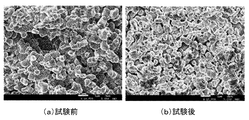
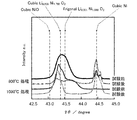
- FIG. 1 It is a schematic diagram which shows one embodiment of the anode for alkaline water electrolysis of this invention. It is a photograph which shows the electron micrograph before and behind the cycle test of the anode for alkaline water electrolysis manufactured by Example 1 of this invention, (a) is before a cycle test, (b) is a photograph after a cycle test. It is a graph which shows the X-ray diffraction analysis result before and behind the cycle test of the anode for alkaline water electrolysis manufactured by Example 1 and Comparative Example 1 of the present invention.
- FIG. 1 is a schematic diagram showing one embodiment of an anode for alkaline water electrolysis according to the present invention, wherein 1 is an anode substrate, and 2 is a catalyst layer made of lithium-containing nickel oxide.
- At least the surface is a conductive substrate made of nickel or a nickel-based alloy, and the anode substrate is preferably made of stainless steel, nickel, iron or Ni-plated iron material from the viewpoint of conductivity and chemical stability, and has a thickness of 0.
- a shape having an opening for removing oxygen bubbles to be generated is preferable, and a nickel expanded mesh or a porous nickel expanded mesh can be used, and the porosity is preferably 10 to 95%.
- the surface of the anode substrate is preferably subjected to a roughening treatment in order to increase the adhesion with the catalyst layer.
- conventional methods include blasting by spraying powder, etching using a substrate-soluble acid, and plasma spraying. and so on.
- a chemical etching process is performed to remove contaminant particles such as metal and organic matter on the surface.
- the consumption amount of the nickel base is preferably about 30 to 400 g / m 2 .
- lithium nickel oxide can be obtained by applying a heat treatment after applying a solution containing 5 to 25% by mass of lithium element such as lithium hydroxide.
- the lithium component raw material include lithium nitrate, lithium carbonate, and lithium chloride, and an aqueous solution having an appropriate concentration can be used as a coating solution. Heat treatment is performed after drying.
- the heat treatment temperature is preferably 900 to 1000 ° C., and the treatment time is preferably 5 to 60 minutes.
- the treatment temperature is higher than this range, if the treatment time is longer than this range, the thickness of the oxide increases, and good catalytic properties as an electrode cannot be obtained. If the treatment time is shorter than this, a sufficient thickness as an oxide cannot be obtained, and only a non-uniform layer can be obtained. If the treatment temperature is lower than this range, the desired oxide can be obtained by increasing the treatment time, but it takes too much time and is not practical.
- the optimum thickness is about 0.1 to 100 ⁇ m, and it is preferable to form a uniform and good electron-conducting layer on the surface so that the base metal does not come into contact with the alkaline aqueous solution as the electrolyte.
- the heat treatment temperature to 900 to 1000 ° C.
- the generated lithium-containing nickel oxide can maintain its crystal structure even when used for a long period of time, and also maintains corrosion resistance even when used for a long period of time.
- a high performance alkaline water electrolysis anode that can be obtained can be obtained.
- a composite oxide can be obtained by applying a solution containing nickel element and lithium element and similarly heat-treating.
- Nickel component raw materials include nickel nitrate, nickel carbonate, nickel chloride and the like, and an aqueous solution having an appropriate concentration can be used as a coating solution.
- the molar ratio of lithium to nickel is preferably in the range of 0.005 to 0.15 as Li / Ni. If it is smaller than this, improvement in conductivity cannot be expected, and if the composition is larger than 0.15, physical strength and chemical stability are small. In the present invention, the detailed reason why the molar ratio Li / Ni between lithium and nickel is in the range of 0.005 to 0.15 will be described in detail below.
- a suitable lithium oxide and nickel oxide in the present invention can be represented by Li x Ni 1-x O, and it is estimated that Li 0.208 Ni 1.792 O 2 is contained by X-ray diffraction analysis.
- nickel oxide has semiconducting properties by lithium doping, and this is manifested when Li / Ni is 0.005 or more.
- the conductivity due to impurity doping in the semiconductor is expressed even in a smaller amount (1 ppm ⁇ 0.001%), it is necessary to limit the voltage loss to a few tens mV or less when the current density is applied as industrial electrolysis. Yes, a doping concentration of substantially this level (0.5% ⁇ 5,000 ppm) is necessary.
- the Li / Ni ratio of Li 0.208 Ni 1.792 O 2 which is the composition confirmed by the X-ray diffraction analysis after the cycle test, is 0.116. Since lithium and divalent nickel have relatively similar ionic radii, it is known that a part of nickel enters the lithium layer and a part of lithium enters the transition metal layer. The composition ratio of Li / Ni is Regardless of the composition discriminated by XRD, it is presumed that the catalyst layer has a distribution. On the other hand, as shown in Comparative Example 1, it is estimated that a large amount of Li 0.308 Ni 1.692 O 2 (Li / Ni ratio is 0.177) having a large Li ratio is present in the early stage of the 800 ° C.
- the Li 0.208 Ni 1.792 O 2 and Li 0.308 Ni 1.692 O 2 peaks disappear after the cycle test because the stability of Li 0.308 Ni 1.692 O 2 was poor. Accordingly, it has been found that the Li / Ni ratio is preferably 0.15 or less in the present invention.
- CVD method A metal-containing gas is decomposed by plasma to generate metal atoms, and a film is formed on a substrate kept at a high temperature (about 800 ° C.).
- PVD method There are a sputtering method and an ion plating method. Sputtering is a method in which ions such as argon collide with a solid metal and metal atoms are ejected as particles. Since the sputtered particles are substantially electrically neutral, the energy of the film-forming particles is low.
- the ion plating method an electron current is generated and a solid metal is evaporated by the heat to obtain metal atoms, and at the same time, many portions thereof are ionized to form a film with ions.
- the ion plating method is classified into arc ion plating, hollow cathode, and electron gun according to the generation method of electron current.
- the arc ion plating method is a method in which the target is vacuum-discharged between the cathode and the anode, and the material is evaporated and ionized from the target surface.
- the ionization rate of the metal vapor is as high as 80% or more, and the denseness and adhesion are high. A film having excellent properties can be formed at high speed.
- the hollow cathode has a moderate ionization rate, and the electron gun has a low ionization rate.
- the constituent materials other than the anode of the alkaline water electrolysis cell are shown below.
- the cathode it is necessary to select a base material that can withstand alkaline water electrolysis and has a small cathode overvoltage.
- the cathode substrate nickel as it is or a nickel substrate coated with an active cathode is used.
- a nickel expanded mesh and a porous nickel expanded mesh can be used as in the anode.
- a cathode material a porous nickel electrode having a large surface area and a Ni—Mo system have been widely studied.
- Raney nickel systems such as Ni—Al, Ni—Zn, and Ni—Co—Zn
- sulfide systems such as Ni—S
- hydrogen storage alloy systems such as Ti 2 Ni
- the properties of low hydrogen overvoltage, high short-circuit stability, and high poisoning resistance are important, and as other catalysts, metals such as platinum, palladium, ruthenium, iridium or their oxides are preferable.
- an ion-permeable membrane comprising an organic fiber cloth in a mixture of a calcium phosphate compound or calcium fluoride hydrophilic inorganic material and an organic binder selected from polysulfone, polypropylene, and polyvinylidene fluoride is shown.
- an organic binder selected from polysulfone, polypropylene, and polyvinylidene fluoride is shown.
- an ion permeable membrane comprising a stretched organic fiber fabric is shown in a film forming mixture consisting of:
- an electrolytic solution to which high concentration alkaline water is added so as to have a predetermined alkali concentration is used, but caustic alkali such as caustic potash or caustic soda is preferable, and its concentration is 1.5 to 40% by mass is preferable. In particular, in view of suppressing power consumption, 15 to 40% by mass, which is a region having a high electric conductivity, is preferable. However, when considering the cost, corrosivity, viscosity, and operability related to electrolysis, the content is more preferably 20 to 30% by mass.
- the electrode substrate is a nickel plate mirror-polished at room temperature (P8000, 1 micron particle size polishing), immersed in 5 mass% lithium hydroxide for 1 hour, and fired in an air atmosphere at 1000 ° C. for 1 hour.
- Oxide and nickel oxide electrodes were prepared.
- the obtained lithium nickel oxide electrode as estimated from the X-rays in FIG. 3, is mainly composed of Li 0.208 Ni 1.792 O 2 , and the molar ratio of lithium to nickel (Li / Ni) is about 0. It was 12. It is clear from the X-ray diffraction analysis of FIG. 3 that the peak estimated as Li 0.208 Ni 1.792 O 2 is shown as a sharp peak before and after the test.
- the temperature of the following electrochemical measurement was 25 ⁇ 1 ° C., and measurement was performed in a 25 mass% potassium hydroxide aqueous solution.
- potential range 0 to 1.5 Vvs.
- 100 cycles of cyclic voltammetry (CV) were performed with RHE at a scan rate of 100 mVs ⁇ 1 .
- the cycle test was conducted at a potential of 1.0 to 1.8 Vvs. 25,000 cycles of CV were performed with RHE at a scan rate of 1 Vs ⁇ 1 .
- the anode potential at a current density of 100 mAcm ⁇ 2 was measured before and after the cycle test.
- the oxygen generation overvoltage increased as the number of cycles in the acceleration test increased, the initial overvoltage-current density gradient was about 60 mVdec ⁇ 1 , and the gradient did not change greatly after the cycle test, indicating high stability.
- the initial overvoltage at 100 mAcm ⁇ 2 was 200 mV, but the overvoltage after the cycle test was 230 mV and was almost stable. Electron micrographs before and after the cycle test are shown in FIG. 2, but no significant change in the crystalline state was observed. In the X-ray diffraction analysis of FIG. 3, the peak related to LiNiO that existed before the test partially decreased after the test, but the peak estimated to be Li 0.208 Ni 1.792 O 2 showed little change.
- Example 2 An electrode having lithium oxide and nickel oxide was produced in the same manner as in Example 1 except that the oxidation treatment was performed in an air atmosphere at 900 ° C. for 1 hour.
- the resulting lithium nickel oxide electrode had a lithium to nickel molar ratio (Li / Ni) of 0.14.
- the overvoltage at 100 mAcm ⁇ 2 was initially 210 mV, but the overvoltage after the cycle test was almost stable at 250 mV. In the electron micrograph, no significant change in the crystalline state was observed. In the X-ray diffraction analysis of the electrode before and after the cycle test, the same change as in Example 1 was confirmed.
- Li 0.308 Ni 1.692 O 2 having a large Li ratio Li / Ni ratio is 0.177
- Li 0.208 Ni 1.792 O 2 is After the cycle test, both the large amount of Li 0.308 Ni 1.692 O 2 and the small amount of Li 0.208 Ni 1.792 O 2 disappeared, and the stability of Li 0.308 Ni 1.692 O 2 This is probably due to the lack of
- Example 3 A nickel oxide electrode was manufactured in the same manner as in Example 1 except that it was not immersed in lithium hydroxide.
- the overvoltage at 100 mAcm ⁇ 2 was 400 mV at the initial stage, and the overvoltage after the cycle test was 410 mV, indicating a large value with stability.
- FIG. 5 shows an electron micrograph and FIG. 6 shows an X-ray diffraction analysis, but no significant change in the crystalline state was observed.
- ⁇ Comparative example 4> A nickel plate mirror-polished at room temperature as an electrode was subjected to the same cycle acceleration test as in Example 1. Although the initial overvoltage was small, the increase with the number of cycles was large. Although the initial overvoltage-current density gradient was about 60 mVdec ⁇ 1 , the gradient after 25,000 cycles was as large as about 100 mVdec ⁇ 1 . The initial overvoltage at 100 mAcm ⁇ 2 was 250 mV, but the overvoltage after the cycle test was 350 mV, which was a significant increase compared to the example.
- FIG. 7 shows electron micrographs before and after the cycle test. Compared with the nickel electrode before the measurement, the electrode surface was different from the state before the test. A volume increase was observed due to the formation of nickel oxide. As a result of X-ray diffraction analysis of the powder generated on the nickel electrode surface after the test and dropped into the solution, Ni (OH) 2 and NiO were confirmed. It is considered that hydroxides and oxides were formed on the electrode surface, and as the volume increased, erosion, corrosion, etc. due to the generation of oxygen generation bubbles and the like were caused and dropped.
- the technology of the present invention is thermodynamically unstable by forming lithium nickel oxide on the nickel surface by heat treatment in a base material mainly made of nickel metal used for oxygen generation in high temperature and high concentration alkaline aqueous solution. It has been found that a nickel base is not in direct contact with the electrolyte and can be used stably for a long period of time.
- the catalyst layer of the present invention is excellent in both catalytic activity and durability, and can be used for alkaline water electrolysis using electric power whose output fluctuates greatly. It can also be used as an anode in industrial electrolysis processes in other alkaline electrolytes.
- Anode substrate 2 Catalyst layer
Landscapes
- Chemical & Material Sciences (AREA)
- Engineering & Computer Science (AREA)
- Chemical Kinetics & Catalysis (AREA)
- Materials Engineering (AREA)
- Organic Chemistry (AREA)
- Electrochemistry (AREA)
- Metallurgy (AREA)
- Inorganic Chemistry (AREA)
- Electrodes For Compound Or Non-Metal Manufacture (AREA)
- Electrolytic Production Of Non-Metals, Compounds, Apparatuses Therefor (AREA)
Abstract
Description
水電解は大きく2つに分けられ、1つはアルカリ水電解であり、電解質に高濃度アルカリ水溶液が用いられている。もう1つは、固体高分子型水電解であり、電解質には、固体高分子膜(SPE)が用いられている。大規模な水素製造を水電解で行う場合、ダイヤモンド電極等を用いた固体高分子型水電解よりも、ニッケル等の鉄軽金属などの安価な材料を用いるアルカリ水電解が適しているといわれている。両極における電極反応は以下のとおりである。
陽極反応:2OH- → H2O + 1/2 O2 + 2e- (1)
陰極反応:2H2O + 2e- → H2 + 2OH- (2)
Ni + 2OH- →Ni(OH)2 + 2e- (3)
電位の増加に従って、3価、4価へと酸化される。反応式として、
Ni(OH)2 + OH- → NiOOH + H2O + e- (4)
NiOOH + OH- → NiO2 + H2O + e- (5)
ニッケル系電池ではこのような酸化物、水酸化物を活物質として利用しているが、アルカリ水電解では、このようなニッケル材料の活性を抑制することが好ましい。
アルカリ水電解に使用される酸素発生用陽極としては、ニッケル自体も酸素過電圧が小さく、特に硫黄を含んだニッケルめっき電極は水電解用陽極として利用されている。
しかしながら、特許文献1~3には、ニッケルに対するリチウムの含有比率やその製造条件については、開示が見当たらず、出力変動の激しい電力下での安定性についても開示がなされていない。
更に、本発明によれば、少なくとも表面がニッケル又はニッケル基合金よりなる導電性基体の表面にリチウム化合物を含有する溶液に塗布等し、前記導電性基体を900℃から1000℃までの温度で酸素を含む雰囲気中で熱処理し、前記導電性基体の表面に、リチウムとニッケルのモル比(Li/Ni)が0.005から0.15であるリチウムニッケル酸化物触媒層を形成することができるとともに、生成されたリチウムニッケル酸化物は、長期間使用しても、その結晶構造を維持することができ、更に、長期間使用しても耐食性を維持することのできる高性能のアルカリ水電解用陽極を得ることができる。
図1は、本発明のアルカリ水電解用陽極の1実施態様を示す模式図であり、1は、陽極基体、2は、リチウム含有ニッケル酸化物よりなる触媒層である。
陽極基体1として、少なくとも表面がニッケル又はニッケル基合金よりなる導電性基体であり、陽極基体は、導電性と化学的安定性からステンレス、ニッケル、鉄又はNiメッキ鉄材料が好ましく、厚さは0.05~5mmであり、生成する酸素気泡を除去するために開口部を有する形状が好ましく、ニッケルエクスパンドメッシュ、多孔質ニッケルエクスパンドメッシュを使用でき、その空隙率は10~95%が好ましい。陽極基体の表面は、触媒層との密着力を高めるために、粗面化処理を行うことが好ましいが、方法としては従来の粉末を吹き付けるブラスト処理、基体可溶性の酸を用いたエッチング、プラズマ溶射などがある。表面の金属、有機物などの汚染粒子を除去するために化学エッチング処理を行う。ニッケル基体の消耗量としては30~400g/m2程度が好ましい。
ニッケル基体において、空気雰囲気中等の酸素を含む雰囲気中でこれを熱処理すると、酸素とニッケルが反応しNi酸化層を基体表面に形成させることができる。酸素濃度としては、以下に述べる温度範囲および時間範囲で行うために、体積として2%以上が好ましい。これ以下では所望の酸化物が得られない。本発明においては、5~25質量%の水酸化リチウムなどのリチウム元素を含む溶液を塗布した後に熱処理することで、リチウムニッケル酸化物を得ることができる。リチウム成分原料としては、硝酸リチウム、炭酸リチウム、塩化リチウムなどがあり、適当な濃度にした水溶液を塗布液として利用できる。乾燥後に熱処理を行う。
リチウムとニッケルのモル比がLi/Niとして0.005から0.15の範囲が好ましい。これより小さいと導電性の向上は期待できず、0.15より大きい組成では物理的強度、化学的安定性が小さい。
本発明において、リチウムとニッケルのモル比Li/Niを0.005から0.15の範囲とした詳細な理由について、以下に詳述する。
本発明における好適なリチウム酸化物とニッケル酸化物は、LixNi1-xOで表すことができ、X線回折分析によりLi0.208Ni1.792O2を含むことが推定される。一方、リチウムドープすることにより、ニッケル酸化物が半導体的性質を帯びることが知られており、Li/Niとして0.005以上であればこれが発現される。
尚、半導体における不純物ドープによる導電性は、より少量(1ppm→0.001%)においても発現されるが、工業電解としての電流密度を与えた場合の電圧損失はせいぜい数10mV以下にとどめる必要があり、実質上この程度のドープ濃度(0.5%→5,000ppm)が必要である。
後述する実施例1に示すように、サイクル試験後のX線回折分析にて確認された組成である、Li0.208Ni1.792O2のLi/Ni比率は、0.116であるが、1価のリチウムと2価のニッケルはイオン半径が比較的似ているため、ニッケルの一部がリチウム層に、リチウムの一部が遷移金属層に入る現象が知られており、Li/Niの組成比率はXRDで判別される組成にこだわらず、触媒層内に分布をもって存在していると推定される。
一方、比較例1に示すように、800℃品の初期では、Li比率の大きいLi0.308Ni1.692O2(Li/Ni比率は0.177)が多量に存在していることが推定されるが、サイクル試験後に、Li0.208Ni1.792O2とLi0.308Ni1.692O2のピークが共に消失している現象は、Li0.308Ni1.692O2の安定性が乏しかったためであると推察される。従って、本発明おいては、Li/Ni比率は0.15以下とすることが好ましいことが判明した。
(1)CVD法:金属を含むガスをプラズマで分解して、金属原子を発生させ、高温(約800℃)に保持した基材上に被膜を形成する。
(2)PVD法:スパッタリング法とイオンプレーティング法とがある。
スパッタリング法とは、アルゴン等のイオンを固体金属に衝突させ、金属原子を粒子としてはじき出す方法である。スパッタ粒子は、略、電気的に中性であるため、被膜形成粒子のエネルギーは、低い。
イオンプレーティング法とは、電子流を発生し、その熱で固体の金属を蒸発させて金属原子を得ると同時に、その多くの部分をイオン化し、イオンにより被膜を形成する。
イオンプレーティング法は、電子流の発生方法により、アークイオンプレーティングとホローカソードと電子銃とに分類される。
アークイオンプレーティング法とは、ターゲットをカソードとアノードとの間で真空放電させ、ターゲット表面から材料を蒸発、イオン化する方法であり、金属蒸気のイオン化率が80%以上と高く、緻密性・密着性の優れた膜を高速で形成できる。また、ホローカソードは、イオン化率が中程度であり、電子銃は、イオン化率が低い。
陰極としては、アルカリ水電解に耐えうる基体材料で陰極過電圧が小さい触媒を選択する必要がある。陰極基体としてニッケルそのままかニッケル基体に活性陰極を被覆したものが用いられている。基体としては陽極同様、ニッケルエクスパンドメッシュ、多孔質ニッケルエクスパンドメッシュを使用できる。陰極材料としては表面積の大きい多孔質ニッケル電極、Ni-Mo系が広く研究されている。その他にはNi-Al、Ni-Zn、Ni-Co-Znなどのラネーニッケル系、Ni-Sなどの硫化物系、Ti2Niなど水素吸蔵合金系などが検討されている。水素過電圧が低い、短絡安定性が高い、あるいは被毒耐性が高いという性質が重要であり、その他の触媒としては、白金、パラジウム、ルテニウム、イリジウムなどの金属或いはそれらの酸化物が好ましい。
電極基体には室温にて鏡面研磨(P8000、1ミクロン粒度の研磨)したニッケル板を用い、5質量%水酸化リチウム中に1時間浸漬し、1000℃の空気雰囲気で1時間焼成を行い、リチウム酸化物とニッケル酸化物の電極を作製した。得られたリチウムニッケル酸化物の電極は、図3のX線からの推定として、Li0.208Ni1.792O2が主成分であり、リチウムとニッケルのモル比(Li/Ni)は、平均として0.12であった。Li0.208Ni1.792O2と推定されるピークが、試験前後において、シャープなピークとして示されていることは、図3のX線回折分析から明らかである。
以下の電気化学測定の温度は25±1℃とし、25質量%水酸化カリウム水溶液中で測定した。電気化学的前処理として、電位範囲:0~1.5Vvs.RHE、走査速度100mVs-1でCyclic Voltammetry(CV)を100サイクル行った。サイクル試験は電位1.0~1.8Vvs.RHE、走査速度1Vs-1としてCVを25,000サイクル行った。電流密度100mAcm-2での陽極電位を、上記サイクル試験の前後で計測した。
加速試験のサイクル数が増加するに従って酸素発生過電圧が増加したが、初期の過電圧-電流密度勾配は約60mVdec-1であり、勾配はサイクル試験後も大きな変化は無く、高い安定性を示した。100mAcm-2での初期過電圧は200mVであったが、サイクル試験後における過電圧は230mVで、ほぼ安定であった。サイクル試験前後での電子顕微鏡写真を図2に示したが、大きな結晶状態の変化は認められなかった。図3のX線回折分析では、試験前には存在したLiNiOに関与するピークは、試験後に一部減少しているが、Li0.208Ni1.792O2と推定されるピークは変化が小さかった。
酸化処理として900℃の空気雰囲気で1時間焼成した以外は、実施例1と同様にリチウム酸化物とニッケル酸化物を有する電極を製作した。得られたリチウムニッケル酸化物電極のリチウムとニッケルのモル比(Li/Ni)が0.14であった。
同様のサイクル試験を実施したところ、100mAcm-2での過電圧は初期210mVであったが、サイクル試験後における過電圧は250mVでほぼ安定であった。電子顕微鏡写真では、大きな結晶状態の変化は認められなかった。サイクル試験前後で電極のX線回折分析では、実施例1と同様の変化が確認された。
酸化処理として800℃の空気雰囲気で1時間焼成した以外は、実施例1と同様にリチウム酸化物とニッケル酸化物を有する電極を製作した。得られたリチウムニッケル酸化物電極のリチウムとニッケルのモル比(Li/Ni)が0.18であった。
同様のサイクル試験を実施したところ、100mAcm-2での過電圧は初期440mVであったが、サイクル試験後における過電圧は240mVであった。サイクル試験前後で結晶状態の変化が認められ、図3のX線回折分析では、試験前には存在したLiNiOに関与するピークが、試験後にLi0.208Ni1.792O2のピークが減少していることが確認された。
800℃で加熱処理した場合、サイクル試験前においては、Li比率の大きいLi0.308Ni1.692O2(Li/Ni比率は0.177)が多量に存在しているが、Li0.208Ni1.792O2は、少量しか存在しておらず、サイクル試験後には、多量のLi0.308Ni1.692O2と少量のLi0.208Ni1.792O2のピークは、共に消失しており、Li0.308Ni1.692O2の安定性が乏しかったためであると推察される。
酸化処理として700℃の空気雰囲気で1時間焼成した以外は、実施例1と同様にリチウムニッケル酸化物を有する電極を製作した。得られたリチウムニッケル酸化物電極のリチウムとニッケルのモル比(Li/Ni)が0.20であった。
同様のサイクル試験を実施したところ、100mAcm-2での過電圧は初期310mVであったが、サイクル試験後における過電圧は230mVであった。電子顕微鏡写真を図4に示したが、結晶状態が多少変化し、亀裂の発生が少し認められた。
水酸化リチウムに浸漬しなかったこと以外は実施例1と同様に処理を行い、ニッケル酸化物電極を製作した。同様のサイクル試験を実施したところ、100mAcm-2での過電圧は初期400mV、サイクル試験後における過電圧は410mVで、安定ながら大きい値を示した。図5に電子顕微鏡写真を、図6にX線回折分析を示したが、大きな結晶状態の変化は認められなかった。
電極として室温にて鏡面研磨したニッケル板を、実施例1と同様のサイクル加速試験に供した。初期過電圧は小さいが、サイクル数に伴う増加が大きかった。初期の過電圧-電流密度勾配は約60mVdec-1であったが、25,000サイクル後の勾配は約100mVdec-1と大きくなった。100mAcm-2での初期過電圧は250mVであったが、サイクル試験後における過電圧は350mVと、実施例に比較して顕著な増加が認められた。
試験後にニッケル電極表面に生成し溶液中に脱落した粉末のX線回折分析を行った結果、Ni(OH)2、NiOを確認した。電極表面に水酸化物や酸化物が生成して、体積増加とともに酸素発生の泡などの生成等によるエロージョン、コロージョン等を起こし、脱落したと考えられる。
2:触媒層
Claims (5)
- 少なくとも表面がニッケル又はニッケル基合金よりなる導電性基体と、該基体表面に形成されるリチウム含有ニッケル酸化物触媒層とからなり、該触媒層中のリチウムとニッケルのモル比(Li/Ni)が0.005から0.15の範囲に入ることを特徴とするアルカリ水電解用陽極。
- 風力発電、太陽光発電などの出力変動の大きい電力を利用してアルカリ水電解を行うために使用することを特徴とする請求項1に記載のアルカリ水電解用陽極。
- 少なくとも表面がニッケル又はニッケル基合金よりなる導電性基体の表面にリチウムイオンを含有する溶液を配置し、該基体を900℃から1000℃までの温度で酸素を含む雰囲気中で熱処理し、リチウムとニッケルのモル比(Li/Ni)が0.005から0.15の範囲に入る、リチウム含有ニッケル酸化物触媒層を形成することを特徴とするアルカリ水電解用陽極の製造方法。
- 熱処理の時間が5分から60分であることを特徴とする請求項3に記載のアルカリ水電解用陽極の製造方法。
- リチウムイオンを含有する溶液にニッケルイオンを含有させたことを特徴とする請求項3に記載のアルカリ水電解用陽極の製造方法。
Priority Applications (7)
| Application Number | Priority Date | Filing Date | Title |
|---|---|---|---|
| US15/029,952 US20160237578A1 (en) | 2013-10-29 | 2014-10-29 | Anode for alkaline water electrolysis |
| CN201480060058.3A CN105683418A (zh) | 2013-10-29 | 2014-10-29 | 碱性水电解用阳极 |
| CA2928790A CA2928790C (en) | 2013-10-29 | 2014-10-29 | Anode for alkaline water electrolysis |
| EP14858854.4A EP3064614B1 (en) | 2013-10-29 | 2014-10-29 | Anode for alkaline water electrolysis |
| KR1020167012770A KR20160072188A (ko) | 2013-10-29 | 2014-10-29 | 알칼리 수전해용 양극 및 그의 제조 방법 |
| ES14858854.4T ES2675931T3 (es) | 2013-10-29 | 2014-10-29 | Ánodo para electrólisis de agua alcalina |
| DK14858854.4T DK3064614T3 (en) | 2013-10-29 | 2014-10-29 | ANODE TO ALKALIC WATER ELECTROLYSIS |
Applications Claiming Priority (2)
| Application Number | Priority Date | Filing Date | Title |
|---|---|---|---|
| JP2013224771A JP2015086420A (ja) | 2013-10-29 | 2013-10-29 | アルカリ水電解用陽極 |
| JP2013-224771 | 2013-10-29 |
Publications (1)
| Publication Number | Publication Date |
|---|---|
| WO2015064644A1 true WO2015064644A1 (ja) | 2015-05-07 |
Family
ID=53004244
Family Applications (1)
| Application Number | Title | Priority Date | Filing Date |
|---|---|---|---|
| PCT/JP2014/078777 Ceased WO2015064644A1 (ja) | 2013-10-29 | 2014-10-29 | アルカリ水電解用陽極 |
Country Status (9)
| Country | Link |
|---|---|
| US (1) | US20160237578A1 (ja) |
| EP (1) | EP3064614B1 (ja) |
| JP (1) | JP2015086420A (ja) |
| KR (1) | KR20160072188A (ja) |
| CN (1) | CN105683418A (ja) |
| CA (1) | CA2928790C (ja) |
| DK (1) | DK3064614T3 (ja) |
| ES (1) | ES2675931T3 (ja) |
| WO (1) | WO2015064644A1 (ja) |
Cited By (10)
| Publication number | Priority date | Publication date | Assignee | Title |
|---|---|---|---|---|
| WO2017047792A1 (ja) * | 2015-09-18 | 2017-03-23 | 旭化成株式会社 | 水電解用陽極、電解セル、並びに水電解用陽極の製造方法 |
| WO2018047961A1 (ja) * | 2016-09-09 | 2018-03-15 | デノラ・ペルメレック株式会社 | アルカリ水電解用陽極の製造方法及びアルカリ水電解用陽極 |
| JP2018165392A (ja) * | 2017-03-28 | 2018-10-25 | 東京瓦斯株式会社 | 水電解システム |
| WO2018199025A1 (ja) | 2017-04-24 | 2018-11-01 | 住友電気工業株式会社 | 酸化物分散金属多孔体、電解用電極および水素製造装置 |
| CN108779563A (zh) * | 2016-04-12 | 2018-11-09 | 迪诺拉永久电极股份有限公司 | 碱性水电解用阳极及碱性水电解用阳极的制造方法 |
| JPWO2019172160A1 (ja) * | 2018-03-07 | 2021-02-18 | デノラ・ペルメレック株式会社 | 電解用電極及びその製造方法 |
| WO2023286641A1 (ja) * | 2021-07-12 | 2023-01-19 | デノラ・ペルメレック株式会社 | 電極の製造方法及び電極 |
| WO2024043228A1 (ja) * | 2022-08-22 | 2024-02-29 | 株式会社アサカ理研 | 水酸化リチウム水溶液の製造方法 |
| KR20240063863A (ko) | 2021-10-01 | 2024-05-10 | 가부시끼가이샤 도꾸야마 | 전해조 |
| WO2024214623A1 (ja) * | 2023-04-12 | 2024-10-17 | 株式会社アサカ理研 | リチウム塩水溶液の膜電解方法 |
Families Citing this family (29)
| Publication number | Priority date | Publication date | Assignee | Title |
|---|---|---|---|---|
| EP3184170B1 (en) | 2015-12-25 | 2020-04-01 | Kabushiki Kaisha Toyota Chuo Kenkyusho | Iron oxide-hydroxide particles, method for producing them and oxidation catalyst using the iron oxide-hydroxide particles |
| CA3019139C (en) | 2016-04-04 | 2020-12-29 | Dioxide Materials, Inc. | Water electrolyzers |
| US10707531B1 (en) | 2016-09-27 | 2020-07-07 | New Dominion Enterprises Inc. | All-inorganic solvents for electrolytes |
| CN106702425B (zh) * | 2016-12-09 | 2018-10-02 | 济南大学 | 一种在泡沫铁表面制备二硫化钼/铜/钴催化析氢层的方法 |
| JP6880404B2 (ja) * | 2017-06-29 | 2021-06-02 | 富士通株式会社 | 酸素発生電極及び酸素発生装置 |
| KR102136619B1 (ko) * | 2018-07-09 | 2020-07-22 | 충남대학교산학협력단 | 다공성 Ni-Al-Mo 알칼리 수전해용 음극 및 그 제조방법과 Ni-Al-Mo 용사코팅재 |
| KR102278529B1 (ko) * | 2018-07-09 | 2021-07-16 | 충남대학교산학협력단 | 다공성 Ni-Al-Mo 알칼리 수전해용 음극 |
| JP7148645B2 (ja) | 2019-01-30 | 2022-10-05 | 株式会社日本触媒 | 電極付きアルカリ水電解用隔膜、その製造方法、及び水電解装置 |
| KR102373090B1 (ko) | 2019-03-12 | 2022-03-10 | 드 노라 페르멜렉 가부시키가이샤 | 알칼리 수전해 방법 및 알칼리 수전해용 애노드 |
| KR102210525B1 (ko) * | 2019-04-12 | 2021-02-02 | 재단법인대구경북과학기술원 | 산소발생반응 전극 및 이의 제조방법 |
| CN110129827A (zh) * | 2019-06-18 | 2019-08-16 | 上海氯碱化工股份有限公司 | 通过锂诱导转化法制备改性钌钛涂层阳极的方法 |
| JP7474436B2 (ja) | 2020-03-09 | 2024-04-25 | デノラ・ペルメレック株式会社 | アルカリ水電解方法及びアルカリ水電解用アノード |
| US20220333258A1 (en) * | 2020-05-29 | 2022-10-20 | Chungbuk National University Industry-Academic Cooperation Foundation | Electrode for high-performance alkaline water electrolysis, and manufacturing method therefor |
| JP7625204B2 (ja) | 2020-07-30 | 2025-02-03 | 国立大学法人京都大学 | アルカリ水電解用アノード及びその製造方法 |
| IT202000020587A1 (it) * | 2020-08-28 | 2022-02-28 | Industrie De Nora Spa | Electrode with enhanced shutdown tolerance- elettrodo con tolleranza agli arresti migliorata |
| JP6975297B1 (ja) | 2020-08-28 | 2021-12-01 | デノラ・ペルメレック株式会社 | アルカリ水電解用アノード |
| JP7694893B2 (ja) | 2020-10-15 | 2025-06-18 | 国立大学法人京都大学 | アルカリ水電解用アノード及びその製造方法 |
| EP4230772B1 (en) | 2020-10-15 | 2025-12-03 | Kyoto University | Anode for alkaline water electrolysis and method for producing same |
| JP7576260B2 (ja) | 2020-11-20 | 2024-10-31 | デノラ・ペルメレック株式会社 | アノードの加速評価方法 |
| JP7748656B2 (ja) * | 2020-12-25 | 2025-10-03 | パナソニックIpマネジメント株式会社 | 非水電解質二次電池用正極活物質及び非水電解質二次電池 |
| US11339483B1 (en) | 2021-04-05 | 2022-05-24 | Alchemr, Inc. | Water electrolyzers employing anion exchange membranes |
| JPWO2023089656A1 (ja) * | 2021-11-16 | 2023-05-25 | ||
| CN117127191A (zh) * | 2022-05-26 | 2023-11-28 | 上海必修福企业管理有限公司 | 一种电化学方法、电化学装置及系统 |
| JPWO2024101105A1 (ja) | 2022-11-10 | 2024-05-16 | ||
| CN116200775A (zh) * | 2022-12-01 | 2023-06-02 | 江苏安凯特科技股份有限公司 | 一种具有嵌入式安装结构的电解水制氢涂层电极 |
| ES3023617T3 (en) * | 2023-02-02 | 2025-06-02 | Oue Stargate Hydrogen Solutions | A perovskite electrode for electrolysis in alkaline media |
| CN116288512A (zh) * | 2023-03-06 | 2023-06-23 | 三一氢能有限公司 | 一种碱性水电解制氢用阳极及其制备方法和应用 |
| CN119082773B (zh) * | 2024-08-27 | 2026-07-03 | 西安隆基氢能科技有限公司 | 一种电解槽、阳极催化材料及其制备方法和应用 |
| WO2026070667A1 (ja) * | 2024-09-25 | 2026-04-02 | 株式会社プロテリアル | アルカリ水電解用アノード電極およびその製造方法 |
Citations (8)
| Publication number | Priority date | Publication date | Assignee | Title |
|---|---|---|---|---|
| US2716670A (en) | 1953-01-16 | 1955-08-30 | Era Patents Ltd | Alkaline primary cells |
| US2928783A (en) | 1956-08-23 | 1960-03-15 | Era Patents Ltd | Porous nickel electrode |
| GB864457A (en) | 1956-08-23 | 1961-04-06 | Era Patents Ltd | Improvements relating to hydrogen-oxygen cells particularly for use as electrolysers |
| JP2000239882A (ja) | 1999-02-24 | 2000-09-05 | Permelec Electrode Ltd | 活性化陰極及びその製造方法 |
| JP2008506845A (ja) * | 2004-07-19 | 2008-03-06 | ウーデ ゲゼルシャフト ミット ベシュレンクテル ハフツング | 向上した導電性を有するニッケル酸化物表面の製造方法 |
| JP2008057968A (ja) | 2003-10-23 | 2008-03-13 | Martin Terence Cole | ダクトにハウジングを取り付ける方法およびハウジング機構 |
| JP5207407B2 (ja) * | 2008-02-18 | 2013-06-12 | 独立行政法人産業技術総合研究所 | 空気極 |
| JP2014203809A (ja) * | 2013-04-10 | 2014-10-27 | 富士電機株式会社 | 正極およびその製造方法 |
Family Cites Families (5)
| Publication number | Priority date | Publication date | Assignee | Title |
|---|---|---|---|---|
| US864457A (en) | 1906-06-09 | 1907-08-27 | Louis C Katz | Change maker and register. |
| US2914596A (en) * | 1958-01-17 | 1959-11-24 | Consolidation Coal Co | Shaped porous semi-conducting compositions of lithiated nickel oxide |
| GB908104A (en) * | 1959-06-30 | 1962-10-17 | Nat Res Dev | Improvements relating to electrodes for electrical fuel cells |
| US3226264A (en) * | 1962-04-18 | 1965-12-28 | Leesona Corp | Method of improving lithiated nickel oxide fuel cell electrodes |
| IL50217A (en) * | 1976-08-06 | 1980-01-31 | Israel State | Electrocatalytically acitve spinel type mixed oxides |
-
2013
- 2013-10-29 JP JP2013224771A patent/JP2015086420A/ja active Pending
-
2014
- 2014-10-29 KR KR1020167012770A patent/KR20160072188A/ko not_active Ceased
- 2014-10-29 WO PCT/JP2014/078777 patent/WO2015064644A1/ja not_active Ceased
- 2014-10-29 US US15/029,952 patent/US20160237578A1/en not_active Abandoned
- 2014-10-29 DK DK14858854.4T patent/DK3064614T3/en active
- 2014-10-29 ES ES14858854.4T patent/ES2675931T3/es active Active
- 2014-10-29 CA CA2928790A patent/CA2928790C/en active Active
- 2014-10-29 EP EP14858854.4A patent/EP3064614B1/en active Active
- 2014-10-29 CN CN201480060058.3A patent/CN105683418A/zh active Pending
Patent Citations (8)
| Publication number | Priority date | Publication date | Assignee | Title |
|---|---|---|---|---|
| US2716670A (en) | 1953-01-16 | 1955-08-30 | Era Patents Ltd | Alkaline primary cells |
| US2928783A (en) | 1956-08-23 | 1960-03-15 | Era Patents Ltd | Porous nickel electrode |
| GB864457A (en) | 1956-08-23 | 1961-04-06 | Era Patents Ltd | Improvements relating to hydrogen-oxygen cells particularly for use as electrolysers |
| JP2000239882A (ja) | 1999-02-24 | 2000-09-05 | Permelec Electrode Ltd | 活性化陰極及びその製造方法 |
| JP2008057968A (ja) | 2003-10-23 | 2008-03-13 | Martin Terence Cole | ダクトにハウジングを取り付ける方法およびハウジング機構 |
| JP2008506845A (ja) * | 2004-07-19 | 2008-03-06 | ウーデ ゲゼルシャフト ミット ベシュレンクテル ハフツング | 向上した導電性を有するニッケル酸化物表面の製造方法 |
| JP5207407B2 (ja) * | 2008-02-18 | 2013-06-12 | 独立行政法人産業技術総合研究所 | 空気極 |
| JP2014203809A (ja) * | 2013-04-10 | 2014-10-27 | 富士電機株式会社 | 正極およびその製造方法 |
Non-Patent Citations (4)
| Title |
|---|
| C. T. BOWEN, INT. J. HYDROGEN ENERGY, vol. 9, 1984, pages 59 |
| J. P. SINGH; N. K. SINGH; R. N. SINGH, INT. J. HYDROGEN ENERGY, vol. 24, 1999, pages 433 |
| P. W. T. LU; S. SRINIVASAN, J. ELECTROCHEM. SOC., vol. 125, 1978, pages 1416 |
| S. MITSUSHIMA; K. MATSUZAWA, HYDROGEN ENERGY SYSTEM, vol. 36, 2011, pages 11 |
Cited By (20)
| Publication number | Priority date | Publication date | Assignee | Title |
|---|---|---|---|---|
| JPWO2017047792A1 (ja) * | 2015-09-18 | 2018-07-19 | 旭化成株式会社 | 水電解用陽極、電解セル、並びに水電解用陽極の製造方法 |
| EP3351659A4 (en) * | 2015-09-18 | 2018-11-07 | Asahi Kasei Kabushiki Kaisha | Positive electrode for water electrolysis, electrolysis cell and method for producing positive electrode for water electrolysis |
| WO2017047792A1 (ja) * | 2015-09-18 | 2017-03-23 | 旭化成株式会社 | 水電解用陽極、電解セル、並びに水電解用陽極の製造方法 |
| CN108779563A (zh) * | 2016-04-12 | 2018-11-09 | 迪诺拉永久电极股份有限公司 | 碱性水电解用阳极及碱性水电解用阳极的制造方法 |
| WO2018047961A1 (ja) * | 2016-09-09 | 2018-03-15 | デノラ・ペルメレック株式会社 | アルカリ水電解用陽極の製造方法及びアルカリ水電解用陽極 |
| JPWO2018047961A1 (ja) * | 2016-09-09 | 2019-06-24 | デノラ・ペルメレック株式会社 | アルカリ水電解用陽極の製造方法及びアルカリ水電解用陽極 |
| US10676832B2 (en) | 2016-09-09 | 2020-06-09 | De Nora Permelec Ltd | Method for producing anode for alkaline water electrolysis, and anode for alkaline water electrolysis |
| JP2018165392A (ja) * | 2017-03-28 | 2018-10-25 | 東京瓦斯株式会社 | 水電解システム |
| WO2018199025A1 (ja) | 2017-04-24 | 2018-11-01 | 住友電気工業株式会社 | 酸化物分散金属多孔体、電解用電極および水素製造装置 |
| JP7273024B2 (ja) | 2018-03-07 | 2023-05-12 | デノラ・ペルメレック株式会社 | 電解用電極及びその製造方法 |
| JPWO2019172160A1 (ja) * | 2018-03-07 | 2021-02-18 | デノラ・ペルメレック株式会社 | 電解用電極及びその製造方法 |
| WO2023286641A1 (ja) * | 2021-07-12 | 2023-01-19 | デノラ・ペルメレック株式会社 | 電極の製造方法及び電極 |
| JP2023011311A (ja) * | 2021-07-12 | 2023-01-24 | デノラ・ペルメレック株式会社 | 電極の製造方法及び電極 |
| US12234563B2 (en) | 2021-07-12 | 2025-02-25 | De Nora Permelec Ltd | Method for manufacturing electrode, and electrode |
| JP7724650B2 (ja) | 2021-07-12 | 2025-08-18 | デノラ・ペルメレック株式会社 | 電極の製造方法 |
| KR20240063863A (ko) | 2021-10-01 | 2024-05-10 | 가부시끼가이샤 도꾸야마 | 전해조 |
| WO2024043228A1 (ja) * | 2022-08-22 | 2024-02-29 | 株式会社アサカ理研 | 水酸化リチウム水溶液の製造方法 |
| WO2024214623A1 (ja) * | 2023-04-12 | 2024-10-17 | 株式会社アサカ理研 | リチウム塩水溶液の膜電解方法 |
| JP2024151485A (ja) * | 2023-04-12 | 2024-10-25 | 株式会社アサカ理研 | リチウム塩水溶液の膜電解方法 |
| JP7801773B2 (ja) | 2023-04-12 | 2026-01-19 | 株式会社アサカ理研 | リチウム塩水溶液の膜電解方法 |
Also Published As
| Publication number | Publication date |
|---|---|
| CN105683418A (zh) | 2016-06-15 |
| ES2675931T3 (es) | 2018-07-13 |
| EP3064614B1 (en) | 2018-06-20 |
| CA2928790A1 (en) | 2015-05-07 |
| US20160237578A1 (en) | 2016-08-18 |
| JP2015086420A (ja) | 2015-05-07 |
| DK3064614T3 (en) | 2018-09-03 |
| EP3064614A1 (en) | 2016-09-07 |
| EP3064614A4 (en) | 2017-06-21 |
| CA2928790C (en) | 2018-07-17 |
| KR20160072188A (ko) | 2016-06-22 |
Similar Documents
| Publication | Publication Date | Title |
|---|---|---|
| CA2928790C (en) | Anode for alkaline water electrolysis | |
| JP7273024B2 (ja) | 電解用電極及びその製造方法 | |
| US10619255B2 (en) | Anode for alkaline water electrolysis and method for producing anode for alkaline water electrolysis | |
| JP6889446B2 (ja) | アルカリ水電解用陽極の製造方法及びアルカリ水電解用陽極 | |
| JP6984837B2 (ja) | アルカリ水電解方法及びアルカリ水電解用アノード | |
| WO2021182385A1 (ja) | アルカリ水電解方法及びアルカリ水電解用アノード | |
| CN116322983B (zh) | 碱水电解用阳极和其制造方法 | |
| WO2022025208A1 (ja) | アルカリ水電解用アノード及びその製造方法 | |
| WO2022080466A1 (ja) | アルカリ水電解用アノード及びその製造方法 | |
| TWI858988B (zh) | 電解用陽極及其製造方法 | |
| WO2023189350A1 (ja) | 電解用電極及びその製造方法 |
Legal Events
| Date | Code | Title | Description |
|---|---|---|---|
| 121 | Ep: the epo has been informed by wipo that ep was designated in this application |
Ref document number: 14858854 Country of ref document: EP Kind code of ref document: A1 |
|
| WWE | Wipo information: entry into national phase |
Ref document number: 15029952 Country of ref document: US |
|
| REEP | Request for entry into the european phase |
Ref document number: 2014858854 Country of ref document: EP |
|
| WWE | Wipo information: entry into national phase |
Ref document number: 2014858854 Country of ref document: EP |
|
| ENP | Entry into the national phase |
Ref document number: 2928790 Country of ref document: CA |
|
| NENP | Non-entry into the national phase |
Ref country code: DE |
|
| ENP | Entry into the national phase |
Ref document number: 20167012770 Country of ref document: KR Kind code of ref document: A |
|
| WWE | Wipo information: entry into national phase |
Ref document number: 1020167012770 Country of ref document: KR |