WO2015072564A1 - 経皮吸収型コロイド液剤 - Google Patents
経皮吸収型コロイド液剤 Download PDFInfo
- Publication number
- WO2015072564A1 WO2015072564A1 PCT/JP2014/080328 JP2014080328W WO2015072564A1 WO 2015072564 A1 WO2015072564 A1 WO 2015072564A1 JP 2014080328 W JP2014080328 W JP 2014080328W WO 2015072564 A1 WO2015072564 A1 WO 2015072564A1
- Authority
- WO
- WIPO (PCT)
- Prior art keywords
- phosphatidylcholine
- drug
- propylene glycol
- solution
- liquid
- Prior art date
- Legal status (The legal status is an assumption and is not a legal conclusion. Google has not performed a legal analysis and makes no representation as to the accuracy of the status listed.)
- Ceased
Links
Images


Classifications
-
- A—HUMAN NECESSITIES
- A61—MEDICAL OR VETERINARY SCIENCE; HYGIENE
- A61K—PREPARATIONS FOR MEDICAL, DENTAL OR TOILETRY PURPOSES
- A61K47/00—Medicinal preparations characterised by the non-active ingredients used, e.g. carriers or inert additives; Targeting or modifying agents chemically bound to the active ingredient
- A61K47/06—Organic compounds, e.g. natural or synthetic hydrocarbons, polyolefins, mineral oil, petrolatum or ozokerite
- A61K47/24—Organic compounds, e.g. natural or synthetic hydrocarbons, polyolefins, mineral oil, petrolatum or ozokerite containing atoms other than carbon, hydrogen, oxygen, halogen, nitrogen or sulfur, e.g. cyclomethicone or phospholipids
-
- A—HUMAN NECESSITIES
- A61—MEDICAL OR VETERINARY SCIENCE; HYGIENE
- A61K—PREPARATIONS FOR MEDICAL, DENTAL OR TOILETRY PURPOSES
- A61K31/00—Medicinal preparations containing organic active ingredients
- A61K31/33—Heterocyclic compounds
- A61K31/335—Heterocyclic compounds having oxygen as the only ring hetero atom, e.g. fungichromin
- A61K31/34—Heterocyclic compounds having oxygen as the only ring hetero atom, e.g. fungichromin having five-membered rings with one oxygen as the only ring hetero atom, e.g. isosorbide
- A61K31/343—Heterocyclic compounds having oxygen as the only ring hetero atom, e.g. fungichromin having five-membered rings with one oxygen as the only ring hetero atom, e.g. isosorbide condensed with a carbocyclic ring, e.g. coumaran, bufuralol, befunolol, clobenfurol, amiodarone
-
- A—HUMAN NECESSITIES
- A61—MEDICAL OR VETERINARY SCIENCE; HYGIENE
- A61K—PREPARATIONS FOR MEDICAL, DENTAL OR TOILETRY PURPOSES
- A61K47/00—Medicinal preparations characterised by the non-active ingredients used, e.g. carriers or inert additives; Targeting or modifying agents chemically bound to the active ingredient
- A61K47/06—Organic compounds, e.g. natural or synthetic hydrocarbons, polyolefins, mineral oil, petrolatum or ozokerite
- A61K47/08—Organic compounds, e.g. natural or synthetic hydrocarbons, polyolefins, mineral oil, petrolatum or ozokerite containing oxygen, e.g. ethers, acetals, ketones, quinones, aldehydes, peroxides
- A61K47/10—Alcohols; Phenols; Salts thereof, e.g. glycerol; Polyethylene glycols [PEG]; Poloxamers; PEG/POE alkyl ethers
-
- A—HUMAN NECESSITIES
- A61—MEDICAL OR VETERINARY SCIENCE; HYGIENE
- A61K—PREPARATIONS FOR MEDICAL, DENTAL OR TOILETRY PURPOSES
- A61K47/00—Medicinal preparations characterised by the non-active ingredients used, e.g. carriers or inert additives; Targeting or modifying agents chemically bound to the active ingredient
- A61K47/06—Organic compounds, e.g. natural or synthetic hydrocarbons, polyolefins, mineral oil, petrolatum or ozokerite
- A61K47/16—Organic compounds, e.g. natural or synthetic hydrocarbons, polyolefins, mineral oil, petrolatum or ozokerite containing nitrogen, e.g. nitro-, nitroso-, azo-compounds, nitriles, cyanates
- A61K47/18—Amines; Amides; Ureas; Quaternary ammonium compounds; Amino acids; Oligopeptides having up to five amino acids
-
- A—HUMAN NECESSITIES
- A61—MEDICAL OR VETERINARY SCIENCE; HYGIENE
- A61K—PREPARATIONS FOR MEDICAL, DENTAL OR TOILETRY PURPOSES
- A61K9/00—Medicinal preparations characterised by special physical form
- A61K9/0012—Galenical forms characterised by the site of application
- A61K9/0014—Skin, i.e. galenical aspects of topical compositions
Definitions
- the present invention relates to a novel transdermal absorption liquid medicine.
- the present invention relates to an external preparation composition containing a drug and phosphatidylcholine.
- Non-Patent Documents 1 and 2 As a transdermal topical solution containing phosphatidylcholine, a solution that achieves excellent transdermal absorption of phosphatidylcholine using L-carnitine (Patent Document 1), or an oil-in-water emulsion liquid solution of ropinirole hydrochloride (Patent Document 2) )It has been known.
- Percutaneous absorption type preparations may show skin irritation depending on the type of drug, and reduction of skin irritation must be taken into consideration when designing the preparation. For example, it has been proposed to use cholesterol as a skin irritation reducing agent for donepezil (Patent Document 3).
- An object of the present invention is to provide a percutaneous absorption type liquid preparation having high drug permeability to skin and reduced skin irritation.
- the present inventor has found that the drug and phosphatidylcholine are colloidally dispersed as propylene glycol or propylene glycol-containing particles as particles of 50 to 500 nm, so that the skin permeation is extremely high compared to when the drug is in a completely dissolved molecular state. It was found that the percutaneous absorbability was maintained while showing the sex. Further, it has been found that the effect is doubled by adding alkanolamine.
- the gist of the present invention is as follows.
- the percutaneous absorption type colloidal solution according to (1) further comprising an alkanolamine.
- a method for producing a transdermal absorption colloidal solution that is colloidally dispersed in a propylene glycol-containing liquid and does not contain a hydrophobic solvent.
- the foamed matrix is a foamed urethane foam.
- the phosphatidylcholine is one selected from egg yolk phosphatidylcholine and soybean phosphatidylcholine.
- the skin permeability is remarkably improved by colloidal dispersion of the drug, and quick percutaneous absorption and sustainability are achieved. Therefore, it is possible to achieve a high blood concentration comparable to oral preparations. Furthermore, even if a drug has been reported to cause skin irritation, the skin irritation can be significantly reduced by transdermal administration as a colloidal solution of the present invention.
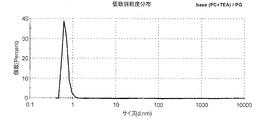
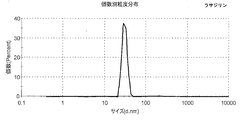
- FIG. 1 is a graph showing the particle size distribution of a solution prepared in a reference production example.
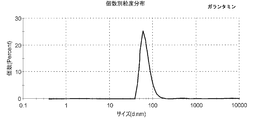
- FIG. 2 is a graph showing the particle size distribution of a colloidal solution containing galantamine hydrobromide prepared in Example 1c.
- FIG. 3 is a graph showing the results of a blood concentration evaluation test of a colloid solution containing galantamine prepared in Examples 1b and 1c.
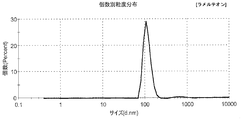
- FIG. 4 is a graph showing the particle size distribution of the colloidal solution containing ramelteon prepared in Example 2a.
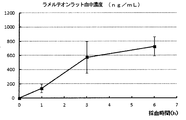
- FIG. 5 is a graph showing the results of a blood concentration evaluation test of a colloid solution containing ramelteon prepared in Example 2a.
- FIG. 6 is a graph showing the particle size distribution of a colloid solution containing rasagiline prepared in Example 3.
- FIG. 1 is a graph showing the particle size distribution of a solution prepared in a reference production example.
- FIG. 2 is a graph showing the particle size distribution of a colloidal solution containing galantamine hydrobromide prepared in Example
- FIG. 7 is a graph showing the particle size distribution of a colloidal solution containing indomethacin prepared in Example 5.
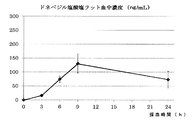
- 8 is a graph showing the results of a blood concentration evaluation test of a colloid solution containing donepezil prepared in Example 6.
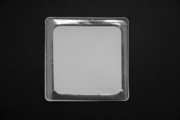
- FIG. 9 is a photograph of the liquid patch used in the blood concentration evaluation test.
- the present invention relates to a transdermal colloidal solution in which a drug and phosphatidylcholine are colloidally dispersed in propylene glycol or a propylene glycol-containing liquid and further contains alkanolamine, a method for producing the same, and the like.
- the “propylene glycol-containing liquid” refers to propylene glycol in which a solubilizing agent such as water and / or a hydrophilic solvent is dissolved and mixed, as described in detail below.
- colloidal dispersion liquid refers to a liquid that exhibits a clear Tyndall phenomenon when irradiated with a red laser beam.
- the average particle size of the dispersoid (colloid particles) in the colloidal dispersion of the present invention is 0.05 to 0.5 ⁇ m, preferably 0.05 to 0.2 ⁇ m. Further, the mode value of the particle diameter is around 0.1 ⁇ m (0.04 to 0.15 ⁇ m). This colloidal dispersion system was stable and no aggregation over time was observed.
- any of neutral drugs, basic drugs, and acidic drugs can be used, and the term “drug” in the present specification includes these pharmacologically acceptable salts.
- a “neutral drug” is a nonionic drug, for example, a drug having a hydroxyl group or an amide group.
- a “basic drug” is a drug having a primary, secondary or tertiary amino group and showing basicity as a compound.
- An “acidic drug” is a drug having a carboxyl group or the like and showing acidity as a compound.
- a neutral drug or a basic drug is particularly preferable because the effects of the present invention such as excellent skin permeability and stability of the liquid agent are particularly remarkably exhibited.
- a compound containing a six-membered ring skeleton and a nitrogen atom-containing group in its structure can be preferably used.
- the six-membered ring in the six-membered ring skeleton may be either a simple ring or a heterocyclic ring.
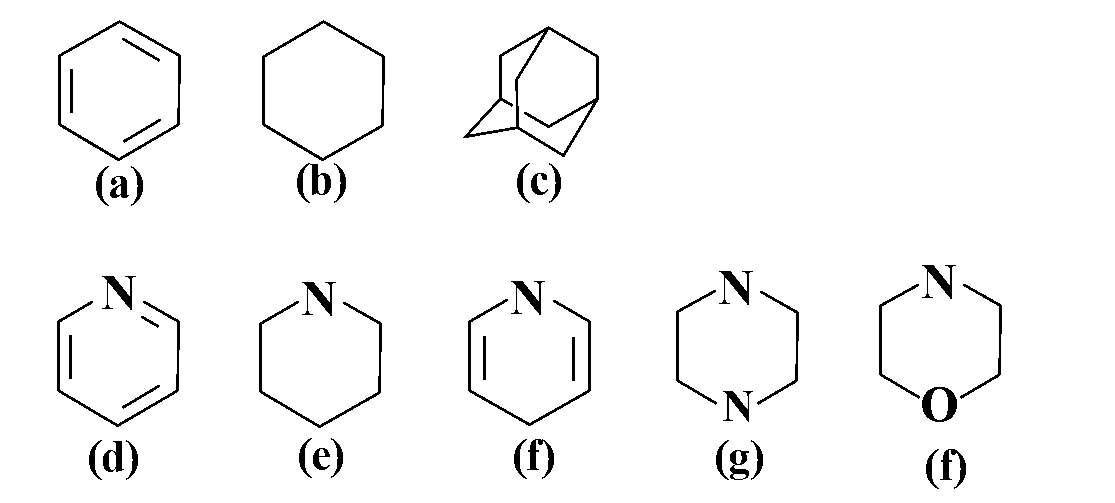
- the six-membered ring includes both a ring having aromaticity and a saturated or unsaturated aliphatic ring which may have a bridged structure. Examples of six-membered monocyclic rings are shown in (a) to (c), and examples of six-membered heterocyclic rings are shown in (d) to (f).
- nitrogen atom-containing groups examples include amino groups, imino groups, amide groups, cyano groups, and nitro groups.
- the nitrogen atom-containing group may be bonded to the above-mentioned six-membered ring skeleton via any organic group.
- the drug contains a six-membered ring containing a nitrogen atom such as pyridine, piperidine, piperazine, morpholine
- the six-membered ring can be recognized as a nitrogen atom-containing group.
- the drug does not need to further contain other nitrogen atom-containing groups.
- the six-membered ring skeleton preferably has a structure represented by the following formula Ia or Ib by having at least two carbon atoms adjacent to each other have a substituent.
- Y is the same or different and represents a carbon atom, a nitrogen atom, an oxygen atom, or a sulfur atom, and n represents an integer of 3 to 5.
- Each atom represented by Y is a single bond or a double bond.
- R ⁇ 1 > and R ⁇ 2 > are the same or different, and show the organic group which may combine with each other or another substituent, and may form the ring, or a hydrogen atom.
- n is preferably 3 or 4, and 3 is particularly preferable.
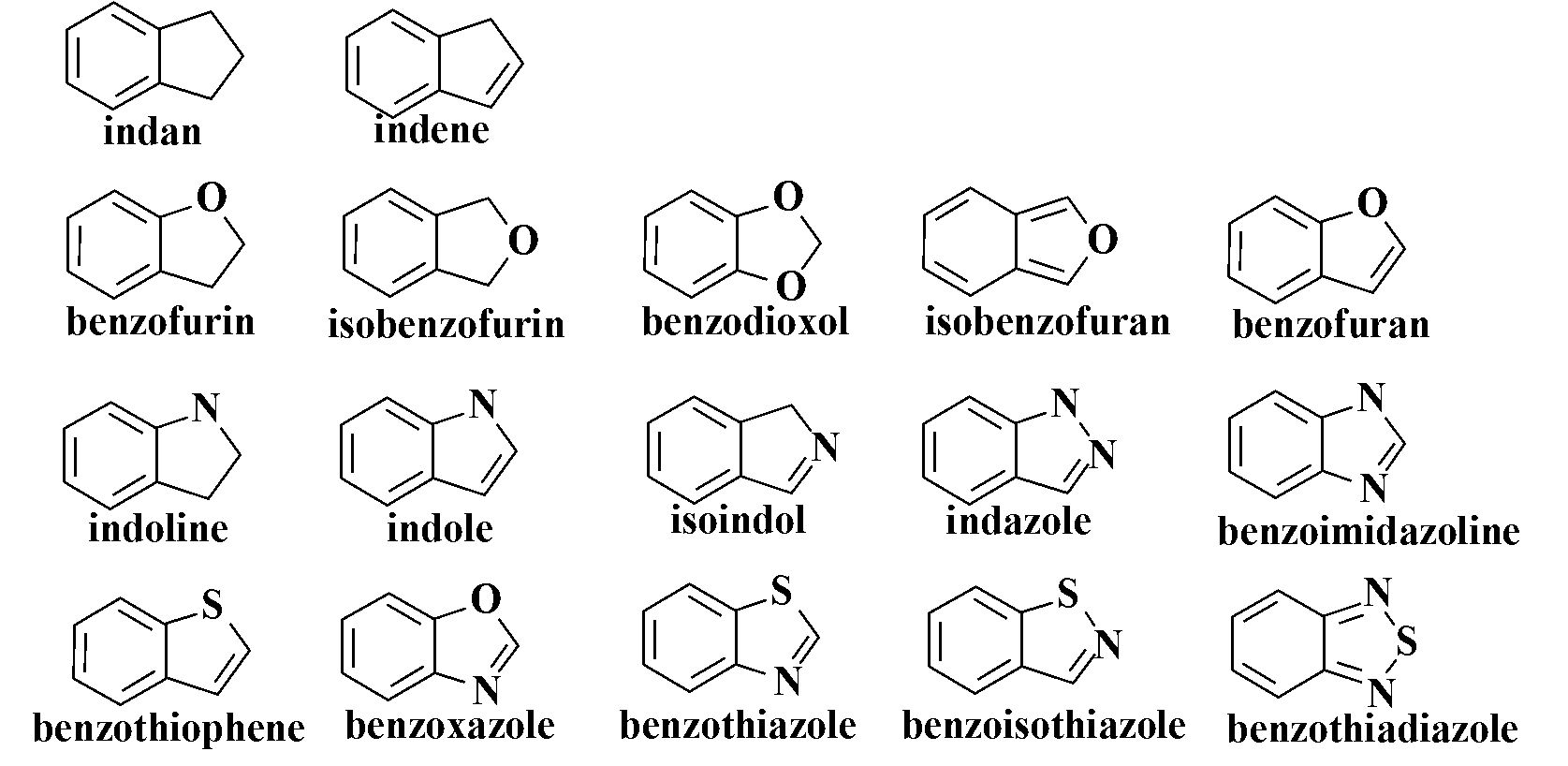
- the structure represented by Formula Ia is, for example, a condensed ring structure composed of a 6-membered ring and a 5-membered ring as shown in Table 2.
- monocyclic rings such as indane and indene; heterocycles containing one oxygen atom such as benzofurin, isobenzofurin, benzofuran, isobenzofuran; heterocycles containing two oxygen atoms such as benzodioxole A heterocycle containing one nitrogen atom such as indoline, indole, isoindole, etc .; a heterocycle containing two nitrogen atoms such as indazole, benzimidazoline; a heterocycle containing a sulfur atom such as benzothiophene; benzoxazole, Examples include heterocycles containing oxygen and nitrogen atoms such as benzoisoxazole; heterocycles containing nitrogen and sulfur atoms such as benzothiadiazole.
- the structure represented by Formula Ia is a structure in which two six-membered rings are condensed. Specifically, naphthalene skeleton, quinoline skeleton, isoquinoline skeleton, cinnoline skeleton, quinazoline skeleton, quinoxaline skeleton And phthalazine skeleton, chroman skeleton and the like.
- Examples of the drug containing such a structure include apomorphine, morphine, oxycodone, pergolide, bromocriptine, propranol, butorphanol, rotigotine, aripiprazole, toxazosin, quinapril, espron, procaterol, azelastine, chlorpromazine and the like.
- the structure represented by the formula Ia is a condensed ring structure composed of a 6-membered ring and a 7-membered ring.
- the drug having such a structure include imiplan, flurazepam, diltiazem, and ketotifen.
- Examples of the drug having the structure represented by the formula Ib include basic drugs in which R 1 and R 2 are both hydrogen atoms such as apomorphine, dopamine and isoprenaline; and R 1 and R 2 such as donepezil, verapamil and oxypertin are both R 1 of an aliphatic hydrocarbon group such as a basic drug, galanthamine, morphine, oxycodone or the like is a hydrogen atom or an aliphatic hydrocarbon group, R 2 is an aliphatic hydrocarbon group, and is a carbon constituting a six-membered ring Examples include basic drugs that form a ring with at least two of the atoms.
- basic drugs containing a pyridine skeleton such as nicamethate and betahistine; diphenidol, fentanyl, morphine, oxycodone, apomorphine, donepezil, methylphenidate, eperisone, pridinol
- Basic drugs containing piperidine skeletons such as triheiphenidyl and perisoxal, basic drugs containing dihydropyridine skeletons such as nicardipine, benidipine and efonidipine; basic drugs containing piperazine skeletons such as flunarizine; bases containing morpholine skeleton such as timolol
- Basic drugs containing an adamantane skeleton such as amantadine, memantine, vildagliptin
- basic drugs containing a benzene ring and a nitrogen atom-containing group basic drugs containing a pyridine skeleton such as nicamethat
- the drug content can be selected from the range of 0.1 to 10 w / w%, preferably 0.5 to 5 w / w%.
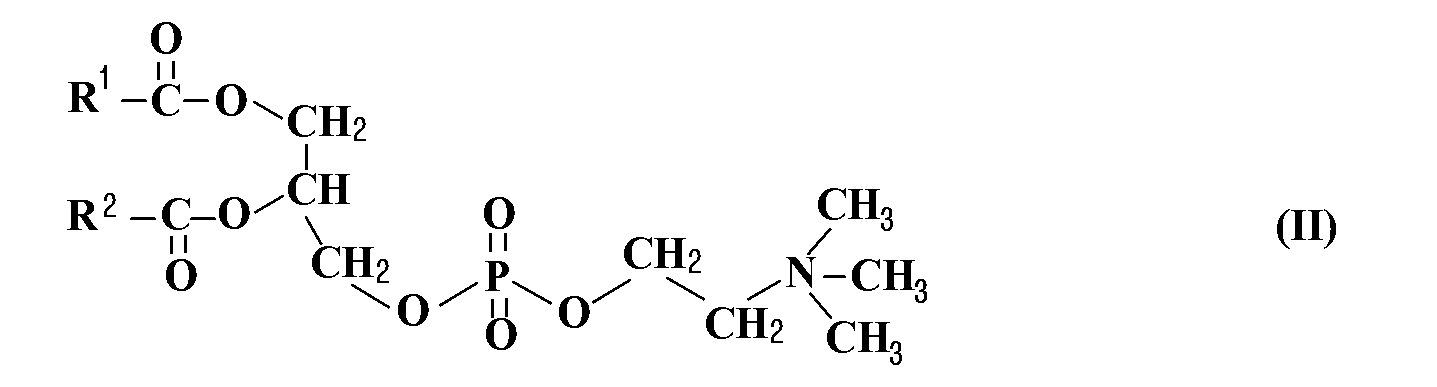
- Phosphatidylcholine is a general term for compounds represented by the formula (II), and is usually provided as a mixture of different types and combinations of R 1 and R 2 .
- R 1 and R 2 are the same or different and represent a C 12-22 hydrocarbon group
- unsaturated phosphatidylcholine in which at least one of R 1 and R 2 is an unsaturated hydrocarbon group can be used.
- R 1 and R 2 may contain saturated hydrocarbon groups such as palmityl group (16: 0) and stearyl group (18: 0), but unsaturated phosphatidylcholine which can be used in the present invention has such saturated carbonization.
- the hydrogen group content is less than 80%, preferably less than 70%, more preferably less than 60%, and particularly preferably less than 50%.
- the unsaturated hydrocarbon group include a paremitrayl group (16: 1), an oleyl group (18: 1), a linoleyl group (18: 2), and a linolenyl group (18: 3).
- the unsaturated phosphatidylcholine preferably has a content of unsaturated hydrocarbon groups having 18 carbon atoms such as an oleyl group, a linoleyl group, and a linolenyl group of 20% or more, more preferably 30% or more, and particularly preferably. Is 40% or more.
- unsaturated phosphatidylcholine is used, a stable colloidal dispersion excellent in skin permeability can be prepared.
- the unsaturated phosphatidylcholine a high-purity phosphatidylcholine which is naturally derived from soybean lecithin, egg yolk lecithin and the like and has a phosphatidylcholine content of 95% or more can be preferably used.
- phosphatidylcholine that has been chemically and / or biologically modified such as hydrogenated phosphatidylcholine that has been subjected to hydrogenation treatment or lysophosphatidylcholine obtained by enzymatic treatment, a stable colloidal dispersion may not be obtained. It is not preferable.
- a phosphatidylcholine that has been chemically and / or biologically modified such as a partially hydrogenated natural lecithin, has a high degree of unsaturation and high purity phosphatidylcholine (for example, the iodine value is 20 or more, Lysolecithin content of less than 10%) can be used as the “unsaturated phosphatidylcholine” of the present invention.
- the iodine value is 20 or more, Lysolecithin content of less than 10%
- the effect of improving transdermal absorbability of the drug is inferior.
- the content of phosphatidylcholine is usually selected from 0.1 to 5 w / w%, preferably 0.2 to 3.0 w / w%, more preferably 0.3 to 2.0 w / w%, particularly preferably 0. 3 to 1.5 w / w%. If the phosphatidylcholine content is less than 0.1 w / w%, a stable colloidal dispersion may not be formed, which is not preferable. Even if phosphatidylcholine is added in excess of 5 w / w%, no improvement in skin permeability depending on the increase in the phosphatidylcholine content is observed.
- the liquid preparation of the present invention in which a drug and phosphatidylcholine are colloidally dispersed in propylene glycol or propylene glycol is excellent in storage stability and skin permeability.
- an alkanolamine is further contained as an absorption enhancer, the drug has skin permeability.
- the alkanolamine primary, secondary, or tertiary alkanolamine having 2 to 12 carbon atoms can be used. Of these, secondary or tertiary alkanolamines are preferred, and tertiary alkanolamines are particularly preferred. Specific examples include diethanolamine, triethanolamine, diisopropanolamine, and triisopropanolamine. Triethanolamine is particularly preferable because of its excellent skin permeation promoting effect.
- the content of alkanolamine is appropriately selected from the range of 0.01 to 10 w / w% depending on the properties of the drug. Many drugs exhibit a significant skin permeation promoting effect in the range of 1 to 8 w / w%, particularly 2 to 5 w / w%. However, for example, addition of alkanolamine exceeding 1 w / w%, such as donepezil hydrochloride described later, may not be preferable.
- the liquid property of the liquid preparation of the present invention is determined by the liquid property presented by dissolving the drug and its salt and the amount of alkanolamine added.
- the liquid property of the present invention is preferably weakly alkaline, but some drugs have poor stability on the alkali side. Therefore, the amount of alkanolamine added can be adjusted as appropriate.
- the amount of triethanolamine added is preferably 0.01 to 0.5 w / w%.
- the pH of the solution can be appropriately adjusted with the amount of alkanolamine added according to the stability of the drug.
- the “propylene glycol” of the present invention is not particularly limited, and commercially available products can be used.
- the colloidal dispersion of the present invention is produced by mixing a drug dissolved in propylene glycol and a phosphatidylcholine dissolved in propylene glycol.
- a dissolution aid is prepared by adding a solubilizing agent such as water or polyethylene glycol to propylene glycol to obtain a propylene glycol-containing liquid, and dissolving the drug in the propylene glycol-containing liquid.
- the addition amount of the solubilizing agent is selected from a range in which the content of propylene glycol in the propylene glycol-containing liquid is 50 w / w% or more, preferably 60 w / w% or more, particularly preferably 65 w / w% or more.
- the amount of the solubilizing agent is large and the content of propylene glycol is small, a stable colloid expressing good drug skin permeability may not be formed, which is not preferable.
- the propylene glycol-containing liquid may further contain a hydrophilic solvent miscible with propylene glycol as necessary.
- a hydrophilic solvent miscible with propylene glycol as necessary.
- Specific examples include polyhydric alcohols such as glycerin and 1,3-butanediol.
- the content of such a hydrophilic solvent is less than 10 w / w% of the propylene glycol-containing liquid.
- polyhydric alcohols such as glycerin and butanediol
- the use of these polyhydric alcohols as a substitute for propylene glycol is not suitable for the colloidal liquid of the present invention.
- phosphatidylcholine when phosphatidylcholine is added to glycerin, liquid turbidity and aggregation of phosphatidylcholine on the liquid surface are observed, and phosphatidylcholine alone tends to form an associated colloid. Furthermore, after drug addition, it tends to gel.
- 1,3-butanediol is used, phosphatidylcholine is completely dissolved as a molecule as in the case of propylene glycol.
- aggregation and precipitation occur in a short time after addition of the drug, unlike in the case of propylene glycol. Tend.
- the liquid agent of the present invention does not contain a hydrophobic solvent.
- the “hydrophobic solvent” is an oily solvent that does not dissolve in propylene glycol at an arbitrary ratio.
- hydrocarbons such as liquid paraffin and squalene; higher fatty acids such as oleic acid, lauric acid, myristic acid, palmitic acid and stearic acid; higher alcohols such as cetyl alcohol, stearyl alcohol and myristyl alcohol;
- fatty acid esters such as isopropyl myristate, isopropyl palmitate, and butyl stearate; and vegetable oils such as olive oil, camellia oil, and jojoba oil.
- the colloidal solution of the present invention contains propylene glycol in an amount of 60 w / w% or more, and is composed only of components that are soluble in propylene glycol or a propylene glycol-containing solution.
- Additives that can be added include fragrances, antioxidants, preservatives, colorants, buffers, pH adjusters, and the like.
- fragrances include ethanol and orange essence.
- antioxidant include tocopherol acetate, sodium edetate, erythorbic acid, 1,3-butylene glycol, sodium pyrosulfite and the like.
- preservative include sorbic acid and taurine.
- pH regulator include organic acids such as citric acid, acetic acid and tartaric acid; and inorganic acids such as phosphoric acid and hydrochloric acid.
- an ultraviolet absorber or an antibacterial agent can be added according to the purpose.
- the colloidal dispersion of the present invention can be produced by mixing a drug dissolved in propylene glycol or a propylene glycol-containing liquid and a phosphatidylcholine dissolved in propylene glycol or a propylene glycol-containing liquid.
- a true solution is obtained, and a particle diameter of 10 nm or more is not observed (see Reference Production Example and FIG. 1).
- no Tyndall phenomenon is observed in any of these drug solutions and phosphatidylcholine solutions.
- a colloidal dispersion exhibiting a Tyndall phenomenon is obtained, and the mode value of the particle diameter is observed around 100 nm.
- a solution (solution I) in which a drug is dissolved in propylene glycol or a propylene glycol-containing solution and a solution (II) in which phosphatidylcholine is dissolved in propylene glycol or a propylene glycol-containing solution Liquid) and the liquid I and the liquid II are mixed;
- the liquid I is mixed with phosphatidylcholine;
- the drug is mixed with the liquid II;
- the drug and the phosphatidylcholine are mixed with propylene glycol or propylene glycol liquid
- Examples of the method for simultaneously adding are not particularly limited.
- the method of preparing each of liquid I and liquid II and mixing them is excellent in that it can be confirmed with certainty that the drug and phosphatidylcholine are in a dissolved state.
- a stable colloidal dispersion having an average particle diameter of 50 to 500 nm can be obtained by mixing a drug in a dissolved state with phosphatidylcholine in a dissolved state and stirring.
- Alkanolamine and other additives can be added at any time.
- the method for applying the solution of the present invention to the skin is not particularly limited, and examples thereof include a method of applying or spraying the solution, and a method of attaching an appropriate carrier carrying the solution on the skin.
- the method of sticking a foamed matrix carrying a liquid is preferable from the viewpoint of easy dose adjustment and handling.
- the “foaming matrix” is a porous body obtained by foaming a resin by a physical or chemical method, and specific examples thereof include polyurethane foam.
- Polyurethane foam is a foam formed by mixing a foaming agent, a foam stabilizer, a catalyst, a colorant, and the like when the polyol is reacted with polyisocyanate for polymerization.
- Polyurethane foam is also abbreviated as urethane foam, and is roughly divided into the following three by the foaming method.
- a bubble that communicates and is soft and has a restorability is called “soft urethane foam”, and a cell that is closed and hard and has no restorability is called “hard urethane foam”.
- An intermediate property is called “semi-rigid urethane foam”. Since there is little communication of air bubbles and a discontinuous type hard urethane foam carries a chemical solution, it is preferable because there is little leakage.
- Example 1a containing phosphatidylcholine showed superior skin permeability compared to the solution of Comparative Example 1a not containing phosphatidylcholine.
- the solution of Example 1b further containing ethanolamine further improved skin permeability compared to the solution of Example 1a.
- the liquid preparation of Comparative Example 1b in which lysolecithin was added instead of phosphatidylcholine did not show the Tyndall phenomenon and improved skin permeability.
- Example 1c About the liquid agent of Example 1c, the particle size distribution was measured by Zeta Sizer Nano (made by Malvern). A mode value of the particle diameter was observed around 70 nm. The measurement results are shown in FIG. A liquid type patch was prepared by impregnating the liquid agent (0.08 g) of Example 1b and Example 1c into urethane foam (area: 2 cm 2 thickness: 0.5 mm, bulk density 0.2 g / cm 3 ). The prepared liquid patch was applied to the back of a rat (5 weeks old, male), and the change in blood concentration of the rat was evaluated according to a conventional method. The results are shown in FIG. Both the solution of Example 1b using the free form and the solution of Example 1c using hydrobromide showed good transdermal absorbability, and there was no difference in the transition of blood concentration. .
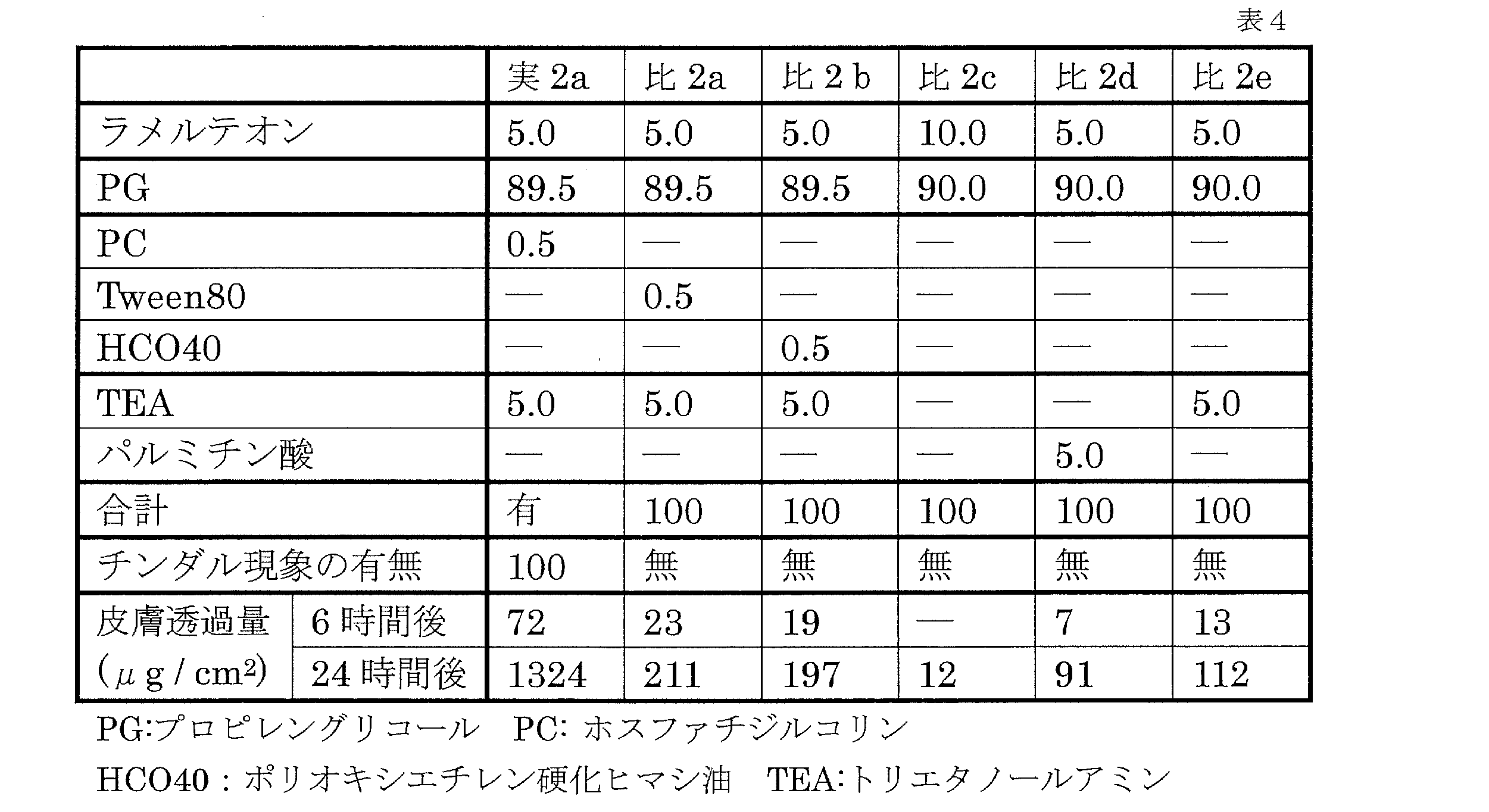
- Comparative Examples 2a to 2e that did not contain phosphatidylcholine did not form a colloidal solution and had poor transdermal absorbability.
- Comparative examples 2a and 2b using Tween 80 and HCO 40 having a surface-active action in the same manner as phosphatidylcholine in place of phosphatidylcholine are not colloidally dispersed and no significant improvement in skin permeability is observed. There is a unique transdermal absorption promoting activity different from surfactants.
- Example 2a The liquid agent (0.3 g) of Example 2a was impregnated into urethane foam (area: 9 cm 2 thickness: 0.5 mm bulk density 0.2 g / cm 3 ) to prepare a liquid patch.
- the prepared liquid patch was applied to the back of a rat (5 weeks old, male), and the change in the blood concentration of the rat was evaluated according to a conventional method. The results are shown in FIG.
- the patch after 6 hours of rat application was collected, and the amount of ramelteon remaining in the preparation and on the skin surface was measured.
- the residual rate of ramelteon was about 65%. That is, about 35% of ramelteon contained in the preparation was transferred into the blood.
- the amount of ramelteon released was about 5.5 mg / sheet.
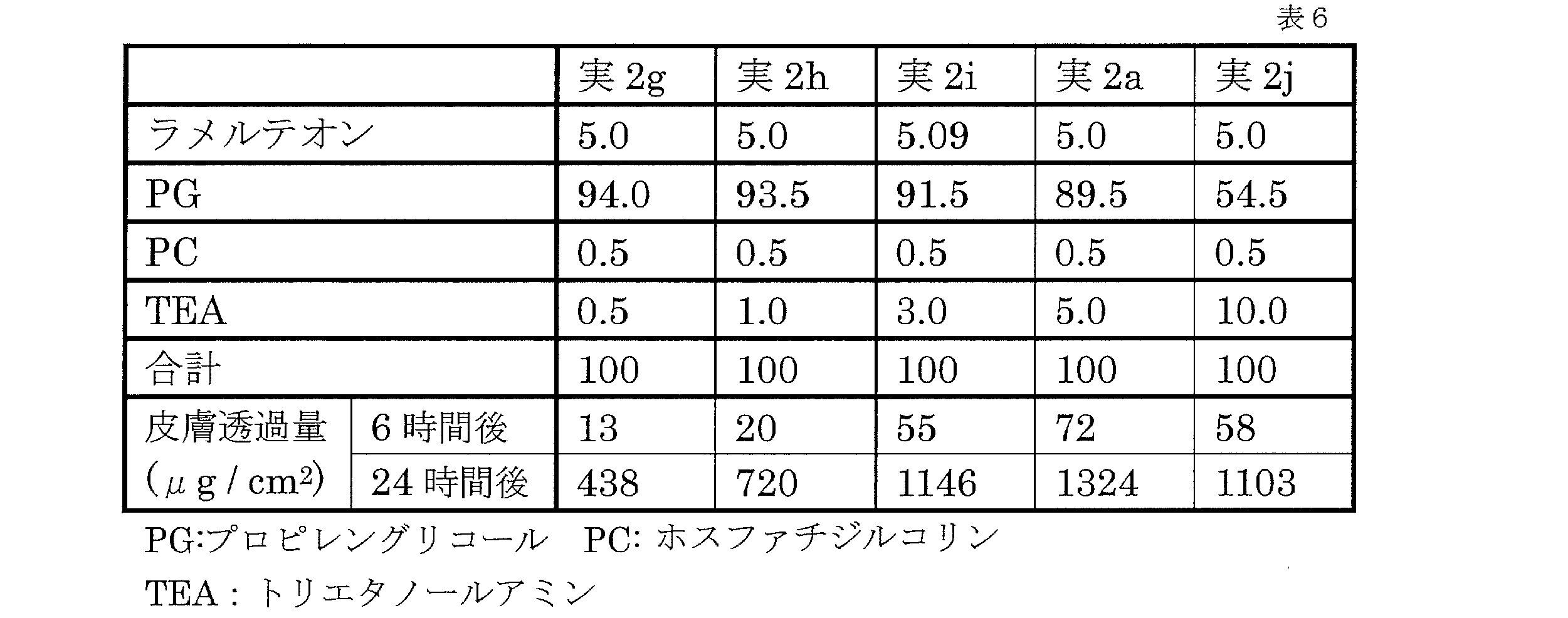
- the skin permeation amount increases depending on the content of phosphatidylcholine, but no significant increase in skin permeation amount is observed even when phosphatidylcholine is added in excess of 0.5 w / w%. Therefore, the content of phosphatidylcholine is usually selected from the range of 0.1 to 5 w / w%, preferably 0.3 to 2.0 w / w%. Triethanolamine exhibited a remarkable absorption promoting effect in a short time compared to other absorption promoters such as diethanolamine and diisopropanol.
- the amount of skin permeation increased. Since the skin permeation amount does not increase even if the content exceeds 5 w / w%, the content of triethanolamine can be selected from the range of 0.01 to 10 w / w%, but in order to obtain a sufficient absorption promoting effect Is preferably 1 to 8 w / w%, particularly preferably 2.5 to 5.5 w / w%.
- the colloidal solution containing phosphatidylcholine markedly increased the amount of skin permeation compared to the solution containing no phosphatidylcholine, and the amount of skin permeation increased dramatically by the addition of triethanolamine.
- the colloid solution of the present invention exhibits excellent skin permeability for any of basic drugs, neutral drugs, and acidic drugs.
- Example 6 The liquid agent (0.18 g) of Example 6 was impregnated into urethane foam (area: 6 cm 2 thickness: 0.5 mm bulk density 0.2 g / cm 3 ) to prepare a liquid patch.
- the prepared liquid patch was applied to the back of a rat (5 weeks old, male), and the change in the blood concentration of the rat was evaluated according to a conventional method.
- the results are shown in FIG.
- Donepezil is a drug that has been reported to cause skin irritation, but no abnormalities such as erythema were observed on the skin of the rat after peeling the patch. This is presumably due to the skin protective effect of phosphatidylcholine.
- the colloid solution of the present invention can be used as a solution for transdermal administration of various drugs.
Landscapes
- Health & Medical Sciences (AREA)
- Chemical & Material Sciences (AREA)
- Life Sciences & Earth Sciences (AREA)
- Veterinary Medicine (AREA)
- Pharmacology & Pharmacy (AREA)
- Public Health (AREA)
- General Health & Medical Sciences (AREA)
- Animal Behavior & Ethology (AREA)
- Epidemiology (AREA)
- Medicinal Chemistry (AREA)
- Oil, Petroleum & Natural Gas (AREA)
- General Chemical & Material Sciences (AREA)
- Chemical Kinetics & Catalysis (AREA)
- Engineering & Computer Science (AREA)
- Molecular Biology (AREA)
- Biophysics (AREA)
- Dermatology (AREA)
- Proteomics, Peptides & Aminoacids (AREA)
- Medicinal Preparation (AREA)
- Pharmaceuticals Containing Other Organic And Inorganic Compounds (AREA)
Abstract
Description
ホスファチジルコリンを含有する経皮外用液剤としては、L-カルニチンを用いてホスファチジルコリンの優れた経皮吸収を実現した液剤(特許文献1)や、ロピニロール塩酸塩の水中油滴エマルション型の液剤(特許文献2)が知られている。
(1) 薬物又はその塩が、ホスファチジルコリンの存存下にプロピレングリコール又はプロピレングリコール含有液中でコロイド分散しており、疎水性溶媒を含まない、経皮吸収型コロイド液剤。
(2) さらに、アルカノールアミンを含む、上記(1)に記載の経皮吸収型コロイド液剤。
(3) アルカノールアミンがトリエタノールアミンである、上記(1)又は(2)に記載の経皮吸収型コロイド液剤。
(4) 薬物が、その構造中に六員環骨格及び窒素原子含有基を含む薬物である、上記(1)~(3)のいずれかに記載の経皮吸収型コロイド液剤。
(5) (6)コロイドの平均粒子径が50~500nmである、上記(1)~(5)のいずれかに記載の経皮吸収型コロイド液剤。
(7) ホスファチジルコリンが、0.1から5w/w%含有される、上記(1)~(6)のいずれかに記載の経皮吸収型コロイド液剤。
(8) ホスファチジルコリンが、不飽和ホスファチジルコリンである、上記(1)~(7)のいずれかに記載の経皮吸収型コロイド液剤。
(9) アルカノールアミンが、0.01~10w/w%含有される、上記(2)~(8)のいずれかに記載の経皮吸収型コロイド液剤。
(10) ホスファチジルコリンが、卵黄ホスファチジルコリン、大豆ホスファチジルコリンの中から1つ以上が選択される、上記(1)~(9)のいずれかに記載の経皮吸収型コロイド液剤。
(12) 更に、アルカノールアミンを添加する工程を含む、上記(11)に記載の経皮吸収型コロイド液剤の製造方法。
(13) アルカノールアミンがトリエタノールアミンである、上記(11)又は(12)に記載の経皮吸収型コロイド液剤の製造方法。
(14) コロイドの平均粒子径が50~500nmである、上記(11)~(13)のいずれかに記載の経皮吸収型コロイド液剤の製造方法。
(15) ホスファチジルコリンが、0.1から5w/w%含有される、上記(11)~(14)のいずれかに記載の経皮吸収型コロイド液剤の製造方法。
(16) ホスファチジルコリンが、不飽和ホスファチジルコリンである、上記(11)~(15)のいずれかに記載の経皮吸収型コロイド液剤の製造方法。
(17) アルカノールアミンが、0.01から10w/w%含有される、上記(11)~(16)のいずれかに記載の経皮吸収型コロイド液剤の製造方法。
(18) ホスファチジルコリンが、卵黄ホスファチジルコリン、大豆ホスファチジルコリンの中から1つ以上が選択されるものである、上記(11)~(17)のいずれかに記載の経皮吸収型コロイド液剤の製造方法。
(20) 発泡マトリックスが発泡ウレタンフォームである、上記(19)に記載の液型貼付剤。
(21) 薬物またはその塩を、プロピレングリコール又はプロピレングリコール含有液中でコロイド分散させるための、ホスファチジルコリンの使用。
(22) ホスファチジルコリンが、卵黄ホスファチジルコリン、大豆ホスファチジルコリンの中から1つ以上が選択されるものである、上記(21)に記載の使用。


プロピレングリコール(94.5重量部)にホスファチジルコリン(0.5重量部)を溶解し、さらにトリエタノールアミン(5重量部)を添加撹拌して澄明な液体を得た。当該液体に赤色レーザーを照射したが、チンダル現象は観察されなかった。ゼーターサイザーナノ(マルバーン社製)により粒度分布を測定したところ、粒径1nm以上に分布は観測されなかった。粒度分布の測定結果を図1に示す。
(実施例1a~1c)及び(比較例1a~1c)
表3に示す組成で液剤を調製した。得られた澄明な液剤に赤色レーザー光を照射して、チンダル現象の有無を観察した。また、得られた液剤についてフランツセルを用いてガランタミンの皮膚透過性を評価した。試験に用いた皮膚は5週齢ヘアレスラット(雄)腹部摘出皮膚であり、レセプター溶液は(水:エタノール=9:1)溶液であった。結果を表3に併せて示す。

(実施例2a)及び(比較例2a~2e)
表4に示す組成(w/w%)で液剤を調製した。得られた液剤についてラメルテオンの皮膚透過性をフランツセルにより評価した。結果を併せて表4に示す。実2aの液剤についてゼーターサイザーナノ(マルバーン社製)により粒度分布を測定した。110nm付近に粒子径の最頻値が観測された。結果を図4に示す。フランツセル試験に用いた皮膚は5週齢ヘアレスラット(雄)腹部摘出皮膚であり、レセプター溶液は(水:エタノール=9:1)溶液であった。
(実施例2b~2f)
表5に示す組成(w/w%)で液剤を調製し、各液剤についてフランツセルを用いて皮膚透過性を評価した。評価結果を併せて表5に示す。フランツセル試験に用いた皮膚は5週齢ヘアレスラット(雄)腹部摘出皮膚であり、レセプター溶液は(水:エタノール=9:1)溶液であった。

(実施例2g~2j)
表6に示す組成(w/w%)で液剤を調製し、各液剤についてフランツセルを用いて皮膚透過性を評価した。評価結果を併せて表6に示す。試験に用いた皮膚は5週齢ヘアレスラット(雄)腹部摘出皮膚であり、レセプター溶液は(水:エタノール=9:1)溶液であった。
(実施例3~7b)及び(比較例3~比較例7)
表7及び表8に示す組成(w/w%)で液剤を調製し、各液剤についてフランツセルを用いて皮膚透過性を評価した。評価結果を併せて表7及び表8に示す。実施例3及び実施例5の液剤について、ゼーターサイザーナノ(マルバーン社製)により粒度分布を測定した。結果を図6及び図7に示す。試験に用いた皮膚は5週齢ヘアレスラット(雄)腹部摘出皮膚であり、レセプター溶液は(水:エタノール=9:1)溶液であった。


Claims (9)
- 薬物またはその塩が、ホスファチジルコリン存存下にプロピレングリコール又はプロピレングリコール含有液中でコロイド分散しており、疎水性溶媒を含まない、経皮吸収型コロイド液剤。
- さらに、アルカノールアミンを含む、請求項1に記載の経皮吸収型コロイド液剤。
- アルカノールアミンがトリエタノールアミンである、請求項1又は2に記載の経皮吸収型コロイド液剤。
- 薬物が、その構造中に六員環骨格及び窒素原子含有基を含む、請求項1~3いずれかの項に記載の経皮吸収型コロイド液剤。
- コロイドの平均粒子径が50~500nmである、請求項1~4いずれかの項に記載の経皮吸収型コロイド液剤。
- ホスファチジルコリンの含有量が、0.1~5w/w%である、請求項1~5いずれかの項に記載の経皮吸収型コロイド液剤。
- ホスファチジルコリンが、不飽和ホスファチジルコリンである、請求項1~6いずれかの項に記載の経皮吸収型コロイド液剤。
- アルカノールアミンの含有量が、0.01~10w/w%である、請求項2~7いずれかの項に記載の経皮吸収型コロイド液剤
- ホスファチジルコリンが、卵黄ホスファチジルコリン、大豆ホスファチジルコリンの中から1つ以上が選択される、請求項1~8いずれかの項に記載の経皮吸収型コロイド液剤。
Priority Applications (5)
| Application Number | Priority Date | Filing Date | Title |
|---|---|---|---|
| EP14862046.1A EP3069712B1 (en) | 2013-11-17 | 2014-11-17 | Transdermal colloidal solution agent |
| JP2015547814A JP6502855B2 (ja) | 2013-11-17 | 2014-11-17 | 経皮吸収型コロイド液剤 |
| CN201480062541.5A CN105722502A (zh) | 2013-11-17 | 2014-11-17 | 经皮吸收胶体型液体制剂 |
| ES14862046T ES2831319T3 (es) | 2013-11-17 | 2014-11-17 | Formulación líquida coloidal absorbente transdérmica |
| US15/156,244 US11660344B2 (en) | 2013-11-17 | 2016-05-16 | Transdermal colloidal solution agent |
Applications Claiming Priority (4)
| Application Number | Priority Date | Filing Date | Title |
|---|---|---|---|
| JP2013-237494 | 2013-11-17 | ||
| JP2013237494 | 2013-11-17 | ||
| JP2014-033471 | 2014-02-24 | ||
| JP2014033471 | 2014-02-24 |
Related Child Applications (1)
| Application Number | Title | Priority Date | Filing Date |
|---|---|---|---|
| US15/156,244 Continuation-In-Part US11660344B2 (en) | 2013-11-17 | 2016-05-16 | Transdermal colloidal solution agent |
Publications (1)
| Publication Number | Publication Date |
|---|---|
| WO2015072564A1 true WO2015072564A1 (ja) | 2015-05-21 |
Family
ID=53057496
Family Applications (1)
| Application Number | Title | Priority Date | Filing Date |
|---|---|---|---|
| PCT/JP2014/080328 Ceased WO2015072564A1 (ja) | 2013-11-17 | 2014-11-17 | 経皮吸収型コロイド液剤 |
Country Status (5)
| Country | Link |
|---|---|
| EP (1) | EP3069712B1 (ja) |
| JP (1) | JP6502855B2 (ja) |
| CN (1) | CN105722502A (ja) |
| ES (1) | ES2831319T3 (ja) |
| WO (1) | WO2015072564A1 (ja) |
Cited By (4)
| Publication number | Priority date | Publication date | Assignee | Title |
|---|---|---|---|---|
| WO2018190313A1 (ja) * | 2017-04-11 | 2018-10-18 | 株式会社メドレックス | メマンチン含有経皮吸収型液剤 |
| JP2019525932A (ja) * | 2016-07-27 | 2019-09-12 | コリウム インターナショナル, インコーポレイテッド | 炭酸水素ナトリウムのin situ変換で促進されたアミン薬物の経皮送達 |
| JP2022044038A (ja) * | 2020-09-04 | 2022-03-16 | 株式会社大石膏盛堂 | ドネペジル含有経皮吸収液剤およびその製造方法 |
| US11660344B2 (en) | 2013-11-17 | 2023-05-30 | Medrx Co., Ltd. | Transdermal colloidal solution agent |
Citations (4)
| Publication number | Priority date | Publication date | Assignee | Title |
|---|---|---|---|---|
| WO2010126501A1 (en) * | 2009-04-29 | 2010-11-04 | University Of Kentucky Research Foundation | Cannabinoid-containing compositions and methods for their use |
| WO2011024354A1 (ja) | 2009-08-25 | 2011-03-03 | 株式会社メドレックス | ホスファチジルコリンの経皮投与組成物とその製造方法 |
| WO2011111384A1 (ja) | 2010-03-11 | 2011-09-15 | 株式会社メドレックス | パーキンソン病治療薬を含有する経皮用組成物 |
| WO2011136288A1 (ja) | 2010-04-28 | 2011-11-03 | 久光製薬株式会社 | ドネペジル含有経皮吸収製剤 |
Family Cites Families (6)
| Publication number | Priority date | Publication date | Assignee | Title |
|---|---|---|---|---|
| JP3313891B2 (ja) * | 1994-06-21 | 2002-08-12 | ポーラ化成工業株式会社 | 経皮吸収促進剤及び皮膚外用剤 |
| ES2411656T3 (es) * | 2002-03-13 | 2013-07-08 | Thomas SKÖLD | Sistemas de administración a base de agua |
| JP4311728B2 (ja) * | 2003-12-10 | 2009-08-12 | ニチバン株式会社 | 経皮吸収型貼付剤 |
| ITMI20060122A1 (it) * | 2006-01-25 | 2007-07-26 | Polichem Sa | Composizioni per uso vaginale |
| EP2344198B1 (en) * | 2008-09-27 | 2020-11-04 | Jina Pharmaceuticals Inc. | Lipid based pharmaceutical preparations for topical application |
| JP5820207B2 (ja) * | 2011-09-13 | 2015-11-24 | 日東電工株式会社 | 経皮吸収促進用組成物および貼付製剤 |
-
2014
- 2014-11-17 JP JP2015547814A patent/JP6502855B2/ja not_active Expired - Fee Related
- 2014-11-17 ES ES14862046T patent/ES2831319T3/es active Active
- 2014-11-17 WO PCT/JP2014/080328 patent/WO2015072564A1/ja not_active Ceased
- 2014-11-17 CN CN201480062541.5A patent/CN105722502A/zh active Pending
- 2014-11-17 EP EP14862046.1A patent/EP3069712B1/en active Active
Patent Citations (4)
| Publication number | Priority date | Publication date | Assignee | Title |
|---|---|---|---|---|
| WO2010126501A1 (en) * | 2009-04-29 | 2010-11-04 | University Of Kentucky Research Foundation | Cannabinoid-containing compositions and methods for their use |
| WO2011024354A1 (ja) | 2009-08-25 | 2011-03-03 | 株式会社メドレックス | ホスファチジルコリンの経皮投与組成物とその製造方法 |
| WO2011111384A1 (ja) | 2010-03-11 | 2011-09-15 | 株式会社メドレックス | パーキンソン病治療薬を含有する経皮用組成物 |
| WO2011136288A1 (ja) | 2010-04-28 | 2011-11-03 | 久光製薬株式会社 | ドネペジル含有経皮吸収製剤 |
Non-Patent Citations (5)
| Title |
|---|
| ADENAN AZEEM ET AL., DRUG DEVELOPMENT AND INDUSTRIAL |
| MANCONI ET AL.: "Penetration enhancer containing vesicles as carriers for dermal delivery of tretinoin", INTERNATIONAL JOURNAL OF PHARMACEUTICS, 2011, pages 37 - 46, XP055285752 * |
| P. SANTOS ET AL., SKIN PHARMACOL PHYSIOL, vol. 21, 2008, pages 246 - 259 |
| See also references of EP3069712A4 * |
| ZHAO ET AL.: "Selection of high efficient transdermal lipid vesicle for curcumin skin delivery", INTERNATIONAL JOURNAL OF PHARMACEUTICS, vol. 454, no. NEN 7, 2013, pages 302 - 309, XP055126433 * |
Cited By (7)
| Publication number | Priority date | Publication date | Assignee | Title |
|---|---|---|---|---|
| US11660344B2 (en) | 2013-11-17 | 2023-05-30 | Medrx Co., Ltd. | Transdermal colloidal solution agent |
| JP2019525932A (ja) * | 2016-07-27 | 2019-09-12 | コリウム インターナショナル, インコーポレイテッド | 炭酸水素ナトリウムのin situ変換で促進されたアミン薬物の経皮送達 |
| JP7071330B2 (ja) | 2016-07-27 | 2022-05-18 | コリウム, インコーポレイテッド | 炭酸水素ナトリウムのin situ変換で促進されたアミン薬物の経皮送達 |
| US11141387B2 (en) | 2017-01-05 | 2021-10-12 | Medrx Co., Ltd. | Memantine-containing transdermally absorbable liquid |
| WO2018190313A1 (ja) * | 2017-04-11 | 2018-10-18 | 株式会社メドレックス | メマンチン含有経皮吸収型液剤 |
| CN110325180A (zh) * | 2017-04-11 | 2019-10-11 | 株式会社梅德瑞科思 | 含有美金刚的经皮吸收型液体制剂 |
| JP2022044038A (ja) * | 2020-09-04 | 2022-03-16 | 株式会社大石膏盛堂 | ドネペジル含有経皮吸収液剤およびその製造方法 |
Also Published As
| Publication number | Publication date |
|---|---|
| EP3069712B1 (en) | 2020-09-23 |
| CN105722502A (zh) | 2016-06-29 |
| JP6502855B2 (ja) | 2019-04-17 |
| JPWO2015072564A1 (ja) | 2017-03-16 |
| EP3069712A1 (en) | 2016-09-21 |
| ES2831319T3 (es) | 2021-06-08 |
| EP3069712A4 (en) | 2016-11-16 |
Similar Documents
| Publication | Publication Date | Title |
|---|---|---|
| EP3142648B1 (de) | Verwendung von semifluorierten alkanen in transdermalen therapeutischen systemen | |
| MX2011004454A (es) | Composicion topica que comprenden una combinacion de al menos dos agentes mejoradores de penetracion. | |
| US11660344B2 (en) | Transdermal colloidal solution agent | |
| EP1150675B1 (en) | A transdermal composition of an antivomiting agent and a preparation containing the same | |
| WO2014051128A1 (ja) | 貼付剤 | |
| TWI515022B (zh) | 經皮吸收型製劑 | |
| JP6502855B2 (ja) | 経皮吸収型コロイド液剤 | |
| KR101819249B1 (ko) | 케토프로펜 함유 수성 첩부제 | |
| WO2013081014A1 (ja) | 貼付剤 | |
| WO2014181840A1 (ja) | 貼付剤 | |
| CN110139641B (zh) | 外用组合物 | |
| US9254325B2 (en) | Percutaneously absorbed preparation | |
| CN107613961B (zh) | 经皮吸收型液体制剂 | |
| WO2015125969A1 (ja) | トリプタン系薬剤の経皮吸収型製剤 | |
| CN115666571B (zh) | 含有阿扑吗啡的经皮吸收型制剂 | |
| HK1161683A (en) | Topical composition comprising a combination of at least two penetration enhancing agents |
Legal Events
| Date | Code | Title | Description |
|---|---|---|---|
| 121 | Ep: the epo has been informed by wipo that ep was designated in this application |
Ref document number: 14862046 Country of ref document: EP Kind code of ref document: A1 |
|
| ENP | Entry into the national phase |
Ref document number: 2015547814 Country of ref document: JP Kind code of ref document: A |
|
| NENP | Non-entry into the national phase |
Ref country code: DE |
|
| REEP | Request for entry into the european phase |
Ref document number: 2014862046 Country of ref document: EP |
|
| WWE | Wipo information: entry into national phase |
Ref document number: 2014862046 Country of ref document: EP |