WO2015083737A1 - 難燃性樹脂組成物、及び、これを用いたケーブル - Google Patents
難燃性樹脂組成物、及び、これを用いたケーブル Download PDFInfo
- Publication number
- WO2015083737A1 WO2015083737A1 PCT/JP2014/081971 JP2014081971W WO2015083737A1 WO 2015083737 A1 WO2015083737 A1 WO 2015083737A1 JP 2014081971 W JP2014081971 W JP 2014081971W WO 2015083737 A1 WO2015083737 A1 WO 2015083737A1
- Authority
- WO
- WIPO (PCT)
- Prior art keywords
- flame retardant
- mass
- parts
- resin composition
- polyolefin resin
- Prior art date
- Legal status (The legal status is an assumption and is not a legal conclusion. Google has not performed a legal analysis and makes no representation as to the accuracy of the status listed.)
- Ceased
Links
Images

Classifications
-
- C—CHEMISTRY; METALLURGY
- C08—ORGANIC MACROMOLECULAR COMPOUNDS; THEIR PREPARATION OR CHEMICAL WORKING-UP; COMPOSITIONS BASED THEREON
- C08L—COMPOSITIONS OF MACROMOLECULAR COMPOUNDS
- C08L23/00—Compositions of homopolymers or copolymers of unsaturated aliphatic hydrocarbons having only one carbon-to-carbon double bond; Compositions of derivatives of such polymers
- C08L23/02—Compositions of homopolymers or copolymers of unsaturated aliphatic hydrocarbons having only one carbon-to-carbon double bond; Compositions of derivatives of such polymers not modified by chemical after-treatment
- C08L23/04—Homopolymers or copolymers of ethene
- C08L23/06—Polyethylene
-
- C—CHEMISTRY; METALLURGY
- C08—ORGANIC MACROMOLECULAR COMPOUNDS; THEIR PREPARATION OR CHEMICAL WORKING-UP; COMPOSITIONS BASED THEREON
- C08K—Use of inorganic or non-macromolecular organic substances as compounding ingredients
- C08K5/00—Use of organic ingredients
- C08K5/04—Oxygen-containing compounds
- C08K5/09—Carboxylic acids; Metal salts thereof; Anhydrides thereof
- C08K5/098—Metal salts of carboxylic acids
-
- C—CHEMISTRY; METALLURGY
- C08—ORGANIC MACROMOLECULAR COMPOUNDS; THEIR PREPARATION OR CHEMICAL WORKING-UP; COMPOSITIONS BASED THEREON
- C08L—COMPOSITIONS OF MACROMOLECULAR COMPOUNDS
- C08L23/00—Compositions of homopolymers or copolymers of unsaturated aliphatic hydrocarbons having only one carbon-to-carbon double bond; Compositions of derivatives of such polymers
- C08L23/02—Compositions of homopolymers or copolymers of unsaturated aliphatic hydrocarbons having only one carbon-to-carbon double bond; Compositions of derivatives of such polymers not modified by chemical after-treatment
-
- C—CHEMISTRY; METALLURGY
- C08—ORGANIC MACROMOLECULAR COMPOUNDS; THEIR PREPARATION OR CHEMICAL WORKING-UP; COMPOSITIONS BASED THEREON
- C08L—COMPOSITIONS OF MACROMOLECULAR COMPOUNDS
- C08L23/00—Compositions of homopolymers or copolymers of unsaturated aliphatic hydrocarbons having only one carbon-to-carbon double bond; Compositions of derivatives of such polymers
- C08L23/02—Compositions of homopolymers or copolymers of unsaturated aliphatic hydrocarbons having only one carbon-to-carbon double bond; Compositions of derivatives of such polymers not modified by chemical after-treatment
- C08L23/04—Homopolymers or copolymers of ethene
- C08L23/08—Copolymers of ethene
- C08L23/0846—Copolymers of ethene with unsaturated hydrocarbons containing atoms other than carbon or hydrogen
- C08L23/0853—Ethylene vinyl acetate copolymers
-
- C—CHEMISTRY; METALLURGY
- C08—ORGANIC MACROMOLECULAR COMPOUNDS; THEIR PREPARATION OR CHEMICAL WORKING-UP; COMPOSITIONS BASED THEREON
- C08L—COMPOSITIONS OF MACROMOLECULAR COMPOUNDS
- C08L23/00—Compositions of homopolymers or copolymers of unsaturated aliphatic hydrocarbons having only one carbon-to-carbon double bond; Compositions of derivatives of such polymers
- C08L23/02—Compositions of homopolymers or copolymers of unsaturated aliphatic hydrocarbons having only one carbon-to-carbon double bond; Compositions of derivatives of such polymers not modified by chemical after-treatment
- C08L23/04—Homopolymers or copolymers of ethene
- C08L23/08—Copolymers of ethene
- C08L23/0846—Copolymers of ethene with unsaturated hydrocarbons containing atoms other than carbon or hydrogen
- C08L23/0869—Copolymers of ethene with unsaturated hydrocarbons containing atoms other than carbon or hydrogen with unsaturated acids, e.g. [meth]acrylic acid; with unsaturated esters, e.g. [meth]acrylic acid esters
-
- C—CHEMISTRY; METALLURGY
- C08—ORGANIC MACROMOLECULAR COMPOUNDS; THEIR PREPARATION OR CHEMICAL WORKING-UP; COMPOSITIONS BASED THEREON
- C08L—COMPOSITIONS OF MACROMOLECULAR COMPOUNDS
- C08L23/00—Compositions of homopolymers or copolymers of unsaturated aliphatic hydrocarbons having only one carbon-to-carbon double bond; Compositions of derivatives of such polymers
- C08L23/02—Compositions of homopolymers or copolymers of unsaturated aliphatic hydrocarbons having only one carbon-to-carbon double bond; Compositions of derivatives of such polymers not modified by chemical after-treatment
- C08L23/10—Homopolymers or copolymers of propene
- C08L23/12—Polypropene
-
- C—CHEMISTRY; METALLURGY
- C08—ORGANIC MACROMOLECULAR COMPOUNDS; THEIR PREPARATION OR CHEMICAL WORKING-UP; COMPOSITIONS BASED THEREON
- C08L—COMPOSITIONS OF MACROMOLECULAR COMPOUNDS
- C08L83/00—Compositions of macromolecular compounds obtained by reactions forming in the main chain of the macromolecule a linkage containing silicon with or without sulfur, nitrogen, oxygen or carbon only; Compositions of derivatives of such polymers
- C08L83/04—Polysiloxanes
-
- C—CHEMISTRY; METALLURGY
- C09—DYES; PAINTS; POLISHES; NATURAL RESINS; ADHESIVES; COMPOSITIONS NOT OTHERWISE PROVIDED FOR; APPLICATIONS OF MATERIALS NOT OTHERWISE PROVIDED FOR
- C09K—MATERIALS FOR MISCELLANEOUS APPLICATIONS, NOT PROVIDED FOR ELSEWHERE
- C09K21/00—Fireproofing materials
- C09K21/02—Inorganic materials
-
- G—PHYSICS
- G02—OPTICS
- G02B—OPTICAL ELEMENTS, SYSTEMS OR APPARATUS
- G02B6/00—Light guides; Structural details of arrangements comprising light guides and other optical elements, e.g. couplings
- G02B6/44—Mechanical structures for providing tensile strength and external protection for fibres, e.g. optical transmission cables
- G02B6/4401—Optical cables
- G02B6/4429—Means specially adapted for strengthening or protecting the cables
- G02B6/4436—Heat resistant
-
- H—ELECTRICITY
- H01—ELECTRIC ELEMENTS
- H01B—CABLES; CONDUCTORS; INSULATORS; SELECTION OF MATERIALS FOR THEIR CONDUCTIVE, INSULATING OR DIELECTRIC PROPERTIES
- H01B13/00—Apparatus or processes specially adapted for manufacturing conductors or cables
- H01B13/06—Insulating conductors or cables
- H01B13/14—Insulating conductors or cables by extrusion
-
- H—ELECTRICITY
- H01—ELECTRIC ELEMENTS
- H01B—CABLES; CONDUCTORS; INSULATORS; SELECTION OF MATERIALS FOR THEIR CONDUCTIVE, INSULATING OR DIELECTRIC PROPERTIES
- H01B3/00—Insulators or insulating bodies characterised by the insulating materials; Selection of materials for their insulating or dielectric properties
- H01B3/18—Insulators or insulating bodies characterised by the insulating materials; Selection of materials for their insulating or dielectric properties mainly consisting of organic substances
- H01B3/30—Insulators or insulating bodies characterised by the insulating materials; Selection of materials for their insulating or dielectric properties mainly consisting of organic substances plastics; resins; waxes
- H01B3/44—Insulators or insulating bodies characterised by the insulating materials; Selection of materials for their insulating or dielectric properties mainly consisting of organic substances plastics; resins; waxes vinyl resins; acrylic resins
- H01B3/441—Insulators or insulating bodies characterised by the insulating materials; Selection of materials for their insulating or dielectric properties mainly consisting of organic substances plastics; resins; waxes vinyl resins; acrylic resins from alkenes
-
- H—ELECTRICITY
- H01—ELECTRIC ELEMENTS
- H01B—CABLES; CONDUCTORS; INSULATORS; SELECTION OF MATERIALS FOR THEIR CONDUCTIVE, INSULATING OR DIELECTRIC PROPERTIES
- H01B3/00—Insulators or insulating bodies characterised by the insulating materials; Selection of materials for their insulating or dielectric properties
- H01B3/18—Insulators or insulating bodies characterised by the insulating materials; Selection of materials for their insulating or dielectric properties mainly consisting of organic substances
- H01B3/30—Insulators or insulating bodies characterised by the insulating materials; Selection of materials for their insulating or dielectric properties mainly consisting of organic substances plastics; resins; waxes
- H01B3/44—Insulators or insulating bodies characterised by the insulating materials; Selection of materials for their insulating or dielectric properties mainly consisting of organic substances plastics; resins; waxes vinyl resins; acrylic resins
- H01B3/447—Insulators or insulating bodies characterised by the insulating materials; Selection of materials for their insulating or dielectric properties mainly consisting of organic substances plastics; resins; waxes vinyl resins; acrylic resins from acrylic compounds
-
- H—ELECTRICITY
- H01—ELECTRIC ELEMENTS
- H01B—CABLES; CONDUCTORS; INSULATORS; SELECTION OF MATERIALS FOR THEIR CONDUCTIVE, INSULATING OR DIELECTRIC PROPERTIES
- H01B3/00—Insulators or insulating bodies characterised by the insulating materials; Selection of materials for their insulating or dielectric properties
- H01B3/18—Insulators or insulating bodies characterised by the insulating materials; Selection of materials for their insulating or dielectric properties mainly consisting of organic substances
- H01B3/30—Insulators or insulating bodies characterised by the insulating materials; Selection of materials for their insulating or dielectric properties mainly consisting of organic substances plastics; resins; waxes
- H01B3/44—Insulators or insulating bodies characterised by the insulating materials; Selection of materials for their insulating or dielectric properties mainly consisting of organic substances plastics; resins; waxes vinyl resins; acrylic resins
- H01B3/448—Insulators or insulating bodies characterised by the insulating materials; Selection of materials for their insulating or dielectric properties mainly consisting of organic substances plastics; resins; waxes vinyl resins; acrylic resins from other vinyl compounds
-
- H—ELECTRICITY
- H01—ELECTRIC ELEMENTS
- H01B—CABLES; CONDUCTORS; INSULATORS; SELECTION OF MATERIALS FOR THEIR CONDUCTIVE, INSULATING OR DIELECTRIC PROPERTIES
- H01B3/00—Insulators or insulating bodies characterised by the insulating materials; Selection of materials for their insulating or dielectric properties
- H01B3/18—Insulators or insulating bodies characterised by the insulating materials; Selection of materials for their insulating or dielectric properties mainly consisting of organic substances
- H01B3/30—Insulators or insulating bodies characterised by the insulating materials; Selection of materials for their insulating or dielectric properties mainly consisting of organic substances plastics; resins; waxes
- H01B3/46—Insulators or insulating bodies characterised by the insulating materials; Selection of materials for their insulating or dielectric properties mainly consisting of organic substances plastics; resins; waxes silicones
-
- H—ELECTRICITY
- H01—ELECTRIC ELEMENTS
- H01B—CABLES; CONDUCTORS; INSULATORS; SELECTION OF MATERIALS FOR THEIR CONDUCTIVE, INSULATING OR DIELECTRIC PROPERTIES
- H01B7/00—Insulated conductors or cables characterised by their form
- H01B7/02—Disposition of insulation
- H01B7/0275—Disposition of insulation comprising one or more extruded layers of insulation
-
- H—ELECTRICITY
- H01—ELECTRIC ELEMENTS
- H01B—CABLES; CONDUCTORS; INSULATORS; SELECTION OF MATERIALS FOR THEIR CONDUCTIVE, INSULATING OR DIELECTRIC PROPERTIES
- H01B7/00—Insulated conductors or cables characterised by their form
- H01B7/17—Protection against damage caused by external factors, e.g. sheaths or armouring
- H01B7/29—Protection against damage caused by extremes of temperature or by flame
- H01B7/295—Protection against damage caused by extremes of temperature or by flame using material resistant to flame
-
- C—CHEMISTRY; METALLURGY
- C08—ORGANIC MACROMOLECULAR COMPOUNDS; THEIR PREPARATION OR CHEMICAL WORKING-UP; COMPOSITIONS BASED THEREON
- C08L—COMPOSITIONS OF MACROMOLECULAR COMPOUNDS
- C08L2201/00—Properties
- C08L2201/02—Flame or fire retardant/resistant
Definitions
- the present invention relates to a flame retardant resin composition and a cable using the same.
- a flame retardant resin composition a composition obtained by adding a metal hydroxide as a flame retardant to a polyolefin resin and adding a silicone compound such as silicone oil or magnesium stearate as a flame retardant aid is known. (See Patent Document 1 below).
- Patent Document 1 sometimes fails to ensure sufficient flame retardancy.
- the amount of the flame retardant added is increased, the flame retardancy can be improved.
- the mechanical properties of the composition are deteriorated.
- the present invention has been made in view of the above circumstances, and provides a flame retardant resin composition capable of ensuring excellent flame retardancy while ensuring excellent mechanical properties, and a cable using the same. For the purpose.
- the present inventors have studied by paying attention to the magnitude relationship between the decomposition start temperature of the metal hydroxide that is a flame retardant and the decomposition start temperature of the silicone compound.
- a fatty acid-containing compound such as magnesium stearate
- an inorganic flame retardant such as a metal hydroxide at a predetermined ratio
- the present invention relates to a polyolefin resin, a silicone compound blended at a ratio of 1.5 parts by mass or more and 20 parts by mass or less with respect to 100 parts by mass of the polyolefin resin, and 5 parts by mass with respect to 100 parts by mass of the polyolefin resin.
- a fatty acid-containing compound blended at a ratio of not less than 20 parts by mass and not more than 20 parts by mass and an inorganic flame retardant blended at a ratio of not less than 5 parts by mass and not more than 40 parts by mass with respect to 100 parts by mass of the polyolefin resin It is a flame retardant resin composition in which the decomposition start temperature of the flame retardant is lower than the decomposition start temperature of the silicone compound.
- the flame retardant resin composition of the present invention it is possible to ensure excellent flame retardancy while securing excellent mechanical properties.
- the present inventors speculate as follows about the reason why more excellent flame retardancy is obtained in the flame retardant resin composition of the present invention.
- the inorganic flame retardant since the decomposition start temperature of the inorganic flame retardant is lower than the decomposition start temperature of the silicone compound, the inorganic flame retardant is decomposed by heat before the silicone compound is decomposed by heat during combustion.
- the decomposition of the inorganic flame retardant at this time is considered to be an endothermic reaction. For this reason, the temperature rise of polyolefin resin is fully suppressed and it becomes possible to inhibit continuation of combustion.
- a barrier layer is formed on the surface of the polyolefin resin by the silicone compound. For this reason, the present inventors speculate that the flame-retardant effect is enhanced.
- the inorganic flame retardant is preferably aluminum hydroxide.
- the inorganic flame retardant is an inorganic flame retardant other than aluminum hydroxide.
- the inorganic flame retardant is blended at a ratio of 10 parts by mass or more and 25 parts by mass or less with respect to 100 parts by mass of the polyolefin resin.
- the flame retardancy of the flame retardant resin composition can be further improved as compared with the case where the blending amount of the inorganic flame retardant is out of the above range.
- the fatty acid-containing compound is preferably magnesium stearate or calcium stearate.
- the flame retardant resin composition includes the polyolefin resin, the silicone compound, the fatty acid-containing compound, the inorganic flame retardant, an antioxidant, an ultraviolet degradation inhibitor, a processing aid, a colorant, and a charge. It may be composed of at least one additive selected from the group consisting of inhibitors.
- the flame retardant resin composition comprises a polyolefin resin, a silicone compound, a fatty acid-containing compound, an inorganic flame retardant, an antioxidant, an ultraviolet degradation inhibitor, a processing aid, a colorant, and an antistatic agent. It is comprised only by the at least 1 sort (s) of additive selected.
- the antioxidant is a phenol-based antioxidant, an amine-based antioxidant, a sulfur-based antioxidant, a phosphorus-based antioxidant, a hydrazine-based antioxidant, or an amide-based antioxidant.
- the UV degradation inhibitor is a benzophenone UV degradation inhibitor, a salicylate UV degradation inhibitor, a benzotriazole UV degradation inhibitor, acrylonitrile Composed of at least one selected from the group consisting of an ultraviolet degradation inhibitor, a metal complex ultraviolet degradation inhibitor and a hindered amine ultraviolet degradation inhibitor, wherein the processing aid is a hydrocarbon processing aid, a fatty acid type It consists of processing aids, fatty acid amide processing aids, ester processing aids, alcohol processing aids, metal soaps and waxes.
- At least one selected from the group consisting of an inorganic pigment, an organic pigment, a dye, and carbon black, and the antistatic agent is a cationic activator, an anion It is preferably composed of at least one selected from the group consisting of an active agent, a nonionic active agent and an amphoteric active agent.
- the present invention is a cable that includes an insulated wire having a conductor and an insulating layer that covers the conductor, and the insulating layer is composed of the above-described flame-retardant resin composition.
- the present invention is a cable having a conductor, an insulating layer covering the conductor, and a sheath covering the insulating layer, wherein at least one of the insulating layer and the sheath is the flame retardant resin composition described above. It is a configured cable.
- this invention is a cable which has a sheath and the optical fiber provided inside the said sheath or provided so that the said sheath may be penetrated, and the said sheath is comprised with the flame-retardant resin composition mentioned above. .
- the decomposition start temperature refers to the decomposition start temperature determined by performing a generated gas analysis on the flame retardant resin composition of the present invention by the generated gas analysis method (EGA-MS method).
- the decomposition start temperature is determined by the SUS capillary tube (product name “Ultra ALLOY-DTA”, Frontier Laboratories), where the sample introduction part equipped with a pyrolyzer (pyrolyzer) and the gas chromatograph mass spectrometer. Measured under the following conditions using a thermal analysis gas chromatograph mass spectrometer (product name “GCMS-QP2010”, manufactured by Shimadzu Corporation) connected with a 0.15 mm inner diameter and a length of 2.5 m).
- GCMS-QP2010 thermal analysis gas chromatograph mass spectrometer
- Temperature rising rate in the thermal decomposition apparatus 50 ° C./min Temperature range: 70-700 ° C Column oven temperature: 320 ° C Carrier gas: Helium pressure: 90.0kPa Column flow rate: 0.92 mL / min
- a flame retardant resin composition capable of ensuring excellent flame retardancy while ensuring excellent mechanical properties, and a cable using the same.
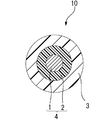
- FIG. 2 is a cross-sectional view taken along line II-II in FIG. It is sectional drawing which shows 2nd Embodiment of the cable of this invention. It is sectional drawing which shows 3rd Embodiment of the cable of this invention.
- FIG. 1 is a partial side view showing a first embodiment of a cable according to the present invention.
- FIG. 2 is a sectional view taken along line II-II in FIG.
- the cable 10 includes one insulated wire 4 and a sheath 3 that covers the one insulated wire 4.
- the insulated wire 4 includes an inner conductor 1 and an insulating layer 2 that covers the inner conductor 1.
- the insulating layer 2 and the sheath 3 are made of a flame retardant resin composition, and the flame retardant resin composition is 1.5 parts by mass or more and 20 parts by mass with respect to 100 parts by mass of the polyolefin resin and the polyolefin resin. 5 to 100 parts by mass of the silicone compound compounded at a ratio of less than or equal to 5 parts by mass, a fatty acid-containing compound that is compounded at a ratio of 5 to 20 parts by mass with respect to 100 parts by mass of the polyolefin resin. And an inorganic flame retardant compounded in a proportion of not less than 40 parts by mass.
- the decomposition start temperature of the inorganic flame retardant is lower than the decomposition start temperature of the silicone compound.
- the insulating layer 2 and the sheath 3 composed of the flame retardant resin composition can ensure excellent flame retardancy while ensuring excellent mechanical properties. For this reason, the cable 10 can ensure the outstanding flame retardance, ensuring the outstanding mechanical characteristic.
- the inner conductor 1 is prepared.
- the inner conductor 1 may be composed of only one strand, or may be configured by bundling a plurality of strands. Further, the inner conductor 1 is not particularly limited with respect to the conductor diameter, the material of the conductor, and the like, and can be appropriately determined according to the application.
- the flame retardant resin composition is prepared.
- the flame retardant resin composition is a polyolefin resin, a silicone compound blended at a ratio of 1.5 parts by mass or more and 20 parts by mass or less with respect to 100 parts by mass of the polyolefin resin, and 100 parts by mass of the polyolefin resin.
- polyolefin resin examples include an ethylene resin and a propylene resin. You may use these individually by 1 type or in mixture of 2 or more types.
- the ethylene-based resin refers to a resin containing ethylene as a structural unit. Examples of the ethylene-based resin include polyethylene resin (PE), ethylene ethyl acrylate copolymer (EEA), and ethylene vinyl acetate copolymer ( EVA).
- the propylene-based resin refers to a resin containing propylene as a structural unit, and examples of the propylene-based resin include polypropylene resin (PP).
- the silicone-based compound functions as a flame retardant aid, and examples thereof include polyorganosiloxane.
- the polyorganosiloxane has a siloxane bond as a main chain and an organic group in a side chain.
- the organic group include a methyl group, a vinyl group, an ethyl group, a propyl group, and a phenyl group.
- polyorganosiloxane examples include dimethylpolysiloxane, methylethylpolysiloxane, methyloctylpolysiloxane, methylvinylpolysiloxane, methylphenylpolysiloxane, and methyl (3,3,3-trifluoropropyl) polysiloxane. Is mentioned.
- the polyorganosiloxane include silicone powder, silicone gum, and silicone resin. Among these, silicone gum is preferable. In this case, bloom is less likely to occur.
- the silicone compound is blended at a ratio of 1.5 parts by mass or more and 20 parts by mass or less with respect to 100 parts by mass of the polyolefin resin.
- the silicone compound is preferably blended at a ratio of 15 parts by mass or less. In this case, superior mechanical properties can be obtained as compared with the case where the proportion of the silicone compound is larger than 15 parts by mass.
- the silicone compound may be previously attached to the surface of the inorganic flame retardant.
- the inorganic flame retardant can be easily dispersed in the polyolefin resin, the uniformity of characteristics in the flame retardant resin composition is further improved.
- the silicone compound is added to and mixed with the inorganic flame retardant to obtain a mixture, and then the mixture is heated at 40 to 75 ° C. for 10 to 10 minutes. It can be obtained by drying for 40 minutes and grinding the dried mixture with a Henschel mixer, an atomizer or the like.
- the decomposition start temperature (T1) of the silicone compound is preferably smaller than the decomposition start temperature (T2) of the polyolefin resin. In this case, an advantage that the flame retardancy is more excellent than that in the case where T1 is T2 or more is obtained.
- (T2-T1) is not particularly limited as long as it is larger than 0 ° C., but is preferably 100 to 250 ° C. In this case, there is an advantage that the flame retardancy is more excellent than when (T2-T1) is out of the above range.
- (T2-T1) is more preferably 150 to 200 ° C.
- the fatty acid-containing compound functions as a flame retardant aid.
- the fatty acid-containing compound refers to a compound containing a fatty acid or a metal salt thereof.
- a fatty acid having 12 to 28 carbon atoms is used as the fatty acid.
- examples of such fatty acids include lauric acid, myristic acid, palmitic acid, stearic acid, tuberculostearic acid, oleic acid, linoleic acid, arachidonic acid, behenic acid and montanic acid.
- stearic acid or tuberculostearic acid is preferable, and stearic acid is particularly preferable. In this case, more excellent flame retardancy can be obtained as compared with the case of using a fatty acid other than stearic acid or tuberculostearic acid.
- the metal constituting the fatty acid metal salt examples include magnesium, calcium, zinc and lead.
- the fatty acid metal salt magnesium stearate or calcium stearate is preferable. In this case, more excellent flame retardancy can be obtained as compared with the case where the fatty acid-containing compound is neither magnesium stearate nor calcium stearate.
- the fatty acid-containing compound is blended at a ratio of 5 parts by mass or more and 20 parts by mass or less with respect to 100 parts by mass of the polyolefin resin.
- the flame retardancy is significantly reduced.
- the fatty acid-containing compound is preferably blended at a ratio of 15 parts by mass or less. In this case, superior mechanical properties can be obtained as compared with the case where the proportion of the fatty acid-containing compound is larger than 15 parts by mass.
- the inorganic flame retardant is not particularly limited as long as it is an inorganic flame retardant having a decomposition start temperature (T3) lower than the decomposition start temperature (T1) of the silicone compound.
- T1-T3 When T1-T3 is 0 ° C. or lower, the flame retardancy is significantly reduced.
- Examples of the inorganic flame retardant include aluminum hydroxide and calcium aluminate hydrate. Of these, aluminum hydroxide is preferable. In this case, more excellent mechanical properties can be obtained than when the inorganic flame retardant is an inorganic flame retardant other than aluminum hydroxide.
- (T1-T3) is not particularly limited as long as it is larger than 0 ° C., but is preferably 50 to 250 ° C. In this case, there is an advantage that the flame retardancy is more excellent than when (T1-T3) is out of the above range.
- (T1-T3) is more preferably 50 to 150 ° C.
- the inorganic flame retardant is blended at a ratio of 5 parts by mass or more and 40 parts by mass or less with respect to 100 parts by mass of the polyolefin resin.
- the flame retardancy is remarkably increased as compared with the case where the blending ratio of the inorganic flame retardant with respect to 100 parts by mass of the polyolefin resin exceeds 40 parts by mass.
- the flame retardancy is remarkably increased.
- the inorganic flame retardant is preferably blended at a ratio of 10 parts by mass to 25 parts by mass with respect to 100 parts by mass of the polyolefin resin.
- the flame retardance of a flame retardant resin composition can be improved more.
- the flame retardant resin composition may further contain an additive as necessary.
- the additive is composed of a material different from the above-described polyolefin resin, silicone compound, fatty acid-containing compound, and inorganic flame retardant.
- examples of such additives include antioxidants, ultraviolet degradation inhibitors, processing aids, colorants, and antistatic agents. These can be used alone or in combination of two or more.
- an antioxidant, an ultraviolet degradation inhibitor, a processing aid, a colorant and an antistatic agent are all contained in the above-mentioned flame retardant resin composition, so that the flame retardant resin composition has flame retardancy. Refers to additives that do not improve.
- “does not improve the flame retardancy of the flame retardant resin composition” means a flame retardant resin composition containing an antioxidant, an ultraviolet degradation inhibitor, a processing aid, a colorant or an antistatic agent.
- the evaluation results by the vertical single-line combustion test used for the evaluation of the flame retardancy of the flame retardant resin composition are an antioxidant, an ultraviolet degradation inhibitor, a processing aid, a colorant and a charge. It says that it is the same or inferior to the flame retardant evaluation results for flame retardant resin compositions that differ only in that none of the inhibitors are included.
- antioxidants examples include phenolic antioxidants, amine antioxidants, sulfur antioxidants, phosphorus antioxidants, hydrazine antioxidants, amide antioxidants, phosphoric acid and citric acid. It is done. These can be used alone or in combination of two or more.
- a phenol-based antioxidant is particularly preferable.
- UV degradation inhibitor examples include, for example, a benzophenone UV degradation inhibitor, a salicylate UV degradation inhibitor, a benzotriazole UV degradation inhibitor, an acrylonitrile UV degradation inhibitor, a metal complex UV degradation inhibitor, and a hindered amine UV radiation.
- examples include deterioration inhibitors. These can be used alone or in combination of two or more.
- a hindered amine UV degradation inhibitor is particularly preferable.
- processing aids include hydrocarbon processing aids, fatty acid processing aids, fatty acid amide processing aids, ester processing aids, alcohol processing aids, metal soaps and waxes. These can be used alone or in combination of two or more.
- a hydrocarbon processing aid is particularly preferable.
- the colorant examples include inorganic pigments, organic pigments, dyes, and carbon black. These can be used alone or in combination of two or more. Here, an inorganic pigment is particularly preferable as the colorant.
- inorganic pigments include chromates, ferrocyan compounds, sulfides, oxides, sulfates, silicates, carbonates and phosphates. These can be used alone or in combination of two or more.
- organic pigments examples include azo pigments, phthalocyanine pigments, vat dye pigments, dyed lake pigments, quinacridone pigments, and dioxazine pigments. These can be used alone or in combination of two or more.
- the dye examples include anthraquinone dyes, indigoid dyes, and azo dyes. These can be used alone or in combination of two or more.
- the antistatic agent examples include a cationic active agent, an anionic active agent, a nonionic active agent, and an amphoteric active agent. These can be used alone or in combination of two or more.
- a cationic activator is particularly preferable.
- cationic activator examples include primary amine salts, tertiary amines, quaternary ammonium compounds and pyridine derivatives. These can be used alone or in combination of two or more.
- anionic activator examples include sulfated oil, soap, sulfated ester oil, sulfated amide oil, sulfate esters, sulfonic acids and phosphate esters. These can be used alone or in combination of two or more.
- nonionic activators include polyhydric alcohol fatty acid esters and ethylene oxide adducts. These can be used alone or in combination of two or more.
- amphoteric activators include carboxylic acid derivatives and imidazoline derivatives. These can be used alone or in combination of two or more.
- the compounding quantity of the additive with respect to 100 mass parts of polyolefin resin is not specifically limited, It is preferable that it is 2 mass parts or less, and it is preferable that it is 1 mass part or less. However, it is preferable that the compounding quantity of the additive with respect to 100 mass parts of polyolefin resin is 0.1 mass part or more.
- the flame retardant resin composition can be obtained by kneading a polyolefin resin, an inorganic flame retardant, a silicone compound, a fatty acid-containing compound, and the like.
- the kneading can be performed with a kneading machine such as a Banbury mixer, a tumbler, a pressure kneader, a kneading extruder, a twin screw extruder, a mixing roll, and the like.
- a part of the polyolefin resin and the silicone compound are kneaded, and the obtained master batch (MB) is mixed with the remaining polyolefin resin, inorganic flame retardant and You may knead
- the inner conductor 1 is covered with the flame retardant resin composition.
- the flame retardant resin composition is melt kneaded using an extruder to form a tubular extrudate. Then, the tubular extrudate is continuously coated on the inner conductor 1. Thus, the insulated wire 4 is obtained.
- sheath Finally, one insulated wire 4 obtained as described above is prepared, and these insulated wires 4 are covered with the sheath 3 produced using the above-mentioned flame-retardant resin composition.
- the sheath 3 protects the insulating layer 2 from physical or chemical damage.
- the cable 10 is obtained as described above.
- the present invention is not limited to the first embodiment.
- the cable 10 has one insulated wire 4, but the cable of the present invention is not limited to a cable having one insulated wire 4.
- Two or more insulated wires 4 may be provided.
- a resin portion made of polypropylene or the like may be provided between the sheath 3 and the insulated wire 4.
- the insulating layer 2 and the sheath 3 of the insulated wire 4 are comprised with said flame-retardant resin composition
- the insulating layer 2 is comprised with normal insulating resin, and only the sheath 3 is comprised.
- the flame retardant resin composition constituting the insulating layer 2 may be used.
- the flame-retardant resin composition of this invention is an optical fiber cable, That is, the present invention can also be applied to a sheath in a cable including a sheath and an optical fiber provided inside the sheath or provided so as to penetrate the sheath.
- the optical fiber cable include a drop type optical fiber cable, an indoor type optical fiber cable, a layer type optical fiber cable, and a tape slot type optical fiber cable.
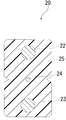
- FIG. 3 is a cross-sectional view showing an indoor type optical fiber cable.
- the indoor optical fiber cable 20 includes two tension members 22 and 23, an optical fiber 24, and a sheath 25 that covers them.
- the optical fiber 24 is provided so as to penetrate the sheath 25.
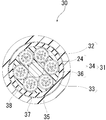
- FIG. 4 is a cross-sectional view showing a layered optical fiber cable.
- the layered optical fiber cable 30 includes a core portion 31 and a sheath 35 provided so as to surround the core portion 31.
- the core portion 31 includes a tension member 32, a lip cord 33 provided so as to surround the tension member 32, and an optical fiber disposed between the tension member 32 and the lip cord 33 along the longitudinal direction of the tension member 32.
- a unit 34 is configured by arranging the optical fiber 24 inside a tube 36 which is colored or not colored. Therefore, the optical fiber 24 is provided inside the sheath 35.
- the press-winding tape 37 is usually wound around the core portion 31, the layered optical fiber cable 30 may not have the press-winding tape 37.
- a waterproof material 38 may be filled around the optical fiber unit 34 between the lip cord 33 and the tension member 32.
- the sheath 25 and the sheath 35 are made of the flame retardant resin composition of the present invention.
- Examples 1 to 14 and Comparative Examples 1 to 7 A base resin, a silicone masterbatch (silicone MB), a fatty acid-containing compound and an inorganic flame retardant are blended in the blending amounts shown in Tables 1 to 5, and kneaded at 160 ° C. for 15 minutes with a Banbury mixer to form a flame retardant resin composition I got a thing.
- the unit of the blending amount of each blending component is part by mass.
- the blending amount of polyethylene resin (PE), ethylene ethyl acrylate copolymer (EEA), ethylene vinyl acetate copolymer (EVA) or polypropylene resin (PP) is not 100 parts by mass.
- the resin is also contained in the silicone MB, and if the PE, EEA, EVA or PP and the resin in the silicone MB are added together, the total amount of the base resin is 100 parts by mass.
- Tables 1 to 5 also show the decomposition start temperature (T3) of the inorganic flame retardant, the decomposition start temperature (T1) of the silicone compound, and the decomposition start temperature (T2) of the base resin.
- Base resin Polyethylene resin (PE) (trade name “Excellen GMH GH030”, manufactured by Sumitomo Chemical Co., Ltd.)
- B Ethylene acrylate copolymer (EEA, trade name “DPDJ-6503”, manufactured by Nihon Unicar)
- C Ethylene vinyl acetate copolymer (EVA, trade name “Evaflex V5274”, manufactured by Mitsui DuPont Polychemical Co., Ltd.)
- D Polypropylene resin (PP, trade name “E111G”, manufactured by Prime Polymer Co., Ltd.)
- Silicone MB (trade name “X-22-2125H”, manufactured by Shin-Etsu Chemical Co., Ltd.) 50% by weight silicone gum and 50% by weight PE
- Fatty acid-containing compound Mg stearate (trade name “Efcochem MGS”, manufactured by ADEKA) Stearic acid Ca (
Landscapes
- Chemical & Material Sciences (AREA)
- Organic Chemistry (AREA)
- Polymers & Plastics (AREA)
- Health & Medical Sciences (AREA)
- Chemical Kinetics & Catalysis (AREA)
- Medicinal Chemistry (AREA)
- Physics & Mathematics (AREA)
- Spectroscopy & Molecular Physics (AREA)
- Engineering & Computer Science (AREA)
- Manufacturing & Machinery (AREA)
- Inorganic Chemistry (AREA)
- Materials Engineering (AREA)
- General Physics & Mathematics (AREA)
- Optics & Photonics (AREA)
- Insulated Conductors (AREA)
- Compositions Of Macromolecular Compounds (AREA)
- Organic Insulating Materials (AREA)
Abstract
Description
<条件>
熱分解装置における昇温速度:50℃/min
温度範囲:70~700℃
カラムオーブン温度:320℃
キャリアーガス:ヘリウム
圧力:90.0kPa
カラム流量:0.92mL/min
図1は、本発明に係るケーブルの第1実施形態を示す部分側面図である。図2は、図1のII-II線に沿った断面図である。図1及び図2に示すように、ケーブル10は、1本の絶縁電線4と、1本の絶縁電線4を被覆するシース3とを備えている。そして、絶縁電線4は、内部導体1と、内部導体1を被覆する絶縁層2とを有している。
次に、上述したケーブル10の製造方法について説明する。
まず内部導体1を準備する。内部導体1は、1本の素線のみで構成されてもよく、複数本の素線を束ねて構成されたものであってもよい。また、内部導体1は、導体径や導体の材質などについて特に限定されるものではなく、用途に応じて適宜定めることができる。
一方、上記難燃性樹脂組成物を準備する。難燃性樹脂組成物は、上述したように、ポリオレフィン樹脂と、ポリオレフィン樹脂100質量部に対して1.5質量部以上20質量部以下の割合で配合されるシリコーン系化合物と、ポリオレフィン樹脂100質量部に対して5質量部以上20質量部以下の割合で配合される脂肪酸含有化合物と、ポリオレフィン樹脂100質量部に対して5質量部以上40質量部以下の割合で配合される無機系難燃剤とを含んでいる。
上述したように、ポリオレフィン樹脂としては、例えばエチレン系樹脂、及び、プロピレン系樹脂などが挙げられる。これらは1種類単独で又は2種以上を混合して用いてもよい。ここで、エチレン系樹脂とは、エチレンを構成単位として含む樹脂を言い、エチレン系樹脂としては、例えばポリエチレン樹脂(PE)、エチレンアクリル酸エチル共重合体(EEA)及びエチレン酢酸ビニル共重合体(EVA)が挙げられる。またプロピレン系樹脂としては、プロピレンを構成単位として含む樹脂を言い、プロピレン系樹脂としては、例えばポリプロピレン樹脂(PP)などが挙げられる。
シリコーン系化合物は、難燃助剤として機能するものであり、ポリオルガノシロキサンなどが挙げられる。ここで、ポリオルガノシロキサンは、シロキサン結合を主鎖とし側鎖に有機基を有するものであり、有機基としては、例えばメチル基、ビニル基、エチル基、プロピル基、フェニル基などが挙げられる。具体的にはポリオルガノシロキサンとしては、例えばジメチルポリシロキサン、メチルエチルポリシロキサン、メチルオクチルポリシロキサン、メチルビニルポリシロキサン、メチルフェニルポリシロキサン、メチル(3,3,3-トリフルオロプロピル)ポリシロキサンなどが挙げられる。ポリオルガノシロキサンとして、シリコーンパウダー、シリコーンガム及びシリコーンレジンが挙げられる。中でも、シリコーンガムが好ましい。この場合、ブルームが起こりにくくなる。
脂肪酸含有化合物は、難燃助剤として機能するものである。脂肪酸含有化合物とは、脂肪酸又はその金属塩を含有するものを言う。ここで、脂肪酸としては、例えば炭素原子数が12~28である脂肪酸が用いられる。このような脂肪酸としては、例えばラウリン酸、ミリスチン酸、パルミチン酸、ステアリン酸、ツベルクロステアリン酸、オレイン酸、リノール酸、アラキドン酸、ベヘン酸及びモンタン酸が挙げられる。中でも、脂肪酸としては、ステアリン酸又はツベルクロステアリン酸が好ましく、ステアリン酸が特に好ましい。この場合、ステアリン酸又はツベルクロステアリン酸以外の脂肪酸を用いる場合に比べて、より優れた難燃性が得られる。
無機系難燃剤は、シリコーン系化合物の分解開始温度(T1)よりも低い分解開始温度(T3)を有する無機系の難燃剤であれば特に限定されるものではない。
上記難燃性樹脂組成物は、添加剤を必要に応じてさらに含んでもよい。添加剤は、上述したポリオレフィン樹脂、シリコーン系化合物、脂肪酸含有化合物及び無機系難燃剤とは異なる材料で構成される。このような添加剤としては、例えば酸化防止剤、紫外線劣化防止剤、加工助剤、着色剤及び帯電防止剤が挙げられる。これらは単独で又は2種以上を組み合せて用いることができる。ここで、酸化防止剤、紫外線劣化防止剤、加工助剤、着色剤及び帯電防止剤はいずれも、上述した難燃性樹脂組成物に含まれることで、難燃性樹脂組成物の難燃性を向上させない添加剤を言う。ここで、「難燃性樹脂組成物の難燃性を向上させない」とは、酸化防止剤、紫外線劣化防止剤、加工助剤、着色剤又は帯電防止剤を含む難燃性樹脂組成物について、後述する実施例及び比較例で難燃性樹脂組成物の難燃性の評価に使用される垂直一条燃焼試験による評価結果が、酸化防止剤、紫外線劣化防止剤、加工助剤、着色剤及び帯電防止剤のいずれも含まない点でのみ異なる難燃性樹脂組成物についての難燃性の評価結果に対して同じか、又は劣ることを言う。
最後に、上記のようにして得られた絶縁電線4を1本用意し、これら絶縁電線4を、上述した難燃性樹脂組成物を用いて作製したシース3で被覆する。シース3は、絶縁層2を物理的又は化学的な損傷から保護するものである。
ベース樹脂、シリコーンマスターバッチ(シリコーンMB)、脂肪酸含有化合物及び無機系難燃剤を、表1~5に示す配合量で配合し、バンバリーミキサによって160℃にて15分間混練し、難燃性樹脂組成物を得た。なお、表1~5において、各配合成分の配合量の単位は質量部である。また表1~5において、ポリエチレン樹脂(PE)、エチレンアクリル酸エチル共重合体(EEA)、エチレン酢酸ビニル共重合体(EVA)又はポリプロピレン樹脂(PP)の配合量が100質量部となっていないが、シリコーンMB中にも樹脂が含まれており、PE、EEA、EVA又はPPとシリコーンMB中の樹脂とを合計すればベース樹脂の合計量は100質量部となる。さらに表1~5には、無機系難燃剤の分解開始温度(T3)、シリコーン系化合物の分解開始温度(T1)及びベース樹脂の分解開始温度(T2)も示した。
(1)ベース樹脂
(A)ポリエチレン樹脂(PE)(商品名「エクセレンGMH GH030」、住友化学社製)
(B)エチレンアクリル酸エチル共重合体(EEA、商品名「DPDJ-6503」、日本ユニカー社製)
(C)エチレン酢酸ビニル共重合体(EVA、商品名「エバフレックス V5274」、三井デュポンポリケミカル社製)
(D)ポリプロピレン樹脂(PP、商品名「E111G」、プライムポリマー社製)
(2)シリコーンMB(商品名「X-22-2125H」、信越化学社製)
50質量%シリコーンガムと50質量%PEとを含有
(3)脂肪酸含有化合物
ステアリン酸Mg(商品名「エフコケムMGS」、ADEKA社製)
ステアリン酸Ca(商品名「SC-P」、堺化学工業社製)
(4)無機系難燃剤
A)水酸化アルミニウム(商品名「BF013」、日本軽金属社製、平均粒径:1.2μm)
B)水酸化マグネシウム(商品名「マグシーズN6」、神島化学工業社製)
C)水酸化カルシウム(吉澤石灰工業社製)


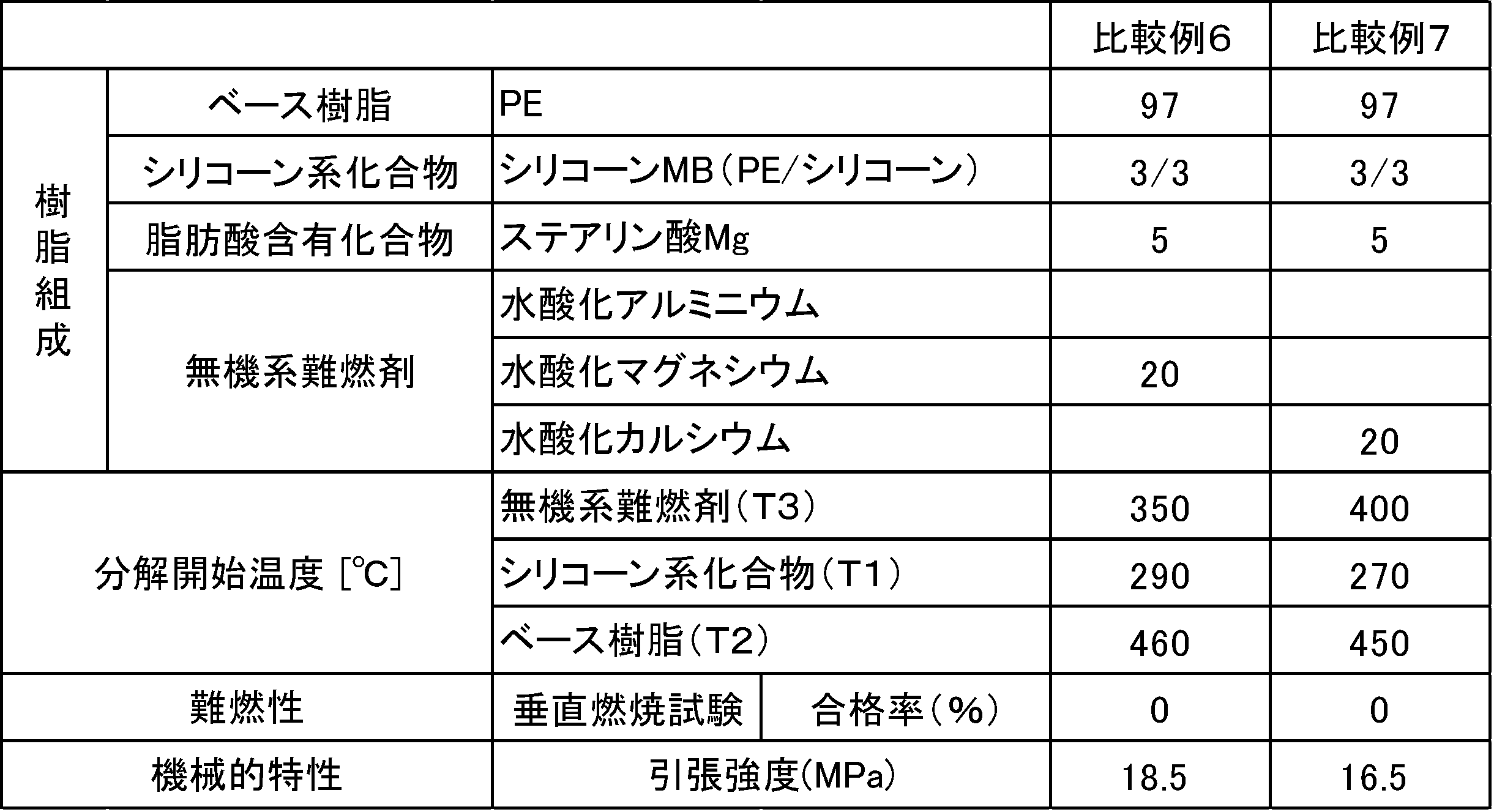
実施例1~14及び比較例1~7の絶縁電線をそれぞれ10本用意し、これらについて、JIS C3665-1に基づいて垂直一条燃焼試験を行い、難燃性を評価した。このとき、具体的には、絶縁電線を上部で支持する上部支持材の下端から炭化の終了点までの長さが50mm以上540mm以下であれば「合格」とし、50mm未満又は540mm超の場合には「不合格」とした。そして、合格率(%)を求めた。結果を表1~5に示す。なお、燃焼試験においては、絶縁電線に対してバーナーの炎を60秒間接触させた。また表1~5において、難燃性の合否基準は下記の通りとした。
合格率が70%以上:合格
合格率が70%未満:不合格
機械的特性の評価は、実施例1~14及び比較例1~7の絶縁電線について、JIS C3005により引張試験を行い、測定された引張強度に基づいて行った。結果を表1~5に示す。表1~5において、引張強度の単位はMPaであり、引張強度の合否基準は下記の通りとした。引張試験において、引張速度は200mm/min、標線間距離は20mmとした。
10MPa以上:合格
10MPa未満:不合格
2…絶縁層
3,25,35…シース
4…絶縁電線
10,20,30…ケーブル
Claims (9)
- ポリオレフィン樹脂と、
前記ポリオレフィン樹脂100質量部に対して1.5質量部以上20質量部以下の割合で配合されるシリコーン系化合物と、
前記ポリオレフィン樹脂100質量部に対して5質量部以上20質量部以下の割合で配合される脂肪酸含有化合物と、
前記ポリオレフィン樹脂100質量部に対して5質量部以上40質量部以下の割合で配合される無機系難燃剤とを含み、
前記無機系難燃剤の分解開始温度が前記シリコーン系化合物の分解開始温度よりも低い難燃性樹脂組成物。 - 前記無機系難燃剤が水酸化アルミニウムである請求項1に記載の難燃性樹脂組成物。
- 前記無機系難燃剤が前記ポリオレフィン樹脂100質量部に対して10質量部以上25質量部以下の割合で配合されている、請求項1又は2に記載の難燃性樹脂組成物。
- 前記脂肪酸含有化合物がステアリン酸マグネシウム又はステアリン酸カルシウムである請求項1~3のいずれか一項に記載の難燃性樹脂組成物。
- 前記ポリオレフィン樹脂と、前記シリコーン系化合物と、前記脂肪酸含有化合物と、前記無機系難燃剤と、酸化防止剤、紫外線劣化防止剤、加工助剤、着色剤及び帯電防止剤からなる群より選択される少なくとも1種の添加剤とで構成される、請求項1~4のいずれか一項に記載の難燃性樹脂組成物。
- 前記酸化防止剤が、フェノール系酸化防止剤、アミン系酸化防止剤、硫黄系酸化防止剤、リン系酸化防止剤、ヒドラジン系酸化防止剤、アミド系酸化防止剤、リン酸及びクエン酸からなる群より選ばれる少なくとも1種で構成され、
前記紫外線劣化防止剤が、ベンゾフェノン系紫外線劣化防止剤、サルチレート系紫外線劣化防止剤、ベンゾトリアゾール系紫外線劣化防止剤、アクリロニトリル系紫外線劣化防止剤、金属錯塩系紫外線劣化防止剤及びヒンダートアミン系紫外線劣化防止剤からなる群より選ばれる少なくとも1種で構成され、
前記加工助剤が、炭化水素系加工助剤、脂肪酸系加工助剤、脂肪酸アミド系加工助剤、エステル系加工助剤、アルコール系加工助剤、金属石鹸及びワックスからなる群より選ばれる少なくとも1種で構成され、
前記着色剤が、無機顔料、有機顔料、染料及びカーボンブラックからなる群より選ばれる少なくとも1種で構成され、
前記帯電防止剤が、陽イオン活性剤、アニオン活性剤、非イオン活性剤及び両性活性剤からなる群より選ばれる少なくとも1種で構成される、請求項5に記載の難燃性樹脂組成物。 - 導体と、
前記導体を被覆する絶縁層とを有する絶縁電線を備えており、
前記絶縁層が、請求項1~6のいずれか一項に記載の難燃性樹脂組成物で構成されるケーブル。 - 導体と、
前記導体を被覆する絶縁層と、
前記絶縁層を覆うシースを有するケーブルであって、
前記絶縁層と前記シースの少なくとも一方が、請求項1~6のいずれか一項に記載の難燃性樹脂組成物で構成されるケーブル。 - シースと、
前記シースの内側に設けられ又は前記シースを貫通するように設けられる光ファイバとを有し、
前記シースが請求項1~6のいずれか一項に記載の難燃性樹脂組成物で構成されるケーブル。
Priority Applications (5)
| Application Number | Priority Date | Filing Date | Title |
|---|---|---|---|
| EP14867282.7A EP3078709A4 (en) | 2013-12-04 | 2014-12-03 | Flame-retardant resin composition and cable using same |
| CN201480048254.9A CN105492525B (zh) | 2013-12-04 | 2014-12-03 | 阻燃性树脂组合物和使用该阻燃性树脂组合物的缆线 |
| JP2015551539A JP6053236B2 (ja) | 2013-12-04 | 2014-12-03 | 難燃性樹脂組成物を用いたケーブル |
| US15/038,753 US9982119B2 (en) | 2013-12-04 | 2014-12-03 | Flame retardant resin composition and cable using the same |
| US15/963,290 US10544293B2 (en) | 2013-12-04 | 2018-04-26 | Flame retardant resin composition and cable using the same |
Applications Claiming Priority (2)
| Application Number | Priority Date | Filing Date | Title |
|---|---|---|---|
| JP2013251231A JP5669924B1 (ja) | 2013-12-04 | 2013-12-04 | 難燃性樹脂組成物、及び、これを用いたケーブル |
| JP2013-251231 | 2013-12-04 |
Related Child Applications (2)
| Application Number | Title | Priority Date | Filing Date |
|---|---|---|---|
| US15/038,753 A-371-Of-International US9982119B2 (en) | 2013-12-04 | 2014-12-03 | Flame retardant resin composition and cable using the same |
| US15/963,290 Continuation US10544293B2 (en) | 2013-12-04 | 2018-04-26 | Flame retardant resin composition and cable using the same |
Publications (1)
| Publication Number | Publication Date |
|---|---|
| WO2015083737A1 true WO2015083737A1 (ja) | 2015-06-11 |
Family
ID=52573816
Family Applications (1)
| Application Number | Title | Priority Date | Filing Date |
|---|---|---|---|
| PCT/JP2014/081971 Ceased WO2015083737A1 (ja) | 2013-12-04 | 2014-12-03 | 難燃性樹脂組成物、及び、これを用いたケーブル |
Country Status (6)
| Country | Link |
|---|---|
| US (2) | US9982119B2 (ja) |
| EP (1) | EP3078709A4 (ja) |
| JP (2) | JP5669924B1 (ja) |
| CN (1) | CN105492525B (ja) |
| TW (1) | TWI598390B (ja) |
| WO (1) | WO2015083737A1 (ja) |
Cited By (3)
| Publication number | Priority date | Publication date | Assignee | Title |
|---|---|---|---|---|
| WO2018034173A1 (ja) * | 2016-08-16 | 2018-02-22 | 株式会社フジクラ | 難燃性樹脂組成物、これを用いた絶縁電線、メタルケーブル、光ファイバケーブル及び成形品 |
| CN107922680A (zh) * | 2015-12-14 | 2018-04-17 | 株式会社藤仓 | 阻燃性树脂组合物、使用该阻燃性树脂组合物的金属缆线和光纤缆线以及成型品 |
| KR102303462B1 (ko) * | 2021-03-12 | 2021-09-24 | (주)대아콤텍 | 절연재료 및 이를 이용하여 제조된 절연제품 |
Families Citing this family (12)
| Publication number | Priority date | Publication date | Assignee | Title |
|---|---|---|---|---|
| JPH0663597B2 (ja) | 1986-04-03 | 1994-08-22 | 敬之助 松谷 | 巻取り可能な伸縮構造体 |
| JP2929103B2 (ja) | 1997-08-08 | 1999-08-03 | 敬之助 松谷 | 伸縮構造体 |
| EP3098261B1 (en) * | 2014-01-21 | 2018-05-16 | Fujikura Ltd. | Flame-retardant resin composition and cable using same |
| JP6595374B2 (ja) * | 2016-03-07 | 2019-10-23 | 株式会社戸出O−Fit | 難燃性複合樹脂材料の製造方法 |
| NO345275B1 (en) * | 2019-03-18 | 2020-11-23 | Blue Sea Norway As | Power cable, method for production and use thereof |
| US12265270B2 (en) * | 2021-03-08 | 2025-04-01 | Corning Research & Development Corporation | Flame retardant compositions for buffer tubes and method of making same |
| EP4408921A1 (en) | 2021-09-30 | 2024-08-07 | ExxonMobil Chemical Patents Inc. | Fluoropolymer-free processing aids for ethylene-based polymers |
| WO2023056213A1 (en) | 2021-09-30 | 2023-04-06 | Exxonmobil Chemical Patents Inc. | Polyethylene glycol-based polymer processing aids |
| CN114213743A (zh) * | 2022-01-05 | 2022-03-22 | 四川安费尔高分子材料科技有限公司 | 一种低烟无卤阻燃电缆料的生产工艺 |
| US20250145820A1 (en) | 2022-02-07 | 2025-05-08 | Exxonmobil Chemical Patents Inc. | Polyethylene glycol-based polymer processing aids |
| WO2023154744A1 (en) | 2022-02-14 | 2023-08-17 | Exxonmobil Chemical Patents Inc. | Polyethylene glycol-based polymer processing aids |
| CN115933081B (zh) * | 2022-11-18 | 2023-07-25 | 宏安集团有限公司 | 一种半干式光纤带光缆 |
Citations (7)
| Publication number | Priority date | Publication date | Assignee | Title |
|---|---|---|---|---|
| JPH03231947A (ja) * | 1989-12-05 | 1991-10-15 | Sakai Chem Ind Co Ltd | ポリオレフィン系樹脂組成物およびその製造方法 |
| JPH07296649A (ja) * | 1994-04-22 | 1995-11-10 | Hitachi Cable Ltd | ノンハロゲン難燃絶縁電線 |
| JP2001152035A (ja) * | 1999-11-30 | 2001-06-05 | Shin Etsu Chem Co Ltd | 流動性及び機械的特性に優れた熱可塑性樹脂組成物 |
| JP2001348466A (ja) * | 2000-06-06 | 2001-12-18 | Fujikura Ltd | 難燃性樹脂組成物 |
| WO2005013291A1 (ja) * | 2003-07-30 | 2005-02-10 | Sumitomo Electric Industries, Limited | 非ハロゲン系難燃ケーブル |
| JP2013108053A (ja) * | 2011-10-28 | 2013-06-06 | Fujikura Ltd | 難燃性樹脂組成物、及び、これを用いたケーブル |
| JP2013133411A (ja) * | 2011-12-27 | 2013-07-08 | Fujikura Ltd | 難燃性樹脂組成物、及び、これを用いたケーブル |
Family Cites Families (10)
| Publication number | Priority date | Publication date | Assignee | Title |
|---|---|---|---|---|
| US4273691A (en) * | 1979-10-18 | 1981-06-16 | General Electric Company | Flame retardant compositions and coated article |
| IE920241A1 (en) * | 1991-08-23 | 1993-02-24 | Hitachi Cable | Non-halogenated fire retardant resin composition and wires¹and cables coated therewith |
| CN1102615C (zh) | 1995-12-27 | 2003-03-05 | 住友电木株式会社 | 制造阻燃型硅烷交联的聚烯烃的方法 |
| DE19610513B4 (de) * | 1996-03-19 | 2006-10-19 | Alcatel Kabel Ag & Co. | Flammwidrige, halogenfreie Mischung |
| ATE449359T1 (de) * | 2001-06-12 | 2009-12-15 | Borealis Tech Oy | Optisches kabel mit verbesserter kriechstromfestigkeit |
| US8331747B1 (en) * | 2008-11-07 | 2012-12-11 | Southwire Company | Non-conductive fiber optic member |
| JPWO2012111628A1 (ja) | 2011-02-14 | 2014-07-07 | 旭化成ケミカルズ株式会社 | 太陽光発電モジュール用接続構造体 |
| KR101202473B1 (ko) * | 2011-04-08 | 2012-11-16 | 주식회사 경신전선 | 엘리베이터 케이블 절연용 할로겐 프리 난연 피복조성물 |
| JP5167428B1 (ja) | 2011-10-28 | 2013-03-21 | 株式会社フジクラ | 難燃性樹脂組成物、及び、これを用いたケーブル |
| KR101688286B1 (ko) * | 2012-01-20 | 2016-12-20 | 미쓰이 가가쿠 가부시키가이샤 | 난연성 수지 조성물 및 그의 제조방법, 및 그의 성형체 및 전선 |
-
2013
- 2013-12-04 JP JP2013251231A patent/JP5669924B1/ja active Active
-
2014
- 2014-12-03 EP EP14867282.7A patent/EP3078709A4/en not_active Withdrawn
- 2014-12-03 US US15/038,753 patent/US9982119B2/en not_active Expired - Fee Related
- 2014-12-03 WO PCT/JP2014/081971 patent/WO2015083737A1/ja not_active Ceased
- 2014-12-03 JP JP2015551539A patent/JP6053236B2/ja active Active
- 2014-12-03 CN CN201480048254.9A patent/CN105492525B/zh not_active Expired - Fee Related
- 2014-12-04 TW TW103142189A patent/TWI598390B/zh not_active IP Right Cessation
-
2018
- 2018-04-26 US US15/963,290 patent/US10544293B2/en not_active Expired - Fee Related
Patent Citations (7)
| Publication number | Priority date | Publication date | Assignee | Title |
|---|---|---|---|---|
| JPH03231947A (ja) * | 1989-12-05 | 1991-10-15 | Sakai Chem Ind Co Ltd | ポリオレフィン系樹脂組成物およびその製造方法 |
| JPH07296649A (ja) * | 1994-04-22 | 1995-11-10 | Hitachi Cable Ltd | ノンハロゲン難燃絶縁電線 |
| JP2001152035A (ja) * | 1999-11-30 | 2001-06-05 | Shin Etsu Chem Co Ltd | 流動性及び機械的特性に優れた熱可塑性樹脂組成物 |
| JP2001348466A (ja) * | 2000-06-06 | 2001-12-18 | Fujikura Ltd | 難燃性樹脂組成物 |
| WO2005013291A1 (ja) * | 2003-07-30 | 2005-02-10 | Sumitomo Electric Industries, Limited | 非ハロゲン系難燃ケーブル |
| JP2013108053A (ja) * | 2011-10-28 | 2013-06-06 | Fujikura Ltd | 難燃性樹脂組成物、及び、これを用いたケーブル |
| JP2013133411A (ja) * | 2011-12-27 | 2013-07-08 | Fujikura Ltd | 難燃性樹脂組成物、及び、これを用いたケーブル |
Non-Patent Citations (1)
| Title |
|---|
| See also references of EP3078709A4 * |
Cited By (7)
| Publication number | Priority date | Publication date | Assignee | Title |
|---|---|---|---|---|
| CN107922680A (zh) * | 2015-12-14 | 2018-04-17 | 株式会社藤仓 | 阻燃性树脂组合物、使用该阻燃性树脂组合物的金属缆线和光纤缆线以及成型品 |
| US20180371220A1 (en) * | 2015-12-14 | 2018-12-27 | Fujikura Ltd. | Flame retardant resin composition and metal cable, optical fiber cable, and molded article using the same |
| EP3385323A4 (en) * | 2015-12-14 | 2019-09-04 | Fujikura Ltd. | FLAME RETARDANT COMPOSITION, METAL CABLE AND OPTICAL FIBER CABLE USING EACH AND LAST MOLDED ARTICLE |
| US10640634B2 (en) | 2015-12-14 | 2020-05-05 | Fujikura Ltd. | Flame retardant resin composition and metal cable, optical fiber cable, and molded article using the same |
| WO2018034173A1 (ja) * | 2016-08-16 | 2018-02-22 | 株式会社フジクラ | 難燃性樹脂組成物、これを用いた絶縁電線、メタルケーブル、光ファイバケーブル及び成形品 |
| JPWO2018034173A1 (ja) * | 2016-08-16 | 2019-02-21 | 株式会社フジクラ | 難燃性樹脂組成物、これを用いた絶縁電線、メタルケーブル、光ファイバケーブル及び成形品 |
| KR102303462B1 (ko) * | 2021-03-12 | 2021-09-24 | (주)대아콤텍 | 절연재료 및 이를 이용하여 제조된 절연제품 |
Also Published As
| Publication number | Publication date |
|---|---|
| US10544293B2 (en) | 2020-01-28 |
| TWI598390B (zh) | 2017-09-11 |
| CN105492525B (zh) | 2017-03-22 |
| US20170051136A1 (en) | 2017-02-23 |
| JPWO2015083737A1 (ja) | 2017-03-16 |
| JP5669924B1 (ja) | 2015-02-18 |
| US9982119B2 (en) | 2018-05-29 |
| US20180244903A1 (en) | 2018-08-30 |
| JP6053236B2 (ja) | 2016-12-27 |
| CN105492525A (zh) | 2016-04-13 |
| EP3078709A1 (en) | 2016-10-12 |
| TW201540766A (zh) | 2015-11-01 |
| EP3078709A4 (en) | 2017-07-12 |
Similar Documents
| Publication | Publication Date | Title |
|---|---|---|
| JP6053236B2 (ja) | 難燃性樹脂組成物を用いたケーブル | |
| JP6170182B2 (ja) | 難燃性樹脂組成物、及び、これを用いたケーブル | |
| JP5937634B2 (ja) | 難燃性樹脂組成物、及び、これを用いたケーブル | |
| CN105980470A (zh) | 阻燃性树脂组合物和使用该阻燃性树脂组合物的缆线 | |
| JP5282163B1 (ja) | 難燃性樹脂組成物、及び、これを用いたケーブル | |
| CN107922688A (zh) | 阻燃性树脂组合物、使用该阻燃性树脂组合物的金属缆线、光纤缆线和成型品 | |
| CN108026339B (zh) | 阻燃性树脂组合物、使用该阻燃性树脂组合物的金属缆线、光纤缆线和成型品 | |
| CN106795338B (zh) | 阻燃性树脂组合物和使用该阻燃性树脂组合物的缆线及光纤缆线 | |
| JP6563016B2 (ja) | 難燃性樹脂組成物、及び、これを用いたケーブル並びに光ファイバケーブル | |
| JP2016155931A (ja) | 難燃性樹脂組成物、及び、これを用いたケーブル並びに光ファイバケーブル | |
| TWI663200B (zh) | 阻燃性樹脂組成物、使用此組成物之金屬電纜及光纖電纜以及成形品 | |
| JP2017025203A (ja) | 難燃性樹脂組成物、及び、これを用いたケーブル並びに光ファイバケーブル | |
| JP6046100B2 (ja) | 難燃性樹脂組成物、及び、これを用いたケーブル並びに光ファイバケーブル | |
| JP5993264B2 (ja) | 難燃性樹脂組成物の製造方法、難燃性樹脂組成物及びこれを用いたケーブル | |
| JP2018039902A (ja) | 難燃性樹脂組成物、これを用いた絶縁電線、メタルケーブル、光ファイバケーブル、自動車用ワイヤハーネス、及び成形品 | |
| JP2019089983A (ja) | 難燃性樹脂組成物、これを用いた絶縁電線、メタルケーブル、光ファイバケーブル及び成形品 | |
| JP2019089982A (ja) | 難燃性樹脂組成物、これを用いた絶縁電線、メタルケーブル、光ファイバケーブル及び成形品 |
Legal Events
| Date | Code | Title | Description |
|---|---|---|---|
| WWE | Wipo information: entry into national phase |
Ref document number: 201480048254.9 Country of ref document: CN |
|
| 121 | Ep: the epo has been informed by wipo that ep was designated in this application |
Ref document number: 14867282 Country of ref document: EP Kind code of ref document: A1 |
|
| ENP | Entry into the national phase |
Ref document number: 2015551539 Country of ref document: JP Kind code of ref document: A |
|
| REEP | Request for entry into the european phase |
Ref document number: 2014867282 Country of ref document: EP |
|
| WWE | Wipo information: entry into national phase |
Ref document number: 2014867282 Country of ref document: EP |
|
| WWE | Wipo information: entry into national phase |
Ref document number: 15038753 Country of ref document: US |
|
| NENP | Non-entry into the national phase |
Ref country code: DE |