WO2015093531A1 - 繊維ガイド - Google Patents
繊維ガイド Download PDFInfo
- Publication number
- WO2015093531A1 WO2015093531A1 PCT/JP2014/083413 JP2014083413W WO2015093531A1 WO 2015093531 A1 WO2015093531 A1 WO 2015093531A1 JP 2014083413 W JP2014083413 W JP 2014083413W WO 2015093531 A1 WO2015093531 A1 WO 2015093531A1
- Authority
- WO
- WIPO (PCT)
- Prior art keywords
- mass
- oxide
- zirconium oxide
- fiber guide
- fiber
- Prior art date
- Legal status (The legal status is an assumption and is not a legal conclusion. Google has not performed a legal analysis and makes no representation as to the accuracy of the status listed.)
- Ceased
Links
Images

Classifications
-
- B—PERFORMING OPERATIONS; TRANSPORTING
- B65—CONVEYING; PACKING; STORING; HANDLING THIN OR FILAMENTARY MATERIAL
- B65H—HANDLING THIN OR FILAMENTARY MATERIAL, e.g. SHEETS, WEBS, CABLES
- B65H57/00—Guides for filamentary materials; Supports therefor
- B65H57/24—Guides for filamentary materials; Supports therefor with wear-resistant surfaces
-
- C—CHEMISTRY; METALLURGY
- C04—CEMENTS; CONCRETE; ARTIFICIAL STONE; CERAMICS; REFRACTORIES
- C04B—LIME, MAGNESIA; SLAG; CEMENTS; COMPOSITIONS THEREOF, e.g. MORTARS, CONCRETE OR LIKE BUILDING MATERIALS; ARTIFICIAL STONE; CERAMICS; REFRACTORIES; TREATMENT OF NATURAL STONE
- C04B35/00—Shaped ceramic products characterised by their composition; Ceramics compositions; Processing powders of inorganic compounds preparatory to the manufacturing of ceramic products
- C04B35/01—Shaped ceramic products characterised by their composition; Ceramics compositions; Processing powders of inorganic compounds preparatory to the manufacturing of ceramic products based on oxide ceramics
- C04B35/10—Shaped ceramic products characterised by their composition; Ceramics compositions; Processing powders of inorganic compounds preparatory to the manufacturing of ceramic products based on oxide ceramics based on aluminium oxide
- C04B35/111—Fine ceramics
-
- C—CHEMISTRY; METALLURGY
- C04—CEMENTS; CONCRETE; ARTIFICIAL STONE; CERAMICS; REFRACTORIES
- C04B—LIME, MAGNESIA; SLAG; CEMENTS; COMPOSITIONS THEREOF, e.g. MORTARS, CONCRETE OR LIKE BUILDING MATERIALS; ARTIFICIAL STONE; CERAMICS; REFRACTORIES; TREATMENT OF NATURAL STONE
- C04B35/00—Shaped ceramic products characterised by their composition; Ceramics compositions; Processing powders of inorganic compounds preparatory to the manufacturing of ceramic products
- C04B35/01—Shaped ceramic products characterised by their composition; Ceramics compositions; Processing powders of inorganic compounds preparatory to the manufacturing of ceramic products based on oxide ceramics
- C04B35/48—Shaped ceramic products characterised by their composition; Ceramics compositions; Processing powders of inorganic compounds preparatory to the manufacturing of ceramic products based on oxide ceramics based on zirconium or hafnium oxides, zirconates, zircon or hafnates
- C04B35/486—Fine ceramics
-
- C—CHEMISTRY; METALLURGY
- C04—CEMENTS; CONCRETE; ARTIFICIAL STONE; CERAMICS; REFRACTORIES
- C04B—LIME, MAGNESIA; SLAG; CEMENTS; COMPOSITIONS THEREOF, e.g. MORTARS, CONCRETE OR LIKE BUILDING MATERIALS; ARTIFICIAL STONE; CERAMICS; REFRACTORIES; TREATMENT OF NATURAL STONE
- C04B35/00—Shaped ceramic products characterised by their composition; Ceramics compositions; Processing powders of inorganic compounds preparatory to the manufacturing of ceramic products
- C04B35/01—Shaped ceramic products characterised by their composition; Ceramics compositions; Processing powders of inorganic compounds preparatory to the manufacturing of ceramic products based on oxide ceramics
- C04B35/48—Shaped ceramic products characterised by their composition; Ceramics compositions; Processing powders of inorganic compounds preparatory to the manufacturing of ceramic products based on oxide ceramics based on zirconium or hafnium oxides, zirconates, zircon or hafnates
- C04B35/486—Fine ceramics
- C04B35/488—Composites
- C04B35/4885—Composites with aluminium oxide
-
- C—CHEMISTRY; METALLURGY
- C04—CEMENTS; CONCRETE; ARTIFICIAL STONE; CERAMICS; REFRACTORIES
- C04B—LIME, MAGNESIA; SLAG; CEMENTS; COMPOSITIONS THEREOF, e.g. MORTARS, CONCRETE OR LIKE BUILDING MATERIALS; ARTIFICIAL STONE; CERAMICS; REFRACTORIES; TREATMENT OF NATURAL STONE
- C04B35/00—Shaped ceramic products characterised by their composition; Ceramics compositions; Processing powders of inorganic compounds preparatory to the manufacturing of ceramic products
- C04B35/622—Forming processes; Processing powders of inorganic compounds preparatory to the manufacturing of ceramic products
- C04B35/626—Preparing or treating the powders individually or as batches ; preparing or treating macroscopic reinforcing agents for ceramic products, e.g. fibres; mechanical aspects section B
- C04B35/62605—Treating the starting powders individually or as mixtures
- C04B35/62645—Thermal treatment of powders or mixtures thereof other than sintering
- C04B35/62655—Drying, e.g. freeze-drying, spray-drying, microwave or supercritical drying
-
- D—TEXTILES; PAPER
- D01—NATURAL OR MAN-MADE THREADS OR FIBRES; SPINNING
- D01D—MECHANICAL METHODS OR APPARATUS IN THE MANUFACTURE OF ARTIFICIAL FILAMENTS, THREADS, FIBRES, BRISTLES OR RIBBONS
- D01D11/00—Other features of manufacture
- D01D11/04—Fixed guides
-
- C—CHEMISTRY; METALLURGY
- C04—CEMENTS; CONCRETE; ARTIFICIAL STONE; CERAMICS; REFRACTORIES
- C04B—LIME, MAGNESIA; SLAG; CEMENTS; COMPOSITIONS THEREOF, e.g. MORTARS, CONCRETE OR LIKE BUILDING MATERIALS; ARTIFICIAL STONE; CERAMICS; REFRACTORIES; TREATMENT OF NATURAL STONE
- C04B2235/00—Aspects relating to ceramic starting mixtures or sintered ceramic products
- C04B2235/02—Composition of constituents of the starting material or of secondary phases of the final product
- C04B2235/30—Constituents and secondary phases not being of a fibrous nature
- C04B2235/34—Non-metal oxides, non-metal mixed oxides, or salts thereof that form the non-metal oxides upon heating, e.g. carbonates, nitrates, (oxy)hydroxides, chlorides
- C04B2235/3418—Silicon oxide, silicic acids or oxide forming salts thereof, e.g. silica sol, fused silica, silica fume, cristobalite, quartz or flint
-
- C—CHEMISTRY; METALLURGY
- C04—CEMENTS; CONCRETE; ARTIFICIAL STONE; CERAMICS; REFRACTORIES
- C04B—LIME, MAGNESIA; SLAG; CEMENTS; COMPOSITIONS THEREOF, e.g. MORTARS, CONCRETE OR LIKE BUILDING MATERIALS; ARTIFICIAL STONE; CERAMICS; REFRACTORIES; TREATMENT OF NATURAL STONE
- C04B2235/00—Aspects relating to ceramic starting mixtures or sintered ceramic products
- C04B2235/02—Composition of constituents of the starting material or of secondary phases of the final product
- C04B2235/50—Constituents or additives of the starting mixture chosen for their shape or used because of their shape or their physical appearance
- C04B2235/54—Particle size related information
- C04B2235/5418—Particle size related information expressed by the size of the particles or aggregates thereof
- C04B2235/5436—Particle size related information expressed by the size of the particles or aggregates thereof micrometer sized, i.e. from 1 to 100 micron
-
- C—CHEMISTRY; METALLURGY
- C04—CEMENTS; CONCRETE; ARTIFICIAL STONE; CERAMICS; REFRACTORIES
- C04B—LIME, MAGNESIA; SLAG; CEMENTS; COMPOSITIONS THEREOF, e.g. MORTARS, CONCRETE OR LIKE BUILDING MATERIALS; ARTIFICIAL STONE; CERAMICS; REFRACTORIES; TREATMENT OF NATURAL STONE
- C04B2235/00—Aspects relating to ceramic starting mixtures or sintered ceramic products
- C04B2235/02—Composition of constituents of the starting material or of secondary phases of the final product
- C04B2235/50—Constituents or additives of the starting mixture chosen for their shape or used because of their shape or their physical appearance
- C04B2235/54—Particle size related information
- C04B2235/5418—Particle size related information expressed by the size of the particles or aggregates thereof
- C04B2235/5445—Particle size related information expressed by the size of the particles or aggregates thereof submicron sized, i.e. from 0,1 to 1 micron
-
- C—CHEMISTRY; METALLURGY
- C04—CEMENTS; CONCRETE; ARTIFICIAL STONE; CERAMICS; REFRACTORIES
- C04B—LIME, MAGNESIA; SLAG; CEMENTS; COMPOSITIONS THEREOF, e.g. MORTARS, CONCRETE OR LIKE BUILDING MATERIALS; ARTIFICIAL STONE; CERAMICS; REFRACTORIES; TREATMENT OF NATURAL STONE
- C04B2235/00—Aspects relating to ceramic starting mixtures or sintered ceramic products
- C04B2235/65—Aspects relating to heat treatments of ceramic bodies such as green ceramics or pre-sintered ceramics, e.g. burning, sintering or melting processes
- C04B2235/656—Aspects relating to heat treatments of ceramic bodies such as green ceramics or pre-sintered ceramics, e.g. burning, sintering or melting processes characterised by specific heating conditions during heat treatment
-
- C—CHEMISTRY; METALLURGY
- C04—CEMENTS; CONCRETE; ARTIFICIAL STONE; CERAMICS; REFRACTORIES
- C04B—LIME, MAGNESIA; SLAG; CEMENTS; COMPOSITIONS THEREOF, e.g. MORTARS, CONCRETE OR LIKE BUILDING MATERIALS; ARTIFICIAL STONE; CERAMICS; REFRACTORIES; TREATMENT OF NATURAL STONE
- C04B2235/00—Aspects relating to ceramic starting mixtures or sintered ceramic products
- C04B2235/70—Aspects relating to sintered or melt-casted ceramic products
- C04B2235/72—Products characterised by the absence or the low content of specific components, e.g. alkali metal free alumina ceramics
- C04B2235/728—Silicon content
-
- C—CHEMISTRY; METALLURGY
- C04—CEMENTS; CONCRETE; ARTIFICIAL STONE; CERAMICS; REFRACTORIES
- C04B—LIME, MAGNESIA; SLAG; CEMENTS; COMPOSITIONS THEREOF, e.g. MORTARS, CONCRETE OR LIKE BUILDING MATERIALS; ARTIFICIAL STONE; CERAMICS; REFRACTORIES; TREATMENT OF NATURAL STONE
- C04B2235/00—Aspects relating to ceramic starting mixtures or sintered ceramic products
- C04B2235/70—Aspects relating to sintered or melt-casted ceramic products
- C04B2235/74—Physical characteristics
- C04B2235/78—Grain sizes and shapes, product microstructures, e.g. acicular grains, equiaxed grains, platelet-structures
- C04B2235/785—Submicron sized grains, i.e. from 0,1 to 1 micron
Definitions
- the present invention relates to a fiber guide.
- fiber guides of various shapes called oiling nozzles, roller guides, rod guides and traverse guides are used by being attached to the textile machine. Ceramics with excellent wear properties are used.
- Patent Document 1 proposes a ceramic having a Vickers hardness HV of 1900 or more, and describes that a specific material is preferably aluminum oxide or silicon carbide. Yes.
- the feed speed is extremely high in order to improve efficiency. It's getting faster.
- the fiber guide made of aluminum oxide shortens the life from 1/10 to 1/50 of the conventional fiber to which various properties and functions are not added, There was a problem that the frequency of replacement of the fiber guide increased and the production efficiency deteriorated.
- the present inventors consider that a high-hardness material is suitable for the fiber guide used for high-performance chemical fibers whose speed is increasing, and a fiber guide made of silicon carbide, silicon nitride, or cermet is used. Although it was produced and the wear was evaluated, favorable results could not be obtained.
- the object of the present invention is to provide a fiber guide having excellent wear resistance for highly functional chemical fibers.
- the fiber guide of the present invention is made of ceramics containing at least zirconium oxide crystal particles, and the crystal grains constituting the ceramics have an average crystal grain size of 1 ⁇ m or less.
- the high-performance chemical fiber has excellent wear resistance, so the frequency of replacement of the fiber guide is reduced, and the production efficiency can be improved.
- FIG. 3 is a perspective view of a traverse guide.
- FIG. 1 is a perspective view of an oiling nozzle
- (b) is a perspective view of a roller guide
- (c) is a perspective view of a rod guide
- (D) is a perspective view of a traverse guide.
- the oiling nozzle 10 is used to attach oil to the fiber 1 by slidingly contacting the fiber 1 after spinning, and the roller guide 20 rotates the fiber 1 at the V-groove portion while rotating. It is used for guiding.
- the rod guide 30 is used for converging or separating the fibers 1, and the traverse guide 40 is used for guidance when winding the fibers 1 around the outer periphery of a cylindrical package. is there.
- the fiber 1 has various moisture characteristics such as moisture absorption, water absorption, sweat absorption, quick drying, water repellency, waterproofing, thermal characteristics such as far-infrared radiation, heat storage heat retention, moisture absorption heat generation, stretch materials and shape stabilization materials.
- a fiber guide when these are collectively referred to as a fiber guide, the fiber guide is described with reference numerals “10 to 40”.
- the fiber guides 10 to 40 of the present embodiment are made of ceramics containing at least zirconium oxide crystal particles, and the average crystal grain size of the crystal particles constituting the ceramics is 1 ⁇ m or less.
- the fiber guides 10 to 40 of the present embodiment have excellent wear resistance against high-speed sliding of the fiber 1 made of high-performance chemical fiber. And since it has such excellent wear resistance, the replacement frequency of the fiber guides 10 to 40 is reduced, so that the production efficiency can be improved.
- the average crystal grain size of the crystal grains constituting the ceramic is 1 ⁇ m or less, so that even if the crystal grains are degranulated, the opening area of the degranulated portion is larger than the thickness of the fiber 1. This is considered to be because the wear is small and the wear from the degranulated part is difficult to proceed.
- the zirconium oxide crystal particles are not included, the crystal particles cannot be prevented from degranulating and wear progresses faster.
- the average crystal grain size of the crystal grains constituting the ceramic exceeds 1 ⁇ m, the fibers 1 are likely to enter the openings of the degranulated portion, and the progress of wear is accelerated.
- the crystal particles other than zirconium oxide are preferably aluminum oxide from the viewpoint of the firing temperature for forming ceramics and the obtained mechanical properties.
- the mass ratio of the zirconium oxide aluminum oxide when the sum of the terms of ZrO 2 value and Al to Zr and terms of Al 2 O 3 value is 100 mass%, the value of Zr ZrO 2 in terms of 60 It is suitable that it is at least mass%.
- the presence / absence of zirconium oxide crystal particles and aluminum oxide crystal particles was measured using an X-ray diffractometer (XRD) and confirmed by identification using a JCPDS card from the obtained X-ray chart. can do. It can also be confirmed by mirror-finishing ceramics, observing at a magnification of 5000 to 10,000 times using a scanning electron microscope (SEM), and performing energy dispersive X-ray analysis (EDS) attached to the SEM. .
- SEM scanning electron microscope
- EDS energy dispersive X-ray analysis
- zirconium (Zr) and oxygen (O) are detected in a certain crystal particle by EDS, It can be considered that zirconium oxide crystal particles are present, and if aluminum (Al) and oxygen (O) are detected in a certain crystal, it is considered that aluminum oxide crystal particles are present. Can do.
- the average grain size was mirror-processed with ceramics, and the surface subjected to thermal etching in the range of 50 to 100 ° C. lower than the firing temperature was taken as the measurement surface, and photographed at a magnification of 5000 to 10,000 times using SEM. Thereafter, the photographed image can be obtained by importing the captured image into image analysis software (for example, Image-Pro Plus made by Planetron), tracing and scanning the contour of the crystal particle, and analyzing it under conditions of a gray scale of 300 dpi.
- image analysis software for example, Image-Pro Plus made by Planetron
- the maximum value of the equivalent circle diameter in the crystal particles is less than 1 ⁇ m.
- the maximum value of the equivalent circle diameter in the crystal particles can be obtained by the same method as the method for obtaining the average crystal grain size of the crystal particles described above.
- the total content of zirconium oxide, hafnium oxide, and oxides of components that stabilize zirconium oxide out of 100% by mass of all the components constituting the ceramic Is preferably 98% by mass or more.
- the ceramic that satisfies the above-described configuration has higher toughness than the ceramic that does not satisfy the above-described configuration.
- the crystal particles are more difficult to fall off and have excellent wear resistance with respect to high-performance chemical fibers.
- the total content of zirconium oxide, hafnium oxide, and oxides of components that stabilize zirconium oxide is 99% by mass or more, out of 100% by mass of all the components constituting the ceramic. It is.
- hafnium oxide is an oxide of hafnium.
- Hafnium is the same group IVa as zirconium, has similar chemical properties to zirconium, and is difficult to separate from zirconium. It is easy to be included in the zirconium raw material.
- hafnium oxide contains about 2% by mass of Hf in terms of HfO 2 when the total of the value in which Zr is converted to ZrO 2 and the value in which Hf is converted to HfO 2 is 100% by mass.
- oxide that stabilizes zirconium oxide examples include yttrium oxide, calcium oxide, magnesium oxide, cerium oxide, dysprosium oxide, silicon oxide, and titanium oxide.
- content for example, in the case of yttrium oxide, yttrium oxide is about 2.0 mol% or more and 3.0 mol% or less out of 100 mol% in total of zirconium oxide and yttrium oxide.
- the standard deviation of the equivalent circle diameter of the crystal particles is 0.1 or less.
- the standard deviation of the equivalent circle diameter in the crystal particles can be obtained by the same method as the method for obtaining the average crystal grain size of the crystal particles described above.
- the content of silicon oxide is 0.05% by mass or more and 0.5% by mass or less in terms of SiO 2 out of 100% by mass of all components constituting the ceramic. Is preferred.
- the glass phase containing silicon oxide formed at the grain boundaries is small in the formation of ceramics, it is possible to promote the sintering without reducing the wear resistance. Mechanical properties can be enhanced.
- each component constituting the ceramic is determined, for example, by using an ICP (Inductively Coupled Plasma) emission spectroscopic analyzer (ICP) or a fluorescent X-ray apparatus (XRF). , Respectively, by converting to ZrO 2 , Al 2 O 3 and SiO 2 .
- ICP Inductively Coupled Plasma
- XRF fluorescent X-ray apparatus
- zirconium oxide powder and aluminum oxide powder are prepared as main raw materials for zirconium oxide and aluminum oxide matrix ceramics, and zirconium oxide powder is prepared as main raw materials for zirconium oxide ceramics.
- the zirconium oxide powder may contain hafnium oxide and an oxide of a component that stabilizes zirconium oxide.
- aluminum oxide powder, silicon oxide powder, and the like are prepared as auxiliary materials that are sintering aids and additives.
- a raw material obtained by weighing a predetermined amount of the main raw material and the auxiliary raw material is used as a starting raw material, and is put into a mill together with a solvent and a ball and pulverized until an average particle size at which a desired average crystal particle size is obtained is obtained.
- a binder to the obtained slurry, it is spray-dried using a spray dryer to form granules.
- the average particle size can be obtained by using a particle size distribution measuring device.
- this granule is put into a mechanical press, and a pressure is applied to obtain a predetermined shape, followed by cutting or the like to obtain a molded body having a desired shape.
- the atmosphere is maintained at a temperature at which crystal grains do not grow too much, for example, at a maximum temperature of 1400 to 1600 ° C. Bake in.
- zirconium oxide is the main raw material, it is fired in an air atmosphere at a temperature at which crystal grains do not grow too much, for example, at a maximum temperature of 1380 to 1500 ° C.
- the holding time at the maximum temperature may be 0.5 to 8 hours.
- the fiber guide of this embodiment can be obtained by barrel-polishing and finishing the obtained sintered compact.
- a filter may be used to remove particles exceeding 0.9 ⁇ m.
- the auxiliary material may be less than 2% by mass, and the remainder may be zirconium oxide powder.
- zirconium oxide powder include Y 2 O 3 when 0.5 to 2.5 mass% of hafnium oxide and yttrium (Y) is a component that stabilizes zirconium oxide. It is 3.5 to 6.0% by mass in terms of conversion, and the balance is zirconium oxide.
- the particle size distribution is confirmed and then filtered using a filter. That's fine. Specifically, particles exceeding the average particle size +0.25 ⁇ m may be excluded. Further, among 100% by mass of all the components constituting the ceramic, the total content of zirconium oxide, hafnium oxide, and oxides of components that stabilize zirconium oxide is a zirconium oxide ceramic having 98% by mass or more.
- the particle size after pulverization becomes the size of the crystal particles in the ceramics.
- a compressive stress is applied evenly between the crystal grains in which the ceramics are present, so that it is possible to form ceramics that are difficult to fall apart.
- the fiber guide thus obtained exhibits excellent wear resistance against high-speed sliding of highly functional chemical fibers. Moreover, since the frequency of replacement of the fiber guide is reduced due to excellent wear resistance, the production efficiency can be improved.
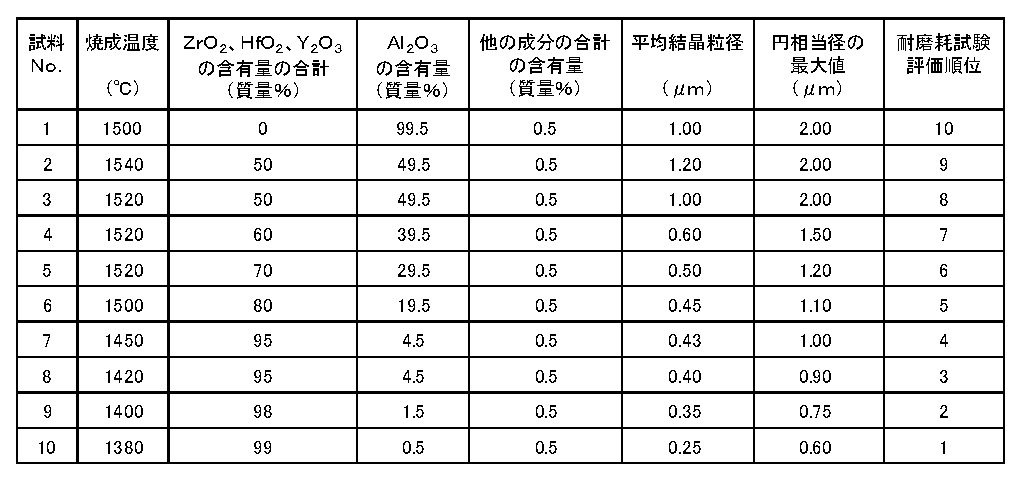
- Zirconium oxide ceramics having the composition and average grain size shown in Table 1 were prepared and subjected to an abrasion resistance test.
- zirconium oxide powder was prepared as a main raw material.
- this zirconium oxide powder has 2% by mass of hafnium oxide in terms of the value of Hf converted to HfO 2 when the total of the value of Zr converted to ZrO 2 and the value of Hf converted to HfO 2 is 100% by mass, A stabilizer containing 3 mol% yttrium oxide was used.
- An aluminum oxide powder was also prepared.
- the starting materials weighed so that the content of each component constituting the zirconium oxide ceramics is as shown in Table 1 are put in a mill together with a solvent and a ball, and pulverized until a desired average particle size is obtained.
- the average particle size was measured using a particle size distribution measuring device.
- this granule was put into a mechanical press, and a pressure was applied to obtain a predetermined shape, followed by cutting and the like to obtain a molded body having a desired shape.
- the obtained molded body was fired by holding it in the air atmosphere for 2 hours at the firing temperature (maximum temperature) shown in Table 1. After that, by performing barrel polishing treatment, the sample No. 1 to 10 fiber guides were obtained.
- each sample obtained was subjected to qualitative analysis by XRF, and the detected components were quantitatively analyzed by ICP.
- the values converted into oxides are shown in Table 1.
- Table 1 In the column of the total content of other components in Table 1, the total of oxide-converted values of components other than Zr, Hf, Y, and Al is described.
- each sample obtained was mirror-finished, and the surface subjected to thermal etching at a temperature lower by 50 ° C. than the firing temperature was used as the measurement surface.
- the photographed image was image analysis software. (Image-Pro Plus made by Planetron, Inc.) The outline of crystal grains was traced and scanned, and the average crystal grain size and maximum value of equivalent circle diameters were determined by analyzing under conditions of gray scale of 300 dpi.
- each sample was measured using XRD, and identification using a JCPDS card was performed from the obtained X-ray chart. 2 to 10 have zirconium oxide crystal particles. 1 confirmed that the zirconium oxide crystal particles were not present.
- Sample No. 1 the width of the wear scar was the widest and the depth was deep.
- Sample No. 2 is Sample No. Although not as much as 1, sample no. The wear scar was wider and deeper than 3-10. In contrast, sample no. In Nos. 3 to 10, the wear scar width was narrow and the depth was shallow. Sample No. 7 and 8, sample no. In No. 8, the width of the wear scar was narrower and the depth was shallower. Furthermore, in particular, sample no. Nos. 9 and 10 had a narrow wear scar and a shallow depth.
- the fiber guide having excellent wear resistance can be obtained by comprising at least zirconium oxide crystal particles and the average crystal particle size of the crystal particles constituting the ceramic is 1 ⁇ m or less. It was. Moreover, it turned out that it is suitable that the maximum value of a circle equivalent diameter in a crystal grain is less than 1 micrometer. Furthermore, it has been found that the fiber guide has excellent wear resistance. Moreover, it is more preferable that the total content of zirconium oxide, hafnium oxide, and oxides of components that stabilize zirconium oxide is 98% by mass or more out of 100% by mass of all components constituting the ceramic. I found out that
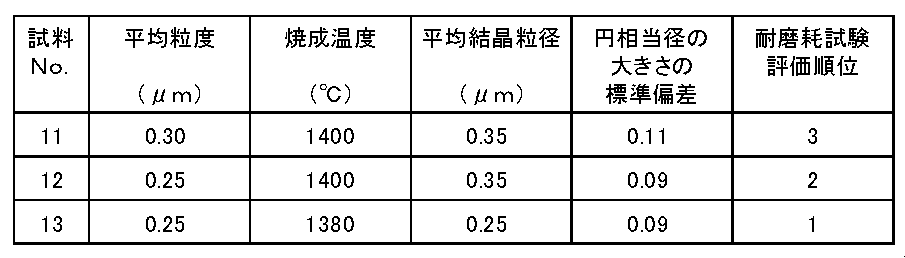
- Example 1 Sample No. shown in Example 1 was used. Samples having different average particle sizes and firing temperatures (maximum temperatures) were prepared using the same starting materials as in No. 9, and the abrasion resistance test was performed. Sample No. 11 shows the sample No. of Example 1. It is the same as 9.
- the starting material, solvent and balls were put in a mill and pulverized to a predetermined average particle size.
- sample no. For 12 and 13 particles exceeding 0.5 ⁇ m were removed.
- sample no. For No. 11 the average particle size after grinding, sample no. For Nos. 12 and 13, the average particle size after the filter pass was measured using a particle size distribution measuring device.
- the obtained molded body was fired by holding it at a firing temperature shown in Table 2 for 2 hours in an air atmosphere. After that, by performing barrel polishing treatment, the sample No. 11-13 fiber guides were obtained.
- each obtained sample was qualitatively analyzed by XRF, and the detected components were quantitatively analyzed by ICP.
- sample no In each of 11 to 13, the total content of ZrO 2 , HfO 2 , Y 2 O 3 is 98% by mass, the content of Al 2 O 3 is 1.5% by mass, The content was 0.5% by mass.
- Example 2 the average crystal grain size of the equivalent circle diameter and the standard deviation of the size of the equivalent circle diameter were obtained by the same method as that for obtaining the average crystal grain size of the equivalent circle diameter. Furthermore, by the same method as in Example 1, a wear resistance test was performed to rank the evaluations. The results are shown in Table 2.
- the standard deviation of the size of the equivalent circle diameter of the crystal particles is preferably 0.1 or less with respect to the wear resistance.
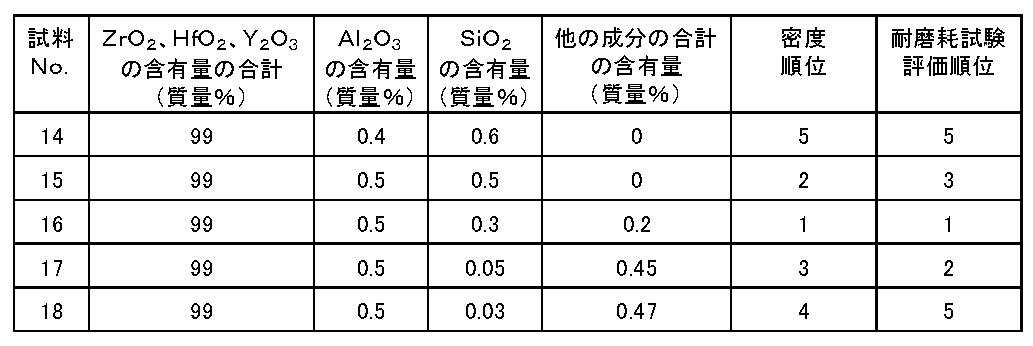
- samples having the compositions shown in Table 3 were prepared, and the density was measured and the abrasion resistance test was performed as an evaluation of mechanical properties.
- the sample No. 1 in Example 1 was used. 10 and sample no. 14-18 fiber guides were obtained.
- the content of silicon oxide is at most 0.5 mass% or more 0.05% by mass in terms of SiO 2, reducing the abrasion resistance
- the mechanical properties were enhanced by the promoting action of sintering.
Landscapes
- Chemical & Material Sciences (AREA)
- Engineering & Computer Science (AREA)
- Ceramic Engineering (AREA)
- Manufacturing & Machinery (AREA)
- Materials Engineering (AREA)
- Structural Engineering (AREA)
- Organic Chemistry (AREA)
- Composite Materials (AREA)
- Textile Engineering (AREA)
- Mechanical Engineering (AREA)
- Physics & Mathematics (AREA)
- Thermal Sciences (AREA)
- Inorganic Chemistry (AREA)
- Guides For Winding Or Rewinding, Or Guides For Filamentary Materials (AREA)
- Compositions Of Oxide Ceramics (AREA)
Abstract
Description
10:オイリングノズル
20:ローラガイド
30:ロッドガイド
40:トラバースガイド
Claims (5)
- 少なくとも酸化ジルコニウムの結晶粒子を含むセラミックスからなり、該セラミックスを構成する結晶粒子の平均結晶粒径が1μm以下であることを特徴とする繊維ガイド。
- 前記結晶粒子における円相当径の最大値が1μm未満であることを特徴とする請求項1に記載の繊維ガイド。
- 前記セラミックスを構成する全成分100質量%のうち、前記酸化ジルコニウムと、酸化ハフニウムと、前記酸化ジルコニウムを安定化させる成分の酸化物との含有量の合計が98質量%以上であることを特徴とする請求項1または請求項2に記載の繊維ガイド。
- 前記結晶粒子の円相当径の大きさの標準偏差が0.1以下であることを特徴とする請求項1乃至請求項3のいずれかに記載の繊維ガイド。
- 前記セラミックスを構成する全成分100質量%のうち、酸化珪素の含有量が0.05質量%以上0.5質量%以下であることを特徴とする請求項1乃至請求項4のいずれかに記載の繊維ガイド。
Priority Applications (3)
| Application Number | Priority Date | Filing Date | Title |
|---|---|---|---|
| EP14872047.7A EP3085652B1 (en) | 2013-12-17 | 2014-12-17 | Fiber guide |
| CN201480068111.4A CN105813964B (zh) | 2013-12-17 | 2014-12-17 | 纤维引导器 |
| JP2015553582A JP6290927B2 (ja) | 2013-12-17 | 2014-12-17 | 繊維ガイド |
Applications Claiming Priority (2)
| Application Number | Priority Date | Filing Date | Title |
|---|---|---|---|
| JP2013-260274 | 2013-12-17 | ||
| JP2013260274 | 2013-12-17 |
Publications (1)
| Publication Number | Publication Date |
|---|---|
| WO2015093531A1 true WO2015093531A1 (ja) | 2015-06-25 |
Family
ID=53402876
Family Applications (1)
| Application Number | Title | Priority Date | Filing Date |
|---|---|---|---|
| PCT/JP2014/083413 Ceased WO2015093531A1 (ja) | 2013-12-17 | 2014-12-17 | 繊維ガイド |
Country Status (4)
| Country | Link |
|---|---|
| EP (1) | EP3085652B1 (ja) |
| JP (1) | JP6290927B2 (ja) |
| CN (1) | CN105813964B (ja) |
| WO (1) | WO2015093531A1 (ja) |
Cited By (3)
| Publication number | Priority date | Publication date | Assignee | Title |
|---|---|---|---|---|
| JP2017116535A (ja) * | 2015-12-17 | 2017-06-29 | 住友金属鉱山株式会社 | 蛍光x線分析用試料調製方法 |
| JPWO2017038699A1 (ja) * | 2015-08-28 | 2017-08-31 | 京セラ株式会社 | 繊維ガイド |
| EP3461771A4 (en) * | 2016-06-28 | 2019-06-19 | Kyocera Corporation | FIBER MANAGEMENT |
Families Citing this family (2)
| Publication number | Priority date | Publication date | Assignee | Title |
|---|---|---|---|---|
| WO2018181148A1 (ja) * | 2017-03-29 | 2018-10-04 | 京セラ株式会社 | 繊維ガイド |
| CN111056838A (zh) * | 2019-12-30 | 2020-04-24 | 宜兴市九荣特种陶瓷有限公司 | 一种陶瓷粉料及用其制得的陶瓷导丝器以及陶瓷导丝器的制备方法 |
Citations (4)
| Publication number | Priority date | Publication date | Assignee | Title |
|---|---|---|---|---|
| JPS59138571A (ja) * | 1983-01-29 | 1984-08-09 | Kyocera Corp | 糸道 |
| JP2003192452A (ja) * | 2001-10-16 | 2003-07-09 | Toray Ind Inc | ジルコニア粉末およびその焼結体 |
| JP2003213522A (ja) | 2002-01-15 | 2003-07-30 | Toray Ind Inc | ポリエステル繊維の製造方法 |
| JP2010229570A (ja) * | 2009-03-26 | 2010-10-14 | Kyocera Corp | 繊維ガイド |
Family Cites Families (6)
| Publication number | Priority date | Publication date | Assignee | Title |
|---|---|---|---|---|
| JP2821680B2 (ja) * | 1988-07-27 | 1998-11-05 | 京セラ株式会社 | 着色ジルコニアセラミックス |
| WO2012176777A1 (ja) * | 2011-06-20 | 2012-12-27 | 京セラ株式会社 | 繊維ガイド |
| CN102863213B (zh) * | 2012-09-14 | 2014-02-05 | 钟祥市中原电子有限责任公司 | 高密度镁稳定氧化锆陶瓷 |
| CN202967725U (zh) * | 2012-11-28 | 2013-06-05 | 孙洋平 | 化纤用陶瓷导丝器 |
| CN103145406A (zh) * | 2013-04-07 | 2013-06-12 | 桂林理工大学 | 一种制备耐磨性能优异的氧化铝陶瓷的方法 |
| CN103232238B (zh) * | 2013-04-25 | 2014-08-06 | 三祥新材股份有限公司 | 一种高强度电熔氧化锆陶瓷球的制备方法 |
-
2014
- 2014-12-17 CN CN201480068111.4A patent/CN105813964B/zh active Active
- 2014-12-17 WO PCT/JP2014/083413 patent/WO2015093531A1/ja not_active Ceased
- 2014-12-17 EP EP14872047.7A patent/EP3085652B1/en active Active
- 2014-12-17 JP JP2015553582A patent/JP6290927B2/ja active Active
Patent Citations (4)
| Publication number | Priority date | Publication date | Assignee | Title |
|---|---|---|---|---|
| JPS59138571A (ja) * | 1983-01-29 | 1984-08-09 | Kyocera Corp | 糸道 |
| JP2003192452A (ja) * | 2001-10-16 | 2003-07-09 | Toray Ind Inc | ジルコニア粉末およびその焼結体 |
| JP2003213522A (ja) | 2002-01-15 | 2003-07-30 | Toray Ind Inc | ポリエステル繊維の製造方法 |
| JP2010229570A (ja) * | 2009-03-26 | 2010-10-14 | Kyocera Corp | 繊維ガイド |
Cited By (6)
| Publication number | Priority date | Publication date | Assignee | Title |
|---|---|---|---|---|
| JPWO2017038699A1 (ja) * | 2015-08-28 | 2017-08-31 | 京セラ株式会社 | 繊維ガイド |
| CN107922141A (zh) * | 2015-08-28 | 2018-04-17 | 京瓷株式会社 | 纤维引导器 |
| EP3326948A4 (en) * | 2015-08-28 | 2018-07-18 | KYOCERA Corporation | Fiber guide |
| CN107922141B (zh) * | 2015-08-28 | 2019-11-01 | 京瓷株式会社 | 纤维引导器 |
| JP2017116535A (ja) * | 2015-12-17 | 2017-06-29 | 住友金属鉱山株式会社 | 蛍光x線分析用試料調製方法 |
| EP3461771A4 (en) * | 2016-06-28 | 2019-06-19 | Kyocera Corporation | FIBER MANAGEMENT |
Also Published As
| Publication number | Publication date |
|---|---|
| JP6290927B2 (ja) | 2018-03-07 |
| CN105813964B (zh) | 2020-02-07 |
| CN105813964A (zh) | 2016-07-27 |
| EP3085652A4 (en) | 2017-08-16 |
| EP3085652A1 (en) | 2016-10-26 |
| EP3085652B1 (en) | 2018-10-24 |
| JPWO2015093531A1 (ja) | 2017-03-23 |
Similar Documents
| Publication | Publication Date | Title |
|---|---|---|
| JP6290927B2 (ja) | 繊維ガイド | |
| JP5269257B2 (ja) | 繊維ガイド | |
| KR101832527B1 (ko) | 지르코니아 소결체 및 그 소결용 조성물 및 가소체 | |
| JP2003034572A (ja) | アルミナセラミックス焼結体及びその製造方法並びに切削工具 | |
| JP2024538598A5 (ja) | ||
| KR101122929B1 (ko) | 투명한 다결정 산질화알루미늄의 제조방법 | |
| EP3326948B1 (en) | Fiber guide | |
| JP6160986B1 (ja) | セラミックス焼結体 | |
| KR20190043631A (ko) | 세라믹 부품 및 이의 형성 방법 | |
| JP2004115343A (ja) | 部分安定化ジルコニア焼結体の製造法 | |
| JP6789379B2 (ja) | 繊維ガイド | |
| JP2017179620A (ja) | 繊維ガイド | |
| JPWO2018003801A1 (ja) | オイリングノズル | |
| KR101434971B1 (ko) | 섬유방사용 노즐 및 가이드 제조방법 | |
| DE60307743T2 (de) | Gesintertes Siliziumnitrid, Schneidplättchen, abriebfester Teil, Schneidwerkzeug und Verfahren zur Herstellung von gesintertem Siliziumnitrid | |
| WO2010024171A1 (ja) | ジルコニア原料およびジルコニア焼結体、並びに刃物 | |
| JP7802091B2 (ja) | 摺動部材およびそれを用いた仮撚機用ディスク | |
| CN112313189A (zh) | 烧结体和其中形成有氧化铝的固溶体的部分稳定氧化锆 | |
| JP6280004B2 (ja) | 釣り糸用ガイド部材 | |
| JP2001080978A (ja) | 窒化珪素質焼結部材及びその製造方法、ならびにセラミックボール | |
| JP2026065317A (ja) | セラミックス焼結体、切削工具、および、ベアリングボール | |
| WO2025187399A1 (ja) | セラミックス焼結体、ベアリングボール、および、切削工具 | |
| JP6336889B2 (ja) | 釣り糸用ガイド部材 | |
| JP2010234436A (ja) | キャプスタン | |
| Abden et al. | Study of High Temperature Sintering Process on Characteristics of Al |
Legal Events
| Date | Code | Title | Description |
|---|---|---|---|
| 121 | Ep: the epo has been informed by wipo that ep was designated in this application |
Ref document number: 14872047 Country of ref document: EP Kind code of ref document: A1 |
|
| ENP | Entry into the national phase |
Ref document number: 2015553582 Country of ref document: JP Kind code of ref document: A |
|
| REEP | Request for entry into the european phase |
Ref document number: 2014872047 Country of ref document: EP |
|
| WWE | Wipo information: entry into national phase |
Ref document number: 2014872047 Country of ref document: EP |
|
| NENP | Non-entry into the national phase |
Ref country code: DE |