WO2015094392A1 - Compositions and methods for treatment of glaucoma - Google Patents
Compositions and methods for treatment of glaucoma Download PDFInfo
- Publication number
- WO2015094392A1 WO2015094392A1 PCT/US2014/015797 US2014015797W WO2015094392A1 WO 2015094392 A1 WO2015094392 A1 WO 2015094392A1 US 2014015797 W US2014015797 W US 2014015797W WO 2015094392 A1 WO2015094392 A1 WO 2015094392A1
- Authority
- WO
- WIPO (PCT)
- Prior art keywords
- concentration
- pharmaceutical composition
- buffer
- dexmedetomidine
- composition
- Prior art date
- Legal status (The legal status is an assumption and is not a legal conclusion. Google has not performed a legal analysis and makes no representation as to the accuracy of the status listed.)
- Ceased
Links
Classifications
-
- A—HUMAN NECESSITIES
- A61—MEDICAL OR VETERINARY SCIENCE; HYGIENE
- A61K—PREPARATIONS FOR MEDICAL, DENTAL OR TOILETRY PURPOSES
- A61K31/00—Medicinal preparations containing organic active ingredients
- A61K31/33—Heterocyclic compounds
- A61K31/395—Heterocyclic compounds having nitrogen as a ring hetero atom, e.g. guanethidine or rifamycins
- A61K31/41—Heterocyclic compounds having nitrogen as a ring hetero atom, e.g. guanethidine or rifamycins having five-membered rings with two or more ring hetero atoms, at least one of which being nitrogen, e.g. tetrazole
- A61K31/4164—1,3-Diazoles
- A61K31/4174—Arylalkylimidazoles, e.g. oxymetazolin, naphazoline, miconazole
-
- A—HUMAN NECESSITIES
- A61—MEDICAL OR VETERINARY SCIENCE; HYGIENE
- A61K—PREPARATIONS FOR MEDICAL, DENTAL OR TOILETRY PURPOSES
- A61K47/00—Medicinal preparations characterised by the non-active ingredients used, e.g. carriers or inert additives; Targeting or modifying agents chemically bound to the active ingredient
- A61K47/06—Organic compounds, e.g. natural or synthetic hydrocarbons, polyolefins, mineral oil, petrolatum or ozokerite
- A61K47/08—Organic compounds, e.g. natural or synthetic hydrocarbons, polyolefins, mineral oil, petrolatum or ozokerite containing oxygen, e.g. ethers, acetals, ketones, quinones, aldehydes, peroxides
- A61K47/10—Alcohols; Phenols; Salts thereof, e.g. glycerol; Polyethylene glycols [PEG]; Poloxamers; PEG/POE alkyl ethers
-
- A—HUMAN NECESSITIES
- A61—MEDICAL OR VETERINARY SCIENCE; HYGIENE
- A61K—PREPARATIONS FOR MEDICAL, DENTAL OR TOILETRY PURPOSES
- A61K47/00—Medicinal preparations characterised by the non-active ingredients used, e.g. carriers or inert additives; Targeting or modifying agents chemically bound to the active ingredient
- A61K47/06—Organic compounds, e.g. natural or synthetic hydrocarbons, polyolefins, mineral oil, petrolatum or ozokerite
- A61K47/16—Organic compounds, e.g. natural or synthetic hydrocarbons, polyolefins, mineral oil, petrolatum or ozokerite containing nitrogen, e.g. nitro-, nitroso-, azo-compounds, nitriles, cyanates
- A61K47/18—Amines; Amides; Ureas; Quaternary ammonium compounds; Amino acids; Oligopeptides having up to five amino acids
- A61K47/186—Quaternary ammonium compounds, e.g. benzalkonium chloride or cetrimide
-
- A—HUMAN NECESSITIES
- A61—MEDICAL OR VETERINARY SCIENCE; HYGIENE
- A61K—PREPARATIONS FOR MEDICAL, DENTAL OR TOILETRY PURPOSES
- A61K47/00—Medicinal preparations characterised by the non-active ingredients used, e.g. carriers or inert additives; Targeting or modifying agents chemically bound to the active ingredient
- A61K47/30—Macromolecular organic or inorganic compounds, e.g. inorganic polyphosphates
- A61K47/36—Polysaccharides; Derivatives thereof, e.g. gums, starch, alginate, dextrin, hyaluronic acid, chitosan, inulin, agar or pectin
- A61K47/38—Cellulose; Derivatives thereof
-
- A—HUMAN NECESSITIES
- A61—MEDICAL OR VETERINARY SCIENCE; HYGIENE
- A61K—PREPARATIONS FOR MEDICAL, DENTAL OR TOILETRY PURPOSES
- A61K9/00—Medicinal preparations characterised by special physical form
- A61K9/0012—Galenical forms characterised by the site of application
- A61K9/0048—Eye, e.g. artificial tears
-
- A—HUMAN NECESSITIES
- A61—MEDICAL OR VETERINARY SCIENCE; HYGIENE
- A61P—SPECIFIC THERAPEUTIC ACTIVITY OF CHEMICAL COMPOUNDS OR MEDICINAL PREPARATIONS
- A61P27/00—Drugs for disorders of the senses
- A61P27/02—Ophthalmic agents
- A61P27/06—Antiglaucoma agents or miotics
Definitions
- Glaucoma is a multifactorial disease which encompasses a spectrum ranging from elevated intraocular pressure ("IOP") to reduced vascular perfusion of the optic nerve.
- IOP intraocular pressure
- glaucoma patients require two or more drugs for satisfactory control of their intraocular pressure.
- the prostaglandins/prostanoids including Xalatan ® (latanoprost; Xalatan is a registered trademark of Pfizer Health AB), Travatan ® (travoprost; Travatan is a registered trademark of Novartis AG) and Lumigan ® (bimatoprost; Lumigan is a registered trademark of Allergan, Inc.
- the two drugs should have different mechanisms of action.
- Brimonidine a known alpha-2 (a-2) adrenergic receptor agonist, typically causes moderate peak IOP reduction of about 20-25% in ocular hypertensive eyes and 6-18% in normotensive eyes (less than 21 mm Hg). Its peak effect is within 2 hours of instillation, its duration of effect is typically less than 12 hours, and its moderate efficacy usually requires dosing of 2-3 times a day. It is one of the leading secondary drugs, with a mechanism of action of aqueous suppression that complements the prostaglandin/prostanoids uveal scleral outflow enhancement for significant additive benefit, but about equal to other second line glaucoma drugs such as beta-blockers and carbonic anhydrase inhibitors.
- brimonidine is the only commercially available a-2 agonist, proving safer and/or more effective than predecessors agonist which it has been compared, including clonidine (i.e. fewer instances of systemic hypotension and/or bradycardia), apraclonidine (i.e. fewer instances of tachyphylaxis), and dexmedetomidine (i.e. less systemic sedation, greater IOP reduction efficacy).
- clonidine i.e. fewer instances of systemic hypotension and/or bradycardia
- apraclonidine i.e. fewer instances of tachyphylaxis
- dexmedetomidine i.e. less systemic sedation, greater IOP reduction efficacy
- brimonidine may induce substantial local side effects in 10-25% of users, such as conjunctival hyperemia (i.e.
- brimonidine a-2 agonists, including brimonidine, clonidine and dexmedetomidine, induce substantial systemic effects if absorbed into the circulation, and are specifically known to increase fatigue, decrease blood pressure (i.e. hypotension) and lower the heart rate (i.e. bradycardia).
- a-2 agonists particularly the more lipophilic drugs such as clonidine and dexmedetomidine readily cross the blood brain barrier and thereby induce potent sedative effects.
- Dexmedetomidine in particular, is a potent intravenous sedative, and side effects such as drowsiness, shortness of breath, dizziness, headache, hypotension, bradycardia, and mood depression are common to all a-2 agonists depending on their degree of systemic absorption.
- Brimonidine in particular produces topical lid and conjunctival allergy, dryness, and redness in well over 10% of patients. These side effects contribute to suboptimal compliance with brimonidine, which also negatively affects treatment.
- brimonidine has been the only commercially available a-2 agonist, due to its demonstrated combination of superior IOP reduction with greatly reduced risk of systemic side effects versus all other a-2 agonists attempted for this purpose, despite its less than optimal side effect profile and modest efficacy relative to prostaglandins/prostanoids.
- compositions and methods effective for the treatment of glaucoma in a patient in need thereof are formulated to prevent sedation, eliminate or reduce redness, eliminate or reduce ocular allergy, as well as significantly reduce intraocular pressure.
- the provided compositions may also have an eye whitening effect.
- the compositions include all of the above benefits and also have neuroprotective benefits and may be used for optic nerve protection, including the treatment of neurodegenerative conditions, such as ischemic optic neuropathy, diabetic retinopathy, optic ischemia, retinal vascular ischemia, and other optic neuropathies, particularly those involving retinal ganglion cells and/or axons at or near the optic nerve lamina.
- the present invention optimizes a-2 agonist corneal permeation utilizing a highly selective a-2 agonist which is formulated to optimize intraocular penetration at a lipophilicity of preferably Log P 2.5 or greater and range of topical lipophilicity based on the pH and optional buffering of the formulation that may range from 0.73 to 3.08 (measured relative to pH as the Log D value). Further, the improved formulations allow for reduced a-1 agonist activity and reduced systemic absorption, allowing for a more lipophilic a-2 agonist for topical use. [00011]
- the preferred compositions of the invention employ selective a-2 adrenergic receptor agonists.
- the formulation preferably has the following non-
- the elastic modulus increases about 200 to 1000 fold within 1-2 seconds during the low shear force interblink period of each cycle, more preferably at least 2000 fold, and still more preferably at least 4000 fold, and where during the blink phase such modulus is less than 100, preferably less than 10, and more preferably about 0;
- the invention provides novel formulations of dexmedetomidine, which are surprisingly found to be much more effective for the treatment of glaucoma than brimonidine.
- These novel inventive formulations share some or all of the following characteristics: a) a high selectivity for a-2 over a-1 adrenergic receptors, such as 1000: 1 or greater; more preferably 1500: 1 or greater; and even more preferably 2000: 1 or greater;
- c) include an anionic cyclodextrin such as Captisol ® (Captisol is a registered trademark of Cydex Pharmaceuticals), other cyclodextrins, or other nonionic surfactants such as poloxamer or a polyoxyl alkyl at specified concentration range, and one or more specific viscosity enhancers (also interchangeably referred to as a "gelling agents").
- an anionic cyclodextrin such as Captisol ® (Captisol is a registered trademark of Cydex Pharmaceuticals)
- other cyclodextrins or other nonionic surfactants such as poloxamer or a polyoxyl alkyl at specified concentration range
- one or more specific viscosity enhancers also interchangeably referred to as a "gelling agents”
- the invention provides a pharmaceutical composition
- a pharmaceutical composition comprising: an a-2 adrenergic receptor agonist at a concentration from between about 0.0125% to about 0.125%) weight by volume, wherein said a-2 adrenergic receptor has a Log P value of 2.0 or greater and has a binding affinity of 950 fold or greater for a-2 over a-1 adrenergic receptors;
- a cyclodextrin or a poloxamer or a polyoxyl alkyl at a concentration of between 2%> and 12% weight by volume or less;
- said pharmaceutical composition has a viscosity of between 25 and 500 cps
- said pharmaceutical composition is effective for the treatment of glaucoma in a patient in need thereof.
- a preferred a-2 adrenergic receptor agonist is dexmedetomidine.
- dexmedetomidine is at a concentration from between about 0.035% and 0.12% weight by volume, more preferably at a concentration from about 0.035% to about 0.10% and more preferably between about 0.050% and 0.10% and even more preferably between about 0.060% and 0.087%.
- the salt selected from the group consisting of sodium chloride, citrate, mesylate, hydrobromide/bromide, acetate, fumarate, sulfate/bisulfate, succinate, phosphate, maleate, nitrate, tartrate, benzoate, carbonate, and pamoate.
- the salt is sodium chloride (e.g., a saline solution).
- the viscosity enhancer is selected from carboxymethyl cellulose, methylcellulose, hydroxymethyl cellulose, hydroxypropylmethyl cellulose, hydroxyethyl cellulose, polyethylene glycol, dextran, povidone, alginic acid, guar gum, acacia, Veegum ® (Veegum is a registered trademark of Vanderbilt Minerals, LLC), gelatin, chitosan, Carbopol ® (Carbopol is a registered trademark of Lubrizol Advanced Materials, Inc.), locust bean gum, acidic polycarbophil, dextran, pectin, glycerin, polysorbate, polyvinylpyrridone, polyvinyl alcohol, hyaluronic acid and combinations thereof.
- the viscosity enhancer is carboxymethyl cellulose.
- carboxymethyl cellulose is of a high blend at a concentration of between 0.1% and 1.25% weight by volume.
- the cyclodextrin, poloxamer or polyoxyl alkyl is present at concentration range of 3% to 10%> by weight; and more preferably, at 5% to 6%> by weight.
- the cyclodextrin is selected from alpha, beta or gamma chain cyclodextrins, and is selected from the group consisting of 2 hydroxypropyl beta cyclodextrin and and more preferably the sulfobutyl ether derivative of ⁇ -cyclodextrin (Captisol ® ); poloxamer is selected from the group consisting of poloxamer 407, poloxamer 188, and combinations thereof and the polyoxyl alkyl is selected from the group consisting of polyoxyl 40 stearate, polyoxyl 35 castor oil, and or polyoxyl dehydrogenated 40 castor oil.
- the pharmaceutical composition may further comprise a buffer which may be selected from, but is not limited to, the group consisting of citrate buffer, borate buffer, maleate buffer, succinate buffer, phosphate buffer, acetate buffer, sorbate buffer and carbonate buffer.
- a buffer which may be selected from, but is not limited to, the group consisting of citrate buffer, borate buffer, maleate buffer, succinate buffer, phosphate buffer, acetate buffer, sorbate buffer and carbonate buffer.
- the buffer is at a concentration between 1 mM and 100 mM, preferably between 4 millimolar and 10 millimolar.
- the a-2 agonist of the pharmaceutical composition has an octanol-water partition coefficient Log D of between about 0.70 and about 2.98, or preferably between about 1.25 and 2.50.
- the pharmaceutical compositions of the invention may further comprise a mucoadhesive, which may be present at a concentration from between about 0.05% and about 10% weight by volume.
- the mucoadhesive is selected from the group consisting of
- Carbopol ® xanthan gums, and cellulose derivatives.
- the invention also provides methods of treating glaucoma and/or posterior pole ocular neurodegenerative conditions and/or dry eye in a patient in need thereof comprising administering to said patient the pharmaceutical compositions of the invention.
- a-1 adrenergic receptor refers to a G-protein-coupled receptor
- GPCR GPCR associated with the G q heterotrimeric G-protein.
- a-2 adrenergic receptor refers to a GPCR associated with the Gi heterotrimeric G-protein.
- selective a-2 adrenergic receptor agonists encompasses all a-2 adrenergic receptor agonists which have a binding affinity of 1000 fold or greater for a-2 over a- 1 adrenergic receptors , and more preferably 1500 fold or greater.
- the term also encompasses pharmaceutically acceptable salts, esters, prodrugs, and other derivatives of selective a-2 adrenergic receptor agonists.
- diexmedetomidine encompasses, without limitation, dexmedetomidine salts, esters, prodrugs and other derivatives.
- prodrug refers to a compound that may be converted under physiological conditions to a biologically active compound.
- composition is intended to encompass a product comprising the specified ingredients in the specified amounts, as well as any product which results, directly or indirectly, from a combination of the specified ingredients in the specified amounts.
- treating and “treatment” refer to reversing, alleviating, inhibiting, or slowing the progress of the disease, disorder, or condition to which such terms apply, or one or more symptoms of such disease, disorder, or condition.
- preventing and “prevention” refer to prophylactic use to reduce the likelihood of a disease, disorder, or condition to which such term applies, or one or more symptoms of such disease, disorder, or condition. It is not necessary to achieve a 100% likelihood of prevention; it is sufficient to achieve at least a partial effect of reducing the risk of acquiring such disease, disorder, or condition.
- significant side effects refers to substantial side effects of the treatment which include at least: a) sedation of a patient such that the patient feels sedated and becomes impaired or b) visually noticeable increase in redness of a patient's eye due to hyperemia.
- immediate camentosa refers to the inflammatory sequelae of a-1 agonist topical medications, particularly following topical ocular or nasal delivery, such as the development of increased vasodilation and hyperemia, in its less severe form referred to as "rebound”.
- Poloxamer 407 and Pluronic ® F127 are used interchangeably.
- Nonionic surfactants suitable for the present invention include cyclodextrins, polyoxyl alkyls, poloxamers or combinations thereof, and may include in addition combinations with other nonionic surfactants such as polysorbates.
- Preferred embodiments include polyoxyl 40 stearate; and optionally Poloxamer 188, Poloxamer 407, Polysorbate 20, Polysorbate 80, ionically charged (e.g. anionic) beta - cyclodextrins with or without a butyrated salt (Captisol ® ), 2-hydroxypropyl beta cyclodextrin (“HPpCD”), Polyoxyl 35 castor oil, and Polyoxyl 40 hydrogenated castor oil or combinations thereof.
- nonionizing surfactant such as poloxamer, poloxamer 103, poloxamer 123, and poloxamer 124, poloxamer 407, poloxamer 188, and poloxamer 338, any poloxamer analogue or derivative, polysorbate, polysorbate 20, polysorbate 40, polysorbate 60, polysorbate 80, any polysorbate analogue or derivative, cyclodextrin, hydroxypropyl- ⁇ - cyclodextrin, hydroxypropyl- ⁇ -cyclodextrin, randomly methylated ⁇ - cyclodextrin, ⁇ -cyclodextrin sulfobutyl ether, ⁇ -cyclodextrin sulfobutyl ether or glucosyl- ⁇ - cyclodextrin, any cyclo
- TAPSO tris(hydroxymethyl)methyl]-3-amino-2-hydroxypropane sulfonic acid
- TES N- tris(hydroxymethyl) methyl-2-aminoethane sulfonic acid
- Tris 2-Amino-2-hydroxymethyl- propane-l,3-diol
- Span a registered trademark of Uniqema Americas Inc.
- an anionic surfactant such as sodium lauryl ether sulfate, sodium lauryl sulfate (“SLS”) or a combination thereof is preferred.
- compositions and methods effective for the treatment of glaucoma in a patient in need thereof are formulated to prevent sedation, eliminate or reduce redness, eliminate or reduce ocular allergy, as well as significantly reduce intraocular pressure.
- the salt selected from the group consisting of sodium chloride, citrate, mesylate, hydrobromide/bromide, acetate, fumarate, sulfate/bisulfate, succinate, phosphate, maleate, nitrate, tartrate, benzoate, carbonate, and pamoate.
- the salt is sodium chloride (e.g., a saline solution).
- the viscosity enhancer is selected from carboxymethyl cellulose, methylcellulose, hydroxymethyl cellulose, hydroxypropylmethyl cellulose, hydroxyethyl cellulose, polyethylene glycol, dextran, povidone, alginic acid, guar gum, acacia, Veegum ® , gelatin, chitosan, Carbopol ® , locust bean gum, acidic polycarbophil, dextran, pectin, povidone, polyvinylpyrridone, polyvinyl alcohol, and hyaluronic acid.
- the viscosity enhancer is carboxymethyl cellulose.
- the cyclodextrin, poloxamer or polyoxyl alkyl is present at concentration range of 3% to 10% by weight; and more preferably, at 5% to 6% by weight.
- the cyclodextrin is selected from the group consisting of alpha, beta or gamma chain cyclodextrin, more preferably 2 hydroxypropyl beta cyclodextrin, and still more preferably the sulfobutyl ether derivative of ⁇ -cyclodextrin such as Captisol ® ; poloxamer is selected from the group consisting of poloxamer 407, poloxamer 188; and the polyoxyl alkyl is selected from the group consisting polyoxyl 40 stearate, polyoxyl 35 castor oil, and or polyoxyl dehydrogenated 40 castor oil.
- poloxamers, polyoxyl alkyls and/or combinations thereof can be used for the purposes of the present invention.
- part of the invention and optimal formulation herein has as its goal to maximize the corneal residence time and permeability of dexmedetomidme to achieve the greatest intraocular absorption while minimizing systemic circulation and side effects.
- side effects include but are not limited to sedation, blurred vision and/or discomfort (e.g., stinging).
- dexmedetomidme can reduce IOP, there has been no showing to the Applicant's knowledge of dexmedetomidme at concentrations and formulations without side effects such as sedation.
- the elastic modulus increases about 100 to 1000 fold within 1-2 seconds during the low shear force interblink period of each cycle, more preferably at least 2000 fold, and where during the blink phase such modulus is less than 100, preferably less than 10, and more preferably about 0;
- the formulation must not cause excessive stinging or discomfort, reducing compliance or causing unacceptable ocular surface toxicity
- CMC carboxymethylcellulose
- Captisol ® it is also surprising, unexpected, and important for optimal corneal absorption and reduction of systemic absorption that when using Captisol ® the CMC is preferably increased to a range from about 0.90% to about 1.2% w/v to retain similar rheological properties found at 0.80%) w/v when used with poloxamers or polyoxyl alkyls.
- highly lipophilic drugs such as dexmedetomidine or other similar a-2 agonists are embedded within a nonpolar inner cell within micelles of a micellar equilibrium of the inventive formulations and thereby shielded by a polar outer shell in such configurations reducing the absorption by the lipophilic vascular endothelium relative to free floating drug in solution.
- the present invention is directed to a pharmaceutical composition
- a pharmaceutical composition comprising: i. dexmedetomidine at a concentration from about 0.0125% to about 0.125% w/v, more preferably from about 0.035% to about 0.10% w/v, most preferably from about 0.060% to about 0.087% w/v;
- a surfactant selected from polyoxyl 40 stearate, a cyclodextrin, gamma cyclodextrin and Captisol ® at a concentration from about 1% to about 15% w/v, more preferably polyoxyl 40 stearate or Captisol ® at a concentration of about 5.5% w/v;
- iii. carboxymethyl cellulose ((1% 2,500 centipoise)), at a concentration from about 0.10%) to about 1.25%) w/v, more preferably at about 0.80%> w/v if the surfactant is polyoxyl 40 stearate or from 0.90% to about 1.2% w/v if the surfactant is Captisol ® ; iv. sodium chloride at a concentration from about 0.025% to about 0.90% w/v, more preferably from about 0.25%> to about 0.50%> w/v, most preferably at about 0.037%) w/v; v. benzalkonium chloride ("BAK”) at a concentration from about 0.007% to about 0.02% w/v; preferably at 0.02% w/v;
- BAK benzalkonium chloride
- an antioxidant at a concentration from about 0.005% to about 0.05% w/v, preferaby at 0.015% w/v, preferably the antioxidant is sodium
- ethylenediaminetetraacetic acid at a concentration of about 0.015% w/v; vii. optionally a buffer at a concentration from about 1 millimolar to about 100
- a phosphate or borate buffer from about 1 to about 5 millimolar, more preferably a phosphate buffer at a concentration from about 2 to about 4 millimolar; and
- a pH from about 4.0 to about 8.0, preferably from about 6.0 to about 7.0.
- said pharmaceutical composition is effective for the treatment of glaucoma in a patient in need thereof.
- the present invention is directed to a pharmaceutical composition
- a pharmaceutical composition comprising: i. dexmedetomidine at a concentration from about 0.060% to about 0.087% w/v; ii. polyoxyl 40 stearate at a concentration of about 5.5% w/v;
- benzalkonium chloride at a concentration of about 0.02% w/v
- sodium lauryl sulfate at a concentration from about 0.01% to about 5.0% w/v, preferably at 0.50%> w/v;
- EDTA at a concentration of about 0.015% w/v
- a phosphate buffer at a concentration from about 1 to about 5
- pH of the composition is from about 6.0 to about 7.0.
- the present invention is directed to a pharmaceutical composition
- a pharmaceutical composition comprising:
- dexmedetomidine at a concentration from about 0.06% to 0.087% w/v;
- benzalkonium chloride at a concentration of about 0.02% w/v
- v. sodium lauryl sulfate at a concentration from about 0.1% to about 1.0% w/v, preferably at 0.50%> w/v;
- an antioxidant is at a concentration of about 0.015% w/v; and vii. optionally a phosphate buffer at a concentration from about 1 to about 5
- pH of the composition is from about 6.0 to about 7.0.
- the present invention is directed to a pharmaceutical composition
- a pharmaceutical composition comprising: i. dexmedetomidine at a concentration of about 0.080% w/v;
- benzalkonium chloride at a concentration of about 0.02% w/v; and wherein w/v denotes weight by volume and wherein said pharmaceutical composition is effective for the treatment of glaucoma in a patient in need thereof.
- the pharmaceutical composition may further comprise a buffer at a concentration from about 1 miUimolar to about 5 miUimolar, which may be selected from the group consisting of citrate buffer, borate buffer, maleate buffer, succinate buffer, phosphate buffer, acetate buffer, sorbate buffer and carbonate buffer, preferably from about 2 miUimolar to about 4 miUimolar and at a pH from about 5.5 to about 7.5.
- a buffer at a concentration from about 1 miUimolar to about 5 miUimolar which may be selected from the group consisting of citrate buffer, borate buffer, maleate buffer, succinate buffer, phosphate buffer, acetate buffer, sorbate buffer and carbonate buffer, preferably from about 2 miUimolar to about 4 miUimolar and at a pH from about 5.5 to about 7.5.
- the overall pH of the pharmaceutical composition is from about 6.0 to 7.0.
- the a-2 agonist of the pharmaceutical composition has an octanol-water partition coefficient Log D of between about 0.70 and about 2.20, and preferably between about 1.25 and 2.00.
- the pharmaceutical compositions of the invention may further comprise a mucoadhesive, which may be selected from the group consisting of Carbopol ® , xanthan gums, and cellulose derivatives.
- a mucoadhesive which may be selected from the group consisting of Carbopol ® , xanthan gums, and cellulose derivatives.
- other gums and/or gels, and/or viscosity enhancers can also be used for the purposes of the present invention.
- the mucoadhesive is at a concentration from between about
- inventive formulations may also optionally include other ingredients, such as corneal penetration enhancers and others.
- the invention also provides a method of treating glaucoma and/or posterior pole ocular neurodegenerative conditions in a patient in need thereof comprising administering to said patient the pharmaceutical compositions of the invention.
- inventive compositions may provide optic nerve protection, retinal ganglion cell neuroprotection, an increase in a-2 agonist concentration in the inner retinal plexiform, and additional neuroprotective benefits. They may also increase the outfiow at the trabecular meshwork which is populated with endothelial cells and believed to be populated with a-2a receptors in humans.
- compositions of the invention may be used to reduce eye redness and/or increase eye whiteness in subjects in need thereof.
- the concentration of a poloxamer, a polyoxyl alkyl, or a cyclodextrin should be within the 15% to 25% range, at which gelling effect at room temperature is known to occur by which corneal retention is prolonged but with substantial prolonged blurring on instillation of minutes or more, and/or at the physiologic range of tonicity enhancers.
- a poloxamer, a polyoxyl alkyl, or a cyclodextrin is effective in the provided combinations when it is present at 12% or less, and preferably at more than 3% but less than 10%.
- a poloxamer, a polyoxyl alkyl, or a cyclodextrin is present at a concentration of 15% or greater or much less than 2%, the compositions are surprisingly less effective or ineffective.
- viscosity enhancers at too low concentrations resulted in surprisingly more side effects and reduced efficacy, and that viscosities are reduced up to or more than 100 fold within the inventive formulations, such that a 1% CMC solution in water of 2,500 cps will be about 100 to 250 cps on initial instillation of a preferred embodiment. It has also been found that the use of viscosity enhancers by themselves (i.e., without a poloxamer, a polyoxyl alkyl or a cyclodextrin) results in much less effective formulations with prolonged blurring on instillation, greater systemic absorption, and in general less efficacy and more side effects.
- the tonicity of the provided formulations is at 0 to 200 mOsm/kg, and preferably at 50 to 150 mOsm/kg, a sustained wetting/lubricating effect will result with minimal blurring and the greater comfort for the patients.
- an ophthalmic vehicle requires 280-310 mOsm/kg, which is achieved through the use of electrolytes or polyols (e.g. mannitol).
- cyclodextrins and more preferably the sulfobutyl ether derivative of ⁇ -cyclodextrin (Captisol ® ) enhance the topical redness reduction whitening effect of the a-2 agonist, particularly dexmedetomidine; and whereby such preferred cyclodextrins further enhance intraocular pressure reduction.
- Captisol ® the sulfobutyl ether derivative of ⁇ -cyclodextrin
- compositions and methods are effective for the treatment of glaucoma.
- the compositions of the invention are formulated to prevent sedation, eliminate or reduce redness, may increase duration of therapeutic action and reduce the incidence of rebound hyperemia and/or other allergic reaction, as well as more significantly reduce intraocular pressure than prior art formulations of a-2 agonists.
- contralateral eye IOP is 90-100% of the IOP of the treated eye, due to very high systemic absorption (vs. about 10%> systemic absorption with the compositions of the present invention).
- formulations of the present invention provide the
- IOP reduction of about 40% at 4 hours in a treated eye is greater than that found for the most optimized formulation of brimonidine (Alphagan ® P at 0.1%, pH 7.4 or greater), which is about 20%> in a treated eye.
- brimonidine Alphagan ® P at 0.1%, pH 7.4 or greater
- Every 1 mm Hg reduction in IOP may result in substantial prevention of visual field loss.
- the longer duration of effect of the present invention creates a substantial effect over a 24 hour period, while a single dose of the conventional brimonidine formulations provides the IOP reduction effect for only about 12 hours or less.
- the invention also provides improved wetting and comfort, lasting up to an hour after instillation.
- the beneficial effects of the provided compositions include:
- a-2 agonists such as apraclonidine and brimonidine
- a-2 agonists such as apraclonidine and brimonidine
- a-2 agonists such as apraclonidine and
- compositions include selectivity for a-2 versus a-1 adrenergic receptors, lipophilicity, tonicity and solubility.
- the selective a-2 adrenergic receptor agonists have binding affinities (Kj) for a-2 over a-1 receptors of 1000:1 or greater; more preferably 1500: 1 or greater; and even more preferably 2000:1 or greater. It is well within a skill in the art to design an assay to determine a- 2/ ⁇ -1 functional selectivity. For example, potency, activity or EC50 at an a-2 A receptor can be determined by assaying for inhibition of adenylate cyclase activity. Furthermore, inhibition of adenylate cyclase activity can be assayed, without limitation, in PC 12 cells stably expressing an a-2 A receptor such as a human a-2 A receptor.
- potency, activity or EC50 at an a-1 A receptor can be determined by assaying for intracellular calcium.
- Intracellular calcium can be assayed, without limitation, in HEK293 cells stably expressing an a-1 A receptor, such as a bovine a-1 A receptor.
- compositions and methods of the invention include selective a-2 adrenergic receptor agonists which have K; for a-2 over a-1 receptors of 1500 fold or greater and have an octanol-water partition coefficient of about Log P 2.50 - 3.0 adjusted however for topical pH (Log D) to be between 0.75 and 3.08.
- Gut D topical pH
- Tears and intraocular fluids are physiologic at pH 7.4, which is equal to pH at Log P and, according to the precepts of the present invention, confers IOP reduction benefits.
- compositions and methods of the invention include selective a-2 adrenergic receptor agonists which have IQ for a-2 over a-1 receptors of 1000 fold or greater and are at a concentration from between about 0.0035% to about 0.035% weight by volume.
- Brimonidine, guanfacine, guanabenz, dexmedetomidine and fadolmidine are some of the sufficiently highly selective a-2 agonists to satisfy the selectivity requirement.
- these highly selective a-2 agonists only dexmedetomidine satisfies other additional preferred formulation characteristics of the present invention, such as lipophilicity.
- Other a-2 agonists, such as clonidine, may be sufficiently lipophilic but lack sufficient selectivity.
- a-2 adrenergic receptor agonist suitable for purposes of the invention is dexmedetomidine as either the HC1 salt, or as the citrate salt.
- Other salts may similarly be substituted for the HC1.
- compositions and methods of the invention include dexmedetomidine, or another selective a-2 adrenergic receptor agonist, at a concentration from between about 0.0125%) to about 0.125%) weight by volume; preferably, between about 0.025%> to about 0.125% weight by volume; more preferably between about 0.045% and about 0.10% weight by volume and even more preferably between about 0.060%) and about 0.087%.
- Lipophilicity may be measured, for example, using known measurements, such as
- Log P log Kow derivation of the octanol-water partition coefficient and/or, a closely related coefficient, XLogP3-AA. See, for example, Tiejun Cheng et al, Computation of Octanol-Water Partition Coefficients by Guiding an Additive Model with Knowledge, J. Chem. Inf. Model., 2007, 47 (6), pp 2140-2148. These measurements represent the intraocular lipophilicity value of topical drugs for intraocular delivery (i.e., once the drug permeates into the anterior chamber and is at a pH of 7.4). A person of ordinary skill in the art is well familiar with these measurements. Thus, the Log P value is the octanol-water coefficient at pH 7.4, i.e., physiologic pH.
- Log P and/or XLogP3-AA are measured when the formulation at issue is or will be at the physiologic pH of about 7.4.
- the range between +2.0 and +3.0 typically allows for the best compromise between: a) the need for a highly lipophilic drug to penetrate the lipophilic corneal epithelium, and to a lesser extent, the very thin inner corneal membrane called Descemet's membrane, and b) a highly hydrophilic drug to penetrate the stroma, which is the middle layer of the corneal "sandwich" that must be penetrated for effective ophthalmic absorption.
- the disclosed combination of a poloxamer, a viscosity enhancer and a hypotonic solution at the disclosed concentration ranges provides a delivery vehicle for dexmedetomidine (and, it is believed, for other mild to highly lipophilic drugs) that is independent of pH and largely independent of the individual drug's lipophilicity.
- the optimal pH of the provided formulations is such pH that results in a Log "D" value for the drug (the initial topical lipophilicity) of between 0.75 and 3.08, and more preferably between 0.92 and 2.98, representing the maximum pH range of 4.0 to 8.0, and the preferred pH range of 4.5 to 7.0 for optimal comfort and stability.
- inventive formulations i.e., those formulations including all of the required ingredients at the required concentrations
- the efficacy of the inventive formulations no longer appears to be reduced by any particular buffers, including phosphate buffer.
- buffers including phosphate buffer.
- specific combination of the ingredients in the inventive formulations confers this pH independence and increased solubility range on a variety of active drugs, both for glaucoma and other purposes, as well as provides increased absorption and reduced systemic side effects; including but not limited to steroidals, nonsteroidals, anti-infectives (antivirals and antimicrobials), and macular degeneration drug treatments such as anti-VEGF.
- the preferred Log P (and XLogP3-AA) values - those that define intraocular performance according to the present invention - that are suitable for the purposes of the invention are between about 1.00 and 4.50; and more preferably, between about 2.0 and 3.50. If the selectivity of a specific a-2 agonist is substantially above 1000: 1 (for example, 1500: 1), additional advantages are believed to be conferred via greater a-2 agonist binding and reduced a- 1 agonist induced ischemia. For example, optic nerve damage progression is known to be highly sensitive to circulation change and ischemia. Because the drug is used over an extended period of time, even small reductions in unintended a-1 agonist-induced ischemia may be beneficial.
- the a-2 agonist intraocular lipophilicity as represented by Log P, and selectivity as represented by the ⁇ -2: ⁇ -1 receptor recruitment ratio, appear to be very important for greater efficacy of an a-2 agonist glaucoma drug. If the selectivity is above, for example, 2000: 1, then it is possible that this agonist may be effective for the purposes of the invention at slightly reduced lipophilicity, and vice versa.
- Table 1 provides known XLogP3-AA values (a more accurate Log P) and a2/al binding affinities for several a-2 agonists.
- Table 1 demonstrates that among the listed a-2 agonists, only dexmedetomidine has an optimal combination of high lipophilicity (XLogP3-AA) and highly selective a2:al coefficient. However, it is possible that formulations including other a-2 agonists can be achieved which meet the defined requirements of the present invention in both selectivity and lipophilicity categories.
- dexmedetomidine or another selective a-2 adrenergic receptor agonist, has Log P at an intraocular pH 7.4 of about 3.10; preferably, between about 2.0 and 5.00; and more preferably between about 2.75 and 3.50.
- Log D refers to a lipophilicity value at a given pH
- this measurement is especially useful to determine the level of topical lipophilicity and resultant corneal permeability of a topical composition through the highly lipophilic corneal epithelium.
- 0.75 and about 2.20, and more particularly between about 1.00 and about 1.50, are preferred for increased corneal permeation of dexmedetomidine and other similar a-2 agonists in normal saline, preferably below the pH of 6.4 to 6.5, and that the "vehicle" of the present invention including poloxamer, viscosity enhancer and hypotonic saline or sterile water greatly reduces and likely totally eliminates such pH limitations.
- the optimal Log D value is from 0.75 to 2.2, and more preferably is about 1.00 to 2.00 at a topical pH of about 4.7 to 6.0.
- ophthalmic drugs typically require about
- tonicity enhancers including but not limited to electrolytes, particularly 0.9% NaCl, and polyols, such as mannitol, may be used to achieve the desired range.
- the inventive compositions should include a salt; a poloxamer at a concentration of 12% weight by volume or less; and a viscosity enhancer.
- a salt for example, using the provided compositions, dexmedetomidme is rendered soluble up to or beyond 0.15%.
- Solubility for dexmedetomidme and other similar drugs in its subclass is typically reduced exponentially with increasing pH.
- dexmedetomidme is only soluble in physiologic saline to about 0.025% at a highly alkaline pH. It is believed that the inventive formulations result in enhancement of solubility of dexmedetomidme, and by extension other members of its subclass, well above the 0.125% at alkaline pH.
- dexmedetomidine is more effective than prior art formulations of dexmedetomidine and more effective than brimonidine by about 200% (IOP reduction vs. time, which is the key measure of the effectiveness of IOP reduction).
- agents that improve solubility include, but are not limited to, polyanionic (multiple negatively charged) compounds, such as methylcellulose and derivatives, particularly carboxymethyl cellulose or other cellulose derivatives; hypotonic saline; sodium acetate, calcium salt, methanesulfonate (mesylate), hydrobromide/bromide, acetate, fumarate, sulfate/bisulfate, succinate, citrate, phosphate, maleate, nitrate, tartrate, benzoate, carbonate, pamoate, borate, glycolate, pivylate, sodium citrate monohydrate, sodium citrate trihydrate, sodium carbonate, sodium ethylenediaminetetraacetic acid ("EDTA”), phosphoric acid, pent
- polyanionic (multiple negatively charged) compounds such as methylcellulose and derivatives, particularly carboxymethyl cellulose or other cellulose derivatives
- hypotonic saline such as sodium acetate, calcium salt, methanesulfonate (mesylate), hydro
- the composition includes sodium citrate dehydrate at about 0.17%, and/or sodium acetate at about 0.39%; and/or calcium salt at about 0.048%.
- compositions and methods of the invention encompass all isomeric forms of the described a-2 adrenergic receptor agonists, their racemic mixtures, enol forms, solvated and unsolvated forms, analogs, prodrugs, derivatives, including but not limited to esters and ethers, and pharmaceutically acceptable salts, including acid addition salts.
- suitable acids for salt formation are hydrochloric, sulfuric, phosphoric, acetic, citric, oxalic, malonic, salicylic, malic, furmaric, succinic, ascorbic, maleic, methanesulfonic, tartaric, and other mineral carboxylic acids well known to those in the art.
- the salts may be prepared by contacting the free base form with a sufficient amount of the desired acid to produce a salt in the conventional manner.
- the free base forms may be regenerated by treating the salt with a suitable dilute aqueous base solution such as dilute aqueous hydroxide potassium carbonate, ammonia, and sodium bicarbonate.
- a suitable dilute aqueous base solution such as dilute aqueous hydroxide potassium carbonate, ammonia, and sodium bicarbonate.
- the free base forms differ from their respective salt forms somewhat in certain physical properties, such as solubility in polar solvents, but the acid salts are equivalent to their respective free base forms for purposes of the invention. (See, for example S. M. Berge, et al, "Pharmaceutical Salts," J. Pharm. Sci., 66: 1-19 (1977) which is incorporated herein by reference).
- compositions and methods of the invention include selective a-2 adrenergic receptor agonists which have binding affinities (Kj) for a-2 over a-1 receptors of 1000 fold or greater and are highly lipophilic, having an octanol-water partition coefficient of about 2.00 or greater.
- Brimonidine by comparison, has a binding affinity for a-2 over a-1 receptors of about 976 and its lipophilicity range, even when optimized by pH, is about three hundred fold less than that of dexmedetomidine, a preferred embodiment.
- compositions and methods of the invention include selective a-2 adrenergic receptor agonists which have IQ for a-2 over a-1 receptors of 1000 fold or greater and are at a concentration from between about 0.001% to about 0.035% weight by volume.
- compositions and methods of the invention include selective a-2 adrenergic receptor agonists which have K; for a-2 over a-1 receptors of 1500 fold or greater, are present at a concentration from between about 0.010% to about 0.040% weight by volume, and have pH of about 6.2 or less.
- the compositions of the invention may also include other therapeutic agents; however, the compositions are intended to be effective without the need for any other therapeutic agents, specifically including, but not limited to, a-1 antagonists.
- the invention also provides methods of treating and/or preventing glaucoma with the provided compositions.
- the provided methods lower IOP in glaucoma patients, reduce redness, and provide eye whitening.
- the provided methods may also treat ischemic optic neuropathy and other neuropathies of various etiologies due to neuroprotective effects of the provided compositions.
- compositions of the present invention are preferably formulated for a mammal, and more preferably, for a human.
- the compositions are delivered as ophthalmic solutions into the eyes.
- topical compositions which include, but are not limited to, gels and creams. They may also include additional non-therapeutic components, which include, but are not limited to, preservatives, delivery vehicles, tonicity adjustors, buffers, pH adjustors, antioxidants, tenacity adjusting agents, mucoadhesive agents, viscosity adjusting agents, and water.
- compositions of the present invention can simply dilute more concentrated solutions of selective a-2 agonists, using methods known in the art with diluent of particular gelling agents in solution, being in a preferred embodiment polyoxyl 40 stearate.
- inventive formulations may optionally include one or more of electrolytes or tonicity enhancing agents, and preferably one or more of the weak acids and/or their salts to achieve a formulated pH of 4.0 to 8.0, and more preferably 5.5 - 6.5.
- compositions of the invention may include various inactive ingredients commonly used in formulating topical compositions and that may improve stability of the formulation.
- compositions of the invention may include alcohols and/or surface active agents, including but not limited to polyglycol ether, polyethylene glycol-nonphenol ether, polyethylene glycol sorbitan monolaurate, polyethylene glycol sorbitan monooleate, polyethylene glycol sorbitanmonooleate, polyethylene glycol sterarate, polyethylene glycol polypropylene glycol ether, polyvinyl alcohol, polyvinyl pyrrolidine, PEG and its derivatives, including but not limited to PEG 4000 or PEG 6000, in a total amount of 0.05% to 5% by mass of the composition.
- alcohols and/or surface active agents including but not limited to polyglycol ether, polyethylene glycol-nonphenol ether, polyethylene glycol sorbitan monolaurate, polyethylene glycol sorbitan monooleate, polyethylene glycol sorbitanmonooleate, polyethylene glycol sterarate, polyethylene glycol polypropylene glycol ether, polyviny
- compositions of the invention may include acids or monoglycerides of fatty acids having 8 to 12 carbon atoms, which when in 0.5 - 1.5 M, and preferably equimolar concentration to the alpha 2 agonist may improve corneal permeation via ion pair formation; or antioxidants such as ion-exchange/photooxidation stabilizing agents, including but not limited to citric acid, sorbic acid, boric acid, caprylic acid, glyceryl monocaprylate, glyceryl monocaproate, glycerol monolaurate, sodium metabisulfite.
- antioxidants such as ion-exchange/photooxidation stabilizing agents, including but not limited to citric acid, sorbic acid, boric acid, caprylic acid, glyceryl monocaprylate, glyceryl monocaproate, glycerol monolaurate, sodium metabisulfite.
- compositions and methods of the present invention may include chelating agents that further improve stability, including but not limited to ethylenediaminetetraacetic acid ("EDTA”) and structurally related acids and even more preferably citric acid or its salt.
- EDTA ethylenediaminetetraacetic acid
- the chelating agents are present at a concentration of between 0.005% and 0.2%> weight/vol.
- Preservatives include, but are not limited to, benzalkonium chloride ("BAK”), methylparaben, polypropylparaben, chlorobutanol, thimerosal, phenylmercuric acetate, perborate, or phenylmercuric nitrate.
- BAK benzalkonium chloride
- methylparaben methylparaben
- polypropylparaben chlorobutanol
- thimerosal phenylmercuric acetate
- perborate phenylmercuric nitrate
- Delivery vehicles include, but are not limited to, polyvinyl alcohol, polyethylene glycol (“PEG”) and its analogues, povidone, hydroxypropyl methyl cellulose, poloxamers, carboxymethyl cellulose (“CMC”), hydroxyethyl cellulose and purified water. It is also possible to use a physiological saline solution as a major vehicle.
- Tonicity adjusters include, but are not limited to, a salt such as sodium chloride, potassium chloride, dextran, cyclodextrins, mannitol, dextrose, glycerin, or another pharmaceutically or ophthalmically acceptable tonicity adjustor.
- the tonicity modifying agents are present at a concentration of between 0.1% and 1% weight by volume.
- compositions of the present invention may comprise corneal permeation enhancing agents which include, but are not limited to, preservatives, cyclodextrins, viscosity enhancers, and ion-channel enhancing agents.
- corneal permeation enhancing agents include citrate, a citrate salt and/or other salts which increase solubility, chelating agents such as EDTA, preservatives, ion-channeling agents, cyclodextrin, or other additives which increase corneal permeability.
- a corneal permeation enhancing agent may be selected from the group consisting of BAK at 0.007%) to 0.02%> weight by volume, EDTA at 0.015%) weight by volume, caprylic acid, citric acid, boric acid, sorbic acid and/or salts, derivatives, and analogues thereof, where citric acid or its salt is a preferred embodiment.
- compositions and methods of the present invention may include additional viscosity enhancers and/or agents increasing solubility and/or stability, including but not limited to polyvinylpyrrolidone, polyethylene glycol ("PEG"), cellulose or cellulose derivatives of various molecular weights, including methylcellulose, cellulose glycolate, hydroxypropylcellulose, CMC and its salts, gelatin, sorbitol, alpha-cyclodextrin and/or other cyclodextrin derivatives, niacinamide, carbomers of various molecular weights including carbomer 934 P and 974 P, xanthan gums, alginic acid, guar gums, locust bean gum, chitosan, propylene glycol, polyvinyl alcohol, polysorbate including polysorbate 80, glycerin, mannitol, benzyl alcohol, phenylethyl alcohol, povidone, borate, acetate,
- PEG polyethylene glycol
- BAK hydroxyaminoethyl sulfate
- EDTA EDTA
- Many of the listed additives may serve more than one purpose: for example, they can serve as both preservatives and corneal permeation enhancing agents (e.g. BAK), or solubilizing, preservative, and corneal permeation enhancing agents (e.g. citrate).
- preservatives e.g. BAK
- corneal permeation enhancing agents e.g. BAK
- solubilizing, preservative, and corneal permeation enhancing agents e.g. citrate
- Buffers and pH adjusters include, but are not limited to, acetate buffers, carbonate buffers, citrate buffers, phosphate buffers and borate buffers. It is understood that various acids or bases can be used to adjust the pH of the composition as needed. pH adjusting agents include, but are not limited to, sodium hydroxide and hydrochloric acid. Antioxidants include, but are not limited to, sodium metabisulfite, sodium thiosulfate, acetylcysteine, butylated hydroxyanisole and butylated hydroxytoluene. EXAMPLE 1 Intraocular Pressure ( ⁇ ), Redness and Burning/Stinging
- a-2 agonists were unilaterally administered to a normotensive ( ⁇ 21 mm Hg) human subject.
- the subject first underwent baseline IOP testing using standard applanation tonometry via slit lamp. After fluorescein instillation, the drug was instilled as a morning dose at between about 7:00 and 9:00 AM. Preliminary measurements at 2, 3, 3.5, 4 and 4.5 hours demonstrated a substantial peak effect between about 3.45 and 4.15 hours for a preferred formulation of the invention.
- follow up IOP checks were designed to be about 4 hours after initial instillation, where instillation consisted of 1-2 drops.
- Tables 4-8 summarize studies of various formulations and excipients with dexmedetomidme.
- Table 4 demonstrates that there are significant side effects, such as sedation, when dexmedetomidme concentration is at or greater than about 0.02%
- Table 5 demonstrates substantial and surprising improvements over Table 4 and prior art studies with the preferred embodiment of dexmedetomidme.
- Bradycardia 0 0 0 0.5 0.5 0 0 0 0
- Viscosity Enhancers Xanthan Gums, Poloxamer, pH 8.
- Polysorbate 80 0.050% 0.050% 0.050% 0.050% 0.050% 0.050% 0.050% 0.050% 0.050% 0.050% 0.050% 0.050%
- compositions with lowest side effect profile are those which contain poloxamer at about 5-6%, CMC, sodium chloride and BAK.
- the peak dose response IOP reduction for preferred embodiments of the present invention appeared to be between about 0.070% - 0.10%.
- a formulation comprising 0.08% dexmedetomidine, 5.5% polyoxyl 40 stearate,
- baseline IOP measurements were performed on a subject using applanation slit lamp tonometry following instillation of fluorescein. Then, two drops of the topical agent to be tested were applied seconds apart to the left eye, and the punctum occluded for 30 seconds. Approximately four hours later, IOP testing was again performed. Three initial readings were taken and discarded to ensure minimal patient blepharospasm, following which the next three readings were recorded and averaged. There was a washout period of several days - 1 week between tests. All baseline IOP measurements were between 15.0 - 15.5 mm Hg at 8:00 AM - 9:00 AM at the time of instillation.
- the present invention demonstrates a surprising increase in IOP reduction, nearly two-fold greater IOP reduction versus brimonidine, greater topical comfort, greater redness reduction, reduced topical side effects, and reduced systemic side effects.
- Table 9 demonstrates the results of this experiment.
- composition C dexmedetomidine at 0.01%, phosphate buffered to pH 6.4 (Composition C); and c) dexmedetomidine at 0.1% with 5% Poloxamer 407 (F127), 0.25% NaCl, CMC high blend 0.75%>, and BAK 0.02%> at pH 6.1 (Composition A) (preferred embodiment).
- Composition B (20% (16.6% 15 (6.6% (6.6% 33% reduction) reduction) reduction)
- Composition C (20% (20% (16.6% (13.4% 83% reduction) reduction) reduction)
- composition A two-fold greater IOP peak % reduction in the treated eye with the inventive formulation
- Composition B two-fold greater iOP peak % reduction in the treated eye with the inventive formulation
- composition A two-fold less IOP % reduction in the non-treated eye with the inventive formulation
- Composition B two-fold less IOP % reduction in the non-treated eye with the inventive formulation
- composition A inventive formulation
- Composition C alternative dexmedetomidine formulation
- composition A Longer duration of action to peak IOP reduction for the inventive formulation (Composition A) increasing from 2.5 hours to 4 hours vs. brimonidine (Composition B).
- a greater differential of IOP reduction between treated and non-treated eye using the inventive compositions represents a lower systemic side effect profile as it is interpreted to correlate with reduced systemic absorption of drug reaching the non-treated eye.
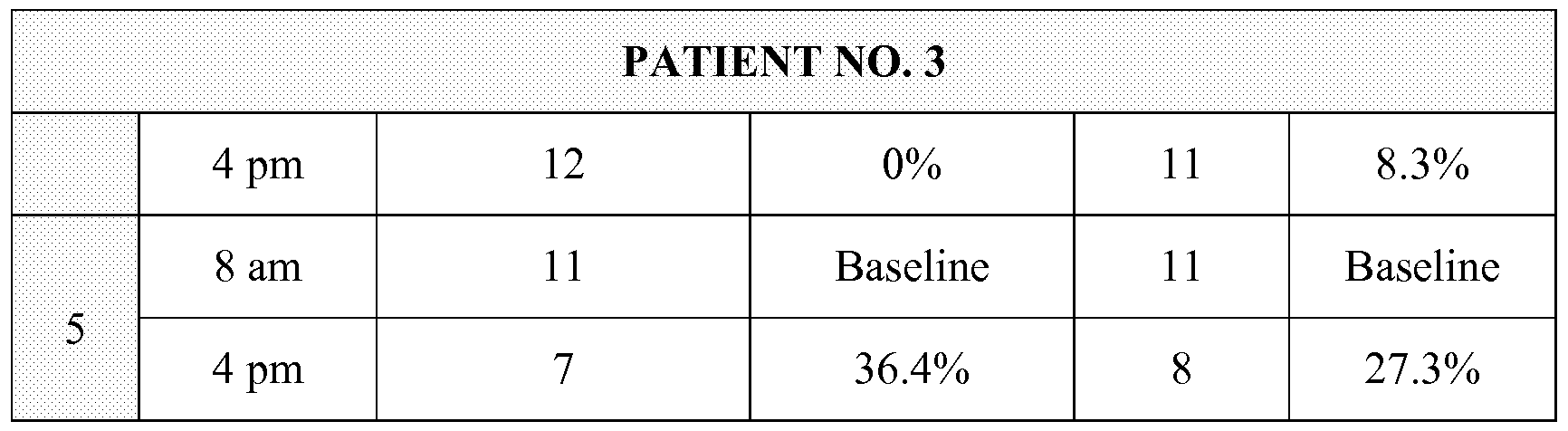
- IOP was measured at one or more of 4 hrs, 8 hrs, 12 hrs, 24 hrs, 32 hrs and comfort and side effect profile were qualitatively assessed.
- the tested inventive formulation achieved a peak IOP reduction effect at about 4 to 8 hours after instillation. Furthermore, in two out of three patients the IOP remained below the baseline 24 hours after instillation.
- conventional brimonidine formulations achieve a peak IOP reduction effect of only about 15-18% in normotensive eyes about 2-3 hours after instillation.
- the IOP reduction effect of the inventive formulation was much stronger: from 41.7% to 58.8% at 8 hours after instillation.
- the formulations of the invention demonstrate improved performance over brimonidine as well as other known glaucoma drugs under similar conditions of testing (1-2 days of use, normotensive eyes).
- EXAMPLE 7 Effect of Replacing the Poloxamer or Polyoxyl Alkyl Surfactant with Captisol ® Table 13. Effect of Replacing the Poloxamer or Polyoxyl Alkyl Surfactant with Captisol ®
- Hg human subject.
- the subject first underwent baseline IOP testing using standard applanation tonometry via slit lamp, which revealed a baseline IOP of about 15.0 - 16.5 (diurnal curve, depending on time of day).
- the drug was instilled as a morning dose at between about 7:00 and 9:00 AM.
- Preliminary measurements at 2, 3, 3.5, 4 and 4.5 hours demonstrated a substantial peak effect between about 3.45 and 4.15 hours for a preferred formulation of the invention.
- follow up IOP checks were designed to be about 4 hours after initial instillation, where instillation consisted of 1-2 drops.
- SLS sodium lauryl sulfate
Landscapes
- Health & Medical Sciences (AREA)
- Chemical & Material Sciences (AREA)
- Life Sciences & Earth Sciences (AREA)
- Veterinary Medicine (AREA)
- Pharmacology & Pharmacy (AREA)
- Public Health (AREA)
- General Health & Medical Sciences (AREA)
- Medicinal Chemistry (AREA)
- Animal Behavior & Ethology (AREA)
- Epidemiology (AREA)
- Engineering & Computer Science (AREA)
- General Chemical & Material Sciences (AREA)
- Chemical Kinetics & Catalysis (AREA)
- Ophthalmology & Optometry (AREA)
- Oil, Petroleum & Natural Gas (AREA)
- Proteomics, Peptides & Aminoacids (AREA)
- Bioinformatics & Cheminformatics (AREA)
- Inorganic Chemistry (AREA)
- Nuclear Medicine, Radiotherapy & Molecular Imaging (AREA)
- Organic Chemistry (AREA)
- Pharmaceuticals Containing Other Organic And Inorganic Compounds (AREA)
- Medicinal Preparation (AREA)
- Medicines That Contain Protein Lipid Enzymes And Other Medicines (AREA)
Abstract
Description



Claims
Priority Applications (6)
| Application Number | Priority Date | Filing Date | Title |
|---|---|---|---|
| EP14872240.8A EP3082427A4 (en) | 2013-12-18 | 2014-02-11 | Compositions and methods for treatment of glaucoma |
| BR112016014404A BR112016014404A2 (en) | 2013-12-18 | 2014-02-11 | COMPOSITIONS AND METHODS FOR TREATMENT OF GLAUCOMA |
| JP2016560613A JP2017501224A (en) | 2013-12-18 | 2014-02-11 | Compositions and methods for the treatment of glaucoma |
| CA2934453A CA2934453A1 (en) | 2013-12-18 | 2014-02-11 | Compositions and methods for treatment of glaucoma |
| MX2016007902A MX2016007902A (en) | 2013-12-18 | 2014-02-11 | Compositions and methods for treatment of glaucoma. |
| CN201480075789.5A CN106455567A (en) | 2013-12-18 | 2014-02-11 | Compositions and methods for treatment of glaucoma |
Applications Claiming Priority (2)
| Application Number | Priority Date | Filing Date | Title |
|---|---|---|---|
| US14/132,780 US20140107173A1 (en) | 2011-02-03 | 2013-12-18 | Compositions and Methods for Treatment of Glaucoma |
| US14/132,780 | 2013-12-18 |
Publications (1)
| Publication Number | Publication Date |
|---|---|
| WO2015094392A1 true WO2015094392A1 (en) | 2015-06-25 |
Family
ID=53403464
Family Applications (1)
| Application Number | Title | Priority Date | Filing Date |
|---|---|---|---|
| PCT/US2014/015797 Ceased WO2015094392A1 (en) | 2013-12-18 | 2014-02-11 | Compositions and methods for treatment of glaucoma |
Country Status (7)
| Country | Link |
|---|---|
| EP (1) | EP3082427A4 (en) |
| JP (1) | JP2017501224A (en) |
| CN (1) | CN106455567A (en) |
| BR (1) | BR112016014404A2 (en) |
| CA (1) | CA2934453A1 (en) |
| MX (1) | MX2016007902A (en) |
| WO (1) | WO2015094392A1 (en) |
Cited By (5)
| Publication number | Priority date | Publication date | Assignee | Title |
|---|---|---|---|---|
| WO2017160548A1 (en) * | 2016-03-17 | 2017-09-21 | Presbyopia Therapies, LLC | Compositions and methods for the treatment of presbyopia |
| CN115137699A (en) * | 2021-03-29 | 2022-10-04 | 四川普锐特药业有限公司 | Dexmedetomidine nasal spray with synergistic and antiseptic effects |
| US12128036B2 (en) | 2018-10-10 | 2024-10-29 | Lenz Therapeutics Operations, Inc. | Compositions and methods for storage stable ophthalmic drugs |
| US12180206B2 (en) | 2021-11-17 | 2024-12-31 | Lenz Therapeutics Operations, Inc. | Aceclidine derivatives, compositions thereof and methods of use thereof |
| US12414942B1 (en) | 2024-03-15 | 2025-09-16 | Lenz Therapeutics Operations, Inc. | Compositions, methods, and systems for treating presbyopia |
Families Citing this family (4)
| Publication number | Priority date | Publication date | Assignee | Title |
|---|---|---|---|---|
| CN111481506B (en) * | 2019-01-25 | 2023-01-24 | 江苏恒瑞医药股份有限公司 | Pharmaceutical product comprising a nasally administrable dexmedetomidine composition |
| CN116474219A (en) * | 2019-06-28 | 2023-07-25 | 四川普锐特药业有限公司 | Drug fluid dispenser and dexmedetomidine nasal spray for maintaining uniformity of administration |
| CN112107544A (en) * | 2019-06-28 | 2020-12-22 | 四川普锐特药业有限公司 | Dexmedetomidine nasal spray, preparation method and application thereof |
| CN111632025A (en) * | 2020-03-04 | 2020-09-08 | 吉林大学第一医院 | A kind of bimeprost ophthalmic temperature-sensitive in situ gel and its preparation method and application |
Citations (6)
| Publication number | Priority date | Publication date | Assignee | Title |
|---|---|---|---|---|
| US20110189174A1 (en) * | 2010-02-01 | 2011-08-04 | Afshin Shafiee | Compositions and methods for treating, reducing, ameliorating, alleviating, or inhibiting progression of, pathogenic ocular neovascularization |
| US20110251285A1 (en) * | 2010-04-07 | 2011-10-13 | Allergan, Inc. | Combinations of preservatives for ophthalmic compositions |
| US20130079379A1 (en) * | 2011-07-14 | 2013-03-28 | Allergan, Inc. | Gel compositions of oxymetazoline and methods of use |
| US20130172357A1 (en) * | 2011-02-03 | 2013-07-04 | Eye Therapies Llc | Compositions and Methods for Treatment of Glaucoma |
| US20130296396A1 (en) * | 2003-08-07 | 2013-11-07 | Allergan, Inc. | Compositions for delivery of therapeutics into the eyes and methods for making and using same |
| US20140107173A1 (en) * | 2011-02-03 | 2014-04-17 | Gnt, Llc | Compositions and Methods for Treatment of Glaucoma |
Family Cites Families (9)
| Publication number | Priority date | Publication date | Assignee | Title |
|---|---|---|---|---|
| GB2290964A (en) * | 1994-07-08 | 1996-01-17 | Arto Olavi Urtti | Transdermal drug delivery system |
| US20100202979A1 (en) * | 2008-08-01 | 2010-08-12 | Gerald Horn | Compositions and methods for treatment of pulmonary diseases and conditions |
| US20100028266A1 (en) * | 2008-08-01 | 2010-02-04 | Alpha Synergy Development. Inc. | Composition and methods for treating allergic response |
| US20110152271A1 (en) * | 2009-12-17 | 2011-06-23 | Gerald Horn | Compositions and methods for ophthalmic delivery of nasal decongestants |
| US20120202863A1 (en) * | 2011-02-03 | 2012-08-09 | Gerald Horn | Compositions and methods for treatment of glaucoma |
| US8242158B1 (en) * | 2012-01-04 | 2012-08-14 | Hospira, Inc. | Dexmedetomidine premix formulation |
| CA2863760A1 (en) * | 2012-02-02 | 2013-08-08 | Alpha Synergy Development, Inc. | Compositions and methods for treatment of glaucoma |
| US20140378401A1 (en) * | 2013-06-21 | 2014-12-25 | Gnt, Llc | Ophthalmic Lipophilic and Hydrophilic Drug Delivery Vehicle Formulations |
| US9089562B2 (en) * | 2013-08-28 | 2015-07-28 | Presbyopia Therapies Llc | Compositions and methods for the treatment of presbyopia |
-
2014
- 2014-02-11 CN CN201480075789.5A patent/CN106455567A/en active Pending
- 2014-02-11 WO PCT/US2014/015797 patent/WO2015094392A1/en not_active Ceased
- 2014-02-11 BR BR112016014404A patent/BR112016014404A2/en not_active IP Right Cessation
- 2014-02-11 EP EP14872240.8A patent/EP3082427A4/en not_active Withdrawn
- 2014-02-11 MX MX2016007902A patent/MX2016007902A/en unknown
- 2014-02-11 JP JP2016560613A patent/JP2017501224A/en not_active Withdrawn
- 2014-02-11 CA CA2934453A patent/CA2934453A1/en not_active Abandoned
Patent Citations (6)
| Publication number | Priority date | Publication date | Assignee | Title |
|---|---|---|---|---|
| US20130296396A1 (en) * | 2003-08-07 | 2013-11-07 | Allergan, Inc. | Compositions for delivery of therapeutics into the eyes and methods for making and using same |
| US20110189174A1 (en) * | 2010-02-01 | 2011-08-04 | Afshin Shafiee | Compositions and methods for treating, reducing, ameliorating, alleviating, or inhibiting progression of, pathogenic ocular neovascularization |
| US20110251285A1 (en) * | 2010-04-07 | 2011-10-13 | Allergan, Inc. | Combinations of preservatives for ophthalmic compositions |
| US20130172357A1 (en) * | 2011-02-03 | 2013-07-04 | Eye Therapies Llc | Compositions and Methods for Treatment of Glaucoma |
| US20140107173A1 (en) * | 2011-02-03 | 2014-04-17 | Gnt, Llc | Compositions and Methods for Treatment of Glaucoma |
| US20130079379A1 (en) * | 2011-07-14 | 2013-03-28 | Allergan, Inc. | Gel compositions of oxymetazoline and methods of use |
Non-Patent Citations (1)
| Title |
|---|
| See also references of EP3082427A4 * |
Cited By (7)
| Publication number | Priority date | Publication date | Assignee | Title |
|---|---|---|---|---|
| WO2017160548A1 (en) * | 2016-03-17 | 2017-09-21 | Presbyopia Therapies, LLC | Compositions and methods for the treatment of presbyopia |
| US12128036B2 (en) | 2018-10-10 | 2024-10-29 | Lenz Therapeutics Operations, Inc. | Compositions and methods for storage stable ophthalmic drugs |
| US12533347B2 (en) | 2018-10-10 | 2026-01-27 | Lenz Therapeutics Operations, Inc. | Compositions and methods for storage stable ophthalmic drugs |
| CN115137699A (en) * | 2021-03-29 | 2022-10-04 | 四川普锐特药业有限公司 | Dexmedetomidine nasal spray with synergistic and antiseptic effects |
| CN115137699B (en) * | 2021-03-29 | 2024-05-03 | 四川普锐特药业有限公司 | A dexmedetomidine nasal spray with enhanced efficacy and preservation |
| US12180206B2 (en) | 2021-11-17 | 2024-12-31 | Lenz Therapeutics Operations, Inc. | Aceclidine derivatives, compositions thereof and methods of use thereof |
| US12414942B1 (en) | 2024-03-15 | 2025-09-16 | Lenz Therapeutics Operations, Inc. | Compositions, methods, and systems for treating presbyopia |
Also Published As
| Publication number | Publication date |
|---|---|
| BR112016014404A2 (en) | 2017-08-08 |
| MX2016007902A (en) | 2016-10-28 |
| CN106455567A (en) | 2017-02-22 |
| CA2934453A1 (en) | 2015-06-25 |
| EP3082427A1 (en) | 2016-10-26 |
| JP2017501224A (en) | 2017-01-12 |
| EP3082427A4 (en) | 2017-08-02 |
Similar Documents
| Publication | Publication Date | Title |
|---|---|---|
| US8445526B2 (en) | Compositions and methods for treatment of glaucoma | |
| US20140163080A1 (en) | Compositions and Methods for Treatment of Glaucoma | |
| WO2015094392A1 (en) | Compositions and methods for treatment of glaucoma | |
| AU2008354558B2 (en) | Stable ophthalmic formulations | |
| WO2014204791A1 (en) | Ophthalmic lipophilic and hydrophilic drug delivery vehicle formulations | |
| US20130172357A1 (en) | Compositions and Methods for Treatment of Glaucoma | |
| US20120309720A1 (en) | Compositions and methods for treatment of glaucoma | |
| US10792288B2 (en) | Preservative free brimonidine and timolol solutions | |
| US8999938B2 (en) | Ophthalmic lipophilic drug delivery vehicle formulations | |
| US20140107173A1 (en) | Compositions and Methods for Treatment of Glaucoma | |
| JP2017503028A (en) | Compositions and methods for treating intraocular neovascularization and / or leakage | |
| KR20140056280A (en) | Fixed dose combination of bimatoprost and brimonidine | |
| CA2826644A1 (en) | Compositions and methods for treatment of glaucoma | |
| WO2013115844A1 (en) | Compositions and methods for treatment of glaucoma | |
| US10058560B2 (en) | Preservative free bimatoprost and timolol solutions | |
| KR20230131822A (en) | Compositions and methods for storage stable eye drops | |
| KR102444571B1 (en) | Ophthalmic composition comprising cetirizine and tocofesolane | |
| US20120202864A1 (en) | Compositions and Methods for Treatment of Glaucoma | |
| US20170143676A1 (en) | Compositions and Methods for Treatment of Glaucoma | |
| US20170224827A1 (en) | Stable preservative free ophthalmic formulations of opioid antagonists | |
| JP7534129B2 (en) | Multi-ingredient eye drops | |
| JP7459508B2 (en) | Mucin degeneration inhibitor and ophthalmic composition | |
| AU2010266539A1 (en) | Pharmaceutical ophthalmological liquid compositions containing propionic acid derivatives as a preservative | |
| JP2011011984A (en) | Therapeutic agent for pseudomyopia | |
| KR20250163816A (en) | Transparent eye drops containing dorzolamide and timolol and preparing method of the same |
Legal Events
| Date | Code | Title | Description |
|---|---|---|---|
| 121 | Ep: the epo has been informed by wipo that ep was designated in this application |
Ref document number: 14872240 Country of ref document: EP Kind code of ref document: A1 |
|
| WWE | Wipo information: entry into national phase |
Ref document number: MX/A/2016/007902 Country of ref document: MX |
|
| ENP | Entry into the national phase |
Ref document number: 2934453 Country of ref document: CA Ref document number: 2016560613 Country of ref document: JP Kind code of ref document: A |
|
| REEP | Request for entry into the european phase |
Ref document number: 2014872240 Country of ref document: EP |
|
| WWE | Wipo information: entry into national phase |
Ref document number: 2014872240 Country of ref document: EP |
|
| NENP | Non-entry into the national phase |
Ref country code: DE |
|
| REG | Reference to national code |
Ref country code: BR Ref legal event code: B01A Ref document number: 112016014404 Country of ref document: BR |
|
| ENP | Entry into the national phase |
Ref document number: 112016014404 Country of ref document: BR Kind code of ref document: A2 Effective date: 20160617 |