WO2015094970A1 - Mono- and dialkyl ethers of furan-2,5-dimethanol and (tetra-hydrofuran-2,5-diyl)dimethanol and amphiphilic derivatives thereof - Google Patents

Mono- and dialkyl ethers of furan-2,5-dimethanol and (tetra-hydrofuran-2,5-diyl)dimethanol and amphiphilic derivatives thereof Download PDF

Info

Publication number
WO2015094970A1
WO2015094970A1 PCT/US2014/070021 US2014070021W WO2015094970A1 WO 2015094970 A1 WO2015094970 A1 WO 2015094970A1 US 2014070021 W US2014070021 W US 2014070021W WO 2015094970 A1 WO2015094970 A1 WO 2015094970A1
Authority
WO
WIPO (PCT)
Prior art keywords
methyl
tetrahydrofuran
fdm
process according
mono
Prior art date
Legal status (The legal status is an assumption and is not a legal conclusion. Google has not performed a legal analysis and makes no representation as to the accuracy of the status listed.)
Ceased
Application number
PCT/US2014/070021
Other languages
French (fr)
Inventor
Kenneth STENSRUD
Current Assignee (The listed assignees may be inaccurate. Google has not performed a legal analysis and makes no representation or warranty as to the accuracy of the list.)
Archer Daniels Midland Co
Original Assignee
Archer Daniels Midland Co
Priority date (The priority date is an assumption and is not a legal conclusion. Google has not performed a legal analysis and makes no representation as to the accuracy of the date listed.)
Filing date
Publication date
Priority to CN201480067612.0A priority Critical patent/CN105814030A/en
Priority to US15/038,066 priority patent/US9670174B2/en
Priority to MX2016007952A priority patent/MX2016007952A/en
Priority to CA2931554A priority patent/CA2931554C/en
Priority to JP2016530946A priority patent/JP6396462B2/en
Priority to AU2014366334A priority patent/AU2014366334B2/en
Application filed by Archer Daniels Midland Co filed Critical Archer Daniels Midland Co
Priority to KR1020167018816A priority patent/KR102100539B1/en
Priority to EP14871772.1A priority patent/EP3083576A4/en
Publication of WO2015094970A1 publication Critical patent/WO2015094970A1/en
Anticipated expiration legal-status Critical
Priority to US15/581,613 priority patent/US20170233358A1/en
Ceased legal-status Critical Current

Links

Classifications

    • CCHEMISTRY; METALLURGY
    • C07ORGANIC CHEMISTRY
    • C07DHETEROCYCLIC COMPOUNDS
    • C07D307/00Heterocyclic compounds containing five-membered rings having one oxygen atom as the only ring hetero atom
    • C07D307/02Heterocyclic compounds containing five-membered rings having one oxygen atom as the only ring hetero atom not condensed with other rings
    • C07D307/04Heterocyclic compounds containing five-membered rings having one oxygen atom as the only ring hetero atom not condensed with other rings having no double bonds between ring members or between ring members and non-ring members
    • C07D307/10Heterocyclic compounds containing five-membered rings having one oxygen atom as the only ring hetero atom not condensed with other rings having no double bonds between ring members or between ring members and non-ring members with substituted hydrocarbon radicals attached to ring carbon atoms
    • C07D307/12Radicals substituted by oxygen atoms
    • CCHEMISTRY; METALLURGY
    • C07ORGANIC CHEMISTRY
    • C07DHETEROCYCLIC COMPOUNDS
    • C07D307/00Heterocyclic compounds containing five-membered rings having one oxygen atom as the only ring hetero atom
    • C07D307/02Heterocyclic compounds containing five-membered rings having one oxygen atom as the only ring hetero atom not condensed with other rings
    • C07D307/04Heterocyclic compounds containing five-membered rings having one oxygen atom as the only ring hetero atom not condensed with other rings having no double bonds between ring members or between ring members and non-ring members
    • C07D307/10Heterocyclic compounds containing five-membered rings having one oxygen atom as the only ring hetero atom not condensed with other rings having no double bonds between ring members or between ring members and non-ring members with substituted hydrocarbon radicals attached to ring carbon atoms
    • C07D307/14Radicals substituted by nitrogen atoms not forming part of a nitro radical
    • CCHEMISTRY; METALLURGY
    • C07ORGANIC CHEMISTRY
    • C07DHETEROCYCLIC COMPOUNDS
    • C07D307/00Heterocyclic compounds containing five-membered rings having one oxygen atom as the only ring hetero atom
    • C07D307/02Heterocyclic compounds containing five-membered rings having one oxygen atom as the only ring hetero atom not condensed with other rings
    • C07D307/34Heterocyclic compounds containing five-membered rings having one oxygen atom as the only ring hetero atom not condensed with other rings having two or three double bonds between ring members or between ring members and non-ring members
    • C07D307/38Heterocyclic compounds containing five-membered rings having one oxygen atom as the only ring hetero atom not condensed with other rings having two or three double bonds between ring members or between ring members and non-ring members with substituted hydrocarbon radicals attached to ring carbon atoms
    • C07D307/40Radicals substituted by oxygen atoms
    • C07D307/42Singly bound oxygen atoms
    • CCHEMISTRY; METALLURGY
    • C07ORGANIC CHEMISTRY
    • C07DHETEROCYCLIC COMPOUNDS
    • C07D307/00Heterocyclic compounds containing five-membered rings having one oxygen atom as the only ring hetero atom
    • C07D307/02Heterocyclic compounds containing five-membered rings having one oxygen atom as the only ring hetero atom not condensed with other rings
    • C07D307/34Heterocyclic compounds containing five-membered rings having one oxygen atom as the only ring hetero atom not condensed with other rings having two or three double bonds between ring members or between ring members and non-ring members
    • C07D307/38Heterocyclic compounds containing five-membered rings having one oxygen atom as the only ring hetero atom not condensed with other rings having two or three double bonds between ring members or between ring members and non-ring members with substituted hydrocarbon radicals attached to ring carbon atoms
    • C07D307/52Radicals substituted by nitrogen atoms not forming part of a nitro radical

Definitions

  • the present disclosure relates to certain cyclic bi-functional materials that are useful as monomers in polymer synthesis, as well as intermediate chemical compounds.
  • the present invention pertains to ethers of furan-2,5-dimethanol (FDM) and/or (tetrahydrofuran-2,5- diyl)dimethanol (bHMTHF), methods for their preparation, and derivative chemical compounds thereof.
  • HMF 5- (hydroxymethyl)furfural
  • Figure 1 a salient dehydration product of the abundant, inexpensive monosaccharide, fructose.
  • HMF is a versatile chemical antecedent to various furanic ring-based derivatives that are known intermediates for a multitude of chemical syntheses, and as plausible surrogates for aromatic hydrocarbons that derive from petroleum resources. Due to HMF's diverse functionalities, some have proposed that HMF be used to produce a wide range of commodities such as polymers, solvents, surfactants, pharmaceuticals, and plant protection agents. As alternates, derivatives of HMF are comparable to benzene -based aromatic compounds or to other compounds containing a furan or tetrahydrofuran (THF). HMF and 2,5-disubstituted furans and THF analogs, therefore, have great potential in the field of intermediate chemicals from renewable agricultural resources.
  • THF tetrahydrofuran
  • HMF itself, however, is rather unsuitable as a chemical intermediate substrate, given its propensity to decompose under thermo-oxidative conditions.
  • FDM furan-2,5-dimethanol
  • Scheme 1 is produced from partial hydrogenation (aldehyde reduction) of HMF.
  • bHMTHF 2,5-bis(hydroxymethyl)tetrahydrofuran
  • B 2,5-bis(hydroxymethyl)tetrahydrofuran
  • C diastereometic ratio when both the ring and aldehyde moieties of HMF are reduce completely
  • These materials can be of value as a molecular antecedent, for example, to polyesters, polyurethane foams, FDCA, plasticizers, additives, lubricants, and amphiphiles.
  • the present disclosure describes, in part, linear mono- and di-alkyl ethers of furan-2,5- dimethanol (FDM) and/or 2,5-bis(hydroxymethyl)tetrahydrofuran (bHMTHF), and a process for synthesis.
  • FDM furan-2,5- dimethanol
  • bHMTHF 2,5-bis(hydroxymethyl)tetrahydrofuran
  • the process includes contacting either FDM or bHMTHF in a polar aprotic organic solvent having a permittivity ( ⁇ ) >8, at a temperature ranging from about -25°C to about 100°C, with either a) an unhindered Bronsted base having a difference in pKa (ApKa) >15 relative to the pKa of a hydroxyl group of either FDM or bHMTHF or b) a hindered Bronsted base and a nucleophile.
  • a polar aprotic organic solvent having a permittivity ( ⁇ ) >8, at a temperature ranging from about -25°C to about 100°C with either a) an unhindered Bronsted base having a difference in pKa (ApKa) >15 relative to the pKa of a hydroxyl group of either FDM or bHMTHF or b) a hindered Bronsted base and a nucleophile.
  • the present disclosure provides a method of preparing a mono- ether involving: contacting FDM with a Bronsted base and one or less molar equivalents of an alkyl-X species according to the following: wherein: "X” is the leaving group (nucleofuge), "n” is an integer from 5 to 25, and "CA” is a conjugate acid.
  • the resultant mono-ether of FDM can be, for example, at least one of the following compounds:
  • the method involves: contacting FDM with a Bronsted base and a minimum of 2 molar equivalents of an alkyl-X species according to the foll
  • the resultant di-ether of FDM can be, for instance, at least one of the following compounds: a. -bis((hexyloxy)methyl)furan
  • the present disclosure provides a method of preparing a mono- ether involving: contacting bHMTHFs with a Bronsted base and 1 or less molar equivalents of an alkyl-X species according to the following:
  • the resultant mono-ether of bHMTHF can be, for example, at least one of the following compounds:
  • the method involves: contacting bHMTHFs with a Bronsted base and a minimum of two molar equivalents of an alkyl-X species according to the following:
  • X is the nucleofuge
  • n is an integer from 5 to 25
  • CA is a conjugate acid.
  • the resultant di-ethers of bHMTHF can be, for instance, at least one of the following compounds:
  • the present disclosure pertains to derivative compounds from the linear mono-ethers of FDM and bHMTHF described above and methods for making the derivatives.
  • These derivative compounds are amphiphilic variants of the mono-ethers and are valued as precursors or plausible bio-based surfactants, dispersants, and/or hydrophiles.
  • the present synthetic processes opens a pathway for direct preparation of linear alkyl ethers from the glycols FDM and/or bHMTHF, molecules that arise from the reduction of fructose derived 5 -(hydroxymethyl) furfural (HMF) under mild conditions, and their derivative chemical compounds.
  • the process may also include either first partially reducing HMF to FDM or fully reducing HMF to bHMTHFs in hydrogenation steps prior to selective etherification according to the present reaction process described herein.
  • the alkyl ethers are valuable precursors with bio-based amphiphilic properties that can be used in surfactants, dispersants, and plasticizers.
  • the process for generating alkyl ethers can be implemented in a single reaction step, in which the FDM or bHMTHF glycol is reacted with either one or two equivalents of a halogenated or sulfonated (leaving group) alkane, depending respectively on whether a mono- or di- ether product is desired.
  • a hindered Bronsted base with a minimum pKa of about 10, preferably about 16, or an unhindered Bronsted base having a difference in pKa (ApKa) of >15 relative to the pKa of a hydroxyl group of either the FDM or bHMTHF is used to deprotonate the -OH moieties of the glycols, enhancing their nucleophilicities by several orders of magnitude towards nucleofuge displacement.
  • the Bronsted base should have a limited propensity to react with an alkyl halide or sulfonate in a nucleophilic substitution and/or elimination.
  • a polar aprotic organic solvent with a dielectric constant of >10, preferably > 30, is employed to augment the basicity of the Bronsted base via charge separation capacities.
  • the reaction is conducted at a temperature in a range from about -20°C to about 100°C, over a period of about 2 or 3 hours. In some other iterations the time may involve about 4 or 8 hours up to about 12 or 24 hours, as conditions may dictate.
  • the Bronsted base in the reaction serves to deprotonate the -OH moieties of the glycols. This helps to enhance the corresponding nucleophilicity of the glycols FDM and bHMTHF by about at least 6 or more orders of magnitude (e.g., 8-10-12) and drives halide/sulfonate displacement on the alkyl reagent.
  • the relative strength of a Bronsted base used in the reaction is of essence in furnishing high conversions of the glycols to, in particular, mono-alkyl ethers.
  • Bronsted bases that have a pKa of at least 10 to about 15
  • the synthesis reaction usually requires the addition of heat to proceed; hence, reaction temperatures of about 45°C-50°C or greater.
  • This can increase the risk of generating side -products (e.g., product of Bronsted base-nucleophilic substitution with the alkyl halide/sulfonate and/or alkenes formed from Bronsted base- mediated elimination of the alkyl halide/sulfonate) and reducing the overall yield of the desired synthesis.
  • side -products e.g., product of Bronsted base-nucleophilic substitution with the alkyl halide/sulfonate and/or alkenes formed from Bronsted base- mediated elimination of the alkyl halide/sulfonate
  • a Bronsted base that has a pKa of at least -16, typically >20 is favored according to certain embodiments of the present process.
  • Bronsted bases with a greater pKa more easily reacts with the -OH moieties of the glycols. This is an advantage that helps one operate effectively the reaction at about ambient room temperatures (e.g., ⁇ 18°C -22°C) or lower temperatures.
  • Some suitable Bronsted bases may include, for example, hydroxides (e.g., methoxide, ethoxide, i-butoxide, and benzyl oxide).
  • Bronsted bases having pKa's > 30 are used, as the equilibrium for deprotonation favors generation of the desired products, such as illustrated in the examples in Scheme 3.
  • Certain favored Bronsted bases of this type may include, for example, metallic hydrides (e.g., lithium, potassium, or sodium hydrides); metal amides (e.g., potassium or sodium amides); lithium diisopropylamide (LDA);
  • metallic hydrides e.g., lithium, potassium, or sodium hydrides
  • metal amides e.g., potassium or sodium amides
  • organometalic compounds e.g., alkyl lithium (e.g., methyl-lithium, n-butyl-lithium, or phenyl- lithium), alkyl magnesium, or alkyl cuprate) and Grignard reagents (e.g., ethylmagnesium bromide, phenylmagnesium bromide).
  • certain disfavored Bronsted bases may include, for example, nitrogen-centered bases (e.g., tertiary amines, aryl amine), because of low-pKa- favoring reactants and nucleophilic propensities.
  • Reaction (a) shows when using a Bronsted base having a pKa -16, the reaction tends to be at equilibrium between product and reactants.
  • Reaction (b) when using a Bronsted base having a pKa -20, the reaction tend to favor the product more, whereas in Reaction (c) when using a Bronsted base having pKa >30, the reaction is driven completely towards product formation.
  • Another factor according to an embodiment of the present invention is to employ a Bronsted base that has molecular bulk.
  • the bulky Bronsted base impedes undesired nucleophilic substitutions of the Bronsted base with the alkyl halide/sulfonate.
  • a more sterically hindered Bronsted base enhances more effectively the reaction to produce predominantly the ether product.
  • Scheme 4 illustrates this feature.
  • reaction (a) using an unhindered Bronsted base tends to make a mixed product of both straight-chain and FDM ethers.
  • reaction (b) with a more bulky, hindered Bronsted base generates the FDM ethers alone.
  • the etherification reaction of the present description can be characterized as a base-mediated, second order substitution reaction between a glycol and activated alkane.
  • the leaving group affixed to the alkane should exhibit favorable nucleofugal properties.
  • Some species in this context can be, for example, halides (e.g., CI, Br, I) and sulfonates (e.g., -OTf, -OTs,-OMs).
  • halides e.g., CI, Br, I
  • sulfonates e.g., -OTf, -OTs,-OMs
  • the alkyl chain lengths may range from about 5 or 8 to about 16 or 18 carbons, or about 6 or 10 to about 20 or 22 carbons (e.g., Cs-Cis; C5-C15; C6-C12), or any iteration therein between.
  • tosylate p-toluenesulfonate
  • CH3C6H4SO2O- [ ⁇ 0 R ] esylate
  • ethanesulfonate ethanesulfonate
  • halides such as bromides
  • alcohols are more economically accessible commercial alkane sources, they may be favored for larger scale, industrial uses according to some embodiments.
  • an alkyl halide is unavailable or prohibitively expensive, but the corresponding alcohol available, one may substitute the alcohol for the corresponding sulfonate through a simple sulfonation reaction.
  • the sulfonate is preferably a triflate because it is a powerful leaving group.
  • This reaction exhibits relatively fast kinetics and generates an activated triflic complex.
  • the reaction is usually conducted at a low temperature, less than 0°C (e.g., typically about -10°C or - ⁇ 2°C to about -20°C or -25°C), to control the reaction kinetics more easily.
  • This reaction is essentially irreversible, as the liberated triflate is entirely non-nucleophilic.
  • the triflic complex then reacts readily with the FDM or bHMTHF, forming respectively a FDM or bHMTHF-triflate with concomitant release and protonation of a nucleophilic base (e.g., pyrimidine, dimethyl-aminopyridine, imidazole, pyrrolidine, and morpho line).
  • a nucleophilic base e.g., pyrimidine, dimethyl-aminopyridine, imidazole, pyrrolidine, and morpho line.
  • the tosylate, mesylate, brosylate, benzenesulfonate, ethylsulfonate or other sulfonate species can be as effective as triflate in imparting leaving groups, and manifesting overall yields that were commensurate with that achieved with triflate. But, these other sulfonates tend to react more slowly in comparison to the triflate. To compensate for this, operations at higher temperatures are typically needed for better yields when using these other species.
  • aprotic solvents are used, as they contain no functionality labile to covalent modifications with the glycol, alkyl halide/sulfonate and Bronsted base of the title reaction, and thus do not interfere with the Sn2-driven process.
  • polar aprotic solvents i.e., solvents with a permanent dipole moment but without the ability to act as hydrogen bond donors
  • Polar aprotic solvents adequately dissolve the glycols and the alkyl halide/sulfonate, a feature for an efficient reaction to occur.
  • polar aprotic solvents tend not to react with the alkyl halide/sulfonate (cf., Scheme 6, ethanol, a polar protic solvent, which can generate undesired side products).
  • a greater dielectric constant can help prevent the solvent from reacting with the primary reagents, hence minimizing formation of side -products.
  • the reactions of the present synthesis process are conducted in solvents with a relative permittivity > 8 r 25, typically about 30 or 35.
  • DMSO and DMF exhibit relatively high dielectric constants (e.g., -30 or 32).
  • Other solvents with high boiling points and dielectric constants, such as NMP and DMA, are effective in cyanide for sulfonate displacement reactions.
  • the reaction to derivatize FDM or bHMTHF with a sulfonate is performed in a solution of solvent having a boiling point > 110°C.
  • dimethylformamide (DMF), dimethylsulfoxide (DMSO), dimethylacetamide (DMA), N- methylpyrrolidone (NMP), hexamethylphosphoramide (HMPA), acetone, acetonitrile (ACN), nitromethane, sulfolane, tetrahydrofuran (THF), 1,4-dioxane, and ethyl acetate.
  • a further consideration when using polar aprotic solvent in the etherification process is to amply charge separate the Bronsted base so that the glycol -OH moieties can be deprotonated.
  • a reflection of the power to charge separate is the permittivity of dielectric constant, represented by ⁇ (no units), with the larger number signifying a greater capacity to sequester the ions.
  • dielectric constant
  • the preferred ⁇ is >30.
  • reaction temperatures can span between about -25°C or -20°C to about 80°C or 100°C.
  • reaction temperature is in a range from about -12°C or -7°C to about 65°C or 70°C, more typically from about -10°C or -5°C to about 40°C or 50°C.
  • preferred temperatures may range from about -10°C or -8°C to about 25°C or 30°C, or about -3°C or 0°C to about 32°C or 35°C, inclusive.
  • the reaction can be performed at or below ambient room temperatures (e.g., ⁇ about 22°C or 25°C). Because of a potential or tendency to generate olefins from base-mediated elimination of an alkyl halide/sulfonate at elevated temperatures, and potential slow reaction kinetics when uses certain Bronsted bases (Scheme 7), temperature control for the present selective etherification is an important factor.
  • various amphiphilic compounds can be synthesized from FDM or bHMTHF ethers as a starting or precursor material.
  • Such derivative materials can be useful as substitutes for existing compounds or new chemical building blocks in surfactant, dispersant, plasticizer or a component in other applications.
  • the derivative amphiphilic compounds can be prepared according to various chemical reactions available for organic synthesis. Preparations of some representative derivative compounds are further described in the accompanying examples below.
  • the methods may include: reacting either a mono-ether of bHMTHF or FDM with: a) chlorosulfonic acid to generate a sulfate, or b) trifluoromethanesulfonic anhydride to generate a trifluoromethanesulfonate, respectively, of each glycol species.
  • a sulfate product can be, for example, at least one of the following compounds:
  • a trifluoromethanesulfonated mono-ether generated from the bHMTHF mono-ether can be, for example, at least one of the following compounds:
  • the process may further involve generating an ethoxyethanolamine derivative of the bHMTHF mono-ether sulfonate compound by substitution of a sulfonate group with an ethanolamine.
  • the resultant ethoxyethanolamine prepared can be, for instance, at least one of the following compounds:
  • the process may further include generating a primary amine of a bHMTHF monoether by substitution of a trifluoromethanesulfonate group to form a benzyl-amine, such as one of the following: a) N-benzyl-l-(5-( e
  • the resultant primary amine can be, for instance, at least one of the following compounds:
  • the process may further include preparing a primary ammonium salt of the bHMTHF monoether by substitution of a trifluoromethanesulfonate group followed by catalytic debenzylation and protonation by a Bronsted acid having a pKa ⁇ 0 (e.g., HC1, HBr, HI).
  • the resultant primary ammonium group can be, for example, at least one of the following compounds:
  • the salt version of the primary amine renders the molecule more amphiphilic with a polar head for cationic surfactants.
  • the resultant sulfate product can be for example:
  • the resultant trifluoromethanesulfonate from FDM mono-ether can be, for example, at least one of the following structures:
  • the process for preparing a primary ammonium group using FDM mono-ethers also involves substitution of a trifluoromethanesulfonate group followed by catalytic debenzylation and protonation by a Bronsted acid having a pKa ⁇ 0.
  • the resultant aminoethylethanolamine can be, for example, the following:
  • a primary amine derivative that is prepared using FDM mono- ether as the starting material can be, for example, the following: (5-((hexyloxy)methyl)furan-2- yl)methanamine
  • quaternary trimethylammonium salt such as: l-(5- ((hexyloxy)methyl)furan-2-yl)-N,N,N de
  • the present synthesis system is further illustrated in the following examples for making: A) bHMTHF di-ethers; B) bHMTHF mono-ethers; C) derivatives of bHMTHF mono-ethers; D) FDM di- ethers; E) FDM mono-ethers; and F) amphiphilic derivatives of FDM mono-ethers .
  • the mixture was diluted with 5 mL of water and 5 mL of methylene chloride and partitioned and the aqueous layer extracted with 3-5 mL volumes of methylene chloride.
  • the organic phases were combined, dried with anhydrous magnesium sulfate, filtered and concentrated under vacuum.
  • the oily residue was dissolved in a minimum amount of methylene chloride and added to 20 g of silica gel, which was then dried under vacuum, furnishing product adsorbed silica gel.
  • This material was added to a pre-fabricated silica gel column, where flash chromatography with hexanes to 10% ethyl acetate in hexanes afforded 64 mg of a B as light yellow oil after inspissation (56% of theoretical).
  • the mixture was diluted with 5 mL of water and 5 mL of methylene chloride and partitioned and the aqueous layer extracted with 3-5 mL volumes of methylene chloride.
  • the organic phases were combined, dried with anhydrous magnesium sulfate, filtered and concentrated under vacuum.
  • the oily residue was dissolved in a minimum amount of methylene chloride and added to 20 g of silica gel, which was then dried under vacuum, furnishing product adsorbed silica gel.
  • This material was added to a pre-fabricated silica gel column, where flash chromatography with hexanes to 7% ethyl acetate in hexanes afforded 118 mg of a B as a beige solid after concentration (65% of theoretical).
  • the mixture was diluted with 5 mL of water and 5 mL of methylene chloride and partitioned and the aqueous layer extracted with 3-5 mL volumes of methylene chloride.
  • the organic phases were combined, dried with anhydrous magnesium sulfate, filtered and concentrated under vacuum.
  • the oily residue was dissolved in a minimum amount of methylene chloride and added to 20 g of silica gel, which was then dried under vacuum, furnishing product adsorbed silica gel.
  • This material was added to a pre-fabricated silica gel column, where flash chromatography with hexanes to 5% ethyl acetate in hexanes afforded 132 mg of a B as an off-white solid after concentration (55% of theoretical).
  • Example 4 Synthesis of ((2S,5R)-5-((hexyloxy)methyl)tetrahydrofuran-2-yl)methanol, ((2S,5S)-5- ((hexyloxy)methyl)tetrahydrofuran-2-yl)methanol, and ((2S,5S)-5- (
  • Example 6 Synthesis of ((2S,5R)-5-((octadecyloxy)methyl)tetrahydrofuran-2-yl)methanol, ((2S,5S)- 5-((octadecyloxy)methyl)tetrahydrofuran-2-yl)methanol, ((2S,5S)- 5(
  • a reflux condenser was outfitted to the flask, and while stirring, the solution was heated to 50°C, 4 hours. After this time, an aliquot was extracted and analyzed by TLC (cerium molybdate visualization), demonstrating that B had entirely disappeared.
  • a single neck, 50 mL round bottomed flask equipped with a 1 cm PTFE coated magnetic stir bar was charged with 175 mg of B (0.339 mmol), 65 of Hunig's base (0.373 mmol), 37 of benzylamine and 10 mL of ethanol.
  • the neck was capped with a reflux condenser, and while vigorously stirring, the mixture was heated to 50°C for 2hrs. After this time, TLC (UV and cerium molybdate visualization) indicated a single band and full consumption of both reagents.
  • the mixture was then diluted with 10 mL of water and 10 mL of methylene chloride and layers partitioned by liquid-liquid extraction.
  • aqueous layer was extracted with 5 mL volumes of methylene chloride (x2), organic layers combined and dried, affording a pale yellow waxy solid.
  • This material was charged to a 25 mL round bottomed flask equipped with a 0.5" PTFE coated magnetic stir bar, along with 100 mg of 10%> Pd/C and 10 mL of absolute ethanol.
  • the neck was capped with a rubber septum and a balloon filled with 3 ⁇ 4 was inserted via a 9 inch, 16" needle; the mixture was stirred vigorously and monitored by TLC (UV-vis visualization). After 2 h, the reaction was deemed complete; catalyst filtered through a pad of Celite and filtrate concentrated under vacuum overnight, affording 74 mg of C (52%) as light yellow, loose oil. This material was used in the supervening step without further purification.
  • a single neck, 10 mL round bottomed flask equipped with a 0.5" octagonal PTFE coated magnetic stir bar was charged with 50 mg of C (0.130 mmol) and 2 mL of a IN ethanolic HC1 solution. The mixture was stirred for 15 minutes, after which time excess solvent was removed first with a rotary evaporator (50°C, 30 mmHg) then under high vacuum ( ⁇ 1 torr) for 1 week. After this time, a yellow semi-solid corresponding to D was observed, weighing 49 mg (88%).
  • the mixture was diluted with 5 mL of water and 5 mL of methylene chloride and partitioned and the aqueous layer extracted with 3-5 mL volumes of methylene chloride.
  • the organic phases were combined, dried with anhydrous magnesium sulfate, filtered and concentrated under vacuum.
  • the oily residue was dissolved in a minimum amount of methylene chloride and added to 20 g of silica gel, which was then dried under vacuum, furnishing product adsorbed silica gel.
  • the mixture was diluted with 5 mL of water and 5 mL of methylene chloride and partitioned and the aqueous layer extracted with 3-5 mL volumes of methylene chloride.
  • the organic phases were combined, dried with anhydrous magnesium sulfate, filtered and concentrated under vacuum.
  • the oily residue was dissolved in a minimum amount of methylene chloride and added to 20 g of silica gel, which was then dried under vacuum, furnishing product adsorbed silica gel.
  • This material was added to a pre-fabricated silica gel column, where flash chromatography with hexanes to 9% ethyl acetate in hexanes afforded 139 mg of a B as a beige solid after concentration (39%> of theoretical).
  • various derivative species can also be made from FDM-monoethers, and the preparation of the FDM derivatives employ the same or similar reaction protocols, mutatis mutandis, as that used to synthesize the derivatives from bHMTHF as a starting material, such as described in the foregoing examples.
  • reaction protocols mutatis mutandis
  • the following examples are of alternative compounds that illustrate certain variance in synthesis.
  • Each of the compounds in these variant examples is expected to parallel that of a derivative bHMTHF mono-ether (e.g., non- hydrolyzable amphiphiles with potential applications as surfactants, dispersants, plasticizers, etc). fate, B.
  • a single neck, 25 mL round bottomed flask equipped with a PTFE coated magnetic stir bar was charged with 50 mg of (5-((hexyloxy)methyl)furan-2-yl)methanamine C (0.237 mmol) and 5 mL of anhydrous DMF.
  • the flask was capped with a rubber septum affixed to an argon inlet and immersed in a saturated brine/ice bath mixture ( ⁇ 0°C). While vigorously stirring and under argon, 74 ⁇ ⁇ of methyl iodide (167 mg, 1.18 mmol) the mixture was added dropwise over 10 minutes. Upon complete addition, the ice bath was withdrawn and the mixture stirred at room temperature overnight.

Landscapes

  • Chemical & Material Sciences (AREA)
  • Organic Chemistry (AREA)
  • Organic Low-Molecular-Weight Compounds And Preparation Thereof (AREA)
  • Furan Compounds (AREA)
  • Low-Molecular Organic Synthesis Reactions Using Catalysts (AREA)

Abstract

Linear mono- and dialkyl ethers of furan-2,5-dimethanol (FDM) and/or 2,5-bis(hydroxymethyl)tetrahydrofuran (bHMTHF), methods for their preparation, and derivative chemical compounds thereof are described. In general, the synthesis process entails a reaction of FDM or bHMTHFs in a polar aprotic organic solvent having a permittivity ( ) >8, at a temperature ranging from about -25C to about 100C, with either a) an unhindered Brnsted base with a pKa ?15 or b) a hindered Brnsted base having minimum pKa of about 16, and a nucleophile.

Description

MONO- AND DIALKYL ETHERS OF FURAN-2,5-DIMETHANOL AND (TETRA- HYDROFURAN-2,5-DIYL)DIMETHANOL AND AMPHIPHILIC DERIVATIVES THEREOF
BENEFIT OF PRIORITY
The present application claims benefit of priority of U.S. Provisional Application No.:
61/918,239, filed December 19, 2013, the contents of which are incorporated herein by reference.
FIELD OF INVENTION
The present disclosure relates to certain cyclic bi-functional materials that are useful as monomers in polymer synthesis, as well as intermediate chemical compounds. In particular, the present invention pertains to ethers of furan-2,5-dimethanol (FDM) and/or (tetrahydrofuran-2,5- diyl)dimethanol (bHMTHF), methods for their preparation, and derivative chemical compounds thereof.
BACKGROUND
Research into renewable, bio-based surrogates for petroleum-based platform chemicals is on the rise in view of growing concerns about the impact of climate change and the gradual depletion of fossil fuels. Sugars are ubiquitous in agricultural materials, and hence are rational precursors for empirical innovations in the "green" materials area. Organic compounds that are readily derived from sugars include furans, robust cyclic ethers that possess structural features which can be useful for making certain polymers, pharmaceuticals, or solvents, among other industrial constituents.
A related compound that has received considerable attention of late is 5- (hydroxymethyl)furfural (HMF), (Figure 1), a salient dehydration product of the abundant, inexpensive monosaccharide, fructose.
Fig. 1. Chemical structure of HMF
Figure imgf000002_0001
HMF is a versatile chemical antecedent to various furanic ring-based derivatives that are known intermediates for a multitude of chemical syntheses, and as plausible surrogates for aromatic hydrocarbons that derive from petroleum resources. Due to HMF's diverse functionalities, some have proposed that HMF be used to produce a wide range of commodities such as polymers, solvents, surfactants, pharmaceuticals, and plant protection agents. As alternates, derivatives of HMF are comparable to benzene -based aromatic compounds or to other compounds containing a furan or tetrahydrofuran (THF). HMF and 2,5-disubstituted furans and THF analogs, therefore, have great potential in the field of intermediate chemicals from renewable agricultural resources. HMF itself, however, is rather unsuitable as a chemical intermediate substrate, given its propensity to decompose under thermo-oxidative conditions. Thus, one should look to derivatives of HMF for practical commercial utility. One derivative is furan-2,5-dimethanol (abbreviated as FDM)(Scheme 1), which is produced from partial hydrogenation (aldehyde reduction) of HMF.
Scheme 1. - FDM B from partial hydrogenation of HMF A
Figure imgf000003_0001
A B
Another derivative is 2,5-bis(hydroxymethyl)tetrahydrofuran (abbreviated as bHMTHF), a saturated analog produced in a 9: 1 cis (B):trans (C) diastereometic ratio when both the ring and aldehyde moieties of HMF are reduce completely (Scheme 2).
Scheme 2. - bHMTHFs from the exhaustive reduction of HMF
Figure imgf000003_0002
A B, 90% c_ 10%
These materials can be of value as a molecular antecedent, for example, to polyesters, polyurethane foams, FDCA, plasticizers, additives, lubricants, and amphiphiles.
To become market competitive with petroleum products, however, the preparation of HMF derivatives from standard agricultural raw materials, such as sugars, need to become economically feasible in terms of cost. Heretofore, research for chemical derivatives using FDM and/or bHMTHFs has received limited attention due in part to the great cost and relative paucity (e.g., ~$200 per gram commercially) of the compounds. Recently, a need has arisen for a way to unlock the potential of FDM and bHMTHFs and their derivative compounds, as these chemical entities have gained attention as valuable glycolic antecedents for the preparation of polymers, solvents, additives, lubricants, and plasticizers, etc. Furthermore, the inherent, immutable chirality of bHMTHFs makes these compounds useful as potential species for pharmaceutical applications or candidates in the emerging chiral auxiliary field of asymmetric organic synthesis. Given the potential uses, a cost efficient and simple process that can synthesis derivatives from FDM and/or bHMTHFs would be appreciated by manufacturers of both industrial and specialty chemicals alike as a way to better utilize biomass- derived carbon resources.
SUMMARY OF THE INVENTION
The present disclosure describes, in part, linear mono- and di-alkyl ethers of furan-2,5- dimethanol (FDM) and/or 2,5-bis(hydroxymethyl)tetrahydrofuran (bHMTHF), and a process for synthesis. Generally, the process includes contacting either FDM or bHMTHF in a polar aprotic organic solvent having a permittivity (ε) >8, at a temperature ranging from about -25°C to about 100°C, with either a) an unhindered Bronsted base having a difference in pKa (ApKa) >15 relative to the pKa of a hydroxyl group of either FDM or bHMTHF or b) a hindered Bronsted base and a nucleophile.
In a particular embodiment, the present disclosure provides a method of preparing a mono- ether involving: contacting FDM with a Bronsted base and one or less molar equivalents of an alkyl-X species according to the following:
Figure imgf000004_0001
wherein: "X" is the leaving group (nucleofuge), "n" is an integer from 5 to 25, and "CA" is a conjugate acid. The resultant mono-ether of FDM can be, for example, at least one of the following compounds:
a. (5-((octadecyloxy)methyl)furan-2-yl)methanol
Figure imgf000004_0002
b. (5-((dodecyloxy)methyl)furan-2-yl)methanol
Figure imgf000004_0003
c. (5-((hexyloxy)methyl)furan-2-yl)methanol
Figure imgf000004_0004
In an embodiment for preparing di-ethers, the method involves: contacting FDM with a Bronsted base and a minimum of 2 molar equivalents of an alkyl-X species according to the foll
Figure imgf000004_0005
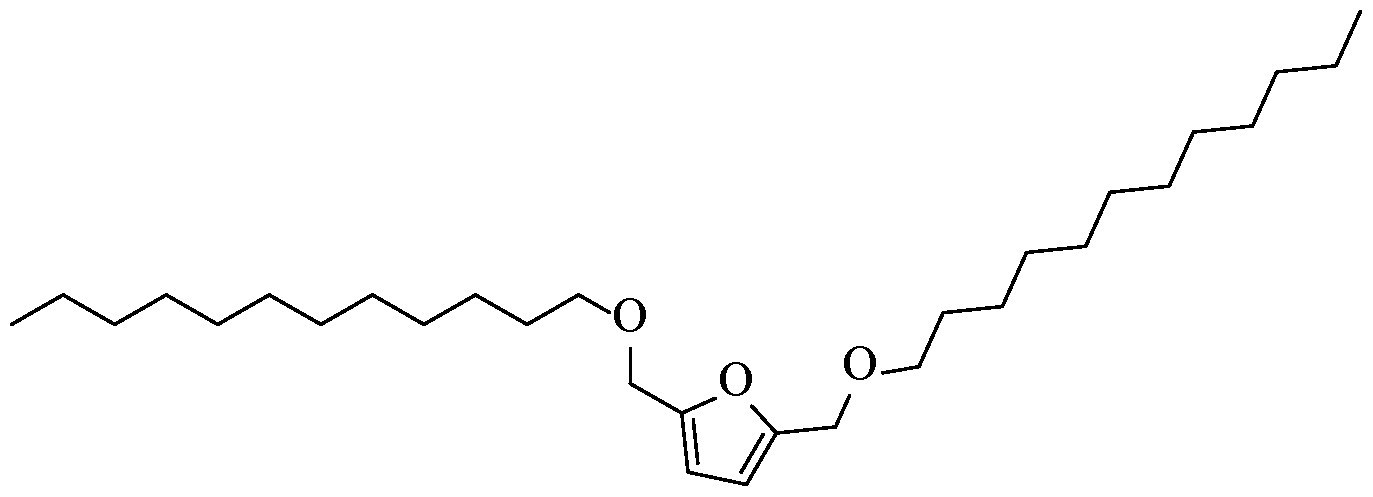
wherein: "X" is the nucleofuge, "n" is an integer from 5 to 25, and "CA" is a conjugate acid. The resultant di-ether of FDM can be, for instance, at least one of the following compounds: a. -bis((hexyloxy)methyl)furan
Figure imgf000005_0001
-bis((dodecyloxy)methyl)furan
Figure imgf000005_0002
c . 2,5 -bis((octadecyloxy)methyl) furan
In yet a further embodiment, the present disclosure provides a method of preparing a mono- ether involving: contacting bHMTHFs with a Bronsted base and 1 or less molar equivalents of an alkyl-X species according to the following:
Figure imgf000005_0003
Figure imgf000005_0004
wherein: "X" is the nucleofuge, "n" is an integer from 5 to 25, and "CA" is a conjugate acid. The resultant mono-ether of bHMTHF can be, for example, at least one of the following compounds:
a. ((2S,5R)- -2-yl)methanol
b. ((2S,5S)- 2-yl)methanol
c. ((2S,5S)- 2-yl)methanol
d. ((2S,5R)- an-2-yl)methanol
Figure imgf000006_0001
e. ((2S,5S)-5-((dodecyloxy)methyl)tetrahydrofuran-2-yl)methanol
Figure imgf000007_0001
f. ((2S,5S)-5-((dodecyloxy)methyl)tetrahydrofuran-2-yl)methanol g. ((2S,5R)-5 furan-2-yl)methanol
Figure imgf000007_0002
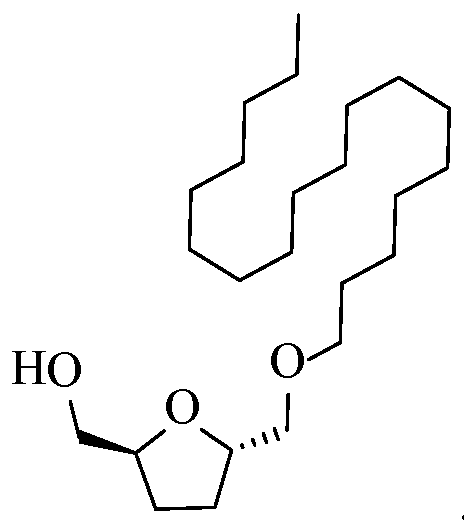
h. ((2S,5S)-5-((octadecyloxy)methyl)tetrahydrofuran-2-yl)methanol
Figure imgf000007_0003
i. ((2S,5S)-5-((octadecyloxy)methyl)tetrahydrofuran-2-yl)methanol
Figure imgf000008_0001
In an embodiment for preparing di-ethers, the method involves: contacting bHMTHFs with a Bronsted base and a minimum of two molar equivalents of an alkyl-X species according to the following:
Figure imgf000008_0002
Figure imgf000008_0003
wherein: "X" is the nucleofuge, "n" is an integer from 5 to 25, and "CA" is a conjugate acid. The resultant di-ethers of bHMTHF can be, for instance, at least one of the following compounds:
a. (2R,5S)-2,
b. (2S,5S)-2,
Figure imgf000008_0004
c. (2R,5S)-2,5-bis((dodecyloxy)methyl)tetrahydrofuran
Figure imgf000009_0001
d. (2S,5S)-2 -bis((dodecyloxy)methyl)tetrahydrofuran
Figure imgf000009_0002
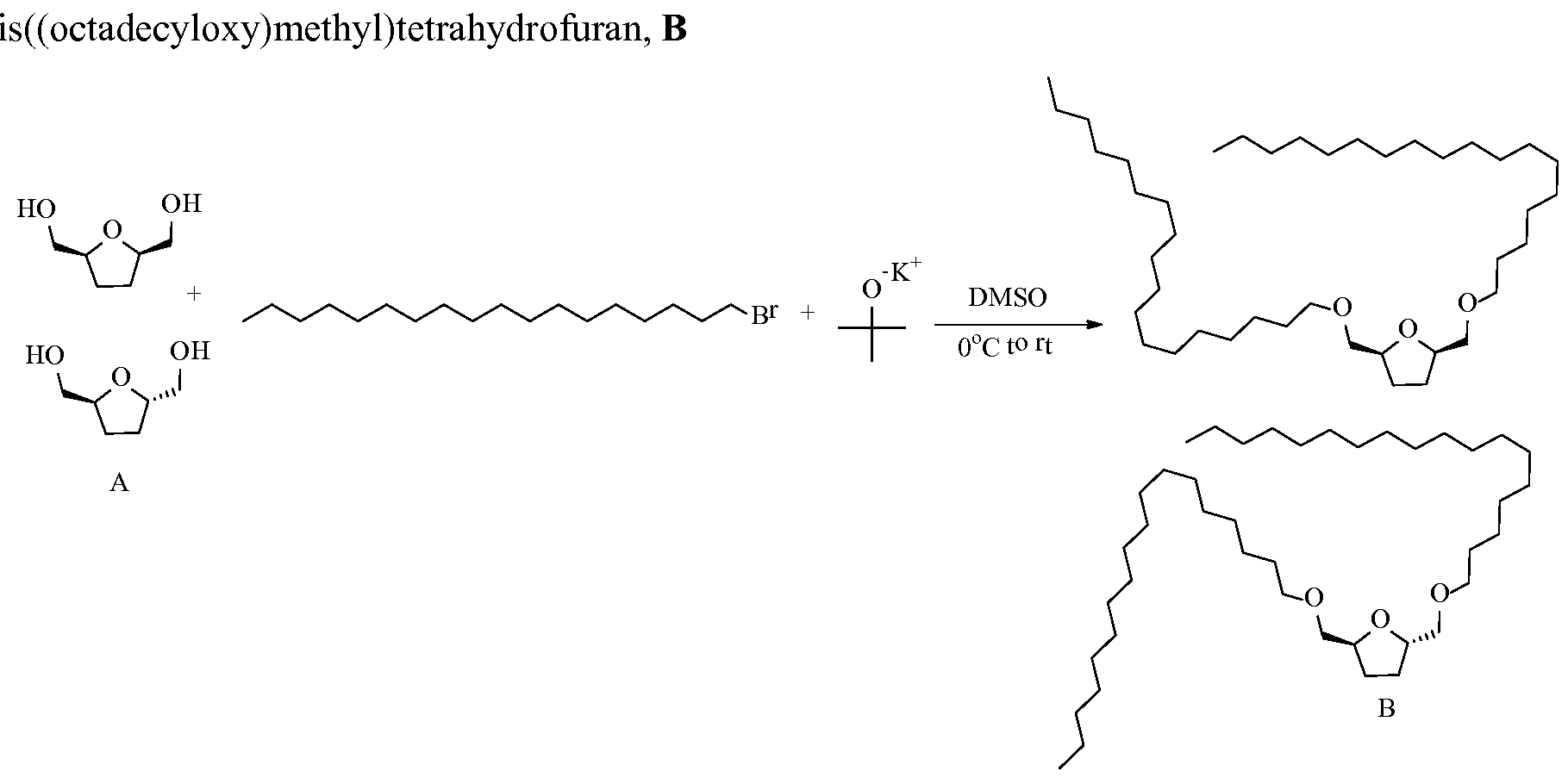
e. (2R, 5 S) -2, 5 -bis((octadecyloxy)methyl)tetrahydrofuran
Figure imgf000009_0003
f. (2S,5S -2,5-bis((octadecyloxy)methyl)tetrahydrofuran
Figure imgf000009_0004
Additionally, in another aspect, the present disclosure pertains to derivative compounds from the linear mono-ethers of FDM and bHMTHF described above and methods for making the derivatives. These derivative compounds are amphiphilic variants of the mono-ethers and are valued as precursors or plausible bio-based surfactants, dispersants, and/or hydrophiles.
Additional features and advantages of the present process will be disclosed in the following detailed description. It is understood that both the foregoing summary and the following detailed description and examples are merely representative of the invention, and are intended to provide an overview for understanding the invention as claimed.
DETAILED DESCRIPTION OF THE INVENTION
Section I. - Description
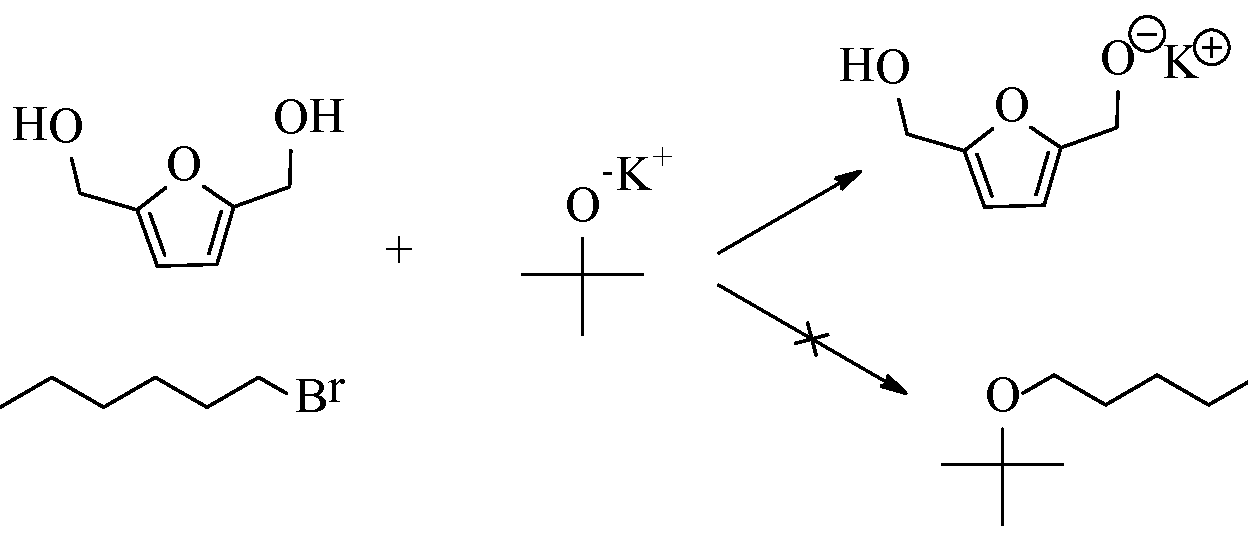
The present synthetic processes opens a pathway for direct preparation of linear alkyl ethers from the glycols FDM and/or bHMTHF, molecules that arise from the reduction of fructose derived 5 -(hydroxymethyl) furfural (HMF) under mild conditions, and their derivative chemical compounds. (Although not necessary, in certain embodiments, the process may also include either first partially reducing HMF to FDM or fully reducing HMF to bHMTHFs in hydrogenation steps prior to selective etherification according to the present reaction process described herein.) The alkyl ethers, in turn, are valuable precursors with bio-based amphiphilic properties that can be used in surfactants, dispersants, and plasticizers.
In general, the process for generating alkyl ethers can be implemented in a single reaction step, in which the FDM or bHMTHF glycol is reacted with either one or two equivalents of a halogenated or sulfonated (leaving group) alkane, depending respectively on whether a mono- or di- ether product is desired. A hindered Bronsted base with a minimum pKa of about 10, preferably about 16, or an unhindered Bronsted base having a difference in pKa (ApKa) of >15 relative to the pKa of a hydroxyl group of either the FDM or bHMTHF is used to deprotonate the -OH moieties of the glycols, enhancing their nucleophilicities by several orders of magnitude towards nucleofuge displacement. (It is believed that with a pronounced difference in the pKa between the Bronsted base and the -OH moieties of the FDM and/or bHMTHF glycols, the Bronsted base should have a limited propensity to react with an alkyl halide or sulfonate in a nucleophilic substitution and/or elimination.) A polar aprotic organic solvent with a dielectric constant of >10, preferably > 30, is employed to augment the basicity of the Bronsted base via charge separation capacities. Typically, the reaction is conducted at a temperature in a range from about -20°C to about 100°C, over a period of about 2 or 3 hours. In some other iterations the time may involve about 4 or 8 hours up to about 12 or 24 hours, as conditions may dictate.
A. Bronsted Bases
As stated, the Bronsted base in the reaction serves to deprotonate the -OH moieties of the glycols. This helps to enhance the corresponding nucleophilicity of the glycols FDM and bHMTHF by about at least 6 or more orders of magnitude (e.g., 8-10-12) and drives halide/sulfonate displacement on the alkyl reagent. The relative strength of a Bronsted base used in the reaction is of essence in furnishing high conversions of the glycols to, in particular, mono-alkyl ethers.
For some Bronsted bases that have a pKa of at least 10 to about 15, the synthesis reaction usually requires the addition of heat to proceed; hence, reaction temperatures of about 45°C-50°C or greater. This, however, can increase the risk of generating side -products (e.g., product of Bronsted base-nucleophilic substitution with the alkyl halide/sulfonate and/or alkenes formed from Bronsted base- mediated elimination of the alkyl halide/sulfonate) and reducing the overall yield of the desired synthesis. To minimize the generation of side products and counteract this phenomenon, a Bronsted base that has a pKa of at least -16, typically >20, is favored according to certain embodiments of the present process. Bronsted bases with a greater pKa more easily reacts with the -OH moieties of the glycols. This is an advantage that helps one operate effectively the reaction at about ambient room temperatures (e.g., ~18°C -22°C) or lower temperatures. Some suitable Bronsted bases may include, for example, hydroxides (e.g., methoxide, ethoxide, i-butoxide, and benzyl oxide). Preferably, Bronsted bases having pKa's > 30 are used, as the equilibrium for deprotonation favors generation of the desired products, such as illustrated in the examples in Scheme 3. Certain favored Bronsted bases of this type may include, for example, metallic hydrides (e.g., lithium, potassium, or sodium hydrides); metal amides (e.g., potassium or sodium amides); lithium diisopropylamide (LDA);
organometalic compounds (e.g., alkyl lithium (e.g., methyl-lithium, n-butyl-lithium, or phenyl- lithium), alkyl magnesium, or alkyl cuprate) and Grignard reagents (e.g., ethylmagnesium bromide, phenylmagnesium bromide). In contrast, certain disfavored Bronsted bases may include, for example, nitrogen-centered bases (e.g., tertiary amines, aryl amine), because of low-pKa- favoring reactants and nucleophilic propensities.
Scheme 3. - Equilibrium constants for various Bronsted base deprotonations of FDM: a) with potassium hydroxide; b) with potassium i-butoxide; c) with sodium hydride.
Figure imgf000012_0001
Figure imgf000012_0002
Figure imgf000012_0003
Reaction (a) shows when using a Bronsted base having a pKa -16, the reaction tends to be at equilibrium between product and reactants. In Reaction (b), when using a Bronsted base having a pKa -20, the reaction tend to favor the product more, whereas in Reaction (c) when using a Bronsted base having pKa >30, the reaction is driven completely towards product formation.
Another factor according to an embodiment of the present invention is to employ a Bronsted base that has molecular bulk. Propitiously, the bulky Bronsted base impedes undesired nucleophilic substitutions of the Bronsted base with the alkyl halide/sulfonate. Hence, a more sterically hindered Bronsted base enhances more effectively the reaction to produce predominantly the ether product. Scheme 4 illustrates this feature. As an example, reaction (a) using an unhindered Bronsted base tends to make a mixed product of both straight-chain and FDM ethers. In contrast, reaction (b) with a more bulky, hindered Bronsted base generates the FDM ethers alone.
Scheme 4. - Examples of Bronsted bases: a) unhindered, nuclephilic base, with sodium methoxide; b) hindered, non-nucleophilic base with potassium i-butoxide.
Figure imgf000013_0001
Figure imgf000013_0002
B. Alkyl Halides and Sulfonates
The etherification reaction of the present description can be characterized as a base-mediated, second order substitution reaction between a glycol and activated alkane. To achieve satisfactory yields of the desired ether in a polar aprotic organic solvent most expeditiously, the leaving group affixed to the alkane should exhibit favorable nucleofugal properties. Some species in this context can be, for example, halides (e.g., CI, Br, I) and sulfonates (e.g., -OTf, -OTs,-OMs). Typically, one can conduct the reaction using straight-chain alkyl halides or sulfonates of 5 to 25 carbons in length. In some reactions, for instance, the alkyl chain lengths may range from about 5 or 8 to about 16 or 18 carbons, or about 6 or 10 to about 20 or 22 carbons (e.g., Cs-Cis; C5-C15; C6-C12), or any iteration therein between.
One can use a variety of sulfonates, including but not limited to, mesylate (methanesulfonate),
CH3SO2O- [W (-OMs); triflate (trifluoromethanesulfonate), CF3SO2O- [ ° ] (-OTfs);
__/ s-o
tosylate (p-toluenesulfonate), CH3C6H4SO2O- [ ^ 0 R ] (-OTs); esylate (ethanesulfonate),
ϋ ^ υ
C2H5SO2O- [ 0 ] (-OEs); besylate (benzenesulfonate), C6H5S020- [ W 6 R ] (-OBs), and other alkyl and aryl sulfonates without limitation.
As halides, such as bromides, and alcohols are more economically accessible commercial alkane sources, they may be favored for larger scale, industrial uses according to some embodiments. In a situation in which an alkyl halide is unavailable or prohibitively expensive, but the corresponding alcohol available, one may substitute the alcohol for the corresponding sulfonate through a simple sulfonation reaction.
In certain embodiments, the sulfonate is preferably a triflate because it is a powerful leaving group. This reaction exhibits relatively fast kinetics and generates an activated triflic complex. The reaction is usually conducted at a low temperature, less than 0°C (e.g., typically about -10°C or -\2°C to about -20°C or -25°C), to control the reaction kinetics more easily. This reaction is essentially irreversible, as the liberated triflate is entirely non-nucleophilic. The triflic complex then reacts readily with the FDM or bHMTHF, forming respectively a FDM or bHMTHF-triflate with concomitant release and protonation of a nucleophilic base (e.g., pyrimidine, dimethyl-aminopyridine, imidazole, pyrrolidine, and morpho line).
The tosylate, mesylate, brosylate, benzenesulfonate, ethylsulfonate or other sulfonate species can be as effective as triflate in imparting leaving groups, and manifesting overall yields that were commensurate with that achieved with triflate. But, these other sulfonates tend to react more slowly in comparison to the triflate. To compensate for this, operations at higher temperatures are typically needed for better yields when using these other species.
Often the conversion can be performed sequentially in a single reaction vessel, prior to executing a displacement reaction with a glycol, such as demonstrated in Scheme 5.
Scheme 5. - Single-vessel sequential sulfonation, displacement reaction between FDM and dodecanol.
Figure imgf000014_0001
C. Organic Solvents
In the present synthesis process, aprotic solvents are used, as they contain no functionality labile to covalent modifications with the glycol, alkyl halide/sulfonate and Bronsted base of the title reaction, and thus do not interfere with the Sn2-driven process. Furthermore, polar aprotic solvents (i.e., solvents with a permanent dipole moment but without the ability to act as hydrogen bond donors) are favored in the present etherification reactions. Polar aprotic solvents adequately dissolve the glycols and the alkyl halide/sulfonate, a feature for an efficient reaction to occur. The function is dissimilar to apolar solvents like hexane or benzene, which lack the ability to effectuate charge separation of the anionic Bronsted base from its cation counterpart, rendering it inactive. Also, polar aprotic solvents tend not to react with the alkyl halide/sulfonate (cf., Scheme 6, ethanol, a polar protic solvent, which can generate undesired side products).
Figure imgf000015_0001
In aprotic solvents a greater dielectric constant can help prevent the solvent from reacting with the primary reagents, hence minimizing formation of side -products. The reactions of the present synthesis process are conducted in solvents with a relative permittivity > 8r 25, typically about 30 or 35. For example, DMSO and DMF exhibit relatively high dielectric constants (e.g., -30 or 32). Other solvents with high boiling points and dielectric constants, such as NMP and DMA, are effective in cyanide for sulfonate displacement reactions. The reaction to derivatize FDM or bHMTHF with a sulfonate is performed in a solution of solvent having a boiling point > 110°C.
Some common polar aprotic solvents that are amenable to this process are
dimethylformamide (DMF), dimethylsulfoxide (DMSO), dimethylacetamide (DMA), N- methylpyrrolidone (NMP), hexamethylphosphoramide (HMPA), acetone, acetonitrile (ACN), nitromethane, sulfolane, tetrahydrofuran (THF), 1,4-dioxane, and ethyl acetate.
A further consideration when using polar aprotic solvent in the etherification process is to amply charge separate the Bronsted base so that the glycol -OH moieties can be deprotonated. A reflection of the power to charge separate is the permittivity of dielectric constant, represented by ε (no units), with the larger number signifying a greater capacity to sequester the ions. In general, e > 20 is the advantageous for effective charge separation, with exceptions being THF (ε = 7.58) and 1,4- dioxane (ε = 2.21) whose oxygen atoms can coordinate with cations captodatively. The preferred ε is >30. Examples of polar aprotic solvents with propitious ε are DMSO (ε = 46.7), sulfolane (ε = 43.3), DMA (ε = 37.8), acetonitrile (ε = 37.5), DMF (ε = 36.7), nitromethane (ε = 35.9), NMP (ε = 32.0), HMPA (ε = 30.0), acetone (ε = 20.0).
D. Reaction Temperature
One of the advantages of the present synthesis process is that it can be operated in a relatively mild temperature range, and under less harsh conditions than some other conventional reaction processes. Depending on the particular Bronsted base, the reaction temperatures can span between about -25°C or -20°C to about 80°C or 100°C. Typically, the reaction temperature is in a range from about -12°C or -7°C to about 65°C or 70°C, more typically from about -10°C or -5°C to about 40°C or 50°C. In certain embodiments, preferred temperatures may range from about -10°C or -8°C to about 25°C or 30°C, or about -3°C or 0°C to about 32°C or 35°C, inclusive. Preferably, the reaction can be performed at or below ambient room temperatures (e.g., < about 22°C or 25°C). Because of a potential or tendency to generate olefins from base-mediated elimination of an alkyl halide/sulfonate at elevated temperatures, and potential slow reaction kinetics when uses certain Bronsted bases (Scheme 7), temperature control for the present selective etherification is an important factor. (As aforementioned, a Bronsted base with a pKa lower than 16, which designates that of the -OH moieties of FDM and bHMTHF, tends to favor the reactants at equilibrium; hence the reaction is performed at an elevated temperature (e.g., >25°C, 35°C, or 40°C) to drive the etherification, albeit with a greater risk of forming side products (olefins).)
Scheme 7. - Reaction temperature profiles with a) potassium i-butoxide, and
Figure imgf000016_0001
E. Derivatives
In another aspect, various amphiphilic compounds can be synthesized from FDM or bHMTHF ethers as a starting or precursor material. Such derivative materials can be useful as substitutes for existing compounds or new chemical building blocks in surfactant, dispersant, plasticizer or a component in other applications. The derivative amphiphilic compounds can be prepared according to various chemical reactions available for organic synthesis. Preparations of some representative derivative compounds are further described in the accompanying examples below.
The methods may include: reacting either a mono-ether of bHMTHF or FDM with: a) chlorosulfonic acid to generate a sulfate, or b) trifluoromethanesulfonic anhydride to generate a trifluoromethanesulfonate, respectively, of each glycol species. For the derivatives of bHMTHF mono-ethers, a sulfate product can be, for example, at least one of the following compounds:
a. ((2S,5R)-5-((hexyloxy)methyl thyl hydrogen sulfate
HO S
Figure imgf000017_0001
b. ((2S,5S)-5-((hexyloxy)methyl)tetrahydrofuran-2-yl)methyl hydrogen sulfate
c. ((2S,5S)-5-((h -2-yl)methyl hydrogen sulfate
Figure imgf000017_0002
Alternatively, a trifluoromethanesulfonated mono-ether generated from the bHMTHF mono-ether can be, for example, at least one of the following compounds:
a. ((2S,5R)-5-((dodecyloxy)methyl)tetrahydrofuran-2-yl)methyl trifluoromethanesulfonate
b. ((2 S, 5 S) -5 -((dodecylo fluoromethanesulfonate c. ((2S,5S)-5-((dodecylo fluoromethanesulfonate d. ((2S,5R)-5-((octadecyl trifluoromethanesulfonate
Figure imgf000018_0001
e. ((2S,5S)-5-((octadecyloxy)methyl)tetrahydrofuran-2-yl)methyl trifluoromethanesulfonate f. ((2S,5S)-5-((octadecylo l)methyl trifluoromethanesulfonate
Figure imgf000019_0001
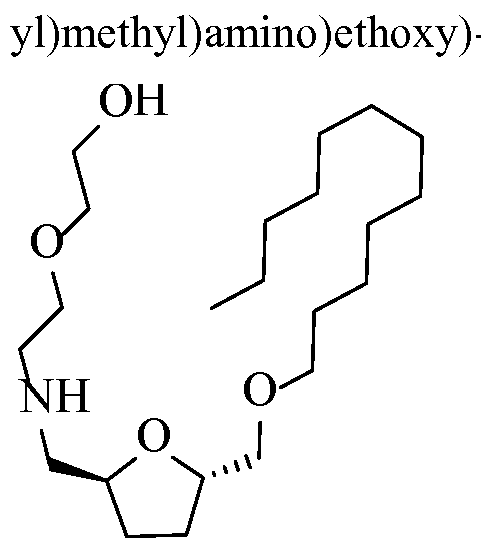
The process may further involve generating an ethoxyethanolamine derivative of the bHMTHF mono-ether sulfonate compound by substitution of a sulfonate group with an ethanolamine. The resultant ethoxyethanolamine prepared can be, for instance, at least one of the following compounds:
a. 2-(2-((((2S,5R)-5-((dodecyloxy)methyl)tetrahydrofuran-2-yl)methyl)amino)ethoxy)- ethanol
Figure imgf000019_0002
b. 2-(2-((((2S,5S)-5-((dodecyloxy)methyl)tetrahydrofuran-2-yl)methyl)amino)ethoxy)- ethanol H
Figure imgf000020_0001
c. 2-(2-((((2S,5S)-5-((dodecyloxy)methyl)tetrahydrofuran-2-yl)methyl)amino)ethoxy)- ethanol
Figure imgf000020_0002
In an alternative embodiment, the process may further include generating a primary amine of a bHMTHF monoether by substitution of a trifluoromethanesulfonate group to form a benzyl-amine, such as one of the following: a) N-benzyl-l-(5-( e
Figure imgf000020_0003
b) N-benzyl-l -((2S,5S)- -((octadecyloxy)methyl)tetrahydrofuran-2-yl)methanamine
Figure imgf000020_0004
c) N-benzyl-l-((2S,5S)- -((octadecyloxy)methyl)tetrahydrofuran-2-yl)methanamine
Figure imgf000021_0001
d) N-benzyl-l -((2S,5R)-5-((octadecyloxy) -2-yl)methanamine
Figure imgf000021_0002
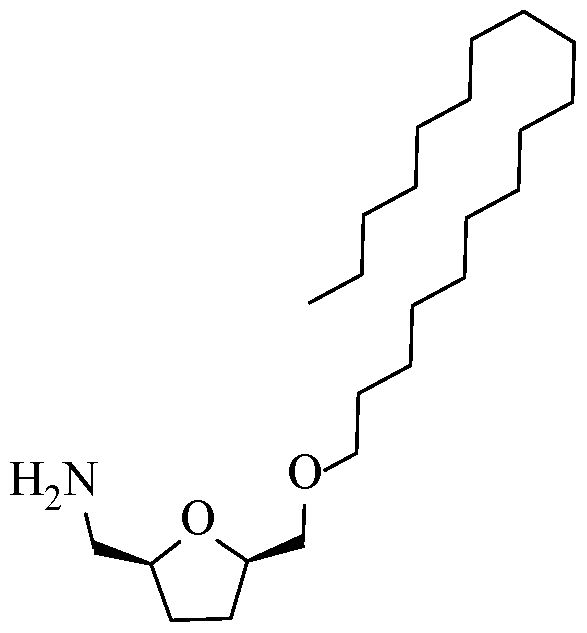
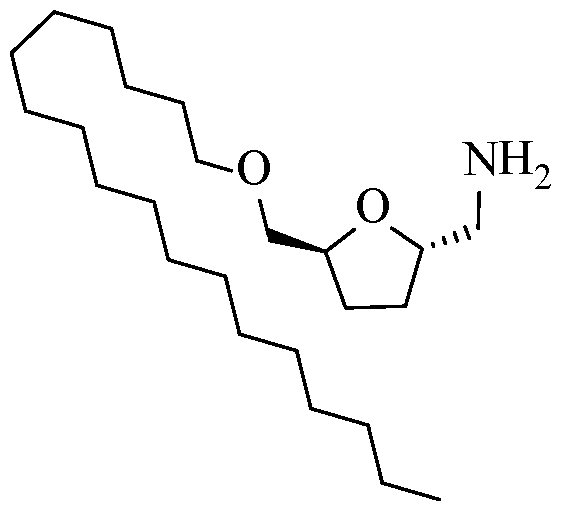
Subsequently, one generates the primary amine by catalytic debenzylation with, for example, a palladium catalyst on carbon. The resultant primary amine can be, for instance, at least one of the following compounds:
a. ((2S,5R)-5-((octadecyl amine
Figure imgf000021_0003
b. ((2S,5S)-5 -((octadecyloxy)methyl)tetrahydrofuran-2 -yl)methanamine c. ((2 S ,5 S) -5 -((octadecyl l)methanamine
Figure imgf000022_0001
In another alternative embodiment, the process may further include preparing a primary ammonium salt of the bHMTHF monoether by substitution of a trifluoromethanesulfonate group followed by catalytic debenzylation and protonation by a Bronsted acid having a pKa < 0 (e.g., HC1, HBr, HI). The resultant primary ammonium group can be, for example, at least one of the following compounds:
a. ((2S,5R)-5-((octa 2-yl)methanaminium chloride
b. ((2 S, 5 S) -5 -((octa -yl)methanaminium chloride
c. ((2 S ,5 S) -5 -((octadecyloxy)methyl)tetrahydrofuran-2 -yl)methanaminium chloride d. ((2S,5R)-5-((octadecyl )methanaminium bromide
Figure imgf000023_0001
e. ((2S,5S)-5-((octadecyloxy)methyl)tetrahydrofuran-2-yl)methanaminium bromide
Figure imgf000023_0002
f. ((2S,5S)-5-((octadecyloxy)methyl)tetrahydrofuran-2-yl)methanaminium bromide
Figure imgf000023_0003
g. ((2S,5R)-5-((octad l)methanaminium iodide
h. ((2S,5S)-5-((octad l)methanaminium iodide
i. ((2S,5S)-5-((octad )methanaminium iodide
Figure imgf000024_0001
The salt version of the primary amine renders the molecule more amphiphilic with a polar head for cationic surfactants.
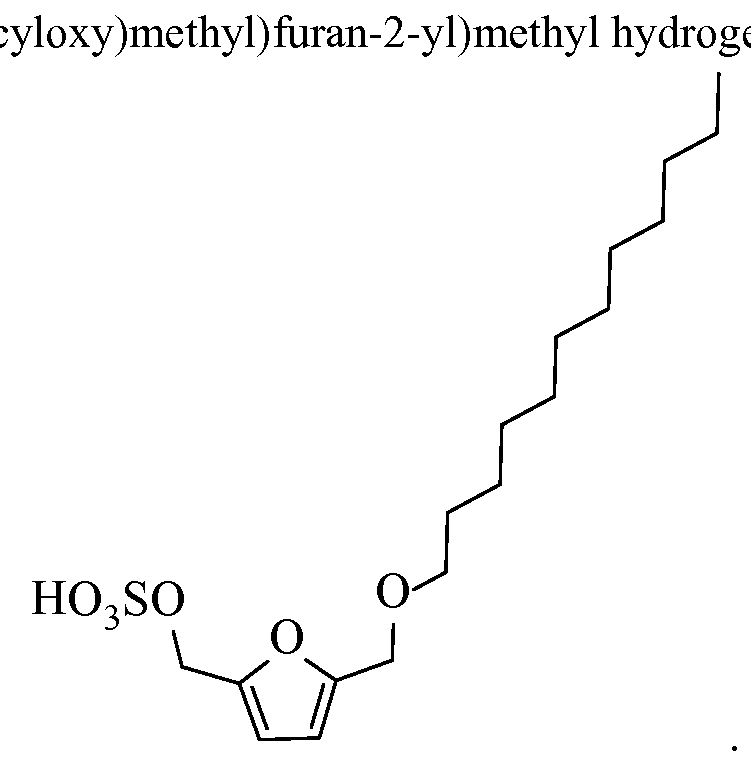
For the derivative compounds prepared from a reaction with a mono-ether of FDM, the resultant sulfate product can be for example:
a. (5-((dodecyloxy)methyl)furan-2-yl)methyl hydrogen sulfate
Figure imgf000025_0001
And, the resultant trifluoromethanesulfonate from FDM mono-ether can be, for example, at least one of the following structures:
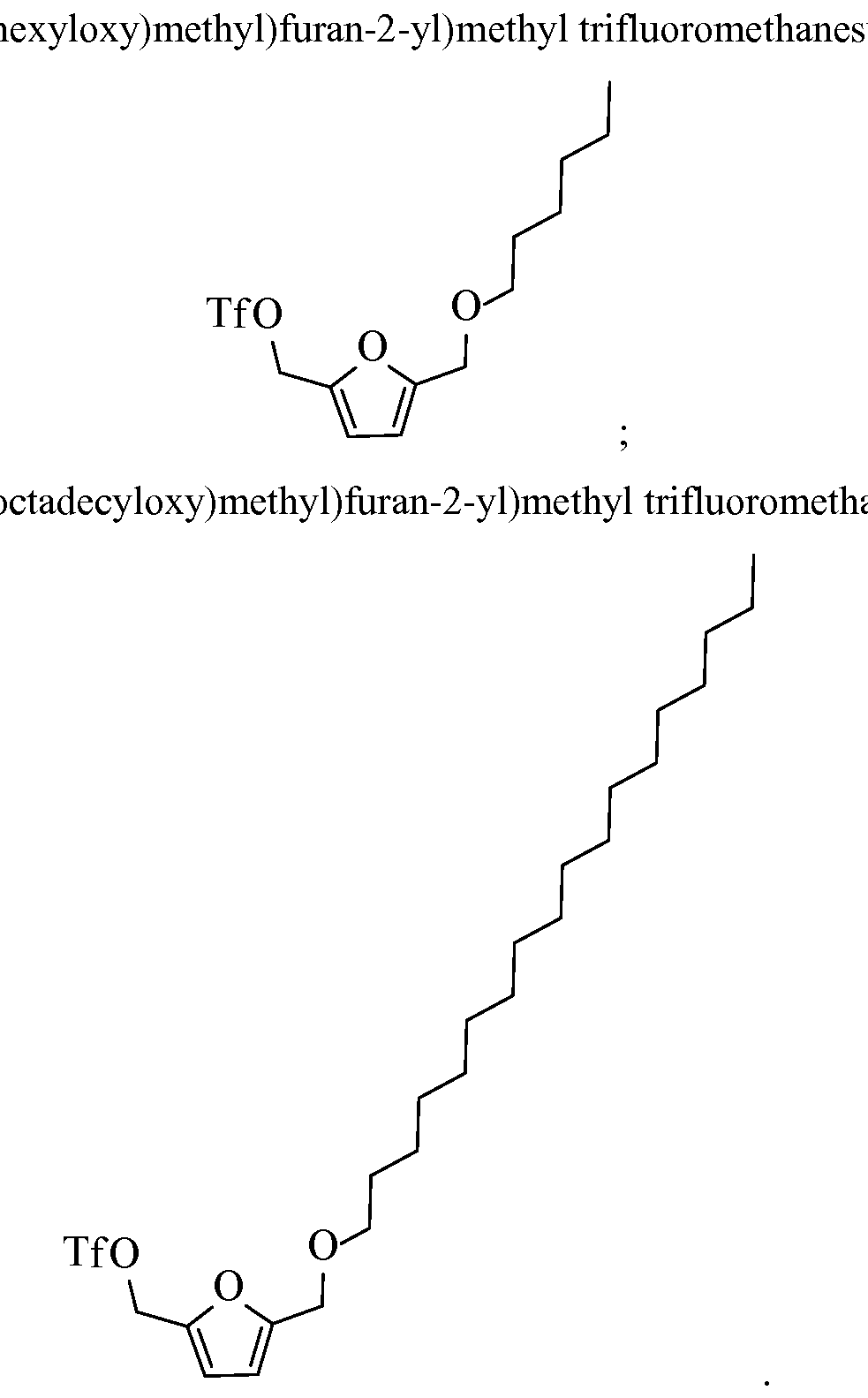
a. (5-(( ulfonate
b. (5-((o anesulfonate
Figure imgf000025_0002
Similar to the process with bHMTHF mono-ethers, the process for preparing a primary ammonium group using FDM mono-ethers also involves substitution of a trifluoromethanesulfonate group followed by catalytic debenzylation and protonation by a Bronsted acid having a pKa < 0. The resultant aminoethylethanolamine can be, for example, the following:
a. 2-((2-(((5-((octadecyloxy)methyl)furan-2-yl)methyl)amino)ethyl)amino)-ethanol
Figure imgf000026_0001
According to another embodiment, a primary amine derivative that is prepared using FDM mono- ether as the starting material can be, for example, the following: (5-((hexyloxy)methyl)furan-2- yl)methanamine
Figure imgf000026_0002
Alternatively, one can also prepare a quaternary trimethylammonium salt such as: l-(5- ((hexyloxy)methyl)furan-2-yl)-N,N,N de
Figure imgf000026_0003
Section II. - Examples
The present synthesis system is further illustrated in the following examples for making: A) bHMTHF di-ethers; B) bHMTHF mono-ethers; C) derivatives of bHMTHF mono-ethers; D) FDM di- ethers; E) FDM mono-ethers; and F) amphiphilic derivatives of FDM mono-ethers .
A. bHMTHF Diethers Example 1: Synthesis of (2R,5S)-2,5-bis((hexyloxy)methyl)tetrahydrofuran and (2S,5S)-2,5- bi
Figure imgf000027_0001
B
Experimental: An oven dried, single neck 10 mL round bottomed flask equipped with a PTFE coated magnetic stir bar was charged with 50 mg of a 9: 1 mixture of ((2R,5S)-tetrahydrofuran-2,5- diyl)dimethanol and ((2S,5S)-tetrahydrofuran-2,5-diyl)dimethanol (0.378 mmol) and 5 mL of anhydrous DMSO. The flask was then immersed in an ice-brine bath (— 10°C) and, while stirring, 106 mg of potassium i-butoxide (0.946 mmol) added in portions and the mixture stirred for 30 minutes at this temperature. At this time, the neck was stoppered with a rubber septum and an argon gas inlet affixed via a 14" needle. While vigorously stirring and under an argon blanket, 117 of 1 - bromohexane (0.832 mmol) was added via syringe. The mixture was then warmed to room temperature and continued to react overnight. After this time, an aliquot was removed and spotted on a silica gel TLC plate, which exhibited a single band (cerium molybdate stain) after developing in 9: 1 hexanes/ethyl acetate. The signature band for A (baseline) was patently absent, suggesting this reagent had fully converted. Here, the mixture was diluted with 5 mL of water and 5 mL of methylene chloride and partitioned and the aqueous layer extracted with 3-5 mL volumes of methylene chloride. The organic phases were combined, dried with anhydrous magnesium sulfate, filtered and concentrated under vacuum. The oily residue was dissolved in a minimum amount of methylene chloride and added to 20 g of silica gel, which was then dried under vacuum, furnishing product adsorbed silica gel. This material was added to a pre-fabricated silica gel column, where flash chromatography with hexanes to 10% ethyl acetate in hexanes afforded 64 mg of a B as light yellow oil after inspissation (56% of theoretical). ¾ NMR (400 MHz, CDCI3, salient peaks corresponding to the cis (meso) derivative in large excess) δ (ppm) 4.21 (m, 2H), 3.64 (m, 2H), 3.40-3.36 (m, 4H), 2.11 (m, 2H), 1.61 (m, 2H), 1.47 (t, J= 6.2 Hz, 4H), 1.40 (m, 4H), 1.35-1.30 (m, 10H), 0.94 (t, J= 7.0 Hz, 6H); 13C NMR (100 MHz, CDCI3 salient peaks corresponding to the cis (meso) derivative in large excess) δ (ppm) 87.1, 78.3, 68.9, 33.2, 31.2, 29.8, 25.4, 23.1, 13.3. Example 2: Synthesis of (2R,5S)-2,5-bis((dodecyloxy)methyl)tetrahydrofuran and (2S,5S)-2,5- bi
Figure imgf000028_0001
Experimental: An oven dried, single neck 10 mL round bottomed flask equipped with a PTFE coated magnetic stir bar was charged with 50 mg of a 9: 1 mixture of ((2R,5S)-tetrahydrofuran-2,5- diyl)dimethanol and ((2S,5S)-tetrahydrofuran-2,5-diyl)dimethanol (0.378 mmol) and 5 mL of anhydrous DMSO. The flask was then immersed in an ice-brine bath (— 10°C) and, while stirring, 106 mg of potassium i-butoxide (0.946 mmol) added in portions and the mixture stirred for 30 minutes at this temperature. At this time, the neck was stoppered with a rubber septum and an argon gas inlet affixed via a 14" needle. While vigorously stirring and under an argon blanket, 200 μL· oi \ - bromododecane (0.832 mmol) was added via syringe. The mixture was then warmed to room temperature and continued to react overnight. After this time, an aliquot was removed and spotted on a silica gel TLC plate, which exhibited a single band (cerium molybdate stain) after developing in 10: 1 hexanes/ethyl acetate. The signature band for A (baseline) was noticeably absent, suggesting this reagent had fully converted. Here, the mixture was diluted with 5 mL of water and 5 mL of methylene chloride and partitioned and the aqueous layer extracted with 3-5 mL volumes of methylene chloride. The organic phases were combined, dried with anhydrous magnesium sulfate, filtered and concentrated under vacuum. The oily residue was dissolved in a minimum amount of methylene chloride and added to 20 g of silica gel, which was then dried under vacuum, furnishing product adsorbed silica gel. This material was added to a pre-fabricated silica gel column, where flash chromatography with hexanes to 7% ethyl acetate in hexanes afforded 118 mg of a B as a beige solid after concentration (65% of theoretical). ¾ NMR (400 MHz, CDCh, salient peaks corresponding to the cis (meso) derivative in large excess) δ (ppm) 4.20 (m, 2H), 3.63 (m, 2H), 3.41-3.38 (m, 4H), 2.09 (m, 2H), 1.59 (m, 2H), 1.49 (t, J = 6.2 Hz, 4H), 1.42 (m, 4H), 1.38-1.30 (m, 34H), 0.92 (t, J = 6.8 Hz, 6H); 13C NMR (100 MHz, CDCI3 salient peaks corresponding to the cis (meso) derivative in large excess) δ (ppm) 87.4, 78.1, 69.1, 33.0, 31.2, 30.9, 29.8, 28.7, 26.2, 25.4, 24.9, 24.1, 23.3, 22.1, 13.3. Example 3: Synthesis of (2R,5S)-2,5-bis((octadecyloxy)methyl)tetrahydrofuran and (2S,5S)-2,5-
Figure imgf000029_0001
Experimental: An oven dried, single neck 10 mL round bottomed flask equipped with a PTFE coated magnetic stir bar was charged with 50 mg of a 9: 1 mixture of ((2R,5S)-tetrahydrofuran-2,5- diyl)dimethanol and ((2S,5S)-tetrahydrofuran-2,5-diyl)dimethanol (0.378 mmol) and 5 mL of anhydrous DMSO. The flask was then immersed in an ice-brine bath (— 10°C) and, while stirring, 106 mg of potassium i-butoxide (0.946 mmol) added in portions and the mixture stirred for 30 minutes at this temperature. At this time, the neck was stoppered with a rubber septum and an argon gas inlet affixed via a 14" needle. While vigorously stirring and under an argon blanket, 277 μΕ of 1 - bromooctadecane (0.832 mmol) was added via syringe. The mixture was then warmed to room temperature and continued to react overnight. After this time, an aliquot was removed and spotted on a silica gel TLC plate, which exhibited a single band (cerium molybdate stain) after developing in 11 : 1 hexanes/ethyl acetate. The signature band for A (baseline) was noticeably absent, suggesting this reagent had fully converted. Here, the mixture was diluted with 5 mL of water and 5 mL of methylene chloride and partitioned and the aqueous layer extracted with 3-5 mL volumes of methylene chloride. The organic phases were combined, dried with anhydrous magnesium sulfate, filtered and concentrated under vacuum. The oily residue was dissolved in a minimum amount of methylene chloride and added to 20 g of silica gel, which was then dried under vacuum, furnishing product adsorbed silica gel. This material was added to a pre-fabricated silica gel column, where flash chromatography with hexanes to 5% ethyl acetate in hexanes afforded 132 mg of a B as an off-white solid after concentration (55% of theoretical). ¾ NMR (400 MHz, CDCb, salient peaks corresponding to the cis (meso) derivative in large excess) δ (ppm) 4.20 (m, 2H), 3.63 (m, 2H), 3.41- 3.38 (m, 4H), 2.08 (m, 2H), 1.65 (m, 2H), 1.48 (t, J = 6.2 Hz, 4H), 1.41 (m, 4H), 1.40-1.28 (m, 58H), 0.89 (t, J = 6.8 Hz, 6H); 13C NMR (100 MHz, CDCI3 salient peaks corresponding to the cis (meso) derivative in large excess) δ (ppm) 87.4, 78.1, 69.1, 33.0, 31.2, 30.9, 29.8, 28.7, 26.2, 25.4, 24.9, 24.1, 23.8, 23.3, 22.9, 22.7, 22.5, 22.1, 21.7, 21.3, 13.3. B. bHMTHF Monoethers
Example 4: Synthesis of ((2S,5R)-5-((hexyloxy)methyl)tetrahydrofuran-2-yl)methanol, ((2S,5S)-5- ((hexyloxy)methyl)tetrahydrofuran-2-yl)methanol, and ((2S,5S)-5- (
Figure imgf000030_0001
Experimental: An oven dried, single neck 10 mL round bottomed flask equipped with a PTFE coated magnetic stir bar was charged with 50 mg of a 9: 1 mixture of ((2R,5S)-tetrahydrofuran-2,5- diyl)dimethanol and ((2S,5S)-tetrahydrofuran-2,5-diyl)dimethanol (0.378 mmol) and 5 mL of anhydrous DMSO. The flask was then immersed in an ice-brine bath (— 10°C) and, while stirring, 42 mg of potassium i-butoxide (0.378 mmol) added in portions and the mixture stirred for 30 minutes at this temperature. At this time, the neck was stoppered with a rubber septum and an argon gas inlet affixed via a 14" needle. While vigorously stirring and under an argon blanket, 53 μΕ of 1- bromohexane (0.378 mmol) was added via syringe. The mixture was then warmed to room temperature and continued to react overnight. After this time, an aliquot was removed and spotted on a silica gel TLC plate, which exhibited two salient bands (cerium molybdate stain) after developing in 3: 1 hexanes/ethyl acetate, Rfi = 0.54 (targets B), Rf2 = baseline (unreacted THF-diols A). Analysis by GC/MS (EI, Initial 70°C, ramp 5°C per minute to 350°C, hold for 60 min.) manifested three salient signals with retention times as follows: a) 12.4 min., m/z 132.1 (M+, unreacted THF-diols), b) 18.7 min., m/z 216.1 (M+, one or more of target monoethers), 19.2 min. m/z 216.1 (M+, one of more of the target mono-ethers).
Example 5: Synthesis of ((2S,5R)-5-((dodecyloxy)methyl)tetrahydrofuran-2-yl)methanol, ((2S,5S)- 5-((dodecyloxy)methyl)tetrahydrofuran-2-yl)methanol, ((2S,5S)-5- ((
Figure imgf000030_0002
Experimental: An oven dried, single neck 10 mL round bottomed flask equipped with a PTFE coated magnetic stir bar was charged with 50 mg of a 9: 1 mixture of ((2R,5S)-tetrahydrofuran-2,5- diyl)dimethanol and ((2S,5S)-tetrahydrofuran-2,5-diyl)dimethanol (0.378 mmol) and 5 mL of anhydrous DMSO. The flask was then immersed in an ice-brine bath (— 10°C) and, while stirring, 42 mg of potassium i-butoxide (0.378 mmol) added in portions and the mixture stirred for 30 minutes at this temperature. At this time, the neck was stoppered with a rubber septum and an argon gas inlet affixed via a 14" needle. While vigorously stirring and under an argon blanket, 91 μΐ^ of 1- bromododecane (0.378 mmol) was added via syringe. The mixture was then warmed to room temperature and continued to react overnight. After this time, an aliquot was removed and spotted on a silica gel TLC plate, which exhibited two salient bands (cerium molybdate stain) after developing in 5: 1 hexanes/ethyl acetate, Rfi = 0.57 (targets B), Rf2 = baseline (residual THF-diols A). Analysis by GC/MS (EI, Initial 70°C, ramp 5°C per minute to 350°C, hold for 60 min.) manifested three salient signals with retention times as follows: a) 12.3 min., m/z 132.1 (M+, unreacted THF-diols A), b) 25.1 min., m/z 300.2 (M+, one or more of target monoethers), 25.9 min. m/z 300.2 (M+, one of more of the target mono-ethers). Example 6: Synthesis of ((2S,5R)-5-((octadecyloxy)methyl)tetrahydrofuran-2-yl)methanol, ((2S,5S)- 5-((octadecyloxy)methyl)tetrahydrofuran-2-yl)methanol, ((2S,5S)- 5(
Figure imgf000031_0001
Experimental: An oven dried, single neck 10 mL round bottomed flask equipped with a PTFE coated magnetic stir bar was charged with 50 mg of a 9: 1 mixture of ((2R,5S)-tetrahydrofuran-2,5- diyl)dimethanol and ((2S,5S)-tetrahydrofuran-2,5-diyl)dimethanol (0.378 mmol) and 5 mL of anhydrous DMSO. The flask was then immersed in an ice-brine bath (— 10°C) and, while stirring, 42 mg of potassium i-butoxide (0.378 mmol) added in portions and the mixture stirred for 30 minutes at this temperature. At this time, the neck was stoppered with a rubber septum and an argon gas inlet affixed via a 14" needle. While vigorously stirring and under an argon blanket, 126 μΕ of 1- bromododecane (0.378 mmol) was added via syringe. The mixture was then warmed to room temperature and continued to react overnight. After this time, an aliquot was removed and spotted on a silica gel TLC plate, which exhibited a single band (cerium molybdate stain) after developing in 6: 1 hexanes/ethyl acetate, Rfi = 0.62 (targets B) and Rf2 = baseline (unreacted THF-diols A). The signature band for A was patently absent, suggesting this reagent had fully converted. Analysis by LC/MS (APCI-, RP 1.7 μιη, 2.1 x 50 mm,, mobile phase-gradient 50 to 0% aqueous in CH3CN, flow rate 0.5 mL/min., M-l) m/z 383.4. C. Derivatives of bHMTHF monoethers
Example 7: Synthesis of potassium ((2S,5R)-5-((hexyloxy)methyl)tetrahydrofuran-2-yl)methyl s
Figure imgf000032_0001
Experimental: An oven dried, single neck 10 mL round bottomed flask equipped with a 0.5" PTFE coated tapered magnetic stir bar was charged with 50 mg of a 9: 1 mixture of ((2S,5R)-5- ((hexyloxy)methyl)tetrahydrofuran-2-yl)methanol and diastereomers A (0.231 mmol) and 5 mL of anhydrous CHCI3. The flask was then immersed in an ice-brine bath (— 10°C) and, while stirring, 15.4 μΐ^ of chlorosulfonic acid (26.9 mg, 0.231 mmol) was added dropwise over 15 minutes. The mixture was then warmed to room temperature and continued to react for 1 hour. After this time, the solvent and resultant HC1 was removed via rotary evaporation and high vacuum. The light yellow oily residue dissolved in a minimum amount of isopropanol and placed in a freezer. After about 3 days, suspended crystals were observed, which were filtered and dried, affording 16 mg (24% of theoretical) of B. Elemental analysis (C, H): Predicted for Ci2H2406S (C, 48.63; H, 8.16); Found (C, 48.66; H, 8.23).
Example 8: Synthesis of 2-(2-((((2S,5R)-5-((dodecyloxy)methyl)tetrahydrofuran2yl)methyl)amino)- e
Figure imgf000032_0002
Experimental: An oven dried, single neck 25 mL round bottomed flask equipped with a 0.5" PTFE coated octagonal magnetic stir bar was charged with 200 mg of a 9: 1 mixture of ((2S,5R)-5- ((dodecyloxy)methyl)tetrahydrofuran-2-yl)methanol and diastereomers A (0.666 mmol), 107 μΕ of pyridine (1.33 mmol) and 5 mL of anhydrous methylene chloride. The flask was then immersed in an ice-brine bath (— 10°C) and, while stirring, 112 μΐ^ of triflic anhydride (0.666 mmol) was added dropwise over 15 minutes. The mixture was then warmed to room temperature and continued to react for 2 hour. After this time, an aliquot was removed and spotted on a silica gel TLC plate that was developed using a 25% ethyl acetate eluent. One spot appeared on the plate (cerium molybdate visualization) with an Rf = 0.57. The absence of the band corresponding to the starting alcohol, Rf = 0.44, signified complete conversion. Excess solvent was then evaporated, furnishing 261 mg of a light yellow oil (90%) specifying B. This material was used in the subsequent step without further purification.
A single neck 50 mL round bottomed flask equipped with a 5/8" octagonal PTFE coated magnetic stir bar and was charged with 250 mg of B (0.578 mmol), 69 mg of 3-(2- aminoethoxy)propan-l-ol, 81 μΕ of triethylamine (0.578 mmol) and 10 mL of absolute ethanol. A reflux condenser was outfitted to the flask, and while stirring, the solution was heated to 50°C, 4 hours. After this time, an aliquot was extracted and analyzed by TLC (cerium molybdate visualization), demonstrating that B had entirely disappeared. The mixture was poured directly onto a short-path, pre-fabricated column comprised of neutral alumina, where flash chromatography with absolute ethanol afforded 96 mg of C as a viscous, pale yellow oil (43%). ¾ NMR (400 MHz, CDC , salient peaks corresponding to the cis (meso) species) δ (ppm) 4.12 (m, 1H), 4.03 (m, 1H), 3.64-3.62 (m, 4H), 3.53 (t, J= 5.4 Hz, 2H), 3.41 (t, J= 6.0 Hz, 2H), 3.30 (t, J = 5.4 Hz), 2.75-2.72 (m, 3H), 2.59 (m, 1H), 2.01 (m, 2H), 1.71 (m, 2H), 1.47 (t, J = 5.6 Hz, 2H), 1.38 (m, 2H), 1.33-1.27 (m, 16H), 0.93 (t, J = 6.8 Hz, 3H); 13C NMR (100 MHz, CDCI3, salient peaks (cis, meso)) δ (ppm) 84.1, 82.2, 77.8, 73.6, 69.0, 68.4, 63.2, 55.9, 50.0, 32.4, 31.9, 31.4, 30.8, 30.6, 30.5, 30.2, 29.9, 29.7, 29.6, 29.3, 29.1, 16.0.
Example 9: Synthesis of ((2S,5R)-5-((octadecyloxy)methyl)tetrahydrofuran-2-yl)methanaminium chloride and diastereomers D (plausible cationic surfactants)
Figure imgf000034_0001
Experimental: An oven dried, 25 mL single neck round bottomed flask equipped with a tapered 1 cm PTFE coated magnetic stir bar was charged with 150 mg of A (0.390 mmol), 94 μL of pyridine (1.17 mmol) and 10 mL of anhydrous methylene chloride. The flask was then immersed in brine/ice bath (— 10°C), and while vigorously stirring, 66 μΐ^ of triflic anhydride (0.390 mmol) was added dropwise over 10 minutes. The ice bath was then removed and reaction continued at room temperature for 2 h. After this time, an aliquot was removed, spotted on a silica gel TLC plate and developed with 20% ethyl acetate in hexanes, indicating (cerium molybdate visualization) a single band with an Rf = 0.52. The signature band for A, Rf = 0.39, was patently absent, indicating this reagent had fully converted. Solids were then filtered and filtrate concentrated in vacuo overnight, furnishing 173 mg of B as a light brown oil (88%). This product was used in the next step without further purification.
A single neck, 50 mL round bottomed flask equipped with a 1 cm PTFE coated magnetic stir bar was charged with 175 mg of B (0.339 mmol), 65 of Hunig's base (0.373 mmol), 37 of benzylamine and 10 mL of ethanol. The neck was capped with a reflux condenser, and while vigorously stirring, the mixture was heated to 50°C for 2hrs. After this time, TLC (UV and cerium molybdate visualization) indicated a single band and full consumption of both reagents. The mixture was then diluted with 10 mL of water and 10 mL of methylene chloride and layers partitioned by liquid-liquid extraction. The aqueous layer was extracted with 5 mL volumes of methylene chloride (x2), organic layers combined and dried, affording a pale yellow waxy solid. This material was charged to a 25 mL round bottomed flask equipped with a 0.5" PTFE coated magnetic stir bar, along with 100 mg of 10%> Pd/C and 10 mL of absolute ethanol. The neck was capped with a rubber septum and a balloon filled with ¾ was inserted via a 9 inch, 16" needle; the mixture was stirred vigorously and monitored by TLC (UV-vis visualization). After 2 h, the reaction was deemed complete; catalyst filtered through a pad of Celite and filtrate concentrated under vacuum overnight, affording 74 mg of C (52%) as light yellow, loose oil. This material was used in the supervening step without further purification.
A single neck, 10 mL round bottomed flask equipped with a 0.5" octagonal PTFE coated magnetic stir bar was charged with 50 mg of C (0.130 mmol) and 2 mL of a IN ethanolic HC1 solution. The mixture was stirred for 15 minutes, after which time excess solvent was removed first with a rotary evaporator (50°C, 30 mmHg) then under high vacuum (< 1 torr) for 1 week. After this time, a yellow semi-solid corresponding to D was observed, weighing 49 mg (88%). ¾ NMR (400 MHz, d6-DMSO/D20, salient signals corresponding to the cis (meso) derivative) δ (ppm) 4.52 (m, 1H), 4.13 (m, 1H), 3.62-3.60 (m, 2H), 3.32-3.28 (m, 4H), 2.03 (m, 2H), 1.75 (m, 2H), 1.59 (m, 2H), 1.48 (m, 2H), 1.30-1.25 (m, 28H), 0.95 (t, J = 6.2 Hz, 3H). 13C NMR (100 MHz, d6-DMSO/D20 salient signals corresponding to the cis (meso) derivative) δ (ppm) 85.1, 81.2, 77.3, 72.2, 49.2, 32.6, 32.2, 31.9, 31.5, 31.2, 30.5, 30.3, 30.0, 29.8, 29.6, 29.3, 29.1, 28.9, 28.8, 28.6, 28.3, 28.0, 27.9, 13.1.
D. FDM diethers
E
Figure imgf000035_0001
Experimental: An oven dried, single neck 10 mL round bottomed flask equipped with a PTFE coated magnetic stir bar was charged with 100 mg of FDM A (0.780 mmol) and 5 mL of anhydrous DMSO. The flask was then immersed in an ice-brine bath (— 10°C) and, while stirring, 219 mg of potassium i-butoxide (1.95 mmol) added in portions and the mixture stirred for 30 minutes at this temperature. At this time, the neck was stoppered with a rubber septum and an argon gas inlet affixed via a 14" needle. While vigorously stirring and under an argon blanket, 240 μL· of 1 -bromohexane (1.72 mmol) was added via syringe. The mixture was then warmed to room temperature and continued to react overnight. After this time, an aliquot was removed and spotted on a silica gel TLC plate, which exhibited a single band (cerium molybdate stain) after developing in 9:1 hexanes/ethyl acetate. The signature band for FDM A (baseline) was patently absent, suggesting this reagent had fully converted. Here, the mixture was diluted with 5 mL of water and 5 mL of methylene chloride and partitioned and the aqueous layer extracted with 3-5 mL volumes of methylene chloride. The organic phases were combined, dried with anhydrous magnesium sulfate, filtered and concentrated under vacuum. The oily residue was dissolved in a minimum amount of methylene chloride and added to 20 g of silica gel, which was then dried under vacuum, furnishing product adsorbed silica gel. This material was added to a pre-fabricated silica gel column, where flash chromatography with hexanes to 13% ethyl acetate in hexanes afforded 124 mg of a B as light yellow oil after concentration in vacuo (53% of theoretical). ¾ NMR (400 MHz, CDC13) δ (ppm) 6.32 (s, 2H), 4.63 (s, 4H), 3.40- 3.36 (m, 4H), 2.10 (m, 2H), 1.59 (m, 2H), 1.48 (t, J = 6.0 Hz, 4H), 1.42 (m, 4H), 1.35-1.30 (m, 10H), 0.91 (t, J = 7.4 Hz, 6H); 13C NMR (100 MHz, CDCI3) δ (ppm) 152.23, 108.3, 71.6, 68.1, 32.6, 31.4, 29.8, 25.4, 13.3.
E
Figure imgf000036_0001
B
Experimental: An oven dried, single neck 10 mL round bottomed flask equipped with a PTFE coated magnetic stir bar was charged with 100 mg of FDM A (0.780 mmol) and 5 mL of anhydrous DMSO. The flask was then immersed in an ice-brine bath (— 10°C) and, while stirring, 219 mg of potassium t- butoxide (1.95 mmol) added in portions and the mixture stirred for 30 minutes at this temperature. At this time, the neck was stoppered with a rubber septum and an argon gas inlet affixed via a 14" needle. While vigorously stirring and under an argon blanket, 412 μΐ^ of 1 -bromododecane (1.72 mmol) was added via syringe. The mixture was then warmed to room temperature and continued to react overnight. After this time, an aliquot was removed and spotted on a silica gel TLC plate, which exhibited a single band (cerium molybdate stain) after developing in 10: 1 hexanes/ethyl acetate. The signature band for FDM A (baseline) was noticeably absent, suggesting this reagent had fully converted. Here, the mixture was diluted with 5 mL of water and 5 mL of methylene chloride and partitioned and the aqueous layer extracted with 3-5 mL volumes of methylene chloride. The organic phases were combined, dried with anhydrous magnesium sulfate, filtered and concentrated under vacuum. The oily residue was dissolved in a minimum amount of methylene chloride and added to 20 g of silica gel, which was then dried under vacuum, furnishing product adsorbed silica gel. This material was added to a pre-fabricated silica gel column, where flash chromatography with hexanes to 9% ethyl acetate in hexanes afforded 139 mg of a B as a beige solid after concentration (39%> of theoretical). ¾ NMR (400 MHz, CDCI3) δ (ppm) 6.42 (2, 2H), 4.67 (s, 4H), 3.42-3.39 (m, 4H), 2.06 (m, 2H), 1.58 (m, 2H), 1.47 (t, J = 6.4 Hz, 4H), 1.40 (m, 4H), 1.38-1.30 (m, 34H), 0.91 (t, J = 7.0 Hz, 6H); 13C NMR (100 MHz, CDCI3) δ (ppm) 152.4, 108.5, 73.4, 69.9, 33.0, 31.2, 30.9, 29.8, 28.7, 26.2, 25.4, 24.9, 24.1, 23.3, 22.1, 13.3.
Example 12: Synthesis of 2,5-bis((octadecyloxy)methyl)furan, B
Figure imgf000037_0001
Experimental: An oven dried, single neck 10 mL round bottomed flask equipped with a PTFE coated magnetic stir bar was charged with 100 mg of FDM A (0.780 mmol) and 5 mL of anhydrous DMSO. The flask was then immersed in an ice-brine bath (— 10°C) and, while stirring, 219 mg of potassium t- butoxide (1.95 mmol) added in portions and the mixture stirred for 30 minutes at this temperature. At this time, the neck was stoppered with a rubber septum and an argon gas inlet affixed via a 14" needle. While vigorously stirring and under an argon blanket, 586 of 1 -bromooctadecane (1.72 mmol) was added via syringe. The mixture was then warmed to room temperature and continued to react overnight. After this time, an aliquot was removed and spotted on a silica gel TLC plate, which exhibited a single band (cerium molybdate stain) after developing in 11 : 1 hexanes/ethyl acetate. The signature band for FDM A (baseline) was noticeably absent, suggesting this reagent had fully converted. Here, the mixture was diluted with 5 mL of water and 5 mL of methylene chloride and partitioned and the aqueous layer extracted with 3-5 mL volumes of methylene chloride. The organic phases were combined, dried with anhydrous magnesium sulfate, filtered and concentrated under vacuum. The oily residue was dissolved in a minimum amount of methylene chloride and added to 20 g of silica gel, which was then dried under vacuum, furnishing product adsorbed silica gel. This material was added to a pre-fabricated silica gel column, where flash chromatography with hexanes to 6% ethyl acetate in hexanes afforded 171 mg of a B as an off- white solid after concentration (35% of theoretical). ¾ NMR (400 MHz, CDC13), δ (ppm) 6.40 (s, 2H), 4.52 (s, 4H), 3.41-3.38 (m, 4H), 2.08
(m, 2H), 1.65 (m, 2H), 1.48 (t, J= 6.2 Hz, 4H), 1.41 (m, 4H), 1.40-1.28 (m, 58H), 0.89 (t, J= 6.8 Hz, 6H); 13C NMR (100 MHz, CDCI3) δ (ppm) 152.7, 108.6, 73.6, 69.0, 33.0, 31.2, 30.9, 29.8, 28.7, 26.2, 25.4, 24.9, 24.1, 23.8, 23.3, 22.9, 22.5, 22.1, 21.7, 21.3, 13.3.
E. FDM mono-ethers
Figure imgf000037_0002
Experimental: An oven dried, single neck 10 mL round bottomed flask equipped with a PTFE coated magnetic stir bar was charged with 100 mg FDM A (0.780 mmol) and 5 mL of anhydrous DMSO. The flask was then immersed in an ice-brine bath (— 10°C) and, while stirring, 87 mg of potassium t- butoxide (0.780 mmol) added in portions and the mixture stirred for 30 minutes at this temperature. At this time, the neck was stoppered with a rubber septum and an argon gas inlet affixed via a 14" needle. While vigorously stirring and under an argon blanket, 266 μΐ^ of 1 -bromooctadecane (0.780 mmol) was added via syringe. The mixture was then warmed to room temperature and continued to react overnight. After this time, an aliquot was removed and spotted on a silica gel TLC plate, which exhibited three bands (cerium molybdate stain) after developing in 6: 1 hexanes/ethyl acetate, Rfi = 0.91 (FDM di-ether) and Rf2 = 0.60, and baseline (unreacted FDM A). The signature band for A was patently absent, suggesting this reagent had fully converted. Analysis by LC/MS (APCI-, RP 1.7 μιη, 2.1 x 50 mm, mobile phase-gradient 50 to 0% aqueous in CH3CN, flow rate 0.5 mL/min., M-l) divulged a m/z of 379.3.
E
Figure imgf000038_0001
B
Experimental: An oven dried, single neck 10 mL round bottomed flask equipped with a PTFE coated magnetic stir bar was charged with 100 mg FDM A (0.780 mmol) and 5 mL of anhydrous DMSO. The flask was then immersed in an ice-brine bath (— 10°C) and, while stirring, 87 mg of potassium t- butoxide (0.780 mmol) added in portions and the mixture stirred for 30 minutes at this temperature. At this time, the neck was stoppered with a rubber septum and an argon gas inlet affixed via a 14" needle. While vigorously stirring and under an argon blanket, 187 of 1 -bromododecane (0.780 mmol) was added via syringe. The mixture was then warmed to room temperature and continued to react overnight. After this time, an aliquot was removed and spotted on a silica gel TLC plate, which exhibited two salient bands (cerium molybdate stain) after developing in 5: 1 hexanes/ethyl acetate, Rfi = 0.91 (FDM-diether) , Rf2 = 0.55 (targets B), Rf3 = baseline (FDM A). Analysis by GC/MS (EI, Initial 70°C, ramp 5°C per minute to 350°C, hold for 60 min.) manifested three salient signals with retention times as follows: a) 11.3 min., m/z 128.1 (M+, FDM A), b) 24.2 min., m/z 296.2 (M+, FDM-monoether B).
E
Figure imgf000038_0002
Experimental: An oven dried, single neck 10 mL round bottomed flask equipped with a PTFE coated magnetic stir bar was charged with 100 mg FDM A (0.780 mmol) and 5 mL of anhydrous DMSO. The flask was then immersed in an ice-brine bath (— 10°C) and, while stirring, 87 mg of potassium i-butoxide (0.780 mmol) added in portions and the mixture stirred for 30 minutes at this temperature. At this time, the neck was stoppered with a rubber septum and an argon gas inlet affixed via a 14" needle. While vigorously stirring and under an argon blanket, 109 μΐ^ of 1 -bromohexane (0.780 mmol) was added via syringe. The mixture was then warmed to room temperature and continued to react overnight. After this time, an aliquot was removed and spotted on a silica gel TLC plate, which exhibited three bands (cerium molybdate stain) after developing in 3:1 hexanes/ethyl acetate, Rfi = 0.89 (FDM di-ether), Rf2 = 0.57 (target B), Rf3 = baseline (unreacted FDM A).
Analysis by GC/MS (EI, Initial 70°C, ramp 5°C per minute to 350°C, hold for 60 min.) manifested three salient signals with retention times as follows: a) 11.3 min., m/z 128.1 (M+, unreacted THF- diols), b) 17.6 min., m/z 212.1 (M+, FDM mono-ether, B). F. Amphiphilic derivatives of FDM mono-ethers
Generally, various derivative species can also be made from FDM-monoethers, and the preparation of the FDM derivatives employ the same or similar reaction protocols, mutatis mutandis, as that used to synthesize the derivatives from bHMTHF as a starting material, such as described in the foregoing examples. Hence, as a person of ordinary skill will comprehend, rather than repeat the entire series of examples for synthesis of derivatives from FDM mono-ethers, the following examples are of alternative compounds that illustrate certain variance in synthesis. Each of the compounds in these variant examples is expected to parallel that of a derivative bHMTHF mono-ether (e.g., non- hydrolyzable amphiphiles with potential applications as surfactants, dispersants, plasticizers, etc). fate, B.
Figure imgf000039_0001
A
B
Experimental: An oven dried, single neck 10 mL round bottomed flask equipped with a 0.5" PTFE coated tapered magnetic stir bar was charged with 100 mg of (5-((dodecyloxy)methyl)furan-2- yl)methanol A (0.337 mmol) and 5 mL of anhydrous CHCI3. The flask was then immersed in an ice- brine bath (— 10°C) and, while stirring, 22.5 μΕ of chlorosulfonic acid (39.2 mg, 0.231 mmol) was added dropwise over 15 minutes. The mixture was then warmed to room temperature and continued to react for 1 hour. After this time, the solvent and resultant HC1 was removed via rotary evaporation and high vacuum. The light yellow oily residue dissolved in a minimum amount of isopropanol and placed in a freezer overnight. An abundance of suspended crystals were manifest that were filtered and dried, affording 55 mg (43% of theoretical) of B. Elemental analysis (C, H): Predicted for Ci8H3206S (C, 57.42; H, 8.57); Found (C, 57.51 ; H, 8.60).
Example 17: Synthesis of 2-((2-(((5-((octadecyloxy)methyl)furan-2-yl)methyl)amino)ethyl)amino)-
Figure imgf000040_0001
Experimental: An oven dried, single neck 25 mL round bottomed flask equipped with a 0.5" PTFE coated octagonal magnetic stir bar was charged with 100 mg of a (5-((octadecyloxy)methyl)furan-2- yl)methanol A (0.263 mmol), 42 μΕ of pyridine (0.526 mmol) and 5 mL of anhydrous methylene chloride. The flask was then immersed in an ice-brine bath (— 10°C) and, while stirring, 44.2 μΕ of triflic anhydride (0.263 mmol) was added dropwise over 15 minutes. The mixture was then warmed to room temperature and continued to react for 2 hour. After this time, an aliquot was removed and spotted on a silica gel TLC plate that was developed using a 25% ethyl acetate eluent. One spot appeared on the plate (cerium molybdate visualization) with an Rf = 0.54. The absence of the band corresponding to the starting alcohol, Rf = 0.41, signified complete conversion. Excess solvent was then evaporated, furnishing 110 mg of a light yellow oil (82%) specifying (5- ((octadecyloxy)methyl)furan-2-yl)methyl trifluoromethanesulfonate, B. This material was used in the subsequent step without further purification. A single neck 50 mL round bottomed flask equipped with a PTFE coated magnetic stir bar and was charged with 100 mg of (5-
((octadecyloxy)methyl)furan-2-yl)methyl trifluoromethanesulfonate B (0.195 mmol), 20.3 mg of 2- ((2-aminoethyl)amino)ethanol (0.195 mmol), 67.9 μΕ of diisopropyl-ethylamine (0.390 mmol) and 10 mL of anhydrous THF. A reflux condenser was outfitted to the flask, and while stirring, the solution was heated to reflux for 6 hours. After this time, an aliquot was extracted and analyzed by TLC (cerium molybdate visualization), demonstrating that B had entirely disappeared. The mixture was poured directly onto a short-path, pre-fabricated column comprised of neutral alumina, where flash chromatography with absolute ethanol afforded 31 mg of 2-((2-(((5-((octadecyloxy)methyl)-furan-2- yl)methyl)amino)ethyl)amino)ethanol C as a loose, pale yellow oil (34%). ¾ NMR (400 MHz, CDC13) δ (ppm) 6.38 (d, J= 8.2 Hz, 1H), 6.16 (d, J= 8.2 Hz, 1H), 4.51 (s, 2H), 3.62 (m, 3H), 3.45 (m, 2H), 3.32 (t, J= 6.0 Hz, 2H), 2.94 (m, 2H), 2.80 (m, 2H), 2.61 (m, 4H), 1.59 (m, 2H), 1.42 (m, 2H), 1.33-1.29 (m, 28H), 0.91 (t, J= 6.8 Hz, 3H); 13C NMR (100 MHz, CDCI3) δ (ppm) 149.9, 149.1, 108.2, 107.0, 73.5, 68.2, 62.1, 51.6, 50.9, 47.8, 46.6, 30.3, 30.0, 29.6, 29.5, 29.4, 29.3, 29.2, 29.0, 28.9, 28.8, 28.7, 28.6, 28.4, 28.2, 28.0, 21.8, 13.8
Example 18: Synthesis of l-(5-((hexyloxy)methyl)furan-2-yl)-N,N,N-trimethylmethanaminium
Figure imgf000041_0001
Experimental: An oven dried, 25 mL single neck round bottomed flask equipped with a tapered 1 cm PTFE coated magnetic stir bar was charged with 125 mg of (5-((hexyloxy)methyl)furan-2- yl)methanol A (0.589 mmol), 94 μΐ^ of pyridine (1.18 mmol) and 10 mL of anhydrous methylene chloride. The flask was then immersed in brine/ice bath (~ -10°C), and while vigorously stirring, 99.1 μΐ. of triflic anhydride (0.589 mmol) was added dropwise over 10 minutes. The ice bath was then removed and reaction continued at room temperature for 2 hrs. After this time, an aliquot was removed, spotted on a silica gel TLC plate and developed with 20% ethyl acetate in hexanes, indicating (cerium molybdate visualization) a single band with an Rf = 0.52. The signature band for A, Rf = 0.39, was patently absent, indicating this reagent had fully converted. Solids were then filtered and filtrate concentrated in vacuo overnight, furnishing 183 mg of (5-
((hexyloxy)methyl)furan-2-yl)methyl trifluoromethanesulfonate B as a beige oil (90%>). This product was used in the next step without further purification.
A single neck, 25 mL round bottomed flask equipped with a 1 cm PTFE coated magnetic stir bar was charged with 150 mg of (5-((hexyloxy)methyl)furan-2-yl)methyl trifluoromethanesulfonate B (0.436 mmol), 152 \L of Hunig's base (0.871 mmol), 48 \L of benzylamine (0.436 mmol) and 10 mL of ethanol. The neck was capped with a reflux condenser, and while vigorously stirring, the mixture was heated to 50°C for 2h. After this time, TLC (UV and cerium molybdate visualization) indicated a single band and full consumption of both reagents. The mixture was then diluted with 10 mL of water and 10 mL of methylene chloride and layers partitioned by liquid- liquid extraction. The aqueous layer was extracted with 5 mL volumes of methylene chloride (x2), organic layers combined and dried, affording a pale yellow waxy solid. This residue was charged to a 25 mL round bottomed flask equipped with a PTFE coated magnetic stir bar, along with 100 mg of 10% Pd/C and 10 mL of absolute ethanol. The neck was capped with a rubber septum and a balloon filled with ¾ was inserted via a 9 inch, 16" needle; the mixture was stirred vigorously and monitored by TLC (UV-vis visualization). After 1.5 h, the reaction was deemed complete; catalyst filtered through a pad of Celite and filtrate concentrated under vacuum overnight, affording 71 mg of (5-((hexyloxy)methyl)furan-2- yl)methanamine C (77%) as colorless, loose oil. This product was used in the next step without further purification.
A single neck, 25 mL round bottomed flask equipped with a PTFE coated magnetic stir bar was charged with 50 mg of (5-((hexyloxy)methyl)furan-2-yl)methanamine C (0.237 mmol) and 5 mL of anhydrous DMF. The flask was capped with a rubber septum affixed to an argon inlet and immersed in a saturated brine/ice bath mixture (~0°C). While vigorously stirring and under argon, 74 μΐ^ of methyl iodide (167 mg, 1.18 mmol) the mixture was added dropwise over 10 minutes. Upon complete addition, the ice bath was withdrawn and the mixture stirred at room temperature overnight. After this time, 15 mL of diethyl ether was added, which induced the precipitation of a white solid. The solid was filtered, washed with 5 mL of diethyl ether (x 3) and dried high vacuum (< 1 torr) for 1 week. After this time, a 55 mg of l -(5-((hexyloxy)methyl)furan-2-yl)-N,N,N- trimethylmethanaminium iodide D was obtained as a fine white powder (61%> of theoretical). ¾ NMR (400 MHz, d6-DMSO) δ (ppm) 6.29 (d, J= 8.2 Hz, 1H), 6.10 (d, J= 8.2 Hz, 1H), 4.42 (s, 2H), 4.30 (s, 2H), 3.51 (s, 9H), 3.40 (t, J = 6.2 Hz, 2H), 1.48-1.46 (m, 4H), 1.33-1.31 (m, 4H), 0.91 (s, 3H); 13C NMR (100 MHz, d6-DMSO) δ (ppm) 152.7, 151.4, 109.0, 108.2, 73.6, 70.0, 68.8, 50.6, 30.8, 30.1, 23.4, 22.5, 15.8.
The present invention has been described in general and in detail by way of examples.
Persons of skill in the art understand that the invention is not limited necessarily to the embodiments specifically disclosed, but that modifications and variations may be made without departing from the scope of the invention as defined by the following claims or their equivalents, including other equivalent components presently known, or to be developed, which may be used within the scope of the present invention. Therefore, unless changes otherwise depart from the scope of the invention, the changes should be construed as being included herein.

Claims

CLAIMS We claim:
1. A process for preparing linear mono- and di-alkyl ethers of either furan-2,5-dimethanol (FDM) or 2,5-bis(hydroxymethyl)tetrahydrofuran (bHMTHF) comprising: contacting either FDM or bHMTHF in a polar aprotic organic solvent with a permittivity (ε) >8, at a temperature ranging from about -25°C to about 100°C, with either a) an unhindered Bronsted base having a difference in pKa (ApKa) >15 relative to the pKa of a hydroxyl group of either said FDM or bHMTHF, or b) a hindered Bronsted base and a nucleophile.
2. The process according to claim 1 , wherein said FDM and bHMTHF are reduction products derived from 5-(hydroxymethyl)furfural (HMF).
3. The process according to claim 1 , wherein said unhindered Bronsted base is a metallic
hydride.
4. The process according to claim 3, wherein said unhindered Bronsted base is at least one of a lithium, sodium, or potassium hydride.
5. The process according to claim 1 , wherein said unhindered Bronsted base is an
organometallic base.
6. The process according to claim 5, wherein said unhindered Bronsted base is at least one of an alkyl lithium, alkyl magnesium, or alkyl cuprate compound.
7. The process according to claim 1 , wherein said unhindered Bronsted base is a metal amide or Grignard reagent.
8. The process according to claim 1 , wherein said hindered Bronsted base is at least one of sodium or potassium i-butoxide, or lithium diisopropylamide.
9. The process according to claim 1 , wherein said hindered Bronsted base has a pKa of at least 16.
10. The process according to claim 9, wherein said hindered Bronsted base has a pKa > 20.
1 1. The process according to claim 1 , wherein said polar, aprotic organic solvent has a
permittivity (ε) >30.
12. The process according to claim 1 , wherein said polar, aprotic organic solvent is at least one of: dimethylformamide (DMF), dimethylsulfoxide (DMSO), dimethylacetamide (DMA), N- methylpyrrolidone (NMP), hexamethylphosphoramide (HMPA), acetone, acetonitrile (ACN), nitromethane, sulfolane, tetrahydrofuran (THF), 1 ,4-dioxane, and ethyl acetate.
13. The process according to claim 1 , wherein said nucleophile is at least one of: an alkyl halide or sulfonate with an alkyl chain length between C5-C25.
14. The process according to claim 13, wherein said alkyl halide or sulfonate has an alkyl chain length between Cs-Cis.
15. The process according to claim 13, wherein said halide is at least one of: CI, Br, or I.
16. The process according to claim 13, wherein said sulfonate is at least one of: a -OTf (triflate), - OMs (mesylate), -OTs (tosylate), -OBs (brosylate), or -OEs (esylate).
17. The process according to claim 1, wherein said temperature is in a range from about
-10°C to about 70°C.
18. The process according to claim 1, wherein said temperature is in a range from about
-5°C to about 35°C.
19. The process according to claim 1, wherein said mono- and diethers of FDM and bHMTHF have linear hydrocarbon chain lengths of C5-C25.
20. The process according to claim 19, wherein said mono- and diethers of bHMTHF and FDM have linear hydrocarbon chain lengths of C6-C 18.
21. A method of preparing a mono-ether comprising: contacting FDM with a Bronsted base and 1
Figure imgf000044_0001
wherein: "X" is the leaving group, "n" is an integer from 5 to 25, and "CA" is a conjugate acid of the base.
22. A mono-ether of FDM prepared according to claim 21, wherein said mono-ether of FDM is at least one of the following compounds:
a. (5-((octadecyloxy)methyl)furan-2-yl)methanol
Figure imgf000044_0002
b. (5-((dodecyloxy)methyl)furan-2-yl)methanol
Figure imgf000044_0003
a. (5-((hexyloxy)methyl)furan-2-yl)methanol
Figure imgf000044_0004
23. A method of preparing a di-ether comprising: contacting FDM with a Bronsted base and a minimum of 2 molar equivalents of an alkyl-X species according to the following:
Figure imgf000045_0001
wherein: "X" is the leaving group, "n" is an integer from 5 to 25, and "CA" is a conjugate acid of the base.
24. A di-ether of FDM prepared according to claim 23, wherein said di-ether of FDM is at least one of the following compounds:
-bis((hexyloxy)methyl)furan
Figure imgf000045_0002
-bis((dodecyloxy)methyl)furan
Figure imgf000045_0003
-bis((octadecyloxy)methyl)furan
Figure imgf000045_0004
25. A method of preparing a mono-ether comprising: contacting bHMTHFs with a Bronsted base and 1 or less molar equivalents of an alkyl-X species according to at least one of the following:
Figure imgf000046_0001
wherein: "X" is the leaving group, "n" is an integer from 5 to 25, and "CA" is a conjugate acid.
26. A mono-ether of bHMTHF prepared according to claim 25, wherein said mono-ether of bHMTHF is at least one of the following compounds:
a. ((2S,5R)-5-((hexy -2-yl)methanol
Figure imgf000046_0002
b. ((2S,5S)-5-((h an-2-yl)methanol
Figure imgf000046_0003
c. ((2S,5S)-5-((hexyloxy)methyl)tetrahydrofuran-2-yl)methanol
Figure imgf000046_0004
d. ((2S,5R)-5-((dodecyloxy)methyl)tetrahydrofuran-2-yl)methanol
Figure imgf000047_0001
e. ((2S,5S)-5-((dodecyloxy)methyl)tetrahydrofuran-2-yl)methanol
Figure imgf000047_0002
f. ((2S,5S)-5-((dodecyloxy)methyl)tetrahydrofuran-2-yl)methanol g. ((2S,5R)-5-((o 2-yl)methanol
Figure imgf000047_0003
h. ((2S,5S)-5-((octadecyloxy)methyl)tetrahydrofuran-2-yl)methanol
Figure imgf000048_0001
Figure imgf000048_0002
27. A method of preparing a di-ether comprising: contacting bHMTHFs with a Bronsted base and a minimum of 2 molar equivalents of an alkyl-X species according to the following:
Figure imgf000048_0003
Figure imgf000048_0004
wherein: "X" is the leaving group, "n" is an integer from 5 to 25, and "CA" is a conjugate acid.
28. A di-ether of bHMTHF prepared according to claim 27, wherein said di-ether of bHMTHF is at least one of the following compounds:
a. (2R,5S)-2,5
Figure imgf000048_0005
b . (2S ,5 S) -2,5 -bis
Figure imgf000049_0001
c. (2R,5S)-2, -bis((dodecyloxy)methyl)tetrahydrofuran
Figure imgf000049_0002
d. (2S,5S)-2, -bis((dodecyloxy)methyl)tetrahydrofuran
Figure imgf000049_0003
e. (2R,5S)-2,5-bis((octadecyloxy)methyl)tetrahydrofuran
Figure imgf000049_0004
f. (2S,5S)-2,5-bis((octadecyloxy)methyl)tetrahydrofui-an
Figure imgf000050_0001
29. A process for preparing a derivative compound from a mono-ether, the process comprising contacting a mono-ether of bHMTHF with a) chlorosulfonic acid to generate a sulfate, or b) trifluoromethanesulfonic anhydride to generate a trifluoromethanesulfonate.
30. A sulfate prepared according to claim 29, wherein said sulfate is at least one of the following compounds:
a. ((2S,5 l)tetrahydrofuran-2-yl)methyl hydrogen sulfate
HO S
Figure imgf000050_0002
b. -5-((hexyloxy)methyl)tetrahydrofuran-2-yl)methyl hydrogen sulfate
c. etrahydrofuran-2-yl)methyl hydrogen sulfate
Figure imgf000050_0003
31. A trifluoromethanesulfonated monoether generated according to claim 29, wherein said trifluoromethanesulfonated monoether is at least one of the following compounds: a. ((2S,5R)-5-((dodecyloxy)methyl)tetrahydrofuran-2-yl)methyl trifluoromethanesulfonate
Figure imgf000051_0001
b. ((2S,5S)-5-((dodecyloxy)methyl)tetrahydrofuran-2-yl)methyl
Figure imgf000051_0002
c. ((2S,5S)-5-((dodecyloxy)methyl)tetrahydrofuran-2-yl)methyl
Figure imgf000051_0003
d. ((2S,5R)-5-((octadecyloxy)methyl)tetrahydrofuran-2-yl)methyl trifluoromethanesulfonate
Figure imgf000051_0004
e. ((2 S ,5 S) -5 -((octadecyloxy)methyl)tetrahydrofuran-2 -yl)methyl
Figure imgf000052_0001
f. ((2S,5S)-5-((octadecyloxy)methyl)tetrahydrofuran-2-yl)methyl
Figure imgf000052_0002
32. The process according to claim 29, further comprising generating an ethoxyethanolamme derivative of a bHMTHF mono-ether sulfonate compound by substitutions of a sulfonate group with an ethnaolamine.
33. A ethoxyethanolamme prepared according to claim 32, wherein said ethoxyethanolamme is at least one of the following compounds:
a. 2-(2-((((2S,5R)-5-((dodecyloxy)methyl)tetrahydrofuran-2-
Figure imgf000052_0003
b. 2-(2-((((2S,5S)-5-((dodecyloxy)methyl)tetrahydrofuran-2- yl)methyl)amino)ethoxy)-ethanol H
Figure imgf000053_0001
c. 2-(2-((((2S,5S)-5-((dodecyloxy)methyl)tetrahydrofuran-2- -ethanol
Figure imgf000053_0002
34. The process according to claim 29, further comprising generating a primary amine of a bHMTHF monoether by substitution of a trifluoromethanesulfonate group followed by catalytic debenzylation.
35. A primary amine prepared according to claim 34, wherein said primary amine is at least one of the following compounds:
a. -5-((octadecyloxy)methyl)tetrahydrofuran-2-yl)methanamine
Figure imgf000053_0003
b. -5-((octadecyloxy)methyl)tetrahydrofuran-2-yl)methanamine
Figure imgf000053_0004
c. ((2 S ,5 S) -5 -((octadecyloxy)methyl)tetrahydrofuran-2 -yl)methanamine
Figure imgf000054_0001
36. The process according to claim 29, further comprising preparing a primary ammonium salt of said bHMTHF monoether by substitution of a trifluoromethanesulfonate group followed by catalytic debenzylation and protonation by a Bronsted acid having a pKa < 0.
37. An primary ammonium salt according to claim 36, wherein said primary ammonium salt is at least one of the following compounds:
a. -5-((octadecyloxy)methyl)tetrahydrofuran-2-yl)methanaminium chloride
Figure imgf000054_0002
b. -5-((octadecyloxy)methyl)tetrahydrofuran-2-yl)methanaminium chloride
Figure imgf000054_0003
c. -5 -((octadecyloxy)methyl)tetrahydrofuran-2 -yl)methanaminium chloride
Figure imgf000054_0004
l)tetrahydrofuran-2-yl)methanaminium bromide
Figure imgf000055_0001
-5-((octadecyloxy)methyl)tetrahydrofuran-2-yl)methanaminium bromide
Figure imgf000055_0002
-5-((octadecyloxy)methyl)tetrahydrofuran-2-yl)methanaminium bromide l)tetrahydrofuran-2-yl)methanaminium iodide
Figure imgf000055_0003
etrahydrofuran-2-yl)methanaminium iodide
Figure imgf000056_0001
xy)methyl)tetrahydrofuran-2-yl)methanaminium iodide
Figure imgf000056_0002
38. A process for preparing a derivative compound from a mono-ether, the process
comprising contacting a mono-ether of FDM with a) chlorosulfonic acid to generate a sulfate or b) trifluoromethanesulfonic anhydride to generate a trifluoromethanesulfonate.
39. A sulfate made according to claim 38, wherein said sulfate is the following compound:
(5-((dodec en sulfate
Figure imgf000056_0003
40. A trifluoromethanesulfonate made according to claim 38, wherein said the
trifluoromethanesulfonate is at least one of the following structures:
a. (5-((hexyloxy)methyl)furan-2-yl)methyl trifluoromethanesulfonate b. (5-((o methanesulfonate
Figure imgf000057_0001
41. The process according to claim 38, further comprising preparing a primary ammonium derivative of said FDM monoether by substitution of a trifluoromethanesulfonate group followed by catalytic debenzylation and protonation by a Bronsted acid having a pKa < 0.
42. A ammoethylethanolamme, wherein said the ammoethylethanolamme is the following:
2-((2-(((5-( amino)-ethanol
Figure imgf000057_0002
43. A primary amine, wherein said primary amine is the following:
(5-((hexyloxy)methyl)furan-2-yl)methanamine
Figure imgf000058_0001
44. A quaternary trimethylammonium salt, wherein said quartemary trimethyl-ammonium salt is the following:
l-(5-((hexyloxy) ethanaminium iodide
Figure imgf000058_0002
PCT/US2014/070021 2013-12-19 2014-12-12 Mono- and dialkyl ethers of furan-2,5-dimethanol and (tetra-hydrofuran-2,5-diyl)dimethanol and amphiphilic derivatives thereof Ceased WO2015094970A1 (en)

Priority Applications (9)

Application Number Priority Date Filing Date Title
US15/038,066 US9670174B2 (en) 2013-12-19 2014-12-12 Mono- and dialkyl ethers of furan-2,5-dimethanol and (tetra-hydrofuran-2,5-diyl)dimethanol and amphiphilic derivatives thereof
MX2016007952A MX2016007952A (en) 2013-12-19 2014-12-12 Mono- and dialkyl ethers of furan-2,5-dimethanol and (tetra-hydrofuran-2,5-diyl)dimethanol and amphiphilic derivatives thereof.
CA2931554A CA2931554C (en) 2013-12-19 2014-12-12 Mono- and dialkyl ethers of furan-2,5-dimethanol and (tetra-hydrofuran-2,5-diyl)dimethanol and amphiphilic derivatives thereof
JP2016530946A JP6396462B2 (en) 2013-12-19 2014-12-12 Mono- and dialkyl ethers of furan-2,5-dimethanol and (tetrahydrofuran-2,5-diyl) dimethanol and their amphiphilic derivatives
AU2014366334A AU2014366334B2 (en) 2013-12-19 2014-12-12 Mono- and dialkyl ethers of furan-2,5-dimethanol and (tetra-hydrofuran-2,5-diyl)dimethanol and amphiphilic derivatives thereof
CN201480067612.0A CN105814030A (en) 2013-12-19 2014-12-12 Mono- and dialkyl ethers of furan-2,5-dimethanol and (tetra-hydrofuran-2,5-diyl)dimethanol and amphiphilic derivatives thereof
KR1020167018816A KR102100539B1 (en) 2013-12-19 2014-12-12 Mono- and Dialkyl Ethers of Furan-2,5-Dimethanol and (Tetra-hydrofuran-2,5-diyl)dimethanol and Amphiphilic Derivatives Thereof
EP14871772.1A EP3083576A4 (en) 2013-12-19 2014-12-12 Mono- and dialkyl ethers of furan-2,5-dimethanol and (tetra-hydrofuran-2,5-diyl)dimethanol and amphiphilic derivatives thereof
US15/581,613 US20170233358A1 (en) 2013-12-19 2017-04-28 Mono- and dialkyl ethers of furan-2,5-dimethanol and (tetra-hydrofuran-2,5-diyl)dimethanol and amphiphilic derivatives thereof

Applications Claiming Priority (2)

Application Number Priority Date Filing Date Title
US201361918239P 2013-12-19 2013-12-19
US61/918,239 2013-12-19

Related Child Applications (2)

Application Number Title Priority Date Filing Date
US15/038,066 A-371-Of-International US9670174B2 (en) 2013-12-19 2014-12-12 Mono- and dialkyl ethers of furan-2,5-dimethanol and (tetra-hydrofuran-2,5-diyl)dimethanol and amphiphilic derivatives thereof
US15/581,613 Division US20170233358A1 (en) 2013-12-19 2017-04-28 Mono- and dialkyl ethers of furan-2,5-dimethanol and (tetra-hydrofuran-2,5-diyl)dimethanol and amphiphilic derivatives thereof

Publications (1)

Publication Number Publication Date
WO2015094970A1 true WO2015094970A1 (en) 2015-06-25

Family

ID=53403552

Family Applications (1)

Application Number Title Priority Date Filing Date
PCT/US2014/070021 Ceased WO2015094970A1 (en) 2013-12-19 2014-12-12 Mono- and dialkyl ethers of furan-2,5-dimethanol and (tetra-hydrofuran-2,5-diyl)dimethanol and amphiphilic derivatives thereof

Country Status (10)

Country Link
US (2) US9670174B2 (en)
EP (1) EP3083576A4 (en)
JP (1) JP6396462B2 (en)
KR (1) KR102100539B1 (en)
CN (1) CN105814030A (en)
AU (1) AU2014366334B2 (en)
CA (1) CA2931554C (en)
HK (1) HK1226391A1 (en)
MX (1) MX2016007952A (en)
WO (1) WO2015094970A1 (en)

Cited By (10)

* Cited by examiner, † Cited by third party
Publication number Priority date Publication date Assignee Title
DE102016009800A1 (en) 2016-08-12 2018-02-15 Henkel Ag & Co. Kgaa Detergents and cleaning agents with anionic surfactants from renewable raw materials
WO2018029202A1 (en) * 2016-08-12 2018-02-15 Henkel Ag & Co. Kgaa New anionic surfactants and detergents and cleaning agents containing same
WO2019042804A1 (en) * 2017-08-28 2019-03-07 Henkel Ag & Co. Kgaa NEW ANIONIC SURFACTANTS AND WASHING AND CLEANING AGENTS CONTAINING THEM
US10538499B2 (en) 2015-04-14 2020-01-21 Dupont Industrial Biosciences Usa, Llc Processes for producing 2,5-furandicarboxylic acid and derivatives thereof and polymers made therefrom
KR20200042942A (en) * 2017-08-28 2020-04-24 헨켈 아게 운트 코. 카게아아 New anionic surfactants and detergents and cleaning agents containing them
WO2020229158A1 (en) 2019-05-10 2020-11-19 Unilever Plc Compound and detergent composition
WO2022008150A1 (en) 2020-07-06 2022-01-13 Unilever Ip Holdings B.V. Irritation mitigating surfactants
WO2026002783A1 (en) 2024-06-24 2026-01-02 Unilever Ip Holdings B.V. Cleansing composition
WO2026002784A1 (en) 2024-06-24 2026-01-02 Unilever Ip Holdings B.V. Furan-based cleansing surfactant
WO2026002781A1 (en) 2024-06-24 2026-01-02 Unilever Ip Holdings B.V. Cleansing composition

Families Citing this family (6)

* Cited by examiner, † Cited by third party
Publication number Priority date Publication date Assignee Title
CA2903281C (en) 2013-03-08 2022-11-29 The University Of British Columbia Substituted organofluoroborates as imaging agents
CA2931552A1 (en) * 2013-12-19 2015-06-25 Archer Daniels Midland Company Sulfonates of furan-2,5-dimethanol and (tetrahydrofuran-2,5-diyl)dimethanol and derivatives thereof
DE102017008072A1 (en) * 2017-08-28 2019-02-28 Henkel Ag & Co. Kgaa New anionic surfactants and detergents and cleaners containing them
AU2019407851B8 (en) 2018-12-18 2025-10-09 Provincial Health Services Authority Dual mode 18f-labelled theranostic compounds and uses thereof
CN114163407B (en) * 2020-09-11 2023-10-24 中国科学院宁波材料技术与工程研究所 Furan ring ingredients that inhibit or kill microorganisms, products containing them and their applications
KR102665866B1 (en) 2021-11-08 2024-05-14 한국생산기술연구원 Method of preparing, separating and purifying tetrahydrofuran-2,5-diester using tetrahydrofuran-2,5-dimethanol

Citations (2)

* Cited by examiner, † Cited by third party
Publication number Priority date Publication date Assignee Title
US5208352A (en) * 1992-04-02 1993-05-04 Sandoz Ltd. Process for preparing the R- and S-isomers of 2-hydroxy-methyl-2-octadecyloxymethyl-tetrahydrofuran and their use in preparing stereoisomers of pharmacologically active compounds
US20130303791A1 (en) * 2010-12-16 2013-11-14 Archer Daniels Midland Company Preparation of aminomethyl furans and alkoxymethyl furan derivatives from carbohydrates

Family Cites Families (6)

* Cited by examiner, † Cited by third party
Publication number Priority date Publication date Assignee Title
EP0178261A3 (en) * 1984-10-10 1986-12-30 Sandoz Ag Substituted 2-furanyl or 5-oxo-2-furanyl-alkoxy phosphoryl alkyl cyclimmonium salts
US4619917A (en) * 1985-07-18 1986-10-28 Sandoz Pharm. Corp. Substituted 2-furanyl- or 5-oxo-2-furanyl methoxy phosphoryl alkyl cyclimmonium salts
ES2010568A6 (en) * 1988-08-04 1989-11-16 Uriach & Cia Sa J New 2,5-disubstituted tetrahydrofuran derivatives.
JP4419761B2 (en) * 2004-09-06 2010-02-24 ダイソー株式会社 A chiral phase transfer catalyst having a spiro skeleton, a process for producing the same, and an asymmetric catalytic reaction using the same.
DE102005023588A1 (en) * 2005-05-18 2006-11-23 Grünenthal GmbH Salts of substituted allophanate esters and their use in medicaments
JO3240B1 (en) * 2007-10-17 2018-03-08 Janssen Pharmaceutica Nv Inhibitors of c-fms Kinase

Patent Citations (2)

* Cited by examiner, † Cited by third party
Publication number Priority date Publication date Assignee Title
US5208352A (en) * 1992-04-02 1993-05-04 Sandoz Ltd. Process for preparing the R- and S-isomers of 2-hydroxy-methyl-2-octadecyloxymethyl-tetrahydrofuran and their use in preparing stereoisomers of pharmacologically active compounds
US20130303791A1 (en) * 2010-12-16 2013-11-14 Archer Daniels Midland Company Preparation of aminomethyl furans and alkoxymethyl furan derivatives from carbohydrates

Non-Patent Citations (4)

* Cited by examiner, † Cited by third party
Title
DATABASE PUBCHEM [online] 26 October 2006 (2006-10-26), "C30H56O3, SCHEMBL16853025", XP055352025, accession no. NCBI Database accession no. CID 10917601 *
DATABASE PUBCHEM. [online] 1 December 2012 (2012-12-01), "SCHEMBL10865666 | C24H48O3", XP055352027, accession no. NCBI Database accession no. CID 70458981 *
DATABASE PUBCHEM. [online] 9 February 2007 (2007-02-09), "SCHEMBL2672596 , C22H44O3", XP055352029, accession no. NCBI Database accession no. 14785823 *
See also references of EP3083576A4 *

Cited By (22)

* Cited by examiner, † Cited by third party
Publication number Priority date Publication date Assignee Title
US11028063B2 (en) 2015-04-14 2021-06-08 Dupont Industrial Biosciences Usa, Llc Processes for producing 2,5-furandicarboxylic acid and derivatives thereof and polymers made therefrom
US10538499B2 (en) 2015-04-14 2020-01-21 Dupont Industrial Biosciences Usa, Llc Processes for producing 2,5-furandicarboxylic acid and derivatives thereof and polymers made therefrom
US10745369B2 (en) 2015-04-14 2020-08-18 Dupont Industrial Biosciences Usa, Llc Processes for producing 2,5-furandicarboxylic acid and derivatives thereof and polymers made therefrom
WO2018029201A1 (en) 2016-08-12 2018-02-15 Henkel Ag & Co. Kgaa Detergents and cleaning agents having anionic surfactants consisting of renewable raw materials
WO2018029202A1 (en) * 2016-08-12 2018-02-15 Henkel Ag & Co. Kgaa New anionic surfactants and detergents and cleaning agents containing same
US11193089B2 (en) 2016-08-12 2021-12-07 Henkel Ag & Co. Kgaa Detergents and cleaning agents having anionic surfactants consisting of renewable raw materials
DE102016009800A1 (en) 2016-08-12 2018-02-15 Henkel Ag & Co. Kgaa Detergents and cleaning agents with anionic surfactants from renewable raw materials
US11174451B2 (en) 2016-08-12 2021-11-16 Henkel Ag & Co. Kgaa Anionic surfactants and detergents and cleaning agents containing same
KR20200042940A (en) * 2017-08-28 2020-04-24 헨켈 아게 운트 코. 카게아아 New anionic surfactants and detergents and cleaning agents containing them
KR102647146B1 (en) 2017-08-28 2024-03-14 헨켈 아게 운트 코. 카게아아 Novel anionic surfactants and detergents and cleaning agents containing them
JP2020531665A (en) * 2017-08-28 2020-11-05 ヘンケル・アクチェンゲゼルシャフト・ウント・コムパニー・コマンディットゲゼルシャフト・アウフ・アクチェンHenkel AG & Co. KGaA New anionic surfactants, as well as detergents and cleaning agents containing them
KR20200042942A (en) * 2017-08-28 2020-04-24 헨켈 아게 운트 코. 카게아아 New anionic surfactants and detergents and cleaning agents containing them
KR102635150B1 (en) 2017-08-28 2024-02-13 헨켈 아게 운트 코. 카게아아 Novel anionic surfactants and detergents and cleaning agents containing them
WO2019042804A1 (en) * 2017-08-28 2019-03-07 Henkel Ag & Co. Kgaa NEW ANIONIC SURFACTANTS AND WASHING AND CLEANING AGENTS CONTAINING THEM
JP7220705B2 (en) 2017-08-28 2023-02-10 ヘンケル・アクチェンゲゼルシャフト・ウント・コムパニー・コマンディットゲゼルシャフト・アウフ・アクチェン Novel anionic surfactants and detergents and cleaners containing them
US11535816B2 (en) 2017-08-28 2022-12-27 Henkel Ag & Co. Kgaa Surfactants with tetrahydrofuranyl system
CN113710785A (en) * 2019-05-10 2021-11-26 联合利华知识产权控股有限公司 Compound and detergent composition
WO2020229158A1 (en) 2019-05-10 2020-11-19 Unilever Plc Compound and detergent composition
WO2022008150A1 (en) 2020-07-06 2022-01-13 Unilever Ip Holdings B.V. Irritation mitigating surfactants
WO2026002783A1 (en) 2024-06-24 2026-01-02 Unilever Ip Holdings B.V. Cleansing composition
WO2026002784A1 (en) 2024-06-24 2026-01-02 Unilever Ip Holdings B.V. Furan-based cleansing surfactant
WO2026002781A1 (en) 2024-06-24 2026-01-02 Unilever Ip Holdings B.V. Cleansing composition

Also Published As

Publication number Publication date
AU2014366334A1 (en) 2016-06-02
JP2017501123A (en) 2017-01-12
AU2014366334B2 (en) 2018-01-18
US20170233358A1 (en) 2017-08-17
US20160297785A1 (en) 2016-10-13
JP6396462B2 (en) 2018-09-26
US9670174B2 (en) 2017-06-06
HK1226391A1 (en) 2017-09-29
CN105814030A (en) 2016-07-27
KR20160098382A (en) 2016-08-18
KR102100539B1 (en) 2020-04-13
EP3083576A4 (en) 2017-08-02
EP3083576A1 (en) 2016-10-26
MX2016007952A (en) 2016-09-09
CA2931554A1 (en) 2015-06-25
CA2931554C (en) 2020-10-13

Similar Documents

Publication Publication Date Title
CA2931554C (en) Mono- and dialkyl ethers of furan-2,5-dimethanol and (tetra-hydrofuran-2,5-diyl)dimethanol and amphiphilic derivatives thereof
Jadhav et al. Efficient selective dehydration of fructose and sucrose into 5-hydroxymethylfurfural (HMF) using dicationic room temperature ionic liquids as a catalyst
Yang et al. Lewis basic ionic liquids-catalyzed synthesis of 5-aryl-2-oxazolidinones from aziridines and CO 2 under solvent-free conditions
JP5766717B2 (en) Highly efficient metathesis catalyst for ROMP and RCM reaction
EP2307431B1 (en) Process for preparing amines from alcohols and ammonia
Jadhav et al. Short oligo (ethylene glycol) functionalized imidazolium dicationic room temperature ionic liquids: Synthesis, properties, and catalytic activity in azidation
AU2014366329A1 (en) Sulfonates of furan-2,5-dimethanol and (tetrahydrofuran-2,5-diyl)dimethanol and derivatives thereof
Yang et al. Efficient and sustainable transformation of gamma-valerolactone into nylon monomers
EP3008049B1 (en) Process for the production of furanic compounds comprising at least one amine function
CA2909059A1 (en) Synthesis of dicarbamates from reduction products of 2-hydroxymethyl-5-furufural (hmf) and derivatives thereof
Song et al. Efficient conversion of glucose and cellulose to 5-hydroxymethylfurfural in DBU-based ionic liquids
AU2014260269A1 (en) 5-(hydroxymethyl) furan-2-carbaldehyde (HMF) sulfonates and process for synthesis thereof
Lee et al. Cycloaddition of carbon dioxide to epichlorohydrin using ionic liquid as a catalyst
AU2014334822A1 (en) Synthesis of diacids, dialdehydes, or diamines from THF-diols
Wu et al. Synthesis of dicationic alkyl imidazolium peroxopolyoxotungsten-based phase transfer catalyst and its catalytic activity for olefin epoxidation
Olszewska et al. Asymmetric synthesis of optically active vinyltetrahydrofurans via palladium-catalysed cyclisation of bis (hydroxymethyl) allylic carbonates
Yu et al. Cobalt complex with a tetradentate aminopyridine ligand: a single-component and efficient catalytic system for the cycloaddition reactions of CO 2 and epoxides
JP7475638B2 (en) Optically active compound and its manufacturing method, coordination compound, cyclic compound, and intermediate compound containing optically active compound
Avola II; MECHANISTIC INTERPRETATIONS OF THE NEGISHIALKYL-ALKYL CROSS COUPLING PROTOCOL USING NMR SPECTROSCOPY

Legal Events

Date Code Title Description
121 Ep: the epo has been informed by wipo that ep was designated in this application
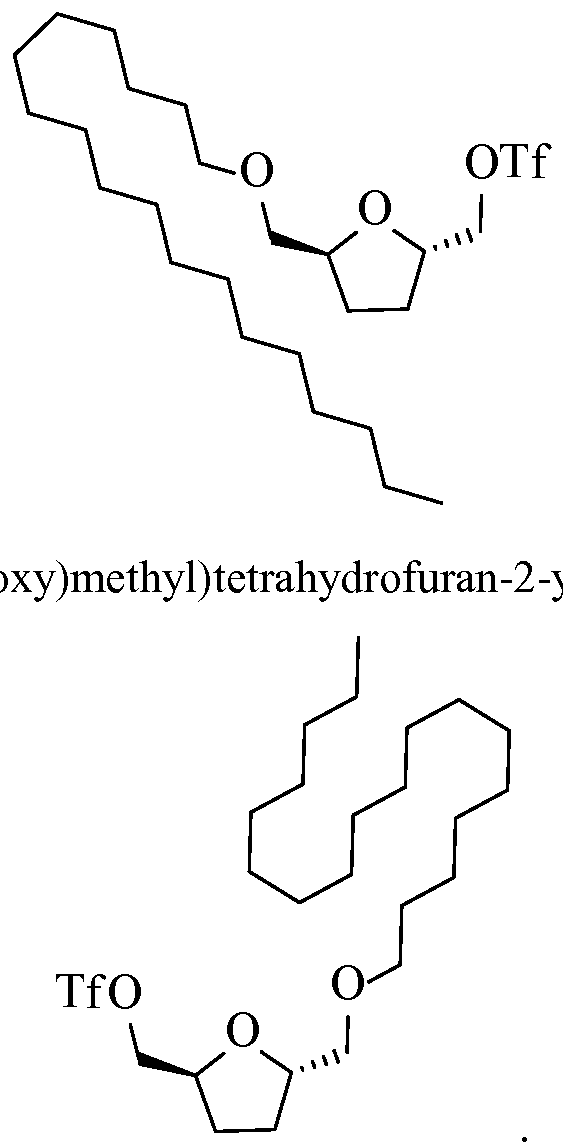
Ref document number: 14871772

Country of ref document: EP

Kind code of ref document: A1

ENP Entry into the national phase

Ref document number: 2016530946

Country of ref document: JP

Kind code of ref document: A

WWE Wipo information: entry into national phase

Ref document number: 15038066

Country of ref document: US

ENP Entry into the national phase

Ref document number: 2931554

Country of ref document: CA

ENP Entry into the national phase

Ref document number: 2014366334

Country of ref document: AU

Date of ref document: 20141212

Kind code of ref document: A

REEP Request for entry into the european phase

Ref document number: 2014871772

Country of ref document: EP

WWE Wipo information: entry into national phase

Ref document number: MX/A/2016/007952

Country of ref document: MX

Ref document number: 2014871772

Country of ref document: EP

NENP Non-entry into the national phase

Ref country code: DE

REG Reference to national code

Ref country code: BR

Ref legal event code: B01A

Ref document number: 112016014118

Country of ref document: BR

ENP Entry into the national phase

Ref document number: 20167018816

Country of ref document: KR

Kind code of ref document: A

ENP Entry into the national phase

Ref document number: 112016014118

Country of ref document: BR

Kind code of ref document: A2

Effective date: 20160616