WO2015099083A1 - 血清および血液を固化する水分散液 - Google Patents
血清および血液を固化する水分散液 Download PDFInfo
- Publication number
- WO2015099083A1 WO2015099083A1 PCT/JP2014/084397 JP2014084397W WO2015099083A1 WO 2015099083 A1 WO2015099083 A1 WO 2015099083A1 JP 2014084397 W JP2014084397 W JP 2014084397W WO 2015099083 A1 WO2015099083 A1 WO 2015099083A1
- Authority
- WO
- WIPO (PCT)
- Prior art keywords
- aqueous dispersion
- blood
- cellulose
- serum
- dispersion according
- Prior art date
- Legal status (The legal status is an assumption and is not a legal conclusion. Google has not performed a legal analysis and makes no representation as to the accuracy of the status listed.)
- Ceased
Links
Images

Classifications
-
- A—HUMAN NECESSITIES
- A61—MEDICAL OR VETERINARY SCIENCE; HYGIENE
- A61L—METHODS OR APPARATUS FOR STERILISING MATERIALS OR OBJECTS IN GENERAL; DISINFECTION, STERILISATION OR DEODORISATION OF AIR; CHEMICAL ASPECTS OF BANDAGES, DRESSINGS, ABSORBENT PADS OR SURGICAL ARTICLES; MATERIALS FOR BANDAGES, DRESSINGS, ABSORBENT PADS OR SURGICAL ARTICLES
- A61L26/00—Chemical aspects of, or use of materials for, wound dressings or bandages in liquid, gel or powder form
- A61L26/0009—Chemical aspects of, or use of materials for, wound dressings or bandages in liquid, gel or powder form containing macromolecular materials
- A61L26/0023—Polysaccharides
-
- A—HUMAN NECESSITIES
- A61—MEDICAL OR VETERINARY SCIENCE; HYGIENE
- A61K—PREPARATIONS FOR MEDICAL, DENTAL OR TOILETRY PURPOSES
- A61K31/00—Medicinal preparations containing organic active ingredients
- A61K31/70—Carbohydrates; Sugars; Derivatives thereof
- A61K31/715—Polysaccharides, i.e. having more than five saccharide radicals attached to each other by glycosidic linkages; Derivatives thereof, e.g. ethers, esters
- A61K31/716—Glucans
-
- A—HUMAN NECESSITIES
- A61—MEDICAL OR VETERINARY SCIENCE; HYGIENE
- A61K—PREPARATIONS FOR MEDICAL, DENTAL OR TOILETRY PURPOSES
- A61K31/00—Medicinal preparations containing organic active ingredients
- A61K31/70—Carbohydrates; Sugars; Derivatives thereof
- A61K31/715—Polysaccharides, i.e. having more than five saccharide radicals attached to each other by glycosidic linkages; Derivatives thereof, e.g. ethers, esters
- A61K31/716—Glucans
- A61K31/717—Celluloses
-
- A—HUMAN NECESSITIES
- A61—MEDICAL OR VETERINARY SCIENCE; HYGIENE
- A61K—PREPARATIONS FOR MEDICAL, DENTAL OR TOILETRY PURPOSES
- A61K31/00—Medicinal preparations containing organic active ingredients
- A61K31/70—Carbohydrates; Sugars; Derivatives thereof
- A61K31/715—Polysaccharides, i.e. having more than five saccharide radicals attached to each other by glycosidic linkages; Derivatives thereof, e.g. ethers, esters
- A61K31/716—Glucans
- A61K31/722—Chitin, chitosan
-
- A—HUMAN NECESSITIES
- A61—MEDICAL OR VETERINARY SCIENCE; HYGIENE
- A61K—PREPARATIONS FOR MEDICAL, DENTAL OR TOILETRY PURPOSES
- A61K31/00—Medicinal preparations containing organic active ingredients
- A61K31/70—Carbohydrates; Sugars; Derivatives thereof
- A61K31/715—Polysaccharides, i.e. having more than five saccharide radicals attached to each other by glycosidic linkages; Derivatives thereof, e.g. ethers, esters
- A61K31/716—Glucans
- A61K31/724—Cyclodextrins
-
- A—HUMAN NECESSITIES
- A61—MEDICAL OR VETERINARY SCIENCE; HYGIENE
- A61K—PREPARATIONS FOR MEDICAL, DENTAL OR TOILETRY PURPOSES
- A61K31/00—Medicinal preparations containing organic active ingredients
- A61K31/70—Carbohydrates; Sugars; Derivatives thereof
- A61K31/715—Polysaccharides, i.e. having more than five saccharide radicals attached to each other by glycosidic linkages; Derivatives thereof, e.g. ethers, esters
- A61K31/732—Pectin
-
- A—HUMAN NECESSITIES
- A61—MEDICAL OR VETERINARY SCIENCE; HYGIENE
- A61K—PREPARATIONS FOR MEDICAL, DENTAL OR TOILETRY PURPOSES
- A61K31/00—Medicinal preparations containing organic active ingredients
- A61K31/70—Carbohydrates; Sugars; Derivatives thereof
- A61K31/715—Polysaccharides, i.e. having more than five saccharide radicals attached to each other by glycosidic linkages; Derivatives thereof, e.g. ethers, esters
- A61K31/733—Fructosans, e.g. inulin
-
- A—HUMAN NECESSITIES
- A61—MEDICAL OR VETERINARY SCIENCE; HYGIENE
- A61K—PREPARATIONS FOR MEDICAL, DENTAL OR TOILETRY PURPOSES
- A61K31/00—Medicinal preparations containing organic active ingredients
- A61K31/70—Carbohydrates; Sugars; Derivatives thereof
- A61K31/715—Polysaccharides, i.e. having more than five saccharide radicals attached to each other by glycosidic linkages; Derivatives thereof, e.g. ethers, esters
- A61K31/736—Glucomannans or galactomannans, e.g. locust bean gum, guar gum
-
- A—HUMAN NECESSITIES
- A61—MEDICAL OR VETERINARY SCIENCE; HYGIENE
- A61K—PREPARATIONS FOR MEDICAL, DENTAL OR TOILETRY PURPOSES
- A61K31/00—Medicinal preparations containing organic active ingredients
- A61K31/74—Synthetic polymeric materials
- A61K31/765—Polymers containing oxygen
-
- A—HUMAN NECESSITIES
- A61—MEDICAL OR VETERINARY SCIENCE; HYGIENE
- A61K—PREPARATIONS FOR MEDICAL, DENTAL OR TOILETRY PURPOSES
- A61K9/00—Medicinal preparations characterised by special physical form
- A61K9/10—Dispersions; Emulsions
-
- A—HUMAN NECESSITIES
- A61—MEDICAL OR VETERINARY SCIENCE; HYGIENE
- A61K—PREPARATIONS FOR MEDICAL, DENTAL OR TOILETRY PURPOSES
- A61K9/00—Medicinal preparations characterised by special physical form
- A61K9/10—Dispersions; Emulsions
- A61K9/12—Aerosols; Foams
-
- A—HUMAN NECESSITIES
- A61—MEDICAL OR VETERINARY SCIENCE; HYGIENE
- A61K—PREPARATIONS FOR MEDICAL, DENTAL OR TOILETRY PURPOSES
- A61K9/00—Medicinal preparations characterised by special physical form
- A61K9/14—Particulate form, e.g. powders, Processes for size reducing of pure drugs or the resulting products, Pure drug nanoparticles
- A61K9/141—Intimate drug-carrier mixtures characterised by the carrier, e.g. ordered mixtures, adsorbates, solid solutions, eutectica, co-dried, co-solubilised, co-kneaded, co-milled, co-ground products, co-precipitates, co-evaporates, co-extrudates, co-melts; Drug nanoparticles with adsorbed surface modifiers
- A61K9/143—Intimate drug-carrier mixtures characterised by the carrier, e.g. ordered mixtures, adsorbates, solid solutions, eutectica, co-dried, co-solubilised, co-kneaded, co-milled, co-ground products, co-precipitates, co-evaporates, co-extrudates, co-melts; Drug nanoparticles with adsorbed surface modifiers with inorganic compounds
-
- A—HUMAN NECESSITIES
- A61—MEDICAL OR VETERINARY SCIENCE; HYGIENE
- A61K—PREPARATIONS FOR MEDICAL, DENTAL OR TOILETRY PURPOSES
- A61K9/00—Medicinal preparations characterised by special physical form
- A61K9/70—Web, sheet or filament bases ; Films; Fibres of the matrix type containing drug
- A61K9/7015—Drug-containing film-forming compositions, e.g. spray-on
-
- A—HUMAN NECESSITIES
- A61—MEDICAL OR VETERINARY SCIENCE; HYGIENE
- A61L—METHODS OR APPARATUS FOR STERILISING MATERIALS OR OBJECTS IN GENERAL; DISINFECTION, STERILISATION OR DEODORISATION OF AIR; CHEMICAL ASPECTS OF BANDAGES, DRESSINGS, ABSORBENT PADS OR SURGICAL ARTICLES; MATERIALS FOR BANDAGES, DRESSINGS, ABSORBENT PADS OR SURGICAL ARTICLES
- A61L26/00—Chemical aspects of, or use of materials for, wound dressings or bandages in liquid, gel or powder form
- A61L26/0061—Use of materials characterised by their function or physical properties
- A61L26/0066—Medicaments; Biocides
-
- A—HUMAN NECESSITIES
- A61—MEDICAL OR VETERINARY SCIENCE; HYGIENE
- A61L—METHODS OR APPARATUS FOR STERILISING MATERIALS OR OBJECTS IN GENERAL; DISINFECTION, STERILISATION OR DEODORISATION OF AIR; CHEMICAL ASPECTS OF BANDAGES, DRESSINGS, ABSORBENT PADS OR SURGICAL ARTICLES; MATERIALS FOR BANDAGES, DRESSINGS, ABSORBENT PADS OR SURGICAL ARTICLES
- A61L26/00—Chemical aspects of, or use of materials for, wound dressings or bandages in liquid, gel or powder form
- A61L26/0061—Use of materials characterised by their function or physical properties
- A61L26/0076—Sprayable compositions
-
- A—HUMAN NECESSITIES
- A61—MEDICAL OR VETERINARY SCIENCE; HYGIENE
- A61P—SPECIFIC THERAPEUTIC ACTIVITY OF CHEMICAL COMPOUNDS OR MEDICINAL PREPARATIONS
- A61P17/00—Drugs for dermatological disorders
- A61P17/02—Drugs for dermatological disorders for treating wounds, ulcers, burns, scars, keloids, or the like
-
- A—HUMAN NECESSITIES
- A61—MEDICAL OR VETERINARY SCIENCE; HYGIENE
- A61P—SPECIFIC THERAPEUTIC ACTIVITY OF CHEMICAL COMPOUNDS OR MEDICINAL PREPARATIONS
- A61P41/00—Drugs used in surgical methods, e.g. surgery adjuvants for preventing adhesion or for vitreum substitution
-
- A—HUMAN NECESSITIES
- A61—MEDICAL OR VETERINARY SCIENCE; HYGIENE
- A61P—SPECIFIC THERAPEUTIC ACTIVITY OF CHEMICAL COMPOUNDS OR MEDICINAL PREPARATIONS
- A61P43/00—Drugs for specific purposes, not provided for in groups A61P1/00-A61P41/00
-
- A—HUMAN NECESSITIES
- A61—MEDICAL OR VETERINARY SCIENCE; HYGIENE
- A61P—SPECIFIC THERAPEUTIC ACTIVITY OF CHEMICAL COMPOUNDS OR MEDICINAL PREPARATIONS
- A61P7/00—Drugs for disorders of the blood or the extracellular fluid
- A61P7/04—Antihaemorrhagics; Procoagulants; Haemostatic agents; Antifibrinolytic agents
-
- A—HUMAN NECESSITIES
- A61—MEDICAL OR VETERINARY SCIENCE; HYGIENE
- A61L—METHODS OR APPARATUS FOR STERILISING MATERIALS OR OBJECTS IN GENERAL; DISINFECTION, STERILISATION OR DEODORISATION OF AIR; CHEMICAL ASPECTS OF BANDAGES, DRESSINGS, ABSORBENT PADS OR SURGICAL ARTICLES; MATERIALS FOR BANDAGES, DRESSINGS, ABSORBENT PADS OR SURGICAL ARTICLES
- A61L2300/00—Biologically active materials used in bandages, wound dressings, absorbent pads or medical devices
- A61L2300/20—Biologically active materials used in bandages, wound dressings, absorbent pads or medical devices containing or releasing organic materials
- A61L2300/23—Carbohydrates
-
- A—HUMAN NECESSITIES
- A61—MEDICAL OR VETERINARY SCIENCE; HYGIENE
- A61L—METHODS OR APPARATUS FOR STERILISING MATERIALS OR OBJECTS IN GENERAL; DISINFECTION, STERILISATION OR DEODORISATION OF AIR; CHEMICAL ASPECTS OF BANDAGES, DRESSINGS, ABSORBENT PADS OR SURGICAL ARTICLES; MATERIALS FOR BANDAGES, DRESSINGS, ABSORBENT PADS OR SURGICAL ARTICLES
- A61L2300/00—Biologically active materials used in bandages, wound dressings, absorbent pads or medical devices
- A61L2300/40—Biologically active materials used in bandages, wound dressings, absorbent pads or medical devices characterised by a specific therapeutic activity or mode of action
- A61L2300/418—Agents promoting blood coagulation, blood-clotting agents, embolising agents
-
- A—HUMAN NECESSITIES
- A61—MEDICAL OR VETERINARY SCIENCE; HYGIENE
- A61L—METHODS OR APPARATUS FOR STERILISING MATERIALS OR OBJECTS IN GENERAL; DISINFECTION, STERILISATION OR DEODORISATION OF AIR; CHEMICAL ASPECTS OF BANDAGES, DRESSINGS, ABSORBENT PADS OR SURGICAL ARTICLES; MATERIALS FOR BANDAGES, DRESSINGS, ABSORBENT PADS OR SURGICAL ARTICLES
- A61L2400/00—Materials characterised by their function or physical properties
- A61L2400/04—Materials for stopping bleeding
Definitions
- the present invention relates to an aqueous dispersion containing an insoluble polysaccharide, and in particular, contains a fiber-like insoluble polysaccharide having a small fiber diameter and a relatively small aspect ratio, and is solidified and hemostatically by contact with plasma, serum or blood.
- the present invention relates to an aqueous dispersion that is useful as a material.
- thrombin powder collagen, oxidized cellulose powder, collagen fiber and powder, collagen sponge, calcium alginate, and the like are known as materials having a so-called hemostatic effect that coagulates upon contact with blood or the like.
- a hemostatic material is used as a hemostatic agent in various forms such as a hemostatic powder, a hemostatic sponge (such as collagen sponge), and hemostatic gauze, and is usually removed after hemostasis.
- Cellulose a kind of insoluble polysaccharide, is used as a water-soluble polymer in a wide range of fields such as foods, cosmetics and pharmaceuticals by chemical modification such as alkylation and oxidation.
- carboxymethyl cellulose sodium (CMC) which is a typical water-soluble cellulose derivative, is processed into a non-woven fabric shape, and this is used as a hemostatic material that absorbs water, blood or body fluid to delay and prevent bleeding.
- chitosan ( ⁇ -1,4-N-acetyl-D-glucosamine), an insoluble polysaccharide, utilizes the fact that the amino group in chitosan acts on the blood coagulation system and exhibits a hemostatic effect.
- it has been clinically applied as a hemostatic agent.
- chitin ( ⁇ -1,4-N-acetyl-D-glucosamine), which is an acetylated form of chitosan, has been pointed out to cause inflammation in vivo. It has been reported that a thrombus is formed to show a hemostatic action for a short time (Non-patent Document 1).
- hydrogels (Patent Document 3) of high molecular weight peptides (self-assembling peptides) motifs derived from natural proteins such as laminin chain, collagen chain and nidogen have attracted attention as local hemostatic agents.
- an external preparation composition containing a hydrophilic colloidal water-soluble polymer such as starch or gelatin and a liquid hydrocarbon compound has been proposed as an effective skin external preparation for blood injury or trauma associated with exudation of body fluid ( Patent Document 4).
- hemostatic effects of the various hemostatic agents proposed so far are not satisfactory enough, and it is necessary to use in combination with other local hemostatic agents, or the risk of infection of the site tends to be removed.
- There are concerns such as rising.
- plasma, serum, or blood may have a hemostatic effect, but depending on the subject, the hemostatic effect may be insufficient.
- the strength of the hemostatic agent itself will weaken and the product shape cannot be maintained.
- animal-derived raw materials such as human-derived fibrin and bovine collagen are used as hemostatic materials, it causes xenobiotic reactions and infectious diseases such as hepatitis C virus resulting from animal-derived products and allergic reactions. There is concern about fear.
- the aforementioned self-assembling peptide is also acidic because its pH is 3, so there is concern about damage to cells and tissues during attachment, and the cost of raw materials in terms of peptide synthesis is high.
- Many problems remain, such as the fact that it is a problem in terms of side effects, and information on side effects such as foreign body immune reactions has not been obtained.
- a new hemostatic material that can accurately control bleeding, has no risk of infection, and is inexpensive and safe.
- the dispersion of cellulose itself which is insoluble, is dispersed in water, and the strength adjustment of sheets and films and the application to cosmetics have been studied in recent years. However, no attempt has been made to adapt the aqueous dispersion to medical use.
- the object of the present invention can be applied to a bleeding wound surface in a simple manner in which it is applied in the form of a liquid or spray mist, and has an excellent solidifying action on any of plasma, serum and blood. And a novel hemostatic material (aqueous dispersion) capable of providing a hemostatic effect quickly and easily.
- a novel hemostatic material aqueous dispersion
- the average fiber diameter (D) is 0.001 to 100 ⁇ m, and the ratio (L / D) of the average fiber length (L) to the average fiber diameter (D) is 5 to 500.
- the present invention relates to an aqueous dispersion containing an insoluble polysaccharide, which is solidified by contact with plasma, serum or blood.
- the present invention relates to the aqueous dispersion according to the first aspect, wherein the insoluble polysaccharide is selected from the group consisting of cellulose fibers and chitin fibers.
- the present invention relates to the aqueous dispersion according to the first aspect or the second aspect, wherein the insoluble polysaccharide is contained at a concentration of 0.001% by mass to 10% by mass.
- the water dispersion as described in any one of the 1st viewpoint thru
- the present invention relates to the aqueous dispersion according to the fourth aspect, wherein the polymer is selected from the group consisting of collagen, alginic acid, polyvinyl alcohol, carboxymethylcellulose, methylcellulose, and hyaluronic acid.
- the present invention relates to the aqueous dispersion according to any one of the first aspect to the fifth aspect, further including a functional component.
- a seventh aspect relates to the aqueous dispersion according to the sixth aspect, wherein the functional component is selected from the group consisting of ascorbic acid, aminocaproic acid, tranexamic acid, and thrombin.
- the present invention relates to the aqueous dispersion according to any one of the first to seventh aspects, wherein the aqueous dispersion is sprayable and solidifies plasma, serum, or blood by the spraying.
- the present invention relates to the use of the aqueous dispersion according to any one of the first aspect to the eighth aspect in hemostasis applications.
- the present invention relates to the use of the aqueous dispersion according to any one of the first aspect to the eighth aspect in wound healing applications.
- it is related with use of the aqueous dispersion as described in any one of the 1st viewpoint thru
- a 12th viewpoint it is related with the film or sheet
- the present invention relates to an external composition containing the aqueous dispersion according to any one of the first aspect to the eighth aspect.
- the present invention relates to a hemostatic composition comprising the aqueous dispersion according to any one of the first aspect to the eighth aspect.
- it is related with the composition for wound treatment containing the aqueous dispersion as described in any one of a 1st viewpoint thru
- the present invention relates to an adhesion preventing composition containing the aqueous dispersion according to any one of the first to eighth aspects.
- the present invention rapidly solidifies when it comes into contact with plasma, serum and blood, and can provide an aqueous dispersion useful as a hemostatic material.
- the insoluble polysaccharide used as the raw material for the aqueous dispersion of the present invention is inexpensive and can keep product costs low. Since the aqueous dispersion does not use any animal-derived raw materials, the C-type There is no concern of causing infectious diseases such as infectious viruses. Furthermore, since the aqueous dispersion can be dispersed in water without chemically modifying the insoluble polysaccharide, for example, by fine pulverization by a wet pulverization method, there is a decrease in safety due to remaining of various chemicals accompanying chemical modification. Can be prevented.
- the aqueous dispersion of the present invention can be sterilized by autoclave, etc., and does not corrode, and further does not process into powder, thread, nonwoven fabric, woven fabric, or the like in liquid (dispersion) form or spray mist.
- a hemostatic effect can be obtained with a simple and portable method.
- blood is in a state where the balance between coagulation and fibrinolysis is maintained in the blood vessel, and the balance collapses due to various causes such as abnormalities in the blood vessel wall, abnormal platelets, abnormal coagulation, and increased fibrinolysis.
- a “bleeding tendency” occurs.
- the aqueous dispersion containing the insoluble sugar polysaccharide of the present invention exhibits hemostatic action by physically solidifying these by contact with plasma, serum, or blood, so that the coagulation system is abnormal and the fibrinolytic system is enhanced. It can show hemostatic action regardless of the cause of bleeding. Therefore, a hemostatic effect can be shown not only for trauma but also for bleeding during surgery.
- FIG. 1 is a view showing an optical micrograph of rabbit blood after addition of a 1% pulp-derived cellulose aqueous dispersion in Example 4.
- FIG. 1 is a view showing an optical micrograph of rabbit blood after addition of a 1% pulp-derived cellulose aqueous dispersion in Example 4.
- insoluble polysaccharide examples include cellulose, chitin, cyclodextrin, dietary fiber and the like. Further, lignin, hemicellulose, inulin, protopectin, glucan, glucomannan, chemically modified oxidized cellulose, or the like may be used. Among them, the insoluble polysaccharide is preferably selected from insoluble cellulose fibers and chitin fibers.
- the raw material of the cellulose fiber used in the aqueous dispersion of the present invention is, for example, cellulose derived from plants such as wood, bamboo, hemp, jute, kenaf, cotton, crops and food residues, or bacterial cellulose, clover (cladophora), gray Cellulose produced by microorganisms or animals such as plants (Glaucocystis), valonia, squirt cellulose, etc. can be used.
- Plant-derived cellulose is a bundle of very thin fibers called microfibrils that form stepwise higher structures with fibrils, lamellae, and fiber cells, whereas bacterial cellulose is cellulose secreted from fungal cells.
- microfibrils form a fine network structure with the same thickness.
- the crystalline nature of cellulose derived from natural sources such as plant origin, microorganism production, and animal production consists of cellulose type I crystals, and the crystallinity thereof varies greatly depending on the cellulose source.
- Plant-derived cellulose contains hemicellulose, lignin and the like as impurities to form a higher order structure. For this reason, the crystallinity of the refined pulp obtained using this as a raw material is about 50%, whereas in the case of Shiogusa, bacterial cellulose, glaucocystis, and sea squirt, the crystallinity is as high as 80% or higher. .
- high-purity cellulose raw materials such as cotton and bacterial cellulose can be used as raw materials.
- isolated and purified cellulose derived from other plants As a raw material of the cellulose fiber used in the aqueous dispersion of the present invention, cotton, bacterial cellulose, kraft pulp and microcrystalline cellulose are preferable.
- Chitin raw material As the chitin raw material, commercially available products such as food additives, pharmaceutical additives, quasi-drugs, cosmetic raw materials, medical device raw materials contained in shrimp, crab, squid, insects, shellfish, mushrooms and the like can be suitably used.
- cellulose fibers obtained by pulverizing these cellulose raw materials or chitin fibers obtained by pulverizing chitin raw materials are used.
- the pulverization method of the cellulose raw material and the chitin raw material is not limited, but in order to make the fiber diameter and fiber length to be described later suitable for the purpose of the present invention, a medium agitation mill such as a high pressure homogenizer, a grinder (stone mill), or a bead mill is used. A method capable of obtaining a strong shearing force is preferred.
- the cellulose raw material is pulverized by jetting and colliding a dispersion liquid in which the cellulose raw material or chitin raw material is dispersed from a pair of nozzles at a high pressure.
- High pressure pulverizer manufactured by Sugino Machine manufactured by Sugino Machine.
- the degree of refinement and homogenization depends on the pressure to be fed to the ultra-high pressure chamber of the high-pressure homogenizer and the number of times to pass through the ultra-high pressure chamber. (The number of treatments) and the cellulose concentration or chitin concentration in the aqueous dispersion.
- the pumping pressure is usually 50 to 250 MPa, preferably 150 to 245 MPa. When the pumping pressure is less than 50 MPa, the refinement of cellulose or chitin is insufficient, and the expected effect cannot be obtained by the refinement.
- the cellulose concentration and chitin concentration in the aqueous dispersion during the micronization treatment are 0.1% by mass to 30% by mass, preferably 1% by mass to 10% by mass. If the cellulose concentration or chitin concentration in the aqueous dispersion is less than 0.1% by mass, the productivity is remarkably low, and if it is higher than 30% by mass, the pulverization efficiency is low and the desired cellulose fiber or chitin fiber cannot be obtained.
- the number of times of fine (pulverization) treatment is not particularly limited and depends on the cellulose concentration / chitin concentration in the aqueous dispersion, but the treatment is performed when the cellulose concentration / chitin concentration is 0.1 to 1% by mass.
- the number of times is about 10 to 100 times, and the fineness is sufficiently achieved.
- about 1 to 10% by mass requires about 10 to 1000 times.
- it is impractical from an industrial point of view because the number of treatments of several thousand times or more is required and the viscosity is increased to the point of hindering handling. .
- the average fiber diameter (D) of the cellulose fiber or chitin fiber used in the present invention is 0.001 to 100 ⁇ m, preferably 0.001 to 0.05 ⁇ m, more preferably 0.01 to 0.05 ⁇ m. .
- the average fiber diameter is less than 0.001 ⁇ m, the addition effect cannot be obtained because the cellulose fiber or chitin fiber is too fine, that is, when the aqueous dispersion containing it comes into contact with plasma, serum or blood.
- the solidified state is insufficient (eg, liquid separation).
- the average fiber diameter is larger than 100 ⁇ m, the cellulose fiber or chitin fiber is not sufficiently refined, and sedimentation or aggregation is likely to be formed in the aqueous dispersion, which may deteriorate the sprayability.
- the aspect ratio (L / D) of the cellulose fiber or chitin fiber used in the present invention is obtained from the average fiber length (L) / average fiber diameter (D), and is 5 to 500, preferably 10 to 500, more preferably. Is 20 to 110.
- the aspect ratio is less than 5, the fiber is not dispersible in the liquid and the coating property at the time of drying cannot be obtained sufficiently. If it exceeds 500, it means that the fiber length becomes extremely large, which leads to a decrease in transparency, and further induces a decrease in transparency and a feeling of use when applied to the skin, generation of twisting, etc. .
- the average fiber diameter (D) of cellulose or chitin was determined as follows. First, the collodion support membrane manufactured by Oken Shoji Co., Ltd. was hydrophilized with an ion cleaner (JIC-410) manufactured by JEOL Co., Ltd. for 3 minutes, and the cellulose dispersion or chitin dispersion (prepared in ultrapure water) prepared in the production example. A few drops were diluted and dried at room temperature. This was observed with a transmission electron microscope (TEM, H-8000) (10,000 times) manufactured by Hitachi, Ltd. at an accelerating voltage of 200 kV.
- TEM transmission electron microscope
- the fiber diameter of each cellulose fiber or chitin fiber was measured, and the number average value was defined as the average fiber diameter (D).
- the average fiber length (L) was determined by diluting the cellulose dispersion or chitin dispersion prepared in the production example 400 times with dimethyl sulfoxide (DMSO), dispersing cellulose or chitin, and using concentrated sulfuric acid in advance.
- DMSO dimethyl sulfoxide
- the number of specimens about 150 to 250 cellulose fibers or chitin fibers Each fiber length was measured, and the number average value was defined as the average fiber length (L).
- the average fiber diameter and average fiber length were calculated
- the insoluble polysaccharide is preferably blended in an amount of 0.001 to 10% by mass, preferably 0.01 to 10% by mass, based on the total mass of the aqueous dispersion.
- These insoluble polysaccharides may be used alone or in combination of two or more.
- a polymer can be further added to the aqueous dispersion of the present invention as long as the effect is not impaired, and a water-soluble polymer is particularly mentioned.
- natural water-soluble polymers include plant polymers (for example, gum arabic, tragacanth gum, galactan, locust bean gum, guar gum, tamarind gum, carob gum, caraya gum, carrageenan, pectin, agar, quince seed, algae colloid (cuckoo extract) ), Starch (rice, corn, potato, wheat), glycyrrhizic acid); microbial polymer (eg, xanthan gum, dextran, succinoglucan, bullulan, etc.); animal polymer (eg, collagen, casein, albumin, gelatin) Etc.); hyaluronic acid and the like.
- plant polymers for example, gum arabic, tragacanth gum, galactan, locust bean gum, guar gum, tamarind gum, ca
- Semi-synthetic water-soluble polymers include, for example, starch polymers (eg, carboxymethyl starch, methylhydroxypropyl starch, etc.); cellulose polymers (methylcellulose, ethylcellulose, methylhydroxypropylcellulose, hydroxyethylcellulose, cellulose sulfate) Sodium, hydroxypropylcellulose, carboxymethylcellulose, sodium carboxymethylcellulose, crystalline cellulose, cellulose powder and the like); alginic acid polymers (for example, alginic acid, sodium alginate, propylene glycol alginate, etc.) and the like.
- starch polymers eg, carboxymethyl starch, methylhydroxypropyl starch, etc.
- cellulose polymers methylcellulose, ethylcellulose, methylhydroxypropylcellulose, hydroxyethylcellulose, cellulose sulfate
- Sodium hydroxypropylcellulose, carboxymethylcellulose, sodium carboxymethylcellulose, crystalline cellulose, cellulose powder and the like
- examples of the synthetic water-soluble polymer include vinyl polymers (eg, polyvinyl alcohol, polyvinyl methyl ether, polyvinyl pyrrolidone, carboxyvinyl polymer); polyoxyethylene polymers (eg, polyethylene glycol 20,000, 40,000, 60,000, etc.); acrylic polymer (for example, sodium polyacrylate, polyethyl acrylate, polyacrylamide, etc.); polyethyleneimine; cationic polymer, etc.
- vinyl polymers eg, polyvinyl alcohol, polyvinyl methyl ether, polyvinyl pyrrolidone, carboxyvinyl polymer
- polyoxyethylene polymers eg, polyethylene glycol 20,000, 40,000, 60,000, etc.
- acrylic polymer for example, sodium polyacrylate, polyethyl acrylate, polyacrylamide, etc.
- polyethyleneimine for example, sodium polyacrylate, polyethyl acrylate, polyacrylamide, etc.
- a polymer selected from the group consisting of collagen, alginic acid, polyvinyl alcohol, carboxymethylcellulose (CMC), methylcellulose, and hyaluronic acid is preferable.
- it can be used as a wound dressing or adhesion preventive agent by mixing with polyvinyl alcohol, which is used as a wound dressing material, or CMC or hyaluronic acid, which is used as an adhesion preventing material.
- the amount added is preferably 0.01% by mass to 10% by mass based on the total mass of the aqueous dispersion of the present invention. More preferably, it is 1 mass% to 5 mass%.
- Functional components as shown below can be further added to the aqueous dispersion of the present invention as long as the effects are not impaired.
- functional components include acrinol, ascorbic acid, isopropanol, benzalkonium chloride, benzethonium chloride, dilute iodine tincture, chlorhexidine gluconate, ethanol, phenoxyethanol, povidone iodine, mercurochrome, isopropylmethylphenol, ethyl aminobenzoate, methyl paraben, glycerin, propylene Glycol, butylene glycol, octanediol, carbazochrome sulfonic acid, diclofenac, glycyrrhetinic acid, indomethacin, prednisolone valerate acetate, ketoprofen, bufexamac, hydrocortisone, thymol, piroxicam,
- the aqueous dispersion of the insoluble sugar polysaccharide of the present invention includes, for example, “blood coagulation factor preparation” such as factor VIII preparation, factor IX complex preparation, fibrinogen preparation, thromboplastin, in addition to the above-mentioned polymer and functional components.
- blood coagulation factor preparation such as factor VIII preparation, factor IX complex preparation, fibrinogen preparation, thromboplastin
- organ hemostatic and snake venom preparations such as lipid thromboplastin and hemocoagulase
- antiplasmin drugs antiplasmin drugs
- other water-soluble components exhibiting hemostatic activity such as a hemostatic agent such as “adrenaline” applied to local hemostasis (eg, nasal bleeding) can be mixed.
- the aqueous dispersion of the present invention can be sprayed, and plasma, serum or blood can be solidified by the spraying. Therefore, the aqueous dispersion of the present invention is suitably used for hemostatic use and wound treatment use.
- the aqueous dispersion can also be used as a film or sheet.
- the aqueous dispersion of the present invention can be applied as an external preparation, a hemostatic composition, a wound treatment composition and an adhesion prevention composition.
- Example 1 Solidification of human serum by 1.2% MNC aqueous dispersion and 1% PNC aqueous dispersion
- human serum manufactured by KAC Co., Ltd., type A
- 0.5 mL of human serum manufactured by KAC Co., Ltd., type A
- 0.5 mL of a 1.2% microcrystalline cellulose aqueous dispersion was added thereto, the serum was added immediately after mixing. Solidification was observed, and slight liquid separation was observed.
- 0.5 mL of 1.2% microcrystalline cellulose aqueous dispersion was further added and mixed, serum was completely solidified without separation.
- Example 2 Solidification of human plasma by 1% PNC aqueous dispersion
- 1 mL of human plasma manufactured by Kojin Bio Co., Ltd., heparin Na treatment
- 1 mL of human plasma manufactured by Kojin Bio Co., Ltd., heparin Na treatment
- 1 mL of human plasma manufactured by Kojin Bio Inc., heparin Na treatment
- 2 mL of 1% pulp-derived cellulose aqueous dispersion was added thereto
- plasma solidification was shown immediately after mixing.
- the human plasma was subjected to a test after thawing frozen plasma manufactured by Kojin Bio Co., Ltd. for 5 hours at room temperature.
- Example 3 Solidification of human blood by 1.2% MNC aqueous dispersion and 1% PNC aqueous dispersion
- Example 4 Solidification of rabbit blood by 1.2% MNC aqueous dispersion and 1% PNC aqueous dispersion
- 1 mL of rabbit blood was placed in a plastic tube and 0.5 mL or 1 mL of a 1.2% microcrystalline cellulose dispersion was added, blood solidification was observed immediately after mixing at any added amount.
- 0.5 mL of 1% pulp-derived cellulose aqueous dispersion was added to 1 mL of rabbit blood, blood solidification was observed immediately after mixing.
- this sample was observed with an optical microscope, it was confirmed that blood cells were taken into the cellulose fiber network. An optical micrograph at that time is shown in FIG.
- Example 5 Solidification of bovine serum by spray mist method of 1% PNC aqueous dispersion
- 0.5 mL of bovine serum (manufactured by Life Technology) was placed in a plastic petri dish.
- 1% pulp-derived cellulose was placed in a spray bottle (Marem 3 L), and 1 mL of the bovine serum was sprayed (added in a mist state).
- a spray bottle Marem 3 L
- 1 mL of the bovine serum was sprayed (added in a mist state).
- the fluidity was lost and serum solidification was observed.
- Example 6 Solidification of human serum and blood by 1% chitin aqueous dispersion
- 0.5 mL of human serum (manufactured by KAC Co., Ltd., type A) is placed in a plastic tube, and 0.5 mL of 5% gum arabic gum aqueous solution is added and mixed. It was in a liquid state. Even when 0.5 mL of 5% gum arabic aqueous solution was further added and mixed there, no solidification of serum was observed. Moreover, even if 0.5 mL of human blood (manufactured by KAC Co., Ltd.) is placed in a plastic tube and mixed with 0.5 mL of 1% aqueous gum arabic solution, the blood does not solidify and remains liquid. It was in a state.
- the present inventors have confirmed that an aqueous dispersion containing cellulose fibers can be sprayed without dripping at a fiber diameter of 0.001 to 0.05 ⁇ m and an aspect ratio of 5 to 500 (Japanese Patent Application No. 2012-265530). ). Then, it has been confirmed that the aqueous dispersion of pulp-derived cellulose exhibits a thickening action on various electrolytes, but the aqueous dispersion of microcrystalline cellulose does not show a thickening action on salts (Japanese Patent Application No. 2013-89702). issue).
- the aqueous dispersion of microcrystalline cellulose solidifies serum and blood (Examples 1 and 3), and the aqueous dispersion of pulp-derived cellulose contains serum, plasma and blood in the above-described Examples. Solidification (Examples 1 to 3) was confirmed. Therefore, it is inferred that these nanocelluloses interact with various components contained in blood, serum or plasma, and the nanofibers form aggregates and aggregates. From this, it can be considered that the dispersion containing cellulose fibers solidifies the serum or plasma itself, and as a result, solidifies the blood and thus exhibits a hemostatic action.
- microcrystalline cellulose aqueous dispersion showed a solidification action of human blood (0.5 mL) in only 0.5 mL, but 1% pulp-derived cellulose aqueous dispersion, 1 In the% chitin aqueous dispersion and PuraMatrix, a partial sol formation was observed due to the liquid separation at an addition amount of 0.5 mL.
- Example 7 Observation of hydrophobicity by fluorescence microscope
- aqueous dispersions or aqueous solutions were dropped on the preparation, dried at room temperature, and observed with a fluorescence microscope.
- cellulose is a polysaccharide that is normally insoluble in water, but the surface of the fiber is made hydrophilic by making it finer and made into nanofibers, and then salts and the like are adsorbed on the fiber surface. This is thought to reflect the mechanism of hydrophobicity.
- the refined cellulose fiber that is a constituent of the cellulose dispersion liquid has a hydrophilic / hydrophobic change on the surface, and specifically, sodium salt contained in serum or the like acts on the surface of the cellulose nanofiber.
- Hydrophobicity is then manifested, followed by a complex formation reaction with plasma, serum, and blood components, that is, by forming aggregates and aggregates by the components contained in fine cellulose and serum and plasma It is considered that the solidifying action of plasma, serum and blood was expressed.
- Deacylated gellan gum usually has the property of forming a gel by self-organizing by reacting with calcium ions. However, due to the nature of the chemical structure, it is affected by reaction with ionic substances in serum or blood, and as a result, the reaction with calcium ions is inhibited. Therefore, deacylated gellan gum does not form a complex with the components contained in serum or blood, that is, it does not form an aggregate / aggregate containing deacylated gellan gum and serum, and deacylated gellan gum solidifies serum and blood. It was thought that the action to do was not recognized.
- Example 8 Composite of nanocellulose and polymer
- 1 g of 10% PVA aqueous solution was added to 9 g of 1% pulp-derived cellulose dispersion to prepare a transparent dispersion containing 0.9% by mass of cellulose and 1% by mass of PVA.
- this transparent dispersion containing 0.9% by mass of cellulose and 1% by mass of PVA was put into a spray bottle (Marem 3L) and sprayed using this, the transparent dispersion was misted and sprayable. Further, after spraying 5 g of cellulose 0.9 mass% / PVA 1 mass% transparent dispersion and drying at room temperature for 48 hours, the sprayed portion became a film.
- Example 9 Preparation of water-containing sheet of nanocellulose
- 1 g of 10% PVA aqueous solution was added to 9 g of 1% pulp-derived cellulose dispersion to prepare a transparent dispersion containing 0.9% by mass of cellulose and 1% by mass of PVA.
- 10 g of the transparent dispersion containing 0.9% by mass of cellulose and 1% by mass of PVA was put in a plastic case (5 cm ⁇ 8 cm) and allowed to air dry at room temperature to obtain 0.171 g of a transparent film. This film was placed in a plastic petri dish (6 cm diameter), and 10 ml of water was added. Water was immediately absorbed and a water-containing sheet was produced.
- Example 10 Investigation into blood coagulation and fibrinolytic system
- a blood coagulation study using data phifibrinogen manufactured by Sysmex Corporation
- a fully automatic blood coagulation analyzer CS-200i manufactured by Sysmex Corporation
- 50 microliters of thrombin reagent was added to 10 microliters of human standard plasma cytolol. After that, even when 10 microliters of 1.2% microcrystalline cellulose aqueous dispersion was added, no fibrin formation was observed.
- the obtained dispersion was measured in a petri dish, dried at 110 ° C. for 5 hours, moisture was removed, the amount of residue was measured, and the concentration was measured. As a result, the cellulose concentration (solid content concentration) in water was 1.7% by mass.
- This aqueous dispersion was autoclaved at 121 ° C. for 20 minutes.
- Example 11 Compounding of nanocellulose and functional component (benzalkonium chloride)] 9.5 g of water was added to 0.5 g of benzalkonium chloride (50%) to prepare a 2.5% benzalkonium chloride aqueous solution. When 0.25 mL of a 2.5% benzalkonium chloride aqueous solution was placed in a plastic tube and 2 mL of a 1.7% pulp-derived nanocellulose aqueous dispersion was added and mixed, gelation (solidification) was observed.
- Example 12 Compounding of nanocellulose and functional component (aminocaproic acid)] 9.8 g of water was added to 0.2 g of aminocaproic acid (6-aminohexanoic acid) to prepare a 2% aminocaproic acid aqueous solution. When 0.25 mL of a 2% aminocaproic acid aqueous solution was placed in a plastic tube and 2 mL of a 1.7% pulp-derived nanocellulose aqueous dispersion was added and mixed, gelation (solidification) was observed.
- Example 13 Solidification of heparinized blood by 1% microcrystalline cellulose-derived nanocellulose (MNC) aqueous dispersion
- MNC microcrystalline cellulose-derived nanocellulose
- Example 14 Solidification of heparinized blood by 2% chitin aqueous dispersion
- Male SD rats 10 weeks old (manufactured by Claire Japan) were anesthetized by intraperitoneal administration of 40 mg / kg of pentobarbital sodium (manufactured by Kyoritsu Pharmaceutical Co., Ltd.), and heparin (1000 U / mL, 10 mL of blood was collected using a plastic syringe with an 18G needle to which Sagent was attached.
- Example 15 Solidification of heparinized blood by 1.7% pulp-derived nanocellulose aqueous dispersion
- Male SD rats 10 weeks old (manufactured by Claire Japan) were anesthetized by intraperitoneal administration of 40 mg / kg of pentobarbital sodium (manufactured by Kyoritsu Pharmaceutical Co., Ltd.), and heparin (1000 U / mL, 10 mL of blood was collected using a plastic syringe with an 18G needle to which Sagent was attached.
- 1 mL of this rat heparin-treated blood was placed in a plastic tube and 1 mL of a 1.7% pulp-derived nanocellulose aqueous dispersion was added thereto, blood solidification was observed immediately after mixing.
- Example 16 Solidification of rat blood by 2% chitin aqueous dispersion
- Male SD rats 10 weeks old (manufactured by Clea Japan Co., Ltd.) are anesthetized by intraperitoneal administration of 40 mg / kg of pentobarbital sodium (manufactured by Kyoritsu Pharmaceutical Co., Ltd.), and a plastic syringe with an 18G needle is inserted from the abdominal aorta. Used to collect 4 mL of blood.
- 1 mL of this rat blood was placed in a plastic tube and 1.5 mL of a 2% chitin aqueous dispersion was added thereto, blood solidification was observed immediately after mixing, but slight separation was observed at this time.
- Example 17 Solidification of rat blood by 1.7% pulp-derived nanocellulose aqueous dispersion
- Male SD rats 10 weeks old (manufactured by Clea Japan Co., Ltd.) are anesthetized by intraperitoneal administration of 40 mg / kg of pentobarbital sodium (manufactured by Kyoritsu Pharmaceutical Co., Ltd.), and a plastic syringe with an 18G needle is inserted from the abdominal aorta. Used to collect 4 mL of blood.
- 1 mL of this rat blood was placed in a plastic tube and 1.5 mL of 1.7% pulp-derived nanocellulose aqueous dispersion was added thereto, blood solidification was observed immediately after mixing, and the blood solidified without separation. Furthermore, no liquid separation was observed even when this solidified product was dispersed by vortexing (15 seconds).
- Example 18 Blood solidification test using veins of lower limbs of rats] Anesthesia was performed by intraperitoneally administering 40 mg / kg of pentobarbital sodium (manufactured by Kyoritsu Pharmaceutical Co., Ltd.) to male SD rats 10 weeks old (manufactured by Clea Japan Co., Ltd.).
- the rat leg foot vein is bled by cutting a blood vessel with a sharp scalpel, and immediately after this, 1.7% pulp-derived nanocellulose (PNC) aqueous dispersion or 2% chitin aqueous dispersion Or using a plastic syringe filled with 0.5 mL of water separately, completely covering the wound, wiping the material with gauze after one minute, and the state of blood flow from the cut In addition, the presence or absence of infiltration into the floor gauze was objectively observed. In the pulp-derived nanocellulose (PNC) coating treatment, the blood flow stopped, but in the chitin coating treatment, the blood flow did not stop. When water was applied, blood flowed out and did not stop.
- PNC pulp-derived nanocellulose
- Example 19 Prevention effect test for hemostasis and adhesion in rat hepatectomy model
- Pentobarbital sodium (trade name: containing somnopentyl, pentobarbital sodium 64.8 mg / mL, manufactured by Kyoritsu Pharmaceutical Co., Ltd.) was intraperitoneally administered to male rats (245.6 g to 260.9 g).
- sononopentyl is diluted 10-fold with physiological saline (manufacturing number K3I85, Otsuka raw food injection, Otsuka Pharmaceutical Factory Co., Ltd.), so that the dosage is 40 mg / kg as sodium pentobarbital.
- physiological saline manufactured by physiological saline
- the rat abdominal skin was shaved with an electric clipper, and the surgical field was disinfected with alcohol for disinfection, and then the midline skin was longitudinally opened to expose the liver.
- the outer left lobe of the liver was placed on a sterilized plate and the marginal part was excised 30 mm.
- 1-5 g of the 1.77% pulp-derived nanocellulose administration group was applied to the liver excision surface so as to completely cover the excision surface, and the suture was closed.
- the sutured abdomen was closed immediately after resection of the liver. While keeping warm enough, the state of the rat was observed until awakening. After waking up, the rats were housed in a breeding cage.
- mice Seven days after the operation, the mice were sacrificed under anesthesia with isoflurane (Isoflu [registered trademark], manufactured by DS Pharma Animal Health Co., Ltd.). It was scored in four stages, “Peelable, 2: Bluntly peelable, 3: Sharply peelable”.
Landscapes
- Health & Medical Sciences (AREA)
- Life Sciences & Earth Sciences (AREA)
- Chemical & Material Sciences (AREA)
- Public Health (AREA)
- General Health & Medical Sciences (AREA)
- Animal Behavior & Ethology (AREA)
- Veterinary Medicine (AREA)
- Epidemiology (AREA)
- Medicinal Chemistry (AREA)
- Pharmacology & Pharmacy (AREA)
- Engineering & Computer Science (AREA)
- Molecular Biology (AREA)
- Bioinformatics & Cheminformatics (AREA)
- Materials Engineering (AREA)
- Dispersion Chemistry (AREA)
- Nuclear Medicine, Radiotherapy & Molecular Imaging (AREA)
- Chemical Kinetics & Catalysis (AREA)
- General Chemical & Material Sciences (AREA)
- Organic Chemistry (AREA)
- Inorganic Chemistry (AREA)
- Dermatology (AREA)
- Surgery (AREA)
- Hematology (AREA)
- Diabetes (AREA)
- Materials For Medical Uses (AREA)
- Medicinal Preparation (AREA)
- Acyclic And Carbocyclic Compounds In Medicinal Compositions (AREA)
- Medicines That Contain Protein Lipid Enzymes And Other Medicines (AREA)
- Pharmaceuticals Containing Other Organic And Inorganic Compounds (AREA)
Abstract
Description
また、不溶性多糖のキトサン(β-1,4-N-アセチル-D-グルコサミン)がキトサン中のアミノ基が血液凝固系に作用して止血効果を示すことを利用し、キトサンを不織布などの形状としたものの止血剤としての臨床応用がなされている。またキトサンのアセチル体であるキチン(β-1,4-N-アセチル-D-グルコサミン)類は、生体内では炎症を起こすことが指摘されていたが、スポンジ型の非晶質キチンは、血小板血栓を形成して短時間止血作用を示すことが報告されている(非特許文献1)。
さらに、天然のタンパク質であるラミニン鎖、コラーゲン鎖およびニドジェンからモチーフした高分子量のペプチド(自己組織化ペプチド)のハイドロゲル(特許文献3)が局所止血剤として注目されている。
また流血や体液の滲出を伴う外傷等に有効な皮膚外用剤として、デンプンやゼラチン等の親水性コロイド状の水溶性高分子と液状炭化水素化合物とを含む外用剤組成物が提案されている(特許文献4)。
前述の自己組織化ペプチドについても、pHが3と酸性であるため付着時の細胞や組織の傷害が懸念されること、またペプチド合成面での原材料費などが高価格であることから汎用性の面で課題となっていること、さらに異物免疫反応などの副作用についての情報が得られていないなど、多くの課題が残されている。
このように出血の抑止を的確に行え、感染リスクがなく安価で安全な新しい止血材が求められている。
また不溶性であるセルロース自体を水分散化することにより、近年、シートやフィルムの強度調節や化粧品への応用が検討されているが、水分散液を医療用途に適応する試みはなされていない。
第2観点として、前記不溶性多糖類が、セルロース繊維及びキチン繊維からなる群から選択される、第1観点に記載の水分散液に関する。
第3観点として、前記不溶性多糖類が、0.001質量%乃至10質量%の濃度で含まれてなる、第1観点又は第2観点に記載の水分散液に関する。
第4観点として、更に高分子を含む、第1観点乃至第3観点のうち何れか一項に記載の水分散液に関する。
第5観点として、前記高分子が、コラーゲン、アルギン酸、ポリビニルアルコール、カルボキシメチルセルロース、メチルセルロース及びヒアルロン酸からなる群から選択される、第4観点に記載の水分散液に関する。
第6観点として、更に機能成分を含む、第1観点乃至第5観点のうち何れか一項に記載の水分散液に関する。
第7観点として、前記機能成分が、アスコルビン酸、アミノカプロン酸、トラネキサム酸およびトロンビンからなる群から選択される、第6観点に記載の水分散液に関する。
第8観点として、前記水分散液がスプレー噴霧可能であり、該噴霧により血漿、血清又は血液を固化する、第1観点乃至第7観点のうち何れか一項に記載の水分散液に関する。
第9観点として、止血用途における第1観点乃至第8観点のうち何れか一項に記載の水分散液の使用に関する。
第10観点として、創傷治癒用途における第1観点乃至第8観点のうち何れか一項に記載の水分散液の使用に関する。
第11観点として、癒着防止用途における第1観点乃至第8観点のうち何れか一項に記載の水分散液の使用に関する。
第12観点として、第1観点乃至第8観点のうち何れか一項に記載の水分散液から得られるフィルム又はシートに関する。
第13観点として、第1観点乃至第8観点のうち何れか一項に記載の水分散液を含む外用組成物に関する。
第14観点として、第1観点乃至第8観点のうち何れか一項に記載の水分散液を含む止血用組成物に関する。
第15観点として、第1観点乃至第8観点のうち何れか一項に記載の水分散液を含む創傷治療用組成物に関する。
第16観点として、第1観点乃至第8観点のうち何れか一項に記載の水分散液を含む癒着防止用組成物に関する。
また本発明の水分散液の原料に使用する不溶性多糖類は安価であり、製品コストを低く抑えることができ、また該水分散液には動物由来の原材料を一切使用していないため、C型感染ウイルス等の感染症などをひき起こす懸念がない。
さらに該水分散液は不溶性多糖を化学修飾することなく、例えば湿式粉砕法によって微細化することにより水分散化を可能としていることから、化学修飾に伴う種々の薬剤の残存による安全性の低下も防止できる。
しかも本発明の水分散液は、オートクレーブなどの滅菌処理が可能であり、しかも腐食せず、さらにパウダー、糸状、不織布、織布などに加工することなく、液体(分散液)形態やスプレーミストの携帯で簡単な用法にて止血効果を得ることができる。
本発明の不溶性糖多糖類を含有する水分散液は、血漿や血清、血液と接触することにより、物理的にこれらを固化させることによって止血作用を示すため、凝固系の異常、線溶系の亢進など、出血原因に関わらず止血作用を示すことができる。そのため外傷時だけでなく手術時における出血に対しても、止血効果を示すことができる。
本発明の水分散液に使用される不溶性多糖類としては、セルロース、キチン、シクロデキストリン、食物繊維等が挙げられる。またリグニン、ヘミセルロース、イヌリン、プロトペクチン、グルカン、グルコマンナンや化学的に修飾した酸化セルロース等を用いてもよい。中でも不溶性多糖類として、好ましくは不溶性のセルロース繊維及びキチン繊維から選択される。
本発明の水分散液に使用されるセルロース繊維の原料は、例えば、木材、竹、麻、ジュート、ケナフ、コットン、農作物・食物残渣など植物由来のセルロース、又はバクテリアセルロース、シオグサ(クラドフォラ)、灰色植物(グラウコキスチス)、バロニア、ホヤセルロースなど、微生物産生若しくは動物産生のセルロースを使用することができる。
植物由来のセルロースはミクロフィブリルと呼ばれる非常に細い繊維がさらに束になりフィブリル、ラメラ、繊維細胞と段階的に高次構造を形成しているのに対し、バクテリアセルロースは菌細胞から分泌されたセルロースのミクロフィブリルが、そのままの太さで微細な網目構造を形成している。
上記植物由来、微生物産生、動物産生といった天然由来のセルロースの結晶質は、セルロースI型結晶からなり、その結晶化度はセルロース源によって大きく異なる。植物由来セルロースは、ヘミセルロース、リグニンなどを不純物として含有して高次構造を形成している。このため、これを原料して得られる精製パルプの結晶化度は50%程度であるのに対して、シオグサやバクテリアセルロース、グラウコキスチス、ホヤなどでは結晶化度が80%以上と高い結晶性を有する。
本発明の水分散液に使用されるセルロース繊維の原料として、好ましくは、コットン、バクテリアセルロース、クラフトパルプや微結晶セルロースである。
キチン原料としては、エビ、カニ、イカ、昆虫、貝、キノコなどに含まれる食品添加物、医薬品添加物、医薬部外品、化粧品原料、医療機器原料など市販のものを好適に使用できる。
本発明においては、上記これらセルロース原料を粉砕したセルロース繊維或いはキチン原料を粉砕したキチン繊維を用いる。セルロース原料及びキチン原料の粉砕方法は限定されないが、本発明の目的に合う後述する繊維径・繊維長にまで微細化するには、高圧ホモジナイザー、グラインダー(石臼)、あるいはビーズミルなどの媒体撹拌ミルといった、強いせん断力が得られる方法が好ましい。
圧送圧力(処理圧力)は、通常、50~250MPaであり、好ましくは150~245MPaである。圧送圧力が50MPa未満の場合には、セルロース又はキチンの微細化が不充分となり、微細化により期待される効果が得られない。
また、微細化処理時の水分散液中のセルロース濃度並びにキチン濃度は0.1質量%~30質量%、好ましくは1質量%~10質量%である。水分散液中のセルロース濃度又はキチン濃度が0.1質量%未満だと生産性が著しく低く、30質量%より高い濃度だと粉砕効率が低く、所望のセルロース繊維やキチン繊維が得られない。
微細化(粉砕化)の処理回数は、特に限定されず、前記水分散液中のセルロース濃度/キチン濃度にもよるが、セルロース濃度/キチン濃度が0.1~1質量%の場合には処理回数は10~100回程度で充分に微細化されるが、1~10質量%では10~1000回程度必要となる。また、30質量%を超える高濃度な場合は、数千回以上の処理回数が必要となることや、取扱いに支障をきたす程度まで高粘度化が進むため、工業的観点から非現実的である。
また、平均繊維長(L)は、製造例において作製したセルロース分散液又はキチン分散液をジメチルスルホキシド(DMSO)により400体積倍に希釈し、セルロース又はキチンを分散させ、予め濃硫酸を用いて表面を親水化処理したシリコンウェハー上へキャストし、110℃にて1時間乾燥させて試料とした。得られた試料の日本電子(株)製走査型電子顕微鏡(SEM、JSM-7400F)(10,000倍)で観察した画像を用いて、標本数:150~250本のセルロース繊維又はキチン繊維について一本一本の繊維長を計測し、その数平均値を平均繊維長(L)とした。なお、比較例として使用したキトサン繊維についても同様の方法を用いて平均繊維径及び平均繊維長を求めた。
またこれら不溶性多糖類は一種を単独で使用してもよいし、二種以上を併用して用いてもよい。
本発明の水分散液には、その効果を損なわない限りにおいてさらに高分子を添加することができ、特に水溶性高分子が挙げられる。
例えば天然の水溶性高分子としては、植物系高分子(例えば、アラビアガム、トラガカントガム、ガラクタン、ローカストビーンガム、グアーガム、タマリンドガム、キャロブガム、カラヤガム、カラギーナン、ペクチン、カンテン、クインスシード、アルゲコロイド(カッソウエキス)、デンプン(コメ、トウモロコシ、バレイショ、コムギ)、グリチルリチン酸);微生物系高分子(例えば、キサンタンガム、デキストラン、サクシノグルカン、ブルラン等);動物系高分子(例えば、コラーゲン、カゼイン、アルブミン、ゼラチン等);ヒアルロン酸等が挙げられる。
また半合成の水溶性高分子としては、例えば、デンプン系高分子(例えば、カルボキシメチルデンプン、メチルヒドロキシプロピルデンプン等);セルロース系高分子(メチルセルロース、エチルセルロース、メチルヒドロキシプロピルセルロース、ヒドロキシエチルセルロース、セルロース硫酸ナトリウム、ヒドロキシプロピルセルロース、カルボキシメチルセルロース、カルボキシメチルセルロースナトリウム、結晶セルロース、セルロース末等);アルギン酸系高分子(例えば、アルギン酸、アルギン酸ナトリウム、アルギン酸プロピレングリコールエステル等)等が挙げられる。
さらに合成の水溶性高分子としては、例えば、ビニル系高分子(例えば、ポリビニルアルコール、ポリビニルメチルエーテル、ポリビニルピロリドン、カルボキシビニルポリマー等);ポリオキシエチレン系高分子(例えば、ポリエチレングリコール20,000、40,000、60,000等);アクリル系高分子(例えば、ポリアクリル酸ナトリウム、ポリエチルアクリレート、ポリアクリルアミド等);ポリエチレンイミン;カチオンポリマー等が挙げられる。
たとえば創傷被覆剤の材料として用いられているポリビニルアルコール、あるいは、癒着防止剤の材料として用いられるCMCやヒアルロン酸と混合することにより、創傷被覆材や癒着防止剤として用いることができる。
本発明の水分散液には、その効果を損なわない限りにおいてさらに下記に示すような機能成分を添加することができる。
機能成分としては、例えばアクリノール、アスコルビン酸、イソプロパノール、塩化ベンザルコニウム、塩化ベンゼトニウム、希ヨードチンキ、グルコン酸クロルヘキシジン、エタノール、フェノキシエタノール、ポビドンヨード、マーキュロクロム、イソプロピルメチルフェノール、アミノ安息香酸エチル、メチルパラベン、グリセリン、プロピレングリコール、ブチレングリコール、オクタンジオール、カルバゾクロムスルホン酸、ジクロフェナク、グリチルレチン酸、インドメタシン、吉草酸酢酸プレドニゾロン、ケトプロフェン、ブフェキサマク、ヒドロコルチゾン、チモール、ピロキシカム、フェルビナク、ノナン酸ワニリルアミド、サリチル酸グリコール、サリチル酸、アラントイン、グリチルリチン酸二カリウム、酢酸トコフェロール、リドカイン、イオウ、塩化セチルピリジニウム、マレイン酸クロルフェニラミン、塩酸ジブカイン、塩酸ナファゾリン、ヨウ素、ジフェンヒドラミン、塩酸ジフェンヒドラミン、ミョウバン、メントール、カンフル、塩酸ピリドキシン、尿素、ビタミンA油、ニコチン酸ベンジル、クロタミトン、トウガラシチンキ、ハッカ油、ウンデシレン酸、ウンデシレン酸亜鉛、エキサラミド、クロトリマゾール、硝酸ミコナゾール、硝酸エコナゾール、チオコナゾール、ジエチルジチオカルバミン酸亜鉛、チアントール、トルシクラート、トルナフタート、ハロプロジン、安息香酸ベルベリン、ヒノキチオール、塩酸クロルヘキシジン、ジフェニルイミダゾール、D-カンフル、フタル酸ジエチル、クロルヒドロキシアルミニウム、キトサン、テレビン油、オリーブ油、マンニトール、グルコース、キチン、無水珪素、含水珪素、果糖、乳糖、蔗糖、白糖、ステアリン酸ナトリウム、アスパルテーム、ソルビトール、キシリトール、ステビオサイド、セラック、酸化チタン、塩化ナトリウム、タルク、マクロゴール、タンニン酸、銅クロロフィリンナトリウム、ヨウ化カリウム、メチルシロキサン、イソプロピルアルコール、ビタミンK、トロンビン及びEGFやFGFなどの成長因子、並びに、各種抗生物質、免疫抑制剤が挙げられる。
上記機能成分が本発明の水分散液に配合される場合、その添加量は、本発明の水分散液の全質量に基いて0.01質量%乃至50質量%であることが好ましい。
さらに本発明の水分散液は外用剤、止血用組成物、創傷治療用組成物並びに癒着防止用組成物として適用できる。
市販の微結晶セルロース(フナコシ(株)製 カラムクロマトグラフィー用 フナセル粉末II)15質量部に純水1,000質量部を加え分散させた後、(株)スギノマシン製高圧粉砕装置(スターバーストシステム)を用いて、200MPaにて300回粉砕処理を行い、微結晶セルロース由来のセルロース繊維水分散液を得た。得られた分散液をシャーレに測りとり、110℃にて5時間乾燥を行い、水分を除去して残渣の量を測定し、濃度を測定した。その結果、水中のセルロース濃度(固形分濃度)は、1.2質量%、pHは7であった。この水分散液を121℃、20分間オートクレーブ処理を行った。
市販のクラフトパルプ(国際紙パルプ商事(株)製 LBKP D-8、固形分46質量%)22質量部に純水978質量部を加えて分散させた後、(株)スギノマシン製高圧粉砕装置(スターバーストシステム)を用いて、245MPaにて200回粉砕処理を行い、パルプ由来のセルロース繊維の水分散液を得た。得られた分散液をシャーレに測りとり、110℃にて5時間乾燥を行い、水分を除去して残渣の量を測定し、濃度を測定した。その結果、水中のセルロース濃度(固形分濃度)は、1質量%、pHは7であった。この水分散液を121℃、20分間オートクレーブ処理を行った。
市販のキチン粉末(甲陽ケミカル(株)製)10質量部に純水990質量部を加えて分散させた後、(株)スギノマシン製高圧粉砕装置(スターバーストシステム)を用いて、245MPaにて200回粉砕処理を行い、ナノキチン繊維の水分散液を得た。得られた分散液をシャーレに測りとり、110℃にて5時間乾燥を行い、水分を除去して残渣の量を測定し、濃度を測定した。その結果、水中のキチン濃度(固形分濃度)は、1質量%であった。この水分散液を121℃、20分間オートクレーブ処理を行った。
市販のキトサン粉末(シグマアルドリッチ社製)10質量部に純水990質量部を加えて分散させた後、(株)スギノマシン製高圧粉砕装置(スターバーストシステム)を用いて、245MPaにて200回粉砕処理を行い、ナノキトサン繊維の水分散液を得た。得られた分散液をシャーレに測りとり、110℃にて5時間乾燥を行い、水分を除去して残渣の量を測定し、濃度を測定した。その結果、水中のキトサン濃度(固形分濃度)は、1質量%であった。この水分散液を121℃、20分間オートクレーブ処理を行った。
カルボキシメチルセルロースナトリウム(CMC-Na、アズワン(株)製)0.25gを蓋付き100mLガラス瓶に入れ、これに24.75gの精製水を加えて、90℃で、90分間ドライバスインキュベーターで加熱後、23℃で、24時間室温に静置し、1質量%CMC-Na水溶液を得た。
タマリンドガム(三晶(株)星製)0.25gを、スクリュー管(マルエムNo.7)に入れ、これに水24.75gを加えて室温混合して、1質量%タマリンドガム水溶液を得た。
キサンタンガム(三晶(株)製)製)0.25gを、スクリュー管(マルエムNo.7)に入れ、これに水24.75gを加えて室温混合して、1質量%タマリンドガム水溶液を得た。
アラビアゴム(藤井薬品(株)製)0.1gを蓋付きスクリュー管(マルエムNo.7)に入れ、これに精製水9.9gを加えて、ドライバスインキュベーターで90℃、60分間加熱後、23℃で24時間室温に静置して、1質量%アラビアゴム水溶液を得た。
同様にアラビアゴム(藤井薬品(株)製)0.5gを蓋付きスクリュー管(マルエムNo.7)に入れ、これに精製水9.5gを加えて、ドライバスインキュベーターで90℃、60分間加熱後、23℃で24時間室温に静置して、5質量%アラビアゴム水溶液を得た。
アルギン酸Na((有)林ケミカル)0.1gを蓋付きスクリュー管(マルエムNo.7)に入れ、これに精製水9.9gを加えて、ドライバスインキュベーターで90℃、60分間加熱後、23℃で24時間室温に静置して、1質量%アルギン酸Na水溶液を得た。
脱アシルジェランガム(三晶(株)製)0.25gを、スクリュー管(マルエムNo.7)に入れ、ここに水17.5gを加えて、ドライバスインキュベーターで90℃、60分間加熱後、23℃で24時間室温に静置して、1質量%脱アシルジェランガム水溶液を得た。
ポリビニルアルコール(PVA)(JF-17、日本酢ビ・ポバール(株)製)0.1gを蓋付きスクリュー管(マルエムNo.7)に入れ、これに9.9gの精製水を加えて、ドライバスインキュベーターで90℃、60分間加熱後、23℃で24時間室温に静置し、1質量%PVA水溶液を得た。
前述の段落[0022]に記載の手順に従い、TEM画像及びSEM画像より前記製造例1乃至製造例3及び比較製造例1で得られたセルロース繊維、ナノキチン繊維及びナノキトサン繊維の平均繊維径D及び平均繊維長Lを求め、これらの値よりアスペクト比L/Dを求めた。得られた結果を表1に示す。

ヒト血清((株)ケー・エー・シー製、A型)0.5mLをプラスチックチューブに入れ、これに1.2%微結晶性セルロース水分散液0.5mLを加えたところ、混合直後より血清の固化作用が認められ、この際にわずかな離液が認められた。ここにさらに、0.5mLの1.2%微結晶性セルロース水分散液を追加し混合したところ、血清は、離液なく完全に固化した。
また、ヒト血清((株)ケー・エー・シー製、A型)0.5mLをプラスチックチューブに入れ、これに1%パルプ由来セルロース水分散液0.5mLを加えたところ、混合直後より血清の固化作用が認められ、この際に一部の離液に基づくゾル状化が認められた。ここにさらに、0.5mLの1%パルプ由来セルロース水分散液を追加し混合したところ、血清は、離液なく完全に固化した。
尚、ヒト血清は、(株)ケー・エー・シー製の凍結血清(A型)を、4℃で、20時間融解させた後試験に供した。
ヒト血漿(コージンバイオ(株)製、ヘパリンNa処理)1mLをプラスチックチューブに入れ、これに1%パルプ由来セルロース水分散液1mLを加えたところ、混合直後より血漿の増粘固化作用が認められた。
さらに、ヒト血漿(コージンバイオ社製、ヘパリンNa処理)1mLを別のプラスチックチューブに入れ、これに1%パルプ由来セルロース水分散液2mLを加えると、混合直後より血漿の固化作用を示した。
尚、ヒト血漿は、コージンバイオ(株)製の凍結血漿を、室温で5時間融解させた後試験に供した。
ヒト血液((株)ケー・エー・シー製)0.5mLをプラスチックチューブに入れ、これに1.2%微結晶性セルロース水分散液0.5mLを加えたところ、混合直後より血液の固化作用が認められた。ここにさらに0.5mLの1.2%微結晶性セルロース水分散液を追加しても、血液は固化状態を維持した。
また、ヒト血液((株)ケー・エー・シー製)0.5mLをプラスチックチューブに入れ、これに1%パルプ由来セルロース水分散液0.5mLを加えたところ、混合直後より血液の固化作用が認められ、この際に一部に離液が認められた。さらにここに0.5mLの1%パルプ由来セルロース水分散液を追加し混合したところ、血液は離液なく完全に固化した。
尚、ヒト血液は、(株)ケー・エー・シー製(ヘパリンナトリウム処理)の凍結血液を、4℃で、20時間融解させた後、試験に供した。
ウサギ血液1mLをプラスチックチューブに入れ、これに1.2%微結晶性セルロース水分散液0.5mLまたは1mLを加えたところ、いずれの添加量においても混合直後より血液の固化作用が認められた。
また、ウサギ血液1mLに、1%パルプ由来セルロース水分散液0.5mLを加えたところ、混合直後より血液の固化作用が認められた。この試料を光学顕微鏡にて観察したところ、セルロースファイバーのネットワーク中に血液の血球が取り込まれていることが確認された。その際の光学顕微鏡写真を図1に示す。
尚、ウサギ血液は、ウサギ((日本エスエルシー(株)製))腹部大動脈より、3.8%クエン酸ナトリウム溶液を用いてプラスティック製注射シリンジにて採取し(血液:クエン酸ナトリウム溶液=9:1)、これをプラスティック製チューブに入れた後、試験に供した。
プラスティックシャーレに、ウシ血清(ライフテクノロジー社製)0.5mLを入れた。1%パルプ由来セルロースをスプレーボトル(マルエム3L)に入れ、ウシ血清に対して1mL量をスプレーした(ミスト状態にて添加)ところ、ウシ血清とセルロースミストの接触直後からシャーレ内で、ウシ血清の流動性が失われ、血清の固化が認められた。
ヒト血清((株)ケー・エー・シー製、A型)0.5mLをプラスチックチューブに入れ、これに1%キチン水分散液0.5mLを加えたところ、混合直後より血清の固化作用が認められ、この際にわずかな離液が認められた。さらに、0.5mLの1%キチン水分散液を追加し混合したところ、血清は離液なく完全に固化した。
また、ヒト血液((株)ケー・エー・シー製)0.5mLをプラスチックチューブに入れ、これに1%キチン水分散液0.5mLを加えたところ、混合直後より血液の固化作用がみられ、また離液が認められた。さらに、0.5mLの1%キチン水分散液を追加し混合したところ、血液は固化した。
ヒト血清((株)ケー・エー・シー製、A型)0.5mLをプラスチックチューブに入れ、これに1%w/v高分子ペプチドを有効成分として含有するPuraMatrix(登録商標)ハイドロゲル(BD社製)0.5mLを加えたところ、混合直後より血清の固化作用が認められ、この際に離液が認められた。ここにさらに0.5mLのPuraMatrixを追加し混合したところ、血清は、離液なく完全に固化した。
また、ヒト血液((株)ケー・エー・シー製)0.5mLをプラスチックチューブに入れ、これに上記PuraMatrix0.5mLを加えたとところ、混合直後より血液の固化作用がみられ、その際に離液が認められた。ここにさらに0.5mLのPuraMatrixを追加し混合したところ、血液は離液なく完全に固化した。
ヒト血清((株)ケー・エー・シー製、A型)0.5mLをプラスチックチューブに入れ、これに1%キトサン水分散液0.5mLを加えて混合したところ、血清は固化せずに液体の状態であった。ここにさらに1%キトサン水分散液0.5mLを追加し混合しても、血清の固化は認められなかった。
また、ヒト血液((株)ケー・エー・シー製)0.5mLをプラスチックチューブに入れ、これに1%キトサン水分散液0.5mLを加えて混合したところ、血液の固化作用は認められなかった。ここにさらに0.5mLの1%キトサン水分散液を追加し混合しても、血液の固化作用は認められなかった。
ヒト血清((株)ケー・エー・シー製、A型)0.5mLをプラスチックチューブに入れ、これに1%CMC-Na水溶液0.5mLを加えて混合しても、血清は固化せずに液体の状態であった。ここにさらに0.5mLの1%CMC-Na水溶液を追加し混合しても、血清の固化は認められなかった。
ヒト血清((株)ケー・エー・シー製、A型)0.5mLをプラスチックチューブに入れ、これに1%タマリンドガム水溶液0.5mLを加えて混合しても、血清は固化せずに液体の状態であった。ここにさらに0.5mLの1%タマリンドガム水溶液を追加し混合しても、血清の固化は認められなかった。
ヒト血清((株)ケー・エー・シー製、A型)0.5mLをプラスチックチューブに入れ、これに1%キサンタンガム水溶液0.5mLを加えて混合しても、血清は固化せずに液体の状態であった。ここにさらに0.5mLの1%キサンタンガム水溶液を追加し混合しても、血清の固化は認められなかった。
ヒト血清((株)ケー・エー・シー製、A型)0.5mLをプラスチックチューブに入れ、これに1%アラビアゴム水溶液0.5mLを加えて混合しても、血清は固化せずに液体の状態であった。ここにさらに0.5mLの1%アラビアゴム水溶液を追加し混合しても、血清の固化は認められなかった。
同様に、ヒト血清((株)ケー・エー・シー製、A型)0.5mLをプラスチックチューブに入れ、これに5%アラビアゴム水溶液0.5mLを加えて混合しても、血清は固化せずに液体の状態であった。ここにさらに0.5mLの5%アラビアゴム水溶液を追加し混合しても、血清の固化は認められなかった。
また、ヒト血液((株)ケー・エー・シー製)0.5mLをプラスチックチューブに入れ、これに1%アラビアゴム水溶液0.5mLを加えて混合しても、血液は固化せずに液体の状態であった。ここにさらに0.5mLの1%アラビアゴム水溶液を追加しても、血液の固化は認められなかった。
同様に、ヒト血液((株)ケー・エー・シー製)0.5mLをプラスチックチューブに入れ、これに5%アラビアゴム水溶液0.5mLを加えて混合しても、血液は固化せずに液体の状態であった。ここにさらに0.5mLの5%アラビアゴム水溶液を追加し混合しても、血液の固化は認められなかった。
さらに、ヒト血漿(コージンバイオ(株)製)0.5mLをプラスチックチューブに入れ、これに1%アラビアゴム水溶液0.5mLを加えて混合しても、血漿は固化せずに液体の状態であった。ここにさらに0.5mLの1%アラビアゴム水溶液を追加し混合しても、血漿の固化は認められなかった。
同様に、ヒト血漿(コージンバイオ(株)製)1mLをプラスチックチューブに入れ、これに5%アラビアゴム水溶液を1mL加えて混合しても、血漿は固化せずに液体の状態であった。ここにさらに2mLの5%アラビアゴム水溶液を追加しても、血漿の固化は認められなかった。
ヒト血清((株)ケー・エー・シー製、A型)0.5mLをプラスチックチューブに入れ、これに1%アルギン酸Na水溶液0.5mLを加えて混合しても、血清は固化せずに液体の状態であった。ここにさらに、0.5mLの1%アルギン酸Na水溶液を追加し混合しても、血清の固化は認められなかった。
同様に、ヒト血液((株)ケー・エー・シー製)0.5mLをプラスチックチューブに入れ、これに1%アルギン酸Na水溶液0.5mLを加えて混合しても、血液は固化せずに液体の状態であった。ここにさらに0.5mLの1%アルギン酸Na水溶液を追加し混合しても、血液の固化は認められなかった。
さらに、ヒト血漿(コージンバイオ(株)製)0.5mLをプラスチックチューブに入れ、これに1%アルギン酸Na水溶液を1mL加えて混合しても、血漿は固化せずに液体の状態であった。ここにさらに2mLの1%アルギン酸Na水溶液を追加しても、血漿の固化は認められなかった。
ヒト血清((株)ケー・エー・シー製、A型)0.5mLをプラスチックチューブに入れ、これに1%脱アシルジェランガム水溶液0.5mLを加えて混合しても、血清は固化せずに液体の状態であった。ここにさらに0.5mLの1%脱アシルジェランガム水溶液を追加し混合しても、血清の固化は認められなかった。
一方本発明では、前述の実施例において、微結晶セルロースの水分散液が血清および血液を固化させること(実施例1及び実施例3)、パルプ由来セルロースの水分散液が血清、血漿及び血液を固化させること(実施例1~実施例3)を確認した。従って、これらのナノセルロースは、血液、血清あるいは血漿中に含まれる種々の成分と相互作用してナノファイバーが凝集体、集合体を形成していることが推察される。このことから、セルロースファイバーを含む分散液が、血清又は血漿そのものを固化させ、その結果、血液を固化させ、ひいては止血作用を示すもの考えられる。
なお血液に関してさらに検討すると、1.2%微結晶セルロース水分散液ではわずか0.5mLにてヒト血液(0.5mL)の固化作用が認められたものの、1%パルプ由来セルロース水分散液、1%キチン水分散液並びにPuraMatrixでは、0.5mLの添加量では離液による一部ゾル化が見られた。


1%パルプ由来セルロース水分散液、1%脱アシルジェランガム水溶液、1%ナノキチン水分散液、および1%ナノキトサン水分散液のそれぞれ1mLに、アニリノナフタレンスルホン酸(ANS)0.007gを加えて溶解した。これらの水分散液または水溶液をプレパラート上に滴下し、室温にて乾燥させ、蛍光顕微鏡観察を行った。
また、1%パルプ由来セルロース水分散液、1%ナノキチン水分散液のそれぞれ0.5mLに、10%NaCl溶液0.005mLを加えた後、ANS0.007gを加えて溶解し、同様に蛍光顕微鏡観察を行った。
観察結果を以下に示す。
なおアニリノナフタレンスルホン酸は、純水中に比べ疎水性環境下におかれるとその蛍光強度が著しく増大し、すなわち親水性環境下では蛍光強度が減少(或いは蛍光発現しない)することが知られている。
上記の結果は、セルロースは通常水に不溶な多糖類であるが、微細化してナノファイバー状とすることによってファイバー表面が親水性となっており、その後、塩などがファイバー表面に吸着されると疎水性となるというメカニズムを反映したものと考えられる。
このように、セルロース分散液の構成成分である微細化したセルロースファイバーは、その表面の親水性/疎水性変化により、具体的にはセルロースナノファイバー表面に、血清などに含まれるナトリウム塩等が作用することにより疎水性が発現し、その後、血漿、血清、血液中の成分との複合形成反応が起こり、すなわち微細化セルロースと血清、血漿に含まれる成分によって凝集体、集合体を形成することにより、血漿、血清や血液の固化作用を発現したものと考えられる。
脱アシルジェランガムは、通常、カルシウムイオンと反応することにより自己組織化し、ゲルを形成する性質を有する。但し化学構造の性質上、血清或いは血液中のイオン性物質と反応するなどの影響を受け、この結果カルシウムイオンとの反応が阻害される。そのため脱アシルジェランガムは、血清或いは血液中に含まれる成分と複合体を形成せず、すなわち脱アシルジェランガムと血清等を含む凝集体/集合体を形成せず、脱アシルジェランガムは血清や血液を固化する作用が認められないものであると考えられた。
1%パルプ由来セルロース分散液9gに10%PVA水溶液1gを加えて、セルロース0.9質量%とPVA1質量%が含まれる透明分散液を作製した。このセルロース0.9質量%とPVA1質量%が含まれる透明分散液をスプレーボトル(マルエム3L)に入れ、これを用いてスプレーを行ったところ、透明分散液はミスト化し、スプレー可能であった。またセルロース0.9質量%・PVA1質量%透明分散液5gをスプレー後、室温で48時間乾燥後にスプレー箇所はフィルム状となった。
1%パルプ由来セルロース分散液9gに10%PVA水溶液1gを加えて、セルロース0.9質量%とPVA1質量%が含まれる透明分散液を作製した。このセルロース0.9質量%とPVA1質量%が含まれる透明分散液10gを、プラスティック製ケース(5cm×8cm)に入れ、室温で自然乾燥させ、0.171gの透明なフィルムを得た。このフィルムをプラスティック製シャーレ(6cm径)に入れて、水10mlを加えたところ、直ちに吸水され含水シートが作製された。
全自動血液凝固測定装置CS-200i(シスメックス(株)製)において、データファイフィブリノゲン(シスメックス社製)を用いた血液凝固検討では、ヒト標準血漿サイトロール10マイクロリットルにトロンビン試薬50マイクロリットルを加えた後、1.2%微結晶性セルロース水分散液10マイクロリットルを加えても、フィブリン形成は認められなかった。
また、全自動血液凝固測定装置CS-200i(シスメックス(株)製)において、フィブリン/フィブリノゲン分解産物測定試薬ラッテクステストBL-2-P-FDP(シスメックス(株)製)を用いた線溶系検討では、ヒト標準血清FDPコントロールネオH1.2%微結晶性セルロース水分散液10μLの検討では、フィブリン・フィブリノーゲン分解産物の形成は認められなかった。
クラフトパルプ(北越紀州製紙株式会社製LBKP D-8、固形分35質量%)22質量部に純水128質量部を加えて分散させた後、増幸産業株式会社製石臼式粉砕装置(マスコロイダー)を用いて、1500rpmにて9回粉砕処理を行い、パルプスラリー(固形分濃度3.5質量%)を作製した。これに株式会社スギノマシン製高圧粉砕装置(スターバーストシステム)を用いて、245MPaにて300回粉砕処理を行い、パルプ由来のセルロース繊維の水分散液を得た。得られた分散液をシャーレに測りとり、110℃にて5時間乾燥を行い、水分を除去して残渣の量を測定し、濃度を測定した。その結果、水中のセルロース濃度(固形分濃度)は、1.7質量%であった。この水分散液を121℃、20分間オートクレーブ処理を行った。
塩化ベンザルコニウム(50%)0.5gに水9.5gを加えて2.5%塩化ベンザルコニウム水溶液を調製した。
2.5%塩化ベンザルコニウム水溶液0.25mLをプラスチックチューブに入れ、これに1.7%パルプ由来ナノセルロース水分散液2mLを加えて混合するとゲル化(固化)が認められた。
同様に、2.5%塩化ベンザルコニウム水溶液0.5mLをプラスチックチューブに入れ、これに1.7%パルプ由来ナノセルロース水分散液2mLを加えて混合するとゲル化が認められ、また2.5%塩化ベンザルコニウム水溶液1mLをプラスチックチューブに入れ、これに1.7%パルプ由来ナノセルロース水分散液2mLを加えて混合するとゲル化(固化)が認められた。
得られた結果を表4に示す。

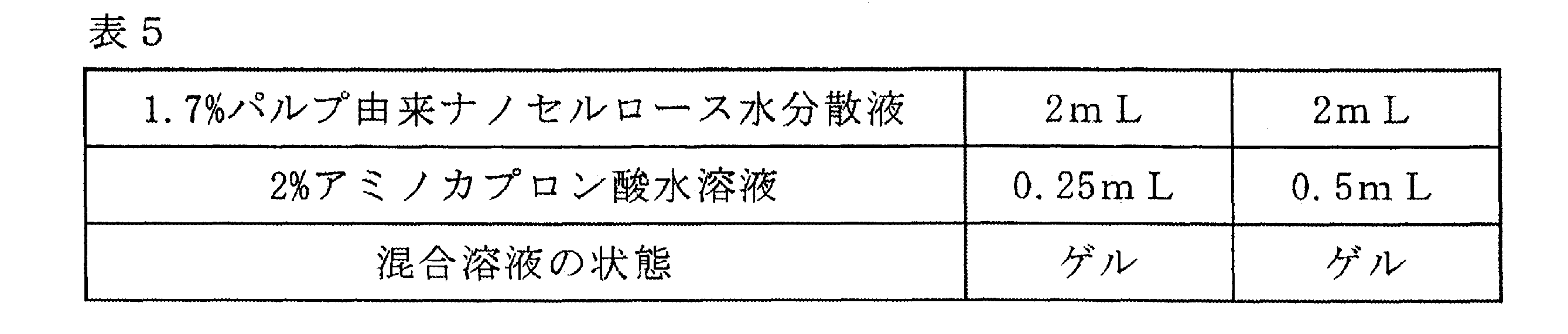
アミノカプロン酸(6-aminohexanoic acid)0.2gに水9.8gを加えて2%アミノカプロン酸水溶液を調製した。
2%アミノカプロン酸水溶液0.25mLをプラスチックチューブに入れ、これに1.7%パルプ由来ナノセルロース水分散液2mLを加えて混合するとゲル化(固化)が認められた。
同様に、2%アミノカプロン酸水溶液0.5mLをプラスチックチューブに入れ、これに1.7%パルプ由来ナノセルロース水分散液2mLを加えて混合するとゲル化(固化)が認められた。
得られた結果を表5に示す。
市販の結晶セルロース(旭化成ケミカルズ株式会社製 PH-101)4質量部に純水396質量部を加え分散させた後、製造例1と同様の操作により製造した。水中のセルロース濃度(固形分濃度)は、1.0質量%であった。
市販のバイオマスナノファイバー(BiNFi-S(ビンフィス)2質量%、株式会社スギノマシン)を121℃、20分間オートクレーブ処理を行うことにより滅菌した。
雄性SDラット10週齢(日本クレア(株)製)にペントバルビタールナトリウム(共立製薬(株)製)40mg/kgを腹腔内投与して麻酔し、腹部大動脈より針先にヘパリン(1000U/mL、セージェント社)を付着させた18Gの針付のプラスティック製シリンジを用いて、血液10mLを採取した。
このラットヘパリン処理血液1mLをプラスチックチューブに入れ、これに水1mLを加えると、液体の状態であった。さらに水を1mL加えても液体の状態であった。
雄性SDラット10週齢(日本クレア(株)製)にペントバルビタールナトリウム(共立製薬(株)製)40mg/kgを腹腔内投与して麻酔し、腹部大動脈より針先にヘパリン(1000U/mL、セージェント社)を付着させた18Gの針付のプラスティック製シリンジを用いて、血液10mLを採取した。
このラットヘパリン処理血液1mLをプラスチックチューブに入れ、これに1%微結晶性セルロース由来ナノセルロース水分散液1mLを加えると、液体の状態であったが、さらに1%微結晶性セルロース由来ナノセルロース水分散液を1mL加えると、直後より血液の固化作用が認められ、この際には離液が認められた。
また、この血液lmLをプラスチックチューブに入れ、1%微結晶性セルロース由来ナノセルロース水分散液1.5mLを加えると、血液は離液のある状態であるが固化する傾向が認められた。
雄性SDラット10週齢(日本クレア(株)製)にペントバルビタールナトリウム(共立製薬(株)製)40mg/kgを腹腔内投与して麻酔し、腹部大動脈より針先にヘパリン(1000U/mL、セージェント社)を付着させた18Gの針付のプラスティック製シリンジを用いて、血液10mLを採取した。
このラットヘパリン処理血液lmLをプラスチックチューブに入れ、これに2%キチン水分散液1mLを加えると、混合直後より血液の固化作用が認められ、この際にわずかな離液が認められた。さらに、1mLの2%キチン水分散液を追加し混合すると、血液は離液なく固化した。
また、この血液1mLをプラスチックチューブに入れ、これに2%キチン水分散液1.5mLを加えたところ、血液は離液なく固化した。
雄性SDラット10週齢(日本クレア(株)製)にペントバルビタールナトリウム(共立製薬(株)製)40mg/kgを腹腔内投与して麻酔し、腹部大動脈より針先にヘパリン(1000U/mL、セージェント社)を付着させた18Gの針付のプラスティック製シリンジを用いて、血液10mLを採取した。
このラットヘパリン処理血液1mLをプラスチックチューブに入れ、これに1.7%パルプ由来ナノセルロース水分散液1mLを加えると、混合直後より血液の固化作用が認められたが、この際にわずかな離液が認められた。さらに、1mLの1.7%パルプ由来ナノセルロース水分散液を追加し混合すると、血液は離液なく固化した。
また、この血液1mLをプラスチックチューブに入れ、これに1.7%パルプ由来ナノセルロース水分散液1.5mLを加えると、血液は離液なく固化した。
雄性SDラット10週齢(日本クレア(株)製)にペントバルビタールナトリウム(共立製薬(株)製)40mg/kgを腹腔内投与して麻酔し、腹部大動脈より18Gの針付のプラスティック製シリンジを用いて、血液10mLを採取した。
このラット血液1.5mLをプラスチックチューブに入れ、これに水1mLを加えると、液体の状態であった。また、ボルテックスによる分散化処理(15秒)においても液状であった。
雄性SDラット10週齢(日本クレア(株)製)にペントバルビタールナトリウム(共立製薬(株)製)40mg/kgを腹腔内投与して麻酔し、腹部大動脈より18Gの針付のプラスティック製シリンジを用いて、血液4mLを採取した。
このラット血液1mLをプラスチックチューブに入れ、これに2%キチン水分散液1.5mLを加えると、混合直後より血液の固化作用が認められたが、この際にわずかな離液が認められた。
雄性SDラット10週齢(日本クレア(株)製)にペントバルビタールナトリウム(共立製薬(株)製)40mg/kgを腹腔内投与して麻酔し、腹部大動脈より18Gの針付のプラスティック製シリンジを用いて、血液4mLを採取した。
このラット血液1mLをプラスチックチューブに入れ、これに1.7%パルプ由来ナノセルロース水分散液1.5mLを加えると、混合直後より血液の固化作用が認められ、血液は離液なく固化した。さらに、この固化体をボルテックスによる分散化処理(15秒)を行っても離液は認められなかった。
雄性SDラット10週齢(日本クレア(株)製)にペントバルビタールナトリウム(共立製薬(株)製)40mg/kgを腹腔内投与して麻酔を行った。ラットの下肢足静脈を鋭敏なメスで、血管を1/3の切り取ることにより出血させ、この直後に、1.7%パルプ由来ナノセルロース(PNC)水分散液、あるいは、2%キチン水分散液、または、水の各々0.5mLをそれぞれ別々に充填したプラスティック製シリンジを用いて、傷部を完全に被覆して、一分後、ガーゼで材料を拭き取り後、切り傷からの血液の流れの状態および床敷したガーゼへの浸潤の有無を達観的に観察した。
パルプ由来ナノセルロース(PNC)の被覆処理では、血液の流れが止まったが、キチンの被覆処理では、血液の流れは止まらなかった。尚、水を適応した場合、血液は、流れ出て、止まらなかった。
(1)試験方法
雄性ラット(245.6g~260.9g)にペントバルビタールナトリウム(商品名:ソムノペンチル、ペントバルビタールナトリウム64.8mg/mL含有、共立製薬(株)製)を腹腔内投与した。具体的には、生理食塩液(製造番号K3I85、大塚生食注、株式会社大塚製薬工場)を用いてソムノペンチルを10倍希釈し、投与量がペントバルビタールナトリウムとして40mg/kgになるように投与液量を換算して投与した。
深麻酔下でラット腹部皮膚を電気バリカンで剃毛し、消毒用アルコールで術野を消毒した後に正中線皮膚を縦切開して肝臓を露出させた。肝臓の外側左葉を滅菌済みの板に乗せ、辺縁部を30mm切除した。被験物質塗布群では切除面を完全に被覆するように1.77%パルプ由来ナノセルロース投与群1~5gを肝臓切除面に塗布し、縫合閉腹した。無処置群では肝臓切除後直ちに縫合閉腹した。
十分に保温しながら、覚醒するまでラットの状態を観察した。覚醒後はラットを飼育ケージに収容した。
術後7日目に、イソフルラン(イソフル[登録商標]、DSファーマアニマルヘルス(株)製)麻酔下で屠殺し、腹腔内組織の癒着、出血性変化を「0:癒着なし、1:自重で剥離可能、2:鈍的剥離可能、3:鋭的剥離」の4段階でスコア化した。
手術日において、肝臓切除により、無処置群では、全例において出血が認められた。これに対して、肝臓切除面に塗布したパルプ由来ナノセルロース投与群では、出血は止まり、止血された。
術後7日において、癒着の程度を表に示す、4段階スコアについては、肝臓切除部において、無処置群では5例中3例でスコア3であったが、これに対して、パルプ由来ナノセルロース投与群では、全例でスコア0と、肝臓切除による癒着に対して防止効果が認められた。
得られた結果を表6に示す。

Claims (16)
- 平均繊維径(D)が0.001乃至100μmであり、平均繊維径(D)に対する平均繊維長(L)の比(L/D)が5乃至500である不溶性多糖類を含有する水分散液であって、
血漿、血清又は血液との接触により固化することを特徴とする、水分散液。 - 前記不溶性多糖類が、セルロース繊維及びキチン繊維、リグニン、ヘミセルロース、イヌリン、プロトペクチン、グルカン、グルコマンナン、シクロデキストリン、食物繊維からなる群から選択される、請求項1に記載の水分散液。
- 前記不溶性多糖類が、0.001質量%乃至10質量%の濃度で含まれてなる、請求項1又は請求項2に記載の水分散液。
- 更に高分子を含む、請求項1乃至請求項3のうち何れか一項に記載の水分散液。
- 前記高分子が、コラーゲン、アルギン酸、ポリビニルアルコール、カルボキシメチルセルロース、メチルセルロース及びヒアルロン酸からなる群から選択される、請求項4に記載の水分散液。
- 更に機能成分を含む、請求項1乃至請求項5のうち何れか一項に記載の水分散液。
- 前記機能成分が、アスコルビン酸、アミノカプロン酸、トラネキサム酸及びトロンビンからなる群から選択される、請求項6に記載の水分散液。
- 前記水分散液がスプレー噴霧可能であり、該噴霧により血漿、血清又は血液を固化する、請求項1乃至請求項7のうち何れか一項に記載の水分散液。
- 止血用途における請求項1乃至請求項8のうち何れか一項に記載の水分散液の使用。
- 創傷治癒用途における請求項1乃至請求項8のうち何れか一項に記載の水分散液の使用。
- 癒着防止用途における請求項1乃至請求項8のうち何れか一項に記載の水分散液の使用。
- 請求項1乃至請求項8のうち何れか一項に記載の水分散液から得られるフィルム又はシート。
- 請求項1乃至請求項8のうち何れか一項に記載の水分散液を含む外用組成物。
- 請求項1乃至請求項8のうち何れか一項に記載の水分散液を含む止血用組成物。
- 請求項1乃至請求項8のうち何れか一項に記載の水分散液を含む創傷治療用組成物。
- 請求項1乃至請求項8のうち何れか一項に記載の水分散液を含む癒着防止用組成物。
Priority Applications (3)
| Application Number | Priority Date | Filing Date | Title |
|---|---|---|---|
| JP2015555023A JPWO2015099083A1 (ja) | 2013-12-25 | 2014-12-25 | 血清および血液を固化する水分散液 |
| US15/108,331 US20160325011A1 (en) | 2013-12-25 | 2014-12-25 | Aqueous dispersion for solidifying serum and blood |
| EP14873568.1A EP3088008A4 (en) | 2013-12-25 | 2014-12-25 | Aqueous dispersion for solidifying serum and blood |
Applications Claiming Priority (2)
| Application Number | Priority Date | Filing Date | Title |
|---|---|---|---|
| JP2013266931 | 2013-12-25 | ||
| JP2013-266931 | 2013-12-25 |
Publications (1)
| Publication Number | Publication Date |
|---|---|
| WO2015099083A1 true WO2015099083A1 (ja) | 2015-07-02 |
Family
ID=53478925
Family Applications (1)
| Application Number | Title | Priority Date | Filing Date |
|---|---|---|---|
| PCT/JP2014/084397 Ceased WO2015099083A1 (ja) | 2013-12-25 | 2014-12-25 | 血清および血液を固化する水分散液 |
Country Status (5)
| Country | Link |
|---|---|
| US (1) | US20160325011A1 (ja) |
| EP (1) | EP3088008A4 (ja) |
| JP (1) | JPWO2015099083A1 (ja) |
| TW (1) | TW201538163A (ja) |
| WO (1) | WO2015099083A1 (ja) |
Cited By (10)
| Publication number | Priority date | Publication date | Assignee | Title |
|---|---|---|---|---|
| WO2016080158A1 (ja) * | 2014-11-17 | 2016-05-26 | 株式会社ライラック研究所 | 創傷治癒を促進し生体諸臓器の被覆(コーチング)及び庇護を目的とした生体皮膜剤 |
| JP2017035425A (ja) * | 2015-08-12 | 2017-02-16 | 株式会社ライラック研究所 | 創傷治癒を促進し生体諸臓器の被覆(コーチング)及び庇護を目的とした生体皮膜剤。 |
| WO2017123653A1 (en) * | 2016-01-11 | 2017-07-20 | Leading BioSciences, Inc. | Compositions and methods for treating and preventing adhesions and ileus |
| WO2017123104A1 (en) * | 2016-01-11 | 2017-07-20 | Chan Mark Philip P | An all natural cellulose fiberboard |
| JP2017535519A (ja) * | 2014-09-15 | 2017-11-30 | プロクター アンド ギャンブル インターナショナル オペレーションズ エス エー | キチン、リグニン、及びポリマー又はコポリマーを含む消費財製品 |
| WO2018043531A1 (ja) * | 2016-08-30 | 2018-03-08 | 大日精化工業株式会社 | 水不溶性成形体の製造方法、水不溶性成形体、及び癒着防止材 |
| CN110420346A (zh) * | 2019-08-30 | 2019-11-08 | 华南理工大学 | 一种玉米秸秆/甲壳素复合止血海绵及其制备方法与应用 |
| JP2020000857A (ja) * | 2018-06-27 | 2020-01-09 | 南六企業股▲ふん▼有限公司 | 抗菌創傷被覆材 |
| JPWO2021246388A1 (ja) * | 2020-06-01 | 2021-12-09 | ||
| JP2025514383A (ja) * | 2022-05-03 | 2025-05-02 | ボストン サイエンティフィック サイムド,インコーポレイテッド | 粘膜下リフティングおよび止血シール用ハイドロゲル |
Families Citing this family (9)
| Publication number | Priority date | Publication date | Assignee | Title |
|---|---|---|---|---|
| CN105536039A (zh) * | 2015-12-25 | 2016-05-04 | 北京大清生物技术有限公司 | 一种可吸收流体止血材料及其制备方法与应用 |
| US10980740B2 (en) * | 2017-09-12 | 2021-04-20 | Shilpa Medicare Limited | Tranexamic acid spray for knee arthroplasty |
| BE1025996A9 (fr) | 2018-01-19 | 2020-05-11 | Hyloris Dev Sa | Solution orale d’acide tranexamique |
| CN108721689A (zh) * | 2018-06-09 | 2018-11-02 | 江苏海尔滋生物科技有限公司 | 生物护创流体膜及其制备方法 |
| WO2020205740A1 (en) * | 2019-03-29 | 2020-10-08 | Hybrid Plastics, Incorporated | Poss viscoelastic hemostatic agents |
| CN112891607B (zh) * | 2021-01-29 | 2022-02-25 | 河南亚都实业有限公司 | 一种抗感染、防黏连改性壳聚糖止血敷料及制备方法 |
| CN113908328B (zh) * | 2021-09-10 | 2023-01-24 | 浙江海洋大学 | 一种基于海藻酸钠、纳晶纤维素的抗菌止血多孔微球 |
| CN115364273A (zh) * | 2022-09-17 | 2022-11-22 | 中国人民解放军空军军医大学 | 一种可喷雾纳米氧化纤维素止血凝胶的制备方法 |
| CN116410513B (zh) * | 2022-12-20 | 2025-08-08 | 武夷学院 | 细菌纤维素/海藻酸钠/SiO2复合海绵材料的制备方法及其用途 |
Citations (9)
| Publication number | Priority date | Publication date | Assignee | Title |
|---|---|---|---|---|
| WO1998046818A1 (en) | 1997-04-11 | 1998-10-22 | Bristol-Myers Squibb Company | Knitted wound dressings and method for making same |
| JP2000256958A (ja) * | 1999-03-05 | 2000-09-19 | Hogi Medical:Kk | 可溶性創傷治癒止血セルロース繊維とその製造方法、及びこれを用いた創傷部の止血治癒方法 |
| JP2001097848A (ja) | 1999-09-30 | 2001-04-10 | Kobayashi Pharmaceut Co Ltd | 外用剤組成物 |
| JP2003510475A (ja) | 1999-09-27 | 2003-03-18 | ビーエイチケー・ホールディング・リミテッド | 吸収性ファブリック |
| JP2005270891A (ja) | 2004-03-26 | 2005-10-06 | Tetsuo Kondo | 多糖類の湿式粉砕方法 |
| WO2005099781A1 (en) * | 2004-04-13 | 2005-10-27 | Politechnika Lodzka (Technical University Of Lodz) | A wound dressing material of dibutyrylchitin and chitin reconstituted therefrom |
| JP5057781B2 (ja) | 2003-06-25 | 2012-10-24 | マサチューセッツ インスティテュート オブ テクノロジー | 修飾を組み込んだ自己集合ペプチドおよびそれを使用する方法 |
| JP2013089702A (ja) | 2011-10-17 | 2013-05-13 | Panasonic Corp | 多層基板、及び多層基板の製造方法 |
| JP2013537810A (ja) * | 2010-08-31 | 2013-10-07 | ボストン サイエンティフィック サイムド,インコーポレイテッド | 止血組成物ならびにその製造方法および使用方法 |
Family Cites Families (14)
| Publication number | Priority date | Publication date | Assignee | Title |
|---|---|---|---|---|
| US5681579A (en) * | 1993-03-22 | 1997-10-28 | E.R. Squibb & Sons, Inc. | Polymeric support wound dressing |
| JP2938325B2 (ja) * | 1993-11-19 | 1999-08-23 | オー・ジー株式会社 | 可剥離性皮膚保護剤 |
| US5607388A (en) * | 1994-06-16 | 1997-03-04 | Hercules Incorporated | Multi-purpose wound dressing |
| US6361551B1 (en) * | 1998-12-11 | 2002-03-26 | C. R. Bard, Inc. | Collagen hemostatic fibers |
| JP3805654B2 (ja) * | 2001-08-29 | 2006-08-02 | 株式会社ネクスト | 止血・癒着防止性のバイオポリマーの微細粒子 |
| US7252837B2 (en) * | 2002-06-28 | 2007-08-07 | Ethicon, Inc. | Hemostatic wound dressing and method of making same |
| WO2005000374A1 (ja) * | 2003-06-30 | 2005-01-06 | Denki Kagaku Kogyo Kabushiki Kaisha | 脊椎・脊髄手術用癒着防止材 |
| JP2008106178A (ja) * | 2006-10-26 | 2008-05-08 | Asahi Kasei Chemicals Corp | 水溶性高分子乾燥組成物 |
| DE102008034364A1 (de) * | 2007-08-03 | 2009-02-05 | Birgit Riesinger | Blutstillender Wundpflegeartikel |
| JP2011167237A (ja) * | 2010-02-16 | 2011-09-01 | Kanazawa Inst Of Technology | 生体適用材料 |
| JP2012193139A (ja) * | 2011-03-16 | 2012-10-11 | Daicel Corp | 化粧料 |
| JP2013216766A (ja) * | 2012-04-06 | 2013-10-24 | Nagoya Univ | 導電性組成物 |
| CN104955440A (zh) * | 2012-12-04 | 2015-09-30 | 日产化学工业株式会社 | 化妆料用添加剂及配合有该化妆料用添加剂的化妆料 |
| EP2990028B1 (en) * | 2013-04-22 | 2018-06-13 | Nissan Chemical Industries, Ltd. | Thickening composition |
-
2014
- 2014-12-25 WO PCT/JP2014/084397 patent/WO2015099083A1/ja not_active Ceased
- 2014-12-25 US US15/108,331 patent/US20160325011A1/en not_active Abandoned
- 2014-12-25 TW TW103145648A patent/TW201538163A/zh unknown
- 2014-12-25 JP JP2015555023A patent/JPWO2015099083A1/ja active Pending
- 2014-12-25 EP EP14873568.1A patent/EP3088008A4/en not_active Withdrawn
Patent Citations (9)
| Publication number | Priority date | Publication date | Assignee | Title |
|---|---|---|---|---|
| WO1998046818A1 (en) | 1997-04-11 | 1998-10-22 | Bristol-Myers Squibb Company | Knitted wound dressings and method for making same |
| JP2000256958A (ja) * | 1999-03-05 | 2000-09-19 | Hogi Medical:Kk | 可溶性創傷治癒止血セルロース繊維とその製造方法、及びこれを用いた創傷部の止血治癒方法 |
| JP2003510475A (ja) | 1999-09-27 | 2003-03-18 | ビーエイチケー・ホールディング・リミテッド | 吸収性ファブリック |
| JP2001097848A (ja) | 1999-09-30 | 2001-04-10 | Kobayashi Pharmaceut Co Ltd | 外用剤組成物 |
| JP5057781B2 (ja) | 2003-06-25 | 2012-10-24 | マサチューセッツ インスティテュート オブ テクノロジー | 修飾を組み込んだ自己集合ペプチドおよびそれを使用する方法 |
| JP2005270891A (ja) | 2004-03-26 | 2005-10-06 | Tetsuo Kondo | 多糖類の湿式粉砕方法 |
| WO2005099781A1 (en) * | 2004-04-13 | 2005-10-27 | Politechnika Lodzka (Technical University Of Lodz) | A wound dressing material of dibutyrylchitin and chitin reconstituted therefrom |
| JP2013537810A (ja) * | 2010-08-31 | 2013-10-07 | ボストン サイエンティフィック サイムド,インコーポレイテッド | 止血組成物ならびにその製造方法および使用方法 |
| JP2013089702A (ja) | 2011-10-17 | 2013-05-13 | Panasonic Corp | 多層基板、及び多層基板の製造方法 |
Non-Patent Citations (2)
| Title |
|---|
| JOURNAL OF THE KYORIN MEDICAL SOCIETY, vol. 44, no. 1, 2013, pages 3 - 11 |
| See also references of EP3088008A4 |
Cited By (18)
| Publication number | Priority date | Publication date | Assignee | Title |
|---|---|---|---|---|
| JP2017535519A (ja) * | 2014-09-15 | 2017-11-30 | プロクター アンド ギャンブル インターナショナル オペレーションズ エス エー | キチン、リグニン、及びポリマー又はコポリマーを含む消費財製品 |
| WO2016080158A1 (ja) * | 2014-11-17 | 2016-05-26 | 株式会社ライラック研究所 | 創傷治癒を促進し生体諸臓器の被覆(コーチング)及び庇護を目的とした生体皮膜剤 |
| JP2017035425A (ja) * | 2015-08-12 | 2017-02-16 | 株式会社ライラック研究所 | 創傷治癒を促進し生体諸臓器の被覆(コーチング)及び庇護を目的とした生体皮膜剤。 |
| CN108883086B (zh) * | 2016-01-11 | 2021-10-26 | 恒翼生物医药科技(上海)有限公司 | 用于治疗和预防粘连及肠梗阻的组合物和方法 |
| WO2017123653A1 (en) * | 2016-01-11 | 2017-07-20 | Leading BioSciences, Inc. | Compositions and methods for treating and preventing adhesions and ileus |
| WO2017123104A1 (en) * | 2016-01-11 | 2017-07-20 | Chan Mark Philip P | An all natural cellulose fiberboard |
| CN108883086A (zh) * | 2016-01-11 | 2018-11-23 | 主导生物科学公司 | 用于治疗和预防粘连及肠梗阻的组合物和方法 |
| US11202768B2 (en) | 2016-01-11 | 2021-12-21 | Leading BioSciences, Inc. | Compositions and methods for treating and preventing adhesions and ileus |
| WO2018043531A1 (ja) * | 2016-08-30 | 2018-03-08 | 大日精化工業株式会社 | 水不溶性成形体の製造方法、水不溶性成形体、及び癒着防止材 |
| JP2020000857A (ja) * | 2018-06-27 | 2020-01-09 | 南六企業股▲ふん▼有限公司 | 抗菌創傷被覆材 |
| CN110420346B (zh) * | 2019-08-30 | 2021-09-21 | 华南理工大学 | 一种玉米秸秆/甲壳素复合止血海绵及其制备方法与应用 |
| CN110420346A (zh) * | 2019-08-30 | 2019-11-08 | 华南理工大学 | 一种玉米秸秆/甲壳素复合止血海绵及其制备方法与应用 |
| JPWO2021246388A1 (ja) * | 2020-06-01 | 2021-12-09 | ||
| WO2021246388A1 (ja) | 2020-06-01 | 2021-12-09 | 株式会社大塚製薬工場 | 癒着防止剤及びそれを用いた癒着防止方法 |
| CN115884800A (zh) * | 2020-06-01 | 2023-03-31 | 株式会社大塚制药工场 | 防粘连剂及使用其的粘连防止方法 |
| JP2023096193A (ja) * | 2020-06-01 | 2023-07-06 | 株式会社大塚製薬工場 | 分散液及びその製造方法 |
| JP7321610B2 (ja) | 2020-06-01 | 2023-08-07 | 株式会社大塚製薬工場 | 癒着防止剤及びそれを用いた癒着防止方法 |
| JP2025514383A (ja) * | 2022-05-03 | 2025-05-02 | ボストン サイエンティフィック サイムド,インコーポレイテッド | 粘膜下リフティングおよび止血シール用ハイドロゲル |
Also Published As
| Publication number | Publication date |
|---|---|
| US20160325011A1 (en) | 2016-11-10 |
| EP3088008A1 (en) | 2016-11-02 |
| JPWO2015099083A1 (ja) | 2017-03-23 |
| TW201538163A (zh) | 2015-10-16 |
| EP3088008A4 (en) | 2017-07-05 |
Similar Documents
| Publication | Publication Date | Title |
|---|---|---|
| WO2015099083A1 (ja) | 血清および血液を固化する水分散液 | |
| Liang et al. | Dual-dynamic-bond cross-linked antibacterial adhesive hydrogel sealants with on-demand removability for post-wound-closure and infected wound healing | |
| Guo et al. | Injectable adhesive self-healing multiple-dynamic-bond crosslinked hydrogel with photothermal antibacterial activity for infected wound healing | |
| Fan et al. | A multifunctional, tough, stretchable, and transparent curcumin hydrogel with potent antimicrobial, antioxidative, anti-inflammatory, and angiogenesis capabilities for diabetic wound healing | |
| KR102667393B1 (ko) | 히알루론산-칼슘 및 폴리라이신을 포함하는 창상 피복재 및 그 제조 방법 | |
| Fan et al. | pH-responsive cellulose-based dual drug-loaded hydrogel for wound dressing | |
| Archana et al. | In vivo evaluation of chitosan–PVP–titanium dioxide nanocomposite as wound dressing material | |
| Liu et al. | Antibacterial and hemostatic hydrogel via nanocomposite from cellulose nanofibers | |
| Xia et al. | Nanoparticles/thermosensitive hydrogel reinforced with chitin whiskers as a wound dressing for treating chronic wounds | |
| Huang et al. | Degradable and bioadhesive alginate-based composites: an effective hemostatic agent | |
| Chen et al. | Lysozyme amyloid fibril-integrated PEG injectable hydrogel adhesive with improved antiswelling and antibacterial capabilities | |
| Cui et al. | A chitosan-based self-healing hydrogel for accelerating infected wound healing | |
| Chen et al. | Evaluation of absorbable hemostatic agents of polyelectrolyte complexes using carboxymethyl starch and chitosan oligosaccharide both in vitro and in vivo | |
| KR20100093516A (ko) | 외과용 하이드로겔 | |
| Almajidi et al. | Three-dimensional printed polyelectrolyte construct containing mupirocin-loaded quaternized chitosan nanoparticles for skin repair | |
| Elhami et al. | Development of nanocomposites based on chitosan/reduced graphene oxide for wound healing application | |
| EP2793908A1 (en) | Composition, preparation, and use of dense chitosan membrane materials | |
| Chen et al. | Converting lysozyme to hydrogel: A multifunctional wound dressing that is more than antibacterial | |
| Hosseini et al. | Chitosan-grafted graphene materials for drug delivery in wound healing | |
| KR102280553B1 (ko) | 개선된 하이드로젤 지혈제 제조방법 및 그에 따른 지혈제 | |
| JP2023096193A (ja) | 分散液及びその製造方法 | |
| Dey et al. | Stimuli-responsive release-active dressing: A promising solution for eradicating biofilm-mediated wound infections | |
| Fang et al. | Hemoadhican Fiber composite with carbon dots for treating severe hemorrhage and infected wounds | |
| Ni et al. | Shikonin nanoparticle-reinforced chitosan/scleroglucan hydrogel for treating oral mucosa wounds in diabetes | |
| Din et al. | Temperature and pH-sensitive chitosan-collagen hydrogels for antimicrobial and wound healing applications |
Legal Events
| Date | Code | Title | Description |
|---|---|---|---|
| 121 | Ep: the epo has been informed by wipo that ep was designated in this application |
Ref document number: 14873568 Country of ref document: EP Kind code of ref document: A1 |
|
| ENP | Entry into the national phase |
Ref document number: 2015555023 Country of ref document: JP Kind code of ref document: A |
|
| NENP | Non-entry into the national phase |
Ref country code: DE |
|
| WWE | Wipo information: entry into national phase |
Ref document number: 15108331 Country of ref document: US |
|
| REEP | Request for entry into the european phase |
Ref document number: 2014873568 Country of ref document: EP |
|
| WWE | Wipo information: entry into national phase |
Ref document number: 2014873568 Country of ref document: EP |