WO2015105186A1 - 軸受部品、軸受部品用鋼材及びそれらの製造方法 - Google Patents
軸受部品、軸受部品用鋼材及びそれらの製造方法 Download PDFInfo
- Publication number
- WO2015105186A1 WO2015105186A1 PCT/JP2015/050528 JP2015050528W WO2015105186A1 WO 2015105186 A1 WO2015105186 A1 WO 2015105186A1 JP 2015050528 W JP2015050528 W JP 2015050528W WO 2015105186 A1 WO2015105186 A1 WO 2015105186A1
- Authority
- WO
- WIPO (PCT)
- Prior art keywords
- less
- content
- hot
- steel
- bearing
- Prior art date
- Legal status (The legal status is an assumption and is not a legal conclusion. Google has not performed a legal analysis and makes no representation as to the accuracy of the status listed.)
- Ceased
Links
Images


Classifications
-
- B—PERFORMING OPERATIONS; TRANSPORTING
- B22—CASTING; POWDER METALLURGY
- B22D—CASTING OF METALS; CASTING OF OTHER SUBSTANCES BY THE SAME PROCESSES OR DEVICES
- B22D23/00—Casting processes not provided for in groups B22D1/00 - B22D21/00
-
- C—CHEMISTRY; METALLURGY
- C21—METALLURGY OF IRON
- C21D—MODIFYING THE PHYSICAL STRUCTURE OF FERROUS METALS; GENERAL DEVICES FOR HEAT TREATMENT OF FERROUS OR NON-FERROUS METALS OR ALLOYS; MAKING METAL MALLEABLE, e.g. BY DECARBURISATION OR TEMPERING
- C21D1/00—General methods or devices for heat treatment, e.g. annealing, hardening, quenching or tempering
- C21D1/18—Hardening; Quenching with or without subsequent tempering
-
- C—CHEMISTRY; METALLURGY
- C21—METALLURGY OF IRON
- C21D—MODIFYING THE PHYSICAL STRUCTURE OF FERROUS METALS; GENERAL DEVICES FOR HEAT TREATMENT OF FERROUS OR NON-FERROUS METALS OR ALLOYS; MAKING METAL MALLEABLE, e.g. BY DECARBURISATION OR TEMPERING
- C21D1/00—General methods or devices for heat treatment, e.g. annealing, hardening, quenching or tempering
- C21D1/26—Methods of annealing
- C21D1/32—Soft annealing, e.g. spheroidising
-
- C—CHEMISTRY; METALLURGY
- C21—METALLURGY OF IRON
- C21D—MODIFYING THE PHYSICAL STRUCTURE OF FERROUS METALS; GENERAL DEVICES FOR HEAT TREATMENT OF FERROUS OR NON-FERROUS METALS OR ALLOYS; MAKING METAL MALLEABLE, e.g. BY DECARBURISATION OR TEMPERING
- C21D8/00—Modifying the physical properties of ferrous metals or ferrous alloys by deformation combined with, or followed by, heat treatment
- C21D8/06—Modifying the physical properties of ferrous metals or ferrous alloys by deformation combined with, or followed by, heat treatment during manufacturing of rods or wires
-
- C—CHEMISTRY; METALLURGY
- C21—METALLURGY OF IRON
- C21D—MODIFYING THE PHYSICAL STRUCTURE OF FERROUS METALS; GENERAL DEVICES FOR HEAT TREATMENT OF FERROUS OR NON-FERROUS METALS OR ALLOYS; MAKING METAL MALLEABLE, e.g. BY DECARBURISATION OR TEMPERING
- C21D9/00—Heat treatment, e.g. annealing, hardening, quenching or tempering, adapted for particular articles; Furnaces therefor
- C21D9/36—Heat treatment, e.g. annealing, hardening, quenching or tempering, adapted for particular articles; Furnaces therefor for balls; for rollers
-
- C—CHEMISTRY; METALLURGY
- C21—METALLURGY OF IRON
- C21D—MODIFYING THE PHYSICAL STRUCTURE OF FERROUS METALS; GENERAL DEVICES FOR HEAT TREATMENT OF FERROUS OR NON-FERROUS METALS OR ALLOYS; MAKING METAL MALLEABLE, e.g. BY DECARBURISATION OR TEMPERING
- C21D9/00—Heat treatment, e.g. annealing, hardening, quenching or tempering, adapted for particular articles; Furnaces therefor
- C21D9/38—Heat treatment, e.g. annealing, hardening, quenching or tempering, adapted for particular articles; Furnaces therefor for roll bodies
-
- C—CHEMISTRY; METALLURGY
- C21—METALLURGY OF IRON
- C21D—MODIFYING THE PHYSICAL STRUCTURE OF FERROUS METALS; GENERAL DEVICES FOR HEAT TREATMENT OF FERROUS OR NON-FERROUS METALS OR ALLOYS; MAKING METAL MALLEABLE, e.g. BY DECARBURISATION OR TEMPERING
- C21D9/00—Heat treatment, e.g. annealing, hardening, quenching or tempering, adapted for particular articles; Furnaces therefor
- C21D9/40—Heat treatment, e.g. annealing, hardening, quenching or tempering, adapted for particular articles; Furnaces therefor for rings; for bearing races
-
- C—CHEMISTRY; METALLURGY
- C21—METALLURGY OF IRON
- C21D—MODIFYING THE PHYSICAL STRUCTURE OF FERROUS METALS; GENERAL DEVICES FOR HEAT TREATMENT OF FERROUS OR NON-FERROUS METALS OR ALLOYS; MAKING METAL MALLEABLE, e.g. BY DECARBURISATION OR TEMPERING
- C21D9/00—Heat treatment, e.g. annealing, hardening, quenching or tempering, adapted for particular articles; Furnaces therefor
- C21D9/52—Heat treatment, e.g. annealing, hardening, quenching or tempering, adapted for particular articles; Furnaces therefor for wires; for strips ; for rods of unlimited length
- C21D9/54—Furnaces for treating strips or wire
- C21D9/68—Furnace coilers; Hot coilers
-
- C—CHEMISTRY; METALLURGY
- C22—METALLURGY; FERROUS OR NON-FERROUS ALLOYS; TREATMENT OF ALLOYS OR NON-FERROUS METALS
- C22C—ALLOYS
- C22C38/00—Ferrous alloys, e.g. steel alloys
-
- C—CHEMISTRY; METALLURGY
- C22—METALLURGY; FERROUS OR NON-FERROUS ALLOYS; TREATMENT OF ALLOYS OR NON-FERROUS METALS
- C22C—ALLOYS
- C22C38/00—Ferrous alloys, e.g. steel alloys
- C22C38/001—Ferrous alloys, e.g. steel alloys containing N
-
- C—CHEMISTRY; METALLURGY
- C22—METALLURGY; FERROUS OR NON-FERROUS ALLOYS; TREATMENT OF ALLOYS OR NON-FERROUS METALS
- C22C—ALLOYS
- C22C38/00—Ferrous alloys, e.g. steel alloys
- C22C38/002—Ferrous alloys, e.g. steel alloys containing In, Mg, or other elements not provided for in one single group C22C38/001 - C22C38/60
-
- C—CHEMISTRY; METALLURGY
- C22—METALLURGY; FERROUS OR NON-FERROUS ALLOYS; TREATMENT OF ALLOYS OR NON-FERROUS METALS
- C22C—ALLOYS
- C22C38/00—Ferrous alloys, e.g. steel alloys
- C22C38/02—Ferrous alloys, e.g. steel alloys containing silicon
-
- C—CHEMISTRY; METALLURGY
- C22—METALLURGY; FERROUS OR NON-FERROUS ALLOYS; TREATMENT OF ALLOYS OR NON-FERROUS METALS
- C22C—ALLOYS
- C22C38/00—Ferrous alloys, e.g. steel alloys
- C22C38/04—Ferrous alloys, e.g. steel alloys containing manganese
-
- C—CHEMISTRY; METALLURGY
- C22—METALLURGY; FERROUS OR NON-FERROUS ALLOYS; TREATMENT OF ALLOYS OR NON-FERROUS METALS
- C22C—ALLOYS
- C22C38/00—Ferrous alloys, e.g. steel alloys
- C22C38/06—Ferrous alloys, e.g. steel alloys containing aluminium
-
- C—CHEMISTRY; METALLURGY
- C22—METALLURGY; FERROUS OR NON-FERROUS ALLOYS; TREATMENT OF ALLOYS OR NON-FERROUS METALS
- C22C—ALLOYS
- C22C38/00—Ferrous alloys, e.g. steel alloys
- C22C38/08—Ferrous alloys, e.g. steel alloys containing nickel
-
- C—CHEMISTRY; METALLURGY
- C22—METALLURGY; FERROUS OR NON-FERROUS ALLOYS; TREATMENT OF ALLOYS OR NON-FERROUS METALS
- C22C—ALLOYS
- C22C38/00—Ferrous alloys, e.g. steel alloys
- C22C38/18—Ferrous alloys, e.g. steel alloys containing chromium
-
- C—CHEMISTRY; METALLURGY
- C22—METALLURGY; FERROUS OR NON-FERROUS ALLOYS; TREATMENT OF ALLOYS OR NON-FERROUS METALS
- C22C—ALLOYS
- C22C38/00—Ferrous alloys, e.g. steel alloys
- C22C38/18—Ferrous alloys, e.g. steel alloys containing chromium
- C22C38/20—Ferrous alloys, e.g. steel alloys containing chromium with copper
-
- C—CHEMISTRY; METALLURGY
- C22—METALLURGY; FERROUS OR NON-FERROUS ALLOYS; TREATMENT OF ALLOYS OR NON-FERROUS METALS
- C22C—ALLOYS
- C22C38/00—Ferrous alloys, e.g. steel alloys
- C22C38/18—Ferrous alloys, e.g. steel alloys containing chromium
- C22C38/22—Ferrous alloys, e.g. steel alloys containing chromium with molybdenum or tungsten
-
- C—CHEMISTRY; METALLURGY
- C22—METALLURGY; FERROUS OR NON-FERROUS ALLOYS; TREATMENT OF ALLOYS OR NON-FERROUS METALS
- C22C—ALLOYS
- C22C38/00—Ferrous alloys, e.g. steel alloys
- C22C38/18—Ferrous alloys, e.g. steel alloys containing chromium
- C22C38/32—Ferrous alloys, e.g. steel alloys containing chromium with boron
-
- C—CHEMISTRY; METALLURGY
- C22—METALLURGY; FERROUS OR NON-FERROUS ALLOYS; TREATMENT OF ALLOYS OR NON-FERROUS METALS
- C22C—ALLOYS
- C22C38/00—Ferrous alloys, e.g. steel alloys
- C22C38/18—Ferrous alloys, e.g. steel alloys containing chromium
- C22C38/40—Ferrous alloys, e.g. steel alloys containing chromium with nickel
-
- C—CHEMISTRY; METALLURGY
- C22—METALLURGY; FERROUS OR NON-FERROUS ALLOYS; TREATMENT OF ALLOYS OR NON-FERROUS METALS
- C22C—ALLOYS
- C22C38/00—Ferrous alloys, e.g. steel alloys
- C22C38/18—Ferrous alloys, e.g. steel alloys containing chromium
- C22C38/40—Ferrous alloys, e.g. steel alloys containing chromium with nickel
- C22C38/44—Ferrous alloys, e.g. steel alloys containing chromium with nickel with molybdenum or tungsten
-
- C—CHEMISTRY; METALLURGY
- C22—METALLURGY; FERROUS OR NON-FERROUS ALLOYS; TREATMENT OF ALLOYS OR NON-FERROUS METALS
- C22C—ALLOYS
- C22C38/00—Ferrous alloys, e.g. steel alloys
- C22C38/18—Ferrous alloys, e.g. steel alloys containing chromium
- C22C38/40—Ferrous alloys, e.g. steel alloys containing chromium with nickel
- C22C38/54—Ferrous alloys, e.g. steel alloys containing chromium with nickel with boron
-
- F—MECHANICAL ENGINEERING; LIGHTING; HEATING; WEAPONS; BLASTING
- F16—ENGINEERING ELEMENTS AND UNITS; GENERAL MEASURES FOR PRODUCING AND MAINTAINING EFFECTIVE FUNCTIONING OF MACHINES OR INSTALLATIONS; THERMAL INSULATION IN GENERAL
- F16C—SHAFTS; FLEXIBLE SHAFTS; ELEMENTS OR CRANKSHAFT MECHANISMS; ROTARY BODIES OTHER THAN GEARING ELEMENTS; BEARINGS
- F16C33/00—Parts of bearings; Special methods for making bearings or parts thereof
- F16C33/30—Parts of ball or roller bearings
-
- F—MECHANICAL ENGINEERING; LIGHTING; HEATING; WEAPONS; BLASTING
- F16—ENGINEERING ELEMENTS AND UNITS; GENERAL MEASURES FOR PRODUCING AND MAINTAINING EFFECTIVE FUNCTIONING OF MACHINES OR INSTALLATIONS; THERMAL INSULATION IN GENERAL
- F16C—SHAFTS; FLEXIBLE SHAFTS; ELEMENTS OR CRANKSHAFT MECHANISMS; ROTARY BODIES OTHER THAN GEARING ELEMENTS; BEARINGS
- F16C33/00—Parts of bearings; Special methods for making bearings or parts thereof
- F16C33/30—Parts of ball or roller bearings
- F16C33/58—Raceways; Race rings
- F16C33/62—Selection of substances
-
- F—MECHANICAL ENGINEERING; LIGHTING; HEATING; WEAPONS; BLASTING
- F16—ENGINEERING ELEMENTS AND UNITS; GENERAL MEASURES FOR PRODUCING AND MAINTAINING EFFECTIVE FUNCTIONING OF MACHINES OR INSTALLATIONS; THERMAL INSULATION IN GENERAL
- F16C—SHAFTS; FLEXIBLE SHAFTS; ELEMENTS OR CRANKSHAFT MECHANISMS; ROTARY BODIES OTHER THAN GEARING ELEMENTS; BEARINGS
- F16C33/00—Parts of bearings; Special methods for making bearings or parts thereof
- F16C33/30—Parts of ball or roller bearings
- F16C33/58—Raceways; Race rings
- F16C33/64—Special methods of manufacture
-
- C—CHEMISTRY; METALLURGY
- C21—METALLURGY OF IRON
- C21D—MODIFYING THE PHYSICAL STRUCTURE OF FERROUS METALS; GENERAL DEVICES FOR HEAT TREATMENT OF FERROUS OR NON-FERROUS METALS OR ALLOYS; MAKING METAL MALLEABLE, e.g. BY DECARBURISATION OR TEMPERING
- C21D2211/00—Microstructure comprising significant phases
- C21D2211/001—Austenite
-
- C—CHEMISTRY; METALLURGY
- C21—METALLURGY OF IRON
- C21D—MODIFYING THE PHYSICAL STRUCTURE OF FERROUS METALS; GENERAL DEVICES FOR HEAT TREATMENT OF FERROUS OR NON-FERROUS METALS OR ALLOYS; MAKING METAL MALLEABLE, e.g. BY DECARBURISATION OR TEMPERING
- C21D2211/00—Microstructure comprising significant phases
- C21D2211/003—Cementite
-
- C—CHEMISTRY; METALLURGY
- C21—METALLURGY OF IRON
- C21D—MODIFYING THE PHYSICAL STRUCTURE OF FERROUS METALS; GENERAL DEVICES FOR HEAT TREATMENT OF FERROUS OR NON-FERROUS METALS OR ALLOYS; MAKING METAL MALLEABLE, e.g. BY DECARBURISATION OR TEMPERING
- C21D2211/00—Microstructure comprising significant phases
- C21D2211/004—Dispersions; Precipitations
-
- C—CHEMISTRY; METALLURGY
- C21—METALLURGY OF IRON
- C21D—MODIFYING THE PHYSICAL STRUCTURE OF FERROUS METALS; GENERAL DEVICES FOR HEAT TREATMENT OF FERROUS OR NON-FERROUS METALS OR ALLOYS; MAKING METAL MALLEABLE, e.g. BY DECARBURISATION OR TEMPERING
- C21D2211/00—Microstructure comprising significant phases
- C21D2211/005—Ferrite
-
- C—CHEMISTRY; METALLURGY
- C21—METALLURGY OF IRON
- C21D—MODIFYING THE PHYSICAL STRUCTURE OF FERROUS METALS; GENERAL DEVICES FOR HEAT TREATMENT OF FERROUS OR NON-FERROUS METALS OR ALLOYS; MAKING METAL MALLEABLE, e.g. BY DECARBURISATION OR TEMPERING
- C21D2211/00—Microstructure comprising significant phases
- C21D2211/008—Martensite
-
- F—MECHANICAL ENGINEERING; LIGHTING; HEATING; WEAPONS; BLASTING
- F16—ENGINEERING ELEMENTS AND UNITS; GENERAL MEASURES FOR PRODUCING AND MAINTAINING EFFECTIVE FUNCTIONING OF MACHINES OR INSTALLATIONS; THERMAL INSULATION IN GENERAL
- F16C—SHAFTS; FLEXIBLE SHAFTS; ELEMENTS OR CRANKSHAFT MECHANISMS; ROTARY BODIES OTHER THAN GEARING ELEMENTS; BEARINGS
- F16C2204/00—Metallic materials; Alloys
- F16C2204/60—Ferrous alloys, e.g. steel alloys
- F16C2204/66—High carbon steel, i.e. carbon content above 0.8 wt%, e.g. through-hardenable steel
-
- F—MECHANICAL ENGINEERING; LIGHTING; HEATING; WEAPONS; BLASTING
- F16—ENGINEERING ELEMENTS AND UNITS; GENERAL MEASURES FOR PRODUCING AND MAINTAINING EFFECTIVE FUNCTIONING OF MACHINES OR INSTALLATIONS; THERMAL INSULATION IN GENERAL
- F16C—SHAFTS; FLEXIBLE SHAFTS; ELEMENTS OR CRANKSHAFT MECHANISMS; ROTARY BODIES OTHER THAN GEARING ELEMENTS; BEARINGS
- F16C2204/00—Metallic materials; Alloys
- F16C2204/60—Ferrous alloys, e.g. steel alloys
- F16C2204/70—Ferrous alloys, e.g. steel alloys with chromium as the next major constituent
-
- F—MECHANICAL ENGINEERING; LIGHTING; HEATING; WEAPONS; BLASTING
- F16—ENGINEERING ELEMENTS AND UNITS; GENERAL MEASURES FOR PRODUCING AND MAINTAINING EFFECTIVE FUNCTIONING OF MACHINES OR INSTALLATIONS; THERMAL INSULATION IN GENERAL
- F16C—SHAFTS; FLEXIBLE SHAFTS; ELEMENTS OR CRANKSHAFT MECHANISMS; ROTARY BODIES OTHER THAN GEARING ELEMENTS; BEARINGS
- F16C2204/00—Metallic materials; Alloys
- F16C2204/60—Ferrous alloys, e.g. steel alloys
- F16C2204/70—Ferrous alloys, e.g. steel alloys with chromium as the next major constituent
- F16C2204/72—Ferrous alloys, e.g. steel alloys with chromium as the next major constituent with nickel as further constituent, e.g. stainless steel
-
- F—MECHANICAL ENGINEERING; LIGHTING; HEATING; WEAPONS; BLASTING
- F16—ENGINEERING ELEMENTS AND UNITS; GENERAL MEASURES FOR PRODUCING AND MAINTAINING EFFECTIVE FUNCTIONING OF MACHINES OR INSTALLATIONS; THERMAL INSULATION IN GENERAL
- F16C—SHAFTS; FLEXIBLE SHAFTS; ELEMENTS OR CRANKSHAFT MECHANISMS; ROTARY BODIES OTHER THAN GEARING ELEMENTS; BEARINGS
- F16C2220/00—Shaping
- F16C2220/40—Shaping by deformation without removing material
- F16C2220/44—Shaping by deformation without removing material by rolling
-
- F—MECHANICAL ENGINEERING; LIGHTING; HEATING; WEAPONS; BLASTING
- F16—ENGINEERING ELEMENTS AND UNITS; GENERAL MEASURES FOR PRODUCING AND MAINTAINING EFFECTIVE FUNCTIONING OF MACHINES OR INSTALLATIONS; THERMAL INSULATION IN GENERAL
- F16C—SHAFTS; FLEXIBLE SHAFTS; ELEMENTS OR CRANKSHAFT MECHANISMS; ROTARY BODIES OTHER THAN GEARING ELEMENTS; BEARINGS
- F16C2223/00—Surface treatments; Hardening; Coating
- F16C2223/02—Mechanical treatment, e.g. finishing
-
- F—MECHANICAL ENGINEERING; LIGHTING; HEATING; WEAPONS; BLASTING
- F16—ENGINEERING ELEMENTS AND UNITS; GENERAL MEASURES FOR PRODUCING AND MAINTAINING EFFECTIVE FUNCTIONING OF MACHINES OR INSTALLATIONS; THERMAL INSULATION IN GENERAL
- F16C—SHAFTS; FLEXIBLE SHAFTS; ELEMENTS OR CRANKSHAFT MECHANISMS; ROTARY BODIES OTHER THAN GEARING ELEMENTS; BEARINGS
- F16C2223/00—Surface treatments; Hardening; Coating
- F16C2223/10—Hardening, e.g. carburizing, carbo-nitriding
Definitions
- the present invention relates to a bearing component such as a needle bearing, a roller bearing, and a ball bearing, a steel material for a bearing component that is a material thereof, and a manufacturing method thereof.
- Bearing parts such as needle bearings, roller bearings, and ball bearings are continuously used even when foreign matters such as burrs and wear powder are mixed in the lubricating oil, that is, in a foreign matter mixed environment. Therefore, it is important to improve the rolling fatigue life of the bearing component in an environment where foreign matter is mixed. It is known that increasing the retained austenite is effective in improving the rolling fatigue life of the bearing component in a foreign matter mixed environment. Therefore, surface treatments such as carburizing and nitriding are performed on the steel for bearing parts.
- Patent Document 1 discloses a bearing component in which carburizing treatment and nitriding treatment are omitted, and a large amount of retained austenite is contained by quenching and tempering treatment.
- the bearing component disclosed in Patent Document 1 contains C, Mn, Ni, or Mo in steel, and lowers the martensite transformation start temperature (Ms point), thereby securing the amount of retained austenite. Yes.
- Ms point martensite transformation start temperature
- the hardenability of the steel material is increased.
- a supercooled structure such as martensite is generated during cooling after hot rolling, and the workability, ductility, and toughness of the hot rolled wire are reduced.
- Patent Document 2 discloses a method for producing retained austenite by using spherical cementite to suppress the coarsening of the crystal grain size.
- spheroidizing heat treatment is performed at a high temperature for a long time.
- C was dissolved in the austenite phase, and the number density of spherical cementite was insufficient.
- the austenite grain size was coarsened, and a sufficient rolling fatigue life improvement effect could not be obtained.
- Patent Document 3 discloses a high carbon steel rolled wire rod for bearing parts, which was invented by a part of the present inventors and can be drawn without performing a spheroidizing heat treatment. Has been.
- Patent Document 4 Conventionally, spheroidizing heat treatment is performed before and after wire drawing.
- a method of performing spheroidizing heat treatment after performing wire drawing on the rolled wire after hot rolling is disclosed in Patent Document 4.
- the method disclosed in Patent Document 4 does not shorten the processing time of the spheroidizing heat treatment.
- Japanese Unexamined Patent Publication No. 2004-124215 Japanese Laid-Open Patent Publication No. 2007-077432 International Publication WO2013-108828 Japanese Unexamined Patent Publication No. 2004-100016
- the present invention has been made in view of such a situation, and in the manufacturing process of a bearing part from a hot rolled wire, the number of times of spheroidizing heat treatment can be manufactured in a short time, It is an object of the present invention to provide a bearing component having excellent rolling fatigue life including a foreign matter-contaminated environment, a steel material for a bearing component as a material thereof, and a manufacturing method thereof.
- the inventors of the present invention have made the average grain size of the prior austenite of the bearing parts by performing a spheroidizing heat treatment at a lower temperature than usual after performing a wire drawing process on a steel material containing Cr and having a metal structure made of pearlite. It has been found that the diameter becomes finer. Furthermore, it discovered that the amount of retained austenite could be ensured by refine
- the gist of the present invention is as follows.
- the bearing component according to an embodiment of the present invention has a chemical composition of mass%, C: 0.95% to 1.10%, Si: 0.10% to 0.70%, Mn: 0 20% to 1.20%, Cr: 0.90% to 1.60%, Al: 0.010% to 0.100%, N: 0.003% to 0.030%, P: It is limited to 0.025% or less, S: 0.025% or less, O: 0.0010% or less, and optionally, Mo: 0.25% or less, B: 0.0050% or less, Cu: 1.0%
- Ca: 0.0015% or less the balance consists of Fe and impurities
- the metal structure is residual austenite, spherical cementite and martensite, the amount of the residual austenite is , 18% to 25% by volume, and in the metal structure,
- the average particle size of bets is less 6.0 .mu.m, the average particle diameter of the spherical cementite is at 0.45 ⁇ m or less,
- the chemical component is, in mass%, Mo: 0.01% to 0.25%, B: 0.0001% to 0.0050%, Cu: 0
- One or more of 0.1% to 1.0%, Ni: 1.0% to 3.0%, and Ca: 0.0001% to 0.0015% may be contained.
- the steel for bearing parts according to one embodiment of the present invention has a chemical composition of mass%, C: 0.95% to 1.10%, Si: 0.10% to 0.70%, Mn : 0.20% to 1.20%, Cr: 0.90% to 1.60%, Al: 0.010% to 0.100%, N: 0.003% to 0.030%, S: 0.025% or less, P: 0.025% or less, O: 0.0010% or less, and optionally, Mo: 0.25% or less, B: 0.0050% or less, Cu: 1.
- the balance is made of Fe and impurities
- the metal structure contains spherical cementite and ferrite
- the particle size of the metal structure is The number density of the spherical cementite of 0.5 ⁇ m to 3.0 ⁇ m is 2.0 ⁇ 10 6 pieces / mm 2 or more.
- the chemical component is in mass%, Mo: 0.01% to 0.25%, B: 0.0001% to 0.0050%, Cu : 0.1% to 1.0%, Ni: 1.0% to 3.0%, Ca: 0.0001% to 0.0015% may be contained.
- a method for producing a steel for bearing parts according to an embodiment of the present invention includes a casting step of obtaining a steel slab comprising the chemical component according to (3) or (4) above; A heating step of heating to a temperature of 1300 ° C .; a hot rolling step of subjecting the steel slab after the heating step to hot rolling at a finishing rolling temperature of 850 ° C. or less to obtain a hot-rolled wire; A winding step of winding the hot-rolled wire after the hot-rolling step at a winding temperature of 800 ° C. or less; and a hot-rolling wire at a cooling rate of 3.0 ° C./second or less after the winding step.
- a 1 is a value obtained by predicting the temperature at which the A 1 transformation starts from the chemical component, and is calculated from the following Equation 1.
- [C], [Si], [Mn], [Cu], [Ni], [Cr], [Mo], [Al], and [B] are mass% and are in the hot-rolled wire rod.
- a method for manufacturing a bearing component according to an embodiment of the present invention includes a casting step of obtaining a steel slab comprising the chemical component according to (1) or (2) above; A heating step of heating to the temperature of; a hot rolling step of subjecting the steel slab after the heating step to hot rolling at a finish rolling temperature of 850 ° C.
- a on the hot-rolled wire after the wire drawing step 1 -5 either lower temperature of °C below, perform spheroidizing heat treatment for holding 0.5-5 hours, spheroidizing annealing process and to obtain a steel bearing parts;
- the bearing component after the spheroidizing annealing process A forming step of roughly forming a steel material; a hardening treatment step in which the steel for bearing parts after the forming step is heated to 800 ° C. to 890 ° C. to perform a hardening treatment; and the bearing after the hardening treatment step A tempering step of tempering the steel for parts at 250 ° C.
- a 1 is a value obtained by predicting the temperature at which the A 1 transformation starts from the chemical component, and is calculated from the following Equation 2.
- [C], [Si], [Mn], [Cu], [Ni], [Cr], [Mo], [Al], and [B] are mass% and are in the hot-rolled wire rod.
- the bearing part having an excellent rolling fatigue life can be obtained not only in a normal environment but also in a foreign matter mixed environment by a short spheroidizing heat treatment with one spheroidizing heat treatment. it can.
- the metal structure it is possible to obtain a steel for bearing parts that is a material for bearing parts.
- the bearing component of the said aspect to a motor vehicle, an industrial machine, etc., the lifetime improvement of a machine and reduction of manufacturing cost can be achieved. That is, the industrial contribution of the present invention is extremely significant.
- the amount (volume%) of retained austenite can be measured, for example, by the ratio of the diffraction intensity of retained austenite ⁇ (220) to the diffraction intensity of martensite ⁇ (211) by X-ray diffraction.
- V ⁇ amount for example, an X-ray diffraction measurement device (RAD-RU300 manufactured by Rigaku Corporation) is used, the target is Co and the target output is 40 kV-200 mA. It can be measured by calculating the theoretical intensity ratio by the Liberty method.
- the necessary amount of retained austenite is 18% or more by volume%.
- the amount of retained austenite exceeds 25% by volume, the hardness decreases, the normal rolling fatigue strength of the bearing component decreases, and the aging of the dimension increases. This will cause a drop in functionality. Therefore, in order to improve the rolling fatigue life of the bearing component in a foreign matter mixed environment, it is necessary to control the amount of retained austenite to 18% to 25% in volume%.
- Ms point martensite transformation start temperature
- the Ms point is affected by the solid solution amount of elements such as C, Si, and Mn in the austenite phase, and is greatly influenced by the amount of C dissolved in the austenite phase.
- the heating temperature of the quenching process is increased in order to increase the amount of dissolved C, the average grain size of the prior austenite becomes coarse.
- the amount of C dissolved in martensite after quenching increases. For this reason, the rolling fatigue life and toughness of the bearing parts are reduced.
- the present inventors have studied focusing on stabilization of the austenite phase by refining crystal grains. As a result, the following knowledge was obtained. First, processing strain is introduced by drawing a hot-rolled wire (pearlite steel) having a pearlite structure. Next, spheroidizing heat treatment is performed on the hot-rolled wire rod after the drawing at a lower temperature than in the past. It was found that spherical cementite can be finely dispersed by this spheroidizing heat treatment. And it turned out that the average particle diameter of the prior austenite after a quenching process can be refined
- the total area reduction during wire drawing and the heating temperature of the spheroidizing heat treatment it is preferable to control the total area reduction during wire drawing and the heating temperature of the spheroidizing heat treatment. Moreover, it is preferable to perform a quenching process after fine precipitation of spherical cementite by these controls. Specifically, after performing drawing of 50% or more total reduction of area of the hot rolled wire rod (pearlitic), 650 ° C. or higher, 750 ° C. or either lower temperature of A 1 -5 ° C. or less After performing the spheroidizing heat treatment at a heating temperature of 0.1 ° C./s or higher, cooling to 400 ° C. or lower is performed. Next, by heating to 800 ° C. to 890 ° C.
- the average particle size of the prior austenite can be suppressed to 6.0 ⁇ m or less, and the amount of retained austenite can be controlled to 18% to 25%. it can.
- the average particle diameter of prior austenite is obtained by the following method. First, at the center in the longitudinal direction of the bearing part, a prior austenite grain boundary appears by polishing and corrosion of the C section perpendicular to the longitudinal direction. Next, an area having a radius of 3 mm from the center of the C cross section is set as a central portion, and the central portion is photographed with a 400 ⁇ field of view using an optical microscope. And it measures by the counting method prescribed
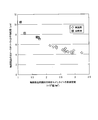
- FIG. 3 shows the number density of spherical cementite having a particle diameter of 0.50 ⁇ m to 3.00 ⁇ m in the steel for bearing parts after spheroidizing heat treatment, and the old austenite of the bearing part obtained through the subsequent quenching and tempering processes.
- the relationship of the average particle diameter of is shown.
- the number density of spherical cementite (particle diameter of 0.5 ⁇ m to 3.0 ⁇ m) of the steel for bearing parts is 2.0 ⁇ 10 6 pieces / mm 2 or more
- the average grain size of the prior austenite of the bearing parts is reduced to 6.0 ⁇ m or less.
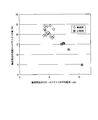
- FIG. 4 shows the relationship between the average grain size of the prior austenite of the bearing part and the amount of retained austenite of the bearing part.
- the amount of retained austenite is 18% or more in volume%.
- the average grain size of the prior austenite exceeds 6.0 ⁇ m, the amount of retained austenite is reduced to less than 18% in volume%.
- Fig. 5 shows the relationship between the amount of retained austenite in the bearing parts and the rolling fatigue life in a foreign matter mixed environment.
- the rolling fatigue life of the bearing component in a foreign matter mixed environment is good.
- the rolling fatigue life of the bearing component in a foreign matter mixed environment decreases.
- the rolling fatigue life of the bearing component is lowered.
- the number density of spherical cementite is more preferably 0.5 ⁇ 10 6 pieces / mm 2 or more.
- the average particle diameter of spherical cementite in the bearing component exceeds 0.45 ⁇ m, the occurrence and progress of fatigue cracks are promoted. Therefore, it is necessary that the average particle diameter of the spherical cementite in the bearing component is 0.45 ⁇ m or less. On the other hand, in consideration of normal operating conditions, it is difficult to make it less than 0.10 ⁇ m.
- Spherical cementite is usually upon heating to more than one point A at the time of quenching, in order to solid solution in the austenite phase as a matrix phase, the number density of the spherical cementite bearing parts, than bearing component steel material which is a material Decrease. If the heating temperature of the quenching process is lowered, the number density of spherical cementite of the bearing part increases, but the amount of retained austenite of the bearing part decreases. Therefore, the rolling fatigue life of the bearing component in an environment where foreign matter is mixed is reduced.
- the present inventors increase the number density of spherical cementite having a particle size of 0.5 ⁇ m to 3.0 ⁇ m in the steel for bearing parts before quenching to 2.0 ⁇ 10 6 pieces / mm 2 or more.
- the number density of spherical cementite having an average particle size of 0.45 ⁇ m or less can be secured at 0.45 ⁇ 10 6 pieces / mm 2 or more in the bearing parts after quenching.
- FIG. 6 shows the relationship between the number density of spherical cementite having a predetermined size of the bearing component and the rolling fatigue life of the bearing component. As shown in FIG. 6, when the number density of spherical cementite having an average particle diameter of 0.45 ⁇ m or less is 0.45 ⁇ 10 6 pieces / mm 2 or more, the rolling fatigue life of the bearing component is good.
- the number density of spherical cementite having a predetermined size is determined as follows.
- the steel material for bearing parts and the bearing parts are cut at the center in the longitudinal direction in a cross section perpendicular to the longitudinal direction.
- the cut C cross section is mirror-polished, and the central part of the C cross section is observed with a scanning electron microscope (SEM) at a magnification of 5000 times, and photographs of 10 fields of view are taken.
- SEM scanning electron microscope
- the number density of spherical cementite having a predetermined size is obtained by measuring the number of spherical cementite having a predetermined size in each field of view and dividing the number by the field area.
- the central part of the C cross section is a circular area having a radius of 3 mm from the central point of the C cross section, and the observation visual field is 0.02 mm 2 .
- the metal structure of the bearing component according to this embodiment will be described.
- the metal structure of the bearing component according to the present embodiment is retained austenite, spherical cementite, and martensite.
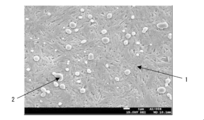
- FIG. 1 the SEM photograph of the metal structure of the bearing component which concerns on this embodiment is shown.
- the SEM photograph in FIG. 1 is a structure in which spherical cementite 2 is precipitated on martensite 1. Since retained austenite cannot be observed by SEM, it is determined by the ratio of the diffraction intensity with martensite using the X diffraction method (XRD).
- XRD X diffraction method
- the retained austenite is 18% to 25% by volume.
- the total of martensite and spherical cementite is preferably 75% to 82% by volume ratio, by subtracting residual austenite from the total volume.
- the metal structure of the steel for bearing parts according to this embodiment will be described.
- the metal structure of the steel material for bearing parts according to the present embodiment includes spherical cementite and ferrite. However, in order to obtain the rolling fatigue life and hardness of the bearing parts, it is preferable that the steel for bearing parts does not contain a structure other than spherical cementite and ferrite.
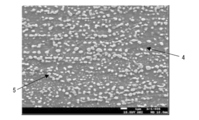
- FIG. 2 the SEM photograph of the metal structure of the steel for bearing parts after the spheroidizing heat treatment according to the present embodiment is shown.
- the SEM photograph in FIG. 2 is a structure in which spherical cementite 5 is precipitated on ferrite 4.
- C 0.95% to 1.10%
- C (carbon) is an element that increases the strength. If the C content is less than 0.95%, the strength of the bearing parts and the rolling fatigue life in an environment where foreign matter is mixed cannot be improved. On the other hand, when the C content exceeds 1.10%, the carbides become coarse, the amount of retained austenite becomes excessive, and not only the hardness of the bearing parts decreases, but also the aging of the dimensions (aging deterioration). Becomes larger. Therefore, the C content is set to 0.95% to 1.10%. In order to obtain the effect of improving the rolling fatigue life more reliably, the C content is preferably 0.96% to 1.05%. More preferably, it is 0.97% to 1.03%.
- Si 0.10% to 0.70%
- Si is an element that increases strength and functions as a deoxidizer. If the Si content is less than 0.10%, these effects cannot be obtained. On the other hand, when the Si content exceeds 0.70%, SiO 2 -based inclusions are generated in the steel material, and the rolling fatigue life of the bearing component is reduced. Therefore, the Si content is set to 0.10% to 0.70%. In order not to reduce the rolling fatigue life more reliably, the Si content is preferably 0.12% to 0.56%. More preferably, it is 0.15% to 0.50%.
- Mn 0.20% to 1.20%
- Mn manganese
- Mn is an element that functions as a deoxidizer and a desulfurizer. Furthermore, it is an element useful for securing the hardenability of steel and the amount of retained austenite. If the Mn content is less than 0.20%, deoxidation becomes insufficient, oxides are generated, and the rolling fatigue life of the bearing component is reduced. On the other hand, when the Mn content exceeds 1.20%, a supercooled structure such as martensite is generated during cooling after hot rolling, which causes generation of voids during wire drawing. Furthermore, if the Mn content exceeds 1.20%, the amount of retained austenite becomes excessive, and the hardness of the bearing component decreases. Therefore, the Mn content is set to 0.20% to 1.20%. The Mn content is preferably 0.21% to 1.15% in order to more reliably deoxidize and not reduce the rolling fatigue life. More preferably, it is 0.25% to 1.00%.
- Cr 0.90% to 1.60%
- Cr chromium
- Cr is an element that improves the hardenability of the steel material. Furthermore, it is an extremely effective element that promotes the spheroidization of carbides and increases the amount of carbides. If the Cr content is less than 0.90%, the amount of C dissolved in austenite increases, and excessive austenite is generated in the bearing component. On the other hand, if the Cr content exceeds 1.60%, dissolution of carbides is suppressed during quenching, leading to a decrease in the amount of retained austenite and a decrease in the hardness of bearing parts. Therefore, the Cr content is set to 0.90% to 1.60%. In order to improve the rolling fatigue life of the bearing component more reliably, the Cr content is preferably 0.91% to 1.55%. More preferably, it is 1.10% to 1.50%. Most preferably, it is 1.30% to 1.50%.
- Al 0.010% to 0.100%
- Al (aluminum) is a deoxidizing element.
- the Al content is set to 0.010% to 0.100%.
- the Al content is preferably 0.015% to 0.078%. More preferably, it is 0.018% to 0.050%.
- N 0.003% to 0.030%
- N forms nitrides with Al and B. These nitrides function as pinning particles and refine the crystal grains. Therefore, N (nitrogen) is an element that suppresses the coarsening of crystal grains. If the N content is less than 0.003%, this effect cannot be obtained. On the other hand, if the N content exceeds 0.030%, coarse inclusions are generated and the rolling fatigue life is reduced. Therefore, the N content is set to 0.003% to 0.030%. In order not to lower the rolling fatigue life more reliably, the N content is preferably 0.005% to 0.029%. More preferably, it is 0.009% to 0.020%.
- P 0.025% or less
- P (phosphorus) is an unavoidable impurity.
- the P content exceeds 0.025%, segregation occurs at the austenite grain boundaries, embrittles the austenite grain boundaries, and reduces the rolling fatigue life of the bearing component. Therefore, the P content is limited to 0.025% or less.
- the P content may be limited to 0.020% or less, and further 0.015% or less.
- 0% is included in the above limit range.
- the lower limit value of the P content may be 0.001%. Considering normal operating conditions, the P content is preferably 0.004% to 0.012%.
- S 0.025% or less S (sulfur) is an unavoidable impurity. If the S content exceeds 0.025%, coarse MnS is formed, and the rolling fatigue life of the bearing component is reduced. Therefore, the S content is limited to 0.025% or less. In order not to lower the rolling fatigue life more reliably, the S content may be limited to 0.020% or less, and further 0.015% or less. The smaller the S content, the better. Therefore, 0% is included in the above limit range. However, it is not technically easy to reduce the S content to 0%. Therefore, from the viewpoint of steelmaking cost, the lower limit value of the S content may be 0.001%. In consideration of normal operating conditions, the S content is preferably 0.003% to 0.011%.
- O oxygen
- oxygen is an unavoidable impurity.
- the O content exceeds 0.0010%, oxide inclusions are formed, and the rolling fatigue life of the bearing parts is reduced. Therefore, the O content is limited to 0.0010% or less.
- the lower limit value of the O content may be 0.0001%.
- the O content is preferably 0.0005% to 0.0010%.
- At least one of Mo, B, Cu, Ni, and Ca may be selectively added to the bearing component according to the present embodiment.
- one or more of Mo, B, Cu and Ni for improving the hardenability and Ca for refining inclusions can be selected. Since these chemical elements do not necessarily need to be added to the steel for bearing parts and the bearing parts, the lower limits of these chemical elements are all 0% and are not limited. Below, the preferable range of these components and the reason are demonstrated. Here, the described% is mass%.
- Mo 0.25% or less Mo is an element that improves hardenability. Moreover, it has the effect
- the Mo content is preferably set to 0.01% or more. However, when the Mo content exceeds 0.25%, these effects are saturated. Therefore, the Mo content is preferably 0.01% to 0.25%. More preferably, the Mo content is 0.01% to 0.23%. More preferably, it is 0.10% to 0.23%.
- B 0.0050% or less
- B is an element that improves hardenability in a small amount. It also has an effect of suppressing the segregation of P and S at the austenite grain boundary during quenching.
- the B content is preferably 0.0001% or more. However, when the B content exceeds 0.0050%, these effects are saturated. Therefore, the B content is preferably 0.0001% to 0.0050%. More preferably, the B content is 0.0003% to 0.0050%. More preferably, it is 0.0005% to 0.0025%, and most preferably 0.0010% to 0.0025%.
- Cu 1.0% or less
- Cu is an element that improves hardenability.
- the Cu content is preferably 0.05% or more.
- the Cu content is preferably 0.05% to 1.0%. More preferably, the Cu content is 0.10% to 0.50%. More preferably, it is 0.19% to 0.31%.
- Ni 3.0% or less
- Ni is an element that improves hardenability. Moreover, it has the effect
- the Ni content is preferably 0.05% or more. However, this effect is saturated when the Ni content exceeds 3.0%. Therefore, the Ni content is preferably 0.05% to 3.0%. More preferably, the Ni content is 0.10% to 1.5%. More preferably, it is 0.21% to 1.2%. Most preferably, it is 0.21% to 1.0%.
- Ca 0.0015% or less
- Ca is an element that forms a solid solution in sulfides to form CaS and refines sulfides.
- the Ca content is preferably 0.0003% or more. However, this effect is saturated when the Ca content exceeds 0.0015%. Furthermore, when the oxide inclusions are coarsened, the rolling fatigue life is reduced. Therefore, the Ca content is preferably 0.0003% to 0.0015%. More preferably, the Ca content is 0.0003% to 0.0011%. More preferably, it is 0.0005% to 0.0011%.
- the bearing component and the steel for bearing component according to the present embodiment contain the above components, and the balance of the chemical composition is substantially composed of Fe and inevitable impurities.
- the metal structure of the bearing component according to this embodiment will be described.
- the metal structure of the bearing component according to the present embodiment is retained austenite, spherical cementite, and martensite.
- the amount of retained austenite is 18% to 25% in volume%.
- the average particle size of spherical cementite is 0.45 ⁇ m or less
- the number density of spherical cementite is 0.45 ⁇ 10 6 pieces / mm 2 or more is necessary.
- the number density of spherical cementite is preferably 0.5 ⁇ 10 6 pieces / mm 2 or more.
- the upper limit of the number density of spherical cementite is not specifically limited, 1.0 x 10 ⁇ 6 > pieces / mm ⁇ 2 > is preferable from a viewpoint of ensuring the restrictions on manufacture and a rolling fatigue life. Moreover, even if the average particle diameter of the spherical cementite is excessively refined, the effect of improving the fatigue life is small, and the production becomes difficult. Therefore, the average particle diameter of spherical cementite in the bearing component is preferably 0.25 ⁇ m or more. That is, the preferable average particle diameter of spherical cementite of the bearing component according to the present embodiment is 0.25 ⁇ m to 0.45 ⁇ m.
- the average particle diameter of spherical cementite is obtained by the following method. First, at the center in the longitudinal direction of the bearing component, a section (C section) perpendicular to the longitudinal direction is cut. A range with a radius of 3 mm from the center of the C cross section is taken as a central portion, and the central portion is photographed with a field of view of 2000 times using an SEM. Then, using a tracing sheet or the like from the photographed image, spherical cementite was projected, and the sheet was subjected to image analysis to measure the particle size of cementite.
- the average grain size of the prior austenite of the bearing component according to the present embodiment is set to 6.0 ⁇ m or less.
- the average particle diameter of prior austenite exceeds 6.0 ⁇ m, the required amount of retained austenite cannot be obtained.
- the average particle diameter of the prior austenite in the bearing component is preferably 3.0 ⁇ m or more. That is, the average particle diameter of the prior austenite of the bearing component according to this embodiment is preferably 3.0 ⁇ m to 6.0 ⁇ m.
- the metal structure of the steel for bearing parts that is the material for the bearing part according to the present embodiment will be described.
- the metal structure of the steel material for bearing parts according to the present embodiment includes spherical cementite and ferrite.
- the number density of spherical cementite having a particle diameter of 0.5 ⁇ m to 3.0 ⁇ m is 2.0 ⁇ 10 6 pieces / mm 2 or more.
- the upper limit of the number density of the spherical cementite is not particularly limited, but 5.0 ⁇ 10 6 pieces / mm 2 is preferable from the viewpoint of securing manufacturing restrictions and rolling fatigue life.
- a hot-rolled wire has the same chemical composition as the bearing component. And it is preferable to have the structure
- the size of the pearlite block has a very strong correlation with the ductility. That is, wire drawing workability is improved by making pearlite fine.
- the average particle size (equivalent circle diameter) of the pearlite block is preferably 15 ⁇ m or less.
- the average particle diameter of the pearlite block exceeds 15 ⁇ m, the effect of improving the wire drawing workability may not be obtained.
- the average particle diameter (equivalent circle diameter) of the pearlite block can be measured using an electron backscattering diffractometer (EBSD).
- EBSD electron backscattering diffractometer
- pro-eutectoid cementite has a small plastic deformability. Therefore, it is divided by wire drawing and becomes a factor for forming voids. If the area ratio of pro-eutectoid cementite is low and the thickness is small, the wire drawing workability is not hindered. Accordingly, the area ratio of pro-eutectoid cementite is preferably 5% or less and the thickness is preferably 1.0 ⁇ m or less. More preferably, the area ratio of pro-eutectoid cementite is 3% or less and the thickness is 0.8 ⁇ m or less. The area ratio and thickness of pro-eutectoid cementite can be measured by SEM observation.
- the bearing component By satisfying the above-described chemical component and metal structure, it is possible to obtain a bearing component having an excellent rolling fatigue life even in a foreign matter mixed environment.
- the bearing component may be manufactured by a manufacturing method described later. Next, the preferable manufacturing method of the bearing component which concerns on this embodiment, and the steel material for bearing components is demonstrated.
- the bearing component according to the present embodiment can be manufactured as follows.
- the manufacturing method of the bearing component demonstrated below, the steel material for bearing components used as the raw material, and the manufacturing method of the hot rolled wire used as the raw material of the steel material for the bearing component are examples for obtaining the bearing component of the present invention.
- the present invention is not limited by the following procedures and methods, and any method can be adopted as long as the configuration of the present invention can be realized.
- Ordinary production conditions can be employed in the method for producing a hot-rolled wire material used as a material for steel for bearing parts.
- a steel whose component composition is adjusted by a conventional method is melted and cast, and subjected to a soaking process and a block rolling as necessary to obtain a steel slab.
- the obtained steel slab is heated and subjected to hot rolling. And after winding up in a ring shape, it cools.
- the hot-rolled wire used as the raw material for the bearing member steel according to the present embodiment can be manufactured through the above steps.
- the casting method is not particularly limited, and a vacuum casting method, a continuous casting method, or the like may be used.
- uniform-heating diffusion process) performed with respect to the slab after a casting process is a heat processing for reducing the segregation which generate
- the steel slab obtained through these steps is generally called a billet.
- the heating temperature in the soaking process is preferably 1100 ° C. to 1200 ° C.
- the holding time is preferably 10 to 20 hours.
- the heating temperature of the steel slab is preferably 900 ° C. to 1300 ° C.
- the finish rolling temperature is preferably 850 ° C. or lower.
- the proeutectoid cementite can be dispersed and precipitated, thereby reducing the thickness of the proeutectoid cementite and increasing the number of pearlite nucleation sites during transformation.
- the pearlite block can be miniaturized.
- a more preferable finish rolling temperature is 800 ° C. or less.
- the finish rolling temperature is preferably 650 ° C. or higher.
- the temperature of the steel slab during hot rolling can be measured with a radiation thermometer.
- a steel material that has been subjected to a hot rolling process that is, a steel material after finish rolling, which is a material for the steel material for bearing parts, is generally called a hot-rolled wire.
- the hot rolled wire is wound into a ring shape at 800 ° C. or lower.
- This process is generally called a winding process.
- the winding temperature in the winding process is high, austenite may grow and the pearlite block may become coarse. Therefore, the winding temperature is preferably 800 ° C. or less. A more preferable winding temperature is 770 ° C. or lower.
- the winding temperature is preferably 650 ° C. or higher.
- the rolled wire is cooled to 600 ° C.
- This process is generally called a cooling process.
- the cooling rate to 600 ° C. is preferably 0.5 ° C./s to 3.0 ° C./s.
- the cooling rate after winding may affect the transformation from austenite to pearlite. Therefore, in order to suppress precipitation of supercooled structures such as martensite and bainite, the cooling rate after winding is preferably 3.0 ° C./s or less. More preferably, it is 2.3 ° C./s or less.
- the cooling rate after winding may affect the precipitation of pro-eutectoid cementite. Therefore, in order to suppress excessive precipitation and coarsening of pro-eutectoid cementite, the cooling rate after winding is preferably 0.5 ° C./s or more. More preferably, it is 0.8 ° C./s or more.
- a normal method for manufacturing a bearing component has a spheroidizing heat treatment step before the wire drawing, but the steel for bearing parts according to the present embodiment does not have a spheroidizing heat treatment step before the wire drawing. That is, the hot-rolled wire obtained through the above steps is subjected to wire drawing with a total area reduction of 50% or more without being subjected to spheroidizing heat treatment.
- the steel for bearing parts is manufactured by performing spheroidizing heat treatment at a temperature not lower than 650 ° C., 750 ° C., or A 1 point ⁇ 5 ° C., whichever is lower. Thereafter, after the obtained steel for bearing parts is formed, a quenching process and a tempering process are performed to obtain a bearing part.
- the cementite can be spheroidized at a low temperature for a short time, the average particle diameter of the spherical cementite of the steel for bearing parts can be made fine, and the number density can be increased. Since the steel for bearing parts manufactured in this way has a sufficient number of spherical cementite, the average particle size of austenite at the time of quenching can be refined.
- the amount of retained austenite of the bearing component can be ensured, and the prior austenite particle size of the bearing component is also reduced. If the total area reduction is less than 50%, a predetermined amount of retained austenite cannot be secured in the steel for bearing parts, and spheroidization of cementite becomes insufficient, resulting in refinement of old austenite of bearing parts. You may not be able to. On the other hand, if the total area reduction rate exceeds 97%, disconnection may occur during wire drawing. Therefore, the total area reduction is preferably 50% to 97%.
- the heating temperature of the spheroidizing heat treatment after the wire drawing is set to be less than 750 ° C. and not more than A 1 -5 ° C. in order to increase the number density of spherical cementite of the steel for bearing parts.
- the number of spheroidizing heat treatments is one.
- the heating is preferably performed at a temperature lower than 750 ° C.
- the heating temperature of the spheroidizing heat treatment after wire drawing is lower than 650 ° C., cementite spheroidization becomes insufficient in the steel for bearing parts, and the pearlite remains as it is. Therefore, at the time of quenching, there is a possibility that the austenite grain size becomes coarse, the hardness increases, and the workability of the bearing component decreases. Therefore, the heating temperature of the spheroidizing heat treatment after wire drawing is preferably 650 ° C. or higher. That is, the heating temperature of the spheroidizing heat treatment is 650 ° C.
- a 1 is the temperature at which the A 1 transformation starts, and the unit is Celsius temperature (° C.).
- a 1 can be simply calculated from the following formula 1 based on chemical components. In the formula, [C], [Si], [Mn], [Cu], [Ni], [Cr], [Mo], [Al] and [B] are mass% and are hot-rolled wire rods. It is C content, Si content, Mn content, Cu content, Ni content, Cr content, Mo content, Al content and B content.
- the steel for bearing parts after the spheroidizing heat treatment is formed (rough forming), and then subjected to a quenching process.
- the heating temperature for quenching is preferably 820 ° C. or higher in order to dissolve a certain amount of cementite in austenite.
- the heating temperature for quenching is less than 820 ° C., cementite is not sufficiently dissolved in austenite, and the hardness of the bearing component may be reduced.
- the heating temperature for quenching exceeds 890 ° C., the average grain size of the prior austenite in the bearing component may become coarse. Therefore, the heating temperature for quenching is preferably 820 ° C.
- the holding time in the quenching treatment is preferably 0.5 to 2 hours. If the holding time is less than 0.5 hours, the cementite is not sufficiently dissolved in austenite. If the retention time is longer than 2 hours, cementite is decomposed and C is excessively dissolved in austenite, increasing the retained austenite in the bearing parts. Or the average particle size of the prior austenite may become coarse.
- the tempering temperature in the tempering treatment is preferably performed at 150 ° C. or higher for ensuring toughness and adjusting the hardness. If the tempering temperature is less than 150 ° C., the toughness of the bearing component may not be ensured. On the other hand, when the tempering temperature exceeds 250 ° C., the hardness of the bearing component is lowered, and the rolling fatigue life may be reduced. Therefore, the tempering temperature is preferably 150 ° C. to 250 ° C.
- the holding time in the tempering treatment is preferably 0.5 to 3 hours. If the holding time is less than 0.5 hours, the toughness of the bearing parts may not be ensured, and even if tempering is performed for more than 3 hours, there is no change in characteristics, and productivity is only reduced. .
- a bearing component is obtained by finishing the steel for bearing component after the tempering treatment.
- the metal structure of the bearing part and the metal structure of the steel for the bearing part can be within the scope of the present invention.
- the conditions in the examples are one example of conditions used for confirming the feasibility and effects of the present invention, and the present invention is not limited to the following examples.
- the present invention can be implemented with appropriate modifications within a range that can be adapted to the gist. Therefore, the present invention can employ various conditions, all of which are included in the technical features of the present invention.
- Hot rolling having the structures described in Table 2-1 and Table 2-2 is performed by subjecting wires and rods having the components shown in Table 1-1 and Table 1-2 to heat treatment and hot forging. Wire was used. Using this hot-rolled wire rod, wire drawing was performed in a cold state until the diameter became 10 mm. Next, the drawn hot-rolled wire rod was cut so that the length in the longitudinal direction was 10 mm (to a length of 10 mm). Then, the cut hot rolled wire is subjected to spheroidizing heat treatment for 0.5 to 3 hours at the spheroidizing temperatures shown in Table 2-1 and Table 2-2 to adjust to a structure containing spherical cementite and ferrite. And it was set as the steel material for bearing parts.
- This steel material for bearing parts was molded into a spherical shape of ⁇ 9.5 mm. Then, after performing a quenching process and a tempering process, a finishing process was performed to manufacture a bearing part.
- the quenching treatment was performed at the quenching temperatures shown in Table 2-1 and Table 2-2, the holding time of the quenching treatment was 60 minutes, and the cooling was oil-cooled.
- tempering treatment was performed at the tempering temperatures shown in Table 2-1 and Table 2-2, and the tempering holding time was 90 minutes.
- Table 2 shows the structure of the hot-rolled wire, the area reduction rate during the wire drawing, the temperature of the quenching treatment, and the tempering treatment.
- the structure of the hot-rolled wire rod, the steel for bearing parts, and the structure of the bearing parts were evaluated using an optical microscope. And the average particle diameter (micrometer) of the prior austenite of a bearing component was measured using SEM. Moreover, the measurement of the average particle diameter (micrometer) and number density (pieces / mm ⁇ 2 >) of the spherical cementite of the steel for bearing components and a bearing component was performed by SEM. Further, the X-ray diffraction method was used to measure the amount (volume%) of retained austenite of the bearing component.
- a radial fatigue tester was used to measure the rolling fatigue life of the bearing parts. Normal rolling fatigue life was tested only with lubricating oil. Further, the rolling fatigue life was measured in a foreign matter mixed environment in which 1 g of iron powder having a hardness of 750 Hv to 800 Hv and a particle size of 100 ⁇ m to 180 ⁇ m was mixed with 1 L of lubricating oil. The measured rolling fatigue life was determined by a Weibull statistical process for a cumulative failure probability of 10%. The rolling fatigue life under normal and foreign matter environment is the same component as SUJ2, and is based on the life of B1 produced by the current manufacturing method. Tables 2-1 and 2-2 show the ratio to the life. It was expressed as
- Tables 2-1 and 2-2 show the evaluation results of material structure, manufacturing method, bearing part structure and rolling fatigue life.
- A1 to A19 are within the appropriate range of the present invention, and the normal rolling fatigue life ratio is 1.5 times or more that of B1, and the rolling fatigue in an environment containing foreign matter is present. The life was more than twice that of B1, and had an excellent fatigue life.
- the metal structure of the steel for bearing parts was composed of spherical cementite and ferrite. Further, the metal structures of the bearing parts were both composed of spherical cementite and martensite.
- A20 to A38, B1, and B2 are comparative examples. Since A20 to A38, B1, and B2 do not satisfy either or both of the chemical composition and the structure of the bearing part defined in the present invention, the rolling fatigue life is equal to or inferior to that of the prior art. It was.
- the chemical composition of A20 to A31 was out of the range of the present invention example. Since A20 has a low C content, the number density of spherical cementite in the steel for bearing parts was small. Therefore, during quenching, the average grain size of austenite is coarsened, the amount of retained austenite is insufficient, and the rolling fatigue life of the bearing parts in a foreign matter mixed environment is reduced. Further, since the C content is small, the number density of spherical cementite was insufficient even in bearing parts. Further, when the amount of C is small, the strength at the time of quenching is also small, so that the rolling fatigue life is lowered even in a normal environment. On the other hand, A21 had an excessive C content. Therefore, the amount of retained austenite and the average particle diameter of spherical cementite became excessive, and the normal rolling fatigue life was not improved.
- A23 had an excessive Mn content. For this reason, due to martensite in the steel for bearing parts, cracks are generated at the time of wire drawing, and the rolling fatigue life of the bearing parts is reduced both under normal conditions and in a foreign matter mixed environment. Further, since the wire drawing workability is lowered, a sufficient wire drawing amount cannot be secured. Therefore, in the spheroidizing heat treatment, the number density of spherical cementite was reduced. Therefore, a sufficient pinning effect could not be ensured, and the average austenite grain size became coarse during the quenching process. Moreover, since the steel for bearing parts has a small amount of spherical cementite, the number density of spherical cementite in the bearing parts after quenching was insufficient.
- A22 had an excessive Si content
- A26 had an excessive Al content
- A30 had an excessive O content.
- the rolling fatigue life was inferior to that of the prior art in both normal and foreign matter mixed environments.
- A28 had an excessive S content, and due to sulfides, the rolling fatigue life was inferior to that of the prior art in both normal and foreign matter mixed environments.
- A31 has an excessive N content, and due to the nitride, the rolling fatigue life was inferior to that of the conventional one in both normal and foreign matter mixed environments.
- the P content was excessive, the grain boundary became brittle, and the rolling fatigue life was reduced in both normal and foreign matter-contaminated environments.
- A32 to A38 are within the scope of the present invention, but the structure of the bearing parts is outside the scope of the present invention. Since A32 and A33 have a low total area reduction rate during wire drawing, some pearlite structures were not spheroidized during the spheroidizing heat treatment, and the number density of spherical cementite in the steel for bearing parts was reduced. For this reason, the average austenite grain size was coarsened during the quenching treatment, so the amount of retained austenite was insufficient. And the number density of the spherical cementite of the bearing parts also decreased, and the rolling fatigue life in an environment containing foreign matter was insufficient.
- A34 had a low heating temperature during the spheroidizing heat treatment, so that part of the pearlite structure was not spheroidized during the spheroidizing heat treatment, and the number density of spherical cementite in the steel for bearing parts was reduced. Therefore, since the average particle size of austenite was coarsened during the quenching process, the amount of retained austenite in the bearing component was reduced. Furthermore, the number density of spherical cementite in the bearing parts has also decreased, and the rolling fatigue life in an environment with foreign matter has been insufficient.
- A36 had a low heating temperature at the time of quenching, so the content of dissolved C was lowered and the amount of retained austenite was insufficient. Therefore, the rolling fatigue life in the environment where foreign matter is mixed is insufficient.
- the heating temperature for quenching was high, and cementite was excessively dissolved, so the amount of retained austenite was excessive and the number density of spherical cementite was also reduced. Therefore, the normal rolling fatigue life has been reduced.
- B1 and B2 are current materials that have been subjected to spheroidizing heat treatment before wire drawing.
- B1 has a small number density of spherical cementite of the steel for bearing parts. For this reason, the average particle size of austenite during the quenching treatment is coarsened, the amount of retained austenite is reduced, and the spherical cementite number density of the bearing parts is reduced. And the rolling fatigue life in a foreign material mixing environment was low. Further, B2 had an increased amount of retained austenite compared to B1 due to an increase in the Mn content, etc., but the number density of spherical cementite of the bearing parts was small, so the normal fatigue life characteristics were insufficient. .
- the content of Mn is suppressed, the spheroidizing heat treatment is shortened, and the rolling fatigue life including in a foreign matter mixed environment is achieved. Since excellent bearing parts can be obtained, industrial applicability is high.
Landscapes
- Chemical & Material Sciences (AREA)
- Engineering & Computer Science (AREA)
- Mechanical Engineering (AREA)
- Organic Chemistry (AREA)
- Materials Engineering (AREA)
- Metallurgy (AREA)
- General Engineering & Computer Science (AREA)
- Thermal Sciences (AREA)
- Crystallography & Structural Chemistry (AREA)
- Physics & Mathematics (AREA)
- Manufacturing & Machinery (AREA)
- Rolling Contact Bearings (AREA)
- Heat Treatment Of Steel (AREA)
- Heat Treatment Of Strip Materials And Filament Materials (AREA)
- Heat Treatment Of Articles (AREA)
Abstract
Description
本願は、2014年1月10日に、日本に出願された特願2014-3338号及び2014年4月16日に、日本に出願された特願2014-84952に基づき優先権を主張し、これらの内容をここに援用する。
特許文献1にて開示されている軸受部品は、鋼中に、C、Mn、Ni又はMoを含有させ、マルテンサイト変態開始温度(Ms点)を下げることで、残留オーステナイトの量を確保している。しかし、残留オーステナイトの量を確保するために、Mnの鋼への添加量を増加させると、鋼材の焼入れ性が高くなる。その結果、熱間圧延後の冷却時に、マルテンサイトなどの過冷組織が生成し、熱間圧延線材の加工性や延性、靭性が低下する。
しかしながら、特許文献4にて開示されている方法は、球状化熱処理の処理時間を短縮するものではない。
(2)上記(1)に記載の軸受部品では、前記化学成分が、質量%で、Mo:0.01%~0.25%、B:0.0001%~0.0050%、Cu:0.1%~1.0%、Ni:1.0%~3.0%、Ca:0.0001%~0.0015%の1種以上を含有してもよい。
(3)本発明の一実施態様に係る軸受部品用鋼材は、化学成分が、質量%で、C:0.95%~1.10%、Si:0.10%~0.70%、Mn:0.20%~1.20%、Cr:0.90%~1.60%、Al:0.010%~0.100%、N:0.003%~0.030%を含有し、S:0.025%以下、P:0.025%以下、O:0.0010%以下に制限し、任意に、Mo:0.25%以下、B:0.0050%以下、Cu:1.0%以下、Ni:3.0%以下、Ca:0.0015%以下を含有し、残部がFe及び不純物からなり、金属組織が、球状セメンタイト及びフェライトを含み、前記金属組織において、粒径が0.5μm~3.0μmの前記球状セメンタイトの個数密度が2.0×10⁶個/mm2以上である。
(4)上記(3)に記載の軸受部品用鋼材では、前記化学成分が、質量%で、Mo:0.01%~0.25%、B:0.0001%~0.0050%、Cu:0.1%~1.0%、Ni:1.0%~3.0%、Ca:0.0001%~0.0015%の1種以上を含有してもよい。
(5)本発明の一実施態様に係る軸受部品用鋼材の製造方法は、上記(3)または(4)に記載の化学成分からなる鋼片を得る鋳造工程と;前記鋼片を900℃~1300℃の温度に加熱する加熱工程と;前記加熱工程後の前記鋼片に、850℃以下の仕上圧延温度で、熱間圧延を施して、熱間圧延線材を得る熱間圧延工程と;前記熱間圧延工程後の前記熱間圧延線材を、800℃以下の巻取温度で巻き取る巻取工程と;前記巻取工程後に3.0℃/秒以下の冷却速度で、前記熱間圧延線材を600℃まで冷却し、前記熱間圧延線材の組織をパーライトとする冷却工程と;前記冷却工程後の前記熱間圧延線材に、総減面率50%以上で伸線加工を施す伸線加工工程と;前記伸線加工工程後の前記熱間圧延線材に、650℃以上、750℃もしくはA1-5℃のどちらか低い方の温度以下で、0.5~5時間保持する球状化熱処理を行い、軸受部品用鋼材を得る球状化熱処理工程と;を有する。ここで、A1とはA1変態が開始する温度を前記化学成分から予測した値であり、下記の式1より算出される。なお、[C]、[Si]、[Mn]、[Cu]、[Ni]、[Cr]、[Mo]、[Al]及び[B]は、質量%で、前記熱間圧延線材中のC含有量、Si含有量、Mn含有量、Cu含有量、Ni含有量、Cr含有量、Mo含有量、Al含有量及びB含有量である。
A1=750.8-26.6×[C]+17.6×[Si]-11.6×[Mn]-22.9×[Cu]-23.0×[Ni]+24.1×[Cr]+22.5×[Mo]-169.4×[Al]-894.7×[B] (式1)
(6)本発明の一実施態様に係る軸受部品の製造方法は、上記(1)または(2)に記載の化学成分からなる鋼片を得る鋳造工程と;前記鋼片を900℃~1300℃の温度に加熱する加熱工程と;前記加熱工程後の前記鋼片に、850℃以下の仕上圧延温度で、熱間圧延を施して、熱間圧延線材を得る熱間圧延工程と;前記熱間圧延工程後の前記熱間圧延線材を、800℃以下の巻取温度で巻き取る巻取工程と;前記巻取工程後に3.0℃/秒以下の冷却速度で、前記熱間圧延線材を600℃まで冷却し、前記熱間圧延線材の組織をパーライトとする冷却工程と;前記冷却工程後の前記熱間圧延線材に、総減面率50%以上で伸線加工を施す伸線加工工程と;前記伸線加工工程後の前記熱間圧延線材に、650℃以上、750℃もしくはA1-5℃のどちらか低い方の温度以下で、0.5~5時間保持する球状化熱処理を行い、軸受部品用鋼材を得る球状化熱処理工程と;前記球状化熱処理工程後の前記軸受部品用鋼材を、粗成形する成形工程と;前記成形工程後の前記軸受部品用鋼材を、800℃~890℃に加熱して、焼入れ処理を行う焼入れ処理工程と;前記焼入れ処理工程後の前記軸受部品用鋼材に、250℃以下で焼戻し処理を行う焼戻し工程と;前記焼戻し処理工程後の前記軸受部品用鋼材に仕上加工を施して軸受部品を得る仕上工程とをを有する。ここで、A1とはA1変態が開始する温度を前記化学成分から予測した値であり、下記の式2より算出される。なお、[C]、[Si]、[Mn]、[Cu]、[Ni]、[Cr]、[Mo]、[Al]及び[B]は、質量%で、前記熱間圧延線材中のC含有量、Si含有量、Mn含有量、Cu含有量、Ni含有量、Cr含有量、Mo含有量、Al含有量及びB含有量である。
A1=750.8-26.6×[C]+17.6×[Si]-11.6×[Mn]-22.9×[Cu]-23.0×[Ni]+24.1×[Cr]+22.5×[Mo]-169.4×[Al]-894.7×[B] (式2)
まず、パーライト組織の熱間圧延線材(パーライト鋼)を伸線加工することによって、加工ひずみを導入する。次に、伸線加工後の熱間圧延線材に対して、従来よりも低温で球状化熱処理を施す。この球状化熱処理によって、球状セメンタイトを微細分散させることができることがわかった。そして、球状セメンタイトを微細分散させることで、球状化熱処理後の軸受部品用鋼材に対して、焼入れ処理後の旧オーステナイトの平均粒径を微細化できることがわかった。
また、本発明者らは、軸受部品の旧オーステナイト平均粒径を6.0μm以下にすることによって、残留オーステナイトの量が18%~25%に制御されることを見出した。
なお、旧オーステナイトの平均粒径は、次の方法により得られる。まず、軸受部品の長手方向の中心において、長手方向に垂直なC断面を研磨・腐食により、旧オーステナイト粒界を現出させる。次に、C断面の中心から半径3mmの範囲を中心部とし、その中心部を光学顕微鏡を用いて400倍の視野で撮影する。そして、撮影した画像からJIS G 0551に規定された計数方法により測定する。なお、サンプルごとに4視野ずつ測定し、得られた4視野の旧オーステナイト粒径の平均値を、旧オーステナイトの平均粒径とする。
図3に示すように、軸受部品用鋼材の球状セメンタイト(粒径が0.5μm~3.0μm)の個数密度が2.0×10⁶個/mm2以上の場合、焼入れ処理及び焼戻し処理後の、軸受部品の旧オーステナイトの平均粒径は微細化して、6.0μm以下となる。このように、軸受部品用鋼材の所定の大きさを有する球状セメンタイトの個数と、軸受部品の旧オーステナイト平均粒径とには、相関がある。
微細で硬質な球状セメンタイトは、鋼中に分散させると、軸受部品の強化に寄与する。そのため、所定の大きさの球状セメンタイトの個数密度が増加すると、軸受部品の転動疲労寿命や衝撃特性が向上する。本発明者らの検討の結果、球状セメンタイトの平均粒径を0.45μm以下とし、その個数密度を、0.45×10⁶個/mm2以上にすることが重要であることがわかった。球状セメンタイトの個数密度が、0.45×106個/mm2未満であると、軸受部品の転動疲労寿命は低下する。球状セメンタイトの個数密度は、より好ましくは、0.5×106個/mm2以上である。
また、軸受部品における、球状セメンタイトの平均粒径が0.45μmを超えると、疲労亀裂の発生や進展を促進させる。そのため、軸受部品における、球状セメンタイトの平均粒径を、0.45μm以下とすることが必要である。一方で、通常の操業条件を考慮すると、0.10μm未満にすることは困難である。
しかし、本発明者らは、焼入れ処理前の軸受部品用鋼材において粒径が0.5μm~3.0μmの球状セメンタイト)の個数密度を、2.0×10⁶個/mm2以上に増加させることによって、焼入れ処理後の軸受部品において、平均粒径が0.45μm以下の大きさを有する球状セメンタイトの個数密度を0.45×106個/mm2以上確保できることを見出した。
本実施形態に係る軸受部品の金属組織において、残留オーステナイトは、体積%で、18%~25%である。マルテンサイト及び球状セメンタイトの合計は、体積率で、全体の体積から、残留オーステナイトを差し引いて、75%~82%が好ましい。
C(炭素)は、強度を高める元素である。C含有量が0.95%未満では、軸受部品の強度及び異物混入環境下での転動疲労寿命を向上させることができない。一方、C含有量が1.10%を超えると、炭化物が粗大化し、また、残留オーステナイトの量が過多になり、軸受部品の硬さが低下するだけでなく、寸法の経年変化(経年劣化)が大きくなる。そのため、C含有量を0.95%~1.10%とする。より確実に、転動疲労寿命の向上効果を得るために、C含有量は、0.96%~1.05%であることが好ましい。さらに好ましくは、0.97%~1.03%である。
Si(ケイ素)は、強度を高め、かつ、脱酸剤として機能する元素である。Si含有量が0.10%未満では、これらの効果を得ることが出来ない。一方、Si含有量が0.70%を超えると、鋼材中にSiO2系介在物が生じて、軸受部品の転動疲労寿命が低下する。そのため、Si含有量を0.10%~0.70%とする。より確実に、転動疲労寿命を低下させないために、Si含有量は、0.12%~0.56%であることが好ましい。さらに好ましくは、0.15%~0.50%である。
Mn(マンガン)は、脱酸剤及び脱硫剤として機能する元素である。さらに、鋼の焼入れ性や残留オーステナイトの量を確保するために有用な元素である。Mn含有量が0.20%未満では、脱酸が不十分となってしまい、酸化物が生成して、軸受部品の転動疲労寿命が低下する。一方、Mn含有量が1.20%を超えると、熱間圧延後の冷却時にマルテンサイトなどの過冷組織が生じることによって、伸線加工時にボイドが生成する原因となる。さらに、Mn含有量が1.20%を超えると、残留オーステナイトの量が過多となり、軸受部品の硬さが低下する。そのため、Mn含有量を0.20%~1.20%とする。より確実に脱酸し、転動疲労寿命を低下させないために、Mn含有量は0.21%~1.15%であることが好ましい。さらに好ましくは、0.25%~1.00%である。
Cr(クロム)は、鋼材の焼入れ性を向上させる元素である。さらに、炭化物の球状化を促進させ、かつ、炭化物量も増加させる極めて有効な元素である。Cr含有量が0.90%未満であると、オーステナイト中に固溶するC量が増加して、軸受部品において、残留オーステナイトが過剰に生成する。一方、Cr含有量が1.60%を超えると、焼入れ時に炭化物の溶解が抑制され、残留オーステナイトの量の低下や軸受部品の硬さの低下を招く。そのため、Cr含有量を0.90%~1.60%とする。より確実に軸受部品の転動疲労寿命を向上させるために、Cr含有量は、0.91%~1.55%であることが好ましい。さらに好ましくは、1.10%~1.50%である。最も好ましくは、1.30%~1.50%である。
Al(アルミニウム)は脱酸元素である。Al含有量が0.010%未満であると、脱酸が不十分となり、酸化物が析出することによって、軸受部品の転動疲労寿命が低下する。一方、Al含有量が0.100%を超えると、AlO系介在物が発生し、軸受部品用鋼材の伸線加工性の低下や軸受部品の転動疲労寿命が低下する。そのため、Al含有量を0.010%~0.100%とする。より確実に転動疲労寿命を低下させないために、Al含有量は、0.015%~0.078%であることが好ましい。さらに好ましくは、0.018%~0.050%である。
Nは、AlやBと窒化物を形成する。これらの窒化物は、ピン止め粒子として機能して結晶粒を細粒化する。それゆえ、N(窒素)は結晶粒の粗大化を抑制する元素である。N含有量が0.003%未満であると、この効果を得ることができない。一方、N含有量が0.030%を超えると、粗大な介在物が生成して、転動疲労寿命が低下する。そのため、N含有量を0.003%~0.030%とする。より確実に転動疲労寿命を低下させないために、N含有量は、0.005%~0.029%が好ましい。さらに好ましくは、0.009%~0.020%である。
P(リン)は不可避的に含有される不純物である。P含有量が0.025%を超えると、オーステナイト粒界に偏析して、オーステナイト粒界を脆化させて、軸受部品の転動疲労寿命を低下させる。そのため、P含有量を0.025%以下に制限する。より確実に転動疲労寿命を低下させないために、P含有量を0.020%以下、さらに0.015%以下に制限してもよい。また、P含有量は少ないほど望ましいので、上記制限範囲に0%が含まれる。ただし、P含有量を0%にするのは、技術的に容易ではない。そのため、製鋼コストの観点から、P含有量の下限値は0.001%としてもよい。通常の操業条件を考慮すると、P含有量は、0.004%~0.012%が好ましい。
S(硫黄)は不可避的に含有される不純物である。S含有量が0.025%を超えると、粗大なMnSが形成され、軸受部品の転動疲労寿命を低下させる。そのため、S含有量を0.025%以下に制限する。より確実に転動疲労寿命を低下させないために、S含有量を0.020%以下、さらに0.015%以下に制限してもよい。S含有量は少ないほど望ましいので、上記制限範囲に0%が含まれる。ただし、S含有量を0%にするのは、技術的に容易ではない。そのため、製鋼コストの観点から、S含有量の下限値は0.001%としてもよい。通常の操業条件を考慮すると、S含有量は、0.003%~0.011%が好ましい。
O(酸素)は不可避的に含有される不純物である。O含有量が0.0010%を超えると、酸化物系介在物が形成されて、軸受部品の転動疲労寿命が低下する。そのため、O含有量を0.0010%以下に制限する。O含有量は少ないほど望ましいので、上記制限範囲に0%が含まれる。ただし、O含有量を0%にするのは、技術的に容易ではない。そのため、製鋼コストの観点から、O含有量の下限値は0.0001%としてもよい。通常の操業条件を考慮すると、O含有量は、0.0005%~0.0010%が好ましい。
以下に、これら成分の好ましい範囲とその理由とについて説明する。ここで、記載する%は、質量%である。
Moは、焼入れ性を向上させる元素である。また、焼入れを施した鋼材の粒界強度を高めて、靭性を向上させる作用を有する。より確実に、焼入れ性と靭性とを確保したい場合には、Mo含有量を0.01%以上とすることが好ましい。しかしながら、Mo含有量が0.25%を超えると、これらの効果は飽和する。そのため、Mo含有量は、0.01%~0.25%が好ましい。より好ましくは、Mo含有量は、0.01%~0.23%である。さらに好ましくは、0.10%~0.23%である。
Bは、微量で焼入れ性を向上させる元素である。また、焼入れ時のオーステナイト粒界におけるPやSの偏析を抑制する効果も有する。このような効果を得たい場合には、B含有量を0.0001%以上とすることが好ましい。しかしながら、B含有量が0.0050%を超えると、これらの効果は飽和する。そのため、B含有量は、0.0001%~0.0050%が好ましい。より好ましくは、B含有量は、0.0003%~0.0050%である。さらに好ましくは、0.0005%~0.0025%であり、最も好ましくは、0.0010%~0.0025%である。
Cuは、焼入れ性を向上させる元素である。より確実に焼入れ性を確保したい場合には、Cu含有量を0.05%以上とすることが好ましい。しかしながら、Cu含有量が1.0%を超えると、この効果が飽和し、さらに熱間加工性が低下する。そのため、Cu含有量は、0.05%~1.0%が好ましい。より好ましくは、Cu含有量は、0.10%~0.50%である。さらに好ましくは、0.19%~0.31%である。
Niは、焼入れ性を向上させる元素である。また、焼入れを施した鋼材の靭性を向上させる作用を有する。より確実に焼入れ性と靭性とを確保したい場合には、Ni含有量を0.05%以上とすることが好ましい。しかしながら、Ni含有量が3.0%を超えると、この効果は飽和する。そのため、Ni含有量は、0.05%~3.0%が好ましい。より好ましくは、Ni含有量は、0.10%~1.5%である。さらに好ましくは、0.21%~1.2%である。最も好ましくは、0.21%~1.0%である。
Caは、硫化物中に固溶しCaSを形成し、硫化物を微細化させる元素である。硫化物の微細化により、転動疲労寿命をさらに向上させたい場合には、Ca含有量を0.0003%以上とすることが好ましい。しかしながら、Ca含有量が0.0015%を超えると、この効果が飽和する。さらに、酸化物系介在物が粗大化することによって、転動疲労寿命の低下を招く。そのため、Ca含有量は、0.0003%~0.0015%が好ましい。より好ましくは、Ca含有量は、0.0003%~0.0011%である。さらに好ましくは、0.0005%~0.0011%である。
本実施形態に係る軸受部品の金属組織は、残留オーステナイト、球状セメンタイト及びマルテンサイトである。
そのうち、残留オーステナイトの量は、体積%で、18%~25%である。異物混入環境下であっても、転動疲労寿命を向上させるためには、残留オーステナイト量を18%~25%とし、球状セメンタイトの平均粒径を0.45μm以下とし、球状セメンタイトの個数密度を0.45×10⁶個/mm2以上とする必要がある。球状セメンタイトの個数密度は、好ましくは0.5×106個/mm2以上とする。なお、球状セメンタイトの個数密度の上限は、特に限定されないが、製造上の制約及び転動疲労寿命を確保する観点から、1.0×106個/mm2が好ましい。また、球状セメンタイトの平均粒径は過剰に微細化にしても、疲労寿命を向上させる効果は小さく、製造が困難となる。そのため、軸受部品における、球状セメンタイトの平均粒径は、好ましくは、0.25μm以上とする。つまり、本実施形態に係る軸受部品の、球状セメンタイトの好ましい平均粒径は、0.25μm~0.45μmである。
なお、球状セメンタイトの平均粒径は、次の方法により得られる。まず、軸受部品の長手方向の中心において、長手方向に垂直な断面(C断面)で切断する。このC断面の中心から半径3mmの範囲を中心部とし、その中心部をSEMを用いて2000倍の視野で撮影する。そして、撮影した画像からトレーシングシートなどを使用して、球状セメンタイトを映して、そのシートを画像解析することで、セメンタイトの粒径を測定した。なお、サンプルごとに4視野ずつ測定し、得られた4視野の球状セメンタイト粒径の平均値を、球状セメンタイトの平均粒径とする。
また、残留オーステナイトの量を確保するため、本実施形態に係る軸受部品の、旧オーステナイトの平均粒径を6.0μm以下とする。旧オーステナイトの平均粒径が6.0μmを超えると、必要とする残留オーステナイトの量が得られない。一方で、軸受部品における、旧オーステナイトの平均粒径を3.0μm以下に微細化するためには、製造負荷を高くしなければならない。そのため、軸受部品における、旧オーステナイトの平均粒径は、好ましくは3.0μm以上とする。つまり、本実施形態に係る軸受部品の、旧オーステナイトの平均粒径は、3.0μm~6.0μmが好ましい。
本実施形態に係る軸受部品用鋼材の金属組織は、球状セメンタイト及びフェライトを含む。このうち、粒径が0.5μm~3.0μmの球状セメンタイトの個数密度は、2.0×10⁶個/mm2以上である。軸受部品用鋼材において、所定の大きさの球状セメンタイトの個数密度が2.0×106個/mm2未満になると、焼入れ及び焼戻し処理後の軸受部品の球状セメンタイトが減少し、軸受部品の転動疲労寿命が低下する。なお、球状セメンタイトの個数密度の上限は、特に限定されないが、製造上の制約及び転動疲労寿命を確保する観点から、5.0×106個/mm2が好ましい。
熱間圧延線材は、軸受部品と同一の化学組成を有する。そして、パーライトと、面積率で、5%以下の初析セメンタイトとからなる組織を有することが好ましい。金属組織中に、マルテンサイトなどの過冷組織が存在すると、伸線加工時に均一に変形することができず、断線の要因となることがある。そのため、熱間圧延線材の組織は、マルテンサイトを有さず、主としてパーライトを有することが、好ましい。
また、パーライトブロックの大きさは延性と非常に強い相関関係がある。つまり、パーライトを微細化することによって、伸線加工性が向上する。そのため、パーライトブロックの平均粒径(円相当径)を15μm以下とすることが好ましい。パーライトブロックの平均粒径が、15μmを超えると、伸線加工性の向上効果が得られない場合がある。一方、パーライトブロック粒径を1μm以下とすることは、工業的に難しい場合がある。そのため、パーライトブロック粒径は、1μm~15μmとすることが好ましい。より好ましくは、1μm~10μmである。
パーライトブロックの平均粒径(円相当径)は、電子後方散乱回折装置(EBSD)を用いて測定することができる。
初析セメンタイトの面積率及び厚さは、SEM観察によって測定することができる。
次に、本実施形態に係る軸受部品及び軸受部品用鋼材の好ましい製造方法について説明する。
なお、以下に説明する軸受部品の製造方法、その素材となる軸受部品用鋼材、その軸受部品用鋼材の素材となる熱間圧延線材の製造方法は、本発明の軸受部品を得るための一例であり、以下の手順及び方法で限定するものではなく、本発明の構成を実現できる方法であれば、如何なる方法をも採用することも可能である。
例えば、常法で成分組成を調整した鋼を溶製、鋳造し、必要に応じてソーキング処理、分塊圧延を施し、鋼片とする。次に、得られた鋼片を加熱し、熱間圧延を施す。そして、リング状に巻き取った後、冷却する。
以上の工程を経て、本実施形態に係る軸受部品用鋼材の素材となる熱間圧延線材は、製造することができる。
また、必要に応じて、鋳造工程後の鋳片に対して施す、ソーキング処理(均熱拡散処理)は、鋳造などで発生する偏析を軽減させるための熱処理である。これらの工程を経て得られた鋼片は、一般的にビレットと呼ばれる。
なお、ソーキング処理の加熱温度は1100℃~1200℃が好ましい。また、保持時間は10時間~20時間が好ましい。
仕上圧延温度を850℃以下とすることにより、初析セメンタイトを分散して析出させることにより、初析セメンタイト厚さを低下させることができ、かつ、変態時のパーライトの核生成サイトを増加させて、パーライトブロックを微細化することができる。より好ましい仕上圧延温度は、800℃以下である。一方、仕上圧延温度が650℃未満であると、パーライトブロックを微細化させることができない場合がある。したがって、仕上圧延温度は650℃以上が好ましい。
熱間圧延中の鋼片の温度は、放射温度計によって測定することができる。
軸受部品用鋼材の素材となる、熱間圧延工程を経た鋼材、すなわち仕上圧延後の鋼材は、一般的に熱間圧延線材と呼ばれる。
巻取工程における、巻取温度が高いと、オーステナイトが粒成長し、パーライトブロックが粗大になることがある。そのため、巻取温度は、800℃以下が好ましい。より好ましい巻取温度は、770℃以下である。一方、巻取温度が650℃未満であると、断線が発生する場合がある。したがって、巻取温度は650℃以上が好ましい。
なお、熱間圧延工程終了後に、必要に応じて冷却を行う、巻取前冷却工程を有してもよい。
600℃までの冷却速度は、0.5℃/s~3.0℃/sとすることが好ましい。
圧延線材を巻取り後、600℃まで冷却すると、パーライトへの変態が完了する。巻取り後の冷却速度は、オーステナイトからパーライトへの変態に影響する場合がある。そのため、マルテンサイトやベイナイトなどの過冷組織の析出を抑制するために、巻取り後の冷却速度は3.0℃/s以下が好ましい。より好ましくは、2.3℃/s以下である。一方、巻取り後の冷却速度は、初析セメンタイトの析出にも影響する場合がある。そのため、初析セメンタイトの過剰な析出や粗大化を抑制するために、巻取り後の冷却速度は0.5℃/s以上とすることが好ましい。より好ましくは、0.8℃/s以上である。
その後、得られた軸受部品用鋼材を成形した後、焼入れ処理、焼戻し処理を行って軸受部品を得る。
総減面率が50%未満であると、軸受部品用鋼材において、所定量の残留オーステナイトを確保できず、また、セメンタイトの球状化が不十分となって、軸受部品の旧オーステナイトを微細化することが出来ない場合がある。一方、総減面率が97%を超えると、伸線加工時に断線が発生する虞がある。そのため、総減面率は、50%~97%とすることが好ましい。
750℃以上またはA1-5℃超の高温で球状化熱処理を行うと、軸受部品用鋼材の球状セメンタイトの個数密度が低下する。さらに、軸受部品用鋼材において、オーステナイトへの変態が生じるため、線径の変化が大きくなることがある。そのため、好ましくは、750℃またはA1-5℃のどちらか低い温度以下で加熱する。
一方、伸線加工後の球状化熱処理の加熱温度が650℃より低いと、軸受部品用鋼材において、セメンタイトの球状化が不十分となり、パーライトのままで残存する。そのため、焼入れ時に、オーステナイト粒径が粗大化し、硬さが上昇して、軸受部品の加工性が低下する恐れがある。したがって、伸線加工後の球状化熱処理の加熱温度は、650℃以上が好ましい。
すなわち、球状化熱処理の加熱温度は、650℃以上、750℃もしくはA1-5℃のどちらか低い温度以下である。
なお、A1とは、A1変態が開始する温度であり、単位は摂氏温度(℃)である。また、A1は、下記の式1より化学成分を基に、簡易的に算出することができる。
なお、式中の[C]、[Si]、[Mn]、[Cu]、[Ni]、[Cr]、[Mo]、[Al]及び[B]は、質量%で、熱間圧延線材中のC含有量、Si含有量、Mn含有量、Cu含有量、Ni含有量、Cr含有量、Mo含有量、Al含有量及びB含有量である。
A1=750.8-26.6×[C]+17.6×[Si]-11.6×[Mn]-22.9×[Cu]-23.0×[Ni]+24.1×[Cr]+22.5×[Mo]-169.4×[Al]-894.7×[B] (式1)
また、球状化熱処理において、上記温度にて、0.5~5時間保持する。保持時間が0.5時間未満の場合は、球状化が十分ではなく、5時間を超えると、所定の球状セメンタイトの個数密度が低下する場合がある。
また、焼入れ処理における保持時間は、0.5~2時間が好ましい。保持時間が0.5時間未満の場合は、セメンタイトのオーステナイト固溶が十分ではなく、2時間を超えると、セメンタイトが分解し、Cがオーステナイトへ過剰に固溶し、軸受部品における残留オーステナイトが増加したり、旧オーステナイトの平均粒径が粗大化したりする可能性がある。
また、焼戻し処理における保持時間は、0.5~3時間が好ましい。保持時間が0.5時間未満の場合は、軸受部品の靱性が確保できない場合があり、3時間を超えて、焼き戻しを行っても、特性に変化はなく、生産性が低下するだけである。
この焼戻し処理後の、軸受部品用鋼材に仕上加工を施すことで、軸受部品が得られる。
通常の転動疲労寿命は、潤滑油のみで試験した。さらに、750Hv~800Hvの硬さを有する、粒径100μm~180μmの鉄粉を、潤滑油1Lに対して1g混入させた、異物混入環境下で転動疲労寿命を測定した。そして、測定した転動疲労寿命を、ワイブル統計処理により、累積破損確率10%の寿命を求めた。通常及び異物混入環境下での転動疲労寿命は、SUJ2と同成分であり、現行の製造方法で作製したB1の寿命を基準とし、表2-1及び表2-2にはその寿命に対する比で表わした。


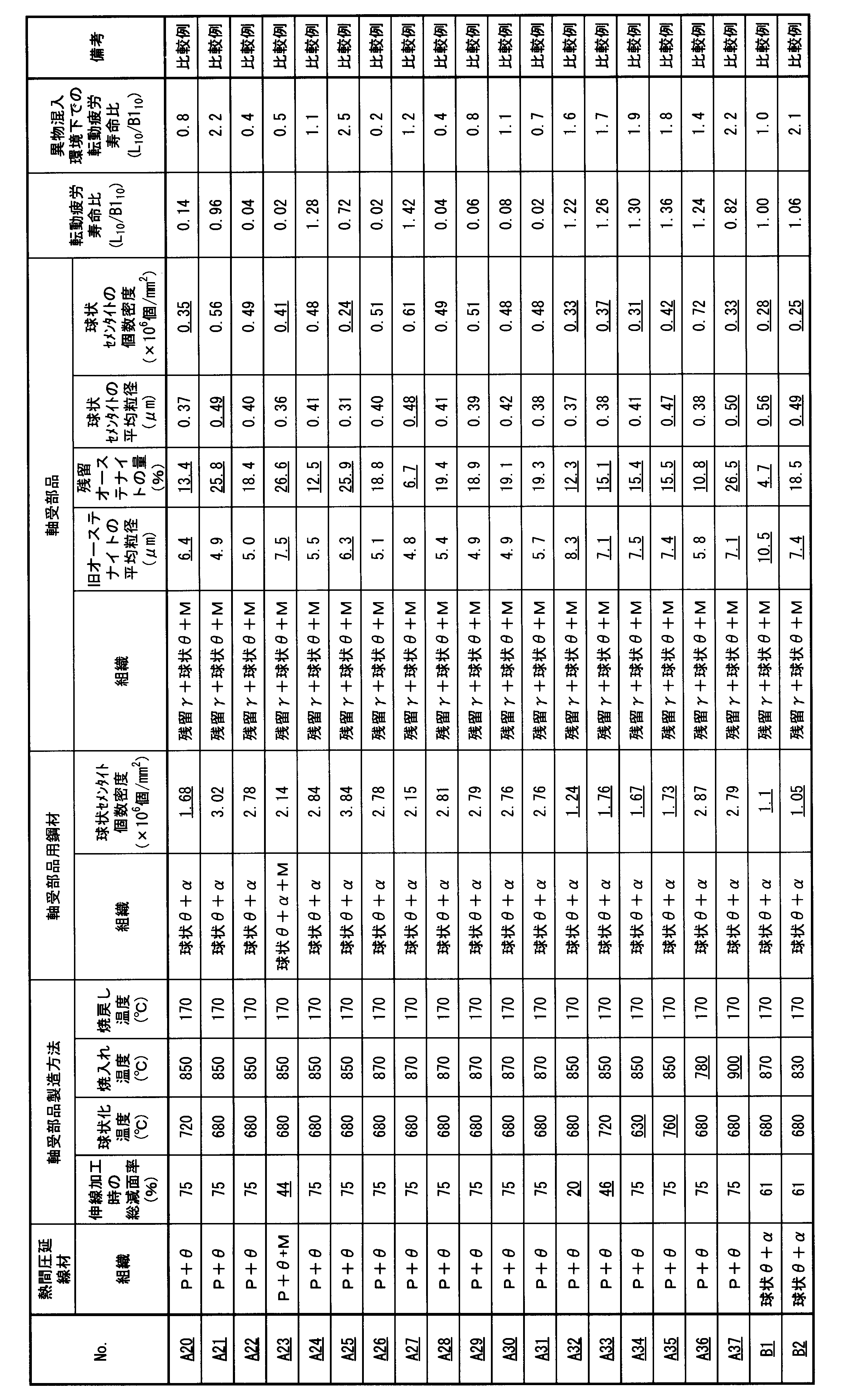
本発明例において、軸受部品用鋼材の金属組織は、いずれも球状セメンタイト及びフェライトとからなっていた。また、軸受部品の金属組織は、いずれも球状セメンタイト及びマルテンサイトとからなっていた。
一方、A20~A38、B1、B2は比較例である。A20~A38、B1、B2は、本発明で規定する化学組成及び軸受部品の組織の何れかまたは両方を満足していないため、転動疲労寿命が、従来と同等、もしくは、従来よりも劣っていた。
2 球状セメンタイト
4 フェライト
5 球状セメンタイト
Claims (6)
- 化学成分が、質量%で
C:0.95%~1.10%、
Si:0.10%~0.70%、
Mn:0.20%~1.20%、
Cr:0.90%~1.60%、
Al:0.010%~0.100%、
N:0.003%~0.030%、
を含有し、
P:0.025%以下、
S:0.025%以下、
O:0.0010%以下
に制限し、任意に、
Mo:0.25%以下、
B:0.0050%以下、
Cu:1.0%以下、
Ni:3.0%以下、
Ca:0.0015%以下
を含有し、残部がFe及び不純物からなり、
金属組織が、残留オーステナイト、球状セメンタイト及びマルテンサイトであり、前記残留オーステナイトの量が、体積%で、18%~25%であり、かつ、前記金属組織において、旧オーステナイトの平均粒径が6.0μm以下であり、前記球状セメンタイトの平均粒径が0.45μm以下であり、かつ、前記球状セメンタイトの個数密度が0.45×10⁶個/mm2以上である
ことを特徴とする軸受部品。 - 前記化学成分が、質量%で、
Mo:0.01%~0.25%、
B :0.0001%~0.0050%、
Cu:0.1%~1.0%、
Ni:1.0%~3.0%、
Ca:0.0001%~0.0015%
の1種以上を含有する
ことを特徴とする請求項1に記載の軸受部品。 - 化学成分が、質量%で
C:0.95%~1.10%、
Si:0.10%~0.70%、
Mn:0.20%~1.20%、
Cr:0.90%~1.60%、
Al:0.010%~0.100%、
N:0.003%~0.030%、
を含有し、
S:0.025%以下、
P:0.025%以下、
O:0.0010%以下
に制限し、任意に、
Mo:0.25%以下、
B:0.0050%以下、
Cu:1.0%以下、
Ni:3.0%以下、
Ca:0.0015%以下
を含有し、残部がFe及び不純物からなり、
金属組織が、球状セメンタイト及びフェライトを含み、前記金属組織において、粒径が0.5μm~3.0μmの前記球状セメンタイトの個数密度が2.0×10⁶個/mm2以上である
ことを特徴とする軸受部品用鋼材。 - 前記化学成分が、質量%で、
Mo:0.01%~0.25%、
B:0.0001%~0.0050%、
Cu:0.1%~1.0%、
Ni:1.0%~3.0%、
Ca:0.0001%~0.0015%
の1種以上を含有する
ことを特徴とする請求項3に記載の軸受部品用鋼材。 - 請求項3または4に記載の化学成分からなる鋼片を得る鋳造工程と;
前記鋼片を900℃~1300℃の温度に加熱する加熱工程と;
前記加熱工程後の前記鋼片に、850℃以下の仕上圧延温度で、熱間圧延を施して、熱間圧延線材を得る熱間圧延工程と;
前記熱間圧延工程後の前記熱間圧延線材を、800℃以下の巻取温度で巻き取る巻取工程と;
前記巻取工程後に3.0℃/秒以下の冷却速度で、前記熱間圧延線材を600℃まで冷却し、前記熱間圧延線材の組織をパーライトとする冷却工程と;
前記冷却工程後の前記熱間圧延線材に、総減面率50%以上で伸線加工を施す伸線加工工程と;
前記伸線加工工程後の前記熱間圧延線材に、650℃以上、750℃もしくはA1-5℃のどちらか低い方の温度以下で、0.5~5時間保持する球状化熱処理を行い、軸受部品用鋼材を得る球状化熱処理工程と;を有する
ことを特徴とする軸受部品用鋼材の製造方法。
ここで、A1とはA1変態が開始する温度を前記化学成分から予測した値であり、下記の式1より算出される。
なお、[C]、[Si]、[Mn]、[Cu]、[Ni]、[Cr]、[Mo]、[Al]及び[B]は、質量%で、前記熱間圧延線材中のC含有量、Si含有量、Mn含有量、Cu含有量、Ni含有量、Cr含有量、Mo含有量、Al含有量及びB含有量である。
A1=750.8-26.6×[C]+17.6×[Si]-11.6×[Mn]-22.9×[Cu]-23.0×[Ni]+24.1×[Cr]+22.5×[Mo]-169.4×[Al]-894.7×[B] (式1) - 請求項1または2に記載の化学成分からなる鋼片を得る鋳造工程と;
前記鋼片を900℃~1300℃の温度に加熱する加熱工程と;
前記加熱工程後の前記鋼片に、850℃以下の仕上圧延温度で、熱間圧延を施して、熱間圧延線材を得る熱間圧延工程と;
前記熱間圧延工程後の前記熱間圧延線材を、800℃以下の巻取温度で巻き取る巻取工程と;
前記巻取工程後に3.0℃/秒以下の冷却速度で、前記熱間圧延線材を600℃まで冷却し、前記熱間圧延線材の組織をパーライトとする冷却工程と;
前記冷却工程後の前記熱間圧延線材に、総減面率50%以上で伸線加工を施す伸線加工工程と;
前記伸線加工工程後の前記熱間圧延線材に、650℃以上、750℃もしくはA1-5℃のどちらか低い方の温度以下で、0.5~5時間保持する球状化熱処理を行い、軸受部品用鋼材を得る球状化熱処理工程と;
前記球状化熱処理工程後の前記軸受部品用鋼材を、粗成形する成形工程と;
前記成形工程後の前記軸受部品用鋼材を、800℃~890℃に加熱して、焼入れ処理を行う焼入れ処理工程と;
前記焼入れ処理工程後の前記軸受部品用鋼材に、250℃以下で焼戻し処理を行う焼戻し工程と;
前記焼戻し処理工程後の前記軸受部品用鋼材に仕上加工を施して軸受部品を得る仕上工程と;を有する
ことを特徴とする軸受部品の製造方法。
ここで、A1とはA1変態が開始する温度を前記化学成分から予測した値であり、下記の式2より算出される。
なお、[C]、[Si]、[Mn]、[Cu]、[Ni]、[Cr]、[Mo]、[Al]及び[B]は、質量%で、前記熱間圧延線材中のC含有量、Si含有量、Mn含有量、Cu含有量、Ni含有量、Cr含有量、Mo含有量、Al含有量及びB含有量である。
A1=750.8-26.6×[C]+17.6×[Si]-11.6×[Mn]-22.9×[Cu]-23.0×[Ni]+24.1×[Cr]+22.5×[Mo]-169.4×[Al]-894.7×[B] (式2)
Priority Applications (7)
| Application Number | Priority Date | Filing Date | Title |
|---|---|---|---|
| EP15735570.2A EP3093361B1 (en) | 2014-01-10 | 2015-01-09 | Bearing part, steel for bearing part and method for producing thereof |
| KR1020167019177A KR101826457B1 (ko) | 2014-01-10 | 2015-01-09 | 베어링 부품, 베어링 부품용 강재 및 그들의 제조 방법 |
| CN201580003908.0A CN105899703B (zh) | 2014-01-10 | 2015-01-09 | 轴承部件、轴承部件用钢材及它们的制造方法 |
| JP2015556849A JP6079903B2 (ja) | 2014-01-10 | 2015-01-09 | 軸受部品、軸受部品用鋼材及びそれらの製造方法 |
| PL15735570T PL3093361T3 (pl) | 2014-01-10 | 2015-01-09 | Element łożyska, stal na element łożyska i sposób ich wytwarzania |
| SG11201605568SA SG11201605568SA (en) | 2014-01-10 | 2015-01-09 | Bearing part, steel for bearing part, and method for producing thereof |
| US15/110,351 US20160333437A1 (en) | 2014-01-10 | 2015-01-09 | Bearing part, steel for bearing part and method for producing thereof |
Applications Claiming Priority (4)
| Application Number | Priority Date | Filing Date | Title |
|---|---|---|---|
| JP2014-003338 | 2014-01-10 | ||
| JP2014003338 | 2014-01-10 | ||
| JP2014084952 | 2014-04-16 | ||
| JP2014-084952 | 2014-04-16 |
Publications (1)
| Publication Number | Publication Date |
|---|---|
| WO2015105186A1 true WO2015105186A1 (ja) | 2015-07-16 |
Family
ID=53524009
Family Applications (2)
| Application Number | Title | Priority Date | Filing Date |
|---|---|---|---|
| PCT/JP2015/050528 Ceased WO2015105186A1 (ja) | 2014-01-10 | 2015-01-09 | 軸受部品、軸受部品用鋼材及びそれらの製造方法 |
| PCT/JP2015/050531 Ceased WO2015105187A1 (ja) | 2014-01-10 | 2015-01-09 | 軸受部品 |
Family Applications After (1)
| Application Number | Title | Priority Date | Filing Date |
|---|---|---|---|
| PCT/JP2015/050531 Ceased WO2015105187A1 (ja) | 2014-01-10 | 2015-01-09 | 軸受部品 |
Country Status (8)
| Country | Link |
|---|---|
| US (2) | US10246757B2 (ja) |
| EP (2) | EP3093363B1 (ja) |
| JP (2) | JP6079903B2 (ja) |
| KR (2) | KR101826458B1 (ja) |
| CN (2) | CN105899703B (ja) |
| PL (2) | PL3093363T3 (ja) |
| SG (2) | SG11201605570XA (ja) |
| WO (2) | WO2015105186A1 (ja) |
Cited By (7)
| Publication number | Priority date | Publication date | Assignee | Title |
|---|---|---|---|---|
| CN105782245A (zh) * | 2016-02-26 | 2016-07-20 | 惠州市金力电机有限公司 | 一种不锈钢基粉末冶金含油轴承 |
| KR101664193B1 (ko) * | 2015-12-11 | 2016-10-11 | 주식회사 세아베스틸 | 오스템퍼링 열처리를 이용한 고수명의 베어링용 강의 제조방법 |
| JP2018123374A (ja) * | 2017-01-31 | 2018-08-09 | 山陽特殊製鋼株式会社 | 高硬度かつ靭性に優れる鋼製部材および高負荷ボールねじのナット |
| WO2022065200A1 (ja) * | 2020-09-24 | 2022-03-31 | Ntn株式会社 | 軸受部品および転がり軸受 |
| JP2022153697A (ja) * | 2021-03-30 | 2022-10-13 | 日本製鉄株式会社 | 軸受用線材 |
| JP2024521184A (ja) * | 2021-06-18 | 2024-05-28 | ポスコ カンパニー リミテッド | 伸線加工性に優れた線材及びその製造方法 |
| US12571427B2 (en) | 2019-10-01 | 2026-03-10 | Ntn Corporation | Bearing part |
Families Citing this family (15)
| Publication number | Priority date | Publication date | Assignee | Title |
|---|---|---|---|---|
| JP6703385B2 (ja) * | 2015-09-18 | 2020-06-03 | 国立大学法人大阪大学 | 高硬度かつ靭性に優れた鋼 |
| JP6843786B2 (ja) * | 2017-03-03 | 2021-03-17 | Ntn株式会社 | 軸受部品及び転がり軸受、ならびに軸受部品の製造方法 |
| JP6827914B2 (ja) * | 2017-12-18 | 2021-02-10 | Ntn株式会社 | 軸受部品及び転がり軸受 |
| EP3591089A4 (en) | 2017-03-03 | 2020-08-05 | NTN Corporation | BEARING ELEMENT, ROLLER BEARING AND BEARING ELEMENT MANUFACTURING METHOD |
| CN108559913A (zh) * | 2018-05-16 | 2018-09-21 | 浙江健力股份有限公司 | 一种GCr15轴承钢管及其制备工艺 |
| KR102704263B1 (ko) * | 2019-06-03 | 2024-09-09 | 현대자동차주식회사 | 고탄소 베어링강의 제조방법 및 이로부터 제조된 고탄소 베어링강 |
| JP7422527B2 (ja) * | 2019-12-05 | 2024-01-26 | 日本製鉄株式会社 | 転動部品及びその製造方法 |
| KR102421642B1 (ko) * | 2019-12-20 | 2022-07-18 | 주식회사 포스코 | 베어링용 선재 및 이의 제조방법 |
| JP7252499B2 (ja) * | 2020-01-08 | 2023-04-05 | 日本製鉄株式会社 | 鋼板およびその製造方法 |
| JP7464821B2 (ja) * | 2020-02-14 | 2024-04-10 | 日本製鉄株式会社 | 軸受軌道用鋼材、および軸受軌道 |
| BR112022025557A2 (pt) * | 2020-06-29 | 2023-01-31 | Jfe Steel Corp | Trilho que tem excelentes características de resistência à propagação de rachadura por fadiga e método de fabricação do mesmo |
| US12595527B2 (en) * | 2021-03-31 | 2026-04-07 | Kobe Steel, Ltd. | Steel wire for machine structural parts and method for manufacturing the same |
| CN114134403B (zh) * | 2021-05-19 | 2023-01-13 | 江阴兴澄特种钢铁有限公司 | 一种大规格风电轴承滚动体用钢及其生产方法 |
| CN113755755A (zh) * | 2021-08-30 | 2021-12-07 | 西安交通大学 | 用于高速精密轴承的超高碳轴承钢材料及其制备方法和应用 |
| CN114790531A (zh) * | 2022-05-09 | 2022-07-26 | 中科西王特钢有限公司 | 一种风电主轴轴承用钢 |
Citations (8)
| Publication number | Priority date | Publication date | Assignee | Title |
|---|---|---|---|---|
| JP2001294972A (ja) * | 2000-04-18 | 2001-10-26 | Sumitomo Metal Ind Ltd | 軸受用鋼材 |
| JP2003129176A (ja) * | 2001-10-16 | 2003-05-08 | Kobe Steel Ltd | 伸線前の熱処理が省略可能な伸線加工性に優れた線状または棒状鋼、および軸受部品 |
| JP2004100016A (ja) | 2002-09-12 | 2004-04-02 | Kobe Steel Ltd | 軸受用圧延線材および伸線材 |
| JP2004124215A (ja) | 2002-10-04 | 2004-04-22 | Daido Steel Co Ltd | 異物混入環境下での転動寿命に優れた軸受用鋼 |
| JP2007077432A (ja) | 2005-09-13 | 2007-03-29 | Sanyo Special Steel Co Ltd | ボールネジまたはワンウェイクラッチ用部品の製造方法 |
| JP2007224410A (ja) * | 2006-01-24 | 2007-09-06 | Kobe Steel Ltd | 伸線性に優れた軸受鋼線材およびその製造方法 |
| JP2009242920A (ja) * | 2008-03-31 | 2009-10-22 | Jfe Steel Corp | 異物環境下での疲労特性に優れた軸受部品およびその製造方法 |
| WO2013108828A1 (ja) | 2012-01-20 | 2013-07-25 | 新日鐵住金株式会社 | 圧延線材、及びその製造方法 |
Family Cites Families (8)
| Publication number | Priority date | Publication date | Assignee | Title |
|---|---|---|---|---|
| JPH07127643A (ja) * | 1993-10-29 | 1995-05-16 | Nippon Seiko Kk | 転がり軸受 |
| JP2001234286A (ja) * | 2000-02-24 | 2001-08-28 | Nippon Steel Corp | 伸線加工性に優れた細径高炭素低合金鋼熱間圧延線材とその製造方法 |
| JP3889931B2 (ja) * | 2001-01-26 | 2007-03-07 | Jfeスチール株式会社 | 軸受材料 |
| JP4252837B2 (ja) * | 2003-04-16 | 2009-04-08 | Jfeスチール株式会社 | 転動疲労寿命の優れた鋼材及びその製造方法 |
| JP4487748B2 (ja) | 2004-11-30 | 2010-06-23 | Jfeスチール株式会社 | 軸受部品の製造方法 |
| JP2007327084A (ja) * | 2006-06-06 | 2007-12-20 | Kobe Steel Ltd | 伸線加工性に優れた線材およびその製造方法 |
| JP5679440B2 (ja) * | 2011-03-28 | 2015-03-04 | 株式会社神戸製鋼所 | 冷間鍛造性に優れ、高周波焼入れ後におけるねじり強度に優れた高周波焼入れ用鋼、およびその製造方法 |
| CN103320704B (zh) * | 2013-07-12 | 2015-02-04 | 安徽工业大学 | 一种高性能的轴承钢的生产方法 |
-
2015
- 2015-01-09 EP EP15735602.3A patent/EP3093363B1/en active Active
- 2015-01-09 KR KR1020167019584A patent/KR101826458B1/ko not_active Expired - Fee Related
- 2015-01-09 PL PL15735602T patent/PL3093363T3/pl unknown
- 2015-01-09 JP JP2015556849A patent/JP6079903B2/ja active Active
- 2015-01-09 WO PCT/JP2015/050528 patent/WO2015105186A1/ja not_active Ceased
- 2015-01-09 JP JP2015556850A patent/JP6079904B2/ja active Active
- 2015-01-09 WO PCT/JP2015/050531 patent/WO2015105187A1/ja not_active Ceased
- 2015-01-09 SG SG11201605570XA patent/SG11201605570XA/en unknown
- 2015-01-09 US US15/110,390 patent/US10246757B2/en not_active Expired - Fee Related
- 2015-01-09 CN CN201580003908.0A patent/CN105899703B/zh active Active
- 2015-01-09 SG SG11201605568SA patent/SG11201605568SA/en unknown
- 2015-01-09 EP EP15735570.2A patent/EP3093361B1/en active Active
- 2015-01-09 CN CN201580003915.0A patent/CN105899704B/zh not_active Expired - Fee Related
- 2015-01-09 PL PL15735570T patent/PL3093361T3/pl unknown
- 2015-01-09 US US15/110,351 patent/US20160333437A1/en not_active Abandoned
- 2015-01-09 KR KR1020167019177A patent/KR101826457B1/ko active Active
Patent Citations (8)
| Publication number | Priority date | Publication date | Assignee | Title |
|---|---|---|---|---|
| JP2001294972A (ja) * | 2000-04-18 | 2001-10-26 | Sumitomo Metal Ind Ltd | 軸受用鋼材 |
| JP2003129176A (ja) * | 2001-10-16 | 2003-05-08 | Kobe Steel Ltd | 伸線前の熱処理が省略可能な伸線加工性に優れた線状または棒状鋼、および軸受部品 |
| JP2004100016A (ja) | 2002-09-12 | 2004-04-02 | Kobe Steel Ltd | 軸受用圧延線材および伸線材 |
| JP2004124215A (ja) | 2002-10-04 | 2004-04-22 | Daido Steel Co Ltd | 異物混入環境下での転動寿命に優れた軸受用鋼 |
| JP2007077432A (ja) | 2005-09-13 | 2007-03-29 | Sanyo Special Steel Co Ltd | ボールネジまたはワンウェイクラッチ用部品の製造方法 |
| JP2007224410A (ja) * | 2006-01-24 | 2007-09-06 | Kobe Steel Ltd | 伸線性に優れた軸受鋼線材およびその製造方法 |
| JP2009242920A (ja) * | 2008-03-31 | 2009-10-22 | Jfe Steel Corp | 異物環境下での疲労特性に優れた軸受部品およびその製造方法 |
| WO2013108828A1 (ja) | 2012-01-20 | 2013-07-25 | 新日鐵住金株式会社 | 圧延線材、及びその製造方法 |
Cited By (8)
| Publication number | Priority date | Publication date | Assignee | Title |
|---|---|---|---|---|
| KR101664193B1 (ko) * | 2015-12-11 | 2016-10-11 | 주식회사 세아베스틸 | 오스템퍼링 열처리를 이용한 고수명의 베어링용 강의 제조방법 |
| CN105782245A (zh) * | 2016-02-26 | 2016-07-20 | 惠州市金力电机有限公司 | 一种不锈钢基粉末冶金含油轴承 |
| JP2018123374A (ja) * | 2017-01-31 | 2018-08-09 | 山陽特殊製鋼株式会社 | 高硬度かつ靭性に優れる鋼製部材および高負荷ボールねじのナット |
| US12571427B2 (en) | 2019-10-01 | 2026-03-10 | Ntn Corporation | Bearing part |
| WO2022065200A1 (ja) * | 2020-09-24 | 2022-03-31 | Ntn株式会社 | 軸受部品および転がり軸受 |
| JP2022153697A (ja) * | 2021-03-30 | 2022-10-13 | 日本製鉄株式会社 | 軸受用線材 |
| JP7606092B2 (ja) | 2021-03-30 | 2024-12-25 | 日本製鉄株式会社 | 軸受用線材 |
| JP2024521184A (ja) * | 2021-06-18 | 2024-05-28 | ポスコ カンパニー リミテッド | 伸線加工性に優れた線材及びその製造方法 |
Also Published As
| Publication number | Publication date |
|---|---|
| CN105899704A (zh) | 2016-08-24 |
| JPWO2015105186A1 (ja) | 2017-03-23 |
| US20160333438A1 (en) | 2016-11-17 |
| EP3093363B1 (en) | 2019-07-10 |
| SG11201605568SA (en) | 2016-08-30 |
| CN105899704B (zh) | 2017-12-22 |
| JP6079904B2 (ja) | 2017-02-15 |
| JPWO2015105187A1 (ja) | 2017-03-23 |
| EP3093363A1 (en) | 2016-11-16 |
| KR20160099671A (ko) | 2016-08-22 |
| US20160333437A1 (en) | 2016-11-17 |
| PL3093361T3 (pl) | 2020-03-31 |
| CN105899703A (zh) | 2016-08-24 |
| SG11201605570XA (en) | 2016-08-30 |
| US10246757B2 (en) | 2019-04-02 |
| KR101826458B1 (ko) | 2018-02-06 |
| EP3093363A4 (en) | 2017-11-22 |
| EP3093361A1 (en) | 2016-11-16 |
| EP3093361B1 (en) | 2019-07-17 |
| KR20160101133A (ko) | 2016-08-24 |
| JP6079903B2 (ja) | 2017-02-15 |
| PL3093363T3 (pl) | 2019-12-31 |
| KR101826457B1 (ko) | 2018-02-06 |
| WO2015105187A1 (ja) | 2015-07-16 |
| CN105899703B (zh) | 2017-09-08 |
| EP3093361A4 (en) | 2017-11-22 |
Similar Documents
| Publication | Publication Date | Title |
|---|---|---|
| JP6079903B2 (ja) | 軸受部品、軸受部品用鋼材及びそれらの製造方法 | |
| JP5736936B2 (ja) | 熱間圧延棒鋼または線材、および冷間鍛造用鋼線の製造方法 | |
| JP5257082B2 (ja) | 低温焼鈍後の冷間鍛造性に優れた鋼線材及びその製造方法並びに冷間鍛造性に優れた鋼線材の製造方法 | |
| WO2011062012A1 (ja) | 低温焼鈍用鋼線及びその製造方法 | |
| JP5590256B2 (ja) | 圧延線材、及びその製造方法 | |
| JP5204328B2 (ja) | 高炭素鋼線材および高炭素鋼線材の製造方法 | |
| EP3342892A1 (en) | Mechanical structure steel for cold-working and manufacturing method therefor | |
| JP2012140674A (ja) | 冷間鍛造性に優れた鋼材、及びその製造方法 | |
| JP2011225897A (ja) | 冷間鍛造用熱間圧延棒鋼または線材 | |
| JP2009275250A (ja) | 冷間加工性に優れた鋼線材およびその製造方法 | |
| CN107075637A (zh) | 拉丝加工性和拉丝加工后的卷成形性优异的轴承用钢线材 | |
| JP5990428B2 (ja) | 転動疲労特性に優れた軸受用鋼材およびその製造方法 | |
| WO2017033773A1 (ja) | 冷間加工用機械構造用鋼、およびその製造方法 | |
| CN118804991A (zh) | 钢材 | |
| JP7401841B1 (ja) | 鋼材 | |
| US20240254588A1 (en) | Wire rod having excellent drawability, and manufacturing method therefor | |
| JP5867324B2 (ja) | 軸受鋼 | |
| JP2025062918A (ja) | 鋼材 | |
| JP2025062921A (ja) | 鋼材 | |
| KR20230159707A (ko) | 기계 구조 부품용 강선 및 그 제조 방법 |
Legal Events
| Date | Code | Title | Description |
|---|---|---|---|
| 121 | Ep: the epo has been informed by wipo that ep was designated in this application |
Ref document number: 15735570 Country of ref document: EP Kind code of ref document: A1 |
|
| DPE1 | Request for preliminary examination filed after expiration of 19th month from priority date (pct application filed from 20040101) | ||
| WWE | Wipo information: entry into national phase |
Ref document number: 15110351 Country of ref document: US |
|
| ENP | Entry into the national phase |
Ref document number: 2015556849 Country of ref document: JP Kind code of ref document: A |
|
| NENP | Non-entry into the national phase |
Ref country code: DE |
|
| ENP | Entry into the national phase |
Ref document number: 20167019177 Country of ref document: KR Kind code of ref document: A |
|
| REEP | Request for entry into the european phase |
Ref document number: 2015735570 Country of ref document: EP |
|
| WWE | Wipo information: entry into national phase |
Ref document number: 2015735570 Country of ref document: EP |
|
| WWE | Wipo information: entry into national phase |
Ref document number: IDP00201604696 Country of ref document: ID |