WO2015107117A1 - (het)arylalkenyl compounds and their use for controlling invertebrate pests - Google Patents
(het)arylalkenyl compounds and their use for controlling invertebrate pests Download PDFInfo
- Publication number
- WO2015107117A1 WO2015107117A1 PCT/EP2015/050693 EP2015050693W WO2015107117A1 WO 2015107117 A1 WO2015107117 A1 WO 2015107117A1 EP 2015050693 W EP2015050693 W EP 2015050693W WO 2015107117 A1 WO2015107117 A1 WO 2015107117A1
- Authority
- WO
- WIPO (PCT)
- Prior art keywords
- alkyl
- hydrogen
- group
- cycloalkyl
- radicals
- Prior art date
- Legal status (The legal status is an assumption and is not a legal conclusion. Google has not performed a legal analysis and makes no representation as to the accuracy of the status listed.)
- Ceased
Links
- 0 C*=C(C)C(NC)=*O Chemical compound C*=C(C)C(NC)=*O 0.000 description 13
- BDEXKUGXAQKHKX-UHFFFAOYSA-N CC1(C)CN(C)CNCC1 Chemical compound CC1(C)CN(C)CNCC1 BDEXKUGXAQKHKX-UHFFFAOYSA-N 0.000 description 1
- AQMXMELGMGPVDJ-UHFFFAOYSA-N CC1NCNCC(C)(C)C1 Chemical compound CC1NCNCC(C)(C)C1 AQMXMELGMGPVDJ-UHFFFAOYSA-N 0.000 description 1
- CWLUICGZITVKQR-UHFFFAOYSA-N CCC(C)(CCC1)ON=C1C=C Chemical compound CCC(C)(CCC1)ON=C1C=C CWLUICGZITVKQR-UHFFFAOYSA-N 0.000 description 1
Classifications
-
- C—CHEMISTRY; METALLURGY
- C07—ORGANIC CHEMISTRY
- C07D—HETEROCYCLIC COMPOUNDS
- C07D209/00—Heterocyclic compounds containing five-membered rings, condensed with other rings, with one nitrogen atom as the only ring hetero atom
- C07D209/02—Heterocyclic compounds containing five-membered rings, condensed with other rings, with one nitrogen atom as the only ring hetero atom condensed with one carbocyclic ring
- C07D209/04—Indoles; Hydrogenated indoles
- C07D209/08—Indoles; Hydrogenated indoles with only hydrogen atoms or radicals containing only hydrogen and carbon atoms, directly attached to carbon atoms of the hetero ring
-
- A—HUMAN NECESSITIES
- A01—AGRICULTURE; FORESTRY; ANIMAL HUSBANDRY; HUNTING; TRAPPING; FISHING
- A01N—PRESERVATION OF BODIES OF HUMANS OR ANIMALS OR PLANTS OR PARTS THEREOF; BIOCIDES, e.g. AS DISINFECTANTS, AS PESTICIDES OR AS HERBICIDES; PEST REPELLANTS OR ATTRACTANTS; PLANT GROWTH REGULATORS
- A01N43/00—Biocides, pest repellants or attractants, or plant growth regulators containing heterocyclic compounds
- A01N43/34—Biocides, pest repellants or attractants, or plant growth regulators containing heterocyclic compounds having rings with one nitrogen atom as the only ring hetero atom
- A01N43/36—Biocides, pest repellants or attractants, or plant growth regulators containing heterocyclic compounds having rings with one nitrogen atom as the only ring hetero atom five-membered rings
- A01N43/38—Biocides, pest repellants or attractants, or plant growth regulators containing heterocyclic compounds having rings with one nitrogen atom as the only ring hetero atom five-membered rings condensed with carbocyclic rings
-
- C—CHEMISTRY; METALLURGY
- C07—ORGANIC CHEMISTRY
- C07D—HETEROCYCLIC COMPOUNDS
- C07D209/00—Heterocyclic compounds containing five-membered rings, condensed with other rings, with one nitrogen atom as the only ring hetero atom
- C07D209/02—Heterocyclic compounds containing five-membered rings, condensed with other rings, with one nitrogen atom as the only ring hetero atom condensed with one carbocyclic ring
- C07D209/04—Indoles; Hydrogenated indoles
- C07D209/30—Indoles; Hydrogenated indoles with hetero atoms or with carbon atoms having three bonds to hetero atoms with at the most one bond to halogen, directly attached to carbon atoms of the hetero ring
-
- C—CHEMISTRY; METALLURGY
- C07—ORGANIC CHEMISTRY
- C07D—HETEROCYCLIC COMPOUNDS
- C07D403/00—Heterocyclic compounds containing two or more hetero rings, having nitrogen atoms as the only ring hetero atoms, not provided for by group C07D401/00
- C07D403/02—Heterocyclic compounds containing two or more hetero rings, having nitrogen atoms as the only ring hetero atoms, not provided for by group C07D401/00 containing two hetero rings
- C07D403/06—Heterocyclic compounds containing two or more hetero rings, having nitrogen atoms as the only ring hetero atoms, not provided for by group C07D401/00 containing two hetero rings linked by a carbon chain containing only aliphatic carbon atoms
Definitions
- (Het)Arylalkenyl compounds and their use for controlling invertebrate pests Description
- the present invention relates to (het)arylalkenyl compounds which are useful for combating or controlling invertebrate pests, in particular arthropod pests and nematodes.
- the invention also relates to a method for controlling invertebrate pests by using these compounds and to plant propagation material and to an agricultural and a veterinary composition comprising said compounds.
- Invertebrate pests and in particular arthropods and nematodes destroy growing and harvested crops and attack wooden dwelling and commercial structures, causing large economic loss to the food supply and to property. While a large number of pesticidal agents are known, due to the ability of target pests to develop resistance to said agents, there is an on-going need for new agents for combating invertebrate pests, in particular insects, arachnids and nematodes.
- the invention relates to (het)arylalkenyl compounds of formula I
- B 1 , B 2 , B 3 , B 4 and B 5 are each independently selected from the group consisting of N and C-R 2 , with the proviso that at most two of B 1 , B 2 , B 3 , B 4 and B 5 are N;
- G 1 is selected from the group consisting of N and C-R 4b ;
- G 2 , G 3 and G 5 are each independently selected from the group consisting of N and C- R 4 ;
- G 4 is selected from the group consisting of N, C-A and C-R 4 ; with the proviso that at most two of G 2 , G 3 , G 4 and G 5 are N;
- A is a group A 1 , A 2 , A 3 or A 4 ,
- a 2 is a group of following formula:
- # denotes the bond to the remainder of the molecule; W is selected from O and S;
- Y is selected from hydrogen, -N(R 5 )R 6 and -OR 9 ;
- a 3 is a group of following formula: (A 3 )
- a 4 is a 3-, 4-, 5-, 6- or 7-membered saturated, partially unsaturated or maximally unsaturated heteromonocyclic ring containing 1 , 2, 3 or 4 heteroatoms or heteroatom groups selected from N, O, S, NO, SO and SO2 as ring members, or is a 8-, 9- or 10-membered saturated, partially unsaturated or maximally unsaturated heterobicyclic ring containing 1 , 2, 3 or 4 heteroa- toms or heteroatom groups selected from N, O, S, NO, SO and SO2 as ring members, where the heteromonocyclic or heterobicyclic ring is optionally substituted with one or more substituents R 11 ; is selected from O and S; is selected from the group consisting of Ci-C4-alkyl, C2-C4-alkenyl, C2-C4-alkynyl, C3-C6-cycloalkyl, Ci-C4-alkylsul
- phenyl which may be substituted by 1 , 2, 3, 4 or 5 radicals R 11 , and a 3-, 4-, 5-, 6-
- R 4 is independently selected from the group consisting of hydrogen, halogen, cyano, azido, nitro, -SCN, -SF 5 , Ci-C6-alkyl, Cs-Cs-cycloalkyl, C2-C6-alkenyl, C2- C6-alkynyl, wherein the four last-mentioned aliphatic and cycloaliphatic radicals may be partially or fully halogenated and/or may be substituted by one or more radicals R 8 ,
- phenyl which may be substituted by 1 , 2, 3, 4 or 5 radicals R 11 , and a 3-, 4-, 5-, 6- 7-, 8-, 9- or 10-membered saturated, partially unsaturated or maximally unsaturated heteromonocyclic or heterobicyclic ring containing 1 , 2, 3 or 4 heteroatoms or heteroatom groups selected from N, O, S, NO, SO and SO2 as ring members, where the heteromonocyclic or heterobicyclic ring may be substituted by one or more radicals R 11 ;
- -S(0) n R 9 is independently selected from the group consisting of hydrogen, halogen, cyano, azido, nitro, -SCN, -SF 5 , d-Ce-alkyl, Cs-Cs-cycloalkyl, C2-Ce-alkenyl, C2-C6- alkynyl, wherein the four last-mentioned aliphatic and cycloaliphatic radicals may be partially or fully halogenated and/or may be substituted by one or more radicals R 8 ,
- each R 5 is independently selected from the group consisting of hydrogen, C1-C10- alkyl, Cs-Cs-cycloalkyl, C2-Cio-alkenyl, C2-Cio-alkynyl, wherein the four last- mentioned aliphatic and cycloali
- R 7a , R 7b are each independently selected from the group consisting of hydrogen, halogen, cyano, Ci-C6-alkyl, Cs-Cs-cycloalkyl, C2-C6-alkenyl and C2-C6-alkynyl, wherein the four last-mentioned aliphatic and cycloaliphatic radicals may be par- tially or fully halogenated and/or may be substituted by one or more radicals R 8 ; each R 8 is independently selected from the group consisting of cyano, azido, nitro, - SCN, -SF 5 , Cs-Cs-cycloalkyl, Cs-Cs-halocycloalkyl, where the cycloaliphatic moieties in the two last-mentioned radicals may be substituted by one or more radicals R 13 ;
- a 3-, 4-, 5-, 6- or 7-membered saturated, partially unsaturated or maximally un- saturated heterocyclic ring comprising 1 , 2 or 3 heteroatoms or heteroatom groups selected from N, O, S, NO, SO and SO2 as ring members, where the heterocyclic ring is optionally substituted with one or more substituents R 16 , or
- R 8 together with the carbon atoms of an alkyl, alkenyl, alkynyl or cycloalkyi group which they are bonded to, form a 3-, 4-, 5-, 6-, 7- or 8-membered saturated or partially unsaturated carbocyclic or heterocyclic ring, where the heterocyclic ring comprises 1 , 2, 3 or 4 heteroatoms or heteroatom groups independently selected from N, O, S, NO, SO and SO2 as ring members, and where the carbocyclic or heterocyclic ring is optionally substituted with one or more substituents R 16 ; and
- phenyl optionally substituted with 1 , 2, 3, 4 or 5 R 16 ;
- a 3-, 4-, 5-, 6- or 7-membered saturated, partially unsaturated or maximally unsaturated heterocyclic ring comprising 1 , 2 or 3 heteroatoms or heteroatom groups selected from N, O, S, NO, SO and SO2 as ring members, where the het- erocyclic ring is optionally substituted with one or more substituents R 16 ;
- R 9 in the groups -S(0) n R 9 and -OSO2R 9 is additionally selected from the group consisting of Ci-C6-alkoxy and Ci-C6-haloalkoxy;
- R 10a , R 10b are selected independently from one another from the group consisting of hydrogen, Ci-C6-alkyl, Ci-C6-haloalkyl, C 3 -C8-cycloalkyl, C 3 -C8-halocycloalkyl, C2-
- a 3-, 4-, 5-, 6- or 7-membered saturated, partially unsaturated or maximally unsaturated heterocyclic ring comprising 1 , 2, 3 or 4 heteroatoms or heteroatom groups selected from N, O, S, NO, SO and SO2 as ring members, where the heterocyclic ring is optionally substituted with one or more substituents R 16 ;
- R 10a and R 10b form together with the nitrogen atom they are bonded to a 3-, 4-, 5-, 6-, 7- or 8-membered saturated, partially unsaturated or maximally unsaturated heterocyclic ring, wherein the heterocyclic ring may additionally contain one or two heteroatoms or heteroatom groups selected from N, O, S, NO, SO and SO2 as ring members, where the heterocyclic ring optionally carries one or more sub- stituents selected from halogen, Ci-C6-alkyl, Ci-C6-haloalkyl, Ci-C6-alkoxy, C1-C6- haloalkoxy, Ci-C6-alkylthio, Ci-C6-haloalkylthio, Cs-Cs-cycloalkyl, C3-C8- halocycloalkyl, C2-C6-alkenyl, C2-C6-haloalkenyl, C2-C6-alkynyl, C2-C6-
- each R 11 is independently selected from the group consisting of halogen, cyano, az- ido, nitro, -SCN, -SF 5 , Ci-Cio-alkyl, Cs-Cs-cycloalkyl, C2-Cio-alkenyl, C2-C10- alkynyl, wherein the four last-mentioned aliphatic and cycloaliphatic radicals may be partially or fully halogenated and/or may be substituted with one or more radicals R 8 ,
- phenyl optionally substituted with 1 , 2, 3, 4, or 5 substituents selected independently from R 16 ;
- a 3-, 4-, 5-, 6- or 7-membered saturated, partially unsaturated or maximally unsaturated aromatic heterocyclic ring comprising 1 , 2, 3 or 4 heteroatoms or heteroatom groups selected from N, O, S, NO, SO and SO2 as ring members, where the heterocyclic ring is optionally substituted with one or more substituents selected independently from R 16 ;
- R 11 bound on adjacent ring atoms form together with the ring atoms to which they are bound a saturated 3-, 4-, 5-, 6-, 7-, 8- or 9-membered ring, where- in the ring may contain 1 or 2 heteroatoms or heteroatom groups selected from
- Cs-Cs-cycloalkyl which may be unsubstituted, partially or fully halogenated and/or may carry 1 or 2 radicals selected from Ci-C4-alkyl, C3-C4-cycloalkyl, Ci- C4-alkoxy, Ci-C4-haloalkoxy and oxo; phenyl, benzyl, pyridyl, phenoxy, where the cyclic moiety in the four last-mentioned radicals may be unsubstituted or carry 1 , 2, 3, 4 or 5 substituents R 16 ; and a 3-, 4-, 5-, 6- or 7-membered saturated, partially unsaturated or maximally unsaturated heterocyclic ring containing 1 , 2 or 3 heteroatoms or heteroatom groups selected from N, O, S, NO, SO and SO2 as ring members, where the heterocyclic ring may be substituted by 1 , 2 or 3 substituents R 16 ;
- R 13 as a substituent on a cycloalkyl ring is additionally selected from the group consisting of Ci-C6-alkyl, C2-C6-alkenyl and C2-C6-alkynyl, wherein the three last- mentioned aliphatic radicals may be unsubstituted, partially or fully halogenated and/or may carry 1 or 2 substituents selected from CN , C3-C4-cycloalkyl, C1-C4- alkoxy, Ci-C4-haloalkoxy and oxo;
- R 14 is independently selected from the group consisting of hydrogen, cyano, Ci- C6-alkoxy, Ci-C6-haloalkoxy, Ci-C6-alkylthio, Ci-C6-haloalkylthio, C1-C6- alkylsulfinyl, Ci-C6-haloalkylsulfinyl, Ci-C6-alkylsulfonyl, Ci-C6-haloalkylsulfonyl, trimethylsilyl, triethylsilyl, feri-butyldimethylsilyl,
- cyclic moieties in the four last- mentioned radicals may be unsubstituted and/or carry 1 , 2 or 3 substituents selected from halogen, Ci-C6-alkyl, Ci-C6-haloalkyl, Ci-C6-alkoxy, Ci-C6-haloalkoxy and (Ci-C6-alkoxy)carbonyl; and a 3-, 4-, 5- or 6-membered saturated, partially unsaturated or maximally unsaturated heterocyclic ring comprising 1 or 2 het- eroatoms or heteroatom groups selected from N, O, S, NO, SO and SO2 as ring members, where the heterocyclic ring is optionally substituted with one or more substituents R 16 : and R 14b , independently of each other, have one of the meanings given for R 14 ; or
- R 14a and R 14b together with the nitrogen atom to which they are bound, form a 3-, 4-, 5-, 6- or 7-membered saturated, partially unsaturated or maximally unsaturated heterocyclic ring, wherein the heterocyclic ring may additionally contain 1 or 2 heteroatoms or heteroatom groups selected from N, O, S, NO, SO and SO2 as ring members, where the heterocyclic ring optionally carries one or more substituents selected from halogen, Ci-C4-alkyl, Ci-C4-haloalkyl, Ci-C4-alkoxy and Ci- C4-haloalkoxy;
- R 15 is independently selected from the group consisting of hydrogen, cyano, trimethylsilyl, triethylsilyl, ferf-butyldimethylsilyl,
- Cs-Cs-cycloalkyI which may be unsubstituted, partially or fully halogenated and/or may carry 1 or 2 radicals selected from Ci-C4-alkyl, C3-C4-cycloalkyl, C1-C4- alkoxy, Ci-C4-haloalkoxy, Ci-C4-alkylthio, Ci-C4-alkylsulfinyl, Ci-C4-alkylsulfonyl and oxo;
- phenyl, benzyl, pyridyl and phenoxy wherein the four last-mentioned radicals may be unsubstituted, partially or fully halogenated and/or carry 1 , 2 or 3 substituents selected from Ci-C6-alkyl, Ci-C6-haloalkyl, Ci-C6-alkoxy, Ci-C6-haloalkoxy and (Ci-C6-alkoxy)carbonyl;
- R 16 is independently selected from the group consisting of halogen, nitro, cyano, -OH, -SH, Ci-C6-alkoxy, Ci-C6-haloalkoxy, Ci-C6-alkylthio, C1-C6- haloalkylthio, Ci-C6-alkylsulfinyl, Ci-C6-haloalkylsulfinyl, Ci-C6-alkylsulfonyl, Ci- C6-haloalkylsulfonyl, trimethylsilyl, triethylsilyl, feri-butyldimethylsilyl;
- phenyl, benzyl, pyridyl and phenoxy wherein the four last-mentioned radicals may be partially or fully halogenated and/or carry 1 , 2 or 3 substituents selected from Ci-C6-alkyl, Ci-C6-haloalkyl, Ci-C6-alkoxy, Ci-C6-haloalkoxy and (C1-C6- alkoxy)carbonyl;
- two R 16 on two adjacent carbon atoms form together with the carbon atoms they are bonded to a 4-, 5-, 6-, 7- or 8-membered saturated, partially unsaturated or maximally unsaturated ring, wherein the ring may contain 1 or 2 heteroatoms or heteroatom groups selected from N, O, S, NO, SO and SO2 as ring members, and wherein the ring optionally carries one or more substituents selected from halogen, Ci-C 4 -haloalkyl, Ci-C 4 -alkoxy and Ci-C 4 -haloalkoxy; each n is independently 0, 1 or 2; and
- each m is independently 0 or 1 ; and the N-oxides, tautomers, stereoisomers and agriculturally or veterinarily acceptable salts thereof.
- the present invention also provides an agricultural composition
- an agricultural composition comprising at least one compound of the formula I as defined herein, a stereoisomer thereof and/or at least one agriculturally acceptable salt thereof and at least one inert liquid and/or solid agriculturally acceptable carrier.
- the present invention also provides a veterinary composition
- a veterinary composition comprising at least one compound of the formula I as defined herein, a stereoisomer thereof and/or a veterinar- ily acceptable salt thereof and at least one inert liquid and/or solid verterinarily acceptable carrier.
- the present invention also provides a method for controlling invertebrate pests which method comprises treating the pests, their food supply, their habitat or their breeding ground or a cultivated plant, plant propagation materials (such as seed), soil, area, material or environment in which the pests are growing or may grow, or the materials, cultivated plants, plant propagation materials (such as seed), soils, surfaces or spaces to be protected from pest attack or infestation with a pesticidally effective amount of a compound of formula I or a salt thereof as defined herein, a stereoisomer thereof and/or at least one salt thereof as defined herein.
- the method does not comprise the treatment of the human or animal body.
- the method serves for protecting plants from attack or infestation by invertebrate pests, and comprises treating the plants with a pesticidally effective amount of at least one compound of the formula I as defined herein, a stereoisomer thereof and/or at least one agriculturally acceptable salt thereof.
- the method especially further serves for protecting plant propagation material and/or the plants which grow therefrom from attack or infestation by invertebrate pests, and comprises treating the plant propagation material with a pesticidally effective amount of at least one compound of the formula I as defined herein, a stereoisomer thereof and/or at least one agriculturally acceptable salt thereof.
- the present invention also relates to plant propagation material, in particular seed, comprising at least one compound of formula I and/or an agriculturally acceptable salt thereof as defined herein.
- the present invention further relates to a method for treating or protecting an animal from infestation or infection by parasites which comprises bringing the animal in contact with a parasiticidally effective amount of at least one compound of the formula I, a stereoisomer thereof and/or at least one veterinarily acceptable salt thereof as defined herein.
- Bringing the animal in contact with the compound I, its salt or the veterinary composition of the invention means applying or administering it to the animal.
- stereoisomers encompasses both optical isomers, such as enantiomers or diastereomers, the latter existing due to more than one center of chirality in the molecule, as well as geometrical isomers (cis/trans isomers).
- These possible cis/trans stereoisomers are represented by the zigzag lines in formula I and by the "intersected" (X-shaped) double bond. In some of the below formulae the possible cis/trans isomers are represented only by zigzag lines.
- the compounds of the formula I may have one or more centers of chirality, in which case they are present as mixtures of enantiomers or diastereomers.
- the invention provides both the pure enantiomers or diastereomers and their mixtures and the use according to the invention of the pure enantiomers or diastereomers of the compound I or its mixtures.
- Suitable compounds of the formula I also include all possible geometrical stereoisomers (cis/trans isomers) and mixtures thereof.
- the term N-oxides relates to a form of compounds I in which at least one nitrogen atom is present in oxidized form (as NO).
- N-oxides of compounds I can in particular be prepared by oxidizing e.g.
- the ring nitrogen atom of the ring containing as ring member B 1 to B 5 or G 1 to G 5 (if any of these ring members are N), and/or of any nitrogen-containing heterocyclic group present in group A 1 to A 4 , R 2 , R 4 , R 4b , R 5 , R 6 , R 8 , R 9 , R 0a , R 0b , R 11 , R 13 , R 4 , R 4a , R 4b , R 15 , or R 16 with a suitable oxidizing agent, such as peroxo carboxylic acids or other peroxides.
- a suitable oxidizing agent such as peroxo carboxylic acids or other peroxides.
- the compounds of the present invention may be amorphous or may exist in one ore more different crystalline states (polymorphs) which may have a different macroscopic properties such as stability or show different biological properties such as activities.
- the present invention includes both amorphous and crystalline compounds of the formula I, mixtures of different crystalline states of the respective compound I, as well as amorphous or crystalline salts thereof.
- Salts of the compounds of the formula I are preferably agriculturally and veterinarily acceptable salts. They can be formed in a customary method, e.g. by reacting the compound with an acid of the anion in question if the compound of formula I has a basic functionality or by reacting an acidic compound of formula I with a suitable base.
- Suitable agriculturally acceptable salts are especially the salts of those cations or the acid addition salts of those acids whose cations and anions, respectively, do not have any adverse effect on the action of the compounds according to the present invention.
- Suitable cations are in particular the ions of the alkali metals, preferably lithium, sodium and potassium, of the alkaline earth metals, preferably calcium, magnesium and barium, and of the transition metals, preferably manganese, copper, zinc and iron, and also ammonium (NH 4 + ) and substituted ammonium in which one to four of the hydrogen atoms are replaced by Ci-C 4 -alkyl, Ci-C 4 -hydroxyalkyl, Ci-C 4 -alkoxy, Ci-C 4 -alkoxy- Ci-C 4 -alkyl, hydroxy-Ci-C 4 -alkoxy-Ci-C 4 -alkyl, phenyl or benzyl.
- substituted ammonium ions comprise methylammonium, isopropylammonium, dimethylammo- nium, diisopropylammonium, trimethylammonium, tetramethylammonium, tetraethyl- ammonium, tetrabutylammonium, 2-hydroxyethylammonium, 2-(2-hydroxyethoxy)- ethylammonium, bis(2-hydroxyethyl)ammonium, benzyltrimethylammonium and benzl- triethylammonium, furthermore phosphonium ions, sulfonium ions, preferably tri(Ci-C 4 -alkyl)sulfonium, and sulfoxonium ions, preferably tri(Ci-C 4 -alkyl)sulfoxonium.
- Anions of useful acid addition salts are primarily chloride, bromide, fluoride, hydrogen sulfate, sulfate, dihydrogen phosphate, hydrogen phosphate, phosphate, nitrate, hydrogen carbonate, carbonate, hexafluorosilicate, hexafluorophosphate, benzoate, and the anions of Ci-C4-alkanoic acids, preferably formate, acetate, propionate and butyr- ate. They can be formed by reacting a compound of formulae I with an acid of the corresponding anion, preferably of hydrochloric acid, hydrobromic acid, sulfuric acid, phosphoric acid or nitric acid.
- Suitable acid addition salts e.g. formed by compounds of formula I containing a basic nitrogen atom, e.g. an amino group, include salts with inorganic acids, for example hydrochloride, sulphates, phosphates, and nitrates and salts of organic acids for example acetic acid, maleic acid, dimaleic acid, fumaric acid, difumaric acid, methane sulfenic acid, methane sulfonic acid, and succinic acid.
- inorganic acids for example hydrochloride, sulphates, phosphates, and nitrates
- organic acids for example acetic acid, maleic acid, dimaleic acid, fumaric acid, difumaric acid, methane sulfenic acid, methane sulfonic acid, and succinic acid.
- invertebrate pest encompasses animal populations, such as insects, arachnids and nematodes, which may attack plants, thereby causing substantial damage to the plants attacked, as well as ectoparasites which may infest animals, in particular warm blooded animals such as e.g. mammals or birds, or other higher animals such as reptiles, amphibians or fish, thereby causing substantial damage to the animals infested.
- plant propagation material is to be understood to denote all the generative parts of the plant such as seeds and vegetative plant material such as cuttings and tubers (e. g. potatoes), which can be used for the multiplication of the plant. This includes seeds, roots, fruits, tubers, bulbs, rhizomes, shoots, sprouts and other parts of plants, including seedlings and young plants, which are to be transplanted after germination or after emergence from soil.
- the plant propagation materials may be treated prophylactically with a plant protection compound either at or before planting or transplanting. Said young plants may also be protected before transplantation by a total or partial treatment by immersion or pouring.
- plants comprises any types of plants including “non-cultivated plants” and in particular "cultivated plants”.
- non-cultivated plants refers to any wild type species or related species or related genera of a cultivated plant.
- cultivated plants is to be understood as including plants which have been modified by breeding, mutagenesis or genetic engineering including but not limiting to agricultural biotech products on the market or in development (cf. http://www.bio.org).
- Genetically modified plants are plants, which genetic material has been so modified by the use of recombinant DNA techniques that under natural circumstances cannot readily be obtained by cross breeding, mutations or natural recombination.
- one or more genes have been integrated into the genetic material of a genetically modified plant in order to improve certain properties of the plant.
- Such genetic modifications also include but are not limited to targeted post-translational modification of protein(s), oligo- or polypeptides e. g. by glycosylation or polymer additions such as prenylated, acety- lated or farnesylated moieties or PEG moieties.
- herbicides e. bromoxynil or ioxynil herbicides as a result of conventional methods of breeding or genetic engineering. Furthermore, plants have been made resistant to multiple classes of herbicides through multiple genetic modifications, such as resistance to both glyphosate and glufosinate or to both glyphosate and a herbicide from another class such as ALS inhibitors, HPPD inhibitors, auxin herbicides, or ACCase inhibitors.
- ALS inhibitors e.g. described in Pest Managem. Sci.
- plants are also covered that are by the use of recombinant DNA techniques capable to synthesize one or more insecticidal proteins, especially those known from the bacterial genus Bacillus, particularly from Bacillus thuringiensis, such as ⁇ -endotoxins, e. g. CrylA(b), CrylA(c), CrylF, CrylF(a2), CryllA(b), CrylllA, CrylllB(bl ) or Cry9c; vegetative insecticidal proteins (VIP), e. g. VIP1 , VIP2, VIP3 or VIP3A; insecticidal proteins of bacteria colonizing nematodes, e. g. Photorhabdus spp. or
- toxins produced by animals such as scorpion toxins, arachnid toxins, wasp toxins, or other insect-specific neurotoxins
- toxins produced by fungi such Streptomycetes toxins, plant lectins, such as pea or barley lectins
- agglutinins protein- ase inhibitors, such as trypsin inhibitors, serine protease inhibitors, patatin, cystatin or papain inhibitors
- ribosome-inactivating proteins (RIP) such as ricin, maize-RIP, abrin, luffin, saporin or bryodin
- steroid metabolism enzymes such as 3-hydroxysteroid oxidase, ecdysteroid-IDP-glycosyl-transferase, cholesterol oxidases, ecdysone inhibitors or HMG-CoA-reductase
- ion channel blockers such as blockers of sodium or calcium channels
- these insecticidal proteins or toxins are to be understood expressly also as pre-toxins, hybrid proteins, truncated or otherwise modified proteins.
- Hybrid proteins are characterized by a new combination of protein domains, (see, e. g. WO 02/015701 ).
- Further examples of such toxins or genetically modified plants capable of synthesizing such toxins are disclosed, e. g., in EP-A 374 753, WO 93/007278, WO 95/34656, EP-A 427 529, EP-A 451 878, WO 03/18810 und WO 03/52073.
- the methods for producing such genetically modified plants are generally known to the person skilled in the art and are described, e. g.
- insecticidal proteins contained in the genetically modified plants impart to the plants producing these proteins tolerance to harmful pests from all taxonomic groups of athropods, especially to beetles (Coeloptera), two-winged insects (Diptera), and moths (Lepidoptera) and to nematodes (Nematoda).
- Genetically modified plants capable to synthesize one or more insecticidal proteins are, e.
- WO 03/018810 MON 863 from Monsanto Europe S.A., Belgium (corn cultivars producing the Cry3Bb1 toxin), IPC 531 from Monsanto Europe S.A., Belgium (cotton cultivars producing a modified version of the CrylAc toxin) and 1507 from Pioneer Overseas Corporation, Belgium (corn cultivars producing the Cry1 F toxin and PAT enzyme).
- plants are also covered that are by the use of recombinant DNA techniques capable to synthesize one or more proteins to increase the resistance or toler- ance of those plants to bacterial, viral or fungal pathogens.
- proteins are the so-called “ pathogenesis-related proteins” (PR proteins, see, e. g.
- EP-A 392 225 plant disease resistance genes (e. g. potato cultivars, which express resistance genes acting against Phytophthora infestans derived from the mexican wild potato Solanum bulbocastanum) or T4-lysozym (e. g. potato cultivars capable of syn- thesizing these proteins with increased resistance against bacteria such as Erwinia amylvora).
- T4-lysozym e. g. potato cultivars capable of syn- thesizing these proteins with increased resistance against bacteria such as Erwinia amylvora.
- the methods for producing such genetically modified plants are generally known to the person skilled in the art and are described, e. g. in the publications mentioned above.
- plants are also covered that are by the use of recombinant DNA techniques capable to synthesize one or more proteins to increase the productivity (e. g. bio mass production, grain yield, starch content, oil content or protein content), tolerance to drought, salinity or other growth-limiting environmental factors or
- plants are also covered that contain by the use of recombinant DNA techniques a modified amount of substances of content or new substances of content, specifically to improve human or animal nutrition, e. g. oil crops that produce health- promoting long-chain omega-3 fatty acids or unsaturated omega-9 fatty acids (e. g. Nexera ® rape, DOW Agro Sciences, Canada).
- plants are also covered that contain by the use of recombinant DNA techniques a modified amount of substances of content or new substances of content, specifically to improve raw material production, e. g. potatoes that produce increased amounts of amylopectin (e. g. Amflora ® potato, BASF SE, Germany).
- a modified amount of substances of content or new substances of content specifically to improve raw material production, e. g. potatoes that produce increased amounts of amylopectin (e. g. Amflora ® potato, BASF SE, Germany).
- the organic moieties mentioned in the above definitions of the variables are - like the term halogen - collective terms for individual listings of the individual group members.
- the prefix C n -C m indicates in each case the possible number of carbon atoms in the group.
- halogen denotes in each case fluorine, bromine, chlorine or iodine, in particu- lar fluorine, chlorine or bromine.
- alkyl as used herein and in the alkyl moieties of alkoxy, alkylthio, alkylsulfi- nyl, alkylsulfonyl, alkylcarbonyl, alkoxycarbonyl and the like refers to saturated straight- chain or branched hydrocarbon radicals having 1 to 2 ("Ci-C2-alkyl"), 1 to 3 (“C1-C3- alkyl"), 1 to 4 (“Ci-C 4 -alkyl”), 1 to 6 (“Ci-C 6 -alkyl”), 1 to 8 (“Ci-C 8 -alkyl”) or 1 to 10 (“Ci- Cio-alkyl”) carbon atoms.
- Ci-C2-Alkyl is methyl or ethyl.
- Ci-C3-Alkyl is additionally propyl and isopropyl.
- Ci-C 4 -Alkyl is additionally butyl, 1 -methylpropyl (sec-butyl), 2- methylpropyl (isobutyl) or 1 ,1 -dimethylethyl (tert-butyl).
- Ci-C6-Alkyl is additionally also, for example, pentyl, 1 -methylbutyl, 2-methylbutyl, 3-methylbutyl, 2,2-dimethylpropyl, 1 - ethylpropyl, 1 ,1 -dimethylpropyl, 1 ,2-dimethylpropyl, hexyl, 1 -methylpentyl, 2- methylpentyl, 3-methylpentyl, 4-methylpentyl, 1 ,1 -dimethylbutyl, 1 ,2-dimethylbutyl, 1 ,3- dimethylbutyl, 2,2-dimethylbutyl, 2,3-dimethylbutyl, 3,3-dimethylbutyl, 1 -ethylbutyl, 2- ethylbutyl, 1 ,1 ,2-trimethylpropyl, 1 ,2,2-trimethylpropyl, 1 -ethyl-1 -methylpropyl, or 1 - eth
- Ci-Cs-Alkyl is additionally also, for example, heptyl, octyl, 2- ethylhexyl and positional isomers thereof.
- Ci-Cio-Alkyl is additionally also, for example, nonyl, decyl and positional isomers thereof.
- haloalkyl as used herein, which is also expressed as “alkyl which is partially or fully halogenated”, refers to straight-chain or branched alkyl groups having 1 to 2 (“Ci-C 2 -haloalkyl”), 1 to 3 (“Ci-C 3 -haloalkyl”), 1 to 4 (“Ci-C 4 -haloalkyl”), 1 to 6 (“Ci-C 6 - haloalkyl”), 1 to 8 (“Ci-C 8 -haloalkyl”) or 1 to 10 (“Ci-Cio-haloalkyl”) carbon atoms (as mentioned above), where some or all of the hydrogen atoms in these groups are replaced by halogen atoms as mentioned above: in particular Ci-C2-haloalkyl, such as chloromethyl, bromomethyl, dichloromethyl, trichloromethyl, fluoromethyl, difluorome- thyl, trifluoromethyl, chlorofluoromethyl,
- Ci-C3-haloalkyl is additionally, for example, 1 -fluoropropyl, 2-fluoropropyl, 3-fluoropropyl, 1 ,1 -difluoropropyl, 2,2- difluoropropyl, 1 ,2-difluoropropyl, 3,3-difluoropropyl, 3,3,3-trifluoropropyl, heptafluoro- propyl, 1 ,1 ,1 -trifluoroprop-2-yl, 3-chloropropyl and the like.
- Examples for Ci-C 4 - haloalkyl are, apart those mentioned for Ci-C3-haloalkyl, 4-chlorobutyl and the like.
- alkenyl refers to monounsaturated straight-chain or branched hydrocarbon radicals having 2 to 3 (“C2-C3-alkenyl"), 2 to 4 (“C 2 -C4-alkenyl”), 2 to 6 (“C 2 -C 6 -alkenyl”), 2 to 8 (“C 2 -C 8 -alkenyl”) or 2 to 10 (“C 2 -Cio-alkenyl”) carbon atoms and a double bond in any position, for example C 2 -C3-alkenyl, such as ethenyl, 1 -propenyl, 2-propenyl or 1 -methylethenyl; C 2 -C4-alkenyl, such as ethenyl, 1 -propenyl,
- haloalkenyl as used herein, which is also expressed as “alkenyl which is partially or fully halogenated”, refers to unsaturated straight-chain or branched hydrocarbon radicals having 2 to 3 (“C 2 -C 3 -haloalkenyl"), 2 to 4 (“C 2 -C 4 -haloalkenyl"), 2 to 6 (“C 2 -C 6 -haloalkenyl”), 2 to 8 (“C 2 -C 6 -haloalkenyl”) or 2 to 10 (“C 2 -Cio-haloalkenyl”) carbon atoms and a double bond in any position (as mentioned above), where some or all of the hydrogen atoms in these groups are replaced by halogen atoms as mentioned above, in particular fluorine, chlorine and bromine, for example chlorovinyl, chloroallyl and the like.
- alkynyl refers to straight-chain or branched hydrocarbon groups having 2 to 3 (“C 2 -C 3 -alkynyl”), 2 to 4 (“C 2 -C 4 -alkynyl”), 2 to 6 (“C 2 -C 6 -alkynyl”), 2 to 8 (“C2-C8-alkynyl”), or 2 to 10 (“C2-Cio-alkynyl”) carbon atoms and one or two triple bonds in any position, for example C2-C3-alkynyl, such as ethynyl, 1 -propynyl or 2- propynyl; C2-C 4 -alkynyl, such as ethynyl, 1 -propynyl, 2-propynyl, 1 -butynyl, 2-butynyl, 3-butynyl, 1 -methyl-2-propynyl and the like, C2-C6-alkyny
- haloalkynyl as used herein, which is also expressed as “alkynyl which is partially or fully halogenated”, refers to unsaturated straight-chain or branched hydrocarbon radicals having 2 to 3 ("C 2 -C 3 -haloalkynyl"), 2 to 4 ("C 2 -C 4 -haloalkynyl"), 3 to 4 ("C 3 -C 4 -haloalkynyl”), 2 to 6 (“C 2 -C 6 -haloalkynyl”), 2 to 8 (“C 2 -C 8 -haloalkynyl”) or 2 to 10 (“C2-Cio-haloalkynyl”) carbon atoms and one or two triple bonds in any position (as mentioned above), where some or all of the hydrogen atoms in these groups are replaced by halogen atoms as mentioned above, in particular fluorine, chlorine and bromine;
- cycloalkyl refers to mono- or bi- or polycyclic saturated hydrocarbon radicals having 3 to 8 (“Cs-Cs-cycloalkyl"), in particular 3 to 6 (“C3-C6- cycloalkyl") or 3 to 5 (“C 3 -C 5 -cycloalkyl”) or 3 to 4 (“C 3 -C 4 -cycloalkyl”) carbon atoms.
- Examples of monocyclic radicals having 3 to 4 carbon atoms comprise cyclopropyl and cyclobutyl.
- monocyclic radicals having 3 to 5 carbon atoms comprise cyclopropyl, cyclobutyl and cyclopentyl.
- Examples of monocyclic radicals having 3 to 6 carbon atoms comprise cyclopropyl, cyclobutyl, cyclopentyl and cyclohexyl.
- Examples of monocyclic radicals having 3 to 8 carbon atoms comprise cyclopropyl, cyclobutyl, cyclopentyl, cyclohexyl, cycloheptyl and cyclooctyl.
- Examples of bicyclic radicals hav- ing 7 or 8 carbon atoms comprise bicyclo[2.2.1]heptyl, bicyclo[3.1 .1 ]heptyl, bicy- clo[2.2.2]octyl and bicyclo[3.2.1 ]octyl.
- cycloalkyl denotes a monocyclic saturated hydrocarbon radical.
- halocycloalkyl as used herein, which is also expressed as “cycloalkyi which is partially or fully halogenated”, refers to mono- or bi- or polycyclic saturated hydrocarbon groups having 3 to 8 (“Cs-Cs-halocycloalkyl” ) or preferably 3 to 6 (“C3-C6- halocycloalkyl") or 3 to 5 (“C 3 -C 5 -halocycloalkyl”) or 3 to 4 (“C 3 -C 4 -halocycloalkyl”) car- bon ring members (as mentioned above) in which some or all of the hydrogen atoms are replaced by halogen atoms as mentioned above, in particular fluorine, chlorine and bromine.
- halocyclopropyl as used herein, which is also expressed as “cyclopropyl which is partially or fully halogenated”, refers to cyclopropyl in which some or all of the hydrogen atoms are replaced by halogen atoms as mentioned above, in particular fluorine, chlorine and bromine.
- Examples are 1 -fluorocyclopropyl, 2-fluorocyclopropyl, 1 ,2- difluorocyclopropyl, 2,2-difluorocyclopropyl, 2,3-difluorocyclopropyl, 1 ,2,2- trifluorocyclopropyl, 1 ,2,3-trifluorocyclopropyl, 2,2,3,3-tetrafluorocyclopropyl, 1 - chlorocyclopropyl, 2-chlorocyclopropyl, 1 ,2-dichlorocyclopropyl, 2,2- dichlorocyclopropyl, 2,3-dichlorocyclopropyl, and the like.
- cycloalkyl-Ci-C 4 -alkyl refers to a Cs-Cs-cycloalkyl group ("Cs-Cs-cycloalkyl- Ci-C 4 -alkyl”), preferably a C3-C6-cycloalkyl group ("C3-C6-cycloalkyl-Ci-C 4 -alkyl”), more preferably a C3-C 4 -cycloalkyl group (“C3-C 4 -cycloalkyl-Ci-C 4 -alkyl”) as defined above (preferably a monocyclic cycloalkyi group) which is bound to the remainder of the molecule via a Ci-C 4 -alkyl group, as defined above.
- Examples for C3-C 4 -cycloalkyl-Ci-C 4 - alkyl are cyclopropyl methyl, cyclopropylethyl, cyclopropylpropyl, cyclobutylmethyl, cy- clobutylethyl and cyclobutylpropyl,
- Examples for C3-C6-cycloalkyl-Ci-C 4 -alkyl, apart those mentioned for C3-C 4 -cycloalkyl-Ci-C 4 -alkyl, are cyclopentylmethyl, cyclopen- tylethyl, cyclopentylpropyl, cyclohexylmethyl, cyclohexylethyl and cyclohexylpropyl.
- C 3 -C 8 -halocycloalkyl-Ci-C 4 -alkyl and "C 3 -C 6 -halocycloalkyl-Ci-C 4 -alkyl” refers to a Cs-Cs-halocycloalkyl or C3-C6-halocycloalkyl group as defined above which is bound to the remainder of the molecule via a Ci-C 4 -alkyl group, as defined above.
- Ci-C2-alkoxy is a Ci-C2-alkyl group, as defined above, attached via an oxy- gen atom.
- Ci-C3-alkoxy is a Ci-C3-alkyl group, as defined above, attached via an oxygen atom.
- Ci-C 4 -alkoxy is a Ci-C 4 -alkyl group, as defined above, attached via an oxygen atom.
- Ci-C6-alkoxy is a Ci-C6-alkyl group, as defined above, attached via an oxygen atom.
- Ci-Cio-alkoxy is a Ci-Cio-alkyl group, as defined above, attached via an oxygen atom.
- Ci-C2-Alkoxy is methoxy or ethoxy.
- Ci-C3-Alkoxy is additionally, for example, n-propoxy and 1 -methylethoxy (iso- propoxy).
- Ci-C 4 -Alkoxy is additionally, for example, butoxy, 1 -methylpropoxy (sec- butoxy), 2-methylpropoxy (isobutoxy) or 1 ,1 -dimethylethoxy (tert-butoxy).
- Ci-C6-Alkoxy is additionally, for example, pentoxy, 1 -methylbutoxy, 2-methylbutoxy, 3-methylbutoxy, 1 ,1 -dimethylpropoxy, 1 ,2-dimethylpropoxy, 2,2-dimethylpropoxy, 1 -ethyl propoxy, hexoxy, 1 -methylpentoxy, 2-methylpentoxy, 3-methylpentoxy, 4-methylpentoxy, 1 ,1 - dimethylbutoxy, 1 ,2-dimethylbutoxy, 1 ,3-dimethylbutoxy, 2,2-dimethylbutoxy, 2,3- dimethylbutoxy, 3,3-dimethylbutoxy, 1 -ethylbutoxy, 2-ethyl butoxy, 1 ,1 ,2- trimethylpropoxy, 1 ,2,2-trimethylpropoxy, 1 -ethyl-1-methylpropoxy or 1 -ethyl-2- methylpropoxy.
- Ci-Cs-Alkoxy is additionally, for example, heptyloxy, octyloxy, 2- ethylhexyloxy and positional isomers thereof.
- Ci-Cio-Alkoxy is additionally, for example, nonyloxy, decyloxy and positional isomers thereof.
- Ci-C2-haloalkoxy is a Ci-C2-haloalkyl group, as defined above, attached via an oxygen atom.
- Ci-C3-haloalkoxy is a Ci-C3-haloalkyl group, as defined above, attached via an oxygen atom.
- Ci-C 4 -haloalkoxy is a Ci-C 4 -haloalkyl group, as defined above, attached via an oxygen atom.
- Ci-C6-haloalkoxy is a Ci-C6-haloalkyl group, as defined above, attached via an oxygen atom.
- Ci- Cio-haloalkoxy is a Ci-Cio-haloalkyl group, as defined above, attached via an oxygen atom.
- Ci-C 2 -Haloalkoxy is, for example, OCH 2 F, OCHF 2 , OCF 3 , OCH 2 CI, OCHCI 2 , OCC , chlorofluoromethoxy, dichlorofluoromethoxy, chlorodifluoromethoxy, 2- fluoroethoxy, 2-chloroethoxy, 2-bromoethoxy, 2-iodoethoxy, 2,2-difluoroethoxy, 2,2,2- trifluoroethoxy, 2-chloro-2-fluoroethoxy, 2-chloro-2,2-difluoroethoxy, 2,2-dichloro-2- fluoroethoxy, 2,2,2-trichloroethoxy or OC 2 F 5 .
- Ci-C3-Haloalkoxy is additionally, for ex- ample, 2-
- Ci-C 4 -Haloalkoxy is additionally, for example, 4-fluorobutoxy, 4-chlorobutoxy, 4- bromobutoxy or nonafluorobutoxy.
- Ci-C6-Haloalkoxy is additionally, for example, 5- fluoropentoxy, 5-chloropentoxy, 5-brom pentoxy, 5-iodopentoxy, undecafluoropentoxy, 6-fluorohexoxy, 6-chlorohexoxy, 6-bromohexoxy, 6-iodohexoxy or dodecafluorohexoxy.
- Ci-C3-alkoxy-Ci-C3-alkyl refers to a straight-chain or branched alkyl group having 1 to 3 carbon atoms, as defined above, where one hydrogen atom is replaced by a Ci-C3-alkoxy group, as defined above.
- Ci-C3-alkoxy-Ci-C 4 -alkyl refers to a straight-chain or branched alkyl group having 1 to 4 carbon atoms, as defined above, where one hydrogen atom is replaced by a Ci-C 4 -alkoxy group, as defined above.
- Ci-C6-alkoxy-Ci-C6-alkyl refers to a straight-chain or branched alkyl group having 1 to 6 carbon atoms, as defined above, where one hydrogen atom is replaced by a Ci-C6-alkoxy group, as defined above.
- Examples are methoxymethyl, ethoxymethyl, propoxymethyl, isopropoxymethyl, n-butoxymethyl, sec-butoxymethyl, isobutoxymethyl, tert- butoxymethyl, 1 -methoxyethyl, 1 -ethoxyethyl, 1 -propoxyethyl, 1 -isopropoxyethyl, 1 -n- butoxyethyl, 1 -sec-butoxyethyl, 1 -isobutoxyethyl, 1 -tert-butoxyethyl, 2-methoxyethyl, 2- ethoxyethyl, 2-propoxyethyl, 2-isopropoxyethyl, 2-n-butoxyethyl, 2-sec-butoxyethyl, 2- isobutoxyethyl, 2-tert-butoxyethyl, 1 -methoxypropyl, 1 -ethoxypropyl, 1 -propoxypropyl,
- Ci-C4-alkoxy-methyl refers to methyl in which one hydrogen atom is replaced by a Ci-C4-alkoxy group, as defined above.
- Ci-C6-alkoxy- methyl refers to methyl in which one hydrogen atom is replaced by a Ci-C6-alkoxy group, as defined above.
- Examples are methoxymethyl, ethoxymethyl, propoxymethyl, isopropoxymethyl, n-butoxymethyl, sec-butoxymethyl, isobutoxymethyl, tert-butoxymethyl, pentyloxymethyl, hexyloxymethyl and the like.
- Ci-C4-Haloalkoxy-Ci-C4-alkyl is a straight-chain or branched alkyl group having from 1 to 4 carbon atoms, wherein one of the hydrogen atoms is replaced by a Ci-C4-alkoxy group and wherein at least one, e.g. 1 , 2, 3, 4 or all of the remaining hydrogen atoms (either in the alkoxy moiety or in the alkyl moiety or in both) are replaced by halogen atoms.
- Examples are difluoro- methoxymethyl (CHF2OCH2), trifluoromethoxymethyl, 1 -difluoromethoxyethyl, 1 - trifluoromethoxyethyl, 2-difluoromethoxyethyl, 2-trifluoromethoxyethyl, difluoro- methoxymethyl (CH3OCF2), 1 ,1 -difluoro-2-methoxyethyl, 2,2-difluoro-2-methoxyethyl and the like.
- Pheny-Ci-C4-alkoxy is a Ci-C4-alkoxy group, as defined above, where one hydrogen atom has been replaced by a phenyl group. Examples are benzyloxy, 1 -phenylethoxy, 2-phenylethoxy, 1 -phenylpropoxy, 2-phenylpropoxy, 3-phenylpropoxy and the like.
- the term "Ci-C2-alkylthio” is a Ci-C2-alkyl group, as defined above, attached via a sulfur atom.
- Ci-C3-alkylthio is a Ci-C3-alkyl group, as defined above, attached via a sulfur atom.
- Ci-C4-alkylthio is a Ci-C4-alkyl group, as defined above, attached via a sulfur atom.
- Ci-C6-alkylthio is a Ci-C6-alkyl group, as defined above, attached via a sulfur atom.
- Ci-Cio-alkylthio is a Ci-Cio-alkyl group, as defined above, attached via a sulfur atom.
- Ci-C2-Alkylthio is methylthio or ethylthio.
- Ci-C3-Alkylthio is additionally, for example, n-propylthio or 1 -methylethylthio (iso- propylthio).
- Ci-C4-Alkylthio is additionally, for example, butylthio, 1 -methylpropylthio (sec-butylthio), 2-methylpropylthio (isobutylthio) or 1 ,1 -dimethylethylthio (tert-butylthio).
- Ci-C6-Alkylthio is additionally, for example, pentylthio, 1 -methylbutylthio,
- Ci-Cs- Alkylthio is additionally, for example, heptylthio, octylthio, 2-ethylhexylthio and positional isomers thereof.
- Ci-Cio-Alkylthio is additionally, for example, nonylthio, decylthio and positional isomers thereof.
- Ci-C2-haloalkylthio is a Ci-C2-haloalkyl group, as defined above, attached via a sulfur atom.
- Ci-C3-haloalkylthio is a Ci-C3-haloalkyl group, as defined above, attached via a sulfur atom.
- Ci-C4-haloalkylthio is a Ci-C4-haloalkyl group, as defined above, attached via a sulfur atom.
- Ci-C6-haloalkylthio is a Ci-C6-haloalkyl group, as defined above, attached via a sulfur atom.
- Ci-C 2 -Haloalkylthio is a Ci-Cio-haloalkyl group, as defined above, attached via a sulfur atom.
- Ci-C 2 -Haloalkylthio is, for example, SCH 2 F, SCHF 2 , SCF 3 , SCH 2 CI, SCHC , SCCI 3 , chlorofluoromethylthio, dichlorofluoromethylthio, chlorodifluoromethylthio, 2- fluoroethylthio, 2-chloroethylthio, 2-bromoethylthio, 2-iodoethylthio, 2,2- difluoroethylthio, 2,2,2-trifluoroethylthio, 2-chloro-2-fluoroethylthio, 2-chloro-2,2- difluoroethylthio, 2,2-dichloro-2-fluoroethylthio, 2,2,2-t
- C1-C3- Haloalkylthio is additionally, for example, 2-fluoropropylthio, 3-fluoropropylthio, 2,2- difluoropropylthio, 2,3-difluoropropylthio, 2-chloropropylthio, 3-chloropropylthio, 2,3- dichloropropylthio, 2-bromopropylthio, 3-bromopropylthio, 3,3,3-trifluoropropylthio, 3,3,3-trichloropropylthio, SCH2-C2F5, SCF2-C2F5, 1-(CH 2 F)-2-fluoroethylthio, 1 -(CH 2 CI)- 2-chloroethylthio or 1-(CH2Br)-2-bromoethylthio.
- Ci-C4-Haloalkylthio is additionally, for example, 4-fluorobutylthio, 4-chlorobutylthio, 4-bromobutylthio or nonafluorobutylthio.
- Ci-C6-Haloalkylthio is additionally, for example, 5-fluoropentylthio, 5-chloropentylthio, 5-brompentylthio, 5-iodopentylthio, undecafluoropentylthio, 6-fluorohexylthio, 6- chlorohexylthio, 6-bromohexylthio, 6-iodohexylthio or dodecafluorohexylthio.
- Ci-C2-a I ky Is u If i nyl is a Ci-C2-alkyl group, as defined above, attached via a sulfinyl [S(O)] group.
- Ci-C4-alkylsulfinyl is a Ci-C4-alkyl group, as defined above, attached via a sulfinyl [S(O)] group.
- Ci-C6-alkylsulfinyl is a C1-C6- alkyl group, as defined above, attached via a sulfinyl [S(O)] group.
- C1-C10- alkylsulfinyl is a Ci-Cio-alkyl group, as defined above, attached via a sulfinyl [S(O)] group.
- Ci-C2-Alkylsulfinyl is methylsulfinyl or ethylsulfinyl.
- nyl is addi- tionally, for example, n-propylsulfinyl, 1 -methylethylsulfinyl (isopropylsulfinyl), butyl- sulfinyl, 1 -methylpropylsulfinyl (sec-butylsulfinyl), 2-methylpropylsulfinyl (isobutylsulfi- nyl) or 1 ,1 -dimethylethylsulfinyl (tert-butylsulfinyl).
- Ci-C6-Alkylsulfinyl is additionally, for example, pentylsulfinyl, 1 -methylbutylsulfinyl, 2-methylbutylsulfinyl, 3- methylbutylsulfinyl, 1 ,1 -dimethylpropylsulfinyl, 1 ,2-dimethylpropylsulfinyl,
- Ci-Ce-Alkylsulfinyl is additionally, for example, heptylsulfinyl, octylsulfinyl, 2- ethylhexylsulfinyl and positional isomers thereof.
- Ci-Cio-Alkylsulfinyl is additionally, for example, nonylsulfinyl, decylsulfinyl and positional isomers thereof.
- the term "Ci-C2-haloalkylsulfinyl” is a Ci-C2-haloalkyl group, as defined above, attached via a sulfinyl [S(O)] group.
- the term "Ci-C4-haloalkylsulfinyl” is a Ci-C4-haloalkyl group, as defined above, attached via a sulfinyl [S(O)] group.
- C1-C6- haloalkylsulfinyl is a Ci-C6-haloalkyl group, as defined above, attached via a sulfinyl [S(O)] group.
- Ci-Cio-haloalkylsulfinyl is a Ci-Cio-haloalkyl group, as defined above, attached via a sulfinyl [S(O)] group.
- Ci-C2-Haloalkylsulfinyl is, for example, S(0)CH 2 F, S(0)CHF 2 , S(0)CF 3 , S(0)CH 2 CI, S(0)CHCI 2 , S(0)CCI 3 , chlorofluorome- thylsulfinyl, dichlorofluoromethylsulfinyl, chlorodifluoromethylsulfinyl, 2- fluoroethylsulfinyl, 2-chloroethylsulfinyl, 2-bromoethylsulfinyl, 2-iodoethylsulfinyl, 2,2- difluoroethylsulfinyl, 2,2,2-trifluoroethylsulfinyl, 2-chloro-2-fluoroethylsulfinyl, 2-chloro- 2,2-difluoroethylsulfinyl, 2,2-dichloro-2-
- Ci-C4-Haloalkylsulfinyl is additionally, for example, 2-fluoropropylsulfinyl, 3- fluoropropylsulfinyl, 2,2-difluoropropylsulfinyl, 2,3-difluoropropylsulfinyl,
- C1-C6- Haloalkylsulfinyl is additionally, for example, 5-fluoropentylsulfinyl, 5- chloropentylsulfinyl, 5-brompentylsulfinyl, 5-iodopentylsulfinyl, undecafluoropentylsulfi- nyl, 6-fluorohexylsulfinyl, 6-chlorohexylsulfinyl, 6-bromohexylsulfinyl, 6-iodohexylsulfinyl or dodecafluorohexylsulfinyl.
- Ci-C 2 -alkylsulfonyl is a Ci-C 2 -alkyl group, as defined above, attached via a sulfonyl [S(0) 2 ] group.
- Ci-C3-alkylsulfonyl is a Ci-C3-alkyl group, as defined above, attached via a sulfonyl [S(0) 2 ] group.
- Ci-C4-alkylsulfonyl is a C1-C4- alkyl group, as defined above, attached via a sulfonyl [S(0) 2 ] group.
- C1-C6- alkylsulfonyl is a Ci-C6-alkyl group, as defined above, attached via a sulfonyl [S(0) 2 ] group.
- Ci-Cio-alkylsulfonyl is a Ci-Cio-alkyl group, as defined above, at- tached via a sulfonyl [S(0) 2 ] group.
- Ci-C 2 -Alkylsulfonyl is methylsulfonyl or ethyl- sulfonyl.
- Ci-C3-Alkylsulfonyl is additionally, for example, n-propylsulfonyl or 1 - methylethylsulfonyl (isopropylsulfonyl).
- Ci-C4-Alkylsulfonyl is additionally, for example, butylsulfonyl, 1 -methylpropylsulfonyl (sec-butylsulfonyl), 2-methylpropylsulfonyl (isobu- tylsulfonyl) or 1 ,1 -dimethylethylsulfonyl (tert-butylsulfonyl).
- Ci-C6-Alkylsulfonyl is addi- tionally, for example, pentylsulfonyl, 1 -methylbutylsulfonyl, 2-methylbutylsulfonyl, 3- methylbutylsulfonyl, 1 ,1 -dimethylpropylsulfonyl, 1 ,2-dimethylpropylsulfonyl,
- d-Cs-Alkylsulfonyl is additionally, for example, heptylsulfonyl, octylsulfonyl, 2-ethylhexylsulfonyl and positional isomers thereof.
- Ci-Cio-Alkylsulfonyl is additionally, for example, nonylsulfonyl, decylsulfonyl and positional isomers thereof.
- Ci-C 2 -haloalkylsulfonyl is a Ci-C 2 -haloalkyl group, as defined above, attached via a sulfonyl [S(0) 2 ] group.
- Ci-C3-haloalkylsulfonyl is a C1-C3- haloalkyl group, as defined above, attached via a sulfonyl [S(0) 2 ] group.
- Ci- C4-haloalkylsulfonyl is a Ci-C4-haloalkyl group, as defined above, attached via a sulfonyl [S(0) 2 ] group.
- Ci-C6-haloalkylsulfonyl is a Ci-C6-haloalkyl group, as defined above, attached via a sulfonyl [S(0) 2 ] group.
- C1-C10- haloalkylsulfonyl is a Ci-Cio-haloalkyl group, as defined above, attached via a sulfonyl [S(0) 2 ] group.
- Ci-C 2 -Haloalkylsulfonyl is, for example, S(0) 2 CH 2 F, S(0) 2 CHF 2 , S(0) 2 CF 3 , S(0) 2 CH 2 CI, S(0) 2 CHCI 2 , S(0) 2 CCI 3 , chlorofluoromethylsulfonyl, dichloro- fluoromethylsulfonyl, chlorodifluoromethylsulfonyl, 2-fluoroethylsulfonyl, 2- chloroethylsulfonyl, 2-bromoethylsulfonyl, 2-iodoethylsulfonyl, 2,2-difluoroethylsulfonyl, 2,2,2-trifluoroethylsulfonyl, 2-chloro-2-fluoroethylsulfonyl, 2-chloro-2,2- difluoroethylsulfonyl, 2,2-d
- Ci-C3-Haloalkylsulfonyl is additionally, for example, 2-fluoropropylsulfonyl, 3-fluoropropylsulfonyl, 2,2-difluoropropylsulfonyl, 2,3-difluoropropylsulfonyl,
- Ci-C 4 - Haloalkylsulfonyl is additionally, for example, 4-fluorobutylsulfonyl, 4- chlorobutylsulfonyl, 4-bromobutylsulfonyl or nonafluorobutylsulfonyl.
- C1-C6- Haloalkylsulfonyl is additionally, for example, 5-fluoropentylsulfonyl, 5- chloropentylsulfonyl, 5-brompentylsulfonyl, 5-iodopentylsulfonyl, undecafluoropen- tylsulfonyl, 6-fluorohexylsulfonyl, 6-chlorohexylsulfonyl, 6-bromohexylsulfonyl, 6- iodohexylsulfonyl or dodecafluorohexylsulfonyl.
- Carboxyl is -C(0)OH.
- Examples are acetyl (methylcarbonyl), propionyl (ethylcarbonyl), propylcarbonyl, isopropylcarbonyl, n-butylcarbonyl and the like.
- Ci-C6-haloalkylcarbonyl a Ci-C6-haloalkylcarbonyl
- Ci-C 4 -haloalkylcarbonyl Ci-C 4 -haloalkylcarbonyl
- Examples are trifluoromethylcarbonyl, 2,2,2- trifluoroethylcarbonyl and the like.
- Examples are methoxycarbonyl), ethoxycarbonyl, propoxycarbonyl, iso- propoxycarbonyl, n-butoxycarbonyl and the like.
- Ci-C6-haloalkoxycarbonyl a Ci-C6-haloalkoxycarbonyl
- Ci-C 4 -haloalkoxycarbonyl Ci-C 4 -haloalkoxycarbonyl
- Examples are trifluoromethoxycarbonyl, 2,2,2- trifluoroethoxycarbonyl and the like.
- Ci-C6-alkylamino is a group -N(H)Ci-C6-alkyl. Examples are methylamino, ethylamino, propylamino, isopropylamino, butylamino and the like.
- di-(Ci-C6-alkyl)amino is a group -N(Ci-C6-alkyl)2. Examples are dimethyl- amino, diethylamino, ethylmethylamino, dipropylamino, diisopropylamino, methylprop- ylamino, methylisopropylamino, ethylpropylamino, ethylisopropylamino, dibutylamino and the like.
- Ci-C6-alkylaminocarbonyl is a group -C(0)-N(H)Ci-C6-alkyl. Examples are methylaminocarbonyl, ethylaminocarbonyl, propylaminocarbonyl, isopropylaminocar- bonyl, butylaminocarbonyl and the like.
- di-(Ci-C6-alkyl)aminocarbonyl is a group -C(0)-N(Ci-C6-alkyl)2.
- Examples are dimethylaminocarbonyl, diethylaminocarbonyl, ethylmethylaminocarbonyl, dipropyl- aminocarbonyl, diisopropylaminocarbonyl, methylpropylaminocarbonyl, methylisoprop- ylaminocarbonyl, ethylpropylaminocarbonyl, ethylisopropylaminocarbonyl, dibutyl- aminocarbonyl and the like.
- 3-, 4-, 5- or 6-membered saturated, partially unsaturated or maximally unsaturated heterocyclic ring containing 1 or 2 (or 3) heteroatoms or heteroatom groups selected from N, O, S, NO, SO and SO2, as ring members denotes a 3-, 4-, 5- or 6- membered saturated, partially unsaturated or maximum unsaturated heteromonocyclic ring containing 1 or 2 (or 3) heteroatoms or heteroatom groups selected from N, O, S, NO, SO and SO2, as ring members.
- heteroatoms or heteroatom groups selected from N, O, S, NO, SO and SO2 denotes a 3-, 4-, 5-, 6- or 7-membered saturated, partially unsaturated or maximum unsaturated heteromonocyclic ring containing 1 , 2 or 3 (or 4) heteroatoms or heteroatom groups selected from N, O, S, NO, SO and SO2, as ring members, or a 7-membered saturated, partially unsaturated or maximally unsaturated heterobicyclic ring containing 1 , 2 or 3 (or 4) heteroatoms or heteroatom groups selected from N, O, S, NO, SO and SO2, as ring members.
- heteroatoms or heteroatom groups selected from N, O, S, NO, SO and SO2 denotes a 3-, 4-, 5-, 6-, 7- or 8-membered saturated, partially unsaturated or maximum unsaturated heter- omonocyclic ring or a 8-membered saturated, partially unsaturated or maximally unsaturated heterobicyclic ring containing 1 , 2 or 3 (or 4) heteroatoms or heteroatom groups selected from N, O, S, NO, SO and SO2, as ring members.
- heteroatoms or heteroatom groups selected from N, O, S, NO, SO and SO2 denotes a 3-, 4-, 5-, 6-, 7-, 8-, 9- or 10-membered saturated, partially unsaturated or maximum unsaturated heteromonocyclic ring or a 8-, 9- or 10-membered saturated, partially unsaturated or maximally unsaturated heterobicyclic ring containing 1 , 2 or 3 (or 4) heteroatoms or heteroatom groups selected from N, O, S, NO, SO and SO2, as ring members.
- Unsaturated rings contain at least one C-C and/or C-N and/or N-N double bond(s). Maximally unsaturated rings contain as many conjugated C-C and/or C-N and/or N-N double bonds as allowed by the ring size. Maximally unsaturated 5-, 6- and 10- membered heterocyclic rings are aromatic. 7-, 8- and 9-membered rings cannot be aromatic. They are homoaromatic (7-membered ring, 3 double bonds) or are olefinic, having 4 double bonds (8- and 9-membered ring). The heterocyclic ring may be attached to the remainder of the molecule via a carbon ring member or via a nitrogen ring member.
- the heterocyclic ring contains at least one carbon ring atom. If the ring contains more than one O ring atom, these are not adjacent. If the het- erocyclic ring is substituted, the substituent may be bound to a carbon or a nitrogen ring atom.
- Examples of a 3-, 4-, 5- or 6-membered saturated heterocyclic ring include: Oxiranyl, thiiranyl, aziridinyl, diaziridinyl, oxetanyl, thietanyl, 1 -oxothietanyl, 1 ,1 -dioxothietanyl, azetidinyl, tetrahydrofuran-2-yl, tetrahydrofuran-3-yl, tetrahydrothien-2-yl, tetrahy- drothien-3-yl, pyrrolidin-1 -yl, pyrrolidin-2-yl, pyrrolidin-3-yl, pyrazolidin-1 -yl, pyrazolidin- 3-yl, pyrazolidin-4-yl, pyrazolidin-5-yl, imidazolidin-1 -yl, imidazolidin-2-yl, imid
- Examples of a 7- membered saturated heterocyclic ring include azepan-1 -, -2-, -3- or -4-yl, oxepan-2-, - 3-, -4- or -5-yl, hexahydro-1 ,3-diazepinyl, hexahydro-1 ,4-diazepinyl, hexahydro-1 ,3- oxazepinyl, hexahydro-1 ,4-oxazepinyl, hexahydro-1 ,3-dioxepinyl, hexahydro-1 ,4- dioxepinyl, and the like
- Examples of an 8-membered saturated heterocyclic ring include azocanyl, oxocanyl and the like.
- Examples of a 9-membered saturated heterocyclic ring include azonanyl, oxonanyl and the like.
- Examples of a 10-membered saturated heterocyclic ring include azecanyl, oxecanyl and the like.
- Examples of a 3-, 4-, 5- or 6-membered partially unsaturated heterocyclic ring include: 2,3-dihydrofur-2-yl, 2,3-dihydrofur-3-yl, 2,4-dihydrofur-2-yl, 2,4-dihydrofur-3-yl, 2,3- dihydrothien-2-yl, 2,3-dihydrothien-3-yl, 2,4-dihydrothien-2-yl, 2,4-dihydrothien-3-yl, 2- pyrrolin-2-yl, 2-pyrrolin-3-yl, 3-pyrrolin-2-yl, 3-pyrrolin-3-yl, 2-isoxazolin-3-yl,
- Examples of a 7-membered partially unsaturated heterocyclic ring include 2,3,4,5- tetrahydro[1 H]azepin-1 -, -2-, -3-, -4-, -5-, -6- or -7-yl, 3,4,5,6-tetrahydro[2H]azepin-2-, -3-, -4-, -5-, -6- or -7-yl, 2,3,4,7-tetrahydro[1 H]azepin-1 -, -2-, -3-, -4-, -5-, -6- or -7-yl, 2,3,6,7-tetrahydro[1 H]azepin-1 -, -2-, -3-, -4-, -5-, -6- or -7-yl, tetrahydrooxepinyl, such as 2,3,4,5-tetrahydro[1 H]oxepin-2-, -3-, -4-, -5-, -6- or
- Examples of an 8-membered partially unsaturated heterocyclic ring include hexahydroazocine, tetrahydroazocine, dihydroazocine, hexahydrooxocine, tetrahydrooxocine, dihydrooxocine and the like.
- Examples of a 9-membered partially unsaturated heterocyclic ring include hexahydroazonine, tetrahydroazonine, dihydro- azonine, hexahydrooxonine, tetrahydrooxonine, dihydrooxonine and the like.
- Examples of a 10-membered partially unsaturated heterocyclic ring include hexahydroazecine, tetrahydroazecine, dihydroazecine, hexahydrooxecine, tetrahydrooxecine, dihydrooxe- cine and the like.
- Examples for a 3-, 4-, 5-, 6- or 7-membered maximally unsaturated (including aromatic) heterocyclic ring are 5- or 6-membered heteroaromatic rings, such as 2-furyl, 3-furyl, 2- thienyl, 3-thienyl, 1 -pyrrolyl, 2-pyrrolyl, 3-pyrrolyl, 1-pyrazolyl, 3-pyrazolyl, 4-pyrazolyl, 5-pyrazolyl, 2-oxazolyl, 4-oxazolyl, 5-oxazolyl, 2-thiazolyl, 4-thiazolyl, 5-thiazolyl, 1 - imidazolyl, 2-imidazolyl, 4-imidazolyl, 1 ,2,3-triazol-1 -yl, 1 ,2,3-triazol-2-yl, 1 ,2,3-triazol-4- yl, 1 ,3,4-triazol-1 -yl, 1 ,3,4-triazol-2-yl, 1 ,3,4-
- Examples for an 8-membered maximally unsaturated heterocyclic ring are azocine, diazocine and the like.
- Examples for a 9-membered maximally unsaturated heterocyclic ring are azonine, diazonine and the like.
- Examples for a 10-membered maximally unsaturated heterocyclic ring are azecine, diazecine and the like.
- Examples for 5- or 6-membered heteroaromatic monocyclic rings containing 1 , 2, 3 or 4 heteroatoms selected from O, N and S as ring members are 2-furyl, 3-furyl, 2-thienyl, 3-thienyl, 1 -pyrrolyl, 2-pyrrolyl, 3-pyrrolyl, 1-pyrazolyl, 3-pyrazolyl, 4-pyrazolyl, 5- pyrazolyl, 2-oxazolyl, 4-oxazolyl, 5-oxazolyl, 2-thiazolyl, 4-thiazolyl, 5-thiazolyl, 1 - imidazolyl, 2-imidazolyl, 4-imidazolyl, 1 ,2,3-triazol-1 -yl, 1 ,2,3-triazol-2-yl, 1 ,2,3-triazol-4- yl, 1 ,3,4-triazol-1 -yl, 1 ,3,4-triazol-2-yl, 1 ,3,4-triazol-3-y
- the "heterobicyclic rings” contain two rings which have at least one ring atom in common. At least one of the two rings contains a heteroatom or het- eroatom group selected from N, O, S, NO, SO and SO2 as ring member.
- the term comprises condensed (fused) ring systems, in which the two rings have two neighboring ring atoms in common, as well as spiro systems, in which the rings have only one ring atom in common, and bridged systems with at least three ring atoms in common.
- Examples for a 7-, 8-, 9- or 10-membered saturated heterobicyclic ring containing 1 , 2 or 3 (or 4) heteroatoms or heteroatom groups selected from N, O, S, NO, SO and SO2, as ring members are:
- Examples for a 8-, 9- or 10-membered partially unsaturated heterobicyclic ring containing 1 , 2 or 3 (or 4) heteroatoms or heteroatom groups selected from N, O, S, NO, SO and SO2, as ring members are:
- Examples for a 8-, 9- or 10-membered maximally unsaturated heterobicyclic ring containing 1 , 2 or 3 (or 4) heteroatoms or heteroatom groups selected from N, O, S, NO, SO and SO2, as ring members are:
- bridged 7-, 8-, 9- or 10-membered heterobicyclic rings containing 1 , 2 3 (or 4) heteroatoms or heteroatom groups selected from N, O, S, NO, SO and SO2, ring members are and the like.
- # denotes the attachment point to the remainder of the molecule.
- the attachment point is not restricted to the ring on which is shown, but can be on either of the fused rings, and may be on a carbon or on a nitrogen ring atom. If the rings carry one or more substituents, these may be bound to carbon and/or to nitrogen ring atoms.
- Examples are, in addition to the saturated and partly unsaturated heteromonocyclic rings mentioned above, carbocyclic rings, such as cyclo- propyl, cyclopropanonyl, cyclobutyl, cyclobutanonyl, cyclopentyl, cyclopentanonyl, cy- clohexyl, cyclohexanonyl, cyclohexadienonyl, cycloheptyl, cycloheptanonyl, cyclooctyl, cyclooctanonyl, furan-2-onyl, pyrrolidine-2-onyl, pyrrolidine-2,5-dionyl, piperidine-2- only, piperidine-2,6-dionyl and the like.
- carbocyclic rings such as cyclo- propyl, cyclopropanonyl, cyclobutyl, cyclobutanonyl, cyclopentyl,
- B 1 and B 5 are CH
- B 2 is CR 2 , where R 2 is not hydrogen
- B 3 and B 4 are CR 2 , where R 2 has one of the above general meanings, or, in particular, one of the below preferred meanings.
- B 2 is CR 2 , where R 2 is not hydrogen
- B 4 is CR 2 , where R 2 has one of the above general meanings, or, in particular, one of the below preferred meanings
- B 1 , B 3 , and B 5 are CH.
- R 2 is selected from hydrogen, halogen, cyano, azido, nitro, -SCN, -SF 5 , Ci- C6-alkyl, Cs-Cs-cycloalkyl, C2-C6-alkenyl, C2-C6-alkynyl, wherein the four last-mentioned aliphatic and cycloaliphatic radicals may be partially or fully halogenated and/or may be substituted by one or more radicals R 8 , -OR 9 , -S(0) n R 9 and -N(R 10a )R 10b ,
- R 8 , R 9 , R 10a and R 10b have one of the above general meanings, or, in particu- lar, one of the below preferred meanings.
- R 2 is selected from hydrogen, halogen and Ci-C2-haloalkyl, in particular from hydrogen, F, CI, Br and CF3, and specifically from hydrogen, CF3 and CI.
- G 1 is C-R 4b , where R 4b has one of the above general meanings, or, in particular, one of the below preferred meanings.
- R 4b is preferably selected from hydrogen, halogen and cyano, and is in particular hydrogen.
- G 2 , G 3 and G 5 are preferably C-R 4 , where R 4 has one of the above general meanings, or, in particular, one of the below preferred meanings. More preferably, G 2 and G 5 are C-H and G 3 is C-R 4 , where R 4 has one of the above general meanings, or, in particular, one of the below preferred meanings.
- G 4 is preferably C-R 4 or C-A, where R 4 and A have one of the above general meanings, or, in particular, one of the below preferred meanings.
- R 4 is preferably selected from the group consisting of hydrogen, halogen, cyano, nitro, Ci-C6-alkyl, Ci-C6-haloalkyl, Ci-C6-alkoxy and Ci-C6-haloalkoxy, and more preferably from hydrogen, halogen and Ci-C4-haloalkyl.
- R 4 is preferably not hydrogen.
- R 4 is preferably selected from the group consisting of halogen, cyano, nitro, Ci-C6-alkyl, Ci- C6-haloalkyl, Ci-C6-alkoxy and Ci-C6-haloalkoxy, and more preferably from halogen and Ci-C 4 -haloalkyl. Specifically, R 4 is halogen if G 4 is C-R 4 .
- R 9 is preferably selected from Ci- C6-alkyl, Ci-C6-haloalkyl, Cs-Cs-cycloalkyl, Cs-Cs-halocycloalkyl, C3-Cs-cycloalkyl-Ci- C4-alkyl-, C2-C6-alkenyl, C2-C6-haloalkenyl, C2-C6-alkynyl and C2-C6-haloalkynyl, and more preferably from Ci-C6-alkyl, Ci-C6-haloalkyl, Cs-Cs-cycloalkyl, Cs-Cs- halocycloalkyl and C3-Cs-cycloalkyl-Ci-C4-alkyl-.
- R 10a and R 10b form together with the nitrogen atom they are bonded to a 3-, 4-, 5-, 6-, 7- or 8-membered saturated, partially unsaturated or maximally unsaturated heterocy- die ring, wherein the heterocyclic ring may additionally contain one or two heteroatoms or heteroatom groups selected from N, O, S, NO, SO and SO2, as ring members, where the heterocyclic ring optionally carries one or more substituents selected from halogen, Ci-C6-alkyl, Ci-C6-haloalkyl, Ci-C6-alkoxy, Ci-C6-haloalkoxy, Ci-C6-alkylthio, Ci-C6-haloalkylthio, Cs-Cs-cycloalkyl, Cs-Cs-halocycloalkyl, C2-C6-alkenyl, C2-C6- haloalkenyl, C2-C6-alkynyl and C2-C6-haloalkyn
- R 14a , R 14b and R 16 have one of the above general meanings, or, in particular, one of the below preferred meanings.
- R 10a is selected from hydrogen, Ci-C6-alkyl and Ci-C6-haloalkyl
- R 14a , R 14b and R 16 have one of the above general meanings, or, in particular, one of the below preferred meanings.
- Ci-C6-alkyl and Ci-C6-haloalkyl are selected from hydrogen, Ci-C6-alkyl and Ci-C6-haloalkyl and preferably from hydrogen and Ci-C6-alkyl;
- R 14a and R 14b have one of the above general meanings, or, in particular, one of the below preferred meanings.
- R 14a is preferably selected from hydrogen, Ci-C6-alkyl and Ci-C6-haloalkyl; and R 14b is preferably selected from hydrogen, Ci-C6-alkyl, Ci-C6-haloalkyl, C2-C6-alkenyl, C2-C6-haloalkenyl, C2-C6-alkynyl, C2-C6-haloalkynyl, C3-C6-cycloalkyl, C3-C6- halocycloalkyl, C3-C6-cycloalkyl-Ci-C4-alkyl-, where the cycloalkyl moieties in the three last-mentioned radicals may carry a CN group; Ci-C6-alkyl substituted with a CN group, phenyl which is optionally substituted with 1 , 2, 3 or 4 substituents each independently selected from the group consisting of halogen, cyano, nitro, Ci-C4-alkyl,
- ⁇ denotes the bonding point to the remainder of the molecule
- k 0, 1 , 2 or 3,
- q 0, 1 or 2;
- each R 16a is independently hydrogen or is R 16 ;
- each R 16 is independently selected from the group consisting of halogen, cyano, ni- tro, Ci-C4-alkyl, Ci-C4-haloalkyl, Ci-C4-alkoxy, Ci-C4-haloalkoxy, Ci-C4-alkylthio, Ci-C4-haloalkylthio, C3-C6-cycloalkyl, C3-C6-halocycloalkyl, C2-C4-alkenyl, C2-C4- haloalkenyl, C2-C4-alkynyl and C2-C4-haloalkynyl; or
- R 14a is selected from hydrogen and methyl; and R 14b is selected from hydrogen, Ci-C4-alkyl, Ci-C4-haloalkyl, C2-C4-alkynyl, C2-C4- haloalkynyl, C3-C6-cycloalkyl, C3-C6-halocycloalkyl, C3-C6-cycloalkyl-methyl-, where the cycloalkyl moieties in the three last-mentioned radicals may carry a CN group; Ci-C6-alkyl substituted with a CN group, and a 4-membered saturated heterocyclic ring comprising one heteroatom or heteroatom group selected from
- each R 16 is independently selected from the group consisting of halogen, cyano, nitro, Ci-C4-alkyl, Ci-C4-haloalkyl, Ci-C4-alkoxy, Ci-C4-haloalkoxy, C1-C4- alkylthio, Ci-C4-haloalkylthio, C3-C6-cycloalkyl, C3-C6-halocycloalkyl, C2-C4- alkenyl, C2-C4-haloalkenyl, C2-C4-alkynyl and C2-C4-haloalkynyl; or
- each R 16 is independently selected from halogen, CN, Ci-C4-alkyl, Ci-C4-haloalkyl, Ci-C4-alkoxy and Ci-C4-haloalkoxy.
- R 14a is selected from hydrogen and methyl and is specifically hydrogen
- R 14b is selected from hydrogen, Ci-C6-alkyl and Ci-Ce-haloalkyI.
- N(R 10a )R 10b is specifically hydrogen.
- R 10a and R 10b form together with the nitrogen atom they are bonded to a 3-, 4-, 5-, 6-, 7- or 8-membered saturated, partially unsaturated or maximally unsaturated heterocyclic ring, wherein the heterocyclic ring may additionally contain one or two heteroatoms or heteroatom groups selected from N, O, S, NO, SO and SO2, as ring members, where the heterocyclic ring optionally carries one or more substituents selected from halogen, Ci-C6-alkyl, Ci-C6-haloalkyl, Ci-C6-alkoxy, Ci-C6-haloalkoxy, Ci-C6-alkylthio, Ci-C6-haloalkylthio, Cs-Cs-cycloalkyl, Cs-Cs-halocycloalkyl, C2-C6-alkenyl, C2-C6- haloalkenyl, C2-C6-alkynyl and C2-C6-haloalkynyl
- R 14a , R 14b and R 16 have one of the above general meanings, or, in particular, one of the below preferred meanings.
- R 10a and R 10b are in this case selected, independently of each other, from hydrogen, Ci-C4-alkyl, Ci-C4-haloalkyl, C2-C4-alkenyl, C2-C4-haloalkenyl, C2-C4- alkynyl, C2-C4-haloalkynyl, C3-C6-cycloalkyl, C3-C6-halocycloalkyl, Ci-C4-alkylcarbonyl, Ci-C4-haloalkylcarbonyl, Ci-C4-alkylaminocarbonyl, Ci-C4-haloalkylaminocarbonyl, C3- C6-cycloalkylaminocarbonyl and C3-C6-halocycloalkylaminocarbonyl,
- heterocyclic ring which additionally may contain 1 or 2 further heteroatoms or heteroatom groups selected from N, O, S, NO, SO and SO2, as ring members, where the heterocyclic ring may carry 1 or 2, in particular 1 , substituents selected from halogen, CN, Ci-C4-alkyl, Ci-C4-haloalkyl, C2-C4- alkenyl, C2-C4-haloalkenyl, C2-C4-alkynyl, C2-C4-haloalkynyl, C3-C6-cycloalkyl, C3-C6- halocycloalkyl, Ci-C4-alkoxy, Ci-C4-haloalkoxy, Ci-C4-alkylthio and Ci-C4-haloalkylthio.
- R 10a and R 10b are in this case selected, independently of each other, from hydrogen, Ci-C4-alkyl, Ci-C4-haloalkyl, C3-C6-cycloalkyl, C3-C6- halocycloalkyl, Ci-C4-alkylaminocarbonyl and Ci-C4-haloalkylaminocarbonyl; and are specifically hydrogen or Ci-C6-alkyl.
- a 1 is N(R 5 )R 6 , wherein R 5 is selected from hydrogen and Ci-C6-alkyl; and
- R 6 is N(R 10a )R 10b , wherein
- R 10a is selected from hydrogen and Ci-C6-alkyl
- R 13 is selected from the group consisting of hydrogen, halogen, C1-C6- alkyl, Cs-Cs-cycloalkyl, C2-C6-alkenyl and C2-C6-alkynyl, wherein the four last-mentioned aliphatic or cycloaliphatic radicals may be unsub- stituted, partially or fully halogenated and/or may carry 1 or 2 radicals selected from CN, C3-C4-cycloalkyl, Ci-C4-alkoxy, Ci-C4-haloalkoxy and oxo.
- A is A 2 .
- W is preferably O.
- Y is preferably N(R 5 )R 6 ; wherein R 5 and R 6 have one of the above general meanings, or, in particular, one of the below preferred meanings. More preferably, in A 2 , W is O and Y is N(R 5 )R 6 ; wherein R 5 and R 6 have one of the above general meanings, or, in particular, one of the below preferred meanings.
- R 5 is preferably selected from hydrogen, Ci-C6-alkyl, Ci-C6-haloalkyl, C2-C6-alkenyl, C2-C6-haloalkenyl, C2-C6-alkynyl, C2-C6-haloalkynyl, Cs-Cs-cycloalkyl, C3-C8- halocycloalkyl, where the 8 aforementioned aliphatic and cycloaliphatic radicals may be substituted by 1 , 2 or 3 radicals R 8 ; Ci-C4-alkylcarbonyl, C1-C4- haloalkylcarbonyl, Ci-C4-alkoxycarbonyl and Ci-C4-haloalkoxycarbonyl; and
- R 6 is preferably selected from hydrogen, Ci-Cio-alkyl, Cs-Cs-cycloalkyl, C2-C10- alkenyl, C2-Cio-alkynyl, wherein the four last-mentioned aliphatic and cycloaliphatic radicals may be partially or fully halogenated and/or may be substituted by one or more substituents R 8 ,
- phenyl which may be substituted with 1 , 2, 3, 4, or 5 substituents R 11 , and a 3-, 4-, 5-, 6-, 7-, 8-, 9- or 10-membered saturated, partially unsaturated or maximally unsaturated heteromonocyclic or heterobicyclic ring containing 1 , 2, 3 or 4 heteroatoms or heteroatom groups independently selected from N, O, S, NO, SO and SO2, as ring members, where the heteromonocyclic or heterobicyclic ring may be substituted with one or more substituents R 11 ;
- R 8 , R 9 , R 10a , R 10b and R 11 have one of the above general meanings, or, in particular, one of the below preferred meanings.
- N(R 5 )R 6 as a radical Y More preferably, in N(R 5 )R 6 as a radical Y,
- R 5 is selected from hydrogen, Ci-C6-alkyl, C2-C3-alkenyl, C2-C3-alkynyl, -Chb-CN, Ci-C6-alkoxy-methyl-, Ci-C4-alkylcarbonyl and Ci-C4-alkoxycarbonyl; and
- R 8 and R 11 have one of the above general meanings, or, in particular, one of the below preferred meanings and wherein each R 9 is independently selected from Ci-C6-alkyl, Ci-C6-haloalkyl, C3-C6-cycloalkyl, phenyl and - N(R 10a )R 10b , wherein R 10a and R 10b , independently of each other, are hydrogen or d-Ce-alkyl;
- R 5 and R 6 together with the nitrogen atom to which they are bound, form a 3-, 4-, 5- or 6-membered saturated heteromonocyclic ring, where the ring may additionally contain 1 , 2 or 3 heteroatoms or heteroatom-containing groups selected from
- heteromonocyclic or heterobicyclic ring may be substituted with 1 , 2, 3, 4 or 5 substituents independently selected from the group consisting of halogen, cyano, Ci-C6-alkyl, Ci-C6-haloalkyl, Ci-C6-alkoxy and C1-C6- haloalkoxy;
- R 5 is selected from hydrogen, Ci-C6-alkyl, C2-C3-alkenyl, Ci-C4-alkylcarbonyl and Ci-C4-alkoxycarbonyl;
- R 8 and R 11 have one of the above general meanings, or, in particular, one of the below preferred meanings;
- R 5 and R 6 together with the nitrogen atom to which they are bound, form a 3-, 4-, 5- or 6-membered saturated heteromonocyclic ring, where the ring may additionally contain 1 , 2 or 3 heteroatoms or heteroatom-containing groups selected from
- heteromonocyclic or heterobicyclic ring may be substituted with 1 , 2 or 3 substituents independently selected from the group consisting of halogen, cyano, Ci-C6-alkyl, Ci-C6-haloalkyl, Ci-C6-alkoxy and Ci-C6-haloalkoxy; or
- each R 9 is independently selected from Ci-C6-alkyl, Ci-C6-haloalkyl, C3- C6-cycloalkyl, C3-C6-halocycloalkyl and C3-C6-cycloalkyl-Ci-C4-alkyl.
- R 8 as a substituent on an aliphatic or cycloaliphatic group is preferably selected from nitro, cyano, Cs-Cs-cycloalkyl which may be substituted by 1 or 2 substituents selected from CN, methyl and oxo, C 3 -Ce-halocycloalkyl, -OR 9 , -S(0) n R 9 ,
- R 8 as a substituent on a cycloaliphatic group is additionally selected from C1-C6- alkyl, Ci-C6-haloalkyl, C2-C6-alkenyl, C2-C6-haloalkenyl, C2-C6-alkynyl, C2-C6- haloalkynyl and C3-C6-cycloalkyl-Ci-C4-alkyl; and
- R 9 , R 10a , R 10b , R 13 and R 16 have one of the above general meanings, or, in particular, one of the below preferred meanings.
- N(R 5 )R 6 as a radical Y More preferably, in N(R 5 )R 6 as a radical Y,
- R 8 as a substituent on a cycloaliphatic group is additionally selected from Ci-C6-alkyl and Ci-C6-haloalkyl;
- R 9 , R 10a , R 10b , R 13 and R 16 have one of the above general meanings, or, in particular, one of the below preferred meanings.
- R 10a and R 10b are preferably selected, independently of each other, from hydrogen, Ci- C4-alkyl, Ci-C4-haloalkyl, C2-C4-alkenyl, C2-C4-haloalkenyl, C2-C4-alkynyl, C2-C4- haloalkynyl, C3-C6-cycloalkyl, C3-C6-halocycloalkyl, Ci-C4-alkylcarbonyl, C1-C4- haloalkylcarbonyl, Ci-C4-alkylaminocarbonyl, Ci-C4-haloalkylaminocarbonyl, C3- C6-cycloalkylaminocarbonyl and C3-C6-halocycloalkylaminocarbonyl,
- heterocyclic ring which additionally may contain 1 or 2 further heteroatoms or heteroatom groups selected from N, O, S, NO, SO and SO2, as ring members, where the heterocyclic ring may carry 1 or 2, in particular 1 , substituents selected from halogen, CN, C1-C4- alkyl, Ci-C4-haloalkyl, C2-C4-alkenyl, C2-C4-haloalkenyl, C2-C4-alkynyl, C2-C4- haloalkynyl, C3-C6-cycloalkyl, C3-C6-halocycloalkyl, Ci-C4-alkoxy, C1-C4- haloalkoxy, Ci-C4-alkylthio and Ci-C4-haloalkylthio.
- R 10a and R 10b are in this case selected, independently of each other, from hydrogen, Ci-C4-alkyl, Ci-C4-haloalkyl, C3-C6-cycloalkyl, C3-C6-halocycloalkyl, Ci- C4-alkylaminocarbonyl and Ci-C4-haloalkylaminocarbonyl. Specifically, they are selected, independently of each other, from hydrogen, Ci-C4-alkyl and Ci-C4-haloalkyl. Very specifically, one of R 10a and R 10b is hydrogen and the other is Ci-C4-alkyl or C1-C4- haloalkyl.
- R 9 is preferably selected from hydrogen, Ci-C4-alkyl, Ci-C4-haloalkyl, C3- C6-cycloalkyl, C3-C6-halocycloalkyl, C3-C6-cycloalkyl-Ci-C4-alkyl-, C2-C4-alkenyl, C2-C4- haloalkenyl, C2-C4-alkynyl and C2-C4-haloalkynyl, and more preferably from hydrogen, Ci-C4-alkyl and Ci-C4-haloalkyl.
- R 13 is preferably selected from Ci-C4-alkyl, Ci-C4-haloalkyl, C3-C6- cycloalkyl, C3-C6-halocycloalkyl, C3-C6-cycloalkyl-Ci-C4-alkyl-, C2-C4-alkenyl, C2-C4- haloalkenyl, C2-C4-alkynyl, C2-C4-haloalkynyl and phenyl, and more preferably from Ci- C4-alkyl and Ci-C4-haloalkyl.
- R 5 is selected from hydrogen and Ci-C4-alkyl
- R 6 is selected from Ci-C6-alkyl, Ci-C6-haloalkyl, Ci-C4-alkyl which carries 1 or 2 radicals R 8 , C3-C6-cycloalkyl, C3-C6-halocycloalkyl and C3-C6-cycloalkyl which carries one radical R 8 , where R 8 has one of the above general meanings, or, in particular, one of the above preferred meanings;
- R 5 and R 6 together with the nitrogen atom to which they are bound, form a 5- or 6-membered saturated heteromonocyclic ring, where the ring may further contain 1 , 2 or 3 heteroatoms or heteroatom-containing groups selected from NH and
- C 0 as ring members, wherein the heterocyclic ring may be substituted with 1 , 2 or 3 substituents independently selected from the group consisting of halogen, cyano, Ci-C6-alkyl, Ci-C6-haloalkyl, Ci-C6-alkoxy and Ci-C6-haloalkoxy.
- substituents independently selected from the group consisting of halogen, cyano, Ci-C6-alkyl, Ci-C6-haloalkyl, Ci-C6-alkoxy and Ci-C6-haloalkoxy.
- R 5 is hydrogen
- R 6 is selected from Ci-C4-alkyl which carries 1 or 2 radicals R 8 , C3-C6-cycloalkyl, C3- C6-halocycloalkyl and C3-C6-cycloalkyl which carries one radical R 8 ; and specifically from methyl which carries 1 or 2 radicals R 8 , cyclopropyl, halocyclopropyl and cyclopropyl which carries one radical R 8 , where R 8 has one of the above general meanings, or, in particular, one of the above preferred meanings;
- R 5 and R 6 together with the nitrogen atom to which they are bound, form a 5- or 6-membered saturated heteromonocyclic ring, where the ring may further contain
- heterocyclic ring may be substituted with 1 , 2 or 3 substituents independently selected from the group consisting of halogen, cyano, Ci-C6-alkyl, Ci-C6-haloalkyl, Ci-C6-alkoxy and Ci-C6-haloalkoxy.
- A is A 3 .
- R 7a and R 7b in the group A 3 are independently of each other selected from hydrogen, Ci-C4-alkyl and Ci-C4-haloalkyl, and more preferably one of R 7a and R 7b is hydrogen and the other is hydrogen or methyl. Specifically, both are hydrogen.
- R 5 is preferably selected from hydrogen, Ci-C6-alkyl, C3-C6-cycloalkyl, C2-C6-alkenyl, C2-C6-alkynyl, wherein the four last-mentioned aliphatic and cycloaliphatic radi- cals may be partially or fully halogenated and/or may be substituted with one or more substituents R 8 ; Ci-C4-alkylcarbonyl, Ci-C4-haloalkylcarbonyl, C1-C4- alkoxycarbonyl and Ci-C4-haloalkoxycarbonyl; and
- R 6 is preferably selected from hydrogen, Ci-C6-alkyl, C3-C6-cycloalkyl, C2-C6-alkenyl, C2-C6-alkynyl, wherein the four last-mentioned aliphatic and cycloaliphatic radi- cals may be partially or fully halogenated and/or may be substituted by one or more substituents R 8 ,
- R 8 , R 9 , R 10a , R 10b and R 11 have one of the above general meanings, or, in particular, one of the below preferred meanings.
- R 5 is selected from hydrogen, Ci-C4-alkyl, C2-C3-alkenyl, C2-C3-alkynyl, -CH2-CN, Ci-C6-alkoxy-methyl-, Ci-C4-alkylcarbonyl and Ci-C4-alkoxycarbonyl, and prefer- ably from hydrogen and Ci-C4-alkyl; and
- R 8 has one of the above general meanings, or, in particular, one of the below preferred meanings.
- R 9 , R 10a , R 10b , R 13 and R 16 have one of the above general meanings, or, in particular, one of the below preferred meanings.
- R 10a and R 10b together with the nitrogen atom to which they are bound, form a 5- or 6-membered saturated, partially unsaturated or aromatic heterocyclic ring, which additionally may contain 1 or 2 further heteroatoms or heteroatom groups selected from N, O, S, NO, SO and SO2, as ring members, where the heterocyclic ring may carry 1 or 2, in particular 1 , substituents selected from halogen, CN, Ci-C4-alkyl, Ci-C4-haloalkyl, C2- C4-alkenyl, C2-C4-haloalkenyl, C2-C4-alkynyl, C2-C4-haloalkynyl, C3-C6-cycloalkyl, C3- C6-halocycloalkyl, Ci-C4-alkoxy, Ci-C4-haloalkoxy, Ci-C4-alkylthio and C1-C4- haloalkylthio.
- R 10a and R 10b in R 8 in the radicals R 5 and R 6 of the group A 3 are, inde- pendently of each other, selected from hydrogen, Ci-C4-alkyl, Ci-C4-haloalkyl, C1-C4- alkyl substituted by one radical R 13 , C3-C6-cycloalkyl, C3-C6-halocycloalkyl, and a 3- or 4-membered saturated heterocyclic ring comprising 1 heteroatom or heteroatom group selected from N, O, S, NO, SO and SO2, as ring member, where the heterocyclic ring is optionally substituted with one or more, preferably 1 , 2 or 3, in particular 1 , substituents selected from halogen, CN , Ci-C4-alkyl, Ci-C4-haloalkyl, Ci-C4-alkoxy and C1-C4- haloalkoxy; and are specifically, independently of each other, selected from hydrogen, Ci-C4-
- R 13 in R 8 in the radicals R 5 and R 6 of the group A 3 is preferably selected from CN, Ci- C6-alkoxy, Ci-C6-haloalkoxy, Ci-C6-alkylthio, Ci-C6-haloalkylthio, Ci-C6-alkylsulfinyl, Ci- C6-haloalkylsulfinyl, Ci-C6-alkylsulfonyl and Ci-C6-haloalkylsulfonyl.
- R 16 in R 8 in the radicals R 5 and R 6 of the group A 3 is preferably selected from halogen, Ci-C4-alkyl, Ci-C4-haloalkyl, Ci-C4-alkoxy and Ci-C4-haloalkoxy.
- R 10a and R 10b are selected from hydrogen, Ci-C4-alkyl, Ci-C4-haloalkyl and C3-C6-cycloalkyl;
- R 13 is selected from CN, C3-C6-cycloalkyl, Ci-C6-alkoxy, Ci-C6-haloalkoxy, C1-C6- alkylthio, Ci-C6-haloalkylthio, Ci-C6-alkylsulfinyl, Ci-C6-haloalkylsulfinyl, C1-C6- alkylsulfonyl, Ci-C6-haloalkylsulfonyl, phenyl and a heterocyclic ring selected from rings of formulae E-1 to E-54 as defined above; and
- each R 16 as a substituent on heterocyclic rings of formulae E-1 to E-54 is independently selected from the group consisting of halogen, cyano, nitro, C1-C4- alkyl, Ci-C 4 -haloalkyl, Ci-C 4 -alkoxy, Ci-C 4 -haloalkoxy, Ci-C 4 -alkylthio, C1-C4- haloalkylthio, C3-C6-cycloalkyl, C3-C6-halocycloalkyl, C2-C4-alkenyl, C2-C4- haloalkenyl, C2-C4-alkynyl and C2-C4-haloalkynyl; or
- R 10a and R 10b independently of each other, are selected from hydrogen and C1-C4- alkyl
- R 13 is selected from cyano, C3-C6-cycloalkyl, phenyl, pyridinyl and pyrimidinyl. In an alternative embodiment of the invention, A is A 4 .
- a 4 is preferably selected from a 3-, 4-, 5-, 6- or 7-membered saturated, partially unsaturated or maximally unsaturated heteromonocyclic ring containing 1 , 2, 3 or 4 heteroa- toms or heteroatom groups selected from N, O, S, NO, SO and SO2, as ring members, where the heteromonocyclic ring is optionally substituted with one or more, preferably 1 , 2 or 3, in particular 1 , substituents R 11 , where R 11 has one of the above general meanings, or, in particular, one of the below preferred meanings.
- a 4 is selected from a 3-, 4-, 5-, 6- or 7-membered saturated heteromonocyclic ring containing 1 or 2 heteroatoms or heteroatom groups selected from N, O, S, NO, SO and SO2, as ring members, a 5-, 6- or 7-membered partially unsaturated heteromonocyclic ring containing 1 , 2 or 3 heteroatoms or heteroatom groups selected from N, O, S, NO, SO and SO2, as ring members, and a 5- or 6-membered aromatic heteromonocyclic ring containing 1 , 2, 3 or 4 heteroatoms selected from N, O and S as ring members, where the heteromonocyclic ring is optionally substituted with one or more, preferably 1 , 2 or 3, in particular 1 , substituents R 11 , where R 11 has one of the above general meanings, or, in particular, one of the below preferred meanings.
- a 4 is even more preferably selected from rings of formulae D-1 to D-173
- ⁇ denotes the bonding point to the remainder of the molecule
- k 0, 1 , 2 or 3;
- q 0, 1 or 2;
- each R 11a is independently hydrogen or has one of the general meanings given above or, in particular, one of the preferred meanings given below for R 11 ; and each R 11 has independently one of the above general, or, in particular, one of the below preferred meanings; and is preferably selected from D-59, D-65 and D-66 and is in particular D-59.
- each R 11 is independently selected from the group consisting of halogen, cyano, ni- tro, Ci-C4-alkyl, Ci-C4-haloalkyl, Ci-C4-alkoxy, Ci-C4-haloalkoxy, Ci-C4-alkylthio, Ci-C4-haloalkylthio, C3-C6-cycloalkyl, C3-C6-halocycloalkyl, C2-C4-alkenyl, C2-C4- haloalkenyl, C2-C4-alkynyl and C2-C4-haloalkynyl; or
- radicals A 1 , A 2 , A 3 and A 4 preference is given to A 2 .
- R 1 is selected from Ci-C4-alkyl, Ci-C4-haloalkyl and Ci-C4-alkoxycarbonyl, and more preferably from Ci-C4-haloalkyl and Ci-C4-alkoxycarbonyl.
- R 1 is Ci-C4-haloalkyl, specifically Ci-C2-haloalkyl and more specifically halomethyl, in particular fluoromethyl, such as fluoromethyl, difluoromethyl and trifluoromethyl, and is very specifically trifluoromethyl.
- R 3 is preferably selected from hydrogen, halogen and Ci-C4-alkyl, and is in particular hydrogen.
- R 4a is preferably selected from hydrogen, Ci-C6-alkyl, Ci-C6-haloalkyl, C3-C6-cycloalkyl, C3-C6-halocycloalkyl, C2-C6-alkenyl, C2-C6-haloalkenyl, C2-C6-alkynyl and
- R 8 as a substituent on an aliphatic and cycloaliphatic radical R 4a is preferably selected from cyano, Ci-C4-alkoxy, Ci-C4-alkoxycarbonyl, phenyloxy and phenyl- Ci-C4-alkoxy-.
- R 4a is selected from hydrogen or Ci-C6-alkyl.
- Z is O.
- R 8 , R 9 , R 10a , R 10b , R 11 , R 12 , R 13 , R 14 , R 14a , R 14b , R 15 and R 16 have following preferred meanings:
- R 8 is a substituent on a cycloalkyi group, it is even more preferably selected from the group consisting of cyano, Ci-C4-alkyl, Ci-C3-haloalkyl, Ci-C4-alkoxy and Ci- C3-haloalkoxy.
- R 8 as a substituent on a cycloalkyi group is selected from cyano, Ci-C4-alkyl and Ci-C3-haloalkyl.
- R 8 is preferably selected from the group consisting of hydrogen, Ci-C6-alkyl, Ci-C6-haloalkyl, Ci-C6-alkoxy-Ci- C6-alkyl, Cs-Cs-cycloalkyl, Cs-Cs-halocycloalkyl, C2-C6-alkenyl, C2-C6-haloalkenyl, C2- Ce-alkynyl, C 2 -C 6 -haloalkynyl, -OR 9 , -SR 9 , -N(R 10a )R 10b , phenyl which may be substituted by 1 , 2, 3, 4 or 5 radicals R 16 , and a 3-, 4-, 5-, 6- or 7-membered saturated, partially unsaturated or aromatic heterocyclic ring containing 1 , 2 or
- R 8 is more preferably selected from the group consisting of Ci-C6-alkyl, Ci-C6-haloalkyl, Cs-Cs-cycloalkyl, Cs- Cs-halocycloalkyl, d-Ce-alkoxy, Ci-C 6 -haloalkoxy, -N(R 10a )R 10b , phenyl which may be substituted by 1 , 2, 3, 4 or 5 radicals R 16 , and a 3-, 4-, 5-, 6- or 7-membered saturated, partially unsaturated or aromatic heterocyclic ring containing 1 , 2 or 3 heteroatoms or heteroatom groups selected from N, O, S, NO, SO and SO2, as ring members, where the heterocyclic ring may be substituted by one or more radicals R 16 ; where R 10a , R 10b and R 16 have has one of the meaning
- each R 9 is independently selected from the group consisting of hydrogen, Ci-C6-alkyl, Ci-C6-haloalkyl, Cs-Cs-cycloalkyl, Cs-Cs-halocycloalkyl, Cs-Cs-cycloalkyl- Ci-C4-alkyl, phenyl which may be substituted by 1 , 2, 3, 4 or 5 radicals R 16 ; and a 3-, 4- , 5-, 6- or 7-membered saturated, partially unsaturated or aromatic heterocyclic ring containing 1 , 2 or 3 heteroatoms or heteroatom groups selected from N , O, S, NO, SO and SO2, as ring members, where the heterocyclic ring may be substituted by one or more, e.g. 1 , 2, 3 or 4, preferably 1 or 2, more preferably 1 , radicals R 16 , where R 16 has one of the meanings given above or in particular one of the preferred meanings given below.
- each R 9 is independently selected from the group consisting of hydrogen, Ci-C6-alkyl, Ci-C6-haloalkyl, phenyl which may be substituted by 1 , 2, 3, 4 or 5 radicals R 16 ; and a 5- or 6-membered heteroaromatic ring containing 1 , 2 or 3 heteroa- toms selected from N , O and S, as ring members, where the heteroaromatic ring may be substituted by one or more radicals R 16 ; where R 16 has one of the meanings given above or in particular one of the preferred meanings given below.
- R 10a and R 10b are, independently of each other, preferably selected from hydrogen, Ci- C 4 -alkyl, Ci-C 4 -haloalkyl, C 2 -C 4 -alkenyl, C 2 -C 4 -haloalkenyl, C 2 -C 4 -alkynyl, C2-C4- haloalkynyl, C3-C6-cycloalkyl, C3-C6-halocycloalkyl, Ci-C 4 -alkylcarbonyl, C1-C4- haloalkylcarbonyl, Ci-C 4 -alkylaminocarbonyl, Ci-C 4 -haloalkylaminocarbonyl, C3-C6- cycloalkylaminocarbonyl, C3-C6-halocycloalkylaminocarbonyl, and a 3-, 4-, 5-, 6- or 7- membered saturated, partially unsaturated or maximally unsaturated heterocyclic
- R 10a and R 10b together with the nitrogen atom to which they are bound, form a 5- or 6-membered saturated, partially unsaturated or aromatic heterocyclic ring, which additionally may contain 1 or 2 further heteroatoms or heteroatom groups selected from N , O, S redesign NO, SO and S0 2 , as ring members, where the heterocyclic ring may carry 1 or 2, in particular 1 , substituents selected from halogen, CN , Ci-C 4 -alkyl, Ci-C 4 -haloalkyl, C 2 - C 4 -alkenyl, C 2 -C 4 -haloalkenyl, C 2 -C 4 -alkynyl, C 2 -C 4 -haloalkynyl, C3-C6-cycloalkyl, C3- C6-halocycloalkyl, Ci-C 4 -alkoxy, Ci-C 4 -haloalkoxy, Ci-C 4 -alkylthio and C
- R 10a and R 10b are, independently of each other, selected from hydrogen, Ci-C4-alkyl, Ci-C4-haloalkyl, C3-C6-cycloalkyl, C3-C6-halocycloalkyl, and a 3 or 4-membered saturated heterocyclic ring comprising 1 heteroatom or heteroatom group selected from N, O, S, NO, SO and SO2, as ring member, where the heterocycl ' ring is optionally substituted with one or more, preferably 1 , 2 or 3, in particular 1 , sub- stituents selected from halogen, CN , Ci-C4-alkyl, Ci-C4-haloalkyl, Ci-C4-alkoxy and Ci C4-haloalkoxy; and are specifically, independently of each other, selected from hydrogen, Ci-C4-alkyl and Ci-C4-haloalkyl.
- Each R 11 and each R 16 are independently of each occurrence and independently of each other preferably selected from halogen, CN , Ci-C4-alkyl, Ci-C4-haloalkyl, C1-C4- alkoxy, Ci-C4-haloalkoxy, Ci-C4-alkylthio, Ci-C4-haloalkylthio, Ci-C4-alkylsulfinyl, C1-C haloalkylsulfinyl, Ci-C4-alkylsulfonyl and Ci-C4-haloalkylsulfonyl, and more preferably from halogen, CN, Ci-C4-alkyl, Ci-C4-haloalkyl, Ci-C4-alkoxy and Ci-C4-haloalkoxy.
- Each R 12 is preferably selected from Ci-C4-alkyl and is in particular methyl.
- R 13 is a substituent on an alkyl, alkenyl or alkynyl group, it is preferably selected from the group consisting of cyano, Cs-Cs-cycloalkyl, Cs-Cs-halocycloalkyl, -OH, - SH, Ci-C 4 -alkoxy, Ci-C 4 -haloalkoxy, Ci-C 4 -alkylthio, Ci-C 4 -haloalkylthio, C1-C4- alkylsulfinyl, Ci-C4-haloalkylsulfinyl, Ci-C4-alkylsulfonyl, Ci-C4-haloalkylsulfonyl and phenyl which may be substituted by 1 , 2 or 3 radicals selected from halogen, C1-C4- alkyl, Ci-C4-haloalkyl, Ci-C4-alkoxy and Ci-C4-haloalkoxy.
- R 13 is a substituent on a cycloalkyl group, it is preferably selected from the group consisting of cyano, Ci-C6-alkyl, Ci-C6-haloalkyl, Cs-Cs-cycloalkyl, Cs-Cs- halocycloalkyl, -OH, -SH, Ci-C4-alkoxy, Ci-C4-haloalkoxy, Ci-C4-alkylthio, C1-C4- haloalkylthio, Ci-C4-alkylsulfinyl, Ci-C4-haloalkylsulfinyl, Ci-C4-alkylsulfonyl, C1-C4- haloalkylsulfonyl and phenyl which may be substituted by 1 , 2 or 3 radicals selected from halogen, Ci-C4-alkyl, Ci-C4-haloalkyl, Ci-C4-alkoxy and
- R 13 is a substituent on a cycloalkyl group, it is even more preferably selected from the group consisting of halogen, Ci-C4-alkyl, Ci-C3-haloalkyl, Ci-C4-alkoxy and Ci-C3-haloalkoxy.
- R 13 as a substituent on a cycloalkyl group is selected from halogen, Ci-C4-alkyl and Ci-C3-haloalkyl.
- R 8 is preferably selected from the group consisting of hydrogen, Ci-C6-alkyl, Ci-C6-haloalkyl, Cs- Cs-cycloalkyl, C3-Cs-halocycloalkyl, -OH, -SH, Ci-C6-alkoxy, Ci-C6-haloalkoxy and phe nyl which may be substituted by 1 , 2 or 3 radicals selected from halogen, Ci-C4-alkyl, Ci-C4-haloalkyl, Ci-C4-alkoxy and Ci-C4-haloalkoxy.
- R 14 , R 14a and R 14b are, independently of each other, preferably selected from hydrogen, Ci-C4-alkyl, Ci-C4-haloalkyl, C2-C4-alkenyl, C2-C4-haloalkenyl, C2-C4-alkynyl, C2-C4- haloalkynyl, C3-C6-cycloalkyl, C3-C6-halocycloalkyl and benzyl, where the phenyl ring in benzyl is optionally substituted 1 , 2 or 3, in particular 1 , substituents selected from halogen, Ci-C4-alkyl, Ci-C4-haloalkyl, Ci-C4-alkoxy and Ci-C4-haloalkoxy;
- R 14a and R 14b together with the nitrogen atom to which they are bound, form a 5- or 6-membered saturated, partially unsaturated or aromatic heterocyclic ring, which additionally may contain 1 or 2 further heteroatoms or heteroatom groups selected from N, O, S, NO, SO and SO2, as ring members, where the heterocyclic ring may carry 1 or 2, in particular 1 , substituents selected from halogen, Ci-C4-alkyl, Ci-C4-haloalkyl, C1-C4- alkoxy and Ci-C4-haloalkoxy.
- R 14 , R 14a and R 14b are, independently of each other, selected from hydrogen, Ci-C4-alkyl, Ci-C4-haloalkyl, C3-C6-cycloalkyl, C3-C6-halocycloalkyl and benzyl, where the phenyl ring in benzyl is optionally substituted 1 , 2 or 3, in particular 1 , substituents selected from halogen, Ci-C4-alkyl, Ci-C4-haloalkyl, Ci-C4-alkoxy and Ci- C4-haloalkoxy;
- R 14a and R 14b together with the nitrogen atom to which they are bound, form a 5- or 6-membered saturated, partially unsaturated or aromatic heterocyclic ring, which additionally may contain 1 or 2 further heteroatoms or heteroatom groups selected from N, O, S, NO, SO and SO2, as ring members, where the heterocyclic ring may carry 1 or 2, in particular 1 , substituents selected from halogen, Ci-C4-alkyl, Ci-C4-haloalkyl, C1-C4- alkoxy and Ci-C4-haloalkoxy.
- Each R 15 is preferably selected from hydrogen, Ci-C6-alkyl, Ci-C6-haloalkyl, phenyl, benzyl, pyridyl and phenoxy, wherein the four last-mentioned radicals may be unsubsti- tuted and/or carry 1 , 2 or 3 substituents selected from Ci-C6-alkyl, Ci-C6-haloalkyl, Ci- C6-alkoxy and Ci-C6-haloalkoxy.
- Each R 16 is preferably selected from the group consisting of halogen, cyano, nitro, Ci- C4-alkyl, Ci-C4-haloalkyl, Ci-C4-alkoxy, Ci-C4-haloalkoxy, Ci-C4-alkylthio, C1-C4- haloalkylthio, C3-C6-cycloalkyl, C3-C6-halocycloalkyl, C2-C4-alkenyl, C2-C4-haloalkenyl, C2-C4-alkynyl and C2-C4-haloalkynyl; or
- each R 16 is independently selected from halogen, CN, Ci-C4-alkyl, Ci- C4-haloalkyl, Ci-C4-alkoxy and Ci-C4-haloalkoxy.
- the invention relates to a compound 1-1
- R 21 , R 22 and R 23 independently of each other have one of the general or, in particular, one of the preferred meanings given above for R 2 ;
- R 4a has one of the general or, in particular, one of the preferred meanings given above;
- R 41 has one of the general or, in particular, one of the preferred meanings given above for R 4 ;
- R A has one of the general or, in particular, one of the preferred meanings given above for R 4 or has one of the general or, in particular, one of the preferred meanings given above for A, and has specifically one of the preferred meanings given above for A.
- R 21 , R 22 and R 23 are selected from hydrogen, halogen and Ci-C2-haloalkyl, preferably from hydrogen, F, CI, Br and CF3;
- R 4a is hydrogen or Ci-C6-alkyl
- R 41 is selected from the group consisting of hydrogen, halogen, cyano, nitro, Ci-C6- alkyl, Ci-C6-haloalkyl, Ci-C6-alkoxy and Ci-C6-haloalkoxy; and
- R A is A 2 and in A 2 W is O and Y is -N(R 5 )R 6 ;
- R 5 is selected from hydrogen and Ci-C4-alkyl
- Ci-C6-alkyl is selected from Ci-C6-alkyl, Ci-C6-haloalkyl, Ci-C4-alkyl which carries 1 or 2 radicals R 8 , C3-C6-cycloalkyl, C3-C6-halocycloalkyl and C3-C6-cycloalkyl which carries one radical R 8 ; or
- R 8 as a substituent on an aliphatic or cycloaliphatic group is selected from cyano, C 3 -C 8 -cycloalkyl, C 3 -C 8 -halocycloalkyl, -OR 9 , -S(0) n R 9 ,
- each R 16 is independently selected from halogen, CN, Ci-C4-alkyl, Ci- C4-haloalkyl, Ci-C4-alkoxy and Ci-C4-haloalkoxy; and
- R 8 as a substituent on a cycloaliphatic group is additionally selected from d-Ce-alkyl and Ci-C 6 -haloalkyl;
- R 9 , R 10a and R 10b are each independently selected from hydrogen, Ci-
- R 13 is selected from Ci-C4-alkyl and Ci-C4-haloalkyl.
- R 21 , R 22 and R 23 are selected from hydrogen, F, CI, Br R 4a is hydrogen or Ci-C6-alkyl;
- R 41 is selected from the group consisting of hydrogen, halogen, Ci-C6-alkyl and Ci-
- R A is A 2 and in A 2 W is O and Y is -N(R 5 )R 6 ;
- R 5 is hydrogen
- R 6 is selected from Ci-C4-alkyl which carries 1 or 2 radicals R 8 , C3-C6- cycloalkyl, C3-C6-halocycloalkyl and C3-C6-cycloalkyl which carries one radical R 8 ; and specifically from methyl which carries 1 or 2 radicals R 8 , cyclo- propyl, halocyclopropyl and cyclopropyl which carries one radical R 8 ;
- R 8 as a substituent on a cycloaliphatic group is additionally selected from Ci-C6-alkyl and Ci-C6-haloalkyl;
- R 9 is selected from hydrogen, Ci-C4-alkyl and Ci-C4-haloalkyl; and each R 16 is independently selected from halogen, CN , Ci-C4-alkyl, Ci- C4-haloalkyl, Ci-C4-alkoxy and Ci-C4-haloalkoxy.
- the invention relates to a compound Z-l-1
- R 21 , R 22 and R 23 independently of each other have one of the general or, in particular, one of the preferred meanings given above for R 2 ;
- R 4a has one of the general or, in particular, one of the preferred meanings given
- R 41 has one of the general or, in particular, one of the preferred meanings given
- R A has one of the general or, in particular, one of the preferred meanings given
- R 4 has one of the general or, in particular, one of the preferred meanings given above for A, and has specifically one of the preferred meanings given above for A.
- R 21 , R 22 , R 23 , R 4a , R 41 and R 4 are as defined in the particular embodiment of compounds 1-1 .
- R 21 , R 22 , R 23 , R 4a , R 41 and R 4 are as defined in the specific embodiment of compounds 1-1.
- the invention relates to a compound E-l-1
- R 21 , R 22 and R 23 independently of each other have one of the general or, in particular, one of the preferred meanings given above for R 2 ;
- R 4a has one of the general or, in particular, one of the preferred meanings given
- R 41 has one of the general or, in particular, one of the preferred meanings given
- R A has one of the general or, in particular, one of the preferred meanings given
- R 4 has one of the general or, in particular, one of the preferred meanings given above for A, and has specifically one of the preferred meanings given above for A.
- compounds E-l-1 , R 21 , R 22 , R 23 , R 4a , R 41 and R 4 are as defined in the particular embodiment of compounds 1-1 .
- compounds E-l-1 , R 21 , R 22 , R 23 , R 4a , R 41 and R 4 are as defined in the specific embodiment of compounds 1-1.
- Examples of preferred compounds are compounds of the following formulae la.1 to la.60, where the variables have one of the general or preferred meanings given above.
- Examples of preferred compounds are the individual compounds compiled in the tables 1 to 50400 below, Moreover, the meanings mentioned below for the individual variables in the tables are per se, independently of the combination in which they are mentioned, a particularly preferred embodiment of the substituents in question.
- R 4a is hydrogen
- R A is -C(0)N(R 5 )R 6
- R 5 is hydrogen
- R 6 is CH(CH 3 )CF 3
- the combination of R 2a , R 2b and R 2c for a compound corresponds in each case to one row of Table A
- R 4a is hydrogen
- R A is -C(0)N(R 5 )R 6
- R 5 is hydrogen
- R 6 is -CH2CH2OCH3
- the combination of R 2a , R 2b and R 2c for a compound corresponds in each case to one row of Table A
- R 4a is hydrogen
- R A is -C(0)N(R 5 )R 6
- R 5 is hydrogen
- R 6 is -CH2CH2OCH2CH3
- the combination of R 2a , R 2b and R 2c for a compound corresponds in each case to one row of Table A
- R 4a is hydrogen
- R A is -C(0)N(R 5 )R 6
- R 5 is hydrogen
- R 6 is -CH2CH2SCH2CH3
- the combination of R 2a , R 2b and R 2c for a compound corresponds in each case to one row of Table A
- R 4a is hydrogen
- R A is -C(0)N(R 5 )R 6
- R 5 is hydrogen
- R 6 is -CH2CH2S(0)CH 2 CH3
- the combination of R 2a , R 2b and R 2c for a compound corresponds in each case to one row of Table A
- R 4a is hydrogen
- R A is -C(0)N(R 5 )R 6
- R 5 is hydrogen
- R 6 is -ChbChbS D ⁇ CI-bCI-ls
- the combination of R 2a , R 2b and R 2c for a compound corresponds in each case to one row of Table A
- R 4a is hydrogen
- R A is -C(0)N(R 5 )R 6
- R 5 is hydrogen
- R 6 is -CH(CH3)CH 2 S(0)CH3
- the combination of R 2a , R 2b and R 2c for a compound corresponds in each case to one row of Table A
- R 4a is hydrogen
- R A is -C(0)N(R 5 )R 6
- R 5 is hydrogen
- R 6 is -C(CH3)2CH 2 S(0)2CH3
- the combination of R 2a , R 2b and R 2c for a compound corresponds in each case to one row of Table A
- R 4a is hydrogen
- R A is -C(0)N(R 5 )R 6
- R 5 is hydrogen
- R 6 is cyclopropyl(4-chloro-3-(trifluoromethyl)-phenyl)methyl
- the combination of R 2a , R 2b and R 2c for a compound corresponds in each case to one row of Table A
- R 4a is hydrogen
- R A is -C(0)N(R 5 )R 6 , wherein R 5 and R 6 , together with the nitrogen atom they are bound to, form aziridin-1 -yl
- the combination of R 2a , R 2b and R 2c for a compound corresponds in each case to one row of Table A
- R 4a is hydrogen
- R A is -C(0)N(R 5 )R 6 , wherein R 5 and R 6 , together with the nitrogen atom they are bound to, form azetidin-1 -yl
- R 2a , R 2b and R 2c for a compound corresponds in each case to one row of Table A
- R 4a is hydrogen
- R A is -C(0)N(R 5 )R 6 , wherein R 5 and R 6 , together with the nitrogen atom they are bound to, form pyrrolidin-1 -yl
- the combination of R 2a , R 2b and R 2c for a compound corresponds in each case to one row of Table A
- R 4a is hydrogen
- R A is -C(0)N(R 5 )R 6 , wherein R 5 and R 6 , together with the nitrogen atom they are bound to, form piperidin-1 -yl, and the combination of R 2a , R 2b and R 2c for a compound corresponds in each case to one row of Table A
- R 4a is hydrogen
- R A is -C(0)N(R 5 )R 6 , wherein R 5 and R 6 , together with the nitrogen atom they are bound to, form piperazin-1 -yl
- the combination of R 2a , R 2b and R 2c for a compound corresponds in each case to one row of Table A
- R 4a is hydrogen
- R A is -C(0)N(R 5 )R 6 , wherein R 5 and R 6 , together with the nitrogen atom they are bound to, form 3,5-dioxopiperazin- 1 -yl
- R 2a , R 2b and R 2c for a compound corresponds in each case to one row of Table A
- R 4a is hydrogen
- R A is -C(0)N(R 5 )R 6 , wherein R 5 and R 6 , together with the nitrogen atom they are bound to, form 1 -methyl-2,6- dioxopiperazin-4-yl
- R 2a , R 2b and R 2c for a compound corresponds in each case to one row of Table A
- R 4a is hydrogen
- R A is -C(0)N(R 5 )R 6 , wherein R 5 and R 6 , together with the nitrogen atom they are bound to, form morpholin-4-yl, and the combination of R 2a , R 2b and R 2c for a compound corresponds in each case to one row of Table A
- Tables 841 to 1680 Compounds of the formula la.2 in which R 4a and R A are as defined in any of tables 1 to 840, and the combination of R 2a , R 2b and R 2c for a compound corresponds in each case to one row of Table A
- Tables 16801 to 17640 Compounds of the formula la.21 in which R 4a and R A are as defined in any of tables 1 to 840, and the combination of R 2a , R 2b and R 2c for a compound corresponds in each case to one row of Table A
- Tables 48721 to 49560 Compounds of the formula la.59 in which R 4a and R A are as defined in any of tables 1 to 840, and the combination of R 2a , R 2b and R 2c for a compound corresponds in each case to one row of Table A
- the compounds of the formula (I) can be prepared by standard methods of organic chemistry, e.g. by the methods described hereinafter or in the synthesis descriptions of the working examples.
- the substituents, variables and indices are as defined above for formula (I), if not otherwise specified.
- A' is A or a precursor of A.
- Compounds ⁇ , in which A' is a precursor of A can be converted as shown below into the different groups A 1 4 .
- Compounds I wherein A is a group A 1 , wherein A 1 is -S(0) n R 9 or -N(R 5 )R 6 can for example be prepared by reacting a compound ⁇ wherein A is CI, Br or I in a Ullmann-type reaction with an amine NHR 5 R 6 or a thiol SHR 9 in the presence of a Cu(l) catalyst.
- the thiol can then be oxi- dized, e.g. with hydrogen peroxide.
- Amine groups can further be introduced in a Buch- wald-Hartwick reaction by reacting a compound ⁇ wherein A is CI, Br or I with an amine NHR 5 R 6 in the presence of a palladium catalyst, such as PdC (dppf) in the presence of a base, such as cesium carbonate.
- Compounds I wherein A is a group A 2 , wherein W is O and Y is OR 9 can be prepared by reacting a compound ⁇ wherein A' is CI, Br, I or Otriflate with carbon monoxide in the presence of a palladium catalyst and an alcohol R 9 OH.
- Compounds I wherein A is a group A 2 , wherein W is O and Y is NR 5 R 6 can be prepared by reacting a compound ⁇ wherein A' is CI, Br, I or Otriflate with carbon monoxide in the presence of a palladium catalyst and an alcohol ROH, wherein R is Ci-C4-alkyl, to a compound of formula 2.
- Suitable palladium catalysts are for example those described in WO 201 1/161 130.
- This ester is then hydrolyzed to the respective carboxylic acid, which is then reacted under standard amidation conditions with an amine NHR 5 R 6 .
- Hydrolyzation can be carried out under standard conditions, e.g. under acidic conditions using for example hy- drochloric acid, sulfuric acid or trifluoroacetic acid, or under basic conditions using for example an alkali metal hydroxide, such as LiOH, NaOH or KOH.
- Amidation is preferably carried out by activation of the carboxylic acids with oxalylchloride [(COCI)2] or thio- nylchloride (SOC ) to the respective acid chlorides, followed by reaction with an amine NHR 5 R 6 .
- amidation is carried out in in the presence of a coupling reagent.
- Suitable coupling reagent are well known and are for instance selected from carbodiimides, such as DCC (dicyclohexylcarbodiimide) and DCI (diisopropylcar- bodiimide), benzotriazol derivatives, such as HATU (0-(7-azabenzotriazol-1 -yl)- ⁇ , ⁇ , ⁇ ', ⁇ '-tetramethyluronium hexafluorophosphate), HBTU ((O-benzotriazol-1 -yl)- ⁇ , ⁇ , ⁇ ', ⁇ '-tetramethyluronium hexafluorophosphate) and HCTU (1 H-benzotriazolium-1 - [bis(dimethylamino)methylene]-5-chloro tetrafluoroborate) and phosphonium-derived activators, such as BOP ((benzotriazol-1 -
- Lawesson's reagent CAS 19172-47-5
- solvents such as HMPA or THF at an elevated temperature such as 60°C to 100°C can be used.
- Preferred reaction conditions are THF at 65°C.
- solvent free conditions or solvents such as toluene at temperatures such as 100°C to 200°C, preferably 140°C, are suitable reaction conditions.
- Compounds I wherein A is a group A 3 , wherein R 7a and R 7b are hydrogen, can be prepared from a compound 4.
- the alcohol 4 can be prepared from the protected analogue 3, wherein PG stands for a protecting group, for example a silyl protecting group such as trimethyl silyl or tert.-butyldimethylsilyl, as shown in scheme 1 .
- the alkohol 4 can be prepared from the aldehyde 1 by reduction for example with sodium borohydride.
- the OH group can first be converted into a better leaving group, e.g. into a sulfonate (for exam- pie mesylate, tosylate or a triflate group).
- R 6 is a group -C(0)R 8
- R 7a and R 7b are optionally substituted alkyl, optionally substituted cycloalkyl, optionally substituted alkenyl or optionally substituted alkynyl, can be obtained from an alcohol of formula 5.
- the alcohol 5 can be prepared from the protected analogue, wherein the OH group is protected, for example, by a silyl protecting group such as trimethyl silyl or tert.-butyldimethylsilyl.
- Alcohol 5 can then be converted into amine 6 via the corresponding azide, as described, for example, in Organic Letters, 2001 , 3(20), 3145-3148.
- Compounds I wherein A is A 4 can be prepared by standard ring coupling reactions.
- compounds wherein A 4 is an N-bound heterocyclic ring can be prepared by reacting a compound ⁇ wherein A is CI, Br or I with the respective ring A 4 -H (H being on the nitrogen ring atom to be coupled) under Ullmann coupling conditions, such as described, for example, in WO 2007/075459.
- copper(l) iodide or copper(l) oxide and a ligand such as 1 ,2-cyclohexyldiamine is used, see for example Kanemasa et al., European Journal of Organic Chemistry, 2004, 695-709.
- A' is F
- the reaction is typically run in a polar aprotic solvent such as ⁇ , ⁇ -dimethylformamide, N,N- dimethylacetamide or N-methylpyrrolidone, and in the presence of an inorganic base such as sodium, potassium or cesium carbonate.
- a 4 is a C-bound heterocyclic ring
- a typical catalyst is tetrakis(triphenylphosphine)palladium(0).
- Solvents such as tetrahy- drofuran, acetonitrile, diethyl ether and dioxane are suitable.
- the boronic acids A 4 - B(OH)2 are either commercially available or can be prepared by known methods.
- Other methods for introduction of the heterocyclic groups A 4 are the Heck, Stille, Kumada and Buchwald-Hartwig coupling procedures; see for example Tetrahedron, 2004, 60, 8991 - 9016.
- reaction can be performed using a Lewis acid, such as titanium tetrachloride, and an amine, such as triethylamine, diisopropylethylamine or tetramethylethylenediamine ("TMEDA").
- a Lewis acid such as titanium tetrachloride
- an amine such as triethylamine, diisopropylethylamine or tetramethylethylenediamine (“TMEDA"
- the intermediate is treated with a ketone of formula 12 and a base, such as n-butyl lithium, sodium hydride or potassium tert- butoxide.
- a base such as n-butyl lithium, sodium hydride or potassium tert- butoxide.
- the compounds of formula I or ⁇ wherein R 3 is H and Z is oxygen can be prepared using a Horner-Wadsworth-Emmons reaction.
- the ⁇ -ketophosphonate is synthesized from the alkyl ester 13 and methyl dialkyi phosphonate.
- Such halogenated compounds are described, for example, in WO 2005/035497.
- the intermediate is treated with a ketone of formula 12 to yield compound I or ⁇ ; see scheme 4.
- Such Horner-Wadsworth-Emmons reaction are described, for example, in Journal of Medicinal Chemistry, 36, 1993, 2984-2997.
- the protected alcohol of formula 19 can be prepared in a similar way from the reduced precusor; see scheme 6.
- the compounds of formula (I) including their stereoisomers, salts, and N- oxides, and their precursors in the synthesis process, can be prepared by the methods described above. If individual compounds can not be prepared via the above-described routes, they can be prepared by derivatization of other compounds (I) or the respective precursor or by customary modifications of the synthesis routes described. For exam- pie, in individual cases, certain compounds of formula (I) can advantageously be prepared from other compounds of formula (I) by derivatization, e.g. by ester hydrolysis, amidation, esterification, ether cleavage, olefination, reduction, oxidation and the like, or by customary modifications of the synthesis routes described.
- reaction mixtures are worked up in the customary manner, for example by mixing with water, separating the phases, and, if appropriate, purifying the crude products by chromatography, for example on alumina or on silica gel.
- Some of the intermediates and end products may be obtained in the form of colorless or pale brown viscous oils which are freed or purified from volatile components under reduced pressure and at moderately elevated temperature. If the intermediates and end products are obtained as solids, they may be purified by recrystallization or trituration. Due to their excellent activity, the compounds of the present invention may be used for controlling invertebrate pests.
- the present invention also provides a method for controlling invertebrate pests which method comprises treating the pests, their food supply, their habitat or their breeding ground or a cultivated plant, plant propagation materials (such as seed), soil, area, material or environment in which the pests are growing or may grow, or the materials, cultivated plants, plant propagation materials (such as seed), soils, surfaces or spaces to be protected from pest attack or infestation with a pesticidally effective amount of a compound of the present invention or a composition as defined above.
- the invention also relates to the use of a compound of the invention, of a stereoisomer and/or of an agriculturally or veterinarily acceptable salt thereof for combating invertebrate pests
- the method of the invention serves for protecting plant propagation material (such as seed) and the plant which grows therefrom from invertebrate pest attack or infestation and comprises treating the plant propagation material (such as seed) with a pesticidally effective amount of a compound of the present invention as defined above or with a pesticidally effective amount of an agricultural composition as defined above and below.
- the method of the invention is not limited to the protection of the "sub- strate" (plant, plant propagation materials, soil material etc.) which has been treated according to the invention, but also has a preventive effect, thus, for example, according protection to a plant which grows from a treated plant propagation materials (such as seed), the plant itself not having been treated.
- the method of the invention serves for protecting plants from attack or infestation by invertebrate pests, which method comprises treating the plants with a pesticidally effective amount of at least one compound of the invention, a stereoisomer thereof and/or at least one agriculturally acceptable salt thereof.
- invertebrate pests are preferably selected from arthropods and nematodes, more preferably from harmful insects, arachnids and nematodes, and even more preferably from insects, acarids and nematodes.
- invertebrate pests are most preferably insects.
- the invention further provides an agricultural composition for combating invertebrate pests, which comprises such an amount of at least one compound according to the invention and at least one inert liquid and/or solid agronomically acceptable carrier that has a pesticidal action and, if desired, at least one surfactant.
- Such a composition may comprise a single active compound of the present invention or a mixture of several active compounds of the present invention.
- the composition according to the present invention may comprise an individual isomer or mixtures of isomers or a salt as well as individual tautomers or mixtures of tautomers.
- the compounds of the present invention, including their salts, stereoisomers and tautomers, are in particular suitable for efficiently controlling arthropodal pests such as arachnids, myriapedes and insects as well as nematodes.
- insects from the order of the lepidopterans for example Acronicta major, Adoxophyes orana, Aedia leucomelas, Agrotis spp.
- Chilo suppressalis such as Chilo suppressalis; Choristoneura fumiferana, Choristoneura occidentalis, Cirphis unipuncta, Clysia am- biguella, Cnaphalocerus spp., Cydia pomonella, Dendrolimus pini, Diaphania nitidalis, Diatraea grandiosella, Earias insulana, Elasmopalpus lignosellus, Ephestia cautella, Ephestia kuehniella, Eupoecilia ambiguella, Euproctis chrysorrhoea, Euxoa spp., Evetria bouliana, Feltia spp.
- Feltia subterranean such as Feltia subterranean; Galleria mellonella, Grapho- litha funebrana, Grapholitha molesta, Helicoverpa spp. such as Helicoverpa armigera, Helicoverpa zea; Heliothis spp. such as Heliothis armigera, Heliothis virescens, Helio- this zea; Hellula undalis, Hibernia defoliaria, Hofmannophila pseudospretella, Homona magnanima, Hyphantria cunea, Hyponomeuta padella, Hyponomeuta malinellus, Keiferia lycopersicella, Lambdina fiscellaria, Laphygma spp.
- Lymantria spp. such as Lymantria dispar, Lymantria monacha; Lyonetia clerkella, Malacosoma neustria, Mamestra spp. such as Mamestra brassicae; Mocis repanda, Mythimna separata, Or- gyia pseudotsugata, Oria spp., Ostrinia spp.
- Pseudoplu- sia includens, Pyrausta nubilalis, Rhyacionia frustrana, Scrobipalpula absolutea, Sitotro- ga cerealella, Sparganothis pilleriana, Spodoptera spp.
- Atomaria linearis such as Atomaria linearis; Attagenus spp., Aulacophora femoralis, Blastophagus piniperda, Blitophaga undata, Bruchidius obtectus, Bruchus spp. such as Bruchus lentis, Bruchus pisorum, Bruchus rufimanus; Byctiscus betulae, Callosobruchus chinensis, Cassida nebulosa, Cerotoma trifurcata, Cetonia aurata, Ceuthorhynchus spp.
- Leptinotarsa decemlineata such as Leptinotarsa decemlineata; Limonius californicus, Lissorhoptrus oryzophilus, Lissorhoptrus oryzophilus, Lixus spp., Lyctus spp. such as Lyctus bruneus; Melanotus communis, Meligethes spp. such as Meligethes aeneus; Melolontha hippocastani, Melolontha melolontha, Migdolus spp., Monochamus spp.
- Phyllotreta chrysocephala such as Phyllotreta chrysocephala, Phyllotreta nemorum, Phyllotreta striolata; Phyllophaga spp., Phyllopertha horticola, Popillia japonica, Premnotrypes spp., Psylliodes chrysocephala, Ptinus spp., Rhizobius ventralis , Rhizopertha dominica, Sitona lineatus, Sitophilus spp. such as Sitophilus granaria, Sitophilus zeamais; Sphenophorus spp. such as Sphenophorus levis; Sternechus spp.
- Aedes spp. such as Aedes aegypti, Aedes albopictus, Aedes vexans; Anastrepha ludens, Anopheles spp.
- Anopheles albimanus such as Anopheles albimanus, Anopheles crucians, Anopheles freeborni, Anopheles gambiae, Anopheles leucosphy- rus, Anopheles maculipennis, Anopheles minimus, Anopheles quadrimaculatus, Anopheles sinensis; Bibio hortulanus, Calliphora erythrocephala, Calliphora vicina, Cerafitis capitata, Ceratitis capitata, Chrysomyia spp.
- Chrysomya bezziana such as Chrysomya bezziana, Chrysomya hominivorax, Chrysomya macellaria; Chrysops atlanticus, Chrysops discal- is, Chrysops silacea, Cochliomyia spp. such as Cochliomyia hominivorax; Contarinia spp. such as Contarinia sorghicola; Cordylobia anthropophaga, Culex spp.
- Lucilia caprina such as Lucilia caprina, Lucilia cuprina, Lucilia serica- ta; Lycoria pectoralis, Mansonia titillanus, Mayetiola spp. such as Mayetiola destructor; Musca spp. such as Musca autumnalis, Musca domestica; Muscina stabulans, Oestrus spp. such as Oestrus ovis; Opomyza florum, Oscinella spp. such as Oscinella frit; Pe- gomya hysocyami, Phlebotomus argentipes, Phorbia spp.
- Phorbia antiqua Phorbia brassicae, Phorbia coarctata
- Prosimulium mixtum Psila rosae, Psorophora columbiae, Psorophora discolor, Rhagoletis cerasi, Rhagoletis pomonella
- Sarcophaga spp. such as Sarcophaga haemorrhoidalis
- Simulium vittatum Stomoxys spp. such as Stomoxys calcitrans
- Thrips spp. such as Frankliniella fusca, Frankliniella occidentalis, Frankliniella tritici
- Heliothrips spp. Hercinothrips femoralis, Kakothrips spp., Rhipiphorothrips cruentatus, Scirtothrips spp. such as Scirtothrips citri
- Taeni- othrips cardamoni Thrips spp.
- Thrips oryzae Thrips palmi
- Thrips tabaci termites (Isoptera), e.g.
- Calotermes flavicollis Coptotermes formosanus, Heterotermes aureus, Heterotermes longiceps, Heterotermes tenuis, Leucotermes flavipes, Odonto- termes spp., Reticulitermes spp. such as Reticulitermes speratus, Reticulitermes fla- vipes, Reticulitermes grassei, Reticulitermes lucifugus, Reticulitermes santonensis, Reticulitermes virginicus; Termes natalensis, cockroaches (Blattaria - Blattodea), e.g.
- Aphis fabae such as Aphis fabae, Aphis forbesi, Aphis gossypii, Aphis grossu- lariae, Aphis pomi, Aphis sambuci, Aphis schneideri, Aphis spiraecola; Arboridia apica- lis, Arilus critatus, Aspidiella spp., Aspidiotus spp., Atanus spp., Aulacorthum solani, Bemisia spp. such as Bemisia argentifolii, Bemisia tabaci; Blissus spp.
- Dysaphis plantaginea such as Dysaphis plantaginea, Dysaphis pyri, Dysaphis radicola; Dysau- lacorthum pseudosolani, Dysdercus spp. such as Dysdercus cingulatus, Dysdercus intermedius; Dysmicoccus spp., Empoasca spp. such as Empoasca fabae, Empoasca solana; Eriosoma spp., Erythroneura spp., Eurygaster spp. such as Eurygaster integri- ceps; Euscelis bilobatus, Euschistus spp.
- Euschistuos heros such as Euschistuos heros, Euschistus im- pictiventris, Euschistus servus; Geococcus coffeae, Halyomorpha spp. such as Halyo- morpha halys; Heliopeltis spp., Homalodisca coagulata, Horcias nobilellus, Hyalopterus pruni, Hyperomyzus lactucae, lcerya spp., Idiocerus spp., Idioscopus spp., Laodelphax striatellus, Lecanium spp., Lepidosaphes spp., Leptocorisa spp., Leptoglossus phyl- lopus, Lipaphis erysimi, Lygus spp.
- Macrosiphum spp. such as Macrosiphum rosae, Ma- crosiphum avenae, Macrosiphum euphorbiae; Mahanarva fimbriolata, Megacopta cri- braria, Megoura viciae, Melanaphis pyrarius, Melanaphis sacchari, Metcafiella spp., Metopolophium dirhodum, Miridae spp., Monellia costalis, Monelliopsis pecanis, Myzus spp.
- Nezara spp. such as Nezara viridula; Nilaparvata lugens, Oebalus spp., Oncometopia spp., Orthezia praelonga, Parabemisia myricae, Paratrioza spp., Parlatoria spp., Pemphigus spp.
- Piezodorus guildinii Pinnaspis aspidistrae, Planococcus spp., Proto- pulvinaria pyriformis, Psallus seriatus, Pseudacysta persea, Pseudaulacaspis pentago- na, Pseudococcus spp. such as Pseudococcus comstocki; Psylla spp.
- Psylla mali Psylla piri
- Pteromalus spp. Pyrilla spp.
- Quadraspidiotus spp. Quesada gigas
- Rastrococcus spp. Reduvius senilis
- Rhodnius spp. Rhopalomyzus ascalonicus
- Rhopalosiphum pseudobrassicas such as Rhopalosiphum pseudobrassicas, Rhopalosiphum insertum, Rhopalosiphum maidis, Rhopalosiphum padi; Sagatodes spp., Sahlbergella singularis, Saissetia spp., Sappaphis mala, Sappaphis mali, Scaphoides titanus, Schizaphis gra- minum, Schizoneura lanuginosa, Scotinophora spp., Selenaspidus articulatus, Sitobion avenae, Sogata spp., Sogatella furcifera, Solubea insularis , Stephanitis nashi, Sticto- cephala festina, Tenalaphara malayensis, Thyanta spp.
- Thyanta perditor such as Thyanta perditor; Ti- braca spp., Tinocallis caryaefoliae, Tomaspis spp., Toxoptera spp. such as Toxoptera aurantii; Trialeurodes spp. such as Trialeurodes vaporariorum; Triatoma spp., Trioza spp., Typhlocyba spp., Unaspis spp. such as Unaspis yanonensis; and Viteus vitifolii, ants, bees, wasps, sawflies (Hymenoptera), e.g.
- Atta capiguara Atta cephalotes, Atta cephalotes, Atta laevigata, Atta robusta, Atta sexdens, Atta texana, Bombus spp., Camponotus floridanus, Crematogaster spp., Dasymutilla occidentalis, Diprion spp., Dolichovespula maculata, Hoplocampa spp. such as Hoplocampa minuta, Hoplocampa testudinea; Lasius spp.
- Amblyomma spp. e.g. Amblyomma americanum, Amblyomma var- iegatum, Amblyomma maculatum
- Argas spp. e.g. Argas persicus
- Boophilus spp. e.g. Boophilus annulatus, Boophilus decoloratus, Boophilus microplus
- Dermacentor silvarum, Dermacentor andersoni Dermacentor variabilis
- Hyalomma spp. e.g. Hy- alomma truncatum
- Ixodes spp. e.g.
- Sarcoptes spp. e.g. Sarcoptes scabiei
- Eriophyidae spp. such as Acaria sheldoni, Aculops spp. (e.g. Aculops pelekassi) Aculus spp. (e.g. Aculus
- Tenuipalpi- dae spp. such as Brevipalpus spp. (e.g. Brevipalpus phoenicis); Tetranychidae spp.
- Eotetranychus spp. such as Eotetranychus spp., Eutetranychus spp., Oligonychus spp., Tetranychus cin- nabarinus, Tetranychus kanzawai, Tetranychus pacificus, Tetranychus telarius and Tetranychus urticae; Bryobia praetiosa, Panonychus spp. (e.g. Panonychus ulmi, Panonychus citri), Metatetranychus spp. and Oligonychus spp. (e.g. Oligonychus pratensis), Vasates lycopersici; Araneida, e.g.
- Geophilus spp. Scutigera spp. such as Scutigera coleop- trata; millipedes (Diplopoda), e.g. Blaniulus guttulatus, Narceus spp.,
- Earwigs e.g. forficula auricularia, lice (Phthiraptera), e.g. Damalinia spp., Pediculus spp. such as Pediculus humanus capitis, Pediculus humanus corporis; Pthirus pubis, Haematopinus spp. such as Hae- matopinus eurysternus, Haematopinus suis; Linognathus spp.
- Linognathus vituli such as Linognathus vituli; Bovicola bovis, Menopon gallinae, Menacanthus stramineus and Solenopotes capillatus, Trichodectes spp., springtails (Collembola ), e.g. Onychiurus ssp. such as Onychiurus armatus,
- nematodes plant parasitic nematodes such as root knot nematodes, Meloidogyne hapla, Meloidogyne incognita, Meloidogyne javani- ca, and other Meloidogyne species; cyst-forming nematodes, Globodera rostochiensis and other Globodera species; Heterodera avenae, Heterodera glycines, Heterodera schachtii, Heterodera trifolii, and other Heterodera species; Seed gall nematodes, An- guina species; Stem and foliar nematodes, Aphelenchoides species such as Aphelen- choides besseyi ; Sting nematodes, Belonolaimus longicaudatus and other Belono- laimus species; Pine nematodes, Bursaphelenchus lignicolus Mamiy
- Radopholus species Reniform nematodes, Rotylenchus robustus, Rotylenchus reni- formis and other Rotylenchus species; Scutellonema species; Stubby root nematodes, Trichodorus primitivus and other Trichodorus species, Paratrichodorus species; Stunt nematodes, Tylenchorhynchus claytoni, Tylenchorhynchus dubius and other Tylencho- rhynchus species; Citrus nematodes, Tylenchulus species such as Tylenchulus semi- penetrans; Dagger nematodes, Xiphinema species; and other plant parasitic nematode species.
- Examples of further pest species which may be controlled by compounds of fomula (I) include: from the class of the Bivalva, for example, Dreissena spp.; from the class of the Gastropoda, for example, Arion spp., Biomphalaria spp., Bulinus spp., Deroceras spp., Galba spp., Lymnaea spp., Oncomelania spp., Succinea spp.; from the class of the helminths, for example, Ancylostoma duodenale, Ancylostoma ceylanicum,
- Diloboderus abderus such as Diloboderus abderus; Edessa spp., Epinotia spp., Formicidae, Geocoris spp., Globitermes sulfureus, Gryllotalpidae, Halotydeus destructor, Hipnodes bicolor, Hydrel- lia philippina, Julus spp., Laodelphax spp., Leptocorsia acuta , Leptocorsia oratorius , Liogenys fuscus, Lucillia spp., Lyogenys fuscus, Mahanarva spp., Maladera matrida, Marasmia spp., Mastotermes spp., Mealybugs, Megascelis ssp, Metamasius hemipter- us, Microtheca spp., Mocis latipes, Murgantia spp., My
- Orseolia oryzae such as Orseolia oryzae; Ox- ycaraenus hyalinipennis, Plusia spp., Pomacea canaliculata, Procornitermes ssp, Pro- cornitermes triacifer , Psylloides spp., Rachiplusia spp., Rhodopholus spp., Scaptocoris castanea, Scaptocoris spp., Scirpophaga spp. such as Scirpophaga incertulas , Scirpophaga innotata; Scotinophara spp. such as Scotinophara coarctata; Sesamia spp.
- Sesamia inferens such as Sesamia inferens, Sogaella frucifera, Solenapsis geminata, Spissistilus spp., Stalk borer, Stenchaetothrips biformis, Steneotarsonemus spinki, Sylepta deroga- ta, Telehin licus, Trichostrongylus spp..
- insects preferably sucking or piercing and chewing and biting insects such as insects from the genera Lepidoptera, Coleoptera and Hemiptera, in particular Lepidoptera, Coleoptera and true bugs.
- the compounds of the present invention are moreover useful for controlling insects of the orders Thysanoptera, Diptera (especially flies, mosquitos), Hymenoptera (especially ants) and Isoptera (especially termites.
- the compounds of the present invention are particularly useful for controlling insects of the orders Lepidoptera and Coleoptera.
- the invention also relates to agrochemical compositions comprising an auxiliary and at least one compound I according to the invention.
- An agrochemical composition comprises a pesticidally effective amount of a compound I.
- effective amount denotes an amount of the composition or of the compounds I, which is sufficient for controlling harmful fungi on cultivated plants or in the protection of materials and which does not result in a substantial damage to the treated plants. Such an amount can vary in a broad range and is dependent on various factors, such as the species to be controlled, the treated cultivated plant or material, the climat- ic conditions and the specific compound I used.
- compositions e.g. solutions, emulsions, suspensions, dusts, powders, pastes, granules, pressings, capsules, and mixtures thereof.
- composition types are suspensions (e.g. SC, OD, FS), emulsifiable concentrates (e.g. EC), emulsions (e.g. EW, EO, ES, ME), capsules (e.g. CS, ZC), pastes, pastilles, wettable powders or dusts (e.g. WP, SP, WS, DP, DS), pressings (e.g.
- compositions types are defined in the "Catalogue of pesticide formulation types and international coding system", Technical Monograph No. 2, 6 th Ed. May 2008, CropLife International.
- compositions are prepared in a known manner, such as described by Mollet and Grubemann, Formulation technology, Wiley VCH, Weinheim, 2001 ; or Knowles, New developments in crop protection product formulation, Agrow Reports DS243, T&F In- forma, London, 2005.
- auxiliaries are solvents, liquid carriers, solid carriers or fillers, surfactants, dis- persants, emulsifiers, wetters, adjuvants, solubilizers, penetration enhancers, protec- tive colloids, adhesion agents, thickeners, humectants, repellents, attractants, feeding stimulants, compatibilizers, bactericides, anti-freezing agents, anti-foaming agents, colorants, tackifiers and binders.
- Suitable solvents and liquid carriers are water and organic solvents, such as mineral oil fractions of medium to high boiling point, e.g. kerosene, diesel oil; oils of vegetable or animal origin; aliphatic, cyclic and aromatic hydrocarbons, e.g. toluene, paraffin, tetra- hydronaphthalene, alkylated naphthalenes; alcohols, e.g. ethanol, propanol, butanol, benzylalcohol, cyclohexanol; glycols; DMSO; ketones, e.g. cyclohexanone; esters, e.g.
- mineral oil fractions of medium to high boiling point e.g. kerosene, diesel oil
- oils of vegetable or animal origin oils of vegetable or animal origin
- aliphatic, cyclic and aromatic hydrocarbons e.g. toluene, paraffin, tetra- hydronaphthalene, alkylated
- lactates carbonates, fatty acid esters, gamma-butyrolactone; fatty acids; phospho- nates; amines; amides, e.g. N-methylpyrrolidone, fatty acid dimethylamides; and mixtures thereof.
- Suitable solid carriers or fillers are mineral earths, e.g. silicates, silica gels, talc, kaolins, limestone, lime, chalk, clays, dolomite, diatomaceous earth, bentonite, calcium sulfate, magnesium sulfate, magnesium oxide; polysaccharides, e.g. cellulose, starch; fertilizers, e.g. ammonium sulfate, ammonium phosphate, ammonium nitrate, ureas; products of vegetable origin, e.g. cereal meal, tree bark meal, wood meal, nutshell meal, and mixtures thereof.
- mineral earths e.g. silicates, silica gels, talc, kaolins, limestone, lime, chalk, clays, dolomite, diatomaceous earth, bentonite, calcium sulfate, magnesium sulfate, magnesium oxide
- polysaccharides e.g. cellulose, starch
- fertilizers
- Suitable surfactants are surface-active compounds, such as anionic, cationic, nonionic and amphoteric surfactants, block polymers, polyelectrolytes, and mixtures thereof.
- Such surfactants can be used as emusifier, dispersant, solubilizer, wetter, penetration enhancer, protective colloid, or adjuvant. Examples of surfactants are listed in
- McCutcheon's, Vol.1 Emulsifiers & Detergents, McCutcheon's Directories, Glen Rock, USA, 2008 (International Ed. or North American Ed.).
- Suitable anionic surfactants are alkali, alkaline earth or ammonium salts of sulfonates, sulfates, phosphates, carboxylates, and mixtures thereof.
- sulfonates are alkylarylsulfonates, diphenylsulfonates, alpha-olefin sulfonates, lignine sulfonates, sul- fonates of fatty acids and oils, sulfonates of ethoxylated alkylphenols, sulfonates of alkoxylated arylphenols, sulfonates of condensed naphthalenes, sulfonates of dodecyl- and tridecylbenzenes, sulfonates of naphthalenes and alkylnaphthalenes, sulfosuccin- ates or sulfosuccinamates.
- Examples of sulfates are sulfates of fatty acids and oils, of ethoxylated alkylphenols, of alcohols, of ethoxylated alcohols, or of fatty acid esters.
- Examples of phosphates are phosphate esters.
- Examples of carboxylates are alkyl carboxylates, and carboxylated alcohol or alkylphenol ethoxylates.
- Suitable nonionic surfactants are alkoxylates, N-subsituted fatty acid amides, amine oxides, esters, sugar-based surfactants, polymeric surfactants, and mixtures thereof.
- alkoxylates are compounds such as alcohols, alkylphenols, amines, amides, arylphenols, fatty acids or fatty acid esters which have been alkoxylated with 1 to 50 equivalents.
- Ethylene oxide and/or propylene oxide may be employed for the alkoxylation, preferably ethylene oxide.
- N-subsititued fatty acid amides are fatty acid glucamides or fatty acid alkanolamides.
- esters are fatty acid esters, glycerol esters or monoglycerides.
- sugar-based surfactants are sorbitans, ethoxylated sorbitans, sucrose and glucose esters or alkylpolyglucosides.
- polymeric surfactants are home- or copolymers of vinylpyrrolidone, vinyl- alcohols, or vinylacetate.
- Suitable cationic surfactants are quaternary surfactants, for example quaternary ammonium compounds with one or two hydrophobic groups, or salts of long-chain primary amines.
- Suitable amphoteric surfactants are alkylbetains and imidazolines.
- Suitable block polymers are block polymers of the A-B or A-B-A type comprising blocks of poly- ethylene oxide and polypropylene oxide, or of the A-B-C type comprising alkanol, polyethylene oxide and polypropylene oxide.
- Suitable polyelectrolytes are polyacids or pol- ybases. Examples of polyacids are alkali salts of polyacrylic acid or polyacid comb polymers.
- polybases are polyvinylamines or polyethyleneamines.
- Suitable adjuvants are compounds, which have a neglectable or even no pesticidal activity themselves, and which improve the biological performance of the compound I on the target. Examples are surfactants, mineral or vegetable oils, and other auxilaries. Further examples are listed by Knowles, Adjuvants and additives, Agrow Reports DS256, T&F Informa UK, 2006, chapter 5.
- Suitable thickeners are polysaccharides (e.g. xanthan gum, carboxymethylcellulose), anorganic clays (organically modified or unmodified), polycarboxylates, and silicates.
- Suitable bactericides are bronopol and isothiazolinone derivatives such as alkylisothia- zolinones and benzisothiazolinones.
Landscapes
- Chemical & Material Sciences (AREA)
- Organic Chemistry (AREA)
- Life Sciences & Earth Sciences (AREA)
- Agronomy & Crop Science (AREA)
- Pest Control & Pesticides (AREA)
- Plant Pathology (AREA)
- Health & Medical Sciences (AREA)
- Engineering & Computer Science (AREA)
- Dentistry (AREA)
- General Health & Medical Sciences (AREA)
- Wood Science & Technology (AREA)
- Zoology (AREA)
- Environmental Sciences (AREA)
- Pharmaceuticals Containing Other Organic And Inorganic Compounds (AREA)
- Agricultural Chemicals And Associated Chemicals (AREA)
- Plural Heterocyclic Compounds (AREA)
Abstract
The present invention relates to (het)arylalkenylcompoundsof formula (I) wherein the variables are as defined in the claims and the description. The compounds are useful for combating or controlling invertebrate pests, in particular arthropod pests and nematodes. The invention also relates to a method for controlling invertebrate pests by using these compounds and to plant propagation material and to an agricultural and a veterinary composition comprising said compounds.
Description
(Het)Arylalkenyl compounds and their use for controlling invertebrate pests Description The present invention relates to (het)arylalkenyl compounds which are useful for combating or controlling invertebrate pests, in particular arthropod pests and nematodes. The invention also relates to a method for controlling invertebrate pests by using these compounds and to plant propagation material and to an agricultural and a veterinary composition comprising said compounds.
Invertebrate pests and in particular arthropods and nematodes destroy growing and harvested crops and attack wooden dwelling and commercial structures, causing large economic loss to the food supply and to property. While a large number of pesticidal agents are known, due to the ability of target pests to develop resistance to said agents, there is an on-going need for new agents for combating invertebrate pests, in particular insects, arachnids and nematodes.
Related insecticidal compounds are described in WO 201 1/054436, WO 2012/1 19984, WO 2013/149940 and WO 2013/167633. However, these documents do not describe compounds having the characteristic substituents and substituents' arrangement as claimed in the present invention.
It is an object of the present invention to provide compounds that have a good pesticidal activity, in particular insecticidal activity, and show a broad activity spectrum against a large number of different invertebrate pests, especially against difficult to control arthropod pests and/or nematodes.
It has been found that these objectives can be achieved by compounds of the formula I below, by their stereoisomers and by their salts, in particular their agriculturally or vet- erinarily acceptable salts.
Therefore, in a first aspect, the invention relates to (het)arylalkenyl compounds of formula I

wherein
B1, B2, B3, B4 and B5 are each independently selected from the group consisting of N and C-R2, with the proviso that at most two of B1, B2, B3, B4 and B5 are N;
G1 is selected from the group consisting of N and C-R4b;
G2, G3 and G5 are each independently selected from the group consisting of N and C- R4;
G4 is selected from the group consisting of N, C-A and C-R4; with the proviso that at most two of G2, G3, G4 and G5 are N;
A is a group A1, A2, A3 or A4,
wherein is selected from the group consisting of -C(=NR6)R8, -S(O)
N(R5)R6;
A2 is a group of following formula:

wherein
# denotes the bond to the remainder of the molecule; W is selected from O and S;
Y is selected from hydrogen, -N(R5)R6 and -OR9;
A3 is a group of following formula:
 (A3)
(A3)
wherein
# denotes the bond to the remainder of the molecule; A4 is a 3-, 4-, 5-, 6- or 7-membered saturated, partially unsaturated or maximally unsaturated heteromonocyclic ring containing 1 , 2, 3 or 4 heteroatoms or heteroatom groups selected from N, O, S, NO, SO and SO2 as ring members, or is a 8-, 9- or 10-membered saturated, partially unsaturated or maximally unsaturated heterobicyclic ring containing 1 , 2, 3 or 4 heteroa- toms or heteroatom groups selected from N, O, S, NO, SO and SO2 as ring members, where the heteromonocyclic or heterobicyclic ring is optionally substituted with one or more substituents R11; is selected from O and S; is selected from the group consisting of Ci-C4-alkyl, C2-C4-alkenyl, C2-C4-alkynyl, C3-C6-cycloalkyl, Ci-C4-alkylsulfonyl and Ci-C4-alkoxycarbonyl, wherein the aliphatic and cycloaliphatic moieties in the six last-mentioned radicals may be partially or fully halogenated and/or may be substituted by one or more radicals selected from the group consisting of hydroxy, cyano, Ci-C4-alkoxy, C1-C4- haloalkoxy, Ci-C4-alkoxycarbonyl, Ci-C4-alkylaminocarbonyl and C1-C4- dialkylaminocarbonyl; each R2 is independently selected from the group consisting of hydrogen, halogen, cyano, azido, nitro, -SCN, -SF5, Ci-C6-alkyl, Cs-Cs-cycloalkyl, C2-C6-alkenyl, C2-
C6-alkynyl, wherein the four last-mentioned aliphatic and cycloaliphatic radicals may be partially or fully halogenated and/or may be substituted by one or more radicals R8,
-Si(R12)3, -OR9, -S(0)nR9, -N(R 0a)R 0b,
phenyl which may be substituted by 1 , 2, 3, 4 or 5 radicals R11, and a 3-, 4-, 5-, 6-
7-, 8-, 9- or 10-membered saturated, partially unsaturated or maximally unsaturated heteromonocyclic or heterobicyclic ring containing 1 , 2, 3 or 4 heteroatoms or heteroatom groups selected from N, O, S, NO, SO and SO2 as ring members, where the heteromono- or heterobicyclic ring may be substituted by one or more radicals R11;
is selected from the group consisting of hydrogen, halogen, cyano, azido, nitro, - SCN, -SF5 ,Ci-C6-alkyl, C3-C6-cycloalkyl, C2-C6-alkenyl, C2-C6-alkynyl and Ci-C6- alkylsulfonyl, wherein the aliphatic and cycloaliphatic moieties in the five last- mentioned radicals may be partially or fully halogenated and/or may be substituted with one or more substituents R8;
R4 is independently selected from the group consisting of hydrogen, halogen, cyano, azido, nitro, -SCN, -SF5, Ci-C6-alkyl, Cs-Cs-cycloalkyl, C2-C6-alkenyl, C2- C6-alkynyl, wherein the four last-mentioned aliphatic and cycloaliphatic radicals may be partially or fully halogenated and/or may be substituted by one or more radicals R8,
-Si(R12)3, -OR9, -S(0)nR9, -N(R 0a)R 0b,
phenyl which may be substituted by 1 , 2, 3, 4 or 5 radicals R11, and a 3-, 4-, 5-, 6- 7-, 8-, 9- or 10-membered saturated, partially unsaturated or maximally unsaturated heteromonocyclic or heterobicyclic ring containing 1 , 2, 3 or 4 heteroatoms or heteroatom groups selected from N, O, S, NO, SO and SO2 as ring members, where the heteromonocyclic or heterobicyclic ring may be substituted by one or more radicals R11;
or
two radicals R4 bound on neighboring carbon atoms form together with the atoms to which they are bound a 5-, 6-, or 7-membered saturated, partially unsaturated or maximally unsaturated ring, where the ring may contain 1 or 2 heteroatoms or heteroatom-containing groups selected from O, S, N, SO, SO2, C=0 and C=S as ring members, wherein the ring may be substituted with 1 , 2, 3, 4 or 5 substituents independently selected from the group consisting of halogen, Ci-C6-alkyl, Ci-C6-haloalkyl and Ci-C6-alkoxy; is selected from the group consisting of hydrogen, Ci-C6-alkyl, C3-C6-cycloalkyl, C2-C6-alkenyl and C2-C6-alkynyl, wherein the four last-mentioned aliphatic and cycloaliphatic radicals may be partially or fully halogenated and/or may be substituted with one or more substituents R8,
and -S(0)nR9; is independently selected from the group consisting of hydrogen, halogen, cyano, azido, nitro, -SCN, -SF5, d-Ce-alkyl, Cs-Cs-cycloalkyl, C2-Ce-alkenyl, C2-C6- alkynyl, wherein the four last-mentioned aliphatic and cycloaliphatic radicals may be partially or fully halogenated and/or may be substituted by one or more radicals R8,
-Si(R12)3, -OR9, -S(0)nR9, -N(R 0a)R 0b,
phenyl which may be substituted by 1 , 2, 3, 4 or 5 radicals R11, and a 3-, 4-, 5-, 6- 7-, 8-, 9- or 10-membered saturated, partially unsaturated or maximally unsaturated heteromonocyclic or heterobicyclic ring containing 1 , 2, 3 or 4 heteroatoms or heteroatom groups selected from N, O, S, NO, SO and SO2 as ring members, where the heteromonocyclic or heterobicyclic ring may be substituted by one or more radicals R11; each R5 is independently selected from the group consisting of hydrogen, C1-C10- alkyl, Cs-Cs-cycloalkyl, C2-Cio-alkenyl, C2-Cio-alkynyl, wherein the four last- mentioned aliphatic and cycloaliphatic radicals may be partially or fully halogen- ated and/or may be substituted with one or more substituents R8, C1-C4- alkylcarbonyl, Ci-C4-haloalkylcarbonyl, Ci-C4-alkoxycarbonyl, C1-C4- haloalkoxycarbonyl, and -S(0)nR9; each R6 is independently selected from the group consisting of hydrogen, cyano, Ci- Cio-alkyl, Cs-Cs-cycloalkyl, C2-Cio-alkenyl, C2-Cio-alkynyl, wherein the four last- mentioned aliphatic and cycloaliphatic radicals may be partially or fully halogen- ated and/or may be substituted by one or more substituents R8,
-OR9, -N(R 0a)R 0b, -S(0)nR9, -C(=O)N(R 0a)N(R 0a)R 0b, -Si(R12)3, -C(=0)R8, -P(=0)(OR9)2, -P(=S)(OR9)2,
phenyl which may be substituted with 1 , 2, 3, 4, or 5 substituents R11, and a 3-, 4-, 5-, 6-, 7-, 8-, 9- or 10-membered saturated, partially unsaturated or maximally unsaturated heteromonocyclic or heterobicyclic ring containing 1 , 2, 3 or 4 heteroatoms or heteroatom groups independently selected from N, O, S, NO, SO and SO2 as ring members, where the heteromonocyclic or heterobicyclic ring may be substituted with one or more substituents R11; or R5 and R6, together with the nitrogen atom to which they are bound, form a 3-, 4-, 5-, 6-, 7- or 8-membered saturated, partially unsaturated or maximally unsatu- rated heteromonocyclic ring, where the ring may additionally contain 1 , 2, 3 or 4 heteroatoms or heteroatom-containing groups selected from O, S, N, SO, SO2, C=0 and C=S as ring members, or form a 7-, 8-, 9- or 10-membered saturated, partially unsaturated or maximally unsaturated heterobicyclic ring, where the ring may additionally contain 1 , 2, 3 or 4 heteroatoms or heteroatom groups selected from N, O, S, NO, SO, SO2, C=0 and C=S, wherein the heteromonocyclic or heterobicyclic ring may be substituted with 1 , 2, 3, 4 or 5 substituents independently selected from the group consisting of halogen, cyano, Ci-C6-alkyl, C1-C6- haloalkyl, Ci-C6-alkoxy, Ci-C6-haloalkoxy, Ci-C6-alkylthio, Ci-C6-haloalkylthio, Cs- Cs-cycloalkyl, C3-Cs-halocycloalkyl, C2-C6-alkenyl, C2-C6-haloalkenyl, C2-C6-
alkynyl, C2-C6-haloalkynyl, wherein the aliphatic or cycloaliphatic moieties in the twelve last-mentioned radicals may be substituted by one or more radicals R8, and phenyl which may be substituted with 1 , 2, 3, 4 or 5 substituents R11; or R5 and R6 together form a group =C(R8)2, =S(0)m(R9)2, =NR10a or =NOR9;
R7a, R7b are each independently selected from the group consisting of hydrogen, halogen, cyano, Ci-C6-alkyl, Cs-Cs-cycloalkyl, C2-C6-alkenyl and C2-C6-alkynyl, wherein the four last-mentioned aliphatic and cycloaliphatic radicals may be par- tially or fully halogenated and/or may be substituted by one or more radicals R8; each R8 is independently selected from the group consisting of cyano, azido, nitro, - SCN, -SF5, Cs-Cs-cycloalkyl, Cs-Cs-halocycloalkyl, where the cycloaliphatic moieties in the two last-mentioned radicals may be substituted by one or more radicals R13;
-Si(R12)3, -OR9, -OSO2R9, -S(0)nR9, -N(R 0a)R 0 , -C(=0)R13,
-C(=O)N(R 0a)R 0b, -C(=S)N(R 0a)R 0b, -C(=0)OR9,
phenyl, optionally substituted with 1 , 2, 3, 4 or 5 substituents R16, and
a 3-, 4-, 5-, 6- or 7-membered saturated, partially unsaturated or maximally un- saturated heterocyclic ring comprising 1 , 2 or 3 heteroatoms or heteroatom groups selected from N, O, S, NO, SO and SO2 as ring members, where the heterocyclic ring is optionally substituted with one or more substituents R16, or
two R8 present on the same carbon atom of an alkyl, alkenyl, alkynyl or cycloalkyi group together form a group =0,

=S(0)mR15N(R 4a)R 4 , =NR 0a, =NOR9; or =NN(R 0a)R 0 ;
or
two radicals R8, together with the carbon atoms of an alkyl, alkenyl, alkynyl or cycloalkyi group which they are bonded to, form a 3-, 4-, 5-, 6-, 7- or 8-membered saturated or partially unsaturated carbocyclic or heterocyclic ring, where the heterocyclic ring comprises 1 , 2, 3 or 4 heteroatoms or heteroatom groups independently selected from N, O, S, NO, SO and SO2 as ring members, and where the carbocyclic or heterocyclic ring is optionally substituted with one or more substituents R16; and
R8 as a substituent on a cycloalkyi ring is additionally selected from the group consisting of Ci-C6-alkyl, Ci-C6-haloalkyl, C2-C6-alkenyl, C2-C6-haloalkenyl, C2- C6-alkynyl and C2-C6-haloalkynyl, where the aliphatic moieties in these six radicals may be substituted by one or more radicals R13; and
R8 in the groups -C(=NR6)R8, -C(=0)R8 and =C(R8)2 is additionally selected from the group consisting of hydrogen, halogen, Ci-C6-alkyl, Ci-C6-haloalkyl, C2-C6- alkenyl, C2-C6-haloalkenyl, C2-C6-alkynyl and C2-C6-haloalkynyl, where the aliphatic moieties in the six last-mentioned radicals may be substituted by one or more radicals R13; each R9 is independently selected from the group consisting of hydrogen, cyano, Ci- Ce-alkyl, Ci-C6-haloalkyl, C3-C8-cycloalkyl, C3-C8-cycloalkyl-Ci-C4-alkyl-, C3-C8- halocycloalkyl, C2-C6-alkenyl, C2-C6-haloalkenyl, C2-C6-alkynyl, C2-C6-haloalkynyl, where the aliphatic and cycloaliphatic moieties in the nine last-mentioned radicals may be substituted by one or more radicals R13,
-Ci-C6-alkyl-C(=0)OR15, -Ci-C6-alkyl-C(=0)N(R a)R ,
-Ci-C6-alkyl-C(=S)N(R 4a)R 4b, -Ci-C6-alkyl-C(=NR 4)N(R 4a)R 4b,
-Si(R12)3, -S(0)nR15, -S(0)nN(R a)R , -N(R 0a)R 0 , -N=C(R13)2, -C(=0)R13, -C(=0)N(R 4a)R 4 , -C(=S)N(R 4a)R 4 , -C(=0)OR15,
phenyl, optionally substituted with 1 , 2, 3, 4 or 5 R16; and
a 3-, 4-, 5-, 6- or 7-membered saturated, partially unsaturated or maximally unsaturated heterocyclic ring comprising 1 , 2 or 3 heteroatoms or heteroatom groups selected from N, O, S, NO, SO and SO2 as ring members, where the het- erocyclic ring is optionally substituted with one or more substituents R16; and
R9 in the groups -S(0)nR9 and -OSO2R9 is additionally selected from the group consisting of Ci-C6-alkoxy and Ci-C6-haloalkoxy;
R10a, R10b are selected independently from one another from the group consisting of hydrogen, Ci-C6-alkyl, Ci-C6-haloalkyl, C3-C8-cycloalkyl, C3-C8-halocycloalkyl, C2-
C6-alkenyl, C2-C6-haloalkenyl, C2-C6-alkynyl, C2-C6-haloalkynyl, where the aliphatic and cycloaliphatic moieties in the eight last-mentioned radicals may be substituted by one or more radicals R13;
-Ci-C6-alkyl-C(=0)OR15, -Ci-C6-alkyl-C(=0)N(R a)R , -Ci-C6-alkyl- C(=S)N(R a)R , -Ci-C6-alkyl-C(=NR )N(R a)R , Ci-C6-alkoxy, Ci-C6- haloalkoxy, Ci-C6-alkylthio, Ci-C6-haloalkylthio,
-S(0)nR15, -S(0)nN(R a)R , -C(=0)R13, -C(=0)OR15, -C(=0)N(R a)R , -C(=S)R13, -C(=S)SR15, -C(=S)N(R 4a)R 4 , -C(=NR 4)R13;
phenyl, optionally substituted with 1 , 2, 3 or 4, substituents R16; and
a 3-, 4-, 5-, 6- or 7-membered saturated, partially unsaturated or maximally unsaturated heterocyclic ring comprising 1 , 2, 3 or 4 heteroatoms or heteroatom groups selected from N, O, S, NO, SO and SO2 as ring members, where the heterocyclic ring is optionally substituted with one or more substituents R16;
or
R10a and R10b form together with the nitrogen atom they are bonded to a 3-, 4-, 5-, 6-, 7- or 8-membered saturated, partially unsaturated or maximally unsaturated heterocyclic ring, wherein the heterocyclic ring may additionally contain one or two heteroatoms or heteroatom groups selected from N, O, S, NO, SO and SO2 as ring members, where the heterocyclic ring optionally carries one or more sub- stituents selected from halogen, Ci-C6-alkyl, Ci-C6-haloalkyl, Ci-C6-alkoxy, C1-C6- haloalkoxy, Ci-C6-alkylthio, Ci-C6-haloalkylthio, Cs-Cs-cycloalkyl, C3-C8- halocycloalkyl, C2-C6-alkenyl, C2-C6-haloalkenyl, C2-C6-alkynyl, C2-C6-haloalkynyl, phenyl, optionally substituted with 1 , 2, 3, 4 or 5 substituents R16, and a 3-, 4-, 5-, 6,- or 7-membered saturated, partially unsaturated or maximally unsaturated heterocyclic ring comprising 1 , 2 or 3 heteroatoms or heteroatom groups selected from N, O, S, NO, SO and SO2 as ring members, where the heterocyclic ring optionally carries one or more substituents R16;
or R 0a and R10b together form a group =C(R13)2, =S(0)m(R15)2,
=S(0)mR15N(R 4a)R 4b, =NR14 or =NOR15; each R11 is independently selected from the group consisting of halogen, cyano, az- ido, nitro, -SCN, -SF5, Ci-Cio-alkyl, Cs-Cs-cycloalkyl, C2-Cio-alkenyl, C2-C10- alkynyl, wherein the four last-mentioned aliphatic and cycloaliphatic radicals may be partially or fully halogenated and/or may be substituted with one or more radicals R8,
-OR9, -N(R 0a)R 0 , -S(0)nR9, -Si(R12)3;
phenyl, optionally substituted with 1 , 2, 3, 4, or 5 substituents selected independently from R16; and
a 3-, 4-, 5-, 6- or 7-membered saturated, partially unsaturated or maximally unsaturated aromatic heterocyclic ring comprising 1 , 2, 3 or 4 heteroatoms or heteroatom groups selected from N, O, S, NO, SO and SO2 as ring members, where the heterocyclic ring is optionally substituted with one or more substituents selected independently from R16;
or two R11 present on the same ring carbon atom of an unsaturated or partially unsaturated heterocyclic ring may together form a group =0,
 =S;
=S;
=S(0)m(R15)2; =S(0)mR15N(R 4a)R 4 , =NR14, =NOR15, or =NN(R 4a)R 4 ;
or two R11 bound on adjacent ring atoms form together with the ring atoms to which they are bound a saturated 3-, 4-, 5-, 6-, 7-, 8- or 9-membered ring, where- in the ring may contain 1 or 2 heteroatoms or heteroatom groups selected from
O, S, N, NR14, NO, SO and S02 and/or 1 or 2 groups selected from C=0, C=S and C=NR14 as ring members, and wherein the ring may be substituted by one or more radicals selected from the group consisting of halogen, Ci-C6-alkyl, C1-C6- haloalkyl, Ci-C6-alkoxy, Ci-C6-haloalkoxy, Ci-C6-alkylthio, Ci-C6-haloalkylthio, C3-
Cs-cycloalkyl, Cs-Cs-halocycloalkyl, C2-C6-alkenyl, C2-C6-haloalkenyl, C2-C6- alkynyl, C2-C6-haloalkynyl, phenyl which may be substituted by 1 , 2, 3, 4 or 5 radicals R16, and a 3-, 4-, 5-, 6- or 7-membered saturated, partially unsaturated or maximally unsaturated heterocyclic ring containing 1 , 2 or 3 heteroatoms or het- eroatom groups selected from N, O, S, NO, SO and SO2 as ring members, where the heterocyclic ring may be substituted by one or more radicals R16; each R12 is independently selected from the group consisting of hydrogen, halogen, Ci-C6-alkyl, Ci-C6-haloalkyl, Ci-C6-alkoxy, Ci-C6-haloalkoxy, C2-C6-alkenyl, C2- C6-haloalkenyl, C2-C6-alkynyl, C2-C6-haloalkynyl, Cs-Cs-cycloalkyl, Cs-Cs- halocycloalkyl, Ci-C6-alkoxy-Ci-C6-alkyl-, Ci-C6-haloalkoxy-Ci-C6-alkyl-, and phenyl, optionally substituted with 1 , 2, 3, 4, or 5 substituents R16; each R13 is independently selected from the group consisting of cyano, nitro,
-OH, -SH, -SCN, -SF5, d-C6-alkoxy, Ci-C6-haloalkoxy, Ci-C6-alkylthio, Ci-C6- haloalkylthio, Ci-C6-alkylsulfinyl, Ci-C6-haloalkylsulfinyl, Ci-C6-alkylsulfonyl, Ci- C6-haloalkylsulfonyl, trimethylsilyl, triethylsilyl, ferf-butyldimethylsilyl,
Cs-Cs-cycloalkyl which may be unsubstituted, partially or fully halogenated and/or may carry 1 or 2 radicals selected from Ci-C4-alkyl, C3-C4-cycloalkyl, Ci- C4-alkoxy, Ci-C4-haloalkoxy and oxo; phenyl, benzyl, pyridyl, phenoxy, where the cyclic moiety in the four last-mentioned radicals may be unsubstituted or carry 1 , 2, 3, 4 or 5 substituents R16; and a 3-, 4-, 5-, 6- or 7-membered saturated, partially unsaturated or maximally unsaturated heterocyclic ring containing 1 , 2 or 3 heteroatoms or heteroatom groups selected from N, O, S, NO, SO and SO2 as ring members, where the heterocyclic ring may be substituted by 1 , 2 or 3 substituents R16;
or
two R13 present on the same carbon atom of an alkyl, alkenyl, alkynyl or cycloal- kyl group may together be =0, =CH(Ci-C4-alkyl), =C(Ci-C4-alkyl)Ci-C4-alkyl, =N(Ci-C6-alkyl) or =NO(Ci-C6-alkyl);
and
R13 as a substituent on a cycloalkyl ring is additionally selected from the group consisting of Ci-C6-alkyl, C2-C6-alkenyl and C2-C6-alkynyl, wherein the three last- mentioned aliphatic radicals may be unsubstituted, partially or fully halogenated and/or may carry 1 or 2 substituents selected from CN , C3-C4-cycloalkyl, C1-C4- alkoxy, Ci-C4-haloalkoxy and oxo;
and
R 3 in the groups =C(R13)2, -N=C(R13)2, -C(=0)R13, -C(=S)R13 and
-C(=NR14)R13 is additionally selected from the group consisting of hydrogen,
halogen, Ci-C6-alkyl, C2-C6-alkenyl and C2-C6-alkynyl, wherein the three last- mentioned aliphatic radicals may be unsubstituted, partially or fully halogenated and/or may carry 1 or 2 radicals selected from CN, C3-C4-cycloalkyl, C1-C4- alkoxy, Ci-C4-haloalkoxy and oxo;
R14 is independently selected from the group consisting of hydrogen, cyano, Ci- C6-alkoxy, Ci-C6-haloalkoxy, Ci-C6-alkylthio, Ci-C6-haloalkylthio, C1-C6- alkylsulfinyl, Ci-C6-haloalkylsulfinyl, Ci-C6-alkylsulfonyl, Ci-C6-haloalkylsulfonyl, trimethylsilyl, triethylsilyl, feri-butyldimethylsilyl,
Ci-C6-alkyl, C2-C6-alkenyl, C2-C6-alkynyl, wherein the three last-mentioned aliphatic radicals may be unsubstituted, partially or fully halogenated and/or may carry 1 or 2 radicals selected from CN, Ci-C4-alkoxy, Ci-C4-haloalkoxy, C1-C4- alkylthio, Ci-C4-alkylsulfinyl, Ci-C4-alkylsulfonyl, C3-C4-cycloalkyl which may be substituted by 1 or 2 substituents selected from halogen and cyano; and oxo; Cs-Cs-cycloalkyI which may be unsubstituted, partially or fully halogenated and/or may carry 1 or 2 radicals selected from Ci-C4-alkyl, Ci-C4-alkoxy, C1-C4- haloalkoxy, Ci-C4-alkylthio, Ci-C4-alkylsulfinyl, Ci-C4-alkylsulfonyl, C3-C4- cycloalkyl, C3-C4-cycloalkyl-Ci-C4-alkyl-, where the cycloalkyl moiety in the two last-mentioned radicals may be substituted by 1 or 2 substituents selected from halogen and cyano; and oxo;
phenyl, benzyl, pyridyl, phenoxy, wherein the cyclic moieties in the four last- mentioned radicals may be unsubstituted and/or carry 1 , 2 or 3 substituents selected from halogen, Ci-C6-alkyl, Ci-C6-haloalkyl, Ci-C6-alkoxy, Ci-C6-haloalkoxy and (Ci-C6-alkoxy)carbonyl; and a 3-, 4-, 5- or 6-membered saturated, partially unsaturated or maximally unsaturated heterocyclic ring comprising 1 or 2 het- eroatoms or heteroatom groups selected from N, O, S, NO, SO and SO2 as ring members, where the heterocyclic ring is optionally substituted with one or more substituents R16: and R14b, independently of each other, have one of the meanings given for R14; or
R14a and R14b, together with the nitrogen atom to which they are bound, form a 3-, 4-, 5-, 6- or 7-membered saturated, partially unsaturated or maximally unsaturated heterocyclic ring, wherein the heterocyclic ring may additionally contain 1 or 2 heteroatoms or heteroatom groups selected from N, O, S, NO, SO and SO2 as ring members, where the heterocyclic ring optionally carries one or more substituents selected from halogen, Ci-C4-alkyl, Ci-C4-haloalkyl, Ci-C4-alkoxy and Ci- C4-haloalkoxy;
or
R14a and R14 or R14b and R14, together with the nitrogen atoms to which they are bound in the group -C(=NR14)N(R14a)R14b, form a 3-, 4-, 5-, 6- or 7-membered partially unsaturated or maximally unsaturated heterocyclic ring, wherein the heterocyclic ring may additionally contain 1 or 2 heteroatoms or heteroatom groups selected from N, O, S, NO, SO and SO2 as ring members, where the heterocyclic ring optionally carries one or more substituents selected from halogen, C1-C4- haloalkyl, Ci-C4-alkoxy and Ci-C4-haloalkoxy;
R15 is independently selected from the group consisting of hydrogen, cyano, trimethylsilyl, triethylsilyl, ferf-butyldimethylsilyl,
Ci-C6-alkyl, C2-C6-alkenyl, C2-C6-alkynyl, wherein the three last-mentioned aliphatic radicals may be unsubstituted, partially or fully halogenated and/or may carry 1 or 2 radicals selected from C3-C4-cycloalkyl, Ci-C4-alkoxy, C1-C4- haloalkoxy, Ci-C4-alkylthio, Ci-C4-alkylsulfinyl, Ci-C4-alkylsulfonyl and oxo;
Cs-Cs-cycloalkyI which may be unsubstituted, partially or fully halogenated and/or may carry 1 or 2 radicals selected from Ci-C4-alkyl, C3-C4-cycloalkyl, C1-C4- alkoxy, Ci-C4-haloalkoxy, Ci-C4-alkylthio, Ci-C4-alkylsulfinyl, Ci-C4-alkylsulfonyl and oxo;
phenyl, benzyl, pyridyl and phenoxy, wherein the four last-mentioned radicals may be unsubstituted, partially or fully halogenated and/or carry 1 , 2 or 3 substituents selected from Ci-C6-alkyl, Ci-C6-haloalkyl, Ci-C6-alkoxy, Ci-C6-haloalkoxy and (Ci-C6-alkoxy)carbonyl;
R16 is independently selected from the group consisting of halogen, nitro, cyano, -OH, -SH, Ci-C6-alkoxy, Ci-C6-haloalkoxy, Ci-C6-alkylthio, C1-C6- haloalkylthio, Ci-C6-alkylsulfinyl, Ci-C6-haloalkylsulfinyl, Ci-C6-alkylsulfonyl, Ci- C6-haloalkylsulfonyl, trimethylsilyl, triethylsilyl, feri-butyldimethylsilyl;
Ci-C6-alkyl, C2-C6-alkenyl, C2-C6-alkynyl, wherein the three last-mentioned aliphatic radicals may be partially or fully halogenated and/or may carry 1 or 2 radicals selected from C3-C4-cycloalkyl, Ci-C4-alkoxy, Ci-C4-haloalkoxy and oxo; Cs-Cs-cycloalkyI which may be partially or fully halogenated and/or may carry 1 or 2 radicals selected from Ci-C4-alkyl, C3-C4-cycloalkyl, Ci-C4-alkoxy, C1-C4- haloalkoxy and oxo;
phenyl, benzyl, pyridyl and phenoxy, wherein the four last-mentioned radicals may be partially or fully halogenated and/or carry 1 , 2 or 3 substituents selected from Ci-C6-alkyl, Ci-C6-haloalkyl, Ci-C6-alkoxy, Ci-C6-haloalkoxy and (C1-C6- alkoxy)carbonyl;
or
two R16 present together on the same atom of an unsaturated or partially unsaturated ring may be =0, =S, =N(Ci-C6-alkyl), =NO(Ci-C6-alkyl), =CH(Ci-C4-alkyl) or =C(Ci-C4-alkyl)Ci-C4-alkyl;
or
two R16 on two adjacent carbon atoms form together with the carbon atoms they are bonded to a 4-, 5-, 6-, 7- or 8-membered saturated, partially unsaturated or maximally unsaturated ring, wherein the ring may contain 1 or 2 heteroatoms or heteroatom groups selected from N, O, S, NO, SO and SO2 as ring members, and wherein the ring optionally carries one or more substituents selected from halogen, Ci-C4-haloalkyl, Ci-C4-alkoxy and Ci-C4-haloalkoxy; each n is independently 0, 1 or 2; and
each m is independently 0 or 1 ; and the N-oxides, tautomers, stereoisomers and agriculturally or veterinarily acceptable salts thereof.
The present invention also provides an agricultural composition comprising at least one compound of the formula I as defined herein, a stereoisomer thereof and/or at least one agriculturally acceptable salt thereof and at least one inert liquid and/or solid agriculturally acceptable carrier.
The present invention also provides a veterinary composition comprising at least one compound of the formula I as defined herein, a stereoisomer thereof and/or a veterinar- ily acceptable salt thereof and at least one inert liquid and/or solid verterinarily acceptable carrier.
The present invention also provides a method for controlling invertebrate pests which method comprises treating the pests, their food supply, their habitat or their breeding ground or a cultivated plant, plant propagation materials (such as seed), soil, area, material or environment in which the pests are growing or may grow, or the materials, cultivated plants, plant propagation materials (such as seed), soils, surfaces or spaces to be protected from pest attack or infestation with a pesticidally effective amount of a compound of formula I or a salt thereof as defined herein, a stereoisomer thereof and/or at least one salt thereof as defined herein. In a specific embeodiment the method does not comprise the treatment of the human or animal body.
Especially, the method serves for protecting plants from attack or infestation by invertebrate pests, and comprises treating the plants with a pesticidally effective amount of
at least one compound of the formula I as defined herein, a stereoisomer thereof and/or at least one agriculturally acceptable salt thereof.
The method especially further serves for protecting plant propagation material and/or the plants which grow therefrom from attack or infestation by invertebrate pests, and comprises treating the plant propagation material with a pesticidally effective amount of at least one compound of the formula I as defined herein, a stereoisomer thereof and/or at least one agriculturally acceptable salt thereof. The present invention also relates to plant propagation material, in particular seed, comprising at least one compound of formula I and/or an agriculturally acceptable salt thereof as defined herein.
The present invention further relates to a method for treating or protecting an animal from infestation or infection by parasites which comprises bringing the animal in contact with a parasiticidally effective amount of at least one compound of the formula I, a stereoisomer thereof and/or at least one veterinarily acceptable salt thereof as defined herein. Bringing the animal in contact with the compound I, its salt or the veterinary composition of the invention means applying or administering it to the animal.
The term "stereoisomers" encompasses both optical isomers, such as enantiomers or diastereomers, the latter existing due to more than one center of chirality in the molecule, as well as geometrical isomers (cis/trans isomers). The compounds I can be present as cis as well as trans isomers relating to the relative position of the groups R1 and R3 (or, alternatively expressed, R1 and the group -C(=Z)-; or R3 and the (het)aryl ring with B1 to B5 as ring members). These possible cis/trans stereoisomers are represented by the zigzag lines in formula I and by the "intersected" (X-shaped) double bond. In some of the below formulae the possible cis/trans isomers are represented only by zigzag lines.
Depending on the substitution pattern, the compounds of the formula I may have one or more centers of chirality, in which case they are present as mixtures of enantiomers or diastereomers. The invention provides both the pure enantiomers or diastereomers and their mixtures and the use according to the invention of the pure enantiomers or diastereomers of the compound I or its mixtures. Suitable compounds of the formula I also include all possible geometrical stereoisomers (cis/trans isomers) and mixtures thereof.
The term N-oxides relates to a form of compounds I in which at least one nitrogen atom is present in oxidized form (as NO). To be more precise, it relates to any compound of the present invention which has at least one tertiary nitrogen atom that is oxidized to an N-oxide moiety. N-oxides of compounds I can in particular be prepared by oxidizing e.g. the ring nitrogen atom of the ring containing as ring member B1 to B5 or G1 to G5 (if any of these ring members are N), and/or of any nitrogen-containing heterocyclic group present in group A1 to A4, R2, R4, R4b, R5, R6, R8, R9, R 0a, R 0b, R11, R13, R 4, R 4a, R 4b, R15, or R16 with a suitable oxidizing agent, such as peroxo carboxylic acids or other peroxides. The person skilled in the art knows if and in which positions compounds of the present invention may form N-oxides.
The compounds of the present invention may be amorphous or may exist in one ore more different crystalline states (polymorphs) which may have a different macroscopic properties such as stability or show different biological properties such as activities. The present invention includes both amorphous and crystalline compounds of the formula I, mixtures of different crystalline states of the respective compound I, as well as amorphous or crystalline salts thereof.
Salts of the compounds of the formula I are preferably agriculturally and veterinarily acceptable salts. They can be formed in a customary method, e.g. by reacting the compound with an acid of the anion in question if the compound of formula I has a basic functionality or by reacting an acidic compound of formula I with a suitable base.
Suitable agriculturally acceptable salts are especially the salts of those cations or the acid addition salts of those acids whose cations and anions, respectively, do not have any adverse effect on the action of the compounds according to the present invention. Suitable cations are in particular the ions of the alkali metals, preferably lithium, sodium and potassium, of the alkaline earth metals, preferably calcium, magnesium and barium, and of the transition metals, preferably manganese, copper, zinc and iron, and also ammonium (NH4 +) and substituted ammonium in which one to four of the hydrogen atoms are replaced by Ci-C4-alkyl, Ci-C4-hydroxyalkyl, Ci-C4-alkoxy, Ci-C4-alkoxy- Ci-C4-alkyl, hydroxy-Ci-C4-alkoxy-Ci-C4-alkyl, phenyl or benzyl. Examples of substituted ammonium ions comprise methylammonium, isopropylammonium, dimethylammo- nium, diisopropylammonium, trimethylammonium, tetramethylammonium, tetraethyl- ammonium, tetrabutylammonium, 2-hydroxyethylammonium, 2-(2-hydroxyethoxy)- ethylammonium, bis(2-hydroxyethyl)ammonium, benzyltrimethylammonium and benzl- triethylammonium, furthermore phosphonium ions, sulfonium ions, preferably tri(Ci-C4-alkyl)sulfonium, and sulfoxonium ions, preferably tri(Ci-C4-alkyl)sulfoxonium.
Anions of useful acid addition salts are primarily chloride, bromide, fluoride, hydrogen sulfate, sulfate, dihydrogen phosphate, hydrogen phosphate, phosphate, nitrate, hydrogen carbonate, carbonate, hexafluorosilicate, hexafluorophosphate, benzoate, and the anions of Ci-C4-alkanoic acids, preferably formate, acetate, propionate and butyr- ate. They can be formed by reacting a compound of formulae I with an acid of the corresponding anion, preferably of hydrochloric acid, hydrobromic acid, sulfuric acid, phosphoric acid or nitric acid.
By the term "veterinarily acceptable salts" is meant salts of those cations or anions which are known and accepted in the art for the formation of salts for veterinary use. Suitable acid addition salts, e.g. formed by compounds of formula I containing a basic nitrogen atom, e.g. an amino group, include salts with inorganic acids, for example hydrochloride, sulphates, phosphates, and nitrates and salts of organic acids for example acetic acid, maleic acid, dimaleic acid, fumaric acid, difumaric acid, methane sulfenic acid, methane sulfonic acid, and succinic acid.
The term "invertebrate pest" as used herein encompasses animal populations, such as insects, arachnids and nematodes, which may attack plants, thereby causing substantial damage to the plants attacked, as well as ectoparasites which may infest animals, in particular warm blooded animals such as e.g. mammals or birds, or other higher animals such as reptiles, amphibians or fish, thereby causing substantial damage to the animals infested.
The term "plant propagation material" is to be understood to denote all the generative parts of the plant such as seeds and vegetative plant material such as cuttings and tubers (e. g. potatoes), which can be used for the multiplication of the plant. This includes seeds, roots, fruits, tubers, bulbs, rhizomes, shoots, sprouts and other parts of plants, including seedlings and young plants, which are to be transplanted after germination or after emergence from soil. The plant propagation materials may be treated prophylactically with a plant protection compound either at or before planting or transplanting. Said young plants may also be protected before transplantation by a total or partial treatment by immersion or pouring.
The term "plants" comprises any types of plants including "non-cultivated plants" and in particular "cultivated plants".
The term "non-cultivated plants" refers to any wild type species or related species or related genera of a cultivated plant.
The term "cultivated plants" is to be understood as including plants which have been modified by breeding, mutagenesis or genetic engineering including but not limiting to agricultural biotech products on the market or in development (cf. http://www.bio.org). Genetically modified plants are plants, which genetic material has been so modified by the use of recombinant DNA techniques that under natural circumstances cannot readily be obtained by cross breeding, mutations or natural recombination. Typically, one or more genes have been integrated into the genetic material of a genetically modified plant in order to improve certain properties of the plant. Such genetic modifications also include but are not limited to targeted post-translational modification of protein(s), oligo- or polypeptides e. g. by glycosylation or polymer additions such as prenylated, acety- lated or farnesylated moieties or PEG moieties.
Plants that have been modified by breeding, mutagenesis or genetic engineering, e. g. have been rendered tolerant to applications of specific classes of herbicides, such as auxin herbicides such as dicamba or 2,4-D; bleacher herbicides such as hydroxyl- phenylpyruvate dioxygenase (HPPD) inhibitors or phytoene desaturase (PDS) inhibit- tors; acetolactate synthase (ALS) inhibitors such as sulfonyl ureas or imidazolinones; enolpyruvylshikimate-3-phosphate synthase (EPSPS) inhibitors, such as glyphosate; glutamine synthetase (GS) inhibitors such as glufosinate; protoporphyrinogen-IX oxi- dase inhibitors; lipid biosynthesis inhibitors such as acetyl CoA carboxylase (ACCase) inhibitors; or oxynil (i. e. bromoxynil or ioxynil) herbicides as a result of conventional methods of breeding or genetic engineering. Furthermore, plants have been made resistant to multiple classes of herbicides through multiple genetic modifications, such as resistance to both glyphosate and glufosinate or to both glyphosate and a herbicide from another class such as ALS inhibitors, HPPD inhibitors, auxin herbicides, or ACCase inhibitors. These herbicide resistance technologies are e. g. described in Pest Managem. Sci. 61 , 2005, 246; 61 , 2005, 258; 61 , 2005, 277; 61 , 2005, 269; 61 , 2005, 286; 64, 2008, 326; 64, 2008, 332; Weed Sci. 57, 2009, 108; Austral. J. Agricult. Res. 58, 2007, 708; Science 316, 2007, 1 185; and references quoted therein. Several culti- vated plants have been rendered tolerant to herbicides by conventional methods of breeding (mutagenesis), e. g. Clearfield® summer rape (Canola, BASF SE, Germany) being tolerant to imidazolinones, e. g. imazamox, or ExpressSun® sunflowers (DuPont, USA) being tolerant to sulfonyl ureas, e. g. tribenuron. Genetic engineering methods have been used to render cultivated plants such as soybean, cotton, corn, beets and rape, tolerant to herbicides such as glyphosate and glufosinate, some of which are commercially available under the trade names RoundupReady® (glyphosate-tolerant, Monsanto, U.S.A.), Cultivance® (imidazolinone tolerant, BASF SE, Germany) and Lib- ertyLink® (glufosinate-tolerant, Bayer CropScience, Germany).
Furthermore, plants are also covered that are by the use of recombinant DNA techniques capable to synthesize one or more insecticidal proteins, especially those known from the bacterial genus Bacillus, particularly from Bacillus thuringiensis, such as δ-endotoxins, e. g. CrylA(b), CrylA(c), CrylF, CrylF(a2), CryllA(b), CrylllA, CrylllB(bl ) or Cry9c; vegetative insecticidal proteins (VIP), e. g. VIP1 , VIP2, VIP3 or VIP3A; insecticidal proteins of bacteria colonizing nematodes, e. g. Photorhabdus spp. or
Xenorhabdus spp.; toxins produced by animals, such as scorpion toxins, arachnid toxins, wasp toxins, or other insect-specific neurotoxins; toxins produced by fungi, such Streptomycetes toxins, plant lectins, such as pea or barley lectins; agglutinins; protein- ase inhibitors, such as trypsin inhibitors, serine protease inhibitors, patatin, cystatin or papain inhibitors; ribosome-inactivating proteins (RIP), such as ricin, maize-RIP, abrin, luffin, saporin or bryodin; steroid metabolism enzymes, such as 3-hydroxysteroid oxidase, ecdysteroid-IDP-glycosyl-transferase, cholesterol oxidases, ecdysone inhibitors or HMG-CoA-reductase; ion channel blockers, such as blockers of sodium or calcium channels; juvenile hormone esterase; diuretic hormone receptors (helicokinin receptors); stilben synthase, bibenzyl synthase, chitinases or glucanases. In the context of the present invention these insecticidal proteins or toxins are to be understood expressly also as pre-toxins, hybrid proteins, truncated or otherwise modified proteins. Hybrid proteins are characterized by a new combination of protein domains, (see, e. g. WO 02/015701 ). Further examples of such toxins or genetically modified plants capable of synthesizing such toxins are disclosed, e. g., in EP-A 374 753, WO 93/007278, WO 95/34656, EP-A 427 529, EP-A 451 878, WO 03/18810 und WO 03/52073. The methods for producing such genetically modified plants are generally known to the person skilled in the art and are described, e. g. in the publications mentioned above. These insecticidal proteins contained in the genetically modified plants impart to the plants producing these proteins tolerance to harmful pests from all taxonomic groups of athropods, especially to beetles (Coeloptera), two-winged insects (Diptera), and moths (Lepidoptera) and to nematodes (Nematoda). Genetically modified plants capable to synthesize one or more insecticidal proteins are, e. g., described in the publications mentioned above, and some of which are commercially available such as YieldGard® (corn cultivars producing the CrylAb toxin), YieldGard® Plus (corn cultivars producing Cry1 Ab and Cry3Bb1 toxins), Starlink® (corn cultivars producing the Cry9c toxin), Her- culex® RW (corn cultivars producing Cry34Ab1 , Cry35Ab1 and the enzyme Phosphino- thricin-N-Acetyltransferase [PAT]); NuCOTN® 33B (cotton cultivars producing the Cry1 Ac toxin), Bollgard® I (cotton cultivars producing the Cry1 Ac toxin), Bollgard® II (cotton cultivars producing CrylAc and Cry2Ab2 toxins); VIPCOT® (cotton cultivars producing a VIP-toxin); NewLeaf® (potato cultivars producing the Cry3A toxin); Bt- Xtra®, NatureGard®, KnockOut®, BiteGard®, Protecta®, Bt1 1 (e. g. Agrisure® CB) and Bt176 from Syngenta Seeds SAS, France, (corn cultivars producing the CrylAb toxin
and PAT enyzme), MIR604 from Syngenta Seeds SAS, France (corn cultivars producing a modified version of the Cry3A toxin, c.f. WO 03/018810), MON 863 from Monsanto Europe S.A., Belgium (corn cultivars producing the Cry3Bb1 toxin), IPC 531 from Monsanto Europe S.A., Belgium (cotton cultivars producing a modified version of the CrylAc toxin) and 1507 from Pioneer Overseas Corporation, Belgium (corn cultivars producing the Cry1 F toxin and PAT enzyme).
Furthermore, plants are also covered that are by the use of recombinant DNA techniques capable to synthesize one or more proteins to increase the resistance or toler- ance of those plants to bacterial, viral or fungal pathogens. Examples of such proteins are the so-called " pathogenesis-related proteins" (PR proteins, see, e. g.
EP-A 392 225), plant disease resistance genes (e. g. potato cultivars, which express resistance genes acting against Phytophthora infestans derived from the mexican wild potato Solanum bulbocastanum) or T4-lysozym (e. g. potato cultivars capable of syn- thesizing these proteins with increased resistance against bacteria such as Erwinia amylvora). The methods for producing such genetically modified plants are generally known to the person skilled in the art and are described, e. g. in the publications mentioned above. Furthermore, plants are also covered that are by the use of recombinant DNA techniques capable to synthesize one or more proteins to increase the productivity (e. g. bio mass production, grain yield, starch content, oil content or protein content), tolerance to drought, salinity or other growth-limiting environmental factors or tolerance to pests and fungal, bacterial or viral pathogens of those plants.
Furthermore, plants are also covered that contain by the use of recombinant DNA techniques a modified amount of substances of content or new substances of content, specifically to improve human or animal nutrition, e. g. oil crops that produce health- promoting long-chain omega-3 fatty acids or unsaturated omega-9 fatty acids (e. g. Nexera® rape, DOW Agro Sciences, Canada).
Furthermore, plants are also covered that contain by the use of recombinant DNA techniques a modified amount of substances of content or new substances of content, specifically to improve raw material production, e. g. potatoes that produce increased amounts of amylopectin (e. g. Amflora® potato, BASF SE, Germany).
The organic moieties mentioned in the above definitions of the variables are - like the term halogen - collective terms for individual listings of the individual group members.
The prefix Cn-Cm indicates in each case the possible number of carbon atoms in the group.
The term halogen denotes in each case fluorine, bromine, chlorine or iodine, in particu- lar fluorine, chlorine or bromine.
The term "alkyl" as used herein and in the alkyl moieties of alkoxy, alkylthio, alkylsulfi- nyl, alkylsulfonyl, alkylcarbonyl, alkoxycarbonyl and the like refers to saturated straight- chain or branched hydrocarbon radicals having 1 to 2 ("Ci-C2-alkyl"), 1 to 3 ("C1-C3- alkyl"), 1 to 4 ("Ci-C4-alkyl"), 1 to 6 ("Ci-C6-alkyl"), 1 to 8 ("Ci-C8-alkyl") or 1 to 10 ("Ci- Cio-alkyl") carbon atoms. Ci-C2-Alkyl is methyl or ethyl. Ci-C3-Alkyl is additionally propyl and isopropyl. Ci-C4-Alkyl is additionally butyl, 1 -methylpropyl (sec-butyl), 2- methylpropyl (isobutyl) or 1 ,1 -dimethylethyl (tert-butyl). Ci-C6-Alkyl is additionally also, for example, pentyl, 1 -methylbutyl, 2-methylbutyl, 3-methylbutyl, 2,2-dimethylpropyl, 1 - ethylpropyl, 1 ,1 -dimethylpropyl, 1 ,2-dimethylpropyl, hexyl, 1 -methylpentyl, 2- methylpentyl, 3-methylpentyl, 4-methylpentyl, 1 ,1 -dimethylbutyl, 1 ,2-dimethylbutyl, 1 ,3- dimethylbutyl, 2,2-dimethylbutyl, 2,3-dimethylbutyl, 3,3-dimethylbutyl, 1 -ethylbutyl, 2- ethylbutyl, 1 ,1 ,2-trimethylpropyl, 1 ,2,2-trimethylpropyl, 1 -ethyl-1 -methylpropyl, or 1 - ethyl-2-methylpropyl. Ci-Cs-Alkyl is additionally also, for example, heptyl, octyl, 2- ethylhexyl and positional isomers thereof. Ci-Cio-Alkyl is additionally also, for example, nonyl, decyl and positional isomers thereof.
The term "haloalkyl" as used herein, which is also expressed as "alkyl which is partially or fully halogenated", refers to straight-chain or branched alkyl groups having 1 to 2 ("Ci-C2-haloalkyl"), 1 to 3 ("Ci-C3-haloalkyl"), 1 to 4 ("Ci-C4-haloalkyl"), 1 to 6 ("Ci-C6- haloalkyl"), 1 to 8 ("Ci-C8-haloalkyl") or 1 to 10 ("Ci-Cio-haloalkyl") carbon atoms (as mentioned above), where some or all of the hydrogen atoms in these groups are replaced by halogen atoms as mentioned above: in particular Ci-C2-haloalkyl, such as chloromethyl, bromomethyl, dichloromethyl, trichloromethyl, fluoromethyl, difluorome- thyl, trifluoromethyl, chlorofluoromethyl, dichlorofluoromethyl, chlorodifluoromethyl, 1 - chloroethyl, 1 -bromoethyl, 1 -fluoroethyl, 2-fluoroethyl, 2,2-difluoroethyl, 2,2,2- trifluoroethyl, 2-chloro-2-fluoroethyl, 2-chloro-2,2-difluoroethyl, 2,2-dichloro-2- fluoroethyl, 2,2,2-trichloroethyl or pentafluoroethyl. Ci-C3-haloalkyl is additionally, for example, 1 -fluoropropyl, 2-fluoropropyl, 3-fluoropropyl, 1 ,1 -difluoropropyl, 2,2- difluoropropyl, 1 ,2-difluoropropyl, 3,3-difluoropropyl, 3,3,3-trifluoropropyl, heptafluoro- propyl, 1 ,1 ,1 -trifluoroprop-2-yl, 3-chloropropyl and the like. Examples for Ci-C4- haloalkyl are, apart those mentioned for Ci-C3-haloalkyl, 4-chlorobutyl and the like.
The term "alkenyl" as used herein refers to monounsaturated straight-chain or branched hydrocarbon radicals having 2 to 3 ("C2-C3-alkenyl"), 2 to 4 ("C2-C4-alkenyl"), 2 to 6 ("C2-C6-alkenyl"), 2 to 8 ("C2-C8-alkenyl") or 2 to 10 ("C2-Cio-alkenyl") carbon atoms and a double bond in any position, for example C2-C3-alkenyl, such as ethenyl, 1 -propenyl, 2-propenyl or 1 -methylethenyl; C2-C4-alkenyl, such as ethenyl, 1 -propenyl,
2- propenyl, 1 -methylethenyl, 1 -butenyl, 2-butenyl, 3-butenyl, 1 -methyl-1 -propenyl, 2- methyl-1 -propenyl, 1 -methyl-2-propenyl or 2-methyl-2-propenyl; C2-C6-alkenyl, such as ethenyl, 1 -propenyl, 2-propenyl, 1 -methylethenyl, 1 -butenyl, 2-butenyl, 3-butenyl, 1 - methyl-1 -propenyl, 2-methyl-1 -propenyl, 1 -methyl-2-propenyl, 2-methyl-2-propenyl, 1 - pentenyl, 2-pentenyl, 3-pentenyl, 4-pentenyl, 1 -methyl-1 -butenyl, 2-methyl-1 -butenyl, 3- methyl-1 -butenyl, 1 -methyl-2-butenyl, 2-methyl-2-butenyl, 3-methyl-2-butenyl, 1 -methyl-
3- butenyl, 2-methyl-3-butenyl, 3-methyl-3-butenyl, 1 ,1 -dimethyl-2-propenyl, 1 ,2- dimethyl-1 -propenyl, 1 ,2-dimethyl-2-propenyl, 1 -ethyl-1 -propenyl, 1 -ethyl-2-propenyl, 1 - hexenyl, 2-hexenyl, 3-hexenyl, 4-hexenyl, 5-hexenyl, 1 -methyl-1 -pentenyl, 2-methyl-1 - pentenyl, 3-methyl-1 -pentenyl, 4-methyl-1 -pentenyl, 1 -methyl-2-pentenyl, 2-methyl-2- pentenyl, 3-methyl-2-pentenyl, 4-methyl-2-pentenyl, 1 -methyl-3-pentenyl, 2-methyl-3- pentenyl, 3-methyl-3-pentenyl, 4-methyl-3-pentenyl, 1 -methyl-4-pentenyl, 2-methyl-4- pentenyl, 3-methyl-4-pentenyl, 4-methyl-4-pentenyl, 1 ,1 -dimethyl-2-butenyl, 1 ,1 - dimethyl-3-butenyl, 1 ,2-dimethyl-1 -butenyl, 1 ,2-dimethyl-2-butenyl, 1 ,2-dimethyl-3- butenyl, 1 ,3-dimethyl-1 -butenyl, 1 ,3-dimethyl-2-butenyl, 1 ,3-dimethyl-3-butenyl,
2,2-dimethyl-3-butenyl, 2, 3-dimethyl-1 -butenyl, 2,3-dimethyl-2-butenyl, 2,3-dimethyl-3- butenyl, 3, 3-dimethyl-1 -butenyl, 3,3-dimethyl-2-butenyl, 1 -ethyl-1 -butenyl, 1 -ethyl-2- butenyl, 1 -ethyl-3-butenyl, 2-ethyl-1 -butenyl, 2-ethyl-2-butenyl, 2-ethyl-3-butenyl, 1 ,1 ,2- trimethyl-2-propenyl, 1 -ethyl-1 -methyl-2-propenyl, 1 -ethyl-2-methyl-1 -propenyl, 1 -ethyl- 2-methyl-2-propenyl and the like, or C2-Cio-alkenyl, such as the radicals mentioned for C2-C6-alkenyl and additionally 1 -heptenyl, 2-heptenyl, 3-heptenyl, 1 -octenyl, 2-octenyl, 3-octenyl, 4-octenyl, 1 -nonenyl, 2-nonenyl, 3-nonenyl, 4-nonenyl, 1 -decenyl, 2-decenyl, 3-decenyl, 4-decenyl, 5-decenyl and the positional isomers thereof. The term "haloalkenyl" as used herein, which is also expressed as "alkenyl which is partially or fully halogenated", refers to unsaturated straight-chain or branched hydrocarbon radicals having 2 to 3 ("C2-C3-haloalkenyl"), 2 to 4 ("C2-C4-haloalkenyl"), 2 to 6 ("C2-C6-haloalkenyl"), 2 to 8 ("C2-C6-haloalkenyl") or 2 to 10 ("C2-Cio-haloalkenyl") carbon atoms and a double bond in any position (as mentioned above), where some or all of the hydrogen atoms in these groups are replaced by halogen atoms as mentioned above, in particular fluorine, chlorine and bromine, for example chlorovinyl, chloroallyl and the like.
The term "alkynyl" as used herein refers to straight-chain or branched hydrocarbon groups having 2 to 3 ("C2-C3-alkynyl"), 2 to 4 ("C2-C4-alkynyl"), 2 to 6 ("C2-C6-alkynyl"), 2 to 8 ("C2-C8-alkynyl"), or 2 to 10 ("C2-Cio-alkynyl") carbon atoms and one or two triple bonds in any position, for example C2-C3-alkynyl, such as ethynyl, 1 -propynyl or 2- propynyl; C2-C4-alkynyl, such as ethynyl, 1 -propynyl, 2-propynyl, 1 -butynyl, 2-butynyl, 3-butynyl, 1 -methyl-2-propynyl and the like, C2-C6-alkynyl, such as ethynyl, 1 -propynyl,
2- propynyl, 1 -butynyl, 2-butynyl, 3-butynyl, 1 -methyl-2-propynyl, 1 -pentynyl, 2-pentynyl,
3- pentynyl, 4-pentynyl, 1 -methyl-2-butynyl, 1 -methyl-3-butynyl, 2-methyl-3-butynyl, 3- methyl-1 -butynyl, 1 ,1 -dimethyl-2-propynyl, 1 -ethyl-2-propynyl, 1 -hexynyl, 2-hexynyl, 3- hexynyl, 4-hexynyl, 5-hexynyl, 1 -methyl-2-pentynyl, 1 -methyl-3-pentynyl, 1 -methyl-4- pentynyl, 2-methyl-3-pentynyl, 2-methyl-4-pentynyl, 3-methyl-1 -pentynyl, 3-methyl-4- pentynyl, 4-methyl-1 -pentynyl, 4-methyl-2-pentynyl, 1 ,1 -dimethyl-2-butynyl, 1 ,1 - dimethyl-3-butynyl, 1 ,2-dimethyl-3-butynyl, 2,2-dimethyl-3-butynyl, 3,3-dimethyl-1 - butynyl, 1 -ethyl-2-butynyl, 1 -ethyl-3-butynyl, 2-ethyl-3-butynyl, 1 -ethyl-1 -methyl-2- propynyl and the like;
The term "haloalkynyl" as used herein, which is also expressed as "alkynyl which is partially or fully halogenated", refers to unsaturated straight-chain or branched hydrocarbon radicals having 2 to 3 ("C2-C3-haloalkynyl"), 2 to 4 ("C2-C4-haloalkynyl"), 3 to 4 ("C3-C4-haloalkynyl"), 2 to 6 ("C2-C6-haloalkynyl"), 2 to 8 ("C2-C8-haloalkynyl") or 2 to 10 ("C2-Cio-haloalkynyl") carbon atoms and one or two triple bonds in any position (as mentioned above), where some or all of the hydrogen atoms in these groups are replaced by halogen atoms as mentioned above, in particular fluorine, chlorine and bromine;
The term "cycloalkyl" as used herein refers to mono- or bi- or polycyclic saturated hydrocarbon radicals having 3 to 8 ("Cs-Cs-cycloalkyl"), in particular 3 to 6 ("C3-C6- cycloalkyl") or 3 to 5 ("C3-C5-cycloalkyl") or 3 to 4 ("C3-C4-cycloalkyl") carbon atoms. Examples of monocyclic radicals having 3 to 4 carbon atoms comprise cyclopropyl and cyclobutyl. Examples of monocyclic radicals having 3 to 5 carbon atoms comprise cyclopropyl, cyclobutyl and cyclopentyl. Examples of monocyclic radicals having 3 to 6 carbon atoms comprise cyclopropyl, cyclobutyl, cyclopentyl and cyclohexyl. Examples of monocyclic radicals having 3 to 8 carbon atoms comprise cyclopropyl, cyclobutyl, cyclopentyl, cyclohexyl, cycloheptyl and cyclooctyl. Examples of bicyclic radicals hav- ing 7 or 8 carbon atoms comprise bicyclo[2.2.1]heptyl, bicyclo[3.1 .1 ]heptyl, bicy- clo[2.2.2]octyl and bicyclo[3.2.1 ]octyl. Preferably, the term cycloalkyl denotes a monocyclic saturated hydrocarbon radical.
The term "halocycloalkyl" as used herein, which is also expressed as "cycloalkyi which is partially or fully halogenated", refers to mono- or bi- or polycyclic saturated hydrocarbon groups having 3 to 8 ("Cs-Cs-halocycloalkyl" ) or preferably 3 to 6 ("C3-C6- halocycloalkyl") or 3 to 5 ("C3-C5-halocycloalkyl") or 3 to 4 ("C3-C4-halocycloalkyl") car- bon ring members (as mentioned above) in which some or all of the hydrogen atoms are replaced by halogen atoms as mentioned above, in particular fluorine, chlorine and bromine.
The term "halocyclopropyl" as used herein, which is also expressed as "cyclopropyl which is partially or fully halogenated", refers to cyclopropyl in which some or all of the hydrogen atoms are replaced by halogen atoms as mentioned above, in particular fluorine, chlorine and bromine. Examples are 1 -fluorocyclopropyl, 2-fluorocyclopropyl, 1 ,2- difluorocyclopropyl, 2,2-difluorocyclopropyl, 2,3-difluorocyclopropyl, 1 ,2,2- trifluorocyclopropyl, 1 ,2,3-trifluorocyclopropyl, 2,2,3,3-tetrafluorocyclopropyl, 1 - chlorocyclopropyl, 2-chlorocyclopropyl, 1 ,2-dichlorocyclopropyl, 2,2- dichlorocyclopropyl, 2,3-dichlorocyclopropyl, and the like.
The term "cycloalkyl-Ci-C4-alkyl" refers to a Cs-Cs-cycloalkyl group ("Cs-Cs-cycloalkyl- Ci-C4-alkyl"), preferably a C3-C6-cycloalkyl group ("C3-C6-cycloalkyl-Ci-C4-alkyl"), more preferably a C3-C4-cycloalkyl group ("C3-C4-cycloalkyl-Ci-C4-alkyl") as defined above (preferably a monocyclic cycloalkyi group) which is bound to the remainder of the molecule via a Ci-C4-alkyl group, as defined above. Examples for C3-C4-cycloalkyl-Ci-C4- alkyl are cyclopropyl methyl, cyclopropylethyl, cyclopropylpropyl, cyclobutylmethyl, cy- clobutylethyl and cyclobutylpropyl, Examples for C3-C6-cycloalkyl-Ci-C4-alkyl, apart those mentioned for C3-C4-cycloalkyl-Ci-C4-alkyl, are cyclopentylmethyl, cyclopen- tylethyl, cyclopentylpropyl, cyclohexylmethyl, cyclohexylethyl and cyclohexylpropyl. Examples for C3-C8-cycloalkyl-Ci-C4-alkyl, apart those mentioned for C3-C6-cycloalkyl- Ci-C4-alkyl, are cycloheptylmethyl, cycloheptylethyl, cyclooctylmethyl and the like. The terms "C3-C8-halocycloalkyl-Ci-C4-alkyl" and "C3-C6-halocycloalkyl-Ci-C4-alkyl" refers to a Cs-Cs-halocycloalkyl or C3-C6-halocycloalkyl group as defined above which is bound to the remainder of the molecule via a Ci-C4-alkyl group, as defined above.
The term "Ci-C2-alkoxy" is a Ci-C2-alkyl group, as defined above, attached via an oxy- gen atom. The term "Ci-C3-alkoxy" is a Ci-C3-alkyl group, as defined above, attached via an oxygen atom. The term "Ci-C4-alkoxy" is a Ci-C4-alkyl group, as defined above, attached via an oxygen atom. The term "Ci-C6-alkoxy" is a Ci-C6-alkyl group, as defined above, attached via an oxygen atom. The term "Ci-Cio-alkoxy" is a Ci-Cio-alkyl group, as defined above, attached via an oxygen atom. Ci-C2-Alkoxy is methoxy or
ethoxy. Ci-C3-Alkoxy is additionally, for example, n-propoxy and 1 -methylethoxy (iso- propoxy). Ci-C4-Alkoxy is additionally, for example, butoxy, 1 -methylpropoxy (sec- butoxy), 2-methylpropoxy (isobutoxy) or 1 ,1 -dimethylethoxy (tert-butoxy). Ci-C6-Alkoxy is additionally, for example, pentoxy, 1 -methylbutoxy, 2-methylbutoxy, 3-methylbutoxy, 1 ,1 -dimethylpropoxy, 1 ,2-dimethylpropoxy, 2,2-dimethylpropoxy, 1 -ethyl propoxy, hexoxy, 1 -methylpentoxy, 2-methylpentoxy, 3-methylpentoxy, 4-methylpentoxy, 1 ,1 - dimethylbutoxy, 1 ,2-dimethylbutoxy, 1 ,3-dimethylbutoxy, 2,2-dimethylbutoxy, 2,3- dimethylbutoxy, 3,3-dimethylbutoxy, 1 -ethylbutoxy, 2-ethyl butoxy, 1 ,1 ,2- trimethylpropoxy, 1 ,2,2-trimethylpropoxy, 1 -ethyl-1-methylpropoxy or 1 -ethyl-2- methylpropoxy. Ci-Cs-Alkoxy is additionally, for example, heptyloxy, octyloxy, 2- ethylhexyloxy and positional isomers thereof. Ci-Cio-Alkoxy is additionally, for example, nonyloxy, decyloxy and positional isomers thereof.
The term "Ci-C2-haloalkoxy" is a Ci-C2-haloalkyl group, as defined above, attached via an oxygen atom. The term "Ci-C3-haloalkoxy" is a Ci-C3-haloalkyl group, as defined above, attached via an oxygen atom. The term "Ci-C4-haloalkoxy" is a Ci-C4-haloalkyl group, as defined above, attached via an oxygen atom. The term "Ci-C6-haloalkoxy" is a Ci-C6-haloalkyl group, as defined above, attached via an oxygen atom. The term "Ci- Cio-haloalkoxy" is a Ci-Cio-haloalkyl group, as defined above, attached via an oxygen atom. Ci-C2-Haloalkoxy is, for example, OCH2F, OCHF2, OCF3, OCH2CI, OCHCI2, OCC , chlorofluoromethoxy, dichlorofluoromethoxy, chlorodifluoromethoxy, 2- fluoroethoxy, 2-chloroethoxy, 2-bromoethoxy, 2-iodoethoxy, 2,2-difluoroethoxy, 2,2,2- trifluoroethoxy, 2-chloro-2-fluoroethoxy, 2-chloro-2,2-difluoroethoxy, 2,2-dichloro-2- fluoroethoxy, 2,2,2-trichloroethoxy or OC2F5. Ci-C3-Haloalkoxy is additionally, for ex- ample, 2-fluoropropoxy, 3-fluoropropoxy, 2,2-difluoropropoxy, 2,3-difluoropropoxy,
2- chloropropoxy, 3-chloropropoxy, 2,3-dichloropropoxy, 2-bromopropoxy,
3- bromopropoxy, 3,3,3-trifluoropropoxy, 3,3,3-trichloropropoxy, OCH2-C2F5, OCF2- C2F5, 1 -(CH2F)-2-fluoroethoxy, 1 -(CH2CI)-2-chloroethoxy or 1 -(CH2Br)-2-bromoethoxy. Ci-C4-Haloalkoxy is additionally, for example, 4-fluorobutoxy, 4-chlorobutoxy, 4- bromobutoxy or nonafluorobutoxy. Ci-C6-Haloalkoxy is additionally, for example, 5- fluoropentoxy, 5-chloropentoxy, 5-brom pentoxy, 5-iodopentoxy, undecafluoropentoxy, 6-fluorohexoxy, 6-chlorohexoxy, 6-bromohexoxy, 6-iodohexoxy or dodecafluorohexoxy.
The term "Ci-C3-alkoxy-Ci-C3-alkyl" as used herein, refers to a straight-chain or branched alkyl group having 1 to 3 carbon atoms, as defined above, where one hydrogen atom is replaced by a Ci-C3-alkoxy group, as defined above. The term "Ci-C4- alkoxy-Ci-C4-alkyl" as used herein, refers to a straight-chain or branched alkyl group having 1 to 4 carbon atoms, as defined above, where one hydrogen atom is replaced by a Ci-C4-alkoxy group, as defined above. The term "Ci-C6-alkoxy-Ci-C6-alkyl" as
used herein, refers to a straight-chain or branched alkyl group having 1 to 6 carbon atoms, as defined above, where one hydrogen atom is replaced by a Ci-C6-alkoxy group, as defined above. Examples are methoxymethyl, ethoxymethyl, propoxymethyl, isopropoxymethyl, n-butoxymethyl, sec-butoxymethyl, isobutoxymethyl, tert- butoxymethyl, 1 -methoxyethyl, 1 -ethoxyethyl, 1 -propoxyethyl, 1 -isopropoxyethyl, 1 -n- butoxyethyl, 1 -sec-butoxyethyl, 1 -isobutoxyethyl, 1 -tert-butoxyethyl, 2-methoxyethyl, 2- ethoxyethyl, 2-propoxyethyl, 2-isopropoxyethyl, 2-n-butoxyethyl, 2-sec-butoxyethyl, 2- isobutoxyethyl, 2-tert-butoxyethyl, 1 -methoxypropyl, 1 -ethoxypropyl, 1 -propoxypropyl,
1 - isopropoxypropyl, 1 -n-butoxypropyl, 1 -sec-butoxypropyl, 1 -isobutoxypropyl, 1 -tert- butoxypropyl, 2-methoxypropyl, 2-ethoxypropyl, 2-propoxypropyl, 2-isopropoxypropyl,
2- n-butoxypropyl, 2-sec-butoxypropyl, 2-isobutoxypropyl, 2-tert-butoxypropyl, 3- methoxypropyl, 3-ethoxypropyl, 3-propoxypropyl, 3-isopropoxypropyl, 3-n-butoxypropyl,
3- sec-butoxypropyl, 3-isobutoxypropyl, 3-tert-butoxypropyl and the like. The term "Ci-C4-alkoxy-methyl" as used herein, refers to methyl in which one hydrogen atom is replaced by a Ci-C4-alkoxy group, as defined above. The term "Ci-C6-alkoxy- methyl" as used herein, refers to methyl in which one hydrogen atom is replaced by a Ci-C6-alkoxy group, as defined above. Examples are methoxymethyl, ethoxymethyl, propoxymethyl, isopropoxymethyl, n-butoxymethyl, sec-butoxymethyl, isobutoxymethyl, tert-butoxymethyl, pentyloxymethyl, hexyloxymethyl and the like.
Ci-C6-Haloalkoxy-Ci-C6-alkyl is a straight-chain or branched alkyl group having from 1 to 6, especially 1 to 4 carbon atoms (=Ci-C6-haloalkoxy-Ci-C4-alkyl), wherein one of the hydrogen atoms is replaced by a Ci-C6-alkoxy group and wherein at least one, e.g. 1 , 2, 3, 4 or all of the remaining hydrogen atoms (either in the alkoxy moiety or in the alkyl moiety or in both) are replaced by halogen atoms. Ci-C4-Haloalkoxy-Ci-C4-alkyl is a straight-chain or branched alkyl group having from 1 to 4 carbon atoms, wherein one of the hydrogen atoms is replaced by a Ci-C4-alkoxy group and wherein at least one, e.g. 1 , 2, 3, 4 or all of the remaining hydrogen atoms (either in the alkoxy moiety or in the alkyl moiety or in both) are replaced by halogen atoms. Examples are difluoro- methoxymethyl (CHF2OCH2), trifluoromethoxymethyl, 1 -difluoromethoxyethyl, 1 - trifluoromethoxyethyl, 2-difluoromethoxyethyl, 2-trifluoromethoxyethyl, difluoro- methoxymethyl (CH3OCF2), 1 ,1 -difluoro-2-methoxyethyl, 2,2-difluoro-2-methoxyethyl and the like.
Pheny-Ci-C4-alkoxy is a Ci-C4-alkoxy group, as defined above, where one hydrogen atom has been replaced by a phenyl group. Examples are benzyloxy, 1 -phenylethoxy, 2-phenylethoxy, 1 -phenylpropoxy, 2-phenylpropoxy, 3-phenylpropoxy and the like.
The term "Ci-C2-alkylthio" is a Ci-C2-alkyl group, as defined above, attached via a sulfur atom. The term "Ci-C3-alkylthio" is a Ci-C3-alkyl group, as defined above, attached via a sulfur atom. The term "Ci-C4-alkylthio" is a Ci-C4-alkyl group, as defined above, attached via a sulfur atom. The term "Ci-C6-alkylthio" is a Ci-C6-alkyl group, as defined above, attached via a sulfur atom. The term "Ci-Cio-alkylthio" is a Ci-Cio-alkyl group, as defined above, attached via a sulfur atom. Ci-C2-Alkylthio is methylthio or ethylthio. Ci-C3-Alkylthio is additionally, for example, n-propylthio or 1 -methylethylthio (iso- propylthio). Ci-C4-Alkylthio is additionally, for example, butylthio, 1 -methylpropylthio (sec-butylthio), 2-methylpropylthio (isobutylthio) or 1 ,1 -dimethylethylthio (tert-butylthio). Ci-C6-Alkylthio is additionally, for example, pentylthio, 1 -methylbutylthio,
2-methylbutylthio, 3-methylbutylthio, 1 ,1 -dimethylpropylthio, 1 ,2-dimethylpropylthio, 2,2-dimethylpropylthio, 1 -ethylpropylthio, hexylthio, 1 -methylpentylthio, 2- methylpentylthio, 3-methylpentylthio, 4-methylpentylthio, 1 ,1 -dimethylbutylthio, 1 ,2- dimethylbutylthio, 1 ,3-dimethylbutylthio, 2,2-dimethylbutylthio, 2,3-dimethylbutylthio, 3,3-dimethylbutylthio, 1 -ethylbutylthio, 2-ethylbutylthio, 1 ,1 ,2-trimethylpropylthio, 1 ,2,2- trimethylpropylthio, 1 -ethyl-1 -methylpropylthio or 1-ethyl-2-methylpropylthio. Ci-Cs- Alkylthio is additionally, for example, heptylthio, octylthio, 2-ethylhexylthio and positional isomers thereof. Ci-Cio-Alkylthio is additionally, for example, nonylthio, decylthio and positional isomers thereof.
The term "Ci-C2-haloalkylthio" is a Ci-C2-haloalkyl group, as defined above, attached via a sulfur atom. The term "Ci-C3-haloalkylthio" is a Ci-C3-haloalkyl group, as defined above, attached via a sulfur atom. The term "Ci-C4-haloalkylthio" is a Ci-C4-haloalkyl group, as defined above, attached via a sulfur atom. The term "Ci-C6-haloalkylthio" is a Ci-C6-haloalkyl group, as defined above, attached via a sulfur atom. The term "C1-C10- haloalkylthio" is a Ci-Cio-haloalkyl group, as defined above, attached via a sulfur atom. Ci-C2-Haloalkylthio is, for example, SCH2F, SCHF2, SCF3, SCH2CI, SCHC , SCCI3, chlorofluoromethylthio, dichlorofluoromethylthio, chlorodifluoromethylthio, 2- fluoroethylthio, 2-chloroethylthio, 2-bromoethylthio, 2-iodoethylthio, 2,2- difluoroethylthio, 2,2,2-trifluoroethylthio, 2-chloro-2-fluoroethylthio, 2-chloro-2,2- difluoroethylthio, 2,2-dichloro-2-fluoroethylthio, 2,2,2-trichloroethylthio or SC2F5. C1-C3- Haloalkylthio is additionally, for example, 2-fluoropropylthio, 3-fluoropropylthio, 2,2- difluoropropylthio, 2,3-difluoropropylthio, 2-chloropropylthio, 3-chloropropylthio, 2,3- dichloropropylthio, 2-bromopropylthio, 3-bromopropylthio, 3,3,3-trifluoropropylthio, 3,3,3-trichloropropylthio, SCH2-C2F5, SCF2-C2F5, 1-(CH2F)-2-fluoroethylthio, 1 -(CH2CI)- 2-chloroethylthio or 1-(CH2Br)-2-bromoethylthio. Ci-C4-Haloalkylthio is additionally, for example, 4-fluorobutylthio, 4-chlorobutylthio, 4-bromobutylthio or nonafluorobutylthio. Ci-C6-Haloalkylthio is additionally, for example, 5-fluoropentylthio, 5-chloropentylthio,
5-brompentylthio, 5-iodopentylthio, undecafluoropentylthio, 6-fluorohexylthio, 6- chlorohexylthio, 6-bromohexylthio, 6-iodohexylthio or dodecafluorohexylthio.
The term "Ci-C2-a I ky Is u If i nyl" is a Ci-C2-alkyl group, as defined above, attached via a sulfinyl [S(O)] group. The term "Ci-C4-alkylsulfinyl" is a Ci-C4-alkyl group, as defined above, attached via a sulfinyl [S(O)] group. The term "Ci-C6-alkylsulfinyl" is a C1-C6- alkyl group, as defined above, attached via a sulfinyl [S(O)] group. The term "C1-C10- alkylsulfinyl" is a Ci-Cio-alkyl group, as defined above, attached via a sulfinyl [S(O)] group. Ci-C2-Alkylsulfinyl is methylsulfinyl or ethylsulfinyl. C1 -C4- Al ky I s u If i nyl is addi- tionally, for example, n-propylsulfinyl, 1 -methylethylsulfinyl (isopropylsulfinyl), butyl- sulfinyl, 1 -methylpropylsulfinyl (sec-butylsulfinyl), 2-methylpropylsulfinyl (isobutylsulfi- nyl) or 1 ,1 -dimethylethylsulfinyl (tert-butylsulfinyl). Ci-C6-Alkylsulfinyl is additionally, for example, pentylsulfinyl, 1 -methylbutylsulfinyl, 2-methylbutylsulfinyl, 3- methylbutylsulfinyl, 1 ,1 -dimethylpropylsulfinyl, 1 ,2-dimethylpropylsulfinyl,
2,2-dimethylpropylsulfinyl, 1 -ethylpropylsulfinyl, hexylsulfinyl, 1 -methylpentylsulfinyl, 2- methylpentylsulfinyl, 3-methylpentylsulfinyl, 4-methylpentylsulfinyl, 1 ,1 - dimethylbutylsulfinyl, 1 ,2-dimethylbutylsulfinyl, 1 ,3-dimethylbutylsulfinyl, 2,2- dimethylbutylsulfinyl, 2,3-dimethylbutylsulfinyl, 3,3-dimethylbutylsulfinyl,
1 -ethylbutylsulf inyl , 2-ethylbutylsulfinyl, 1 ,1 ,2-trimethylpropylsulfinyl, 1 ,2,2- trimethylpropylsulfinyl, 1 -ethyl-1 -methylpropylsulfinyl or 1 -ethyl-2-methylpropylsulfinyl. Ci-Ce-Alkylsulfinyl is additionally, for example, heptylsulfinyl, octylsulfinyl, 2- ethylhexylsulfinyl and positional isomers thereof. Ci-Cio-Alkylsulfinyl is additionally, for example, nonylsulfinyl, decylsulfinyl and positional isomers thereof. The term "Ci-C2-haloalkylsulfinyl" is a Ci-C2-haloalkyl group, as defined above, attached via a sulfinyl [S(O)] group. The term "Ci-C4-haloalkylsulfinyl" is a Ci-C4-haloalkyl group, as defined above, attached via a sulfinyl [S(O)] group. The term "C1-C6- haloalkylsulfinyl" is a Ci-C6-haloalkyl group, as defined above, attached via a sulfinyl [S(O)] group. The term "Ci-Cio-haloalkylsulfinyl" is a Ci-Cio-haloalkyl group, as defined above, attached via a sulfinyl [S(O)] group. Ci-C2-Haloalkylsulfinyl is, for example, S(0)CH2F, S(0)CHF2, S(0)CF3, S(0)CH2CI, S(0)CHCI2, S(0)CCI3, chlorofluorome- thylsulfinyl, dichlorofluoromethylsulfinyl, chlorodifluoromethylsulfinyl, 2- fluoroethylsulfinyl, 2-chloroethylsulfinyl, 2-bromoethylsulfinyl, 2-iodoethylsulfinyl, 2,2- difluoroethylsulfinyl, 2,2,2-trifluoroethylsulfinyl, 2-chloro-2-fluoroethylsulfinyl, 2-chloro- 2,2-difluoroethylsulfinyl, 2,2-dichloro-2-fluoroethylsulfinyl, 2,2,2-trichloroethylsulfinyl or S(0)C2F5. Ci-C4-Haloalkylsulfinyl is additionally, for example, 2-fluoropropylsulfinyl, 3- fluoropropylsulfinyl, 2,2-difluoropropylsulfinyl, 2,3-difluoropropylsulfinyl,
2-chloropropylsulfinyl, 3-chloropropylsulfinyl, 2,3-dichloropropylsulfinyl, 2- bromopropylsulfinyl, 3-bromopropylsulfinyl, 3,3,3-trifluoropropylsulfinyl, 3,3,3-
trichloropropylsulfinyl, S(0)CH2-C2F5, S(0)CF2-C2F5, 1 -(CH2F)-2-fluoroethylsulfinyl, 1 - (CH2CI)-2-chloroethylsulfinyl, 1 -(CH2Br)-2-bromoethylsulfinyl, 4-fluorobutylsulfinyl, 4- chlorobutylsulfinyl, 4-bromobutylsulfinyl or nonafluorobutylsulfinyl. C1-C6- Haloalkylsulfinyl is additionally, for example, 5-fluoropentylsulfinyl, 5- chloropentylsulfinyl, 5-brompentylsulfinyl, 5-iodopentylsulfinyl, undecafluoropentylsulfi- nyl, 6-fluorohexylsulfinyl, 6-chlorohexylsulfinyl, 6-bromohexylsulfinyl, 6-iodohexylsulfinyl or dodecafluorohexylsulfinyl.
The term "Ci-C2-alkylsulfonyl" is a Ci-C2-alkyl group, as defined above, attached via a sulfonyl [S(0)2] group. The term "Ci-C3-alkylsulfonyl" is a Ci-C3-alkyl group, as defined above, attached via a sulfonyl [S(0)2] group. The term "Ci-C4-alkylsulfonyl" is a C1-C4- alkyl group, as defined above, attached via a sulfonyl [S(0)2] group. The term "C1-C6- alkylsulfonyl" is a Ci-C6-alkyl group, as defined above, attached via a sulfonyl [S(0)2] group. The term "Ci-Cio-alkylsulfonyl" is a Ci-Cio-alkyl group, as defined above, at- tached via a sulfonyl [S(0)2] group. Ci-C2-Alkylsulfonyl is methylsulfonyl or ethyl- sulfonyl. Ci-C3-Alkylsulfonyl is additionally, for example, n-propylsulfonyl or 1 - methylethylsulfonyl (isopropylsulfonyl). Ci-C4-Alkylsulfonyl is additionally, for example, butylsulfonyl, 1 -methylpropylsulfonyl (sec-butylsulfonyl), 2-methylpropylsulfonyl (isobu- tylsulfonyl) or 1 ,1 -dimethylethylsulfonyl (tert-butylsulfonyl). Ci-C6-Alkylsulfonyl is addi- tionally, for example, pentylsulfonyl, 1 -methylbutylsulfonyl, 2-methylbutylsulfonyl, 3- methylbutylsulfonyl, 1 ,1 -dimethylpropylsulfonyl, 1 ,2-dimethylpropylsulfonyl,
2,2-dimethylpropylsulfonyl, 1 -ethylpropylsulfonyl, hexylsulfonyl, 1 -methylpentylsulfonyl, 2-methylpentylsulfonyl, 3-methylpentylsulfonyl, 4-methylpentylsulfonyl, 1 ,1 - dimethylbutylsulfonyl, 1 ,2-dimethylbutylsulfonyl, 1 ,3-dimethylbutylsulfonyl, 2,2- dimethylbutylsulfonyl, 2,3-dimethylbutylsulfonyl, 3,3-dimethylbutylsulfonyl,
1 -ethylbutylsulfonyl, 2-ethylbutylsulfonyl, 1 ,1 ,2-trimethylpropylsulfonyl, 1 ,2,2- trimethylpropylsulfonyl, 1 -ethyl-1 -methylpropylsulfonyl or 1 -ethyl-2- methylpropylsulfonyl. d-Cs-Alkylsulfonyl is additionally, for example, heptylsulfonyl, octylsulfonyl, 2-ethylhexylsulfonyl and positional isomers thereof. Ci-Cio-Alkylsulfonyl is additionally, for example, nonylsulfonyl, decylsulfonyl and positional isomers thereof.
The term "Ci-C2-haloalkylsulfonyl" is a Ci-C2-haloalkyl group, as defined above, attached via a sulfonyl [S(0)2] group. The term "Ci-C3-haloalkylsulfonyl" is a C1-C3- haloalkyl group, as defined above, attached via a sulfonyl [S(0)2] group. The term "Ci- C4-haloalkylsulfonyl" is a Ci-C4-haloalkyl group, as defined above, attached via a sulfonyl [S(0)2] group. The term "Ci-C6-haloalkylsulfonyl" is a Ci-C6-haloalkyl group, as defined above, attached via a sulfonyl [S(0)2] group. The term "C1-C10- haloalkylsulfonyl" is a Ci-Cio-haloalkyl group, as defined above, attached via a sulfonyl [S(0)2] group. Ci-C2-Haloalkylsulfonyl is, for example, S(0)2CH2F, S(0)2CHF2,
S(0)2CF3, S(0)2CH2CI, S(0)2CHCI2, S(0)2CCI3, chlorofluoromethylsulfonyl, dichloro- fluoromethylsulfonyl, chlorodifluoromethylsulfonyl, 2-fluoroethylsulfonyl, 2- chloroethylsulfonyl, 2-bromoethylsulfonyl, 2-iodoethylsulfonyl, 2,2-difluoroethylsulfonyl, 2,2,2-trifluoroethylsulfonyl, 2-chloro-2-fluoroethylsulfonyl, 2-chloro-2,2- difluoroethylsulfonyl, 2,2-dichloro-2-fluoroethylsulfonyl, 2,2,2-trichloroethylsulfonyl or S(0)2C2F5. Ci-C3-Haloalkylsulfonyl is additionally, for example, 2-fluoropropylsulfonyl, 3-fluoropropylsulfonyl, 2,2-difluoropropylsulfonyl, 2,3-difluoropropylsulfonyl,
2-chloropropylsulfonyl, 3-chloropropylsulfonyl, 2,3-dichloropropylsulfonyl, 2- bromopropylsulfonyl, 3-bromopropylsulfonyl, 3,3,3-trifluoropropylsulfonyl, 3,3,3- trichloropropylsulfonyl, S(0)2CH2-C2F5, S(0)2CF2-C2F5, 1 -(CH2F)-2-fluoroethylsulfonyl, 1 -(CH2CI)-2-chloroethylsulfonylor 1 -(CH2Br)-2-bromoethylsulfonyl. Ci-C4- Haloalkylsulfonyl is additionally, for example, 4-fluorobutylsulfonyl, 4- chlorobutylsulfonyl, 4-bromobutylsulfonyl or nonafluorobutylsulfonyl. C1-C6- Haloalkylsulfonyl is additionally, for example, 5-fluoropentylsulfonyl, 5- chloropentylsulfonyl, 5-brompentylsulfonyl, 5-iodopentylsulfonyl, undecafluoropen- tylsulfonyl, 6-fluorohexylsulfonyl, 6-chlorohexylsulfonyl, 6-bromohexylsulfonyl, 6- iodohexylsulfonyl or dodecafluorohexylsulfonyl.
The substituent "oxo" replaces a CH2 group by a C(=0) group.
"Carboxyl" is -C(0)OH.
The term "alkylcarbonyl" is a Ci-C6-alkyl ("Ci-C6-alkylcarbonyl"), preferably a Ci-C4- alkyl ("Ci-C4-alkylcarbonyl") group, as defined above, attached via a carbonyl [C(=0)] group. Examples are acetyl (methylcarbonyl), propionyl (ethylcarbonyl), propylcarbonyl, isopropylcarbonyl, n-butylcarbonyl and the like.
The term "haloalkylcarbonyl" is a Ci-C6-haloalkyl ("Ci-C6-haloalkylcarbonyl"), preferably a Ci-C4-haloalkyl ("Ci-C4-haloalkylcarbonyl") group, as defined above, attached via a carbonyl [C(=0)] group. Examples are trifluoromethylcarbonyl, 2,2,2- trifluoroethylcarbonyl and the like.
The term "alkoxycarbonyl" is a Ci-C6-alkoxy ("Ci-C6-alkoxycarbonyl"), preferably a Ci- C4-alkoxy ("Ci-C4-alkoxycarbonyl") group, as defined above, attached via a carbonyl [C(=0)] group. Examples are methoxycarbonyl), ethoxycarbonyl, propoxycarbonyl, iso- propoxycarbonyl, n-butoxycarbonyl and the like.
The term "haloalkoxycarbonyl" is a Ci-C6-haloalkoxy ("Ci-C6-haloalkoxycarbonyl"), preferably a Ci-C4-haloalkoxy ("Ci-C4-haloalkoxycarbonyl") group, as defined above,
attached via a carbonyl [C(=0)] group. Examples are trifluoromethoxycarbonyl, 2,2,2- trifluoroethoxycarbonyl and the like.
The term "Ci-C6-alkylamino" is a group -N(H)Ci-C6-alkyl. Examples are methylamino, ethylamino, propylamino, isopropylamino, butylamino and the like.
The term "di-(Ci-C6-alkyl)amino" is a group -N(Ci-C6-alkyl)2. Examples are dimethyl- amino, diethylamino, ethylmethylamino, dipropylamino, diisopropylamino, methylprop- ylamino, methylisopropylamino, ethylpropylamino, ethylisopropylamino, dibutylamino and the like.
The term "Ci-C6-alkylaminocarbonyl" is a group -C(0)-N(H)Ci-C6-alkyl. Examples are methylaminocarbonyl, ethylaminocarbonyl, propylaminocarbonyl, isopropylaminocar- bonyl, butylaminocarbonyl and the like.
The term "di-(Ci-C6-alkyl)aminocarbonyl" is a group -C(0)-N(Ci-C6-alkyl)2. Examples are dimethylaminocarbonyl, diethylaminocarbonyl, ethylmethylaminocarbonyl, dipropyl- aminocarbonyl, diisopropylaminocarbonyl, methylpropylaminocarbonyl, methylisoprop- ylaminocarbonyl, ethylpropylaminocarbonyl, ethylisopropylaminocarbonyl, dibutyl- aminocarbonyl and the like.
The term "3-, 4-, 5- or 6-membered saturated, partially unsaturated or maximally unsaturated heterocyclic ring containing 1 or 2 (or 3) heteroatoms or heteroatom groups selected from N, O, S, NO, SO and SO2, as ring members" denotes a 3-, 4-, 5- or 6- membered saturated, partially unsaturated or maximum unsaturated heteromonocyclic ring containing 1 or 2 (or 3) heteroatoms or heteroatom groups selected from N, O, S, NO, SO and SO2, as ring members.
The term "3-, 4-, 5-, 6- or 7-membered saturated, partially unsaturated or maximally unsaturated heterocyclic ring containing 1 , 2 or 3 (or 4) heteroatoms or heteroatom groups selected from N, O, S, NO, SO and SO2, as ring members" denotes a 3-, 4-, 5-, 6- or 7-membered saturated, partially unsaturated or maximum unsaturated heteromonocyclic ring containing 1 , 2 or 3 (or 4) heteroatoms or heteroatom groups selected from N, O, S, NO, SO and SO2, as ring members, or a 7-membered saturated, partially unsaturated or maximally unsaturated heterobicyclic ring containing 1 , 2 or 3 (or 4) heteroatoms or heteroatom groups selected from N, O, S, NO, SO and SO2, as ring members.
The term "3-, 4-, 5-, 6-, 7- or 8-membered saturated, partially unsaturated or maximally unsaturated heterocyclic ring containing 1 , 2 or 3 (or 4) heteroatoms or heteroatom
groups selected from N, O, S, NO, SO and SO2, as ring members" denotes a 3-, 4-, 5-, 6-, 7- or 8-membered saturated, partially unsaturated or maximum unsaturated heter- omonocyclic ring or a 8-membered saturated, partially unsaturated or maximally unsaturated heterobicyclic ring containing 1 , 2 or 3 (or 4) heteroatoms or heteroatom groups selected from N, O, S, NO, SO and SO2, as ring members.
The term "3-, 4-, 5-, 6-, 7-, 8-, 9- or 10-membered saturated, partially unsaturated or maximally unsaturated heterocyclic ring containing 1 , 2 or 3 (or 4) heteroatoms or heteroatom groups selected from N, O, S, NO, SO and SO2, as ring members" denotes a 3-, 4-, 5-, 6-, 7-, 8-, 9- or 10-membered saturated, partially unsaturated or maximum unsaturated heteromonocyclic ring or a 8-, 9- or 10-membered saturated, partially unsaturated or maximally unsaturated heterobicyclic ring containing 1 , 2 or 3 (or 4) heteroatoms or heteroatom groups selected from N, O, S, NO, SO and SO2, as ring members.
Unsaturated rings contain at least one C-C and/or C-N and/or N-N double bond(s). Maximally unsaturated rings contain as many conjugated C-C and/or C-N and/or N-N double bonds as allowed by the ring size. Maximally unsaturated 5-, 6- and 10- membered heterocyclic rings are aromatic. 7-, 8- and 9-membered rings cannot be aromatic. They are homoaromatic (7-membered ring, 3 double bonds) or are olefinic, having 4 double bonds (8- and 9-membered ring). The heterocyclic ring may be attached to the remainder of the molecule via a carbon ring member or via a nitrogen ring member. As a matter of course, the heterocyclic ring contains at least one carbon ring atom. If the ring contains more than one O ring atom, these are not adjacent. If the het- erocyclic ring is substituted, the substituent may be bound to a carbon or a nitrogen ring atom.
Examples of a 3-, 4-, 5- or 6-membered saturated heterocyclic ring include: Oxiranyl, thiiranyl, aziridinyl, diaziridinyl, oxetanyl, thietanyl, 1 -oxothietanyl, 1 ,1 -dioxothietanyl, azetidinyl, tetrahydrofuran-2-yl, tetrahydrofuran-3-yl, tetrahydrothien-2-yl, tetrahy- drothien-3-yl, pyrrolidin-1 -yl, pyrrolidin-2-yl, pyrrolidin-3-yl, pyrazolidin-1 -yl, pyrazolidin- 3-yl, pyrazolidin-4-yl, pyrazolidin-5-yl, imidazolidin-1 -yl, imidazolidin-2-yl, imidazolidin-4- yl, oxazolidin-2-yl, oxazolidin-3-yl, oxazolidin-4-yl, oxazolidin-5-yl, isoxazolidin-2-yl, isoxazolidin-3-yl, isoxazolidin-4-yl, isoxazolidin-5-yl, thiazolidin-2-yl, thiazolidin-3-yl, thiazolidin-4-yl, thiazolidin-5-yl, isothiazolidin-2-yl, isothiazolidin-3-yl, isothiazolidin-4-yl, isothiazolidin-5-yl, 1 ,2,4-oxadiazolidin-3-yl, 1 ,2,4-oxadiazolidin-5-yl, 1 ,2,4-thiadiazolidin-
3- yl, 1 ,2,4-thiadiazolidin-5-yl, 1 ,2,4-triazolidin-3-yl, 1 ,3,4-oxadiazolidin-2-yl,
1 ,3,4-thiadiazolidin-2-yl, 1 ,3,4-triazolidin-1 -yl, 1 ,3,4-triazolidin-2-yl, 2-tetrahydropyranyl,
4- tetrahydropyranyl, 1 ,3-dioxan-5-yl, 1 ,4-dioxan-2-yl, piperidin-1 -yl, piperidin-2-yl, piper-
idin-3-yl, piperidin-4-yl, hexahydropyridazin-3-yl, hexahydropyridazin-4-yl, hexahydro- pyrimidin-2-yl, hexahydropyrimidin-4-yl, hexahydropyrimidin-5-yl, piperazin-1 -yl, piper- azin-2-yl, 1 ,3,5-hexahydrotriazin-1 -yl, 1 ,3,5-hexahydrotriazin-2-yl and
1 ,2,4-hexahydrotriazin-3-yl, morpholin-2-yl, morpholin-3-yl, morpholin-4-yl, thiomorpho- lin-2-yl, thiomorpholin-3-yl, thiomorpholin-4-yl, 1 -oxothiomorpholin-2-yl,
1 - oxothiomorpholin-3-yl, 1 -oxothiomorpholin-4-yl, 1 ,1 -dioxothiomorpholin-2-yl, 1 ,1 - dioxothiomorpholin-3-yl, 1 ,1 -dioxothiomorpholin-4-yl, and the like. Examples of a 7- membered saturated heterocyclic ring include azepan-1 -, -2-, -3- or -4-yl, oxepan-2-, - 3-, -4- or -5-yl, hexahydro-1 ,3-diazepinyl, hexahydro-1 ,4-diazepinyl, hexahydro-1 ,3- oxazepinyl, hexahydro-1 ,4-oxazepinyl, hexahydro-1 ,3-dioxepinyl, hexahydro-1 ,4- dioxepinyl, and the like Examples of an 8-membered saturated heterocyclic ring include azocanyl, oxocanyl and the like. Examples of a 9-membered saturated heterocyclic ring include azonanyl, oxonanyl and the like. Examples of a 10-membered saturated heterocyclic ring include azecanyl, oxecanyl and the like.
Examples of a 3-, 4-, 5- or 6-membered partially unsaturated heterocyclic ring include: 2,3-dihydrofur-2-yl, 2,3-dihydrofur-3-yl, 2,4-dihydrofur-2-yl, 2,4-dihydrofur-3-yl, 2,3- dihydrothien-2-yl, 2,3-dihydrothien-3-yl, 2,4-dihydrothien-2-yl, 2,4-dihydrothien-3-yl, 2- pyrrolin-2-yl, 2-pyrrolin-3-yl, 3-pyrrolin-2-yl, 3-pyrrolin-3-yl, 2-isoxazolin-3-yl,
3-isoxazolin-3-yl, 4-isoxazolin-3-yl, 2-isoxazolin-4-yl, 3-isoxazolin-4-yl, 4-isoxazolin-4-yl,
2- isoxazolin-5-yl, 3-isoxazolin-5-yl, 4-isoxazolin-5-yl, 2-isothiazolin-3-yl, 3-isothiazolin-
3- yl, 4-isothiazolin-3-yl, 2-isothiazolin-4-yl, 3-isothiazolin-4-yl, 4-isothiazolin-4-yl, 2-isothiazolin-5-yl, 3-isothiazolin-5-yl, 4-isothiazolin-5-yl, 2,3-dihydropyrazol-1 -yl,
2.3- dihydropyrazol-2-yl, 2,3-dihydropyrazol-3-yl, 2,3-dihydropyrazol-4-yl,
2,3-dihydropyrazol-5-yl, 3,4-dihydropyrazol-1 -yl, 3,4-dihydropyrazol-3-yl,
3.4- dihydropyrazol-4-yl, 3,4-dihydropyrazol-5-yl, 4,5-dihydropyrazol-1 -yl,
4.5- dihydropyrazol-3-yl, 4,5-dihydropyrazol-4-yl, 4,5-dihydropyrazol-5-yl,
2 , 3-d i hyd rooxazol-2-yl , 2 , 3-d i hyd rooxazol-3-yl , 2 , 3-d i hyd rooxazol-4-yl ,
2.3- dihydrooxazol-5-yl, 3,4-dihydrooxazol-2-yl, 3,4-dihydrooxazol-3-yl,
3,4-dihydrooxazol-4-yl, 3,4-dihydrooxazol-5-yl, 3,4-dihydrooxazol-2-yl,
3.4- dihydrooxazol-3-yl, 3,4-dihydrooxazol-4-yl, 2-, 3-, 4-, 5- or 6-di- or tetrahydropyridi- nyl, 3-di- or tetrahydropyridazinyl, 4-di- or tetrahydropyridazinyl, 2-di- or tetrahydropy- rimidinyl, 4-di- or tetrahydropyrimidinyl, 5-di- or tetrahydropyrimidinyl, di- or tetrahydro- pyrazinyl, 1 ,3, 5-di- or tetrahydrotriazin-2-yl, 1 ,2, 4-di- or tetrahydrotriazin-3-yl, and the like. Examples of a 7-membered partially unsaturated heterocyclic ring include 2,3,4,5- tetrahydro[1 H]azepin-1 -, -2-, -3-, -4-, -5-, -6- or -7-yl, 3,4,5,6-tetrahydro[2H]azepin-2-, -3-, -4-, -5-, -6- or -7-yl, 2,3,4,7-tetrahydro[1 H]azepin-1 -, -2-, -3-, -4-, -5-, -6- or -7-yl, 2,3,6,7-tetrahydro[1 H]azepin-1 -, -2-, -3-, -4-, -5-, -6- or -7-yl, tetrahydrooxepinyl, such as 2,3,4,5-tetrahydro[1 H]oxepin-2-, -3-, -4-, -5-, -6- or -7-yl, 2,3,4,7-
tetrahydro[1 H]oxepin-2-, -3-, -4-, -5-, -6- or -7-yl, 2,3,6,7-tetrahydro[1 H]oxepin-2-, -3-, -4-, -5-, -6- or -7-yl, tetrahydro-1 ,3-diazepinyl, tetrahydro-1 ,4-diazepinyl, tetrahydro-1 ,3- oxazepinyl, tetrahydro-1 ,4-oxazepinyl, tetrahydro-1 ,3-dioxepinyl and tetrahydro-1 ,4- dioxepinyl and the like. Examples of an 8-membered partially unsaturated heterocyclic ring include hexahydroazocine, tetrahydroazocine, dihydroazocine, hexahydrooxocine, tetrahydrooxocine, dihydrooxocine and the like. Examples of a 9-membered partially unsaturated heterocyclic ring include hexahydroazonine, tetrahydroazonine, dihydro- azonine, hexahydrooxonine, tetrahydrooxonine, dihydrooxonine and the like. Examples of a 10-membered partially unsaturated heterocyclic ring include hexahydroazecine, tetrahydroazecine, dihydroazecine, hexahydrooxecine, tetrahydrooxecine, dihydrooxe- cine and the like.
Examples for a 3-, 4-, 5-, 6- or 7-membered maximally unsaturated (including aromatic) heterocyclic ring are 5- or 6-membered heteroaromatic rings, such as 2-furyl, 3-furyl, 2- thienyl, 3-thienyl, 1 -pyrrolyl, 2-pyrrolyl, 3-pyrrolyl, 1-pyrazolyl, 3-pyrazolyl, 4-pyrazolyl, 5-pyrazolyl, 2-oxazolyl, 4-oxazolyl, 5-oxazolyl, 2-thiazolyl, 4-thiazolyl, 5-thiazolyl, 1 - imidazolyl, 2-imidazolyl, 4-imidazolyl, 1 ,2,3-triazol-1 -yl, 1 ,2,3-triazol-2-yl, 1 ,2,3-triazol-4- yl, 1 ,3,4-triazol-1 -yl, 1 ,3,4-triazol-2-yl, 1 ,3,4-triazol-3-yl, 1 ,2,3,4-tetrazol-1 -yl, 1 ,2,3,4- tetrazol-2-yl, 1 ,2,3,4-tetrazol-5-yl, 2-pyridinyl, 3-pyridinyl, 4-pyridinyl, 1 -oxopyridin-2-yl, 1 -oxopyridin-3-yl, 1 -oxopyridin-4-yl,3-pyridazinyl, 4-pyridazinyl, 2-pyrimidinyl,
4-pyrimidinyl, 5-pyrimidinyl and 2-pyrazinyl, and also homoaromatic radicals, such as 1 H-azepine, 1 H-[1 ,3]-diazepine and 1 H-[1 ,4]-diazepine. Examples for an 8-membered maximally unsaturated heterocyclic ring are azocine, diazocine and the like. Examples for a 9-membered maximally unsaturated heterocyclic ring are azonine, diazonine and the like. Examples for a 10-membered maximally unsaturated heterocyclic ring are azecine, diazecine and the like.
Examples for 5- or 6-membered heteroaromatic monocyclic rings containing 1 , 2, 3 or 4 heteroatoms selected from O, N and S as ring members are 2-furyl, 3-furyl, 2-thienyl, 3-thienyl, 1 -pyrrolyl, 2-pyrrolyl, 3-pyrrolyl, 1-pyrazolyl, 3-pyrazolyl, 4-pyrazolyl, 5- pyrazolyl, 2-oxazolyl, 4-oxazolyl, 5-oxazolyl, 2-thiazolyl, 4-thiazolyl, 5-thiazolyl, 1 - imidazolyl, 2-imidazolyl, 4-imidazolyl, 1 ,2,3-triazol-1 -yl, 1 ,2,3-triazol-2-yl, 1 ,2,3-triazol-4- yl, 1 ,3,4-triazol-1 -yl, 1 ,3,4-triazol-2-yl, 1 ,3,4-triazol-3-yl, 1 ,2,3,4-tetrazol-1 -yl, 1 ,2,3,4- tetrazol-2-yl, 1 ,2,3,4-tetrazol-5-yl, 2-pyridinyl, 3-pyridinyl, 4-pyridinyl, 1 -oxopyridin-2-yl, 1 -oxopyridin-3-yl, 1 -oxopyridin-4-yl, 3-pyridazinyl, 4-pyridazinyl, 2-pyrimidinyl,
4-pyrimidinyl, 5-pyrimidinyl and 2-pyrazinyl.
In the present invention, the "heterobicyclic rings" contain two rings which have at least one ring atom in common. At least one of the two rings contains a heteroatom or het-
eroatom group selected from N, O, S, NO, SO and SO2 as ring member. The term comprises condensed (fused) ring systems, in which the two rings have two neighboring ring atoms in common, as well as spiro systems, in which the rings have only one ring atom in common, and bridged systems with at least three ring atoms in common.
Examples for fused systems:
Examples for a 7-, 8-, 9- or 10-membered saturated heterobicyclic ring containing 1 , 2 or 3 (or 4) heteroatoms or heteroatom groups selected from N, O, S, NO, SO and SO2, as ring members are:
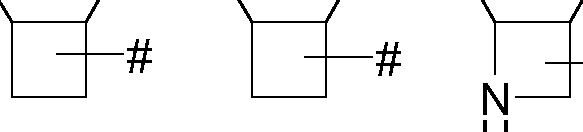


Examples for a 8-, 9- or 10-membered partially unsaturated heterobicyclic ring containing 1 , 2 or 3 (or 4) heteroatoms or heteroatom groups selected from N, O, S, NO, SO and SO2, as ring members are:


Examples for a 8-, 9- or 10-membered maximally unsaturated heterobicyclic ring containing 1 , 2 or 3 (or 4) heteroatoms or heteroatom groups selected from N, O, S, NO, SO and SO2, as ring members are:

Examples for spiro-bound 7-, 8-, 9- or 10-membered heterobicyclic rings containing 1 ,
2 or 3 (or 4) heteroatoms or heteroatom groups selected from N, O, S, NO, SO and SO2, as ring members are

Examples for bridged 7-, 8-, 9- or 10-membered heterobicyclic rings containing 1 , 2 3 (or 4) heteroatoms or heteroatom groups selected from N, O, S, NO, SO and SO2, ring members are
 and the like.
In the above structures # denotes the attachment point to the remainder of the molecule. The attachment point is not restricted to the ring on which is shown, but can be on either of the fused rings, and may be on a carbon or on a nitrogen ring atom. If the rings carry one or more substituents, these may be bound to carbon and/or to nitrogen ring atoms.
A saturated 3-, 4-, 5-, 6-, 7-, 8- or 9-membered ring, wherein the ring may contain 1 or 2 heteroatoms or heteroatom groups selected from O, S, N, NR14, NO, SO and SO2 and/or 1 or 2 groups selected from C=0, C=S and C=NR14 as ring members is either carbocyclic or heterocyclic. Examples are, in addition to the saturated and partly unsaturated heteromonocyclic rings mentioned above, carbocyclic rings, such as cyclo- propyl, cyclopropanonyl, cyclobutyl, cyclobutanonyl, cyclopentyl, cyclopentanonyl, cy- clohexyl, cyclohexanonyl, cyclohexadienonyl, cycloheptyl, cycloheptanonyl, cyclooctyl, cyclooctanonyl, furan-2-onyl, pyrrolidine-2-onyl, pyrrolidine-2,5-dionyl, piperidine-2- only, piperidine-2,6-dionyl and the like.
The remarks made below concerning preferred embodiments of the variables of the compounds of formula I, especially with respect to their substituents A, A1, A2, A3, A4, B1, B2, B3, B4, B5, G1, G2, G3, G4, G5, W, Y, Z, R , R2, R3, R4, R4a, R4b, R5, R6, R7a, R7b, R8, R9, R10a, R10b, R11, R12, R13, R14, R14a, R14b, R15, R16, m and n, the features of the use and method according to the invention and of the composition of the invention are valid both on their own and, in particular, in every possible combination with each other. In a preferred embodiment, B1 and B5 are CH and B2, B3 and B4 are CR2, where R2 has one of the above general meanings, or, in particular, one of the below preferred meanings.
More preferably, B1 and B5 are CH, B2 is CR2, where R2 is not hydrogen, and B3 and B4 are CR2, where R2 has one of the above general meanings, or, in particular, one of the below preferred meanings. In particular, B2 is CR2, where R2 is not hydrogen, B4 is CR2, where R2 has one of the above general meanings, or, in particular, one of the below preferred meanings, and B1, B3, and B5 are CH. Preferably, R2 is selected from hydrogen, halogen, cyano, azido, nitro, -SCN, -SF5, Ci- C6-alkyl, Cs-Cs-cycloalkyl, C2-C6-alkenyl, C2-C6-alkynyl, wherein the four last-mentioned aliphatic and cycloaliphatic radicals may be partially or fully halogenated and/or may be substituted by one or more radicals R8, -OR9, -S(0)nR9 and -N(R10a)R10b,
wherein R8, R9, R10a and R10b have one of the above general meanings, or, in particu- lar, one of the below preferred meanings.
More preferably, R2 is selected from hydrogen, halogen and Ci-C2-haloalkyl, in particular from hydrogen, F, CI, Br and CF3, and specifically from hydrogen, CF3 and CI. In a preferred embodiment, G1 is C-R4b, where R4b has one of the above general meanings, or, in particular, one of the below preferred meanings.
R4b is preferably selected from hydrogen, halogen and cyano, and is in particular hydrogen.
G2, G3 and G5 are preferably C-R4, where R4 has one of the above general meanings, or, in particular, one of the below preferred meanings.
More preferably, G2 and G5 are C-H and G3 is C-R4, where R4 has one of the above general meanings, or, in particular, one of the below preferred meanings.
G4 is preferably C-R4 or C-A, where R4 and A have one of the above general meanings, or, in particular, one of the below preferred meanings.
R4 is preferably selected from the group consisting of hydrogen, halogen, cyano, nitro, Ci-C6-alkyl, Ci-C6-haloalkyl, Ci-C6-alkoxy and Ci-C6-haloalkoxy, and more preferably from hydrogen, halogen and Ci-C4-haloalkyl.
In case that G4 is C-R4, R4 is preferably not hydrogen. In case that G4 is C-R4, R4 is preferably selected from the group consisting of halogen, cyano, nitro, Ci-C6-alkyl, Ci- C6-haloalkyl, Ci-C6-alkoxy and Ci-C6-haloalkoxy, and more preferably from halogen and Ci-C4-haloalkyl. Specifically, R4 is halogen if G4 is C-R4.
In one preferred embodiment, A is A1 and A1 is selected from -C(=NR6)R8 and -N(R5)R6 and is more preferably -C(=NR6)R8; wherein R5, R6 and R8 have one of the above general meanings, or, in particular, one of the below preferred meanings. More preferably, A1 is -C(=NR6)R8; wherein R5, R6 and R8 have one of the above general meanings, or, in particular, one of the below preferred meanings
R6 as a radical in the group -C(=NR6)R8 is preferably selected from hydrogen, cyano, Ci-Cio-alkyl, Cs-Cs-cycloalkyl, C2-Cio-alkenyl, C2-Cio-alkynyl, wherein the four last- mentioned aliphatic and cycloaliphatic radicals each independently may be partially or fully halogenated and/or may be substituted with 1 , 2, 3, 4, 5 or 6 substituents R8; -OR9 and -N(R10a)R10b; wherein R8, R9, R10a and R10b have one of the above general meanings, or, in particular, one of the below preferred meanings. More preferably, R6 in -C(=NR6)R8 is selected from hydrogen, Ci-Cio-alkyl, Cs-Cs- cycloalkyl, wherein the two last-mentioned aliphatic and cycloaliphatic radicals each independently may be partially or fully halogenated and/or may be substituted with 1 , 2 or 3, preferably 1 or 2, in particular 1 , substituents R8; OR9 and NR10aR10b; wherein R8, R9, R10a and R10b have one of the above general meanings, or, in particular, one of the below preferred meanings.
Even more preferably, R6 in -C(=NR6)R8 is selected from OR9 and NR10aR10b; wherein R8, R9, R10a and R10b have one of the above general meanings, or, in particular, one of the below preferred meanings. Specifically, R6 in -C(=NR6)R8 is NR10aR10b.
In OR9 as a preferred meaning of R6 in -C(=NR6)R8, R9 is preferably selected from Ci- C6-alkyl, Ci-C6-haloalkyl, Cs-Cs-cycloalkyl, Cs-Cs-halocycloalkyl, C3-Cs-cycloalkyl-Ci- C4-alkyl-, C2-C6-alkenyl, C2-C6-haloalkenyl, C2-C6-alkynyl and C2-C6-haloalkynyl, and more preferably from Ci-C6-alkyl, Ci-C6-haloalkyl, Cs-Cs-cycloalkyl, Cs-Cs- halocycloalkyl and C3-Cs-cycloalkyl-Ci-C4-alkyl-.
In NR10aR10b as a preferred meaning of R6 in -C(=NR6)R8, R10a and R10b, independently of each other, are preferably selected from the group consisting of hydrogen, C1-C6- alkyl, Ci-C6-haloalkyl, C2-C6-alkenyl, C2-C6-haloalkenyl, C2-C6-alkynyl, C2-C6- haloalkynyl, Cs-Cs-cycloalkyl, Cs-Cs-halocycloalkyl, Ci-C6-alkylcarbonyl, C1-C6- haloalkylcarbonyl, -C(=0)N(R14a)R14b, -C(=S)N(R14a)R14b, phenyl which is optionally substituted with 1 , 2, 3 or 4 substituents R16, and a 3-, 4-, 5-, 6- or 7-membered saturated, partially unsaturated or maximally unsaturated heterocyclic ring comprising 1 , 2, 3 or 4 heteroatoms or heteroatom groups selected from N, O, S, NO, SO and SO2, as ring members, where the heterocyclic ring is optionally substituted with one or more substituents R16;
or R10a and R10b form together with the nitrogen atom they are bonded to a 3-, 4-, 5-, 6-, 7- or 8-membered saturated, partially unsaturated or maximally unsaturated heterocy- die ring, wherein the heterocyclic ring may additionally contain one or two heteroatoms or heteroatom groups selected from N, O, S, NO, SO and SO2, as ring members, where the heterocyclic ring optionally carries one or more substituents selected from halogen, Ci-C6-alkyl, Ci-C6-haloalkyl, Ci-C6-alkoxy, Ci-C6-haloalkoxy, Ci-C6-alkylthio, Ci-C6-haloalkylthio, Cs-Cs-cycloalkyl, Cs-Cs-halocycloalkyl, C2-C6-alkenyl, C2-C6- haloalkenyl, C2-C6-alkynyl and C2-C6-haloalkynyl;
wherein R14a, R14b and R16 have one of the above general meanings, or, in particular, one of the below preferred meanings.
More preferably,
R10a is selected from hydrogen, Ci-C6-alkyl and Ci-C6-haloalkyl; and
R10b is selected from-C(=0)N(R14a)R14b, -C(=S)N(R14a)R14b, phenyl which is optionally substituted with 1 , 2, 3 or 4 substituents R16, and a 5- or 6-membered heteroaro- matic ring comprising 1 , 2 or 3 heteroatoms selected from N, O and S, as ring members, where the heteroaromatic ring is optionally substituted with one or more substituents R16;
wherein R14a, R14b and R16 have one of the above general meanings, or, in particular, one of the below preferred meanings.
Even more preferably,
is selected from hydrogen, Ci-C6-alkyl and Ci-C6-haloalkyl and preferably from hydrogen and Ci-C6-alkyl; and
is selected from-C(=0)N(R 4a)R 4b and -C(=S)N(R 4a)R 4b;
wherein R14a and R14b have one of the above general meanings, or, in particular, one of the below preferred meanings.
In the above radicals R10a and R10b,
R14a is preferably selected from hydrogen, Ci-C6-alkyl and Ci-C6-haloalkyl; and R14b is preferably selected from hydrogen, Ci-C6-alkyl, Ci-C6-haloalkyl, C2-C6-alkenyl, C2-C6-haloalkenyl, C2-C6-alkynyl, C2-C6-haloalkynyl, C3-C6-cycloalkyl, C3-C6- halocycloalkyl, C3-C6-cycloalkyl-Ci-C4-alkyl-, where the cycloalkyl moieties in the three last-mentioned radicals may carry a CN group; Ci-C6-alkyl substituted with a CN group, phenyl which is optionally substituted with 1 , 2, 3 or 4 substituents each independently selected from the group consisting of halogen, cyano, nitro, Ci-C4-alkyl, Ci-C4-haloalkyl, Ci-C4-alkoxy, Ci-C4-haloalkoxy, Ci-C4-alkylthio, Ci- C4-haloalkylthio, C3-C6-cycloalkyl, C3-C6-halocycloalkyl, C2-C4-alkenyl, C2-C4- haloalkenyl, C2-C4-alkynyl and C2-C4-haloalkynyl; and a heterocyclic ring selected from rings of formulae E-1 to E-54

E-6 E-8 E-9

E-10 E- 1 E-12 E-13 E-14

E-20 E-21 E-22 E-23 E-24

E-50 E-51 E-52 E-53 E-54 wherein
^ denotes the bonding point to the remainder of the molecule;
k is 0, 1 , 2 or 3,
q is 0, 1 or 2;
each R16a is independently hydrogen or is R16; and
each R16 is independently selected from the group consisting of halogen, cyano, ni- tro, Ci-C4-alkyl, Ci-C4-haloalkyl, Ci-C4-alkoxy, Ci-C4-haloalkoxy, Ci-C4-alkylthio, Ci-C4-haloalkylthio, C3-C6-cycloalkyl, C3-C6-halocycloalkyl, C2-C4-alkenyl, C2-C4- haloalkenyl, C2-C4-alkynyl and C2-C4-haloalkynyl; or
two R16 present on the same carbon atom of a saturated ring may form together =0 or =S. More preferably, in the above radicals R10a and R
R14a is selected from hydrogen and methyl; and
R14b is selected from hydrogen, Ci-C4-alkyl, Ci-C4-haloalkyl, C2-C4-alkynyl, C2-C4- haloalkynyl, C3-C6-cycloalkyl, C3-C6-halocycloalkyl, C3-C6-cycloalkyl-methyl-, where the cycloalkyl moieties in the three last-mentioned radicals may carry a CN group; Ci-C6-alkyl substituted with a CN group, and a 4-membered saturated heterocyclic ring comprising one heteroatom or heteroatom group selected from
S, SO and SO2 as ring member (ring E-44), where the heterocyclic ring is optionally substituted with one or more, preferably 1 or 2, in particular 1 , substituents R16;
wherein each R16 is independently selected from the group consisting of halogen, cyano, nitro, Ci-C4-alkyl, Ci-C4-haloalkyl, Ci-C4-alkoxy, Ci-C4-haloalkoxy, C1-C4- alkylthio, Ci-C4-haloalkylthio, C3-C6-cycloalkyl, C3-C6-halocycloalkyl, C2-C4- alkenyl, C2-C4-haloalkenyl, C2-C4-alkynyl and C2-C4-haloalkynyl; or
two R16 present on the same carbon atom may form together a group =0 or =S. Preferably, in the above radicals, each R16 is independently selected from halogen, CN, Ci-C4-alkyl, Ci-C4-haloalkyl, Ci-C4-alkoxy and Ci-C4-haloalkoxy.
Specifically, in the above radicals R10a and R10b, R14a is selected from hydrogen and methyl and is specifically hydrogen, and R14b is selected from hydrogen, Ci-C6-alkyl and Ci-Ce-haloalkyI.
R8 as a radical in the group -C(=NR6)R8 is preferably selected from hydrogen, C1-C4- alkyl, Ci-C4-haloalkyl and NR10aR10b, and more preferably from hydrogen and
N(R10a)R10b, and is specifically hydrogen.
In this case (i.e. in NR10aR10b as a meaning of R8), R10a and R10b are preferably selected, independently of each other, from the group consisting of hydrogen, Ci-C6-alkyl, Ci-C6-haloalkyl, C2-C6-alkenyl, C2-C6-haloalkenyl, C2-C6-alkynyl, C2-C6-haloalkynyl, C3- Cs-cycloalkyl, Cs-Cs-halocycloalkyl, Ci-C6-alkylcarbonyl, Ci-C6-haloalkylcarbonyl, -C(=0)N(R14a)R14 , -C(=S)N(R14a)R14 , phenyl which is optionally substituted with 1 , 2, 3 or 4 substituents R16, and a 3-, 4-, 5-, 6- or 7-membered saturated, partially unsaturated or maximally unsaturated heterocyclic ring comprising 1 , 2, 3 or 4 heteroatoms or heteroatom groups selected from N, O, S, NO, SO and SO2, as ring members, where the heterocyclic ring is optionally substituted with one or more substituents R16;
or R10a and R10b form together with the nitrogen atom they are bonded to a 3-, 4-, 5-, 6-, 7- or 8-membered saturated, partially unsaturated or maximally unsaturated heterocyclic ring, wherein the heterocyclic ring may additionally contain one or two heteroatoms or heteroatom groups selected from N, O, S, NO, SO and SO2, as ring members, where the heterocyclic ring optionally carries one or more substituents selected from
halogen, Ci-C6-alkyl, Ci-C6-haloalkyl, Ci-C6-alkoxy, Ci-C6-haloalkoxy, Ci-C6-alkylthio, Ci-C6-haloalkylthio, Cs-Cs-cycloalkyl, Cs-Cs-halocycloalkyl, C2-C6-alkenyl, C2-C6- haloalkenyl, C2-C6-alkynyl and C2-C6-haloalkynyl;
wherein R14a, R14b and R16 have one of the above general meanings, or, in particular, one of the below preferred meanings.
More preferably, R10a and R10b are in this case selected, independently of each other, from hydrogen, Ci-C4-alkyl, Ci-C4-haloalkyl, C2-C4-alkenyl, C2-C4-haloalkenyl, C2-C4- alkynyl, C2-C4-haloalkynyl, C3-C6-cycloalkyl, C3-C6-halocycloalkyl, Ci-C4-alkylcarbonyl, Ci-C4-haloalkylcarbonyl, Ci-C4-alkylaminocarbonyl, Ci-C4-haloalkylaminocarbonyl, C3- C6-cycloalkylaminocarbonyl and C3-C6-halocycloalkylaminocarbonyl,
or, together with the nitrogen atom to which they are bound, form a 5- or 6-membered saturated, partially unsaturated or aromatic heterocyclic ring, which additionally may contain 1 or 2 further heteroatoms or heteroatom groups selected from N, O, S, NO, SO and SO2, as ring members, where the heterocyclic ring may carry 1 or 2, in particular 1 , substituents selected from halogen, CN, Ci-C4-alkyl, Ci-C4-haloalkyl, C2-C4- alkenyl, C2-C4-haloalkenyl, C2-C4-alkynyl, C2-C4-haloalkynyl, C3-C6-cycloalkyl, C3-C6- halocycloalkyl, Ci-C4-alkoxy, Ci-C4-haloalkoxy, Ci-C4-alkylthio and Ci-C4-haloalkylthio. Even more preferably, R10a and R10b are in this case selected, independently of each other, from hydrogen, Ci-C4-alkyl, Ci-C4-haloalkyl, C3-C6-cycloalkyl, C3-C6- halocycloalkyl, Ci-C4-alkylaminocarbonyl and Ci-C4-haloalkylaminocarbonyl; and are specifically hydrogen or Ci-C6-alkyl. In an alternatively more preferred embodiment of the invention, A1 is N(R5)R6, wherein R5 is selected from hydrogen and Ci-C6-alkyl; and
R6 is N(R10a)R10b, wherein
R10a is selected from hydrogen and Ci-C6-alkyl; and
Riob js -C(=0)R13, wherein
R13 is selected from the group consisting of hydrogen, halogen, C1-C6- alkyl, Cs-Cs-cycloalkyl, C2-C6-alkenyl and C2-C6-alkynyl, wherein the four last-mentioned aliphatic or cycloaliphatic radicals may be unsub- stituted, partially or fully halogenated and/or may carry 1 or 2 radicals selected from CN, C3-C4-cycloalkyl, Ci-C4-alkoxy, Ci-C4-haloalkoxy and oxo.
In an alternative embodiment of the invention, A is A2.
In A2, W is preferably O.
In A2, Y is preferably N(R5)R6; wherein R5 and R6 have one of the above general meanings, or, in particular, one of the below preferred meanings. More preferably, in A2, W is O and Y is N(R5)R6; wherein R5 and R6 have one of the above general meanings, or, in particular, one of the below preferred meanings.
In N(R5)R6 as a radical Y,
R5 is preferably selected from hydrogen, Ci-C6-alkyl, Ci-C6-haloalkyl, C2-C6-alkenyl, C2-C6-haloalkenyl, C2-C6-alkynyl, C2-C6-haloalkynyl, Cs-Cs-cycloalkyl, C3-C8- halocycloalkyl, where the 8 aforementioned aliphatic and cycloaliphatic radicals may be substituted by 1 , 2 or 3 radicals R8; Ci-C4-alkylcarbonyl, C1-C4- haloalkylcarbonyl, Ci-C4-alkoxycarbonyl and Ci-C4-haloalkoxycarbonyl; and
R6 is preferably selected from hydrogen, Ci-Cio-alkyl, Cs-Cs-cycloalkyl, C2-C10- alkenyl, C2-Cio-alkynyl, wherein the four last-mentioned aliphatic and cycloaliphatic radicals may be partially or fully halogenated and/or may be substituted by one or more substituents R8,
-OR9, -N(R 0a)R 0b, -S(0)nR9, -C(=O)N(R 0a)N(R 0a)R 0b, -C(=0)R8,
-P(=0)(OR9)2, -P(=S)(OR9)2,
phenyl which may be substituted with 1 , 2, 3, 4, or 5 substituents R11, and a 3-, 4-, 5-, 6-, 7-, 8-, 9- or 10-membered saturated, partially unsaturated or maximally unsaturated heteromonocyclic or heterobicyclic ring containing 1 , 2, 3 or 4 heteroatoms or heteroatom groups independently selected from N, O, S, NO, SO and SO2, as ring members, where the heteromonocyclic or heterobicyclic ring may be substituted with one or more substituents R11;
or
R5 and R6, together with the nitrogen atom to which they are bound, form a 3-, 4-, 5-, 6-, 7- or 8-membered saturated, partially unsaturated or maximally unsaturated heteromonocyclic ring, where the ring may further contain 1 , 2, 3 or 4 heteroa- toms or heteroatom-containing groups selected from O, S, SO, SO2, N, NH, C=0 and C=S as ring members, or form a 7-, 8-, 9- or 10-membered saturated, partially unsaturated or maximally unsaturated heterobicyclic ring, where the ring may further contain 1 , 2, 3 or 4 heteroatoms or heteroatom groups selected from N, O, S, NO, SO, SO2, C=0 and C=S, wherein the heteromonocyclic or heterobicyclic ring may be substituted with 1 , 2, 3, 4 or 5 substituents independently selected from the group consisting of halogen, cyano, Ci-C6-alkyl, Ci-C6-haloalkyl, C1-C6- alkoxy, Ci-C6-haloalkoxy, Ci-C6-alkylthio, Ci-C6-haloalkylthio, Cs-Cs-cycloalkyl, C3-Cs-halocycloalkyl, C2-C6-alkenyl, C2-C6-haloalkenyl, C2-C6-alkynyl, C2-C6- haloalkynyl, wherein the aliphatic or cycloaliphatic moieties in the twelve last-
mentioned radicals may be substituted by one or more radicals R8, and phenyl which may be substituted with 1 , 2, 3, 4 or 5 substituents R11;
or
R5 and R6 together form a group =C(R8)2, =S(0)m(R9)2, =NR10a or =NOR9;
wherein R8, R9, R10a, R10b and R11 have one of the above general meanings, or, in particular, one of the below preferred meanings.
More preferably, in N(R5)R6 as a radical Y,
R5 is selected from hydrogen, Ci-C6-alkyl, C2-C3-alkenyl, C2-C3-alkynyl, -Chb-CN, Ci-C6-alkoxy-methyl-, Ci-C4-alkylcarbonyl and Ci-C4-alkoxycarbonyl; and
R6 is selected from is selected from hydrogen, Ci-C6-alkyl, Ci-C6-haloalkyl, C3-C6- cycloalkyl, C3-C6-halocycloalkyl, C2-C6-alkenyl, C2-C6-haloalkenyl, C2-C6-alkynyl, C2-C6-haloalkynyl, where the 8 last-mentioned aliphatic and cycloaliphatic radicals may carry 1 , 2 or 3 radicals R8; -C(=0)R8, -S(0)nR9, -P(=0)(OR9)2,
 phenyl which may be substituted with 1 , 2, 3, 4, or 5 substituents R11, and a 3-, 4-, 5-, 6- or 7-membered saturated, partially unsaturated or maximally unsaturated heteromonocyclic ring containing 1 , 2 or 3 heteroatoms or het- eroatom groups independently selected from N, O, S, NO, SO and SO2, as ring members, where the heteromonocyclic ring may be substituted with one or more substituents R11;
wherein R8 and R11 have one of the above general meanings, or, in particular, one of the below preferred meanings and wherein each R9 is independently selected from Ci-C6-alkyl, Ci-C6-haloalkyl, C3-C6-cycloalkyl, phenyl and - N(R10a)R10b, wherein R10a and R10b, independently of each other, are hydrogen or d-Ce-alkyl;
or
R5 and R6, together with the nitrogen atom to which they are bound, form a 3-, 4-, 5- or 6-membered saturated heteromonocyclic ring, where the ring may additionally contain 1 , 2 or 3 heteroatoms or heteroatom-containing groups selected from
0, S, SO, SO2, NH and C=0 as ring members, or form a 7-, 8-, 9- or 10- membered saturated heterobicyclic ring, where the ring may additionally contain
1 , 2, 3 or 4 heteroatoms or heteroatom groups selected from O, S, SO, SO2, NH and C=0, wherein the heteromonocyclic or heterobicyclic ring may be substituted with 1 , 2, 3, 4 or 5 substituents independently selected from the group consisting of halogen, cyano, Ci-C6-alkyl, Ci-C6-haloalkyl, Ci-C6-alkoxy and C1-C6- haloalkoxy;
or
R5 and R6 together form a group =S(0)m(R9)2;
wherein each R9 is independently selected from Ci-C6-alkyl, Ci-C6-haloalkyl, C3- C6-cycloalkyl, C3-C6-halocycloalkyl and C3-C6-cycloalkyl-Ci-C4-alkyl.
Even more preferably, in N(R5)R6 as a radical Y,
R5 is selected from hydrogen, Ci-C6-alkyl, C2-C3-alkenyl, Ci-C4-alkylcarbonyl and Ci-C4-alkoxycarbonyl; and
R6 is selected from Ci-C6-alkyl, Ci-C6-haloalkyl, Ci-C4-alkyl which carries 1 or 2 radicals R8, C3-C6-cycloalkyl, C3-C6-halocycloalkyl, C3-C6-cycloalkyl which carries one radical R8; C2-C6-alkenyl, C2-C6-alkynyl, -C(=0)R8, phenyl which may be substituted with 1 , 2, 3, 4, or 5 substituents R11, and a 3-, 4-, 5- or 6-membered saturated, partially unsaturated or maximally unsaturated heteromonocyclic ring containing 1 , 2 or 3 heteroatoms or heteroatom groups independently selected from N, O, S, NO, SO and SO2, as ring members, where the heteromonocyclic ring may be substituted with one or more substituents R11;
wherein R8 and R11 have one of the above general meanings, or, in particular, one of the below preferred meanings;
or
R5 and R6, together with the nitrogen atom to which they are bound, form a 3-, 4-, 5- or 6-membered saturated heteromonocyclic ring, where the ring may additionally contain 1 , 2 or 3 heteroatoms or heteroatom-containing groups selected from
0, S, SO, SO2, NH and C=0 as ring members, or form a 7-, 8-, 9- or 10- membered saturated heterobicyclic ring, where the ring may additionally contain
1 , 2, 3 or 4 heteroatoms or heteroatom groups selected from O, S, SO, SO2, NH and C=0, wherein the heteromonocyclic or heterobicyclic ring may be substituted with 1 , 2 or 3 substituents independently selected from the group consisting of halogen, cyano, Ci-C6-alkyl, Ci-C6-haloalkyl, Ci-C6-alkoxy and Ci-C6-haloalkoxy; or
R5 and R6 together form a group

wherein each R9 is independently selected from Ci-C6-alkyl, Ci-C6-haloalkyl, C3- C6-cycloalkyl, C3-C6-halocycloalkyl and C3-C6-cycloalkyl-Ci-C4-alkyl.
In N(R5)R6 as a radical Y,
R8 as a substituent on an aliphatic or cycloaliphatic group is preferably selected from nitro, cyano, Cs-Cs-cycloalkyl which may be substituted by 1 or 2 substituents selected from CN, methyl and oxo, C3-Ce-halocycloalkyl, -OR9, -S(0)nR9,
-N(R 0a)R 0b, -C(=0)R13, -C(=O)N(R 0a)R 0b, -C(=S)N(R 0a)R 0b, -C(=0)OR9, phenyl, optionally substituted with 1 , 2, 3, 4 or 5 substituents R16, and a 3-, 4-, 5-, 6- or 7-membered saturated, partially unsaturated or maximally unsaturated heterocyclic ring comprising 1 , 2 or 3 heteroatoms or heteroatom groups selected from
N, O, S, NO, SO and SO2, as ring members, where the heterocyclic ring is optionally substituted with one or more substituents R16; and
R8 as a substituent on a cycloaliphatic group is additionally selected from C1-C6- alkyl, Ci-C6-haloalkyl, C2-C6-alkenyl, C2-C6-haloalkenyl, C2-C6-alkynyl, C2-C6- haloalkynyl and C3-C6-cycloalkyl-Ci-C4-alkyl; and
R8 in the group -C(=0)R8 is selected from hydrogen, Ci-C6-alkyl, Ci-C6-haloalkyl, - OR9 and -N(R 0a)R 0b;
wherein R9, R10a, R10b, R13 and R16 have one of the above general meanings, or, in particular, one of the below preferred meanings.
More preferably, in N(R5)R6 as a radical Y,
R8 as a substituent on an aliphatic or cycloaliphatic group is selected from cyano, Ca-Ce-cycloalkyl, C3-Ce-halocycloalkyl, -OR9, -S(0)nR9, -N(R 0a)R 0 , -C(=0)R13, -C(=O)N(R 0a)R 0b, -C(=S)N(R 0a)R 0 , -C(=0)OR9, phenyl, optionally substituted with 1 , 2 or 3 substituents R16, and a 5- or 6-membered heteroaromatic ring comprising 1 , 2 or 3 heteroatoms selected from N, O and S, as ring members, where the heteroaromatic ring is optionally substituted with one or more substituents R16; and specifically from cyano, C3-C6-cycloalkyl, C3-C6-halocycloalkyl,
-C(=0)OR9 and phenyl, optionally substituted with 1 , 2 or 3 substituents R16; and
R8 as a substituent on a cycloaliphatic group is additionally selected from Ci-C6-alkyl and Ci-C6-haloalkyl; and
R8 in the group -C(=0)R8 is selected from hydrogen, Ci-C6-alkyl, Ci-C6-haloalkyl, - OR9 and -N(R 0a)R 0 ;
wherein R9, R10a, R10b, R13 and R16 have one of the above general meanings, or, in particular, one of the below preferred meanings.
In this case,
R10a and R10b are preferably selected, independently of each other, from hydrogen, Ci- C4-alkyl, Ci-C4-haloalkyl, C2-C4-alkenyl, C2-C4-haloalkenyl, C2-C4-alkynyl, C2-C4- haloalkynyl, C3-C6-cycloalkyl, C3-C6-halocycloalkyl, Ci-C4-alkylcarbonyl, C1-C4- haloalkylcarbonyl, Ci-C4-alkylaminocarbonyl, Ci-C4-haloalkylaminocarbonyl, C3- C6-cycloalkylaminocarbonyl and C3-C6-halocycloalkylaminocarbonyl,
or, together with the nitrogen atom to which they are bound, form a 5- or 6- membered saturated, partially unsaturated or aromatic heterocyclic ring, which additionally may contain 1 or 2 further heteroatoms or heteroatom groups selected from N, O, S, NO, SO and SO2, as ring members, where the heterocyclic ring may carry 1 or 2, in particular 1 , substituents selected from halogen, CN, C1-C4- alkyl, Ci-C4-haloalkyl, C2-C4-alkenyl, C2-C4-haloalkenyl, C2-C4-alkynyl, C2-C4-
haloalkynyl, C3-C6-cycloalkyl, C3-C6-halocycloalkyl, Ci-C4-alkoxy, C1-C4- haloalkoxy, Ci-C4-alkylthio and Ci-C4-haloalkylthio.
More preferably, R10a and R10b are in this case selected, independently of each other, from hydrogen, Ci-C4-alkyl, Ci-C4-haloalkyl, C3-C6-cycloalkyl, C3-C6-halocycloalkyl, Ci- C4-alkylaminocarbonyl and Ci-C4-haloalkylaminocarbonyl. Specifically, they are selected, independently of each other, from hydrogen, Ci-C4-alkyl and Ci-C4-haloalkyl. Very specifically, one of R10a and R10b is hydrogen and the other is Ci-C4-alkyl or C1-C4- haloalkyl.
In this case, R9 is preferably selected from hydrogen, Ci-C4-alkyl, Ci-C4-haloalkyl, C3- C6-cycloalkyl, C3-C6-halocycloalkyl, C3-C6-cycloalkyl-Ci-C4-alkyl-, C2-C4-alkenyl, C2-C4- haloalkenyl, C2-C4-alkynyl and C2-C4-haloalkynyl, and more preferably from hydrogen, Ci-C4-alkyl and Ci-C4-haloalkyl.
In this case, R13 is preferably selected from Ci-C4-alkyl, Ci-C4-haloalkyl, C3-C6- cycloalkyl, C3-C6-halocycloalkyl, C3-C6-cycloalkyl-Ci-C4-alkyl-, C2-C4-alkenyl, C2-C4- haloalkenyl, C2-C4-alkynyl, C2-C4-haloalkynyl and phenyl, and more preferably from Ci- C4-alkyl and Ci-C4-haloalkyl.
In a particular embodiment, in N(R5)R6 as Y,
R5 is selected from hydrogen and Ci-C4-alkyl;
R6 is selected from Ci-C6-alkyl, Ci-C6-haloalkyl, Ci-C4-alkyl which carries 1 or 2 radicals R8, C3-C6-cycloalkyl, C3-C6-halocycloalkyl and C3-C6-cycloalkyl which carries one radical R8, where R8 has one of the above general meanings, or, in particular, one of the above preferred meanings;
or
R5 and R6, together with the nitrogen atom to which they are bound, form a 5- or 6-membered saturated heteromonocyclic ring, where the ring may further contain 1 , 2 or 3 heteroatoms or heteroatom-containing groups selected from NH and
C=0 as ring members, wherein the heterocyclic ring may be substituted with 1 , 2 or 3 substituents independently selected from the group consisting of halogen, cyano, Ci-C6-alkyl, Ci-C6-haloalkyl, Ci-C6-alkoxy and Ci-C6-haloalkoxy. In a specific embodiment, in N(R5)R6 as Y,
R5 is hydrogen; and
R6 is selected from Ci-C4-alkyl which carries 1 or 2 radicals R8, C3-C6-cycloalkyl, C3- C6-halocycloalkyl and C3-C6-cycloalkyl which carries one radical R8; and specifically from methyl which carries 1 or 2 radicals R8, cyclopropyl, halocyclopropyl
and cyclopropyl which carries one radical R8, where R8 has one of the above general meanings, or, in particular, one of the above preferred meanings;
or
R5 and R6, together with the nitrogen atom to which they are bound, form a 5- or 6-membered saturated heteromonocyclic ring, where the ring may further contain
1 , 2 or 3 heteroatoms or heteroatom-containing groups selected from NH and C=0 as ring members, wherein the heterocyclic ring may be substituted with 1 , 2 or 3 substituents independently selected from the group consisting of halogen, cyano, Ci-C6-alkyl, Ci-C6-haloalkyl, Ci-C6-alkoxy and Ci-C6-haloalkoxy.
In an alternative embodiment of the invention, A is A3.
Preferably, R7a and R7b in the group A3 are independently of each other selected from hydrogen, Ci-C4-alkyl and Ci-C4-haloalkyl, and more preferably one of R7a and R7b is hydrogen and the other is hydrogen or methyl. Specifically, both are hydrogen.
In the group A3,
R5 is preferably selected from hydrogen, Ci-C6-alkyl, C3-C6-cycloalkyl, C2-C6-alkenyl, C2-C6-alkynyl, wherein the four last-mentioned aliphatic and cycloaliphatic radi- cals may be partially or fully halogenated and/or may be substituted with one or more substituents R8; Ci-C4-alkylcarbonyl, Ci-C4-haloalkylcarbonyl, C1-C4- alkoxycarbonyl and Ci-C4-haloalkoxycarbonyl; and
R6 is preferably selected from hydrogen, Ci-C6-alkyl, C3-C6-cycloalkyl, C2-C6-alkenyl, C2-C6-alkynyl, wherein the four last-mentioned aliphatic and cycloaliphatic radi- cals may be partially or fully halogenated and/or may be substituted by one or more substituents R8,
-OR9, -N(R 0a)R 0b, -S(0)nR9, -C(=O)N(R 0a)N(R 0a)R 0b, -C(=0)R8,
phenyl and a 3-, 4-, 5-, 6- or 7-membered saturated, partially unsaturated or maximally unsaturated heteromonocyclic or heterobicyclic ring containing 1 , 2, 3 or 4 heteroatoms or heteroatom groups independently selected from N, O, S, NO, SO and SO2, as ring members, where the heteromonocyclic or heterobicyclic ring may be substituted with one or more substituents R11;
or
R5 and R6, together with the nitrogen atom to which they are bound, form a 3-, 4-, 5- or 6-membered saturated, partially unsaturated or maximally unsaturated heterocyclic ring, where the ring may further contain 1 , 2, 3 or 4 heteroatoms or heteroatom-containing groups selected from O, S, N, SO, SO2, C=0 and C=S as ring members, wherein the heterocyclic ring may be substituted with 1 , 2, 3, 4 or 5 substituents independently selected from the group consisting of halogen, cy-
ano, Ci-C6-alkyl, Ci-C6-haloalkyl, Ci-C6-alkoxy, Ci-C6-haloalkoxy, Ci-C6-alkylthio, Ci-C6-haloalkylthio, Cs-Cs-cycloalkyl, Cs-Cs-halocycloalkyl, C2-C6-alkenyl, C2-C6- haloalkenyl, C2-C6-alkynyl, C2-C6-haloalkynyl, wherein the aliphatic or cydoaliphatic moieties in the twelve last-mentioned radicals may be substituted by one or more radicals R8, and phenyl which may be substituted with 1 , 2, 3, 4 or 5 substituents R11 ;
or
R5 and R6 together form a group =C(R8)2, =S(0)m(R9)2, =NR10a or =NOR9;
wherein R8, R9, R10a, R10b and R11 have one of the above general meanings, or, in particular, one of the below preferred meanings.
More preferably, in the group A3,
R5 is selected from hydrogen, Ci-C4-alkyl, C2-C3-alkenyl, C2-C3-alkynyl, -CH2-CN, Ci-C6-alkoxy-methyl-, Ci-C4-alkylcarbonyl and Ci-C4-alkoxycarbonyl, and prefer- ably from hydrogen and Ci-C4-alkyl; and
R6 is -C(=0)R8;
wherein R8 has one of the above general meanings, or, in particular, one of the below preferred meanings. R8 in -C(=0)R8 as a meaning of the radicals R5 and R6 of the group A3 is preferably selected from the group consisting of Ci-C6-alkyl, Ci-C6-haloalkyl, Cs-Cs-cycloalkyl, Cs- Cs-halocycloalkyl, C2-C6-alkenyl, C2-C6-haloalkenyl, C2-C6-alkynyl, C2-C6-haloalkynyl, where the aliphatic and cydoaliphatic moieties in the 8 last-mentioned radicals may be substituted by one or more radicals R13; -OR9, -S(0)nR9, -N(R10a)R10b, phenyl, optionally substituted with 1 , 2, 3, 4 or 5 substituents R16, and a 3-, 4-, 5- or 6-membered saturated, partially unsaturated or maximally unsaturated heterocyclic ring comprising 1 , 2 or 3 heteroatoms or heteroatom groups selected from N, O, S, NO, SO and SO2, as ring members, where the heterocyclic ring is optionally substituted with one or more substituents R16,
wherein R9, R10a, R10b, R13 and R16 have one of the above general meanings, or, in particular, one of the below preferred meanings.
R9 in -OR9 as a meaning of R8 in the group -C(=0)R8 as a meaning of the radicals R5 and R6 of the group A3 is preferably selected from Ci-C6-alkyl, Ci-C6-haloalkyl, C2-C6- alkenyl, C2-C6-haloalkenyl, C2-C6-alkynyl, C2-C6-haloalkynyl, Cs-Cs-cycloalkyl, Cs-Cs- halocycloalkyl and C3-Cs-cycloalkyl-Ci-C4-alkyl-, and more preferably from Ci-C6-alkyl, Ci-C6-haloalkyl, Cs-Cs-cycloalkyl, Cs-Cs-halocycloalkyl and C3-Cs-cycloalkyl-Ci-C4- alkyk
R10a and R10b in -N(R10a)R10b as a meaning of R8 in the group -C(=0)R8 as a meaning of the radicals R5 and R6 of the group A3 are, independently of each other, preferably selected from hydrogen, Ci-C4-alkyl, Ci-C4-haloalkyl, Ci-C4-alkyl substituted by one radical R13, C2-C4-alkenyl, C2-C4-haloalkenyl, C2-C4-alkynyl, C2-C4-haloalkynyl, C3-C6- cycloalkyl, C3-C6-halocycloalkyl, Ci-C4-alkylcarbonyl, Ci-C4-haloalkylcarbonyl, C1-C4- alkylaminocarbonyl, Ci-C4-haloalkylaminocarbonyl, C3-C6-cycloalkylaminocarbonyl, C3- C6-halocycloalkylaminocarbonyl, and a 3-, 4-, 5-, 6- or 7-membered saturated, partially unsaturated or maximally unsaturated heterocyclic ring comprising 1 , 2 or 3 heteroa- toms or heteroatom groups selected from N, O, S, NO, SO and SO2, as ring members, where the heterocyclic ring is optionally substituted with one or more, preferably 1 , 2 or 3, in particular 1 , substituents selected from halogen, CN , Ci-C4-alkyl, Ci-C4-haloalkyl, C2-C4-alkenyl, C2-C4-haloalkenyl, C2-C4-alkynyl, C2-C4-haloalkynyl, C3-C6-cycloalkyl, C3-C6-halocycloalkyl, Ci-C4-alkoxy, Ci-C4-haloalkoxy, Ci-C4-alkylthio and C1-C4- haloalkylthio;
or, R10a and R10b, together with the nitrogen atom to which they are bound, form a 5- or 6-membered saturated, partially unsaturated or aromatic heterocyclic ring, which additionally may contain 1 or 2 further heteroatoms or heteroatom groups selected from N, O, S, NO, SO and SO2, as ring members, where the heterocyclic ring may carry 1 or 2, in particular 1 , substituents selected from halogen, CN, Ci-C4-alkyl, Ci-C4-haloalkyl, C2- C4-alkenyl, C2-C4-haloalkenyl, C2-C4-alkynyl, C2-C4-haloalkynyl, C3-C6-cycloalkyl, C3- C6-halocycloalkyl, Ci-C4-alkoxy, Ci-C4-haloalkoxy, Ci-C4-alkylthio and C1-C4- haloalkylthio.
More preferably, R10a and R10b in R8 in the radicals R5 and R6 of the group A3 are, inde- pendently of each other, selected from hydrogen, Ci-C4-alkyl, Ci-C4-haloalkyl, C1-C4- alkyl substituted by one radical R13, C3-C6-cycloalkyl, C3-C6-halocycloalkyl, and a 3- or 4-membered saturated heterocyclic ring comprising 1 heteroatom or heteroatom group selected from N, O, S, NO, SO and SO2, as ring member, where the heterocyclic ring is optionally substituted with one or more, preferably 1 , 2 or 3, in particular 1 , substituents selected from halogen, CN , Ci-C4-alkyl, Ci-C4-haloalkyl, Ci-C4-alkoxy and C1-C4- haloalkoxy; and are specifically, independently of each other, selected from hydrogen, Ci-C4-alkyl and Ci-C4-haloalkyl.
R13 in R8 in the radicals R5 and R6 of the group A3 is preferably selected from CN, Ci- C6-alkoxy, Ci-C6-haloalkoxy, Ci-C6-alkylthio, Ci-C6-haloalkylthio, Ci-C6-alkylsulfinyl, Ci- C6-haloalkylsulfinyl, Ci-C6-alkylsulfonyl and Ci-C6-haloalkylsulfonyl.
R16 in R8 in the radicals R5 and R6 of the group A3 is preferably selected from halogen, Ci-C4-alkyl, Ci-C4-haloalkyl, Ci-C4-alkoxy and Ci-C4-haloalkoxy.
More preferably, R8 in -C(=0)R8 as a meaning of the radicals R5 and R6 of the group A3 is selected from the group consisting of Ci-C6-alkyl, Ci-C6-haloalkyl, Ci-C4-alkyl substituted by one radical R13, C3-C8-cycloalkyl, C3-C8-halocycloalkyl, -N(R10a)R10b, phenyl which is optionally substituted with 1 , 2, 3, 4 or 5 substituents each independently selected from the group consisting of halogen, cyano, nitro, Ci-C4-alkyl, Ci- C4-haloalkyl, Ci-C4-alkoxy, Ci-C4-haloalkoxy, Ci-C4-alkylthio, Ci-C4-haloalkylthio, C3- C6-cycloalkyl, C3-C6-halocycloalkyl, C2-C4-alkenyl, C2-C4-haloalkenyl, C2-C4-alkynyl and C2-C4-haloalkynyl; and a heterocyclic ring selected from rings of formulae E-1 to E-54 as defined above,
wherein
R10a and R10b, independently of each other, are selected from hydrogen, Ci-C4-alkyl, Ci-C4-haloalkyl and C3-C6-cycloalkyl; and
R13 is selected from CN, C3-C6-cycloalkyl, Ci-C6-alkoxy, Ci-C6-haloalkoxy, C1-C6- alkylthio, Ci-C6-haloalkylthio, Ci-C6-alkylsulfinyl, Ci-C6-haloalkylsulfinyl, C1-C6- alkylsulfonyl, Ci-C6-haloalkylsulfonyl, phenyl and a heterocyclic ring selected from rings of formulae E-1 to E-54 as defined above; and
each R16 as a substituent on heterocyclic rings of formulae E-1 to E-54 is independently selected from the group consisting of halogen, cyano, nitro, C1-C4- alkyl, Ci-C4-haloalkyl, Ci-C4-alkoxy, Ci-C4-haloalkoxy, Ci-C4-alkylthio, C1-C4- haloalkylthio, C3-C6-cycloalkyl, C3-C6-halocycloalkyl, C2-C4-alkenyl, C2-C4- haloalkenyl, C2-C4-alkynyl and C2-C4-haloalkynyl; or
two R16 present on the same carbon atom of a saturated heterocyclic ring may form together =0 or =S.
Even more preferably, R8 in -C(=0)R8 as a meaning of the radicals R5 and R6 of the group A3 is selected from the group consisting of Ci-C6-alkyl, Ci-C6-haloalkyl, C1-C4- alkyl substituted by one radical R13, C3-C0-cycloalkyl, C3-C0-halocycloalkyl and -
N(R10a)R10b;
wherein
R10a and R10b, independently of each other, are selected from hydrogen and C1-C4- alkyl; and
R13 is selected from cyano, C3-C6-cycloalkyl, phenyl, pyridinyl and pyrimidinyl. In an alternative embodiment of the invention, A is A4.
A4 is preferably selected from a 3-, 4-, 5-, 6- or 7-membered saturated, partially unsaturated or maximally unsaturated heteromonocyclic ring containing 1 , 2, 3 or 4 heteroa- toms or heteroatom groups selected from N, O, S, NO, SO and SO2, as ring members,
where the heteromonocyclic ring is optionally substituted with one or more, preferably 1 , 2 or 3, in particular 1 , substituents R11, where R11 has one of the above general meanings, or, in particular, one of the below preferred meanings. More preferably, A4 is selected from a 3-, 4-, 5-, 6- or 7-membered saturated heteromonocyclic ring containing 1 or 2 heteroatoms or heteroatom groups selected from N, O, S, NO, SO and SO2, as ring members, a 5-, 6- or 7-membered partially unsaturated heteromonocyclic ring containing 1 , 2 or 3 heteroatoms or heteroatom groups selected from N, O, S, NO, SO and SO2, as ring members, and a 5- or 6-membered aromatic heteromonocyclic ring containing 1 , 2, 3 or 4 heteroatoms selected from N, O and S as ring members, where the heteromonocyclic ring is optionally substituted with one or more, preferably 1 , 2 or 3, in particular 1 , substituents R11, where R11 has one of the above general meanings, or, in particular, one of the below preferred meanings. A4 is even more preferably selected from rings of formulae D-1 to D-173

D-15 D-16 D-17 D-18 D-19

D-20 D-21 D-22 D-23 D-24

D-25 D-26 D-27 D-28 D-29

D-30 D-31 D-32 D-33 D-34

D-35 D-36 D-37 D-38 D-39

D-40 D-41 D-42 D-43 D-44

D-46 D-47 D-48 D-49

D-50 D-51 D-52 D-53 D-54

D-55 D-56 D-57 D-58 D-59

D-60 D-61 D-62 D-63 D-64

D-65 D-66 D-67 D-68 D-69
1)

D-70 D-71 D-72 D-73 D-74

D-75 D-76 D-77 D-78 D-79

D-80 D-81 D-82 D-83 D-84

D-90 D-92 D-93 D-94

D-95 D-96 D-97 D-98 D-99

D-105 D-106 D-107 D-108 D-109

D-110 D-111 D-112 D-113 D-114
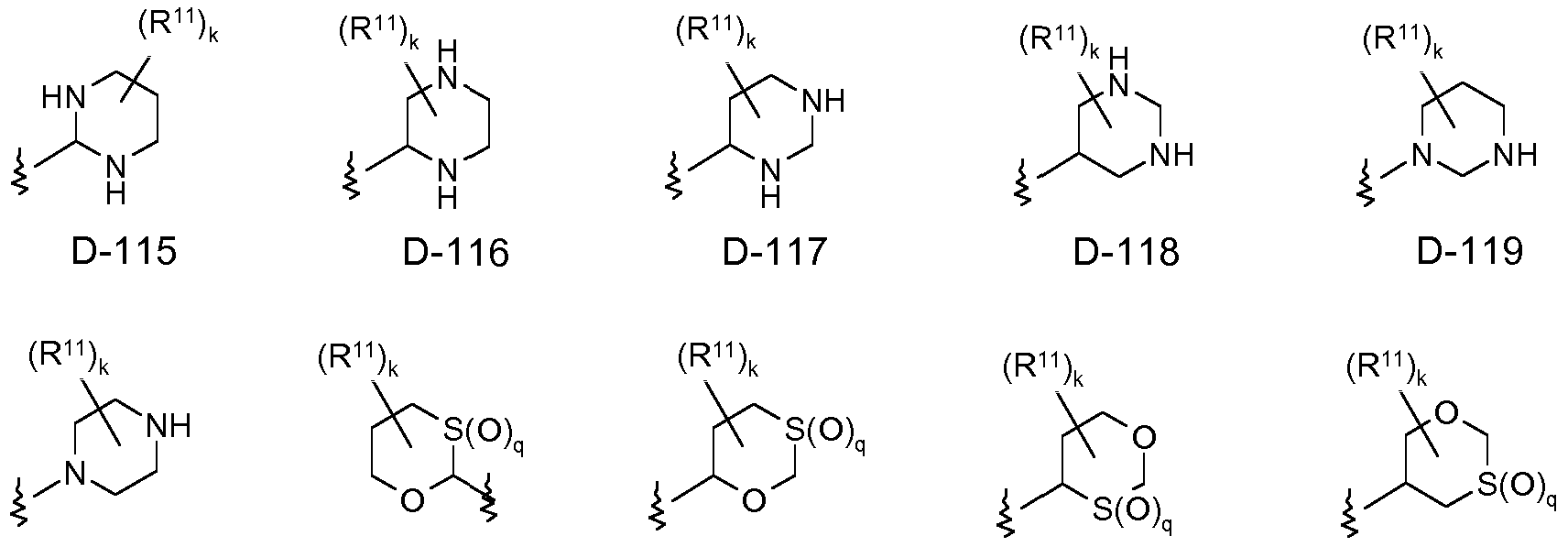
D-120 D-121 D-122 D-123 D-124

D-125 D-126 D-127 D-128 D-129

D-130 D-131 D-132 D-133 D-134

D-135 D-136 D-137 D-138 D-139
(R11) (R11)k (R11)k

D-140 D-141 D-142 D-143 D-144

D-145 D-146 D-147 D-148 D-149

D-155 D-156 D-157 D-158 D-159

D-160 D-161 D-162 D-163 D-164

D-165 D-166 D-167 D-168 D-169

D-170 D-171 D-172 D-173 wherein
^ denotes the bonding point to the remainder of the molecule,
k is 0, 1 , 2 or 3;
q is 0, 1 or 2;
each R11a is independently hydrogen or has one of the general meanings given above or, in particular, one of the preferred meanings given below for R11; and each R11 has independently one of the above general, or, in particular, one of the below preferred meanings; and is preferably selected from D-59, D-65 and D-66 and is in particular D-59.
Preferably, in the above rings D-1 to D-173,
each R11 is independently selected from the group consisting of halogen, cyano, ni- tro, Ci-C4-alkyl, Ci-C4-haloalkyl, Ci-C4-alkoxy, Ci-C4-haloalkoxy, Ci-C4-alkylthio, Ci-C4-haloalkylthio, C3-C6-cycloalkyl, C3-C6-halocycloalkyl, C2-C4-alkenyl, C2-C4- haloalkenyl, C2-C4-alkynyl and C2-C4-haloalkynyl; or
two R11 present on the same carbon atom of a saturated or partially unsaturated ring may form together =0 or =S.
Among the radicals A1, A2, A3 and A4, preference is given to A2.
Preferably, R1 is selected from Ci-C4-alkyl, Ci-C4-haloalkyl and Ci-C4-alkoxycarbonyl, and more preferably from Ci-C4-haloalkyl and Ci-C4-alkoxycarbonyl. In particular, R1 is Ci-C4-haloalkyl, specifically Ci-C2-haloalkyl and more specifically halomethyl, in particular fluoromethyl, such as fluoromethyl, difluoromethyl and trifluoromethyl, and is very specifically trifluoromethyl. R3 is preferably selected from hydrogen, halogen and Ci-C4-alkyl, and is in particular hydrogen.
R4a is preferably selected from hydrogen, Ci-C6-alkyl, Ci-C6-haloalkyl, C3-C6-cycloalkyl, C3-C6-halocycloalkyl, C2-C6-alkenyl, C2-C6-haloalkenyl, C2-C6-alkynyl and
C2-C6-haloalkynyl, wherein the 8 last-mentioned aliphatic and cycloaliphatic radicals
may be partially or fully halogenated and/or may be substituted with one or more sub- stituents R8, where R8 has one of the above general or, in particular, one of the below preferred meanings. Preferably, R8 as a substituent on an aliphatic and cycloaliphatic radical R4a is preferably selected from cyano, Ci-C4-alkoxy, Ci-C4-alkoxycarbonyl, phenyloxy and phenyl- Ci-C4-alkoxy-.
More preferably, R4a is selected from hydrogen or Ci-C6-alkyl.
Preferably, Z is O.
If not specified otherwise above, R8, R9, R10a, R10b, R11, R12, R13, R14, R14a, R14b, R15 and R16 have following preferred meanings:
In case R8 is a substituent on an alkyl, alkenyl or alkynyl group, it is preferably selected from the group consisting of cyano, Cs-Cs-cycloalkyl, Cs-Cs-halocycloalkyl, -OR9, -SR9, -C(=O)N(R 0a)R 0b, -C(=S)N(R 0a)R 0b, -C(=0)OR9, phenyl which may be substituted by 1 , 2, 3, 4 or 5 radicals R16, and a 3-, 4-, 5-, 6- or 7-membered saturated, partially un- saturated or aromatic heterocyclic ring containing 1 , 2 or 3 heteroatoms or heteroatom groups selected from N, O, S, NO, SO and SO2, as ring members, where the heterocyclic ring may be substituted by one or more radicals R16; where R9, R10a, R10b and R16 have one of the meanings given above or in particular one of the preferred meanings given below.
In case R8 is a substituent on an alkyl, alkenyl or alkynyl group, it is even more preferably selected from the group consisting of cyano, C3-C6-cycloalkyl, C3-C6-halocycloalkyl, Ci-C4-alkoxy, Ci-C4-haloalkoxy, Ci-C4-alkylthio, Ci-C4-haloalkylthio, -C(=O)N(R10a)R10 , -C(=S)N(R10a)R10 , -C(=0)OR9, phenyl which may be substituted by 1 , 2, 3, 4 or 5 radi- cals R16, and a 3-, 4-, 5-, 6- or 7-membered saturated, partially unsaturated or aromatic heterocyclic ring containing 1 , 2 or 3 heteroatoms or heteroatom groups selected from N, O, S, NO, SO and SO2, as ring members, where the heterocyclic ring may be substituted by one or more radicals R16; where R9, R10a, R10b and R16 have one of the meanings given above or in particular one of the preferred meanings given below. In particu- lar it is selected from the group consisting of cyano, C3-C6-cycloalkyl, C3-C6- halocycloalkyl, -C(=O)N(R 0a)R 0 , -C(=S)N(R 0a)R 0 , -C(=0)OR9, phenyl which may be substituted by 1 , 2, 3, 4 or 5 radicals R16, and a 3-, 4-, 5-, 6- or 7-membered saturated, partially unsaturated or aromatic heterocyclic ring containing 1 , 2 or 3 heteroatoms or heteroatom groups selected from N, O, S, NO, SO and SO2, as ring members, where
the heterocyclic ring may be substituted by one or more radicals R16; where R9, R10a, R10b and R16 have one of the meanings given above or in particular one of the preferred meanings given below. In case R8 is a substituent on a cycloalkyi group, it is preferably selected from the group consisting of cyano, Ci-C6-alkyl, Ci-C6-haloalkyl, Ci-C6-alkoxy-Ci-C6-alkyl, -OR9, -OSO2R9, -SR9, -N(R 0a)R 0b, -C(=O)N(R 0a)R 0b, -C(=S)N(R 0a)R 0b, -C(=0)OR9 , phenyl which may be substituted by 1 , 2, 3, 4 or 5 radicals R16, and a 3-, 4-, 5-, 6- or 7- membered saturated, partially unsaturated or aromatic heterocyclic ring containing 1 , 2 or 3 heteroatoms or heteroatom groups selected from N, O, S, NO, SO and SO2, as ring members, where the heterocyclic ring may be substituted by one or more radicals R16; where R9, R10a, R10b and R16 have one of the meanings given above or in particular one of the preferred meanings given below. In case R8 is a substituent on a cycloalkyi group, it is even more preferably selected from the group consisting of cyano, Ci-C4-alkyl, Ci-C3-haloalkyl, Ci-C4-alkoxy and Ci- C3-haloalkoxy. In particular, R8 as a substituent on a cycloalkyi group is selected from cyano, Ci-C4-alkyl and Ci-C3-haloalkyl. In case of R8 in a group -C(=0)R8, =C(R8)2 or -C(=NR6)R8, R8 is preferably selected from the group consisting of hydrogen, Ci-C6-alkyl, Ci-C6-haloalkyl, Ci-C6-alkoxy-Ci- C6-alkyl, Cs-Cs-cycloalkyl, Cs-Cs-halocycloalkyl, C2-C6-alkenyl, C2-C6-haloalkenyl, C2- Ce-alkynyl, C2-C6-haloalkynyl, -OR9, -SR9, -N(R10a)R10b, phenyl which may be substituted by 1 , 2, 3, 4 or 5 radicals R16, and a 3-, 4-, 5-, 6- or 7-membered saturated, partially unsaturated or aromatic heterocyclic ring containing 1 , 2 or 3 heteroatoms or heteroatom groups selected from N, O, S, NO, SO and SO2, as ring members, where the heterocyclic ring may be substituted by one or more radicals R16; where R9, R10a, R10b and R16 have one of the meanings given above or in particular one of the preferred meanings given below.
In case of R8 in a group -C(=0)R8,
 or -C(=NR6)R8, R8 is more preferably selected from the group consisting of Ci-C6-alkyl, Ci-C6-haloalkyl, Cs-Cs-cycloalkyl, Cs- Cs-halocycloalkyl, d-Ce-alkoxy, Ci-C6-haloalkoxy, -N(R10a)R10b, phenyl which may be substituted by 1 , 2, 3, 4 or 5 radicals R16, and a 3-, 4-, 5-, 6- or 7-membered saturated, partially unsaturated or aromatic heterocyclic ring containing 1 , 2 or 3 heteroatoms or heteroatom groups selected from N, O, S, NO, SO and SO2, as ring members, where the heterocyclic ring may be substituted by one or more radicals R16; where R10a, R10b and R16 have has one of the meanings given above or in particular one of the preferred meanings given below.
Preferably, each R9 is independently selected from the group consisting of hydrogen, Ci-C6-alkyl, Ci-C6-haloalkyl, Cs-Cs-cycloalkyl, Cs-Cs-halocycloalkyl, Cs-Cs-cycloalkyl- Ci-C4-alkyl, phenyl which may be substituted by 1 , 2, 3, 4 or 5 radicals R16; and a 3-, 4- , 5-, 6- or 7-membered saturated, partially unsaturated or aromatic heterocyclic ring containing 1 , 2 or 3 heteroatoms or heteroatom groups selected from N , O, S, NO, SO and SO2, as ring members, where the heterocyclic ring may be substituted by one or more, e.g. 1 , 2, 3 or 4, preferably 1 or 2, more preferably 1 , radicals R16, where R16 has one of the meanings given above or in particular one of the preferred meanings given below.
or -C(=NR6)R8, R8 is more preferably selected from the group consisting of Ci-C6-alkyl, Ci-C6-haloalkyl, Cs-Cs-cycloalkyl, Cs- Cs-halocycloalkyl, d-Ce-alkoxy, Ci-C6-haloalkoxy, -N(R10a)R10b, phenyl which may be substituted by 1 , 2, 3, 4 or 5 radicals R16, and a 3-, 4-, 5-, 6- or 7-membered saturated, partially unsaturated or aromatic heterocyclic ring containing 1 , 2 or 3 heteroatoms or heteroatom groups selected from N, O, S, NO, SO and SO2, as ring members, where the heterocyclic ring may be substituted by one or more radicals R16; where R10a, R10b and R16 have has one of the meanings given above or in particular one of the preferred meanings given below.
Preferably, each R9 is independently selected from the group consisting of hydrogen, Ci-C6-alkyl, Ci-C6-haloalkyl, Cs-Cs-cycloalkyl, Cs-Cs-halocycloalkyl, Cs-Cs-cycloalkyl- Ci-C4-alkyl, phenyl which may be substituted by 1 , 2, 3, 4 or 5 radicals R16; and a 3-, 4- , 5-, 6- or 7-membered saturated, partially unsaturated or aromatic heterocyclic ring containing 1 , 2 or 3 heteroatoms or heteroatom groups selected from N , O, S, NO, SO and SO2, as ring members, where the heterocyclic ring may be substituted by one or more, e.g. 1 , 2, 3 or 4, preferably 1 or 2, more preferably 1 , radicals R16, where R16 has one of the meanings given above or in particular one of the preferred meanings given below.
More preferably, each R9 is independently selected from the group consisting of hydrogen, Ci-C6-alkyl, Ci-C6-haloalkyl, phenyl which may be substituted by 1 , 2, 3, 4 or 5 radicals R16; and a 5- or 6-membered heteroaromatic ring containing 1 , 2 or 3 heteroa- toms selected from N , O and S, as ring members, where the heteroaromatic ring may be substituted by one or more radicals R16; where R16 has one of the meanings given above or in particular one of the preferred meanings given below.
R10a and R10b are, independently of each other, preferably selected from hydrogen, Ci- C4-alkyl, Ci-C4-haloalkyl, C2-C4-alkenyl, C2-C4-haloalkenyl, C2-C4-alkynyl, C2-C4- haloalkynyl, C3-C6-cycloalkyl, C3-C6-halocycloalkyl, Ci-C4-alkylcarbonyl, C1-C4- haloalkylcarbonyl, Ci-C4-alkylaminocarbonyl, Ci-C4-haloalkylaminocarbonyl, C3-C6- cycloalkylaminocarbonyl, C3-C6-halocycloalkylaminocarbonyl, and a 3-, 4-, 5-, 6- or 7- membered saturated, partially unsaturated or maximally unsaturated heterocyclic ring comprising 1 , 2 or 3 heteroatoms or heteroatom groups selected from N , O, S, NO, SO and SO2, as ring members, where the heterocyclic ring is optionally substituted with one or more, preferably 1 , 2 or 3, in particular 1 , substituents selected from halogen, CN , Ci-C4-alkyl, Ci-C4-haloalkyl, C2-C4-alkenyl, C2-C4-haloalkenyl, C2-C4-alkynyl, C2- C4-haloalkynyl, C3-C6-cycloalkyl, C3-C6-halocycloalkyl, Ci-C4-alkoxy, Ci-C4-haloalkoxy, Ci-C4-alkylthio and Ci-C4-haloalkylthio;
or, R10a and R10b, together with the nitrogen atom to which they are bound, form a 5- or 6-membered saturated, partially unsaturated or aromatic heterocyclic ring, which additionally may contain 1 or 2 further heteroatoms or heteroatom groups selected from N , O, S„ NO, SO and S02, as ring members, where the heterocyclic ring may carry 1 or 2, in particular 1 , substituents selected from halogen, CN , Ci-C4-alkyl, Ci-C4-haloalkyl, C2- C4-alkenyl, C2-C4-haloalkenyl, C2-C4-alkynyl, C2-C4-haloalkynyl, C3-C6-cycloalkyl, C3- C6-halocycloalkyl, Ci-C4-alkoxy, Ci-C4-haloalkoxy, Ci-C4-alkylthio and C1-C4- haloalkylthio.
More preferably, R10a and R10b are, independently of each other, selected from hydrogen, Ci-C4-alkyl, Ci-C4-haloalkyl, C3-C6-cycloalkyl, C3-C6-halocycloalkyl, and a 3 or 4-membered saturated heterocyclic ring comprising 1 heteroatom or heteroatom group selected from N, O, S, NO, SO and SO2, as ring member, where the heterocycl' ring is optionally substituted with one or more, preferably 1 , 2 or 3, in particular 1 , sub- stituents selected from halogen, CN , Ci-C4-alkyl, Ci-C4-haloalkyl, Ci-C4-alkoxy and Ci C4-haloalkoxy; and are specifically, independently of each other, selected from hydrogen, Ci-C4-alkyl and Ci-C4-haloalkyl. Each R11 and each R16 are independently of each occurrence and independently of each other preferably selected from halogen, CN , Ci-C4-alkyl, Ci-C4-haloalkyl, C1-C4- alkoxy, Ci-C4-haloalkoxy, Ci-C4-alkylthio, Ci-C4-haloalkylthio, Ci-C4-alkylsulfinyl, C1-C haloalkylsulfinyl, Ci-C4-alkylsulfonyl and Ci-C4-haloalkylsulfonyl, and more preferably from halogen, CN, Ci-C4-alkyl, Ci-C4-haloalkyl, Ci-C4-alkoxy and Ci-C4-haloalkoxy.
Each R12 is preferably selected from Ci-C4-alkyl and is in particular methyl.
In case R13 is a substituent on an alkyl, alkenyl or alkynyl group, it is preferably selected from the group consisting of cyano, Cs-Cs-cycloalkyl, Cs-Cs-halocycloalkyl, -OH, - SH, Ci-C4-alkoxy, Ci-C4-haloalkoxy, Ci-C4-alkylthio, Ci-C4-haloalkylthio, C1-C4- alkylsulfinyl, Ci-C4-haloalkylsulfinyl, Ci-C4-alkylsulfonyl, Ci-C4-haloalkylsulfonyl and phenyl which may be substituted by 1 , 2 or 3 radicals selected from halogen, C1-C4- alkyl, Ci-C4-haloalkyl, Ci-C4-alkoxy and Ci-C4-haloalkoxy. In case R13 is a substituent on a cycloalkyl group, it is preferably selected from the group consisting of cyano, Ci-C6-alkyl, Ci-C6-haloalkyl, Cs-Cs-cycloalkyl, Cs-Cs- halocycloalkyl, -OH, -SH, Ci-C4-alkoxy, Ci-C4-haloalkoxy, Ci-C4-alkylthio, C1-C4- haloalkylthio, Ci-C4-alkylsulfinyl, Ci-C4-haloalkylsulfinyl, Ci-C4-alkylsulfonyl, C1-C4- haloalkylsulfonyl and phenyl which may be substituted by 1 , 2 or 3 radicals selected from halogen, Ci-C4-alkyl, Ci-C4-haloalkyl, Ci-C4-alkoxy and Ci-C4-haloalkoxy.
In case R13 is a substituent on a cycloalkyl group, it is even more preferably selected from the group consisting of halogen, Ci-C4-alkyl, Ci-C3-haloalkyl, Ci-C4-alkoxy and Ci-C3-haloalkoxy. In particular, R13 as a substituent on a cycloalkyl group is selected from halogen, Ci-C4-alkyl and Ci-C3-haloalkyl.
In case of R13 in a group -C(=0)R13, -C(=S)R13, =C(R13)2 or -C(=NR 4)R13, R8 is preferably selected from the group consisting of hydrogen, Ci-C6-alkyl, Ci-C6-haloalkyl, Cs- Cs-cycloalkyl, C3-Cs-halocycloalkyl, -OH, -SH, Ci-C6-alkoxy, Ci-C6-haloalkoxy and phe
nyl which may be substituted by 1 , 2 or 3 radicals selected from halogen, Ci-C4-alkyl, Ci-C4-haloalkyl, Ci-C4-alkoxy and Ci-C4-haloalkoxy.
R14, R14a and R14b are, independently of each other, preferably selected from hydrogen, Ci-C4-alkyl, Ci-C4-haloalkyl, C2-C4-alkenyl, C2-C4-haloalkenyl, C2-C4-alkynyl, C2-C4- haloalkynyl, C3-C6-cycloalkyl, C3-C6-halocycloalkyl and benzyl, where the phenyl ring in benzyl is optionally substituted 1 , 2 or 3, in particular 1 , substituents selected from halogen, Ci-C4-alkyl, Ci-C4-haloalkyl, Ci-C4-alkoxy and Ci-C4-haloalkoxy;
or, R14a and R14b, together with the nitrogen atom to which they are bound, form a 5- or 6-membered saturated, partially unsaturated or aromatic heterocyclic ring, which additionally may contain 1 or 2 further heteroatoms or heteroatom groups selected from N, O, S, NO, SO and SO2, as ring members, where the heterocyclic ring may carry 1 or 2, in particular 1 , substituents selected from halogen, Ci-C4-alkyl, Ci-C4-haloalkyl, C1-C4- alkoxy and Ci-C4-haloalkoxy.
More preferably, R14, R14a and R14b are, independently of each other, selected from hydrogen, Ci-C4-alkyl, Ci-C4-haloalkyl, C3-C6-cycloalkyl, C3-C6-halocycloalkyl and benzyl, where the phenyl ring in benzyl is optionally substituted 1 , 2 or 3, in particular 1 , substituents selected from halogen, Ci-C4-alkyl, Ci-C4-haloalkyl, Ci-C4-alkoxy and Ci- C4-haloalkoxy;
or, R14a and R14b, together with the nitrogen atom to which they are bound, form a 5- or 6-membered saturated, partially unsaturated or aromatic heterocyclic ring, which additionally may contain 1 or 2 further heteroatoms or heteroatom groups selected from N, O, S, NO, SO and SO2, as ring members, where the heterocyclic ring may carry 1 or 2, in particular 1 , substituents selected from halogen, Ci-C4-alkyl, Ci-C4-haloalkyl, C1-C4- alkoxy and Ci-C4-haloalkoxy.
Each R15 is preferably selected from hydrogen, Ci-C6-alkyl, Ci-C6-haloalkyl, phenyl, benzyl, pyridyl and phenoxy, wherein the four last-mentioned radicals may be unsubsti- tuted and/or carry 1 , 2 or 3 substituents selected from Ci-C6-alkyl, Ci-C6-haloalkyl, Ci- C6-alkoxy and Ci-C6-haloalkoxy.
Each R16 is preferably selected from the group consisting of halogen, cyano, nitro, Ci- C4-alkyl, Ci-C4-haloalkyl, Ci-C4-alkoxy, Ci-C4-haloalkoxy, Ci-C4-alkylthio, C1-C4- haloalkylthio, C3-C6-cycloalkyl, C3-C6-halocycloalkyl, C2-C4-alkenyl, C2-C4-haloalkenyl, C2-C4-alkynyl and C2-C4-haloalkynyl; or
two R11 present on the same carbon atom may form together a group =0 or =S.
More preferably, each R16 is independently selected from halogen, CN, Ci-C4-alkyl, Ci- C4-haloalkyl, Ci-C4-alkoxy and Ci-C4-haloalkoxy.
In a particular embodiment, the invention relates to a compound 1-1

wherein
R21, R22 and R23 independently of each other have one of the general or, in particular, one of the preferred meanings given above for R2;
R4a has one of the general or, in particular, one of the preferred meanings given above;
R41 has one of the general or, in particular, one of the preferred meanings given above for R4; and
RA has one of the general or, in particular, one of the preferred meanings given above for R4 or has one of the general or, in particular, one of the preferred meanings given above for A, and has specifically one of the preferred meanings given above for A.
In a particular embodiment of compounds 1-1 ,
R21, R22 and R23, independently of each other, are selected from hydrogen, halogen and Ci-C2-haloalkyl, preferably from hydrogen, F, CI, Br and CF3;
R4a is hydrogen or Ci-C6-alkyl;
R41 is selected from the group consisting of hydrogen, halogen, cyano, nitro, Ci-C6- alkyl, Ci-C6-haloalkyl, Ci-C6-alkoxy and Ci-C6-haloalkoxy; and
RA is A2 and in A2 W is O and Y is -N(R5)R6; wherein
R5 is selected from hydrogen and Ci-C4-alkyl; and
is selected from Ci-C6-alkyl, Ci-C6-haloalkyl, Ci-C4-alkyl which carries 1 or 2 radicals R8, C3-C6-cycloalkyl, C3-C6-halocycloalkyl and C3-C6-cycloalkyl which carries one radical R8; or
R5 and R6, together with the nitrogen atom to which they are bound, form a 5- or 6-membered saturated heteromonocyclic ring, where the ring may further contain 1 , 2 or 3 heteroatoms or heteroatom-containing groups selected from NH and C=0 as ring members, wherein the heterocyclic ring may be substituted with 1 , 2 or 3 substituents independently selected from the
group consisting of halogen, cyano, Ci-C6-alkyl, Ci-C6-haloalkyl, Ci-C 6- alkoxy and Ci-C6-haloalkoxy;
where
R8 as a substituent on an aliphatic or cycloaliphatic group is selected from cyano, C3-C8-cycloalkyl, C3-C8-halocycloalkyl, -OR9 , -S(0)nR9,
-N(R 0a)R 0b, -C(=0)R13, -C(=O)N(R 0a)R 0b, -C(=S)N(R 0a)R 0b, -C(=0)OR9, phenyl, optionally substituted with 1 , 2 or 3 substituents R16, and a 5- or 6-membered heteroaromatic ring comprising 1 , 2 or 3 heteroatoms selected from N, O and S, as ring members, where the heteroaromatic ring is optionally substituted with one or more substituents R16; where
each R16 is independently selected from halogen, CN, Ci-C4-alkyl, Ci- C4-haloalkyl, Ci-C4-alkoxy and Ci-C4-haloalkoxy; and
R8 as a substituent on a cycloaliphatic group is additionally selected from d-Ce-alkyl and Ci-C6-haloalkyl;
where
R9, R10a and R10b are each independently selected from hydrogen, Ci-
C4-alkyl and Ci-C4-haloalkyl; and
R13 is selected from Ci-C4-alkyl and Ci-C4-haloalkyl.
In a specific embodiment of compounds 1-1 ,
R21, R22 and R23, independently of each other, are selected from hydrogen, F, CI, Br R4a is hydrogen or Ci-C6-alkyl;
R41 is selected from the group consisting of hydrogen, halogen, Ci-C6-alkyl and Ci-
C6-haloalkyl; and
RA is A2 and in A2 W is O and Y is -N(R5)R6; wherein
R5 is hydrogen; and
R6 is selected from Ci-C4-alkyl which carries 1 or 2 radicals R8, C3-C6- cycloalkyl, C3-C6-halocycloalkyl and C3-C6-cycloalkyl which carries one radical R8; and specifically from methyl which carries 1 or 2 radicals R8, cyclo- propyl, halocyclopropyl and cyclopropyl which carries one radical R8;
or
R5 and R6, together with the nitrogen atom to which they are bound, form a 5- or 6-membered saturated heteromonocyclic ring, where the ring may further contain 1 , 2 or 3 heteroatoms or heteroatom-containing groups selected from NH and C=0 as ring members, wherein the heterocyclic ring may be substituted with 1 , 2 or 3 substituents independently selected from the
group consisting of halogen, cyano, Ci-C6-alkyl, Ci-C6-haloalkyl, C1-C6- alkoxy and Ci-C6-haloalkoxy;
where
R8 as a substituent on an aliphatic or cycloaliphatic group is selected from cyano, C3-C6-cycloalkyl, C3-C6-halocycloalkyl, -C(=0)OR9 and phenyl, optionally substituted with 1 , 2 or 3 substituents R16; and
R8 as a substituent on a cycloaliphatic group is additionally selected from Ci-C6-alkyl and Ci-C6-haloalkyl;
where
R9 is selected from hydrogen, Ci-C4-alkyl and Ci-C4-haloalkyl; and each R16 is independently selected from halogen, CN , Ci-C4-alkyl, Ci- C4-haloalkyl, Ci-C4-alkoxy and Ci-C4-haloalkoxy.
In a specific embodiment, the invention relates to a compound Z-l-1

wherein
R21 , R22 and R23 independently of each other have one of the general or, in particular, one of the preferred meanings given above for R2;
R4a has one of the general or, in particular, one of the preferred meanings given
above;
R41 has one of the general or, in particular, one of the preferred meanings given
above for R4; and
RA has one of the general or, in particular, one of the preferred meanings given
above for R4 or has one of the general or, in particular, one of the preferred meanings given above for A, and has specifically one of the preferred meanings given above for A.
In a particular embodiment of compounds Z-l-1 , R21 , R22, R23, R4a, R41 and R4 are as defined in the particular embodiment of compounds 1-1 . In a specific embodiment of compounds Z-l-1 , R21 , R22, R23, R4a, R41 and R4 are as defined in the specific embodiment of compounds 1-1.
In another s ecific embodiment, the invention relates to a compound E-l-1

wherein
R21, R22 and R23 independently of each other have one of the general or, in particular, one of the preferred meanings given above for R2;
R4a has one of the general or, in particular, one of the preferred meanings given
above;
R41 has one of the general or, in particular, one of the preferred meanings given
above for R4; and
RA has one of the general or, in particular, one of the preferred meanings given
above for R4 or has one of the general or, in particular, one of the preferred meanings given above for A, and has specifically one of the preferred meanings given above for A. In a particular embodiment of compounds E-l-1 , R21, R22, R23, R4a, R41 and R4 are as defined in the particular embodiment of compounds 1-1 . In a specific embodiment of compounds E-l-1 , R21, R22, R23, R4a, R41 and R4 are as defined in the specific embodiment of compounds 1-1. Examples of preferred compounds are compounds of the following formulae la.1 to la.60, where the variables have one of the general or preferred meanings given above. Examples of preferred compounds are the individual compounds compiled in the tables 1 to 50400 below, Moreover, the meanings mentioned below for the individual variables in the tables are per se, independently of the combination in which they are mentioned, a particularly preferred embodiment of the substituents in question.


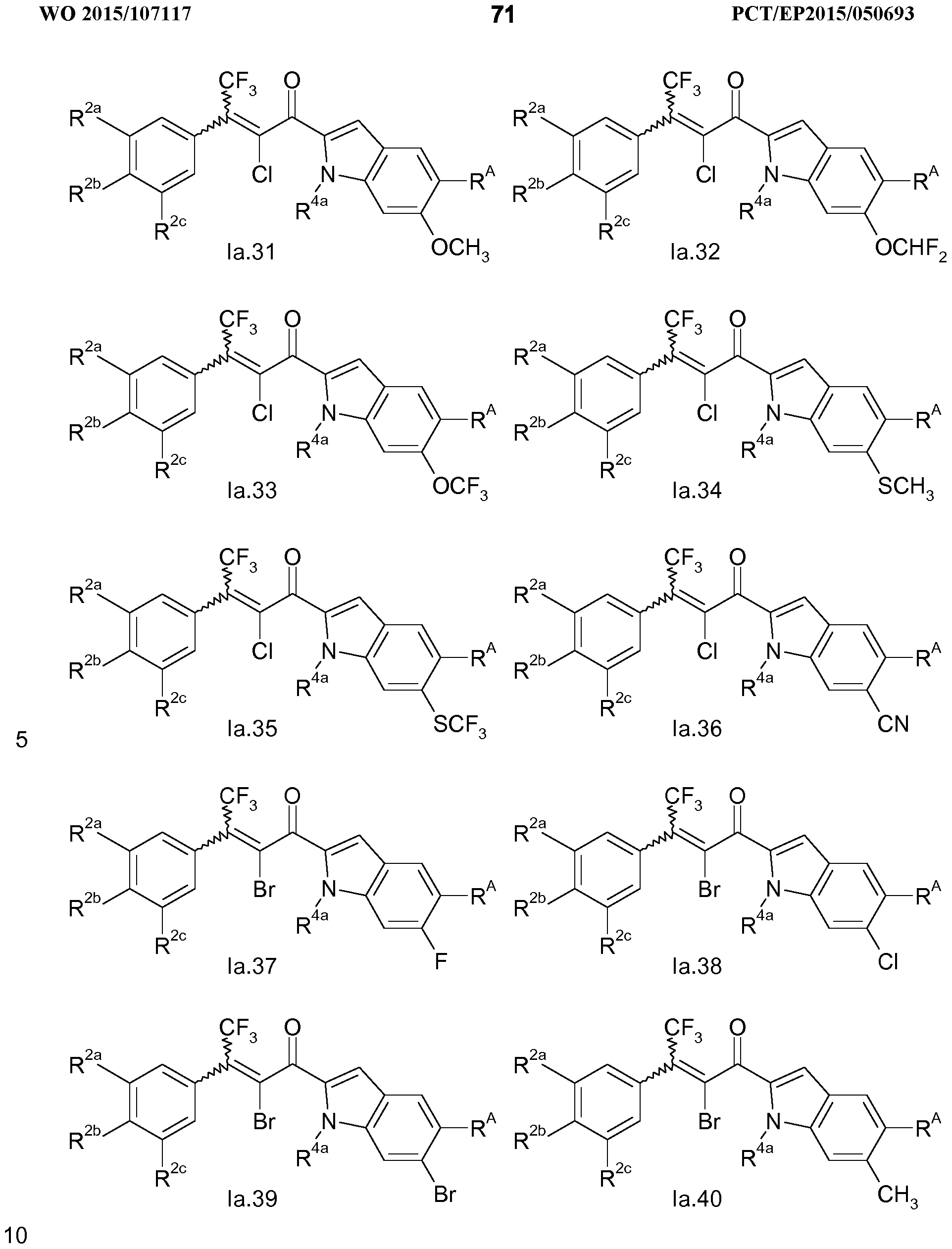


Table 1
Compounds of the formula la.1 in which R4a is hydrogen, RA is -C(0)N(R5)R6, wherein R5 is hydrogen and R6 is hydrogen, and the combination of R2a, R2b and R2c for a compound corresponds in each case to one row of Table A
Table 2
Compounds of the formula la.1 in which R4a is hydrogen, RA is -C(0)N(R5)R6, wherein
R5 is hydrogen and R6 is methyl, and the combination of R2a, R2b and R2c for a compound corresponds in each case to one row of Table A
Table 3
Compounds of the formula la.1 in which R4a is hydrogen, RA is -C(0)N(R5)R6, wherein R5 is hydrogen and R6 is ethyl, and the combination of R2a, R2b and R2c for a compound corresponds in each case to one row of Table A
Table 4
Compounds of the formula la.1 in which R4a is hydrogen, RA is -C(0)N(R5)R6, wherein R5 is hydrogen and R6 is n-propyl, and the combination of R2a, R2b and R2c for a com- pound corresponds in each case to one row of Table A
Table 5
Compounds of the formula la.1 in which R4a is hydrogen, RA is -C(0)N(R5)R6, wherein R5 is hydrogen and R6 is isopropyl, and the combination of R a, R2b and R2c for a compound corresponds in each case to one row of Table A
Table 6
Compounds of the formula la.1 in which R4a is hydrogen, RA is -C(0)N(R5)R6, wherein R5 is hydrogen and R6 is n-butyl, and the combination of R2a, R2 and R2c for a compound corresponds in each case to one row of Table A
Table 7
Compounds of the formula la.1 in which R4a is hydrogen, RA is -C(0)N(R5)R6, wherein R5 is hydrogen and R6 is sec-butyl, and the combination of R2a, R2b and R2c for a compound corresponds in each case to one row of Table A
Table 8
Compounds of the formula la.1 in which R4a is hydrogen, RA is -C(0)N(R5)R6, wherein R5 is hydrogen and R6 is isobutyl, and the combination of R a, R2b and R2c for a compound corresponds in each case to one row of Table A
Table 9
Compounds of the formula la.1 in which R4a is hydrogen, RA is -C(0)N(R5)R6, wherein R5 is hydrogen and R6 is tert-butyl, and the combination of R2a, R2 and R2c for a com- pound corresponds in each case to one row of Table A
Table 10
Compounds of the formula la.1 in which R4a is hydrogen, RA is -C(0)N(R5)R6, wherein R5 is hydrogen and R6 is allyl, and the combination of R2a, R2b and R2c for a compound corresponds in each case to one row of Table A
Table 1 1
Compounds of the formula la.1 in which R4a is hydrogen, RA is -C(0)N(R5)R6, wherein R5 is hydrogen and R6 is propargyl (-CH2-C≡CH), and the combination of R2a, R b and R2c for a compound corresponds in each case to one row of Table A
Table 12
Compounds of the formula la.1 in which R4a is hydrogen, RA is -C(0)N(R5)R6, wherein R5 is hydrogen and R6 is CH2F, and the combination of R2a, R2b and R2c for a compound corresponds in each case to one row of Table A
Table 13
Compounds of the formula la.1 in which R4a is hydrogen, RA is -C(0)N(R5)R6, wherein R5 is hydrogen and R6 is CHF2, and the combination of R2a, R2b and R2c for a compound corresponds in each case to one row of Table A
Table 14
Compounds of the formula la.1 in which R4a is hydrogen, RA is -C(0)N(R5)R6, wherein R5 is hydrogen and R6 is CF3, and the combination of R2a, R2b and R2c for a compound corresponds in each case to one row of Table A
Table 15
Compounds of the formula la.1 in which R4a is hydrogen, RA is -C(0)N(R5)R6, wherein R5 is hydrogen and R6 is CH2CH2F, and the combination of R2a, R2b and R2c for a compound corresponds in each case to one row of Table A
Table 16
Compounds of the formula la.1 in which R4a is hydrogen, RA is -C(0)N(R5)R6, wherein R5 is hydrogen and R6 is CH2CHF2, and the combination of R2a, R2b and R2c for a com- pound corresponds in each case to one row of Table A
Table 17
Compounds of the formula la.1 in which R4a is hydrogen, RA is -C(0)N(R5)R6, wherein R5 is hydrogen and R6 is CH2CF3, and the combination of R2a, R2 and R2c for a compound corresponds in each case to one row of Table A
Table 18
Compounds of the formula la.1 in which R4a is hydrogen, RA is -C(0)N(R5)R6, wherein R5 is hydrogen and R6 is CF2CF3, and the combination of R2a, R2b and R2c for a compound corresponds in each case to one row of Table A
Table 19
Compounds of the formula la.1 in which R4a is hydrogen, RA is -C(0)N(R5)R6, wherein R5 is hydrogen and R6 is CH2CH2CF3, and the combination of R2a, R2b and R2c for a compound corresponds in each case to one row of Table A
Table 20
Compounds of the formula la.1 in which R4a is hydrogen, RA is -C(0)N(R5)R6, wherein R5 is hydrogen and R6 is CH(CH3)CH2F, and the combination of R2a, R2b and R c for a compound corresponds in each case to one row of Table A
Table 21
Compounds of the formula la.1 in which R4a is hydrogen, RA is -C(0)N(R5)R6, wherein
R5 is hydrogen and R6 is CH(CH3)CHF2, and the combination of R2a, R2b and R2c for a compound corresponds in each case to one row of Table A
Table 22
Compounds of the formula la.1 in which R4a is hydrogen, RA is -C(0)N(R5)R6, wherein R5 is hydrogen and R6 is CH(CH3)CF3, and the combination of R2a, R2b and R2c for a compound corresponds in each case to one row of Table A
Table 23
Compounds of the formula la.1 in which R4a is hydrogen, RA is -C(0)N(R5)R6, wherein R5 is hydrogen and R6 is CH(CH2F)2 ,and the combination of R2a, R2b and R2c for a compound corresponds in each case to one row of Table A
Table 24
Compounds of the formula la.1 in which R4a is hydrogen, RA is -C(0)N(R5)R6, wherein R5 is hydrogen and R6 is CH(CHF2)2, and the combination of R2a, R2b and R2c for a compound corresponds in each case to one row of Table A
Table 25
Compounds of the formula la.1 in which R4a is hydrogen, RA is -C(0)N(R5)R6, wherein R5 is hydrogen and R6 is CH(CF3)2, and the combination of R2a, R2b and R2c for a compound corresponds in each case to one row of Table A
Table 26
Compounds of the formula la.1 in which R4a is hydrogen, RA is -C(0)N(R5)R6, wherein R5 is hydrogen and R6 is cyanomethyl, and the combination of R2a, R2b and R2c for a compound corresponds in each case to one row of Table A
Table 27
Compounds of the formula la.1 in which R4a is hydrogen, RA is -C(0)N(R5)R6, wherein R5 is hydrogen and R6 is 1 -cyanoethyl, and the combination of R2a, R2b and R2c for a compound corresponds in each case to one row of Table A
Table 28
Compounds of the formula la.1 in which R4a is hydrogen, RA is -C(0)N(R5)R6, wherein R5 is hydrogen and R6 is 2-cyanoethyl, and the combination of R2a, R2b and R2c for a compound corresponds in each case to one row of Table A
Table 29
Compounds of the formula la.1 in which R4a is hydrogen, RA is -C(0)N(R5)R6, wherein R5 is hydrogen and R6 is 1 -cyanopropyl, and the combination of R2a, R2b and R2c for a compound corresponds in each case to one row of Table A
Table 30
Compounds of the formula la.1 in which R4a is hydrogen, RA is -C(0)N(R5)R6, wherein R5 is hydrogen and R6 is 2-cyanopropyl, and the combination of R2a, R2b and R2c for a compound corresponds in each case to one row of Table A
Table 31
Compounds of the formula la.1 in which R4a is hydrogen, RA is -C(0)N(R5)R6, wherein R5 is hydrogen and R6 is 3-cyanopropyl, and the combination of R2a, R2b and R2c for a compound corresponds in each case to one row of Table A
Table 32
Compounds of the formula la.1 in which R4a is hydrogen, RA is -C(0)N(R5)R6, wherein R5 is hydrogen and R6 is 1 -cyanoprop-2-yl, and the combination of R2a, R2b and R2c for a compound corresponds in each case to one row of Table A
Table 33
Compounds of the formula la.1 in which R4a is hydrogen, RA is -C(0)N(R5)R6, wherein R5 is hydrogen and R6 is 2-cyanoprop-2-yl, and the combination of R2a, R2b and R2c for a compound corresponds in each case to one row of Table A
Table 34
Compounds of the formula la.1 in which R4a is hydrogen, RA is -C(0)N(R5)R6, wherein R5 is hydrogen and R6 is 1 -cyano-2-methylprop-1 -yl, and the combination of R2a, R2b and R2c for a compound corresponds in each case to one row of Table A
Table 35
Compounds of the formula la.1 in which R4a is hydrogen, RA is -C(0)N(R5)R6, wherein R5 is hydrogen and R6 is 1 -cyano-2-ethylprop-2-yl, and the combination of R2a, R2b and R2c for a compound corresponds in each case to one row of Table A
Table 36
Compounds of the formula la.1 in which R4a is hydrogen, RA is -C(0)N(R5)R6, wherein R5 is hydrogen and R6 is 2-cyano-1 ,3-dimethoxyprop-2-yl, and the combination of R2a, R2b and R2c for a compound corresponds in each case to one row of Table A
Table 37
Compounds of the formula la.1 in which R4a is hydrogen, RA is -C(0)N(R5)R6, wherein R5 is hydrogen and R6 is 1 -cyanobut-3-in-1 -yl, and the combination of R2a, R2b and R2c for a compound corresponds in each case to one row of Table A
Table 38
Compounds of the formula la.1 in which R4a is hydrogen, RA is -C(0)N(R5)R6, wherein R5 is hydrogen and R6 is 1 -(methylsulfinyl)prop-2-yl, and the combination of R2a, R2b and R2c for a compound corresponds in each case to one row of Table A
Table 39
Compounds of the formula la.1 in which R4a is hydrogen, RA is -C(0)N(R5)R6, wherein R5 is hydrogen and R6 is -CH2CH2OCH3, and the combination of R2a, R2b and R2c for a compound corresponds in each case to one row of Table A
Table 40
Compounds of the formula la.1 in which R4a is hydrogen, RA is -C(0)N(R5)R6, wherein
R5 is hydrogen and R6 is -CH2CH2OCH2CH3, and the combination of R2a, R2b and R2c for a compound corresponds in each case to one row of Table A
Table 41
Compounds of the formula la.1 in which R4a is hydrogen, RA is -C(0)N(R5)R6, wherein R5 is hydrogen and R6 is -CH2CH2SCH3, and the combination of R2a, R2b and R2c for a compound corresponds in each case to one row of Table A
Table 42
Compounds of the formula la.1 in which R4a is hydrogen, RA is -C(0)N(R5)R6, wherein R5 is hydrogen and R6 is -CH2CH2S(0)CH3, and the combination of R2a, R2b and R2c for a compound corresponds in each case to one row of Table A
Table 43
Compounds of the formula la.1 in which R4a is hydrogen, RA is -C(0)N(R5)R6, wherein R5 is hydrogen and R6 is -CI-bCI-bS D^CHs, and the combination of R2a, R2b and R2c for a compound corresponds in each case to one row of Table A
Table 44
Compounds of the formula la.1 in which R4a is hydrogen, RA is -C(0)N(R5)R6, wherein R5 is hydrogen and R6 is -CH2CH2SCH2CH3, and the combination of R2a, R2b and R2c for a compound corresponds in each case to one row of Table A
Table 45
Compounds of the formula la.1 in which R4a is hydrogen, RA is -C(0)N(R5)R6, wherein R5 is hydrogen and R6 is -CH2CH2S(0)CH2CH3, and the combination of R2a, R2b and R2c for a compound corresponds in each case to one row of Table A
Table 46
Compounds of the formula la.1 in which R4a is hydrogen, RA is -C(0)N(R5)R6, wherein R5 is hydrogen and R6 is -ChbChbS D^CI-bCI-ls, and the combination of R2a, R2b and R2c for a compound corresponds in each case to one row of Table A
Table 47
Compounds of the formula la.1 in which R4a is hydrogen, RA is -C(0)N(R5)R6, wherein R5 is hydrogen and R6 is -CH(CH3)CH2SCH3, and the combination of R2a, R2b and R2c for a compound corresponds in each case to one row of Table A
Table 48
Compounds of the formula la.1 in which R4a is hydrogen, RA is -C(0)N(R5)R6, wherein R5 is hydrogen and R6 is -CH(CH3)CH2S(0)CH3, and the combination of R2a, R2b and R2c for a compound corresponds in each case to one row of Table A
Table 49
Compounds of the formula la.1 in which R4a is hydrogen, RA is -C(0)N(R5)R6, wherein R5 is hydrogen and R6 is -CH(CH3)CH2S(0)2CH3, and the combination of R2a, R2b and R2c for a compound corresponds in each case to one row of Table A
Table 50
Compounds of the formula la.1 in which R4a is hydrogen, RA is -C(0)N(R5)R6, wherein R5 is hydrogen and R6 is -C(CH3)2CH2SCH3, and the combination of R2a, R2b and R2c for a compound corresponds in each case to one row of Table A
Table 51
Compounds of the formula la.1 in which R4a is hydrogen, RA is -C(0)N(R5)R6, wherein R5 is hydrogen and R6 is -C(CH3)2CH2S(0)CH3, and the combination of R2a, R2b and R2c for a compound corresponds in each case to one row of Table A
Table 52
Compounds of the formula la.1 in which R4a is hydrogen, RA is -C(0)N(R5)R6, wherein R5 is hydrogen and R6 is -C(CH3)2CH2S(0)2CH3, and the combination of R2a, R2b and R2c for a compound corresponds in each case to one row of Table A
Table 53
Compounds of the formula la.1 in which R4a is hydrogen, RA is -C(0)N(R5)R6, wherein R5 is hydrogen and R6 is cyclopropyl, and the combination of R2a, R2b and R2c for a compound corresponds in each case to one row of Table A
Table 54
Compounds of the formula la.1 in which R4a is hydrogen, RA is -C(0)N(R5)R6, wherein R5 is hydrogen and R6 is cyclobutyl, and the combination of R2a, R2b and R2c for a com- pound corresponds in each case to one row of Table A
Table 55
Compounds of the formula la.1 in which R4a is hydrogen, RA is -C(0)N(R5)R6, wherein R5 is hydrogen and R6 is cyclopentyl, and the combination of R2a, R2b and R2c for a compound corresponds in each case to one row of Table A
Table 56
Compounds of the formula la.1 in which R4a is hydrogen, RA is -C(0)N(R5)R6, wherein R5 is hydrogen and R6 is cyclohexyl, and the combination of R2a, R2b and R2c for a compound corresponds in each case to one row of Table A
Table 57
Compounds of the formula la.1 in which R4a is hydrogen, RA is -C(0)N(R5)R6, wherein R5 is hydrogen and R6 is 1 -fluorocyclopropyl, and the combination of R2a, R2b and R2c for a compound corresponds in each case to one row of Table A
Table 58
Compounds of the formula la.1 in which R4a is hydrogen, RA is -C(0)N(R5)R6, wherein R5 is hydrogen and R6 is 2,2-difluorocyclopropyl, and the combination of R2a, R2b and R2c for a compound corresponds in each case to one row of Table A
Table 59
Compounds of the formula la.1 in which R4a is hydrogen, RA is -C(0)N(R5)R6, wherein
R5 is hydrogen and R6 is 1 -cyanocyclopropyl, and the combination of R2a, R2b and R2c for a compound corresponds in each case to one row of Table A
Table 60
Compounds of the formula la.1 in which R4a is hydrogen, RA is -C(0)N(R5)R6, wherein R5 is hydrogen and R6 is 1 -methylcyclopropyl, and the combination of R2a, R2b and R2c for a compound corresponds in each case to one row of Table A
Table 61
Compounds of the formula la.1 in which R4a is hydrogen, RA is -C(0)N(R5)R6, wherein R5 is hydrogen and R6 is 1 ,2-dimethylcyclopropyl, and the combination of R2a, R2b and R2c for a compound corresponds in each case to one row of Table A
Table 62
Compounds of the formula la.1 in which R4a is hydrogen, RA is -C(0)N(R5)R6, wherein R5 is hydrogen and R6 is 1 -ethylcyclopropyl, and the combination of R2a, R2b and R2c for a compound corresponds in each case to one row of Table A
Table 63
Compounds of the formula la.1 in which R4a is hydrogen, RA is -C(0)N(R5)R6, wherein R5 is hydrogen and R6 is 1 -(trifluoromethyl)-cyclopropyl, and the combination of R2a, R2b and R2c for a compound corresponds in each case to one row of Table A
Table 64
Compounds of the formula la.1 in which R4a is hydrogen, RA is -C(0)N(R5)R6, wherein R5 is hydrogen and R6 is 1 -ethinylcyclopropyl, and the combination of R2a, R2b and R2c for a compound corresponds in each case to one row of Table A
Table 65
Compounds of the formula la.1 in which R4a is hydrogen, RA is -C(0)N(R5)R6, wherein R5 is hydrogen and R6 is 1 -propargylcyclopropyl, and the combination of R2a, R2b and R2c for a compound corresponds in each case to one row of Table A
Table 66
Compounds of the formula la.1 in which R4a is hydrogen, RA is -C(0)N(R5)R6, wherein R5 is hydrogen and R6 is 1 -methoxycyclopropyl, and the combination of R2a, R2b and R2c for a compound corresponds in each case to one row of Table A
Table 67
Compounds of the formula la.1 in which R4a is hydrogen, RA is -C(0)N(R5)R6, wherein R5 is hydrogen and R6 is 1 -ethoxycyclopropyl, and the combination of R2a, R2b and R2c for a compound corresponds in each case to one row of Table A
Table 68
Compounds of the formula la.1 in which R4a is hydrogen, RA is -C(0)N(R5)R6, wherein R5 is hydrogen and R6 is 1 -propoxycyclopropyl, and the combination of R2a, R2b and R2c for a compound corresponds in each case to one row of Table A
Table 69
Compounds of the formula la.1 in which R4a is hydrogen, RA is -C(0)N(R5)R6, wherein R5 is hydrogen and R6 is 1 -isopropoxycyclopropyl, and the combination of R2a, R2b and R2c for a compound corresponds in each case to one row of Table A
Table 70
Compounds of the formula la.1 in which R4a is hydrogen, RA is -C(0)N(R5)R6, wherein R5 is hydrogen and R6 is 1 -(methoxycarbonyl)-cyclopropyl, and the combination of R2a, R2b and R2c for a compound corresponds in each case to one row of Table A
Table 71
Compounds of the formula la.1 in which R4a is hydrogen, RA is -C(0)N(R5)R6, wherein R5 is hydrogen and R6 is 1 -(ethoxycarbonyl)-cyclopropyl, and the combination of R2a, R2b and R2c for a compound corresponds in each case to one row of Table A
Table 72
Compounds of the formula la.1 in which R4a is hydrogen, RA is -C(0)N(R5)R6, wherein R5 is hydrogen and R6 is 1 ,1 -bicyclopropyl-1 -yl, and the combination of R2a, R2b and R2c for a compound corresponds in each case to one row of Table A
Table 73
Compounds of the formula la.1 in which R4a is hydrogen, RA is -C(0)N(R5)R6, wherein R5 is hydrogen and R6 is 1 -phenylcyclopropyl, and the combination of R2a, R2b and R2c for a compound corresponds in each case to one row of Table A
Table 74
Compounds of the formula la.1 in which R4a is hydrogen, RA is -C(0)N(R5)R6, wherein R5 is hydrogen and R6 is 1 -fluorocyclobutyl, and the combination of R2a, R2b and R2c for a compound corresponds in each case to one row of Table A
Table 75
Compounds of the formula la.1 in which R4a is hydrogen, RA is -C(0)N(R5)R6, wherein R5 is hydrogen and R6 is 2,2-difluorocyclobutyl, and the combination of R2a, R2b and R2c for a compound corresponds in each case to one row of Table A
Table 76
Compounds of the formula la.1 in which R4a is hydrogen, RA is -C(0)N(R5)R6, wherein R5 is hydrogen and R6 is 3,3-difluorocyclobutyl, and the combination of R2a, R2b and R2c for a compound corresponds in each case to one row of Table A
Table 77
Compounds of the formula la.1 in which R4a is hydrogen, RA is -C(0)N(R5)R6, wherein R5 is hydrogen and R6 is 1 -cyanocyclobutyl, and the combination of R2a, R2b and R2c for a compound corresponds in each case to one row of Table A
Table 78
Compounds of the formula la.1 in which R4a is hydrogen, RA is -C(0)N(R5)R6, wherein
R5 is hydrogen and R6 is 1 -ethinylcyclobutyl, and the combination of R2a, R2b and R2c for a compound corresponds in each case to one row of Table A
Table 79
Compounds of the formula la.1 in which R4a is hydrogen, RA is -C(0)N(R5)R6, wherein R5 is hydrogen and R6 is cyclopropylmethyl, and the combination of R2a, R2b and R2c for a compound corresponds in each case to one row of Table A
Table 80
Compounds of the formula la.1 in which R4a is hydrogen, RA is -C(0)N(R5)R6, wherein R5 is hydrogen and R6 is (l -cyanocyclopropyl)-methyl, and the combination of R2a, R2b and R2c for a compound corresponds in each case to one row of Table A
Table 81
Compounds of the formula la.1 in which R4a is hydrogen, RA is -C(0)N(R5)R6, wherein R5 is hydrogen and R6 is (l -fluorocyclopropyl)-methyl, and the combination of R2a, R2b and R2c for a compound corresponds in each case to one row of Table A
Table 82
Compounds of the formula la.1 in which R4a is hydrogen, RA is -C(0)N(R5)R6, wherein R5 is hydrogen and R6 is (l -methylcyclopropyl)-methyl, and the combination of R2a, R2b and R2c for a compound corresponds in each case to one row of Table A
Table 83
Compounds of the formula la.1 in which R4a is hydrogen, RA is -C(0)N(R5)R6, wherein R5 is hydrogen and R6 is cyclopropyl(phenyl)methyl, and the combination of R2a, R2b and R2c for a compound corresponds in each case to one row of Table A
Table 84
Compounds of the formula la.1 in which R4a is hydrogen, RA is -C(0)N(R5)R6, wherein R5 is hydrogen and R6 is cyclopropyl(4-chloro-3-(trifluoromethyl)-phenyl)methyl, and the combination of R2a, R2b and R2c for a compound corresponds in each case to one row of Table A
Table 85
Compounds of the formula la.1 in which R4a is hydrogen, RA is -C(0)N(R5)R6, wherein R5 is hydrogen and R6 is cyclobutylmethyl, and the combination of R2a, R2b and R2c for a compound corresponds in each case to one row of Table A
Table 86
Compounds of the formula la.1 in which R4a is hydrogen, RA is -C(0)N(R5)R6, wherein R5 is hydrogen and R6 is (l -fluorocyclobutyl)-methyl, and the combination of R2a, R2b and R2c for a compound corresponds in each case to one row of Table A
Table 87
Compounds of the formula la.1 in which R4a is hydrogen, RA is -C(0)N(R5)R6, wherein R5 is hydrogen and R6 is (2,2-difluorocyclobutyl)-methyl, and the combination of R2a, R2b and R2c for a compound corresponds in each case to one row of Table A
Table 88
Compounds of the formula la.1 in which R4a is hydrogen, RA is -C(0)N(R5)R6, wherein R5 is hydrogen and R6 is (3,3-difluorocyclobutyl)-methyl, and the combination of R2a, R2b and R2c for a compound corresponds in each case to one row of Table A
Table 89
Compounds of the formula la.1 in which R4a is hydrogen, RA is -C(0)N(R5)R6, wherein R5 is hydrogen and R6 is cyclopentyl methyl, and the combination of R2a, R2b and R2c for a compound corresponds in each case to one row of Table A
Table 90
Compounds of the formula la.1 in which R4a is hydrogen, RA is -C(0)N(R5)R6, wherein R5 is hydrogen and R6 is cyclohexylmethyl, and the combination of R2a, R2b and R2c for a compound corresponds in each case to one row of Table A
Tables 91 to 180
Compounds of the formula la.1 in which R4a is hydrogen, RA is -C(0)N(R5)R6, wherein R5 is methyl and R6 is as defined in any of tables 1 to 90, and the combination of R2a, R2b and R2c for a compound corresponds in each case to one row of Table A
Tables 181 to 270
Compounds of the formula la.1 in which R4a is hydrogen, RA is -C(0)N(R5)R6, wherein R5 is ethyl and R6 is as defined in any of tables 1 to 90, and the combination of R2a, R2b and R2c for a compound corresponds in each case to one row of Table A
Table 271
Compounds of the formula la.1 in which R4a is hydrogen, RA is -C(0)N(R5)R6, wherein R5 and R6, together with the nitrogen atom they are bound to, form aziridin-1 -yl, and the combination of R2a, R2b and R2c for a compound corresponds in each case to one row of Table A
Table 272
Compounds of the formula la.1 in which R4a is hydrogen, RA is -C(0)N(R5)R6, wherein R5 and R6, together with the nitrogen atom they are bound to, form azetidin-1 -yl, and the combination of R2a, R2b and R2c for a compound corresponds in each case to one row of Table A
Table 273
Compounds of the formula la.1 in which R4a is hydrogen, RA is -C(0)N(R5)R6, wherein R5 and R6, together with the nitrogen atom they are bound to, form pyrrolidin-1 -yl, and the combination of R2a, R2b and R2c for a compound corresponds in each case to one row of Table A
Table 274
Compounds of the formula la.1 in which R4a is hydrogen, RA is -C(0)N(R5)R6, wherein R5 and R6, together with the nitrogen atom they are bound to, form piperidin-1 -yl, and
the combination of R2a, R2b and R2c for a compound corresponds in each case to one row of Table A
Table 275
Compounds of the formula la.1 in which R4a is hydrogen, RA is -C(0)N(R5)R6, wherein R5 and R6, together with the nitrogen atom they are bound to, form piperazin-1 -yl, and the combination of R2a, R2b and R2c for a compound corresponds in each case to one row of Table A
Table 276
Compounds of the formula la.1 in which R4a is hydrogen, RA is -C(0)N(R5)R6, wherein R5 and R6, together with the nitrogen atom they are bound to, form 3,5-dioxopiperazin- 1 -yl, and the combination of R2a, R2b and R2c for a compound corresponds in each case to one row of Table A
Table 277
Compounds of the formula la.1 in which R4a is hydrogen, RA is -C(0)N(R5)R6, wherein R5 and R6, together with the nitrogen atom they are bound to, form 1 -methyl-2,6- dioxopiperazin-4-yl, and the combination of R2a, R2b and R2c for a compound corresponds in each case to one row of Table A
Table 278
Compounds of the formula la.1 in which R4a is hydrogen, RA is -C(0)N(R5)R6, wherein R5 and R6, together with the nitrogen atom they are bound to, form morpholin-4-yl, and the combination of R2a, R2b and R2c for a compound corresponds in each case to one row of Table A
Table 279
Compounds of the formula la.1 in which R4a is hydrogen, RA is CI, and the combination of R2a, R2b and R2c for a compound corresponds in each case to one row of Table A Table 280
Compounds of the formula la.1 in which R4a is hydrogen, RA is Br, and the combination of R2a, R2b and R2c for a compound corresponds in each case to one row of Table A Tables 281 to 560
Compounds of the formula la.1 in which R4a is methyl, RA is as defined in any of tables 1 to 280, and the combination of R2a, R2b and R2c for a compound corresponds in each case to one row of Table A
Tables 561 to 840
Compounds of the formula la.1 in which R4a is ethyl, RA is as defined in any of tables 1 to 280, and the combination of R2a, R2b and R2c for a compound corresponds in each case to one row of Table A
Tables 841 to 1680
Compounds of the formula la.2 in which R4a and RA are as defined in any of tables 1 to 840, and the combination of R2a, R2b and R2c for a compound corresponds in each case to one row of Table A
Tables 1681 to 2520
Compounds of the formula la.3 in which R4a and RA are as defined in any of tables 1 to 840, and the combination of R2a, R2b and R2c for a compound corresponds in each case to one row of Table A
Tables 2521 to 3360
Compounds of the formula la.4 in which R4a and RA are as defined in any of tables 1 to 840, and the combination of R2a, R2b and R2c for a compound corresponds in each case to one row of Table A
Tables 3361 to 4200
Compounds of the formula la.5 in which R4a and RA are as defined in any of tables 1 to 840, and the combination of R2a, R2b and R2c for a compound corresponds in each case to one row of Table A
Tables 4201 to 5040
Compounds of the formula la.6 in which R4a and RA are as defined in any of tables 1 to 840, and the combination of R2a, R2b and R2c for a compound corresponds in each case to one row of Table A
Tables 5041 to 5880
Compounds of the formula la.7 in which R4a and RA are as defined in any of tables 1 to 840, and the combination of R2a, R2b and R2c for a compound corresponds in each case to one row of Table A
Tables 5881 to 6720
Compounds of the formula la.8 in which R4a and RA are as defined in any of tables 1 to 840, and the combination of R2a, R2b and R2c for a compound corresponds in each case to one row of Table A
Tables 6721 to 7560
Compounds of the formula la.9 in which R4a and RA are as defined in any of tables 1 to 840, and the combination of R2a, R2b and R2c for a compound corresponds in each case to one row of Table A
Tables 7561 to 8400
Compounds of the formula la.10 in which R4a and RA are as defined in any of tables 1 to 840, and the combination of R2a, R2b and R2c for a compound corresponds in each case to one row of Table A
Tables 8401 to 9240
Compounds of the formula la.1 1 in which R4a and RA are as defined in any of tables 1 to 840, and the combination of R2a, R2b and R2c for a compound corresponds in each case to one row of Table A
Tables 9241 to 10080
Compounds of the formula la.12 in which R4a and RA are as defined in any of tables 1 to 840, and the combination of R2a, R2b and R2c for a compound corresponds in each case to one row of Table A
Tables 10081 to 10920
Compounds of the formula la.13 in which R4a and RA are as defined in any of tables 1 to 840, and the combination of R2a, R2b and R2c for a compound corresponds in each case to one row of Table A
Tables 10921 to 1 1760
Compounds of the formula la.14 in which R4a and RA are as defined in any of tables 1 to 840, and the combination of R2a, R2b and R2c for a compound corresponds in each case to one row of Table A
Tables 1 1761 to 12600
Compounds of the formula la.15 in which R4a and RA are as defined in any of tables 1 to 840, and the combination of R2a, R2b and R2c for a compound corresponds in each case to one row of Table A
Tables 12601 to 13440
Compounds of the formula la.16 in which R4a and RA are as defined in any of tables 1 to 840, and the combination of R2a, R2b and R2c for a compound corresponds in each case to one row of Table A
Tables 13441 to 14280
Compounds of the formula la.17 in which R4a and RA are as defined in any of tables 1 to 840, and the combination of R2a, R2b and R2c for a compound corresponds in each case to one row of Table A
Tables 14281 to 15120
Compounds of the formula la.18 in which R4a and RA are as defined in any of tables 1 to 840, and the combination of R2a, R2b and R2c for a compound corresponds in each case to one row of Table A
Tables 15121 to 15960
Compounds of the formula la.19 in which R4a and RA are as defined in any of tables 1 to 840, and the combination of R2a, R2b and R2c for a compound corresponds in each case to one row of Table A
Tables 15961 to 16800
Compounds of the formula la.20 in which R4a and RA are as defined in any of tables 1 to 840, and the combination of R2a, R2b and R2c for a compound corresponds in each case to one row of Table A
Tables 16801 to 17640
Compounds of the formula la.21 in which R4a and RA are as defined in any of tables 1 to 840, and the combination of R2a, R2b and R2c for a compound corresponds in each case to one row of Table A
Tables 17641 to 18480
Compounds of the formula la.22 in which R4a and RA are as defined in any of tables 1 to 840, and the combination of R2a, R2b and R2c for a compound corresponds in each case to one row of Table A
Tables 18481 to 19320
Compounds of the formula la.23 in which R4a and RA are as defined in any of tables 1 to 840, and the combination of R2a, R2b and R2c for a compound corresponds in each case to one row of Table A
Tables 19321 to 20160
Compounds of the formula la.24 in which R4a and RA are as defined in any of tables 1 to 840, and the combination of R2a, R2b and R2c for a compound corresponds in each case to one row of Table A
Tables 20161 to 21000
Compounds of the formula la.25 in which R4a and RA are as defined in any of tables 1 to 840, and the combination of R2a, R2b and R2c for a compound corresponds in each case to one row of Table A
Tables 21001 to 21840
Compounds of the formula la.26 in which R4a and RA are as defined in any of tables 1 to 840, and the combination of R2a, R2b and R2c for a compound corresponds in each case to one row of Table A
Tables 21841 to 22680
Compounds of the formula la.27 in which R4a and RA are as defined in any of tables 1 to 840, and the combination of R2a, R2b and R2c for a compound corresponds in each case to one row of Table A
Tables 22681 to 23520
Compounds of the formula la.28 in which R4a and RA are as defined in any of tables 1 to 840, and the combination of R2a, R2b and R2c for a compound corresponds in each case to one row of Table A
Tables 23521 to 24360
Compounds of the formula la.29 in which R4a and RA are as defined in any of tables 1 to 840, and the combination of R2a, R2b and R2c for a compound corresponds in each case to one row of Table A
Tables 24361 to 25200
Compounds of the formula la.30 in which R4a and RA are as defined in any of tables 1 to 840, and the combination of R2a, R2b and R2c for a compound corresponds in each case to one row of Table A
Tables 25201 to 26040
Compounds of the formula la.31 in which R4a and RA are as defined in any of tables 1 to 840, and the combination of R2a, R2b and R2c for a compound corresponds in each case to one row of Table A
Tables 26041 to 26880
Compounds of the formula la.32 in which R4a and RA are as defined in any of tables 1 to 840, and the combination of R2a, R2b and R2c for a compound corresponds in each case to one row of Table A
Tables 26881 to 27720
Compounds of the formula la.33 in which R4a and RA are as defined in any of tables 1 to 840, and the combination of R2a, R2b and R2c for a compound corresponds in each case to one row of Table A
Tables 27721 to 28560
Compounds of the formula la.34 in which R4a and RA are as defined in any of tables 1 to 840, and the combination of R2a, R2b and R2c for a compound corresponds in each case to one row of Table A
Tables 28561 to 29400
Compounds of the formula la.35 in which R4a and RA are as defined in any of tables 1 to 840, and the combination of R2a, R2b and R2c for a compound corresponds in each case to one row of Table A
Tables 29401 to 30240
Compounds of the formula la.36 in which R4a and RA are as defined in any of tables 1 to 840, and the combination of R2a, R2b and R2c for a compound corresponds in each case to one row of Table A
Tables 30241 to 31080
Compounds of the formula la.37 in which R4a and RA are as defined in any of tables 1 to 840, and the combination of R2a, R2b and R2c for a compound corresponds in each case to one row of Table A
Tables 31081 to 31920
Compounds of the formula la.38 in which R4a and RA are as defined in any of tables 1 to 840, and the combination of R2a, R2b and R2c for a compound corresponds in each case to one row of Table A
Tables 31921 to 32760
Compounds of the formula la.39 in which R4a and RA are as defined in any of tables 1 to 840, and the combination of R2a, R2b and R2c for a compound corresponds in each case to one row of Table A
Tables 32761 to 33600
Compounds of the formula la.40 in which R4a and RA are as defined in any of tables 1 to 840, and the combination of R2a, R2b and R2c for a compound corresponds in each case to one row of Table A
Tables 33601 to 34440
Compounds of the formula la.41 in which R4a and RA are as defined in any of tables 1 to 840, and the combination of R2a, R2 and R2c for a compound corresponds in each case to one row of Table A
Tables 34441 to 35280
Compounds of the formula la.42 in which R4a and RA are as defined in any of tables 1 to 840, and the combination of R2a, R2b and R2c for a compound corresponds in each case to one row of Table A
Tables 35281 to 36120
Compounds of the formula la.43 in which R4a and RA are as defined in any of tables 1 to 840, and the combination of R2a, R2b and R2c for a compound corresponds in each case to one row of Table A
Tables 36121 to 36960
Compounds of the formula la.44 in which R4a and RA are as defined in any of tables 1 to 840, and the combination of R2a, R2b and R2c for a compound corresponds in each case to one row of Table A
Tables 36961 to 37800
Compounds of the formula la.45 in which R4a and RA are as defined in any of tables 1 to 840, and the combination of R2a, R2b and R2c for a compound corresponds in each case to one row of Table A
Tables 37801 to 38640
Compounds of the formula la.46 in which R4a and RA are as defined in any of tables 1 to 840, and the combination of R2a, R2 and R2c for a compound corresponds in each case to one row of Table A
Tables 38641 to 39480
Compounds of the formula la.47 in which R4a and RA are as defined in any of tables 1 to 840, and the combination of R2a, R2b and R2c for a compound corresponds in each case to one row of Table A
Tables 39481 to 40320
Compounds of the formula la.48 in which R4a and RA are as defined in any of tables 1 to 840, and the combination of R2a, R2 and R c for a compound corresponds in each case to one row of Table A
Tables 40321 to 41 160
Compounds of the formula la.49 in which R4a and RA are as defined in any of tables 1 to 840, and the combination of R2a, R2b and R2c for a compound corresponds in each case to one row of Table A
Tables 41 161 to 42000
Compounds of the formula la.50 in which R4a and RA are as defined in any of tables 1 to 840, and the combination of R2a, R2b and R2c for a compound corresponds in each case to one row of Table A
Tables 42001 to 42840
Compounds of the formula la.51 in which R4a and RA are as defined in any of tables 1 to 840, and the combination of R2a, R2b and R2c for a compound corresponds in each case to one row of Table A
Tables 42841 to 43680
Compounds of the formula la.52 in which R4a and RA are as defined in any of tables 1 to 840, and the combination of R2a, R2b and R2c for a compound corresponds in each case to one row of Table A
Tables 43681 to 44520
Compounds of the formula la.53 in which R4a and RA are as defined in any of tables 1 to 840, and the combination of R2a, R2b and R2c for a compound corresponds in each case to one row of Table A
Tables 44521 to 45360
Compounds of the formula la.54 in which R4a and RA are as defined in any of tables 1 to 840, and the combination of R2a, R2 and R2c for a compound corresponds in each case to one row of Table A
Tables 45361 to 46200
Compounds of the formula la.55 in which R4a and RA are as defined in any of tables 1 to 840, and the combination of R2a, R2b and R2c for a compound corresponds in each case to one row of Table A
Tables 46201 to 47040
Compounds of the formula la.56 in which R4a and RA are as defined in any of tables 1 to 840, and the combination of R2a, R2 and R2c for a compound corresponds in each case to one row of Table A
Tables 47041 to 47880
Compounds of the formula la.57 in which R4a and RA are as defined in any of tables 1 to 840, and the combination of R2a, R2b and R2c for a compound corresponds in each case to one row of Table A
Tables 47881 to 48720
Compounds of the formula la.58 in which R4a and RA are as defined in any of tables 1 to 840, and the combination of R2a, R2b and R2c for a compound corresponds in each case to one row of Table A
Tables 48721 to 49560
Compounds of the formula la.59 in which R4a and RA are as defined in any of tables 1 to 840, and the combination of R2a, R2b and R2c for a compound corresponds in each case to one row of Table A
Tables 49561 to 50400
Compounds of the formula la.60 in which R4a and RA are as defined in any of tables 1 to 840, and the combination of R2a, R2b and R2c for a compound corresponds in each case to one row of Table A
Table A
No. R2a R2b R2c
A-1 F H F
A-2 F F F
A-3 F CI F
A-4 F Br F
A-5 F H CI
A-6 F H Br
A-7 CI H CI
A-8 CI CI CI
A-9 CI F H
A-10 CI F CI
A-1 1 CI Br CI
A-12 CI H Br
A-13 Br H Br
A-14 Br F Br
A-15 Br CI Br
A-16 CFs H F
A-17 CFs H CI
A-18 CFs H Br
A-19 CFs H CFs
A-20 CFs F F
A-21 CFs CI CI
A-22 CFs Br Br
A-23 CFs F H
A-24 CFs CI H
A-25 CFs Br H
A-26 OCFs H F
A-27 OCFs H CI

Among the above compounds, preference is given to compounds of formula la.1 to la.12 and in particular to compounds la.2 and la.6. The compounds of the formula (I) can be prepared by standard methods of organic chemistry, e.g. by the methods described hereinafter or in the synthesis descriptions of the working examples. The substituents, variables and indices are as defined above for formula (I), if not otherwise specified. A' is A or a precursor of A. Compounds Γ, in which A' is a precursor of A can be converted as shown below into the different groups A1 4.

Compounds Γ, in which A is CI, Br, I or -OS02-Rz1, where Rz1 is Ci-C4-alkyl, Ci-C4- haloalkyl or phenyl which may be substituted by 1 , 2 or 3 radicals selected from Ci-C4- alkyl, Ci-C4-haloalkyl Ci-C4-alkoxy or Ci-C4-haloalkoxy, can be converted to compounds I wherein A is a group A1, wherein A1 is an imino group -C(=NR6)R8, by reaction with carbon monoxide and a hydride source, such as triethylsilane, in the presence of a transition metal complex catalyst, preferably a palladium catalyst, to a carbonyl compound 1. This reaction converts the starting group A into a carbonyl group - C(=0)H.

For obtaining compounds in which R8 in the imino group is H, such carbonyl compounds 1 are then reacted with an amine (derivative) NH2R6. Alternatively, the compound Γ, in which A' is CI, Br, I or -OS02-Rz1, where Rz1 is as defined above, can be reacted in a one pot reaction with carbon monoxide and hydrogen in the presence of a transition metal complex catalyst and the amine NH2R6.
These reactions can be carried out in analogy to the methods described in WO
2010/072781 and the references cited therein.
Compounds I wherein A is a group A1, wherein A1 is -S(0)nR9 or -N(R5)R6, can for example be prepared by reacting a compound Γ wherein A is CI, Br or I in a Ullmann-type reaction with an amine NHR5R6 or a thiol SHR9 in the presence of a Cu(l) catalyst. To obtain a compound wherein A1 is -S(0)nR9 wherein n is not 0 the thiol can then be oxi- dized, e.g. with hydrogen peroxide. Amine groups can further be introduced in a Buch- wald-Hartwick reaction by reacting a compound Γ wherein A is CI, Br or I with an amine NHR5R6 in the presence of a palladium catalyst, such as PdC (dppf) in the presence of a base, such as cesium carbonate. Thioethers (A1 = -SR9) can further be introduced by reacting a compound Γ wherein A is F in an SNAr reaction (nucleophilic aromatic substitution reaction) with a thiol HSR9 in the presence of a base, such as potassium carbonate (K2CO3), or with a thiolate (e.g. NaSR9). Compounds I wherein A is a group A2, wherein W is O and Y is OR9 can be prepared by reacting a compound Γ wherein A' is CI, Br, I or Otriflate with carbon monoxide in the presence of a palladium catalyst and an alcohol R9OH. Compounds I wherein A is a group A2, wherein W is O and Y is NR5R6 can be prepared by reacting a compound Γ wherein A' is CI, Br, I or Otriflate with carbon monoxide in the presence of a palladium catalyst and an alcohol ROH, wherein R is Ci-C4-alkyl, to a compound of formula 2. Suitable palladium catalysts are for example those described in WO 201 1/161 130.

This ester is then hydrolyzed to the respective carboxylic acid, which is then reacted under standard amidation conditions with an amine NHR5R6. Hydrolyzation can be carried out under standard conditions, e.g. under acidic conditions using for example hy- drochloric acid, sulfuric acid or trifluoroacetic acid, or under basic conditions using for example an alkali metal hydroxide, such as LiOH, NaOH or KOH. Amidation is preferably carried out by activation of the carboxylic acids with oxalylchloride [(COCI)2] or thio- nylchloride (SOC ) to the respective acid chlorides, followed by reaction with an amine NHR5R6. Alternatively, amidation is carried out in in the presence of a coupling reagent. Suitable coupling reagent (activators) are well known and are for instance selected from carbodiimides, such as DCC (dicyclohexylcarbodiimide) and DCI (diisopropylcar- bodiimide), benzotriazol derivatives, such as HATU (0-(7-azabenzotriazol-1 -yl)- Ν,Ν,Ν',Ν'-tetramethyluronium hexafluorophosphate), HBTU ((O-benzotriazol-1 -yl)- Ν,Ν,Ν',Ν'-tetramethyluronium hexafluorophosphate) and HCTU (1 H-benzotriazolium-1 - [bis(dimethylamino)methylene]-5-chloro tetrafluoroborate) and phosphonium-derived activators, such as BOP ((benzotriazol-1 -yloxy)-tris(dimethylamino)phosphonium hexafluorophosphate), Py-BOP ((benzotriazol-l -yloxy)-tripyrrolidinphosphonium hexafluorophosphate) and Py-BrOP (bromotripyrrolidinphosphonium hexafluorophosphate). Generally, the activator is used in excess. The benzotriazol and phosphonium coupling reagents are generally used in a basic medium.
Compounds I wherein A is a group A2, wherein W is S and Y is NR5R6 or OR9, can be prepared by reacting the corresponding oxo-compound (W is O) with Lawesson's reagent (CAS 19172-47-5), see for example Jesberger et al., Synthesis, 2003, 1929-1958 and references therein. For compounds wherein Y is NR5R6, solvents such as HMPA or THF at an elevated temperature such as 60°C to 100°C can be used. Preferred reaction conditions are THF at 65°C. For compounds wherein Y is OR9, solvent free conditions or solvents such as toluene at temperatures such as 100°C to 200°C, preferably 140°C, are suitable reaction conditions.
Compounds I wherein A is a group A3, wherein R7a and R7b are hydrogen, can be prepared from a compound 4. The alcohol 4 can be prepared from the protected analogue
3, wherein PG stands for a protecting group, for example a silyl protecting group such as trimethyl silyl or tert.-butyldimethylsilyl, as shown in scheme 1 . Alternatively the alkohol 4 can be prepared from the aldehyde 1 by reduction for example with sodium borohydride.
Scheme 1

This is then reacted in an SN reaction with an amine NHR5R6. For this purpose, the OH group can first be converted into a better leaving group, e.g. into a sulfonate (for exam- pie mesylate, tosylate or a triflate group). If R6 is a group -C(0)R8, it is alternatively possible to react compound 4 with an amine N H2R5 and react then the resulting ben- zylic amine with an acid R8-COOH or a derivative thereof, such as its acid chloride R8- COCI, in an amidation reaction. Compounds in which R7a and R7b are optionally substituted alkyl, optionally substituted cycloalkyl, optionally substituted alkenyl or optionally substituted alkynyl, can be obtained from an alcohol of formula 5. The alcohol 5 can be prepared from the protected analogue, wherein the OH group is protected, for example, by a silyl protecting group such as trimethyl silyl or tert.-butyldimethylsilyl.

Alcohol 5 can then be converted into amine 6 via the corresponding azide, as described, for example, in Organic Letters, 2001 , 3(20), 3145-3148.
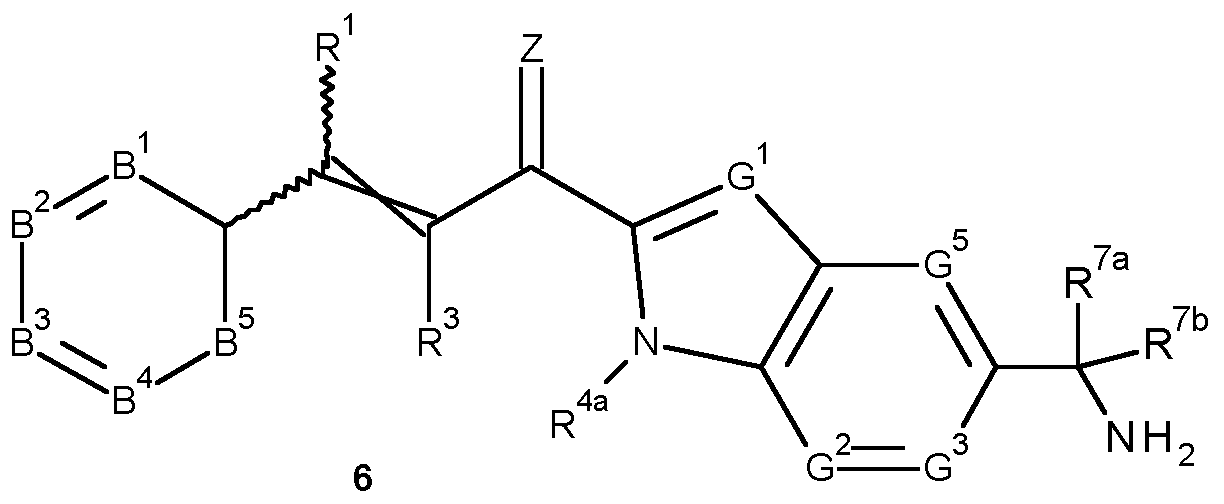
If desired, this can be converted into compounds I wherein R5 and R6 are different from hydrogen, for example by standard alkylation reactions. Compounds I wherein A is A4 can be prepared by standard ring coupling reactions. For example, compounds wherein A4 is an N-bound heterocyclic ring can be prepared by reacting a compound Γ wherein A is CI, Br or I with the respective ring A4-H (H being on the nitrogen ring atom to be coupled) under Ullmann coupling conditions, such as described, for example, in WO 2007/075459. Typically, copper(l) iodide or copper(l) oxide and a ligand such as 1 ,2-cyclohexyldiamine is used, see for example Kanemasa et al., European Journal of Organic Chemistry, 2004, 695-709. If A' is F, the reaction is typically run in a polar aprotic solvent such as Ν,Ν-dimethylformamide, N,N- dimethylacetamide or N-methylpyrrolidone, and in the presence of an inorganic base such as sodium, potassium or cesium carbonate.
Compounds, wherein A4 is a C-bound heterocyclic ring can be prepared by reacting a compound Γ wherein A' is Br or I with the boronic acid of the respective ring A4-B(OH)2 or the boronate ester of the respective ring A4-B(OR2) under Suzuki reaction conditions via Pd-catalyzed cross coupling, such as described, for example, in WO 2007/075459. A typical catalyst is tetrakis(triphenylphosphine)palladium(0). Solvents such as tetrahy- drofuran, acetonitrile, diethyl ether and dioxane are suitable. The boronic acids A4- B(OH)2 are either commercially available or can be prepared by known methods. Other methods for introduction of the heterocyclic groups A4 are the Heck, Stille, Kumada and Buchwald-Hartwig coupling procedures; see for example Tetrahedron, 2004, 60, 8991 - 9016.
Compounds of formula I or Γ wherein R3 is H and Z is oxygen can be prepared by aldol-type reaction of a methylketone of formula 7 with a ketone of formula 8, as shown in scheme 2. Such reactions are usually carried out in the presence of a base, such as sodium hydride, lithium hydride, lithium diisopropylamide or lithium
hexamethyldisilazide. Alternatively, the reaction can be performed using a Lewis acid, such as titanium tetrachloride, and an amine, such as triethylamine,
diisopropylethylamine or tetramethylethylenediamine ("TMEDA"). Methods describing such a conversion are known for example from EP 1975149.
Scheme 2

Alternatively compounds of formula I or Γ wherein R3 is H and Z is oxygen can be prepared employing a Wittig approach as shown in Scheme 3. Compounds of formula 11 wherein Hal is a halogen, such as bromo or chloro, can be prepared by reacting a methyl ketone of formula 10 with a halogenating agent, such as bromine or chlorine. Such halogenated compounds are described, for example, in Chem.Eur.J. 2012,18, 14157-14164. The halogenated compound 11 can be reacted with a phosphine, such as triphenylphoshine. In a second step, the intermediate is treated with a ketone of formula 12 and a base, such as n-butyl lithium, sodium hydride or potassium tert- butoxide. Such conversions are described, for example, in Heterocycles, 2001 , 55 (7), 1291 - 1299 and EP 1975149.
Scheme 3


Alternatively the compounds of formula I or Γ wherein R3 is H and Z is oxygen can be prepared using a Horner-Wadsworth-Emmons reaction. The β-ketophosphonate is synthesized from the alkyl ester 13 and methyl dialkyi phosphonate. Such halogenated compounds are described, for example, in WO 2005/035497. In a second step, the intermediate is treated with a ketone of formula 12 to yield compound I or Γ; see scheme 4. Such Horner-Wadsworth-Emmons reaction are described, for example, in Journal of Medicinal Chemistry, 36, 1993, 2984-2997.
Scheme 4

Compounds of formula 13 can be prepared from an iodoaniline of formula 15 with pyruvic acid in the presence of a palladium catalyst as shown in scheme 5 and as described in Bioorganic & Medicinal Chemistry Letters, 20(9), 2010, 271 1 -2725 or Journal of Organic Chemistry, 1 197, 62, 2676-2677.
Scheme 5

15 13
The protected alcohol of formula 19 can be prepared in a similar way from the reduced precusor; see scheme 6.
Scheme 6

16 17 18

Accordingly, the present invention also provides a method for controlling invertebrate pests which method comprises treating the pests, their food supply, their habitat or their breeding ground or a cultivated plant, plant propagation materials (such as seed), soil, area, material or environment in which the pests are growing or may grow, or the materials, cultivated plants, plant propagation materials (such as seed), soils, surfaces or spaces to be protected from pest attack or infestation with a pesticidally effective amount of a compound of the present invention or a composition as defined above. The invention also relates to the use of a compound of the invention, of a stereoisomer and/or of an agriculturally or veterinarily acceptable salt thereof for combating invertebrate pests
Preferably, the method of the invention serves for protecting plant propagation material (such as seed) and the plant which grows therefrom from invertebrate pest attack or infestation and comprises treating the plant propagation material (such as seed) with a pesticidally effective amount of a compound of the present invention as defined above or with a pesticidally effective amount of an agricultural composition as defined above and below. The method of the invention is not limited to the protection of the "sub- strate" (plant, plant propagation materials, soil material etc.) which has been treated according to the invention, but also has a preventive effect, thus, for example, according protection to a plant which grows from a treated plant propagation materials (such as seed), the plant itself not having been treated. Alternatively preferably, the method of the invention serves for protecting plants from attack or infestation by invertebrate pests, which method comprises treating the plants with a pesticidally effective amount of at least one compound of the invention, a stereoisomer thereof and/or at least one agriculturally acceptable salt thereof. In the sense of the present invention, "invertebrate pests" are preferably selected from arthropods and nematodes, more preferably from harmful insects, arachnids and nematodes, and even more preferably from insects, acarids and nematodes. In the sense of the present invention, "invertebrate pests" are most preferably insects.
The invention further provides an agricultural composition for combating invertebrate pests, which comprises such an amount of at least one compound according to the invention and at least one inert liquid and/or solid agronomically acceptable carrier that has a pesticidal action and, if desired, at least one surfactant.
Such a composition may comprise a single active compound of the present invention or a mixture of several active compounds of the present invention. The composition according to the present invention may comprise an individual isomer or mixtures of isomers or a salt as well as individual tautomers or mixtures of tautomers. The compounds of the present invention, including their salts, stereoisomers and tautomers, are in particular suitable for efficiently controlling arthropodal pests such as arachnids, myriapedes and insects as well as nematodes. They are especially suitable for efficiently combating or controlling the following pests: insects from the order of the lepidopterans (Lepidoptera), for example Acronicta major, Adoxophyes orana, Aedia leucomelas, Agrotis spp. such as Agrotis fucosa, Agrotis segetum, Agrotis ypsilon; Alabama argillacea, Anticarsia gemmatalis, Anticarsia spp., Argyresthia conjugella, Autographa gamma, Barathra brassicae, Bucculatrix thurberiel- la, Bupalus piniarius, Cacoecia murinana, Cacoecia podana, Capua reticulana, Car- pocapsa pomonella, Cheimatobia brumata, Chilo spp. such as Chilo suppressalis; Choristoneura fumiferana, Choristoneura occidentalis, Cirphis unipuncta, Clysia am- biguella, Cnaphalocerus spp., Cydia pomonella, Dendrolimus pini, Diaphania nitidalis, Diatraea grandiosella, Earias insulana, Elasmopalpus lignosellus, Ephestia cautella, Ephestia kuehniella, Eupoecilia ambiguella, Euproctis chrysorrhoea, Euxoa spp., Evetria bouliana, Feltia spp. such as Feltia subterranean; Galleria mellonella, Grapho- litha funebrana, Grapholitha molesta, Helicoverpa spp. such as Helicoverpa armigera, Helicoverpa zea; Heliothis spp. such as Heliothis armigera, Heliothis virescens, Helio- this zea; Hellula undalis, Hibernia defoliaria, Hofmannophila pseudospretella, Homona magnanima, Hyphantria cunea, Hyponomeuta padella, Hyponomeuta malinellus, Keiferia lycopersicella, Lambdina fiscellaria, Laphygma spp. such as Laphygma exigua; Leucoptera coffeella, Leucoptera scitella, Lithocolletis blancardella, Lithophane anten- nata, Lobesia botrana, Loxagrotis albicosta, Loxostege sticticalis, Lymantria spp. such as Lymantria dispar, Lymantria monacha; Lyonetia clerkella, Malacosoma neustria, Mamestra spp. such as Mamestra brassicae; Mocis repanda, Mythimna separata, Or- gyia pseudotsugata, Oria spp., Ostrinia spp. such as Ostrinia nubilalis; Oulema oryzae, Panolis flammea, Pectinophora spp. such as Pectinophora gossypiella; Peridroma saucia, Phalera bucephala, Phthorimaea spp. such as Phthorimaea operculella; Phyl- locnistis citrella, Pieris spp. such as Pieris brassicae, Pieris rapae; Plathypena scabra, Plutella maculipennis, Plutella xylostella, Prodenia spp., Pseudaletia spp., Pseudoplu-
sia includens, Pyrausta nubilalis, Rhyacionia frustrana, Scrobipalpula absoluta, Sitotro- ga cerealella, Sparganothis pilleriana, Spodoptera spp. such as Spodoptera frugiperda, Spodoptera littoralis, Spodoptera litura; Thaumatopoea pityocampa, Thermesia gem- matalis, Tinea pellionella, Tineola bisselliella, Tortrix viridana, Trichoplusia spp. such as Trichoplusia ni; Tuta absoluta, and Zeiraphera canadensis, beetles (Coleoptera), for example Acanthoscehdes obtectus, Adoretus spp., Agelastica alni, Agrilus sinuatus, Agriotes spp. such as Agriotes fuscicollis, Agriotes lineatus, Agri- otes obscurus; Amphimallus solstitialis, Anisandrus dispar, Anobium punctatum, Anomala rufocuprea, Anoplophora spp. such as Anoplophora glabripennis; Anthono- mus spp. such as Anthonomus grandis, Anthonomus pomorum; Anthrenus spp., Aph- thona euphoridae, Apogonia spp., Athous haemorrhoidalis, Atomaria spp. such as Atomaria linearis; Attagenus spp., Aulacophora femoralis, Blastophagus piniperda, Blitophaga undata, Bruchidius obtectus, Bruchus spp. such as Bruchus lentis, Bruchus pisorum, Bruchus rufimanus; Byctiscus betulae, Callosobruchus chinensis, Cassida nebulosa, Cerotoma trifurcata, Cetonia aurata, Ceuthorhynchus spp. such as Ceuthor- rhynchus assimilis, Ceuthorrhynchus napi; Chaetocnema tibialis, Cleonus mendicus, Conoderus spp. such as Conoderus vespertinus; Cosmopolites spp., Costelytra zea- landica, Crioceris asparagi, Cryptorhynchus lapathi, Ctenicera ssp. such as Ctenicera destructor; Curculio spp., Dectes texanus, Dermestes spp., Diabrotica spp. such as Diabrotica 12-punctata Diabrotica speciosa, Diabrotica longicornis, Diabrotica semi- punctata, Diabrotica virgifera; Epilachna spp. such as Epilachna varivestis, Epilachna vigintioctomaculata; Epitrix spp. such as Epitrix hirtipennis; Eutinobothrus brasiliensis, Faustinus cubae, Gibbium psylloides, Heteronychus arator, Hylamorpha elegans, Hy- lobius abietis, Hylotrupes bajulus, Hypera brunneipennis, Hypera postica, Hypothene- mus spp., Ips typographus, Lachnosterna consanguinea, Lema bilineata, Lema mela- nopus, Leptinotarsa spp. such as Leptinotarsa decemlineata; Limonius californicus, Lissorhoptrus oryzophilus, Lissorhoptrus oryzophilus, Lixus spp., Lyctus spp. such as Lyctus bruneus; Melanotus communis, Meligethes spp. such as Meligethes aeneus; Melolontha hippocastani, Melolontha melolontha, Migdolus spp., Monochamus spp. such as Monochamus alternatus; Naupactus xanthographus, Niptus hololeucus, Oryctes rhinoceros, Oryzaephilus surinamensis, Otiorrhynchus sulcatus, Otiorrhynchus ovatus, Otiorrhynchus sulcatus, Oulema oryzae, Oxycetonia jucunda, Phaedon cochle- ariae, Phyllobius pyri, Phyllopertha horticola, Phyllophaga spp., Phyllotreta spp. such as Phyllotreta chrysocephala, Phyllotreta nemorum, Phyllotreta striolata; Phyllophaga spp., Phyllopertha horticola, Popillia japonica, Premnotrypes spp., Psylliodes chrysocephala, Ptinus spp., Rhizobius ventralis , Rhizopertha dominica, Sitona lineatus, Sitophilus spp. such as Sitophilus granaria, Sitophilus zeamais; Sphenophorus spp. such as Sphenophorus levis; Sternechus spp. such as Sternechus subsignatus; Sym-
phyletes spp., Tenebrio molitor, Tribolium spp. such as Tribolium castaneum; Tro- goderma spp., Tychius spp., Xylotrechus spp., and Zabrus spp. such as Zabrus teneb- rioides, flies, mosquitoes (Diptera), e.g. Aedes spp. such as Aedes aegypti, Aedes albopictus, Aedes vexans; Anastrepha ludens, Anopheles spp. such as Anopheles albimanus, Anopheles crucians, Anopheles freeborni, Anopheles gambiae, Anopheles leucosphy- rus, Anopheles maculipennis, Anopheles minimus, Anopheles quadrimaculatus, Anopheles sinensis; Bibio hortulanus, Calliphora erythrocephala, Calliphora vicina, Cerafitis capitata, Ceratitis capitata, Chrysomyia spp. such as Chrysomya bezziana, Chrysomya hominivorax, Chrysomya macellaria; Chrysops atlanticus, Chrysops discal- is, Chrysops silacea, Cochliomyia spp. such as Cochliomyia hominivorax; Contarinia spp. such as Contarinia sorghicola; Cordylobia anthropophaga, Culex spp. such as Culex nigripalpus, Culex pipiens, Culex quinquefasciatus, Culex tarsalis, Culex tri- taeniorhynchus; Culicoides furens, Culiseta inornata, Culiseta melanura, Cuterebra spp., Dacus cucurbitae, Dacus oleae, Dasineura brassicae, Delia spp. such as Delia antique, Delia coarctata, Delia platura, Delia radicum; Dermatobia hominis, Drosophila spp., Fannia spp. such as Fannia canicularis; Gastraphilus spp. such as Gasterophilus intestinalis; Geomyza Tripunctata, Glossina fuscipes, Glossina morsitans, Glossina palpalis, Glossina tachinoides, Haematobia irritans, Haplodiplosis equestris, Hippelates spp., Hylemyia spp. such as Hylemyia platura; Hypoderma spp. such as Hypoderma lineata; Hyppobosca spp., Leptoconops torrens, Liriomyza spp. such as Liriomyza sati- vae, Liriomyza trifolii; Lucilia spp. such as Lucilia caprina, Lucilia cuprina, Lucilia serica- ta; Lycoria pectoralis, Mansonia titillanus, Mayetiola spp. such as Mayetiola destructor; Musca spp. such as Musca autumnalis, Musca domestica; Muscina stabulans, Oestrus spp. such as Oestrus ovis; Opomyza florum, Oscinella spp. such as Oscinella frit; Pe- gomya hysocyami, Phlebotomus argentipes, Phorbia spp. such as Phorbia antiqua, Phorbia brassicae, Phorbia coarctata; Prosimulium mixtum, Psila rosae, Psorophora columbiae, Psorophora discolor, Rhagoletis cerasi, Rhagoletis pomonella, Sarcophaga spp. such as Sarcophaga haemorrhoidalis; Simulium vittatum, Stomoxys spp. such as Stomoxys calcitrans; Tabanus spp. such as Tabanus atratus, Tabanus bovinus, Taba- nus lineola, Tabanus similis; Tannia spp., Tipula oleracea, Tipula paludosa, and Wohlfahrtia spp., thrips (Thysanoptera), e.g. Baliothrips biformis, Dichromothrips corbetti, Dichromothrips ssp., Enneothrips flavens, Frankliniella spp. such as Frankliniella fusca, Frankliniella occidentalis, Frankliniella tritici; Heliothrips spp., Hercinothrips femoralis, Kakothrips spp., Rhipiphorothrips cruentatus, Scirtothrips spp. such as Scirtothrips citri; Taeni- othrips cardamoni, Thrips spp. such as Thrips oryzae, Thrips palmi, Thrips tabaci;
termites (Isoptera), e.g. Calotermes flavicollis, Coptotermes formosanus, Heterotermes aureus, Heterotermes longiceps, Heterotermes tenuis, Leucotermes flavipes, Odonto- termes spp., Reticulitermes spp. such as Reticulitermes speratus, Reticulitermes fla- vipes, Reticulitermes grassei, Reticulitermes lucifugus, Reticulitermes santonensis, Reticulitermes virginicus; Termes natalensis, cockroaches (Blattaria - Blattodea), e.g. Acheta domesticus, Blatta orientalis, Blattella asahinae, Blattella germanica, Gryllotalpa spp., Leucophaea maderae, Locusta spp., Melanoplus spp., Periplaneta americana, Periplaneta australasiae, Periplaneta brun- nea, Periplaneta fuligginosa, Periplaneta japonica, bugs, aphids, leafhoppers, whiteflies, scale insects, cicadas (Hemiptera), e.g. Acros- ternum spp. such as Acrosternum hilare; Acyrthosipon spp. such as Acyrthosiphon onobrychis, Acyrthosiphon pisum; Adelges laricis, Aeneolamia spp., Agonoscena spp., Aleurodes spp., Aleurolobus barodensis, Aleurothrixus spp., Amrasca spp., Anasa tris- tis, Antestiopsis spp., Anuraphis cardui, Aonidiella spp., Aphanostigma piri, Aphidula nasturtii, Aphis spp. such as Aphis fabae, Aphis forbesi, Aphis gossypii, Aphis grossu- lariae, Aphis pomi, Aphis sambuci, Aphis schneideri, Aphis spiraecola; Arboridia apica- lis, Arilus critatus, Aspidiella spp., Aspidiotus spp., Atanus spp., Aulacorthum solani, Bemisia spp. such as Bemisia argentifolii, Bemisia tabaci; Blissus spp. such as Blissus leucopterus; Brachycaudus cardui, Brachycaudus helichrysi, Brachycaudus persicae, Brachycaudus prunicola, Brachycolus spp., Brevicoryne brassicae, Calligypona margi- nata, Calocoris spp., Campylomma livida, Capitophorus horni, Carneocephala fulgida, Cavelerius spp., Ceraplastes spp., Ceratovacuna lanigera, Cercopidae, Cerosipha gossypii, Chaetosiphon fragaefolii, Chionaspis tegalensis, Chlorita onukii, Chromaphis juglandicola, Chrysomphalus ficus, Cicadulina mbila, Cimex spp. such as Cimex he- mipterus, Cimex lectularius; Coccomytilus hall i , Coccus spp., Creontiades dilutus, Cryptomyzus ribis, Cryptomyzus ribis, Cyrtopeltis notatus, Dalbulus spp., Dasynus pi- peris, Dialeurades spp., Diaphorina spp., Diaspis spp., Dichelops furcatus, Diconocoris hewetti, Doralis spp., Dreyfusia nordmannianae, Dreyfusia piceae, Drosicha spp., Dysaphis spp. such as Dysaphis plantaginea, Dysaphis pyri, Dysaphis radicola; Dysau- lacorthum pseudosolani, Dysdercus spp. such as Dysdercus cingulatus, Dysdercus intermedius; Dysmicoccus spp., Empoasca spp. such as Empoasca fabae, Empoasca solana; Eriosoma spp., Erythroneura spp., Eurygaster spp. such as Eurygaster integri- ceps; Euscelis bilobatus, Euschistus spp. such as Euschistuos heros, Euschistus im- pictiventris, Euschistus servus; Geococcus coffeae, Halyomorpha spp. such as Halyo- morpha halys; Heliopeltis spp., Homalodisca coagulata, Horcias nobilellus, Hyalopterus pruni, Hyperomyzus lactucae, lcerya spp., Idiocerus spp., Idioscopus spp., Laodelphax
striatellus, Lecanium spp., Lepidosaphes spp., Leptocorisa spp., Leptoglossus phyl- lopus, Lipaphis erysimi, Lygus spp. such as Lygus hesperus, Lygus lineolaris, Lygus pratensis; Macropes excavatus, Macrosiphum spp. such as Macrosiphum rosae, Ma- crosiphum avenae, Macrosiphum euphorbiae; Mahanarva fimbriolata, Megacopta cri- braria, Megoura viciae, Melanaphis pyrarius, Melanaphis sacchari, Metcafiella spp., Metopolophium dirhodum, Miridae spp., Monellia costalis, Monelliopsis pecanis, Myzus spp. such as Myzus ascalonicus, Myzus cerasi, Myzus persicae, Myzus varians; Naso- novia ribis-nigri, Nephotettix spp. such as Nephotettix malayanus, Nephotettix nigropic- tus, Nephotettix parvus, Nephotettix virescens; Nezara spp. such as Nezara viridula; Nilaparvata lugens, Oebalus spp., Oncometopia spp., Orthezia praelonga, Parabemisia myricae, Paratrioza spp., Parlatoria spp., Pemphigus spp. such as Pemphigus bur- sarius; Pentomidae, Peregrinus maidis, Perkinsiella saccharicida, Phenacoccus spp., Phloeomyzus passerinii, Phorodon humuli, Phylloxera spp., Piesma quadrata, Piezodo- rus spp. such as Piezodorus guildinii, Pinnaspis aspidistrae, Planococcus spp., Proto- pulvinaria pyriformis, Psallus seriatus, Pseudacysta persea, Pseudaulacaspis pentago- na, Pseudococcus spp. such as Pseudococcus comstocki; Psylla spp. such as Psylla mali, Psylla piri; Pteromalus spp., Pyrilla spp., Quadraspidiotus spp., Quesada gigas, Rastrococcus spp., Reduvius senilis, Rhodnius spp., Rhopalomyzus ascalonicus, Rho- palosiphum spp. such as Rhopalosiphum pseudobrassicas, Rhopalosiphum insertum, Rhopalosiphum maidis, Rhopalosiphum padi; Sagatodes spp., Sahlbergella singularis, Saissetia spp., Sappaphis mala, Sappaphis mali, Scaphoides titanus, Schizaphis gra- minum, Schizoneura lanuginosa, Scotinophora spp., Selenaspidus articulatus, Sitobion avenae, Sogata spp., Sogatella furcifera, Solubea insularis , Stephanitis nashi, Sticto- cephala festina, Tenalaphara malayensis, Thyanta spp. such as Thyanta perditor; Ti- braca spp., Tinocallis caryaefoliae, Tomaspis spp., Toxoptera spp. such as Toxoptera aurantii; Trialeurodes spp. such as Trialeurodes vaporariorum; Triatoma spp., Trioza spp., Typhlocyba spp., Unaspis spp. such as Unaspis yanonensis; and Viteus vitifolii, ants, bees, wasps, sawflies (Hymenoptera), e.g. Athalia rosae, Atta capiguara, Atta cephalotes, Atta cephalotes, Atta laevigata, Atta robusta, Atta sexdens, Atta texana, Bombus spp., Camponotus floridanus, Crematogaster spp., Dasymutilla occidentalis, Diprion spp., Dolichovespula maculata, Hoplocampa spp. such as Hoplocampa minuta, Hoplocampa testudinea; Lasius spp. such as Lasius niger, Linepithema humile, Mono- morium pharaonis, Paravespula germanica, Paravespula pennsylvanica, Paravespula vulgaris, Pheidole megacephala, Pogonomyrmex barbatus, Pogonomyrmex californi- cus, Polistes rubiginosa, Solenopsis geminata, Solenopsis invicta, Solenopsis richteri, Solenopsis xyloni, Vespa spp. such as Vespa crabro, and Vespula squamosa,
crickets, grasshoppers, locusts (Orthoptera), e.g. Acheta domestica, Calliptamus itali- cus, Chortoicetes terminifera, Dociostaurus maroccanus, Gryllotalpa africana, Gryllo- talpa gryllotalpa, Hieroglyphus daganensis, Kraussaria angulifera, Locusta migratoria, Locustana pardalina, Melanoplus bivittatus, Melanoplus femurrubrum, Melanoplus mexicanus, Melanoplus sanguinipes, Melanoplus spretus, Nomadacris septemfasciata, Oedaleus senegalensis, Schistocerca americana, Schistocerca gregaria, Tachycines asynamorus, and Zonozerus variegatus, arachnids (Arachnida), such as acari,e.g. of the families Argasidae, Ixodidae and Sar- coptidae, such as Amblyomma spp. (e.g. Amblyomma americanum, Amblyomma var- iegatum, Amblyomma maculatum), Argas spp. (e.g. Argas persicus), Boophilus spp. (e.g. Boophilus annulatus, Boophilus decoloratus, Boophilus microplus), Dermacentor silvarum, Dermacentor andersoni, Dermacentor variabilis, Hyalomma spp. (e.g. Hy- alomma truncatum), Ixodes spp. (e.g. Ixodes ricinus, Ixodes rubicundus, Ixodes scapu- laris, Ixodes holocyclus, Ixodes pacificus), Ornithodorus spp. (e.g. Ornithodorus mou- bata, Ornithodorus hermsi, Ornithodorus turicata), Ornithonyssus bacoti, Otobius megnini, Dermanyssus gallinae, Psoroptes spp. (e.g. Psoroptes ovis), Rhipicephalus spp. (e.g. Rhipicephalus sanguineus, Rhipicephalus appendiculatus, Rhipicephalus evertsi), Rhizoglyphus spp., Sarcoptes spp. (e.g. Sarcoptes scabiei), and Eriophyidae spp. such as Acaria sheldoni, Aculops spp. (e.g. Aculops pelekassi) Aculus spp. (e.g. Aculus schlechtendali), Epitrimerus pyri, Phyllocoptruta oleivora and Eriophyes spp. (e.g. Eriophyes sheldoni); Tarsonemidae spp. such as Hemitarsonemus spp., Phy- tonemus pallidus and Polyphagotarsonemus latus, Stenotarsonemus spp.; Tenuipalpi- dae spp. such as Brevipalpus spp. (e.g. Brevipalpus phoenicis); Tetranychidae spp. such as Eotetranychus spp., Eutetranychus spp., Oligonychus spp., Tetranychus cin- nabarinus, Tetranychus kanzawai, Tetranychus pacificus, Tetranychus telarius and Tetranychus urticae; Bryobia praetiosa, Panonychus spp. (e.g. Panonychus ulmi, Panonychus citri), Metatetranychus spp. and Oligonychus spp. (e.g. Oligonychus pratensis), Vasates lycopersici; Araneida, e.g. Latrodectus mactans, and Loxosceles reclusa. And Acarus siro, Chorioptes spp., Scorpio maurus fleas (Siphonaptera), e.g. Ceratophyllus spp., Ctenocephalides felis, Ctenocephalides canis, Xenopsylla cheopis, Pulex irritans, Tunga penetrans, and Nosopsyllus fasciatus, silverfish, firebrat (Thysanura), e.g. Lepisma saccharina and Thermobia domestica, centipedes (Chilopoda), e.g. Geophilus spp., Scutigera spp. such as Scutigera coleop- trata;
millipedes (Diplopoda), e.g. Blaniulus guttulatus, Narceus spp.,
Earwigs (Dermaptera), e.g. forficula auricularia, lice (Phthiraptera), e.g. Damalinia spp., Pediculus spp. such as Pediculus humanus capitis, Pediculus humanus corporis; Pthirus pubis, Haematopinus spp. such as Hae- matopinus eurysternus, Haematopinus suis; Linognathus spp. such as Linognathus vituli; Bovicola bovis, Menopon gallinae, Menacanthus stramineus and Solenopotes capillatus, Trichodectes spp., springtails (Collembola ), e.g. Onychiurus ssp. such as Onychiurus armatus,
They are also suitable for controlling nematodes: plant parasitic nematodes such as root knot nematodes, Meloidogyne hapla, Meloidogyne incognita, Meloidogyne javani- ca, and other Meloidogyne species; cyst-forming nematodes, Globodera rostochiensis and other Globodera species; Heterodera avenae, Heterodera glycines, Heterodera schachtii, Heterodera trifolii, and other Heterodera species; Seed gall nematodes, An- guina species; Stem and foliar nematodes, Aphelenchoides species such as Aphelen- choides besseyi ; Sting nematodes, Belonolaimus longicaudatus and other Belono- laimus species; Pine nematodes, Bursaphelenchus lignicolus Mamiya et Kiyohara, Bursaphelenchus xylophilus and other Bursaphelenchus species; Ring nematodes, Criconema species, Criconemella species, Criconemoides species, Mesocriconema species; Stem and bulb nematodes, Ditylenchus destructor, Ditylenchus dipsaci and other Ditylenchus species; Awl nematodes, Dolichodorus species; Spiral nematodes, Heliocotylenchus multicinctus and other Helicotylenchus species; Sheath and sheathoid nematodes, Hemicycliophora species and Hemicriconemoides species; Hirshmanniella species; Lance nematodes, Hoploaimus species; false rootknot nematodes, Nacobbus species; Needle nematodes, Longidorus elongatus and other Lon- gidorus species; Lesion nematodes, Pratylenchus brachyurus, Pratylenchus neglectus, Pratylenchus penetrans, Pratylenchus curvitatus, Pratylenchus goodeyi and other Pratylenchus species; Burrowing nematodes, Radopholus similis and other
Radopholus species; Reniform nematodes, Rotylenchus robustus, Rotylenchus reni- formis and other Rotylenchus species; Scutellonema species; Stubby root nematodes, Trichodorus primitivus and other Trichodorus species, Paratrichodorus species; Stunt nematodes, Tylenchorhynchus claytoni, Tylenchorhynchus dubius and other Tylencho- rhynchus species; Citrus nematodes, Tylenchulus species such as Tylenchulus semi- penetrans; Dagger nematodes, Xiphinema species; and other plant parasitic nematode species.
Examples of further pest species which may be controlled by compounds of fomula (I) include: from the class of the Bivalva, for example, Dreissena spp.; from the class of the Gastropoda, for example, Arion spp., Biomphalaria spp., Bulinus spp., Deroceras spp., Galba spp., Lymnaea spp., Oncomelania spp., Succinea spp.; from the class of the helminths, for example, Ancylostoma duodenale, Ancylostoma ceylanicum,
Acylostoma braziliensis, Ancylostoma spp., Ascaris lubricoides, Ascaris spp., Brugia malayi, Brugia timori, Bunostomum spp., Chabertia spp., Clonorchis spp., Cooperia spp., Dicrocoelium spp., Dictyocaulus filaria, Diphyllobothrium latum, Dracunculus me- dinensis, Echinococcus granulosus, Echinococcus multilocularis, Enterobius vermicu- laris, Faciola spp., Haemonchus spp. such as Haemonchus contortus; Heterakis spp., Hymenolepis nana, Hyostrongulus spp., Loa Loa, Nematodirus spp., Oesophagosto- mum spp., Opisthorchis spp., Onchocerca volvulus, Ostertagia spp., Paragonimus spp., Schistosomen spp., Strongyloides fuelleborni, Strongyloides stercora lis, Strony- loides spp., Taenia saginata, Taenia solium, Trichinella spiralis, Trichinella nativa, Trichinella britovi, Trichinella nelsoni, Trichinella pseudopsiralis, Trichostrongulus spp., Trichuris trichuria, Wuchereria bancrofti; from the order of the Isopoda, for example, Armadillidium vulgare, Oniscus asellus, Porcellio scaber; from the order of the Symphy- la, for example, Scutigerella immaculata; Further examples of pest species which may be controlled by compounds of formula (I) include: Anisoplia austriaca, Apamea spp., Austroasca viridigrisea, Baliothrips biformis, Caenorhabditis elegans, Cephus spp., Ceutorhynchus napi, Chaetocnema aridula, Chilo auricilius, Chilo indicus , Chilo polychrysus, Chortiocetes terminifera, Cnaphalo- croci medinalis, Cnaphalocrosis spp., Colias eurytheme, Collops spp., Cornitermes cumulans, Creontiades spp., Cyclocephala spp., Dalbulus maidis, Deraceras reticula- tum , Diatrea saccharalis, Dichelops furcatus, Dicladispa armigera , Diloboderus spp. such as Diloboderus abderus; Edessa spp., Epinotia spp., Formicidae, Geocoris spp., Globitermes sulfureus, Gryllotalpidae, Halotydeus destructor, Hipnodes bicolor, Hydrel- lia philippina, Julus spp., Laodelphax spp., Leptocorsia acuta , Leptocorsia oratorius , Liogenys fuscus, Lucillia spp., Lyogenys fuscus, Mahanarva spp., Maladera matrida, Marasmia spp., Mastotermes spp., Mealybugs, Megascelis ssp, Metamasius hemipter- us, Microtheca spp., Mocis latipes, Murgantia spp., Mythemina separata , Neo- capritermes opacus, Neocapritermes parvus, Neomegalotomus spp., Neotermes spp., Nymphula depunctalis, Oebalus pugnax, Orseolia spp. such as Orseolia oryzae; Ox- ycaraenus hyalinipennis, Plusia spp., Pomacea canaliculata, Procornitermes ssp, Pro- cornitermes triacifer , Psylloides spp., Rachiplusia spp., Rhodopholus spp., Scaptocoris castanea, Scaptocoris spp., Scirpophaga spp. such as Scirpophaga incertulas , Scirpophaga innotata; Scotinophara spp. such as Scotinophara coarctata; Sesamia spp. such as Sesamia inferens, Sogaella frucifera, Solenapsis geminata, Spissistilus
spp., Stalk borer, Stenchaetothrips biformis, Steneotarsonemus spinki, Sylepta deroga- ta, Telehin licus, Trichostrongylus spp..
The compounds of the present invention, including their salts, stereoisomers and tau- tomers, are particularly useful for controlling insects, preferably sucking or piercing and chewing and biting insects such as insects from the genera Lepidoptera, Coleoptera and Hemiptera, in particular Lepidoptera, Coleoptera and true bugs.
The compounds of the present invention, including their salts, stereoisomers and tau- tomers, are moreover useful for controlling insects of the orders Thysanoptera, Diptera (especially flies, mosquitos), Hymenoptera (especially ants) and Isoptera (especially termites.
The compounds of the present invention, including their salts, stereoisomers and tau- tomers, are particularly useful for controlling insects of the orders Lepidoptera and Coleoptera.
The invention also relates to agrochemical compositions comprising an auxiliary and at least one compound I according to the invention.
An agrochemical composition comprises a pesticidally effective amount of a compound I. The term "effective amount" denotes an amount of the composition or of the compounds I, which is sufficient for controlling harmful fungi on cultivated plants or in the protection of materials and which does not result in a substantial damage to the treated plants. Such an amount can vary in a broad range and is dependent on various factors, such as the species to be controlled, the treated cultivated plant or material, the climat- ic conditions and the specific compound I used.
The compounds I, their N-oxides and salts can be converted into customary types of agrochemical compositions, e.g. solutions, emulsions, suspensions, dusts, powders, pastes, granules, pressings, capsules, and mixtures thereof. Examples for composition types are suspensions (e.g. SC, OD, FS), emulsifiable concentrates (e.g. EC), emulsions (e.g. EW, EO, ES, ME), capsules (e.g. CS, ZC), pastes, pastilles, wettable powders or dusts (e.g. WP, SP, WS, DP, DS), pressings (e.g. BR, TB, DT), granules (e.g. WG, SG, GR, FG, GG, MG), insecticidal articles (e.g. LN), as well as gel formulations for the treatment of plant propagation materials such as seeds (e.g. GF). These and further compositions types are defined in the "Catalogue of pesticide formulation types and international coding system", Technical Monograph No. 2, 6th Ed. May 2008, CropLife International.
The compositions are prepared in a known manner, such as described by Mollet and Grubemann, Formulation technology, Wiley VCH, Weinheim, 2001 ; or Knowles, New developments in crop protection product formulation, Agrow Reports DS243, T&F In-
forma, London, 2005.
Suitable auxiliaries are solvents, liquid carriers, solid carriers or fillers, surfactants, dis- persants, emulsifiers, wetters, adjuvants, solubilizers, penetration enhancers, protec- tive colloids, adhesion agents, thickeners, humectants, repellents, attractants, feeding stimulants, compatibilizers, bactericides, anti-freezing agents, anti-foaming agents, colorants, tackifiers and binders.
Suitable solvents and liquid carriers are water and organic solvents, such as mineral oil fractions of medium to high boiling point, e.g. kerosene, diesel oil; oils of vegetable or animal origin; aliphatic, cyclic and aromatic hydrocarbons, e.g. toluene, paraffin, tetra- hydronaphthalene, alkylated naphthalenes; alcohols, e.g. ethanol, propanol, butanol, benzylalcohol, cyclohexanol; glycols; DMSO; ketones, e.g. cyclohexanone; esters, e.g. lactates, carbonates, fatty acid esters, gamma-butyrolactone; fatty acids; phospho- nates; amines; amides, e.g. N-methylpyrrolidone, fatty acid dimethylamides; and mixtures thereof.
Suitable solid carriers or fillers are mineral earths, e.g. silicates, silica gels, talc, kaolins, limestone, lime, chalk, clays, dolomite, diatomaceous earth, bentonite, calcium sulfate, magnesium sulfate, magnesium oxide; polysaccharides, e.g. cellulose, starch; fertilizers, e.g. ammonium sulfate, ammonium phosphate, ammonium nitrate, ureas; products of vegetable origin, e.g. cereal meal, tree bark meal, wood meal, nutshell meal, and mixtures thereof. Suitable surfactants are surface-active compounds, such as anionic, cationic, nonionic and amphoteric surfactants, block polymers, polyelectrolytes, and mixtures thereof. Such surfactants can be used as emusifier, dispersant, solubilizer, wetter, penetration enhancer, protective colloid, or adjuvant. Examples of surfactants are listed in
McCutcheon's, Vol.1 : Emulsifiers & Detergents, McCutcheon's Directories, Glen Rock, USA, 2008 (International Ed. or North American Ed.).
Suitable anionic surfactants are alkali, alkaline earth or ammonium salts of sulfonates, sulfates, phosphates, carboxylates, and mixtures thereof. Examples of sulfonates are alkylarylsulfonates, diphenylsulfonates, alpha-olefin sulfonates, lignine sulfonates, sul- fonates of fatty acids and oils, sulfonates of ethoxylated alkylphenols, sulfonates of alkoxylated arylphenols, sulfonates of condensed naphthalenes, sulfonates of dodecyl- and tridecylbenzenes, sulfonates of naphthalenes and alkylnaphthalenes, sulfosuccin- ates or sulfosuccinamates. Examples of sulfates are sulfates of fatty acids and oils, of ethoxylated alkylphenols, of alcohols, of ethoxylated alcohols, or of fatty acid esters.
Examples of phosphates are phosphate esters. Examples of carboxylates are alkyl carboxylates, and carboxylated alcohol or alkylphenol ethoxylates.
Suitable nonionic surfactants are alkoxylates, N-subsituted fatty acid amides, amine oxides, esters, sugar-based surfactants, polymeric surfactants, and mixtures thereof. Examples of alkoxylates are compounds such as alcohols, alkylphenols, amines, amides, arylphenols, fatty acids or fatty acid esters which have been alkoxylated with 1 to 50 equivalents. Ethylene oxide and/or propylene oxide may be employed for the alkoxylation, preferably ethylene oxide. Examples of N-subsititued fatty acid amides are fatty acid glucamides or fatty acid alkanolamides. Examples of esters are fatty acid esters, glycerol esters or monoglycerides. Examples of sugar-based surfactants are sorbitans, ethoxylated sorbitans, sucrose and glucose esters or alkylpolyglucosides. Examples of polymeric surfactants are home- or copolymers of vinylpyrrolidone, vinyl- alcohols, or vinylacetate.
Suitable cationic surfactants are quaternary surfactants, for example quaternary ammonium compounds with one or two hydrophobic groups, or salts of long-chain primary amines. Suitable amphoteric surfactants are alkylbetains and imidazolines. Suitable block polymers are block polymers of the A-B or A-B-A type comprising blocks of poly- ethylene oxide and polypropylene oxide, or of the A-B-C type comprising alkanol, polyethylene oxide and polypropylene oxide. Suitable polyelectrolytes are polyacids or pol- ybases. Examples of polyacids are alkali salts of polyacrylic acid or polyacid comb polymers. Examples of polybases are polyvinylamines or polyethyleneamines. Suitable adjuvants are compounds, which have a neglectable or even no pesticidal activity themselves, and which improve the biological performance of the compound I on the target. Examples are surfactants, mineral or vegetable oils, and other auxilaries. Further examples are listed by Knowles, Adjuvants and additives, Agrow Reports DS256, T&F Informa UK, 2006, chapter 5.
Suitable thickeners are polysaccharides (e.g. xanthan gum, carboxymethylcellulose), anorganic clays (organically modified or unmodified), polycarboxylates, and silicates.
Suitable bactericides are bronopol and isothiazolinone derivatives such as alkylisothia- zolinones and benzisothiazolinones.
Suitable anti-freezing agents are ethylene glycol, propylene glycol, urea and glycerin.
Suitable anti-foaming agents are silicones, long chain alcohols, and salts of fatty acids.
Suitable colorants (e.g. in red, blue, or green) are pigments of low water solubility and water-soluble dyes. Examples are inorganic colorants (e.g. iron oxide, titan oxide, iron hexacyanoferrate) and organic colorants (e.g. alizarin-, azo- and phthalocyanine colorants).
Suitable tackifiers or binders are polyvinylpyrrolidons, polyvinylacetates, polyvinyl alcohols, polyacrylates, biological or synthetic waxes, and cellulose ethers.
Examples for composition types and their preparation are:
i) Water-soluble concentrates (SL, LS)
10-60 wt% of a compound I according to the invention and 5-15 wt% wetting agent (e.g. alcohol alkoxylates) are dissolved in water and/or in a water-soluble solvent (e.g. alcohols) ad 100 wt%. The active substance dissolves upon dilution with water.
ii) Dispersible concentrates (DC)
5-25 wt% of a compound I according to the invention and 1 -10 wt% dispersant (e.g. polyvinylpyrrolidone) are dissolved in organic solvent (e.g. cyclohexanone) ad
100 wt%. Dilution with water gives a dispersion.
iii) Emulsifiable concentrates (EC)
15-70 wt% of a compound I according to the invention and 5-10 wt% emulsifiers (e.g. calcium dodecylbenzenesulfonate and castor oil ethoxylate) are dissolved in water- insoluble organic solvent (e.g. aromatic hydrocarbon) ad 100 wt%. Dilution with water gives an emulsion.
iv) Emulsions (EW, EO, ES)
5-40 wt% of a compound I according to the invention and 1 -10 wt% emulsifiers (e.g. calcium dodecylbenzenesulfonate and castor oil ethoxylate) are dissolved in 20-40 wt% water-insoluble organic solvent (e.g. aromatic hydrocarbon). This mixture is introduced into water ad 100 wt% by means of an emulsifying machine and made into a homogeneous emulsion. Dilution with water gives an emulsion.
v) Suspensions (SC, OD, FS)
In an agitated ball mill, 20-60 wt% of a compound I according to the invention are comminuted with addition of 2-10 wt% dispersants and wetting agents (e.g. sodium lignosulfonate and alcohol ethoxylate), 0,1 -2 wt% thickener (e.g. xanthan gum) and water ad 100 wt% to give a fine active substance suspension. Dilution with water gives a stable suspension of the active substance. For FS type composition up to 40 wt% binder (e.g. polyvinylalcohol) is added.
vi) Water-dispersible granules and water-soluble granules (WG, SG)
50-80 wt% of a compound I according to the invention are ground finely with addition of dispersants and wetting agents (e.g. sodium lignosulfonate and alcohol ethoxylate) ad 100 wt%and prepared as water-dispersible or water-soluble granules by means of technical appliances (e.g. extrusion, spray tower, fluidized bed). Dilution with water gives a stable dispersion or solution of the active substance.
vii) Water-dispersible powders and water-soluble powders (WP, SP, WS)
50-80 wt% of a compound I according to the invention are ground in a rotor-stator mill with addition of 1 -5 wt% dispersants (e.g. sodium lignosulfonate), 1 -3 wt% wetting agents (e.g. alcohol ethoxylate) and solid carrier (e.g. silica gel) ad 100 wt%. Dilution with water gives a stable dispersion or solution of the active substance.
viii) Gel (GW, GF)
In an agitated ball mill, 5-25 wt% of a compound I according to the invention are comminuted with addition of 3-10 wt% dispersants (e.g. sodium lignosulfonate), 1 -5 wt% thickener (e.g. carboxymethylcellulose) and water ad 100 wt% to give a fine suspension of the active substance. Dilution with water gives a stable suspension of the active substance.
iv) Microemulsion (ME)
5-20 wt% of a compound I according to the invention are added to 5-30 wt% organic solvent blend (e.g. fatty acid dimethylamide and cyclohexanone), 10-25 wt% surfactant blend (e.g. alkohol ethoxylate and arylphenol ethoxylate), and water ad 100 %. This mixture is stirred for 1 h to produce spontaneously a thermodynamically stable micro- emulsion.
iv) Microcapsules (CS)
An oil phase comprising 5-50 wt% of a compound I according to the invention, 0-40 wt% water insoluble organic solvent (e.g. aromatic hydrocarbon), 2-15 wt% acrylic monomers (e.g. methylmethacrylate, methacrylic acid and a di- or triacrylate) are dispersed into an aqueous solution of a protective colloid (e.g. polyvinyl alcohol). Radical polymerization initiated by a radical initiator results in the formation of
poly(meth)acrylate microcapsules. Alternatively, an oil phase comprising 5-50 wt% of a compound I according to the invention, 0-40 wt% water insoluble organic solvent (e.g. aromatic hydrocarbon), and an isocyanate monomer (e.g. diphenylmethene-4,4'- diisocyanatae) are dispersed into an aqueous solution of a protective colloid (e.g. polyvinyl alcohol). The addition of a polyamine (e.g. hexamethylenediamine) results in the formation of a polyurea microcapsules. The monomers amount to 1 -10 wt%. The wt% relate to the total CS composition.
ix) Dustable powders (DP, DS)
1 -10 wt% of a compound I according to the invention are ground finely and mixed intimately with solid carrier (e.g. finely divided kaolin) ad 100 wt%.
x) Granules (GR, FG)
0.5-30 wt% of a compound I according to the invention is ground finely and associated with solid carrier (e.g. silicate) ad 100 wt%. Granulation is achieved by extrusion, spray-drying or the fluidized bed.
xi) Ultra-low volume liquids (UL)
1 -50 wt% of a compound I according to the invention are dissolved in organic solvent (e.g. aromatic hydrocarbon) ad 100 wt%.
The compositions types i) to xi) may optionally comprise further auxiliaries, such as
0,1 -1 wt% bactericides, 5-15 wt% anti-freezing agents, 0,1 -1 wt% anti-foaming agents, and 0,1 -1 wt% colorants.
The agrochemical compositions generally comprise between 0.01 and 95%, preferably between 0.1 and 90%, and in particular between 0.5 and 75%, by weight of active substance. The active substances are employed in a purity of from 90% to 100%, preferably from 95% to 100% (according to NMR spectrum).
Solutions for seed treamtent (LS), Suspoemulsions (SE), flowable concentrates (FS), powders for dry treatment (DS), water-dispersible powders for slurry treatment (WS), water-soluble powders (SS), emulsions (ES), emulsifiable concentrates (EC) and gels (GF) are usually employed for the purposes of treatment of plant propagation materials, particularly seeds. The compositions in question give, after two-to-tenfold dilution, active substance concentrations of from 0.01 to 60% by weight, preferably from 0.1 to 40% by weight, in the ready-to-use preparations. Application can be carried out before or during sowing. Methods for applying compound I and compositions thereof, respectively, on to plant propagation material, especially seeds include dressing, coating, pelleting, dusting, soaking and in-furrow application methods of the propagation material. Preferably, compound I or the compositions thereof, respectively, are applied on to the plant propagation material by a method such that germination is not induced, e.g. by seed dressing, pelleting, coating and dusting.
When employed in plant protection, the amounts of active substances applied are, depending on the kind of effect desired, from 0.001 to 2 kg per ha, preferably from 0.005 to 2 kg per ha, more preferably from 0.05 to 0.9 kg per ha, and in particular from 0.1 to 0.75 kg per ha.
In treatment of plant propagation materials such as seeds, e.g. by dusting, coating or drenching seed, amounts of active substance of from 0.1 to 1000 g, preferably from 1 to 1000 g, more preferably from 1 to 100 g and most preferably from 5 to 100 g, per 100 kilogram of plant propagation material (preferably seeds) are generally required. When used in the protection of materials or stored products, the amount of active substance applied depends on the kind of application area and on the desired effect.
Amounts customarily applied in the protection of materials are 0.001 g to 2 kg, preferably 0.005 g to 1 kg, of active substance per cubic meter of treated material.
Various types of oils, wetters, adjuvants, fertilizer, or micronutrients, and further pesticides (e.g. herbicides, insecticides, fungicides, growth regulators, safeners) may be added to the active substances or the compositions comprising them as premix or, if appropriate not until immediately prior to use (tank mix). These agents can be admixed with the compositions according to the invention in a weight ratio of 1 :100 to 100:1 , preferably 1 :10 to 10:1.
The user applies the composition according to the invention usually from a predosage device, a knapsack sprayer, a spray tank, a spray plane, or an irrigation system. Usually, the agrochemical composition is made up with water, buffer, and/or further auxiliaries to the desired application concentration and the ready-to-use spray liquor or the agrochemical composition according to the invention is thus obtained. Usually, 20 to 2000 liters, preferably 50 to 400 liters, of the ready-to-use spray liquor are applied per hectare of agricultural useful area.
According to one embodiment, individual components of the composition according to the invention such as parts of a kit or parts of a binary or ternary mixture may be mixed by the user himself in a spray tank and further auxiliaries may be added, if appropriate. In a further embodiment, either individual components of the composition according to the invention or partially premixed components, e.g. components comprising compounds I and/or active substances from the groups M) or F) (see below), may be mixed by the user in a spray tank and further auxiliaries and additives may be added, if appropriate.
In a further embodiment, either individual components of the composition according to the invention or partially premixed components, e. g. components comprising compounds I and/or active substances from the groups M.1 to M.UN.X or F.I to F.XIII, can be applied jointly (e.g. after tank mix) or consecutively.
The following list M of pesticides, grouped according the Mode of Action Classification of the Insecticide Resistance Action Committee (IRAC), together with which the com- pounds according to the invention can be used and with which potential synergistic effects might be produced, is intended to illustrate the possible combinations, but not to impose any limitation:
M.1 Acetylcholine esterase (AChE) inhibitors from the class of
M.1A carbamates, for example aldicarb, alanycarb, bendiocarb, benfuracarb, butocar- boxim, butoxycarboxim, carbaryl, carbofuran, carbosulfan, ethiofencarb, fenobucarb, formetanate, furathiocarb, isoprocarb, methiocarb, methomyl, metolcarb, oxamyl, pi- rimicarb, propoxur, thiodicarb, thiofanox, trimethacarb, XMC, xylylcarb and triazamate; or from the class of
M.1 B organophosphates, for example acephate, azamethiphos, azinphos-ethyl, az- inphosmethyl, cadusafos, chlorethoxyfos, chlorfenvinphos, chlormephos, chlorpyrifos, chlorpyrifos-methyl, coumaphos, cyanophos, demeton-S-methyl, diazinon, dichlorvos/ DDVP, dicrotophos, dimethoate, dimethylvinphos, disulfoton, EPN, ethion, ethopro- phos, famphur, fenamiphos, fenitrothion, fenthion, fosthiazate, heptenophos, imicyafos, isofenphos, isopropyl O- (methoxyaminothio-phosphoryl) salicylate, isoxathion, mala- thion, mecarbam, methamidophos, methidathion, mevinphos, monocrotophos, naled, omethoate, oxydemeton-methyl, parathion, parathion-methyl, phenthoate, phorate,
phosalone, phosmet, phosphamidon, phoxim, pirimiphos- methyl, profenofos, prope- tamphos, prothiofos, pyraclofos, pyridaphenthion, quinalphos, sulfotep, tebupirimfos, temephos, terbufos, tetrachlorvinphos, thiometon, triazophos, trichlorfon and vami- dothion;
M.2. GABA-gated chloride channel antagonists such as:
M.2A cyclodiene organochlorine compounds, as for example endosulfan or chlordane; or
M.2B fiproles (phenylpyrazoles), as for example ethiprole, fipronil, flufiprole, pyra- fluprole and pyriprole;
M.3 Sodium channel modulators from the class of
M.3A pyrethroids, for example acrinathrin, allethrin, d-cis-trans allethrin, d-trans alle- thrin, bifenthrin, bioallethrin, bioallethrin S-cylclopentenyl, bioresmethrin, cycloprothrin, cyfluthrin, beta-cyfluthrin, cyhalothrin, lambda-cyhalothrin, gamma-cyhalothrin, cyper- methrin, alpha-cypermethrin, beta-cypermethrin, theta-cypermethrin, zeta- cypermethrin, cyphenothrin, deltamethrin, empenthrin, esfenvalerate, etofenprox, fenpropathrin, fenvalerate, flucythrinate, flumethrin, tau-fluvalinate, halfenprox, imipro- thrin, meperfluthrin,metofluthrin, momfluorothrin, permethrin, phenothrin, prallethrin, profluthrin, pyrethrin (pyrethrum), resmethrin, silafluofen, tefluthrin, tetramethylfluthrin, tetramethrin, tralomethrin and transfluthrin; or
M.3B sodium channel modulators such as DDT or methoxychlor;
M.4 Nicotinic acetylcholine receptor agonists (nAChR) from the class of
M.4A neonicotinoids, for example acteamiprid, chlothianidin, dinotefuran, imidacloprid, nitenpyram, thiacloprid and thiamethoxam; or the compounds
M.4A.1 : 1 -[(6-chloro-3-pyridinyl)methyl]-2,3,5,6,7,8-hexahydro-9-nitro-(5S,8R)-5,8- Epoxy-1 H-imidazo[1 ,2-a]azepine; or
M.4A.2: 1 -[(6-chloro-3-pyridyl)methyl]-2-nitro-1 -[(E)-pentylideneamino]guanidine; or M4.A.3: 1 -[(6-chloro-3-pyridyl)methyl]-7-methyl-8-nitro-5-propoxy-3,5,6,7-tetrahydro- 2H-imidazo[1 ,2-a]pyridine;
or M.4B nicotine.
M.5 Nicotinic acetylcholine receptor allosteric activators from the class of spinosyns, for example spinosad or spinetoram;
M.6 Chloride channel activators from the class of avermectins and milbemycins, for example abamectin, emamectin benzoate, ivermectin, lepimectin or milbemectin; M.7 Juvenile hormone mimics, such as
M.7A juvenile hormone analogues as hydroprene, kinoprene and methoprene; or others as M.7B fenoxycarb or M.7C pyriproxyfen;
M.8 miscellaneous non-specific (multi-site) inhibitors, for example
M.8A alkyl halides as methyl bromide and other alkyl halides, or
M.8B chloropicrin, or M.8C sulfuryl fluoride, or M.8D borax, or M.8E tartar emetic;
M.9 Selective homopteran feeding blockers, for example
M.9B pymetrozine, or M.9C flonicamid;
M.10 Mite growth inhibitors, for example
M.10A clofentezine, hexythiazox and diflovidazin, or M.10B etoxazole;
M.1 1 Microbial disruptors of insect midgut membranes, for example bacillus thuringiensis or bacillus sphaericus and the insecticdal proteins they produce such as bacillus thuringiensis subsp. israelensis, bacillus sphaericus, bacillus thuringiensis subsp. aizawai, bacillus thuringiensis subsp. kurstaki and bacillus thuringiensis subsp. tenebri- onis, or the Bt crop proteins: CrylAb, CrylAc, Cryl Fa, Cry2Ab, mCry3A, Cry3Ab, Cry3Bb and Cry34/35Ab1 ;
M.12 Inhibitors of mitochondrial ATP synthase, for example
M.12A diafenthiuron, or
M.12B organotin miticides such as azocyclotin, cyhexatin or fenbutatin oxide, or M.12C propargite, or M.12D tetradifon;
M.13 Uncouplers of oxidative phosphorylation via disruption of the proton gradient, for example chlorfenapyr, DNOC or sulfluramid;
M.14 Nicotinic acetylcholine receptor (nAChR) channel blockers, for example nereis- toxin analogues as bensultap, cartap hydrochloride, thiocyclam or thiosultap sodium; M.15 Inhibitors of the chitin biosynthesis type 0, such as benzoylureas as for example bistrifluron, chlorfluazuron, diflubenzuron, flucycloxuron, flufenoxuron, hexaflumuron, lufenuron, novaluron, noviflumuron, teflubenzuron or triflumuron;
M.16 Inhibitors of the chitin biosynthesis type 1 , as for example buprofezin;
M.17 Moulting disruptors, Dipteran, as for example cyromazine;
M.18 Ecdyson receptor agonists such as diacylhydrazines, for example methoxyfeno- zide, tebufenozide, halofenozide, fufenozide or chromafenozide;
M.19 Octopamin receptor agonists, as for example amitraz;
M.20 Mitochondrial complex III electron transport inhibitors, for example
M.20A hydramethylnon, or M.20B acequinocyl, or M.20C fluacrypyrim;
M.21 Mitochondrial complex I electron transport inhibitors, for example
M.21A METI acaricides and insecticides such as fenazaquin, fenpyroximate, pyrimidif- en, pyridaben, tebufenpyrad or tolfenpyrad, or M.21 B rotenone;
M.22 Voltage-dependent sodium channel blockers, for example
M.22A indoxacarb, or M.22B metaflumizone, or M.22C 1 -[(E)-[2-(4-cyanophenyl)-1 -[3- (trifluoromethyl)phenyl]ethylidene]amino]-3-[4-(difluoromethoxy)phenyl]urea;
M.23 Inhibitors of the of acetyl CoA carboxylase, such as Tetronic and Tetramic acid derivatives, for example spirodiclofen, spiromesifen or spirotetramat; M.24 Mitochondrial complex IV electron transport inhibitors, for example
M.24A phosphine such as aluminium phosphide, calcium phosphide, phosphine or zinc phosphide, or M.24B cyanide.
M.25 Mitochondrial complex II electron transport inhibitors, such as beta-ketonitrile derivatives, for example cyenopyrafen or cyflumetofen;
M.28 Ryanodine receptor-modulators from the class of diamides, as for example flubendiamide, chlorantraniliprole (rynaxypyr®), cyantraniliprole (cyazypyr®), or the phthalamide compounds
M.28.1 : (R)-3-Chlor-N1 -{2-methyl-4-[1 , 2,2,2 - tetrafluor-1 -(trifluormethyl)ethyl]phenyl}- N2-(1 -methyl-2-methylsulfonylethyl)phthalamid and
M.28.2: (S)-3-Chlor-N1 -{2-methyl-4-[1 ,2,2,2 - tetrafluor-1 -(trifluormethyl)ethyl]phenyl}- N2-(1 -methyl-2-methylsulfonylethyl)phthalamid, or the compound
M.28.3: 3-bromo-N-{2-bromo-4-chloro-6-[(1 -cyclopropylethyl)carbamoyl]phenyl}-1 -(3- chlorpyridin-2-yl)-1 H-pyrazole-5-carboxamide (proposed ISO name: cyclaniliprole), or the compound
M.28.4: methyl-2-[3,5-dibromo-2-({[3-bromo-1 -(3-chlorpyridin-2-yl)-1 H-pyrazol-5- yl]carbonyl}amino)benzoyl]-1 ,2-dimethylhydrazinecarboxylate; or a compound selected from M.28.5a) to M.28.5I):
M.28.5a) N-[4,6-dichloro-2-[(diethyl-lambda-4-sulfanylidene)carbamoyl]-phenyl]-2-(3- chloro-2-pyridyl)-5-(trifluoromethyl)pyrazole-3-carboxamide;
M.28.5b) N-[4-chloro-2-[(diethyl-lambda-4-sulfanylidene)carbamoyl]-6-methyl-phenyl]- 2-(3-chloro-2-pyridyl)-5-(trifluoromethyl)pyrazole-3-carboxamide;
M.28.5c) N-[4-chloro-2-[(di-2-propyl-lambda-4-sulfanylidene)carbamoyl]-6-methyl- phenyl]-2-(3-chloro-2-pyridyl)-5-(trifluoromethyl)pyrazole-3-carboxamide;
M.28.5d) N-[4,6-dichloro-2-[(di-2-propyl-lambda-4-sulfanylidene)carbamoyl]-phenyl]-2- (3-chloro-2-pyridyl)-5-(trifluoromethyl)pyrazole-3-carboxamide;
M.28.5e) N-[4,6-dichloro-2-[(diethyl-lambda-4-sulfanylidene)carbamoyl]-phenyl]-2-(3- chloro-2-pyridyl)-5-(difluoromethyl)pyrazole-3-carboxamide;
M.28.5f) N-[4,6-dibromo-2-[(di-2-propyl-lambda-4-sulfanylidene)carbamoyl]-phenyl]-2- (3-chloro-2-pyridyl)-5-(trifluoromethyl)pyrazole-3-carboxamide;
M.28.5g) N-[4-chloro-2-[(di-2-propyl-lambda-4-sulfanylidene)carbamoyl]-6-cyano- phenyl]-2-(3-chloro-2-pyridyl)-5-(trifluoromethyl)pyrazole-3-carboxamide;
M.28.5h) N-[4,6-dibromo-2-[(diethyl-lambda-4-sulfanylidene)carbamoyl]-phenyl]-2-(3- chloro-2-pyridyl)-5-(trifluoromethyl)pyrazole-3-carboxamide;
Μ.28.5Ϊ) N-[2-(5-amino-1 ,3,4-thiadiazol-2-yl)-4-chloro-6-methyl-phenyl]-5-bromo-2-(3- chloro-2-pyridyl)pyrazole-3-carboxamide;
M.28.5j) 5-chloro-2-(3-chloro-2-pyridyl)-N-[2,4-dichloro-6-[(1 -cyano-1 -methyl- ethyl)carbamoyl]phenyl]pyrazole-3-carboxamide;
M.28.5k) 5-bromo-N-[2,4-dichloro-6-(methylcarbamoyl)phenyl]-2-(3,5-dichloro-2- pyridyl)pyrazole-3-carboxamide;
M.28.5I) N-[2-(tert-butylcarbamoyl)-4-chloro-6-methyl-phenyl]-2-(3-chloro-2-pyridyl)-5- (fluoromethoxy)pyrazole-3-carboxamide; or a compound selected from
M.28.6 N2-(1 -cyano-1 -methyl-ethyl)-N 1 -(2,4-dimethylphenyl)-3-iodo-phthalamide; or M.28.7 3-chloro-N2-(1 -cyano-1 -methyl-ethyl)-N1 -(2,4-dimethylphenyl)phthalamide; M.UN.X insecticidal active compounds of unknown or uncertain mode of action, as for example afidopyropen, azadirachtin, amidoflumet, benzoximate, bifenazate, bromo- propylate, chinomethionat, cryolite, dicofol, flufenerim, flometoquin, fluensulfone, flupyradifurone, piperonyl butoxide, pyridalyl, pyrifluquinazon, sulfoxaflor, pyflubumide or the compounds
M.UN.X.1 : 4-[5-(3,5-Dichloro-phenyl)-5-trifluoromethyl-4,5-dihydro-isoxazol-3-yl]-2- methyl-N-[(2,2,2-trifluoro-ethylcarbamoyl)-methyl]-benzamide, or the compound M.UN.X.2: 4-[5-[3-chloro-5-(trifluoromethyl)phenyl]-5-(trifluoromethyl)-4H-isoxazol-3-yl]- N-[2-oxo-2-(2,2,2-trifluoroethylamino)ethyl]naphthalene-1 -carboxamide, or the compound
M.UN.X.3: 1 1 -(4-chloro-2,6-dimethylphenyl)-12-hydroxy-1 ,4-dioxa-9- azadispiro[4.2.4.2]-tetradec-1 1 -en-10-one, or the compound
M.UN.X.4: 3-(4' -fluoro-2,4-dimethylbiphenyl-3-yl)-4-hydroxy-8-oxa-1 - azaspiro[4.5]dec-3-en-2-one, or the compound
M.UN.X.5: 1 -[2-fluoro-4-methyl-5-[(2,2,2-trifluoroethyl)sulfinyl]phenyl]-3- (trifluoromethyl)-l H-1 ,2,4-triazole-5-amine, or actives on basis of bacillus firmus (Voti- vo, 1-1582); or
M.UN.X.6; a compound selected from the group of
M.UN.X.6a) (E/Z)-N-[1 -[(6-chloro-3-pyridyl)methyl]-2-pyridylidene]-2,2,2-trifluoro- acetamide;
M.UN.X.6b) (E/Z)-N-[1 -[(6-chloro-5-fluoro-3-pyridyl)methyl]-2-pyridylidene]-2,2,2- trifluoro-acetamide;
M.UN.X.6C) (E/Z)-2,2,2-trifluoro-N-[1 -[(6-fluoro-3-pyridyl)methyl]-2- pyridylidene]acetamide;
M.UN.X.6d) (E/Z)-N-[1 -[(6-bromo-3-pyridyl)methyl]-2-pyridylidene]-2,2,2-trifluoro- acetamide;
M.UN.X.6e) (E/Z)-N-[1 -[1 -(6-chloro-3-pyridyl)ethyl]-2-pyridylidene]-2,2,2-trifluoro- acetamide;
M.UN.X.6†) (E/Z)-N-[1 -[(6-chloro-3-pyndyl)methyl]-2-pyridylidene]-2,2-difluoro- acetamide;
M.UN.X.6g) (E/Z)-2-chloro-N-[1 -[(6-chloro-3-pyndyl)methyl]-2-pyndylidene]-2,2-difluoro- acetamide;
M.UN.X.6h) (E/Z)-N-[1 -[(2-chloropyrimidin-5-yl)methyl]-2-pyridylidene]-2,2,2-trifluoro- acetamide and
M.UN.X.6i) (E Z)-N-[1 -[(6-chloro-3-pyridyl)methyl]-2-pyridylidene]-2,2,3,3,3-pentafluoro- propanamide.); or of the compounds
M.UN.X.7: 3-[3-chloro-5-(trifluoromethyl)phenyl]-4-oxo-1 -(pyrimidin-5- ylmethyl)pyrido[1 ,2-a]pyrimidin-1 -ium-2-olate; or
M.UN.X.8: 1 -[(2-chlorothiazol-5-yl)methyl]-3-(3,5-dichlorophenyl)-9-methyl-4-oxo- pyrido[1 ,2-a]pyrimidin-1 -ium-2-olate; or
M.UN.X.9: 8-chloro-N-[2-chloro-5-methoxyphenyl)sulfonyl]-6-trifluoromethyl)- imidazo[1 ,2-a]pyridine-2-carboxamide; or
M.UN.X.10: 4-[5-(3,5-dichlorophenyl)-5-(trifluoromethyl)-4H-isoxazol-3-yl]-2-methyl-N- (1 -oxothietan-3-yl)benzamide; or
M.UN.X.1 1 : 5-[3-[2,6-dichloro-4-(3,3-dichloroallyloxy)phenoxy]propoxy]-1 H-pyrazole. The commercially available compounds of the group M listed above may be found in The Pesticide Manual, 15th Edition, C. D. S. Tomlin, British Crop Protection Council (201 1 ) among other publications.
The quinoline derivative flometoquin is shown in WO2006/013896. The aminofuranone compounds flupyradifurone is known from WO 2007/1 15644. The sulfoximine compound sulfoxaflor is known from WO2007/149134. The pyrethroid momfluorothrin is known from US6908945. The pyrazole acaricide pyflubumide is known from
WO2007/020986. The isoxazoline compounds have been described likewise M.UN.X.1 in WO2005/085216, M.UN.X2. in WO2009/002809 and in WO201 1/149749 and the isoxazoline M.UN.X.10 in WO2013/050317. The pyripyropene derivative afidopyropen has been described in WO 2006/129714. The spiroketal-substituted cyclic ketoenol derivative M.UN.X.3 is known from WO2006/089633 and the biphenyl-substituted spi- rocyclic ketoenol derivative M.UN.X.4 from WO2008/06791 1. Finally triazoylphen- ylsulfide like M.UN.X.5 have been described in WO2006/043635 and biological control agents on basis of bacillus firmus in WO2009/124707. The neonicotionids 4A.1 is known from WO20120/069266 and WO201 1/06946, the M.4.A.2 from
WO2013/003977, the M4.A.3.from WO2010/069266.
The Metaflumizone analogue M.22C is described in CN 10171577. The phthalamides M.28.1 and M.28.2 are both known from WO 2007/101540. The anthranilamide M.28.3 has been described in WO2005/077934. The hydrazide compound M.28.4 has been described in WO 2007/043677. The anthranilamides M.28.5a) to M.28.5h) can be prepared as described in WO 2007/006670, WO2013/024009 and WO2013/024010, the anthranilamide Μ.28.5Ϊ) is described in WO201 1/085575, the M.28.5j) in
WO2008/134969, the M.28.5k) in US201 1/046186 and the M.28.5I) in
WO2012/034403. The diamide compounds M.28.6 and M.28.7 can be found in
CN102613183.
The compounds M.UN.X.6a) to M.UN.X.6i) listed in M.UN.X.6 have been described in WO2012/029672. The mesoionic antagonist compound M.UN.X.7 was described in WO2012/0921 15, the mesoionic antagonist compound M.UN.X.8 was described in WO 2013/192035, the nematicide M.UN.X.9 in WO2013/055584 and the pyridalyl-type ana- logue M.UN.X.1 1 in WO2010/060379.
Preferred additional pesticidally active ingredients are those selected from the IRAC group 1 , the Acetylcholinesterase (AChE) inhibitors, herein from the group 1 A (Car- bamtes) Thiodicarb, Methomyl and Carbaryl, and from the group
1 B(Organophosphates), especially Acephate, Chlorpyriphos and Dimethoate, from the group 2B, the fiproles, here especially ethiprole and fipronil, from the group 3, the pyrethroids, here especially lambda-cyhalothrin, alpha-cypermethrin or deltametrin, and from the group 4A, the neonicotinoids, here especially acetamiprid, clothianidin, dinote- furan, imidacloprid, nitenpyram, thiacloprid or thiomethoxam.
Especially combinations of compounds of the invention with fiproles, neonictinoids or pyrethroids may possibly exhibit synergistic control of stinkbugs (according to the Colby formula), in particular Euschistus, e.g. Euschistus heros. The following list F of active substances, in conjunction with which the compounds according to the invention can be used, is intended to illustrate the possible combinations but does not limit them:
F.I) Respiration inhibitors
F.I 1 ) Inhibitors of complex III at Q0 site (e.g. strobilurins): azoxystrobin, cou- methoxystrobin, coumoxystrobin, dimoxystrobin, enestroburin, fenaminstrobin, fenoxystrobin/flufenoxystrobin, fluoxastrobin, kresoxim-methyl, mandestrobine, metominostrobin, orysastrobin, picoxystrobin, pyraclostrobin, pyrametostrobin, pyraoxystrobin, trifloxystrobin and 2-(2-(3-(2,6-dichlorophenyl)-1 -methyl- allylideneaminooxymethyl)-phenyl)-2-methoxyimino-N-methyl-acetamide, pyri- bencarb, triclopyricarb/chlorodincarb, famoxadone, fenamidone;
F.I 2) inhibitors of complex III at Q, site: cyazofamid, amisulbrom,
[(3S,6S,7R,8R)-8-benzyl-3-[(3-acetoxy-4-methoxy-pyridine-2-carbonyl)amino]- 6-methyl-4,9-dioxo-1 ,5-dioxonan-7-yl] 2-methylpropanoate, [(3S,6S,7R,8R)-8- benzyl-3-[[3-(acetoxymethoxy)-4-methoxy-pyridine-2-carbonyl]amino]-6- methyl-4,9-dioxo-1 ,5-dioxonan-7-yl] 2-methylpropanoate, [(3S,6S,7R,8R)-8- benzyl-3-[(3-isobutoxycarbonyloxy-4-methoxy-pyridine-2-carbonyl)amino]-6- methyl-4,9-dioxo-1 ,5-dioxonan-7-yl] 2-methylpropanoate, [(3S,6S,7R,8R)-8- benzyl-3-[[3-(1 ,3-benzodioxol-5-ylmethoxy)-4-methoxy-pyridine-2-car- bonyl]amino]-6-methyl-4,9-dioxo-1 ,5-dioxonan-7-yl] 2-methylpropanoate; (3S,6S,7R,8R)-3-[[(3-hydroxy-4-methoxy-2-pyridinyl)carbonyl]amino]- 6-methyl-4,9-dioxo-8-(phenylmethyl)-1 ,5-dioxonan-7-yl 2-methylpropanoate;
F.I 3) inhibitors of complex II (e. g. carboxamides): benodanil, ben- zovindiflupyr, bixafen, boscalid, carboxin, fenfuram, fluopyram, flutolanil, fluxapyroxad, furametpyr, isofetamid, isopyrazam, mepronil, oxycarboxin, pen- flufen, penthiopyrad, sedaxane, tecloftalam, thifluzamide, N-(4'- trifluoromethylthiobiphenyl-2-yl)-3-difluoromethyl-1-methyl-1 H-pyrazole-4- carboxamide, N-(2-(1 ,3,3-trimethyl-butyl)-phenyl)-1 ,3-dimethyl-5-fluoro-1 H- pyrazole-4-carboxamide, 3-(difluoromethyl)-1 -methyl-N-(1 ,1 ,3-trimethylindan- 4-yl)pyrazole-4-carboxamide, 3-(trifluoromethyl)-1 -methyl-N-(1 , 1 ,3-trimethyl- indan-4-yl)pyrazole-4-carboxamide, 1 ,3-dimethyl-N-(1 ,1 ,3-trimethylindan-4- yl)pyrazole-4-carboxamide, 3-(trifluoromethyl)-1 ,5-dimethyl-N-(1 ,1 ,3- trimethylindan-4-yl)pyrazole-4-carboxamide, 1 ,3,5-trimethyl-N-(1 ,1 ,3- trimethylindan-4-yl)pyrazole-4-carboxamide, N-(7-fluoro-1 ,1 ,3-trimethyl-indan- 4-yl)-1 ,3-dimethyl-pyrazole-4-carboxamide, N-[2-(2,4-dichlorophenyl)-2- methoxy-1 -methyl-ethyl]-3-(difluoromethyl)-1 -methyl-pyrazole-4-carboxamide, N-[2-(2,4-difluorophenyl)phenyl]-3-(trifluoromethyl)pyrazine-2-carboxamide;
F.I 4) other respiration inhibitors (e.g. complex I, uncouplers): diflumetorim, (5,8-difluoroquinazolin-4-yl)-{2-[2-fluoro-4-(4-trifluoromethylpyridin-2-yloxy)- phenyl]-ethyl}-amine; nitrophenyl derivates: binapacryl, dinobuton, dinocap, fluazinam; ferimzone; organometal compounds: fentin salts, such as fentin- acetate, fentin chloride or fentin hydroxide; ametoctradin; and silthiofam;
F.ll) Sterol biosynthesis inhibitors (SBI fungicides)
F.ll 1 ) C14 demethylase inhibitors (DMI fungicides): triazoles: azaconazole, bitertanol, bromuconazole, cyproconazole, difenoconazole, diniconazole, dini- conazole-M, epoxiconazole, fenbuconazole, fluquinconazole, flusilazole, flutriafol, hexaconazole, imibenconazole, ipconazole, metconazole, myclobu- tanil, oxpoconazole, paclobutrazole, penconazole, propiconazole, prothio-
conazole, simeconazole, tebuconazole, tetraconazole, triadimefon, triadime- nol, triticonazole, uniconazole,
1 -[re/-(2S;3R)-3-(2-chlorophenyl)-2-(2,4-difluorophenyl)-oxiranylmethyl]-5-thio- cyanato-1 H-[1 ,2,4]triazole, 2-[re/-(2S;3R)-3-(2-chlorophenyl)-2-(2,4- difluorophenyl)-oxiranylmethyl]-2H-[1 ,2,4]triazole-3-thiol, 2-[2-chloro-4-(4- chlorophenoxy)phenyl]-1 -(1 ,2,4-triazol-1 -yl)pentan-2-ol, 1 -[4-(4- chlorophenoxy)-2-(trifluoromethyl)phenyl]-1 -cyclopropyl-2-(1 ,2,4-triazol-1 - yl)ethanol, 2-[4-(4-chlorophenoxy)-2-(trifluoromethyl)phenyl]-1 -(1 ,2,4-triazol-1 - yl)butan-2-ol, 2-[2-chloro-4-(4-chlorophenoxy)phenyl]-1 -(1 ,2,4-triazol-1 - yl)butan-2-ol, 2-[4-(4-chlorophenoxy)-2-(trifluoromethyl)phenyl]-3-methyl-1 - (1 ,2,4-triazol-1 -yl)butan-2-ol, 2-[4-(4-chlorophenoxy)-2-(trifluoromethyl)phenyl]- 1 -(1 ,2,4-triazol-1 -yl)propan-2-ol, 2-[2-chloro-4-(4-chlorophenoxy)phenyl]-3- methyl-1 -(1 ,2,4-triazol-1 -yl)butan-2-ol, 2-[4-(4-chlorophenoxy)-2- (trifluoromethyl)phenyl]-1 -(1 ,2,4-triazol-1 -yl)pentan-2-ol, 2-[4-(4- fluorophenoxy)-2-(trifluoromethyl)phenyl]-1 -(1 ,2,4-triazol-1 -yl)propan-2-ol; imidazoles: imazalil, pefurazoate, prochloraz, triflumizol; pyrimidines, pyridines and piperazines: fenarimol, nuarimol, pyrifenox, triforine, [3-(4-chloro-2-fluoro- phenyl)-5-(2,4-difluorophenyl)isoxazol-4-yl]-(3-pyridyl)methanol;
F.ll 2) Delta 14-reductase inhibitors: aldimorph, dodemorph, dodemorph- acetate, fenpropimorph, tridemorph, fenpropidin, piperalin, spiroxamine;
F.ll 3) Inhibitors of 3-keto reductase: fenhexamid;
F.lll) Nucleic acid synthesis inhibitors
F.lll 1 ) phenylamides or acyl amino acid fungicides: benalaxyl, benalaxyl-M, kiralaxyl, metalaxyl, metalaxyl-M (mefenoxam), ofurace, oxadixyl;
F.lll 2) others: hymexazole, octhilinone, oxolinic acid, bupirimate, 5- fluorocytosine, 5-fluoro-2-(p-tolylmethoxy)pyrimidin-4-amine, 5-fluoro-2-(4- fluorophenylmethoxy)pyrimidin-4-amine;
F.IV) Inhibitors of cell division and cytoskeleton
F.IV 1 ) tubulin inhibitors, such as benzimidazoles, thiophanates: benomyl, carbendazim, fuberidazole, thiabendazole, thiophanate-methyl; triazolopyrim- idines: 5-chloro-7-(4-methylpiperidin-1 -yl)-6-(2,4,6-trifluorophenyl)-[1 ,2,4]tri- azolo[1 ,5-a]pyrimidine;
F.IV 2) other cell division inhibitors: diethofencarb, ethaboxam, pencycuron, fluopicolide, zoxamide, metrafenone, pyriofenone;
F.V) Inhibitors of amino acid and protein synthesis
F.V 1 ) methionine synthesis inhibitors (anilino-pyrimidines): cyprodinil, mepa- nipyrim, pyrimethanil;
F.V 2) protein synthesis inhibitors: blasticidin-S, kasugamycin, kasugamycin hydrochloride-hydrate, mildiomycin, streptomycin, oxytetracyclin, polyoxine, validamycin A;
F.VI) Signal transduction inhibitors
F.VI 1 ) MAP / histidine kinase inhibitors: fluoroimid, iprodione, procymidone, vinclozolin, fenpiclonil, fludioxonil;
F.VI 2) G protein inhibitors: quinoxyfen;
F.VI I) Lipid and membrane synthesis inhibitors
F.VI I 1 ) Phospholipid biosynthesis inhibitors: edifenphos, iprobenfos, pyrazo- phos, isoprothiolane;
F.VI I 2) lipid peroxidation: dicloran, quintozene, tecnazene, tolclofos-methyl, biphenyl, chloroneb, etridiazole; F.VII 3) phospholipid biosynthesis and cell wall deposition: dimethomorph, flumorph, mandipropamid, pyrimorph, benthiavalicarb, iprovalicarb, valifenal- ate and N-(1 -(1 -(4-cyano-phenyl)ethanesulfonyl)-but-2-yl) carbamic acid-(4- fluorophenyl) ester; F.VII 4) compounds affecting cell membrane permeability and fatty acides: propamocarb, propamocarb-hydrochlorid;
F.VII 5) fatty acid amide hydrolase inhibitors: oxathiapiprolin; F.VIII) Inhibitors with Multi Site Action
F.VIII 1 ) inorganic active substances: Bordeaux mixture, copper acetate, copper hydroxide, copper oxychloride, basic copper sulfate, sulfur;
F.VIII 2) thio- and dithiocarbamates: ferbam, mancozeb, maneb, metam, tiram, propineb, thiram, zineb, ziram;
F.VIII 3) organochlorine compounds (e.g. phthalimides, sulfamides, chloroni- triles): anilazine, chlorothalonil, captafol, captan, folpet, dichlofluanid, dichloro- phen, hexachlorobenzene, pentachlorphenole and its salts, phthalide, tol- ylfluanid, N-(4-chloro-2-nitro-phenyl)-N-ethyl-4-methyl-benzenesulfonamide;
F.VIII 4) guanidines and others: guanidine, dodine, dodine free base, guaza- tine, guazatine-acetate, iminoctadine, iminoctadine-triacetate, iminoctadine- tris(albesilate), dithianon, 2,6-dimethyl-1 H,5H-[1 ,4]dithiino[2,3-c:5,6- c']dipyrrole-1 ,3,5,7(2H,6H)-tetraone;
F.IX) Cell wall synthesis inhibitors
F.IX 1 ) inhibitors of glucan synthesis: validamycin, polyoxin B; F.IX 2) melanin synthesis inhibitors: pyroquilon, tricyclazole, carpropamid, di- cyclomet, fenoxanil;
F.X) Plant defence inducers F.X 1 ) acibenzolar-S-methyl, probenazole, isotianil, tiadinil, prohexadione- calcium;
F.X 2) phosphonates: fosetyl, fosetyl-aluminum, phosphorous acid and its salts, 4-cyclopropyl-N-(2,4-dimethoxyphenyl)thiadiazole-5-carboxamide;
F.XI) Unknown mode of action bronopol, chinomethionat, cyflufenamid, cymoxanil, dazomet, debacarb, diclo- mezine, difenzoquat, difenzoquat-methylsulfate, diphenylamin, fenpyrazamine, flumetover, flusulfamide, flutianil, methasulfocarb, nitrapyrin, nitrothal- isopropyl, oxathiapiprolin, picarbutrazox, tolprocarb, 2-[3,5-bis(difluoromethyl)- 1 H-pyrazol-1 -yl]-1 -[4-(4-{5-[2-(prop-2-yn-1 -yloxy)phenyl]-4,5-dihydro-1 ,2- oxazol-3-yl}-1 ,3-thiazol-2-yl)piperidin-1 -yl]ethanone, 2-[3,5-bis(difluoromethyl)- 1 H-pyrazol-1 -yl]-1 -[4-(4-{5-[2-fluoro-6-(prop-2-yn-1-yloxy)phenyl]-4,5-dihydro- 1 ,2-oxazol-3-yl}-1 ,3-thiazol-2-yl)piperidin-1 -yl]ethanone, 2-[3,5- bis(difluoromethyl)-1 H-pyrazol-1 -yl]-1 -[4-(4-{5-[2-chloro-6-(prop-2-yn-1 -yl- oxy)phenyl]-4,5-dihydro-1 ,2-oxazol-3-yl}-1 ,3-thiazol-2-yl)piperidin-1 - yl]ethanone, oxin-copper, proquinazid, tebufloquin, tecloftalam, triazoxide, 2-butoxy-6-iodo-3-propylchromen-4-one, N-(cyclopropylmethoxyimino-(6- difluoro-methoxy-2,3-difluoro-phenyl)-methyl)-2-phenyl acetamide, N'-(4-(4- chloro-3-trifluoromethyl-phenoxy)-2,5-dimethyl-phenyl)-N-ethyl-N-methyl formamidine, N'-(4-(4-fluoro-3-trifluoromethyl-phenoxy)-2,5-dimethyl-phenyl)-
N-ethyl-N-methyl formamidine, N'-(2-methyl-5-trifluoromethyl-4-(3-trimethyl- silanyl-propoxy)-phenyl)-N-ethyl-N-methyl formamidine, N'-(5-difluoromethyl- 2-methyl-4-(3-trimethylsilanyl-propoxy)-phenyl)-N-ethyl-N-methyl formamidine, methoxy-acetic acid 6-tert-butyl-8-fluoro-2,3-dimethyl-quinolin-4-yl ester, 3-[5- (4-methylphenyl)-2,3-dimethyl-isoxazolidin-3-yl]-pyridine, 3-[5-(4-chloro- phenyl)-2,3-dimethyl-isoxazolidin-3-yl]-pyridine (pyrisoxazole), N-(6-methoxy- pyridin-3-yl) cyclopropanecarboxylic acid amide, 5-chloro-1 -(4,6-dimethoxy- pyrimidin-2-yl)-2-methyl-1 H-benzoimidazole, 2-(4-chloro-phenyl)-N-[4-(3,4- dimethoxy-phenyl)-isoxazol-5-yl]-2-prop-2-ynyloxy-acetamide, ethyl
(Z)-3-amino-2-cyano-3-phenyl-prop-2-enoate, pentyl N-[6-[[(Z)-[(1 -methyltetra- zol-5-yl)-phenyl-methylene]amino]oxymethyl]-2-pyridyl]carbamate, 2-[2-[(7,8- difluoro-2-methyl-3-quinolyl)oxy]-6-fluoro-phenyl]propan-2-ol, 2-[2-fluoro-6-[(8- fluoro-2-methyl-3-quinolyl)oxy]phenyl]propan-2-ol, 3-(5-fluoro-3,3,4,4- tetramethyl-3,4-dihydroisoquinolin-1 -yl)quinoline, 3-(4,4-difluoro-3,3-dimethyl- 3,4-dihydroisoquinolin-1 -yl)quinoline, 3-(4,4,5-trifluoro-3,3-dimethyl-3,4- dihydroisoquinolin-1 -yl)quinoline;
F.XII) Biopesticides F.XII 1 ) Microbial pesticides with fungicidal, bactericidal, viricidal and/or plant defense activator activity: Ampelomyces quisqualis, Aspergillus flavus, Aureobasidium pullulans, Bacillus amyloliquefaciens, B. mojavensis, B.
pumilus, B. simplex, B. solisalsi, B. subtilis, B. subtilis var. amyloliquefaciens, Candida oleophila, C. saitoana, Clavibacter michiganensis (bacteriophages), Coniothyrium minitans, Cryphonectria parasitica, Cryptococcus albidus,
Dilophosphora alopecuri, Fusarium oxysporum, Clonostachys rosea f.
catenulate (also named Gliocladium catenulatum), Gliocladium roseum, Lysobacter antibioticus, L. enzymogenes, Metschnikowia fructicola,
Microdochium dimerum, Microsphaeropsis ochracea, Muscodor albus, Paenibacillus polymyxa, Pantoea vagans, Phlebiopsis gigantea,
Pseudomonas sp., Pseudomonas chloraphis, Pseudozyma flocculosa, Pichia anomala, Pythium oligandrum, Sphaerodes mycoparasitica, Streptomyces griseoviridis, S. lydicus, S. violaceusniger, Talaromyces flavus, Trichoderma asperellum, T. atroviride, T. fertile, T. gamsii, T. harmatum, T. harzianum; mixture of T. harzianum and T. viride; mixture of T. polysporum and T.
harzianum; T. stromaticum, T. virens (also named Gliocladium virens), T. viride, Typhula phacorrhiza, Ulocladium oudemansii, Verticillium dahlia, zucchini yellow mosaic virus (avirulent strain); F.XII 2) Biochemical pesticides with fungicidal, bactericidal, viricidal and/or plant defense activator activity: chitosan (hydrolysate), harpin protein, laminarin, Menhaden fish oil, natamycin, Plum pox virus coat protein,
potassium or sodium bicarbonate, Reynoutria sachlinensis extract, salicylic acid, tea tree oil;
The fungicidal active compounds mentioned above of groups F.I to F.XI, their preparation and their action against harmful fungi are generally known (cf., for example, http://www.hclrss.demon.co.uk/index.html).
The fungicides of chemical nature described by common names, their preparation and their activity against pests are known (cf.: http://www.alanwood.net/pesticides/); these pesticides are often commercially available.
The fungicides described by lUPAC nomenclature, their preparation and their pesticidal activity are also known (cf. Can. J. Plant Sci. 48(6), 587-94, 1968; EP-A 141 317; EP-A 152 031 ; EP-A 226 917; EP-A 243 970; EP-A 256 503; EP-A 428 941 ; EP-A 532 022; EP-A 1 028 125; EP-A 1 035 122; EP-A 1 201 648; EP-A 1 122 244, JP 2002316902; DE 19650197; DE 10021412; DE 102005009458; US 3,296,272; US 3,325,503; WO 98/46608; WO 99/14187; WO 99/24413; WO 99/27783; WO 00/29404; WO 00/46148; WO 00/65913; WO 01/54501 ; WO 01/56358; WO 02/22583; WO 02/40431 ; WO 03/10149; WO 03/1 1853; WO 03/14103; WO 03/16286; WO 03/53145; WO 03/61388; WO 03/66609; WO 03/74491 ; WO 04/49804; WO 04/83193; WO 05/120234; WO 05/123689; WO 05/123690; WO 05/63721 ; WO 05/87772; WO 05/87773; WO 06/15866; WO 06/87325; WO 06/87343; WO 07/82098; WO 07/90624, WO 1 1/028657, WO2012/168188, WO 2007/006670, WO 1 1/77514; WO13/047749, WO 10/069882, WO 13/047441 , WO 03/16303, WO 09/90181 , WO 13/007767, WO 13/010862, WO 13/024009 and WO 13/024010).
The biopesticides from group F.XI I) of fungicides, their preparation and their pesticidal activity e.g. against harmful fungi or insects are known (e-Pesticide Manual V 5.2
(ISBN 978 1 901396 85 0) (2008-201 1 ); http://www.epa.gov/opp00001/biopesticides/, see product lists therein; http://www.omri.org/omri-lists, see lists therein; Bio-Pesticides Database BPDB http://sitem.herts.ac.uk/aeru/bpdb/, see A to Z link therein).
The biopesticides from group F.XI I . may also have insecticidal, acaricidal, molluscidal, pheromone, nematicidal, plant stress reducing, plant growth regulator, plant growth promoting and/or yield enhancing activity. The biopesticides from group L3) and/or L4) may also have fungicidal, bactericidal, viricidal, plant defense activator, plant stress reducing, plant growth regulator, plant growth promoting and/or yield enhancing activity. The biopesticides from group F.XII may also have fungicidal, bactericidal, viricidal, plant defense activator, insecticidal, acaricidal, molluscidal, pheromone and/or nematicidal activity.
Many of these biopesticides are registered and/or are commercially available:
aluminium silicate (Screen™ Duo from Certis LLC, USA), Agrobacterium radio-bacter K1026 (e.g. NoGall® from Becker Underwood Pty Ltd., Australia), A. radiobacter K84 (Nature 280, 697-699, 1979; e.g. GallTroll® from AG Biochem, Inc., C, USA),
Ampelomyces quisqualis M-10 (e.g. AQ 10® from Intrachem Bio GmbH & Co. KG, Germany), Ascophyllum nodosum (Norwegian kelp, Brown kelp) extract or filtrate (e.g.
ORKA GOLD from Becker Underwood, South Africa; or Goemar® from Laboratoires Goemar, France), Aspergillus flavus NRRL 21882 isolated from a peanut in Georgia in 1991 by the USDA, National Peanut Research Laboratory (e.g. in Afla-Guard® from Syngenta, CH), mixtures of Aureobasidium pullulans DSM14940 and DSM 14941 (e.g. blastospores in Blossom Protect® from bio-ferm GmbH, Germany), Azospirillum brasilense XOH (e.g. AZOS from Xtreme Gardening, USA or RTI Reforestation
Technologies International; USA), Bacillus amyloliquefaciens FZB42 (e.g. in
RhizoVital® 42 from AbiTEP GmbH, Berlin, Germany), B. amyloliquefaciens IN937a (J. Microbiol. Biotechnol. 17(2), 280- 286, 2007; e.g. in BioYield® from Gustafson LLC, TX, USA), B. amyloliquefaciens IT-45 (CNCM I-3800) (e.g. Rhizocell C from ITHEC, France), B. amyloliquefaciens subsp. plantarum MBI600 (NRRL B-50595, deposited at United States Department of Agriculture) (e.g. Integral®, Subtilex® NG from Becker Underwood, USA), B. cereus CNCM 1-1562 (US 6,406,690), B. firmus CNCM 1-1582 (WO 2009/126473, WO 2009/124707, US 6,406,690; Votivo® from Bayer Crop
Science LP, USA), B. pumilus GB34 (ATCC 700814; e.g. in YieldShield® from
Gustafson LLC, TX, USA), and Bacillus pumilus KFP9F (NRRL B-50754) (e.g. in BAC- UP or FUSION-P from Becker Underwood South Africa), B. pumilus QST 2808 (NRRL B-30087) (e.g. Sonata® and Ballad® Plus from AgraQuest Inc., USA), B. subtilis GB03 (e.g. Kodiak® or BioYield® from Gustafson, Inc., USA; or Companion® from Growth Products, Ltd., White Plains, NY 10603, USA), B. subtilis GB07 (Epic® from Gustafson, Inc., USA), B. subtilis QST-713 (NRRL B-21661 in Rhapsody®, Serenade® MAX and Serenade® ASO from AgraQuest Inc., USA), B. subtilis var. amylolique-faciens FZB24 (e.g. Taegro® from Novozyme Biologicals, Inc., USA), B. subtilis var. amyloliquefaciens D747 (e.g. Double Nickel 55 from Certis LLC, USA), B. thuringiensis ssp. aizawai ABTS-1857 (e.g. in XenTari® from BioFa AG, Munsingen, Germany), B. t. ssp. aizawai SAN 401 I, ABG-6305 and ABG-6346, Bacillus t. ssp. israelensis AM65-52 (e.g. in VectoBac® from Valent Biosciences, IL, USA), Bacillus thuringiensis ssp. kurstaki SB4 (NRRL B-50753; e.g. Beta Pro® from Becker Underwood, South Africa), B. t. ssp. kurstaki ABTS-351 identical to HD-1 (ATCC SD-1275; e.g. in Dipel® DF from Valent Biosciences, IL, USA), B. t. ssp. kurstaki EG 2348 (e.g. in Lepinox® or Rapax® from CBC (Europe) S.r.l., Italy), B. t. ssp. tenebrionis DSM 2803 (EP 0 585 215 B1 ; identical to NRRL B-15939; Mycogen Corp.), B. t. ssp. tenebrionis NB-125 (DSM 5526; EP 0 585 215 B1 ; also referred to as SAN 418 I or ABG-6479; former production strain of Novo-Nordisk), B. t. ssp. tenebrionis NB-176 (or NB-176-1 ) a gamma-irridated, induced high-yielding mutant of strain NB-125 (DSM 5480; EP 585 215 B1 ; Novodor® from
Valent Biosciences, Switzerland), Beauveria bassiana ATCC 74040 (e.g. in Naturalis® from CBC (Europe) S.r.l., Italy), B. bassiana DSM 12256 (US 200020031495; e.g. BioExpert® SC from Live Sytems Technology S.A., Colombia), B. bassiana GHA (BotaniGard® 22WGP from Laverlam Int. Corp., USA), B. bassiana PPRI 5339
(ARSEF number 5339 in the USDA ARS collection of entomopathogenic fungal cultures; NRRL 50757) (e.g. Broad Band® from Becker Underwood, South Africa), B. brongniartii (e.g. in Melocont® from Agrifutur, Agrianello, Italy, for control of cockchafer;
J. Appl. Microbiol. 100(5), 1063-72, 2006), Bradyrhizobium sp. (e.g. Vault® from Becker Underwood, USA), B. japonicum (e.g. VAULT® from Becker Underwood, USA), Candida oleophila 1-182 (NRRL Y-18846; e.g. Aspire® from Ecogen Inc., USA, Phytoparasitica 23(3), 231 -234, 1995), C. oleophila strain O (NRRL Y-2317; Biological Control 51 , 403- 408, 2009),, Candida saitoana (e.g. Biocure® (in mixture with lysozyme) and BioCoat® from Micro Flo Company, USA (BASF SE) and Arysta), Chitosan (e.g. Armour-Zen® from BotriZen Ltd., NZ), Clonostachys rosea f. catenulata, also named Gliocladium catenulatum (e.g. isolate J 1446: Prestop® from Verdera Oy, Finland), Chromobacterium subtsugae PRAA4-1 isolated from soil under an eastern hemlock (Tsuga canadensis) in the Catoctin Mountain region of central Maryland (e.g. in GRANDEVO from Marrone Bio Innovations, USA), Coniothyrium minitans
CON/M/91 -08 (e.g. Contans® WG from Prophyta, Germany), Cryphonectria parasitica (e.g. Endothia parasitica from CNICM, France), Cryptococcus albidus (e.g. YIELD PLUS® from Anchor Bio-Technologies, South Africa), Cryptophlebia leucotreta granulovirus (CrIeGV) (e.g. in CRYPTEX from Adermatt Biocontrol, Switzerland), Cydia pomonella granulovirus (CpGV) V03 (DSM GV-0006; e.g. in MADEX Max from
Andermatt Biocontrol, Switzerland), CpGV V22 (DSM GV-0014; e.g. in MADEX Twin from Adermatt Biocontrol, Switzerland), Delftia acidovorans RAY209 (ATCC PTA-4249; WO 2003/57861 ; e.g. in BIOBOOST from Brett Young, Winnipeg, Canada),
Dilophosphora alopecuri (Twist Fungus from Becker Underwood, Australia), Ecklonia maxima (kelp) extract (e.g. KELPAK SL from Kelp Products Ltd, South Africa), formononetin (e.g. in MYCONATE from Plant Health Care pic, U.K.), Fusarium oxysporum (e.g. BIOFOX® from S.I.A.P.A., Italy, FUSACLEAN® from Natural Plant Protection, France), Glomus intraradices (e.g. MYC 4000 from ITHEC, France), Glomus intraradices RTI-801 (e.g. MYKOS from Xtreme Gardening, USA or RTI
Reforestation Technologies International; USA), grapefruit seeds and pulp extract (e.g. BC-1000 from Chemie S.A., Chile), harpin (alpha-beta) protein (e.g. MESSENGER or HARP-N-Tek from Plant Health Care pic, U.K.; Science 257, 1- 132, 1992),
Heterorhabditis bacteriophaga (e.g. Nemasys® G from Becker Underwood Ltd., UK), Isaria fumosorosea Apopka-97 (ATCC 20874) (PFR-97™ from Certis LLC, USA), cis- jasmone (US 8,221 ,736), laminarin (e.g. in VACCIPLANT from Laboratoires Goemar, St. Malo, France or Stahler SA, Switzerland), Lecanicillium longisporum KV42 and KV71 (e.g. VERTALEC® from Koppert BV, Netherlands), L. muscarium KV01 (formerly Verticillium lecanii) (e.g. MYCOTAL from Koppert BV, Netherlands), Lysobacter antibioticus 13-1 (Biological Control 45, 288-296, 2008), L. antibioticus HS124 (Curr.
Microbiol. 59(6), 608-615, 2009), L. enzymogenes 3.1T8 (Microbiol. Res. 158, 107-1 15; Biological Control 31 (2), 145-154, 2004), Metarhizium anisopliae var. acridum IMI 330189 (isolated from Ornithacris cavroisi in Niger; also NRRL 50758) (e.g. GREEN MUSCLE® from Becker Underwood, South Africa), M. a. var. acridum FI-985 (e.g. GREEN GUARD® SC from Becker Underwood Pty Ltd, Australia), M. anisopliae Fl- 1045 (e.g. BIOCANE® from Becker Underwood Pty Ltd, Australia), M. anisopliae F52 (DSM 3884, ATCC 90448; e.g. MET52® Novozymes Biologicals BioAg Group,
Canada), M. anisopliae ICIPE 69 (e.g. METATHRIPOL from ICIPE, Nairobe, Kenya), Metschnikowia fructicola (NRRL Y-30752; e.g. SHEMER® from Agrogreen, Israel, now distributed by Bayer CropSciences, Germany; US 6,994,849), Microdochium dimerum (e.g. ANTIBOT® from Agrauxine, France), Microsphaeropsis ochracea P130A (ATCC 74412 isolated from apple leaves from an abandoned orchard, St-Joseph-du-Lac, Quebec, Canada in 1993; Mycologia 94(2), 297-301 , 2002), Muscodor albus QST 20799 originally isolated from the bark of a cinnamon tree in Honduras (e.g. in development products Muscudor™ or QRD300 from AgraQuest, USA), Neem oil (e.g. TRILOGY®, TRIACT® 70 EC from Certis LLC, USA), Nomuraea rileyi strains
SA86101 , GU87401 , SR86151 , CG128 and VA9101 , Paecilomyces fumosoroseus FE 9901 (e.g. NO FLY™ from Natural Industries, Inc., USA), P. Iilacinus 251 (e.g. in BioAct®/MeloCon® from Prophyta, Germany; Crop Protection 27, 352-361 , 2008; originally isolated from infected nematode eggs in the Philippines), P. Iilacinus DSM 15169 (e.g. NEMATA® SC from Live Systems Technology S.A., Colombia), P. Iilacinus BCP2 (NRRL 50756; e.g. PL GOLD from Becker Underwood BioAg SA Ltd, South Africa), mixture of Paenibacillus alvei NAS6G6 (NRRL B-50755), Pantoea vagans (formerly agglomerans) C9-1 (originally isolated in 1994 from apple stem tissue;
BlightBan C9-1® from NuFrams America Inc., USA, for control of fire blight in apple; J. Bacteriol. 192(24) 6486- 6487, 2010), Pasteuria spp. ATCC PTA-9643 (WO
2010/085795), Pasteuria spp. ATCC SD-5832 (WO 2012/064527), P. nishizawae (WO 2010/80169), P. penetrans (US 5,248,500), P. ramose (WO 2010/80619), P. thornea (WO 2010/80169), P. usgae (WO 2010/80169), Penicillium bilaiae (e.g. Jump Start® from Novozymes Biologicals BioAg Group, Canada, originally isolated from soil in southern Alberta; Fertilizer Res. 39, 97-103, 1994), Phlebiopsis gigantea (e.g.
RotStop® from Verdera Oy, Finland), Pichia anomala WRL-076 (NRRL Y-30842; US 8,206,972), potassium bicarbonate (e.g. Amicarb® fromm Stahler SA, Switzerland), potassium silicate (e.g. Sil-MATRIX™ from Certis LLC, USA), Pseudozyma flocculosa PF-A22 UL (e.g. Sporodex® from Plant Products Co. Ltd., Canada), Pseudomonas sp. DSM 13134 (WO 2001/40441 , e.g. in PRORADIX from Sourcon Padena GmbH & Co. KG, Hechinger Str. 262, 72072 Tubingen, Germany), P. chloraphis MA 342 (e.g. in CERALL or CEDEMON from BioAgri AB, Uppsala, Sweden), P. fluorescens CL 145A (e.g. in ZEQUANOX from Marrone Biolnnovations, Davis, CA, USA; J. Invertebr.
Pathol. 1 13(1 ):104-14, 2013), Pythium oligandrum DV 74 (ATCC 38472; e.g.
POLYVERSUM® from Remeslo SSRO, Biopreparaty, Czech Rep. and GOWAN, USA; US 2013/0035230), Reynoutria sachlinensis extract (e.g. REGALIA® SC from Marrone Biolnnovations, Davis, CA, USA), Rhizobium leguminosarum bv. phaseolii (e.g.
RHIZO-STICK from Becker Underwood, USA), R. I. trifolii RP1 13-7 (e.g. DORMAL from Becker Underwood, USA; Appl. Environ. Microbiol. 44(5), 1096-1 101 ), R. I. bv. viciae P1 NP3Cst (also referred to as 1435; New Phytol 179(1 ), 224-235, 2008; e.g. in NODULATOR PL Peat Granule from Becker Underwood, USA; or in NODULATOR XL PL bfrom Becker Underwood, Canada), R. I. bv. viciae SU303 (e.g. NODULAID Group E from Becker Underwood, Australia), R. I. bv. viciae WSM1455 (e.g. NODULAID
Group F from Becker Underwood, Australia), R. tropici SEMIA 4080 (identical to PRF 81 ; Soil Biology & Biochemistry 39, 867- 876, 2007), Sinorhizobium meliloti
MSDJ0848 (INRA, France) also referred to as strain 201 1 or RCR201 1 (Mol Gen Genomics (2004) 272: 1- 17; e.g. DORMAL ALFALFA from Becker Underwood, USA; NITRAGIN® Gold from Novozymes Biologicals BioAg Group, Canada), Sphaerodes mycoparasitica IDAC 301008-01 (WO 201 1/022809), Steinernema carpocapsae (e.g. MILLENIUM® from Becker Underwood Ltd., UK), S. feltiae (NEMASHIELD® from BioWorks, Inc., USA; NEMASYS® from Becker Underwood Ltd., UK), S. kraussei L137 (NEMASYS® L from Becker Underwood Ltd., UK), Streptomyces griseoviridis K61 (e.g. MYCOSTOP® from Verdera Oy, Espoo, Finland; Crop Protection 25, 468-475, 2006), S. lydicus WYEC 108 (e.g. Actinovate® from Natural Industries, Inc., USA, US
5,403,584), S. violaceusniger YCED-9 (e.g. DT-9® from Natural Industries, Inc., USA, US 5,968,503), Talaromyces flavus V1 17b (e.g. PROTUS® from Prophyta, Germany), Trichoderma asperellum SKT-1 (e.g. ECO-HOPE® from Kumiai Chemical Industry Co., Ltd., Japan), T. asperellum ICC 012 (e.g. in TENET WP, REMDIER WP, BIOTEN WP from Isagro NC, USA, BIO-TAM from AgraQuest, USA), T. atroviride LC52 (e.g.
SENTINEL® from Agrimm Technologies Ltd, NZ), T. atroviride CNCM 1-1237 (e.g. in Esquive WG from Agrauxine S.A., France, e.g. against pruning wound diseases on vine and plant root pathogens), T. fertile JM41 R (NRRL 50759; e.g. RICHPLUS™ from Becker Underwood Bio Ag SA Ltd, South Africa), T. gamsii ICC 080 (e.g. in TENET WP, REMDIER WP, BIOTEN WP from Isagro NC, USA, BIO-TAM from AgraQuest, USA), T. harzianum T-22 (e.g. PLANTSHIELD® der Firma BioWorks Inc., USA), T. harzianum TH 35 (e.g. ROOT PRO® from Mycontrol Ltd., Israel), T. harzianum T-39 (e.g. TRICHODEX® and TRICHODERMA 2000® from Mycontrol Ltd., Israel and Makhteshim Ltd., Israel), T. harzianum and T. viride (e.g. TRICHOPEL from Agrimm Technologies Ltd, NZ), T. harzianum ICC012 and T. viride ICC080 (e.g. REMEDIER® WP from Isagro Ricerca, Italy), T. polysporum and T. harzianum (e.g. BINAB® from BINAB Bio-Innovation AB, Sweden), T. stromaticum (e.g. TRICOVAB® from
C.E.P.L.A.C., Brazil), T. virens GL-21 (also named Gliocladium virens) (e.g.
SOILGARD® from Certis LLC, USA), T. viride (e.g. TRIECO® from Ecosense Labs.
(India) Pvt. Ltd., Indien, BIO-CURE® F from T. Stanes & Co. Ltd., Indien), T. viride TV1 (e.g. T. viride TV1 from Agribiotec srl, Italy) and Ulocladium oudemansii HRU3 (e.g. in BOTRY-ZEN® from Botry-Zen Ltd, NZ).
Strains can be sourced from genetic resource and deposition centers: American Type Culture Collection, 10801 University Blvd., Manassas, VA 201 10-2209, USA (strains with ATCC prefic); CABI Europe - International Mycological Institute, Bakeham Lane, Egham, Surrey, TW20 9TYNRRL, UK (strains with prefices CABI and IMI);
Centraalbureau voor Schimmelcultures, Fungal Biodiversity Centre, Uppsalaan 8, PO Box 85167, 3508 AD Utrecht, Netherlands (strains with prefic CBS); Division of Plant Industry, CSIRO, Canberra, Australia (strains with prefix CC); Collection Nationale de Cultures de Microorganismes, Institut Pasteur, 25 rue du Docteur Roux, F-75724 PARIS Cedex 15 (strains with prefix CNCM); Leibniz-lnstitut DSMZ-Deutsche
Sammlung von Mikroorganismen und Zellkulturen GmbH, Inhoffenst^e 7 B, 38124 Braunschweig, Germany (strains with prefix DSM); International Depositary Authority of Canada Collection, Canada (strains with prefix IDAC); Interntional Collection of Micro- orgniasms from Plants, Landcare Research, Private Bag 92170, Auckland Mail Centre, Auckland 1 142, New Zealand (strans with prefix ICMP); IITA, PMB 5320, Ibadan, Nigeria (straisn with prefix IITA); The National Collections of Industrial and Marine Bacteria Ltd., Torry Research Station, P.O. Box 31 , 135 Abbey Road, Aberdeen, AB9 8DG, Scotland (strains with prefix NCIMB); ARS Culture Collection of the National Center for Agricultural Utilization Research, Agricultural Research Service, U.S.
Department of Agriculture, 1815 North University Street, Peoria, Illinois 61604, USA (strains with prefix NRRL); Department of Scientific and Industrial Research Culture Collection, Applied Biochemistry Division, Palmerston North, New Zealand (strains with prefix NZP); FEPAGRO-Fundagao Estadual de Pesquisa Agropecuaria, Rua
Gongalves Dias, 570, Bairro Menino Deus, Porto Alegre/RS, Brazil (strains with prefix SEMIA); SARDI, Adelaide, South Australia (strains with prefix SRDI); U.S. Department of Agriculture, Agricultural Research Service, Soybean and Alfalfa Research
Laboratory, BARC-West, 10300 Baltimore Boulevard, Building 01 1 , Room 19-9, Beltsville, MD 20705, USA (strains with prefix USDA: Beltsville Rhizobium Culture Collection Catalog March 1987 USDA-ARS ARS-30:
http://pdf.usaid.gov/pdf_docs/PNAAW891.pdf); and Murdoch University, Perth, Western Australia (strains with prefix WSM). Further strains may be found at the Global catalogue of Microorganisms: http://gcm.wfcc.info/ and
http://www.landcareresearch.co.nz/resources/collections/icmp and further references to strain collections and their prefixes at http://refs.wdcm.org/collections.htm.
Bacillus amyloliquefaciens subsp. plantarum MBI600 (NRRL B-50595) is deposited under accession number NRRL B-50595 with the strain designation Bacillus subtilis 1430 (and identical to NCIMB 1237). Recently, MBI 600 has been re-classified as Bacillus amyloliquefaciens subsp. plantarum based on polyphasic testing which combines classical microbiological methods relying on a mixture of traditional tools (such as culture-based methods) and molecular tools (such as genotyping and fatty acids analysis). Thus, Bacillus subtilis MBI600 (or MBI 600 or MBI-600) is identical to Bacillus amyloliquefaciens subsp. plantarum MBI600, formerly Bacillus subtilis MBI600. Bacillus amyloliquefaciens MBI600 is known as plant growth-promoting rice seed treatment from Int. J. Microbiol. Res. 3(2) (201 1 ), 120-130 and further described e.g. in US 2012/0149571 A1 . This strain MBI600 is e.g. commercially available as liquid formulation product INTEGRAL® (Becker-Underwood Inc., USA).
Bacillus subtilis strain FB17 was originally isolated from red beet roots in North America (System Appl. Microbiol 27 (2004) 372-379). This B. subtilis strain promotes plant health (US 2010/0260735 A1 ; WO 201 1/109395 A2). B. subtilis FB17 has also been deposited at ATCC under number PTA-1 1857 on April 26, 201 1. Bacillus subtilis strain FB17 may be referred elsewhere to as UD1022 or UD10-22.
Bacillus amyloliquefaciens AP-136 (NRRL B-50614), B. amyloliquefaciens AP-188
(NRRL B-50615), B. amyloliquefaciens AP-218 (NRRL B-50618), B. amyloliquefaciens AP-219 (NRRL B-50619), B. amyloliquefaciens AP-295 (NRRL B-50620), B. japonicum SEMIA 5079 (e.g. Gelfix 5 or Adhere 60 from Nitral Urbana Laoboratories, Brazil, a BASF Company), B. japonicum SEMIA 5080 (e.g. GELFIX 5 or ADHERE 60 from Nitral Urbana Laoboratories, Brazil, a BASF Company), B. mojavensis AP-209 (NRRL B- 50616), B. solisalsi AP-217 (NRRL B-50617), B. pumilus strain INR-7 (otherwise referred to as BU-F22 (NRRL B-50153) and BU-F33 (NRRL B-50185)), B. simplex ABU 288 (NRRL B-50340) and B. amyloliquefaciens subsp. plantarum MBI600 (NRRL B- 50595) have been mentioned i.a. in US patent appl. 20120149571 , US 8,445,255, WO 2012/079073. Bradyrhizobium japonicum USDA 3 is known from US patent 7,262,151. Jasmonic acid or salts (jasmonates) or derivatives include without limitation potassi-um jasmonate, sodium jasmonate, lithium jasmonate, ammonium jasmonate,
dimethyl-ammonium jasmonate, isopropylammonium jasmonate, diolammonium jasmonate, diethtriethanolammonium jasmonate, jasmonic acid methyl ester, jasmonic acid amide, jasmonic acid methylamide, jasmonic acid-L-amino acid (amide-linked) conjugates (e.g., conjugates with L-isoleucine, L-valine, L-leucine, or L-phenylalanine), 12-oxo-phytodienoic acid, coronatine, coronafacoyl-L-serine, coronafacoyl-L-threonine, methyl esters of 1 -oxo-indanoyl-isoleucine, methyl esters of 1 -oxo-indanoyl-leucine, coronalon (2-[(6-ethyl-l-oxo-indane-4-carbonyl) -amino]-3-methyl -pentanoic acid methyl ester), linoleic acid or derivatives thereof and cis-jasmone, or combinations of any of the above.
Humates are humic and fulvic acids extracted from a form of lignite coal and clay, known as leonardite. Humic acids are organic acids that occur in humus and other organically derived materials such as peat and certain soft coal. They have been shown to increase fertilizer efficiency in phosphate and micro-nutrient uptake by plants as well as aiding in the development of plant root systems.
The compounds of the invention may be mixed with soil, peat or other rooting media for the protection of plants against seed-borne, soil-borne or foliar fungal diseases.
Examples of suitable synergists for use in the compositions include piperonyl butoxide, sesamex, safroxan and dodecyl imidazole. Suitable herbicides and plant-growth regulators for inclusion in the compositions will depend upon the intended target and the effect required.
An example of a rice selective herbicide which may be included is propanil. An example of a plant growth regulator for use in cotton is PIX™.
Some mixtures may comprise active ingredients which have significantly different physical, chemical or biological properties such that they do not easily lend themselves to the same The invertebrate pest (also referred to as "animal pest"), i.e. the insects, arachnids and nematodes, the plant, soil or water in which the plant is growing or may grow can be contacted with the compounds of the present invention or composition(s) comprising them by any application method known in the art. As such, "contacting" includes both direct contact (applying the compounds/compositions directly on the invertebrate pest or plant - typically to the foliage, stem or roots of the plant) and indirect contact (applying the compounds/compositions to the locus of the invertebrate pest or plant).
The compounds of the present invention or the pesticidal compositions comprising them may be used to protect growing plants and crops from attack or infestation by animal pests, especially insects, acaridae or arachnids by contacting the plant/crop with a pesticidally effective amount of compounds of the present invention. The term "crop" refers both to growing and harvested crops.
The compounds of the present invention and the compositions comprising them are particularly important in the control of a multitude of insects on various cultivated plants, such as cereal, root crops, oil crops, vegetables, spices, ornamentals, for ex- ample seed of durum and other wheat, barley, oats, rye, maize (fodder maize and sugar maize / sweet and field corn), soybeans, oil crops, crucifers, cotton, sunflowers, bananas, rice, oilseed rape, turnip rape, sugarbeet, fodder beet, eggplants, potatoes, grass, lawn, turf, fodder grass, tomatoes, leeks, pumpkin/squash, cabbage, iceberg lettuce, pepper, cucumbers, melons, Brassica species, melons, beans, peas, garlic, onions, carrots, tuberous plants such as potatoes, sugar cane, tobacco, grapes, petunias, geranium/pelargoniums, pansies and impatiens.
The compounds of the present invention are employed as such or in form of compositions by treating the insects or the plants, plant propagation materials, such as seeds, soil, surfaces, materials or rooms to be protected from insecticidal attack with an insec- ticidally effective amount of the active compounds. The application can be carried out both before and after the infection of the plants, plant propagation materials, such as seeds, soil, surfaces, materials or rooms by the insects.
Moreover, invertebrate pests may be controlled by contacting the target pest, its food supply, habitat, breeding ground or its locus with a pesticidally effective amount of compounds of the present invention. As such, the application may be carried out before or after the infection of the locus, growing crops, or harvested crops by the pest.
The compounds of the present invention can also be applied preventively to places at which occurrence of the pests is expected.
The compounds of the present invention may be also used to protect growing plants from attack or infestation by pests by contacting the plant with a pesticidally effective amount of compounds of the present invention. As such, "contacting" includes both direct contact (applying the compounds/compositions directly on the pest and/or plant - typically to the foliage, stem or roots of the plant) and indirect contact (applying the compounds/compositions to the locus of the pest and/or plant).
"Locus" means a habitat, breeding ground, plant, seed, soil, area, material or environment in which a pest or parasite is growing or may grow. In general, "pesticidally effective amount" means the amount of active ingredient needed to achieve an observable effect on growth, including the effects of necrosis, death, retardation, prevention, and removal, destruction, or otherwise diminishing the occurrence and activity of the target organism. The pesticidally effective amount can vary for the various compounds/compositions used in the invention. A pesticidally effective amount of the compositions will also vary according to the prevailing conditions such as desired pesticidal effect and duration, weather, target species, locus, mode of application, and the like.
In the case of soil treatment or of application to the pests dwelling place or nest, the quantity of active ingredient ranges from 0.0001 to 500 g per 100 m2, preferably from 0.001 to 20 g per 100 m2.
Customary application rates in the protection of materials are, for example, from 0.01 g to 1000 g of active compound per m2 treated material, desirably from 0.1 g to 50 g per m2.
Insecticidal compositions for use in the impregnation of materials typically contain from 0.001 to 95 weight %, preferably from 0.1 to 45 weight %, and more preferably from 1 to 25 weight % of at least one repellent and/or insecticide.
For use in treating crop plants, the rate of application of the active ingredients of this invention may be in the range of 0.1 g to 4000 g per hectare, desirably from 5 g to 500 g per hectare, more desirably from 5 g to 200 g per hectare.
The compounds of the present invention are effective through both contact (via soil, glass, wall, bed net, carpet, plant parts or animal parts), and ingestion (bait, or plant part).
The compounds of the present invention may also be applied against non-crop insect pests, such as ants, termites, wasps, flies, mosquitos, crickets, or cockroaches. For use against said non-crop pests, compounds of the present invention are preferably used in a bait composition.
The bait can be a liquid, a solid or a semisolid preparation (e.g. a gel). Solid baits can be formed into various shapes and forms suitable to the respective application e.g. granules, blocks, sticks, disks. Liquid baits can be filled into various devices to ensure
proper application, e.g. open containers, spray devices, droplet sources, or evaporation sources. Gels can be based on aqueous or oily matrices and can be formulated to particular necessities in terms of stickyness, moisture retention or aging characteristics. The bait employed in the composition is a product, which is sufficiently attractive to incite insects such as ants, termites, wasps, flies, mosquitos, crickets etc. or cockroaches to eat it. The attractiveness can be manipulated by using feeding stimulants or sex pheromones. Food stimulants are chosen, for example, but not exclusively, from animal and/or plant proteins (meat-, fish- or blood meal, insect parts, egg yolk), from fats and oils of animal and/or plant origin, or mono-, oligo- or polyorganosaccharides, especially from sucrose, lactose, fructose, dextrose, glucose, starch, pectin or even molasses or honey. Fresh or decaying parts of fruits, crops, plants, animals, insects or specific parts thereof can also serve as a feeding stimulant. Sex pheromones are known to be more insect specific. Specific pheromones are described in the literature and are known to those skilled in the art.
For use in bait compositions, the typical content of active ingredient is from 0.001 weight % to 15 weight %, desirably from 0.001 weight % to 5% weight % of active ingredient.
Formulations of compounds of the present invention as aerosols (e.g in spray cans), oil sprays or pump sprays are highly suitable for the non-professional user for controlling pests such as flies, fleas, ticks, mosquitos or cockroaches. Aerosol recipes are preferably composed of the active compound, solvents such as lower alcohols (e.g. methanol, ethanol, propanol, butanol), ketones (e.g. acetone, methyl ethyl ketone), paraffin hydrocarbons (e.g. kerosenes) having boiling ranges of approximately 50 to 250°C, dimethylformamide, N-methylpyrrolidone, dimethyl sulfoxide, aromatic hydrocarbons such as toluene, xylene, water, furthermore auxiliaries such as emulsifiers such as sorbitol monooleate, oleyl ethoxylate having 3-7 mol of ethylene oxide, fatty alcohol ethox- ylate, perfume oils such as ethereal oils, esters of medium fatty acids with lower alcohols, aromatic carbonyl compounds, if appropriate stabilizers such as sodium benzo- ate, amphoteric surfactants, lower epoxides, triethyl orthoformate and, if required, pro- pellants such as propane, butane, nitrogen, compressed air, dimethyl ether, carbon dioxide, nitrous oxide, or mixtures of these gases.
The oil spray formulations differ from the aerosol recipes in that no propellants are used.
For use in spray compositions, the content of active ingredient is from 0.001 to 80 weights %, preferably from 0.01 to 50 weight % and most preferably from 0.01 to 15 weight %.
The compounds of the present invention and its respective compositions can also be used in mosquito and fumigating coils, smoke cartridges, vaporizer plates or long-term
vaporizers and also in moth papers, moth pads or other heat-independent vaporizer systems.
Methods to control infectious diseases transmitted by insects (e.g. malaria, dengue and yellow fever, lymphatic filariasis, and leishmaniasis) with compounds of the present invention and its respective compositions also comprise treating surfaces of huts and houses, air spraying and impregnation of curtains, tents, clothing items, bed nets, tsetse-fly trap or the like. Insecticidal compositions for application to fibers, fabric, knit- goods, nonwovens, netting material or foils and tarpaulins preferably comprise a mixture including the insecticide, optionally a repellent and at least one binder. Suitable repellents for example are Ν,Ν-Diethyl-meta-toluamide (DEET),
Ν,Ν-diethylphenylacetamide (DEPA), 1 -(3-cyclohexan-1 -yl-carbonyl)-2-methylpiperine, (2-hydroxymethylcyclohexyl) acetic acid lactone, 2-ethyl-1 ,3-hexandiol, indalone, Me- thylneodecanamide (MNDA), a pyrethroid not used for insect control such as {(+/-)-3- allyl-2-methyl-4-oxocyclopent-2-(+)-enyl-(+)-trans-chrysantemate (Esbiothrin), a repel- lent derived from or identical with plant extracts like limonene, eugenol, (+)-Eucamalol (1 ), (-)-l -epi-eucamalol or crude plant extracts from plants like Eucalyptus maculata, Vitex rotundifolia, Cymbopogan martinii, Cymbopogan citratus (lemon grass), Cy- mopogan nartdus (citronella). Suitable binders are selected for example from polymers and copolymers of vinyl esters of aliphatic acids (such as such as vinyl acetate and vinyl versatate), acrylic and methacrylic esters of alcohols, such as butyl acrylate, 2- ethylhexylacrylate, and methyl acrylate, mono- and di-ethylenically unsaturated hydrocarbons, such as styrene, and aliphatic diens, such as butadiene.
The impregnation of curtains and bednets is done in general by dipping the textile material into emulsions or dispersions of the insecticide or spraying them onto the nets. The compounds of the present invention and their compositions can be used for protecting wooden materials such as trees, board fences, sleepers, etc. and buildings such as houses, outhouses, factories, but also construction materials, furniture, leathers, fibers, vinyl articles, electric wires and cables etc. from ants and/or termites, and for controlling ants and termites from doing harm to crops or human being (e.g. when the pests invade into houses and public facilities). The compounds of the present invention are applied not only to the surrounding soil surface or into the under-floor soil in order to protect wooden materials but it can also be applied to lumbered articles such as surfaces of the under-floor concrete, alcove posts, beams, plywoods, furniture, etc., wooden articles such as particle boards, half boards, etc. and vinyl articles such as coated electric wires, vinyl sheets, heat insulating material such as styrene foams, etc. In case of application against ants doing harm to crops or human beings, the ant controller of the present invention is applied to the crops or the surrounding soil, or is directly applied to the nest of ants or the like.
The compounds of the present invention are also suitable for the treatment of plant propagation material, especially seeds, in order to protect them from insect pest, in particular from soil-living insect pests and the resulting plant's roots and shoots against soil pests and foliar insects.
The compounds of the present invention are particularly useful for the protection of the seed from soil pests and the resulting plant's roots and shoots against soil pests and foliar insects. The protection of the resulting plant's roots and shoots is preferred. More preferred is the protection of resulting plant's shoots from piercing and sucking insects, wherein the protection from aphids is most preferred.
The present invention therefore comprises a method for the protection of seeds from insects, in particular from soil insects and of the seedlings' roots and shoots from insects, in particular from soil and foliar insects, said method comprising contacting the seeds before sowing and/or after pregermination with a compound of the present invention, including a salt thereof. Particularly preferred is a method, wherein the plant' s roots and shoots are protected, more preferably a method, wherein the plants shoots are protected form piercing and sucking insects, most preferably a method, wherein the plants shoots are protected from aphids.
The term seed embraces seeds and plant propagules of all kinds including but not limited to true seeds, seed pieces, suckers, corms, bulbs, fruit, tubers, grains, cuttings, cut shoots and the like and means in a preferred embodiment true seeds.
The term seed treatment comprises all suitable seed treatment techniques known in the art, such as seed dressing, seed coating, seed dusting, seed soaking and seed pelleting.
The present invention also comprises seeds coated with or containing the active com- pound.
The term "coated with and/or containing" generally signifies that the active ingredient is for the most part on the surface of the propagation product at the time of application, although a greater or lesser part of the ingredient may penetrate into the propagation product, depending on the method of application. When the said propagation product is (re)planted, it may absorb the active ingredient.
Suitable seed is seed of cereals, root crops, oil crops, vegetables, spices, ornamentals, for example seed of durum and other wheat, barley, oats, rye, maize (fodder maize and sugar maize / sweet and field corn), soybeans, oil crops, crucifers, cotton, sunflowers, bananas, rice, oilseed rape, turnip rape, sugarbeet, fodder beet, eggplants, potatoes, grass, lawn, turf, fodder grass, tomatoes, leeks, pumpkin/squash, cabbage, iceberg lettuce, pepper, cucumbers, melons, Brassica species, melons, beans, peas, garlic, onions, carrots, tuberous plants such as potatoes, sugar cane, tobacco, grapes, petunias, geranium/pelargoniums, pansies and impatiens.
In addition, the active compound may also be used for the treatment seeds from plants, which tolerate the action of herbicides or fungicides or insecticides owing to breeding, including genetic engineering methods.
For example, the active compound can be employed in treatment of seeds from plants, which are resistant to herbicides from the group consisting of the sulfonylureas, imid- azolinones, glufosinate-ammonium or glyphosate-isopropylammonium and analogous active substances (see for example, EP-A 242 236, EP-A 242 246) (WO 92/00377) (EP-A 257 993, U.S. 5,013,659) or in transgenic crop plants, for example cotton, with the capability of producing Bacillus thuringiensis toxins (Bt toxins) which make the plants resistant to certain pests (EP-A 142 924, EP-A 193 259),
Furthermore, the active compound can be used also for the treatment of seeds from plants, which have modified characteristics in comparison with existing plants consist, which can be generated for example by traditional breeding methods and/or the generation of mutants, or by recombinant procedures). For example, a number of cases have been described of recombinant modifications of crop plants for the purpose of modifying the starch synthesized in the plants (e.g. WO 92/1 1376, WO 92/14827, WO
91/19806) or of transgenic crop plants having a modified fatty acid composition (WO 91/13972).
The seed treatment application of the active compound is carried out by spraying or by dusting the seeds before sowing of the plants and before emergence of the plants.
Compositions which are especially useful for seed treatment are e.g.:
A Soluble concentrates (SL, LS)
D Emulsions (EW, EO, ES)
E Suspensions (SC, OD, FS)
F Water-dispersible granules and water-soluble granules (WG, SG)
G Water-dispersible powders and water-soluble powders (WP, SP, WS)
H Gel-Formulations (GF)
I Dustable powders (DP, DS)
Conventional seed treatment formulations include for example flowable concentrates FS, solutions LS, powders for dry treatment DS, water dispersible powders for slurry treatment WS, water-soluble powders SS and emulsion ES and EC and gel formulation GF. These formulations can be applied to the seed diluted or undiluted. Application to the seeds is carried out before sowing, either directly on the seeds or after having pregerminated the latter.
In a preferred embodiment a FS formulation is used for seed treatment. Typcially, a FS formulation may comprise 1 -800 g/l of active ingredient, 1 -200 g/l Surfactant, 0 to
200 g/l antifreezing agent, 0 to 400 g/l of binder, 0 to 200 g/l of a pigment and up to 1 liter of a solvent, preferably water.
Especially preferred FS formulations of compounds of the present invention for seed treatment usually comprise from 0.1 to 80% by weight (1 to 800 g/l) of the active ingre- dient, from 0.1 to 20% by weight (1 to 200 g/l) of at least one surfactant, e.g. 0.05 to 5% by weight of a wetter and from 0.5 to 15% by weight of a dispersing agent, up to 20% by weight, e.g. from 5 to 20% of an anti-freeze agent, from 0 to 15% by weight, e.g. 1 to 15% by weight of a pigment and/or a dye, from 0 to 40% by weight, e.g. 1 to 40% by weight of a binder (sticker /adhesion agent), optionally up to 5% by weight, e.g. from 0.1 to 5% by weight of a thickener, optionally from 0.1 to 2% of an anti-foam agent, and optionally a preservative such as a biocide, antioxidant or the like, e.g. in an amount from 0.01 to 1 % by weight and a filler/vehicle up to 100% by weight.
Seed Treatment formulations may additionally also comprise binders and optionally colorants.
Binders can be added to improve the adhesion of the active materials on the seeds after treatment. Suitable binders are homo- and copolymers from alkylene oxides like ethylene oxide or propylene oxide, polyvinylacetate, polyvinylalcohols, polyvinylpyrrolidones, and copolymers thereof, ethylene-vinyl acetate copolymers, acrylic homo- and copolymers, polyethyleneamines, polyethyleneamides and polyethyleneimines, poly- saccharides like celluloses, tylose and starch, polyolefin homo- and copolymers like olefin/maleic anhydride copolymers, polyurethanes, polyesters, polystyrene homo and copolymers.
Optionally, also colorants can be included in the formulation. Suitable colorants or dyes for seed treatment formulations are Rhodamin B, C.I. Pigment Red 1 12, C.I. Solvent Red 1 , pigment blue 15:4, pigment blue 15:3, pigment blue 15:2, pigment blue 15:1 , pigment blue 80, pigment yellow 1 , pigment yellow 13, pigment red 1 12, pigment red 48:2, pigment red 48:1 , pigment red 57:1 , pigment red 53:1 , pigment orange 43, pigment orange 34, pigment orange 5, pigment green 36, pigment green 7, pigment white 6, pigment brown 25, basic violet 10, basic violet 49, acid red 51 , acid red 52, acid red 14, acid blue 9, acid yellow 23, basic red 10, basic red 108.
Examples of a gelling agent is carrageen (Satiagel®)
In the treatment of seed, the application rates of the compounds of the present invention are generally from 0.01 g to 10 kg per 100 kg of seed, preferably from 0.05 g to 5 kg per 100 kg of seed, more preferably from 0.1 g to 1000 g per 100 kg of seed and in particular from 0.1 g to 200 g per 100 kg of seed.
The invention therefore also relates to seed comprising a compound of the present invention, including an agriculturally useful salt of it, as defined herein. The amount of the compound of the present invention, including an agriculturally useful salt thereof will in general vary from 0.01 g to 10 kg per 100 kg of seed, preferably from 0.05 g to 5 kg
per 100 kg of seed, in particular from 0.1 g to 1000 g per 100 kg of seed. For specific crops such as lettuce the rate can be higher.
Methods which can be employed for treating the seed are, in principle, all suitable seed treatment and especially seed dressing techniques known in the art, such as seed coating (e.g. seed pelleting), seed dusting and seed imbibition (e.g. seed soaking). Here, "seed treatment" refers to all methods that bring seeds and the compounds of the present invention into contact with each other, and "seed dressing" to methods of seed treatment which provide the seeds with an amount of the compounds of the pre- sent invention, i.e. which generate a seed comprising a compound of the present invention. In principle, the treatment can be applied to the seed at any time from the harvest of the seed to the sowing of the seed. The seed can be treated immediately before, or during, the planting of the seed, for example using the "planter's box" method. However, the treatment may also be carried out several weeks or months, for example up to 12 months, before planting the seed, for example in the form of a seed dressing treatment, without a substantially reduced efficacy being observed.
Expediently, the treatment is applied to unsown seed. As used herein, the term "unsown seed" is meant to include seed at any period from the harvest of the seed to the sowing of the seed in the ground for the purpose of germination and growth of the plant.
Specifically, a procedure is followed in the treatment in which the seed is mixed, in a suitable device, for example a mixing device for solid or solid/liquid mixing partners, with the desired amount of seed treatment formulations, either as such or after previous dilution with water, until the composition is distributed uniformly on the seed. If appropriate, this is followed by a drying step.
The compounds of the present invention, including their stereoisomers, veterinarily acceptable salts or N-oxides, are in particular also suitable for being used for combating parasites in and on animals.
An object of the present invention is therefore also to provide new methods to control parasites in and on animals. Another object of the invention is to provide safer pesticides for animals. Another object of the invention is further to provide pesticides for animals that may be used in lower doses than existing pesticides. And another object of the invention is to provide pesticides for animals, which provide a long residual control of the parasites.
The invention also relates to compositions comprising a parasiticidally effective amount of compounds of the present invention, including their stereoisomers, veterinarily ac-
ceptable salts or N-oxides, and an acceptable carrier, for combating parasites in and on animals.
The present invention also provides a method for treating, controlling, preventing and protecting animals against infestation and infection by parasites, which comprises oral- ly, topically or parenterally administering or applying to the animals a parasiticidally effective amount of a compound of the present invention, including its stereoisomers, veterinarily acceptable salts or N-oxides, or a composition comprising it.
The invention also provides the use of a compound of the present invention, including its stereoisomers, veterinarily acceptable salts or N-oxides, for treating or protecting an animal from infestation or infection by invertebrate pests.
The invention also provides a process for the preparation of a composition for treating, controlling, preventing or protecting animals against infestation or infection by parasites which comprises a parasiticidally effective amount of a compound of the present invention, including its stereoisomers, veterinarily acceptable salts or N-oxides, or a compo- sition comprising it.
Activity of compounds against agricultural pests does not suggest their suitability for control of endo- and ectoparasites in and on animals which requires, for example, low, non-emetic dosages in the case of oral application, metabolic compatibility with the animal, low toxicity, and a safe handling.
Surprisingly it has now been found that compounds of formula (I) and their stereoisomers, veterinarily acceptable salts, tautomers and N-oxides, are suitable for combating endo- and ectoparasites in and on animals.
The compounds of the present invention, especially compounds of formula (I) and their stereoisomers, veterinarily acceptable salts, tautomers and N-oxides, and compositions comprising them are preferably used for controlling and preventing infestations of and infections in animals including warm-blooded animals (including humans) and fish. They are for example suitable for controlling and preventing infestations and infections in mammals such as cattle, sheep, swine, camels, deer, horses, pigs, poultry, rabbits, goats, dogs and cats, water buffalo, donkeys, fallow deer and reindeer, and also in fur- bearing animals such as mink, chinchilla and raccoon, birds such as hens, geese, turkeys and ducks and fish such as fresh- and salt-water fish such as trout, carp and eels. Compounds of the present invention, including their stereoisomers, veterinarily acceptable salts or N-oxides, and compositions comprising them are preferably used for controlling and preventing infestations and infections in domestic animals, such as dogs or cats.
Infestations in warm-blooded animals and fish include, but are not limited to, lice, biting lice, ticks, nasal bots, keds, biting flies, muscoid flies, flies, myiasitic fly larvae, chig- gers, gnats, mosquitoes and fleas.
The compounds of the present invention, including their stereoisomers, veterinarily acceptable salts or N-oxides, and compositions comprising them are suitable for systemic and/or non-systemic control of ecto- and/or endoparasites. They are active against all or some stages of development.
The compounds of the present invention are especially useful for combating parasites of the following orders and species, respectively:
fleas (Siphonaptera), e.g. Ctenocephalides felis, Ctenocephalides canis, Xenopsylla cheopis, Pulex irritans, Tunga penetrans, and Nosopsyllus fasciatus,
cockroaches (Blattaria - Blattodea), e.g. Blattella germanica, Blattella asahinae, Peri- planeta americana, Periplaneta japonica, Periplaneta brunnea, Periplaneta fuligginosa, Periplaneta australasiae, and Blatta orientalis,
flies, mosquitoes (Diptera), e.g. Aedes aegypti, Aedes albopictus, Aedes vexans, Ana- strepha ludens, Anopheles maculipennis, Anopheles crucians, Anopheles albimanus, Anopheles gambiae, Anopheles freeborni, Anopheles leucosphyrus, Anopheles mini- mus, Anopheles quadrimaculatus, Calliphora vicina, Chrysomya bezziana, Chrysomya hominivorax, Chrysomya macellaria, Chrysops discalis, Chrysops silacea, Chrysops atlanticus, Cochliomyia hominivorax, Cordylobia anthropophaga, Culicoides furens, Culex pipiens, Culex nigripalpus, Culex quinquefasciatus, Culex tarsalis, Culiseta inor- nata, Culiseta melanura, Dermatobia hominis, Fannia canicularis, Gasterophilus inte- stinalis, Glossina morsitans, Glossina palpalis, Glossina fuscipes, Glossina tachinoi- des, Haematobia irritans, Haplodiplosis equestris, Hippelates spp., Hypoderma lineata, Leptoconops torrens, Lucilia caprina, Lucilia cuprina, Lucilia sericata, Lycoria pectora- lis, Mansonia spp., Musca domestica, Muscina stabulans, Oestrus ovis, Phlebotomus argentipes, Psorophora columbiae, Psorophora discolor, Prosimulium mixtum, Sarco- phaga haemorrhoidalis, Sarcophaga sp., Simulium vittatum, Stomoxys calcitrans, Ta- banus bovinus, Tabanus atratus, Tabanus lineola, and Tabanus similis,
lice (Phthiraptera), e.g. Pediculus humanus capitis, Pediculus humanus corporis, Pthi- rus pubis, Haematopinus eurysternus, Haematopinus suis, Linognathus vituli, Bovicola bovis, Menopon gallinae, Menacanthus stramineus and Solenopotes capillatus.
ticks and parasitic mites (Parasitiformes): ticks (Ixodida), e.g. Ixodes scapularis, Ixodes holocyclus, Ixodes pacificus, Rhiphicephalus sanguineus, Dermacentor andersoni, Dermacentor variabilis, Amblyomma americanum, Ambryomma maculatum, Ornithodo- rus hermsi, Ornithodorus turicata and parasitic mites (Mesostigmata), e.g. Ornithonys- sus bacoti and Dermanyssus gallinae,
Actinedida (Prostigmata) und Acaridida (Astigmata) e.g. Acarapis spp., Cheyletiella spp., Ornithocheyletia spp., Myobia spp., Psorergates spp., Demodex spp., Trombicula spp., Listrophorus spp., Acarus spp., Tyrophagus spp., Caloglyphus spp., Hypodectes spp., Pterolichus spp., Psoroptes spp., Chorioptes spp., Otodectes spp., Sarcoptes spp., Notoedres spp.,Knemidocoptes spp., Cytodites spp., and Laminosioptes spp.,
Bugs (Heteropterida): Cimex lectularius, Cimex hemipterus, Reduvius senilis, Triatoma spp., Rhodnius ssp., Panstrongylus ssp. and Arilus critatus,
Anoplurida, e.g. Haematopinus spp., Linognathus spp., Pediculus spp., Phtirus spp., and Solenopotes spp,
Mallophagida (suborders Arnblycerina and Ischnocerina), e.g. Trimenopon spp., Me- nopon spp., Trinoton spp., Bovicola spp., Werneckiella spp., Lepikentron spp., Tricho- dectes spp., and Felicola spp,
Roundworms Nematoda:
Wipeworms and Trichinosis (Trichosyringida), e.g. Trichinellidae (Trichinella spp.), (Tri- churidae) Trichuris spp., Capillaria spp,
Rhabditida, e.g. Rhabditis spp, Strongyloides spp., Helicephalobus spp,
Strongylida, e.g. Strongylus spp., Ancylostoma spp., Necator americanus, Bunosto- mum spp. (Hookworm), Trichostrongylus spp., Haemonchus contortus., Ostertagia spp., Cooperia spp., Nematodirus spp., Dictyocaulus spp., Cyathostoma spp., Oeso- phagostomum spp., Stephanurus dentatus, Ollulanus spp., Chabertia spp., Stepha- nurus dentatus, Syngamus trachea, Ancylostoma spp., Uncinaria spp., Globocephalus spp., Necator spp., Metastrongylus spp., Muellerius capillaris, Protostrongylus spp., Angiostrongylus spp., Parelaphostrongylus spp. Aleurostrongylus abstrusus, and Dioc- tophyma renale,
Intestinal roundworms (Ascaridida), e.g. Ascaris lumbricoides, Ascaris suum, Ascaridia galli, Parascaris equorum, Enterobius vermicularis (Threadworm), Toxocara canis, To- xascaris leonine, Skrjabinema spp., and Oxyuris equi,
Camallanida, e.g. Dracunculus medinensis (guinea worm)
Spirurida, e.g. Thelazia spp. Wuchereria spp., Brugia spp., Onchocerca spp., Dirofilari spp. a, Dipetalonema spp., Setaria spp., Elaeophora spp., Spirocerca lupi, and Habro- nema spp.,
Thorny headed worms (Acanthocephala), e.g. Acanthocephalus spp., Macracantho- rhynchus hirudinaceus and Oncicola spp.,
Planarians (Plathelminthes):
Flukes (Trematoda), e.g. Faciola spp., Fascioloides magna, Paragonimus spp., Dicro- coelium spp., Fasciolopsis buski, Clonorchis sinensis, Schistosoma spp., Trichobilhar- zia spp., Alaria alata, Paragonimus spp., and Nanocyetes spp.,
Cercomeromorpha, in particular Cestoda (Tapeworms), e.g. Diphyllobothrium spp.,
Tenia spp., Echinococcus spp., Dipylidium caninum, Multiceps spp., Hymenolepis spp., Mesocestoides spp., Vampirolepis spp., Moniezia spp., Anoplocephala spp., Sirometra spp., Anoplocephala spp., and Hymenolepis spp.
The present invention relates to the therapeutic and the non-therapeutic use of compounds of the present invention and compositions comprising them for controlling
and/or combating parasites in and/or on animals. The compounds of the present invention and compositions comprising them may be used to protect the animals from attack or infestation by parasites by contacting them with a parasiticidally effective amount of compounds of the present invention and compositions containing them.
The compounds of the present invention and compositions comprising them can be effective through both contact (via soil, glass, wall, bed net, carpet, blankets or animal parts) and ingestion (e.g. baits). As such, "contacting" includes both direct contact (applying the pesticidal mixtures/compositions containing the compounds of the present invention directly on the parasite, which may include an indirect contact at its locus-P, and optionally also administrating the pesticidal mixtures/composition directly on the animal to be protected) and indirect contact (applying the compounds/compositions to the locus of the parasite). The contact of the parasite through application to its locus is an example of a non-therapeutic use of compounds of the present invention. "Locus-P" as used above means the habitat, food supply, breeding ground, area, material or envi- ronment in which a parasite is growing or may grow outside of the animal.
In general, "parasiticidally effective amount" means the amount of active ingredient needed to achieve an observable effect on growth, including the effects of necrosis, death, retardation, prevention, and removal, destruction, or otherwise diminishing the occurrence and activity of the target organism. The parasiticidally effective amount can vary for the various compounds/compositions of the present invention. A parasiticidally effective amount of the compositions will also vary according to the prevailing conditions such as desired parasiticidal effect and duration, target species, mode of application, and the like.
The compounds of the present invention can also be applied preventively to places at which occurrence of the pests or parasites are expected.
Administration can be carried out both prophylactically and therapeutically.
Administration of the active compounds is carried out directly or in the form of suitable preparations, orally, topically/dermally or parenterally. Examples
The present invention is now illustrated in further details by the following examples, without imposing any limitation thereto. Preparation Examples
Compounds can be characterized e.g. by coupled High Performance Liquid Chromatography / mass spectrometry (HPLC/MS), by 1H-NMR and/or by their melting points. Analytical HPLC column:
Method Analytical HPLC column: Phenomenex Kinetex 1 ,7 μηι XB-C18 100A; 50 x 2.1 mm; mobile phase: A: water + 0.1 % trifluoroacetic acid (TFA); B: acetonitrile + 0.1 % TFA; gradient: 5-100% B in 1.50 minutes; 100% B 0.20 min; flow: 0,8-1 ,0mL/min in 1 .5 minutes at 60°C.
MS-method: ESI positive.
1H-NMR. The signals are characterized by chemical shift (ppm) vs. tetramethylsilane, by their multiplicity and by their integral (relative number of hydrogen atoms given). The following abbreviations are used to characterize the multiplicity of the signals: m = multiplett, q = quartett, t = triplett, d = doublet and s = singlett.
Abbreviations: h (hour), in (minute), r.t. (room temperature; 20-25°C); TLC (thin layer chromatography), TBME (or MTBE; tert-butylmethyl ether); THF (tetrahydrofuran), DMF (dimethylformamide), PE (petrol ether), DCE (dichloroethane), TEA (triethyla- mine), EtOAc (ethyl acetate), DABCO (1 ,4-diazabicyclo[2.2.2]octan), HATU (1 - [bis(dimethylamino)methylene]-1 H-1 ,2,3-triazolo[4,5-b]pyridinium 3-oxid hexafluoro- phosphate), PyBroP (bromotripyrrolidinophosphonium hexafluorophosphate)
A. Synthesis examples Example 1
N-Cyclopropyl-1 -methyl-6-(trifluoromethyl)-2-[(E)-4,4,4-trifluoro-3-[3-(trifluoromethyl)- phenyl]but-2-enoyl]indole-5-carboxamide
1 .1 tert-Butyl 4-nitro-2-(trifluoromethyl)-benzoate
4-Nitro-2-(trifluoromethyl)-benzoic acid (20 g, 0.085 mol) and SOC (40 ml) in toluene (250 ml) were stirred at 80°C overnight. Then the solvent was removed and the residue was dissolved in THF (300 ml). Potassium tert-butoxide (10 g, 0.088 mol) was added in portions at 0°C. When the starting material had disapeard on TLC, the mixture was poured into ammonium chloride and extracted with tert-butylmethyl ether (TBME). The organic layer was concentrated and the resulting residue was purified by column chromatography (PE:EtOAc = 10:1 ) to give the title compound (15 g, 70% purity) H NMR (400 MHz; CDCI3): δ 8.57 (s, 1 H), 8.44 - 8.42 (m, 1 H), 7.90 - 7.88 (d, 1 H), 1.59 (s, 9H).
1 .2 tert-Butyl 4-amino-2-(trifluoromethyl)-benzoate
A solution of tert-butyl 4-nitro-2-(trifluoromethyl)-benzoate (15 g, 0.059 mol) and palladium on carbon (3 g) in ethanol was stirred under 50 psi hydrogen at r.t. for 1 h. The mixture was filtered and the filtrate was concentrated to give the title compound (12 g, crude product). H NMR (400 MHz; CDCI3): δ 7.66-7.64 (d, 1 H), 6.93 (s, 1 H), 6.75-6.73 (m, 1 H), 1.55 (s, 9H).
1 .3 tert-Butyl 4-amino-5-iodo-2-(trifluoromethyl)benzoate
A solution of iodine (12 g, 0.046 mol) in ethanol (1 10 ml) was added dropwise to a mixture of tert-butyl 4-amino-2-(trifluoromethyl)-benzoate (12 g, 0.046 mol) and Ag2S04 (14 g, 0.046 mol) in ethanol at r.t. under nitrogen. When the starting material had disapeard on TLC, the mixture was filtered and the filtrate was concentrated. The residue was poured into saturated Na2S203 solution and extracted with ethyl acetate. The product was purified by column chromatography (PE:EtOAc = 10:1 ) to give the title compound (9 g, 50%), as a solid. H NMR (400 MHz; CDC ): δ 8.16 (s, 1 H), 6.99 (s, 1 H), 4.58 (s, 2H), 1.58 (s, 9H).
1 .4 5-tert-Butoxycarbonyl-6-(trifluoromethyl)-1 H-indole-2-carboxylic acid
A solution of tert-butyl 4-amino-5-iodo-2-(trifluoromethyl)benzoate (7 g, 18 mmol), pyruvic acid (7.9 g, 90 mmol) and DABCO (6 g, 54 mmol) in DMF (70 ml) was stirred at 20°C under nitrogen for 10 min. Then Pd(ll) acetate (0.2 g, 0.9 mmol) was added and the mixture was stirred at 1 10°C for 2h. The mixture was concentrated and the residue was partitioned between EtOAc and water. The organic layer was dried and
concentrated to give the title compound (6g of crude product). 1H NMR (400 MHz; CD3OD): δ 8.15 (s, 1 H), 7.89 (s, 1 H), 7.31 (s, 1 H), 1.62 (s, 9H).
1 .5 05-tert-Butyl 02-methyl 1 -methyl-6-(trifluoromethyl)indole-2,5-dicarboxylate
A solution of crude 5-tert-butoxycarbonyl-6-(trifluoromethyl)-1 H-indole-2-carboxylic acid (21 g, 0.064 mol), potassium carbonate (35.4 g, 0.26 mol) and iodomethane (36.3 g, 0.26 mol) in DMF (150 ml) was stirred at 80°C overnight until no starting compound was visible on TLC. The mixture was concentrated and the residue was partitioned
between EtOAc (300 ml) and water (300 ml). The organic layer was dried and concentrated. The resulting residue was purified by column chromatography
(PE:EtOAc = 20:1 ) to give the title compound (10 g, 42%). 1H NMR (400 MHz; CDCI3): δ 8.16 (s, 1 H), 7.77 (s, 1 H), 7.37 (s, 1 H), 4.15 (s, 3 H), 3.96 (s, 3 H), 1 .62 (s, 9H).
1 .6 5-tert-Butoxycarbonyl-1 -methyl-6-(trifluoromethyl)indole-2-carboxylic acid A solution of 05-tert-butyl 02-methyl 1 -methyl-6-(trifluoromethyl)indole-2,5- dicarboxylate (10 g, 0.028 mol) and sodium hydroxide (3.93 g, 0.098 mol) in THF (160 ml) and water (50 ml) was stirred at 40°C overnight until no starting compound was visible on TLC. The mixture was diluted with water (200 ml) and extracted with MTBE (2 x 50 ml). The aqueous layer was acidified to pH 6 and extracted with EtOAc (3 x 100 ml). The organic layer was dried and concentrated to give the title compound (8.8 g, 92%). H NMR (400 MHz; CD3OD): δ 8.13 (s, 1 H), 7.94 (s, 1 H), 7.41 (s, 1 H), 4.16 (s, 3 H), 1 .62 (s, 9H).
1 .7 tert-Butyl 2-[methoxy(methyl)carbamoyl]-1 -methyl-6-(trifluoromethyl)indole-5- carboxylate
A solution of 5-tert-Butoxycarbonyl-1 -methyl-6-(trifluoromethyl)indole-2-carboxylic acid (8.5 g, 0.025 mol), HATU (10.7 g, 0.028 mol), N-methoxymethanamine (2.7 g, 0.028 mol) and TEA (10.5 ml, 0.075 mol) in DMF (300 ml) was stirred at r.t. overnight until no starting compound was visible on TLC. Then water (300 ml) was added and the mixture was extracted with EtOAc (3 x 100 ml). The organic layer was dried and concentrated, and the resulting residue was purified by column chromatography (PE:EtOAc = 3:1 ) to give the title compound (7.8 g, 82%). H NMR (400 MHz; CDCI3): δ 1 .62 (s, 9 H), 3.43 (s, 3 H), 3.66 (s, 3 H), 4.00 (s, 3 H), 7.15 (s, 1 H), 7.75 (s, 1 H), 8.15 (s, 1 H). 1 .8 tert-Butyl 2-acetyl-1 -methyl-6-(trifluoromethyl)indole-5-carboxylate
To a solution of tert-butyl 2-[methoxy(methyl)carbamoyl]-1 -methyl-6-(trifluoromethyl)- indole-5-carboxylate (7.8 g, 0.02 mol) in THF (130 ml) was added dropwise methyl- magnesium bromide (20 ml, 0.06 mol) at 0°C under nitrogen, and the mixture was stirred at r.t. overnight until no starting compound was visible on TLC. The mixture was quenched by aqueous ammonium chloride (150 ml) and extracted with EtOAc (3 x 80 ml). The organic layer was washed with brine, dried and concentrated, and the resulting residue was purified by column chromatography (PE:EtOAc = 3:1 ) to give the title compound (6.7 g, 97%). 1H NMR (400 MHz; CDCI3): δ 1 .54 (s, 9 H), 2.58 (s, 3 H), 4.05 (s, 3 H), 7.19 (s, 1 H), 7.68 (s, 1 H), 8.1 1 (s, 1 H)
1 .9 tert-Butyl 1 -methyl-6-(trifluoromethyl)-2-[(E)-4,4,4-trifluoro-3-[3-(trifluoromethyl) phenyl]but-2-enoyl]indole-5-carboxylate
To a solution of tert-butyl 2-acetyl-1 -methyl-6-(trifluoromethyl)indole-5-carboxylate (6.75 g, 0.02 mol) in DCE (130 ml) was added potassium carbonate (3.9 g, 0.028 mol), 2,2,2-trifluoro-1 -[3-(trifluoromethyl)phenyl]ethanone (9g, 0.04 mol) and TEA (1.42 ml, 0.014 mol), and the mixture was refluxed overnight until no carboxylate was visible on TLC. The mixture was poured into water and extracted with EtOAc (3 x 80 ml). The organic layer was washed with brine, dried over sodium sulphate and concentrated. The resulting residue was purified by column chromatography (PE:EtOAc = 3:1 ) to give the title compound (5 g, 45%). 1H NMR (400 MHz; CDC ): δ 1 .62 (s, 9 H), 4.00 (s, 3 H), 7.36 (s, 1 H), 7.41 - 7.60 (m, 4 H), 7.64 (d, 1 H), 7.73 (s,1 H), 8.19 (s, 1 H)
1 .10 1 -Methyl-6-(trifluoromethyl)-2-[(E)-4,4,4-trifluoro-3-[3-(trifluoromethyl)phenyl]but- 2-enoyl]indole-5-carboxylic acid
A solution of tert-butyl 1 -methyl-6-(trifluoromethyl)-2-[(E)-4,4,4-trifluoro-3-[3-(trifluoro- methyl)-phenyl]but-2-enoyl]indole-5-carboxylate (9 g, 0.016 mol) in HCI/EtOAc (130 ml) was stirred at r.t. overnight until no starting compound was visible on TLC. The mixture was concentrated to give the title compound (8 g, 98%). H NMR (400 MHz; CD3OD): δ 4.00 (s, 3 H), 7.54 - 7.67 (m, 4 H), 7.67 - 7.77 (m, 1 H), 7.96 (s, 1 H), 8.37 (s, 1 H)
1 .1 1 N-Cyclopropyl-1 -methyl-6-(trifluoromethyl)-2-[(E)-4,4,4-trifluoro-3-[3- (trifluoromethyl)phenyl]but-2-enoyl]indole-5-carboxamide To a solution of 1 -methyl-6-(trifluoromethyl)-2-[(E)-4,4,4-trifluoro-3-[3-(trifluoromethyl)- phenyl]but-2-enoyl]indole-5-carboxylic acid (120 mg, 0,24 mol, cyclopropylamine (17 mg, 0,29 mmol) and PyBroP (138 mg, 0,29 mmol) in CH2CI2 (10 ml) was added N,N- diisopropylethylamine (120 mg) at r.t. The reaction was stirred at room temperature for 16 h and then concentrated. The residue was purified by flash chromatography on sili- ca gel (EtOAc/cyclohexane). The product was obtained as amorphous white foam (26 mg, 20%).
HPLC-MS: 1 .337 min, M = 549.7.
Following compounds IA-1 to IA-31 of formula IA summarized in table B were prepared in analogy:

wherein R2b = H , R3 = H, R5 = H
Table B


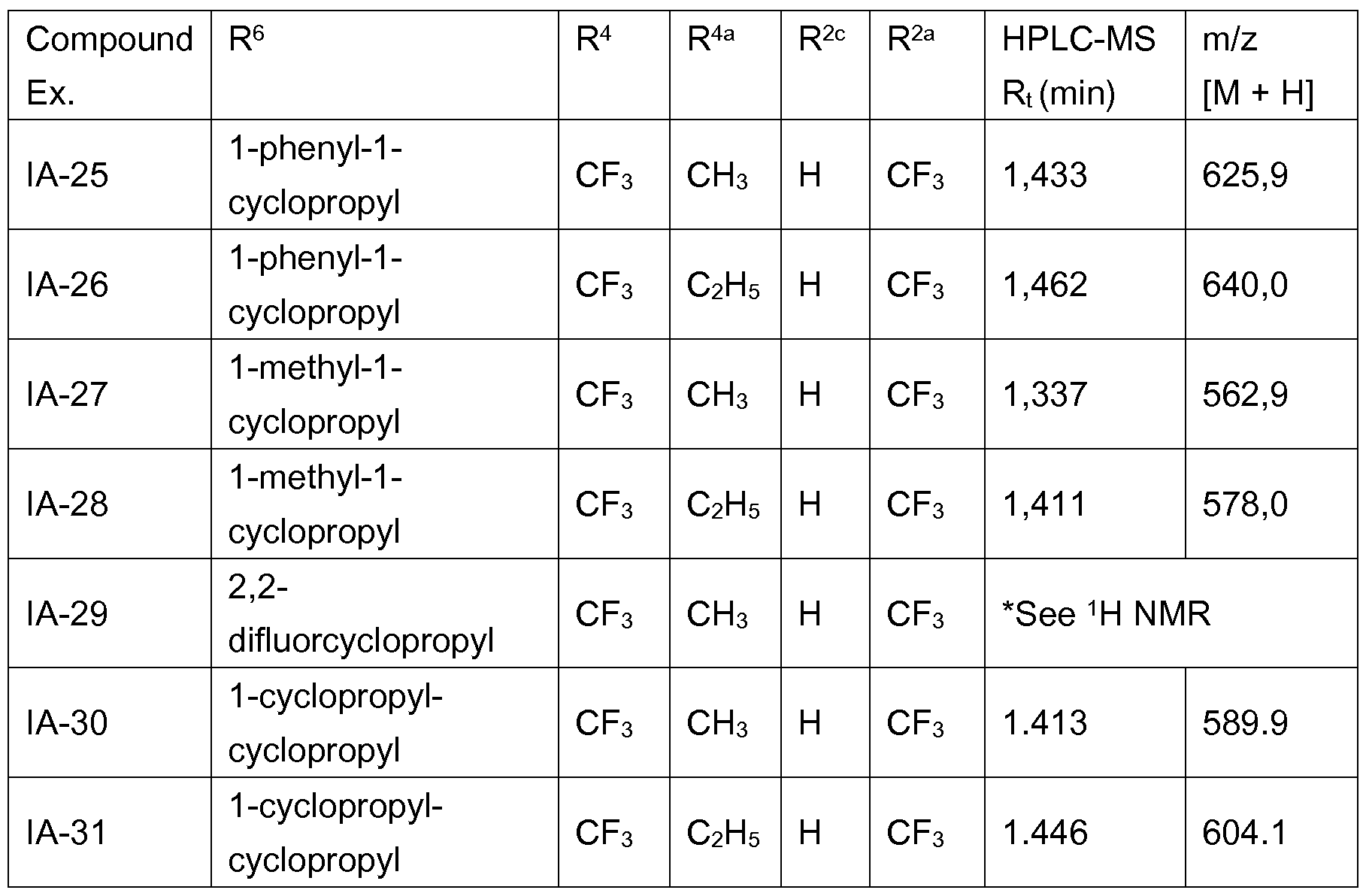
Α-29:1Η NMR (400 MHz; CDCIs): δ 7.91 (s, 1 H), 7.72 (s, 1H), 7.63 (s, 1H), 7,59-7.43 (m, 4H), 7.31 (s, 1H), 6.19 (s, 1H), 4,01 (s, 3H), 3.64-3.49 (m, 1H), 2.02-1.88 (m, 1H), 1.59-1.42 (m, 1H)
Following compounds IB-1 to IB-3 of formula IB summarized in table C were prepared in analogy:
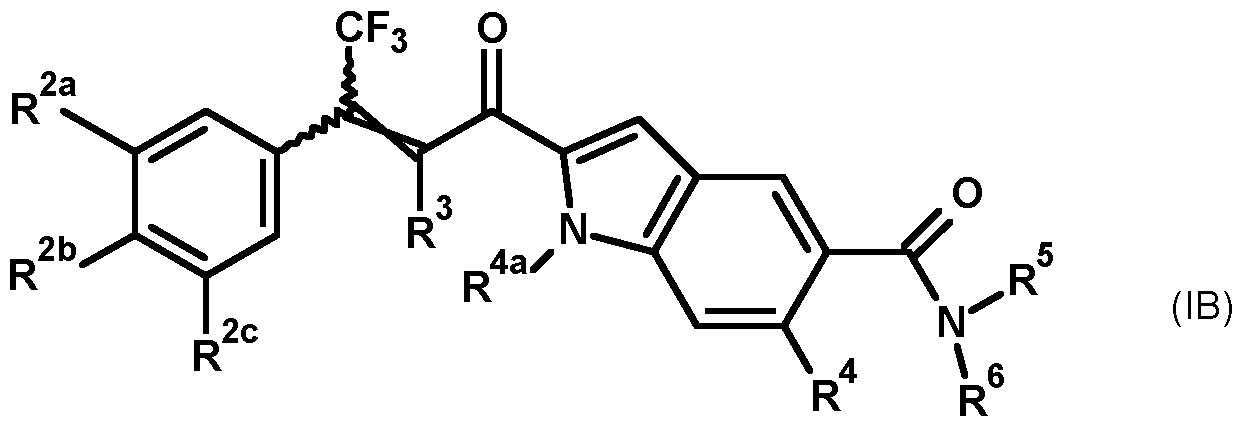
wherein R2b = H, R3 = H
Table C
Compound #-NR5R6 R4 R4a R2c R2a HPLC- m/z
Ex. MS Rt [M +
(min) H]
Compound #-NR5R6 R4 R4a R2c R2a HPLC- m/z
Ex. MS Rt [M +
(min) H] o
IB-1 CFs CHs CI CI 1 ,383 600,1
IB-2 CFs CHs CI CI 1 ,491 576,9
IB-3 #-0 CI C2H5 H CFs 1 ,413 543,8
Following compounds IC-1 to IC-3 of formula IC summarized in table D were prepared in analogy:

wherein R2b = H, R3 = H
Table D

•IC-1 : 1H NMR (500 MHz; CDCIs): δ 8.05 (s, 1 H), 7.76 (s, 1 H), 7.44 (s, 1 H), 7.39 (s, 1 H), 7.21 -7.18 (m, 3H), 4.01 (s, 3H)
•IC-2: 1H NMR (500 MHz; CDCIs): δ δ 7.99 (s, 1 H), 7.51 (s, 1 H), 7.44 (s, 1 H), 7.38 (s, 1 H), 7.21 -7.15 (m, 3H), 3.94 (s, 3H)
B. Evaluation of pesticidal activity
The activity of the compounds of formula I of the present invention can be
demonstrated and evaluated by the following biological test. B.1 Boll weevil (Anthonomus grandis)
For evaluating control of boll weevil (Anthonomus grandis) the test unit consisted of 96- well-microtiter plates containing an insect diet and 5-10 A. grandis eggs.
The compounds were formulated using a solution containing 75% v/v water and 25% v/v DMSO. Different concentrations of formulated compounds were sprayed onto the insect diet at 5 μΙ, using a custom built micro atomizer, at two replications.
After application, microtiter plates were incubated at about 25 + 1 °C and about 75 + 5 % relative humidity for 5 days. Egg and larval mortality was then visually assessed. In this test, compounds IA-1 , IA-2, IA-3, IA-4JA-5, IA-6, IA-7, IA-8, IA-9, IA-10, IA-1 1 , IA-12, IA-15, IA-16, IA-17, IA-18, IA-19, IA-20, IA-21 , IA-22, IA-24, IA-25, IA-26, IA-27, IA-28, IA-31 , IB-2, IB-3 at 2500 ppm showed at least 75 % mortality in comparison with untreated controls. B.2 Mediterranean fruitfly (Ceratitis capitata)
For evaluating control of Mediterranean fruitfly (Ceratitis capitata) the test unit consisted of microtiter plates containing an insect diet and 50-80 C. capitata eggs.
The compounds were formulated using a solution containing 75% v/v water and 25% v/v DMSO. Different concentrations of formulated compounds were sprayed onto the insect diet at 5 μΙ, using a custom built micro atomizer, at two replications.
After application, microtiter plates were incubated at about 28 + 1 °C and about 80 + 5 % relative humidity for 5 days. Egg and larval mortality was then visually assessed. In this test, compounds IA-1 , IA-3, IA-4, IA-6, IA-7, IA-8, IA-9, IA-15, IA-16, IA-17, IA- 18, IA-19, IA-20, IA-22, IA-24, IA-25 at 1415 ppm showed at least 75 % mortality in comparison with untreated controls.
B.3 Tobacco budworm (Heliothis virescens)
For evaluating control of tobacco budworm (Heliothis virescens) the test unit consisted of 96-well-microtiter plates containing an insect diet and 15-25 H. virescens eggs. The compounds were formulated using a solution containing 75% v/v water and 25% v/v DMSO. Different concentrations of formulated compounds were sprayed onto the insect diet at 10 μΙ, using a custom built micro atomizer, at two replications.
After application, microtiter plates were incubated at about 28 + 1 °C and about 80 + 5 % relative humidity for 5 days. Egg and larval mortality was then visually assessed.
In this test, compounds IA-1 , IA-2, IA-3, IA-4, IA-5, IA-6, IA-7, IA-8, IA-9, IA-12, IA-15, IA-16, IA-17, IA-18, IA-19, IA-20, IA-21 , IA-22, IA-24, IA-26, IA-27, IA-29 at 2500 ppm showed at least 75% mortality in comparison with untreated controls.
B.4 Green Peach Aphid (Myzus persicae) For evaluating control of green peach aphid (Myzus persicae) through systemic means the test unit consisted of 96-well-microtiter plates containing liquid artificial diet under an artificial membrane.
The compounds were formulated using a solution containing 75% v/v water and 25% v/v DMSO. Different concentrations of formulated compounds were pipetted into the aphid diet, using a custom built pipetter, at two replications.
After application, 5 - 8 adult aphids were placed on the artificial membrane inside the microtiter plate wells. The aphids were then allowed to suck on the treated aphid diet and incubated at about 23 + 1 °C and about 50 + 5 % relative humidity for 3 days. Aphid mortality and fecundity was then visually assessed.
In this test, compounds IA-1 , IA-2, IA-3, IA-4, IA-5, IA-8, IA-9, IA-16, IA-20 at 2500 ppm showed at least 75 % mortality in comparison with untreated controls.
B.5 Vetch aphid (Megoura viciae)
For evaluating control of vetch aphid (Megoura viciae) through contact or systemic means the test unit consisted of 24-well-microtiter plates containing broad bean leaf disks.
The compounds were formulated using a solution containing 75% v/v water and 25% v/v DMSO. Different concentrations of formulated compounds were sprayed onto the leaf disks at 2.5 μΙ, using a custom built micro atomizer, at two replications.
After application, the leaf disks were air-dried and 5 - 8 adult aphids placed on the leaf disks inside the microtiter plate wells. The aphids were then allowed to suck on the treated leaf disks and incubated at about 23 ± 1 °C and about 50 ± 5 % relative humidi- ty for 5 days. Aphid mortality and fecundity was then visually assessed.
In this test, compounds IA-1 , IA-2, IA-3, IA-4, IA-6, IA-7, IA-8, IA-9, IA-12, IA-15, IA-16, IA-17, IA-19, IA-20, IA-28 at 2500 ppm showed over 75 % mortality in comparison with untreated controls. B.6 Diamond back moth (Plutella xylostella)
The active compound was dissolved at the desired concentration in a mixture of 1 :1 (vohvol) distilled water : aceteone. Surfactant (Kinetic HV) was added at a rate of 0.01 % (vol/vol).The test solution was prepared at the day of use.
Leaves of cabbage were dipped in test solution and air-dried. Treated leaves were placed in petri dishes lined with moist filter paper and inoculated with ten 3rd instar larvae. Mortality was recorded 72 hours after treatment. Feeding damages were also recorded using a scale of 0-100%.
In this test, compounds IA-1 , IA-2, IA-3, IA-4, IA-7, IA-8, IA-9, IA-15, IA-16, IA-17, IA- 18, IA-19, IA-20, IA-22 at 500 ppm showed at least 75 % mortality in comparison with untreated controls. B.7 Southern armyworm (Spodoptera eridania), 2nd instar larvae
The active compounds were formulated in cyclohexanone as a 10,000 ppm solution supplied in tubes. The tubes were inserted into an automated electrostatic sprayer equipped with an atomizing nozzle and they served as stock solutions for which lower dilutions were made in 50% acetone:50% water (v/v). A nonionic surfactant (Kinetic®) was included in the solution at a volume of 0.01 % (v/v).
Lima bean plants (variety Sieva) were grown 2 plants to a pot and selected for treatment at the 1 st true leaf stage. Test solutions were sprayed onto the foliage by an au- tomated electrostatic plant sprayer equipped with an atomizing spray nozzle. The plants were dried in the sprayer fume hood and then removed from the sprayer. Each pot was placed into perforated plastic bags with a zip closure. About 10 to 1 1 armyworm larvae were placed into the bag and the bags zipped closed. Test plants were maintained in a growth room at about 25°C and about 20-40% relative humidity for 4 days, avoiding direct exposure to fluorescent light (24 hour photoperiod) to prevent trapping of heat inside the bags. Mortality and reduced feeding were assessed 4 days after treatment, compared to untreated control plants.
In this test, compounds IA-1 , IA-2, IA-3, IA-4, IA-7, IA-8, IA-9 at 300 ppm showed at least 75 % mortality in comparison with untreated controls.
In this test, compounds IA-7, IA-8, IA-9, IA-10, IA-12, IA-15, IA-16, IA-17, IA-18, IA-19, IA-20, IA-21 , IA-27 at 500 ppm showed at least 75 % mortality in comparison with untreated controls.
B.8 Cowpea aphid {Aphis craccivora)
The active compound was dissolved at the desired concentration in a mixture of 1 :1 (vohvol) distilled water : acetone. Surfactant (Alkamuls® EL 620) was added at a rate of 0.1 % (vol/vol). The test solution was prepared at the day of use.
Potted cowpea plants were colonized with approximately 50 - 100 aphids of various stages by manually transferring a leaf tissue cut from infested plant 24 hours before application. Plants were sprayed after the pest population has been recorded. Treated plants were maintained on light carts at about 28°C. Percent mortality was assessed after 72 hours.
In this test, compounds IA-26 and IA-30 at 500 ppm showed at least 75 % mortality in comparison with untreated controls.
B.9 Orchid thrips (Dichromothrips corbetti)
Dichromothrips corbetti adults used for bioassay were obtained from a colony maintained continuously under laboratory conditions. For testing purposes, the test compound was diluted in a 1 :1 mixture of acetone:water (vohvol), plus Kinetic HV at a rate of 0.01 % v/v.
Thrips potency of each compound was evaluated by using a floral-immersion technique. All petals of individual, intact orchid flowers were dipped into treatment solution and allowed to dry in Petri dishes. Treated flowers were placed into individual re-sealable plastic along with about 20 adult thrips. All test arenas were held under continuous light and a temperature of about 28°C for duration of the assay. After 3 days, the numbers of live thrips were counted on each petal. The percent mortality was recorded 72 hours after treatment.
In this test, compounds IA-1 and IA-3 at 500 ppm showed at least 75 % mortality in comparison with untreated controls.
B.10 Rice green leafhopper (Nephotettix virescens)
Rice seedlings were cleaned and washed 24 hours before spraying. The active compounds were formulated in 1 :1 acetone:water (vohvol), and 0.01 % vol/vol surfactant (Kinetic HV) was added. Potted rice seedlings were sprayed with 5-6 ml test solution, air dried, covered with Mylar cages and inoculated with 10 adults. Treated rice plants were kept at about 28-29°C and relative humidity of about 50-60%. Percent mortality was recorded after 72 hours.
In this test, compounds IA-2, IA-8, IA-9, IA-16 at 500 ppm showed at least 75 % mortality in comparison with untreated controls.
B.1 1 Silverleaf whitefly (Bemisia argentifolii) (adults)
The active compounds were formulated in cyclohexanone as a 10,000 ppm solution supplied in tubes. The tubes were inserted into an automated electrostatic sprayer equipped with an atomizing nozzle and they served as stock solutions for which lower dilutions were made in 50% acetone:50% water (v/v). A nonionic surfactant (Kinetic®) was included in the solution at a volume of 0.01 % (v/v).
Cotton plants at the cotyledon stage (one plant per pot) were sprayed by an automated electrostatic plant sprayer equipped with an atomizing spray nozzle. The plants were dried in the sprayer fume hood and then removed from the sprayer. Each pot was placed into a plastic cup and about 10 to 12 whitefly adults (approximately 3-5 days old) were introduced. The insects were collected using an aspirator and a nontoxic Tygon® tubing connected to a barrier pipette tip. The tip, containing the collected insects, was then gently inserted into the soil containing the treated plant, allowing insects to crawl out of the tip to reach the foliage for feeding. Cups were covered with a reusable screened lid. Test plants were maintained in a growth room at about 25°C and about 20-40% relative humidity for 3 days, avoiding direct exposure to fluorescent light (24 hour photoperiod) to prevent trapping of heat inside the cup. Mortality was assessed 3 days after treatment, compared to untreated control plants.
In this test, compound IA-7, IA-9, IA-31 at 300 ppm showed at least 75 % mortality in comparison with untreated controls.
Claims
We claim:
1 . A (het)arylalkenyl compound of formula I

wherein
B1, B2, B3, B4 and B5 are each independently selected from the group consisting of N and C-R2, with the proviso that at most two of B1, B2, B3, B4 and B5 are N;
G1 is selected from the group consisting of N and C-R4b;
G2, G3 and G5 are each independently selected from the group consisting of N and C-R4;
G4 is selected from the group consisting of N, C-A and C-R4; with the proviso that at most two of G2, G3, G4 and G5 are N;
A is a group A1, A2, A3 or A4,
wherein
A1 is selected from the group consisting of -C(=NR6)R8, -S(0)nR9 and - N(R5)R6;
A2 is a group of following formula:

wherein
# denotes the bond to the remainder of the molecule;
W is selected from O and S;
Y is selected from hydrogen, -N(R5)R6 and -OR9; is a group of following formula:

wherein
# denotes the bond to the remainder of the molecule; is a 3-, 4-, 5-, 6- or 7-membered saturated, partially unsaturated or maximally unsaturated heteromonocyclic ring containing 1 , 2, 3 or 4 heteroatoms or heteroatom groups selected from N, O, S, NO, SO and SO2 as ring members, or is a 8-, 9- or 10-membered saturated, partially unsaturated or maximally unsaturated heterobicyclic ring containing 1 , 2, 3 or 4 heteroatoms or heteroatom groups selected from N, O, S, NO, SO and SO2 as ring members, where the heteromonocyclic or heterobicyclic ring is optionally substituted with one or more substituents R11; is selected from O and S;
R1 is selected from the group consisting of Ci-C4-alkyl, C2-C4-alkenyl, C2-C4- alkynyl, C3-C6-cycloalkyl, Ci-C4-alkylsulfonyl and Ci-C4-alkoxycarbonyl, wherein the aliphatic and cycloaliphatic moieties in the six last-mentioned radicals may be partially or fully halogenated and/or may be substituted by one or more radicals selected from the group consisting of hydroxy, cyano, Ci-C4-alkoxy, Ci-C4-haloalkoxy, Ci-C4-alkoxycarbonyl, C1-C4- alkylaminocarbonyl and Ci-C4-dialkylaminocarbonyl; each R2 is independently selected from the group consisting of hydrogen, halogen, cyano, azido, nitro, -SCN, -SF5, Ci-C6-alkyl, Cs-Cs-cycloalkyl, C2-C6- alkenyl, C2-C6-alkynyl, wherein the four last-mentioned aliphatic and cycloaliphatic radicals may be partially or fully halogenated and/or may be sub- stituted by one or more radicals R8,
-Si(R12)3, -OR9, -S(0)nR9, -N(R 0a)R 0b,
phenyl which may be substituted by 1 , 2, 3, 4 or 5 radicals R11, and a 3-, 4-, 5-, 6- 7-, 8-, 9- or 10-membered saturated, partially unsaturated or maximally unsaturated heteromonocyclic or heterobicyclic ring containing 1 , 2, 3 or 4 heteroatoms or heteroatom groups selected from N, O, S, NO, SO and SO2 as ring members, where the heteromono- or heterobicyclic ring may be substituted by one or more radicals R11;
R3 is selected from the group consisting of hydrogen, halogen, cyano, azido, nitro, -SCN, -SF5 ,Ci-C6-alkyl, C3-C6-cycloalkyl, C2-C6-alkenyl, C2-C6-alkynyl and Ci-C6-alkylsulfonyl, wherein the aliphatic and cycloaliphatic moieties in the five last-mentioned radicals may be partially or fully halogenated and/or may be substituted with one or more substituents R8; each R4 is independently selected from the group consisting of hydrogen, hal- ogen, cyano, azido, nitro, -SCN, -SF5, Ci-C6-alkyl, Cs-Cs-cycloalkyl, C2-C6- alkenyl, C2-C6-alkynyl, wherein the four last-mentioned aliphatic and cycloaliphatic radicals may be partially or fully halogenated and/or may be substituted by one or more radicals R8,
-Si(R12)3, -OR9, -S(0)nR9, -N(R 0a)R 0b,
phenyl which may be substituted by 1 , 2, 3, 4 or 5 radicals R11, and a 3-, 4-,
5-, 6- 7-, 8-, 9- or 10-membered saturated, partially unsaturated or maximally unsaturated heteromonocyclic or heterobicyclic ring containing 1 , 2, 3 or 4 heteroatoms or heteroatom groups selected from N, O, S, NO, SO and SO2 as ring members, where the heteromonocyclic or heterobicyclic ring may be substituted by one or more radicals R11;
or
two radicals R4 bound on neighboring carbon atoms form together with the atoms to which they are bound a 5-, 6-, or 7-membered saturated, partially unsaturated or maximally unsaturated ring, where the ring may contain 1 or 2 heteroatoms or heteroatom-containing groups selected from O, S, N, SO,
SO2, C=0 and C=S as ring members, wherein the ring may be substituted with 1 , 2, 3, 4 or 5 substituents independently selected from the group consisting of halogen, Ci-C6-alkyl, Ci-C6-haloalkyl and Ci-C6-alkoxy; R4a is selected from the group consisting of hydrogen, Ci-C6-alkyl, C3-C6- cycloalkyl, C2-C6-alkenyl and C2-C6-alkynyl, wherein the four last-mentioned aliphatic and cycloaliphatic radicals may be partially or fully halogenated and/or may be substituted with one or more substituents R8,
and -S(0)nR9;
R4b is independently selected from the group consisting of hydrogen, halogen, cyano, azido, nitro, -SCN, -SF5, Ci-C6-alkyl, Cs-Cs-cycloalkyl, C2-C6-alkenyl, C2-C6-alkynyl, wherein the four last-mentioned aliphatic and cycloaliphatic radicals may be partially or fully halogenated and/or may be substituted by one or more radicals R8,
-Si(R12)3, -OR9, -S(0)nR9, -N(R 0a)R 0 ,
phenyl which may be substituted by 1 , 2, 3, 4 or 5 radicals R11, and a 3-, 4-, 5-, 6- 7-, 8-, 9- or 10-membered saturated, partially unsaturated or maximally unsaturated heteromonocyclic or heterobicyclic ring containing 1 , 2, 3 or 4 heteroatoms or heteroatom groups selected from N, O, S, NO, SO and
SO2 as ring members, where the heteromonocyclic or heterobicyclic ring may be substituted by one or more radicals R11; each R5 is independently selected from the group consisting of hydrogen, Ci- Cio-alkyl, Cs-Cs-cycloalkyl, C2-Cio-alkenyl, C2-Cio-alkynyl, wherein the four last-mentioned aliphatic and cycloaliphatic radicals may be partially or fully halogenated and/or may be substituted with one or more substituents R8, Ci-C4-alkylcarbonyl, Ci-C4-haloalkylcarbonyl, Ci-C4-alkoxycarbonyl, C1-C4- haloalkoxycarbonyl, and -S(0)nR9; each R6 is independently selected from the group consisting of hydrogen, cyano, Ci-Cio-alkyl, Cs-Cs-cycloalkyl, C2-Cio-alkenyl, C2-Cio-alkynyl, wherein the four last-mentioned aliphatic and cycloaliphatic radicals may be partially or fully halogenated and/or may be substituted by one or more substituents
R8,
-OR9, -N(R 0a)R 0b, -S(0)nR9, -C(=O)N(R 0a)N(R 0a)R 0b, -Si(R12)3, -C(=0)R8, -P(=0)(OR9)2, -P(=S)(OR9)2,
phenyl which may be substituted with 1 , 2, 3, 4, or 5 substituents R11, and a 3-, 4-, 5-, 6-, 7-, 8-, 9- or 10-membered saturated, partially unsaturated or maximally unsaturated heteromonocyclic or heterobicyclic ring containing 1 , 2, 3 or 4 heteroatoms or heteroatom groups independently selected from N, O, S, NO, SO and SO2 as ring members, where the heteromonocyclic or heterobicyclic ring may be substituted with one or more substituents R11; or R5 and R6, together with the nitrogen atom to which they are bound, form a 3-, 4-, 5-, 6-, 7- or 8-membered saturated, partially unsaturated or maximally unsaturated heteromonocyclic ring, where the ring may additionally contain 1 , 2, 3 or 4 heteroatoms or heteroatom-containing groups selected from O, S, N, SO, SO2, C=0 and C=S as ring members, or form a 7-, 8-, 9- or 10-membered saturated, partially unsaturated or maximally unsaturated heterobicyclic ring, where the ring may additionally contain 1 , 2, 3 or 4 het-
eroatoms or heteroatom groups selected from N, O, S, NO, SO, SO2, C=0 and C=S, wherein the heteromonocyclic or heterobicyclic ring may be substituted with 1 , 2, 3, 4 or 5 substituents independently selected from the group consisting of halogen, cyano, Ci-C6-alkyl, Ci-C6-haloalkyl, C1-C6- alkoxy, Ci-C6-haloalkoxy, Ci-C6-alkylthio, Ci-C6-haloalkylthio, C3-C8- cycloalkyl, Cs-Cs-halocycloalkyl, C2-C6-alkenyl, C2-C6-haloalkenyl, C2-C6- alkynyl, C2-C6-haloalkynyl, wherein the aliphatic or cycloaliphatic moieties in the twelve last-mentioned radicals may be substituted by one or more radicals R8, and phenyl which may be substituted with 1 , 2, 3, 4 or 5 substitu- ents R11; or R5 and R6 together form a group =C(R8)2, =S(0)m(R9)2, =NR10a or =NOR9;
R7a, R7b are each independently selected from the group consisting of hydro- gen, halogen, cyano, Ci-C6-alkyl, Cs-Cs-cycloalkyl, C2-C6-alkenyl and C2-
C6-alkynyl, wherein the four last-mentioned aliphatic and cycloaliphatic radicals may be partially or fully halogenated and/or may be substituted by one or more radicals R8; each R8 is independently selected from the group consisting of cyano, azido, nitro, -SCN, -SF5, Cs-Cs-cycloalkyl, Cs-Cs-halocycloalkyl, where the cycloaliphatic moieties in the two last-mentioned radicals may be substituted by one or more radicals R13;
-Si(R12)3, -OR9, -OSO2R9, -S(0)nR9, -N(R 0a)R 0 , -C(=0)R13,
-C(=O)N(R 0a)R 0b, -C(=S)N(R 0a)R 0b, -C(=0)OR9,
phenyl, optionally substituted with 1 , 2, 3, 4 or 5 substituents R16, and a 3-, 4-, 5-, 6- or 7-membered saturated, partially unsaturated or maximally unsaturated heterocyclic ring comprising 1 , 2 or 3 heteroatoms or heteroatom groups selected from N, O, S, NO, SO and SO2 as ring members, where the heterocyclic ring is optionally substituted with one or more substituents R16,
or
two R8 present on the same carbon atom of an alkyl, alkenyl, alkynyl or cy- cloalkyl group together form a group =0,

=S(0)mR15N(R 4a)R 4 , =NR 0a, =NOR9; or =NN(R 0a)R 0 ;
or
two radicals R8, together with the carbon atoms of an alkyl, alkenyl, alkynyl or cycloalkyl group which they are bonded to, form a 3-, 4-, 5-, 6-, 7- or 8- membered saturated or partially unsaturated carbocyclic or heterocyclic ring, where the heterocyclic ring comprises 1 , 2, 3 or 4 heteroatoms or heteroatom groups independently selected from N, O, S, NO, SO and SO2 as
ring members, and where the carbocyclic or heterocyclic ring is optionally substituted with one or more substituents R16; and
R8 as a substituent on a cycloalkyl ring is additionally selected from the group consisting of Ci-C6-alkyl, Ci-C6-haloalkyl, C2-C6-alkenyl, C2-C6- haloalkenyl, C2-C6-alkynyl and C2-C6-haloalkynyl, where the aliphatic moieties in these six radicals may be substituted by one or more radicals R13; and
R8 in the groups -C(=NR6)R8, -C(=0)R8 and =C(R8)2 is additionally selected from the group consisting of hydrogen, halogen, Ci-C6-alkyl, C1-C6- haloalkyl, C2-C6-alkenyl, C2-C6-haloalkenyl, C2-C6-alkynyl and C2-C6- haloalkynyl, where the aliphatic moieties in the six last-mentioned radicals may be substituted by one or more radicals R13; each R9 is independently selected from the group consisting of hydrogen, cy- ano, Ci-C6-alkyl, Ci-C6-haloalkyl, Cs-Cs-cycloalkyl, C3-Cs-cycloalkyl-Ci-C4- alkyl-, C3-Cs-halocycloalkyl, C2-C6-alkenyl, C2-C6-haloalkenyl, C2-C6-alkynyl, C2-C6-haloalkynyl, where the aliphatic and cydoaliphatic moieties in the nine last-mentioned radicals may be substituted by one or more radicals R 3,
-Ci-C6-alkyl-C(=0)OR15, -Ci-C6-alkyl-C(=0)N(R a)R ,
-Ci-C6-alkyl-C(=S)N(R 4a)R 4b, -Ci-C6-alkyl-C(=NR 4)N(R 4a)R 4b,
-Si(R12)3, -S(0)nR15, -S(0)nN(R a)R , -N(R 0a)R 0 , -N=C(R13)2, -C(=0)R13, -C(=0)N(R 4a)R 4 , -C(=S)N(R 4a)R 4 , -C(=0)OR15,
phenyl, optionally substituted with 1 , 2, 3, 4 or 5 R16; and
a 3-, 4-, 5-, 6- or 7-membered saturated, partially unsaturated or maximally unsaturated heterocyclic ring comprising 1 , 2 or 3 heteroatoms or heteroa- tom groups selected from N, O, S, NO, SO and SO2 as ring members, where the heterocyclic ring is optionally substituted with one or more substituents R16; and
R9 in the groups -S(0)nR9 and -OSO2R9 is additionally selected from the group consisting of Ci-C6-alkoxy and Ci-C6-haloalkoxy;
R10a, R10b are selected independently from one another from the group consisting of hydrogen, Ci-C6-alkyl, Ci-C6-haloalkyl, Cs-Cs-cycloalkyl, C3-C8- halocycloalkyl, C2-C6-alkenyl, C2-C6-haloalkenyl, C2-C6-alkynyl, C2-C6- haloalkynyl, where the aliphatic and cydoaliphatic moieties in the eight last- mentioned radicals may be substituted by one or more radicals R13;
-Ci-C6-alkyl-C(=0)OR15, -Ci-C6-alkyl-C(=0)N(R a)R , -Ci-C6-alkyl- C(=S)N(R a)R , -Ci-C6-alkyl-C(=NR )N(R a)R , Ci-C6-alkoxy, Ci-C6- haloalkoxy, Ci-C6-alkylthio, Ci-C6-haloalkylthio,
-S(0)nR15, -S(0)nN(R a)R , -C(=0)R13, -C(=0)OR15, -C(=0)N(R a)R , -C(=S)R13, -C(=S)SR15, -C(=S)N(R 4a) R 4b, -C(=N R 4)R13;
phenyl, optionally substituted with 1 , 2, 3 or 4, substituents R16; and a 3-, 4-, 5-, 6- or 7-membered saturated, partially unsaturated or maximally unsaturated heterocyclic ring comprising 1 , 2, 3 or 4 heteroatoms or het- eroatom groups selected from N , O, S, NO, SO and SO2 as ring members, where the heterocyclic ring is optionally substituted with one or more substituents R16;
or
R10a and R10b form together with the nitrogen atom they are bonded to a 3-, 4-, 5-, 6-, 7- or 8-membered saturated, partially unsaturated or maximally unsaturated heterocyclic ring, wherein the heterocyclic ring may additionally contain one or two heteroatoms or heteroatom groups selected from N , O, S, NO, SO and SO2 as ring members, where the heterocyclic ring optionally carries one or more substituents selected from halogen, Ci- C6-alkyl, Ci-C6-haloalkyl, Ci-C6-alkoxy, Ci-C6-haloalkoxy, Ci-C6-alkylthio, Ci-C6-haloalkylthio, Cs-Cs-cycloalkyl, C3-Cs-halocycloalkyl, C2-C6-alkenyl, C2-C6-haloalkenyl, C2-C6-alkynyl, C2-C6-haloalkynyl, phenyl, optionally substituted with 1 , 2, 3, 4 or 5 substituents R16, and a 3-, 4-, 5-, 6,- or 7- membered saturated, partially unsaturated or maximally unsaturated heterocyclic ring comprising 1 , 2 or 3 heteroatoms or heteroatom groups selected from N , O, S, NO, SO and SO2 as ring members, where the heterocyclic ring optionally carries one or more substituents R16;
or R 0a and R10 together form a group =C(R13)2, =S(0)m(R15)2,
=S(0)mR15N(R 4a)R 4 , =N R14 or =NOR15; each R11 is independently selected from the group consisting of halogen, cy- ano, azido, nitro, -SCN, -SF5, Ci-Cio-alkyl, Cs-Cs-cycloalkyl, C2-Cio-alkenyl, C2-Cio-alkynyl, wherein the four last-mentioned aliphatic and cycloaliphatic radicals may be partially or fully halogenated and/or may be substituted with one or more radicals R8,
-OR9, -N(R 0a)R 0 , -S(0)nR9, -Si(R12)3;
phenyl, optionally substituted with 1 , 2, 3, 4, or 5 substituents selected independently from R16; and
a 3-, 4-, 5-, 6- or 7-membered saturated, partially unsaturated or maximally unsaturated aromatic heterocyclic ring comprising 1 , 2, 3 or 4 heteroatoms or heteroatom groups selected from N, O, S, NO, SO and SO2 as ring members, where the heterocyclic ring is optionally substituted with one or more substituents selected independently from R16;
or two R11 present on the same ring carbon atom of an unsaturated or partially unsaturated heterocyclic ring may together form a group =0,
 =S; =S(0)m(R15)2; =S(0)mR15N(R 4a)R 4b, =NR14, =NOR15, or =NN(R 4a)R 4b or two R11 bound on adjacent ring atoms form together with the ring atoms to which they are bound a saturated 3-, 4-, 5-, 6-, 7-, 8- or 9-membered ring, wherein the ring may contain 1 or 2 heteroatoms or heteroatom groups selected from O, S, N, NR14, NO, SO and SO2 and/or 1 or 2 groups selected from C=0, C=S and C=NR14 as ring members, and wherein the ring may be substituted by one or more radicals selected from the group consisting of halogen, Ci-C6-alkyl, Ci-C6-haloalkyl, Ci-C6-alkoxy, C1-C6- haloalkoxy, Ci-C6-alkylthio, Ci-C6-haloalkylthio, Cs-Cs-cycloalkyl, C3-C8- halocycloalkyl, C2-C6-alkenyl, C2-C6-haloalkenyl, C2-C6-alkynyl, C2-C6- haloalkynyl, phenyl which may be substituted by 1 , 2, 3, 4 or 5 radicals R16 and a 3-, 4-, 5-, 6- or 7-membered saturated, partially unsaturated or maximally unsaturated heterocyclic ring containing 1 , 2 or 3 heteroatoms or heteroatom groups selected from N, O, S, NO, SO and SO2 as ring members, where the heterocyclic ring may be substituted by one or more radicals R16; each R12 is independently selected from the group consisting of hydrogen, halogen, Ci-C6-alkyl, Ci-C6-haloalkyl, Ci-C6-alkoxy, Ci-C6-haloalkoxy, C2-C6- alkenyl, C2-C6-haloalkenyl, C2-C6-alkynyl, C2-C6-haloalkynyl, Cs-Cs- cycloalkyl, C3-Cs-halocycloalkyl, Ci-C6-alkoxy-Ci-C6-alkyl-, C1-C6- haloalkoxy-Ci-C6-alkyl-, and phenyl, optionally substituted with 1 , 2, 3, 4, or 5 substituents R16; each R13 is independently selected from the group consisting of cyano, nitro, -OH, -SH, -SCN, -SF5, d-Ce-alkoxy, Ci-C6-haloalkoxy, Ci-C6-alkylthio, Ci-C6-haloalkylthio, Ci-C6-alkylsulfinyl, Ci-C6-haloalkylsulfinyl, C1-C6- alkylsulfonyl, Ci-C6-haloalkylsulfonyl, trimethylsilyl, triethylsilyl, tert- butyldimethylsilyl,
Cs-Cs-cycloalkyl which may be unsubstituted, partially or fully halogenated and/or may carry 1 or 2 radicals selected from Ci-C4-alkyl, C3-C4-cycloalkyl, Ci-C4-alkoxy, Ci-C4-haloalkoxy and oxo; phenyl, benzyl, pyridyl, phenoxy, where the cyclic moiety in the four last-mentioned radicals may be unsubstituted or carry 1 , 2, 3, 4 or 5 substituents R16; and a 3-, 4-, 5-, 6- or 7- membered saturated, partially unsaturated or maximally unsaturated heterocyclic ring containing 1 , 2 or 3 heteroatoms or heteroatom groups selected
from N, O, S, NO, SO and SO2 as ring members, where the heterocyclic ring may be substituted by 1 , 2 or 3 substituents R16;
or
two R13 present on the same carbon atom of an alkyl, alkenyl, alkynyl or cycloalkyl group may together be =0, =CH(Ci-C4-alkyl), =C(Ci-C4-alkyl)Ci-
C4-alkyl, =N(Ci-C6-alkyl) or =NO(Ci-C6-alkyl);
and
R13 as a substituent on a cycloalkyl ring is additionally selected from the group consisting of Ci-C6-alkyl, C2-C6-alkenyl and C2-C6-alkynyl, wherein the three last-mentioned aliphatic radicals may be unsubstituted, partially or fully halogenated and/or may carry 1 or 2 substituents selected from CN, C3-C4-cycloalkyl, Ci-C4-alkoxy, Ci-C4-haloalkoxy and oxo;
and
R 3 in the groups =C(R13)2, -N=C(R13)2, -C(=0)R13, -C(=S)R13 and
-C(=NR14)R13 is additionally selected from the group consisting of hydrogen, halogen, Ci-C6-alkyl, C2-C6-alkenyl and C2-C6-alkynyl, wherein the three last-mentioned aliphatic radicals may be unsubstituted, partially or fully halogenated and/or may carry 1 or 2 radicals selected from CN , C3-C4- cycloalkyl, Ci-C4-alkoxy, Ci-C4-haloalkoxy and oxo; each R14 is independently selected from the group consisting of hydrogen, cy- ano, Ci-C6-alkoxy, Ci-C6-haloalkoxy, Ci-C6-alkylthio, Ci-C6-haloalkylthio, Ci-C6-alkylsulfinyl, Ci-C6-haloalkylsulfinyl, Ci-C6-alkylsulfonyl, C1-C6- haloalkylsulfonyl, trimethylsilyl, triethylsilyl, feri-butyldimethylsilyl,
Ci-C6-alkyl, C2-C6-alkenyl, C2-C6-alkynyl, wherein the three last-mentioned aliphatic radicals may be unsubstituted, partially or fully halogenated and/or may carry 1 or 2 radicals selected from CN , Ci-C4-alkoxy, C1-C4- haloalkoxy, Ci-C4-alkylthio, Ci-C4-alkylsulfinyl, Ci-C4-alkylsulfonyl, C3-C4- cycloalkyl which may be substituted by 1 or 2 substituents selected from halogen and cyano; and oxo;
C3-C8-cycloalkyl which may be unsubstituted, partially or fully halogenated and/or may carry 1 or 2 radicals selected from Ci-C4-alkyl, Ci-C4-alkoxy, Ci-C4-haloalkoxy, Ci-C4-alkylthio, Ci-C4-alkylsulfinyl, Ci-C4-alkylsulfonyl, C3-C4-cycloalkyl, C3-C4-cycloalkyl-Ci-C4-alkyl-, where the cycloalkyl moiety in the two last-mentioned radicals may be substituted by 1 or 2 substituents selected from halogen and cyano; and oxo;
phenyl, benzyl, pyridyl, phenoxy, wherein the cyclic moieties in the four last- mentioned radicals may be unsubstituted and/or carry 1 , 2 or 3 substituents selected from halogen, Ci-C6-alkyl, Ci-C6-haloalkyl, Ci-C6-alkoxy, C1-C6-
haloalkoxy and (Ci-C6-alkoxy)carbonyl; and a 3-, 4-, 5- or 6-membered saturated, partially unsaturated or maximally unsaturated heterocyclic ring comprising 1 or 2 heteroatoms or heteroatom groups selected from N, O, S, NO, SO and SO2 as ring members, where the heterocyclic ring is optionally substituted with one or more substituents R16;
R14a and R14b, independently of each other, have one of the meanings given for R14; or
R14a and R14b, together with the nitrogen atom to which they are bound, form a 3-, 4-, 5-, 6- or 7-membered saturated, partially unsaturated or maximally unsaturated heterocyclic ring, wherein the heterocyclic ring may additionally contain 1 or 2 heteroatoms or heteroatom groups selected from N, O, S, NO, SO and SO2 as ring members, where the heterocyclic ring optionally carries one or more substituents selected from halogen, Ci-C4-alkyl, Ci-C4-haloalkyl, Ci-C4-alkoxy and Ci-C4-haloalkoxy;
or
R14a and R14 or R14b and R14, together with the nitrogen atoms to which they are bound in the group -C(=NR14)N(R14a)R14b, form a 3-, 4-, 5-, 6- or 7- membered partially unsaturated or maximally unsaturated heterocyclic ring, wherein the heterocyclic ring may additionally contain 1 or 2 heteroatoms or heteroatom groups selected from N, O, S, NO, SO and SO2 as ring members, where the heterocyclic ring optionally carries one or more substituents selected from halogen, Ci-C4-haloalkyl, Ci-C4-alkoxy and Ci-C4-haloalkoxy; each R15 is independently selected from the group consisting of hydrogen, cy- ano, trimethylsilyl, triethylsilyl, feri-butyldimethylsilyl,
Ci-C6-alkyl, C2-C6-alkenyl, C2-C6-alkynyl, wherein the three last-mentioned aliphatic radicals may be unsubstituted, partially or fully halogenated and/or may carry 1 or 2 radicals selected from C3-C4-cycloalkyl, Ci-C4-alkoxy, Ci-C4-haloalkoxy, Ci-C4-alkylthio, Ci-C4-alkylsulfinyl, Ci-C4-alkylsulfonyl and oxo;
C3-C8-cycloalkyl which may be unsubstituted, partially or fully halogenated and/or may carry 1 or 2 radicals selected from Ci-C4-alkyl, C3-C4-cycloalkyl, Ci-C4-alkoxy, Ci-C4-haloalkoxy, Ci-C4-alkylthio, Ci-C4-alkylsulfinyl, C1-C4- alkylsulfonyl and oxo;
phenyl, benzyl, pyridyl and phenoxy, wherein the four last-mentioned radicals may be unsubstituted, partially or fully halogenated and/or carry 1 , 2 or 3 substituents selected from Ci-C6-alkyl, Ci-C6-haloalkyl, Ci-C6-alkoxy, Ci- C6-haloalkoxy and (Ci-C6-alkoxy)carbonyl;
each R16 is independently selected from the group consisting of halogen, nitro, cyano, -OH, -SH, Ci-C6-alkoxy, Ci-C6-haloalkoxy, Ci-C6-alkylthio, C1-C6- haloalkylthio, Ci-C6-alkylsulfinyl, Ci-C6-haloalkylsulfinyl, Ci-C6-alkylsulfonyl, Ci-C6-haloalkylsulfonyl, trimethylsilyl, triethylsilyl, feri-butyldimethylsilyl; Ci-C6-alkyl, C2-C6-alkenyl, C2-C6-alkynyl, wherein the three last-mentioned aliphatic radicals may be partially or fully halogenated and/or may carry 1 or 2 radicals selected from C3-C4-cycloalkyl, Ci-C4-alkoxy, Ci-C4-haloalkoxy and oxo;
C3-C8-cycloalkyl which may be partially or fully halogenated and/or may carry 1 or 2 radicals selected from Ci-C4-alkyl, C3-C4-cycloalkyl, Ci-C4-alkoxy, Ci-C4-haloalkoxy and oxo;
phenyl, benzyl, pyridyl and phenoxy, wherein the four last-mentioned radicals may be partially or fully halogenated and/or carry 1 , 2 or 3 substituents selected from Ci-C6-alkyl, Ci-C6-haloalkyl, Ci-C6-alkoxy, Ci-C6-haloalkoxy and (Ci-C6-alkoxy)carbonyl;
or
two R16 present together on the same atom of an unsaturated or partially unsaturated ring may be =0, =S, =N(Ci-C6-alkyl), =NO(Ci-C6-alkyl), =CH(Ci-C4-alkyl) or =C(Ci-C4-alkyl)Ci-C4-alkyl;
or
two R16 on two adjacent carbon atoms form together with the carbon atoms they are bonded to a 4-, 5-, 6-, 7- or 8-membered saturated, partially unsaturated or maximally unsaturated ring, wherein the ring may contain 1 or 2 heteroatoms or heteroatom groups selected from N, O, S, NO, SO and SO2 as ring members, and wherein the ring optionally carries one or more substituents selected from halogen, Ci-C4-haloalkyl, Ci-C4-alkoxy and Ci-C4-haloalkoxy; each n is independently 0, 1 or 2; and
each m is independently 0 or 1 ; and the N-oxides, tautomers, stereoisomers and agriculturally or veterinarily acceptable salts thereof.
2. The compounds as claimed in claiml , where B1 and B5 are CH and B2, B3 and B4 are CR2, where R2 has one of the meanings given in claim 1.
The compounds as claimed in claim 2, where B2 is CR2, where R2 is not hydrogen, and B3 and B4 are CR2, where R2 has one of the meanings given in claim 1 , and where specifically B2 is CR2, where R2 is not hydrogen, B4 is CR2, where R2 has one of the meanings given in claim 1 , and B1, B3, and B5 are CH.
The compounds as claimed in any of the preceding claims, where R2 is selected from hydrogen, halogen, cyano, azido, nitro, -SCN, -SF5, Ci-C6-alkyl, C3-C8- cycloalkyl, C2-C6-alkenyl, C2-C6-alkynyl, wherein the four last-mentioned aliphatic and cycloaliphatic radicals may be partially or fully halogenated and/or may be substituted by one or more radicals R8, -OR9, -S(0)nR9 and -N(R10a)R10b, wherein R8, R9, R10a and R10b are as defined in claim 1 .
The compounds as claimed in claim 4, where R2 is selected from hydrogen, halogen and Ci-C2-haloalkyl, preferably from hydrogen, F, CI, Br and CF3, and in particular from hydrogen, CF3 and CI.
The compounds as claimed in any of the preceding claims, where G1 is C-R4b, where R4b is selected from hydrogen, halogen and cyano, and is in particular hydrogen.
The compounds as claimed in any of the preceding claims, where G2, G3 and G5 are C-R4, where R4 is as defined in claim 1 .
8. The compounds as claimed in claim 7, where G2 and G5 are C-H and G3 is C-R4, where R4 is as defined in claim 1.
9. The compounds as claimed in any of the preceding claims, where G4 is C-R4 or C-A, where R4 and A are as defined in claim 1 . 10. The compounds as claimed in any of the preceding claims, where R4 is selected from the group consisting of hydrogen, halogen, cyano, nitro, Ci-C6-alkyl, C1-C6- haloalkyl, Ci-C6-alkoxy and Ci-C6-haloalkoxy.
1 1 . The compounds as claimed in claim 10, where R4 is selected from the group consisting of hydrogen, halogen and Ci-C4-haloalkyl.
12. The compounds as claimed in any of the preceding claims, where A is A1 and A1 is selected from -C(=NR6)R8 and -N(R5)R6; wherein R5, R6 and R8 are as defined
in claim 1 .
13. The compounds as claimed in claim 12, where R6 in -C(=NR6)R8 is -OR9; and R9 is selected from Ci-C6-alkyl, Ci-C6-haloalkyl, Cs-Cs-cycloalkyl, C3-C8- halocycloalkyl, C3-C8-cycloalkyl-Ci-C4-alkyl-, C2-C6-alkenyl, C2-C6-haloalkenyl, C2-C6-alkynyl and C2-C6-haloalkynyl, and preferably from Ci-C6-alkyl, C1-C6- haloalkyl, Cs-Cs-cycloalkyl, Cs-Cs-halocycloalkyl and C3-Cs-cycloalkyl-Ci-C4-alkyl.
14. The compounds as claimed in claim 12, where R6 in -C(=NR6)R8 is -N(R10a)R10b, where
R10a is selected from hydrogen and Ci-C6-alkyl; and
R 0b is selected from -C(=0)N(R 4a)R 4b and -C(=S)N(R 4a)R 4b;
R14a is selected from hydrogen, Ci-C6-alkyl and Ci-C6-haloalkyl; and R14b is selected from hydrogen, Ci-C6-alkyl, Ci-C6-haloalkyl, C2-C6-alkenyl, C2-C6-haloalkenyl, C2-C6-alkynyl, C2-C6-haloalkynyl, C3-C6-cycloalkyl, C3-C6-halocycloalkyl, C3-C6-cycloalkyl-Ci-C4-alkyl-, where the cycloal- kyl moieties in the three last-mentioned radicals may carry a CN group; Ci-C6-alkyl substituted with a CN group, phenyl which is optionally substituted with 1 , 2, 3 or 4, substituents each independently selected from the group consisting of halogen, cyano, nitro, C1-C4- alkyl, Ci-C4-haloalkyl, Ci-C4-alkoxy, Ci-C4-haloalkoxy, Ci-C4-alkylthio, Ci-C4-haloalkylthio, C3-C6-cycloalkyl, C3-C6-halocycloalkyl, C2-C4- alkenyl, C2-C4-haloalkenyl, C2-C4-alkynyl and C2-C4-haloalkynyl; and a heterocyclic ring selected from rings of formulae E-1 to E-54

E-1 E-2 E-3 E-4 E-5

E-6 E-7 E-8 E-9

E-10 E-11 E-12 E-13 E-14
 wherein denotes the bonding point to the remainder of the molecule;
k is 0, 1 , 2 or 3,
q is 0, 1 or 2;
each R16a is independently hydrogen or is R16; and
each R16 is independently selected from the group consisting of halogen, cyano, nitro, Ci-C4-alkyl, Ci-C4-haloalkyl, Ci-C4-alkoxy, C1-C4- haloalkoxy, Ci-C4-alkylthio, Ci-C4-haloalkylthio, C3-C6-cycloalkyl, C3- C6-halocycloalkyl, C2-C4-alkenyl, C2-C4-haloalkenyl, C2-C4-alkynyl and C2-C4-haloalkynyl; or
two R16 present on the same carbon atom of a saturated ring may form together =0 or =S.
The compounds as claimed in claim 14, where R14a is selected from hydrogen and methyl and R14b is selected from hydrogen, Ci-C6-alkyl and Ci-C6-haloalkyl.
The compounds as claimed in any of claims 12 to 15, where R8 in -C(=N R6)R8 as a meaning for A1 is selected from hydrogen and -N(R10a)R10b and is preferably hydrogen.
The compounds as claimed in claim 12, where A1 is -N(R5)R6, wherein
R5 is selected from hydrogen and Ci-C6-alkyl; and
R6 is -N(R10a) R10b, wherein
R10a is selected from hydrogen and Ci-C6-alkyl; and
Riob js -C(=0)R13, wherein
R13 is selected from the group consisting of hydrogen, halogen, Ci- C6-alkyl, Cs-Cs-cycloalkyl, C2-C6-alkenyl and C2-C6-alkynyl, wherein the four last-mentioned aliphatic or cycloaliphatic radicals may be unsubstituted, partially or fully halogenated and/or may carry 1 or 2 radicals selected from CN, C3-C4-cycloalkyl, Ci-C4-alkoxy, Ci-C4-haloalkoxy and oxo.
The compounds as claimed in any of claims 1 to 1 1 , where A is A2 and in A2 W is O.
19. The compounds as claimed in any of claims 1 to 1 1 and 18, where in A2 Y is -N(R5)R6; wherein R5 and R6 are as defined in claim 1.
The compounds as claimed in claim 19, where
R5 is selected from hydrogen, Ci-C6-alkyl, C2-C3-alkenyl, Ci-C4-alkylcarbonyl and Ci-C4-alkoxycarbonyl; and
R6 is selected from Ci-C6-alkyl, Ci-C6-haloalkyl, Ci-C4-alkyl which carries 1 or 2 radicals R8, C3-C6-cycloalkyl, C3-C6-halocycloalkyl, C3-C6-cycloalkyl which carries one radical R8; C2-C6-alkenyl, C2-C6-alkynyl, -C(=0)R8, phenyl which may be substituted with 1 , 2, 3, 4, or 5 substituents R11, and a 3-, 4-, 5- or 6-membered saturated, partially unsaturated or maximally unsaturated het- eromonocyclic ring containing 1 , 2 or 3 heteroatoms or heteroatom groups independently selected from N, O, S, NO, SO and SO2, as ring members, where the heteromonocyclic ring may be substituted with one or more substituents R11;
wherein R8 and R11 are as defined in claim 1 ;
or
R5 and R6, together with the nitrogen atom to which they are bound, form a 3-, 4-, 5- or 6-membered saturated heteromonocyclic ring, where the ring may additionally contain 1 , 2 or 3 heteroatoms or heteroatom-containing groups selected from O, S, SO, SO2, NH and C=0 as ring members, or form a 7-, 8-, 9- or 10-membered saturated heterobicyclic ring, where the ring may additionally contain 1 , 2, 3 or 4 heteroatoms or heteroatom groups selected from O, S, SO, SO2, NH and C=0, wherein the heteromonocyclic or heterobicyclic ring may be substituted with 1 , 2 or 3 substituents independently selected from the group consisting of halogen, cyano, C1-C6- alkyl, Ci-C6-haloalkyl, Ci-C6-alkoxy and Ci-C6-haloalkoxy;
or
R5 and R6 together form a group

wherein each R9 is independently selected from Ci-C6-alkyl, C1-C6- haloalkyl, C3-C6-cycloalkyl, C3-C6-halocycloalkyl and C3-C6-cycloalkyl-Ci-
C4-alkyl.
The compounds as claimed in claim 20, where
R8 as a substituent on an aliphatic or cycloaliphatic group is selected from cyano, Cs-Cs-cycloalkyl, C3-C8-halocycloalkyl, -OR9, -S(0)nR9,
-N(R 0a)R 0b, -C(=0)R13, -C(=O)N(R 0a)R 0b, -C(=S)N(R 0a)R 0b, -C(=0)OR9, phenyl, optionally substituted with 1 , 2 or 3 substituents R16, and a 5- or 6- membered heteroaromatic ring comprising 1 , 2 or 3 heteroatoms selected from N, O and S, as ring members, where the heteroaromatic ring is optionally substituted with one or more substituents R16; and
R8 as a substituent on a cycloaliphatic group is additionally selected from Ci-
C6-alkyl and Ci-C6-haloalkyl; and
R8 in the group -C(=0)R8 is selected from hydrogen, Ci-C6-alkyl, C1-C6- haloalkyl, -OR9 and -N(R 0a)R 0b;
wherein R9, R10a, R10b, R13 and R16 are as defined in claim 1 .
The compounds as claimed in any of claims 20 or 21 , where R9, R10a and R10b are each independently selected from hydrogen, Ci-C4-alkyl and Ci-C4-haloalkyl and R13 is selected from Ci-C4-alkyl and Ci-C4-haloalkyl.
The compounds as claimed in any of claims 20 to 22, where
R5 is selected from hydrogen and Ci-C4-alkyl;
R6 is selected from Ci-C6-alkyl, Ci-C6-haloalkyl, Ci-C4-alkyl which carries 1 or 2 radicals R8, C3-C6-cycloalkyl, C3-C6-halocycloalkyl and C3-C6-cycloalkyl which carries one radical R8, where R8 is as defined in any of claims 1 , 21 or 22;
or
R5 and R6, together with the nitrogen atom to which they are bound, form a 5- or 6-membered saturated heteromonocyclic ring, where the ring may further contain 1 , 2 or 3 heteroatoms or heteroatom-containing groups selected from NH and C=0 as ring members, wherein the heterocyclic ring may be substituted with 1 , 2 or 3 substituents independently selected from the group consisting of halogen, cyano, Ci-C6-alkyl, Ci-C6-haloalkyl, C1-C6- alkoxy and Ci-C6-haloalkoxy.
The compounds as claimed in any of claims 1 to 1 1 , where A is A3 and in A3 R7a and R7b are independently of each other selected from hydrogen, Ci-C4-alkyl and Ci-C4-haloalkyl, and where preferably one of R7a and R7b is hydrogen and the other is hydrogen or methyl; and
R5 is selected from hydrogen, Ci-C6-alkyl, C3-C6-cycloalkyl, C2-C6-alkenyl, C2-C6-alkynyl, wherein the four last-mentioned aliphatic and cycloaliphatic radicals may be partially or fully halogenated and/or may be substituted with one or more substituents R8; Ci-C4-alkylcarbonyl, C1-C4- haloalkylcarbonyl, Ci-C4-alkoxycarbonyl and Ci-C4-haloalkoxycarbonyl;
R6 is selected from hydrogen, Ci-C6-alkyl, C3-C6-cycloalkyl, C2-C6-alkenyl, C2-C6-alkynyl, wherein the four last-mentioned aliphatic and cycloaliphatic radicals may be partially or fully halogenated and/or may be substituted by one or more substituents R8,
-OR9, -N(R 0a)R 0 , -S(0)nR9, -C(=O)N(R 0a)N(R 0a)R 0 , -C(=0)R8,
phenyl and a 3-, 4-, 5-, 6- or 7-membered saturated, partially unsaturated or maximally unsaturated heteromonocyclic or heterobicyclic ring containing 1 , 2, 3 or 4 heteroatoms or heteroatom groups independently selected from N, O, S, NO, SO and SO2, as ring members, where the heteromonocyclic or heterobicyclic ring may be substituted with one or more substituents R11; or
R5 and R6, together with the nitrogen atom to which they are bound, form a 3-, 4-, 5- or 6-membered saturated, partially unsaturated or maximally unsaturated heterocyclic ring, where the ring may further contain 1 , 2, 3 or 4 heteroatoms or heteroatom-containing groups selected from O, S, N, SO, SO2, C=0 and C=S as ring members, wherein the heterocyclic ring may be substituted with 1 , 2, 3, 4 or 5 substituents independently selected from the group consisting of halogen, cyano, Ci-C6-alkyl, Ci-C6-haloalkyl, C1-C6- alkoxy, Ci-C6-haloalkoxy, Ci-C6-alkylthio, Ci-C6-haloalkylthio, C3-C8- cycloalkyl, Cs-Cs-halocycloalkyl, C2-C6-alkenyl, C2-C6-haloalkenyl, C2-C6- alkynyl, C2-C6-haloalkynyl, wherein the aliphatic or cycloaliphatic moieties in the twelve last-mentioned radicals may be substituted by one or more radicals R8, and phenyl which may be substituted with 1 , 2, 3, 4 or 5 substituents R11;
or
R5 and R6 together form a group =C(R8)2, =S(0)m(R9)2, =NR10a or =NOR9 wherein R8, R9, R10a, R10b and R11 are as defined in claim 1 .
The compounds as claimed in claim 24, where
R5 is selected from hydrogen, Ci-C4-alkyl, C2-C3-alkenyl, C2-C3-alkynyl, -CH2- CN, Ci-C6-alkoxy-methyl-, Ci-C4-alkylcarbonyl and Ci-C4-alkoxycarbonyl, and preferably from hydrogen and Ci-C4-alkyl; and
R6 is -C(=0)R8;
wherein
R8 is selected from the group consisting of Ci-C6-alkyl, Ci-C6-haloalkyl, Ci-C4-alkyl substituted by one radical R13, Cs-Cs-cycloalkyl, Cs-Cs- halocycloalkyl and -N(R10a)R10b;
wherein
R10a and R10b, independently of each other, are selected from hydrogen and Ci-C4-alkyl; and
R13 is selected from cyano, C3-C6-cycloalkyl, phenyl, pyridinyl and pyrimidinyl.
26. The compounds as claimed in any of claims 1 to 1 1 , where A is A4 and A4 is se- lected from rings of formulae D-1 to D-173

D-1 D-2 D-3 D-4 D-5

D-1 1 D-12 D-13 D-14
D-15 D-16 D-17 D-19

D-20 -21 D-22 D-23 D-24

D-25 D-26 D-27 D-28 D-29

D-30 D-31 D-32 D-33 D-34

D-35 D-36 D-37 D-38 D-39

D-40 D-41 D-42 D-43 D-44

D-46 D-47 D-48 D-49

D-50 D-51 D-52 D-53 D-54

D-55 D-56 D-57 D-58 D-59

D-60 D-61 D-62 D-63 D-64 1)

D-65 D-66 D-67 D-68 D-69

D-70 D-71 D-72 D-73 D-74

D-85 D-86 D-87 D-88 D-89

D-90 D-92 D-93 D-94

D-95 D-96 D-97 D-98 D-99
(

D-100 D-101 D-102 D-103 D-104

D-105 D-106 D-107 D-108 D-109

D-110 D-111 D-112 D-113 D-114

D-115 D-116 D-117 D-118 D-119

D-120 D-121 D-122 D-123 D-124
(R"V (R11)k (R11)k (R")k (R11)k

D-125 D-126 D-127 D-128 D-129

D-130 D-131 D-132 D-133 D-134
(R")k (R11)k (R")k (R11)k (R11)^
N ? ,Ϊ3 .
4^° r s 4-
D-135 D-136 D-137 D-138 D-139

D-140 D-141 D-142 D-143 D-144

D-150 D-151 D-152 D-153 D-154

D-155 D-156 D-157 D-158 D-159

D-160 D-161 D-162 D-163 D-164
(R11) (R11) (R11) (R11) (R11)

D-170 D-171 D-172 D-173
wherein
denotes the bonding point to the remainder of the molecule,
k is 0, 1 , 2 or 3;
q is 0, 1 or 2;
each R11a is independently hydrogen or has one of the meanings given below for R11; and
each R11 is independently selected from the group consisting of halogen, cy- ano, nitro, Ci-C4-alkyl, Ci-C4-haloalkyl, Ci-C4-alkoxy, Ci-C4-haloalkoxy, Ci- C4-alkylthio, Ci-C4-haloalkylthio, C3-C6-cycloalkyl, C3-C6-halocycloalkyl, C2- C4-alkenyl, C2-C4-haloalkenyl, C2-C4-alkynyl and C2-C4-haloalkynyl; or two R11 present on the same carbon atom of a saturated or partially unsatu rated ring may form together =0 or =S;
and is preferably selected from D-59, D-65 and D-66 and is in particular D-59.
The compounds as claimed in any of the preceding claims, where R1 is selected from Ci-C4-haloalkyl and Ci-C4-alkoxycarbonyl, and where R1 is in particular CF3
The compounds as claimed in any of the preceding claims, where R3 is selected from hydrogen, halogen and Ci-C4-alkyl, and is in particular hydrogen.
29. The compounds as claimed in any of the preceding claims, where R4a is hydro- gen or d-C6-alkyl.
The compounds as claimed in any of the preceding claims, where Z is O.
The compounds as claimed in any of the preceding claims, of formula 1-1

wherein
R21, R22 and R23 independently of each other have one of the meanings given in claims 1 , 4 or 5 for R2;
R4a has one of the meanings given in claims 1 and 29;
R41 has one of the meanings given in claims 1 , 10 or 1 1 for R4; and
RA has one of the meanings given in claims 1 , 10 or 1 1 for R4 or has one of the meanings given in claims 1 or 12 to 26 for A.
32. An agricultural or veterinary composition comprising at least one compound of the formula I, as defined in any of claims 1 to 31 , a stereoisomer thereof and/or at least one agriculturally or veterinarily acceptable salt thereof, and at least one in- ert liquid and/or solid agriculturally or veterinarily acceptable carrier.
33. The use of a compound as defined in any of claims 1 to 31 , of a stereoisomer and/or of an agriculturally or veterinarily acceptable salt thereof for combating invertebrate pests.
34. The use of a compound as defined in any of claims 1 to 31 , of a stereoisomer and/or of a veterinarily acceptable salt thereof, for treating or protecting an animal from infestation or infection by invertebrate pests. 35. A method for protecting plant propagation material and/or the plants which grow therefrom from attack or infestation by invertebrate pests, which method comprises treating the plant propagation material with a pesticidally effective amount of at least one compound of the formula I as defined in any of claims 1 to 31 , a stereoisomer thereof and/or at least one agriculturally acceptable salt thereof.
Applications Claiming Priority (2)
| Application Number | Priority Date | Filing Date | Title |
|---|---|---|---|
| US201461928008P | 2014-01-16 | 2014-01-16 | |
| US61/928,008 | 2014-01-16 |
Publications (1)
| Publication Number | Publication Date |
|---|---|
| WO2015107117A1 true WO2015107117A1 (en) | 2015-07-23 |
Family
ID=52434753
Family Applications (1)
| Application Number | Title | Priority Date | Filing Date |
|---|---|---|---|
| PCT/EP2015/050693 Ceased WO2015107117A1 (en) | 2014-01-16 | 2015-01-15 | (het)arylalkenyl compounds and their use for controlling invertebrate pests |
Country Status (1)
| Country | Link |
|---|---|
| WO (1) | WO2015107117A1 (en) |
Cited By (4)
| Publication number | Priority date | Publication date | Assignee | Title |
|---|---|---|---|---|
| EP3241830A1 (en) | 2016-05-04 | 2017-11-08 | Bayer CropScience Aktiengesellschaft | Condensed bicyclic heterocyclic derivatives as pesticides |
| WO2018033455A1 (en) | 2016-08-15 | 2018-02-22 | Bayer Cropscience Aktiengesellschaft | Condensed bicyclic heterocycle derivatives as pest control agents |
| WO2018197257A1 (en) | 2017-04-24 | 2018-11-01 | Bayer Aktiengesellschaft | Condensed bicyclic heterocyclic-compound derivatives as pest control agents |
| WO2019162174A1 (en) | 2018-02-21 | 2019-08-29 | Bayer Aktiengesellschaft | Condensed bicyclic heterocyclic derivatives as pest control agents |
Citations (4)
| Publication number | Priority date | Publication date | Assignee | Title |
|---|---|---|---|---|
| EP1975149A1 (en) * | 2005-12-26 | 2008-10-01 | Nissan Chemical Industries, Ltd. | 1,3-bis(substituted phenyl)-3-hydroxypropan-1-one or 2-propen-1-one compound, and salt thereof |
| WO2012119984A1 (en) * | 2011-03-09 | 2012-09-13 | Bayer Cropscience Ag | Indolecarboxamides and benzimidazolecarboxamides as insecticides and acaricides |
| WO2013149940A1 (en) * | 2012-04-02 | 2013-10-10 | Basf Se | Acrylamide compounds for combating invertebrate pests |
| WO2013174645A1 (en) * | 2012-05-24 | 2013-11-28 | Basf Se | N-thio-anthranilamide compounds and their use as pesticides |
-
2015
- 2015-01-15 WO PCT/EP2015/050693 patent/WO2015107117A1/en not_active Ceased
Patent Citations (4)
| Publication number | Priority date | Publication date | Assignee | Title |
|---|---|---|---|---|
| EP1975149A1 (en) * | 2005-12-26 | 2008-10-01 | Nissan Chemical Industries, Ltd. | 1,3-bis(substituted phenyl)-3-hydroxypropan-1-one or 2-propen-1-one compound, and salt thereof |
| WO2012119984A1 (en) * | 2011-03-09 | 2012-09-13 | Bayer Cropscience Ag | Indolecarboxamides and benzimidazolecarboxamides as insecticides and acaricides |
| WO2013149940A1 (en) * | 2012-04-02 | 2013-10-10 | Basf Se | Acrylamide compounds for combating invertebrate pests |
| WO2013174645A1 (en) * | 2012-05-24 | 2013-11-28 | Basf Se | N-thio-anthranilamide compounds and their use as pesticides |
Non-Patent Citations (1)
| Title |
|---|
| XIAOQIAN SUN ET AL: "Formation of Functionalized 2 H -Azirines through PhIO-Mediated Trifluoroethoxylation and Azirination of Enamines", ORGANIC LETTERS, vol. 15, no. 24, 20 December 2013 (2013-12-20), pages 6222 - 6225, XP055175822, ISSN: 1523-7060, DOI: 10.1021/ol4030716 * |
Cited By (4)
| Publication number | Priority date | Publication date | Assignee | Title |
|---|---|---|---|---|
| EP3241830A1 (en) | 2016-05-04 | 2017-11-08 | Bayer CropScience Aktiengesellschaft | Condensed bicyclic heterocyclic derivatives as pesticides |
| WO2018033455A1 (en) | 2016-08-15 | 2018-02-22 | Bayer Cropscience Aktiengesellschaft | Condensed bicyclic heterocycle derivatives as pest control agents |
| WO2018197257A1 (en) | 2017-04-24 | 2018-11-01 | Bayer Aktiengesellschaft | Condensed bicyclic heterocyclic-compound derivatives as pest control agents |
| WO2019162174A1 (en) | 2018-02-21 | 2019-08-29 | Bayer Aktiengesellschaft | Condensed bicyclic heterocyclic derivatives as pest control agents |
Similar Documents
| Publication | Publication Date | Title |
|---|---|---|
| US10226045B2 (en) | Azoline compounds | |
| JP6483157B2 (en) | Cyclopentene compounds and cyclopentadiene compounds for invertebrate pest control | |
| US10327446B2 (en) | Naphthyl- or isoquinolinyl-substituted isothiazoline compounds | |
| WO2014206910A1 (en) | Bicyclyl-substituted isothiazoline compounds | |
| WO2015104422A1 (en) | Dihydrothiophene compounds for controlling invertebrate pests | |
| WO2015107117A1 (en) | (het)arylalkenyl compounds and their use for controlling invertebrate pests | |
| EP3013822A1 (en) | Thiophene- or furan-substituted isothiazoline compounds as pesticides | |
| EP3013808B1 (en) | Isothiazoline compounds substituted with a carbobicyclic group | |
| WO2015091645A1 (en) | Azole compounds carrying an imine-derived substituent | |
| WO2015022293A2 (en) | 1,3-(het)aryl-substituted pyrazole compounds |
Legal Events
| Date | Code | Title | Description |
|---|---|---|---|
| 121 | Ep: the epo has been informed by wipo that ep was designated in this application |
Ref document number: 15701712 Country of ref document: EP Kind code of ref document: A1 |
|
| NENP | Non-entry into the national phase |
Ref country code: DE |
|
| 122 | Ep: pct application non-entry in european phase |
Ref document number: 15701712 Country of ref document: EP Kind code of ref document: A1 |