WO2015107762A1 - アスファルト混合物およびその製造方法、ならびにそれを用いた舗装方法 - Google Patents
アスファルト混合物およびその製造方法、ならびにそれを用いた舗装方法 Download PDFInfo
- Publication number
- WO2015107762A1 WO2015107762A1 PCT/JP2014/080091 JP2014080091W WO2015107762A1 WO 2015107762 A1 WO2015107762 A1 WO 2015107762A1 JP 2014080091 W JP2014080091 W JP 2014080091W WO 2015107762 A1 WO2015107762 A1 WO 2015107762A1
- Authority
- WO
- WIPO (PCT)
- Prior art keywords
- asphalt mixture
- acid
- asphalt
- solidifying material
- alkaline additive
- Prior art date
- Legal status (The legal status is an assumption and is not a legal conclusion. Google has not performed a legal analysis and makes no representation as to the accuracy of the status listed.)
- Ceased
Links
Images


Classifications
-
- C—CHEMISTRY; METALLURGY
- C08—ORGANIC MACROMOLECULAR COMPOUNDS; THEIR PREPARATION OR CHEMICAL WORKING-UP; COMPOSITIONS BASED THEREON
- C08L—COMPOSITIONS OF MACROMOLECULAR COMPOUNDS
- C08L95/00—Compositions of bituminous materials, e.g. asphalt, tar, pitch
-
- E—FIXED CONSTRUCTIONS
- E01—CONSTRUCTION OF ROADS, RAILWAYS, OR BRIDGES
- E01C—CONSTRUCTION OF, OR SURFACES FOR, ROADS, SPORTS GROUNDS, OR THE LIKE; MACHINES OR AUXILIARY TOOLS FOR CONSTRUCTION OR REPAIR
- E01C7/00—Coherent pavings made in situ
- E01C7/08—Coherent pavings made in situ made of road-metal and binders
- E01C7/18—Coherent pavings made in situ made of road-metal and binders of road-metal and bituminous binders
-
- C—CHEMISTRY; METALLURGY
- C08—ORGANIC MACROMOLECULAR COMPOUNDS; THEIR PREPARATION OR CHEMICAL WORKING-UP; COMPOSITIONS BASED THEREON
- C08L—COMPOSITIONS OF MACROMOLECULAR COMPOUNDS
- C08L2555/00—Characteristics of bituminous mixtures
- C08L2555/20—Mixtures of bitumen and aggregate defined by their production temperatures, e.g. production of asphalt for road or pavement applications
- C08L2555/22—Asphalt produced above 140°C, e.g. hot melt asphalt
-
- C—CHEMISTRY; METALLURGY
- C08—ORGANIC MACROMOLECULAR COMPOUNDS; THEIR PREPARATION OR CHEMICAL WORKING-UP; COMPOSITIONS BASED THEREON
- C08L—COMPOSITIONS OF MACROMOLECULAR COMPOUNDS
- C08L2555/00—Characteristics of bituminous mixtures
- C08L2555/40—Mixtures based upon bitumen or asphalt containing functional additives
- C08L2555/60—Organic non-macromolecular ingredients, e.g. oil, fat, wax or natural dye
- C08L2555/62—Organic non-macromolecular ingredients, e.g. oil, fat, wax or natural dye from natural renewable resources
- C08L2555/64—Oils, fats or waxes based upon fatty acid esters, e.g. fish oil, olive oil, lard, cocoa butter, bees wax or carnauba wax
-
- Y—GENERAL TAGGING OF NEW TECHNOLOGICAL DEVELOPMENTS; GENERAL TAGGING OF CROSS-SECTIONAL TECHNOLOGIES SPANNING OVER SEVERAL SECTIONS OF THE IPC; TECHNICAL SUBJECTS COVERED BY FORMER USPC CROSS-REFERENCE ART COLLECTIONS [XRACs] AND DIGESTS
- Y02—TECHNOLOGIES OR APPLICATIONS FOR MITIGATION OR ADAPTATION AGAINST CLIMATE CHANGE
- Y02A—TECHNOLOGIES FOR ADAPTATION TO CLIMATE CHANGE
- Y02A30/00—Adapting or protecting infrastructure or their operation
- Y02A30/30—Adapting or protecting infrastructure or their operation in transportation, e.g. on roads, waterways or railways
Definitions
- the present invention relates to an asphalt mixture used for road pavement and the like, a manufacturing method thereof, and a pavement method using the same.
- the heated asphalt mixture is carried out at an initial rolling temperature in the range of 110 to 140 ° C. as shown in the paving manual and the like.
- a heated asphalt mixture using an intermediate temperature technique that is, an intermediate temperature asphalt mixture, can generally extend the usable temperature range of the heated asphalt mixture by about 30 ° C. to the lower limit side.
- the heated asphalt mixture can obtain a large strength immediately after paving, its pot life is the time until the temperature of the mixture decreases, so when using a small amount of the mixture in several times, When the mixture is transported for a long time, it is difficult to apply it when the construction thickness is thin, such as a thin-layer overlay method, and a significant temperature drop occurs immediately after laying.
- the intermediate temperature asphalt mixture can generally expand the usable temperature range to the lower limit side by about 30 ° C. compared to the heated asphalt mixture, but under each condition as described above, a sufficient effect can be obtained. Is hard to say.
- the present invention has been proposed in view of the above, and an object of the present invention is to provide an asphalt mixture that has good workability and can develop strength in a relatively short time after construction.
- the present inventors as a result of producing an asphalt mixture, in the aggregate and asphalt, a lubricating solidified material containing a fatty acid and a resin acid in a predetermined ratio and By adding and mixing alkaline additives, the viscosity of asphalt is reduced, enabling construction even when the temperature of the mixture drops to room temperature, and by adding a curing accelerator to the mixture during construction, added lubrication As a result, it was found that an asphalt mixture capable of developing strength in a relatively short time can be provided by thickening and thickening the saponification solidifying material and the alkali component, thereby completing the present invention.
- the present inventors can appropriately improve the strength of the obtained specimen by using a fatty acid blended with a predetermined amount of resin acid as the lubricious solidifying material, and at room temperature.
- a fatty acid blended with a predetermined amount of resin acid as the lubricious solidifying material
- it is a room temperature construction type heated asphalt mixture obtained by mixing aggregate, asphalt, a lubricating solidifying material, and an alkaline additive, wherein the lubricating solidifying material is a fatty acid and a resin.
- the asphalt mixture characterized by containing an acid in a weight ratio of “fatty acid: resin acid” of 99.5: 0.5 to 80:20.
- the present invention is characterized in that the strength is improved by adding a curing accelerator to the asphalt mixture and saponifying or neutralizing the lubricating solidifying material and the alkaline additive.
- a paving method is provided.
- a method for producing the above asphalt mixture the first step of mixing the aggregate heated to 100 to 170 ° C. and the asphalt heated to 130 to 170 ° C. with a mixing device; A second step of adding and mixing the lubricant solidifying material to the mixture obtained in the first step; and a third step of adding and mixing the alkaline additive to the mixture obtained in the second step; A method for producing an asphalt mixture is provided.
- the present invention it is possible to perform construction at room temperature by adding a low-viscosity lubricant solidifying material, and by supplying a curing accelerator at the time of construction, alkaline addition in the mixture
- the material is ion-decomposed, whereby it can be saponified or neutralized with the lubricious solidified material, and high strength can be developed at an early stage.
- by using a material containing a predetermined ratio of fatty acid and resin acid as the lubricating solidifying material in addition to workability at room temperature, under low temperature conditions (for example, 0 ° C.) Therefore, it is possible to use it properly even in a cold region.
- the asphalt mixture of the present invention takes advantage of its workability and short time to strength development, and is suitable as an asphalt mixture for repairing paved roads, regardless of whether it is a cold district or not. Can be used.
- FIG. 1 is an explanatory diagram showing the concept of the construction temperature range between an asphalt mixture according to the present invention and a conventional asphalt mixture.
- FIG. 2 is a diagram showing the workability evaluation tester used in this example.
- the asphalt mixture of the present invention is an asphalt mixture formed by mixing asphalt, an aggregate, a lubricant solidifying material, and an alkaline additive.
- the lubricant solidifying material contains a fatty acid and a resin acid, “fatty acid: Resin acid ”is contained in a weight ratio of 99.5: 0.5 to 80:20.
- the asphalt mixture of the present invention is improved in strength by adding a curing accelerator at the time of construction, so that the lubricating solidifying material undergoes a saponification reaction or neutralization reaction with an alkali component derived from the alkaline additive. is there.
- examples of the curing accelerator include water.
- the saponification reaction or neutralization reaction may be any reaction that produces a fatty acid alkali salt.
- fatty acid alkali salt sali salt
- glycerin fatty acid alkali salt
- glycerin glycerin
- a neutralization method in which a higher fatty acid is neutralized with alkaline water.
- the saponification reaction when an alkaline additive is added in a solid state, the reaction generally does not start unless a solvent such as water is present.
- the asphalt mixture of the present invention contains asphalt, aggregate, lubricant solidifying material, and alkaline additive, and its microstructure is as follows. Conceivable. That is, a lubricating film composed of a low-viscosity lubricating solidifying material and an alkaline additive is interposed between the aggregates on which the asphalt coating is formed, and it is considered that a lubricating effect is thereby exhibited. . As a result, the pavement before the saponification reaction or neutralization reaction is kept in a low viscosity state. That is, in the present invention, the lubricant solidifying material acts as a cutback material that lowers the viscosity of the asphalt mixture at room temperature before construction. In particular, according to the present invention, since a lubricant solidified material containing a fatty acid and a resin acid in a predetermined ratio is used, not only at room temperature but also at low temperature conditions, The viscosity state can be maintained.
- a curing accelerator for example, water
- a hardening accelerator for example, water
- the compaction method is not limited to the method using roller rolling, and may be appropriately selected according to the purpose of paving. Depending on the purpose, for example, a stepping method may be employed.
- FIG. 1 shows the relationship between the usable temperature range (construction temperature range) and the binder viscosity of the asphalt mixture of the present invention and a conventional heated asphalt mixture (a heated asphalt mixture not containing a lubricating solidifying material and an alkaline additive). It is a figure.
- the asphalt mixture of the present invention has a wider usable temperature range than conventional heated asphalt mixtures and can be applied even at 100 ° C. or lower. Further, by adding a curing accelerator (for example, water), it becomes possible to quickly increase the binder viscosity to the same level as that of the conventional heated asphalt mixture.
- a curing accelerator for example, water
- the asphalt mixture of the present invention contains aggregate, asphalt, a lubricious solidifying material, and an alkaline additive.
- aggregates there is no particular limitation on the aggregate, and those used for ordinary paving asphalt such as crushed stone, sand, stone powder, etc. can be used as appropriate, and aggregates in any particle size range such as dense particle size and open particle size are not limited. Can be used. As an example, it is possible to use particles having a 2.36 mm sieve passing mass percentage in the range of 15 to 80%, which is the ratio of particles passing through a sieve having an opening of 2.36 mm.
- asphalt is not particularly limited, and straight asphalt and modified asphalt can be used without limitation.
- recycled aggregate may be used as aggregate and asphalt instead of ordinary aggregate.
- a material containing a fatty acid and a resin acid is used as the lubricious solidifying material.
- the content ratio of the fatty acid and the resin acid constituting the lubricating solidified material used in the present invention is 99.5: 0.5 to 80:20, preferably 99:99, by weight ratio of “fatty acid: resin acid”. 1 to 85:15, more preferably 99: 1 to 88:12. If the resin does not contain a resin acid as a lubricious solidifying material, or if the resin acid is contained but its content is too low, the strength is not sufficiently exhibited when water as a curing accelerator is added. Thus, a desired pavement cannot be obtained. On the other hand, when there is too much content of resin acid, workability
- the fatty acid constituting the lubricating solidifying material any of saturated fatty acid and unsaturated fatty acid can be used.
- palmitic acid, stearic acid, oleic acid, and linoleic acid (conjugated linoleic acid is used). It is preferable to use those containing at least.
- a fatty acid containing such an acid workability during construction, particularly workability under low temperature conditions, can be improved.
- the ratio of each component in the fatty acid constituting the lubricating solidifying material of the present invention is preferably as follows, and by making the ratio of each component as follows, workability during construction, In particular, the workability under low temperature conditions can be made particularly good.
- Palmitic acid preferably 0.5 to 10% by weight, more preferably 1 to 6% by weight Stearic acid: preferably 0.5 to 8% by weight, more preferably 1 to 4% by weight Oleic acid: preferably 15 to 65% by weight, more preferably 30 to 50% by weight Linoleic acid (including conjugated linoleic acid): preferably 15 to 70% by weight, more preferably 30 to 45% by weight
- Examples of the resin acid constituting the lubricant solidifying material include a C20 polycyclic diterpene having a carboxyl group, and specific examples thereof include abietic acid, dehydroabietic acid, neoabietic acid, pimaric acid, A rosin containing one or more of isopimaric acid and parastrinic acid is preferred.
- the use of a lubricious solidifying material in which a predetermined amount of such a resin acid is blended with a fatty acid ensures sufficient strength development when water as a curing accelerator is added. Can do.
- the content ratio of the lubricious solidifying material in the asphalt mixture of the present invention is preferably in the range of 10:90 to 90:10 as a weight ratio of “asphalt: lubricating solidified material”.
- the addition amount of the lubricious solidifying material is preferably determined in accordance with the construction conditions.
- the acid value of the lubricious solidifying material used in the present invention is not particularly limited, but is preferably 170 to 220 mgKOH / g, more preferably 180 to 200 mgKOH / g.
- the alkaline additive is not particularly limited as long as it is a compound that becomes an alkali component due to the action of a curing accelerator (for example, water).
- a curing accelerator for example, water
- low hydrogen ions are obtained due to the action of the hardening accelerator.
- ordinary cement ordinary Portland cement
- exhibiting a low hydrogen ion concentration by the action of a curing accelerator is preferably used.
- the ordinary portland cement for example, tricalcium silicate (3CaO ⁇ SiO 2), dicalcium silicate (2CaO ⁇ SiO 2), calcium aluminate (3CaO ⁇ Al 2 O 3) , calcium alumino ferrite (4CaO ⁇ Al 2 O 3 ⁇ Fe 2 O 3 ), calcium sulfate (CaSO 4 ⁇ 2H 2 O), or the like can be used as a main component.
- an aqueous solution containing metal ions such as sodium ion (Na +), potassium ion (K +), magnesium ion (Mg 2+ ), calcium ion (Ca 2+ ), or water
- the powder containing the metal salt which decomposes into the above ions by adding, sodium hydrogen carbonate (NaHCO 3 ), potassium hydrogen carbonate (KHCO 3 ) or the like can be used.
- the content ratio of the alkaline additive in the asphalt mixture of the present invention is preferably in the range of 100: 10 to 100: 300 in terms of the weight ratio of “lubricated solidifying material: alkaline additive”, and 100: 15 More preferably, it is within the range of 100: 40.
- additives usually used in the field of asphalt pavement can be added to the asphalt mixture of the present invention as long as the effects of the present invention are not impaired.
- additives include, but are not limited to, fillers, plant fibers, pigments, antifreezing agents, and the like.
- the asphalt mixture of the present invention is produced by, for example, the method described below, and the obtained mixture is sealed in a bag provided with a moisture permeation preventive layer and a heat fusion layer, for long-term storage (for example, , About 6 months).
- a moisture permeation preventive layer and a heat fusion layer for long-term storage (for example, , About 6 months).
- the aggregate is charged into the mixing device, and the aggregate is dry-mixed.
- the dry mixing is performed in a state where the aggregate is heated to 100 to 170 ° C., preferably 100 to 140 ° C., more preferably 110 to 130 ° C.
- the temperature and time of dry mixing are not particularly limited, but the temperature of dry mixing is usually 100 to 140 ° C., preferably 110 to 130 ° C., and the time of dry mixing is usually about 1 second to 1 minute. is there.
- the moisture content contained in the aggregate can be controlled by using the aggregate in a state heated to the above temperature, thereby improving the storage stability of the resulting asphalt mixture. .
- asphalt is added to the mixing device, and the aggregate and asphalt are mixed.
- the asphalt is heated to 130 to 170 ° C., preferably 140 to 160 ° C., and added to the mixing device, and then the aggregate and asphalt are mixed.
- the mixing temperature and the mixing time are not particularly limited as long as the asphalt layer is uniformly formed on the surface of the aggregate, but the mixing temperature is usually 100 to 140 ° C., preferably 110 ° C.
- the mixing time is usually about 1 second to 5 minutes.
- the lubricious solidifying material is added to the mixing device, and the mixture obtained above is mixed with the lubricious solidifying material.
- the lubricant solidifying material may be used at room temperature, but it is preferable to use it after heating to about 15 to 25 ° C. in the cold season.
- the mixing temperature and mixing time are not particularly limited, but the mixing temperature is usually 100 to 140 ° C., preferably 110 to 130 ° C., and the mixing time is usually about 1 second to 5 minutes. is there.
- an alkaline additive is added to the mixing apparatus, and the mixture obtained above is mixed with the alkaline additive.
- the mixing temperature and mixing time at this time are not particularly limited, but the mixing temperature is usually 100 to 140 ° C., preferably 110 to 130 ° C., and the mixing time is usually about 1 second to 5 minutes.
- the aggregate and the asphalt are first mixed, and then the asphalt mixture obtained by adding and mixing the lubricant solidifying material and the alkaline additive in this order is applied to the surface of the aggregate asphalt coating.
- a layer made of a lubricious solidifying material is formed on the surface of the asphalt coating, and the surface of the layer made of the lubricious solidifying material is covered with a solid alkaline additive. it can.
- the reaction efficiency between the alkaline additive and the curing accelerator can be increased, and even when the addition amount of the alkaline additive is relatively small, the strength improvement effect when the curing accelerator is added is sufficient. It can be expressed in Moreover, the asphalt mixture obtained can be made excellent in storage stability by relatively reducing the addition amount of the alkaline additive.
- the asphalt mixture of this example can be produced by taking out the mixture obtained above from the mixing apparatus while maintaining the temperature at 100 to 130 ° C.
- the asphalt mixture thus obtained is filled into a bag having a moisture permeation preventing layer and a heat-sealing layer, and then the heat-sealing layer is heat-pressed with a heat sealer or the like. Then, the asphalt mixture is sealed in the bag by heat-sealing the heat-sealing layer.
- the amount of moisture entering the bag can be reduced (for example, the amount of moisture in the bag is reduced to 0.1. As a result, the asphalt mixture can be made excellent in storage stability.
- the alkaline additive contained in the asphalt mixture reacts with water, thereby losing the alkaline additive. Since it can prevent activating, the compounding quantity of an alkaline additive can be made comparatively few.
- the blending amount of the alkaline additive can be preferably in the range of 100: 15 to 100: 40 by the weight ratio of “lubricating solidifying material: alkaline additive”.
- the material constituting the moisture permeation preventive layer examples include nylon and ethylene vinyl alcohol copolymer.
- polyolefin etc. are mentioned as a material which comprises a heat-fusion layer.
- the bag having a moisture permeation preventing layer and a heat fusion layer preferably has a three-layer structure of heat fusion layer / water permeation prevention layer / heat fusion layer. Those having a three-layer structure of nylon layer / polyolefin layer are particularly preferred.
- a base material parts other than a water permeation prevention layer and a heat sealing layer which comprises the bag provided with the water permeation prevention layer and the heat sealing layer used in this example, for example, paper or aluminum foil Etc.
- the asphalt mixture obtained in this way is taken out from the bag provided with a moisture permeation preventive layer and a heat-sealing layer, for example, and after applying, a hardening accelerator (for example, water) is added and compacted.
- a hardening accelerator for example, water
- the lubricating solidifying material contained in the asphalt mixture and the alkaline additive are saponified and solidified by the curing accelerator, Strength can be expressed.
- the asphalt mixture of this example has an improved initial strength and a rapid onset of strength compared to conventional bag-packed normal temperature composites.
- an alkaline additive is added in addition to the curing accelerator (for example, water) when the lubricating solidifying material and the alkali component are saponified. It is good also as a structure.
- the alkaline additive added together with the curing accelerator for example, the alkaline additive described above can be used, but potassium pyrophosphate is particularly preferable.
- an alkaline additive is added to the asphalt mixture by adding an alkaline additive in addition to the curing accelerator.
- the ratio can be kept low, whereby the storage stability of the asphalt mixture can be improved.
- the ratio of the alkaline additive in the asphalt mixture in this case is preferably a weight ratio of “lubricating solidifying material: alkaline additive”, preferably in the range of 100: 1 to 100: 10.
- no alkaline additive may be added.
- the asphalt mixture of this example has improved initial strength and quicker strength development than conventional bag-packed normal temperature composites.
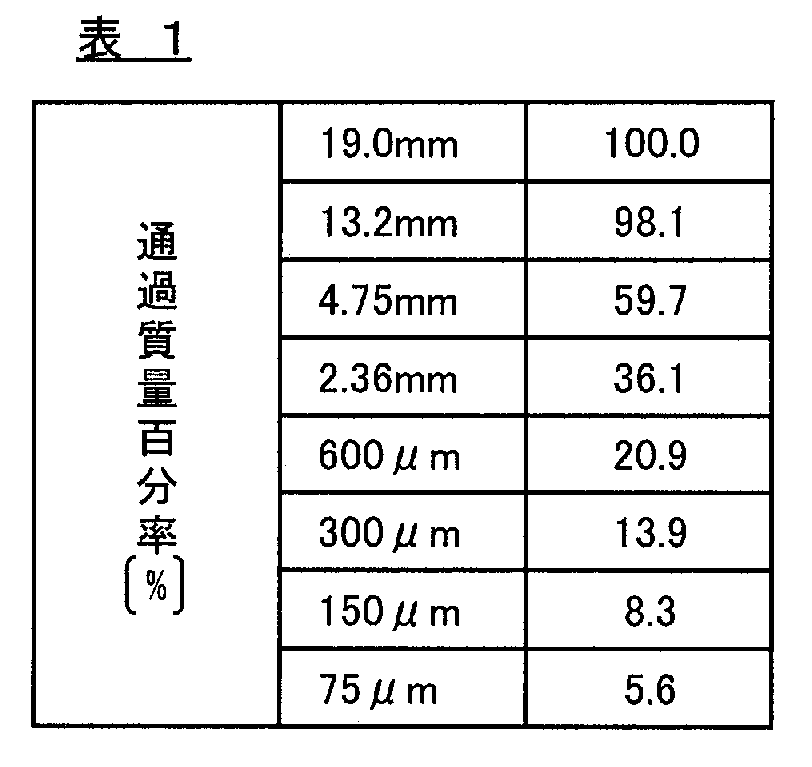
- Example 1 93.8 parts by weight of aggregate having the synthetic particle size shown in Table 1 below, 3.1 parts by weight of straight asphalt, 2.5 parts of a lubricious solidifying material (trade name “Hartor FA-1”, manufactured by Harima Chemicals Group), And 0.6 part of ordinary Portland cement was blended in this order into a biaxial pug mill type mixer (1 batch: 30 to 60 kg), and mixed to obtain an asphalt mixture.
- the heating temperature of the aggregate was 120 ° C.
- the heating temperature of the asphalt was 165 ° C.
- the other members were at room temperature.
- the lubricant solidifying material (trade name “Hartol FA-1”, manufactured by Harima Chemicals Group Co., Ltd.) used in Example 1 has the following properties.
- Fatty acid: resin acid 98.5: 1.5 (weight ratio) -Unsaponifiable matter content: 2.0% by weight
- Resin acid type Rosin-Acid value: 194 mg KOH / g
- the asphalt mixture thus obtained is cured with a dryer (in a bag) until a constant temperature of 60 ° C., and then the asphalt mixture is put into a mold (formwork), and then water is added. Thus, a specimen was obtained.
- the workability evaluation test machine 100 shown in FIG. 2 includes a cylindrical container 110 for placing the asphalt mixture, and a lifting handle 130 for moving the cylindrical container 110 in the vertical direction.
- the workability evaluation test machine 100 has a rotating blade 120 held by a shaft 121, and the rotational driving force from the drive source 140 is transmitted to the rotating blade 120 via the gear box 141 and the shaft 121.
- the rotary wing 120 is rotatable.
- the workability evaluation test machine 100 includes a digital torque meter 142 for measuring the rotational torque of the drive source 140. The rotational torque of the drive source 140 measured by the digital torque meter 142 is transmitted through the communication line 150. Via the data logger 160.
- the cylindrical container 110 is moved upward by the elevating handle 130 until the rotary blade 120 is completely buried in the regenerative heating asphalt mixture placed in the cylindrical container 110.
- the workability was evaluated by measuring the rotational torque necessary to rotate the rotary blade 120.
- the workability was evaluated under the conditions of 20 ° C. and near 0 ° C., and evaluated according to the following criteria. The results are shown in Table 3. As the rotational torque is smaller, it can be handled with a smaller force. Therefore, it can be determined that the workability is excellent. Specifically, in the case of the evaluation “A” and the evaluation “B”, the workability is good and it can be determined that the work can be performed satisfactorily.
- Example 2 Lubricating solidifying material (trade name “Hartor FA-1P”, manufactured by Harima Chemicals Group) instead of 2.5 parts of lubricating solidifying material (trade name “Hartor FA-1”, manufactured by Harima Chemicals Group) 2.
- An asphalt mixture was obtained and evaluated in the same manner as in Example 1 except that 5 parts were used. The results are shown in Tables 2 and 3.
- the lubricant solidifying material used in Example 2 (trade name “Hartol FA-1P”, manufactured by Harima Chemicals Group Co., Ltd.) has the following properties.
- Fatty acid: resin acid 95.4: 4.6 (weight ratio) -Unsaponifiable matter content: 2.0% by weight
- Fatty acid component ratio 1 to 4% by weight of palmitic acid, 1 to 4% by weight of stearic acid, 35 to 45% by weight of oleic acid, and 35 to 45% by weight of linoleic acid (including conjugated linoleic acid)
- Resin acid type Rosin-Acid value: 193 mg KOH / g
- Example 3 Lubricating solidifying material (trade name “Hartor FA-3S”, manufactured by Harima Chemicals Group) instead of 2.5 parts of lubricating solidifying material (trade name “Hartol FA-1”, manufactured by Harima Chemicals Group) 2.
- An asphalt mixture was obtained and evaluated in the same manner as in Example 1 except that 5 parts were used. The results are shown in Tables 2 and 3.
- the lubricant solidifying material used in Example 3 (trade name “Hartol FA-3S”, manufactured by Harima Chemicals Group Co., Ltd.) has the following properties.
- Fatty acid: resin acid 89.7: 10.3 (weight ratio) ⁇ Unsaponifiable matter content: 2.5% by weight Fatty acid component ratio: 3 to 6% by weight of palmitic acid, 1 to 4% by weight of stearic acid, 30 to 40% by weight of oleic acid, and 30 to 40% by weight of linoleic acid (including conjugated linoleic acid) -Resin acid type: Rosin-Acid value: 191 mg KOH / g
- the lubricant solidifying material contains fatty acid and resin acid in a weight ratio of “fatty acid: resin acid” of 99.5: 0.5 to 80:20.
- the Marshall stability value is increased at an early stage, and the strength can be expressed at an early stage. Even under the conditions, the workability was excellent.
- the workability at 0 ° C. is obtained in Comparative Example 1, and at 0 ° C. and 20 ° C. in Comparative Example 2. As a result, workability deteriorated.
Landscapes
- Chemical & Material Sciences (AREA)
- Structural Engineering (AREA)
- Engineering & Computer Science (AREA)
- Civil Engineering (AREA)
- Chemical Kinetics & Catalysis (AREA)
- Health & Medical Sciences (AREA)
- Materials Engineering (AREA)
- Medicinal Chemistry (AREA)
- Polymers & Plastics (AREA)
- Organic Chemistry (AREA)
- Architecture (AREA)
- Compositions Of Macromolecular Compounds (AREA)
- Road Paving Structures (AREA)
Abstract
Description
また、中温化技術を使用した加熱アスファルト混合物、すなわち中温化アスファルト混合物は、一般的には加熱アスファルト混合物の可使温度範囲を下限側に30℃程度拡げることができるとされている。
一方、中温化アスファルト混合物は、通常、加熱アスファルト混合物に比べて可使温度範囲を下限側に30℃程度拡げることができるが、前述したような各条件下においては、十分な効果が得られるとは言い難い。
例えば、アスファルト混合物の粘度を、鉱物油等を使用して強制的に低下させる、いわゆるカットバックアスファルト混合物が提案されている。カットバックアスファルト混合物は、特許文献1に示すように鉱物油等のカットバック材でアスファルトを軟質化させ、カットバック材の揮発に伴って、アスファルト混合物の強度を発現させるものである。
特に、本発明者等は、潤滑性固化材として、脂肪酸に、所定量の樹脂酸を配合したものを用いることにより、得られる供試体の強度を適切に向上させることができ、しかも、常温においてはもちろんのこと、低温条件下においても優れた作業性を示すことを見出し、本発明を完成させるに至ったものである。
特に、本発明によれば、潤滑性固化材として、脂肪酸と樹脂酸とを所定の割合で含有するものを用いることで、常温での作業性に加え、低温条件下(たとえば、0℃)での作業性をも良好なものとすることができ、そのため、寒冷地においても、適切に使用することができるものである。
なお、本発明のアスファルト混合物は、その作業性および強度発現までの時間が短いという利点を活かし、たとえば、舗装道路の補修用のアスファルト混合物として、寒冷地であるか否かを問わず、好適に用いることができる。
また、鹸化反応においては、アルカリ性添加材を固形状態で添加した場合には、水などの溶媒が存在しない場合には、一般的には反応は開始しない。その一方で、水などの溶媒が存在する場合には、「潤滑性固化材中の脂肪酸および樹脂酸+アルカリ性添加材+水=石鹸(固体)」の反応(鹸化反応または中和反応)が起こり、石鹸が生成し、これにより、強度が発現するものである。
パルミチン酸:好ましくは0.5~10重量%、より好ましくは:1~6重量%
ステアリン酸:好ましくは0.5~8重量%、より好ましくは1~4重量%
オレイン酸:好ましくは15~65重量%、より好ましくは30~50重量%
リノール酸(共役リノール酸を含む):好ましくは15~70重量%、より好ましくは30~45重量%
また、本発明のアスファルト混合物は、たとえば、以下に説明する方法により製造を行い、得られた混合物を、水分透過防止層および熱融着層を備える袋内に密封することで、長期保存(たとえば、6ヶ月程度)が可能なものとすることができる。
以下、本例のアスファルト混合物の製造方法について、説明する。
あるいは、本発明においては、上記方法により得られる混合物において、潤滑性固化材とアルカリ成分とを鹸化反応させる際に、硬化促進剤(たとえば、水)に加えて、アルカリ性添加材を添加するような構成としてもよい。
下記表1に示す合成粒度を有する骨材93.8重量部、ストレートアスファルト3.1重量部、潤滑性固化材(商品名「ハートールFA-1」、ハリマ化成グループ社製)2.5部、および普通ポルトランドセメント0.6部を、2軸パグミル型ミキサ(1バッチ:30~60kg)に、この順にて配合し、混合を行うことで、アスファルト混合物を得た。なお、この際において、骨材の加熱温度は120℃、アスファルトの加熱温度は165℃、その他の部材は常温とした。また、実施例1で用いた潤滑性固化材(商品名「ハートールFA-1」、ハリマ化成グループ社製)は、以下の性状を有するものである。
・「脂肪酸:樹脂酸」=98.5:1.5(重量比)
・不けん化物含有量:2.0重量%
・脂肪酸の成分比率:パルミチン酸1~3重量%、ステアリン酸1~3重量%、オレイン酸40~50重量%、およびリノール酸(共役リノール酸を含む)35~45重量%
・樹脂酸の種類:ロジン
・酸価:194mgKOH/g
そして、得られた供試体を用いて、マーシャル安定度の測定を行った。マーシャル安定度の測定は、供試体を作製した後、1時間後、3時間後、1日後、3日後、7日後にそれぞれ行った。また、マーシャル安定度の測定は、1時間後、3時間後、1日後、3日後については20℃で行い、7日後については60℃で行った。結果を表2に示す。マーシャル安定度の値が早期に高くなるほど、早期に安定かつ高強度な供試体が得られると判断することができる。
また、得られたアスファルト混合物の作業性を、図2に示す作業性評価試験機100を用いて、評価した。図2に示す作業性評価試験機100は、アスファルト混合物を載置するための円筒容器110、および円筒容器110を上下方向に移動させるための昇降ハンドル130を備えている。また、作業性評価試験機100は、軸121に保持された回転羽120を有しており、駆動源140からの回転駆動力が、ギヤボックス141および軸121を介して回転羽120に伝達されることにより、回転羽120は、回転可能となっている。さらに、作業性評価試験機100は、駆動源140の回転トルクを測定するためのデジタルトルクメータ142を備えており、デジタルトルクメータ142により測定された駆動源140の回転トルクは、通信線150を介して、データロガー160に送信されるようになっている。
A:回転トルク5N・m未満
B:回転トルク5N・m以上、8N・m未満、
C:回転トルク8N・m以上
潤滑性固化材(商品名「ハートールFA-1」、ハリマ化成グループ社製)2.5部の代わりに、潤滑性固化材(商品名「ハートールFA-1P」、ハリマ化成グループ社製)2.5部を使用した以外は、実施例1と同様にして、アスファルト混合物を得て、同様に評価を行った。結果を表2、表3に示す。
なお、実施例2で用いた潤滑性固化材(商品名「ハートールFA-1P」、ハリマ化成グループ社製)は、以下の性状を有するものである。
・「脂肪酸:樹脂酸」=95.4:4.6(重量比)
・不けん化物含有量:2.0重量%
・脂肪酸の成分比率:パルミチン酸1~4重量%、ステアリン酸1~4重量%、オレイン酸35~45重量%、およびリノール酸(共役リノール酸を含む)35~45重量%
・樹脂酸の種類:ロジン
・酸価:193mgKOH/g
潤滑性固化材(商品名「ハートールFA-1」、ハリマ化成グループ社製)2.5部の代わりに、潤滑性固化材(商品名「ハートールFA-3S」、ハリマ化成グループ社製)2.5部を使用した以外は、実施例1と同様にして、アスファルト混合物を得て、同様に評価を行った。結果を表2、表3に示す。
なお、実施例3で用いた潤滑性固化材(商品名「ハートールFA-3S」、ハリマ化成グループ社製)は、以下の性状を有するものである。
・「脂肪酸:樹脂酸」=89.7:10.3(重量比)
・不けん化物含有量:2.5重量%
・脂肪酸の成分比率:パルミチン酸3~6重量%、ステアリン酸1~4重量%、オレイン酸30~40重量%、およびリノール酸(共役リノール酸を含む)30~40重量%
・樹脂酸の種類:ロジン
・酸価:191mgKOH/g
潤滑性固化材(商品名「ハートールFA-1」、ハリマ化成グループ社製)2.5部の代わりに、潤滑性固化材(商品名「ハートールSR-20」、ハリマ化成グループ社製)2.5部を使用した以外は、実施例1と同様にして、アスファルト混合物を得て、同様に評価を行った。結果を表2、表3に示す。
なお、比較例1で用いた潤滑性固化材(商品名「ハートールSR-20」、ハリマ化成グループ社製)は、以下の性状を有するものである。
・「脂肪酸:樹脂酸」=77.9:22.1(重量比)
・不けん化物含有量:5重量%
・酸価:160mgKOH/g
潤滑性固化材(商品名「ハートールFA-1」、ハリマ化成グループ社製)2.5部の代わりに、潤滑性固化材(商品名「ハートールSR-30」、ハリマ化成グループ社製)2.5部を使用した以外は、実施例1と同様にして、アスファルト混合物を得て、同様に評価を行った。結果を表2、表3に示す。
なお、比較例2で用いた潤滑性固化材(商品名「ハートールSR-30」、ハリマ化成グループ社製)は、以下の性状を有するものである。
・「脂肪酸:樹脂酸」=56.9:43.1(重量比)
・不けん化物含有量:5重量%
・酸価:163mgKOH/g

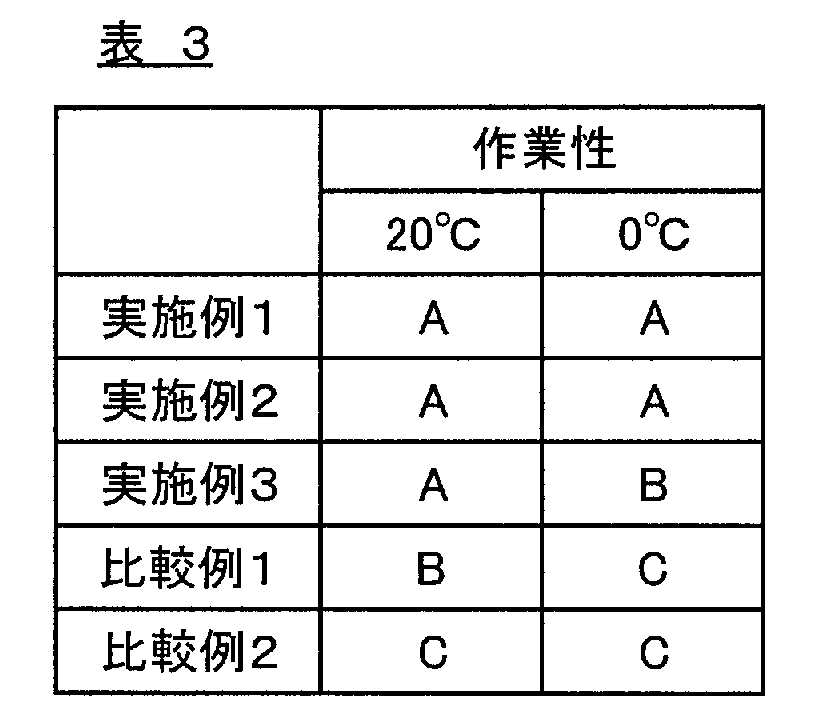
一方、潤滑性固化材として、脂肪酸の含有割合が低すぎるものを用いた場合には、比較例1においては、0℃における作業性が、また、比較例2においては、0℃および20℃における作業性が、それぞれ悪化する結果となった。
Claims (10)
- 骨材と、アスファルトと、潤滑性固化材と、アルカリ性添加材とを混合してなる常温施工型加熱アスファルト混合物であって、
前記潤滑性固化材が、脂肪酸と樹脂酸とを、「脂肪酸:樹脂酸」の重量比で、99.5:0.5~80:20の比率で含有していることを特徴とするアスファルト混合物。 - 前記潤滑性固化材が、前記脂肪酸として、パルミチン酸、ステアリン酸、オレイン酸、およびリノール酸(共役リノール酸を含む)を含有することを特徴とする請求項1に記載のアスファルト混合物。
- 前記脂肪酸中の各成分の含有割合が、パルミチン酸0.5~10重量%、ステアリン酸0.5~8重量%、オレイン酸15~65重量%、およびリノール酸(共役リノール酸を含む)15~70重量%である請求項2に記載のアスファルト混合物。
- 前記アスファルトと、前記潤滑性固化材とが、「アスファルト:潤滑性固化材」の重量比で、10:90~90:10の範囲内であることを特徴とする請求項1~3のいずれかに記載のアスファルト混合物。
- 前記潤滑性固化材と前記アルカリ性添加材とが、「潤滑性固化材:アルカリ性添加材」の重量比で、100:10~100:300の範囲内であることを特徴とする請求項1~4のいずれかに記載のアスファルト混合物。
- 骨材と、アスファルトと、潤滑性固化材と、を混合してなる常温施工型加熱アスファルト混合物であって、
前記潤滑性固化材が、脂肪酸と樹脂酸とを、「脂肪酸:樹脂酸」の重量比で、99.5:0.5~80:20の比率で含有していることを特徴とするアスファルト混合物。 - 請求項1に記載のアスファルト混合物に、硬化促進剤を添加し、前記潤滑性固化材と前記アルカリ性添加材とを鹸化反応させることで、強度を向上させることを特徴とする舗装方法。
- 請求項7に記載のアスファルト混合物に、アルカリ性添加剤および硬化促進剤を添加し、前記潤滑性固化材と前記アルカリ性添加材とを鹸化反応させることで、強度を向上させることを特徴とする舗装方法。
- 請求項1に記載のアスファルト混合物を製造する方法であって、
100~170℃に加熱した骨材と、130~170℃に加熱したアスファルトとを混合装置で混合する第1工程と、
前記第1工程で得られた混合物に、前記潤滑性固化材を添加・混合する第2工程と、
前記第2工程で得られた混合物に、前記アルカリ性添加材を添加・混合する第3工程とを備えることを特徴とするアスファルト混合物の製造方法。 - 前記第3工程で得られた混合物を、水分透過防止層および熱融着層を備える袋内に充填し、次いで、前記熱融着層を熱融着することで、前記混合物を前記袋内に密封する第4工程をさらに備えることを特徴とする請求項9に記載のアスファルト混合物の製造方法。
Priority Applications (4)
| Application Number | Priority Date | Filing Date | Title |
|---|---|---|---|
| MX2016009254A MX374966B (es) | 2014-01-17 | 2014-11-13 | Mezcla asfáltica, proceso para la producción de la misma, y método de pavimentación utilizando la misma. |
| CA2936776A CA2936776C (en) | 2014-01-17 | 2014-11-13 | Asphalt mixture, process for production of same, and paving method using same |
| EP14878823.5A EP3095821B1 (en) | 2014-01-17 | 2014-11-13 | Asphalt mixture, process for production of same, and paving method using same |
| AU2014378373A AU2014378373B2 (en) | 2014-01-17 | 2014-11-13 | Asphalt mixture, method for producing same and paving method using same |
Applications Claiming Priority (2)
| Application Number | Priority Date | Filing Date | Title |
|---|---|---|---|
| US14/158,705 | 2014-01-17 | ||
| US14/158,705 US9434841B2 (en) | 2014-01-17 | 2014-01-17 | Asphalt mixture, process for production of same, and paving method using same |
Publications (1)
| Publication Number | Publication Date |
|---|---|
| WO2015107762A1 true WO2015107762A1 (ja) | 2015-07-23 |
Family
ID=53542666
Family Applications (1)
| Application Number | Title | Priority Date | Filing Date |
|---|---|---|---|
| PCT/JP2014/080091 Ceased WO2015107762A1 (ja) | 2014-01-17 | 2014-11-13 | アスファルト混合物およびその製造方法、ならびにそれを用いた舗装方法 |
Country Status (7)
| Country | Link |
|---|---|
| US (1) | US9434841B2 (ja) |
| EP (1) | EP3095821B1 (ja) |
| AU (1) | AU2014378373B2 (ja) |
| CA (1) | CA2936776C (ja) |
| MX (1) | MX374966B (ja) |
| PT (1) | PT3095821T (ja) |
| WO (1) | WO2015107762A1 (ja) |
Cited By (7)
| Publication number | Priority date | Publication date | Assignee | Title |
|---|---|---|---|---|
| JP5916937B1 (ja) * | 2015-12-21 | 2016-05-11 | 前田道路株式会社 | アスファルト混合物およびその製造方法、ならびにそれを用いた舗装方法 |
| JP5916938B1 (ja) * | 2015-12-21 | 2016-05-11 | 前田道路株式会社 | アスファルト混合物およびその製造方法、ならびにそれを用いた舗装方法 |
| JP2017082180A (ja) * | 2015-10-30 | 2017-05-18 | シンレキ工業株式会社 | 繊維入り鹸化反応型常温アスファルト混合物 |
| JP2017082434A (ja) * | 2015-10-26 | 2017-05-18 | 大成ロテック株式会社 | 常温アスファルト混合物、常温アスファルト舗装構造体、及びその舗装構造体の施工方法 |
| JP2018017072A (ja) * | 2016-07-29 | 2018-02-01 | 前田道路株式会社 | アスファルト混合物およびその製造方法、ならびにそれを用いた舗装方法 |
| JP2018184511A (ja) * | 2017-04-25 | 2018-11-22 | 大林道路株式会社 | 高耐久常温アスファルト混合物 |
| JPWO2021100343A1 (ja) * | 2019-11-19 | 2021-05-27 |
Families Citing this family (7)
| Publication number | Priority date | Publication date | Assignee | Title |
|---|---|---|---|---|
| JP6028120B1 (ja) * | 2016-06-06 | 2016-11-16 | 光工業株式会社 | 常温舗装用アスファルト舗装材 |
| JP6458194B1 (ja) * | 2018-08-31 | 2019-01-23 | 世紀東急工業株式会社 | 常温アスファルト混合物 |
| CN110054907B (zh) * | 2019-05-10 | 2021-05-14 | 湖南鑫长胜材料科技有限公司 | 生物基常温液体沥青及其制备方法与应用 |
| CN112851174A (zh) * | 2021-01-21 | 2021-05-28 | 武汉工程大学 | 一种化学反应型冷补沥青混合料的制备方法 |
| CN113702207A (zh) * | 2021-08-11 | 2021-11-26 | 广西交科集团有限公司 | 一种成品沥青冷补料储存稳定性评价方法及试验装置 |
| CN114634329B (zh) * | 2022-02-24 | 2023-04-11 | 武汉工程大学 | 一种利用餐饮回收油制备反应型冷补沥青混合料的方法 |
| CN120535241B (zh) * | 2025-07-28 | 2025-11-11 | 湖南省交通科学研究院有限公司 | 一种反应型沥青冷补料、制备方法和应用 |
Citations (5)
| Publication number | Priority date | Publication date | Assignee | Title |
|---|---|---|---|---|
| JPH1112475A (ja) | 1997-06-24 | 1999-01-19 | Nichireki Co Ltd | 舗装用常温アスファルト混合物とその製造方法 |
| JPH11228839A (ja) * | 1998-02-13 | 1999-08-24 | Showa Shell Sekiyu Kk | アスファルト乳剤 |
| JP2001181510A (ja) * | 1999-12-28 | 2001-07-03 | Obayashi Road Corp | アスファルト混合物の製造方法 |
| WO2010104048A1 (ja) * | 2009-03-11 | 2010-09-16 | 東亜道路工業株式会社 | アスファルト混合物 |
| WO2011086722A1 (ja) * | 2010-01-12 | 2011-07-21 | 前田道路株式会社 | 常温施工型加熱アスファルト混合物およびその製造方法、ならびにそれを用いた舗装方法 |
Family Cites Families (11)
| Publication number | Priority date | Publication date | Assignee | Title |
|---|---|---|---|---|
| BE518728A (ja) * | 1952-03-28 | |||
| US2919204A (en) * | 1956-09-21 | 1959-12-29 | Armour & Co | Strip-resistant bituminous compositions |
| US3951676A (en) * | 1971-07-14 | 1976-04-20 | Chevron Research Company | Cationic bituminous emulsions forming residuum having improved temperature characteristics |
| US4547224A (en) * | 1984-09-17 | 1985-10-15 | Westvaco Corporation | Emulsifiers for bituminous emulsions |
| US5336438A (en) * | 1989-05-22 | 1994-08-09 | Westvaco Corporation | Rapid and medium setting high float bituminous emulsions from difficult asphalts |
| US20030091389A1 (en) * | 2001-11-15 | 2003-05-15 | Deery American Corporation | Asphalt container systems |
| US6770127B2 (en) * | 2002-05-16 | 2004-08-03 | Shandong Heritage Highway Materials Technologies | Multigrade asphalt power additive |
| MX2011001041A (es) * | 2008-08-02 | 2011-05-19 | Georgia Pacific Chemicals Llc | Emulsiones de brea. |
| US8287635B2 (en) * | 2009-02-10 | 2012-10-16 | Green Product Solutions, Inc. | Asphalt mix workable at ambient temperatures with only biodegradable solvents and method of manufacturing the same |
| JP5583978B2 (ja) | 2009-03-25 | 2014-09-03 | 前田道路株式会社 | 常温施工型加熱アスファルト混合物 |
| FR2945816B1 (fr) * | 2009-05-19 | 2011-08-26 | Total Raffinage Marketing | Liant bitumineux pour la preparation d'asphaltes ou d'enrobes a basses temperatures |
-
2014
- 2014-01-17 US US14/158,705 patent/US9434841B2/en active Active
- 2014-11-13 EP EP14878823.5A patent/EP3095821B1/en active Active
- 2014-11-13 AU AU2014378373A patent/AU2014378373B2/en active Active
- 2014-11-13 PT PT148788235T patent/PT3095821T/pt unknown
- 2014-11-13 WO PCT/JP2014/080091 patent/WO2015107762A1/ja not_active Ceased
- 2014-11-13 CA CA2936776A patent/CA2936776C/en active Active
- 2014-11-13 MX MX2016009254A patent/MX374966B/es active IP Right Grant
Patent Citations (5)
| Publication number | Priority date | Publication date | Assignee | Title |
|---|---|---|---|---|
| JPH1112475A (ja) | 1997-06-24 | 1999-01-19 | Nichireki Co Ltd | 舗装用常温アスファルト混合物とその製造方法 |
| JPH11228839A (ja) * | 1998-02-13 | 1999-08-24 | Showa Shell Sekiyu Kk | アスファルト乳剤 |
| JP2001181510A (ja) * | 1999-12-28 | 2001-07-03 | Obayashi Road Corp | アスファルト混合物の製造方法 |
| WO2010104048A1 (ja) * | 2009-03-11 | 2010-09-16 | 東亜道路工業株式会社 | アスファルト混合物 |
| WO2011086722A1 (ja) * | 2010-01-12 | 2011-07-21 | 前田道路株式会社 | 常温施工型加熱アスファルト混合物およびその製造方法、ならびにそれを用いた舗装方法 |
Non-Patent Citations (1)
| Title |
|---|
| See also references of EP3095821A4 |
Cited By (13)
| Publication number | Priority date | Publication date | Assignee | Title |
|---|---|---|---|---|
| JP2017082434A (ja) * | 2015-10-26 | 2017-05-18 | 大成ロテック株式会社 | 常温アスファルト混合物、常温アスファルト舗装構造体、及びその舗装構造体の施工方法 |
| JP2017082180A (ja) * | 2015-10-30 | 2017-05-18 | シンレキ工業株式会社 | 繊維入り鹸化反応型常温アスファルト混合物 |
| JP5916937B1 (ja) * | 2015-12-21 | 2016-05-11 | 前田道路株式会社 | アスファルト混合物およびその製造方法、ならびにそれを用いた舗装方法 |
| JP5916938B1 (ja) * | 2015-12-21 | 2016-05-11 | 前田道路株式会社 | アスファルト混合物およびその製造方法、ならびにそれを用いた舗装方法 |
| US9617425B1 (en) | 2015-12-21 | 2017-04-11 | Maeda Road Construction Co., Ltd. | Asphalt mixture, process for production of same, and paving method using same |
| US9617426B1 (en) | 2015-12-21 | 2017-04-11 | Maeda Road Construction Co., Ltd. | Asphalt mixture, process for production of same, and paving method using same |
| JP2018017072A (ja) * | 2016-07-29 | 2018-02-01 | 前田道路株式会社 | アスファルト混合物およびその製造方法、ならびにそれを用いた舗装方法 |
| WO2018020971A1 (ja) * | 2016-07-29 | 2018-02-01 | 前田道路株式会社 | アスファルト混合物およびその製造方法、ならびにそれを用いた舗装方法 |
| AU2017302847B2 (en) * | 2016-07-29 | 2019-10-24 | Maeda Road Construction Co.,Ltd | Asphalt mixture, method for producing same and paving method using same |
| JP2018184511A (ja) * | 2017-04-25 | 2018-11-22 | 大林道路株式会社 | 高耐久常温アスファルト混合物 |
| JPWO2021100343A1 (ja) * | 2019-11-19 | 2021-05-27 | ||
| WO2021100343A1 (ja) * | 2019-11-19 | 2021-05-27 | 富士フイルム株式会社 | アスファルト混合物、舗装方法、及びアスファルト硬化物の製造方法 |
| JP7237193B2 (ja) | 2019-11-19 | 2023-03-10 | 富士フイルム株式会社 | アスファルト混合物、舗装方法、及びアスファルト硬化物の製造方法 |
Also Published As
| Publication number | Publication date |
|---|---|
| EP3095821A1 (en) | 2016-11-23 |
| EP3095821B1 (en) | 2020-04-22 |
| CA2936776C (en) | 2018-04-24 |
| AU2014378373B2 (en) | 2017-08-24 |
| MX374966B (es) | 2025-03-06 |
| PT3095821T (pt) | 2020-07-07 |
| US20150203684A1 (en) | 2015-07-23 |
| US9434841B2 (en) | 2016-09-06 |
| EP3095821A4 (en) | 2017-06-14 |
| AU2014378373A1 (en) | 2016-08-04 |
| CA2936776A1 (en) | 2015-07-23 |
| MX2016009254A (es) | 2017-01-19 |
Similar Documents
| Publication | Publication Date | Title |
|---|---|---|
| WO2015107762A1 (ja) | アスファルト混合物およびその製造方法、ならびにそれを用いた舗装方法 | |
| JP5916938B1 (ja) | アスファルト混合物およびその製造方法、ならびにそれを用いた舗装方法 | |
| WO2011086722A1 (ja) | 常温施工型加熱アスファルト混合物およびその製造方法、ならびにそれを用いた舗装方法 | |
| JPWO2011086722A1 (ja) | 常温施工型加熱アスファルト混合物およびその製造方法、ならびにそれを用いた舗装方法 | |
| JP5916937B1 (ja) | アスファルト混合物およびその製造方法、ならびにそれを用いた舗装方法 | |
| JP5939722B1 (ja) | 繊維入り鹸化反応型常温アスファルト混合物 | |
| KR100210163B1 (ko) | 도로보수용 상온아스콘 포장재료 및 그의 제조방법 | |
| JP7025601B2 (ja) | アスファルト混合物、およびそれを用いた舗装方法 | |
| JP6089139B1 (ja) | アスファルト混合物およびその製造方法、ならびにそれを用いた舗装方法 | |
| CN103922695B (zh) | 用于高铁无砟轨道砂浆层快速修复灌浆砂浆 | |
| JP6339848B2 (ja) | 遮水構造および遮水構造の形成方法 | |
| JP2019143046A (ja) | 常温アスファルト混合物、水添加常温アスファルト混合物、及び常温アスファルト混合物の製造方法 | |
| JP6344873B1 (ja) | 高耐久常温アスファルト混合物 | |
| JP6127194B1 (ja) | 再生舗装用混合物および舗装体 | |
| JP2015143423A (ja) | 常温施工型軽量舗装材組成物 | |
| JP7386955B1 (ja) | アスファルト舗装補修用のアスファルト組成物 | |
| JP2020066980A (ja) | 低温施工型道路補修材 | |
| JP2024101213A (ja) | 全天候型常温アスファルト混合物及び舗装方法 | |
| JP2023097822A (ja) | 常温施工型アスファルト合材及びその製造方法 | |
| CA2966069C (en) | Asphalt mixture, process for production of same, and paving method using same | |
| EP4624664A1 (en) | Method for repairing asphalt pavement | |
| TWI698566B (zh) | 道路鋪料及其製作、施作方法 | |
| CA2966073A1 (en) | Asphalt mixture, process for production of same, and paving method using same | |
| AU2017202947B1 (en) | Asphalt mixture, process for production of same, and paving method using same | |
| AU2017202921B1 (en) | Asphalt mixture, process for production of same, and paving method using same |
Legal Events
| Date | Code | Title | Description |
|---|---|---|---|
| 121 | Ep: the epo has been informed by wipo that ep was designated in this application |
Ref document number: 14878823 Country of ref document: EP Kind code of ref document: A1 |
|
| ENP | Entry into the national phase |
Ref document number: 2936776 Country of ref document: CA |
|
| WWE | Wipo information: entry into national phase |
Ref document number: MX/A/2016/009254 Country of ref document: MX |
|
| NENP | Non-entry into the national phase |
Ref country code: DE |
|
| ENP | Entry into the national phase |
Ref document number: 2014378373 Country of ref document: AU Date of ref document: 20141113 Kind code of ref document: A |
|
| REEP | Request for entry into the european phase |
Ref document number: 2014878823 Country of ref document: EP |
|
| WWE | Wipo information: entry into national phase |
Ref document number: 2014878823 Country of ref document: EP |
|
| NENP | Non-entry into the national phase |
Ref country code: JP |