WO2015111695A1 - スカンジウム濃縮物回収方法 - Google Patents
スカンジウム濃縮物回収方法 Download PDFInfo
- Publication number
- WO2015111695A1 WO2015111695A1 PCT/JP2015/051825 JP2015051825W WO2015111695A1 WO 2015111695 A1 WO2015111695 A1 WO 2015111695A1 JP 2015051825 W JP2015051825 W JP 2015051825W WO 2015111695 A1 WO2015111695 A1 WO 2015111695A1
- Authority
- WO
- WIPO (PCT)
- Prior art keywords
- scandium
- alloy
- concentrate
- cooling
- scandium concentrate
- Prior art date
- Legal status (The legal status is an assumption and is not a legal conclusion. Google has not performed a legal analysis and makes no representation as to the accuracy of the status listed.)
- Ceased
Links
Images
Classifications
-
- C—CHEMISTRY; METALLURGY
- C22—METALLURGY; FERROUS OR NON-FERROUS ALLOYS; TREATMENT OF ALLOYS OR NON-FERROUS METALS
- C22B—PRODUCTION AND REFINING OF METALS; PRETREATMENT OF RAW MATERIALS
- C22B21/00—Obtaining aluminium
- C22B21/0038—Obtaining aluminium by other processes
- C22B21/0069—Obtaining aluminium by other processes from scrap, skimmings or any secondary source aluminium, e.g. recovery of alloy constituents
-
- C—CHEMISTRY; METALLURGY
- C22—METALLURGY; FERROUS OR NON-FERROUS ALLOYS; TREATMENT OF ALLOYS OR NON-FERROUS METALS
- C22B—PRODUCTION AND REFINING OF METALS; PRETREATMENT OF RAW MATERIALS
- C22B59/00—Obtaining rare earth metals
-
- C—CHEMISTRY; METALLURGY
- C22—METALLURGY; FERROUS OR NON-FERROUS ALLOYS; TREATMENT OF ALLOYS OR NON-FERROUS METALS
- C22B—PRODUCTION AND REFINING OF METALS; PRETREATMENT OF RAW MATERIALS
- C22B7/00—Working up raw materials other than ores, e.g. scrap, to produce non-ferrous metals and compounds thereof; Methods of a general interest or applied to the winning of more than two metals
- C22B7/001—Dry processes
-
- C—CHEMISTRY; METALLURGY
- C22—METALLURGY; FERROUS OR NON-FERROUS ALLOYS; TREATMENT OF ALLOYS OR NON-FERROUS METALS
- C22C—ALLOYS
- C22C21/00—Alloys based on aluminium
-
- Y—GENERAL TAGGING OF NEW TECHNOLOGICAL DEVELOPMENTS; GENERAL TAGGING OF CROSS-SECTIONAL TECHNOLOGIES SPANNING OVER SEVERAL SECTIONS OF THE IPC; TECHNICAL SUBJECTS COVERED BY FORMER USPC CROSS-REFERENCE ART COLLECTIONS [XRACs] AND DIGESTS
- Y02—TECHNOLOGIES OR APPLICATIONS FOR MITIGATION OR ADAPTATION AGAINST CLIMATE CHANGE
- Y02P—CLIMATE CHANGE MITIGATION TECHNOLOGIES IN THE PRODUCTION OR PROCESSING OF GOODS
- Y02P10/00—Technologies related to metal processing
- Y02P10/20—Recycling
Definitions
- the present invention relates to a method for recovering scandium concentrate, and more particularly, to a method for recovering scandium concentrate from a molten alloy containing scandium and aluminum.
- Aluminum scandium alloy containing aluminum and scandium (hereinafter also referred to as “Al—Sc alloy”) has characteristics of light weight and high strength, and is used not only for sports equipment but also in fields requiring impact resistance. . In addition, in the future, it is expected to be used as a structural material for aircraft, electric cars, high-speed railways and the like. However, scandium is very expensive because it produces very little. Therefore, it is not easy to use scandium widely industrially.
- the scandium quality of these waste products and the like is much higher than the scandium quality of nickel oxide ore and the like, and it is expected that the scandium is recovered from the waste products and reused.
- the quality of scandium such as waste is high, the element contained in the Al—Sc alloy is aluminum, and the scandium content is very small compared to the aluminum content. It is not possible to effectively recover the scandium concentrate simply by melting.
- the present invention has been made to solve the above-described problems, and its purpose is to effectively recover a scandium concentrate from an Al—Sc alloy. More specifically, in a structure or the like, an Al—Sc alloy having a Sc concentration of 0.1 to 1% is often used. As described above, the Sc concentration of the Al—Sc master alloy is 1 to 2%.
- the present invention efficiently produces a scandium concentrate that can be directly used as an Al—Sc master alloy from scrap products of an Al—Sc alloy having an Sc concentration of about 0.1 to 1% used in structures and the like. The purpose is to collect.
- the present inventors have cooled the molten alloy containing aluminum and scandium under a predetermined condition, and then maintained the temperature at a constant temperature for a certain period of time.
- the present invention has been completed.
- the present invention provides the following.
- the present invention includes a cooling step of cooling a molten alloy containing aluminum and scandium at a cooling rate of 10 ° C. or more and 100 ° C. or less per minute until the temperature reaches 660 ° C. or more and 700 ° C. or less; It is a scandium recovery method including a holding step of maintaining a temperature of 700 ° C. or lower for a predetermined time and a recovery step of recovering a solid scandium concentrate.
- the recovery step is a step of dividing the melting furnace for melting the molten alloy into two or more blocks in the depth direction and recovering the deepest block.
- the scandium concentrate can be effectively recovered from the Al—Sc alloy.
- This scandium concentrate can be reused as it is as a high-quality Al—Sc master alloy. Further, scandium can be recovered through the solvent extraction or the like extremely efficiently compared to the case of recovery from nickel oxide ore.
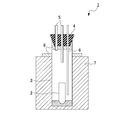
- FIG. 1 is a schematic view showing an example of a melting furnace 1.
- the scandium concentrate recovery method of the present invention is performed at 660 ° C. or higher and 700 ° C. or lower while maintaining an aluminum scandium molten alloy (hereinafter also referred to as “Al—Sc molten alloy”) at a cooling rate of 10 ° C. or higher and 100 ° C. or lower per minute.
- Al—Sc molten alloy aluminum scandium molten alloy
- the melting temperature of the Al—Sc alloy is not particularly limited as long as the Al—Sc alloy can be sufficiently melted.
- the Sc grade contained in the Al—Sc alloy is 1%, the Al—Sc alloy can be sufficiently melted at 800 ° C. or higher.
- the cooling rate is 10 ° C. or more and 100 ° C. or less per minute.
- the cooling rate is preferably 20 ° C. or more and 50 ° C. or less per minute, and more preferably 20 ° C. or more and 30 ° C. or less per minute.
- the cooling rate is faster than 100 ° C. per minute, the scandium concentrate is finely dispersed throughout the Al—Sc alloy, which is not preferable in that a sufficient concentration effect cannot be obtained.
- the cooling rate is slower than 10 ° C. per minute, even if the inside of the melting furnace is replaced with an inert gas such as argon or nitrogen and cooled, a slight amount of oxygen remaining inside the melting furnace This is not preferable because it may not sufficiently prevent scandium oxidation during cooling. Moreover, it is not preferable also in the point that the energy cost for temperature maintenance increases.
- the cooling rate faster than 20 ° C. per minute, it is possible to prevent scandium from being oxidized during cooling and obtain a high-quality scandium concentrate even in an air atmosphere. preferable.
- the Sc concentration of the Al—Sc molten alloy decreases along the liquidus composition, and an appropriate amount of Al 3 Sc is generated. In this way, the temperature is gradually lowered.
- the eutectic temperature of the Al—Sc molten alloy is about 660 ° C., and the Sc concentration of the eutectic composition is 0.2 to 0.4%. Therefore, by reducing the temperature to near the eutectic temperature, Al— The Sc concentration of the Sc molten alloy can be reduced, and the concentration of the scandium concentrate that precipitates due to the difference in specific gravity can be increased.
- the target temperature for cooling is 660 ° C. or higher and 700 ° C. or lower, and preferably 665 ° C. or higher and 690 ° C. or lower. If the target temperature is higher than 700 ° C., the amount of Al 3 Sc produced is reduced, and the scandium concentrate cannot be suitably recovered, which is not preferable. When the target temperature falls below 660 ° C., the temperature becomes lower than the melting point of aluminum, so that an Al solid is generated and can be mixed with Al 3 Sc, which is not preferable. In particular, the cooling target temperature of 665 ° C. or higher is preferable in that generation of an Al solid is suppressed.
- the holding process is a process of maintaining the cooling target temperature for a certain period of time.
- the holding time is determined by the size and shape of the melting furnace and is not generally determined, but it is sufficient if it is 60 minutes or longer, preferably 90 minutes or longer, and more preferably 120 minutes or longer. .
- the holding time is not necessarily long. Even if the holding time is 180 minutes or more, the yield is not significantly increased compared to the case where the holding time is 60 minutes.
- the Sc concentration of the Al—Sc molten alloy is about 0.4 which is the eutectic composition.
- Al 3 Sc can be sufficiently obtained.
- the concentration of Sc contained in Al 3 Sc is about 35%.
- the recovery step is a step of cooling the temperature of the melting furnace to room temperature after the holding step and recovering the solid scandium concentrate containing Al 3 Sc from the melting furnace.
- the solid block formed after cooling is divided into two or more in the depth direction of the furnace and the deepest block is recovered as a scandium concentrate, scandium can be recovered easily.
- the number of blocks is not particularly limited, but is preferably 5 or more, and more preferably 10 or more.
- the scandium concentrate block taken out from the melting furnace is charged into the melting furnace again and re-melted, it is mixed into the scandium concentrate by performing the cooling process, holding process and recovery process again.
- the collected aluminum can be collected at the top of the melt, and the scandium quality of the scandium concentrate can be improved accordingly.
- the scandium concentrate of the present invention may be reused as it is as a high-quality Al—Sc master alloy, or may be reused after remelting to form a master alloy. Further, by recovering scandium from a scandium concentrate by a known method such as solvent extraction, scandium can be recovered extremely efficiently as compared with the case of recovering from nickel oxide ore.
- FIG. 1 is a schematic diagram illustrating the configuration of a melting furnace 1 used in this embodiment.
- a melting furnace 1 includes an alumina tamman tube 2 enclosing an Al—Sc alloy, a quartz furnace core tube 3 enclosing the alumina tamman tube 2, and a rubber plug 4 for sealing the quartz furnace core tube 3.
- the argon gas replacement unit 5 replaces the inside of the quartz furnace core tube 3 with argon gas through two tube insertion portions (not shown) provided in the rubber plug 4, and the thermoelectric provided in the rubber plug 4.
- thermocouple 6 inserted into the quartz furnace core tube 3 through a pair insertion portion (not shown), and an electric furnace 7 that keeps the temperature inside the quartz tube 3 from the periphery of the quartz furnace core tube 3 to a predetermined temperature. And a heat insulating board 8 that maintains the heat insulating property inside the quartz furnace core tube 3.
- an Al—Sc alloy having a Sc concentration of 1% is placed in an alumina Tamman tube 2 having a purity of 99.5%, and the Tamman tube 2 is used in an electric furnace 1 in which the atmosphere can be adjusted using a quartz furnace core tube 3.
- the gas is sufficiently replaced with argon through the argon gas replacement unit 5 and then heated to 800 ° C. and maintained for 60 minutes under the argon gas flow. did.
- the current value flowing through the electric furnace 1 was controlled so as to lower the temperature at a rate of 20 to 30 ° C. per minute, and the temperature was maintained for 120 minutes when the temperature reached 670 ° C. Thereafter, the electric furnace 1 was turned off and the sample was cooled inside the electric furnace 1. After the sample reached room temperature, the solidified sample was taken out.
- the Sc concentration of the bottom block according to the example was 7%. From this, a cooling step of cooling the molten alloy containing aluminum and scandium at a cooling rate of 10 ° C. or more and 100 ° C. or less per minute until it reaches 660 ° C. or more and 730 ° C. or less, and this cooling temperature is maintained for a certain time. It was confirmed that the scandium concentrate obtained through the holding step and the recovery step of recovering the solid scandium concentrate can be reused as it is as a high-quality Al—Sc master alloy. Moreover, by performing solvent extraction etc. with respect to this scandium concentrate, scandium can also be collect
Landscapes
- Chemical & Material Sciences (AREA)
- Engineering & Computer Science (AREA)
- Materials Engineering (AREA)
- Mechanical Engineering (AREA)
- Metallurgy (AREA)
- Organic Chemistry (AREA)
- Manufacturing & Machinery (AREA)
- Life Sciences & Earth Sciences (AREA)
- Environmental & Geological Engineering (AREA)
- General Life Sciences & Earth Sciences (AREA)
- Geology (AREA)
- Manufacture And Refinement Of Metals (AREA)
Abstract
Al-Sc合金からスカンジウム濃縮物を有効に回収する。 本発明に係るスカンジウム濃縮物回収方法は、アルミニウム及びスカンジウムを含有する溶融合金を毎分10℃以上100℃以下の冷却速度で維持しながら660℃以上730℃以下になるまで冷却する冷却工程と、660℃以上730℃以下の温度を一定時間保つ保持工程と、固体のスカンジウム濃縮物を回収する回収工程とを含む。本発明によると、Al-Sc合金からスカンジウム濃縮物を有効に回収することができる。このスカンジウム濃縮物は、高品位なAl-Sc母合金としてそのまま再利用できる。また、溶媒抽出等を経ることで、ニッケル酸化鉱石から回収する場合に比べて極めて効率的にスカンジウムを回収することもできる。
Description
本発明は、スカンジウム濃縮物回収方法、より詳しくは、スカンジウムとアルミニウムを含有する溶融合金からスカンジウム濃縮物を回収する方法に関する。
アルミニウム及びスカンジウムを含有するアルミニウムスカンジウム合金(以下、「Al-Sc合金」ともいう。)は、軽量で高強度という特性を有し、スポーツ用品のほか、耐衝撃性を要する分野で用いられている。加えて、将来的には、航空機、電気自動車、高速鉄道等の構造材としての利用も期待される。しかしながら、スカンジウムの産出量は極めて少ないため、スカンジウムは非常に高価である。そのため、スカンジウムを工業的に幅広く利用することは容易でない。
近年、ニッケル酸化鉱石に微量随伴するスカンジウムを回収する技術が進み、従来よりも大量のスカンジウムを安定して得ることができつつある。しかしながら、ニッケル酸化鉱石からスカンジウムを回収するには、イオン交換、溶媒抽出、中和沈澱及び焙焼等、多数の工程を要するため、この技術を用いても、スカンジウムが高価であることに変わりはない。
ところで、スカンジウムは、容易に酸化される上に高融点であるため、スカンジウムとアルミニウムとをただ溶融するだけでは、Al-Sc合金を得ることはできない。そこで、一般的に、溶融したアルミニウムに対して、スカンジウム酸化物をカルシウム等の金属で還元しながら添加し、スカンジウム品位が1~2%程度の母合金を得、これをアルミニウムで希釈して目的とするAl-Sc合金を得る手法がとられる。また、ハロゲン化スカンジウムを原料としてスカンジウム母合金を製造することも提案されている(特許文献1参照)。
特許文献1に記載の処理とは逆方向の処理を行うことで、Al-Sc合金からスカンジウムを分離することも考えられる。しかしながら、ハロゲン化スカンジウムの安定性のほか、有害な塩素を使用することによるリスク、さらに、工業的な設備やコストを考えると、特許文献1に記載の処理とは逆方向の処理を行うことでスカンジウム回収技術を実用化することは容易でない。
一方で、スカンジウムへの期待は高まっていることから、今後、Al-Sc合金の生産量は増加し、いずれはAl-Sc合金を用いた構造体の廃棄や、該構造体の製造工程内で生じる不良品等が増えることも予想される。
これら廃棄品等のスカンジウム品位は、ニッケル酸化鉱石等におけるスカンジウム品位よりは遥かに高く、廃棄品等からスカンジウムを回収して再利用するのは有効な手段であると予想される。しかしながら、廃棄品等のスカンジウム品位が高いとはいっても、Al-Sc合金に含まれる元素はアルミニウムであり、スカンジウムの含有量はアルミニウムの含有量に比べるごく微量であるため、Al-Sc合金をただ溶融するだけでは、スカンジウム濃縮物を有効に回収することはできない。
本発明は、以上のような課題を解決するためになされたものであり、その目的は、Al-Sc合金からスカンジウム濃縮物を有効に回収することである。より詳しく説明すると、構造体等において、Al-Sc合金は、Sc濃度にして0.1~1%のものが多く用いられる。上述したとおり、Al-Sc母合金のSc濃度は1~2%である。本発明は、構造体等で使用されていたSc濃度が0.1~1%程度であるAl-Sc合金のスクラップ品から、Al-Sc母合金としてそのまま利用できる程度のスカンジウム濃縮物を効率よく回収することを目的とするものである。
本発明者らは、上記課題を解決すべく鋭意研究を重ねた結果、アルミニウム及びスカンジウムを含有する溶融合金を所定の条件で冷却し、その後、一定の温度で一定時間保つことで、上記の目的を達成できることを見出し、本発明を完成するに至った。
具体的には、本発明では、以下のようなものを提供する。
(1)本発明は、アルミニウム及びスカンジウムを含有する溶融合金を毎分10℃以上100℃以下の冷却速度で維持しながら660℃以上700℃以下になるまで冷却する冷却工程と、前記660℃以上700℃以下の温度を一定時間保つ保持工程と、固体のスカンジウム濃縮物を回収する回収工程とを含む、スカンジウム回収方法である。
(2)また、本発明は、前記回収工程が、前記溶融合金を溶融する溶融炉を深さ方向に対して2以上のブロックに分け、最も深い部分のブロックを回収する工程である、(1)に記載のスカンジウム濃縮物回収方法である。
(3)また、本発明は、前記回収工程で回収された前記スカンジウム濃縮物を溶融炉で溶融した後、前記冷却工程、前記保持工程及び前記回収工程を再び行う、(1)又は(2)に記載のスカンジウム回収方法である。
本発明によると、Al-Sc合金からスカンジウム濃縮物を有効に回収することができる。このスカンジウム濃縮物は、高品位なAl-Sc母合金としてそのまま再利用できる。また、溶媒抽出等を経ることで、ニッケル酸化鉱石から回収する場合に比べて極めて効率的にスカンジウムを回収することもできる。
以下、本発明の具体的な実施形態について詳細に説明するが、本発明は以下の実施形態に何ら限定されるものではなく、本発明の目的の範囲内において、適宜変更を加えて実施することができる。なお、説明が重複する箇所については、適宜説明を省略する場合があるが、発明の要旨を限定するものではない。
<スカンジウム濃縮物回収方法>
本発明のスカンジウム濃縮物回収方法は、アルミニウムスカンジウム溶融合金(以下、「Al-Sc溶融合金」ともいう。)を毎分10℃以上100℃以下の冷却速度で維持しながら660℃以上700℃以下になるまで冷却する冷却工程と、この所定の温度を一定時間保つ保持工程と、固体のスカンジウム濃縮物を回収する回収工程とを含む。
本発明のスカンジウム濃縮物回収方法は、アルミニウムスカンジウム溶融合金(以下、「Al-Sc溶融合金」ともいう。)を毎分10℃以上100℃以下の冷却速度で維持しながら660℃以上700℃以下になるまで冷却する冷却工程と、この所定の温度を一定時間保つ保持工程と、固体のスカンジウム濃縮物を回収する回収工程とを含む。
〔冷却工程〕
Al-Sc合金の溶融温度は、Al-Sc合金を十分に溶融できる温度であれば、特に限定されるものではない。例えば、Al-Sc合金に含まれるSc品位が1%である場合、800℃以上であればAl-Sc合金を十分に溶融できる。
Al-Sc合金の溶融温度は、Al-Sc合金を十分に溶融できる温度であれば、特に限定されるものではない。例えば、Al-Sc合金に含まれるSc品位が1%である場合、800℃以上であればAl-Sc合金を十分に溶融できる。
冷却速度は、毎分10℃以上100℃以下である。この冷却速度は、毎分20℃以上50℃以下であることが好ましく、毎分20℃以上30℃以下であることがより好ましい。冷却速度が毎分100℃よりも速いと、Al-Sc合金の全体にスカンジウム濃縮物が微細に分散するため、十分な濃縮効果が得られない点で好ましくない。冷却速度が毎分10℃よりも遅いと、たとえ、溶融炉の内部を、アルゴン、窒素等の不活性ガスに置換して冷却したとしても、溶融炉の内部に残存するわずかな量の酸素と反応し、冷却中におけるスカンジウムの酸化を十分に防止できない可能性があるため、好ましくない。また、温度維持のためのエネルギーコストが増大する点でも好ましくない。
特に、冷却速度を毎分20℃よりも速くすることで、大気雰囲気下であっても、冷却中にスカンジウムが酸化するのを防止し、高品位なスカンジウム濃縮物を得ることができるため、より好ましい。
一例として、Sc品位が1%であるAl-Sc合金スクラップをリサイクル処理する場合について説明する。Al-Sc溶融合金を上記の冷却速度で冷却すると、液相線温度である約730℃において、Al-Sc溶融合金中に金属間化合物Al3Scが固体で生成する。
引き続き、上記の冷却速度で冷却すると、液相線組成に沿ってAl-Sc溶融合金のSc濃度が低下し、それに見合う量のAl3Scが生成する。このように徐々に温度を低下させる。Al-Sc溶融合金の共晶温度は約660℃であり、共晶組成のSc濃度は0.2~0.4%であることから、温度を共晶温度近くまで低下させることで、Al-Sc溶融合金のSc濃度を低濃度化できるとともに、比重差で沈降するスカンジウム濃縮物の濃度を高めることができる。
冷却の目標温度は、660℃以上700℃以下であり、665℃以上690℃以下であることが好ましい。目標温度が700℃よりも高いと、Al3Scの生成量が少なくなり、スカンジウム濃縮物を好適に回収できないため、好ましくない。目標温度が660℃を割り込むと、温度がアルミニウムの融点よりも低くなるため、Alの固体が生成し、Al3Scと混ざり得るため、好ましくない。特に、冷却の目標温度が665℃以上であると、Alの固体が生成するのを抑えられる点で好ましい。
〔保持工程〕
保持工程は、上記冷却の目標温度を一定時間保つ工程である。保持時間は、溶融炉の大きさや形状で決まるものであり、一概に決まるものではないが、60分以上であれば足り、90分以上であることが好ましく、120分以上であることがより好ましい。一方、保持時間が長ければよいというわけではない。保持時間を180分以上とったとしても、保持時間が60分である場合に比べて収率が格段に高まるわけではない。
保持工程は、上記冷却の目標温度を一定時間保つ工程である。保持時間は、溶融炉の大きさや形状で決まるものであり、一概に決まるものではないが、60分以上であれば足り、90分以上であることが好ましく、120分以上であることがより好ましい。一方、保持時間が長ければよいというわけではない。保持時間を180分以上とったとしても、保持時間が60分である場合に比べて収率が格段に高まるわけではない。
Sc品位が1%であるAl-Sc合金スクラップをリサイクル処理する場合を例にすると、670℃で120分間保持することで、Al-Sc溶融合金のSc濃度を共晶組成である約0.4%にまで低濃度化でき、結果としてAl3Scを十分に得ることができる。このAl3Scの含まれるSc濃度は約35%である。
〔回収工程〕
回収工程は、保持工程の後、溶融炉の温度を室温まで冷却し、Al3Scを含む固体のスカンジウム濃縮物を溶融炉から回収する工程である。
回収工程は、保持工程の後、溶融炉の温度を室温まで冷却し、Al3Scを含む固体のスカンジウム濃縮物を溶融炉から回収する工程である。
固体Al3Scは溶体中に沈降するので、傾転等で上部の溶融Alすなわちアルミニウム濃縮物を排出し、底部にある固体すなわちスカンジウム濃縮物を回収することで、Sc濃度の高い母合金原料を得ることができる。実際には固体Al3Scと溶融Alの完全分離が難しく、混合したスラリーが固化したような状態で回収されるため、Sc濃度にして2~23%となる。
分離を効率的に行うためには、すべてを凝固させて取り出し、切断してもいいが、エネルギーコストを要するので実用的でなく、溶融状態で分離する方が好ましい。このため工業的な溶融炉には傾転炉を用いることが好ましい。
より沈降するように冷却中に溶融炉を炉底側が外を向くように回転し、遠心力で炉底側にスカンジウムを集めることを行っても良い。
また、冷却後にできる固体ブロックを炉の深さ方向に対して2以上に分割し、最も深い部分のブロックをスカンジウム濃縮物として回収すれば、容易にスカンジウムを回収できる。ブロックの数は特に限定されるものでないが、5以上であることがより好ましく、10以上であることがさらに好ましい。
さらに、上記の溶融炉から取り出したスカンジウム濃縮物のブロックを、再び溶融炉に装入し、再溶融した後、上記の冷却工程、保持工程及び回収工程を再び行うことで、スカンジウム濃縮物に混入したアルミニウムを溶融物の上部に集めることができ、それだけスカンジウム濃縮物のスカンジウム品位を向上させることができる。
本発明のスカンジウム濃縮物は、高品位なAl-Sc母合金としてそのまま再利用してもよいし、再溶融して母合金化してから再利用してもよい。また、溶媒抽出等の公知の方法でスカンジウム濃縮物からスカンジウムを回収することで、ニッケル酸化鉱石から回収する場合に比べて極めて効率的にスカンジウムを回収することもできる。
以下、実施例により、本発明をさらに詳細に説明するが、本発明はこれらの記載に何ら制限を受けるものではない。

<実施例>
図1は、本実施例で用いた溶融炉1の構成を説明する概略図である。溶融炉1は、Al-Sc合金を封入するアルミナ製タンマン管2と、このアルミナ製タンマン管2を封入する石英製炉芯管3と、この石英製炉芯管3を密閉するゴム栓4と、このゴム栓4に設けられた2本の管挿入部(図示せず)を通じて石英製炉芯管3の内部をアルゴンガスで置換するアルゴンガス置換部5と、ゴム栓4に設けられた熱電対挿入部(図示せず)を通じて石英製炉芯管3の内部に挿入される熱電対6と、石英製炉芯管3の周囲から石英管3の内部の温度を所定温度に保つ電気炉7と、石英製炉芯管3の内部の断熱性を保つ断熱ボード8とを備える。
図1は、本実施例で用いた溶融炉1の構成を説明する概略図である。溶融炉1は、Al-Sc合金を封入するアルミナ製タンマン管2と、このアルミナ製タンマン管2を封入する石英製炉芯管3と、この石英製炉芯管3を密閉するゴム栓4と、このゴム栓4に設けられた2本の管挿入部(図示せず)を通じて石英製炉芯管3の内部をアルゴンガスで置換するアルゴンガス置換部5と、ゴム栓4に設けられた熱電対挿入部(図示せず)を通じて石英製炉芯管3の内部に挿入される熱電対6と、石英製炉芯管3の周囲から石英管3の内部の温度を所定温度に保つ電気炉7と、石英製炉芯管3の内部の断熱性を保つ断熱ボード8とを備える。
Sc濃度が1%であるAl-Sc合金50gを純度99.5%のアルミナ製タンマン管2に入れ、このタンマン管2を、石英製炉芯管3を用いて雰囲気を調整できる電気炉1の内部にセットした。石英製炉芯管3の内部雰囲気を不活性に保つため、アルゴンガス置換部5を通じて気体をアルゴンで十分に置換した後に800℃まで昇温して維持し、アルゴンガス流の下で60分保持した。
その後、毎分20~30℃の割合を維持して温度を降下させるよう、電気炉1に流れる電流値を制御し、温度が670℃に達した点で温度を120分保持した。その後、電気炉1の電源を切って電気炉1の内部で試料を冷却した。試料が常温になった後、固化した試料を取り出した。
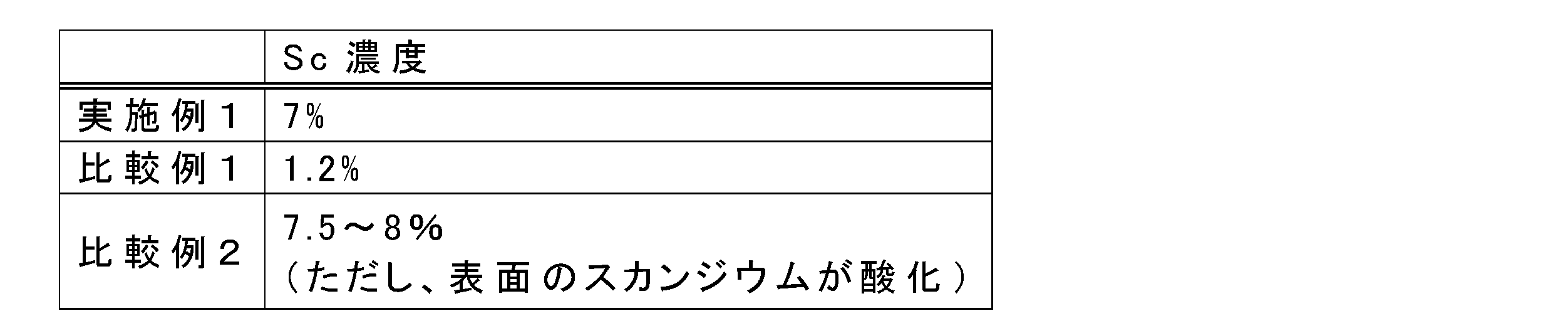
その後、アルミナ製タンマン管2を割り、得られた金属試料表面に薄く着いたスラグ分をハンマリングにて剥がした後、試料底部から約10%相当の体積に相当する箇所でダイヤモンドカッターを利用して切断した。この切断によって得た底部ブロックの組成を、は蛍光X線分析装置を用いて分析した。結果を表2に示す。
<比較例1>
冷却速度が110~120℃/分であること以外は、実施例と同じ手法によって底部ブロックを得た。この底部ブロックの組成を、は蛍光X線分析装置を用いて分析した。結果を表2に示す。
冷却速度が110~120℃/分であること以外は、実施例と同じ手法によって底部ブロックを得た。この底部ブロックの組成を、は蛍光X線分析装置を用いて分析した。結果を表2に示す。
<比較例2>
冷却速度が5~8℃/分であること以外は、実施例と同じ手法によって底部ブロックを得た。この底部ブロックの組成を、は蛍光X線分析装置を用いて分析した。結果を表2に示す。
冷却速度が5~8℃/分であること以外は、実施例と同じ手法によって底部ブロックを得た。この底部ブロックの組成を、は蛍光X線分析装置を用いて分析した。結果を表2に示す。
実施例に係る底部ブロックのSc濃度は、7%であった。このことから、アルミニウム及びスカンジウムを含有する溶融合金を毎分10℃以上100℃以下の冷却速度で維持しながら660℃以上730℃以下になるまで冷却する冷却工程と、この冷却温度を一定時間保つ保持工程と、固体のスカンジウム濃縮物を回収する回収工程とを経て得られるスカンジウム濃縮物は、高品位なAl-Sc母合金としてそのまま再利用できることが確認された。また、このスカンジウム濃縮物に対して溶媒抽出等を行うことで、ニッケル酸化鉱石から回収する場合に比べて極めて効率的にスカンジウムを回収することもできる。
一方、冷却速度が速すぎると、スカンジウム濃度が1.2%と低く、高品位なAl-Sc母合金としてそのまま再利用することはできない(比較例1)。実施例より低くなった。また、試料断面を電子線マイクロアナライザ(EPMA)で観察すると、Al-Sc合金相においても、全面にわたって細かなスカンジウム含有物が分散している様子がみられ、スカンジウム濃縮物として取り出すことのできた重量自体が実施例の重量よりも少なかった。
また、冷却速度が遅すぎても、底部ブロックのスカンジウム濃度は、実施例の濃度と大差なかった(比較例2)。また、溶融炉の内部をアルゴンで置換して冷却したにもかかわらず、表面付近に残ったスカンジウムは酸化物になっていた。そのため、冷却速度が遅すぎる場合、スカンジウム濃縮物を高品位なAl-Sc母合金としてそのまま再利用できないことが確認された。底部ブロックの酸化は、溶融炉の内部に残存するわずかな量の酸素と反応したことに起因すると予想される。
1 溶融炉
2 アルミナ製タンマン管
3 石英製炉芯管
4 ゴム栓
5 アルゴンガス置換部
6 熱電対
7 電気炉
8 断熱ボード
2 アルミナ製タンマン管
3 石英製炉芯管
4 ゴム栓
5 アルゴンガス置換部
6 熱電対
7 電気炉
8 断熱ボード
Claims (3)
- アルミニウム及びスカンジウムを含有する溶融合金を毎分10℃以上100℃以下の冷却速度で維持しながら660℃以上730℃以下になるまで冷却する冷却工程と、
前記660℃以上730℃以下の温度を一定時間保つ保持工程と、
固体のスカンジウム濃縮物を回収する回収工程とを含む、スカンジウム濃縮物回収方法。 - 前記回収工程は、前記溶融合金を溶融する溶融炉を深さ方向に対して2以上のブロックに分け、最も深い部分のブロックを回収する工程である、請求項1に記載のスカンジウム濃縮物回収方法。
- 前記回収工程で回収された前記スカンジウム濃縮物を溶融炉で溶融した後、前記冷却工程、前記保持工程及び前記回収工程を再び行う、請求項1又は2に記載のスカンジウム濃縮物回収方法。
Priority Applications (1)
| Application Number | Priority Date | Filing Date | Title |
|---|---|---|---|
| EP15740184.5A EP3081659B1 (en) | 2014-01-27 | 2015-01-23 | Scandium concentrate recovery method |
Applications Claiming Priority (2)
| Application Number | Priority Date | Filing Date | Title |
|---|---|---|---|
| JP2014-012664 | 2014-01-27 | ||
| JP2014012664A JP5907186B2 (ja) | 2014-01-27 | 2014-01-27 | スカンジウム濃縮物回収方法 |
Publications (1)
| Publication Number | Publication Date |
|---|---|
| WO2015111695A1 true WO2015111695A1 (ja) | 2015-07-30 |
Family
ID=53681492
Family Applications (1)
| Application Number | Title | Priority Date | Filing Date |
|---|---|---|---|
| PCT/JP2015/051825 Ceased WO2015111695A1 (ja) | 2014-01-27 | 2015-01-23 | スカンジウム濃縮物回収方法 |
Country Status (3)
| Country | Link |
|---|---|
| EP (1) | EP3081659B1 (ja) |
| JP (1) | JP5907186B2 (ja) |
| WO (1) | WO2015111695A1 (ja) |
Citations (4)
| Publication number | Priority date | Publication date | Assignee | Title |
|---|---|---|---|---|
| JPH05171304A (ja) * | 1991-12-19 | 1993-07-09 | Kobe Steel Ltd | アルミニウム合金から有用金属を回収する方法 |
| JP2003171724A (ja) | 2001-12-07 | 2003-06-20 | Aomori Prefecture | Al−Sc母合金の製造法およびその方法によって得られたAl−Sc母合金 |
| JP2007254822A (ja) * | 2006-03-23 | 2007-10-04 | Taiheiyo Kinzoku Kk | スカンジウム含有合金の製造方法およびこの方法により得られたスカンジウム含有合金 |
| JP5445725B1 (ja) * | 2013-06-26 | 2014-03-19 | 日本軽金属株式会社 | Al−Sc合金の製造方法 |
Family Cites Families (1)
| Publication number | Priority date | Publication date | Assignee | Title |
|---|---|---|---|---|
| FR2902800B1 (fr) * | 2006-06-23 | 2008-08-22 | Alcan Rhenalu Sa | Procede de recyclage de scrap en alliage d'aluminium provenant de l'industrie aeronautique |
-
2014
- 2014-01-27 JP JP2014012664A patent/JP5907186B2/ja active Active
-
2015
- 2015-01-23 WO PCT/JP2015/051825 patent/WO2015111695A1/ja not_active Ceased
- 2015-01-23 EP EP15740184.5A patent/EP3081659B1/en not_active Not-in-force
Patent Citations (4)
| Publication number | Priority date | Publication date | Assignee | Title |
|---|---|---|---|---|
| JPH05171304A (ja) * | 1991-12-19 | 1993-07-09 | Kobe Steel Ltd | アルミニウム合金から有用金属を回収する方法 |
| JP2003171724A (ja) | 2001-12-07 | 2003-06-20 | Aomori Prefecture | Al−Sc母合金の製造法およびその方法によって得られたAl−Sc母合金 |
| JP2007254822A (ja) * | 2006-03-23 | 2007-10-04 | Taiheiyo Kinzoku Kk | スカンジウム含有合金の製造方法およびこの方法により得られたスカンジウム含有合金 |
| JP5445725B1 (ja) * | 2013-06-26 | 2014-03-19 | 日本軽金属株式会社 | Al−Sc合金の製造方法 |
Also Published As
| Publication number | Publication date |
|---|---|
| JP2015140443A (ja) | 2015-08-03 |
| EP3081659A1 (en) | 2016-10-19 |
| EP3081659B1 (en) | 2018-12-05 |
| EP3081659A4 (en) | 2016-12-28 |
| JP5907186B2 (ja) | 2016-04-26 |
Similar Documents
| Publication | Publication Date | Title |
|---|---|---|
| US9203126B2 (en) | Method for recovering valuable metals | |
| JP5445725B1 (ja) | Al−Sc合金の製造方法 | |
| CN103526049B (zh) | 一种火法冶炼锑除砷的方法 | |
| JP5572887B2 (ja) | アルミニウム合金溶湯用マグネシウム濃度調整剤及びそれを用いたマグネシウム濃度調整方法 | |
| JP5907188B2 (ja) | スカンジウム濃縮物の製造方法 | |
| JP5907187B2 (ja) | スカンジウム濃縮物の製造方法 | |
| JP5907186B2 (ja) | スカンジウム濃縮物回収方法 | |
| JP2015534530A5 (ja) | ||
| JP6425018B2 (ja) | 希土類元素の分離回収方法 | |
| JP2012254894A (ja) | シリコンの精製方法 | |
| JP6565232B2 (ja) | 銀の回収方法 | |
| KR101817075B1 (ko) | 알루미늄-스칸듐 모합금 및 그 제조방법 | |
| JP2013234356A (ja) | 高不純物含有鉛滓を原料とする鉛の乾式製錬方法 | |
| CN118871600A (zh) | 有价金属的制造方法 | |
| CN118792525B (zh) | 一种金属铍纯化方法 | |
| JP5554274B2 (ja) | InとSnとを回収する方法及びITOリサイクル材からInとSnとを回収する方法 | |
| WO2010150873A1 (ja) | 鉄スクラップに共存する元素の分離・回収方法 | |
| JP2003105448A (ja) | 鉄スクラップからの銅の分離、除去方法 | |
| WO2015111696A1 (ja) | スカンジウム塩化物及びスカンジウム酸化物の製造方法 | |
| CN109338139A (zh) | 一种新型精炼剂及其制备方法 | |
| JP2011162427A (ja) | 精製されたシリコンの製造方法 | |
| TW201718885A (zh) | 含有Ru的Cu合金的均質化方法 | |
| CN109609778A (zh) | 一种利用金属萃取进行原铝除镓的方法 | |
| JP2015218377A (ja) | 分離方法 | |
| JP2011184229A (ja) | 精製シリコンの製造方法 |
Legal Events
| Date | Code | Title | Description |
|---|---|---|---|
| 121 | Ep: the epo has been informed by wipo that ep was designated in this application |
Ref document number: 15740184 Country of ref document: EP Kind code of ref document: A1 |
|
| REEP | Request for entry into the european phase |
Ref document number: 2015740184 Country of ref document: EP |
|
| WWE | Wipo information: entry into national phase |
Ref document number: 2015740184 Country of ref document: EP |
|
| NENP | Non-entry into the national phase |
Ref country code: DE |