WO2015113384A1 - 信息的发送、获取方法、接入方法、节点、系统和介质 - Google Patents
信息的发送、获取方法、接入方法、节点、系统和介质 Download PDFInfo
- Publication number
- WO2015113384A1 WO2015113384A1 PCT/CN2014/082840 CN2014082840W WO2015113384A1 WO 2015113384 A1 WO2015113384 A1 WO 2015113384A1 CN 2014082840 W CN2014082840 W CN 2014082840W WO 2015113384 A1 WO2015113384 A1 WO 2015113384A1
- Authority
- WO
- WIPO (PCT)
- Prior art keywords
- type
- level
- random access
- value
- node
- Prior art date
- Legal status (The legal status is an assumption and is not a legal conclusion. Google has not performed a legal analysis and makes no representation as to the accuracy of the status listed.)
- Ceased
Links
Classifications
-
- H—ELECTRICITY
- H04—ELECTRIC COMMUNICATION TECHNIQUE
- H04W—WIRELESS COMMUNICATION NETWORKS
- H04W72/00—Local resource management
- H04W72/04—Wireless resource allocation
- H04W72/044—Wireless resource allocation based on the type of the allocated resource
- H04W72/0453—Resources in frequency domain, e.g. a carrier in FDMA
-
- H—ELECTRICITY
- H04—ELECTRIC COMMUNICATION TECHNIQUE
- H04W—WIRELESS COMMUNICATION NETWORKS
- H04W74/00—Wireless channel access
- H04W74/002—Transmission of channel access control information
- H04W74/006—Transmission of channel access control information in the downlink, i.e. towards the terminal
-
- H—ELECTRICITY
- H04—ELECTRIC COMMUNICATION TECHNIQUE
- H04B—TRANSMISSION
- H04B17/00—Monitoring; Testing
- H04B17/30—Monitoring; Testing of propagation channels
- H04B17/309—Measuring or estimating channel quality parameters
- H04B17/318—Received signal strength
- H04B17/328—Reference signal received power [RSRP]; Reference signal received quality [RSRQ]
-
- H—ELECTRICITY
- H04—ELECTRIC COMMUNICATION TECHNIQUE
- H04J—MULTIPLEX COMMUNICATION
- H04J4/00—Combined time-division and frequency-division multiplex systems
- H04J4/005—Transmultiplexing
-
- H—ELECTRICITY
- H04—ELECTRIC COMMUNICATION TECHNIQUE
- H04L—TRANSMISSION OF DIGITAL INFORMATION, e.g. TELEGRAPHIC COMMUNICATION
- H04L5/00—Arrangements affording multiple use of the transmission path
- H04L5/003—Arrangements for allocating sub-channels of the transmission path
- H04L5/0048—Allocation of pilot signals, i.e. of signals known to the receiver
-
- H—ELECTRICITY
- H04—ELECTRIC COMMUNICATION TECHNIQUE
- H04W—WIRELESS COMMUNICATION NETWORKS
- H04W16/00—Network planning, e.g. coverage or traffic planning tools; Network deployment, e.g. resource partitioning or cells structures
- H04W16/24—Cell structures
- H04W16/26—Cell enhancers or enhancement, e.g. for tunnels, building shadow
-
- H—ELECTRICITY
- H04—ELECTRIC COMMUNICATION TECHNIQUE
- H04W—WIRELESS COMMUNICATION NETWORKS
- H04W28/00—Network traffic management; Network resource management
- H04W28/02—Traffic management, e.g. flow control or congestion control
- H04W28/0231—Traffic management, e.g. flow control or congestion control based on communication conditions
- H04W28/0236—Traffic management, e.g. flow control or congestion control based on communication conditions radio quality, e.g. interference, losses or delay
-
- H—ELECTRICITY
- H04—ELECTRIC COMMUNICATION TECHNIQUE
- H04W—WIRELESS COMMUNICATION NETWORKS
- H04W74/00—Wireless channel access
- H04W74/08—Non-scheduled access, e.g. ALOHA
- H04W74/0833—Random access procedures, e.g. with 4-step access
Definitions
- the present invention relates to a random access technology in the field of wireless communications, and in particular, to a method for transmitting and acquiring configuration information, an access method, a communication node, a system, and a computer storage medium.
- MTC Machine Type Communicative
- MTC UE also known as Machine to Machine (M2M) user communication equipment
- GSM Globa Systems of Mobi le communicat ion
- LTE Long Term Evolution
- LTE-A Long Term Evolution-A
- M2M multi-class data services based on LTE/LTE-A will also be more attractive. Only when the cost of the LTE-M2M device can be lower than the MTC terminal of the GSM system can the M2M service actually switch from GSM to LTE.
- the main alternative methods for reducing the cost of the MTC user terminal include: reducing the number of terminal receiving antennas, reducing the baseband processing bandwidth of the terminal, reducing the peak rate supported by the terminal, using the half-duplex mode, and the like.
- the cost reduction means that the performance is degraded.
- the demand for the LTE/LTE-A system cell coverage cannot be reduced. Therefore, the MTC terminal with low-cost configuration needs to take some measures to meet the coverage performance requirements of the existing LTE terminal.
- the MTC terminal may be located in a basement, a corner, etc., and the scene is worse than that of a normal LTE UE.
- the uplink and downlink coverage enhancement of the line part MTC UE is necessary. How to ensure the access quality of the user is the first problem to be considered. It is necessary to enhance the design of the random access channel (Physical Random Access Channel, PRACH) of the LTE/LTE-A system to ensure that the MTC UE can access normally. system.
- PRACH Physical Random Access Channel
- a total of five types of random access signaling transmission formats (also called Preamble format), that is, Preamble format 0 4, Evolved Node B (Evolved Node B, eNB for short) can be configured.
- Preamble format 0 4
- Evolved Node B Evolved Node B
- SIB System Information Block
- the UE After learning the PRACH Preamble format supported by the current system, the UE generates random access signaling (also called Message 1, Messagel, referred to as Msgl) according to the currently configured random access sequence and according to the selected Preamble format.
- Msgl random access signaling
- the eNB detects the random access signaling sent by the UE on the PRACH, and sends a random access response message (Randar Access Response, RAR for short) once the random access signaling sent by the UE is detected. Also known as Message 2, Message2 or Msg2 for short).
- RAR Random Access Response
- the location information of the Physi ca 1 Resource Block (PRB) occupied by the random access response message in the LTE/LTE-A system is included in the downlink control information (Downlink Control Information, DCI) and is controlled by physical downlink. Channel (Physical Downlink Control Channel, PDCCH) sent.
- DCI information further includes a 16-bit Cyclic Redundancy Check (CRC), and the CRC further uses a 16-bit random access radio network temporary identifier (Random Access Radio Network Temporary Identity, RA).
- the UE receives the RAR message and obtains the uplink time synchronization and uplink resources. However, it is not determined at this time that the RAR message is sent to the UE itself rather than to other UEs because there are different UEs in the same time-frequency resource. The possibility of sending the same random access sequence, so that they receive the same RAR through the same RA-RNTI. Moreover, the UE also has no way of knowing if other UEs are using the same resources for random access. To this end, the UE needs to resolve such random access collisions by following messages 3 (Message3, Msg3 for short) and Message 4 (Message4, Msg4 for short).
- Msg 3 is the first message based on uplink scheduling and transmitted on PUSCH by HARQ (Hybrid Automatic Repeat reques t) mechanism.
- the RRC Connection Request message is transmitted in the Ms g 3 .
- the message in order to distinguish different UEs, carries a UE-specific ID in MSG3 for distinguishing different UEs. In the case of initial access, this ID may be the S-TMSI (if any) of the UE or random.
- a 40-bit value is generated.
- the UE After the UE sends the MSg3 message, it immediately starts the contention cancellation timer (and then restarts the timer every time Msg3 is retransmitted), and the UE needs to listen to the conflict resolution message returned by the eNodeB to itself during this time (Contention) Resolution, Msg4 message).
- the prior art proposes enhanced random access, but the signaling consumption in the enhanced random access process is large, so it is urgent to propose a The signaling consumption is reduced, and the random access of the MTC UE is further optimized. Summary of the invention
- embodiments of the present invention are directed to providing a method for transmitting, acquiring, accessing, connecting, calculating, and calculating configuration information that can effectively reduce signaling overhead in a random access procedure.
- Machine storage media
- a first aspect of the embodiments of the present invention provides a method for sending random access channel configuration information, where the method includes:
- the random access channel configuration information includes configuration information of a first type of level.
- the first level comprises a coverage enhancement level and/or a physical channel repetition transmission level.
- the physical channel corresponding to the physical channel repeat transmission level includes at least one of the following;
- Physical random access channel Physical broadcast channel, physical downlink control channel, enhanced physical downlink control channel, physical downlink shared channel, physical uplink control channel, and physical uplink shared channel.
- the physical channel repeat transmission level includes primary information, system information, control information, downlink transport block, uplink transport block, Msgl message, random access response message, Msg3 message, and Msg4 message carried on the physical channel. Repeat the transmission level of at least one of them.
- the random access channel configuration information is configured by the first type of node or the management device of the first type of node in system information or control information.
- the system information is sent by a physical downlink shared channel
- the control information is sent by a physical downlink control information channel or an enhanced physical downlink control channel.
- the configuration information of the first class level includes index information of the first class level configured by the first type of node, bit mapping information, and a physical channel corresponding to the first class level. At least one of the number of repeated transmissions, the number of levels of the predefined first level, the number of levels of the configured first level, the highest level of the configured first level, and the lowest level of the configured first level.
- the first type of configuration information has a mapping relationship with the first type of information, where the mapping relationship is configured by the communication system device in the second type of node or sent by the first type of node to the The second type of node.
- the first type of information includes at least one of the following:
- Nl The number of the first class of the configuration, Nl, where N1 is a positive integer
- N2 is a positive integer
- the number of repeated transmissions of the physical channel corresponding to the first type of level is a predefined value; wherein the predefined value is a positive integer.
- the N1 first class levels are taken from a predefined N2 first class level, and the N2 is a positive integer greater than or equal to the N1.
- the configuration information of the first class level further includes a physical channel repetition number scheme Display information
- the physical channel repetition number scheme indication information is used to indicate that one set is selected from a scheme of a plurality of sets of physical channel repetition times of a first type of level.
- the predefined reference signal comprises at least one of the following:
- the received signal quality of the predefined reference signal comprises at least one of: a reference signal received power, a reference signal received quality, a received signal strength indicator, a received signal to noise ratio of the reference signal, a second type of node and the The path loss value between the first type of nodes and the number of repeated transmissions of the predefined reference signal when the predefined reference signal is successfully received.
- the range of values of the received signal quality of the predefined reference signal includes at least one of the following:
- the value range refers to the maximum value of the value, or the minimum value of the value or the specific value or value interval.
- the reference value of the received signal quality of the predefined reference signal is sent by the first type of node to the second type of node.
- a reference value of the received signal quality of the predefined reference signal is configured in the random access channel configuration information.
- the range of the received signal quality of the predefined reference signal corresponding to the different levels of the first class has the same size range
- the range of the range of the received signal quality of the predefined reference signal corresponding to the different levels of the first level is smaller as the level of the first class becomes higher;
- the range corresponding to the value range of the received signal quality of the predefined reference signal corresponding to the different levels of the first class is configured by the first type of node in the system message.
- the value range of the received signal quality of the predefined reference signal corresponding to the different levels of the first class level does not have an intersection or a partial intersection.
- the second type of node randomly selects or selects a first type of level according to a predefined principle. Corresponding level.
- the value range of the coverage enhancement target value corresponding to the different levels of the first class level does not have an intersection or a partial intersection.
- the second type of node randomly selects or selects a level corresponding to the first type of level according to a predefined principle.
- the range of the value range corresponding to the coverage enhancement target value corresponding to the different levels of the first level is the same;
- the value range corresponding to the value range of the coverage enhancement target value corresponding to the different levels of the first level is smaller as the level of the first class level becomes higher;
- the range corresponding to the value interval of the coverage enhancement target value corresponding to the different levels of the first level is configured by the first type of node in the system message.
- the sending random access channel configuration information is:
- the random access channel configuration information is transmitted under the trigger of a predefined condition.
- the random access channel configuration information further includes a random access channel resource allocated to the second type of node.
- the random access channel resource allocated for the second type of node includes at least one of a time domain resource, a frequency domain resource, and an available random access sequence.
- the method further includes: determining, according to the number of the first class level and the random access channel resource allocated for the second type of node, the random access channel resources allocated by each of the first class level The way to reuse.
- the number of random access sequences allocated by each of the first class levels is proportional to the first class.
- the number of random access sequences allocated by each of the first class different levels is the same, and The assigned random access sequence is different.
- the number of random access sequences allocated by different levels of the first class level increases as the level of the first class level becomes larger.
- the number of random access sequences allocated by each of the first class level is configured by the first type of node. .
- the number of random access sequences allocated by each of the first class-levels is determined by The first type of node configuration.
- the random access channel configuration information further includes: the random access channel resource allocated to the second type of node is configured to allocate the random access channel resource according to a predefined resource allocation policy;
- the predetermined resource allocation policy includes a first policy and a second policy
- the random access channel resources allocated by each of the first class classes occupy the same time domain resource and/or frequency domain resource, and the random access channel resources allocated by each level of the first class level
- the random access sequence included is different;
- the first predefined value, the second predefined value, the third predefined value, and the fourth predefined value are configured by the communication system device and transmitted to the second type of node, or by the first type of node Configured and sent to the second type of node.
- the ratio of the number of random access sequences allocated by the first level and the two levels satisfies a preset proportional relationship A m (i ) : A m (n) ;
- i and n are indexes of two different levels of the first class level
- m ( i ) and m ( n ) are power exponents corresponding to two levels of the first class of the index corresponding to i and n, and A is a base.
- said A m (i ) and A m (n) are power exponents corresponding to two levels of the first class of the index corresponding to i and n, and A is a base.
- the second aspect of the embodiments of the present invention further provides a method for acquiring random access channel configuration information, where the method includes:
- the random access channel configuration information includes configuration information of a first type of level
- the first type of information is queried in a pre-stored first type information table according to the first type of level configuration information and a predefined rule.
- the third aspect of the embodiments of the present invention further provides a random access method, where the method includes: a first type of node sends random access channel configuration information; and the random access channel configuration information includes configuration information of a first type of level;
- the second type of node receives the random access channel configuration information
- the second type of node queries the first type of information in a pre-stored first type information table according to the first type of level configuration information and a predefined rule;
- the second type of node randomly accesses the wireless network according to the first type of information.
- a fourth aspect of the embodiments of the present invention further provides a communication node, where the communication node is a first type of node, and the first type of node includes:
- the first sending unit is configured to send random access channel configuration information; the random access channel configuration information includes configuration information of a first type of level.
- the fifth aspect of the embodiment of the present invention further provides a communication node, where the communication node is a second type of node;
- a receiving unit configured to receive random access channel configuration information;
- the information includes the configuration information of the first class level;
- the query unit is configured to query the first type of information in a pre-stored first type information table according to the first type of level configuration information and according to a predefined rule.
- a sixth aspect of the embodiments of the present invention further provides a communication system, where the system includes: a first type of node, configured to send random access channel configuration information; and the random access channel configuration information includes configuration information of a first type of level ;
- a second type of node configured to receive the random access channel configuration information, query the first type information in a pre-stored first type information table according to the first type of configuration information and a predefined rule, and according to the The first type of information is randomly connected to the wireless network.
- a seventh aspect of the present invention provides a computer storage medium, where the computer storage medium stores computer executable instructions, where the computer executable instructions are used to perform the first to third aspects of the embodiments of the present invention. At least one of the methods.
- the configuration information sending, obtaining method, the access method, the communication node, the system, and the computer storage medium may query the pre-stored first type information according to the first type of configuration information, thereby completing The first type of information is transmitted and obtained; and the random access process is completed according to the first type of information queried, and the transmission of the first type of information is obviously transmitted according to the first class level. Less information is available, reducing signaling overhead.
- FIG. 1 is a schematic flowchart of a method for acquiring random access signaling configuration information according to Embodiment 2 of the present invention
- FIG. 2 is a schematic flowchart of a random access method according to Embodiment 2 of the present invention.
- FIG. 3 is a schematic structural diagram of a communication node according to Embodiment 5 of the present invention.
- FIG. 4 is a schematic structural diagram of a communication system according to Embodiment 6 of the present invention. detailed description
- Embodiment 1 is a diagrammatic representation of Embodiment 1:
- the embodiment provides a method for transmitting random access channel configuration information, where the method includes: sending random access channel configuration information; the random access channel configuration information includes configuration information of a first type of level;
- the configuration information of the first class level is used to obtain the first type of information according to a predefined rule.
- the first type of information may be divided into a plurality of levels, and the first type of information corresponding to the specific one or more levels of the first type of information may be queried according to the configuration information of the first type of information.
- the first type of information may be information to be used in a random access procedure, such as random access signaling.
- the first level includes at least one of an coverage enhancement level and a physical channel repetition transmission level.
- the physical channel repeat transmission level includes primary information carried on the physical channel
- the first type of information corresponding to the physical channel repeat transmission level includes a physical channel type and a number of retransmissions of each physical channel.
- the physical channel corresponding to the physical channel repeat transmission level may specifically include at least one of the following;
- the first type of configuration information is configured by the communication system device, such as a first type node or a management device of the first type node (a high level network node of the first type node or a controller of the first type node) And configured in the system message or the downlink control channel information, or pre-stored in the devices of the first type node and the second type node.
- the communication system device such as a first type node or a management device of the first type node (a high level network node of the first type node or a controller of the first type node) And configured in the system message or the downlink control channel information, or pre-stored in the devices of the first type node and the second type node.
- the first type of node may be any one of a macro base station, a micro base station, a pico base station, a home base station, a low power node, and a relay station.
- the system message is information for communication transmitted by the first type of node in a broadcast form.
- the second type of node may be one or more terminals or terminal groups, such as an MTC terminal and/or an MTC coverage enhanced terminal.
- the system information is sent by a physical downlink shared channel
- the downlink control channel information is sent by a physical downlink control information channel or an enhanced physical downlink control channel.
- the first type of configuration information is used to query the first type of information, and the specific composition may be a predefined first level of the number of levels, a configured first level of the number of levels, and the first configuration.
- Index information of the first class level in the combination of the highest level of the class level and the lowest level of the first class of the configuration, the repeated transmission times information of the physical channel corresponding to the first class level, and the bit mapping information The first level of the number of levels, the highest level of the first class, and the lowest level of the first class, the following three preferred modes are provided:
- Method 1 The first level of configuration information includes index information, specific Such as the corresponding index number;
- mode 2 The first type of configuration information includes bit mapping information; consists of a sequence of several bits 0 or 1; in a specific implementation process, the sequence length according to the bit mapping information may also be The combination of 0 or 0 and 1 in the sequence is mapped with at least part of the information of the first type of information, and the first class is obtained according to the mapping relationship.
- the configuration information of the first class level includes a first level quantity.
- the first type of level may be combined with the highest level of the first level and/or the lowest level of the first level as the basis for querying the first type of information.
- each of the first class levels may be sorted by using a specific predetermined method; specifically, the first level is specified as the highest level or the lowest level, There is no need to set the first level, there are many specific implementation methods, and it is not mentioned here.
- the following is a specific example of a method for acquiring first type information according to the first level number: the first type information is stored by a pre-established A information table; and the information table A1 corresponds to a level.
- the corresponding levels of any two information tables are different; according to the quantity information of the levels, which one of the A information tables can be determined. For example, when the first class level is a, it is determined that the first type information is queried through the information table A1.
- the specific information in the information table A1 can be pre-defined or randomly obtained. There are many specific ways, and it is no longer mentioned here.
- the configuration information of the first type of class has a mapping relationship with the first type of information, and the mapping relationship is sent by the communication system management device or the first type of node to the second type of node.
- the communication system is a communication network including a transmitting node and a receiving node and its equipment.
- the communication system in this embodiment includes a first type of node, a second type of node, and a management network element of the first type of node and/or the second type of order.
- the first type of information includes at least one of the following:
- N1 The number N1 of the first class level, where N1 is a positive integer; if the first class level includes 10 levels, the N1 is equal to 10;
- the index information of the N1 levels of the first level may correspond to an index information, and the query processing may be conveniently performed according to the first class level; a value range of the received signal quality of the predefined reference signal corresponding to the class level; a value range of the coverage enhancement target value corresponding to the first class level; wherein, the value The range refers to the maximum value, the minimum value, or the value interval of the value; the value range includes the maximum value, the minimum value of the value, the specific value, and the value between the maximum value and the minimum value;
- the number of repeated transmissions of the physical channel corresponding to the first type of level may be a predetermined value; wherein the predefined value is a positive integer.
- the N1 first class levels are taken from a predefined N2 first class level, and the N2 is a positive integer less than N1.
- the first type of configuration information may further include physical channel repetition number scheme indication information, where the physical channel repetition number scheme indication information is used to indicate a plurality of sets of physical channel repetition times pre-defined from the first type of level. Choose one of the options for the range of values.
- the predefined reference signal includes at least one of the following:
- a physical broadcast channel Physical Broadcas t Channel, PBCH
- the received signal quality of the predefined reference signal includes at least one of: a reference signal received power, a reference signal received quality, a received signal strength indicator, a received signal to noise ratio of the reference signal, a second type of node, and the first type The path loss value between the nodes and the number of repeated transmissions of the predefined reference signal when the predefined reference signal is successfully received.
- the value range of the received signal quality of the predefined reference signal includes a value range of the measured value of the received signal quality of at least one of the following predefined reference signals;
- the measured value of the received signal quality of the predefined reference signal and the received signal of the predefined reference signal The difference between the reference value of the mass number or the absolute value of the difference value;
- the value range refers to the maximum value, the minimum value, the specific value, or the value range.
- a reference value of the received signal quality of the predefined reference signal is sent by the first type of node to the second type of node; a reference value of a received signal quality of the predefined reference signal is configured on the random access channel In the configuration information.
- the value range of the received signal quality of the predefined reference signal corresponding to the different levels of the first class does not have an intersection or a partial intersection, and the reception of the corresponding predefined reference signal of the different level of the first class
- the range of signal quality values is not exactly the same.
- the second type of node When the second type of node measures the received signal quality of the predefined reference signal in an intersection of two different levels, the second type of node randomly selects or selects a level corresponding to the first type of level according to a predefined principle. Specifically, when the first class level includes the level B1 and the level B2; wherein, the received signal quality of the predefined reference signal of the level B1 and the level B2 intersects, and the quality of the measured received signal of the second type node is located In the intersection, the second type of node may randomly select the first type of information corresponding to the level B1 or the level B2 as the information required for obtaining the random access.
- the selection may be based on a predefined principle, such as preferentially selecting a query corresponding to the first type of information as described in the smaller level.
- the definition principle is based on the second-class node power consumption selection principle, and specifically, the level that the second-type node power consumption can support is selected.
- mapping relationship between the range of the received signal quality of the predefined reference signal corresponding to the different levels of the first type of the level includes at least two types:
- the first type the range of the received signal quality of the predefined reference signal corresponding to the different levels of the first class is the same. Specifically, if the level a is higher than the level b, the range of the value interval corresponding to each of the level a and the level b may be the same, for example, all of the values are included, but the specific values corresponding to the level a and the level b are taken. Values may be the same or different.
- the second type the size of the range corresponding to the received signal quality value interval of the predefined reference signal corresponding to the different levels of the first class is smaller as the level of the first class level becomes higher, such as, for example, the level a is high.
- the level corresponding to the received signal quality value interval of the predefined reference signal corresponding to level b is pi; the range corresponding to the received signal quality value interval of the reference signal corresponding to level b is p2; Then pi is less than p2.
- the level a and the level b may be the same or different for the specific values.
- the value range of the coverage enhancement target value corresponding to the different levels of the first class level does not have an intersection or a partial intersection.
- the coverage enhancement target value measured by the second type of node is in an intersection of different levels, the second type of node randomly selects or selects a level corresponding to the first type of level according to a predefined principle.
- the range of values corresponding to the range of the coverage enhancement target value corresponding to the different levels of the first class is the same, or the value range corresponding to the value range of the coverage enhancement target value corresponding to the different levels of the first class
- the size of the level of the first class is increased as the level of the level of the first class is increased; the range corresponding to the value range of the coverage enhancement target value corresponding to the level of the first class is configured by the first class node in the system message. .
- the sending random access channel configuration information is:
- the random access channel configuration information is transmitted under the trigger of a predefined condition.
- the pre-defined condition may be an instruction sent by the network management device or triggered by the information submitted by the terminal.
- the random access channel configuration information further includes a physical random access channel (Physica 1 Random Acces s Channel, PRACH) resource configuration information, where the PRACH resource is used for random access of the second type of node.
- PRACH Physical Random Access Channel
- the random access channel configuration information further includes a random access channel resource allocated for the second type of node.
- the random access channel resource allocated for the second type of node includes at least one of a time collar resource, a frequency domain resource, and an available random access sequence.
- the method in this embodiment may also schedule the random access channel resource according to a predefined resource allocation policy
- the predetermined resource allocation policy includes a first policy and a second policy
- the first policy is that the number of available random access sequences is less than the first predefined value, the number of available random access sequences is greater than the second predefined value, and the number of available random access sequences is greater than the first predefined value and less than the second predefined One of the values; the first predefined value is smaller than the second predefined value; the second policy is that the number of available random access sequences is greater than the third predefined value, and the number of available random access sequences is less than the fourth predefined The value and the available random access sequence are smaller than the third predefined value and greater than the fourth predefined value; the third predefined value is greater than the second predefined value; when the first policy is met, each of the A multiplexing manner of a class of allocated random access channel resources includes: frequency division multiplexing and/or time division multiplexing;
- each of the first class-level allocated random access channel resources occupies the same time domain resource and/or frequency resource, and each of the first class-level allocated random access channel resources includes Different random access sequences;
- the first predefined value, the second predefined value, the third predefined value, and the fourth predefined value are configured by the network management device and transmitted to the second type of node, or configured by the first type of node. And sent to the second type of node.
- the number of random access sequences allocated by each of the first class different levels is the same.
- the number of random access sequences allocated by each of the first class levels may be configured;
- the number of random access sequences allocated by different levels of the first class level becomes larger as the level of the first class level becomes higher, that is, the number of random access sequences is proportional to the level of the first class level.
- the ratio of the number of random access sequences allocated by the first level and the two levels satisfies a preset proportional relationship A m(i ) : A m(n) ; wherein, i, n are two different levels of the first class
- the index of the level; m ( i ) and m (n) are the power exponents corresponding to the two levels of the first class of the index corresponding to i and n, and A is the base.
- a mm corresponds The first level of the first level
- a m (N1 ) corresponds to the N1 level of the first level.
- the A m(i ) and A m(n ) are range values of received signal quality of the predefined reference signal corresponding to each level of the first class level by the communication device and/or the level of the first class level
- the size of the range of values corresponding to the coverage enhancement target value is configured.
- the communication system device in this embodiment may be a first type node, a second type node, or any node in a communication system; the communication system device may correspond to a specific physical device, or may be combined with other functional applications. Use the logical network element of the same device.
- Embodiment 2 is a diagrammatic representation of Embodiment 1:
- this embodiment provides a method for obtaining random access signaling, where the method includes:
- Step S110 Receive random access channel configuration information, where the random access channel configuration information includes configuration information of a first type of level;
- Step S120 Query the first type information in a pre-stored first type information table according to the first type of level configuration information and a predefined rule.
- the device performing the steps S110 and S120 may be a second type of node, and the second type of node may include one or more terminals or terminal groups, such as an MTC terminal or an MTC coverage enhanced terminal. .
- the first type of information is pre-stored in the storage medium of the second type of node.
- the specific configuration of the first type of information refer to the first embodiment.
- the method for obtaining the random access signaling according to the embodiment is configured to perform the query according to the first type of information according to the first type of information, and the method for obtaining the random access signaling according to the previous method.
- Obtaining the information to be used in the random access process has the advantages of simple signaling interaction and small signaling overhead.
- Embodiment 3 is a diagrammatic representation of Embodiment 3
- this embodiment provides a random access method, where the method includes: Step S210: A first type node sends random access channel configuration information; and the random access channel configuration information includes a first type of level Configuration information;
- Step S220 The second type of node receives the random access channel configuration information.
- Step S230 The second type of node queries the first type information in a pre-stored first type information table according to the first type of level and a predefined rule.
- Step S240 The second type of node randomly accesses the wireless network according to the first type of information.
- the first type of node is usually a device such as a network side base station, and specifically may be any one of a macro base station, a micro base station (a pico base station, a femto base station, a low power node, and a relay station).
- a network side base station such as a network side base station, and specifically may be any one of a macro base station, a micro base station (a pico base station, a femto base station, a low power node, and a relay station).
- the second type of node is usually one or more mobile terminals; the mobile terminal may be an MTC terminal or an MTC coverage enhanced terminal.
- composition of the first class and the first type of information refer to the first embodiment.
- the accessing the wireless network according to the first type of information in step S240 is usually a first type of node in the access wireless network, such as a macro base station or a small base station.
- a first type of node in the access wireless network such as a macro base station or a small base station.
- information required in the random access process is not all sent by the first type of node, and the first type of node only sends the query or Obtain the basis of the first type of information, thereby reducing the information interaction in the random access process.
- Embodiment 4 This embodiment provides a communication node, where the communication node is a first type of node, and the first type of node includes:
- a first sending unit configured to send random access channel configuration information;
- the random access channel configuration information includes configuration information of a first type of level;
- the configuration information of the first class level is used to obtain the first type of information according to a predefined rule.
- the method for transmitting the random access channel configuration information according to the first embodiment provides hardware support for implementation, and can be used to implement the technical solution described in any one of the first embodiments.
- the first type of communication node further includes a storage medium connected to the first sending unit, and the storage medium is configured to store the random access channel configuration information.
- Embodiment 5 is a diagrammatic representation of Embodiment 5:
- the embodiment provides a communication node, where the communication node is a second type of node; and the second type of node includes:
- the receiving unit 110 is configured to receive random access channel configuration information, where the random access channel configuration information includes configuration information of a first type of level;
- the querying unit 120 is configured to query the first type of information in a pre-stored first type information table according to the first class level and according to a predefined rule.
- the specific structure of the receiving unit 110 may be a receiving antenna; the physical structure of the query unit 120 may include a processor; the processor runs a program or software, and may query a pre-stored first from a storage medium of the communication node. A type of information.
- the receiving unit 110, the query unit 120 and the storage medium are connected by a bus, and data transmission inside the communication node can be performed.
- the communication node in this embodiment provides the hardware support for the method for obtaining the random access signaling according to the second embodiment, and can implement any of the technical solutions described in the first embodiment.
- this embodiment provides a communication system, where the system includes:
- the first type of node 210 is configured to send random access channel configuration information; the random access channel configuration information includes configuration information of a first type of level;
- the second type of node 220 is configured to receive the random access channel configuration information, and query the first type information and the basis in a pre-stored first type information table according to the first type of level configuration information and a predefined rule.
- the first type of information is randomly accessed by a wireless network.
- the first type of node may be any one of a macro base station, a micro base station, a pico base station, a femto base station, a low power node, and a relay station.
- the second type of node may be one or more terminals or terminal groups, such as an MTC terminal and/or an MTC coverage enhanced terminal.
- the communication system in this embodiment provides hardware support according to the random access method described in the third embodiment, and has the same advantages of reducing signaling overhead in the terminal random access process.
- the specific composition of the first type of information and the first type of information refer to the first embodiment.
- the embodiment of the present invention further provides a computer storage medium, where the computer storage medium stores computer executable instructions, and the computer executable instructions are used to execute at least one of the methods described in Embodiments 1 to 3. Specifically, the method shown in FIG. 1 and FIG. 2 is executed.
- the computer storage medium may be a storage medium such as a DVD, an optical disk, a removable hard disk or a USB flash drive, preferably a non-transitory storage medium.
- Machine type communication users exist in Long Term Evolution (LTE) systems Terminal MTC UEs, and the MTC UEs into normal MTC UE (Normal MTC UE) and covering the reinforcing MTC UE (Coverage Improvement MTC UE, CI MTC UE) 0 LTE system enhancement level covering configure up to three (Coverage Improvement Level, CIL ), Table 1 shows the coverage enhancement level, coverage enhancement target (coverage improvement target,
- CIT CIL Coverage Improvement Random Access Channel PRACH Quantity Target
- CIL1 Repeated transmission of CIL1 - 3Levels times
- CIL2 Repeatedly send CIL2 - 3Levels times
- CIL2 Repeatedly send CIL2 - 3Levels sub-table 1
- the evolved Node B transmits random access channel configuration information in System Information (SIB).
- SIB System Information
- the configuration information includes an index information Index, and the value ranges from 0 to 5.
- the configuration information includes the index information value being 5,
- the PRACH Preamble corresponding to CILO repeatedly sends N ⁇ T 1 times, the PRACH Preamble corresponding to CIL1 is repeatedly transmitted, and the PRACH Preamble corresponding to CIL2 repeatedly transmits preamble, Typel, J ⁇
- the coverage enhancement level corresponds to the first level described in Embodiments 1 to 6; the configuration information of the first type level may correspond to the index information; and the first information corresponds to Table 1. Information.
- MTC UEs there are MTC UEs in the LTE system, and the MTC UEs are divided into a normal MTC UE (Normal MTC UE) and a coverage enhanced MTC UE (CI MTC UE). There are up to three Coverage Improvement Levels (CILs) in the system. Table 2 shows the number of coverage enhancement levels, coverage improvement targets (CIT), number of PRACH Preamble retransmissions, and number of PBCH retransmissions. Mapping relationship.
- CILs Coverage Improvement Levels
- CIL1 Repeated transmission
- CIL1 Repeated transmission 15dB - ⁇ j preamble, Typed ypeO
- CIL1 Repeatedly sending CIL1: Repeatedly sending 15dB preamble, Typel ypel
- CIL1 Repeated transmission
- CIL1 Repeated transmission lOdB - ⁇ j preamble, Typed ypeO
- CIL1 Repeated transmission
- CIL1 Repeated transmission lOdB preamble, Typel ypel
- the eNB sends the random access channel configuration information in the System Information Block (SIB), which includes an index information Index, which ranges from 0 to 5.
- SIB System Information Block
- the PRACH Preamble corresponding to the CILO repeatedly transmits d el
- the PRACH Preamble corresponding to the CIL2 repeatedly transmits N ⁇ 1 time.
- the PBCH corresponding to the CILO is repeatedly transmitted, and the PBCH corresponding to the CIL1 is repeatedly transmitted N ⁇ 2 ⁇ times, and the PBCH corresponding to the CIL2 is repeatedly transmitted.
- the first level is an coverage enhancement level
- the first type of level configuration information is index information in an coverage enhancement level
- the first information is information in Table 2.
- the MTC UEs are present in the LTE system, and the MTC UEs are divided into a normal MTC UE (Normal MTC UE) and a coverage enhancement MTC UE (Clind MTC UE). 2 systems are configured with 2 to 3 coverage enhancement levels (Coverage). Improvement Level, CIL), Table 3 shows the mapping between coverage enhancement level, Coverage Improvement Target (CIT), PRACH Preamble repeated transmission times, and PBCH repeated transmission times.
- CIL coverage enhancement levels
- CIT Coverage Improvement Target
- PRACH Preamble repeated transmission times and PBCH repeated transmission times.
- CIL1 Repeated transmission
- CIL1 Repeated transmission lOdB ypel
- the eNB transmits random access channel configuration information in System Information Block (SIB).
- SIB System Information Block
- the value of the index information in Table 3 ranges from 0 to 3.
- ⁇ CIT ⁇ 5dB
- the CIT corresponding to CIL1 is 5dB
- the PRACH Preamble corresponding to the CILO repeatedly transmits N ⁇ U ⁇ T 1 time
- the PRACH Preamble corresponding to the CIL1 repeatedly transmits N ⁇ T ⁇ iT 1 time
- the PRACH corresponding to the CIL2 Preamble repeatedly sends ⁇ :; ⁇ 1 time.
- CIL0 corresponding PBCH 1 repeatedly transmitted (repeatedly transmitted indicates that no PBCH)
- CIL1 repeatedly transmitting a corresponding PBCH ⁇ ⁇ ⁇ 1 times
- CIL2 corresponding PBCH NH repeatedly transmitted twice.
- the first level is an coverage enhancement level
- the first level is an index information Index of the coverage enhancement level.
- the first information is the information in Table 3.
- MTC UEs there are MTC UEs in the LTE system, and the MTC UEs are divided into a normal MTC UE (Normal MTC UE) and a Cover Improvement Improvement MTC UE (CI MTC UE).
- Normal MTC UE normal MTC UE
- CI MTC UE Cover Improvement Improvement MTC UE
- the five coverage enhancement levels defined in the system are shown in Table 4. Each CIL level corresponds to a Max Coverage Improvement Target (MCI).
- three coverage enhancement levels are configured in the communication system, and the eNB sends random access channel configuration information in the SIB; the configuration information includes three coverage enhancements configured by the communication system management device. At least one of the bit map bitmap information corresponding to the level.
- the bitmap information is 10101.
- the CI MTC UE determines the number of repetitions of the PRACH Preamble as C, C, and C by looking up Table 4.
- the first level is enhanced coverage information
- the first level is bit mapping information
- the first information is information in Table 4.
- the eNB may configure multiple sets of repeated transmission times for the physical channel in advance. Taking the PRACH Preamble as an example, as shown in Table 5, the eNB pre-configures two sets of repeated transmission times (TypeO and Typel) for the PRACH Preamble. The eNB sends the number of repeated transmissions of the configured PRACH Preamble by lbit in the random access channel configuration information sent by the eNB. For example, 0 represents TypeO, and 1 represents Type1.
- MTC UEs there are MTC UEs in the LTE system, and the MTC UEs are divided into a normal MTC UE (Normal MTC UE) and a coverage enhanced MTC UE (Cover Improvement MTC) UE, CI MTC UE). Up to three Coverage Improvement Levels (CILs) are configured in the communication system. Table 6 and Table 7 are coverage enhancement targets and coverage enhancement targets (Clevels) for two coverage enhancement levels and three coverage enhancement levels. ) mapping table.
- CILs Coverage Improvement Levels
- CIT CIL Index Coverage Improvement Target
- CIT CIL Index Coverage Improvement Target
- the eNB transmits random access channel configuration information in the SIB, including the quantity information of the coverage enhancement level.
- the number of coverage enhancement levels is three.
- the CI MTC UE learns the mapping table of the coverage enhancement level and the coverage improvement target (CIT).
- Table 7 shows.
- the first level is an enhanced coverage level; the first level is a level number of coverage levels; and the first information is information in Table 6 or Table 7.
- the CI MTC UE is divided into three coverage enhancement levels according to the location where the coverage enhancement target value supported by the CI MTC UE is in the value interval in Table 7.
- the CI MTC UE measures the reference signal sent by the eNB, and determines the coverage enhancement level selected by the CI MTC UE according to the measurement result, the mapping result of the eNB pre-configured measurement result and the coverage enhancement level.
- the reference signal may be at least one of the following: a Cell-Specific Reference Signal (CRS), dedicated to demodulation Demodulation Reference Signal (DM-RS), Primary synchronization signals (PSS), Secondary synchronization signals (SSS), Physical Broadcast Channel (PBCH).
- CRS Cell-Specific Reference Signal
- DM-RS dedicated to demodulation Demodulation Reference Signal
- PSS Primary synchronization signals
- SSS Secondary synchronization signals
- PBCH Physical Broadcast Channel
- the measurement result may be at least one of the following:
- RSRP Reference Signal Receive Power
- RSRP Reference Signal Receive Quality
- RSSI Received Signal Strength Indicator
- the reference signal is a sector-specific reference signal (CSU), the measurement result Reference Signal Receive Power (RSRP).
- CSU sector-specific reference signal
- RSRP Reference Signal Receive Power
- the eNB pre-configures the mapping table of the RSRP and the coverage enhancement level as shown in Table 3, where ⁇ ⁇ is the RSRP measurement value, and RSRP 0 ⁇ is the minimum value and the maximum value of the CIL0 value interval; RSRP ⁇ ? ⁇ 1 is the minimum and maximum value of the CIL1 value interval; RSRP 2 RSRP 2 is the minimum and maximum value of the CIL2 value interval.
- RSRP 0 RSRI ⁇ RSRP L ⁇ RSRP 2 ⁇ « ⁇ 2 is predefined by the standard or sent by the eNB to the CI MTC UE through the downlink channel.
- the eNB pre-configures the mapping relationship between the number of PRACH Preamble repeated transmissions and the coverage enhancement level as shown in Table 9.
- the number of PRACH Preamble retransmissions corresponding to CIL0 is N c IL0 ; the number of PRACH Preamble retransmissions corresponding to ciL1 is; the number of PRACH Preamble retransmissions corresponding to CIL2 is CIL2
- the mapping relationship between the number of times the eNB performs the repeated transmission of the PDCCH and the coverage enhancement level is as shown in Table 10.
- the number of repeated transmissions of the PDCCH corresponding to CIL0 is N C P ? L C 0 CH ;
- the number of repeated transmissions of the PDCCH corresponding to CIL1 is N CH ;
- the number of repeated transmissions of the PDCCH corresponding to CIL2 is N CI D L C 2 CH
- the eNB pre-configures the mapping relationship between the number of repeated transmissions of the PDSCH and the coverage enhancement level, as shown in Table 11.
- the number of repeated transmissions of the PDSCH corresponding to CIL0 is ⁇ ;
- the number of repeated transmissions of the corresponding PDSCH is: repeated transmission of the PDSCH corresponding to CIL2
- the mapping relationship between the number of times the eNB pre-configures the number of repeated transmissions of the PUCCH and the coverage enhancement level is as shown in Table 12.
- the number of repeated transmissions of the PUCCH corresponding to CIL0 is ⁇ ⁇ ;
- the number of repeated transmissions of PUCCH corresponding to CIL1 is N CH ;
- the number of repeated transmissions of PUCCH corresponding to CIL2 is PUCCH
- mapping relationship between the number of times that the eNB pre-configures the number of repeated transmissions of the PUSCH and the coverage enhancement level is as shown in Table 13.
- the number of repeated transmissions of PUSCH corresponding to CIL0 is ;
- T PUSCH The number of repeated transmissions of the corresponding PUSCH is; the number of repeated transmissions of the PUSCH corresponding to CIL2 is PUSCH
- UE1 is a CI MTC UE, and UE1 measures the RSRP value of the CRS as RSRP and ⁇ C re is between ⁇ » and « ⁇ m c , and the coverage enhancement level index of UE1 is CIL Index 0.
- the UE1 can learn from Table 4 to Table 8 that the number of repeated transmissions of the PRACH Preamble is ⁇ , the number of repeated transmissions of the PDCCH is N CH , and the number of repeated transmissions of the PDSCH is /.
- the number of repeated transmissions of PUCCH is ⁇ CI ⁇ L0 , and the number of repeated transmissions of PUSCH is PUSCH
- the amount information of the coverage enhancement level transmitted by the eNB in the system information may be different each time.
- the eNB may configure multiple sets of repeated transmission times for the physical channel in advance. Taking the PRACH Preamble as an example, as shown in Table 14, the eNB pre-configures two sets of repeated transmission times (TypeO and Typel) for the PRACH Preamble.
- the eNB in the random access channel configuration information sent by the system information (SIB), indicates the number of repeated transmissions of the configured PRACH Preamble by lbit. For example, 0 represents TypeO, and 1 represents Type1.
- the eNB may configure multiple sets of repeated transmission times for the physical channel in advance. Taking the PRACH Preamble as an example, as shown in Table 15 and Table 16, the eNB pre-configures two sets of repeated transmission times for the PRACH Preamble and the PDCCH. (TypeO and Typel).
- the eNB is indicated by 1 bit in the random access channel configuration information sent in the System Information Block (SIB), for example, 0 represents TypeO, and 1 represents Type 1.
- SIB System Information Block
- mapping table of coverage enhancement level and coverage enhancement target (CIT) for two coverage enhancement levels and three coverage enhancement levels can also be shown in Table 17 and Table 18, adjacent to the two There is an intersection between the value ranges of the coverage enhancement target values corresponding to the coverage enhancement level.
- CIT CIL Index Coverage Improvement Target
- Example 6 There are MTC UEs in the LTE system, and the MTC UEs are divided into a normal MTC UE (Normal MTC UE) and a Cover Improvement Improvement MTC UE (CI MTC UE). Up to three Coverage Improvement Levels (CILs) are configured in the system, and coverage enhancement targets (CIT) are provided for two coverage enhancement levels and three coverage enhancement levels in Tables 19 and 20, respectively. Mapping table.
- CILs Coverage Improvement Levels
- CIT coverage enhancement targets
- the eNB sends random access channel configuration information in the system information, including the quantity information of the coverage enhancement level.
- the number of coverage enhancement levels is three.
- the mapping table of the coverage enhancement target (CIT) of the CI MTC UE is shown in Table 20.
- the eNB may pre-configure multiple sets of repeated transmission times for the physical channel. Taking the PRACH Preamble as an example, as shown in Table 21, the eNB pre-configures four sets of repeated transmission times (Type0, Type1, Type2, Type3) for the PRACH Preamble.
- the eNB indicates the number of repeated transmission times of the configured PRACH Preamble by using 2 bits in the random access channel configuration information sent by the eNB. For example, 00 represents Type0, 01 represents Type 1, and 10 represents Type2, 11 Represents Type3.
- Example 7 Legacy UEs presence and MTC UEs in the LTE system, and is divided into MTC UEs MTC UE (Normal MTC UE) and covering the reinforcing MTC UE (Coverage Improvement MTC UE, CI MTC UE) 0 system configuration up to three coverage enhancement Coverage Improvement Level (CIL), Tables 22 and 23 give a mapping table of coverage enhancement levels and coverage improvement targets (CITs) for two coverage enhancement levels and three coverage enhancement levels, respectively.
- MTC UE Normal MTC UE
- CIL coverage enhancement Coverage Improvement Level
- Tables 22 and 23 give a mapping table of coverage enhancement levels and coverage improvement targets (CITs) for two coverage enhancement levels and three coverage enhancement levels, respectively.
- CIT CIL Index Coverage Improvement Target
- the eNB transmits random access channel configuration information in the System Information Block (SIB), including the quantity information of the coverage enhancement level.
- SIB System Information Block
- the number of coverage enhancement levels is three.
- the mapping table of the coverage enhancement target (CIT) of the CI MTC UE is shown in Table 23.
- the eNB pre-configures the mapping scheme of the number of repeated transmissions for the physical channel.
- the number of repeated PRACH Preamble transmissions corresponding to CIL0 is 2; the number of repeated PRACH Preamble transmissions corresponding to CIL1 is 10; CIL2
- the corresponding PRACH Preamble is sent 50 times.
- the random access channel configuration information further includes a resource of a random access channel allocated for the coverage enhanced MTC UE; and the time-frequency domain resource of the random access channel allocated for the coverage enhanced MTC UE is Legacy When the time-frequency domain resources of the random access channels allocated by the UE are the same, they are distinguished by assigning different random access sequences.
- the randomization of each coverage enhancement level is divided by the multiplexing manner of TDM and/or FDM. Incoming channel resources.
- the coverage enhanced MTC UE is allocated 6 random access sequences, and the coverage enhancement level is 3, so it is necessary to divide the coverage enhancement level random access channels by using TDM and/or FDM multiplexing manner. Resources.
- the eNB sends random access channel configuration information in the system information, including coverage enhancement, and the like.
- Level information In this embodiment, the number of coverage enhancement levels is three.
- the mapping table of the coverage enhancement target (CIT) of the CI MTC UE is shown in Table 26.
- the eNB pre-configures the mapping scheme of the number of repeated transmissions for the physical channel, and the PRACH Preamble is as shown in, for example, Table 27, the number of repeated transmissions of the PRACH Preamble corresponding to the CIL0 is 2 times; the number of repeated transmissions of the PRACH Preamble corresponding to the CIL1 is 10 times; The PRACH Preamble is sent 50 times.
- the random access channel configuration information further includes a resource of a random access channel allocated to cover the enhanced MTC UE;
- the time-frequency domain resource of the random access channel allocated for covering the enhanced MTC UE is different from the time-frequency domain resource of the random access channel allocated for the legacy UE. Further, the random access channel resources of each coverage enhancement level are divided by CDM, that is, different coverage enhancement levels are assigned different random access sequences, and the number of random access sequences allocated by each coverage enhancement level is the same.
- the time-frequency domain resources of the random access channel allocated by the enhanced MTC UE are different from the time-frequency domain resources of the random access channel allocated for the legacy UE.
- the CDM method is used to divide the random access channel resources of each coverage enhancement level, that is, different coverage enhancement levels are assigned different random access sequences.
- the number of random access sequences assigned to each coverage enhancement level can be configured; the configuration principle can be one of the following:
- the number of opportunities that can send a random access sequence is the same or on the same order of magnitude.
- Example 9 Legacy UEs presence and MTC UEs in the LTE system, and the MTC UEs into normal MTC UE (Normal MTC UE) and covering the reinforcing MTC UE (Coverage Improvement MTC UE, CI MTC UE) 0 system configuration up to three Coverage Improvement Level (CIL), Table 28 to Table 30 respectively show the mapping table of coverage enhancement level and coverage improvement target (CIT) for different coverage enhancement level.
- CIL Coverage Improvement Level
- CIT CIL Index Coverage Improvement Target
- CIT CIL Index Coverage Improvement Target
- CIT CIL Index Coverage Improvement Target
- the eNB sends random access channel configuration information in the system information (SIB, System Information Block), including the quantity information of the coverage enhancement level.
- SIB System Information Block
- the number of coverage enhancement levels is three.
- the mapping table of the coverage enhancement target (CIT) of the CI MTC UE is shown in Table 30.
- the eNB pre-configures the mapping scheme of the number of repeated transmissions for the physical channel. Taking the PRACH Preamble as an example, as shown in Table 31, the number of repeated PRACH Preamble transmissions corresponding to CIL0 is 2; the number of repeated PRACH Preamble transmissions corresponding to CIL1 is 10; CIL2 The corresponding PRACH Preamble is sent 50 times.
- the random access channel configuration information further includes a resource of a random access channel allocated to cover the enhanced MTC UE;
- the time-frequency domain resource of the random access channel allocated for covering the enhanced MTC UE is different from the time-frequency domain resource of the random access channel allocated for the legacy UE.
- the CDM is used to divide the random access channel resources of each coverage enhancement level, that is, different coverage enhancement levels are assigned different random access sequences.
- the number of random access sequences allocated for each coverage enhancement level can be configured. The principle of configuration is:
- the number of coverage enhancement levels is 3, and the proportional relationship between the number of random access sequences allocated by CIL0, CIL1, and CIL2 satisfies AO: Al : A2.
- the value of A is configured by the system or configured by the eNB; Except for the present embodiment, the value of the A is determined by at least the size of the range of values of the coverage enhancement target value;
- the value of the A is determined by at least the size of the range of the received signal quality of the predefined reference signal corresponding to the coverage enhancement level;
- the predefined reference signal is at least one of the following:
- CRS Cell-Specific Reference Signal
- DM-RS Demodulation Reference Signal
- PSS Primary synchronization signals
- SSS Secondary synchronization signals
- PBCH Physical Broadcast Channel
- the received signal quality of the predefined reference signal refers to one of the following:
- RSRP Reference Signal Receive Power
- RSRP Reference Signal Receive Power
- RSI Received Signal Strength Indicator
- Target UE Received Signal-to-Noise Ratio of Reference Signal
- RSRP Reference Signal Receive Power
- RSRP Reference Signal Receive Power
- RSSI Received Signal Strength Indicator
- Target UE Received Signal-to-Noise Ratio of Reference Signal
- Target UE The path loss value between the eNBs, the number of times the predefined reference signal is repeatedly transmitted when the predefined reference signal is successfully received.
- the value range of the received signal quality of the predefined reference signal refers to one of the following: a range of values of the measured value of the received signal quality of the predefined reference signal;
- the reference value of the received signal quality of the predefined reference signal is sent by the eNB to the target UE;
- the reference value of the received signal quality of the predefined reference signal is in the random access Configured in the channel configuration information.
- the eNB sends random access channel configuration information in the system information, including the quantity information of the coverage enhancement level.
- the number of coverage enhancement levels is three.
- the mapping table of the CI MTC UE to know the coverage enhancement level and the coverage improvement target (CIT) is shown in Table 34.
- the eNB pre-configures the mapping scheme of the number of repeated transmissions for the physical channel.
- the number of repeated PRACH Preamble transmissions of CIL0 is 10
- the number of repeated PRACH Preamble transmissions by CIL1 is 30
- CIL2 The corresponding PRACH Preamble is sent 50 times.
- the random access channel configuration information further includes a resource of a random access channel allocated to cover the enhanced MTC UE.
- the time-frequency domain resource of the random access channel allocated for covering the enhanced MTC UE is different from the time-frequency domain resource of the random access channel allocated for the legacy UE.
- the CDM is used to divide the random access channel resources of each coverage enhancement level, that is, different coverage enhancement levels are assigned different random access sequences. The number of random access sequences assigned to each coverage enhancement level is the same.
- the size range of the coverage enhancement target value corresponding to each coverage enhancement level becomes smaller as the level of the coverage enhancement level becomes larger, and adjacent coverage enhancement is performed.
- the range of values of the coverage enhancement target values corresponding to the levels may exist as an intersection, as shown in Table 36.
- the MTC UE When the MTC UE measures the coverage enhancement target value to fall in the intersection, the MTC UE autonomously selects the level of the coverage enhancement level to which it belongs, or the MTC UE selects the level of the coverage enhancement level to which it belongs according to a predefined principle.
Landscapes
- Engineering & Computer Science (AREA)
- Signal Processing (AREA)
- Computer Networks & Wireless Communication (AREA)
- Quality & Reliability (AREA)
- Physics & Mathematics (AREA)
- Electromagnetism (AREA)
- Mobile Radio Communication Systems (AREA)
Abstract
本发明公开了一种配置信息发送、获取方法、接入方法、节点及系统,涉及无线通信领域的随机接入技术。所述随机接入信道配置信息发送方法包括:发送随机接入信道配置信息;所述随机接入信道配置信息包括第一类等级的配置信息。本发明还同时公开了一种计算机存储介质。
Description
信息的发送、 获取方法、 接入方法、 节点、 系统和介质 技术领域
本发明涉及无线通信领域的随机接入技术, 尤其涉及一种配置信息的 发送、 获取方法、 接入方法、 通信节点、 系统和计算机存储介质。 背景技术 机器类型通信( Machine Type Communica t ion, MTC )用户终端 ( MTC User Equipment , 简称 MTC UE ) , 又称机器到机器(Machine to Machine , M2M ) 用户通信设备, 是现阶段物联网的主要应用形式。 低功耗低成本是其可大 规模应用的重要保障。 目前市场上部署的 M2M设备主要基于全球移动通信 ( Globa l Sys tem of Mobi le communicat ion , GSM ) 系统。 近年来, 由于 长期演进 ( Long Term Evolut ion, LTE ) /LTE-A ( LTE的后续演进) 的频 i普 效率的提高, 越来越多的移动运营商选择 LTE/LTE-A作为未来宽带无线通 信系统的演进方向。 基于 LTE/LTE-A的 M2M多种类数据业务也将更具吸引 力。 只有当 LTE-M2M设备的成本能做到比 GSM系统的 MTC终端低时, M2M业 务才能真正从 GSM转到 LTE系统上。
目前对于降低 MTC用户终端成本的主要备选方法包括: 减少终端接收 天线的数目、 降低终端基带处理带宽、 降低终端支持的峰值速率、 釆用半 双工模式等等。 然而成本的降低意味着性能的下降, 对于 LTE/LTE-A 系统 小区覆盖的需求是不能降低的, 因此釆用低成本配置的 MTC终端需要釆取 一些措施才能达到现有 LTE终端的覆盖性能需求。 另外, MTC终端可能位于 地下室、 墙角等位置, 所处场景要比普通 LTE UE恶劣。 为了弥补穿透损耗 导致的覆盖下降, 部分 MTC UE需要更高的性能提升, 因此针对这种场景进
行部分 MTC UE的上下行覆盖增强是必要的。 如何保证用户的接入质量则是 首先需要考虑的问题, 有必要针对 LTE/LTE-A 系统的随机接入信道 (Physical Random Access Channel, 简称为 PRACH )进行增强设计, 保证 MTC UE可以正常接入系统。
现有 LTE/LTE-A系统中一共可以配置 5种随机接入信令的发送格式(又 叫 Preamble format ) , 即 Preamble format 0 4, 基站 ( Evolved Node B, 演进型 Node B, 简称 eNB)从 5种 Preamble format 中选择一种, 并且将 选择的 Preamble format 的配置信息通过系统信息 (System Information Block, SIB)发送给 UE。 UE在获知当前系统支持的 PRACH Preamble format 之后, 根据当前配置的随机接入序列并且按照选择的 Preamble format 具 体格式生成随机接入信令(又叫做消息 1, Messagel, 简称 Msgl ) 。 UE在 PRACH上发送上述随机接入信令。
LTE/LTE-A系统中 eNB在 PRACH上检测 UE发送的随机接入信令, 一旦 检测到 UE 发送的随机接入信令, 就会发送随机接入响应消息 (Random Access Response, 简称为 RAR, 又叫做消息 2、 Message2或简称 Msg2 )给 UE。
LTE/LTE-A 系统中随机接入响应消息所占用的物理资源块( Phy s i ca 1 Resource Block, PRB ) 的位置信息是包含在下行控制信息 (Downlink Control Information , DCI ) 中且通过物理下行控制信道 ( Phys ical Downlink Control Channel, PDCCH )发送的。 此外, 上述 DCI信息中还包 括 16比特的循环冗余校睑码 ( Cyclic Redundancy Check, CRC ) , 并且上 述 CRC进一步釆用 16比特的随机接入无线网络临时标识(Random Access Radio Network Temporary Identity, RA-RNTI )进行力口扰, 力口扰方式为: ck = (¾ +¾)mod2 k=0,l,---,15 其中, 为 CRC中的第 1+1个比特; 为 RA-RNTI中的第 1+1个比特;
Ci为加 4尤后生成的第 1+1个比特。
UE接收到 RAR消息, 获得上行的时间同步和上行资源. 但此时并不能 确定 RAR消息是发送给 UE 自己而不是发送给其他的 UE的, 因为存在着不 同的 UE在相同的时间-频率资源上发送相同的随机接入序列的可能性, 这 样, 他们就会通过相同的 RA-RNTI接收到同样的 RAR。 而且, UE也无从知 道是否有其他的 UE在使用相同的资源进行随机接入。 为此 UE需要通过随 后的消息 3 (Message3, 简称 Msg3)和消息 4 (Message4, 简称 Msg4) 消 息, 来解决这样的随机接入冲突。
Msg 3是第一条基于上行调度并且釆用 HARQ (Hybrid Automatic Repeat reques t)机制在 PUSCH上传输的消息。 在初始随机接入过程中, Ms g 3中传 输的是 RRC层连接请求消息 (RRC Connection Request ) , 如果不同的 UE 接收到相同的 RAR消息, 那么他们就会获得相同的上行资源, 同时发送 Msg3 消息, 为了区分不同的 UE, 在 MSG3中会携带一个 UE特定的 ID, 用于区分 不同的 UE. 在初始接入的情况下, 这个 ID可以是 UE的 S-TMSI (如果存在 的话)或者随机生成的一个 40位的值。
UE在发完 MSg3消息后就要立刻启动竟争消除定时器(而随后每一次重 传 Msg3都要重新启动这个定时器) , UE需要在此时间内监听 eNodeB返回 给自己的冲突解决消息 ( Contention Resolution, Msg4消息) 。
为了保证 MTCUE低功耗的同时, 能提高随机接入网络的能力, 现有 技术中提出了增强形随机接入, 但是增强形随机接入过程中信令消耗较大, 故急需提出一种以降低信令消耗, 进一步优化 MTC UE的随机接入。 发明内容
有鉴于此, 本发明实施例期望在于提供一种能有效减少随机接入过程 中信令开销的配置信息的发送、 获取方法、 接入方法、 节点、 系统和计算
机存储介质。
为达到上述目的, 本发明实施例的技术方案是这样实现的:
本发明实施例第一方面提供一种随机接入信道配置信息的发送方法, 所述方法包括:
发送随机接入信道配置信息; 所述随机接入信道配置信息包括第一类 等级的配置信息。
优选地, 所述第一等级包括覆盖增强等级和 /或及物理信道重复发送等 级。
优选地, 所述物理信道重复发送等级所对应的物理信道包括以下至少 其中之一;
物理随机接入信道 、 物理广播信道、 物理下行控制信道、 增强型物理 下行控制信道、 物理下行共享信道、 物理上行控制信道以及物理上行共享 信道。
优选地, 所述物理信道重复发送等级包括所述物理信道上承载的主要 信息、 系统信息、 控制信息、 下行传输块、 上行传输块、 Msgl 消息、 随机 接入响应消息、 Msg3消息以及 Msg4消息的至少其中之一的重复发送等级。
优选地, 所述随机接入信道配置信息由第一类节点或所述第一类节点 的管理设备, 配置在系统信息或控制信息中。
优选地,
所述系统信息由物理下行共享信道发送;
所述控制信息由物理下行控制信息信道或增强型物理下行控制信道发 送。
优选地, 所述第一类等级的配置信息包括所述第一类节点配置的所述 第一类等级的索引信息、 比特映射信息、 所述第一类等级对应的物理信道
的重复发送次数信息、 预定义的第一等级的等级数量、 配置的第一等级的 等级数量、 配置的第一类等级的最高等级及配置的第一类等级的最低等级 的至少其中之一。
优选地, 所述第一类等级的配置信息与第一类信息存在映射关系, 所 述映射关系由通信系统设备配置在所述第二类节点中或者由所述第一类节 点发送给所述第二类节点。
优选地,
所述第一类信息包括以下至少之一:
所述第一类等级的数量;
配置的所述第一类等级的数量 Nl, 其中 N1为正整数;
所述第一等级所述 N1个等级的索引信息;
预定义的所述第一类等级的数量 N2, 其中 N2为正整数;
所述第一类等级对应的预定义参考信号的接收信号质量的取值范围; 所述第一类等级对应的覆盖增强目标值的取值范围; 其中, 所述取值 范围是指取值的最大值、 或取值的最小值或具体取值或取值区间;
所述第一类等级对应的物理信道的重复发送等级;
所述第一类等级对应的物理信道的重复发送次数的取值范围, 其中, 所述取值范围为具体取值或取值区间。
优选地, 所述第一类等级对应的物理信道的重复发送次数为预定义取 值; 其中所述预定义取值为正整数。
优选地, 所述 N1个第一类等级取自于预定义的 N2个第一类等级, 所 述 N2为大于或等于所述 N1的正整数。
优选地, 所述第一类等级的配置信息还包括物理信道重复次数方案指
示信息;
其中, 所述物理信道重复次数方案指示信息, 用于指示从第一类等级 预定义的多套物理信道重复次数的取值范围的方案中选择一套。
优选地, 所述预定义参考信号包括以下至少其中之一:
扇区专用的参考信号、 解调专用的参考信号、 主同步信号、 辅同步信 号以及物理广播信道所发送的信号。
优选地, 所述预定义参考信号的接收信号质量包括以下至少其中之一: 参考信号接收功率、 参考信号接收质量、 接收信号强度指示、 参考信 号的接收信噪比、 第二类节点与所述第一类节点之间的路径损耗值及成功 接收所述预定义参考信号时所述预定义参考信号的重复发送次数。
优选地, 所述预定义参考信号的接收信号质量的取值范围包括以下至 少其中之一:
预定义参考信号的接收信号质量的测量值的取值范围;
预定义参考信号的接收信号质量的测量值与预定义参考信号的接收信 号质量的参考值的差值或差值的绝对值的取值范围;
其中, 所述取值范围是指取值的最大值、 或取值的最小值或具体取值 或取值区间。
优选地, 所述预定义参考信号的接收信号质量的参考值由所述第一类 节点发送给所述第二类节点。
优选地, 所述预定义参考信号的接收信号质量的参考值配置在所述随 机接入信道配置信息中。
优选地, 所述第一类等级不同等级对应的预定义参考信号的接收信号 质量的取值区间所对应的范围大小相同;
或
第一类等级不同等级对应的预定义参考信号的接收信号质量的取值区 间所对应的范围大小随着第一类等级的等级变高而变小; 其中,
所述第一类等级不同等级对应的预定义参考信号的接收信号质量的取 值区间所对应的范围由所述第一类节点在系统消息中配置。
优选地, 所述第一类等级的不同等级所对应的预定义参考信号的接收 信号质量的取值范围不存在交集或者存在部分交集。
优选地, 当所述第二类节点测量得到的所述预定义参考信号的接收信 号质量处于不同等级的交集中时, 所述第二类节点随机选择或根据预定义 原则选择第一类等级所对应的等级。
优选地, 所述第一类等级的不同等级所对应的覆盖增强目标值的取值 范围不存在交集或者存在部分交集。
优选地, 当所述第二类节点测量得到的所述覆盖增强目标值处于不同 等级的交集中时, 所述第二类节点随机选择或根据预定义原则选择第一类 等级所对应的等级。
优选地, 所述第一类等级不同等级对应的覆盖增强目标值的取值范围 区间所对应取值范围大小相同;
或
第一类等级不同等级对应的覆盖增强目标值的取值区间所对应的取值 范围的大小随着第一类等级的等级变高而变小;
其中,
所述第一类等级不同等级对应的覆盖增强目标值的取值区间所对应的 范围由所述第一类节点在系统消息中配置。
优选地, 所述发送随机接入信道配置信息为:
按周期发送所述随机接入信道配置信息,
或
在预定义条件的触发下发送所述随机接入信道配置信息。
优选地, 所述随机接入信道配置信息中还包括为所述第二类节点分配 的随机接入信道资源。
优选地, 所述为所述第二类节点分配的随机接入信道资源包括时域资 源、 频域资源及可用随机接入序列的至少其中之一。
优选地, 所述方法还包括: 至少根据所述第一类等级的数量以及为所 述第二类节点分配的随机接入信道资源, 确定各个所述第一类等级分配的 随机接入信道资源的复用方式。
优选地, 当各个所述第一类等级不同等级分配的随机接入信道资源通 过可用随机接入序列区分时, 各个所述第一类等级分配的随机接入序列数 量正比于所述第一类等级各等级所对应的所述第二类节点的数量。
优选地, 当各个所述第一类等级不同等级分配的随机接入信道资源通 过可用随机接入序列区分时, 各个所述第一类等级不同等级所分配的随机 接入序列数量相同, 且所分配的随机接入序列不同。
优选地, 所述第一类等级的不同等级所分配的随机接入序列数量随着 第一类等级的等级变大而变多。
优选地, 当各个所述第一类等级分配的随机接入信道资源通过可用的 随机接入序列区分时, 各个所述第一类等级分配的随机接入序列数量由所 述第一类节点配置。
优选地, 当各个所述第一类等级分配的随机接入信道资源通过可用的 随机接入序列区分时, 各个所述第一类等级分配的随机接入序列数量由所
述第一类节点配置。
优选地, 所述随机接入信道配置信息中还包括: 为所述第二类节点分 配的随机接入信道资源为根据预定义资源分配策略分配所述随机接入信道 资源;
所述预定以资源分配策略包括第一策略及第二策略;
所述第一策略为可用随机接入序列数量小于第一预定义值、 可用随机 接入序列数量大于第二预定义值及可用随机接入序列数量大于第一预定义 值且小于第二预定义值的其中之一; 所述第一预定义值小于第二预定义值; 所述第二策略为可用随机接入序列数量大于第三预定义值、 可用随机 接入序列数量小于第四预定义值及可用随机接入序列小于第三预定义值且 大于第四预定义值的其中之一; 所述第三预定义值大于第二预定义值; 当满足第一策略时, 所述第一类等级各等级釆用时分复用复用同一频 域资源或釆用频分复用复用同一时域资源; ;
当满足第二策略时, 各个所述第一类等级分配的随机接入信道资源占 用相同的时域资源和 /或频域资源, 并且所述第一类等级各等级分配的随机 接入信道资源包括的随机接入序列不同;
其中, 所述第一预定义值、 第二预定义值、 第三预定义值及第四预定 义值由通信系统设备配置并传输给所述第二类节点, 或者由所述第一类节 点配置并发送给所述第二类节点。
优选地, 所述第一类等级两等级所分配的随机接入序列数量的比例满 足预设比例关系 Am (i) : Am (n) ;
其中, i、 n为第一类等级两个不同等级的索引;
m ( i )及 m ( n )为索引为 i和 n所对应的第一类等级两个等级对应的 幂指数, A为底数。
优选地, 所述 Am (i) 及 Am (n)
由通信设备根据所述第一类等级各等级对应的预定义参考信号的接收 信号质量的取值范围和 /或所述第一类等级各等级对应的覆盖增强目标值 的取值范围的大小所配置的。
本发明实施例第二方面还提供一种随机接入信道配置信息获取方法, 所述方法包括:
接收随机接入信道配置信息; 所述随机接入信道配置信息包括第一类 等级的配置信息;
根据所述第一类等级的配置信息及预定义规则, 在预先存储的第一类 信息表中查询所述第一类信息。
本发明实施例第三方面还提供一种随机接入方法, 所述方法包括: 第一类节点发送随机接入信道配置信息; 所述随机接入信道配置信息 包括第一类等级的配置信息;
第二类节点接收所述随机接入信道配置信息;
第二类节点根据第一类等级的配置信息及预定义规则, 在预先存储的 第一类信息表中查询所述第一类信息;
第二类节点依据所述第一类信息随机接入无线网络。
本发明实施例第四方面还提供一种通信节点, 所述通信节点为第一类 节点; 所述第一类节点包括:
第一发送单元, 配置为发送随机接入信道配置信息; 所述随机接入信 道配置信息包括第一类等级的配置信息。
本发明实施例第五方面还提供一种通信节点, 所述通信节点为第二类 节点; 所述第二类节点包括:
接收单元, 配置为接收随机接入信道配置信息; 所述随机接入信道配
置信息包括第一类等级的配置信息;
查询单元, 配置为根据所述第一类等级的配置信息及根据预定义规则, 在预先存储的第一类信息表中查询所述第一类信息。
本发明实施例第六方面还提供一种通信系统, 所述系统包括: 第一类节点, 配置为发送随机接入信道配置信息; 所述随机接入信道 配置信息包括第一类等级的配置信息;
第二类节点, 配置为接收所述随机接入信道配置信息, 根据第一类等 级的配置信息及预定义规则在预先存储的第一类信息表中查询所述第一类 信息及依据所述第一类信息随机接入无线网络。
本发明实施例第七方面还提供一种计算机存储介质, 所述计算机存储 介质中存储有计算机可执行指令, 所述计算机可执行指令用于执行本发明 实施例第一方面至第三方面所述的方法的至少其中之一。
本发明实施例所述的配置信息的发送、 获取方法、 接入方法、 通信节 点、 系统和计算机存储介质, 根据所述第一类等级的配置信息可以查询预 先存储的第一类信息, 从而完成第一类信息的发送及获取; 再根据所查询 的第一类信息完成随机接入过程, 相对于传输第一类信息, 显然传输第一 类信息的查询依据一一第一类等级所传输的信息更少了, 从而减少了信令 开销。 附图说明
图 1 为本发明实施例二所述的随机接入信令配置信息获取方法的流程 示意图;
图 2为本发明实施例二所述的随机接入方法的流程示意图;
图 3为本发明实施例五所述的通信节点的结构示意图;
图 4为本发明实施例六所述的通信系统的结构示意图。
具体实施方式
以下结合附图对本发明的优选实施例进行详细说明, 应当理解, 以下 所说明的优选实施例仅用于说明和解释本发明, 并不用于限定本发明。
实施例一:
本实施例提供一种随机接入信道配置信息发送方法, 所述方法包括: 发送随机接入信道配置信息; 所述随机接入信道配置信息包括第一类 等级的配置信息;
其中, 所述第一类等级的配置信息及根据预定义规则用于获取第一类 信息。 所述第一类信息可分为若干个等级, 根据所述第一类等级的配置信 息可查询到所述第一类信息的具体一个或多个等级所对应的第一类信息。
所述第一类信息可为随机接入过程中将使用的信息, 具体的如随机接 入信令。
所述第一等级包括覆盖增强等级及物理信道重复发送等级的至少其中 之一。
所述物理信道重复发送等级包括所述物理信道上承载的主要信息
( Master I nformationBlock , ΜΙΒ )、 系统信息 ( System Information Block, SIB ), 控制信息 ( Downlink Control Information, DCI )、 下行传输块、 上 行传输块、 Msgl消息、 随机接入响应消息、 Msg3消息以及 Msg4消息的至 少其中之一的重复发送等级。
所述物理信道重复发送等级所对应的第一类信息包括物理信道类型以 及每一物理信道的重发次数。 所述物理信道重复发送等级所对应的物理信 道可具体包括以下至少其中之一;
物理随机接入信道、 物理广播信道 PBCH、 物理下行控制信道 PDCCH、 增强型物理下行控制信道 EPDCCH、 物理下行共享信道 PDSCH、 物理上行控 制信道 PUCCH以及物理上行共享信道 PUSCH。
所述第一类等级的配置信息由通信系统设备进行配置, 具体的如第一 类节点或所述第一类节点的管理设备(第一类节点的高层网络节点或第一 类节点的控制器) , 配置在系统消息或下行控制信道信息中, 或者预先存 储在所述第一类节点和第二类节点的设备中。 所述第一类节点可为宏基站、 微基站、 微微基站、 家庭基站、 低功率节点及中继站的任意其中之一。 系 统消息为由第一类节点以广播形式发送的用于通信的信息。
所述第二类节点可为一个或多个终端或终端组, 具体的如 MTC终端和 / 或 MTC覆盖增强终端。
所述系统信息由物理下行共享信道发送;
所述下行控制信道信息由物理下行控制信息信道或增强型物理下行控 制信道发送。
所述第一类等级的配置信息为用以查询所述第一类信息的依据, 具体 的组成可为预定义的第一等级的等级数量、 配置的第一等级的等级数量、 配置的第一类等级的最高等级及配置的第一类等级的最低等级等多种组合 方式中所述第一类等级的索引信息、 所述第一类等级对应的物理信道的重 复发送次数信息、 比特映射信息、 第一等级的等级数量、 第一类等级的最 高等级及第一类等级的最低等级的任意一种, 以下提供三种优选方式: 方式一: 第一类等级配置信息包括索引信息, 具体的如对应的索引号; 方式二: 第一类等级的配置信息包括比特映射信息; 由若干位 0或 1 的序列组成; 在具体的实现过程中, 还可将根据所述比特映射信息的序列 长度、 序列中 0或 0和 1的组合方式与第一类信息的至少部分信息进行映 射, 根据所述映射关系来获取第一类信息; 所述比特映射信息也可视为在 第一类信息的信息表中进行查询的索引或依据。 在本方式中, 还可以结合 第一等级数量作为查询第一类信息的依据。 所述第一等级数量为第一等级 的所包括的等级或级别的总个数。
方式三: 所述第一类等级的配置信息包括第一等级数量。 在具体实现 时, 所述第一类等级数量可以与第一等级的最高等级和 /或第一类等级的最 低等级结合作为查询第一类信息的依据。 具体如何确定所述第一类等级的 最高等级或最低等级, 可以釆用具体地预定方法将第一类等级中的各个等 级进行排序; 具体的如规定第一等级的为最高等级或最低等级, 还可以不 设第一等级, 具体的实现方式有多种, 在此就不——赘述了。 以下为根据 所述第一等级数量获取第一类信息的方法的具体示例: 如所述第一类信息 由预先设立的 A个信息表所存储; 信息表 A1中都对应了 a个等级。 任意两 个信息表的所对应的等级都不同; 则根据所述等级的数量信息, 即可确定 A 个信息表中的具体的哪一个。 如当所述第一类等级为 a 时, 则确定通过信 息表 A1查询所述第一类信息。 具体的获取信息表 A1 中哪一等级的信息, 可以预先定义或随机获取均可, 具体的方式有多种, 在此就不再——赘述 了。
显然所述第一类等级的配置信息与第一类信息存在映射关系, 且所述 映射关系由通信系统管理设备或第一类节点发送至第二类节点。 所述通信 系统为包括发送节点以及接收节点的通信网络及其设备。 在本实施例中所 述通信系统包括第一类节点、 第二类节点以及所述第一类节点和 /或第二类 接单的管理网元。
所述第一类信息包括以下至少之一:
所述第一类等级的数量 Nl, 其中 N1为正整数; 如所述第一类等级包括 10个等级, 则所述 N1等于 10;
所述第一等级所述 N1个等级的索引信息, 即所述第一等级中的每一个 等级均可对应了一个索引信息, 能方便依据所述第一类等级进行查询处理; 所述第一类等级对应的预定义参考信号的接收信号质量的取值范围; 所述第一类等级对应的覆盖增强目标值的取值范围; 其中, 所述取值
范围是指取值的最大值、 最小值或取值区间; 所述取值区间包括了最大值、 取值的最小值、 具体取值及最大值与最小值之间的值;
所述第一类等级对应的物理信道的重复发送等级;
所述第一类等级对应的物理信道的重复发送次数的取值范围, 其中, 所述取值范围为具体取值或取值区间。
优选地, 所述第一类等级对应的物理信道的重复发送次数可以为预定 义取值; 其中所述预定义取值为正整数。
所述 N1个第一类等级取自于预定义的 N2个第一类等级, 所述 N2为小 于 N1的正整数。
所述第一类等级的配置信息还可以包括物理信道重复次数方案指示信 息; 其中, 所述物理信道重复次数方案指示信息, 用于指示从第一类等级 预定义的多套物理信道重复次数的取值范围的方案中选择一套。
所述预定义参考信号包括以下至少其中之一:
扇区专用的参考信号、 解调专用的参考信号、 主同步信号、 辅同步信 号以及物理广播信道(Phys ica l Broadcas t Channel , PBCH ) 所发送的信 号。
所述预定义参考信号的接收信号质量包括以下至少其中之一: 参考信号接收功率、 参考信号接收质量、 接收信号强度指示、 参考信 号的接收信噪比、 第二类节点与所述第一类节点之间的路径损耗值及成功 接收所述预定义参考信号时所述预定义参考信号的重复发送次数。
所述预定义参考信号的接收信号质量的取值范围包括以下至少其中之 预定义参考信号的接收信号质量的测量值的取值范围;
预定义参考信号的接收信号质量的测量值与预定义参考信号的接收信
号质量的参考值的差值或差值的绝对值的取值范围;
其中, 所述取值范围是指取值的最大值、 取值最小值、 具体取值或取 值区间;
所述预定义参考信号的接收信号质量的参考值由所述第一类节点发送 给所述第二类节点; 所述预定义参考信号的接收信号质量的参考值配置在 所述随机接入信道配置信息中。
第一类等级的不同等级所对应的预定义参考信号的接收信号质量的取 值范围不存在交集或者存在部分交集, 及所述第一类等级的不同等级所述 对应的预定义参考信号的接收信号质量的取值范围不完全相同。
当所述第二类节点测量所述预定义参考信号的接收信号质量在两不同 等级的交集中时, 所述第二类节点随机选择或根据预定义原则选择第一类 等级所对应的等级。具体的如当第一类等级包括等级 B1以及等级 B2 ;其中, 等级 B1与等级 B2的预定义参考信号的接收信号质量存在交集, 且所述第 二类节点所述测量的接收信号的质量位于所述交集中时, 所述第二类节点 可随机的选取等级 B1或等级 B2所对应的第一类信息作为所需获取用于随 机接入的信息。 此外, 还可根据预定义原则进行选择, 如优先选取较小等 级所述对应第一类信息的查询。 此外, 定义原则为根据所述第二类节点功 耗选择原则, 具体的如选取所述第二类节点功耗可以支持的等级。
所述第一类等级不同等级对应的预定义参考信号的接收信号质量的取 值区间所对应的范围大小的映射关系至少包括两种:
第一种: 所述第一类等级不同等级对应的预定义参考信号的接收信号 质量的取值区间所对应的范围相同。 具体地, 如等级 a高于等级 b, 所述等 级 a与等级 b各自所对应的取值区间的范围大小可以相同, 例如都包括 10 个取值, 但是等级 a与等级 b所对应的具体取值可能相同也可能不同。
第二种: 第一类等级不同等级对应的预定义参考信号的接收信号质量 取值区间所对应的范围的大小随着第一类等级的等级变高而变小具体地, 如如等级 a高于等级 b,等级 a对应的预定义参考信号的接收信号质量取值 区间所对应的范围如为 pi ; 等级 b对应的预定以参考信号的接收信号质量 取值区间所对应的范围如为 p2; 则 pi小于 p2。 但是等级 a和等级 b可以 对定的具体取值可以相同也可以不同。
优选地, 所述第一类等级的不同等级所对应的覆盖增强目标值的取值 范围不存在交集或者存在部分交集。 当所述第二类节点测量得到的所述覆 盖增强目标值处于不同等级的交集中时, 所述第二类节点随机选择或根据 预定义原则选择第一类等级所对应的等级。 所述第一类等级不同等级对应 的覆盖增强目标值的取值范围区间所对应取值范围大小相同, 或第一类等 级不同等级对应的覆盖增强目标值的取值区间所对应的取值范围的大小随 着第一类等级的等级变高而变小; 所述第一类等级不同等级对应的覆盖增 强目标值的取值区间所对应的范围由所述第一类节点在系统消息中配置。
所述发送随机接入信道配置信息为:
按周期发送所述随机接入信道配置信息, 或
在预定义条件的触发下发送所述随机接入信道配置信息。
所述预定义条件可是网管设备下发的指令或根据终端所提交的请求等 信息来触发所述配置信息的发送。
所述随机接入信道配置信息中还包括物理随机接入信道 ( Phys ica 1 Random Acces s Channel , PRACH ) 资源配置信息, 其中所述 PRACH 资源用 于所述第二类节点的随机接入。
所述随机接入信道配置信息中还包括为所述第二类节点分配的随机接 入信道资源。
所述为所述第二类节点分配的随机接入信道资源包括时领资源、 频域 资源及可用随机接入序列的至少其中之一。
根据所述第一类等级的数量以及为所述第二类节点分配的随机接入信道 资源, 确定各个所述第一类等级分配的随机接入信道资源的复用方式。
本实施例所述方法还可根据预定义资源分配策略调度所述随机接入信 道资源;
所述预定以资源分配策略包括第一策略及第二策略;
所述第一策略为可用随机接入序列数量小于第一预定义值、 可用随机 接入序列数量大于第二预定义值及可用随机接入序列数量大于第一预定义 值且小于第二预定义值的其中之一; 所述第一预定义值小于第二预定义值; 所述第二策略为可用随机接入序列数量大于第三预定义值、 可用随机 接入序列数量小于第四预定义值及可用随机接入序列小于第三预定义值且 大于第四预定义值的其中之一; 所述第三预定义值大于第二预定义值; 当满足第一策略时, 各个所述第一类等级分配的随机接入信道资源的 复用方式包括: 频分复用和 /或时分复用;
当满足第二策略时, 各个所述第一类等级分配的随机接入信道资源占 用相同的时域资源和 /或频率资源, 并且各个所述第一类等级分配的随机接 入信道资源包括的随机接入序列不同;
其中, 所述第一预定义值、 第二预定义值、 第三预定义值及第四预 定义值由网管设备配置并传输给所述第二类节点, 或者由所述第一类节点 配置并发送给所述第二类节点。
当各个所述第一类等级不同等级分配的随机接入信道资源通过可用随 机接入序列区分时, 各个所述第一类等级不同等级所分配的随机接入序列 数量相同。
此外, 更进一步的, 当各个所述第一类等级分配的随机接入信道资源 通过可用的随机接入序列区分时, 各个所述第一类等级分配的随机接入序 列数量可以配置;
所述第一类等级的不同等级所分配的随机接入序列数量随着第一类等 级的等级变高而变大, 即所述随机接入序列数量与第一类等级的等级高低 呈正比。 所述第一类等级两等级所分配的随机接入序列数量的比例满足预 设比例关系 Am(i) : Am(n) ; 其中, 其中, i、 n为第一类等级两个不同等级的 索引; m ( i )及 m (n)为索引为 i和 n所对应的第一类等级两个等级对应 的幂指数, A为底数。
N1个第一类等级各等级之间随机接入序列数量的关系可满足 Amm: Am (2): Am(2): ...... Am(N1), 其中 Amm对应于第一等级的第 1等级; 所述 Am (N1) 对应于所述第一等级的第 N1等级。
所述 Am(i) 及 Am(n)由通信设备根据所述第一类等级各等级对应的预定义 参考信号的接收信号质量的取值范围和 /或所述第一类等级各等级对应的 覆盖增强目标值的取值范围的大小所配置的。
在本实施例中所述的通信系统设备可以是第一类节点、 第二类节点或通信 系统中的任意节点; 所述通信系统设备可以对应具体的物理设备, 也可以 是与其他功能应用复用同一个设备的逻辑网元。
实施例二:
如图 1 所示, 本实施例提供一种随机接入信令的获取方法, 所述方法 包括:
步骤 S110: 接收随机接入信道配置信息; 所述随机接入信道配置信息 包括第一类等级的配置信息;
步骤 S120: 根据所述第一类等级的配置信息及预定义规则, 在预先存 储的第一类信息表中查询所述第一类信息。
执行所述步骤 S110及步骤 S120的设备可为第二类节点, 所述第二类 节点可包括一个或多个终端或终端组, 具体的如 MTC终端或 MTC覆盖增 强终端。。
在所述第二类节点的存储介质中已经预先存储了所述第一类信息; 所 述第一类信息的具体构成可参见实施例一。
本实施例所述随机接入信令的获取方法, 相对于以往的随机信令获取 方法, 通过接收第一类等级, 根据所述第一类等级在预先存储的第一类信 息进行查询, 来获取随机接入过程中将使用到的信息, 具有信令交互简单, 信令开销小的优点。
实施例三:
如图 2所示, 本实施例提供一种随机接入方法, 所述方法包括: 步骤 S210: 第一类节点发送随机接入信道配置信息; 所述随机接入信 道配置信息包括第一类等级的配置信息;
步骤 S220: 第二类节点接收所述随机接入信道配置信息;
步骤 S230: 第二类节点根据第一类等级及预定义规则, 在预先存储的 第一类信息表中查询所述第一类信息;
步骤 S240: 第二类节点依据所述第一类信息随机接入无线网络。
所述第一类节点通常为网络侧基站等设备, 具体的可是宏基站、 微基 站(、 微微基站、 毫微微基站、 低功率节点及中继站的任意其中之一。
所述第二类节点通常为一个或多个移动终端; 所述移动终端可为 MTC 终端或 MTC覆盖增强终端。
所述第一类等级及第一类信息的构成, 可参见实施例一。
步骤 S240中所述的根据第一类信息接入无线网络, 通常为接入无线网 络中的第一类节点, 如宏基站或小基站等设备。
本实施例所述的随机接入方法, 相对于现有的随机接入方法, 随机接 入过程中所需要的信息并不全部由第一类节点所发送, 而第一类节点仅发 送查询或获取第一类信息的依据, 从而减少了随机接入过程中的信息交互。
实施例四: 本实施例提供一种通信节点, 所述通信节点为第一类节点; 所述第一 类节点包括:
第一发送单元, 配置为发送随机接入信道配置信息; 所述随机接入信 道配置信息包括第一类等级的配置信息;
其中, 所述第一类等级的配置信息及根据预定义规则用于获取第一类 信息。 例为实施例一所述的随机接入信道配置信息发送方法提供了实现的硬件支 持, 能用以实现实施例一中任一所述的技术方案。
在具体的实现过程中, 所述第一类通信节点还包括与所述第一发送单 元相连的存储介质; 所述存储介质配置为存储所述随机接入信道配置信息。
实施例五:
如 3所示, 本实施例提供一种通信节点, 所述通信节点为第二类节点; 所述第二类节点包括:
接收单元 110, 配置为接收随机接入信道配置信息; 所述随机接入信道 配置信息包括第一类等级的配置信息;
查询单元 120, 配置为根据所述第一类等级及根据预定义规则, 在预先 存储的第一类信息表中查询所述第一类信息。
所述接收单元 110的具体结构可为接收天线; 所述查询单元 120的物 理结构可包括处理器; 所述处理器运行程序或软件, 可从所述通信节点的 存储介质中查询预先存储的第一类信息。 所述接收单元 110、 所述查询单元
120以及存储介质通过总线连接, 可进行所述通信节点内部的数据传输。 本实施例所述的通信节点, 为实施例二所述的随机接入信令的获取方 法提供了实现的硬件支持, 能实现实施例一中所述的任一所述的技术方案。
实施例六
如图 4所示, 本实施例提供一种通信系统, 所述系统包括:
第一类节点 210, 配置为发送随机接入信道配置信息; 所述随机接入信 道配置信息包括第一类等级的配置信息;
第二类节点 220, 配置为接收所述随机接入信道配置信息,根据第一类 等级的配置信息及预定义规则, 在预先存储的第一类信息表中查询所述第 一类信息及依据所述第一类信息随机接入无线网络。
所述第一类节点可为宏基站、 微基站、 微微基站、 毫微微基站、 低功 率节点及中继站的任意其中之一。
所述第二类节点可为一个或多个终端或终端组, 具体的如 MTC终端和 / 或 MTC覆盖增强终端。
本实施例所述的通信系统为实施例三所述的随机接入方法, 提供了硬 件支持, 同样的具有减少了终端随机接入过程中信令开销的优点。 所述第 一类等级及第一类信息的具体构成, 可参见实施例一。
本发明实施例还提供一种计算机存储介质, 所述计算机存储介质中存 储有计算机可执行指令, 所述计算机可执行指令用于执行实施例一至实施 例三中所述的方法的至少其中之一, 具体如执行如图 1、 图 2所示的方法。
所述计算机存储介质可以为 DVD、光盘、移动硬盘或 U盘等存储介质, 优选为非瞬间的存储介质。
以下结合本发明的实施例提供以下具体应用示例。
示例 1 :
在长期演进( Long Term Evolution, LTE)系统中存在机器类型通信用户
终端 MTC UEs,并且将 MTC UEs划分为普通 MTC UE ( Normal MTC UE ) 和覆盖增强 MTC UE ( Coverage Improvement MTC UE, CI MTC UE )0 LTE 系统中最多配置三个覆盖增强等级 (Coverage Improvement Level, CIL), 表 1给出了覆盖增强等级数量、 覆盖增强目标( Coverage Improvement Target,
CIT ) 以及 PRACH Preamble重复发送次数之间的映射关系。
Index CIL Coverage Improvement 随机接入信道 PRACH 数量 Target (CIT) Preamble重复发送次数
0 1 CILO: OdB <CIT <=15dB CILO:重复发送 N^^ *次
1 1 CILO: OdB <CIT <=15dB CILO: 重复发送 次
02 2 CILO: OdB <CIT <=7.5dB CILO:重复发送 CIL0'2Leve!s 次
CILl : 7.5dB <CIT<= 15dB
CILl :重复发送 CIL1-2Levels 次
13 2 CILO: OdB <CIT <=7.5dB CILO: 重复发送 CIL0'2Leve!s 次
CILl : 7.5dB <CIT<= 15dB
CILl : 重复发送 CIL1-2Levels 次
24 3 CILO: OdB <CIT <=5dB CILO:重复发送 CIL0-3Levels 次
CILl : 5dB <CIT<= lOdB
CILl :重复发送 CIL1-3Levels 次 CIL2: lOdB <CIT<= 15dB
CIL2:重复发送 CIL2-3Levels 次
35 3 CILO: OdB <CIT <=5dB CILO: 重 发送 CIL0-3Levels 次
CILl : 5dB <CIT<= lOdB
CILl : 重 m c/ii'3ieve& 次 CIL2: lOdB <CIT<= 15dB
CIL2: 重复发送 CIL2-3Levels 次 表 1
演进型基站 (evolved Node B, eNB)在系统信息( SIB, System Information Block ) 中发送随机接入信道配置信息。 所述配置信息包括一个索引信息 Index, 取值范围是 0~5。 本示例中, 配置信息所述包括索引信息取值为 5,
CI MTC 终端获知上述索引信息(Index 5 ), 并且通过查询表 1可知当覆盖 增强等级数量为 3时, CIL0对应的 CIT为 OdB <CIT <=5dB, CIL1对应的 CIT为 5dB <CIT <=10dB, CIL2对应的 CIT为 lOdB <CIT <=15dB。 CILO 对应的 PRACH Preamble 重复发送 N^^ ^T1次, CIL1 对应的 PRACH Preamble重复发送 次, CIL2对应的 PRACH Preamble重复发送 preamble ,Typel、J^
^ CIL2;3 Levels 入。
在本示例中所述覆盖增强等级对应与实施例一至六中所述的第一等 级; 所述第一类等级的配置信息可对应于所述索引信息; 所述第一信息为 对应于表 1的信息。
示例 2:
在 LTE系统中存在 MTC UEs, 并且将 MTC UEs划分为普通 MTC UE ( Normal MTC UE )和覆盖增强 MTC UE ( Coverage Improvement MTC UE , CI MTC UE )。 系统中最多配置三个覆盖增强等级(Coverage Improvement Level, CIL), 表 2给出了覆盖增强等级数量、 覆盖增强目标 ( Coverage Improvement Target, CIT )、 PRACH Preamble重复发送次数以 及 PBCH重复发送次数之间的映射关系。

^ CIL0;2Levels 次 ^ CIL0;2Levels次
CIL1 : 7.5dB <CIT<=
CIL1: 重复发送 CIL1 : 重复发送 15dB -\ j preamble, Typed ypeO
^ CILl;2Levels 次 ^ CILl;2Levels次
2 CILO : OdB <CIT CILO : 重复发送 CILO: 重复发送 <=7.5dB preamble ,Typel ypel
^ CIL0;2Levels 次 ^ CIL0;2Levels
CIL1 : 7.5dB <CIT<=
CIL1: 重复发送 CIL1 : 重复发送 15dB preamble ,Typel ypel
^ CILl;2Levels 次 ^ CILl;2Levels次
3 CILO : OdB <CIT CILO : 重复发送 CILO: 重复发送 <=5dB -\ j preamble, Typed ypeO
^ CILO ^Levels 次 ^ CILO ;3 Levels次
CIL1: 5dB <CIT<=
CIL1: 重复发送 CIL1 : 重复发送 lOdB -\ j preamble, Typed ypeO
^ CILl;3Levels 次 ^ CILl;3 Levels次
CIL2: lOdB <CIT<=
CIL2 : 重复发送 CIL2: 重复发送 15dB
-\ j preamble, Typed ypeO
^ CIL2;3 Levels 次 ^ CIL2;3 Levels次
3 CILO : OdB <CIT CILO : 重复发送 CILO: 重复发送 <=5dB preamble ,Typel ypel
^ CILO ^Levels 次 ^ CILO ^Levels次
CIL1: 5dB <CIT<=
CIL1: 重复发送 CIL1 : 重复发送 lOdB preamble ,Typel ypel
^ CILl;3Levels 次 ^ CILl;3Levels次
CIL2: lOdB <CIT<=
CIL2 : 重复发送 CIL2: 重复发送 15dB
preamble ,Typel ypel
^ CIL2;3 Levels 次 ^ CIL2;3 Levels次 表 2
eNB在系统信息 (SIB, System Information Block ) 中发送随机接入信 道配置信息, 其中包括一个索引信息 Index, 取值范围是 0~5。 本示例中,
配置信息中所述包括的索引信息取值为 5, CI MTC UE获知上述索引信息 ( Index 5 ), 并且通过查表 2可知: 当覆盖增强等级数量为 3时, CIL0对应 的 CIT为 OdB <CIT <=5dB, CIL1对应的 CIT为 5dB <CIT <=10dB, CIL2 对应的 CIT为 lOdB <CIT <=15dB。 CILO对应的 PRACH Preamble重复发送 d el , dLl对应的 PRACH Preamble重复发送 N5^=el次, CIL2 对应的 PRACH Preamble重复发送 N^^^ 1次。 CILO对应的 PBCH重复发 送 次, CIL1对应的 PBCH重复发送 N^2≤次, CIL2对应的 PBCH 重复发送 次。
所述第一等级为覆盖增强等级; 所述第一类等级配置信息为覆盖增强 等级中的索引信息; 所述第一信息为表 2中的信息。
示例 3:
在 LTE系统中存在 MTC UEs, 并且将 MTC UEs划分为普通 MTC UE ( Normal MTC UE )和覆盖增强 MTC UE ( Coverage Improvement MTC UE, CI MTC UE )0 系统中配置 2~3个覆盖增强等级 (Coverage Improvement Level, CIL) , 表 3 给出了覆盖增强等级数量、 覆盖增强目标 (Coverage Improvement Target, CIT ), PRACH Preamble重复发送次数以及 PBCH重 复发送次数之间的映射关系。

^ CIL0;2Levels 次 1次
CILl : 7.5dB <CIT<=
CILl: 重复发送 CILl : 重复发送
15dB ypel
preamble ,Typel ^ CILl;2Levels
^ CILl;2Levels 次 次
3 CILO : CILO : 重复发送 CILO: 重复发送 <=5dB -\ j preamble, Typed
^ CILO ^Levels 次 1次
CILl : 5dB <CIT<=
CILl: 重复发送 CILl : 重复发送 lOdB ypeO
Λ Λ -\ j preamble, Typed ^ CILl;3 Levels
^ CILl;3Levels 次 次
CIL2: lOdB <CIT< H= H
CIL2 : 重复发送 CIL2: 重复发送 15dB
ypeO
-\ j preamble, Typed ^ CIL2;3 Levels
^ CILl ;3 Levels 次 次
3 CILO : CILO : 重复发送 CILO: 重复发送 <=5dB preamble ,Typel
^ CILO ^Levels 次 1次
CILl : 5dB <CIT<=
CILl: 重复发送 CIL1 : 重复发送 lOdB ypel
preamble ,Typel ^ CILl;3Levels
^ CILl;3Levels 次 次
CIL2: lOdB <CIT<=
CIL2 : 重复发送 CIL2: 重复发送 15dB
ypel preamble ,Typel ^ CIL2;3 Levels
^ CILl ;3 Levels 次 次 表 3
eNB在系统信息( System Information Block , SIB )中发送随机接入信 道配置信息。 表 3中索引信息的取值范围是 0~3。 本示例中, 当配置信息中 的索引信息取值为 3, CI MTC 终端获知上述索引信息为 Index= 3, 并且通 过查表(表 1 )可知覆盖增强等级数量为 3, CIL0对应的 CIT为 OdB <CIT <=5dB, CILl对应的 CIT为 5dB <CIT <=10dB, CIL2对应的 CIT为 lOdB <CIT <=15dB。 CILO对应的 PRACH Preamble重复发送 N^U^T1次, CILl 对应的 PRACH Preamble 重复发送 N^T^iT1次, CIL2 对应的 PRACH
Preamble重复发送 Λ^ :;^1次。 CIL0对应的 PBCH重复发送 1次(表示不 需要 PBCH重复发送), CIL1对应的 PBCH重复发送 Λ^^^ς1次, CIL2对 应的 PBCH重复发送 NH =次。
其中, 所述第一等级为覆盖增强等级; 所述第一等级为所述覆盖增强等 级的索引信息 Index。 所述第一信息为所述表 3中的信息。
示例 4:
在 LTE系统中存在 MTC UEs, 并且将 MTC UEs划分为普通 MTC UE ( Normal MTC UE )和覆盖增强 MTC UE ( Coverage Improvement MTC UE, CI MTC UE )。 系统中预定义 5种覆盖增强等级如表 4所示, 每个 CIL 等级对应一个最大覆盖增强目标值 ( Max Coverage Improvement Target, MCI )

表 4
本示例中, 通信系统中配置三个覆盖增强等级 (Coverage Improvement Level, CIL), eNB在 SIB中发送随机接入信道配置信息; 所述配置信息包 括通信系统管理设备所述配置的三个覆盖增强等级所对应的比特映射 bitmap信息至少其中之一。 所述 bitmap信息为 10101。 CI MTC UE接收到
上述 bitmaplOlOl之后, 确定系统配置的三个覆盖增强等级为 CIL0、 CIL2 和 CIL4, CIL0对应的覆盖增强目标值的取值区间为 OdB <CIT <=3dB, CIL2 对应的覆盖增强目标值的取值区间为 3dB <CIT <=9dB, CIL2对应的覆盖增 强目标值的取值区间为 9dB <CIT <=15dB。 CI MTC UE通过查找表 4,确定 PRACH Preamble的重复次数分别为 C 、 C 和 C 。 在本示例中, 所述第一等级为增强覆盖信息; 所述第一等级为比特映 射信息; 所述第一信息为表 4中的信息。
此外, eNB 可以预先为物理信道配置多套重复发送次数的方案, 以 PRACH Preamble为例, 如表 5所示, eNB预先为 PRACH Preamble配置 2 套重复发送次数的方案 ( TypeO和 Typel )。 eNB在 SIB中发送的随机接入 信道配置信息中通过 lbit来指示配置的 PRACH Preamble的重复发送次数 方案, 例如 0代表 TypeO, 1代表 Typel。

表 5
示例 5:
在 LTE系统中存在 MTC UEs, 并且将 MTC UEs划分为普通 MTC UE ( Normal MTC UE )和覆盖增强 MTC UE ( Coverage Improvement MTC
UE, CI MTC UE )。 在通信系统中最多配置三个覆盖增强等级 (Coverage Improvement Level, CIL),表 6和表 7为两个覆盖增强等级和三个覆盖增强 等级时覆盖增强等级与覆盖增强目标( Coverage Improvement Target, CIT ) 的映射表格。
CIL Index Coverage Improvement Target(CIT)
0 OdB <CIV <=7.5dB
1 7.5dB <CIV<= 15dB
表 6
CIL Index Coverage Improvement Target(CIT)
0 OdB <CIV <=5dB
1 5dB <CIV<= lOdB
2 10dB<CIV<= 15dB 表 7 eNB在 SIB中发送随机接入信道配置信息, 其中包括覆盖增强等级的 数量信息。 本实施例中, 覆盖增强等级的数量为 3。 则 CI MTC UE获知覆 盖增强等级与覆盖增强目标( Coverage Improvement Target, CIT )的映射表 格^。表 7所示。 在本示例中, 所述第一等级为增强覆盖等级; 所述第一等级为覆盖等 级的等级数量; 所述第一信息为表 6或表 7中的信息。 按照 CI MTC UE需要支持的覆盖增强目标值处于表 7中取值区间的位 置, 将 CI MTC UE划分到三个覆盖增强等级中。 例如, CI MTC UE测量 eNB发送的参考信号, 并且根据测量结果、 eNB预先配置的测量结果与覆 盖增强等级的映射表格确定 CI MTC UE选择的覆盖增强等级。 其中, 所述参考信号可以是以下至少之一: 扇区专用的参考信号(Cell-Specific Reference Signal, CRS )、 解调专用
的参考信号( Demodulation Reference Signal, DM-RS )、主同步信号( Primary synchronization signals , PSS )、 辅同步信号 ( Secondary synchronization signals, SSS )、 物理广播信道( Physical Broadcast Channel, PBCH )。
其中, 所述测量结果可以是以下至少之一:
参考信号接收功率 ( Reference Signal Receive Power, RSRP );
参考信号接收质量(Reference Signal Receive Quality, RSRP ); 接收信号强度指示 ( Received Signal Strength Indicator, RSSI );
UE与 eNB之间的路径损耗值; 所述下行参考信号的接收信噪比; 本示例中, 所述参考信号为扇区专用的参考信号 ( CeU-Specific Reference Signal, CRS ), 所述测量结果为参考信号接收功率 ( Reference Signal Receive Power , RSRP )。
本实施例中, eNB预先配置 RSRP与覆盖增强等级的映射表格如表 3 所示, 其中, ^^∞ 为 RSRP测量值, RSRP 0 ^^为 CIL0取值区 间的最小值和最大值; RSRP ^?^1为 CIL1取值区间的最小值和最大 值; RSRP 2 RSRP 2为 CIL2 取值区间的最小值和最大值。 RSRP^0
RSRP 0 RSRI^ RSRP L ^ RSRP 2 ^ «^ 2由标准预先定义或者由 eNB 通过下行信道发送给 CI MTC UE。

表 8
本示例中, eNB预先配置 PRACH Preamble重复发送次数与覆盖增强 等级的映射关系如表 9所示。 CIL0对应的 PRACH Preamble重复发送次数 为 NcIL0 ; ciLl对应的 PRACH Preamble重复发送次数为 ; CIL2对 应的 PRACH Preamble重复发送次数为 CIL2

表 9
本示例中, eNB预先配置 PDCCH的重复发送次数与覆盖增强等级的 映射关系如表 10所示。 CIL0对应的 PDCCH的重复发送次数为 NC P?L C 0 CH; CIL1 对应的 PDCCH的重复发送次数为 N CH; CIL2对应的 PDCCH的重复发送 次数为 N CIDLC 2CH
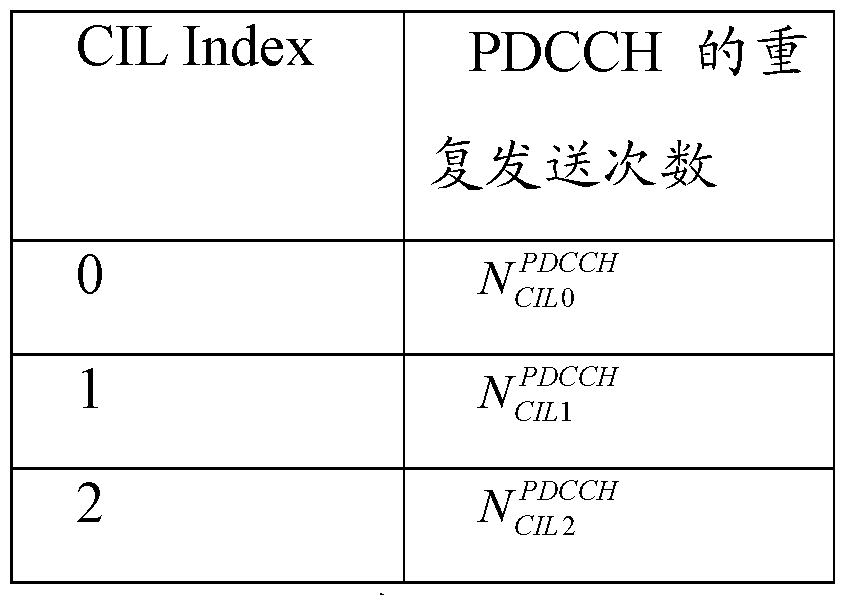
表 10
本示例中, eNB预先配置 PDSCH的重复发送次数与覆盖增强等级的映 射关系,如表 11所示。 CIL0对应的 PDSCH的重复发送次数为 Ν ; CIL1
对应的 PDSCH的重复发送次数为 ; CIL2对应的 PDSCH的重复发送


表 11
本示例中, eNB预先配置 PUCCH的重复发送次数与覆盖增强等级的 映射关系如表 12所示。 CIL0对应的 PUCCH的重复发送次数为 Ν Η; CIL1 对应的 PUCCH的重复发送次数为 N CH; CIL2对应的 PUCCH的重复发送 次数为 PUCCH
N ' ( CIL 2

表 12
本实施例中, eNB预先配置 PUSCH的重复发送次数与覆盖增强等级的 映射关系如表 13所示。 CIL0对应的 PUSCH的重复发送次数为 ; CIL1
^ T PUSCH ^ 对应的 PUSCH的重复发送次数为 ; CIL2对应的 PUSCH的重复发送 次数为 PUSCH
N, CIL 2

1 N PUSCH
i CILl
2 N PUSCH
i CIL2
表 13
本实施例中, UEl为 CI MTC UE, UEl测量 CRS的 RSRP值为 RSRP 且^^ Cre处于^ » 、 «^m c 之间, 则 UEl的覆盖增强等级索引为 CIL Index 0。 UEl根据 CIL Index 0从表 4至表 8中可以获知 PRACH Preamble 重复发送次数为 Νί , PDCCH的重复发送次数为 N CH, PDSCH的重复 发送次数为 /。 , PUCCH的重复发送次数为^ CI^L0 , PUSCH的重复发送 次数为 PUSCH
N ' ( CILO
本示例中, eNB每次在系统信息 ( SIB, System Information Block ) 中 发送的覆盖增强等级的数量信息可以不同。
此外, eNB 可以预先为物理信道配置多套重复发送次数的方案, 以 PRACH Preamble为例,如表 14所示, eNB预先为 PRACH Preamble配置 2 套重复发送次数的方案(TypeO和 Typel )。 eNB在系统信息( SIB, System Information Block ) 中发送的随机接入信道配置信息中通过 lbit来指示配置 的 PRACH Preamble的重复发送次数方案,例如 0代表 TypeO, 1代表 Typel。

表 14
除本实施例外, eNB 可以预先为物理信道配置多套重复发送次数的方 案, 以 PRACH Preamble为例, 如表 15和表 16所示, eNB预先为 PRACH Preamble和 PDCCH配置 2套重复发送次数的方案( TypeO和 Typel )。 eNB 在系统信息 (SIB, System Information Block ) 中发送的随机接入信道配置 信息中通过 1 bit来指示, 例如 0代表 TypeO, 1代表 Type 1。

表 15

表 16
除本实施例外, 两个覆盖增强等级和三个覆盖增强等级时覆盖增强等 级与覆盖增强目标( Coverage Improvement Target, CIT )的映射表格还可以 如表 17和表 18所示, 相邻的两个覆盖增强等级对应的覆盖增强目标值的 取值区间存在交集。
CIL Index Coverage Improvement Target(CIT)
0 OdB <CIV <=9dB
1 6dB <CIV<= 15dB
表 17
CIL Index Coverage Improvement Target(CIT)
0 OdB <CIV <=6dB
1 4dB <CIV<= lldB
2 9dB<CIV<= 15dB
表 18 示例 6: 在 LTE系统中存在 MTC UEs, 并且将 MTC UEs划分为普通 MTC UE ( Normal MTC UE )和覆盖增强 MTC UE ( Coverage Improvement MTC UE , CI MTC UE )。 系统中最多配置三个覆盖增强等级(Coverage Improvement Level, CIL),表 19和表 20分别给两个覆盖增强等级和三个覆 盖增强等级时覆盖增强等级与覆盖增强目标( Coverage Improvement Target, CIT ) 的映射表格。

表 20
eNB 在系统信息中发送随机接入信道配置信息, 其中包括覆盖增强等 级的数量信息。 本实施例中, 覆盖增强等级的数量为 3。 则 CI MTC UE获 知覆盖增强等级与覆盖增强目标( Coverage Improvement Target, CIT )的映 射表格如表 20所示。
eNB 可以预先为物理信道配置多套重复发送次数的方案, 以 PRACH Preamble为例, 如表 21所示, eNB预先为 PRACH Preamble配置 4套重复 发送次数的方案(Type0、 Typel、 Type2、 Type3 )。 eNB在系统信息(SIB, System Information Block )中发送的随机接入信道配置信息中通过 2bit来指 示配置的 PRACH Preamble的重复发送次数方案, 例如 00代表 Type0, 01 代表 Type 1, 10代表 Type2, 11代表 Type3。

表 21
示例 7 在 LTE系统中存在 Legacy UEs和 MTC UEs,并且将 MTC UEs划分为 MTC UE ( Normal MTC UE ) 和覆盖增强 MTC UE ( Coverage Improvement MTC UE, CI MTC UE )0 系统中最多配置三个覆盖增强等级 (Coverage Improvement Level, CIL), 表 22和表 23分别给两个覆盖增强等 级和三个覆盖增强等级时覆盖增强等级与覆盖增强目标 ( Coverage Improvement Target, CIT ) 的映射表格。
CIL Index Coverage Improvement Target(CIT)
0 OdB <CIV <=7.5dB
1 7.5dB <CIV<= 15dB 表 22
CIL Index Coverage Improvement Target(CIT)
0 OdB <CIV <=5dB
1 5dB <CIV<= lOdB
2 10dB<CIV<= 15dB 表 23 eNB在系统信息 (SIB, System Information Block ) 中发送随机接入信 道配置信息, 其中包括覆盖增强等级的数量信息。 本实施例中, 覆盖增强 等级的数量为 3。 则 CI MTC UE 获知覆盖增强等级与覆盖增强目标 ( Coverage Improvement Target, CIT ) 的映射表格如表 23所示。
eNB 预先为物理信道配置重复发送次数的映射方案, 以 PRACH Preamble为例, 如表 24所示, CIL0对应的 PRACH Preamble重复发送次数 为 2次; CIL1对应的 PRACH Preamble重复发送次数为 10次; CIL2对应 的 PRACH Preamble重复发送次数为 50次。

表 24 所述随机接入信道配置信息中还包括为覆盖增强的 MTC UE分配的随机 接入信道的资源; 当为覆盖增强的 MTC UE分配的随机接入信道的时频域资源与为 Legacy
UE分配的随机接入信道的时频域资源相同时, 通过分配不同的随机接入序 列的方式加以区分。
本示例中预先定义: 当为覆盖增强的 MTC UE分配的随机接入序列数量 小于 10条且覆盖增强等级为 3个时, 通过 TDM和 /或 FDM的复用方式划分 各个覆盖增强等级的随机接入信道资源。
本示例中, 例如为覆盖增强的 MTC UE分配 6条随机接入序列, 并且覆 盖增强等级为 3个, 所以需要釆用 TDM和 /或 FDM的复用方式划分各个覆盖 增强等级的随机接入信道资源。
示例 8:
在 LTE系统中存在 Legacy UEs和 MTC UEs, 并且将 MTC UEs划分为普 通 MTC UE ( Normal MTC UE ) 和覆盖增强 MTC UE ( Coverage Improvement MTC UE, CI MTC UE )0 系统中最多配置三个覆盖增强等级 (Coverage Improvement Level, CIL), 表 25和表 26为两个覆盖增强等级和 三个覆盖增强等级时覆盖增强等级与覆盖增强目标 ( Coverage Improvement Target, CIT ) 的映射表格。

表 26
eNB 在系统信息中发送随机接入信道配置信息, 其中包括覆盖增强等
级的数量信息。 本实施例中, 覆盖增强等级的数量为 3。 则 CI MTC UE获 知覆盖增强等级与覆盖增强目标( Coverage Improvement Target, CIT )的映 射表格如表 26所示。
eNB 预先为物理信道配置重复发送次数的映射方案, 以 PRACH Preamble为例如表 27所示, CIL0对应的 PRACH Preamble重复发送次数为 2次; CIL1对应的 PRACH Preamble重复发送次数为 10次; CIL2对应的 PRACH Preamble重复发送次数为 50次。

表 27
所述随机接入信道配置信息中还包括为覆盖增强的 MTC UE分配的随机 接入信道的资源;
为覆盖增强的 MTC UE分配的随机接入信道的时频域资源与为 Legacy UE 分配的随机接入信道的时频域资源不同。 进一步釆用 CDM的方式划分各个 覆盖增强等级的随机接入信道资源, 即不同覆盖增强等级分配不同的随机 接入序列, 且各个覆盖增强等级分配的随机接入序列数量相同。
除本实施例外, 覆盖增强的 MTC UE分配的随机接入信道的时频域资源 与为 Legacy UE 分配的随机接入信道的时频域资源不同。 进一步釆用 CDM 方式划分各个覆盖增强等级的随机接入信道资源, 即不同覆盖增强等级分 配不同的随机接入序列。 各个覆盖增强等级分配的随机接入序列数量可以 配置; 配置的原则可以是以下之一:
根据不同覆盖增强等级的 MTC UE的数量多少划分各个覆盖增强等级分 配的随机接入序列数量;
覆盖增强等级越大的 MTC UE分配的随机接入序列数量越少; 覆盖增强等级越大的 MTC UE分配的随机接入序列数量越多; 保证在相同的时间段内不同覆盖增强等级的 MTC UE可以发送随机接入 序列的机会数量相同或者在同一个量级。 示例 9: 在 LTE系统中存在 Legacy UEs和 MTC UEs,并且将 MTC UEs划分为 普通 MTC UE ( Normal MTC UE ) 和覆盖增强 MTC UE ( Coverage Improvement MTC UE, CI MTC UE )0 系统中最多配置三个覆盖增强等级 (Coverage Improvement Level, CIL), 表 28〜表 30分别给出不同覆盖增强等 级数量时覆盖增强等级与覆盖增强目标( Coverage Improvement Target, CIT ) 的映射表格。
CIL Index Coverage Improvement Target(CIT)
0 OdB <CIV <=15dB 表 28
CIL Index Coverage Improvement Target(CIT)
0 OdB <CIV <=7.5dB
1 7.5dB <CIV<= 15dB 表 29
CIL Index Coverage Improvement Target(CIT)
0 OdB <CIV <=5dB
1 5dB <CIV<= lOdB
2 10dB<CIV<= 15dB 表 30
eNB在系统信息 (SIB, System Information Block ) 中发送随机接入信 道配置信息, 其中包括覆盖增强等级的数量信息。 本实施例中, 覆盖增强 等级的数量为 3。 则 CI MTC UE 获知覆盖增强等级与覆盖增强目标 ( Coverage Improvement Target, CIT ) 的映射表格如表 30所示。
eNB 预先为物理信道配置重复发送次数的映射方案, 以 PRACH Preamble为例, 如表 31所示, CIL0对应的 PRACH Preamble重复发送次数 为 2次; CIL1对应的 PRACH Preamble重复发送次数为 10次; CIL2对应 的 PRACH Preamble重复发送次数为 50次。

表 31
所述随机接入信道配置信息中还包括为覆盖增强的 MTC UE分配的随机 接入信道的资源;
为覆盖增强的 MTC UE分配的随机接入信道的时频域资源与为 Legacy UE 分配的随机接入信道的时频域资源不同。 进一步釆用 CDM的方式划分各个 覆盖增强等级的随机接入信道资源, 即不同覆盖增强等级分配不同的随机 接入序列。 各个覆盖增强等级分配的随机接入序列数量可以配置, 配置的 原则为:
根据不同覆盖增强等级的 MTC UE的数量多少划分各个覆盖增强等级分 配的随机接入序列数量;
本实施例中, 覆盖增强等级的数量为 3, CIL0、 CIL1和 CIL2分配的随 机接入序列数量的比例关系满足 AO: Al : A2。 其中, A 的取值由系统配置 或者由 eNB配置;
除本实施例外, 所述 A 的取值至少由覆盖增强目标值的取值范围的大 小确定;
除本实施例外, 所述 A 的取值至少由覆盖增强等级对应的预定义参考 信号的接收信号质量的取值范围的大小确定;
所述预定义参考信号为以下至少之一:
扇区专用的参考信号 (Cell-Specific Reference Signal, CRS )、 解 调专用的参考信号 (Demodulation Reference Signal, DM-RS )、 主同步信 号 ( Primary synchronization signals, PSS )、 辅同步信号 ( Secondary synchronization signals, SSS )、 物理广播信道 ( Physical Broadcast Channel, PBCH )。
所述预定义参考信号的接收信号质量是指以下之一:
参考信号接收功率 ( Reference Signal Receive Power, RSRP )、 参考 信号接收质量 ( Reference Signal Receive Power, RSRP )、 接收信号强度 指示 ( Received Signal Strength Indicator, RSSI )、 参考信号的接收信 噪比、 目标 UE与 eNB之间的路径损耗值、 成功接收所述预定义参考信号时 所述预定义参考信号重复发送的次数。
所述预定义参考信号的接收信号质量的取值范围是指以下之一: 预定义参考信号的接收信号质量的测量值的取值范围;
预定义参考信号的接收信号质量的测量值与预定义参考信号的接收信 号质量的参考值的差值或差值的绝对值的取值范围; 其中, 所述取值范围 是指取值的最大值或取值的最小值或取值区间段;
其中, 所述预定义参考信号的接收信号质量的参考值由 eNB发送给目 标 UE;
其中, 所述预定义参考信号的接收信号质量的参考值在所述随机接入
信道配置信息中配置。
示例 10:
在 LTE系统中存在 Legacy UEs和 MTC UEs,并且将 MTC UEs划分为 普通 MTC UE ( Normal MTC UE ) 和覆盖增强 MTC UE ( Coverage Improvement MTC UE, CI MTC UE )0 系统中最多配置三个覆盖增强等级 (Coverage Improvement Level, CIL), 表 32〜表 34分别给出不同覆盖增强等 级数量时覆盖增强等级与覆盖增强目标( Coverage Improvement Target, CIT ) 的映射表格。 当配置多个覆盖增强等级时, 每个覆盖增强等级对应的覆盖 增强目标值的取值范围的大小随着覆盖增强等级的等级的变高而变小;


表 34
eNB 在系统信息中发送随机接入信道配置信息, 其中包括覆盖增强等 级的数量信息。 本实施例中, 覆盖增强等级的数量为 3。 则 CI MTC UE获 知覆盖增强等级与覆盖增强目标( Coverage Improvement Target, CIT )的映 射表格如表 34所示。
eNB 预先为物理信道配置重复发送次数的映射方案, 以 PRACH Preamble为例, 如表 35所示, CIL0对应的 PRACH Preamble重复发送次数 为 10次; CIL1对应的 PRACH Preamble重复发送次数为 30次; CIL2对应 的 PRACH Preamble重复发送次数为 50次。

表 35
所述随机接入信道配置信息中还包括为覆盖增强的 MTC UE分配的随机 接入信道的资源。
为覆盖增强的 MTC UE分配的随机接入信道的时频域资源与为 Legacy UE 分配的随机接入信道的时频域资源不同。 进一步釆用 CDM的方式划分各个 覆盖增强等级的随机接入信道资源, 即不同覆盖增强等级分配不同的随机 接入序列。 各个覆盖增强等级分配的随机接入序列数量相同。
除本实施例外, 当配置多个覆盖增强等级时, 每个覆盖增强等级对应 的覆盖增强目标值的取值范围的大小随着覆盖增强等级的等级变大而变 小, 且相邻的覆盖增强等级对应的覆盖增强目标值的取值范围可以存在交 集, 如表 36所示。
CIL Index Coverage Improvement Target(CIT)
0 OdB <CIV <=10dB
1 8dB <CIV<= 13dB
2 12dB<CIV<= 15dB
表 36 当 MTC UE测量覆盖增强目标值落在所述交集中, MTC UE自主选择所属 的覆盖增强等级的等级, 或 MTC UE根据预定义原则选择所属的覆盖增强等 级的等级。
以上所述, 仅为本发明的较佳实施例而已, 并非用于限定本发明的保 护范围。 凡按照本发明原理所作的修改, 都应当理解为落入本发明的保护 范围。
Claims
1、 一种随机接入信道配置信息的发送方法, 所述方法包括:
发送随机接入信道配置信息; 所述随机接入信道配置信息包括第一类 等级的配置信息。
2、 根据权利要求 1所述的方法, 其中, 所述第一等级包括覆盖增强等 级和 /或及物理信道重复发送等级。
3、 根据权利要求 2所述的方法, 其中, 所述物理信道重复发送等级所 对应的物理信道包括以下至少其中之一;
物理随机接入信道 、 物理广播信道、 物理下行控制信道、 增强型物理 下行控制信道、 物理下行共享信道、 物理上行控制信道以及物理上行共享 信道。
4、 根据权利要求 3所述的方法, 其中, 所述物理信道重复发送等级包 括所述物理信道上承载的主要信息、 系统信息、 控制信息、 下行传输块、 上行传输块、 Ms g l消息、 随机接入响应消息、 Ms g 3消息以及 Ms g4消息的 至少其中之一的重复发送等级。
5、 根据权利要求 1所述的方法, 其中, 所述随机接入信道配置信息由 第一类节点或所述第一类节点的管理设备, 配置在系统信息或控制信息中。
6、 根据权利要求 5所述的方法, 其中,
所述系统信息由物理下行共享信道发送;
所述控制信息由物理下行控制信息信道或增强型物理下行控制信道发 送。
7、 根据权利要求 1至 6任一项所述的方法, 其中, 所述第一类等级的 配置信息包括所述第一类节点配置的所述第一类等级的索引信息、 比特映
射信息、 所述第一类等级对应的物理信道的重复发送次数信息、 预定义的 第一等级的等级数量、 配置的第一等级的等级数量、 配置的第一类等级的 最高等级及配置的第一类等级的最低等级的至少其中之一。
8、 根据权利要求 7所述的方法, 其中, 所述第一类等级的配置信息与 第一类信息存在映射关系, 所述映射关系由通信系统设备配置在所述第二 类节点中或者由所述第一类节点发送给所述第二类节点。
9、 根据权利要求 7所述的方法, 其中,
所述第一类信息包括以下至少之一:
所述第一类等级的数量;
配置的所述第一类等级的数量 Nl, 其中 N1为正整数;
所述第一等级所述 N1个等级的索引信息;
预定义的所述第一类等级的数量 N2, 其中 N2为正整数;
所述第一类等级对应的预定义参考信号的接收信号质量的取值范围; 所述第一类等级对应的覆盖增强目标值的取值范围; 其中, 所述取值 范围是指取值的最大值、 或取值的最小值或具体取值或取值区间;
所述第一类等级对应的物理信道的重复发送等级;
所述第一类等级对应的物理信道的重复发送次数的取值范围, 其中, 所述取值范围为具体取值或取值区间。
10、 根据权利要求 9 所述的方法, 其中, 所述第一类等级对应的物理 信道的重复发送次数为预定义取值; 其中所述预定义取值为正整数。
11、 根据权利要求 1 0所述的方法, 其中, 所述 N1个第一类等级取自 于预定义的 N2个第一类等级, 所述 N2为大于或等于所述 N1的正整数。
12、 根据权利要求 9 所述的方法, 其中, 所述第一类等级的配置信息
还包括物理信道重复次数方案指示信息;
其中, 所述物理信道重复次数方案指示信息, 用于指示从第一类等级 预定义的多套物理信道重复次数的取值范围的方案中选择一套。
1 3、 根据权利要求 9 所述的方法, 其中, 所述预定义参考信号包括以 下至少其中之一:
扇区专用的参考信号、 解调专用的参考信号、 主同步信号、 辅同步信 号以及物理广播信道所发送的信号。
14、 根据权利要求 1 3所述的方法, 其中, 所述预定义参考信号的接收 信号质量包括以下至少其中之一:
参考信号接收功率、 参考信号接收质量、 接收信号强度指示、 参考信 号的接收信噪比、 第二类节点与所述第一类节点之间的路径损耗值及成功 接收所述预定义参考信号时所述预定义参考信号的重复发送次数。
15、 根据权利要求 14所述的方法, 其中, 所述预定义参考信号的接收 信号质量的取值范围包括以下至少其中之一:
预定义参考信号的接收信号质量的测量值的取值范围;
预定义参考信号的接收信号质量的测量值与预定义参考信号的接收信 号质量的参考值的差值或差值的绝对值的取值范围;
其中, 所述取值范围是指取值的最大值、 或取值的最小值或具体取值 或取值区间。
16、 根据权利要求 15所述的方法, 其中, 所述预定义参考信号的接收 信号质量的参考值由所述第一类节点发送给所述第二类节点。
17、 根据权利要求 16所述的方法, 其中, 所述预定义参考信号的接收 信号质量的参考值配置在所述随机接入信道配置信息中。
18、 根据权利要求 15所述的方法, 其中, 所述第一类等级不同等级对
应的预定义参考信号的接收信号质量的取值区间所对应的范围大小相同; 或
第一类等级不同等级对应的预定义参考信号的接收信号质量的取值区 间所对应的范围大小随着第一类等级的等级变高而变小; 其中,
所述第一类等级不同等级对应的预定义参考信号的接收信号质量的取 值区间所对应的范围由所述第一类节点在系统消息中配置。
19、 根据权利要求 9 所述的方法, 其中, 所述第一类等级的不同等级 所对应的预定义参考信号的接收信号质量的取值范围不存在交集或者存在 部分交集。
20、 根据权利要求 19所述的方法, 其中, 当所述第二类节点测量得到 的所述预定义参考信号的接收信号质量处于不同等级的交集中时, 所述第 二类节点随机选择或根据预定义原则选择第一类等级所对应的等级。
21、 根据权利要求 9 所述的方法, 其中, 所述第一类等级的不同等级 所对应的覆盖增强目标值的取值范围不存在交集或者存在部分交集。
22、 根据权利要求 21所述的方法, 其中, 当所述第二类节点测量得到 的所述覆盖增强目标值处于不同等级的交集中时, 所述第二类节点随机选 择或根据预定义原则选择第一类等级所对应的等级。
23、 根据权利要求 9 所述的方法, 其中, 所述第一类等级不同等级对 应的覆盖增强目标值的取值范围区间所对应取值范围大小相同;
或
第一类等级不同等级对应的覆盖增强目标值的取值区间所对应的取值 范围的大小随着第一类等级的等级变高而变小;
其中,
所述第一类等级不同等级对应的覆盖增强目标值的取值区间所对应的 范围由所述第一类节点在系统消息中配置。
24、 根据权利要求 1至 4任一项所述的方法, 其中, 所述发送随机接 入信道配置信息为:
按周期发送所述随机接入信道配置信息,
或
在预定义条件的触发下发送所述随机接入信道配置信息。
25、 根据权利要求 9 项所述的方法, 其中, 所述随机接入信道配置信 息中还包括为所述第二类节点分配的随机接入信道资源。
26、 根据权利要求 25所述的方法, 其中, 所述为所述第二类节点分配 的随机接入信道资源包括时域资源、 频域资源及可用随机接入序列的至少 其中之一。
27、 根据权利要求 26所述的方法, 其中, 所述方法还包括: 至少根据 所述第一类等级的数量以及为所述第二类节点分配的随机接入信道资源, 确定各个所述第一类等级分配的随机接入信道资源的复用方式。
28、 根据权利要求 26所述的方法, 其中, 当各个所述第一类等级不同 等级分配的随机接入信道资源通过可用随机接入序列区分时, 各个所述第 一类等级分配的随机接入序列数量正比于所述第一类等级各等级所对应的 所述第二类节点的数量。
29、 根据权利要求 26所述的方法, 其中, 当各个所述第一类等级不同 等级分配的随机接入信道资源通过可用随机接入序列区分时, 各个所述第 一类等级不同等级所分配的随机接入序列数量相同, 且所分配的随机接入 序列不同。
30、 根据权利要求 26所述的方法, 其中, 所述第一类等级的不同等级
所分配的随机接入序列数量随着第一类等级的等级变大而变多。
31、 根据权利要求 26所述的方法, 其中, 当各个所述第一类等级分配 的随机接入信道资源通过可用的随机接入序列区分时, 各个所述第一类等 级分配的随机接入序列数量由所述第一类节点配置。
32、 根据权利要求 26所述的方法, 其中, 当各个所述第一类等级分配 的随机接入信道资源通过可用的随机接入序列区分时, 各个所述第一类等 级分配的随机接入序列数量由所述第一类节点配置。
33、 根据权利要求 26所述的方法, 其中, 所述随机接入信道配置信息 中还包括: 为所述第二类节点分配的随机接入信道资源为根据预定义资源 分配策略分配所述随机接入信道资源;
所述预定以资源分配策略包括第一策略及第二策略;
所述第一策略为可用随机接入序列数量小于第一预定义值、 可用随机 接入序列数量大于第二预定义值及可用随机接入序列数量大于第一预定义 值且小于第二预定义值的其中之一; 所述第一预定义值小于第二预定义值; 所述第二策略为可用随机接入序列数量大于第三预定义值、 可用随机 接入序列数量小于第四预定义值及可用随机接入序列小于第三预定义值且 大于第四预定义值的其中之一; 所述第三预定义值大于第二预定义值; 当满足第一策略时, 所述第一类等级各等级釆用时分复用复用同一频 域资源或釆用频分复用复用同一时域资源; ;
当满足第二策略时, 各个所述第一类等级分配的随机接入信道资源占 用相同的时域资源和 /或频域资源, 并且所述第一类等级各等级分配的随机 接入信道资源包括的随机接入序列不同;
其中, 所述第一预定义值、 第二预定义值、 第三预定义值及第四预定 义值由通信系统设备配置并传输给所述第二类节点, 或者由所述第一类节
点配置并发送给所述第二类节点。
34、 根据权利要求 28所述的方法, 其中, 所述第一类等级两等级所分 配的随机接入序列数量的比例满足预设比例关系 Am (i) : Am (n) ;
其中, i、 n为第一类等级两个不同等级的索引;
m ( i )及 m ( n )为索引为 i和 n所对应的第一类等级两个等级对应的 幂指数, A为底数。
35、 根据权利要求 34所述的方法, 其中, 所述 Am (i) 及 Am (n)
由通信设备根据所述第一类等级各等级对应的预定义参考信号的接收 信号质量的取值范围和 /或所述第一类等级各等级对应的覆盖增强目标值 的取值范围的大小所配置的。
36、 一种随机接入信道配置信息获取方法, 所述方法包括:
接收随机接入信道配置信息; 所述随机接入信道配置信息包括第一类 等级的配置信息;
根据所述第一类等级的配置信息及预定义规则, 在预先存储的第一类 信息表中查询所述第一类信息。
37、 一种随机接入方法, 所述方法包括:
第一类节点发送随机接入信道配置信息; 所述随机接入信道配置信息 包括第一类等级的配置信息;
第二类节点接收所述随机接入信道配置信息;
第二类节点根据第一类等级的配置信息及预定义规则, 在预先存储的 第一类信息表中查询所述第一类信息;
第二类节点依据所述第一类信息随机接入无线网络。
38、 一种通信节点, 所述通信节点为第一类节点; 所述第一类节点包 括:
第一发送单元, 配置为发送随机接入信道配置信息; 所述随机接入信 道配置信息包括第一类等级的配置信息。
39、 一种通信节点, 所述通信节点为第二类节点; 所述第二类节点包 括:
接收单元, 配置为接收随机接入信道配置信息; 所述随机接入信道配 置信息包括第一类等级的配置信息;
查询单元, 配置为根据所述第一类等级的配置信息及根据预定义规则, 在预先存储的第一类信息表中查询所述第一类信息。
40、 一种通信系统, 所述系统包括:
第一类节点, 配置为发送随机接入信道配置信息; 所述随机接入信道 配置信息包括第一类等级的配置信息;
第二类节点, 配置为接收所述随机接入信道配置信息, 根据第一类等 级的配置信息及预定义规则在预先存储的第一类信息表中查询所述第一类 信息及依据所述第一类信息随机接入无线网络。
41、 一种计算机存储介质, 所述计算机存储介质中存储有计算机可执 行指令, 所述计算机可执行指令用于执行权利要求 1至 37所述的方法的至 少其中之一。
Priority Applications (2)
| Application Number | Priority Date | Filing Date | Title |
|---|---|---|---|
| EP14881023.7A EP3101984A4 (en) | 2014-01-28 | 2014-07-23 | Information transmission and acquisition method, access method, node, system and medium |
| US15/114,515 US20160345325A1 (en) | 2014-01-28 | 2014-07-23 | Information transmission and acquisition method, access method, node, system and medium |
Applications Claiming Priority (2)
| Application Number | Priority Date | Filing Date | Title |
|---|---|---|---|
| CN201410042545.9 | 2014-01-28 | ||
| CN201410042545.9A CN104812084A (zh) | 2014-01-28 | 2014-01-28 | 配置信息的发送、获取方法、接入方法、通信节点及系统 |
Publications (1)
| Publication Number | Publication Date |
|---|---|
| WO2015113384A1 true WO2015113384A1 (zh) | 2015-08-06 |
Family
ID=53696430
Family Applications (1)
| Application Number | Title | Priority Date | Filing Date |
|---|---|---|---|
| PCT/CN2014/082840 Ceased WO2015113384A1 (zh) | 2014-01-28 | 2014-07-23 | 信息的发送、获取方法、接入方法、节点、系统和介质 |
Country Status (4)
| Country | Link |
|---|---|
| US (1) | US20160345325A1 (zh) |
| EP (1) | EP3101984A4 (zh) |
| CN (1) | CN104812084A (zh) |
| WO (1) | WO2015113384A1 (zh) |
Cited By (3)
| Publication number | Priority date | Publication date | Assignee | Title |
|---|---|---|---|---|
| WO2017035757A1 (zh) * | 2015-08-31 | 2017-03-09 | 华为技术有限公司 | 一种接入小区的方法、装置及系统 |
| WO2017150863A1 (en) * | 2016-02-29 | 2017-09-08 | Samsung Electronics Co., Ltd. | Apparatus and method for signaling system information |
| CN111475779A (zh) * | 2020-05-19 | 2020-07-31 | 上海闻泰电子科技有限公司 | 图像处理方法、装置、设备及存储介质 |
Families Citing this family (31)
| Publication number | Priority date | Publication date | Assignee | Title |
|---|---|---|---|---|
| CN105812092A (zh) * | 2014-12-31 | 2016-07-27 | 中兴通讯股份有限公司 | 重复发送处理方法、装置及节点 |
| US9930700B2 (en) * | 2015-04-21 | 2018-03-27 | Qualcomm Incorporated | Configurable random access initial power level selection |
| CN106559883A (zh) * | 2015-09-25 | 2017-04-05 | 中兴通讯股份有限公司 | 消息的资源配置方法及装置 |
| US10143013B2 (en) * | 2015-10-02 | 2018-11-27 | Sony Mobile Communications Inc. | Apparatus, systems and methods for user equipment (UE) coverage enhancement level definition, selection and allocation |
| WO2017185304A1 (zh) | 2016-04-28 | 2017-11-02 | 富士通株式会社 | Ra-rnti的确定装置、rar的传输装置、方法以及通信系统 |
| KR102313906B1 (ko) * | 2016-05-13 | 2021-10-18 | 한국전자통신연구원 | 제어 채널을 위한 자원의 설정 정보를 전송하는 방법 및 장치, 상향링크 drs를 위한 자원의 설정 정보를 전송하는 방법 및 장치, 서브프레임/슬롯의 타입을 지시하는 지시자를 전송하는 방법 및 장치, 그리고 하향링크 심볼의 개수를 전송하는 방법 및 장치 |
| US10764811B2 (en) | 2016-05-27 | 2020-09-01 | Huawei Technologies Co., Ltd. | Method for handover to relay node, related device, and system |
| CN109478964B (zh) * | 2016-08-11 | 2022-04-29 | 华为技术有限公司 | 一种调度分配信息传输方法、设备及系统 |
| WO2018084669A1 (en) * | 2016-11-04 | 2018-05-11 | Samsung Electronics Co., Ltd. | Method and user equipment for provisioning minimum system information in wireless communication system |
| EP3549302B1 (en) * | 2017-01-04 | 2024-10-30 | LG Electronics Inc. | Method and apparatus for sharing spectrum between 3gpp lte and nr in wireless communication system |
| US10505799B2 (en) * | 2017-03-20 | 2019-12-10 | Motorola Mobility Llc | System information for changing a configuration |
| CN110521272B (zh) * | 2017-04-19 | 2021-06-04 | 华为技术有限公司 | 一种覆盖模式识别方法以及装置 |
| CN108738141B (zh) * | 2017-04-21 | 2020-04-17 | 中国移动通信有限公司研究院 | 一种物理随机接入信道参数的配置方法、网络侧设备及终端 |
| US11178699B2 (en) | 2017-05-05 | 2021-11-16 | Beijing Xiaomi Mobile Software Co., Ltd. | Random access method and apparatus, user equipment, and computer readable storage medium |
| JP7001307B2 (ja) | 2017-06-22 | 2022-01-19 | ホアウェイ・テクノロジーズ・カンパニー・リミテッド | 通信方法、端末デバイス、ネットワークデバイス、プログラム、および通信システム |
| EP3668248B1 (en) * | 2017-08-16 | 2025-03-12 | Koninklijke Philips N.V. | Random access method and device |
| CN107708132B (zh) * | 2017-11-28 | 2021-01-26 | 中国联合网络通信集团有限公司 | 一种尝试接入次数的获取方法和基站 |
| CN110022610A (zh) * | 2018-01-10 | 2019-07-16 | 维沃移动通信有限公司 | 一种收发信息的方法、终端设备及网络设备 |
| CN110351742A (zh) * | 2018-04-04 | 2019-10-18 | 大唐移动通信设备有限公司 | 一种上行数据发送方法及移动接入设备 |
| WO2019192022A1 (zh) * | 2018-04-06 | 2019-10-10 | Oppo广东移动通信有限公司 | 无线通信方法、终端和网络设备 |
| CN110475363B (zh) | 2018-05-11 | 2024-05-31 | 中兴通讯股份有限公司 | 随机接入资源的选择方法、装置及设备、存储介质 |
| CN110769505B (zh) | 2018-07-26 | 2023-04-18 | 维沃移动通信有限公司 | 随机接入方法、终端及网络设备 |
| WO2020087379A1 (zh) * | 2018-10-31 | 2020-05-07 | 北京小米移动软件有限公司 | 传输随机接入指示信息的方法及装置 |
| CN111132360B (zh) | 2018-11-01 | 2023-10-17 | 中兴通讯股份有限公司 | 消息发送、消息配置方法及装置、存储介质 |
| CN111586878B (zh) * | 2019-02-15 | 2022-10-28 | 华为技术有限公司 | 通信方法及装置 |
| US20220312229A1 (en) * | 2019-06-17 | 2022-09-29 | Telefonaktiebolaget Lm Ericsson (Publ) | Methods and devices for wireless communication |
| WO2021146863A1 (zh) * | 2020-01-20 | 2021-07-29 | Oppo广东移动通信有限公司 | 通信方法、装置及设备 |
| CN111372288B (zh) * | 2020-03-10 | 2023-04-18 | 北京意锐新创科技有限公司 | 适用于支付设备的前导序列传输优化方法和装置 |
| CN119342618A (zh) * | 2020-07-24 | 2025-01-21 | 维沃移动通信有限公司 | 随机接入方法、设备及系统 |
| CN112468380A (zh) * | 2020-11-30 | 2021-03-09 | 杭州和利时自动化有限公司 | 一种数据筛选方法、装置及电子设备和存储介质 |
| US20240080883A1 (en) * | 2021-01-15 | 2024-03-07 | Beijing Xiaomi Mobile Software Co., Ltd. | Method and device for indicating repetition of random access message, and method and device for repetition of random access message |
Citations (3)
| Publication number | Priority date | Publication date | Assignee | Title |
|---|---|---|---|---|
| CN101242669A (zh) * | 2008-03-19 | 2008-08-13 | 中兴通讯股份有限公司 | 一种时分双工系统物理随机接入信道参数配置及指示方法 |
| CN101730258A (zh) * | 2008-10-27 | 2010-06-09 | 展讯通信(上海)有限公司 | 增强随机接入信道的接入方法及用户设备 |
| CN102378389A (zh) * | 2010-08-20 | 2012-03-14 | 中兴通讯股份有限公司 | 一种物理随机接入信道的接入方法和装置 |
Family Cites Families (3)
| Publication number | Priority date | Publication date | Assignee | Title |
|---|---|---|---|---|
| TR201810929T4 (tr) * | 2008-01-11 | 2018-08-27 | Ericsson Telefon Ab L M | Bir iletişim ağında yöntemler ve cihazlar. |
| CN101754344B (zh) * | 2008-12-19 | 2011-11-09 | 中国移动通信集团设计院有限公司 | Td-scdma系统的上行覆盖能力控制方法及用户设备 |
| CN103458528B (zh) * | 2012-05-29 | 2016-12-07 | 华为技术有限公司 | 基于竞争的随机接入方法及设备 |
-
2014
- 2014-01-28 CN CN201410042545.9A patent/CN104812084A/zh not_active Withdrawn
- 2014-07-23 US US15/114,515 patent/US20160345325A1/en not_active Abandoned
- 2014-07-23 EP EP14881023.7A patent/EP3101984A4/en not_active Withdrawn
- 2014-07-23 WO PCT/CN2014/082840 patent/WO2015113384A1/zh not_active Ceased
Patent Citations (3)
| Publication number | Priority date | Publication date | Assignee | Title |
|---|---|---|---|---|
| CN101242669A (zh) * | 2008-03-19 | 2008-08-13 | 中兴通讯股份有限公司 | 一种时分双工系统物理随机接入信道参数配置及指示方法 |
| CN101730258A (zh) * | 2008-10-27 | 2010-06-09 | 展讯通信(上海)有限公司 | 增强随机接入信道的接入方法及用户设备 |
| CN102378389A (zh) * | 2010-08-20 | 2012-03-14 | 中兴通讯股份有限公司 | 一种物理随机接入信道的接入方法和装置 |
Non-Patent Citations (1)
| Title |
|---|
| See also references of EP3101984A4 * |
Cited By (12)
| Publication number | Priority date | Publication date | Assignee | Title |
|---|---|---|---|---|
| WO2017035757A1 (zh) * | 2015-08-31 | 2017-03-09 | 华为技术有限公司 | 一种接入小区的方法、装置及系统 |
| WO2017150863A1 (en) * | 2016-02-29 | 2017-09-08 | Samsung Electronics Co., Ltd. | Apparatus and method for signaling system information |
| CN108605268A (zh) * | 2016-02-29 | 2018-09-28 | 三星电子株式会社 | 用于发信号通知系统信息的设备和方法 |
| US10455621B2 (en) | 2016-02-29 | 2019-10-22 | Samsung Electronics Co., Ltd. | Apparatus and method for signaling system information |
| US10531496B2 (en) | 2016-02-29 | 2020-01-07 | Samsung Electronics Co., Ltd. | Apparatus and method for signaling system information |
| CN108605268B (zh) * | 2016-02-29 | 2021-05-14 | 三星电子株式会社 | 用于发信号通知系统信息的设备和方法 |
| CN113115404A (zh) * | 2016-02-29 | 2021-07-13 | 三星电子株式会社 | 用于发信号通知系统信息的设备和方法 |
| US11219069B2 (en) | 2016-02-29 | 2022-01-04 | Samsung Electronics Co., Ltd. | Apparatus and method for signaling system information |
| US11924883B2 (en) | 2016-02-29 | 2024-03-05 | Samsung Electronics Co., Ltd. | Apparatus and method for signaling system information |
| CN113115404B (zh) * | 2016-02-29 | 2024-04-09 | 三星电子株式会社 | 用于发信号通知系统信息的设备和方法 |
| CN111475779A (zh) * | 2020-05-19 | 2020-07-31 | 上海闻泰电子科技有限公司 | 图像处理方法、装置、设备及存储介质 |
| CN111475779B (zh) * | 2020-05-19 | 2023-11-03 | 昆明闻讯实业有限公司 | 图像处理方法、装置、设备及存储介质 |
Also Published As
| Publication number | Publication date |
|---|---|
| EP3101984A1 (en) | 2016-12-07 |
| EP3101984A4 (en) | 2017-02-01 |
| US20160345325A1 (en) | 2016-11-24 |
| CN104812084A (zh) | 2015-07-29 |
Similar Documents
| Publication | Publication Date | Title |
|---|---|---|
| WO2015113384A1 (zh) | 信息的发送、获取方法、接入方法、节点、系统和介质 | |
| CN104780617B (zh) | 一种非竞争随机接入方法、节点设备及系统 | |
| US11109359B2 (en) | Method and user equipment for transmitting uplink signal and user equipment for receiving uplink signal | |
| US10368352B2 (en) | Data transmission method and apparatus by device to device terminal in wireless communication system | |
| CN108352956B (zh) | 发送信号的方法和装置以及触发信号传输的方法和装置 | |
| KR102181920B1 (ko) | 랜덤 액세스 메시지의 송신을 향상시키기 위한 통신 디바이스 및 방법 | |
| US10080242B2 (en) | Method and system for allocating random access channel resource | |
| EP2929744B1 (en) | System and method for small traffic transmissions | |
| CN104184548B (zh) | 随机接入序列传输方法和装置 | |
| CN108810857B (zh) | 一种资源确定方法、基站及用户设备 | |
| CN103997788B (zh) | 用于设备到设备通信的设备发现方法及用户设备、网络侧设备 | |
| EP4369833B1 (en) | Method and apparatus for transmitting and receiving reference signal for sidelink data in wireless communication system | |
| CN105992383B (zh) | 随机接入响应消息发送方法和节点 | |
| US20150326373A1 (en) | Apparatus and method for avoiding interference in device-to-device wireless communication system | |
| CN110049557A (zh) | 随机接入方法及装置 | |
| US20170303291A1 (en) | Method and device whereby device-to-device terminal transmits signals in order of priority in wireless communication system | |
| KR20200057098A (ko) | 시간 도메인 구성 및 관련된 무선 단말 및 네트워크 노드를 포함하는 업링크 그랜트를 제공하는 방법 | |
| WO2016188250A1 (zh) | 一种资源分配的方法和装置 | |
| KR102249733B1 (ko) | 무선 통신 시스템에서 단말 간 디스커버리 방법 | |
| US10476834B2 (en) | System and method for random access | |
| CN105338589A (zh) | 随机接入响应消息的传输方法及装置 | |
| US20220322302A1 (en) | Method and device for performing sidelink communication using coordination information | |
| WO2022222106A1 (zh) | 传输物理侧行反馈信道psfch的方法和终端设备 | |
| KR20200105404A (ko) | 무선 통신 시스템에서 리소스 풀을 운영하는 방법 및 장치 | |
| KR20200105436A (ko) | 무선 통신 시스템에서 리소스 풀을 운영하는 방법 및 장치 |
Legal Events
| Date | Code | Title | Description |
|---|---|---|---|
| 121 | Ep: the epo has been informed by wipo that ep was designated in this application |
Ref document number: 14881023 Country of ref document: EP Kind code of ref document: A1 |
|
| WWE | Wipo information: entry into national phase |
Ref document number: 15114515 Country of ref document: US |
|
| NENP | Non-entry into the national phase |
Ref country code: DE |
|
| REEP | Request for entry into the european phase |
Ref document number: 2014881023 Country of ref document: EP |
|
| WWE | Wipo information: entry into national phase |
Ref document number: 2014881023 Country of ref document: EP |