WO2015113903A1 - Verfahren zur herstellung von 1-indanolen und 1-indanaminen - Google Patents
Verfahren zur herstellung von 1-indanolen und 1-indanaminen Download PDFInfo
- Publication number
- WO2015113903A1 WO2015113903A1 PCT/EP2015/051344 EP2015051344W WO2015113903A1 WO 2015113903 A1 WO2015113903 A1 WO 2015113903A1 EP 2015051344 W EP2015051344 W EP 2015051344W WO 2015113903 A1 WO2015113903 A1 WO 2015113903A1
- Authority
- WO
- WIPO (PCT)
- Prior art keywords
- hydrogen
- alkyl
- methyl
- cor
- palladium
- Prior art date
- Legal status (The legal status is an assumption and is not a legal conclusion. Google has not performed a legal analysis and makes no representation as to the accuracy of the status listed.)
- Ceased
Links
- 0 CC1(*)C([*+])c(cc(c(OC)c2)OC)c2BrC1 Chemical compound CC1(*)C([*+])c(cc(c(OC)c2)OC)c2BrC1 0.000 description 2
- JXFKJMQLMWJUSY-UHFFFAOYSA-N CC(C)(C[BrH]c1c2cccc1)C2N(C(c1ccccc11)=O)C1=O Chemical compound CC(C)(C[BrH]c1c2cccc1)C2N(C(c1ccccc11)=O)C1=O JXFKJMQLMWJUSY-UHFFFAOYSA-N 0.000 description 1
- NKFIOPKKWKZOFX-UHFFFAOYSA-N CC(C)(Cc1ccccc11)C1N(C(c1ccccc11)=O)C1=O Chemical compound CC(C)(Cc1ccccc11)C1N(C(c1ccccc11)=O)C1=O NKFIOPKKWKZOFX-UHFFFAOYSA-N 0.000 description 1
Classifications
-
- C—CHEMISTRY; METALLURGY
- C07—ORGANIC CHEMISTRY
- C07F—ACYCLIC, CARBOCYCLIC OR HETEROCYCLIC COMPOUNDS CONTAINING ELEMENTS OTHER THAN CARBON, HYDROGEN, HALOGEN, OXYGEN, NITROGEN, SULFUR, SELENIUM OR TELLURIUM
- C07F7/00—Compounds containing elements of Groups 4 or 14 of the Periodic Table
- C07F7/02—Silicon compounds
- C07F7/08—Compounds having one or more C—Si linkages
- C07F7/0803—Compounds with Si-C or Si-Si linkages
- C07F7/081—Compounds with Si-C or Si-Si linkages comprising at least one atom selected from the elements N, O, halogen, S, Se or Te
-
- B—PERFORMING OPERATIONS; TRANSPORTING
- B01—PHYSICAL OR CHEMICAL PROCESSES OR APPARATUS IN GENERAL
- B01J—CHEMICAL OR PHYSICAL PROCESSES, e.g. CATALYSIS OR COLLOID CHEMISTRY; THEIR RELEVANT APPARATUS
- B01J23/00—Catalysts comprising metals or metal oxides or hydroxides, not provided for in group B01J21/00
- B01J23/38—Catalysts comprising metals or metal oxides or hydroxides, not provided for in group B01J21/00 of noble metals
- B01J23/40—Catalysts comprising metals or metal oxides or hydroxides, not provided for in group B01J21/00 of noble metals of the platinum group metals
- B01J23/44—Palladium
-
- C—CHEMISTRY; METALLURGY
- C07—ORGANIC CHEMISTRY
- C07C—ACYCLIC OR CARBOCYCLIC COMPOUNDS
- C07C209/00—Preparation of compounds containing amino groups bound to a carbon skeleton
- C07C209/54—Preparation of compounds containing amino groups bound to a carbon skeleton by rearrangement reactions
- C07C209/58—Preparation of compounds containing amino groups bound to a carbon skeleton by rearrangement reactions from or via amides
-
- C—CHEMISTRY; METALLURGY
- C07—ORGANIC CHEMISTRY
- C07C—ACYCLIC OR CARBOCYCLIC COMPOUNDS
- C07C211/00—Compounds containing amino groups bound to a carbon skeleton
- C07C211/33—Compounds containing amino groups bound to a carbon skeleton having amino groups bound to carbon atoms of rings other than six-membered aromatic rings
- C07C211/39—Compounds containing amino groups bound to a carbon skeleton having amino groups bound to carbon atoms of rings other than six-membered aromatic rings of an unsaturated carbon skeleton
- C07C211/41—Compounds containing amino groups bound to a carbon skeleton having amino groups bound to carbon atoms of rings other than six-membered aromatic rings of an unsaturated carbon skeleton containing condensed ring systems
- C07C211/42—Compounds containing amino groups bound to a carbon skeleton having amino groups bound to carbon atoms of rings other than six-membered aromatic rings of an unsaturated carbon skeleton containing condensed ring systems with six-membered aromatic rings being part of the condensed ring systems
-
- C—CHEMISTRY; METALLURGY
- C07—ORGANIC CHEMISTRY
- C07C—ACYCLIC OR CARBOCYCLIC COMPOUNDS
- C07C67/00—Preparation of carboxylic acid esters
- C07C67/28—Preparation of carboxylic acid esters by modifying the hydroxylic moiety of the ester, such modification not being an introduction of an ester group
- C07C67/297—Preparation of carboxylic acid esters by modifying the hydroxylic moiety of the ester, such modification not being an introduction of an ester group by splitting-off hydrogen or functional groups; by hydrogenolysis of functional groups
-
- C—CHEMISTRY; METALLURGY
- C07—ORGANIC CHEMISTRY
- C07C—ACYCLIC OR CARBOCYCLIC COMPOUNDS
- C07C69/00—Esters of carboxylic acids; Esters of carbonic or haloformic acids
- C07C69/02—Esters of acyclic saturated monocarboxylic acids having the carboxyl group bound to an acyclic carbon atom or to hydrogen
- C07C69/22—Esters of acyclic saturated monocarboxylic acids having the carboxyl group bound to an acyclic carbon atom or to hydrogen having three or more carbon atoms in the acid moiety
- C07C69/24—Esters of acyclic saturated monocarboxylic acids having the carboxyl group bound to an acyclic carbon atom or to hydrogen having three or more carbon atoms in the acid moiety esterified with monohydroxylic compounds
-
- C—CHEMISTRY; METALLURGY
- C07—ORGANIC CHEMISTRY
- C07C—ACYCLIC OR CARBOCYCLIC COMPOUNDS
- C07C69/00—Esters of carboxylic acids; Esters of carbonic or haloformic acids
- C07C69/62—Halogen-containing esters
- C07C69/63—Halogen-containing esters of saturated acids
-
- C—CHEMISTRY; METALLURGY
- C07—ORGANIC CHEMISTRY
- C07D—HETEROCYCLIC COMPOUNDS
- C07D209/00—Heterocyclic compounds containing five-membered rings, condensed with other rings, with one nitrogen atom as the only ring hetero atom
- C07D209/02—Heterocyclic compounds containing five-membered rings, condensed with other rings, with one nitrogen atom as the only ring hetero atom condensed with one carbocyclic ring
- C07D209/44—Iso-indoles; Hydrogenated iso-indoles
- C07D209/48—Iso-indoles; Hydrogenated iso-indoles with oxygen atoms in positions 1 and 3, e.g. phthalimide
-
- C—CHEMISTRY; METALLURGY
- C07—ORGANIC CHEMISTRY
- C07F—ACYCLIC, CARBOCYCLIC OR HETEROCYCLIC COMPOUNDS CONTAINING ELEMENTS OTHER THAN CARBON, HYDROGEN, HALOGEN, OXYGEN, NITROGEN, SULFUR, SELENIUM OR TELLURIUM
- C07F7/00—Compounds containing elements of Groups 4 or 14 of the Periodic Table
- C07F7/02—Silicon compounds
- C07F7/08—Compounds having one or more C—Si linkages
- C07F7/18—Compounds having one or more C—Si linkages as well as one or more C—O—Si linkages
- C07F7/1804—Compounds having Si-O-C linkages
- C07F7/1872—Preparation; Treatments not provided for in C07F7/20
-
- C—CHEMISTRY; METALLURGY
- C07—ORGANIC CHEMISTRY
- C07B—GENERAL METHODS OF ORGANIC CHEMISTRY; APPARATUS THEREFOR
- C07B2200/00—Indexing scheme relating to specific properties of organic compounds
- C07B2200/07—Optical isomers
-
- C—CHEMISTRY; METALLURGY
- C07—ORGANIC CHEMISTRY
- C07C—ACYCLIC OR CARBOCYCLIC COMPOUNDS
- C07C2523/00—Catalysts comprising metals or metal oxides or hydroxides, not provided for in group C07C2521/00
- C07C2523/38—Catalysts comprising metals or metal oxides or hydroxides, not provided for in group C07C2521/00 of noble metals
- C07C2523/40—Catalysts comprising metals or metal oxides or hydroxides, not provided for in group C07C2521/00 of noble metals of the platinum group metals
- C07C2523/44—Palladium
-
- C—CHEMISTRY; METALLURGY
- C07—ORGANIC CHEMISTRY
- C07C—ACYCLIC OR CARBOCYCLIC COMPOUNDS
- C07C2602/00—Systems containing two condensed rings
- C07C2602/02—Systems containing two condensed rings the rings having only two atoms in common
- C07C2602/04—One of the condensed rings being a six-membered aromatic ring
- C07C2602/08—One of the condensed rings being a six-membered aromatic ring the other ring being five-membered, e.g. indane
Definitions
- the invention relates to a process for the preparation of 1-indanols and 1 - indanamines by palladium-catalyzed arylation and their use as intermediates for the synthesis of fine chemicals and agrochemical active ingredients.
- 1-indanols and 1-indanamines of the formula (I) in which Y represents a substituted hydroxyl or amino group, represent an important structural element in a large number of agronomically active substances, as described, for example, in WO 2004/069814 A1 and WO 2007 / 1 12834 A1.
- Hui Fang et al . "Rapid Catalyst Screening by a Continuous Flow Microreactor Interfaced with Ultra High Pressure Liquid Chromatography," The Journal of Organic Chemistry
- the object of the present invention is to provide a process for the preparation of 1-indanols and 1-indanamines which overcomes the disadvantages of the processes known from the prior art.
- 1-indanols and 1-indanamines can be prepared in high yields by palladium-catalyzed arylation of 1- (2-halophenyl) alkane-1-ols or 1- (2-halophenyl) alkane-1 - amines.
- An object of the present invention is thus a process for the preparation of 1-indanols and 1-indanamines of the general formula (I), characterized in that 1- (2-halo-phenyl) alkan-1-ols or 1- (2-halophenyl alkane-1-amine (II)
- Y is NR 1 R 2 or OR 3 ,
- R 1 is hydrogen or COR 4 ,
- R 2 is COR 4 ,
- R 1 and R 2 together form the group COCH 2 CH 2 CO or CO-phenylene-CO
- R 3 is Si (R 5 ) 3 or pivaloyl (2,2-dimethylpropanoyl),
- R 4 is (C 1 -C 6) -alkyl or phenyl
- R 5 is (C 1 -C 6) -alkyl or phenyl
- Hai means chlorine, bromine or iodine
- R is fluorine, (C 1 -C 3 ) -alkyl or (C 1 -C 3 ) -alkoxy,
- X 1 is hydrogen or (C 1 -C 6 ) -alkyl
- X 2 is hydrogen or (C 1 -C 6 ) -alkyl
- X 3 is hydrogen or (C 1 -C 6 ) -alkyl
- X 4 is hydrogen or (C 1 -C 6 ) -alkyl
- Y and X 1 together with the carbon atoms to which they are attached form a 5- to 7-membered saturated ring, m is 0, 1, 2 or 3.
- Suitable palladium catalysts are, for example, Pd (OAc) 2, Pd2dba3
- the palladium catalyst is usually used in an amount of 0.1 to 10 mol%, preferably 1 to 10 mol%, particularly preferably 1 to 5 mol%, based on the compound (II).
- Suitable phosphine ligands are, for example, trialkylphosphines,
- Tricycloalkylphosphines such as tricyclohexylphosphine, triarylphosphines such as
- the phosphines can also be used in the form of salts, for example with HBF 4 .
- the phosphine ligands are usually used in an amount of 0.1 to 10 mol%, preferably 1 to 10 mol%, particularly preferably 1 to 5 mol%, based on the compound (II).
- Palladium catalysts and phosphine ligands may be used as separate compounds, or conveniently in the form of a preformed complex, e.g. as tretrakis (triphenylphosphinyl) palladium, which is particularly preferred.
- Suitable bases are, for example, carbonates, bicarbonates, phosphates, alkoxides and carboxylates of alkali metals, such as L12CO3, Na2CO3, K2CO3, NaHCO3, KHCO3, K 3 PO 4, K 2 HPO 4, NaOMe, NaOEt, NaOiPr, NaOtBu, KOMe, KOEt, KOiPr, KOtBu, NaOAc, KOAc, NaOPiv (sodium pivalate), KOPiv, NaOCOPh and KOCOPh or mixtures of such bases.
- Preference is given to mixtures of carbonates and carboxylates. Particularly preferred is the mixture of K2CO3 and KOPiv.
- the base is usually used in a 1 to 5 molar ratio based on the compound (II).
- Suitable solvents include, for example, aromatics such as toluene, xylene, chlorobenzene and anisole; Ethers such as dibutyl ether, diphenyl ether and polyglycol ether; Esters such as butyl acetate and isopropyl acetate; Amides such as dimethylacetamide, dimethylformamide, and dibutylformamide or mixtures thereof.
- aromatic solvents such as xylene.
- the preparation process of the invention is usually carried out at elevated temperature of about 100 ° C to the boiling point of the respective solvent.
- Preferred is a range of 120 to 150 ° C. If the boiling point of the particular solvent should be below, it is expedient to work under pressure.
- R 1 means
- R 2 means
- R 3 means
- R 4 means
- R 5 means
- R means
- Y and X 1 together with the carbon atoms to which they are attached form a 5- to 7-membered saturated ring, m is 0, 1, 2 or 3.
- alkyl radicals having more than two carbon atoms may be straight-chain or branched.
- Alkyl radicals mean e.g. Methyl, ethyl, n- or i-propyl, n-, i-, t- or 2-butyl, pentyls, hexyls, such as n-hexyl, i-hexyl and 1, 3-dimethylbutyl.
- the palladium catalyst (0.015 mmol, 5 mol%)
- the phosphine ligand (0.03 mmol, 10 mol%) and the base, for example, potassium pivalate (0.030 mmol, 10 mol%) and K 2 CO 3 (0.3 mmol, 1, 0 eq.) Submitted and the Solvent (3 ml of xylene) and a compound of formula (II) (0.3 mmol, 1 .0 eq.) Was added.
- the mixture is then stirred for 10 minutes at room temperature and then heated to 140 ° C and stirred for 16 hours at this temperature. After cooling the reaction mixture to room temperature, the mixture is filtered, the solvent is stripped off and the residue is purified by chromatography.
- Example 1 Preparation of 2,2-dimethyl-2,3-dihydro-1H-inden-1-yl) oxy) triisopropylsilane from [1- (2-bromophenyl) -2,2-dimethylpropoxy] (triisopropyl) silane
- Example 2 Preparation of ((2 ', 3'-dihydrospiro [cyclopropane-1,1'-inden-3'-yl) oxy) triisopropylsilane from [1- (2-bromophenyl) -cyclopropylethoxy] (triisopropyl) silane
- Example 3 Preparation of ((5,6-dimethoxy-2,2-dimethyl-2,3-dihydro-1H-inden-1-yl) oxy) triisopropylsilane from [1- (2-bromo-4,5-) dimethoxyphenyl) -2,2-dimethylpropoxy] (tri-tert-butyl) silane
- Example 4 Preparation of ((6-methoxy-2,2-dimethyl-2,3-dihydro-1H-inden-1-yl) oxy) triisopropylsilane from [1- (2-bromo-5-methoxyphenyl) -2 , 2-dimethylpropoxy] (tri-tert-butyl) silane
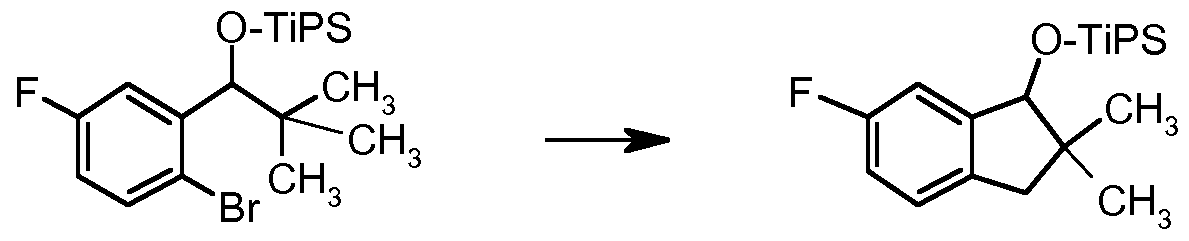
- Example 5 Preparation of ((6-Fluoro-2,2-dimethyl-2,3-dihydro-1H-inden-1-yl) oxy) triisopropylsilane from [1- (2-bromo-5-fluorophenyl) -2 , 2-dimethylpropoxy] (tri-tert-butyl) silane
- Example 7 Preparation of 6-methoxy-2,2-dimethyl-2,3-dihydro-1H-inden-1-yl-2,2-dimethylpropanoate from 1- (2-bromo-5-methoxyphenyl) -2, 2-dimethylpropyl-2,2-dimethylpropanoate
- Example 8 Preparation of 6-fluoro-2,2-dimethyl-2,3-dihydro-1H-inden-1-yl-2,2-dimethylpropanoate from 1- (2-bromo-5-fluorophenyl) -2, 2-dimethylpropyl-2,2-dimethylpropanoate
- Example 1 Preparation of 2- (2,2-dimethyl-2,3-dihydro-1H-inden-1-yl) isoindoline-1,3-dione from 2- [1- (2-bromophenyl) -2 , 2-dimethylpropyl] -1H-isoindole-1,3-2H-dione
- Example 12 Preparation of (1R, 2S) -2,6-dimethylindan-1-mannin from 2- [1- (2-bromo-5-methylphenyl) -2-methylpropyl] -1H-isoindole-1,3 (2H) -dione via 2 - [(1R, 2S) -2,6-dimethyl-2,3-dihydro-1H-inden-1-yl] -1H-isoindole-1,3 (2H) - dion
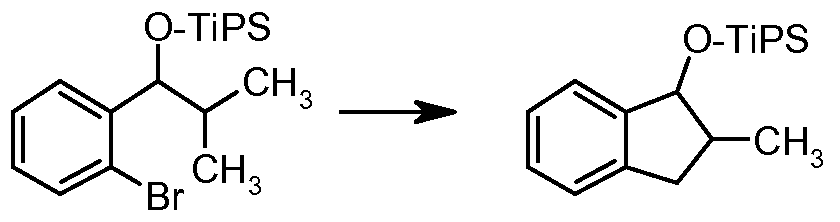
- Example 13 Preparation of triisopropyl ((2-methyl-2,3-dihydro-1H-inden-1-yl) oxy) silane from [1- (2-bromophenyl) -2-methylpropoxy] (triisopropyl) silane This reaction was carried out with various palladium catalysts, phosphine ligands and amounts of bases. The results obtained under different conditions are listed in tabular form:
Landscapes
- Chemical & Material Sciences (AREA)
- Organic Chemistry (AREA)
- Chemical Kinetics & Catalysis (AREA)
- Engineering & Computer Science (AREA)
- Materials Engineering (AREA)
- Organic Low-Molecular-Weight Compounds And Preparation Thereof (AREA)
- Low-Molecular Organic Synthesis Reactions Using Catalysts (AREA)
- Catalysts (AREA)
- Indole Compounds (AREA)
- Furan Compounds (AREA)
Abstract
Description





Claims

Priority Applications (10)
| Application Number | Priority Date | Filing Date | Title |
|---|---|---|---|
| CN201580005701.7A CN106414420B (zh) | 2014-01-28 | 2015-01-23 | 制备1-茚满醇和1-茚满胺的方法 |
| KR1020167022941A KR102362143B1 (ko) | 2014-01-28 | 2015-01-23 | 1-인다놀 및 1-인단아민의 제조방법 |
| MX2016009839A MX362690B (es) | 2014-01-28 | 2015-01-23 | Metodo para producir 1-indanoles y 1-indanaminas. |
| EP15701198.2A EP3099671B1 (de) | 2014-01-28 | 2015-01-23 | Verfahren zur herstellung von 1-indanolen und 1-indanaminen |
| DK15701198.2T DK3099671T3 (da) | 2014-01-28 | 2015-01-23 | Fremgangsmåde til fremstilling af 1-indanoler og 1-indanaminer |
| JP2016565561A JP6475265B2 (ja) | 2014-01-28 | 2015-01-23 | 1−インダノールおよび1−インダンアミンを製造する方法 |
| US15/114,385 US9796737B2 (en) | 2014-01-28 | 2015-01-23 | Method for producing 1-indanoles and 1-indanamines |
| BR112016017513-1A BR112016017513B1 (pt) | 2014-01-28 | 2015-01-23 | Processo para preparação de 1-indanóis e 1-indanaminas |
| ES15701198.2T ES2657797T3 (es) | 2014-01-28 | 2015-01-23 | Procedimiento para producir 1-indanoles y 1-indanaminas |
| IL246831A IL246831B (en) | 2014-01-28 | 2016-07-19 | Method for producing 1-indanoles and 1-indanamines |
Applications Claiming Priority (2)
| Application Number | Priority Date | Filing Date | Title |
|---|---|---|---|
| EP14152790 | 2014-01-28 | ||
| EP14152790.3 | 2014-01-28 |
Publications (1)
| Publication Number | Publication Date |
|---|---|
| WO2015113903A1 true WO2015113903A1 (de) | 2015-08-06 |
Family
ID=49999830
Family Applications (1)
| Application Number | Title | Priority Date | Filing Date |
|---|---|---|---|
| PCT/EP2015/051344 Ceased WO2015113903A1 (de) | 2014-01-28 | 2015-01-23 | Verfahren zur herstellung von 1-indanolen und 1-indanaminen |
Country Status (12)
| Country | Link |
|---|---|
| US (1) | US9796737B2 (de) |
| EP (1) | EP3099671B1 (de) |
| JP (1) | JP6475265B2 (de) |
| KR (1) | KR102362143B1 (de) |
| CN (1) | CN106414420B (de) |
| BR (1) | BR112016017513B1 (de) |
| DK (1) | DK3099671T3 (de) |
| ES (1) | ES2657797T3 (de) |
| IL (1) | IL246831B (de) |
| MX (1) | MX362690B (de) |
| TW (1) | TWI668201B (de) |
| WO (1) | WO2015113903A1 (de) |
Cited By (4)
| Publication number | Priority date | Publication date | Assignee | Title |
|---|---|---|---|---|
| WO2024201469A1 (en) | 2023-03-29 | 2024-10-03 | Adama Agan Ltd. | Process for the preparation of amine intermediates |
| EP4722192A1 (de) | 2024-10-03 | 2026-04-08 | Adama Agan Ltd. | Verfahren zur herstellung von amidzwischenprodukten |
| EP4800002A1 (de) | 2025-02-27 | 2026-09-02 | Bayer Aktiengesellschaft | Substituierte indanylcarboxamide sowie deren salze und ihre verwendung als herbizide wirkstoffe |
| EP4800010A1 (de) | 2025-02-27 | 2026-09-02 | Bayer Aktiengesellschaft | Substituierte indanylaminotriazine sowie deren salze und ihre verwendung als herbizide wirkstoffe |
Families Citing this family (4)
| Publication number | Priority date | Publication date | Assignee | Title |
|---|---|---|---|---|
| WO2019224179A1 (en) * | 2018-05-23 | 2019-11-28 | Bayer Aktiengesellschaft | Process for producing substituted 4-aminoindane derivatives from 2-(hydroxyalkyl)-anilines |
| CN109438253B (zh) * | 2018-10-08 | 2021-04-23 | 苏利制药科技江阴有限公司 | 一种合成2-氨基茚的方法 |
| CA3153003C (en) | 2018-11-29 | 2023-10-17 | Bayer Cropscience Lp | Herbicidal compositions for animal grazelands and methods for applying the same |
| CN113797978B (zh) * | 2021-10-12 | 2023-11-07 | 青岛科技大学 | 一类聚三芳基氧膦负载钯/铜双金属催化剂的制备方法及应用 |
Family Cites Families (5)
| Publication number | Priority date | Publication date | Assignee | Title |
|---|---|---|---|---|
| DK1592674T3 (da) | 2003-02-05 | 2014-06-16 | Bayer Cropscience Ag | Amino-1,3,5-triaziner, der er n-substitueret med chirale bicykliske radikaler, fremgangsmåde til fremstilling af disse, sammensætninger dermed og deres anendelse som herbicider og plantevækstregulatorer |
| US7804803B2 (en) * | 2005-07-25 | 2010-09-28 | Honeywell International Inc. | Neighbor based TDMA slot assignment |
| TR201815377T4 (tr) | 2006-03-29 | 2018-11-21 | Bayer Cropscience Ag | Diflufenican, flufenacet ve flurtamone içeren herbisit maddeler. |
| CA2647811A1 (en) * | 2006-03-30 | 2007-10-11 | Asahi Kasei Pharma Corporation | Substituted bicyclic derivative and use thereof |
| KR100929437B1 (ko) | 2007-08-02 | 2009-12-03 | 포항공과대학교 산학협력단 | 광학 활성을 갖는 아민의 제조방법 |
-
2015
- 2015-01-23 US US15/114,385 patent/US9796737B2/en active Active
- 2015-01-23 WO PCT/EP2015/051344 patent/WO2015113903A1/de not_active Ceased
- 2015-01-23 EP EP15701198.2A patent/EP3099671B1/de active Active
- 2015-01-23 MX MX2016009839A patent/MX362690B/es active IP Right Grant
- 2015-01-23 KR KR1020167022941A patent/KR102362143B1/ko active Active
- 2015-01-23 ES ES15701198.2T patent/ES2657797T3/es active Active
- 2015-01-23 BR BR112016017513-1A patent/BR112016017513B1/pt active IP Right Grant
- 2015-01-23 JP JP2016565561A patent/JP6475265B2/ja active Active
- 2015-01-23 DK DK15701198.2T patent/DK3099671T3/da active
- 2015-01-23 CN CN201580005701.7A patent/CN106414420B/zh active Active
- 2015-01-26 TW TW104102456A patent/TWI668201B/zh active
-
2016
- 2016-07-19 IL IL246831A patent/IL246831B/en active IP Right Grant
Non-Patent Citations (4)
| Title |
|---|
| CATHLEEN PIERRE ET AL: "Synthesis of Polycyclic Molecules by Double C(sp 2 )-H/C(sp 3 )-H Arylations with a Single Palladium Catalyst", ORGANIC LETTERS, vol. 13, no. 7, 1 April 2011 (2011-04-01), pages 1816 - 1819, XP055123277, ISSN: 1523-7060, DOI: 10.1021/ol200329e * |
| HUI FANG ET AL: "Rapid Catalyst Screening by a Continuous-Flow Microreactor Interfaced with Ultra-High-Pressure Liquid Chromatography", THE JOURNAL OF ORGANIC CHEMISTRY, vol. 75, no. 16, 20 August 2010 (2010-08-20), pages 5619 - 5626, XP055123361, ISSN: 0022-3263, DOI: 10.1021/jo100981e * |
| J. A. PINCOCK ET AL: "The Photochemistry of Conformationally Rigid Benzylic Esters: 2,2-Dimethyl-1-indanyl Acetates and Pivalates", THE JOURNAL OF ORGANIC CHEMISTRY, vol. 60, no. 13, 1 June 1995 (1995-06-01), pages 4067 - 4076, XP055123358, ISSN: 0022-3263, DOI: 10.1021/jo00118a024 * |
| NICOLAS MARTIN ET AL: "Diastereo- and Enantioselective Intramolecular C(sp3)-H Arylation for the Synthesis of Fused Cyclopentanes", CHEMISTRY - A EUROPEAN JOURNAL, vol. 18, no. 15, 10 April 2012 (2012-04-10), pages 4480 - 4484, XP055123282, ISSN: 0947-6539, DOI: 10.1002/chem.201200018 * |
Cited By (7)
| Publication number | Priority date | Publication date | Assignee | Title |
|---|---|---|---|---|
| WO2024201469A1 (en) | 2023-03-29 | 2024-10-03 | Adama Agan Ltd. | Process for the preparation of amine intermediates |
| EP4722192A1 (de) | 2024-10-03 | 2026-04-08 | Adama Agan Ltd. | Verfahren zur herstellung von amidzwischenprodukten |
| WO2026074562A1 (en) | 2024-10-03 | 2026-04-09 | Adama Agan Ltd. | Process for the preparation of amide intermediates |
| EP4800002A1 (de) | 2025-02-27 | 2026-09-02 | Bayer Aktiengesellschaft | Substituierte indanylcarboxamide sowie deren salze und ihre verwendung als herbizide wirkstoffe |
| EP4800010A1 (de) | 2025-02-27 | 2026-09-02 | Bayer Aktiengesellschaft | Substituierte indanylaminotriazine sowie deren salze und ihre verwendung als herbizide wirkstoffe |
| WO2026180652A1 (de) | 2025-02-27 | 2026-09-03 | Bayer Aktiengesellschaft | Substituierte indanylaminotriazine sowie deren salze und ihre verwendung als herbizide wirkstoffe |
| WO2026180653A1 (de) | 2025-02-27 | 2026-09-03 | Bayer Aktiengesellschaft | Substituierte indanylcarboxamide sowie deren salze und ihre verwendung als herbizide wirkstoffe |
Also Published As
| Publication number | Publication date |
|---|---|
| CN106414420A (zh) | 2017-02-15 |
| CN106414420B (zh) | 2018-12-14 |
| MX362690B (es) | 2019-02-01 |
| EP3099671A1 (de) | 2016-12-07 |
| JP6475265B2 (ja) | 2019-02-27 |
| TW201613843A (en) | 2016-04-16 |
| BR112016017513B1 (pt) | 2022-03-03 |
| EP3099671B1 (de) | 2017-12-27 |
| ES2657797T3 (es) | 2018-03-06 |
| BR112016017513A2 (de) | 2017-08-08 |
| TWI668201B (zh) | 2019-08-11 |
| KR20160113643A (ko) | 2016-09-30 |
| KR102362143B1 (ko) | 2022-02-10 |
| IL246831B (en) | 2018-11-29 |
| US20160340370A1 (en) | 2016-11-24 |
| MX2016009839A (es) | 2016-10-31 |
| DK3099671T3 (da) | 2018-01-29 |
| JP2017508783A (ja) | 2017-03-30 |
| US9796737B2 (en) | 2017-10-24 |
Similar Documents
| Publication | Publication Date | Title |
|---|---|---|
| EP3099671B1 (de) | Verfahren zur herstellung von 1-indanolen und 1-indanaminen | |
| He et al. | Heterogeneous Platinum‐Catalyzed C H Perfluoroalkylation of Arenes and Heteroarenes | |
| Tietze et al. | Total Synthesis of Linoxepin through a Palladium‐Catalyzed Domino Reaction | |
| EP2668153B1 (de) | Verfahren zur herstellung von 2-aminobenzamin-derivaten | |
| DE60125747T2 (de) | Verfahren zur herstellung von 2-halobenzoesäuren | |
| Li et al. | Ruthenium‐Catalyzed Site‐Selective Trifluoromethylations and (Per) Fluoroalkylations of Anilines and Indoles | |
| JPWO2013099819A1 (ja) | バナジウム錯体を用いたファルネサールの製造方法 | |
| EP3215481A1 (de) | Verfahren zum herstellen von biphenylaminen aus azobenzolen durch rutheniumkatalyse | |
| US9416082B2 (en) | Process for the isomerisation of an exo double bond | |
| ITMI20120114A1 (it) | Nuovo procedimento per la preparazione di acido 2,4,5-trifluorofenilacetico | |
| EP2850066B1 (de) | Verfahren zum herstellen von 1-alkyl-3-fluoralkyl-1h-pyrazol-4-carbonsäurechloriden | |
| EP2931705B1 (de) | Verfahren zur herstellung von 4-halogenalkyl-3-mercapto-substituierten 2-hydroxybenzoesäure-derivaten | |
| EP1489064B1 (de) | Herstellung von fluorhaltigen Acetophenonen | |
| EP2526081B1 (de) | Verfahren zur herstellung von aryl- und heteroarylessigsäure-derivaten | |
| KR101939863B1 (ko) | 1,3,3-트라이메틸-2-(3-메틸펜트-2-엔-4-이닐)사이클로헥스-1-엔의 제조 방법 | |
| EP3411354A1 (de) | Verfahren zur herstellung von substituierten 4-amino-indan-derivaten | |
| Zhang et al. | 5-Hydroxypent-2-enenitriles as precursors toward dihydropyranones, dienenitriles and functionalized naphthalenes | |
| EP0267537B1 (de) | Verfahren zur Herstellung von Vinylglyoxalderivaten, neue Vinylglyoxalderivate und deren Verwendung | |
| CN103880705B (zh) | 二肟基紫罗兰酮及其制备方法和应用 | |
| KR102071898B1 (ko) | 높은 광학순도의 키랄성 진저롤 화합물의 제조 방법 | |
| Villamizar et al. | Facile access to optically active ring C aromatic diterpenes from (+)-manool. Synthesis of (+)-13-hydroxypodocarpa-8, 11, 13-triene,(+)-7-deoxynimbidiol and (+)-nimbidiol | |
| CN106488900B (zh) | 受阻底物上的普林斯反应 | |
| WO2014037307A1 (en) | Process for preparing 6-iodo-2-oxindole | |
| WO2008084086A1 (de) | Verfahren zur herstellung von o-vinylcarbamaten und vinylcarbonaten | |
| Zhou et al. | An efficient synthesis of 2, 4-dichloro-3, 5-difluorobenzoic acid |
Legal Events
| Date | Code | Title | Description |
|---|---|---|---|
| 121 | Ep: the epo has been informed by wipo that ep was designated in this application |
Ref document number: 15701198 Country of ref document: EP Kind code of ref document: A1 |
|
| WWE | Wipo information: entry into national phase |
Ref document number: 246831 Country of ref document: IL |
|
| REEP | Request for entry into the european phase |
Ref document number: 2015701198 Country of ref document: EP |
|
| WWE | Wipo information: entry into national phase |
Ref document number: 2015701198 Country of ref document: EP |
|
| ENP | Entry into the national phase |
Ref document number: 2016565561 Country of ref document: JP Kind code of ref document: A |
|
| WWE | Wipo information: entry into national phase |
Ref document number: 15114385 Country of ref document: US |
|
| NENP | Non-entry into the national phase |
Ref country code: DE |
|
| WWE | Wipo information: entry into national phase |
Ref document number: MX/A/2016/009839 Country of ref document: MX |
|
| REG | Reference to national code |
Ref country code: BR Ref legal event code: B01A Ref document number: 112016017513 Country of ref document: BR |
|
| ENP | Entry into the national phase |
Ref document number: 20167022941 Country of ref document: KR Kind code of ref document: A |
|
| ENP | Entry into the national phase |
Ref document number: 112016017513 Country of ref document: BR Kind code of ref document: A2 Effective date: 20160728 |