WO2015117718A1 - Metallkomplexe - Google Patents
Metallkomplexe Download PDFInfo
- Publication number
- WO2015117718A1 WO2015117718A1 PCT/EP2015/000043 EP2015000043W WO2015117718A1 WO 2015117718 A1 WO2015117718 A1 WO 2015117718A1 EP 2015000043 W EP2015000043 W EP 2015000043W WO 2015117718 A1 WO2015117718 A1 WO 2015117718A1
- Authority
- WO
- WIPO (PCT)
- Prior art keywords
- cyc
- formula
- cyd
- group
- radicals
- Prior art date
- Legal status (The legal status is an assumption and is not a legal conclusion. Google has not performed a legal analysis and makes no representation as to the accuracy of the status listed.)
- Ceased
Links
- 0 *(**1)*C2=C1SCCC=*2 Chemical compound *(**1)*C2=C1SCCC=*2 0.000 description 11
- UBTLGRRHGMVEOU-UHFFFAOYSA-O CC(C)(C)c(cc1)cc2c1[OH+]c1ccc(C(C)(C)C)cc1C2(c1nc(Br)ccc1)c1cccc(Br)n1 Chemical compound CC(C)(C)c(cc1)cc2c1[OH+]c1ccc(C(C)(C)C)cc1C2(c1nc(Br)ccc1)c1cccc(Br)n1 UBTLGRRHGMVEOU-UHFFFAOYSA-O 0.000 description 1
- ZFYWKAOSFPSCLU-UHFFFAOYSA-N CC(C)(C1(C)C)C(C)(C)c(cc2N)c1cc2N Chemical compound CC(C)(C1(C)C)C(C)(C)c(cc2N)c1cc2N ZFYWKAOSFPSCLU-UHFFFAOYSA-N 0.000 description 1
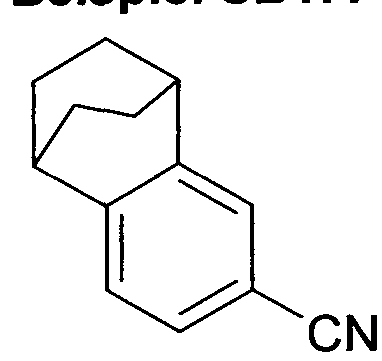
- KJVYWYYKFVJAFL-UHFFFAOYSA-N N#Cc1cc(C2CCC3CC2)c3cc1 Chemical compound N#Cc1cc(C2CCC3CC2)c3cc1 KJVYWYYKFVJAFL-UHFFFAOYSA-N 0.000 description 1
Classifications
-
- C—CHEMISTRY; METALLURGY
- C07—ORGANIC CHEMISTRY
- C07F—ACYCLIC, CARBOCYCLIC OR HETEROCYCLIC COMPOUNDS CONTAINING ELEMENTS OTHER THAN CARBON, HYDROGEN, HALOGEN, OXYGEN, NITROGEN, SULFUR, SELENIUM OR TELLURIUM
- C07F15/00—Compounds containing elements of Groups 8, 9, 10 or 18 of the Periodic Table
- C07F15/0006—Compounds containing elements of Groups 8, 9, 10 or 18 of the Periodic Table compounds of the platinum group
- C07F15/0033—Iridium compounds
-
- C—CHEMISTRY; METALLURGY
- C07—ORGANIC CHEMISTRY
- C07F—ACYCLIC, CARBOCYCLIC OR HETEROCYCLIC COMPOUNDS CONTAINING ELEMENTS OTHER THAN CARBON, HYDROGEN, HALOGEN, OXYGEN, NITROGEN, SULFUR, SELENIUM OR TELLURIUM
- C07F15/00—Compounds containing elements of Groups 8, 9, 10 or 18 of the Periodic Table
- C07F15/0006—Compounds containing elements of Groups 8, 9, 10 or 18 of the Periodic Table compounds of the platinum group
- C07F15/0086—Platinum compounds
-
- C—CHEMISTRY; METALLURGY
- C09—DYES; PAINTS; POLISHES; NATURAL RESINS; ADHESIVES; COMPOSITIONS NOT OTHERWISE PROVIDED FOR; APPLICATIONS OF MATERIALS NOT OTHERWISE PROVIDED FOR
- C09K—MATERIALS FOR MISCELLANEOUS APPLICATIONS, NOT PROVIDED FOR ELSEWHERE
- C09K11/00—Luminescent materials, e.g. electroluminescent or chemiluminescent
- C09K11/02—Use of particular materials as binders, particle coatings or suspension media therefor
- C09K11/025—Use of particular materials as binders, particle coatings or suspension media therefor non-luminescent particle coatings or suspension media
-
- C—CHEMISTRY; METALLURGY
- C09—DYES; PAINTS; POLISHES; NATURAL RESINS; ADHESIVES; COMPOSITIONS NOT OTHERWISE PROVIDED FOR; APPLICATIONS OF MATERIALS NOT OTHERWISE PROVIDED FOR
- C09K—MATERIALS FOR MISCELLANEOUS APPLICATIONS, NOT PROVIDED FOR ELSEWHERE
- C09K11/00—Luminescent materials, e.g. electroluminescent or chemiluminescent
- C09K11/06—Luminescent materials, e.g. electroluminescent or chemiluminescent containing organic luminescent materials
-
- H—ELECTRICITY
- H10—SEMICONDUCTOR DEVICES; ELECTRIC SOLID-STATE DEVICES NOT OTHERWISE PROVIDED FOR
- H10K—ORGANIC ELECTRIC SOLID-STATE DEVICES
- H10K85/00—Organic materials used in the body or electrodes of devices covered by this subclass
- H10K85/30—Coordination compounds
- H10K85/341—Transition metal complexes, e.g. Ru(II)polypyridine complexes
- H10K85/342—Transition metal complexes, e.g. Ru(II)polypyridine complexes comprising iridium
-
- H—ELECTRICITY
- H10—SEMICONDUCTOR DEVICES; ELECTRIC SOLID-STATE DEVICES NOT OTHERWISE PROVIDED FOR
- H10K—ORGANIC ELECTRIC SOLID-STATE DEVICES
- H10K85/00—Organic materials used in the body or electrodes of devices covered by this subclass
- H10K85/30—Coordination compounds
- H10K85/341—Transition metal complexes, e.g. Ru(II)polypyridine complexes
- H10K85/346—Transition metal complexes, e.g. Ru(II)polypyridine complexes comprising platinum
-
- C—CHEMISTRY; METALLURGY
- C09—DYES; PAINTS; POLISHES; NATURAL RESINS; ADHESIVES; COMPOSITIONS NOT OTHERWISE PROVIDED FOR; APPLICATIONS OF MATERIALS NOT OTHERWISE PROVIDED FOR
- C09K—MATERIALS FOR MISCELLANEOUS APPLICATIONS, NOT PROVIDED FOR ELSEWHERE
- C09K2211/00—Chemical nature of organic luminescent or tenebrescent compounds
- C09K2211/10—Non-macromolecular compounds
- C09K2211/1003—Carbocyclic compounds
- C09K2211/1007—Non-condensed systems
-
- C—CHEMISTRY; METALLURGY
- C09—DYES; PAINTS; POLISHES; NATURAL RESINS; ADHESIVES; COMPOSITIONS NOT OTHERWISE PROVIDED FOR; APPLICATIONS OF MATERIALS NOT OTHERWISE PROVIDED FOR
- C09K—MATERIALS FOR MISCELLANEOUS APPLICATIONS, NOT PROVIDED FOR ELSEWHERE
- C09K2211/00—Chemical nature of organic luminescent or tenebrescent compounds
- C09K2211/10—Non-macromolecular compounds
- C09K2211/1003—Carbocyclic compounds
- C09K2211/1011—Condensed systems
-
- C—CHEMISTRY; METALLURGY
- C09—DYES; PAINTS; POLISHES; NATURAL RESINS; ADHESIVES; COMPOSITIONS NOT OTHERWISE PROVIDED FOR; APPLICATIONS OF MATERIALS NOT OTHERWISE PROVIDED FOR
- C09K—MATERIALS FOR MISCELLANEOUS APPLICATIONS, NOT PROVIDED FOR ELSEWHERE
- C09K2211/00—Chemical nature of organic luminescent or tenebrescent compounds
- C09K2211/10—Non-macromolecular compounds
- C09K2211/1003—Carbocyclic compounds
- C09K2211/1014—Carbocyclic compounds bridged by heteroatoms, e.g. N, P, Si or B
-
- C—CHEMISTRY; METALLURGY
- C09—DYES; PAINTS; POLISHES; NATURAL RESINS; ADHESIVES; COMPOSITIONS NOT OTHERWISE PROVIDED FOR; APPLICATIONS OF MATERIALS NOT OTHERWISE PROVIDED FOR
- C09K—MATERIALS FOR MISCELLANEOUS APPLICATIONS, NOT PROVIDED FOR ELSEWHERE
- C09K2211/00—Chemical nature of organic luminescent or tenebrescent compounds
- C09K2211/10—Non-macromolecular compounds
- C09K2211/1018—Heterocyclic compounds
- C09K2211/1022—Heterocyclic compounds bridged by heteroatoms, e.g. N, P, Si or B
-
- C—CHEMISTRY; METALLURGY
- C09—DYES; PAINTS; POLISHES; NATURAL RESINS; ADHESIVES; COMPOSITIONS NOT OTHERWISE PROVIDED FOR; APPLICATIONS OF MATERIALS NOT OTHERWISE PROVIDED FOR
- C09K—MATERIALS FOR MISCELLANEOUS APPLICATIONS, NOT PROVIDED FOR ELSEWHERE
- C09K2211/00—Chemical nature of organic luminescent or tenebrescent compounds
- C09K2211/10—Non-macromolecular compounds
- C09K2211/1018—Heterocyclic compounds
- C09K2211/1025—Heterocyclic compounds characterised by ligands
- C09K2211/1029—Heterocyclic compounds characterised by ligands containing one nitrogen atom as the heteroatom
-
- C—CHEMISTRY; METALLURGY
- C09—DYES; PAINTS; POLISHES; NATURAL RESINS; ADHESIVES; COMPOSITIONS NOT OTHERWISE PROVIDED FOR; APPLICATIONS OF MATERIALS NOT OTHERWISE PROVIDED FOR
- C09K—MATERIALS FOR MISCELLANEOUS APPLICATIONS, NOT PROVIDED FOR ELSEWHERE
- C09K2211/00—Chemical nature of organic luminescent or tenebrescent compounds
- C09K2211/10—Non-macromolecular compounds
- C09K2211/1018—Heterocyclic compounds
- C09K2211/1025—Heterocyclic compounds characterised by ligands
- C09K2211/1044—Heterocyclic compounds characterised by ligands containing two nitrogen atoms as heteroatoms
-
- C—CHEMISTRY; METALLURGY
- C09—DYES; PAINTS; POLISHES; NATURAL RESINS; ADHESIVES; COMPOSITIONS NOT OTHERWISE PROVIDED FOR; APPLICATIONS OF MATERIALS NOT OTHERWISE PROVIDED FOR
- C09K—MATERIALS FOR MISCELLANEOUS APPLICATIONS, NOT PROVIDED FOR ELSEWHERE
- C09K2211/00—Chemical nature of organic luminescent or tenebrescent compounds
- C09K2211/10—Non-macromolecular compounds
- C09K2211/1018—Heterocyclic compounds
- C09K2211/1025—Heterocyclic compounds characterised by ligands
- C09K2211/1044—Heterocyclic compounds characterised by ligands containing two nitrogen atoms as heteroatoms
- C09K2211/1048—Heterocyclic compounds characterised by ligands containing two nitrogen atoms as heteroatoms with oxygen
-
- C—CHEMISTRY; METALLURGY
- C09—DYES; PAINTS; POLISHES; NATURAL RESINS; ADHESIVES; COMPOSITIONS NOT OTHERWISE PROVIDED FOR; APPLICATIONS OF MATERIALS NOT OTHERWISE PROVIDED FOR
- C09K—MATERIALS FOR MISCELLANEOUS APPLICATIONS, NOT PROVIDED FOR ELSEWHERE
- C09K2211/00—Chemical nature of organic luminescent or tenebrescent compounds
- C09K2211/10—Non-macromolecular compounds
- C09K2211/1018—Heterocyclic compounds
- C09K2211/1025—Heterocyclic compounds characterised by ligands
- C09K2211/1059—Heterocyclic compounds characterised by ligands containing three nitrogen atoms as heteroatoms
-
- C—CHEMISTRY; METALLURGY
- C09—DYES; PAINTS; POLISHES; NATURAL RESINS; ADHESIVES; COMPOSITIONS NOT OTHERWISE PROVIDED FOR; APPLICATIONS OF MATERIALS NOT OTHERWISE PROVIDED FOR
- C09K—MATERIALS FOR MISCELLANEOUS APPLICATIONS, NOT PROVIDED FOR ELSEWHERE
- C09K2211/00—Chemical nature of organic luminescent or tenebrescent compounds
- C09K2211/10—Non-macromolecular compounds
- C09K2211/1018—Heterocyclic compounds
- C09K2211/1025—Heterocyclic compounds characterised by ligands
- C09K2211/1059—Heterocyclic compounds characterised by ligands containing three nitrogen atoms as heteroatoms
- C09K2211/1062—Heterocyclic compounds characterised by ligands containing three nitrogen atoms as heteroatoms with oxygen
-
- C—CHEMISTRY; METALLURGY
- C09—DYES; PAINTS; POLISHES; NATURAL RESINS; ADHESIVES; COMPOSITIONS NOT OTHERWISE PROVIDED FOR; APPLICATIONS OF MATERIALS NOT OTHERWISE PROVIDED FOR
- C09K—MATERIALS FOR MISCELLANEOUS APPLICATIONS, NOT PROVIDED FOR ELSEWHERE
- C09K2211/00—Chemical nature of organic luminescent or tenebrescent compounds
- C09K2211/10—Non-macromolecular compounds
- C09K2211/1018—Heterocyclic compounds
- C09K2211/1025—Heterocyclic compounds characterised by ligands
- C09K2211/1059—Heterocyclic compounds characterised by ligands containing three nitrogen atoms as heteroatoms
- C09K2211/107—Heterocyclic compounds characterised by ligands containing three nitrogen atoms as heteroatoms with other heteroatoms
-
- C—CHEMISTRY; METALLURGY
- C09—DYES; PAINTS; POLISHES; NATURAL RESINS; ADHESIVES; COMPOSITIONS NOT OTHERWISE PROVIDED FOR; APPLICATIONS OF MATERIALS NOT OTHERWISE PROVIDED FOR
- C09K—MATERIALS FOR MISCELLANEOUS APPLICATIONS, NOT PROVIDED FOR ELSEWHERE
- C09K2211/00—Chemical nature of organic luminescent or tenebrescent compounds
- C09K2211/10—Non-macromolecular compounds
- C09K2211/1018—Heterocyclic compounds
- C09K2211/1025—Heterocyclic compounds characterised by ligands
- C09K2211/1074—Heterocyclic compounds characterised by ligands containing more than three nitrogen atoms as heteroatoms
-
- C—CHEMISTRY; METALLURGY
- C09—DYES; PAINTS; POLISHES; NATURAL RESINS; ADHESIVES; COMPOSITIONS NOT OTHERWISE PROVIDED FOR; APPLICATIONS OF MATERIALS NOT OTHERWISE PROVIDED FOR
- C09K—MATERIALS FOR MISCELLANEOUS APPLICATIONS, NOT PROVIDED FOR ELSEWHERE
- C09K2211/00—Chemical nature of organic luminescent or tenebrescent compounds
- C09K2211/10—Non-macromolecular compounds
- C09K2211/1018—Heterocyclic compounds
- C09K2211/1025—Heterocyclic compounds characterised by ligands
- C09K2211/1088—Heterocyclic compounds characterised by ligands containing oxygen as the only heteroatom
-
- C—CHEMISTRY; METALLURGY
- C09—DYES; PAINTS; POLISHES; NATURAL RESINS; ADHESIVES; COMPOSITIONS NOT OTHERWISE PROVIDED FOR; APPLICATIONS OF MATERIALS NOT OTHERWISE PROVIDED FOR
- C09K—MATERIALS FOR MISCELLANEOUS APPLICATIONS, NOT PROVIDED FOR ELSEWHERE
- C09K2211/00—Chemical nature of organic luminescent or tenebrescent compounds
- C09K2211/18—Metal complexes
- C09K2211/185—Metal complexes of the platinum group, i.e. Os, Ir, Pt, Ru, Rh or Pd
-
- H—ELECTRICITY
- H10—SEMICONDUCTOR DEVICES; ELECTRIC SOLID-STATE DEVICES NOT OTHERWISE PROVIDED FOR
- H10K—ORGANIC ELECTRIC SOLID-STATE DEVICES
- H10K2101/00—Properties of the organic materials covered by group H10K85/00
- H10K2101/10—Triplet emission
-
- H—ELECTRICITY
- H10—SEMICONDUCTOR DEVICES; ELECTRIC SOLID-STATE DEVICES NOT OTHERWISE PROVIDED FOR
- H10K—ORGANIC ELECTRIC SOLID-STATE DEVICES
- H10K2101/00—Properties of the organic materials covered by group H10K85/00
- H10K2101/90—Multiple hosts in the emissive layer
-
- H—ELECTRICITY
- H10—SEMICONDUCTOR DEVICES; ELECTRIC SOLID-STATE DEVICES NOT OTHERWISE PROVIDED FOR
- H10K—ORGANIC ELECTRIC SOLID-STATE DEVICES
- H10K50/00—Organic light-emitting devices
- H10K50/10—OLEDs or polymer light-emitting diodes [PLED]
- H10K50/11—OLEDs or polymer light-emitting diodes [PLED] characterised by the electroluminescent [EL] layers
-
- Y—GENERAL TAGGING OF NEW TECHNOLOGICAL DEVELOPMENTS; GENERAL TAGGING OF CROSS-SECTIONAL TECHNOLOGIES SPANNING OVER SEVERAL SECTIONS OF THE IPC; TECHNICAL SUBJECTS COVERED BY FORMER USPC CROSS-REFERENCE ART COLLECTIONS [XRACs] AND DIGESTS
- Y02—TECHNOLOGIES OR APPLICATIONS FOR MITIGATION OR ADAPTATION AGAINST CLIMATE CHANGE
- Y02E—REDUCTION OF GREENHOUSE GAS [GHG] EMISSIONS, RELATED TO ENERGY GENERATION, TRANSMISSION OR DISTRIBUTION
- Y02E10/00—Energy generation through renewable energy sources
- Y02E10/50—Photovoltaic [PV] energy
- Y02E10/549—Organic PV cells
Definitions
- the present invention relates to metal complexes which are suitable for use as emitters in organic electroluminescent devices.
- organometallic complexes which exhibit phosphorescence instead of fluorescence are used as emitting materials (M.A. Baldo et al., Appl. Phys. Lett. 1999, 75, 4-6).
- organometallic compounds For quantum mechanical reasons, up to four times energy and power efficiency is possible using organometallic compounds as phosphorescence emitters.
- iridium and platinum complexes are used in phosphorescent OLEDs as triplet emitters in particular.
- iridium complexes in particular bis- and tris-ortho-metallated complexes with aromatic ligands are used, wherein the ligands on a negatively charged carbon atom and a neutral nitrogen atom or on a negatively charged carbon atom and a neutral
- Carbene carbon atom bind to the metal. Examples of such
- Complexes are tris (phenylpyridyl) iridium (III) and derivatives thereof (eg according to US 2002/0034656 or WO 2010/027583).
- a large number of related ligands and iridium or platinum complexes are known from the literature, for example complexes with 1- or 3-phenylisoquinoline ligands (for example according to EP 1348711 or WO 2011/028473), with 2-phenyl-quinolines (US Pat. for example according to WO 2002/064700 or WO 2006/095943) or with phenyl carbenes (for example according to WO 2005/019373).
- Platinum complexes are known, for example, from WO 2003/040257.
- the object of the present invention is therefore to provide new metal complexes which are suitable as emitters for use in OLEDs.
- the object is to provide emitters which exhibit improved properties in terms of efficiency, operating voltage, lifetime, color coordinates and / or color purity, ie width of the emission band.
- metal complexes of the prior art still need to be improved in terms of sublimability and solubility.
- tris-ortho-metallated complexes often have high sublimation temperatures due to the high molecular weight, which in turn can lead to thermal decomposition in the sublimation.
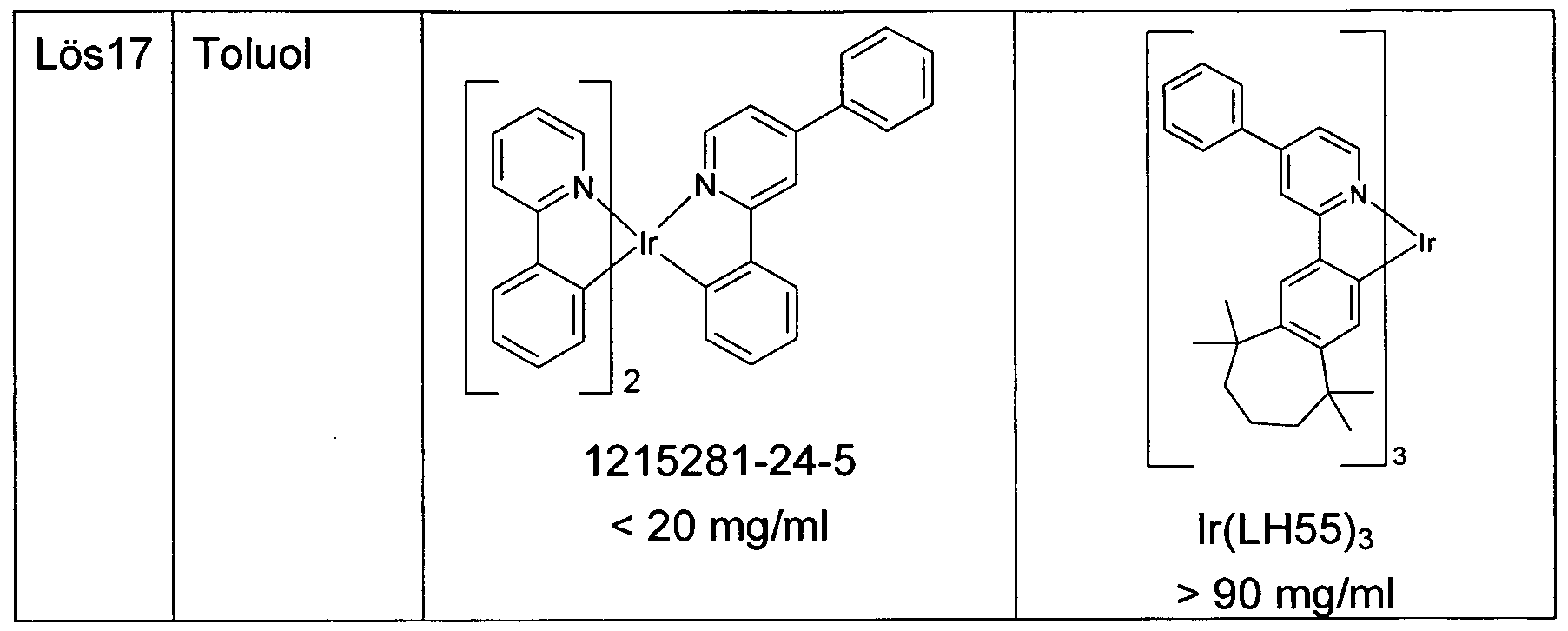
- a variety of metal complexes according to the prior art are not sufficiently soluble to allow processing from solution of common organic solvents.
- US 2007/0231600 discloses iridium complexes which contain a six-membered ring attached to each of the two coordinating aryl or heteroaryl groups. However, compounds with purely aliphatic six-membered rings without benzylic protons are not disclosed.
- KH Lee et al. disclose a heteroleptic Ir (ppy) 2 (acac) complex containing a fused tetramethylcyclohexane ring. Due to the often shorter lifetime of heteroleptic complexes with acetyl acetonate as coligands, tris-ortho-metallated complexes are preferable, since they generally have a longer lifetime.
- the tris-ortho-metallated complexes have the disadvantage that they sublime due to the higher molecular weight compared to acetylacetonate complexes at higher temperature, which depending on the exact structure of the complex also to a thermal decomposition in the sublimation or vapor deposition can lead to the production of the organic electroluminescent device. Therefore, further improvements are desirable here.
- the invention thus relates to a compound according to formula (1),
- M is iridium or platinum
- CyC is an aryl or heteroaryl group having from 5 to 18 aromatic ring atoms or a fluorene group which in each case coordinates via a carbon atom to M and which may each be substituted by one or more radicals R and which is in each case connected via a covalent bond to CyD;
- CyD is a heteroaryl group having 5 to 18 aromatic ring atoms, which coordinates to M via a neutral nitrogen atom or via a carbene carbon atom and which may be substituted by one or more R radicals and which is linked to CyC via a covalent bond;
- adjacent carbon atoms means that the carbon atoms are directly bonded to each other, and "adjacent radicals” in the definition of the radicals means that these radicals are attached to the same carbon atom or to adjacent carbon atoms.
- adjacent radicals in the structures according to the invention form an aliphatic ring system, it is preferred if this aliphatic ring system does not have acidic benzylic protons. This can be achieved by the fact that the carbon atoms of the aliphatic ring system, which bind directly to an aryl or heteroaryl group, are completely substituted and contain no hydrogen atoms bound. This can also be achieved by the fact that the carbon atoms of the aliphatic ring system which bind directly to an aryl or heteroaryl group, the bridgeheads of a bi- or polycyclic structure.
- bridgehead carbon atoms bound protons are much less acidic than benzylic protons on carbon atoms that are not bound in a bi- or polycyclic structure due to the spatial structure of the bi or polycycle and are considered for the purposes of the present invention as non-acidic protons.
- An aryl group for the purposes of this invention contains 6 to 40 carbon atoms; a heteroaryl group in the context of this invention contains 2 to 40 carbon atoms and at least one heteroatom, with the proviso that the sum of
- heteroatoms are preferably selected from N, O and / or S.
- aryl group or heteroaryl either a simple aromatic cycle, ie benzene, or a simple heteroaromatic cycle, for example pyridine, pyrimidine, thiophene, etc., or a fused aryl or heteroaryl group, for example naphthalene, anthracene, phenanthrene, quinoline, isoquinoline, etc., understood.
- An aromatic ring system in the sense of this invention contains 6 to 60 carbon atoms in the ring system.
- a heteroaromatic ring system in the sense This invention contains 1 to 60 C atoms and at least one heteroatom in the ring system, provided that the sum of C atoms and heteroatoms is at least 5.
- the heteroatoms are preferably selected from N, O and / or S.
- An aromatic or heteroaromatic ring system in the sense of this invention is to be understood as meaning a system which does not necessarily contain only aryl or heteroaryl groups but in which also several aryl or heteroaryl groups a non-aromatic moiety (preferably less than 10% of the atoms other than H), such as e.g.
- N or O atom or a carbonyl group may be interrupted.
- systems such as 9,9'-spirobifluorene, 9,9-diarylfluorene, triarylamine, diaryl ethers, stilbene, etc. are to be understood as aromatic ring systems in the context of this invention, and also systems in which two or more aryl groups, for example by a linear or cyclic alkyl group or interrupted by a silyl group.
- systems in which two or more aryl or heteroaryl groups are bonded directly to each other, such as.
- biphenyl or terphenyl also be understood as an aromatic or heteroaromatic ring system.
- a cyclic alkyl, alkoxy or thioalkoxy group is understood as meaning a monocyclic, a bicyclic or a polycyclic group.
- a C 1 - to C 4 -alkyl group in which individual H atoms or CH 2 groups may be substituted by the abovementioned groups, for example the radicals methyl, ethyl, n-propyl, i Propyl, cyclopropyl, n -butyl, i -butyl, s -butyl, t -butyl, cyclobutyl, 2-methylbutyl, n -pentyl, s -pentyl, t -pentyl, 2-pentyl, neo -pentyl, cyclopentyl, n Hexyl, s-hexyl, t-hexyl, 2-hexyl, 3-hexyl, neo-hexyl, cyclohexyl, methylcyclopentyl, 2-methylpentyl, n-heptyl, 2-h
- alkenyl group is understood as meaning, for example, ethenyl, propenyl, butenyl, pentenyl, cyclopentenyl, hexenyl, cyclohexenyl, heptenyl, cycloheptenyl, octenyl, cyclooctenyl or cyclooctadienyl.
- alkynyl groups include ethynyl, propynyl, butynyl, pentynyl, hexynyl, heptynyl or
- a C 1 to C 4 o-alkoxy group is understood as meaning, for example, methoxy, trifluoromethoxy, ethoxy, n-propoxy, isopropoxy, n-butoxy, isobutoxy, s-butoxy, t-butoxy or 2-methylbutoxy.
- aromatic or heteroaromatic ring system having 5-60 aromatic ring atoms, which may be substituted in each case with the abovementioned radicals and which may be linked via any position on the aromatic or heteroaromatic, are understood, for example, groups which are derived from benzene, naphthalene , Anthracene, benzanthracene, phenanthrene, benzophenanthrene, pyrene,
- CyC is an aryl or heteroaryl group having 5 to 14 aromatic ring atoms, more preferably 6 to 13 aromatic ring atoms, most preferably having 6 to 10 aromatic ring atoms, most preferably having 6 aromatic ring atoms which have a carbon atom coordinated to M and which may be substituted with one or more R radicals and which is linked to CyD via a covalent bond.
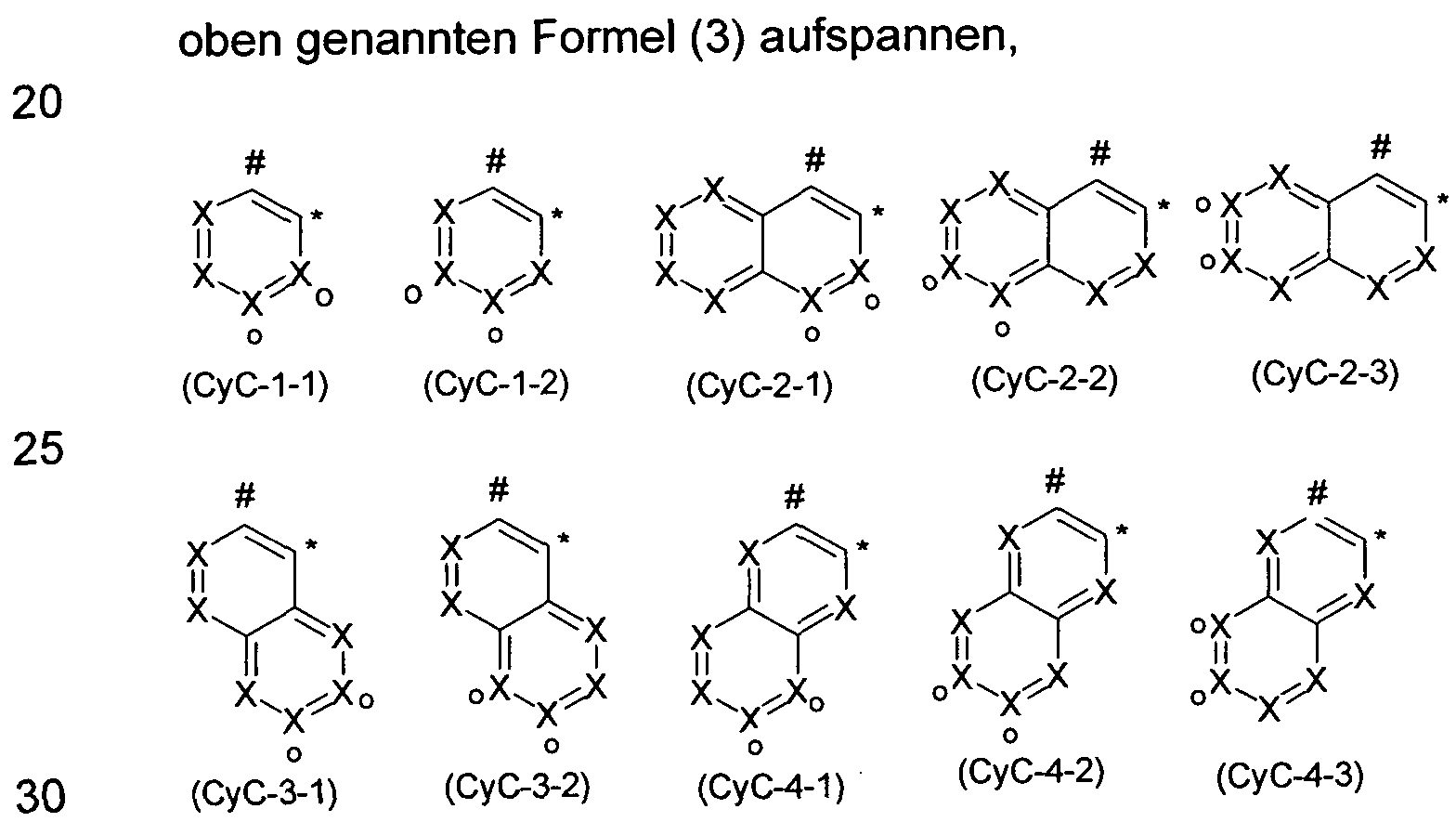
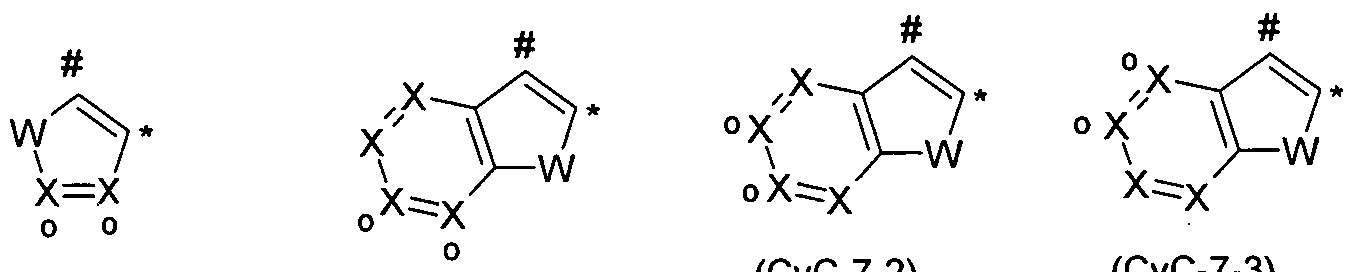
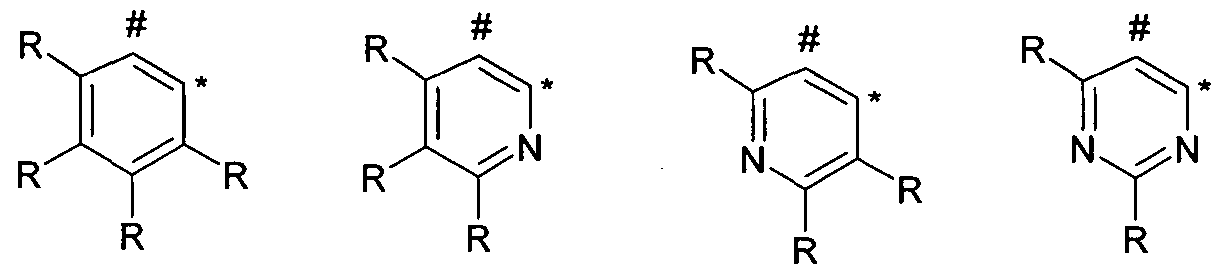
- Preferred embodiments of the group CyC are the structures of the following formulas (CyC-1) to (CyC-19), wherein the group CyC in each case binds to CyD at the position indicated by # and coordinates to the metal M at the position indicated by * ,
- X is the same or different CR or N at each occurrence
- W is the same or different NR, O or S at each occurrence.
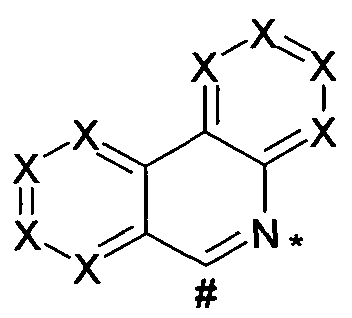
- two adjacent groups X in CyC represent CR and together with the radicals R which are bonded to these carbon atoms form a group of the above-mentioned or more particularly detailed formula (3 ).
- a maximum of three symbols X in CyC stands for N, more preferably at most two symbols X in CyC stand for N, very particularly preferably at most one symbol X in CyC stands for N. More preferably, all symbols X stand for CR.
- CyC are the groups of the following formulas (CyC-1a) to (CyC-19a),
- CyC-17a (CyC-18a) (CyC-19a) wherein the symbols used have the meanings given above.
- CyC has the group of formula (3), two adjacent R together with the carbon atoms to which they bind form a ring of formula (3).
- Preferred groups among the groups (CyC-1) to (CyC-19) are the groups (CyC-1), (CyC-3), (CyC-8), (CyC-10), (CyC-12), ( CyC-13) and (CyC-16), and particularly preferred are the groups (CyC-1a), (CyC-3a), (CyC-8a), (CyC-10a), (CyC-12a), (CyC-1a) 13a) and (CyC-16a).
- Preferred embodiments of the group CyD are the structures of the following formulas (CyD-1) to (CyD-10), wherein the group CyD in each case binds to CyC at the position indicated by # and coordinates to the metal M at the position indicated by * ,
- a maximum of three symbols X in CyD stands for N, more preferably at most two symbols X in CyD stand for N, very particularly preferably at most one symbol X in CyD stands for N. More preferably, all symbols X stand for CR.
- CyD are the groups of the following formulas (CyD-1a) to (CyD-10a),
- Preferred groups among the groups (CyD-1) to (CyD-10) are the groups (CyD-1), (CyD-3), (CyD-4), (CyD-5) and (CyD-6), and particularly preferred are the groups (CyD-1a), (CyD-3a), (CyD-4a), (CyD-5a) and (CyD-6a).
- CyC is an aryl or heteroaryl group having 5 to 14 aromatic ring atoms and, at the same time, CyD is a heteroaryl group having 5 to 13 aromatic ring atoms.
- CyC is particularly preferably an aryl or heteroaryl group having 6 to 13 aromatic ring atoms, preferably having 6 to 10 aromatic ring atoms, in particular having 6 aromatic ring atoms, and at the same time CyD is a heteroaryl group having 5 to 10 aromatic Ring atoms.
- CyC and CyD may be substituted by one or more radicals R.
- CyD and / or CyC or the above-mentioned preferred embodiments have two adjacent carbon atoms which are each substituted by R radicals, where the respective radicals R together with the C atoms form a ring of the abovementioned Span formula (3).
- the ligand L either contains exactly one group of formula (3), or it contains two groups of formula (3), one of which is attached to CyC and the other to CyD. In a particularly preferred embodiment, the ligand L contains exactly one group of the formula (3).
- the group of formula (3) may be either CyC or CyD, with the group of formula (3) attached to CyC or CyD in any position.
- the preferred positions for adjacent groups X, which represent CR are in which the respective radicals R together with the C atoms to which they are attached form a ring of the
- A is the same or different at each occurrence for C (R) 2.
- Preferred embodiments of the formula (4) are thus the structures of the formulas (4-A) and (4-B), the structure of the formula (4-A) being particularly preferred,
- Preferred embodiments of the formula (5) are the structures of the formulas (5-A), (5-B) and (5-C), the structure of the formula (5-A) being particularly preferred,
- R 1 is the same or different at each occurrence as H, D or an alkyl group with 1 to 5 C atoms, particularly preferably methyl, in which also one or more H atoms can be replaced by F, where two or more adjacent radicals R 1 can form an aliphatic ring system with one another. More preferably, R is hydrogen.
- two radicals R 3 which are bonded to the same carbon atom, together form an aliphatic or aromatic ring system and thus form a spiro system;
- R 3 can form an aliphatic ring system with an adjacent radical R or R 1 .
- R 3 in the group of the formula (3) and in the preferred embodiments is identical or different at each occurrence for a straight-chain alkyl or alkoxy group having 1 to 3 C atoms, in particular methyl, or a branched one or cyclic alkyl or alkoxy group having 3 to 5 C atoms or an aromatic or heteroaromatic ring system having 6 to 12 aromatic ring atoms, each of which may be substituted by one or more radicals R 2 , but is preferably unsubstituted;
- two radicals R 3 which are bonded to the same carbon atom, together form an aliphatic or aromatic ring system and thus form a spiro system; furthermore, R 3 may form an aliphatic ring system with an adjacent R or R radical.
- radicals R on each occurrence are identically or differently selected from the group consisting of H, D, F, N (R 1 ) 2 , a straight-chain alkyl group having 1 to 6 C atoms or a branched or cyclic alkyl group having 3 to 10 C atoms, wherein one or more H atoms may be replaced by D or F, or an aromatic or heteroaromatic ring system having 5 to 24 aromatic ring atoms, each of which may be substituted by one or more radicals R 1 ; in this case, two adjacent radicals R or R with R 1 can also form a mono- or polycyclic, aliphatic or aromatic ring system with one another.
- radicals R 1 which are bonded to R are, identically or differently, H, F, CN, a straight-chain alkyl group having 1 to 5 C atoms or a branched or cyclic alkyl group having 3 to 5 C atoms which may each be substituted by one or more radicals R 2 , or an aromatic or heteroaromatic ring system having from 5 to 13 aromatic ring atoms, each of which may be substituted by one or more radicals R 2 ; in this case, two or more adjacent radicals R together form a mono- or polycyclic aliphatic ring system.
- Preferred radicals R 2 are the same or different at each occurrence, H, F or an aliphatic hydrocarbon radical having 1 to 5 carbon atoms or an aromatic hydrocarbon radical having 6 to 12 carbon atoms; two or more substituents R 2 may also together form a mono- or polycyclic, aliphatic ring system.
- a bridging unit may be present which links this ligand L with one or more further ligands L and L '.
- a bridging unit exists, so that the ligands have tridentate or polydentate or polypodalen character. There may also be two such bridging units. This leads to the formation of macrocyclic ligands or to the formation of cryptates.
- Preferred structures with polydentate ligands or with polydentate ligands are the metal complexes of the following formulas (6) to (11),
- V preferably represents a single bond or a bridging unit containing 1 to 80 Atoms from the third, fourth, fifth and / or sixth main group (group 13, 14, 15 or 16 according to IUPAC) or a 3- to 6-membered homo- or heterocycle which covalently bind together the partial ligands L or L with L ' combines.
- the bridging unit V can also be constructed asymmetrically, ie the combination of V to L or L 'does not have to be identical.
- the bridging unit V may be neutral, single, double or triple negative or single, double or triple positively charged.
- V is preferably neutral or simply negative or simply positively charged, more preferably neutral. In this case, the charge of V is preferably selected so that a total of neutral
- n is preferably at least 2.
- group V has no significant influence on the electronic properties of the complex, since the task of this group is essentially to increase the chemical and thermal stability of the complexes by bridging L with each other or with L ' ,
- V is a trivalent group, ie three ligands L are bridged with one another or two ligands L with L 'or one ligand L with two ligands L', V is preferably the same or different at each occurrence selected from the group consisting of B, B ( R 1 ) ⁇ B (C (R) 2 ) 3 ,
- N (C O) 3 , N (C (R 1 ) 2 C (R 1 ) 2 ) 3 , (R 1 ) N (C (R 1 ) 2 C (R 1 ) 2 ) ⁇ P, P (R 1 ) ⁇ PO, PS, P (O) 3 , PO (O) 3 , P (OC (R 1 ) 2 ) 3 , PO (OC (R) 2 ) 3 , P (C (R 1 ) 2 ) 3 , P (R) (C (R 1 ) 2 ) 3 + , PO (C (R 1 ) 2 ) 3 , P (C (R 1 ) 2 C (R) 2 ) 3 , P (R 1 ) (C (R) 2 C (R 1 ) 2 ) 3 ⁇ PO (C (R 1 ) 2 C (R 1 ) 2 ) 3 , S + ( S (C (R 1 ) 2 ) 3 + , S (C (R 1 ) 2 C (R 1 ) 2 )
- the other symbols used have the meanings given above.
- V stands for a group CR 2
- the two radicals R can also be linked to one another so that structures such as, for example, 9,9-fluorene are suitable groups V.
- V is a divalent group, ie two ligands L linked to one another or a ligand L to L '
- ligand groups L ' are described as they occur in formula (1).
- the ligand groups L ' can also be selected if they are bonded to L via a bridging unit V, as indicated in formulas (6), (8) and (10).
- the ligands L ' are preferably monoanionic bidentate ligands which bind to M via a neutral nitrogen atom and a negatively charged carbon atom or via a neutral carbon atom and a negatively charged carbon atom. It is preferred that the ligands L 'with the metal form a cyclometall faced five-membered or six-membered ring, in particular a cyclometall elected five-membered ring. As described above, the ligands L 'may also be bonded to L via a bridging group V.
- the ligands L ' are, in particular, ligands such as are generally used in the field of phosphorescent metal complexes for organic electroluminescent devices, ie, phenylpyridine, naphthylpyridine, phenylquinoline, phenylisoquinoline, etc., each of which may be substituted by one or more R radicals.
- ligands such as are generally used in the field of phosphorescent metal complexes for organic electroluminescent devices, ie, phenylpyridine, naphthylpyridine, phenylquinoline, phenylisoquinoline, etc., each of which may be substituted by one or more R radicals.
- Electroluminescent devices a plurality of such ligands is known, and he can without further inventive step other such Select ligands as ligand L 'for compounds according to formula (1).
- the combination of two groups is particularly suitable, as represented by the following formulas (27) to (50), where one group binds via a neutral nitrogen atom or a carbene carbon atom and the other group preferably via a negatively charged carbon atom binds.
- the ligand L 'can then be formed from the groups of formulas (27) to (50) by each of these groups bonding to each other at the position indicated by #.
- the position at which the groups coordinate to the metal M are indicated by * .
- These groups can also have one or two bridging
- Units V be bound to the ligand L.
- W has the abovementioned meaning and X stands, identically or differently, for each occurrence for CR or N, the above-mentioned limitation that at least two adjacent groups X represent CR and the radicals R form a ring of the formula (3), does not apply.
- R has the same meaning as described above, wherein here also two radicals R, which are bonded to two different cycles of the above formulas (27) to (59), together can also form an aromatic ring system.
- a maximum of three symbols X in each group represent N, more preferably, at most two symbols X in each group represent N, most preferably, at most one symbol X in each group represents N. More preferably, all symbols X stand for CR.
- two radicals R in the ligand L ' which are bonded to two different cycles of the abovementioned formulas (27) to (50) also form an aromatic ring system with one another, for example, ligands which as a whole represent a single larger heteroaryl group, such as for example, benzo [h] quinoline, etc.
- Preferred ligands which are formed by ring formation of two radicals R at the different cycles are the structures of the formulas (51) to (55) listed below,
- H atoms can be replaced by D or F, or an aromatic or heteroaromatic ring system having 5 to 14 aromatic ring atoms, which may be substituted by one or more radicals R 1 each; two or more adjacent radicals R may also together form a mono- or polycyclic, aliphatic, aromatic and / or benzoannulated ring system.
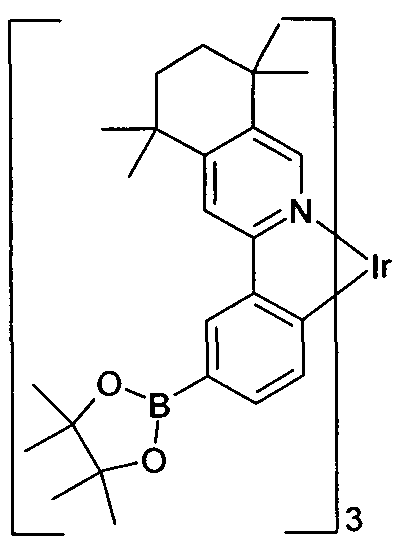
- radicals R are the same or different at each occurrence selected from the group consisting of H, D, F, Br, CN, B (OR 1 ) 2, a straight-chain alkyl group having 1 to 5 carbon atoms, in particular methyl, or a branched or cyclic alkyl group having 3 to 5 C-atoms, in particular iso-propyl or tert-butyl, wherein one or more H atoms may be replaced by D or F, or an aromatic or heteroaromatic ring system having 5 to 12 aromatic ring atoms, the each by one or several radicals R 1 may be substituted; two or more radicals R may also together form a mono- or polycyclic, aliphatic, aromatic and / or benzoannulated ring system.
- Preferred radicals R 1 in the abovementioned structures of L ' are defined analogously to the preferred radicals R 1 listed above.
- the complexes according to the invention can be facial or pseudofacial, or they can be meridional or pseudomeridional.
- the ligands L and / or L ' may also be chiral depending on the structure. This is particularly the case when they contain substituents, for example alkyl, alkoxy, dialkylamino or aralkyl groups, which have one or more stereocenters. Since the basic structure of the complex can also be a chiral structure, the formation of diastereomers and several pairs of enantiomers is possible.
- the complexes according to the invention then comprise both the mixtures of the different diastereomers or the corresponding racemates as well as the individual isolated diastereomers or enantiomers.
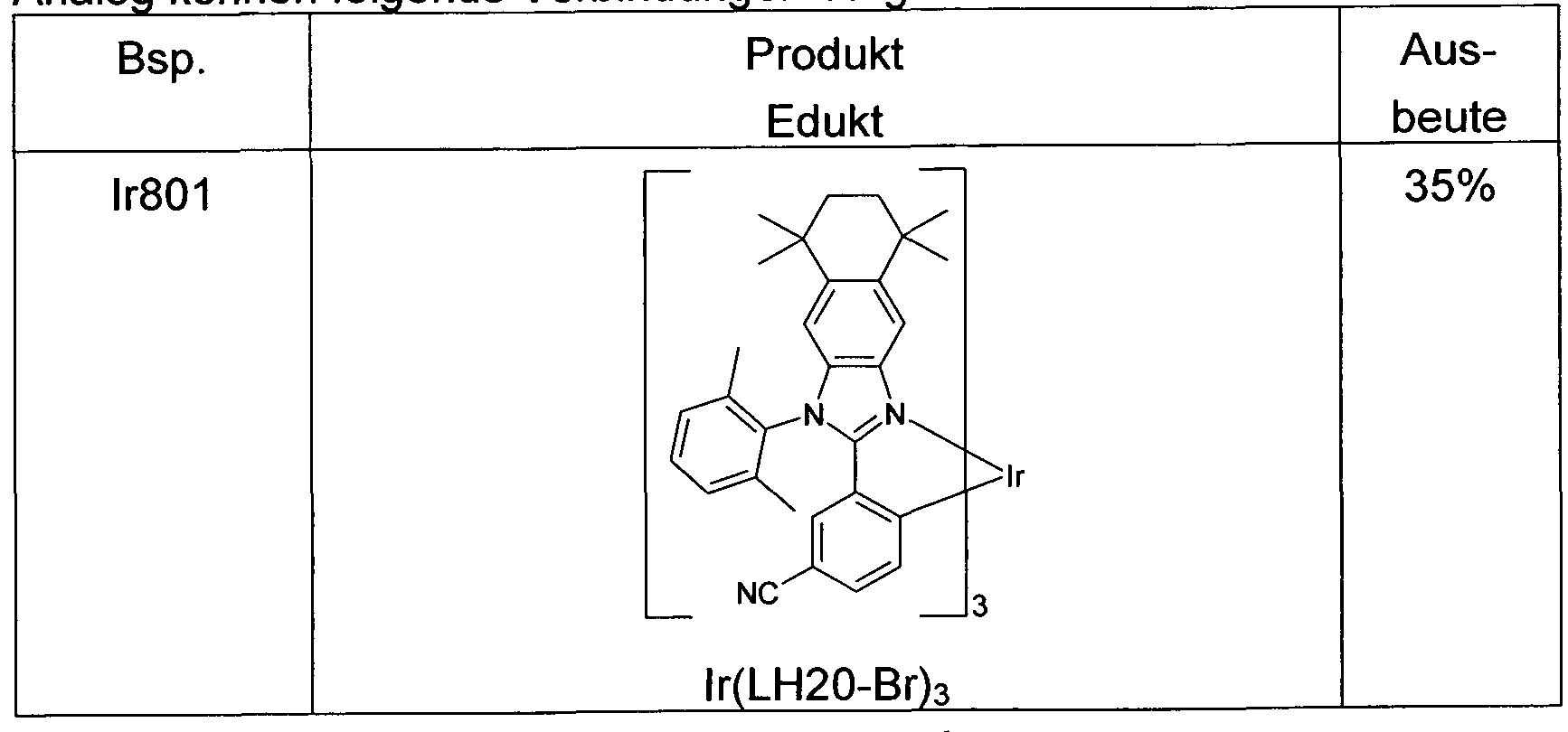
- the abovementioned preferred embodiments can be combined with one another as desired. In a particularly preferred embodiment of the invention, the abovementioned preferred embodiments apply simultaneously. Examples of suitable compounds according to formula (1) are the structures listed in the following table.
- the metal complexes according to the invention can in principle be prepared by various methods. However, the methods described below have been found to be particularly suitable.
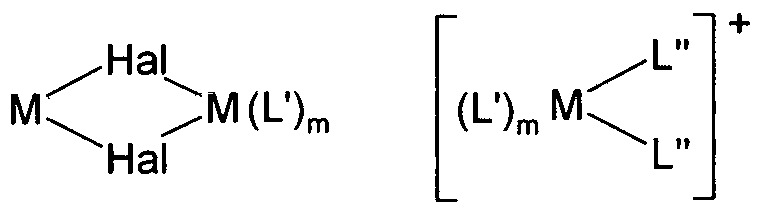
- another object of the present invention is a process for preparing the metal complex compounds of formula (1) by reacting the corresponding free ligands L and optionally U with metal alcoholates of formula (67), with metal ketoketonates of formula (68), with metal halides of Formula (69), with dimeric metal complexes of the formula (70) or with metal complexes of the formula (71),
- metal compounds in particular iridium compounds, which carry both alcoholate and / or halide and / or hydroxyl and also ketoketonate radicals. These connections can also be loaded.
- iridium compounds which are particularly suitable as starting materials are disclosed in WO 2004/085449.
- [IrCl 2 (acac) 2 for example Na [IrCl 2 (acac) 2 ] metal complexes with acetylacetonate derivatives as ligands, for example lr (acac) 3 or tris (2,2,6,6-tetramethylheptane-3,5-dionato) iridium, and lrCl3 xH 2 O, where x is usually a number between 2 and 4.
- Suitable platinum starting materials are, for example, PtCl 2 , K 2 [PtCl 4 ],
- PtCl 2 (DMSO) 2 Pt (Me) 2 (DMSO) 2 or PtCl 2 (benzonitrile) 2 .
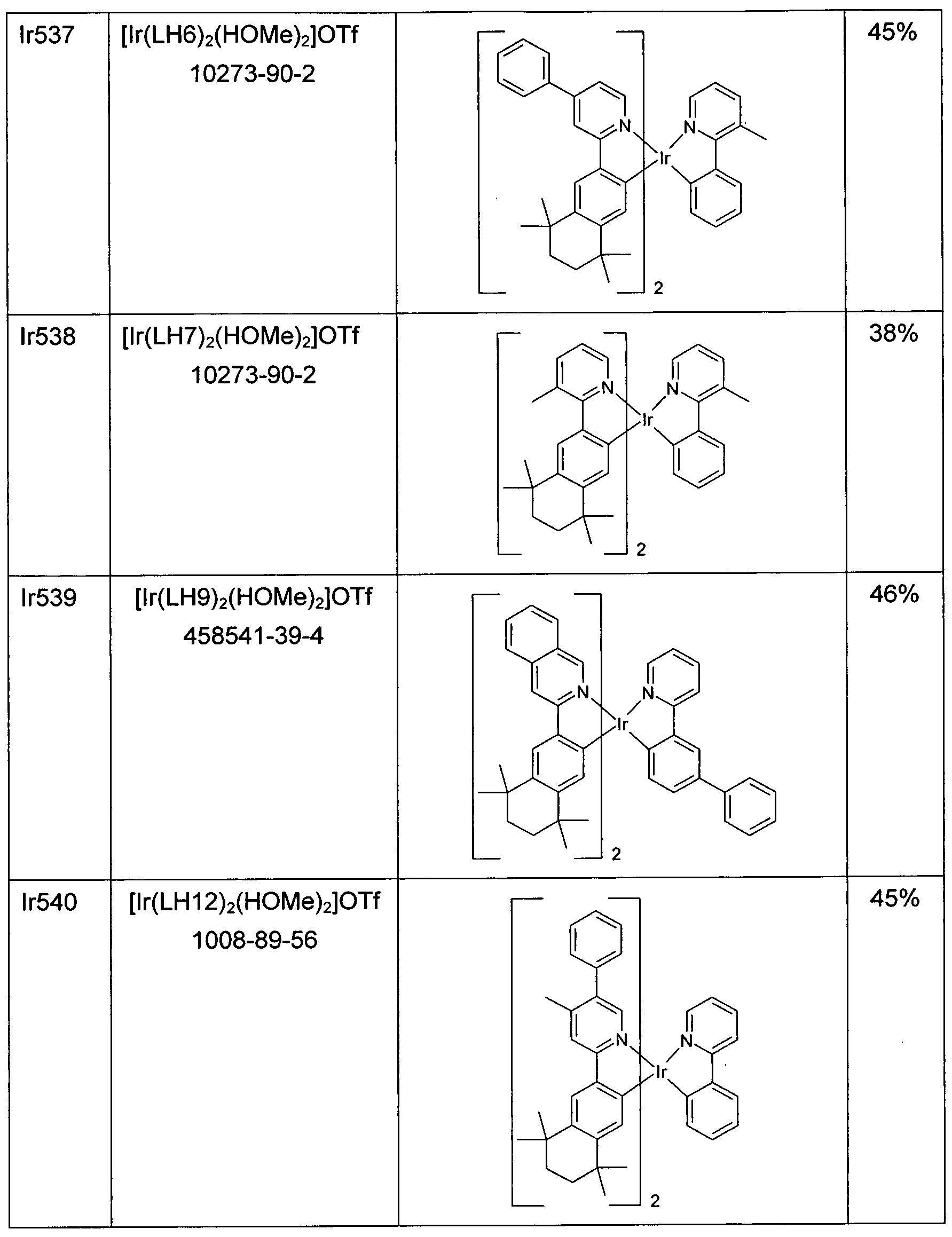
- the synthesis can also be carried out by reacting the ligands L with iridium complexes of the formula [Ir (L ') 2 (HOMe) 2 ] A or [Ir (L') 2 (NCMe) 2 ] A or by reacting the ligands L 'with Iridium complexes of the formula
- Heteroleptic complexes can also be synthesized, for example, according to WO 05/042548.
- the synthesis can be activated, for example, thermally, photochemically and / or by microwave radiation.
- the synthesis can also be carried out in an autoclave at elevated pressure and / or elevated temperature.
- the reactions can be carried out in a melt of the corresponding o-metalating ligands without the addition of solvents or melting aids.
- solvents or melting aids may be added.
- Suitable solvents are protic or aprotic solvents, such as aliphatic and / or aromatic alcohols (methanol, ethanol, isopropanol, t-butanol, etc.), oligo- and polyalcohols (ethylene glycol, 1,2-propanediol, glycerol, etc.).
- Alcohol ethers ethoxyethanol, diethylene glycol, triethylene glycol, polyethylene glycol, etc.
- ethers di- and triethylene glycol dimethyl ether, diphenyl ether, etc.
- aromatic, heteroaromatic and / or aliphatic hydrocarbons toluene, xylene, mesitylene, chlorobenzene, pyridine, Lutidine, quinoline, iso-quinoline, tridecane, hexadecane, etc.
- amides DF, DMAC, etc.
- lactams NMP
- sulfoxides DMOS
- sulfones dimethylsulfone, sulfolane, etc.
- Suitable melting Helps are compounds that are solid at Rautemperatur, but melt when heating the reaction mixture and dissolve the reactants, so that a homogeneous melt is formed.
- Particularly suitable are biphenyl, m-terphenyl, triphenylene, 1,2-, 1,3-, 1, 4-bis-phenoxybenzene, triphenylphosphine oxide, 18-crown-6, phenol, 1-naphthol, hydroquinone, etc ..
- the compounds according to the invention can also be made soluble by suitable substitution, for example by longer alkyl groups (about 4 to 20 C atoms), in particular branched alkyl groups, or optionally substituted aryl groups, for example xylyl, mesityl or branched terphenyl or quaterphenyl groups.
- suitable substitution for example by longer alkyl groups (about 4 to 20 C atoms), in particular branched alkyl groups, or optionally substituted aryl groups, for example xylyl, mesityl or branched terphenyl or quaterphenyl groups.
- Such compounds are then soluble in common organic solvents, such as toluene or xylene at room temperature in sufficient concentration to process the complexes from solution can.
- These soluble compounds are particularly suitable for processing from solution, for example by printing processes.
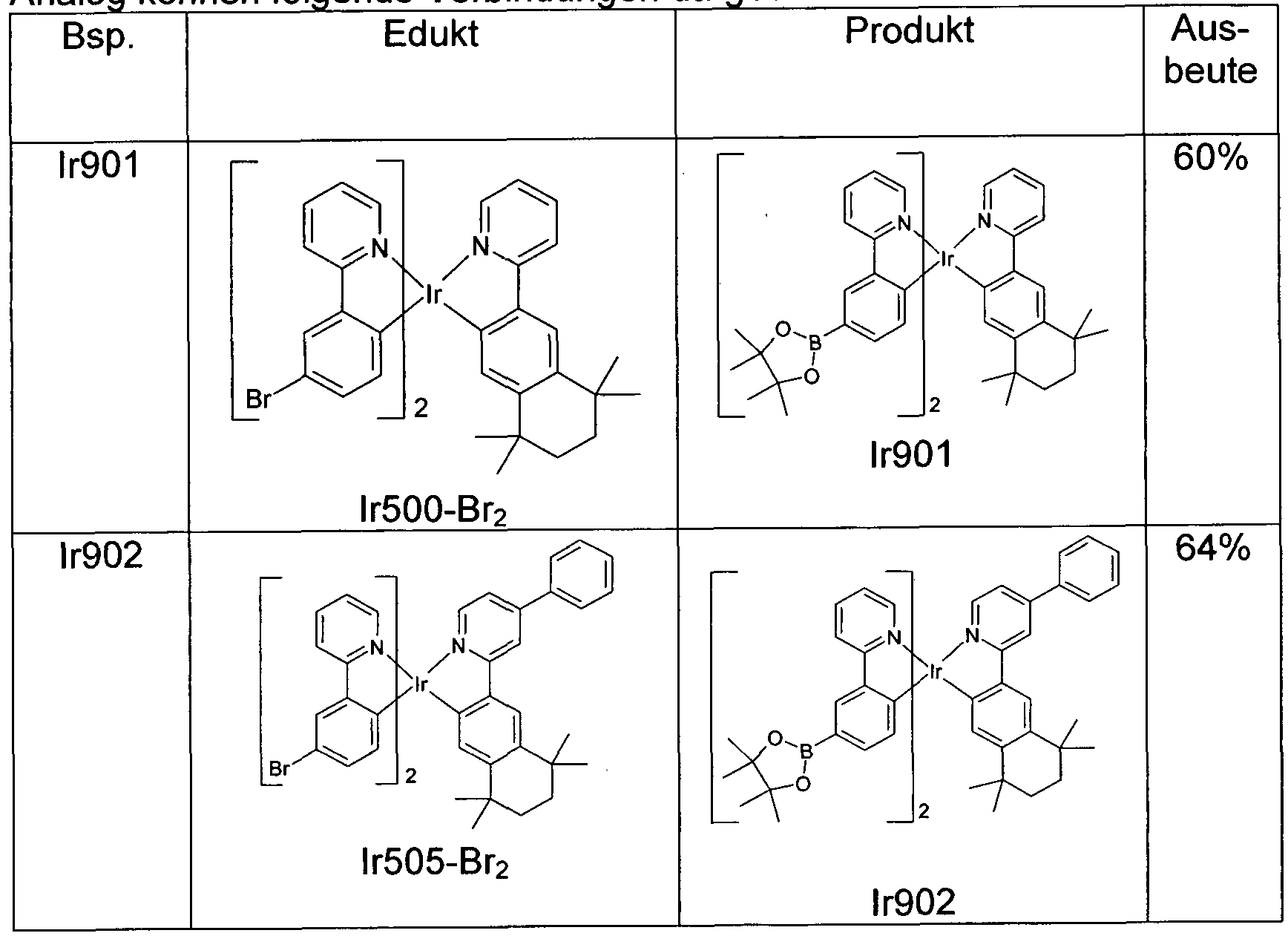
- the compounds of the invention may also be mixed with a polymer. It is also possible to incorporate these compounds covalently into a polymer. This is particularly possible with compounds which are substituted with reactive leaving groups, such as bromine, iodine, chlorine, boronic acid or boronic acid esters, or with reactive, polymerizable groups, such as olefins or oxetanes. These can be used as monomers for the production of corresponding oligomers, dendrimers or polymers. The oligomerization or polymerization is preferably carried out via the halogen functionality or the boronic acid functionality or via the polymerizable group. It is also possible to crosslink the polymers via such groups.
- reactive leaving groups such as bromine, iodine, chlorine, boronic acid or boronic acid esters
- reactive, polymerizable groups such as olefins or oxetanes.
- the compounds of the invention and polymers can be used as a crosslinked or uncrosslinked layer.
- the invention therefore further oligomers, polymers or dendrimers containing one or more of the compounds of the invention listed above, wherein one or more bonds of the inventive compound to the polymer, oligomer or dendrimer are present. Depending on the linkage of the compound according to the invention, this therefore forms a side chain of the oligomer or polymer or is linked in the main chain.
- the polymers, oligomers or dendrimers may be conjugated, partially conjugated or non-conjugated.
- the oligomers or polymers may be linear, branched or dendritic.
- the repeat units of the compounds according to the invention in oligomers, dendrimers and polymers have the same preferences as described above.
- the monomers according to the invention are homopolymerized or copolymerized with further monomers. Preference is given to copolymers in which the units of the formula (1) or the preferred embodiments described above are present at 0.01 to 99.9 mol%, preferably 5 to 90 mol%, particularly preferably 20 to 80 mol%.
- Suitable and preferred comonomers which form the polymer backbone are selected from fluorenes (for example according to EP 842208 or WO 2000/022026), spirobifluorenes (for example according to EP 707020, EP 894107 or WO 2006/061181), para phenylenes (for example in accordance with WO 92/18552), carbazoles (for example according to WO 2004/070772 or WO 2004/113468), thiophenes (for example according to EP 1028136), dihydrophenanthrenes (eg.
- fluorenes for example according to EP 842208 or WO 2000/022026)
- spirobifluorenes for example according to EP 707020, EP 894107 or WO 2006/061181
- para phenylenes for example in accordance with WO 92/18552
- carbazoles for example according to WO 2004/070772 or WO 2004/113468
- thiophenes for
- WO 2005/014689 cis-and trans-indeno-fluorenes (eg according to WO 2004/041901 or WO 2004/113412), ketones (eg according to WO 2005/040302), phenanthrenes (eg . according to
- the polymers, oligomers and dendrimers may also contain other units, for example hole transport units, in particular those based on triarylamines, and / or electron transport units.
- Formulations of the compounds of the invention required. These formulations may be, for example, solutions, dispersions or emulsions. It may be preferable to use mixtures of two or more solvents for this purpose.
- Suitable and preferred solvents are, for example, toluene, anisole, o-, m- or p-xylene, methyl benzoate, mesitylene, tetralin, veratrol, THF, methyl THF, THP, chlorobenzene, dioxane, phenoxytoluene, in particular 3-phenoxytoluene, ( -) - fenchone, 1, 2,3,5-tetramethylbenzene, 1, 2,4,5-tetramethylbenzene, 1-methylnaphthalene, 2-methylbenzothiazole, 2-phenoxyethanol, 2-pyrrolidinone, 3-methylanisole, 4-methylanisole, 3 , 4-dimethylanisole, 3,5-dimethylanisole, acetophenone, a-terpineol, benzothiazole, butylbenzoate, cumene, cyclohexanol, cyclohexanone, cyclohexylbenzene, decal
- a further subject of the present invention is therefore a formulation containing at least one compound according to the invention or at least one oligomer according to the invention, polymer or dendrimer and at least one further compound.
- the further compound may be for example a solvent, in particular one of the abovementioned solvents or a mixture of these solvents.
- the further compound can also be a further organic or inorganic compound which is likewise used in the electronic device, for example a matrix material. This further compound may also be polymeric.
- the above-described compounds of the formula (1) or the above-mentioned preferred embodiments may be used in the electronic device as the active component.
- Another object of the present invention is thus the use of a compound of the invention in an electronic device.
- Yet- Another object of the present invention is an electronic device containing at least one compound according to the invention.
- An electronic device is understood to mean a device which contains anode, cathode and at least one layer, this layer containing at least one organic or organometallic compound.
- the electronic device according to the invention thus contains anode, cathode and at least one layer which contains at least one compound of the above-mentioned formula (1).
- preferred electronic devices are selected from the group consisting of organic electroluminescent devices (OLEDs, PLEDs), organic integrated circuits (O-ICs), organic field effect transistors (O-FETs), organic thin-film transistors (O-TFTs), organic light-emitting transistors (O-LETs), organic solar cells (O-SCs), organic optical detectors, organic photoreceptors, organic field quench devices (O-FQDs), light-emitting electrochemical cells (LECs) or organic laser diodes (O-SCs).
- Laser containing in at least one layer at least one compound according to the above-mentioned formula (1). Particularly preferred are organic electroluminescent devices.
- Active components are generally the organic or inorganic materials incorporated between the anode and cathode, for example, charge injection, charge transport or charge blocking materials, but especially emission materials and matrix materials.
- the compounds according to the invention exhibit particularly good properties as emission material in organic electroluminescent devices. A preferred embodiment of the invention are therefore organic electroluminescent devices.
- the compounds according to the invention can be used for the production of singlet oxygen or in photocatalysis.
- the organic electroluminescent device includes cathode, anode and at least one emitting layer. Apart from these layers, they may also contain further layers, for example one or more hole injection layers, hole transport layers, hole blocking layers, electron transport layers, electron injection layers, exciton blocking layers, electron blocking layers, charge generation layers and / or organic or inorganic p / n junctions. It is possible that one or more hole transport layers are p-doped, for example, with metal oxides such as M0O 3 or WO 3 or with (per) fluorinated low-electron aromatics, and / or that one or more electron-transport layers are n-doped. Likewise, interlayers may be introduced between two emitting layers which, for example, have an exciton-blocking function and / or control the charge balance in the electroluminescent device. It should be noted, however, that not necessarily each of these layers must be present.
- the organic electroluminescent device may contain an emitting layer, or it may contain a plurality of emitting layers. If multiple emission layers are present, they preferably have a total of several emission maxima between 380 nm and 750 nm, so that overall white emission results, ie. H.
- various emitting compounds are used which can fluoresce or phosphoresce. Particular preference is given to three-layer systems, the three layers exhibiting blue, green and orange or red emission (for the basic structure see, for example, WO 2005/011013) or systems having more than three emitting layers. It may also be a hybrid system wherein one or more layers fluoresce and one or more other layers phosphoresce.
- the organic electroluminescent device contains the compound according to formula (1) or the above-mentioned preferred embodiments as
- emitting compound in one or more emitting layers.
- the compound of the formula (1) When the compound of the formula (1) is used as an emitting compound in an emitting layer, it is preferably used in combination with one or more matrix materials.
- the mixture of the compound according to formula (1) and the matrix material contains between 0.1 and 99% by volume, preferably between 1 and 90% by volume, more preferably between 3 and 40% by volume, in particular between 5 and 15% by volume of the compound of the formula (1) relative to the total mixture made of emitter and matrix material. Accordingly contains the
- the triplet level of the matrix material is higher than the triplet level of the emitter.
- Suitable matrix materials for the compounds according to the invention are ketones, phosphine oxides, sulfoxides and sulfones, for. B. according to WO
- Carbazole derivatives indolocarbazole derivatives, e.g. B. according to WO 2007/063754 or WO 2008/056746, indenocarbazole derivatives, for. B. according to WO
- a plurality of different matrix materials as a mixture, in particular at least one electron-conducting Matrix material and at least one hole-conducting matrix material.
- a preferred combination is, for example, the use of an aromatic ketone, a triazine derivative or a phosphine oxide derivative with a triarylamine derivative or a carbazole derivative as a mixed matrix for the metal complex according to the invention. Also preferred is the use of a mixture of a charge transporting
- Matrix material and an electrically inert matrix material which is not or not significantly involved in charge transport, such.
- WO 2010/108579 it is preferable to use a mixture of two or more triplet
- the triplet emitter with the shorter-wave emission spectrum serves as a co-matrix for the triplet emitter with the longer-wave emission spectrum.
- the complexes according to the invention of formula (1) can be used as a co-matrix for longer-wave emitting triplet emitters, for example for green or red emitting triplet emitters.
- the compounds according to the invention can also be used in other functions in the electronic device, for example as hole transport material in a hole injection or transport layer, as charge generation material or as electron blocking material.
- the complexes according to the invention can be used as matrix material for other phosphorescent metal complexes in an emitting layer.
- low work function metals, metal alloys or multilayer structures of various metals are preferable, such as alkaline earth metals, alkali metals, main group metals or lanthanides (eg, Ca, Ba, Mg, Al, In, Mg, Yb, Sm, etc.).
- alloys of an alkali or alkaline earth metal and silver for example an alloy of magnesium and silver.
- further metals which have a relatively high work function such as, for example, B. Ag, which then usually combinations of metals, such as Mg / Ag, Ca / Ag or Ba / Ag are used. It can also be preferred between a metallic cathode and the
- organic semiconductors to introduce a thin intermediate layer of a material with a high dielectric constant.
- Suitable examples of this are alkali metal or alkaline earth metal fluorides, but also the corresponding oxides or carbonates (for example LiF, Li 2 O, BaF 2 , MgO, NaF, CsF, CS 2 CO 3, etc.).
- organic alkali metal complexes for.
- the layer thickness of this layer is preferably between 0.5 and 5 nm.
- the anode high workfunction materials are preferred.
- the anode has a work function greater than 4.5 eV. Vacuum up.
- metals with a high redox potential such as Ag, Pt or Au, are suitable for this purpose.
- metal / metal oxide electrodes eg Al / Ni / NiO x , Al / PtO x
- at least one of the electrodes must be transparent or partially transparent to allow either the irradiation of the organic material (O-SC) or the outcoupling of light (OLED / PLED, O-LASER).
- Preferred anode materials here are conductive mixed metal oxides.
- ITO indium tin oxide
- IZO indium zinc oxide
- conductive, doped organic materials in particular conductive doped polymers, for. B. PEDOT, PANI or derivatives of these polymers.
- a p-doped hole transport material is applied to the anode as a hole injection layer, wherein suitable p-dopants are metal oxides, for example M0O3 or WO3, or (per) fluorinated electron-poor aromatics.
- suitable p-dopants are HAT-CN (hexacyano-hexaazatriphenylene) or the compound NPD9 from Novaled.
- Such a layer simplifies the hole injection in materials with a low HOMO, that is, a HOMO of large magnitude.
- the other layers it is generally possible to use all the materials used for the layers according to the prior art, and the person skilled in the art can combine any of these materials in an electronic device with the materials according to the invention without inventive step.
- the device is structured accordingly (depending on the application), contacted and finally hermetically sealed because the life of such devices drastically shortened in the presence of water and / or air.
- an organic electroluminescent device characterized in that one or more layers are coated with a sublimation process. In this case, 6 mbar, the materials in vacuum sublimation at an initial pressure of usually less than 10 "5 mbar, preferably less than 10" evaporated. It is also possible that the initial pressure is even lower or even higher, for example less than 10 ⁇ 7 mbar.
- an organic electroluminescent device characterized in that one or more layers are coated with the OVPD (Organic Vapor Phase Deposition) method or with the aid of a carrier gas sublimation.
- the materials are applied at a pressure between 10 ⁇ 5 mbar and 1 bar.
- OVJP Organic Vapor Jet Printing
- the materials are applied directly through a nozzle and thus structured (for example, BMS Arnold et al., Appl. Phys. Lett., 2008, 92, 053301).
- an organic electroluminescent device characterized in that one or more layers of solution, such. B. by spin coating, or with any printing process, such.
- any printing process such as screen printing, flexographic printing, offset printing or Nozzle printing, but more preferably LITI (Light Induced Thermal Imaging, thermal transfer printing) or ink-jet printing (ink jet printing) can be produced.
- LITI Light Induced Thermal Imaging, thermal transfer printing
- ink-jet printing ink jet printing
- the organic electroluminescent device may also be fabricated as a hybrid system by exposing one or more layers
- Solution are applied and one or more other layers are evaporated. So it is possible, for example, an emitting Layer containing a compound of formula (1) and a matrix material applied from solution and then evaporate a hole blocking layer and / or an electron transport layer in vacuo.
- the electronic devices according to the invention are distinguished by one or more of the following surprising advantages over the prior art:
- the metal complexes of the invention have compared to
- the metal complexes of the invention have compared to
- analogous compounds which contain no structural unit according to formula (3) a higher solubility.
- many compounds which otherwise resemble the compounds according to the invention, but contain no structural unit according to formula (3) are only sparingly or in low concentration soluble in a multiplicity of common organic solvents.
- the compounds of the invention in a variety of common organic solvents in significantly higher Concentration soluble which also allows the processing and preparation of the electroluminescent devices from solution.
- a higher solubility also provides a guideline in the purification of the complexes in the synthesis.
- the metal complexes of the invention have in part a very narrow emission spectrum, which leads to a high color purity of the emission, as is desirable in particular for display applications.
- Organic electroluminescent devices containing compounds according to formula (1) as emitting materials have a very good lifetime.
- Organic electroluminescent devices containing compounds according to formula (1) as emitting materials have excellent efficiency. In particular, the efficiency is significantly higher than analogous compounds containing no structural unit according to formula (3).
- analogous compounds which contain a structural unit according to formula (3) in which one or more groups R 3 are hydrogen, a higher oxidation stability, in particular in solution.
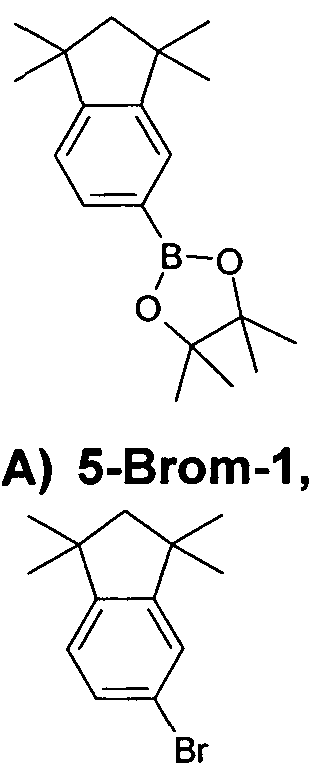
- Example SP1 1, 1, 3,3-tetramethyl-1-indan-5-boronic acid pinacol ester variant 1:
- starting material product yield , 2,3,3-hexamethyl-5-indanyl) -ethylamine, SP13b
- the dark oily residue is dissolved in 1000 ml of THF and slowly added dropwise with ice cooling to a solution of 38.0 g (1.0 mol) of lithium aluminum hydride in 1000 ml of THF (Caution: Exothermic reaction!). After completion of the addition, the mixture is allowed to warm to room temperature and the reaction mixture is stirred for 20 h at room temperature. The reaction mixture is hydrolyzed with ice cooling by the slow addition of 500 ml of saturated sodium sulfate solution.
- a mixture of 24.5 g (100 mmol) of 2- (1,1,2,3,3-hexamethyl-5-indanyl) ethylamine, SP13b, 14.1 ml (100 mmol) of triethylamine and 150 ml of dichloromethane is added at 0 ° C. with a solution of 14.1 g (100 mmol) of benzoic acid chloride [98-88-4] in 100 ml of dichloromethane while stirring well, adding dropwise so that the temperature does not exceed 30.degree. The mixture is then stirred for 1 h at room temperature.
- Example SP22 7-phenyl-ethynyl 1-1,2, 3,4-tetrahydro-1,4-methano-thaline-6-carbaldehyde
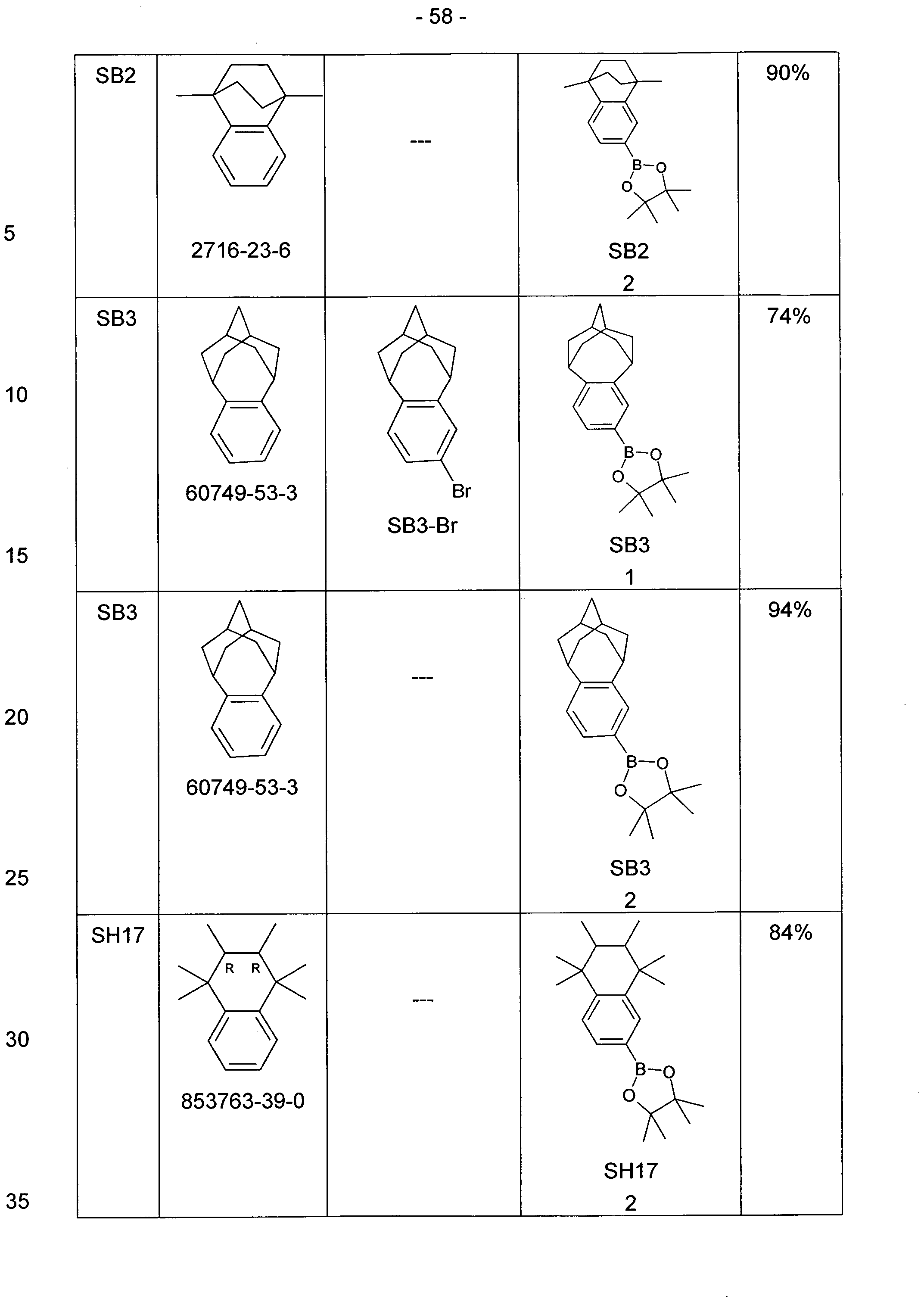
- Example SH15 bis (1,1,4,4-tetramethyl-tetrahydro-naphth-6-yl) ether
- reaction mixture is quenched by addition of 30 ml of ethanol, the solvent is completely evaporated in vacuo, the residue is taken up in 1000 ml of glacial acetic acid, 150 ml of acetic anhydride are added with stirring and then 30 ml of concentrated solution are added dropwise. Sulfuric acid and stirred for 3 h at 60 ° C after. Then the solvent is removed in vacuo, the residue is taken up in 1000 ml of dichloromethane and made alkaline with ice cooling by addition of 10 wt .-% aqueous NaOH.
- the organic phase is separated off, washed three times with 500 ml of water, dried over magnesium sulfate, the organic phase is concentrated completely and the residue is taken up in 500 ml of methanol, homogenized in the heat and then stirred for 12 h, the product crystallizes.
- the solid obtained after suction is dissolved in 1000 ml of dichloromethane, the solution is filtered through a bed of celite, the filtrate is concentrated to dryness, the residue is recrystallized twice from toluene: methanol (1: 1) and then dried in vacuo. Yield: 56.3 g (87 mmol), 36%; Purity: about 95% after 1 H NMR.
- Solids are purified by recrystallization and fractional sublimation (p ca. 10 "4 - 10 5 mbar, T about 160-240 ° C) of low boilers and non-volatile secondary components. Oils are purified by chromatography, fractionated by Kugelrohr distillation or dried in vacuo to remove low boilers.
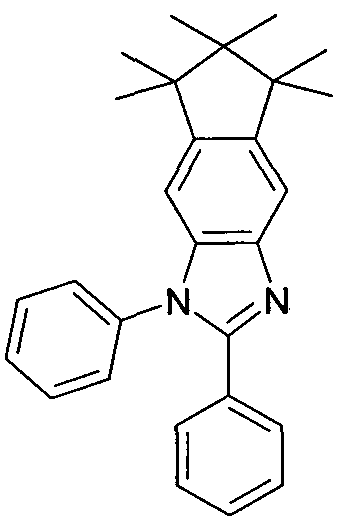
- Example LP11 5,5,6,6,7,7-hexamethyl, 2-diphenyl-1, 5,6,7-tetrahydroindeno [5,6-d] imidazole
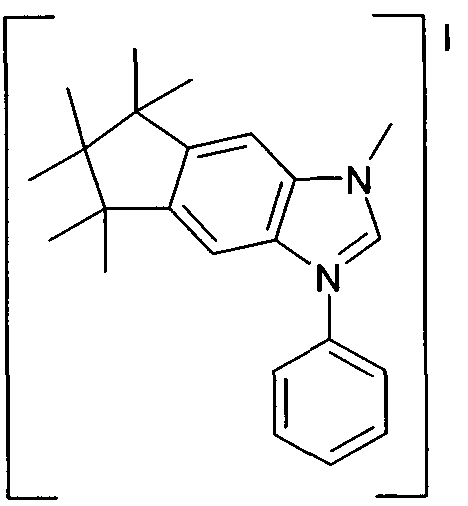
- Example LP12 1,5,5,6,6,7,7-heptamethyl-3-phenyl 1-1, 5,6,7-ahydro-indeno [5,6-d] imidazolium iodide, LP12
- a suspension of 28.3 g (89 mmol) of 5,5,6,6,7,7-hexamethyl-1-phenyl-1, 5,6,7-tetrahydro-indeno [5,6-d] -imidazole, B), 12.6 ml (200 mmol) of methyl iodide [74-88-4] are added in 100 ml of THF with stirring, and the mixture is stirred at 45 ° C. for 24 h. After cooling, the mixture is filtered off with suction from the precipitated solid, washed three times with 50 ml of ethanol each time and dried in vacuo.
- Example LP14 1, 4,4,6,6-pentamethyl-3-phenyl 1-1, 4,5,6-tetrahydro-cyclopentaimidazolium iodide
- the mixture is extracted three times with 300 ml of toluene, the organic phase is washed three times with water, dried over magnesium sulfate and the solvent is removed in vacuo.
- the oily residue is dissolved in 200 ml of o-dichlorobenzene, the solution is treated with 86.9 g (1 mol) of manganese dioxide and then boiled for 16 h under reflux at Wasserab- separator. After cooling, the manganese dioxide is filtered through a Celite layer, the solid is washed with 500 ml of a mixture of dichloromethane and ethanol (10: 1) and the combined filtrates are freed from the solvents in vacuo.
- Example LP25 1R, 4S-methano-1,2,3,4-tetrahydro-9-phenyl-10-phenanthrene
- the residue is mixed with 500 ml of diethyl ether, washed twice with 100 ml of saturated sodium bicarbonate solution and twice with 300 ml of water and then dried over magnesium sulfate.
- the oily residue is mixed with 27.6 g (200 mmol) of potassium carbonate, 5 g of palladium-carbon (5% strength by weight), 2.6 g (10 mmol) of triphenylphosphine, 100 g of glass beads (3 mm diameter) and 300 g ml mesitylene and heated again for 16 h under reflux.
- connection LH52 can be displayed:
- Example LH1 2- (5,5,8,8-Tetramethyl-5,6,7,8-tetrahydronaphthalen-2-yl) pyridine, LP1
- Phenyl-imidazole or phenyl-benzimidazole type Phenyl-imidazole or phenyl-benzimidazole type:
- Variant A tris-acetylacetonato-iridium (III) as iridium starting material
- the synthesis can take place in a stirred autoclave with glass insert.
- the ampoules are usually under pressure!
- the ampoule is opened, the sinter cake is filled with 100 g glass balls (3 mm diameter) in 100 ml of a suspension by (the suspending agent is chosen so that the ligand is good, but the metal complex is poorly soluble in it, typical suspending agents are methanol, ethanol, dichloromethane, acetone, THF, ethyl acetate, toluene, etc.) stirred for 3 h and thereby mechanically digested.
- the fine suspension is decanted from the glass beads, the solid is filtered off with suction, washed with 50 ml of the suspension medium and dried in vacuo.
- the dry solid is placed in a continuous hot extractor on a 3-5 cm high Alox bed (Alox, basic activity level 1) and then with an extractant (original amount approx. 500 ml, the extractant is chosen so that the complex in it good in the heat and poorly soluble in the cold, particularly suitable extractants are hydrocarbons such as toluene, xylenes, mesitylene,
- Naphthalene, o-dichlorobenzene, halogenated aliphatic hydrocarbons are generally unsuitable because they halo genieren or decompose the complexes, if necessary) extracted.
- the extractant is concentrated in vacuo to about 100 ml.
- Metal complexes which have too good solubility in the extractant are brought to crystallization by the dropwise addition of 200 ml of methanol.
- the solid of the suspensions thus obtained is filtered off with suction, washed once with about 50 ml of methanol and dried. After drying, the purity of the metal complex is determined by NMR and / or HPLC.
- the hot extraction step is repeated, omitting the Alox bed from the 2nd extraction. If a purity of 99.5 - 99.9% is reached, the metal complex is tempered or sublimated. The annealing is carried out in a high vacuum (p about 10 ⁇ 6 mbar) in the temperature range of about 200 - 300 ° C, preferably for complexes with molecular weights greater than about 1300 g / mol.
- the sublimation is carried out in high vacuum (p about 10 "6 mbar) in the temperature range of about 230-400 ° C, whereby the sublimation is preferably in the form of a fractional sublimation performed well in organic solvents, soluble complexes can alternatively be chromatographed also on silica gel. ,
- the deduced fac metal complexes precipitate as a mixture of diastereomers.
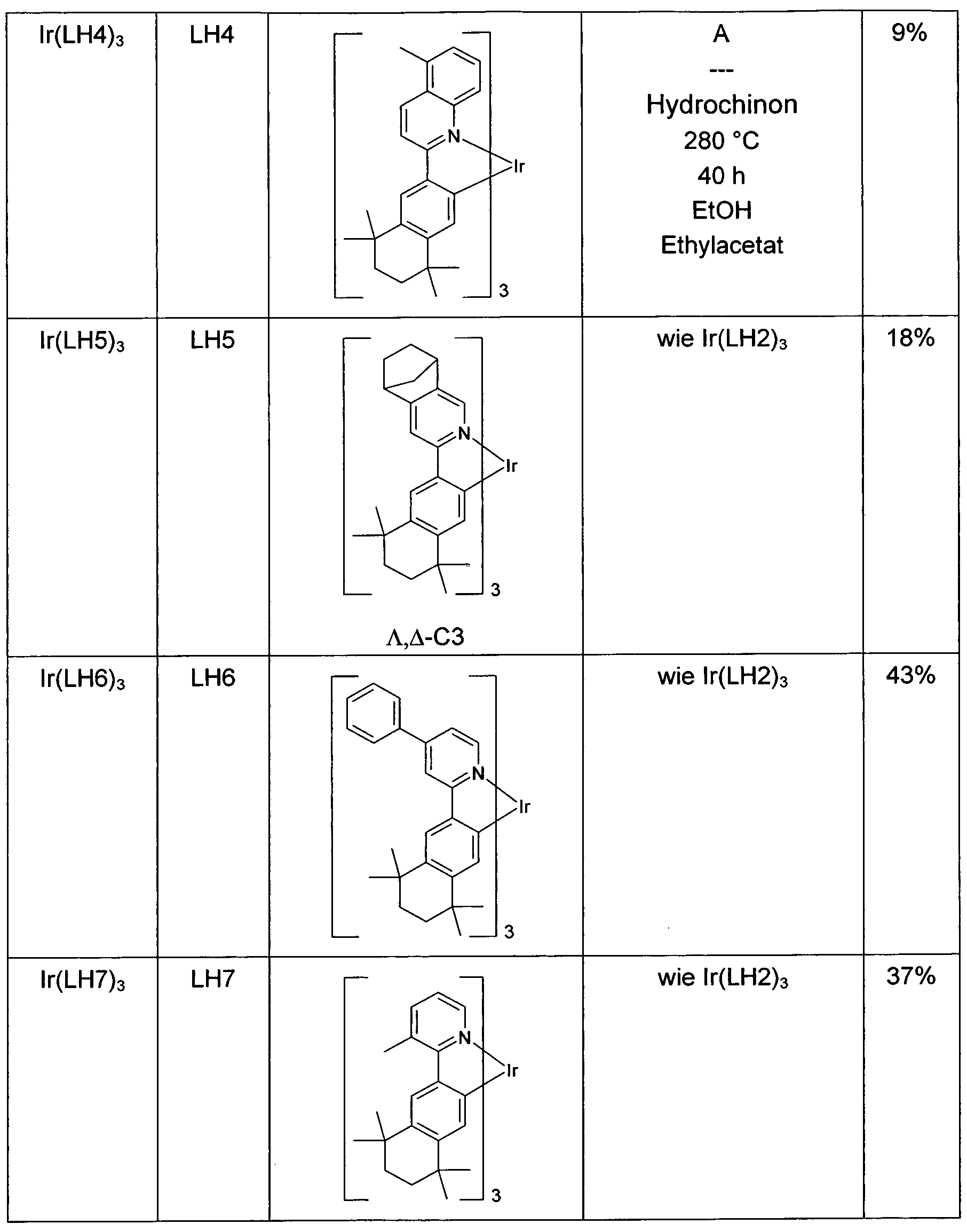
- the enantiomers ⁇ , ⁇ of the point group C3 generally have a significantly lower solubility in the extractant than the enantiomers of the point group C1, which thus accumulate in the mother liquor. A separation of the C3 from the C1 diastereomers in this way is often possible. In addition, the diastereomers can also be separated by chromatography. Become
- Enantiomerically pure ligands of group C1 are used to form a pair of diastereomers ⁇ , ⁇ of group C3.
- the diastereomers can be separated by crystallization or chromatography and thus as
- Variant B tris (2,2,6,6-tetramethyl-3,5-heptanedionato) iridium (III) as an iridium starting material
- Variants C Sodium [cis, trans-di-chloro (bis-acetylacetonato] iridate (III) as iridium starting material
- n-heptane DCM 8: 1 lr (LH35) 3 LH35 as lr (LH2) 3 40% lr (LH36) 3 LH36 as lr (LH2) 3 28% lr (LH37) 3 LH37 as lr (LH2) 3 40% lr (LH38) 3 LH38 as lr (LH2) 3 44% lr (LH53) 3 LH53 A 38%
- a mixture of 10 mmol of sodium bis-acetylacetonato-dichloro-iridate (III) [770720-50-8], 24 mmol of ligand L and a glass-coated magnetic stirrer core are melted under vacuum (10 "5 mbar) into a thick-walled 50 ml glass ampoule
- the ampoule is tempered for the specified time at the specified temperature, the molten mixture being stirred with the aid of a magnetic stirrer After cooling - CAUTION: the ampoules are usually under pressure!
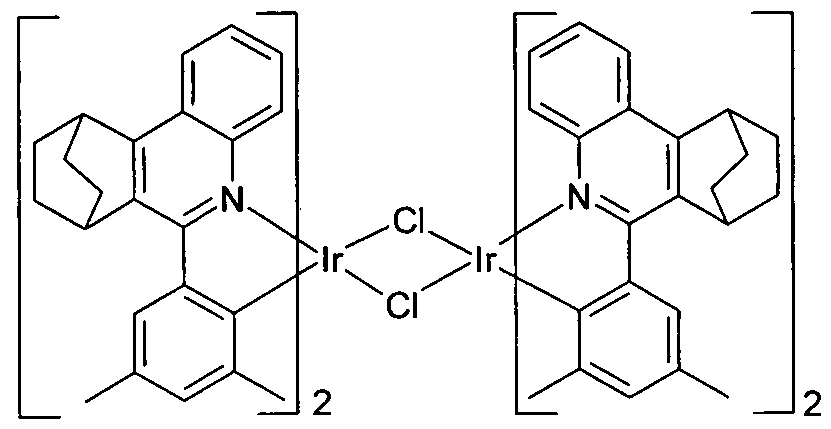
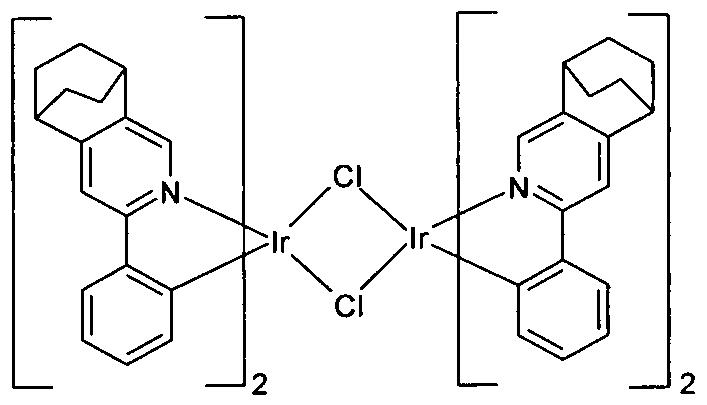
- the sinter cake is mixed with 100 g glass beads (3 mm diameter) in 100 ml of the indicated suspension agent (the suspending agent is chosen so that the ligand is good, the chloro-dimer of the formula [Ir (L) 2 Cl] 2 is poorly soluble in it, typical suspending agents are dichloromethane , Acetone, ethyl acetate, toluene, etc.) are stirred for 3 h while mechanically digested, the fine suspension is decanted from the glass beads, the solid is sucked in [lr (L) 2 Cl] 2 , which still contains about 2 eq NaCl el, hereinafter called the crude chloro-dimer, and dried in vacuo. The resulting crude chloro-dimer of the formula [Ir (L) 2 Cl] 2 is further reacted without purification.
- the suspending agent is chosen so that the ligand is good, the chloro-dimer of the formula [Ir (L) 2 Cl] 2 is
- the precipitated silver (l) chloride is filtered off with suction through a bed of Celite, the filtrate is concentrated to dryness, the yellow residue is taken up in 30 ml of toluene or cyclohexane, filtered from the solid, washed with n-heptane and dried in vacuo , The product of the formula [Ir (L) 2 (HOMe) 2] OTf thus obtained is further reacted without purification.
- Phenylimidazole or phenylbenzimidazole type Phenylimidazole or phenylbenzimidazole type:
- a mixture of 10 mmol of ligand L, 10 mmol K 2 PtCl 4 , 400 mmol of lithium acetate, anhydrous, and 200 ml of glacial acetic acid is refluxed for 60 h. After cooling and addition of 200 ml of water, the mixture is extracted twice with 250 ml of toluene, dried over magnesium sulfate, filtered through a bed of Celite, the Celite washed with 200 ml of toluene and then removed the toluene in vacuo. The solid thus obtained is purified by hot extraction as described under 1) variant A and then
- a mixture of 10 mmol of the ligand, 10 mmol of silver (I) oxide and 200 ml of dioxane is stirred for 16 h at room temperature, then treated with 100 ml of butanone, 20 mmol of sodium carbonate and 10 mmol cyclooctadienyl-platinum dichloride and heated under reflux for 16 h , After removal of the solvent, the solid is triturated with 500 ml of hot toluene, the suspension is filtered through a pad of Celite and the filtrate is concentrated to dryness. The resulting solid is chromatographed on silica gel with DCM and then subjected to fractional sublimation as described under 1) Variant A.
- Iridium complexes of hexadentate ligands A mixture of 10 mmol of the ligand L, 10 mmol of sodium bis-acetyl-acetonato-dichloro-iridate (III) [770720-50-8] and 200 ml of triethylene glycol dimethyl ether is 48 h at 210 ° C on a water separator (the acetyl - acetone and thermal cleavage products of the solvent distilled off) heated. After cooling and addition of 200 ml of water is filtered off with suction from the precipitated solid and dried in vacuo.
- the solid is stirred with 500 ml of hot THF, the suspension is filtered while hot on a Celite bed, the Celite is washed with 200 ml of THF and the combined filtrates are concentrated to dryness.
- the solid thus obtained is purified as described under 1) Variant A by hot extraction with toluene and then fractionated by sublimation.
- the annealing is carried out in high vacuum (p about 10 "6 mbar) in the temperature range of about 200-300 ° C
- the sublimation is carried out in high vacuum (p about 10". 6 mbar) in the temperature range of about 300-400 ° C
- the sublimation is preferably carried out in the form of a fractional sublimation.
- THF dioxane
- xylene mesitylene
- dimethylacetamide NMP
- DMSO dimethylacetamide
- phosphines such as tri-tert-butylphosphine, SPhos, XPhos, RuPhos, XanthPhos, etc. may be used, wherein in these phosphines the preferred phosphine: palladium ratio is 2: 1 to 1.2: 1.
- the solvent is removed in vacuo, the product is taken in a suitable phosphines
- the annealing is carried out in high vacuum (p about 10 "6 mbar) in the temperature range of about 200-300 ° C
- the sublimation is carried out in high vacuum (p about 10". 6 mbar) in the temperature range of about 300-400 ° C
- the sublimation is preferably carried out in the form of a fractional sublimation.
- the product of the product is amine or carbazole
- a suspension of 10 mmol of borylated complex, 12-20 mmol of aryl bromide per (RO) 2 B function and 80 mmol of tripotassium phosphate in a mixture of 300 ml of toluene, 100 ml of dioxane and 300 ml of water is added 0.6 mmol of tri-o-tolylphosphine and then treated with 0.1 mmol of palladium (II) acetate and heated under reflux for 16 h. After cooling, 500 ml of water and 200 ml of toluene are added, the aqueous phase is separated off, the organic phase is washed three times with 200 ml of water, once with 200 ml
- Dioxane, xylene, mesitylene, dimethylacetamide, NMP, DMSO, etc. is treated with 0.6 mmol of tri-o-tolylphosphine and then with 0.1 mmol of palladium (II) acetate and heated under reflux for 1 to 24 hours.
- other phosphines such as tri-tert-butylphosphine, SPhos, XPhos, RuPhos, XanthPhos, etc., may be used, with the preferred phosphine: palladium ratio being 2: 1 to 1.2: 1 for these phosphines.
- the solvent is removed in vacuo, the product is taken in a suitable
- Solvent toluene, dichloromethane, ethyl acetate, etc.
- purified as described under variant A.
- Composition in a total concentration of about 100 mmol / L in a mixture of 2 volumes of toluene: 6 volumes of dioxane: 1 volume of water dissolved or suspended. Then you add 2 mol equivalents of tri-potassium phosphate per Br functionality used, stirred for 5 min. then adds 0.03 to 0.003 mol equivalents of tri-ortho-tolyl-phosphine and then 0.005 to 0.0005 mol equivalents of palladium (II) acetate (ratio of phosphine to Pd preferably 6: 1) per Br functionality used and heated with very good stirring 2-3 h under reflux.
- the viscosity of the mixture increases too much, it can be diluted with a mixture of 2 volumes of toluene: 3 volumes of dioxane. After a total of 4-6 h reaction time is added to end capping 0.05 mol equivalents per boronic acid functionality of a Monobromaromaten and then 30 min. then 0.05 mol equivalents per Br-functionality of a monoboronic acid or a Monoboronklareesters added and boiled for a further 1 h. After cooling, dilute with 300 ml
- composition in a total concentration of about 100 mmol / L in a solvent (THF, dioxane, xylyl, mesitylene, dimethylacetamide, NMP, DMSO, etc.) dissolved or suspended. Then add 3 mol equivalents Lente base (potassium fluoride, tripotassium phosphate (anhydrous, monohydrate or trihydrate), potassium carbonate, cesium carbonate, etc. each anhydrous) per Br functionality and the weight equivalent glass beads (3 mm diameter), stirred for 5 min. after, then adds 0.03 to 0.003 mol equivalents of tri-ortho-tolylphosphine and then 0.005 to 0.0005 mol equivalents
- phosphines such as tri-tert-butylphosphine, SPhos, XPhos, RuPhos, XanthPhos, etc.
- the preferred phosphine: palladium ratio being 2: 1 to 1.3: 1 for these phosphines.
- the complexes of the invention have the solubility reported in the table, in the specified solvents at 25 ° C on.
- the comparison with the complexes without the cycle according to the invention shows that the solubility of the complexes according to the invention is markedly greater (factor about 5 to 50).
- the complexes according to the invention have the sublimation temperature and rate specified in the table at a base pressure of about 10 -5 mbar.
- the comparison with complexes without a cycle according to the invention shows that the sublimation temperature of the complexes according to the invention is lower and the sublimation rate is significantly greater.
- the complexes of the invention are stable under the sublimation conditions.
- inventive OLEDs and OLEDs according to the prior art is carried out according to a general method according to WO 2004/058911, based on the circumstances described here
- the following examples introduce the results of different OLEDs.
- Glass slides with structured ITO 50 nm, indium tin oxide
- the OLEDs have in principle the following layer structure: substrate / hole transport layer 1 (HTL1) consisting of HTM doped with 3% NDP-9 (commercially available from Novaled), 20 nm / hole transport layer 2 (HTL2) / optional electron blocker layer (EBL) / emission layer (EML) / optional hole blocking layer (HBL) / electron transport layer (ETL) / optional electron injection layer (EIL) and finally one
- the cathode is formed by a 100 nm thick aluminum layer.
- the emission layer always consists of at least one matrix material (host material, host material) and an emitting dopant (dopant, Emitter), which is admixed to the matrix material or the matrix materials by Co. evaporation in a certain volume fraction.
- the electron transport layer may consist of a mixture of two materials.
- the exact structure of the OLEDs is shown in Table 1.
- the materials used to make the OLEDs are shown in Table 7.
- the OLEDs are characterized by default.
- the electroluminescence spectra, the current efficiency (measured in cd / A) and the voltage (measured at 1000 cd / m 2 in V) are determined from current-voltage-brightness characteristics (IUL characteristic curves).
- IUL characteristic curves current-voltage-brightness characteristics
- the service life is determined.
- the lifetime is defined as the time after which the luminance has dropped to a certain level from a certain starting luminance.
- the term LD50 means that the stated lifetime is the time at which the luminance has fallen to 50% of the starting luminance, ie from 1000 cd / m 2 to 500 cd / m 2 .
- the compounds according to the invention can be used inter alia as phosphorescent emitter materials in the emission layer in OLEDs.
- the compounds according to the invention can be used inter alia as phosphorescent emitter materials in the emission layer in OLEDs.
Landscapes
- Chemical & Material Sciences (AREA)
- Organic Chemistry (AREA)
- Engineering & Computer Science (AREA)
- Materials Engineering (AREA)
- Crystallography & Structural Chemistry (AREA)
- Inorganic Chemistry (AREA)
- Electroluminescent Light Sources (AREA)
- Compositions Of Macromolecular Compounds (AREA)
Abstract
Description
































Claims




Priority Applications (5)
| Application Number | Priority Date | Filing Date | Title |
|---|---|---|---|
| US15/116,898 US11393988B2 (en) | 2014-02-05 | 2015-01-13 | Metal complexes |
| CN201580007236.0A CN105980519B (zh) | 2014-02-05 | 2015-01-13 | 金属络合物 |
| EP15700634.7A EP3102650B1 (de) | 2014-02-05 | 2015-01-13 | Metallkomplexe |
| KR1020167024426A KR102349550B1 (ko) | 2014-02-05 | 2015-01-13 | 금속 착물 |
| JP2016550250A JP6640098B2 (ja) | 2014-02-05 | 2015-01-13 | 金属錯体 |
Applications Claiming Priority (2)
| Application Number | Priority Date | Filing Date | Title |
|---|---|---|---|
| EP14000417 | 2014-02-05 | ||
| EP14000417.7 | 2014-02-05 |
Publications (1)
| Publication Number | Publication Date |
|---|---|
| WO2015117718A1 true WO2015117718A1 (de) | 2015-08-13 |
Family
ID=50068784
Family Applications (1)
| Application Number | Title | Priority Date | Filing Date |
|---|---|---|---|
| PCT/EP2015/000043 Ceased WO2015117718A1 (de) | 2014-02-05 | 2015-01-13 | Metallkomplexe |
Country Status (7)
| Country | Link |
|---|---|
| US (1) | US11393988B2 (de) |
| EP (1) | EP3102650B1 (de) |
| JP (1) | JP6640098B2 (de) |
| KR (1) | KR102349550B1 (de) |
| CN (1) | CN105980519B (de) |
| TW (1) | TWI654193B (de) |
| WO (1) | WO2015117718A1 (de) |
Cited By (177)
| Publication number | Priority date | Publication date | Assignee | Title |
|---|---|---|---|---|
| CN106146532A (zh) * | 2015-05-15 | 2016-11-23 | 环球展览公司 | 有机电致发光材料和装置 |
| WO2016184540A1 (en) | 2015-05-18 | 2016-11-24 | Merck Patent Gmbh | Materials for organic electroluminescent devices |
| US20170077426A1 (en) * | 2015-09-03 | 2017-03-16 | Universal Display Corporation | Organic electroluminescent materials and devices |
| JPWO2015151914A1 (ja) * | 2014-04-04 | 2017-04-13 | コニカミノルタ株式会社 | 有機金属錯体の合成方法及び当該合成方法により合成された化合物を用いた有機エレクトロルミネッセンス素子 |
| JP2017081914A (ja) * | 2015-10-29 | 2017-05-18 | 株式会社半導体エネルギー研究所 | 有機金属錯体、発光素子、発光装置、電子機器、および照明装置 |
| WO2017148564A1 (de) | 2016-03-03 | 2017-09-08 | Merck Patent Gmbh | Materialien für organische elektrolumineszenzvorrichtungen |
| WO2017168293A1 (en) * | 2016-04-01 | 2017-10-05 | Semiconductor Energy Laboratory Co., Ltd. | Light-emitting element, light-emitting device, electronic device, and lighting device |
| WO2018050584A1 (de) | 2016-09-14 | 2018-03-22 | Merck Patent Gmbh | Verbindungen mit spirobifluoren-strukturen |
| WO2018050583A1 (de) | 2016-09-14 | 2018-03-22 | Merck Patent Gmbh | Verbindungen mit carbazol-strukturen |
| WO2018061421A1 (ja) * | 2016-09-28 | 2018-04-05 | 住友化学株式会社 | 組成物及び発光素子 |
| WO2018087022A1 (de) | 2016-11-09 | 2018-05-17 | Merck Patent Gmbh | Materialien für organische elektrolumineszenzvorrichtungen |
| WO2018087346A1 (de) | 2016-11-14 | 2018-05-17 | Merck Patent Gmbh | Verbindungen mit einer akzeptor- und einer donorgruppe |
| WO2018099846A1 (de) | 2016-11-30 | 2018-06-07 | Merck Patent Gmbh | Verbindungen mit valerolaktam-strukturen |
| WO2018104193A1 (de) | 2016-12-05 | 2018-06-14 | Merck Patent Gmbh | Materialien für organische elektrolumineszenzvorrichtungen |
| WO2018104195A1 (de) | 2016-12-05 | 2018-06-14 | Merck Patent Gmbh | Stickstoffhaltige heterocyclen zur verwendung in oleds |
| WO2018104194A1 (de) | 2016-12-05 | 2018-06-14 | Merck Patent Gmbh | Materialien für organische elektrolumineszenzvorrichtungen |
| WO2018127465A1 (de) | 2017-01-04 | 2018-07-12 | Merck Patent Gmbh | Materialien für organische elektrolumineszenzvorrichtungen |
| WO2018138039A1 (de) | 2017-01-25 | 2018-08-02 | Merck Patent Gmbh | Carbazolderivate |
| WO2018138306A1 (de) | 2017-01-30 | 2018-08-02 | Merck Patent Gmbh | Materialien für organische elektrolumineszenzvorrichtungen |
| WO2018149769A1 (de) | 2017-02-14 | 2018-08-23 | Merck Patent Gmbh | Materialien für organische elektrolumineszenzvorrichtungen |
| WO2018166932A1 (de) | 2017-03-13 | 2018-09-20 | Merck Patent Gmbh | Verbindungen mit arylamin-strukturen |
| WO2018166934A1 (de) | 2017-03-15 | 2018-09-20 | Merck Patent Gmbh | Materialien für organische elektrolumineszenzvorrichtungen |
| JP2018531896A (ja) * | 2015-08-25 | 2018-11-01 | メルク、パテント、ゲゼルシャフト、ミット、ベシュレンクテル、ハフツングMerck Patent GmbH | 金属錯体 |
| WO2018215318A1 (de) | 2017-05-22 | 2018-11-29 | Merck Patent Gmbh | Hexazyklische heteroaromatische verbindungen für elektronische vorrichtungen |
| WO2019007867A1 (de) | 2017-07-05 | 2019-01-10 | Merck Patent Gmbh | Zusammensetzung für organische elektronische vorrichtungen |
| WO2019007866A1 (de) | 2017-07-05 | 2019-01-10 | Merck Patent Gmbh | Zusammensetzung für organische elektronische vorrichtungen |
| WO2019052933A1 (de) | 2017-09-12 | 2019-03-21 | Merck Patent Gmbh | Materialien für organische elektrolumineszenzvorrichtungen |
| WO2019081391A1 (de) | 2017-10-24 | 2019-05-02 | Merck Patent Gmbh | Materialien für organische elektrolumineszenzvorrichtungen |
| WO2019096717A2 (de) | 2017-11-14 | 2019-05-23 | Merck Patent Gmbh | Zusammensetzung für organische elektronische vorrichtungen |
| KR20190058638A (ko) * | 2016-10-12 | 2019-05-29 | 메르크 파텐트 게엠베하 | 이핵성 금속 착물 및 상기 금속 착물을 함유하는 전자 디바이스, 특히 유기 전계발광 디바이스 |
| WO2019121458A1 (de) | 2017-12-19 | 2019-06-27 | Merck Patent Gmbh | Heterocyclische verbindung zur verwendung in electronischen vorrichtungen |
| WO2019145316A1 (de) | 2018-01-25 | 2019-08-01 | Merck Patent Gmbh | Materialien für organische elektrolumineszenzvorrichtungen |
| JP2019527684A (ja) * | 2016-07-14 | 2019-10-03 | メルク、パテント、ゲゼルシャフト、ミット、ベシュレンクテル、ハフツングMerck Patent GmbH | 金属錯体 |
| JP2019529349A (ja) * | 2016-07-25 | 2019-10-17 | メルク、パテント、ゲゼルシャフト、ミット、ベシュレンクテル、ハフツングMerck Patent GmbH | 三脚型二座副配位子を含む、二核およびオリゴ核の金属錯体、並びにその電子デバイスにおける使用 |
| WO2019229011A1 (de) | 2018-05-30 | 2019-12-05 | Merck Patent Gmbh | Zusammensetzung für organische elektronische vorrichtungen |
| WO2019233904A1 (de) | 2018-06-07 | 2019-12-12 | Merck Patent Gmbh | Organische elektrolumineszenzvorrichtungen |
| WO2020011686A1 (de) | 2018-07-09 | 2020-01-16 | Merck Patent Gmbh | Materialien für organische elektrolumineszenzvorrichtungen |
| US10566552B2 (en) | 2016-04-13 | 2020-02-18 | Universal Display Corporation | Organic electroluminescent materials and devices |
| WO2020053315A1 (de) | 2018-09-12 | 2020-03-19 | Merck Patent Gmbh | Elektrolumineszierende vorrichtungen |
| WO2020053150A1 (en) | 2018-09-12 | 2020-03-19 | Merck Patent Gmbh | Materials for organic electroluminescent devices |
| WO2020053314A1 (de) | 2018-09-12 | 2020-03-19 | Merck Patent Gmbh | Elektrolumineszierende vorrichtungen |
| WO2020064662A2 (de) | 2018-09-27 | 2020-04-02 | Merck Patent Gmbh | Verfahren zur herstellung von sterisch gehinderten stickstoffhaltigen heteroaromatischen verbindungen |
| WO2020064666A1 (de) | 2018-09-27 | 2020-04-02 | Merck Patent Gmbh | Verbindungen, die in einer organischen elektronischen vorrichtung als aktive verbindungen einsetzbar sind |
| WO2020094539A1 (de) | 2018-11-05 | 2020-05-14 | Merck Patent Gmbh | In einer organischen elektronischen vorrichtung einsetzbare verbindungen |
| WO2020094542A1 (de) | 2018-11-06 | 2020-05-14 | Merck Patent Gmbh | 5,6-diphenyl-5,6-dihydro-dibenz[c,e][1,2]azaphosphorin- und 6-phenyl-6h-dibenzo[c,e][1,2]thiazin-5,5-dioxid-derivate und ähnliche verbindungen als organische elektrolumineszenzmaterialien für oleds |
| WO2020099349A1 (de) | 2018-11-14 | 2020-05-22 | Merck Patent Gmbh | Zur herstellung einer organischen elektronischen vorrichtung einsetzbare verbindungen |
| WO2020099307A1 (de) | 2018-11-15 | 2020-05-22 | Merck Patent Gmbh | Materialien für organische elektrolumineszenzvorrichtungen |
| WO2020127165A1 (de) | 2018-12-19 | 2020-06-25 | Merck Patent Gmbh | Materialien für organische elektrolumineszenzvorrichtungen |
| WO2020148303A1 (de) | 2019-01-17 | 2020-07-23 | Merck Patent Gmbh | Materialien für organische elektrolumineszenzvorrichtungen |
| US10722495B2 (en) | 2017-09-08 | 2020-07-28 | Incyte Corporation | Cyanoindazole compounds and uses thereof |
| US10745388B2 (en) | 2018-02-20 | 2020-08-18 | Incyte Corporation | Indazole compounds and uses thereof |
| WO2020165064A1 (de) | 2019-02-11 | 2020-08-20 | Merck Patent Gmbh | Mononukleare iridiumkomplexe mit drei ortho-metallierten bidentaten liganden und optischer orientierungsanisotropie |
| US10752635B2 (en) | 2018-02-20 | 2020-08-25 | Incyte Corporation | Indazole compounds and uses thereof |
| WO2020169241A1 (de) | 2019-02-18 | 2020-08-27 | Merck Patent Gmbh | Zusammensetzung für organische elektronische vorrichtungen |
| WO2020178230A1 (en) | 2019-03-04 | 2020-09-10 | Merck Patent Gmbh | Ligands for nano-sized materials |
| WO2020182779A1 (de) | 2019-03-12 | 2020-09-17 | Merck Patent Gmbh | Materialien für organische elektrolumineszenzvorrichtungen |
| WO2020187865A1 (de) | 2019-03-20 | 2020-09-24 | Merck Patent Gmbh | Materialien für organische elektrolumineszenzvorrichtungen |
| WO2020193447A1 (de) | 2019-03-25 | 2020-10-01 | Merck Patent Gmbh | Materialien für organische elektrolumineszenzvorrichtungen |
| US10800761B2 (en) | 2018-02-20 | 2020-10-13 | Incyte Corporation | Carboxamide compounds and uses thereof |
| WO2020208051A1 (en) | 2019-04-11 | 2020-10-15 | Merck Patent Gmbh | Materials for organic electroluminescent devices |
| WO2020212296A1 (de) | 2019-04-15 | 2020-10-22 | Merck Patent Gmbh | Metallkomplexe |
| US10822361B2 (en) | 2017-02-22 | 2020-11-03 | Universal Display Corporation | Organic electroluminescent materials and devices |
| US10899755B2 (en) | 2018-08-08 | 2021-01-26 | Incyte Corporation | Benzothiazole compounds and uses thereof |
| WO2021013775A1 (de) | 2019-07-22 | 2021-01-28 | Merck Patent Gmbh | Verfahren zur herstellung ortho-metallierter metallverbindungen |
| US10934288B2 (en) | 2016-09-09 | 2021-03-02 | Incyte Corporation | Pyrazolopyridine compounds and uses thereof |
| WO2021037401A1 (de) | 2019-08-26 | 2021-03-04 | Merck Patent Gmbh | Materialien für organische elektrolumineszenzvorrichtungen |
| WO2021043703A1 (de) | 2019-09-02 | 2021-03-11 | Merck Patent Gmbh | Materialien für organische elektrolumineszenzvorrichtungen |
| WO2021043755A1 (de) | 2019-09-03 | 2021-03-11 | Merck Patent Gmbh | Materialien für organische elektrolumineszenzvorrichtungen |
| WO2021052921A1 (de) | 2019-09-19 | 2021-03-25 | Merck Patent Gmbh | Mischung von zwei hostmaterialien und organische elektrolumineszierende vorrichtung damit |
| WO2021053046A1 (de) | 2019-09-20 | 2021-03-25 | Merck Patent Gmbh | Peri-kondensierte heterozyklische verbindungen als materialien für elektronische vorrichtungen |
| WO2021078831A1 (de) | 2019-10-25 | 2021-04-29 | Merck Patent Gmbh | In einer organischen elektronischen vorrichtung einsetzbare verbindungen |
| WO2021089447A1 (de) | 2019-11-04 | 2021-05-14 | Merck Patent Gmbh | Organische elektrolumineszierende vorrichtung |
| WO2021089450A1 (en) | 2019-11-04 | 2021-05-14 | Merck Patent Gmbh | Materials for organic electroluminescent devices |
| WO2021094269A1 (en) | 2019-11-12 | 2021-05-20 | Merck Patent Gmbh | Materials for organic electroluminescent devices |
| US11014929B2 (en) | 2016-09-09 | 2021-05-25 | Incyte Corporation | Pyrazolopyrimidine compounds and uses thereof |
| WO2021110720A1 (de) | 2019-12-04 | 2021-06-10 | Merck Patent Gmbh | Metallkomplexe |
| WO2021110741A1 (en) | 2019-12-04 | 2021-06-10 | Merck Patent Gmbh | Materials for organic electroluminescent devices |
| WO2021122740A1 (de) | 2019-12-19 | 2021-06-24 | Merck Patent Gmbh | Polycyclische verbindungen für organische elektrolumineszenzvorrichtungen |
| WO2021122535A1 (de) | 2019-12-17 | 2021-06-24 | Merck Patent Gmbh | Materialien für organische elektrolumineszenzvorrichtungen |
| WO2021122538A1 (de) | 2019-12-18 | 2021-06-24 | Merck Patent Gmbh | Aromatische verbindungen für organische elektrolumineszenzvorrichtungen |
| US11066394B2 (en) | 2019-08-06 | 2021-07-20 | Incyte Corporation | Solid forms of an HPK1 inhibitor |
| WO2021151922A1 (de) | 2020-01-29 | 2021-08-05 | Merck Patent Gmbh | Benzimidazol-derivate |
| WO2021170522A1 (de) | 2020-02-25 | 2021-09-02 | Merck Patent Gmbh | Verwendung von heterocyclischen verbindungen in einer organischen elektronischen vorrichtung |
| US11111247B2 (en) | 2018-09-25 | 2021-09-07 | Incyte Corporation | Pyrazolopyrimidine compounds and uses thereof |
| WO2021175706A1 (de) | 2020-03-02 | 2021-09-10 | Merck Patent Gmbh | Verwendung von sulfonverbindungen in einer organischen elektronischen vorrichtung |
| WO2021180625A1 (de) | 2020-03-11 | 2021-09-16 | Merck Patent Gmbh | Organische elektrolumineszierende vorrichtung |
| WO2021180614A1 (de) | 2020-03-11 | 2021-09-16 | Merck Patent Gmbh | Organische elektrolumineszierende vorrichtung |
| WO2021185829A1 (de) | 2020-03-17 | 2021-09-23 | Merck Patent Gmbh | Heterocyclische verbindungen für organische elektrolumineszenzvorrichtungen |
| WO2021185712A1 (de) | 2020-03-17 | 2021-09-23 | Merck Patent Gmbh | Heteroaromatische verbindungen für organische elektrolumineszenzvorrichtungen |
| WO2021191058A1 (en) | 2020-03-23 | 2021-09-30 | Merck Patent Gmbh | Materials for organic electroluminescent devices |
| WO2021191183A1 (de) | 2020-03-26 | 2021-09-30 | Merck Patent Gmbh | Cyclische verbindungen für organische elektrolumineszenzvorrichtungen |
| WO2021191117A1 (de) | 2020-03-24 | 2021-09-30 | Merck Patent Gmbh | Materialien für elektronische vorrichtungen |
| WO2021198213A1 (de) | 2020-04-02 | 2021-10-07 | Merck Patent Gmbh | Materialien für organische elektrolumineszenzvorrichtungen |
| WO2021204646A1 (de) | 2020-04-06 | 2021-10-14 | Merck Patent Gmbh | Polycyclische verbindungen für organische elektrolumineszenzvorrichtungen |
| WO2021239772A1 (de) | 2020-05-29 | 2021-12-02 | Merck Patent Gmbh | Organische elektrolumineszierende vorrichtung |
| US11201298B2 (en) | 2017-01-09 | 2021-12-14 | Universal Display Corporation | Organic electroluminescent materials and devices |
| WO2021254984A1 (de) | 2020-06-18 | 2021-12-23 | Merck Patent Gmbh | Indenoazanaphthaline |
| WO2021259824A1 (de) | 2020-06-23 | 2021-12-30 | Merck Patent Gmbh | Verfahren zur herstellung einer mischung |
| WO2022002772A1 (de) | 2020-06-29 | 2022-01-06 | Merck Patent Gmbh | Heteroaromatische verbindungen für organische elektrolumineszenzvorrichtungen |
| WO2022002771A1 (de) | 2020-06-29 | 2022-01-06 | Merck Patent Gmbh | Heterocyclische verbindungen für organische elektrolumineszenzvorrichtungen |
| US11242343B2 (en) | 2016-09-09 | 2022-02-08 | Incyte Corporation | Pyrazolopyridine compounds and uses thereof |
| WO2022029096A1 (de) | 2020-08-06 | 2022-02-10 | Merck Patent Gmbh | Materialien für organische elektrolumineszenzvorrichtungen |
| WO2022034046A1 (de) | 2020-08-13 | 2022-02-17 | Merck Patent Gmbh | Metallkomplexe |
| WO2022038065A1 (de) | 2020-08-18 | 2022-02-24 | Merck Patent Gmbh | Materialien für organische elektrolumineszenzvorrichtungen |
| WO2022038066A1 (de) | 2020-08-19 | 2022-02-24 | Merck Patent Gmbh | Materialien für organische elektrolumineszenzvorrichtungen |
| WO2022069421A1 (de) | 2020-09-30 | 2022-04-07 | Merck Patent Gmbh | Zur strukturierung von funktionalen schichten organischer elektrolumineszenzvorrichtungen einsetzbare verbindungen |
| WO2022069422A1 (de) | 2020-09-30 | 2022-04-07 | Merck Patent Gmbh | Verbindungen zur strukturierung von funktionalen schichten organischer elektrolumineszenzvorrichtungen |
| US11299473B2 (en) | 2018-04-13 | 2022-04-12 | Incyte Corporation | Benzimidazole and indole compounds and uses thereof |
| WO2022079067A1 (de) | 2020-10-16 | 2022-04-21 | Merck Patent Gmbh | Verbindungen mit heteroatomen für organische elektrolumineszenzvorrichtungen |
| WO2022079068A1 (de) | 2020-10-16 | 2022-04-21 | Merck Patent Gmbh | Heterocyclische verbindungen für organische elektrolumineszenzvorrichtungen |
| WO2022101171A1 (de) | 2020-11-10 | 2022-05-19 | Merck Patent Gmbh | Schwefelhaltige verbindungen für organische elektrolumineszenzvorrichtungen |
| WO2022117473A1 (de) | 2020-12-02 | 2022-06-09 | Merck Patent Gmbh | Heterocyclische verbindungen für organische elektrolumineszenzvorrichtungen |
| WO2022122682A2 (de) | 2020-12-10 | 2022-06-16 | Merck Patent Gmbh | Materialien für organische elektrolumineszenzvorrichtungen |
| WO2022129116A1 (de) | 2020-12-18 | 2022-06-23 | Merck Patent Gmbh | Indolo[3.2.1-jk]carbazole-6-carbonitril-derivate als blau fluoreszierende emitter zur verwendung in oleds |
| WO2022129114A1 (de) | 2020-12-18 | 2022-06-23 | Merck Patent Gmbh | Stickstoffhaltige verbindungen für organische elektrolumineszenzvorrichtungen |
| WO2022129113A1 (de) | 2020-12-18 | 2022-06-23 | Merck Patent Gmbh | Stickstoffhaltige heteroaromaten für organische elektrolumineszenzvorrichtungen |
| WO2022148717A1 (de) | 2021-01-05 | 2022-07-14 | Merck Patent Gmbh | Materialien für organische elektrolumineszenzvorrichtungen |
| WO2022157343A1 (de) | 2021-01-25 | 2022-07-28 | Merck Patent Gmbh | Stickstoffhaltige verbindungen für organische elektrolumineszenzvorrichtungen |
| US11406624B2 (en) | 2017-02-15 | 2022-08-09 | Incyte Corporation | Pyrazolopyridine compounds and uses thereof |
| WO2022194799A1 (de) | 2021-03-18 | 2022-09-22 | Merck Patent Gmbh | Heteroaromatische verbindungen für organische elektrolumineszenzvorrichtungen |
| WO2022200638A1 (de) | 2021-07-06 | 2022-09-29 | Merck Patent Gmbh | Materialien für organische elektrolumineszenzvorrichtungen |
| EP4079742A1 (de) | 2021-04-14 | 2022-10-26 | Merck Patent GmbH | Metallkomplexe |
| WO2022229298A1 (de) | 2021-04-29 | 2022-11-03 | Merck Patent Gmbh | Materialien für organische elektrolumineszenzvorrichtungen |
| WO2022229126A1 (de) | 2021-04-29 | 2022-11-03 | Merck Patent Gmbh | Materialien für organische elektrolumineszenzvorrichtungen |
| WO2022229234A1 (de) | 2021-04-30 | 2022-11-03 | Merck Patent Gmbh | Stickstoffhaltige, heterocyclische verbindungen für organische elektrolumineszenzvorrichtungen |
| WO2022243403A1 (de) | 2021-05-21 | 2022-11-24 | Merck Patent Gmbh | Verfahren zur kontinuierlichen aufreinigung von mindestens einem funktionalen material und vorrichtung zur kontinuierlichen aufreinigung von mindestens einem funktionalen material |
| WO2023036976A1 (en) | 2021-09-13 | 2023-03-16 | Merck Patent Gmbh | Materials for organic electroluminescent devices |
| WO2023041454A1 (de) | 2021-09-14 | 2023-03-23 | Merck Patent Gmbh | Borhaltige, heterocyclische verbindungen für organische elektrolumineszenzvorrichtungen |
| WO2023052272A1 (de) | 2021-09-28 | 2023-04-06 | Merck Patent Gmbh | Materialien für elektronische vorrichtungen |
| WO2023052275A1 (de) | 2021-09-28 | 2023-04-06 | Merck Patent Gmbh | Materialien für elektronische vorrichtungen |
| WO2023052314A1 (de) | 2021-09-28 | 2023-04-06 | Merck Patent Gmbh | Materialien für elektronische vorrichtungen |
| WO2023052313A1 (de) | 2021-09-28 | 2023-04-06 | Merck Patent Gmbh | Materialien für elektronische vorrichtungen |
| WO2023072799A1 (de) | 2021-10-27 | 2023-05-04 | Merck Patent Gmbh | Bor- und stickstoffhaltige, heterocyclische verbindungen für organische elektrolumineszenzvorrichtungen |
| WO2023094412A1 (de) | 2021-11-25 | 2023-06-01 | Merck Patent Gmbh | Materialien für elektronische vorrichtungen |
| WO2023110742A1 (de) | 2021-12-13 | 2023-06-22 | Merck Patent Gmbh | Materialien für organische elektrolumineszenzvorrichtungen |
| WO2023117837A1 (de) | 2021-12-21 | 2023-06-29 | Merck Patent Gmbh | Verfahren zur herstellung von deuterierten organischen verbindungen |
| WO2023152346A1 (de) | 2022-02-14 | 2023-08-17 | Merck Patent Gmbh | Materialien für elektronische vorrichtungen |
| WO2023152063A1 (de) | 2022-02-09 | 2023-08-17 | Merck Patent Gmbh | Materialien für organische elektrolumineszenzvorrichtungen |
| WO2023161167A1 (de) | 2022-02-23 | 2023-08-31 | Merck Patent Gmbh | Stickstoffhaltige heterocyclen für organische elektrolumineszenzvorrichtungen |
| WO2023161168A1 (de) | 2022-02-23 | 2023-08-31 | Merck Patent Gmbh | Aromatische heterocyclen für organische elektrolumineszenzvorrichtungen |
| WO2023213837A1 (de) | 2022-05-06 | 2023-11-09 | Merck Patent Gmbh | Cyclische verbindungen für organische elektrolumineszenzvorrichtungen |
| WO2023222559A1 (de) | 2022-05-18 | 2023-11-23 | Merck Patent Gmbh | Verfahren zur herstellung von deuterierten organischen verbindungen |
| US11856838B2 (en) | 2019-04-11 | 2023-12-26 | Samsung Electronics Co., Ltd. | Organometallic compound, organic light-emitting device including the organometallic compound, diagnostic composition including the organometallic compound |
| WO2023247663A1 (de) | 2022-06-24 | 2023-12-28 | Merck Patent Gmbh | Zusammensetzung für organische elektronische vorrichtungen |
| WO2023247662A1 (de) | 2022-06-24 | 2023-12-28 | Merck Patent Gmbh | Zusammensetzung für organische elektronische vorrichtungen |
| WO2024013004A1 (de) | 2022-07-11 | 2024-01-18 | Merck Patent Gmbh | Materialien für elektronische vorrichtungen |
| WO2024033282A1 (en) | 2022-08-09 | 2024-02-15 | Merck Patent Gmbh | Materials for organic electroluminescent devices |
| WO2024061948A1 (de) | 2022-09-22 | 2024-03-28 | Merck Patent Gmbh | Stickstoffenthaltende heterocyclen für organische elektrolumineszenzvorrichtungen |
| WO2024061942A1 (de) | 2022-09-22 | 2024-03-28 | Merck Patent Gmbh | Stickstoffenthaltende verbindungen für organische elektrolumineszenzvorrichtungen |
| WO2024094592A2 (de) | 2022-11-01 | 2024-05-10 | Merck Patent Gmbh | Stickstoffhaltige heterocyclen für organische elektrolumineszenzvorrichtungen |
| WO2024105066A1 (en) | 2022-11-17 | 2024-05-23 | Merck Patent Gmbh | Materials for organic electroluminescent devices |
| WO2024132892A1 (en) | 2022-12-19 | 2024-06-27 | Merck Patent Gmbh | Materials for organic electroluminescent devices |
| WO2024132993A1 (de) | 2022-12-19 | 2024-06-27 | Merck Patent Gmbh | Materialien für elektronische vorrichtungen |
| WO2024133048A1 (en) | 2022-12-20 | 2024-06-27 | Merck Patent Gmbh | Method for preparing deuterated aromatic compounds |
| WO2024149694A1 (de) | 2023-01-10 | 2024-07-18 | Merck Patent Gmbh | Stickstoffhaltige heterocyclen für organische elektrolumineszenzvorrichtungen |
| WO2024153568A1 (de) | 2023-01-17 | 2024-07-25 | Merck Patent Gmbh | Heterocyclen für organische elektrolumineszenzvorrichtungen |
| WO2024170609A1 (en) | 2023-02-17 | 2024-08-22 | Merck Patent Gmbh | Materials for organic electroluminescent devices |
| WO2024184050A1 (de) | 2023-03-07 | 2024-09-12 | Merck Patent Gmbh | Cyclische stickstoffverbindungen für organische elektrolumineszenzvorrichtungen |
| WO2024194264A1 (de) | 2023-03-20 | 2024-09-26 | Merck Patent Gmbh | Materialien für organische elektrolumineszenzvorrichtungen |
| WO2024218109A1 (de) | 2023-04-20 | 2024-10-24 | Merck Patent Gmbh | Materialien für elektronische vorrichtungen |
| WO2024240725A1 (de) | 2023-05-25 | 2024-11-28 | Merck Patent Gmbh | Tris[1,2,4]triazolo[1,5-a:1',5'-c:1'',5''-e][1,3,5]triazin-derivate zur verwendung in organischen elektrolumineszenzvorrichtungen |
| EP4486099A1 (de) | 2023-06-30 | 2025-01-01 | Merck Patent GmbH | Verbindungen für organische elektrolumineszenzvorrichtungen |
| WO2025021855A1 (de) | 2023-07-27 | 2025-01-30 | Merck Patent Gmbh | Materialien für organische lichtemittierende vorrichtungen und organische sensoren |
| WO2025045843A1 (de) | 2023-08-30 | 2025-03-06 | Merck Patent Gmbh | Materialien für organische lichtemittierende vorrichtungen |
| WO2025045842A1 (de) | 2023-08-30 | 2025-03-06 | Merck Patent Gmbh | Materialien für organische lichtemittierende vorrichtungen |
| WO2025045851A1 (de) | 2023-08-30 | 2025-03-06 | Merck Patent Gmbh | Materialien für organische lichtemittierende vorrichtungen |
| WO2025109056A1 (de) | 2023-11-24 | 2025-05-30 | Merck Patent Gmbh | Sauerstoffenthaltende heterocyclen für organische elektrolumineszenzvorrichtungen |
| WO2025132551A1 (de) | 2023-12-22 | 2025-06-26 | Merck Patent Gmbh | Materialien für elektronische vorrichtungen |
| WO2025181097A1 (de) | 2024-02-29 | 2025-09-04 | Merck Patent Gmbh | Stickstoffenthaltende heterocyclen für organische elektrolumineszenzvorrichtungen |
| WO2025181044A1 (de) | 2024-02-29 | 2025-09-04 | Merck Patent Gmbh | Stickstoffenthaltende verbindungen für organische elektrolumineszenzvorrichtungen |
| WO2025181124A1 (de) | 2024-03-01 | 2025-09-04 | Merck Patent Gmbh | Materialien für organische elektrolumineszenzvorrichtungen |
| US12435102B2 (en) | 2020-10-02 | 2025-10-07 | Universal Display Corporation | Organic electroluminescent materials and devices |
| WO2026008710A1 (de) | 2024-07-05 | 2026-01-08 | Merck Patent Gmbh | Cyclische siliciumverbindungen für organische elektrolumineszenzvorrichtungen |
| WO2026017611A1 (en) | 2024-07-15 | 2026-01-22 | Merck Patent Gmbh | Organic light emitting device |
| WO2026022016A1 (de) | 2024-07-22 | 2026-01-29 | Merck Patent Gmbh | Materialien für organische lichtemittierende vorrichtungen |
| WO2026041632A1 (de) | 2024-08-21 | 2026-02-26 | Merck Patent Gmbh | Heterocyclische materialien für organische lichtemittierende vorrichtungen |
| WO2026073855A1 (de) | 2024-10-01 | 2026-04-09 | Merck Patent Gmbh | Siliciumverbindungen für organische elektrolumineszenz-vorrichtungen |
Families Citing this family (20)
| Publication number | Priority date | Publication date | Assignee | Title |
|---|---|---|---|---|
| JP6576929B2 (ja) * | 2013-09-11 | 2019-09-18 | メルク パテント ゲーエムベーハー | ヘテロ環化合物 |
| JP6582540B2 (ja) * | 2015-05-15 | 2019-10-02 | コニカミノルタ株式会社 | 有機エレクトロルミネッセンス素子、有機エレクトロルミネッセンス素子の製造方法、表示装置及び照明装置 |
| JP6861551B2 (ja) * | 2016-04-01 | 2021-04-21 | 株式会社半導体エネルギー研究所 | 有機金属錯体、発光素子、発光装置、電子機器、および照明装置 |
| CN109937207A (zh) * | 2016-10-12 | 2019-06-25 | 默克专利有限公司 | 金属络合物 |
| JP7138654B2 (ja) * | 2017-03-29 | 2022-09-16 | メルク パテント ゲゼルシャフト ミット ベシュレンクテル ハフツング | 金属錯体 |
| CN107163086B (zh) * | 2017-06-12 | 2019-08-02 | 安徽工业大学 | 一种含烷基位阻基团的哒嗪类铱配合物及其制备方法和应用 |
| US11469382B2 (en) * | 2017-07-12 | 2022-10-11 | Universal Display Corporation | Organic electroluminescent materials and devices |
| TWI828664B (zh) * | 2018-03-19 | 2024-01-11 | 愛爾蘭商Udc愛爾蘭責任有限公司 | 金屬錯合物 |
| US11342513B2 (en) * | 2018-05-04 | 2022-05-24 | Universal Display Corporation | Organic electroluminescent materials and devices |
| US11296283B2 (en) * | 2018-06-04 | 2022-04-05 | Universal Display Corporation | Organic electroluminescent materials and devices |
| CN108948098A (zh) * | 2018-08-02 | 2018-12-07 | 瑞声科技(南京)有限公司 | 一种具有苯并环烷烃配体的金属配合物及其应用 |
| JP7345487B2 (ja) * | 2018-09-27 | 2023-09-15 | 株式会社半導体エネルギー研究所 | 有機金属錯体、発光材料、発光デバイス、有機化合物および複核錯体 |
| EP3940110A1 (de) * | 2020-07-13 | 2022-01-19 | Heraeus Deutschland GmbH & Co. KG | Zubereitungen von edelmetallkomplexen |
| CN112062745A (zh) * | 2020-09-17 | 2020-12-11 | 李恒 | 9,9’-二甲基氧杂蒽的制备方法 |
| US20220407020A1 (en) * | 2021-04-23 | 2022-12-22 | Universal Display Corporation | Organic electroluminescent materials and devices |
| KR102927095B1 (ko) * | 2021-06-01 | 2026-02-12 | 삼성디스플레이 주식회사 | 유기금속 화합물, 이를 포함한 발광 소자 및 상기 발광 소자를 포함한 전자 장치 |
| CN115010765B (zh) * | 2021-07-20 | 2024-08-20 | 安徽工业大学 | 一种红光有机电致磷光材料及其制备方法、应用 |
| CN115044051B (zh) * | 2022-05-25 | 2023-04-18 | 郑州大学 | 一种缓解肿瘤乏氧的铂金团簇放疗增敏剂 |
| CN121968995A (zh) * | 2023-06-07 | 2026-05-01 | 上海钥熠电子科技有限公司 | 一种oled发光有机材料及其oled发光器件 |
| WO2025164404A1 (ja) * | 2024-01-31 | 2025-08-07 | 国立研究開発法人産業技術総合研究所 | 金属錯体、該金属錯体からなる発光材料及び光触媒 |
Citations (4)
| Publication number | Priority date | Publication date | Assignee | Title |
|---|---|---|---|---|
| WO2011157339A1 (de) * | 2010-06-15 | 2011-12-22 | Merck Patent Gmbh | Metallkomplexe |
| WO2014008982A1 (de) * | 2012-07-13 | 2014-01-16 | Merck Patent Gmbh | Metallkomplexe |
| WO2014094962A2 (de) * | 2012-12-21 | 2014-06-26 | Merck Patent Gmbh | Metallkomplexe |
| WO2014094960A1 (de) * | 2012-12-21 | 2014-06-26 | Merck Patent Gmbh | Metallkomplexe |
Family Cites Families (7)
| Publication number | Priority date | Publication date | Assignee | Title |
|---|---|---|---|---|
| JP4154138B2 (ja) * | 2000-09-26 | 2008-09-24 | キヤノン株式会社 | 発光素子、表示装置及び金属配位化合物 |
| JP5273910B2 (ja) | 2006-03-31 | 2013-08-28 | キヤノン株式会社 | 発光素子用有機化合物、発光素子および画像表示装置 |
| JP2008075043A (ja) | 2006-09-25 | 2008-04-03 | Konica Minolta Holdings Inc | 有機エレクトロルミネッセンス素子材料、有機エレクトロルミネッセンス素子、表示装置及び照明装置 |
| JP2012517422A (ja) * | 2009-02-06 | 2012-08-02 | ソルヴェイ(ソシエテ アノニム) | ピリジルトリアゾール配位子を含有するリン光性発光イリジウム錯体 |
| DE102009023155A1 (de) * | 2009-05-29 | 2010-12-02 | Merck Patent Gmbh | Materialien für organische Elektrolumineszenzvorrichtungen |
| KR101667799B1 (ko) | 2012-09-07 | 2016-10-20 | 삼성디스플레이 주식회사 | 유기금속 화합물 및 이를 포함한 유기 발광 소자 |
| JP6556629B2 (ja) | 2012-12-21 | 2019-08-07 | メルク パテント ゲーエムベーハー | 金属錯体 |
-
2015
- 2015-01-13 JP JP2016550250A patent/JP6640098B2/ja active Active
- 2015-01-13 WO PCT/EP2015/000043 patent/WO2015117718A1/de not_active Ceased
- 2015-01-13 KR KR1020167024426A patent/KR102349550B1/ko active Active
- 2015-01-13 EP EP15700634.7A patent/EP3102650B1/de active Active
- 2015-01-13 US US15/116,898 patent/US11393988B2/en active Active
- 2015-01-13 CN CN201580007236.0A patent/CN105980519B/zh active Active
- 2015-02-02 TW TW104103451A patent/TWI654193B/zh active
Patent Citations (4)
| Publication number | Priority date | Publication date | Assignee | Title |
|---|---|---|---|---|
| WO2011157339A1 (de) * | 2010-06-15 | 2011-12-22 | Merck Patent Gmbh | Metallkomplexe |
| WO2014008982A1 (de) * | 2012-07-13 | 2014-01-16 | Merck Patent Gmbh | Metallkomplexe |
| WO2014094962A2 (de) * | 2012-12-21 | 2014-06-26 | Merck Patent Gmbh | Metallkomplexe |
| WO2014094960A1 (de) * | 2012-12-21 | 2014-06-26 | Merck Patent Gmbh | Metallkomplexe |
Non-Patent Citations (4)
| Title |
|---|
| DATABASE CA [online] CHEMICAL ABSTRACTS SERVICE, COLUMBUS, OHIO, US; 16 January 2014 (2014-01-16), STOESSEL, PHILIPP ET AL: "Metal complexes with heterocyclic ligands and their preparation and use in electronic devices", XP002736159, retrieved from STN Database accession no. 2014:71438 * |
| DATABASE CA [online] CHEMICAL ABSTRACTS SERVICE, COLUMBUS, OHIO, US; 2009, LEE, KUM HEE ET AL: "Highly efficient green-emitting electrophosphorescent iridium complexes with enhanced steric hindrance", XP002736160, retrieved from STN Database accession no. 2009:1268195 * |
| DATABASE CA [online] CHEMICAL ABSTRACTS SERVICE, COLUMBUS, OHIO, US; 2011, STOESSEL, PHILIPP ET AL: "Transition metal cyclometalated 2-arylbenzimidazole complexes as blue phosphorescent materials for organic light-emitting devices", XP002736158, retrieved from STN Database accession no. 2011:1654765 * |
| LEE, KUM HEE ET AL: "Highly efficient green-emitting electrophosphorescent iridium complexes with enhanced steric hindrance", JOURNAL OF NANOSCIENCE AND NANOTECHNOLOGY , 9(12), 7099-7103 CODEN: JNNOAR; ISSN: 1533-4880, 2009, XP008175036, DOI: 10.1166/JNN.2009.1659 10.1166/JNN.2009.1659 * |
Cited By (234)
| Publication number | Priority date | Publication date | Assignee | Title |
|---|---|---|---|---|
| JPWO2015151914A1 (ja) * | 2014-04-04 | 2017-04-13 | コニカミノルタ株式会社 | 有機金属錯体の合成方法及び当該合成方法により合成された化合物を用いた有機エレクトロルミネッセンス素子 |
| US10862053B2 (en) | 2014-04-04 | 2020-12-08 | Konica Minolta, Inc. | Method for synthesizing organic metal complex and organic electroluminescent element using compound synthesized by said synthesis method |
| US9859510B2 (en) | 2015-05-15 | 2018-01-02 | Universal Display Corporation | Organic electroluminescent materials and devices |
| EP3929201A1 (de) * | 2015-05-15 | 2021-12-29 | Universal Display Corporation | Organische elektrolumineszente materialien und vorrichtungen |
| EP3098229A1 (de) * | 2015-05-15 | 2016-11-30 | Universal Display Corporation | Organische elektrolumineszente materialien und vorrichtungen |
| USRE48809E1 (en) | 2015-05-15 | 2021-11-02 | Universal Display Corporation | Organic electroluminescent materials and devices |
| US11335864B2 (en) | 2015-05-15 | 2022-05-17 | Universal Display Corporation | Organic electroluminescent materials and devices |
| US12035614B2 (en) | 2015-05-15 | 2024-07-09 | Universal Display Corporation | Organic electroluminescent materials and devices |
| CN106146532A (zh) * | 2015-05-15 | 2016-11-23 | 环球展览公司 | 有机电致发光材料和装置 |
| US10547013B2 (en) | 2015-05-15 | 2020-01-28 | Universal Display Corporation | Organic electroluminescent materials and devices |
| CN106146532B (zh) * | 2015-05-15 | 2020-07-28 | 环球展览公司 | 有机电致发光材料和装置 |
| WO2016184540A1 (en) | 2015-05-18 | 2016-11-24 | Merck Patent Gmbh | Materials for organic electroluminescent devices |
| JP2018531896A (ja) * | 2015-08-25 | 2018-11-01 | メルク、パテント、ゲゼルシャフト、ミット、ベシュレンクテル、ハフツングMerck Patent GmbH | 金属錯体 |
| US11031562B2 (en) | 2015-08-25 | 2021-06-08 | Merck Patent Gmbh | Metal complexes |
| US11605789B2 (en) | 2015-09-03 | 2023-03-14 | Universal Display Corporation | Organic electroluminescent materials and devices |
| US10672996B2 (en) | 2015-09-03 | 2020-06-02 | Universal Display Corporation | Organic electroluminescent materials and devices |
| US10361381B2 (en) * | 2015-09-03 | 2019-07-23 | Universal Display Corporation | Organic electroluminescent materials and devices |
| US20170077426A1 (en) * | 2015-09-03 | 2017-03-16 | Universal Display Corporation | Organic electroluminescent materials and devices |
| US11626563B2 (en) | 2015-09-03 | 2023-04-11 | Universal Display Corporation | Organic electroluminescent materials and devices |
| JP2017081914A (ja) * | 2015-10-29 | 2017-05-18 | 株式会社半導体エネルギー研究所 | 有機金属錯体、発光素子、発光装置、電子機器、および照明装置 |
| WO2017148565A1 (de) | 2016-03-03 | 2017-09-08 | Merck Patent Gmbh | Materialien für organische elektrolumineszenzvorrichtungen |
| WO2017148564A1 (de) | 2016-03-03 | 2017-09-08 | Merck Patent Gmbh | Materialien für organische elektrolumineszenzvorrichtungen |
| CN109121439B (zh) * | 2016-04-01 | 2021-10-08 | 株式会社半导体能源研究所 | 发光元件、发光装置、电子设备及照明装置 |
| WO2017168293A1 (en) * | 2016-04-01 | 2017-10-05 | Semiconductor Energy Laboratory Co., Ltd. | Light-emitting element, light-emitting device, electronic device, and lighting device |
| CN113880884A (zh) * | 2016-04-01 | 2022-01-04 | 株式会社半导体能源研究所 | 发光元件、发光装置、电子设备及照明装置 |
| CN109121439A (zh) * | 2016-04-01 | 2019-01-01 | 株式会社半导体能源研究所 | 发光元件、发光装置、电子设备及照明装置 |
| US12239010B2 (en) | 2016-04-01 | 2025-02-25 | Semiconductor Energy Laboratory Co., Ltd. | Light-emitting element, light-emitting device, electronic device, and lighting device |
| US11342515B2 (en) | 2016-04-13 | 2022-05-24 | Universal Display Corporation | Organic electroluminescent materials and devices |
| US10566552B2 (en) | 2016-04-13 | 2020-02-18 | Universal Display Corporation | Organic electroluminescent materials and devices |
| US11825734B2 (en) | 2016-04-13 | 2023-11-21 | Universal Display Corporation | Organic electroluminescent materials and devices |
| JP7039549B2 (ja) | 2016-07-14 | 2022-03-22 | メルク パテント ゲゼルシャフト ミット ベシュレンクテル ハフツング | 金属錯体 |
| JP2019527684A (ja) * | 2016-07-14 | 2019-10-03 | メルク、パテント、ゲゼルシャフト、ミット、ベシュレンクテル、ハフツングMerck Patent GmbH | 金属錯体 |
| US11713332B2 (en) | 2016-07-14 | 2023-08-01 | Merck Patent Gmbh | Metal complexes |
| US12479873B2 (en) | 2016-07-14 | 2025-11-25 | UDC Ireland | Metal complexes |
| US11437592B2 (en) | 2016-07-25 | 2022-09-06 | Merck Patent Gmbh | Dinuclear and oligonuclear metal complexes containing tripodal bidentate part ligands and their use in electronic devices |
| JP7030780B2 (ja) | 2016-07-25 | 2022-03-07 | メルク パテント ゲゼルシャフト ミット ベシュレンクテル ハフツング | 三脚型二座副配位子を含む、二核およびオリゴ核の金属錯体、並びにその電子デバイスにおける使用 |
| JP2019529349A (ja) * | 2016-07-25 | 2019-10-17 | メルク、パテント、ゲゼルシャフト、ミット、ベシュレンクテル、ハフツングMerck Patent GmbH | 三脚型二座副配位子を含む、二核およびオリゴ核の金属錯体、並びにその電子デバイスにおける使用 |
| US12516059B2 (en) | 2016-09-09 | 2026-01-06 | Incyte Corporation | Pyrazolopyridine compounds and uses thereof |
| US11891388B2 (en) | 2016-09-09 | 2024-02-06 | Incyte Corporation | Pyrazolopyridine compounds and uses thereof |
| US11014929B2 (en) | 2016-09-09 | 2021-05-25 | Incyte Corporation | Pyrazolopyrimidine compounds and uses thereof |
| US11542265B2 (en) | 2016-09-09 | 2023-01-03 | Incyte Corporation | Pyrazolopyrimidine compounds and uses thereof |
| US12384778B2 (en) | 2016-09-09 | 2025-08-12 | Incyte Corporation | Pyrazolopyridine compounds and uses thereof |
| US11795166B2 (en) | 2016-09-09 | 2023-10-24 | Incyte Corporation | Pyrazolopyridine compounds and uses thereof |
| US11242343B2 (en) | 2016-09-09 | 2022-02-08 | Incyte Corporation | Pyrazolopyridine compounds and uses thereof |
| US10934288B2 (en) | 2016-09-09 | 2021-03-02 | Incyte Corporation | Pyrazolopyridine compounds and uses thereof |
| WO2018050583A1 (de) | 2016-09-14 | 2018-03-22 | Merck Patent Gmbh | Verbindungen mit carbazol-strukturen |
| WO2018050584A1 (de) | 2016-09-14 | 2018-03-22 | Merck Patent Gmbh | Verbindungen mit spirobifluoren-strukturen |
| WO2018061421A1 (ja) * | 2016-09-28 | 2018-04-05 | 住友化学株式会社 | 組成物及び発光素子 |
| JPWO2018061421A1 (ja) * | 2016-09-28 | 2018-09-27 | 住友化学株式会社 | 組成物及び発光素子 |
| KR102522745B1 (ko) | 2016-10-12 | 2023-04-17 | 메르크 파텐트 게엠베하 | 이핵성 금속 착물 및 상기 금속 착물을 함유하는 전자 디바이스, 특히 유기 전계발광 디바이스 |
| KR20190058638A (ko) * | 2016-10-12 | 2019-05-29 | 메르크 파텐트 게엠베하 | 이핵성 금속 착물 및 상기 금속 착물을 함유하는 전자 디바이스, 특히 유기 전계발광 디바이스 |
| WO2018087022A1 (de) | 2016-11-09 | 2018-05-17 | Merck Patent Gmbh | Materialien für organische elektrolumineszenzvorrichtungen |
| WO2018087346A1 (de) | 2016-11-14 | 2018-05-17 | Merck Patent Gmbh | Verbindungen mit einer akzeptor- und einer donorgruppe |
| EP4271163A2 (de) | 2016-11-14 | 2023-11-01 | Merck Patent GmbH | Verbindungen mit einer akzeptor- und einer donorgruppe |
| WO2018099846A1 (de) | 2016-11-30 | 2018-06-07 | Merck Patent Gmbh | Verbindungen mit valerolaktam-strukturen |
| WO2018104194A1 (de) | 2016-12-05 | 2018-06-14 | Merck Patent Gmbh | Materialien für organische elektrolumineszenzvorrichtungen |
| EP3978491A1 (de) | 2016-12-05 | 2022-04-06 | Merck Patent GmbH | Stickstoffhaltige heterocyclen zur verwendung in oleds |
| WO2018104193A1 (de) | 2016-12-05 | 2018-06-14 | Merck Patent Gmbh | Materialien für organische elektrolumineszenzvorrichtungen |
| WO2018104195A1 (de) | 2016-12-05 | 2018-06-14 | Merck Patent Gmbh | Stickstoffhaltige heterocyclen zur verwendung in oleds |
| WO2018127465A1 (de) | 2017-01-04 | 2018-07-12 | Merck Patent Gmbh | Materialien für organische elektrolumineszenzvorrichtungen |
| US11201298B2 (en) | 2017-01-09 | 2021-12-14 | Universal Display Corporation | Organic electroluminescent materials and devices |
| WO2018138039A1 (de) | 2017-01-25 | 2018-08-02 | Merck Patent Gmbh | Carbazolderivate |
| WO2018138306A1 (de) | 2017-01-30 | 2018-08-02 | Merck Patent Gmbh | Materialien für organische elektrolumineszenzvorrichtungen |
| WO2018149769A1 (de) | 2017-02-14 | 2018-08-23 | Merck Patent Gmbh | Materialien für organische elektrolumineszenzvorrichtungen |
| US11406624B2 (en) | 2017-02-15 | 2022-08-09 | Incyte Corporation | Pyrazolopyridine compounds and uses thereof |
| US11254697B2 (en) | 2017-02-22 | 2022-02-22 | Universal Display Corporation | Organic electroluminescent materials and devices |
| US11760770B2 (en) | 2017-02-22 | 2023-09-19 | Universal Display Corporation | Organic electroluminescent materials and devices |
| US10822361B2 (en) | 2017-02-22 | 2020-11-03 | Universal Display Corporation | Organic electroluminescent materials and devices |
| US10844084B2 (en) | 2017-02-22 | 2020-11-24 | Universal Display Corporation | Organic electroluminescent materials and devices |
| US11697661B2 (en) | 2017-02-22 | 2023-07-11 | Universal Display Corporation | Organic electroluminescent materials and devices |
| WO2018166932A1 (de) | 2017-03-13 | 2018-09-20 | Merck Patent Gmbh | Verbindungen mit arylamin-strukturen |
| WO2018166934A1 (de) | 2017-03-15 | 2018-09-20 | Merck Patent Gmbh | Materialien für organische elektrolumineszenzvorrichtungen |
| WO2018215318A1 (de) | 2017-05-22 | 2018-11-29 | Merck Patent Gmbh | Hexazyklische heteroaromatische verbindungen für elektronische vorrichtungen |
| WO2019007867A1 (de) | 2017-07-05 | 2019-01-10 | Merck Patent Gmbh | Zusammensetzung für organische elektronische vorrichtungen |
| EP4186898A1 (de) | 2017-07-05 | 2023-05-31 | Merck Patent GmbH | Zusammensetzung für organische elektronische verbindungen |
| WO2019007866A1 (de) | 2017-07-05 | 2019-01-10 | Merck Patent Gmbh | Zusammensetzung für organische elektronische vorrichtungen |
| US10722495B2 (en) | 2017-09-08 | 2020-07-28 | Incyte Corporation | Cyanoindazole compounds and uses thereof |
| WO2019052933A1 (de) | 2017-09-12 | 2019-03-21 | Merck Patent Gmbh | Materialien für organische elektrolumineszenzvorrichtungen |
| WO2019081391A1 (de) | 2017-10-24 | 2019-05-02 | Merck Patent Gmbh | Materialien für organische elektrolumineszenzvorrichtungen |
| WO2019096717A2 (de) | 2017-11-14 | 2019-05-23 | Merck Patent Gmbh | Zusammensetzung für organische elektronische vorrichtungen |
| WO2019121458A1 (de) | 2017-12-19 | 2019-06-27 | Merck Patent Gmbh | Heterocyclische verbindung zur verwendung in electronischen vorrichtungen |
| WO2019145316A1 (de) | 2018-01-25 | 2019-08-01 | Merck Patent Gmbh | Materialien für organische elektrolumineszenzvorrichtungen |
| US11731958B2 (en) | 2018-02-20 | 2023-08-22 | Incyte Corporation | Carboxamide compounds and uses thereof |
| US10745388B2 (en) | 2018-02-20 | 2020-08-18 | Incyte Corporation | Indazole compounds and uses thereof |
| US12466815B2 (en) | 2018-02-20 | 2025-11-11 | Incyte Corporation | Carboxamide compounds and uses thereof |
| US10752635B2 (en) | 2018-02-20 | 2020-08-25 | Incyte Corporation | Indazole compounds and uses thereof |
| US11492354B2 (en) | 2018-02-20 | 2022-11-08 | Incyte Corporation | Indazole compounds and uses thereof |
| US10800761B2 (en) | 2018-02-20 | 2020-10-13 | Incyte Corporation | Carboxamide compounds and uses thereof |
| US11299473B2 (en) | 2018-04-13 | 2022-04-12 | Incyte Corporation | Benzimidazole and indole compounds and uses thereof |
| WO2019229011A1 (de) | 2018-05-30 | 2019-12-05 | Merck Patent Gmbh | Zusammensetzung für organische elektronische vorrichtungen |
| WO2019233904A1 (de) | 2018-06-07 | 2019-12-12 | Merck Patent Gmbh | Organische elektrolumineszenzvorrichtungen |
| WO2020011686A1 (de) | 2018-07-09 | 2020-01-16 | Merck Patent Gmbh | Materialien für organische elektrolumineszenzvorrichtungen |
| US10899755B2 (en) | 2018-08-08 | 2021-01-26 | Incyte Corporation | Benzothiazole compounds and uses thereof |
| US11866426B2 (en) | 2018-08-08 | 2024-01-09 | Incyte Corporation | Benzothiazole compounds and uses thereof |
| DE202019005923U1 (de) | 2018-09-12 | 2023-06-27 | MERCK Patent Gesellschaft mit beschränkter Haftung | Elektrolumineszierende Vorrichtungen |
| DE202019005924U1 (de) | 2018-09-12 | 2023-05-10 | MERCK Patent Gesellschaft mit beschränkter Haftung | Elektrolumineszierende Vorrichtungen |
| WO2020053315A1 (de) | 2018-09-12 | 2020-03-19 | Merck Patent Gmbh | Elektrolumineszierende vorrichtungen |
| WO2020053150A1 (en) | 2018-09-12 | 2020-03-19 | Merck Patent Gmbh | Materials for organic electroluminescent devices |
| WO2020053314A1 (de) | 2018-09-12 | 2020-03-19 | Merck Patent Gmbh | Elektrolumineszierende vorrichtungen |
| US12441731B2 (en) | 2018-09-25 | 2025-10-14 | Incyte Corporation | Pyrazolopyrimidine compounds and uses thereof |
| US11111247B2 (en) | 2018-09-25 | 2021-09-07 | Incyte Corporation | Pyrazolopyrimidine compounds and uses thereof |
| WO2020064666A1 (de) | 2018-09-27 | 2020-04-02 | Merck Patent Gmbh | Verbindungen, die in einer organischen elektronischen vorrichtung als aktive verbindungen einsetzbar sind |
| WO2020064662A2 (de) | 2018-09-27 | 2020-04-02 | Merck Patent Gmbh | Verfahren zur herstellung von sterisch gehinderten stickstoffhaltigen heteroaromatischen verbindungen |
| EP4601449A2 (de) | 2018-09-27 | 2025-08-13 | Merck Patent GmbH | Verbindungen, die in einer organischen elektronischen vorrichtung als aktive verbindungen einsetzbar sind |
| EP4190880A1 (de) | 2018-09-27 | 2023-06-07 | Merck Patent GmbH | Verbindungen, die in einer organischen elektronischen vorrichtung als aktive verbindungen einsetzbar sind |
| US12178124B2 (en) | 2018-09-27 | 2024-12-24 | Merck Kgaa | Compounds that can be used in an organic electronic device as active compounds |
| WO2020094539A1 (de) | 2018-11-05 | 2020-05-14 | Merck Patent Gmbh | In einer organischen elektronischen vorrichtung einsetzbare verbindungen |
| WO2020094542A1 (de) | 2018-11-06 | 2020-05-14 | Merck Patent Gmbh | 5,6-diphenyl-5,6-dihydro-dibenz[c,e][1,2]azaphosphorin- und 6-phenyl-6h-dibenzo[c,e][1,2]thiazin-5,5-dioxid-derivate und ähnliche verbindungen als organische elektrolumineszenzmaterialien für oleds |
| WO2020099349A1 (de) | 2018-11-14 | 2020-05-22 | Merck Patent Gmbh | Zur herstellung einer organischen elektronischen vorrichtung einsetzbare verbindungen |
| WO2020099307A1 (de) | 2018-11-15 | 2020-05-22 | Merck Patent Gmbh | Materialien für organische elektrolumineszenzvorrichtungen |
| WO2020127165A1 (de) | 2018-12-19 | 2020-06-25 | Merck Patent Gmbh | Materialien für organische elektrolumineszenzvorrichtungen |
| WO2020148303A1 (de) | 2019-01-17 | 2020-07-23 | Merck Patent Gmbh | Materialien für organische elektrolumineszenzvorrichtungen |
| CN113383002A (zh) * | 2019-02-11 | 2021-09-10 | 默克专利有限公司 | 含有三个邻位金属化双齿配体和光学定向各向异性的单核铱络合物 |
| TWI850329B (zh) * | 2019-02-11 | 2024-08-01 | 愛爾蘭商Udc愛爾蘭責任有限公司 | 金屬錯合物 |
| WO2020165064A1 (de) | 2019-02-11 | 2020-08-20 | Merck Patent Gmbh | Mononukleare iridiumkomplexe mit drei ortho-metallierten bidentaten liganden und optischer orientierungsanisotropie |
| CN113383002B (zh) * | 2019-02-11 | 2024-08-20 | Udc爱尔兰有限公司 | 含有三个邻位金属化双齿配体和光学定向各向异性的单核铱络合物 |
| WO2020169241A1 (de) | 2019-02-18 | 2020-08-27 | Merck Patent Gmbh | Zusammensetzung für organische elektronische vorrichtungen |
| WO2020178230A1 (en) | 2019-03-04 | 2020-09-10 | Merck Patent Gmbh | Ligands for nano-sized materials |
| WO2020182779A1 (de) | 2019-03-12 | 2020-09-17 | Merck Patent Gmbh | Materialien für organische elektrolumineszenzvorrichtungen |
| WO2020187865A1 (de) | 2019-03-20 | 2020-09-24 | Merck Patent Gmbh | Materialien für organische elektrolumineszenzvorrichtungen |
| WO2020193447A1 (de) | 2019-03-25 | 2020-10-01 | Merck Patent Gmbh | Materialien für organische elektrolumineszenzvorrichtungen |
| US11856838B2 (en) | 2019-04-11 | 2023-12-26 | Samsung Electronics Co., Ltd. | Organometallic compound, organic light-emitting device including the organometallic compound, diagnostic composition including the organometallic compound |
| WO2020208051A1 (en) | 2019-04-11 | 2020-10-15 | Merck Patent Gmbh | Materials for organic electroluminescent devices |
| WO2020212296A1 (de) | 2019-04-15 | 2020-10-22 | Merck Patent Gmbh | Metallkomplexe |
| WO2021013775A1 (de) | 2019-07-22 | 2021-01-28 | Merck Patent Gmbh | Verfahren zur herstellung ortho-metallierter metallverbindungen |
| US11066394B2 (en) | 2019-08-06 | 2021-07-20 | Incyte Corporation | Solid forms of an HPK1 inhibitor |
| US11787784B2 (en) | 2019-08-06 | 2023-10-17 | Incyte Corporation | Solid forms of an HPK1 inhibitor |
| WO2021037401A1 (de) | 2019-08-26 | 2021-03-04 | Merck Patent Gmbh | Materialien für organische elektrolumineszenzvorrichtungen |
| WO2021043703A1 (de) | 2019-09-02 | 2021-03-11 | Merck Patent Gmbh | Materialien für organische elektrolumineszenzvorrichtungen |
| WO2021043755A1 (de) | 2019-09-03 | 2021-03-11 | Merck Patent Gmbh | Materialien für organische elektrolumineszenzvorrichtungen |
| WO2021052921A1 (de) | 2019-09-19 | 2021-03-25 | Merck Patent Gmbh | Mischung von zwei hostmaterialien und organische elektrolumineszierende vorrichtung damit |
| EP4697919A2 (de) | 2019-09-19 | 2026-02-18 | Merck Patent GmbH | Organische elektrolumineszierende vorrichtung |
| WO2021053046A1 (de) | 2019-09-20 | 2021-03-25 | Merck Patent Gmbh | Peri-kondensierte heterozyklische verbindungen als materialien für elektronische vorrichtungen |
| WO2021078831A1 (de) | 2019-10-25 | 2021-04-29 | Merck Patent Gmbh | In einer organischen elektronischen vorrichtung einsetzbare verbindungen |
| WO2021089447A1 (de) | 2019-11-04 | 2021-05-14 | Merck Patent Gmbh | Organische elektrolumineszierende vorrichtung |
| WO2021089450A1 (en) | 2019-11-04 | 2021-05-14 | Merck Patent Gmbh | Materials for organic electroluminescent devices |
| WO2021094269A1 (en) | 2019-11-12 | 2021-05-20 | Merck Patent Gmbh | Materials for organic electroluminescent devices |
| WO2021110741A1 (en) | 2019-12-04 | 2021-06-10 | Merck Patent Gmbh | Materials for organic electroluminescent devices |
| WO2021110720A1 (de) | 2019-12-04 | 2021-06-10 | Merck Patent Gmbh | Metallkomplexe |
| WO2021122535A1 (de) | 2019-12-17 | 2021-06-24 | Merck Patent Gmbh | Materialien für organische elektrolumineszenzvorrichtungen |
| WO2021122538A1 (de) | 2019-12-18 | 2021-06-24 | Merck Patent Gmbh | Aromatische verbindungen für organische elektrolumineszenzvorrichtungen |
| WO2021122740A1 (de) | 2019-12-19 | 2021-06-24 | Merck Patent Gmbh | Polycyclische verbindungen für organische elektrolumineszenzvorrichtungen |
| WO2021151922A1 (de) | 2020-01-29 | 2021-08-05 | Merck Patent Gmbh | Benzimidazol-derivate |
| WO2021170522A1 (de) | 2020-02-25 | 2021-09-02 | Merck Patent Gmbh | Verwendung von heterocyclischen verbindungen in einer organischen elektronischen vorrichtung |
| WO2021175706A1 (de) | 2020-03-02 | 2021-09-10 | Merck Patent Gmbh | Verwendung von sulfonverbindungen in einer organischen elektronischen vorrichtung |
| WO2021180625A1 (de) | 2020-03-11 | 2021-09-16 | Merck Patent Gmbh | Organische elektrolumineszierende vorrichtung |
| WO2021180614A1 (de) | 2020-03-11 | 2021-09-16 | Merck Patent Gmbh | Organische elektrolumineszierende vorrichtung |
| WO2021185829A1 (de) | 2020-03-17 | 2021-09-23 | Merck Patent Gmbh | Heterocyclische verbindungen für organische elektrolumineszenzvorrichtungen |
| WO2021185712A1 (de) | 2020-03-17 | 2021-09-23 | Merck Patent Gmbh | Heteroaromatische verbindungen für organische elektrolumineszenzvorrichtungen |
| WO2021191058A1 (en) | 2020-03-23 | 2021-09-30 | Merck Patent Gmbh | Materials for organic electroluminescent devices |
| WO2021191117A1 (de) | 2020-03-24 | 2021-09-30 | Merck Patent Gmbh | Materialien für elektronische vorrichtungen |
| WO2021191183A1 (de) | 2020-03-26 | 2021-09-30 | Merck Patent Gmbh | Cyclische verbindungen für organische elektrolumineszenzvorrichtungen |
| WO2021198213A1 (de) | 2020-04-02 | 2021-10-07 | Merck Patent Gmbh | Materialien für organische elektrolumineszenzvorrichtungen |
| WO2021204646A1 (de) | 2020-04-06 | 2021-10-14 | Merck Patent Gmbh | Polycyclische verbindungen für organische elektrolumineszenzvorrichtungen |
| WO2021239772A1 (de) | 2020-05-29 | 2021-12-02 | Merck Patent Gmbh | Organische elektrolumineszierende vorrichtung |
| WO2021254984A1 (de) | 2020-06-18 | 2021-12-23 | Merck Patent Gmbh | Indenoazanaphthaline |
| WO2021259824A1 (de) | 2020-06-23 | 2021-12-30 | Merck Patent Gmbh | Verfahren zur herstellung einer mischung |
| WO2022002772A1 (de) | 2020-06-29 | 2022-01-06 | Merck Patent Gmbh | Heteroaromatische verbindungen für organische elektrolumineszenzvorrichtungen |
| WO2022002771A1 (de) | 2020-06-29 | 2022-01-06 | Merck Patent Gmbh | Heterocyclische verbindungen für organische elektrolumineszenzvorrichtungen |
| WO2022029096A1 (de) | 2020-08-06 | 2022-02-10 | Merck Patent Gmbh | Materialien für organische elektrolumineszenzvorrichtungen |
| WO2022034046A1 (de) | 2020-08-13 | 2022-02-17 | Merck Patent Gmbh | Metallkomplexe |
| WO2022038065A1 (de) | 2020-08-18 | 2022-02-24 | Merck Patent Gmbh | Materialien für organische elektrolumineszenzvorrichtungen |
| WO2022038066A1 (de) | 2020-08-19 | 2022-02-24 | Merck Patent Gmbh | Materialien für organische elektrolumineszenzvorrichtungen |
| WO2022069421A1 (de) | 2020-09-30 | 2022-04-07 | Merck Patent Gmbh | Zur strukturierung von funktionalen schichten organischer elektrolumineszenzvorrichtungen einsetzbare verbindungen |
| WO2022069422A1 (de) | 2020-09-30 | 2022-04-07 | Merck Patent Gmbh | Verbindungen zur strukturierung von funktionalen schichten organischer elektrolumineszenzvorrichtungen |
| US12435102B2 (en) | 2020-10-02 | 2025-10-07 | Universal Display Corporation | Organic electroluminescent materials and devices |
| WO2022079068A1 (de) | 2020-10-16 | 2022-04-21 | Merck Patent Gmbh | Heterocyclische verbindungen für organische elektrolumineszenzvorrichtungen |
| WO2022079067A1 (de) | 2020-10-16 | 2022-04-21 | Merck Patent Gmbh | Verbindungen mit heteroatomen für organische elektrolumineszenzvorrichtungen |
| WO2022101171A1 (de) | 2020-11-10 | 2022-05-19 | Merck Patent Gmbh | Schwefelhaltige verbindungen für organische elektrolumineszenzvorrichtungen |
| WO2022117473A1 (de) | 2020-12-02 | 2022-06-09 | Merck Patent Gmbh | Heterocyclische verbindungen für organische elektrolumineszenzvorrichtungen |
| WO2022122682A2 (de) | 2020-12-10 | 2022-06-16 | Merck Patent Gmbh | Materialien für organische elektrolumineszenzvorrichtungen |
| EP4676208A2 (de) | 2020-12-18 | 2026-01-07 | Merck Patent GmbH | Stickstoffhaltige heteroaromaten für organische elektrolumineszenzvorrichtungen |
| WO2022129116A1 (de) | 2020-12-18 | 2022-06-23 | Merck Patent Gmbh | Indolo[3.2.1-jk]carbazole-6-carbonitril-derivate als blau fluoreszierende emitter zur verwendung in oleds |
| WO2022129114A1 (de) | 2020-12-18 | 2022-06-23 | Merck Patent Gmbh | Stickstoffhaltige verbindungen für organische elektrolumineszenzvorrichtungen |
| WO2022129113A1 (de) | 2020-12-18 | 2022-06-23 | Merck Patent Gmbh | Stickstoffhaltige heteroaromaten für organische elektrolumineszenzvorrichtungen |
| WO2022148717A1 (de) | 2021-01-05 | 2022-07-14 | Merck Patent Gmbh | Materialien für organische elektrolumineszenzvorrichtungen |
| WO2022157343A1 (de) | 2021-01-25 | 2022-07-28 | Merck Patent Gmbh | Stickstoffhaltige verbindungen für organische elektrolumineszenzvorrichtungen |
| WO2022194799A1 (de) | 2021-03-18 | 2022-09-22 | Merck Patent Gmbh | Heteroaromatische verbindungen für organische elektrolumineszenzvorrichtungen |
| EP4079742A1 (de) | 2021-04-14 | 2022-10-26 | Merck Patent GmbH | Metallkomplexe |
| WO2022229298A1 (de) | 2021-04-29 | 2022-11-03 | Merck Patent Gmbh | Materialien für organische elektrolumineszenzvorrichtungen |
| WO2022229126A1 (de) | 2021-04-29 | 2022-11-03 | Merck Patent Gmbh | Materialien für organische elektrolumineszenzvorrichtungen |
| WO2022229234A1 (de) | 2021-04-30 | 2022-11-03 | Merck Patent Gmbh | Stickstoffhaltige, heterocyclische verbindungen für organische elektrolumineszenzvorrichtungen |
| WO2022243403A1 (de) | 2021-05-21 | 2022-11-24 | Merck Patent Gmbh | Verfahren zur kontinuierlichen aufreinigung von mindestens einem funktionalen material und vorrichtung zur kontinuierlichen aufreinigung von mindestens einem funktionalen material |
| WO2022200638A1 (de) | 2021-07-06 | 2022-09-29 | Merck Patent Gmbh | Materialien für organische elektrolumineszenzvorrichtungen |
| WO2023036976A1 (en) | 2021-09-13 | 2023-03-16 | Merck Patent Gmbh | Materials for organic electroluminescent devices |
| WO2023041454A1 (de) | 2021-09-14 | 2023-03-23 | Merck Patent Gmbh | Borhaltige, heterocyclische verbindungen für organische elektrolumineszenzvorrichtungen |
| WO2023052314A1 (de) | 2021-09-28 | 2023-04-06 | Merck Patent Gmbh | Materialien für elektronische vorrichtungen |
| WO2023052275A1 (de) | 2021-09-28 | 2023-04-06 | Merck Patent Gmbh | Materialien für elektronische vorrichtungen |
| WO2023052313A1 (de) | 2021-09-28 | 2023-04-06 | Merck Patent Gmbh | Materialien für elektronische vorrichtungen |
| WO2023052272A1 (de) | 2021-09-28 | 2023-04-06 | Merck Patent Gmbh | Materialien für elektronische vorrichtungen |
| WO2023072799A1 (de) | 2021-10-27 | 2023-05-04 | Merck Patent Gmbh | Bor- und stickstoffhaltige, heterocyclische verbindungen für organische elektrolumineszenzvorrichtungen |
| WO2023094412A1 (de) | 2021-11-25 | 2023-06-01 | Merck Patent Gmbh | Materialien für elektronische vorrichtungen |
| WO2023110742A1 (de) | 2021-12-13 | 2023-06-22 | Merck Patent Gmbh | Materialien für organische elektrolumineszenzvorrichtungen |
| WO2023117837A1 (de) | 2021-12-21 | 2023-06-29 | Merck Patent Gmbh | Verfahren zur herstellung von deuterierten organischen verbindungen |
| WO2023152063A1 (de) | 2022-02-09 | 2023-08-17 | Merck Patent Gmbh | Materialien für organische elektrolumineszenzvorrichtungen |
| WO2023152346A1 (de) | 2022-02-14 | 2023-08-17 | Merck Patent Gmbh | Materialien für elektronische vorrichtungen |
| WO2023161168A1 (de) | 2022-02-23 | 2023-08-31 | Merck Patent Gmbh | Aromatische heterocyclen für organische elektrolumineszenzvorrichtungen |
| WO2023161167A1 (de) | 2022-02-23 | 2023-08-31 | Merck Patent Gmbh | Stickstoffhaltige heterocyclen für organische elektrolumineszenzvorrichtungen |
| EP4719022A2 (de) | 2022-02-23 | 2026-04-01 | UDC Ireland Limited | Stickstoffhaltige heterocyclen für organische elektrolumineszenzvorrichtungen |
| WO2023213837A1 (de) | 2022-05-06 | 2023-11-09 | Merck Patent Gmbh | Cyclische verbindungen für organische elektrolumineszenzvorrichtungen |
| WO2023222559A1 (de) | 2022-05-18 | 2023-11-23 | Merck Patent Gmbh | Verfahren zur herstellung von deuterierten organischen verbindungen |
| WO2023247662A1 (de) | 2022-06-24 | 2023-12-28 | Merck Patent Gmbh | Zusammensetzung für organische elektronische vorrichtungen |
| WO2023247663A1 (de) | 2022-06-24 | 2023-12-28 | Merck Patent Gmbh | Zusammensetzung für organische elektronische vorrichtungen |
| WO2024013004A1 (de) | 2022-07-11 | 2024-01-18 | Merck Patent Gmbh | Materialien für elektronische vorrichtungen |
| WO2024033282A1 (en) | 2022-08-09 | 2024-02-15 | Merck Patent Gmbh | Materials for organic electroluminescent devices |
| WO2024061942A1 (de) | 2022-09-22 | 2024-03-28 | Merck Patent Gmbh | Stickstoffenthaltende verbindungen für organische elektrolumineszenzvorrichtungen |
| WO2024061948A1 (de) | 2022-09-22 | 2024-03-28 | Merck Patent Gmbh | Stickstoffenthaltende heterocyclen für organische elektrolumineszenzvorrichtungen |
| WO2024094592A2 (de) | 2022-11-01 | 2024-05-10 | Merck Patent Gmbh | Stickstoffhaltige heterocyclen für organische elektrolumineszenzvorrichtungen |
| WO2024105066A1 (en) | 2022-11-17 | 2024-05-23 | Merck Patent Gmbh | Materials for organic electroluminescent devices |
| WO2024132993A1 (de) | 2022-12-19 | 2024-06-27 | Merck Patent Gmbh | Materialien für elektronische vorrichtungen |
| WO2024132892A1 (en) | 2022-12-19 | 2024-06-27 | Merck Patent Gmbh | Materials for organic electroluminescent devices |
| WO2024133048A1 (en) | 2022-12-20 | 2024-06-27 | Merck Patent Gmbh | Method for preparing deuterated aromatic compounds |
| WO2024149694A1 (de) | 2023-01-10 | 2024-07-18 | Merck Patent Gmbh | Stickstoffhaltige heterocyclen für organische elektrolumineszenzvorrichtungen |
| WO2024153568A1 (de) | 2023-01-17 | 2024-07-25 | Merck Patent Gmbh | Heterocyclen für organische elektrolumineszenzvorrichtungen |
| WO2024170609A1 (en) | 2023-02-17 | 2024-08-22 | Merck Patent Gmbh | Materials for organic electroluminescent devices |
| WO2024184050A1 (de) | 2023-03-07 | 2024-09-12 | Merck Patent Gmbh | Cyclische stickstoffverbindungen für organische elektrolumineszenzvorrichtungen |
| WO2024194264A1 (de) | 2023-03-20 | 2024-09-26 | Merck Patent Gmbh | Materialien für organische elektrolumineszenzvorrichtungen |
| WO2024218109A1 (de) | 2023-04-20 | 2024-10-24 | Merck Patent Gmbh | Materialien für elektronische vorrichtungen |
| WO2024240725A1 (de) | 2023-05-25 | 2024-11-28 | Merck Patent Gmbh | Tris[1,2,4]triazolo[1,5-a:1',5'-c:1'',5''-e][1,3,5]triazin-derivate zur verwendung in organischen elektrolumineszenzvorrichtungen |
| EP4486099A1 (de) | 2023-06-30 | 2025-01-01 | Merck Patent GmbH | Verbindungen für organische elektrolumineszenzvorrichtungen |
| WO2025021855A1 (de) | 2023-07-27 | 2025-01-30 | Merck Patent Gmbh | Materialien für organische lichtemittierende vorrichtungen und organische sensoren |
| WO2025045851A1 (de) | 2023-08-30 | 2025-03-06 | Merck Patent Gmbh | Materialien für organische lichtemittierende vorrichtungen |
| WO2025045842A1 (de) | 2023-08-30 | 2025-03-06 | Merck Patent Gmbh | Materialien für organische lichtemittierende vorrichtungen |
| WO2025045843A1 (de) | 2023-08-30 | 2025-03-06 | Merck Patent Gmbh | Materialien für organische lichtemittierende vorrichtungen |
| WO2025109056A1 (de) | 2023-11-24 | 2025-05-30 | Merck Patent Gmbh | Sauerstoffenthaltende heterocyclen für organische elektrolumineszenzvorrichtungen |
| WO2025132551A1 (de) | 2023-12-22 | 2025-06-26 | Merck Patent Gmbh | Materialien für elektronische vorrichtungen |
| WO2025181097A1 (de) | 2024-02-29 | 2025-09-04 | Merck Patent Gmbh | Stickstoffenthaltende heterocyclen für organische elektrolumineszenzvorrichtungen |
| WO2025181044A1 (de) | 2024-02-29 | 2025-09-04 | Merck Patent Gmbh | Stickstoffenthaltende verbindungen für organische elektrolumineszenzvorrichtungen |
| WO2025181124A1 (de) | 2024-03-01 | 2025-09-04 | Merck Patent Gmbh | Materialien für organische elektrolumineszenzvorrichtungen |
| WO2026008710A1 (de) | 2024-07-05 | 2026-01-08 | Merck Patent Gmbh | Cyclische siliciumverbindungen für organische elektrolumineszenzvorrichtungen |
| WO2026017611A1 (en) | 2024-07-15 | 2026-01-22 | Merck Patent Gmbh | Organic light emitting device |
| WO2026022016A1 (de) | 2024-07-22 | 2026-01-29 | Merck Patent Gmbh | Materialien für organische lichtemittierende vorrichtungen |
| WO2026041632A1 (de) | 2024-08-21 | 2026-02-26 | Merck Patent Gmbh | Heterocyclische materialien für organische lichtemittierende vorrichtungen |
| WO2026073855A1 (de) | 2024-10-01 | 2026-04-09 | Merck Patent Gmbh | Siliciumverbindungen für organische elektrolumineszenz-vorrichtungen |
Also Published As
| Publication number | Publication date |
|---|---|
| KR20160119155A (ko) | 2016-10-12 |
| US20170170413A1 (en) | 2017-06-15 |
| EP3102650B1 (de) | 2018-08-29 |
| TWI654193B (zh) | 2019-03-21 |
| JP2017507129A (ja) | 2017-03-16 |
| KR102349550B1 (ko) | 2022-01-11 |
| TW201546080A (zh) | 2015-12-16 |
| CN105980519B (zh) | 2019-06-14 |
| JP6640098B2 (ja) | 2020-02-05 |
| EP3102650A1 (de) | 2016-12-14 |
| CN105980519A (zh) | 2016-09-28 |
| US11393988B2 (en) | 2022-07-19 |
Similar Documents
| Publication | Publication Date | Title |
|---|---|---|
| EP3102650B1 (de) | Metallkomplexe | |
| EP3424936B1 (de) | Metallkomplexe | |
| EP3094638B1 (de) | Metallkomplexe | |
| EP3487865B1 (de) | Di- und oligonukleare metallkomplexe mit tripodalen bidentaten teilliganden sowie deren verwendung in elektronischen vorrichtungen | |
| EP3160976B1 (de) | Metallkomplexe | |
| DE112011102366B4 (de) | Metallkomplexe | |
| EP3044284B1 (de) | Metallkomplexe | |
| EP2714704B1 (de) | Metallkomplexe | |
| EP2906575B1 (de) | Metallkomplexe | |
| WO2019158453A1 (de) | Metallkomplexe | |
| EP3016952B1 (de) | Spirokondensierte lactamverbindungen für organische elektrolumineszenzvorrichtungen | |
| EP3526228A1 (de) | Metallkomplexe | |
| EP3526226A1 (de) | Metallkomplexe | |
| WO2017032439A1 (de) | Metallkomplexe | |
| WO2018041769A1 (de) | Bl- und trinukleare metallkomplexe aufgebaut aus zwei miteinander verknüpften tripodalen hexadentaten liganden zur verwendung in elektrolumineszenzvorrichtungen | |
| EP3484868A1 (de) | Metallkomplexe | |
| WO2017148565A1 (de) | Materialien für organische elektrolumineszenzvorrichtungen | |
| WO2016124304A1 (de) | Metallkomplexe | |
| EP3174890A1 (de) | Metallkomplexe | |
| EP3507294A1 (de) | Bl- und trinukleare metallkomplexe aufgebaut aus zwei miteinander verknüpften tripodalen hexadentaten liganden zur verwendung in elektrolumineszenzvorrichtungen | |
| WO2013000531A1 (de) | Metallkomplexe | |
| EP3532480B1 (de) | Metallkomplexe | |
| EP4069709B1 (de) | Metallkomplexe | |
| EP4079742B1 (de) | Metallkomplexe |
Legal Events
| Date | Code | Title | Description |
|---|---|---|---|
| 121 | Ep: the epo has been informed by wipo that ep was designated in this application |
Ref document number: 15700634 Country of ref document: EP Kind code of ref document: A1 |
|
| REEP | Request for entry into the european phase |
Ref document number: 2015700634 Country of ref document: EP |
|
| WWE | Wipo information: entry into national phase |
Ref document number: 2015700634 Country of ref document: EP |
|
| ENP | Entry into the national phase |
Ref document number: 2016550250 Country of ref document: JP Kind code of ref document: A |
|
| NENP | Non-entry into the national phase |
Ref country code: DE |
|
| WWE | Wipo information: entry into national phase |
Ref document number: 15116898 Country of ref document: US |
|
| ENP | Entry into the national phase |
Ref document number: 20167024426 Country of ref document: KR Kind code of ref document: A |