WO2015119026A1 - 多層体 - Google Patents
多層体 Download PDFInfo
- Publication number
- WO2015119026A1 WO2015119026A1 PCT/JP2015/052436 JP2015052436W WO2015119026A1 WO 2015119026 A1 WO2015119026 A1 WO 2015119026A1 JP 2015052436 W JP2015052436 W JP 2015052436W WO 2015119026 A1 WO2015119026 A1 WO 2015119026A1
- Authority
- WO
- WIPO (PCT)
- Prior art keywords
- polycarbonate resin
- bis
- multilayer body
- tert
- parts
- Prior art date
- Legal status (The legal status is an assumption and is not a legal conclusion. Google has not performed a legal analysis and makes no representation as to the accuracy of the status listed.)
- Ceased
Links
- 0 CC(C)C(OC(COC12*)[C@]1OCC2OC(C)(C)C)=O Chemical compound CC(C)C(OC(COC12*)[C@]1OCC2OC(C)(C)C)=O 0.000 description 2
Classifications
-
- B—PERFORMING OPERATIONS; TRANSPORTING
- B32—LAYERED PRODUCTS
- B32B—LAYERED PRODUCTS, i.e. PRODUCTS BUILT-UP OF STRATA OF FLAT OR NON-FLAT, e.g. CELLULAR OR HONEYCOMB, FORM
- B32B27/00—Layered products comprising a layer of synthetic resin
- B32B27/36—Layered products comprising a layer of synthetic resin comprising polyesters
- B32B27/365—Layered products comprising a layer of synthetic resin comprising polyesters comprising polycarbonates
-
- B—PERFORMING OPERATIONS; TRANSPORTING
- B32—LAYERED PRODUCTS
- B32B—LAYERED PRODUCTS, i.e. PRODUCTS BUILT-UP OF STRATA OF FLAT OR NON-FLAT, e.g. CELLULAR OR HONEYCOMB, FORM
- B32B27/00—Layered products comprising a layer of synthetic resin
- B32B27/06—Layered products comprising a layer of synthetic resin as the main or only constituent of a layer, which is next to another layer of the same or of a different material
- B32B27/08—Layered products comprising a layer of synthetic resin as the main or only constituent of a layer, which is next to another layer of the same or of a different material of synthetic resin
-
- C—CHEMISTRY; METALLURGY
- C08—ORGANIC MACROMOLECULAR COMPOUNDS; THEIR PREPARATION OR CHEMICAL WORKING-UP; COMPOSITIONS BASED THEREON
- C08G—MACROMOLECULAR COMPOUNDS OBTAINED OTHERWISE THAN BY REACTIONS ONLY INVOLVING UNSATURATED CARBON-TO-CARBON BONDS
- C08G64/00—Macromolecular compounds obtained by reactions forming a carbonic ester link in the main chain of the macromolecule
- C08G64/02—Aliphatic polycarbonates
- C08G64/0208—Aliphatic polycarbonates saturated
-
- B—PERFORMING OPERATIONS; TRANSPORTING
- B32—LAYERED PRODUCTS
- B32B—LAYERED PRODUCTS, i.e. PRODUCTS BUILT-UP OF STRATA OF FLAT OR NON-FLAT, e.g. CELLULAR OR HONEYCOMB, FORM
- B32B2250/00—Layers arrangement
- B32B2250/24—All layers being polymeric
- B32B2250/244—All polymers belonging to those covered by group B32B27/36
-
- B—PERFORMING OPERATIONS; TRANSPORTING
- B32—LAYERED PRODUCTS
- B32B—LAYERED PRODUCTS, i.e. PRODUCTS BUILT-UP OF STRATA OF FLAT OR NON-FLAT, e.g. CELLULAR OR HONEYCOMB, FORM
- B32B2307/00—Properties of the layers or laminate
- B32B2307/30—Properties of the layers or laminate having particular thermal properties
- B32B2307/306—Resistant to heat
-
- B—PERFORMING OPERATIONS; TRANSPORTING
- B32—LAYERED PRODUCTS
- B32B—LAYERED PRODUCTS, i.e. PRODUCTS BUILT-UP OF STRATA OF FLAT OR NON-FLAT, e.g. CELLULAR OR HONEYCOMB, FORM
- B32B2307/00—Properties of the layers or laminate
- B32B2307/40—Properties of the layers or laminate having particular optical properties
- B32B2307/412—Transparent
-
- B—PERFORMING OPERATIONS; TRANSPORTING
- B32—LAYERED PRODUCTS
- B32B—LAYERED PRODUCTS, i.e. PRODUCTS BUILT-UP OF STRATA OF FLAT OR NON-FLAT, e.g. CELLULAR OR HONEYCOMB, FORM
- B32B2307/00—Properties of the layers or laminate
- B32B2307/50—Properties of the layers or laminate having particular mechanical properties
- B32B2307/536—Hardness
-
- B—PERFORMING OPERATIONS; TRANSPORTING
- B32—LAYERED PRODUCTS
- B32B—LAYERED PRODUCTS, i.e. PRODUCTS BUILT-UP OF STRATA OF FLAT OR NON-FLAT, e.g. CELLULAR OR HONEYCOMB, FORM
- B32B2307/00—Properties of the layers or laminate
- B32B2307/50—Properties of the layers or laminate having particular mechanical properties
- B32B2307/558—Impact strength, toughness
-
- B—PERFORMING OPERATIONS; TRANSPORTING
- B32—LAYERED PRODUCTS
- B32B—LAYERED PRODUCTS, i.e. PRODUCTS BUILT-UP OF STRATA OF FLAT OR NON-FLAT, e.g. CELLULAR OR HONEYCOMB, FORM
- B32B2307/00—Properties of the layers or laminate
- B32B2307/70—Other properties
- B32B2307/712—Weather resistant
-
- B—PERFORMING OPERATIONS; TRANSPORTING
- B32—LAYERED PRODUCTS
- B32B—LAYERED PRODUCTS, i.e. PRODUCTS BUILT-UP OF STRATA OF FLAT OR NON-FLAT, e.g. CELLULAR OR HONEYCOMB, FORM
- B32B2307/00—Properties of the layers or laminate
- B32B2307/70—Other properties
- B32B2307/732—Dimensional properties
- B32B2307/734—Dimensional stability
- B32B2307/736—Shrinkable
-
- B—PERFORMING OPERATIONS; TRANSPORTING
- B32—LAYERED PRODUCTS
- B32B—LAYERED PRODUCTS, i.e. PRODUCTS BUILT-UP OF STRATA OF FLAT OR NON-FLAT, e.g. CELLULAR OR HONEYCOMB, FORM
- B32B2419/00—Buildings or parts thereof
-
- B—PERFORMING OPERATIONS; TRANSPORTING
- B32—LAYERED PRODUCTS
- B32B—LAYERED PRODUCTS, i.e. PRODUCTS BUILT-UP OF STRATA OF FLAT OR NON-FLAT, e.g. CELLULAR OR HONEYCOMB, FORM
- B32B2457/00—Electrical equipment
- B32B2457/20—Displays, e.g. liquid crystal displays, plasma displays
Definitions
- the present invention relates to a multilayer body excellent in heat resistance, low water absorption, impact resistance, surface hardness, and adhesion.
- Polycarbonate resin made of bisphenol A is widely used for vehicle applications and construction materials because of its excellent heat resistance, impact resistance, flame retardancy, and transparency.
- these applications particularly those used outdoors are required to have high weather resistance, but generally the weather resistance of polycarbonate resin is not superior compared to other transparent materials such as acrylic resin, and yellowing due to outdoor exposure. Deformation and devitrification occur.
- various studies have been made so far as measures for improving the weather resistance of polycarbonate, and as one of the methods, a technique of coating an acrylic resin containing a weathering agent on a polycarbonate substrate is used. (Patent Document 1).
- Patent Document 1 Although these methods show improvement in weather resistance, it is difficult to say that the characteristics of polycarbonate are sufficiently utilized from the viewpoint of impact resistance, heat resistance, and water absorption as essential problems of acrylic resins. There was room.
- Patent Documents 4 and 5 disclose a laminate with a bisphenol A-type polycarbonate in a specific configuration, but the heat resistance and surface hardness of the isosorbide-based polycarbonate of the adhesion layer are low, and an additional coating layer is required. There was a problem that the adhesion and the adhesiveness was extremely bad.
- Patent Documents 6 and 7 show a copolymer composition having isosorbide and a spiro ring skeleton, but are intended for use in optical film applications and do not describe the viewpoint as a laminate with bisphenol A-type polycarbonate. .
- An object of the present invention is to provide a multilayer body excellent in heat resistance, low water absorption, impact resistance, surface hardness, and adhesion.
- the present inventors have included a certain ratio of a monomer having a specific spiro ring structure as a copolymerizable monomer with isosorbide, which is excellent in heat resistance, low water absorption, impact resistance, and surface hardness.
- a certain ratio of a monomer having a specific spiro ring structure as a copolymerizable monomer with isosorbide, which is excellent in heat resistance, low water absorption, impact resistance, and surface hardness.
- the object of the invention is achieved by the following.
- the main repeating unit is the following formula
- R 1 , R 2 , R 3 and R 4 are a hydrogen atom or an alkyl group having 1 to 5 carbon atoms.
- a polycarbonate having a molar ratio (a-1 / a-2) of units (a-1) to units (a-2) of 32/68 to 70/30 The multilayer body which has at least 1 layer or more each of the layer which consists of resin (A), and the layer which consists of aromatic polycarbonate resin (B).
- a layer made of a polycarbonate resin containing isosorbide and a diol having a spiro ring structure as a structural unit at a constant ratio and a layer made of an aromatic polycarbonate resin are laminated, thereby providing heat resistance, low water absorption, and impact resistance.
- a multilayer body having excellent properties in surface hardness and excellent adhesion Therefore, the industrial effect that it produces is exceptional.
- the main repeating unit is composed of a unit (a-1) and a unit (a-2).
- the main repeating unit is a total of unit (a-1) and unit (a-2) of 50 mol% or more, preferably 60 mol% or more, more preferably 70 mol% based on all repeating units. % Or more, more preferably 80 mol% or more.
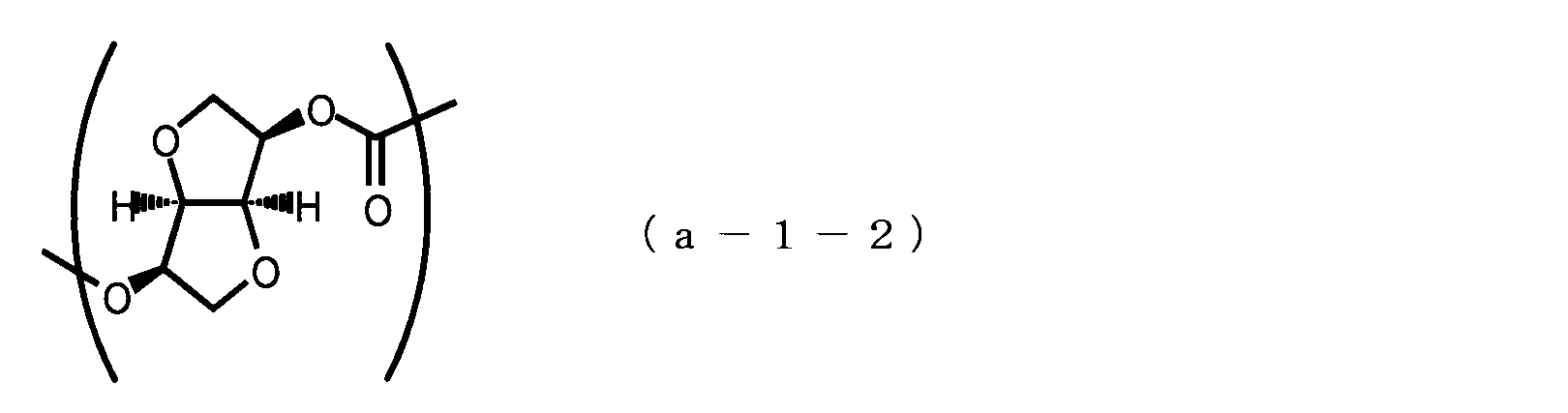
- the unit (a-1) in the present invention is derived from an aliphatic diol having an ether group, as shown in the formula (a-1).
- the diol having an ether bond in the biomass resource is a material having high heat resistance and pencil hardness.
- Examples of the formula (a-1) include repeating units (a-1-1), (a-1-2) and (a-1-3) represented by the following formulas having a stereoisomer relationship.
- carbohydrate-derived ether diols which are substances obtained from natural biomass and are one of the so-called renewable resources.
- the repeating units (a-1-1), (a-1-2) and (a-1-3) are called isosorbide, isomannide and isoid, respectively.
- Isosorbide is obtained by hydrogenating D-glucose obtained from starch and then dehydrating it.
- Other ether diols can be obtained by the same reaction except for the starting materials.
- isosorbide isomannide, and isoidide
- a repeating unit derived from isosorbide (1,4; 3,6-dianhydro-D-sorbitol) is particularly preferable because of ease of production and excellent heat resistance.
- the unit (a-2) in the present invention is derived from a diol having a spiro ring structure.
- diol compounds having a spiro ring structure 3,9-bis (2-hydroxyethyl) -2,4,8,10-tetraoxaspiro (5.5) undecane, 3,9-bis (2-hydroxy-1) , 1-Dimethylethyl) -2,4,8,10-tetraoxaspiro (5.5) undecane, 3,9-bis (2-hydroxy-1,1-diethylethyl) -2,4,8,10 Fats such as tetraoxaspiro (5.5) undecane, 3,9-bis (2-hydroxy-1,1-dipropylethyl) -2,4,8,10-tetraoxaspiro (5.5) undecane And cyclic diol compounds.
- the diol compound for deriving other units other than the unit (a-1) and the unit (a-2) may be any of other aliphatic diol compounds, alicyclic diol compounds, and aromatic dihydroxy compounds.
- Examples include diol compounds and oxyalkylene glycols such as diethylene glycol, triethylene glycol, tetraethylene glycol, and polyethylene glycol described in No. 2004/111106 pamphlet and International Publication No. 2011/021720 pamphlet.
- Examples of the aliphatic diol compound include 1,3-propanediol, 1,4-butanediol, 1,5-pentanediol, 1,6-hexanediol, 1,8-octanediol, 1.9-nonanediol, , 10-decanediol, 1,12-dodecanediol, 2-methyl-1,3-propanediol, neopentyl glycol, 3-methyl-1,5-pentanediol, 2-n-butyl-2-ethyl-1 , 3-propanediol, 2,2-diethyl-1,3-propanediol, 2,4-diethyl-1,5-pentanediol, 1,2-hexane glycol, 1,2-octyl glycol, 2-ethyl- 1,3-hexanediol, 2,3-diisobutyl
- Examples of the alicyclic diol compound include cyclohexane dimethanol, tricyclodecane dimethanol, adamantane diol, pentacyclopentadecane dimethanol, 2,2,4,4-tetramethyl-1,3-cyclobutane diol, and the like.
- Aromatic dihydroxy compounds include ⁇ , ⁇ ′-bis (4-hydroxyphenyl) -m-diisopropylbenzene (bisphenol M), 9,9-bis (4-hydroxy-3-methylphenyl) fluorene, 1,1- Bis (4-hydroxyphenyl) cyclohexane, 1,1-bis (4-hydroxyphenyl) -3,3,5-trimethylcyclohexane, 4,4′-dihydroxy-3,3′-dimethyldiphenyl sulfide, bisphenol A, 2 , 2-bis (4-hydroxy-3-methylphenyl) propane (bisphenol C), 2,2-bis (4-hydroxyphenyl) -1,1,1,3,3,3-hexafluoropropane (bisphenol AF) And 1,1-bis (4-hydroxyphenyl) decane.
- bisphenol M 9,9-bis (4-hydroxy-3-methylphenyl) fluorene
- 1,1- Bis (4-hydroxyphenyl) cyclohexane 1,1-bis (4-hydroxy
- the main repeating unit contains the unit (a-1) and the unit (a-2), and the molar ratio (a-1 / a-2) is 32 / 68-70 / 30.
- a molar ratio (a-1 / a-2) of 32/68 to 70/30 is preferred because heat resistance and surface hardness are increased, and adhesion with bisphenol A-type polycarbonate is also obtained.
- the molar ratio (a-1 / a-2) between the unit (a-1) and the unit (a-2) is preferably 40/60 to 70/30, more preferably 45/55 to 70/30, / 50 to 70/30 is more preferable.
- the balance between adhesion and heat resistance with bisphenol A-type polycarbonate is particularly excellent and more preferable.
- the molar ratio (a-1 / a-2) is smaller than 32/68, the heat resistance is low.
- the molar ratio (a-1 / a-2) is larger than 70/30, the water absorption is reduced. The rate is high, and the adhesion with the bisphenol A-type polycarbonate deteriorates.
- the molar ratio (a-1 / a-2) can be measured and calculated by proton NMR of JNM-AL400 manufactured by JEOL.
- the polycarbonate resin (A) is produced by a reaction means known per se for producing an ordinary polycarbonate resin, for example, a method of reacting a diol component with a carbonate precursor such as a carbonic acid diester. Next, basic means for these manufacturing methods will be briefly described.
- the transesterification reaction using a carbonic acid diester as a carbonate precursor is performed by a method in which a predetermined proportion of a diol component is stirred with a carbonic acid diester while heating in an inert gas atmosphere to distill the resulting alcohol or phenol.
- the reaction temperature varies depending on the boiling point of the alcohol or phenol produced, but is usually in the range of 120 to 300 ° C.
- the reaction is completed while distilling off the alcohol or phenol produced under reduced pressure from the beginning. Moreover, you may add a terminal stopper, antioxidant, etc. as needed.
- Examples of the carbonic acid diester used for the transesterification include esters such as an aryl group having 6 to 12 carbon atoms and an aralkyl group which may be substituted. Specific examples include diphenyl carbonate, ditolyl carbonate, bis (chlorophenyl) carbonate, and m-cresyl carbonate. Of these, diphenyl carbonate is particularly preferred.
- the amount of diphenyl carbonate to be used is preferably 0.97 to 1.10 mol, more preferably 1.00 to 1.06 mol, per 1 mol of the dihydroxy compound.
- a polymerization catalyst can be used in order to increase the polymerization rate.
- the polymerization catalyst include alkali metal compounds, alkaline earth metal compounds, nitrogen-containing compounds, metal compounds and the like.
- organic acid salts organic acid salts, inorganic salts, oxides, hydroxides, hydrides, alkoxides, quaternary ammonium hydroxides, and the like of alkali metals and alkaline earth metals are preferably used. It can be used alone or in combination.
- alkali metal compound examples include sodium hydroxide, potassium hydroxide, cesium hydroxide, lithium hydroxide, sodium bicarbonate, sodium carbonate, potassium carbonate, cesium carbonate, lithium carbonate, sodium acetate, potassium acetate, cesium acetate, lithium acetate, Sodium stearate, potassium stearate, cesium stearate, lithium stearate, sodium borohydride, sodium benzoate, potassium benzoate, cesium benzoate, lithium benzoate, disodium hydrogen phosphate, dipotassium hydrogen phosphate, phosphorus
- Examples include dilithium oxyhydrogen, disodium phenylphosphate, disodium salt of bisphenol A, 2 potassium salt, 2 cesium salt, 2 lithium salt, sodium salt of phenol, potassium salt, cesium salt and lithium salt.
- Alkaline earth metal compounds include magnesium hydroxide, calcium hydroxide, strontium hydroxide, barium hydroxide, magnesium carbonate, calcium carbonate, strontium carbonate, barium carbonate, magnesium diacetate, calcium diacetate, strontium diacetate, diacetate Examples include barium and barium stearate.
- nitrogen-containing compounds include quaternary ammonium hydroxides having alkyl, aryl groups, etc., such as tetramethylammonium hydroxide, tetraethylammonium hydroxide, tetrapropylammonium hydroxide, tetrabutylammonium hydroxide, and trimethylbenzylammonium hydroxide.
- quaternary ammonium hydroxides having alkyl, aryl groups, etc. such as tetramethylammonium hydroxide, tetraethylammonium hydroxide, tetrapropylammonium hydroxide, tetrabutylammonium hydroxide, and trimethylbenzylammonium hydroxide.
- tertiary amines such as triethylamine, dimethylbenzylamine and triphenylamine
- imidazoles such as 2-methylimidazole, 2-phenylimidazole and benzimidazole can
- bases or basic salts such as ammonia, tetramethylammonium borohydride, tetrabutylammonium borohydride, tetrabutylammonium tetraphenylborate, tetraphenylammonium tetraphenylborate and the like are exemplified.
- metal compounds include zinc aluminum compounds, germanium compounds, organic tin compounds, antimony compounds, manganese compounds, titanium compounds, zirconium compounds, and the like. These compounds may be used alone or in combination of two or more.
- the amount of these polymerization catalysts used is preferably 1 ⁇ 10 ⁇ 9 to 1 ⁇ 10 ⁇ 2 equivalent, preferably 1 ⁇ 10 ⁇ 8 to 1 ⁇ 10 ⁇ 5 equivalent, more preferably 1 ⁇ with respect to 1 mol of the diol component. It is selected in the range of 10 ⁇ 7 to 1 ⁇ 10 ⁇ 3 equivalents.
- a catalyst deactivator can be added at a later stage of the reaction.
- a known catalyst deactivator is effectively used.
- sulfonic acid ammonium salt and phosphonium salt are preferable.
- salts of dodecylbenzenesulfonic acid such as tetrabutylphosphonium salt of dodecylbenzenesulfonic acid and salts of paratoluenesulfonic acid such as tetrabutylammonium salt of paratoluenesulfonic acid are preferable.
- esters of sulfonic acid methyl benzenesulfonate, ethyl benzenesulfonate, butyl benzenesulfonate, octyl benzenesulfonate, phenyl benzenesulfonate, methyl paratoluenesulfonate, ethyl paratoluenesulfonate, butyl paratoluenesulfonate, Octyl paratoluenesulfonate, phenyl paratoluenesulfonate and the like are preferably used.
- dodecylbenzenesulfonic acid tetrabutylphosphonium salt is most preferably used.
- the amount of the catalyst deactivator used is preferably 0.5 to 50 mol per mol of the catalyst when at least one polymerization catalyst selected from alkali metal compounds and / or alkaline earth metal compounds is used. It can be used in a proportion, more preferably in a proportion of 0.5 to 10 mol, still more preferably in a proportion of 0.8 to 5 mol.
- the specific viscosity ( ⁇ SP ) of the polycarbonate resin (A) is preferably 0.2 to 1.5.
- the specific viscosity is in the range of 0.2 to 1.5, the strength and molding processability of the molded product are good. More preferably, it is 0.25 to 1.2, still more preferably 0.3 to 1.0, and particularly preferably 0.3 to 0.5.
- the specific viscosity referred to in the present invention was determined using an Ostwald viscometer from a solution obtained by dissolving 0.7 g of a polycarbonate resin in 100 ml of methylene chloride at 20 ° C.
- Specific viscosity ( ⁇ SP ) (t ⁇ t 0 ) / t 0 [T 0 is methylene chloride falling seconds, t is sample solution falling seconds]
- T 0 is methylene chloride falling seconds
- t is sample solution falling seconds
- specific viscosity it can carry out in the following way, for example.
- the polycarbonate resin is dissolved in 20 to 30 times its weight of methylene chloride, and the soluble component is collected by celite filtration, and then the solution is removed and sufficiently dried to obtain a solid component soluble in methylene chloride.
- the specific viscosity at 20 ° C. is determined from a solution of 0.7 g of the solid dissolved in 100 ml of methylene chloride.
- the glass transition temperature (Tg) of the polycarbonate resin (A) is preferably 110 to 145 ° C., more preferably 115 to 140 ° C.
- a Tg of 110 to 145 ° C. is preferable because it has good heat stability and moldability when used as an optical molded article.
- Glass transition temperature (Tg) is measured using a 2910 type DSC manufactured by TA Instruments Japan Co., Ltd., at a heating rate of 20 ° C./min.
- the saturated water absorption rate of the polycarbonate resin (A) is preferably 2.0% or less, more preferably 1.8% or less, and still more preferably 1.5% or less.
- a water absorption of 2.0% or less is preferred because it can reduce dimensional changes and warpage due to water absorption in the molded product.
- the layer made of the polycarbonate resin (A) preferably has a pencil hardness of F or higher. In view of excellent scratch resistance, it is preferably H or more.
- the pencil hardness is 4H or less and has a sufficient function.
- the pencil hardness can be increased by increasing the composition of the repeating unit (B) based on all repeating units.
- the pencil hardness is a hardness that does not leave a scratch mark even when the resin of the present invention is rubbed with a pencil having a specific pencil hardness, and is measured according to JIS K-5600. It is preferable to use as an index the pencil hardness used in the surface hardness test of the coating film that can be formed.
- Pencil hardness becomes soft in the order of 9H, 8H, 7H, 6H, 5H, 4H, 3H, 2H, H, F, HB, B, 2B, 3B, 4B, 5B, 6B, the hardest is 9H, The soft one is 6B.
- the aromatic polycarbonate resin (B) may be either a homopolymer or a copolymer.
- the aromatic polycarbonate resin (B) may have a branched structure or a linear structure, or may be a mixture of a branched structure and a linear structure.
- Any known method such as a phosgene method, a transesterification method or a pyridine method may be used as a method for producing the aromatic polycarbonate resin (B) using a dihydric phenol as a raw material.
- Bisphenols are typical examples of dihydric phenols, and 2,2-bis (4-hydroxyphenyl) propane, that is, bisphenol A is particularly preferably used. Further, part or all of bisphenol A may be replaced with other dihydric phenols.
- Other dihydric phenols include hydroquinone, 4,4-dihydroxydiphenyl, bis (4-hydroxyphenyl) alkanes such as bis (4-hydroxyphenyl) methane and 1,1-bis (4-hydroxyphenyl) ethane, Bis (4-hydroxyphenyl) cycloalkane such as 1-bis (4-hydroxyphenyl) cyclohexane, bis (4-hydroxyphenyl) sulfide, bis (4-hydroxyphenyl) sulfone, bis (4-hydroxyphenyl) sulfoxide, Compounds such as bis (4-hydroxyphenyl) ether, alkyls such as 2,2-bis (3-methyl-4-hydroxyphenyl) propane and 2,2-bis (3,5-dimethyl-4-hydroxyphen
- the viscosity average molecular weight of the aromatic polycarbonate resin (B) used in the present invention is preferably 15,000 or more and 30,000 or less, more preferably 20,000 or more and 27,000 or less, from the balance of mechanical properties and molding processability. Range.
- the viscosity average molecular weight (M) of the polycarbonate resin (B) is the following specific viscosity ( ⁇ sp ) obtained from a solution obtained by dissolving 0.7 g of the polycarbonate resin at 20 ° C. in 100 ml of methylene chloride using an Ostwald viscometer. It is obtained by inserting into the formula.
- the reduced viscosity of the aromatic polycarbonate resin (B) is preferably measured at a temperature of 20.0 ° C. ⁇ 0.1 ° C., using methylene chloride as a solvent, and adjusting the polycarbonate concentration to 0.60 g / dl precisely. Is 0.23 dl / g or more and 0.72 dl / g or less, more preferably 0.27 dl / g or more and 0.61 dl / g or less.
- the polycarbonate resin used in the present invention is a heat stabilizer, a plasticizer, a light stabilizer, a polymerized metal deactivator, a flame retardant, a lubricant, an antistatic agent, a surfactant, an antibacterial agent, if necessary and necessary.
- Additives such as ultraviolet absorbers and mold release agents can be blended.
- the polycarbonate resin used in the present invention particularly preferably contains a heat stabilizer in order to suppress a decrease in molecular weight and a deterioration in hue during extrusion and molding.
- a heat stabilizer examples include a phosphorus heat stabilizer, a phenol heat stabilizer, and a sulfur heat stabilizer, and these can be used alone or in combination of two or more.
- a phosphorus heat stabilizer As the phosphorus stabilizer, a phosphite compound is preferably blended.
- phosphite compound examples include pentaerythritol type phosphite compounds, phosphite compounds having a cyclic structure by reacting with dihydric phenols, and phosphite compounds having other structures.
- pentaerythritol phosphite compound examples include distearyl pentaerythritol diphosphite, bis (2,4-di-tert-butylphenyl) pentaerythritol diphosphite, and bis (2,6 -Di-tert-butyl-4-methylphenyl) pentaerythritol diphosphite, bis (2,6-di-tert-butyl-4-ethylphenyl) pentaerythritol diphosphite, phenylbisphenol A pentaerythritol diphosphite, And bis (nonylphenyl) pentaerythritol diphosphite, dicyclohexylpentaerythritol diphosphite, and the like.
- distearyl pentaerythritol diphosphite and bis (2,4-di-te) are preferable.
- distearyl pentaerythritol diphosphite and bis (2,4-di-te) are preferable.
- distearyl pentaerythritol diphosphite and bis (2,4-di-te) are preferable.
- Examples of phosphite compounds having a cyclic structure by reacting with the above dihydric phenols include 2,2′-methylenebis (4,6-di-tert-butylphenyl) (2,4-di-tert-butylphenyl).
- Examples of the phosphite compounds having other structures described above include triphenyl phosphite, tris (nonylphenyl) phosphite, tridecyl phosphite, trioctyl phosphite, trioctadecyl phosphite, and didecyl monophenyl phosphite.
- Dioctyl monophenyl phosphite diisopropyl monophenyl phosphite, monobutyl diphenyl phosphite, monodecyl diphenyl phosphite, monooctyl diphenyl phosphite, 2,2-methylenebis (4,6-di-tert-butylphenyl) octylphos Phyto, Tris (diethylphenyl) phosphite, Tris (di-iso-propylphenyl) phosphite, Tris (di-n-butylphenyl) phosphite, Tris (2,4-di-t rt- butyl phenyl) phosphite, and tris (2,6-di -tert- butylphenyl) phosphite and the like.
- phosphite compounds for example, phosphate compounds, phosphonite compounds, and phosphonate compounds can be mentioned.
- phosphate compound examples include tributyl phosphate, trimethyl phosphate, tricresyl phosphate, triphenyl phosphate, trichlorophenyl phosphate, triethyl phosphate, diphenyl cresyl phosphate, diphenyl monoorxenyl phosphate, tributoxyethyl phosphate, dibutyl phosphate, dioctyl phosphate, Examples thereof include diisopropyl phosphate, and triphenyl phosphate and trimethyl phosphate are preferable.
- Examples of the phosphonite compound include tetrakis (2,4-di-tert-butylphenyl) -4,4′-biphenylenediphosphonite, tetrakis (2,4-di-tert-butylphenyl) -4,3′-biphenylenedi.
- Examples of the phosphonate compound include dimethyl benzenephosphonate, diethyl benzenephosphonate, and dipropyl benzenephosphonate.
- the above phosphorous heat stabilizers can be used alone or in combination of two or more.
- the phosphorus heat stabilizer is preferably added in an amount of 0.001 to 1 part by weight, more preferably 0.01 to 0.5 part by weight, and still more preferably 0.01 to 0.3 part by weight per 100 parts by weight of the polycarbonate resin.
- the polycarbonate resin used in the present invention contains a hindered phenol-based heat stabilizer or sulfur-based heat stabilizer as a heat stabilizer for the purpose of suppressing molecular weight reduction and hue deterioration during extrusion and molding. It can also be added in combination with a system heat stabilizer.
- the hindered phenol heat stabilizer is not particularly limited as long as it has an antioxidant function.
- n-octadecyl-3- (4′-hydroxy-3 ′, 5′-di-t-Butylphenyl) propionate tetrakis ⁇ methylene-3- (3 ′, 5′-di-tert-butyl-4-hydroxyphenyl) propionate ⁇ methane, distearyl (4-hydroxy-3-methyl-5-tert-butylbenzyl) ) Malonate, triethylene glycol-bis ⁇ 3- (3-tert-butyl-5-methyl-4-hydroxyphenyl) propionate ⁇ , 1,6-hexanediol-bis ⁇ 3- (3,5-di-t- Butyl-4-hydroxyphenyl) propionate ⁇ , pentaerythrityl-tetrakis ⁇ 3- (3,5-di-t-butyl-4-hydro Siphenyl) propionate ⁇ , 2,
- hindered phenol heat stabilizers may be used alone or in combination of two or more.
- the hindered phenol heat stabilizer is preferably 0.001 to 1 part by weight, more preferably 0.01 to 0.5 part by weight, still more preferably 0.01 to 0.3 part by weight per 100 parts by weight of the polycarbonate resin. Blended.
- sulfur-based heat stabilizer examples include dilauryl-3,3′-thiodipropionate, ditridecyl-3,3′-thiodipropionate, dimyristyl-3,3′-thiodipropionate, diester Stearyl-3,3′-thiodipropionate, laurylstearyl-3,3′-thiodipropionate, pentaerythritol tetrakis (3-laurylthiopropionate), bis [2-methyl-4- (3 -Laurylthiopropionyloxy) -5-tert-butylphenyl] sulfide, octadecyl disulfide, mercaptobenzimidazole, 2-mercapto-6-methylbenzimidazole, 1,1′-thiobis (2-naphthol), etc. .
- pentaerythritol tetrakis 3-lauryl thiopropionate
- sulfur heat stabilizers may be used alone or in combination of two or more.
- the sulfur heat stabilizer is preferably added in an amount of 0.001 to 1 part by weight, more preferably 0.01 to 0.5 part by weight, and still more preferably 0.01 to 0.3 part by weight per 100 parts by weight of the polycarbonate resin.
- the total of these is preferably 0.001 to 1 part by weight, more preferably 0.001 part by weight based on 100 parts by weight of the polycarbonate resin. 01 to 0.3 parts by weight is blended.
- the polycarbonate resin used in the present invention can be blended with a release agent within a range that does not impair the object of the present invention in order to further improve the releasability from the mold during melt molding.
- Such release agents include higher fatty acid esters of mono- or polyhydric alcohols, higher fatty acids, paraffin wax, beeswax, olefin waxes, olefin waxes containing carboxy groups and / or carboxylic anhydride groups, silicone oils, Examples include organopolysiloxane.
- the higher fatty acid ester is preferably a partial ester or total ester of a monohydric or polyhydric alcohol having 1 to 20 carbon atoms and a saturated fatty acid having 10 to 30 carbon atoms.
- Such partial esters or total esters of monohydric or polyhydric alcohols and saturated fatty acids include, for example, stearic acid monoglyceride, stearic acid diglyceride, stearic acid triglyceride, stearic acid monosorbate, stearyl stearate, behenic acid monoglyceride, behenic acid Behenyl, pentaerythritol monostearate, pentaerythritol tetrastearate, pentaerythritol tetrapelargonate, propylene glycol monostearate, stearyl stearate, palmityl palmitate, butyl stearate, methyl laurate, isopropyl palmitate, biphenyl
- stearic acid monoglyceride stearic acid triglyceride, pentaerythritol tetrastearate, and behenyl behenate are preferably used.
- a saturated fatty acid having 10 to 30 carbon atoms is preferable.
- Such fatty acids include myristic acid, lauric acid, palmitic acid, stearic acid, behenic acid and the like.
- release agents may be used alone or in combination of two or more.
- the amount of the release agent is preferably 0.01 to 5 parts by weight with respect to 100 parts by weight of the polycarbonate resin.
- UV absorber The polycarbonate resin used in the present invention can contain an ultraviolet absorber.
- UV absorbers include benzotriazole UV absorbers, benzophenone UV absorbers, triazine UV absorbers, cyclic imino ester UV absorbers, and cyanoacrylate UV absorbers. Among them, benzotriazole UV absorbers Agents are preferred.
- benzotriazole ultraviolet absorber examples include 2- (2′-hydroxy-5′-methylphenyl) benzotriazole, 2- (2′-hydroxy-5′-tert-butylphenyl) benzotriazole, 2- (2 '-Hydroxy-5'-tert-octylphenyl) benzotriazole, 2- (2'-hydroxy-3', 5'-di-tert-butylphenyl) benzotriazole, 2- (2'-hydroxy-3 ', 5'-di-tert-amylphenyl) benzotriazole, 2- (2'-hydroxy-3'-dodecyl-5'-methylphenyl) benzotriazole, 2- (2'-hydroxy-3 ', 5'-bis ( ⁇ , ⁇ '-dimethylbenzyl) phenylbenzotriazole, 2- [2'-hydroxy-3 '-(3 ", 4", 5 “, 6” -tetraphthalimidomethyl) -5′-methylphenyl] be
- the ratio of the ultraviolet absorber is preferably 0.01 to 2 parts by weight, more preferably 0.1 to 1 part by weight, and still more preferably 0.2 to 0.5 parts by weight with respect to 100 parts by weight of the polycarbonate resin. is there.
- the polycarbonate resin used in the present invention can contain a light stabilizer.
- a light stabilizer When a light stabilizer is included, there is an advantage that it is favorable in terms of weather resistance and cracks are hardly formed in the molded product.
- Examples of the light stabilizer include 1,2,2,6,6-pentamethyl-4-piperidyl methacrylate, didecanoic acid bis (2,2,6,6-tetramethyl-1-octyloxy-4-piperidinyl) ester, Bis (1,2,2,6,6-pentamethyl-4-piperidinyl)-[[3,5-bis (1,1-dimethylethyl) -4-hydroxyphenyl] methyl] butyl malonate, 2,4- Bis [N-butyl-N- (1-cyclohexyloxy-2,2,6,6-tetramethylpiperidin-2-yl) amino] -6- (2-hydroxyethylamine) -1,3,5-triazine, Bis (1,2,2,6,6-pentamethyl-4-piperidinyl) sebacate, methyl (1,2,2,6,6-pentamethyl-4-piperidinyl) sebacate, bis (2 2,6,6-tetramethyl-4-piperidyl) carbonate
- epoxy stabilizer In order to improve hydrolyzability, an epoxy compound can be blended with the polycarbonate resin used in the present invention within a range not impairing the object of the present invention.
- Epoxy stabilizers include epoxidized soybean oil, epoxidized linseed oil, phenyl glycidyl ether, allyl glycidyl ether, t-butylphenyl glycidyl ether, 3,4-epoxycyclohexylmethyl-3 ′, 4′-epoxycyclohexyl carboxylate 3,4-epoxy-6-methylcyclohexylmethyl-3 ′, 4′-epoxy-6′-methylcyclohexylcarboxylate, 2,3-epoxycyclohexylmethyl-3 ′, 4′-epoxycyclohexylcarboxylate, 4- (3,4-epoxy-5-methylcyclohexyl) butyl-3 ′, 4′-epoxycyclohexylcarboxylate, 3,4-epoxycyclohexylethylene oxide, cyclohexylmethyl-3,4-epoxycyclohexyl
- Such an epoxy stabilizer is in the range of 0.0001 to 5 parts by weight, preferably 0.001 to 1 part by weight, more preferably 0.005 to 0.5 parts by weight, based on 100 parts by weight of the polycarbonate resin. It is desirable to blend with.
- the polycarbonate resin used in the present invention can be blended with a bluing agent in order to counteract the yellowishness of the lens based on the polymer or the UV absorber.
- a bluing agent can be used without any problem as long as it is used for polycarbonate.
- anthraquinone dyes are preferred because they are readily available.
- the bluing agent include, for example, the general name Solvent Violet 13 [CA. No (color index No) 60725], generic name Solvent Violet 31 [CA. No 68210, generic name Solvent Violet 33 [CA. No. 60725], generic name Solvent Blue 94 [CA. No. 61500], generic name Solvent Violet 36 [CA. No. 68210], generic name Solvent Blue97 [manufactured by Bayer "Macrolex Violet RR"] and generic name Solvent Blue45 [CA. No. 61110] is given as a representative example.
- These bluing agents may be used individually by 1 type, and may use 2 or more types together. These bluing agents are preferably blended at a ratio of 0.1 ⁇ 10 ⁇ 4 to 2 ⁇ 10 ⁇ 4 parts by weight with respect to 100 parts by weight of the polycarbonate resin.
- a flame retardant can also be blended with the polycarbonate resin used in the present invention.
- Flame retardants include brominated epoxy resins, brominated polystyrenes, brominated polycarbonates, brominated polyacrylates, halogenated flame retardants such as chlorinated polyethylene, phosphate ester flame retardants such as monophosphate compounds and phosphate oligomer compounds, Organic phosphorus flame retardants other than phosphate ester flame retardants such as phosphinate compounds, phosphonate compounds, phosphonitrile oligomer compounds, phosphonic acid amide compounds, organic sulfonate alkali (earth) metal salts, borate metal salt flame retardants, And organic metal salt flame retardants such as metal stannate flame retardants, silicone flame retardants, ammonium polyphosphate flame retardants, and triazine flame retardants.
- a flame retardant aid for example, sodium antimonate, antimony trioxide, etc.
- an anti-drip agent polytetrafluoroethylene having fibril-forming ability, etc.
- the range of 0.05 to 50 parts by weight per 100 parts by weight of the polycarbonate resin is preferable. If it is less than 0.05 part by weight, sufficient flame retardancy will not be exhibited, and if it exceeds 50 parts by weight, the strength and heat resistance of the molded product will be impaired.
- an elastic polymer in the polycarbonate resin used in the present invention, an elastic polymer can be used as an impact modifier.
- the elastic polymer include natural rubber or a rubber component having a glass transition temperature of 10 ° C.
- a more preferable elastic polymer is a core-shell type graft copolymer in which one or two or more shells of the above monomer are graft-copolymerized on the core of the rubber component.
- block copolymers of such rubber components and the above monomers include thermoplastic elastomers such as styrene / ethylenepropylene / styrene elastomers (hydrogenated styrene / isoprene / styrene elastomers) and hydrogenated styrene / butadiene / styrene elastomers.
- thermoplastic elastomers such as styrene / ethylenepropylene / styrene elastomers (hydrogenated styrene / isoprene / styrene elastomers) and hydrogenated styrene / butadiene / styrene elastomers.
- various elastic polymers known as other thermoplastic elastomers such as polyurethane elastomers, polyester elastomers, polyether amide elastomers and the like
- a core-shell type graft copolymer is more suitable as an impact modifier.
- the core particle size is preferably 0.05 to 0.8 ⁇ m, more preferably 0.1 to 0.6 ⁇ m, and more preferably 0.1 to 0.5 ⁇ m in terms of weight average particle size. Is more preferable. If it is in the range of 0.05 to 0.8 ⁇ m, better impact resistance is achieved.
- the elastic polymer preferably contains 40% or more of a rubber component, and more preferably contains 60% or more.
- Rubber components include butadiene rubber, butadiene-acrylic composite rubber, acrylic rubber, acrylic-silicone composite rubber, isobutylene-silicone composite rubber, isoprene rubber, styrene-butadiene rubber, chloroprene rubber, ethylene-propylene rubber, nitrile rubber, ethylene- Acrylic rubber, silicone rubber, epichlorohydrin rubber, fluororubber, and those in which hydrogen is added to these unsaturated bonds may include halogen atoms because of concerns about the generation of harmful substances during combustion. No rubber component is preferable in terms of environmental load.
- the glass transition temperature of the rubber component is preferably ⁇ 10 ° C. or lower, more preferably ⁇ 30 ° C. or lower, and the rubber component is particularly preferably butadiene rubber, butadiene-acrylic composite rubber, acrylic rubber, or acrylic-silicone composite rubber.
- the composite rubber is a rubber obtained by copolymerizing two kinds of rubber components or a rubber polymerized so as to have an IPN structure entangled with each other so as not to be separated.
- Examples of the aromatic vinyl in the vinyl compound copolymerized with the rubber component include styrene, ⁇ -methylstyrene, p-methylstyrene, alkoxystyrene, halogenated styrene and the like, and styrene is particularly preferable.
- Examples of acrylic esters include methyl acrylate, ethyl acrylate, butyl acrylate, cyclohexyl acrylate, octyl acrylate, etc.
- examples of methacrylic esters include methyl methacrylate, ethyl methacrylate, methacrylic acid.
- Examples thereof include butyl, cyclohexyl methacrylate, octyl methacrylate and the like, and methyl methacrylate is particularly preferable.
- a methacrylic acid ester such as methyl methacrylate as an essential component. More specifically, the methacrylic acid ester is contained in 100% by weight of the graft component (in the case of the core-shell type polymer in 100% by weight of the shell), preferably 10% by weight or more, more preferably 15% by weight or more. Is done.
- the elastic polymer containing a rubber component having a glass transition temperature of 10 ° C. or less may be produced by any polymerization method including bulk polymerization, solution polymerization, suspension polymerization, and emulsion polymerization. It can be a single-stage graft or a multi-stage graft. Moreover, the mixture with the copolymer of only the graft component byproduced in the case of manufacture may be sufficient. Furthermore, examples of the polymerization method include a general emulsion polymerization method, a soap-free polymerization method using an initiator such as potassium persulfate, a seed polymerization method, and a two-stage swelling polymerization method.
- the aqueous phase and the monomer phase are individually maintained, both are accurately supplied to the continuous disperser, and the particle diameter is controlled by the rotation speed of the disperser, and the continuous production is performed.
- a method may be used in which the monomer phase is supplied by passing it through a fine orifice having a diameter of several to several tens of ⁇ m or a porous filter in an aqueous liquid having dispersibility to control the particle size.
- the reaction may be one stage or multistage for both the core and the shell.
- rubber components mainly composed of butadiene rubber, acrylic rubber, or butadiene-acrylic composite rubber include Kane Ace B series (for example, B-56) of Kaneka Chemical Industry Co., Ltd. and Metabrene of Mitsubishi Rayon Co., Ltd. C series (for example, C-223A), W series (for example, W-450A), Kureha Chemical Industry's paraloid EXL series (for example, EXL-2602), HIA series (for example, HIA-15), BTA series (E.g. BTA-III), KCA series, Rohm and Haas Paraloid EXL series, KM series (e.g.
- the composition ratio of the impact modifier is preferably 0.2 to 50 parts by weight per 100 parts by weight of the polycarbonate resin, preferably 1 to 30 parts by weight, and more preferably 1.5 to 20 parts by weight. Such a composition range can give good impact resistance to the composition while suppressing a decrease in rigidity.
- the multilayer body of the present invention can be widely used as a molded product such as a film, a sheet, or a plate.
- a method for forming the multilayer body a known method such as coextrusion, extrusion lamination, heat lamination, dry lamination, or the like can be used. Among these, it is particularly preferable to use a coextrusion method.
- the resin and the additives constituting each layer of the multilayer body are combined with the resin through a feed block or a multi-manifold die using a plurality of extruders to form the multilayer body.
- the multilayer body obtained in the above step can be stretched uniaxially or biaxially by a roll method, a tenter method, a tubular method or the like.
- the total thickness is preferably 0.03 to 300 mm, more preferably 0.05 to 100 mm, further preferably 0.1 to 10 mm, and particularly preferably 0.5 to 3 mm.
- the ratio of the layer made of the polycarbonate resin (A) to the total thickness of all layers of the multilayer body is preferably 5% or more and 60% or less, more preferably 10% or more and 55% or less, and more preferably 20% or more. More preferably, it is 50% or less. If the thickness of the layer made of the polycarbonate resin (A) is within such a range, a multilayer body having excellent surface hardness and heat resistance and also having excellent impact resistance can be provided.
- the multilayer body of the present invention formed as a film, sheet, or plate has excellent transparency, impact resistance, and heat resistance, and has excellent UV discoloration resistance and surface hardness. Therefore, the use of the multilayer body of the present invention is not particularly limited. For example, building materials, interior parts, transparent sheets such as display covers, sheets for resin-coated metal plates, molding (vacuum / pressure forming, hot press molding) Etc.), a colored plate, a transparent plate, a shrink film, a shrink label, a shrink tube, an automobile interior material, a resin glazing, a household appliance member, an OA equipment member, and the like.
- surface treatment Various surface treatments can be performed on the multilayer body of the present invention.
- Surface treatment here refers to a new layer on the surface of resin molded products such as vapor deposition (physical vapor deposition, chemical vapor deposition, etc.), plating (electroplating, electroless plating, hot dipping, etc.), painting, coating, printing, etc.
- a method used for ordinary polycarbonate resin is applicable.
- Specific examples of the surface treatment include various surface treatments such as hard coat, water / oil repellent coat, ultraviolet absorption coat, infrared absorption coat, and metalizing (evaporation).
- Hard coat is a particularly preferred and required surface treatment.
- parts means “parts by weight”.
- the resins used and the evaluation methods used in the examples are as follows.
- Pencil Hardness Based on JIS K5400, 1 kg while maintaining a 45 degree angle with respect to the surface of the first layer of the multilayer sample cut to 80 mm ⁇ 60 mm in a constant temperature room at 23 ° C. A line was drawn in a state where a load of 1 mm was applied, and the surface state was visually evaluated.
- the water absorption rate is obtained by dissolving a polycarbonate resin pellet in methylene chloride, evaporating the methylene chloride, using a cast film having a thickness of 200 ⁇ m, drying at 100 ° C. for 12 hours, and immersed in water at 25 ° C. for 48 hours. The increase in weight was measured, and the water absorption was determined by the following formula.
- Water absorption (%) ⁇ (resin weight after water absorption ⁇ resin weight before water absorption) / resin weight before water absorption ⁇ ⁇ 100 6).
- Adhesiveness The surface of the first layer of the multilayer sample is cut with 11 cutters at 1 mm intervals vertically and horizontally on the surface of the first layer to make 100 squares, and the cello tape (registered trademark) (Nichiban Co., Ltd. adhesive) After affixing (tape), it peeled at a stretch in the direction of 90 degrees. The first layer did not peel off, and the number of remaining squares was counted.
- Impact resistance Multi-layer samples are tested 10 times at a test temperature of 23 ° C, a test speed of 7 m / sec, a striker diameter of 1/2 inch and a receiving diameter of 1 inch using Shimadzu HYDROSHOTHITS-P10 (Shimadzu Corporation). The test was carried out and the maximum impact energy (average value) at that time was evaluated.
- SPG isosorbide
- SPG 3,9-bis (2-hydroxy-1,1-dimethylethyl) -2,4,8,10-tetraoxaspiro (5,5) undecane
- SPG 3,9-bis (2-hydroxy-1,1-dimethylethyl) -2,4,8,10-tetraoxaspiro (5,5) undecane
- SPG 3,9-bis (2-hydroxy-1,1-dimethylethyl) -2,4,8,10-tetraoxaspiro (5,5) undecane
- the polycarbonate resin (B) (manufactured by Teijin Chemicals Ltd., trade name: Panlite) is a single screw extruder with a screw diameter of 40 mm, and the polycarbonate resin forming the polycarbonate resin (A) layer prepared by the above production method is a screw. Each is melted by a single screw extruder having a diameter of 30 mm and laminated in two layers by a feed block method. T-type dies having a set temperature of 280 ° C. for polycarbonate resin (B) and a set temperature of 230 ° C.
- Example 6 ⁇ Manufacture of laminates> The same evaluation as in Example 1 was performed except that PMMA (Acrypet MF manufactured by Mitsubishi Rayon Co., Ltd.) was used instead of the polycarbonate resin (A). The obtained laminate did not have satisfactory heat resistance and water absorption, and the original purpose of impact resistance could not be achieved.
- PMMA Acrypet MF manufactured by Mitsubishi Rayon Co., Ltd.
- the multilayer body of the present invention comprises a building material, an interior part, a transparent sheet such as a display cover, a sheet for a resin-coated metal plate, a sheet for molding (vacuum / pressure forming, hot press molding, etc.), a colored plate, a transparent plate, a shrink film, It is useful as a shrink label, shrink tube, automobile interior material, resin glazing, home appliance product member, OA equipment member.
Landscapes
- Chemical & Material Sciences (AREA)
- Health & Medical Sciences (AREA)
- Chemical Kinetics & Catalysis (AREA)
- Medicinal Chemistry (AREA)
- Polymers & Plastics (AREA)
- Organic Chemistry (AREA)
- Polyesters Or Polycarbonates (AREA)
- Compositions Of Macromolecular Compounds (AREA)
- Laminated Bodies (AREA)
Abstract
Description


で表される単位(a-2)を含み、単位(a-1)と単位(a-2)とのモル比(a-1/a-2)が32/68~70/30であるポリカーボネート樹脂(A)からなる層と芳香族ポリカーボネート樹脂(B)からなる層とをそれぞれ少なくとも1層以上有する多層体。
<ポリカーボネート樹脂>
(ポリカーボネート樹脂(A))
本発明のポリカーボネート樹脂(A)は、主たる繰り返し単位が、単位(a-1)と単位(a-2)とから構成される。主たる繰り返し単位とは、単位(a-1)と単位(a-2)との合計が全繰り返し単位を基準として50モル%以上であり、好ましくは60モル%以上であり、より好ましくは70モル%以上、さらに好ましくは80モル%以上であることである。
(単位(a-1))
本発明における単位(a-1)は前記式(a-1)に示したように、エーテル基を有する脂肪族ジオールから誘導されるものである。


(単位(a-2))
本発明における単位(a-2)は、スピロ環構造を有するジオールから誘導されるものである。スピロ環構造を有するジオール化合物として、3,9-ビス(2-ヒドロキシエチル)-2,4,8,10-テトラオキサスピロ(5.5)ウンデカン、3,9-ビス(2-ヒドロキシ-1,1-ジメチルエチル)-2,4,8,10-テトラオキサスピロ(5.5)ウンデカン、3,9-ビス(2-ヒドロキシ-1,1-ジエチルエチル)-2,4,8,10-テトラオキサスピロ(5.5)ウンデカン、3,9-ビス(2-ヒドロキシ-1,1-ジプロピルエチル)-2,4,8,10-テトラオキサスピロ(5.5)ウンデカンなどの脂環式ジオール化合物があげられる。
(その他の単位)
単位(a-1)および単位(a-2)以外のその他の単位を誘導するジオール化合物としては、他の脂肪族ジオール化合物、脂環式ジオール化合物、芳香族ジヒドロキシ化合物のいずれでも良く、国際公開第2004/111106号パンフレット、国際公開第2011/021720号パンフレットに記載のジオール化合物やジエチレングリコール、トリエチレングリコール、テトラエチレングリコール、ポリエチレングリコールなどのオキシアルキレングリコール類が挙げられる。
(組成)
本発明で使用されるポリカーボネート樹脂(A)は、主たる繰り返し単位が単位(a-1)と単位(a-2)とを含み、それらのモル比(a-1/a-2)は32/68~70/30である。モル比(a-1/a-2)が32/68~70/30では、耐熱性、表面硬度が高くなり、ビスフェノールA型ポリカーボネートとの密着性も得られ好ましい。単位(a-1)と単位(a-2)とのモル比(a-1/a-2)は、40/60~70/30が好ましく、45/55~70/30がより好ましく、50/50~70/30がさらに好ましい。この組成の範囲では、特にビスフェノールA型ポリカーボネートとの密着性と耐熱性のバランスに優れ、より好ましい。なお、モル比(a-1/a-2)が32/68より小さい場合は、耐熱性が低くなり、他方モル比(a-1/a-2)が70/30より大きい場合は、吸水率が高く、ビスフェノールA型ポリカーボネートとの密着性が悪化する。モル比(a-1/a-2)は、日本電子社製JNM-AL400のプロトンNMRにて測定し算出することができる。
(ポリカーボネート樹脂(A)の製造方法)
ポリカーボネート樹脂(A)は、通常のポリカーボネート樹脂を製造するそれ自体公知の反応手段、例えばジオール成分に炭酸ジエステルなどのカーボネート前駆物質を反応させる方法により製造される。次にこれらの製造方法について基本的な手段を簡単に説明する。
(比粘度:ηSP)
ポリカーボネート樹脂(A)の比粘度(ηSP)は、0.2~1.5が好ましい。比粘度が0.2~1.5の範囲では成形品の強度及び成形加工性が良好となる。より好ましくは0.25~1.2であり、さらに好ましくは0.3~1.0であり、特に好ましくは0.3~0.5である。
[t0は塩化メチレンの落下秒数、tは試料溶液の落下秒数]
なお、具体的な比粘度の測定としては、例えば次の要領で行うことができる。まず、ポリカーボネート樹脂をその20~30倍重量の塩化メチレンに溶解し、可溶分をセライト濾過により採取した後、溶液を除去して十分に乾燥し、塩化メチレン可溶分の固体を得る。かかる固体0.7gを塩化メチレン100mlに溶解した溶液から20℃における比粘度を、オストワルド粘度計を用いて求める。
(ガラス転移温度:Tg)
ポリカーボネート樹脂(A)のガラス転移温度(Tg)は、好ましくは110~145℃、より好ましくは115~140℃である。Tgが110~145℃であると、光学成形体として使用した際に、耐熱安定性及び成形性が良好であり好ましい。
(飽和吸水率)
ポリカーボネート樹脂(A)の飽和吸水率は、好ましくは2.0%以下、より好ましくは1.8%以下、さらに好ましくは1.5%以下である。吸水率が2.0%以下であると成形品において吸水による寸法変化や反りが低減でき好ましい。
(鉛筆硬度)
ポリカーボネート樹脂(A)からなる層は、鉛筆硬度がF以上であることが好ましい。耐傷性に優れるという点で、H以上であることが好ましい。なお、鉛筆硬度は4H以下で充分な機能を有する。鉛筆硬度は全繰り返し単位を基準として繰り返し単位(B)の組成を増加させることで硬くすることができる。本発明において、鉛筆硬度とは、本発明の樹脂を特定の鉛筆硬度を有する鉛筆で樹脂を擦過した場合に擦過しても擦過痕が残らない硬さのことであり、JIS K-5600に従って測定できる塗膜の表面硬度試験に用いる鉛筆硬度を指標とすることが好ましい。鉛筆硬度は、9H、8H、7H、6H、5H、4H、3H、2H、H、F、HB、B、2B、3B、4B、5B、6Bの順で柔らかくなり、最も硬いものが9H、最も軟らかいものが6Bである。
(芳香族ポリカーボネート樹脂(B))
芳香族ポリカーボネート樹脂(B)は、ホモポリマー及びコポリマーのいずれであってもよい。また、芳香族ポリカーボネート樹脂(B)は、分岐構造であっても、直鎖構造であってもよいし、さらに分岐構造と直鎖構造との混合物であってもよい。
[η]=1.23×10⁻⁴M0.83
c=0.7
また、芳香族ポリカーボネート樹脂(B)の還元粘度は、溶媒として塩化メチレンを用い、ポリカーボネート濃度を0.60g/dlに精密に調整し、温度20.0℃±0.1℃で測定され、好ましくは0.23dl/g以上0.72dl/g以下で、より好ましくは0.27dl/g以上0.61dl/g以下の範囲内である。
(添加剤)
本発明で使用されるポリカーボネート樹脂は、用途や必要に応じて熱安定剤、可塑剤、光安定剤、重合金属不活性化剤、難燃剤、滑剤、帯電防止剤、界面活性剤、抗菌剤、紫外線吸収剤、離型剤等の添加剤を配合することができる。
(熱安定剤)
本発明で使用されるポリカーボネート樹脂は、押出・成形時の分子量低下や色相の悪化を抑制するために、とくに熱安定剤を含有することが好ましい。熱安定剤としてはリン系熱安定剤、フェノール系熱安定剤、イオウ系熱安定剤が挙げられ、これらの1種を単独で、又は2種以上を併用して用いることができる。特に、単位(a-1)のエーテルジオール残基が熱と酸素により劣化し、着色しやすいため、熱安定剤としてはリン系熱安定剤を含有することが好ましい。リン系安定剤としてはホスファイト化合物を配合することが好ましい。ホスファイト化合物としては、ペンタエリスリトール型ホスファイト化合物、二価フェノール類と反応し環状構造を有するホスファイト化合物、その他の構造を有するホスファイト化合物が挙げられる。
(離型剤)
本発明で使用されるポリカーボネート樹脂は、溶融成形時の金型からの離型性をより向上させるために、本発明の目的を損なわない範囲で離型剤を配合することも可能である。
(紫外線吸収剤)
本発明で使用されるポリカーボネート樹脂は、紫外線吸収剤を含むことができる。紫外線吸収剤としてはベンゾトリアゾール系紫外線吸収剤、ベンゾフェノン系紫外線吸収剤、トリアジン系紫外線吸収剤、環状イミノエステル系紫外線吸収剤、シアノアクリレート系紫外線吸収剤等が挙げられ、なかでもベンゾトリアゾール系紫外線吸収剤が好ましい。
(光安定剤)
本発明で使用されるポリカーボネート樹脂は、光安定剤を含むことができる。光安定剤を含むと、耐候性の面で良好であり、成形品にクラックが入り難くなるという利点がある。
(エポキシ系安定剤)
本発明で使用されるポリカーボネート樹脂には、加水分解性を改善するため、本願発明の目的を損なわない範囲で、エポキシ化合物を配合することが出来る。
(ブルーイング剤)
本発明で使用されるポリカーボネート樹脂は、重合体や紫外線吸収剤に基づくレンズの黄色味を打ち消すためにブルーイング剤を配合することができる。ブルーイング剤としては、ポリカーボネートに使用されるものであれば、特に支障なく使用することができる。一般的にはアンスラキノン系染料が入手容易であり好ましい。
(難燃剤)
本発明で使用されるポリカーボネート樹脂には、難燃剤を配合することもできる。難燃剤としては、臭素化エポキシ樹脂、臭素化ポリスチレン、臭素化ポリカーボネート、臭素化ポリアクリレート、および塩素化ポリエチレンなどのハロゲン系難燃剤、モノホスフェート化合物およびホスフェートオリゴマー化合物などのリン酸エステル系難燃剤、ホスフィネート化合物、ホスホネート化合物、ホスホニトリルオリゴマー化合物、ホスホン酸アミド化合物などのリン酸エステル系難燃剤以外の有機リン系難燃剤、有機スルホン酸アルカリ(土類)金属塩、ホウ酸金属塩系難燃剤、および錫酸金属塩系難燃剤などの有機金属塩系難燃剤、並びにシリコーン系難燃剤、ポリリン酸アンモニウム系難燃剤、トリアジン系難燃剤等が挙げられる。また別途、難燃助剤(例えば、アンチモン酸ナトリウム、三酸化アンチモン等)や滴下防止剤(フィブリル形成能を有するポリテトラフルオロエチレン等)等を配合し、難燃剤と併用してもよい。
(弾性重合体)
本発明で使用されるポリカーボネート樹脂には、衝撃改良剤として弾性重合体を使用することができ、弾性重合体の例としては、天然ゴムまたは、ガラス転移温度が10℃以下のゴム成分に、芳香族ビニル、シアン化ビニル、アクリル酸エステル、メタクリル酸エステル、およびこれらと共重合可能なビニル化合物から選択されたモノマーの1種または2種以上が共重合されたグラフト共重合体を挙げることができる。より好適な弾性重合体は、ゴム成分のコアに前記モノマーの1種または2種以上のシェルがグラフト共重合されたコア-シェル型のグラフト共重合体である。
<多層体>
本発明の多層体は、フィルム、シート、プレート等の成形品として広く使用することができる。多層体の成形方法としては公知の方法、例えば、共押出、押出ラミネート、熱ラミネート、ドライラミネート等の方法を用いることができる。この中でも特に共押出法を用いることが好ましい。
(表面処理)
本発明の多層体には、各種の表面処理を行うことが可能である。ここでいう表面処理とは、蒸着(物理蒸着、化学蒸着など)、メッキ(電気メッキ、無電解メッキ、溶融メッキなど)、塗装、コーティング、印刷などの樹脂成形品の表層上に新たな層を形成させるものであり、通常のポリカーボネート樹脂に用いられる方法が適用できる。表面処理としては、具体的には、ハードコート、撥水・撥油コート、紫外線吸収コート、赤外線吸収コート、並びにメタライジング(蒸着など)などの各種の表面処理が例示される。ハードコートは特に好ましくかつ必要とされる表面処理である。
日本電子社製JNM-AL400のプロトンNMRにて各繰り返し単位を測定し、ポリマー組成比(モル比)を算出した。
20℃で塩化メチレン100mlにポリカーボネート樹脂0.7gを溶解した溶液からオストワルド粘度計を用いて求めた。
[t0は塩化メチレンの落下秒数、tは試料溶液の落下秒数]
3.ガラス転移温度(Tg)
ポリカーボネート樹脂8mgを用いてティー・エイ・インスツルメント(株)製の熱分析システム DSC-2910を使用して、JIS K7121に準拠して窒素雰囲気下(窒素流量:40ml/min)、昇温速度:20℃/minの条件下で測定した。
JIS K5400に基づき、雰囲気温度23℃の恒温室内で80mm×60mmに切
り出した多層体サンプルの第1層の表面に対して、鉛筆を45度の角度を保ちつつ1kg
の荷重をかけた状態で線を引き、表面状態を目視にて評価した。
吸水率は、ポリカーボネート樹脂ペレットを塩化メチレンに溶解後、塩化メチレンを蒸発させて得られた厚み200μmのキャストフィルムを用い、100℃12時間乾燥後、25℃48時間水中に浸漬した後の重量増加を測定し、次式によって吸水率を求めた。
6.密着性
多層体サンプルの第1層の表面にカッターで1mm間隔に縦横に各11本の切れ目を入れて100個のマス目を作り、この目にセロテープ(登録商標)(ニチバン(株)製粘着テープ)を貼り付けた後、90°の方向に一気に剥した。第1層が剥離せず、残ったマス目の数を数えた。
多層体サンプルを高速衝撃試験機 島津HYDROSHOTHITS-P10(島津製作所)を使用して、試験温度23℃、試験速度7m/sec、ストライカー径1/2インチ、受け径1インチにて10回試験を実施し、そのときの最大衝撃エネルギー(平均値)を評価した。
[ポリカーボネート樹脂(A)]
PC1(実施例):
イソソルビド(以下ISS)に由来する構造単位/3,9-ビス(2-ヒドロキシ-1,1-ジメチルエチル)-2,4,8,10-テトラオキサスピロ(5,5)ウンデカン(以下SPG)に由来する構造単位=32/68(モル%)、比粘度0.344
PC2(実施例):
ISSに由来する構造単位/SPGに由来する構造単位=70/30(モル%)、比粘度0.399
PC3(実施例):
ISSに由来する構造単位/SPGに由来する構造単位/1,9-ノナンジオール(以下ND)=65/30/5(モル%)、比粘度0.362
PC4(実施例):
ISSに由来する構造単位/SPGに由来する構造単位/1,4-シクロヘキサンジメタノール(以下CHDM)に由来する構造単位=50/30/20(モル%)、比粘度0.341
PC5(比較例):
ISSに由来する構造単位/SPGに由来する構造単位=80/20(モル%)、比粘度0.365
PC6(比較例):
ISSに由来する構造単位/SPGに由来する構造単位=30/70(モル%)、比粘度0.341
PC7(比較例):
ISSに由来する構造単位/NDに由来する構造単位=88/12(モル%)、比粘度0.321
PC8(比較例):
ISSに由来する構造単位/CHDMに由来する構造単位=50/50(モル%)、比粘度0.367
PC9(比較例):
ISSに由来する構造単位/CHDMに由来する構造単位=70/30(モル%)、比粘度0.361
[ポリカーボネート樹脂(B)]
PC10(実施例):
帝人化成株式会社製、商品名:パンライト 粘度平均分子量=25,000、還元粘度0.383
[PMMA]
三菱レイヨン社製アクリペットMF
[実施例1]
<ポリカーボネート樹脂Aの製造>
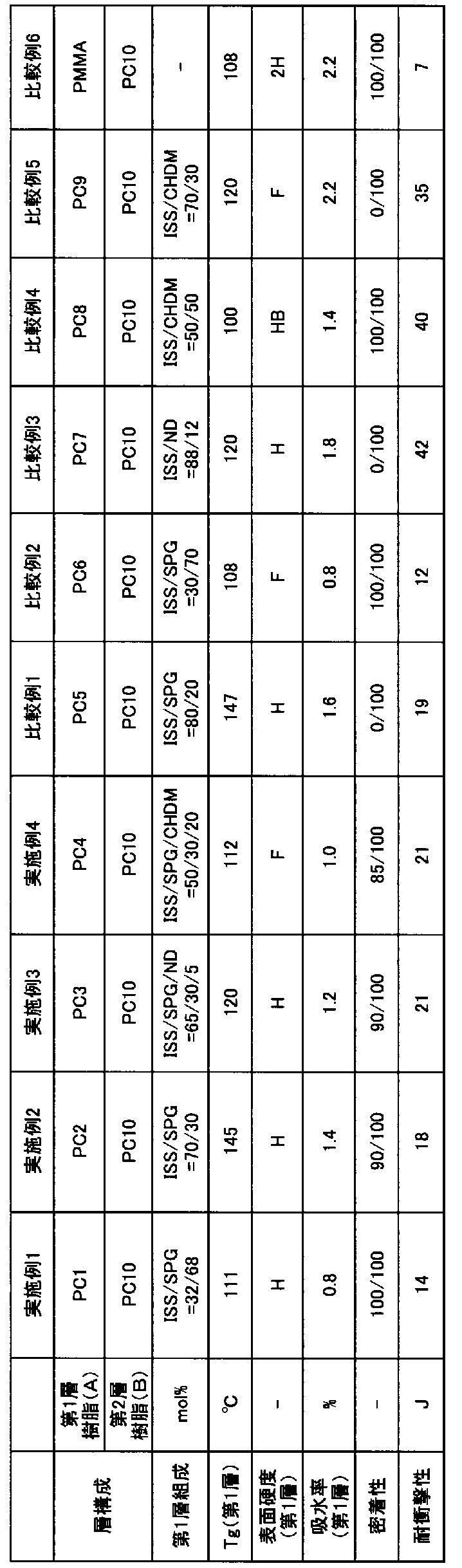
イソソルビド(以下ISSと略す)164部、3,9-ビス(2-ヒドロキシ-1,1-ジメチルエチル)-2,4,8,10-テトラオキサスピロ(5,5)ウンデカン(以下SPGと略す)724部、ジフェニルカーボネート(以下DPCと略す)750部、および触媒としてテトラメチルアンモニウムヒドロキシド0.8×10⁻²部とステアリン酸バリウム0.6×10⁻⁴部を窒素雰囲気下200℃に加熱し溶融させた。その後、30分かけて220℃へ昇温および減圧度を20.0kPaに調整した。その後、さらに30分かけて240℃へ昇温および減圧度を10kPaに調整した。10分間その温度で保持した後、1時間かけて減圧度を133Pa以下とした。反応終了後、反応槽の底より窒素加圧下吐出し、水槽で冷却しながら、ペレタイザーでカットしてペレットを得た(PC1)。得られたペレットについて各種評価を行った。評価結果を表1に記載した。
<ポリカーボネート樹脂積層体の製造>
ポリカーボネート樹脂(B)(帝人化成株式会社製、商品名:パンライト)はスクリュー径40mmの単軸押出機で、また、上記製造方法で作成したポリカーボネート樹脂(A)層を形成するポリカーボネート樹脂はスクリュー径30mmの単軸押出機でそれぞれ溶融させ、フィードブロック法にて2層に積層させ、ポリカーボネート樹脂(B)については設定温度280℃、ポリカーボネート樹脂(A)については設定温度230℃のT型ダイスを介して押出し、得られるシートを鏡面仕上げされたロールにて冷却し、ポリカーボネート樹脂(B)の片面にポリカーボネート樹脂(A)を積層した積層体を得た。また、この時それぞれの層の厚みは、第1層(ポリカーボネート樹脂(A)層)/第2層(ポリカーボネート樹脂(B)層)=0.1/1.0(mm)となるよう溶融樹脂の吐出量を調整した。得られた積層体の各種評価結果を表1に記載した。
[実施例2]
<ポリカーボネート樹脂の製造>
ISS358部、SPG319部、DPC750部を原料として用いた他は、実施例1と全く同様の操作を行い、同様の評価を行った(PC2)。その結果を表1に記載した。
<ポリカーボネート樹脂積層体の製造>
ポリカーボネート樹脂(A)について、設定温度250℃のT型ダイスを介して押出した他は、実施例1と全く同様の操作を行い、同様の評価を行った。その結果を表1に記載した。
[実施例3]
ISS332部、SPG319部、ND28部、DPC750部を原料として用いた他は、実施例1と全く同様の操作を行い、同様の評価を行った(PC3)。その結果を表1に記載した。
<ポリカーボネート樹脂積層体の製造>
ポリカーボネート樹脂(A)について、設定温度240℃のT型ダイスを介して押出した他は、実施例1と全く同様の操作を行い、同様の評価を行った。その結果を表1に記載した。
[実施例4]
ISS256部、SPG319部、CHDM101部、DPC750部を原料として用いた他は、実施例1と全く同様の操作を行い、同様の評価を行った(PC4)。その結果を表1に記載した。
<ポリカーボネート樹脂積層体の製造>
実施例1と全く同様の操作を行い、同様の評価を行った。その結果を表1に記載した。
[比較例1]
<ポリカーボネート樹脂の製造>
ISS409部、SPG213部、DPC750部を原料として用いた他は、実施例1と全く同様の操作を行い、同様の評価を行った(PC5)。その結果を表1に記載した。
<ポリカーボネート樹脂積層体の製造>
ポリカーボネート樹脂(A)について、設定温度250℃のT型ダイスを介して押出した他は、実施例1と全く同様の操作を行い、同様の評価を行った。溶融粘度が高く、成型加工性が悪化したが、積層体は得られた。得られた積層体は樹脂同士の密着性が低く、当初の目的を達成できるものではなかった。
[比較例2]
<ポリカーボネート樹脂の製造>
ISS153部、SPG745部、DPC750部を原料として用いた他は、実施例1と全く同様の操作を行い、同様の評価を行った(PC6)。その結果を表1に記載した。
<ポリカーボネート樹脂積層体の製造>
実施例1と全く同様の操作を行い、同様の評価を行った。得られた積層体は耐熱性が十分ではなく、当初の目的を達成できるものではなかった。
[比較例3]
<ポリカーボネート樹脂の製造>
ISS450部、ND67部、DPC750部を原料として用いた他は、実施例1と全く同様の操作を行い、同様の評価を行った(PC7)。その結果を表1に記載した。
<ポリカーボネート樹脂積層体の製造>
ポリカーボネート樹脂(A)について、設定温度240℃のT型ダイスを介して押出した他は、実施例1と全く同様の操作を行い、同様の評価を行った。得られた積層体は樹脂同士の密着性が低く、当初の目的を達成できるものではなかった。
[比較例4]
<ポリカーボネート樹脂の製造>
ISS256部、CHDM252部、DPC750部を原料として用いた他は、実施例1と全く同様の操作を行い、同様の評価を行った(PC8)。その結果を表1に記載した。
<ポリカーボネート樹脂積層体の製造>
実施例1と全く同様の操作を行い、同様の評価を行った。得られた積層体は耐熱性が十分ではなく、また表面硬度も劣っていたため、当初の目的を達成できるものではなかった。
[比較例5]
<ポリカーボネート樹脂の製造>
ISS358部、CHDM151部、DPC750部を原料として用いた他は、実施例1と全く同様の操作を行い、同様の評価を行った(PC9)。その結果を表1に記載した。
<ポリカーボネート樹脂積層体の製造>
実施例1と全く同様の操作を行い、同様の評価を行った。得られた積層体は樹脂同士の密着性が低く、当初の目的を達成できるものではなかった。
[比較例6]
<積層体の製造>
ポリカーボネート樹脂(A)の代わりにPMMA(三菱レイヨン社製アクリペットMF)を用いた他は実施例1と全く同様の操作を行い、同様の評価を行った。得られた積層体は耐熱性、吸水性が満足できる水準になく、また衝撃性についても当初の目的を達成できるものではなかった。
Claims (5)
- 主たる繰り返し単位が下記式


で表される単位(a-2)を含み、単位(a-1)と単位(a-2)とのモル比(a-1/a-2)が32/68~70/30であるポリカーボネート樹脂(A)からなる層と芳香族ポリカーボネート樹脂(B)からなる層とをそれぞれ少なくとも1層以上有する多層体。 - 芳香族ポリカーボネート樹脂(B)がビスフェノールAからなるポリカーボネート樹脂である請求項1記載の多層体。
- ポリカーボネート樹脂(A)のガラス転移温度が110℃~145℃である請求項1記載の多層体。
- ポリカーボネート樹脂(A)の飽和吸水率が2.0%以下である請求項1記載の多層体。
- ポリカーボネート樹脂(A)からなる層の表面硬度がF以上である請求項1記載の多層体。
Priority Applications (4)
| Application Number | Priority Date | Filing Date | Title |
|---|---|---|---|
| US15/103,978 US10035336B2 (en) | 2014-02-10 | 2015-01-29 | Multilayer body |
| JP2015560950A JP6200002B2 (ja) | 2014-02-10 | 2015-01-29 | 多層体 |
| EP15746624.4A EP3106306B1 (en) | 2014-02-10 | 2015-01-29 | Multilayer body |
| CN201580005913.5A CN105980156A (zh) | 2014-02-10 | 2015-01-29 | 多层体 |
Applications Claiming Priority (2)
| Application Number | Priority Date | Filing Date | Title |
|---|---|---|---|
| JP2014023376 | 2014-02-10 | ||
| JP2014-023376 | 2014-02-10 |
Publications (1)
| Publication Number | Publication Date |
|---|---|
| WO2015119026A1 true WO2015119026A1 (ja) | 2015-08-13 |
Family
ID=53777833
Family Applications (1)
| Application Number | Title | Priority Date | Filing Date |
|---|---|---|---|
| PCT/JP2015/052436 Ceased WO2015119026A1 (ja) | 2014-02-10 | 2015-01-29 | 多層体 |
Country Status (6)
| Country | Link |
|---|---|
| US (1) | US10035336B2 (ja) |
| EP (1) | EP3106306B1 (ja) |
| JP (1) | JP6200002B2 (ja) |
| CN (2) | CN105980156A (ja) |
| TW (1) | TWI648307B (ja) |
| WO (1) | WO2015119026A1 (ja) |
Cited By (7)
| Publication number | Priority date | Publication date | Assignee | Title |
|---|---|---|---|---|
| WO2017057117A1 (ja) * | 2015-10-02 | 2017-04-06 | 帝人株式会社 | 樹脂組成物およびそれから形成されるフィルム |
| JP2017071152A (ja) * | 2015-10-08 | 2017-04-13 | 三菱樹脂株式会社 | 積層体、およびディスプレイ用前面板 |
| WO2019124182A1 (ja) | 2017-12-21 | 2019-06-27 | 帝人株式会社 | 多層体 |
| JP2019172796A (ja) * | 2018-03-28 | 2019-10-10 | 帝人株式会社 | ポリカーボネート樹脂およびポリカーボネート樹脂の製造方法 |
| JP2022058692A (ja) * | 2018-03-28 | 2022-04-12 | 帝人株式会社 | ポリカーボネート樹脂およびポリカーボネート樹脂の製造方法 |
| US11339285B2 (en) | 2017-02-03 | 2022-05-24 | Teijin Limited | Multilayer body |
| JP2023125913A (ja) * | 2022-02-28 | 2023-09-07 | 三菱ケミカル株式会社 | 積層体、複合積層体、カード、及びパスポート |
Families Citing this family (5)
| Publication number | Priority date | Publication date | Assignee | Title |
|---|---|---|---|---|
| CN109575230B (zh) * | 2018-12-06 | 2021-01-22 | 黑龙江大学 | 一种多功能聚氨酯衍生物的制备方法和应用 |
| CN109400836B (zh) * | 2018-12-06 | 2021-01-22 | 黑龙江大学 | 含有三芳胺结构及四苯乙烯基团的聚氨酯衍生物的制备方法和应用 |
| WO2021070741A1 (ja) * | 2019-10-08 | 2021-04-15 | 帝人株式会社 | 樹脂組成物 |
| CN118401370A (zh) * | 2021-12-17 | 2024-07-26 | 科思创德国股份有限公司 | 具有良好的有利性质的至少部分生物基层状结构 |
| EP4197783A1 (en) * | 2021-12-17 | 2023-06-21 | Covestro Deutschland AG | At least partially biobased layered structure with good flame resistance |
Citations (5)
| Publication number | Priority date | Publication date | Assignee | Title |
|---|---|---|---|---|
| WO2008020636A1 (fr) * | 2006-08-18 | 2008-02-21 | Mitsubishi Gas Chemical Company, Inc. | Résine de polycarbonate et film optique utilisant celle-ci |
| WO2011096089A1 (ja) * | 2010-02-05 | 2011-08-11 | 帝人株式会社 | ポリカーボネート樹脂およびその製造方法 |
| WO2011108594A1 (ja) * | 2010-03-03 | 2011-09-09 | 三菱化学株式会社 | 積層体 |
| JP2012166503A (ja) * | 2011-02-16 | 2012-09-06 | Teijin Chem Ltd | 積層フィルム |
| WO2014133114A1 (ja) * | 2013-02-26 | 2014-09-04 | 帝人株式会社 | ポリカーボネート成形品 |
Family Cites Families (5)
| Publication number | Priority date | Publication date | Assignee | Title |
|---|---|---|---|---|
| JPH04270652A (ja) | 1991-02-27 | 1992-09-28 | Asahi Chem Ind Co Ltd | 耐候性の優れたポリカーボネート樹脂積層シート |
| JP4310248B2 (ja) | 2004-07-28 | 2009-08-05 | 帝人株式会社 | ポリカーボネート組成物及びその製造方法 |
| JP4071243B2 (ja) | 2005-02-24 | 2008-04-02 | 東芝テック株式会社 | 顔料分散体 |
| JP2009046519A (ja) | 2005-11-29 | 2009-03-05 | Mitsui Chemicals Inc | ポリカーボネート共重合体からなる透明耐熱成形体、その製造方法およびその用途 |
| JP5506437B2 (ja) | 2010-01-29 | 2014-05-28 | 三菱化学株式会社 | 多層体 |
-
2015
- 2015-01-29 EP EP15746624.4A patent/EP3106306B1/en active Active
- 2015-01-29 WO PCT/JP2015/052436 patent/WO2015119026A1/ja not_active Ceased
- 2015-01-29 CN CN201580005913.5A patent/CN105980156A/zh active Pending
- 2015-01-29 US US15/103,978 patent/US10035336B2/en active Active
- 2015-01-29 CN CN201910660632.3A patent/CN110435276A/zh active Pending
- 2015-01-29 JP JP2015560950A patent/JP6200002B2/ja active Active
- 2015-02-06 TW TW104104058A patent/TWI648307B/zh not_active IP Right Cessation
Patent Citations (5)
| Publication number | Priority date | Publication date | Assignee | Title |
|---|---|---|---|---|
| WO2008020636A1 (fr) * | 2006-08-18 | 2008-02-21 | Mitsubishi Gas Chemical Company, Inc. | Résine de polycarbonate et film optique utilisant celle-ci |
| WO2011096089A1 (ja) * | 2010-02-05 | 2011-08-11 | 帝人株式会社 | ポリカーボネート樹脂およびその製造方法 |
| WO2011108594A1 (ja) * | 2010-03-03 | 2011-09-09 | 三菱化学株式会社 | 積層体 |
| JP2012166503A (ja) * | 2011-02-16 | 2012-09-06 | Teijin Chem Ltd | 積層フィルム |
| WO2014133114A1 (ja) * | 2013-02-26 | 2014-09-04 | 帝人株式会社 | ポリカーボネート成形品 |
Cited By (14)
| Publication number | Priority date | Publication date | Assignee | Title |
|---|---|---|---|---|
| WO2017057117A1 (ja) * | 2015-10-02 | 2017-04-06 | 帝人株式会社 | 樹脂組成物およびそれから形成されるフィルム |
| CN108137913A (zh) * | 2015-10-02 | 2018-06-08 | 帝人株式会社 | 树脂组合物和由其形成的膜 |
| JPWO2017057117A1 (ja) * | 2015-10-02 | 2018-07-19 | 帝人株式会社 | 樹脂組成物およびそれから形成されるフィルム |
| US11441030B2 (en) | 2015-10-02 | 2022-09-13 | Teijin Limited | Resin composition and film formed from same |
| JP2017071152A (ja) * | 2015-10-08 | 2017-04-13 | 三菱樹脂株式会社 | 積層体、およびディスプレイ用前面板 |
| US11339285B2 (en) | 2017-02-03 | 2022-05-24 | Teijin Limited | Multilayer body |
| US11285710B2 (en) | 2017-12-21 | 2022-03-29 | Teijin Limited | Multilayer body |
| WO2019124182A1 (ja) | 2017-12-21 | 2019-06-27 | 帝人株式会社 | 多層体 |
| JP2022058692A (ja) * | 2018-03-28 | 2022-04-12 | 帝人株式会社 | ポリカーボネート樹脂およびポリカーボネート樹脂の製造方法 |
| JP2019172796A (ja) * | 2018-03-28 | 2019-10-10 | 帝人株式会社 | ポリカーボネート樹脂およびポリカーボネート樹脂の製造方法 |
| JP7096030B2 (ja) | 2018-03-28 | 2022-07-05 | 帝人株式会社 | ポリカーボネート樹脂およびポリカーボネート樹脂の製造方法 |
| JP7335369B2 (ja) | 2018-03-28 | 2023-08-29 | 帝人株式会社 | ポリカーボネート樹脂およびポリカーボネート樹脂の製造方法 |
| JP2023125913A (ja) * | 2022-02-28 | 2023-09-07 | 三菱ケミカル株式会社 | 積層体、複合積層体、カード、及びパスポート |
| JP7831008B2 (ja) | 2022-02-28 | 2026-03-17 | 三菱ケミカル株式会社 | 積層体、複合積層体、カード、及びパスポート |
Also Published As
| Publication number | Publication date |
|---|---|
| US10035336B2 (en) | 2018-07-31 |
| JP6200002B2 (ja) | 2017-09-20 |
| CN110435276A (zh) | 2019-11-12 |
| EP3106306B1 (en) | 2019-06-12 |
| TWI648307B (zh) | 2019-01-21 |
| CN105980156A (zh) | 2016-09-28 |
| EP3106306A1 (en) | 2016-12-21 |
| EP3106306A4 (en) | 2017-01-25 |
| US20170203556A1 (en) | 2017-07-20 |
| JPWO2015119026A1 (ja) | 2017-03-23 |
| TW201544524A (zh) | 2015-12-01 |
Similar Documents
| Publication | Publication Date | Title |
|---|---|---|
| JP6200002B2 (ja) | 多層体 | |
| JP6313133B2 (ja) | 多層体 | |
| JP6637061B2 (ja) | 樹脂組成物およびそれから形成されるフィルム | |
| JP2015232091A (ja) | 樹脂組成物 | |
| JP2021080320A (ja) | 樹脂組成物およびその成形品 | |
| JP6947882B2 (ja) | 多層体 | |
| WO2021070741A1 (ja) | 樹脂組成物 | |
| JP7221724B2 (ja) | 加飾成形体 | |
| JP6983255B2 (ja) | 多層体 | |
| JP2021109922A (ja) | 樹脂組成物およびその成形品 | |
| JP2022070481A (ja) | 樹脂組成物およびその成形品 | |
| JP7803680B2 (ja) | 積層体 | |
| JP2022041497A (ja) | 積層体 | |
| JP2021134349A (ja) | シートまたはフィルム、および積層体 | |
| JP2022098746A (ja) | 樹脂組成物および成形品 | |
| JP2021134295A (ja) | 樹脂組成物 |
Legal Events
| Date | Code | Title | Description |
|---|---|---|---|
| 121 | Ep: the epo has been informed by wipo that ep was designated in this application |
Ref document number: 15746624 Country of ref document: EP Kind code of ref document: A1 |
|
| WWE | Wipo information: entry into national phase |
Ref document number: 15103978 Country of ref document: US |
|
| REEP | Request for entry into the european phase |
Ref document number: 2015746624 Country of ref document: EP |
|
| WWE | Wipo information: entry into national phase |
Ref document number: 2015746624 Country of ref document: EP |
|
| ENP | Entry into the national phase |
Ref document number: 2015560950 Country of ref document: JP Kind code of ref document: A |
|
| NENP | Non-entry into the national phase |
Ref country code: DE |