WO2015122002A1 - 電気自動車 - Google Patents
電気自動車 Download PDFInfo
- Publication number
- WO2015122002A1 WO2015122002A1 PCT/JP2014/053589 JP2014053589W WO2015122002A1 WO 2015122002 A1 WO2015122002 A1 WO 2015122002A1 JP 2014053589 W JP2014053589 W JP 2014053589W WO 2015122002 A1 WO2015122002 A1 WO 2015122002A1
- Authority
- WO
- WIPO (PCT)
- Prior art keywords
- wheel
- electric vehicle
- electric
- battery
- electric motor
- Prior art date
- Legal status (The legal status is an assumption and is not a legal conclusion. Google has not performed a legal analysis and makes no representation as to the accuracy of the status listed.)
- Ceased
Links
Images



Classifications
-
- B—PERFORMING OPERATIONS; TRANSPORTING
- B60—VEHICLES IN GENERAL
- B60K—ARRANGEMENT OR MOUNTING OF PROPULSION UNITS OR OF TRANSMISSIONS IN VEHICLES; ARRANGEMENT OR MOUNTING OF PLURAL DIVERSE PRIME-MOVERS IN VEHICLES; AUXILIARY DRIVES FOR VEHICLES; INSTRUMENTATION OR DASHBOARDS FOR VEHICLES; ARRANGEMENTS IN CONNECTION WITH COOLING, AIR INTAKE, GAS EXHAUST OR FUEL SUPPLY OF PROPULSION UNITS IN VEHICLES
- B60K1/00—Arrangement or mounting of electrical propulsion units
- B60K1/04—Arrangement or mounting of electrical propulsion units of the electric storage means for propulsion
-
- B—PERFORMING OPERATIONS; TRANSPORTING
- B60—VEHICLES IN GENERAL
- B60F—VEHICLES FOR USE BOTH ON RAIL AND ON ROAD; VEHICLES CAPABLE OF TRAVELLING IN OR ON DIFFERENT MEDIA, e.g. AMPHIBIOUS VEHICLES
- B60F3/00—Amphibious vehicles, i.e. vehicles capable of travelling both on land and on water; Land vehicles capable of travelling under water
- B60F3/003—Parts or details of the vehicle structure; vehicle arrangements not otherwise provided for
-
- B—PERFORMING OPERATIONS; TRANSPORTING
- B60—VEHICLES IN GENERAL
- B60K—ARRANGEMENT OR MOUNTING OF PROPULSION UNITS OR OF TRANSMISSIONS IN VEHICLES; ARRANGEMENT OR MOUNTING OF PLURAL DIVERSE PRIME-MOVERS IN VEHICLES; AUXILIARY DRIVES FOR VEHICLES; INSTRUMENTATION OR DASHBOARDS FOR VEHICLES; ARRANGEMENTS IN CONNECTION WITH COOLING, AIR INTAKE, GAS EXHAUST OR FUEL SUPPLY OF PROPULSION UNITS IN VEHICLES
- B60K1/00—Arrangement or mounting of electrical propulsion units
- B60K1/04—Arrangement or mounting of electrical propulsion units of the electric storage means for propulsion
- B60K2001/0405—Arrangement or mounting of electrical propulsion units of the electric storage means for propulsion characterised by their position
- B60K2001/0416—Arrangement in the rear part of the vehicle
-
- B—PERFORMING OPERATIONS; TRANSPORTING
- B60—VEHICLES IN GENERAL
- B60K—ARRANGEMENT OR MOUNTING OF PROPULSION UNITS OR OF TRANSMISSIONS IN VEHICLES; ARRANGEMENT OR MOUNTING OF PLURAL DIVERSE PRIME-MOVERS IN VEHICLES; AUXILIARY DRIVES FOR VEHICLES; INSTRUMENTATION OR DASHBOARDS FOR VEHICLES; ARRANGEMENTS IN CONNECTION WITH COOLING, AIR INTAKE, GAS EXHAUST OR FUEL SUPPLY OF PROPULSION UNITS IN VEHICLES
- B60K7/00—Disposition of motor in, or adjacent to, traction wheel
- B60K2007/0038—Disposition of motor in, or adjacent to, traction wheel the motor moving together with the wheel axle
-
- B—PERFORMING OPERATIONS; TRANSPORTING
- B60—VEHICLES IN GENERAL
- B60K—ARRANGEMENT OR MOUNTING OF PROPULSION UNITS OR OF TRANSMISSIONS IN VEHICLES; ARRANGEMENT OR MOUNTING OF PLURAL DIVERSE PRIME-MOVERS IN VEHICLES; AUXILIARY DRIVES FOR VEHICLES; INSTRUMENTATION OR DASHBOARDS FOR VEHICLES; ARRANGEMENTS IN CONNECTION WITH COOLING, AIR INTAKE, GAS EXHAUST OR FUEL SUPPLY OF PROPULSION UNITS IN VEHICLES
- B60K7/00—Disposition of motor in, or adjacent to, traction wheel
- B60K2007/0092—Disposition of motor in, or adjacent to, traction wheel the motor axle being coaxial to the wheel axle
-
- B—PERFORMING OPERATIONS; TRANSPORTING
- B60—VEHICLES IN GENERAL
- B60K—ARRANGEMENT OR MOUNTING OF PROPULSION UNITS OR OF TRANSMISSIONS IN VEHICLES; ARRANGEMENT OR MOUNTING OF PLURAL DIVERSE PRIME-MOVERS IN VEHICLES; AUXILIARY DRIVES FOR VEHICLES; INSTRUMENTATION OR DASHBOARDS FOR VEHICLES; ARRANGEMENTS IN CONNECTION WITH COOLING, AIR INTAKE, GAS EXHAUST OR FUEL SUPPLY OF PROPULSION UNITS IN VEHICLES
- B60K7/00—Disposition of motor in, or adjacent to, traction wheel
- B60K7/0007—Disposition of motor in, or adjacent to, traction wheel the motor being electric
-
- B—PERFORMING OPERATIONS; TRANSPORTING
- B60—VEHICLES IN GENERAL
- B60Y—INDEXING SCHEME RELATING TO ASPECTS CROSS-CUTTING VEHICLE TECHNOLOGY
- B60Y2200/00—Type of vehicle
- B60Y2200/40—Special vehicles
- B60Y2200/42—Amphibious vehicles
Definitions
- the present invention relates to an electric vehicle.
- the main advantage of the present invention is to improve the stability of electric vehicles floating on the water.
- the present invention has been made to solve at least a part of the above-described problems, and can be realized as the following aspects.
- Aspect 1 An electric vehicle, Front wheels, An electric motor for driving the front wheel; A battery for supplying power to the electric motor;
- the rear wheel A vehicle comprising: a floor wall having a floor surface of a passenger compartment; and a peripheral wall connected to a peripheral portion of the floor wall and extending upward from the floor wall and surrounding the floor wall along the peripheral portion of the floor wall.
- the electric vehicle further includes a door member capable of opening and closing the target opening, When projecting the front wheel, the electric motor, the rear wheel, and the battery in a direction parallel to the left-right direction of the electric vehicle, The electric motor is disposed at a position where at least a part of the electric motor overlaps the front wheel, The battery is disposed at a position where at least a part of the battery overlaps the rear wheel, The center of gravity of the electric vehicle is lower than the water line in each of a light load state and a full load state, and the position of the center of gravity of the electric vehicle in the front-rear direction is disposed between the front wheel and the rear wheel. Yes, Electric car.
- the electric vehicle can float on the water by the buoyancy obtained by the vehicle compartment forming portion and the door member that closes the target opening formed by the vehicle compartment forming portion.
- the electric motor which is a relatively heavy element of the electric vehicle, is placed near the front wheel, and the battery, another relatively heavy element, is placed near the rear wheel, thereby increasing the center of gravity of the electric vehicle.
- the position in the front-rear direction of the electric vehicle with the center of gravity lower than the water line can be arranged between the front wheel and the rear wheel.
- Aspect 2 The electric vehicle according to aspect 1,
- the vehicle compartment forming part and the door member are made of resin.
- the electric vehicle can easily float on the water.
- the stability of the electric vehicle floating on the water can be further improved.
- the electric vehicle according to aspect 1 or 2 includes a tire, a wheel on which the tire is mounted, and a flow path forming unit that forms a flow path from one side of the wheel to the opening by forming an opening facing a rear side,
- the wheel includes a propeller blade, When the wheel rotates in the water, the flow path forming unit discharges the water sucked from the other side of the wheel by the wheel and discharged to the one side from the opening toward the rear side, Electric car.
- the electric vehicle when the electric vehicle floats on the water, the electric vehicle can move in a stable state by driving the front wheels.
- Aspect 4 The electric vehicle according to any one of aspects 1 to 3, further comprising: With headlamps, An electric vehicle in which at least a part of the headlamp is disposed at a position higher than the water line in the full load state.
- the headlamp when the electric vehicle floats on the water, the headlamp can illuminate the front of the electric vehicle.
- FIG. 1 is a perspective view of an electric vehicle 100 as an embodiment of the present invention.
- 1 is a perspective view of a first partial configuration 101 of an electric vehicle 100.
- FIG. 2 is a perspective view of a second partial configuration 102 of the electric vehicle 100.
- FIG. It is a perspective view of the compartment formation part 30 and the doors 80L and 80R on either side.
- FIG. 4 is a projection view in which some elements of the electric vehicle 100 are projected in a direction parallel to the left-right direction DLR. It is sectional drawing containing central axis CL of the left front wheel 21L.
- FIG. 1 is a perspective view of an electric vehicle 100 as an embodiment of the present invention.
- the front direction DF is a forward direction of the electric vehicle 100
- the rear direction DB is a direction opposite to the front direction DF.
- the direction parallel to the front direction DF is also referred to as “front-rear direction DFB”.
- the upward direction DU is a vertically upward direction
- the downward direction DD is a vertically downward direction.
- the right direction DR is the right direction when facing the front direction DF, and is perpendicular to the front direction DF and the upward direction DU.
- the left direction DL is a direction opposite to the right direction DR.
- the direction parallel to the right direction DR is also referred to as “left-right direction DLR”.
- the letter “L” is given to the end of the code of the element arranged on the left of the pair of elements arranged on the left and right
- the letter “R” is given to the end of the code of the element arranged on the right.
- the outline of the appearance of the electric vehicle 100 is shown. Also, in the figure, as elements of the electric vehicle 100, an outer plate 90, a door 80L, a slide mechanism 89L that slidably supports the door 80L, wheels 21L, 21R, 22L, and headlamps 70L, 70R. And are shown.
- the outer plate 90 includes a front cover 92 disposed on the front direction DF side of the electric vehicle 100.
- the electric vehicle 100 has a door opening 120L for getting on and off.
- the door 80L can open and close the door opening 120L. In FIG. 1, the door 80L closes the door opening 120L.
- the electric vehicle 100 is a front wheel drive vehicle.
- the electric vehicle 100 further includes a frame and a vehicle compartment forming portion not shown in FIG. 1 (details will be described later).
- the slide mechanism 89L is fixed to the frame.
- FIG. 2 is a perspective view of the first partial configuration 101 of the electric vehicle 100.
- the first partial configuration 101 is a remaining configuration in which an exterior product including the outer plate 90 and an interior product (for example, a seat) (not shown) are removed from the electric vehicle 100 of FIG.
- the frame 10 the vehicle compartment forming part 30 forming the vehicle compartment 110, the left and right front wheels 21L and 21R, the left rear wheel 22L, the steering device 51, A steering wheel 52 and left and right front suspension devices 55L and 55R are shown.
- the vehicle compartment forming portion 30 is hatched. Although illustration is omitted, left and right front seats and left and right rear seats are arranged in the passenger compartment 110.
- the frame 10 is formed using metal (for example, iron, aluminum, etc.) in order to improve the rigidity of the electric vehicle 100.
- the left front suspension device 55L connects the frame 10 and the left front wheel 21L.
- the right front suspension device 55R connects the frame 10 and the right front wheel 21R. That is, the frame 10 supports the front wheels 21L and 21R via the front suspension devices 55L and 55R.
- a steering device 51 is connected to the front wheels 21L and 21R, and a steering wheel 52 is connected to the steering device 51.
- the steering device 51 can change the directions of the front wheels 21L and 21R.
- a user (driver) can control the steering device 51 by operating the steering wheel 52.
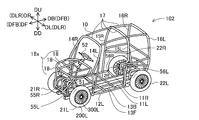
- FIG. 3 is a perspective view of the second partial configuration 102 of the electric vehicle 100.
- the second partial configuration 102 is a remaining configuration in which the vehicle compartment forming unit 30 is removed from the first partial configuration 101 in FIG. 2.
- left and right rear suspension devices 56 ⁇ / b> L and 56 ⁇ / b> R and a right rear wheel 22 ⁇ / b> R are shown as elements of the second partial configuration 102.
- the left rear suspension device 56L connects the frame 10 and the left rear wheel 22L.
- the right rear suspension device 56R connects the frame 10 and the right rear wheel 22R. That is, the frame 10 supports the rear wheels 22L and 22R via the rear suspension devices 56R and 56L.
- the frame 10 includes left and right center rails 11L and 11R, left and right side members 12L and 12R, and front and rear cross members 13F and 13B as elements that form a chassis of the electric vehicle 100.
- the left and right center rails 11L and 11R are members extending in the front-rear direction DFB.
- the left and right side members 12L and 12R are members extending in the front-rear direction DFB, and their lengths are shorter than the lengths of the center rails 11L and 11R.
- the left side member 12L is disposed on the left direction DL side of the central portion of the left center rail 11L.
- the right side member 12R is disposed on the right direction DR side of the center portion of the right center rail 11R.
- the front and rear cross members 13F, 13B extend in the left-right direction DLR from the left side member 12L to the right side member 12R, and connect the center rails 11L, 11R and the side members 12L, 12R.
- the vehicle compartment forming portion 30 (FIG. 2) is fixed to the frame 10 while being placed on the center rails 11L and 11R, the side members 12L and 12R, and the cross members 13F and 13B.
- the frame 10 further includes a plurality of left and right front pillars 14L and 14R, left and right center pillars 15L and 15R, and left and right rear pillars 16L and 16R as elements that support the outer plate 90 of the electric vehicle 100 (FIG. 1).
- the roof bar 17 and a plurality of front bars 18 are included.
- the plurality of front bars 18 form a bowl-shaped front cover frame 18x fixed to the front direction DF side of the center rails 11L and 11R.
- the front cover frame 18x supports a front cover 92 (FIG. 1) that covers the steering device 51 and the front suspension devices 55L and 55R.
- the lower ends of the front pillars 14L and 14R and the lower ends of the rear pillars 16L and 16R are connected to the center rails 11L and 11R.
- the lower ends of the center pillars 15L and 15R are connected to the side members 12L and 12R.
- the plurality of roof bars 17 connect the upper ends of the pillars 14L, 14R, 15L, 15R, 16L, and 16R.
- These members 14L, 14R, 15L, 15R, 16L, 16R, and 17 support an outer plate 90 (FIG. 1) that covers the passenger compartment 110 (FIG. 2).
- the frame 10 includes various other members in addition to the above members.
- any method such as welding, screwing, or connection using a connector can be employed.
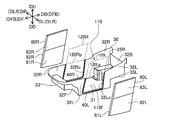
- FIG. 4 is a perspective view of the vehicle compartment forming portion 30 and the left and right doors 80L and 80R. Openings 120L and 120R indicated by dotted lines in the figure indicate left and right door openings 120L and 120R that are opened and closed by the left and right doors 80L and 80R, respectively.
- the left door opening 120L is formed between the left front pillar 14L (FIG. 3) and the left center pillar 15L.
- the right door opening 120R is formed between the right front pillar 14R and the right center pillar 15R.
- the right door 80R includes an inner panel 81R, an outer panel 82R, and a door glass 83R.
- the inner panel 81R forms a portion on the inner side (that is, the vehicle compartment 110 side) of the right door 80R.
- the outer panel 82R forms a portion outside the right door 80R.
- These panels 81R and 82R form a part on the lower DD side of the right door 80R.
- the door glass 83R is disposed on the upper DU side of the panels 81R and 82R.
- the left door 80L includes an inner panel 81L, an outer panel 82L, and a door glass 83L.
- the structures of these members 81L, 82L, and 83L are the same as the structures of the members 81R, 82R, and 83R of the right door 80R, respectively.
- the vehicle compartment forming unit 30 includes a floor wall 31 and a peripheral wall 33.
- the floor wall 31 is a plate that extends approximately horizontally, and has a floor surface 110 f of the passenger compartment 110.
- the peripheral wall 33 includes a front wall 32F, a left wall 32L, a rear wall 32B, and a right wall 32R.
- the front wall 32F, the left wall 32L, the rear wall 32B, and the right wall 32R are connected to each other in this order.
- the peripheral wall 33 is connected to the peripheral edge of the floor wall 31, extends from the floor wall 31 toward the upward DU side, and surrounds the floor wall 31. In the present embodiment, the peripheral wall 33 is connected to the peripheral edge of the floor wall 31 over the entire periphery.
- the front wall 32F, the left wall 32L, the rear wall 32B, and the right wall 32R are a portion of the floor wall 31 on the front direction DF side, a portion on the left direction DL side, and a rear direction DB side. And the portion on the right direction DR side are respectively connected.
- a recessed portion 35R that is recessed toward the passenger compartment 110 side is formed in the right rear portion of the floor wall 31 (hereinafter also referred to as “wheel housing 35R”).
- the wheel housing 35R is provided in order to prevent the right rear wheel 22R from interfering with the vehicle compartment forming portion 30.
- a wheel housing 35 ⁇ / b> L for avoiding the left rear wheel 22 ⁇ / b> L from interfering with the vehicle compartment forming portion 30 is also formed on the left rear portion of the floor wall 31.
- the right wall 32R is formed with a substantially rectangular notch 32Rc extending from the upper end in the downward direction DD. This notch 32Rc forms a lower part 120Rp of the right door opening 120R (hereinafter referred to as “target opening 120Rp”).
- the inner panel 81R can open and close the target opening 120Rp by opening and closing the right door 80R.
- a seal member 40R extending along the edge of the notch 32Rc is fixed to the edge of the notch 32Rc.
- the left wall 32L is formed with a substantially rectangular notch 32Lc extending from the upper end in the downward direction DD.
- the cutout 32Lc forms a target opening 120Lp that is a part of the lower side of the door opening 120L.
- the inner panel 81L can open and close the target opening 120Lp.
- the seal member 40L fixed to the edge of the notch 32Lc seals between the inner panel 81L and the left wall 32L over the entire edge of the notch 32Lc. .
- the vehicle compartment forming portion 30 and the inner panels 81L and 81R form a cup-shaped member.
- a cup-shaped member can give the electric vehicle 100 sufficient buoyancy to float on the water.
- the vehicle compartment forming portion 30 and the inner panels 81L and 81R are formed using a resin (for example, carbon fiber reinforced plastic). Thereby, the electric vehicle 100 can be reduced in weight.
- various through holes are formed in the vehicle compartment forming portion 30 (for example, through holes through which an electric cable connected to an electrical component passes). Such a through hole is sealed (for example, filled with a sealant) to prevent the vehicle interior 110 from being submerged.
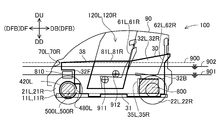
- FIG. 5 is a projection view in which some elements of the electric vehicle 100 are projected in a direction parallel to the left-right direction DLR (in other words, projected from the left side of the electric vehicle 100 toward the right side).
- the center rails 11L and 11R, the headlamps 70L and 70R, the battery 800, the controller 810, and the electric motors 500L and 500R are shown.
- the left electric motor 500L is connected to the left front wheel 21L
- the right electric motor 500R is connected to the right front wheel 21R.
- motors with a rated output of 15 [kW] or less are used as the electric motors 500L and 500R in total.
- the electric motors 500L and 500R constitute in-wheel motors arranged inside the wheels constituting the front wheels 21L and 21R.
- the outline of the vehicle interior forming portion 30 and the outlines of the inner panels 81L and 82R are indicated by bold lines.
- the electric motors 500L and 500R and the battery 800 are hatched. Note that the configuration of the electric vehicle 100 is approximately symmetrical. Accordingly, in FIG. 5, various pairs of elements arranged on the left and right sides are shown to overlap each other. For example, in FIG. 5, the contour of the left electric motor 500L is the same as the contour of the right electric motor 500R.
- the control unit 810 is an electronic circuit that drives the electric motors 500L and 500R using the power supplied by the battery 800.
- the control unit 810 includes, for example, a computer and an inverter circuit.
- the computer for example, a known computer including a CPU, a volatile memory, and a nonvolatile memory can be employed.
- the CPU controls the inverter circuit by executing a program stored in the nonvolatile memory. Further, the CPU controls the inverter circuit in accordance with a signal from an operating means (not shown) operated by the user (for example, an accelerator pedal).
- the inverter circuit controls the electric motors 500L and 500R by supplying electric power from the battery 800 to the electric motors 500L and 500R under the control of the computer.
- the front seats 61L and 61R are arranged at positions that approximately overlap the door openings 120L and 120R.
- the rear seats 62L and 62R are disposed on the rear DB side of the front seats 61L and 61R.
- the rear seats 62L and 62R are disposed on the wheel housings 35L and 35R, respectively.
- the battery 800 is disposed between the two wheel housings 35L and 35R. As described above, the battery 800 is disposed inside the vehicle compartment forming portion 30 (that is, inside the vehicle compartment 110).
- the control unit 810 is disposed on the front DF side of the front wall 32F (that is, outside the passenger compartment 110).
- the battery 800 and the control unit 810 are connected by an electric cable (not shown).
- the electric cable extends from the battery 800 to the control unit 810 through a through hole (not shown) provided in the vehicle compartment forming unit 30. This through hole is filled with a waterproof sealant.
- Control unit 810 and electric motors 500L and 500R are connected by an electric cable (not shown).
- the electric motors 500L and 500R, the battery 800, the control unit 810, and the electric cable all include a waterproof structure.
- a reference height 900 is shown.
- This reference height 900 indicates the position of the lowest portion of the upper DU side end of the cup-shaped member 38 formed by the vehicle compartment forming portion 30 and the inner panels 81L and 81R.
- the electric vehicle 100 floats on the water, if the water surface is lower than the reference height 900, it is difficult for water to enter the cup-shaped member 38 (that is, the passenger compartment 110). 1 day) can float. For example, during a disaster such as a flood, the electric vehicle 100 can float on the water.
- the drawing further shows a first water line 901 and a second water line 902.
- the first water line 901 is a water line when the electric vehicle 100 in a lightly loaded state floats on the water.
- the second water line 902 is a water line when the fully loaded electric vehicle 100 floats on the water.
- the light load state means a state in which no luggage and passengers are loaded. That is, the first draft line 901 is a draft line associated with the own weight (also referred to as a light load amount) of the electric vehicle 100.
- the full load state means a state in which the maximum load capacity and the maximum number of passengers are loaded. The maximum loading capacity and the maximum capacity are determined in advance according to the electric vehicle 100.
- a reference weight for example, 55 kg
- the total weight that is, the maximum vehicle weight
- the second water line 902 is a water line associated with such maximum total weight.
- the first water line 901 is located below the reference height 900.
- the 2nd water line 902 is higher than the 1st water line 901, it is located below the reference height 900. Therefore, the electric vehicle 100 can float on the water in each of the light load state and the full load state.
- a method of forming the vehicle compartment forming portion 30 and the inner panels 81L and 81R using a light material can be employed.
- a metal and a resin can be used as the light material.
- the metal a relatively light metal (for example, aluminum) can be used.
- the resin for example, one or more selected from carbon fiber reinforced plastic, glass fiber reinforced plastic, engineering plastic, dicyclopentadiene, and epoxy resin can be adopted.
- the entire vehicle compartment forming portion 30 can be molded as a single component.
- the compartment formation part 30 may be manufactured by connecting a plurality of members. Further, the material may be different between the vehicle compartment forming portion 30 and the inner panels 81L and 81R.
- centroids 911 and 912 are shown.
- the first center of gravity 911 indicates the center of gravity of the electric vehicle 100 in a light load state.
- the first center of gravity 911 is located below the first water line 901.
- the second center of gravity 912 indicates the center of gravity of the fully loaded electric vehicle 100.
- the second center of gravity 912 is higher than the first center of gravity 911, it is located below the second waterline 902.
- the center of gravity is located below the water line, the possibility that the electric vehicle 100 will roll over can be reduced. As a result, the stability of the electric vehicle floating on the water can be improved.
- the electric motors 500L and 500R as the relatively heavy elements of the elements of the electric vehicle 100 and the battery 800 are arranged at low positions.
- the left electric motor 500L is arranged at a position where the entire left electric motor 500L overlaps with the front wheels 21L and 21R.
- the right electric motor 500R is also arranged at a position where the entire right electric motor 500R overlaps with the front wheels 21L and 21R.
- the battery 800 is disposed at a position where a part of the battery 800 overlaps the rear wheels 22 ⁇ / b> L and 22 ⁇ / b> R.
- the positions of the centers of gravity 911, 912 in the front-rear direction DFB are between the front wheels 21L, 21R and the rear wheels 22L, 22R. Therefore, the electric vehicle 100 floating on the water can be prevented from tilting forward or backward.
- the electric motors 500L and 500R are arranged in the vicinity of the front wheels 21L and 21R in order to arrange the center of gravity between the front wheels 21L and 21R and the rear wheels 22L and 22R, and the battery 800 is connected to the rear wheels 22L and 22R. (Fig. 5).
- the headlamps 70L and 70R are arranged at a position higher than the fully loaded second water line 902. Therefore, when the electric vehicle 100 sails on the water, the headlamps 70L and 70R can illuminate the front of the electric vehicle 100.
- the headlamps 70L and 70R In order for the headlamps 70L and 70R to illuminate the front of the electric vehicle 100 when the electric vehicle 100 floats on the water, at least a part of the headlamps 70L and 70R is positioned higher than the fully loaded second water line 902. It only has to be arranged. For example, some of the headlamps 70L and 70R may be disposed at a position lower than the fully loaded second waterline 902. Further, when the electric vehicle 100 sails on the water, the headlamps 70L and 70R may not be used. In this case, all of the headlamps 70L and 70R may be disposed at a position lower than the fully loaded second waterline 902.
- FIG. 6 is a cross-sectional view including the central axis CL of the left front wheel 21L. This sectional view shows a section parallel to the front-rear direction DFB and the left-right direction DLR.
- an electric motor 500L in addition to the left front wheel 21L, an electric motor 500L, a drive shaft 510L projecting from the electric motor 500L toward the left direction DL, and a hub fixed to the end of the drive shaft 510L on the left direction DL side 520L.
- the left front wheel 21L includes a wheel 300L connected to the hub 520L, a tire 200L attached to the wheel 300L, a support portion 410L that supports the drive shaft 510L, and a cover 420L that covers the entire right side DR side of the wheel 300L. , Including.
- the cover 420L is connected to the support portion 410L.
- the electric motor 500L is fixed to the support portion 410L.
- the drive shaft 510L, the hub 520L, the wheel 300L, and the tire 200L are rotatable about a common central axis CL. As described above, the rotation axis of the electric motor 500L coincides with the rotation axis of the wheel 300L.
- the support part 410L is connected to 55 L of front left suspension apparatuses (FIG. 2).
- the cover 420L forms a ring-shaped space 430L surrounding the support portion 410L on the right direction DR side of the wheel 300L.
- An opening 480L is formed on the rear side DB side of the cover 420L.
- FIG. 5 shows the outline of the cover 420L and the opening 480L. As illustrated, the opening 480L faces the rear DB side.
- the wheel 300L includes a hub 306L connected to the hub 520L, a rim 302L to which the tire 200L is mounted, and a spoke 304L connecting the hub 306L and the rim 302L.
- the spoke 304L forms a propeller blade.
- the spoke 304L sucks water from the left direction DL side and draws water to the right direction DR side. Discharge.
- the water discharged to the right direction DR side passes through the space 430L and is discharged from the opening 480L toward the rear DB side.
- the left front wheel 21L generates a propulsive force in the forward direction.
- a space 430L formed by the cover 420L corresponds to a water flow path from the right direction DR side of the wheel 300L to the opening 480L. That is, the cover 420L corresponds to a flow path forming part that forms the flow path 430L.
- the entire left front wheel 21L is disposed below the first water line 901 in a lightly loaded state. Therefore, the left front wheel 21L can generate a large propulsive force regardless of the loading amount.
- a part of the left front wheel 21L may be disposed above the first waterline 901.
- a part of wheel 21L may be arrange
- the steering device 51 (FIG. 1) can change the direction of the left front wheel 21L.
- the direction of the left front wheel 21L is changed, the protruding direction of water from the opening 480L is also changed.
- the electric vehicle 100 can change the traveling direction in a state where it floats on the water.
- the configuration of the right front wheel 21R is symmetrical with the configuration of the left front wheel 21L. Accordingly, the right front wheel 21R can generate thrust in the forward direction and the traveling direction can be changed in the same manner as the left front wheel 21L. As described above, when the electric vehicle 100 floats on the water, the electric vehicle 100 can move in a stable state by driving the front wheels 21L and 21R.
- the arrangement of the electric motors 500L and 500R is not limited to the arrangement shown in FIG. 5, and various other arrangements can be adopted.
- a part of the left electric motor 500L may be disposed outside the front wheels 21L and 21R.
- the left electric motor 500L is preferably arranged at a position where at least a part of the left electric motor 500L overlaps at least one of the front wheels 21L and 21R.
- the right electric motor 500R In any case, in order to lower the center of gravity, it is preferable that the entire electric motors 500L and 500R are arranged at a position lower than the end of at least one of the front wheels 21L and 21R on the upper direction DU side.
- the arrangement of the battery 800 is not limited to the arrangement shown in FIG. 5, and various other arrangements can be employed.
- the battery 800 may be configured such that the entire battery 800 overlaps at least one of the rear wheels 22L and 22R.
- the battery 800 is preferably arranged at a position where at least a part of the battery 800 overlaps at least one of the rear wheels 22L and 22R.
- the entire battery 800 is disposed at a position lower than the end of at least one of the rear wheels 22L and 22R on the upper direction DU side.
- the remaining battery may be arranged in another part.
- the configuration of the left front wheel 21L is not limited to the configuration shown in FIG. 6, and various other configurations can be employed.
- the wheel 300L is not limited to the member having the shape described in FIG. 6, and other various members including propeller-shaped blades can be employed.
- the configuration of the propeller-shaped blades various configurations that convert rotational motion into propulsive force by moving water can be employed.
- a member obtained by providing a plurality of through holes in a disk that connects the hub 306L and the rim 302L and further fixing blades protruding from the edges of the through holes to the disk may be employed.
- the cover 420L may be disposed on the left direction DL side of the wheel 300L.
- the wheel 300L is configured to suck water from the right direction DR side (that is, the inner side) and discharge water from the left direction DL (that is, the outer side).
- the propeller blades and the cover 420L may be omitted from the wheel.
- the electric vehicle 100 can float on the water.
- the electric motor 500L and the wheel 300L may be connected via a gear. In any case, in order to improve the running stability of the electric vehicle 100, it is preferable to adopt a configuration that is symmetrical to the configuration of the left front wheel 21L as the configuration of the right front wheel 21R.
- the sealing member 40R may be fixed to the inner panel 81R of the right door 80R instead of the right wall 32R.
- the sealing member 40L may be fixed to the inner panel 81L of the left door 80L.
- Through-holes through which various members such as electric cables pass can be formed in the vehicle compartment forming portion 30 and the inner panels 81L and 81R.
- a seal for suppressing flooding in the through hole below the second draft line 902 in the full load state As such a seal, a seal that completely seals the through hole can be adopted.
- a seal that allows slight water immersion may be employed.
- the configuration of the electric vehicle 100 is not limited to the configuration illustrated in FIGS. 1 to 5, and various other configurations can be employed.
- the opening / closing mechanism of the doors 80L and 80R is not limited to the slide mechanism, and a hinge mechanism or a link mechanism can be employed.
- the opening / closing mechanism is preferably fixed to the frame 10.
- the door opening and the door may be provided only on one of the left direction DL side and the right direction DR side of the electric vehicle 100.
- a door opening and a door may be provided on the rear DB side of the electric vehicle 100.
- the vehicle compartment forming unit 30 forms at least the portion of the door opening below the second water line 902 when fully loaded as the target opening, and the door opens and closes the target opening (for example, a door member (for example, 4 and preferably includes the inner panel 81R) of FIG.
- a door member for example, 4 and preferably includes the inner panel 81R
- any material other than the frame 10, the vehicle compartment forming portion 30, and the inner panels 81L and 81R can be used.
- a resin may be employed as the material for the outer plate 90.
- the present invention can be suitably used for an electric vehicle floating on the water.
- front cover 100 ... electric vehicle, 101 ... first part configuration, 102 ... second part configuration, 110 ... Vehicle compartment, 110f ... Floor surface, 120L ... Left door opening, 120R ... Right door opening, 120Lp, 120Rp ... Target opening, 200L ... Tire, 300L ... Wheel , 302L ... rim, 304L ... spoke, 306L ... hub, 410L ... support, 420L ... cover 430L ... flow path, 480L ... opening, 500L ... left electric motor, 500R ... right electric motor, 510L ... drive shaft, 520L ... hub, 800 ... battery, 810 ... control unit, 901 ... first water line, 902 ... second water line, 911 ...
Landscapes
- Engineering & Computer Science (AREA)
- Chemical & Material Sciences (AREA)
- Combustion & Propulsion (AREA)
- Transportation (AREA)
- Mechanical Engineering (AREA)
- Body Structure For Vehicles (AREA)
- Arrangement Or Mounting Of Propulsion Units For Vehicles (AREA)
- Automatic Cycles, And Cycles In General (AREA)
Abstract
Description
電気自動車であって、
前輪と、
前記前輪を駆動する電気モータと、
前記電気モータに電力を供給するバッテリーと、
後輪と、
車室の床面を有する床壁と、前記床壁の周縁部に接続され前記床壁から上方側に向かって延び前記床壁の周縁部に沿って前記床壁を囲む周壁と、を含む車室形成部と、
前記前輪と前記後輪と前記車室形成部とを支持する金属製のフレームと、
を備え、
前記周壁は、乗り降りのための開口のうちの少なくとも下側の一部分である対象開口を形成し、
前記電気自動車は、さらに、前記対象開口を開閉可能なドア部材を備え、
前記電気自動車の左右方向と平行な方向に前記前輪と前記電気モータと前記後輪と前記バッテリーとを投影した場合に、
前記電気モータは、前記電気モータの少なくとも一部分が前記前輪と重なる位置に配置され、
前記バッテリーは、前記バッテリーの少なくとも一部分が前記後輪と重なる位置に配置され、
前記電気自動車の重心は、軽荷状態と満載状態とのそれぞれにおいて、喫水線よりも低く、かつ、前記重心の前記電気自動車の前後方向の位置が前記前輪と前記後輪との間に配置されている、
電気自動車。
態様1に記載の電気自動車であって、
前記車室形成部と前記ドア部材とは、樹脂で形成されている、電気自動車。
態様1または2に記載の電気自動車であって、
前記前輪は、タイヤと、前記タイヤが装着されるホイールと、後方側を向く開口を形成し前記ホイールの一方側から前記開口に至る流路を形成する流路形成部と、を含み、
前記ホイールは、プロペラ状の羽根を含み、
前記流路形成部は、前記ホイールが水中で回転した場合に、前記ホイールによって前記ホイールの他方側から吸引されて前記一方側へ排出された水を、前記開口から後方側に向かって排出する、
電気自動車。
態様1から3のいずれか1項に記載の電気自動車であって、さらに、
前照灯を備え、
前記前照灯の少なくとも一部分は、前記満載状態における喫水線よりも高い位置に配置されている、電気自動車。
次に、本発明の実施の形態を実施例に基づき説明する。図1は、本発明の一実施例としての電気自動車100の斜視図である。図中には、6つの方向DF、DB、DR、DL、DD、DUが示されている。前方向DFは、電気自動車100の前進方向であり、後方向DBは、前方向DFの反対方向である。以下、前方向DFと平行な方向を「前後方向DFB」とも呼ぶ。上方向DUは、鉛直上方向であり、下方向DDは、鉛直下方向である。右方向DRは、前方向DFを向いた場合の右方向であり、前方向DFと上方向DUとに垂直である。左方向DLは、右方向DRの反対方向である。以下、右方向DRと平行な方向を「左右方向DLR」とも呼ぶ。また、左右に配置される一対の要素のうち、左に配置される要素の符号の末尾には文字「L」を付与し、右に配置される要素の符号の末尾には文字「R」を付与する。
(1)電気モータ500L、500Rの配置としては、図5に示す配置に限らず、他の種々の配置を採用可能である。例えば、図5の投影図において、左電気モータ500Lの一部が、前輪21L、21Rの外に配置されてもよい。一般的には、図5の投影図において、左電気モータ500Lは、左電気モータ500Lの少なくとも一部が前輪21L、21Rの少なくとも一方と重なる位置に配置されることが好ましい。右電気モータ500Rの配置についても、同様である。いずれの場合も、重心を低くするためには、電気モータ500L、500Rの全体が、前輪21L、21Rの少なくとも一方の上方向DU側の端よりも低い位置に配置されていることが好ましい。
Claims (4)
- 電気自動車であって、
前輪と、
前記前輪を駆動する電気モータと、
前記電気モータに電力を供給するバッテリーと、
後輪と、
車室の床面を有する床壁と、前記床壁の周縁部に接続され前記床壁から上方側に向かって延び前記床壁の周縁部に沿って前記床壁を囲む周壁と、を含む車室形成部と、
前記前輪と前記後輪と前記車室形成部とを支持する金属製のフレームと、
を備え、
前記周壁は、乗り降りのための開口のうちの少なくとも下側の一部分である対象開口を形成し、
前記電気自動車は、さらに、前記対象開口を開閉可能なドア部材を備え、
前記電気自動車の左右方向と平行な方向に前記前輪と前記電気モータと前記後輪と前記バッテリーとを投影した場合に、
前記電気モータは、前記電気モータの少なくとも一部分が前記前輪と重なる位置に配置され、
前記バッテリーは、前記バッテリーの少なくとも一部分が前記後輪と重なる位置に配置され、
前記電気自動車の重心は、軽荷状態と満載状態とのそれぞれにおいて、喫水線よりも低く、かつ、前記重心の前記電気自動車の前後方向の位置が前記前輪と前記後輪との間に配置されている、
電気自動車。 - 請求項1に記載の電気自動車であって、
前記車室形成部と前記ドア部材とは、樹脂で形成されている、電気自動車。 - 請求項1または2に記載の電気自動車であって、
前記前輪は、タイヤと、前記タイヤが装着されるホイールと、後方側を向く開口を形成し前記ホイールの一方側から前記開口に至る流路を形成する流路形成部と、を含み、
前記ホイールは、プロペラ状の羽根を含み、
前記流路形成部は、前記ホイールが水中で回転した場合に、前記ホイールによって前記ホイールの他方側から吸引されて前記一方側へ排出された水を、前記開口から後方側に向かって排出する、
電気自動車。 - 請求項1から3のいずれか1項に記載の電気自動車であって、さらに、
前照灯を備え、
前記前照灯の少なくとも一部分は、前記満載状態における喫水線よりも高い位置に配置されている、電気自動車。
Priority Applications (5)
| Application Number | Priority Date | Filing Date | Title |
|---|---|---|---|
| JP2015562667A JP6019337B2 (ja) | 2014-02-17 | 2014-02-17 | 電気自動車 |
| PCT/JP2014/053589 WO2015122002A1 (ja) | 2014-02-17 | 2014-02-17 | 電気自動車 |
| EP14882471.7A EP3109070B1 (en) | 2014-02-17 | 2014-02-17 | Electric vehicle |
| MYPI2016702935A MY164334A (en) | 2014-02-17 | 2014-02-17 | Electric vehicle |
| CN201480075414.9A CN106029407B (zh) | 2014-02-17 | 2014-02-17 | 电动汽车 |
Applications Claiming Priority (1)
| Application Number | Priority Date | Filing Date | Title |
|---|---|---|---|
| PCT/JP2014/053589 WO2015122002A1 (ja) | 2014-02-17 | 2014-02-17 | 電気自動車 |
Publications (1)
| Publication Number | Publication Date |
|---|---|
| WO2015122002A1 true WO2015122002A1 (ja) | 2015-08-20 |
Family
ID=53799765
Family Applications (1)
| Application Number | Title | Priority Date | Filing Date |
|---|---|---|---|
| PCT/JP2014/053589 Ceased WO2015122002A1 (ja) | 2014-02-17 | 2014-02-17 | 電気自動車 |
Country Status (5)
| Country | Link |
|---|---|
| EP (1) | EP3109070B1 (ja) |
| JP (1) | JP6019337B2 (ja) |
| CN (1) | CN106029407B (ja) |
| MY (1) | MY164334A (ja) |
| WO (1) | WO2015122002A1 (ja) |
Cited By (1)
| Publication number | Priority date | Publication date | Assignee | Title |
|---|---|---|---|---|
| JP2018062257A (ja) * | 2016-10-13 | 2018-04-19 | 有限会社イーエスシーアイ | 救命筏製造用型枠、救命筏の製造方法及び救命筏 |
Families Citing this family (13)
| Publication number | Priority date | Publication date | Assignee | Title |
|---|---|---|---|---|
| WO2018033880A2 (en) | 2016-08-17 | 2018-02-22 | Shape Corp. | Battery support and protection structure for a vehicle |
| CN106627006B (zh) * | 2016-10-31 | 2020-07-14 | 闫建君 | 封闭紧凑型可涉水后轮转向电动车 |
| EP3566253B1 (en) | 2017-01-04 | 2022-12-28 | Shape Corp. | Battery support structure for a vehicle |
| US11211656B2 (en) | 2017-05-16 | 2021-12-28 | Shape Corp. | Vehicle battery tray with integrated battery retention and support feature |
| US10886513B2 (en) | 2017-05-16 | 2021-01-05 | Shape Corp. | Vehicle battery tray having tub-based integration |
| US10483510B2 (en) | 2017-05-16 | 2019-11-19 | Shape Corp. | Polarized battery tray for a vehicle |
| WO2019055658A2 (en) | 2017-09-13 | 2019-03-21 | Shape Corp. | VEHICLE BATTERY TRAY WITH TUBULAR PERIPHERAL WALL |
| US12347879B2 (en) | 2017-09-13 | 2025-07-01 | Shape Corp. | Vehicle battery tray with tubular peripheral wall |
| US10661646B2 (en) | 2017-10-04 | 2020-05-26 | Shape Corp. | Battery tray floor assembly for electric vehicles |
| CN112055898A (zh) | 2018-03-01 | 2020-12-08 | 形状集团 | 与车辆电池托盘集成的冷却系统 |
| US11688910B2 (en) | 2018-03-15 | 2023-06-27 | Shape Corp. | Vehicle battery tray having tub-based component |
| CN109017179A (zh) * | 2018-08-01 | 2018-12-18 | 浙江睦田消防科技开发有限公司 | 水陆两栖消防车 |
| WO2021064475A1 (en) * | 2020-01-10 | 2021-04-08 | Hazeri Majid | Vehicle with the ability to move on land, air and water |
Citations (2)
| Publication number | Priority date | Publication date | Assignee | Title |
|---|---|---|---|---|
| JPH09501125A (ja) * | 1993-08-04 | 1997-02-04 | スラーヴォミール クルコウスキー | 水上推進装置 |
| JP2009067122A (ja) * | 2007-09-11 | 2009-04-02 | Ihi Corp | 水陸両用車 |
Family Cites Families (11)
| Publication number | Priority date | Publication date | Assignee | Title |
|---|---|---|---|---|
| US1425243A (en) * | 1919-05-16 | 1922-08-08 | Sr John Duthie | Ship-hull construction |
| EP0492655A1 (en) * | 1990-12-17 | 1992-07-01 | Isuzu Motors Limited | Amphibian motor vehicle |
| US5181478A (en) * | 1991-12-23 | 1993-01-26 | Sebastiano Berardi | Amphibious vehicle with retractable wheels |
| US5755602A (en) * | 1993-08-04 | 1998-05-26 | Klukowski; Slawomir | Nautical propulsion device |
| US5868093A (en) * | 1997-03-11 | 1999-02-09 | Tseng; An-Ping | Amphibious vehicle |
| CN2933931Y (zh) * | 2006-06-12 | 2007-08-15 | 谷春茂 | 一种微型复合塑料汽车 |
| US8221174B2 (en) * | 2007-09-03 | 2012-07-17 | March J David | Amphibious vehicle |
| KR20100020230A (ko) * | 2008-08-12 | 2010-02-22 | 주식회사 탑알앤디 | 전기 자동차 |
| CN201494267U (zh) * | 2009-07-21 | 2010-06-02 | 王权 | 两栖电动四轮车 |
| CN102009573A (zh) * | 2009-09-05 | 2011-04-13 | 王建友 | 一种水陆两用汽车 |
| CN202138177U (zh) * | 2011-06-30 | 2012-02-08 | 刘信华 | 水陆两用车 |
-
2014
- 2014-02-17 EP EP14882471.7A patent/EP3109070B1/en active Active
- 2014-02-17 WO PCT/JP2014/053589 patent/WO2015122002A1/ja not_active Ceased
- 2014-02-17 CN CN201480075414.9A patent/CN106029407B/zh active Active
- 2014-02-17 JP JP2015562667A patent/JP6019337B2/ja not_active Expired - Fee Related
- 2014-02-17 MY MYPI2016702935A patent/MY164334A/en unknown
Patent Citations (2)
| Publication number | Priority date | Publication date | Assignee | Title |
|---|---|---|---|---|
| JPH09501125A (ja) * | 1993-08-04 | 1997-02-04 | スラーヴォミール クルコウスキー | 水上推進装置 |
| JP2009067122A (ja) * | 2007-09-11 | 2009-04-02 | Ihi Corp | 水陸両用車 |
Cited By (1)
| Publication number | Priority date | Publication date | Assignee | Title |
|---|---|---|---|---|
| JP2018062257A (ja) * | 2016-10-13 | 2018-04-19 | 有限会社イーエスシーアイ | 救命筏製造用型枠、救命筏の製造方法及び救命筏 |
Also Published As
| Publication number | Publication date |
|---|---|
| CN106029407A (zh) | 2016-10-12 |
| CN106029407B (zh) | 2018-03-20 |
| JP6019337B2 (ja) | 2016-11-02 |
| EP3109070A1 (en) | 2016-12-28 |
| JPWO2015122002A1 (ja) | 2017-03-30 |
| EP3109070B1 (en) | 2019-04-24 |
| MY164334A (en) | 2017-12-15 |
| EP3109070A4 (en) | 2017-12-06 |
Similar Documents
| Publication | Publication Date | Title |
|---|---|---|
| JP6019337B2 (ja) | 電気自動車 | |
| US10457330B2 (en) | Electric motor vehicle for transport of goods made of a rotomoulded body supported by a modular tubular frame | |
| US10160301B2 (en) | Electric car with pre-assembled modular structure | |
| JP6119790B2 (ja) | 保持機構、電気自動車、前輪駆動の電気自動車、及び後輪駆動の電気自動車 | |
| KR102155404B1 (ko) | 작업 차량 | |
| CN101941466A (zh) | 用于汽车的底板结构 | |
| US8272465B2 (en) | Electric vehicle | |
| EP2454770A1 (en) | Battery pack | |
| JP6844955B2 (ja) | 乗物用のヘッドランプ装置 | |
| CN103282226A (zh) | 燃料电池车辆 | |
| CN110949542A (zh) | 车身前部结构 | |
| KR102140360B1 (ko) | 작업 차량 | |
| JP6516232B1 (ja) | 電気自動車用の車台、及び、電気自動車 | |
| JP2013014276A (ja) | 電気自動車のバッテリ支持構造 | |
| JP2013159306A (ja) | 電気自動車 | |
| CN101847736A (zh) | 蓄电池安装结构 | |
| JP2023051652A (ja) | 車体構造 | |
| JP7107907B2 (ja) | 車両のボディ | |
| JP2021133837A (ja) | 車体構造 | |
| JP2021104760A (ja) | 搭載構造 | |
| US20150274493A1 (en) | Vehicle with winch | |
| CN114559802B (zh) | 车辆的下部结构 | |
| US20240208593A1 (en) | Folding inflatable vehicle | |
| JP2015168380A (ja) | 電動車両 | |
| JP7461738B2 (ja) | 車両 |
Legal Events
| Date | Code | Title | Description |
|---|---|---|---|
| 121 | Ep: the epo has been informed by wipo that ep was designated in this application |
Ref document number: 14882471 Country of ref document: EP Kind code of ref document: A1 |
|
| ENP | Entry into the national phase |
Ref document number: 2015562667 Country of ref document: JP Kind code of ref document: A |
|
| WWE | Wipo information: entry into national phase |
Ref document number: IDP00201605399 Country of ref document: ID |
|
| NENP | Non-entry into the national phase |
Ref country code: DE |
|
| REEP | Request for entry into the european phase |
Ref document number: 2014882471 Country of ref document: EP |
|
| WWE | Wipo information: entry into national phase |
Ref document number: 2014882471 Country of ref document: EP |