WO2015123667A1 - Pressure-sensitive adhesive - Google Patents
Pressure-sensitive adhesive Download PDFInfo
- Publication number
- WO2015123667A1 WO2015123667A1 PCT/US2015/016139 US2015016139W WO2015123667A1 WO 2015123667 A1 WO2015123667 A1 WO 2015123667A1 US 2015016139 W US2015016139 W US 2015016139W WO 2015123667 A1 WO2015123667 A1 WO 2015123667A1
- Authority
- WO
- WIPO (PCT)
- Prior art keywords
- pressure
- mass
- sensitive adhesive
- parts
- monomer
- Prior art date
- Legal status (The legal status is an assumption and is not a legal conclusion. Google has not performed a legal analysis and makes no representation as to the accuracy of the status listed.)
- Ceased
Links
Classifications
-
- C—CHEMISTRY; METALLURGY
- C09—DYES; PAINTS; POLISHES; NATURAL RESINS; ADHESIVES; COMPOSITIONS NOT OTHERWISE PROVIDED FOR; APPLICATIONS OF MATERIALS NOT OTHERWISE PROVIDED FOR
- C09J—ADHESIVES; NON-MECHANICAL ASPECTS OF ADHESIVE PROCESSES IN GENERAL; ADHESIVE PROCESSES NOT PROVIDED FOR ELSEWHERE; USE OF MATERIALS AS ADHESIVES
- C09J123/00—Adhesives based on homopolymers or copolymers of unsaturated aliphatic hydrocarbons having only one carbon-to-carbon double bond; Adhesives based on derivatives of such polymers
- C09J123/26—Adhesives based on homopolymers or copolymers of unsaturated aliphatic hydrocarbons having only one carbon-to-carbon double bond; Adhesives based on derivatives of such polymers modified by chemical after-treatment
- C09J123/28—Adhesives based on homopolymers or copolymers of unsaturated aliphatic hydrocarbons having only one carbon-to-carbon double bond; Adhesives based on derivatives of such polymers modified by chemical after-treatment by reaction with halogens or compounds containing halogen
-
- C—CHEMISTRY; METALLURGY
- C09—DYES; PAINTS; POLISHES; NATURAL RESINS; ADHESIVES; COMPOSITIONS NOT OTHERWISE PROVIDED FOR; APPLICATIONS OF MATERIALS NOT OTHERWISE PROVIDED FOR
- C09J—ADHESIVES; NON-MECHANICAL ASPECTS OF ADHESIVE PROCESSES IN GENERAL; ADHESIVE PROCESSES NOT PROVIDED FOR ELSEWHERE; USE OF MATERIALS AS ADHESIVES
- C09J133/00—Adhesives based on homopolymers or copolymers of compounds having one or more unsaturated aliphatic radicals, each having only one carbon-to-carbon double bond, and at least one being terminated by only one carboxyl radical, or of salts, anhydrides, esters, amides, imides, or nitriles thereof; Adhesives based on derivatives of such polymers
- C09J133/04—Homopolymers or copolymers of esters
- C09J133/06—Homopolymers or copolymers of esters of esters containing only carbon, hydrogen and oxygen, the oxygen atom being present only as part of the carboxyl radical
- C09J133/08—Homopolymers or copolymers of acrylic acid esters
-
- C—CHEMISTRY; METALLURGY
- C08—ORGANIC MACROMOLECULAR COMPOUNDS; THEIR PREPARATION OR CHEMICAL WORKING-UP; COMPOSITIONS BASED THEREON
- C08L—COMPOSITIONS OF MACROMOLECULAR COMPOUNDS
- C08L23/00—Compositions of homopolymers or copolymers of unsaturated aliphatic hydrocarbons having only one carbon-to-carbon double bond; Compositions of derivatives of such polymers
- C08L23/26—Compositions of homopolymers or copolymers of unsaturated aliphatic hydrocarbons having only one carbon-to-carbon double bond; Compositions of derivatives of such polymers modified by chemical after-treatment
- C08L23/28—Compositions of homopolymers or copolymers of unsaturated aliphatic hydrocarbons having only one carbon-to-carbon double bond; Compositions of derivatives of such polymers modified by chemical after-treatment by reaction with halogens or halogen-containing compounds
-
- C—CHEMISTRY; METALLURGY
- C09—DYES; PAINTS; POLISHES; NATURAL RESINS; ADHESIVES; COMPOSITIONS NOT OTHERWISE PROVIDED FOR; APPLICATIONS OF MATERIALS NOT OTHERWISE PROVIDED FOR
- C09J—ADHESIVES; NON-MECHANICAL ASPECTS OF ADHESIVE PROCESSES IN GENERAL; ADHESIVE PROCESSES NOT PROVIDED FOR ELSEWHERE; USE OF MATERIALS AS ADHESIVES
- C09J133/00—Adhesives based on homopolymers or copolymers of compounds having one or more unsaturated aliphatic radicals, each having only one carbon-to-carbon double bond, and at least one being terminated by only one carboxyl radical, or of salts, anhydrides, esters, amides, imides, or nitriles thereof; Adhesives based on derivatives of such polymers
- C09J133/04—Homopolymers or copolymers of esters
- C09J133/06—Homopolymers or copolymers of esters of esters containing only carbon, hydrogen and oxygen, the oxygen atom being present only as part of the carboxyl radical
Definitions
- the present invention relates to a pressure-sensitive adhesive.
- Polyolefins such as polypropylene are used in a variety of applications, such as vehicle parts, construction materials, electronic parts, and office equipment, and are also used in a wide variety of environments. Despite being widely used in this way, polyolefins are low surface energy (LSE) materials, and it is therefore difficult to strongly bond these polyolefm materials. As a result, pressure-sensitive adhesives have been proposed as materials able to bond these kinds of materials (for example, see Patent Documents 1 and 2).
- LSE low surface energy
- Patent Document 1 WO/1996/34066
- Patent Document 2 WO/2011/071477
- olefm-based homopolymers such as polypropylene
- copolymers of ethylene and a-olefins and modified products thereof are also employed in practical applications, and high adhesion to this type of polyolefm is also required.
- bonded parts are subjected to a variety of external forces, and environments in which such bonded parts are used range from low temperature to high temperature environments.
- One aspect of the present invention provides a pressure-sensitive adhesive that contains a tacky adhesive polymer and a chlorinated polyolefm, wherein a heat of fusion of the chlorinated polyolefm is 0 to 5 J/g, and a content of chlorine in the chlorinated polyolefm is 16 to 25 mass %.
- a pressure-sensitive adhesive that exhibits high adhesion to olefm-based homopolymers such as polypropylene, as well as to copolymers of ethylene and a-olefins, olefm-based thermoplastic elastomers (TPO), and olefin-based crosslinked thermoplastic rubbers (TPV).
- This pressure-sensitive adhesive exhibits sufficient practical strength to be able to withstand a variety of external forces (for example, static shearing load or dynamic peeling load) applied to a bonded polyolefin article, and exhibits high adhesion both initially and over a period of time from low temperatures to high temperatures (for example, from 5°C to 80°C).
- the pressure-sensitive adhesive according to the present embodiment is a pressure-sensitive adhesive that contains a tacky adhesive polymer and a chlorinated polyolefin, wherein the heat of fusion of the chlorinated polyolefin is 0 to 5 J/g, and the content of chlorine in the chlorinated polyolefin is 16 to 25 mass %.
- pressure-sensitive adhesive means an adhesive that exhibits tackiness at usage temperature (typically -20°C to 60°C), and "tackiness” means that the storage modulus (G'), as measured at 10 radians/sec at the usage temperature (a measurement temperature of 20°C to 22°C is preferred), is less than 3 x 10 5 Pa (the Dahlquist criterion).
- the "tacky adhesive polymer” is a polymer that exhibits the aforementioned "tackiness”
- the term “polymer” is used in accordance with the definition of "macromolecule” or “polymer” according to the Polymer Nomenclature Committee of The International Union of Pure and Applied Chemistry (IUPAC)
- mass % is sometimes expressed as “wt.%”, and “mass %” and “wt.%” have the same meaning.
- the tacky adhesive polymer can be a polymer obtained by polymerizing a first monomer consisting of at least one type of (meth)acrylic acid ester of a non-tertiary alcohol having 4 to 20 carbons in the alkyl group and a second monomer that copolymerizes with the first monomer.
- (meth)acrylic means acrylic or methacrylic (sometimes expressed as methacrylic), and the same is true for similar compounds.
- the second monomer is different from the first monomer.
- the first monomer is a monomer which, when homopolymerized, gives a polymer having a glass transition temperature of less than 0°C.
- glass transition temperature means the temperature of the Tan5 peak position in dynamic viscoelasticity measurements (in which a frequency of 1.0 Hz and a rate of temperature increase of 5°C/min are preferred) (the same hereinafter).
- the first monomer is a mono functional (meth)acrylic acid ester of a non-tertiary alkyl alcohol having preferably 4 to 20 carbons, and more preferably 4 to 18 carbons, in the alkyl group.
- Preferred examples of the first monomer include n-butyl acrylate, n-hexyl acrylate, n-octyl acrylate, isooctyl acrylate, 2-ethylhexyl acrylate, isononyl acrylate, n-decyl acrylate, n-dodecyl acrylate, octadecyl acrylate, and mixtures thereof, but the first monomer is not limited to these examples.
- the second monomer is a monomer which has at least one ethylenically unsaturated group and which, when homopolymerized, gives a polymer having a glass transition temperature of greater than 0°C.
- Preferred examples of the second monomer include (meth)acrylic acid, substituted (meth)acrylamide compounds such as N-vinyl pyrrolidone, N-vinyl caprolactam, and ⁇ , ⁇ -dimethylacrylamide, acrylonitrile, isobornyl acrylate, acrylates having 1 to 3 carbons in the alkyl group, carboxyethyl acrylate, and mixtures thereof, but the second monomer is not limited to these examples.
- the second monomer is preferably ⁇ , ⁇ -dimethylacrylamide or isobornyl acrylate.
- a basic monomer such as a substituted (meth)acrylamide
- the mass ratio of the first monomer and the second monomer is preferably 50 to 100 parts by mass / 0 to 50 parts by mass in order to achieve a balance between initial adhesive strength at low temperatures and static shearing strength at high temperatures.
- the chlorinated polyolefin contained in the pressure-sensitive adhesive is a compound in which a chlorine atom is added to a carbon atom in a polyolefin.
- the chlorinated polyolefm is not particularly limited as long as the heat of fusion thereof is 0 to 5 J/g and the chlorine content therein is 16 to 25 mass %, and examples thereof include polyolefms obtained by chlorinating copolymers of propylene and a-olefins such as ethylene, 1 -butene, 1-pentene, 1-hexene, 1 -heptene, 1 -octene, and 4-methyl- 1 -pentene.
- the chlorinated polyolefin can be a polyolefin obtained by chlorinating a copolymer obtained by further graft polymerizing an ⁇ , ⁇ -unsaturated carboxylic acid such as maleic acid, maleic acid anhydride, fumaric acid, citraconic acid, citraconic acid anhydride, mesaconic acid, itaconic acid, itaconic acid anhydride, aconitic acid, aconitic acid anhydride, or himic acid anhydride on to a copolymer such as those mentioned above.
- an ⁇ , ⁇ -unsaturated carboxylic acid such as maleic acid, maleic acid anhydride, fumaric acid, citraconic acid, citraconic acid anhydride, mesaconic acid, itaconic acid, itaconic acid anhydride, aconitic acid, aconitic acid anhydride, or himic acid anhydride on to a copolymer such as those mentioned above.
- the heat of fusion of the chlorinated polyolefin means the heat of fusion as measured by differential scanning calorimetry (DSC) in accordance with JIS K 7121 (1987).
- the heat of fusion is measured in a nitrogen atmosphere by increasing the temperature from 23°C to 180°C at a rate of temperature increase of 10°C/min, lowering the temperature from 180°C to - 100°C at a rate of temperature decrease of 10°C/min, and then increasing the temperature from - 100°C to 180°C at a rate of temperature increase of 10°C/min.
- a chlorinated polyolefin having a heat of fusion of 0 to 5 J/g and a chlorine content of 16 to 25 mass % can be produced using, for example, the method disclosed in Japanese Unexamined Patent Application Publication No. 2004-217807.
- a chlorinated polyolefin having a heat of fusion of 0 to 5 J/g and chlorine content of 16 to 25 mass % can be produced using, for example, the method disclosed in Japanese Unexamined Patent Application Publication No. 2004-217807.
- chlorinated polyolefin can be procured as, for example, Superchlon 930S or Superchlon 322 I S manufactured by Nippon Paper Industries Co., Ltd., Chiyoda-ku, Tokyo, Japan. [0016]
- the heat of fusion of the chlorinated polyolefin is 0 to 5 J/g, preferably 0 to 3 J/g, and more preferably 0 to 2 J/g.
- compatibility with the tacky adhesive polymer is low, it is difficult to obtain sufficient adhesive strength.
- the content of chlorine in the chlorinated polyolefin is 16 to 25 mass %, preferably 17 to 24 mass %, and more preferably 17 to 23 mass %.
- the content of chlorine in the chlorinated polyolefin can be measured by, for example, the oxygen flask combustion method (in accordance with JIS K 7229 (1995)).
- the content of the chlorinated polyolefin is preferably 0.05 to 5.0 parts by mass, more preferably 0.1 to 3.0 parts by mass, and further preferably 0.1 to 1.0 parts by mass, relative to 100 parts by mass of the tacky adhesive polymer.
- the pressure-sensitive adhesive according to the present embodiment can further contain a tackifier.
- tackifiers include hydrocarbon resins, terpene phenol resins, rosin resins, rosin ester resins, and hydrogenated products thereof.
- Preferred examples of available tackifiers include RegalrezTM1085, RegalrezTM1094, RegalrezTM6108, and RegalrezTM3102, which are manufactured by Eastman Chemical Japan Ltd., Minato-ku, Tokyo, Japan, and Arkon P-140, which is manufactured by Arakawa Chemical Industries, Ltd., Osaka City, Osaka Prefecture, Japan.
- the content of the tackifier is preferably 10 parts by mass or less, and more preferably 5 parts by mass or less, relative to 100 parts by mass of the tacky adhesive polymer. If the content of the tackifier exceeds this range, compatibility with the chlorinated polyolefin decreases and it can be difficult to achieve sufficient adhesive strength.
- the lower limit of the content of the tackifier is not particularly limited, but can be, for example, 0.5 parts by mass or greater relative to 100 parts by mass of the tacky adhesive polymer.
- the pressure-sensitive adhesive according to the present embodiment may further contain a polyether-modified silicone.
- Polyether-modified silicone means a polyorganosiloxane in which at least some of the organic moieties are organic groups having polyoxyalkylenes.
- the polyoxyalkylene is preferably polyoxyethylene, polyoxypropylene, or poly(oxyethylene/oxypropylene).
- polyether-modified silicone can be, for example, a compound represented by general formula (1) below.
- the polyether-modified silicone can be procured as, for example, SHI 92 manufactured by Dow Corning Toray Co., Ltd., Chiyoda-ku, Tokyo, Japan. [0022]
- R 1 is a divalent organic group (and preferably an alkylene group having 1 to 6 carbons)
- R 2 is a hydrogen atom or a monovalent organic group (and preferably an alkyl group having 1 to 6 carbons.
- the content of the polyether-modified silicone is preferably 0.1 to 3.0 parts by mass, more preferably 0.1 to 2.0 parts by mass, and further preferably 0.1 to 1.0 parts by mass, relative to 100 parts by mass of the tacky adhesive polymer.
- the pressure-sensitive adhesive according to the present embodiment may further contain publicly known additives used in pressure-sensitive adhesives, such as polymerization initiators, crosslinking agents, plasticizers, fillers, anti-aging agents, UV absorbers, and colorants.
- publicly known additives used in pressure-sensitive adhesives such as polymerization initiators, crosslinking agents, plasticizers, fillers, anti-aging agents, UV absorbers, and colorants.
- pressure-sensitive adhesive include (1) a method of polymerizing the monomer used to obtain the tacky adhesive polymer (if necessary, a variety of additives may be added), and (2) a method of preparing two types of monomers used to obtain the tacky adhesive polymer (if necessary, a variety of additives may be added) (hereinafter referred to as "the first raw material” and “the second raw material”), adding the second raw material to a product obtained by polymerizing a part (for example, approximately 10 mass %) of the first raw material, and then polymerizing all the monomers.
- either a chlorinated polyolefin having a heat of fusion of 0 to 5 J/g and a chlorine content of 16 to 25 mass % should be added to a tacky adhesive polymer obtained in the manner described above, or polymerization should be carried out in a state whereby this chlorinated polyolefin is added to the above-mentioned monomer, first raw material or second raw material. Moreover, in cases where a polymerization solvent is used, it is preferable to ultimately evaporate off this solvent.
- the pressure-sensitive adhesive according to the present embodiment can be advantageously used as a pressure-sensitive adhesive tape by being laminated on a base material such as an acrylic foam tape.
- This pressure-sensitive adhesive tape can be advantageously used as an adhesive tape for bonding products used under a variety of conditions, such as vehicle parts, construction materials, electronic parts, and office equipment.
- chlorinated polyolefins tackifiers, polyether-modified silicones, and photopolymerization initiators used in the working examples and comparative examples are as follows.
- Chlorinated polyolefins having the properties shown in table 1 were used. Moreover, the heat of fusion was determined by means of DSC measurements carried out in accordance with JIS K
- the temperature was increased from 23°C to 180°C at a rate of temperature increase of 10°C/min in a nitrogen atmosphere.
- the temperature was increased from - 100°C to 180°C at a rate of temperature increase of 10°C/min, and the heat of fusion was determined from the heat recorded at this point.
- Arkon P-140 Arakawa Chemical Industries, Ltd.
- Irgacure 651 BASF Japan, Minato-ku, Tokyo, Japan
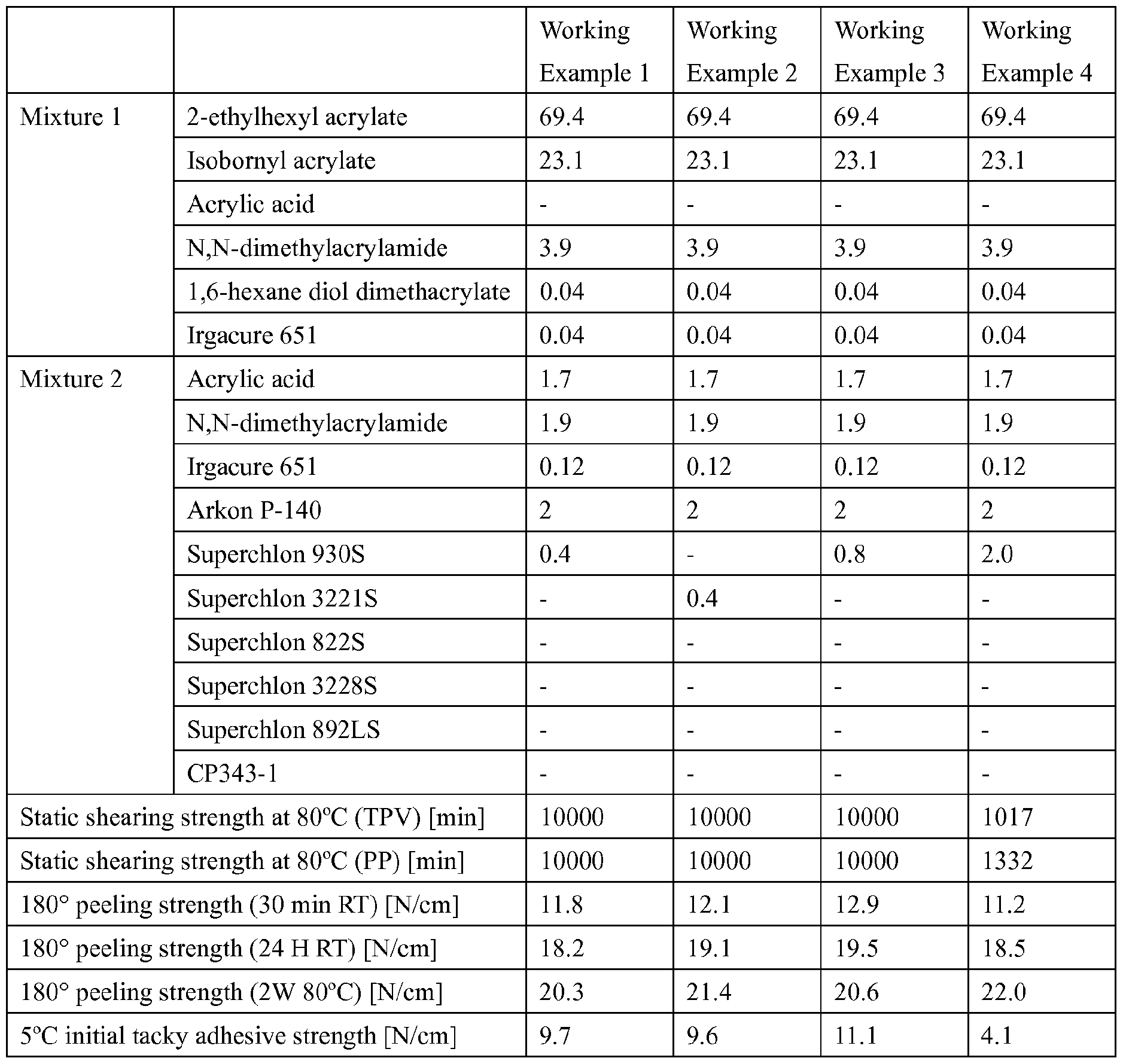
- Mixture 1 which had the compositions shown in tables 2 to 6 (units: parts by mass), was irradiated with ultraviolet light at an intensity of 3 mW/cm 2 for 3 minutes using a low pressure mercury lamp in a nitrogen atmosphere so as to polymerize some of the monomers and obtain a mixture having a viscosity of approximately 2200 mPa ⁇ s.
- Mixture 2 which had the compositions shown in tables 2 to 6 (units: parts by mass), was added to the obtained mixture, heated for 45 minutes at a temperature of approximately 65°C, while stirring, and then cooled to room temperature.
- this mixture was sandwiched between two poly(ethylene terephthalate) (PET) films that had been surface treated with a silicone release agent, and formed into a sheet by calender molding. Both sides of this sheet were irradiated with ultraviolet light at an intensity of 0.3 mW/cm 2 for 3 minutes using a low pressure mercury lamp, and then irradiated for 3 minutes with ultraviolet light at an intensity of 7.0 mW/cm 2 . In this way, a tape-like pressure-sensitive adhesive having a thickness of 0.08 mm was obtained. Moreover, the "tacky adhesive polymer" in the pressure-sensitive adhesive is a component obtained from only the monomers and the photopolymerization initiator.
- a pressure-sensitive adhesive tape obtained by laminating this tape- like pressure-sensitive adhesive on both surfaces of an acrylic foam tape having a thickness of 1.0 mm (manufactured by
- a 12 mm x 25 mm pressure-sensitive adhesive tape was laminated on an oxidation-treated aluminum substrate having dimensions of 30 mm ⁇ 60 mm ⁇ 0.127 mm.
- a second substrate having the same dimensions as the aluminum substrate was placed on the pressure-sensitive adhesive tape in such a way as to overlap the pressure-sensitive adhesive tape on the aluminum substrate by 25 mm.
- the second substrate was a polypropylene (PP) substrate or a crosslinked oleffn-based thermoplastic rubber (TPV) substrate that was a composite body of a dynamically crosslinked ethylene -propylene-diene rubber (EPDM) and a polypropylene (PP) resin, and was washed with isopropanol prior to use.
- PP polypropylene
- TPV crosslinked oleffn-based thermoplastic rubber
- a pressure-sensitive adhesive tape measuring 12 mm ⁇ 100 mm was laminated on a PET film having a thickness of 0.05 mm (the surface of which had been subjected to corona treatment) and bonded to a TPV substrate, which had been washed with isopropanol, at room temperature (23°C). At this point, a 2 kg metal roller was passed back and forth once over the bonded article. The sample obtained in this way was stored under the following three conditions.
- the sample was placed on a tensile strength testing-machine, the pressure-sensitive tape was peeled from the substrate at a rate of 50 mm min in a 180° direction, and the peeling strength at this point was measured.
- the sample stored at 80°C was cooled to room temperature prior to the test.
- An article obtained by laminating a pressure-sensitive adhesive tape measuring 12 mm x 100 mm on a PET film having a thickness of 0.025 mm (the surface of which had been subjected to corona treatment), a TPV substrate which had been washed with isopropanol, and a 2 kg metal roller were stored for 2 hours in a low temperature chamber at 5°C.
- the pressure-sensitive adhesive tape laminated to the PET was bonded to the TPV substrate in the low temperature chamber at 5°C, and the 2 kg metal roller was passed back and forth once over the bonded article.
Landscapes
- Chemical & Material Sciences (AREA)
- Organic Chemistry (AREA)
- Chemical Kinetics & Catalysis (AREA)
- General Chemical & Material Sciences (AREA)
- Health & Medical Sciences (AREA)
- Medicinal Chemistry (AREA)
- Polymers & Plastics (AREA)
- Adhesives Or Adhesive Processes (AREA)
- Adhesive Tapes (AREA)
Abstract
Description




Claims
Priority Applications (3)
| Application Number | Priority Date | Filing Date | Title |
|---|---|---|---|
| US15/120,132 US20170058157A1 (en) | 2014-02-17 | 2015-02-17 | Pressure-Sensitive Adhesive |
| CN201580014337.0A CN106103079A (en) | 2014-02-17 | 2015-02-17 | Contact adhesive |
| EP15749277.8A EP3107722B1 (en) | 2014-02-17 | 2015-02-17 | Pressure-sensitive adhesive |
Applications Claiming Priority (2)
| Application Number | Priority Date | Filing Date | Title |
|---|---|---|---|
| JP2014027478A JP6359284B2 (en) | 2014-02-17 | 2014-02-17 | Pressure sensitive adhesive |
| JP2014-027478 | 2014-02-17 |
Publications (1)
| Publication Number | Publication Date |
|---|---|
| WO2015123667A1 true WO2015123667A1 (en) | 2015-08-20 |
Family
ID=53800704
Family Applications (1)
| Application Number | Title | Priority Date | Filing Date |
|---|---|---|---|
| PCT/US2015/016139 Ceased WO2015123667A1 (en) | 2014-02-17 | 2015-02-17 | Pressure-sensitive adhesive |
Country Status (5)
| Country | Link |
|---|---|
| US (1) | US20170058157A1 (en) |
| EP (1) | EP3107722B1 (en) |
| JP (1) | JP6359284B2 (en) |
| CN (1) | CN106103079A (en) |
| WO (1) | WO2015123667A1 (en) |
Families Citing this family (1)
| Publication number | Priority date | Publication date | Assignee | Title |
|---|---|---|---|---|
| JP7263764B2 (en) * | 2018-12-25 | 2023-04-25 | 大日本印刷株式会社 | Adhesive sheet |
Citations (3)
| Publication number | Priority date | Publication date | Assignee | Title |
|---|---|---|---|---|
| US5840783A (en) * | 1995-04-24 | 1998-11-24 | Minnesota Mining And Manufacturing Company | Pressure-sensitive adhesives for polyolefin surfaces |
| US6773806B1 (en) * | 1999-11-04 | 2004-08-10 | Nitto Denko Corporation | Adhesive tape and substrate for adhesive tape |
| US20110135936A1 (en) * | 2008-08-08 | 2011-06-09 | Hideaki Katsuta | Water-based primer composition and coating method using the same |
Family Cites Families (7)
| Publication number | Priority date | Publication date | Assignee | Title |
|---|---|---|---|---|
| JPH0980230A (en) * | 1995-09-13 | 1997-03-28 | Sekisui Chem Co Ltd | Polarizer fixing structure |
| JP2002234980A (en) * | 2001-02-09 | 2002-08-23 | Showa Denko Kk | Wear-resistant resin composition and its molded product |
| JP2004217807A (en) * | 2003-01-16 | 2004-08-05 | Nippon Paper Chemicals Co Ltd | Chlorinated polyolefin resin solution with good low temperature stability |
| JP4423497B2 (en) * | 2003-11-06 | 2010-03-03 | 東洋化成工業株式会社 | UV curable resin composition |
| JP2010126697A (en) * | 2008-11-28 | 2010-06-10 | Three M Innovative Properties Co | Pressure-sensitive adhesive composition and pressure-sensitive adhesive tape |
| JP5611527B2 (en) * | 2009-01-08 | 2014-10-22 | 日本カーバイド工業株式会社 | Adhesive and optical film |
| JP5860673B2 (en) * | 2011-11-07 | 2016-02-16 | 日東電工株式会社 | Adhesive composition, adhesive layer, polarizing plate with adhesive layer, and image forming apparatus |
-
2014
- 2014-02-17 JP JP2014027478A patent/JP6359284B2/en not_active Expired - Fee Related
-
2015
- 2015-02-17 EP EP15749277.8A patent/EP3107722B1/en active Active
- 2015-02-17 WO PCT/US2015/016139 patent/WO2015123667A1/en not_active Ceased
- 2015-02-17 US US15/120,132 patent/US20170058157A1/en not_active Abandoned
- 2015-02-17 CN CN201580014337.0A patent/CN106103079A/en active Pending
Patent Citations (3)
| Publication number | Priority date | Publication date | Assignee | Title |
|---|---|---|---|---|
| US5840783A (en) * | 1995-04-24 | 1998-11-24 | Minnesota Mining And Manufacturing Company | Pressure-sensitive adhesives for polyolefin surfaces |
| US6773806B1 (en) * | 1999-11-04 | 2004-08-10 | Nitto Denko Corporation | Adhesive tape and substrate for adhesive tape |
| US20110135936A1 (en) * | 2008-08-08 | 2011-06-09 | Hideaki Katsuta | Water-based primer composition and coating method using the same |
Non-Patent Citations (1)
| Title |
|---|
| See also references of EP3107722A4 * |
Also Published As
| Publication number | Publication date |
|---|---|
| CN106103079A (en) | 2016-11-09 |
| EP3107722A4 (en) | 2017-11-08 |
| US20170058157A1 (en) | 2017-03-02 |
| EP3107722B1 (en) | 2019-05-08 |
| JP6359284B2 (en) | 2018-07-18 |
| EP3107722A1 (en) | 2016-12-28 |
| JP2015151485A (en) | 2015-08-24 |
Similar Documents
| Publication | Publication Date | Title |
|---|---|---|
| JP6945025B2 (en) | Double-sided adhesive sheet | |
| JP6367599B2 (en) | Double-sided adhesive sheet | |
| TWI702272B (en) | Adhesive sheet, manufacturing method of laminated body with adhesive layer, laminated body with adhesive layer, image display device and touch panel | |
| EP3402854B1 (en) | Pressure-sensitive adhesive composition and article thereof | |
| TWI846812B (en) | Adhesive Sheet | |
| TW202016252A (en) | Optical pressure-sensitive adhesive composition and use thereof | |
| CN103930509B (en) | Peel off again with water-dispersed acrylic class adhesive composition and bonding sheet | |
| CN104650757A (en) | double sided adhesive sheet | |
| JP7063690B2 (en) | Adhesive sheet | |
| KR20230135083A (en) | Optical adhesive sheet for foldable devices | |
| EP3107722B1 (en) | Pressure-sensitive adhesive | |
| KR20230136537A (en) | Optical adhesive sheet | |
| KR20230098044A (en) | Optical adhesive sheet | |
| CN116082966A (en) | Optical Adhesive Sheets with Release Liners | |
| TWI921467B (en) | Surface Protective Sheets and Treatment Methods | |
| KR102607273B1 (en) | Pressure-sensitive adhesive sheet | |
| TWI903037B (en) | Surface Protective Sheets and Treatment Methods | |
| KR20230159542A (en) | Optical laminates, image display devices, and adhesive compositions | |
| CN111171731B (en) | Dual-network pressure-sensitive adhesive composition and pressure-sensitive adhesive product containing same | |
| KR20230061258A (en) | Optical pressure-sensitive adhesive sheet with release liner | |
| TW202506928A (en) | Optical adhesive sheet | |
| TW202449107A (en) | Optical adhesive sheet | |
| TW202500703A (en) | Optical adhesive sheet | |
| TW202506927A (en) | Optical adhesive sheet | |
| TW202432757A (en) | Adhesive Sheet |
Legal Events
| Date | Code | Title | Description |
|---|---|---|---|
| 121 | Ep: the epo has been informed by wipo that ep was designated in this application |
Ref document number: 15749277 Country of ref document: EP Kind code of ref document: A1 |
|
| NENP | Non-entry into the national phase |
Ref country code: DE |
|
| WWE | Wipo information: entry into national phase |
Ref document number: 15120132 Country of ref document: US |
|
| REEP | Request for entry into the european phase |
Ref document number: 2015749277 Country of ref document: EP |
|
| WWE | Wipo information: entry into national phase |
Ref document number: 2015749277 Country of ref document: EP |
|
| REG | Reference to national code |
Ref country code: BR Ref legal event code: B01A Ref document number: 112016019067 Country of ref document: BR |
|
| ENP | Entry into the national phase |
Ref document number: 112016019067 Country of ref document: BR Kind code of ref document: A2 Effective date: 20160817 |