WO2015125650A1 - ニッケル粉の製造方法 - Google Patents
ニッケル粉の製造方法 Download PDFInfo
- Publication number
- WO2015125650A1 WO2015125650A1 PCT/JP2015/053541 JP2015053541W WO2015125650A1 WO 2015125650 A1 WO2015125650 A1 WO 2015125650A1 JP 2015053541 W JP2015053541 W JP 2015053541W WO 2015125650 A1 WO2015125650 A1 WO 2015125650A1
- Authority
- WO
- WIPO (PCT)
- Prior art keywords
- nickel
- nickel powder
- seed crystal
- dispersant
- ammine complex
- Prior art date
- Legal status (The legal status is an assumption and is not a legal conclusion. Google has not performed a legal analysis and makes no representation as to the accuracy of the status listed.)
- Ceased
Links
Images


Classifications
-
- B—PERFORMING OPERATIONS; TRANSPORTING
- B22—CASTING; POWDER METALLURGY
- B22F—WORKING METALLIC POWDER; MANUFACTURE OF ARTICLES FROM METALLIC POWDER; MAKING METALLIC POWDER; APPARATUS OR DEVICES SPECIALLY ADAPTED FOR METALLIC POWDER
- B22F9/00—Making metallic powder or suspensions thereof
- B22F9/16—Making metallic powder or suspensions thereof using chemical processes
- B22F9/18—Making metallic powder or suspensions thereof using chemical processes with reduction of metal compounds
- B22F9/24—Making metallic powder or suspensions thereof using chemical processes with reduction of metal compounds starting from liquid metal compounds, e.g. solutions
- B22F9/26—Making metallic powder or suspensions thereof using chemical processes with reduction of metal compounds starting from liquid metal compounds, e.g. solutions using gaseous reductors
-
- B—PERFORMING OPERATIONS; TRANSPORTING
- B22—CASTING; POWDER METALLURGY
- B22F—WORKING METALLIC POWDER; MANUFACTURE OF ARTICLES FROM METALLIC POWDER; MAKING METALLIC POWDER; APPARATUS OR DEVICES SPECIALLY ADAPTED FOR METALLIC POWDER
- B22F1/00—Metallic powder; Treatment of metallic powder, e.g. to facilitate working or to improve properties
-
- C—CHEMISTRY; METALLURGY
- C22—METALLURGY; FERROUS OR NON-FERROUS ALLOYS; TREATMENT OF ALLOYS OR NON-FERROUS METALS
- C22B—PRODUCTION AND REFINING OF METALS; PRETREATMENT OF RAW MATERIALS
- C22B23/00—Obtaining nickel or cobalt
- C22B23/04—Obtaining nickel or cobalt by wet processes
- C22B23/0453—Treatment or purification of solutions, e.g. obtained by leaching
- C22B23/0461—Treatment or purification of solutions, e.g. obtained by leaching by chemical methods
-
- B—PERFORMING OPERATIONS; TRANSPORTING
- B22—CASTING; POWDER METALLURGY
- B22F—WORKING METALLIC POWDER; MANUFACTURE OF ARTICLES FROM METALLIC POWDER; MAKING METALLIC POWDER; APPARATUS OR DEVICES SPECIALLY ADAPTED FOR METALLIC POWDER
- B22F2301/00—Metallic composition of the powder or its coating
- B22F2301/15—Nickel or cobalt
-
- Y—GENERAL TAGGING OF NEW TECHNOLOGICAL DEVELOPMENTS; GENERAL TAGGING OF CROSS-SECTIONAL TECHNOLOGIES SPANNING OVER SEVERAL SECTIONS OF THE IPC; TECHNICAL SUBJECTS COVERED BY FORMER USPC CROSS-REFERENCE ART COLLECTIONS [XRACs] AND DIGESTS
- Y02—TECHNOLOGIES OR APPLICATIONS FOR MITIGATION OR ADAPTATION AGAINST CLIMATE CHANGE
- Y02E—REDUCTION OF GREENHOUSE GAS [GHG] EMISSIONS, RELATED TO ENERGY GENERATION, TRANSMISSION OR DISTRIBUTION
- Y02E60/00—Enabling technologies; Technologies with a potential or indirect contribution to GHG emissions mitigation
- Y02E60/10—Energy storage using batteries
Definitions
- the present invention relates to a method for producing nickel powder from a solution containing a nickel sulfate ammine complex using fine nickel powder.
- Patent Document 1 As a method for producing nickel powder expected to be used as a material for a positive electrode active material such as a conductive paste or a nickel metal hydride battery, for example, a method disclosed in Patent Document 1 is known. In the production method disclosed in Patent Document 1, a solution containing the produced nickel ammine complex is treated under high temperature and high pressure to cause the reaction represented by the following formula (1) to precipitate nickel hydroxide particles. This is a method for producing nickel hydroxide powder.
- nickel hydroxide is reduced with a reducing agent, nickel powder can be obtained.
- Various reducing agents can be used, but using hydrogen gas is industrially inexpensive and widely used.
- Non-Patent Document 1 describes a nickel powder production process by Sherritt Gordon. In this production method, an aqueous solution of nickel sulfate and a complexing agent are mixed to form a solution containing a nickel ammine complex. The solution is placed in a pressure vessel such as an autoclave and heated to about 150 to 250 ° C. Hydrogen gas is blown, and nickel ammine complex salt is reduced by hydrogen to obtain nickel powder.
- a pressure vessel such as an autoclave and heated to about 150 to 250 ° C. Hydrogen gas is blown, and nickel ammine complex salt is reduced by hydrogen to obtain nickel powder.
- Non-Patent Document 1 when hydrogen gas is blown, if there are no seed crystals serving as nuclei, many fine nickel powders are often generated non-uniformly, As a result, it is difficult to obtain a product having a predetermined particle size and it is difficult to obtain uniform quality.
- fine nickel is deposited like scaling on the inner wall of the pressurized container and the surface of the stirrer, problems such as an increase in the maintenance of the equipment and a decrease in the product recovery rate also occur. This is not preferable.
- the present invention relates to a decrease in productivity and an increase in cost in a production method in which nickel seed crystals are added to a solution containing a nickel ammine complex under high temperature and high pressure to reduce the hydrogen to obtain nickel powder.
- the present invention provides a manufacturing method that maintains the quality of nickel powder while reducing the amount of seed crystals used.
- the first invention of the present invention provides a mixed slurry formed by adding a dispersant having a seed crystal and an anionic functional group to a solution containing a nickel ammine complex.
- Nickel characterized in that a nickel ammine complex in the mixed slurry is reduced to obtain a nickel powder by performing pressurized hydrogen reduction treatment in which hydrogen is blown in a high-temperature and high-pressure atmosphere at a temperature of from 250 to 250 ° C. to cause a reduction reaction. It is a manufacturing method of powder.
- a second invention of the present invention is a method for producing nickel powder, wherein the dispersant in the first invention is sodium lignin sulfonate having an anionic functional group.
- the invention of 3 of the present invention is a method for producing nickel powder, wherein the dispersant according to the first invention is sodium dodecylbenzenesulfonate having an anionic functional group.
- the amount of the dispersant added in the second invention is 5.0 wt% or more and 50.0 wt% or less with respect to the weight of the seed crystal added to the solution containing the nickel ammine complex. It is the ratio of this, It is a manufacturing method of the nickel powder characterized by the above-mentioned.
- the amount of the dispersant added in the third aspect is 0.05 wt% or more and 10.0 wt% with respect to the weight of the seed crystal added to the solution containing the nickel ammine complex. It is the following ratios, It is the manufacturing method of the nickel powder of Claim 3 characterized by the above-mentioned.
- a mixed slurry formed by adding a dispersant having a seed crystal and a nonionic functional group to a solution containing a nickel ammine complex is subjected to a high-temperature and high-pressure atmosphere at 150 ° C. to 250 ° C.
- the nickel powder production method is characterized in that hydrogen is blown in to perform a pressurized hydrogen reduction treatment that causes a reduction reaction, and the nickel ammine complex in the mixed slurry is reduced to obtain nickel powder.
- the amount of the dispersant added in the sixth invention is 5.0 wt% or more and 50.0 wt% or less with respect to the weight of the seed crystal added to the solution containing the nickel ammine complex. It is the ratio of this, It is a manufacturing method of the nickel powder characterized by the above-mentioned.
- the eighth invention of the present invention is a method for producing nickel powder, characterized in that the seed crystal in the first to seventh inventions is nickel powder.
- a nickel powder is produced by adding a seed crystal to a solution containing a nickel ammine complex and reducing the hydrogen under high temperature and high pressure to produce nickel powder.
- the method for producing high-purity nickel powder of the present invention uses a high-pressure vessel such as an autoclave to add a seed crystal to a solution containing a nickel ammine complex, and perform a pressure hydrogen reduction treatment in which reduction with hydrogen is performed at high temperature and pressure.
- a high-pressure vessel such as an autoclave to add a seed crystal to a solution containing a nickel ammine complex
- a pressure hydrogen reduction treatment in which reduction with hydrogen is performed at high temperature and pressure.
- the reduction rate which was conventionally about 20%, can be improved to nearly 100%, and nickel particles can be precipitated efficiently. It is characterized by.
- a nickel sulfate solution (NiSO 4 ) of a leachate obtained by leaching a nickel-containing material with sulfuric acid is added to aqueous ammonia (NH 4 OH) and ammonium sulfate ((NH 4 ) 2 SO 4 ) as shown in FIG.
- a nickel slurry is added to the solution containing the nickel ammine complex formed through the complexing process to form a mixed slurry, and a mixed slurry is formed, and the mixed slurry is reduced with hydrogen in a high-pressure vessel.
- This is a manufacturing method in which a reduced hydrogen slurry is obtained by applying a pressurized hydrogen reduction process for performing treatment, and then nickel powder is formed through a filtration and washing process.
- ammonium sulfate and ammonia (NH 3) or ammonia water (NH 4 OH) used for the complexing treatment are ammonium sulfate: (NH 4 ) 2 SO 4 and its ammonium sulfate discharged from the filtration / washing process, and ammonia. Ammonia recovered through the recovery step or aqueous ammonia can be used.
- the dispersant and the seed crystal which are the characteristics of the present invention will be described.
- the dispersant used in the present invention may be any dispersant having an anionic or nonionic functional group.
- the dispersant having an anionic functional group may be sodium lignin sulfonate or dodecylbenzene sulfonic acid.
- sodium By using sodium, the effect on nickel reduction is further improved, and a reduction rate of 80% or more can be obtained.
- the mechanism that improves the reduction rate is that the added seed crystal is dispersed, so that a large amount of nickel can be precipitated per seed crystal grain, and the nickel reduction rate is considered to be improved. .
- the molecule of the dispersant is divided into a hydrophobic part and a hydrophilic part, and the hydrophobic part is usually adsorbed on the surface of the particle, and dispersion is caused by repulsion of the charge of the hydrophilic part. For this reason, since the powder which the dispersing agent adsorbed repels, the effect to disperse
- PVA polyvinyl alcohol
- PEG polyethylene glycol
- the addition amount of the dispersant is 5.0 wt% to 50.0 wt% for sodium lignin sulfonate, and sodium dodecylbenzenesulfonate for the seed crystal weight added to the solution containing the nickel ammine complex.
- An amount of 0.05 to 10.0 wt% is preferably added.
- the amount of the dispersant added depends on the type of the dispersant, but is greatly dependent on and influenced by the grain size or specific surface area of the seed crystal. If the particle size is small, the specific surface area becomes large. Conversely, if the particle size is large, the specific surface area becomes small and the amount of the dispersant added can be small.
- the particle diameter of the seed crystal varies when the nickel powder of the product is repeatedly used, and may be small when the specific surface area is large.
- the amount of the dispersant added to coat all the particles needs to be 0.05 to 50.0 wt%.
- a dispersant of 05 wt% to 10.0 wt% and sodium lignin sulfonate it is desirable to add in the range of 5.0 wt% to 50.0 wt%. Even if it is added in excess, the effect is not expected to increase so much, and the drug cost is wasted only by increasing the addition amount. Furthermore, when the addition is excessive, the above-mentioned specific effect found in the present invention is not exhibited, and a problem of causing aggregation occurs. As shown in FIG. 2, the reduction rate when no dispersant is used is about 25%, but it is improved to 95% or more by adding the dispersant of the present invention.
- the seed crystal to be used is fine nickel powder, so that the purity of the nickel powder to be formed can be reduced and high purity nickel powder can be obtained.
- the particle size of the fine nickel seed crystal used is in the range of 0.5 to 5.0 ⁇ m, and the uniformity of the formed nickel powder and the dispersion of the nickel powder formed when the above dispersant is used. It expresses the effect without obstructing the work to promote. If the size is out of the range, the uniformity and dispersion may be impaired.
- the proportion of nickel powder that becomes a product is improved accordingly, and productivity is improved. Further, since the amount of repetition is reduced, the equipment scale for obtaining the same production amount can be saved correspondingly, and the cost can be reduced.
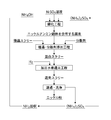
- FIG. 1 is a production process flow chart showing an example of a method for producing nickel powder according to the present invention.
- a “nickel ammine complex” produced through a complexing step using a “nickel sulfate (NiSO 4 ) solution” as a nickel base solution. It is a manufacturing process flow figure at the time of using the "solution containing”.
- the reduction ratio used in the following examples is obtained by measuring the Ni concentration in the liquid after hydrogen reduction.
- a batch type autoclave with a capacity of 3 L was used in the production apparatus. Prepare a solution containing 336 g of reagent nickel sulfate hexahydrate and 330 g of ammonium sulfate in 440 ml of pure water, add 191 ml of 25% aqueous ammonia to this, adjust the total liquid volume to 1000 ml, and use it as the starting solution. This initial solution was charged into the inner can of the autoclave.
- 7.5 g of commercially available nickel powder as seed crystals and 0.4 g of sodium lignin sulfonate as a dispersing agent are added to the starting liquid in the charged inner cylinder can to form a mixed slurry, and the inner cylinder can is charged into an autoclave. Sealed and sealed.
- the pressurized hydrogen reduction process was performed under the following conditions. While stirring with an electric stirrer at 750 rpm, the temperature of the autoclave was increased to 185 ° C. using a heat medium heater. When the temperature reaches 185 ° C., hydrogen gas is blown from the cylinder into the liquid phase part in the inner cylinder can at a flow rate of 2.0 liter / min, and the internal pressure is increased and maintained to 3.5 MPa. The reduction reaction was caused. The reaction was carried out for 60 minutes after the start of blowing hydrogen gas, and after 60 minutes, the supply of hydrogen gas was stopped, and then cooled to room temperature with stirring.
- the cooled inner cylinder can was taken out from the autoclave, and the reduced slurry contained in the inner cylinder can was subjected to solid-liquid separation by filtration using a filter paper and Nutsche in a filtration / washing process to recover nickel powder.
- the recovered nickel powder was washed with water to remove impurities.
- the reduction rate of nickel was about 99%.
- the pH of the filtrate after the reduction was in the range of 6.5 to 7.5.
- Example 1 Comparative Example 1 Except for not adding a dispersant, 191 ml of 25% aqueous ammonia was added to a solution containing 440 ml of pure water, 336 g of nickel sulfate hexahydrate and 330 g of ammonium sulfate under the same conditions as in Example 1, and the total liquid volume was 1000 ml. The same nickel powder as used in Example 1 was added as a seed crystal to this solution in an amount of 7.5 g.
- the inner cylinder can was set in an autoclave, and while being stirred at 750 rpm with a stirrer, the temperature was raised with the heat medium heater as in Example 1 until the internal temperature reached 185 ° C. When the temperature reaches 185 ° C., hydrogen gas is blown into the liquid phase in the inner cylinder can at 2.0 liter / min, and the pressure is increased and maintained so that the internal pressure becomes 3.5 MPa, and the reduction reaction proceeds. It was.
- the supply of hydrogen gas was stopped and cooling was performed.
- the cooled inner cylinder can was taken out, and the slurry contained in the taken out inner cylinder can was subjected to solid-liquid separation to recover nickel powder.
- the recovered nickel powder was about 25 g, and the reduction rate was 24%.
- Example 2 nickel powder was produced using the same method as in Example 1 when the seed crystal addition ratio was set to a seed crystal ratio of 0.05 (that is, 5%), and the reduction rate was determined.
- Nickel powder was produced using the same method as Example 1 except that the seed crystal addition ratio was changed to a seed crystal ratio of 0.07 (that is, 7%), and the reduction rate was determined.
- Nickel powder was produced using the same method as in Example 1 except that the seed crystal addition ratio was 0.01 (ie, 1%), and the reduction rate was determined.
- Comparative Example 3 nickel powder was produced using the same method as in Example 1 except that only the dispersant was added without adding seed crystals, and the reduction rate was determined.
- Nickel powder was produced using the same method as in Example 1 except that only a seed crystal with a seed crystal ratio of 0.30 (that is, 30%) was added without adding a dispersant, and the reduction rate was determined. .
- Nickel powder was produced using the same method as in Example 1 except that only a seed crystal having a seed crystal ratio of 0.50 (that is, 50%) was added without adding a dispersant, and the reduction rate was determined. .
- Example 1 The results of Examples 1 to 3 and Comparative Examples 1 to 5 are summarized in Table 1, and the change in reduction rate depending on the seed crystal ratio with and without the addition of a dispersant is shown in FIG.
- Table 1 and FIG. 2 the reduction rate in the case of Comparative Example 3 in which only the dispersant was added without adding the seed crystal was 7%.
- the reduction rate of 99% was improved by setting the seed crystal ratio to 0.05 as Example 2. That is, it can be seen that the dispersant has a remarkable effect in improving the reduction rate at the time of seed crystal addition.
- the reduction rate is almost the same level, and the seed crystal ratio is about 0.05 (5%). It turns out that an effect is acquired.
- the reduction rate was improved, but compared with the case where the above dispersant was used, It can be seen that a seed crystal having a ratio of about 0.5, which is 10 times, is necessary, and the cost increases accordingly.
- about one-tenth of the seed crystal in the case of using no dispersant is required, and the cost can be reduced by reducing the amount of repeated products and the amount of purchase. It can be seen that even if it exists, the effect can be greatly reduced.
- a seed slurry containing 15 g of nickel powder as a seed crystal (the seed crystal addition rate is 20 wt%) and 1.3 wt% of a sodium dodecylbenzenesulfonate dispersant are added to the seed crystal weight and mixed slurry Was made.
- the pressurized hydrogen reduction process was performed under the following conditions.
- the prepared mixed slurry is charged into an autoclave in a high-pressure vessel, heated to 185 ° C. while stirring, and then hydrogen gas as a reducing agent is blown to supply hydrogen gas so that the pressure in the autoclave becomes 3.5 MPa. Then, reduction treatment was performed.
- Nickel powder was prepared and collected under the same conditions as in Example 4 except that the amount of sodium dodecylbenzenesulfonate as the dispersant was 6.7 wt% with respect to the seed crystal weight.
- the nickel reduction rate of the collected nickel powder according to Example 2 was 95% or more as shown in FIG.
- the mixed slurry was charged into an autoclave, heated to 185 ° C. with stirring, hydrogen gas was blown into the mixed slurry, and hydrogen gas was supplied so that the pressure in the autoclave became 3.5 MPa.
- the nickel reduction rate of the recovered nickel powder according to Comparative Example 1 was approximately 25% as shown in FIG.
Landscapes
- Chemical & Material Sciences (AREA)
- Chemical Kinetics & Catalysis (AREA)
- General Chemical & Material Sciences (AREA)
- Engineering & Computer Science (AREA)
- Manufacturing & Machinery (AREA)
- Materials Engineering (AREA)
- Mechanical Engineering (AREA)
- Metallurgy (AREA)
- Organic Chemistry (AREA)
- Manufacture Of Metal Powder And Suspensions Thereof (AREA)
- Powder Metallurgy (AREA)
Abstract
Description

この製造方法は、硫酸ニッケル水溶液と錯化剤を混合してニッケルアンミン錯体を含有する溶液とし、その溶液をオートクレーブ等の加圧容器に入れ、150~250℃程度に昇温し、溶液中に水素ガスを吹き込むもので、水素によりニッケルアンミン錯塩が還元されてニッケル粉が得られるものである。
また、加圧容器の内壁や攪拌機などの機器表面にスケーリングのように微細なニッケルが析出するため、設備のメンテナンスの手間が増加したり製品の回収率が低下したりする等の問題も発生しているために好ましくない。
しかし上記のように、製品の一部を利用した場合、加工には手間がかかりコストアップの要因となる。さらに加工で得られる形状のばらつきなどに起因して品質が安定しない課題があった。
しかし、例えばニッケル粉を得るために、非特許文献1のプロセスで使用しているように鉄粉を種晶として用いれば、製品の品質に影響するため、用途が限られてしまい、好ましいことではなかった。
本発明は、ニッケル含有物を硫酸による浸出工程で生成した浸出液の硫酸ニッケル溶液(NiSO4)に、図1に示すようにアンモニア水(NH4OH)及び硫酸アンモニウム((NH4)2SO4)による錯化処理を施す錯化工程を経て生成したニッケルアンミン錯体を含有する溶液に、ニッケル粉の種晶及び分散剤を添加して混合スラリーを形成し、その混合スラリーに高圧容器中で水素還元処理を行う加圧水素還元工程を加えて還元スラリーを得て、その後濾過・洗浄工程を経てニッケル粉を形成する製造方法である。
以下、本発明の特徴とする分散剤及び種晶について説明する。
本発明で使用する分散剤は、アニオン系またはノニオン系の官能基を持つものであればよいが、とりわけ、アニオン系の官能基を持つ分散剤としては、リグニンスルホン酸ナトリウム、又はドデシルベンゼンスルホン酸ナトリウムを用いることで、ニッケル還元への効果はさらに向上し、80%以上の還元率が得られる。
ここで、分散剤を添加すると、還元率が向上するメカニズムは、添加された種晶が分散するため、種晶一粒あたりに多くのニッケルが析出可能となり、ニッケルの還元率が向上すると考えられる。
この分散剤の添加量は、分散剤の種類にも左右されるが、種晶の粒径又は比表面積に大きく依存、影響されるもので、同じ重量の種晶を添加した場合、粒径が小さいと比表面積が大きくなり、逆に粒径が大きいと比表面積は小さくなって、分散剤の添加量も少なくて済む。種晶の粒径は、製品のニッケル粉末を繰り返して使用する場合は、ばらつきがあり、比表面積も大きい場合、小さい場合がある。
さらに、添加が過剰となる場合には、本発明で見出した上記の特異的な効果が発現せず、凝集を生じる問題が発生する。
なお、図2に示すように、分散剤を使用しない場合の還元率は25%程度だが、本発明の分散剤を添加することで95%以上まで向上する。
使用する種晶は、微小なニッケル粉を用いることで、形成するニッケル粉の純度を低下させずにすみ、高い純度のニッケル粉を得ることができる。
また、使用する微小なニッケル種晶の粒径は、0.5~5.0μmの範囲が、形成されたニッケル粉の均一性や上記分散剤を使用した際の形成されるニッケル粉の分散を促進する働きなどを阻害せずに効果を表すものである。その範囲外の大きさでは、均一性や分散を害してしまう恐れがあり望ましくない。
図1は、本発明に係るニッケル粉の製造方法の一例を示す製造工程フロー図で、「硫酸ニッケル(NiSO4)溶液」をニッケル元液とし、錯化工程を経て作製される「ニッケルアンミン錯体を含有する溶液」を用いた場合の製造工程フロー図である。
下記実施例で用いた還元率は、水素還元後の液中のNi濃度を測定し求めたものである。

純水440mlに試薬硫酸ニッケル六水和物336g、硫酸アンモニウム330gを含む溶液を調製し、これに25%アンモニア水191mlを添加し、合計の液量が1000mlになるように調整して始液とし、この始液を上記オートクレーブの内筒缶に装入した。
この時の種晶添加率は、10wt%(7.5/75×100=10)となる。
電動撹拌機により750rpmで撹拌させながら、熱媒ヒーターを用いてオートクレーブの内部温度が185℃になるまで昇温した。185℃に温度が到達した時点から、水素ガスをボンベから内筒缶内の液相部に2.0リットル/minの流量で吹込み、内部圧力を3.5MPaになるように昇圧、維持して還元反応を生じさせた。
水素ガスを吹き込み開始してから60分間反応させ、60分経過後に水素ガスの供給を停止し、その後撹拌しながら室温まで冷却した。
ニッケルの還元率は約99%だった。
還元後の濾液のpHは6.5~7.5の範囲になった。
分散剤を添加しなかった以外は、実施例1と同じ条件である純水440ml、硫酸ニッケル六水和物336g、硫酸アンモニウム330gを含む溶液に25%アンモニア水191ml添加し、合計の液量が1000mlになるように調整して内筒缶に装入し、この溶液に実施例1で用いたものと同じニッケル粉を種晶として7.5g添加した。
冷却した内筒缶を取り出し、取り出した内筒缶に入っているスラリーを固液分離してニッケル粉を回収した。
回収したニッケル粉は約25gであり、還元率は24%だった。
種晶の添加割合を種晶比0.01(すなわち1%)とした以外は、実施例1と同じ方法を用いてニッケル粉が生成され、その還元率を求めた。
比較例3として種晶を添加せず分散剤のみ添加した以外は、実施例1と同じ方法を用いてニッケル粉が生成され、その還元率を求めた。
分散剤を添加せずに、種晶比0.30(すなわち30%)の種晶のみを添加した以外は、実施例1と同じ方法を用いてニッケル粉が生成され、その還元率を求めた。
分散剤を添加せずに、種晶比0.50(すなわち50%)の種晶のみを添加した以外は、実施例1と同じ方法を用いてニッケル粉が生成され、その還元率を求めた。
表1及び図2に示すように、種晶を添加せずに分散剤のみ添加した比較例3の場合の還元率は7%だった。これに対し、実施例2として種晶比を0.05とすることで、99%の還元率まで向上した。
すなわち、分散剤は種晶添加時の還元率の向上に顕著な効果があることがわかる。
一方、比較例1、4、5として示した、分散剤を使用せずに種晶比だけを増加させた場合も、還元率は向上するが、上記の分散剤を使用した場合に比べると、10倍の0.5程度もの比率となる種晶が必要であり、それだけコストが上昇することがわかる。言い換えると本発明により分散剤を使用しない場合の約10分の1の種晶で済むことになり、製品の繰り返し量や購入量が減少することでそれだけコストが節減でき、種晶由来の不純物が存在する場合でも影響を大きく低減できる効果を有することがわかる。

このときのニッケル還元率は、図3に示す通り95%以上が得られた。
回収した実施例2に係るニッケル粉のニッケル還元率は、図3に示すように95%以上が得られた。
硫酸ニッケル六水和物336g、硫酸アンモニウム330gを含む溶液に25%アンモニア水を191ml添加し、合計の液量が1000mlになるように調整して錯化処理を行い、ニッケルアンミン錯体を含有する溶液を作製した。この溶液にニッケル粉の種晶15gを含む種晶スラリーを添加して混合スラリーとした。
この回収した比較例1に係るニッケル粉のニッケル還元率は、図3に示す通り概ね25%程度だった。
Claims (8)
- ニッケルアンミン錯体を含有する溶液に、種晶とアニオン系の官能基を有する分散剤を添加して形成した混合スラリーに、150℃~250℃の高温高圧雰囲気下で水素を吹き込んで還元反応を生じさせる加圧水素還元処理を施して、前記混合スラリー中のニッケルアンミン錯体を還元してニッケルの粉末を得ることを特徴とするニッケル粉の製造方法。
- 前記分散剤が、アニオン系の官能基を有するリグニンスルホン酸ナトリウムであることを特徴とする請求項1に記載のニッケル粉の製造方法。
- 前記分散剤が、アニオン系の官能基を有するドデシルベンゼンスルホン酸ナトリウムであることを特徴とする請求項1に記載のニッケル粉の製造方法。
- 前記分散剤の添加量が、ニッケルアンミン錯体を含有する溶液に添加する種晶の重量に対して、5.0wt%以上、50.0wt%以下の割合であることを特徴とする請求項2に記載のニッケル粉の製造方法。
- 前記分散剤の添加量が、ニッケルアンミン錯体を含有する溶液に添加する種晶の重量に対して、0.05wt%以上、10.0wt%以下の割合であることを特徴とする請求項3に記載のニッケル粉の製造方法。
- ニッケルアンミン錯体を含有する溶液に、種晶とノニオン系の官能基を有する分散剤を添加して形成した混合スラリーに、150℃~250℃の高温高圧雰囲気下で水素を吹き込んで還元反応を生じさせる加圧水素還元処理を施して、前記混合スラリー中のニッケルアンミン錯体を還元してニッケルの粉末を得ることを特徴とするニッケル粉の製造方法。
- 前記分散剤の添加量が、ニッケルアンミン錯体を含有する溶液に添加する種晶の重量に対して、5.0wt%以上、50.0wt%以下の割合であることを特徴とする請求項6に記載のニッケル粉の製造方法。
- 前記種晶が、ニッケル粉であることを特徴とする請求項1~7のいずれか1項に記載のニッケル粉の製造方法。
Priority Applications (7)
| Application Number | Priority Date | Filing Date | Title |
|---|---|---|---|
| EP15751434.0A EP3108987A4 (en) | 2014-02-21 | 2015-02-09 | Method for producing nickel powder |
| JP2015542060A JP5936783B2 (ja) | 2014-02-21 | 2015-02-09 | ニッケル粉の製造方法 |
| CA2939809A CA2939809C (en) | 2014-02-21 | 2015-02-09 | Method for producing nickel powder |
| CN201580009384.6A CN106029270B (zh) | 2014-02-21 | 2015-02-09 | 镍粉的制造方法 |
| AU2015220105A AU2015220105B2 (en) | 2014-02-21 | 2015-02-09 | Method for producing nickel powder |
| US15/119,263 US10471514B2 (en) | 2014-02-21 | 2015-02-09 | Method for producing nickel powder |
| PH12016501664A PH12016501664A1 (en) | 2014-02-21 | 2016-08-19 | Method for producing nickel powder |
Applications Claiming Priority (4)
| Application Number | Priority Date | Filing Date | Title |
|---|---|---|---|
| JP2014031253 | 2014-02-21 | ||
| JP2014-031253 | 2014-02-21 | ||
| JP2014-051219 | 2014-03-14 | ||
| JP2014051219 | 2014-03-14 |
Publications (1)
| Publication Number | Publication Date |
|---|---|
| WO2015125650A1 true WO2015125650A1 (ja) | 2015-08-27 |
Family
ID=53878156
Family Applications (1)
| Application Number | Title | Priority Date | Filing Date |
|---|---|---|---|
| PCT/JP2015/053541 Ceased WO2015125650A1 (ja) | 2014-02-21 | 2015-02-09 | ニッケル粉の製造方法 |
Country Status (8)
| Country | Link |
|---|---|
| US (1) | US10471514B2 (ja) |
| EP (1) | EP3108987A4 (ja) |
| JP (1) | JP5936783B2 (ja) |
| CN (1) | CN106029270B (ja) |
| AU (1) | AU2015220105B2 (ja) |
| CA (1) | CA2939809C (ja) |
| PH (1) | PH12016501664A1 (ja) |
| WO (1) | WO2015125650A1 (ja) |
Cited By (5)
| Publication number | Priority date | Publication date | Assignee | Title |
|---|---|---|---|---|
| WO2018061634A1 (ja) * | 2016-09-27 | 2018-04-05 | 住友金属鉱山株式会社 | ニッケル粉の製造方法 |
| JP2018145510A (ja) * | 2017-03-09 | 2018-09-20 | 住友金属鉱山株式会社 | ニッケル粉の製造方法 |
| CN108698131A (zh) * | 2016-02-29 | 2018-10-23 | 住友金属矿山株式会社 | 镍粉的制造方法 |
| CN109153081A (zh) * | 2016-05-30 | 2019-01-04 | 住友金属矿山株式会社 | 镍粉的制造方法 |
| WO2019123972A1 (ja) * | 2017-12-21 | 2019-06-27 | 住友金属鉱山株式会社 | ニッケル粉の製造方法 |
Families Citing this family (5)
| Publication number | Priority date | Publication date | Assignee | Title |
|---|---|---|---|---|
| JP6442298B2 (ja) * | 2014-03-26 | 2018-12-19 | 国立大学法人高知大学 | ニッケル粉の製造方法 |
| WO2016117138A1 (ja) * | 2015-01-22 | 2016-07-28 | 住友金属鉱山株式会社 | ニッケル粉の製造方法 |
| JP6202348B2 (ja) * | 2015-10-26 | 2017-09-27 | 住友金属鉱山株式会社 | 高密度ニッケル粉の製造方法 |
| JP6641632B2 (ja) * | 2016-03-04 | 2020-02-05 | 住友金属鉱山株式会社 | ニッケル粉の製造方法 |
| CN110049840B (zh) * | 2016-12-05 | 2022-06-24 | 住友金属矿山株式会社 | 镍粉末的制造方法 |
Citations (4)
| Publication number | Priority date | Publication date | Assignee | Title |
|---|---|---|---|---|
| US4148632A (en) * | 1977-11-02 | 1979-04-10 | Sherritt Gordon Mines Limited | Treatment of dissolved basic nickel carbonate to obtain nickel |
| US4545814A (en) * | 1984-05-23 | 1985-10-08 | Amax Inc. | Production of cobalt and nickel powder |
| JPH10509213A (ja) * | 1994-11-14 | 1998-09-08 | ザ ウェスターム コーポレイション | ミクロンサイズのニッケル金属粉末およびその製造方法 |
| US20040159187A1 (en) * | 1999-11-09 | 2004-08-19 | Matti Hamalainen | Method for the reduction of nickel from an aqueous solution |
Family Cites Families (14)
| Publication number | Priority date | Publication date | Assignee | Title |
|---|---|---|---|---|
| US2853380A (en) * | 1957-05-20 | 1958-09-23 | Sherritt Gordon Mines Ltd | Method of recovering metal values from solutions |
| US3156556A (en) * | 1962-07-20 | 1964-11-10 | Sherritt Gordon Mines Ltd | Method of producing fine spherical metal powders |
| CA970168A (en) | 1972-10-20 | 1975-07-01 | Sherritt Gordon Mines Limited | Production of nickel powder from impure nickel compounds |
| NZ247442A (en) * | 1992-05-01 | 1995-09-26 | Rohm & Haas | Improving the wetting, dissolution or dispersion of one or more dithiocarbamate compounds in a liquid and compositions thereof |
| AUPR917701A0 (en) * | 2001-11-29 | 2001-12-20 | QNI Technology Limited | Integrated ammoniacal solvent extraction and hydrogen reduction of nickel |
| JP2005194156A (ja) | 2004-01-09 | 2005-07-21 | Ishikawajima Harima Heavy Ind Co Ltd | 水酸化ニッケル粉末の製造方法 |
| JP4360339B2 (ja) * | 2005-04-01 | 2009-11-11 | セイコーエプソン株式会社 | 成形体形成用組成物 |
| US7604679B2 (en) * | 2005-11-04 | 2009-10-20 | Sumitomo Metal Mining Co., Ltd. | Fine nickel powder and process for producing the same |
| EP1925307A1 (en) | 2006-11-03 | 2008-05-28 | Emotional Brain B.V. | Use of 3-alpha-androstanediol in the treatment of sexual dysfunction |
| FR2914200B1 (fr) * | 2007-03-30 | 2009-11-27 | Inst Francais Du Petrole | Procede de synthese de nanoparticules metalliques cubiques en presence de deux reducteurs |
| CN102407342B (zh) * | 2011-10-31 | 2013-06-05 | 山东大学 | 粒径可精确控制的纳米银粉的制备方法 |
| JP5828923B2 (ja) * | 2014-01-30 | 2015-12-09 | 国立大学法人高知大学 | ニッケル粉の製造方法 |
| JP5811376B2 (ja) * | 2014-02-17 | 2015-11-11 | 住友金属鉱山株式会社 | 水素還元ニッケル粉の製造に用いる種結晶の製造方法 |
| JP6099601B2 (ja) * | 2014-02-17 | 2017-03-22 | 国立大学法人高知大学 | ニッケル粉の製造方法 |
-
2015
- 2015-02-09 JP JP2015542060A patent/JP5936783B2/ja active Active
- 2015-02-09 US US15/119,263 patent/US10471514B2/en not_active Expired - Fee Related
- 2015-02-09 CN CN201580009384.6A patent/CN106029270B/zh not_active Expired - Fee Related
- 2015-02-09 WO PCT/JP2015/053541 patent/WO2015125650A1/ja not_active Ceased
- 2015-02-09 CA CA2939809A patent/CA2939809C/en not_active Expired - Fee Related
- 2015-02-09 EP EP15751434.0A patent/EP3108987A4/en not_active Withdrawn
- 2015-02-09 AU AU2015220105A patent/AU2015220105B2/en not_active Ceased
-
2016
- 2016-08-19 PH PH12016501664A patent/PH12016501664A1/en unknown
Patent Citations (4)
| Publication number | Priority date | Publication date | Assignee | Title |
|---|---|---|---|---|
| US4148632A (en) * | 1977-11-02 | 1979-04-10 | Sherritt Gordon Mines Limited | Treatment of dissolved basic nickel carbonate to obtain nickel |
| US4545814A (en) * | 1984-05-23 | 1985-10-08 | Amax Inc. | Production of cobalt and nickel powder |
| JPH10509213A (ja) * | 1994-11-14 | 1998-09-08 | ザ ウェスターム コーポレイション | ミクロンサイズのニッケル金属粉末およびその製造方法 |
| US20040159187A1 (en) * | 1999-11-09 | 2004-08-19 | Matti Hamalainen | Method for the reduction of nickel from an aqueous solution |
Non-Patent Citations (1)
| Title |
|---|
| See also references of EP3108987A4 * |
Cited By (10)
| Publication number | Priority date | Publication date | Assignee | Title |
|---|---|---|---|---|
| CN108698131A (zh) * | 2016-02-29 | 2018-10-23 | 住友金属矿山株式会社 | 镍粉的制造方法 |
| EP3424625A4 (en) * | 2016-02-29 | 2019-11-20 | Sumitomo Metal Mining Co., Ltd. | NICKEL POWDER PROCESS |
| CN109153081A (zh) * | 2016-05-30 | 2019-01-04 | 住友金属矿山株式会社 | 镍粉的制造方法 |
| EP3466571A4 (en) * | 2016-05-30 | 2020-01-22 | Sumitomo Metal Mining Co., Ltd. | PROCESS FOR PRODUCING NICKEL POWDER |
| WO2018061634A1 (ja) * | 2016-09-27 | 2018-04-05 | 住友金属鉱山株式会社 | ニッケル粉の製造方法 |
| JP2018070997A (ja) * | 2016-09-27 | 2018-05-10 | 住友金属鉱山株式会社 | ニッケル粉の製造方法 |
| EP3520933A4 (en) * | 2016-09-27 | 2020-03-18 | Sumitomo Metal Mining Co., Ltd. | NICKEL POWDER PRODUCTION METHOD |
| JP2018145510A (ja) * | 2017-03-09 | 2018-09-20 | 住友金属鉱山株式会社 | ニッケル粉の製造方法 |
| WO2019123972A1 (ja) * | 2017-12-21 | 2019-06-27 | 住友金属鉱山株式会社 | ニッケル粉の製造方法 |
| JP2019112661A (ja) * | 2017-12-21 | 2019-07-11 | 住友金属鉱山株式会社 | ニッケル粉の製造方法 |
Also Published As
| Publication number | Publication date |
|---|---|
| CA2939809A1 (en) | 2015-08-27 |
| CA2939809C (en) | 2017-08-22 |
| EP3108987A1 (en) | 2016-12-28 |
| PH12016501664B1 (en) | 2016-10-03 |
| US10471514B2 (en) | 2019-11-12 |
| CN106029270A (zh) | 2016-10-12 |
| AU2015220105B2 (en) | 2016-09-22 |
| CN106029270B (zh) | 2017-09-08 |
| AU2015220105A1 (en) | 2016-09-01 |
| US20170008090A1 (en) | 2017-01-12 |
| PH12016501664A1 (en) | 2016-10-03 |
| JPWO2015125650A1 (ja) | 2017-03-30 |
| JP5936783B2 (ja) | 2016-06-22 |
| EP3108987A4 (en) | 2018-02-07 |
Similar Documents
| Publication | Publication Date | Title |
|---|---|---|
| JP5936783B2 (ja) | ニッケル粉の製造方法 | |
| CN105817641B (zh) | 一种利用新生纳米晶种诱导生产金属粉末的制备方法 | |
| WO2015115427A1 (ja) | ニッケル粉の製造方法 | |
| CN105992662B (zh) | 氢还原镍粉的制造所使用的晶种的制造方法 | |
| CN106029269B (zh) | 镍粉的制造方法 | |
| CN104326477B (zh) | 一种电容器用超高纯硅溶胶的制备方法 | |
| CN105252014A (zh) | 一种碱性体系中制备超细银粉的方法 | |
| CN107735199A (zh) | 钴粉的制造方法 | |
| WO2016117138A1 (ja) | ニッケル粉の製造方法 | |
| AU2017226381B2 (en) | Nickel powder production method | |
| JP6350830B2 (ja) | コバルト粉の種結晶の製造方法 | |
| JP5796696B1 (ja) | ニッケル粉の製造方法 | |
| JP2017082270A5 (ja) | ||
| AU2017227207B2 (en) | Nickel powder production method | |
| JP2017155253A (ja) | ニッケル粉の製造方法 | |
| US20210197266A1 (en) | Method for producing nickel powder | |
| JP7272761B2 (ja) | ニッケル粉の製造方法 | |
| JP2017155265A5 (ja) |
Legal Events
| Date | Code | Title | Description |
|---|---|---|---|
| ENP | Entry into the national phase |
Ref document number: 2015542060 Country of ref document: JP Kind code of ref document: A |
|
| 121 | Ep: the epo has been informed by wipo that ep was designated in this application |
Ref document number: 15751434 Country of ref document: EP Kind code of ref document: A1 |
|
| ENP | Entry into the national phase |
Ref document number: 2939809 Country of ref document: CA |
|
| WWE | Wipo information: entry into national phase |
Ref document number: 15119263 Country of ref document: US |
|
| WWE | Wipo information: entry into national phase |
Ref document number: 12016501664 Country of ref document: PH |
|
| NENP | Non-entry into the national phase |
Ref country code: DE |
|
| ENP | Entry into the national phase |
Ref document number: 2015220105 Country of ref document: AU Date of ref document: 20150209 Kind code of ref document: A |
|
| REEP | Request for entry into the european phase |
Ref document number: 2015751434 Country of ref document: EP |
|
| WWE | Wipo information: entry into national phase |
Ref document number: 2015751434 Country of ref document: EP |
|
| WWE | Wipo information: entry into national phase |
Ref document number: IDP00201606257 Country of ref document: ID |