WO2015131854A1 - Smart congestion control for rrc connected mode in lteadvanced systems - Google Patents
Smart congestion control for rrc connected mode in lteadvanced systems Download PDFInfo
- Publication number
- WO2015131854A1 WO2015131854A1 PCT/CN2015/073799 CN2015073799W WO2015131854A1 WO 2015131854 A1 WO2015131854 A1 WO 2015131854A1 CN 2015073799 W CN2015073799 W CN 2015073799W WO 2015131854 A1 WO2015131854 A1 WO 2015131854A1
- Authority
- WO
- WIPO (PCT)
- Prior art keywords
- barring
- application
- prioritized
- parameters
- rrc
- Prior art date
- Legal status (The legal status is an assumption and is not a legal conclusion. Google has not performed a legal analysis and makes no representation as to the accuracy of the status listed.)
- Ceased
Links
Images


Classifications
-
- H—ELECTRICITY
- H04—ELECTRIC COMMUNICATION TECHNIQUE
- H04W—WIRELESS COMMUNICATION NETWORKS
- H04W72/00—Local resource management
- H04W72/50—Allocation or scheduling criteria for wireless resources
- H04W72/52—Allocation or scheduling criteria for wireless resources based on load
-
- H—ELECTRICITY
- H04—ELECTRIC COMMUNICATION TECHNIQUE
- H04L—TRANSMISSION OF DIGITAL INFORMATION, e.g. TELEGRAPHIC COMMUNICATION
- H04L65/00—Network arrangements, protocols or services for supporting real-time applications in data packet communication
-
- H—ELECTRICITY
- H04—ELECTRIC COMMUNICATION TECHNIQUE
- H04L—TRANSMISSION OF DIGITAL INFORMATION, e.g. TELEGRAPHIC COMMUNICATION
- H04L65/00—Network arrangements, protocols or services for supporting real-time applications in data packet communication
- H04L65/80—Responding to QoS
-
- H—ELECTRICITY
- H04—ELECTRIC COMMUNICATION TECHNIQUE
- H04W—WIRELESS COMMUNICATION NETWORKS
- H04W48/00—Access restriction; Network selection; Access point selection
- H04W48/02—Access restriction performed under specific conditions
-
- H—ELECTRICITY
- H04—ELECTRIC COMMUNICATION TECHNIQUE
- H04W—WIRELESS COMMUNICATION NETWORKS
- H04W4/00—Services specially adapted for wireless communication networks; Facilities therefor
- H04W4/70—Services for machine-to-machine communication [M2M] or machine type communication [MTC]
-
- H—ELECTRICITY
- H04—ELECTRIC COMMUNICATION TECHNIQUE
- H04W—WIRELESS COMMUNICATION NETWORKS
- H04W80/00—Wireless network protocols or protocol adaptations to wireless operation
- H04W80/04—Network layer protocols, e.g. mobile IP [Internet Protocol]
Definitions
- the disclosed embodiments relate generally to LTE advanced systems, and, more particularly, to smart congestion control for both RRC Idle and RRC Connected UEs in LTE-Advanced systems.
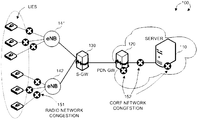
- FIG. 1 illustrates a radio network congestion and a core network congestion use case in an LTE network 100.
- LTE network 100 comprises an application server 110, a packet data network gateway (PDN GW) 120, a serving GW 130, two base stations eNB141 and eNB142, and a plurality of user equipments (UEs) .
- Radio network congestion occurs when massive concurrent data transmission takes place in the radio access network, as depicted by arrow 151.
- data congestion may occur in the mobile core network or on the link between the mobile core network and the application server 110 where the data traffic related to the application is aggregated, as depicted by arrow 152.
- Access Class Barring is a mechanism to limit the number of simultaneous access attempts from certain UEs. All UEs are member of one out of ten randomly allocated mobile populations, defined as access class 0 to 9. The population number is stored in UE’s SIM/USIM. In addition, the UEs may be members of one or more out of five special categories (e.g., Access Class 11 to 15) , also stored in the SIM/USIM. Under the ACB mechanism, the network operator may prevent certain UEs from making access attempts or responding to pages in specific areas of a PLMN based on the corresponding access class.
- ACB Access Class Barring
- EAB Enhanced access barring
- MTC Machine Type Communication
- SAC Service Specific Access Control
- MMTEL IP Multimedia Subsystem multimedia telephony
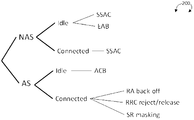
- FIG. 2 illustrates various barring mechanisms for congestion control in an LTE system 200.
- LTE specifies several barring mechanisms for concurrent congestion control in different layers.
- NAS non-access stratum
- SSAC Service Specific Access Control
- EAB EAB
- SSAC Service Specific Access Control
- AS Access stratum
- RRC Idle mode RRC Idle mode
- ACB Access stratum
- RRC Connected mode random access backoff, RRC reject/release, and scheduling request (SR) masking can be used as well.
- SR scheduling request
- LTE Some of the barring mechanisms in LTE, however, have duplicate behavior and therefore may cause quality degradation in some scenarios. For example, double barring of SSAC and ACB for MMTEL service de-prioritizes MMTEL service and LTE fails to prioritize MMTEL service over other services. Furthermore, congestion control for RRC Connected UEs becomes more important as the trend is to keep UE in RRC Connected for data applications. However, LTE lacks congestion control mechanism for RRC Connected mode. Therefore, it is desirable to provide a feasible congestion control mechanism with a fine granularity that can prioritize or deprioritize services based on operator’s requirement. In addition, the congestion control mechanism can be applied for RRC Connected mode as well with proper granularity.
- a smart congestion control method is proposed for UEs in RRC Idle mode and in RRC Connected mode in a 3GPP LTE-Advanced network.
- a UE initiates an MMTEL service in RRC Idle mode in a mobile communication network.
- the UE acquires access control information from a base station.
- the access control information indicates whether ACB is applicable to MMTEL service type.
- the UE then performs SSAC check for the MMTEL service based on the access control information.
- the UE also performs ACB check for the MMTEL service if ACB is applicable to the MMTEL service. Otherwise, the UE bypasses the ACB check for the MMTEL service.
- the access control information comprises SSAC configuration information, ACB parameters information, and ACB bypass information.
- the MMTEL service type has multiple subtypes including voice, video, and text
- the ACB bypass information contains one or more indications, each indication indicates whether ACB is applicable to an MMTEL service subtype.
- the UE comprises a NAS layer and an AS layer, and the NAS layer forwards MMTEL service type indication to the AS layer for determining whether to bypass ACB.
- the UE performs random access with prioritized RA backoff.
- the RA backoff value is different for different service types, and the RA backoff value is contained in a new control element (CE) in a random access response (RAR) .
- CE control element
- RAR random access response
- a UE establishes an RRC connection with a base station for an application in a mobile communication network.
- the UE acquires a barring indication that indicates whether scheduling request (SR) barring is applicable for respective applications.
- the UE acquires prioritized barring parameters for SR barring if applicable.
- the prioritized barring parameters is associated with a priority of the application.
- the UE determines whether to send a scheduling request for an arrived packet based on the prioritized barring parameters.
- the application is associated with a quality class indicator (QCI) , and the priority of the application is based on the QCI.
- QCI quality class indicator
- the UE comprises a NAS layer and an RRC layer, where the RRC layer forwards the barring indication and the prioritized barring parameters to the NAS layer for determining SR barring.
- the prioritized barring parameters can be the same as or separate from the ACB barring parameters applied for RRC Idle mode, and the eNB signals a bitmap for indicating which prioritization should apply.
- Figure 1 (Prior Art) illustrates a radio network congestion use case and a core network congestion use case in an LTE network.
- Figure 2 (Prior Art) illustrates various barring mechanisms for congestion control in an LTE system.
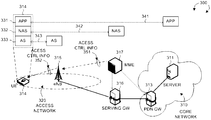
- Figure 3 illustrates a 3GPP LTE network that supports smart congestion control mechanism in accordance with one novel aspect.
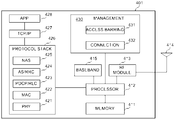
- FIG. 4 is a simplified block diagram of a user equipment (UE) that supports certain embodiments of the present invention.
- UE user equipment
- Figure 5 illustrates a method of smart congestion control in RRC Idle mode.
- Figure 6 illustrates a method of smart congestion control in RRC Connected mode.
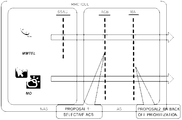
- Figure 7 illustrates one embodiment of selective access control barring (ACB) .
- Figure 8 illustrates another embodiment of selective access control barring (ACB) .
- Figure 9 illustrates the barring rate performance of selective ACB.
- Figure 10 illustrates the delay performance of selective ACB.
- Figure 11 is a flow chart of a method of selective ACB for MMTEL service from UE perspective in accordance with one novel aspect.
- Figure 12 is a flow chart of a method of selective ACB for MMTEL service from eNB perspective in accordance with one novel aspect.
- Figure 13 illustrates one embodiment of smart congestion control in RRC Connected mode.
- Figure 14 is a flow chart of a method of smart congestion control in RRC Connected mode from UE perspective in accordance with one novel aspect.
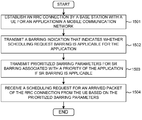
- Figure 15 is a flow chart of a method of smart congestion control in RRC Connected mode from base station perspective in accordance with one novel aspect.
- FIG 3 illustrates a 3GPP LTE network 300 that supports smart congestion control mechanism in accordance with one novel aspect.
- 3GPP LTE network 300 comprises an application server 311 that provides various services by communicating with a plurality of user equipments (e.g., UE 314 as illustrated in Figure 3) .
- server 311 and a packet data network gateway (PDN GW) 313 belong to part of a core network 310.
- UE 314 and its serving base station (eNB) 315 belong to part of a radio access network (RAN) 320.
- Server 311 communicates with UE 314 through PDN GW 313, serving GW 316, and eNB 315.
- a mobility management entity (MME) 317 communicates with eNB 315, serving GW 316 and PDN GW 313 for mobility management of wireless access devices in 3GPP network 300.
- MME mobility management entity
- server 311 provides various services/applications in application (APP) protocol layer.
- APP application
- server 311 communicates with the plurality of UEs in the 3GPP network.
- Each UE e.g. UE 3114 comprises various protocol layer modules to support the end-to-end applications and data connections.
- APP module 331 communicates with server 311 in APP protocol layer (e.g., depicted by dashed line 341) , which provides the end-to-end control/data.
- NAS module 332 communicates with MME 317 in non-access stratum protocol layer (e.g., depicted by dashed line 342) , which supports mobility management and other signaling functionality.
- RRC module 333 communicates with eNB 315 in radio resource control (RRC) protocol layer (e.g., depicted by dashed line 343) , which takes care of broadcast of system information, RRC connection control, paging, radio configuration control, QoS control, etc.
- RRC radio resource control
- Access Class Barring is a mechanism to limit the number of simultaneous access attempts from certain UEs. Under the ACB mechanism, the network operator may prevent certain UEs from making access attempts or responding to pages in specific areas of a PLMN based on the corresponding access class.
- access barring is achieved via barring parameters including access probability (e.g., barring factor) and retry timer (e.g., barring time) performed at the UE side.
- SSAC Service Specific Access Control
- MMTEL IP Multimedia Subsystem multimedia telephony
- the SSAC mechanism is similar to ACB, and access barring can be achieved via barring parameters including access probability (e.g., barring factor) and retry timer (e.g., barring time) performed at the UE side.
- access probability e.g., barring factor
- retry timer e.g., barring time
- a smart congestion control mechanism for the network operator to control access attempts from UEs to prevent overload of the access network and/or the core network.
- the network operator can prioritize or de-prioritize certain service types. For example, the network operator can de-prioritize MMTEL service during normal situation by applying double barring of SSAC/ACB.
- the network operator can prioritize MMTEL service by applying ACB bypassing. For example, in AS layer, eNB 315 determines SSAC information, ACB information, and ACB bypass information based on access control configuration transmitted from MME 317 as depicted by line 351.
- the access control information is then broadcasted from eNB 315 to UE 314 via system information block as depicted by line 352.
- UE 314 Upon acquiring the access control information, UE 314 attempts RRC access subject to SSAC/ACB control. If UE 314 gains RRC access, then UE 314 further attempts random access with backoff prioritization. Finally, after UE 314 establishes RRC connection, eNB 315 determines whether to apply additional barring control including SR masking in RRC Connected mode.
- FIG. 4 is a simplified block diagram of a user equipment (UE) 401 that supports certain embodiments of the present invention.
- UE 401 comprises memory 411, a processor 412, a radio frequency (RF) module 413 coupled to antenna 414, a baseband module 415, a 3GPP protocol stack module 426 supporting various protocol layers including NAS 425, AS/RRC 424, PDCP/RLC 423, MAC 422 and PHY 421, a TCP/IP protocol stack module 427, an application module APP 428, and a management module 430 including an access barring module 431, and an RRC connection management module 432.
- the access barring module may further comprise an SSAC module for NAS layer access control and an ACB module for AS layer access control.
- the various function modules may be implemented and configured by software, firmware, hardware, and any combination thereof.
- the function modules when executed by processor 412 (via program instructions contained in memory 411) , interwork with each other to allow UE 401 to perform certain embodiments of the present invention accordingly.
- Figure 5 illustrates a method of smart congestion control for a UE in RRC Idle mode.
- the UE comprises a NAS layer and an AS layer.
- the NAS layer performs SSAC check to verify if the UE is barred from NAS layer access.
- SSAC check After satisfying the SSAC check, NAS layer notifies AS layer that a service is arrived and an RRC connection is required.
- the AS layer further performs ACB check to verify if the UE is barred from AS layer access.
- MO mobile originated
- the AS layer performs selective ACB.
- the ACB check may be bypassed for MMTEL service if configured by the network. This way, MMTEL service is not always de-prioritized. Instead, MMTEL service can be prioritized through bypassing ACB check in AS layer.
- the UE After the UE passes the AS layer access control, the UE starts a contention-based random access (RA) procedure with a backoff window to gain access to the radio network.
- RA backoff value is prioritized based on traffic type. Different backoff values are used for different traffic types.
- the UE After completing the RA procedure, the UE establishes an RRC connection with the network and enters RRC Connected mode.
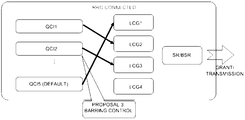
- Figure 6 illustrates a method of smart congestion control in RRC Connected mode.
- the specific application is associated with a certain QoS class indicator (QCI) respectively.
- QCI QoS class indicator
- the MMTEL service may be associated with QCI1
- the MO data service may be associated with QCI5 (the default QCI) .
- additional barring control may be applied for the subscribed applications, which have different prioritizations (e.g., based on QCI) . Different prioritization have different barring parameters for the UE to decide whether scheduling request (SR) and buffer status report (BSR) can be sent.
- SR scheduling request
- BSR buffer status report
- the network For a UE to perform selective ACB, the network (eNB) needs to indicate the bypass of ACB to the UE.
- the eNB uses a new information bit in SIB.
- the new information bit indicates whether ACB bypass should be applied for MMTEL service.
- the eNB changes the existing SSAC parameter, e.g., adding one bit to indicate whether ACB bypass should be applied for MMTEL service.
- a predefined ACB barring value is used to implicitly indicate whether ACB bypass should be applied for MMTEL service.
- separate new information bits in SIB are used for individual MMTEL service subtypes including voice, video, and text. For example, three new information bits are defined in SIB, and each bit indicates whether ACB bypass should be applied for MMTEL voice, video, and text service respectively.
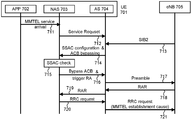
- Figure 7 illustrates one embodiment of selective access control barring (ACB) from UE perspective.
- UE 701 comprises an application layer APP 702, a NAS layer NAS 703, and an AS layer AS 704.
- APP 702 forwards an arrived MMTEL service to NAS 703.
- NAS 703 forwards the service request to AS 704.
- AS 704 receives SIB2 broadcasted from eNB 705.
- SIB2 comprises various access control information including SSAC configuration, ACB parameters, and ACB bypass information.
- AS 704 forwards the received SSAC configuration and ACB bypass information to NAS 703.
- NAS 703 performs SSAC check for the MMTEL service.
- step 716 NAS 703 request AS 704 to trigger the subsequence random access (RA) procedure without ACB.
- AS 704 sends a random access preamble to eNB 705.
- eNB 705 sends a random access response (RAR) back to UE 701.
- RAR random access response
- AS 704 forwards the RAR to NAS 703, which sends out an RRC request to AS 704 in step 720.
- step 721 AS 704 sends the RRC request with establishment cause to eNB 705 for establishing an RRC connection.
- FIG. 8 illustrates another embodiment of selective access control barring (ACB) from UE perspective.
- UE 801 comprises an application layer APP 802, a NAS layer NAS 803, and an AS layer AS 804.
- APP 802 forwards an arrived MMTEL service to NAS 803.
- NAS 803 forwards the service request to AS 804.
- AS 804 receives SIB2 broadcasted from eNB 805.
- SIB2 comprises various access control information including SSAC configuration, ACB parameters, and ACB bypass information.
- AS 804 forwards the received SSAC configuration to NAS 803.
- NAS 803 performs SSAC check for the MMTEL service.
- NAS 803 forwards the MMTEL service type and/or subtype (s) to AS 804.
- AS 804 either performs ACB check or bypasses ACB check based on the indicated subtype (s) , received ACB parameters and the ACB bypass information.
- NAS 803 informs AS 804 the arrived traffic type of MMTEL and/or the subtypes.
- AS 804 triggers the subsequence random access (RA) procedure without ACB if the traffic type satisfies the ACB bypass configuration.
- AS 804 sends a random access preamble to eNB 805.
- step 819 eNB 705 sends a random access response (RAR) back to UE 801.
- step 820 AS 804 forwards the RAR to NAS 803, which sends out an RRC request to AS 804 in step 821.
- step 822 AS 804 sends the RRC request with establishment cause to eNB 805 for establishing an RRC connection.
- RAR random access response
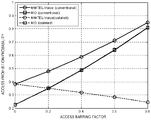
- Figure 9 illustrates the barring rate performance of selective ACB.
- the barring rate (access prohibition probability) increases as the ACB barring factor increases.
- the barring rate decreases while the ACB barring factor increases (assuming that the SSAC barring factor is fixed to 0.2) . Therefore, it shows that under selective ACB, the MMTEL-voice service is prioritized over MO service by increasing the ACB barring factor.
- Figure 10 illustrates the delay performance of selective ACB.
- the delay performance increases as the ACB barring factor increases.
- the average access delay remains the same while the ACB barring factor increases (assuming that the SSAC barring factor is fixed to 0.2) . Therefore, it shows that under selective ACB, the MMTEL-voice service is prioritized over MO service by increasing the ACB barring factor.
- MAC header will specify a backoff interval (BI) value for contention resolution.
- BI backoff interval
- a dedicated mapping table for BI value with respect to backoff window size is applied for all traffic type.
- the RA backoff is prioritized based on traffic type. Different backoff values are applied for different service or application type in order to provide more congestion control granularity. In a first embodiment, different mapping tables are used for different traffic types. In a second embodiment, RA backoff bypass is applied for certain traffic type. In a third embodiment, a new control element (CE) is used for carrying specific backoff value in RAR.
- CE new control element
- default backoff values are used for particular services.
- NAS layer notifies the traffic type to AS layer for using corresponding backoff value.
- AS layer forward backoff parameters to NAS layer for selecting corresponding backoff value based on the traffic type.
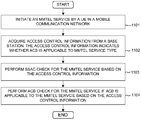
- FIG 11 is a flow chart of a method of selective ACB for MMTEL service from UE perspective in accordance with one novel aspect.
- a UE initiates an MMTEL service in a mobile communication network.
- the UE acquires access control information from a base station.
- the access control information indicates whether ACB is applicable to MMTEL service type.
- the UE performs SSAC check for the MMTEL service based on the access control information.
- the UE performs ACB check for the MMTEL service if ACB is applicable to the MMTEL service. Otherwise, the UE bypasses the ACB check for the MMTEL service.
- the access control information comprises SSAC configuration information, ACB parameters information, and ACB bypass information.
- the MMTEL service type has multiple subtypes including voice, video, and text
- the ACB bypass information contains one or more indications, each indication indicates whether ACB is applicable to an MMTEL service subtype.
- the UE comprises a NAS layer and an AS layer, and the NAS layer forwards MMTEL service type indication to the AS layer for determining whether to bypass ACB.
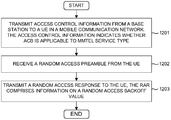
- FIG. 12 is a flow chart of a method of selective ACB for MMTEL service from eNB perspective in accordance with one novel aspect.
- a base station transmits access control information to a UE in a mobile communication network.
- the access control information indicates whether ACB is applicable to MMTEL service type.
- the base station receives a random access preamble from the UE.
- the base station transmits a random access response (RAR) to the UE.
- the RAR comprises information on a random access (RA) backoff value.
- the access control information comprises SSAC configuration information, ACB parameters information, and ACB bypass information.
- the MMTEL service type has multiple subtypes including voice, video, and text
- the ACB bypass information contains one or more indications, each indication indicates whether ACB is applicable to an MMTEL service subtype.
- the RA backoff value is different for different service types, and the RA backoff value is contained in a new control element (CE) in the RAR.
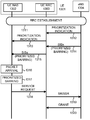
- FIG. 13 illustrates one embodiment of smart congestion control in RRC Connected mode.
- UE 1301 comprises a NAS layer 1302 and an AS/RRC layer 1303.
- UE 1301 establishes an RRC connection and radio bearer with its serving bases station eNB 1304 for an application.
- the application (and the radio bearer) is associated with a quality of service (QoS) class indicator (QCI) respectively, or is associated with an allocation and retention priority (ARP) .
- QoS quality of service
- QCI quality of service class indicator
- ARP allocation and retention priority
- eNB 1304 transmits a prioritization indication to UE RRC 1303, which forwards the indication to UE NAS 1302 in step 1313.
- the prioritization indication indicates whether barring control in RRC Connected mode should be applied or not.
- eNB 1304 broadcasts prioritized barring parameters to UE RRC 1303 via SIBx.
- UE RRC 1303 then forwards the prioritized barring parameters to UE NAS 1302 in step 1315.
- Different barring parameters are assigned to different prioritization based on the QCI/ARP of each application. For example, an application with higher QCI is assigned to have lower barring factor and shorter barring time, while an application with lower QCI is assigned to have higher barring factor and longer barring time.
- Those barring parameters can be separate and independent from the barring parameters of ACB in RRC Idle mode.
- the same barring parameters of ACB in RRC Idle mode can be used in RRC Connected mode, and the base station only needs to signal the UE a bitmap indicating which prioritization shall apply.
- the bitmap would be a 9-bit bitmap that each bit stands for a specific QCI. If the bit is “1” , it means the application associating with the corresponding QCI shall perform prioritized barring (using the same ACB parameter as in RRC Idle mode) , otherwise, the application can initiate scheduling request without prioritized barring.
- eNB 1304 can change the barring parameters when modification period is coming. Such prioritization barring based on QCI/ARP has finer granularity congestion control for RRC Connected mode.
- step 1316 a packet arrives at UE NAS 1302.
- UE NAS 1302 applies prioritized barring for the arrived packet.
- UE NAS 1302 forwards a service request to UE RRC 1303.
- UE RRC 1303 sends SR/BSR to eNB 1304.
- eNB 1304 sends an uplink grant to UE RRC 1303 for data transmission in response to the SR/BSR.
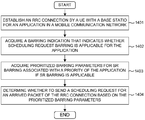
- FIG 14 is a flow chart of a method of smart congestion control in RRC Connected mode from UE perspective in accordance with one novel aspect.
- a UE establishes an RRC connection with a base station for an application in a mobile communication network.
- the UE acquires a barring indication that indicates whether scheduling request (SR) barring is applicable for the application.
- the UE acquires prioritized barring parameters for SR barring if applicable.
- the prioritized barring parameters is associated with a priority of the application.
- the UE determines whether to send a scheduling request for an arrived packet based on the prioritized barring parameters.
- the application is associated with a quality class indicator (QCI) , and the priority of the application is based on the QCI.
- the UE comprises a NAS layer and an AS/RRC layer, where the AS/RRC layer forwards the barring indication and the prioritized barring parameters to the NAS layer for determining SR barring.
- FIG. 15 is a flow chart of a method of smart congestion control in RRC Connected mode from base station perspective in accordance with one novel aspect.
- a base station establishes an RRC connection with a UE for an application in a mobile communication network.
- the base station transmits a barring indication that indicates whether scheduling request (SR) barring is applicable for the application.
- the base station transmits prioritized barring parameters for SR barring if applicable.
- the prioritized barring parameters is associated with a priority of the application.
- the base station receives a scheduling request for an arrived packet of the RRC connection from the UE based on the prioritized parameters.
- the application is associated with a quality class indicator (QCI) , and the priority of the application is based on the QCI.
- QCI quality class indicator
- the prioritized barring parameters can be separate from the ACB barring parameters for RRC Idle mode.
- the prioritized barring parameters are the same as the ACB parameters applied for RRC Idle mode, and the eNB signals a bitmap for indicating which prioritization should apply for SR barring.
Landscapes
- Engineering & Computer Science (AREA)
- Computer Networks & Wireless Communication (AREA)
- Signal Processing (AREA)
- Multimedia (AREA)
- Computer Security & Cryptography (AREA)
- Mobile Radio Communication Systems (AREA)
- Data Exchanges In Wide-Area Networks (AREA)
Abstract
Description
Claims (22)
- A method comprising:establishing a radio resource control (RRC) connection by a user equipment (UE) with a base station for an application in a mobile communication network;acquiring a barring indication that indicates whether scheduling request (SR) barring is applicable for the application;acquiring prioritized barring parameters for SR barring associated with a priority of the application if SR barring is applicable; anddetermining whether to send a scheduling request for an arrived packet of the RRC connection based on the prioritized barring parameters.
- The method of Claim 1, wherein the application is associated with a quality class indicator (QCI) , and wherein the priority of the application is based on the QCI.
- The method of Claim 1, wherein the application is associated with an allocation and retention priority (ARP) , and wherein the priority of the application is based on the ARP.
- The method of Claim 1, wherein the prioritized barring parameters comprises a prioritized barring factor and a prioritized barring time.
- The method of Claim 4, wherein different applications with different priorities have different barring factors and barring times.
- The method of Claim 1, wherein the UE comprises a NAS layer and an RRC layer, wherein the RRC layer forwards the barring indication and the prioritized barring parameters to the NAS layer for determining SR barring.
- The method of Claim 1, wherein the UE also determines whether to send buffer status report (BSR) for the RRC connection based on the prioritized barring parameters.
- A user equipment (UE) , comprising:a radio resource control (RRC) connection module that establishes an RRC connection with a base station for an application in a mobile communication network;a receiver that receives a barring indication that indicates whether scheduling request (SR) barring is applicable for the application, wherein the receiver also receives prioritized barring parameters for SR barring associated with a priority of the application if SR barring is applicable; anda prioritized access barring module that determines whether to send a scheduling request for an arrived packet of the RRC connection based on the prioritized barring parameters.
- The UE of Claim 8, wherein the application is associated with a quality class indicator (QCI) , and wherein the priority of the application is based on the QCI.
- The UE of Claim 8, wherein the application is associated with an allocation and retention priority (ARP) , and wherein the priority of the application is based on the ARP.
- The UE of Claim 8, wherein the prioritized barring parameters comprises a prioritized barring factor and a prioritized barring time.
- The UE of Claim 8, wherein different applications with different priorities have different barring factors and barring times.
- The UE of Claim 8, wherein the UE comprises a NAS layer and an RRC layer, wherein the RRC layer forwards the barring indication and the prioritized barring parameters to the NAS layer for determining SR barring.
- The UE of Claim 8, wherein the UE also determines whether to send buffer status report (BSR) for the RRC connection based on the prioritized barring parameters.
- A method comprising:establishing a radio resource control (RRC) connection by a base station with a user equipment (UE) for an application in a mobile communication network;transmitting a barring indication that indicates whether scheduling request (SR) barring is applicable for the application;transmitting prioritized barring parameters for SR barring associated with a priority of the application if SR barring is applicable; andreceiving a scheduling request for an arrived packet of the RRC connection from the UE based on the prioritized barring parameters.
- The method of Claim 15, wherein the application is associated with a quality class indicator (QCI) , and wherein the priority of the application is based on the QCI.
- The method of Claim 15, wherein the application is associated with an allocation and retention priority (ARP) , and wherein the priority of the application is based on the ARP.
- The method of Claim 15, wherein the prioritized barring parameters comprises a prioritized barring factor and a prioritized barring time.
- The method of Claim 18, wherein different applications with different priorities have different barring factors and barring times.
- The method of Claim 15, wherein the base station broadcasts the prioritized barring parameters via system information block (SIB) .
- The method of Claim 15, wherein the barring parameters are independent from access control barring (ACB) parameters applied for RRC Idle mode.
- The method of Claim 15, wherein the barring parameters are the same as access control barring (ACB) parameters applied for RRC Idle mode.
Priority Applications (3)
| Application Number | Priority Date | Filing Date | Title |
|---|---|---|---|
| EP15758138.0A EP3028518A4 (en) | 2014-03-06 | 2015-03-06 | Smart congestion control for rrc connected mode in lte advanced systems |
| CN201580001118.9A CN105325046A (en) | 2014-03-06 | 2015-03-06 | Intelligent congestion control of radio resource control connection state in a long term evolution upgrade system |
| BR112016016614A BR112016016614A2 (en) | 2014-03-06 | 2015-03-06 | SMART CONGESTION CONTROL FOR RRC CONNECTED MODE ON ADVANCED LTE SYSTEMS |
Applications Claiming Priority (4)
| Application Number | Priority Date | Filing Date | Title |
|---|---|---|---|
| US201461948814P | 2014-03-06 | 2014-03-06 | |
| US61/948,814 | 2014-03-06 | ||
| US14/639,437 | 2015-03-05 | ||
| US14/639,437 US9538540B2 (en) | 2014-03-06 | 2015-03-05 | Smart congestion control for RRC connected mode in LTE systems |
Publications (1)
| Publication Number | Publication Date |
|---|---|
| WO2015131854A1 true WO2015131854A1 (en) | 2015-09-11 |
Family
ID=54018809
Family Applications (2)
| Application Number | Title | Priority Date | Filing Date |
|---|---|---|---|
| PCT/CN2015/073778 Ceased WO2015131851A1 (en) | 2014-03-06 | 2015-03-06 | Smart congestion control for rrc idle mode in lte advanced systems |
| PCT/CN2015/073799 Ceased WO2015131854A1 (en) | 2014-03-06 | 2015-03-06 | Smart congestion control for rrc connected mode in lteadvanced systems |
Family Applications Before (1)
| Application Number | Title | Priority Date | Filing Date |
|---|---|---|---|
| PCT/CN2015/073778 Ceased WO2015131851A1 (en) | 2014-03-06 | 2015-03-06 | Smart congestion control for rrc idle mode in lte advanced systems |
Country Status (5)
| Country | Link |
|---|---|
| US (2) | US9949271B2 (en) |
| EP (2) | EP3028518A4 (en) |
| CN (2) | CN106068633B (en) |
| BR (2) | BR112016016614A2 (en) |
| WO (2) | WO2015131851A1 (en) |
Families Citing this family (34)
| Publication number | Priority date | Publication date | Assignee | Title |
|---|---|---|---|---|
| CN115484638A (en) | 2013-10-30 | 2022-12-16 | 交互数字专利控股公司 | System and method for handling priority service congestion |
| US9723466B2 (en) * | 2013-11-01 | 2017-08-01 | Nokia Technologies Oy | Enhanced control of services |
| WO2015137731A1 (en) * | 2014-03-13 | 2015-09-17 | Lg Electronics Inc. | Method and apparatus for indicating skipping of access class barring in wireless communication system |
| WO2016006980A1 (en) * | 2014-07-11 | 2016-01-14 | Lg Electronics Inc. | Method and apparatus for performing access control for network sharing in wireless communication system |
| US10075866B2 (en) * | 2014-12-08 | 2018-09-11 | Industrial Technology Research Institute | Accessing failure event reporting method, user equipment, method for adjusting access control mechanism, control node |
| WO2016144009A1 (en) * | 2015-03-12 | 2016-09-15 | 엘지전자 주식회사 | Method and terminal for controlling network traffic in wireless communication system |
| US10601719B2 (en) * | 2015-09-09 | 2020-03-24 | Nvidia Corporation | User-equipment-based quality-of-service enforcement and control system and method for real-time traffic |
| CN108141794A (en) * | 2015-09-24 | 2018-06-08 | Lg电子株式会社 | The method and apparatus for sending Priority Service |
| KR102338670B1 (en) * | 2015-09-30 | 2021-12-13 | 광동 오포 모바일 텔레커뮤니케이션즈 코포레이션 리미티드 | Service bearing congestion control method and device |
| US10172060B2 (en) * | 2016-05-03 | 2019-01-01 | Qualcomm Incorporated | Reselection failure detection and prevention in multi-SIM wireless communication devices |
| CN107889186B (en) * | 2016-09-30 | 2021-01-12 | 华为技术有限公司 | Access control method, terminal equipment and wireless access network equipment |
| US20180124680A1 (en) * | 2016-10-27 | 2018-05-03 | Qualcomm Incorporated | Signal barring of delay tolerant access |
| JP6686234B2 (en) * | 2016-11-03 | 2020-04-22 | エルジー エレクトロニクス インコーポレイティド | Moving method from NGS to EPS in wireless communication system and apparatus therefor |
| US10999781B2 (en) * | 2016-11-09 | 2021-05-04 | Lg Electronics Inc. | Method for transmitting RRC message and wireless device |
| WO2018086059A1 (en) * | 2016-11-11 | 2018-05-17 | Qualcomm Incorporated | Access control in connected mode, idle mode, and inactive state |
| MX2019008683A (en) * | 2017-01-23 | 2019-09-18 | Guangdong Oppo Mobile Telecommunications Corp Ltd | Access method, and terminal. |
| CN108366430B (en) * | 2017-01-26 | 2023-10-03 | 华为技术有限公司 | Methods and terminal devices for scheduling requests |
| CN110301162B (en) | 2017-02-02 | 2023-07-21 | Lg 电子株式会社 | Method and device for determining RRC state |
| JP6798623B2 (en) * | 2017-03-15 | 2020-12-09 | 富士通株式会社 | Access prohibition methods, devices and communication systems |
| CN107124417B (en) * | 2017-05-03 | 2020-10-09 | 浪潮集团有限公司 | MMTel application server, session system and method based on heterogeneous computing |
| WO2019153321A1 (en) * | 2018-02-12 | 2019-08-15 | Zte Corporation | Methods, apparatus and systems for indicating a configuration of access control information in a wireless communication |
| US10499276B2 (en) * | 2018-03-06 | 2019-12-03 | Verizon Patent And Licensing Inc. | Method and system for end-to-end admission and congestion control based on network slicing |
| US11172400B2 (en) * | 2018-03-06 | 2021-11-09 | Verizon Patent And Licensing Inc. | Method and system for end-to-end admission and congestion control based on network slicing |
| RU2762340C1 (en) * | 2018-05-31 | 2021-12-20 | Бейдзин Сяоми Мобайл Софтвэр Ко., Лтд. | Method and device for restricting access |
| CN112262595A (en) * | 2018-06-07 | 2021-01-22 | 华为技术有限公司 | Method, device and system for sending service request |
| US10681559B2 (en) * | 2018-06-29 | 2020-06-09 | Verizon Patent And Licensing Inc. | Method and system for supporting voice calls in 5G new radio environments |
| CN108886736B (en) * | 2018-07-13 | 2021-09-07 | 北京小米移动软件有限公司 | Data transmission control method and device |
| CN119545546A (en) * | 2019-03-29 | 2025-02-28 | 北京三星通信技术研究有限公司 | User equipment, base station and data transmission method |
| US11553471B2 (en) | 2019-03-29 | 2023-01-10 | Samsung Electronics Co., Ltd. | Method and apparatus for transmitting data |
| WO2020237447A1 (en) * | 2019-05-24 | 2020-12-03 | Oppo广东移动通信有限公司 | Wireless communication method and device |
| US11671902B2 (en) * | 2020-06-25 | 2023-06-06 | Qualcomm Incorporated | Apparatus and methods for new radio broadcast and multicast access control |
| WO2022077372A1 (en) * | 2020-10-15 | 2022-04-21 | 北京小米移动软件有限公司 | Access control information processing method and apparatus, and communication device and storage medium |
| US20240056152A1 (en) * | 2022-08-10 | 2024-02-15 | Samsung Electronics Co., Ltd. | Csi measurement and report with operation state adaptation |
| US12625733B2 (en) * | 2023-09-19 | 2026-05-12 | International Business Machines Corporation | Dynamic decentralized resources manager |
Citations (3)
| Publication number | Priority date | Publication date | Assignee | Title |
|---|---|---|---|---|
| WO2013025148A1 (en) * | 2011-08-15 | 2013-02-21 | Telefonaktiebolaget L M Ericsson (Publ) | Network access delay for extended access barring (eab) configured user equipments and/or group-based addressed user equipments |
| US20130194998A1 (en) * | 2012-01-30 | 2013-08-01 | Telefonaktiebolaget L M Ericsson (Publ) | Access Spreading with Selective Paging |
| US20140010180A1 (en) * | 2012-07-06 | 2014-01-09 | Lg Electronics Inc. | Method and apparatus for service access barring |
Family Cites Families (21)
| Publication number | Priority date | Publication date | Assignee | Title |
|---|---|---|---|---|
| CN101925151A (en) * | 2009-06-12 | 2010-12-22 | 华为技术有限公司 | Access control method, device and system |
| CN101990310A (en) * | 2009-07-30 | 2011-03-23 | 华为技术有限公司 | Random access method and device thereof |
| EP3606114B1 (en) * | 2009-10-02 | 2021-12-08 | BlackBerry Limited | Method, apparatus and computer-readable media for initiating a packet switched emergency call |
| KR101670253B1 (en) * | 2010-02-16 | 2016-10-31 | 삼성전자 주식회사 | Method and device for controlling network access of ue in wireless communication system |
| WO2012013355A1 (en) | 2010-07-30 | 2012-02-02 | Deutsche Telekom Ag | Method and program for cell barring in a cellular network |
| CN102404820B (en) * | 2010-09-15 | 2016-02-10 | 中兴通讯股份有限公司 | A kind of via node and realize the method for access control |
| JP5396375B2 (en) * | 2010-11-30 | 2014-01-22 | 株式会社Nttドコモ | Mobile communication method and mobile station |
| CN102595555B (en) * | 2011-01-12 | 2018-08-31 | 中兴通讯股份有限公司 | Control terminal initiates the method and system of business |
| KR101929307B1 (en) | 2011-04-11 | 2018-12-17 | 삼성전자 주식회사 | method and apparatus to control UE Cell reselection priority while UE is in CSG cell |
| US9215645B2 (en) * | 2011-05-02 | 2015-12-15 | Telefonaktiebolaget L M Ericsson (Publ) | Controlling network accesses by radio terminals associated with access classes |
| US9369944B2 (en) | 2011-08-05 | 2016-06-14 | Telefonaktiebolaget Lm Ericsson (Publ) | Methods of modifying communication network access and related network nodes, and wireless terminals |
| KR101967721B1 (en) * | 2011-08-10 | 2019-04-10 | 삼성전자 주식회사 | Method and appratus of applying extended access barring in mobile communication system |
| US8738075B2 (en) | 2011-08-10 | 2014-05-27 | Nokia Siemens Networks Oy | Methods and apparatus for radio resource control |
| US8938233B2 (en) * | 2011-08-16 | 2015-01-20 | Mediatek Inc. | Enhanced access control in LTE advanced systems |
| CN102404233B (en) | 2011-12-27 | 2014-07-23 | 中国电信股份有限公司 | Method for controlling routing query of IMS user and IMS network |
| JP5936435B2 (en) | 2012-05-07 | 2016-06-22 | 株式会社Nttドコモ | Mobile station |
| CN103716885B (en) * | 2012-09-28 | 2017-09-29 | 电信科学技术研究院 | A kind of local load bearing management method and equipment |
| EP2976914A4 (en) | 2013-03-20 | 2016-07-13 | Ericsson Telefon Ab L M | Method for filtering uplink data based on the characteristic of a logical bearer. |
| US9445304B2 (en) * | 2013-08-19 | 2016-09-13 | Telefonaktiebolaget Lm Ericsson (Publ) | Inverse service specific access control (SSAC) |
| KR102445680B1 (en) | 2013-08-30 | 2022-09-20 | 인터디지탈 패튼 홀딩스, 인크 | Application-specific access control methods |
| US9723466B2 (en) * | 2013-11-01 | 2017-08-01 | Nokia Technologies Oy | Enhanced control of services |
-
2015
- 2015-03-05 US US14/639,414 patent/US9949271B2/en active Active
- 2015-03-05 US US14/639,437 patent/US9538540B2/en active Active
- 2015-03-06 BR BR112016016614A patent/BR112016016614A2/en not_active IP Right Cessation
- 2015-03-06 CN CN201580012333.9A patent/CN106068633B/en active Active
- 2015-03-06 EP EP15758138.0A patent/EP3028518A4/en not_active Withdrawn
- 2015-03-06 CN CN201580001118.9A patent/CN105325046A/en active Pending
- 2015-03-06 BR BR112016016504-7A patent/BR112016016504A2/en not_active IP Right Cessation
- 2015-03-06 WO PCT/CN2015/073778 patent/WO2015131851A1/en not_active Ceased
- 2015-03-06 WO PCT/CN2015/073799 patent/WO2015131854A1/en not_active Ceased
- 2015-03-06 EP EP15757999.6A patent/EP3028422B1/en active Active
Patent Citations (3)
| Publication number | Priority date | Publication date | Assignee | Title |
|---|---|---|---|---|
| WO2013025148A1 (en) * | 2011-08-15 | 2013-02-21 | Telefonaktiebolaget L M Ericsson (Publ) | Network access delay for extended access barring (eab) configured user equipments and/or group-based addressed user equipments |
| US20130194998A1 (en) * | 2012-01-30 | 2013-08-01 | Telefonaktiebolaget L M Ericsson (Publ) | Access Spreading with Selective Paging |
| US20140010180A1 (en) * | 2012-07-06 | 2014-01-09 | Lg Electronics Inc. | Method and apparatus for service access barring |
Non-Patent Citations (2)
| Title |
|---|
| NTT DOCOMO, INC: "Requirement and Way forward for SSAC in CONNECTED", 3GPP TSG-RAN2#83, R2-132758, 23 August 2013 (2013-08-23), XP050718502 * |
| See also references of EP3028518A4 * |
Also Published As
| Publication number | Publication date |
|---|---|
| BR112016016614A2 (en) | 2024-01-16 |
| CN106068633A (en) | 2016-11-02 |
| US20150257161A1 (en) | 2015-09-10 |
| US20150257088A1 (en) | 2015-09-10 |
| WO2015131851A1 (en) | 2015-09-11 |
| EP3028422B1 (en) | 2020-05-06 |
| EP3028518A4 (en) | 2017-03-15 |
| US9949271B2 (en) | 2018-04-17 |
| EP3028422A4 (en) | 2017-03-15 |
| CN105325046A (en) | 2016-02-10 |
| EP3028422A1 (en) | 2016-06-08 |
| US9538540B2 (en) | 2017-01-03 |
| BR112016016504A2 (en) | 2018-06-12 |
| EP3028518A1 (en) | 2016-06-08 |
| CN106068633B (en) | 2019-07-12 |
Similar Documents
| Publication | Publication Date | Title |
|---|---|---|
| US9538540B2 (en) | Smart congestion control for RRC connected mode in LTE systems | |
| US11057804B2 (en) | Method and device for adjusting random access backoff parameter | |
| US11032802B2 (en) | Mobile terminal device and associated method for obtaining uplink resources | |
| US10798621B2 (en) | Method and device for transmitting system information request in wireless communication system | |
| US11115981B2 (en) | Method and apparatus for allocating resource based on anchor carrier in wireless communication system | |
| AU2012295045B2 (en) | System and method for applying extended accessing barring in wireless communication system | |
| US20190124715A1 (en) | Method and apparatus of performing msg3-based system information request in a wireless communication system | |
| KR102400462B1 (en) | Method and apparatus for configuring a signaling category for an access control mechanism in a wireless communication system | |
| US9635673B2 (en) | Base station and associated method for assigning uplink resources to terminal devices with a similar traffic profile | |
| US20200170002A1 (en) | Method and apparatus for performing sidelink transmissions on multiple carriers in wireless communication system | |
| US20200120674A1 (en) | Method and apparatus for selecting carrier for sidelink transmission in wireless communication system | |
| CN114173420B (en) | Communication methods and devices | |
| CN110999444A (en) | Method for selecting carrier and apparatus supporting the same | |
| US9743426B2 (en) | Dynamic determination and signaling of a RAR window size to a coverage enhanced low complexity machine type communication device | |
| US20120307632A1 (en) | Method and apparatus to prevent ran (radio access network) overload for legacy networks in a wireless communication system | |
| CN106471848A (en) | Method and apparatus for performing application-specific access control in a wireless communication system | |
| EP3482591B1 (en) | Methods and devices for managing access priority of a wireless device | |
| US9750043B2 (en) | Method for supporting communication using two or more radio access technologies and apparatus for same | |
| US9930699B2 (en) | Providing access control parameters to a user equipment | |
| US10305585B2 (en) | Communication method and device in unlicensed band |
Legal Events
| Date | Code | Title | Description |
|---|---|---|---|
| WWE | Wipo information: entry into national phase |
Ref document number: 201580001118.9 Country of ref document: CN |
|
| 121 | Ep: the epo has been informed by wipo that ep was designated in this application |
Ref document number: 15758138 Country of ref document: EP Kind code of ref document: A1 |
|
| WWE | Wipo information: entry into national phase |
Ref document number: 2015758138 Country of ref document: EP |
|
| NENP | Non-entry into the national phase |
Ref country code: DE |
|
| REG | Reference to national code |
Ref country code: BR Ref legal event code: B01A Ref document number: 112016016614 Country of ref document: BR |
|
| ENP | Entry into the national phase |
Ref document number: 112016016614 Country of ref document: BR Kind code of ref document: A2 Effective date: 20160718 |