WO2015133496A1 - ラミネート接着剤、ラミネートフィルムの製造方法、ラミネートフィルムおよびレトルトパウチ材料 - Google Patents
ラミネート接着剤、ラミネートフィルムの製造方法、ラミネートフィルムおよびレトルトパウチ材料 Download PDFInfo
- Publication number
- WO2015133496A1 WO2015133496A1 PCT/JP2015/056255 JP2015056255W WO2015133496A1 WO 2015133496 A1 WO2015133496 A1 WO 2015133496A1 JP 2015056255 W JP2015056255 W JP 2015056255W WO 2015133496 A1 WO2015133496 A1 WO 2015133496A1
- Authority
- WO
- WIPO (PCT)
- Prior art keywords
- mass
- xylylene diisocyanate
- polyol
- laminate
- isocyanurate
- Prior art date
- Legal status (The legal status is an assumption and is not a legal conclusion. Google has not performed a legal analysis and makes no representation as to the accuracy of the status listed.)
- Ceased
Links
Images

Classifications
-
- C—CHEMISTRY; METALLURGY
- C07—ORGANIC CHEMISTRY
- C07D—HETEROCYCLIC COMPOUNDS
- C07D251/00—Heterocyclic compounds containing 1,3,5-triazine rings
- C07D251/02—Heterocyclic compounds containing 1,3,5-triazine rings not condensed with other rings
- C07D251/12—Heterocyclic compounds containing 1,3,5-triazine rings not condensed with other rings having three double bonds between ring members or between ring members and non-ring members
- C07D251/26—Heterocyclic compounds containing 1,3,5-triazine rings not condensed with other rings having three double bonds between ring members or between ring members and non-ring members with only hetero atoms directly attached to ring carbon atoms
- C07D251/30—Only oxygen atoms
- C07D251/32—Cyanuric acid; Isocyanuric acid
-
- B—PERFORMING OPERATIONS; TRANSPORTING
- B32—LAYERED PRODUCTS
- B32B—LAYERED PRODUCTS, i.e. PRODUCTS BUILT-UP OF STRATA OF FLAT OR NON-FLAT, e.g. CELLULAR OR HONEYCOMB, FORM
- B32B15/00—Layered products comprising a layer of metal
- B32B15/04—Layered products comprising a layer of metal comprising metal as the main or only constituent of a layer, which is next to another layer of the same or of a different material
- B32B15/08—Layered products comprising a layer of metal comprising metal as the main or only constituent of a layer, which is next to another layer of the same or of a different material of synthetic resin
- B32B15/085—Layered products comprising a layer of metal comprising metal as the main or only constituent of a layer, which is next to another layer of the same or of a different material of synthetic resin comprising polyolefins
-
- B—PERFORMING OPERATIONS; TRANSPORTING
- B32—LAYERED PRODUCTS
- B32B—LAYERED PRODUCTS, i.e. PRODUCTS BUILT-UP OF STRATA OF FLAT OR NON-FLAT, e.g. CELLULAR OR HONEYCOMB, FORM
- B32B15/00—Layered products comprising a layer of metal
- B32B15/20—Layered products comprising a layer of metal comprising aluminium or copper
-
- B—PERFORMING OPERATIONS; TRANSPORTING
- B32—LAYERED PRODUCTS
- B32B—LAYERED PRODUCTS, i.e. PRODUCTS BUILT-UP OF STRATA OF FLAT OR NON-FLAT, e.g. CELLULAR OR HONEYCOMB, FORM
- B32B27/00—Layered products comprising a layer of synthetic resin
- B32B27/32—Layered products comprising a layer of synthetic resin comprising polyolefins
-
- B—PERFORMING OPERATIONS; TRANSPORTING
- B32—LAYERED PRODUCTS
- B32B—LAYERED PRODUCTS, i.e. PRODUCTS BUILT-UP OF STRATA OF FLAT OR NON-FLAT, e.g. CELLULAR OR HONEYCOMB, FORM
- B32B37/00—Methods or apparatus for laminating, e.g. by curing or by ultrasonic bonding
- B32B37/12—Methods or apparatus for laminating, e.g. by curing or by ultrasonic bonding characterised by using adhesives
-
- B—PERFORMING OPERATIONS; TRANSPORTING
- B32—LAYERED PRODUCTS
- B32B—LAYERED PRODUCTS, i.e. PRODUCTS BUILT-UP OF STRATA OF FLAT OR NON-FLAT, e.g. CELLULAR OR HONEYCOMB, FORM
- B32B7/00—Layered products characterised by the relation between layers; Layered products characterised by the relative orientation of features between layers, or by the relative values of a measurable parameter between layers, i.e. products comprising layers having different physical, chemical or physicochemical properties; Layered products characterised by the interconnection of layers
- B32B7/04—Interconnection of layers
- B32B7/12—Interconnection of layers using interposed adhesives or interposed materials with bonding properties
-
- C—CHEMISTRY; METALLURGY
- C08—ORGANIC MACROMOLECULAR COMPOUNDS; THEIR PREPARATION OR CHEMICAL WORKING-UP; COMPOSITIONS BASED THEREON
- C08G—MACROMOLECULAR COMPOUNDS OBTAINED OTHERWISE THAN BY REACTIONS ONLY INVOLVING UNSATURATED CARBON-TO-CARBON BONDS
- C08G18/00—Polymeric products of isocyanates or isothiocyanates
- C08G18/02—Polymeric products of isocyanates or isothiocyanates of isocyanates or isothiocyanates only
- C08G18/022—Polymeric products of isocyanates or isothiocyanates of isocyanates or isothiocyanates only the polymeric products containing isocyanurate groups
-
- C—CHEMISTRY; METALLURGY
- C08—ORGANIC MACROMOLECULAR COMPOUNDS; THEIR PREPARATION OR CHEMICAL WORKING-UP; COMPOSITIONS BASED THEREON
- C08G—MACROMOLECULAR COMPOUNDS OBTAINED OTHERWISE THAN BY REACTIONS ONLY INVOLVING UNSATURATED CARBON-TO-CARBON BONDS
- C08G18/00—Polymeric products of isocyanates or isothiocyanates
- C08G18/06—Polymeric products of isocyanates or isothiocyanates with compounds having active hydrogen
- C08G18/08—Processes
- C08G18/09—Processes comprising oligomerisation of isocyanates or isothiocyanates involving reaction of a part of the isocyanate or isothiocyanate groups with each other in the reaction mixture
- C08G18/092—Processes comprising oligomerisation of isocyanates or isothiocyanates involving reaction of a part of the isocyanate or isothiocyanate groups with each other in the reaction mixture oligomerisation to isocyanurate groups
-
- C—CHEMISTRY; METALLURGY
- C08—ORGANIC MACROMOLECULAR COMPOUNDS; THEIR PREPARATION OR CHEMICAL WORKING-UP; COMPOSITIONS BASED THEREON
- C08G—MACROMOLECULAR COMPOUNDS OBTAINED OTHERWISE THAN BY REACTIONS ONLY INVOLVING UNSATURATED CARBON-TO-CARBON BONDS
- C08G18/00—Polymeric products of isocyanates or isothiocyanates
- C08G18/06—Polymeric products of isocyanates or isothiocyanates with compounds having active hydrogen
- C08G18/08—Processes
- C08G18/10—Prepolymer processes involving reaction of isocyanates or isothiocyanates with compounds having active hydrogen in a first reaction step
- C08G18/12—Prepolymer processes involving reaction of isocyanates or isothiocyanates with compounds having active hydrogen in a first reaction step using two or more compounds having active hydrogen in the first polymerisation step
-
- C—CHEMISTRY; METALLURGY
- C08—ORGANIC MACROMOLECULAR COMPOUNDS; THEIR PREPARATION OR CHEMICAL WORKING-UP; COMPOSITIONS BASED THEREON
- C08G—MACROMOLECULAR COMPOUNDS OBTAINED OTHERWISE THAN BY REACTIONS ONLY INVOLVING UNSATURATED CARBON-TO-CARBON BONDS
- C08G18/00—Polymeric products of isocyanates or isothiocyanates
- C08G18/06—Polymeric products of isocyanates or isothiocyanates with compounds having active hydrogen
- C08G18/08—Processes
- C08G18/16—Catalysts
- C08G18/18—Catalysts containing secondary or tertiary amines or salts thereof
- C08G18/1875—Catalysts containing secondary or tertiary amines or salts thereof containing ammonium salts or mixtures of secondary of tertiary amines and acids
-
- C—CHEMISTRY; METALLURGY
- C08—ORGANIC MACROMOLECULAR COMPOUNDS; THEIR PREPARATION OR CHEMICAL WORKING-UP; COMPOSITIONS BASED THEREON
- C08G—MACROMOLECULAR COMPOUNDS OBTAINED OTHERWISE THAN BY REACTIONS ONLY INVOLVING UNSATURATED CARBON-TO-CARBON BONDS
- C08G18/00—Polymeric products of isocyanates or isothiocyanates
- C08G18/06—Polymeric products of isocyanates or isothiocyanates with compounds having active hydrogen
- C08G18/28—Polymeric products of isocyanates or isothiocyanates with compounds having active hydrogen characterised by the compounds used containing active hydrogen
- C08G18/30—Low-molecular-weight compounds
-
- C—CHEMISTRY; METALLURGY
- C08—ORGANIC MACROMOLECULAR COMPOUNDS; THEIR PREPARATION OR CHEMICAL WORKING-UP; COMPOSITIONS BASED THEREON
- C08G—MACROMOLECULAR COMPOUNDS OBTAINED OTHERWISE THAN BY REACTIONS ONLY INVOLVING UNSATURATED CARBON-TO-CARBON BONDS
- C08G18/00—Polymeric products of isocyanates or isothiocyanates
- C08G18/06—Polymeric products of isocyanates or isothiocyanates with compounds having active hydrogen
- C08G18/28—Polymeric products of isocyanates or isothiocyanates with compounds having active hydrogen characterised by the compounds used containing active hydrogen
- C08G18/30—Low-molecular-weight compounds
- C08G18/38—Low-molecular-weight compounds having heteroatoms other than oxygen
- C08G18/3878—Low-molecular-weight compounds having heteroatoms other than oxygen having phosphorus
- C08G18/3882—Low-molecular-weight compounds having heteroatoms other than oxygen having phosphorus having phosphorus bound to oxygen only
- C08G18/3885—Phosphate compounds
-
- C—CHEMISTRY; METALLURGY
- C08—ORGANIC MACROMOLECULAR COMPOUNDS; THEIR PREPARATION OR CHEMICAL WORKING-UP; COMPOSITIONS BASED THEREON
- C08G—MACROMOLECULAR COMPOUNDS OBTAINED OTHERWISE THAN BY REACTIONS ONLY INVOLVING UNSATURATED CARBON-TO-CARBON BONDS
- C08G18/00—Polymeric products of isocyanates or isothiocyanates
- C08G18/06—Polymeric products of isocyanates or isothiocyanates with compounds having active hydrogen
- C08G18/70—Polymeric products of isocyanates or isothiocyanates with compounds having active hydrogen characterised by the isocyanates or isothiocyanates used
- C08G18/701—Compounds forming isocyanates or isothiocyanates in situ
-
- C—CHEMISTRY; METALLURGY
- C08—ORGANIC MACROMOLECULAR COMPOUNDS; THEIR PREPARATION OR CHEMICAL WORKING-UP; COMPOSITIONS BASED THEREON
- C08G—MACROMOLECULAR COMPOUNDS OBTAINED OTHERWISE THAN BY REACTIONS ONLY INVOLVING UNSATURATED CARBON-TO-CARBON BONDS
- C08G18/00—Polymeric products of isocyanates or isothiocyanates
- C08G18/06—Polymeric products of isocyanates or isothiocyanates with compounds having active hydrogen
- C08G18/70—Polymeric products of isocyanates or isothiocyanates with compounds having active hydrogen characterised by the isocyanates or isothiocyanates used
- C08G18/72—Polyisocyanates or polyisothiocyanates
- C08G18/74—Polyisocyanates or polyisothiocyanates cyclic
- C08G18/76—Polyisocyanates or polyisothiocyanates cyclic aromatic
- C08G18/7614—Polyisocyanates or polyisothiocyanates cyclic aromatic containing only one aromatic ring
- C08G18/7628—Polyisocyanates or polyisothiocyanates cyclic aromatic containing only one aromatic ring containing at least one isocyanate or isothiocyanate group linked to the aromatic ring by means of an aliphatic group
- C08G18/7642—Polyisocyanates or polyisothiocyanates cyclic aromatic containing only one aromatic ring containing at least one isocyanate or isothiocyanate group linked to the aromatic ring by means of an aliphatic group containing at least two isocyanate or isothiocyanate groups linked to the aromatic ring by means of an aliphatic group having a primary carbon atom next to the isocyanate or isothiocyanate groups, e.g. xylylene diisocyanate or homologues substituted on the aromatic ring
-
- C—CHEMISTRY; METALLURGY
- C08—ORGANIC MACROMOLECULAR COMPOUNDS; THEIR PREPARATION OR CHEMICAL WORKING-UP; COMPOSITIONS BASED THEREON
- C08G—MACROMOLECULAR COMPOUNDS OBTAINED OTHERWISE THAN BY REACTIONS ONLY INVOLVING UNSATURATED CARBON-TO-CARBON BONDS
- C08G18/00—Polymeric products of isocyanates or isothiocyanates
- C08G18/06—Polymeric products of isocyanates or isothiocyanates with compounds having active hydrogen
- C08G18/70—Polymeric products of isocyanates or isothiocyanates with compounds having active hydrogen characterised by the isocyanates or isothiocyanates used
- C08G18/72—Polyisocyanates or polyisothiocyanates
- C08G18/74—Polyisocyanates or polyisothiocyanates cyclic
- C08G18/76—Polyisocyanates or polyisothiocyanates cyclic aromatic
- C08G18/7657—Polyisocyanates or polyisothiocyanates cyclic aromatic containing two or more aromatic rings
- C08G18/7692—Polyisocyanates or polyisothiocyanates cyclic aromatic containing two or more aromatic rings containing at least one isocyanate or isothiocyanate group linked to an aromatic ring by means of an aliphatic group
-
- C—CHEMISTRY; METALLURGY
- C09—DYES; PAINTS; POLISHES; NATURAL RESINS; ADHESIVES; COMPOSITIONS NOT OTHERWISE PROVIDED FOR; APPLICATIONS OF MATERIALS NOT OTHERWISE PROVIDED FOR
- C09J—ADHESIVES; NON-MECHANICAL ASPECTS OF ADHESIVE PROCESSES IN GENERAL; ADHESIVE PROCESSES NOT PROVIDED FOR ELSEWHERE; USE OF MATERIALS AS ADHESIVES
- C09J175/00—Adhesives based on polyureas or polyurethanes; Adhesives based on derivatives of such polymers
- C09J175/04—Polyurethanes
-
- B—PERFORMING OPERATIONS; TRANSPORTING
- B32—LAYERED PRODUCTS
- B32B—LAYERED PRODUCTS, i.e. PRODUCTS BUILT-UP OF STRATA OF FLAT OR NON-FLAT, e.g. CELLULAR OR HONEYCOMB, FORM
- B32B2255/00—Coating on the layer surface
- B32B2255/06—Coating on the layer surface on metal layer
-
- B—PERFORMING OPERATIONS; TRANSPORTING
- B32—LAYERED PRODUCTS
- B32B—LAYERED PRODUCTS, i.e. PRODUCTS BUILT-UP OF STRATA OF FLAT OR NON-FLAT, e.g. CELLULAR OR HONEYCOMB, FORM
- B32B2255/00—Coating on the layer surface
- B32B2255/10—Coating on the layer surface on synthetic resin layer or on natural or synthetic rubber layer
-
- B—PERFORMING OPERATIONS; TRANSPORTING
- B32—LAYERED PRODUCTS
- B32B—LAYERED PRODUCTS, i.e. PRODUCTS BUILT-UP OF STRATA OF FLAT OR NON-FLAT, e.g. CELLULAR OR HONEYCOMB, FORM
- B32B2255/00—Coating on the layer surface
- B32B2255/26—Polymeric coating
-
- B—PERFORMING OPERATIONS; TRANSPORTING
- B32—LAYERED PRODUCTS
- B32B—LAYERED PRODUCTS, i.e. PRODUCTS BUILT-UP OF STRATA OF FLAT OR NON-FLAT, e.g. CELLULAR OR HONEYCOMB, FORM
- B32B2311/00—Metals, their alloys or their compounds
- B32B2311/24—Aluminium
-
- B—PERFORMING OPERATIONS; TRANSPORTING
- B32—LAYERED PRODUCTS
- B32B—LAYERED PRODUCTS, i.e. PRODUCTS BUILT-UP OF STRATA OF FLAT OR NON-FLAT, e.g. CELLULAR OR HONEYCOMB, FORM
- B32B2323/00—Polyalkenes
- B32B2323/10—Polypropylene
-
- B—PERFORMING OPERATIONS; TRANSPORTING
- B32—LAYERED PRODUCTS
- B32B—LAYERED PRODUCTS, i.e. PRODUCTS BUILT-UP OF STRATA OF FLAT OR NON-FLAT, e.g. CELLULAR OR HONEYCOMB, FORM
- B32B2553/00—Packaging equipment or accessories not otherwise provided for
Definitions
- the present invention relates to a laminating adhesive, a method for producing a laminating film, a laminating film, and a retort pouch material. More specifically, the laminating adhesive, a method for producing a laminating film using the laminating adhesive, a laminating film obtained by the method, and The present invention relates to a retort pouch material provided with a laminate film.
- a laminate film specifically, a laminate obtained by laminating a plastic film, a metal foil such as aluminum, a metal vapor-deposited film, a silica vapor-deposited film, etc. with an adhesive. Films are known.
- a two-component curable polyurethane adhesive that is, a two-component curable polyurethane adhesive using a combination of a curing agent containing a polyisocyanate component and a main agent containing a polyol component. Agents are known.
- a laminating adhesive having a trimethylolpropane adduct of xylylene diisocyanate, a curing agent containing a silane coupling agent, and a main ingredient containing a polyester polyol, and further an adhesive for the laminating
- a composite film obtained by bonding a plurality of films and curing at 50 ° C. for 3 days is known (see, for example, Patent Document 1 (Example 1)).
- an adhesive for dry laminate containing a polyester polyurethane polyol, a polyester polyol, a polyisocyanate containing a trimethylolpropane adduct of xylylene diisocyanate, and a silane coupling agent and further an adhesive for the dry laminate
- a composite film obtained by bonding a plurality of films and curing at 40 ° C. for 2 days or at 40 ° C. for 4 days is known (see, for example, Patent Document 2 (Example 1)).
- the object of the present invention is excellent in interlayer adhesion, acid resistance and content resistance, and further, laminate adhesion that can ensure excellent adhesion even when cured under non-heating, and can suppress delamination during heat treatment It is in providing the manufacturing method of a laminate film using the agent, the laminate adhesive agent, the laminate film obtained by the method, and the retort pouch material provided with the laminate film.
- the laminate adhesive of the present invention contains a curing agent containing a polyisocyanate component and a main agent containing a polyol component, the polyisocyanate component contains an isocyanurate derivative of xylylene diisocyanate, and an isocyanate of the xylylene diisocyanate.
- the area ratio of the peak having a peak top of a molecular weight in the range of 400 to 1000 in terms of polystyrene was 30% or more and 90% or less with respect to the area of all peaks. It is characterized by being.
- the peak area with a polystyrene-equivalent molecular weight of 400 to 1000 as the peak top It is preferable that the area ratio with respect to the area of all the peaks is 35% or more and 80% or less.
- the content ratio of the isocyanurate derivative of the xylylene diisocyanate is 20% by mass or more in the polyisocyanate component.
- the method for producing a laminate film of the present invention is characterized in that a plurality of films are adhered by the above-mentioned laminate adhesive.
- the adhered film is cured under non-heating.
- the laminate film of the present invention includes a plurality of films, and the plurality of films are bonded by the above-mentioned laminate adhesive.
- the retort pouch material of the present invention is characterized by comprising the above laminate film.
- the laminate adhesive of the present invention a method for producing a laminate film using the laminate adhesive, a laminate film obtained by the method, and a retort pouch material provided with the laminate film are excellent in interlayer adhesion, acid resistance and content resistance. Furthermore, even when cured without heating, excellent adhesiveness can be secured, and delamination during heat treatment can be suppressed.
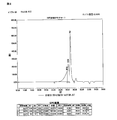
- FIG. 1 is a gel permeation chromatogram of an isocyanurate derivative of xylylene diisocyanate of Production Example 3.
- FIG. 2 is a gel permeation chromatogram of the isocyanurate derivative of xylylene diisocyanate of Production Example 8.
- the laminate adhesive of the present invention contains a curing agent containing a polyisocyanate component and a main agent containing a polyol component, and preferably comprises a curing agent containing a polyisocyanate component and a main agent containing a polyol component.
- the polyisocyanate component contains an isocyanurate derivative of xylylene diisocyanate as an essential component.
- the isocyanurate derivative of xylylene diisocyanate is a trimer of xylylene diisocyanate, and is obtained by reacting xylylene diisocyanate in the presence of an isocyanurate-forming catalyst.
- xylylene diisocyanate examples include 1,2-xylylene diisocyanate (o-xylylene diisocyanate (o-XDI)), 1,3-xylylene diisocyanate (m-xylylene diisocyanate (m-XDI)), 1,4- Xylylene diisocyanate (p-xylylene diisocyanate (p-XDI)) is mentioned as a structural isomer.
- xylylene diisocyanates can be used alone or in combination of two or more.
- the xylylene diisocyanate is preferably 1,3-xylylene diisocyanate, 1,4-xylylene diisocyanate, and more preferably 1,3-xylylene diisocyanate.
- the isocyanuration catalyst is not particularly limited as long as it is a catalyst that activates isocyanuration.
- Secondary amines, and tertiary amines such as 2-dimethylaminomethylphenol, 2,4, and the like, and polycondensates of monomers copolymerizable with secondary amines (for example, polycondensates of phenol, formaldehyde, etc.) Mannich bases such as 6-tris (dimethylaminomethyl) phenol, for example tetraalkylammonium hydroxides such as tetramethylammonium, tetraethylammonium, tetrabutylammonium, trimethylbenzylammonium, tributylbenzylammonium And its weak organic acid salts, such as trimethylhydroxypropylam
- Trialkylhydroxyalkylammonium hydroxide and its weak organic acid salts such as metal salts of alkyl carboxylic acids such as acetic acid, caproic acid, octylic acid, myristic acid, naphthenic acid (for example, alkali metal salts, magnesium salts, tin salts, Zinc salts, lead salts, etc.), for example, metal chelate compounds of ⁇ -diketones such as aluminum acetylacetone, lithium acetylacetone, etc., such as aluminum chloride, boron trifluoride, etc.
- metal salts of alkyl carboxylic acids such as acetic acid, caproic acid, octylic acid, myristic acid, naphthenic acid (for example, alkali metal salts, magnesium salts, tin salts, Zinc salts, lead salts, etc.)
- metal chelate compounds of ⁇ -diketones such as aluminum acetylacetone, lithium acet
- Friedel-Crafts catalysts for example, various organometallic compounds such as titanium tetrabutyrate and tributylantimony oxide, for example, aminosilyl group-containing compounds such as hexamethylsilazane, and hetero-substituted organics such as tetrabutylphosphonium hydrogen fluoride Examples thereof include phosphorus compounds.
- the isocyanuration catalyst is preferably a tetraalkylammonium hydroxide or a trialkylhydroxyalkylammonium hydroxide, more preferably a tetraalkylammonium hydroxide, and even more preferably a trimethylbenzylammonium hydroxide. Hydroxide and tetrabutylammonium hydroxide are mentioned.
- xylylene diisocyanate can be isocyanurate with a particularly excellent reaction rate, and thus the production efficiency is excellent.
- the blending ratio (solid content) of the isocyanurate-forming catalyst is, for example, 0.001 part by mass (phr) or more, preferably 0.005 part by mass (phr) or more, more preferably 100 parts by mass of xylylene diisocyanate. Is 0.01 parts by mass (phr) or more, more preferably 0.012 parts by mass (phr) or more, and particularly preferably 0.015 parts by mass (phr) or more.
- (Phr) or less preferably 0.06 parts by mass (phr) or less, more preferably 0.05 parts by mass (phr) or less, more preferably 0.03 parts by mass (phr) or less, particularly preferably 0.025 parts by mass (phr) or less.
- the isocyanurate-forming catalyst is blended with xylylene diisocyanate at the blending ratio described above and heated to cause isocyanurate-forming reaction.
- the reaction conditions for the isocyanuration reaction include, for example, an inert gas atmosphere such as nitrogen gas, normal pressure (atmospheric pressure), and a reaction temperature (attainable maximum temperature) of, for example, 20 ° C. or higher, preferably 40 ° C. More than 45 ° C., more preferably 60 ° C. or more, particularly preferably 70 ° C. or more, for example, 90 ° C. or less, preferably 80 ° C. or less, more preferably 77 ° C. or less, Preferably, it is 75 degrees C or less.
- the reaction time is, for example, 30 minutes or more, preferably 60 minutes or more, more preferably 120 minutes or more, and further preferably 300 minutes or more, for example, 720 minutes or less, preferably 600 minutes or less, More preferably, it is 480 minutes or less.
- an organic phosphite described in JP-A-61-129173 can be added as a co-catalyst in order to control isocyanuration. .
- organic phosphites examples include aliphatic organic phosphites and aromatic organic phosphites.
- Examples of the aliphatic organic phosphite include triethyl phosphite, tributyl phosphite, tris (2-ethylhexyl) phosphite, tridecyl phosphite, trilauryl phosphite, tris (tridecyl) phosphite, and tristearyl phosphite.
- Alkyl monophosphites such as distearyl pentaerythritol diphosphite, di-dodecyl pentaerythritol diphosphite, di-tridecyl pentaerythritol diphosphite, tripentaerythritol triphosphite and other aliphatic polyhydric alcohols Derivatized di-, tri- or tetraphosphites, as well as alicyclic polyphosphites such as hydrogenated bisphenol A phosphite polymers (molecular weight 2400-3000), Such as tris (2,3-dichloro-propyl) phosphite.
- aromatic organic phosphites include triphenyl phosphite, tris (nonylphenyl) phosphite, tris (2,4-di-t-butylphenyl) phosphite, diphenyldecyl phosphite, diphenyl (tridecyl)
- Aryl monophosphites such as phosphites, for example, aromatic polyhydric alcohols such as dinonylphenyl, pentaerythritol, diphosphite, tetraphenyl, tetra, tridecyl, pentaerythrityl, tetraphosphite, tetraphenyl, dipropylene glycol, diphosphite Di-, tri- or tetraphosphites derived from, for example, dialkyl bisphenol A diphosphite having 1 to 20 carbon atoms, 4,4'-butylidene-bis (3-methyl-6-t
- organic phosphites can be used alone or in combination of two or more.
- the organic phosphite is preferably an aromatic organic phosphite, more preferably a di, tri or tetraphosphite derived from an aromatic polyhydric alcohol, more preferably tetra. And phenyl dipropylene glycol diphosphite.
- the blending ratio of the organic phosphite is, for example, 0.01 parts by mass (phr) or more, preferably 0.03 parts by mass (phr) or more, with respect to 100 parts by mass of xylylene diisocyanate. 0.1 parts by mass (phr) or less, preferably 0.07 parts by mass (phr) or less.
- reaction rate and reaction rate can be improved, and gelation can be suppressed.
- a hindered phenol antioxidant for example, 2,6-di (tert-butyl) -4-methylphenol (also called dibutylhydroxytoluene, hereinafter may be abbreviated as BHT).
- Stabilizers such as Irganox 1010, Irganox 1076, Irganox 1135, Irganox 245 (manufactured by Ciba Japan Ltd., trade name) can be added at an appropriate ratio.
- a known reaction solvent may be blended if necessary, and further, a known catalyst deactivator (for example, phosphoric acid, monochloroacetic acid, dodecylbenzenesulfonic acid, paratoluenesulfone, etc. at any timing). Acid, benzoyl chloride, etc.) can also be added.
- a known catalyst deactivator for example, phosphoric acid, monochloroacetic acid, dodecylbenzenesulfonic acid, paratoluenesulfone, etc. at any timing.
- Acid benzoyl chloride, etc.
- an unreacted xylylene diisocyanate monomer is obtained from a mixed reaction solution of an isocyanurate composition comprising an isocyanurate derivative of xylylene diisocyanate and xylylene diisocyanate monomer.
- an isocyanurate composition comprising an isocyanurate derivative of xylylene diisocyanate and xylylene diisocyanate monomer.
- distillation such as thin film distillation (Smith distillation) or extraction.
- the yield of the isocyanurate derivative obtained by the thin film distillation is the isocyanurate of xylylene diisocyanate relative to the mass of the reaction mixture.
- the mass of the nurate derivative for example, 16% by mass or more, preferably 25% by mass or more, more preferably 40% by mass or more, for example, 64% by mass or less, preferably 60% by mass or less.
- the distillation yield of the isocyanurate derivative of xylylene diisocyanate can be determined by calculating the ratio of the mass of the isocyanurate derivative of xylylene diisocyanate to the mass of the reaction mixture according to the examples described later. .
- alcohols can be blended if necessary. That is, the isocyanurate-modified product can be modified with alcohols.
- examples of the alcohols include aliphatic alcohols and aromatic alcohols, and preferably include aliphatic alcohols.
- aliphatic alcohol examples include a monovalent aliphatic alcohol, a divalent aliphatic alcohol, a trivalent aliphatic alcohol, a tetravalent or higher aliphatic alcohol, and the like.
- Examples of monovalent aliphatic alcohols include linear monovalent aliphatic alcohols and branched monovalent aliphatic alcohols.
- linear monohydric aliphatic alcohols examples include methanol, ethanol, n-propanol, n-butanol, n-pentanol, n-hexanol, n-heptanol, n-octanol, n-nonanol, and n-decanol.
- N-undecanol N-undecanol, n-dodecanol (lauryl alcohol), n-tridecanol, n-tetradecanol, n-pentadecanol, n-hexadecanol, n-heptadecanol, n-octadecanol (stearyl alcohol) , N-nonadecanol, eicosanol and the like.
- branched monohydric aliphatic alcohols examples include isopropanol (also known as isopropyl alcohol, IPA), isobutanol (also known as isobutyl alcohol, IBA), sec-butanol, tert-butanol, isopentanol, isohexanol, iso Heptanol, isooctanol, 2-ethylhexanol (also known as 2-ethylhexyl alcohol, 2-EHA), isononanol, isodecanol, 5-ethyl-2-nonanol, trimethylnonyl alcohol, 2-hexyldecanol, 3,9-diethyl-6 -Tridecanol, 2-isoheptylisoundecanol, 2-octyldodecanol, and other branched alkanols (C (carbon number, the same shall apply hereinafter) 5 to 20).
- divalent aliphatic alcohol examples include ethylene glycol, 1,3-propanediol (1,3-PG), 1,4-butylene glycol, 1,5-pentanediol, 1,6-hexanediol, , 4-dihydroxy-2-butene, diethylene glycol, triethylene glycol, dipropylene glycol, and other linear dihydric aliphatic alcohols such as linear alkane (C7-20) diols such as 1,2- Propanediol, 1,3-butylene glycol (also known as 1,3-butanediol), 1,2-butylene glycol, neopentyl glycol, 3-methyl-1,5-pentanediol (MPD), 2,2,4 Trimethyl-1,3-pentanediol (TMPD), 3,3-dimethylol heptane, 2,6-di Branched divalent aliphatic alcohols such as til-1-octene-3,
- trivalent aliphatic alcohol examples include glycerin and trimethylolpropane.
- tetrahydric or higher aliphatic alcohol examples include tetramethylolmethane, D-sorbitol, xylitol, D-mannitol and the like.
- these alcohols have one or more hydroxy groups in the molecule, the other molecular structures are not particularly limited as long as they do not inhibit the excellent effects of the present invention. Further, it may have an ester group, an ether group, a cyclohexane ring, an aromatic ring, or the like. Examples of such alcohols include addition polymers (random and / or block polymers of two or more types of alkylene oxides) of the above monohydric alcohols and alkylene oxides (eg, ethylene oxide, propylene oxide, etc.).
- Examples include ether group-containing monohydric alcohols, ester group-containing monohydric alcohols that are addition polymerization products of the above monohydric alcohols and lactones (for example, ⁇ -caprolactone, ⁇ -valerolactone, and the like).
- These alcohols can be used alone or in combination of two or more.
- Examples of the alcohols preferably include aliphatic alcohols, more preferably monovalent and divalent aliphatic alcohols, and still more preferably divalent aliphatic alcohols.
- the aliphatic alcohol is preferably an aliphatic alcohol having 1 to 20 carbon atoms, more preferably an aliphatic alcohol having 4 to 20 carbon atoms, and still more preferably an aliphatic alcohol having 4 to 15 carbon atoms. Is mentioned.
- the aliphatic alcohol is preferably a branched monovalent or divalent aliphatic alcohol, more preferably a branched divalent aliphatic alcohol.
- the aliphatic alcohol is particularly preferably 1,3-butanediol.
- Alcohols are blended in the isocyanurate derivative of xylylene diisocyanate so that the average number of functional groups is 2 or more, and the blending ratio is, for example, 0.1% relative to 100 parts by mass of xylylene diisocyanate. 3 parts by mass or more, preferably 1.0 part by mass or more, more preferably 1.5 parts by mass or more, and for example, 11 parts by mass or less, preferably 8.0 parts by mass or less, more preferably 7.0 parts by mass or less, more preferably 5.0 parts by mass or less, and particularly preferably 3.0 parts by mass or less.
- the xylylene diisocyanate and the alcohol have an equivalent ratio (NCO / OH) of the isocyanate group of the xylylene diisocyanate to the hydroxy group of the alcohol, for example, 5 or more, preferably 10 or more.
- it is blended at a blending ratio of 20 or more, more preferably 25 or more, and usually 1000 or less.
- a method for modifying the isocyanurate-modified product of xylylene diisocyanate with alcohols for example, first, xylylene diisocyanate and alcohols are reacted, and then isocyanurate reaction in the presence of an isocyanurate-forming catalyst. Thereafter, a method for removing unreacted xylylene diisocyanate, for example, after first converting only xylylene diisocyanate to isocyanurate by the above-described method, removing unreacted xylylene diisocyanate, and then obtaining the polyisocyanate Examples include a method of reacting nurate with alcohols.
- xylylene diisocyanate and an alcohol are reacted, and then an isocyanuration reaction is performed in the presence of an isocyanuration catalyst, and then unreacted xylylene diisocyanate is removed.
- the reaction between xylylene diisocyanate and alcohols is a urethanization reaction (including an allophanatization reaction).
- the reaction conditions for example, under an inert gas atmosphere such as nitrogen gas, under normal pressure (atmospheric pressure),
- the reaction temperature is, for example, room temperature (for example, 25 ° C.) or higher, preferably 40 ° C. or higher, for example, 100 ° C. or lower, preferably 90 ° C. or lower.
- the reaction time is, for example, 0.05 hours or more, preferably 0.2 hours or more, for example, 10 hours or less, preferably 6 hours or less, more preferably 2.5 hours or less.
- a known urethanization catalyst such as amines and organometallic compounds may be added as necessary.
- amines include tertiary amines such as triethylamine, triethylenediamine, bis- (2-dimethylaminoethyl) ether, N-methylmorpholine, and quaternary ammonium salts such as tetraethylhydroxylammonium, such as imidazole, And imidazoles such as 2-ethyl-4-methylimidazole.
- tertiary amines such as triethylamine, triethylenediamine, bis- (2-dimethylaminoethyl) ether, N-methylmorpholine
- quaternary ammonium salts such as tetraethylhydroxylammonium, such as imidazole, And imidazoles such as 2-ethyl-4-methylimidazole.
- organometallic compounds include tin acetate, tin octylate, tin oleate, tin laurate, dibutyltin diacetate, dimethyltin dilaurate, dibutyltin dilaurate, dibutyltin dimercaptide, dibutyltin maleate, dibutyltin dilaurate, dibutyltin Organic tin compounds such as dineodecanoate, dioctyltin dimercaptide, dioctyltin dilaurate, dibutyltin dichloride, for example, organic lead compounds such as lead octoate and lead naphthenate, for example, organic nickel compounds such as nickel naphthenate, Examples thereof include organic cobalt compounds such as cobalt naphthenate, organic copper compounds such as copper octenoate, and organic bismuth compounds such as bismuth octylate and bismuth
- examples of the urethanization catalyst include potassium salts such as potassium carbonate, potassium acetate, and potassium octylate.
- urethanization catalysts can be used alone or in combination of two or more.
- the isocyanurate-forming catalyst is added to the resulting reaction liquid at the above-described mixing ratio, and the reaction product of xylylene diisocyanate and alcohol is reacted with isocyanurate.
- the reaction conditions for the isocyanurate formation are the same as described above.
- finish of reaction unreacted xylylene diisocyanate is removed by well-known removal methods, such as distillation, as needed.
- an isocyanurate derivative of xylylene diisocyanate modified with alcohols can be produced.
- an isocyanurate derivative of xylylene diisocyanate when the isocyanurate derivative of xylylene diisocyanate is modified with alcohols, an allophanate derivative of xylylene diisocyanate may be obtained as a by-product. In such a case, the isocyanurate derivative of xylylene diisocyanate contains an allophanate derivative of xylylene diisocyanate as an inevitable accessory component. In other words, when the isocyanurate derivative of xylylene diisocyanate is modified with alcohols, an isocyanurate composition containing an isocyanurate derivative of xylylene diisocyanate and an allophanate derivative of xylylene diisocyanate is obtained.
- the amount of modification of the alcohols relative to the isocyanurate derivative is, for example, 0.5% by mass or more, preferably 1. It is 0 mass% or more, More preferably, it is 3.0 mass% or more, for example, 15 mass% or less, Preferably, it is 10 mass% or less, More preferably, it is 7.0 mass% or less, More preferably, it is 6. It is 0 mass% or less, Most preferably, it is 5.0 mass% or less.
- denaturation rate) of alcohol with respect to an isocyanurate derivative is computable by a following formula.
- Alcohol modification rate of isocyanurate derivative (alcohol modification ratio in reaction mixture (mass%) / distillation yield (mass%)) ⁇ 100
- the alcohol modification rate in the reaction mixture is a modification amount of alcohols relative to the xylylene diisocyanate and isocyanurate derivatives in the reaction mixture, and is calculated as a blending ratio of the alcohol feed mass with respect to the xylylene diisocyanate charge mass. be able to.
- the alcohol modification rate can also be calculated by 1 H-NMR measurement.
- a benzene proton peak of 6.5 to 8.0 ppm is xylylene-ranged in 1 H-NMR measurement (400 MHz, solvent CDCL 3 (3%), total of 128 times) of an isocyanurate derivative.
- the attribute peak of the isocyanate is used, and the methyl proton peak of 0.9 to 1.4 ppm is the attribute peak of the aliphatic alcohol.
- the peak area ratio can be calculated as the molar ratio of xylylene diisocyanate and aliphatic alcohol. And from the calculated molar ratio, the mass ratio of xylylene diisocyanate and alcohol can be calculated to calculate the alcohol modification rate.
- an isocyanurate derivative of xylylene diisocyanate that has not been modified with alcohols is defined as a derivative that is not actively blended with an active hydrogen group-containing compound such as the alcohols as a modifier, for example, Modification of xylylene diisocyanate to isocyanurate derivatives based on active hydrogen group-containing compounds (for example, isocyanurate-forming catalyst solvents (such as methanol) and moisture) that are inevitably mixed in the production of isocyanurate derivatives Inclusion of groups (for example, urethane groups, urea groups, etc.) is allowed.
- active hydrogen group-containing compounds for example, isocyanurate-forming catalyst solvents (such as methanol) and moisture
- groups for example, urethane groups, urea groups, etc.
- the isocyanurate derivative of xylylene diisocyanate has an isocyanate group concentration (solid content of 100% by mass), for example, 10.0% by mass or more, preferably 15.0% by mass or more, more preferably 18.0% by mass or more. For example, it is 25.0% by mass or less, preferably 24.0% by mass or less, more preferably 23.0% by mass or less, and further preferably 20.0% by mass or less.
- isocyanate group concentration (solid content: 100% by mass) of the isocyanurate derivative of xylylene diisocyanate can be determined according to the examples described later.
- the isocyanate monomer concentration concentration of unreacted xylylene diisocyanate
- concentration of unreacted xylylene diisocyanate is, for example, 2% by mass or less, preferably 1% by mass or less, more preferably 0.5% by mass. % Or less.
- the conversion (reaction rate) of the isocyanurate group of xylylene diisocyanate is, for example, 1% by mass or more, preferably 5% by mass or more, more preferably 10% by mass or more, for example, 50% by mass or less.
- the amount is preferably 45% by mass or less, and more preferably 40% by mass or less.
- the conversion rate (reaction rate) of the isocyanate group of xylylene diisocyanate is substantially equal to the isocyanurate conversion rate (trimer conversion rate).
- the conversion rate (reaction rate) of the isocyanate group of xylylene diisocyanate is the urethane conversion rate by the alcohols and the isocyanurate conversion rate ( (Trimer conversion).
- the urethane conversion is, for example, 0.5% by mass or more, preferably 1.5% by mass or more, more preferably 3.0% by mass or more, for example, 30% by mass or less, preferably Is 20% by mass or less, more preferably 10% by mass or less, and still more preferably 8.0% by mass or less.
- the isocyanurate conversion rate (trimer conversion rate) is, for example, 15% by mass or more, preferably 17% by mass or more, for example, 40% by mass or less, preferably 35% by mass or less.
- the isocyanurate group conversion rate, urethane conversion rate, and trimer conversion rate of xylylene diisocyanate are based on the isocyanate group concentration of the reaction solution relative to the isocyanate group concentration of xylylene diisocyanate at the time of charging, according to the examples described later. It can be obtained by calculating the reduction rate.
- the area of the peak having a molecular weight of 400 to 1000 in terms of polystyrene, preferably 600 to 900, as the peak top. Is 30% or more, preferably 35% or more, more preferably 40% or more, and 90% or less, preferably 90% or less. 85% or less, more preferably 80% or less, and still more preferably 75% or less.
- the trimolecular area ratio is a gel equipped with a differential refractive index detector (RID) based on a standard polystyrene calibration curve based on the molecular weight distribution of an isocyanurate derivative of xylylene diisocyanate based on the examples described later. It can be calculated as a peak area ratio in a chromatogram (chart) obtained by measurement with a permeation chromatograph (GPC).
- RID differential refractive index detector
- the trimolecular area ratio is the isocyanurate mononuclear (specifically, the three molecules of xylylene diisocyanate form one isocyanurate ring). And the content of a compound in which the isocyanurate ring is not bonded to another isocyanurate ring, that is, a trimolecular body of xylylene diisocyanate via the isocyanurate ring.
- the trimolecular area ratio is determined by the content of isocyanurate mononuclear and the trimolecular body of allophanate derivative of xylylene diisocyanate (specifically , A compound in which two molecules of xylylene diisocyanate are bonded via alcohols (dihydric alcohol), and one molecule of xylylene diisocyanate is allophanate bonded to the bonding site (urethane bond thereof), That is, it corresponds to the total amount of xylylene diisocyanate trimolecule having an allophanate bond.
- trimolecular area ratio is in the above range, excellent adhesiveness can be ensured.
- polyisocyanate component can contain other polyisocyanates (polyisocyanates other than isocyanurate derivatives of xylylene diisocyanate) as optional components.
- polyisocyanates include, for example, aliphatic polyisocyanates, araliphatic polyisocyanates, aromatic polyisocyanates, and derivatives of these polyisocyanates (excluding isocyanurate derivatives of xylylene diisocyanate).
- aliphatic polyisocyanate examples include trimethylene diisocyanate, tetramethylene diisocyanate, hexamethylene diisocyanate (HDI), 1,2-propylene diisocyanate, 1,2-butylene diisocyanate, 2,3-butylene diisocyanate, and 1,3-butylene.
- examples thereof include aliphatic diisocyanates such as diisocyanate, 2,4,4- or 2,2,4-trimethylhexamethylene diisocyanate, and 2,6-diisocyanate methylcaproate.
- the aliphatic polyisocyanate includes alicyclic polyisocyanate.
- alicyclic polyisocyanate examples include 1,3-cyclopentane diisocyanate, 1,4-cyclohexane diisocyanate, 1,3-cyclohexane diisocyanate, 3-isocyanatomethyl-3,5,5-trimethylcyclohexyl isocyanate (also known as: Isophorone diisocyanate (IPDI)), 4,4′-methylenebis (cyclohexyl isocyanate) (H 12 MDI), methyl-2,4-cyclohexane diisocyanate, methyl-2,6-cyclohexane diisocyanate, bis (isocyanatomethyl) cyclohexane (1 , 3- or 1,4-bis (isocyanatomethyl) cyclohexane) (H 6 XDI), bis (isocyanatomethyl) cyclohexane (1,3-or 1,4-bis (isocyanatoethyl Cyclohexane), an
- araliphatic polyisocyanate examples include 1,3- or 1,4-xylylene diisocyanate or a mixture thereof (XDI), 1,3- or 1,4-tetramethylxylylene diisocyanate or a mixture thereof, ⁇ , ⁇ And aromatic aliphatic diisocyanates such as' -diisocyanato-1,4-diethylbenzene.
- aromatic polyisocyanates examples include 2,4-tolylene diisocyanate and 2,6-tolylene diisocyanate, and isomer mixtures of these tolylene diisocyanates (TDI), 4,4'-diphenylmethane diisocyanate, 2,4 ' -Diphenylmethane diisocyanate and 2,2'-diphenylmethane diisocyanate, as well as any isomeric mixture of these diphenylmethane diisocyanates (MDI), aromatic diisocyanates such as toluylene diisocyanate, paraphenylene diisocyanate, naphthalene diisocyanate and the like.
- TDI tolylene diisocyanates
- MDI diphenylmethane diisocyanates
- aromatic diisocyanates such as toluylene diisocyanate, paraphenylene diisocyanate, naphthalene diisocyanate and the like.
- polyisocyanate derivatives examples include multimers (eg, dimers, trimers (eg, isocyanurate derivatives, iminooxadiazinedione derivatives), pentamers, heptamers), allophanate derivatives (eg, , Allophanate derivatives generated from the reaction of polyisocyanate with a low molecular weight polyol described later), polyol derivatives (for example, polyol derivatives (alcohol adduct) generated from the reaction of polyisocyanate with a low molecular weight polyol described below), Biuret derivatives (for example, biuret derivatives formed by reaction of polyisocyanate with water or amines), urea derivatives (for example, urea derivatives formed by reaction of polyisocyanate and diamine), oxadiazine trione derivatives ( For example, Oxadiazine trione produced by reaction of reisocyanate and carbon dioxide), carbodiimide derivatives (carbodiimide derivative produced by reaction
- polyisocyanates can be used alone or in combination of two or more.
- polyisocyanates preferably include aliphatic polyisocyanate derivatives, alicyclic polyisocyanate derivatives, and araliphatic polyisocyanate derivatives, and more preferably hexamethylene diisocyanate multimers, polyol derivatives, and biurets. Derivatives, multimers of isophorone diisocyanate and polyol derivatives, polyol derivatives of xylylene diisocyanate, allophanate derivatives of xylylene diisocyanate.
- the polyisocyanate component is preferably composed of only an isocyanurate derivative of xylylene diisocyanate, an isocyanurate derivative of xylylene diisocyanate and a multimer of hexamethylene diisocyanate, an isocyanurate derivative of xylylene diisocyanate, and hexa It consists of a polyol derivative of methylene diisocyanate, isocyanurate derivative of xylylene diisocyanate and biuret derivative of hexamethylene diisocyanate, isocyanurate derivative of xylylene diisocyanate and multimer of isophorone diisocyanate, It is composed of an isocyanurate derivative of diisocyanate and a polyol derivative of isophorone diisocyanate.
- Isocyanurate derivative of diisocyanate and polyol derivative of xylylene diisocyanate isocyanurate derivative of xylylene diisocyanate and allophanate derivative of xylylene diisocyanate, isocyanurate derivative of xylylene diisocyanate and hexamethylene It consists of a multimer of diisocyanate and a polyol derivative of isophorone diisocyanate.
- the content ratio of the isocyanurate derivative of xylylene diisocyanate is, for example, 10% by mass or more, preferably 20% by mass or more of the isocyanurate derivative of xylylene diisocyanate with respect to the total amount of the polyisocyanate component. More preferably, it is 30 mass% or more, for example, 100 mass% or less.
- the content ratio of the isocyanurate derivative of xylylene diisocyanate is within the above range, excellent adhesiveness, heat resistance, hot water resistance, acid resistance, content resistance, etc. can be obtained even if it is cured without heating. .
- the isocyanate group concentration of the polyisocyanate component is, for example, 10% by mass or more, preferably 13% by mass or more, for example, 25% by mass or less, preferably 23% by mass or less.
- the polyisocyanate component may be diluted with an organic solvent as necessary. That is, the curing agent can contain an organic solvent.
- organic solvent examples include ketones such as acetone, methyl ethyl ketone, methyl isobutyl ketone, and cyclohexanone, nitriles such as acetonitrile, alkyl esters such as methyl acetate, ethyl acetate, butyl acetate, and isobutyl acetate, such as n- Aliphatic hydrocarbons such as hexane, n-heptane and octane, for example, alicyclic hydrocarbons such as cyclohexane and methylcyclohexane, for example, aromatic hydrocarbons such as toluene, xylene and ethylbenzene, such as methyl cellosolve acetate , Ethyl cellosolve acetate, methyl carbitol acetate, ethyl carbitol acetate, ethylene glycol ethyl ether acetate, propy
- examples of the organic solvent include nonpolar solvents (nonpolar organic solvents).
- nonpolar organic solvents include aliphatic and naphthenic hydrocarbon organic solvents having an aniline point of, for example, 10 to Examples include non-polar organic solvents having low toxicity and weak dissolving power at 70 ° C., preferably 12 to 65 ° C., and vegetable oils represented by terpene oil.
- Such a nonpolar organic solvent is available as a commercial product.
- Examples of such a commercial product include House (manufactured by Shell Chemical Co., aniline point 15 ° C.), Swazol 310 (manufactured by Maruzen Petroleum Co., Ltd., aniline point 16 ° C.) Essonaphtha No. 6 (manufactured by Exxon Chemical, aniline point 43 ° C.), wax (manufactured by Shell Chemical Co., aniline point 43 ° C.), Essonaphtha No.
- Organic solvents can be used alone or in combination of two or more.
- the polyisocyanate component is mixed with an organic solvent at an arbitrary ratio.
- the concentration of the polyisocyanate component is, for example, 20% by mass or more, preferably 30% by mass or more, for example, 95% by mass or less, preferably 90% by mass or less. It is.
- the viscosity of the curing agent at 25 ° C. is, for example, 100 mPa ⁇ s or more, for example, 10,000 mPa ⁇ s or less, preferably 5000 mPa ⁇ s or less.
- polyol component examples include high molecular weight polyols.
- the high molecular weight polyol is a compound having two or more hydroxyl groups and a number average molecular weight of 400 or more, for example, polyether polyol, polyester polyol, polyester amide polyol, polycarbonate polyol, polyurethane polyol, epoxy polyol, vegetable oil polyol, polyolefin polyol, Acrylic polyol, vinyl monomer modified polyol are mentioned.
- polyether polyol examples include polyalkylene polyol, polytetramethylene ether glycol, and polytrimethylene ether glycol.
- polyalkylene polyol examples include addition polymers of alkylene oxides such as ethylene oxide and propylene oxide, which are initiated with a low molecular weight polyol or an aromatic / aliphatic polyamine described later (random and / or two or more alkylene oxides). Or a block copolymer).
- polytetramethylene ether glycol examples include a ring-opening polymer obtained by cationic polymerization of tetrahydrofuran, and amorphous polytetramethylene ether glycol obtained by copolymerizing the above-described dihydric alcohol with a polymerization unit of tetrahydrofuran.
- polytetramethylene ether glycol derived from plants starting from tetrahydrofuran produced based on plant-based materials such as furfural can also be used.
- polytrimethylene ether glycol examples include a polyol produced by condensation polymerization of plant-derived 1,3-propanediol.
- polyester polyol examples include a polycondensate obtained by reacting a low molecular weight polyol (preferably a dihydric alcohol) described below with a polybasic acid under known conditions.
- polybasic acid examples include oxalic acid, malonic acid, succinic acid, methyl succinic acid, glutaric acid, adipic acid, 1,1-dimethyl-1,3-dicarboxypropane, 3-methyl-3-ethylglutaric acid Azelaic acid, sebacic acid, other saturated aliphatic dicarboxylic acids (having 11 to 13 carbon atoms) such as maleic acid, fumaric acid, itaconic acid, other unsaturated aliphatic dicarboxylic acids such as orthophthalic acid, isophthalic acid, Terephthalic acid, toluene dicarboxylic acid, naphthalene dicarboxylic acid, other aromatic dicarboxylic acids such as hexahydrophthalic acid, other alicyclic dicarboxylic acids such as dimer acid, hydrogenated dimer acid, het acid Acids and acid anhydrides derived from these carboxylic acids, eg oxalic anhydride
- polyester polyols include hydroxycarboxylic acids such as low molecular weight polyols described later and hydroxyl group-containing vegetable oil fatty acids (for example, castor oil fatty acid containing ricinoleic acid, hydrogenated castor oil fatty acid containing 12-hydroxystearic acid). And vegetable oil-based polyester polyols obtained by a condensation reaction under known conditions.
- Polyester polyols obtained by ring-opening polymerization of lactones such as ⁇ -caprolactone and ⁇ -valerolactone for example, using a low molecular weight polyol (preferably a dihydric alcohol) described below as an initiator, for example, Examples include caprolactone polyol, polyvalerolactone polyol, and lactone polyester polyol obtained by copolymerizing the above-described dihydric alcohol.
- polyesteramide polyol examples include a polyesteramide polyol obtained by using a low molecular weight polyamine (for example, ethylenediamine, propylenediamine, hexamethylenediamine, etc.) together as a raw material in the esterification reaction of the polyester polyol described above. .
- a low molecular weight polyamine for example, ethylenediamine, propylenediamine, hexamethylenediamine, etc.
- polycarbonate polyol examples include a ring-opening polymer of ethylene carbonate using a low molecular weight polyol (preferably a dihydric alcohol) described later as an initiator, for example, 1,4-butanediol, 1,5-pentanediol, Examples thereof include amorphous polycarbonate polyols obtained by copolymerizing a dihydric alcohol such as 3-methyl-1,5-pentanediol and 1,6-hexanediol with a ring-opening polymer.
- the polyurethane polyol is a polyester polyol, polyether polyol and / or polycarbonate polyol obtained as described above, in a ratio that the equivalent ratio of hydroxyl group to isocyanate group (OH / NCO) exceeds 1, and the above polyisocyanate (xylylene diene). It can be obtained as a polyester polyurethane polyol, a polyether polyurethane polyol, a polycarbonate polyurethane polyol, or a polyester polyether polyurethane polyol by reacting with an isocyanurate derivative of isocyanate.
- epoxy polyol examples include an epoxy polyol obtained by a reaction between a low molecular weight polyol described later and a polyfunctional halohydrin such as epichlorohydrin or ⁇ -methylepichlorohydrin.
- Examples of the vegetable oil polyol include hydroxyl group-containing vegetable oils such as castor oil and palm oil.
- castor oil polyol, or ester-modified castor oil polyol obtained by reaction of castor oil polyol and polypropylene polyol can be used.
- polyolefin polyol examples include polybutadiene polyol and partially saponified ethylene-vinyl acetate copolymer.
- acrylic polyol examples include a copolymer obtained by copolymerizing a hydroxyl group-containing acrylate and a copolymerizable vinyl monomer copolymerizable with the hydroxyl group-containing acrylate.
- hydroxyl group-containing acrylates examples include 2-hydroxyethyl (meth) acrylate, hydroxypropyl (meth) acrylate, hydroxybutyl (meth) acrylate, 2,2-dihydroxymethylbutyl (meth) acrylate, polyhydroxyalkyl maleate, Examples thereof include polyhydroxyalkyl fumarate.
- Preferable examples include 2-hydroxyethyl (meth) acrylate.
- Examples of the copolymerizable vinyl monomer include methyl (meth) acrylate, ethyl (meth) acrylate, propyl (meth) acrylate, isopropyl (meth) acrylate, butyl (meth) acrylate, isobutyl (meth) acrylate, s-butyl ( (Meth) acrylate, t-butyl (meth) acrylate, pentyl (meth) acrylate, isopentyl (meth) acrylate, hexyl (meth) acrylate, isononyl (meth) acrylate, 2-ethylhexyl (meth) acrylate, cyclohexyl acrylate, isobornyl (meth) ) Alkyl (meth) acrylates such as acrylate (1 to 12 carbon atoms), for example, aromatic vinyl monomers such as styrene, vinyltoluene, ⁇ -methyls
- the acrylic polyol can be obtained by copolymerizing these hydroxyl group-containing acrylate and copolymerizable vinyl monomer in the presence of a suitable solvent and a polymerization initiator.
- the acrylic polyol includes, for example, silicone polyol and fluorine polyol.
- silicone polyol examples include an acrylic polyol in which a silicone compound containing a vinyl group such as ⁇ -methacryloxypropyltrimethoxysilane is blended as the copolymerizable vinyl monomer in the copolymerization of the acrylic polyol described above. .
- the fluorine polyol for example, in the copolymerization of the acrylic polyol described above, as the copolymerizable vinyl monomer, for example, an acrylic polyol in which a fluorine compound containing a vinyl group such as tetrafluoroethylene or chlorotrifluoroethylene is blended may be mentioned. .
- the vinyl monomer-modified polyol can be obtained by a reaction between the above-described high molecular weight polyol and a vinyl monomer.
- the high molecular weight polyol is preferably a high molecular weight polyol selected from polyether polyol, polyester polyol and polycarbonate polyol.
- examples of the vinyl monomer include the above-described alkyl (meth) acrylate, vinyl cyanide, vinylidene cyanide, and the like. These vinyl monomers can be used alone or in combination of two or more. Of these, alkyl (meth) acrylate is preferable.
- the vinyl monomer-modified polyol is obtained by reacting these high molecular weight polyol and vinyl monomer in the presence of a radical polymerization initiator (for example, persulfate, organic peroxide, azo compound, etc.), for example. Can be obtained.
- a radical polymerization initiator for example, persulfate, organic peroxide, azo compound, etc.
- These high molecular weight polyols can be used alone or in combination of two or more.
- Preferred examples of the high molecular weight polyol include polyester polyol, polyether polyol, and polyurethane polyol.
- the polyol component can contain a low molecular weight polyol.
- the low molecular weight polyol is a compound having two or more hydroxyl groups and a number average molecular weight of 60 or more and less than 400, such as ethylene glycol, propylene glycol, 1,3-propanediol, 1,4-butylene glycol, 1,3- Butylene glycol, 1,2-butylene glycol, 1,5-pentanediol, 1,6-hexanediol, neopentyl glycol, 3-methyl-1,5-pentanediol, 2,2,2-trimethylpentanediol, 3 , 3-dimethylol heptane, alkane (C7-20) diol, 1,3- or 1,4-cyclohexanedimethanol and mixtures thereof, 1,3- or 1,4-cyclohexanediol and mixtures thereof, hydrogenation Bisphenol A, 1,4-dihydroxy-2-butene, 2 Dihydric alcohols such as 6-dimethyl-1-o
- These low molecular weight polyols can be used alone or in combination of two or more.
- the content ratio of the high molecular weight polyol and the low molecular weight polyol is such that the high molecular weight polyol is, for example, 60 parts by mass or more, preferably 70 parts by mass or more with respect to the total amount of 100 parts by mass. , 100 parts by mass or less.
- the low molecular weight polyol is, for example, 0 part by mass or more, for example, 40 parts by mass or less, preferably 30 parts by mass or less.
- the average functional group number of the polyol component is, for example, 2 or more, for example, 6 or less, preferably 4 or less.
- the number average molecular weight (in terms of standard polystyrene) of the polyol component is, for example, 200 or more, preferably 300 or more, for example, 200,000 or less, preferably 100,000 or less, more preferably 50,000 or less. .
- polyol component may be acid-modified as necessary.
- the method for acid-modifying the polyol component is not particularly limited, and a known method is employed. Specifically, for example, an acid anhydride such as trimellitic anhydride, phthalic anhydride, maleic anhydride, pyromellitic anhydride or the like is added to a terminal hydroxyl group of a polyol component (that is, high molecular weight polyol and / or low molecular weight polyol). React. In addition, reaction conditions are suitably set according to the kind of high molecular weight polyol, the kind of acid anhydride, etc.
- an acid anhydride such as trimellitic anhydride, phthalic anhydride, maleic anhydride, pyromellitic anhydride or the like is added to a terminal hydroxyl group of a polyol component (that is, high molecular weight polyol and / or low molecular weight polyol). React.
- reaction conditions are suitably set according to the kind of high molecular weight polyol
- the acid value of the polyol component is usually 0 mgKOH / g or more, for example, 280 mgKOH / g or less, preferably 100 mgKOH / g or less, more preferably 50 mgKOH / g.
- the polyol component may be diluted with an organic solvent as necessary. That is, the main agent can contain an organic solvent.
- organic solvent examples include the same organic solvent as the organic solvent contained in the above-described curing agent.
- the organic solvent can be used alone or in combination of two or more.
- the polyol component is mixed with an organic solvent at an arbitrary ratio.
- the concentration of the polyisocyanate component is, for example, 20% by mass or more, preferably 30% by mass or more, for example, 95% by mass or less, preferably 90% by mass or less. is there.
- the viscosity of the main agent at 25 ° C. is, for example, 100 mPa ⁇ s or more, for example, 10,000 mPa ⁇ s or less, preferably 5000 mPa ⁇ s or less.
- Laminate adhesives include, for example, silane coupling agents, compounds containing sulfonamide groups, phosphorus oxyacids or derivatives thereof, epoxy resins, catalysts, carboxylic acids or anhydrides, antioxidants, ultraviolet rays
- Known additives such as absorbents, hydrolysis inhibitors, antifungal agents, thickeners, plasticizers, pigments, fillers, antifoaming agents, and the like can be contained in appropriate proportions.
- Silane coupling agents include structural formulas R—Si ⁇ (X) 3 or R—Si ⁇ (R ′) (X) 2 (wherein R is a vinyl group, an epoxy group, an amino group, an imino group, an isocyanate group) Or an organic group having a mercapto group, R ′ represents a lower alkyl group, and X represents a methoxy group, an ethoxy group, or a chloro atom.
- Chlorosilanes such as trichlorosilane, for example, N- ⁇ - (aminoethyl) - ⁇ -aminopropyltrimethoxysilane, ⁇ -aminopropyltriethoxysilane, N- ⁇ - (aminoethyl) - ⁇ -propylmethyldimethoxysilane, n -(Dimethoxymethylsilylpropyl) ethylenediamine, n- (triethoxysilylpropyl) ethylenediamine, N-phenyl- ⁇ - Aminosilanes such as minopropyltrimethoxysilane, such as ⁇ -glycidoxypropyltrimethoxysilane, ⁇ -glycidoxypropyltriethoxysilane, ⁇ - (3,4-epoxycyclohexyl) ethyltrimethoxysilane, di ( ⁇ - Examples thereof include epoxy silanes such as g
- silane coupling agents can be used alone or in combination of two or more.
- Examples of the compound containing a sulfonamide group include aromatic sulfonamides and aliphatic sulfonamides.
- aromatic sulfonamides include benzenesulfonamide, dimethylbenzenesulfonamide, sulfanilamide, o- and p-toluenesulfonamide, hydroxynaphthalenesulfonamide, naphthalene-1-sulfonamide, naphthalene-2-sulfonamide, Examples thereof include m-nitrobenzenesulfonamide and p-chlorobenzenesulfonamide.
- Examples of the aliphatic sulfonamides include methanesulfonamide, N, N-dimethylmethanesulfonamide, N, N-dimethylethanesulfonamide, N, N-diethylmethanesulfonamide, N-methoxymethanesulfonamide, N- Examples include dodecylmethanesulfonamide, N-cyclohexyl-1-butanesulfonamide, and 2-aminoethanesulfonamide.
- These compounds containing a sulfonamide group can be used alone or in combination of two or more.
- oxygen acid of phosphorus examples include phosphoric acids such as hypophosphorous acid, phosphorous acid, orthophosphoric acid and hypophosphoric acid, for example, condensed phosphorous such as metaphosphoric acid, pyrophosphoric acid, tripolyphosphoric acid, polyphosphoric acid and ultraphosphoric acid.
- phosphoric acids such as hypophosphorous acid, phosphorous acid, orthophosphoric acid and hypophosphoric acid
- condensed phosphorous such as metaphosphoric acid, pyrophosphoric acid, tripolyphosphoric acid, polyphosphoric acid and ultraphosphoric acid.
- examples include acids.
- Examples of phosphorus oxygen acid derivatives include phosphates such as sodium and potassium, or condensed phosphates such as monomethyl orthophosphate, monoethyl orthophosphate, monopropyl orthophosphate, monobutyl orthophosphate, mono-orthophosphate.
- phosphates such as sodium and potassium
- condensed phosphates such as monomethyl orthophosphate, monoethyl orthophosphate, monopropyl orthophosphate, monobutyl orthophosphate, mono-orthophosphate.
- Monoesters such as 2-ethylhexyl, monophenyl orthophosphate, monomethyl phosphite, monoethyl phosphite, monopropyl phosphite, monobutyl phosphite, mono-2-ethylhexyl phosphite, monophenyl phosphite,
- phosphorus oxyacids or derivatives thereof can be used alone or in combination of two or more.
- the blending timing is not particularly limited, and for example, it may be blended with either or both of the curing agent and the main agent, and the curing agent and the main agent.
- the additive may be blended, or the additive may be blended separately after the curing agent and the main agent are blended. Further, the addition ratio is appropriately set according to the type of additive.
- the laminate adhesive of the present invention is prepared, for example, as a two-component curable polyurethane resin.
- the laminating adhesive of the present invention is prepared in advance by separately preparing a curing agent and a main agent, and in use, the curing agent and the main agent are blended and applied to an adherend. Used.
- the mixing ratio of the curing agent and the main agent is such that the equivalent ratio of isocyanate groups in the curing agent to the hydroxyl groups in the main agent (NCO / OH) is, for example, 0.4 or more, preferably 0.5 or more. 10 or less, preferably 6 or less.
- the laminating adhesive is used as a two-component curable polyurethane resin (that is, a two-component urethane adhesive)
- the curing agent and the main agent are prepared separately. By blending only the necessary minimum amounts of the curing agent and the main agent, they can be effectively used as an adhesive that is fast-curing and excellent in adhesive performance.
- the above laminate adhesive is excellent in interlayer adhesion, moisture and heat resistance (hot water resistance), high temperature sterilization suitability (heat resistance), acid resistance, solvent resistance and content resistance. Therefore, the laminate adhesive described above is an adhesive for producing a laminate film by bonding (sticking) a plurality of films, specifically, various industries such as foods, beverages, pharmaceuticals and quasi drugs. It is suitably used as a laminating adhesive for producing packaging materials in the field.
- the present invention also includes a laminate film obtained by using the above-mentioned laminate adhesive and a method for producing the laminate film.
- a plurality of films are bonded with the above-mentioned laminate adhesive.
- the mixture is applied to the surface of each film by a solvent laminator, and the solvent is volatilized.
- the bonded surfaces are bonded together, and then cured by curing at room temperature or under heating.
- the coating amount is preferably about 2.0 to 5.0 g / m 2 after solvent evaporation.
- the coating amount is preferably about 1.0 to 4.0 g / m 2 .
- the laminated film examples include plastic films such as polyethylene terephthalate, nylon, polyethylene, polypropylene, and polyvinyl chloride, such as metal foils such as aluminum, metal deposited films, silica deposited films, alumina deposited films, silica- Alumina composite vapor deposition films, metal films such as stainless steel, iron, copper, lead and the like can be mentioned.
- plastic films such as polyethylene terephthalate, nylon, polyethylene, polypropylene, and polyvinyl chloride
- metal foils such as aluminum, metal deposited films, silica deposited films, alumina deposited films, silica- Alumina composite vapor deposition films, metal films such as stainless steel, iron, copper, lead and the like can be mentioned.
- films can be used alone or in combination of two or more.
- the film may be subjected to a known process such as a stretching process, a corona process, or a coating process, if necessary.
- the thickness of the film is appropriately set according to the type and application, but for example, in the case of a plastic film, it is preferably 5 to 200 ⁇ m.
- the adhered film may be cured under heating (heat curing), but can be cured under non-heating (non-heating curing) without heating the adhered film.
- the temperature condition in the heat curing is, for example, 30 ° C or higher, preferably 40 ° C or higher, for example, 80 ° C or lower, preferably 60 ° C or lower.
- the curing time is, for example, 12 hours or more, preferably 24 hours or more, for example, 10 days or less, preferably 7 days or less.
- the temperature condition in the non-heating curing may be, for example, room temperature (that is, the ambient temperature of the curing place without heating), and specifically, for example, ⁇ 10 ° C., preferably 0 ° C. or more.
- room temperature that is, the ambient temperature of the curing place without heating
- ⁇ 10 ° C. preferably 0 ° C. or more.
- it is 10 ° C. or more, more preferably 20 ° C. or more, for example, less than 40 ° C., preferably 35 ° C. or less, more preferably less than 30 ° C.
- the curing time is, for example, 12 hours or more, preferably 24 hours or more, for example, 10 days or less, preferably 7 days or less.
- the shrinkage of the film can be suppressed or the productivity of the laminate film can be improved.
- the film shrinks due to the heating, and the influence may cause a problem such as a pitch shift or a wrinkle entering the core of the scroll. .
- the laminate adhesive of the present invention it is possible to obtain excellent adhesive strength even when cured under non-heating, so there is no need for heat curing, and shrinkage of the film can be suppressed, Moreover, since thermosetting does not become insufficient, delamination can be suppressed. Therefore, the productivity of the laminate film can be improved.
- the above-mentioned laminate adhesive, a method for producing a laminate film using the laminate adhesive, and a laminate film obtained by the method are excellent in interlayer adhesion, acid resistance and content resistance, and further, under non-heating. Even when cured, it can ensure excellent adhesion and suppress delamination during heat treatment.
- a laminate film produced using such a laminate adhesive of the present invention is subjected to a hot water treatment at 100 ° C. or higher, for example, a hot water spray type, a hot water rotary type or a steam type. Even if the high temperature sterilization treatment is performed, delamination during the hot water treatment can be suppressed, and peeling between the respective layers can be suppressed.
- the above laminate film is excellent in content resistance, and is filled with acidic foods such as vinegar and ketchup, for example, sanitary products such as detergents, shampoos and conditioners, and requires adhesive strength after storage. It is also preferably used in certain applications.
- the laminate film obtained using the above-mentioned laminate adhesive is suitably used for applications requiring interlayer adhesion, heat resistance, hot water resistance, acid resistance, solvent resistance, content resistance, etc. It is more suitably used as a retort pouch material that is heat sterilized at 100 ° C. or higher.
- the retort pouch material is made of, for example, a composite film. Specifically, the retort pouch material is made of a composite film obtained by laminating a plurality of films with the above laminating adhesive.
- laminated films include plastic films such as polyethylene terephthalate, nylon, polyethylene, polypropylene, and polyvinyl chloride, such as metal foils such as aluminum, metal deposited films, silica deposited films, alumina deposited films, and silica-alumina composites. Vapor deposition films, metal films such as stainless steel, iron, copper, and lead are used. The thickness is, for example, 5 to 200 ⁇ m in the case of a plastic film.
- the laminating method is employed as the laminating method. More specifically, for example, the above laminating adhesive is applied to a film by a known laminator such as a solvent-type laminator or a solvent-free laminator, and after volatilizing the solvent if necessary, the coated surface is bonded, Curing and curing.
- a known laminator such as a solvent-type laminator or a solvent-free laminator
- the coating amount is about 2.0 to 5.0 g / m 2 after solvent evaporation
- the solvent-free type is about 1.0 to 4.0 g / m 2 .
- Such a retort pouch material contains an isocyanurate derivative of xylylene diisocyanate as the polyisocyanate component of the laminate adhesive, so even if it is cured without heating, it has excellent adhesion and suppresses delamination during heat treatment. it can.
- blending ratio content ratio
- physical property values and parameters used in the following description are described in the above-mentioned “Mode for Carrying Out the Invention”, and the corresponding blending ratio (content ratio) ), Physical property values, parameters, etc.
- the upper limit value number defined as “less than” or “less than”
- lower limit value number defined as “greater than” or “exceeded”
- distillation yield of isocyanurate derivative was determined by measuring the masses of the reaction mixture (pre-distillation solution) and isocyanurate derivative (distillation solution), respectively, and calculating the ratio of the mass of the isocyanurate derivative to the mass of the reaction mixture according to the following formula. Obtained by calculating.
- Distillation yield of isocyanurate derivative (mass%) (mass of isocyanurate derivative (g) / mass of reaction mixture (g)) ⁇ 100 ⁇ Amount modified with alcohols relative to isocyanurate derivatives (alcohol modification rate of isocyanurate derivatives)> The modification amount of alcohols with respect to xylylene diisocyanate and isocyanurate derivatives in the reaction mixture (alcohol modification rate in the reaction mixture) was calculated as the charge mass of alcohols with respect to the charge mass of xylylene diisocyanate.
- Alcohol modification rate of isocyanurate derivative (alcohol modification ratio in reaction mixture (mass%) / distillation yield (mass%)) ⁇ 100 ⁇ Conversion rate (reaction rate) (%)>
- the isocyanate group concentration in the reaction solution was measured according to JIS K-1603-1 (2010), and the reduction rate was determined to obtain the conversion rate of the isocyanate group (reaction). Rate).
- the conversion rate of the isocyanate group is the trimer conversion rate.
- the conversion rate of isocyanate groups after the addition of alcohols and before the addition of the isocyanurate-forming catalyst is the urethane conversion rate.
- the conversion rate of the isocyanate group after the addition of the isocyanurate conversion catalyst is the trimer conversion rate.
- the trimolecular area ratio is the area of the peak area with a retention time of 26.8 minutes to 27.1 minutes as the peak top in the chromatogram (chart) obtained by the following apparatus relative to the area of all peaks. It is also a rate.
- the obtained reaction mixture was passed through a thin-film distillation apparatus (temperature: 150 ° C., vacuum: 50 Pa) to remove unreacted xylylene diisocyanate to obtain an isocyanurate derivative of xylylene diisocyanate.
- the distillation yield was 9.3% by mass.
- the alcohol modification rate in this reaction was 0% by mass, the isocyanate group conversion rate (that is, the trimer conversion rate) was 5.0% by mass, and the trimolecular area ratio was 88%.
- Production Examples 2-6 An isocyanurate derivative of xylylene diisocyanate was obtained in the same manner as in Production Example 1 except that the formulation and production conditions shown in Table 1 were changed.
- TSAOH tetrabutylammonium hydroxide
- the obtained reaction mixture was passed through a thin-film distillation apparatus (temperature 150 ° C., vacuum 50 Pa) to remove unreacted xylylene diisocyanate to obtain a polyisocyanurate composition.
- the distillation yield was 60.0% by mass.
- the alcohol modification rate in this reaction is 1.96% by mass in the reaction mixture (before distillation), 3.27% by mass in the isocyanurate derivative (after distillation), and the conversion rate of isocyanate group is 34.2% by mass.
- the urethane conversion was 5.3% by mass
- the trimer conversion was 28.9% by mass
- the trimolecular area ratio was 39%.
- Production Examples 8-9 An isocyanurate derivative of xylylene diisocyanate was obtained in the same manner as in Production Example 7 except that the formulation and production conditions shown in Table 2 were changed.
- the solid content concentration of the curing agent was adjusted according to the evaluation method described later.
- the curing agent used in the solvent system test has a solid content concentration of 75% by mass with ethyl acetate. Diluted to
- the solid content concentration of Vestana T 1890/100 used in Preparation Example 29 is 100% by mass, but it is difficult to dilute with ethyl acetate alone. . Therefore, in Preparation Example 29, Vesantat T1890 / 100 was added to the isocyanurate derivative of xylylene diisocyanate of Production Example 4, and then heated and dissolved in ethyl acetate so that the final solid content concentration became 75% by mass. A curing agent was prepared.
- the curing agent used in the solvent-free test (solvent-free adhesion retort test described later) was used as it was without being diluted with a solvent.
- Preparation Example 31 (Preparation of main agent A) -Production of polyol A1 488.3 parts by mass of isophthalic acid, 137.7 parts by mass of adipic acid, 203.9 parts by mass of ethylene glycol, 219.0 parts by mass of neopentyl glycol, 290.5 parts by mass of 1,6-hexanediol and 0.4 parts by mass of zinc acetate was subjected to an esterification reaction at 180 to 220 ° C. under a nitrogen stream to distill a predetermined amount of water and glycol to obtain a polyester polyol having a number average molecular weight of about 5000. This whole amount was dissolved in 800.0 g of ethyl acetate to obtain a solution having a solid content (NV) of 60%, which was designated as polyol A1.
- NV solid content
- polyol A3 488.3 parts by mass of isophthalic acid, 137.7 parts by mass of adipic acid, 203.9 parts by mass of ethylene glycol, 219.0 parts by mass of neopentyl glycol, 290.5 parts by mass of 1,6-hexanediol and
- An esterification reaction was performed on 180 parts by mass of zinc acetate in a nitrogen stream at 180 to 220 ° C. to distill a predetermined amount of water and glycol to obtain a polyester polyol having a number average molecular weight of about 5000.
- 7.85 parts by mass of trimellitic anhydride was added and allowed to react for 2 hours. This whole amount was dissolved in 805.2 parts by mass of ethyl acetate to obtain a solution having a solid content of 60%, which was designated as polyol A3.
- main agent A 600.0 parts by mass of polyol A2, 333.3 parts by mass of polyol A3, 0.15 parts by mass of phosphoric acid (manufactured by Wako Pure Chemical Industries), aminosilane (manufactured by Shin-Etsu Chemical Co., Ltd., trade name KBM603) ) 0.3 parts by mass, epoxy silane (manufactured by Shin-Etsu Chemical Co., Ltd., trade name KBM403) 4.5 parts by mass, and ethyl acetate 71.62 parts by mass. Prepared.
- Preparation Example 32 (Preparation of curing agent A) To a 1-liter four-necked flask equipped with a stirrer, thermometer, condenser and nitrogen gas inlet tube, 700 parts by mass of 1,3-xylylene diisocyanate (Mitsui Chemicals, m-XDI) under a nitrogen atmosphere 27.6 parts by weight of isobutyl alcohol, 0.36 parts by weight of (2-ethylhexyl) phosphite, pentaerythritol tetrakis [3- (3,5-di-t-butyl-4-hydroxyphenyl) propionate] 36 parts by mass were charged and urethanized at 75 ° C. for 3.5 hours.
- 1,3-xylylene diisocyanate Mitsubishi Chemicals, m-XDI
- Preparation Example 33 (Preparation of main agent B) ⁇ Preparation of polyol B1 588.1 g of isophthalic acid, 752.24 g of 1,3-butanediol and 440.22 g of neopentyl glycol were esterified at 180 to 220 ° C. in a nitrogen stream, and a predetermined amount of water was distilled off. After that, 258.66 g of adipic acid, 357.98 g of sebacic acid, and 0.08 g of titanium tetrabutoxide were added and esterified at 180 to 220 ° C. to obtain a polyester polyol B1 having a number average molecular weight of about 500.
- main agent B 750 g of polyol B1 and 57.6 g of trimellitic anhydride were reacted at 120 to 150 ° C. for 3 hours under a nitrogen stream, cooled to 60 ° C., and then Actol T-700 (polypropylene polyol, Mitsui Chemicals). (Made) 171.4 g, phosphoric acid 1.0 g, and epoxy silane 20.0 g were added and mixed to obtain a main agent B as a resin having a solid content of 100%.
- the blending ratio (main agent / curing agent blending ratio) in the solvent-based test is a curing agent containing a solvent, It is a mass ratio with the main ingredient containing a solvent.
- the blending ratio (main agent / curing agent blending ratio) in the solvent-free test is a mass ratio of the curing agent not containing a solvent and the main agent not containing a solvent.
- a composite film consisting of four layers of polyethylene terephthalate film (thickness 12 ⁇ m) / nylon film (thickness 15 ⁇ m) / aluminum foil (thickness 9 ⁇ m) / unstretched polypropylene film (thickness 60 ⁇ m: single-sided corona treatment) Produced.
- a laminating adhesive (containing a curing agent and a main agent) was first applied to a polyethylene terephthalate film at room temperature to evaporate the solvent, and then the coated surface was bonded to a double-sided corona-treated nylon film.
- the laminate adhesive of each example and each comparative example was applied to the other surface of the nylon film of the two-layer composite film, the solvent was stripped off, and the applied surface was pasted on the aluminum foil.
- the laminate adhesives of the examples and comparative examples were applied to the other surface of the aluminum foil of the three-layer composite film in the same manner as described above, and after the solvent was stripped, the coated surface was unstretched polypropylene film. It was bonded to the corona-treated surface.
- the laminating adhesive in which the curing agent and the main agent are blended
- the coating amount after evaporation of the solvent is about 3.3 g / m 2. So that they were pasted together.
- the obtained four-layer composite film was cured at 40 ° C. (heating) for 4 days or at 24 ° C. (non-heating) for 4 days to cure the laminate adhesive.
- the peel strength between nylon / aluminum foil and between aluminum foil / unstretched polypropylene film was measured in a 120 ° C. constant temperature bath according to JIS K 6854-3 (1999) and Measurements were made at 24 ° C. with a width of 15 mm and a tensile speed of 300 mm / min.
- a bag having a size of 9 ⁇ 13 cm was prepared and filled with 150 g of vinegar / salad oil / ketchup mixed at a volume ratio of 1/1/1.
- the bag was placed on a 210 ⁇ 520 ⁇ 105 mm tray, sterilized with hot water under 135 ° C. for 20 minutes, 8 revolutions per minute, and 0.35 MPa pressure, and then peeled off at each corner of the bag. The state (delamination) was observed.
- three bags were tested per one type of sample.
- the peel strength between the nylon / aluminum foil and between the aluminum foil / unstretched polypropylene film after the hot water sterilization test was measured at 24 ° C. in accordance with JIS K 6854-3 (1999). Measurement was performed at a width of 15 mm and a tensile speed of 300 mm / min. In addition, the appearance after the hot water sterilization test was visually evaluated.
- Acid resistance retort test Takelac A-505 (main component: polyester polyurethane polyol, solid content concentration 50% by mass, solvent: ethyl acetate, commercially available product, manufactured by Mitsui Chemicals, Inc.) was used as the main agent.
- the main agent and the curing agent obtained in each of the preparation examples and the comparative preparation examples were blended to obtain a laminate adhesive.
- the laminating adhesive in which the curing agent and the main agent are blended
- the coating amount after evaporation of the solvent is about 3.3 g / m 2. So that they were pasted together.
- a bag having a size of 9 cm ⁇ 13 cm was prepared, and 150 g of vinegar was filled as the contents.
- the bag was placed on a 210 ⁇ 520 ⁇ 105 mm tray, sterilized with hot water under 135 ° C. for 20 minutes, 8 revolutions per minute, and 0.35 MPa, and then stored at 60 ° C. for 2 weeks.
- the adhesive strength between the aluminum foil / unstretched polypropylene film before and after the hot water sterilization test and after storage at 60 ° C. for 2 weeks is 15 mm under 24 ° C. according to JIS K 6854-3 (1999). The measurement was performed under the conditions of width and tensile speed of 300 mm / min.
- the obtained laminate adhesive was applied to a corona-treated surface of a single-sided corona-treated nylon film (thickness 15 ⁇ m), and the solvent was stripped, and then the coated surface and an unstretched polyethylene film (thickness 130 ⁇ m) were bonded to each other at 40 ° C. Curing was performed for 4 days to cure the laminate adhesive.
- the laminating adhesive in which the curing agent and the main agent are blended
- the coating amount after evaporation of the solvent is about 3.3 g / m 2. So that they were pasted together.
- a bag having a size of 6.5 cm ⁇ 17.5 cm is prepared, and 30 g of commercially available rinse (Lux Super Damage Repair, Unilever Japan) is filled as the content, Stored at 2 ° C. for 2 weeks.
- the peel strength between the nylon film before and after storage and the unstretched polyethylene film was measured in accordance with JIS K 6854-3 (1999) under the conditions of 24 ° C., 15 mm width and 300 mm / min tensile speed. . Further, the strength of the heat seal portion was measured in the same manner.
- Solvent-free adhesion retort test Main agent B obtained in Preparation Example 33 was used as the main agent.
- the main agent and the curing agent obtained in each of the preparation examples and the comparative preparation examples were blended to obtain a laminate adhesive.
- a bag having a size of 9 cm ⁇ 13 cm was prepared and filled with 150 g of vinegar / salad oil / ketchup mixed at a volume ratio of 1/1/1.
- the bag was placed on a 210 ⁇ 520 ⁇ 105 mm tray, sterilized with hot water under pressure of 0.20 MPa at 121 ° C. for 30 minutes, and then stored at 50 ° C. for 2 weeks.
- the adhesive strength between the aluminum foil / unstretched polypropylene film before and after the hot water sterilization test and after storage at 50 ° C. for 2 weeks was determined according to JIS K 6854-3 (1999), at 24 ° C., 15 mm width, The measurement was performed under the condition of a tensile speed of 300 mm / min.
- the laminate adhesive of the present invention a method for producing a laminate film using the laminate adhesive, a laminate film obtained by the method, and a retort pouch material provided with the laminate film are suitably used in the packaging field.
Landscapes
- Chemical & Material Sciences (AREA)
- Organic Chemistry (AREA)
- Health & Medical Sciences (AREA)
- Chemical Kinetics & Catalysis (AREA)
- Medicinal Chemistry (AREA)
- Polymers & Plastics (AREA)
- Polyurethanes Or Polyureas (AREA)
- Adhesives Or Adhesive Processes (AREA)
Abstract
Description
なお、イソシアヌレート誘導体に対するアルコール類の変性量(アルコール変性率)は、下記式により算出することができる。
そして、反応混合液におけるアルコール変性率は、反応混合液におけるキシリレンジイソシアネートおよびイソシアヌレート誘導体に対するアルコール類の変性量であって、キシリレンジイソシアネートの仕込み質量に対するアルコール類の仕込み質量の配合割合として算出することができる。
イソシアヌレート誘導体の蒸留収率は、反応混合液(蒸留前液)およびイソシアヌレート誘導体(蒸留後液)の質量をそれぞれ測定し、下記式により反応混合液の質量に対するイソシアヌレート誘導体の質量の割合を算出することにより求めた。
<イソシアヌレート誘導体に対するアルコール類による変性量(イソシアヌレート誘導体のアルコール変性率)>
反応混合液における、キシリレンジイソシアネートおよびイソシアヌレート誘導体に対するアルコール類の変性量(反応混合液におけるアルコール変性率)は、キシリレンジイソシアネートの仕込み質量に対するアルコール類の仕込み質量として算出した。
<転化率(反応率)(%)>
反応液(反応混合液またはイソシアヌレート誘導体)中のイソシアネート基濃度を、JIS K-1603-1(2010年)に準拠して測定し、その減少率を求めることにより、イソシアネート基の転化率(反応率)を求めた。
イソシアヌレート誘導体のサンプルをゲルパーミエーションクロマトグラフィ(GPC)測定し、得られたクロマトグラム(チャート)において、ポリスチレン換算分子量400~1000の間をピークトップとするピークの面積の、全ピークの面積に対する面積率から、3分子体面積率を求めた。
(1)分析装置 : Alliance(Waters)
(2)ポンプ : Alliance 2695(Waters)
(3)検出器 : 2414型示差屈折検出器(Waters)
(4)溶離液 : Tetrahydrofuran
(5)分離カラム :Plgel GUARD + Plgel 5μmMixed-C×3本(50×7.5mm,300×7.5mm)
メーカー ; Polymer Laboratories
品番 ; PL1110-6500
(6)測定温度 : 40℃
(7)流速 : 1mL/min
(8)サンプル注入量 : 100μL
(9)解析装置 : EMPOWERデータ処理装置(Waters)
・システム補正
(1)標準物質名 : Polystyrene
(2)検量線作成方法 : 分子量の異なるTOSOH社製 TSKstandard Polystyreneを用い、リテンションタイムと分子量のグラフを作成。
(3)注入量、注入濃度 : 100μL、 1mg/mL
なお、製造例3のキシリレンジイソシアネートのイソシアヌレート誘導体のゲルパーミエーションクロマトグラムを図1に示し、製造例8のキシリレンジイソシアネートのイソシアヌレート誘導体のゲルパーミエーションクロマトグラムを図2に示す。
<キシリレンジイソシアネートのイソシアヌレート誘導体>
製造例1
温度計、撹拌装置、窒素導入管および冷却管が装着された反応器に、窒素雰囲気下、1,3-キシリレンジイソシアネート(三井化学社製、m-XDI)100質量部と、2,6-ジ(tert-ブチル)-4-メチルフェノール(別名:ジブチルヒドロキシトルエン、BHT、ヒンダードフェノール系酸化防止剤(安定剤))0.025phrと、テトラフェニル・ジプロピレングリコール・ジホスファイト(JPP-100(商品名、城北化学工業社製)有機亜リン酸エステル、助触媒)0.05phrとを仕込んだ後、この仕込み液に、イソシアヌレート化触媒として、テトラブチルアンモニウムのハイドロオキサイド(TBAOH)の溶液(37%メタノール溶液)0.032phr(固形分換算0.012phr)配合し、反応開始温度60℃で100分間反応させた。反応中の到達最高温度は、65℃であった。
表1に示す処方および製造条件に変更したこと以外は、製造例1と同様にして、キシリレンジイソシアネートのイソシアヌレート誘導体を得た。
温度計、撹拌装置、窒素導入管および冷却管が装着された反応器に、窒素雰囲気下、1,3-キシリレンジイソシアネート(三井化学社製、m-XDI)100質量部と、2,6-ジ(tert-ブチル)-4-メチルフェノール(別名:ジブチルヒドロキシトルエン、BHT、ヒンダードフェノール系酸化防止剤)0.025phrと、テトラフェニル・ジプロピレングリコール・ジホスファイト(JPP-100(商品名、城北化学工業社製)有機亜リン酸エステル、助触媒)0.05phrとを仕込んだ後、この仕込み液に、1,3-ブタンジオール1.96質量部を加え、仕込み液を75℃に昇温して、ウレタン化反応させた。1,3-ブタンジオールのヒドロキシ基に対する、1,3-キシリレンジイソシアネートのイソシアネート基の当量比(NCO/OH)は24であった。
表2に示す処方および製造条件に変更したこと以外は、製造例7と同様にして、キシリレンジイソシアネートのイソシアヌレート誘導体を得た。


TBAOH:テトラブチルアンモニウムのハイドロオキサイドの溶液、37%メタノール溶液
1,3-BG:1,3-ブタンジオール
IBA:イソブタノール(別名:イソブチルアルコール)
調製例1~35および比較調製例1~10
各製造例で得られたキシリレンジイソシアネートのイソシアヌレート誘導体、および、市販のポリイソシアネートを、表3~7に示す組み合わせおよび処方で配合し、硬化剤を得た。なお、表中には、混合質量比を固形分基準(固形分比)で示す。
・ポリオールA1の製造
イソフタル酸488.3質量部、アジピン酸137.7質量部、エチレングリコール203.9質量部、ネオペンチルグリコール219.0質量部、1,6-ヘキサンジオール290.5質量部および酢酸亜鉛0.4質量部を窒素気流下180~220℃でエステル化反応させ、所定量の水およびグリコールを留出させ、数平均分子量約5000のポリエステルポリオールを得た。この全量を酢酸エチル800.0gに溶解させ、固形分(NV)60%の溶液とし、ポリオールA1とした。
上記で得られたポリオールA1を805.8質量部に、窒素雰囲気下で3-イソシアナトメチル-3,5,5-トリメチルシクロヘキシルイソシアネート16.54質量部、オクチル酸錫0.25質量部を加え、77~80℃で4時間ウレタン化反応させ、イソシアネート基の消失を確認した後、酢酸エチル177.66質量部を加え、固形分50%の溶液とし、ポリオールA2を得た。
イソフタル酸488.3質量部、アジピン酸137.7質量部、エチレングリコール203.9質量部、ネオペンチルグリコール219.0質量部、1,6-ヘキサンジオール290.5質量部および酢酸亜鉛0.4質量部を窒素気流下180~220℃でエステル化反応を行い、所定量の水およびグリコールを留出させ、数平均分子量約5000のポリエステルポリオールを得た。これを150℃まで冷却した後、無水トリメリト酸7.85質量部を加え、2時間反応させた。この全量を酢酸エチル805.2質量部に溶解させ、固形分60%の溶液とし、ポリオールA3とした。
ポリオールA2を600.0質量部、ポリオールA3を333.3質量部、リン酸(和光純薬工業製)を0.15質量部、アミノシラン(信越化学工業社製、商品名KBM603)を0.3質量部、エポキシシラン(信越化学工業社製、商品名KBM403)を4.5質量部、酢酸エチルを71.62質量部混合し、固形分50%の溶液として、主剤Aを調製した。
攪拌機、温度計、冷却器および窒素ガス導入管を備えた容量1リットルの四つ口フラスコに、窒素雰囲気下、1,3-キシリレンジイソシアネート(三井化学社製、m-XDI)700質量部と、イソブチルアルコール27.6質量部と、(2-エチルヘキシル)ホスファイト0.36質量部と、ペンタエリスリトールテトラキス〔3-(3,5-ジ-t-ブチル-4-ヒドロキシフェニル)プロピオネート〕0.36質量部とを仕込み、75℃で3.5時間、ウレタン化反応させた。
・ポリオールB1の調製
イソフタル酸588.1g、1,3-ブタンジオール752.24g、および、ネオペンチルグリコール440.22gを窒素気流下180~220℃でエステル化反応させ、所定量の水を留出させた後、アジピン酸258.66g、セバシン酸357.98g、および、チタンテトラブトキシド0.08gを加え、180~220℃でエステル化反応させ、数平均分子量約500のポリエステルポリオールB1を得た。
ポリオールB1を750g、および、無水トリメリト酸を57.6g、窒素気流下120~150℃で3時間反応させ、60℃まで冷却後、アクトコールT-700(ポリプロピレンポリオール,三井化学製)171.4g、リン酸1.0g、および、エポキシシラン20.0gを加えて混合し、固形分100%の樹脂として、主剤Bを得た。
各調製例および各比較調製例において得られた硬化剤と、以下の各試験に応じた主剤とを、表3~7に示す通りの配合比(質量比)で混合し、ラミネート接着剤を得た。
1)加熱/非加熱養生レトルト試験
主剤として、調製例31で得られた主剤Aを用いた。主剤と、各調製例および各比較調製例において得られた硬化剤とを配合し、ラミネート接着剤を得た。
主剤として、タケラックA-505(主成分:ポリエステルポリウレタンポリオール、固形分濃度50質量%、溶剤:酢酸エチル、市販品、三井化学社製)を用いた。主剤と、各調製例および各比較調製例において得られた硬化剤とを配合し、ラミネート接着剤を得た。
主剤として、タケラックA-626(主成分:ポリエステルポリオール、固形分濃度60質量%、溶剤:酢酸エチル、市販品、三井化学社製)を用いた。主剤と、各調製例および各比較調製例において得られた硬化剤とを配合し、ラミネート接着剤を得た。
主剤として、調製例33で得られた主剤Bを用いた。主剤と、各調製例および各比較調製例において得られた硬化剤とを配合し、ラミネート接着剤を得た。
ポリエチレンテレフタレートフィルム:東洋紡社製 エステルフィルムE5102
両面コロナ処理ナイロンフィルム:ユニチカ社製 エンブレムONBC
アルミニウム箔:東洋アルミニウム社製 アルミハクC
未延伸ポリプロピレンフィルム:三井化学東セロ社製 CP RXC-22
片面コロナ処理ナイロンフィルム:ユニチカ社製 エンブレムON
未延伸ポリエチレンフィルム:三井化学東セロ社製 T.U.X FC-D

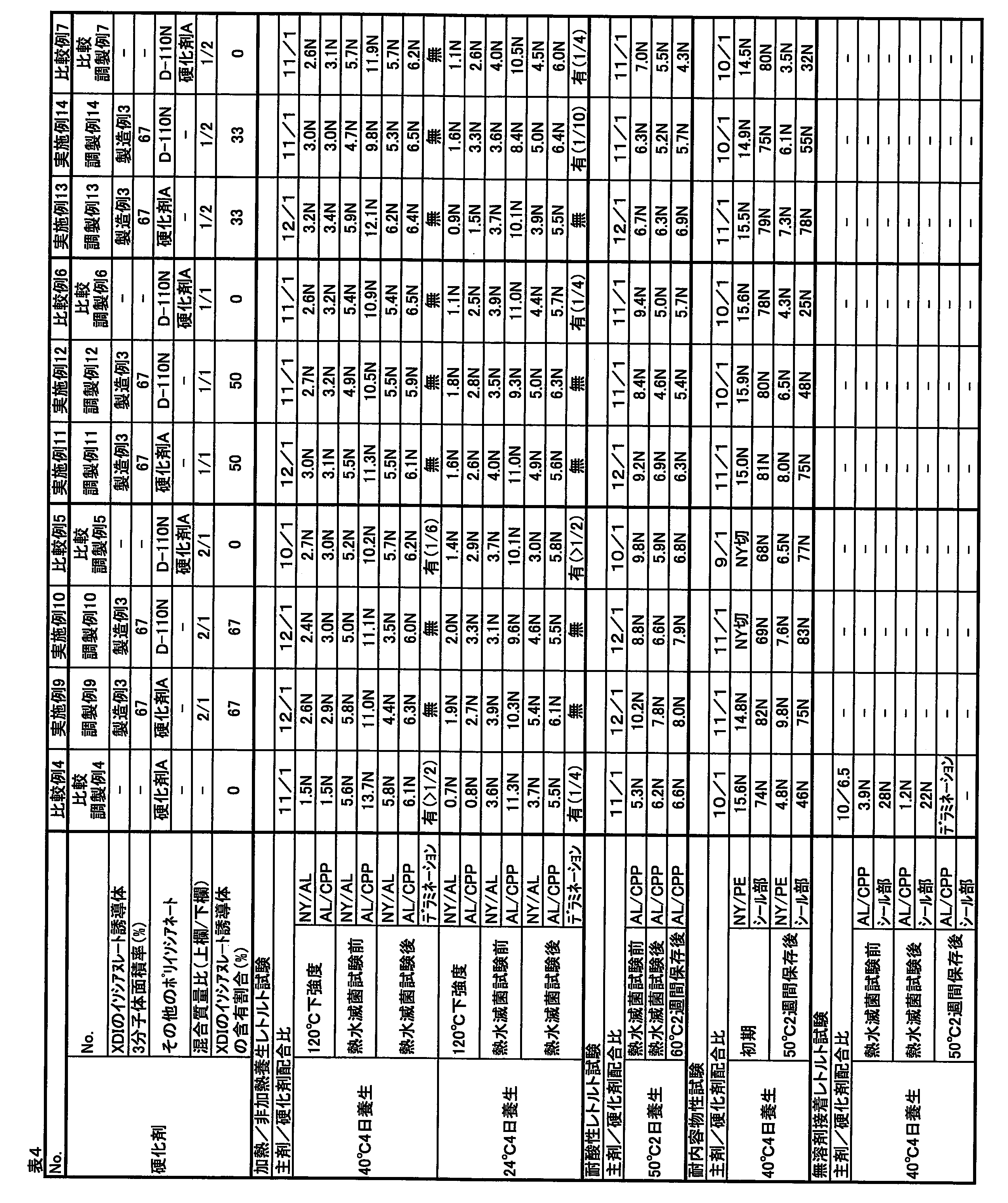

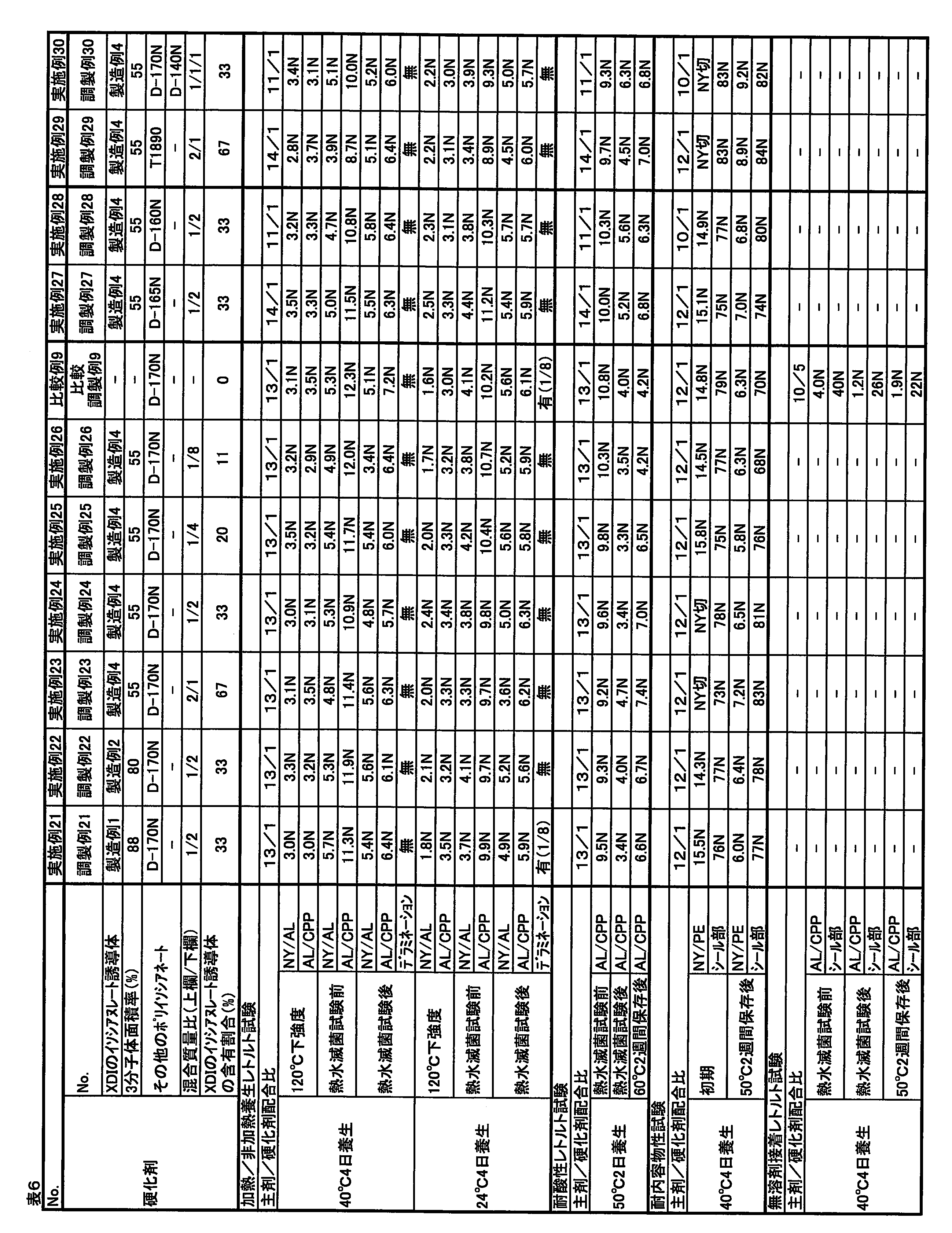

D-110N:タケネートD-110N、キシリレンジイソシアネートのトリメチロールプロパン変性体、固形分濃度:75質量%、三井化学社製
D-140N:タケネートD-140N、イソホロンジイソシアネートのトリメチロールプロパン変性体、固形分濃度:75質量%、三井化学社製
D-160N:タケネートD-160N、ヘキサメチレンジイソシアネートのトリメチロールプロパン変性体、固形分75質量%、三井化学社製
D-165N:タケネートD-165N、ヘキサメチレンジイソシアネートのビウレット変性体、固形分濃度:100質量%、三井化学社製
D-170N:タケネートD-170N、ヘキサメチレンジイソシアネートの三量体、固形分濃度:100質量%、三井化学社製
T1890:Vestanat T1890/100、イソホロンジイソシアネートの三量体、固形分濃度:100質量%、エボニック デグサ ジャパン社製
硬化剤A:キシリレンジイソシアネートのアロファネート誘導体、固形分濃度:100質量%、調製例32で得られた硬化剤A
NY:ナイロン
AL:アルミニウム箔
CPP:未延伸ポリプロピレンフィルム
PE:未延伸ポリエチレンフィルム
デラミネーション:外観評価。デラミネーションの有無を示す。なお、「無」は、デラミネーションが確認されなかったことを示し、「有」は、デラミネーションが確認されたことを示す。また、「有」に続く数字は、サンプルのヒートシール部分の長さに対して、デラミネーションが確認された領域(長さ)の割合を示す。
Claims (7)
- ポリイソシアネート成分を含む硬化剤と、ポリオール成分を含む主剤とを含有し、
前記ポリイソシアネート成分は、キシリレンジイソシアネートのイソシアヌレート誘導体を含有し、
前記キシリレンジイソシアネートのイソシアヌレート誘導体をゲルパーミエーションクロマトグラフ測定したときのクロマトグラムにおいて、ポリスチレン換算分子量400~1000の間をピークトップとするピークの面積の、全ピークの面積に対する面積率が、30%以上90%以下である
ことを特徴とする、ラミネート接着剤。 - 前記キシリレンジイソシアネートのイソシアヌレート誘導体をゲルパーミエーションクロマトグラフ測定したときのクロマトグラムにおいて、ポリスチレン換算分子量400~1000の間をピークトップとするピークの面積の、全ピークの面積に対する面積率が、35%以上80%以下である
ことを特徴とする、請求項1に記載のラミネート接着剤。 - 前記ポリイソシアネート成分において、前記キシリレンジイソシアネートのイソシアヌレート誘導体の含有割合が、20質量%以上である
ことを特徴とする、請求項1に記載のラミネート接着剤。 - 請求項1に記載のラミネート接着剤によって、複数のフィルムを接着させることを特徴とする、ラミネートフィルムの製造方法。
- 接着された前記フィルムを、非加熱下において養生させることを特徴とする、請求項4に記載のラミネートフィルムの製造方法。
- 複数のフィルムを備え、
前記複数のフィルムが、請求項1に記載のラミネート接着剤によって接着されていることを特徴とする、ラミネートフィルム。 - 請求項6に記載のラミネートフィルムを備えることを特徴とする、レトルトパウチ材料。
Priority Applications (5)
| Application Number | Priority Date | Filing Date | Title |
|---|---|---|---|
| EP15758144.8A EP3115430B1 (en) | 2014-03-04 | 2015-03-03 | Laminate adhesive, method for manufacturing laminate film, laminate film, and retort pouch material |
| CN201580010092.4A CN106029813B (zh) | 2014-03-04 | 2015-03-03 | 层压粘接剂、层压膜的制造方法、层压膜及蒸煮袋材料 |
| US15/123,197 US20170066949A1 (en) | 2014-03-04 | 2015-03-03 | Laminate adhesive, method for producing laminate film, laminate film, and retort pouch material |
| JP2016506516A JP6317428B2 (ja) | 2014-03-04 | 2015-03-03 | ラミネート接着剤、ラミネートフィルムの製造方法、ラミネートフィルムおよびレトルトパウチ材料 |
| JP2015119355A JP6506112B2 (ja) | 2014-03-04 | 2015-06-12 | ポリイソシアネート組成物、ポリウレタン樹脂および二液硬化型ポリウレタン組成物。 |
Applications Claiming Priority (4)
| Application Number | Priority Date | Filing Date | Title |
|---|---|---|---|
| JP2014-041957 | 2014-03-04 | ||
| JP2014041957 | 2014-03-04 | ||
| JP2014041952 | 2014-03-04 | ||
| JP2014-041952 | 2014-03-04 |
Publications (1)
| Publication Number | Publication Date |
|---|---|
| WO2015133496A1 true WO2015133496A1 (ja) | 2015-09-11 |
Family
ID=54055299
Family Applications (4)
| Application Number | Title | Priority Date | Filing Date |
|---|---|---|---|
| PCT/JP2015/056252 Ceased WO2015133493A1 (ja) | 2014-03-04 | 2015-03-03 | ポリイソシアヌレート組成物およびその製造方法 |
| PCT/JP2015/056254 Ceased WO2015133495A1 (ja) | 2014-03-04 | 2015-03-03 | イソシアヌレート組成物 |
| PCT/JP2015/056255 Ceased WO2015133496A1 (ja) | 2014-03-04 | 2015-03-03 | ラミネート接着剤、ラミネートフィルムの製造方法、ラミネートフィルムおよびレトルトパウチ材料 |
| PCT/JP2015/056253 Ceased WO2015133494A1 (ja) | 2014-03-04 | 2015-03-03 | イソシアヌレート組成物 |
Family Applications Before (2)
| Application Number | Title | Priority Date | Filing Date |
|---|---|---|---|
| PCT/JP2015/056252 Ceased WO2015133493A1 (ja) | 2014-03-04 | 2015-03-03 | ポリイソシアヌレート組成物およびその製造方法 |
| PCT/JP2015/056254 Ceased WO2015133495A1 (ja) | 2014-03-04 | 2015-03-03 | イソシアヌレート組成物 |
Family Applications After (1)
| Application Number | Title | Priority Date | Filing Date |
|---|---|---|---|
| PCT/JP2015/056253 Ceased WO2015133494A1 (ja) | 2014-03-04 | 2015-03-03 | イソシアヌレート組成物 |
Country Status (5)
| Country | Link |
|---|---|
| US (3) | US9873676B2 (ja) |
| EP (4) | EP3115430B1 (ja) |
| JP (5) | JP6250138B2 (ja) |
| CN (4) | CN106062026B (ja) |
| WO (4) | WO2015133493A1 (ja) |
Cited By (10)
| Publication number | Priority date | Publication date | Assignee | Title |
|---|---|---|---|---|
| JPWO2019116903A1 (ja) * | 2017-12-12 | 2020-01-16 | Dic株式会社 | 無溶剤型ラミネート接着剤、その硬化物、積層体及び包装体 |
| WO2020013129A1 (ja) * | 2018-07-11 | 2020-01-16 | 三井化学株式会社 | ラミネート用接着剤 |
| JP2020138999A (ja) * | 2019-02-27 | 2020-09-03 | 三井化学株式会社 | ポリイソシアネート組成物 |
| WO2020203473A1 (ja) * | 2019-03-29 | 2020-10-08 | 三井化学株式会社 | 2液硬化型ラミネート接着剤およびラミネートフィルム |
| JP2021038304A (ja) * | 2019-09-02 | 2021-03-11 | 三井化学株式会社 | ポリイソシアネート組成物およびその製造方法 |
| CN112979569A (zh) * | 2021-03-09 | 2021-06-18 | 北方民族大学 | 一种制备芳香族异氰酸酯三聚物的方法 |
| JP2021161163A (ja) * | 2020-03-31 | 2021-10-11 | 三井化学株式会社 | 2液硬化型ポリウレタン組成物 |
| JP2021528546A (ja) * | 2018-06-25 | 2021-10-21 | ヘンケル・アクチェンゲゼルシャフト・ウント・コムパニー・コマンディットゲゼルシャフト・アウフ・アクチェンHenkel AG & Co. KGaA | 再生可能な原材料に基づく包装用接着剤 |
| JP2022117008A (ja) * | 2021-01-29 | 2022-08-10 | 三井化学株式会社 | 2成分型硬化吹付材 |
| WO2023047872A1 (ja) * | 2021-09-21 | 2023-03-30 | 株式会社レゾナック | 接着剤用組成物及び積層体 |
Families Citing this family (23)
| Publication number | Priority date | Publication date | Assignee | Title |
|---|---|---|---|---|
| EP3115430B1 (en) * | 2014-03-04 | 2020-08-05 | Mitsui Chemicals, Inc. | Laminate adhesive, method for manufacturing laminate film, laminate film, and retort pouch material |
| TW201829525A (zh) * | 2016-10-14 | 2018-08-16 | 日商旭化成股份有限公司 | 異氰酸酯組成物,異氰酸酯聚合物之製造方法,以及異氰酸酯聚合物 |
| JP6965069B2 (ja) * | 2017-09-14 | 2021-11-10 | ダイセン・メンブレン・システムズ株式会社 | ポリウレタン接着剤組成物、及びこれを用いて製作される中空糸膜モジュール |
| JP6891085B2 (ja) * | 2017-09-26 | 2021-06-18 | 三井化学株式会社 | イソシアヌレートの製造方法 |
| EP3470135B1 (en) | 2017-10-13 | 2020-04-08 | Agfa Nv | A composition comprising solvent and heat resistant capsules |
| EP3470134B1 (en) | 2017-10-13 | 2020-06-03 | Agfa Nv | A composition comprising solvent and heat resistant capsules |
| JP7020193B2 (ja) * | 2018-03-05 | 2022-02-16 | 凸版印刷株式会社 | 化粧シートおよび化粧部材 |
| US10946618B2 (en) | 2018-09-17 | 2021-03-16 | AISIN Technical Center of America, Inc. | Process for making 7xxx series aluminum/fiber reinforced polypropylene hybrid part for automotive crash absorption application |
| EP3626471A1 (en) | 2018-09-24 | 2020-03-25 | Agfa Nv | Laser markable compositions |
| EP3626472A1 (en) | 2018-09-24 | 2020-03-25 | Agfa Nv | Laser markable compositions |
| JP7151338B2 (ja) * | 2018-09-28 | 2022-10-12 | 凸版印刷株式会社 | 積層フィルムおよび包装容器 |
| JP7326072B2 (ja) * | 2019-09-02 | 2023-08-15 | 三井化学株式会社 | ポリイソシアネート組成物およびその製造方法 |
| JP7288575B2 (ja) * | 2019-09-13 | 2023-06-08 | シーカ・ジャパン株式会社 | ウレタン被覆材組成物、被覆構造および施工方法 |
| EP4053237A4 (en) * | 2019-10-28 | 2023-11-08 | Mitsui Chemicals, Inc. | POLYURETHANE STRUCTURAL ADHESIVE |
| JP7343371B2 (ja) * | 2019-11-29 | 2023-09-12 | 三井化学株式会社 | ブロックイソシアネート、および、コーティング剤 |
| EP3838610A1 (en) | 2019-12-17 | 2021-06-23 | Agfa Nv | Laser markable articles |
| EP3838609A1 (en) | 2019-12-17 | 2021-06-23 | Agfa Nv | Laser markable articles |
| WO2021200794A1 (ja) * | 2020-03-30 | 2021-10-07 | 三井化学株式会社 | 活性エネルギー線硬化性ポリウレタン樹脂、硬化性樹脂組成物、および、活性エネルギー線硬化性ポリウレタン樹脂の製造方法 |
| CN112266763B (zh) * | 2020-09-17 | 2021-10-01 | 安徽省淮河制胶有限公司 | 一种砂粒胶粘剂的制备方法及其在砂纸加工中的应用 |
| CN117295986A (zh) * | 2021-03-31 | 2023-12-26 | 住友电木株式会社 | 偏振片、偏振透镜和光学部件 |
| JP7057858B1 (ja) * | 2021-09-22 | 2022-04-20 | 三井化学株式会社 | ポリウレタン樹脂の製造方法、および、ポリウレタン樹脂 |
| WO2025009399A1 (ja) * | 2023-07-04 | 2025-01-09 | Dic株式会社 | ポリイソシアネート組成物、2液硬化型組成物、2液硬化型コーティング剤、2液硬化型接着剤、積層体、包装材 |
| WO2026040074A1 (en) * | 2024-08-23 | 2026-02-26 | Basf Se | Process for the provision of aliphatic polyisocyanurate |
Citations (10)
| Publication number | Priority date | Publication date | Assignee | Title |
|---|---|---|---|---|
| JPH08269428A (ja) * | 1995-01-31 | 1996-10-15 | Nippon Polyurethane Ind Co Ltd | ラミネート用接着剤組成物と積層フィルムの製造方法 |
| JP2000351953A (ja) * | 1998-06-26 | 2000-12-19 | Toppan Printing Co Ltd | ドライラミネーション用接着剤及びそれを用いた積層体 |
| JP2001240839A (ja) * | 2000-02-28 | 2001-09-04 | Nippon Polyurethane Ind Co Ltd | ラミネート接着剤用ポリイソシアネート硬化剤及びその製造方法 |
| JP2002155260A (ja) * | 2000-09-11 | 2002-05-28 | Toppan Printing Co Ltd | ドライラミネーション用接着剤及びそれを用いた積層包装材 |
| JP2004115681A (ja) * | 2002-09-27 | 2004-04-15 | Toyo Ink Mfg Co Ltd | 無溶剤型接着剤組成物及びその利用 |
| JP2005161691A (ja) * | 2003-12-03 | 2005-06-23 | Mitsubishi Gas Chem Co Inc | 食品の保存方法 |
| JP2008239911A (ja) * | 2007-03-29 | 2008-10-09 | Dic Corp | プライマー及び該プライマーからなる樹脂塗膜を有する積層体 |
| JP2013129105A (ja) * | 2011-12-21 | 2013-07-04 | Dic Corp | バリア性易開封ラミネートフィルム及びこれを用いる包装材 |
| JP2014015619A (ja) * | 2013-08-22 | 2014-01-30 | Henkel Japan Ltd | 太陽電池バックシート用接着剤 |
| JP2014088533A (ja) * | 2012-10-31 | 2014-05-15 | Dainippon Printing Co Ltd | 粘着剤組成物およびそれを用いた粘着シート |
Family Cites Families (52)
| Publication number | Priority date | Publication date | Assignee | Title |
|---|---|---|---|---|
| DE1644809A1 (de) * | 1967-08-04 | 1971-01-21 | Bayer Ag | Polyurethanlackueberzuege und Verfahren zu ihrer Herstellung |
| GB1234728A (en) * | 1968-09-11 | 1971-06-09 | Takeda Chemical Industries Ltd | Method for producing organic isocyanate polymers |
| JPS4631531Y1 (ja) | 1969-07-29 | 1971-11-01 | ||
| JPS49110684A (ja) * | 1973-03-10 | 1974-10-22 | ||
| JPS531258B2 (ja) * | 1973-07-17 | 1978-01-17 | ||
| US4040992A (en) | 1975-07-29 | 1977-08-09 | Air Products And Chemicals, Inc. | Catalysis of organic isocyanate reactions |
| JPS591289B2 (ja) * | 1975-12-08 | 1984-01-11 | 旭化成株式会社 | ユウキポリイソシアネ−トノセイゾウホウホウ |
| JPS5432490A (en) * | 1977-08-17 | 1979-03-09 | Dainippon Ink & Chem Inc | Preparation of polyisocyanates |
| JPS54138586A (en) * | 1978-04-18 | 1979-10-27 | Showa Denko Kk | Preparation of isocyanuric acid ester |
| DE3100262A1 (de) * | 1981-01-08 | 1982-08-05 | Bayer Ag, 5090 Leverkusen | Verfahren zur herstellung von isocyanuratgruppen aufweisenden polyisocyanaten, als katalysator-komponente fuer dieses verfahren geeignete loesungen, sowie die verwendung der verfahrensprodukte als isocyanat-komponente bei der herstellung von polyurethanen |
| JPS6112677A (ja) * | 1984-06-28 | 1986-01-21 | Dainippon Ink & Chem Inc | 改良されたポリイソシアネ−トの製造法 |
| JPS6172013A (ja) * | 1984-09-18 | 1986-04-14 | Dainippon Ink & Chem Inc | 樹脂組成物 |
| JPS61129173A (ja) * | 1984-11-19 | 1986-06-17 | Takeda Chem Ind Ltd | イソシアヌレ−ト環とイソシアナ−ト基とを有する化合物の製造法 |
| FR2607499A1 (fr) * | 1986-12-02 | 1988-06-03 | Rhone Poulenc Chimie | Polyisocyanates a groupement isocyanurique purs et procede d'obtention de ces polyisocyanates |
| US5086175A (en) * | 1988-12-28 | 1992-02-04 | Takeda Chemical Industries, Ltd. | Polyisocyanates, their production and uses |
| DE69025028T2 (de) * | 1989-05-16 | 1996-07-18 | Nippon Polyurethane Kogyo Kk | Verfahren zur herstellung modifizierter organischer polyisocyanate |
| US5221743A (en) * | 1992-03-02 | 1993-06-22 | Olin Corporation | Process for producing isocyanurates by cyclotrimerizing isocyanates using polymer-bound catalysts |
| CA2116167C (en) * | 1993-03-15 | 2007-05-15 | Myron W. Shaffer | One-component coating compositions containing oxime- or lactam-blocked polyisocyanates which have improved resistance to yellowing |
| JPH07233240A (ja) * | 1994-02-22 | 1995-09-05 | Nippon Paint Co Ltd | 硬化剤およびカチオン電着塗料組成物 |
| US5777061A (en) * | 1996-02-14 | 1998-07-07 | Bayer Corporation | Blocked polyisocyanate crosslinkers for providing improved flow properties to coating compositions |
| US5714564A (en) * | 1996-08-21 | 1998-02-03 | Bayer Corporation | Low viscosity polyisocyanates prepared from monomeric triisocyanates |
| JPH1060082A (ja) * | 1996-08-21 | 1998-03-03 | Nippon Polyurethane Ind Co Ltd | ポリイソシアヌレートフォーム用組成物、及び該組成物を用いたポリイソシアヌレートフォームの製造方法 |
| US5691439A (en) * | 1996-12-16 | 1997-11-25 | Bayer Corporation | Low surface energy polyisocyanates and their use in one- or two-component coating compositions |
| JPH10319202A (ja) * | 1997-05-20 | 1998-12-04 | Nippon Polyurethane Ind Co Ltd | プラスチックレンズの製造方法 |
| JPH11171966A (ja) * | 1997-12-09 | 1999-06-29 | Nippon Polyurethane Ind Co Ltd | ポリイソシアネート組成物、並びにその製造方法及びそれを用いた塗料用硬化剤 |
| CN1241990C (zh) * | 2001-07-13 | 2006-02-15 | 日本聚氨酯工业株式会社 | 层压材料粘合剂用聚异氰酸酯固化剂及其制备方法 |
| EP1369443B1 (en) * | 2002-06-04 | 2007-04-04 | Mitsubishi Gas Chemical Company, Inc. | Gas-barrier polyurethane resin, and adhesive for laminate, film and paint containing the same |
| BRPI0408042B1 (pt) * | 2003-02-28 | 2014-12-02 | Dow Global Technology Inc | "composição de poliisocianato isocianurato e processo para a preparação de uma mistura de poliisocianato isocianurato". |
| JP4524794B2 (ja) * | 2004-03-01 | 2010-08-18 | 日本ポリウレタン工業株式会社 | 水性一液コーティング剤用ポリウレタンエマルジョンの製造方法 |
| JP4631531B2 (ja) | 2005-05-10 | 2011-02-16 | ブラザー工業株式会社 | ネットワークシステム、接続確立方法、及びノード装置等 |
| AU2007302971A1 (en) | 2006-10-05 | 2008-04-10 | Asahi Glass Co., Ltd. | Composition for two-component fluorine coating material |
| WO2008065732A1 (fr) | 2006-11-27 | 2008-06-05 | Nippon Polyurethane Industry Co., Ltd. | Procédé de production d'un mélange à base d'isocyanate modifié contenant une liaison allophanate et une liaison isocyanurate |
| EP1970420A1 (en) * | 2007-03-15 | 2008-09-17 | Huntsman International Llc | Polyisocyanate-based adhesive composition |
| CN101239987A (zh) * | 2008-01-23 | 2008-08-13 | 湖北德邦化工新材料有限公司 | 含巯基或羟基的硅氧烷改性的多异氰酸酯三聚体固化剂及其制备方法 |
| FR2929612B1 (fr) * | 2008-04-03 | 2011-02-04 | Rhodia Operations | Procede d'oligomerisation des isocyanates en continu |
| JP5397584B2 (ja) * | 2008-07-22 | 2014-01-22 | 東洋製罐株式会社 | 無溶剤型接着剤を使用した多層フィルム、その製造方法および包装容器 |
| JP5568225B2 (ja) * | 2008-07-22 | 2014-08-06 | 三井化学株式会社 | 塗料 |
| CN101717571A (zh) * | 2009-10-30 | 2010-06-02 | 华南理工大学 | 一种高固含量无毒级聚氨酯固化剂的制备方法 |
| CN103140529A (zh) * | 2010-07-08 | 2013-06-05 | 亨茨曼国际有限公司 | 多异氰酸酯基防腐蚀涂层 |
| DE102010031681A1 (de) * | 2010-07-20 | 2012-01-26 | Bayer Materialscience Ag | Polyurethane mit geringem Volumenschrumpf |
| DE102010031683A1 (de) * | 2010-07-20 | 2012-01-26 | Bayer Materialscience Ag | Polyisocyanatgemische |
| DE102010031684A1 (de) * | 2010-07-20 | 2012-01-26 | Bayer Materialscience Ag | Polyurethane mit hoher Lichtbrechung |
| JP5662832B2 (ja) * | 2010-08-31 | 2015-02-04 | 富士フイルム株式会社 | 画像形成材料、平版印刷版原版及び平版印刷版の作製方法 |
| CN102134255B (zh) * | 2011-01-17 | 2014-06-25 | 武汉壁千韧硅涂料有限公司 | 亲水性硅氧烷改性异氰酸酯类三聚体及其制备方法 |
| CN102167925A (zh) * | 2011-03-02 | 2011-08-31 | 中国科学院长春应用化学研究所 | 一种光纤涂料附着力促进剂及其制备方法 |
| WO2013024108A1 (de) * | 2011-08-16 | 2013-02-21 | Bayer Intellectual Property Gmbh | Verfahren zur herstellung eines polyurethan-polyisocyanurat-hartschaums |
| CN109970950A (zh) * | 2011-11-30 | 2019-07-05 | 科思创德国股份有限公司 | 用于连续异氰酸酯改性的方法 |
| JP6043531B2 (ja) * | 2012-07-25 | 2016-12-14 | 旭化成株式会社 | ポリイソシアネート組成物 |
| CN102816293B (zh) * | 2012-08-10 | 2016-08-03 | 三棵树涂料股份有限公司 | 高相容性低游离tdi的耐黄变混合三聚体固化剂的制备方法 |
| JP6016528B2 (ja) * | 2012-08-24 | 2016-10-26 | 東洋アルミニウム株式会社 | 太陽電池裏面保護シート |
| EP3115430B1 (en) * | 2014-03-04 | 2020-08-05 | Mitsui Chemicals, Inc. | Laminate adhesive, method for manufacturing laminate film, laminate film, and retort pouch material |
| JP6434825B2 (ja) * | 2014-03-04 | 2018-12-05 | 三井化学株式会社 | ポリイソシアヌレート組成物の製造方法 |
-
2015
- 2015-03-03 EP EP15758144.8A patent/EP3115430B1/en active Active
- 2015-03-03 JP JP2016506515A patent/JP6250138B2/ja active Active
- 2015-03-03 JP JP2016506516A patent/JP6317428B2/ja active Active
- 2015-03-03 US US15/123,200 patent/US9873676B2/en active Active
- 2015-03-03 EP EP15759248.6A patent/EP3115386B1/en active Active
- 2015-03-03 JP JP2016506513A patent/JP6271704B2/ja active Active
- 2015-03-03 CN CN201580010081.6A patent/CN106062026B/zh active Active
- 2015-03-03 JP JP2016506514A patent/JP6161788B2/ja active Active
- 2015-03-03 EP EP15758164.6A patent/EP3115385B1/en active Active
- 2015-03-03 CN CN201580010092.4A patent/CN106029813B/zh active Active
- 2015-03-03 CN CN201580010078.4A patent/CN106062023B/zh active Active
- 2015-03-03 WO PCT/JP2015/056252 patent/WO2015133493A1/ja not_active Ceased
- 2015-03-03 CN CN201580010079.9A patent/CN106062024B/zh active Active
- 2015-03-03 WO PCT/JP2015/056254 patent/WO2015133495A1/ja not_active Ceased
- 2015-03-03 EP EP15757945.9A patent/EP3115390B1/en active Active
- 2015-03-03 WO PCT/JP2015/056255 patent/WO2015133496A1/ja not_active Ceased
- 2015-03-03 US US15/123,197 patent/US20170066949A1/en not_active Abandoned
- 2015-03-03 US US15/123,199 patent/US9725422B2/en active Active
- 2015-03-03 WO PCT/JP2015/056253 patent/WO2015133494A1/ja not_active Ceased
- 2015-06-12 JP JP2015119355A patent/JP6506112B2/ja active Active
Patent Citations (10)
| Publication number | Priority date | Publication date | Assignee | Title |
|---|---|---|---|---|
| JPH08269428A (ja) * | 1995-01-31 | 1996-10-15 | Nippon Polyurethane Ind Co Ltd | ラミネート用接着剤組成物と積層フィルムの製造方法 |
| JP2000351953A (ja) * | 1998-06-26 | 2000-12-19 | Toppan Printing Co Ltd | ドライラミネーション用接着剤及びそれを用いた積層体 |
| JP2001240839A (ja) * | 2000-02-28 | 2001-09-04 | Nippon Polyurethane Ind Co Ltd | ラミネート接着剤用ポリイソシアネート硬化剤及びその製造方法 |
| JP2002155260A (ja) * | 2000-09-11 | 2002-05-28 | Toppan Printing Co Ltd | ドライラミネーション用接着剤及びそれを用いた積層包装材 |
| JP2004115681A (ja) * | 2002-09-27 | 2004-04-15 | Toyo Ink Mfg Co Ltd | 無溶剤型接着剤組成物及びその利用 |
| JP2005161691A (ja) * | 2003-12-03 | 2005-06-23 | Mitsubishi Gas Chem Co Inc | 食品の保存方法 |
| JP2008239911A (ja) * | 2007-03-29 | 2008-10-09 | Dic Corp | プライマー及び該プライマーからなる樹脂塗膜を有する積層体 |
| JP2013129105A (ja) * | 2011-12-21 | 2013-07-04 | Dic Corp | バリア性易開封ラミネートフィルム及びこれを用いる包装材 |
| JP2014088533A (ja) * | 2012-10-31 | 2014-05-15 | Dainippon Printing Co Ltd | 粘着剤組成物およびそれを用いた粘着シート |
| JP2014015619A (ja) * | 2013-08-22 | 2014-01-30 | Henkel Japan Ltd | 太陽電池バックシート用接着剤 |
Cited By (18)
| Publication number | Priority date | Publication date | Assignee | Title |
|---|---|---|---|---|
| JPWO2019116903A1 (ja) * | 2017-12-12 | 2020-01-16 | Dic株式会社 | 無溶剤型ラミネート接着剤、その硬化物、積層体及び包装体 |
| JP7333349B2 (ja) | 2018-06-25 | 2023-08-24 | ヘンケル・アクチェンゲゼルシャフト・ウント・コムパニー・コマンディットゲゼルシャフト・アウフ・アクチェン | 再生可能な原材料に基づく包装用接着剤 |
| JP2021528546A (ja) * | 2018-06-25 | 2021-10-21 | ヘンケル・アクチェンゲゼルシャフト・ウント・コムパニー・コマンディットゲゼルシャフト・アウフ・アクチェンHenkel AG & Co. KGaA | 再生可能な原材料に基づく包装用接着剤 |
| WO2020013129A1 (ja) * | 2018-07-11 | 2020-01-16 | 三井化学株式会社 | ラミネート用接着剤 |
| US12209205B2 (en) | 2018-07-11 | 2025-01-28 | Mitsui Chemicals, Inc. | Laminate adhesive |
| JPWO2020013129A1 (ja) * | 2018-07-11 | 2021-07-08 | 三井化学株式会社 | ラミネート用接着剤 |
| JP7109546B2 (ja) | 2018-07-11 | 2022-07-29 | 三井化学株式会社 | ラミネート用接着剤 |
| JP7219633B2 (ja) | 2019-02-27 | 2023-02-08 | 三井化学株式会社 | ポリイソシアネート組成物 |
| JP2020138999A (ja) * | 2019-02-27 | 2020-09-03 | 三井化学株式会社 | ポリイソシアネート組成物 |
| WO2020203473A1 (ja) * | 2019-03-29 | 2020-10-08 | 三井化学株式会社 | 2液硬化型ラミネート接着剤およびラミネートフィルム |
| JP2021038304A (ja) * | 2019-09-02 | 2021-03-11 | 三井化学株式会社 | ポリイソシアネート組成物およびその製造方法 |
| JP7236357B2 (ja) | 2019-09-02 | 2023-03-09 | 三井化学株式会社 | ポリイソシアネート組成物およびその製造方法 |
| JP2021161163A (ja) * | 2020-03-31 | 2021-10-11 | 三井化学株式会社 | 2液硬化型ポリウレタン組成物 |
| JP7413125B2 (ja) | 2020-03-31 | 2024-01-15 | 三井化学株式会社 | 2液硬化型ポリウレタン組成物 |
| JP2022117008A (ja) * | 2021-01-29 | 2022-08-10 | 三井化学株式会社 | 2成分型硬化吹付材 |
| JP7509702B2 (ja) | 2021-01-29 | 2024-07-02 | 三井化学株式会社 | 2成分型硬化吹付材 |
| CN112979569A (zh) * | 2021-03-09 | 2021-06-18 | 北方民族大学 | 一种制备芳香族异氰酸酯三聚物的方法 |
| WO2023047872A1 (ja) * | 2021-09-21 | 2023-03-30 | 株式会社レゾナック | 接着剤用組成物及び積層体 |
Also Published As
Similar Documents
| Publication | Publication Date | Title |
|---|---|---|
| JP6317428B2 (ja) | ラミネート接着剤、ラミネートフィルムの製造方法、ラミネートフィルムおよびレトルトパウチ材料 | |
| CN108473842B (zh) | 二液固化型无溶剂系层压用粘接剂和树脂固化物 | |
| JP6482663B2 (ja) | ポリイソシアネート組成物、ポリウレタン樹脂、二液硬化型ポリウレタン組成物、コーティング材料および接着材料 | |
| CN1989217B (zh) | 二液固化型无溶剂系粘接剂 | |
| JP5530963B2 (ja) | 接着剤組成物 | |
| JP6243929B2 (ja) | ポリイソシアネート組成物の製造方法 | |
| JP5657990B2 (ja) | ラミネート用接着剤 | |
| JP5563843B2 (ja) | 二液硬化型無溶剤系接着剤 | |
| JP4631093B2 (ja) | 2液硬化型無溶剤系接着剤および2液硬化型無溶剤系接着剤用組成物 | |
| CN110128624A (zh) | 多异氰酸酯组合物、涂料组合物、涂膜的制造方法及涂膜 | |
| JPWO2015115291A1 (ja) | ポリイソシアネート組成物、2液硬化型ポリウレタン樹脂、塗料および接着剤 | |
| JP7109546B2 (ja) | ラミネート用接着剤 | |
| JP2006213801A (ja) | 2液硬化型無溶剤系接着剤 | |
| JP6754449B2 (ja) | 二液硬化型接着剤組成物、ラミネートフィルムおよびその製造方法 | |
| JP2025122100A (ja) | 接着剤の製造方法および積層体の製造方法 | |
| JP6178541B1 (ja) | 二液硬化型無溶剤系ラミネート用接着剤および樹脂硬化物 | |
| JP6434825B2 (ja) | ポリイソシアヌレート組成物の製造方法 | |
| JP2019156946A (ja) | ガスバリア性ラミネート接着剤およびラミネートフィルム |
Legal Events
| Date | Code | Title | Description |
|---|---|---|---|
| 121 | Ep: the epo has been informed by wipo that ep was designated in this application |
Ref document number: 15758144 Country of ref document: EP Kind code of ref document: A1 |
|
| ENP | Entry into the national phase |
Ref document number: 2016506516 Country of ref document: JP Kind code of ref document: A |
|
| REEP | Request for entry into the european phase |
Ref document number: 2015758144 Country of ref document: EP |
|
| WWE | Wipo information: entry into national phase |
Ref document number: 2015758144 Country of ref document: EP |
|
| WWE | Wipo information: entry into national phase |
Ref document number: 15123197 Country of ref document: US |
|
| NENP | Non-entry into the national phase |
Ref country code: DE |