WO2015133536A1 - 熱電変換材料含有樹脂組成物、及び熱電変換材料含有樹脂組成物からなるフィルム - Google Patents
熱電変換材料含有樹脂組成物、及び熱電変換材料含有樹脂組成物からなるフィルム Download PDFInfo
- Publication number
- WO2015133536A1 WO2015133536A1 PCT/JP2015/056400 JP2015056400W WO2015133536A1 WO 2015133536 A1 WO2015133536 A1 WO 2015133536A1 JP 2015056400 W JP2015056400 W JP 2015056400W WO 2015133536 A1 WO2015133536 A1 WO 2015133536A1
- Authority
- WO
- WIPO (PCT)
- Prior art keywords
- thermoelectric conversion
- resin composition
- film
- conversion material
- containing resin
- Prior art date
- Legal status (The legal status is an assumption and is not a legal conclusion. Google has not performed a legal analysis and makes no representation as to the accuracy of the status listed.)
- Ceased
Links
Classifications
-
- H—ELECTRICITY
- H10—SEMICONDUCTOR DEVICES; ELECTRIC SOLID-STATE DEVICES NOT OTHERWISE PROVIDED FOR
- H10N—ELECTRIC SOLID-STATE DEVICES NOT OTHERWISE PROVIDED FOR
- H10N10/00—Thermoelectric devices comprising a junction of dissimilar materials, i.e. devices exhibiting Seebeck or Peltier effects
- H10N10/80—Constructional details
- H10N10/85—Thermoelectric active materials
- H10N10/851—Thermoelectric active materials comprising inorganic compositions
-
- B—PERFORMING OPERATIONS; TRANSPORTING
- B82—NANOTECHNOLOGY
- B82Y—SPECIFIC USES OR APPLICATIONS OF NANOSTRUCTURES; MEASUREMENT OR ANALYSIS OF NANOSTRUCTURES; MANUFACTURE OR TREATMENT OF NANOSTRUCTURES
- B82Y30/00—Nanotechnology for materials or surface science, e.g. nanocomposites
-
- H—ELECTRICITY
- H10—SEMICONDUCTOR DEVICES; ELECTRIC SOLID-STATE DEVICES NOT OTHERWISE PROVIDED FOR
- H10N—ELECTRIC SOLID-STATE DEVICES NOT OTHERWISE PROVIDED FOR
- H10N10/00—Thermoelectric devices comprising a junction of dissimilar materials, i.e. devices exhibiting Seebeck or Peltier effects
- H10N10/80—Constructional details
- H10N10/85—Thermoelectric active materials
- H10N10/856—Thermoelectric active materials comprising organic compositions
-
- C—CHEMISTRY; METALLURGY
- C08—ORGANIC MACROMOLECULAR COMPOUNDS; THEIR PREPARATION OR CHEMICAL WORKING-UP; COMPOSITIONS BASED THEREON
- C08J—WORKING-UP; GENERAL PROCESSES OF COMPOUNDING; AFTER-TREATMENT NOT COVERED BY SUBCLASSES C08B, C08C, C08F, C08G or C08H
- C08J5/00—Manufacture of articles or shaped materials containing macromolecular substances
- C08J5/18—Manufacture of films or sheets
-
- C—CHEMISTRY; METALLURGY
- C08—ORGANIC MACROMOLECULAR COMPOUNDS; THEIR PREPARATION OR CHEMICAL WORKING-UP; COMPOSITIONS BASED THEREON
- C08K—Use of inorganic or non-macromolecular organic substances as compounding ingredients
- C08K3/00—Use of inorganic substances as compounding ingredients
- C08K3/02—Elements
- C08K3/04—Carbon
- C08K3/041—Carbon nanotubes
-
- C—CHEMISTRY; METALLURGY
- C08—ORGANIC MACROMOLECULAR COMPOUNDS; THEIR PREPARATION OR CHEMICAL WORKING-UP; COMPOSITIONS BASED THEREON
- C08K—Use of inorganic or non-macromolecular organic substances as compounding ingredients
- C08K7/00—Use of ingredients characterised by shape
- C08K7/02—Fibres or whiskers
- C08K7/04—Fibres or whiskers inorganic
- C08K7/06—Elements
-
- C—CHEMISTRY; METALLURGY
- C08—ORGANIC MACROMOLECULAR COMPOUNDS; THEIR PREPARATION OR CHEMICAL WORKING-UP; COMPOSITIONS BASED THEREON
- C08K—Use of inorganic or non-macromolecular organic substances as compounding ingredients
- C08K7/00—Use of ingredients characterised by shape
- C08K7/22—Expanded, porous or hollow particles
-
- C—CHEMISTRY; METALLURGY
- C08—ORGANIC MACROMOLECULAR COMPOUNDS; THEIR PREPARATION OR CHEMICAL WORKING-UP; COMPOSITIONS BASED THEREON
- C08L—COMPOSITIONS OF MACROMOLECULAR COMPOUNDS
- C08L101/00—Compositions of unspecified macromolecular compounds
-
- H—ELECTRICITY
- H10—SEMICONDUCTOR DEVICES; ELECTRIC SOLID-STATE DEVICES NOT OTHERWISE PROVIDED FOR
- H10N—ELECTRIC SOLID-STATE DEVICES NOT OTHERWISE PROVIDED FOR
- H10N10/00—Thermoelectric devices comprising a junction of dissimilar materials, i.e. devices exhibiting Seebeck or Peltier effects
- H10N10/01—Manufacture or treatment
-
- H—ELECTRICITY
- H10—SEMICONDUCTOR DEVICES; ELECTRIC SOLID-STATE DEVICES NOT OTHERWISE PROVIDED FOR
- H10N—ELECTRIC SOLID-STATE DEVICES NOT OTHERWISE PROVIDED FOR
- H10N10/00—Thermoelectric devices comprising a junction of dissimilar materials, i.e. devices exhibiting Seebeck or Peltier effects
- H10N10/80—Constructional details
- H10N10/85—Thermoelectric active materials
- H10N10/851—Thermoelectric active materials comprising inorganic compositions
- H10N10/8556—Thermoelectric active materials comprising inorganic compositions comprising compounds containing germanium or silicon
-
- C—CHEMISTRY; METALLURGY
- C08—ORGANIC MACROMOLECULAR COMPOUNDS; THEIR PREPARATION OR CHEMICAL WORKING-UP; COMPOSITIONS BASED THEREON
- C08J—WORKING-UP; GENERAL PROCESSES OF COMPOUNDING; AFTER-TREATMENT NOT COVERED BY SUBCLASSES C08B, C08C, C08F, C08G or C08H
- C08J2327/00—Characterised by the use of homopolymers or copolymers of compounds having one or more unsaturated aliphatic radicals, each having only one carbon-to-carbon double bond, and at least one being terminated by a halogen; Derivatives of such polymers
- C08J2327/02—Characterised by the use of homopolymers or copolymers of compounds having one or more unsaturated aliphatic radicals, each having only one carbon-to-carbon double bond, and at least one being terminated by a halogen; Derivatives of such polymers not modified by chemical after-treatment
- C08J2327/04—Characterised by the use of homopolymers or copolymers of compounds having one or more unsaturated aliphatic radicals, each having only one carbon-to-carbon double bond, and at least one being terminated by a halogen; Derivatives of such polymers not modified by chemical after-treatment containing chlorine atoms
- C08J2327/06—Homopolymers or copolymers of vinyl chloride
-
- C—CHEMISTRY; METALLURGY
- C08—ORGANIC MACROMOLECULAR COMPOUNDS; THEIR PREPARATION OR CHEMICAL WORKING-UP; COMPOSITIONS BASED THEREON
- C08J—WORKING-UP; GENERAL PROCESSES OF COMPOUNDING; AFTER-TREATMENT NOT COVERED BY SUBCLASSES C08B, C08C, C08F, C08G or C08H
- C08J2379/00—Characterised by the use of macromolecular compounds obtained by reactions forming in the main chain of the macromolecule a linkage containing nitrogen with or without oxygen, or carbon only, not provided for in groups C08J2361/00 - C08J2377/00
- C08J2379/04—Polycondensates having nitrogen-containing heterocyclic rings in the main chain; Polyhydrazides; Polyamide acids or similar polyimide precursors
- C08J2379/08—Polyimides; Polyester-imides; Polyamide-imides; Polyamide acids or similar polyimide precursors
Definitions
- the present invention relates to a thermoelectric conversion material-containing resin composition and a film comprising the thermoelectric conversion material-containing resin composition.
- thermoelectric conversion materials that can directly convert thermal energy into electrical energy have attracted attention.
- a flexible film-like thermoelectric conversion material is required.
- thermoelectric conversion materials have been conventionally studied mainly with inorganic materials, but in recent years, studies on organic materials have also become active. This is because organic materials are generally excellent in processability and flexibility as compared with inorganic materials.
- poly (metal 1,1,2,2-ethenetetrathiolate) is known as an organic thermoelectric conversion material (see Non-Patent Document 1).
- Non-Patent Document 1 the poly (metal 1,1,2,2-ethenetetrathiolate) described in Non-Patent Document 1 has poor film forming properties and it is difficult to form a film having excellent flexibility. Considering application to thermoelectric conversion elements, poly (metal 1,1,2,2-ethenetetrathiolate) is desired to have further improved conductivity.
- the present invention has been made in view of the above problems, and a resin composition that can easily form a film excellent in thermoelectric conversion characteristics and flexibility, and thermoelectric conversion characteristics formed using the resin composition. And it aims at providing the film which is excellent in flexibility.
- the inventors of the present invention solve the above-mentioned problems by including (A) an insulating resin, (B) an inorganic thermoelectric conversion material, and (C) a charge transport material in the thermoelectric conversion material-containing resin composition.
- the present inventors have found that the present invention can be accomplished and have completed the present invention. More specifically, the present invention is as follows.
- thermoelectric conversion material-containing resin composition comprising (A) an insulating resin, (B) an inorganic thermoelectric conversion material, and (C) a charge transport material.
- the form of the (B) inorganic thermoelectric conversion material is a tube or a wire having an average diameter of 0.5 to 3000 nm and an aspect ratio (average length / average diameter) of 10 or more.
- Thermoelectric conversion material-containing resin composition is a tube or a wire having an average diameter of 0.5 to 3000 nm and an aspect ratio (average length / average diameter) of 10 or more.
- thermoelectric conversion material-containing resin composition according to (2) wherein the inorganic thermoelectric conversion material (B) is a single-walled carbon nanotube.
- thermoelectric conversion material-containing resin according to any one of (1) to (3), wherein the (A) insulating resin is at least one selected from the group consisting of polyolefins and halogenated polyolefins. Composition.
- thermoelectric conversion material-containing resin composition according to (4) wherein the (A) insulating resin is polyvinyl chloride.
- thermoelectric conversion material-containing resin composition A film formed using the thermoelectric conversion material-containing resin composition according to any one of (1) to (5).
- thermoelectric conversion element comprising the film according to (6).
- the resin composition which can form easily the film excellent in a thermoelectric conversion characteristic and flexibility, and the film excellent in the thermoelectric conversion characteristic and flexibility formed using the said resin composition are provided. be able to.
- the heat conversion material-containing resin composition (hereinafter also referred to as a resin composition) according to the present invention includes (A) an insulating resin, (B) an inorganic thermoelectric conversion material, and (C) a charge transport material. . Further, the resin composition may be a liquid composition containing (S) an organic solvent. Furthermore, in addition to (A) insulating resin, (B) inorganic thermoelectric conversion material, (C) charge transport material, and (S) organic solvent, (D) other components are conventionally used as various components. A reinforcing material, a filler, and an additive, which are blended in the resin composition, may be included. Hereinafter, essential or optional components contained in the resin composition will be described.
- the insulating resin is not particularly limited as long as it can be formed into a film, and can be appropriately selected from insulating resins conventionally used for film formation.
- the insulating resin is not particularly limited as long as it is generally recognized by those skilled in the art as an insulating material.
- the conductivity of the insulating resin is preferably 1 S / cm or less.
- the thermal conductivity of the (A) insulating resin is preferably 0.5 W / mK or less, and more preferably 0.3 W / mK or less.
- Preferred examples of the insulating resin include polypropylene, high density polyethylene, low density polyethylene, linear low density polyethylene, crosslinked polyethylene, ultrahigh molecular weight polyethylene, polybutene-1, poly-3-methylpentene, poly- Polyolefin such as 4-methylpentene, ethylene-vinyl acetate copolymer, ethylene-ethyl acrylate copolymer, ethylene-propylene copolymer, copolymer of cycloolefin such as polyethylene and norbornene; polyvinyl chloride, polychlorinated Vinylidene, chlorinated polyethylene, chlorinated polypropylene, polyvinylidene fluoride, rubber chloride, vinyl chloride-vinyl acetate copolymer, vinyl chloride-ethylene copolymer, vinyl chloride-vinylidene chloride copolymer, vinyl chloride-vinylidene chloride-acetic acid Vinyl terpolymer, salt Halogenated polyolef
- Acrylic resin Polyacrylonitrile; AS resin, ABS resin, ACS resin, SBS resin, MBS resin, heat-resistant ABS resin and other styrenic resins; polyvinyl alcohol; polyvinyl formal; polyvinyl butyral; polyethylene terephthalate, polytrimethylene terephthalate, polybutylene terephthalate , Polyalkylene terephthalates such as polycyclohexanedimethylene terephthalate; polyalkylene naphthalates such as polyethylene naphthalate and polybutylene naphthalate
- polyolefins and halogenated polyolefins are preferable from the viewpoint of film forming properties of the resin composition, and polyvinyl chloride is particularly preferable.
- the content of the (A) insulating resin in the resin composition is not particularly limited as long as the object of the present invention is not impaired.
- the content of the (A) insulating resin in the resin composition is 1 to 2 as the ratio of the mass of the (A) insulating resin material to the total mass of components other than the (S) organic solvent in the resin composition. 80% by mass is preferable, and 10 to 30% by mass is more preferable.
- thermoelectric conversion material (B) An inorganic thermoelectric conversion material will not be specifically limited if it is conventionally recognized by those skilled in the art as an inorganic material which has thermoelectric conversion ability. Specific examples of such materials include single-walled carbon nanotubes; zinc oxide, tin oxide, strontium titanate, barium titanate, (Zn, Al) O, NaCo 2 O 4 , Ca 3 Co 4 O 9 , Bi.
- metals such as silver sulfide; selected from Bi, Sb, Ag, Pb, Ge, Cu, Sn, As, Se, Te, Fe, Mn, Co, and Si And a metal element composite material containing at least two kinds of elements.
- Preferred examples of the metal element composite material include BiTe, BiSb, BiSbTe, BiSbSe, CoSb, PbTe, TeSe, and SiGe materials, and magnesium silicide materials (Mg 2 Si materials). Is mentioned.
- the form of the inorganic thermoelectric conversion material is not particularly limited as long as (B) the inorganic thermoelectric conversion material is well dispersed in the (A) insulating resin.
- (B) As a form of an inorganic thermoelectric conversion material it is preferable that it is a particulate form, a tube form, or a wire form, and it is preferable that it is a tube form or a wire form. Since the (B) inorganic thermoelectric conversion material on the tube or wire is likely to make point contact in the film formed using the resin composition, the (B) inorganic thermoelectric conversion material on the tube or on the wire is used. In this case, carriers (charges) are likely to move in the film.
- the average particle size of the inorganic thermoelectric conversion material is preferably 2 nm to 100 ⁇ m, and more preferably 2 nm to 10 ⁇ m.
- the average diameter (average length in the uniaxial direction) of the tube or wire is preferably 0.5 to 3000 nm, preferably 0.5 to 2000 nm. It is more preferable that The aspect ratio (average length / average diameter, average length is the average length in the major axis direction) of the tube or wire is preferably 10 or more, and preferably 10 to 2000. Said average particle diameter, average length, and average diameter are the number average values calculated
- the content of the (B) inorganic thermoelectric conversion material in the resin composition is not particularly limited as long as the object of the present invention is not impaired.
- the content of (B) inorganic thermoelectric conversion material in the resin composition is 4 as the ratio of the mass of (B) inorganic thermoelectric conversion material to the total mass of components other than (S) organic solvent in the resin composition. -70 mass% is preferable, and 10-40 mass% is more preferable.
- the charge transport material is a substance that transports or promotes electrons or holes, and increases the efficiency of thermoelectric conversion of a film formed using the resin composition.
- the resin composition contains (C) the charge transport material, the conductivity and power factor of the film formed using the resin composition are increased.
- a charge transport material used as a constituent material of an organic electroluminescent element, a constituent material of a photoelectric conversion element, or a constituent material of a photosensitive layer provided in an electrophotographic photosensitive member used in an electrophotographic apparatus is (C) a charge. It can be suitably used as a transport material.
- charge transport material examples include N, N, N ′, N′-tetraphenyl-4,4′-diaminophenyl, N, N′-diphenyl-N, N′-bis (3-methyl Phenyl)-[1,1′-biphenyl] -4,4′-diamine (TPD), 2,2-bis (4-di-p-tolylaminophenyl) propane, 1,1-bis (4-di-) p-tolylaminophenyl) cyclohexane, N, N, N ′, N′-tetra-p-tolyl-4,4′-diaminobiphenyl, 1,1-bis (4-di-p-tolylaminophenyl) -4 -Phenylcyclohexane, bis (4-dimethylamino-2-methylphenyl) phenylmethane, bis (4-di-p-tolylaminophenyl) phen
- the content of the (C) charge transport material in the resin composition is not particularly limited as long as the object of the present invention is not impaired.
- the content of the (C) charge transport material in the resin composition is 15 to 95 as a ratio of the mass of the (C) charge transport material to the total mass of components other than the (S) organic solvent in the resin composition. % By mass is preferable, and 30 to 70% by mass is more preferable.
- the resin composition may contain the (S) organic solvent.
- (S) kind of organic solvent (A) If it can melt
- (B) inorganic thermoelectric conversion material and (C) charge transport material do not necessarily need to be soluble in (S) organic solvent.
- the organic solvent include aromatic solvents such as toluene, xylene, ethylbenzene, anisole, trimethylbenzene, p-fluorophenol, p-chlorophenol, o-chlorophenol, and perfluorophenol; tetrahydrofuran, Dioxane, cyclopentyl monomethyl ether, ethylene glycol monoethyl ether, ethylene glycol monomethyl ether acetate, ethylene glycol monoethyl ether acetate, propylene glycol monomethyl ether acetate, diethylene glycol monobutyl ether acetate, diethylene glycol monoethyl ether acetate, and 3-methoxybutyl acetate Ethers: cyclohexanone, methyl isobutyl ketone, methyl ethyl keto And ketones such as diisobutyl ketone; N, N-dimethylformamide, N, N-
- the content of components other than the (S) solvent in the resin composition is preferably 0.1 to 50% by mass with respect to the mass of the total amount of the resin composition. 0.1 to 30% by mass is more preferable, and 0.1 to 20% by mass is particularly preferable.
- the resin composition may contain one or more components selected from reinforcing materials and fillers conventionally added to various resin compositions used for various purposes, and various additives.
- the additive include a plasticizer, a dispersant, a colorant, an ultraviolet absorber, an antioxidant, a nucleating agent, and a flame retardant.
- These reinforcing materials, fillers, and additives are used in consideration of film-forming properties when forming a film, and the use of these reinforcing materials, fillers, and additives in conventional resin compositions. It is appropriately selected within the range of the amount.
- the manufacturing method of a resin composition will not be specifically limited if the component demonstrated above can be mixed uniformly.
- the resin composition does not contain (S) an organic solvent, (A) insulating resin and (A) components other than insulating resin are mixed into two rolls, three rolls, a pressure kneader, a Banbury mixer, A resin composition is obtained by uniformly mixing using a melt kneader such as a screw extruder or a twin screw extruder.
- the resin composition contains (S) an organic solvent
- predetermined components other than the (S) organic solvent contained in the resin composition are uniformly mixed or dissolved in the organic solvent using an ultrasonic homogenizer or the like.
- a resin composition is obtained.
- the organic solvent is brought to a temperature within a range that does not cause excessive volatilization of the organic solvent or thermal decomposition of each component. May be heated.
- the method for forming a film using the resin composition described above is not particularly limited.
- the manufacturing method of a film is suitably selected from well-known methods according to the property of a resin composition and the kind of resin contained in a resin composition.
- a film can be formed according to a known method. Suitable film forming methods include an inflation method, a T-die method, and a calendar method.
- the resin composition is a liquid composition containing (S) an organic solvent
- the organic solvent is removed to form a resin composition film.
- the method for removing the (S) organic solvent from the film of the resin composition is not particularly limited, and examples thereof include a method of heating the film and a method of placing the film in a reduced-pressure atmosphere at room temperature or under heating.
- the film thickness of the film formed by the above method is not particularly limited, but is preferably 0.1 ⁇ m to 10 mm, more preferably 1 ⁇ m to 3 mm.
- the film formed by the above method it is also preferable to subject the film formed by the above method to a treatment for bringing the film into contact with a specific type of treatment liquid described later.
- a treatment liquid an organic solvent, an aqueous solution of saccharide, or an aqueous solution containing an acid or a base is preferably used.
- the conductivity of the film can be improved.
- a treatment solution that does not swell or deteriorate the film is selected.
- the method for bringing the film into contact with the treatment liquid is not particularly limited, and examples thereof include application of the treatment liquid to the film and immersion of the film in the treatment liquid.
- the treatment liquid that can be used for the contact treatment include methanol, ethanol, n-propanol, isopropanol, n-butanol, n-pentanol, n-hexanol, ethylene glycol, propylene glycol, diethylene glycol, Aliphatic alcohols such as diethylene glycol and glycerin; aromatic solvents such as toluene, xylene, and ethylbenzene; ethers such as diethyl ether, di-n-propyl ether, dioxane, and tetrahydrofuran.
- aqueous solutions include those containing sugars such as glucose and xylitol, and those containing acids and bases such as hydrochloric acid and sulfuric acid.
- thermoelectric conversion characteristics and flexibility are excellent in thermoelectric conversion characteristics and flexibility. For this reason, the said film is suitably utilized as a component of a thermoelectric conversion element.
- Preparation Example 1 (Preparation of poly (nickel 1,1,2,2-ethenetetrathiolate) (solubilized PETT)) 1,3,4,6-tetrathiapentalene-2,5-dione (TPD, reagent, manufactured by Tokyo Chemical Industry Co., Ltd.) 1 g, sodium methoxide (reagent, manufactured by Wako Pure Chemical Industries, Ltd.) 1.2 g, And 6.8 g of dodecyltrimethylammonium bromide (DTAB, reagent, Wako Pure Chemical Industries, Ltd.) were dissolved in 200 mL of methanol. The resulting solution was heated to reflux for 12 hours.
- TPD 1,3,4,6-tetrathiapentalene-2,5-dione
- anhydrous nickel (II) chloride (reagent, manufactured by Wako Pure Chemical Industries, Ltd.) 0.63 g was added to the solution. After the addition of anhydrous nickel (II) chloride, the solution was further heated to reflux for 12 hours. After refluxing for 12 hours, the solution was allowed to stand at room temperature for 12 hours to form a precipitate. The resulting black precipitate was collected by suction filtration. The collected precipitate was washed with 2 L of methanol, 2 L of water, and 50 mL of diethyl ether in this order, and then dried to obtain solubilized PETT.
- anhydrous nickel (II) chloride (reagent, manufactured by Wako Pure Chemical Industries, Ltd.) 0.63 g was added to the solution. After the addition of anhydrous nickel (II) chloride, the solution was further heated to reflux for 12 hours. After refluxing for 12 hours, the solution was allowed to stand at room temperature for 12 hours to form a precipitate. The resulting black precipitate was collected by suction filtration
- the elemental composition of the obtained solubilized PETT was analyzed, the elemental composition was as follows: Ni: 15.25% by mass, Na: 0.48% by mass, S: 38.56% by mass, C: 30.76% by mass. , N: 1.49% by mass, H: 4.38% by mass. From this result, it can be seen that the solubilized PETT obtained contains sodium ions derived from sodium methoxide and dodecyltrimethylammonium ions derived from DTAB.
- solubility of the obtained solubilized PETT in polar organic solvents such as dimethyl sulfoxide and N-methyl-2-pyrrolidone was confirmed.
- polar organic solvents such as dimethyl sulfoxide and N-methyl-2-pyrrolidone
- TTF-TCNQ charge transfer complex
- TCNQ 7,7,8,8-tetracyanoquinodimethane
- TCNQ reagent, manufactured by Tokyo Chemical Industry Co., Ltd.
- PVC Polyvinyl chloride (reagent, manufactured by Wako Pure Chemical Industries, Ltd.)
- PI Polyimide (Solpit A, manufactured by Solpy Industry Co., Ltd.)
- B1 and B2 were used as the inorganic thermoelectric conversion materials as the component (B).
- B1 Single-walled carbon nanotubes (Pure Tubes (trade name), manufactured by Aldrich, average length of 1 ⁇ m, average diameter of 1.4 nm) were used.
- B2 Single-walled carbon nanotube (Single-Walled Carbon Nanotubes, average diameter 0.8 nm, manufactured by Aldrich)
- C1 to C3 were used as the charge transport material as the component (C).
- ⁇ Methanol treatment method> First, the film or sheet was immersed in methanol for 30 minutes. Next, the film or sheet was lifted from methanol and heated on a hot plate at 70 ° C. for 15 minutes to dry the film or sheet.
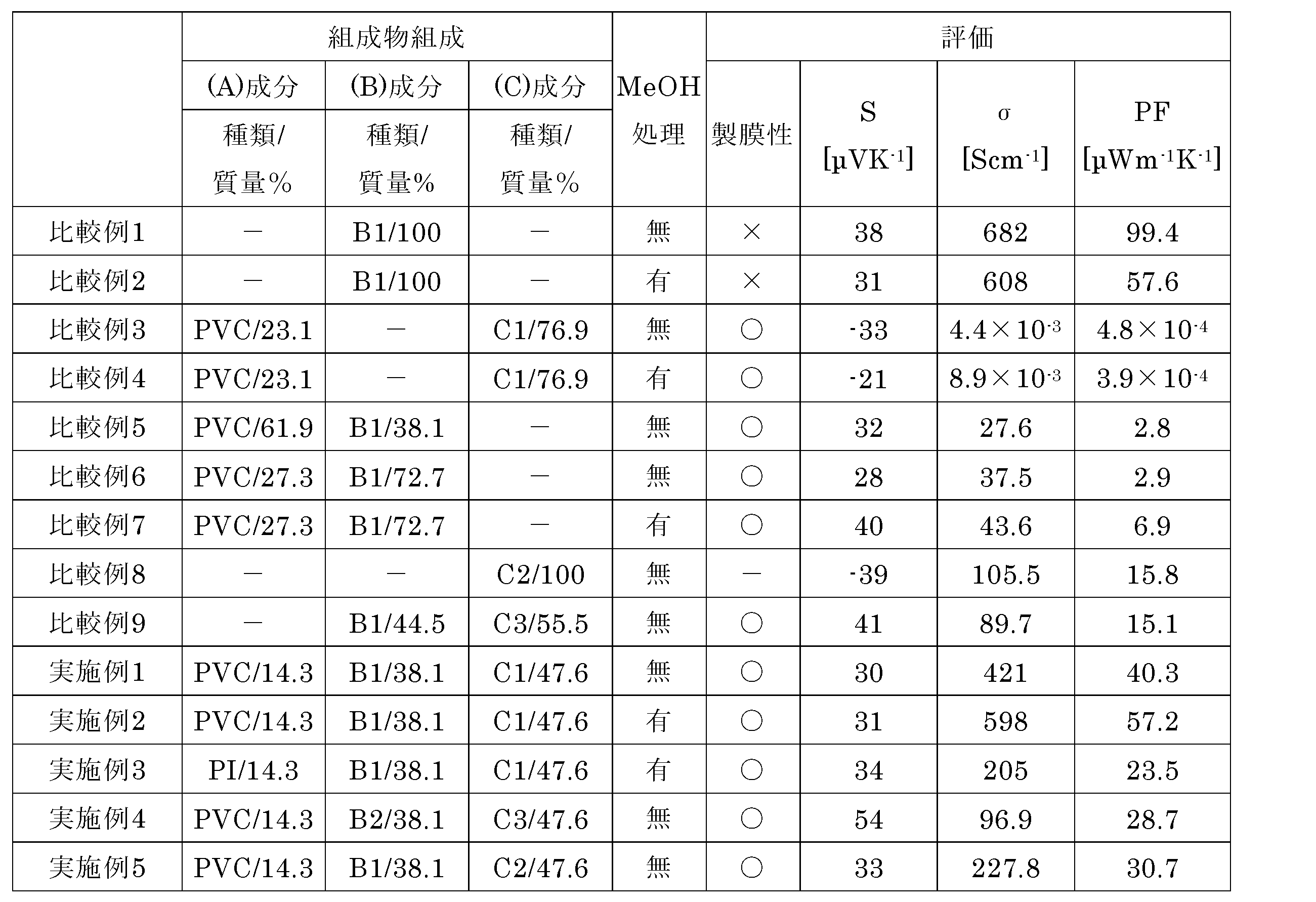
- thermoelectric property evaluation apparatus ZE- 3 For the films, sheets, or blocks obtained in each Example and Comparative Example, the Seebeck coefficient (S), the conductivity ( ⁇ ), and the power factor (PF) at 340 K were respectively measured using the thermoelectric property evaluation apparatus ZE- 3 was measured. These measurement results are shown in Table 1.
- the ratio of the content of the component (A) and the content of the component (C) is the ratio described in Table 1, and the content of the component (A) in the dispersion and the content of the component (C)
- the component (A) and the component (C) were uniformly mixed with N-methyl-2-pyrrolidone so that the total amount became 0.5% by mass to obtain a dispersion.
- As the component (A) and the component (C), those described in Table 1 were used.
- the quartz substrate was heated at 60 ° C. for 10 hours to obtain a film having a thickness of 8 ⁇ m.
- the sheet obtained in Comparative Example 3 was not subjected to methanol treatment, and the sheet obtained in Comparative Example 4 was subjected to methanol treatment.
- the ratio of the content of the component (A) and the content of the component (B) is the ratio described in Table 1, the content of the component (A) in the dispersion, and the content of the component (B)
- the component (A) and the component (B) were uniformly mixed with N-methyl-2-pyrrolidone so that the total amount of was 0.5% by mass to obtain a dispersion.
- As the component (A) and the component (B), those described in Table 1 were used.
- the quartz substrate was heated at 60 ° C. for 10 hours to obtain a film having a thickness of 7 ⁇ m.
- the sheets obtained in Comparative Examples 5 and 6 were not subjected to methanol treatment, and the sheet obtained in Comparative Example 7 was subjected to methanol treatment.
- the thermal conductivity ⁇ (W / mk) was measured to determine the dimensionless figure of merit (ZT).
- ZT dimensionless figure of merit
- the specific heat Cp (J / gK, 25 ° C.) of the film was measured using a differential scanning calorimeter (DSC 204 F1 Phoenix, manufactured by Netch Japan).
- the thermal diffusivity ⁇ (mm 2 / S, 25 ° C.) of the film was measured using a nano flash analyzer (LFA 447 / 2-4 / InSb NanoFlash Xe, manufactured by Netch Japan).
- the density ⁇ (g / cm 3 ) of the film was measured by the Archimedes method. The measured values are as follows. Cp: 0.88 (J / gK, 25 ° C.) ⁇ : 0.079 (mm 2 / S, 25 ° C.) ⁇ : 0.83 (g / cm 3 )
- ZT dimensionless figure of merit
- Component (B) (single-walled carbon nanotube, B1) 4.22 mg and component (C) (TTF, C3) 5.27 mg were uniformly mixed with 2 mL of N, N-dimethylformamide to obtain a dispersion. After casting the obtained dispersion on a quartz substrate, the quartz substrate was heated at 80 ° C. for 2 hours. Next, the quartz substrate was heated at 110 ° C. for 30 minutes to obtain a film having a thickness of 6.3 ⁇ m. The pellets obtained in Comparative Example 9 were not subjected to methanol treatment.
- Example 1 The ratio of the content of the component (A), the content of the component (B), and the content of the component (C) is the ratio described in Table 1, and the content of the component (A) in the dispersion And (A) component, (B) component, and (C) component are made into N so that the sum total of content of (B) component and content of (C) component may be 0.5 mass%.
- -Mix-2-pyrrolidone was mixed uniformly to obtain a dispersion.
- the component (A), the component (B), and the component (C) those listed in Table 1 were used.
- the quartz substrate was heated at 60 ° C. for 10 hours to obtain a film having a thickness of 6.8 ⁇ m.
- the sheet obtained in Example 1 was not subjected to methanol treatment, and the sheets obtained in Examples 2 and 3 were subjected to methanol treatment.
- Example 1 For the film obtained in Example 1, the thermal conductivity ⁇ (W / mk) was measured in the same manner as in Comparative Example 5, and the value of the dimensionless figure of merit (ZT) was calculated. As a result, the ZT value of the film obtained in Example 1 was 0.31 at 343K.
- Example 3 A coating solution containing CNT, PETT, and resin in NMP at the same concentration as in Example 2 was obtained in the same manner as in Example 2 except that PVC was changed to PI. Using the obtained coating solution, film formation and film methanol treatment were performed in the same manner as in Example 2.
- Example 4 (A) component (PVC) 1.36 mg, (B) component (single-walled carbon nanotube, B2) 3.61 mg, and (C) component (TTF, C3) 4.52 mg, N, N-dimethylformamide 2 mL And uniformly mixed to obtain a dispersion. After casting the obtained dispersion on a quartz substrate, the quartz substrate was heated at 80 ° C. for 2 hours. Next, the quartz substrate was heated at 110 ° C. for 30 minutes to obtain a film having a thickness of 4.8 ⁇ m. The film obtained in Example 4 was not subjected to methanol treatment.
- Example 5 (A) component (PVC) 1.36 mg, (B) component (single-walled carbon nanotubes, B1) 3.61 mg, and (C) component (TTF-TCNQ, C2) 4.52 mg are mixed with N, N-dimethyl.
- a dispersion was obtained by uniformly mixing with 2 mL of formamide. After casting the obtained dispersion on a quartz substrate, the quartz substrate was heated at 80 ° C. for 2 hours. Next, the quartz substrate was heated at 110 ° C. for 30 minutes to obtain a film having a thickness of 6.7 ⁇ m. The film obtained in Example 5 was not subjected to methanol treatment.
- Comparative Examples 5 to 7 it is found that when a resin composition comprising (A) an insulating resin and (B) an inorganic thermoelectric conversion material is used, a film having excellent thermoelectric conversion characteristics cannot be formed. Further, according to comparison between Comparative Examples 1 and 2 and Comparative Examples 5 to 7, even though (B) the inorganic thermoelectric conversion material itself has excellent thermoelectric conversion characteristics, (B) the inorganic thermoelectric conversion material ( A) It is understood that the thermoelectric conversion characteristics of the film are greatly impaired by being dispersed in a matrix made of an insulating resin.
- thermoelectric conversion characteristics when a film is formed using a resin composition containing (A) an insulating resin, (B) an inorganic thermoelectric conversion material, and (C) a charge transport material, the thermoelectric conversion characteristics And it turns out that the film which is excellent in flexibility can be formed.
- Example 1 when the film made of the resin composition is treated with an organic solvent such as methanol, the conductivity of the film is increased, and accordingly, the power factor (PF) of the film is increased. You can see that it increases. That is, it can be seen from Example 1 and Example 2 that when a film made of a resin composition containing a predetermined component is treated with a specific type of treatment liquid, the thermoelectric conversion characteristics of the film can be enhanced.
- an organic solvent such as methanol
Landscapes
- Chemical & Material Sciences (AREA)
- Engineering & Computer Science (AREA)
- Health & Medical Sciences (AREA)
- Chemical Kinetics & Catalysis (AREA)
- Medicinal Chemistry (AREA)
- Polymers & Plastics (AREA)
- Organic Chemistry (AREA)
- Nanotechnology (AREA)
- Materials Engineering (AREA)
- Manufacturing & Machinery (AREA)
- Physics & Mathematics (AREA)
- Composite Materials (AREA)
- Condensed Matter Physics & Semiconductors (AREA)
- General Physics & Mathematics (AREA)
- Crystallography & Structural Chemistry (AREA)
- Inorganic Chemistry (AREA)
- Compositions Of Macromolecular Compounds (AREA)
- Electroluminescent Light Sources (AREA)
- Carbon And Carbon Compounds (AREA)
- Manufacture Of Macromolecular Shaped Articles (AREA)
Abstract
Description
本発明に係る熱念変換材料含有樹脂組成物(以下、樹脂組成物とも記す。)は、(A)絶縁性樹脂と、(B)無機熱電変換材料と、(C)電荷輸送材料とを含む。また、樹脂組成物は、(S)有機溶剤を含む液状の組成物であってもよい。さらに、樹脂組成物は、(A)絶縁性樹脂、(B)無機熱電変換材料、(C)電荷輸送材料、及び(S)有機溶剤の以外に、(D)他の成分として、従来から種々の樹脂組成物に配合されている、強化材、充填材、及び添加剤を含んでいてもよい。
以下、樹脂組成物が含む、必須又は任意の成分について説明する。
(A)絶縁性樹脂は、フィルム状に製膜可能なものであれば特に限定されず、従来からフィルム形成用途に用いられている絶縁性の樹脂から適宜選択することができる。(A)絶縁性樹脂は、当業者に一般的に絶縁性の材料であると認識されているものであれば特に限定されない。(A)絶縁性樹脂の電導率は、1S/cm以下が好ましい。また、(A)絶縁性樹脂の熱伝導率は、0.5W/mK以下が好ましく、0.3W/mK以下がより好ましい。
(B)無機熱電変換材料は、従来から当業者に熱電変換能を有する無機材料であると認識されているものであれば特に限定されない。このような、材料の具体例としては、単層カーボンナノチューブ;酸化亜鉛、酸化スズ、チタン酸ストロンチウム、チタン酸バリウム、(Zn,Al)O、NaCo2O4、Ca3Co4O9、Bi2Sr2Co2Oy、及び硫化銀等の金属の酸化物や硫化物;Bi、Sb、Ag、Pb、Ge、Cu、Sn、As、Se、Te、Fe、Mn、Co、及びSiから選択される少なくとも2種以上の元素を含む金属元素複合材料が挙げられる。金属元素複合材料の好適な例としては、BiTe系、BiSb系、BiSbTe系、BiSbSe系、CoSb系、PbTe系、TeSe系、及びSiGe系の材料や、マグネシウムシリサイド系材料(Mg2Si系材料)が挙げられる。
上記の平均粒子径、平均長、及び平均径は、粒子状の無機変換材料の電子顕微鏡観察画像から求められる数平均値である。
(C)電荷輸送材料は、電子又は正孔を輸送するか、輸送を促進させる物質であって、樹脂組成物を用いて形成されるフィルムの熱電変換の効率を高める。樹脂組成物が、(C)電荷輸送材料を含むことにより、樹脂組成物を用いて形成されるフィルムの導電性及びパワーファクターが高まる。
樹脂組成物を用いてキャストフィルムを形成する場合、樹脂組成物は(S)有機溶剤を含んでいてもよい。(S)有機溶剤の種類、(A)絶縁性樹脂を均一に溶解可能なものであれば特に限定されない。このため(S)有機溶剤の種類は、(A)絶縁性樹脂の種類に応じて適宜選択される。なお、(B)無機熱電変換材料、及び(C)電荷輸送材料は、必ずしも(S)有機溶剤に可溶である必要はない。
樹脂組成物は、多様な目的で使用されている種々の樹脂組成物に従来から配合されている強化材や充填材、及び種々の添加剤から選択される1種以上の成分を含んでいてもよい。添加剤の具体例としては可塑剤、分散剤、着色剤、紫外線吸収剤、酸化防止剤、造核剤、及び難燃剤等が挙げられる。これらの強化材、充填材、及び添加剤の使用量は、フィルムを形成する際の製膜性等を考慮しつつ、従来の樹脂組成物におけるこれらの強化材、充填材、及び添加剤の使用量の範囲内で適宜選択される。
樹脂組成物の製造方法は、以上説明した成分を均一に混合できれば特に限定されない。樹脂組成物が(S)有機溶剤を含まない場合、(A)絶縁性樹脂と、(A)絶縁性樹脂以外の成分とを、二本ロール、三本ロール、加圧ニーダー、バンバリーミキサー、単軸押出機、及び二軸押出機等の溶融混練装置を用いて均一に混合して、樹脂組成物が得られる。
以上説明した樹脂組成物を用いてフィルムを形成する方法は特に限定されない。フィルムの製造方法は、樹脂組成物の性状や、樹脂組成物に含まれる樹脂の種類に応じて、公知の方法から適宜選択される。
(ポリ(ニッケル 1,1,2,2-エテンテトラチオラート)(可溶化PETT)の調製)
1,3,4,6-テトラチアペンタレン-2,5-ジオン(TPD、試薬、東京化成工業株式会社製)1g、ナトリウムメトキシド(試薬、和光純薬工業株式会社製)1.2g、及びドデシルトリメチルアンモニウムブロマイド(DTAB、試薬、和光純薬工業株式会社)6.8gを、メタノール200mL中に溶解させた。得られた溶液を、12時間加熱還流させた。次いで、溶液中に塩化ニッケル(II)無水(試薬、和光純薬工業株式会社製)0.63gを加えた。塩化ニッケル(II)無水の添加後、さらに、溶液を12時間加熱還流させた。12時間還流後、溶液を室温下に12時間静置し、沈殿を生成させた。生成した黒色の沈殿物を吸引ろ過により回収した。回収された沈殿物を、メタノール2L、水2L、及びジエチルエーテル50mLを順に用いて洗浄した後、乾燥させて、可溶化PETTを得た。
(電荷移動錯体(TTF-TCNQ)の調製)
7,7,8,8-テトラシアノキノジメタン(TCNQ、試薬、東京化成工業株式会社製)1020.87mgを、アセトニトリル250mLに加え、室温下で12時間撹拌してTCNQのアセトニトリル溶液を得た。次いで、テトラチアフルバレン(TTF、試薬、東京化成工業株式会社製)1021.88mgをアセトニトリル60mgに加えた後、室温で10分間超音波を照射して、TTFのアセトニトリル溶液を得た。
得られたTCNQのアセトニトリル溶液と、TTFのアセトニトリル溶液と混合した後、室温で30分間撹拌した。撹拌により、アセトニトリル中に黒色の沈殿が生成した。沈殿をろ過により回収した後、乾燥させた。乾燥させた沈殿をアセトニトリルで洗浄した後、80℃で15時間真空下に乾燥させて、電荷移動錯体(TTF-TCNQ)1905.50mg(収率93.3%)を得た。
PVC:ポリ塩化ビニル(試薬、和光純薬工業株式会社製)
PI:ポリイミド(Solpit A、ソルピー工業株式会社製)
B1:単層カーボンナノチューブ(Pure Tubes(商品名)、Aldrich社製、平均長1μm、平均径1.4nm)を用いた。
B2:単層カーボンナノチューブ(Single-Walled Carbon Nanotubes、平均径0.8nm、Aldrich社製)
C1:調製例1で得られたPETT
C2:調製例2で得られた電荷移動錯体(TTF-TCNQ)
C3:テトラチアフルバレン(TTF、試薬、東京化成工業株式会社製)
まず、フィルム、又はシートをメタノール中に30分間浸漬させた。次いで、フィルム、又はシートをメタノール中から引き揚げ、70℃のホットプレート上で15分間加熱して、フィルム又はシート乾燥させた。
試薬として購入したシート状のB1を、4mm×16mmの大きさに切り取り、石英基板に張り付けて、ZEM-3で熱電特性を測定した。膜の厚さは18μmであった。
比較例1で得たシートについてはメタノール処理を施さず、比較例2で得たシートについてはメタノール処理を施した。
(A)成分の含有量と、(C)成分の含有量との比率が、表1に記載の比率であり、分散液中の(A)成分の含有量と、(C)成分の含有量との合計が0.5質量%となるように、(A)成分及び(C)成分を、N-メチル-2-ピロリドンと均一に混合して、分散液を得た。(A)成分及び(C)成分としては、表1に記載の種類のものを用いた。得られた分散液を石英基板上にキャストした後、石英基板を60℃で10時間加熱して、膜厚8μmのフィルムを得た。
比較例3で得たシートについてはメタノール処理を施さず、比較例4で得たシートについてはメタノール処理を施した。
(A)成分の含有量と、(B)成分の含有量との比率が、表1に記載の比率であり、分散液中の(A)成分の含有量と、(B)成分の含有量の合計が0.5質量%となるように、(A)成分及び(B)成分を、N-メチル-2-ピロリドンと均一に混合して、分散液を得た。(A)成分及び(B)成分としては、表1に記載の種類のものを用いた。得られた分散液を石英基板上にキャストした後、石英基板を60℃で10時間加熱して、膜厚7μmのフィルムを得た。
比較例5及び6で得たシートについてはメタノール処理を施さず、比較例7で得たシートについてはメタノール処理を施した。
熱伝導率κを測定する際、フィルムの比熱Cp(J/gK、25℃)は、示差走査熱量計(DSC 204 F1 Phoenix、ネッチジャパン社製)を用いて測定した。フィルムの熱拡散率α(mm2/S、25℃)は、ナノフラッシュアナライザ-(LFA 447/2-4/InSb NanoFlash Xe、ネッチジャパン社製)を用いて測定した。フィルムの密度ρ(g/cm3)は、アルキメデス法で測定した。測定された各値は、以下の通りである。
Cp:0.88(J/gK、25℃)
α:0.079(mm2/S、25℃)
ρ:0.83(g/cm3)
(熱伝導率算出式)
κ=α×Cp×ρ
(無次元性能指数算出式)
ZT=(S2×σ×T)÷κ(Tは絶対温度)
調製例2で得られた電荷移動錯体(TTF-TCNQ、C2)をめのう乳鉢で粉砕した。電荷移動錯体(C2)110.34mgを、ペレット作成用の金型に充填した後、電荷移動錯体(C2)の粉末をプレス機でプレスして、10mm×3.0mm×2.3mmのブロック状のペレットを得た。比較例8ではペレットを作成委したため、製膜性の評価を行わなかった。
比較例8で得たペレットについてはメタノール処理を施さなかった。
(B)成分(単層カーボンナノチューブ、B1)4.22mg、及び(C)成分(TTF、C3)5.27mgを、N,N-ジメチルホルムアミド2mLと均一に混合して分散液を得た。得られた分散液を石英基板上にキャストした後、石英基板を80℃で2時間加熱した。次いで、石英基板を110℃で30分間加熱して、膜厚6.3μmのフィルムを得た。
比較例9で得たペレットについてはメタノール処理を施さなかった。
(A)成分の含有量と、(B)成分の含有量と、(C)成分の含有量との比率が、表1に記載の比率であり、分散液中の(A)成分の含有量と、(B)成分の含有量と、(C)成分の含有量との合計が0.5質量%となるように、(A)成分、(B)成分、及び(C)成分を、N-メチル-2-ピロリドンと均一に混合して、分散液を得た。(A)成分、(B)成分、及び(C)成分としては、表1に記載の種類のものを用いた。得られた分散液を石英基板上にキャストした後、石英基板を60℃で10時間加熱して、膜厚6.8μmのフィルムを得た。
実施例1で得たシートについてはメタノール処理を施さず、実施例2及び3で得たシートについてはメタノール処理を施した。
PVCを、PIに変えることの他は、実施例2と同様にして、CNTと、PETTと、樹脂とを、実施例2と同濃度でNMP中に含む塗布液を得た。得られた塗布液を用いて、実施例2と同様にして、フィルム形成と、フィルムのメタノール処理とを行った。
(A)成分(PVC)1.36mgと、(B)成分(単層カーボンナノチューブ、B2)3.61mg、及び(C)成分(TTF、C3)4.52mgを、N,N-ジメチルホルムアミド2mLと均一に混合して分散液を得た。得られた分散液を石英基板上にキャストした後、石英基板を80℃で2時間加熱した。次いで、石英基板を110℃で30分間加熱して、膜厚4.8μmのフィルムを得た。
実施例4で得たフィルムについてはメタノール処理を施さなかった。
(A)成分(PVC)1.36mgと、(B)成分(単層カーボンナノチューブ、B1)3.61mg、及び(C)成分(TTF-TCNQ、C2)4.52mgを、N,N-ジメチルホルムアミド2mLと均一に混合して分散液を得た。得られた分散液を石英基板上にキャストした後、石英基板を80℃で2時間加熱した。次いで、石英基板を110℃で30分間加熱して、膜厚6.7μmのフィルムを得た。
実施例5で得たフィルムについてはメタノール処理を施さなかった。
Claims (8)
- (A)絶縁性樹脂と、(B)無機熱電変換材料と、(C)電荷輸送材料とを含む、熱電変換材料含有樹脂組成物。
- 前記(B)無機熱電変換材料の形態が、平均径が0.5~3000nmであり、アスペクト比(平均長/平均径)が10以上のチューブ又はワイヤーである、請求項1に記載の熱電変換材料含有樹脂組成物。
- 前記(B)無機熱電変換材料が単層カーボンナノチューブである、請求項2に記載の熱電変換材料含有樹脂組成物。
- 前記(A)絶縁性樹脂がポリオレフィン、及びハロゲン化ポリオレフィンからなる群より選択される1種以上である、請求項1~3のいずれか1項に記載の熱電変換材料含有樹脂組成物。
- 前記(A)絶縁性樹脂がポリ塩化ビニルである、請求項4に記載の熱電変換材料含有樹脂組成物。
- 請求項1~5のいずれか1項に記載の熱電変換材料含有樹脂組成物を用いて形成されたフィルム。
- 請求項6に記載のフィルムに対して、脂肪族アルコール類、芳香族溶媒、エーテル類、糖類の水溶液、及び酸又は塩基を含む水溶液からなる群より選択される処理液を接触させる処理を施して得られたフィルム。
- 請求項6又は7に記載のフィルムを備える、熱電変換素子。
Priority Applications (4)
| Application Number | Priority Date | Filing Date | Title |
|---|---|---|---|
| US15/122,467 US10084124B2 (en) | 2014-03-07 | 2015-03-04 | Thermoelectric conversion material-containing resin composition and film formed from thermoelectric conversion material-containing resin composition |
| EP15757929.3A EP3128566B1 (en) | 2014-03-07 | 2015-03-04 | Method of producing film formed from thermoelectric conversion material-containing resin composition |
| CN201580011370.8A CN106165133B (zh) | 2014-03-07 | 2015-03-04 | 含热电转换材料的树脂组合物、以及由含热电转换材料的树脂组合物形成的膜 |
| KR1020167023848A KR102269045B1 (ko) | 2014-03-07 | 2015-03-04 | 열전 변환 재료 함유 수지 조성물, 및 열전 변환 재료 함유 수지 조성물로 이루어지는 필름 |
Applications Claiming Priority (2)
| Application Number | Priority Date | Filing Date | Title |
|---|---|---|---|
| JP2014-045238 | 2014-03-07 | ||
| JP2014045238A JP6256113B2 (ja) | 2014-03-07 | 2014-03-07 | 熱電変換材料含有樹脂組成物からなるフィルムの製造方法および熱電変換素子の製造方法 |
Publications (1)
| Publication Number | Publication Date |
|---|---|
| WO2015133536A1 true WO2015133536A1 (ja) | 2015-09-11 |
Family
ID=54055339
Family Applications (1)
| Application Number | Title | Priority Date | Filing Date |
|---|---|---|---|
| PCT/JP2015/056400 Ceased WO2015133536A1 (ja) | 2014-03-07 | 2015-03-04 | 熱電変換材料含有樹脂組成物、及び熱電変換材料含有樹脂組成物からなるフィルム |
Country Status (6)
| Country | Link |
|---|---|
| US (1) | US10084124B2 (ja) |
| EP (1) | EP3128566B1 (ja) |
| JP (1) | JP6256113B2 (ja) |
| KR (1) | KR102269045B1 (ja) |
| CN (1) | CN106165133B (ja) |
| WO (1) | WO2015133536A1 (ja) |
Cited By (2)
| Publication number | Priority date | Publication date | Assignee | Title |
|---|---|---|---|---|
| CN109075243A (zh) * | 2016-01-15 | 2018-12-21 | 日本瑞翁株式会社 | 热电转换元件用组合物、担载有金属纳米粒子的碳纳米管的制造方法、热电转换元件用成型体及其制造方法、以及热电转换元件 |
| CN113380941A (zh) * | 2021-06-07 | 2021-09-10 | 北京航空航天大学 | 一种可拉伸多孔结构的面外型热电器件 |
Families Citing this family (16)
| Publication number | Priority date | Publication date | Assignee | Title |
|---|---|---|---|---|
| JP2921881B2 (ja) | 1989-10-04 | 1999-07-19 | 鐘淵化学工業株式会社 | 硬質発泡体 |
| JP3023000B2 (ja) | 1991-02-15 | 2000-03-21 | 株式会社アイジー技術研究所 | 目地材 |
| WO2017122808A1 (ja) * | 2016-01-15 | 2017-07-20 | 日本ゼオン株式会社 | 熱電変換素子用フィルムの製造方法 |
| US10186344B2 (en) * | 2016-01-19 | 2019-01-22 | Xerox Corporation | Conductive polymer composite |
| JP6698565B2 (ja) * | 2017-02-28 | 2020-05-27 | 富士フイルム株式会社 | 熱電変換層、熱電変換素子、熱電変換モジュール |
| CN110494997A (zh) * | 2017-03-30 | 2019-11-22 | 琳得科株式会社 | 热电转换模块及其制造方法 |
| JP7209167B2 (ja) * | 2017-05-08 | 2023-01-20 | パナソニックIpマネジメント株式会社 | ジントル相熱電変換材料 |
| CN109309155B (zh) * | 2017-07-28 | 2022-04-19 | 丰田自动车株式会社 | 高锰硅基碲化物热电复合材料及其制备方法 |
| JP7111567B2 (ja) * | 2017-10-31 | 2022-08-02 | 株式会社日本触媒 | 硫化物、熱電変換材料、熱電変換素子、及び硫化物を製造する方法 |
| CN109119528A (zh) * | 2018-08-17 | 2019-01-01 | 深圳大学 | 一种电荷转移复合物修饰的碳纳米管及其制备方法与应用 |
| CN110218077A (zh) * | 2019-04-29 | 2019-09-10 | 哈尔滨工业大学(深圳) | 一种钙钴氧化物/碳纳米管复合热电材料及其制备方法 |
| US12035629B2 (en) | 2019-08-30 | 2024-07-09 | Sumitomo Electric Industries, Ltd. | Thermoelectric conversion material, thermoelectric conversion element, thermoelectric conversion module, and optical sensor |
| JP7441847B2 (ja) | 2019-08-30 | 2024-03-01 | 住友電気工業株式会社 | 熱電変換材料の製造方法 |
| JP7585628B2 (ja) * | 2020-06-17 | 2024-11-19 | artience株式会社 | 熱電変換材料および熱電変換素子 |
| JP7508889B2 (ja) * | 2020-06-23 | 2024-07-02 | artience株式会社 | 熱電変換材料および熱電変換素子 |
| CN115556450A (zh) * | 2022-09-26 | 2023-01-03 | 湖北慧狮塑业股份有限公司 | 一种超薄型聚烯烃干膜保护膜 |
Citations (2)
| Publication number | Priority date | Publication date | Assignee | Title |
|---|---|---|---|---|
| JP2006128444A (ja) * | 2004-10-29 | 2006-05-18 | Toyota Central Res & Dev Lab Inc | 熱電材料 |
| JP2014029932A (ja) * | 2012-07-31 | 2014-02-13 | Nippon Valqua Ind Ltd | 熱電変換材料、熱電変換シートおよびその製造方法ならびに熱電変換モジュール |
Family Cites Families (7)
| Publication number | Priority date | Publication date | Assignee | Title |
|---|---|---|---|---|
| JP4895293B2 (ja) | 2007-01-26 | 2012-03-14 | 新日鐵化学株式会社 | フレキシブル熱電変換素子及びその製造方法 |
| CN101631744A (zh) * | 2007-03-13 | 2010-01-20 | 东洋炭素株式会社 | 含有碳纳米管的碳材料的精制方法及由该精制方法得到的碳材料、以及使用该碳材料的树脂成型体、纤维、散热器、滑动材料、电场电子释放源材料、电极的导电助剂、担载有催化剂的材料及导电性膜 |
| EP2754690B1 (en) | 2007-05-10 | 2017-12-13 | Plastipak Packaging, Inc. | Oxygen scavenging molecules, articles containing same, and methods of their use |
| JP2010245299A (ja) * | 2009-04-06 | 2010-10-28 | Three M Innovative Properties Co | 複合材熱電材料及びその製造方法 |
| CN101931043B (zh) * | 2009-06-19 | 2013-03-20 | 清华大学 | 热电转换材料 |
| JP5713472B2 (ja) * | 2011-03-04 | 2015-05-07 | 独立行政法人産業技術総合研究所 | 熱電変換材料及び該材料を用いたフレキシブル熱電変換素子 |
| US20120234204A1 (en) * | 2011-03-17 | 2012-09-20 | Bayer Materialscience Ag | Vapor phase functionalization of carbon nanotubes |
-
2014
- 2014-03-07 JP JP2014045238A patent/JP6256113B2/ja not_active Expired - Fee Related
-
2015
- 2015-03-04 KR KR1020167023848A patent/KR102269045B1/ko not_active Expired - Fee Related
- 2015-03-04 CN CN201580011370.8A patent/CN106165133B/zh not_active Expired - Fee Related
- 2015-03-04 US US15/122,467 patent/US10084124B2/en active Active
- 2015-03-04 EP EP15757929.3A patent/EP3128566B1/en active Active
- 2015-03-04 WO PCT/JP2015/056400 patent/WO2015133536A1/ja not_active Ceased
Patent Citations (2)
| Publication number | Priority date | Publication date | Assignee | Title |
|---|---|---|---|---|
| JP2006128444A (ja) * | 2004-10-29 | 2006-05-18 | Toyota Central Res & Dev Lab Inc | 熱電材料 |
| JP2014029932A (ja) * | 2012-07-31 | 2014-02-13 | Nippon Valqua Ind Ltd | 熱電変換材料、熱電変換シートおよびその製造方法ならびに熱電変換モジュール |
Non-Patent Citations (1)
| Title |
|---|
| See also references of EP3128566A4 * |
Cited By (3)
| Publication number | Priority date | Publication date | Assignee | Title |
|---|---|---|---|---|
| CN109075243A (zh) * | 2016-01-15 | 2018-12-21 | 日本瑞翁株式会社 | 热电转换元件用组合物、担载有金属纳米粒子的碳纳米管的制造方法、热电转换元件用成型体及其制造方法、以及热电转换元件 |
| CN109075243B (zh) * | 2016-01-15 | 2023-05-09 | 日本瑞翁株式会社 | 热电转换元件用组合物及其制造方法、热电转换元件用成型体及其制造方法及热电转换元件 |
| CN113380941A (zh) * | 2021-06-07 | 2021-09-10 | 北京航空航天大学 | 一种可拉伸多孔结构的面外型热电器件 |
Also Published As
| Publication number | Publication date |
|---|---|
| JP6256113B2 (ja) | 2018-01-10 |
| KR102269045B1 (ko) | 2021-06-23 |
| EP3128566B1 (en) | 2019-07-31 |
| JP2015170766A (ja) | 2015-09-28 |
| CN106165133A (zh) | 2016-11-23 |
| US20170069812A1 (en) | 2017-03-09 |
| KR20160130383A (ko) | 2016-11-11 |
| US10084124B2 (en) | 2018-09-25 |
| EP3128566A1 (en) | 2017-02-08 |
| EP3128566A4 (en) | 2017-11-08 |
| CN106165133B (zh) | 2018-12-21 |
Similar Documents
| Publication | Publication Date | Title |
|---|---|---|
| JP6256113B2 (ja) | 熱電変換材料含有樹脂組成物からなるフィルムの製造方法および熱電変換素子の製造方法 | |
| JP6841533B2 (ja) | 粘性熱電材料、それを用いた熱電変換モジュール、その製造方法、およびペルチェ素子 | |
| CN102800809B (zh) | 使用具有高功函数的聚合物阳极的简化的有机电子器件 | |
| Wang et al. | Polymer composites-based thermoelectric materials and devices | |
| Ju et al. | Solution-processable flexible thermoelectric composite films based on conductive polymer/SnSe 0.8 S 0.2 nanosheets/carbon nanotubes for wearable electronic applications | |
| CN104205383B (zh) | 热电转换材料及其制造方法 | |
| Luo et al. | Melt-mixed thermoplastic composites containing carbon nanotubes for thermoelectric applications | |
| CN103283049A (zh) | 热电装置及其应用 | |
| CN104823280B (zh) | 放射线检测装置 | |
| Oshima et al. | Improvement of stability of n-type super growth CNTs by hybridization with polymer for organic hybrid thermoelectrics | |
| JP5207630B2 (ja) | 有機電界発光素子 | |
| Sarabia-Riquelme et al. | Simple, low-cost, water-processable n-type thermoelectric composite films from multiwall carbon nanotubes in polyvinylpyrrolidone | |
| Tang et al. | Semiconducting polymer contributes favorably to the Seebeck coefficient in multi-component, high-performance n-type thermoelectric nanocomposites | |
| JP7730593B2 (ja) | 熱電材料、その製造方法、および、熱電発電素子 | |
| WO2017122808A1 (ja) | 熱電変換素子用フィルムの製造方法 | |
| Jiang et al. | Flexible polyvinylidene fluoride/multiwall carbon nanotube-based thermoelectric composite films with excellent environmental stability and enhanced power factor from ferroelectric polarization | |
| WO2015129581A1 (ja) | 新規な有機多環芳香族化合物、およびその利用 | |
| Roy et al. | Self-charging photo-power cell based on a novel polymer nanocomposite film with high energy density and durability | |
| JP2021090038A (ja) | 熱電変換材料および熱電変換素子 | |
| CN106058035A (zh) | 一种二亚乙基三胺掺杂的n‑型碳纳米管热电材料及其制备方法 | |
| Okirigiti et al. | Flexible Thermoelectric Materials for Wearable Energy Harvesting: Advances in Polymers and Hybrid Architectures | |
| KR101523135B1 (ko) | 고-일함수 및 고-전도도 하이브리드 전도성 박막 및 이를 포함한 유기 발광 소자 | |
| WO2019130671A1 (ja) | 熱電変換シート | |
| CN114203923B (zh) | 空穴缓冲材料及其制备方法和oled器件 | |
| Paulraj et al. | Organic Semiconductors for Thermoelectric Applications |
Legal Events
| Date | Code | Title | Description |
|---|---|---|---|
| 121 | Ep: the epo has been informed by wipo that ep was designated in this application |
Ref document number: 15757929 Country of ref document: EP Kind code of ref document: A1 |
|
| ENP | Entry into the national phase |
Ref document number: 20167023848 Country of ref document: KR Kind code of ref document: A |
|
| REEP | Request for entry into the european phase |
Ref document number: 2015757929 Country of ref document: EP |
|
| WWE | Wipo information: entry into national phase |
Ref document number: 15122467 Country of ref document: US Ref document number: 2015757929 Country of ref document: EP |
|
| NENP | Non-entry into the national phase |
Ref country code: DE |