WO2015136947A1 - Azaspiro derivatives as trpm8 antagonists - Google Patents
Azaspiro derivatives as trpm8 antagonists Download PDFInfo
- Publication number
- WO2015136947A1 WO2015136947A1 PCT/JP2015/001454 JP2015001454W WO2015136947A1 WO 2015136947 A1 WO2015136947 A1 WO 2015136947A1 JP 2015001454 W JP2015001454 W JP 2015001454W WO 2015136947 A1 WO2015136947 A1 WO 2015136947A1
- Authority
- WO
- WIPO (PCT)
- Prior art keywords
- difluoro
- diazaspiro
- dione
- decane
- oxoethyl
- Prior art date
- Legal status (The legal status is an assumption and is not a legal conclusion. Google has not performed a legal analysis and makes no representation as to the accuracy of the status listed.)
- Ceased
Links
Classifications
-
- C—CHEMISTRY; METALLURGY
- C07—ORGANIC CHEMISTRY
- C07D—HETEROCYCLIC COMPOUNDS
- C07D491/00—Heterocyclic compounds containing in the condensed ring system both one or more rings having oxygen atoms as the only ring hetero atoms and one or more rings having nitrogen atoms as the only ring hetero atoms, not provided for by groups C07D451/00 - C07D459/00, C07D463/00, C07D477/00 or C07D489/00
- C07D491/02—Heterocyclic compounds containing in the condensed ring system both one or more rings having oxygen atoms as the only ring hetero atoms and one or more rings having nitrogen atoms as the only ring hetero atoms, not provided for by groups C07D451/00 - C07D459/00, C07D463/00, C07D477/00 or C07D489/00 in which the condensed system contains two hetero rings
- C07D491/04—Ortho-condensed systems
- C07D491/056—Ortho-condensed systems with two or more oxygen atoms as ring hetero atoms in the oxygen-containing ring
-
- A—HUMAN NECESSITIES
- A61—MEDICAL OR VETERINARY SCIENCE; HYGIENE
- A61K—PREPARATIONS FOR MEDICAL, DENTAL OR TOILETRY PURPOSES
- A61K31/00—Medicinal preparations containing organic active ingredients
- A61K31/33—Heterocyclic compounds
- A61K31/395—Heterocyclic compounds having nitrogen as a ring hetero atom, e.g. guanethidine or rifamycins
- A61K31/41—Heterocyclic compounds having nitrogen as a ring hetero atom, e.g. guanethidine or rifamycins having five-membered rings with two or more ring hetero atoms, at least one of which being nitrogen, e.g. tetrazole
-
- A—HUMAN NECESSITIES
- A61—MEDICAL OR VETERINARY SCIENCE; HYGIENE
- A61K—PREPARATIONS FOR MEDICAL, DENTAL OR TOILETRY PURPOSES
- A61K31/00—Medicinal preparations containing organic active ingredients
- A61K31/33—Heterocyclic compounds
- A61K31/395—Heterocyclic compounds having nitrogen as a ring hetero atom, e.g. guanethidine or rifamycins
- A61K31/41—Heterocyclic compounds having nitrogen as a ring hetero atom, e.g. guanethidine or rifamycins having five-membered rings with two or more ring hetero atoms, at least one of which being nitrogen, e.g. tetrazole
- A61K31/4164—1,3-Diazoles
-
- A—HUMAN NECESSITIES
- A61—MEDICAL OR VETERINARY SCIENCE; HYGIENE
- A61K—PREPARATIONS FOR MEDICAL, DENTAL OR TOILETRY PURPOSES
- A61K31/00—Medicinal preparations containing organic active ingredients
- A61K31/33—Heterocyclic compounds
- A61K31/395—Heterocyclic compounds having nitrogen as a ring hetero atom, e.g. guanethidine or rifamycins
- A61K31/41—Heterocyclic compounds having nitrogen as a ring hetero atom, e.g. guanethidine or rifamycins having five-membered rings with two or more ring hetero atoms, at least one of which being nitrogen, e.g. tetrazole
- A61K31/4164—1,3-Diazoles
- A61K31/4166—1,3-Diazoles having oxo groups directly attached to the heterocyclic ring, e.g. phenytoin
-
- A—HUMAN NECESSITIES
- A61—MEDICAL OR VETERINARY SCIENCE; HYGIENE
- A61K—PREPARATIONS FOR MEDICAL, DENTAL OR TOILETRY PURPOSES
- A61K31/00—Medicinal preparations containing organic active ingredients
- A61K31/33—Heterocyclic compounds
- A61K31/395—Heterocyclic compounds having nitrogen as a ring hetero atom, e.g. guanethidine or rifamycins
- A61K31/41—Heterocyclic compounds having nitrogen as a ring hetero atom, e.g. guanethidine or rifamycins having five-membered rings with two or more ring hetero atoms, at least one of which being nitrogen, e.g. tetrazole
- A61K31/4164—1,3-Diazoles
- A61K31/4178—1,3-Diazoles not condensed 1,3-diazoles and containing further heterocyclic rings, e.g. pilocarpine, nitrofurantoin
-
- A—HUMAN NECESSITIES
- A61—MEDICAL OR VETERINARY SCIENCE; HYGIENE
- A61K—PREPARATIONS FOR MEDICAL, DENTAL OR TOILETRY PURPOSES
- A61K31/00—Medicinal preparations containing organic active ingredients
- A61K31/33—Heterocyclic compounds
- A61K31/395—Heterocyclic compounds having nitrogen as a ring hetero atom, e.g. guanethidine or rifamycins
- A61K31/41—Heterocyclic compounds having nitrogen as a ring hetero atom, e.g. guanethidine or rifamycins having five-membered rings with two or more ring hetero atoms, at least one of which being nitrogen, e.g. tetrazole
- A61K31/4164—1,3-Diazoles
- A61K31/4184—1,3-Diazoles condensed with carbocyclic rings, e.g. benzimidazoles
-
- A—HUMAN NECESSITIES
- A61—MEDICAL OR VETERINARY SCIENCE; HYGIENE
- A61K—PREPARATIONS FOR MEDICAL, DENTAL OR TOILETRY PURPOSES
- A61K31/00—Medicinal preparations containing organic active ingredients
- A61K31/33—Heterocyclic compounds
- A61K31/395—Heterocyclic compounds having nitrogen as a ring hetero atom, e.g. guanethidine or rifamycins
- A61K31/41—Heterocyclic compounds having nitrogen as a ring hetero atom, e.g. guanethidine or rifamycins having five-membered rings with two or more ring hetero atoms, at least one of which being nitrogen, e.g. tetrazole
- A61K31/42—Oxazoles
- A61K31/421—1,3-Oxazoles, e.g. pemoline, trimethadione
-
- A—HUMAN NECESSITIES
- A61—MEDICAL OR VETERINARY SCIENCE; HYGIENE
- A61K—PREPARATIONS FOR MEDICAL, DENTAL OR TOILETRY PURPOSES
- A61K31/00—Medicinal preparations containing organic active ingredients
- A61K31/33—Heterocyclic compounds
- A61K31/395—Heterocyclic compounds having nitrogen as a ring hetero atom, e.g. guanethidine or rifamycins
- A61K31/41—Heterocyclic compounds having nitrogen as a ring hetero atom, e.g. guanethidine or rifamycins having five-membered rings with two or more ring hetero atoms, at least one of which being nitrogen, e.g. tetrazole
- A61K31/42—Oxazoles
- A61K31/422—Oxazoles not condensed and containing further heterocyclic rings
-
- A—HUMAN NECESSITIES
- A61—MEDICAL OR VETERINARY SCIENCE; HYGIENE
- A61K—PREPARATIONS FOR MEDICAL, DENTAL OR TOILETRY PURPOSES
- A61K31/00—Medicinal preparations containing organic active ingredients
- A61K31/33—Heterocyclic compounds
- A61K31/395—Heterocyclic compounds having nitrogen as a ring hetero atom, e.g. guanethidine or rifamycins
- A61K31/41—Heterocyclic compounds having nitrogen as a ring hetero atom, e.g. guanethidine or rifamycins having five-membered rings with two or more ring hetero atoms, at least one of which being nitrogen, e.g. tetrazole
- A61K31/42—Oxazoles
- A61K31/423—Oxazoles condensed with carbocyclic rings
-
- A—HUMAN NECESSITIES
- A61—MEDICAL OR VETERINARY SCIENCE; HYGIENE
- A61K—PREPARATIONS FOR MEDICAL, DENTAL OR TOILETRY PURPOSES
- A61K31/00—Medicinal preparations containing organic active ingredients
- A61K31/33—Heterocyclic compounds
- A61K31/395—Heterocyclic compounds having nitrogen as a ring hetero atom, e.g. guanethidine or rifamycins
- A61K31/41—Heterocyclic compounds having nitrogen as a ring hetero atom, e.g. guanethidine or rifamycins having five-membered rings with two or more ring hetero atoms, at least one of which being nitrogen, e.g. tetrazole
- A61K31/425—Thiazoles
- A61K31/427—Thiazoles not condensed and containing further heterocyclic rings
-
- A—HUMAN NECESSITIES
- A61—MEDICAL OR VETERINARY SCIENCE; HYGIENE
- A61K—PREPARATIONS FOR MEDICAL, DENTAL OR TOILETRY PURPOSES
- A61K31/00—Medicinal preparations containing organic active ingredients
- A61K31/33—Heterocyclic compounds
- A61K31/395—Heterocyclic compounds having nitrogen as a ring hetero atom, e.g. guanethidine or rifamycins
- A61K31/435—Heterocyclic compounds having nitrogen as a ring hetero atom, e.g. guanethidine or rifamycins having six-membered rings with one nitrogen as the only ring hetero atom
-
- A—HUMAN NECESSITIES
- A61—MEDICAL OR VETERINARY SCIENCE; HYGIENE
- A61K—PREPARATIONS FOR MEDICAL, DENTAL OR TOILETRY PURPOSES
- A61K31/00—Medicinal preparations containing organic active ingredients
- A61K31/33—Heterocyclic compounds
- A61K31/395—Heterocyclic compounds having nitrogen as a ring hetero atom, e.g. guanethidine or rifamycins
- A61K31/435—Heterocyclic compounds having nitrogen as a ring hetero atom, e.g. guanethidine or rifamycins having six-membered rings with one nitrogen as the only ring hetero atom
- A61K31/4353—Heterocyclic compounds having nitrogen as a ring hetero atom, e.g. guanethidine or rifamycins having six-membered rings with one nitrogen as the only ring hetero atom ortho- or peri-condensed with heterocyclic ring systems
- A61K31/4355—Heterocyclic compounds having nitrogen as a ring hetero atom, e.g. guanethidine or rifamycins having six-membered rings with one nitrogen as the only ring hetero atom ortho- or peri-condensed with heterocyclic ring systems the heterocyclic ring system containing a five-membered ring having oxygen as a ring hetero atom
-
- A—HUMAN NECESSITIES
- A61—MEDICAL OR VETERINARY SCIENCE; HYGIENE
- A61K—PREPARATIONS FOR MEDICAL, DENTAL OR TOILETRY PURPOSES
- A61K31/00—Medicinal preparations containing organic active ingredients
- A61K31/33—Heterocyclic compounds
- A61K31/395—Heterocyclic compounds having nitrogen as a ring hetero atom, e.g. guanethidine or rifamycins
- A61K31/435—Heterocyclic compounds having nitrogen as a ring hetero atom, e.g. guanethidine or rifamycins having six-membered rings with one nitrogen as the only ring hetero atom
- A61K31/4353—Heterocyclic compounds having nitrogen as a ring hetero atom, e.g. guanethidine or rifamycins having six-membered rings with one nitrogen as the only ring hetero atom ortho- or peri-condensed with heterocyclic ring systems
- A61K31/437—Heterocyclic compounds having nitrogen as a ring hetero atom, e.g. guanethidine or rifamycins having six-membered rings with one nitrogen as the only ring hetero atom ortho- or peri-condensed with heterocyclic ring systems the heterocyclic ring system containing a five-membered ring having nitrogen as a ring hetero atom, e.g. indolizine, beta-carboline
-
- A—HUMAN NECESSITIES
- A61—MEDICAL OR VETERINARY SCIENCE; HYGIENE
- A61K—PREPARATIONS FOR MEDICAL, DENTAL OR TOILETRY PURPOSES
- A61K31/00—Medicinal preparations containing organic active ingredients
- A61K31/33—Heterocyclic compounds
- A61K31/395—Heterocyclic compounds having nitrogen as a ring hetero atom, e.g. guanethidine or rifamycins
- A61K31/435—Heterocyclic compounds having nitrogen as a ring hetero atom, e.g. guanethidine or rifamycins having six-membered rings with one nitrogen as the only ring hetero atom
- A61K31/4353—Heterocyclic compounds having nitrogen as a ring hetero atom, e.g. guanethidine or rifamycins having six-membered rings with one nitrogen as the only ring hetero atom ortho- or peri-condensed with heterocyclic ring systems
- A61K31/4375—Heterocyclic compounds having nitrogen as a ring hetero atom, e.g. guanethidine or rifamycins having six-membered rings with one nitrogen as the only ring hetero atom ortho- or peri-condensed with heterocyclic ring systems the heterocyclic ring system containing a six-membered ring having nitrogen as a ring heteroatom, e.g. quinolizines, naphthyridines, berberine, vincamine
-
- A—HUMAN NECESSITIES
- A61—MEDICAL OR VETERINARY SCIENCE; HYGIENE
- A61K—PREPARATIONS FOR MEDICAL, DENTAL OR TOILETRY PURPOSES
- A61K31/00—Medicinal preparations containing organic active ingredients
- A61K31/33—Heterocyclic compounds
- A61K31/395—Heterocyclic compounds having nitrogen as a ring hetero atom, e.g. guanethidine or rifamycins
- A61K31/435—Heterocyclic compounds having nitrogen as a ring hetero atom, e.g. guanethidine or rifamycins having six-membered rings with one nitrogen as the only ring hetero atom
- A61K31/44—Non condensed pyridines; Hydrogenated derivatives thereof
- A61K31/4427—Non condensed pyridines; Hydrogenated derivatives thereof containing further heterocyclic ring systems
- A61K31/4439—Non condensed pyridines; Hydrogenated derivatives thereof containing further heterocyclic ring systems containing a five-membered ring with nitrogen as a ring hetero atom, e.g. omeprazole
-
- A—HUMAN NECESSITIES
- A61—MEDICAL OR VETERINARY SCIENCE; HYGIENE
- A61K—PREPARATIONS FOR MEDICAL, DENTAL OR TOILETRY PURPOSES
- A61K31/00—Medicinal preparations containing organic active ingredients
- A61K31/33—Heterocyclic compounds
- A61K31/395—Heterocyclic compounds having nitrogen as a ring hetero atom, e.g. guanethidine or rifamycins
- A61K31/435—Heterocyclic compounds having nitrogen as a ring hetero atom, e.g. guanethidine or rifamycins having six-membered rings with one nitrogen as the only ring hetero atom
- A61K31/44—Non condensed pyridines; Hydrogenated derivatives thereof
- A61K31/4427—Non condensed pyridines; Hydrogenated derivatives thereof containing further heterocyclic ring systems
- A61K31/444—Non condensed pyridines; Hydrogenated derivatives thereof containing further heterocyclic ring systems containing a six-membered ring with nitrogen as a ring heteroatom, e.g. amrinone
-
- A—HUMAN NECESSITIES
- A61—MEDICAL OR VETERINARY SCIENCE; HYGIENE
- A61K—PREPARATIONS FOR MEDICAL, DENTAL OR TOILETRY PURPOSES
- A61K31/00—Medicinal preparations containing organic active ingredients
- A61K31/33—Heterocyclic compounds
- A61K31/395—Heterocyclic compounds having nitrogen as a ring hetero atom, e.g. guanethidine or rifamycins
- A61K31/435—Heterocyclic compounds having nitrogen as a ring hetero atom, e.g. guanethidine or rifamycins having six-membered rings with one nitrogen as the only ring hetero atom
- A61K31/44—Non condensed pyridines; Hydrogenated derivatives thereof
- A61K31/445—Non condensed piperidines, e.g. piperocaine
- A61K31/4523—Non condensed piperidines, e.g. piperocaine containing further heterocyclic ring systems
- A61K31/4545—Non condensed piperidines, e.g. piperocaine containing further heterocyclic ring systems containing a six-membered ring with nitrogen as a ring hetero atom, e.g. pipamperone, anabasine
-
- A—HUMAN NECESSITIES
- A61—MEDICAL OR VETERINARY SCIENCE; HYGIENE
- A61K—PREPARATIONS FOR MEDICAL, DENTAL OR TOILETRY PURPOSES
- A61K31/00—Medicinal preparations containing organic active ingredients
- A61K31/33—Heterocyclic compounds
- A61K31/395—Heterocyclic compounds having nitrogen as a ring hetero atom, e.g. guanethidine or rifamycins
- A61K31/435—Heterocyclic compounds having nitrogen as a ring hetero atom, e.g. guanethidine or rifamycins having six-membered rings with one nitrogen as the only ring hetero atom
- A61K31/47—Quinolines; Isoquinolines
- A61K31/4709—Non-condensed quinolines and containing further heterocyclic rings
-
- A—HUMAN NECESSITIES
- A61—MEDICAL OR VETERINARY SCIENCE; HYGIENE
- A61K—PREPARATIONS FOR MEDICAL, DENTAL OR TOILETRY PURPOSES
- A61K31/00—Medicinal preparations containing organic active ingredients
- A61K31/33—Heterocyclic compounds
- A61K31/395—Heterocyclic compounds having nitrogen as a ring hetero atom, e.g. guanethidine or rifamycins
- A61K31/435—Heterocyclic compounds having nitrogen as a ring hetero atom, e.g. guanethidine or rifamycins having six-membered rings with one nitrogen as the only ring hetero atom
- A61K31/47—Quinolines; Isoquinolines
- A61K31/472—Non-condensed isoquinolines, e.g. papaverine
- A61K31/4725—Non-condensed isoquinolines, e.g. papaverine containing further heterocyclic rings
-
- A—HUMAN NECESSITIES
- A61—MEDICAL OR VETERINARY SCIENCE; HYGIENE
- A61K—PREPARATIONS FOR MEDICAL, DENTAL OR TOILETRY PURPOSES
- A61K31/00—Medicinal preparations containing organic active ingredients
- A61K31/33—Heterocyclic compounds
- A61K31/395—Heterocyclic compounds having nitrogen as a ring hetero atom, e.g. guanethidine or rifamycins
- A61K31/495—Heterocyclic compounds having nitrogen as a ring hetero atom, e.g. guanethidine or rifamycins having six-membered rings with two or more nitrogen atoms as the only ring heteroatoms, e.g. piperazine or tetrazines
- A61K31/4965—Non-condensed pyrazines
- A61K31/497—Non-condensed pyrazines containing further heterocyclic rings
-
- A—HUMAN NECESSITIES
- A61—MEDICAL OR VETERINARY SCIENCE; HYGIENE
- A61K—PREPARATIONS FOR MEDICAL, DENTAL OR TOILETRY PURPOSES
- A61K31/00—Medicinal preparations containing organic active ingredients
- A61K31/33—Heterocyclic compounds
- A61K31/395—Heterocyclic compounds having nitrogen as a ring hetero atom, e.g. guanethidine or rifamycins
- A61K31/495—Heterocyclic compounds having nitrogen as a ring hetero atom, e.g. guanethidine or rifamycins having six-membered rings with two or more nitrogen atoms as the only ring heteroatoms, e.g. piperazine or tetrazines
- A61K31/498—Pyrazines or piperazines ortho- and peri-condensed with carbocyclic ring systems, e.g. quinoxaline, phenazine
-
- A—HUMAN NECESSITIES
- A61—MEDICAL OR VETERINARY SCIENCE; HYGIENE
- A61K—PREPARATIONS FOR MEDICAL, DENTAL OR TOILETRY PURPOSES
- A61K31/00—Medicinal preparations containing organic active ingredients
- A61K31/33—Heterocyclic compounds
- A61K31/395—Heterocyclic compounds having nitrogen as a ring hetero atom, e.g. guanethidine or rifamycins
- A61K31/495—Heterocyclic compounds having nitrogen as a ring hetero atom, e.g. guanethidine or rifamycins having six-membered rings with two or more nitrogen atoms as the only ring heteroatoms, e.g. piperazine or tetrazines
- A61K31/4985—Pyrazines or piperazines ortho- or peri-condensed with heterocyclic ring systems
-
- A—HUMAN NECESSITIES
- A61—MEDICAL OR VETERINARY SCIENCE; HYGIENE
- A61K—PREPARATIONS FOR MEDICAL, DENTAL OR TOILETRY PURPOSES
- A61K31/00—Medicinal preparations containing organic active ingredients
- A61K31/33—Heterocyclic compounds
- A61K31/395—Heterocyclic compounds having nitrogen as a ring hetero atom, e.g. guanethidine or rifamycins
- A61K31/495—Heterocyclic compounds having nitrogen as a ring hetero atom, e.g. guanethidine or rifamycins having six-membered rings with two or more nitrogen atoms as the only ring heteroatoms, e.g. piperazine or tetrazines
- A61K31/50—Pyridazines; Hydrogenated pyridazines
- A61K31/501—Pyridazines; Hydrogenated pyridazines not condensed and containing further heterocyclic rings
-
- A—HUMAN NECESSITIES
- A61—MEDICAL OR VETERINARY SCIENCE; HYGIENE
- A61K—PREPARATIONS FOR MEDICAL, DENTAL OR TOILETRY PURPOSES
- A61K31/00—Medicinal preparations containing organic active ingredients
- A61K31/33—Heterocyclic compounds
- A61K31/395—Heterocyclic compounds having nitrogen as a ring hetero atom, e.g. guanethidine or rifamycins
- A61K31/495—Heterocyclic compounds having nitrogen as a ring hetero atom, e.g. guanethidine or rifamycins having six-membered rings with two or more nitrogen atoms as the only ring heteroatoms, e.g. piperazine or tetrazines
- A61K31/50—Pyridazines; Hydrogenated pyridazines
- A61K31/502—Pyridazines; Hydrogenated pyridazines ortho- or peri-condensed with carbocyclic ring systems, e.g. cinnoline, phthalazine
-
- A—HUMAN NECESSITIES
- A61—MEDICAL OR VETERINARY SCIENCE; HYGIENE
- A61K—PREPARATIONS FOR MEDICAL, DENTAL OR TOILETRY PURPOSES
- A61K31/00—Medicinal preparations containing organic active ingredients
- A61K31/33—Heterocyclic compounds
- A61K31/395—Heterocyclic compounds having nitrogen as a ring hetero atom, e.g. guanethidine or rifamycins
- A61K31/495—Heterocyclic compounds having nitrogen as a ring hetero atom, e.g. guanethidine or rifamycins having six-membered rings with two or more nitrogen atoms as the only ring heteroatoms, e.g. piperazine or tetrazines
- A61K31/50—Pyridazines; Hydrogenated pyridazines
- A61K31/5025—Pyridazines; Hydrogenated pyridazines ortho- or peri-condensed with heterocyclic ring systems
-
- A—HUMAN NECESSITIES
- A61—MEDICAL OR VETERINARY SCIENCE; HYGIENE
- A61K—PREPARATIONS FOR MEDICAL, DENTAL OR TOILETRY PURPOSES
- A61K31/00—Medicinal preparations containing organic active ingredients
- A61K31/33—Heterocyclic compounds
- A61K31/395—Heterocyclic compounds having nitrogen as a ring hetero atom, e.g. guanethidine or rifamycins
- A61K31/495—Heterocyclic compounds having nitrogen as a ring hetero atom, e.g. guanethidine or rifamycins having six-membered rings with two or more nitrogen atoms as the only ring heteroatoms, e.g. piperazine or tetrazines
- A61K31/505—Pyrimidines; Hydrogenated pyrimidines, e.g. trimethoprim
- A61K31/506—Pyrimidines; Hydrogenated pyrimidines, e.g. trimethoprim not condensed and containing further heterocyclic rings
-
- A—HUMAN NECESSITIES
- A61—MEDICAL OR VETERINARY SCIENCE; HYGIENE
- A61K—PREPARATIONS FOR MEDICAL, DENTAL OR TOILETRY PURPOSES
- A61K31/00—Medicinal preparations containing organic active ingredients
- A61K31/33—Heterocyclic compounds
- A61K31/395—Heterocyclic compounds having nitrogen as a ring hetero atom, e.g. guanethidine or rifamycins
- A61K31/495—Heterocyclic compounds having nitrogen as a ring hetero atom, e.g. guanethidine or rifamycins having six-membered rings with two or more nitrogen atoms as the only ring heteroatoms, e.g. piperazine or tetrazines
- A61K31/505—Pyrimidines; Hydrogenated pyrimidines, e.g. trimethoprim
- A61K31/517—Pyrimidines; Hydrogenated pyrimidines, e.g. trimethoprim ortho- or peri-condensed with carbocyclic ring systems, e.g. quinazoline, perimidine
-
- A—HUMAN NECESSITIES
- A61—MEDICAL OR VETERINARY SCIENCE; HYGIENE
- A61K—PREPARATIONS FOR MEDICAL, DENTAL OR TOILETRY PURPOSES
- A61K31/00—Medicinal preparations containing organic active ingredients
- A61K31/33—Heterocyclic compounds
- A61K31/395—Heterocyclic compounds having nitrogen as a ring hetero atom, e.g. guanethidine or rifamycins
- A61K31/495—Heterocyclic compounds having nitrogen as a ring hetero atom, e.g. guanethidine or rifamycins having six-membered rings with two or more nitrogen atoms as the only ring heteroatoms, e.g. piperazine or tetrazines
- A61K31/505—Pyrimidines; Hydrogenated pyrimidines, e.g. trimethoprim
- A61K31/519—Pyrimidines; Hydrogenated pyrimidines, e.g. trimethoprim ortho- or peri-condensed with heterocyclic rings
-
- A—HUMAN NECESSITIES
- A61—MEDICAL OR VETERINARY SCIENCE; HYGIENE
- A61K—PREPARATIONS FOR MEDICAL, DENTAL OR TOILETRY PURPOSES
- A61K31/00—Medicinal preparations containing organic active ingredients
- A61K31/33—Heterocyclic compounds
- A61K31/395—Heterocyclic compounds having nitrogen as a ring hetero atom, e.g. guanethidine or rifamycins
- A61K31/535—Heterocyclic compounds having nitrogen as a ring hetero atom, e.g. guanethidine or rifamycins having six-membered rings with at least one nitrogen and one oxygen as the ring hetero atoms, e.g. 1,2-oxazines
- A61K31/5375—1,4-Oxazines, e.g. morpholine
- A61K31/538—1,4-Oxazines, e.g. morpholine ortho- or peri-condensed with carbocyclic ring systems
-
- A—HUMAN NECESSITIES
- A61—MEDICAL OR VETERINARY SCIENCE; HYGIENE
- A61P—SPECIFIC THERAPEUTIC ACTIVITY OF CHEMICAL COMPOUNDS OR MEDICINAL PREPARATIONS
- A61P1/00—Drugs for disorders of the alimentary tract or the digestive system
-
- A—HUMAN NECESSITIES
- A61—MEDICAL OR VETERINARY SCIENCE; HYGIENE
- A61P—SPECIFIC THERAPEUTIC ACTIVITY OF CHEMICAL COMPOUNDS OR MEDICINAL PREPARATIONS
- A61P1/00—Drugs for disorders of the alimentary tract or the digestive system
- A61P1/04—Drugs for disorders of the alimentary tract or the digestive system for ulcers, gastritis or reflux esophagitis, e.g. antacids, inhibitors of acid secretion, mucosal protectants
-
- A—HUMAN NECESSITIES
- A61—MEDICAL OR VETERINARY SCIENCE; HYGIENE
- A61P—SPECIFIC THERAPEUTIC ACTIVITY OF CHEMICAL COMPOUNDS OR MEDICINAL PREPARATIONS
- A61P11/00—Drugs for disorders of the respiratory system
-
- A—HUMAN NECESSITIES
- A61—MEDICAL OR VETERINARY SCIENCE; HYGIENE
- A61P—SPECIFIC THERAPEUTIC ACTIVITY OF CHEMICAL COMPOUNDS OR MEDICINAL PREPARATIONS
- A61P11/00—Drugs for disorders of the respiratory system
- A61P11/06—Antiasthmatics
-
- A—HUMAN NECESSITIES
- A61—MEDICAL OR VETERINARY SCIENCE; HYGIENE
- A61P—SPECIFIC THERAPEUTIC ACTIVITY OF CHEMICAL COMPOUNDS OR MEDICINAL PREPARATIONS
- A61P13/00—Drugs for disorders of the urinary system
- A61P13/02—Drugs for disorders of the urinary system of urine or of the urinary tract, e.g. urine acidifiers
-
- A—HUMAN NECESSITIES
- A61—MEDICAL OR VETERINARY SCIENCE; HYGIENE
- A61P—SPECIFIC THERAPEUTIC ACTIVITY OF CHEMICAL COMPOUNDS OR MEDICINAL PREPARATIONS
- A61P13/00—Drugs for disorders of the urinary system
- A61P13/08—Drugs for disorders of the urinary system of the prostate
-
- A—HUMAN NECESSITIES
- A61—MEDICAL OR VETERINARY SCIENCE; HYGIENE
- A61P—SPECIFIC THERAPEUTIC ACTIVITY OF CHEMICAL COMPOUNDS OR MEDICINAL PREPARATIONS
- A61P13/00—Drugs for disorders of the urinary system
- A61P13/10—Drugs for disorders of the urinary system of the bladder
-
- A—HUMAN NECESSITIES
- A61—MEDICAL OR VETERINARY SCIENCE; HYGIENE
- A61P—SPECIFIC THERAPEUTIC ACTIVITY OF CHEMICAL COMPOUNDS OR MEDICINAL PREPARATIONS
- A61P17/00—Drugs for dermatological disorders
- A61P17/04—Antipruritics
-
- A—HUMAN NECESSITIES
- A61—MEDICAL OR VETERINARY SCIENCE; HYGIENE
- A61P—SPECIFIC THERAPEUTIC ACTIVITY OF CHEMICAL COMPOUNDS OR MEDICINAL PREPARATIONS
- A61P19/00—Drugs for skeletal disorders
- A61P19/02—Drugs for skeletal disorders for joint disorders, e.g. arthritis, arthrosis
-
- A—HUMAN NECESSITIES
- A61—MEDICAL OR VETERINARY SCIENCE; HYGIENE
- A61P—SPECIFIC THERAPEUTIC ACTIVITY OF CHEMICAL COMPOUNDS OR MEDICINAL PREPARATIONS
- A61P25/00—Drugs for disorders of the nervous system
-
- A—HUMAN NECESSITIES
- A61—MEDICAL OR VETERINARY SCIENCE; HYGIENE
- A61P—SPECIFIC THERAPEUTIC ACTIVITY OF CHEMICAL COMPOUNDS OR MEDICINAL PREPARATIONS
- A61P25/00—Drugs for disorders of the nervous system
- A61P25/06—Antimigraine agents
-
- A—HUMAN NECESSITIES
- A61—MEDICAL OR VETERINARY SCIENCE; HYGIENE
- A61P—SPECIFIC THERAPEUTIC ACTIVITY OF CHEMICAL COMPOUNDS OR MEDICINAL PREPARATIONS
- A61P25/00—Drugs for disorders of the nervous system
- A61P25/22—Anxiolytics
-
- A—HUMAN NECESSITIES
- A61—MEDICAL OR VETERINARY SCIENCE; HYGIENE
- A61P—SPECIFIC THERAPEUTIC ACTIVITY OF CHEMICAL COMPOUNDS OR MEDICINAL PREPARATIONS
- A61P25/00—Drugs for disorders of the nervous system
- A61P25/24—Antidepressants
-
- A—HUMAN NECESSITIES
- A61—MEDICAL OR VETERINARY SCIENCE; HYGIENE
- A61P—SPECIFIC THERAPEUTIC ACTIVITY OF CHEMICAL COMPOUNDS OR MEDICINAL PREPARATIONS
- A61P29/00—Non-central analgesic, antipyretic or antiinflammatory agents, e.g. antirheumatic agents; Non-steroidal antiinflammatory drugs [NSAID]
-
- A—HUMAN NECESSITIES
- A61—MEDICAL OR VETERINARY SCIENCE; HYGIENE
- A61P—SPECIFIC THERAPEUTIC ACTIVITY OF CHEMICAL COMPOUNDS OR MEDICINAL PREPARATIONS
- A61P37/00—Drugs for immunological or allergic disorders
- A61P37/02—Immunomodulators
-
- A—HUMAN NECESSITIES
- A61—MEDICAL OR VETERINARY SCIENCE; HYGIENE
- A61P—SPECIFIC THERAPEUTIC ACTIVITY OF CHEMICAL COMPOUNDS OR MEDICINAL PREPARATIONS
- A61P37/00—Drugs for immunological or allergic disorders
- A61P37/08—Antiallergic agents
-
- A—HUMAN NECESSITIES
- A61—MEDICAL OR VETERINARY SCIENCE; HYGIENE
- A61P—SPECIFIC THERAPEUTIC ACTIVITY OF CHEMICAL COMPOUNDS OR MEDICINAL PREPARATIONS
- A61P43/00—Drugs for specific purposes, not provided for in groups A61P1/00-A61P41/00
-
- A—HUMAN NECESSITIES
- A61—MEDICAL OR VETERINARY SCIENCE; HYGIENE
- A61P—SPECIFIC THERAPEUTIC ACTIVITY OF CHEMICAL COMPOUNDS OR MEDICINAL PREPARATIONS
- A61P9/00—Drugs for disorders of the cardiovascular system
-
- A—HUMAN NECESSITIES
- A61—MEDICAL OR VETERINARY SCIENCE; HYGIENE
- A61P—SPECIFIC THERAPEUTIC ACTIVITY OF CHEMICAL COMPOUNDS OR MEDICINAL PREPARATIONS
- A61P9/00—Drugs for disorders of the cardiovascular system
- A61P9/10—Drugs for disorders of the cardiovascular system for treating ischaemic or atherosclerotic diseases, e.g. antianginal drugs, coronary vasodilators, drugs for myocardial infarction, retinopathy, cerebrovascula insufficiency, renal arteriosclerosis
-
- A—HUMAN NECESSITIES
- A61—MEDICAL OR VETERINARY SCIENCE; HYGIENE
- A61P—SPECIFIC THERAPEUTIC ACTIVITY OF CHEMICAL COMPOUNDS OR MEDICINAL PREPARATIONS
- A61P9/00—Drugs for disorders of the cardiovascular system
- A61P9/12—Antihypertensives
-
- C—CHEMISTRY; METALLURGY
- C07—ORGANIC CHEMISTRY
- C07D—HETEROCYCLIC COMPOUNDS
- C07D235/00—Heterocyclic compounds containing 1,3-diazole or hydrogenated 1,3-diazole rings, condensed with other rings
- C07D235/02—Heterocyclic compounds containing 1,3-diazole or hydrogenated 1,3-diazole rings, condensed with other rings condensed with carbocyclic rings or ring systems
-
- C—CHEMISTRY; METALLURGY
- C07—ORGANIC CHEMISTRY
- C07D—HETEROCYCLIC COMPOUNDS
- C07D235/00—Heterocyclic compounds containing 1,3-diazole or hydrogenated 1,3-diazole rings, condensed with other rings
- C07D235/02—Heterocyclic compounds containing 1,3-diazole or hydrogenated 1,3-diazole rings, condensed with other rings condensed with carbocyclic rings or ring systems
- C07D235/04—Benzimidazoles; Hydrogenated benzimidazoles
- C07D235/06—Benzimidazoles; Hydrogenated benzimidazoles with only hydrogen atoms, hydrocarbon or substituted hydrocarbon radicals, directly attached in position 2
-
- C—CHEMISTRY; METALLURGY
- C07—ORGANIC CHEMISTRY
- C07D—HETEROCYCLIC COMPOUNDS
- C07D235/00—Heterocyclic compounds containing 1,3-diazole or hydrogenated 1,3-diazole rings, condensed with other rings
- C07D235/02—Heterocyclic compounds containing 1,3-diazole or hydrogenated 1,3-diazole rings, condensed with other rings condensed with carbocyclic rings or ring systems
- C07D235/04—Benzimidazoles; Hydrogenated benzimidazoles
- C07D235/24—Benzimidazoles; Hydrogenated benzimidazoles with hetero atoms or with carbon atoms having three bonds to hetero atoms with at the most one bond to halogen, e.g. ester or nitrile radicals, directly attached in position 2
- C07D235/26—Oxygen atoms
-
- C—CHEMISTRY; METALLURGY
- C07—ORGANIC CHEMISTRY
- C07D—HETEROCYCLIC COMPOUNDS
- C07D263/00—Heterocyclic compounds containing 1,3-oxazole or hydrogenated 1,3-oxazole rings
- C07D263/52—Heterocyclic compounds containing 1,3-oxazole or hydrogenated 1,3-oxazole rings condensed with carbocyclic rings or ring systems
-
- C—CHEMISTRY; METALLURGY
- C07—ORGANIC CHEMISTRY
- C07D—HETEROCYCLIC COMPOUNDS
- C07D401/00—Heterocyclic compounds containing two or more hetero rings, having nitrogen atoms as the only ring hetero atoms, at least one ring being a six-membered ring with only one nitrogen atom
- C07D401/02—Heterocyclic compounds containing two or more hetero rings, having nitrogen atoms as the only ring hetero atoms, at least one ring being a six-membered ring with only one nitrogen atom containing two hetero rings
- C07D401/10—Heterocyclic compounds containing two or more hetero rings, having nitrogen atoms as the only ring hetero atoms, at least one ring being a six-membered ring with only one nitrogen atom containing two hetero rings linked by a carbon chain containing aromatic rings
-
- C—CHEMISTRY; METALLURGY
- C07—ORGANIC CHEMISTRY
- C07D—HETEROCYCLIC COMPOUNDS
- C07D401/00—Heterocyclic compounds containing two or more hetero rings, having nitrogen atoms as the only ring hetero atoms, at least one ring being a six-membered ring with only one nitrogen atom
- C07D401/02—Heterocyclic compounds containing two or more hetero rings, having nitrogen atoms as the only ring hetero atoms, at least one ring being a six-membered ring with only one nitrogen atom containing two hetero rings
- C07D401/12—Heterocyclic compounds containing two or more hetero rings, having nitrogen atoms as the only ring hetero atoms, at least one ring being a six-membered ring with only one nitrogen atom containing two hetero rings linked by a chain containing hetero atoms as chain links
-
- C—CHEMISTRY; METALLURGY
- C07—ORGANIC CHEMISTRY
- C07D—HETEROCYCLIC COMPOUNDS
- C07D401/00—Heterocyclic compounds containing two or more hetero rings, having nitrogen atoms as the only ring hetero atoms, at least one ring being a six-membered ring with only one nitrogen atom
- C07D401/14—Heterocyclic compounds containing two or more hetero rings, having nitrogen atoms as the only ring hetero atoms, at least one ring being a six-membered ring with only one nitrogen atom containing three or more hetero rings
-
- C—CHEMISTRY; METALLURGY
- C07—ORGANIC CHEMISTRY
- C07D—HETEROCYCLIC COMPOUNDS
- C07D403/00—Heterocyclic compounds containing two or more hetero rings, having nitrogen atoms as the only ring hetero atoms, not provided for by group C07D401/00
- C07D403/02—Heterocyclic compounds containing two or more hetero rings, having nitrogen atoms as the only ring hetero atoms, not provided for by group C07D401/00 containing two hetero rings
- C07D403/06—Heterocyclic compounds containing two or more hetero rings, having nitrogen atoms as the only ring hetero atoms, not provided for by group C07D401/00 containing two hetero rings linked by a carbon chain containing only aliphatic carbon atoms
-
- C—CHEMISTRY; METALLURGY
- C07—ORGANIC CHEMISTRY
- C07D—HETEROCYCLIC COMPOUNDS
- C07D403/00—Heterocyclic compounds containing two or more hetero rings, having nitrogen atoms as the only ring hetero atoms, not provided for by group C07D401/00
- C07D403/02—Heterocyclic compounds containing two or more hetero rings, having nitrogen atoms as the only ring hetero atoms, not provided for by group C07D401/00 containing two hetero rings
- C07D403/10—Heterocyclic compounds containing two or more hetero rings, having nitrogen atoms as the only ring hetero atoms, not provided for by group C07D401/00 containing two hetero rings linked by a carbon chain containing aromatic rings
-
- C—CHEMISTRY; METALLURGY
- C07—ORGANIC CHEMISTRY
- C07D—HETEROCYCLIC COMPOUNDS
- C07D403/00—Heterocyclic compounds containing two or more hetero rings, having nitrogen atoms as the only ring hetero atoms, not provided for by group C07D401/00
- C07D403/02—Heterocyclic compounds containing two or more hetero rings, having nitrogen atoms as the only ring hetero atoms, not provided for by group C07D401/00 containing two hetero rings
- C07D403/12—Heterocyclic compounds containing two or more hetero rings, having nitrogen atoms as the only ring hetero atoms, not provided for by group C07D401/00 containing two hetero rings linked by a chain containing hetero atoms as chain links
-
- C—CHEMISTRY; METALLURGY
- C07—ORGANIC CHEMISTRY
- C07D—HETEROCYCLIC COMPOUNDS
- C07D403/00—Heterocyclic compounds containing two or more hetero rings, having nitrogen atoms as the only ring hetero atoms, not provided for by group C07D401/00
- C07D403/14—Heterocyclic compounds containing two or more hetero rings, having nitrogen atoms as the only ring hetero atoms, not provided for by group C07D401/00 containing three or more hetero rings
-
- C—CHEMISTRY; METALLURGY
- C07—ORGANIC CHEMISTRY
- C07D—HETEROCYCLIC COMPOUNDS
- C07D405/00—Heterocyclic compounds containing both one or more hetero rings having oxygen atoms as the only ring hetero atoms, and one or more rings having nitrogen as the only ring hetero atom
- C07D405/14—Heterocyclic compounds containing both one or more hetero rings having oxygen atoms as the only ring hetero atoms, and one or more rings having nitrogen as the only ring hetero atom containing three or more hetero rings
-
- C—CHEMISTRY; METALLURGY
- C07—ORGANIC CHEMISTRY
- C07D—HETEROCYCLIC COMPOUNDS
- C07D409/00—Heterocyclic compounds containing two or more hetero rings, at least one ring having sulfur atoms as the only ring hetero atoms
- C07D409/02—Heterocyclic compounds containing two or more hetero rings, at least one ring having sulfur atoms as the only ring hetero atoms containing two hetero rings
- C07D409/10—Heterocyclic compounds containing two or more hetero rings, at least one ring having sulfur atoms as the only ring hetero atoms containing two hetero rings linked by a carbon chain containing aromatic rings
-
- C—CHEMISTRY; METALLURGY
- C07—ORGANIC CHEMISTRY
- C07D—HETEROCYCLIC COMPOUNDS
- C07D409/00—Heterocyclic compounds containing two or more hetero rings, at least one ring having sulfur atoms as the only ring hetero atoms
- C07D409/14—Heterocyclic compounds containing two or more hetero rings, at least one ring having sulfur atoms as the only ring hetero atoms containing three or more hetero rings
-
- C—CHEMISTRY; METALLURGY
- C07—ORGANIC CHEMISTRY
- C07D—HETEROCYCLIC COMPOUNDS
- C07D413/00—Heterocyclic compounds containing two or more hetero rings, at least one ring having nitrogen and oxygen atoms as the only ring hetero atoms
- C07D413/02—Heterocyclic compounds containing two or more hetero rings, at least one ring having nitrogen and oxygen atoms as the only ring hetero atoms containing two hetero rings
- C07D413/06—Heterocyclic compounds containing two or more hetero rings, at least one ring having nitrogen and oxygen atoms as the only ring hetero atoms containing two hetero rings linked by a carbon chain containing only aliphatic carbon atoms
-
- C—CHEMISTRY; METALLURGY
- C07—ORGANIC CHEMISTRY
- C07D—HETEROCYCLIC COMPOUNDS
- C07D413/00—Heterocyclic compounds containing two or more hetero rings, at least one ring having nitrogen and oxygen atoms as the only ring hetero atoms
- C07D413/02—Heterocyclic compounds containing two or more hetero rings, at least one ring having nitrogen and oxygen atoms as the only ring hetero atoms containing two hetero rings
- C07D413/10—Heterocyclic compounds containing two or more hetero rings, at least one ring having nitrogen and oxygen atoms as the only ring hetero atoms containing two hetero rings linked by a carbon chain containing aromatic rings
-
- C—CHEMISTRY; METALLURGY
- C07—ORGANIC CHEMISTRY
- C07D—HETEROCYCLIC COMPOUNDS
- C07D413/00—Heterocyclic compounds containing two or more hetero rings, at least one ring having nitrogen and oxygen atoms as the only ring hetero atoms
- C07D413/14—Heterocyclic compounds containing two or more hetero rings, at least one ring having nitrogen and oxygen atoms as the only ring hetero atoms containing three or more hetero rings
-
- C—CHEMISTRY; METALLURGY
- C07—ORGANIC CHEMISTRY
- C07D—HETEROCYCLIC COMPOUNDS
- C07D417/00—Heterocyclic compounds containing two or more hetero rings, at least one ring having nitrogen and sulfur atoms as the only ring hetero atoms, not provided for by group C07D415/00
- C07D417/02—Heterocyclic compounds containing two or more hetero rings, at least one ring having nitrogen and sulfur atoms as the only ring hetero atoms, not provided for by group C07D415/00 containing two hetero rings
- C07D417/06—Heterocyclic compounds containing two or more hetero rings, at least one ring having nitrogen and sulfur atoms as the only ring hetero atoms, not provided for by group C07D415/00 containing two hetero rings linked by a carbon chain containing only aliphatic carbon atoms
-
- C—CHEMISTRY; METALLURGY
- C07—ORGANIC CHEMISTRY
- C07D—HETEROCYCLIC COMPOUNDS
- C07D417/00—Heterocyclic compounds containing two or more hetero rings, at least one ring having nitrogen and sulfur atoms as the only ring hetero atoms, not provided for by group C07D415/00
- C07D417/02—Heterocyclic compounds containing two or more hetero rings, at least one ring having nitrogen and sulfur atoms as the only ring hetero atoms, not provided for by group C07D415/00 containing two hetero rings
- C07D417/10—Heterocyclic compounds containing two or more hetero rings, at least one ring having nitrogen and sulfur atoms as the only ring hetero atoms, not provided for by group C07D415/00 containing two hetero rings linked by a carbon chain containing aromatic rings
-
- C—CHEMISTRY; METALLURGY
- C07—ORGANIC CHEMISTRY
- C07D—HETEROCYCLIC COMPOUNDS
- C07D417/00—Heterocyclic compounds containing two or more hetero rings, at least one ring having nitrogen and sulfur atoms as the only ring hetero atoms, not provided for by group C07D415/00
- C07D417/14—Heterocyclic compounds containing two or more hetero rings, at least one ring having nitrogen and sulfur atoms as the only ring hetero atoms, not provided for by group C07D415/00 containing three or more hetero rings
-
- C—CHEMISTRY; METALLURGY
- C07—ORGANIC CHEMISTRY
- C07D—HETEROCYCLIC COMPOUNDS
- C07D471/00—Heterocyclic compounds containing nitrogen atoms as the only ring hetero atoms in the condensed system, at least one ring being a six-membered ring with one nitrogen atom, not provided for by groups C07D451/00 - C07D463/00
- C07D471/02—Heterocyclic compounds containing nitrogen atoms as the only ring hetero atoms in the condensed system, at least one ring being a six-membered ring with one nitrogen atom, not provided for by groups C07D451/00 - C07D463/00 in which the condensed system contains two hetero rings
- C07D471/04—Ortho-condensed systems
-
- C—CHEMISTRY; METALLURGY
- C07—ORGANIC CHEMISTRY
- C07D—HETEROCYCLIC COMPOUNDS
- C07D473/00—Heterocyclic compounds containing purine ring systems
-
- C—CHEMISTRY; METALLURGY
- C07—ORGANIC CHEMISTRY
- C07D—HETEROCYCLIC COMPOUNDS
- C07D487/00—Heterocyclic compounds containing nitrogen atoms as the only ring hetero atoms in the condensed system, not provided for by groups C07D451/00 - C07D477/00
- C07D487/02—Heterocyclic compounds containing nitrogen atoms as the only ring hetero atoms in the condensed system, not provided for by groups C07D451/00 - C07D477/00 in which the condensed system contains two hetero rings
- C07D487/04—Ortho-condensed systems
-
- C—CHEMISTRY; METALLURGY
- C07—ORGANIC CHEMISTRY
- C07D—HETEROCYCLIC COMPOUNDS
- C07D491/00—Heterocyclic compounds containing in the condensed ring system both one or more rings having oxygen atoms as the only ring hetero atoms and one or more rings having nitrogen atoms as the only ring hetero atoms, not provided for by groups C07D451/00 - C07D459/00, C07D463/00, C07D477/00 or C07D489/00
- C07D491/02—Heterocyclic compounds containing in the condensed ring system both one or more rings having oxygen atoms as the only ring hetero atoms and one or more rings having nitrogen atoms as the only ring hetero atoms, not provided for by groups C07D451/00 - C07D459/00, C07D463/00, C07D477/00 or C07D489/00 in which the condensed system contains two hetero rings
- C07D491/04—Ortho-condensed systems
- C07D491/044—Ortho-condensed systems with only one oxygen atom as ring hetero atom in the oxygen-containing ring
- C07D491/048—Ortho-condensed systems with only one oxygen atom as ring hetero atom in the oxygen-containing ring the oxygen-containing ring being five-membered
Definitions
- This invention relates to azaspiro derivatives that act as modulators of the TRPM8 receptor.
- the present invention also relates to processes for the preparation of novel azaspiro derivatives and to their use in the treatment of a wide range of diseases, syndromes, and disorders, in particular for the treatment of inflammatory, pain and urological diseases or disorders.
- TRP channels are one of the largest groups of ion channels, and they are divided into 6 sub-families (TRPV, TRPM, TRPA, TRPC, TRPP and TRPML). TRP channels are cation-selecive channels that are activated by a variety of physical (e.g., temperature, osmolarity, mechanical) and chemical stimuli. TRPM8 is a member of TRP channel family. The receptor was cloned in 2002 (NPL 1; NPL 2) and it was found to be sensitive to cold temperature and menthol, and therefore named as cold menthol receptor-1 (CMR-1). TRPM8 can sense temperature changes in the range of both innocuous cold (15-28 o C) and noxious cold ( ⁇ 15 o C) as well as by chemical agents such as menthol and icilin.
- CMR-1 cold menthol receptor-1
- TRPM8 is located on primary nociceptive neurons including A-delta and C-fibers and is also modulated by inflammation-mediated second messenger signals (NPL 3; NPL 4).
- NPL 3 inflammation-mediated second messenger signals
- the localization of TRPM8 on both A-delta and C-fibers may provide a basis for abnormal cold sensitivity in pathologic conditions wherein these neurons are altered, resulting in pain, often of a burning nature (NPL 5; NPL 6; NPL 7, NPL 8, NPL 9).
- NPL 5; NPL 6; NPL 7, NPL 8, NPL 9 a burning nature
- Oxaliplatin a third-generation platinum-based chemotherapy drug, induces serious sensory neurotoxicity in patients, which is aggravated by exposure to cold.
- Glenmark group reported that the small molecular TRPM8 antagonists produced a dose-dependent inhibition of nocifensive paw licking in oxaliplatin-induced cold allodynia in mice (NPL 11).
- TRPM8 is also known to be expressed in the brain, odontoblasts, lung, bladder, gastrointestinal tract, blood vessels, prostate and immune cells, thereby providing the possibility for therapeutic modulation in a wide range of maladies.
- WO 2010/037081(PTL 4) and US005739336A (PTL 5) disclose spiropiperidine derivatives.
- the chemical structures of the compounds disclosed in the both patents are quite different from the compounds of the present invention.
- the compounds disclosed in the both patents relate to melanocortin receptor inhibitors and selective 5HT2c receptor antagonists, respectively, which is quite different from TRPM8 receptor antagonist.
- WO 2012/174342 discloses spiro[cyclohexane-oxazolidinone] derivatives.
- the chemical structures of the compounds disclosed in the both patents are quite different from the compounds of the present invention.
- the compounds disclosed in the both patents relate to TRPV4 antagonists and antibacterial agents, respectively, which is quite different from TRPM8 receptor antagonist.
- the invention in WO 2005/044978 discloses spiro derivatives which relate an in the both aspects of chemical structures and biological activities. Therefore the azaspiro derivatives in the present invention which have TRPM8 receptor antagonist activity have never been disclosed in prior arts.
- TRPM8 antagonists that can be used to treat a disease, syndrome, or condition in a mammal in which the disease, syndrome, or condition is affected by the modulation of TRPM8 receptors, such as wherein the condition or disorder is one or more of inflammatory, pain and urological diseases or disorders, including wherein the condition or disorder is one or more of inflammatory, pain and urological diseases or disorders, including chronic pain; neuropathic pain including cold allodynia and diabetic neuropathy; postoperative pain; osteoarthritis; rheumatoid arthritic pain; cancer pain; neuralgia; neuropathies; algesia; dentin hypersensitivity; nerve injury; migraine; cluster and tension headaches; ischaemia; irritable bowel syndrome; Raynaud's syndrome; neurodegeneration; fibromyalgia; stroke; itch; psychiatric disorders including anxiety and depression; inflammatory disorders including asthma, chronic obstructive pulmonary, airways disease including COPD, pulmonary
- TRPM8 antagonists should be well absorbed from the GI tract, be metabolically stable and possess favorable pharmacokinetic properties. They should be non-toxic. Furthermore, the ideal drug candidate will exist in a physical form that is stable, non-hygroscopic and easily formulated. In particular, it has been desired that compounds would have to bind potently to the TRPM8 receptor and show functional activity as antagonists. The present invention provides novel compounds which have excellent TRPM8 antagonistic activities.
- the compounds of the present invention may show less toxicity, good absorption and distribution, good solubility, less plasma protein binding, less drug-drug interaction, good metabolic stability, reduced inhibitory activity at HERG channel, and/or reduced QT prolongation.
- the present invention provides: [1] a compound of the following formula (I) wherein A is aryl and heteroaryl; B is aryl and heteroaryl; L is independently selected from the group consisting of a chemical bond, oxygen, sulfur, -NR 4 -, -(CR C R D ) t -, -O(CR C R D ) t -, -(CR C R D ) t O-, -N(R 4 )(CR C R D ) t -, -(CR C R D ) t N(R 4 )-, -N(R 4 )(CR C R D ) t O-, and -O(CR C R D ) t N(R 4 )- X is independently selected from the group consisting of -CH 2 -, oxygen, sulfur and NH; R A and R B are independently selected from the group consisting of; (1) hydrogen, (2) halogen, (3) (C 1 -C 10 )alkyl, (4) (C
- A is independently selected from the group consisting of benzene, pyridine, pyridazine, pyrazine, pyrimidine, triazine, thiophene, furan, pyrrole, imidazole, pyrazole, thiazole, isothiazole, oxazole, isoxazole, and triazole. or a pharmaceutically acceptable salt thereof or a prodrug thereof;
- the condition or disorder is one or more of inflammatory, pain and urological diseases or disorders, including chronic pain; neuropathic pain including cold allodynia and diabetic neuropathy; postoperative pain; osteoarthritis; rheumatoid arthritic pain; cancer pain; neuralgia; neuropathies; algesia; dentin hypersensitivity; nerve injury; migraine; cluster and tension headaches; ischaemia; irritable bowel syndrome; Raynaud's syndrome; neurodegeneration; fibromyalgia; stroke; itch; psychiatric disorders including anxiety and depression; inflammatory disorders including asthma, chronic obstructive pulmonary, airways disease including COPD, pulmonary hypertension; anxiety including other stress-related disorders; and urological diseases or disorders including detrusor overactivity or overactive bladder, urinary incontinence, neurogenic detrusor overactivity or detrusor hyperflexia, idiopathic detrusor overactivity or detrus
- the condition or disorder is one or more of inflammatory, pain and urological diseases or disorders, including chronic pain; neuropathic pain including cold allodynia and diabetic neuropathy; postoperative pain; osteoarthritis; rheumatoid arthritic pain; cancer pain; neuralgia; neuropathies; algesia; dentin hypersensitivity; nerve injury; migraine; cluster and tension headaches; ischaemia; irritable bowel syndrome; Raynaud's syndrome; neurodegeneration; fibromyalgia; stroke; itch; psychiatric disorders including anxiety and depression; inflammatory disorders including asthma, chronic obstructive pulmonary, airways disease including COPD, pulmonary hypertension; anxiety including other stress-related disorders; and urological diseases or disorders including detrusor overactivity or overactive bladder, urinary incontinence, neurogenic detrusor overactivity or detrusor hyperflexia, idiopathic detrusor overactivity or detrus
- a pharmaceutical composition comprising a compound or a pharmaceutically acceptable salt thereof or a prodrug thereof, as described in any one of [1] to [4], and a pharmaceutically acceptable carrier;
- [12] a process for preparing a pharmaceutical composition, wherein the process comprising mixing a compound described in any one of [1] to [4] or a pharmaceutically acceptable salt thereof or a prodrug thereof and a pharmaceutically acceptable carrier or excipient.
- TRPM8 receptor activity examples include, but are not limited to, TRPM8 related diseases.
- the compounds of the present invention show the TRPM8 receptor antagonistic activity.
- the compounds of the present invention may show less toxicity, good absorption, distribution, good solubility, less protein binding affinity other than TRPM8 receptor, less drug-drug interaction, and good metabolic stability.
- alkyl as a group or part of a group e.g. alkoxy or hydroxyalkyl refers to a straight or branched alkyl group in all isomeric forms.
- C 1 -C 4 alkyl refers to an alkyl group, as defined above, containing at least 1, and at most 4 carbon atoms. Examples of such alkyl groups include methyl, ethyl, propyl, iso-propyl, n-butyl, iso- butyl, sec-butyl, or tert-butyl. Examples of such alkoxy groups include methoxy, ethoxy, propoxy, iso-propoxy, butoxy, iso-butoxy, sec-butoxy and tert-butoxy.
- cycloalkyl means a mono- or bicyclic ring, but not limited to, cyclopropyl, cyclobutyl, cyclopentyl, cyclohexyl, cycloheptyl, norboranyl, and adamantyl groups and the like.
- halogen refers to fluorine (F), chlorine (Cl), bromine (Br), or iodine (I) and the term “halo” refers to the halogen: fluoro (-F), chloro (-Cl), bromo (-Br) and iodo (-I).
- haloalkyl means an alkyl radical which is substituted by halogen atom(s) as defined above including, but not limited to, fluoromethyl, difluoromethyl, trifluoromethyl, 2-fluoroethyl, 2,2-difluoroethyl, 2,2,2-trifluoroethyl, 2,2,2-trichloroethyl, 3-fluoropropyl, 4-fluorobutyl, chloromethyl, trichloromethyl, iodomethyl and bromomethyl groups and the like.
- haloalkoxy means haloalkyl-O-, including, but not limited to, fluoromethoxy, difluoromethoxy, trifluoromethoxy, 2-fluoroethoxy, 2,2-difluoroethoxy, 2,2,2-trifluoroethoxy, 2,2,2-trichloroethoxy, 3-fluoropropoxy, 4-fluorobutoxy, chloromethoxy, trichloromethoxy, iodomethoxy and bromomethoxy groups and the like.
- alkoxy means an O-alkyl group wherein “alkyl” is defined above.
- heterocyclyl means a saturated 3- to 16- membered ring which comprises one or more heteroatoms selected from nitrogen, oxygen and sulfur.
- the heterocyclyl may be a monocyclic, bicyclic or tricyclic ring system, which may include fused, bridged or spiro ring systems.
- heterocyclyl groups examples include azetidinyl, 1,4-dioxanyl, pyrrolidinyl, piperidinyl, piperazinyl, morpholinyl, tetrahydrofuranyl, thiomorpholinyl, tetrahydrothienyl, 2-oxo-pyrrolidinyl, 2-oxo-piperidinyl, 2-oxo-imidazolidinyl, 2-oxo-oxazolidinyl, quinuclidinyl, azabicyclo[3.2.1]octyl, 2-oxa-6-azaspiro[3.4]octyl and N-oxides thereof and S-oxides thereof.
- aryl means unsaturated and partially saturated 6- to 15- membered ring which consists of carbon atoms; Examples of such unsaturated aryl include, but are not limited to, phenyl, naphthyl, indanyl, indenyl, 1,2,3,4-tetrahydronaphthyl, and 1,2-dihydronaphthyl inthereof.
- heteroaryl means 5- to 15- membered ring, preferably 6- to 15-membered ring, in which an aromatic heteroatom containing ring is fused to a non-aromatic ring, such as heterocyclyl ring or cycloalkyl ring, and also means 5- to 15- membered ring, preferably 6- to 15- membered ring, in which an aryl ring is fused to a non-aromatic heteroatom containing ring, such as heterocyclyl ring.
- heteroaryl as used herein, means the following; 1) unsaturated and partially saturated 5- to 15- membered ring, preferably 6- to 15- membered ring, which consists of carbon atoms and from one to five heteroatoms selected from nitrogen, phosphorus, oxygen and sulfur.
- heteroaryl examples include, but are not limited to, thiophenyl, thiazolyl, isoxazolyl, pyrazolyl, tetrazolyl, furanyl, pyrrolyl, imidazolyl, oxazolyl, isothiazolyl, triazolyl, thiadiazolyl, pyridyl, pyrimidyl, pyridazinyl, pyrazinyl, triazinyl, benzofuranyl, benzothiophenyl, benzotriazolyl, indolyl, indazolyl, benzoimidazolyl, pyrrolopyridyl, pyrrolopyrimidinyl, pyrazolopyridyl, pyrazolopyrimidinyl, imidazopyridinyl, furopyridyl, benzoisoxazolyl, imidazopyrazinyl, imidazopyridazinyl, imidazo
- heteroaryl examples include the heteroaryl ring radical consisting of the following rings.
- C 0 means direct bond
- the substituents on the ring of the compound of the present invention may exist on the any atoms if it is chemically allowed.
- protecting group means a hydroxy or amino protecting group which is selected from typical hydroxy or amino protecting groups described in Protective Groups in Organic Synthesis Forth Edition edited by T. W. Greene et al. (John Wiley & Sons, 2006);
- treating refers to curative, palliative and prophylactic treatment, including reversing, alleviating, inhibiting the progress of, or preventing the disorder or condition to which such term applies, or one or more symptoms of such disorder or condition.
- the compounds of formula (I) can form acid addition salts thereof. It will be appreciated that for use in medicine the salts of the compounds of formula (I) should be pharmaceutically acceptable. Suitable pharmaceutically acceptable salts will be apparent to those skilled in the art and include those described in J. Pharm. Sci, 66, 1-19, 1977, such as acid addition salts formed with inorganic acids e.g. hydrochloric, hydrobromic, sulfuric, nitric or phosphoric acid; and organic acids e.g.
- succinic maleic, formic, acetic, trifluoroacetic, propionic, fumaric, citric, tartaric, benzoic, p-toluenesulfonic, methanesulfonic or naphthalenesulfonic acid.
- Certain of the compounds of formula (I) may form acid addition salts with one or more equivalents of the acid.
- the present invention includes within its scope all possible stoichiometric and non-stoichiometric forms.
- certain compounds containing an acidic function such as a carboxy can be isolated in the form of their inorganic salt in which the counter ion can be selected from sodium, potassium, lithium, calcium, magnesium and the like, as well as from organic bases.
- prodrugs of the compounds of formula (I).
- certain derivatives of compounds of formula (I) which may have little or no pharmacological activity themselves, when administered into or onto the body, can be converted into compounds of formula (I) having the desired activity, for example, by hydrolytic cleavage.
- Such derivatives are referred to as "prodrugs”.
- Further information on the use of prodrugs may be found in Pro-drugs as Novel Delivery Systems, Vol. 14, ACS Symposium Series (T Higuchi and W Stella) and Bioreversible Carriers in Drug Design, Pergamon Press, 1987 (ed. E B Roche, American Pharmaceutical Association).
- Prodrugs in accordance with the invention can be produced by replacing appropriate functionalities present in the compounds of formula (I) with certain moieties known to those skilled in the art as 'pro-moieties' as described, for example, in Design of Prodrugs by H Bundgaard (Elsevier, 1985).
- Some examples of prodrugs in accordance with the invention include:
- an amide derivative prepared by reacting with a suitable acid halide or a suitable acid anhydride is exemplified as a prodrug.
- a particularly preferred amide derivative as a prodrug is -NHCO(CH 2 ) 2 OCH 3 , -NHCOCH(NH 2 )CH 3 or the like.
- the compounds of formula (I), salts thereof and prodrugs thereof may be prepared in crystalline or non-crystalline form, and, if crystalline, may optionally be hydrated or solvated.
- This invention includes within its scope stoichiometric hydrates or solvates as well as compounds containing variable amounts of water and/or solvent.
- Salts and solvates having non-pharmaceutically acceptable counter-ions or associated solvents are within the scope of the present invention, for example, for use as intermediates in the preparation of other compounds of formula (I) and their pharmaceutically acceptable salts.
- a prodrug of a compound of formula (I) is a functional derivative of the compound which, upon administration to a patient, eventually liberates the compound of formula (I) in vivo.
- Administration of a compound of formula (I) as a prodrug may enable the skilled artisan to do one or more of the following: (a) modify the onset of action of the compound in vivo; (b) modify the duration of action of the compound in vivo; (c) modify the transportation or distribution of the compound in vivo; (d) modify the solubility of the compound in vivo; and (e) overcome a side effect or other difficulty encountered with the compound.
- Typical functional derivatives used to prepare prodrugs include modifications of the compound that are chemically or enzymatically cleaved in vivo. Such modifications, which include the preparation of phosphates, amides, esters, thioesters, carbonates, and carbamates, are well known to those skilled in the art.
- compounds of formula (I) there may be some chiral carbon atoms.
- compounds of formula (I) exist as stereoisomers.
- the invention extends to all optical isomers such as stereoisomeric forms of the compounds of formula (I) including enantiomers, diastereoisomers and mixtures thereof, such as racemates.
- the different stereoisomeric forms may be separated or resolved one from the other by conventional methods or any given isomer may be obtained by conventional stereoselective or asymmetric syntheses.
- the invention also includes isotopically-labeled compounds, which are identical to those described herein, but for the fact that one or more atoms are replaced by an atom having an atomic mass or mass number different from the atomic mass or mass number usually found in nature.
- isotopes that can be incorporated into compounds of the invention include isotopes of hydrogen, carbon, nitrogen, oxygen, phosphorous, fluorine, iodine, and chlorine, such as 3 H, 11 C, 14 C, 18 F, 123 I and 125 I.
- Compounds of the invention that contain the aforementioned isotopes and/or other isotopes of other atoms are within the scope of the present invention.
- Isotopically-labeled compounds of the present invention for example those into which radioactive isotopes such as 3 H, 14 C are incorporated, are useful in drug and/or substrate tissue distribution assays. Tritiated, i.e., 3 H, and carbon-14, i.e., 14 C, isotopes are particularly preferred for their ease of preparation and detectability. 11 C and 18 F isotopes are particularly useful in PET (positron emission tomography), and 125 I isotopes are particularly useful in SPECT (single photon emission computerized tomography), all useful in brain imaging.
- lsotopically labeled compounds of the invention can generally be prepared by carrying out the procedures disclosed in the Schemes and/or in the Examples below, then substituting a readily available isotopically labeled reagent for a non-isotopically labeled reagent.
- potencies and efficacies of the compounds of this invention for TRPM8 can be determined by reporter assay performed on the human cloned receptor as described herein.
- Compounds of formula (I) have demonstrated antagonistic activity at the TRPM8 receptor, using the functional assay described herein.
- Compounds of formula (I) and pharmaceutically acceptable salts thereof are therefore of use in the treatment of conditions or disorders which are mediated via the TRPM8 receptor.
- the compounds of formula (I) and pharmaceutically acceptable salts thereof are of use in the treatment of a wide range of diseases, syndromes, and disorders, in particular for the treatment of inflammatory, pain and urological diseases or disorders, such as wherein the condition or disorder is one or more of inflammatory, pain and urological diseases or disorders, including chronic pain; neuropathic pain including cold allodynia and diabetic neuropathy; postoperative pain; osteoarthritis; rheumatoid arthritic pain; cancer pain; neuralgia; neuropathies; algesia; dentin hypersensitivity; nerve injury; migraine; cluster and tension headaches; ischaemia; irritable bowel syndrome; Raynaud's syndrome; neurodegeneration; fibromyalgia; stroke; itch; psychiatric disorders including anxiety and depression; inflammatory disorders including asthma, chronic obstructive
- treatment includes prophylaxis as well as alleviation of established symptoms as described above.
- a pharmaceutical composition of the invention which may be prepared by admixture, suitably at ambient temperature and atmospheric pressure, is usually adapted for oral, parenteral or rectal administration and, as such, may be in the form of tablets, capsules, oral liquid preparations, powders, granules, lozenges, reconstitutable powders, injectable or infusible solutions or suspensions or suppositories. Orally administered compositions are generally preferred. Tablets and capsules for oral administration may be in unit dose form, and may contain conventional excipients, such as binding agents (e.g. pregelatinised maize starch, polyvinylpyrrolidone or hydroxypropyl methylcellulose); fillers (e.g.
- binding agents e.g. pregelatinised maize starch, polyvinylpyrrolidone or hydroxypropyl methylcellulose
- fillers e.g.
- lactose microcrystalline cellulose or calcium hydrogen phosphate
- tabletting lubricants e.g. magnesium stearate, talc or silica
- disintegrants e.g. potato starch or sodium starch glycolate
- acceptable wetting agents e.g. sodium lauryl sulphate.
- the tablets may be coated according to methods well known in normal pharmaceutical practice.
- Oral liquid preparations may be in the form of, for example, aqueous or oily suspension, solutions, emulsions, syrups or elixirs, or may be in the form of a dry product for reconstitution with water or other suitable vehicle before use.
- Such liquid preparations may contain conventional additives such as suspending agents (e.g. sorbitol syrup, cellulose derivatives or hydrogenated edible fats), emulsifying agents (e.g. lecithin or acacia), non-aqueous vehicles (which may include edible oils e.g. almond oil, oily esters, ethyl alcohol or fractionated vegetable oils), preservatives (e.g.
- Preparations for oral administration may be suitably formulated to give controlled release of the active compound or pharmaceutically acceptable salt thereof.
- fluid unit dosage forms are prepared utilising a compound of formula (I) or pharmaceutically acceptable salt thereof and a sterile vehicle.
- Formulations for injection may be presented in unit dosage form e.g. in ampoules or in multi-dose, utilising a compound of formula (I) or pharmaceutically acceptable salt thereof and a sterile vehicle, optionally with an added preservative.
- the compositions may take such forms as suspensions, solutions or emulsions in oily or aqueous vehicles, and may contain formulatory agents such as suspending, stabilising and/or dispersing agents.
- the active ingredient may be in powder form for constitution with a suitable vehicle, e.g. sterile pyrogen-free water, before use.
- the compound depending on the vehicle and concentration used, can be either suspended or dissolved in the vehicle.
- the compound can be dissolved for injection and filter sterilised before filling into a suitable vial or ampoule and sealing.
- adjuvants such as a local anaesthetic, preservatives and buffering agents are dissolved in the vehicle.
- the composition can be frozen after filling into the vial and the water removed under vacuum.
- Parenteral suspensions are prepared in substantially the same manner, except that the compound is suspended in the vehicle instead of being dissolved, and sterilisation cannot be accomplished by filtration.
- the compound can be sterilised by exposure to ethylene oxide before suspension in a sterile vehicle.
- a surfactant or wetting agent is included in the composition to facilitate uniform distribution of the compound.
- Lotions may be formulated with an aqueous or oily base and will in general also contain one or more emulsifying agents, stabilising agents, dispersing agents, suspending agents, thickening agents, or colouring agents. Drops may be formulated with an aqueous or non-aqueous base also comprising one or more dispersing agents, stabilising agents, solubilising agents or suspending agents. They may also contain a preservative.
- the compounds of formula (I) or pharmaceutically acceptable salts thereof may also be formulated in rectal compositions such as suppositories or retention enemas, e.g. containing conventional suppository bases such as cocoa butter or other glycerides.
- the compounds of formula (I) or pharmaceutically acceptable salts may also be formulated as depot preparations. Such long acting formulations may be administered by implantation (for example subcutaneously or intramuscularly) or by intramuscular injection.
- the compounds of formula (I) or pharmaceutically acceptable salts may be formulated with suitable polymeric or hydrophobic materials (for example as an emulsion in an acceptable oil) or ion exchange resins, or as sparingly soluble derivatives, for example, as a sparingly soluble salt.
- the compounds formula (I) or pharmaceutically acceptable salts thereof may be formulated as solutions for administration via a suitable metered or unitary dose device or alternatively as a powder mix with a suitable carrier for administration using a suitable delivery device.
- compounds of formula (I) or pharmaceutically acceptable salts thereof may be formulated for oral, buccal, parenteral, topical (including ophthalmic and nasal), depot or rectal administration or in a form suitable for administration by inhalation or insufflation (either through the mouth or nose).
- the compounds of formula (I) and pharmaceutically acceptable salts thereof may be formulated for topical administration in the form of ointments, creams, gels, lotions, pessaries, aerosols or drops (e.g.
- Ointments and creams may, for example, be formulated with an aqueous or oily base with the addition of suitable thickening and/or gelling agents.
- Ointments for administration to the eye may be manufactured in a sterile manner using sterilized components.
- a TRPM8 antagonist may be usefully combined with another pharmacologically active compound, or with two or more other pharmacologically active compounds, particularly in the treatment of inflammatory, pain and urological diseases or disorders.
- a TRPM8 antagonist particularly a compound of formula (I), or a pharmaceutically acceptable salt or solvate thereof, as defined above, may be administered simultaneously, sequentially or separately in combination with one or more agents selected from:
- an opioid analgesic e.g. morphine, heroin, hydromorphone, oxymorphone, levorphanol, levallorphan, methadone, meperidine, fentanyl, cocaine, codeine, dihydrocodeine, oxycodone, hydrocodone, propoxyphene, nalmefene, nalorphine, naloxone, naltrexone, buprenorphine, butorphanol, nalbuphine or pentazocine;
- opioid analgesic e.g. morphine, heroin, hydromorphone, oxymorphone, levorphanol, levallorphan, methadone, meperidine, fentanyl, cocaine, codeine, dihydrocodeine, oxycodone, hydrocodone, propoxyphene, nalmefene, nalorphine, naloxone, naltrexone, buprenorphine, butorphanol, nal
- NSAID nonsteroidal antiinflammatory drug
- diclofenac diflusinal, etodolac
- fenbufen fenoprofen
- flufenisal flurbiprofen
- ibuprofen indomethacin
- ketoprofen ketorolac
- meclofenamic acid mefenamic acid, meloxicam
- nabumetone naproxen
- nimesulide nitroflurbiprofen
- olsalazine oxaprozin
- phenylbutazone piroxicam
- sulfasalazine sulindac
- tolmetin or zomepirac a nonsteroidal antiinflammatory drug
- a barbiturate sedative e.g. amobarbital, aprobarbital, butabarbital, butabital, mephobarbital, metharbital, methohexital, pentobarbital, phenobartital, secobarbital, talbutal, thiamylal or thiopental;
- a benzodiazepine having a sedative action e.g. chlordiazepoxide, clorazepate, diazepam, flurazepam, lorazepam, oxazepam, temazepam or triazolam;
- an H1 antagonist having a sedative action e.g. diphenhydramine, pyrilamine, promethazine, chlorpheniramine or chlorcyclizine; - a sedative such as glutethimide, meprobamate, methaqualone or dichloralphenazone;
- a skeletal muscle relaxant e.g. baclofen, carisoprodol, chlorzoxazone, cyclobenzaprine, methocarbamol or orphrenadine;
- an NMDA receptor antagonist e.g. dextromethorphan ((+)-3-methoxy-N-methylmorphinan) or its metabolite dextrorphan ((+)-3-hydroxy-N-methylmorphinan), ketamine, memantine, pyrroloquinoline quinine, cis-4-(phosphonomethyl)-2-piperidinecarboxylic acid, budipine, EN-3231 (MorphiDex(registered trademark), a combination formulation of morphine and dextromethorphan), topiramate, neramexane or perzinfotel including an NR2B antagonist, e.g.
- an NMDA receptor antagonist e.g. dextromethorphan ((+)-3-methoxy-N-methylmorphinan) or its metabolite dextrorphan ((+)-3-hydroxy-N-methylmorphinan), ketamine, memantine, pyrroloquinoline quinine, cis-4
- an alpha-adrenergic e.g. doxazosin, tamsulosin, clonidine, guanfacine, dexmedetomidine, modafinil, or 4-amino-6,7-dimethoxy-2-(5-methanesulfonamido-1,2,3,4-tetrahydroisoquinol-2-yl)-5-(2-pyridyl)quinazoline;
- a tricyclic antidepressant e.g. desipramine, imipramine, amitriptyline or nortriptyline;
- an anticonvulsant e.g. carbamazepine, lamotrigine, topiramate or valproate;
- a tachykinin (NK) antagonist particularly an NK-3, NK-2 or NK-1 antagonist, e.g. alphaR,9R)-7-[3,5-bis(trifluoromethyl)benzyl]-8,9,10,11-tetrahydro-9-methyl-5-(4-methylphenyl)-7H-[1,4]diazocino[2,1-g][1,7]-naphthyridine-6,13-dione (TAK-637), 5-[[(2R,3S)-2-[(1R)-1-[3,5-bis(trifluoromethyl)phenyl]ethoxy-3-(4-fluorophenyl)-4-morpholinyl]methyl]-1,2-dihydro-3H-1,2,4-triazol-3-one (MK-869, aprepitant), lanepitant, dapitant or 3-[[2-methoxy-5-(trifluoromethoxy)phenyl]methylamino]
- a muscarinic antagonist e.g. oxybutynin, tolterodine, propiverine, trospium chloride, darifenacin, solifenacin, temiverine and ipratropium;
- COX-2 selective inhibitor e.g. celecoxib, rofecoxib, parecoxib, valdecoxib, deracoxib, etoricoxib, or lumiracoxib;
- coal-tar analgesic in particular paracetamol
- a neuroleptic such as droperidol, chlorpromazine, haloperidol, perphenazine, thioridazine, mesoridazine, trifluoperazine, fluphenazine, clozapine, olanzapine, risperidone, ziprasidone, quetiapine, sertindole, aripiprazole, sonepiprazole, blonanserin, iloperidone, perospirone, raclopride, zotepine, bifeprunox, asenapine, lurasidone, amisulpride, balaperidone, palindore, eplivanserin, osanetant, rimonabant, meclinertant, Miraxion(registered trademark) or sarizotan;
- vanilloid receptor agonist e.g. resiniferatoxin
- antagonist e.g. capsazepine
- V1, V2, V3, V4, M8, M2, A1 a transient receptor potential cation channel subtype (V1, V2, V3, V4, M8, M2, A1) agonist or antagonist;
- beta-adrenergic such as propranolol
- corticosteroid such as dexamethasone
- a 5-HT receptor agonist or antagonist particularly a 5-HT1B/1D agonist such as eletriptan, sumatriptan, naratriptan, zolmitriptan or rizatriptan;
- a 5-HT2A receptor antagonist such as R(+)-alpha-(2,3-dimethoxy-phenyl)-1-[2-(4-fluorophenylethyl)]-4-piperidinemethanol (MDL-100907);
- a cholinergic (nicotinic) analgesic such as ispronicline (TC-1734), (E)-N-methyl-4-(3-pyridinyl)-3-buten-1-amine (RJR-2403), (R)-5-(2-azetidinylmethoxy)-2-chloropyridine (ABT-594) or nicotine;
- a PDEV inhibitor such as 5-[2-ethoxy-5-(4-methyl-1-piperazinylsulphonyl)phenyl]-1-methyl-3-n-propyl-1,6-dihydro-7H-pyrazolo[4,3-d]pyrimidin-7-one (sildenafil), (6R,12aR)-2,3,6,7,12,12a-hexahydro-2-methyl-6-(3,4-methylenedioxyphenyl)pyrazino[2',1':6,1]pyrido[3,4-b]indole-1,4-dione (IC-351 or tadalafil), 2-[2-ethoxy-5-(4-ethyl-piperazin-1-yl-sulphonyl)phenyl]-5-methyl-7-propyl-3H-imidazo[5,1-f][1,2,4]triazin-4-one (vardenafil), 5-(5-acetyl-2-butoxy
- an alpha-2-delta ligand such as gabapentin, pregabalin, 3-methylgabapentin, (3-(aminomethyl)-bicyclo[3.2.0]hept-3-yl)acetic acid, (3S,5R)-3-(aminomethyl)-5-methylheptanoic acid, (3S,5R)-3-amino-5-methylheptanoic acid, , (3S,5R)-3-amino-5-methyloctanoic acid, (2S,4S)-4-(3-chlorophenoxy)proline, (2S,4S)-4-(3-fluorobenzyl)proline, [(1R,5R,6S)-6-(aminomethyl)bicyclo[3.2.0]hept-6-yl]acetic acid, 3-((1-(aminomethyl)cyclohexyl)methyl)-4H-[1,2,4]oxadiazol-5-one, C-[1-((1H-te
- mGluR1 metabotropic glutamate subtype 1 receptor
- a serotonin reuptake inhibitor such as sertraline, sertraline metabolite demethylsertraline, fluoxetine, norfluoxetine (fluoxetine desmethyl metabolite), fluvoxamine, paroxetine, citalopram, citalopram metabolite desmethylcitalopram, escitalopram, d,l-fenfluramine, femoxetine, ifoxetine, cyanodothiepin, litoxetine, dapoxetine, nefazodone, cericlamine and trazodone;
- noradrenaline (norepinephrine) reuptake inhibitor such as maprotiline, lofepramine, mirtazapine, oxaprotiline, fezolamine, tomoxetine, mianserin, bupropion, bupropron metabolite hydroxybupropion, nomifensine and viloxazine (Vivalan (registered trademark)), especially a selective noradrenaline reuptake inhibitor such as reboxetine, in particular (S,S)-reboxetine;
- a dual serotonin-noradrenaline reuptake inhibitor such as venlafaxine, venlafaxine metabolite O-desmethylvenlafaxine, clomipramine, clomipramine metabolite desmethylclomipramine, duloxetine, milnacipran and imipramine;
- an inducible nitric oxide synthase (iNOS) inhibitor such as S-[2-[(1-iminoethyl)amino]ethyl]-L-homocysteine, S-[2-[(1-iminoethyl)-amino]ethyl]-4,4-dioxo-L-cysteine, S-[2-[(1-iminoethyl)amino]ethyl]-2-methyl-L-cysteine, (2S,5Z)-2-amino-2-methyl-7-[(1-iminoethyl)amino]-5-heptenoic acid, 2-[[(1R,3S)-3-amino-4-hydroxy-1-(5-thiazolyl)-butyl]thio]-5-chloro-3-pyridinecarbonitrile; 2-[[[(1R,3S)-3-amino-4-hydroxy-1-(5-thiazolyl)
- an acetylcholinesterase inhibitor such as donepezil
- a prostaglandin E2 subtype 4 (EP4) antagonist such as N-[( ⁇ 2-[4-(2-ethyl-4,6-dimethyl-1H-imidazo[4,5-c]pyridin-1-yl)phenyl]ethyl ⁇ amino)-carbonyl]-4-methylbenzenesulfonamide or 4-[(1S)-1-( ⁇ [5-chloro-2-(3-fluorophenoxy)pyridin-3-yl]carbonyl ⁇ amino)ethyl]benzoic acid;
- leukotriene B4 antagonist such as 1-(3-biphenyl-4-ylmethyl-4-hydroxy-chroman-7-yl)-cyclopentanecarboxylic acid (CP-105696), 5-[2-(2-Carboxyethyl)-3-[6-(4-methoxyphenyl)-5E-hexenyl]oxyphenoxy]-valeric acid (ONO-4057) or DPC-11870,
- a 5-lipoxygenase inhibitor such as zileuton, 6-[(3-fluoro-5-[4-methoxy-3,4,5,6-tetrahydro-2H-pyran-4-yl])phenoxy-methyl]-1-methyl-2-quinolone (ZD-2138), or 2,3,5-trimethyl-6-(3-pyridylmethyl)-1,4-benzoquinone (CV-6504);
- a sodium channel blocker such as lidocaine
- a calcium channel blocker such as ziconotide, zonisamide, mibefradil
- a 5-HT3 antagonist such as ondansetron
- a chemotherapy drug such as oxaliplatin, 5-fluorouracil, leukovorin, paclitaxel
- CGRP calcitonin gene related peptide
- BK1 and BK2 bradykinin
- - a voltage gated sodium dependent channel blocker Na v1.3 , Na v1.7 , Na v1.8
- - a voltage dependent calcium channel blocker N-type, T-type
- P2X ion channel type ATP receptor
- ASIC1a, ASIC3 acid-sensing ion channel
- - angiotensin AT2 antagonist - a chemokine CCR2B receptor antagonist
- - a sigma1 receptor agonist or antagonist a 5-HT3 antagonist, such as ondansetron
- a chemotherapy drug such as oxaliplatin, 5-fluorouracil, leuk
- composition may contain from 0.1% to 99% by weight, preferably from 10 to 60% by weight, of the active material, depending on the method of administration.
- the dose of the compound used in the treatment of the aforementioned disorders will vary in the usual way with the seriousness of the disorders, the weight of the sufferer, and other similar factors.
- a therapeutically effective amount of a compound of formula (I) or a pharmaceutical composition thereof includes a dose range from about 0.05 mg to about 3000 mg, in particular from about 1 mg to about 1000 mg or, more particularly, from about 10 mg to about 500 mg of active ingredient in a regimen of about once a day or more than once a day, for example two, three or four times a day for an average (70 kg) human; although, it is apparent to one skilled in the art that the therapeutically effective amount for active compounds of the invention will vary as will the diseases, syndromes, conditions, and disorders being treated.
- a pharmaceutical composition is preferably provided in the form of tablets containing about 0.01, about 10, about 50, about 100, about 150, about 200, about 250, and about 500 milligrams of the inventive compound as the active ingredient.
- a compound of formula (I) may be administered in a single daily dose, or the total daily dosage may be administered in divided doses of two, three and four times daily.
- Optimal dosages of a compound of formula (I) to be administered may be readily determined and will vary with the particular compound used, the mode of administration, the strength of the preparation, and the advancement of the disease, syndrome, condition, or disorder.
- factors associated with the particular subject being treated including subject age, weight, diet and time of administration, will result in the need to adjust the dose to achieve an appropriate therapeutic level.
- Compounds of formula (I) may be administered in any of the foregoing compositions and dosage regimens or by means of those compositions and dosage regimens established in the art whenever use of a compound of formula (I) is required for a subject in need thereof.
- the compounds of formula (I) are useful in methods for treating and preventing a disease, a syndrome, a condition, or a disorder in a subject, including an animal, a mammal and a human in which the disease, the syndrome, the condition, or the disorder is affected by the modulation of TRPM8 receptors.
- Such methods comprise, consist of, and consist essentially of administering to a subject, including an animal, a mammal, and a human in need of such treatment or prevention a therapeutically effective amount of a compound, salt, or solvate of formula (I).
- the compounds of formula (I) are useful for preventing or treating pain, or diseases, syndromes, conditions, or disorders causing such pain, or pulmonary or vascular dysfunction. More particularly, the compounds of formula (I) are useful for preventing or treating inflammatory pain, inflammatory hypersensitivity conditions, neuropathic pain, anxiety, depression, and cardiovascular disease aggravated by cold, including peripheral vascular disease, vascular hypertension, pulmonary hypertension, Raynaud's disease, and coronary artery disease, by administering to a subject in need thereof a therapeutically effective amount of a compound of formula (I).
- inflammatory pain examples include pain due to a disease, condition, syndrome, disorder, or a pain state including inflammatory bowel disease, visceral pain, migraine, post operative pain, osteoarthritis, rheumatoid arthritis, back pain, lower back pain, joint pain, abdominal pain, chest pain, labor, musculoskeletal diseases, skin diseases, toothache, pyrosis, burn, sunburn, snake bite, venomous snake bite, spider bite, insect sting, neurogenic bladder, interstitial cystitis, urinary tract infection, rhinitis, contact dermatitis/hypersensitivity, itch, eczema, pharyngitis, mucositis, enteritis, irritable bowel syndrome, Raynaud's syndrome, cholecystitis, pancreatitis, postmastectomy pain syndrome, menstrual pain, endometriosis, sinus headache, tension headache, or arachnoiditis.
- inflammatory bowel disease visceral pain, migraine, post
- inflammatory hyperalgesia which can be further distinguished as inflammatory somatic hyperalgesia or inflammatory visceral hyperalgesia.
- Inflammatory somatic hyperalgesia can be characterized by the presence of an inflammatory hyperalgesic state in which a hypersensitivity to thermal, mechanical and/or chemical stimuli exists.
- Inflammatory visceral hyperalgesia can also be characterized by the presence of an inflammatory hyperalgesic state, in which an enhanced visceral irritability exists.
- inflammatory hyperalgesia examples include a disease, syndrome, condition, disorder, or pain state including inflammation, osteoarthritis, rheumatoid arthritis, back pain, joint pain, abdominal pain, musculoskeletal diseases, skin diseases, post operative pain, headaches, toothache, burn, sunburn, insect sting, neurogenic bladder, urinary incontinence, interstitial cystitis, urinary tract infection, cough, asthma, chronic obstructive pulmonary disease, rhinitis, contact dermatitis/hypersensitivity, itch, eczema, pharyngitis, enteritis, irritable bowel syndrome, Raynaud's syndrome, inflammatory bowel diseases including Crohn's Disease or ulcerative colitis.
- a disease, syndrome, condition, disorder, or pain state including inflammation, osteoarthritis, rheumatoid arthritis, back pain, joint pain, abdominal pain, musculoskeletal diseases, skin diseases, post operative pain, headaches, toothache, burn, sunburn, insect
- One embodiment of the present invention is directed to a method for treating inflammatory somatic hyperalgesia in which a hypersensitivity to thermal, mechanical and/or chemical stimuli exists, comprising the step of administering to a mammal in need of such treatment a therapeutically effective amount of a compound, salt or solvate of formula (I).
- a further embodiment of the present invention is directed to a method for treating inflammatory visceral hyperalgesia in which a enhanced visceral irritability exists, comprising, consisting of, and/or consisting essentially of the step of administering to a subject in need of such treatment a therapeutically effective amount of a compound, salt or solvate of formula (I).
- a further embodiment of the present invention is directed to a method for treating neuropathic cold allodynia in which a hypersensitivity to a cooling stimuli exists, comprising, consisting of, and/or consisting essentially of the step of administering to a subject in need of such treatment a therapeutically effective amount of a compound, salt or solvate of formula (I).
- Examples of an inflammatory hypersensitivity condition include urinary incontinence, benign prostatic hypertrophy, cough, asthma, rhinitis and nasal hypersensitivity, itch, contact dermatitis and/ or dermal allergy, and chronic obstructive pulmonary disease.
- a neuropathic pain examples include pain due to a disease, syndrome, condition, disorder, or pain state including cancer, neurological disorders, spine and peripheral nerve surgery, brain tumor, traumatic brain injury (TBI), spinal cord trauma, chronic pain syndrome, fibromyalgia, chronic fatigue syndrome, neuralgias (trigeminal neuralgia, glossopharyngeal neuralgia, postherpetic neuralgia and causalgia), lupus, sarcoidosis, peripheral neuropathy, bilateral peripheral neuropathy, diabetic neuropathy, central pain, neuropathies associated with spinal cord injury, stroke, amyotrophic lateral sclerosis (ALS), Parkinson's disease, multiple sclerosis, sciatic neuritis, mandibular joint neuralgia, peripheral neuritis, polyneuritis, stump pain, phantom limb pain, bony fractures, oral neuropathic pain, Charcot's pain, complex regional pain syndrome I and II (CRPS I/II), radiculopathy, Guillain-Barre
- neuropathic cold allodynia which can be characterized by the presence of a neuropathy-associated allodynic state in which a hypersensitivity to cooling stimuli exists.
- neuropathic cold allodynia include allodynia due to a disease, condition, syndrome, disorder or pain state including neuropathic pain or neuralgia, pain arising from spine and peripheral nerve surgery or trauma, traumatic brain injury (TBI), trigeminal neuralgia, postherpetic neuralgia, causalgia, peripheral neuropathy, diabetic neuropathy, central pain, stroke, peripheral neuritis, polyneuritis, complex regional pain syndrome I and II (CRPS I/II) and radiculopathy.
- TBI traumatic brain injury
- anxiety examples include social anxiety, post traumatic stress disorder, phobias, social phobia, special phobias, panic disorder, obsessive compulsive disorder, acute stress disorder, separation anxiety disorder, and generalized anxiety disorder.
- depression examples include major depression, bipolar disorder, seasonal affective disorder, post natal depression, manic depression, and bipolar depression.
- bases are likewise no particular restriction on the nature of the bases used, and any base commonly used in reactions of this type may equally be used here.
- bases include: alkali metal hydroxides, such as lithium hydroxide, sodium hydroxide, potassium hydroxide, and barium hydroxide; alkali metal hydrides, such as lithium hydride, sodium hydride, and potassium hydride; alkali metal alkoxides, such as sodium methoxide, sodium ethoxide, and potassium t-butoxide; alkali metal carbonates, such as lithium carbonate, sodium carbonate, potassium carbonate, and cesium carbonate; alkali metal hydrogencarbonates, such as lithium hydrogencarbonate, sodium hydrogencarbonate, and potassium hydrogencarbonate; amines, such as N-methylmorpholine, triethylamine, tripropylamine, tributylamine, diisopropylethylamine, N-methylpiperidine, pyridine, 4-pyrrolidinopyridine, picoline,
- the reactions are normally and preferably effected in the presence of inert solvent.
- solvent there is no particular restriction on the nature of the solvent to be employed, provided that it has no adverse effect on the reaction or the reagents involved and that it can dissolve reagents, at least to some extent.
- Suitable solvents include, but not limited to: halogenated hydrocarbons, such as DCM, chloroform, carbon tetrachloride, and dichloroethane; ethers, such as diethyl ether, diisopropyl ether, THF, and dioxane; aromatic hydrocarbons, such as benzene, toluene and nitrobenzene; amides, such as, DMF, DMA, and hexamethylphosphoric triamide; amines, such as N-methylmorpholine, triethylamine, tripropylamine, tributylamine, diisopropylethylamine, N-methylpiperidine, pyridine, 4-pyrrolidinopyridine, N,N-dimethylaniline, and N,N-diethylaniline; alcohols, such as methanol, ethanol, propanol, isopropanol, and butanol; nitriles, such as acetonit
- solvents including but not limited to DMF, DMA, DMSO, THF, diethylether, diisopropylether, dimethoxyethane, acetonitrile, DCM, dichloroethane and chloroform are preferred.
- Microwave reaction is conducted by Intiator (registered trademark) Sixty (Biotage). Yields are given for illustrative purposes only.
- the column chromatography systems are conducted by Yamazen flash chromatography and Biotage (SP1, Isolera one). Flash column chromatography is carried out using Merck silica gel 60 (230-400 mesh ASTM), Fuji Silysia Chromatorex (registered trademark) DM2035 (Amino Type, 30-50 micrometer), Biotage silica (32-63 mm, KP-Sil), Biotage amino bounded silica (45-75 mm, KP-NH), Wakogel (registered trademark) C-300HGT, Hi-Flash (registered trademark) column (YAMAZEN, silica gel, 40 micro meters, 60 angstrom), Hi-Flash (registered trademark) column (YAMAZEN, amino, 40 micro meters, 60 angstrom).
- LC/MS/MS data are determined at the triple quadrupole mass spectrometry (AB SCIEX API4000) with HPLC (Agilent 1100 series) and autosampler (AMR CTC-PAL).
- azaspiro derivatives of the formula (I) can be prepared by the procedures described in the general methods presented below or by the specific methods described in the Example synthesis part and Intermediate synthesis part, or by routine modifications thereof.
- the present invention also encompasses any one or more of these processes for preparing the azaspiro derivatives of formula (I), in addition to any novel intermediates used therein.
- an azaspiro compound of the general formula (I) can be prepared by the N-alkylation reaction of an azaspiro compound of formula (II) with the alpha-haloketone compound of formula (III) in the presence of a base in an inert solvent.
- a preferred base is selected from, for example, but not limited to: an alkali or alkaline earth metal hydroxide, alkoxide, carbonate, halide or hydride, such as sodium hydroxide, potassium hydroxide, sodium methoxide, sodium ethoxide, potassium tert-butoxide, cesium carbonate, sodium carbonate, potassium carbonate, potassium phosphate, potassium fluoride, sodium hydride or potassium hydride; or an amine such as TEA, tributylamine, diisopropylethylamine, 2,6-lutidine, pyridine or 4-dimethylaminopyridine.
- an alkali or alkaline earth metal hydroxide, alkoxide, carbonate, halide or hydride such as sodium hydroxide, potassium hydroxide, sodium methoxide, sodium ethoxide, potassium tert-butoxide, cesium carbonate, sodium carbonate, potassium carbonate, potassium phosphate, potassium fluoride, sodium hydride or
- Suitable inert aqueous or non-aqueous organic solvents include: ethers, such as THF or 1,4-dioxane; acetone; N,N-Dimethylformamide; DMSO; halogenated hydrocarbons, such as DCM, 1,2-dichloroethane or chloroform; and pyridine; or mixtures thereof.
- the reaction can be carried out at a temperature in the range of from -80 o C to 200 o C, preferably in the range of from -10 o C to 150 o C. Reaction times are, in general, from 10 minutes to 4 days, preferably from 10 minutes to 24 h.
- a microwave oven may optionally be used to increase reaction rates.
- a compound of the general formula (IV) can be prepared from a compound (III) using a suitable reduction reagent (for example, sodium borohydride) in an inert solvent (for example, methanol). Then, a compound of the general formula (V) can be prepared from a compound (IV) according to the N-alkylation described in the generally synthetic method in scheme-1. Finally, a compound of the general formula (I) can be prepared from a compound (V) using a suitable oxidation reagent (for example, Dess-Martin reagent) in an inert solvent (for example, dichloromethane).
- a suitable oxidation reagent for example, Dess-Martin reagent
- a compound of the general formula (I-a) can be prepared by the cross coupling reaction of a halide compound of formula (VI) with a boronic (or bronic ester) compound of formula (VII) in organic solvent or water-organic co-solvent mixture under coupling conditions in the presence of a suitable transition metal catalyst and in the presence or absence of a base.
- R' w B means OH, O-low alkyl or fluorine, and w is 2 or 3, B is boron atom.
- B(OH) 2 , B(O-lower alkyl) 2 , B(lower alkyl) 2 , potassium trifluoroborate (BF 3 - )(BF 3 K) are described, but when B(O-lower alkyl) 2 may form the cyclic ring between the lower alkyl groups.
- a compound of the general formula (I-a) can also be prepared by the same cross coupling reaction from a halide compound of formula (IX) with a boronic (or bronic ester) compound of formula (VIII) converted from the halide compound of formula (VI).
- the boronic (or bronic ester) compounds of formula (VII) and (VIII) are utilized as the isolated reagents or the reagents generated in in situ for the cross coupling reaction.
- suitable transition metal catalysts include: tetrakis(triphenylphosphine)palladium(0), bis(triphenylphosphine)palladium(II) chloride, copper(0), copper(I) acetate, copper(I) bromide, copper(I) chloride, copper(I) iodide, copper(I) oxide, copper(II) trifluoromethanesulfonate, copper (II) acetate, copper(II) bromide, copper(II) chloride, copper(II) iodide, copper(II) oxide, copper(II) trifluoromethanesulfonate, palladium(II) acetate, palladium(II) chloride, bis(acetonitrile)dichloropal
- Preferred catalysts are tetrakis(triphenylphosphine)palladium(0), bis(triphenylphosphine)palladium(II) chloride, palladium(II) acetate, palladium(II) chloride, bis(acetonitrile)dichloropalladium(0), bis(dibenzylideneacetone)palladium(0), tris(dibenzylideneacetone)dipalladium(0) and [1,1-bis(diphenylphosphino)ferrocene]palladium(II) dichloride.
- Suitable organic solvent for the anhydrous solvent and the water-organic co-solvent mixture include: THF; 1,4-dioxane; DME; DMF; acetonitrile; alcohols, such as methanol or ethanol; halogenated hydrocarbons, such as DCM, 1,2-dichloroethane, chloroform or carbon tetrachloride; and diethylether.
- a base such as potassium hydroxide, sodium hydroxide, lithium hydroxide, sodium bicarbonate, sodium carbonate, potassium carbonate and potassium phosphate.
- This reaction can be carried out in the presence of a suitable additive agent.
- additive agents include: triphenylphosphine, tri-tert-butylphosphine, 1,1'-bis(diphenylphosphino)ferrocene, tri-2-furylphosphine, tri-o-tolylphosphine, 2-(dichlorohexylphosphino)biphenyl, triphenylarsine, tetrabutylammonium chloride, tetrabutylammonium fluoride, lithium acetate, lithium chloride, triethylamine, potassium or sodium methoxide, sodium hydroxide, cesium carbonate, tripotassium phosphate, sodium carbonate, sodium bicarbonate, and/or sodium iodide.
- the reaction can be carried out at a temperature of from 0 o C to 200 o C, more preferably from 20 o C to 150 o C. Reaction times are, in general, from 5 minutes to 96 h, more preferably from 30 minutes to 24 h. In an alternative case, the reaction can be carried out in a microwave system in the presence of a base in an inert solvent. The reaction can be carried out at a temperature in the range of from 100 o C to 200 o C, preferably in the range of from 120 o C to 150 o C. Reaction times are, in general, from 10 minutes to 3 h, preferably from 15 minutes to 1 h.
- an appropriate halogenation reagent for example, bromine, chlorine, iodide, sulfuryl chloride, hydrogen bromine, N-bromosuccinimide (NBS), copper (II) bromide , 5,5-dibromo-2,2-dimethyl-4,6-dioxo-1,3-dioxane, trimethylphenylammonium tribromide, benzyltrimethylammonium tribromide, and benzyltrimethylammonium dichloroiodate are cited.
- organic solvent for example, acetic acid, 25% hydrogen bromide-acetic acid solution, 48% hydrogen bromide solution, carbon disulfide, diethyl ether, tetrahydrofuran, N,N-dimethylformamide (DMF), halogenated hydrocarbon such as dichloromethane, 1,2-dichloroethane, chloroform, carbon tetrachloride can be used.
- the reaction period is about 5 minutes to 96 h, and is generally about 30 minutes to 24 h.
- the reaction temperature is about 0 o C to 250 o C, and is generally about 30 o C to 150 o C.
- alpha-haloketone compound of the general formula (III) can also be prepared from an ester compound (XI) according to the procedure described in Tetrahedron Letters, 38, 3175, 1997.
- compound of formula (III) is prepared by the reaction with an ester compound (XI) under the condition of iodochloromethane and lithium diisopropylamide (LDA) in tetrahydrofuran (THF) at - 78 o C.
- LDA lithium diisopropylamide
- an alpha-haloketone compound of the general formula (XIII) can be prepared by the Friedel-Crafts reaction of a pyrrole compound (XII) using chloroacetyl chloride and appropriate Lewis acid (for example, aluminum chloride) in an inert solvent (for example, dichloromethane).
- a pyrrole compound (XII) using chloroacetyl chloride and appropriate Lewis acid (for example, aluminum chloride) in an inert solvent (for example, dichloromethane).
- a compound of the general formula (XV) (the general formula (II): R A and R B are oxo, X is NH) can be prepared from compounds of the general formula (XIV) by the methodology (Bucherer-Bergs reaction) described in the literature (for example, Chem. Rev., 46 (3), pp 403-470, 1950).
- compound of formula (XV) is prepared by the reaction of a ketone compound of formula (XIV) under the condition of potassium cyanide (or trimethylsilyl cyanide) and ammonium carbonate in ethanol/water (1:1 v/v) at 70 o C for 20 h.
- a compound of formula (XVII) (the general formula (II): R A and R B are oxo, and X is O) can be prepared from a cyanohydrin compound of the general formula (XVI).
- the compound of formula (XVI) can be prepared from a ketone compound of the general formula (XIV) by the condition of trimethylsilyl cyanide and the catalytic zinc (II) iodide, followed by deprotection of O-trimethylsilyl moiety under the acidic condition in the step-1.
- a compound of formula (XVI) can be converted to a 2,4-oxazolidinedione derivative of formula (XVII) according to the procedure described in Synthesis, p 697 (1991).
- a compound of formula (XVII) is prepared by the reaction of a compound of formula (XVI) with chlorosulfonyl isocyanate, followed by acid hydrolysis in the step-2.
- a compound of the general formula (XX) (the general formula (II): R A and R B are hydrogen, and X is O) can be prepared from a compound of the general formula (XVIII) (an intermediate compound of formula (XVI)).
- a compound of the general formula (XIX) can be prepared under the condition of reduction reaction by using the reduction reagent, such as borane-dimethylsulfide complex, in this step-1.
- the reduction reagent such as borane-dimethylsulfide complex
- a compound of the general formula (XIX) can be converted to an oxazolidin-2-one derivative of formula (XX) by the reaction with the 1,1'-carbonyldiimidazole (CDI) in this step-2.
- a compound of the general formula (XXIV) (the general formula (II): R A is alkyl; R B is hydrogen or alkyl, and X is O) can be prepared from a compound of the general formula (XIV).
- a compound of the general formula (XXIII) can be prepared by the Reformatsky reaction of the activated reagent (XXI) prepared from zinc metal and alpha-bromoacetic acid ester derivatives with a compound of the general formula (XIV) in this step-1, followed by the alkali hydrolysis of a compound of the general formula (XXII). Further, a compound of the general formula (XXIII) can be converted to an oxazolidin-2-one derivative of formula (XXIV) by the reaction with the diphenylphosphoryl azide (DPPA) in this step-2.
- DPPA diphenylphosphoryl azide
- a compound of the general formula (XXVIII) can be prepared by the reaction of a halide compound of formula (XXV) with compound of formula (XXVI)(step-1).
- the compound of the general formula (XXVIII) can be also prepared by the reaction of a phenol compound of formula (XXVII) with compound of formula (IX)(step-2) by using the selected procedure from palladium coupling reaction, nucleophilic substitution reaction and ullmann reaction.
- the coupling reaction can be carried out by the combination a suitable palladium catalyst, ligand and base in organic solvent or water-organic co-solvent mixture.
- transition metal catalysts include: palladium(II) acetate, tris(dibenzylideneacetone)dipalladium(0) and [1,3-Bis(2,6-Diisopropylphenyl)imidazol-2-ylidene] (3-chloropyridyl)palladium(II) dichloride.
- suitable organic solvent for the anhydrous solvent and the water-organic co-solvent mixture include: THF; DME; 1,4-dioxane; DMF; acetonitrile and alcohols, such as methanol, ethanol and tert-butyl alcohol.
- Suitable base examples include: sodium bicarbonate, sodium carbonate, potassium carbonate, cesium carbonate, potassium phosphate, sodium tert-butoxide and potassium tert-butoxide. This reaction can be carried out in the presence of a suitable ligand agent.
- ligand agents examples include: 2,2'-Bis(diphenylphosphino)-1,1'-binaphthyl(BINAP), 2-Dicyclohexylphosphino-2'-(N,N-dimethylamino)biphenyl(DavePhos), 4,5-Bis(diphenylphosphino)-9,9-dimethylxanthene(Xantphos) and 2-Dicyclohexylphosphino-2',4',6'-triisopropylbiphenyl(XPhos).
- the nucleophilic substitution reaction can be carried out in organic solvent or water-organic co-solvent mixture under coupling conditions in the presence of a base.
- Suitable organic solvent examples include N,N-dimethylformamide, dimethylsulfoxide and N-methyl-2-pyrrolidinone.
- suitable base examples include sodium carbonate, potassium carbonate, cesium carbonate, potassium phosphate, sodium hydride, sodium tert-butoxide and potassium tert-butoxide.
- the Ullmann reaction can be carried out under the coupling conditions by using a suitable copper reagent, ligand and base in organic solvent.
- a suitable copper reagent for example, copper (I) iodide, copper (I) bromide, and copper (I) chloride can be used.
- ligand and base for example, ligand such as N,N-dimethylglycine, L-proline, N,N'-dimethylethylenediamine and trans-N,N'-dimethylcyclohexane-1,2-diamine and base such as sodium carbonate, potassium carbonate and cesium carbonate.
- suitable organic solvent include THF, 1,4-dioxane, N,N-dimethylformamide, dimethylsulfoxide and N-methyl-2-pyrrolidinone. These reaction can be carried out at a temperature of from 20 o C to 200 o C, more preferably from 100 o C to 160 o C.
- Reaction times are, in general, from 5 minutes to 96 h, more preferably from 30 minutes to 24 h.
- the reaction can be carried out in a microwave system in the presence of a base in an inert solvent.
- the reaction can be carried out at a temperature in the range of from 100 o C to 200 o C, preferably in the range of from 120 o C to 150 o C.
- Reaction times are, in general, from 10 minutes to 3 h, preferably from 15 minutes to 1 h.
- a compound of the general formula (XXXII) can be prepared by the reaction of a halide compound of formula (XXV) with compound of formula (XXIX), (XXX) or (XXXI) by using the selected procedure from palladium coupling reaction, nucleophilic substitution reaction or the Ullmann reaction according to the general synthetic method in scheme-10, according to the generally synthetic method in scheme-10.
- hydantoin derivative (INT-1-2-A) is prepared according to the procedure (INT-1-1-A) from the known or synthesized ketone derivatives in Table 1.
- the titled compound is prepared according to the procedure described in Synthesis, p 697 (1991) from 4,4-difluoro-1-hydroxycyclohexanecarbonitrile (495 mg, 3.07 mmol) and chlorosulfonyl isocyanate (281 microL, 3.23 mmol) and triethylamine (450 microL, 3.23 mmol) in anhydrous benzene (10 mL) to give the product (600 mg, 95% yield) as a slightly yellow solid.
- 1 H-NMR (270 MHz, DMSO-d 6 ): delta 12.01 (br.s, 1H), 2.25-1.85 (m, 8H).
- Step-1> Intermediate-1-5-1 (INT-1-5-1): ethyl 2-cyano-2-(4,4-difluorocyclohexylidene) acetate
- Step-1> Intermediate-1-7-1 (INT-1-7-1): ethyl 2-(4,4-difluoro-1-hydroxycyclohexyl)-2-methylpropanoate
- Step-1> Intermediate-1-8-1 (INT-1-8-1): ethyl 2-(4,4-difluoro-1-hydroxycyclohexyl)-3-methylbutanoate
- pyrrole derivatives (INT-2-2-A and INT-2-6-A) are prepared according to the procedure of intermediate 2-1-A from the known or synthesized aniline derivatives in Table 2.
- the titled compound is prepared according to the procedure described in WO 2011/005052 from aniline (3.73 g, 40.1 mmol) and ethyl 2-acetamido-3-oxobutanoate (2.50 g, 13.4 mmol).
- the purification is carried out by column chromatography on silica gel eluting with hexane-EtOAc (1:3 v/v) to give the product (4.06 g, 62% yield) as a slightly brown solid.
- imidazole derivatives (INT-3-2-A to INT-3-4-A) are prepared according to the procedure of intermediate 3-1-A from the known or synthesized aniline derivatives and ethyl 2-acetamido-3-oxobutanoate in Table 3.
- alpha-chloroacetyl derivatives (INT-4-2-A to INT-4-12-A) are prepared according to the procedure of intermediate 4-1-A from the known or synthesized pyrrole derivatives in Table 4.
- alpha-chloromethyl ketone derivatives (INT-5-2-A to INT-5-19-A) are prepared according to the procedure of intermediate 5-1-A from the known or synthesized ester derivatives in Table 5.
- alpha-halomethyl ketone derivatives (INT-6-1-A to INT-6-15-A) are prepared according to the procedure of methods (A-C) from the known or synthesized methyl ketone derivatives in Table 6.
- Potassium carbonate (1.47g, 10.62 mmol), palladium acetae (2 mmol %)(32 mg, 0.142 mmol), tricyclohexylphosphine tetrafluoroborate (4 mol %)(104 mg, 0.283 mmol), and pivalic acid (30 mol %)(217 mg, 2.13 mmol) are weighed to air and placed in a screw-cap vial equipped with a magnetic stir bar. The vial is purged with argon, and DMA (24 mL) is added.
- the 1-(4-methylthiazol-2-yl)ethanone (1.00 g, 7.08 mmol) and bromobenzene (1.11 g, 7.08 mmol) are added.
- the reaction mixture is then vigorously stirred at 100 o C for 16 h.
- the solution is then cooled to rt, diluted with EtOAc, washed with H 2 O, dried over MgSO 4 , filtered, and evaporated under reduced pressure.
- the crude product is purified by column chromatography on silica gel eluting with 10-50% ethyl acetate in hexane to afford the corresponding product.
- N,N-dimethyl acetoamide (0.714 mL, 7.71 mmol) is cooled at 0-5 o C and to this is added phosphoryl trichloride (0.699 mL, 7.71 mmol) slowly in a dropwise manner. The resulting mixture is then stirred at room temperature for 20 minutes. The reaction mixture is then diluted with 1, 2-dichloroethane (30 mL) and cooled to 0 o C. To the cooled reaction mixture is then added a solution of 1, 3-dimethyl-1H-pyrrole (1.20 g, 7.01 mmol) in 1, 2- dichloroethane (30 mL) dropwise. The reaction mixture is then heated to reflux for 30 minutes.
- the mixture so obtained is allowed to cool to room temperature and is diluted with sodium acetate trihydrate aq. solution (10 g in 25 mL water). The mixture is further heated to reflux for 30 minutes and two layers are separated. The aqueous layer is extracted with dichloromethane (3 x 50 mL). The combined organic layer is washed with water (1 x 50 mL) and dried over anhydrous Na 2 SO 4 . The solvent from the reaction mixture is evaporated under reduced pressure to obtain a crude product. This crude product is purified by column chromatography on silica gel eluting with 0-30% ethyl acetate in hexane to obtain the titled compound (1.23 g, 83 % yield).
- alpha-bromomethyl ketone derivatives (INT-6-16-A to INT-6-31-A) are prepared according to the procedure of intermediate 6-4-A (Method C) or intermediate 6-1-A (Method A) from the known or synthesized methyl ketone derivatives in Table 7.
- the titled compound is prepared according to the procedure of INT-6-21 from the 1-(6-chloropyridin-3-yl)ethanone (200 mg, 1.29 mmol) and 2-methyl-1H-benzo[d]imidazole (57 mg, 0.428 mmol) to give the product (43 mg, 40% yield) as a yellow solid.
- the titled compound is prepared according to the procedure of INT-6-19-1 from 2-chloro-6-methyl-3-nitropyridine (951 mg, 5.51 mmol), 1-(4-aminophenyl)ethanone (745 mg, 5.51 mmol), sodium iodide (83 mg, 0.551 mmol), racemic-BINAP (206 mg, 0.331 mmol), palladium acetate (74 mg, 0.331 mmol) and potassium carbonate (1659 mg, 12.0 mmol) in toluene (30 mL) to give the product (1290 mg, 86% yield) as a reddish yellow solid.
- 1 H-NMR 270 MHz, CDCl 3
- the titled compound is prepared according to the procedure of INT-6-19-2 from INT-6-23-1 (400 mg, 1.47 mmol) , ammonium chloride (237 mg, 4.42 mmol) and iron powder (494 mg, 8.85 mmol) in EtOH (12 mL)-water (3 mL) to give the product (369 mg, quant.) as a dark yellow amorphous solid.
- the titled compound is prepared according to the procedure of INT-6-19-2 from INT-6-24-1 (1640 mg, 5.62 mmol), ammonium chloride (902 mg, 16.87 mmol) and iron (1884 mg, 33.7 mmol) in ethanol (60 mL)-water (15 mL) to give the product (1100 mg, 72% yield) as a green solid.
- the titled compound is prepared according to the procedure of INT-6-19-1 from 2-chloro-3-nitro-6-(trifluoromethyl)pyridine (827 mg, 3.47 mmol), 1-(4-aminophenyl)ethanone (469 mg, 3.47 mmol), sodium iodide (52 mg, 0.347 mmol), racemic-BINAP (130 mg, 0.208 mmol), palladium acetate (46.7 mg, 0.208 mmol) and potassium carbonate (959 mg, 6.94 mmol) in toluene (30 mL) to give the product (1072 mg, 95% yield) as a ocher solid.
- the titled compound is prepared according to the procedure of INT-6-19-2 from INT-6-25-1 (1060 mg, 3.26 mmol), ammonium chloride (523 mg, 9.78 mmol) and iron (1092 mg, 19.55 mmol) in ethanol (40 mL)-water (10 mL) to give the product (962 mg, quant.) as a dark red solid.
- the titled compound is prepared according to the procedure of INT-6-15 from 1-(4-hydroxyphenyl)ethanone (200 mg, 1.47 mmol), 2-chloro-6-methylpyrazine (264 mg, 2.06 mmol) and potassium carbonate (406 mg, 2.94 mmol) to give the product (190 mg, 57% , chemical purity of 40%) as a pale yellow solid.
- hydantoin derivatives (INT-7-2-A to INT-7-20-A) are prepared according to the procedure of intermediate 7-1-A from the known or synthesized alpha-haloacetyl derivatives and azaspiro derivatives in Table 8.
- N-bromosuccinimide (674 mg, 3.79 mmol) is added portion wise to a solution of INT-5-8-A (500 mg, 2.91mmol) in THF (50 mL) at -10 o C. The mixture is stirred at the same temperature for 2 h. After the removal of solvent under reduced pressure, the residue is dissolved in DCM (100 mL) and the organic phase is washed with water (3 x 50 mL) and brine, dried over Na 2 SO 4 , filtered and concentrated in vacuo. The residue is purified by column chromatography on silica gel eluting with 10-50 % EtOAc in hexane to give the titled compound (597 mg, 82% yield).
- 1 H-NMR (270MHz, CDCl 3 ): delta 6.88 (s, 1H), 4.42 (s, 2H), 3.95 (s, 3H), 2.07 (s, 3H).
- the titled compound is prepared according to the procedure described in N-alkylation reaction of intermediate-7-1-A from 8,8-difluoro-1,3-diazaspiro[4.5]decane-2,4-dione (INT-1-1-A)(1.62 g, 5.22 mmol), 2-chloro-1-(6-chloropyridin-3-yl)ethanone (991 mg, 5.22 mmol) and K 2 CO 3 (2.16 g, 15.6 mmol) in DMF (15 mL).
- hydantoin derivatives (INT-8-2-A to INT-8-5-A) are prepared according to the procedure of intermediate 8-1-A from the known or synthesized alpha-haloacetyl derivatives and hydantoin derivatives in Table 9.
- a mixture of INT-12-2-2 (200 mg, 0.515 mmol), bis(pinacolato)dibroron(150 mg, 0.592 mmol), PdCl 2 (dppf) CH 2 Cl 2 (21 mg, 0.026 mmol) and potassium acetate (126 mg, 1.288 mmol) in 1,4-dioxane (3 mL) is stirred at 80 o C for 3 h.
- the reaction mixture (3 mL in dioxane) is used for the next Suzuki-Miyaura cross coupling reaction.
- the titled compound is prepared according to the procedure of INT-15-1-1 from INT-6-23-1 (740 mg, 2.73 mmol), bromine (126 microL, 2.46 mmol) in 25% HBr-AcOH (20 mL) to give the product (1232 mg, quant., chemical purity of mono-bromo product: 90%) as a yellow solid. This is used for the next step without the further purification.
- 1 H-NMR (270 MHz, DMSO-d 6 ): delta 10.23 (br.s, 1H), 8.53-8.45 (m, 1H), 8.06-7.92 (m, 4H), 7.04-6.96 (m, 1H), 4.90 (s, 2H), 2.52 (s, 3H).
- the titled compound is prepared according to the procedure of INT-15-1-A (step-3) from INT-15-2-2 (310 mg, 0.655 mmol), ammonium chloride (105 mg, 1.96 mmol) and iron (219 mg, 3.93 mmol) in ethanol-water (4:1)(20 mL) to give the product (281 mg, 97% yield) as a dark yellow solid.
- the titled compound is prepared according to the procedure of INT-17-1 from the INT-15-1-A (50 mg, 0.116 mmol) and acetoxyacetyl chloride (25.4 mg, 0.186 mmol) to give the product (55 mg, 92% yield) as a yellow amorphous solid.
- Example-1-1 3-(2-(2,5-dimethyl-1-(5-methylisoxazol-3-yl)-1H-pyrrol-3-yl)-2-oxoethyl)-8,8-difluoro-1,3-diazaspiro[4.5]decane-2,4-dione
- Example 1-15 are prepared according to the procedure of Example-1 from the intermediate-4-8-A (INT-4-8-A) or known alpha-haloketone derivatives and the known or synthesized azaspiro derivatives in Table 12.
- the further purification is carried out by preparative LC-MS system in the usual manner.
- the retention time and observed MS by HPLC-QC method are summarized in Table 12.
- the titled compound is prepared according to the procedure of example-1 from INT-4-7-A (1.00 g, 3.53 mmol), 1,3-diazaspiro[4.5]decane-2,4-dione (624 mg, 3.71 mmol) and potassium carbonate (1.22 g, 8.83 mmol) in DMF (20 mL) in a microwave irradiation system at 160 o C for 10 min.
- the residue is purified by column chromatography (Biotage) on silica gel (100 g) eluting with 10-80% ethyl acetate in DCM to give the compound (1.33 g, 91% yield) as a pale yellow amorphous solid.
- Example-5-15 8,8-difluoro-3-(2-(4-(2-(hydroxymethyl)-1H-benzo[d]imidazol-1-yl)phenyl)-2-oxoethyl)-1,3-diazaspiro[4.5]decane-2,4-dione
- Example-5-16 3-(2-(4-(2-(aminomethyl)-1H-benzo[d]imidazol-1-yl)phenyl)-2-oxoethyl)-8,8-difluoro-1,3-diazaspiro[4.5]decane-2,4-dione
- Example-6-54 8,8-difluoro-3-(2-(4-(3-(2-hydroxyethoxy)pyrazin-2-yl)phenyl)-2-oxoethyl)-1,3-diazaspiro[4.5]decane-2,4-dione
- the titled compound is prepared according to the procedure described in Suzuki-Miyaura cross coupling reaction of condition-C from INT 12-1-A (30 mg, 0.067 mmol), INT 6-54-1 (17 mg, 0.067 mmol), and bis(di-tert-butyl(4-dimethylaminophenyl)phosphine)dichloropalladium(II) (5.5 mg, 0.0067 mmol) instead of PdCl 2 (dppf) in a microwave irradiation system at 120 o C for 20 min.
- the crude brown oil (36 mg) is obtained and this compound is used for next step without purification.
- Example-6-55 3-(2-(2'-(aminomethyl)-[1,1'-biphenyl]-4-yl)-2-oxoethyl)-8,8-difluoro-1,3-diazaspiro[4.5]decane-2,4-dione hydrochloride
- the titled compound is prepared according to the procedure described in Suzuki-Miyaura cross coupling reaction of condition-A from INT-12-1-A (838 mg, 1.87 mmol), tert-butyl 2-bromobenzylcarbamate (642 mg, 2.24 mmol) under microwave irradiation at 120 o C for 20 min.
- the reaction mixture is filtered through Celite pad and the Celite pad is washed with EtOAc.
- the filtrate and washings are extracted with EtOAc and the combined organic solution is washed with water and brine, dried over sodium sulfate, filtered and concentrated in vacuo.
- Example-6-56 3-(2-(4-(2-(aminomethyl)pyridin-3-yl)phenyl)-2-oxoethyl)-8,8-difluoro-1,3-diazaspiro[4.5]decane-2,4-dione
- Step-1> Intermediate-6-56 -1 (INT-6-56-1): 3-(2-(4-(2-(aminomethyl)pyridin-3-yl)phenyl)-2-oxoethyl)-8,8-difluoro-1,3-diazaspiro[4.5]decane-2,4-dione
- Example-6-56 3-(2-(4-(2-(aminomethyl)pyridin-3-yl)phenyl)-2-oxoethyl)-8,8-difluoro-1,3-diazaspiro[4.5]decane-2,4-dione
- Example-6-56 To a stirred suspension of Example-6-56 (38.1 mg, 0.089 mmol) in DCM (3 mL)-THF (1 mL) is added triethylamine (25 microL, 0.179 mmol) followed by acetic anhydride (10 microL, 0.107 mmol) at rt. The mixture is stirred at rt for 5 h. After the removal of solvent, the residue is purified by column chromatography (Biotage) on amine silica gel (10 g) with 50-100% EtOAc in hexane to give the titled compound (38.6 mg, 92% yield) as a colorless amorphous solid. The further purification is carried out by preparative LC-MS system in the usual manner.
- Example-6-58 3-(2-(4-(4-(aminomethyl)pyridin-3-yl)phenyl)-2-oxoethyl)-8,8-difluoro-1,3-diazaspiro[4.5]decane-2,4-dione
- the titled compound is prepared according to the procedure described in Suzuki-Miyaura cross coupling reaction of condition-A from INT-12-1-A (60 mg, 0.134 mmol), tert-butyl ((3-bromopyridin-4-yl)methyl)carbamate (46 mg, 0.161 mmol) in a microwave irradiation system at 120 o C for 20 min.
- the residue is purified by column chromatography (Biotage) on silica gel (10 g) eluting with 10-80% ethyl acetate in DCM to give the product (63 mg, 89% yield) as a pale yellow solid.
- Example 19-1 3-(2-(6-(methyl(m-tolyl)amino)pyridin-3-yl)-2-oxoethyl)-1,3-diazaspiro[4.5]decane-2,4-dione
- Example-20-1 3-(2-(6-(3-chlorophenoxy)pyridin-3-yl)-2-oxoethyl)-1,3-diazaspiro[4.5]decane-2,4-dione
- Example-21-1 2-(4-(2-(8,8-difluoro-2,4-dioxo-1,3-diazaspiro[4.5]decan-3-yl)acetyl)phenoxy)nicotinonitrile
- a mixture of INT-14-1-A (35 mg, 0.10 mmol), 2-chloronicotinonitrile (20 mg, 0.145 mmol) and K 2 CO 3 (29 mg, 0.207 mmol) in DMF (1.5 mL) is irradiated in a microwave reactor (Biotage Initiator) for 30 min at 140 o C.
- the reaction mixture is filtered through a pad of celite and the filter cake is washed with EtOAc.
- the filtrate and washings are washed with water and brine, dried over Na 2 SO 4 , filtered and concentrated in vacuo.
- Example-21-2 3-(2-(4-((3-chloropyridin-2-yl)oxy)phenyl)-2-oxoethyl)-8,8-difluoro-1,3-diazaspiro[4.5]decane-2,4-dione
- Example-21-11 8,8-difluoro-3-(2-(4-((4-methylpyridazin-3-yl)oxy)phenyl)-2-oxoethyl)-1,3-diazaspiro[4.5]decane-2,4-dione
- Example-21-12 3-(4-(2-(8,8-difluoro-2,4-dioxo-1,3-diazaspiro[4.5]decan-3-yl)acetyl)phenoxy)pyridazine-4-carbonitrile
- the titled compound is prepared according to the procedure of example-21-11 from the INT-14-1-A (30 mg, 0.089 mmol) and 3-chloropyridazine-4-carbonitrile (30.9 mg, 0.222 mmol) to give the product (31 mg, 79% yield) as a brown amorphous solid.
- the further purification is carried out by preparative LC-MS system in the usual manner. Observed MS: 442.2 tR/method: 1.43min./(QC1)
- Example-21-13 8,8-difluoro-3-(2-oxo-2-(4-(thiazol-2-yloxy)phenyl)ethyl)-1,3-diazaspiro[4.5]decane-2,4-dione
- Example-21-14 8,8-difluoro-3-(2-oxo-2-(4-(pyridin-3-yloxy)phenyl)ethyl)-1,3-diazaspiro[4.5]decane-2,4-dione
- the titled compound is prepared according to the procedure of example-21-11 from the INT-7-1-A (60 mg, 0.15 mmol), pyridin-3-ol (17.1 mg, 0.179 mmol), t-BuXPhos (31.8 mg, 0.075 mmol), Pd 2 (dba) 3 (13.7 mg, 0.015 mmol) and potassium phosphate (95 mg, 0.45 mmol) in 1,4-dioxane (3 mL) to give the product (19 mg, 30% yield) as a slightly yellow solid.
- the further purification is carried out by preparative LC-MS system in the usual manner. Observed MS: 416.4 tR/method: 1.47min./(QC1)
- Example-21-18 8,8-difluoro-3-(2-oxo-2-(4-(pyridin-3-ylmethoxy)phenyl)ethyl)-1,3-diazaspiro[4.5]decane-2,4-dione
- Example-21-20 8,8-difluoro-3-(2-oxo-2-(4-(pyrimidin-2-ylmethoxy)phenyl)ethyl)-1,3-diazaspiro[4.5]decane-2,4-dione
- the titled compound is prepared according to the procedure of example-21-17 from the INT-14-1-A (50 mg, 0.148 mmol), 2-(chloromethyl)pyrimidine (24 mg, 0.148 mmol) and cesium carbonate (144 mg, 0.443 mmol) in DMF (2 mL) to give the product (28 mg, 44% yield) as a colorless amorphous solid.
- the further purification is carried out by preparative LC-MS system in the usual manner. Observed MS: 431.2 tR/method: 1.34min./(QC1)
- Example-23-1 8,8-difluoro-3-(2-oxo-2-(4-(2-oxo-1H-imidazo[4,5-b]pyridin-3(2H)-yl)phenyl)ethyl)-1,3-diazaspiro[4.5]decane-2,4-dione
- Example-23-2 8,8-difluoro-3-(2-(4-(5-methyl-2-oxo-1H-imidazo[4,5-b]pyridin-3(2H)-yl)phenyl)-2-oxoethyl)-1,3-diazaspiro[4.5]decane-2,4-dione
- the titled compound is prepared according to the procedure of example-23-1 from the INT-15-2-A (80 mg, 0.18 mmol), CDI (73.1 mg, 0.451 mmol) and pyridine (36 microL, 0.451 mmol) in THF (3 mL) to give the product (75 mg, 89% yield) as a dark yellow solid.
- the further purification is carried out by preparative LC-MS system in the usual manner. Observed MS: 470.4 tR/method: 1.42min./(QC1)
- Example-24-1 3-(2-(4-(2-(difluoromethyl)-1H-benzo[d]imidazol-1-yl)phenyl)-2-oxoethyl)-8,8-difluoro-1,3-diazaspiro[4.5]decane-2,4-dione
- Example-24-6 8,8-difluoro-3-(2-oxo-2-(4-(2-(trifluoromethyl)-3H-imidazo[4,5-b]pyridin-3-yl)phenyl)ethyl)-1,3-diazaspiro[4.5]decane-2,4-dione
- Example-24-7 8,8-difluoro-3-(2-(4-(5-methyl-2-(trifluoromethyl)-3H-imidazo[4,5-b]pyridin-3-yl)phenyl)-2-oxoethyl)-1,3-diazaspiro[4.5]decane-2,4-dione
- Example-25-1 3-(2-(4-(2-((dimethylamino)methyl)-5-methyl-3H-imidazo[4,5-b]pyridin-3-yl)phenyl)-2-oxoethyl)-8,8-difluoro-1,3-diazaspiro[4.5]decane-2,4-dione
- Example-26-1 8,8-difluoro-3-(2-(4-(2-methoxy-3H-imidazo[4,5-b]pyridin-3-yl)phenyl)-2-oxoethyl)-1,3-diazaspiro[4.5]decane-2,4-dione
- Example-26-2 is prepared according to the procedure of Example-26-1 from INT-15-2-A in Table 42.
- Example-26-2 is carried out in the condition of p-TsOH (0.3 eq.) instead of AcOH.
- the further purification is carried out by preparative LC-MS system in the usual manner.
- the retention time and observed MS by HPLC-QC method are summarized in Table 42.
- Example-27-1 3-(4-(2-(8,8-difluoro-2,4-dioxo-1,3-diazaspiro[4.5]decan-3-yl)acetyl)phenyl)-2-methyl-3H-imidazo[4,5-b]pyridine-5-carbonitrile
- Example-28-1 3-(2-(4-(2-(dimethylamino)-5-methyl-3H-imidazo[4,5-b]pyridin-3-yl)phenyl)-2-oxoethyl)-8,8-difluoro-1,3-diazaspiro[4.5]decane-2,4-dione
- Example-28-2 N-(2-((4-(2-(8,8-difluoro-2,4-dioxo-1,3-diazaspiro[4.5]decan-3-yl)acetyl)phenyl)amino)pyridin-3-yl)acetamide
- Example-28-3 3-(2-(4-(2-acetylisoindolin-4-yl)phenyl)-2-oxoethyl)-8,8-difluoro-1,3-diazaspiro[4.5]decane- 2,4-dione
- example-6-115 32 mg, 0.073 mmol
- DCM dimethylethyl sulfoxide
- TEA 0.030 mL, 0.218 mmol
- the mixture is stirred at rt for 5 h.
- the mixture is quenched with sat. NaHCO 3 solution and extracted with DCM.
- the organic solution is dried over Na 2 SO 4 , filtered and concentrated in vacuo.
- the purification is carried out by column chromatography on silica gel eluting with a gradient of 50-100% EtOAc then 0-5% MeOH in EtOAc to give the titled compound (27 mg, 77% yield) as a pale purple solid.
- Example-28-4 8,8-difluoro-3-(2-(4-(2-(hydroxymethyl)-3H-imidazo[4,5-b]pyridin-3-yl)phenyl)-2-oxoethyl)-1,3-diazaspiro[4.5]decane-2,4-dione
- Example-28-5 8,8-difluoro-3-(2-(4-(2-(hydroxymethyl)-5-methyl-3H-imidazo[4,5-b]pyridin-3-yl)phenyl)-2-oxoethyl)-1,3-diazaspiro[4.5]decane-2,4-dione
- the titled compound is prepared according to the procedure of example-28-4 from the INT-17-3-A (75.9 mg, 0.144 mmol) and potassium carbonate (60 mg, 0.433 mmol) in methanol (4 mL) to give the product (29 mg, 41% yield) as a white solid.
- the further purification is carried out by preparative LC-MS system in the usual manner. Observed MS: 484.6 tR/method: 1.33min./(QC1)
- Example-29-1 4'-(2-(8,8-difluoro-2,4-dioxo-1,3-diazaspiro[4.5]decan-3-yl)acetyl)-N,N-dimethyl-[1,1'-biphenyl]-2-carboxamide
- a cell-based Ca 2+ influx assay using HEK293 cells stably expressing human TRPM8 is used to identify the activity of compounds.
- HEK293 cells stably expressing human TRPM8 are grown in T175 flasks at 37 o C in a 5% CO 2 humidified incubator to about 80% confluence.
- Media composition consists of Dulbecco's Modified Eagle Medium (high glucose), 10% fetal calf serum (FCS), 100 units/mLPenicillin, 100 microg/mL Streptomycin and 600 microg/mL Geneticine.
- cells are seeded in poly-D-lysine coated 384-well plates (BD FALCON) at a density of 30,000 cells per well in culture medium and grown overnight in 5% CO 2 at 37 o C.
- growth media is removed and cells are loaded with 0.5 microM Fluo4-AM (Molecular Probes) and 0.005 % Pluronic F-127 dissolved in assay buffer (Hank's balanced salt solution (HBSS), 19.4 mM HEPES pH7.4, 2.5 mM Probenecid) for 1 hour at room temperature. After washing with assay buffer, the cells are preincubated with various concentrations of the compounds for 5 min.
- assay buffer Hort's balanced salt solution (HBSS), 19.4 mM HEPES pH7.4, 2.5 mM Probenecid
- FDSS Hamamatsu Photonics Functional Drug Screening System
- IC 50 values for compounds of the present invention are determined from 11-point dose-response studies. Curves are generated using the average of duplicate wells for each data point. Finally, the IC 50 values are calculated with the best-fit dose curve determined by XLfit (ID Business Solutions Ltd.).
- All tested compounds show less than about 3 microM of IC 50 against TRPM8 in the above assays.
- Preferable compounds show less than about 500 nM of IC 50 against TRPM8 in the above assays. More preferable compounds show less than about 100 nM of IC 50 against TRPM8 in the above assays. Most preferable compounds show less than about 10 nM of IC 50 against TRPM8 in the above assays.
- Compounds with IC 50 against TRPM8 ⁇ 500 nM are: 1-1, 1-2, 1-3, 1-4, 1-5, 1-6, 1-13, 1-14, 2-1, 2-2, 2-3, 2-4, 2-5, 2-6, 2-7, 2-8, 2-11, 2-12, 2-13, 2-14, 2-15, 2-16, 2-17, 2-18, 3-1, 3-2, 3-3, 3-4, 3-5, 3-6, 3-7, 3-8, 3-9, 3-10, 3-11, 3-12, 3-13, 3-14, 3-15, 3-16, 3-17, 3-18, 3-19, 3-20, 3-21, 3-22, 3-23, 3-24, 3-25, 3-26, 3-27, 3-28, 3-29, 4-1, 4-2, 4-3, 4-4, 4-5, 4-6, 4-7, 4-8, 4-9, 4-10, 4-11, 4-12, 5-1, 5-2, 5-3, 5-4, 5-5, 5-6, 5-7, 5-8, 5-9, 5-10, 5-11, 5-12, 5-13, 5-14,
- Compounds with IC 50 against TRPM8 ⁇ 100 nM are: 1-1, 1-2, 1-3, 2-1, 2-2, 2-3, 2-4, 2-5, 2-11, 2-12, 2-13, 2-14, 2-15, 3-1, 3-2, 3-3, 3-4, 3-5, 3-6, 3-7, 3-8, 3-9, 3-10, 3-11, 3-12, 3-13, 3-14, 3-15, 3-16, 3-17, 3-18, 3-19, 4-1, 4-2, 4-3, 4-4, 4-5, 4-6, 4-10, 5-1, 5-2, 5-3, 5-5, 5-6, 5-7, 5-8, 5-9, 5-10, 5-11, 5-12, 5-13, 5-14, 5-15, 5-17, 5-18, 5-19, 5-20, 5-22, 5-25, 5-26, 5-27, 5-28, 5-30, 5-31, 5-32, 5-33, 5-39, 5-41, 6-1, 6-2, 6-3, 6-4, 6-5, 6-6, 6-7, 6-8, 6-9, 6-10, 6-11,
- Compounds with IC 50 against TRPM8 ⁇ 10 nM are: 5-7, 5-9, 5-10, 5-14, 5-27, 5-28, 6-1, 6-2, 6-3, 6-4, 6-5, 6-6, 6-7, 6-8, 7-1, 7-22, 9-1, 9-2, 9-3, 9-10, 9-11, 9-12, 12-1, 13-34, 13-35, 13-36, 13-37, 13-38, 13-71, 14-5, 15-6, 16-4, 17-6, 18-2, 19-14, 19-30, 19-33, 24-5, 24-7, 26-1, 26-3, 27-1.
- G-361 Since TRPM8 is expressed in a human malignant melanoma cell lines, G-361 (Health Science Research Resources Bank, Osaka, Japan), the G-361 cells are used for in vitro functional assay. G-361 cells are grown in T175 flasks at 37 o C in a 5% CO 2 humidified incubator to about 80% confluence. Media composition consists of McCoy's 5A medium and 10% FCS. At 48 hours prior to assay, cells are seeded in poly-D-lysine coated 96-well plates (Corning) at a density of 12,000 cells per well in culture medium and grown in 5% CO 2 at 37 o C.
- IC 50 values for compounds of the present invention are determined from dose-response studies. Curves are generated using the average of duplicate wells for each data point. Finally, the IC 50 values are calculated with the best-fit dose curve determined by XLfit (ID Business Solutions Ltd.).
- CCI Chronic constriction injury
- cold allodynia is assessed using a cold plate (LHP-1700CP, TECA) with a temperature controller (Mode13300-0, CAL Controls Inc.) as described by Tanimoto-Mori S et al. (Behav Pharmacol.,19: 85-90, 2008).
- the animals are habituated to the apparatus which consists of a transparent acrylic box (10 x12 x12 cm) on a stainless-steel plate (15 x33 cm). The surface of the cold plate held on 10 o C and the temperature of the plate is monitored continuously with a precision of 0.1 o C.
- the rat is placed on the cold plate and the paw withdrawal latency (PWL) is measured before and after the compound administration, with a cut-off value of 120 seconds.
- PWL paw withdrawal latency
- the compounds of the invention or their vehicles are administered perorally, subcutaneously or intraperitoneally. The percentages of inhibition are calculated as follows;
- CCI Chronic constriction injury
- VFHs von Frey hairs
- the animals are habituated to grid bottom cages prior to the start of experiment.
- VFHs in ascending order of force (0.16, 0.4, 0.6, 1, 1.4, 2, 4, 6, 8, 10, 15 and 26 gram) are applied to the plantar surface of the hind paw.
- Each VFH is applied to the ipsilateral paw for 6 seconds or until a withdrawal response is occurred. Once a withdrawal response is happened, the paw is re-tested, starting with the next descending VFH until no response is occurred.
- paw withdrawal threshold PWT
- Static allodynia is defined as present if animals responded to or below the innocuous 1.4 gram VFH.
- the compounds of the invention or their vehicles are administered perorally, subcutaneously or intraperitoneally. The percentages of inhibition are calculated as follows;
- Oxaliplatin-induced model of neuropathic pain cold and static allodynia
- the animals are habituated to the apparatus which consists of a transparent acrylic box (10 x 12 x 12 cm) on a stainless-steel plate (15 x 33 cm). The surface of the cold plate held on 10 o C and the temperature of the plate is monitored continuously with a precision of 0.1 o C. For testing, the animal is placed on the cold plate and PWL is measured before and after the compound administration, with a cut-off value of 120 seconds. Static allodynia is assessed using VFHs. The animals are habituated to grid or mesh bottom cages prior to the start of experiment.
- VFHs in ascending order of force (0.16, 0.4, 0.6, 1, 1.4, 2, 4, 6, 8, 10, 15 and 26 gram) are applied to the plantar surface of the hind paw.
- PWT paw withdrawal threshold
- Oxaliplatin-induced model of neuropathic pain Oxaliplatin-induced model of neuropathic pain; cold hyperalgesia/allodynia
- Oxaliplatin (Wako Pure Chemical Industries, Led.) was dissolved in 5% glucose for injection to make 4 mg/mL solution. Oxaliplatin (4 mg/kg) was injected intraperitoneally twice a week for two-week (on Days 1, 2, 8, 9) in a volume of 1 mL/kg. First day of treatment was defined as Day 1. Cold hyperalgesia/allodynia was assessed by acetone test. The animals were habituated to grid or mesh bottom cages prior to the start of experiment. Acetone (50 mL) was applied to the plantar surface of the hind paw.
- nociceptive responses were scored as follows: 0; no response, 1; stamping and/or lifting of the paw, 2; licking/biting or flinching of the paw once, 3; repeated licking/biting and/or flinching of the paw.
- Acetone was repeatedly applied to the left and right hind paws (twice for each, total 4 applications), thus total score were maximum 12 and minimum 0.
- total score was measured before and after the compound administration.
- the compounds of the invention or their vehicles were administered perorally, subcutaneously or intraperitoneally.
- Female Guinea Pigs (300-450g) are anaesthetized with urethane. A midline abdominal incision is performed, both ureters are exposed and ligated, a catheter is implanted in the bladder pole and the abdomen is closed. For administration of the compounds the vena jugularis is exposed and cannulated with a catheter. After this surgery the bladder catheter is connected via a t-shaped tube to an infusion pump and to a pressure transducer. Saline is infused and intrabladder pressure is registered. After 1 h of equilibration period and the establishment of constant voiding cycles, menthol (0.2 - 0.6 mM) is added to the infused saline.
- vehicle (control group) or TRPM8 antagonists are administered i.v. as bolus injection.
- the effect of treatment on the micturition interval (corresponding to bladder capacity) and micturition pressure is calculated and compared between vehicle-treated and compound-treated groups.
- mice Female Sprague-Dawley rats (7 - 8weeks / Japan SLC) are used. Cyclophosphamide (Wako) dissolved in saline (Otsuka) is administered intraperitoneally at 200 mg/kg. On the next day, rats are anesthetized by administration of urethane at 0.9 mg/kg, s.c. The abdomen is opened through a midline incision, and a polyethylene catheter is implanted into the bladder through the dome. The bladder catheter is connected via T-tube to a pressure transducer and a microinjection pump. Saline is infused at room temperature into the bladder at a rate of 3 mL/hour. Intravesical pressure is recorded continuously on a chart pen recorder for about 1 hour before a test compound administration.
- a testing compound dissolved in PBS containing WellSolve (Celeste) is administered intravenously at 1 mg/kg, 3 mg/kg, 5 mg/kg or 10 mg/kg.
- the micturition frequency calculated from micturition interval during 60 min after administration of testing compound was analyzed from the cystometry data.
- the testing compounds mediated inhibition of the frequency was evaluated using Dunnett' method vs vehicle. A probability levels less than 5% is accepted as significant difference. Data are anslyzsd as this mean +/- SEM from 8 - 12 rats.
- Human dofetilide binding assay Human HERG transfected HEK293S cells are prepared and grown in-house. The collected cells are suspended in 50 mM Tris-HCl (pH 7.4 at 4 o C) and homogenized using a hand held Polytron PT 1200 disruptor set at full power for 20 sec on ice. The homogenates are centrifuged at 48,000 x g at 4 o C for 20 min. The pellets are then resuspended, homogenized, and centrifuged once more in the same manner.
- the final pellets are resuspended in an appropriate volume of 50 mM Tris-HCl, 10 mM KCl, 1 mM MgCl 2 (pH 7.4 at 4 o C), homogenized, aliquoted and stored at -80 o C until use.
- An aliquot of membrane fractions is used for protein concentration determination using BCA protein assay kit (PIERCE) and ARVOsx plate reader (Wallac). Binding assays are conducted in a total volume of 30 microL in 384-well plates. The activity is measured by PHERAstar (BMG LABTECH) using fluorescence polarization technology.
- test compounds Ten microL of test compounds are incubated with 10 microL of fluorescence ligand (6 nM Cy3B tagged dofetilide derivative) and 10 microL of membrane homogenate (6 microgram protein) for 120 minutes at room temperature. Nonspecific binding is determined by 10 microM E4031 at the final concentration. All tested compounds of the invention show higher IC 50 values in human dofetilide binding than IC 50 values in TRPM8 functional assay described above.
- the closest compound described as an example 2-121 in WO2014/130582 to the present invention is the following compound.
- the closest compound has 19 microM of IC 50 and 6.5 microM of Ki values in human dofetilide binding assay, whereas the compounds of the present invention have the higher IC 50 values in human dofetilide binding assay, which leads to reducing the risk of cardiovascular adverse events.
- HLM human liver microsomes
- Test compounds (1 microM) are incubated with 1 mM MgCl 2 and 0.78 mg/mL HLM (HL101) or 0.74 mg/mL HLM (Gentest UltraPool 150) or 0.61 mg/mL HLM (XenoTech XTreme 200) in 100 mM potassium phosphate buffer (pH 7.4) at 37 o C on the 96-deep well plate.
- the reaction mixture is split into two groups, a non-P450 and a P450 groupon necessary. NADPH is only added to the reaction mixture of the P450 group.
- NADPH generation system is also used instead of NADPH.
- An aliquot of samples of P450 group is collected at 0, 10, 30, and 60 min time point, where 0 min time point indicated the time when NADPH is added into the reaction mixture of P450 group.
- An aliquot of samples of non-P450 group is collected at -10 and 65 min time point. Collected aliquots are extracted with acetonitrile solution containing an internal standard. The precipitated protein is spun down in centrifuge (2000 rpm, 15 min). The compound concentration in supernatant is measured by LC/MS/MS system.
- the half-life value is obtained by plotting the natural logarithm of the peak area ratio of compounds/ internal standard versus time. The slope of the line of best fit through the points yield the rate of metabolism (k). This is converted to a half-life value using following equations:
- the compounds of this invention show preferable stability, which show the above-mentioned practical use.
- the closest compound described as an example 2-121 in WO2014/130582 has less than 5 minutes of the half-live in HLM and has the large intrinsic clearance (CL int ) of more than 215 mL/min/kg, whereas the present invention has more than 5 minutes in the half-live in HLM and CL int of ⁇ 100 mL/min/kg in metabolism stability assay, which leads to good pharmacokinetic properties.
- Drug-drug interaction assay This method essentially involves determining the percent inhibition of metabolites formation from probes (Tacrine 2 microM or phenacetin 50microM for CYP1A2, bupropion 3 microM for CYP2B6, amodiaquine 2 microM for CYP2C8, diclofenac 5 or 10 microM for CYP2C9, S-mephenytoin 40 microM for CYP2C19, dextromethorphan 5 microM or bufuralol 5 microM for CYP2D6, and midazolam 2 microM or 2.5 microM for CYP3A4) at 3 microM or 0.4-50 microM of the each compound.
- probes Tecrine 2 microM or phenacetin 50microM for CYP1A2, bupropion 3 microM for CYP2B6, amodiaquine 2 microM for CYP2C8, diclofenac 5 or 10 microM for CYP2C9, S-mephenytoin 40 microM for
- the assay is carried out as follows.
- the compounds (60 microM, 10 microL) are pre-incubated in 170 microL of mixture including 0.1 mg protein/mL or 0.05 mg protein/mL human liver microsomes, 100 mM potassium phosphate buffer (pH 7.4), 1 mM MgCl 2 or 3.3 mM MgCl 2 and probes as substrate for appropriate time (5min or 30min).
- Reaction is started by adding a 20 microL of 10mM NADPH or 10 microL of 13 microM NADPH.
- the assay plate is incubated at 37 o C. Acetonitrile or methanol is added to the incubate solution at appropriate time (8 min or 10 min).
- the metabolites' concentration in the supernatant is measured by LC/MS/MS system.
- the degree of drug-drug interaction is interpreted based on generation % of metabolites in the presence or absence of test compound or IC 50 values calculated from generation % of metabolism vs. compound concentration.
- the compounds of this invention show preferable results, which show the above-mentioned practical use.
- Plasma protein binding assay Plasma protein binding of the test compound (1 microM) is measured by the method of equilibrium dialysis using 96-well plate type equipment. HTD96a(registeredtrademark), regenerated cellulose membranes (molecular weight cut-off 12,000-14,000, 22 mm x 120 mm) are soaked for over night in distilled water, then for 15 minutes in 30% ethanol, and finally for 20 minutes in dialysis buffer (Dulbecco's phosphate buffered saline, minus CaCl 2 and MgCl 2 ). Frozen plasma of human, Sprague-Dawley rats, and Beagle dogs are used.
- the dialysis equipment is assembled and added 150 microL of compound-fortified plasma to one side of each well and 150 microL of dialysis buffer to the other side of each well. After 4 hours incubation at 37 o C for 150 r.p.m, aliquots of plasma and buffer are sampled. The compound in plasma and buffer are extracted with 300 microL of acetonitrile or acetonitrile/methanol (1/1) containing internal standard compounds for analysis. The concentration of the compound is determined with LC/MS/MS analysis. The fraction of the compound unbound is calculated by the following equation (A) or (B):
- [plasma] eq and [buffer] eq are the concentrations of the compound in plasma and buffer, respectively.
- Cp is the peak area of the compound in plasma sample
- Cis,p is the peak area of the internal standard in plasma sample
- Cb is the peak area of the compound in buffer sample
- Cis,b is the peak area of the internal standard in buffer sample
- 4 and 4/3 is the reciprocal of the dilution rate in plasma and buffer, respectively.
- the compounds of this invention show preferable plasma protein binding, which show the above-mentioned practical use.
Landscapes
- Chemical & Material Sciences (AREA)
- Health & Medical Sciences (AREA)
- Organic Chemistry (AREA)
- Veterinary Medicine (AREA)
- Life Sciences & Earth Sciences (AREA)
- Public Health (AREA)
- Pharmacology & Pharmacy (AREA)
- Medicinal Chemistry (AREA)
- General Health & Medical Sciences (AREA)
- Animal Behavior & Ethology (AREA)
- Epidemiology (AREA)
- General Chemical & Material Sciences (AREA)
- Bioinformatics & Cheminformatics (AREA)
- Nuclear Medicine, Radiotherapy & Molecular Imaging (AREA)
- Chemical Kinetics & Catalysis (AREA)
- Engineering & Computer Science (AREA)
- Immunology (AREA)
- Urology & Nephrology (AREA)
- Neurosurgery (AREA)
- Pulmonology (AREA)
- Biomedical Technology (AREA)
- Neurology (AREA)
- Heart & Thoracic Surgery (AREA)
- Pain & Pain Management (AREA)
- Cardiology (AREA)
- Rheumatology (AREA)
- Vascular Medicine (AREA)
- Orthopedic Medicine & Surgery (AREA)
- Physical Education & Sports Medicine (AREA)
- Dermatology (AREA)
- Psychiatry (AREA)
- Nitrogen Condensed Heterocyclic Rings (AREA)
- Pharmaceuticals Containing Other Organic And Inorganic Compounds (AREA)
- Plural Heterocyclic Compounds (AREA)
- Medicines That Contain Protein Lipid Enzymes And Other Medicines (AREA)
Abstract
Description

Therefore the azaspiro derivatives in the present invention which have TRPM8 receptor antagonist activity have never been disclosed in prior arts.
{PTL 2} WO 2006/040103
{PTL 3} WO 2014/025651
{PTL 4} WO 2010/037081
{PTL 5} US005739336A
{PTL 6} WO 2012/174342
{PTL 7} WO 2011/148962
{PTL 8} WO 2005/044978
{NPL 2} Peier, A.D., Cell 108, 705-715, 2002
{NPL 3} Abe, J., et al., Neurosci Lett, 397(1-2), 140-144, 2006
{NPL 4} Premkumar, L.S., et al., J. Neurosci, 25(49), 11322-11329, 2005
{NPL 5} Kobayashi, K., et al., J Comp Neurol, 493(4), 596-606, 2005
{NPL 6} Roza, C, et al., Pain, 120(1-2), 24-35, 2006
{NPL 7} Xing, H., et al., J Neurophysiol, 95(2), 1221-30, 2006
{NPL 8} European Journal of Pharmacology, Volume 716, Issues 1-3, 61-76, 2013
{NPL 9} PAIN, Volume 152, Issue 10, 2211-2223, 2011
{NPL 10} Gauchan, P., et al., Neurosci Lett, 458, 93-95, 2009
{NPL 11} Sachin, S. Chaudhari, et al., Bioorg. Med. Chem, 21, 6542-6553, 2013
[1] a compound of the following formula (I)
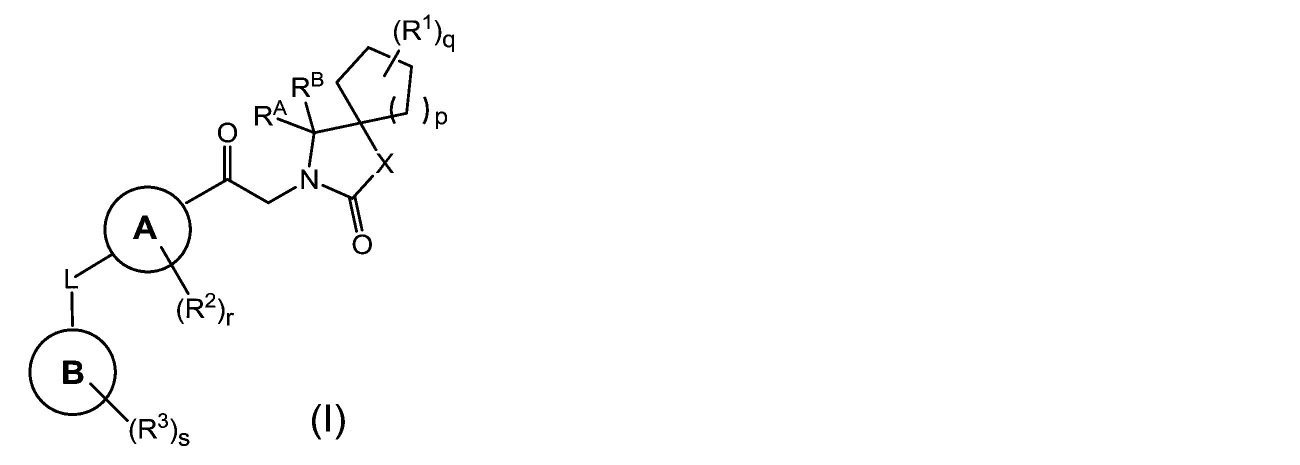
A is aryl and heteroaryl;
B is aryl and heteroaryl;
L is independently selected from the group consisting of a chemical bond, oxygen,
sulfur, -NR4-, -(CRCRD)t-, -O(CRCRD)t-, -(CRCRD)tO-, -N(R4)(CRCRD)t-, -(CRCRD)tN(R4)-, -N(R4)(CRCRD)tO-, and -O(CRCRD)t N(R4)-
X is independently selected from the group consisting of -CH2-, oxygen, sulfur and NH;
RA and RB are independently selected from the group consisting of;
(1) hydrogen, (2) halogen, (3) (C1-C10)alkyl, (4) (C3-C10)cycloalkyl and (5) (C1-C10)haloalkyl; or RA and RB may form oxo group (=O); or RA and RB may form a 3 to 8 membered ring which may contain one or more heteroatoms independently selected from oxygen, sulfur and nitrogen; and said ring is optionally substituted with 1 to 6 substituents independently selected from (1) hydrogen, (2) halogen, (3) hydroxy, (4) (C1-C10)alkyl, (5) (C3-C10)cycloalkyl, (6) (C1-C10)haloalkyl, (7) (C1-C10)alkoxy and (8) (C1-C10)haloalkoxy;
RC and RD are independently selected from the group consisting of (1) hydrogen, (2) halogen, (3) (C1-C10)alkyl, (4) (C3-C10)cycloalkyl and (5) (C1-C10)haloalkyl; or RC and RD may form a 3 to 8 membered ring which may contain one or more heteroatoms independently selected from oxygen, sulfur and nitrogen; and said ring is optionally substituted with 1 to 6 substituents independently selected from (1) hydrogen, (2) halogen, (3) hydroxy, (4) (C1-C10)alkyl, (5) (C3-C10)cycloalky, (6) (C1-C10)haloalkyl, (7) (C1-C10)alkoxy and (8) (C1-C10)haloalkoxy;
R1 is independently selected from the group consisting of (1) hydrogen, (2) halogen, (3) amino, (4) cyano, (5) hydroxyl, (6) (C1-C10)alkyl, (7) (C3-C10)cycloalkyl, (8) (C1-C10)haloalkyl, (9) (C1-C10)alkoxy and (10) (C1-C10)haloalkoxy; two R1 on the same carbon or the different carbons are possible to form a 3 to 8 membered ring which may contain an atom selected from oxygen, sulfur and nitrogen; and said ring is optionally substituted with 1 to 6 substituents independently selected from (1) hydrogen, (2) halogen, (3) hydroxy, (4) (C1-C10)alkyl, (5) (C3-C10)cycloalkyl, (6) (C1-C10)haloalkyl, (7) (C1-C10)alkoxy, and (8) (C1-C10)haloalkoxy;
R2 is independently selected from the group consisting of (1) hydrogen, (2) halogen, (3) amino, (4) -NH(C1-C6)alkyl, (5) -N[(C1-C6)alkyl]2 wherein the alkyl is same or different, (6) cyano, (7) hydroxyl, (8) nitro, (9) (C1-C6)alkylthio, (10) (C1-C10)alkyl, (11) (C3-C10)cycloalkyl, (12) (C1-C10)alkoxy, (13) (C1-C10)haloalkyl and (14) (C1-C10)haloalkoxy;
R3 is independently selected from the group consisting of (1) hydrogen, (2) halogen, (3) cyano, (4) nitro, (5) hydroxyl, (6) (C1-C6)alkylthio, (7) (C1-C6)alkylsulfinyl, (8) (C1-C6)alkylsulfonyl, (9) -NR5R6, (10) -C(=O)NR5R6, (11) tri(C1-C6)alkylsilyl, (12) (C1-C10)alkyl, (13) (C3-C10)cycloalkyl, (14) (C1-C6)alkoxy(C0-C6)alkyl, (15) (C3-C10)cycloalkoxy, (16) -C(=O)(C1-C6)alkyl, (17) -C(=O)O(C1-C6)alkyl and (18) -C(=O)OH; said (C1-C10)alkyl, (C3-C10)cycloalkyl, (C1-C6)alkoxy(C0-C6)alkyl and (C3-C10)cycloalkoxy are optionally substituted with1 to 6 substituents independently selected from (1) hydrogen, (2) halogen, (3) hydroxyl, (4) cyano, (5) (C3-C10)cycloalkyl, (6) (C1-C10)haloalkyl, (7) (C1-C10)alkoxy, (8) (C1-C10)haloalkoxy and (9) -NR6R5;
wherein R5 and R6, together with nitrogen atom to which they are attached, may form a 3 to 10 membered ring which may contain an atom selected from oxygen, sulfur and nitrogen; and said ring is optionally substituted with 1 to 6 substituents independently selected from (1) hydrogen, (2) halogen, (3) hydroxyl, (4) (C1-C10)alkyl, (5) (C3-C10)cycloalkyl, (6) (C1-C10)haloalkyl, (7) (C1-C10)alkoxy and (8) (C1-C10)haloalkoxy;
R4, R5 and R6 are independently selected from the group consisting of (1) hydrogen, (2) (C1-C10)alkyl, (3) (C3-C10)cycloalkyl, (4) (C1-C10)haloalkyl, (5) hydroxyl(C1-C10)alkyl, (6) (C1-C10)alkoxy(C1-C10)alkyl, (7) H2N-(C1-C10)alkyl, (8) [(C1-C10)alkyl]NH-(C1-C10)alkyl, (9) [(C1-C10)alkyl]2N-(C1-C10)alkyl, (10) (C1-C10)alkylcarbonyl and (11) (C1-C10)alkylsulfonyl;
p is 1,2,3 or 4;
q is 1,2,3 or 4; when q is two or more than two, R1 is same or different,
r is 1,2,3 or 4; when r is two or more than two, R2 is same or different,
s is 1,2,3,4,5,6 or 7; when s is two or more than two, R3 is same or different,
t is 1,2 or 3; when t is two or more than two, RC and RD are same or different,
or a pharmaceutically acceptable salt thereof or a prodrug thereof;
A is 6 membered aryl or 5 to 6 membered heteroaryl
or a pharmaceutically acceptable salt thereof or a prodrug thereof;
A is independently selected from the group consisting of benzene, pyridine, pyridazine, pyrazine, pyrimidine, triazine, thiophene, furan, pyrrole, imidazole, pyrazole, thiazole, isothiazole, oxazole, isoxazole, and triazole.
or a pharmaceutically acceptable salt thereof or a prodrug thereof;
3-(2-(2,5-dimethyl-1-(5-methylisoxazol-3-yl)-1H-pyrrol-3-yl)-2-oxoethyl)-8,8-difluoro-1,3-diazaspiro[4.5]decane-2,4-dione;
3-(2-(2,5-dimethyl-1-phenyl-1H-imidazol-4-yl)-2-oxoethyl)-8,8-difluoro-1,3-diazaspiro[4.5]decane-2,4-dione;
6-(4-(2-(2,4-dioxo-1,3-diazaspiro[4.5]decan-3-yl)acetyl)phenyl)picolinonitrile;
3-(2-(1-(3-chlorophenyl)-2,5-dimethyl-1H-imidazol-4-yl)-2-oxoethyl)-8,8-difluoro-1,3-diazaspiro[4.5]decane-2,4-dione;
8,8-difluoro-3-(2-(1-(3-fluorophenyl)-2,5-dimethyl-1H-imidazol-4-yl)-2-oxoethyl)-1,3-diazaspiro[4.5]decane-2,4-dione;
3-(2-(1,4-dimethyl-5-phenyl-1H-pyrazol-3-yl)-2-oxoethyl)-8,8-difluoro-1,3-diazaspiro[4.5]decane-2,4-dione;
8,8-difluoro-3-(2-(4-(6-methylpyrazin-2-yl)phenyl)-2-oxoethyl)-1,3-diazaspiro[4.5]decane-2,4-dione;
6-(4-(2-(8,8-difluoro-2,4-dioxo-1,3-diazaspiro[4.5]decan-3-yl)acetyl)phenyl)picolinonitrile;
8,8-difluoro-3-(2-(2'-(hydroxymethyl)-[1,1'-biphenyl]-4-yl)-2-oxoethyl)-1,3-diazaspiro[4.5]decane-2,4-dione;
8,8-difluoro-3-(2-(4-(3-methylpyrazin-2-yl)phenyl)-2-oxoethyl)-1,3-diazaspiro[4.5]decane-2,4-dione;
3-(2-(2,5-dimethyl-1-phenyl-1H-imidazol-4-yl)-2-oxoethyl)-8,8-difluoro-1-oxa-3-azaspiro[4.5]decane-2,4-dione;
8,8-difluoro-3-(2-(4-(2-(hydroxymethyl)pyridin-3-yl)phenyl)-2-oxoethyl)-1,3-diazaspiro[4.5]decane-2,4-dione;
8,8-difluoro-3-(2-(4-(4-(hydroxymethyl)pyridin-3-yl)phenyl)-2-oxoethyl)-1,3-diazaspiro[4.5]decane-2,4-dione;
3-(2-(2,5-dimethyl-1-(5-methylisoxazol-3-yl)-1H-pyrrol-3-yl)-2-oxoethyl)-8,8-difluoro-1-oxa-3-azaspiro[4.5]decane-2,4-dione;
8,8-difluoro-3-(2-(5-(2-(hydroxymethyl)phenyl)-4-methylthiophen-2-yl)-2-oxoethyl)-1,3-diazaspiro[4.5]decane-2,4-dione;
3-(2-(4-(3-(hydroxymethyl)pyrazin-2-yl)phenyl)-2-oxoethyl)-1,3-diazaspiro[4.5]decane-2,4-dione;
3-(2-(1,4-dimethyl-5-phenyl-1H-pyrazol-3-yl)-2-oxoethyl)-8,8-difluoro-1-oxa-3-azaspiro[4.5]decane-2,4-dione;
8,8-difluoro-3-(2-(4-(4-methylpyridazin-3-yl)phenyl)-2-oxoethyl)-1,3-diazaspiro[4.5]decane-2,4-dione;
3-(4-(2-(8,8-difluoro-2,4-dioxo-1,3-diazaspiro[4.5]decan-3-yl)acetyl)phenyl)pyrazine-2-carbonitrile;
3-(2-(1,4-dimethyl-5-phenyl-1H-pyrrol-2-yl)-2-oxoethyl)-8,8-difluoro-1,3-diazaspiro[4.5]decane-2,4-dione;
8,8-difluoro-3-(2-(4-(3-(hydroxymethyl)pyrazin-2-yl)phenyl)-2-oxoethyl)-1,3-diazaspiro[4.5]decane-2,4-dione;
3-(2-(6-(methyl(pyridin-2-yl)amino)pyridin-3-yl)-2-oxoethyl)-1,3-diazaspiro[4.5]decane-2,4-dione;
3-(4-(2-(8,8-difluoro-2,4-dioxo-1,3-diazaspiro[4.5]decan-3-yl)acetyl)phenyl)picolinonitrile;
8,8-difluoro-3-(2-oxo-2-(4-(quinolin-8-yl)phenyl)ethyl)-1,3-diazaspiro[4.5]decane-2,4-dione;
3-(2-(4-(1H-indol-4-yl)phenyl)-2-oxoethyl)-8,8-difluoro-1,3-diazaspiro[4.5]decane-2,4-dione;
8,8-difluoro-3-(2-oxo-2-(4-(quinolin-2-yl)phenyl)ethyl)-1,3-diazaspiro[4.5]decane-2,4-dione;
8,8-difluoro-3-(2-(4-(isoquinolin-8-yl)phenyl)-2-oxoethyl)-1,3-diazaspiro[4.5]decane-2,4-dione;
8,8-difluoro-3-(2-(4-(isoquinolin-1-yl)phenyl)-2-oxoethyl)-1,3-diazaspiro[4.5]decane-2,4-dione;
8,8-difluoro-3-(2-(4-(furo[3,2-c]pyridin-4-yl)phenyl)-2-oxoethyl)-1,3-diazaspiro[4.5]decane-2,4-dione;
8,8-difluoro-3-(2-(6-(methyl(pyridin-2-yl)amino)pyridin-3-yl)-2-oxoethyl)-1,3-diazaspiro[4.5]decane-2,4-dione;
8,8-difluoro-3-(2-(6-(methyl(phenyl)amino)pyridin-3-yl)-2-oxoethyl)-1,3-diazaspiro[4.5]decane-2,4-dione;
8,8-difluoro-3-(2-(4-(3-fluoropyridin-2-yl)phenyl)-2-oxoethyl)-1,3-diazaspiro[4.5]decane-2,4-dione;
3-(4-(2-(8,8-difluoro-2,4-dioxo-1,3-diazaspiro[4.5]decan-3-yl)acetyl)phenyl)isonicotinonitrile;
8,8-difluoro-3-(2-(4-(2-methoxypyridin-3-yl)phenyl)-2-oxoethyl)-1,3-diazaspiro[4.5]decane-2,4-dione;
8,8-difluoro-3-(2-(4-(4-methoxypyridin-3-yl)phenyl)-2-oxoethyl)-1,3-diazaspiro[4.5]decane-2,4-dione;
8,8-difluoro-3-(2-oxo-2-(4-(2-oxoindolin-4-yl)phenyl)ethyl)-1,3-diazaspiro[4.5]decane-2,4-dione;
3-(2-(4-(7H-pyrrolo[2,3-d]pyrimidin-4-yl)phenyl)-2-oxoethyl)-8,8-difluoro-1,3-diazaspiro[4.5]decane-2,4-dione;
3-(2-(4-(1H-pyrrolo[3,2-c]pyridin-4-yl)phenyl)-2-oxoethyl)-8,8-difluoro-1,3-diazaspiro[4.5]decane-2,4-dione;
3-(2-(4-(1H-pyrrolo[2,3-b]pyridin-4-yl)phenyl)-2-oxoethyl)-8,8-difluoro-1,3-diazaspiro[4.5]decane-2,4-dione;
3-(2-(4-(3-chloropyridin-2-yl)phenyl)-2-oxoethyl)-8,8-difluoro-1,3-diazaspiro[4.5]decane-2,4-dione;
8,8-difluoro-3-(2-(4-(2-methyl-1H-benzo[d]imidazol-1-yl)phenyl)-2-oxoethyl)-1,3-diazaspiro[4.5]decane-2,4-dione;
3-(2-(4-(1H-indazol-4-yl)phenyl)-2-oxoethyl)-8,8-difluoro-1,3-diazaspiro[4.5]decane-2,4-dione;
3-(2-(6-(1H-indazol-4-yl)pyridin-3-yl)-2-oxoethyl)-8,8-difluoro-1,3-diazaspiro[4.5]decane-2,4-dione;
3-(2-(4-(1H-benzo[d]imidazol-1-yl)phenyl)-2-oxoethyl)-8,8-difluoro-1,3-diazaspiro[4.5]decane-2,4-dione;
3-(5-(2-(8,8-difluoro-2,4-dioxo-1,3-diazaspiro[4.5]decan-3-yl)acetyl)-1,3-dimethyl-1H-pyrrol-2-yl)benzonitrile;
3-(2-(4-(1H-pyrrolo[2,3-c]pyridin-4-yl)phenyl)-2-oxoethyl)-8,8-difluoro-1,3-diazaspiro[4.5]decane-2,4-dione;
8,8-difluoro-3-(2-(3-fluoro-4-(quinolin-8-yl)phenyl)-2-oxoethyl)-1,3-diazaspiro[4.5]decane-2,4-dione;
3-(5-(2-(8,8-difluoro-2,4-dioxo-1,3-diazaspiro[4.5]decan-3-yl)acetyl)-1-methyl-1H-pyrrol-2-yl)benzonitrile;
3-(5-(2-(8,8-difluoro-2,4-dioxo-1,3-diazaspiro[4.5]decan-3-yl)acetyl)-3-methylthiophen-2-yl)benzonitrile;
8,8-difluoro-3-(2-(4-(2-(2-hydroxyethoxy)pyridin-3-yl)phenyl)-2-oxoethyl)-1,3-diazaspiro[4.5]decane-2,4-dione;
8,8-difluoro-3-(2-(5-(3-fluorophenyl)-1,4-dimethyl-1H-pyrrol-2-yl)-2-oxoethyl)-1,3-diazaspiro[4.5]decane-2,4-dione;
3-(2-(5-(3-chlorophenyl)-1,4-dimethyl-1H-pyrrol-2-yl)-2-oxoethyl)-8,8-difluoro-1,3-diazaspiro[4.5]decane-2,4-dione;
3-(5-(2-(8,8-difluoro-2,4-dioxo-1,3-diazaspiro[4.5]decan-3-yl)acetyl)-1,3-dimethyl-1H-pyrrol-2-yl)benzamide;
8,8-difluoro-3-(2-(5-(2-fluorophenyl)-1,4-dimethyl-1H-pyrrol-2-yl)-2-oxoethyl)-1,3-diazaspiro[4.5]decane-2,4-dione;
3-(2-(4-(1H-pyrazolo[3,4-b]pyridin-4-yl)phenyl)-2-oxoethyl)-8,8-difluoro-1,3-diazaspiro[4.5]decane-2,4-dione;
3-(2-(4-(1H-pyrazolo[4,3-c]pyridin-4-yl)phenyl)-2-oxoethyl)-8,8-difluoro-1,3-diazaspiro[4.5]decane-2,4-dione;
3-(2-(4-(1H-indazol-1-yl)phenyl)-2-oxoethyl)-8,8-difluoro-1,3-diazaspiro[4.5]decane-2,4-dione;
8,8-difluoro-3-(2-(5-(3-fluorophenyl)-1-methyl-1H-imidazol-2-yl)-2-oxoethyl)-1,3-diazaspiro[4.5]decane-2,4-dione;
8,8-difluoro-3-(2-(4-(2-methyl-3H-imidazo[4,5-b]pyridin-3-yl)phenyl)-2-oxoethyl)-1,3-diazaspiro[4.5]decane-2,4-dione;
8,8-difluoro-3-(2-oxo-2-(4-(pyridin-2-yloxy)phenyl)ethyl)-1,3-diazaspiro[4.5]decane-2,4-dione;
3-(2-(5-(3,5-difluorophenyl)-1,4-dimethyl-1H-pyrrol-2-yl)-2-oxoethyl)-8,8-difluoro-1,3-diazaspiro[4.5]decane-2,4-dione;
8,8-difluoro-3-(2-(2'-methyl-[3,3'-bipyridin]-6-yl)-2-oxoethyl)-1,3-diazaspiro[4.5]decane-2,4-dione;
3-(2-(4-(1H-pyrazolo[3,4-d]pyrimidin-4-yl)phenyl)-2-oxoethyl)-8,8-difluoro-1,3-diazaspiro[4.5]decane-2,4-dione;
3-(2-(6-(1H-pyrrolo[2,3-c]pyridin-4-yl)pyridin-3-yl)-2-oxoethyl)-8,8-difluoro-1,3-diazaspiro[4.5]decane-2,4-dione;
8,8-difluoro-3-(2-(4-(3-(2-hydroxyethoxy)pyrazin-2-yl)phenyl)-2-oxoethyl)-1,3-diazaspiro[4.5]decane-2,4-dione;
8,8-difluoro-3-(2-oxo-2-(4-(phthalazin-1-yl)phenyl)ethyl)-1,3-diazaspiro[4.5]decane-2,4-dione;
3-(2-(4-(3H-imidazo[4,5-b]pyridin-3-yl)phenyl)-2-oxoethyl)-8,8-difluoro-1,3-diazaspiro[4.5]decane-2,4-dione;
3-(2-(2-(8,8-difluoro-2,4-dioxo-1,3-diazaspiro[4.5]decan-3-yl)acetyl)-4-methylthiazol-5-yl)benzonitrile;
3-(2-(1,4-dimethyl-5-phenyl-1H-imidazol-2-yl)-2-oxoethyl)-8,8-difluoro-1,3-diazaspiro[4.5]decane-2,4-dione;
8,8-difluoro-3-(2-(5-(3-fluorophenyl)-1,4-dimethyl-1H-imidazol-2-yl)-2-oxoethyl)-1,3-diazaspiro[4.5]decane-2,4-dione;
3-(2-(2-(8,8-difluoro-2,4-dioxo-1,3-diazaspiro[4.5]decan-3-yl)acetyl)-1,4-dimethyl-1H-imidazol-5-yl)benzonitrile;
8,8-difluoro-3-(2-(5-(isoquinolin-8-yl)-1,4-dimethyl-1H-imidazol-2-yl)-2-oxoethyl)-1,3-diazaspiro[4.5]decane-2,4-dione;
8,8-difluoro-3-(2-(5-(2-(hydroxymethyl)phenyl)-1,4-dimethyl-1H-imidazol-2-yl)-2-oxoethyl)-1,3-diazaspiro[4.5]decane-2,4-dione;
8,8-difluoro-3-(2-(4-(2-(hydroxymethyl)-1H-benzo[d]imidazol-1-yl)phenyl)-2-oxoethyl)-1,3-diazaspiro[4.5]decane-2,4-dione;
8,8-difluoro-3-(2-(5-(3-fluorophenyl)-1,4-dimethyl-1H-pyrrol-3-yl)-2-oxoethyl)-1,3-diazaspiro[4.5]decane-2,4-dione;
3-(4-(2-(8,8-difluoro-2,4-dioxo-1,3-diazaspiro[4.5]decan-3-yl)acetyl)-1,3-dimethyl-1H-pyrrol-2-yl)benzonitrile;
3-(2-(5-(1H-benzo[d]imidazol-1-yl)pyrazin-2-yl)-2-oxoethyl)-8,8-difluoro-1,3-diazaspiro[4.5]decane-2,4-dione;
3-(2-(4-(2,7-naphthyridin-1-yl)phenyl)-2-oxoethyl)-8,8-difluoro-1,3-diazaspiro[4.5]decane-2,4-dione;
8,8-difluoro-3-(2-oxo-2-(4-(2-oxo-2,3-dihydro-1H-benzo[d]imidazol-1-yl)phenyl)ethyl)-1,3-diazaspiro[4.5]decane-2,4-dione;
8,8-difluoro-3-(2-(5-(2-(hydroxymethyl)phenyl)pyrazin-2-yl)-2-oxoethyl)-1,3-diazaspiro[4.5]decane-2,4-dione;
8,8-difluoro-3-(2-(5-(4-methoxypyridin-3-yl)pyrazin-2-yl)-2-oxoethyl)-1,3-diazaspiro[4.5]decane-2,4-dione;
3-(5-(2-(8,8-difluoro-2,4-dioxo-1,3-diazaspiro[4.5]decan-3-yl)acetyl)-2,4-dimethylthiophen-3-yl)benzamide;
3-(2-(5-(3,5-difluorophenyl)-1,4-dimethyl-1H-imidazol-2-yl)-2-oxoethyl)-8,8-difluoro-1,3-diazaspiro[4.5]decane-2,4-dione;
8,8-difluoro-3-(2-oxo-2-(4-(pyridazin-3-yloxy)phenyl)ethyl)-1,3-diazaspiro[4.5]decane-2,4-dione;
8,8-difluoro-3-(2-oxo-2-(4-(2-oxo-1H-imidazo[4,5-b]pyridin-3(2H)-yl)phenyl)ethyl)-1,3-diazaspiro[4.5]decane-2,4-dione;
3-(2-(5-(3,5-difluorophenyl)-4-methylthiazol-2-yl)-2-oxoethyl)-8,8-difluoro-1,3-diazaspiro[4.5]decane-2,4-dione;
4'-(2-(8,8-difluoro-2,4-dioxo-1,3-diazaspiro[4.5]decan-3-yl)acetyl)-2'-methoxy-[1,1'-biphenyl]-2-carbonitrile;
2-(4-(2-(8,8-difluoro-2,4-dioxo-1,3-diazaspiro[4.5]decan-3-yl)acetyl)phenoxy)nicotinonitrile;
3-(2-(4-((3-chloropyridin-2-yl)oxy)phenyl)-2-oxoethyl)-8,8-difluoro-1,3-diazaspiro[4.5]decane-2,4-dione;
8,8-difluoro-3-(2-(4-(3-(hydroxymethyl)pyridin-2-yl)phenyl)-2-oxoethyl)-1,3-diazaspiro[4.5]decane-2,4-dione;
3-(2-(2'-(aminomethyl)-[1,1'-biphenyl]-4-yl)-2-oxoethyl)-8,8-difluoro-1,3-diazaspiro[4.5]decane-2,4-dione;
8,8-difluoro-3-(2-oxo-2-(6-(quinolin-8-yl)pyridin-3-yl)ethyl)-1,3-diazaspiro[4.5]decane-2,4-dione;
8,8-difluoro-3-(2-(5-(2-methylpyridin-3-yl)pyrazin-2-yl)-2-oxoethyl)-1,3-diazaspiro[4.5]decane-2,4-dione;
3-(2-(4-(2,7-naphthyridin-1-yl)phenyl)-2-oxoethyl)-8,8-difluoro-1-oxa-3-azaspiro[4.5]decane2,4-dione;
3-(4-(2-(8,8-difluoro-2,4-dioxo-1,3-diazaspiro[4.5]decan-3-yl)acetyl)phenyl)-2-methyl-3H-imidazo[4,5-b]pyridine-5-carbonitrile;
8,8-difluoro-3-(2-oxo-2-(4-(2-oxobenzo[d]oxazol-3(2H)-yl)phenyl)ethyl)-1,3-diazaspiro[4.5]decane-2,4-dione;
3-(2-(4-(2,5-dimethyl-3H-imidazo[4,5-b]pyridin-3-yl)phenyl)-2-oxoethyl)-8,8-difluoro-1,3-diazaspiro[4.5]decane-2,4-dione;
8,8-difluoro-3-(2-(5-(2-methyl-1H-benzo[d]imidazol-1-yl)pyrazin-2-yl)-2-oxoethyl)-1,3-diazaspiro[4.5]decane-2,4-dione;
8,8-difluoro-3-(2-(4-(2-methoxy-5-methyl-3H-imidazo[4,5-b]pyridin-3-yl)phenyl)-2-oxoethyl)-1,3-diazaspiro[4.5]decane-2,4-dione;
8,8-difluoro-3-(2-(4-(5-methyl-2-(trifluoromethyl)-3H-imidazo[4,5-b]pyridin-3-yl)phenyl)-2-oxoethyl)-1,3-diazaspiro[4.5]decane-2,4-dione;
3-(2-(4-(2-(difluoromethyl)-5-methyl-3H-imidazo[4,5-b]pyridin-3-yl)phenyl)-2-oxoethyl)-8,8-difluoro-1,3-diazaspiro[4.5]decane-2,4-dione;
8,8-difluoro-3-(2-(4-(5-methyl-2-oxo-1H-imidazo[4,5-b]pyridin-3(2H)-yl)phenyl)-2-oxoethyl)-1,3-diazaspiro[4.5]decane-2,4-dione;
6-(4-(2-(8,8-difluoro-2,4-dioxo-1,3-diazaspiro[4.5]decan-3-yl)acetyl)phenoxy)picolinonitrile;
8,8-difluoro-3-(2-(4-(5-methyl-3H-imidazo[4,5-b]pyridin-3-yl)phenyl)-2-oxoethyl)-1,3-diazaspiro[4.5]decane-2,4-dione;
8,8-difluoro-3-(2-(4-(3-methoxypyrazin-2-yl)phenyl)-2-oxoethyl)-1,3-diazaspiro[4.5]decane-2,4-dione;
3-(4-(2-(8,8-difluoro-2,4-dioxo-1,3-diazaspiro[4.5]decan-3-yl)acetyl)-3-fluorophenyl)pyrazine-2-carbonitrile;
8,8-difluoro-3-(2-(4-(imidazo[1,2-b]pyridazin-3-yl)phenyl)-2-oxoethyl)-1,3-diazaspiro[4.5]decane-2,4-dione;
8,8-difluoro-3-(2-(2'-(2-hydroxyethyl)-[1,1'-biphenyl]-4-yl)-2-oxoethyl)-1,3-diazaspiro[4.5]decane-2,4-dione;
2-(4'-(2-(8,8-difluoro-2,4-dioxo-1,3-diazaspiro[4.5]decan-3-yl)acetyl)-[1,1'-biphenyl]-2-yl)acetonitrile;
3-(2-(4-(1H-imidazo[4,5-b]pyrazin-1-yl)phenyl)-2-oxoethyl)-8,8-difluoro-1,3-diazaspiro[4.5]decane-2,4-dione;
8,8-difluoro-3-(2-(4-(4-methylpyridazin-3-yl)phenyl)-2-oxoethyl)-1-oxa-3-azaspiro[4.5]decane-2,4-dione;
3-(4-(2-(8,8-difluoro-2,4-dioxo-1,3-diazaspiro[4.5]decan-3-yl)acetyl)phenoxy)pyridazine-4-carbonitrile;
8,8-difluoro-3-(2-(4-(2-(hydroxymethyl)-5-methyl-3H-imidazo[4,5-b]pyridin-3-yl)phenyl)-2-oxoethyl)-1,3-diazaspiro[4.5]decane-2,4-dione;
8,8-difluoro-3-(2-oxo-2-(4-(pyrazolo[1,5-a]pyrimidin-3-yl)phenyl)ethyl)-1,3-diazaspiro[4.5]decane-2,4-dione;
4-(4-(2-(8,8-difluoro-2,4-dioxo-1,3-diazaspiro[4.5]decan-3-yl)acetyl)phenyl)nicotinonitrile;
8,8-difluoro-3-(2-(2-fluoro-4-(4-methylpyridazin-3-yl)phenyl)-2-oxoethyl)-1,3-diazaspiro[4.5]decane-2,4-dione;
8,8-difluoro-3-(2-(2-fluoro-4-(3-(hydroxymethyl)pyrazin-2-yl)phenyl)-2-oxoethyl)-1,3-diazaspiro[4.5]decane-2,4-dione; and
2-(4-(2-(8,8-difluoro-2,4-dioxo-1,3-diazaspiro[4.5]decan-3-yl)acetyl)phenyl)nicotinonitrile
or a pharmaceutically acceptable salt thereof or a prodrug thereof.

Examples of such unsaturated aryl include, but are not limited to, phenyl, naphthyl, indanyl, indenyl, 1,2,3,4-tetrahydronaphthyl, and 1,2-dihydronaphthyl inthereof.
Namely, the term " heteroaryl " as used herein, means the following;
1) unsaturated and partially saturated 5- to 15- membered ring, preferably 6- to 15- membered ring, which consists of carbon atoms and from one to five heteroatoms selected from nitrogen, phosphorus, oxygen and sulfur.
2) unsaturated and partially saturated 5- to 15- membered ring, preferably 6- to 15- membered ring, in which a non-aromatic ring, such as heterocyclyl ring or cycloalkyl ring, is fused to a heteroaryl defined above
3) unsaturated and partially saturated 5- to 15- membered ring, preferably 6- to 15- membered ring, in which an aryl ring is fused to a heterocyclyl ring.
Examples of such heteroaryl include, but are not limited to, thiophenyl, thiazolyl, isoxazolyl, pyrazolyl, tetrazolyl, furanyl, pyrrolyl, imidazolyl, oxazolyl, isothiazolyl, triazolyl, thiadiazolyl, pyridyl, pyrimidyl, pyridazinyl, pyrazinyl, triazinyl, benzofuranyl, benzothiophenyl, benzotriazolyl, indolyl, indazolyl, benzoimidazolyl, pyrrolopyridyl, pyrrolopyrimidinyl, pyrazolopyridyl, pyrazolopyrimidinyl, imidazopyridinyl, furopyridyl, benzoisoxazolyl, imidazopyrazinyl, imidazopyridazinyl, imidazopyrimidinyl, quinolyl, isoquinolyl, quinazolinyl, phthalazinyl, quinoxalinyl, naphthyridinyl, pyridopyrimidinyl, and N-oxides thereof and S-oxides thereof.


Also within the scope of the invention are so-called "prodrugs" of the compounds of formula (I). Thus certain derivatives of compounds of formula (I) which may have little or no pharmacological activity themselves, when administered into or onto the body, can be converted into compounds of formula (I) having the desired activity, for example, by hydrolytic cleavage. Such derivatives are referred to as "prodrugs". Further information on the use of prodrugs may be found in Pro-drugs as Novel Delivery Systems, Vol. 14, ACS Symposium Series (T Higuchi and W Stella) and Bioreversible Carriers in Drug Design, Pergamon Press, 1987 (ed. E B Roche, American Pharmaceutical Association).
(ii) where the compound of the formula (I) contains an amino group, an amide derivative prepared by reacting with a suitable acid halide or a suitable acid anhydride is exemplified as a prodrug. A particularly preferred amide derivative as a prodrug is -NHCO(CH2)2OCH3, -NHCOCH(NH2)CH3 or the like.
- a sedative such as glutethimide, meprobamate, methaqualone or dichloralphenazone;
- a chemotherapy drug such as oxaliplatin, 5-fluorouracil, leukovorin, paclitaxel;
- a calcitonin gene related peptide (CGRP) antagonist;
- a bradykinin (BK1 and BK2) antagonist;
- a voltage gated sodium dependent channel blocker (Nav1.3, Nav1.7, Nav1.8);
- a voltage dependent calcium channel blocker (N-type, T-type);
- a P2X (ion channel type ATP receptor) antagonist;
- an acid-sensing ion channel (ASIC1a, ASIC3) antagonist;
- an angiotensin AT2 antagonist;
- a chemokine CCR2B receptor antagonist;
- a cathepsin (B, S, K) inhibitor;
- a sigma1 receptor agonist or antagonist;
Throughout the instant application, the following abbreviations are used with the following meanings:
AcOH: Acetic acid
aq.: aqueous
BINAP: 2,2'-Bis(diphenylphosphino)-1,1'-binaphthyl
tBuXPhos: 2-Di-tert-Butylphosphino-2',4',6'-triisopropylbiphenyl
CDI: Carbonyldiimidazole
Cs2CO3: Cesium carbonate
DABCO: 1,4-diazabicyclo[2.2.2]octane
DavePhos: 2-Dicyclohexylphosphino-2'-(N,N-dimethylamino)biphenyl
DABCO: 1,4-diazabicyclo[2.2.2]octane
DBU: 1,8-Diazabicyclo[5.4.0]undec-7-ene
DCM: Dichloromethane
DEAD: Diethyl azodicarboxylate
DIPEA: Diisopropylethylamine
DMF: N,N-Dimethylformamide
DMA : N,N-Dimethylacetamide
DME: 1,2-Dimethoxyethane
DMSO: Dimethyl sulfoxide
Dess-Martin Periodinane: 1,1,1-Tris(acetyloxy)-1,1-dihydro-1,2-benziodoxol-3-(1H)-one
ESI: Electrospray Ionization
Et: Ethyl
EtOAc: Ethyl acetate
EtOH: Ethanol
eq.: equivalent
HPLC: High-Performance Liquid Chromatography
INT: Intermediate
IPE: Isopropyl ether
K2CO3: Potassium carbonate
K3PO4: Potassium phosphate
KO t-Bu: Potassium tert-butoxide
LC: Liquid Chromatography
LDA: Lithium diisopropylamide
LG: Leaving Group
tR: Retention Time
Me: Methyl
MeCN: Acetonitrile
MeOH: Methanol
min: minute
NaHCO3: Sodium Bicarbonate
Na2SO4: Sodium Sulfate
Na2S2O3: Sodium thiosulfate
NaO t-Bu: Sodium tert-butoxide
MHz: Megahertz
mp: melting point
MS: Mass Spectrometry
NMP: N-methyl-2-pyrrolidone
NMR: Nuclear Magnetic Resonance
Oxone (Registered Trademark): Potassium peroxymonosulfate
PG: Protecting Group
Pd2(dba)3: Tris(dibenzylideneacetone)dipalladium(0)
Pd(OAc)2: Palladium (II) acetate
PdCl2(dppf) CH2Cl2: [1, 1'-Bis(diphenylphosphino)ferrocene]dichloropalladium (II), Dichloromethane Adduct
PdCl2(Amphos)2: Bis(di-tert-butyl(4-dimethylaminophenyl)phosphine)dichloropalladium(II)
PEPPSI(Trademark)-IPr: [1,3-Bis(2,6-Diisopropylphenyl)imidazol-2-ylidene] (3-chloropyridyl)palladium(II) dichloride
Pd(PPh3)4 : Tetrakis(triphenylphosphine)palladium (0)
POCl3: Phosphorus(V) oxychloride
quant.: quantitative
rt: room temperature
sat.: saturated
TEA: Triethylamine
TFA: Trifluoroacetic Acid
THF: Tetrahydrofuran
THP: 2-Tetrahydropyranyl
p-TsOH: p-Toluenesulfonic acid
XPhos: 2-Dicyclohexylphosphino-2',4',6'-triisopropylbiphenyl
Xantphos: 4,5-Bis(diphenylphosphino)-9,9-dimethylxanthene
The invention is illustrated in the following non-limiting examples in which, unless stated otherwise: all reagents are commercially available, all operations are carried out at room or ambient temperature, that is, in the range of about 18 to 25 oC; evaporation of solvent is carried out using a rotary evaporator under reduced pressure with a bath temperature of up to about 60 oC; reactions are monitored by thin layer chromatography (TLC) and reaction times are given for illustration only; the structure and purity of all isolated compounds are assured by at least one of the following techniques: TCL (Merck silica gel 60 F254 precoated TLC plates or Merck NH2 F254 precoated HPTLC plates), mass spectrometry or nuclear magnetic resonance (NMR). Microwave reaction is conducted by Intiator (registered trademark) Sixty (Biotage). Yields are given for illustrative purposes only. The column chromatography systems are conducted by Yamazen flash chromatography and Biotage (SP1, Isolera one). Flash column chromatography is carried out using Merck silica gel 60 (230-400 mesh ASTM), Fuji Silysia Chromatorex (registered trademark) DM2035 (Amino Type, 30-50 micrometer), Biotage silica (32-63 mm, KP-Sil), Biotage amino bounded silica (45-75 mm, KP-NH), Wakogel (registered trademark) C-300HGT, Hi-Flash (registered trademark) column (YAMAZEN, silica gel, 40 micro meters, 60 angstrom), Hi-Flash (registered trademark) column (YAMAZEN, amino, 40 micro meters, 60 angstrom). LC-MS analysis for intermediates and Examples are carried out by Waters 2695 Alliance HPLC with ZQ 2000 mass spectrometer and 2996 PDA detector. Analytical conditions (method-A, method-B, method-C, method-D, method-E and method-F) are as follows.


Apparatus; Waters MS-trigger AutoPurification(trademark) system
Column; Waters XTerra C18, 19 x 50 mm, 5 micrometer particle
Condition A: Methanol or acetonitrile / 0.01%(v/v) ammonia aqueous solution
Condition B: Methanol or acetonitrile / 0.05%(v/v) formic acid aqueous solution
Low-resolution mass spectral data (ESI) are obtained by the following apparatus and conditions: Apparatus; Waters Alliance HPLC system on ZQ or ZMD mass spectrometer and UV detector. LC/MS/MS data are determined at the triple quadrupole mass spectrometry (AB SCIEX API4000) with HPLC (Agilent 1100 series) and autosampler (AMR CTC-PAL). NMR data are determined at 270 MHz (JEOL JNM-LA 270 spectrometer), 300 MHz (JEOL JNM-LA300) or 600 MHz (Bruker Avance 600) using deuterated chloroform (99.8% D) or dimethylsulfoxide (99.9% D) as solvent unless indicated otherwise, relative to tetramethylsilane (TMS) as internal standard in parts per million (ppm); conventional abbreviations used are: s = singlet, d = doublet, t = triplet, q = quartet, m = multiplet, br = broad, etc. Chemical symbols have their usual meanings; M (mol(s) per liter), L(liter(s)), mL (milliliter(s)), g (gram(s)), mg(milligram(s)), mol (moles), mmol (millimoles).
Each prepared compound is generally named by ChemBioDraw (Ultra, version 12.0, CambridgeSoft).
Method: QC1
Apparatus: Waters ACQUITY Ultra Performance LC with TUV Detector and ZQ mass spectrometer
Column: Waters ACQUITY C18, 2.1 x 100 mm, 1.7 micrometer particle size
Column Temperature: 60 oC
Flow rate: 0.7 mL/min
Run time: 3 min
UV detection: 210 nm
MS detection: ESI positive/negative mode
Mobile phases:
A1: 10 mM Ammonium acetate
B1: acetonitrile
Gradient program: (QC_neutral_full_3min)

Method: QC2
Apparatus: Waters 2795 Alliance HPLC with ZQ2000 mass spectrometer and 2996 PDA Detector
Column: XBridge C18, 2.1 x 50 mm, 3.5 micrometer particle size
Column Temperature: 45 oC
Flow rate: 1.2 mL/min
Run time: 4.5 min
UV detection: 210-400 nm scan
MS detection: ESI positive/negative mode
Mobile phases:
A: Water
B: MeCN
C: 1% aqueous HCO2H solution
D: 1% aqueous NH3 solution
Gradient program:
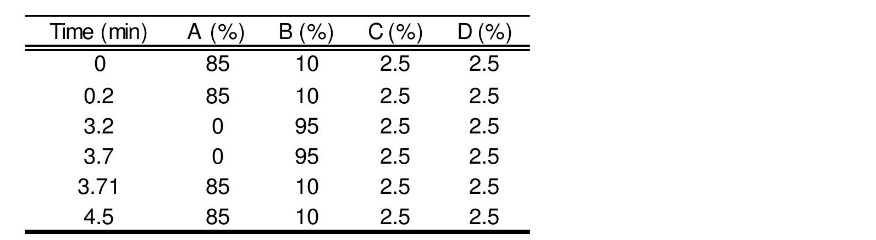


Examples of suitable transition metal catalysts include: tetrakis(triphenylphosphine)palladium(0), bis(triphenylphosphine)palladium(II) chloride, copper(0), copper(I) acetate, copper(I) bromide, copper(I) chloride, copper(I) iodide, copper(I) oxide, copper(II) trifluoromethanesulfonate, copper (II) acetate, copper(II) bromide, copper(II) chloride, copper(II) iodide, copper(II) oxide, copper(II) trifluoromethanesulfonate, palladium(II) acetate, palladium(II) chloride, bis(acetonitrile)dichloropalladium(II), bis(dibenzylideneacetone)palladium(0), tris(dibenzylideneacetone)dipalladium(0) and [1,1'-bis(diphenylphosphino)ferrocene] palladium(II) dichloride. Preferred catalysts are tetrakis(triphenylphosphine)palladium(0), bis(triphenylphosphine)palladium(II) chloride, palladium(II) acetate, palladium(II) chloride, bis(acetonitrile)dichloropalladium(0), bis(dibenzylideneacetone)palladium(0), tris(dibenzylideneacetone)dipalladium(0) and [1,1-bis(diphenylphosphino)ferrocene]palladium(II) dichloride.
Examples of suitable organic solvent for the anhydrous solvent and the water-organic co-solvent mixture include: THF; 1,4-dioxane; DME; DMF; acetonitrile; alcohols, such as methanol or ethanol; halogenated hydrocarbons, such as DCM, 1,2-dichloroethane, chloroform or carbon tetrachloride; and diethylether. This reaction can be carried out in the presence or absence of a base such as potassium hydroxide, sodium hydroxide, lithium hydroxide, sodium bicarbonate, sodium carbonate, potassium carbonate and potassium phosphate. This reaction can be carried out in the presence of a suitable additive agent. Examples of such additive agents include: triphenylphosphine, tri-tert-butylphosphine, 1,1'-bis(diphenylphosphino)ferrocene, tri-2-furylphosphine, tri-o-tolylphosphine, 2-(dichlorohexylphosphino)biphenyl, triphenylarsine, tetrabutylammonium chloride, tetrabutylammonium fluoride, lithium acetate, lithium chloride, triethylamine, potassium or sodium methoxide, sodium hydroxide, cesium carbonate, tripotassium phosphate, sodium carbonate, sodium bicarbonate, and/or sodium iodide. The reaction can be carried out at a temperature of from 0 oC to 200 oC, more preferably from 20 oC to 150 oC. Reaction times are, in general, from 5 minutes to 96 h, more preferably from 30 minutes to 24 h. In an alternative case, the reaction can be carried out in a microwave system in the presence of a base in an inert solvent. The reaction can be carried out at a temperature in the range of from 100 oC to 200 oC, preferably in the range of from 120 oC to 150 oC. Reaction times are, in general, from 10 minutes to 3 h, preferably from 15 minutes to 1 h. Other than a Suzuki-Miyaura cross coupling shown above, Still cross coupling reaction using trialkyltin instead of R'wB substituent, and Negishi coupling reaction using zinc-halogen, wherein as a halogen, chlorine, bromine, iodide are cited, instead of R'wB substituent can be used.
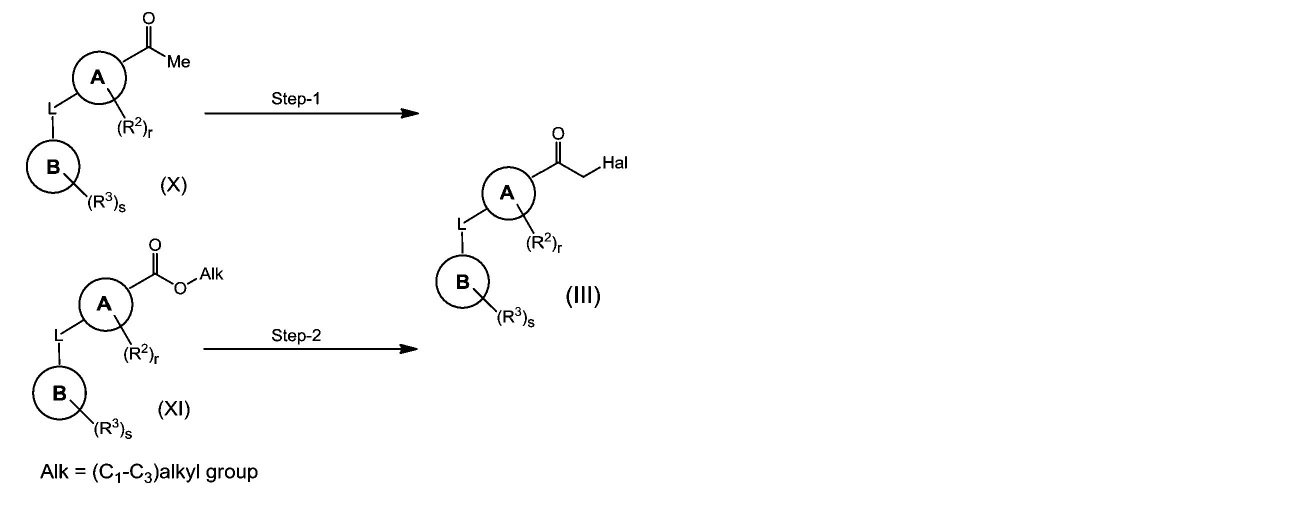


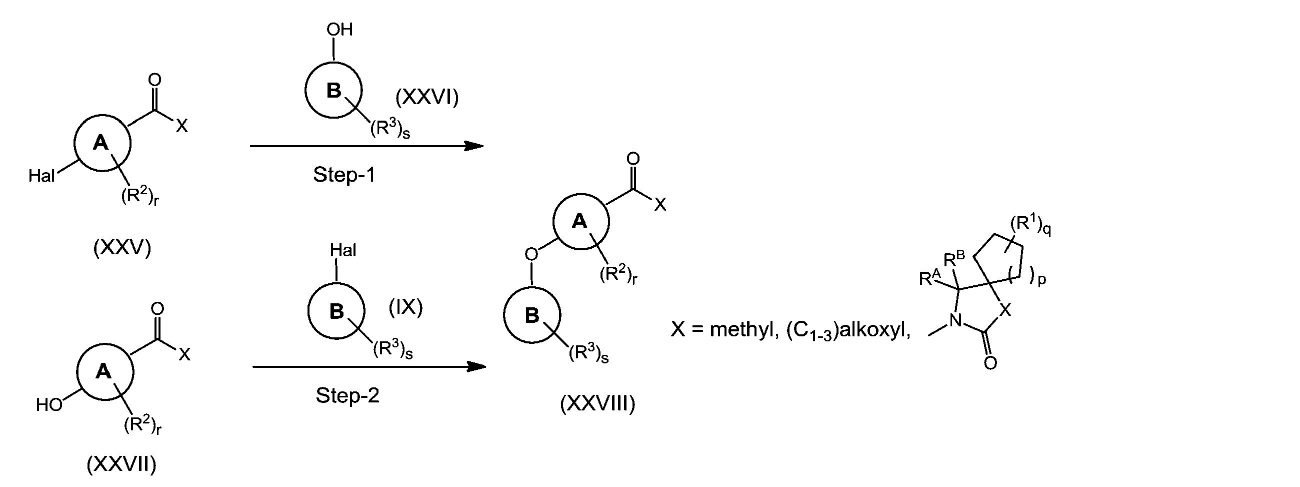


1H-NMR (270MHz, DMSO-d6): delta 10.77 (br.s, 1H), 8.53 (s, 1H), 2.20-1.65 (m, 8H).
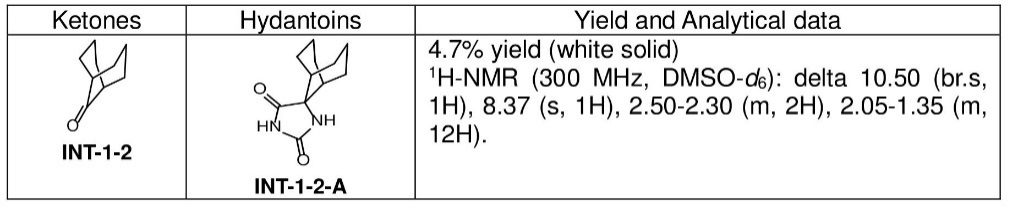

1H-NMR (270 MHz, DMSO-d6): delta 12.01 (br.s, 1H), 2.25-1.85 (m, 8H).

1H-NMR (270 MHz, CDCl3): delta 5.79 (br.s, 1H), 3.38 (s, 2H), 2.35-1.75 (m, 8H).

acetate


1H-NMR (300 MHz, CDCl3): delta 2.75 (s, 2H), 2.32-2.05 (m, 6H), 2.92-2.77 (m, 2H).

1H-NMR (300 MHz, CDCl3): delta 8.08 (br s, 1H), 2.63 (s, 2H), 2.41-2.06 (m, 4H), 1.96-1.69 (m, 4H).
MS (ESI) m/z: 202.2 (M-H)-.

ethyl 2-(4,4-difluoro-1-hydroxycyclohexyl)propanoate

1H-NMR (270 MHz, CDCl3): delta 4.19 (q, J = 7.3 Hz, 2H,), 3.33 (d, J = 2.0 Hz, 1H), 2.75-1.82 (m, 6H), 1.73-1.59 (m, 2H), 1.54-1.36 (m, 1H), 1.28 (t, J = 7.3 Hz, 3H), 1.23 (d, J = 7.3 Hz, 3H).
2-(4,4-difluoro-1-hydroxycyclohexyl)propanoic acid

MS (ESI) m/z: 207.1 (M-H)-.
1H-NMR (270 MHz, CDCl3): delta 5.61 (br s, 1H), 3.66 (q, J = 6.6 Hz, 1H), 2.38-1.95 (m, 6H), 1.88-1.59 (m, 2H), 1.20 (d, J = 6.6 Hz, 3H).
MS (ESI) m/z: 206.1 (M+H)+.

ethyl 2-(4,4-difluoro-1-hydroxycyclohexyl)-2-methylpropanoate

MS (ESI) m/z: 249.1 (M-H)-.
2-(4,4-difluoro-1-hydroxycyclohexyl)-2-methylpropanoic acid

MS (ESI) m/z: 221.1 (M-H)-.
1H-NMR (270 MHz, CDCl3): delta 5.80 (br s, 1H), 2.33-2.02 (m, 6H), 1.80-1.60 (m, 2H), 1.27 (s, 3H), 1.27 (s, 3H).
MS (ESI) m/z: 220.2 (M+H)+.

ethyl 2-(4,4-difluoro-1-hydroxycyclohexyl)-3-methylbutanoate

2-(4,4-difluoro-1-hydroxycyclohexyl)-3-methylbutanoic acid

MS (ESI) m/z: 235.1 (M-H)-.
1H-NMR (270 MHz, CDCl3): delta 6.37 (br s, 1H), 3.21 (d, J = 7.9 Hz, 1H), 2.35-2.18 (m, 1H), 2.18-1.98 (m, 5H), 1.98-1.73 (m, 3H), 1.00 (d, J = 6.6 Hz, 3H), 0.92 (d, J = 6.6 Hz, 3H).
MS (ESI) m/z: 234.2 (M+H)+.

1H-NMR (300 MHz, CDCl3): delta 5.92 (s, 1H), 5.90 (s, 2H), 2.37 (s, 3H), 2.19 (s, 6H).


1H-NMR (270 MHz, CDCl3): delta 7.60-7.50 (m, 3H), 7.24-7.15 (m, 2H), 4.41 (q, J = 7.3 Hz, 2H), 2.32 (s, 3H), 2.23 (s, 3H), 1.42 (t, J = 7.3 Hz, 3H).
MS (ESI) m/z: 245.2 (M+H)+.


1H-NMR (270 MHz, CDCl3): delta 9.07 (dd, J = 4.6, 1.3 Hz, 1H), 8.06 (d, J = 8.5 Hz, 2H), 7.84 (dd, J = 9.2, 4.6 Hz, 1H), 7.59-7.55 (m, 1H), 7.36 (d, J = 8.5 Hz, 2H), 2.60 (s, 3H).
MS (ESI) m/z: 246.3 (M+H)+.
2-chloro-1-(2,5-dimethyl-1-(3-methylisoxazol-5-yl)-1H-pyrrol-3-yl)ethanone

1H-NMR (270 MHz, CDCl3): delta 6.31 (s, 1H), 6.10 (s, 1H), 4.45 (s, 2H), 2.46 (s, 3H), 2.41 (s, 3H), 2.15 (s, 3H).
MS (ESI) m/z: 253.17 (M+H)+ .
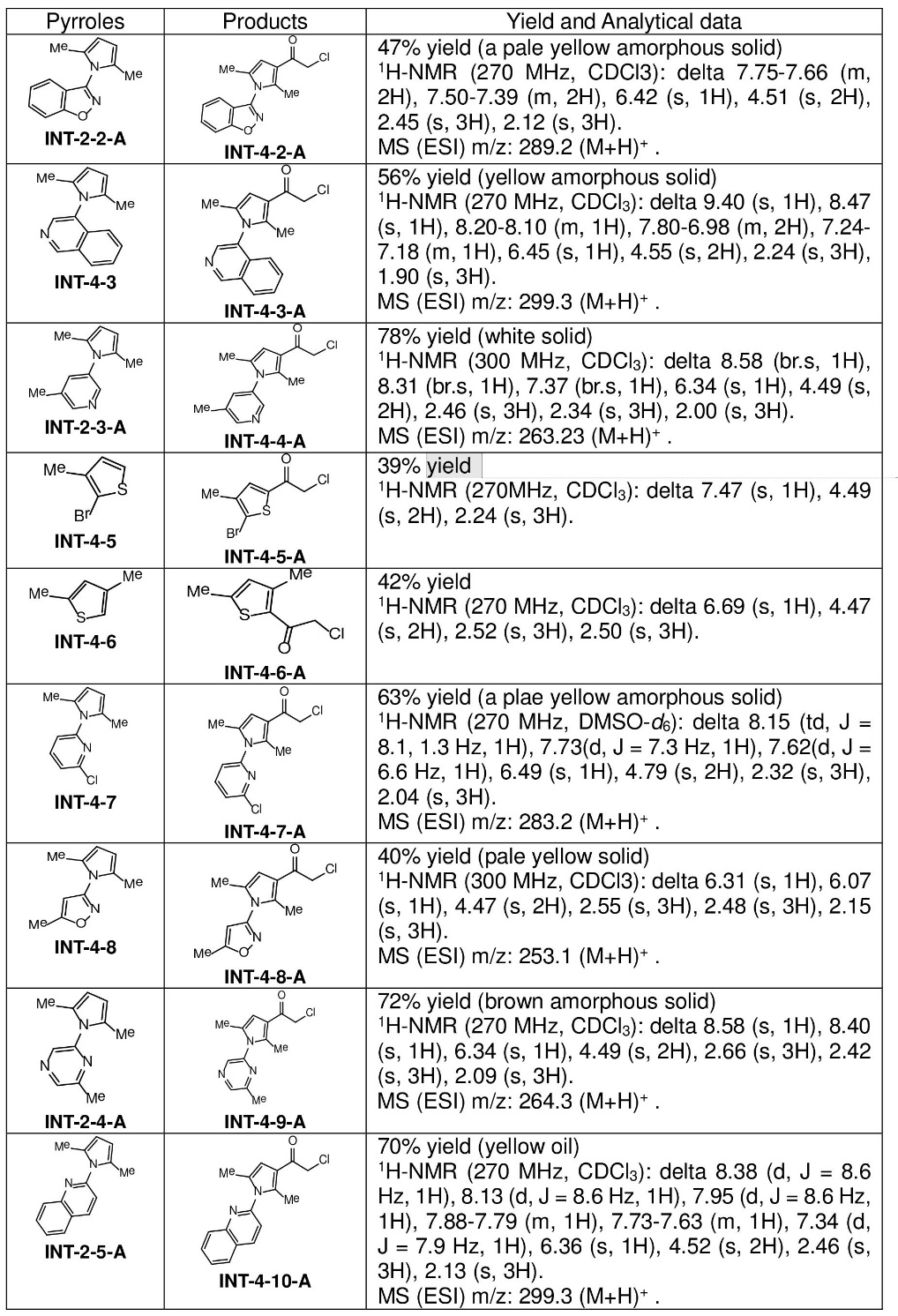


1H-NMR (270 MHz, CDCl3): delta 7.62-7.52 (m, 3H), 7.24-7.17 (m, 2H), 4.88 (s, 2H), 2.35 (s, 3H), 2.21 (s, 3H).
MS (ESI) m/z: 249.2 (M+H)+.


(Method-A): Chlorination using benzyltrimethylammonium dichloroiodate
Intermediate-6-1-A (INT-6-1-A: 1-(5-bromo-1-methyl-1H-pyrrol-2-yl)-2-chloroethanone

Intermediate-6-3-A (INT-6-3-A): 2-bromo-1-(1,4-dimethyl-5-phenyl-1H-pyrrol-2-yl)ethanone

Intermediate-6-4-A (INT-6-4-A): 2-bromo-1-(5-bromo-1,4-dimethyl-1H-imidazol-2-yl)ethanone hydrobromide


1H-NMR (270MHz, CDCl3): delta 7.48-7.40 (m, 5H), 2.71 (s, 3H), 2.57 (s, 3H).

1H-NMR (270MHz, CDCl3): delta 7.51-7.37 (m, 3H), 7.30-7.26 (m, 2H), 6.88 (s, 1H), 3.75 (s, 3H), 2.45 (s, 3H), 2.02 (s, 3H).


1H-NMR (270MHz, CDCl3): delta 7.00 (s, 1H), 3.98 (s, 3H), 2.63 (s, 3H).
MS (ESI) m/z: 205.1 (M+H)+.

1H-NMR (270MHz, CDCl3): delta 6.77 (s, 1H), 3.93 (s, 3H), 2.63 (s, 3H), 2.26 (s, 3H).
MS (ESI) m/z: 139.2 (M+H)+.

1H-NMR (270MHz, CDCl3): delta 3.96 (s, 3H), 2.62 (s, 3H), 2.26 (s, 3H).
MS (ESI) m/z: 219.1 (M+H)+.

-2-yl)ethanone

1H-NMR (600 MHz, CDCl3): delta 6.70 (s, 1H), 3.91 (s, 3H), 2.61 (s, 3H), 1.88-1.82 (m, 1H), 0.91-0.86 (m, 2H), 0.73-0.69 (m, 2H).
MS (ESI) m/z: 165.2 (M+H)+.

1H-NMR (270MHz, CDCl3): delta 3.94 (s, 3H), 2.57 (s, 3H), 1.92-1.80 (m, 1H), 0.95-0.88 (m, 4H).
MS (ESI) m/z: 243.1 (M+H)+.

1H-NMR (270MHz, CDCl3): delta 7.11 (s, 1H), 3.95 (s, 3H), 2.63 (s, 3H).
MS (ESI) m/z: 159.2 (M+H)+.

1H-NMR (270 MHz, DMSO-d6): delta 9.07 (dd, J = 4.6, 1.3 Hz, 1H), 8.06 (d, J = 8.5 Hz, 2H), 7.84 (dd, J = 9.2, 4.6 Hz, 1H), 7.59-7.55 (m, 1H), 7.36 (d, J = 8.5 Hz, 2H), 2.60 (s, 3H).
MS (ESI) m/z: 215.1 (M+H)+.


Intermediate-6-19 (INT-6-19): 1-(4-(2-methyl-3H-imidazo[4,5-b]pyridin-3-yl)phenyl)ethanone

19-1 (INT-6-19-1): 1-(4-((2-nitrophenyl)amino)phenyl)ethanone

1H-NMR (270 MHz, CDCl3): delta 10.36 (br.s, 1H), 8.62-8.54 (m, 2H), 8.05-7.96 (m, 2H), 7.88-7.80 (m, 2H), 7.00-6.92 (m, 1H), 2.61 (s, 3H).
MS (ESI) m/z: 258.1 (M+H)+.

1H-NMR (270 MHz, DMSO-d6): delta 8.28 (s, 1H), 7.85 (d, J = 8.5 Hz, 2H), 7.69 (d, J = 8.5 Hz, 2H), 7.57 (dd, J = 4.6, 1.3 Hz, 1H), 6.98 (dd, J = 7.9, 1.3 Hz, 1H), 6.75 (dd, J = 7.9, 4.6 Hz, 1H), 5.20 (s, 2H), 2.46 (s, 3H).
MS (ESI) m/z: 228.1 (M+H)+ .

1H-NMR (270 MHz, DMSO-d6): delta 9.56 (s, 1H), 8.62 (s, 1H), 8.08 (d, J = 3.3 Hz, 1H), 7.89 (d, J = 9.2 Hz, 2H), 7.76-7.71 (m, 3H), 6.95 (dd, J = 7.3, 4.6 Hz, 1H), 2.50 (s, 3H), 2.12 (s, 3H).
MS (ESI) m/z: 270.1 (M+H)+.
1-(4-(2-methyl-3H-imidazo[4,5-b]pyridin-3-yl)phenyl)ethanone
1H-NMR (270 MHz, DMSO-d6): delta 8.25 (dd, J = 5.3, 1.3 Hz, 1H), 8.18 (d, J = 8.5 Hz, 2H), 8.06 (dd, J = 7.9, 1.3 Hz, 1H), 7.77 (d, J = 8.5 Hz, 2H), 7.32 (dd, J = 7.9, 5.3 Hz, 1H), 2.68 (s, 3H), 2.53 (s, 3H).
MS (ESI) m/z: 252.1 (M+H)+.

1H-NMR (270 MHz, DMSO-d6): delta 9.07 (s, 1H), 8.49 (dd, J = 4.6, 1.3 Hz, 1H), 8.27-8.17 (m, 5H), 7.44 (dd, J = 7.9, 4.6 Hz, 1H), 2.66 (s, 3H).
MS (ESI) m/z: 238.1 (M+H)+.

1H-NMR (270 MHz, DMSO-d6): delta 8.99 (s, 1H), 8.55 (d, J = 4.6 Hz, 1H), 8.22-8.19 (m, 3H), 7.92 (d, J = 8.6 Hz, 2H), 7.41 (dd, J = 7.9, 4.6 Hz), 2.67 (s, 3H).
MS (ESI) m/z: 238.3 (M+H)+.

1H-NMR (270 MHz, DMSO-d6): delta 9.19 (s, 1H), 9.12 (s, 1H), 8.51 (dd, J = 8.5, 1.3 Hz, 1H), 8.45 (d, J = 7.9 Hz, 1H), 8.13 (d, J = 8.5 Hz, 1H), 7.80 (d, J = 7.9 Hz, 1H), 7.46-7.35 (m, 2H), 2.68 (s, 3H).
MS (ESI) m/z: 238.1 (M+H)+.

1H-NMR (270 MHz, DMSO-d6): delta 9.25 (d, J = 2.0 Hz, 1H), 8.59-8.56 (m, 1H), 7.91 (d, J = 8.5 Hz, 1H), 7.68-7.65 (m, 1H), 7.55-7.52 (m, 1H), 7.29-7.25 (m, 2H), 2.72 (s, 3H), 2.65 (s, 3H).
MS (ESI) m/z: 252.0 (M+H)+.


1H-NMR (270 MHz, CDCl3): delta 10.46 (br. s, 1H), 8.45 (d, J = 7.9 Hz, 1H), 8.05-7.95 (m, 2H), 7.93-7.85 (m, 2H), 6.79 (d, J = 7.9 Hz, 1H), 2.61 (s, 3H), 2.59 (s, 3H).
MS (ESI) m/z: 272.1 (M+H)+.

1H-NMR (270 MHz, CDCl3): delta 7.90 (d, J = 8.6 Hz, 2H), 7.32 (d, J = 8.6 Hz, 2H), 7.01 (d, J = 7.9 Hz, 1H), 6.73 (d, J = 7.9 Hz, 1H), 6.65 (br.s, 1H), 3.33 (br.s, 2H), 2.55 (s, 3H), 2.43 (s, 3H).
MS (ESI) m/z: 242.2 (M+H)+.
1-(4-(2,5-dimethyl-3H-imidazo[4,5-b]pyridin-3-yl)phenyl)ethanone
1H-NMR (270 MHz, CDCl3): delta 8.22-8.14 (m, 2H), 7.93 (d, J = 7.9 Hz, 1H), 7.77-7.69 (m, 2H), 7.17 (d, J = 7.9 Hz, 1H), 2.68 (s, 3H), 2.48 (s, 6H).
MS (ESI) m/z: 266.2 (M+H)+.


1H-NMR (270 MHz, CDCl3): delta 10.45 (br.s, 1H), 8.51 (d, J = 8.6 Hz, 1H), 8.08-7.97 (m, 2H), 7.87-7.75 (m, 2H), 6.92 (d, J = 8.6 Hz, 1H), 2.61 (s, 3H).

1H-NMR (270 MHz, DMSO-d6): delta 8.45 (br.s, 1H), 7.90 (d, J = 8.6 Hz, 2H), 7.69 (d, J = 8.6 Hz, 2H), 7.01 (d, J = 7.9 Hz, 1H), 6.78 (d, J = 7.9 Hz, 1H), 5.35 (s, 2H), 2.50 (s, 3H).
MS (ESI) m/z: 262.2 (M+H)+.

1H-NMR (270 MHz, CDCl3): delta 8.24-8.13 (m, 2H), 7.96 (d, J = 7.9 Hz, 1H), 7.60-7.50 (m, 2H), 7.27 (d, J = 7.9 Hz, 1H), 2.69 (s, 3H), 2.58 (s, 3H).
MS (ESI) m/z: 286.2 (M+H)+.
1H-NMR (270 MHz, DMSO-d6): delta 8.29 (d, J = 7.9 Hz, 1H), 8.22 (d, J = 8.6 Hz, 2H), 7.95 (d, J = 7.9 Hz, 1H), 7.80 (d, J = 8.6 Hz, 2H), 2.69 (s, 3H), 2.58 (s, 3H).
MS (ESI) m/z: 277.3 (M+H)+.


1H-NMR (270 MHz, DMSO-d6): delta 10.37 (br.s, 1H), 8.74 (d, J = 8.6 Hz, 1H), 8.08-7.98 (m, 2H), 7.90-7.82 (m, 2H), 7.28 (dd, J = 8.6, 2.0 Hz, 1H), 2.62 (s, 3H).

MS (ESI) m/z: 296.2 (M+H)+.
1H-NMR (270 MHz, CDCl3): delta 8.24-8.16 (m 2H), 8.13 (d, J = 8.6 Hz, 1H), 7.70-7.64 (m, 1H), 7.62-7.55 (m, 2H), 2.70 (s, 3H), 2.65 (s, 3H).
MS (ESI) m/z: 320.1 (M+H)+.

1H-NMR (270 MHz, CDCl3): delta 8.39 (s, 1H), 8.35 (s, 3H), 8.04 (d, J = 8.6 Hz, 2H), 7.32 (d, J = 8.6 Hz, 2H), 2.59 (s, 3H), 2.36 (s, 3H).
MS (ESI) m/z: 229.13 (M+H)+.

1H-NMR (270 MHz, DMSO-d6): delta 9.04 (d, J = 4.6 Hz, 1H), 7.89 (d, J = 6.6 Hz, 1H), 7.84-7.76 (m, 2H), 7.63 (t, J = 7.9 Hz, 1H), 7.56-7.51 (m, 2H), 2.61 (s, 3H).

1H-NMR (270 MHz, CDCl3): delta 8.58-8.54 (m, 3H), 8.35 (d, J = 2.0 Hz, 1H), 7.61-7.53 (m, 1H), 7.41 (dd, J = 8.6, 4.6 Hz, 1H), 2.58 (s, 3H).
MS (ESI) m/z: 249.2 (M+H)+.

MS (ESI) m/z: 247.2 (M+H)+.

1H-NMR (270 MHz, DMSO-d6): delta 9.12 (d, J = 5.3 Hz, 1H), 8.11 (d, J = 8.6 Hz, 2H), 7.78 (d, J = 8.6 Hz, 2H), 7.69 (d, J = 5.3 Hz, 1H), 2.66 (s, 3H), 2.34 (s, 3H).
MS (ESI) m/z: 213.3 (M+H)+.

1H-NMR (270 MHz, DMSO-d6): delta 9.03 (s, 1H), 7.98 (d, J = 8.6 Hz, 2H), 7.81 (d, J = 8.6 Hz, 2H), 4.97 (s, 2H), 2.25-1.75 (m, 8H).
MS (ESI) m/z: 399.0 (M-H)-.



1H-NMR (270MHz, CDCl3): delta 4.48(s, 2H), 2.58 (s, 3H), 2.48 (s, 3H).

1H-NMR (270MHz, CDCl3): delta 6.88 (s, 1H), 4.42 (s, 2H), 3.95 (s, 3H), 2.07 (s, 3H).

1H-NMR (270MHz, CDCl3): delta 7.38 (s, 1H), 4.36 (s, 2H), 3.64 (s, 3H), 2.27 (s, 3H).
3-(2-(6-chloropyridin-3-yl)-2-oxoethyl)-8,8-difluoro-1,3-diazaspiro[4.5]decane-2,4-dione

1H-NMR (270 MHz, DMSO-d6): delta 9.08 (d, J = 2.6 Hz, 1H), 9.04 (s, 1H), 8.41 (dd, J = 8.6, 2.6 Hz, 1H), 7.76 (d, J = 8.6 Hz, 1H), 5.05 (s, 2H), 2.25-1.65 (m, 8H).
MS (ESI) m/z: 358.2 (M+H)+.


MS (ESI) m/z: 282.9 (M+H)+.

1H-NMR (270 MHz, DMSO-d6): delta 8.82 (s, 1H), 8.77 (s, 1H), 8.71 (s, 1H), 6.19 (d, J = 5.3 Hz, 1H), 4.87 (td, J = 6.6, 5.3 Hz, 1H), 3.64 (ABqd, J = 13.8, 6.6 Hz, 2H), 2.20-1.65 (m, 8H).
MS (ESI) m/z: 406.8 (M+H)+.

1H-NMR (270 MHz, DMSO-d6): delta 9.09 (d, J = 1.3 Hz, 1H), 9.08 (s, 1H), 8.96 (s, 1H), 5.00 (s, 2H), 2.25-1.78 (m, 8H).
MS (ESI) m/z: 404.9 (M+H)+.
3-(2-(5-bromo-4-methylthiazol-2-yl)-2-oxoethyl)-8,8-difluoro-1,3-diazaspiro[4.5]decane-2,4-dione


MS (ESI) m/z: 258.0 (M+H)+.

1H-NMR (270MHz, DMSO-d6): delta 8.84 (br.s, 1H), 6.75 (d, J = 5.3 Hz, 1H), 4.95 (td, J = 7.2, 5.3 Hz, 1H), 3.58 (dd, J = 7.2, 1.3 Hz, 2H), 2.24 (s, 3H), 2.25-1.3 (m, 8H).
3-(2-(5-bromo-4-methylthiazol-2-yl)-2-oxoethyl)-8,8-difluoro-1,3-diazaspiro[4.5]decane-2,4-dione

1H-NMR (270MHz, CDCl3): delta 6.36 (br.s, 1H), 5.02 (s, 2H), 2.50 (s, 3H), 2.50-2.15 (m, 4H), 2.10-1.90 (m, 4H).
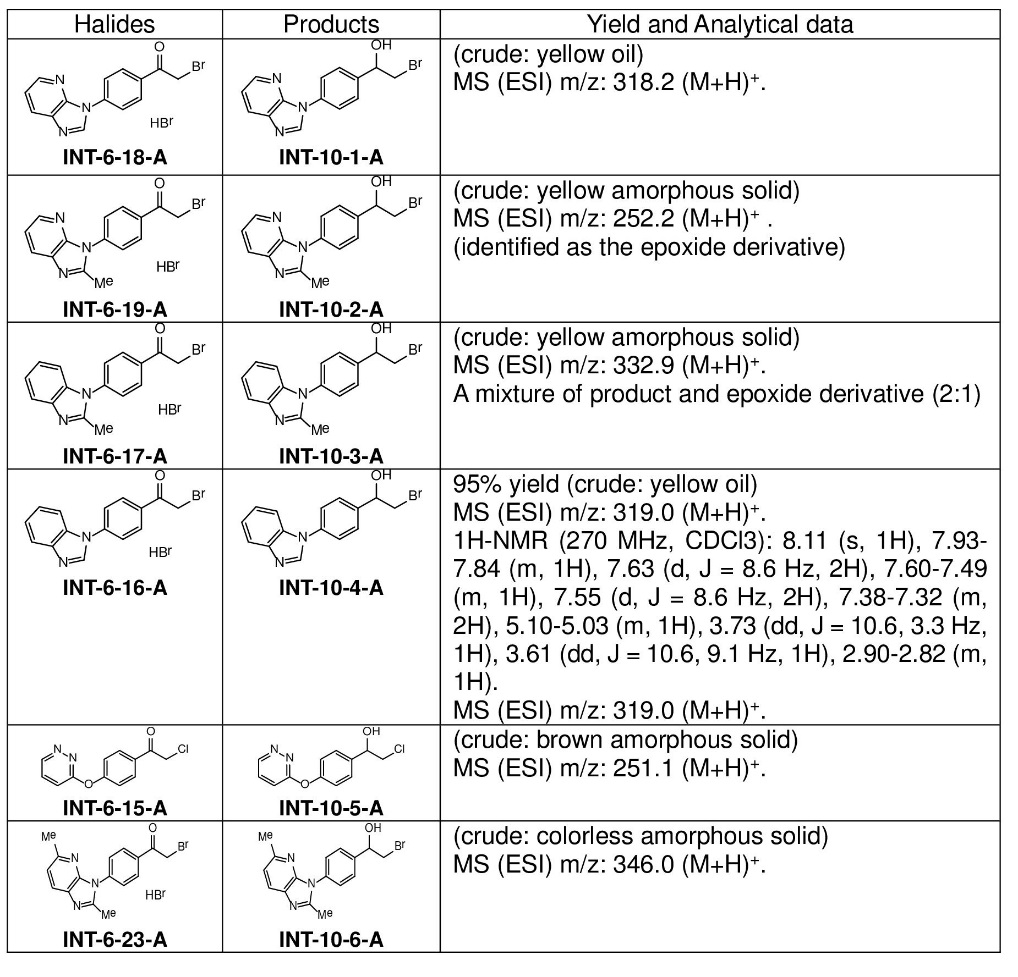


1H-NMR (270 MHz, DMSO-d6): delta 9.02 (s, 1H), 8.04 (d, J = 7.9 Hz, 2H), 7.84 (d, J = 7.9 Hz, 2H), 4.97 (s, 2H), 2.25-1.75 (m, 8H), 1.32 (s, 12H).
MS (ESI) m/z: 449.2 (M+H)+.
(2-oxo-2-(4-(4,4,5,5-tetramethyl-1,3,2-dioxaborolan-2-yl)phenyl)ethyl)-1-oxa-3-azaspiro[4.5]decan-2-one


1H-NMR (270 MHz, CDCl3): delta 7.51 (d, J = 7.9 Hz, 2H), 7.27 (d, J = 7.9 Hz, 2H), 5.03-4.92 (m, 1H), 3.59-3.23 (m, 4H), 2.90 (br.s, 1H), 2.31-1.95 (m, 6H), 1.83-1.68 (m, 2H).
MS (ESI) m/z: 390.1 (M+H)+.

1H-NMR (270 MHz, CDCl3): delta 7.80 (d, J = 8.6 Hz, 2H), 7.64 (d, J = 8.6 Hz, 2H), 4.67 (s, 2H), 3.47 (s, 2H), 2.38-2.00 (m, 6H), 2.00-1.80 (m, 2H).
MS (ESI) m/z: 390.1 (M+H)+.
A mixture of INT-12-2-2 (200 mg, 0.515 mmol), bis(pinacolato)dibroron(150 mg, 0.592 mmol), PdCl2(dppf) CH2Cl2 (21 mg, 0.026 mmol) and potassium acetate (126 mg, 1.288 mmol) in 1,4-dioxane (3 mL) is stirred at 80 oC for 3 h. The reaction mixture (3 mL in dioxane) is used for the next Suzuki-Miyaura cross coupling reaction.
3-(2-(4-(5,5-dimethyl-1,3,2-dioxaborinan-2-yl)phenyl)-2-oxoethyl)-1,3-diazaspiro[4.5]decane-2,4-dione

3-(2-oxo-2-(4-(4,4,5,5-tetramethyl-1,3,2-dioxaborolan-2-yl)phenyl)ethyl)-1,3-diazaspiro[4.5]decane-2,4-dione

8,8-difluoro-3-(2-(3-fluoro-4-(4,4,5,5-tetramethyl-1,3,2-dioxaborolan-2-yl)phenyl)-2-oxoethyl)-1,3-diazaspiro[4.5]decane-2,4-dione

MS (ESI) m/z: 383.2 (M-H)- (as the bronic acid derivatives).
8,8-difluoro-3-(2-(2-fluoro-4-(4,4,5,5-tetramethyl-1,3,2-dioxaborolan-2-yl)phenyl)-2-oxoethyl)-1,3-diazaspiro[4.5]decane-2,4-dione

8,8-difluoro-3-(2-oxo-2-(4-(4,4,5,5-tetramethyl-1,3,2-dioxaborolan-2-yl)phenyl)ethyl)-1-oxa-3-azaspiro[4.5]decane-2,4-dione

MS (ESI) m/z: 448.1 (M-H)-.


1H-NMR (270 MHz, CDCl3): delta 7.50 (d, J = 7.9 Hz, 2H), 7.28 (d, J = 7.9 Hz, 2H), 4.97 (dt, J = 7.9, 3.3 Hz, 1H), 3.52 (dd, J = 15.2, 3.3 Hz, 1H), 3.39 (dd, J = 15.2, 7.9 Hz, 1H), 3.19 (s, 2H), 3.20-3.14 (m, 1H), 1.85-1.63 (m, 4H), 1.60-1.32 (m, 6H).
MS (ESI) m/z: 356.0 (M+H)+.
1H-NMR (270 MHz, CDCl3): delta 7.81 (d, J = 8.5 Hz, 2H), 7.64 (d, J = 8.5 Hz, 2H), 4.65 (s, 2H), 3.39 (s, 2H), 2.00-1.32 (m, 10H).
MS (ESI) m/z: 354.0 (M+H)+.


MS (ESI) m/z: 387.9 (M+H-OH)+.
1H-NMR (270 MHz, CDCl3): delta 7.82 (d, J = 8.6 Hz, 2H), 7.65 (d, J = 8.6 Hz, 2H), 4.92 (d, J = 18.5 Hz, 1H), 4.33 (d, J = 18.5 Hz, 1H), 3.82 (q, J = 6.6 Hz, 1H), 2.40-1.98 (m, 6H), 1.93-1.66 (m, 2H), 1.15 (d, J = 6.6 Hz, 3H).
MS (ESI) m/z: 403.8 (M+H)+.


MS (ESI) m/z: 419.8 (M+H)+.
1H-NMR (270 MHz, CDCl3): delta 7.83 (d, J = 8.6 Hz, 2H), 7.65 (d, J = 8.6 Hz, 2H), 4.52 (s, 2H), 2.39-2.02 (m, 6H), 1.85-1.64 (m, 2H), 1.17 (s, 6H).
MS (ESI) m/z: 417.8 (M+H)+.


MS (ESI) m/z: 433.8 (M+H)+.
1H-NMR (270 MHz, CDCl3): delta 7.81 (d, J = 8.6 Hz, 2H), 7.65 (d, J = 8.6 Hz, 2H), 5.22 (d, J = 18.5 Hz, 1H), 4.40 (d, J = 18.5 Hz, 1H), 3.60 (d, J = 2.0 Hz, 1H), 2.62-2.49 (m, 1H), 2.41-1.72 (m, 8H), 1.04 (d, J = 6.6 Hz, 6H).
MS (ESI) m/z: 431.8 (M+H)+.

1H-NMR (270 MHz, DMSO-d6): delta 10.58 (br.s, 1H), 8.98 (s, 1H), 7.92 (d, J = 8.6 Hz, 2H), 6.89 (d, J = 8.6 Hz, 2H), 4.84 (s, 2H), 2.25-1.70 (m, 8H).
MS (ESI) m/z: 339.06 (M+H)+.


1H-NMR (270 MHz, DMSO-d6): delta 10.1 (s, 1H), 8.63-8.59 (m, 2H), 8.01 (d, J = 8.5 Hz, 2H), 7.90 (d, J = 8.5 Hz, 2H), 7.14 (dd, J = 7.9, 4.6 Hz, 1H), 4.89 (s, 2H).
MS (ESI) m/z: 337.9 (M+H)+.

1H-NMR (270 MHz, DMSO-d6): delta 10.2 (s, 1H), 9.02 (s, 1H), 8.62-8.57 (m, 2H), 8.05 (d, J = 8.5 Hz, 2H), 7.94 (d, J = 8.5 Hz, 2H), 7.15 (dd, J = 7.9, 4.6 Hz, 1H), 4.94 (s, 2H), 2.18-1.81 (m, 8H).
MS (ESI) m/z: 460.0 (M+H)+.
1H-NMR (270 MHz, DMSO-d6): delta 8.98 (s, 1H), 8.41 (s, 1H), 7.92 (d, J = 9.2 Hz, 2H), 7.72 (d, J = 9.2 Hz, 2H), 7.59 (dd, J = 4.6, 1.3 Hz, 1H), 7.02-6.98 (m, 1H), 6.78 (dd, J = 7.9, 4.6 Hz, 1H), 5.22 (s, 2H), 4.84 (s, 2H), 2.17-1.85 (m, 8H).
MS (ESI) m/z: 430.1 (M+H)+ .


1H-NMR (270 MHz, DMSO-d6): delta 10.23 (br.s, 1H), 8.53-8.45 (m, 1H), 8.06-7.92 (m, 4H), 7.04-6.96 (m, 1H), 4.90 (s, 2H), 2.52 (s, 3H).
MS (ESI) m/z: 350.1 (M+H)+.

1H-NMR (270 MHz, DMSO-d6): delta 10.25 (br.s, 1H), 9.02 (br.s, 1H), 8.53-8.46 (m, 1H), 8.10-7.95 (m, 4H), 7.05-6.97 (m, 1H), 4.94 (s, 2H), 2.53 (s, 3H), 2.27-1.75 (m, 8H).
MS (ESI) m/z: 474.0 (M+H)+.
1H-NMR (270 MHz, DMSO-d6): delta 8.98 (br.s, 1H), 8.37 (br.s, 1H), 7.92 (d, J = 8.6 Hz, 2H), 7.74 (d, J = 8.6 Hz, 2H), 6.93 (d, J = 7.9 Hz, 1H), 6.63 (d, J = 7.9 Hz, 1H), 4.98 (br.s, 2H), 4.84 (br.s, 2H), 2.29 (s, 3H), 2.26-1.75 (m, 8H).
MS (ESI) m/z: 444.0 (M+H)+.


1H-NMR (270 MHz, CDCl3): delta 8.00 (d, J = 7.9 Hz, 2H), 7.86 (d, J = 7.9 Hz, 1H), 7.53-7.46 (m, 4H), 7.30 (d, J = 7.3 Hz, 1H), 6.56 (s, 1H), 4.97 (s, 2H), 2.48-2.21 (m, 4H), 2.12-1.90 (m, 4H), 1.29 (s, 9H).
MS (ESI) m/z: 497.2 (M-H)-.

MS (ESI) m/z: 441.2 (M-H)- .

MS (ESI) m/z: 480.3 (M-H)-.

1H-NMR (270 MHz, DMSO-d6): delta 9.05 (br.s, 1H), 8.30 (d, J = 8.6 Hz, 2H), 8.09 (d, J = 7.9 Hz, 1H), 7.85 (d, J = 8.6 Hz, 2H), 7.29 (d, J = 7.9 Hz, 1H), 5.09 (br.s, 2H), 4.96 (br.s, 2H), 2.52 (s, 3H), 2.28-1.78 (m, 8H).
MS (ESI) m/z: 502.2 (M+H)+.

MS (ESI) m/z: 512.0 (M+H)+.

MS (ESI) m/z: 526.3 (M+H)+.
Examples

1H-NMR (270 MHz, DMSO-d6): delta 8.95 (s, 1H), 6.70 (s, 1H), 6.65 (s, 1H), 4.59 (s, 2H), 2.52 (s, 3H), 2.36 (s, 3H), 2.12 (s, 3H), 2.25-1.70 (m, 8H).
MS (ESI) m/z: 421.3 (M+H)+.


1H-NMR (270 MHz, DMSO-d6): delta 8.79 (s, 1H), 8.15 (t, J = 7.2 Hz, 1H), 7.73 (d, J = 6.6 Hz 1H), 7.62 (d, J = 7.2 Hz, 1H), 6.61 (s, 1H), 4.56 (s, 2H), 2.29 (s, 3H), 2.06 (s, 3H), 1.72-1.57 (m, 8H).
MS (ESI) m/z: 415.2 (M+H)+.
Observed MS: 451.2
tR/method: 1.86 min./(QC1)

Observed MS: 480.2
tR/method: 1.58 min./(QC1)


1H-NMR (270 MHz, DMSO-d6): delta 8.71 (s, 1H), 7.89-7.74 (m, 3H), 7.36-7.17 (m, 8H), 6.74-6.70 (m, 2H), 6.27 (s, 1H), 4.50 (s, 2H), 4.09 (s, 2H), 2.51 (s, 3H).
MS (ESI) m/z: 375.1 (M+H)+.

1H-NMR (270 MHz, DMSO-d6): delta 8.18 (d, J = 8.5 Hz, 2H), 7.80-7.75 (m, 3H), 7.34-7.25 (m, 6H), 7.14-7.11 (m, 2H), 4.72 (s, 2H), 4.45 (s, 2H), 2.68 (s, 3H), 2.46 (s, 3H).
MS (ESI) m/z: .357.1 (M+H)+ .

MS (ESI) m/z: 270.1 (M+H)+.
1H-NMR (270 MHz, DMSO-d6): delta 9.06 (s, 1H), 8.30 (d, J = 8.5 Hz, 2H), 7.84 (d, J = 8.5 Hz, 2H), 7.32-7.28 (m, 4H), 5.61 (t, J = 5.9 Hz, 1H), 5.07 (s, 2H), 4.65 (d, J = 5.9 Hz, 2H), 2.19-1.76 (m, 8H).
MS (ESI) m/z: 469.1 (M+H)+.


MS (ESI) m/z: 493.9 (M+H)+.
Observed MS: 466.5
tR/method: 1.37 min./(QC1)


Purification of neutral compound: short filtration using amine silica gel or the purification by column chromatography.
Purification of basic compound: The residue is loaded onto an SCX cartridge (Varian Bond Elute, 1 g/6 mL) conditioned with 1mL of MeOH, rinsed with 5 mL of MeOH and eluted with 5 mL of 1M NH3/MeOH. Volatiles are removed by nitrogen flow to give the crude title compound. If necessary, the purification by column chromatography is carried out before the purification using SCX.
The further purification is carried out by preparative LC-MS system in the usual manner. The retention time and observed MS by HPLC-QC method are noted in Table 20.

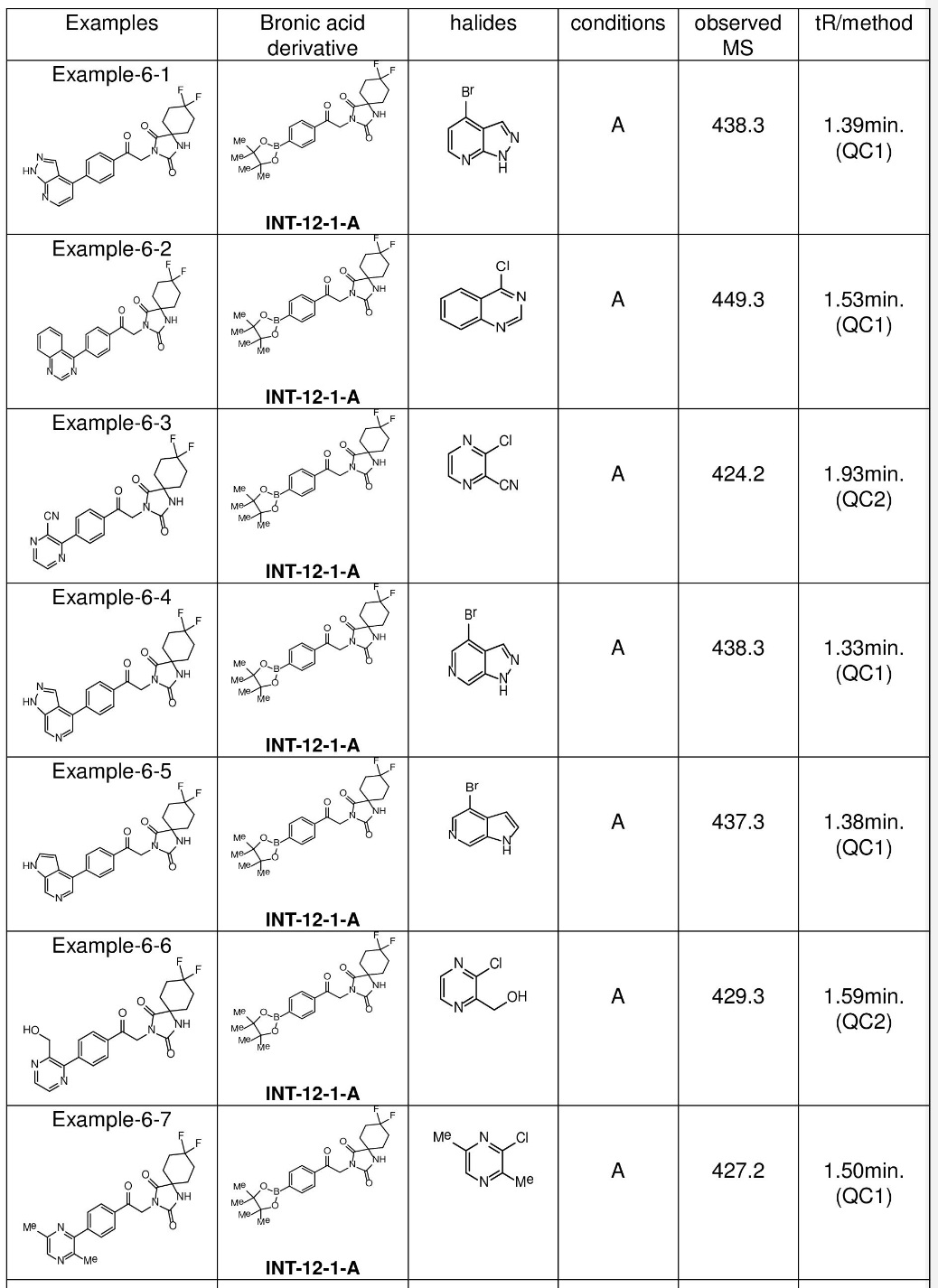


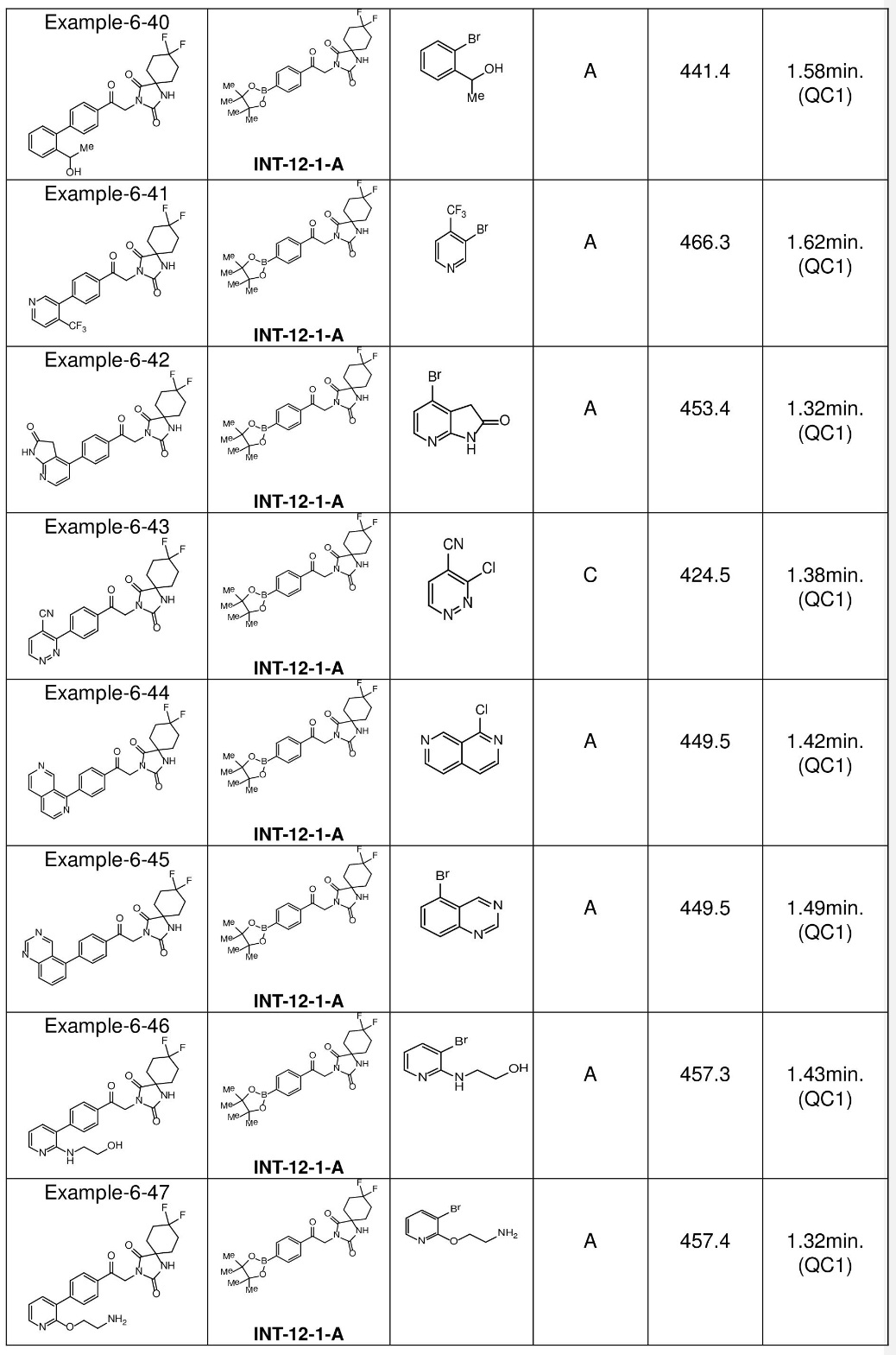


1H-NMR (270 MHz, CDCl3): delta 8.01 (d, J = 2.7 Hz, 1H), 7.93 (d, J = 2.7 Hz, 1H), 4.75 (t, J = 3.0 Hz, 1H), 4.65-4.55 (m, 2H), 4.19-4.05 (m, 1H), 4.00-3.80 (m, 2H), 3.60-3.50 (m, 1H), 1.89-1.48 (m, 6H).

MS (ESI) m/z: 545.2 (M+H)+.
1H-NMR (270 MHz, CDCl3): delta 8.33 (d, J = 2.6 Hz, 1H), 8.24 (d, J = 8.6 Hz, 2H), 8.11 ( d, J = 2.6 Hz, 1H), 8.05 (d, J = 8.6 Hz, 2H), 6.05 (br.s, 1H), 4.97 (s, 2H), 4.65-4.57 (m, 2H), 4.08-4.00 (m, 2H), 2.58-2.19 (m, 5H), 2.12-1.90 (m, 4H).
Observed MS: 459.3
tR/method: 1.41 min./(QC1)


1H-NMR (270 MHz, CDCl3): delta 8.04 (d, J = 8.5 Hz, 2H), 7.50-7.35 (m, 4H), 7.28-7.24 (m, 2H), 6.94 (br.s, 1H), 4.98 (s, 2H), 4.68 (br.s, 1H), 4.29 (d, J = 5.3 Hz, 2H), 2.38-2.24 (m, 4H), 2.04-1.98 (m, 4H), 1.63 (s, 3H), 1.43 (s, 9H).
MS (ESI) m/z: 526.4 (M-H)-.
1H-NMR (270 MHz, DMSO-d6): delta 9.05 (s, 1H), 8.33 (s, 2H), 8.16 (d, J = 8.5 Hz, 2H), 7.71 (d, J = 7.2 Hz, 1H), 7.62-7.48 (m, 4H), 7.37 (d, J = 7.2 Hz, 1H), 5.03 (s, 2H), 3.97 (s, 2H), 2.19-1.81 (m, 8H).
MS (ESI) m/z: 428.3 (M+H)-.

MS (ESI) m/z: 429.29 (M+H)+.

1H-NMR (270 MHz, CDCl3): delta 8.64-8.58 (m, 1H), 8.10-8.00 (m, 2H), 7.62-7.55 (m, 1H), 7.53-7.45 (m, 2H), 7.36-7.28 (m, 1H), 7.00 (br.s, 1H), 6.00 (br.s, 1H), 4.96 (s, 2H), 4.38 (d, J = 3.9 Hz, 2H), 2.50-1.90 (m, 8H), 1.65 (s, 3H), 1.43 (s, 9H).
MS (ESI) m/z: 529.41 (M+H)+.
1H-NMR (270 MHz, DMSO-d6): delta 9.03 (br.s, 1H), 8.65-8.60 (m, 1H), 8.18-8.10 (m, 2H), 7.75-7.40 (m, 3H), 7.44-7.35 (m, 1H), 5.02 (s, 2H), 3.73 (s, 2H), 2.30-1.75 (m, 8H). (A signal due to NH is not observed.)
Observed MS: 427.3
tR/method: 1.23 min./(QC1)

The further purification is carried out by preparative LC-MS system in the usual manner.
1H-NMR (270MHz, DMSO-d6): delta 9.03 (s, 1H), 8.65-8.60 (m, 1H), 8.24-8.20 (m, 1H), 8.18-8.10 (m, 2H), 7.75-7.60 (m, 3H), 7.48-7.40 (m, 1H), 5.03 (s, 2H), 4.32 (d, J = 4.3 Hz, 2H), 2.30-1.75 (m, 8H), 1.80 (s, 3H).
Observed MS: 469.4
tR/method: 1.33 min./(QC1)


1H-NMR (270 MHz, DMSO-d6): delta 9.02 (s, 1H), 8.59 (d, J = 5.3 Hz, 1H), 8.43 (s, 1H), 8.14 (d, J = 7.9 Hz, 2H), 7.64 (d, J = 7.9 Hz, 2H), 7.51 (t, J = 5.3 Hz, 1H), 7.39 (d, J = 4.6 Hz, 1H), 5.02 (s, 2H), 4.11 (d, J = 5.3 Hz, 2H), 2.17-1.86 (m, 8H), 1.36 (s, 9H).
MS (ESI) m/z: 529.3 (M-H)-.
Observed MS: 427.4
tR/method: 1.19 min./(QC1)

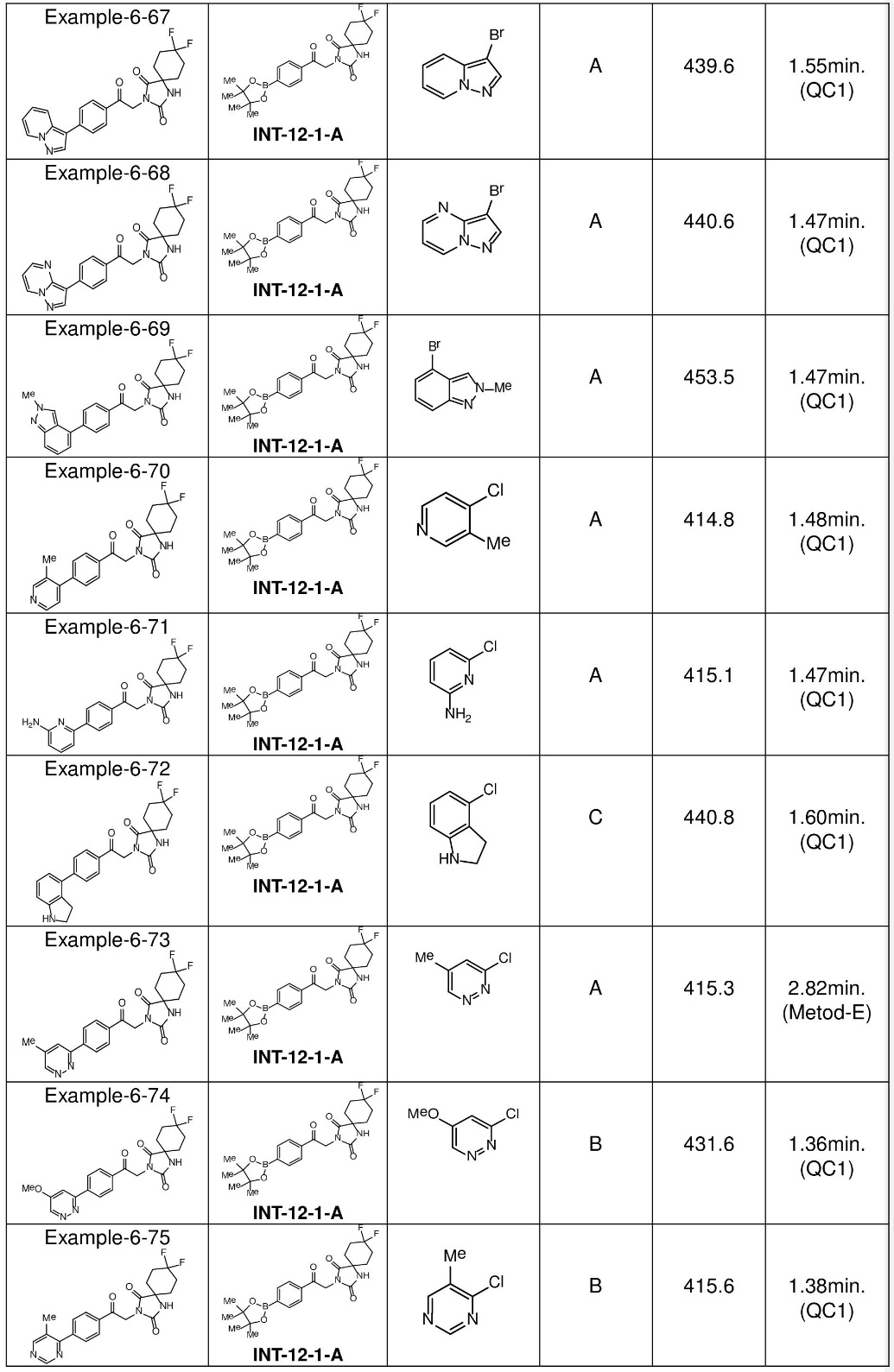
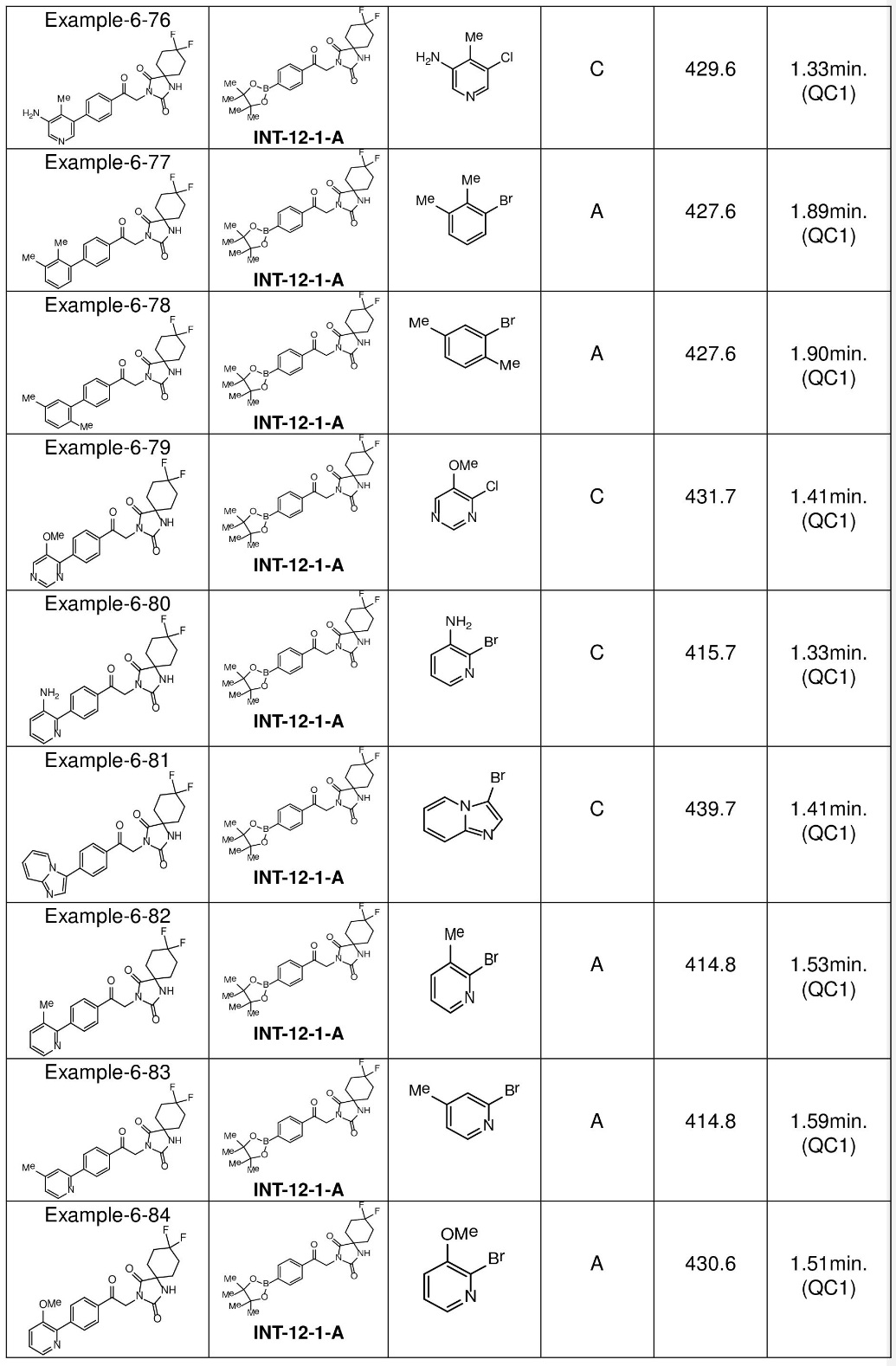
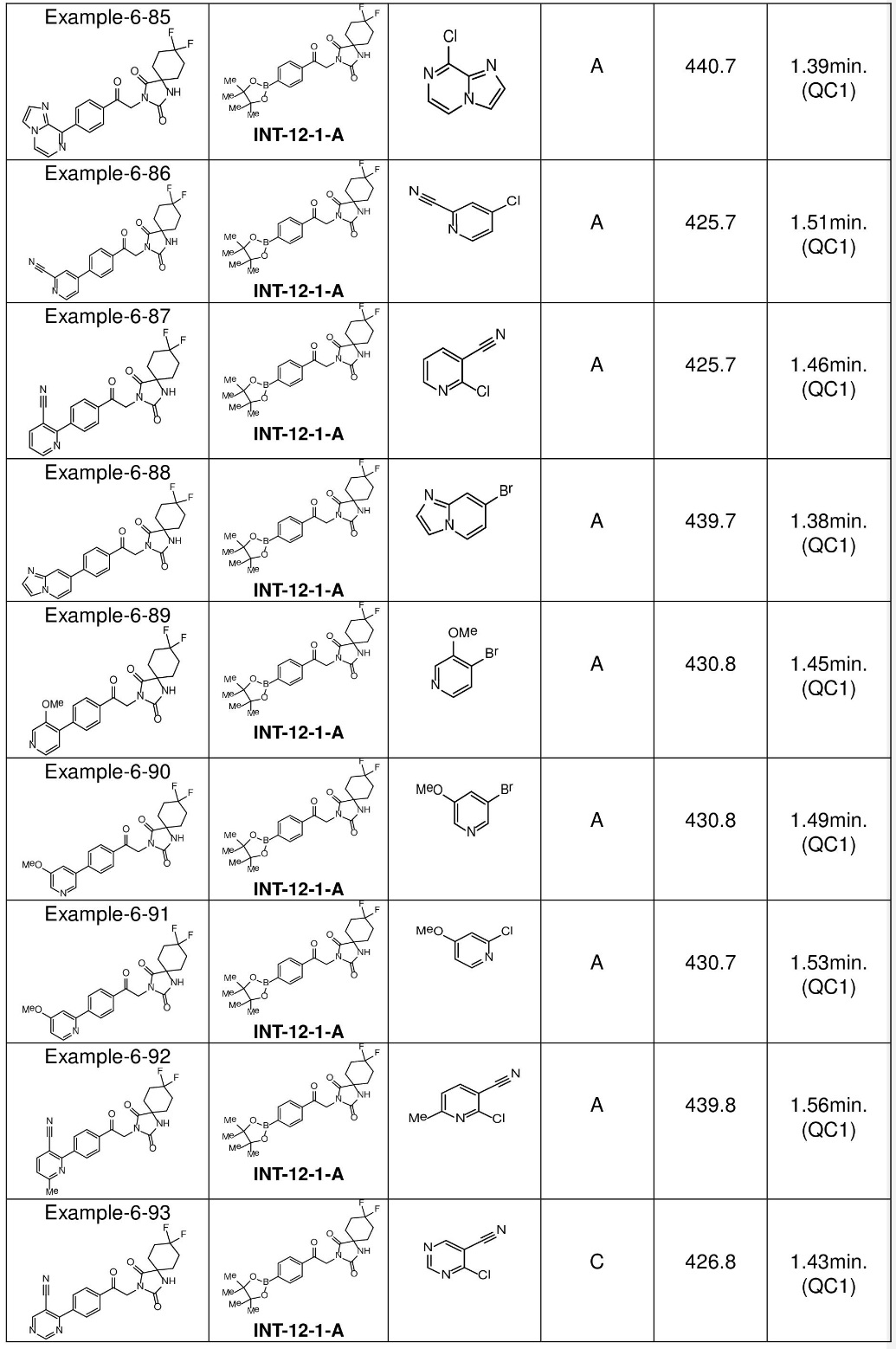
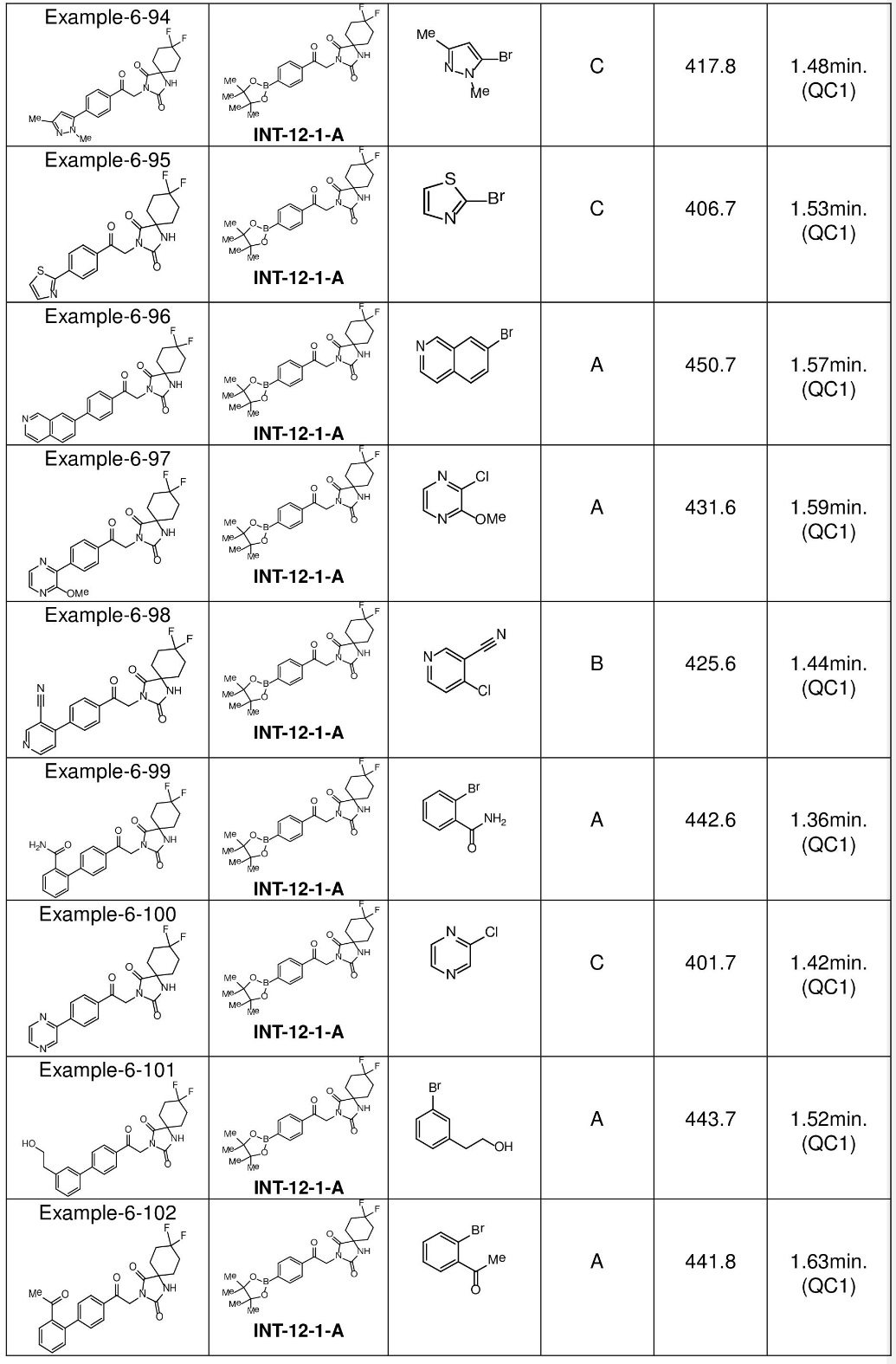


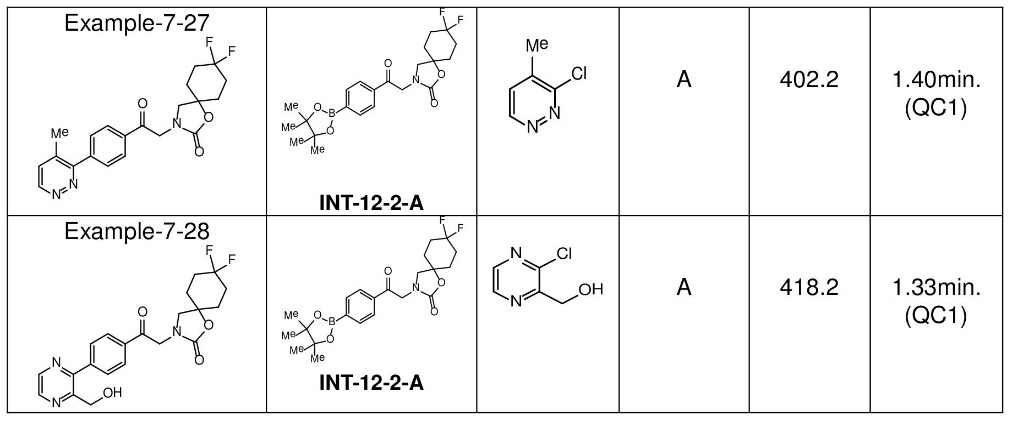


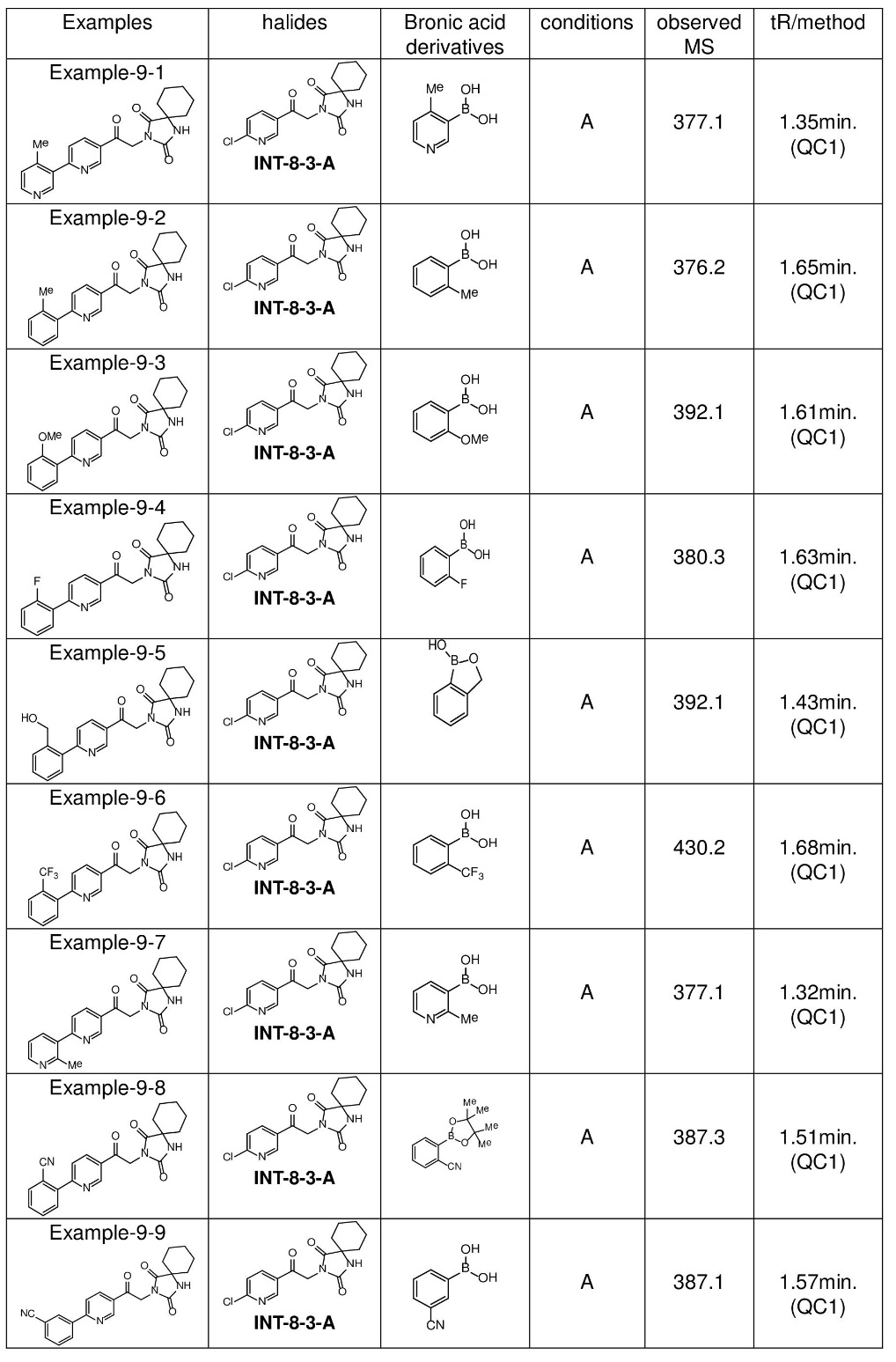


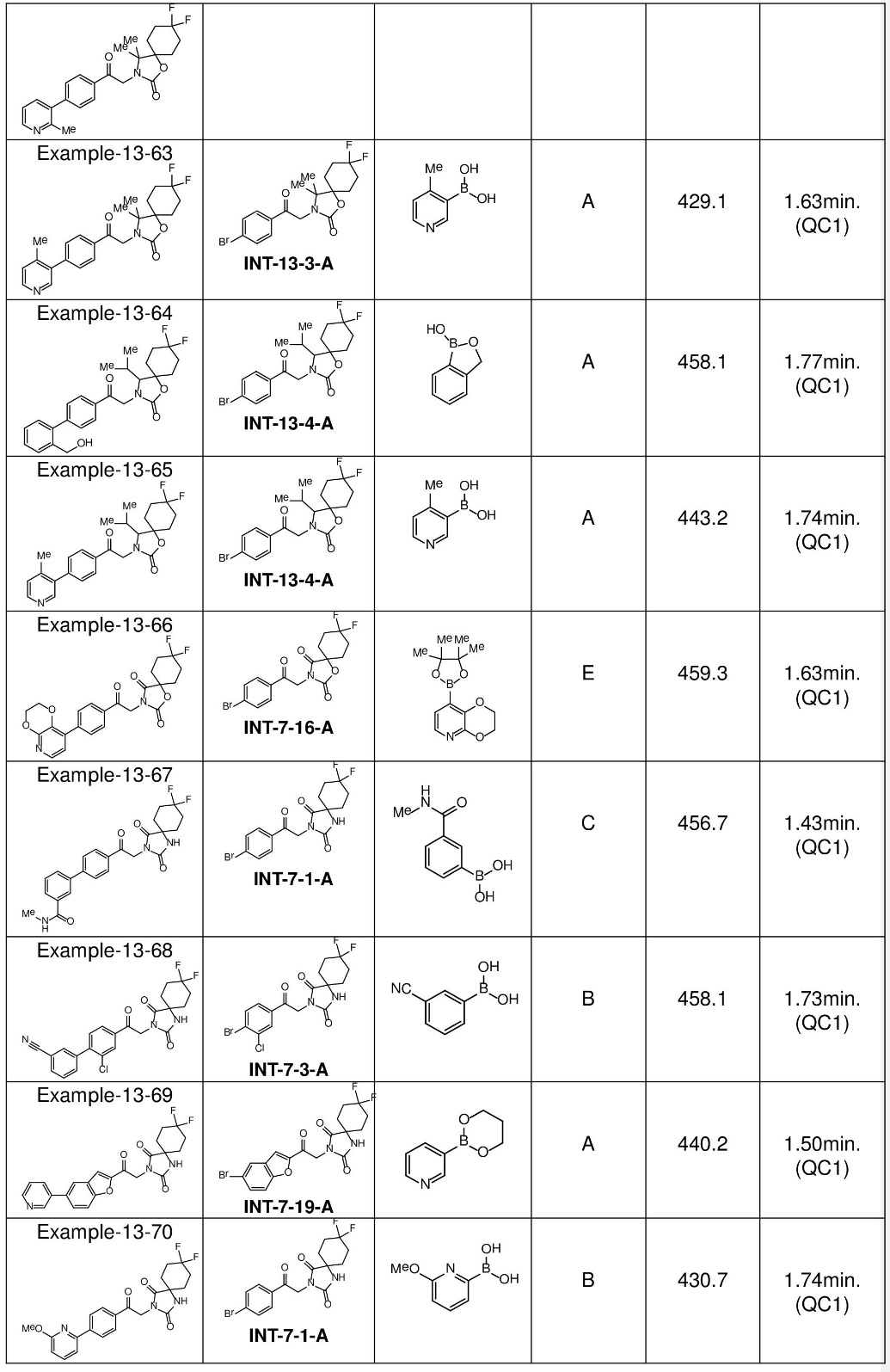


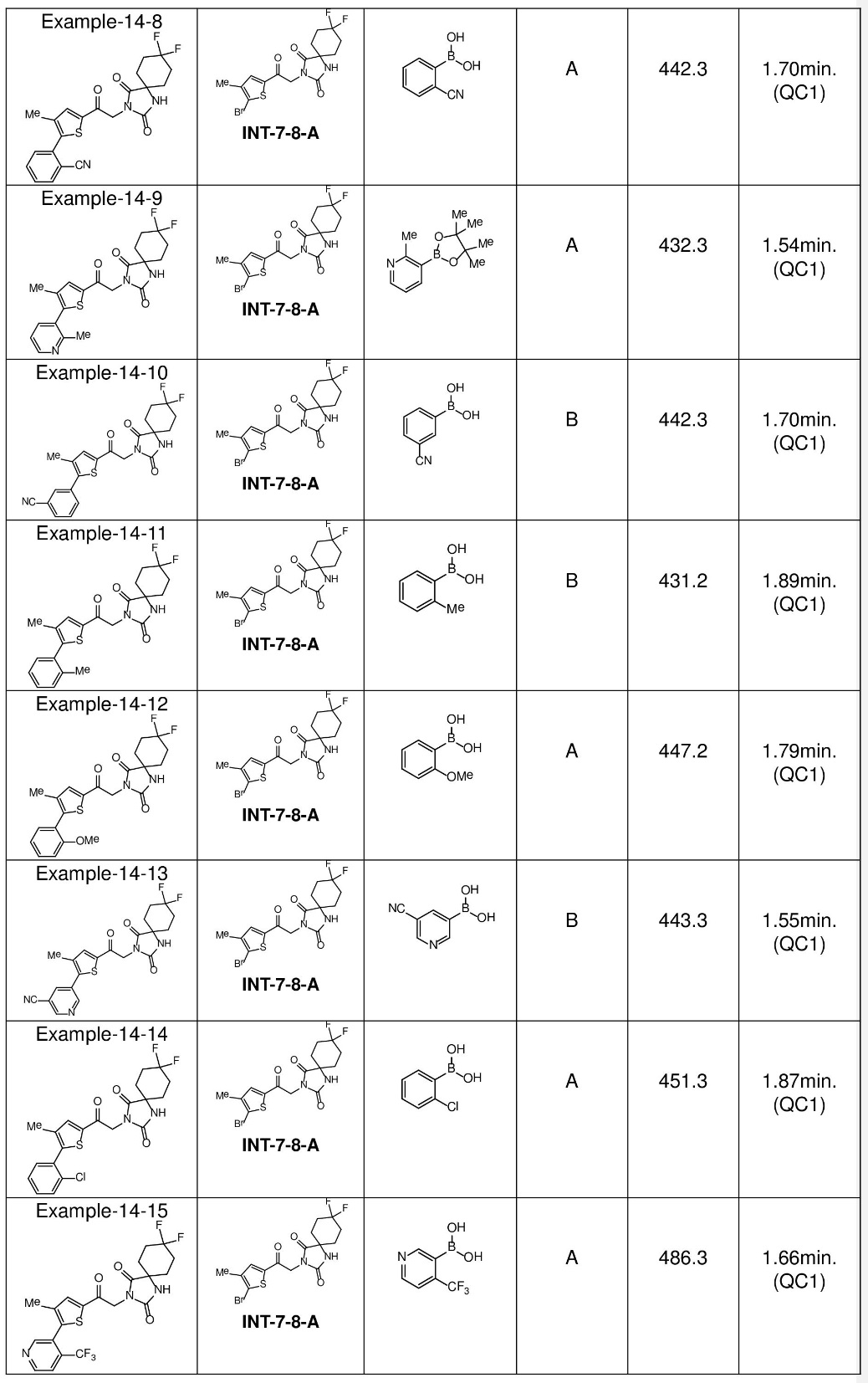


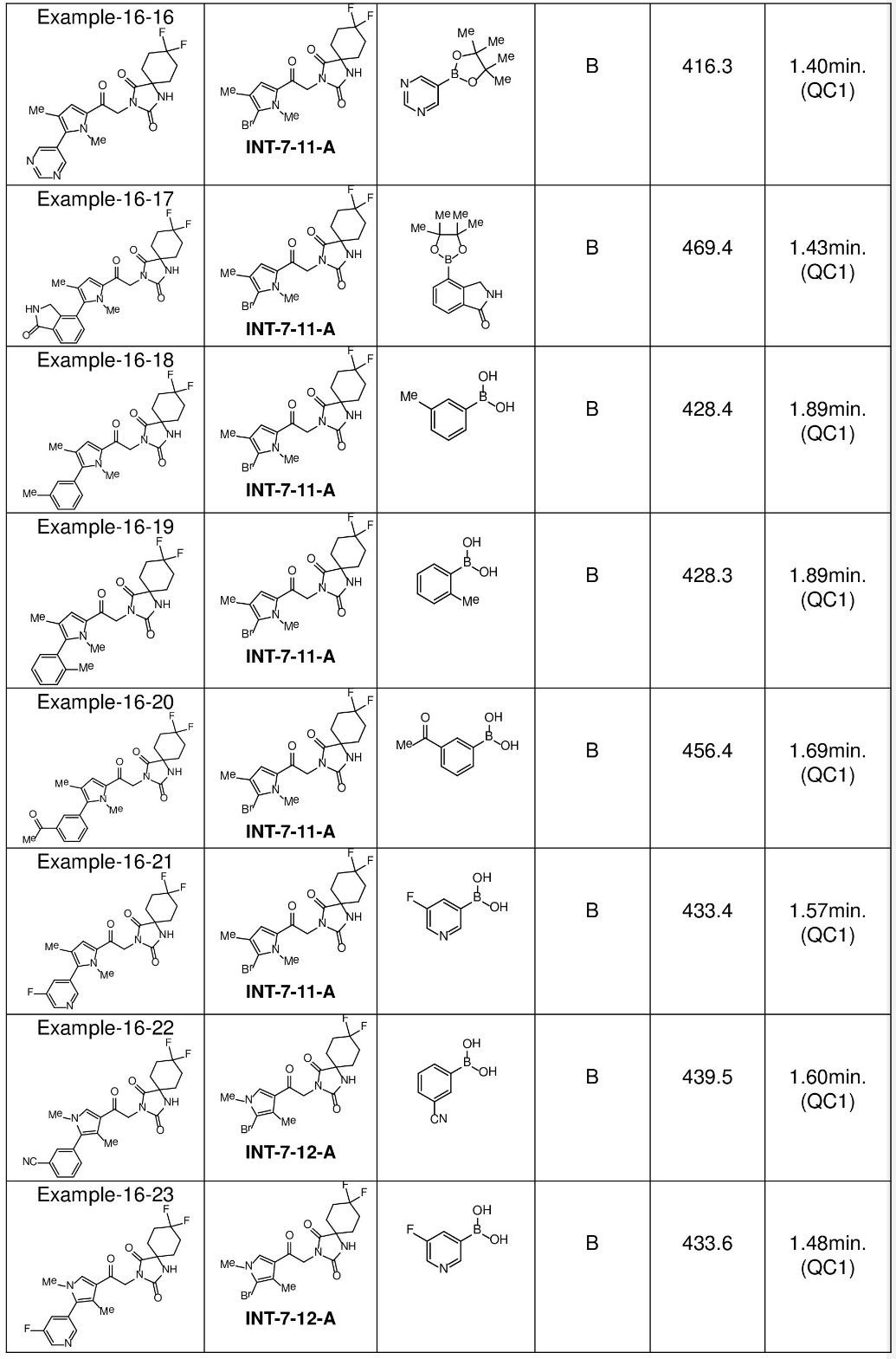


To a solution of INT-8-3-A (30 mg, 0.093 mmol) in DME (1 mL) is added N-Methyl-m-toluidine (12 mg, 0.103mmol), potassium tert-butoxide (16 mg, 0.140 mmol) and Pd-PEPPSI(trademark)-IPr (1.3 mg, 1.86 mmol). The mixture is irradiated in a microwave reactor (Biotage Initiator) for 30 min. at 140 oC (or heated at 100-150 oC for 3-15 h in oil bath). The mixture is quenched with water and filtered through a pad of celite. The filter cake is washed with EtOAc and the filtrate and washings are washed with brine, dried over sodium sulfate, filtered, and concentrated in vacuo. The residue is purified by column chromatography on silica gel with 10-100% EtOAc in hexane to give the titled compound (13 mg, 34% yield). The further purification is carried out by preparative LC-MS system in the usual manner.
Observed MS: 405.4
tR/method: 1.76 min./(QC1)

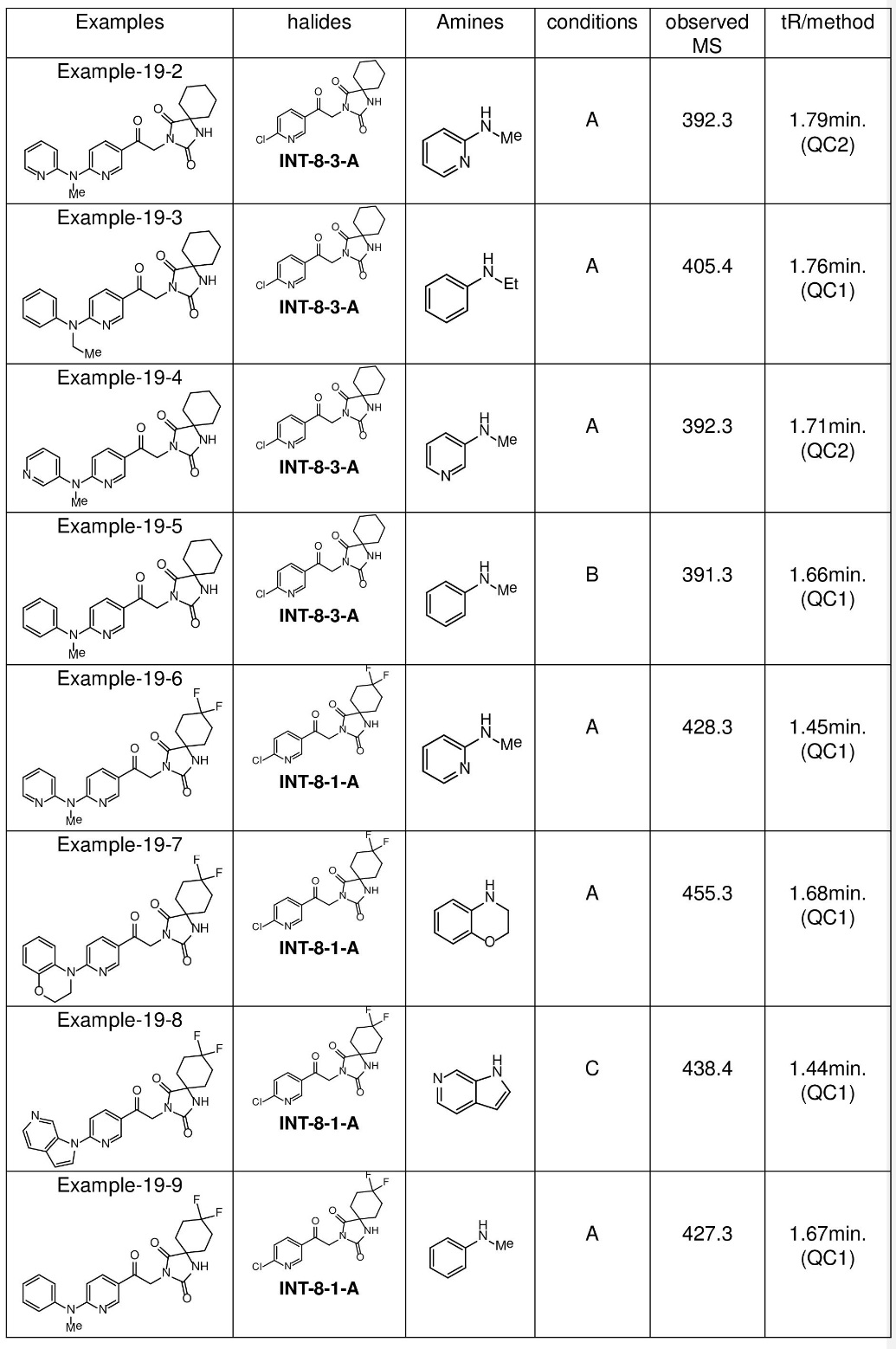


Observed MS: 417.7
tR/method: 1.56min./(QC1)


Observed MS: 439.3
tR/method: 1.53 min./(QC1)
3-(2-(4-((3-chloropyridin-2-yl)oxy)phenyl)-2-oxoethyl)-8,8-difluoro-1,3-diazaspiro[4.5]decane-2,4-dione

Observed MS: 448.2
tR/method: 1.68 min./(QC1)

8,8-difluoro-3-(2-(4-((4-methylpyridazin-3-yl)oxy)phenyl)-2-oxoethyl)-1,3-diazaspiro[4.5]decane-2,4-dione

Observed MS: 431.2
tR/method: 1.43min./(QC1)
3-(4-(2-(8,8-difluoro-2,4-dioxo-1,3-diazaspiro[4.5]decan-3-yl)acetyl)phenoxy)pyridazine-4-carbonitrile

Observed MS: 442.2
tR/method: 1.43min./(QC1)
8,8-difluoro-3-(2-oxo-2-(4-(thiazol-2-yloxy)phenyl)ethyl)-1,3-diazaspiro[4.5]decane-2,4-dione

Observed MS: 422.1
tR/method: 1.56min./(QC1)
8,8-difluoro-3-(2-oxo-2-(4-(pyridin-3-yloxy)phenyl)ethyl)-1,3-diazaspiro[4.5]decane-2,4-dione

Observed MS: 416.4
tR/method: 1.47min./(QC1)

8,8-difluoro-3-(2-oxo-2-(4-(pyridin-3-ylmethoxy)phenyl)ethyl)-1,3-diazaspiro[4.5]decane-2,4-dione

Observed MS: 430.1
tR/method: 1.45min./(QC1)
8,8-difluoro-3-(2-oxo-2-(4-(pyridin-4-ylmethoxy)phenyl)ethyl)-1,3-diazaspiro[4.5]decane-2,4-dione

Observed MS: 430.2
tR/method: 1.44min./(QC1)
8,8-difluoro-3-(2-oxo-2-(4-(pyrimidin-2-ylmethoxy)phenyl)ethyl)-1,3-diazaspiro[4.5]decane-2,4-dione

Observed MS: 431.2
tR/method: 1.34min./(QC1)

8,8-difluoro-3-(2-oxo-2-(4-(2-oxo-1H-imidazo[4,5-b]pyridin-3(2H)-yl)phenyl)ethyl)-1,3-diazaspiro[4.5]decane-2,4-dione

Observed MS: 454.4
tR/method: 1.34 min./(QC1)
8,8-difluoro-3-(2-(4-(5-methyl-2-oxo-1H-imidazo[4,5-b]pyridin-3(2H)-yl)phenyl)-2-oxoethyl)-1,3-diazaspiro[4.5]decane-2,4-dione

Observed MS: 470.4
tR/method: 1.42min./(QC1)
3-(2-(4-(2-(difluoromethyl)-1H-benzo[d]imidazol-1-yl)phenyl)-2-oxoethyl)-8,8-difluoro-1,3-diazaspiro[4.5]decane-2,4-dione

Observed MS: 490.1
tR/method: 2.05min./(QC2)

8,8-difluoro-3-(2-oxo-2-(4-(2-(trifluoromethyl)-3H-imidazo[4,5-b]pyridin-3-yl)phenyl)ethyl)-1,3-diazaspiro[4.5]decane-2,4-dione

Observed MS: 508.6
tR/method: 1.58min./(QC1)
8,8-difluoro-3-(2-(4-(5-methyl-2-(trifluoromethyl)-3H-imidazo[4,5-b]pyridin-3-yl)phenyl)-2-oxoethyl)-1,3-diazaspiro[4.5]decane-2,4-dione

Observed MS: 522.7
tR/method: 1.67min./(QC1)
3-(2-(4-(2-((dimethylamino)methyl)-5-methyl-3H-imidazo[4,5-b]pyridin-3-yl)phenyl)-2-oxoethyl)-8,8-difluoro-1,3-diazaspiro[4.5]decane-2,4-dione

Observed MS: 511.7
tR/method: 1.48min./(QC1)

8,8-difluoro-3-(2-(4-(2-methoxy-3H-imidazo[4,5-b]pyridin-3-yl)phenyl)-2-oxoethyl)-1,3-diazaspiro[4.5]decane-2,4-dione

The further purification is carried out by preparative LC-MS system in the usual manner.
Observed MS: 470.2
tR/method: 2.02min./(QC2)

3-(4-(2-(8,8-difluoro-2,4-dioxo-1,3-diazaspiro[4.5]decan-3-yl)acetyl)phenyl)-2-methyl-3H-imidazo[4,5-b]pyridine-5-carbonitrile

MS (ESI) m/z: 479.3 (M+H)+.
The further purification for the assay sample is carried out by preparative LC-MS system in the usual manner.
Observed MS: 479.2
tR/method: 1.96min./(QC2)
3-(2-(4-(2-(dimethylamino)-5-methyl-3H-imidazo[4,5-b]pyridin-3-yl)phenyl)-2-oxoethyl)-8,8-difluoro-1,3-diazaspiro[4.5]decane-2,4-dione
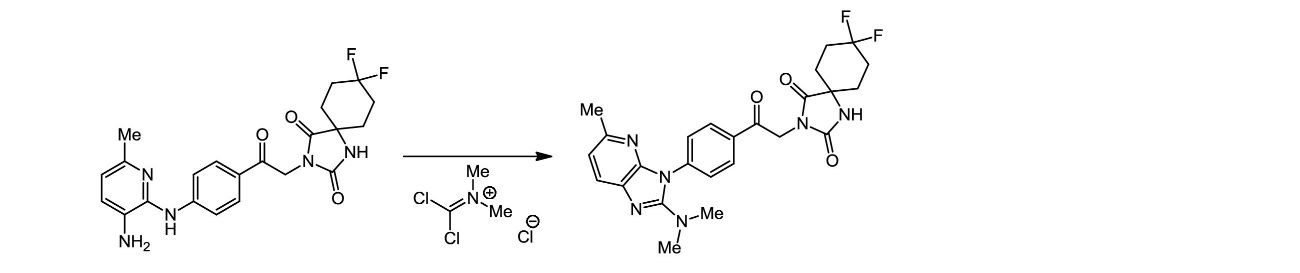
Observed MS: 497.8
tR/method: 1.51min./(QC1)
N-(2-((4-(2-(8,8-difluoro-2,4-dioxo-1,3-diazaspiro[4.5]decan-3-yl)acetyl)phenyl)amino)pyridin-3-yl)acetamide

1H-NMR (270 MHz, DMSO-d6): delta 9.56 (s, 1H), 8.98 (s, 1H), 8.71 (s, 1H), 8.14-8.08 (m, 1H), 7.97 (d, J = 8.6 Hz, 2H), 7.82-7.72 (m, 3H), 7.02-6.95 (m, 1H), 4.87 (s, 2H), 2.25-1.75 (m, 11H, including delta 2.12 (s, 3H)).
MS (ESI) m/z: 472.2 (M+H)+.
The further purification for the assay sample is carried out by preparative LC-MS system in the usual manner.Observed MS: 472.7
tR/method: 1.35min./(QC1)
3-(2-(4-(2-acetylisoindolin-4-yl)phenyl)-2-oxoethyl)-8,8-difluoro-1,3-diazaspiro[4.5]decane-
2,4-dione
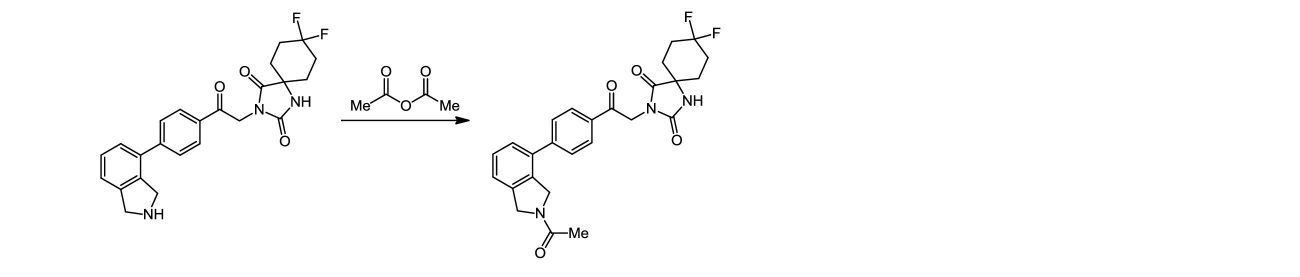
1H-NMR (270 MHz, CDCl3): delta 8.10-8.06 (m, 2H), 7.61-7.53 (m, 2H), 7.49-7.27 (m, 3H), 6.67 (br s, 1H), 5.00-4.93 (m, 2H), 4.93-4.80 (m, 4H), 2.50-1.90 (m, 11H).
MS (ESI) m/z: 482.0 (M+H)+.
The further purification is carried out by preparative LC-MS system in the usual manner.
Observed MS: 482.3
tR/method: 1.51min./(QC1)
8,8-difluoro-3-(2-(4-(2-(hydroxymethyl)-3H-imidazo[4,5-b]pyridin-3-yl)phenyl)-2-oxoethyl)-1,3-diazaspiro[4.5]decane-2,4-dione

Observed MS: 470.3
tR/method: 1.27min./(QC1)
8,8-difluoro-3-(2-(4-(2-(hydroxymethyl)-5-methyl-3H-imidazo[4,5-b]pyridin-3-yl)phenyl)-2-oxoethyl)-1,3-diazaspiro[4.5]decane-2,4-dione

Observed MS: 484.6
tR/method: 1.33min./(QC1)
4'-(2-(8,8-difluoro-2,4-dioxo-1,3-diazaspiro[4.5]decan-3-yl)acetyl)-N,N-dimethyl-[1,1'-biphenyl]-2-carboxamide

Observed MS: 470.7
tR/method: 1.49min./(QC1)


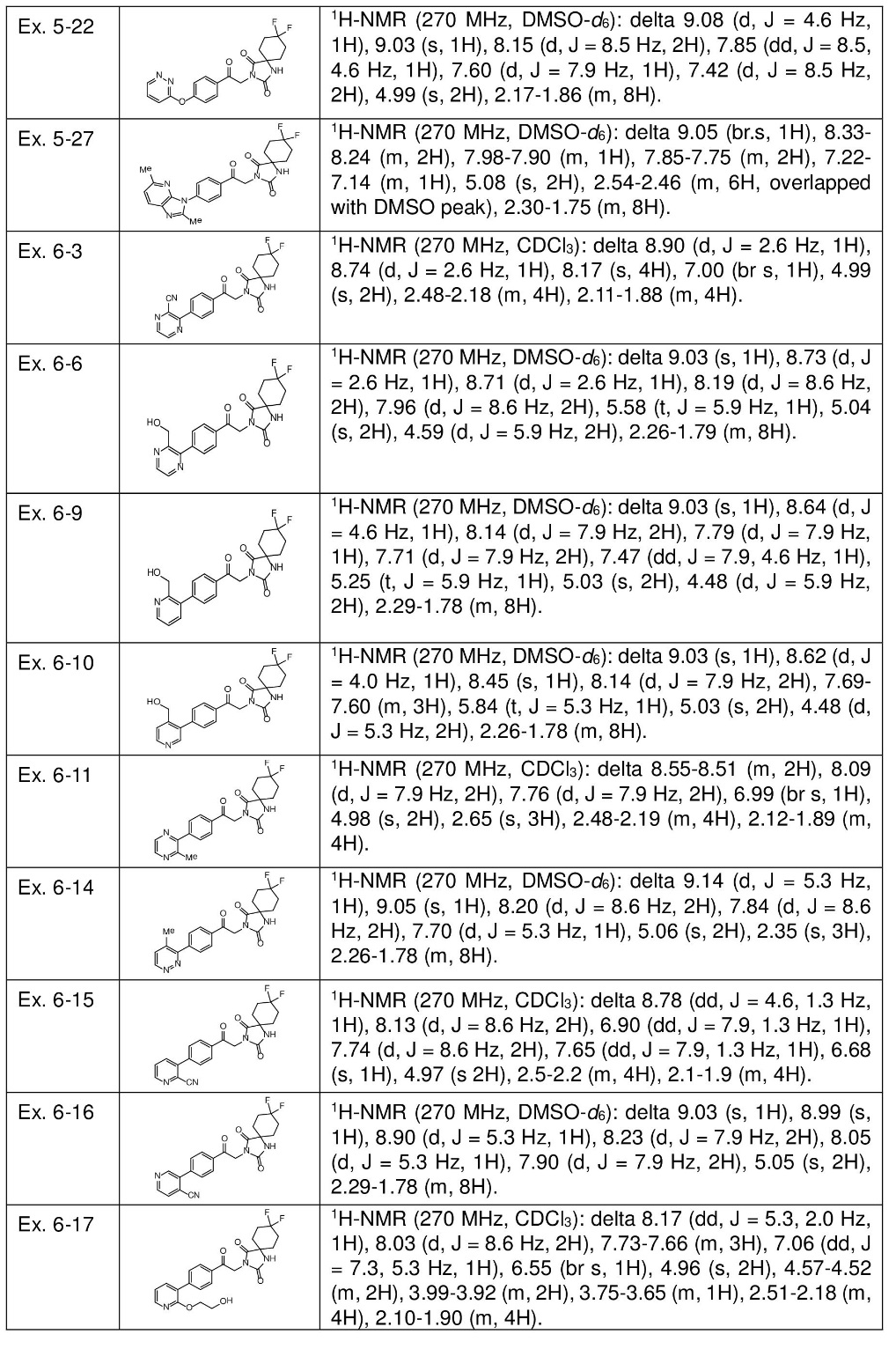


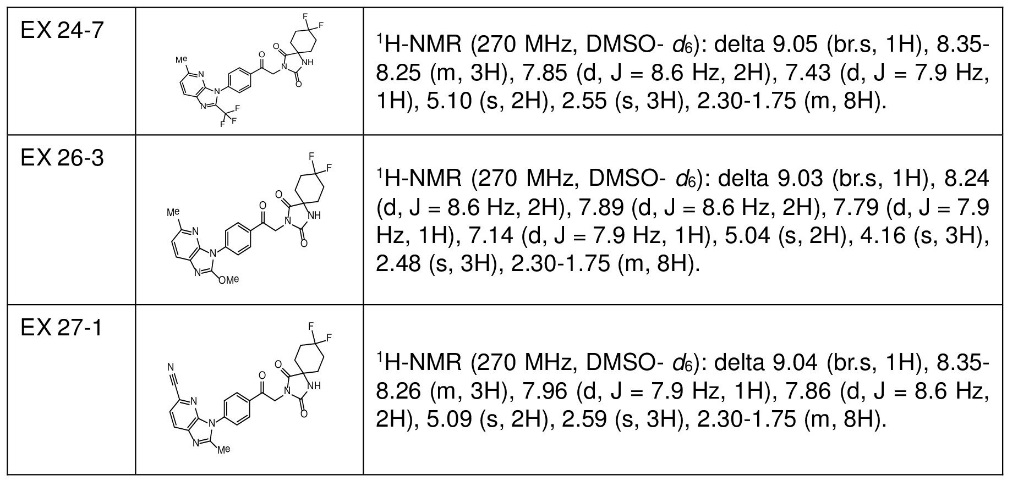
HEK293 cells stably expressing human TRPM8 are grown in T175 flasks at 37oC in a 5% CO2 humidified incubator to about 80% confluence. Media composition consists of Dulbecco's Modified Eagle Medium (high glucose), 10% fetal calf serum (FCS), 100 units/mLPenicillin, 100 microg/mL Streptomycin and 600 microg/mL Geneticine. At 24 hours prior to assay, cells are seeded in poly-D-lysine coated 384-well plates (BD FALCON) at a density of 30,000 cells per well in culture medium and grown overnight in 5% CO2 at 37oC. On the assay day, growth media is removed and cells are loaded with 0.5 microM Fluo4-AM (Molecular Probes) and 0.005 % Pluronic F-127 dissolved in assay buffer (Hank's balanced salt solution (HBSS), 19.4 mM HEPES pH7.4, 2.5 mM Probenecid) for 1 hour at room temperature. After washing with assay buffer, the cells are preincubated with various concentrations of the compounds for 5 min. The changes in intracellular calcium concentration by addition of 30 microM menthol are monitored by the cell imaging technology by Hamamatsu Photonics Functional Drug Screening System (FDSS).
The IC50 values for compounds of the present invention are determined from 11-point dose-response studies. Curves are generated using the average of duplicate wells for each data point. Finally, the IC50 values are calculated with the best-fit dose curve determined by XLfit (ID Business Solutions Ltd.).
G-361 cells are grown in T175 flasks at 37oC in a 5% CO2 humidified incubator to about 80% confluence. Media composition consists of McCoy's 5A medium and 10% FCS. At 48 hours prior to assay, cells are seeded in poly-D-lysine coated 96-well plates (Corning) at a density of 12,000 cells per well in culture medium and grown in 5% CO2 at 37oC. On the assay day, growth media is removed and cells are loaded with 5 microM Fluo-4 AM (Molecular Probes) and 0.005 % Pluronic F-127 dissolved in assay buffer (HBSS, 19.4 mM HEPES pH7.4, 2.5 mM Probenecid) for 1 hour at room temperature. After washing with assay buffer, the cells are preincubated with various concentrations of the compounds for 5 min. The changes in intracellular calcium concentration by addition of 300 microM menthol are monitored by FDSS.
The IC50 values for compounds of the present invention are determined from dose-response studies. Curves are generated using the average of duplicate wells for each data point. Finally, the IC50 values are calculated with the best-fit dose curve determined by XLfit (ID Business Solutions Ltd.).



The micturition frequency calculated from micturition interval during 60 min after administration of testing compound was analyzed from the cystometry data. The testing compounds mediated inhibition of the frequency was evaluated using Dunnett' method vs vehicle. A probability levels less than 5% is accepted as significant difference. Data are anslyzsd as this mean +/- SEM from 8 - 12 rats.
Human HERG transfected HEK293S cells are prepared and grown in-house. The collected cells are suspended in 50 mM Tris-HCl (pH 7.4 at 4 oC) and homogenized using a hand held Polytron PT 1200 disruptor set at full power for 20 sec on ice. The homogenates are centrifuged at 48,000 x g at 4 oC for 20 min. The pellets are then resuspended, homogenized, and centrifuged once more in the same manner. The final pellets are resuspended in an appropriate volume of 50 mM Tris-HCl, 10 mM KCl, 1 mM MgCl2 (pH 7.4 at 4 oC), homogenized, aliquoted and stored at -80 oC until use. An aliquot of membrane fractions is used for protein concentration determination using BCA protein assay kit (PIERCE) and ARVOsx plate reader (Wallac). Binding assays are conducted in a total volume of 30 microL in 384-well plates. The activity is measured by PHERAstar (BMG LABTECH) using fluorescence polarization technology. Ten microL of test compounds are incubated with 10 microL of fluorescence ligand (6 nM Cy3B tagged dofetilide derivative) and 10 microL of membrane homogenate (6 microgram protein) for 120 minutes at room temperature. Nonspecific binding is determined by 10 microM E4031 at the final concentration.
All tested compounds of the invention show higher IC50 values in human dofetilide binding than IC50 values in TRPM8 functional assay described above.

Half-life in human liver microsomes (HLM)
Test compounds (1 microM) are incubated with 1 mM MgCl2 and 0.78 mg/mL HLM (HL101) or 0.74 mg/mL HLM (Gentest UltraPool 150) or 0.61 mg/mL HLM (XenoTech XTreme 200) in 100 mM potassium phosphate buffer (pH 7.4) at 37 oC on the 96-deep well plate. The reaction mixture is split into two groups, a non-P450 and a P450 groupon necessary. NADPH is only added to the reaction mixture of the P450 group. (NADPH generation system is also used instead of NADPH.) An aliquot of samples of P450 group is collected at 0, 10, 30, and 60 min time point, where 0 min time point indicated the time when NADPH is added into the reaction mixture of P450 group. An aliquot of samples of non-P450 group is collected at -10 and 65 min time point. Collected aliquots are extracted with acetonitrile solution containing an internal standard. The precipitated protein is spun down in centrifuge (2000 rpm, 15 min). The compound concentration in supernatant is measured by LC/MS/MS system.

This method essentially involves determining the percent inhibition of metabolites formation from probes (Tacrine 2 microM or phenacetin 50microM for CYP1A2, bupropion 3 microM for CYP2B6, amodiaquine 2 microM for CYP2C8, diclofenac 5 or 10 microM for CYP2C9, S-mephenytoin 40 microM for CYP2C19, dextromethorphan 5 microM or bufuralol 5 microM for CYP2D6, and midazolam 2 microM or 2.5 microM for CYP3A4) at 3 microM or 0.4-50 microM of the each compound.
The metabolites' concentration in the supernatant is measured by LC/MS/MS system.
The degree of drug-drug interaction is interpreted based on generation % of metabolites in the presence or absence of test compound or IC50 values calculated from generation % of metabolism vs. compound concentration.
The compounds of this invention show preferable results, which show the above-mentioned practical use.
Plasma protein binding of the test compound (1 microM) is measured by the method of equilibrium dialysis using 96-well plate type equipment. HTD96a(registeredtrademark), regenerated cellulose membranes (molecular weight cut-off 12,000-14,000, 22 mm x 120 mm) are soaked for over night in distilled water, then for 15 minutes in 30% ethanol, and finally for 20 minutes in dialysis buffer (Dulbecco's phosphate buffered saline, minus CaCl2 and MgCl2). Frozen plasma of human, Sprague-Dawley rats, and Beagle dogs are used. The dialysis equipment is assembled and added 150 microL of compound-fortified plasma to one side of each well and 150 microL of dialysis buffer to the other side of each well. After 4 hours incubation at 37 oC for 150 r.p.m, aliquots of plasma and buffer are sampled. The compound in plasma and buffer are extracted with 300 microL of acetonitrile or acetonitrile/methanol (1/1) containing internal standard compounds for analysis. The concentration of the compound is determined with LC/MS/MS analysis.
The fraction of the compound unbound is calculated by the following equation (A) or (B):


Cis,p is the peak area of the internal standard in plasma sample;
Cb is the peak area of the compound in buffer sample;
Cis,b is the peak area of the internal standard in buffer sample;
4 and 4/3 is the reciprocal of the dilution rate in plasma and buffer, respectively.
The compounds of this invention show preferable plasma protein binding, which show the above-mentioned practical use.
The DMSO solution (2 microL, 30 mM) of each compound is dispensed into each well of a 96-well glass bottom plate. Potassium phosphate buffer solution (50 mM, 198 microL, pH 6.5) is added to each well, and the mixture is incubated at 37 oC with rotate shaking for 24 hours. After centrifugation at 2000 g for 5 minutes, the supernatant is filtered through the polycarbonate Isopore membrane. The concentration of samples is determined by a general gradient HPLC method (J. Pharm. Sci., 95, 2115-2122, 2006).
Claims (12)
- A compound of the following formula (I)

A is aryl and heteroaryl;
B is aryl and heteroaryl;
L is independently selected from the group consisting of a chemical bond, oxygen,
sulfur, -NR4-, -(CRCRD)t-, -O(CRCRD)t-, -(CRCRD)tO-, -N(R4)(CRCRD)t-, -(CRCRD)tN(R4)-, -N(R4)(CRCRD)tO-, and -O(CRCRD)t N(R4)-;
X is independently selected from the group consisting of -CH2-, oxygen, sulfur and NH;
RA and RB are independently selected from the group consisting of;
(1) hydrogen, (2) halogen, (3) (C1-C10)alkyl, (4) (C3-C10)cycloalkyl and (5) (C1-C10)haloalkyl; or RA and RB may form oxo group (=O); or RA and RB may form a 3 to 8 membered ring which may contain one or more heteroatoms independently selected from oxygen, sulfur and nitrogen; and said ring is optionally substituted with 1 to 6 substituents independently selected from (1) hydrogen, (2) halogen, (3) hydroxy, (4) (C1-C10)alkyl, (5) (C3-C10)cycloalkyl, (6) (C1-C10)haloalkyl, (7) (C1-C10)alkoxy and (8) (C1-C10)haloalkoxy;
RC and RD are independently selected from the group consisting of (1) hydrogen, (2) halogen, (3) (C1-C10)alkyl, (4) (C3-C10)cycloalkyl and (5) (C1-C10)haloalkyl; or RC and RD may form a 3 to 8 membered ring which may contain one or more heteroatoms independently selected from oxygen, sulfur and nitrogen; and said ring is optionally substituted with 1 to 6 substituents independently selected from (1) hydrogen, (2) halogen, (3) hydroxy, (4) (C1-C10)alkyl, (5) (C3-C10)cycloalky, (6) (C1-C10)haloalkyl, (7) (C1-C10)alkoxy and (8) (C1-C10)haloalkoxy;
R1 is independently selected from the group consisting of (1) hydrogen, (2) halogen, (3) amino, (4) cyano, (5) hydroxyl, (6) (C1-C10)alkyl, (7) (C3-C10)cycloalkyl, (8) (C1-C10)haloalkyl, (9) (C1-C10)alkoxy and (10) (C1-C10)haloalkoxy; two R1 on the same carbon or the different carbons are possible to form a 3 to 8 membered ring which may contain an atom selected from oxygen, sulfur and nitrogen; and said ring is optionally substituted with 1 to 6 substituents independently selected from (1) hydrogen, (2) halogen, (3) hydroxy, (4) (C1-C10)alkyl, (5) (C3-C10)cycloalkyl, (6) (C1-C10)haloalkyl, (7) (C1-C10)alkoxy, and (8) (C1-C10)haloalkoxy;
R2 is independently selected from the group consisting of (1) hydrogen, (2) halogen, (3) amino, (4) -NH(C1-C6)alkyl, (5) -N[(C1-C6)alkyl]2 wherein the alkyl is same or different, (6) cyano, (7) hydroxyl, (8) nitro, (9) (C1-C6)alkylthio, (10) (C1-C10)alkyl, (11) (C3-C10)cycloalkyl, (12) (C1-C10)alkoxy, (13) (C1-C10)haloalkyl and (14) (C1-C10)haloalkoxy;
R3 is independently selected from the group consisting of (1) hydrogen, (2) halogen, (3) cyano, (4) nitro, (5) hydroxyl, (6) (C1-C6)alkylthio, (7) (C1-C6)alkylsulfinyl, (8) (C1-C6)alkylsulfonyl, (9) -NR5R6, (10) -C(=O)NR5R6, (11) tri(C1-C6)alkylsilyl, (12) (C1-C10)alkyl, (13) (C3-C10)cycloalkyl, (14) (C1-C6)alkoxy(C0-C6)alkyl, (15) (C3-C10)cycloalkoxy, (16) -C(=O)(C1-C6)alkyl, (17) -C(=O)O(C1-C6)alkyl and (18) -C(=O)OH; said (C1-C10)alkyl, (C3-C10)cycloalkyl, (C1-C6)alkoxy(C0-C6)alkyl and (C3-C10)cycloalkoxy are optionally substituted with1 to 6 substituents independently
selected from (1) hydrogen, (2) halogen, (3) hydroxyl, (4) cyano, (5) (C3-C10)cycloalkyl, (6) (C1-C10)haloalkyl, (7) (C1-C10)alkoxy, (8) (C1-C10)haloalkoxy and (9) -NR6R5;
wherein R5 and R6, together with nitrogen atom to which they are attached, may form a 3 to 10 membered ring which may contain an atom selected from oxygen, sulfur and nitrogen; and said ring is optionally substituted with 1 to 6 substituents independently selected from (1) hydrogen, (2) halogen, (3) hydroxyl, (4) (C1-C10)alkyl, (5) (C3-C10)cycloalkyl, (6) (C1-C10)haloalkyl, (7) (C1-C10)alkoxy and (8) (C1-C10)haloalkoxy;
R4, R5 and R6 are independently selected from the group consisting of (1) hydrogen, (2) (C1-C10)alkyl, (3) (C3-C10)cycloalkyl, (4) (C1-C10)haloalkyl, (5) hydroxyl(C1-C10)alkyl, (6) (C1-C10)alkoxy(C1-C10)alkyl, (7) H2N-(C1-C10)alkyl, (8) [(C1-C10)alkyl]NH-(C1-C10)alkyl, (9) [(C1-C10)alkyl]2N-(C1-C10)alkyl, (10) (C1-C10)alkylcarbonyl and (11) (C1-C10)alkylsulfonyl;
p is 1,2,3 or 4;
q is 1,2,3 or 4; when q is two or more than two, R1 is same or different,
r is 1,2,3 or 4; when r is two or more than two, R2 is same or different,
s is 1,2,3,4,5,6 or 7; when s is two or more than two, R3 is same or different,
t is 1,2 or 3; when t is two or more than two, RC and RD are same or different,
or a pharmaceutically acceptable salt thereof or a prodrug thereof.
- The compound described in claim 1 wherein
A is 6 membered aryl or 5 to 6 membered heteroaryl
or a pharmaceutically acceptable salt thereof or a prodrug thereof. - The compound described in claim 1 or claim 2 wherein
A is independently selected from the group consisting of
benzene, pyridine, pyridazine, pyrazine, pyrimidine, triazine, thiophene, furan, pyrrole, imidazole, pyrazole, thiazole, isothiazole, oxazole, isoxazole, and triazole.
or a pharmaceutically acceptable salt thereof or a prodrug thereof. - The compound as claimed in any one of claims 1 and 3 which is selected from:
3-(2-(2,5-dimethyl-1-(5-methylisoxazol-3-yl)-1H-pyrrol-3-yl)-2-oxoethyl)-8,8-difluoro-1,3-diazaspiro[4.5]decane-2,4-dione;
3-(2-(2,5-dimethyl-1-phenyl-1H-imidazol-4-yl)-2-oxoethyl)-8,8-difluoro-1,3-diazaspiro[4.5]decane-2,4-dione;
6-(4-(2-(2,4-dioxo-1,3-diazaspiro[4.5]decan-3-yl)acetyl)phenyl)picolinonitrile;
3-(2-(1-(3-chlorophenyl)-2,5-dimethyl-1H-imidazol-4-yl)-2-oxoethyl)-8,8-difluoro-1,3-diazaspiro[4.5]decane-2,4-dione;
8,8-difluoro-3-(2-(1-(3-fluorophenyl)-2,5-dimethyl-1H-imidazol-4-yl)-2-oxoethyl)-1,3-diazaspiro[4.5]decane-2,4-dione;
3-(2-(1,4-dimethyl-5-phenyl-1H-pyrazol-3-yl)-2-oxoethyl)-8,8-difluoro-1,3-diazaspiro[4.5]decane-2,4-dione;
8,8-difluoro-3-(2-(4-(6-methylpyrazin-2-yl)phenyl)-2-oxoethyl)-1,3-diazaspiro[4.5]decane-2,4-dione;
6-(4-(2-(8,8-difluoro-2,4-dioxo-1,3-diazaspiro[4.5]decan-3-yl)acetyl)phenyl)picolinonitrile;
8,8-difluoro-3-(2-(2'-(hydroxymethyl)-[1,1'-biphenyl]-4-yl)-2-oxoethyl)-1,3-diazaspiro[4.5]decane-2,4-dione;
8,8-difluoro-3-(2-(4-(3-methylpyrazin-2-yl)phenyl)-2-oxoethyl)-1,3-diazaspiro[4.5]decane-2,4-dione;
3-(2-(2,5-dimethyl-1-phenyl-1H-imidazol-4-yl)-2-oxoethyl)-8,8-difluoro-1-oxa-3-azaspiro[4.5]decane-2,4-dione;
8,8-difluoro-3-(2-(4-(2-(hydroxymethyl)pyridin-3-yl)phenyl)-2-oxoethyl)-1,3-diazaspiro[4.5]decane-2,4-dione;
8,8-difluoro-3-(2-(4-(4-(hydroxymethyl)pyridin-3-yl)phenyl)-2-oxoethyl)-1,3-diazaspiro[4.5]decane-2,4-dione;
3-(2-(2,5-dimethyl-1-(5-methylisoxazol-3-yl)-1H-pyrrol-3-yl)-2-oxoethyl)-8,8-difluoro-1-oxa-3-azaspiro[4.5]decane-2,4-dione;
8,8-difluoro-3-(2-(5-(2-(hydroxymethyl)phenyl)-4-methylthiophen-2-yl)-2-oxoethyl)-1,3-diazaspiro[4.5]decane-2,4-dione;
3-(2-(4-(3-(hydroxymethyl)pyrazin-2-yl)phenyl)-2-oxoethyl)-1,3-diazaspiro[4.5]decane-2,4-dione;
3-(2-(1,4-dimethyl-5-phenyl-1H-pyrazol-3-yl)-2-oxoethyl)-8,8-difluoro-1-oxa-
3-azaspiro[4.5]decane-2,4-dione;
8,8-difluoro-3-(2-(4-(4-methylpyridazin-3-yl)phenyl)-2-oxoethyl)-1,3-diazaspiro[4.5]decane-2,4-dione;
3-(4-(2-(8,8-difluoro-2,4-dioxo-1,3-diazaspiro[4.5]decan-3-yl)acetyl)phenyl)pyrazine-2-carbonitrile;
3-(2-(1,4-dimethyl-5-phenyl-1H-pyrrol-2-yl)-2-oxoethyl)-8,8-difluoro-1,3-diazaspiro[4.5]decane-2,4-dione;
8,8-difluoro-3-(2-(4-(3-(hydroxymethyl)pyrazin-2-yl)phenyl)-2-oxoethyl)-1,3-diazaspiro[4.5]decane-2,4-dione;
3-(2-(6-(methyl(pyridin-2-yl)amino)pyridin-3-yl)-2-oxoethyl)-1,3-diazaspiro[4.5]decane-2,4-dione;
3-(4-(2-(8,8-difluoro-2,4-dioxo-1,3-diazaspiro[4.5]decan-3-yl)acetyl)phenyl)picolinonitrile;
8,8-difluoro-3-(2-oxo-2-(4-(quinolin-8-yl)phenyl)ethyl)-1,3-diazaspiro[4.5]decane-2,4-dione;
3-(2-(4-(1H-indol-4-yl)phenyl)-2-oxoethyl)-8,8-difluoro-1,3-diazaspiro[4.5]decane-2,4-dione;
8,8-difluoro-3-(2-oxo-2-(4-(quinolin-2-yl)phenyl)ethyl)-1,3-diazaspiro[4.5]decane-2,4-dione;
8,8-difluoro-3-(2-(4-(isoquinolin-8-yl)phenyl)-2-oxoethyl)-1,3-diazaspiro[4.5]decane-2,4-dione;
8,8-difluoro-3-(2-(4-(isoquinolin-1-yl)phenyl)-2-oxoethyl)-1,3-diazaspiro[4.5]decane-2,4-dione;
8,8-difluoro-3-(2-(4-(furo[3,2-c]pyridin-4-yl)phenyl)-2-oxoethyl)-1,3-diazaspiro[4.5]decane
-2,4-dione;
8,8-difluoro-3-(2-(6-(methyl(pyridin-2-yl)amino)pyridin-3-yl)-2-oxoethyl)-1,3-diazaspiro[4.5]decane-2,4-dione;
8,8-difluoro-3-(2-(6-(methyl(phenyl)amino)pyridin-3-yl)-2-oxoethyl)-1,3-diazaspiro[4.5]decane-2,4-dione;
8,8-difluoro-3-(2-(4-(3-fluoropyridin-2-yl)phenyl)-2-oxoethyl)-1,3-diazaspiro[4.5]decane-2,4-dione;
3-(4-(2-(8,8-difluoro-2,4-dioxo-1,3-diazaspiro[4.5]decan-3-yl)acetyl)phenyl)isonicotinonitrile;
8,8-difluoro-3-(2-(4-(2-methoxypyridin-3-yl)phenyl)-2-oxoethyl)-1,3-diazaspiro[4.5]decane-2,4-dione;
8,8-difluoro-3-(2-(4-(4-methoxypyridin-3-yl)phenyl)-2-oxoethyl)-1,3-diazaspiro[4.5]decane-2,4-dione;
8,8-difluoro-3-(2-oxo-2-(4-(2-oxoindolin-4-yl)phenyl)ethyl)-1,3-diazaspiro[4.5]decane-2,4-dione;
3-(2-(4-(7H-pyrrolo[2,3-d]pyrimidin-4-yl)phenyl)-2-oxoethyl)-8,8-difluoro-1,3-diazaspiro[4.5]decane-2,4-dione;
3-(2-(4-(1H-pyrrolo[3,2-c]pyridin-4-yl)phenyl)-2-oxoethyl)-8,8-difluoro-1,3-diazaspiro[4.5]decane-2,4-dione;
3-(2-(4-(1H-pyrrolo[2,3-b]pyridin-4-yl)phenyl)-2-oxoethyl)-8,8-difluoro-1,3-diazaspiro[4.5]decane-2,4-dione;
3-(2-(4-(3-chloropyridin-2-yl)phenyl)-2-oxoethyl)-8,8-difluoro-1,3-diazaspiro[4.5]decane-2,4-dione;
8,8-difluoro-3-(2-(4-(2-methyl-1H-benzo[d]imidazol-1-yl)phenyl)-2-oxoethyl)-1,3-diazaspiro[4.5]decane-2,4-dione;
3-(2-(4-(1H-indazol-4-yl)phenyl)-2-oxoethyl)-8,8-difluoro-1,3-diazaspiro[4.5]decane-2,4-dione;
3-(2-(6-(1H-indazol-4-yl)pyridin-3-yl)-2-oxoethyl)-8,8-difluoro-1,3-diazaspiro[4.5]decane-2,4-dione;
3-(2-(4-(1H-benzo[d]imidazol-1-yl)phenyl)-2-oxoethyl)-8,8-difluoro-1,3-diazaspiro[4.5]decane-2,4-dione;
3-(5-(2-(8,8-difluoro-2,4-dioxo-1,3-diazaspiro[4.5]decan-3-yl)acetyl)-1,3-dimethyl-1H-pyrrol-2-yl)benzonitrile;
3-(2-(4-(1H-pyrrolo[2,3-c]pyridin-4-yl)phenyl)-2-oxoethyl)-8,8-difluoro-1,3-diazaspiro[4.5]decane-2,4-dione;
8,8-difluoro-3-(2-(3-fluoro-4-(quinolin-8-yl)phenyl)-2-oxoethyl)-1,3-diazaspiro[4.5]decane-2,4-dione;
3-(5-(2-(8,8-difluoro-2,4-dioxo-1,3-diazaspiro[4.5]decan-3-yl)acetyl)-1-methyl-1H-pyrrol-2-yl)benzonitrile;
3-(5-(2-(8,8-difluoro-2,4-dioxo-1,3-diazaspiro[4.5]decan-3-yl)acetyl)-3-methylthiophen-2-yl)benzonitrile;
8,8-difluoro-3-(2-(4-(2-(2-hydroxyethoxy)pyridin-3-yl)phenyl)-2-oxoethyl)-1,3-diazaspiro[4.5]decane-2,4-dione;
8,8-difluoro-3-(2-(5-(3-fluorophenyl)-1,4-dimethyl-1H-pyrrol-2-yl)-2-oxoethyl)-1,3-diazaspiro[4.5]decane-2,4-dione;
3-(2-(5-(3-chlorophenyl)-1,4-dimethyl-1H-pyrrol-2-yl)-2-oxoethyl)-8,8-difluoro-1,3-diazaspiro[4.5]decane-2,4-dione;
3-(5-(2-(8,8-difluoro-2,4-dioxo-1,3-diazaspiro[4.5]decan-3-yl)acetyl)-1,3-dimethyl-1H-pyrrol-2-yl)benzamide;
8,8-difluoro-3-(2-(5-(2-fluorophenyl)-1,4-dimethyl-1H-pyrrol-2-yl)-2-oxoethyl)-1,3-diazaspiro[4.5]decane-2,4-dione;
3-(2-(4-(1H-pyrazolo[3,4-b]pyridin-4-yl)phenyl)-2-oxoethyl)-8,8-difluoro-1,3-diazaspiro[4.5]decane-2,4-dione;
3-(2-(4-(1H-pyrazolo[4,3-c]pyridin-4-yl)phenyl)-2-oxoethyl)-8,8-difluoro-1,3-diazaspiro[4.5]decane-2,4-dione;
3-(2-(4-(1H-indazol-1-yl)phenyl)-2-oxoethyl)-8,8-difluoro-1,3-diazaspiro[4.5]decane-2,4-dione;
8,8-difluoro-3-(2-(5-(3-fluorophenyl)-1-methyl-1H-imidazol-2-yl)-2-oxoethyl)-1,3-diazaspiro[4.5]decane-2,4-dione;
8,8-difluoro-3-(2-(4-(2-methyl-3H-imidazo[4,5-b]pyridin-3-yl)phenyl)-2-oxoethyl)-1,3-diazaspiro[4.5]decane-2,4-dione;
8,8-difluoro-3-(2-oxo-2-(4-(pyridin-2-yloxy)phenyl)ethyl)-1,3-diazaspiro[4.5]decane-2,4-dione;
3-(2-(5-(3,5-difluorophenyl)-1,4-dimethyl-1H-pyrrol-2-yl)-2-oxoethyl)-8,8-difluoro-1,3-diazaspiro[4.5]decane-2,4-dione;
8,8-difluoro-3-(2-(2'-methyl-[3,3'-bipyridin]-6-yl)-2-oxoethyl)-1,3-diazaspiro[4.5]decane-2,4-dione;
3-(2-(4-(1H-pyrazolo[3,4-d]pyrimidin-4-yl)phenyl)-2-oxoethyl)-8,8-difluoro-1,3-diazaspiro[4.5]decane-2,4-dione;
3-(2-(6-(1H-pyrrolo[2,3-c]pyridin-4-yl)pyridin-3-yl)-2-oxoethyl)-8,8-difluoro-1,3-diazaspiro[4.5]decane-2,4-dione;
8,8-difluoro-3-(2-(4-(3-(2-hydroxyethoxy)pyrazin-2-yl)phenyl)-2-oxoethyl)-1,3-diazaspiro[4.5]decane-2,4-dione;
8,8-difluoro-3-(2-oxo-2-(4-(phthalazin-1-yl)phenyl)ethyl)-1,3-diazaspiro[4.5]decane-2,4-dione;
3-(2-(4-(3H-imidazo[4,5-b]pyridin-3-yl)phenyl)-2-oxoethyl)-8,8-difluoro-1,3-diazaspiro[4.5]decane-2,4-dione;
3-(2-(2-(8,8-difluoro-2,4-dioxo-1,3-diazaspiro[4.5]decan-3-yl)acetyl)-4-methylthiazol-5-yl)benzonitrile;
3-(2-(1,4-dimethyl-5-phenyl-1H-imidazol-2-yl)-2-oxoethyl)-8,8-difluoro-1,3-diazaspiro[4.5]decane-2,4-dione;
8,8-difluoro-3-(2-(5-(3-fluorophenyl)-1,4-dimethyl-1H-imidazol-2-yl)-2-oxoethyl)-1,3-diazaspiro[4.5]decane-2,4-dione;
3-(2-(2-(8,8-difluoro-2,4-dioxo-1,3-diazaspiro[4.5]decan-3-yl)acetyl)-1,4-dimethyl-1H-imidazol-5-yl)benzonitrile;
8,8-difluoro-3-(2-(5-(isoquinolin-8-yl)-1,4-dimethyl-1H-imidazol-2-yl)-2-oxoethyl)-1,3-diazaspiro[4.5]decane-2,4-dione;
8,8-difluoro-3-(2-(5-(2-(hydroxymethyl)phenyl)-1,4-dimethyl-1H-imidazol-2-yl)-2-oxoethyl)-1,3-diazaspiro[4.5]decane-2,4-dione;
8,8-difluoro-3-(2-(4-(2-(hydroxymethyl)-1H-benzo[d]imidazol-1-yl)phenyl)-2-oxoethyl)-1,3-diazaspiro[4.5]decane-2,4-dione;
8,8-difluoro-3-(2-(5-(3-fluorophenyl)-1,4-dimethyl-1H-pyrrol-3-yl)-2-oxoethyl)-1,3-diazaspiro[4.5]decane-2,4-dione;
3-(4-(2-(8,8-difluoro-2,4-dioxo-1,3-diazaspiro[4.5]decan-3-yl)acetyl)-1,3-dimethyl-1H-pyrrol-2-yl)benzonitrile;
3-(2-(5-(1H-benzo[d]imidazol-1-yl)pyrazin-2-yl)-2-oxoethyl)-8,8-difluoro-1,3-diazaspiro[4.5]decane-2,4-dione;
3-(2-(4-(2,7-naphthyridin-1-yl)phenyl)-2-oxoethyl)-8,8-difluoro-1,3-diazaspiro[4.5]decane-2,4-dione;
8,8-difluoro-3-(2-oxo-2-(4-(2-oxo-2,3-dihydro-1H-benzo[d]imidazol-1-yl)phenyl)ethyl)-1,3-diazaspiro[4.5]decane-2,4-dione;
8,8-difluoro-3-(2-(5-(2-(hydroxymethyl)phenyl)pyrazin-2-yl)-2-oxoethyl)-1,3-diazaspiro[4.5]decane-2,4-dione;
8,8-difluoro-3-(2-(5-(4-methoxypyridin-3-yl)pyrazin-2-yl)-2-oxoethyl)-1,3-diazaspiro[4.5]decane-2,4-dione;
3-(5-(2-(8,8-difluoro-2,4-dioxo-1,3-diazaspiro[4.5]decan-3-yl)acetyl)-2,4-dimethylthiophen-3-yl)benzamide;
3-(2-(5-(3,5-difluorophenyl)-1,4-dimethyl-1H-imidazol-2-yl)-2-oxoethyl)-8,8-difluoro-1,3-diazaspiro[4.5]decane-2,4-dione;
8,8-difluoro-3-(2-oxo-2-(4-(pyridazin-3-yloxy)phenyl)ethyl)-1,3-diazaspiro[4.5]decane-2,4-dione;
8,8-difluoro-3-(2-oxo-2-(4-(2-oxo-1H-imidazo[4,5-b]pyridin-3(2H)-yl)phenyl)ethyl)-1,3-diazaspiro[4.5]decane-2,4-dione;
3-(2-(5-(3,5-difluorophenyl)-4-methylthiazol-2-yl)-2-oxoethyl)-8,8-difluoro-1,3-diazaspiro[4.5]decane-2,4-dione;
4'-(2-(8,8-difluoro-2,4-dioxo-1,3-diazaspiro[4.5]decan-3-yl)acetyl)-2'-methoxy-[1,1'-biphenyl]-2-carbonitrile;
2-(4-(2-(8,8-difluoro-2,4-dioxo-1,3-diazaspiro[4.5]decan-3-yl)acetyl)phenoxy)nicotinonitrile;
3-(2-(4-((3-chloropyridin-2-yl)oxy)phenyl)-2-oxoethyl)-8,8-difluoro-1,3-diazaspiro[4.5]decane-2,4-dione;
8,8-difluoro-3-(2-(4-(3-(hydroxymethyl)pyridin-2-yl)phenyl)-2-oxoethyl)-1,3-diazaspiro[4.5]decane-2,4-dione;
3-(2-(2'-(aminomethyl)-[1,1'-biphenyl]-4-yl)-2-oxoethyl)-8,8-difluoro-1,3-diazaspiro[4.5]decane-2,4-dione;
8,8-difluoro-3-(2-oxo-2-(6-(quinolin-8-yl)pyridin-3-yl)ethyl)-1,3-diazaspiro[4.5]decane-2,4-dione;
8,8-difluoro-3-(2-(5-(2-methylpyridin-3-yl)pyrazin-2-yl)-2-oxoethyl)-1,3-diazaspiro[4.5]decane-2,4-dione;
3-(2-(4-(2,7-naphthyridin-1-yl)phenyl)-2-oxoethyl)-8,8-difluoro-1-oxa-3-azaspiro[4.5]decane-2,4-dione;
3-(4-(2-(8,8-difluoro-2,4-dioxo-1,3-diazaspiro[4.5]decan-3-yl)acetyl)phenyl)-2-methyl-3H-imidazo[4,5-b]pyridine-5-carbonitrile;
8,8-difluoro-3-(2-oxo-2-(4-(2-oxobenzo[d]oxazol-3(2H)-yl)phenyl)ethyl)-1,3-diazaspiro[4.5]decane-2,4-dione;
3-(2-(4-(2,5-dimethyl-3H-imidazo[4,5-b]pyridin-3-yl)phenyl)-2-oxoethyl)-8,8-difluoro-1,3-diazaspiro[4.5]decane-2,4-dione;
8,8-difluoro-3-(2-(5-(2-methyl-1H-benzo[d]imidazol-1-yl)pyrazin-2-yl)-2-oxoethyl)-1,3-
diazaspiro[4.5]decane-2,4-dione;
8,8-difluoro-3-(2-(4-(2-methoxy-5-methyl-3H-imidazo[4,5-b]pyridin-3-yl)phenyl)-2-oxoethyl)-1,3-diazaspiro[4.5]decane-2,4-dione;
8,8-difluoro-3-(2-(4-(5-methyl-2-(trifluoromethyl)-3H-imidazo[4,5-b]pyridin-3-yl)phenyl)-2-oxoethyl)-1,3-diazaspiro[4.5]decane-2,4-dione;
3-(2-(4-(2-(difluoromethyl)-5-methyl-3H-imidazo[4,5-b]pyridin-3-yl)phenyl)-2-oxoethyl)-8,8-difluoro-1,3-diazaspiro[4.5]decane-2,4-dione;
8,8-difluoro-3-(2-(4-(5-methyl-2-oxo-1H-imidazo[4,5-b]pyridin-3(2H)-yl)phenyl)-2-oxoethyl)1,3-diazaspiro[4.5]decane-2,4-dione;
6-(4-(2-(8,8-difluoro-2,4-dioxo-1,3-diazaspiro[4.5]decan-3-yl)acetyl)phenoxy)picolinonitrile;
8,8-difluoro-3-(2-(4-(5-methyl-3H-imidazo[4,5-b]pyridin-3-yl)phenyl)-2-oxoethyl)-1,3-diazaspiro[4.5]decane-2,4-dione;
8,8-difluoro-3-(2-(4-(3-methoxypyrazin-2-yl)phenyl)-2-oxoethyl)-1,3-diazaspiro[4.5]decane-2,4-dione;
3-(4-(2-(8,8-difluoro-2,4-dioxo-1,3-diazaspiro[4.5]decan-3-yl)acetyl)-3-fluorophenyl)pyrazin-2-carbonitrile;
8,8-difluoro-3-(2-(4-(imidazo[1,2-b]pyridazin-3-yl)phenyl)-2-oxoethyl)-1,3-diazaspiro[4.5]decane-2,4-dione;
8,8-difluoro-3-(2-(2'-(2-hydroxyethyl)-[1,1'-biphenyl]-4-yl)-2-oxoethyl)-1,3-diazaspiro[4.5]decane-2,4-dione;
2-(4'-(2-(8,8-difluoro-2,4-dioxo-1,3-diazaspiro[4.5]decan-3-yl)acetyl)-[1,1'-biphenyl]-2-yl)acetonitrile;
3-(2-(4-(1H-imidazo[4,5-b]pyrazin-1-yl)phenyl)-2-oxoethyl)-8,8-difluoro-1,3-diazaspiro[4.5]decane-2,4-dione;
8,8-difluoro-3-(2-(4-(4-methylpyridazin-3-yl)phenyl)-2-oxoethyl)-1-oxa-3-azaspiro[4.5]decane-2,4-dione;
3-(4-(2-(8,8-difluoro-2,4-dioxo-1,3-diazaspiro[4.5]decan-3-yl)acetyl)phenoxy)pyridazine-4-carbonitrile;
8,8-difluoro-3-(2-(4-(2-(hydroxymethyl)-5-methyl-3H-imidazo[4,5-b]pyridin-3-yl)phenyl)-2-oxoethyl)-1,3-diazaspiro[4.5]decane-2,4-dione;
8,8-difluoro-3-(2-oxo-2-(4-(pyrazolo[1,5-a]pyrimidin-3-yl)phenyl)ethyl)-1,3-diazaspiro[4.5]decane-2,4-dione;
4-(4-(2-(8,8-difluoro-2,4-dioxo-1,3-diazaspiro[4.5]decan-3-yl)acetyl)phenyl)nicotinonitrile;
8,8-difluoro-3-(2-(2-fluoro-4-(4-methylpyridazin-3-yl)phenyl)-2-oxoethyl)-1,3-diazaspiro[4.5]decane-2,4-dione;
8,8-difluoro-3-(2-(2-fluoro-4-(3-(hydroxymethyl)pyrazin-2-yl)phenyl)-2-oxoethyl)-1,3-diazaspiro[4.5]decane-2,4-dione; and
2-(4-(2-(8,8-difluoro-2,4-dioxo-1,3-diazaspiro[4.5]decan-3-yl)acetyl)phenyl)nicotinonitrile
or a pharmaceutically acceptable salt thereof or a prodrug thereof. - A use of a compound described in any one of claims 1 to 4 or a pharmaceutically acceptable salt thereof or a prodrug thereof for the manufacture of a medicament for the treatment of a condition or disorder mediated by TRPM8 receptor antagonistic activity.
- A use as claimed in claim 5, wherein the condition or disorder is one or more of inflammatory, pain and urological diseases or disorders, including chronic pain; neuropathic pain including cold allodynia and diabetic neuropathy; postoperative pain; osteoarthritis; rheumatoid arthritic pain; cancer pain; neuralgia; neuropathies; algesia; dentin hypersensitivity; nerve injury; migraine; cluster and tension headaches; ischaemia; irritable bowel syndrome; Raynaud's syndrome; neurodegeneration; fibromyalgia; stroke; itch; psychiatric disorders including anxiety and depression; inflammatory disorders including asthma, chronic obstructive pulmonary, airways disease including COPD, pulmonary hypertension; anxiety including other stress-related disorders; and urological diseases or disorders including detrusor overactivity or overactive bladder, urinary incontinence, neurogenic detrusor overactivity or detrusor hyperflexia, idiopathic detrusor overactivity or detrusor instability, benign prostatic hyperplasia, and lower urinary tract symptoms; and combinations thereof.
- A method for the treatment of a condition or disorder mediated by TRPM8 receptor antagonistic activity in a mammalian subject, including a human, which comprises administering to a mammal in need of such treatment a therapeutically effective amount of a compound described in any one of claims 1 to 4 or a pharmaceutically acceptable salt thereof or a prodrug thereof.
- A method as claimed in claim 7, wherein the condition or disorder is one or more of inflammatory, pain and urological diseases or disorders, including chronic pain; neuropathic pain including cold allodynia and diabetic neuropathy; postoperative pain; osteoarthritis; rheumatoid arthritic pain; cancer pain; neuralgia; neuropathies; algesia; dentin hypersensitivity; nerve injury; migraine; cluster and tension headaches; ischaemia; irritable bowel syndrome; Raynaud's syndrome; neurodegeneration; fibromyalgia; stroke; itch; psychiatric disorders including anxiety and depression; inflammatory disorders including asthma, chronic obstructive pulmonary, airways disease including COPD, pulmonary hypertension; anxiety including other stress-related disorders; and urological diseases or disorders including detrusor overactivity or overactive bladder, urinary incontinence, neurogenic detrusor overactivity or detrusor hyperflexia, idiopathic detrusor overactivity or detrusor instability, benign prostatic hyperplasia, and lower urinary tract symptoms; and combinations thereof.
- A pharmaceutical composition comprising a compound or a pharmaceutically acceptable salt thereof or a prodrug thereof, as described in any one of claims 1 to 4, and a pharmaceutically acceptable carrier.
- A pharmaceutical composition as claimed in claim 9, further comprising another pharmacologically active agent.
- A compound described in any one of claims 1 to 4 or a pharmaceutically acceptable salt thereof or a prodrug thereof for use in the treatment of a condition or disorder mediated by TRPM8 receptor antagonistic activity.
- A process for preparing a pharmaceutical composition comprising mixing a compound described in any one of claims 1 to 4 or a pharmaceutically acceptable salt thereof or a prodrug thereof and a pharmaceutically acceptable carrier or excipient.
Priority Applications (10)
| Application Number | Priority Date | Filing Date | Title |
|---|---|---|---|
| RU2016140338A RU2683309C2 (en) | 2014-03-14 | 2015-03-16 | Azaspiro derivatives as trpm8 antagonists |
| KR1020167027045A KR102425400B1 (en) | 2014-03-14 | 2015-03-16 | Azaspiro derivatives as trpm8 antagonists |
| CN201580013708.3A CN106103416B (en) | 2014-03-14 | 2015-03-16 | Azaspiro derivatives as TRPM8 antagonists |
| ES15760744T ES2850999T3 (en) | 2014-03-14 | 2015-03-16 | Azaspiro derivatives as TRPM8 antagonists |
| EP15760744.1A EP3116858B1 (en) | 2014-03-14 | 2015-03-16 | Azaspiro derivatives as trpm8 antagonists |
| CA2940621A CA2940621C (en) | 2014-03-14 | 2015-03-16 | Azaspiro derivatives as trpm8 antagonists |
| MX2016011632A MX379110B (en) | 2014-03-14 | 2015-03-16 | AZASPIRO DERIVATIVES AS TRPM8 ANTAGONISTS. |
| US15/125,615 US10093678B2 (en) | 2014-03-14 | 2015-03-16 | Azaspiro derivatives as TRPM8 antagonists |
| JP2016557355A JP6643545B2 (en) | 2014-03-14 | 2015-03-16 | Azaspiro derivatives as TRPM8 antagonists |
| US16/050,514 US20180339993A1 (en) | 2014-03-14 | 2018-07-31 | Azaspiro derivatives as trpm8 antagonists |
Applications Claiming Priority (2)
| Application Number | Priority Date | Filing Date | Title |
|---|---|---|---|
| US201461953521P | 2014-03-14 | 2014-03-14 | |
| US61/953,521 | 2014-03-14 |
Related Child Applications (2)
| Application Number | Title | Priority Date | Filing Date |
|---|---|---|---|
| US15/125,615 A-371-Of-International US10093678B2 (en) | 2014-03-14 | 2015-03-16 | Azaspiro derivatives as TRPM8 antagonists |
| US16/050,514 Continuation US20180339993A1 (en) | 2014-03-14 | 2018-07-31 | Azaspiro derivatives as trpm8 antagonists |
Publications (1)
| Publication Number | Publication Date |
|---|---|
| WO2015136947A1 true WO2015136947A1 (en) | 2015-09-17 |
Family
ID=54071402
Family Applications (1)
| Application Number | Title | Priority Date | Filing Date |
|---|---|---|---|
| PCT/JP2015/001454 Ceased WO2015136947A1 (en) | 2014-03-14 | 2015-03-16 | Azaspiro derivatives as trpm8 antagonists |
Country Status (12)
| Country | Link |
|---|---|
| US (2) | US10093678B2 (en) |
| EP (1) | EP3116858B1 (en) |
| JP (1) | JP6643545B2 (en) |
| KR (1) | KR102425400B1 (en) |
| CN (1) | CN106103416B (en) |
| CA (1) | CA2940621C (en) |
| ES (1) | ES2850999T3 (en) |
| HK (1) | HK1226064A1 (en) |
| MX (1) | MX379110B (en) |
| RU (1) | RU2683309C2 (en) |
| TW (1) | TWI674257B (en) |
| WO (1) | WO2015136947A1 (en) |
Cited By (12)
| Publication number | Priority date | Publication date | Assignee | Title |
|---|---|---|---|---|
| WO2017043092A1 (en) * | 2015-09-11 | 2017-03-16 | Raqualia Pharma Inc. | Imidazolinone derivatives as trpm8 antagonists |
| WO2017058594A1 (en) * | 2015-10-01 | 2017-04-06 | Senomyx, Inc. | Compounds useful as modulators of trpm8 |
| US10016418B2 (en) | 2010-11-05 | 2018-07-10 | Seaomyx, Inc. | Compounds useful as modulators of TRPM8 |
| WO2018145934A1 (en) * | 2017-02-08 | 2018-08-16 | Bayer Cropscience Aktiengesellschaft | Novel triazole derivatives |
| JP2019501932A (en) * | 2016-01-13 | 2019-01-24 | グリュネンタール・ゲゼルシャフト・ミト・ベシュレンクテル・ハフツング | 8-Amino-2-oxo-1,3-diaza-spiro- [4.5] -decane derivatives |
| JP2019520327A (en) * | 2016-05-19 | 2019-07-18 | グラクソスミスクライン、インテレクチュアル、プロパティー、(ナンバー2)、リミテッドGlaxosmithkline Intellectual Property (No.2) Limited | TRPV4 antagonist |
| US10485236B2 (en) | 2015-08-14 | 2019-11-26 | Bayer Cropscience Aktiengesellschaft | Triazole derivatives, intermediates thereof and their use as fungicides |
| WO2020160464A1 (en) | 2019-02-01 | 2020-08-06 | Marshall University Research Corporation | Transient receptor potential melastatin 8 (trpm8) antagonists and related methods |
| US11905535B2 (en) | 2019-10-01 | 2024-02-20 | Empyrean Nueroscience, Inc. | Genetic engineering of fungi to modulate tryptamine expression |
| US12104179B2 (en) | 2021-12-31 | 2024-10-01 | Empyrean Neuroscience, Inc. | Genetically modified organisms for producing psychotropic alkaloids |
| WO2025064492A1 (en) * | 2023-09-19 | 2025-03-27 | Xgene Pharmaceutical Inc. | Trpm8 antagonist for treating cancer |
| WO2025063240A1 (en) * | 2023-09-19 | 2025-03-27 | Raqualia Pharma Inc. | Azaspiro derivative salt |
Families Citing this family (25)
| Publication number | Priority date | Publication date | Assignee | Title |
|---|---|---|---|---|
| CN112851769A (en) | 2014-01-27 | 2021-05-28 | 分子模板公司 | Deimmunized Shiga toxin subunit A effector polypeptides for use in mammals |
| EP3303373B1 (en) | 2015-05-30 | 2020-04-08 | Molecular Templates, Inc. | De-immunized, shiga toxin a subunit scaffolds and cell-targeting molecules comprising the same |
| IL294124B2 (en) | 2015-12-10 | 2024-02-01 | Ptc Therapeutics Inc | Methods for treating Huntington's disease |
| WO2018106895A1 (en) | 2016-12-07 | 2018-06-14 | Molecular Templates, Inc. | Shiga toxin a subunit effector polypeptides, shiga toxin effector scaffolds, and cell-targeting molecules for site-specific conjugation |
| MX2019008840A (en) | 2017-01-25 | 2019-09-09 | Molecular Templates Inc | Cell-targeting molecules comprising de-immunized, shiga toxin a subunit effectors and cd8+ t-cell epitopes. |
| US11407753B2 (en) | 2017-06-05 | 2022-08-09 | Ptc Therapeutics, Inc. | Compounds for treating Huntington's disease |
| US11382918B2 (en) | 2017-06-28 | 2022-07-12 | Ptc Therapeutics, Inc. | Methods for treating Huntington's Disease |
| WO2019005993A1 (en) | 2017-06-28 | 2019-01-03 | Ptc Therapeutics, Inc. | Methods for treating huntington's disease |
| WO2019028440A1 (en) | 2017-08-04 | 2019-02-07 | Skyhawk Therapeutics, Inc. | Methods and compositions for modulating splicing |
| MX2020009957A (en) | 2018-03-27 | 2021-01-15 | Ptc Therapeutics Inc | Compounds for treating huntington's disease. |
| CN110612117B (en) | 2018-04-17 | 2024-04-12 | 分子模板公司 | HER2 targeting molecules comprising deimmunized shiga toxin a subunit scaffolds |
| EP3814360B8 (en) | 2018-06-27 | 2024-11-06 | PTC Therapeutics, Inc. | Heteroaryl compounds for treating huntington's disease |
| EP3814345B8 (en) | 2018-06-27 | 2024-10-30 | PTC Therapeutics, Inc. | Heteroaryl compounds for treating huntington's disease |
| PL3814357T3 (en) | 2018-06-27 | 2024-09-16 | Ptc Therapeutics, Inc. | Heterocyclic and heteroaryl compounds for treating huntington's disease |
| WO2020163248A1 (en) | 2019-02-04 | 2020-08-13 | Skyhawk Therapeutics, Inc. | Methods and compositions for modulating splicing |
| EP3920915A4 (en) | 2019-02-05 | 2022-10-05 | Skyhawk Therapeutics, Inc. | Methods and compositions for modulating splicing |
| CN114126613A (en) | 2019-02-05 | 2022-03-01 | 斯基霍克疗法公司 | Methods and compositions for modulating splicing |
| CN113661162A (en) | 2019-02-06 | 2021-11-16 | 斯基霍克疗法公司 | Methods and compositions for modulating splicing |
| WO2020163544A1 (en) | 2019-02-06 | 2020-08-13 | Skyhawk Therapeutics, Inc. | Methods and compositions for modulating splicing |
| WO2020231977A1 (en) | 2019-05-13 | 2020-11-19 | Ptc Therapeutics, Inc. | Compounds for treating huntington's disease |
| WO2021055816A1 (en) | 2019-09-18 | 2021-03-25 | Molecular Templates, Inc. | Pd-l1 binding molecules comprising shiga toxin a subunit scaffolds |
| EP4045491A1 (en) | 2019-10-17 | 2022-08-24 | Givaudan SA | Substituted azacyles as trmp8 modulators |
| CN111423353B (en) * | 2020-04-29 | 2022-03-22 | 湖北省生物农药工程研究中心 | Polysubstituted N-arylpyrrole compound and preparation method thereof |
| CN111518015A (en) * | 2020-05-20 | 2020-08-11 | 上海合全药物研发有限公司 | Preparation method of tert-butyl-8-oxylidene-2-azaspiro [4.5] decane-2-formic acid ester |
| EP4262858A1 (en) | 2020-12-16 | 2023-10-25 | Molecular Templates, Inc. | Clinical methods for use of a pd-l1-binding molecule comprising a shiga toxin effector |
Citations (15)
| Publication number | Priority date | Publication date | Assignee | Title |
|---|---|---|---|---|
| US5739336A (en) | 1995-06-23 | 1998-04-14 | Syntex (U.S.A.) Inc. | 1,3,8-triaza- and 3,8-diaza-1-oxaspiro 4,5! decane derivatives |
| WO2005044978A2 (en) | 2003-07-15 | 2005-05-19 | Washington University | Methods of treating, preventing and inhibiting cancer metastasis and tumor formation |
| WO2006040103A1 (en) | 2004-10-13 | 2006-04-20 | Bayer Healthcare Ag | Use of cold menthol receptor modulators for the treatment of respiratory disorders |
| WO2006040136A1 (en) | 2004-10-13 | 2006-04-20 | Bayer Healthcare Ag | Substituted 4-benzyloxy-phenylmethylamide derivatives as cold menthol receptor-1 (cmr-1) antagonists for the treatment of urological disorder |
| WO2008032191A2 (en) * | 2006-09-13 | 2008-03-20 | Astrazeneca Ab | Spiro-oxazolidinone compounds and their use as metabotropic glutamate receptor potentiators |
| US20090163545A1 (en) * | 2007-12-21 | 2009-06-25 | University Of Rochester | Method For Altering The Lifespan Of Eukaryotic Organisms |
| WO2010037081A1 (en) | 2008-09-29 | 2010-04-01 | Palatin Technologies, Inc. | Melanocortin receptor-specific spiro-piperidine compounds |
| US20100093788A1 (en) | 2008-10-15 | 2010-04-15 | Player Mark R | Heterocyclic benzimidazoles as trpm8 modulators |
| WO2010103381A1 (en) | 2009-03-13 | 2010-09-16 | Glenmark Pharmaceuticals S.A. | Spirocyclic piperidine derivatives as trpm 8 modulators |
| WO2011005052A2 (en) | 2009-07-10 | 2011-01-13 | Green Gross Corporation | Novel arylpiperazine-containing imidazole 4-carboxamide derivatives and pharmaceutical composition comprising same |
| WO2011148962A1 (en) | 2010-05-25 | 2011-12-01 | 大正製薬株式会社 | Novel heterocyclic compound or salt thereof |
| WO2012174342A1 (en) | 2011-06-17 | 2012-12-20 | Glaxosmithkline Llc | Trpv4 antagonists |
| WO2014025651A1 (en) | 2012-08-06 | 2014-02-13 | Amgen Inc. | Chroman derivatives as trpm8 inhibitors |
| WO2014130582A2 (en) | 2013-02-19 | 2014-08-28 | Senomyx, Inc. | Compounds useful as modulators of trpm8 |
| WO2014133170A1 (en) | 2013-03-01 | 2014-09-04 | 株式会社Clio | Pharmaceutical composition including migratory factor for guiding pluripotent stem cells to injury |
Family Cites Families (1)
| Publication number | Priority date | Publication date | Assignee | Title |
|---|---|---|---|---|
| AR057579A1 (en) * | 2005-11-23 | 2007-12-05 | Merck & Co Inc | SPIROCICLICAL COMPOUNDS AS INHIBITORS OF ACETYLASE HISTONE (HDAC) |
-
2015
- 2015-03-16 TW TW104108412A patent/TWI674257B/en active
- 2015-03-16 WO PCT/JP2015/001454 patent/WO2015136947A1/en not_active Ceased
- 2015-03-16 HK HK16114375.8A patent/HK1226064A1/en unknown
- 2015-03-16 EP EP15760744.1A patent/EP3116858B1/en active Active
- 2015-03-16 CN CN201580013708.3A patent/CN106103416B/en active Active
- 2015-03-16 CA CA2940621A patent/CA2940621C/en active Active
- 2015-03-16 ES ES15760744T patent/ES2850999T3/en active Active
- 2015-03-16 JP JP2016557355A patent/JP6643545B2/en active Active
- 2015-03-16 US US15/125,615 patent/US10093678B2/en active Active
- 2015-03-16 RU RU2016140338A patent/RU2683309C2/en active
- 2015-03-16 MX MX2016011632A patent/MX379110B/en unknown
- 2015-03-16 KR KR1020167027045A patent/KR102425400B1/en active Active
-
2018
- 2018-07-31 US US16/050,514 patent/US20180339993A1/en not_active Abandoned
Patent Citations (16)
| Publication number | Priority date | Publication date | Assignee | Title |
|---|---|---|---|---|
| US5739336A (en) | 1995-06-23 | 1998-04-14 | Syntex (U.S.A.) Inc. | 1,3,8-triaza- and 3,8-diaza-1-oxaspiro 4,5! decane derivatives |
| WO2005044978A2 (en) | 2003-07-15 | 2005-05-19 | Washington University | Methods of treating, preventing and inhibiting cancer metastasis and tumor formation |
| WO2006040103A1 (en) | 2004-10-13 | 2006-04-20 | Bayer Healthcare Ag | Use of cold menthol receptor modulators for the treatment of respiratory disorders |
| WO2006040136A1 (en) | 2004-10-13 | 2006-04-20 | Bayer Healthcare Ag | Substituted 4-benzyloxy-phenylmethylamide derivatives as cold menthol receptor-1 (cmr-1) antagonists for the treatment of urological disorder |
| WO2008032191A2 (en) * | 2006-09-13 | 2008-03-20 | Astrazeneca Ab | Spiro-oxazolidinone compounds and their use as metabotropic glutamate receptor potentiators |
| US8642660B2 (en) | 2007-12-21 | 2014-02-04 | The University Of Rochester | Method for altering the lifespan of eukaryotic organisms |
| US20090163545A1 (en) * | 2007-12-21 | 2009-06-25 | University Of Rochester | Method For Altering The Lifespan Of Eukaryotic Organisms |
| WO2010037081A1 (en) | 2008-09-29 | 2010-04-01 | Palatin Technologies, Inc. | Melanocortin receptor-specific spiro-piperidine compounds |
| US20100093788A1 (en) | 2008-10-15 | 2010-04-15 | Player Mark R | Heterocyclic benzimidazoles as trpm8 modulators |
| WO2010103381A1 (en) | 2009-03-13 | 2010-09-16 | Glenmark Pharmaceuticals S.A. | Spirocyclic piperidine derivatives as trpm 8 modulators |
| WO2011005052A2 (en) | 2009-07-10 | 2011-01-13 | Green Gross Corporation | Novel arylpiperazine-containing imidazole 4-carboxamide derivatives and pharmaceutical composition comprising same |
| WO2011148962A1 (en) | 2010-05-25 | 2011-12-01 | 大正製薬株式会社 | Novel heterocyclic compound or salt thereof |
| WO2012174342A1 (en) | 2011-06-17 | 2012-12-20 | Glaxosmithkline Llc | Trpv4 antagonists |
| WO2014025651A1 (en) | 2012-08-06 | 2014-02-13 | Amgen Inc. | Chroman derivatives as trpm8 inhibitors |
| WO2014130582A2 (en) | 2013-02-19 | 2014-08-28 | Senomyx, Inc. | Compounds useful as modulators of trpm8 |
| WO2014133170A1 (en) | 2013-03-01 | 2014-09-04 | 株式会社Clio | Pharmaceutical composition including migratory factor for guiding pluripotent stem cells to injury |
Non-Patent Citations (128)
| Title |
|---|
| "Bioreversible Carriers in Drug Design", 1987, PERGAMON PRESS |
| "DATABASE", Database accession no. 1 01 2022-1 4-8 |
| "J. Pharm. Sci", vol. 66, 1977, pages: 1 - 19 |
| ABE, J. ET AL., NEUROSCI LETT, vol. 397, no. 1-2, 2006, pages 140 - 144 |
| BENNETT GJXIE YK, PAIN, vol. 33, 1988, pages 87 - 107 |
| CHEM. REV., vol. 46, no. 3, 1950, pages 403 - 470 |
| DANIEL J. PARKS ET AL.: "Design and Optimization of Benzimidazole-Containing Transient Receptor Potential Melastatin 8 (TRPM8) Antagonists", JOURNAL OF MEDICINAL CHEMISTRY, vol. 54, no. 1, 13 January 2011 (2011-01-13), pages 233 - 247, XP055407437, ISSN: 0022-2623, DOI: 10.1021/jm101075v |
| DATABASE CAPLUS Database accession no. 2009:769551 * |
| DATABASE CAPLUS Database accession no. 2009:846100 * |
| DATABASE CAPLUS Database accession no. 2009:846102 * |
| DATABASE CAPLUS Database accession no. 2009:846103 * |
| DATABASE CAPLUS Database accession no. 2009:846104 * |
| DATABASE CAPLUS Database accession no. 2009:846108 * |
| DATABASE CAPLUS Database accession no. 2009:846110 * |
| DATABASE CAPLUS Database accession no. 2009:846111 * |
| DATABASE Caplus Database accession no. 2009:846114 * |
| DATABASE REGISTRY [o] 1 May 2012 (2012-05-01), XP055359799, retrieved from STN * |
| DATABASE REGISTRY Database accession no. 1001511-15-4 * |
| DATABASE REGISTRY Database accession no. 1002949-44-1 * |
| DATABASE REGISTRY Database accession no. 1002949-52-1 * |
| DATABASE REGISTRY Database accession no. 1004179-56-9 * |
| DATABASE REGISTRY Database accession no. 1008038-38-7 * |
| DATABASE REGISTRY Database accession no. 1009698-68-3 * |
| DATABASE REGISTRY Database accession no. 1011084-16-4 * |
| DATABASE REGISTRY Database accession no. 1011971-78-0 * |
| DATABASE REGISTRY Database accession no. 1011971-90-6 * |
| DATABASE REGISTRY Database accession no. 1012123-18-0 * |
| DATABASE REGISTRY Database accession no. 1012127-15-9 * |
| DATABASE REGISTRY Database accession no. 1012169-60-6 * |
| DATABASE REGISTRY Database accession no. 1012169-83-3 * |
| DATABASE REGISTRY Database accession no. 1014308-64-5 * |
| DATABASE REGISTRY Database accession no. 1014367-68-0 * |
| DATABASE REGISTRY Database accession no. 1014367-71-5 * |
| DATABASE REGISTRY Database accession no. 1014862-23-7 * |
| DATABASE REGISTRY Database accession no. 1014940-67-0 * |
| DATABASE REGISTRY Database accession no. 1057700-45-4 * |
| DATABASE REGISTRY Database accession no. 1057755-92-6 * |
| DATABASE REGISTRY Database accession no. 1057919-60-4 * |
| DATABASE REGISTRY Database accession no. 1083193-07-0 * |
| DATABASE REGISTRY Database accession no. 1087633-05-3 * |
| DATABASE REGISTRY Database accession no. 1090567-51-3 * |
| DATABASE REGISTRY Database accession no. 1147660-02-3 * |
| DATABASE REGISTRY Database accession no. 1180588-51-5 * |
| DATABASE REGISTRY Database accession no. 1197672-03-9 * |
| DATABASE REGISTRY Database accession no. 1208713-09-0 * |
| DATABASE REGISTRY Database accession no. 1209215-26-8 * |
| DATABASE REGISTRY Database accession no. 1210803-22-7 * |
| DATABASE REGISTRY Database accession no. 1259189-35-9 * |
| DATABASE REGISTRY Database accession no. 1276337-79-1 * |
| DATABASE REGISTRY Database accession no. 1301581-70-3 * |
| DATABASE REGISTRY Database accession no. 1320315-93-2 * |
| DATABASE REGISTRY Database accession no. 1320648-38-1 * |
| DATABASE REGISTRY Database accession no. 1320872-19-2 * |
| DATABASE REGISTRY Database accession no. 1371235-45-8 * |
| DATABASE Registry Database accession no. 1372031-46-3 * |
| DATABASE REGISTRY Database accession no. 727718-78-7 * |
| DATABASE REGISTRY Database accession no. 746606-14-4 * |
| DATABASE REGISTRY Database accession no. 746618-58-6 * |
| DATABASE REGISTRY Database accession no. 782464-74-8 * |
| DATABASE REGISTRY Database accession no. 795285-06-2 * |
| DATABASE REGISTRY Database accession no. 795285-18-6 * |
| DATABASE REGISTRY Database accession no. 795285-20-0 * |
| DATABASE REGISTRY Database accession no. 849184-07-2 * |
| DATABASE REGISTRY Database accession no. 849478-16-6 * |
| DATABASE REGISTRY Database accession no. 849485-24-1 * |
| DATABASE REGISTRY Database accession no. 849527-78-2 * |
| DATABASE REGISTRY Database accession no. 849603-78-7 * |
| DATABASE REGISTRY Database accession no. 851118-27-9 * |
| DATABASE REGISTRY Database accession no. 851215-21-9 * |
| DATABASE REGISTRY Database accession no. 851283-38-0 * |
| DATABASE REGISTRY Database accession no. 851898-41-4 * |
| DATABASE REGISTRY Database accession no. 851902-35-7 * |
| DATABASE REGISTRY Database accession no. 867274-68-8 * |
| DATABASE Registry Database accession no. 867312-77-4 * |
| DATABASE REGISTRY Database accession no. 868269-97-0 * |
| DATABASE REGISTRY Database accession no. 869355-15-7 * |
| DATABASE REGISTRY Database accession no. 871218-59-6 * |
| DATABASE REGISTRY Database accession no. 871218-66-5 * |
| DATABASE REGISTRY Database accession no. 871804-45-4 * |
| DATABASE REGISTRY Database accession no. 872025-23-5 * |
| DATABASE REGISTRY Database accession no. 875447-88-4 * |
| DATABASE REGISTRY Database accession no. 876541-23-0 * |
| DATABASE REGISTRY Database accession no. 876580-41-5 * |
| DATABASE REGISTRY Database accession no. 876690-52-7 * |
| DATABASE REGISTRY Database accession no. 897298-70-3 * |
| DATABASE REGISTRY Database accession no. 920628-57-5 * |
| DATABASE REGISTRY Database accession no. 920641-75-4 * |
| DATABASE REGISTRY Database accession no. 920644-55-9 * |
| DATABASE REGISTRY Database accession no. 920909-57-5 * |
| DATABASE REGISTRY Database accession no. 923896-72-4 * |
| DATABASE REGISTRY Database accession no. 923906-39-2 * |
| DATABASE REGISTRY Database accession no. 924025-57-0 * |
| DATABASE REGISTRY Database accession no. 924050-21-5 * |
| DATABASE REGISTRY Database accession no. 924110-77-0 * |
| DATABASE REGISTRY Database accession no. 924114-47-6 * |
| DATABASE REGISTRY Database accession no. 924117-57-7 * |
| DATABASE REGISTRY Database accession no. 924171-23-3 * |
| DATABASE REGISTRY Database accession no. 924221-64-7 * |
| DATABASE REGISTRY Database accession no. 924240-13-1 * |
| DATABASE REGISTRY Database accession no. 924245-50-1 * |
| DATABASE REGISTRY Database accession no. 924247-27-8 * |
| DATABASE REGISTRY Database accession no. 924259-30-3 * |
| DATABASE REGISTRY Database accession no. 930403-55-7 * |
| DATABASE REGISTRY Database accession no. 931001-07-9 * |
| DATABASE REGISTRY Database accession no. 938937-97-4 * |
| DATABASE REGISTRY Database accession no. 941042-07-5 * |
| DATABASE REGISTRY Database accession no. 941149-81-1 * |
| DATABASE REGISTRY Database accession no. 950004-67-8 * |
| EUROPEAN JOURNAL OF PHARMACOLOGY, vol. 716, no. 1-3, 2013, pages 61 - 76 |
| FIELD MJ ET AL., PAIN, vol. 83, 1999, pages 303 - 311 |
| GAUCHAN P ET AL., NEUROSCI LETT, vol. 458, 2009, pages 93 - 95 |
| GAUCHAN, P. ET AL., NEUROSCI LETT, vol. 458, 2009, pages 93 - 95 |
| H BUNDGAARD: "Design of Prodrugs", 1985, ELSEVIER |
| J. PHARM. SCI., vol. 95, 2006, pages 2115 - 2122 |
| KOBAYASHI, K. ET AL., J COMP NEUROL, vol. 493, no. 4, 2005, pages 596 - 606 |
| MCKEMY, D.D. ET AL., NATURE, vol. 416, 2002, pages 52 - 58 |
| OBNISKA, J. ET AL.: "Synthesis, physicochemical and anticonvulsant properties of new N-4-arylpiperazin-1-yl amides of (2-aza-1,3-dioxospiro [4.5]dec-2-yl)-acetic acid", ACTA POLONIAE PHARMACEUTICA, vol. 62, no. 4, 2005, pages 283 - 288, XP055358144 * |
| PAIN, vol. 152, no. 10, 2011, pages 2211 - 2223 |
| PEIER, A.D., CELL, vol. 108, 2002, pages 705 - 715 |
| POLI, GIULIO ET AL.: "Application of a FLAP-Consensus Docking Mixed Strategy for the Identification of New Fatty Acid Amide Hydrolase Inhibitors", JOURNAL OF CHEMICAL INFORMATION AND MODELING, vol. 55, no. 3, 2015, pages 667 - 675, XP055358146 * |
| PREMKUMAR, L.S. ET AL., J. NEUROSCI, vol. 25, no. 49, 2005, pages 11322 - 11329 |
| ROZA, C ET AL., PAIN, vol. 120, no. 1-2, 2006, pages 24 - 35 |
| SACHIN, S. CHAUDHARI ET AL., BIOORG. MED. CHEM, vol. 21, 2013, pages 6542 - 6553 |
| SYNTHESIS, 1991, pages 697 |
| T HIGUCHIW STELLA, PRO-DRUGS AS NOVEL DELIVERY SYSTEMS, VOL. 14, ACS SYMPOSIUM SERIES, vol. 14 |
| TANIMOTO-MORI S ET AL., BEHAV PHARMACOL., vol. 19, 2008, pages 85 - 90 |
| TETRAHEDRON LETTERS, vol. 38, 1997, pages 3175 |
| XING, H. ET AL., J NEUROPHYSIOL, vol. 95, no. 2, 2006, pages 1221 - 30 |
Cited By (18)
| Publication number | Priority date | Publication date | Assignee | Title |
|---|---|---|---|---|
| US10953007B2 (en) | 2010-11-05 | 2021-03-23 | Firmenich Incorporated | Compounds useful as modulators of TRPM8 |
| US10016418B2 (en) | 2010-11-05 | 2018-07-10 | Seaomyx, Inc. | Compounds useful as modulators of TRPM8 |
| US10485236B2 (en) | 2015-08-14 | 2019-11-26 | Bayer Cropscience Aktiengesellschaft | Triazole derivatives, intermediates thereof and their use as fungicides |
| WO2017043092A1 (en) * | 2015-09-11 | 2017-03-16 | Raqualia Pharma Inc. | Imidazolinone derivatives as trpm8 antagonists |
| CN108473484B (en) * | 2015-10-01 | 2021-06-29 | 弗门尼舍公司 | Compounds useful as modulators of TRPM8 |
| RU2745616C1 (en) * | 2015-10-01 | 2021-03-29 | Сеномикс, Инк. | Compounds used as trpm8 modulators |
| CN108473484A (en) * | 2015-10-01 | 2018-08-31 | 赛诺米克斯公司 | Compounds useful as modulators of TRPM8 |
| WO2017058594A1 (en) * | 2015-10-01 | 2017-04-06 | Senomyx, Inc. | Compounds useful as modulators of trpm8 |
| US9732071B2 (en) | 2015-10-01 | 2017-08-15 | Senomyx, Inc. | Compounds useful as modulators of TRPM8 |
| JP2019501932A (en) * | 2016-01-13 | 2019-01-24 | グリュネンタール・ゲゼルシャフト・ミト・ベシュレンクテル・ハフツング | 8-Amino-2-oxo-1,3-diaza-spiro- [4.5] -decane derivatives |
| JP2019520327A (en) * | 2016-05-19 | 2019-07-18 | グラクソスミスクライン、インテレクチュアル、プロパティー、(ナンバー2)、リミテッドGlaxosmithkline Intellectual Property (No.2) Limited | TRPV4 antagonist |
| WO2018145934A1 (en) * | 2017-02-08 | 2018-08-16 | Bayer Cropscience Aktiengesellschaft | Novel triazole derivatives |
| WO2020160464A1 (en) | 2019-02-01 | 2020-08-06 | Marshall University Research Corporation | Transient receptor potential melastatin 8 (trpm8) antagonists and related methods |
| EP3917510A4 (en) * | 2019-02-01 | 2022-11-16 | Marshall University Research Corporation | TRANSIENT RECEPTOR POTENTIALS METLASTATIN-8 (TRPM8) ANTAGONISTS AND RELATED PROCEDURES |
| US11905535B2 (en) | 2019-10-01 | 2024-02-20 | Empyrean Nueroscience, Inc. | Genetic engineering of fungi to modulate tryptamine expression |
| US12104179B2 (en) | 2021-12-31 | 2024-10-01 | Empyrean Neuroscience, Inc. | Genetically modified organisms for producing psychotropic alkaloids |
| WO2025064492A1 (en) * | 2023-09-19 | 2025-03-27 | Xgene Pharmaceutical Inc. | Trpm8 antagonist for treating cancer |
| WO2025063240A1 (en) * | 2023-09-19 | 2025-03-27 | Raqualia Pharma Inc. | Azaspiro derivative salt |
Also Published As
| Publication number | Publication date |
|---|---|
| JP6643545B2 (en) | 2020-02-12 |
| RU2683309C2 (en) | 2019-03-28 |
| TWI674257B (en) | 2019-10-11 |
| HK1226064A1 (en) | 2017-09-22 |
| EP3116858A1 (en) | 2017-01-18 |
| CN106103416B (en) | 2021-03-02 |
| US20170002016A1 (en) | 2017-01-05 |
| US20180339993A1 (en) | 2018-11-29 |
| EP3116858B1 (en) | 2020-11-11 |
| EP3116858A4 (en) | 2017-11-22 |
| JP2017507981A (en) | 2017-03-23 |
| MX2016011632A (en) | 2016-12-12 |
| RU2016140338A3 (en) | 2018-10-24 |
| ES2850999T3 (en) | 2021-09-02 |
| MX379110B (en) | 2025-03-11 |
| TW201623250A (en) | 2016-07-01 |
| KR102425400B1 (en) | 2022-07-26 |
| CN106103416A (en) | 2016-11-09 |
| CA2940621C (en) | 2022-03-15 |
| KR20160132041A (en) | 2016-11-16 |
| US10093678B2 (en) | 2018-10-09 |
| CA2940621A1 (en) | 2015-09-17 |
| RU2016140338A (en) | 2018-04-19 |
Similar Documents
| Publication | Publication Date | Title |
|---|---|---|
| US10093678B2 (en) | Azaspiro derivatives as TRPM8 antagonists | |
| JP6605462B2 (en) | Condensed piperidine amides as modulators of ion channels | |
| EP3544979B1 (en) | Oxadiazolones as transient receptor potential channel inhibitors | |
| WO2010125831A1 (en) | Sulfamoyl benzoic acid derivatives as trpm8 antagonists | |
| JP7055528B1 (en) | Ketoamide derivative as a protease inhibitor | |
| WO2012007869A2 (en) | Chemical compounds | |
| JP2025513455A (en) | Heteroaryl compounds for the treatment of pain - Patents.com | |
| EP4511114A1 (en) | Heteroaryl compounds for the treatment of pain | |
| US8829026B2 (en) | Sulfamoyl benzoic acid heterobicyclic derivatives as TRPM8 antagonists | |
| US12421191B2 (en) | 3-hydroxyoxindole derivatives as CRHR2 antagonist | |
| HK1231870B (en) | Azaspiro derivatives as trpm8 antagonists | |
| BR112016020223B1 (en) | COMPOUND, USE OF THE SAME, PHARMACEUTICAL COMPOSITION, AND PROCESS FOR THE PREPARATION OF THE SAME | |
| EP3350171A1 (en) | Imidazolinone derivatives as trpm8 antagonists | |
| HK1223611B (en) | Fused piperidine amides as modulators of ion channels |
Legal Events
| Date | Code | Title | Description |
|---|---|---|---|
| 121 | Ep: the epo has been informed by wipo that ep was designated in this application |
Ref document number: 15760744 Country of ref document: EP Kind code of ref document: A1 |
|
| DPE1 | Request for preliminary examination filed after expiration of 19th month from priority date (pct application filed from 20040101) | ||
| ENP | Entry into the national phase |
Ref document number: 2940621 Country of ref document: CA |
|
| WWE | Wipo information: entry into national phase |
Ref document number: MX/A/2016/011632 Country of ref document: MX |
|
| WWE | Wipo information: entry into national phase |
Ref document number: 15125615 Country of ref document: US |
|
| ENP | Entry into the national phase |
Ref document number: 2016557355 Country of ref document: JP Kind code of ref document: A |
|
| NENP | Non-entry into the national phase |
Ref country code: DE |
|
| ENP | Entry into the national phase |
Ref document number: 20167027045 Country of ref document: KR Kind code of ref document: A |
|
| REEP | Request for entry into the european phase |
Ref document number: 2015760744 Country of ref document: EP |
|
| WWE | Wipo information: entry into national phase |
Ref document number: 2015760744 Country of ref document: EP |
|
| ENP | Entry into the national phase |
Ref document number: 2016140338 Country of ref document: RU Kind code of ref document: A |
|
| REG | Reference to national code |
Ref country code: BR Ref legal event code: B01A Ref document number: 112016020223 Country of ref document: BR |
|
| ENP | Entry into the national phase |
Ref document number: 112016020223 Country of ref document: BR Kind code of ref document: A2 Effective date: 20160831 |