WO2015138039A1 - Methods and reagents for radiolabeling - Google Patents
Methods and reagents for radiolabeling Download PDFInfo
- Publication number
- WO2015138039A1 WO2015138039A1 PCT/US2014/072090 US2014072090W WO2015138039A1 WO 2015138039 A1 WO2015138039 A1 WO 2015138039A1 US 2014072090 W US2014072090 W US 2014072090W WO 2015138039 A1 WO2015138039 A1 WO 2015138039A1
- Authority
- WO
- WIPO (PCT)
- Prior art keywords
- compound
- formula
- nitrogen
- sulfur
- oxygen
- Prior art date
- Legal status (The legal status is an assumption and is not a legal conclusion. Google has not performed a legal analysis and makes no representation as to the accuracy of the status listed.)
- Ceased
Links
- 0 C*c(c(*c1nc2c(N)nc(*)nc2[n]1I*)c1)cc2c1OCO2 Chemical compound C*c(c(*c1nc2c(N)nc(*)nc2[n]1I*)c1)cc2c1OCO2 0.000 description 6
- SUPVGFZUWFMATN-UHFFFAOYSA-N CC(C)NCCC[n]1c(Sc(c(I)c2)cc3c2OCO3)nc2c(N)ncnc12 Chemical compound CC(C)NCCC[n]1c(Sc(c(I)c2)cc3c2OCO3)nc2c(N)ncnc12 SUPVGFZUWFMATN-UHFFFAOYSA-N 0.000 description 1
Classifications
-
- C—CHEMISTRY; METALLURGY
- C07—ORGANIC CHEMISTRY
- C07D—HETEROCYCLIC COMPOUNDS
- C07D473/00—Heterocyclic compounds containing purine ring systems
- C07D473/26—Heterocyclic compounds containing purine ring systems with an oxygen, sulphur, or nitrogen atom directly attached in position 2 or 6, but not in both
- C07D473/32—Nitrogen atom
- C07D473/34—Nitrogen atom attached in position 6, e.g. adenine
-
- A—HUMAN NECESSITIES
- A61—MEDICAL OR VETERINARY SCIENCE; HYGIENE
- A61P—SPECIFIC THERAPEUTIC ACTIVITY OF CHEMICAL COMPOUNDS OR MEDICINAL PREPARATIONS
- A61P35/00—Antineoplastic agents
-
- C—CHEMISTRY; METALLURGY
- C07—ORGANIC CHEMISTRY
- C07B—GENERAL METHODS OF ORGANIC CHEMISTRY; APPARATUS THEREFOR
- C07B59/00—Introduction of isotopes of elements into organic compounds ; Labelled organic compounds per se
- C07B59/002—Heterocyclic compounds
-
- C—CHEMISTRY; METALLURGY
- C07—ORGANIC CHEMISTRY
- C07F—ACYCLIC, CARBOCYCLIC OR HETEROCYCLIC COMPOUNDS CONTAINING ELEMENTS OTHER THAN CARBON, HYDROGEN, HALOGEN, OXYGEN, NITROGEN, SULFUR, SELENIUM OR TELLURIUM
- C07F7/00—Compounds containing elements of Groups 4 or 14 of the Periodic Table
- C07F7/22—Tin compounds
- C07F7/2208—Compounds having tin linked only to carbon, hydrogen and/or halogen
-
- C—CHEMISTRY; METALLURGY
- C07—ORGANIC CHEMISTRY
- C07B—GENERAL METHODS OF ORGANIC CHEMISTRY; APPARATUS THEREFOR
- C07B2200/00—Indexing scheme relating to specific properties of organic compounds
- C07B2200/05—Isotopically modified compounds, e.g. labelled
Definitions
- Hsp90 is a family of proteins involved in many cellular functions, including the cellular defense against stress, the stability and function of mutated proteins, and the conformational maturation of key proteins involved in the growth response of cells to extracellular factors.
- Hsp90 has also been shown to be overexpressed in multiple tumor types and as a function of oncogenic transformation. Hsp90 inhibitors are therefore a highly pursued target in drug discovery efforts.
- Radiolabeled Hsp90 inhibitors can be used clinically in a variety of applications related to treatment regimen, diagnosis, and patient monitoring.
- the currently available methods for placing a radioisotope on an Hsp90 inhibitor compound are prohibitively expensive due to poor yields and/or synthetic routes that sacrifice significant amounts of precious radioisotope.
- the present invention provides, among other things, novel methods for the synthesis of radiolabelled compounds.
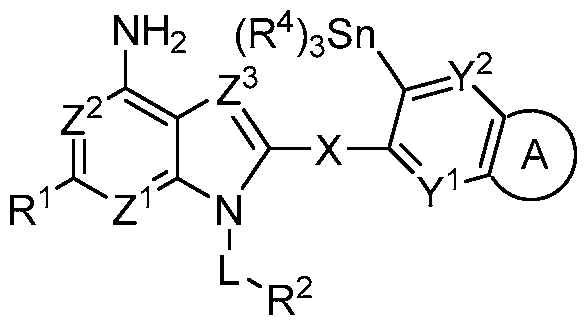
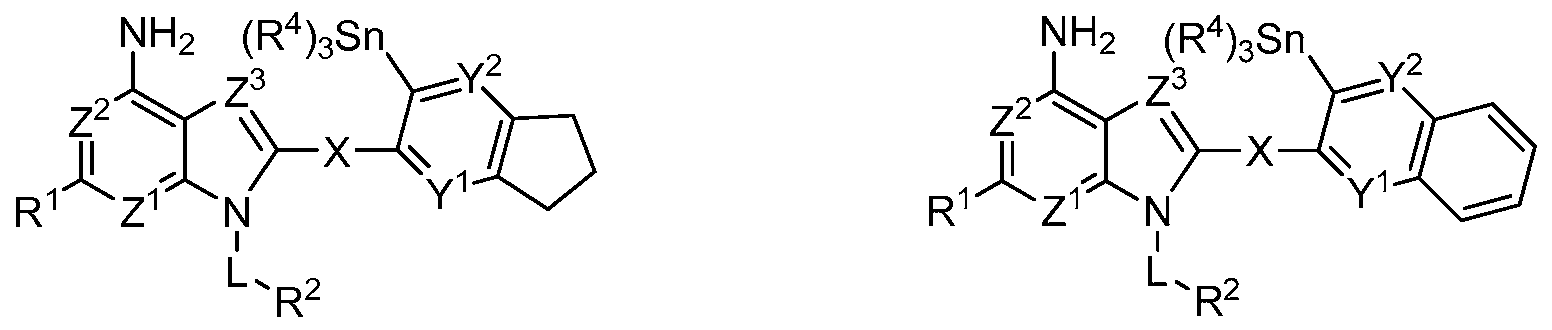
- the present invention provides compounds of formula I:
- each of R , R ⁇ R ⁇ R , L, X, Y , Y Z Z and V is as defined above and described in classes and subclasses herein.
- the present invention provides methods of using compounds of formula I to provide radiolabeled analogs.
- Figure 1 depicts an HPLC profile of purified [ 131 I]-Compound 5 (PU-H71).
- the present invention encompasses the recognition that the ability to measure particular forms of Hsp90 is advantageous to patient selection, treatment, and outcome.
- an "oncogenic Hsp90" species the abundance of which is not dictated by Hsp90 expression alone, that can be used to predict for sensitivity to Hsp90 inhibition therapy. Measuring the presence and/or abundance of this oncogenic Hsp90 in tumors is therefore a method to predict patient response to Hsp90 therapy.
- the use of labeled Hsp90 inhibitors facilitates measuring the abundance of oncogenic Hsp90 in a multitude of tumors and tumor cells, as demonstrated by Applicant's prior work disclosed in International Patent Publication No. WO2013/009655.
- Applicant has shown that cancer is not the only case in which the presence of various Hsp90 species is relevant. For example,
- neurodegenerative contexts also display a pathogenic (i.e., stress-specific) Hsp90, the relative abundance of which can be measured using labeled Hsp90 inhibitors (WO2013/009655).
- the present invention provides the identification of a previously unknown problem, namely that the expense of synthesizing labeled compounds was detrimental to the production and availability of radiolabeled Hsp90 inhibitors in both the pre-clinical and clinical medicine.
- the present invention provides methods to improve the synthesis of labeled Hsp90 inhibitors by reducing the current two-step procedure to a single step by removing the second step in the current process (i.e., step d).
- provided methods have higher typical isolated yields and require less radiochemistry time, resulting in significant cost savings per dose of radiolabeled compound. Such methods and others are described below in the ensuing description and Examples.
- the present invention provides a compound of formula I:
- X is -CH 2 -, -0-, or -S-;
- Y 1 and Y 2 are independently -CR 3a - or -N-;
- Z 1 , Z 2 , and Z 3 are independently -CH- or -N-;
- R 1 is hydrogen or halogen
- L is a straight or branched, optionally substituted C 2 _i 4 aliphatic group wherein one or more carbons are optionally and independently replaced by -Cy-, -NR-, -N(R)C(0)-, - C(0)N(R)-, -C(0)N(0)-, -N(R)S0 2 -, -S0 2 N(R)-, -0-, -C(O)-, -OC(O)-, -C(0)0-, -S-, - SO-, or -S0 2 -,
- each -Cy- is independently an optionally substituted 3-8 membered bivalent, saturated,
- R 2 is hydrogen or an optionally substituted group selected from the group consisting of Ci_ 6 aliphatic, phenyl, 3- to 7-membered saturated or partially unsaturated monocyclic carbocyclyl, 3- to 7-membered saturated or partially unsaturated monocyclic heterocyclyl having 1-2 heteroatoms selected from oxygen, nitrogen, or sulfur, 5- to 6-membered heteroaryl having 1-4 heteroatoms selected from oxygen, nitrogen, or sulfur, 7- to 10- membered saturated or partially unsaturated bicyclic carbocyclyl, 7- to 10-membered saturated or partially unsaturated bicyclic heterocyclyl having 1-4 heteroatoms selected from oxygen, nitrogen, or sulfur, 7- to 10-membered bicyclic heteroaryl having 1-4 heteroatoms selected from oxygen, nitrogen, or sulfur, or 8- to 10-membered bicyclic aryl;
- each R 3 is independently, halogen, -N0 2 , -CN, -OR, -SR, -N(R) 2 , -C(0)R, -C0 2 R, -
- Ring A is a 3- to 7-membered partially unsaturated carbocyclyl, phenyl, a 5- to 6- membered partially unsaturated monocyclic heterocyclyl having 1-2 heteroatoms selected from oxygen, nitrogen, or sulfur, 5- to 6-membered heteroaryl having 1-4 heteroatoms selected from oxygen, nitrogen, or sulfur, or 6-membered aryl;
- R 3a is R 3 or hydrogen
- R 4 is Ci_4 alkyl
- each R is independently hydrogen or an optionally substituted group selected from Ci_ 6
- aliphatic or "aliphatic group”, as used herein, means a straight-chain
- aliphatic groups contain 1-6 aliphatic carbon atoms. In some embodiments, aliphatic groups contain 1-5 aliphatic carbon atoms. In some embodiments, aliphatic groups contain 1-4 aliphatic carbon atoms.
- aliphatic groups contain 1-3 aliphatic carbon atoms, and in yet other embodiments, aliphatic groups contain 1-2 aliphatic carbon atoms.
- cycloaliphatic (or “carbocycle” or “cycloalkyl”) refers to a monocyclic C3-C6 hydrocarbon that is completely saturated or that contains one or more units of
- Suitable aliphatic groups include, but are not limited to, linear or branched, substituted or unsubstituted alkyl, alkenyl, alkynyl groups and hybrids thereof such as
- heteroatom means one or more of oxygen, sulfur, nitrogen, phosphorus, or silicon (including, any oxidized form of nitrogen, sulfur, phosphorus, or silicon; the quatemized form of any basic nitrogen or; a substitutable nitrogen of a heterocyclic ring, for example N (as in 3,4-dihydro-2H-pyrrolyl), ⁇ (as in pyrrolidinyl) or NR + (as in N-substituted pyrrolidinyl)).
- alkylene refers to a bivalent alkyl group.
- An "alkylene chain” is a polymethylene group, i.e., -(CH 2 ) n -, wherein n is a positive integer, preferably from 1 to 6, from 1 to 4, from 1 to 3, from 1 to 2, or from 2 to 3.
- a substituted alkylene chain is a polymethylene group in which one or more methylene hydrogen atoms are replaced with a substituent. Suitable substituents include those described below for a substituted aliphatic group.
- halogen means F, CI, Br, or I.
- aryloxy refers to monocyclic and bicyclic ring systems having a total of five to 10 ring members, wherein at least one ring in the system is aromatic and wherein each ring in the system contains three to seven ring members.
- aryl may be used interchangeably with the term “aryl ring”.
- an 8-10 membered bicyclic aryl group is an optionally substituted naphthyl ring.
- aryl refers to an aromatic ring system which includes, but not limited to, phenyl, biphenyl, naphthyl, anthracyl and the like, which may bear one or more substituents.
- aryl is a group in which an aromatic ring is fused to one or more non-aromatic rings, such as indanyl, phthalimidyl, naphthimidyl, phenanthridinyl, or tetrahydronaphthyl, and the like.
- heteroaryl and “heteroar-,” used alone or as part of a larger moiety e.g., “heteroaralkyl,” or “heteroaralkoxy,” refer to groups having 5 to 10 ring atoms, preferably 5, 6, or 9 ring atoms; having 6, 10, or 14 ⁇ electrons shared in a cyclic array; and having, in addition to carbon atoms, from one to five heteroatoms.
- Heteroaryl groups include, without limitation, thienyl, furanyl, pyrrolyl, imidazolyl, pyrazolyl, triazolyl, tetrazolyl, oxazolyl, isoxazolyl, oxadiazolyl, thiazolyl, isothiazolyl, thiadiazolyl, pyridyl, pyridazinyl, pyrimidinyl, pyrazinyl, indolizinyl, purinyl, naphthyridinyl, and pteridinyl.
- heteroaryl and “heteroar-”, as used herein, also include groups in which a heteroaromatic ring is fused to one or more aryl, cycloaliphatic, or heterocyclyl rings, where the radical or point of attachment is on the heteroaromatic ring.
- Nonlimiting examples include indolyl, isoindolyl, benzothienyl, benzofuranyl, dibenzofuranyl, indazolyl, benzimidazolyl, benzthiazolyl, quinolyl, isoquinolyl, cinnolinyl, phthalazinyl, quinazolinyl, quinoxalinyl, 4H-quinolizinyl, carbazolyl, acridinyl, phenazinyl, phenothiazinyl, phenoxazinyl, tetrahydroquinolinyl, tetrahydroisoquinolinyl, and pyrido[2,3-b]-l,4-oxazin-3(4H)-one.
- heteroaryl group may be mono- or bicyclic.
- heteroaryl may be used interchangeably with the terms “heteroaryl ring,” “heteroaryl group,” or “heteroaromatic,” any of which terms include rings that are optionally substituted.
- heteroarylkyl refers to an alkyl group substituted by a heteroaryl, wherein the alkyl and heteroaryl portions independently are optionally substituted.
- heterocycle As used herein, the terms “heterocycle,” “heterocyclyl,” “heterocyclic radical,” and “heterocyclic ring” are used interchangeably and refer to a stable 5- to 7-membered monocyclic or 7-10-membered bicyclic heterocyclic moiety that is either saturated or partially unsaturated, and having, in addition to carbon atoms, one or more, preferably one to four, heteroatoms, as defined above.
- nitrogen includes a substituted nitrogen.
- the nitrogen may be N (as in 3,4-dihydro-2H-pyrrolyl), ⁇ (as in pyrrolidinyl), or (as in N-substituted pyrrolidinyl).
- a heterocyclic ring can be attached to its pendant group at any heteroatom or carbon atom that results in a stable structure and any of the ring atoms can be optionally substituted.
- saturated or partially unsaturated heterocyclic radicals include, without limitation, tetrahydrofuranyl, tetrahydrothiophenyl pyrrolidinyl, piperidinyl, pyrrolinyl, tetrahydroquinolinyl, tetrahydroisoquinolinyl, decahydroquinolinyl, oxazolidinyl, piperazinyl, dioxanyl, dioxolanyl, diazepinyl, oxazepinyl, thiazepinyl, morpholinyl, and quinuclidinyl.
- heterocycle refers to an alkyl group substituted by a heterocyclyl, wherein the alkyl and heterocyclyl portions independently are optionally substituted.
- partially unsaturated refers to a ring moiety that includes at least one double or triple bond.
- partially unsaturated is intended to encompass rings having multiple sites of unsaturation, but is not intended to include aryl or heteroaryl moieties, as herein defined.
- compounds of the invention may, when specified, contain
- substituents are preferably those that result in the formation of stable or chemically feasible compounds.
- stable refers to compounds that are not substantially altered when subjected to conditions to allow for their production, detection, and, in certain embodiments, their recovery, purification, and use for one or more of the purposes disclosed herein.
- Suitable monovalent substituents on R° are independently halogen, -(CH 2 ) 0 2 R*, -(haloR*), -(CH 2 ) 0 2 OH, -(CH 2 ) 0 2 OR*, -(CH 2 ) 0
- Suitable divalent substituents that are bound to vicinal substitutable carbons of an "optionally substituted” group include: -0(CR 2 ) 2 3O-, wherein each independent occurrence of R is selected from hydrogen, Ci_6 aliphatic which may be substituted as defined below, or an unsubstituted 5-6-membered saturated, partially unsaturated, or aryl ring having 0-4 heteroatoms independently selected from nitrogen, oxygen, or sulfur.
- Suitable substituents on the aliphatic group of R include halogen, -
- each R* is unsubstituted or where preceded by "halo" is substituted only with one or more halogens, and is independently aliphatic, -CH 2 Ph, -O(CH 2 ) 0 -iPh, or a 5-6- membered saturated, partially unsaturated, or aryl ring having 0-4 heteroatoms independently selected from nitrogen, oxygen, or sulfur.
- Suitable substituents on a substitutable nitrogen of an "optionally substituted" group include -R ⁇ , -NR ⁇ 2 , -C(0)R ⁇ , -C(0)OR ⁇ , -C(0)C(0)R ⁇ , -C(0)CH 2 C(0)R ⁇ , - S(0) 2 R ⁇ , -S(0) 2 NR ⁇ 2 , -C(S)NR ⁇ 2 , -C(NH)NR ⁇ 2 , or -N(R ⁇ )S(0) 2 R ⁇ ; wherein each R ⁇ is independently hydrogen, Ci_6 aliphatic which may be substituted as defined below, unsubstituted -OPh, or an unsubstituted 5-6-membered saturated, partially unsaturated, or aryl ring having 0- 4 heteroatoms independently selected from nitrogen, oxygen, or sulfur, or, notwithstanding the definition above, two independent occurrences of R ⁇ , taken together with their intervening atom(s
- Suitable substituents on the aliphatic group of R ⁇ are independently halogen, -
- the term "pharmaceutically acceptable salt” refers to those salts which are, within the scope of sound medical judgment, suitable for use in contact with the tissues of humans and lower animals without undue toxicity, irritation, allergic response and the like, and are commensurate with a reasonable benefit/risk ratio.
- Pharmaceutically acceptable salts are well known in the art. For example, S. M. Berge et al., describe pharmaceutically acceptable salts in detail in J. Pharmaceutical Sciences, 1977, 66, 1-19, incorporated herein by reference.
- the neutral forms of the compounds are regenerated by contacting the salt with a base or acid and isolating the parent compound in the conventional manner.
- the parent form of the compound differs from the various salt forms in certain physical properties, such as solubility in polar solvents.
- structures depicted herein are also meant to include all isomeric (e.g., enantiomeric, diastereomeric, and geometric (or conformational)) forms of the structure; for example, the R and S configurations for each asymmetric center, Z and E double bond isomers, and Z and E conformational isomers. Therefore, single stereochemical isomers as well as enantiomeric, diastereomeric, and geometric (or conformational) mixtures of the present compounds are within the scope of the invention. Unless otherwise stated, all tautomeric forms of the compounds of the invention are within the scope of the invention.
- structures depicted herein are also meant to include compounds that differ only in the presence of one or more isotopically enriched atoms.
- compounds having the present structures including the replacement of hydrogen by deuterium or tritium, or the replacement of a carbon by a 13 C- or 14 C-enriched carbon are within the scope of this invention.
- Such compounds are useful, for example, as analytical tools, as probes in biological assays, or as therapeutic agents in accordance with the present invention.
- oxo means an oxygen that is double bonded to a carbon atom, thereby forming a carbonyl.
- protecting group it is meant that a particular functional moiety, e.g., O, S, or N, is masked or blocked, permitting, if desired, a reaction to be carried out selectively at another reactive site in a multifunctional compound.
- Suitable protecting groups are well known in the art and include those described in detail in Protecting Groups in Organic Synthesis, T. W. Greene and P. G. M. Wuts, 3 rd edition, John Wiley & Sons, 1999, the entirety of which is incorporated herein by reference.
- a protecting group reacts selectively in good yield to give a protected substrate that is stable to the projected reactions; the protecting group is preferably selectively removable by readily available, preferably non-toxic reagents that do not attack the other functional groups; the protecting group forms a separable derivative (more preferably without the generation of new stereogenic centers); and the protecting group will preferably have a minimum of additional functionality to avoid further sites of reaction.
- oxygen, sulfur, nitrogen, and carbon protecting groups may be utilized.
- Amino-protecting groups include methyl carbamate, 9-fluorenylmethyl carbamate (Fmoc), 9-(2,7- dibromo)fluoroenylmethyl carbamate, 4-methoxyphenacyl carbamate (Phenoc), 2,2,2- trichloroethyl carbamate (Troc), 2-trimethylsilylethyl carbamate (Teoc), 1 -methyl- 1 -(4- biphenylyl)ethyl carbamate (Bpoc), 2-(2'- and 4'-pyridyl)ethyl carbamate (Pyoc), 2-(N,N- dicyclohexylcarboxamido)ethyl carbamate, t-butyl carbamate (BOC), allyl carbamate (Alloc), 4- nitrocinnamyl carbamate (Noc), N-hydroxypiperidinyl carbamate, alkyldithio carbamate, benzyl
- benzenesulfenamide o-nitrobenzenesulfenamide (Nps), 2,4-dinitrobenzenesulfenamide, pentachlorobenzenesulfenamide, 2-nitro-4-methoxybenzenesulfenamide,
- triphenylmethylsulfenamide /?-toluenesulfonamide (Ts)
- benzenesulfonamide 2,3,6,-trimethyl-
- radiolabel refers to a moiety comprising a radioactive isotope of at least one element.
- exemplary suitable radiolabels include but are not limited to those described herein.
- a radiolabel is one used in positron emission tomography (PET).
- a radiolabel is one used in single-photon emission computed tomography (SPECT).
- the present invention provides a compound of formula I:
- R , R ⁇ R ⁇ R , L, X, Y , Y Z Z and V is as defined above and described in classes and subclasses herein.
- X is -CH 2 -. In some embodiments, X is -S-. In other embodiments, X is -0-.
- Y 1 is -CR 3a -. In certain embodiments, Y 1 is -N-.
- Y 2 is -CR 3a -. In certain embodiments, Y 2 is -N-.
- R 3a is hydrogen
- Z 1 is -CH-. In certain embodiments, Z 1 is -N-.
- Z 2 is -CH-. In certain embodiments, Z 2 is -N-.
- Z 3 is -CH-. In certain embodiments, Z 3 is -N-.
- R 1 is hydrogen. In some embodiments, R 1 is halogen. In some embodiments, R 1 is fluro.
- -L-R 2 comprises a methylene that is replaced with -NH- to form a secondary amine.
- L is a straight or branched, C 2 _i 4 aliphatic group wherein one or more carbons are independently replaced by -NR-, wherein R is other than a -Boc protecting group.
- -L-R 2 does not contain a Boc-protected secondary amine.
- -L-R 2 does not contain a secondary amine that is protected with an acid-labile protecting group.
- -L-R 2 does not contain a protected secondary amine.
- L is a straight or branched, optionally substituted C 2-14 aliphatic group wherein one, two, or three carbons are optionally and independently replaced by -Cy-, -NR-, -N(R)C(0)-, -C(0)N(R)-, -C(0)N(0)-, -N(R)S0 2 -, -S0 2 N(R)-, -0-, -C(O)-, - OC(O)-, -C(0)0-, -S-, -SO-, or -S0 2 -,
- L is a straight or branched, C 2 _i 4 aliphatic group wherein a methylene of the aliphatic group is replaced with -NH- to form a secondary amine.
- L is a straight or branched, C 2 _i 2 aliphatic group wherein a methylene of the aliphatic group is replaced with -NH- to form a secondary amine.
- L is a straight or branched, C 2 _io aliphatic group wherein a methylene of the aliphatic group is replaced with -NH- to form a secondary amine.
- L is a straight or branched, C 2 _8 aliphatic group wherein a methylene of the aliphatic group is replaced with -NH- to form a secondary amine.
- L is a straight or branched, C 2 _ 6 aliphatic group wherein a methylene of the aliphatic group is replaced with -NH- to form a secondary amine.
- L is a straight or branched, C 2 _ 4 aliphatic group wherein a methylene of the aliphatic group is replaced with -NH- to form a secondary amine.
- L is a straight or branched, C 6 _i 4 aliphatic group wherein a methylene of the aliphatic group is replaced with -NH- to form a secondary amine. In some embodiments, L is a straight or branched, C 6 -i 2 aliphatic group wherein a methylene of the aliphatic group is replaced with -NH- to form a secondary amine.
- L is a straight or branched, C 2 _i 4 aliphatic group wherein one or more carbons are optionally and independently replaced by -Cy- or -C(O)-. In some embodiments, L is a straight or branched, C 2 _8 aliphatic group wherein one or more carbons are optionally and independently replaced by -Cy- or -C(O)-. In certain embodiments, L is a straight or branched, C 2 _g aliphatic group wherein one carbon of L is replaced by -Cy- and wherein -Cy- is a 6-membered saturated ring having one heteroatom selected from nitrogen.
- -Cy- is an optionally substituted 3-8 membered bivalent, saturated, partially unsaturated, or aryl ring having 0-4 heteroatoms independently selected from nitrogen, oxygen, or sulfur. In some embodiments, -Cy- is an optionally substituted 3-8 membered bivalent, saturated ring having 1-2 heteroatoms independently selected from nitrogen, oxygen, or sulfur. In some embodiments, -Cy- is an optionally substituted 5-6 membered bivalent, saturated ring having 1-2 heteroatoms independently selected from nitrogen, oxygen, or sulfur. In some embodiments, -Cy- is bivalent piperidinyl.
- R 2 is hydrogen. In other embodiments, R 2 is optionally substituted Ci_ 6 aliphatic. In some embodiments, R 2 is optionally substituted Ci_ 4 aliphatic. In some embodiments, R 2 is Ci_ 4 alkyl.
- R 2 is 3- to 7-membered saturated or partially unsaturated monocyclic heterocyclyl having 1-2 heteroatoms selected from oxygen, nitrogen, or sulfur. In some embodiments, R 2 is 5- to 6-membered saturated or partially unsaturated monocyclic heterocyclyl having 1-2 heteroatoms selected from oxygen, nitrogen, or sulfur. In some embodiments, R 2 is piperidinyl. In some embodiments, R 2 is aziridinyl.
- R 2 is 3- to 7-membered saturated or partially unsaturated monocyclic carbocyclyl. In some embodiments, R 2 is cyclopropyl.
- -L-R 2 forms a primary amino-alkyl group. In some embodiments, -L-R 2 forms a secondary alkyl-amino-alkyl group.
- -L-R 2 is selected from the following:
- -L-R 2 is selected from the following:
- each R 3 is independently halogen,-CN, -OR, -SR, -
- each R 3 is -OR.
- one or both of Y 1 and Y 2 is -CR 3a - and there are two occurrences of R 3 .
- one or both of Y 1 and Y 2 is -CR 3a - and there is one occurrence of R 3 .
- both Y 1 and Y 2 are -N- and there are two occurrences of R 3 .
- both Y 1 and Y 2 are -N- and there is one occurrence of R 3 .
- substituents on the ring bearing the trialkyltin group located at the 4 ' and 5 ' positions. In some embodiments, these two substituents are taken together with their intervening atoms to form Ring A.
- R 3 is -OR
- R is Ci_ 6 aliphatic.
- R is methyl.
- Ring A is a 5- to 6-membered partially unsaturated monocyclic heterocyclyl having 1-2 heteroatoms selected from oxygen, nitrogen, or sulfur, 5- to 6-membered heteroaryl having 1-4 heteroatoms selected from oxygen, nitrogen, or sulfur, or 6-membered aryl.
- Ring A is a 5-membered partially unsaturated monocyclic heterocyclyl having 2 heteroatoms selected from oxygen.
- Ring A is a 5- membered partially unsaturated monocyclic heterocyclyl having 1 heteroatom selected from oxygen.
- Ring A is a 6-membered partially unsaturated monocyclic heterocyclyl having 2 heteroatoms selected from oxygen.
- Ring A is phenyl.
- Ring A is 3- to 7-membered partially unsaturated carbocyclyl.
- Ring A is 5- to 6-membered partially unsaturated carbocyclyl.
- R 4 is methyl. In some embodiments, R 4 is ethyl. In some embodiments, R 4 is butyl.
- a compound of the present invention is other than:
- a provided compound is of formula I-a-1 :
- Ring A, R , R R , L, Y , Y Z Z Z ⁇ and X is as defined above and described in classes and subclasses herein, both singly and in combination.
- a provided compound is of formula I-a:
- a compound is of formula I-a and:
- X is -CH 2 - or -S-;
- R 1 is hydrogen or halogen
- L is a straight or branched, C 2 _i 4 aliphatic group wherein one or more carbons are
- a provided compound is of formula I-b, I-c, I-d, I-e, I-f, I- g, I-h, or I-j :
- R , R , R , L, X, Y , Y , Z 1 , Z Z ⁇ and R is as defined above and described in classes and subclasses herein, both singly and in combination.
- a provided compound is of formula I-i:
- R 1 , R 2 , R 4 , L, and X is as defined above and described in classes and subclasses herein, both singly and in combination.
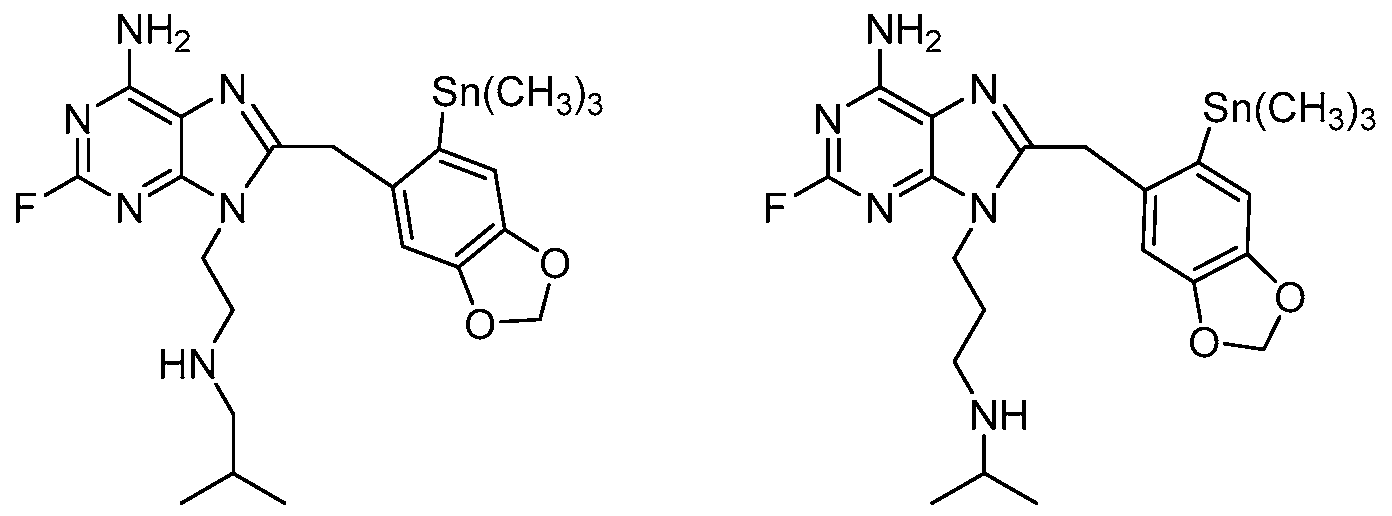
- a compound of formula I is selected from those depicted in Table 1.
- any intermediate depicted Schemes A, B, or C may be isolated and/or purified prior to each subsequent step.
- any intermediate depicted in Schemes A, B, or C may be utilized in subsequent steps without isolation and/or purification. Such telescoping of steps is contemplated in the present invention.
- compounds described herein may be purified by any means known in the art.
- purification of a compound described herein comprises filtration, chromatography, distillation, crystallization, or a combination thereof.
- chromatography comprises high performance liquid chromatography (HPLC).
- HPLC high performance liquid chromatography
- chromatography comprises normal phase, reverse phase, or ion- exchange elution over a cartridge comprising suitable sorbent media. Purification via chromatography methods typically utilizes one or more solvents, which are known to the skilled artisan or determined by routine experimentation.
- chromatography comprises HPLC using an elution solvent comprising acetonitrile.
- chromatography comprises HPLC using an elution solvent comprising ethanol.
- compound 5 is purified by any of the methods described in this paragraph.
- the present invention provides methods for the synthesis of compounds of formula I and I L and intermediates thereto.
- such methods are as shown in Scheme B, below: Scheme B
- R L is a radiolabel and each of R 1 , R 2 , R 3 , R 4 , L, R L , X, Y 1 , Y 2 , Z 1 , Z 2 , Z 3 is as defined herein and described in classes and subclasses herein, both singly and in combination.
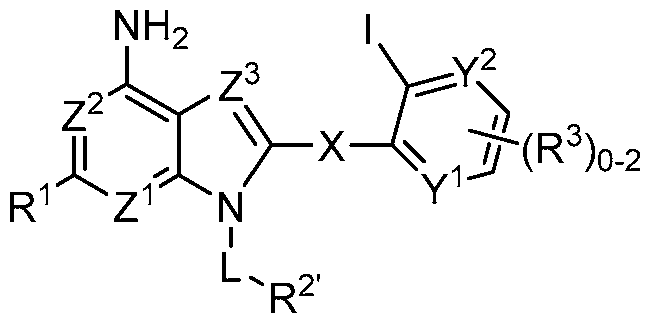
- aryl iodide A is reacted under suitable conditions to provide a trialkyltin compound of formula I.
- suitable conditions for the installation of a trimethyltin group from an aryl iodide are known in the art and contemplated by the present disclosure, including those described in International Patent Application Publication Nos. WO2006084030 and WO2013009655 and US Patent Application Publication No. US2011312980.
- Suitable conditions for the installation of a tributyltin group from an aryl iodide are also known in the art (see, for example Qu et al, J. Med. Chem.
- step S-1 does not employ a protecting group on a secondary amine of L-R 2 , if such secondary amine is present.
- suitable conditions comprise a catalyst.
- a catalyst is a palladium catalyst.
- a catalyst is Pd(PPli 3 )4.
- a catalyst is PdCl 2 (CH 3 CN) 2 .
- a catalyst is Pd(PPh 3 ) 2 Br 2 .
- step S-l employs a suitable solvent.
- solvents suitable for use at step S-l include polar solvents (e.g., ethers, DMF), aromatic hydrocarbons (e.g., toluene), or combinations thereof.
- a solvent is or comprises dioxane or THF (tetrahydrofuran).
- a solvent is or comprises dioxane.
- a solvent is or comprises DMF.
- a solvent is or comprises toluene.
- step S-l is carried out at temperatures of about 25-150 °C
- the temperature is about 60-110 °C. In some embodiments, the temperature is about 90 °C.
- the present invention provides a method comprising the steps of: a) providing an aryl iodide compound of formula A:
- R , R ⁇ R ⁇ L, Y , Y Z Z Z ⁇ and X is as defined above and described in classes and subclasses herein, both singly and in combination; and b) reacting the aryl iodide of formula A under suitable conditions to provide a trialkyltin compound of formula I:
- R 4 is as defined above and described in classes and subclasses herein, both singly and in combination.
- a compound of formula I may be converted to radiolabeled compound I L .
- Suitable conditions for the installation of a radiolabel from a trialkyltin are known in the art and contemplated by the present disclosure, including those described in International Patent Application Publication Nos. WO2006084030 and WO2013009655 and US Patent Application Publication No. US2011312980.
- step S-2 does not employ a protecting group on a secondary amine of L-R 2 , if such secondary amine is present.
- suitable methods comprise mixing a radiolabel reagent with a compound of formula I optionally in a suitable solvent.
- a radiolabel reagent is [ 131 I]-NaI solution.
- the present invention provide a method comprising the steps of: a) providing a trialkyltin compound of formula I:
- each of R , R ⁇ R ⁇ R , L, Y , Y Z Z Z ⁇ and X is as defined above and described in classes and subclasses herein, both singly and in combination; and b) reacting the trialkyltin compound of formula I under suitable conditions to provide a compound of formula I L :
- R L is or comprises an atom selected from the group consisting of 131 1, 125 1, 124 1, 123 I, n C, 15 0, 13 N, 19 F and 18 F. In some embodiments, R L is 124 I.
- -L-R 2 comprises a methylene that is replaced with -NH- to form a secondary amine, and wherein the secondary amine is protected with a suitable protecting group; and each of R 1 , R 2 , R 3 , R 4 , L, Y 1 , Y 2 , Z 1 , Z 2 , Z 3 , and X is as defined above and described in classes and subclasses herein, both singly and in combination.
- aryl iodide A is reacted under suitable protecting group conditions to provide an aryl iodide of formula B, wherein the secondary amine of R 2 is protected with a suitable protecting group to form R 2 .
- suitable amino protecting groups are well known in the art and include those described in detail in Greene ⁇ supra).
- Suitable mono-protected amines include, but are not limited to, aralkylamines, carbamates, allyl amines, amides, and the like.
- Suitable mono-protected amino moieties include t-butyloxycarbonylamino (- NHBOC), ethyloxycarbonylamino, methyloxycarbonylamino, trichloroethyloxycarbonylamino, allyloxycarbonylamino (-NHAlloc), benzyloxocarbonylamino (-NHCBZ), allylamino, benzylamino (-NHBn), fluorenylmethylcarbonyl (-NHFmoc), formamido, acetamido, chloroacetamido, dichloroacetamido, trichloroacetamido, phenylacetamido, trifluoroacetamido, benzamido, t-butyldiphenylsilyl, and the like.
- a suitable protecting group is capable of being removed under mildly basic conditions. In certain embodiments, a suitable protecting group is capable of being removed under mild conditions with an amine base. In some embodiments, a suitable protecting group is Fmoc. In certain embodiments, a suitable protecting group is not one removed under acidic conditions. In some embodiments, a suitable protecting group is other than a t-butyloxycarbonyl (Boc) group.
- the present invention provides a method comprising the steps of: a) providing an aryl iodide of formula A:
- R , R ⁇ R ⁇ L, Y , Y Z Z Z ⁇ and X is as defined above and described in classes and subclasses herein, both singly and in combination; and b) reacting the aryl iodide of formula A under suitable reaction conditions to provide an aryl iodide compound of formula B:
- R 2 is as defined above and described in classes and subclasses herein, both singly and in combination.
- aryl iodide of formula B is reacted under suitable conditions to provide a protected amine compound of formula C.
- suitable conditions for the installation of a trialkyltin group e.g., trimethyltin, tributyltin, etc.
- suitable conditions comprise a catalyst.
- a catalyst is a palladium catalyst.
- a catalyst is Pd(PPh 3 ) 4 .
- a catalyst is PdCl 2 (CH 3 CN) 2 .
- a catalyst is Pd(PPh 3 ) 2 Br 2 .
- step S-4 employs a suitable solvent.
- solvents suitable for use at step S-4 include polar solvents (e.g., ethers, DMF), aromatic hydrocarbons (e.g., toluene), or combinations thereof.
- a solvent is or comprises dioxane or THF (tetrahydrofuran).
- a solvent is or comprises dioxane.
- a solvent is or comprises DMF.
- a solvent is or comprises toluene.
- step S-4 is carried out at temperatures of about 25-150 °C.
- the temperature is about 60-110 °C. In some embodiments, the temperature is about 90 °C.
- the present invention provides a method comprising the steps of: a) providing an aryl iodide compound of formula B:
- R 4 is as defined above and described in classes and subclasses herein, both singly and in combination.
- step S-5 protected amine compound of formula C is reacted under suitable deprotection conditions to provide trialkyltin compound of formula I.
- suitable deprotection conditions will depend upon the choice of protecting group, and suitable deprotection chemistries are well known in the art and include those described in detail in Greene (supra).
- suitable deprotection conditions are mildly basic.
- suitable deprotection conditions comprise an amine base.
- the present invention provides a method comprising the steps of: a) providing protected amine compound of formula C: c
- R 2 is as defined above and described in classes and subclasses herein, both singly and in combination.
- the compound of formula I is of formula I-a-1 :
- Ring A, R , R R , L, Y , Y Z Z Z ⁇ and X is as defined above and described in classes and subclasses herein, both singly and in combination.
- a compound is of formula I-a and:
- X is -CH 2 - or -S-;
- R 1 is hydrogen or halogen
- L is a straight or branched, C 2 _i 4 aliphatic group wherein one or more carbons are
- I is of formula I-b, I-c, I-d, I-e, I-f, I-g, I-h, or I-j :
- R , R ⁇ R , R, L, Y , Y Z Z Z ⁇ and X is as defined above and described in classes and subclasses herein, both singly and in combination.
- the compound of formula I is of formula I-i:
- R 1 , R 2 , R 4 , L, and X is as defined above and described in classes and subclasses herein, both singly and in combination.
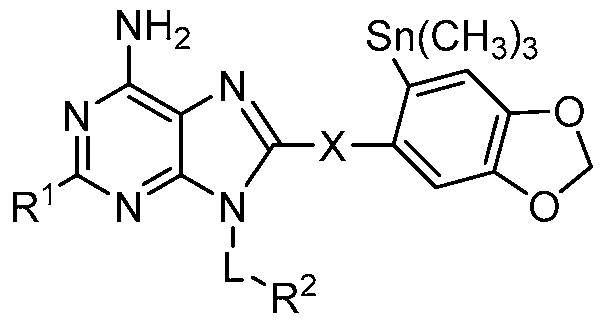
- the present invention provides a method comprising the steps of: a) providing a trimethyltin compound:
- R L is a radiolabel as defined above and described in classes and subclasses herein, both singly and in combination.
- the present invention provides a method comprising the steps of: a) providing an aryl iodide compound:
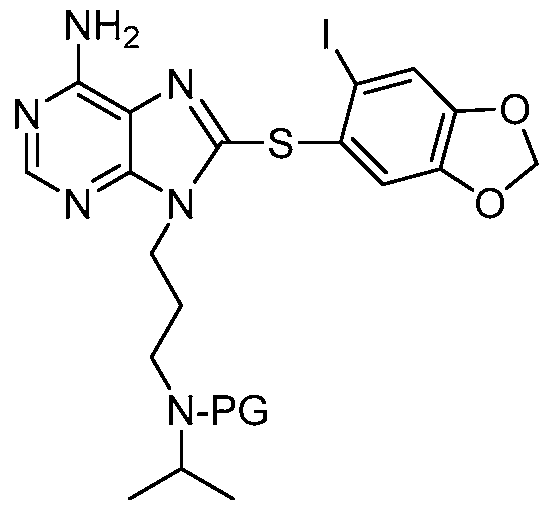
- the present invention provides a method comprising the steps of: a) providing protected amine compound:
- PG is a suitable protecting group as defined above and described in classes and subclasses herein; and b) reacting the protected amine compound under suitable deprotection conditions to provide trimethyltin compound:
- PG is a protecting group that is capable of being removed under mildly basic conditions.
- PG is -Fmoc.
- the present invention provides a method comprising the steps of: a) providing an aryl iodide compound:
- PG is a suitable protecting group as defined above and described in classes and subclasses herein; and b) reacting the aryl iodide under suitable conditions to provide protected amine compound:
- the present invention provides a method comprising the steps of: a) providing an aryl iodide of formula:
- the present invention provides pharmaceutical compositions comprising a Compound I L in combination with a pharmaceutically acceptable excipient (e.g., carrier).
- a pharmaceutically acceptable excipient e.g., carrier
- such pharmaceutical compositions optionally include an aryl iodide of formula A.
- compositions include optical isomers, diastereomers, or pharmaceutically acceptable salts of the inhibitors disclosed herein.
- Compound I L included in the pharmaceutical composition may be covalently attached to a carrier moiety, as described above. Alternatively, Compound I L included in the pharmaceutical composition is not covalently linked to a carrier moiety.
- a "pharmaceutically acceptable carrier,” as used herein refers to pharmaceutical excipients, for example, pharmaceutically, physiologically, acceptable organic or inorganic carrier substances suitable for enteral or parenteral application that do not deleteriously react with the active agent.
- suitable pharmaceutically acceptable carriers include water, salt solutions (such as Ringer's solution), alcohols, oils, gelatins, and carbohydrates such as lactose, amylose or starch, fatty acid esters, hydroxymethycellulose, and polyvinyl pyrrolidine.
- Such preparations can be sterilized and, if desired, mixed with auxiliary agents such as lubricants, preservatives, stabilizers, wetting agents, emulsifiers, salts for influencing osmotic pressure, buffers, coloring, and/or aromatic substances and the like that do not deleteriously react with the compounds of the invention.
- auxiliary agents such as lubricants, preservatives, stabilizers, wetting agents, emulsifiers, salts for influencing osmotic pressure, buffers, coloring, and/or aromatic substances and the like that do not deleteriously react with the compounds of the invention.
- the compounds of the invention can be administered alone or can be coadministered to the subject. Co-administration is meant to include simultaneous or sequential administration of the compounds individually or in combination (more than one compound).
- the preparations can also be combined, when desired, with other active substances (e.g. to reduce metabolic degradation).
- Compounds of the present invention can be prepared and administered in a wide variety of oral, parenteral, and topical dosage forms.
- the compounds of the present invention can be administered by injection (e.g. intravenously, intramuscularly, intracutaneously, subcutaneously, intraduodenally, or intraperitoneally).
- the compounds described herein can be administered by inhalation, for example, intranasally.
- the compounds of the present invention can be administered transdermally. It is also envisioned that multiple routes of administration (e.g., intramuscular, oral, transdermal) can be used to administer the compounds of the invention.
- pharmaceutically acceptable carriers can be either solid or liquid.
- Solid form preparations include powders, tablets, pills, capsules, cachets, suppositories, and dispersible granules.
- a solid carrier can be one or more substance that may also act as diluents, flavoring agents, binders, preservatives, tablet disintegrating agents, or an encapsulating material.
- the carrier is a finely divided solid in a mixture with the finely divided active component.
- the active component is mixed with the carrier having the necessary binding properties in suitable proportions and compacted in the shape and size desired.
- the powders and tablets preferably contain from 5% to 70% of the active compound.
- Suitable carriers are magnesium carbonate, magnesium stearate, talc, sugar, lactose, pectin, dextrin, starch, gelatin, tragacanth, methylcellulose, sodium carboxymethylcellulose, a low melting wax, cocoa butter, and the like.
- the term "preparation" is intended to include the formulation of the active compound with encapsulating material as a carrier providing a capsule in which the active component with or without other carriers, is surrounded by a carrier, which is thus in association with it.
- cachets and lozenges are included. Tablets, powders, capsules, pills, cachets, and lozenges can be used as solid dosage forms suitable for oral administration.
- a low melting wax such as a mixture of fatty acid glycerides or cocoa butter
- the active component is dispersed homogeneously therein, as by stirring.
- the molten homogeneous mixture is then poured into convenient sized molds, allowed to cool, and thereby to solidify.
- Liquid form preparations include solutions, suspensions, and emulsions, for example, water or water/propylene glycol solutions.
- liquid preparations can be formulated in solution in aqueous polyethylene glycol solution.
- suitable admixtures for the compounds of the invention are injectable, sterile solutions, preferably oily or aqueous solutions, as well as suspensions, emulsions, or implants, including suppositories.
- carriers for parenteral administration include aqueous solutions of dextrose, saline, pure water, ethanol, glycerol, propylene glycol, peanut oil, sesame oil, polyoxyethylene-block polymers, and the like. Ampoules are convenient unit dosages.
- the compounds of the invention can also be incorporated into liposomes or administered via transdermal pumps or patches.
- Pharmaceutical admixtures suitable for use in the present invention include those described, for example, in Pharmaceutical Sciences (17th Ed., Mack Pub. Co., Easton, PA) and WO 96/05309, the teachings of both of which are hereby incorporated by reference.
- Aqueous solutions suitable for oral use can be prepared by dissolving the active component in water and adding suitable colorants, flavors, stabilizers, and thickening agents as desired.
- Aqueous suspensions suitable for oral use can be made by dispersing the finely divided active component in water with viscous material, such as natural or synthetic gums, resins, methylcellulose, sodium carboxymethylcellulose, and other well-known suspending agents.
- solid form preparations that are intended to be converted, shortly before use, to liquid form preparations for oral administration.
- liquid forms include solutions, suspensions, and emulsions.
- These preparations may contain, in addition to the active component, colorants, flavors, stabilizers, buffers, artificial and natural sweeteners, dispersants, thickeners, solubilizing agents, and the like.
- the pharmaceutical preparation is preferably in unit dosage form.
- the preparation is subdivided into unit doses containing appropriate quantities of the active component.
- the unit dosage form can be a packaged preparation, the package containing discrete quantities of preparation, such as packeted tablets, capsules, and powders in vials or ampoules.
- the unit dosage form can be a capsule, tablet, cachet, or lozenge itself, or it can be the appropriate number of any of these in packaged form.
- the quantity of active component in a unit dose preparation may be varied or adjusted from 0.1 mg to 10000 mg, more typically 1.0 mg to 1000 mg, most typically 10 mg to 500 mg, according to the particular application and the potency of the active component.
- the composition can, if desired, also contain other compatible therapeutic agents.
- Some compounds may have limited solubility in water and therefore may require a surfactant or other appropriate co-solvent in the composition.
- Such co-solvents include:
- Such co-solvents are typically employed at a level between about 0.01 % and about 2% by weight.
- Viscosity greater than that of simple aqueous solutions may be desirable to decrease variability in dispensing the formulations, to decrease physical separation of components of a suspension or emulsion of formulation, and/or otherwise to improve the formulation.
- Such viscosity building agents include, for example, polyvinyl alcohol, polyvinyl pyrrolidone, methyl cellulose, hydroxy propyl methylcellulose, hydroxyethyl cellulose, carboxymethyl cellulose, hydroxy propyl cellulose, chondroitin sulfate and salts thereof, hyaluronic acid and salts thereof, and combinations of the foregoing.
- Such agents are typically employed at a level between about 0.01% and about 2% by weight.
- compositions of the present invention may additionally include components to provide sustained release and/or comfort.
- Such components include high molecular weight, anionic mucomimetic polymers, gelling polysaccharides, and finely-divided drug carrier substrates. These components are discussed in greater detail in U.S. Pat. Nos. 4,911,920;
- Method 2 utilized a protecting group strategy as an alternative to Method 1. Fmoc was chosen since it can be removed under mildly basic conditions, and importantly the trimethyltin moiety is stable under these conditions.
- Method 1 when 1 was directly subjected to conditions that were previously used for Boc-protected 2, the desired product I-l in was obtained in 41%> yield. Similarly, when Fmoc-protected PU-H71 2-2 was subjected to similar conditions 2-3 was obtained in 56%> yield. Compared to the Method 1, Method 2 requires two additional steps, installation and removal of the Fmoc group, at yields of 88%> and 70%>, respectively. The overall yield for Method 2 is 34%> (0.88 x 0.56 x 0.70 x 100%) which is comparable to Method 1.
- the product has a retention time of about 12 minutes, under the conditions described above was collected and used for further studies.
- the yield for this reaction averages in the range of 60-70%.
- Radiolabeling of compound 1-2 is carried out as described in Example 3, substituting compound 1-2 for compound 1-1.
- Radiolabeling of compound 1-3 is carried out as described in Example 3, substituting compound 1-3 for compound 1-1.
- Radiolabeling of compound 1-4 is carried out as described in Example 3, substituting compound 1-4 for compound 1-1.
Landscapes
- Organic Chemistry (AREA)
- Chemical & Material Sciences (AREA)
- Health & Medical Sciences (AREA)
- General Health & Medical Sciences (AREA)
- Veterinary Medicine (AREA)
- Nuclear Medicine, Radiotherapy & Molecular Imaging (AREA)
- General Chemical & Material Sciences (AREA)
- Pharmacology & Pharmacy (AREA)
- Life Sciences & Earth Sciences (AREA)
- Animal Behavior & Ethology (AREA)
- Chemical Kinetics & Catalysis (AREA)
- Public Health (AREA)
- Medicinal Chemistry (AREA)
- Pharmaceuticals Containing Other Organic And Inorganic Compounds (AREA)
- Plural Heterocyclic Compounds (AREA)
- Medicines Containing Antibodies Or Antigens For Use As Internal Diagnostic Agents (AREA)
- Organic Low-Molecular-Weight Compounds And Preparation Thereof (AREA)
- Heterocyclic Carbon Compounds Containing A Hetero Ring Having Oxygen Or Sulfur (AREA)
- Steroid Compounds (AREA)
- Nitrogen Condensed Heterocyclic Rings (AREA)
Abstract
Description








Claims








Priority Applications (13)
| Application Number | Priority Date | Filing Date | Title |
|---|---|---|---|
| RU2016128528A RU2016128528A (en) | 2013-12-23 | 2014-12-23 | METHODS AND REAGENTS FOR INTRODUCING A RADIOACTIVE TAG |
| US15/107,229 US9994573B2 (en) | 2013-12-23 | 2014-12-23 | Methods and reagents for radiolabeling |
| CA2934850A CA2934850C (en) | 2013-12-23 | 2014-12-23 | Methods and reagents for radiolabeling |
| EP14885717.0A EP3086792B1 (en) | 2013-12-23 | 2014-12-23 | Methods and reagents for radiolabeling |
| BR112016014758A BR112016014758A8 (en) | 2013-12-23 | 2014-12-23 | compound and method for radioactive labeling and pharmaceutical composition comprising said compound |
| AU2014386214A AU2014386214B2 (en) | 2013-12-23 | 2014-12-23 | Methods and reagents for radiolabeling |
| CN201480076193.7A CN106456645B (en) | 2013-12-23 | 2014-12-23 | Methods and reagents for radiolabeling |
| JP2016542216A JP6491214B2 (en) | 2013-12-23 | 2014-12-23 | Methods and reagents for radiolabeling |
| KR1020167019985A KR102325454B1 (en) | 2013-12-23 | 2014-12-23 | Methods and reagents for radiolabeling |
| MX2016008418A MX2016008418A (en) | 2013-12-23 | 2014-12-23 | Methods and reagents for radiolabeling. |
| IL246403A IL246403B (en) | 2013-12-23 | 2016-06-22 | Methods and reagents for radiolabeling |
| US15/971,908 US10329293B2 (en) | 2013-12-23 | 2018-05-04 | Methods and reagents for radiolabeling |
| US16/396,496 US10793570B2 (en) | 2013-12-23 | 2019-04-26 | Methods and reagents for radiolabeling |
Applications Claiming Priority (2)
| Application Number | Priority Date | Filing Date | Title |
|---|---|---|---|
| US201361919901P | 2013-12-23 | 2013-12-23 | |
| US61/919,901 | 2013-12-23 |
Related Child Applications (2)
| Application Number | Title | Priority Date | Filing Date |
|---|---|---|---|
| US15/107,229 A-371-Of-International US9994573B2 (en) | 2013-12-23 | 2014-12-23 | Methods and reagents for radiolabeling |
| US15/971,908 Division US10329293B2 (en) | 2013-12-23 | 2018-05-04 | Methods and reagents for radiolabeling |
Publications (1)
| Publication Number | Publication Date |
|---|---|
| WO2015138039A1 true WO2015138039A1 (en) | 2015-09-17 |
Family
ID=54072256
Family Applications (1)
| Application Number | Title | Priority Date | Filing Date |
|---|---|---|---|
| PCT/US2014/072090 Ceased WO2015138039A1 (en) | 2013-12-23 | 2014-12-23 | Methods and reagents for radiolabeling |
Country Status (13)
| Country | Link |
|---|---|
| US (3) | US9994573B2 (en) |
| EP (1) | EP3086792B1 (en) |
| JP (1) | JP6491214B2 (en) |
| KR (1) | KR102325454B1 (en) |
| CN (1) | CN106456645B (en) |
| AU (1) | AU2014386214B2 (en) |
| BR (1) | BR112016014758A8 (en) |
| CA (1) | CA2934850C (en) |
| IL (1) | IL246403B (en) |
| MX (1) | MX2016008418A (en) |
| RU (1) | RU2016128528A (en) |
| TW (1) | TWI673279B (en) |
| WO (1) | WO2015138039A1 (en) |
Families Citing this family (5)
| Publication number | Priority date | Publication date | Assignee | Title |
|---|---|---|---|---|
| WO2015138039A1 (en) | 2013-12-23 | 2015-09-17 | Memorial Sloan-Kettering Cancer Center | Methods and reagents for radiolabeling |
| MX387627B (en) * | 2014-09-17 | 2025-03-18 | Memorial Sloan Kettering Cancer Center | HSP90-TARGETED INFLAMMATION AND INFECTION IMAGING AND THERAPY |
| WO2017002196A1 (en) * | 2015-06-30 | 2017-01-05 | 株式会社日立国際電気 | Matching box and matching method |
| KR102175125B1 (en) * | 2018-12-28 | 2020-11-05 | 울산과학기술원 | Compound comprising Hsp90 inhibitor targeting mitochondria and pharmaceutical composition for photodynamic therapy comprising the compound |
| WO2022182731A1 (en) * | 2021-02-24 | 2022-09-01 | Samus Therapeutics, Inc. | Sn-labeling and radiolabeling of epichaperome inhibitors |
Citations (16)
| Publication number | Priority date | Publication date | Assignee | Title |
|---|---|---|---|---|
| US4861760A (en) | 1985-10-03 | 1989-08-29 | Merck & Co., Inc. | Ophthalmological composition of the type which undergoes liquid-gel phase transition |
| US4911920A (en) | 1986-07-30 | 1990-03-27 | Alcon Laboratories, Inc. | Sustained release, comfort formulation for glaucoma therapy |
| US5212162A (en) | 1991-03-27 | 1993-05-18 | Alcon Laboratories, Inc. | Use of combinations gelling polysaccharides and finely divided drug carrier substrates in topical ophthalmic compositions |
| US5403841A (en) | 1991-01-15 | 1995-04-04 | Alcon Laboratories, Inc. | Use of carrageenans in topical ophthalmic compositions |
| WO1996005309A2 (en) | 1994-08-17 | 1996-02-22 | The Rockefeller University | Modulators of body weight, corresponding nucleic acids and proteins, and diagnostic and therapeutic uses thereof |
| WO2006084030A2 (en) | 2005-02-01 | 2006-08-10 | Sloan-Kettering Institute For Cancer Research | Small-molecule hsp90 inhibitors |
| US20070178537A1 (en) * | 2003-06-30 | 2007-08-02 | Sloan-Kettering Institute For Cancer Research | Assays for detection of bioactive compounds that interact with heat shock protein 90 |
| WO2007134298A2 (en) | 2006-05-12 | 2007-11-22 | Myriad Genetics, Inc. | Therapeutic compounds and their use in cancer |
| WO2008005937A2 (en) | 2006-06-30 | 2008-01-10 | Sloan-Kettering Institute For Cancer Research | Treatment of neurodegenerative diseases through inhibiton of hsp90 |
| US20100292255A1 (en) | 2007-11-14 | 2010-11-18 | Myriad Pharmaceuticals, Inc. | Therapeutic Compounds and Their Use in Treating Diseases and Disorders |
| WO2011044394A1 (en) | 2009-10-07 | 2011-04-14 | Sloan-Kettering Institute For Cancer Research | Purine derivatives useful as hsp90 inhibitors |
| US20110312980A1 (en) | 2005-02-01 | 2011-12-22 | Sloan-Kettering Institute For Cancer Research | Small-molecule Hsp90 Inhibitors |
| WO2012138896A1 (en) | 2011-04-05 | 2012-10-11 | Sloan-Kettering Institute For Cancer Research | Hsp90 inhibitors |
| WO2012138894A1 (en) | 2011-04-05 | 2012-10-11 | Sloan-Kettering Institute For Cancer Research | Hsp90 inhibitors |
| WO2013009657A1 (en) * | 2011-07-08 | 2013-01-17 | Sloan-Kettering Institute For Cancer Research | Uses of labeled hsp90 inhibitors |
| US8586605B2 (en) | 2007-03-20 | 2013-11-19 | Curis, Inc. | Fused amino pyridine as HSP90 inhibitors |
Family Cites Families (6)
| Publication number | Priority date | Publication date | Assignee | Title |
|---|---|---|---|---|
| BR112013027448A2 (en) | 2011-04-28 | 2020-09-01 | Sloan-Kettering Institute For Cancer Research | combination therapy with hsp90 |
| EP2972394A4 (en) * | 2013-03-15 | 2016-11-02 | Sloan Kettering Inst Cancer | HSP90 TARGETING CARDIAC IMAGING AND TREATMENT THEREOF |
| SG11201601542SA (en) | 2013-08-16 | 2016-04-28 | Sloan Kettering Inst Cancer | Selective grp94 inhibitors and uses thereof |
| WO2015138039A1 (en) | 2013-12-23 | 2015-09-17 | Memorial Sloan-Kettering Cancer Center | Methods and reagents for radiolabeling |
| MX387627B (en) | 2014-09-17 | 2025-03-18 | Memorial Sloan Kettering Cancer Center | HSP90-TARGETED INFLAMMATION AND INFECTION IMAGING AND THERAPY |
| US20180280397A1 (en) | 2015-10-05 | 2018-10-04 | Memorial Sloan Kettering Cancer Center | Rational combination therapy for the treatment of cancer |
-
2014
- 2014-12-23 WO PCT/US2014/072090 patent/WO2015138039A1/en not_active Ceased
- 2014-12-23 TW TW103145077A patent/TWI673279B/en not_active IP Right Cessation
- 2014-12-23 RU RU2016128528A patent/RU2016128528A/en unknown
- 2014-12-23 CA CA2934850A patent/CA2934850C/en active Active
- 2014-12-23 MX MX2016008418A patent/MX2016008418A/en unknown
- 2014-12-23 CN CN201480076193.7A patent/CN106456645B/en not_active Expired - Fee Related
- 2014-12-23 KR KR1020167019985A patent/KR102325454B1/en not_active Expired - Fee Related
- 2014-12-23 JP JP2016542216A patent/JP6491214B2/en not_active Expired - Fee Related
- 2014-12-23 AU AU2014386214A patent/AU2014386214B2/en not_active Ceased
- 2014-12-23 EP EP14885717.0A patent/EP3086792B1/en not_active Not-in-force
- 2014-12-23 US US15/107,229 patent/US9994573B2/en active Active
- 2014-12-23 BR BR112016014758A patent/BR112016014758A8/en not_active Application Discontinuation
-
2016
- 2016-06-22 IL IL246403A patent/IL246403B/en active IP Right Grant
-
2018
- 2018-05-04 US US15/971,908 patent/US10329293B2/en active Active
-
2019
- 2019-04-26 US US16/396,496 patent/US10793570B2/en not_active Expired - Fee Related
Patent Citations (18)
| Publication number | Priority date | Publication date | Assignee | Title |
|---|---|---|---|---|
| US4861760A (en) | 1985-10-03 | 1989-08-29 | Merck & Co., Inc. | Ophthalmological composition of the type which undergoes liquid-gel phase transition |
| US4911920A (en) | 1986-07-30 | 1990-03-27 | Alcon Laboratories, Inc. | Sustained release, comfort formulation for glaucoma therapy |
| US5403841A (en) | 1991-01-15 | 1995-04-04 | Alcon Laboratories, Inc. | Use of carrageenans in topical ophthalmic compositions |
| US5212162A (en) | 1991-03-27 | 1993-05-18 | Alcon Laboratories, Inc. | Use of combinations gelling polysaccharides and finely divided drug carrier substrates in topical ophthalmic compositions |
| WO1996005309A2 (en) | 1994-08-17 | 1996-02-22 | The Rockefeller University | Modulators of body weight, corresponding nucleic acids and proteins, and diagnostic and therapeutic uses thereof |
| US20070178537A1 (en) * | 2003-06-30 | 2007-08-02 | Sloan-Kettering Institute For Cancer Research | Assays for detection of bioactive compounds that interact with heat shock protein 90 |
| US20110312980A1 (en) | 2005-02-01 | 2011-12-22 | Sloan-Kettering Institute For Cancer Research | Small-molecule Hsp90 Inhibitors |
| WO2006084030A2 (en) | 2005-02-01 | 2006-08-10 | Sloan-Kettering Institute For Cancer Research | Small-molecule hsp90 inhibitors |
| WO2007134298A2 (en) | 2006-05-12 | 2007-11-22 | Myriad Genetics, Inc. | Therapeutic compounds and their use in cancer |
| US20100016586A1 (en) | 2006-05-12 | 2010-01-21 | Myriad Genetics, Incorporated | Therapeutic compounds and their use in cancer |
| WO2008005937A2 (en) | 2006-06-30 | 2008-01-10 | Sloan-Kettering Institute For Cancer Research | Treatment of neurodegenerative diseases through inhibiton of hsp90 |
| US8586605B2 (en) | 2007-03-20 | 2013-11-19 | Curis, Inc. | Fused amino pyridine as HSP90 inhibitors |
| US20100292255A1 (en) | 2007-11-14 | 2010-11-18 | Myriad Pharmaceuticals, Inc. | Therapeutic Compounds and Their Use in Treating Diseases and Disorders |
| WO2011044394A1 (en) | 2009-10-07 | 2011-04-14 | Sloan-Kettering Institute For Cancer Research | Purine derivatives useful as hsp90 inhibitors |
| WO2012138896A1 (en) | 2011-04-05 | 2012-10-11 | Sloan-Kettering Institute For Cancer Research | Hsp90 inhibitors |
| WO2012138894A1 (en) | 2011-04-05 | 2012-10-11 | Sloan-Kettering Institute For Cancer Research | Hsp90 inhibitors |
| WO2013009657A1 (en) * | 2011-07-08 | 2013-01-17 | Sloan-Kettering Institute For Cancer Research | Uses of labeled hsp90 inhibitors |
| WO2013009655A2 (en) | 2011-07-08 | 2013-01-17 | Sloan-Kettering Institute For Cancer Research | Uses of labeled hsp90 inhibitors |
Non-Patent Citations (7)
| Title |
|---|
| "Pharmaceutical Sciences", MACK PUB. CO. |
| FARINA, V.KRISHNAMURTHY, V.SCOTT, W. J: "The Stille reaction", ORG. REACT, vol. 50, 1997, XP008126365, DOI: 10.1002/0471264180.or050.01 |
| QU ET AL., J. MED. CHEM., vol. 50, 2007, pages 2157 - 65 |
| S. M. BERGE ET AL., J. PHARMACEUTICAL SCIENCES, vol. 66, 1977, pages 1 - 19 |
| See also references of EP3086792A4 |
| SMITH, M.B.MARCH, J.: "March's Advanced Organic Chemistry", 2001, JOHN WILEY & SONS |
| T. W. GREENEP. G. M. WUTS: "Protecting Groups in Organic Synthesis", 1999, UNIVERSITY SCIENCE BOOKS |
Also Published As
| Publication number | Publication date |
|---|---|
| EP3086792B1 (en) | 2022-10-12 |
| CA2934850C (en) | 2022-12-06 |
| BR112016014758A8 (en) | 2020-06-02 |
| US20200017502A1 (en) | 2020-01-16 |
| IL246403B (en) | 2020-08-31 |
| US20170029426A1 (en) | 2017-02-02 |
| TWI673279B (en) | 2019-10-01 |
| RU2016128528A (en) | 2018-01-30 |
| BR112016014758A2 (en) | 2017-08-08 |
| AU2014386214B2 (en) | 2020-05-21 |
| JP6491214B2 (en) | 2019-03-27 |
| EP3086792A4 (en) | 2017-05-24 |
| US20180251461A1 (en) | 2018-09-06 |
| MX2016008418A (en) | 2017-01-11 |
| CN106456645A (en) | 2017-02-22 |
| AU2014386214A1 (en) | 2016-07-14 |
| EP3086792A1 (en) | 2016-11-02 |
| CN106456645B (en) | 2021-03-23 |
| KR102325454B1 (en) | 2021-11-16 |
| US9994573B2 (en) | 2018-06-12 |
| CA2934850A1 (en) | 2015-09-17 |
| US10329293B2 (en) | 2019-06-25 |
| KR20160101186A (en) | 2016-08-24 |
| US10793570B2 (en) | 2020-10-06 |
| IL246403A0 (en) | 2016-08-31 |
| TW201609773A (en) | 2016-03-16 |
| JP2017502039A (en) | 2017-01-19 |
Similar Documents
| Publication | Publication Date | Title |
|---|---|---|
| US10793570B2 (en) | Methods and reagents for radiolabeling | |
| JP7584815B2 (en) | Aromatic compounds and their uses in antitumor drugs | |
| CN115175908A (en) | Aryl or heteroaryl pyridone or pyrimidone derivative and preparation method and application thereof | |
| CA2771822C (en) | Bruton's tyrosine kinase inhibitors | |
| CN113666923A (en) | Alkoxy alkyl substituted heterocyclic inhibitor and preparation method and application thereof | |
| JP7548814B2 (en) | Polycyclic Compounds as IDO Inhibitors and/or Dual IDO-HDAC Inhibitors | |
| JP2025528779A (en) | PDE4B inhibitors and uses thereof | |
| EP2632898A1 (en) | Heterocyclic tyrosine kinase inhibitors | |
| JP7029444B2 (en) | PDE4 inhibitor | |
| AU2020401999B2 (en) | Compound as cyclin-dependent kinase 9 inhibitor and use thereof | |
| CA3226162A1 (en) | Aryl compounds and pharmaceutical compositions that modulate ikzf2 | |
| CN114031623A (en) | A kind of C14 amino-substituted tetrandrine derivative and its preparation and application | |
| FR2596051A1 (en) | NOVEL DERIVATIVES OF PURINE, THEIR PREPARATION AND THEIR USE AS MEDICAMENTS | |
| Witiak et al. | Syntheses and proton NMR conformational analyses of diastereomeric 4, 4'-(4, 5-dihydroxy-1, 2-cyclohexanediyl) bis (2, 6-piperazinedione) s and a synthetically related tricyclic octahydro-2, 2-dimethyl-6-oxo-1, 3-dioxolo [4, 5-g] quinoxaline-5, 8-diacetic acid ester | |
| BR112016017981B1 (en) | AZAINDOLA DERIVATIVE COMPOUNDS, JAK3 INHIBITOR, PHARMACEUTICAL COMPOSITION AND AGENT COMPRISING SAID COMPOUNDS, AND USE THEREOF TO TREAT A DISEASE INVOLVING JAK3 | |
| CN111527069A (en) | Quinoline derivatives | |
| CN107311973B (en) | Nitrate-group-containing dihydromyricetin derivative and preparation and application thereof | |
| CA3235475A1 (en) | Process | |
| CN113461700A (en) | Application of oxygen-promoted dearomatization reaction in construction of spiro-dienone skeleton | |
| CN121293164A (en) | A small molecule compound, its preparation method, and its application in anticancer drugs | |
| HK40105472A (en) | Compound used as inhibitor of cdk4 kinase and use thereof | |
| CN104557844B (en) | Derivative of unique gourmet powder A and preparation method and application thereof | |
| CN110698420A (en) | Preparation method of 2-oxazole methylamine heterocyclic compound | |
| CN101200470A (en) | Acyclic carbon glycoside compounds, carbon glycoside intermediate compounds and their preparation methods and applications | |
| JPS6036463A (en) | Allantoin derivative |
Legal Events
| Date | Code | Title | Description |
|---|---|---|---|
| 121 | Ep: the epo has been informed by wipo that ep was designated in this application |
Ref document number: 14885717 Country of ref document: EP Kind code of ref document: A1 |
|
| ENP | Entry into the national phase |
Ref document number: 2934850 Country of ref document: CA Ref document number: 2016542216 Country of ref document: JP Kind code of ref document: A |
|
| WWE | Wipo information: entry into national phase |
Ref document number: 246403 Country of ref document: IL Ref document number: 15107229 Country of ref document: US |
|
| NENP | Non-entry into the national phase |
Ref country code: DE |
|
| WWE | Wipo information: entry into national phase |
Ref document number: MX/A/2016/008418 Country of ref document: MX |
|
| REG | Reference to national code |
Ref country code: BR Ref legal event code: B01A Ref document number: 112016014758 Country of ref document: BR |
|
| REEP | Request for entry into the european phase |
Ref document number: 2014885717 Country of ref document: EP |
|
| WWE | Wipo information: entry into national phase |
Ref document number: 2014885717 Country of ref document: EP |
|
| ENP | Entry into the national phase |
Ref document number: 2014386214 Country of ref document: AU Date of ref document: 20141223 Kind code of ref document: A |
|
| ENP | Entry into the national phase |
Ref document number: 20167019985 Country of ref document: KR Kind code of ref document: A |
|
| ENP | Entry into the national phase |
Ref document number: 2016128528 Country of ref document: RU Kind code of ref document: A |
|
| ENP | Entry into the national phase |
Ref document number: 112016014758 Country of ref document: BR Kind code of ref document: A2 Effective date: 20160622 |