WO2015145787A1 - ジルコニア系多孔質体及びその製造方法 - Google Patents
ジルコニア系多孔質体及びその製造方法 Download PDFInfo
- Publication number
- WO2015145787A1 WO2015145787A1 PCT/JP2014/061661 JP2014061661W WO2015145787A1 WO 2015145787 A1 WO2015145787 A1 WO 2015145787A1 JP 2014061661 W JP2014061661 W JP 2014061661W WO 2015145787 A1 WO2015145787 A1 WO 2015145787A1
- Authority
- WO
- WIPO (PCT)
- Prior art keywords
- zirconia
- porous body
- solution
- based porous
- hours
- Prior art date
- Legal status (The legal status is an assumption and is not a legal conclusion. Google has not performed a legal analysis and makes no representation as to the accuracy of the status listed.)
- Ceased
Links
Images


Classifications
-
- B—PERFORMING OPERATIONS; TRANSPORTING
- B01—PHYSICAL OR CHEMICAL PROCESSES OR APPARATUS IN GENERAL
- B01J—CHEMICAL OR PHYSICAL PROCESSES, e.g. CATALYSIS OR COLLOID CHEMISTRY; THEIR RELEVANT APPARATUS
- B01J21/00—Catalysts comprising the elements, oxides, or hydroxides of magnesium, boron, aluminium, carbon, silicon, titanium, zirconium, or hafnium
- B01J21/06—Silicon, titanium, zirconium or hafnium; Oxides or hydroxides thereof
- B01J21/066—Zirconium or hafnium; Oxides or hydroxides thereof
-
- B—PERFORMING OPERATIONS; TRANSPORTING
- B01—PHYSICAL OR CHEMICAL PROCESSES OR APPARATUS IN GENERAL
- B01J—CHEMICAL OR PHYSICAL PROCESSES, e.g. CATALYSIS OR COLLOID CHEMISTRY; THEIR RELEVANT APPARATUS
- B01J23/00—Catalysts comprising metals or metal oxides or hydroxides, not provided for in group B01J21/00
- B01J23/10—Catalysts comprising metals or metal oxides or hydroxides, not provided for in group B01J21/00 of rare earths
-
- B—PERFORMING OPERATIONS; TRANSPORTING
- B01—PHYSICAL OR CHEMICAL PROCESSES OR APPARATUS IN GENERAL
- B01J—CHEMICAL OR PHYSICAL PROCESSES, e.g. CATALYSIS OR COLLOID CHEMISTRY; THEIR RELEVANT APPARATUS
- B01J35/00—Catalysts, in general, characterised by their form or physical properties
- B01J35/60—Catalysts, in general, characterised by their form or physical properties characterised by their surface properties or porosity
- B01J35/61—Surface area
- B01J35/613—10-100 m2/g
-
- B—PERFORMING OPERATIONS; TRANSPORTING
- B01—PHYSICAL OR CHEMICAL PROCESSES OR APPARATUS IN GENERAL
- B01J—CHEMICAL OR PHYSICAL PROCESSES, e.g. CATALYSIS OR COLLOID CHEMISTRY; THEIR RELEVANT APPARATUS
- B01J35/00—Catalysts, in general, characterised by their form or physical properties
- B01J35/60—Catalysts, in general, characterised by their form or physical properties characterised by their surface properties or porosity
- B01J35/63—Pore volume
- B01J35/633—Pore volume less than 0.5 ml/g
-
- B—PERFORMING OPERATIONS; TRANSPORTING
- B01—PHYSICAL OR CHEMICAL PROCESSES OR APPARATUS IN GENERAL
- B01J—CHEMICAL OR PHYSICAL PROCESSES, e.g. CATALYSIS OR COLLOID CHEMISTRY; THEIR RELEVANT APPARATUS
- B01J35/00—Catalysts, in general, characterised by their form or physical properties
- B01J35/60—Catalysts, in general, characterised by their form or physical properties characterised by their surface properties or porosity
- B01J35/63—Pore volume
- B01J35/635—0.5-1.0 ml/g
-
- B—PERFORMING OPERATIONS; TRANSPORTING
- B01—PHYSICAL OR CHEMICAL PROCESSES OR APPARATUS IN GENERAL
- B01J—CHEMICAL OR PHYSICAL PROCESSES, e.g. CATALYSIS OR COLLOID CHEMISTRY; THEIR RELEVANT APPARATUS
- B01J35/00—Catalysts, in general, characterised by their form or physical properties
- B01J35/60—Catalysts, in general, characterised by their form or physical properties characterised by their surface properties or porosity
- B01J35/64—Pore diameter
- B01J35/647—2-50 nm
-
- B—PERFORMING OPERATIONS; TRANSPORTING
- B01—PHYSICAL OR CHEMICAL PROCESSES OR APPARATUS IN GENERAL
- B01J—CHEMICAL OR PHYSICAL PROCESSES, e.g. CATALYSIS OR COLLOID CHEMISTRY; THEIR RELEVANT APPARATUS
- B01J35/00—Catalysts, in general, characterised by their form or physical properties
- B01J35/60—Catalysts, in general, characterised by their form or physical properties characterised by their surface properties or porosity
- B01J35/64—Pore diameter
- B01J35/651—50-500 nm
-
- B—PERFORMING OPERATIONS; TRANSPORTING
- B01—PHYSICAL OR CHEMICAL PROCESSES OR APPARATUS IN GENERAL
- B01J—CHEMICAL OR PHYSICAL PROCESSES, e.g. CATALYSIS OR COLLOID CHEMISTRY; THEIR RELEVANT APPARATUS
- B01J37/00—Processes, in general, for preparing catalysts; Processes, in general, for activation of catalysts
- B01J37/02—Impregnation, coating or precipitation
- B01J37/03—Precipitation; Co-precipitation
- B01J37/031—Precipitation
-
- B—PERFORMING OPERATIONS; TRANSPORTING
- B01—PHYSICAL OR CHEMICAL PROCESSES OR APPARATUS IN GENERAL
- B01J—CHEMICAL OR PHYSICAL PROCESSES, e.g. CATALYSIS OR COLLOID CHEMISTRY; THEIR RELEVANT APPARATUS
- B01J37/00—Processes, in general, for preparing catalysts; Processes, in general, for activation of catalysts
- B01J37/04—Mixing
-
- B—PERFORMING OPERATIONS; TRANSPORTING
- B01—PHYSICAL OR CHEMICAL PROCESSES OR APPARATUS IN GENERAL
- B01J—CHEMICAL OR PHYSICAL PROCESSES, e.g. CATALYSIS OR COLLOID CHEMISTRY; THEIR RELEVANT APPARATUS
- B01J37/00—Processes, in general, for preparing catalysts; Processes, in general, for activation of catalysts
- B01J37/08—Heat treatment
-
- B—PERFORMING OPERATIONS; TRANSPORTING
- B01—PHYSICAL OR CHEMICAL PROCESSES OR APPARATUS IN GENERAL
- B01J—CHEMICAL OR PHYSICAL PROCESSES, e.g. CATALYSIS OR COLLOID CHEMISTRY; THEIR RELEVANT APPARATUS
- B01J37/00—Processes, in general, for preparing catalysts; Processes, in general, for activation of catalysts
- B01J37/20—Sulfiding
-
- C—CHEMISTRY; METALLURGY
- C01—INORGANIC CHEMISTRY
- C01G—COMPOUNDS CONTAINING METALS NOT COVERED BY SUBCLASSES C01D OR C01F
- C01G25/00—Compounds of zirconium
- C01G25/02—Oxides
-
- C—CHEMISTRY; METALLURGY
- C01—INORGANIC CHEMISTRY
- C01P—INDEXING SCHEME RELATING TO STRUCTURAL AND PHYSICAL ASPECTS OF SOLID INORGANIC COMPOUNDS
- C01P2004/00—Particle morphology
- C01P2004/01—Particle morphology depicted by an image
- C01P2004/03—Particle morphology depicted by an image obtained by SEM
-
- C—CHEMISTRY; METALLURGY
- C01—INORGANIC CHEMISTRY
- C01P—INDEXING SCHEME RELATING TO STRUCTURAL AND PHYSICAL ASPECTS OF SOLID INORGANIC COMPOUNDS
- C01P2004/00—Particle morphology
- C01P2004/30—Particle morphology extending in three dimensions
- C01P2004/32—Spheres
-
- C—CHEMISTRY; METALLURGY
- C01—INORGANIC CHEMISTRY
- C01P—INDEXING SCHEME RELATING TO STRUCTURAL AND PHYSICAL ASPECTS OF SOLID INORGANIC COMPOUNDS
- C01P2006/00—Physical properties of inorganic compounds
- C01P2006/12—Surface area
-
- C—CHEMISTRY; METALLURGY
- C01—INORGANIC CHEMISTRY
- C01P—INDEXING SCHEME RELATING TO STRUCTURAL AND PHYSICAL ASPECTS OF SOLID INORGANIC COMPOUNDS
- C01P2006/00—Physical properties of inorganic compounds
- C01P2006/12—Surface area
- C01P2006/13—Surface area thermal stability thereof at high temperatures
-
- C—CHEMISTRY; METALLURGY
- C01—INORGANIC CHEMISTRY
- C01P—INDEXING SCHEME RELATING TO STRUCTURAL AND PHYSICAL ASPECTS OF SOLID INORGANIC COMPOUNDS
- C01P2006/00—Physical properties of inorganic compounds
- C01P2006/14—Pore volume
-
- C—CHEMISTRY; METALLURGY
- C01—INORGANIC CHEMISTRY
- C01P—INDEXING SCHEME RELATING TO STRUCTURAL AND PHYSICAL ASPECTS OF SOLID INORGANIC COMPOUNDS
- C01P2006/00—Physical properties of inorganic compounds
- C01P2006/16—Pore diameter
-
- C—CHEMISTRY; METALLURGY
- C01—INORGANIC CHEMISTRY
- C01P—INDEXING SCHEME RELATING TO STRUCTURAL AND PHYSICAL ASPECTS OF SOLID INORGANIC COMPOUNDS
- C01P2006/00—Physical properties of inorganic compounds
- C01P2006/16—Pore diameter
- C01P2006/17—Pore diameter distribution
Definitions
- the present invention relates to a zirconia porous body and a method for producing the same.
- the specific surface area at 400 ° C. of zirconia used as a catalyst carrier is at most about 100 m 2 / g.
- those having a specific surface area exceeding 100 m 2 / g are generally amorphous having no fixed structure. For this reason, even if zirconia alone is used as a catalyst carrier, the specific surface area becomes small at a high temperature of 400 ° C. or higher, and thus stable performance cannot be obtained at a high temperature. Therefore, in order to use it as a catalyst carrier, further improvement in heat resistance (thermal stability) is necessary.
- the noble metal that is the active species of the catalyst is supported with good dispersibility in the pores having a diameter of 10 to 100 nm, the pore volume of the pores having a diameter of 10 to 100 nm is large, and What has a small pore volume of pores having a diameter exceeding 100 nm is required. Further, even at a high temperature of 1000 ° C. or higher, the heat resistance at a high temperature of the pore volume having a diameter of 10 to 100 nm, that is, the pore having a diameter of 10 to 100 nm is required.
- Patent Document 1 discloses a catalyst having excellent heat resistance that can maintain a high specific surface area even when used for a long time in a high-temperature atmosphere by controlling the particle size to a desired optimum size.
- a carrier material is disclosed.
- Patent Document 2 discloses a zirconia-based porous body having a specific surface area of at least 30 m 2 / g after firing at 1000 ° C. for 3 hours.
- the pore distribution based on the BJH method has a peak in the pore diameter of 20 to 110 nm, the total pore volume is 0.4 cm 3 / g or more, and the specific surface area after firing at 1000 ° C. for 3 hours is A zirconia-based porous body that is at least 30 m 2 / g is disclosed.
- Patent Document 3 states that the total pore volume after heat treatment at 1000 ° C. for 3 hours is at least 0.75 ml / g and the total volume of pores having a diameter of 10 to 100 nm after heat treatment at 1000 ° C. for 3 hours.
- a porous zirconia-based powder characterized in that is at least 30% of the total pore volume. Also disclosed is a porous zirconia-based powder whose specific surface area after firing at 1000 ° C. for 3 hours is at least 35 m 2 / g and specific surface area after firing at 1100 ° C. for 3 hours is at least 10 m 2 / g. .
- the total pore volume after firing at 1000 ° C. for 3 hours is at least 0.35 ml / g
- the pore volume having a diameter of 10 to 100 nm is 0.2 ml / g or more, and 100 nm to 10 ⁇ m.
- Zirconium-based composite oxides having a pore volume with a diameter of 0.2 ml / g or less are disclosed.
- Patent Document 5 includes a composite of noble metal and cerium oxide that is at least partially coated with lanthanum-containing alumina, and has a pore volume with a diameter in the range of 160 nm to less than 1000 nm.
- An exhaust gas purifying catalyst characterized by being 5% or more and 20% or less of the pore volume is disclosed.
- the pore size distribution is within the above range, performance degradation due to high temperature durability treatment can be prevented and exhaust gas can reach precious metals efficiently, and even after high temperature durability, the exhaust gas can be purified more efficiently. It is disclosed that it can be done.
- the pore volume is as small as about 20% or less, and the variation in pore volume is large, so that it cannot be said that sufficient heat resistance is obtained.
- the present invention has been made in view of the above problems, and its object is to have a pore diameter suitable for supporting a catalytically active species such as a noble metal, and a small variation in pore diameter.
- the object is to provide a zirconia-based porous body having a sufficient specific surface area even after heat treatment at 1000 ° C. for 12 hours.
- the present inventors have found that a zirconia-based porous body obtained by a specific production method using a zirconium salt solution and a sulfating agent solution as a starting material can achieve the above object. As a result, the present invention has been completed.
- the present invention relates to the following zirconia porous body and a method for producing the same.
- a zirconia-based porous material as a particle, (1) In the pore distribution based on the BJH method, there is a peak at a pore diameter of 20 to 100 nm, the half width of the peak obtained from the measured pore distribution curve is W, and the peak height is P When the P / W ratio is 0.05 or more and the total pore volume is 0.5 cm 3 / g or more, (2) After heat treatment at 1000 ° C.
- Step 3 of aging the reaction solution containing basic zirconium sulfate that has been mixed in Step 2 at 95 ° C. or more for 3 hours or more (4) Step 4 of obtaining a zirconium-containing hydroxide by adding an alkali to the ripened basic zirconium sulfate-containing reaction solution obtained in Step 3 (5) Step 5 of obtaining a zirconia-based porous body by heat-treating the zirconium-containing hydroxide obtained in Step 4. 6).
- the zirconia-based porous material of the present invention has a peak in the pore diameter of 20 to 100 nm in the pore distribution based on the BJH method, the peak half-value width obtained from the measured pore distribution curve is W, and the peak When the height of P is P, the P / W ratio is 0.05 or more and the total pore volume is 0.5 cm 3 / g or more, so that a highly efficient catalytic effect is brought about. In particular, after heat treatment at 1000 ° C.
- the method for producing a zirconia-based porous material of the present invention sets the temperature of the mixed solution and the SO 4 2 ⁇ / ZrO 2 weight ratio in the mixed solution.
- homogeneous basic zirconium sulfate particles can be produced in the production process, so that the zirconia-based porous material of the present invention having the desired pore distribution and the above characteristics can be obtained. .
- FIG. 3 is a view showing pore distribution before heating of particles of zirconia-based porous bodies obtained in Examples 1 to 4 and Comparative Examples 1 and 2.
- 2 is a SEM image of the particle surface of the zirconia porous material obtained in Example 1.
- FIG. 4 is a SEM image of the particle surface of the zirconia porous material obtained in Comparative Example 1.
- 2 is a SEM image of a cross section of the zirconia porous material obtained in Example 1.
- FIG. The arrows in the figure illustrate gaps.
- 3 is a SEM image of a cross section of the zirconia porous body obtained in Comparative Example 1. It is the figure which showed the relationship between the peak height P and the half value width W in a pore distribution curve.
- the zirconia-based porous body of the present invention is a particle-shaped zirconia-based porous body, (1) In the pore distribution based on the BJH method, there is a peak at a pore diameter of 20 to 100 nm, the peak half-value width obtained from the measured pore distribution curve is W, and the peak height (peak intensity) P / W ratio when P is 0.05 or more, the total pore volume is 0.5 cm 3 / g or more, (2) After heat treatment at 1000 ° C.
- the P / W ratio is 0.03 or more, and has a specific surface area of at least 40 m 2 / g,
- the total pore volume is 0.3 cm 3 / g or more.
- the BJH method is a method proposed by Barrett, Joyner and Halenda to determine the distribution of mesopores, and is the most effective model for calculating mesopore distribution. This is an assumed model (E. P. Barrett, L. G. Joyner, and P. P. Halenda, J.Am. Chem. Soc., 73, 373 (1951)).
- the peak of the pore diameter in the pore distribution is in the range of 20 to 100 nm, preferably in the range of 30 to 90 nm, and more preferably in the range of 40 to 80 nm.
- the P / W ratio between the peak height P and the half width W is 0.05 or more, preferably 0.07 or more, more preferably 0.1. That's it.
- the relationship between the peak height P and the half width W in the pore distribution curve is as shown in FIG.
- the total pore volume there is 0.5 cm 3 / g or more, preferably 0.7 cm 3 / g or more.
- the total pore volume is 0.5 cm 3 when the P / W ratio between the peak height P and the half width W is less than 0.05. In the case of one or more cases where the amount is less than / g, there are the following problems.
- the zirconia porous body of the present invention has a peak in the pore diameter of 20 to 100 nm after heat treatment at 1000 ° C. for 12 hours, preferably in the range of 30 to 90 nm, more preferably in the range of 40 to 80 nm. It is in. Further, the P / W ratio after the heat treatment is 0.03 or more, preferably 0.05 or more, and more preferably 0.07 or more.
- the specific surface area after the heat treatment is at least 40 m 2 / g, preferably 45 m 2 / g or more, more preferably 50 m 2 / g or more. Furthermore, the total pore volume after the heat treatment is 0.3 cm 3 / g or more, preferably 0.5 cm 3 / g or more.
- the zirconia-based porous material of the present invention preferably has a specific surface area of at least 20 m 2 / g after heat treatment at 1100 ° C. for 12 hours, separately from the heat treatment.
- the zirconia porous body of the present invention can maintain a high specific surface area and a total pore volume with almost no change in pore distribution even after heat treatment at 1000 ° C. for 12 hours.
- a good specific surface area can be maintained even after heat treatment at 1100 ° C. for 12 hours.
- the use application includes an automobile catalyst promoter and a catalyst carrier for purifying exhaust gas which is a high-temperature gas.
- the particle shape specified by the SEM image is spherical or substantially spherical, and the circularity coefficient is 0.85 to 1.0.
- the SEM image is an image taken with a scanning electron microscope.
- the spherical shape or the substantially spherical shape means a shape that does not have an acute convex portion when the particle surface is observed. If the shape of the particles is spherical or substantially spherical, the contact area between adjacent particles is extremely small, and friction between particles is minimized. When the friction between particles is suppressed, the load on the particles is reduced, and not only the aggregation of particles is suppressed as much as possible, but also the particles are difficult to collapse even though the particles have voids. Therefore, it is easy to maintain the particle diameter and particle shape.
- the zirconia-based porous material of the present invention is easy to maintain the particle diameter and particle shape in the manufacturing process (including heat treatment) of the catalyst device for the purpose of using the promoter and the catalyst carrier. Maintaining the particle size and particle shape is considered to contribute greatly to efficiently exhibiting the catalytic ability of the catalytic device.
- the zirconia porous body of the present invention has a circularity coefficient of 0.85 to 1.0, preferably 0.87 to 0.95.
- the circularity coefficient of the zirconia-based porous material is less than 0.85, there are convex portions on the surface of the particles of the zirconia-based porous material, and friction occurs between the particles in the manufacturing process of the catalyst device.
- the convex part is cut and fine particles are generated. Therefore, since the fine particles promote the aggregation of the zirconia porous body due to heat when the catalyst device is used, the specific surface area is reduced and the catalytic performance of the catalyst device is significantly reduced.
- the coefficient of variation of the number of voids per unit area (1 ⁇ m 2 ) is 10% or less in the cross section of the particle specified by the SEM image.
- the coefficient of variation may be 10% or less, but is preferably 5.0 to 9.0%.
- the coefficient of variation means a value obtained by dividing the standard deviation of the number of voids per unit area (1 ⁇ m 2 ) by the average value of the number of voids and further multiplying by 100 and expressed in%.
- Coefficient of variation (%) (standard deviation / average value) ⁇ 100.
- the air gap is a portion exemplified by arrows in FIG.
- the number of voids is the number of voids present per unit area (1 ⁇ m 2 ) of the SEM image. If the coefficient of variation of the number of voids is 10% or less, the voids in the particles are regularly arranged throughout the particles, so that force is dispersed throughout the particles even when pressurized from the outside. Therefore, the arrangement and shape of the voids in the particles can be maintained, and the shape of the particles is not easily broken even in the manufacturing process of the catalyst device for the purpose of using the promoter or the catalyst carrier.
- the zirconia-based porous body of the present invention is basically composed of zirconium oxide (ZrO 2 ).
- ZrO 2 zirconium oxide
- a third component IR earth element, rare earth element
- Transition metal elements except alkaline metal elements, alkaline earth metal elements, Al, In, Si, Sn and Bi, at least one metal selected from the group).
- the third component When it contains the third component, it becomes a solid solution or composite oxide containing these.
- the content of the third component is not limited, but is usually less than 50% by weight, particularly 0.1 to 49% by weight, in terms of oxide, in the zirconia porous body.
- inevitable impurities may be included within a range that does not hinder the effects of the present invention.
- the manufacturing method of the zirconia-type porous body of this invention has the following processes in order: (1) Step 1 of heating the zirconium salt solution and the sulfating agent solution to 95 ° C. or higher, respectively (2) Step 2 of obtaining a basic zirconium sulfate-containing reaction solution as a mixed solution by mixing the heated zirconium salt solution and the heated sulfating agent solution, and mixing is completed from the start of mixing. Until the SO 4 2 ⁇ / ZrO 2 weight ratio in the mixed solution is maintained in the range of 0.3 to 0.8, and the temperature of the mixed solution is maintained at 95 ° C.
- Step 3 of aging the reaction solution containing basic zirconium sulfate that has been mixed in Step 2 at 95 ° C. or more for 3 hours or more
- Step 4 of obtaining a zirconium-containing hydroxide by adding an alkali to the ripened basic zirconium sulfate-containing reaction solution obtained in Step 3
- Step 5 of obtaining a zirconia-based porous body by heat-treating the zirconium-containing hydroxide obtained in Step 4.
- Step 1 the zirconium salt solution and sulfating agent solution as starting materials are each heated to 95 ° C. or higher.
- the zirconium salt used in the present invention is not particularly limited as long as it can supply zirconium ions.
- zirconium oxynitrate, zirconium oxychloride, zirconium nitrate or the like can be used alone or in combination.
- zirconium oxychloride it is preferable to use zirconium oxychloride from the viewpoint of excellent productivity on an industrial scale.
- the solvent may be appropriately selected according to the type of zirconium salt to be used, but usually water (pure water, ion-exchanged water, hereinafter the same) is preferably used.
- the concentration of the zirconium salt solution is not particularly limited, but generally it is preferably 5 to 250 g in terms of zirconium oxide (ZrO 2 ) with respect to 1000 g of the solvent, and particularly preferably 20 to 150 g.
- any sulfating agent may be used as long as it reacts with zirconium ions to form a sulfate (to sulfate).
- Sodium sulfate, potassium sulfate, ammonium sulfate, potassium hydrogen sulfate, sodium hydrogen sulfate, disulfuric acid examples include potassium, sodium disulfate, sulfur trioxide, a solution of sulfur trioxide in sulfuric acid (oleum), chlorosulfonic acid, sulfamic acid, sulfuryl chloride, and the like.
- the sulfating agent may be prepared in any form such as powder or solution, but in the production method of the present invention, this is used in the form of a solution.
- the solvent is the same as described above.
- the free acid concentration of the zirconium salt solution used in the present invention is preferably 0.1 to 2.0 N.
- the free acid concentration can be adjusted, for example, by using hydrochloric acid, nitric acid, sodium hydroxide, or the like.
- the concentration of the sulfating agent is not particularly limited, but generally it is preferably 5 to 250 g, particularly 20 to 150 g, with respect to 1000 g of the solvent.
- the container for preparing the zirconium salt solution and the sulfating agent solution is not particularly limited as long as it has a capacity capable of sufficiently stirring the zirconium salt solution and the sulfating agent solution. However, it is preferable to have equipment that can be appropriately heated so that the temperature of each solution does not fall below 95 ° C.
- the heating temperature of the zirconium salt solution and the sulfating agent solution may be 95 ° C or higher, preferably 97 ° C or higher.
- the solution temperature is lower than 95 ° C., the zirconium salt solution and the sulfating agent do not sufficiently react in step 2 (mixing step), and the yield decreases.
- Step 2 the heated zirconium salt solution and the heated sulfating agent solution are mixed to obtain a basic zirconium sulfate-containing reaction solution as a mixed solution.
- the SO 4 2 ⁇ / ZrO 2 weight ratio in the mixed solution is maintained in the range of 0.3 to 0.8, and the temperature of the mixed solution is maintained at 95 ° C. or higher. .
- the SO 4 2 ⁇ / ZrO 2 weight ratio in the mixed solution may be 0.3 to 0.8, but is preferably 0.4 to 0.7.
- the SO 4 2 ⁇ / ZrO 2 weight ratio in the mixed solution is less than 0.3, the yield of the reaction product is affected by the degree of formation of the basic zirconium sulfate.
- the SO 4 2 ⁇ / ZrO 2 weight ratio in the mixed solution is larger than 0.8, a soluble salt of zirconium sulfate is formed, and the yield of basic zirconium sulfate is greatly reduced. The thermal stability of the porous body is greatly reduced.
- step 2 in order to maintain the temperature of the mixed solution at 95 ° C. or higher, it is preferable to keep both the pipe for supplying each solution and the container for obtaining the mixed solution at 95 ° C. or higher using a heater.
- step 3 the basic zirconium sulfate-containing reaction solution that has been mixed in step 2 is aged at 95 ° C. or higher for 3 hours or longer.
- the upper limit of the aging time is not limited, but is about 7 hours.
- the temperature (ripening temperature) of the mixed solution in step 3 may be 95 ° C. or higher, preferably 97 ° C. or higher.
- the aging temperature is less than 95 ° C. or when the aging time is less than 3 hours, the basic zirconium sulfate is not sufficiently formed, which adversely affects the yield.
- Step 4 an alkali is added to the ripened basic zirconium sulfate-containing reaction solution obtained in step 3 to perform a neutralization reaction. Neutralization produces zirconium-containing hydroxide.
- alkali used in the present invention for example, caustic soda, sodium carbonate, ammonia, hydrazine ammonium hydrogen carbonate and the like are preferable.
- the alkali concentration is not particularly limited, but it is diluted with water and usually 5 to 30%.
- an alkali There are two methods for adding an alkali: (1) adding an alkaline solution to a basic zirconium sulfate-containing reaction solution, and (2) adding a basic zirconium sulfate-containing reaction solution to an alkaline solution. There is no limitation, and either method may be used. After neutralization, the slurry is filtered to obtain a zirconium-containing hydroxide. The zirconium-containing hydroxide is preferably washed with pure water or the like as necessary to remove impurities. After washing with water, it can be dried as necessary.
- step 5 the zirconium-containing hydroxide obtained in step 4 is heat-treated to oxidize the zirconium-containing hydroxide to obtain a zirconia-based porous body.
- the heat treatment temperature of the zirconium-containing hydroxide is not particularly limited, but it is usually about 400 to 1050 ° C. for 1 to 10 hours. When the temperature is lower than 400 ° C., sufficient crystallization does not proceed. When the temperature exceeds 1050 ° C., the initial specific surface area of the zirconia-based porous material is lowered, which is not preferable.
- the heat treatment atmosphere is not particularly limited, but it may be normally in the air or in an oxidizing atmosphere.
- the addition of the metal salt may be any step from Step 1 to Step 4, and the number of times of addition is not particularly limited, and the metal salt can be added once or divided into two or more times.
- Ce, Y, Sc, La, Pr, Nd, etc. are exemplified, and Ce, La, Pr, Nd, Y are preferable.
- transition metal element examples include Ti, Cr, Mn, Fe, Co, Ni, Cu, Mo, and W.
- alkaline earth metals examples include Mg, Ca, Sr, Ba and the like.
- metal salts are not particularly limited as long as they are water-soluble, and examples thereof include nitrates, sulfates, carbonates, acetates, chlorides, bromides, etc., in order to avoid contamination with impurities. Is preferably nitrate.
- metal salts in a predetermined ratio are mixed, and the metal salt concentration (including insoluble basic zirconium sulfate) in the mixed solution is 0.1 to 20%, preferably 2 in terms of oxide. ⁇ 8%. If it is less than 0.1%, the concentration is low, the effect of addition is small, and if it exceeds 20%, the zirconium content becomes small and the heat resistance decreases, which is not preferable.
- the present invention is not limited to the above-described embodiments, and various modifications are possible within the scope shown in the claims, and embodiments obtained by appropriately combining technical means disclosed in different embodiments. Is also included in the technical scope of the present invention. Further, the zirconia-based porous material obtained in each Example and Comparative Example contains 1 to 2% by weight of hafnium oxide with respect to zirconium oxide as an inevitable impurity.
- the physical property measuring method in each example and comparative example is as follows.
- Specific surface area A specific surface area meter “Flowsorb-II” (manufactured by Micromeritics) was used and measured by the BET method. P / W ratio was calculated
- Pore distribution and total pore volume Measurement was performed by the BJH method using a measuring device “Autosorb-1, Quantachrome (MODEL NO. AS1KR)”.
- Primary particle diameter The primary particle diameter was calculated from the half width of the X-ray diffraction peak using the following Scherrer equation.
- Circularity coefficient is a coefficient representing the degree of unevenness of particles. (4 ⁇ ⁇ area) / (peripheral length) 2 is a numerical value calculated by 2 .
- ⁇ circularity coefficient ⁇ 1 and the perfect circle is 1.
- the circularity coefficient was analyzed using particle analysis software Mac-View (Mountech Co., Ltd., Japan). SEM images were taken using FE-SEM JSM-6700F (manufactured by JEOL). (6) Number of voids per unit area (1 ⁇ m 2 ) The voids are most suitable for cross-sectional photography of particles by selecting the locations where the voids are relatively uniform from the field of view observed in the SEM image. Photographed at a magnification.
- the photographed SEM images were divided into regions having an area of 1 ⁇ m 2 and the number of voids in each region was counted visually.
- the average value and standard deviation of the number of voids were calculated from the number of voids, and the coefficient of variation was obtained.
- the coefficient of variation can be calculated by the following formula.
- the obtained hydroxide precipitate was filtered, washed thoroughly with water, and the obtained hydroxide was dried at 105 ° C. for 24 hours.
- the dried hydroxide was heat-treated in the atmosphere at 600 ° C. for 5 hours to obtain a zirconia-based porous material containing cerium oxide.
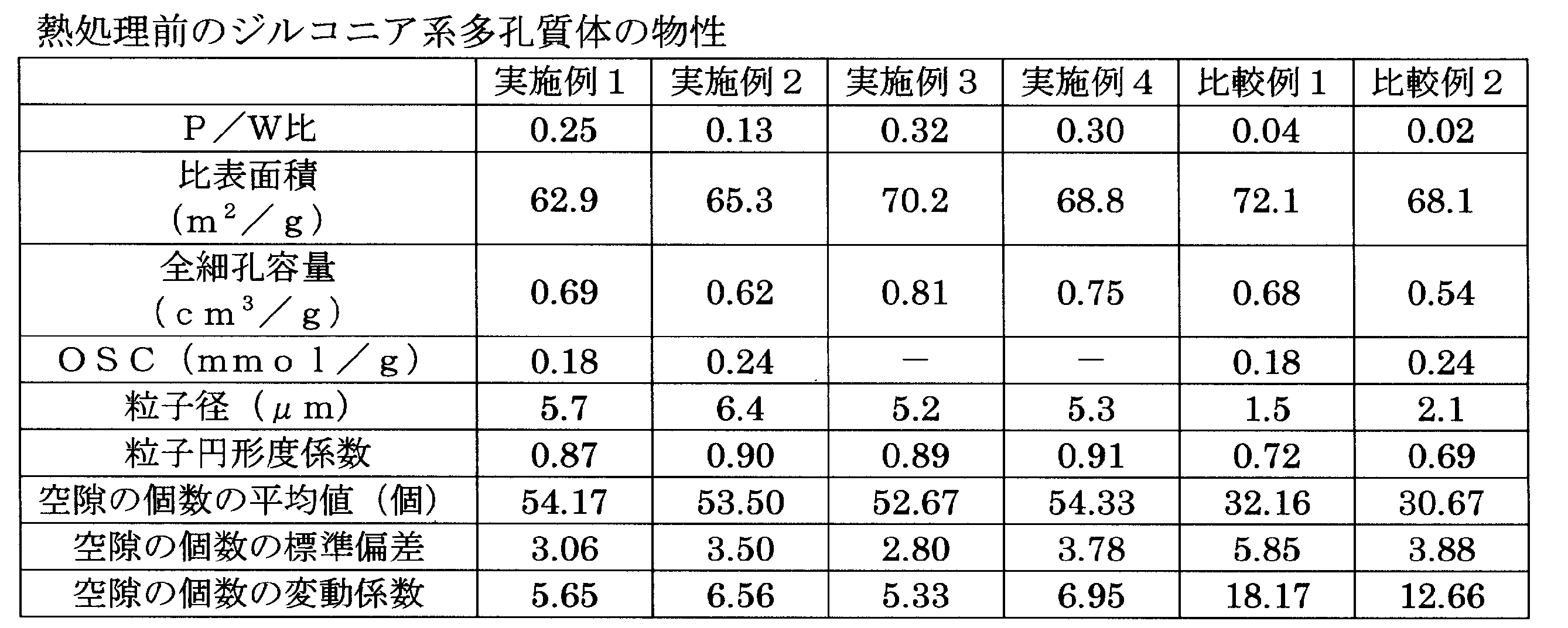
- This cerium oxide-containing zirconia-based porous body is referred to as “zirconia-based porous body before heat treatment”.
- the zirconia porous body before heat treatment was subjected to heat treatment in the atmosphere at 1000 ° C. for 12 hours.
- the zirconia porous body before the heat treatment was heat-treated in the atmosphere at 1100 ° C. for 12 hours.
- Table 1 shows the composition of the zirconia porous body before the heat treatment.
- Table 3 shows the P / W ratio, specific surface area, total pore volume, and OSC of the zirconia porous material after heat treatment at 1000 ° C. for 12 hours in the atmosphere.
- Table 4 shows the P / W ratio, specific surface area, total pore volume and OSC of the zirconia porous material after heat treatment at 1100 ° C. for 12 hours in the atmosphere.
- the obtained hydroxide precipitate was filtered, washed thoroughly with water, and the obtained hydroxide was dried at 105 ° C. for 24 hours.
- the dried hydroxide was heat-treated in the atmosphere at 600 ° C. for 5 hours to obtain a zirconia-based porous material containing cerium oxide.
- the obtained hydroxide precipitate was filtered, washed thoroughly with water, and the obtained hydroxide was dried at 105 ° C. for 24 hours.
- the dried hydroxide was heat-treated in the atmosphere at 500 ° C. for 5 hours to obtain a lanthanum oxide-containing zirconia-based porous material.
- the obtained hydroxide precipitate was filtered, washed thoroughly with water, and the obtained hydroxide was dried at 105 ° C. for 24 hours.
- the dried hydroxide was heat-treated in the atmosphere at 500 ° C. for 5 hours to obtain a neodymium oxide-containing zirconia-based porous material.
- the obtained hydroxide precipitate was filtered, washed thoroughly with water, and the obtained hydroxide was dried at 105 ° C. for 24 hours.
- the dried hydroxide was heat-treated in the atmosphere at 600 ° C. for 5 hours to obtain a zirconia-based porous material containing cerium oxide.
- the obtained hydroxide precipitate was filtered, washed thoroughly with water, and the obtained hydroxide was dried at 105 ° C. for 24 hours.
- the dried hydroxide was heat-treated in the atmosphere at 600 ° C. for 5 hours to obtain a zirconia-based porous material containing cerium oxide.
- the zirconia-based porous material of the present invention is effective in purifying harmful components in exhaust gas when used for various exhaust gas purification catalysts, TWC applications and the like. Further, in an environment where the oxygen storage capacity, oxygen release capacity, and the like can be utilized, the present invention can be widely applied to exhaust gas purification catalyst applications such as an exhaust gas oxidation catalyst for an internal combustion engine, a NOx storage purification catalyst, and a NOx selective reduction catalyst. Furthermore, it can also be used for abrasives, electrical and electronic materials, etc. that can take advantage of oxygen storage capacity, oxygen release capacity, and the like.
- A1 Pore size distribution A2 Pore size peak P of pore distribution based on BJH method
Landscapes
- Chemical & Material Sciences (AREA)
- Organic Chemistry (AREA)
- Engineering & Computer Science (AREA)
- Materials Engineering (AREA)
- Chemical Kinetics & Catalysis (AREA)
- Inorganic Chemistry (AREA)
- Physics & Mathematics (AREA)
- Thermal Sciences (AREA)
- Inorganic Compounds Of Heavy Metals (AREA)
- Nanotechnology (AREA)
- Catalysts (AREA)
Abstract
Description
(A/B)×100=56.9(%)にすぎない。
A:加熱後の比表面積
B:加熱前の比表面積 を示す。
1.粒子であるジルコニア系多孔質体であって,
(1)BJH法に基づく細孔分布において,20~100nmの細孔径にピークを有し,測定した細孔分布曲線から求められるピークの半価幅をWとし,ピークの高さをPとしたときのP/W比が0.05以上であり,全細孔容量が0.5cm3/g以上であり,
(2)1000℃で12時間の熱処理後において,20~100nmの細孔径にピークを有し,前記P/W比が0.03以上であり,少なくとも40m2/gの比表面積を有し,全細孔容量が0.3cm3/g以上である,
ことを特徴とするジルコニア系多孔質体。
2.1100℃で12時間の熱処理後において,少なくとも20m2/gの比表面積を有する,上記項1に記載のジルコニア系多孔質体。
3.SEM画像で特定される前記粒子の形状が球状又は略球状であって,円形度係数が0.85~1.0である,上記項1又は2に記載のジルコニア系多孔質体。
4.SEM画像で特定される前記粒子の断面において,単位面積あたり(1μm2)の空隙の個数の変動係数が10%以下である,上記項1~3のいずれかに記載のジルコニア系多孔質体。
5.上記項1~4のいずれかに記載のジルコニア系多孔質体の製造方法であって,下記工程を順に有することを特徴とする製造方法:
(1)ジルコニウム塩溶液及び硫酸塩化剤溶液をそれぞれ95℃以上に加熱する工程1,
(2)前記加熱後のジルコニウム塩溶液と前記加熱後の硫酸塩化剤溶液とを混合することにより,混合液として塩基性硫酸ジルコニウム含有反応液を得る工程2であって,当該混合開始から混合完了まで,混合液中のSO4 2-/ZrO2重量比率を0.3~0.8の範囲に維持するとともに,混合液の温度を95℃以上に維持する工程2,
(3)工程2で混合完了した塩基性硫酸ジルコニウム含有反応液を,95℃以上で3時間以上熟成する工程3,
(4)工程3で得られた熟成後の塩基性硫酸ジルコニウム含有反応液にアルカリを添加することにより,ジルコニウム含有水酸化物を得る工程4,
(5)工程4で得られたジルコニウム含有水酸化物を熱処理することにより,ジルコニア系多孔質体を得る工程5。
6.工程1~工程4のいずれかにおいて,希土類元素,希土類元素を除く遷移金属元素,アルカリ土類金属元素,Al,In,Si,Sn及びBiからなる群から選択される少なくとも1種の金属の塩を添加する,上記項5に記載のジルコニア系多孔質体の製造方法。
(1)細孔分布
本発明のジルコニア系多孔質体は,粒子形状のジルコニア系多孔質体であって,
(1)BJH法に基づく細孔分布において,20~100nmの細孔径にピークを有し,測定した細孔分布曲線から求められるピークの半価幅をWとし,ピークの高さ(ピーク強度)をPとしたときのP/W比が0.05以上であり,全細孔容量が0.5cm3/g以上であり,
(2)1000℃で12時間の熱処理後において,20~100nmの細孔径にピークを有し,前記P/W比が0.03以上であり,少なくとも40m2/gの比表面積を有し,全細孔容量が0.3cm3/g以上であることを特徴とする。
(2)形状
本発明のジルコニア系多孔質体は,SEM画像で特定される粒子の形状が球状又は略球状であって,円形度係数が0.85~1.0である。SEM画像とは,走査型電子顕微鏡で撮影した画像をいう。
(3)粒子の内部構造
本発明のジルコニア系多孔質体は,SEM画像で特定される粒子の断面において,単位面積あたり(1μm2)の空隙の個数の変動係数が10%以下である。変動係数は10%以下であれば良いが,5.0~9.0%であれば好ましい。
変動係数(%)=(標準偏差/平均値)×100 である。
本発明のジルコニア系多孔質体の製造方法は,下記工程を順に有する:
(1)ジルコニウム塩溶液及び硫酸塩化剤溶液をそれぞれ95℃以上に加熱する工程1,
(2)前記加熱後のジルコニウム塩溶液と前記加熱後の硫酸塩化剤溶液とを混合することにより,混合液として塩基性硫酸ジルコニウム含有反応液を得る工程2であって,当該混合開始から混合完了まで,混合液中のSO4 2-/ZrO2重量比率を0.3~0.8の範囲に維持するとともに,混合液の温度を95℃以上に維持する工程2,
(3)工程2で混合完了した塩基性硫酸ジルコニウム含有反応液を,95℃以上で3時間以上熟成する工程3,
(4)工程3で得られた熟成後の塩基性硫酸ジルコニウム含有反応液にアルカリを添加することにより,ジルコニウム含有水酸化物を得る工程4,
(5)工程4で得られたジルコニウム含有水酸化物を熱処理することにより,ジルコニア系多孔質体を得る工程5。
(1)工程1
工程1では,出発原料であるジルコニウム塩溶液及び硫酸塩化剤溶液をそれぞれ95℃以上に加熱する。
工程2では,前記加熱後のジルコニウム塩溶液と前記加熱後の硫酸塩化剤溶液とを混合することにより,混合液として塩基性硫酸ジルコニウム含有反応液を得る。ここで,当該混合開始から混合完了まで,混合液中のSO4 2-/ZrO2重量比率を0.3~0.8の範囲に維持するとともに,混合液の温度を95℃以上に維持する。
工程3では,工程2で混合完了した塩基性硫酸ジルコニウム含有反応液を,95℃以上で3時間以上熟成する。熟成時間の上限値は限定的ではないが,7時間程度である。
工程4では,工程3で得られた熟成後の塩基性硫酸ジルコニウム含有反応液にアルカリを添加し,中和反応を行う。中和により,ジルコニウム含有水酸化物が生成する。
工程5では,工程4で得られたジルコニウム含有水酸化物を熱処理することにより,ジルコニウム含有水酸化物を酸化し,ジルコニア系多孔質体を得る。
本発明の製造方法では,工程1から工程4のいずれかにおいて,希土類元素,希土類元素を除く遷移金属元素,アルカリ土類金属元素,Al,In,Si,Sn及びBiからなる群から選択される少なくとも1種の金属の塩(金属塩)を添加することができる。これらの金属塩を添加することによって,ジルコニア系多孔質体の耐熱性及び触媒性能をより向上することができる。
(1)比表面積
比表面積計「フローソーブ-II」(マイクロメリティクス製)を用い,BET法により測定した。測定結果からP/W比を求めた(図6参照)。
(2)細孔分布及び全細孔容量
測定装置「Autosorb-1, Quantachrome (MODEL NO.AS1KR)」を用い,BJH法により測定した。
(3)酸素吸着量(OSC)
測定装置「マルチタスクTPD(TPD-1-AT)」(日本ベル製)を用い,600℃における酸素パルス法により測定した。
(4)一次粒子径
X線回折ピークの半価幅より,次式のシェラーの式を用いて計算した。
〔式中,k:定数0.9,λ:X線波長(Å),β:試料の回折線幅-標準試料の回折線幅(ラジアン),θ:回折角(度)を示す。〕
(5)円形度係数
円形度係数とは,粒子の凹凸の度合いを表す係数であり,
(4π×面積)/(周囲長)2で算出される数値である。
(6)単位面積あたり(1μm2)の空隙の個数
空隙は,SEM画像で観測された視野の中から,空隙の大きさが比較的そろっている箇所選択し,粒子の断面撮影に最も適した倍率で撮影した。撮影したSEM画像を面積1μm2の領域で区切り,各領域の空隙数を目視でカウントした。これらの空隙数から空隙数の平均値及び標準偏差を算出し,変動係数を求めた。なお,変動係数は下式により算出することができる。



A2 BJH法に基づく細孔分布の細孔径ピークP
A3 測定した細孔分布曲線から求められるピークの半価幅W
Claims (6)
- 粒子であるジルコニア系多孔質体であって,
(1)BJH法に基づく細孔分布において,20~100nmの細孔径にピークを有し,測定した細孔分布曲線から求められるピークの半価幅をWとし,ピークの高さをPとしたときのP/W比が0.05以上であり,全細孔容量が0.5cm3/g以上であり,
(2)1000℃で12時間の熱処理後において,20~100nmの細孔径にピークを有し,前記P/W比が0.03以上であり,少なくとも40m2/gの比表面積を有し,全細孔容量が0.3cm3/g以上である,
ことを特徴とするジルコニア系多孔質体。 - 1100℃で12時間の熱処理後において,少なくとも20m2/gの比表面積を有する,請求項1に記載のジルコニア系多孔質体。
- SEM画像で特定される前記粒子の形状が球状又は略球状であって,円形度係数が0.85~1.0である,請求項1又は2に記載のジルコニア系多孔質体。
- SEM画像で特定される前記粒子の断面において,単位面積あたり(1μm2)の空隙の個数の変動係数が10%以下である,請求項1~3のいずれかに記載のジルコニア系多孔質体。
- 請求項1~4のいずれかに記載のジルコニア系多孔質体の製造方法であって,下記工程を順に有することを特徴とする製造方法:
(1)ジルコニウム塩溶液及び硫酸塩化剤溶液をそれぞれ95℃以上に加熱する工程1,
(2)前記加熱後のジルコニウム塩溶液と前記加熱後の硫酸塩化剤溶液とを混合することにより,混合液として塩基性硫酸ジルコニウム含有反応液を得る工程2であって,当該混合開始から混合完了まで,混合液中のSO4 2-/ZrO2重量比率を0.3~0.8の範囲に維持するとともに,混合液の温度を95℃以上に維持する工程2,
(3)工程2で混合完了した塩基性硫酸ジルコニウム含有反応液を,95℃以上で3時間以上熟成する工程3,
(4)工程3で得られた熟成後の塩基性硫酸ジルコニウム含有反応液にアルカリを添加することにより,ジルコニウム含有水酸化物を得る工程4,
(5)工程4で得られたジルコニウム含有水酸化物を熱処理することにより,ジルコニア系多孔質体を得る工程5。 - 工程1~工程4のいずれかにおいて,希土類元素,希土類元素を除く遷移金属元素,アルカリ土類金属元素,Al,In,Si,Sn及びBiからなる群から選択される少なくとも1種の金属の塩を添加する,請求項5に記載のジルコニア系多孔質体の製造方法。
Priority Applications (4)
| Application Number | Priority Date | Filing Date | Title |
|---|---|---|---|
| US14/913,077 US9956543B2 (en) | 2014-03-28 | 2014-04-25 | Zirconia-based porous body and method for producing same |
| PL14887437T PL3085667T3 (pl) | 2014-03-28 | 2014-04-25 | Porowata struktura na bazie ditlenku cyrkonu i sposób jej wytwarzania |
| CN201480006519.9A CN105339307B (zh) | 2014-03-28 | 2014-04-25 | 氧化锆系多孔体及其制造方法 |
| EP14887437.3A EP3085667B2 (en) | 2014-03-28 | 2014-04-25 | Zirconia-based porous body and method for producing same |
Applications Claiming Priority (2)
| Application Number | Priority Date | Filing Date | Title |
|---|---|---|---|
| JP2014-070424 | 2014-03-28 | ||
| JP2014070424A JP5744274B1 (ja) | 2014-03-28 | 2014-03-28 | ジルコニア系多孔質体及びその製造方法 |
Publications (1)
| Publication Number | Publication Date |
|---|---|
| WO2015145787A1 true WO2015145787A1 (ja) | 2015-10-01 |
Family
ID=53537784
Family Applications (1)
| Application Number | Title | Priority Date | Filing Date |
|---|---|---|---|
| PCT/JP2014/061661 Ceased WO2015145787A1 (ja) | 2014-03-28 | 2014-04-25 | ジルコニア系多孔質体及びその製造方法 |
Country Status (6)
| Country | Link |
|---|---|
| US (1) | US9956543B2 (ja) |
| EP (1) | EP3085667B2 (ja) |
| JP (1) | JP5744274B1 (ja) |
| CN (1) | CN105339307B (ja) |
| PL (1) | PL3085667T3 (ja) |
| WO (1) | WO2015145787A1 (ja) |
Cited By (7)
| Publication number | Priority date | Publication date | Assignee | Title |
|---|---|---|---|---|
| WO2017072509A1 (en) * | 2015-10-27 | 2017-05-04 | Magnesium Elektron Limited | Zirconia-based compositions for use as three way catalysts |
| WO2017130917A1 (ja) | 2016-01-26 | 2017-08-03 | 新日本電工株式会社 | セリア・ジルコニア系複合酸化物酸素吸放出材料、排ガス浄化触媒、及び排ガス浄化用ハニカム構造体 |
| WO2021020104A1 (ja) * | 2019-07-30 | 2021-02-04 | 第一稀元素化学工業株式会社 | ジルコニア系複合酸化物、及び、ジルコニア系複合酸化物の製造方法 |
| JP6991384B1 (ja) | 2021-08-12 | 2022-01-12 | 第一稀元素化学工業株式会社 | ジルコニア系多孔質体、及び、ジルコニア系多孔質体の製造方法 |
| WO2022075346A1 (ja) * | 2020-10-09 | 2022-04-14 | 第一稀元素化学工業株式会社 | ジルコニア粉末、ジルコニア焼結体、及び、ジルコニア焼結体の製造方法 |
| JPWO2022075345A1 (ja) * | 2020-10-09 | 2022-04-14 | ||
| JP7178526B1 (ja) | 2022-06-06 | 2022-11-25 | 第一稀元素化学工業株式会社 | 多孔質ジルコニア系複合酸化物、及び、多孔質ジルコニア系複合酸化物の製造方法 |
Families Citing this family (12)
| Publication number | Priority date | Publication date | Assignee | Title |
|---|---|---|---|---|
| JP5744274B1 (ja) | 2014-03-28 | 2015-07-08 | 第一稀元素化学工業株式会社 | ジルコニア系多孔質体及びその製造方法 |
| WO2018078313A1 (en) * | 2016-10-27 | 2018-05-03 | Magnesium Elektron Limited | Acidic zirconium hydroxide |
| EP3345870B1 (en) * | 2016-03-30 | 2020-04-22 | Daiichi Kigenso Kagaku Kogyo Co., Ltd. | Zirconia fine powder and production method therefor |
| FR3050450A1 (fr) * | 2016-04-26 | 2017-10-27 | Rhodia Operations | Oxyde mixte a base de cerium et de zirconium |
| JP6701581B2 (ja) * | 2017-03-02 | 2020-05-27 | 株式会社豊田中央研究所 | 酸素吸放出材 |
| CN111447997B (zh) * | 2018-01-08 | 2023-08-01 | 太平洋工业发展公司 | 制造用于废气处理的介孔储氧材料的方法、所述储氧材料及其用途 |
| KR102706190B1 (ko) | 2018-01-08 | 2024-09-12 | 패서픽 인더스트리얼 디벨럽먼트 코퍼레이션 | 세리아-지르코니아-산소 저장 물질을 포함하는 촉매 및 그 제조 방법 |
| JP7422989B2 (ja) * | 2019-01-24 | 2024-01-29 | 日本特殊陶業株式会社 | 多孔質ジルコニア粒子及びタンパク質固定用凝集体 |
| WO2021012107A1 (en) * | 2019-07-19 | 2021-01-28 | Rhodia Operations | Mixed oxide based on cerium and zirconium |
| CN110451957A (zh) * | 2019-09-18 | 2019-11-15 | 苏州炻原新材料科技有限公司 | 一种纳米氧化锆喷涂粉末及其制备方法 |
| US20230234034A1 (en) | 2020-05-28 | 2023-07-27 | Rhodia Operations | Aluminium and zirconium-based mixed oxide |
| KR20240114742A (ko) | 2021-12-01 | 2024-07-24 | 로디아 오퍼레이션스 | 알루미늄 및 지르코늄-기재 혼합 산화물 |
Citations (7)
| Publication number | Priority date | Publication date | Assignee | Title |
|---|---|---|---|---|
| JPH06183739A (ja) * | 1992-12-18 | 1994-07-05 | Nippon Denko Kk | タップ密度の低い酸化ジルコニウム微粉末の製造方法 |
| JP2006036576A (ja) * | 2004-07-26 | 2006-02-09 | Daiichi Kigensokagaku Kogyo Co Ltd | ジルコニア系多孔質体及びその製造方法 |
| JP2007197311A (ja) * | 2005-12-28 | 2007-08-09 | Daiichi Kigensokagaku Kogyo Co Ltd | セリウム・ジルコニウム複合酸化物及びその製造方法 |
| JP2008081392A (ja) * | 2006-08-22 | 2008-04-10 | Daiichi Kigensokagaku Kogyo Co Ltd | 多孔質ジルコニア系粉末及びその製造方法 |
| JP2009013064A (ja) * | 2008-10-03 | 2009-01-22 | Toyota Motor Corp | 多孔質複合酸化物及びその製造方法 |
| JP2009249275A (ja) * | 2008-04-09 | 2009-10-29 | Daiichi Kigensokagaku Kogyo Co Ltd | セリウム−ジルコニウム系複合酸化物及びその製造方法 |
| JP2012533499A (ja) * | 2009-07-17 | 2012-12-27 | ロデイア・オペラシヨン | 特有の多孔度を有する酸化セリウムおよび酸化ジルコニウムを含む組成物、この調製方法および触媒作用におけるこの使用 |
Family Cites Families (12)
| Publication number | Priority date | Publication date | Assignee | Title |
|---|---|---|---|---|
| JP3946982B2 (ja) | 2001-11-01 | 2007-07-18 | ニッケイ・メル株式会社 | ジルコニア・セリア基複合酸化物の製造方法 |
| FR2868768B1 (fr) | 2004-04-07 | 2007-07-20 | Rhodia Chimie Sa | Composition a base d'oxydes de zirconium et d'ytrium, procede de preparation et utilisation dans un systeme catalytique |
| GB0428555D0 (en) | 2004-12-30 | 2005-02-09 | Magnesium Elektron Ltd | Composite material for automotive catalyst applications and method of manufacturing |
| US7704483B2 (en) | 2005-04-29 | 2010-04-27 | Cabot Corporation | High surface area tetragonal zirconia and processes for synthesizing same |
| JP5344805B2 (ja) * | 2006-06-20 | 2013-11-20 | 第一稀元素化学工業株式会社 | ジルコニア系複合酸化物及びその製造方法 |
| JP5008355B2 (ja) * | 2006-06-30 | 2012-08-22 | 第一稀元素化学工業株式会社 | 酸化セリウム−酸化ジルコニウム系複合酸化物及びその製造方法 |
| EP1894620B2 (en) * | 2006-08-22 | 2023-06-07 | Daiichi Kigenso Kagaku Kogyo Co., Ltd. | Method to produce a porous zirconia powder |
| JP5100244B2 (ja) * | 2006-10-12 | 2012-12-19 | 第一稀元素化学工業株式会社 | ジルコニア・セリア・イットリア系複合酸化物及びその製造方法 |
| JP2008150242A (ja) | 2006-12-18 | 2008-07-03 | Toyota Motor Corp | 酸化物の製造方法 |
| JP6262413B2 (ja) | 2009-03-06 | 2018-01-17 | ユミコア日本触媒株式会社 | 排気ガス浄化用触媒及びその製造方法、並びに排気ガス浄化方法 |
| FR2959735B1 (fr) | 2010-05-06 | 2012-06-22 | Rhodia Operations | Composition a base d'oxydes de zirconium, de cerium d'au moins une autre terre rare, a porosite specifique, procede de preparation et utilisation en catalyse. |
| JP5744274B1 (ja) | 2014-03-28 | 2015-07-08 | 第一稀元素化学工業株式会社 | ジルコニア系多孔質体及びその製造方法 |
-
2014
- 2014-03-28 JP JP2014070424A patent/JP5744274B1/ja active Active
- 2014-04-25 PL PL14887437T patent/PL3085667T3/pl unknown
- 2014-04-25 EP EP14887437.3A patent/EP3085667B2/en active Active
- 2014-04-25 US US14/913,077 patent/US9956543B2/en active Active
- 2014-04-25 CN CN201480006519.9A patent/CN105339307B/zh active Active
- 2014-04-25 WO PCT/JP2014/061661 patent/WO2015145787A1/ja not_active Ceased
Patent Citations (7)
| Publication number | Priority date | Publication date | Assignee | Title |
|---|---|---|---|---|
| JPH06183739A (ja) * | 1992-12-18 | 1994-07-05 | Nippon Denko Kk | タップ密度の低い酸化ジルコニウム微粉末の製造方法 |
| JP2006036576A (ja) * | 2004-07-26 | 2006-02-09 | Daiichi Kigensokagaku Kogyo Co Ltd | ジルコニア系多孔質体及びその製造方法 |
| JP2007197311A (ja) * | 2005-12-28 | 2007-08-09 | Daiichi Kigensokagaku Kogyo Co Ltd | セリウム・ジルコニウム複合酸化物及びその製造方法 |
| JP2008081392A (ja) * | 2006-08-22 | 2008-04-10 | Daiichi Kigensokagaku Kogyo Co Ltd | 多孔質ジルコニア系粉末及びその製造方法 |
| JP2009249275A (ja) * | 2008-04-09 | 2009-10-29 | Daiichi Kigensokagaku Kogyo Co Ltd | セリウム−ジルコニウム系複合酸化物及びその製造方法 |
| JP2009013064A (ja) * | 2008-10-03 | 2009-01-22 | Toyota Motor Corp | 多孔質複合酸化物及びその製造方法 |
| JP2012533499A (ja) * | 2009-07-17 | 2012-12-27 | ロデイア・オペラシヨン | 特有の多孔度を有する酸化セリウムおよび酸化ジルコニウムを含む組成物、この調製方法および触媒作用におけるこの使用 |
Non-Patent Citations (1)
| Title |
|---|
| See also references of EP3085667A4 * |
Cited By (32)
| Publication number | Priority date | Publication date | Assignee | Title |
|---|---|---|---|---|
| JP7012639B2 (ja) | 2015-10-27 | 2022-01-28 | マグネシウム エレクトロン リミテッド | 三元触媒として使用するためのジルコニア系組成物 |
| CN108349744A (zh) * | 2015-10-27 | 2018-07-31 | 镁电子有限公司 | 用作三元催化剂的基于氧化锆的组合物 |
| KR20180100544A (ko) * | 2015-10-27 | 2018-09-11 | 마그네슘 일렉트론 리미티드 | 삼원 촉매로서 사용하기 위한 지르코니아-기반 조성물 |
| US20180304235A1 (en) * | 2015-10-27 | 2018-10-25 | Magnesium Elektron Limited | Zirconia-based compositions for use as three way catalysts |
| JP2019501092A (ja) * | 2015-10-27 | 2019-01-17 | マグネシウム エレクトロン リミテッド | 三元触媒として使用するためのジルコニア系組成物 |
| RU2727187C2 (ru) * | 2015-10-27 | 2020-07-21 | Магнезиум Электрон Лимитед | Композиции на основе оксида циркония, используемые в качестве тройных катализаторов |
| CN108349744B (zh) * | 2015-10-27 | 2020-12-18 | 镁电子有限公司 | 用作三元催化剂的基于氧化锆的组合物 |
| WO2017072509A1 (en) * | 2015-10-27 | 2017-05-04 | Magnesium Elektron Limited | Zirconia-based compositions for use as three way catalysts |
| KR102550022B1 (ko) * | 2015-10-27 | 2023-06-29 | 마그네슘 일렉트론 리미티드 | 삼원 촉매로서 사용하기 위한 지르코니아-기반 조성물 |
| US11613473B2 (en) | 2015-10-27 | 2023-03-28 | Magnesium Elektron Limited | Zirconia-based compositions for use as three way catalysts |
| WO2017130917A1 (ja) | 2016-01-26 | 2017-08-03 | 新日本電工株式会社 | セリア・ジルコニア系複合酸化物酸素吸放出材料、排ガス浄化触媒、及び排ガス浄化用ハニカム構造体 |
| US10987654B2 (en) | 2016-01-26 | 2021-04-27 | Nippon Denko Co., Ltd | Ceria-zirconia-based composite oxide oxygen storage material, exhaust gas cleaning catalyst, and honeycomb structure for exhaust gas cleaning |
| WO2021020104A1 (ja) * | 2019-07-30 | 2021-02-04 | 第一稀元素化学工業株式会社 | ジルコニア系複合酸化物、及び、ジルコニア系複合酸化物の製造方法 |
| JPWO2021020104A1 (ja) * | 2019-07-30 | 2021-12-02 | 第一稀元素化学工業株式会社 | ジルコニア系複合酸化物、及び、ジルコニア系複合酸化物の製造方法 |
| JP7451533B2 (ja) | 2019-07-30 | 2024-03-18 | 第一稀元素化学工業株式会社 | ジルコニア系複合酸化物、及び、ジルコニア系複合酸化物の製造方法 |
| JP7195481B2 (ja) | 2020-10-09 | 2022-12-23 | 第一稀元素化学工業株式会社 | ジルコニア粉末、ジルコニア焼結体、及び、ジルコニア焼結体の製造方法 |
| WO2022075345A1 (ja) * | 2020-10-09 | 2022-04-14 | 第一稀元素化学工業株式会社 | ジルコニア粉末、ジルコニア焼結体、及び、ジルコニア焼結体の製造方法 |
| JPWO2022075345A1 (ja) * | 2020-10-09 | 2022-04-14 | ||
| CN114787085A (zh) * | 2020-10-09 | 2022-07-22 | 第一稀元素化学工业株式会社 | 氧化锆粉末、氧化锆烧结体以及氧化锆烧结体的制造方法 |
| CN114787085B (zh) * | 2020-10-09 | 2024-03-15 | 第一稀元素化学工业株式会社 | 氧化锆粉末、氧化锆烧结体以及氧化锆烧结体的制造方法 |
| JPWO2022075346A1 (ja) * | 2020-10-09 | 2022-04-14 | ||
| WO2022075346A1 (ja) * | 2020-10-09 | 2022-04-14 | 第一稀元素化学工業株式会社 | ジルコニア粉末、ジルコニア焼結体、及び、ジルコニア焼結体の製造方法 |
| JP7195482B2 (ja) | 2020-10-09 | 2022-12-23 | 第一稀元素化学工業株式会社 | ジルコニア粉末、ジルコニア焼結体、及び、ジルコニア焼結体の製造方法 |
| EP4023600A4 (en) * | 2021-08-12 | 2022-12-21 | Daiichi Kigenso Kagaku Kogyo Co., Ltd. | ZIRCONIA-BASED POROUS BODIES AND METHOD FOR PRODUCING ZIRCONIA-BASED POROUS BODIES |
| JP6991384B1 (ja) | 2021-08-12 | 2022-01-12 | 第一稀元素化学工業株式会社 | ジルコニア系多孔質体、及び、ジルコニア系多孔質体の製造方法 |
| JP2023025987A (ja) * | 2021-08-12 | 2023-02-24 | 第一稀元素化学工業株式会社 | ジルコニア系多孔質体、及び、ジルコニア系多孔質体の製造方法 |
| WO2022107900A1 (ja) * | 2021-08-12 | 2022-05-27 | 第一稀元素化学工業株式会社 | ジルコニア系多孔質体、及び、ジルコニア系多孔質体の製造方法 |
| US11958039B2 (en) | 2021-08-12 | 2024-04-16 | Daiichi Kigenso Kagaku Kogyo Co., Ltd. | Zirconia-based porous body and method for manufacturing zirconia-based porous body |
| WO2023238734A1 (ja) * | 2022-06-06 | 2023-12-14 | 第一稀元素化学工業株式会社 | 多孔質ジルコニア系複合酸化物、及び、多孔質ジルコニア系複合酸化物の製造方法 |
| JP2023178603A (ja) * | 2022-06-06 | 2023-12-18 | 第一稀元素化学工業株式会社 | 多孔質ジルコニア系複合酸化物、及び、多孔質ジルコニア系複合酸化物の製造方法 |
| JP7178526B1 (ja) | 2022-06-06 | 2022-11-25 | 第一稀元素化学工業株式会社 | 多孔質ジルコニア系複合酸化物、及び、多孔質ジルコニア系複合酸化物の製造方法 |
| EP4484379A4 (en) * | 2022-06-06 | 2026-02-25 | Daiichi Kigenso Kagaku Kogyo | POROUS ZIRCONIA-BASED COMPOSITE OXIDE AND PROCESS FOR MANUFACTURING POROUS ZIRCONIA-BASED COMPOSITE OXIDE |
Also Published As
| Publication number | Publication date |
|---|---|
| EP3085667B1 (en) | 2019-10-09 |
| US9956543B2 (en) | 2018-05-01 |
| EP3085667B2 (en) | 2026-01-14 |
| EP3085667A1 (en) | 2016-10-26 |
| CN105339307B (zh) | 2020-07-24 |
| JP2015189655A (ja) | 2015-11-02 |
| US20160207027A1 (en) | 2016-07-21 |
| PL3085667T3 (pl) | 2020-05-18 |
| EP3085667A4 (en) | 2016-12-07 |
| CN105339307A (zh) | 2016-02-17 |
| JP5744274B1 (ja) | 2015-07-08 |
Similar Documents
| Publication | Publication Date | Title |
|---|---|---|
| JP5744274B1 (ja) | ジルコニア系多孔質体及びその製造方法 | |
| JP4660135B2 (ja) | ジルコニア系多孔質体及びその製造方法 | |
| JP5063252B2 (ja) | 多孔質ジルコニア系粉末及びその製造方法 | |
| US8048389B2 (en) | Cerium oxide-zirconium oxide-based mixed oxide and method for producing thereof | |
| CN101596451B (zh) | 铈-锆类复合氧化物及其制造方法 | |
| JP5263677B2 (ja) | アンモニア分解触媒、それを用いたアンモニア分解方法、およびアンモニア分解反応装置 | |
| JP4503603B2 (ja) | 酸化セリウムと酸化ジルコニウムを主体とする向上した還元能と比表面積を有する組成物及び触媒 | |
| WO2018047379A1 (ja) | 脱硝触媒、及びその製造方法 | |
| JP5703924B2 (ja) | 柱状セリア触媒 | |
| JP6516862B2 (ja) | 排ガス浄化用触媒及びその製造方法並びにそれを用いた排ガス浄化装置 | |
| WO2019003424A1 (ja) | アルミナ系複合酸化物及びその製造方法 | |
| WO2022107900A1 (ja) | ジルコニア系多孔質体、及び、ジルコニア系多孔質体の製造方法 | |
| JP5887575B2 (ja) | 自動車排ガス浄化用助触媒材およびその製造方法 | |
| ES2811076T3 (es) | Material catalizador y procedimiento para su producción | |
| JP5652271B2 (ja) | 排ガス浄化用触媒担体、それを用いた排ガス浄化用触媒及び排ガス浄化用触媒担体の製造方法 | |
| JP6325010B2 (ja) | アルミナ系複合酸化物及びその製造方法 | |
| JP7279203B2 (ja) | 耐熱性ルテニウム複合体、並びにNOx吸蔵及び還元触媒としての用途 | |
| JP4611038B2 (ja) | 排ガス浄化用触媒の製造方法 | |
| JP2012187457A (ja) | 窒素酸化物選択還元触媒とその製造方法 | |
| JP4254444B2 (ja) | 内燃機関用排ガス浄化触媒およびその製造方法 | |
| JP2011136257A (ja) | 排ガス浄化用触媒担体およびそれを用いた排ガス浄化用触媒 | |
| JP6909402B2 (ja) | 排ガス浄化用触媒担体、それを用いた排ガス浄化用触媒、及び排ガス浄化用触媒担体の製造方法 | |
| JP6806588B2 (ja) | 自動車排気ガス浄化用助触媒およびその製造方法 | |
| CN104353450A (zh) | 一种制备纳米晶体金属掺杂催化剂的方法 | |
| JP2012245429A (ja) | 貴金属担持触媒 |
Legal Events
| Date | Code | Title | Description |
|---|---|---|---|
| WWE | Wipo information: entry into national phase |
Ref document number: 201480006519.9 Country of ref document: CN |
|
| 121 | Ep: the epo has been informed by wipo that ep was designated in this application |
Ref document number: 14887437 Country of ref document: EP Kind code of ref document: A1 |
|
| REEP | Request for entry into the european phase |
Ref document number: 2014887437 Country of ref document: EP |
|
| WWE | Wipo information: entry into national phase |
Ref document number: 14913077 Country of ref document: US Ref document number: 2014887437 Country of ref document: EP |
|
| NENP | Non-entry into the national phase |
Ref country code: DE |