WO2015146650A1 - 架橋性ゴム組成物及びゴム架橋物の製造方法 - Google Patents
架橋性ゴム組成物及びゴム架橋物の製造方法 Download PDFInfo
- Publication number
- WO2015146650A1 WO2015146650A1 PCT/JP2015/057550 JP2015057550W WO2015146650A1 WO 2015146650 A1 WO2015146650 A1 WO 2015146650A1 JP 2015057550 W JP2015057550 W JP 2015057550W WO 2015146650 A1 WO2015146650 A1 WO 2015146650A1
- Authority
- WO
- WIPO (PCT)
- Prior art keywords
- monomer unit
- rubber
- conjugated diene
- weight
- ethylenically unsaturated
- Prior art date
- Legal status (The legal status is an assumption and is not a legal conclusion. Google has not performed a legal analysis and makes no representation as to the accuracy of the status listed.)
- Ceased
Links
Images

Classifications
-
- C—CHEMISTRY; METALLURGY
- C08—ORGANIC MACROMOLECULAR COMPOUNDS; THEIR PREPARATION OR CHEMICAL WORKING-UP; COMPOSITIONS BASED THEREON
- C08J—WORKING-UP; GENERAL PROCESSES OF COMPOUNDING; AFTER-TREATMENT NOT COVERED BY SUBCLASSES C08B, C08C, C08F, C08G or C08H
- C08J3/00—Processes of treating or compounding macromolecular substances
- C08J3/24—Crosslinking, e.g. vulcanising, of macromolecules
-
- C—CHEMISTRY; METALLURGY
- C08—ORGANIC MACROMOLECULAR COMPOUNDS; THEIR PREPARATION OR CHEMICAL WORKING-UP; COMPOSITIONS BASED THEREON
- C08F—MACROMOLECULAR COMPOUNDS OBTAINED BY REACTIONS ONLY INVOLVING CARBON-TO-CARBON UNSATURATED BONDS
- C08F236/00—Copolymers of compounds having one or more unsaturated aliphatic radicals, at least one having two or more carbon-to-carbon double bonds
- C08F236/02—Copolymers of compounds having one or more unsaturated aliphatic radicals, at least one having two or more carbon-to-carbon double bonds the radical having only two carbon-to-carbon double bonds
- C08F236/04—Copolymers of compounds having one or more unsaturated aliphatic radicals, at least one having two or more carbon-to-carbon double bonds the radical having only two carbon-to-carbon double bonds conjugated
- C08F236/12—Copolymers of compounds having one or more unsaturated aliphatic radicals, at least one having two or more carbon-to-carbon double bonds the radical having only two carbon-to-carbon double bonds conjugated with nitriles
-
- C—CHEMISTRY; METALLURGY
- C08—ORGANIC MACROMOLECULAR COMPOUNDS; THEIR PREPARATION OR CHEMICAL WORKING-UP; COMPOSITIONS BASED THEREON
- C08F—MACROMOLECULAR COMPOUNDS OBTAINED BY REACTIONS ONLY INVOLVING CARBON-TO-CARBON UNSATURATED BONDS
- C08F8/00—Chemical modification by after-treatment
- C08F8/04—Reduction, e.g. hydrogenation
-
- C—CHEMISTRY; METALLURGY
- C08—ORGANIC MACROMOLECULAR COMPOUNDS; THEIR PREPARATION OR CHEMICAL WORKING-UP; COMPOSITIONS BASED THEREON
- C08K—Use of inorganic or non-macromolecular organic substances as compounding ingredients
- C08K5/00—Use of organic ingredients
- C08K5/16—Nitrogen-containing compounds
- C08K5/17—Amines; Quaternary ammonium compounds
-
- C—CHEMISTRY; METALLURGY
- C08—ORGANIC MACROMOLECULAR COMPOUNDS; THEIR PREPARATION OR CHEMICAL WORKING-UP; COMPOSITIONS BASED THEREON
- C08K—Use of inorganic or non-macromolecular organic substances as compounding ingredients
- C08K5/00—Use of organic ingredients
- C08K5/16—Nitrogen-containing compounds
- C08K5/205—Compounds containing groups, e.g. carbamates
-
- C—CHEMISTRY; METALLURGY
- C08—ORGANIC MACROMOLECULAR COMPOUNDS; THEIR PREPARATION OR CHEMICAL WORKING-UP; COMPOSITIONS BASED THEREON
- C08L—COMPOSITIONS OF MACROMOLECULAR COMPOUNDS
- C08L13/00—Compositions of rubbers containing carboxyl groups
-
- C—CHEMISTRY; METALLURGY
- C08—ORGANIC MACROMOLECULAR COMPOUNDS; THEIR PREPARATION OR CHEMICAL WORKING-UP; COMPOSITIONS BASED THEREON
- C08L—COMPOSITIONS OF MACROMOLECULAR COMPOUNDS
- C08L15/00—Compositions of rubber derivatives
- C08L15/005—Hydrogenated nitrile rubber
-
- C—CHEMISTRY; METALLURGY
- C08—ORGANIC MACROMOLECULAR COMPOUNDS; THEIR PREPARATION OR CHEMICAL WORKING-UP; COMPOSITIONS BASED THEREON
- C08F—MACROMOLECULAR COMPOUNDS OBTAINED BY REACTIONS ONLY INVOLVING CARBON-TO-CARBON UNSATURATED BONDS
- C08F220/00—Copolymers of compounds having one or more unsaturated aliphatic radicals, each having only one carbon-to-carbon double bond, and only one being terminated by only one carboxyl radical or a salt, anhydride ester, amide, imide or nitrile thereof
- C08F220/02—Monocarboxylic acids having less than ten carbon atoms; Derivatives thereof
- C08F220/42—Nitriles
- C08F220/44—Acrylonitrile
-
- C—CHEMISTRY; METALLURGY
- C08—ORGANIC MACROMOLECULAR COMPOUNDS; THEIR PREPARATION OR CHEMICAL WORKING-UP; COMPOSITIONS BASED THEREON
- C08J—WORKING-UP; GENERAL PROCESSES OF COMPOUNDING; AFTER-TREATMENT NOT COVERED BY SUBCLASSES C08B, C08C, C08F, C08G or C08H
- C08J2309/00—Characterised by the use of homopolymers or copolymers of conjugated diene hydrocarbons
- C08J2309/02—Copolymers with acrylonitrile
-
- C—CHEMISTRY; METALLURGY
- C08—ORGANIC MACROMOLECULAR COMPOUNDS; THEIR PREPARATION OR CHEMICAL WORKING-UP; COMPOSITIONS BASED THEREON
- C08J—WORKING-UP; GENERAL PROCESSES OF COMPOUNDING; AFTER-TREATMENT NOT COVERED BY SUBCLASSES C08B, C08C, C08F, C08G or C08H
- C08J3/00—Processes of treating or compounding macromolecular substances
- C08J3/24—Crosslinking, e.g. vulcanising, of macromolecules
- C08J3/246—Intercrosslinking of at least two polymers
-
- C—CHEMISTRY; METALLURGY
- C08—ORGANIC MACROMOLECULAR COMPOUNDS; THEIR PREPARATION OR CHEMICAL WORKING-UP; COMPOSITIONS BASED THEREON
- C08L—COMPOSITIONS OF MACROMOLECULAR COMPOUNDS
- C08L9/00—Compositions of homopolymers or copolymers of conjugated diene hydrocarbons
- C08L9/02—Copolymers with acrylonitrile
Definitions
- the present invention relates to a crosslinkable rubber composition and a method for producing a crosslinked rubber product.
- nitrile group-containing highly saturated copolymer rubber represented by hydrogenated acrylonitrile-butadiene copolymer rubber is more resistant to heat than general nitrile group-containing copolymer rubber such as acrylonitrile-butadiene copolymer rubber. Because of its excellent ozone resistance, it is widely used for various fuel oil hoses, O-rings, belts in oil, etc. for automobiles.
- O-rings incorporated in automobile engines and the like are used in an environment where they are exposed to fuel oil such as gasoline. Therefore, they are required to have fuel oil resistance such that they do not swell when contacted with them.
- a rubber compound that meets this demand for example, in Patent Document 1, (i) at least one hydrogenated nitrile rubber, (ii) at least one hydrogenated terpolymer rubber, (iii) at least one strong base and Polymer blends have been proposed comprising a salt comprising a Group 1 metal with a weak acid, and (iv) at least one olefin / vinyl acetate and / or olefin / acrylate rubber.
- O-rings incorporated in automobile engines and the like used in cold regions need to have cold resistance such as rubber elasticity even in a low temperature environment, and it is an issue to achieve both cold resistance and fuel oil resistance.
- cold resistance such as rubber elasticity even in a low temperature environment
- fuel oil resistance is deteriorated accordingly.
- the molecular structure of hydrogenated nitrile rubber is controlled.
- JP 2005-29790 Japanese Published Patent Publication “JP 2005-29790” (published February 3, 2005)
- Non-Patent Document 1 it is not industrially easy to control the molecular structure as described in Non-Patent Document 1, and there is a problem that the manufacturing cost increases. Therefore, a new crosslinkable rubber composition having excellent cold resistance and fuel oil resistance obtained by a method other than controlling the molecular structure is demanded.
- an object of the present invention is to provide a crosslinkable rubber composition which is excellent in both fuel oil resistance and cold resistance and has a good balance between fuel oil resistance and cold resistance.
- the present inventors have found that the ⁇ , ⁇ -ethylenically unsaturated nitrile monomer unit (a1) is less than 30% by weight, the conjugated diene monomer unit (b1) and ⁇ , ⁇ -ethylenically unsaturated dicarboxylic acid monoester monomer unit (d1), and nitrile group-containing copolymer rubber obtained by hydrogenating at least a part of the conjugated diene monomer unit (b1) [A And an ⁇ , ⁇ -ethylenically unsaturated nitrile monomer unit (a2) of 30% by weight or more, and a conjugated diene monomer unit (b2), and one of the conjugated diene monomer units (b2) According to the rubber cross-linked product obtained by cross-linking the cross-linkable rubber composition containing the nitrile group-containing copolymer rubber [B] whose part may be hydrogenated and the amine-based cross-linking
- the crosslinkable rubber composition according to the present invention comprises ⁇ , ⁇ -ethylenically unsaturated nitrile monomer unit (a1) less than 30% by weight, conjugated diene monomer unit (b1) and ⁇ , ⁇ -ethylenic monomer.
- the crosslinkable rubber composition according to the present invention comprises ⁇ , ⁇ -ethylenically unsaturated nitrile monomer unit (a1) less than 30% by weight, conjugated diene monomer unit (b1) and ⁇ , ⁇ -ethylenically unsaturated.
- the nitrile group-containing copolymer rubber [A] contained in the crosslinkable rubber composition according to the present invention comprises an ⁇ , ⁇ -ethylenically unsaturated nitrile monomer unit (a1) of less than 30% by weight, a conjugated diene monomer. It has a unit (b1) and an ⁇ , ⁇ -ethylenically unsaturated dicarboxylic acid monoester monomer unit (d1), and is formed by hydrogenating at least a part of the conjugated diene monomer unit (b1). .
- Examples of the ⁇ , ⁇ -ethylenically unsaturated nitrile monomer (ma1) that forms the ⁇ , ⁇ -ethylenically unsaturated nitrile monomer unit (a1) include ⁇ , ⁇ -ethylenically unsaturated monomers having a nitrile group.
- the saturated compound is not limited, and examples include acrylonitrile; ⁇ -halogenoacrylonitrile such as ⁇ -chloroacrylonitrile and ⁇ -bromoacrylonitrile; ⁇ -alkylacrylonitrile such as methacrylonitrile and ethacrylonitrile; Among these, acrylonitrile and methacrylonitrile are preferable, and acrylonitrile is particularly preferable.
- ⁇ , ⁇ -ethylenically unsaturated nitrile monomers may be used in combination.
- the content of the ⁇ , ⁇ -ethylenically unsaturated nitrile monomer unit (a1) in the nitrile group-containing copolymer rubber [A] is the total monomer unit of the nitrile group-containing copolymer rubber [A].
- the content is less than 30% by weight, preferably 25% by weight or less. Further, it is preferably 1% by weight or more, more preferably 10% by weight or more, and further preferably 15% by weight or more.
- the content of the ⁇ , ⁇ -ethylenically unsaturated nitrile monomer unit (a1) is too large, the cold resistance of the resulting crosslinked product tends to decrease, and when it is too small, the fuel oil resistance tends to be inferior. .
- conjugated diene monomer unit (b1) examples include 1,3-butadiene, isoprene, 2,3-dimethyl-1,3-butadiene, and 1,3-pentadiene. Etc. Of these, 1,3-butadiene is preferred.
- the conjugated diene monomer unit (b1) in the nitrile group-containing copolymer rubber [A] is contained in the nitrile group-containing copolymer rubber [A] in a state of being at least partially hydrogenated. .
- the content of the conjugated diene monomer unit (b1) is preferably 20 to 83.5% by weight in the total monomer units of the nitrile group-containing copolymer rubber [A], and 30.5 to 64.0% by weight. % Is more preferred, with 40-58.5 weight being more preferred.
- the content ratio of the conjugated diene monomer unit (b1) is 20% by weight or more, the rubber elasticity of the obtained rubber cross-linked product is improved.
- the said content rate is 83.5 weight% or less, the heat aging resistance of the obtained rubber crosslinked material, chemical stability, etc. improve.
- Hydrogenation of the conjugated diene monomer unit (b1) can be performed using a conventionally known hydrogenation catalyst or the like.
- the degree of hydrogenation is not particularly limited, but the iodine value of the nitrile group-containing copolymer rubber [A] is preferably 120 or less, more preferably 80 or less, still more preferably 25 or less, and particularly preferably 10 or less. It is better to hydrogenate. When the iodine value is 120 or less, the heat resistance and ozone resistance of the obtained rubber cross-linked product are improved.
- the monomer that forms the ⁇ , ⁇ -ethylenically unsaturated dicarboxylic acid monoester monomer unit (d1) contained in the nitrile group-containing copolymer rubber [A] is an unesterified unsubstituted monomer.
- Any ⁇ , ⁇ -ethylenically unsaturated dicarboxylic acid monoester monomer (md1) having one (free) carboxyl group is not particularly limited.
- the unsubstituted carboxyl group is mainly used for crosslinking.
- the nitrile group-containing copolymer rubber [A] has an ⁇ , ⁇ -ethylenically unsaturated dicarboxylic acid monoester monomer unit (d1), which is crosslinked by an amine-based crosslinking agent, so that the crosslinking density is high. Therefore, the resulting rubber cross-linked product can be excellent in mechanical properties such as elongation, and more excellent in compression set resistance and cold resistance.
- the organic group bonded to the carbonyl group through the oxygen atom in the ester part of the ⁇ , ⁇ -ethylenically unsaturated dicarboxylic acid monoester monomer (md1) includes an alkyl group, a cycloalkyl group and an alkylcycloalkyl group.
- an alkyl group is particularly preferable.
- Such an alkyl group as an organic group bonded to a carbonyl group through an oxygen atom preferably has 1 to 12 carbon atoms, more preferably 2 to 6 carbon atoms.
- the cycloalkyl group as an organic group bonded to the carbonyl group through an oxygen atom preferably has 5 to 12 carbon atoms, more preferably 6 to 10 carbon atoms.
- the alkylcycloalkyl group as an organic group bonded to the carbonyl group via an oxygen atom preferably has 6 to 12 carbon atoms, more preferably 7 to 10 carbon atoms.
- the number of carbon atoms of the organic group bonded to the carbonyl group via an oxygen atom is 1 or more for an alkyl group, 5 or more for a cycloalkyl group, and 6 or more for an alkylcycloalkyl group. Is added to improve the processing stability of the crosslinkable rubber composition. When the number of carbon atoms is 12 or less, the crosslinking rate is increased, and the mechanical properties of the resulting rubber crosslinked product are improved.
- ⁇ , ⁇ -ethylenically unsaturated dicarboxylic acid monoester monomer (md1) include maleic acid monoalkyl esters such as monomethyl maleate, monoethyl maleate, monopropyl maleate, and mono n-butyl maleate.
- Maleic acid monocycloalkyl esters such as monocyclopentyl maleate, monocyclohexyl maleate and monocycloheptyl maleate; monoalkyl cycloalkyl esters of maleic acid such as monomethylcyclopentyl maleate and monoethylcyclohexyl maleate; monomethyl fumarate; fumarate Monoalkyl esters of fumaric acid such as monoethyl fumarate, monopropyl fumarate, mono-n-butyl fumarate; monocyclopentyl fumarate, monocyclohexyl fumarate, monocycloheptyl fumarate, etc.
- Monocyclic esters of malic acid monoalkyl cycloalkyl esters of fumaric acid such as monomethylcyclopentyl fumarate and monoethylcyclohexyl fumarate; Monoalkyl esters; citraconic acid monocycloalkyl esters such as citraconic acid monocyclopentyl, citraconic acid monocyclohexyl, citraconic acid monocycloheptyl, etc .; citraconic acid monomethylcyclopentyl, citraconic acid monoethylcyclohexyl, etc .; Monoalkyl itaconate such as monomethyl, monoethyl itaconate, monopropyl itaconate, mono-n-butyl itaconate Ester; itaconic acid monocyclopentyl, itaconic acid monocyclohexyl, itaconic acid monocycloheptyl, etc. itaconic acid monocycloalkyl ester; itaconic acid monomethylcycl
- the monopropyl maleate, mono-n-butyl maleate, monopropyl fumarate, mono-n-butyl fumarate, monopropyl citraconic acid and mono-citraconic acid are preferred because the effects of the present invention become more remarkable.
- a monoester of a dicarboxylic acid having the two carboxyl groups in the cis position (cis configuration) is more preferred, and mono-n-butyl maleate is particularly preferred.
- the content ratio of the ⁇ , ⁇ -ethylenically unsaturated dicarboxylic acid monoester monomer unit (d1) in the nitrile group-containing copolymer rubber [A] is 4.5 to 10% by weight in the total monomer units. %, More preferably 6 to 9.5% by weight, and even more preferably 6.5 to 8.5% by weight.
- the content of the ⁇ , ⁇ -ethylenically unsaturated dicarboxylic acid monoester monomer unit (d1) is 4.5% by weight or more, the mechanical properties and compression set resistance of the resulting rubber cross-linked product are improved. improves.
- the content is 10% by weight or less, the scorch stability is improved when a cross-linking agent is added to form a cross-linkable rubber composition, and the fatigue resistance of the obtained rubber cross-linked product is improved. To do.
- the nitrile group-containing copolymer rubber [A] comprises an ⁇ , ⁇ -ethylenically unsaturated nitrile monomer (ma1), a conjugated diene monomer (mb1) and an ⁇ , ⁇ -ethylenically unsaturated dicarboxylic acid monoester monomer. It may contain other monomer units copolymerizable with the monomer (md1).
- Examples of other monomers that form monomer units include (meth) acrylic acid alkoxyalkyl ester monomers, (meth) acrylic acid alkyl ester monomers, and ⁇ , ⁇ -ethylenically unsaturated monocarboxylic acids.
- the nitrile group-containing copolymer rubber [A] includes ⁇ , ⁇ -ethylenically unsaturated nitrile monomer unit (a1), conjugated diene monomer unit (b1), ⁇ , ⁇ -ethylenically unsaturated dicarboxylic acid.
- a (meth) acrylic acid alkoxyalkyl ester monomer unit (c) is preferably included.
- the nitrile group-containing copolymer rubber [A] further comprises the (meth) acrylic acid alkoxyalkyl ester monomer unit (c)
- the cold resistance and fuel oil resistance are further improved, and the fuel oil resistance and cold resistance are improved.
- a rubber cross-linked product having an even better balance of properties can be obtained.
- (meth) acrylic acid alkoxyalkyl ester monomer (mc) forming the (meth) acrylic acid alkoxyalkyl ester monomer unit (c) acrylic acid or methacrylic acid and an alcohol having an alkoxyalkyl group are used. There is no particular limitation as long as it is an ester compound.
- (meth) acrylic acid means acrylic acid and / or methacrylic acid.
- Examples of such (meth) acrylic acid alkoxyalkyl ester monomers (mc) include methoxymethyl (meth) acrylate, methoxyethyl (meth) acrylate, ethoxymethyl (meth) acrylate, and ethoxy (meth) acrylate.
- Examples include ethyl, methoxypropyl (meth) acrylate, methoxybutyl (meth) acrylate, and the like.
- the alkoxyalkyl group preferably has 2 to 8 carbon atoms, more preferably 2 to 6 carbon atoms, more preferably methoxyethyl acrylate and ethoxyethyl acrylate, particularly preferably methoxyethyl acrylate, 2-methoxyethyl acrylate is particularly preferred.
- the content ratio of the (meth) acrylic acid alkoxyalkyl ester monomer unit (c) in the nitrile group-containing copolymer rubber [A] is preferably 11 to 30% by weight, and preferably 15 to More preferred is 25% by weight, and further more preferred is 20 to 25% by weight.
- the content of the (meth) acrylic acid alkoxyalkyl ester monomer unit (c) is 11% by weight or more, the oil resistance and cold resistance of the obtained rubber cross-linked product are further improved.
- the content is 30% by weight or less, fatigue resistance and sliding wear resistance of the obtained rubber cross-linked product are improved.
- Examples of (meth) acrylic acid alkyl ester monomers include methyl (meth) acrylate, ethyl (meth) acrylate, n-propyl (meth) acrylate, i-propyl (meth) acrylate, and (meth) acrylic acid. Examples thereof include n-butyl, i-butyl (meth) acrylate, and t-butyl (meth) acrylate.
- Examples of the ⁇ , ⁇ -ethylenically unsaturated monocarboxylic acid monomer include acrylic acid, methacrylic acid, and crotonic acid.
- Examples of the ⁇ , ⁇ -ethylenically unsaturated polyvalent carboxylic acid monomer include itaconic acid, fumaric acid, maleic acid and the like.
- Examples of the ⁇ , ⁇ -ethylenically unsaturated polyvalent carboxylic acid anhydride monomer include maleic anhydride.
- aromatic vinyl monomer examples include styrene, ⁇ -methylstyrene, vinyl pyridine and the like.
- fluorine-containing vinyl monomer examples include fluoroethyl vinyl ether, fluoropropyl vinyl ether, o-trifluoromethyl styrene, vinyl pentafluorobenzoate, difluoroethylene, and tetrafluoroethylene.
- copolymerizable anti-aging agents examples include N- (4-anilinophenyl) acrylamide, N- (4-anilinophenyl) methacrylamide, N- (4-anilinophenyl) cinnamamide, N- (4-anilino).
- Examples include phenyl) crotonamide, N-phenyl-4- (3-vinylbenzyloxy) aniline, N-phenyl-4- (4-vinylbenzyloxy) aniline and the like.
- the content of other monomer units other than the unsaturated dicarboxylic acid monoester monomer unit (d1) is preferably based on all monomer units constituting the nitrile group-containing copolymer rubber [A]. Is 50% by weight or less, more preferably 30% by weight or less, and still more preferably 10% by weight or less.
- the nitrile group-containing copolymer rubber [B] contained in the crosslinkable rubber composition according to the present invention comprises an ⁇ , ⁇ -ethylenically unsaturated nitrile monomer unit (a2) of 30% by weight or more and a conjugated diene monomer.
- a nitrile group-containing copolymer rubber having a unit (b2) and at least a part of the conjugated diene monomer unit (b2) may be hydrogenated.
- the ⁇ , ⁇ -ethylenically unsaturated nitrile monomer (ma2) that forms the ⁇ , ⁇ -ethylenically unsaturated nitrile monomer unit (a2) includes ⁇ , ⁇ -ethylenically unsaturated nitrile monomer (ma2) Examples thereof are the same as those in ma1), and these ⁇ , ⁇ -ethylenically unsaturated nitrile monomers (ma2) may be used in combination.
- acrylonitrile and methacrylonitrile are preferable, and acrylonitrile is particularly preferable.
- the content ratio of the ⁇ , ⁇ -ethylenically unsaturated nitrile monomer unit (a2) in the nitrile group-containing copolymer rubber [B] is the total monomer unit of the nitrile group-containing copolymer rubber [B]. Among them, it is 30% by weight or more, preferably 35% by weight or more. Further, it is preferably 90% by weight or less, more preferably 70% by weight or less, and further preferably 50% by weight or less.
- the content of the ⁇ , ⁇ -ethylenically unsaturated nitrile monomer unit (a2) is too small, the fuel oil resistance of the resulting cross-linked product tends to decrease, and when it is too large, the cold resistance tends to decrease. .
- conjugated diene monomer unit (b2) examples of the conjugated diene monomer (mb2) that forms the conjugated diene monomer unit (b2) include the same as those described for the conjugated diene monomer (mb1). As the conjugated diene monomer (mb2), these plural types may be used in combination. Of these, 1,3-butadiene is preferred.
- the content ratio of the conjugated diene monomer unit (b2) is 70% by weight or less, preferably 65% by weight or less in the total monomer units of the nitrile group-containing copolymer rubber [B]. Further, it is preferably 10% by weight or more, more preferably 20% by weight or more, and further preferably 30% by weight or more. If the content of the conjugated diene monomer unit (b2) is too small, the rubber elasticity of the rubber crosslinked product tends to be inferior or cold resistance tends to be lowered. When the content is 70% by weight or less, the resulting rubber cross-linked product has good oil resistance, heat aging resistance, chemical stability, and the like.
- the nitrile group-containing copolymer rubber [B] is preferably one in which at least a part of the conjugated diene monomer unit (b2) in the nitrile group-containing copolymer rubber [B] is hydrogenated.
- the iodine value of the nitrile group-containing copolymer rubber [B] is preferably 120 or less, more preferably 80 or less, still more preferably 25 or less, and particularly preferably 10 or less. When the iodine value is 120 or less, the heat resistance and ozone resistance of the obtained rubber cross-linked product are improved.
- the nitrile group-containing copolymer rubber [B] is a unit of other monomer copolymerizable with the ⁇ , ⁇ -ethylenically unsaturated nitrile monomer (ma2) and the conjugated diene monomer (mb2). May be contained.
- Examples of other monomers that form monomer units include ⁇ , ⁇ -ethylenically unsaturated dicarboxylic acid monoester monomer (md2), (meth) acrylic acid alkoxyalkyl ester monomer (mc), and the like.
- Examples thereof include saturated polyvalent carboxylic acid anhydride monomers, aromatic vinyl monomers, fluorine-containing vinyl monomers, and copolymerizable anti-aging agents.
- nitrile group-containing copolymer rubber [B] is co-crosslinked with the nitrile group-containing copolymer rubber [A], and from the viewpoint of further improving the mechanical properties and compression set resistance of the crosslinked rubber, ⁇ , ⁇ -It preferably contains an ethylenically unsaturated dicarboxylic acid monoester monomer unit (d2).
- the content of the ⁇ , ⁇ -ethylenically unsaturated dicarboxylic acid monoester monomer unit (d2) is 4.5 to 10% by weight in the total monomer units of the nitrile group-containing copolymer rubber [B]. Preferably, it is 6 to 9.5% by weight, more preferably 6.5 to 8.5% by weight.
- the content of the ⁇ , ⁇ -ethylenically unsaturated dicarboxylic acid monoester monomer unit (d2) is 4.5% by weight or more, the mechanical properties and compression set resistance of the resulting rubber cross-linked product are improved. improves.
- the content is 10% by weight or less, the scorch stability is improved when a cross-linking agent is added to form a cross-linkable rubber composition, and the fatigue resistance of the obtained rubber cross-linked product is improved. To do.
- the ⁇ , ⁇ -ethylenically unsaturated dicarboxylic acid monoester monomer unit (md2) forming the ⁇ , ⁇ -ethylenically unsaturated dicarboxylic acid monoester monomer unit (d2) includes ⁇ , ⁇ -ethylenically unsaturated monomers. Examples thereof are the same as those described for the saturated dicarboxylic acid monoester monomer (md1), and these ⁇ , ⁇ -ethylenically unsaturated dicarboxylic acid monoester monomers (md2) may be used in combination. Good.
- monoesters of dicarboxylic acids having a carboxyl group at each of two carbon atoms forming an ⁇ , ⁇ -ethylenically unsaturated bond such as butyl; and the like, such as mono-n-butyl maleate and monopropyl citraconic acid.
- a monoester of a dicarboxylic acid having two carboxyl groups in the cis position (cis configuration) is more preferred, and mono-n-butyl maleate is particularly preferred.
- the content of the monomer units is preferably 50% by weight or less, more preferably 30% by weight or less, and still more preferably, based on all monomer units constituting the nitrile group-containing copolymer rubber [B]. 10% by weight or less.
- the polymer Mooney viscosity (ML 1 + 4 , 100 ° C.) is preferably 15 to 200, more preferably 15 to 150, more preferably 15 to 100.
- the polymer Mooney viscosity is 15 or more, the resulting rubber cross-linked product has good mechanical properties.
- the polymer Mooney viscosity is 200 or less, the processability is improved when a crosslinking agent is added to form a crosslinkable rubber composition.
- the method for producing the nitrile group-containing copolymer rubbers [A] and [B] contained in the crosslinkable rubber composition according to the present invention is not particularly limited, but the above-mentioned monomers are copolymerized by emulsion polymerization using an emulsifier. After polymerization, if necessary, unreacted monomers are removed to prepare a latex of a nitrile group-containing copolymer rubber, which is hydrogenated as necessary, and then solidified and dried to obtain a desired solid state. Rubber can be obtained. In emulsion polymerization, commonly used polymerization auxiliary materials such as emulsifiers, polymerization initiators, molecular weight regulators and the like can be used.
- Nonionic emulsifiers such as polyoxyethylene alkyl ether, polyoxyethylene alkyl phenol ether, polyoxyethylene alkyl ester, polyoxyethylene sorbitan alkyl ester; Myristic acid, palmitic acid, oleic acid And anionic emulsifiers such as salts of fatty acids such as linolenic acid, alkylbenzene sulfonates such as sodium dodecylbenzene sulfonate, higher alcohol sulfates and alkyl sulfosuccinates; sulfoesters of ⁇ , ⁇ -unsaturated carboxylic acids, ⁇ , and copolymerizable emulsifiers such as sulfate esters of ⁇ -unsaturated carboxylic acids and sulfoalkylaryl ethers.
- the amount of the emulsifier used is preferably 0.1 to 10
- the polymerization initiator is not particularly limited as long as it is a radical initiator, but inorganic peroxides such as potassium persulfate, sodium persulfate, ammonium persulfate, potassium perphosphate, hydrogen peroxide; t-butyl peroxide, cumene Hydroperoxide, p-menthane hydroperoxide, di-t-butyl peroxide, t-butylcumyl peroxide, acetyl peroxide, isobutyryl peroxide, octanoyl peroxide, dibenzoyl peroxide, 3, 5, 5 Organic peroxides such as trimethylhexanoyl peroxide and t-butylperoxyisobutyrate; azobisisobutyronitrile, azobis-2,4-dimethylvaleronitrile, azobiscyclohexanecarbonitrile, methyl azobisisobutyrate, etc. Azo Compounds; and the like
- inorganic or organic peroxides are preferable.
- a peroxide used as the polymerization initiator, it can be used as a redox polymerization initiator in combination with a reducing agent such as sodium bisulfite or ferrous sulfate.
- the amount of the polymerization initiator used is preferably 0.01 to 2 parts by weight with respect to 100 parts by weight of all monomers used for polymerization.
- the molecular weight modifier is not particularly limited.
- mercaptans such as t-dodecyl mercaptan, n-dodecyl mercaptan, octyl mercaptan; halogenated hydrocarbons such as carbon tetrachloride, methylene chloride, methylene bromide; ⁇ -methyl Styrene dimers; sulfur-containing compounds such as tetraethylthiuram disulfide, dipentamethylene thiuram disulfide, diisopropylxanthogen disulfide and the like. These can be used alone or in combination of two or more.
- the amount of the molecular weight modifier used is preferably 0.1 to 0.8 parts by weight with respect to 100 parts by weight of the total monomers used for polymerization.
- water can be used as a medium for emulsion polymerization.
- the amount of water is preferably 80 to 500 parts by weight with respect to 100 parts by weight of all monomers to be subjected to polymerization.
- polymerization auxiliary materials such as a stabilizer, a dispersant, a pH adjuster, an oxygen scavenger, and a particle size adjuster can be used as necessary. In using these, neither the kind nor the usage-amount is specifically limited.
- a nitrile group-containing copolymer rubber [A] can be produced by selectively hydrogenating the double bond of the conjugated diene monomer unit (b1) to the obtained copolymer.
- a nitrile group-containing copolymer rubber [B] in which at least a part of the conjugated diene monomer unit (b2) in the nitrile group-containing copolymer rubber [B] is hydrogenated, A nitrile group-containing copolymer rubber [B] can be produced by selectively hydrogenating the double bond of the conjugated diene monomer unit (b2).
- the type and amount of the hydrogenation catalyst used for hydrogenation, the hydrogenation temperature, etc. may be determined according to known methods.
- the hydrogenation method can be performed in a latex state or in a state where a solid rubber obtained by coagulating and drying the latex is dissolved in an organic solvent.
- the latex after the hydrogenation reaction can be coagulated and dried to obtain a desired solid rubber.
- the organic solvent is removed from the solution after the hydrogenation reaction by steam stripping or the like, and then dried as desired to obtain a desired solid rubber.
- the mixing ratio (weight ratio) ([A] / [B]) of the nitrile group-containing copolymer rubber [A] and [B] is 20/80 to 80/20. Is preferred, 25/75 to 75/25 is more preferred, and 40/60 to 60/40 is even more preferred.
- the crosslinkable rubber composition according to the present invention includes an amine-based crosslinking agent. Thereby, compression set resistance is improved, and excellent cold resistance can be imparted to the resulting rubber cross-linked product.
- a specific example of the amine-based crosslinking agent is not particularly limited as long as it is a compound having two or more amino groups or a compound having two or more amino groups at the time of crosslinking. More specifically, a compound in which a plurality of hydrogen atoms of an aliphatic hydrocarbon or aromatic hydrocarbon are substituted with an amino group or a hydrazide structure (a structure represented by —CONHNH 2 , CO represents a carbonyl group). In addition, those which are in the form of the compound upon crosslinking are preferred.
- aliphatic polyvalent amines such as hexamethylene diamine, hexamethylene diamine carbamate, tetramethylene pentamine, hexamethylene diamine cinnamaldehyde adduct, hexamethylene diamine dibenzoate salt; 2,2-bis ⁇ 4- Aromatic polyamines such as (4-aminophenoxy) phenyl ⁇ propane, 4,4′-methylenedianiline, m-phenylenediamine, p-phenylenediamine, 4,4′-methylenebis (o-chloroaniline); And compounds having two or more hydrazide structures such as isophthalic acid dihydrazide, adipic acid dihydrazide, and sebacic acid dihydrazide. Among these, aliphatic polyvalent amines are preferable, and hexamethylenediamine carbamate is particularly preferable.
- the compounding amount of the amine-based crosslinking agent in the crosslinkable rubber composition according to the present invention is 0.1 to 20 weights with respect to 100 parts by weight of the total amount of the nitrile group-containing copolymer rubbers [A] and [B]. Parts, preferably 0.2 to 15 parts by weight, more preferably 0.5 to 10 parts by weight, particularly preferably 1 to 5 parts by weight, and most preferably 1.5 to 4 parts by weight.
- the blending amount is 0.1 parts by weight or more, the mechanical properties and compression set resistance of the obtained rubber cross-linked product are further improved.
- the said compounding quantity is 20 weight part or less, the fatigue resistance of the rubber crosslinked material obtained becomes favorable.
- the crosslinkable rubber composition according to the present invention preferably further contains a basic crosslink accelerator in addition to the nitrile group-containing copolymer rubber [A], [B] and an amine-based crosslinker.
- a basic crosslinking accelerator By further containing a basic crosslinking accelerator, the effect of the present invention becomes more remarkable.
- Nonene-5 hereinafter sometimes abbreviated as “DBN”), 1-methylimidazole, 1-ethylimidazole, 1-phenylimidazole, 1-benzylimidazole, 1,2-dimethylimidazole, 1-ethyl-2-methylimidazole 1-methoxyethylimidazole, 1-phenyl-2-methylimidazole, 1-benzyl-2-methylimidazole, 1-methyl-2-phenylimidazole, 1-methyl-2-benzylimidazole, 1,4-dimethylimidazole, 1,5-dimethylimidazole, 1,2,4-trimethylimidazole, 1,4-dimethyl -2-ethylimidazole, 1-methyl-2-methoxyimidazole
- guanidine-based basic crosslinking accelerators and basic crosslinking accelerators having a cyclic amidine structure are preferred, and 1,3-di-ortho-tolylguanidine, 1,8-diazabicyclo [5,4,0] undecene. -7 and 1,5-diazabicyclo [4,3,0] nonene-5 are more preferred, and 1,8-diazabicyclo [5,4,0] undecene-7 is particularly preferred.
- the basic crosslinking accelerator having the cyclic amidine structure may form a salt with an organic carboxylic acid, an alkyl phosphoric acid or the like.
- the blending amount of the basic crosslinking accelerator in the crosslinkable rubber composition according to the present invention is preferably 0.1 with respect to 100 parts by weight of the total amount of the nitrile group-containing copolymer rubbers [A] and [B]. -20 parts by weight, more preferably 0.5-10 parts by weight, still more preferably 1-5 parts by weight.
- the blending amount of the basic crosslinking accelerator is 0.1 parts by weight or more, the crosslinking rate of the crosslinkable rubber composition becomes sufficiently high, and the crosslinking density becomes good.
- the blending amount is 20 parts by weight or less, the crosslinking rate of the crosslinkable rubber composition is prevented from becoming too fast, and as a result, scorch can be suppressed. Moreover, storage stability becomes favorable.
- the crosslinking rubber composition according to the present invention is used in the rubber field.
- Formulations that may be used may be included.
- Such compounding agents include, for example, reinforcing fillers such as carbon black and silica, non-reinforcing fillers such as calcium carbonate and clay, crosslinking accelerators other than basic crosslinking accelerators, crosslinking assistants, crosslinking delays Agents, anti-aging agents, antioxidants, light stabilizers, scorch inhibitors such as primary amines, plasticizers, processing aids, lubricants, adhesives, lubricants, flame retardants, antifungal agents, acid acceptors, antistatic agents Agents, pigments and the like can be blended.
- the compounding amount of these compounding agents is not particularly limited as long as the object and the effect of the present invention are not impaired, and an amount corresponding to the compounding purpose can be compounded.
- the blending amount in the crosslinkable rubber composition is the total amount of the nitrile group-containing copolymer rubber [A] and [B].
- the amount is preferably 30 parts by weight or less, more preferably 20 parts by weight or less, and still more preferably 10 parts by weight or less with respect to 100 parts by weight.
- the crosslinkable rubber composition according to the present invention is prepared by mixing the components described so far, preferably in a non-aqueous system.
- the method for preparing the crosslinkable rubber composition according to the present invention is not limited.
- components other than the crosslinking agent and the heat-labile crosslinking aid are mixed in a kneader such as a Banbury mixer, an intermixer, or a kneader. After primary kneading, it can be prepared by transferring to a roll kneader or the like and adding a cross-linking agent, a heat unstable cross-linking aid, etc., and secondary kneading.
- the compound Mooney viscosity [ML 1 + 4 , 100 ° C.] can be suitably adjusted to 15 to 200, more preferably 20 to 175, More preferably, it is 25 to 150.
- the crosslinkable rubber composition according to the present invention having such a compound Mooney viscosity is excellent in processability.
- the rubber cross-linked product according to the present invention comprises ⁇ , ⁇ -ethylenically unsaturated nitrile monomer unit (a1) less than 30% by weight, conjugated diene monomer unit (b1) and ⁇ , ⁇ -ethylenically unsaturated dicarboxylic acid.
- the unsaturated nitrile monomer unit (a2) has 30% by weight or more and the conjugated diene monomer unit (b2), and at least a part of the conjugated diene monomer unit (b2) is hydrogenated. It contains a good nitrile group-containing copolymer rubber [B] and is crosslinked with an amine-based crosslinking agent.
- the rubber cross-linked product according to the present invention is suitably obtained by the cross-linkable rubber composition according to the present invention. Therefore, both fuel oil resistance and cold resistance are excellent. Further, the ⁇ , ⁇ -ethylenically unsaturated nitrile monomer unit (a1) is less than 30% by weight, the conjugated diene monomer unit (b1) and the ⁇ , ⁇ -ethylenically unsaturated dicarboxylic acid monoester monomer unit ( and a nitrile group-containing copolymer rubber [A] having at least a part of the conjugated diene monomer unit (b1), and an ⁇ , ⁇ -ethylenically unsaturated nitrile monomer unit.
- A2 Nitrile group-containing copolymer having 30% by weight or more and a conjugated diene monomer unit (b2), wherein at least a part of the conjugated diene monomer unit (b2) may be hydrogenated
- a method for producing a rubber cross-linked product in which rubber [B] and an amine cross-linking agent are mixed and then cross-linked is also within the scope of the present invention.
- More specific production examples of the rubber cross-linked product according to the present invention are as follows. That is, by using the crosslinkable rubber composition according to the present invention, for example, molding is performed from a molding machine corresponding to a desired shape, the crosslinking reaction is performed by heating, and the shape is fixed as a crosslinked product. be able to.
- the molding machine include an extruder, an injection molding machine, a compressor, and a roll.
- crosslinking may be performed after molding in advance or may be performed simultaneously with molding.
- the molding temperature is preferably 10 to 200 ° C, more preferably 25 to 120 ° C.
- the crosslinking temperature is preferably from 100 to 200 ° C, more preferably from 130 to 190 ° C.
- the crosslinking time is preferably 1 minute to 24 hours, more preferably 2 minutes to 6 hours.
- a heating method a general method used for crosslinking of rubber such as press heating, steam heating, oven heating, hot air heating, etc. may be appropriately selected.
- the rubber cross-linked product according to the present invention thus obtained is excellent in both fuel oil resistance and cold resistance, and is excellent in the balance between fuel oil resistance and cold resistance. Furthermore, the rubber cross-linked product according to the present invention has good normal state properties and is particularly excellent in compression set resistance.
- the rubber cross-linked product according to the present invention includes O-rings, packings, diaphragms, oil seals, shaft seals, bearing seals, well head seals, pneumatic equipment seals, air conditioner cooling devices and air conditioner refrigerators.
- Various seal materials such as seals for valves, valve seats, BOPs (Blow Out Preventar), platters, etc .; at the connection between the intake manifold and cylinder head Intake manifold installed Cylinder gasket, cylinder head gasket attached to the connecting part of the cylinder block and cylinder head, rocker cover gasket attached to the connecting part of the rocker cover and cylinder head, oil pan and cylinder block or transmission case
- Various gaskets such as an oil pan gasket to be mounted, a gasket for a fuel cell separator mounted between a pair of housings sandwiching a unit cell having a positive electrode, an electrolyte plate and a negative electrode, and a top cover gasket for a hard disk drive;
- Various rolls such as printing rolls, steelmaking rolls, papermaking rolls, industrial
- the rubber cross-linked product according to the present invention can be suitably used as a belt, a hose or a sealing material, and is particularly suitable as a sealing material, and among the sealing materials, is suitable as an O-ring.
- composition of nitrile group-containing copolymer rubber The content ratio of each monomer unit constituting the nitrile group-containing copolymer rubber was determined by 1 H-NMR analysis and 13 C-NMR analysis.
- the 1,3-butadiene unit shown in Table 1 includes a structural unit obtained by hydrogenating a carbon-carbon double bond in the 1,3-butadiene unit.
- Mooney viscosity (polymer Mooney)
- JIS K 6300-1 unit: [ML 1 + 4 , 100 ° C.]
- the latex and palladium catalyst (with 1 wt% palladium acetate / acetone solution and ion exchange water equal in weight to the dry weight of rubber contained in the latex) are added to the autoclave so that the palladium content becomes 1,000 ppm.
- the mixed solution was added and a hydrogenation reaction was performed at a hydrogen pressure of 3 MPa and a temperature of 50 ° C. for 6 hours to obtain a latex of a nitrile group-containing copolymer rubber.
- nitrile group-containing copolymer rubber [A] was obtained.
- the resulting nitrile group-containing copolymer rubber [A] had an iodine value of 7, and a polymer Mooney viscosity [ML 1 + 4 , 100 ° C.] of 50.
- Table 1 shows the content ratio of each monomer unit constituting the obtained nitrile group-containing copolymer rubber [A].
- Table 1 shows the content ratio, iodine value and polymer Mooney viscosity of each monomer unit constituting the obtained nitrile group-containing copolymer rubber.
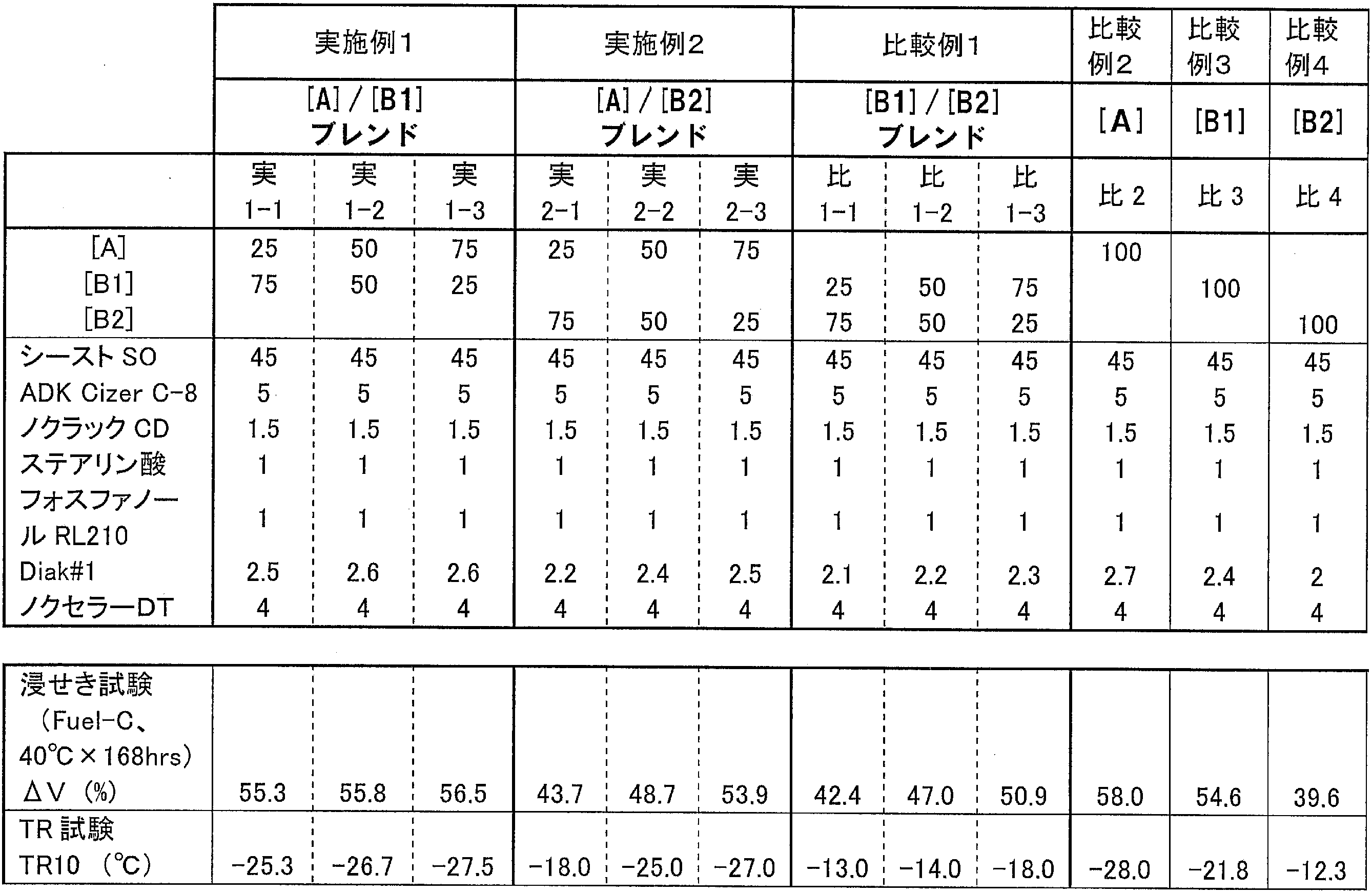
- Example 1 Preparation method and evaluation result of rubber blend sample of [A] and [B1]] According to the compounding amount of Table 2, a crosslinkable rubber composition was prepared using a Banbury mixer and then a roll kneader. First, using a Banbury mixer, the nitrile group-containing copolymer rubber [A] obtained in Synthesis Example 1 and [B1] obtained in Synthesis Example 2 were combined with FEF carbon (trade name “Seast SO”, Tokai Carbon.
- trimellitic acid tri-2-ethylhexyl (trade name “ADK Cizer C-8”, manufactured by ADEKA, plasticizer), 4,4′-di- ( ⁇ , ⁇ -dimethylbenzyl) diphenylamine (Trade name “NOCRACK CD”, manufactured by Ouchi Shinsei Chemical Co., Ltd., anti-aging agent), stearic acid, and polyoxyethylene stearyl ether phosphate (trade name “phosphanol RL-210”, manufactured by Toho Chemical Co., Ltd., processing aid Agent) was added and kneaded.
- the kneaded product was transferred to a roll kneader, and further hexamethylenediamine carbamate (trade name “Diak # 1”, manufactured by DuPont Dow Elastomer Co., Ltd., polyamine-based cross-linking agent) and 1,3-di-ortho -Tolylguanidine (trade name “Noxeller DT”, manufactured by Ouchi Shinsei Chemical Co., Ltd., crosslinking accelerator) was added and kneaded to obtain a crosslinkable rubber composition.
- hexamethylenediamine carbamate trade name “Diak # 1”, manufactured by DuPont Dow Elastomer Co., Ltd., polyamine-based cross-linking agent
- 1,3-di-ortho -Tolylguanidine trade name “Noxeller DT”, manufactured by Ouchi Shinsei Chemical Co., Ltd., crosslinking accelerator
- the crosslinkable rubber composition was put into a mold having a length of 15 cm, a width of 15 cm, and a depth of 0.2 cm, and press-molded at 170 ° C. for 20 minutes while being pressed at a press pressure of 10 MPa to obtain a sheet-like cross-linked product. .
- the obtained cross-linked product was transferred to a gear oven and subjected to secondary cross-linking at 170 ° C. for 4 hours.
- Example 2 Preparation method and evaluation result of rubber blend sample of [A] and [B2]] A crosslinked rubber product was obtained in the same manner as in Example 1 except that [B2] was used instead of [B1]. The formulation and evaluation results are shown in Table 2.
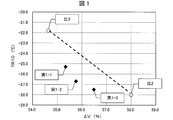
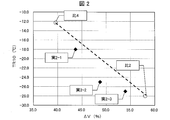
- 1 to 3 show ⁇ V and TR10 plotted on the X-axis and Y-axis, respectively, using the values in Table 2.
- 1 to 3 are diagrams showing measurement results of cold resistance and fuel oil resistance in Examples and Comparative Examples of the present invention.
- FIG. 1 shows that the blends of Examples 1-1 to 1-3 are approaching the lower left from the plots of the non-blend rubbers of Comparative Examples 2 and 3. From this, it was shown that both fuel oil resistance and cold resistance were improved by blending.
- the present invention can be used for various rubber products.
Landscapes
- Chemical & Material Sciences (AREA)
- Health & Medical Sciences (AREA)
- Chemical Kinetics & Catalysis (AREA)
- Medicinal Chemistry (AREA)
- Polymers & Plastics (AREA)
- Organic Chemistry (AREA)
- General Chemical & Material Sciences (AREA)
- Compositions Of Macromolecular Compounds (AREA)
- Addition Polymer Or Copolymer, Post-Treatments, Or Chemical Modifications (AREA)
Abstract
Description
α,β-エチレン性不飽和ニトリル単量体単位(a2)30重量%以上、及び共役ジエン単量体単位(b2)を有し、前記共役ジエン単量体単位(b2)の少なくとも一部が水素化されていてもよいニトリル基含有共重合体ゴム[B]と、アミン系架橋剤とを含有する。
本発明に係る架橋性ゴム組成物は、α,β-エチレン性不飽和ニトリル単量体単位(a1)30重量%未満、共役ジエン単量体単位(b1)及びα,β-エチレン性不飽和ジカルボン酸モノエステル単量体単位(d1)を有し、前記共役ジエン単量体単位(b1)の少なくとも一部を水素化してなるニトリル基含有共重合体ゴム[A]と、α,β-エチレン性不飽和ニトリル単量体単位(a2)30重量%以上、及び共役ジエン単量体単位(b2)を有し、前記共役ジエン単量体単位(b2)の少なくとも一部が水素化されていてもよいニトリル基含有共重合体ゴム[B]と、アミン系架橋剤とを含有している。本発明に係る架橋性ゴム組成物を用いることにより、耐燃料油性及び耐寒性が共に優れており、耐燃料油性及び耐寒性のバランスに優れたゴム架橋物を得ることができる。
本発明に係る架橋性ゴム組成物に含まれるニトリル基含有共重合体ゴム[A]は、α,β-エチレン性不飽和ニトリル単量体単位(a1)30重量%未満、共役ジエン単量体単位(b1)及びα,β-エチレン性不飽和ジカルボン酸モノエステル単量体単位(d1)を有し、前記共役ジエン単量体単位(b1)の少なくとも一部を水素化してなるものである。
α,β-エチレン性不飽和ニトリル単量体単位(a1)を形成するα,β-エチレン性不飽和ニトリル単量体(ma1)としては、例えば、ニトリル基を有するα,β-エチレン性不飽和化合物であれば限定されず、アクリロニトリル;α-クロロアクリロニトリル、α-ブロモアクリロニトリルなどのα-ハロゲノアクリロニトリル;メタクリロニトリル、エタクリロニトリルなどのα-アルキルアクリロニトリル;等が挙げられる。これらのなかでも、アクリロニトリル及びメタクリロニトリルが好ましく、アクリロニトリルが特に好ましい。α,β-エチレン性不飽和ニトリル単量体として、これらの複数種を併用してもよい。
共役ジエン単量体単位(b1)を形成する共役ジエン単量体(mb1)としては、例えば、1,3-ブタジエン、イソプレン、2,3-ジメチル-1,3-ブタジエン、1,3-ペンタジエンなどが挙げられる。これらのなかでも、1,3-ブタジエンが好ましい。
ニトリル基含有共重合体ゴム[A]に含まれる、α,β-エチレン性不飽和ジカルボン酸モノエステル単量体単位(d1)を形成する単量体としては、エステル化されていない無置換の(フリーの)カルボキシル基を1個有する、α,β-エチレン性不飽和ジカルボン酸モノエステル単量体(md1)であれば特に限定されない。
ニトリル基含有共重合体ゴム[A]は、α,β-エチレン性不飽和ニトリル単量体(ma1)、共役ジエン単量体(mb1)及びα,β-エチレン性不飽和ジカルボン酸モノエステル単量体(md1)と共重合可能なその他の単量体の単位を含有していても良い。
本発明に係る架橋性ゴム組成物に含まれるニトリル基含有共重合体ゴム[B]は、α,β-エチレン性不飽和ニトリル単量体単位(a2)30重量%以上及び共役ジエン単量体単位(b2)を有し、前記共役ジエン単量体単位(b2)の少なくとも一部が水素化されていてもよいニトリル基含有共重合体ゴムである。ニトリル基含有共重合体ゴム[B]を含むことにより、耐燃料油性が向上する。
α,β-エチレン性不飽和ニトリル単量体単位(a2)を形成するα,β-エチレン性不飽和ニトリル単量体(ma2)としては、α,β-エチレン性不飽和ニトリル単量体(ma1)と同様のものが挙げられ、α,β-エチレン性不飽和ニトリル単量体(ma2)として、これらの複数種を併用してもよい。中でも、アクリロニトリル及びメタクリロニトリルが好ましく、アクリロニトリルが特に好ましい。
共役ジエン単量体単位(b2)を形成する共役ジエン単量体(mb2)としては、共役ジエン単量体(mb1)で述べたと同様のものが挙げられ、共役ジエン単量体(mb2)として、これらの複数種を併用してもよい。中でも、1,3-ブタジエンが好ましい。
また、ニトリル基含有共重合体ゴム[B]は、α,β-エチレン性不飽和ニトリル単量体(ma2)及び共役ジエン単量体(mb2)と共重合可能なその他の単量体の単位を含有していてもよい。
本発明に係る架橋性ゴム組成物に含まれるニトリル基含有共重合体ゴム[A]及びニトリル基含有共重合体ゴム[B](以下、ニトリル基含有共重合体ゴム[A]及びニトリル基含有共重合体ゴム[B]をまとめて、単に「ニトリル基含有共重合体ゴム」と略すこともある。)のポリマームーニー粘度(ML1+4、100℃)は、好ましくは15~200、より好ましくは15~150、さらに好ましくは15~100である。ポリマームーニー粘度が15以上であることにより、得られるゴム架橋物の機械的特性が良好になる。また、ポリマームーニー粘度が200以下であることにより、架橋剤を添加し、架橋性ゴム組成物とした場合における加工性が良好になる。
本発明に係る架橋性ゴム組成物に含まれるニトリル基含有共重合体ゴム[A]及び[B]の製造方法は、特に限定されないが、乳化剤を用いた乳化重合により上述の単量体を共重合した後、所望により未反応の単量体を除去してニトリル基含有共重合体ゴムのラテックスを調製し、これを必要に応じて水素化した後、凝固・乾燥して、所望の固形状ゴムを得ることができる。乳化重合に際しては、乳化剤、重合開始剤、分子量調整剤等の通常用いられる重合副資材を使用することができる。
本発明に係る架橋性ゴム組成物における、ニトリル基含有共重合体ゴム[A]及び[B]の混合比(重量比)([A]/[B])は、20/80~80/20が好ましく、25/75~75/25がより好ましく、40/60~60/40がさらに好ましい。ニトリル基含有共重合体ゴム[A]の混合比を、ニトリル基含有共重合体ゴム[B]との合計量100に対して20以上とすることで、十分な耐寒性が発揮される。ニトリル基含有共重合体ゴム[B]の混合比を、ニトリル基含有共重合体ゴム[A]との合計量100に対して20以上とすることで、十分な耐油性が発揮される。
本発明に係る架橋性ゴム組成物は、アミン系架橋剤を含む。これにより、耐圧縮永久ひずみ性が改善され、また、得られるゴム架橋物に優れた耐寒性を付与できる。
本発明に係る架橋性ゴム組成物は、ニトリル基含有共重合体ゴム[A]、[B]及びアミン系架橋剤に加えて、塩基性架橋促進剤をさらに含有していることが好ましい。塩基性架橋促進剤をさらに含有させることにより、本発明の効果がより一層顕著になる。
本発明に係る架橋性ゴム組成物には、ニトリル基含有共重合体ゴム[A]及び[B]並びにアミン系架橋剤、必要に応じて添加される塩基性架橋促進剤以外に、ゴム分野において使用され得る配合剤を含んでもよい。このような配合剤としては、例えば、カーボンブラック及びシリカ等の補強性充填材、炭酸カルシウム及びクレイ等の非補強性充填材、塩基性架橋促進剤以外の架橋促進剤、架橋助剤、架橋遅延剤、老化防止剤、酸化防止剤、光安定剤、一級アミン等のスコーチ防止剤、可塑剤、加工助剤、滑剤、粘着剤、潤滑剤、難燃剤、防黴剤、受酸剤、帯電防止剤、顔料等を配合することができる。これらの配合剤の配合量は、本発明の目的や効果を阻害しない範囲であれば特に限定されず、配合目的に応じた量を配合することができる。
本発明に係る架橋性ゴム組成物は、これまで説明した各成分を好ましくは非水系で混合して調製される。
本発明に係るゴム架橋物は、α,β-エチレン性不飽和ニトリル単量体単位(a1)30重量%未満、共役ジエン単量体単位(b1)及びα,β-エチレン性不飽和ジカルボン酸モノエステル単量体単位(d1)を有し、前記共役ジエン単量体単位(b1)の少なくとも一部を水素化してなるニトリル基含有共重合体ゴム[A]と、α,β-エチレン性不飽和ニトリル単量体単位(a2)30重量%以上、及び共役ジエン単量体単位(b2)を有し、前記共役ジエン単量体単位(b2)の少なくとも一部が水素化されていてもよいニトリル基含有共重合体ゴム[B]とを含み、アミン系架橋剤で架橋されてなるものである。
印刷用ロール、製鉄用ロール、製紙用ロール、工業用ロール、事務機用ロールなどの各種ロール;平ベルト(フィルムコア平ベルト、コード平ベルト、積層式平ベルト、単体式平ベルト等)、Vベルト(ラップドVベルト、ローエッジVベルト等)、Vリブドベルト(シングルVリブドベルト、ダブルVリブドベルト、ラップドVリブドベルト、背面ゴムVリブドベルト、上コグVリブドベルト等)、CVT用ベルト、タイミングベルト、歯付ベルト、コンベアーベルト、などの各種ベルト;燃料ホース、ターボエアーホース、オイルホース、ラジェターホース、ヒーターホース、ウォーターホース、バキュームブレーキホース、コントロールホース、エアコンホース、ブレーキホース、パワーステアリングホース、エアーホース、マリンホース、ライザー、フローラインなどの各種ホース;CVJブーツ、プロペラシャフトブーツ、等速ジョイントブーツ、ラックアンドピニオンブーツなどの各種ブーツ;クッション材、ダイナミックダンパ、ゴムカップリング、空気バネ、防振材などの減衰材ゴム部品;ダストカバー、自動車内装部材、タイヤ、被覆ケーブル、靴底、電磁波シールド、フレキシブルプリント基板用接着剤等の接着剤、燃料電池セパレーターの他、化粧品、及び医薬品の分野、食品と接触する分野、エレクトロニクス分野など幅広い用途に使用することができる。これらのなかでも、本発明に係るゴム架橋物は、ベルト、ホースまたはシール材として好適に用いることができ、特にシール材として好適であり、シール材のなかでもO-リングとして好適である。
ニトリル基含有共重合体ゴムを構成する各単量体単位の含有割合は、1H-NMR分析及び13C-NMR分析により求めた。なお、表1に示す1,3-ブタジエン単位は、1,3-ブタジエン単位中の炭素-炭素二重結合を水素化した構造単位を含むものである。
ニトリル基含有共重合体ゴムのヨウ素価は、JIS K 6235に準じて測定した。
ニトリル基含有共重合体ゴムのムーニー粘度は、JIS K 6300-1に従って測定した(単位は〔ML1+4、100℃〕)。
ゴム架橋物を、30mm×20mm×2mmの大きさに打ち抜き、得られた試験片を、トルエン/イソオクタン=50/50(体積比)の燃料油(Fuel-C)中に40℃で168時間浸漬することにより、耐燃料油浸漬試験を行った。そこから、JIS K 6258に従い、浸漬後の体積膨潤度ΔV(単位:%)を算出した。浸漬後の体積膨潤度ΔVが低いほど、耐燃料油性に優れる。
ゴム架橋物を、JIS K 6261に従い、TR試験(低温弾性回復試験)により架橋物の耐寒性を測定した。TR10(単位:℃)が低いほど、耐寒性に優れる。
金属製ボトルに、イオン交換水180部、濃度10重量%のドデシルベンゼンスルホン酸ナトリウム水溶液25部、アクリロニトリル(ma1)23部、マレイン酸モノn-ブチル(md1)7部、アクリル酸2-メトキシエチル(mc)30部、及び、t-ドデシルメルカプタン(分子量調整剤)0.5部の順に仕込み、内部の気体を窒素で3回置換した後、1,3-ブタジエン(mb1)40部を仕込んだ。金属製ボトルを5℃に保ち、クメンハイドロパーオキサイド(重合開始剤)0.1部を仕込み、金属製ボトルを回転させながら16時間重合反応した。
アクリロニトリル(ma2)、マレイン酸モノn-ブチル(md2)、アクリル酸2-メトキシエチル(mc)、及び1,3-ブタジエン(mb2)の使用量を表1に示す量へと変更とした以外は、合成例1と同様にして、ニトリル基含有共重合体ゴム[B1]、[B2]を得た。

表2の配合量に従って、バンバリーミキサー、次いで、ロール混練機を用いて、架橋性ゴム組成物を調製した。まず、バンバリーミキサーを用いて、合成例1で得られたニトリル基含有共重合体ゴム[A]及び合成例2で得られた[B1]に、FEFカーボン(商品名「シーストSO」、東海カーボン社製、カーボンブラック)、トリメリット酸トリ-2-エチルヘキシル(商品名「ADK Cizer C-8」、ADEKA社製、可塑剤)、4,4’-ジ-(α,α-ジメチルベンジル)ジフェニルアミン(商品名「ノクラック CD」、大内新興化学社製、老化防止剤)、ステアリン酸、及びポリオキシエチレンステアリルエーテルリン酸(商品名「フォスファノールRL-210」、東邦化学社製、加工助剤)を添加して混練した。次いで、混練物をロール混練機に移して、さらに、ヘキサメチレンジアミンカルバメート(商品名「Diak#1」、デュポン・ダウ・エラストマー社製、ポリアミン系架橋剤)、及び、1,3-ジ-オルト-トリルグアニジン(商品名「ノクセラー DT」、大内新興化学社製、架橋促進剤)を添加して混練し、架橋性ゴム組成物を得た。
[B1]の代わりに[B2]を用いた以外は、実施例1と同様にしてゴム架橋物を得た。配合及び評価結果を表2に示す。
[A]の代わりに[B2]を用いた以外は、実施例1と同様にしてゴム架橋物を得た。配合及び評価結果を表2に示す。
[A]のみのゴム試料とした以外は、実施例1と同様にしてゴム架橋物を得た。配合及び評価結果を表2に示す。
[B1]のみのゴム試料とした以外は、実施例1と同様にしてゴム架橋物を得た。配合及び評価結果を表2に示す。
[B2]のみのゴム試料とした以外は、実施例1と同様にしてゴム架橋物を得た。配合及び評価結果を表2に示す。
Claims (6)
- α,β-エチレン性不飽和ニトリル単量体単位(a1)30重量%未満、共役ジエン単量体単位(b1)及びα,β-エチレン性不飽和ジカルボン酸モノエステル単量体単位(d1)を有し、前記共役ジエン単量体単位(b1)の少なくとも一部を水素化してなるニトリル基含有共重合体ゴム[A]と、
α,β-エチレン性不飽和ニトリル単量体単位(a2)30重量%以上、及び共役ジエン単量体単位(b2)を有し、前記共役ジエン単量体単位(b2)の少なくとも一部が水素化されていてもよいニトリル基含有共重合体ゴム[B]と、
アミン系架橋剤とを含有する架橋性ゴム組成物。 - 前記ニトリル基含有共重合体ゴム[A]が、さらに(メタ)アクリル酸アルコキシアルキルエステル単量体単位(c)を有する請求項1に記載の架橋性ゴム組成物。
- 前記ニトリル基含有共重合体ゴム[A]のヨウ素価が120以下である請求項1又は2に記載の架橋性ゴム組成物。
- 前記α,β-エチレン性不飽和ジカルボン酸モノエステル単量体単位(d1)が、マレイン酸モノn-ブチル単位である請求項1~3のいずれか1項に記載の架橋性ゴム組成物。
- α,β-エチレン性不飽和ニトリル単量体単位(a1)30重量%未満、共役ジエン単量体単位(b1)及びα,β-エチレン性不飽和ジカルボン酸モノエステル単量体単位(d1)を有し、前記共役ジエン単量体単位(b1)の少なくとも一部を水素化してなるニトリル基含有共重合体ゴム[A]と、
α,β-エチレン性不飽和ニトリル単量体単位(a2)30重量%以上、及び共役ジエン単量体単位(b2)を有し、前記共役ジエン単量体単位(b2)の少なくとも一部が水素化されていてもよいニトリル基含有共重合体ゴム[B]と、を含み、
アミン系架橋剤で架橋されてなるゴム架橋物。 - α,β-エチレン性不飽和ニトリル単量体単位(a1)30重量%未満、共役ジエン単量体単位(b1)及びα,β-エチレン性不飽和ジカルボン酸モノエステル単量体単位(d1)を有し、前記共役ジエン単量体単位(b1)の少なくとも一部を水素化してなるニトリル基含有共重合体ゴム[A]と、
α,β-エチレン性不飽和ニトリル単量体単位(a2)30重量%以上、及び共役ジエン単量体単位(b2)を有し、前記共役ジエン単量体単位(b2)の少なくとも一部が水素化されていてもよいニトリル基含有共重合体ゴム[B]と、
アミン系架橋剤とを混合した後、架橋するゴム架橋物の製造方法。
Priority Applications (5)
| Application Number | Priority Date | Filing Date | Title |
|---|---|---|---|
| KR1020167021157A KR102189729B1 (ko) | 2014-03-25 | 2015-03-13 | 가교성 고무 조성물 및 고무 가교물의 제조 방법 |
| US15/116,401 US10030107B2 (en) | 2014-03-25 | 2015-03-13 | Crosslinking rubber composition and crosslinked rubber production method |
| JP2016510238A JP6465103B2 (ja) | 2014-03-25 | 2015-03-13 | 架橋性ゴム組成物及びゴム架橋物の製造方法 |
| EP15769828.3A EP3124533B1 (en) | 2014-03-25 | 2015-03-13 | Crosslinking rubber composition and crosslinked rubber production method |
| CN201580009439.3A CN106029768B (zh) | 2014-03-25 | 2015-03-13 | 交联性橡胶组合物和橡胶交联物的制造方法 |
Applications Claiming Priority (2)
| Application Number | Priority Date | Filing Date | Title |
|---|---|---|---|
| JP2014-062532 | 2014-03-25 | ||
| JP2014062532 | 2014-03-25 |
Publications (1)
| Publication Number | Publication Date |
|---|---|
| WO2015146650A1 true WO2015146650A1 (ja) | 2015-10-01 |
Family
ID=54195173
Family Applications (1)
| Application Number | Title | Priority Date | Filing Date |
|---|---|---|---|
| PCT/JP2015/057550 Ceased WO2015146650A1 (ja) | 2014-03-25 | 2015-03-13 | 架橋性ゴム組成物及びゴム架橋物の製造方法 |
Country Status (6)
| Country | Link |
|---|---|
| US (1) | US10030107B2 (ja) |
| EP (1) | EP3124533B1 (ja) |
| JP (1) | JP6465103B2 (ja) |
| KR (1) | KR102189729B1 (ja) |
| CN (1) | CN106029768B (ja) |
| WO (1) | WO2015146650A1 (ja) |
Cited By (4)
| Publication number | Priority date | Publication date | Assignee | Title |
|---|---|---|---|---|
| CN107383451A (zh) * | 2017-08-31 | 2017-11-24 | 安徽华海特种电缆集团有限公司 | 一种移动用防油耐寒耐高压扁平电缆料 |
| EP3333196A1 (de) | 2016-12-09 | 2018-06-13 | ARLANXEO Deutschland GmbH | Hydrierte nitril-dien-carbonsäureester-copolymere |
| JPWO2018180207A1 (ja) * | 2017-03-30 | 2020-02-06 | 日本ゼオン株式会社 | 架橋性ゴム組成物、及びゴム架橋物 |
| JP2021519370A (ja) * | 2018-04-19 | 2021-08-10 | アランセオ・ドイチュランド・ゲーエムベーハー | 冷却剤と接触状態にある、hnbr−pegアクリレートコポリマーを含む加硫物の使用 |
Families Citing this family (4)
| Publication number | Priority date | Publication date | Assignee | Title |
|---|---|---|---|---|
| US20200115486A1 (en) * | 2017-03-17 | 2020-04-16 | Zeon Corporation | Nitrile group-containing copolymer rubber |
| US20200140595A1 (en) | 2017-07-25 | 2020-05-07 | Arlanxeo Deutschland Gmbh | Vulcanizable Compositions Comprising Hydrogenated Nitrile-Diene-Carboxylic Ester Copolymer and Silica |
| CN111094371B (zh) * | 2017-09-28 | 2023-02-03 | 日本瑞翁株式会社 | 含腈基共聚物橡胶的制造方法 |
| TW202311326A (zh) * | 2021-05-24 | 2023-03-16 | 日商日本瑞翁股份有限公司 | 含腈基共聚物橡膠、橡膠組成物及橡膠交聯物 |
Citations (4)
| Publication number | Priority date | Publication date | Assignee | Title |
|---|---|---|---|---|
| JP2008195881A (ja) * | 2007-02-15 | 2008-08-28 | Nok Corp | 水素化nbr組成物 |
| WO2010087431A1 (ja) * | 2009-01-30 | 2010-08-05 | 日本ゼオン株式会社 | ニトリル基含有高飽和共重合体ゴム |
| JP2012031311A (ja) * | 2010-07-30 | 2012-02-16 | Nippon Zeon Co Ltd | ニトリル基含有高飽和共重合体ゴム |
| WO2013175878A1 (ja) * | 2012-05-24 | 2013-11-28 | Nok株式会社 | ポリアミン加硫性高飽和ニトリルゴム組成物 |
Family Cites Families (10)
| Publication number | Priority date | Publication date | Assignee | Title |
|---|---|---|---|---|
| JP3489838B2 (ja) * | 1996-03-29 | 2004-01-26 | 日本ゼオン株式会社 | ニトリル基含有高飽和共重合体ゴム、それを含む耐熱性ゴム組成物およびゴムと繊維との複合体 |
| JP4062828B2 (ja) * | 1999-08-20 | 2008-03-19 | 日本ゼオン株式会社 | 架橋性ゴム組成物および架橋物 |
| CA2436742A1 (en) | 2003-06-26 | 2004-12-26 | Bayer Inc. | Polymer blends comprising nitrile rubber |
| KR20050029790A (ko) | 2003-09-23 | 2005-03-29 | 주식회사 엘리아테크 | 투습방지막을 구비한 유기이엘 패널 및 그의 제조방법 |
| WO2007072900A1 (ja) * | 2005-12-21 | 2007-06-28 | Zeon Corporation | 架橋性ゴム組成物およびゴム架橋物 |
| JP5381985B2 (ja) * | 2008-06-27 | 2014-01-08 | 日本ゼオン株式会社 | ニトリル基含有高飽和共重合体ゴム |
| EP2145920A1 (en) * | 2008-07-15 | 2010-01-20 | Lanxess Deutschland GmbH | Vulcanizable polymer compositions |
| JP5742719B2 (ja) * | 2009-10-19 | 2015-07-01 | 日本ゼオン株式会社 | 架橋性ニトリルゴム組成物およびその製造方法 |
| CN103380173A (zh) * | 2010-12-27 | 2013-10-30 | 日本瑞翁株式会社 | 橡胶组合物及橡胶交联物 |
| WO2012133618A1 (ja) * | 2011-03-31 | 2012-10-04 | 日本ゼオン株式会社 | 高飽和ニトリルゴム組成物およびゴム架橋物 |
-
2015
- 2015-03-13 US US15/116,401 patent/US10030107B2/en active Active
- 2015-03-13 WO PCT/JP2015/057550 patent/WO2015146650A1/ja not_active Ceased
- 2015-03-13 EP EP15769828.3A patent/EP3124533B1/en active Active
- 2015-03-13 JP JP2016510238A patent/JP6465103B2/ja active Active
- 2015-03-13 KR KR1020167021157A patent/KR102189729B1/ko active Active
- 2015-03-13 CN CN201580009439.3A patent/CN106029768B/zh active Active
Patent Citations (4)
| Publication number | Priority date | Publication date | Assignee | Title |
|---|---|---|---|---|
| JP2008195881A (ja) * | 2007-02-15 | 2008-08-28 | Nok Corp | 水素化nbr組成物 |
| WO2010087431A1 (ja) * | 2009-01-30 | 2010-08-05 | 日本ゼオン株式会社 | ニトリル基含有高飽和共重合体ゴム |
| JP2012031311A (ja) * | 2010-07-30 | 2012-02-16 | Nippon Zeon Co Ltd | ニトリル基含有高飽和共重合体ゴム |
| WO2013175878A1 (ja) * | 2012-05-24 | 2013-11-28 | Nok株式会社 | ポリアミン加硫性高飽和ニトリルゴム組成物 |
Cited By (7)
| Publication number | Priority date | Publication date | Assignee | Title |
|---|---|---|---|---|
| EP3333196A1 (de) | 2016-12-09 | 2018-06-13 | ARLANXEO Deutschland GmbH | Hydrierte nitril-dien-carbonsäureester-copolymere |
| WO2018103989A1 (de) | 2016-12-09 | 2018-06-14 | Arlanxeo Deutschland Gmbh | Hydrierte nitril-dien-carbonsäureester-copolymere |
| JPWO2018180207A1 (ja) * | 2017-03-30 | 2020-02-06 | 日本ゼオン株式会社 | 架橋性ゴム組成物、及びゴム架橋物 |
| JP7036109B2 (ja) | 2017-03-30 | 2022-03-15 | 日本ゼオン株式会社 | 架橋性ゴム組成物、及びゴム架橋物 |
| CN107383451A (zh) * | 2017-08-31 | 2017-11-24 | 安徽华海特种电缆集团有限公司 | 一种移动用防油耐寒耐高压扁平电缆料 |
| JP2021519370A (ja) * | 2018-04-19 | 2021-08-10 | アランセオ・ドイチュランド・ゲーエムベーハー | 冷却剤と接触状態にある、hnbr−pegアクリレートコポリマーを含む加硫物の使用 |
| JP7440421B2 (ja) | 2018-04-19 | 2024-02-28 | アランセオ・ドイチュランド・ゲーエムベーハー | 冷却剤と接触状態にある、hnbr-pegアクリレートコポリマーを含む加硫物の使用 |
Also Published As
| Publication number | Publication date |
|---|---|
| JP6465103B2 (ja) | 2019-02-06 |
| EP3124533A4 (en) | 2017-03-08 |
| US20170015797A1 (en) | 2017-01-19 |
| CN106029768A (zh) | 2016-10-12 |
| KR102189729B1 (ko) | 2020-12-11 |
| KR20160137960A (ko) | 2016-12-02 |
| EP3124533B1 (en) | 2018-01-03 |
| EP3124533A1 (en) | 2017-02-01 |
| CN106029768B (zh) | 2018-02-02 |
| JPWO2015146650A1 (ja) | 2017-04-13 |
| US10030107B2 (en) | 2018-07-24 |
Similar Documents
| Publication | Publication Date | Title |
|---|---|---|
| JP5640748B2 (ja) | ニトリル基含有高飽和共重合体ゴム | |
| JP6465103B2 (ja) | 架橋性ゴム組成物及びゴム架橋物の製造方法 | |
| JP6056866B2 (ja) | 架橋性ゴム組成物およびゴム架橋物 | |
| JP5429097B2 (ja) | ニトリル基含有高飽和共重合体ゴム | |
| JP5716585B2 (ja) | 架橋性ゴム組成物およびゴム架橋物 | |
| JP6601407B2 (ja) | 架橋性ニトリルゴム組成物およびゴム架橋物 | |
| JP5510218B2 (ja) | ニトリル基含有高飽和共重合体ゴム組成物 | |
| JP6733551B2 (ja) | 架橋性ニトリルゴム組成物およびゴム架橋物 | |
| JP5531729B2 (ja) | ゴム組成物および架橋物 | |
| JP5817610B2 (ja) | 架橋性ゴム組成物およびゴム架橋物 | |
| JP5983626B2 (ja) | ニトリルゴム組成物およびゴム架橋物 | |
| JP6380107B2 (ja) | ニトリルゴム組成物およびゴム架橋物 | |
| WO2014175415A1 (ja) | ニトリルゴム組成物、架橋性ゴム組成物およびゴム架橋物 | |
| WO2015115521A1 (ja) | 架橋性ニトリルゴム組成物およびゴム架橋物 | |
| JPWO2019049855A1 (ja) | カルボキシル基含有ニトリルゴム、架橋性ニトリルゴム組成物およびゴム架橋物 | |
| JP7484426B2 (ja) | ニトリルゴム組成物およびゴム架橋物 |
Legal Events
| Date | Code | Title | Description |
|---|---|---|---|
| 121 | Ep: the epo has been informed by wipo that ep was designated in this application |
Ref document number: 15769828 Country of ref document: EP Kind code of ref document: A1 |
|
| ENP | Entry into the national phase |
Ref document number: 2016510238 Country of ref document: JP Kind code of ref document: A |
|
| ENP | Entry into the national phase |
Ref document number: 20167021157 Country of ref document: KR Kind code of ref document: A |
|
| WWE | Wipo information: entry into national phase |
Ref document number: 15116401 Country of ref document: US |
|
| REEP | Request for entry into the european phase |
Ref document number: 2015769828 Country of ref document: EP |
|
| WWE | Wipo information: entry into national phase |
Ref document number: 2015769828 Country of ref document: EP |
|
| NENP | Non-entry into the national phase |
Ref country code: DE |