WO2015146947A1 - 非水電解液用添加剤、非水電解液、及び、蓄電デバイス - Google Patents
非水電解液用添加剤、非水電解液、及び、蓄電デバイス Download PDFInfo
- Publication number
- WO2015146947A1 WO2015146947A1 PCT/JP2015/058827 JP2015058827W WO2015146947A1 WO 2015146947 A1 WO2015146947 A1 WO 2015146947A1 JP 2015058827 W JP2015058827 W JP 2015058827W WO 2015146947 A1 WO2015146947 A1 WO 2015146947A1
- Authority
- WO
- WIPO (PCT)
- Prior art keywords
- formula
- group
- optionally substituted
- carbon atoms
- aqueous electrolyte
- Prior art date
- Legal status (The legal status is an assumption and is not a legal conclusion. Google has not performed a legal analysis and makes no representation as to the accuracy of the status listed.)
- Ceased
Links
Images
Classifications
-
- H—ELECTRICITY
- H01—ELECTRIC ELEMENTS
- H01M—PROCESSES OR MEANS, e.g. BATTERIES, FOR THE DIRECT CONVERSION OF CHEMICAL ENERGY INTO ELECTRICAL ENERGY
- H01M10/00—Secondary cells; Manufacture thereof
- H01M10/05—Accumulators with non-aqueous electrolyte
- H01M10/056—Accumulators with non-aqueous electrolyte characterised by the materials used as electrolytes, e.g. mixed inorganic/organic electrolytes
- H01M10/0564—Accumulators with non-aqueous electrolyte characterised by the materials used as electrolytes, e.g. mixed inorganic/organic electrolytes the electrolyte being constituted of organic materials only
- H01M10/0566—Liquid materials
- H01M10/0567—Liquid materials characterised by the additives
-
- H—ELECTRICITY
- H01—ELECTRIC ELEMENTS
- H01M—PROCESSES OR MEANS, e.g. BATTERIES, FOR THE DIRECT CONVERSION OF CHEMICAL ENERGY INTO ELECTRICAL ENERGY
- H01M10/00—Secondary cells; Manufacture thereof
- H01M10/42—Methods or arrangements for servicing or maintenance of secondary cells or secondary half-cells
- H01M10/4235—Safety or regulating additives or arrangements in electrodes, separators or electrolyte
-
- H—ELECTRICITY
- H01—ELECTRIC ELEMENTS
- H01G—CAPACITORS; CAPACITORS, RECTIFIERS, DETECTORS, SWITCHING DEVICES, LIGHT-SENSITIVE OR TEMPERATURE-SENSITIVE DEVICES OF THE ELECTROLYTIC TYPE
- H01G11/00—Hybrid capacitors, i.e. capacitors having different positive and negative electrodes; Electric double-layer [EDL] capacitors; Processes for the manufacture thereof or of parts thereof
- H01G11/54—Electrolytes
- H01G11/56—Solid electrolytes, e.g. gels; Additives therein
-
- H—ELECTRICITY
- H01—ELECTRIC ELEMENTS
- H01G—CAPACITORS; CAPACITORS, RECTIFIERS, DETECTORS, SWITCHING DEVICES, LIGHT-SENSITIVE OR TEMPERATURE-SENSITIVE DEVICES OF THE ELECTROLYTIC TYPE
- H01G11/00—Hybrid capacitors, i.e. capacitors having different positive and negative electrodes; Electric double-layer [EDL] capacitors; Processes for the manufacture thereof or of parts thereof
- H01G11/54—Electrolytes
- H01G11/58—Liquid electrolytes
- H01G11/64—Liquid electrolytes characterised by additives
-
- H—ELECTRICITY
- H01—ELECTRIC ELEMENTS
- H01M—PROCESSES OR MEANS, e.g. BATTERIES, FOR THE DIRECT CONVERSION OF CHEMICAL ENERGY INTO ELECTRICAL ENERGY
- H01M10/00—Secondary cells; Manufacture thereof
- H01M10/05—Accumulators with non-aqueous electrolyte
- H01M10/052—Li-accumulators
- H01M10/0525—Rocking-chair batteries, i.e. batteries with lithium insertion or intercalation in both electrodes; Lithium-ion batteries
-
- H—ELECTRICITY
- H01—ELECTRIC ELEMENTS
- H01M—PROCESSES OR MEANS, e.g. BATTERIES, FOR THE DIRECT CONVERSION OF CHEMICAL ENERGY INTO ELECTRICAL ENERGY
- H01M10/00—Secondary cells; Manufacture thereof
- H01M10/05—Accumulators with non-aqueous electrolyte
- H01M10/056—Accumulators with non-aqueous electrolyte characterised by the materials used as electrolytes, e.g. mixed inorganic/organic electrolytes
- H01M10/0564—Accumulators with non-aqueous electrolyte characterised by the materials used as electrolytes, e.g. mixed inorganic/organic electrolytes the electrolyte being constituted of organic materials only
- H01M10/0566—Liquid materials
- H01M10/0568—Liquid materials characterised by the solutes
-
- H—ELECTRICITY
- H01—ELECTRIC ELEMENTS
- H01M—PROCESSES OR MEANS, e.g. BATTERIES, FOR THE DIRECT CONVERSION OF CHEMICAL ENERGY INTO ELECTRICAL ENERGY
- H01M10/00—Secondary cells; Manufacture thereof
- H01M10/05—Accumulators with non-aqueous electrolyte
- H01M10/056—Accumulators with non-aqueous electrolyte characterised by the materials used as electrolytes, e.g. mixed inorganic/organic electrolytes
- H01M10/0564—Accumulators with non-aqueous electrolyte characterised by the materials used as electrolytes, e.g. mixed inorganic/organic electrolytes the electrolyte being constituted of organic materials only
- H01M10/0566—Liquid materials
- H01M10/0569—Liquid materials characterised by the solvents
-
- H—ELECTRICITY
- H01—ELECTRIC ELEMENTS
- H01G—CAPACITORS; CAPACITORS, RECTIFIERS, DETECTORS, SWITCHING DEVICES, LIGHT-SENSITIVE OR TEMPERATURE-SENSITIVE DEVICES OF THE ELECTROLYTIC TYPE
- H01G11/00—Hybrid capacitors, i.e. capacitors having different positive and negative electrodes; Electric double-layer [EDL] capacitors; Processes for the manufacture thereof or of parts thereof
- H01G11/04—Hybrid capacitors
- H01G11/06—Hybrid capacitors with one of the electrodes allowing ions to be reversibly doped thereinto, e.g. lithium ion capacitors [LIC]
-
- H—ELECTRICITY
- H01—ELECTRIC ELEMENTS
- H01M—PROCESSES OR MEANS, e.g. BATTERIES, FOR THE DIRECT CONVERSION OF CHEMICAL ENERGY INTO ELECTRICAL ENERGY
- H01M2220/00—Batteries for particular applications
- H01M2220/30—Batteries in portable systems, e.g. mobile phone, laptop
-
- H—ELECTRICITY
- H01—ELECTRIC ELEMENTS
- H01M—PROCESSES OR MEANS, e.g. BATTERIES, FOR THE DIRECT CONVERSION OF CHEMICAL ENERGY INTO ELECTRICAL ENERGY
- H01M2300/00—Electrolytes
- H01M2300/0017—Non-aqueous electrolytes
- H01M2300/0025—Organic electrolyte
-
- H—ELECTRICITY
- H01—ELECTRIC ELEMENTS
- H01M—PROCESSES OR MEANS, e.g. BATTERIES, FOR THE DIRECT CONVERSION OF CHEMICAL ENERGY INTO ELECTRICAL ENERGY
- H01M2300/00—Electrolytes
- H01M2300/0017—Non-aqueous electrolytes
- H01M2300/0025—Organic electrolyte
- H01M2300/0028—Organic electrolyte characterised by the solvent
- H01M2300/0037—Mixture of solvents
-
- Y—GENERAL TAGGING OF NEW TECHNOLOGICAL DEVELOPMENTS; GENERAL TAGGING OF CROSS-SECTIONAL TECHNOLOGIES SPANNING OVER SEVERAL SECTIONS OF THE IPC; TECHNICAL SUBJECTS COVERED BY FORMER USPC CROSS-REFERENCE ART COLLECTIONS [XRACs] AND DIGESTS
- Y02—TECHNOLOGIES OR APPLICATIONS FOR MITIGATION OR ADAPTATION AGAINST CLIMATE CHANGE
- Y02E—REDUCTION OF GREENHOUSE GAS [GHG] EMISSIONS, RELATED TO ENERGY GENERATION, TRANSMISSION OR DISTRIBUTION
- Y02E60/00—Enabling technologies; Technologies with a potential or indirect contribution to GHG emissions mitigation
- Y02E60/10—Energy storage using batteries
-
- Y—GENERAL TAGGING OF NEW TECHNOLOGICAL DEVELOPMENTS; GENERAL TAGGING OF CROSS-SECTIONAL TECHNOLOGIES SPANNING OVER SEVERAL SECTIONS OF THE IPC; TECHNICAL SUBJECTS COVERED BY FORMER USPC CROSS-REFERENCE ART COLLECTIONS [XRACs] AND DIGESTS
- Y02—TECHNOLOGIES OR APPLICATIONS FOR MITIGATION OR ADAPTATION AGAINST CLIMATE CHANGE
- Y02E—REDUCTION OF GREENHOUSE GAS [GHG] EMISSIONS, RELATED TO ENERGY GENERATION, TRANSMISSION OR DISTRIBUTION
- Y02E60/00—Enabling technologies; Technologies with a potential or indirect contribution to GHG emissions mitigation
- Y02E60/13—Energy storage using capacitors
Definitions
- the present invention relates to an additive for a non-aqueous electrolyte.
- the present invention also relates to a non-aqueous electrolyte containing the additive for non-aqueous electrolyte, and an electricity storage device using the non-aqueous electrolyte.
- lithium ion batteries are used as power sources for notebook computers, mobile phones and the like because of their high operating voltage and energy density. These lithium ion batteries have higher energy density compared to lead batteries and nickel cadmium batteries, and are expected to realize higher capacities.
- the lithium ion battery has a problem that the capacity of the battery decreases with the progress of charge / discharge cycles and storage under high temperature conditions.
- SEI solid electrolyte interface
- Patent Documents 1 to 3 include cyclic monosulfonic acid esters
- Patent Document 4 includes sulfur-containing aromatic compounds
- Patent Document 5 includes disulfide compounds
- Patent Document 6 9 to 9 respectively disclose disulfonic acid esters.
- Patent Documents 10 to 13 disclose electrolytic solutions containing vinylene carbonate or vinyl ethylene carbonate
- Patent Documents 14 and 15 disclose electrolytic solutions containing 1,3-propane sultone or butane sultone. Has been.
- a compound having a lower LUMO energy is an electron acceptor that is more excellent, and is a non-aqueous electrolyte additive that can form a stable SEI on the surface of an electrode such as a non-aqueous electrolyte secondary battery. It is supposed to be. Therefore, by measuring the LUMO energy of a compound, it is possible to easily evaluate whether the compound has the ability to form stable SEI on the electrode surface of a nonaqueous electrolyte secondary battery or the like. Is now a very useful tool.
- the compounds disclosed in Patent Documents 1 to 9 have high LUMO energy, insufficient performance as additives for non-aqueous electrolytes, and are chemically unstable even when LUMO energy is low.
- the disulfonic acid ester compound exhibits low LUMO energy, it has a low stability to moisture and easily deteriorates. Therefore, when it is stored for a long period of time, it is necessary to strictly control the moisture content and temperature.
- a heat resistant temperature of about 60 ° C. is generally required for a lithium ion battery and about 80 ° C. for a lithium ion capacitor, the additive for non-aqueous electrolyte used in an electricity storage device is high. Improving the stability of was an important issue.
- the performance of SEI formed on the electrode surface varies depending on the additive used, and is deeply involved in many battery characteristics such as cycle characteristics, charge / discharge capacity, high temperature storage characteristics, gas generation suppression, and reduction of internal resistance. .
- conventional additives it has been difficult to form SEI with sufficient performance and to keep its battery characteristics high over a long period of time.
- an electrolytic solution using a vinylene carbonate compound or a sultone compound such as 1,3-propane sultone described in Patent Documents 10 to 15 as an additive causes electrochemical reductive decomposition on the negative electrode surface.
- the generated SEI can suppress irreversible capacity reduction.
- SEI formed by these additives is excellent in the performance of protecting the electrode, the performance of lowering the internal resistance is small because of the low ion conductivity of lithium ions. Further, the formed SEI does not have the strength to withstand long-term use, and the SEI is decomposed during use or the SEI cracks, so that the surface of the negative electrode is exposed and the electrolyte is decomposed. There was a problem that the characteristics deteriorated.
- the conventional additive for non-aqueous electrolyte does not have sufficient performance over a long period of time in performance of protecting the electrode or reducing internal resistance, and there is room for improvement. . That is, a novel electrolytic solution that improves the battery characteristics of an electricity storage device such as a non-aqueous electrolyte secondary battery by forming SEI that is stable on the electrode surface and that improves cycle characteristics, charge / discharge capacity, internal resistance, etc. Development of additives for use was required.
- the present invention is excellent in storage stability and, when used in an electricity storage device, forms a stable solid electrolyte interface (SEI) on the electrode surface to provide cycle characteristics, charge / discharge capacity, high temperature storage characteristics, gas generation suppression, internal It aims at providing the additive for non-aqueous electrolyte which can improve battery characteristics, such as reduction of resistance.
- Another object of the present invention is to provide a non-aqueous electrolyte using the additive for non-aqueous electrolyte and an electricity storage device using the non-aqueous electrolyte.
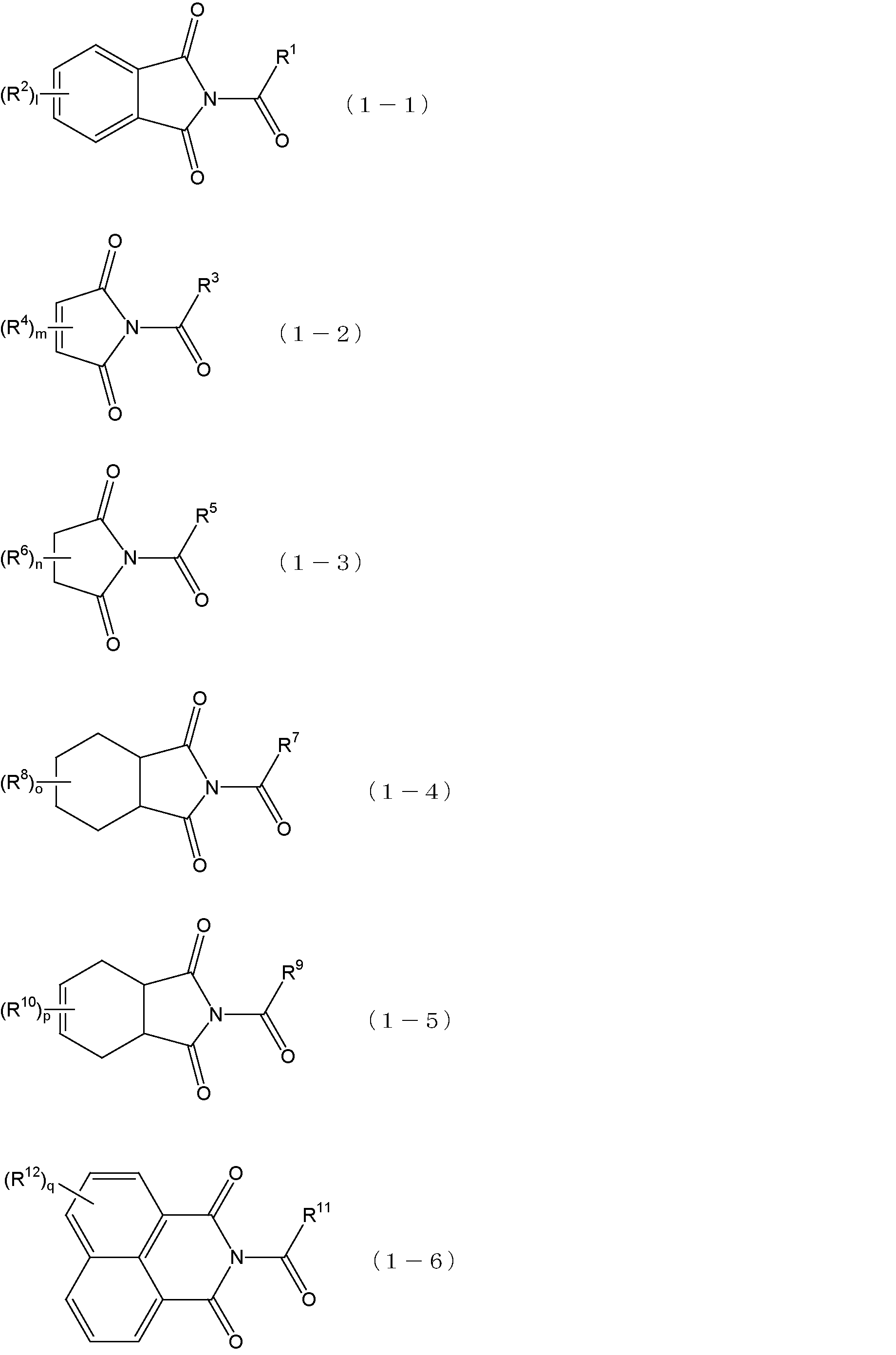
- the present invention provides the following formula (1-1), formula (1-2), formula (1-3), formula (1-4), formula (1-5), formula (1-5)
- the additive for non-aqueous electrolyte solution containing the cyclic imide compound represented by ⁇ 6) is not limited to the one containing only the cyclic imide compound according to the present invention, and may contain other components as long as the object of the present invention is not impaired. .
- R 9 in the formula and R 11 in the formula (1-6) are each an optionally substituted alkyl group having 1 to 4 carbon atoms and an optionally substituted alkenyl group having 2 to 4 carbon atoms.
- R 10 in the formula and R 12 in the formula (1-6) are each an optionally substituted alkyl group having 1 to 4 carbon atoms and an optionally substituted alkoxy group having 1 to 4 carbon atoms. Or a halogen atom.
- L in the formula (1-1) represents an integer of 0 to 4
- m in the formula (1-2) represents an integer of 0 to 2
- n in the formula (1-3) represents 0 to 2.
- the inventors of the present invention have said formula (1-1), formula (1-2), formula (1-3), formula (1-4), formula (1-5), and formula
- the cyclic imide compound represented by (1-6) (hereinafter also referred to as “cyclic imide compound according to the present invention”) is a low LUMO that is susceptible to electrochemical reduction due to the influence of a carbonyl group bonded to nitrogen. It was found to be energy stable and chemically stable. Therefore, the present inventors include a non-aqueous electrolyte containing an additive for a non-aqueous electrolyte containing the cyclic imide compound according to the present invention, and further adding the non-aqueous electrolyte to a power storage device such as a non-aqueous electrolyte secondary battery.
- a power storage device such as a non-aqueous electrolyte secondary battery.
- the reason why the cyclic imide compound according to the present invention improves battery characteristics such as cycle characteristics, charge / discharge capacity, high-temperature storage characteristics, gas generation suppression, and reduction of internal resistance as an additive for non-aqueous electrolytes is not clear. It is considered as follows.
- the cyclic imide compound according to the present invention is considered to open the cyclic imide when subjected to electrochemical reduction, and to form SEI containing a large number of polar groups including nitrogen atoms, oxygen atoms and the like.
- SEI containing a large number of polar groups containing nitrogen atom, oxygen atom and the like exhibits excellent ionic conductivity and is electrochemically stable, and thus is considered to be a very high performance SEI.
- the cyclic imide compound according to the present invention has three carbonyl groups bonded to the nitrogen atom, and the electron density of nitrogen is low. Therefore, an electrochemical reduction reaction is performed on the negative electrode surface. It is easy to receive. As a result, it is considered that electrochemical reductive decomposition occurs easily and it is easy to form SEI on the negative electrode surface.
- an alkyl group or the like is directly bonded to the nitrogen atom, it is difficult to undergo a reduction reaction on the negative electrode surface, and as a result, it is considered that SEI is difficult to form.
- the number of carbonyl groups bonded to the nitrogen atom is 2 or less, there is a possibility that a sufficient effect is not exhibited.
- R 1 in the formula (1-1), R 3 in the formula (1-2), R 5 in the formula (1-3), R 7 in the formula (1-4), the formula R 9 in (1-5) and R 11 in formula (1-6) are each an optionally substituted alkyl group having 1 to 4 carbon atoms or an optionally substituted carbon number.
- R 1 , R 3 , R 5 , R 7 , R 9 , and R 11 are more susceptible to electrochemical reduction reaction and can form good SEI.
- a good alkoxy group having 1 to 4 carbon atoms, an unsubstituted phenoxy group, an unsubstituted benzyloxy group, an optionally substituted alkenyloxy group having 2 to 4 carbon atoms, or R 13 and R 14 are each An NR 13 R 14 group which is an optionally substituted alkyl group having 1 to 4 carbon atoms or an optionally substituted benzyl group is preferable.
- R 1 in the formula (1-1), R 3 in the formula (1-2), R 5 in the formula (1-3), R 7 in the formula (1-4), the formula R 9 in (1-5) and R 11 in the formula (1-6) are substituted alkyl groups having 1 to 4 carbon atoms, substituted alkenyl groups having 2 to 4 carbon atoms, The substituted alkoxy group having 1 to 4 carbon atoms, the substituted alkenyloxy group having 2 to 6 carbon atoms, the alkyl group having 1 to 4 carbon atoms in which at least one of R 13 and R 14 is substituted, or a substituted group;
- examples of the substituent include a halogen atom.
- R 1 in the formula (1-1), R 3 in the formula (1-2), R 5 in the formula (1-3), R 7 in the formula (1-4), R 9 in the formula (1-5) and R 11 in the formula (1-6) are a substituted phenyl group, a substituted phenoxy group, a substituted benzyl group, a substituted benzyloxy Group, or when at least one of R 13 and R 14 is a substituted phenyl group or a substituted benzyl group NR 13 R 14 group, examples of the substituent include alkyl having 1 to 4 carbon atoms Group, an alkoxy group having 1 to 4 carbon atoms, a halogen atom, and the like. Among these, a halogen atom is preferable, and a fluorine atom is more preferable because it exhibits low LUMO
- R 1 in the formula (1-1), R 3 in the formula (1-2), R 5 in the formula (1-3), R 7 in the formula (1-4), the formula Examples of the optionally substituted alkyl group represented by R 9 in (1-5) and R 11 in the above formula (1-6) include a methyl group, ethyl Group, n-propyl group, isopropyl group, n-butyl group, isobutyl group, t-butyl group, monofluoromethyl group, 2-monofluoroethyl group, 3-monofluoropropyl group, 4-monofluorobutyl group, difluoro Methyl group, 2,2-difluoroethyl group, 3,3-difluoropropyl group, 4,4-difluorobutyl group, trifluoromethyl group, 2,2,2-trifluoroethyl group, 3,3,3-trimethyl Fluoropropyl group, 4,4,4-trifluorobuty Group, 1,1,2,
- R 1 in the formula (1-1), R 3 in the formula (1-2), R 5 in the formula (1-3), R 7 in the formula (1-4), the formula Examples of the optionally substituted alkenyl group having 2 to 4 carbon atoms represented by R 9 in (1-5) and R 11 in the formula (1-6) include, for example, vinyl group, allyl Group, isopropenyl group, 1-butenyl group, 2-butenyl group, 3-butenyl group, isobutenyl group and the like. Of these, an allyl group is preferable.
- R 1 in the formula (1-1), R 3 in the formula (1-2), R 5 in the formula (1-3), R 7 in the formula (1-4), the formula Examples of the optionally substituted alkoxy group having 1 to 4 carbon atoms represented by R 9 in (1-5) and R 11 in the formula (1-6) include, for example, a methoxy group, ethoxy Group, n-propoxy group, n-butoxy group, trifluoromethoxy group, 2,2,2-trifluoroethyloxy group, 1,1,2,2,2-pentafluoroethyloxy group and the like. Of these, an ethoxy group and a 2,2,2-trifluoroethyloxy group are preferable.
- R 1 in the formula (1-1), R 3 in the formula (1-2), R 5 in the formula (1-3), R 7 in the formula (1-4), the formula Examples of the optionally substituted phenyl group represented by R 9 in (1-5) and R 11 in the formula (1-6) include a phenyl group, a 2-methylphenyl group, 3 -Methylphenyl group, 4-methylphenyl group, 2-ethylphenyl group, 3-ethylphenyl group, 4-ethylphenyl group, 2-methoxyphenyl group, 3-methoxyphenyl group, 4-methoxyphenyl group, 2-ethoxy Phenyl group, 3-ethoxyphenyl group, 4-ethoxyphenyl group, 2- (dimethylamino) phenyl group, 3- (dimethylamino) phenyl group, 4- (dimethylamino) phenyl group, 2-fluorophenyl group, 3- Fluorophenyl group 4-fluorophenyl
- a phenyl group, a 2-fluorophenyl group, a 3-fluorophenyl group, and a 4-fluorophenyl group are preferable because they exhibit low LUMO energy that is easily subjected to electrochemical reduction.
- R 1 in the formula (1-1), R 3 in the formula (1-2), R 5 in the formula (1-3), R 7 in the formula (1-4), the formula Examples of the optionally substituted phenoxy group represented by R 9 in (1-5) and R 11 in the formula (1-6) include a phenoxy group, a 2-methylphenoxy group, 3 -Methylphenoxy group, 4-methylphenoxy group, 2-ethylphenoxy group, 3-ethylphenoxy group, 4-ethylphenoxy group, 2-methoxyphenoxy group, 3-methoxyphenoxy group, 4-methoxyphenoxy group, 2-ethoxy Phenoxy group, 3-ethoxyphenoxy group, 4-ethoxyphenoxy group, 2- (dimethylamino) phenoxy group, 3- (dimethylamino) phenoxy group, 4- (dimethylamino) phenoxy group, 2-fluoro Enoxy group, 3-fluorophenoxy group, 4-fluorophenoxy group, 2-chlorophenoxy group, 3-chlorophenoxy group, 4-
- R 1 in the formula (1-1), R 3 in the formula (1-2), R 5 in the formula (1-3), R 7 in the formula (1-4), the formula Examples of the optionally substituted benzyl group represented by R 9 in (1-5) and R 11 in the formula (1-6) include a benzyl group, a 2-methylbenzyl group, 3 -Methylbenzyl group, 4-methylbenzyl group, 2-ethylbenzyl group, 3-ethylbenzyl group, 4-ethylbenzyl group, 2-methoxybenzyl group, 3-methoxybenzyl group, 4-methoxybenzyl group, 2-ethoxy Benzyl group, 3-ethoxybenzyl group, 4-ethoxybenzyl group, 2- (dimethylamino) benzyl group, 3- (dimethylamino) benzyl group, 4- (dimethylamino) benzyl group, 2-fluorobenzyl group, 3- Fluorobenzyl group 4-fluorobenzyl
- R 1 in the formula (1-1), R 3 in the formula (1-2), R 5 in the formula (1-3), R 7 in the formula (1-4), the formula Examples of the optionally substituted benzyloxy group represented by R 9 in (1-5) and R 11 in the formula (1-6) include a benzyloxy group, 2-methylbenzyloxy Group, 3-methylbenzyloxy group, 4-methylbenzyloxy group, 2-ethylbenzyloxy group, 3-ethylbenzyloxy group, 4-ethylbenzyloxy group, 2-methoxybenzyloxy group, 3-methoxybenzyloxy group 4-methoxybenzyloxy group, 2-ethoxybenzyloxy group, 3-ethoxybenzyloxy group, 4-ethoxybenzyloxy group, 2- (dimethylamino) benzyloxy group, 3- (dimethylamino) base Zyloxy group, 4- (dimethylamino) benzyloxy group, 2-fluorobenzyloxy group, 3-fluorobenzy
- the optionally substituted alkenyloxy group having 2 to 6 carbon atoms represented by R 9 in (1-5) and R 11 in the formula (1-6) is, for example, 2-propenyl Examples thereof include an oxy group, a 1-methyl-2-propenyloxy group, a 2-methyl-2-propenyloxy group, a 2-butenyloxy group, a 3-butenyloxy group, a 2-hexenyloxy group, and a 5-hexenyloxy group. Of these, a 2-propenyloxy group and a 2-butenyloxy group are preferable because they exhibit low LUMO energy that is susceptible to electrochemical reduction.
- R 1 in the formula (1-1), R 3 in the formula (1-2), R 5 in the formula (1-3), R 7 in the formula (1-4), the formula Examples of the NR 13 R 14 group represented by R 9 in (1-5) and R 11 in the formula (1-6) include an N, N-dimethylamino group, N, N-diethylamino group, and the like.
- R 2 in the formula (1-1), R 4 in the formula (1-2), R 6 in the formula (1-3), R 8 in the formula (1-4), the formula R 10 in (1-5) and R 12 in the formula (1-6) are each an optionally substituted alkyl group having 1 to 4 carbon atoms or an optionally substituted carbon number. 1 to 4 alkoxy groups or a halogen atom.
- l represents an integer of 0 to 4
- m represents an integer of 0 to 2
- n represents 0.
- p in the formula (1-5) represents an integer of 0 to 4
- Q in q represents an integer of 0 to 6.
- R 2 in the formula (1-1), R 4 in the formula (1-2), R 6 in the formula (1-3), R 8 in the formula (1-4), the formula Examples of the optionally substituted alkyl group represented by R 10 in (1-5) and R 12 in the above formula (1-6) include a methyl group, ethyl Group, n-propyl group, isopropyl group, n-butyl group, isobutyl group, t-butyl group and the like. Of these, a methyl group is preferable from the viewpoints of availability and reactivity.
- R 2 in the formula (1-1), R 4 in the formula (1-2), R 6 in the formula (1-3), R 8 in the formula (1-4), the formula Examples of the optionally substituted alkoxy group having 1 to 4 carbon atoms represented by R 10 in (1-5) and R 12 in the formula (1-6) include, for example, a methoxy group, ethoxy Group, n-propoxy group, n-butoxy group and the like. Of these, a methoxy group is preferred from the viewpoints of availability and reactivity.
- R 2 in the formula (1-1), R 4 in the formula (1-2), R 6 in the formula (1-3), R 8 in the formula (1-4), the formula Examples of the halogen atom represented by R 10 in (1-5) and R 12 in the above formula (1-6) include a fluorine atom, a chlorine atom, a bromine atom, and an iodine atom. Of these, a chlorine atom is preferable from the viewpoint of availability, reactivity, and the like.
- l is preferably 0 to 2, more preferably 0 to 1, and still more preferably 0 from the viewpoints of availability, reactivity, and the like.
- the preferred substitution position of R 2 is the 4-position
- the preferred substitution positions when l is 2 are the 4-position and 5-position.
- each R 2 may be the same or different.
- M in the formula (1-2) is preferably 0 or 1, and more preferably 0.
- m in the formula (1-2) is 2, two R 4 s may be the same or different.
- n is preferably 0 or 1, and more preferably 0.
- two R 6 s may be the same or different.
- o is preferably 0 to 2, more preferably 0 to 1, and still more preferably 0 from the viewpoints of availability and reactivity.
- o in the formula (1-4) is an integer of 2 to 4, each R 8 may be the same or different.
- p is preferably 0 to 2, more preferably 0 to 1, and still more preferably 0 from the viewpoints of availability, reactivity, and the like.
- p in the formula (1-5) is an integer of 2 to 4, each R 10 may be the same or different.
- Q in the formula (1-6) is preferably 0 to 2, more preferably 0 to 1, and still more preferably 0 from the viewpoints of availability and reactivity.
- q in the formula (1-6) is an integer of 2 to 6, each R 12 may be the same or different.
- examples of the compound represented by the formula (1-1) include N-benzoylphthalimide, N- (phenoxycarbonyl) phthalimide, N-acetylphthalimide, and N- (methoxycarbonyl).
- examples of the compound represented by the formula (1-2) include N-benzoylmaleimide, N- (phenoxycarbonyl) maleimide, N-acetylmaleimide, N- (methoxycarbonyl).
- examples of the compound represented by the formula (1-3) include N-benzoylsuccinimide, N- (phenoxycarbonyl) succinimide, and N-acetylsuccinimide.
- N- (methoxycarbonyl) succinimide N-propanoyl succinimide, N- (ethoxycarbonyl) succinimide, N-butanoyl succinimide, N- (propoxycarbonyl) succinimide, N- ( 2-propenyloxycarbonyl) succinimide, N- (N ′, N′-dimethylaminocarbonyl) succinimide, N- (N′-methyl-N′-benzylaminocarbonyl) succinimide and the like.
- examples of the compound represented by the formula (1-4) include N-benzoylhexahydrophthalimide, N- (phenoxycarbonyl) hexahydrophthalimide, and N-acetylhexahydrophthalimide.
- examples of the compound represented by the formula (1-5) include N-benzoyl-1,2,3,6-tetrahydrophthalimide, N- (phenoxycarbonyl) -1 , 2,3,6-tetrahydrophthalimide, N-acetyl-1,2,3,6-tetrahydrophthalimide, N- (methoxycarbonyl) -1,2,3,6-tetrahydrophthalimide, N-propanoyl-1,2 , 3,6-tetrahydrophthalimide, N- (ethoxycarbonyl) -1,2,3,6-tetrahydrophthalimide, N-butanoyl-1,2,3,6-tetrahydrophthalimide, N- (propoxycarbonyl) -1, 2,3,6-tetrahydrophthalimide, N- (2-propenyloxycarbonyl) -1,2,3,6-tetra Drophthalimide, N-benzoyl-4-
- examples of the compound represented by the formula (1-6) include N-benzoylnaphthalimide, N- (phenoxycarbonyl) naphthalimide, N-acetylnaphthalimide, N- (Methoxycarbonyl) naphthalimide, N-propanoylnaphthalimide, N- (ethoxycarbonyl) naphthalimide, N-butanoylnaphthalimide, N- (propoxycarbonyl) naphthalimide, N- (2-propenyloxycarbonyl) naphthalimide N-benzoyl-4-methylnaphthalimide, N- (phenoxycarbonyl) -4-methylnaphthalimide, N-acetyl-4-methylnaphthalimide, N- (methoxycarbonyl) -4-methylnaphthalimide, N-propanoyl -4-Methylnaphthalimi N- (ethoxy
- the additive for non-aqueous electrolyte of the present invention includes a cyclic imide compound represented by the formula (1-1) and a cyclic imide compound represented by the formula (1-2) as the cyclic imide compound according to the present invention.
- the non-aqueous electrolyte additive of the present invention is a compound represented by the following formula (2-1), a compound represented by the following formula (2-1) as a cyclic imide compound according to the present invention from the viewpoints of availability and reactivity.
- Equation (2-1) in the R 15, R 16 in the formula (2-2), R 17 in the formula (2-3), R 18 in the formula (2-4), the formula (2-5) R 19 in the formula and R 20 in the formula (2-6) are each an optionally substituted alkyl group having 1 to 4 carbon atoms and an optionally substituted alkenyl group having 2 to 4 carbon atoms.
- R 25 in the formula and R 26 in the formula (3-6) each represent an optionally substituted alkoxy group having 1 to 4 carbon atoms, an unsubstituted phenoxy group, or an unsubstituted benzyloxy group
- R 25 in the formula and R 26 in the formula (3-6) each represent an optionally substituted alkoxy group having 1 to 4 carbon atoms, an unsubstituted phenoxy group, or an unsubstituted benzyloxy group
- R 13 and R 14 each independently represents an optionally substituted 1 to 4 carbon atom
- An alkyl group or an optionally substituted benzyl group is shown.
- the optionally substituted benzyloxy group, the optionally substituted alkenyloxy group having 2 to 4 carbon atoms, and the NR 13 R 14 group are represented by R 1 in the above formula (1-1), (1-2) in R 3, R 5 in the formula (1-3) in the formula (1-4) in R 7, the formula (1-5) in R 9, and the formula (1-6) the same as those exemplified in R 11, or, the corresponding ones of the number of carbon atoms among those shown ⁇ Can be mentioned.
- Examples of the alkenyloxy group of 2 to 4 and the NR 13 R 14 group include R 1 in the formula (1-1), R 3 in the formula (1-2), and the formula (1-3), respectively.
- Examples of the method for producing the cyclic imide compound according to the present invention include a method of reacting a corresponding cyclic imide compound with a halide.
- a method of reacting a corresponding cyclic imide compound with a halide for example, in the case of producing a compound (N- (phenoxycarbonyl) phthalimide) in which R 1 is a phenoxy group and l is 0 in the formula (1-1), phthalimide and triethylamine are used as an organic solvent. Then, after adding phenyl chloroformate dropwise and stirring at room temperature for 2 hours, washing with water, crystallization, filtration, and the like can be used.
- the cyclic imide compound according to the present invention has a preferred lower limit of the lowest unoccupied molecular orbital (LUMO) energy of ⁇ 3.1 eV and a preferred upper limit of 0.0 eV.
- LUMO energy When the LUMO energy is less than ⁇ 3.1 eV, excessive decomposition may occur, and a film showing high resistance may be formed on the negative electrode surface.
- the LUMO energy exceeds 0.0 eV, stable SEI may not be formed on the negative electrode surface.
- a more preferable lower limit of the LUMO energy is ⁇ 3.0 eV, and a more preferable upper limit is ⁇ 0.5 eV.
- the “lowest unoccupied molecular orbital (LUMO) energy” is calculated by combining the semi-empirical molecular orbital calculation method PM3 and the density functional method B3LYP method. Specifically, in the present invention, a value calculated using Gaussian 03 (Revision B.03, software manufactured by Gaussian, USA) is used.
- the non-aqueous electrolyte additive of the present invention containing the cyclic imide compound according to the present invention is added to the non-aqueous electrolyte.
- stable SEI can be formed on the electrode surface to improve battery characteristics such as cycle characteristics, charge / discharge capacity, and internal resistance.
- the additive for non-aqueous electrolyte of the present invention containing the cyclic imide compound according to the present invention can be used at room temperature for a long time. It is possible to save. Therefore, the non-aqueous electrolyte containing the non-aqueous electrolyte additive can withstand long-term storage and use.
- non-aqueous electrolyte containing the additive for non-aqueous electrolyte, the non-aqueous solvent, and the electrolyte of the present invention is also one aspect of the present invention.
- the minimum with preferable content of the additive for nonaqueous electrolytes of this invention in the nonaqueous electrolyte of this invention is 0.005 mass%, and a preferable upper limit is 10 mass%.
- a preferable upper limit is 10 mass%.
- the content of the additive for non-aqueous electrolyte of the present invention is less than 0.005% by mass, stable SEI is sufficiently obtained by electrolysis on the electrode surface when used in a non-aqueous electrolyte secondary battery or the like. May not be formed.
- the content of the additive for non-aqueous electrolyte of the present invention exceeds 10% by mass, not only is it difficult to dissolve, but also the viscosity of the non-aqueous electrolyte increases, and it becomes impossible to ensure sufficient ion mobility. The electroconductivity etc.
- the more preferable lower limit of the content of the additive for non-aqueous electrolyte of the present invention is 0.01% by mass.
- the content of the additive for non-aqueous electrolyte of the present invention is in the above range, the effect of the present invention can be easily obtained, and in particular, the reductive decomposition reaction of the non-aqueous solvent occurring at high temperatures can be suppressed to a lower temperature. It is possible to improve capacity deterioration and gas generation due to storage underneath.
- the additive for non-aqueous electrolytes of this invention may be used independently, and may be used in combination of 2 or more type.
- a preferable minimum is 0.005 mass% and a preferable upper limit is 10 mass%.
- non-aqueous electrolyte of the present invention if necessary, together with the additive for non-aqueous electrolyte of the present invention, such as vinylene carbonate (VC), fluoroethylene carbonate (FEC), 1,3-propane sultone (PS), etc.
- VC vinylene carbonate
- FEC fluoroethylene carbonate
- PS 1,3-propane sultone
- You may contain a general additive.
- an aprotic solvent is preferable from the viewpoint of keeping the viscosity of the obtained non-aqueous electrolyte low.
- it contains at least one selected from the group consisting of cyclic carbonate, chain carbonate, aliphatic carboxylic acid ester, lactone, lactam, cyclic ether, chain ether, sulfone, nitrile, and halogen derivatives thereof. It is preferable. Of these, cyclic carbonates and chain carbonates are more preferably used.
- Examples of the cyclic carbonate include ethylene carbonate (EC), propylene carbonate, butylene carbonate, and the like.
- Examples of the chain carbonate include dimethyl carbonate, diethyl carbonate (DEC), and ethyl methyl carbonate.
- Examples of the aliphatic carboxylic acid ester include methyl acetate, ethyl acetate, methyl propionate, ethyl propionate, methyl butyrate, methyl isobutyrate, and methyl trimethyl acetate.
- Examples of the lactone include ⁇ -butyrolactone.
- Examples of the lactam include ⁇ -caprolactam and N-methylpyrrolidone.
- Examples of the cyclic ether include tetrahydrofuran, 2-methyltetrahydrofuran, tetrahydropyran, 1,3-dioxolane and the like.
- Examples of the chain ether include 1,2-diethoxyethane, ethoxymethoxyethane, and the like.
- Examples of the sulfone include sulfolane.
- Examples of the nitrile include acetonitrile.
- Examples of the halogen derivative include 4-fluoro-1,3-dioxolane-2-one, 4-chloro-1,3-dioxolan-2-one, 4,5-difluoro-1,3-dioxolane-2- ON etc. are mentioned.
- nonaqueous solvents may be used alone or in combination of two or more. These nonaqueous solvents are preferably used for nonaqueous electrolyte secondary batteries such as lithium ion batteries, electric double layer capacitors such as lithium ion capacitors, and the like.
- the electrolyte is preferably a lithium salt that serves as a source of lithium ions.
- LiAlCl 4, LiBF 4, LiPF 6, LiClO 4, LiAsF 6 and is preferably at least one selected from the group consisting of LiSbF 6.
- These electrolytes may be used alone or in combination of two or more.
- the LiBF 4, if the LiPF 6 is used as the non-aqueous solvent preferably mixed one or more respective cyclic carbonate and chain carbonate is more preferable to mix ethylene carbonate and diethyl carbonate.
- the preferable lower limit of the concentration of the electrolyte in the nonaqueous electrolytic solution of the present invention is 0.1 mol / L, and the preferable upper limit is 2.0 mol / L.
- concentration of the electrolyte is less than 0.1 mol / L, the conductivity of the non-aqueous electrolyte cannot be sufficiently ensured, and the discharge characteristics and the charge characteristics are hindered when used in an electricity storage device.
- concentration of the electrolyte exceeds 2.0 mol / L, the viscosity increases and the mobility of ions cannot be sufficiently ensured, so that the conductivity of the non-aqueous electrolyte cannot be sufficiently secured and When used in a device, the discharge characteristics and charging characteristics may be hindered.
- a more preferred lower limit of the electrolyte concentration is 0.5 mol / L, and a more preferred upper limit is 1.5 mol / L.
- An electricity storage device including the non-aqueous electrolyte, positive electrode, and negative electrode of the present invention is also one aspect of the present invention.
- Examples of the electricity storage device include a non-aqueous electrolyte secondary battery and an electric double layer capacitor. Of these, lithium ion batteries and lithium ion capacitors are preferred.
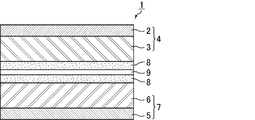
- FIG. 1 is a cross-sectional view schematically showing an example of the electricity storage device of the present invention.
- a nonaqueous electrolyte secondary battery 1 according to an electricity storage device of the present invention includes a positive electrode plate 4 in which a positive electrode active material layer 3 is provided on one side of a positive electrode current collector 2, and a negative electrode current collector.
- a negative electrode plate 7 having a negative electrode active material layer 6 provided on one surface side of the body 5 is provided.
- the positive electrode plate 4 and the negative electrode plate 7 are disposed to face each other with a separator 9 provided in the non-aqueous electrolyte 8 and the non-aqueous electrolyte 8 of the present invention.
- a non-aqueous electrolyte secondary battery is shown as the electricity storage device, but the electricity storage device of the present invention is not limited to this, and can be applied to other electricity storage devices such as electric double layer capacitors. .
- the positive electrode current collector 2 and the negative electrode current collector 5 for example, a metal foil made of a metal such as aluminum, copper, nickel, and stainless steel can be used.
- a lithium-containing composite oxide is preferably used as the positive electrode active material used for the positive electrode active material layer 3.
- a lithium-containing composite oxide is preferably used.
- LiMnO 2 , LiFeO 2 , LiCoO 2 , LiMn 2 O 4 , Li 2 FeSiO 4 , LiNi 1/3 Co examples thereof include lithium-containing composite oxides such as 1/3 Mn 1/3 O 2 and LiFePO 4 .
- Examples of the negative electrode active material used for the negative electrode active material layer 6 include a material that can occlude and release lithium. Examples of such materials include carbon materials such as graphite and amorphous carbon, and oxide materials such as indium oxide, silicon oxide, tin oxide, zinc oxide, and lithium oxide.
- lithium metal and a metal material capable of forming an alloy with lithium can be used as the negative electrode active material. Examples of the metal capable of forming an alloy with lithium include Cu, Sn, Si, Co, Mn, Fe, Sb, Ag, and the like, and are composed of binary or ternary containing these metals and lithium. An alloy can also be used. These negative electrode active materials may be used alone or in combination of two or more.
- separator 9 for example, a porous film made of polyethylene, polypropylene, fluororesin, or the like can be used.
- the present invention when used in an electricity storage device, it has excellent storage stability and forms a stable SEI on the electrode surface to provide cycle characteristics, charge / discharge capacity, high temperature storage characteristics, gas generation suppression, and reduction of internal resistance. It is possible to provide an additive for a non-aqueous electrolyte that can improve battery characteristics such as the above. Moreover, according to this invention, the nonaqueous electrolyte using this additive for nonaqueous electrolytes, and the electrical storage device using this nonaqueous electrolyte can be provided.
- EC ethylene carbonate
- DEC diethyl carbonate
- a concentration of 1.0 mol / L of LiPF 6 as an electrolyte
- the content of the compound 1 shown in Table 1 as an additive for a non-aqueous electrolyte is 0.5% by mass with respect to the total amount of the solution composed of the mixed non-aqueous solvent and the electrolyte.
- a non-aqueous electrolyte was prepared.
- Example 2 A nonaqueous electrolytic solution was prepared in the same manner as in Example 1 except that the content ratio of Compound 1 was 1.0% by mass.
- Example 3 A nonaqueous electrolytic solution was prepared in the same manner as in Example 1, except that Compound 2 shown in Table 1 was added instead of Compound 1 so that the content ratio was 1.0% by mass.
- Example 4 A nonaqueous electrolytic solution was prepared in the same manner as in Example 1 except that the compound 3 shown in Table 1 was added instead of the compound 1 so that the content ratio was 1.0% by mass.
- Example 5 A nonaqueous electrolytic solution was prepared in the same manner as in Example 1 except that the compound 4 shown in Table 1 was added instead of the compound 1 so that the content ratio was 1.0% by mass.
- Example 6 A nonaqueous electrolytic solution was prepared in the same manner as in Example 1 except that the compound 5 shown in Table 1 was added instead of the compound 1 so that the content ratio was 1.0% by mass.
- Example 7 A nonaqueous electrolytic solution was prepared in the same manner as in Example 1 except that the compound 6 shown in Table 1 was added instead of the compound 1 so that the content ratio was 1.0% by mass.
- Example 8 A nonaqueous electrolytic solution was prepared in the same manner as in Example 1 except that the compound 7 shown in Table 1 was added instead of the compound 1 so that the content ratio was 1.0% by mass.
- Example 9 A nonaqueous electrolytic solution was prepared in the same manner as in Example 1 except that the compound 8 shown in Table 1 was added instead of the compound 1 so that the content ratio was 1.0% by mass.
- Example 10 A nonaqueous electrolytic solution was prepared in the same manner as in Example 1 except that the compound 9 shown in Table 1 was added instead of the compound 1 so that the content ratio was 1.0% by mass.
- Example 11 A nonaqueous electrolytic solution was prepared in the same manner as in Example 1 except that the compound 10 shown in Table 2 was added instead of the compound 1 so that the content ratio was 1.0% by mass.
- Example 12 A nonaqueous electrolytic solution was prepared in the same manner as in Example 1 except that Compound 11 shown in Table 2 was added instead of Compound 1 so that the content ratio was 1.0% by mass.
- Example 13 A nonaqueous electrolytic solution was prepared in the same manner as in Example 1, except that Compound 12 shown in Table 2 was added instead of Compound 1 so that the content ratio was 1.0% by mass.
- Example 14 A nonaqueous electrolytic solution was prepared in the same manner as in Example 1 except that the compound 13 shown in Table 2 was added instead of the compound 1 so that the content ratio was 1.0% by mass.
- Example 15 A nonaqueous electrolytic solution was prepared in the same manner as in Example 1 except that the compound 14 shown in Table 2 was added instead of the compound 1 so that the content ratio was 1.0% by mass.
- Example 16 A nonaqueous electrolytic solution was prepared in the same manner as in Example 1 except that the compound 15 shown in Table 2 was added instead of the compound 1 so that the content ratio was 1.0% by mass.
- Example 17 A nonaqueous electrolytic solution was prepared in the same manner as in Example 1 except that the compound 16 shown in Table 2 was added instead of the compound 1 so that the content ratio was 1.0% by mass.
- Example 18 A nonaqueous electrolytic solution was prepared in the same manner as in Example 1 except that Compound 17 shown in Table 2 was added instead of Compound 1 so that the content ratio was 1.0% by mass.
- Example 19 A nonaqueous electrolytic solution was prepared in the same manner as in Example 1, except that Compound 18 shown in Table 2 was added instead of Compound 1 so that the content ratio was 1.0% by mass.
- Example 1 A nonaqueous electrolytic solution was prepared in the same manner as in Example 1 except that Compound 1 was not used.
- Example 2 A nonaqueous electrolytic solution was prepared in the same manner as in Example 1 except that 1,3-propane sultone was added in such a manner that the content ratio was 1.0 mass% instead of Compound 1.
- Example 3 A nonaqueous electrolytic solution was prepared in the same manner as in Example 1 except that vinylene carbonate (VC) was added so as to have a content ratio of 1.0% by mass instead of Compound 1.
- VC vinylene carbonate
- Comparative Example 4 A nonaqueous electrolytic solution was prepared in the same manner as in Comparative Example 3 except that the content of vinylene carbonate (VC) was 2.0% by mass.
- Example 5 A nonaqueous electrolytic solution was prepared in the same manner as in Example 1 except that fluoroethylene carbonate (FEC) was added so that the content ratio was 1.0% by mass instead of Compound 1.
- FEC fluoroethylene carbonate
- Comparative Example 6 A nonaqueous electrolytic solution was prepared in the same manner as in Comparative Example 5 except that the content ratio of fluoroethylene carbonate (FEC) was 2.0% by mass.
- FEC fluoroethylene carbonate
- Example 8 A nonaqueous electrolytic solution was prepared in the same manner as in Example 1 except that maleimide was added so that the content ratio was 1.0% by mass instead of Compound 1.
- Example 9 A nonaqueous electrolytic solution was prepared in the same manner as in Example 1 except that succinimide was added in such a manner that the content ratio was 1.0% by mass instead of Compound 1.
- Example 10 A nonaqueous electrolytic solution was prepared in the same manner as in Example 1 except that the compound 19 shown in Table 3 was added instead of the compound 1 so that the content ratio was 1.0% by mass.
- Example 11 A nonaqueous electrolytic solution was prepared in the same manner as in Example 1, except that Compound 20 shown in Table 3 was added instead of Compound 1 so that the content ratio was 1.0% by mass.
- Example 12 A nonaqueous electrolytic solution was prepared in the same manner as in Example 1 except that Compound 21 shown in Table 3 was added instead of Compound 1 so that the content ratio was 1.0% by mass.
- Example 13 A nonaqueous electrolytic solution was prepared in the same manner as in Example 1 except that the compound 22 shown in Table 3 was added instead of the compound 1 so that the content ratio was 1.0% by mass.
- Example 14 A nonaqueous electrolytic solution was prepared in the same manner as in Example 1, except that the compound 23 shown in Table 3 was added instead of the compound 1 so that the content ratio was 1.0% by mass.
- NMP N-methyl-2-pyrrolidone
- LiMn 2 O 4 as a positive electrode active material and carbon black as a conductivity imparting agent are dry-mixed and polyvinylidene fluoride (PVDF) is dissolved as a binder
- PVDF polyvinylidene fluoride
- the obtained slurry was applied on an aluminum metal foil (square shape, thickness 20 ⁇ m) serving as a positive electrode current collector, and then NMP was evaporated to prepare a positive electrode sheet.
- the negative electrode sheet a commercially available graphite coated electrode sheet (manufactured by Hosen Co., Ltd.) was used.
- a negative electrode sheet and a positive electrode sheet were laminated via a separator made of polyethylene to produce a cylindrical secondary battery.
- Each cylindrical secondary battery obtained was charged at 25 ° C. with a charge rate of 0.3 C, a discharge rate of 0.3 C, a charge end voltage of 4.2 V, and a discharge end voltage of 2.5 V.
- a discharge cycle test was conducted. Tables 5 and 6 show the discharge capacity retention ratio (%) after 200 cycles and the internal resistance ratio after 200 cycles.
- discharge capacity maintenance rate after 200 cycles is obtained by multiplying the value obtained by dividing discharge capacity (mAh) after 200 cycle test by discharge capacity (mAh) after 10 cycle test by 100. It is.
- the “internal resistance ratio after 200 cycles” is a relative value of the resistance after the 200 cycle test when the resistance before the cycle test is 1.
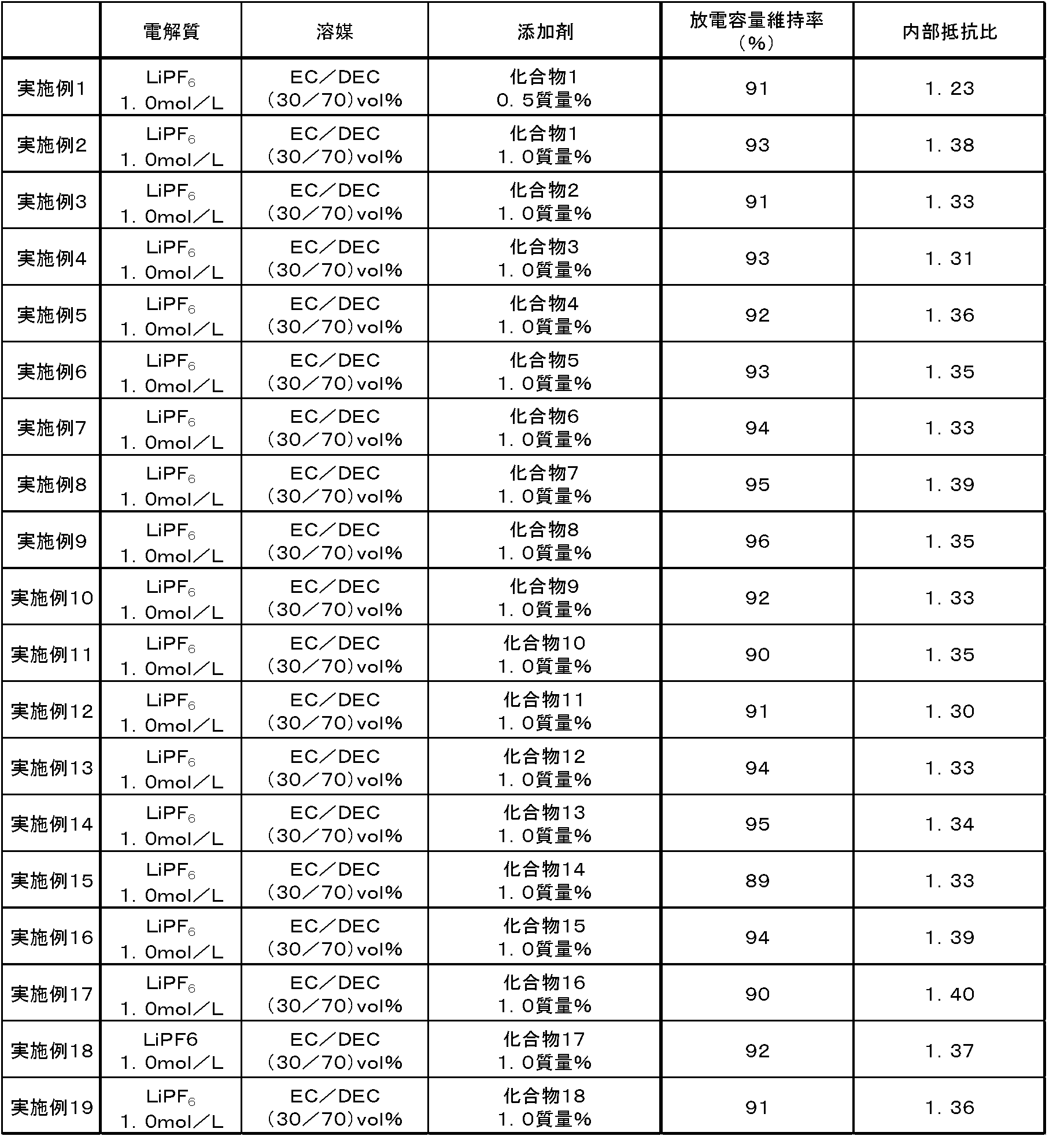
- the cylindrical secondary batteries using the non-aqueous electrolytes of Examples including the compounds 1 to 18 which are cyclic imide compounds according to the present invention are the non-aqueous electrolytes of Comparative Examples 1 to 9. It can be seen that the discharge capacity retention rate during the cycle test is higher than that of the used cylindrical secondary battery. Therefore, when the non-aqueous electrolyte of the example containing the cyclic imide compound according to the present invention as an additive for a non-aqueous electrolyte is used for a non-aqueous electrolyte secondary battery, the non-aqueous electrolyte of a comparative example is used.
- NMP N-methyl-2-pyrrolidone
- LiCoO 2 lithium cobaltate
- carbon black as a conductivity imparting agent
- PVDF polyvinylidene fluoride
- graphite powder as a negative electrode active material and carbon black as a conductivity imparting agent are dry-mixed and uniformly dispersed in N-methyl-2-pyrrolidone (NMP) in which polyvinylidene fluoride (PVDF) is dissolved as a binder.
- NMP N-methyl-2-pyrrolidone
- PVDF polyvinylidene fluoride
- the positive electrode, the negative electrode, and the polyethylene separator were laminated in the order of the negative electrode, the separator, the positive electrode, the separator, and the negative electrode to produce a battery element.
- the battery element was inserted into a bag made of a laminate film in which both surfaces of aluminum (thickness 40 ⁇ m) were coated with a resin layer while projecting positive and negative terminals, and then Examples 1 to 19 and Comparative Examples 1 to 14
- Each non-aqueous electrolyte obtained in (1) was poured into a bag and vacuum sealed to produce a sheet-like non-aqueous electrolyte battery.
- the sheet-like battery was sandwiched between glass plates and pressurized.
- the obtained nonaqueous electrolyte battery was charged to 4.2 V at a current corresponding to 0.2 C at 25 ° C. and then discharged to 3 V at a current corresponding to 0.2 C for 3 cycles.
- the battery was stabilized.
- high temperature storage at 60 ° C. for 168 hours was performed.
- it cooled to room temperature, measured the volume by Archimedes method, and calculated
- the battery after high-temperature storage was discharged to 3.0 V with a current corresponding to 0.2 C to obtain the remaining capacity of the battery.
- the operation of discharging to 0.2 V at 3 C was repeated twice, and the capacity indicated by the battery in the final discharge was taken as the battery recovery capacity.
- the ratios of the remaining capacity and the recovery capacity obtained above to the discharge capacity before storage were defined as the remaining capacity ratio (%) and the recovery capacity ratio (%), respectively. The results are shown in Tables 7 and 8.
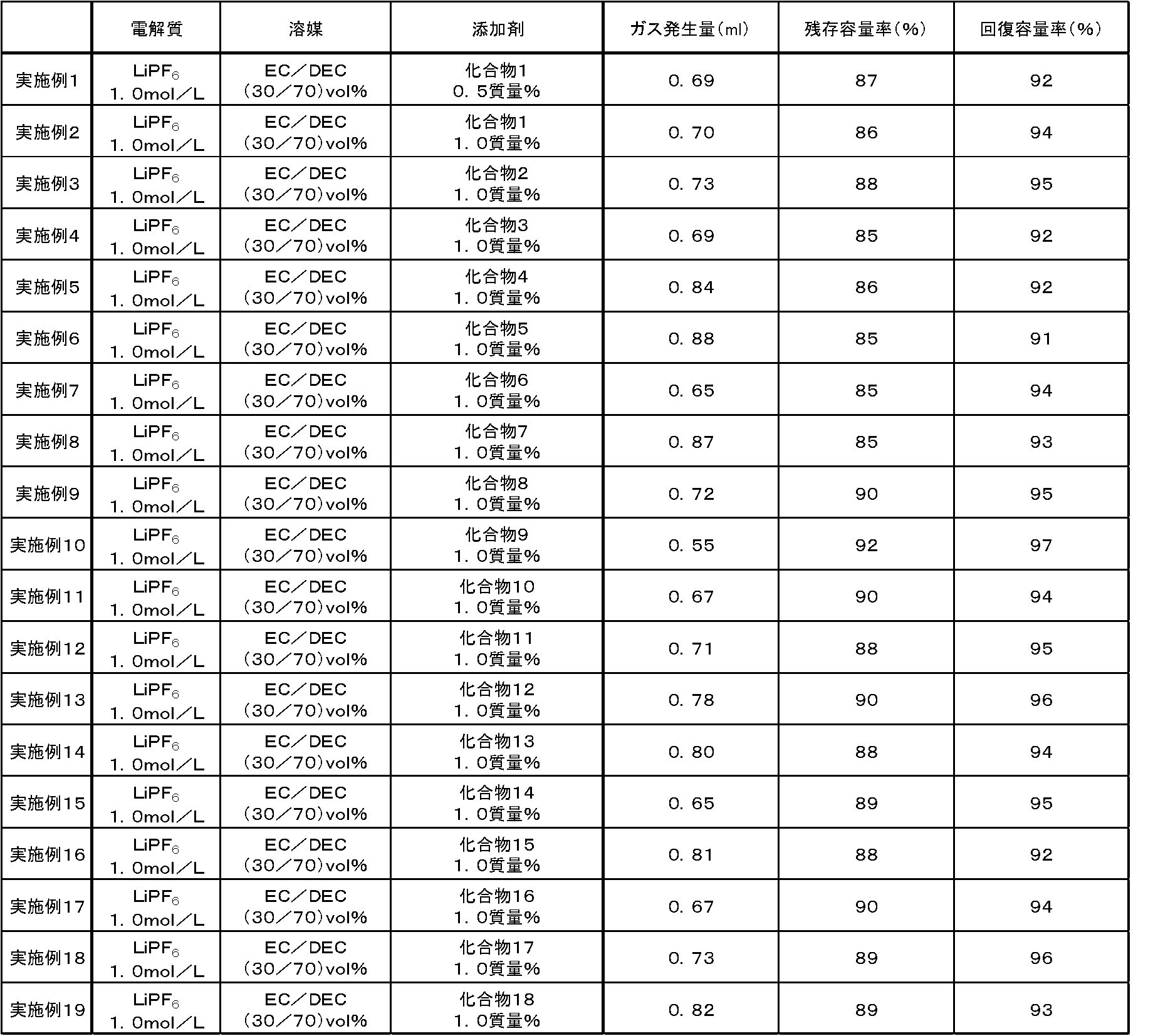
- the non-aqueous electrolyte battery using the non-aqueous electrolyte solution of each example containing compounds 1 to 18 which are the cyclic imide compounds according to the present invention is a non-aqueous electrolyte solution using the non-aqueous electrolyte solution of the comparative example.
- the amount of gas generated during high-temperature storage is low, and the remaining capacity and recovery capacity after high-temperature storage are excellent, so that high-temperature storage characteristics can be improved.
- the present invention when used in an electricity storage device, it has excellent storage stability and forms a stable SEI on the electrode surface to provide cycle characteristics, charge / discharge capacity, high temperature storage characteristics, gas generation suppression, and reduction of internal resistance. It is possible to provide an additive for a non-aqueous electrolyte that can improve battery characteristics such as the above. Moreover, according to this invention, the nonaqueous electrolyte using this additive for nonaqueous electrolytes, and the electrical storage device using this nonaqueous electrolyte can be provided.
Landscapes
- Chemical & Material Sciences (AREA)
- Engineering & Computer Science (AREA)
- Chemical Kinetics & Catalysis (AREA)
- Electrochemistry (AREA)
- General Chemical & Material Sciences (AREA)
- Manufacturing & Machinery (AREA)
- Power Engineering (AREA)
- General Physics & Mathematics (AREA)
- Condensed Matter Physics & Semiconductors (AREA)
- Physics & Mathematics (AREA)
- Inorganic Chemistry (AREA)
- Microelectronics & Electronic Packaging (AREA)
- Materials Engineering (AREA)
- Secondary Cells (AREA)
- Electric Double-Layer Capacitors Or The Like (AREA)
Abstract
Description
しかしながら、リチウムイオン電池には、充放電サイクルの経過や高温条件下での保存に伴って電池の容量が低下するという問題がある。これは、長期間の充放電サイクルの経過に伴い、電極と電解液との副反応、電極反応による電解液の分解や電極活物質層への電解質の含浸性の低下、更にリチウムイオンのインターカレーション効率の低下が生じること等が要因に挙げられる。
また、特許文献10~13には、ビニレンカーボネートやビニルエチレンカーボネートを含有する電解液が開示されており、特許文献14、15には、1,3-プロパンスルトンやブタンスルトンを含有する電解液が開示されている。
例えば、特許文献10~15に記載されているビニレンカーボネート系化合物や1,3-プロパンスルトン等のスルトン系化合物を添加剤として用いた電解液は、負極表面上に電気化学的還元分解を生じて生成したSEIによって、不可逆的な容量低下を抑制することが可能となっている。しかし、これらの添加剤によって形成されたSEIは電極を保護する性能に優れるものの、リチウムイオンのイオン伝導性が低いため、内部抵抗を低下させる性能は小さかった。更に、形成されたSEIは、長期間の使用に耐える強度がなく、使用中にSEIが分解したり、SEIに亀裂が生じたりすることによって負極表面が露出し、電解液の分解が生じて電池特性が低下するといった問題点があった。
なお、本発明の非水電解液用添加剤は、本発明にかかる環状イミド化合物のみを含有するものに限定されず、本発明の目的を損なわない範囲で、他の成分を含有してもよい。
以下に本発明を詳細に説明する。
また、前記式(1-1)中のR1、前記式(1-2)中のR3、前記式(1-3)中のR5、前記式(1-4)中のR7、前記式(1-5)中のR9、及び、前記式(1-6)中のR11が、置換されたフェニル基、置換されたフェノキシ基、置換されたベンジル基、置換されたベンジルオキシ基、又は、R13及びR14のうち少なくとも一方が置換されたフェニル基若しくは置換されたベンジル基であるNR13R14基である場合、置換基としては、例えば、炭素数1~4のアルキル基、炭素数1~4のアルコキシ基、ハロゲン原子等が挙げられる。なかでも、電気化学的還元を受けやすい低いLUMOエネルギーを示すこと等から、ハロゲン原子が好ましく、フッ素原子がより好ましい。
前記式(1-1)中のlが1である場合、R2の好ましい置換位置は4位であり、lが2の場合の好ましい置換位置は、4位と5位である。
前記式(1-1)中のlが2~4の整数である場合、各R2は、それぞれ同一であってもよいし異なっていてもよい。
前記式(1-2)中のmが2である場合、2つのR4は、それぞれ同一であってもよいし異なっていてもよい。
前記式(1-3)中のnが2である場合、2つのR6は、それぞれ同一であってもよいし異なっていてもよい。
前記式(1-4)中のoが2~4の整数である場合、各R8は、それぞれ同一であってもよいし異なっていてもよい。
前記式(1-5)中のpが2~4の整数である場合、各R10は、それぞれ同一であってもよいし異なっていてもよい。
前記式(1-6)中のqが2~6の整数である場合、各R12は、それぞれ同一であってもよいし異なっていてもよい。
なかでも、本発明の非水電解液用添加剤は、入手性や反応性等の観点から、本発明にかかる環状イミド化合物として、下記式(2-1)で表される化合物、下記式(2-2)で表される化合物、下記式(2-3)で表される化合物、下記式(2-4)で表される化合物、下記式(2-5)で表される化合物、及び、下記式(2-6)で表される化合物からなる群より選択される少なくとも1種を含有することが好ましく、下記式(3-1)で表される化合物、下記式(3-2)で表される化合物、下記式(3-3)で表される化合物、下記式(3-4)で表される化合物、下記式(3-5)で表される化合物、及び、下記式(3-6)で表される化合物からなる群より選択される少なくとも1種を含有することがより好ましい。


また、前記式(3-1)中のR21、前記式(3-2)中のR22、前記式(3-3)中のR23、前記式(3-4)中のR24、前記式(3-5)中のR25、及び、前記式(3-6)中のR26における、置換されていてもよい炭素数1~4のアルコキシ基、置換されていてもよい炭素数2~4のアルケニルオキシ基、及び、NR13R14基としては、それぞれ前記式(1-1)中のR1、前記式(1-2)中のR3、前記式(1-3)中のR5、前記式(1-4)中のR7、前記式(1-5)中のR9、及び、前記式(1-6)のR11において例示したものと同様のもの、又は、該例示したもののうち炭素数の対応するものが挙げられる。
具体的には例えば、前記式(1-1)における、R1がフェノキシ基であり、lが0である化合物(N-(フェノキシカルボニル)フタルイミド)を製造する場合は、有機溶媒にフタルイミドとトリエチルアミンを溶解させ、次いで、クロロ蟻酸フェニルを滴下し、室温で2時間撹拌した後、水洗浄し、結晶化させ、濾過する方法等を用いることができる。
なお、前記「最低空分子軌道(LUMO)エネルギー」は、半経験的分子軌道計算法であるPM3と密度汎関数法であるB3LYP法とを組み合わせて算出される。具体的に本発明では、Gaussian03(Revision B.03、米ガウシアン社製ソフトウェア)を用いて算出された値を用いる。
なお、本発明の非水電解液用添加剤は、単独で用いてもよいし、2種以上を組み合わせて用いてもよい。なお、本発明の非水電解液用添加剤を2種以上用いる場合の合計の含有量は、好ましい下限が0.005質量%、好ましい上限が10質量%である。
前記鎖状カーボネートとしては、例えば、炭酸ジメチル、炭酸ジエチル(DEC)、炭酸エチルメチル等が挙げられる。
前記脂肪族カルボン酸エステルとしては、例えば、酢酸メチル、酢酸エチル、プロピオン酸メチル、プロピオン酸エチル、酪酸メチル、イソ酪酸メチル、トリメチル酢酸メチル等が挙げられる。
前記ラクトンとしては、例えば、γ-ブチロラクトン等が挙げられる。
前記ラクタムとしては、例えば、ε-カプロラクタム、N-メチルピロリドン等が挙げられる。
前記環状エーテルとしては、例えば、テトラヒドロフラン、2-メチルテトラヒドロフラン、テトラヒドロピラン、1,3-ジオキソラン等が挙げられる。
前記鎖状エーテルとしては、例えば、1,2-ジエトキシエタン、エトキシメトキシエタン等が挙げられる。
前記スルホンとしては、例えば、スルホラン等が挙げられる。
前記ニトリルとしては、例えば、アセトニトリル等が挙げられる。
前記ハロゲン誘導体としては、例えば、4-フルオロ-1,3-ジオキソラン-2-オン、4-クロロ-1,3-ジオキソラン-2-オン、4,5-ジフルオロ-1,3-ジオキソラン-2-オン等が挙げられる。
これらの非水溶媒は、単独で用いてもよいし、2種以上を組み合わせて用いてもよい。
これらの非水溶媒は、例えば、リチウムイオン電池等の非水電解液二次電池や、リチウムイオンキャパシタ等の電気二重層キャパシタ等に好ましく用いられる。
なお、前記LiBF4、LiPF6が用いられる場合、非水溶媒としては、環状カーボネート及び鎖状カーボネートをそれぞれ1種以上混合することが好ましく、炭酸エチレン及び炭酸ジエチルを混合することがより好ましい。
図1において、本発明の蓄電デバイスにかかる非水電解液二次電池1は、正極集電体2の一方面側に正極活物質層3が設けられてなる正極板4、及び、負極集電体5の一方面側に負極活物質層6が設けられてなる負極板7を有する。正極板4と負極板7とは、本発明の非水電解液8と非水電解液8中に設けたセパレータ9を介して対向配置されている。
なお、図1では、蓄電デバイスとして非水電解液二次電池を示したが、本発明の蓄電デバイスはこれに限定されることはなく、その他の電気二重層キャパシタ等の蓄電デバイスにも適用できる。
また、負極活物質として、リチウム金属、及び、リチウムと合金を形成することができる金属材料を用いることもできる。前記リチウムと合金を形成することができる金属としては、例えば、Cu、Sn、Si、Co、Mn、Fe、Sb、Ag等が挙げられ、これらの金属とリチウムを含む2元又は3元からなる合金を用いることもできる。
これらの負極活物質は単独で用いてもよいし、2種以上を組み合わせて用いてもよい。
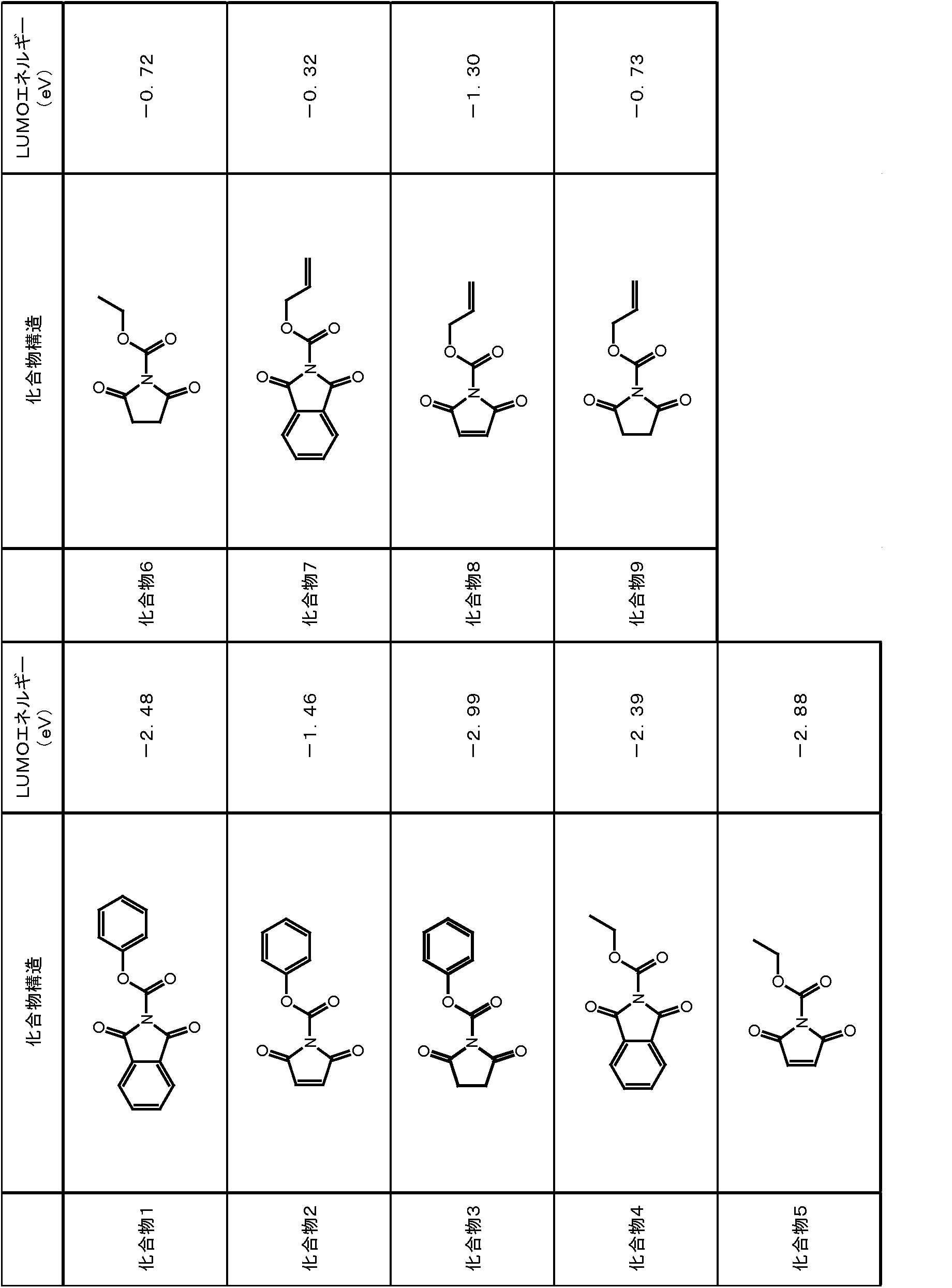
炭酸エチレン(EC)と炭酸ジエチル(DEC)とを、EC:DEC=30:70の体積組成比で混合して得られた混合非水溶媒に、電解質としてLiPF6を1.0mol/Lの濃度となるように溶解し、該混合非水溶媒と該電解質とからなる溶液全量に対し、非水電解液用添加剤として表1に示した化合物1を、含有割合が0.5質量%となるように添加し、非水電解液を調製した。
化合物1の含有割合を1.0質量%となるようにしたこと以外は、実施例1と同様にして非水電解液を調製した。
化合物1に代えて、表1に示した化合物2を含有割合が1.0質量%となるように添加したこと以外は、実施例1と同様にして非水電解液を調製した。
化合物1に代えて、表1に示した化合物3を含有割合が1.0質量%となるように添加したこと以外は、実施例1と同様にして非水電解液を調製した。
化合物1に代えて、表1に示した化合物4を含有割合が1.0質量%となるように添加したこと以外は、実施例1と同様にして非水電解液を調製した。
化合物1に代えて、表1に示した化合物5を含有割合が1.0質量%となるように添加したこと以外は、実施例1と同様にして非水電解液を調製した。
化合物1に代えて、表1に示した化合物6を含有割合が1.0質量%となるように添加したこと以外は、実施例1と同様にして非水電解液を調製した。
化合物1に代えて、表1に示した化合物7を含有割合が1.0質量%となるように添加したこと以外は、実施例1と同様にして非水電解液を調製した。
化合物1に代えて、表1に示した化合物8を含有割合が1.0質量%となるように添加したこと以外は、実施例1と同様にして非水電解液を調製した。
化合物1に代えて、表1に示した化合物9を含有割合が1.0質量%となるように添加したこと以外は、実施例1と同様にして非水電解液を調製した。
化合物1に代えて、表2に示した化合物10を含有割合が1.0質量%となるように添加したこと以外は、実施例1と同様にして非水電解液を調製した。
化合物1に代えて、表2に示した化合物11を含有割合が1.0質量%となるように添加したこと以外は、実施例1と同様にして非水電解液を調製した。
化合物1に代えて、表2に示した化合物12を含有割合が1.0質量%となるように添加したこと以外は、実施例1と同様にして非水電解液を調製した。
化合物1に代えて、表2に示した化合物13を含有割合が1.0質量%となるように添加したこと以外は、実施例1と同様にして非水電解液を調製した。
化合物1に代えて、表2に示した化合物14を含有割合が1.0質量%となるように添加したこと以外は、実施例1と同様にして非水電解液を調製した。
化合物1に代えて、表2に示した化合物15を含有割合が1.0質量%となるように添加したこと以外は、実施例1と同様にして非水電解液を調製した。
化合物1に代えて、表2に示した化合物16を含有割合が1.0質量%となるように添加したこと以外は、実施例1と同様にして非水電解液を調製した。
化合物1に代えて、表2に示した化合物17を含有割合が1.0質量%となるように添加したこと以外は、実施例1と同様にして非水電解液を調製した。
化合物1に代えて、表2に示した化合物18を含有割合が1.0質量%となるように添加したこと以外は、実施例1と同様にして非水電解液を調製した。
化合物1を用いなかったこと以外は、実施例1と同様にして非水電解液を調製した。
化合物1に代えて、1,3-プロパンスルトンを含有割合が1.0質量%となるように添加したこと以外は、実施例1と同様にして非水電解液を調製した。
化合物1に代えて、ビニレンカーボネート(VC)を含有割合が1.0質量%となるように添加したこと以外は、実施例1と同様にして非水電解液を調製した。
ビニレンカーボネート(VC)の含有割合を2.0質量%となるようにしたこと以外は、比較例3と同様にして非水電解液を調製した。
化合物1に代えて、フルオロエチレンカーボネート(FEC)を含有割合が1.0質量%となるように添加したこと以外は、実施例1と同様にして非水電解液を調製した。
フルオロエチレンカーボネート(FEC)の含有割合を2.0質量%となるようにしたこと以外は、比較例5と同様にして非水電解液を調製した。
化合物1に代えて、フタルイミドを含有割合が1.0質量%となるように添加したこと以外は、実施例1と同様にして非水電解液を調製した。
化合物1に代えて、マレイミドを含有割合が1.0質量%となるように添加したこと以外は、実施例1と同様にして非水電解液を調製した。
化合物1に代えて、スクシンイミドを含有割合が1.0質量%となるように添加したこと以外は、実施例1と同様にして非水電解液を調製した。
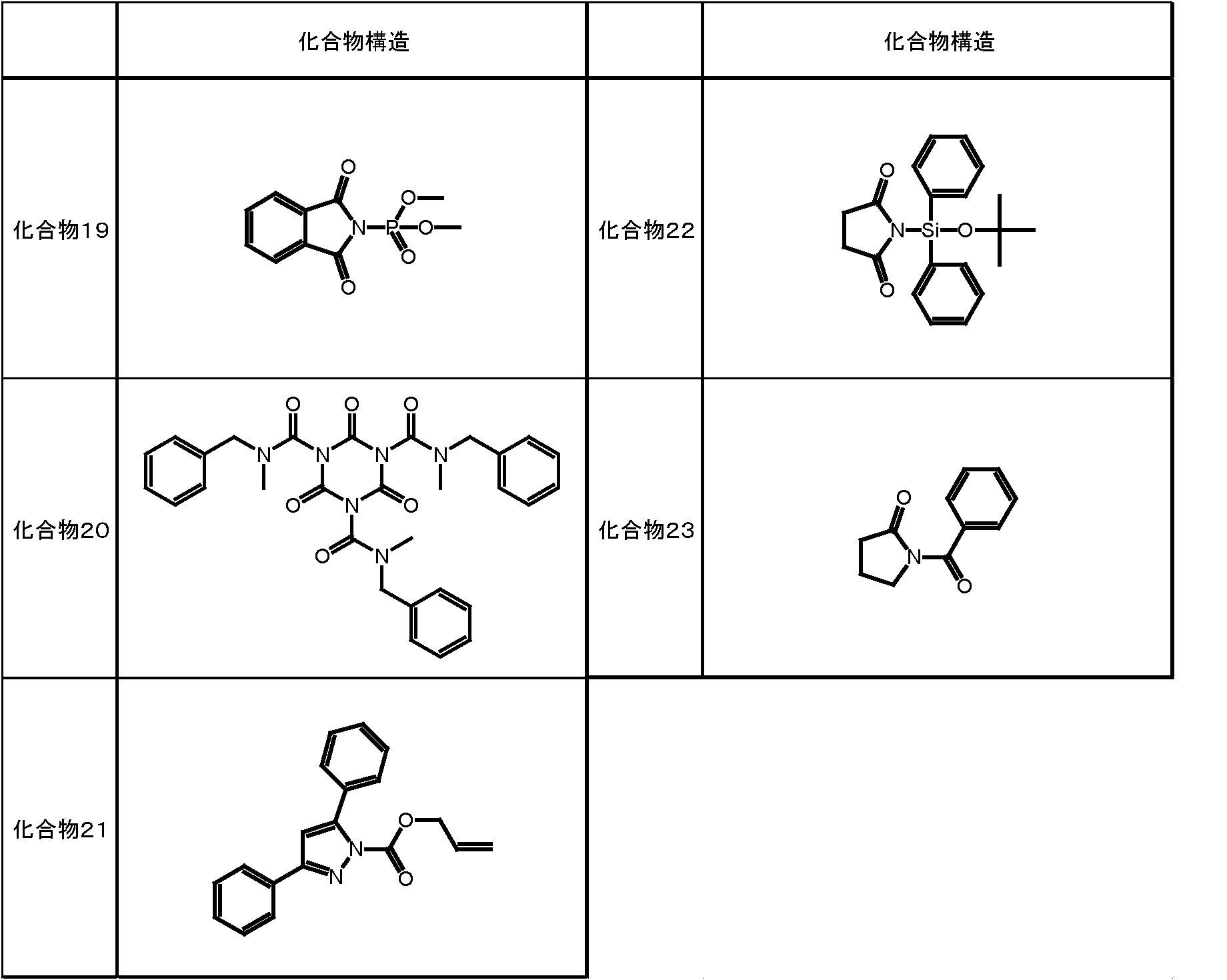
化合物1に代えて、表3に示した化合物19を含有割合が1.0質量%となるように添加したこと以外は、実施例1と同様にして非水電解液を調製した。
化合物1に代えて、表3に示した化合物20を含有割合が1.0質量%となるように添加したこと以外は、実施例1と同様にして非水電解液を調製した。
化合物1に代えて、表3に示した化合物21を含有割合が1.0質量%となるように添加したこと以外は、実施例1と同様にして非水電解液を調製した。
化合物1に代えて、表3に示した化合物22を含有割合が1.0質量%となるように添加したこと以外は、実施例1と同様にして非水電解液を調製した。
化合物1に代えて、表3に示した化合物23を含有割合が1.0質量%となるように添加したこと以外は、実施例1と同様にして非水電解液を調製した。
(LUMOエネルギーの測定)
実施例で用いた化合物1~18について、LUMO(最低空分子軌道)エネルギーを測定するため、Gaussian03ソフトウェアにより、半経験的分子軌道計算を行った。軌道計算により得られた化合物1~18のLUMOエネルギーを表1、2に示した。

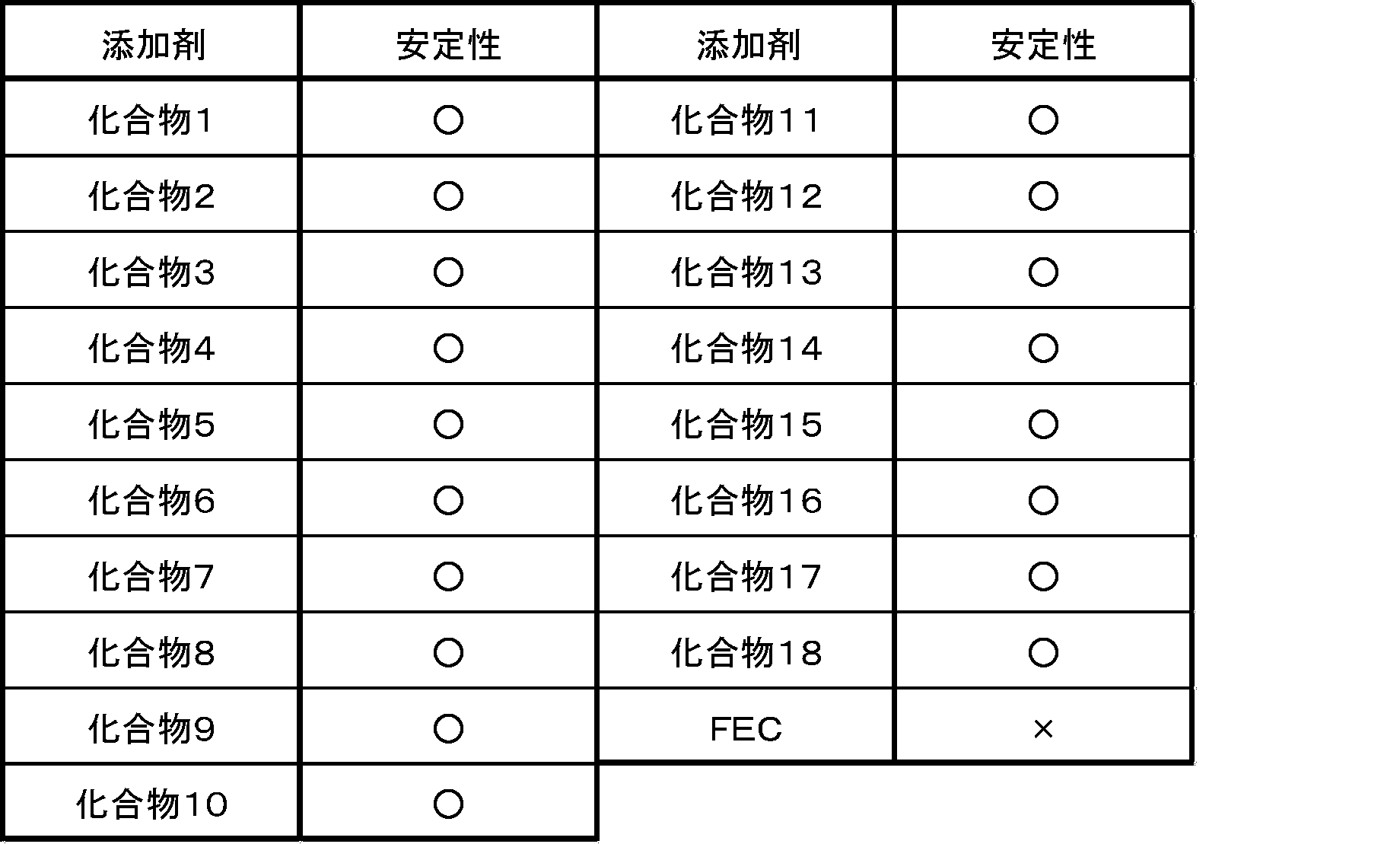
実施例で用いた化合物1~18、及び、比較例5、6で用いたフルオロエチレンカーボネート(FEC)について、温度40±2℃、湿度75±5%の恒温恒湿環境下で90日間の保存試験を行い、1H-核磁気共鳴スペクトル(1H-NMR)を測定し、保存前後の各化合物のピークを確認し、保存前後で1H-NMRのピーク変化がなかった場合を「○」、保存前後で1H-NMRのわずかなピーク変化が確認された場合を「△」、保存前後で1H-NMRの明らかなピーク変化が確認された場合を「×」として安定性を評価した。結果を表4に示した。
正極活物質としてLiMn2O4、及び、導電性付与剤としてカーボンブラックを乾式混合し、バインダーとしてポリフッ化ビニリデン(PVDF)を溶解させたN-メチル-2-ピロリドン(NMP)中に均一に分散させ、スラリーを作製した。得られたスラリーを正極集電体となるアルミ金属箔(角型、厚さ20μm)上に塗布後、NMPを蒸発させることにより正極シートを作製した。得られた正極シート中の固形分比率は、質量比で、正極活物質:導電性付与剤:PVDF=80:10:10とした。
一方、負極シートとして、市販の黒鉛塗布電極シート(宝泉社製)を用いた。
実施例1~19及び比較例1~9で得られた各非水電解液中にて、負極シートと正極シートとを、ポリエチレンからなるセパレータを介して積層し、円筒型二次電池を作製した。
得られた各円筒型二次電池に対して、25℃において、充電レートを0.3C、放電レートを0.3C、充電終止電圧を4.2V、及び、放電終止電圧を2.5Vとして充放電サイクル試験を行った。200サイクル後の放電容量維持率(%)と200サイクル後の内部抵抗比を表5、6に示した。
なお、「200サイクル後の放電容量維持率(%)」とは、200サイクル試験後の放電容量(mAh)を、10サイクル試験後の放電容量(mAh)で割った値に100をかけたものである。また、「200サイクル後の内部抵抗比」とは、サイクル試験前の抵抗を1としたときの、200サイクル試験後の抵抗を相対値で示したものである。

正極活物質としてコバルト酸リチウム(LiCoO2)、及び、導電性付与剤としてカーボンブラックを乾式混合し、バインダーとしてポリフッ化ビニリデン(PVDF)を溶解させたN-メチル-2-ピロリドン(NMP)中に均一に分散させ、スラリーを作製した。得られたスラリーを正極集電体となるアルミ金属箔(角型、厚さ20μm)の両面に塗布後、NMPを乾燥した後、プレスして正極とした。得られた正極シート中の固形分比率は、質量比で、正極活物質:導電性付与剤:PVDF=90:5:5とした。
一方、負極活物質としてグラファイト粉末、及び、導電性付与剤としてカーボンブラックを乾式混合し、バインダーとしてポリフッ化ビニリデン(PVDF)を溶解させたN-メチル-2-ピロリドン(NMP)中に均一に分散させ、スラリーを作製した。得られたスラリーを負極集電体となる銅箔(角型、厚さ10μm)の片面に塗布後、NMPを乾燥した後、プレスして負極とした。得られた負極シート中の固形分比率は、質量比で、負極活物質:導電性付与剤:PVDF=93:3:4とした。
上記の正極、負極、及び、ポリエチレン製のセパレータを、負極、セパレータ、正極、セパレータ、負極の順に積層して電池要素を作製した。この電池要素をアルミニウム(厚さ40μm)の両面を樹脂層で被覆したラミネートフィルムからなる袋内に正・負極の端子を突設させながら挿入した後、実施例1~19及び比較例1~14で得られた各非水電解液を袋内に注入し、真空封止を行ない、シート状の非水電解液電池を作製した。更に、電極間の密着性を高めるために、ガラス板でシート状電池を挟んで加圧した。
得られた非水電解液電池に対して、25℃において、0.2Cに相当する電流で4.2Vまで充電した後、0.2Cに相当する電流で3Vまで放電する操作を3サイクル行なって電池を安定させた。
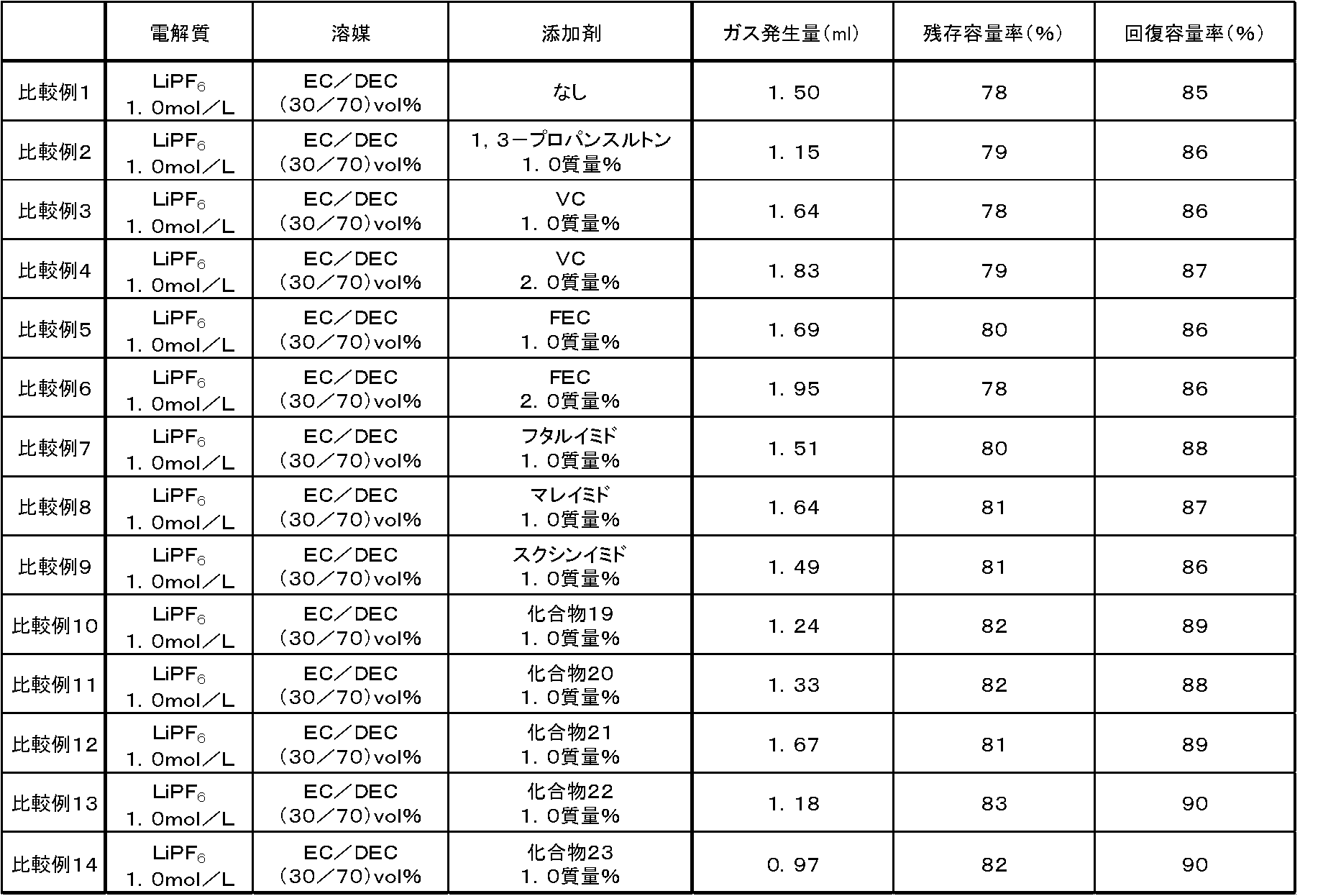
次いで、充電レートを0.3Cとして再度4.2Vまで充電を行なった後、60℃、168時間の高温保存を行なった。その後、室温まで冷却し、アルキメデス法により体積を測定し、保存前後の体積変化からガス発生量を求めた。また、高温保存を経た後の電池を0.2Cに相当する電流で3.0Vまで放電し、電池の残存容量とした。最後に、0.2Cに相当する電流で4.2Vまで充電した後、0.2Cで3Vまで放電する操作を2回繰り返し、最後の放電において電池が示した容量をもって電池の回復容量とした。上記で得られた残存容量及び回復容量の、保存前の放電容量に対する割合をそれぞれ残存容量率(%)及び回復容量率(%)とした。結果を表7、8に示した。
表7、8から、本発明にかかる環状イミド化合物である化合物1~18を含む各実施例の非水電解液を用いた非水系電解液電池は、比較例の非水電解液を用いた非水系電解液電池と比較して、高温保存時のガス発生量が低く、かつ、高温保存後の残存容量・回復容量に優れており、高温保存特性を改善することができる。また、本発明にかかる環状イミド化合物に代えて、本発明にかかる環状イミド化合物と類似する構造を有する化合物(フタルイミド、マレイミド、スクシンイミド、化合物19~23)を用いた場合、高温保存時の発生ガス抑制及び高温保存後の残存容量・回復容量向上に若干の効果は見られるものの、添加剤として不充分であることがわかる。
2 正極集電体
3 正極活物質層
4 正極板
5 負極集電体
6 負極活物質層
7 負極板
8 非水電解液
9 セパレータ
Claims (11)
- 下記式(1-1)、下記式(1-2)、下記式(1-3)、下記式(1-4)、下記式(1-5)、又は、下記式(1-6)で表される環状イミド化合物を含有することを特徴とする非水電解液用添加剤。

- 環状イミド化合物として、下記式(2-1)で表される化合物、下記式(2-2)で表される化合物、下記式(2-3)で表される化合物、下記式(2-4)で表される化合物、下記式(2-5)で表される化合物、及び、下記式(2-6)で表される化合物からなる群より選択される少なくとも1種を含有する請求項1記載の非水電解液用添加剤。
- 環状イミド化合物として、下記式(3-1)で表される化合物、下記式(3-2)で表される化合物、下記式(3-3)で表される化合物、下記式(3-4)で表される化合物、下記式(3-5)で表される化合物、及び、下記式(3-6)で表される化合物からなる群より選択される少なくとも1種を含有する請求項1又は2記載の非水電解液用添加剤。

- 請求項1、2又は3記載の非水電解液用添加剤、非水溶媒、及び、電解質を含有する非水電解液。
- 非水溶媒は、非プロトン性溶媒である請求項4記載の非水電解液。
- 非プロトン性溶媒は、環状カーボネート、鎖状カーボネート、脂肪族カルボン酸エステル、ラクトン、ラクタム、環状エーテル、鎖状エーテル、スルホン、ニトリル、及び、これらのハロゲン誘導体からなる群より選択される少なくとも1種である請求項5記載の非水電解液。
- 電解質は、リチウム塩を含有する請求項4、5又は6記載の非水電解液。
- リチウム塩は、LiAlCl4、LiBF4、LiPF6、LiClO4、LiAsF6、及び、LiSbF6からなる群より選択される少なくとも1種である請求項7記載の非水電解液。
- 請求項4、5、6、7又は8記載の非水電解液、正極、及び、負極を備えた蓄電デバイス。
- 蓄電デバイスがリチウムイオン電池である、請求項9記載の蓄電デバイス。
- 蓄電デバイスがリチウムイオンキャパシタである、請求項9記載の蓄電デバイス。
Priority Applications (5)
| Application Number | Priority Date | Filing Date | Title |
|---|---|---|---|
| EP15769390.4A EP3131153A4 (en) | 2014-03-28 | 2015-03-24 | Additive for non-aqueous electrolyte, non-aqueous electrolyte, and power storage device |
| KR1020167025282A KR20160138402A (ko) | 2014-03-28 | 2015-03-24 | 비수 전해액용 첨가제, 비수 전해액, 및 축전 디바이스 |
| US15/128,062 US20170117588A1 (en) | 2014-03-28 | 2015-03-24 | Additive for non-aqueous electrolyte, non-aqueous electrolyte, and power storage device |
| CN201580017166.7A CN106133984A (zh) | 2014-03-28 | 2015-03-24 | 非水电解液用添加剂、非水电解液和蓄电器件 |
| JP2016510364A JPWO2015146947A1 (ja) | 2014-03-28 | 2015-03-24 | 非水電解液用添加剤、非水電解液、及び、蓄電デバイス |
Applications Claiming Priority (2)
| Application Number | Priority Date | Filing Date | Title |
|---|---|---|---|
| JP2014068814 | 2014-03-28 | ||
| JP2014-068814 | 2014-03-28 |
Publications (1)
| Publication Number | Publication Date |
|---|---|
| WO2015146947A1 true WO2015146947A1 (ja) | 2015-10-01 |
Family
ID=54195460
Family Applications (1)
| Application Number | Title | Priority Date | Filing Date |
|---|---|---|---|
| PCT/JP2015/058827 Ceased WO2015146947A1 (ja) | 2014-03-28 | 2015-03-24 | 非水電解液用添加剤、非水電解液、及び、蓄電デバイス |
Country Status (7)
| Country | Link |
|---|---|
| US (1) | US20170117588A1 (ja) |
| EP (1) | EP3131153A4 (ja) |
| JP (1) | JPWO2015146947A1 (ja) |
| KR (1) | KR20160138402A (ja) |
| CN (1) | CN106133984A (ja) |
| TW (1) | TW201542519A (ja) |
| WO (1) | WO2015146947A1 (ja) |
Families Citing this family (10)
| Publication number | Priority date | Publication date | Assignee | Title |
|---|---|---|---|---|
| EP3669390B1 (en) * | 2017-08-17 | 2025-05-28 | The Trustees of Columbia University in the City of New York | Redox flow batteries and compounds for battery application |
| WO2020130575A1 (ko) * | 2018-12-17 | 2020-06-25 | 주식회사 엘지화학 | 리튬 이차전지용 전해액 및 이를 포함하는 리튬 이차전지 |
| ES3028339T3 (en) | 2019-01-17 | 2025-06-18 | Lg Energy Solution Ltd | Non-aqueous electrolyte for lithium secondary battery and lithium secondary battery including the same |
| ES3026672T3 (en) * | 2019-01-17 | 2025-06-11 | Lg Energy Solution Ltd | Use of a compound as an additive of a non-aqueous electrolyte solution, non-aqueous electrolyte for lithium secondary battery and lithium secondary battery including the same |
| CN110400970B (zh) * | 2019-06-04 | 2023-09-05 | 江西力能新能源科技有限公司 | 一种电解质材料及其在高温锂电池上的应用 |
| CN111162317A (zh) * | 2019-12-17 | 2020-05-15 | 山东海科创新研究院有限公司 | 一种电解液及锂离子电池 |
| KR102726732B1 (ko) * | 2021-10-21 | 2024-11-07 | 주식회사 에스켐 | 이차전지용 전해질, 이의 제조방법 및 이를 포함하는 이차전지 |
| KR102668579B1 (ko) * | 2022-07-11 | 2024-05-24 | 주식회사 엘지에너지솔루션 | 리튬 이차전지용 비수 전해액 및 이를 포함하는 리튬 이차전지 |
| CN116247301B (zh) * | 2023-05-10 | 2023-08-11 | 合肥国轩高科动力能源有限公司 | 电解液及锂离子电池 |
| CN120015923B (zh) * | 2024-12-13 | 2025-11-14 | 远景动力技术(江苏)有限公司 | 电解液和二次电池 |
Citations (6)
| Publication number | Priority date | Publication date | Assignee | Title |
|---|---|---|---|---|
| WO2002035636A1 (en) * | 2000-10-20 | 2002-05-02 | Dainippon Ink And Chemicals, Inc. | Solid polymer electrolyte and cell containing the electrolyte |
| JP2006024407A (ja) * | 2004-07-07 | 2006-01-26 | Matsushita Electric Ind Co Ltd | 有機電解液電池 |
| CN1964127A (zh) * | 2005-11-10 | 2007-05-16 | 财团法人工业技术研究院 | 高离子导电性胶态高分子电解质用于可充放电高分子二次电池 |
| JP2011524620A (ja) * | 2008-06-16 | 2011-09-01 | エルコマックス メンブランズ ゲゼルシャフト ミット ベシュレンクテル ハフツング | 燃料電池の製造におけるプロトン伝導性付与材料の使用 |
| WO2012029387A1 (ja) * | 2010-09-02 | 2012-03-08 | 日本電気株式会社 | 二次電池 |
| US20130048077A1 (en) * | 2008-04-10 | 2013-02-28 | Samsung Sdi Co., Ltd. | Gel electrolyte and dye-sensitized solar cell using the same |
Family Cites Families (23)
| Publication number | Priority date | Publication date | Assignee | Title |
|---|---|---|---|---|
| DE1940370A1 (de) * | 1969-07-16 | 1971-02-18 | Bayer Ag | Neue Dicarbonsaeureimide |
| DE2023078A1 (de) * | 1969-07-16 | 1971-11-25 | Bayer Ag | Neue Carbonsaeureimid-Derivate aus bifunktionellen Cyanamiden und Dicarbonsaeureanhydriden |
| JP2597091B2 (ja) | 1986-10-16 | 1997-04-02 | 日立マクセル株式会社 | リチウム二次電池 |
| JP2962782B2 (ja) | 1990-07-26 | 1999-10-12 | 三洋電機株式会社 | 非水系電解液電池 |
| JP3066126B2 (ja) | 1991-09-10 | 2000-07-17 | 三洋電機株式会社 | 非水系電解液電池 |
| JP3086510B2 (ja) | 1991-11-01 | 2000-09-11 | 三洋電機株式会社 | 非水系電解液リチウム電池 |
| FR2719161B1 (fr) | 1994-04-22 | 1996-08-02 | Accumulateurs Fixes | Générateur électrochimique rechargeable au lithium à anode de carbone. |
| JP3669064B2 (ja) | 1996-08-01 | 2005-07-06 | ソニー株式会社 | 非水電解質二次電池 |
| JP3978881B2 (ja) | 1997-08-22 | 2007-09-19 | 宇部興産株式会社 | 非水電解液およびそれを用いたリチウム二次電池 |
| JPH11339850A (ja) | 1998-05-29 | 1999-12-10 | Nec Mori Energy Kk | リチウムイオン二次電池 |
| JP2001006729A (ja) | 1999-06-18 | 2001-01-12 | Mitsubishi Chemicals Corp | 非水系電解液二次電池 |
| JP3444243B2 (ja) | 1999-08-03 | 2003-09-08 | 宇部興産株式会社 | 非水電解液およびそれを用いたリチウム二次電池 |
| JP4465968B2 (ja) | 2003-03-18 | 2010-05-26 | 日本電気株式会社 | 二次電池用電解液およびそれを用いた二次電池 |
| JP4345641B2 (ja) | 2003-12-15 | 2009-10-14 | 日本電気株式会社 | 二次電池 |
| JP4433163B2 (ja) | 2004-02-13 | 2010-03-17 | 日本電気株式会社 | リチウム二次電池用電解液およびそれを用いたリチウム二次電池 |
| TWI377717B (en) * | 2006-12-29 | 2012-11-21 | Ind Tech Res Inst | Nonaqueous electrolyte having maleimide additives and rechargeable cells employing the same |
| KR20100015432A (ko) * | 2007-03-09 | 2010-02-12 | 바스프 에스이 | 리튬-이온 전지용 니트록시드 |
| CN101632198A (zh) * | 2007-03-09 | 2010-01-20 | 巴斯夫欧洲公司 | 用于锂离子电池的硝基氧 |
| JP5306681B2 (ja) * | 2007-03-30 | 2013-10-02 | 富士フイルム株式会社 | 重合性化合物、重合体、インク組成物、印刷物及びインクジェット記録方法 |
| US8197964B2 (en) | 2007-07-09 | 2012-06-12 | Sony Corporation | Battery |
| EP2367189B1 (en) * | 2010-03-18 | 2013-09-04 | ABB Technology AG | Switch unit, and related method |
| CN102332607A (zh) * | 2011-03-22 | 2012-01-25 | 东莞新能源科技有限公司 | 一种非水性二次锂电池用电解液 |
| KR102188424B1 (ko) * | 2013-12-19 | 2020-12-08 | 에스케이이노베이션 주식회사 | 리튬 이차전지 전해액 및 이를 포함하는 리튬 이차전지 |
-
2015
- 2015-03-24 US US15/128,062 patent/US20170117588A1/en not_active Abandoned
- 2015-03-24 CN CN201580017166.7A patent/CN106133984A/zh active Pending
- 2015-03-24 JP JP2016510364A patent/JPWO2015146947A1/ja not_active Ceased
- 2015-03-24 EP EP15769390.4A patent/EP3131153A4/en not_active Withdrawn
- 2015-03-24 KR KR1020167025282A patent/KR20160138402A/ko not_active Withdrawn
- 2015-03-24 WO PCT/JP2015/058827 patent/WO2015146947A1/ja not_active Ceased
- 2015-03-26 TW TW104109661A patent/TW201542519A/zh unknown
Patent Citations (6)
| Publication number | Priority date | Publication date | Assignee | Title |
|---|---|---|---|---|
| WO2002035636A1 (en) * | 2000-10-20 | 2002-05-02 | Dainippon Ink And Chemicals, Inc. | Solid polymer electrolyte and cell containing the electrolyte |
| JP2006024407A (ja) * | 2004-07-07 | 2006-01-26 | Matsushita Electric Ind Co Ltd | 有機電解液電池 |
| CN1964127A (zh) * | 2005-11-10 | 2007-05-16 | 财团法人工业技术研究院 | 高离子导电性胶态高分子电解质用于可充放电高分子二次电池 |
| US20130048077A1 (en) * | 2008-04-10 | 2013-02-28 | Samsung Sdi Co., Ltd. | Gel electrolyte and dye-sensitized solar cell using the same |
| JP2011524620A (ja) * | 2008-06-16 | 2011-09-01 | エルコマックス メンブランズ ゲゼルシャフト ミット ベシュレンクテル ハフツング | 燃料電池の製造におけるプロトン伝導性付与材料の使用 |
| WO2012029387A1 (ja) * | 2010-09-02 | 2012-03-08 | 日本電気株式会社 | 二次電池 |
Non-Patent Citations (1)
| Title |
|---|
| See also references of EP3131153A4 * |
Also Published As
| Publication number | Publication date |
|---|---|
| EP3131153A1 (en) | 2017-02-15 |
| TW201542519A (zh) | 2015-11-16 |
| CN106133984A (zh) | 2016-11-16 |
| KR20160138402A (ko) | 2016-12-05 |
| US20170117588A1 (en) | 2017-04-27 |
| EP3131153A4 (en) | 2018-02-21 |
| JPWO2015146947A1 (ja) | 2017-04-13 |
Similar Documents
| Publication | Publication Date | Title |
|---|---|---|
| JP6472888B2 (ja) | 非水電解液用添加剤、非水電解液、及び、蓄電デバイス | |
| JPWO2015146947A1 (ja) | 非水電解液用添加剤、非水電解液、及び、蓄電デバイス | |
| WO2016158986A1 (ja) | 非水電解液用添加剤、非水電解液、及び、蓄電デバイス | |
| JP6411271B2 (ja) | 非水電解液用添加剤、非水電解液、及び、蓄電デバイス | |
| JP2019164879A (ja) | 非水電解液用添加剤、非水電解液、及び、蓄電デバイス | |
| JP6765380B2 (ja) | 非水電解液用添加剤、非水電解液、及び、蓄電デバイス | |
| JP4968614B2 (ja) | 二次電池用電解液およびそれを用いた二次電池 | |
| JP5982201B2 (ja) | ジスルホン酸ベンジルアミド化合物、非水電解液用添加剤、非水電解液、及び、蓄電デバイス | |
| JP2018518816A (ja) | 低下したインピーダンス増加を有するLiイオン電池電解質 | |
| JP6066645B2 (ja) | 非水電解液用添加剤、非水電解液、及び、蓄電デバイス | |
| JP6411268B2 (ja) | 非水電解液用添加剤、非水電解液、及び、蓄電デバイス | |
| JP2015191807A (ja) | 非水電解液用添加剤、非水電解液、及び、蓄電デバイス | |
| JP6411270B2 (ja) | 非水電解液用添加剤、非水電解液、及び、蓄電デバイス | |
| JPWO2019088127A1 (ja) | 非水電解液用添加剤、非水電解液及び蓄電デバイス | |
| JP7166258B2 (ja) | 非水電解液用添加剤、非水電解液、及び、蓄電デバイス | |
| JP2015191808A (ja) | 非水電解液用添加剤、非水電解液、及び、蓄電デバイス | |
| JP6411269B2 (ja) | 非水電解液用添加剤、非水電解液、及び、蓄電デバイス | |
| JP2016192360A (ja) | 非水電解液用添加剤、非水電解液、及び、蓄電デバイス | |
| JP2016192382A (ja) | 非水電解液用添加剤、非水電解液、及び、蓄電デバイス | |
| JP2013206715A (ja) | 非水電解液用添加剤、非水電解液、及び、蓄電デバイス | |
| JP2013203699A (ja) | リン含有スルホン酸アミド化合物、非水電解液用添加剤、非水電解液、及び、蓄電デバイス |
Legal Events
| Date | Code | Title | Description |
|---|---|---|---|
| 121 | Ep: the epo has been informed by wipo that ep was designated in this application |
Ref document number: 15769390 Country of ref document: EP Kind code of ref document: A1 |
|
| ENP | Entry into the national phase |
Ref document number: 2016510364 Country of ref document: JP Kind code of ref document: A |
|
| ENP | Entry into the national phase |
Ref document number: 20167025282 Country of ref document: KR Kind code of ref document: A |
|
| REEP | Request for entry into the european phase |
Ref document number: 2015769390 Country of ref document: EP |
|
| WWE | Wipo information: entry into national phase |
Ref document number: 2015769390 Country of ref document: EP |
|
| WWE | Wipo information: entry into national phase |
Ref document number: 15128062 Country of ref document: US |
|
| NENP | Non-entry into the national phase |
Ref country code: DE |