WO2015149213A1 - Interference parameter signaling for efficient interference cancellation and suppression - Google Patents

Interference parameter signaling for efficient interference cancellation and suppression Download PDF

Info

Publication number
WO2015149213A1
WO2015149213A1 PCT/CN2014/074355 CN2014074355W WO2015149213A1 WO 2015149213 A1 WO2015149213 A1 WO 2015149213A1 CN 2014074355 W CN2014074355 W CN 2014074355W WO 2015149213 A1 WO2015149213 A1 WO 2015149213A1
Authority
WO
WIPO (PCT)
Prior art keywords
interference
information
field
control information
downlink control
Prior art date
Legal status (The legal status is an assumption and is not a legal conclusion. Google has not performed a legal analysis and makes no representation as to the accuracy of the status listed.)
Ceased
Application number
PCT/CN2014/074355
Other languages
French (fr)
Inventor
Michael Einhaus
Alexander Golitschek Edler Von Elbwart
Li Wang
Current Assignee (The listed assignees may be inaccurate. Google has not performed a legal analysis and makes no representation or warranty as to the accuracy of the list.)
Panasonic Intellectual Property Corp of America
Original Assignee
Panasonic Intellectual Property Corp of America
Priority date (The priority date is an assumption and is not a legal conclusion. Google has not performed a legal analysis and makes no representation as to the accuracy of the date listed.)
Filing date
Publication date
Application filed by Panasonic Intellectual Property Corp of America filed Critical Panasonic Intellectual Property Corp of America
Priority to JP2016557052A priority Critical patent/JP6379214B2/en
Priority to PCT/CN2014/074355 priority patent/WO2015149213A1/en
Priority to US15/122,384 priority patent/US10020973B2/en
Priority to EP14888004.0A priority patent/EP3127385B1/en
Publication of WO2015149213A1 publication Critical patent/WO2015149213A1/en
Anticipated expiration legal-status Critical
Priority to US16/002,613 priority patent/US10341152B2/en
Ceased legal-status Critical Current

Links

Images

Classifications

    • HELECTRICITY
    • H04ELECTRIC COMMUNICATION TECHNIQUE
    • H04JMULTIPLEX COMMUNICATION
    • H04J11/00Orthogonal multiplex systems, e.g. using WALSH codes
    • H04J11/0023Interference mitigation or co-ordination
    • H04J11/005Interference mitigation or co-ordination of intercell interference
    • H04J11/0056Inter-base station aspects
    • HELECTRICITY
    • H04ELECTRIC COMMUNICATION TECHNIQUE
    • H04LTRANSMISSION OF DIGITAL INFORMATION, e.g. TELEGRAPHIC COMMUNICATION
    • H04L1/00Arrangements for detecting or preventing errors in the information received
    • H04L1/0001Systems modifying transmission characteristics according to link quality, e.g. power backoff
    • H04L1/0002Systems modifying transmission characteristics according to link quality, e.g. power backoff by adapting the transmission rate
    • H04L1/0003Systems modifying transmission characteristics according to link quality, e.g. power backoff by adapting the transmission rate by switching between different modulation schemes
    • HELECTRICITY
    • H04ELECTRIC COMMUNICATION TECHNIQUE
    • H04LTRANSMISSION OF DIGITAL INFORMATION, e.g. TELEGRAPHIC COMMUNICATION
    • H04L1/00Arrangements for detecting or preventing errors in the information received
    • H04L1/0001Systems modifying transmission characteristics according to link quality, e.g. power backoff
    • H04L1/0009Systems modifying transmission characteristics according to link quality, e.g. power backoff by adapting the channel coding
    • HELECTRICITY
    • H04ELECTRIC COMMUNICATION TECHNIQUE
    • H04LTRANSMISSION OF DIGITAL INFORMATION, e.g. TELEGRAPHIC COMMUNICATION
    • H04L1/00Arrangements for detecting or preventing errors in the information received
    • H04L1/0001Systems modifying transmission characteristics according to link quality, e.g. power backoff
    • H04L1/0036Systems modifying transmission characteristics according to link quality, e.g. power backoff arrangements specific to the receiver
    • H04L1/0038Blind format detection
    • HELECTRICITY
    • H04ELECTRIC COMMUNICATION TECHNIQUE
    • H04LTRANSMISSION OF DIGITAL INFORMATION, e.g. TELEGRAPHIC COMMUNICATION
    • H04L5/00Arrangements affording multiple use of the transmission path
    • H04L5/003Arrangements for allocating sub-channels of the transmission path
    • H04L5/0053Allocation of signalling, i.e. of overhead other than pilot signals
    • HELECTRICITY
    • H04ELECTRIC COMMUNICATION TECHNIQUE
    • H04WWIRELESS COMMUNICATION NETWORKS
    • H04W72/00Local resource management
    • H04W72/20Control channels or signalling for resource management
    • H04W72/23Control channels or signalling for resource management in the downlink direction of a wireless link, i.e. towards a terminal
    • HELECTRICITY
    • H04ELECTRIC COMMUNICATION TECHNIQUE
    • H04WWIRELESS COMMUNICATION NETWORKS
    • H04W72/00Local resource management
    • H04W72/50Allocation or scheduling criteria for wireless resources
    • H04W72/54Allocation or scheduling criteria for wireless resources based on quality criteria
    • H04W72/541Allocation or scheduling criteria for wireless resources based on quality criteria using the level of interference

Definitions

  • the present invention relates to transmission of interference parameters from a serving node to a receiving device in a cellular communication system.
  • Third generation(3G)mobile cellular systems such as,for instance,universal mobile telecommunication systems(UMTS)standardized within the third generation partnership project (3GPP)have been based on wideband code division multiple access(WCDMA)radio access technology.Today,3G systems are being deployed on a broad scale all around the world.
  • WCDMA wideband code division multiple access
  • 3G systems are being deployed on a broad scale all around the world.
  • HSDPA high-speed downlink packet access
  • HSUPA high-speed uplink packet access
  • OFDM orthogonal frequency division multiplexing
  • SC-FDMA single carrier frequency division multiplexing access
  • the LTE system represents efficient packet based radio access and radio access networks that provide full IP-based functionalities with low latency and low cost.
  • the downlink supports data modulation schemes QPSK,16QAM,and64QAM and the uplink supports QPSK,16QAM,and at least for some devices also64QAM,for physical data channel transmissions.
  • LTE Long Term Evolution
  • MIMO Multiple Input/Multiple Output
  • LTE can co-exist with earlier3GPP radio technologies,even in adjacent channels,and calls can be handed over to and from all3GPP’s previous radio access technologies.
  • FIG. 1 An LTE network architecture including network entities and interfaces between them is exemplified in Figure1.
  • the LTE architecture supports interconnection of different radio access networks(RAN)such as UTRAN or GERAN(GSM EDGE Radio Access Network),which are connected to the EPC via the Serving GPRS Support Node(SGSN).
  • RAN radio access networks
  • UE User Equipment
  • eNB120entities are known as base station in other mobile networks.
  • the eNB entity120 may be connected through wired lines to one or more SGWs via the S1-U interface(“U”stays for
  • the E-UTRAN consists of an eNodeB,providing the E-UTRA user plane (PDCP/RLC/MAC/PHY)and control plane(RRC)protocol terminations towards the user equipment(UE).
  • the eNodeB(eNB) hosts the Physical(PHY),Medium Access Control(MAC), Radio Link Control(RLC)and Packet Data Control Protocol(PDCP)layers that include the functionality of user-plane header-compression and encryption.It also offers Radio Resource Control(RRC)functionality corresponding to the control plane.It performs many functions including radio resource management,admission control,scheduling,enforcement of negotiated uplink Quality of Service(QoS),cell information broadcast,ciphering/deciphering of user and control plane data,and compression/decompression of downlink/uplink user plane packet headers.
  • the eNBs are interconnected with each other by means of the X2interface.
  • Figure2 Illustrates structure of a component carrier in LTE Release8and later releases.
  • the downlink component carrier of the3GPP LTE Release8 is sub-divided in the time-frequency domain in so-called sub-frames each of which is divided into two downlink slots,one of which is shown in Figure2as corresponding to a time period Tslot.
  • the first downlink slot comprises a control channel region within the first OFDM symbol(s).
  • Each sub-frame consists of a given number of OFDM symbols in the time domain,each OFDM symbol spanning over the entire bandwidth of the component carrier.
  • the smallest unit of resources that can be assigned by a scheduler is a resource block also called physical resource block(PRB).
  • PRB physical resource block
  • a PRB is defined as consecutive OFDM symbols in the time domain and consecutive sub-carriers in the frequency domain.
  • the downlink resources are assigned in resource block pairs.
  • a resource block pair consists of two resource blocks.It spans consecutive sub-carriers in the frequency domain and the entire modulation symbols of the sub-frame in the time domain.
  • a physical resource block consists of resource elements corresponding to one slot in the time domain and180kHz in the frequency domain(further details on the downlink resource grid can be found,for example,in3GPP TS36.211,“Evolved universal terrestrial radio access(E-UTRA); physical channels and modulations(Release10)”,version10.4.0,2012,Section6.2,freely available at www.3gpp.org,which is incorporated herein by reference). While it can happen that some resource elements within a resource block or resource block pair are not used even though it has been scheduled,for simplicity of the used terminology still the whole resource block or resource block pair is assigned.Examples for resource elements that are actually not assigned by a scheduler include reference signals,broadcast signals,synchronization signals, and resource elements used for various control signal or channel transmissions.
  • the number of physical resource blocks in downlink depends on the downlink transmission bandwidth configured in the cell and is at present defined in LTE as being from the interval of6 to110(P)RBs.It is common practice in LTE to denote the bandwidth either in units of Hz(e.g. 10MHz)or in units of resource blocks,e.g.for the downlink case the cell bandwidth can equivalently expressed as e.g.10MHz or
  • a resource block designates the smallest resource unit on an air interface of a mobile communication that can be assigned by a scheduler for transmitting data.
  • the dimensions of a resource block may be any combination of time(e.g.time slot,sub- frame,frame,etc.for time division multiplex(TDM)),frequency(e.g.subband,carrier frequency, etc.for frequency division multiplex(FDM)),code(e.g.spreading code for code division multiplex(CDM)),antenna(e.g.Multiple Input Multiple Output(MIMO)),etc.depending on the access scheme used in the mobile communication system.
  • PCFICH Physical control format indicator channel
  • PDCCH Physical downlink control channel
  • the PCFICH is sent from a known position within the control signalling region of a downlink sub- frame using a known pre-defined modulation and coding scheme.
  • the user equipment decodes the PCFICH in order to obtain information about a size of the control signalling region in a sub- frame,for instance,the number of OFDM symbols. If the user equipment(UE)is unable to decode the PCFICH or if it obtains an erroneous PCFICH value,it will not be able to correctly decode the L1/L2control signalling(PDCCH)comprised in the control signalling region,which may result in losing all resource assignments contained therein.
  • the PDCCH carries downlink control information,such as,for instance,scheduling grants for allocating resources for downlink or uplink data transmission.
  • the PDCCH for the user equipment is transmitted on the first of either one,two or three OFDM symbols according to PCFICH within a sub-frame.
  • Physical downlink shared channel (PDSCH) is used to transport user data.
  • PDSCH is mapped to the remaining OFDM symbols within one sub-frame after PDCCH.
  • the PDSCH resources allocated for one UE are in the units of resource block for each sub-frame.
  • Physical uplink shared channel (PUSCH)carries user data.
  • Physical Uplink Control Channel (PUCCH)carries signalling in the uplink direction such as scheduling requests,HARQ positive and negative acknowledgements in response to data packets on PDSCH,and channel state information(CSI).
  • IP packets User data(IP packets)to be transmitted over the communication network may be generated by the user application.They may include speech,video,text,or any other media possibly compressed and encapsulated into other protocols before forming the IP packets.
  • the IP packets are in EUTRAN further processed on the PDCP layer resulting in addition of a PDCP header.
  • the PDCP packets formed in this manner are further segmented and/or reassembled (reassembling being shown in the figure)into RLC packets to which an RLC header is added.
  • One or more RLC packets are then encapsulated into a MAC packet including also a MAC header and padding,if necessary.
  • the MAC packet is also called“transport block”.Thus, a transport block is from the point of view of the physical layer a packet of user data entering the physical layer.There are predefined transport block sizes(TBS)which may be used in LTE.
  • the transport block is then within one transmission time interval(TTI)mapped onto the subframes on the physical layer(PHY).
  • TTI transmission time interval
  • PHY physical layer
  • link adaptation is fundamental to the design of a radio interface which is efficient for packet-switched data traffic.
  • UMTS Universal Mobile Telecommunication System
  • link adaptation in LTE adjusts the transmitted data rate(modulation scheme and channel coding rate)dynamically to match the prevailing radio channel capacity for each user.
  • the eNodeB For the downlink data transmissions in LTE, the eNodeB typically selects the modulation scheme and code rate(MCS)depending on a prediction of the downlink channel conditions.An important input to this selection process is the Channel State Information(CSI)feedback (mentioned above)transmitted by the User Equipment(UE)in the uplink to the eNodeB.
  • MCS modulation scheme and code rate
  • Channel state information is used in a multi-user communication system,such as for example 3GPP LTE to determine the quality of channel resource(s)for one or more users.
  • the eNodeB can select between QPSK,16-QAM and64-QAM schemes and a wide range of code rates.
  • This CSI information may be used to aid in a multi- user scheduling algorithm to assign channel resources to different users,or to adapt link parameters such as modulation scheme,coding rate or transmit power,so as to exploit the assigned channel resources to its fullest potential.
  • the downlink control information may be transmitted in different formats,depending on the signaling information necessary.
  • the DCI may include:
  • MCS -modulation and coding scheme
  • the DCI may further include HARQ related information such as redundancy version(RV),HARQ process number,or new data indicator(NDI);MIMO related information such as pre-coding;power control related information,etc.
  • HARQ related information such as redundancy version(RV),HARQ process number,or new data indicator(NDI);MIMO related information such as pre-coding;power control related information,etc.
  • L1/L2control signaling is transmitted on the downlink along with the data.
  • L1/L2control signaling is multiplexed with the downlink data in a subframe,assuming that the user allocation can basically change from subframe to subframe.
  • user allocation might also be performed on a TTI(Transmission Time Interval)basis,where the TTI length can be in general a multiple of the subframes or correspond to a subframe.
  • TTI length may be fixed in a service area for all users,may be different for different users,or may even by dynamic for each user.
  • the L1/2control signaling needs only be transmitted once per TTI.Without loss of generality,the following assumes that a TTI is equivalent to one subframe.
  • the L1/L2control signaling is transmitted on the Physical Downlink Control Channel(PDCCH).
  • a PDCCH carries a message as a Downlink Control Information(DCI),which in most cases includes resource assignments(allocations)and other control information for a mobile terminal or groups of UEs.
  • DCI Downlink Control Information
  • severe PDCCHs can be transmitted in one subframe.
  • in3GPP LTE assignments for uplink data transmissions,also referred to as uplink scheduling grants or uplink resource assignments,are also transmitted on the PDCCH.
  • the information sent on the L1/L2control signaling for assigning uplink or downlink radio resources(particularly LTE(-A)Release10) can be categorized to the following items:
  • Resource allocation information indicates the resources(Resource Blocks,RBs)on which a user is allocated.Note,that the number of RBs on which a user is allocated can thus be dynamic.In particular,the number of the resource blocks(frequency domain)is carried by the resource allocation information. The position in the time domain(subframe) is given by the subframe in which the PDCCH is received and a predefined rule(the resources are allocated fixed number of subframes after the PDCCH subframe).
  • Carrier indicator which is used if a control channel transmitted on a first carrier assigns resources that concern a second carrier,i.e.resources on a second carrier or resources related to a second carrier if carrier aggregation is applied.
  • new data indicator indicated whether the allocation is for an initial transmission of data or for a retransmission of data.
  • Redundancy version indicates the coding applied to the retransmitted data(in LTE incremental redundancy combining is supported,meaning that each retransmission may include the data of the first transmission differently coded,i.e. may include parity bits which together with the already received transmission/retransmission(s)finally enable decoding).
  • Reference signal information such as the applied cyclic shift and/or orthogonal cover code index,which are to be employed for transmission or reception of reference signals related to the assignment.
  • Hopping information e.g.an indication whether and how to apply resource hopping in order to increase the frequency diversity.
  • Multi-cluster information which is a flag used to indicate and control whether the transmission occurs in a single cluster(contiguous set of RBs)or in multiple clusters(at least two non-contiguous sets of contiguous RBs).Multi-cluster allocation has been introduced by3GPP LTE-(A)Release10.
  • Downlink control information occurs in several formats that differ in overall size and also in the information contained in its fields.
  • the different DCI formats that are currently defined for LTE are as follows and described in detail in3GPP TS36.212,v.12.0.0“Multiplexing and channel coding”,section5.3.3.1(available at http://www.3gpp.org and incorporated herein by reference).
  • DCI Format0 is used for the transmission of resource grants for the PUSCH,using single-antenna port transmissions in uplink transmission mode1or2.
  • the scrambling may further depend on the UE transmit antenna selection,as apparent from TS 36.212.In the case where UE transmit antenna selection is configured and applicable,after attachment,the CRC parity bits are scrambled with an antenna selection mask and the corresponding RNTI.As in both cases the RNTI is involved in the scrambling operation,for simplicity and without loss of generality the following description of the embodiments simply refers to the CRC being scrambled(and descrambled,as applicable)with an RNTI,which should therefore be understood as notwithstanding e.g.a further element in the scrambling process such as an antenna selection mask.
  • the UE descrambles the CRC by applying the“UE identity”and,if no CRC error is detected,the UE determines that PDCCH carries its control information intended for itself.
  • the terminology of“masking”and“de-masking” is used as well,for the above-described process of scrambling a CRC with an identity.
  • The“UE identity”mentioned above with which the CRC of the DCI may be scrambled can also be a SI-RNTI(System Information Radio Network Temporary Identifier),which is not a“UE identity”as such,but rather an identifier associated with the type of information that is indicated and transmitted,in this case the system information.
  • SI-RNTI System Information Radio Network Temporary Identifier
  • the SI-RNTI is usually fixed in the specification and thus known a priori to all UEs.
  • the physical downlink control channel(PDCCH) carries e.g.scheduling grants for allocating resources for downlink or uplink data transmission.
  • Multiple PDCCHs can be transmitted in a subframe.
  • the PDCCH for the user equipments is transmitted on the first OFDM symbols(usually either1,2or3OFDM symbols as indicated by the PCFICH,in exceptional cases either2,3,or4OFDM symbols as indicated by the PCFICH)within a subframe,extending over the entire system bandwidth;the system bandwidth is typically equivalent to the span of a cell or component carrier.
  • the region occupied by the first OFDM symbols in the time domain and the subcarriers in the frequency domain is also referred to as PDCCH region or control channel region.
  • the remaining OFDM symbols in the time domain on the subcarriers in the frequency domain is referred to as the PDSCH region or shared channel region(see below).
  • the PDCCH assigns a PDSCH resource for(user)data within the same subframe.
  • the PDCCH control channel region within a subframe consists of a set of Control Channel Elements,CCEs where the total number of CCEs in the control region of subframe is distributed throughout time and frequency control resource.Multiple CCEs can be combined to effectively reduce the coding rate of the control channel.CCEs are combined in a predetermined manner using a tree structure to achieve different coding rate.Control channel elements are separately allocable units smaller than the entire physical resource block.They enable finer resource assignment for the control channel in which smaller amounts of data are transported.
  • the information transmitted via the PDCCH is also referred to as L1/L2control signaling(for details on L1/L2control signaling see above).
  • the L1/L2control information does not contain a HARQ process number,since a synchronous HARQ protocol is employed for LTE uplink.
  • the HARQ process to be used for an uplink transmission is given by the timing.Furthermore it should be noted that the redundancy version(RV)information is jointly encoded with the transport format information,i.e.the RV info is embedded in the transport format(TF)field.
  • the TF respectively modulation and coding scheme(MCS)field has for example a size of bits,which corresponds to 32entries.3TF/MCS table entries are reserved for indicating RVs1,2or3. The remaining MCS table entries are used to signal the MCS level(TBS)implicitly indicating RV0.
  • the Redundancy Version(RV) is signaled separately in a two-bit field.Furthermore the modulation order information is jointly encoded with the transport format information.Similar to the uplink case there is5bit MCS field signaled on PDCCH.Three of the entries are reserved to signal an explicit modulation order, providing no Transport format(Transport block)info.For the remaining29entries modulation order and Transport block size info are signaled.
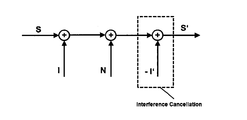
  • the idea behind the concept of interference cancellation and interference suppression is that the effective signal to interference power ratio in the receiver can be increased if the interference fraction of the received signal can be removed or suppressed in the receiver.In order to achieve this,the knowledge of the type and strength of the interference is beneficial.
  • Figure4 illustrates the basic concept of interference cancellation in the receiver.
  • a signal S is generated by the receiver and transmitted over a channel.
  • interference I and noise N This results in a disturbed signal which is inputted to a receiver and which may lead to some bit errors in the demodulator.
  • interference cancellation (marked by a dashed rectangle in Fig.4)may be applied.
  • an interference estimation I’available in the receiver is used to recover signal S’which is further used as an input for the demodulator reducing therewith the bit error rate.
  • the recovery is achieved by subtracting the estimated interference signal I’form the received signal S+N+I.
  • the performance of interference cancellation strongly depends on the accuracy of the interference estimation I’.In case of a very inaccurate interference estimation which corresponds to a large difference between I and I’,it could even result in an increased disturbance of the demodulator input yielding an increased bit error rate.
  • the interference I is determined by a combination of some transmission(interference) parameters.
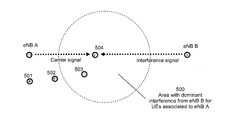
  • Figure5 shows a typical scenario with interference from a single dominant interfering cell.
  • UEs 501,502,503and504 are served by an eNB A and experience interference from eNB B.
  • UE 501and UE502 experience weak interference from eNB B since they are far away from the interference source(eNB B),while UE503and UE504experience strong interference from eNB B.
  • the dashed circle500 indicates the area,in which the interference from the eNB B is dominant for the terminals served by the eNB A.For the purpose of improving the reception quality in the terminals located within the area500,the interference cancellation and thus also the accuracy of the interference estimation may be essential.
  • the parameters in an LTE system which influence the interference(interference parameters) comprise
  • the amount of required interference information depends hereby on the receiver type.
  • the receiver types investigated at3GPP range from receivers that suppress the interference by means of spatial filtering of the sum signal to receivers that perform the complete decoding of code words transmitted by the interference source.
  • a receiver that performs merely an interference suppression by means of spatial filtering of the received signal (e.g.E-LMMSE-IRC in the NAICS technical report,Section7.2)requires only information about the effective interference channel(including precoding on the interference transmitter side)per spatial layer,while information about modulation and coding scheme, redundancy version,etc.are not required.
  • the interference parameters are estimated within the receiver by means of hypothesis testing.This approach does not involve any network assistance but constitutes increased computation complexity in the receiver. Depending on which parameters have to be determined,the additional complexity can be significant. The advantage of such an approach is that no additional signalling is required.
  • the interference parameters are determined in the receiver by listening to existing control signals from the interfering cell itself.This does not require any additional network assistance since the transmission parameters of the interfering signal are anyway already provided to UEs associated to the interfering eNB.
  • the disadvantage of this approach is that the UE has to be able to receive signals from both serving and interfering eNB in parallel.It furthermore requires a significant amount of blind detection of signals from the interfering cell which increases the implementation complexity of the receiver.
  • Interference information is provided to the interference victim UE by the serving eNB by means of downlink control messages on MAC layer or above.
  • the serving eNB has knowledge of the transmission parameters used in the interfering cell due to backhaul communication.Due to the latency involved in higher-layer signalling,the approach can only be applied for interference parameters that do not change frequently.
  • Interference information is provided to the interference victim UE by the serving eNB by means of downlink control signalling on the physical layer.
  • the serving eNB has knowledge of the transmission parameters used in the interfering cell due to backhaul communication.
  • the interference information can be updated more frequently if the backhaul connection between serving and interfering eNB meets the required delay and capacity needs.
  • a crucial precondition of this approach is a backhaul connection with sufficient capacity and latency.
  • the preferred use case would therefore be intra-site coordination or coordination for remote radio heads(RRH).
  • This invention provides a solution for providing information regarding interference parameters to the receivers by means of explicit signalling of interference parameters or sets of interference parameter candidates.
  • the interference information is provided by means of L1signalling from the serving eNB to the controlled device(such as a terminal,DCI receiving device).
  • Preferred embodiments of the present invention are the subject matter of the dependent claims.
  • the particular approach of the present invention is to provide the interference parameters within a downlink control information.Based on the interference parameters,the receiving device can estimate the interference and employ the estimate in cancellation procedure.
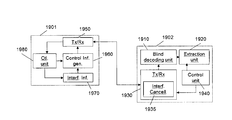
  • an apparatus for receiving data from a serving base station in a cellular communication system, the apparatus comprising: a blind decoding unit for identifying and decoding a downlink control information transmitted by the serving base station,an extraction unit for extracting from a first field of the downlink control information a scheduling control information and from a second field of the downlink control information an interference information,and a transceiver for receiving or transmitting data on resources specified by the scheduling information while taking into account the interference information so as to reduce the interference caused by transmitters other than the serving base station.
  • an apparatus for transmitting data to a receiving device in a cellular communication system,the apparatus being a serving base station for the receiving device,comprising:an interference information determining unit for determining the interference experienced by the receiving device caused by transmitters other than the serving base station, a control information generation unit for generating a downlink control information including a first field including a scheduling control information and a second field including the interference information,and a transmitter for transmitting to the receiving device for blind decoding the generated downlink control information,and for receiving or transmitting data from/to the receiving device on resources specified by the scheduling information.
  • a method for receiving data from a serving base station in a cellular communication system comprising the steps of: blind decoding for identifying and decoding a downlink control information transmitted by the serving base station,extracting from a first field of the downlink control information a scheduling control information and from a second field of the downlink control information an interference information,and receiving or transmitting data on resources specified by the scheduling information while taking into account the interference information so as to reduce the interference caused by transmitters other than the serving base station.
  • a method for transmitting data to a receiving device in a cellular communication system comprising:determining the interference experienced by the receiving device caused by transmitters other than the serving base station,generating a downlink control information including a first field including a scheduling control information and a second field including the interference information,and transmitting to the receiving device for blind decoding the generated downlink control information,and for receiving or transmitting data from/to the receiving device on resources specified by the scheduling information.
  • the scheduling information is a first scheduling information which indicates transmission parameters for a first transport block of data. Then in the second field of the downlink control information either the interference information or a second scheduling information which indicates transmission parameters for a second transport block of data is conveyed.
  • the scheduling information of the first field of the downlink control information is a first scheduling information which indicates transmission parameters for a first transport block of data
  • the second field of the downlink control information conveys either the interference information and a reduced second scheduling information which indicates transmission parameters for a second transport block of data or only a complete second scheduling information which indicates transmission parameters for a second transport block of data.
  • the first and the second field may have the same sizes,each of the first and the second field may include a modulation and coding scheme subfield for indicating modulation and coding scheme(MCS),and the modulation and coding scheme subfield of the first field may be larger than the modulation and coding scheme subfield of the second field.
  • MCS modulation and coding scheme
  • a switching message may be provided on a protocol layer higher than the physical layer,the switching message indicating the format of the second field,namely whether or not the second field is to carry the interference information.
  • a switching indication is provided on the physical layer,and the switching indication indicates the format of the second field,namely whether or not the second field is to carry the interference information.
  • the switching indication within a3GPP LTE Release-11 downlink control information message,in the resource allocation header field while it is assumed that Type0allocation applies.
  • the resource allocation header interpretation is configured semi-statically by a layer higher than the physical layer,wherein the resource header is interpretable either as indicating Type0or Type1allocation or as indicating the switching indication.
  • the switching indication is conveyed within the second field in that at least one codepoint among all possible values defined by a subset of bits of the second field indicates that the interference information is transmitted in the second field and all codepoints other than said at least one codepoint indicate that the interference information is not transmitted in the second field.
  • the subset of bits takes either the value of said at least one codepoint or another value indicating redundancy version for the second transport block.
  • the downlink control information may include a resource block assignment field and can take any of the following formats:i)the resource block assignment field indicates resource assignment for the transmission,for which the scheduling information is transmitted;or ii)the resource block assignment field includes a first subfield(1580)indicating resource assignment for the transmission,for which the scheduling information is transmitted,and a second subfield (1590)indicating whether or not the interference information in the second field is to be applied for interference cancellation for the respective resources specified in the first subfield(1580).
  • the second subfield(1690)of the resource block assignment field indicates for the respective resources assigned in accordance with the first subfield whether a first interference information or a second interference information is to be applied to said respective assigned resources,and the second field includes a first subfield indicating the first set of interference parameters and a second subfield indicating the second set of interference parameters.
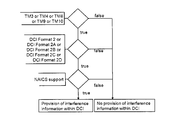
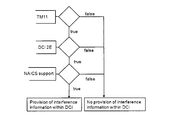
  • a control information may be provided carrying a transmission mode,wherein the transmission mode can take a value which defines that the apparatus is to extract from the downlink control information the interference information as well as values which do not define that the apparatus is to extract the interference information from the downlink control information.
  • the decision on whether or not to provide the interference information within the downing control information may be performed in a transmitter of the DCI(such as the serving base station) based on measurements of a reference signal,reported to the apparatus by the receiving device and/or based on load information of an interfering base station.
  • a computer program product comprising a computer-readable medium having a computer-readable program code embodied thereon is provided,the program code being adapted to carry out the present invention.
  • the above apparatus is embodies on an integrated circuit.
  • Figure1 is a block diagram illustrating an example of physical layer processing of four services in a digital broadcast system
  • Figure2 is a schematic drawing illustrating an example of a grid of OFDM modulation resources in time and frequency domain
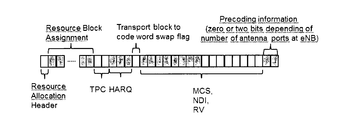
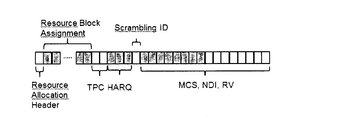
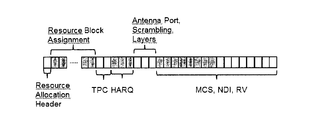
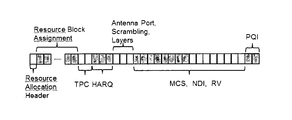
  • Figures3A to3E are schematic drawings illustrating respective DCI formats2,2A,2B,2C and 2D as used in LTE;
  • Figure4 is a block diagram illustrating interference cancellation at the receiver
  • Figure5 is a schematic drawing illustrating different interference scenarios for terminals in the proximity of two base stations
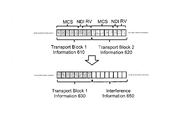
  • Figure6 is a schematic drawing illustrating mapping of the interference information on a DCI with format supporting two transport blocks
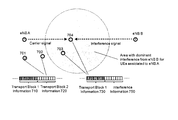
  • Figure7 is a schematic drawing illustrating inclusion of interference information into the DCI depending on the interference conditions of the terminals
  • Figure8 is a schematic drawing illustrating switching between two formats of the DCI
  • Figure9 is a schematic drawing illustrating switching between two formats of the DCI by means of the resource allocation header
  • Figure10 is a schematic drawing illustrating transmission of interference parameter for terminals affected by strong interference
  • Figure11 is a schematic drawing illustrating transmission of interference parameter for terminals affected by strong interference
  • Figure12 is a schematic drawing illustrating state transitions for signaling the interference parameters as shown in Figures9and10;
  • Figure13 is a schematic drawing illustrating transmission of interference information within a portion of the MCS field of the scheduling information for the second transport block
  • Figure14 is a schematic drawing illustrating switching between two formats of the DCI by means of the redundancy version field
  • Figure15 is a schematic drawing illustrating utilization of unused resource block assignment bits in case of lower granularity of resource block assignment
  • Figure16 is a schematic drawing illustrating utilization of unused resource block assignment bits in case of lower granularity of resource block assignment for controlling transmission of plural sets of interference information
  • Figure17 is a schematic drawing illustrating relation between transmission modes and the transmission of interference information
  • Figure18 is a schematic drawing illustrating relation between transmission modes including a new transmission mode and the transmission of interference information
  • Figure19 is a block diagram illustrating some apparatuses according to the present invention.
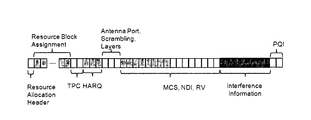
  • Figure20A and20B is a schematic drawing illustrating new DCI formats supporting transmission of interference information.
  • the present invention addresses the support of interference cancellation and suppression by means of network assistance.
  • Interference cancellation and suppression on the UE side can significantly increase downlink user throughput due to increased PDSCH SINR.Knowledge of interference parameters is required on UE side for performing effective interference cancellation and suppression.
  • the interference may be an inter-cell interference as illustrated on Figure5.
  • a UE is served by a serving node(e.g.a base station, such as eNB for LTE system) and is exposed to interference from another node such as another base station controlling another respective cell.
  • a serving node e.g. a base station, such as eNB for LTE system
  • another node such as another base station controlling another respective cell.
  • the source of interference does not necessarily has to be a network node such as eNB.Rather,the interference may be generated also by relays or even by other terminals(especially in the uplink for the LTE),or by parallel transmissions to other receivers from the serving node itself.
  • the present invention provides a strategy for transmitting information concerning transmission parameters used in interfering neighbouring cells and resulting in interference with the transmission between the victim UEs and the serving node.
  • the victim UEs(UEs subjected to interference) may use this information for performing interference cancellation or suppression.
  • the term“cellular system”or“cell” refer to any arrangement of a cell including macro cells,micro cells,pico cells,femto cells or any other concepts.
  • the inter-cell interference may be also caused by hierarchically organized cells such as a macro cell including an area of a pico cell.
  • a relay(which may also be a user terminal providing a relay function)coverage may also form a cell.
  • the interference to be suppressed may also be caused by interfering with other terminals.
  • the invention describes different strategies for providing the interference information together with PDSCH scheduling information for the interference victim UE within a single downlink control information(DCI)format. This can be achieved by reusing certain bits of existing LTE Release-11DCI formats or by introducing one or more new DCI formats.
  • transmission parameters of the serving eNB are transmitted to the UE in form of downlink control information(DCI)that is transmitted in physical downlink control channel(s) (PDCCH)or enhanced physical downlink control channels(E-PDCCH).
  • DCI downlink control information
  • PDCCH physical downlink control channel
  • E-PDCCH enhanced physical downlink control channels
  • One approach could be the introduction of a new DCI format that contains only the interference information from a neighbouring cell(or another interferers).However,using such an approach would mean that the interference victim UE(UE affected by the interference)has to receive two PDCCHs or EPDCCHs;one conveying the DCI with the PDSCH allocation information and an additional one conveying the DCI that contains the interference information.
  • DCI formats already defined in the LTE specification3GPP TS36.212,v12.0.0,December2013, Section5.3.3.1,could be extended by bits that are used for the provision of interference information.
  • the advantage compared to introducing a new DCI would be that no additional blind detection and decoding of PDCCHs or EPDCCHs is required since both PDSCH allocation information and interference information are provided within a single DCI format.
  • the problem that has to be solved is the provision of interference information by the serving eNB in form of L1signalling by meeting following design targets:
  • the signalling solution should introduce as little as possible additional signalling overhead in form of required CCEs/ECCEs.
  • Interference information should only be provided to the UE when it is necessary.This requirement correlates with the need for minimization of control overhead.
  • the interference information is provided together with PDSCH scheduling within the same DCI format.
  • a method for receiving data from or sending data to a serving base station in a cellular communication system.
  • the method is performed at a receiving node such as a terminal and applies blind decoding for identifying and decoding a downlink control information DCI transmitted by the serving base station.
  • a step of extracting from a first field of the downlink control information scheduling control information and from a second field of the downlink control information an interference information is performed.
  • the receiving node receives or transmits data on resources specified by the scheduling information while taking into account the interference information so as to reduce the interference caused by transmitters other than the serving base station.
  • the term“blind decoding” refers to decoding of data transmissions without prior knowledge of corresponding transmissions parameters such as allocated resources and transport format (i.e.DCI format).
  • the number and/or the location of control channel elements(CCEs) used for the PDCCH transmissions is not known to the terminals in advance.
  • a terminal tries to blindly decode the incoming control information assuming different combinations of CCEs and checking for the CRC. If the CRC matches,the terminal concludes that the PDCCH was directed to it and that the control information was decoded correctly.If the CRC does not match,then the terminal detects another location of CCEs.
  • LTE uses a so-called search space for each terminal. The search space determines the combinations of CCEs that the terminal needs to monitor for a possible control information.
  • the transmitters other than the serving base station/ network node may be other base stations or relays or even other terminals.
  • This approach enables reusing bits within DCI formats which exist already in LTE Release-11, for the purpose of providing interference information to UEs.
  • the DCI formats that are used for the provision of interference information are the ones that are used in Release-11for indicating PDSCH allocations with two transport blocks.
  • a transport block conveys a single code word with individual channel coding.
  • the scheduling of two transport blocks is used in LTE for transmissions on multiple spatial layers.
  • the mapping of code words to transport blocks and the mapping of transport blocks to spatial layers is defined in Section 5.3.3.1of the LTE specification3GPP TS36.212v12.0.0,December2013,and Section6.3.3of the LTE specification3GPP TS36.211v12.0.0,December2013,respectively.
  • DCI format2 includes resource allocation header having a length of one bit,followed by resource block assignment field(RBA).
  • RBA is a bitmap specifying for each(group of)PRBs whether the resources are assigned to the controlled node(such as terminal)or not.
  • the DCI format2further includes a TPC(transmission power commands) information,HARQ configuration(process number),transport block to codeword swap flag for assigning the two transport blocks to codewords,and the scheduling information specific for each of the two transport blocks.
  • the transport block specific scheduling information comprises eight bits and comprises modulation and coding scheme(MCS)indication,new data indicator (NDI)and redundancy version(RV)indication.
  • the precoding information is signalled, which has a length of three or six bits depending in the number of antenna ports at the eNB and includes,for instance,rang indicator(RI)or the presiding matrix indicator(PMI).
  • Figure3B shows DCI format2A,which differs from the DCI format2in particular by shorter precoding information having zero or two bit length,depending in the number of antenna ports.
  • Figure3C illustrates DCI format2B which includes,apart from the resource allocation header, RBA,TCP and HARQ information and the scheduling information for the two transport blocks,a scrambling identity.
  • Figure3D illustrates DCI format2C,,which differs from the format2B in particular by including information concerning antenna ports,scrambling identity and number of layers.
  • Figure3E illustrates DCI format2D which,in addition to elements described with reference to format2C,includes PQI(PDSCH Rate Matching and QuasiCoLocation Indicator)to inform the UE about the transmitting point or set of transmitting points.
  • a new DCI format may be defined alternatively,with the feature that it includes interference information within the second field.
  • the scheduling information extracted from the first field of the downlink control information is a first scheduling information which indicates transmission parameters for a first transport block of data.
  • the second field includes either the interference information or a second scheduling information which indicates transmission parameters for a second transport block of data.
  • a UE can be scheduled
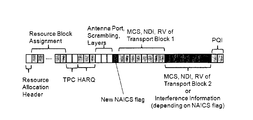
  • Figure6 shows how the bits for one of the two transport blocks within a DCI format are used for providing interference information. The interpretation of the remaining bits of the DCI format is not changed.In particular, Figure6shows the contents of the first field610of the downlink control information. The first field610carries scheduling information for the first transport block.
  • the scheduling information contains modulation and coding scheme,new data indicator and redundancy version.
  • the contents of the second field620 includes the same type of scheduling information(MCS,NDI,RV)for the second transport block.Thus,the first field610and the second field620correspond to the current LTE DCI format.This format is advantageously further applied for terminals which experience rather low interference,e.g.interference which does not exceed a predefine threshold.If the terminals experience a high interference,e.g.
  • the format of the DCI’s in this embodiment corresponds to the first field630and second field650.
  • the first field 630 includes scheduling information for the first transport block.
  • the length of the fields610,620, 630,and640 is the same.
  • the second field650does not include the information related to the second block,but rather the interference information for the receiving device.
  • the interference information enables the receiving device to perform estimation of the interference and thus,to cancel or suppress the interference as illustrated in Figure4.
  • the effect of this approach is that a UE can only be provided with interference information if a single transport block is scheduled. If two transport blocks should be scheduled for the UE, interference information is not provided.
  • Figure7 shows the application of the basic concept in a typical NAICS scenario with inter-cell interference.
  • the figure shows four different UE positions(701,702,703and704)where UEs at positions701and702do not experience strong inter-cell interference,while UEs at positions 703and704are affected by strong interference.
  • Sece efficient interference cancellation or suppression of high interference power levels depends on the ability to obtain accurate interference estimations(I’in Figure4),it is reasonable to provide interference information only to UEs at positions703and704.
  • Interference information is not required since the interference power level is very low and does hence not justify the use of interference cancellation,which requires additional computational capacity and thus also power.
  • the implied restriction of the present embodiment namely that UEs at positions703and704 cannot be scheduled for two transport blocks, is not expected to affect the system performance in a negative way.
  • the scheduling of two transport blocks is used in LTE for transmissions on multiple spatial layers.Transmissions on multiple spatial layers are most beneficial in case of high SINR level,which corresponds to UEs located in the proximity of the cell-centre and thus experience low interference power levels.On the other hand,the UEs located in the proximity of the cell edges experience high interference power levels and would thus rather be scheduled with single layer transmission in order to maximize the SINR.
  • Figure8 shows an example of switching between DCI format interpretation states.
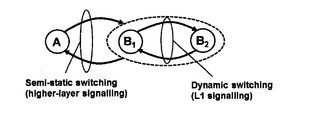
  • Figure8 illustrates that the downlink control signalling for a UE configured for NAICS support can therefore be described by two states:state A in which DCI scheduling information is provided for two transport blocks and without interference information(610,620),and state B in which DCI scheduling information is provided for a single transport block630and in addition,the interference information650is included.
  • the switching may be performed by means of higher-layer signalling or by means of a dynamic indication within DCI formats.
  • the switching message is received on a protocol layer higher than the physical layer,and the switching message indicates the format of the second field, namely whether or not the second field is to carry the interference information.
  • the switching message may have any format,which enables to indicate whether or not the interference indication is to be included in the DCI.
  • the switching message can be transmitted only if the DCI format(in particular,the fact whether or not the DCIs for the particular UE are to include the interference information)changes.
  • such switching message may be transmitted if the interference conditions of the receiving device change. The change may correspond to increase of the interference,so that it becomes useful/necessary to transmit the interference information. The change may also correspond to decrease of interference,so that it becomes unnecessary to transmit the interference information.
  • the present invention is not limited to reusing the old DCI format.
  • a new DCI format which includes the interference information.
  • uch new DCI format may beneficially include information for a first transport block and the interference information as illustrated in Figure6(630,650)and not include information for a second transport block.
  • This enables definition of a new DCI with similar field sizes as the currently used DCIs. The dynamic switching between both states could be indicated by a new additional bit in the DCI format.
  • the new DCI may also have a different format.
  • the interference information may be added to the DCI.
  • the DCI may include the scheduling information relating to both transport blocks and in addition thereto a new field for carrying the interference information(interference parameters).It is noted that such additional interference information field may have any size,in accordance with the interference parameters to be transmitted. The size may be fixed with a predefined number of bits.With the new DCI defined, the switching would not require dynamic switching since scheduling information for two transport blocks and interference information can be provided within the same DCI format.
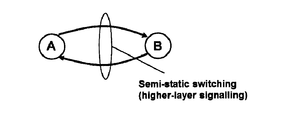
  • Figure8 illustrates an embodiment of the present invention,according to which the switching between the two states A and B is performed in a semi-static fashion by means of a higher-layer signalling, e.g.by means of MAC or RRC messages.
  • a new element may be added into an already defined MAC or RRC message.
  • RRC Connection Reconfiguration described in Section5.3.5of1of the LTE specification3GPP TS36.331 v12.1.0,March2014.
  • a new MAC or RRC message could be defined for indicating NAICS support by the serving eNB.
  • the decision on state change can be made for example based on reference signal received power(RSRP)or RSRQ measurements of neighbouring cells.
  • RSRP is a linear average of reference signal power over a specified bandwidth.It is usually measured by the UE for the purposes of cell selection,reselection and handover. The UE measures the power of the pilot signals(reference signals transmitted with a predefined power). The measurement result is reported to the serving node.
  • the RSRQ measurement provides additional information and is the ratio between the RSRP and the Received Signal Strength Indicator(RSSI),and depending on the measurement bandwidth,means the number of resource blocks.
  • RSSI is the total received wideband power including all interference and thermal noise.As RSRQ combines signal strength as well as interference level,this measurement value provides additional help for mobility decisions as well as a mean for roughly estimating the interference level.RSRQ measurement results are also signaled to the serving node.Details to RSRP and RSRQ can be found in the LTE specification3GPP TS36.
  • a switching indication on the physical layer is provided,wherein the switching indication indicates the format of the second field,namely whether or not the second field is to carry the interference information.
  • the switching indication lay be signalled directly within the corresponding DCI.
  • the switching between the two states A and B is indicated within the DCI format itself. This can be achieved by either introducing a new bit that will be used for indicating the state,or by assigning for this purpose a bit within the existing DCI format(s).
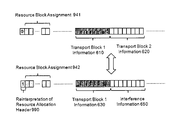
  • Figure9 shows the reuse of resource allocation header of DCI formats2,2A,2B,2C and2D.
  • the resource allocation header in these DCI formats is currently used in Release-11LTE for the purpose of switching between two allocation types:
  • -Type0:A bitmap indicates resource block groups(RBGs)that are allocated to the scheduled UE.
  • RBGs consist of respective sets of consecutive physical resource blocks (PRBs).
  • -Type1:Individual PRBs can be addressed within a subset of PRBs.
  • the bitmap is slightly smaller than for Type0since some bits are used to indicate the subset of PRBs.
  • the motivation for providing this method of resource allocation is flexibility in spreading the resources across the frequency domain to exploit frequency diversity.
  • Figures10and11 for the case with high and low traffic load in the interfering eNB B, respectively.
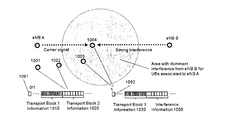
  • Figure10 shows terminals1001and1002which do not experience high interference.Terminals1003and1004are within the area with dominant interference from the eNB B.Thus,it is beneficial when terminals1003and1004are provided with interference parameters corresponding to the transmission configuration of the eNB B in order to be able to estimate the interference and apply interference cancellation.
  • Thus,terminals1001and1002 are provided with scheduling information concerning two transport blocks1010and1020.
  • the resource allocation header1091 is applied as envisaged in current Release-11LTE,namely to signal Type0or Type1as explained above.
  • terminals1003and1004require transmission of interference information they are provided with DCI including scheduling information for only one transport block1030and with interference parameters1050.This interpretation of the first and second field is signalled by setting the resource allocation header 1092to1.
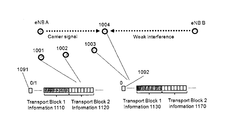
  • Figure11 shows a case in which the interference from the eNB B is not significant,so that terminals1003and1004also do not require the provision of interference information.
  • the DCI for terminals1003and1004 includes resource allocation header set to0meaning that the first field1130as well as the second field1170carry scheduling information related to the respective transport blocks.
  • UE1001and UE1002 are not configured for NAICS support since they are not expected to experience strong interference from eNB B(e.g.based on RSRP measurements as described above)even in case of high traffic load. These UEs can always be scheduled with two transport blocks resource and resource allocation based either on Type0or Type1.
  • UE1003and UE1004 are potential interference victims of eNB B in case of high traffic load in the corresponding cell.
  • the fact that these UEs are potential interference victims can for example be determined by means of RSRP measurements as described above for the higher layer signalling example.
  • this means that PDSCHs for these UEs can only be scheduled with resource allocation Type0and the DCI format provides either scheduling information for two transport blocks or scheduling information for a single transport block plus interference information.
  • two transport blocks can be scheduled if the SINR level is high due to low traffic load at eNB B,assuming it is the dominant cause for interference.
  • the serving eNB A can be informed about the traffic load at eNB B via backhaul signalling between both eNBs,for example by a corresponding extension of the X2interface defined in the LTE specification3GPP TS36.432v12.1.0,March2014.If the traffic load is high,the UE could be scheduled for single transport block transmissions in combination for the provision of interference information.
  • the dynamic switching between the two possibilities for UE1003and UE1004 is beneficial in case of fast fluctuations of the traffic load which is for example prevailing in case of FTP traffic assumptions.
  • the downlink control signalling for a UE configured for NAICS support can therefore be described by three states:state A with no provision of interference information and possible scheduling of two transport blocks with resource allocation based on Type0and Type1; state B1with scheduling of two transport blocks with resource allocation based on Type0 without interference information;and state B2with scheduling of a single transport block with resource allocation based in Type0and with interference information.
  • the switching indication is received in this embodiment within a3GPP LTE Release-11downlink control information message,in the resource allocation header field,while it is assumed that Type0allocation applies.
  • the resource allocation header interpretation is configured semi-statically by a layer higher than the physical layer,wherein the resource header is interpretable either as indicating Type0or Type1allocation or as indicating the switching indication.
  • the higher layer signalling may be MAC or RRC.
  • Figure13 illustrates another alternative to the approach illustrated in Figures11and12.
  • Figure13 shows a variant for the dynamic switching between providing interference information or not,by means of reinterpretation of the resource allocation header bit in the DCI format2,2A,2B,2C or2D of Release-11LTE.
  • the scheduling of two transport blocks in this alternative is possible even in combination with the provision of interference information.
  • the dynamic switching may be applied also in this embodiment.However, it is noted that the format of the second field1350,1370as shown in Figure13may also be applied without dynamic switching. The switching may be semi-static by higher layer protocols.
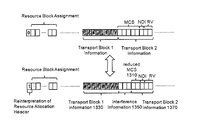
  • the scheduling information extracted from the first field of the downlink control information is a first scheduling information1330which indicates transmission parameters for a first transport block of data.
  • the second field of the downlink control information includes either the interference information1350together with a reduced second scheduling information1370 which indicates transmission parameters for a second transport block of data or only a complete second scheduling information which indicates transmission parameters for a second transport block of data.
  • the first and the second field have the same sizes,each of the first and the second field includes a modulation and coding scheme subfield for indicating modulation and coding scheme(MCS),and the modulation and coding scheme subfield of the first field is larger than the modulation and coding scheme subfield of the second field.
  • MCS modulation and coding scheme subfield for indicating modulation and coding scheme
  • the MCS field is reduced in order to enable within the same DCI to signal both,the interference parameters and the information concerning second transport block.It is noted that shortening the MCS is nly an example.In general,any information such as RV may be shortened alternatively or in addition to the MCS field.
  • the scheduling flexibility of Transport Block2 is reduced;the original allocation of five bits for indicating the modulation and coding scheme(MCS)is reduced fraction of these five bits(e.g.two bits in the example shown in13).
  • This reduced number of bits for the MCS indication could for example be used for indicating the MCS level by means of differential indication compared to the MCS level of Transport Block1assuming the same MCS table for Transport Block1and Transport Block2as defined in Section7.1.7of the LTE specification3GPP TS36.213v12.0.0,December2013..Two bits for the differential MCS indication would support four levels and three bits would support eight levels.More bits for the differential would provide even more flexibility,but the benefits are expected to be negligible.
  • Figure14 shows another variant for the dynamic provision of interference information within DCI format2,2A,2B,2C and2D.
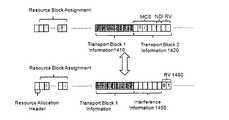
  • the switching between DCI format interpretations is not indicated by the reinterpretation of the resource allocation header bit,but by a certain code point of the redundancy version(RV)field for Transport Block2.
  • Figure14 shows on the top the transmission of the DCI with the scheduling information1410for the first transport block and the scheduling information1420for the second transport block.
  • the last two bits of the scheduling information1420 are formed by redundancy version which thus may take values00,01,10,and 11.Since the RV in the field1420has a value different from a predefined value(here the codepoint01),the field1420is interpreted as the scheduling information for the second transport block.
  • the redundancy version1480of the second field 1450 has the value of01,which corresponds to the predefined value and indicates in this embodiment that the second field1450is to be interpreted
  • the switching indication is signalled within the second field in that at least one codepoint among all possible values defined by a subset of bits of the second field indicates that the interference information is transmitted in the second field and all codepoints other than said at least one codepoint indicate that the interference information is not transmitted in the second field.
  • the subset1480of bits can take either the value of said at least one codepoint(e.g.10in1450)or another value indicating redundancy version for the second transport block(e.g.RV in1420).However,it is noted that usage of the redundancy version is only an example.
  • a codepoint of another subset of bits of the second field1450 may be taken for signaling the presence of the interference information.For instance,one or more codepoints may be reserved for this purpose in the modulation and coding scheme field MCS.This may be also the case in the embodiment described with reference to Figure13,for the reduced MCS field.In such a case,the resource block header in Figure13 would not need
  • the RV field is used in LTE Release-11for selecting different redundancy versions of a code word for HARQ transmissions;four different redundancy versions are supported and may be employed as in the present embodiment.
  • a certain RV field code point(e.g.01in Figure14, but generally any of the points00,11,01,11)of Transport Block2could be used for indicating the provision of interference information instead of scheduling information for Transport Block2.
  • FIG.15 Another variant of the present invention is shown in Figure15.
  • the term“switching indication”does not necessarily mean that the indication indicates change of the format.
  • the switching indication may indicate the format applicable(switched)for the current DCI.
  • the present invention is not limited thereto and the switching indication may also indicate whether the format is to be changed or not. The same applies for the switching message transmitted by higher layers and described above.
  • the RBA field of the DCI represents a bitmap that indicates the set of resource block groups(RBGs)which are allocated for the PDSCH transmission indicated in the DCI.
  • RBG constitutes a set of consecutive physical resource blocks(PRBs),and the RBG size,which may be1,2,3or4 PRBs,depends on the downlink bandwidth as shown in the following Table1:
  • Table1 shows furthermore how the resource allocation granularity would be reduced for resource allocations to an UE that is configured for NAICS support.
  • the reduced allocation granularity entails the possibility to use a bitmap with half the size of the original RBA field in the current DCI for allocating PRBs for PDSCH transmissions.
  • the other half of the RBA field is used for indicating the resource block allocation of the interference transmission that adheres to the provided interference parameter information by means of an interference resource allocation bitmap.
  • Figure15 shows reinterpretation of resource allocation header as described above for distinguishing whether or not the interference information is transmitted with the current DCI.
  • this embodiment may also be applied without dynamic indication by means of higher layer configuration so that the resource allocation header maintains its usual meaning.
  • the present embodiment may also be combined with the previous embodiments described with respect to Figures13and14.Thus,the switching indication may be transmitted within the second field and/or the second field may include both the interference information as well as the scheduling information.
  • the resource allocation header with length of one bit is followed by resource block assignment(RBA)field.
  • the top part of Figure15 shows RBA field as currently used in LTE.
  • the bottom part of Figure15 illustrates an example in which the RBA field includes a first subfield1580for carrying the allocation block assignment for the transmission defined further in the first field(“Transport Block1Information”in the figure)and a second subfield1590for carrying Interference Resource Block Assignment,i.e.a bitmap in which for each resource group pair(cf.table
  • the resource block assignment field includes a first subfield1580indicating resource assignment for the transmission,for which the scheduling information is transmitted,and a second subfield1590indicating whether or not the interference information in the second field is to be applied for interference cancellation for the respective resources specified in the first subfield1580.
  • an interference cancellation unit in the transceiver of the DCI receiving apparatus may be controlled by the interference resource block assignment1590(i.e. by the second subfield)to apply or not interference cancellation for the respective resources addressed by the bits of the first subfield.
  • interference resource allocation bitmap is used for distinguishing two different sets of interference parameters in the interfering cell per resource allocation unit;the latter is determined based on the resource allocation granularity for NAICS given in Table1.
  • the bit field for Transport Block2could then be separated into two parts;one for indicating interference parameters of the first set,and a second one for indicating interference parameters of the second set.
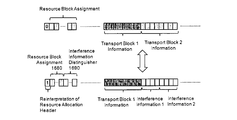
  • the concept is depicted in Figure16.
  • the top part of Figure16 corresponds to the top part of Figure15.
  • the bottom part shows the resource block assignment field which includes two subfields1680,1690.
  • a first subfield1680 corresponds to the subfield 1580described with reference to Figure15,it indicates the resource block assignment.
  • the first subfield1580 carries a bitmap with each bit indicating whether a respective resource portion is assigned or not.
  • the size of the portion addressed by one bit is given by the RBG size and the granularity applied in the NAICS mode.In the case of Table1,row2for instance,each bit would refer to two RBGs,each of which consisting of two PRBs.
  • the second subfield1690of the resource block assignment field is an Interference Information Distinguisher and indicates for the respective assigned resources whether a first or a second interference information included in the second field is to be applied for the respective assigner resources.
  • the second field of the scheduling information carries two sets of interference information(“Interference Information1”and“Interference Information2”).
  • the interference cancellation unit part of a transceiver of the DCI receiving apparatus,applies either interference information1or interference information2for the purpose of interference estimation.
  • the first interference information may include a first set of interference parameters applicable to a CRS based transmission(of the interferer)and the second information may include a second set of interference parameters applicable to DMRS based transmission.
  • the Cell-Specific Reference Signals(CRS)and Demodulation Reference Signals(DMRS) are reference signals used in LTE.In a CRS based transmission, the CRS is merely a reference signal,so that no information on precoding is available based on CRS.
  • the precoding information (such as precoding matrix and rang indicator)is to be transmitted separately.Since the precoding information related to the interferer(such as eNB B)also improves the estimation of interference,it makes sense when the first interference parameter set also includes the precoding information.
  • DMRS is a reference signal which also carries information about the precoding and in particular the phase resulting from the applied precoding matrix of the data transmitted.Accordingly,for the DMRS based transmission,no information concerning precoding is necessary.
  • the second set of interference parameters are
  • interference sets may also be structured in another way.
  • the embodiment described with reference to Figure16 can be further extended by providing more sets of interference parameters in the respective more subfields of the second field.This would be enabled for higher granularities.
  • the resource block assignment would include the first subfield for resource assignment and then a second subfield with2or more bits for indicating the set of interference parameters to be applied.
  • Table2 Sub-band size for aperiodic CQI reporting
  • variant C could also be combined with the state switching based on the RV field interpretation described above with reference to Figure14.It could furthermore be combined with the reduced MCS concept described with reference to Figure13.
  • the proposed signalling concept for the provision of interference information addresses all the above described design targets in an efficient manner.
  • the provision of interference information can be provided in combination with a large variety of different transmission schemes.It allows therefore a significant degree of freedom of transmission schemes for UEs that makes use of NAICS support.
  • the interference information is provided by means of reusing bits within a DCI format that will most likely anyway not be used for scheduling PDSCHs for UEs that can benefit from interference cancellation or suppression.
  • the proposed signalling concept furthermore allows for fast switching between provision of interference information and possibility to schedule two transport blocks.
  • the interference parameters that could be provided to the UE within the DCI format could be a subset of the parameters described above.This could be for example be a simple indication whether PDSCH transmission are scheduled for reception based on DMSR or CRS in the interfering eNB;in case of the CRS based transmission,the corresponding PMI(precoding matrix indicator)and RI(rank indicator)could be indicated as well within the interference information since the precoding of the PDSCH is given by a code book entry given by PMI and RI,and the CRS as reference for the precoding.
  • PDSCH receptions based on DMRS do not require the indication of a precoder(e.g.based on a code book)since the UE directly determines the precoder by measuring the DMRS.It could furthermore be reasonable to indicate the modulation order used on the interfering PBRs.
  • interference transmission parameters such as PMI and RI
  • certain predefined sets of interference parameter combinations The determination of the exact interference parameters would then be determined by means of blind detection on a reduced set of hypotheses. The benefit would be a reduced blind detection complexity.
  • a precondition for indication interference parameters to the interference victim UE without additional information on the PRB allocation of the interference together with the PDSCH allocation for that UE in the same DCI is the assumption that the interference allocation in terms of allocated PRBs coincides with the PRB allocation of the interfered PDSCH.
  • This can be achieved by coordinated resource allocation between neighbouring eNBs,for example by means of scheduling restrictions as they are currently discussed at3GPP RAN1within the scope of NAICS.More flexibility in the resource allocation of the interfering cell can be facilitated by utilizing the concept described with reference to Figures15and16.
  • the present invention is not limited to Release-11LTE.It is applicable to any communication system in which the terminals served by a base station may suffer interference from other transmitters.Nevertheless,the present invention may readily be applied to the3GPP LTE.Accordingly,in the following,some more details are provided for incorporating the present invention into the existing parts of the standard.In order to embody the present invention into the existing provisions of the standard,Transmission Modes defined in Release-11may be used.
  • Figure17 shows a flow chart describing the PDSCH allocation in combination with providing interference information for Release-11transmission modes that support scheduling of two transport blocks;which are TM3,TM4,TM8,TM9and TM10as described in3GPP TS36.213 v12.0.0,December2013,Section7.1.
  • a UE is configured for a single transmission mode per cell.Each of the transmission modes supports two transmission schemes that are distinguished by blind detection of the DCI format used for providing PDSCH scheduling information to the receiving UE.
  • the DCI formats that are used for scheduling two transport blocks are DCI format2,2A,2B,2C and2D corresponding to TM4,TM3,TM8,TM9and TM10, respectively.
  • the transmission mode is provided to the UE in an RRC message whenever the UE establishes an RRC connection which may be an initial connection to an LTE network or a reestablishment of an RRC connection.
  • the second supported DCI format of all considered transmission modes is DCI format1A which is used for scheduling PDSCH transmissions by means of transmit diversity as described in 3GPP TS36.213v12.0.0,December2013,Section7.1.
  • the provision of interference information(NAICS support) is only supported in the DCI format2,2A,2B,2C and2D.Whether one of these DCI formats contains interference information is indicated to the receiving UE either by semi-static configuration based on higher-layer signalling or by dynamic indication within the DCI format itself.
  • Figure17thus illustrates the rules for generating/parsing the DCI.If the transmission mode is TM3,4,8,9or10(i.e.transmission mode supporting DCI formats for transmission of two transport blocks),then it is tested whether such DCI format is included.If the transmission mode is other than TM3,4,8,9or10,inclusion of the interference information is not possible. If the DCI format is not a format2,2A,2B,2C or2D,i.e.a format with a
  • Figure18 shows an alternative flow chart considering the definition of a new transmission mode (i.e.TM11)for the provision of the interference information.
  • this new transmission mode could be used for scheduling two transport blocks without providing interference information or for scheduling a single transport block in combination with providing interference information as described in any of the above embodiments.
  • the dynamic switching between both states could be indicated by a particular bit(e.g.NAICS flag)in the new DCI format(i.e.DCI format2E).
  • a transmission mode is defined in accordance with which the terminal is configured to extract from the DCI the interference information.
  • the extraction may be conditioned by a switching indication,i.e.once the UE is in the interference transmission mode,then the UE checks whether the switching indication indicates to extract or not to extract from the DCI the interference information and handles accordingly.
  • Another option corresponding to an embodiment of the invention is to introduce a new bit field for interference information within the new DCI format(i.e.DCI format2E).Such a DCI format could then always allow the allocation of two transport blocks in combination with provision of interference information.
  • new DCI formats in accordance with an embodiment of the invention are illustrated in Figure20A and20B.
  • Figure20A shows a DCI format2E based on the format2D described above with reference to Figure3E.
  • Format2E differs from the format2D in particular by additionally including an interference information field.Thus,the exemplary format2E is longer than the format2D.
  • Format2E can be used always when the interference transmission is to be transmitted (conveyed).Accordingly,the application of the format2E already indicates that the interference information is transmitted.For transmission of control information without interference information,another format such as2D would be used.
  • Figure20B shows another possible new DCI format2F which may be defined alternatively or in addition to the format2E described above.
  • Format2F is also based on format2D described above with reference to Figure3E.However,in addition thereto,it includes a new NAICS flag which indicates whether the second field(“MCS,NDI,RV of Transport Block2or Interference Information”)carries the interference information or the scheduling information for the second transport block.This flag thus indicates whether the network assisted interference cancellation and suppression is applicable at the receiver of the DCI.
  • both above exemplified new DCI formats2E and2F are based on the existing format2D.However,the present invention is not limited thereto any of the formats2,2A,2B,2C or2D described with reference to Figure3may be adapted in a similar way.
  • the advantage of a new DCI is that the resource allocation header may be used for its original purpose of signalling type0or type1resource allocation,irrespectively of interference situation and that also the other fields of the DCI may serve their usual purposes(such as redundancy version or MCS).
  • the new DCI formats are slightly longer(format2E includes the interference information in addition to the scheduling information of the two transport blocks,format2F includes at least one more bit for the NAICS flag).It is noted that the length of the interference information in the new DCI formats,especially the format2E does not have to match the length of the scheduling information.Any length necessary for signalling of the interference parameters or their subset as described above may apply.
  • a new transmission mode(such as TM11)for providing interference information to the receiving UE has the advantage that it is possible to define a new DCI format that can be optimized for the provision of interference information in terms of required number of bits and supported degrees of freedom for the PDSCH allocation in the serving cell;in contrast to the approaches described with reference to Figures13to16,the new DCI format could for example always allow the allocation of two transport blocks with both Type0and Type1resource allocation plus indicating interference information.
  • the disadvantage of such an approach is that the size of the DCI format is increased which results in reduced robustness and increased demand for control channel resources.
  • the NAICS support in terms of providing interference information to the UE that is scheduled for a PDSCH is only supported for a single transmission mode(such as the TM11)in contrast to the approaches without limiting the possibility of transmitting the interference information to a separate new transmission mode,where multiple transmission modes are supported.
  • the provision of interference information together with PDSCH scheduling information within a single DCI format does not have to be restricted to a single new transmission mode and corresponding DCI format.
  • Multiple transmission modes and corresponding DCI formats could be defined for NAICS support in order to feature more scheduling flexibility for the serving eNB.
  • Figure19 is a block diagram illustrating a control information receiver1902and a control information transmitter1901for embodying the above described functionality.
  • the apparatus1902for receiving control data from a serving base station in a cellular communication system comprises a blind decoding unit1910for identifying and decoding a downlink control information(DCI)transmitted by the serving base station1901;an extraction unit1920for extracting from a first field of the downlink control information decoded a scheduling control information and from a second field of the downlink control information an interference information;and a transceiver1930for receiving or transmitting data on resources specified by the scheduling information while taking into account the interference information so as to reduce (in the interference cancellation unit1935)the interference caused by transmitters other than the serving base station.
  • a control unit1940 may serve for controlling the extraction unit to extract from the second field the interference information or scheduling information for the second transport block.
  • the apparatus1902 may be a terminal such as mobile terminal or any other device connected to the network via serving base station1901over wireless.
  • the apparatus1901for transmitting control data to a receiving device1902in a cellular communication system may be a serving base station(eNB A)for the receiving device1902and comprises:an interference information determining unit1970for determining the interference experienced by the receiving device1902caused by transmitters other than the serving base station(eNB B); a control information generation unit1960for generating a downlink control information including a first field including a scheduling control information and a second field including the interference information;and a transceiver(1950)for transmitting to the receiving device for blind decoding the generated downlink control information,and for receiving or transmitting data from/to the receiving device on resources specified by the scheduling information.
  • the apparatus may further include control unit1980which may perform judgement on whether to generate and include or not the interference information into the downlink control information.This judgement may be based on the measurements received by the base station 1901from the terminal1902and/or based on the load of the interfering base station if the interference is caused by another base station.
  • the load information may be
  • a computing device or processor may for example be general purpose processors, digital signal processors(DSP),application specific integrated circuits(ASIC),field programmable gate arrays(FPGA)or other programmable logic devices,etc.
  • DSP digital signal processors
  • ASIC application specific integrated circuits
  • FPGA field programmable gate arrays
  • the various embodiments of the invention may also be performed or embodied by a combination of these devices.
  • the various embodiments of the invention may also be implemented by means of software modules,which are executed by a processor or directly in hardware.Also a combination of software modules and a hardware implementation may be possible.
  • the software modules may be stored on any kind of computer readable storage media,for example RAM, EPROM,EEPROM,flash memory,registers,hard disks,CD-ROM,DVD,etc.
  • the present invention relates to transmission and reception of downlink control information in a communication system.
  • a serving base station transmits to a terminal a downlink control information which includes a first field with a scheduling information and a second field with interference parameters(interference information).
  • the receiver employs the interference parameters for interference estimation used in interference cancellation or suppression.
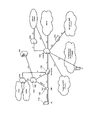
Landscapes

  • Engineering & Computer Science (AREA)
  • Signal Processing (AREA)
  • Computer Networks & Wireless Communication (AREA)
  • Quality & Reliability (AREA)
  • Mobile Radio Communication Systems (AREA)

Abstract

The present invention relates to transmission and reception of downlink control information in a communication system.In particular,a serving base station transmits to a terminal a downlink control information which includes a first field with a scheduling information and a second field with interference parameters (interference information).The receiver employs the interference parameters for interference estimation used in interference cancellation or suppression.
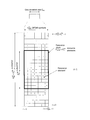
Description

INTERFERENCE PARAMETER SIGNALING FOR EFFICIENT  INTERFERENCE CANCELLATION AND SUPPRESSION
The present invention relates to transmission of interference parameters from a serving node to  a receiving device in a cellular communication system.
TECHNOLOGY BACKGROUND
Third generation(3G)mobile cellular systems,such as,for instance,universal mobile  telecommunication systems(UMTS)standardized within the third generation partnership project  (3GPP)have been based on wideband code division multiple access(WCDMA)radio access  technology.Today,3G systems are being deployed on a broad scale all around the world.After  enhancing this technology by introducing high-speed downlink packet access(HSDPA)and an  enhanced uplink,also referred to as high-speed uplink packet access(HSUPA),the next major  step in evolution of the UMTS standard has brought the combination of orthogonal frequency  division multiplexing(OFDM)for the downlink and single carrier frequency division multiplexing  access(SC-FDMA)for the uplink.This system has been named long term evolution(LTE)since  it has been intended to cope with future technology evolutions.
The LTE system represents efficient packet based radio access and radio access networks that  provide full IP-based functionalities with low latency and low cost.The downlink supports data  modulation schemes QPSK,16QAM,and64QAM and the uplink supports QPSK,16QAM,and  at least for some devices also64QAM,for physical data channel transmissions.The term  “downlink”denotes direction from the network to the terminal.The term“uplink”denotes  direction from the terminal to the network.
LTE’s network access is extremely flexible,using a number of defined channel bandwidths  between1.4and20MHz,contrasted with UMTS terrestrial radio access(UTRA)fixed5MHz  channels.Spectral efficiency is increased by up to four-fold compared with UTRA,and  improvements in architecture and signaling reduce round-trip latency.Multiple Input/Multiple  Output(MIMO)antenna technology should enable10times as many users per cell as3GPP’s  original WCDMA radio access technology.To suit as many frequency band allocation  arrangements as possible,both paired(frequency division duplex FDD)and unpaired(time  division duplex TDD)band operation is supported.LTE can co-exist with earlier3GPP radio  technologies,even in adjacent channels,and calls can be handed over to and from all3GPP’s  previous radio access technologies.
An LTE network architecture including network entities and interfaces between them is  exemplified in Figure1.As can be seen in Figure1,the LTE architecture supports  interconnection of different radio access networks(RAN)such as UTRAN or GERAN(GSM  EDGE Radio Access Network),which are connected to the EPC via the Serving GPRS Support  Node(SGSN).In a3GPP mobile network,the mobile terminal110(called User Equipment,UE, or device)is attached to the access network via the Node B(NB)in the UTRAN and via the  evolved Node B(eNB)in the E-UTRAN access.The NB and eNB120entities are known as  base station in other mobile networks.There are two data packet gateways located in the EPS  for supporting the UE mobility–Serving Gateway(SGW)130and Packet Data Network  Gateway160(PDN-GW or shortly PGW).Assuming the E-UTRAN access,the eNB entity120 may be connected through wired lines to one or more SGWs via the S1-U interface(“U”stays for “user plane”)and to the Mobility Management Entity140(MME)via the S1-MMME interface. The SGSN150and MME140are also referred to as serving core network(CN)nodes.
As shown above,the E-UTRAN consists of an eNodeB,providing the E-UTRA user plane (PDCP/RLC/MAC/PHY)and control plane(RRC)protocol terminations towards the user  equipment(UE).The eNodeB(eNB)hosts the Physical(PHY),Medium Access Control(MAC), Radio Link Control(RLC)and Packet Data Control Protocol(PDCP)layers that include the  functionality of user-plane header-compression and encryption.It also offers Radio Resource  Control(RRC)functionality corresponding to the control plane.It performs many functions  including radio resource management,admission control,scheduling,enforcement of negotiated  uplink Quality of Service(QoS),cell information broadcast,ciphering/deciphering of user and  control plane data,and compression/decompression of downlink/uplink user plane packet  headers.The eNBs are interconnected with each other by means of the X2interface.
Figure2illustrates structure of a component carrier in LTE Release8and later releases.The  downlink component carrier of the3GPP LTE Release8is sub-divided in the time-frequency  domain in so-called sub-frames each of which is divided into two downlink slots,one of which is  shown in Figure2as corresponding to a time period Tslot.The first downlink slot comprises a  control channel region within the first OFDM symbol(s).Each sub-frame consists of a given  number of OFDM symbols in the time domain,each OFDM symbol spanning over the entire  bandwidth of the component carrier.
In particular,the smallest unit of resources that can be assigned by a scheduler is a resource  block also called physical resource block(PRB).A PRB is defined as
Figure PCTCN2014074355-appb-000001
consecutive OFDM  symbols in the time domain and
Figure PCTCN2014074355-appb-000002
consecutive sub-carriers in the frequency domain.In  practice,the downlink resources are assigned in resource block pairs.A resource block pair  consists of two resource blocks.It spans
Figure PCTCN2014074355-appb-000003
consecutive sub-carriers in the frequency domain  and the entire
Figure PCTCN2014074355-appb-000004
modulation symbols of the sub-frame in the time domain.
Figure PCTCN2014074355-appb-000005
may be  either6or7resulting in either12or14OFDM symbols in total.Consequently,a physical  resource block consists of
Figure PCTCN2014074355-appb-000006
resource elements corresponding to one slot in the time  domain and180kHz in the frequency domain(further details on the downlink resource grid can  be found,for example,in3GPP TS36.211,“Evolved universal terrestrial radio access(E-UTRA); physical channels and modulations(Release10)”,version10.4.0,2012,Section6.2,freely  available at www.3gpp.org,which is incorporated herein by reference).While it can happen that  some resource elements within a resource block or resource block pair are not used even  though it has been scheduled,for simplicity of the used terminology still the whole resource  block or resource block pair is assigned.Examples for resource elements that are actually not  assigned by a scheduler include reference signals,broadcast signals,synchronization signals, and resource elements used for various control signal or channel transmissions.
The number of physical resource blocks
Figure PCTCN2014074355-appb-000007
in downlink depends on the downlink transmission  bandwidth configured in the cell and is at present defined in LTE as being from the interval of6 to110(P)RBs.It is common practice in LTE to denote the bandwidth either in units of Hz(e.g. 10MHz)or in units of resource blocks,e.g.for the downlink case the cell bandwidth can  equivalently expressed as e.g.10MHz or
Figure PCTCN2014074355-appb-000008
Generally,it may be assumed that a resource block designates the smallest resource unit on an  air interface of a mobile communication that can be assigned by a scheduler for transmitting  data.The dimensions of a resource block may be any combination of time(e.g.time slot,sub- frame,frame,etc.for time division multiplex(TDM)),frequency(e.g.subband,carrier frequency, etc.for frequency division multiplex(FDM)),code(e.g.spreading code for code division  multiplex(CDM)),antenna(e.g.Multiple Input Multiple Output(MIMO)),etc.depending on the  access scheme used in the mobile communication system.
In3GPP LTE Release8the downlink control signalling is basically carried by the following three  physical channels:
-Physical control format indicator channel(PCFICH)for indicating the number of OFDM  symbols used for control signalling in a sub-frame(i.e.the size of the control channel  region);
-Physical hybrid ARQ indicator channel(PHICH)for carrying the downlink ACK/NACK  associated with uplink data transmission;and
-Physical downlink control channel(PDCCH)for carrying downlink scheduling  assignments and uplink scheduling assignments.
The PCFICH is sent from a known position within the control signalling region of a downlink sub- frame using a known pre-defined modulation and coding scheme.The user equipment decodes  the PCFICH in order to obtain information about a size of the control signalling region in a sub- frame,for instance,the number of OFDM symbols.If the user equipment(UE)is unable to  decode the PCFICH or if it obtains an erroneous PCFICH value,it will not be able to correctly  decode the L1/L2control signalling(PDCCH)comprised in the control signalling region,which  may result in losing all resource assignments contained therein.
The PDCCH carries downlink control information,such as,for instance,scheduling grants for  allocating resources for downlink or uplink data transmission.The PDCCH for the user  equipment is transmitted on the first of either one,two or three OFDM symbols according to  PCFICH within a sub-frame.
Physical downlink shared channel(PDSCH)is used to transport user data.PDSCH is mapped  to the remaining OFDM symbols within one sub-frame after PDCCH.The PDSCH resources  allocated for one UE are in the units of resource block for each sub-frame.
Physical uplink shared channel(PUSCH)carries user data.Physical Uplink Control Channel (PUCCH)carries signalling in the uplink direction such as scheduling requests,HARQ positive  and negative acknowledgements in response to data packets on PDSCH,and channel state  information(CSI).
User data(IP packets)to be transmitted over the communication network may be generated by  the user application.They may include speech,video,text,or any other media possibly  compressed and encapsulated into other protocols before forming the IP packets.The IP  packets are in EUTRAN further processed on the PDCP layer resulting in addition of a PDCP  header.The PDCP packets formed in this manner are further segmented and/or reassembled  (reassembling being shown in the figure)into RLC packets to which an RLC header is added. One or more RLC packets are then encapsulated into a MAC packet including also a MAC  header and padding,if necessary.The MAC packet is also called“transport block”.Thus,a  transport block is from the point of view of the physical layer a packet of user data entering the  physical layer.There are predefined transport block sizes(TBS)which may be used in LTE. The transport block is then within one transmission time interval(TTI)mapped onto the  subframes on the physical layer(PHY).Details of the mapping of data starting with transport  blocks up to the interleaving is shown in Figures5.2.2-1and5.3.2-1and described in the related  description of the3GPP TS36.212,v.10.4.0,“Evolved universal terrestrial radio access(E- UTRA);Multiplexing and channel coding”available freely at  www.3gpp.org and incorporated  herein by reference,for the uplink and downlink transmission of user data respectively. Furthermore,the physical channel mapping is described in detail in Figure6.3-1and Figure5.3- 1for downlink and uplink,respectively,and the related description in3GPP TS36.211,v10.4.0.
The principle of link adaptation is fundamental to the design of a radio interface which is efficient  for packet-switched data traffic.Unlike the early versions of UMTS(Universal Mobile  Telecommunication System),which used fast closed-loop power control to support circuit- switched services with a roughly constant data rate,link adaptation in LTE adjusts the  transmitted data rate(modulation scheme and channel coding rate)dynamically to match the  prevailing radio channel capacity for each user.
For the downlink data transmissions in LTE,the eNodeB typically selects the modulation  scheme and code rate(MCS)depending on a prediction of the downlink channel conditions.An  important input to this selection process is the Channel State Information(CSI)feedback (mentioned above)transmitted by the User Equipment(UE)in the uplink to the eNodeB.
Channel state information is used in a multi-user communication system,such as for example 3GPP LTE to determine the quality of channel resource(s)for one or more users.In general,in  response to the CSI feedback the eNodeB can select between QPSK,16-QAM and64-QAM  schemes and a wide range of code rates.This CSI information may be used to aid in a multi- user scheduling algorithm to assign channel resources to different users,or to adapt link  parameters such as modulation scheme,coding rate or transmit power,so as to exploit the  assigned channel resources to its fullest potential.
The uplink and downlink resource grants(grants enabling the UE to transmit data in downlink  and uplink,respectively)are transmitted from the eNodeB to the UE in a downlink control  information(DCI)via PDCCH.The downlink control information may be transmitted in different  formats,depending on the signaling information necessary.In general,the DCI may include:
-a resource block assignment(RBA),
-modulation and coding scheme(MCS).
It may include further information,depending on the signaling information necessary,as also  described in Section9.3.2.3of the book“LTE:The UMTS Long Term Evolution from theory to  practice”by S.Sesia,I.Toufik,M.Baker,Apr.2009,John Wiley&Sons,ISBN978-0-470- 69716-0,which is incorporated herein by reference.For instance,the DCI may further include  HARQ related information such as redundancy version(RV),HARQ process number,or new  data indicator(NDI);MIMO related information such as pre-coding;power control related  information,etc.
As described above,in order to inform the scheduled users about their allocation status, transport format and other data-related information(e.g.HARQ information,transmit power  control(TPC)commands),L1/L2control signaling is transmitted on the downlink along with the  data.L1/L2control signaling is multiplexed with the downlink data in a subframe,assuming that  the user allocation can basically change from subframe to subframe.It should be noted that user  allocation might also be performed on a TTI(Transmission Time Interval)basis,where the TTI  length can be in general a multiple of the subframes or correspond to a subframe.The TTI  length may be fixed in a service area for all users,may be different for different users,or may  even by dynamic for each user.Generally,the L1/2control signaling needs only be transmitted  once per TTI.Without loss of generality,the following assumes that a TTI is equivalent to one  subframe.
The L1/L2control signaling is transmitted on the Physical Downlink Control Channel(PDCCH). A PDCCH carries a message as a Downlink Control Information(DCI),which in most cases  includes resource assignments(allocations)and other control information for a mobile terminal  or groups of UEs.In general,several PDCCHs can be transmitted in one subframe.It should be  noted that in3GPP LTE,assignments for uplink data transmissions,also referred to as uplink  scheduling grants or uplink resource assignments,are also transmitted on the PDCCH. Generally,the information sent on the L1/L2control signaling for assigning uplink or downlink  radio resources(particularly LTE(-A)Release10)can be categorized to the following items:
- User identity,indicating the user that is allocated.This is typically included in the  checksum by masking the CRC with the user identity.Then,the users(UEs)perform  blind decoding by demasking the identities transmitted in the search space(i.e.in the  resources configured as search space in which the respective terminals have to monitor  the control information whether there is data for them).
- Resource allocation information,indicating the resources(Resource Blocks,RBs)on  which a user is allocated.Note,that the number of RBs on which a user is allocated can  thus be dynamic.In particular,the number of the resource blocks(frequency domain)is  carried by the resource allocation information.The position in the time domain(subframe) is given by the subframe in which the PDCCH is received and a predefined rule(the  resources are allocated fixed number of subframes after the PDCCH subframe).
- Carrier indicator,which is used if a control channel transmitted on a first carrier assigns  resources that concern a second carrier,i.e.resources on a second carrier or resources  related to a second carrier if carrier aggregation is applied.
- Modulation and coding scheme that determines the employed modulation scheme and  coding rate(length of the transport block to be coded).
- HARQ information,such as a new data indicator(NDI)and/or a redundancy version(RV) that is particularly useful in retransmissions of data packets or parts thereof.In particular, new data indicator indicated whether the allocation is for an initial transmission of data or  for a retransmission of data.Redundancy version indicates the coding applied to the  retransmitted data(in LTE incremental redundancy combining is supported,meaning that  each retransmission may include the data of the first transmission differently coded,i.e. may include parity bits which together with the already received  transmission/retransmission(s)finally enable decoding).
- Power control commands to adjust the transmit power of the assigned uplink data or  control information transmission.
- Reference signal information such as the applied cyclic shift and/or orthogonal cover  code index,which are to be employed for transmission or reception of reference signals  related to the assignment.
- Uplink or downlink assignment index that is used to identify an order of assignments, which is particularly useful in TDD systems.
- Hopping information,e.g.an indication whether and how to apply resource hopping in  order to increase the frequency diversity.
- CSI request,which is used to trigger the transmission of channel state information in an  assigned resource.
- Multi-cluster information,which is a flag used to indicate and control whether the  transmission occurs in a single cluster(contiguous set of RBs)or in multiple clusters(at  least two non-contiguous sets of contiguous RBs).Multi-cluster allocation has been  introduced by3GPP LTE-(A)Release10.
It is to be noted that the above listing is non-exhaustive,and not all mentioned information items  need to be present in each PDCCH transmission depending on the DCI format that is used.
Downlink control information occurs in several formats that differ in overall size and also in the  information contained in its fields.The different DCI formats that are currently defined for LTE  are as follows and described in detail in3GPP TS36.212,v.12.0.0“Multiplexing and channel  coding”,section5.3.3.1(available at http://www.3gpp.org and incorporated herein by reference). For instance,DCI Format0is used for the transmission of resource grants for the PUSCH,using  single-antenna port transmissions in uplink transmission mode1or2.
In order for the UE to identify whether it has received a PDCCH transmission correctly,error  detection is provided by means of a16-bit CRC appended to each PDCCH(i.e.DCI). Furthermore,it is necessary that the UE can identify which PDCCH(s)are intended for it.This  could in theory be achieved by adding an identifier to the PDCCH payload;however,it turns out  to be more efficient to scramble the CRC with the“UE identity”,which saves the additional  overhead.The CRC may be calculated and scrambled as defined in detail by3GPP in TS 36.212,Section5.3.3.2“CRC attachment”,incorporated hereby by reference.The section  describes how error detection is provided on DCI transmissions through a Cyclic Redundancy  Check(CRC).A brief summary is given below.The entire payload is used to calculate the CRC  parity bits.The parity bits are computed and attached.In the case where UE transmit antenna  selection is not configured or applicable,after attachment,the CRC parity bits are scrambled  with the corresponding RNTI.
The scrambling may further depend on the UE transmit antenna selection,as apparent from TS 36.212.In the case where UE transmit antenna selection is configured and applicable,after  attachment,the CRC parity bits are scrambled with an antenna selection mask and the  corresponding RNTI.As in both cases the RNTI is involved in the scrambling operation,for  simplicity and without loss of generality the following description of the embodiments simply  refers to the CRC being scrambled(and descrambled,as applicable)with an RNTI,which  should therefore be understood as notwithstanding e.g.a further element in the scrambling  process such as an antenna selection mask.
Correspondingly,the UE descrambles the CRC by applying the“UE identity”and,if no CRC  error is detected,the UE determines that PDCCH carries its control information intended for  itself.The terminology of“masking”and“de-masking”is used as well,for the above-described  process of scrambling a CRC with an identity.The“UE identity”mentioned above with which the  CRC of the DCI may be scrambled can also be a SI-RNTI(System Information Radio Network  Temporary Identifier),which is not a“UE identity”as such,but rather an identifier associated  with the type of information that is indicated and transmitted,in this case the system information. The SI-RNTI is usually fixed in the specification and thus known a priori to all UEs.
The physical downlink control channel(PDCCH)carries e.g.scheduling grants for allocating  resources for downlink or uplink data transmission.Multiple PDCCHs can be transmitted in a  subframe.The PDCCH for the user equipments is transmitted on the first
Figure PCTCN2014074355-appb-000009
OFDM  symbols(usually either1,2or3OFDM symbols as indicated by the PCFICH,in exceptional  cases either2,3,or4OFDM symbols as indicated by the PCFICH)within a subframe,extending  over the entire system bandwidth;the system bandwidth is typically equivalent to the span of a  cell or component carrier.The region occupied by the first
Figure PCTCN2014074355-appb-000010
OFDM symbols in the time  domain and the
Figure PCTCN2014074355-appb-000011
subcarriers in the frequency domain is also referred to as PDCCH  region or control channel region.The remaining
Figure PCTCN2014074355-appb-000012
OFDM symbols in  the time domain on the
Figure PCTCN2014074355-appb-000013
subcarriers in the frequency domain is referred to as the  PDSCH region or shared channel region(see below).
For a downlink grant(i.e.resource assignment)on the physical downlink shared channel  (PDSCH),the PDCCH assigns a PDSCH resource for(user)data within the same subframe. The PDCCH control channel region within a subframe consists of a set of Control Channel  Elements,CCEs where the total number of CCEs in the control region of subframe is distributed  throughout time and frequency control resource.Multiple CCEs can be combined to effectively  reduce the coding rate of the control channel.CCEs are combined in a predetermined manner  using a tree structure to achieve different coding rate.Control channel elements are separately  allocable units smaller than the entire physical resource block.They enable finer resource  assignment for the control channel in which smaller amounts of data are transported.
On a transport channel level,the information transmitted via the PDCCH is also referred to as  L1/L2control signaling(for details on L1/L2control signaling see above).
For uplink resource assignments(for transmissions on the Physical Uplink Shared CHannel  (PUSCH))signaled on PDCCH in LTE,the L1/L2control information does not contain a HARQ  process number,since a synchronous HARQ protocol is employed for LTE uplink.The HARQ  process to be used for an uplink transmission is given by the timing.Furthermore it should be  noted that the redundancy version(RV)information is jointly encoded with the transport format  information,i.e.the RV info is embedded in the transport format(TF)field.The TF respectively  modulation and coding scheme(MCS)field has for example a size of bits,which corresponds to  32entries.3TF/MCS table entries are reserved for indicating RVs1,2or3.The remaining MCS  table entries are used to signal the MCS level(TBS)implicitly indicating RV0.
For details on the TBS/RV signaling for uplink assignments on PDCCH please see3GPP TS 36.213,“Evolved Universal Terrestrial Radio Access(E-UTRA);Physical layer procedures”, version3GPP TS36.213,v.10.4.0,2012(available at http://www.3gpp.org and incorporated  herein by reference).The size of the CRC field of the PDCCH is16bits.
For downlink assignments(PDSCH)signaled on PDCCH in LTE the Redundancy Version(RV) is signaled separately in a two-bit field.Furthermore the modulation order information is jointly  encoded with the transport format information.Similar to the uplink case there is5bit MCS field  signaled on PDCCH.Three of the entries are reserved to signal an explicit modulation order, providing no Transport format(Transport block)info.For the remaining29entries modulation  order and Transport block size info are signaled.
The idea behind the concept of interference cancellation and interference suppression is that the  effective signal to interference power ratio in the receiver can be increased if the interference  fraction of the received signal can be removed or suppressed in the receiver.In order to achieve  this,the knowledge of the type and strength of the interference is beneficial.
Figure4illustrates the basic concept of interference cancellation in the receiver.A signal S is  generated by the receiver and transmitted over a channel.During the transmission it is  superimposed by interference I and noise N.This results in a disturbed signal which is inputted  to a receiver and which may lead to some bit errors in the demodulator.In order to improve the  reception and in particular,the bit error rate resulting from demodulation and decoding, interference cancellation(marked by a dashed rectangle in Fig.4)may be applied.In particular, an interference estimation I’available in the receiver is used to recover signal S’which is further  used as an input for the demodulator reducing therewith the bit error rate.In this example,the  recovery is achieved by subtracting the estimated interference signal I’form the received signal  S+N+I.The performance of interference cancellation strongly depends on the accuracy of the  interference estimation I’.In case of a very inaccurate interference estimation which corresponds  to a large difference between I and I’,it could even result in an increased disturbance of the  demodulator input yielding an increased bit error rate.
The interference I is determined by a combination of some transmission(interference) parameters.The accuracy of the interference estimation I’increases with the amount of  information regarding the interference parameters that is available on the receiver side.
Figure5shows a typical scenario with interference from a single dominant interfering cell.UEs 501,502,503and504are served by an eNB A and experience interference from eNB B.UE 501and UE502experience weak interference from eNB B since they are far away from the  interference source(eNB B),while UE503and UE504experience strong interference from eNB  B.The dashed circle500indicates the area,in which the interference from the eNB B is  dominant for the terminals served by the eNB A.For the purpose of improving the reception  quality in the terminals located within the area500,the interference cancellation and thus also  the accuracy of the interference estimation may be essential.
Recently,3GPP initiated a study item concerning network assisted interference cancellation and  suppression(NAICS)for the downlink in3GPP LTE systems.Details are described in3GPP TR 36.866v12.0.0,March2014,“Study on Network-Assisted Interference Cancellation and  Suppression(NAIC)for LTE”(referred to as“NAICS technical report”in the following).Based  thereon,a subsequent work item is supposed to specify inclusion of the network assisted  interference cancellation into the standard,as can be seen from RP-140519,“New work item  proposal for network assistance interference cancellation and suppression for LTE”,3GPP  RAN#63,March2014,referred to as“NAICS work item”in the following.
The parameters in an LTE system which influence the interference(interference parameters) comprise
-Position of reference signals(pilot)within the resource grid of the interfering transmission (e.g.by eNB B of figure5),
-Effective interference channel including precoding on the interference transmitter side,
-Interferer resource allocation in terms of allocated resources(PRBs,CFI,etc.),
-Number of spatial transmission layers of the interfering transmission,
-Modulation order of the interfering transmission,
-Channel coding parameters of the interfering transmission(code rate,redundancy  version,etc.).
The amount of required interference information depends hereby on the receiver type.The  receiver types investigated at3GPP range from receivers that suppress the interference by  means of spatial filtering of the sum signal to receivers that perform the complete decoding of  code words transmitted by the interference source.
A receiver that performs merely an interference suppression by means of spatial filtering of the  received signal(e.g.E-LMMSE-IRC in the NAICS technical report,Section7.2)requires only  information about the effective interference channel(including precoding on the interference  transmitter side)per spatial layer,while information about modulation and coding scheme, redundancy version,etc.are not required.
On the other hand,a receiver that performs interference cancellation either on symbol(SL-IC,cf. NAICS technical report,Section7.4)or on codeword level(CW-IC,cf.NAICS technical report, Section7.4)requires a significantly extended amount of interference information.In particular, on the receiver side it has to be known which modulation symbol was transmitted in order to  perform effective interference cancellation as show in Figure4.A detailed description of the  receiver types studied at3GPP RAN1within the scope of NAISC is given in the NAICS cf. NAICS technical report cited above.Accordingly,also different approaches can be considered  for obtaining interference parameters in LTE system:
-Blind detection:The interference parameters are estimated within the receiver by  means of hypothesis testing.This approach does not involve any network assistance but  constitutes increased computation complexity in the receiver.Depending on which  parameters have to be determined,the additional complexity can be significant.The  advantage of such an approach is that no additional signalling is required.
-Overhearing of control signals(DCI,reference signals,etc.)from interfering eNB: The interference parameters are determined in the receiver by listening to existing  control signals from the interfering cell itself.This does not require any additional network  assistance since the transmission parameters of the interfering signal are anyway  already provided to UEs associated to the interfering eNB.The disadvantage of this  approach is that the UE has to be able to receive signals from both serving and  interfering eNB in parallel.It furthermore requires a significant amount of blind detection  of signals from the interfering cell which increases the implementation complexity of the  receiver.
-L1signalling from interfering eNB:This approach addresses the introduction of new  L1(physical layer)signalling for the provision of interference information.This control  information would be transmitted by the interfering eNB and received by interference  victim UEs that are associated to a neighbouring eNB.The disadvantage of this  approach is that the UE has to be able to receive signals from both serving and  interfering eNB in parallel.
-Higher-layer signalling from serving eNB:Interference information is provided to the  interference victim UE by the serving eNB by means of downlink control messages on  MAC layer or above.The serving eNB has knowledge of the transmission parameters  used in the interfering cell due to backhaul communication.Due to the latency involved in  higher-layer signalling,the approach can only be applied for interference parameters that  do not change frequently.
-L1signalling from serving eNB:Interference information is provided to the interference  victim UE by the serving eNB by means of downlink control signalling on the physical  layer.The serving eNB has knowledge of the transmission parameters used in the  interfering cell due to backhaul communication.In contrast to using higher-layer  signalling,the interference information can be updated more frequently if the backhaul  connection between serving and interfering eNB meets the required delay and capacity  needs.A crucial precondition of this approach is a backhaul connection with sufficient  capacity and latency.The preferred use case would therefore be intra-site coordination  or coordination for remote radio heads(RRH).
Thus,each of the above approaches for obtaining the interference parameters have their  advantages and disadvantages.
SUMMARY OF THE INVENTION
It is the aim of the present invention,to provide an efficient manner of obtaining at the receiver  the interference parameters to be used in interference suppression.
This invention provides a solution for providing information regarding interference parameters to  the receivers by means of explicit signalling of interference parameters or sets of interference  parameter candidates.The interference information is provided by means of L1signalling from  the serving eNB to the controlled device(such as a terminal,DCI receiving device).
This is achieved by the features as set forth in the independent claims.
Preferred embodiments of the present invention are the subject matter of the dependent claims. The particular approach of the present invention is to provide the interference parameters within  a downlink control information.Based on the interference parameters,the receiving device can  estimate the interference and employ the estimate in cancellation procedure.
In accordance with an aspect of the present invention,an apparatus is provided for receiving  data from a serving base station in a cellular communication system,the apparatus comprising:a  blind decoding unit for identifying and decoding a downlink control information transmitted by the  serving base station,an extraction unit for extracting from a first field of the downlink control  information a scheduling control information and from a second field of the downlink control  information an interference information,and a transceiver for receiving or transmitting data on  resources specified by the scheduling information while taking into account the interference  information so as to reduce the interference caused by transmitters other than the serving base  station.
In accordance with another aspect of the invention,an apparatus is provided for transmitting  data to a receiving device in a cellular communication system,the apparatus being a serving  base station for the receiving device,comprising:an interference information determining unit  for determining the interference experienced by the receiving device caused by transmitters  other than the serving base station,a control information generation unit for generating a  downlink control information including a first field including a scheduling control information and  a second field including the interference information,and a transmitter for transmitting to the  receiving device for blind decoding the generated downlink control information,and for receiving  or transmitting data from/to the receiving device on resources specified by the scheduling  information.
In accordance with another aspect of the invention,a method is provided for receiving data from  a serving base station in a cellular communication system,the method comprising the steps of: blind decoding for identifying and decoding a downlink control information transmitted by the  serving base station,extracting from a first field of the downlink control information a scheduling  control information and from a second field of the downlink control information an interference  information,and receiving or transmitting data on resources specified by the scheduling  information while taking into account the interference information so as to reduce the  interference caused by transmitters other than the serving base station.
In accordance with another aspect of the invention,a method is provided for transmitting data to  a receiving device in a cellular communication system,the apparatus being a serving base  station for the receiving device,comprising:determining the interference experienced by the  receiving device caused by transmitters other than the serving base station,generating a  downlink control information including a first field including a scheduling control information and  a second field including the interference information,and transmitting to the receiving device for  blind decoding the generated downlink control information,and for receiving or transmitting data  from/to the receiving device on resources specified by the scheduling information.
Advantageously,the scheduling information is a first scheduling information which indicates  transmission parameters for a first transport block of data.Then in the second field of the  downlink control information either the interference information or a second scheduling  information which indicates transmission parameters for a second transport block of data is  conveyed.
Alternatively,the scheduling information of the first field of the downlink control information is a  first scheduling information which indicates transmission parameters for a first transport block of  data,and the second field of the downlink control information conveys either the interference  information and a reduced second scheduling information which indicates transmission  parameters for a second transport block of data or only a complete second scheduling  information which indicates transmission parameters for a second transport block of data.
In particular,the first and the second field may have the same sizes,each of the first and the  second field may include a modulation and coding scheme subfield for indicating modulation and  coding scheme(MCS),and the modulation and coding scheme subfield of the first field may be  larger than the modulation and coding scheme subfield of the second field.
Moreover,a switching message may be provided on a protocol layer higher than the physical  layer,the switching message indicating the format of the second field,namely whether or not the  second field is to carry the interference information.This enables semi-static configuration of  NAICS application and thus semi-static configuration of whether the interference parameters are  to be included or not into the DCI.
Alternatively,a switching indication is provided on the physical layer,and the switching indication  indicates the format of the second field,namely whether or not the second field is to carry the  interference information.This enables dynamic configuration of information to be carried by the  DCI,namely whether in the particular DCI the second field is to be interpreted as a scheduling  information for the transport block or as interference parameters.
In accordance with an embodiment,the switching indication within a3GPP LTE Release-11 downlink control information message,in the resource allocation header field,while it is  assumed that Type0allocation applies.Advantageously,the resource allocation header  interpretation is configured semi-statically by a layer higher than the physical layer,wherein the  resource header is interpretable either as indicating Type0or Type1allocation or as indicating  the switching indication.
In accordance with another embodiment,the switching indication is conveyed within the second  field in that at least one codepoint among all possible values defined by a subset of bits of the  second field indicates that the interference information is transmitted in the second field and all  codepoints other than said at least one codepoint indicate that the interference information is not  transmitted in the second field.Advantageously,the subset of bits takes either the value of said  at least one codepoint or another value indicating redundancy version for the second transport  block.
The downlink control information may include a resource block assignment field and can take  any of the following formats:i)the resource block assignment field indicates resource  assignment for the transmission,for which the scheduling information is transmitted;or ii)the  resource block assignment field includes a first subfield(1580)indicating resource assignment  for the transmission,for which the scheduling information is transmitted,and a second subfield (1590)indicating whether or not the interference information in the second field is to be applied  for interference cancellation for the respective resources specified in the first subfield(1580).
Advantageously,in case of format ii)the second subfield(1690)of the resource block  assignment field indicates for the respective resources assigned in accordance with the first  subfield whether a first interference information or a second interference information is to be  applied to said respective assigned resources,and the second field includes a first subfield  indicating the first set of interference parameters and a second subfield indicating the second set  of interference parameters.
Moreover,within a protocol of a layer higher than the physical layer,a control information may  be provided carrying a transmission mode,wherein the transmission mode can take a value  which defines that the apparatus is to extract from the downlink control information the  interference information as well as values which do not define that the apparatus is to extract the  interference information from the downlink control information.
The decision on whether or not to provide the interference information within the downing control  information may be performed in a transmitter of the DCI(such as the serving base station) based on measurements of a reference signal,reported to the apparatus by the receiving device  and/or based on load information of an interfering base station.
In accordance with another aspect of the present invention,a computer program product  comprising a computer-readable medium having a computer-readable program code embodied  thereon is provided,the program code being adapted to carry out the present invention.
According to an aspect of the present invention the above apparatus is embodies on an  integrated circuit.
The above objectives and other objectives and features of the present invention will become  more apparent from the following description and preferred embodiments,given in conjunction  with the accompanying drawings in which:
Figure1is a block diagram illustrating an example of physical layer processing of four  services in a digital broadcast system;
Figure2is a schematic drawing illustrating an example of a grid of OFDM modulation  resources in time and frequency domain;
Figures3A to3E are schematic drawings illustrating respective DCI formats2,2A,2B,2C and 2D as used in LTE;
Figure4is a block diagram illustrating interference cancellation at the receiver;
Figure5is a schematic drawing illustrating different interference scenarios for terminals in  the proximity of two base stations;
Figure6is a schematic drawing illustrating mapping of the interference information on a  DCI with format supporting two transport blocks;
Figure7is a schematic drawing illustrating inclusion of interference information into the  DCI depending on the interference conditions of the terminals;
Figure8is a schematic drawing illustrating switching between two formats of the DCI;
Figure9is a schematic drawing illustrating switching between two formats of the DCI by  means of the resource allocation header;
Figure10is a schematic drawing illustrating transmission of interference parameter for  terminals affected by strong interference;
Figure11is a schematic drawing illustrating transmission of interference parameter for  terminals affected by strong interference;
Figure12is a schematic drawing illustrating state transitions for signaling the interference  parameters as shown in Figures9and10;
Figure13is a schematic drawing illustrating transmission of interference information within  a portion of the MCS field of the scheduling information for the second transport  block;
Figure14is a schematic drawing illustrating switching between two formats of the DCI by  means of the redundancy version field;
Figure15is a schematic drawing illustrating utilization of unused resource block assignment  bits in case of lower granularity of resource block assignment;
Figure16is a schematic drawing illustrating utilization of unused resource block assignment  bits in case of lower granularity of resource block assignment for controlling  transmission of plural sets of interference information;
Figure17is a schematic drawing illustrating relation between transmission modes and the  transmission of interference information;
Figure18is a schematic drawing illustrating relation between transmission modes including  a new transmission mode and the transmission of interference information;
Figure19is a block diagram illustrating some apparatuses according to the present  invention;
Figure20A and20B is a schematic drawing illustrating new DCI formats supporting  transmission of interference information.
DETAILED DESCRIPTION
The present invention addresses the support of interference cancellation and suppression by  means of network assistance.Interference cancellation and suppression on the UE side can  significantly increase downlink user throughput due to increased PDSCH SINR.Knowledge of  interference parameters is required on UE side for performing effective interference cancellation  and suppression.The interference may be an inter-cell interference as illustrated on Figure5. Accordingly,a UE is served by a serving node(e.g.a base station,such as eNB for LTE system) and is exposed to interference from another node such as another base station controlling  another respective cell.It is noted that the source of interference does not necessarily has to be  a network node such as eNB.Rather,the interference may be generated also by relays or even  by other terminals(especially in the uplink for the LTE),or by parallel transmissions to other  receivers from the serving node itself.
The present invention provides a strategy for transmitting information concerning transmission  parameters used in interfering neighbouring cells and resulting in interference with the  transmission between the victim UEs and the serving node.The victim UEs(UEs subjected to  interference)may use this information for performing interference cancellation or suppression.
It is noted that the term“cellular system”or“cell”refer to any arrangement of a cell including  macro cells,micro cells,pico cells,femto cells or any other concepts.The inter-cell interference  may be also caused by hierarchically organized cells such as a macro cell including an area of a  pico cell.Moreover,for the purpose of the invention,it is considered that a relay(which may also  be a user terminal providing a relay function)coverage may also form a cell.Moreover,the  interference to be suppressed may also be caused by interfering with other terminals.
In the context of LTE,the invention describes different strategies for providing the interference  information together with PDSCH scheduling information for the interference victim UE within a  single downlink control information(DCI)format.This can be achieved by reusing certain bits of  existing LTE Release-11DCI formats or by introducing one or more new DCI formats.
In particular,transmission parameters of the serving eNB are transmitted to the UE in form of  downlink control information(DCI)that is transmitted in physical downlink control channel(s) (PDCCH)or enhanced physical downlink control channels(E-PDCCH).A possible approach is  to provide the interference information within a DCI format as well.
One approach could be the introduction of a new DCI format that contains only the interference  information from a neighbouring cell(or another interferers).However,using such an approach  would mean that the interference victim UE(UE affected by the interference)has to receive two  PDCCHs or EPDCCHs;one conveying the DCI with the PDSCH allocation information and an  additional one conveying the DCI that contains the interference information.There are two  problems connected with such an approach:(a)the need to receive two PDCCHs or E-PDCCHs  requires additional blind DCI detection and decoding,and(b)the transmission of two PDCCHs  or EPDCCHs results in an increase demand of transmission resources for downlink control  signalling.The latter is given in form of control channel elements(CCE)or enhanced control  channel elements(ECCE)as defined in the LTE specification3GPP TS36.211v12.0.0, December2013,for instance in Section6.8and Section6.8A.
DCI formats already defined in the LTE specification3GPP TS36.212,v12.0.0,December2013, Section5.3.3.1,could be extended by bits that are used for the provision of interference  information.The advantage compared to introducing a new DCI would be that no additional blind  detection and decoding of PDCCHs or EPDCCHs is required since both PDSCH allocation  information and interference information are provided within a single DCI format.
However,there are also two disadvantages connected with such an approach:(a)extending the  DCI format size results in a reduced PDCCH or EPDCCH robustness due to increased size,and (b)the increased DCI format size could result in an increased demand for control channels  elements(CCE/ECCE).The reduced robustness due to reduced channel coding rates form a  critical issue since UEs that are candidates for interference cancellation or suppression are  typically cell-edge UEs that experience low SINR levels.
The problem that has to be solved is the provision of interference information by the serving eNB  in form of L1signalling by meeting following design targets:
-Minimization of additional control overhead:The signalling solution should introduce  as little as possible additional signalling overhead in form of required CCEs/ECCEs.
-Minimum specification and implementation changes:The implied3GPP specification  changes should be kept as small as possible in order to allow a smooth transition to new  specification releases.
-Avoidance of additional DCI blind decoding:The introduction of additional blind  decoding effort for downlink control information should be avoided in order to keep the  UE implementation complexity low.
-Provision of interference information only if required:Interference information should  only be provided to the UE when it is necessary.This requirement correlates with the  need for minimization of control overhead.
According to the invention,the interference information is provided together with PDSCH  scheduling within the same DCI format.
In particular,a method is provided for receiving data from or sending data to a serving base  station in a cellular communication system.The method is performed at a receiving node such  as a terminal and applies blind decoding for identifying and decoding a downlink control  information DCI transmitted by the serving base station.Then,a step of extracting from a first  field of the downlink control information scheduling control information and from a second field of  the downlink control information an interference information is performed.Finally,the receiving  node receives or transmits data on resources specified by the scheduling information while  taking into account the interference information so as to reduce the interference caused by  transmitters other than the serving base station.
Here,the term“blind decoding”refers to decoding of data transmissions without prior knowledge  of corresponding transmissions parameters such as allocated resources and transport format  (i.e.DCI format).In LTE,the number and/or the location of control channel elements(CCEs) used for the PDCCH transmissions is not known to the terminals in advance.In order to find its  control information,a terminal tries to blindly decode the incoming control information assuming  different combinations of CCEs and checking for the CRC.If the CRC matches,the terminal  concludes that the PDCCH was directed to it and that the control information was decoded  correctly.If the CRC does not match,then the terminal detects another location of CCEs.In  order to keep the number of decoding attempts low,LTE uses a so-called search space for each  terminal.The search space determines the combinations of CCEs that the terminal needs to  monitor for a possible control information.The transmitters other than the serving base station/ network node may be other base stations or relays or even other terminals.
This approach enables reusing bits within DCI formats which exist already in LTE Release-11, for the purpose of providing interference information to UEs.
The DCI formats that are used for the provision of interference information are the ones that are  used in Release-11for indicating PDSCH allocations with two transport blocks.A transport block  conveys a single code word with individual channel coding.The scheduling of two transport  blocks is used in LTE for transmissions on multiple spatial layers.The mapping of code words to  transport blocks and the mapping of transport blocks to spatial layers is defined in Section  5.3.3.1of the LTE specification3GPP TS36.212v12.0.0,December2013,and Section6.3.3of  the LTE specification3GPP TS36.211v12.0.0,December2013,respectively.
The DCI formats that can be used for scheduling two transport blocks supported by the Release- 11are given below:
-DCI format2:Closed-loop spatial multiplexing or transmit diversity
-DCI format2A:Large delay CDD(cyclic delay diversity)or transmit diversity
-DCI format2B:Dual-layer transmission using antenna port7and8or single antenna  port7or8
-DCI format2C:Transmission on up to eight layers using antenna ports7-14or single  antenna port7or8
-DCI format2D:Transmission on up to eight layers using antenna ports7-14or single  antenna port7or8
These formats are further illustrated in a simplified manner in the respective Figures3A to3E.In  particular,Figure3A shows that DCI format2includes resource allocation header having a  length of one bit,followed by resource block assignment field(RBA).RBA is a bitmap specifying  for each(group of)PRBs whether the resources are assigned to the controlled node(such as  terminal)or not.The DCI format2further includes a TPC(transmission power commands) information,HARQ configuration(process number),transport block to codeword swap flag for  assigning the two transport blocks to codewords,and the scheduling information specific for  each of the two transport blocks.The transport block specific scheduling information comprises  eight bits and comprises modulation and coding scheme(MCS)indication,new data indicator (NDI)and redundancy version(RV)indication.Finally,the precoding information is signalled, which has a length of three or six bits depending in the number of antenna ports at the eNB and  includes,for instance,rang indicator(RI)or the presiding matrix indicator(PMI).
Figure3B shows DCI format2A,which differs from the DCI format2in particular by shorter  precoding information having zero or two bit length,depending in the number of antenna ports. Figure3C illustrates DCI format2B which includes,apart from the resource allocation header, RBA,TCP and HARQ information and the scheduling information for the two transport blocks,a  scrambling identity.Figure3D illustrates DCI format2C,,which differs from the format2B in  particular by including information concerning antenna ports,scrambling identity and number of  layers.Figure3E illustrates DCI format2D which,in addition to elements described with  reference to format2C,includes PQI(PDSCH Rate Matching and QuasiCoLocation Indicator)to  inform the UE about the transmitting point or set of transmitting points.
However,it is noted that the present invention is not limited by reusing the existing DCI formats. A new DCI format may be defined alternatively,with the feature that it includes interference  information within the second field.
According to an embodiment of the present invention,the scheduling information extracted from  the first field of the downlink control information is a first scheduling information which indicates  transmission parameters for a first transport block of data.The second field includes either the  interference information or a second scheduling information which indicates transmission  parameters for a second transport block of data.
Thus,in terms of LTE,a UE can be scheduled
-either for a PDSCH transmission with two transport blocks.Here it is assumed that the  interference is negligible,i.e.the UE is out of the area500illustrated in Fig.5.
-or for a PDSCH transmission with a single transport block in combination with providing  interference information to the receiving UE.
Figure6shows how the bits for one of the two transport blocks within a DCI format are used for  providing interference information.The interpretation of the remaining bits of the DCI format is  not changed.In particular,Figure6shows the contents of the first field610of the downlink  control information.The first field610carries scheduling information for the first transport block. The scheduling information contains modulation and coding scheme,new data indicator and  redundancy version.The contents of the second field620includes the same type of scheduling  information(MCS,NDI,RV)for the second transport block.Thus,the first field610and the  second field620correspond to the current LTE DCI format.This format is advantageously  further applied for terminals which experience rather low interference,e.g.interference which  does not exceed a predefine threshold.If the terminals experience a high interference,e.g. interference exceeding certain threshold,the format of the DCI’s in this embodiment  corresponds to the first field630and second field650.Similarly to the first field610,the first field 630includes scheduling information for the first transport block.The length of the fields610,620, 630,and640is the same.However,the second field650does not include the information  related to the second block,but rather the interference information for the receiving device.The  interference information enables the receiving device to perform estimation of the interference  and thus,to cancel or suppress the interference as illustrated in Figure4.
The effect of this approach is that a UE can only be provided with interference information if a  single transport block is scheduled.If two transport blocks should be scheduled for the UE, interference information is not provided.
Figure7shows the application of the basic concept in a typical NAICS scenario with inter-cell  interference.The figure shows four different UE positions(701,702,703and704)where UEs at  positions701and702do not experience strong inter-cell interference,while UEs at positions 703and704are affected by strong interference.Since efficient interference cancellation or  suppression of high interference power levels depends on the ability to obtain accurate  interference estimations(I’in Figure4),it is reasonable to provide interference information only  to UEs at positions703and704.For UEs at positions701and702,interference information is  not required since the interference power level is very low and does hence not justify the use of  interference cancellation,which requires additional computational capacity and thus also power.
The implied restriction of the present embodiment,namely that UEs at positions703and704 cannot be scheduled for two transport blocks,is not expected to affect the system performance  in a negative way.The scheduling of two transport blocks is used in LTE for transmissions on  multiple spatial layers.Transmissions on multiple spatial layers are most beneficial in case of  high SINR level,which corresponds to UEs located in the proximity of the cell-centre and thus  experience low interference power levels.On the other hand,the UEs located in the proximity of  the cell edges experience high interference power levels and would thus rather be scheduled  with single layer transmission in order to maximize the SINR.
Figure8shows an example of switching between DCI format interpretation states.In particular, Figure8illustrates that the downlink control signalling for a UE configured for NAICS support  can therefore be described by two states:state A in which DCI scheduling information is  provided for two transport blocks and without interference information(610,620),and state B in  which DCI scheduling information is provided for a single transport block630and in addition,the  interference information650is included.
There are different options for switching between these two configurations A and B.For instance, the switching may be performed by means of higher-layer signalling or by means of a dynamic indication within DCI formats.
In the first of these embodiments,the switching message is received on a protocol layer higher  than the physical layer,and the switching message indicates the format of the second field, namely whether or not the second field is to carry the interference information.It is noted that the  switching message may have any format,which enables to indicate whether or not the  interference indication is to be included in the DCI.For instance,the switching message can be  transmitted only if the DCI format(in particular,the fact whether or not the DCIs for the particular  UE are to include the interference information)changes.For instance,such switching message  may be transmitted if the interference conditions of the receiving device change.The change  may correspond to increase of the interference,so that it becomes useful/necessary to transmit  the interference information.The change may also correspond to decrease of interference,so  that it becomes unnecessary to transmit the interference information.
However,it is noted that the present invention is not limited to reusing the old DCI format.There  may be a new DCI format,which includes the interference information.Such new DCI format  may beneficially include information for a first transport block and the interference information as  illustrated in Figure6(630,650)and not include information for a second transport block.This  enables definition of a new DCI with similar field sizes as the currently used DCIs.The dynamic  switching between both states could be indicated by a new additional bit in the DCI format. However,the new DCI may also have a different format.For instance,the interference  information may be added to the DCI.Accordingly,the DCI may include the scheduling  information relating to both transport blocks and in addition thereto a new field for carrying the  interference information(interference parameters).It is noted that such additional interference  information field may have any size,in accordance with the interference parameters to be  transmitted.The size may be fixed with a predefined number of bits.With the new DCI defined, the switching would not require dynamic switching since scheduling information for two transport  blocks and interference information can be provided within the same DCI format.
Figure8illustrates an embodiment of the present invention,according to which the switching  between the two states A and B is performed in a semi-static fashion by means of a higher-layer  signalling,e.g.by means of MAC or RRC messages.For the switching message,a new element  may be added into an already defined MAC or RRC message.For instance,RRC Connection  Reconfiguration described in Section5.3.5of1of the LTE specification3GPP TS36.331 v12.1.0,March2014.Alternatively,a new MAC or RRC message could be defined for indicating  NAICS support by the serving eNB.
The decision on state change can be made for example based on reference signal received  power(RSRP)or RSRQ measurements of neighbouring cells.RSRP is a linear average of  reference signal power over a specified bandwidth.It is usually measured by the UE for the  purposes of cell selection,reselection and handover.The UE measures the power of the pilot  signals(reference signals transmitted with a predefined power).The measurement result is  reported to the serving node.The RSRQ measurement provides additional information and is  the ratio between the RSRP and the Received Signal Strength Indicator(RSSI),and depending  on the measurement bandwidth,means the number of resource blocks.RSSI is the total  received wideband power including all interference and thermal noise.As RSRQ combines  signal strength as well as interference level,this measurement value provides additional help for  mobility decisions as well as a mean for roughly estimating the interference level.RSRQ  measurement results are also signaled to the serving node.Details to RSRP and RSRQ can be  found in the LTE specification3GPP TS36.214v11.1.0,December2012,Section5.1.1and  Section5.1.3,respectively.Accordingly,the measurements provided by the receivers of the DCI  information to the serving node(serving base station)may be used to make the decision on  whether or not the DCI shall include interference parameters.According to the decision  performed at the serving node,the serving node then transmits the switching message to the  respective DCI receivers.It is noted that RSRP and RSRQ are only examples from the LTE. However,the present invention is not limited to these examples.In general,any measurements  reported to the serving node from the DCI receivers reflecting the interference conditions of the  DCI receivers can be used.
Alternatively to signalling the DCI format including or not the interference information via higher  layer signalling,dynamic switching by means of L1signalling between the provision of  scheduling information for two transport blocks(state A)without interference information and the  provision of scheduling information for a single transport block plus interference information  (state B)is envisaged according to another embodiment of the invention.
Accordingly,a switching indication on the physical layer is provided,wherein the switching  indication indicates the format of the second field,namely whether or not the second field is to  carry the interference information.The switching indication lay be signalled directly within the  corresponding DCI.
In particular,the switching between the two states A and B(i.e.the format of the second field in  the DCI format to be applied)is indicated within the DCI format itself.This can be achieved by  either introducing a new bit that will be used for indicating the state,or by assigning for this  purpose a bit within the existing DCI format(s).
Figure9shows the reuse of resource allocation header of DCI formats2,2A,2B,2C and2D. The resource allocation header in these DCI formats is currently used in Release-11LTE for the  purpose of switching between two allocation types:
-Type0:A bitmap indicates resource block groups(RBGs)that are allocated to the  scheduled UE.RBGs consist of respective sets of consecutive physical resource blocks (PRBs).
-Type1:Individual PRBs can be addressed within a subset of PRBs.The bitmap is  slightly smaller than for Type0since some bits are used to indicate the subset of PRBs. The motivation for providing this method of resource allocation is flexibility in spreading  the resources across the frequency domain to exploit frequency diversity.
As described above,resource allocations according to Type1are used in order to better exploit  frequency diversity.This can be seen as a strategy for addressing inter-cell interference,as well. However,regarding the interference information required for effective interference cancellation  or suppressions,this allocation scheme is rather counterproductive since spreading the PDSCH  over a large part of the frequency channel will most likely result in a minimum correlation  between the interference parameters of different PRBs which cause interference to the  considered PDSCH.It would require hence a rather large amount of interference parameter  signalling overhead if blind detection of these parameters is not possible.In terms of interference  parameter provision,resource allocation based on Type0is thus more beneficial due to the  allocation granularity of groups of consecutive PRBs.
Accordingly,the restriction to resource allocation of Type0for a DCI format with single transport  block allocations plus provision of interference information is not expected to constitute any  negative impact on the PDSCH throughput performance.
The application of the dynamic indication of interference information provision is shown in  Figures10and11for the case with high and low traffic load in the interfering eNB B, respectively.In particular,Figure10shows terminals1001and1002which do not experience  high interference.Terminals1003and1004are within the area with dominant interference from  the eNB B.Thus,it is beneficial when terminals1003and1004are provided with interference  parameters corresponding to the transmission configuration of the eNB B in order to be able to  estimate the interference and apply interference cancellation.Thus,terminals1001and1002 are provided with scheduling information concerning two transport blocks1010and1020.The  resource allocation header1091is applied as envisaged in current Release-11LTE,namely to  signal Type0or Type1as explained above.In contrast,since terminals1003and1004require  transmission of interference information,they are provided with DCI including scheduling  information for only one transport block1030and with interference parameters1050.This  interpretation of the first and second field is signalled by setting the resource allocation header 1092to1.
Figure11shows a case in which the interference from the eNB B is not significant,so that  terminals1003and1004also do not require the provision of interference information.Thus,the  DCI for terminals1003and1004includes resource allocation header set to0meaning that the  first field1130as well as the second field1170carry scheduling information related to the  respective transport blocks.In the examples of both Figure10and Figure11it is assumed that  terminals1003and1004apply Type0allocation.However,the allocation may be set freely to  Type0or Type1for the terminals1001and1002.
UE1001and UE1002are not configured for NAICS support since they are not expected to  experience strong interference from eNB B(e.g.based on RSRP measurements as described  above)even in case of high traffic load.These UEs can always be scheduled with two transport  blocks resource and resource allocation based either on Type0or Type1.
UE1003and UE1004are potential interference victims of eNB B in case of high traffic load in  the corresponding cell.The fact that these UEs are potential interference victims can for  example be determined by means of RSRP measurements as described above for the higher  layer signalling example.UE1003and UE1004are therefore configured for NAICS support. According to one embodiment of the invention,this means that PDSCHs for these UEs can only  be scheduled with resource allocation Type0and the DCI format provides either scheduling  information for two transport blocks or scheduling information for a single transport block plus  interference information.
For UE1003and UE1004,two transport blocks can be scheduled if the SINR level is high due  to low traffic load at eNB B,assuming it is the dominant cause for interference.The serving  eNB A can be informed about the traffic load at eNB B via backhaul signalling between both  eNBs,for example by a corresponding extension of the X2interface defined in the LTE  specification3GPP TS36.432v12.1.0,March2014.If the traffic load is high,the UE could be  scheduled for single transport block transmissions in combination for the provision of  interference information.
The dynamic switching between the two possibilities for UE1003and UE1004is beneficial in  case of fast fluctuations of the traffic load which is for example prevailing in case of FTP traffic  assumptions.The downlink control signalling for a UE configured for NAICS support can  therefore be described by three states:state A with no provision of interference information and  possible scheduling of two transport blocks with resource allocation based on Type0and Type1; state B1with scheduling of two transport blocks with resource allocation based on Type0 without interference information;and state B2with scheduling of a single transport block with  resource allocation based in Type0and with interference information.
The corresponding state model is illustrated in Figure12.The switching between state A and  state B(with sub-states B1and B2)is performed in a semi-static fashion by means of higher- layer signalling.For instance,by means of RRC Connection Reconfiguration described in  Section5.3.5of1of the LTE specification3GPP TS36.331v12.1.0,March2014.The switching  between sub-states B1and B2is performed in a dynamic fashion by means of an indication  within the DCI format as described in this invention.
In summary,the switching indication is received in this embodiment within a3GPP LTE  Release-11downlink control information message,in the resource allocation header field,while  it is assumed that Type0allocation applies.Moreover,the resource allocation header  interpretation is configured semi-statically by a layer higher than the physical layer,wherein the  resource header is interpretable either as indicating Type0or Type1allocation or as indicating  the switching indication.The higher layer signalling may be MAC or RRC.
Figure13illustrates another alternative to the approach illustrated in Figures11and12.In  particular,Figure13shows a variant for the dynamic switching between providing interference  information or not,by means of reinterpretation of the resource allocation header bit in the DCI  format2,2A,2B,2C or2D of Release-11LTE.The scheduling of two transport blocks in this  alternative is possible even in combination with the provision of interference information.As can  be seen in Figure13,the dynamic switching may be applied also in this embodiment.However, it is noted that the format of the second field1350,1370as shown in Figure13may also be  applied without dynamic switching.The switching may be semi-static by higher layer protocols.
In Figure13the scheduling information extracted from the first field of the downlink control  information is a first scheduling information1330which indicates transmission parameters for a  first transport block of data.The second field of the downlink control information includes either  the interference information1350together with a reduced second scheduling information1370 which indicates transmission parameters for a second transport block of data or only a complete  second scheduling information which indicates transmission parameters for a second transport  block of data.
Advantageously,the first and the second field have the same sizes,each of the first and the  second field includes a modulation and coding scheme subfield for indicating modulation and  coding scheme(MCS),and the modulation and coding scheme subfield of the first field is larger  than the modulation and coding scheme subfield of the second field.Thus,the MCS field is  reduced in order to enable within the same DCI to signal both,the interference parameters and  the information concerning second transport block.It is noted that shortening the MCS is nly an  example.In general,any information such as RV may be shortened alternatively or in addition to  the MCS field.
However,in this embodiment the scheduling flexibility of Transport Block2is reduced;the  original allocation of five bits for indicating the modulation and coding scheme(MCS)is reduced  fraction of these five bits(e.g.two bits in the example shown in13).This reduced number of bits  for the MCS indication could for example be used for indicating the MCS level by means of  differential indication compared to the MCS level of Transport Block1assuming the same MCS  table for Transport Block1and Transport Block2as defined in Section7.1.7of the LTE  specification3GPP TS36.213v12.0.0,December2013..Two bits for the differential MCS  indication would support four levels and three bits would support eight levels.More bits for the  differential would provide even more flexibility,but the benefits are expected to be negligible.
The drawback of this approach compared the scheme described with reference to Figures10to 12is that the number of bits that can be used for the provision of interference information is  reduced.To which extend this affects the system performance depends on the amount of  required interference information in the UE receiver;the more interference information is  required,the more bits are required in the corresponding DCI as well and the more serious is the  reduction of the MCS range.
Figure14shows another variant for the dynamic provision of interference information within DCI  format2,2A,2B,2C and2D.In contrast to the schemes described above with reference to  Figures10to13,the switching between DCI format interpretations is not indicated by the  reinterpretation of the resource allocation header bit,but by a certain code point of the  redundancy version(RV)field for Transport Block2.Figure14shows on the top the  transmission of the DCI with the scheduling information1410for the first transport block and the  scheduling information1420for the second transport block.The last two bits of the scheduling  information1420are formed by redundancy version which thus may take values00,01,10,and 11.Since the RV in the field1420has a value different from a predefined value(here the  codepoint01),the field1420is interpreted as the scheduling information for the second  transport block.On the bottom of Figure14,the redundancy version1480of the second field 1450has the value of01,which corresponds to the predefined value and indicates in this  embodiment that the second field1450is to be interpreted as interference information and not  as the scheduling information for the second transport block.
In other words,in this embodiment,the switching indication is signalled within the second field  in that at least one codepoint among all possible values defined by a subset of bits of the second  field indicates that the interference information is transmitted in the second field and all  codepoints other than said at least one codepoint indicate that the interference information is not  transmitted in the second field.As shown in Figure14,the subset1480of bits can take either  the value of said at least one codepoint(e.g.10in1450)or another value indicating redundancy  version for the second transport block(e.g.RV in1420).However,it is noted that usage of the  redundancy version is only an example.In general,a codepoint of another subset of bits of the  second field1450may be taken for signaling the presence of the interference information.For  instance,one or more codepoints may be reserved for this purpose in the modulation and coding  scheme field MCS.This may be also the case in the embodiment described with reference to  Figure13,for the reduced MCS field.In such a case,the resource block header in Figure13  would not need to be reinterpreted and could be used in its usual meaning at any interference  conditions.Further combinations of these two embodiments are possible as is clear to those  skilled in the art.
The RV field is used in LTE Release-11for selecting different redundancy versions of a code  word for HARQ transmissions;four different redundancy versions are supported and may be  employed as in the present embodiment.In order to allow dynamic switching between the  allocation of two transport blocks without interference information and a single transport block  with interference information within the DCI,a certain RV field code point(e.g.01in Figure14, but generally any of the points00,11,01,11)of Transport Block2could be used for indicating  the provision of interference information instead of scheduling information for Transport Block2. The advantage of this approach is that resource allocation can be performed based on both  Type0and Type1.The implied restriction is that a certain redundancy version cannot be  scheduled for Transport Block2.Compared to the solution described with reference to Figures 10to12,the number of bits that can be used for providing interference information is  furthermore reduced from eight bits to five bits.
Another variant of the present invention is shown in Figure15.Accordingly,parts of the resource  block allocation(RBA)field of the DCI are reused for indicating the interference resource  allocation that adheres to the interference parameter information provided in the bit field for  Transport Block2.It is noted that the term“switching indication”does not necessarily mean that  the indication indicates change of the format.As shown in the above examples,the switching  indication may indicate the format applicable(switched)for the current DCI.However,the  present invention is not limited thereto and the switching indication may also indicate whether  the format is to be changed or not.The same applies for the switching message transmitted by  higher layers and described above.
In LTE Release-11,assuming that the resource allocation is based on Type0,the RBA field of  the DCI represents a bitmap that indicates the set of resource block groups(RBGs)which are  allocated for the PDSCH transmission indicated in the DCI.An RBG constitutes a set of  consecutive physical resource blocks(PRBs),and the RBG size,which may be1,2,3or4 PRBs,depends on the downlink bandwidth as shown in the following Table1:
Figure PCTCN2014074355-appb-000014
Table1:RBG size for Type0resource allocation
Table1shows furthermore how the resource allocation granularity would be reduced for  resource allocations to an UE that is configured for NAICS support.The reduced allocation  granularity entails the possibility to use a bitmap with half the size of the original RBA field in the  current DCI for allocating PRBs for PDSCH transmissions.The other half of the RBA field is  used for indicating the resource block allocation of the interference transmission that adheres to  the provided interference parameter information by means of an interference resource allocation  bitmap.
In particular,Figure15shows reinterpretation of resource allocation header as described above  for distinguishing whether or not the interference information is transmitted with the current DCI. However,this embodiment may also be applied without dynamic indication by means of higher  layer configuration so that the resource allocation header maintains its usual meaning.Moreover, the present embodiment may also be combined with the previous embodiments described with  respect to Figures13and14.Thus,the switching indication may be transmitted within the  second field and/or the second field may include both the interference information as well as the  scheduling information.According to Figure15,the resource allocation header with length of one  bit is followed by resource block assignment(RBA)field.The top part of Figure15shows RBA field as currently used in LTE.The bottom part of Figure15illustrates an example in which the  RBA field includes a first subfield1580for carrying the allocation block assignment for the  transmission defined further in the first field(“Transport Block1Information”in the figure)and a  second subfield1590for carrying Interference Resource Block Assignment,i.e.a bitmap in  which for each resource group pair(cf.table1above with the granularity resulting in resource  group pairs of2,4,6or8PRBs)a corresponding bit indicates whether the interference  information transmitted in the second field is to be applied or not.For example,a first bit of the  Interference Resource Block Assignment1590may refer to the same resources to which the  first bit of the bitmap concerning the resource block assignment1580is related.The first bit of  1590may take value0which can indicate that the interference information is not to be applied  for interference cancellation on the resources addressed by the corresponding first bit of the  resource block assignment1580.It can also take value1which indicates that the interference  information is to be used for the respective resources.
In general,the resource block assignment field includes a first subfield1580indicating resource  assignment for the transmission,for which the scheduling information is transmitted,and a  second subfield1590indicating whether or not the interference information in the second field is  to be applied for interference cancellation for the respective resources specified in the first  subfield1580.Accordingly,an interference cancellation unit in the transceiver of the DCI  receiving apparatus may be controlled by the interference resource block assignment1590(i.e. by the second subfield)to apply or not interference cancellation for the respective resources  addressed by the bits of the first subfield.
Another option is that the interference resource allocation bitmap is used for distinguishing two  different sets of interference parameters in the interfering cell per resource allocation unit;the  latter is determined based on the resource allocation granularity for NAICS given in Table1.
The bit field for Transport Block2could then be separated into two parts;one for indicating  interference parameters of the first set,and a second one for indicating interference parameters  of the second set.The concept is depicted in Figure16.In particular,the top part of Figure16 corresponds to the top part of Figure15.The bottom part shows the resource block assignment  field which includes two subfields1680,1690.A first subfield1680corresponds to the subfield  1580described with reference to Figure15,it indicates the resource block assignment.In  particular,the first subfield1580carries a bitmap with each bit indicating whether a respective  resource portion is assigned or not.The size of the portion addressed by one bit is given by the  RBG size and the granularity applied in the NAICS mode.In the case of Table1,row2for  instance,each bit would refer to two RBGs,each of which consisting of two PRBs.
The second subfield1690of the resource block assignment field is an Interference Information  Distinguisher and indicates for the respective assigned resources whether a first or a second  interference information included in the second field is to be applied for the respective assigner  resources.Moreover,the second field of the scheduling information carries two sets of  interference information(“Interference Information1”and“Interference Information2”).Based on  the Interference Information Distinguisher1690received within the DCI,the interference  cancellation unit,part of a transceiver of the DCI receiving apparatus,applies either interference  information1or interference information2for the purpose of interference estimation.
For instance,the first interference information may include a first set of interference parameters  applicable to a CRS based transmission(of the interferer)and the second information may  include a second set of interference parameters applicable to DMRS based transmission.The  Cell-Specific Reference Signals(CRS)and Demodulation Reference Signals(DMRS)are  reference signals used in LTE.In a CRS based transmission,the CRS is merely a reference  signal,so that no information on precoding is available based on CRS.Accordingly,the  precoding information(such as precoding matrix and rang indicator)is to be transmitted  separately.Since the precoding information related to the interferer(such as eNB B)also  improves the estimation of interference,it makes sense when the first interference parameter set  also includes the precoding information.DMRS is a reference signal which also carries  information about the precoding and in particular the phase resulting from the applied precoding  matrix of the data transmitted.Accordingly,for the DMRS based transmission,no information  concerning precoding is necessary.Accordingly,the second set of interference parameters  advantageously does not include the precoding parameters.
However,it is noted that the example with DMRS-based transmission and CRS-based  transmission by the interferer is only one of possible embodiments of the invention.The  interference sets may also be structured in another way.
This structure of the RBA field in the above embodiments is provided while assuming that the  resources are only assigned in couples when the interference information is transmitted in the  DCI.Accordingly,only a half of the originally available range for RBA is necessary to indicate the  allocation in such scenario.In particular,Table1shows that RBGs have1,2,3or4PRBs but  the resources may be only assigned for twice as much PRBs,i.e.for2,4,6or8PRBs.This  corresponds to granularity reduced by factor2.In general,the granularity of the resource  allocation may be even more restricted than the restriction of Table1.For instance,the  granularity may be reduced by factor3.This would result in the values of last column in Table1 of3,6,9and12PRBs.
Accordingly,the embodiment described with reference to Figure16can be further extended by  providing more sets of interference parameters in the respective more subfields of the second  field.This would be enabled for higher granularities.Correspondingly the resource block  assignment would include the first subfield for resource assignment and then a second subfield  with2or more bits for indicating the set of interference parameters to be applied.
It is not expected that the reduced resource allocation granularity will have negative performance  impacts.This assumption is motivated by the fact that the CQI reporting granularity for sub- bands that are configured by the eNB is already lower than the allocation granularity in case of  aperiodic reporting,as shown in the following Table2:
Figure PCTCN2014074355-appb-000015
Table2:Sub-band size for aperiodic CQI reporting
Applying the above concept described with reference to Figure15and16would basically align  the allocation granularity to the reporting granularity.A precondition for applying this variant of  switching indicator signalling shown in Figures15and16is that the resource allocation in the  interfering cell is based Type0with reduced allocation granularity as well.
Instead of switching the state of the DCI format by reinterpreting the resource allocation header, variant C could also be combined with the state switching based on the RV field interpretation  described above with reference to Figure14.It could furthermore be combined with the reduced  MCS concept described with reference to Figure13.
The proposed signalling concept for the provision of interference information addresses all the  above described design targets in an efficient manner.
-Due to the reuse of bits that are common to DCI format2,2A,2B,2C and2D,the  provision of interference information can be provided in combination with a large variety  of different transmission schemes.It allows therefore a significant degree of freedom of  transmission schemes for UEs that makes use of NAICS support.
-The reliability of DCI transmissions in terms of error rates is not affected by the provision  of interference information since the DCI format size is not extended.
-Additional blind decoding of PDCCHs is not required since interference information is  provided together with PDSCH scheduling information within the same DCI format.
-The interference information is provided by means of reusing bits within a DCI format that  will most likely anyway not be used for scheduling PDSCHs for UEs that can benefit from  interference cancellation or suppression.
-In addition to semi-static configuration of NAICS support,the proposed signalling concept  furthermore allows for fast switching between provision of interference information and  possibility to schedule two transport blocks.
The interference parameters that could be provided to the UE within the DCI format could be a  subset of the parameters described above.This could be for example be a simple indication  whether PDSCH transmission are scheduled for reception based on DMSR or CRS in the  interfering eNB;in case of the CRS based transmission,the corresponding PMI(precoding  matrix indicator)and RI(rank indicator)could be indicated as well within the interference  information since the precoding of the PDSCH is given by a code book entry given by PMI and  RI,and the CRS as reference for the precoding.PDSCH receptions based on DMRS do not  require the indication of a precoder(e.g.based on a code book)since the UE directly  determines the precoder by measuring the DMRS.It could furthermore be reasonable to indicate  the modulation order used on the interfering PBRs.
In addition to explicitly indicating certain interference transmission parameters such as PMI and  RI it is also possible to indicate certain predefined sets of interference parameter combinations. The determination of the exact interference parameters would then be determined by means of  blind detection on a reduced set of hypotheses.The benefit would be a reduced blind detection  complexity.
It is furthermore possible to either provide interference information only from a single  neighbouring eNB(e.g.determined based on RSRP measurements on UE side),or from a set of  neighbouring eNBs.
The question which interference parameters can be determined by means of blind detection and  which required support from network side in form of indication by means of downlink control  signalling is still under discussed at3GPP RAN1and RAN4.Details of the current discussion  status can be found in the NAICS technical report and NAICS working item cited above.
A precondition for indication interference parameters to the interference victim UE without  additional information on the PRB allocation of the interference together with the PDSCH  allocation for that UE in the same DCI is the assumption that the interference allocation in terms  of allocated PRBs coincides with the PRB allocation of the interfered PDSCH.This can be  achieved by coordinated resource allocation between neighbouring eNBs,for example by means  of scheduling restrictions as they are currently discussed at3GPP RAN1within the scope of  NAICS.More flexibility in the resource allocation of the interfering cell can be facilitated by  utilizing the concept described with reference to Figures15and16.
It is noted that the present invention is not limited to Release-11LTE.It is applicable to any  communication system in which the terminals served by a base station may suffer interference  from other transmitters.Nevertheless,the present invention may readily be applied to the3GPP  LTE.Accordingly,in the following,some more details are provided for incorporating the present  invention into the existing parts of the standard.In order to embody the present invention into the  existing provisions of the standard,Transmission Modes defined in Release-11may be used.
Figure17shows a flow chart describing the PDSCH allocation in combination with providing  interference information for Release-11transmission modes that support scheduling of two  transport blocks;which are TM3,TM4,TM8,TM9and TM10as described in3GPP TS36.213 v12.0.0,December2013,Section7.1.In LTE,a UE is configured for a single transmission mode  per cell.Each of the transmission modes supports two transmission schemes that are  distinguished by blind detection of the DCI format used for providing PDSCH scheduling  information to the receiving UE.The DCI formats that are used for scheduling two transport  blocks are DCI format2,2A,2B,2C and2D corresponding to TM4,TM3,TM8,TM9and TM10, respectively.The transmission mode is provided to the UE in an RRC message whenever the  UE establishes an RRC connection which may be an initial connection to an LTE network or a  reestablishment of an RRC connection.
The second supported DCI format of all considered transmission modes is DCI format1A which  is used for scheduling PDSCH transmissions by means of transmit diversity as described in 3GPP TS36.213v12.0.0,December2013,Section7.1.The provision of interference  information(NAICS support)is only supported in the DCI format2,2A,2B,2C and2D.Whether  one of these DCI formats contains interference information is indicated to the receiving UE either  by semi-static configuration based on higher-layer signalling or by dynamic indication within the  DCI format itself.Figure17thus illustrates the rules for generating/parsing the DCI.If the  transmission mode is TM3,4,8,9or10(i.e.transmission mode supporting DCI formats for  transmission of two transport blocks),then it is tested whether such DCI format is included.If the  transmission mode is other than TM3,4,8,9or10,inclusion of the interference information is  not possible.If the DCI format is not a format2,2A,2B,2C or2D,i.e.a format with a first and a  second field related to transmission of two transport blocks,then the inclusion of the interference  parameters is also not possible.However,if the DCI format is one of the2,2A,2B,2C or2D  formats,then it is to be tested whether NAICS support is enabled.If not,then the interference  information cannot be included into the DCI.If the NAICS is supported,then any predefined of  the possibilities of including the interference information into the DCI as described above may be  applied.
Figure18shows an alternative flow chart considering the definition of a new transmission mode (i.e.TM11)for the provision of the interference information.Corresponding to the Rel-11 transmission modes TM3,TM4,TM8,TM9and TM10,this new transmission mode could be  used for scheduling two transport blocks without providing interference information or for  scheduling a single transport block in combination with providing interference information as  described in any of the above embodiments.The dynamic switching between both states could  be indicated by a particular bit(e.g.NAICS flag)in the new DCI format(i.e.DCI format2E).
In summary,all UEs are configured with a transmission mode to help it determine how to  process data transmissions received on the Physical Downlink Shared Channel(PDSCH). According to an embodiment of the present invention a transmission mode(an interference  transmission mode)is defined in accordance with which the terminal is configured to extract  from the DCI the interference information.The extraction may be conditioned by a switching  indication,i.e.once the UE is in the interference transmission mode,then the UE checks  whether the switching indication indicates to extract or not to extract from the DCI the  interference information and handles accordingly.
Another option corresponding to an embodiment of the invention is to introduce a new bit field  for interference information within the new DCI format(i.e.DCI format2E).Such a DCI format  could then always allow the allocation of two transport blocks in combination with provision of  interference information.Examples of new DCI formats in accordance with an embodiment of  the invention are illustrated in Figure20A and20B.
Figure20A shows a DCI format2E based on the format2D described above with reference to  Figure3E.Format2E differs from the format2D in particular by additionally including an  interference information field.Thus,the exemplary format2E is longer than the format2D. Format2E can be used always when the interference transmission is to be transmitted (conveyed).Accordingly,the application of the format2E already indicates that the interference  information is transmitted.For transmission of control information without interference  information,another format such as2D would be used.
Figure20B shows another possible new DCI format2F which may be defined alternatively or in  addition to the format2E described above.Format2F is also based on format2D described  above with reference to Figure3E.However,in addition thereto,it includes a new NAICS flag  which indicates whether the second field(“MCS,NDI,RV of Transport Block2or Interference Information”)carries the interference information or the scheduling information for the second  transport block.This flag thus indicates whether the network assisted interference cancellation  and suppression is applicable at the receiver of the DCI.
It is noted that both above exemplified new DCI formats2E and2F are based on the existing  format2D.However,the present invention is not limited thereto any of the formats2,2A,2B,2C  or2D described with reference to Figure3may be adapted in a similar way.The advantage of a  new DCI is that the resource allocation header may be used for its original purpose of signalling  type0or type1resource allocation,irrespectively of interference situation and that also the  other fields of the DCI may serve their usual purposes(such as redundancy version or MCS). However,the new DCI formats are slightly longer(format2E includes the interference  information in addition to the scheduling information of the two transport blocks,format2F  includes at least one more bit for the NAICS flag).It is noted that the length of the interference  information in the new DCI formats,especially the format2E does not have to match the length  of the scheduling information.Any length necessary for signalling of the interference parameters  or their subset as described above may apply.
The definition of a new transmission mode(such as TM11)for providing interference information  to the receiving UE has the advantage that it is possible to define a new DCI format that can be  optimized for the provision of interference information in terms of required number of bits and  supported degrees of freedom for the PDSCH allocation in the serving cell;in contrast to the  approaches described with reference to Figures13to16,the new DCI format could for example  always allow the allocation of two transport blocks with both Type0and Type1resource  allocation plus indicating interference information.
The disadvantage of such an approach is that the size of the DCI format is increased which  results in reduced robustness and increased demand for control channel resources.Another  issue is that the NAICS support in terms of providing interference information to the UE that is  scheduled for a PDSCH is only supported for a single transmission mode(such as the TM11)in  contrast to the approaches without limiting the possibility of transmitting the interference  information to a separate new transmission mode,where multiple transmission modes are  supported.
In general,the provision of interference information together with PDSCH scheduling information  within a single DCI format does not have to be restricted to a single new transmission mode and  corresponding DCI format.Multiple transmission modes and corresponding DCI formats could  be defined for NAICS support in order to feature more scheduling flexibility for the serving eNB.
Figure19is a block diagram illustrating a control information receiver1902and a control  information transmitter1901for embodying the above described functionality.In particular,the  apparatus1902for receiving control data from a serving base station in a cellular  communication system comprises a blind decoding unit1910for identifying and decoding a  downlink control information(DCI)transmitted by the serving base station1901;an extraction  unit1920for extracting from a first field of the downlink control information decoded a scheduling  control information and from a second field of the downlink control information an interference  information;and a transceiver1930for receiving or transmitting data on resources specified by  the scheduling information while taking into account the interference information so as to reduce  (in the interference cancellation unit1935)the interference caused by transmitters other than the  serving base station.Moreover,a control unit1940may serve for controlling the extraction unit  to extract from the second field the interference information or scheduling information for the  second transport block.The apparatus1902may be a terminal such as mobile terminal or any  other device connected to the network via serving base station1901over wireless.
The apparatus1901for transmitting control data to a receiving device1902in a cellular  communication system may be a serving base station(eNB A)for the receiving device1902and  comprises:an interference information determining unit1970for determining the interference  experienced by the receiving device1902caused by transmitters other than the serving base  station(eNB B);a control information generation unit1960for generating a downlink control  information including a first field including a scheduling control information and a second field  including the interference information;and a transceiver(1950)for transmitting to the receiving  device for blind decoding the generated downlink control information,and for receiving or  transmitting data from/to the receiving device on resources specified by the scheduling  information.The apparatus may further include control unit1980which may perform judgement  on whether to generate and include or not the interference information into the downlink control  information.This judgement may be based on the measurements received by the base station 1901from the terminal1902and/or based on the load of the interfering base station if the  interference is caused by another base station.The load information may be conveyed to the  serving base station by means of a backhaul link between the serving and the interfering base  station.
The explanations given in the Technical Background section above are intended to better  understand the specific exemplary embodiments described herein and should not be understood  as limiting the invention to the described specific implementations of processes and functions in  the mobile communication network such as a network compliant with the3GPP standards. Nevertheless,the improvements proposed herein may be readily applied in the  architectures/systems described in the Technological Background section and may in some  embodiments of the invention also make use of standard and improved procedures of theses  architectures/systems.It would be appreciated by a person skilled in the art that numerous  variations and/or modifications may be made to the present invention as shown in the specific  embodiments without departing from the spirit or scope of the invention as broadly described.
Another embodiment of the invention relates to the implementation of the above described various embodiments using hardware and software.It is recognized that the various  embodiments of the invention may be implemented or performed using computing devices  (processors).A computing device or processor may for example be general purpose processors, digital signal processors(DSP),application specific integrated circuits(ASIC),field  programmable gate arrays(FPGA)or other programmable logic devices,etc.The various  embodiments of the invention may also be performed or embodied by a combination of these  devices.
Further,the various embodiments of the invention may also be implemented by means of  software modules,which are executed by a processor or directly in hardware.Also a  combination of software modules and a hardware implementation may be possible.The software  modules may be stored on any kind of computer readable storage media,for example RAM, EPROM,EEPROM,flash memory,registers,hard disks,CD-ROM,DVD,etc.
The present invention relates to transmission and reception of downlink control information in a  communication system.In particular,a serving base station transmits to a terminal a downlink  control information which includes a first field with a scheduling information and a second field  with interference parameters(interference information).The receiver employs the interference  parameters for interference estimation used in interference cancellation or suppression.
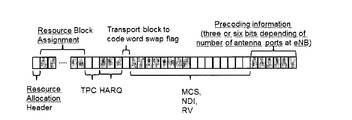
Claims (18)

  1. An apparatus for receiving data from a serving base station in a cellular communication  system,the apparatus comprising:
    a blind decoding unit for identifying and decoding a downlink control information  transmitted by the serving base station,
    an extraction unit for extracting from a first field of the downlink control information a  scheduling control information and from a second field of the downlink control information  an interference information,and
    a transceiver for receiving or transmitting data on resources specified by the scheduling  information while taking into account the interference information so as to reduce the  interference caused by transmitters other than the serving base station.
  2. The apparatus according to claim1,wherein the scheduling information extracted from  the first field of the downlink control information is a first scheduling information which  indicates transmission parameters for a first transport block of data,the apparatus further  comprising
    a control unit for controlling the extraction unit to either extract from the second field of  the downlink control information the interference information or a second scheduling  information which indicates transmission parameters for a second transport block of data.
  3. The apparatus according to claim1,wherein the scheduling information extracted from  the first field of the downlink control information is a first scheduling information which  indicates transmission parameters for a first transport block of data,the apparatus further  comprising
    a control unit for controlling the extraction unit to extract from the second field of the  downlink control information either the interference information and a reduced second  scheduling information which indicates transmission parameters for a second transport  block of data or only a complete second scheduling information which indicates  transmission parameters for a second transport block of data.
  4. The apparatus according to claim3,wherein
    the first and the second field have the same sizes,
    each of the first and the second field includes a modulation and coding scheme subfield  for indicating modulation and coding scheme(MCS),
    the modulation and coding scheme subfield of the first field is larger than the modulation  and coding scheme subfield of the second field.
  5. The apparatus according to any of claims2to4,wherein
    the control unit is configured to receive a switching message on a protocol layer higher  than the physical layer,and
    the switching message indicates the format of the second field,namely whether or not  the second field is to carry the interference information.
  6. The apparatus according to any of claims2to4,wherein
    the control unit is configured to receive a switching indication on the physical layer,and  the switching indication indicates the format of the second field,namely whether or not  the second field is to carry the interference information.
  7. The apparatus according to claim6,wherein
    the control unit is configured to receive the switching indication within a3GPP LTE  Release-11downlink control information message,in the resource allocation header field, while it is assumed that Type0allocation applies.
  8. The apparatus according to claim7,wherein the resource allocation header  interpretation is configured semi-statically by a layer higher than the physical layer, wherein the resource header is interpretable either as indicating Type0or Type1 allocation or as indicating the switching indication.
  9. The apparatus according to claim6,wherein
    the control unit is configured to receive the switching indication within the second field in  that at least one codepoint among all possible values defined by a subset of bits of the  second field indicates that the interference information is transmitted in the second field  and all codepoints other than said at least one codepoint indicate that the interference  information is not transmitted in the second field.
  10. The apparatus according to claim9,wherein the subset of bits takes either the value of  said at least one codepoint or another value indicating redundancy version for the second  transport block.
  11. The apparatus according to any of claims1to10,wherein the downlink control  information includes a resource block assignment field and can take any of the following  formats:
    i)the resource block assignment field indicates resource assignment for the  transmission,for which the scheduling information is transmitted;
    ii)the resource block assignment field includes a first subfield(1580)indicating  resource assignment for the transmission,for which the scheduling information  is transmitted,and a second subfield(1590)indicating whether or not the  interference information in the second field is to be applied for interference  cancellation for the respective resources specified in the first subfield(1580).
  12. The apparatus according to claim11,wherein
    in case of format ii)the second subfield(1690)of the resource block assignment field  indicates for the respective resources assigned in accordance with the first subfield  whether a first interference information or a second interference information is to be  applied to said respective assigned resources,and
    the second field includes a first subfield indicating the first set of interference parameters  and a second subfield indicating the second set of interference parameters.
  13. The apparatus according to any of claims1to12,wherein the transceiver is configured  to receive within a protocol of a layer higher than the physical layer a control information  carrying a transmission mode,wherein the transmission mode can take a value which  defines that the apparatus is to extract from the downlink control information the  interference information as well as values which do not define that the apparatus is to  extract the interference information from the downlink control information.
  14. An apparatus for transmitting data to a receiving device in a cellular communication  system,the apparatus being a serving base station for the receiving device,comprising:
    an interference information determining unit for determining the interference experienced  by the receiving device caused by transmitters other than the serving base station,
    a control information generation unit for generating a downlink control information  including a first field including a scheduling control information and a second field  including the interference information,and
    a transmitter for transmitting to the receiving device for blind decoding the generated  downlink control information,and for receiving or transmitting data from/to the receiving  device on resources specified by the scheduling information.
  15. The apparatus according to claim14,further comprising a switching indication generation  unit for generating a switching indication indicating whether or not the interference  information is included into the downlink control information,and for embedding the  switching indication either semi-statically within a protocol layer higher than the physical  layer,or dynamically within the downlink control information.
  16. The apparatus according to claim14or15further comprising an interference judgement  unit for deciding whether or not to provide the interference information within the downing  control information based on measurements of a reference signal,reported to the  apparatus by the receiving device and/or based on load information of an interfering base  station.
  17. A method for receiving data from a serving base station in a cellular communication  system,the method comprising the steps of:
    blind decoding for identifying and decoding a downlink control information transmitted by  the serving base station,
    extracting from a first field of the downlink control information a scheduling control  information and from a second field of the downlink control information an interference  information,and
    receiving or transmitting data on resources specified by the scheduling information while  taking into account the interference information so as to reduce the interference caused  by transmitters other than the serving base station.
  18. A method for transmitting data to a receiving device in a cellular communication system, the apparatus being a serving base station for the receiving device,comprising:
    determining the interference experienced by the receiving device caused by transmitters  other than the serving base station,
    generating a downlink control information including a first field including a scheduling  control information and a second field including the interference information,and
    transmitting to the receiving device for blind decoding the generated downlink control  information,and for receiving or transmitting data from/to the receiving device on  resources specified by the scheduling information.
PCT/CN2014/074355 2014-03-31 2014-03-31 Interference parameter signaling for efficient interference cancellation and suppression Ceased WO2015149213A1 (en)

Priority Applications (5)

Application Number Priority Date Filing Date Title
JP2016557052A JP6379214B2 (en) 2014-03-31 2014-03-31 Interference parameter signaling for effective cancellation and suppression of interference
PCT/CN2014/074355 WO2015149213A1 (en) 2014-03-31 2014-03-31 Interference parameter signaling for efficient interference cancellation and suppression
US15/122,384 US10020973B2 (en) 2014-03-31 2014-03-31 Interference parameter signaling for efficient interference cancellation and suppression
EP14888004.0A EP3127385B1 (en) 2014-03-31 2014-03-31 Interference parameter signaling for efficient interference cancellation and suppression
US16/002,613 US10341152B2 (en) 2014-03-31 2018-06-07 Interference parameter signaling for efficient interference cancellation and suppression

Applications Claiming Priority (1)

Application Number Priority Date Filing Date Title
PCT/CN2014/074355 WO2015149213A1 (en) 2014-03-31 2014-03-31 Interference parameter signaling for efficient interference cancellation and suppression

Related Child Applications (2)

Application Number Title Priority Date Filing Date
US15/122,384 A-371-Of-International US10020973B2 (en) 2014-03-31 2014-03-31 Interference parameter signaling for efficient interference cancellation and suppression
US16/002,613 Continuation US10341152B2 (en) 2014-03-31 2018-06-07 Interference parameter signaling for efficient interference cancellation and suppression

Publications (1)

Publication Number Publication Date
WO2015149213A1 true WO2015149213A1 (en) 2015-10-08

Family

ID=54239207

Family Applications (1)

Application Number Title Priority Date Filing Date
PCT/CN2014/074355 Ceased WO2015149213A1 (en) 2014-03-31 2014-03-31 Interference parameter signaling for efficient interference cancellation and suppression

Country Status (4)

Country Link
US (2) US10020973B2 (en)
EP (1) EP3127385B1 (en)
JP (1) JP6379214B2 (en)
WO (1) WO2015149213A1 (en)

Cited By (5)

* Cited by examiner, † Cited by third party
Publication number Priority date Publication date Assignee Title
CN109644487A (en) * 2016-08-30 2019-04-16 Lg电子株式会社 The method of down link control information and the device using this method are sent in wireless communication system
CN110313205A (en) * 2017-02-10 2019-10-08 华为技术有限公司 A communication method and device
JPWO2018203408A1 (en) * 2017-05-02 2020-03-12 株式会社Nttドコモ User terminal and wireless communication method
CN112534938A (en) * 2018-08-17 2021-03-19 华为技术有限公司 Downlink control information transmission method and device
CN115395998A (en) * 2017-05-04 2022-11-25 大唐移动通信设备有限公司 A message decoding method, sending end and receiving end

Families Citing this family (25)

* Cited by examiner, † Cited by third party
Publication number Priority date Publication date Assignee Title
EP2590350A1 (en) * 2011-11-07 2013-05-08 Panasonic Corporation Enhanced PDCCH overlapping with the PDCCH region
JP6698350B2 (en) * 2014-01-15 2020-05-27 シャープ株式会社 Terminal device, base station device, and integrated circuit
JPWO2015137112A1 (en) * 2014-03-13 2017-04-06 シャープ株式会社 Terminal device, base station device, and integrated circuit
KR102244366B1 (en) * 2014-05-09 2021-04-26 삼성전자주식회사 Method and Device Utilizing Wireless Resources for Interference Cancellation and Suppression in Wireless Communication Systems
US20150365178A1 (en) * 2014-06-12 2015-12-17 Broadcom Corporation System, method, and apparatus for signaling intefering cell information
KR102176635B1 (en) * 2015-06-05 2020-11-09 삼성전자주식회사 Apparatus and method for transmitting and receiving for control information in wireless communication system
CN106487488A (en) * 2015-08-25 2017-03-08 电信科学技术研究院 The sending, receiving method of control signaling, the network equipment and receiving device
TWI767306B (en) * 2015-11-10 2022-06-11 美商Idac控股公司 Downlink control channel design and signaling for beamformed systems
JP6490308B2 (en) * 2016-02-05 2019-03-27 パナソニック インテレクチュアル プロパティ コーポレーション オブ アメリカPanasonic Intellectual Property Corporation of America Base station, terminal and communication method
CN107197528B (en) * 2016-03-14 2020-12-25 华为技术有限公司 Method and device for scheduling and allocating resources
US10939361B2 (en) * 2016-08-12 2021-03-02 Huawei Technologies Co., Ltd. Control information sending method, control information receiving method, and device
CN108076520B (en) * 2016-11-16 2020-02-14 上海朗帛通信技术有限公司 Method and equipment used in UE and base station
CN108337733B (en) * 2017-01-20 2021-01-29 华为技术有限公司 Data transmission method and related device
KR20220044869A (en) 2017-06-02 2022-04-11 애플 인크. Beamformed measurement for new radio (nr)
KR20190073105A (en) * 2017-12-18 2019-06-26 한국전자통신연구원 Method and apparatus for obtaining control information
US11050523B2 (en) * 2018-05-11 2021-06-29 Qualcomm Incorporated Techniques to interpret control information based on a repetition factor
CN110474741B (en) * 2018-05-11 2021-01-15 华为技术有限公司 Communication method and device
CN110536462B (en) * 2019-02-02 2025-02-07 中兴通讯股份有限公司 Transport block transmission method, device, communication equipment and storage medium
US10886958B2 (en) * 2019-03-18 2021-01-05 Mediatek Inc. Over-the-air signal assisted interference cancellation or suppression
WO2021023531A1 (en) * 2019-08-06 2021-02-11 Sony Corporation Communications devices, infrastructure equipment, and methods
CN113473611B (en) * 2020-03-31 2024-09-06 维沃移动通信有限公司 Resource scheduling method, device and UE
US11424851B2 (en) * 2020-12-09 2022-08-23 Qualcomm Incorporated Dynamic bit width determination for resource block group mask
WO2023000195A1 (en) * 2021-07-21 2023-01-26 Qualcomm Incorporated Transmission configuration indicator state mapping for mutilple transport block transmission
US20230319862A1 (en) * 2022-03-21 2023-10-05 Qualcomm Incorporated Interference cancellation for full duplex communication
CN120224194B (en) * 2025-02-27 2026-04-14 西安电子科技大学 Smart interference suppression method and device and electronic equipment

Citations (4)

* Cited by examiner, † Cited by third party
Publication number Priority date Publication date Assignee Title
CN101605356A (en) * 2008-06-12 2009-12-16 大唐移动通信设备有限公司 A kind of method of indexed resource, Apparatus and system
CN103037513A (en) * 2011-09-30 2013-04-10 上海贝尔股份有限公司 Method for enhancing downlink control information for improving system spectral efficiency
WO2013068834A1 (en) * 2011-11-07 2013-05-16 Alcatel Lucent Method and apparatus for transmitting and receiving downlink control information based on multi-user mimo transmission
WO2014007699A1 (en) * 2012-07-04 2014-01-09 Telefonaktiebolaget L M Ericsson (Publ) Interference control in hetnet:s

Family Cites Families (8)

* Cited by examiner, † Cited by third party
Publication number Priority date Publication date Assignee Title
CN101325741B (en) * 2007-06-14 2012-12-12 Nxp股份有限公司 Method and system for operating MU-MIMO wireless communication system
WO2011137383A1 (en) * 2010-04-30 2011-11-03 Interdigital Patent Holdings, Inc. Downlink control in heterogeneous networks
KR20140023738A (en) * 2012-08-17 2014-02-27 삼성전자주식회사 Method and apparatus for link scheduling based on a sharing interference information between links in wireless communication system
KR102061700B1 (en) * 2012-11-02 2020-01-02 삼성전자주식회사 Method and apparatus for interference aware detection in wireless communication system
KR20140067780A (en) * 2012-11-27 2014-06-05 삼성전자주식회사 Method and apparatus for interference cancellation of mimo transmission in wireless communication system
US9641284B2 (en) * 2013-12-19 2017-05-02 Lg Electronics Inc. Method and apparatus for receiving or transmitting interference information
WO2015107978A1 (en) * 2014-01-15 2015-07-23 シャープ株式会社 Terminal device, base station device, and integrated circuit
US9112657B1 (en) * 2014-03-06 2015-08-18 Samsung Electronics Co., Ltd Method for extracting interference signal information and apparatus for the same

Patent Citations (4)

* Cited by examiner, † Cited by third party
Publication number Priority date Publication date Assignee Title
CN101605356A (en) * 2008-06-12 2009-12-16 大唐移动通信设备有限公司 A kind of method of indexed resource, Apparatus and system
CN103037513A (en) * 2011-09-30 2013-04-10 上海贝尔股份有限公司 Method for enhancing downlink control information for improving system spectral efficiency
WO2013068834A1 (en) * 2011-11-07 2013-05-16 Alcatel Lucent Method and apparatus for transmitting and receiving downlink control information based on multi-user mimo transmission
WO2014007699A1 (en) * 2012-07-04 2014-01-09 Telefonaktiebolaget L M Ericsson (Publ) Interference control in hetnet:s

Non-Patent Citations (1)

* Cited by examiner, † Cited by third party
Title
See also references of EP3127385A4 *

Cited By (13)

* Cited by examiner, † Cited by third party
Publication number Priority date Publication date Assignee Title
CN109644487A (en) * 2016-08-30 2019-04-16 Lg电子株式会社 The method of down link control information and the device using this method are sent in wireless communication system
CN109644487B (en) * 2016-08-30 2022-05-24 Lg电子株式会社 Method for transmitting downlink control information in wireless communication system and apparatus using the same
US11336390B2 (en) 2016-08-30 2022-05-17 Lg Electronics Inc. Method for transmitting downlink control information in wireless communication system and device using same
CN110313205B (en) * 2017-02-10 2021-12-21 华为技术有限公司 Communication method and device
US11171755B2 (en) 2017-02-10 2021-11-09 Huawei Technologies Co., Ltd. Communication method and communications device
CN110313205A (en) * 2017-02-10 2019-10-08 华为技术有限公司 A communication method and device
EP3621376A4 (en) * 2017-05-02 2021-03-24 NTT DoCoMo, Inc. USER TERMINAL AND WIRELESS COMMUNICATION PROCESS
US11252695B2 (en) 2017-05-02 2022-02-15 Ntt Docomo, Inc. User terminal and radio communication method
JPWO2018203408A1 (en) * 2017-05-02 2020-03-12 株式会社Nttドコモ User terminal and wireless communication method
US12022491B2 (en) 2017-05-02 2024-06-25 Ntt Docomo, Inc. Terminal, radio communication method, base station, and system
CN115395998A (en) * 2017-05-04 2022-11-25 大唐移动通信设备有限公司 A message decoding method, sending end and receiving end
CN112534938A (en) * 2018-08-17 2021-03-19 华为技术有限公司 Downlink control information transmission method and device
CN112534938B (en) * 2018-08-17 2022-07-29 华为技术有限公司 Downlink control information transmission method and device

Also Published As

Publication number Publication date
US10341152B2 (en) 2019-07-02
EP3127385A1 (en) 2017-02-08
JP2017516335A (en) 2017-06-15
JP6379214B2 (en) 2018-08-22
EP3127385A4 (en) 2017-10-18
US10020973B2 (en) 2018-07-10
US20180309608A1 (en) 2018-10-25
US20170078126A1 (en) 2017-03-16
EP3127385B1 (en) 2019-03-13

Similar Documents

Publication Publication Date Title
US10341152B2 (en) Interference parameter signaling for efficient interference cancellation and suppression
US10128927B2 (en) Channel state information reporting enhancement for network assisted interference cancellation and suppression
US9894647B2 (en) Downlink coverage enhancements
JP5764239B2 (en) CQI acquisition method, base station apparatus and integrated circuit
CN104025495B (en) Method and arrangement for launching and receiving the down link control information for mobile radio telecommunications
JP7210596B2 (en) Communication device, base station and method
US9325460B2 (en) Implicit component carrier determination for aperiodic channel quality reports
US9723606B2 (en) Method and apparatus for enhanced control channel-based operation in wireless communication system
EP3455991B1 (en) Configuration of downlink transmissions
TWI644543B (en) Dynamic physical uplink control channel (pucch)
CN114024805B (en) Multi-user data transmission method and device
US11258568B2 (en) Single packet encoded channel state information (CSI) design for new radio (NR) multiple input-multiple output (MIMO)
CN104488344A (en) LTE enhancements for small packet transmission
EP3360258B1 (en) Communication device, network node, method and computer

Legal Events

Date Code Title Description
121 Ep: the epo has been informed by wipo that ep was designated in this application

Ref document number: 14888004

Country of ref document: EP

Kind code of ref document: A1

WWE Wipo information: entry into national phase

Ref document number: 15122384

Country of ref document: US

ENP Entry into the national phase

Ref document number: 2016557052

Country of ref document: JP

Kind code of ref document: A

REEP Request for entry into the european phase

Ref document number: 2014888004

Country of ref document: EP

WWE Wipo information: entry into national phase

Ref document number: 2014888004

Country of ref document: EP

NENP Non-entry into the national phase

Ref country code: DE