WO2015151853A1 - 熱可塑性樹脂組成物およびその成形品 - Google Patents
熱可塑性樹脂組成物およびその成形品 Download PDFInfo
- Publication number
- WO2015151853A1 WO2015151853A1 PCT/JP2015/058443 JP2015058443W WO2015151853A1 WO 2015151853 A1 WO2015151853 A1 WO 2015151853A1 JP 2015058443 W JP2015058443 W JP 2015058443W WO 2015151853 A1 WO2015151853 A1 WO 2015151853A1
- Authority
- WO
- WIPO (PCT)
- Prior art keywords
- thermoplastic resin
- resin composition
- mass
- copolymer
- monomer
- Prior art date
- Legal status (The legal status is an assumption and is not a legal conclusion. Google has not performed a legal analysis and makes no representation as to the accuracy of the status listed.)
- Ceased
Links
Images

Classifications
-
- C—CHEMISTRY; METALLURGY
- C08—ORGANIC MACROMOLECULAR COMPOUNDS; THEIR PREPARATION OR CHEMICAL WORKING-UP; COMPOSITIONS BASED THEREON
- C08F—MACROMOLECULAR COMPOUNDS OBTAINED BY REACTIONS ONLY INVOLVING CARBON-TO-CARBON UNSATURATED BONDS
- C08F255/00—Macromolecular compounds obtained by polymerising monomers on to polymers of hydrocarbons as defined in group C08F10/00
- C08F255/02—Macromolecular compounds obtained by polymerising monomers on to polymers of hydrocarbons as defined in group C08F10/00 on to polymers of olefins having two or three carbon atoms
- C08F255/06—Macromolecular compounds obtained by polymerising monomers on to polymers of hydrocarbons as defined in group C08F10/00 on to polymers of olefins having two or three carbon atoms on to ethylene-propylene-diene terpolymers
-
- C—CHEMISTRY; METALLURGY
- C08—ORGANIC MACROMOLECULAR COMPOUNDS; THEIR PREPARATION OR CHEMICAL WORKING-UP; COMPOSITIONS BASED THEREON
- C08F—MACROMOLECULAR COMPOUNDS OBTAINED BY REACTIONS ONLY INVOLVING CARBON-TO-CARBON UNSATURATED BONDS
- C08F2/00—Processes of polymerisation
- C08F2/12—Polymerisation in non-solvents
- C08F2/16—Aqueous medium
- C08F2/18—Suspension polymerisation
-
- C—CHEMISTRY; METALLURGY
- C08—ORGANIC MACROMOLECULAR COMPOUNDS; THEIR PREPARATION OR CHEMICAL WORKING-UP; COMPOSITIONS BASED THEREON
- C08F—MACROMOLECULAR COMPOUNDS OBTAINED BY REACTIONS ONLY INVOLVING CARBON-TO-CARBON UNSATURATED BONDS
- C08F220/00—Copolymers of compounds having one or more unsaturated aliphatic radicals, each having only one carbon-to-carbon double bond, and only one being terminated by only one carboxyl radical or a salt, anhydride ester, amide, imide or nitrile thereof
- C08F220/02—Monocarboxylic acids having less than ten carbon atoms; Derivatives thereof
- C08F220/10—Esters
- C08F220/12—Esters of monohydric alcohols or phenols
- C08F220/14—Methyl esters, e.g. methyl (meth)acrylate
-
- C—CHEMISTRY; METALLURGY
- C08—ORGANIC MACROMOLECULAR COMPOUNDS; THEIR PREPARATION OR CHEMICAL WORKING-UP; COMPOSITIONS BASED THEREON
- C08F—MACROMOLECULAR COMPOUNDS OBTAINED BY REACTIONS ONLY INVOLVING CARBON-TO-CARBON UNSATURATED BONDS
- C08F220/00—Copolymers of compounds having one or more unsaturated aliphatic radicals, each having only one carbon-to-carbon double bond, and only one being terminated by only one carboxyl radical or a salt, anhydride ester, amide, imide or nitrile thereof
- C08F220/02—Monocarboxylic acids having less than ten carbon atoms; Derivatives thereof
- C08F220/10—Esters
- C08F220/12—Esters of monohydric alcohols or phenols
- C08F220/16—Esters of monohydric alcohols or phenols of phenols or of alcohols containing two or more carbon atoms
-
- C—CHEMISTRY; METALLURGY
- C08—ORGANIC MACROMOLECULAR COMPOUNDS; THEIR PREPARATION OR CHEMICAL WORKING-UP; COMPOSITIONS BASED THEREON
- C08F—MACROMOLECULAR COMPOUNDS OBTAINED BY REACTIONS ONLY INVOLVING CARBON-TO-CARBON UNSATURATED BONDS
- C08F220/00—Copolymers of compounds having one or more unsaturated aliphatic radicals, each having only one carbon-to-carbon double bond, and only one being terminated by only one carboxyl radical or a salt, anhydride ester, amide, imide or nitrile thereof
- C08F220/02—Monocarboxylic acids having less than ten carbon atoms; Derivatives thereof
- C08F220/10—Esters
- C08F220/12—Esters of monohydric alcohols or phenols
- C08F220/16—Esters of monohydric alcohols or phenols of phenols or of alcohols containing two or more carbon atoms
- C08F220/18—Esters of monohydric alcohols or phenols of phenols or of alcohols containing two or more carbon atoms with acrylic or methacrylic acids
- C08F220/1804—C4-(meth)acrylate, e.g. butyl (meth)acrylate, isobutyl (meth)acrylate or tert-butyl (meth)acrylate
-
- C—CHEMISTRY; METALLURGY
- C08—ORGANIC MACROMOLECULAR COMPOUNDS; THEIR PREPARATION OR CHEMICAL WORKING-UP; COMPOSITIONS BASED THEREON
- C08F—MACROMOLECULAR COMPOUNDS OBTAINED BY REACTIONS ONLY INVOLVING CARBON-TO-CARBON UNSATURATED BONDS
- C08F265/00—Macromolecular compounds obtained by polymerising monomers on to polymers of unsaturated monocarboxylic acids or derivatives thereof as defined in group C08F20/00
- C08F265/04—Macromolecular compounds obtained by polymerising monomers on to polymers of unsaturated monocarboxylic acids or derivatives thereof as defined in group C08F20/00 on to polymers of esters
- C08F265/06—Polymerisation of acrylate or methacrylate esters on to polymers thereof
-
- C—CHEMISTRY; METALLURGY
- C08—ORGANIC MACROMOLECULAR COMPOUNDS; THEIR PREPARATION OR CHEMICAL WORKING-UP; COMPOSITIONS BASED THEREON
- C08F—MACROMOLECULAR COMPOUNDS OBTAINED BY REACTIONS ONLY INVOLVING CARBON-TO-CARBON UNSATURATED BONDS
- C08F279/00—Macromolecular compounds obtained by polymerising monomers on to polymers of monomers having two or more carbon-to-carbon double bonds as defined in group C08F36/00
- C08F279/02—Macromolecular compounds obtained by polymerising monomers on to polymers of monomers having two or more carbon-to-carbon double bonds as defined in group C08F36/00 on to polymers of conjugated dienes
-
- C—CHEMISTRY; METALLURGY
- C08—ORGANIC MACROMOLECULAR COMPOUNDS; THEIR PREPARATION OR CHEMICAL WORKING-UP; COMPOSITIONS BASED THEREON
- C08F—MACROMOLECULAR COMPOUNDS OBTAINED BY REACTIONS ONLY INVOLVING CARBON-TO-CARBON UNSATURATED BONDS
- C08F290/00—Macromolecular compounds obtained by polymerising monomers on to polymers modified by introduction of aliphatic unsaturated end or side groups
- C08F290/02—Macromolecular compounds obtained by polymerising monomers on to polymers modified by introduction of aliphatic unsaturated end or side groups on to polymers modified by introduction of unsaturated end groups
- C08F290/06—Polymers provided for in subclass C08G
- C08F290/068—Polysiloxanes
-
- C—CHEMISTRY; METALLURGY
- C08—ORGANIC MACROMOLECULAR COMPOUNDS; THEIR PREPARATION OR CHEMICAL WORKING-UP; COMPOSITIONS BASED THEREON
- C08L—COMPOSITIONS OF MACROMOLECULAR COMPOUNDS
- C08L25/00—Compositions of, homopolymers or copolymers of compounds having one or more unsaturated aliphatic radicals, each having only one carbon-to-carbon double bond, and at least one being terminated by an aromatic carbocyclic ring; Compositions of derivatives of such polymers
- C08L25/02—Homopolymers or copolymers of hydrocarbons
- C08L25/04—Homopolymers or copolymers of styrene
- C08L25/08—Copolymers of styrene
-
- C—CHEMISTRY; METALLURGY
- C08—ORGANIC MACROMOLECULAR COMPOUNDS; THEIR PREPARATION OR CHEMICAL WORKING-UP; COMPOSITIONS BASED THEREON
- C08L—COMPOSITIONS OF MACROMOLECULAR COMPOUNDS
- C08L33/00—Compositions of homopolymers or copolymers of compounds having one or more unsaturated aliphatic radicals, each having only one carbon-to-carbon double bond, and only one being terminated by only one carboxyl radical, or of salts, anhydrides, esters, amides, imides or nitriles thereof; Compositions of derivatives of such polymers
- C08L33/04—Homopolymers or copolymers of esters
- C08L33/06—Homopolymers or copolymers of esters of esters containing only carbon, hydrogen and oxygen, which oxygen atoms are present only as part of the carboxyl radical
- C08L33/10—Homopolymers or copolymers of methacrylic acid esters
- C08L33/12—Homopolymers or copolymers of methyl methacrylate
-
- C—CHEMISTRY; METALLURGY
- C08—ORGANIC MACROMOLECULAR COMPOUNDS; THEIR PREPARATION OR CHEMICAL WORKING-UP; COMPOSITIONS BASED THEREON
- C08L—COMPOSITIONS OF MACROMOLECULAR COMPOUNDS
- C08L51/00—Compositions of graft polymers in which the grafted component is obtained by reactions only involving carbon-to-carbon unsaturated bonds; Compositions of derivatives of such polymers
- C08L51/04—Compositions of graft polymers in which the grafted component is obtained by reactions only involving carbon-to-carbon unsaturated bonds; Compositions of derivatives of such polymers grafted on to rubbers
-
- C—CHEMISTRY; METALLURGY
- C08—ORGANIC MACROMOLECULAR COMPOUNDS; THEIR PREPARATION OR CHEMICAL WORKING-UP; COMPOSITIONS BASED THEREON
- C08L—COMPOSITIONS OF MACROMOLECULAR COMPOUNDS
- C08L51/00—Compositions of graft polymers in which the grafted component is obtained by reactions only involving carbon-to-carbon unsaturated bonds; Compositions of derivatives of such polymers
- C08L51/06—Compositions of graft polymers in which the grafted component is obtained by reactions only involving carbon-to-carbon unsaturated bonds; Compositions of derivatives of such polymers grafted on to homopolymers or copolymers of aliphatic hydrocarbons containing only one carbon-to-carbon double bond
-
- C—CHEMISTRY; METALLURGY
- C08—ORGANIC MACROMOLECULAR COMPOUNDS; THEIR PREPARATION OR CHEMICAL WORKING-UP; COMPOSITIONS BASED THEREON
- C08L—COMPOSITIONS OF MACROMOLECULAR COMPOUNDS
- C08L9/00—Compositions of homopolymers or copolymers of conjugated diene hydrocarbons
- C08L9/06—Copolymers with styrene
-
- C—CHEMISTRY; METALLURGY
- C08—ORGANIC MACROMOLECULAR COMPOUNDS; THEIR PREPARATION OR CHEMICAL WORKING-UP; COMPOSITIONS BASED THEREON
- C08L—COMPOSITIONS OF MACROMOLECULAR COMPOUNDS
- C08L2201/00—Properties
- C08L2201/08—Stabilised against heat, light or radiation or oxydation
-
- C—CHEMISTRY; METALLURGY
- C08—ORGANIC MACROMOLECULAR COMPOUNDS; THEIR PREPARATION OR CHEMICAL WORKING-UP; COMPOSITIONS BASED THEREON
- C08L—COMPOSITIONS OF MACROMOLECULAR COMPOUNDS
- C08L2205/00—Polymer mixtures characterised by other features
- C08L2205/06—Polymer mixtures characterised by other features having improved processability or containing aids for moulding methods
Definitions
- the present invention provides a thermoplastic resin composition that gives a molded product excellent in heat discoloration at the time of molding retention, fluidity, impact resistance, heat resistance, molded product surface appearance, color development and vibration damping properties, and this heat
- the present invention relates to a thermoplastic resin molded product formed by molding a plastic resin composition.
- Thermoplastic resins such as styrene resins typified by ABS resins and alloy materials made of styrene resins and other thermoplastic resins are excellent in mechanical properties, physical properties, electrical properties, etc. Widely used in electronics, OA / home appliances, vehicles, sanitary, etc. Due to the recent reduction in weight and size of products, molded products have become thinner. In order to reduce the thickness, when a molded product is obtained by injection molding or the like, it is necessary to increase the molding temperature or the injection speed, which is a severe condition for the thermoplastic resin.
- thermoplastic resin composition By adding various heat stability improvers to the thermoplastic resin composition, a certain degree of heat stability improvement effect can be obtained, but the cost increases.
- the vibration-proof and vibration-damping material a material in which a resin or rubber material is sandwiched between metal plates is used. With the recent reduction in weight and size of equipment, it has become difficult to design products with such a structure, and a material that forms the structure itself is required to have high vibration damping performance.
- a material with high rigidity that can be a structure has a low vibration damping property, while a material with a large vibration damping property has a contradictory relationship that the rigidity is low. It was difficult to use the resin composition as it was.
- JP-A-6-41443 discloses a copolymer of a acrylate monomer and / or a methacrylic acid ester monomer and another comonomer having a glass transition temperature of 0 ° C. or more and a thermoplastic resin. A combination is proposed.
- Japanese Patent Application Laid-Open No. 11-349785 proposes blending a rubbery polymer having a specific core-shell structure with a styrene resin. In these resin compositions, a molded product excellent in molding processability and appearance surface properties while maintaining vibration damping properties has not been obtained.
- Japanese Patent Application Laid-Open No. 2000-212373 discloses a Tg peak of each polymer constituting the composition in a specific temperature range in a thermoplastic resin composition comprising a (meth) acrylic ester copolymer and another copolymer. There has been proposed a thermoplastic resin composition having a loss tangent (tan ⁇ ) peak different from the above. In this resin composition, improvement in molding processability and appearance surface property is seen, but there is no effect on heat discoloration of the resin composition.
- JP-A-6-41443 Japanese Patent Laid-Open No. 11-349785 JP 2000-212373 A
- An object of the present invention is to provide a thermoplastic resin composition that gives a molded product that is excellent in heat discoloration at the time of molding retention, fluidity, impact resistance, heat resistance, molded product surface appearance, color developability, and vibration damping properties. There is to do.
- the present invention provides a copolymer obtained by copolymerizing a vinyl monomer essentially comprising styrene and ⁇ -methylstyrene as an aromatic vinyl monomer with a specific composition, and a graft copolymer. It has been found that the above problems can be solved by using a thermoplastic resin composition obtained by melt-kneading.
- the gist of the present invention is as follows.
- thermoplastic resin composition 30 to 80 parts by mass of a copolymer (B) obtained by copolymerizing an essential vinyl monomer mixture (however, the total of the graft copolymer (A) and the copolymer (B) is 100 parts by mass)
- the thermoplastic resin composition 30 to 80 parts by mass of a copolymer (B) obtained by copolymerizing an essential vinyl monomer mixture (however, the total of the graft copolymer (A) and the copolymer (B) is 100 parts by mass)
- the thermoplastic resin composition 30 to 80 parts by mass of a copolymer (B) obtained by copolymerizing an essential vinyl monomer mixture (however, the total of the graft copolymer (A) and the copolymer (B) is 100 parts by mass)
- the vinyl monomer mixture is an unsaturated nitrile monomer 5 to 20% by mass, an aromatic vinyl monomer 10 to 30% by mass, a (meth) acrylic acid ester monomer 50 to The thermoplastic resin composition according to [1], comprising 85% by mass and 0 to 10% by mass of another vinyl monomer.
- the aromatic vinyl monomer in the vinyl monomer mixture contains 5 to 30% by mass of styrene and 70 to 95% by mass of ⁇ -methylstyrene.
- thermoplastic resin composition according to any one of [1] to [3], wherein the copolymer (B) is obtained by suspension polymerization.
- the rubbery polymer (a) is an acrylic rubber containing an alkyl acrylate monomer unit and a polyfunctional monomer unit, or a polyorganosiloxane and an alkyl acrylate monomer unit.
- the graft copolymer (A) is an unsaturated nitrile monomer, an aromatic vinyl monomer, and (meth) in the presence of 40 to 80% by mass of the rubber polymer (a). Any one of [1] to [6], which is obtained by graft copolymerization of 60 to 20% by mass of a vinyl monomer selected from the group consisting of acrylate monomers. Thermoplastic resin composition.
- the graft ratio of the graft copolymer (A) is 20 to 150%, the reduced viscosity of the acetone soluble part is 0.30 to 0.70 dL / g, and the copolymer (B) The thermoplastic resin composition according to any one of [1] to [7], wherein the reduced viscosity is 0.30 to 0.70 dL / g.
- the content of rubber polymer (a) in the entire thermoplastic resin composition is in the range of 10 to 30% by mass, according to any one of [1] to [8] Thermoplastic resin composition.
- thermoplastic resin molded product obtained by molding the thermoplastic resin composition according to any one of [1] to [9].
- thermoplastic resin composition of the present invention is excellent in heat discoloration at the time of molding retention, and can give a molded product excellent in fluidity, impact resistance, heat resistance, molded product surface appearance, color development and vibration damping properties. It is.
- the thermoplastic resin composition of the present invention can be used for automobile materials, building materials, and home appliances, for which demand has been increasing in recent years, and its industrial utility value is extremely high.
- the “unit” refers to a structural portion derived from a monomer compound (monomer) before polymerization.
- the “vinyl monomer unit” refers to “a structural portion derived from a vinyl monomer”.
- (meth) acryl means one or both of “acryl” and “methacryl”.
- the graft copolymer (A) is an unsaturated nitrile monomer, aromatic vinyl monomer, or (meth) acrylic acid ester monomer in the presence of the rubbery polymer (a). These vinyl monomers are essential, and are obtained by graft copolymerization of monomer components containing other vinyl monomers having copolymerizability with the above-mentioned monomers blended as necessary. .
- Examples of the rubbery polymer (a) include diene rubber, acrylic rubber containing an alkyl acrylate monomer unit and a polyfunctional monomer unit, ethylene-propylene rubber (EPR), ethylene-butene rubber ( Examples include EBR), ethylene-octene rubber (EOR), ethylene-propylene-diene rubber (EPDM), polyorganosiloxane and the like.
- Rubbery polymers may be used alone or in a combination of two or more.
- an acrylic rubber containing an alkyl acrylate monomer unit and a polyfunctional monomer unit from the viewpoint of excellent weather resistance and color developability of the resulting thermoplastic resin composition, an acrylic rubber containing an alkyl acrylate monomer unit and a polyfunctional monomer unit, and An acrylic composite rubber made of an acrylic rubber containing a polyorganosiloxane, an acrylic acid alkyl ester monomer unit, and a polyfunctional monomer unit is preferred.
- the rubbery polymer (a) is preferably produced by emulsion polymerization of a mixture of the above monomers constituting the monomer unit contained in the rubbery polymer (a).
- an anionic emulsifier is preferable from the viewpoint that the stability of the latex during the emulsion polymerization is excellent and the polymerization rate can be increased.
- anionic emulsifiers include sodium sarcosine, fatty acid potassium, fatty acid sodium, alkenyl succinate potassium, alkenyl succinate dipotassium, rosin acid soap and other carboxylates, alkyl sulfate esters, alkyl benzene sulfonates, sodium alkyl sulfosuccinates, Examples thereof include dibasic acids having an alkyl group and / or alkenyl group, such as sodium polyoxyethylene nonylphenyl ether sulfate, or salts thereof.
- the alkyl group is preferably a linear or branched group having 8 to 22 carbon atoms, more preferably 12 to 20 carbon atoms.
- a cyclic alkyl group such as various octyl groups, various decyl groups, various dodecyl groups, various tetradecyl groups, various hexadecyl groups, various octadecyl groups, various icosyl groups, and the like.
- the alkenyl group is preferably a linear, branched or cyclic alkenyl group having 8 to 22 carbon atoms, more preferably 12 to 20 carbon atoms.
- various octenyl groups, various decenyl groups, various dodecenyl groups, A tetradecenyl group, various hexadecenyl groups, various octadecenyl groups, various icocenyl groups, etc. can be mentioned.
- At least one acid group is a carboxyl group from the viewpoint of the aggregation property of the dispersion.
- the other acid group include a carboxyl group and a sulfonic acid group, and a carboxyl group is preferable from the viewpoint of cohesiveness of the dispersion.
- the dibasic acid has an alkyl group and / or alkenyl group having 8 to 22 carbon atoms from the viewpoint of emulsification performance, emulsion stability, aggregation property, etc., one acid group is a carboxyl group, and the other acid
- the group is preferably a dibasic acid which is a carboxyl group or a sulfonic acid group, more preferably a dicarboxylic acid having an alkyl group and / or alkenyl group having 8 to 22 carbon atoms, and an alkyl group and / or alkenyl group having 12 to 20 carbon atoms. More preferred are dicarboxylic acids having
- the salt of the dibasic acid is preferably an alkali metal salt such as sodium salt or potassium salt.
- dibasic acid salt examples include disodium monoalkyl succinate sulfonate, disodium alkyl succinate, dipotassium alkyl succinate, disodium alkenyl succinate, and dipotassium alkenyl succinate.
- Each of the alkyl group and / or alkenyl group preferably has 8 to 22 carbon atoms, more preferably 10 to 20 carbon atoms.
- sodium sarcosineate dipotassium alkenyl succinate, alkyl sulfate ester salt, sodium alkylbenzene sulfonate, sodium alkyl sulfosuccinate, polyoxyethylene nonylphenyl Sodium ether sulfate and the like are preferable.
- dipotassium alkenyl succinate having 12 to 20 carbon atoms is preferable from the viewpoints of excellent emulsifiability, storage stability, aggregation and polymerization stability, and a wide range of coagulant options.
- anionic emulsifiers may be used alone or in combination of two or more.
- the anionic emulsifier is usually used in a proportion of 0.1 to 4.0 parts by weight, particularly 0.5 to 3.0 parts by weight, based on 100 parts by weight of the rubbery polymer (a).
- the volume average particle size determined by the method in Examples described later is preferably 80 to 600 nm from the viewpoint of impact resistance and molded product appearance characteristics of the thermoplastic resin composition obtained. Is 90 to 500 nm.
- the rubbery polymer (a) may be a mixture of two or more rubbery polymers having different volume average particle diameters and different rubber types.
- Examples of the unsaturated nitrile monomer to be graft copolymerized with the rubber polymer (a) include one or more of acrylonitrile and methacrylonitrile, and acrylonitrile is particularly preferable.
- aromatic vinyl monomer examples include one or more of styrene, ⁇ -methylstyrene, p-methylstyrene, bromostyrene and the like, and styrene and ⁇ -methylstyrene are particularly preferable.
- Examples of (meth) acrylic acid ester monomers include methyl methacrylate, methyl methacrylate, alkyl methacrylate such as n-butyl methacrylate, 2-ethylhexyl acrylate, methyl acrylate, ethyl acrylate, and acrylic acid n.
- alkyl acrylate such as butyl, 2-hydroxyethyl methacrylate and the like, and methyl methacrylate, methyl acrylate and n-butyl acrylate are particularly preferable.
- vinyl monomers copolymerizable with these include maleimide compounds such as N-phenylmaleimide and N-cyclohexylmaleimide, and unsaturated groups such as acrylic acid, methacrylic acid, maleic acid, itaconic acid and fumaric acid. 1 type, or 2 or more types, such as carboxylic acid, is mentioned.
- the monomer component to be graft copolymerized with the rubber polymer (a) is preferably any of an unsaturated nitrile monomer, an aromatic vinyl monomer, and a (meth) acrylic acid ester monomer. It consists of 80 to 100% by mass of vinyl monomers and 0 to 20% by mass of other vinyl monomers copolymerizable with these monomers (monomer mixture 100% by mass). If any of the vinyl monomers is less than this range and the other vinyl monomers are more than this range, either the impact resistance or the molded product appearance characteristics of the resulting thermoplastic resin composition are inferior. .
- the monomer component to be graft copolymerized with the rubbery polymer (a) is composed of an unsaturated nitrile monomer and an aromatic vinyl monomer
- the unsaturated nitrile monomer in the monomer component The proportion is preferably 5 to 50% by mass and the proportion of the aromatic vinyl monomer is preferably 50 to 95% by mass from the viewpoint of the impact resistance and the appearance characteristics of the molded product, etc. of the resulting thermoplastic resin composition.
- the monomer component to be graft copolymerized with the rubber polymer (a) comprises an unsaturated nitrile monomer, an aromatic vinyl monomer, and a (meth) acrylic acid ester monomer
- the monomer The proportion of the unsaturated nitrile monomer in the component is 1 to 40% by mass, the proportion of the aromatic vinyl monomer is 10 to 76% by mass, and the proportion of the (meth) acrylate monomer is 20 to It is preferable that it is 80 mass% from viewpoints of the impact resistance of the thermoplastic resin composition obtained, a molded article appearance characteristic, etc.
- Specific examples of the monomer component to be graft-copolymerized to the rubber polymer (a) include: Acrylonitrile alone, Styrene alone, Methyl methacrylate alone, Mixture of acrylonitrile and styrene, Mixture of acrylonitrile and ⁇ -methylstyrene, Acrylic Examples thereof include a mixture of nitrile, styrene and ⁇ -methylstyrene, a mixture of acrylonitrile, styrene and methyl methacrylate, a mixture of acrylonitrile, styrene and alkyl acrylate, a mixture of methyl methacrylate and alkyl acrylate, and the like.
- the resulting thermoplastic resin composition is a mixture of acrylonitrile and styrene, a mixture of acrylonitrile, styrene and methyl methacrylate, methyl methacrylate and alkyl acrylate.
- a mixture of esters is preferred.
- the graft copolymer (A) is preferably obtained by graft copolymerization of 60 to 20% by mass of the monomer component in the presence of 40 to 80% by mass of the rubbery polymer (a) (graft Copolymer (A) 100% by mass). If the rubbery polymer (a) is more than this range and the monomer component is less than this range, the surface appearance of the resulting molded product will be inferior. When the rubbery polymer (a) is less than this range and the monomer component is more than this range, the resulting thermoplastic resin composition has poor impact resistance.
- the method for producing the graft copolymer (A) is not particularly limited, and known methods such as bulk polymerization, solution polymerization, bulk suspension polymerization, suspension polymerization, emulsion polymerization and the like are used.
- the graft copolymer (A) has a graft ratio of 20 to 20 as determined by the method described in the Examples below. It is preferably in the range of 150%.
- the graft ratio of the graft copolymer (A) is less than 20%, the appearance characteristics of the obtained molded product are inferior, and the thermoplastic resin composition obtained is obtained when the graft ratio is less than 20% or more than 150%. There is a risk that the impact resistance of the steel may be impaired.
- the reduced viscosity of the acetone soluble part of the graft copolymer (A) is preferably 0.30 to 0.70 dL / g, particularly preferably 0.30 to 0.50 dL / g.
- the reduced viscosity of the acetone soluble part of the graft copolymer (A) is determined by the method described in the Examples section below.
- Copolymer (B) is copolymerized with unsaturated nitrile monomer, aromatic vinyl monomer, (meth) acrylic acid ester monomer, and the above monomer blended as necessary
- a vinyl monomer mixture hereinafter referred to as “vinyl monomer mixture (b)”
- vinyl monomer mixture (b) which is composed of other vinyl monomers having a property and essentially includes styrene and ⁇ -methylstyrene as aromatic vinyl monomers. In some cases).
- vinyl monomers having polymerizability the same monomers as those used in the graft copolymer (A) can be used, and the same applies to the types of suitable monomers.
- unsaturated nitrile monomer acrylonitrile is particularly preferable.
- the (meth) acrylic acid ester monomer methyl methacrylate is particularly preferable.
- the proportion of the unsaturated nitrile monomer contained in the vinyl monomer mixture (b) is preferably 5 to 20% by mass, and more preferably 5 to 15% by mass. If the ratio of the unsaturated nitrile monomer is not less than the above lower limit, the resulting thermoplastic resin composition has good impact resistance, and if it is not more than the above upper limit, the resulting thermoplastic resin composition can be retained during molding. The thermal discoloration of is suppressed.
- the proportion of the aromatic vinyl monomer contained in the vinyl monomer mixture (b) is preferably 10 to 30% by mass, and more preferably 15 to 25% by mass. If the ratio of the aromatic vinyl monomer is not less than the above lower limit, the moldability and heat resistance of the resulting thermoplastic resin composition will be good, and if it is not more than the above upper limit, the resistance of the resulting thermoplastic resin composition will be good. Impact properties are good.
- the proportion of the (meth) acrylic acid ester monomer contained in the vinyl monomer mixture (b) is preferably 50 to 85% by mass, more preferably 65 to 75% by mass. If the ratio of the (meth) acrylic acid ester monomer is equal to or higher than the above lower limit, the resulting molded article has excellent appearance characteristics and vibration damping properties, and if it is equal to or lower than the upper limit, molding of the obtained thermoplastic resin composition , Heat resistance and heat stability are improved.
- the proportion of other monomers contained in the vinyl monomer mixture (b) is preferably 10% by mass or less, and more preferably 8% by mass or less. If the ratio of another monomer is below the said upper limit, the balance of the impact resistance and external appearance of the obtained molded article will become favorable.
- the vinyl monomer mixture (b) essentially comprises an aromatic vinyl monomer, and the aromatic vinyl monomer comprises styrene and ⁇ -methylstyrene as essential components.
- the proportion of styrene contained in 100% by mass of the aromatic vinyl monomer in the vinyl monomer mixture (b) is preferably 5 to 30% by mass, and more preferably 10 to 25% by mass.
- the proportion of ⁇ -methylstyrene contained in 100% by mass of the aromatic vinyl monomer is preferably 70 to 95% by mass, and more preferably 75 to 90% by mass.
- the proportion of styrene in the aromatic vinyl monomer is less than the above lower limit and the proportion of ⁇ -methylstyrene exceeds the above upper limit, properties such as moldability and thermal stability of the resulting thermoplastic resin composition may be deteriorated. There is. When the proportion of styrene in the aromatic vinyl monomer exceeds the above upper limit and the proportion of ⁇ -methylstyrene is less than the above lower limit, the heat resistance of the resulting thermoplastic resin composition may be impaired.
- the reduced viscosity of the copolymer (B) is 0.30 to 0.70 dL / g, particularly 0.40 to 0.65 dL. / G is preferable.
- the reduced viscosity of the copolymer (B) is not less than the above lower limit, the impact strength becomes higher, and when it is not more than the above upper limit, a good molded product appearance and moldability can be maintained.
- the reduced viscosity of the copolymer (B) is determined by the method described in the Examples section below, as is the reduced viscosity of the acetone soluble part of the graft copolymer (A).
- the method for producing the copolymer (B) is not particularly limited as in the case of the graft copolymer (A), and known methods such as bulk polymerization, solution polymerization, bulk suspension polymerization, suspension polymerization, and emulsion polymerization are used. It is done. Suspension polymerization is particularly preferred from the viewpoint of color developability of the resulting thermoplastic resin composition and thermal discoloration during residence.
- suspension aid used when producing the copolymer (B) by suspension polymerization include the same anionic emulsifiers used for producing the graft copolymer (A).
- potassium alkenyl succinate is particularly preferred.
- the alkenyl group of potassium alkenyl succinate is preferably 8 to 22 carbon atoms, more preferably 12 to 20 carbon atoms, similarly to potassium alkenyl succinate of the anionic emulsifier used for the production of the graft copolymer (A).
- a linear, branched or cyclic alkenyl group includes, for example, various octenyl groups, various decenyl groups, various dodecenyl groups, and various tetradecenyl groups.
- the potassium alkenyl succinate may be either a mono salt or a di salt, but a di salt is preferred. Of these, dipotassium alkenyl succinate having an alkenyl group having 12 to 14 carbon atoms is particularly preferred.
- Suspension aid potassium alkenyl succinate may be used alone or in combination of two or more.
- Suspension auxiliary potassium alkenyl succinate is usually 0.001 to 0.5 parts by weight, particularly 0.001 to 0.1 parts by weight, based on 100 parts by weight of the total amount of vinyl monomer mixture (b). Used at a rate of
- the blending ratio of the graft copolymer (A) in the thermoplastic resin composition of the present invention is 20 to 70 parts by weight, preferably 25 to 60 parts by weight, more preferably 30 to 50 parts by weight, and particularly preferably 40 to 40 parts by weight. 50 parts by mass.
- the blending ratio of the copolymer (B) of the thermoplastic resin composition of the present invention is 30 to 80 parts by mass, preferably 40 to 75 parts by mass, more preferably 50 to 70 parts by mass, and particularly preferably 60 to 70 parts by mass. It is a mass part (100 mass parts in total of a graft copolymer (A) and a copolymer (B)).
- the blending ratio of the graft copolymer (A) is less than the above range and the blending ratio of the copolymer (B) is more than the above range, the resulting thermoplastic resin composition has poor impact resistance. It becomes.
- the blending ratio of the copolymer (B) is less than the above range and the blending ratio of the graft copolymer (A) is greater than the above range, the fluidity, heat resistance, Properties such as moldability and vibration damping are impaired.
- the content of the rubber polymer (a) in the entire thermoplastic resin composition is preferably in the range of 10 to 30% by mass, and 12 to 25%. More preferably, it is in the range of mass%.
- the thermoplastic resin composition of the present invention may include, in addition to the graft copolymer (A) and the copolymer (B), an ⁇ -olefin polymer such as polyethylene and polypropylene, and an ⁇ -olefin copolymer thereof, Styrene resins such as polystyrene and high impact styrene, polycarbonate, polybutylene terephthalate, polyethylene terephthalate, polyamide, polymethyl methacrylate, polyphenylene ether, polyphenylene sulfide, polysulfone, polyethersulfone, polyimide, polyetherimide, polyetheretherketone, etc.
- an ⁇ -olefin polymer such as polyethylene and polypropylene
- Styrene resins such as polystyrene and high impact styrene
- polycarbonate polybutylene terephthalate
- polyethylene terephthalate polyamide
- polymethyl methacrylate polyphen
- thermoplastic resins furthermore, antioxidants, UV absorbers, light stabilizers, antistatic agents, lubricants, dyes, pigments, plasticizers, flame retardants, release agents, glass fibers, carbon fibers, metal fibers, Carbon fiber, metal flake, It may contain various additives such as luc, mica and graphite, reinforcing materials, fillers and the like.
- thermoplastic resin composition of the present invention can be obtained by uniformly melt-mixing the graft copolymer (A), the copolymer (B), and other components used as necessary.
- the order of mixing each component is not limited at all. All the components may be mixed at the same time, or any two or more components may be preliminarily mixed first, and then the remaining components may be added and mixed.
- An extruder, a Banbury mixer, a roll mill, or the like can be used for melt mixing the mixture of components.
- thermoplastic resin molded product The thermoplastic resin molded article of the present invention is obtained by subjecting the thermoplastic resin composition of the present invention to extrusion molding such as injection molding, sheet extrusion, profile extrusion molding, vacuum molding, pressure molding, compression molding, calendar molding, and foam molding. It can be obtained by molding by blow molding, inflation molding or the like.
- thermoplastic resin composition of the present invention can also be used as a material for forming a coating layer on a substrate made of another resin, metal, or the like.
- thermoplastic resin composition of the present invention examples include rubber-modified thermoplastic resins such as ABS resins and high impact polystyrene resins (HIPS), and phenol resins. And thermosetting resins such as melamine resin.
- thermoplastic resin composition of the present invention By coating and molding the thermoplastic resin composition of the present invention on a substrate made of these other resins and metals, excellent weather resistance and design properties having a good appearance can be imparted.
- thermoplastic resin molded product of the present invention can be used for various purposes.
- parts around the engine flooring in the trunk, tire covers, floor boxes, glove boxes, parts around the gasoline filler, wheel caps, door mirrors, pillars, etc.
- vehicle interior / exterior parts wall materials, windows
- Electrical equipment such as building material parts such as frames, household appliance parts such as tableware, toys, vacuum cleaner housings, television housings, air conditioner housings, interior members, ship members and communication equipment housings, laptop computer housings, portable terminal housings, and liquid crystal projector housings It is preferably used for a housing or the like.
- Solid content of rubbery polymer latex was determined from the following formula by accurately weighing 1 g of latex, weighing the residue after evaporating volatile components over 20 minutes at 200 ° C.
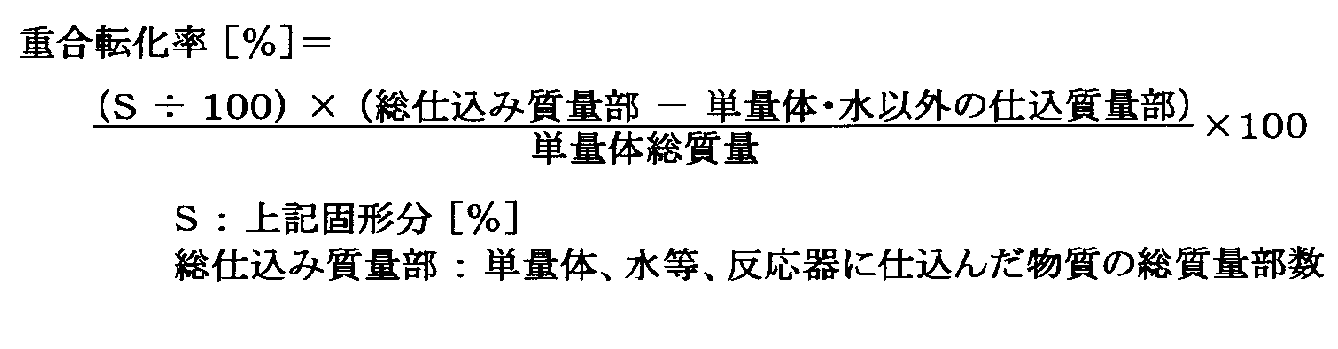
- the polymerization conversion was determined from the following formula by measuring the solid content.
- ⁇ Volume average particle diameter> After diluting the rubbery polymer latex with distilled water so that the loading index is 0.1 to 100 with a dynamic light scattering particle size measuring device (model: Nanotrac UPA-EX150) manufactured by Nikkiso Co., Ltd. The volume average particle diameter was determined by a dynamic light scattering method.
- an aqueous solution consisting of 0.45 parts sodium formaldehyde sulfoxylate, 0.0002 parts ferrous sulfate heptahydrate, 0.0006 parts disodium ethylenediaminetetraacetate and 10 parts deionized water was added. Then, polymerization was started. After the polymerization exotherm was confirmed, the jacket temperature was set to 75 ° C., and the polymerization was continued until no polymerization exotherm was confirmed, and the polymerization was further maintained for 1 hour to obtain a rubbery polymer latex having a volume average particle size of 100 nm (a-1 )
- an aqueous solution consisting of 0.45 parts sodium formaldehyde sulfoxylate, 0.0002 parts ferrous sulfate heptahydrate, 0.0006 parts disodium ethylenediaminetetraacetate and 10 parts deionized water was added. Then, polymerization was started. After the polymerization exotherm was confirmed, the jacket temperature was set to 75 ° C., and the polymerization was continued until the polymerization exotherm was not confirmed, and was further maintained for 1 hour. The resulting rubbery polymer had a volume average particle size of 100 nm.
- an aqueous solution consisting of 0.36 parts of sodium formaldehyde sulfoxylate, 0.0002 parts of ferrous sulfate heptahydrate, 0.0006 parts of disodium ethylenediaminetetraacetate and 10 parts of deionized water was added. Then, polymerization was started. After the polymerization exotherm was confirmed, the jacket temperature was set to 75 ° C., and the polymerization was continued until the polymerization exotherm was not confirmed, and was further maintained for 1 hour. The resulting rubbery polymer had a volume average particle size of 100 nm.
- ⁇ Synthesis Example 7 Production of rubbery polymer latex (a-6)> A styrene-polybutadiene copolymer having a solid content of 33% and an average particle diameter of 80 nm comprising 5% styrene units and 95% butadiene units in a reactor equipped with a reagent injection vessel, a cooling tube, a jacket heater and a stirrer 20 parts of latex (as a solid content) was charged, and the internal temperature was raised to 30 ° C. while stirring.
- the internal temperature was raised to 45 ° C., 0.5 parts of sodium formaldehyde sulfoxylate, 0.0003 parts of ferrous sulfate, heptahydrate, 0.0009 parts of ethylenediaminetetraacetic acid dihydrate, A mixed solution consisting of 10 parts of ionic water was added. Thereafter, the mixture was held for 90 minutes with stirring at an internal temperature of 75 ° C. to obtain a rubbery polymer latex (a-6) having a volume average particle size of 320 nm, which is a composite rubber of polybutadiene rubber and n-butyl acrylate. The polymerization conversion of this rubbery polymer was 99.5%.
- graft copolymer (A-1)> In a reactor equipped with a reagent injection container, a cooling tube, a jacket heater and a stirrer, 230 parts of deionized water (including water in the rubbery polymer latex), 50 parts of the rubbery polymer latex (a-1) (As solid content), 0.5 parts of alkenyl succinic acid dipotassium (trade name: Latemul ASK (Kao Co., Ltd.)) and 0.3 part of sodium formaldehyde sulfoxylate were charged, and the reactor was sufficiently purged with nitrogen The internal temperature was raised to 70 ° C. while stirring.
- the mixture was heated to 80 ° C. while dropping a mixed solution consisting of 15 parts of acrylonitrile, 35 parts of styrene and 0.5 part of t-butyl hydroperoxide over 100 minutes.
- graft copolymer (A-1) latex After completion of the dropping, the temperature was maintained at 80 ° C. for 30 minutes and then cooled to obtain a graft copolymer (A-1) latex.
- a graft copolymer (A-7) latex After dropping, the mixture was further stirred for 1 hour to obtain a graft copolymer (A-7) latex.
- the polymerization conversion rate of this graft copolymer was 98.5%.
- a phenolic antioxidant trade name: Yoshinox 2246G (trade name, API Corporation)
- a sulfur series antioxidant trade name: DLTP “Yoshitomi” (produced by API Corporation)
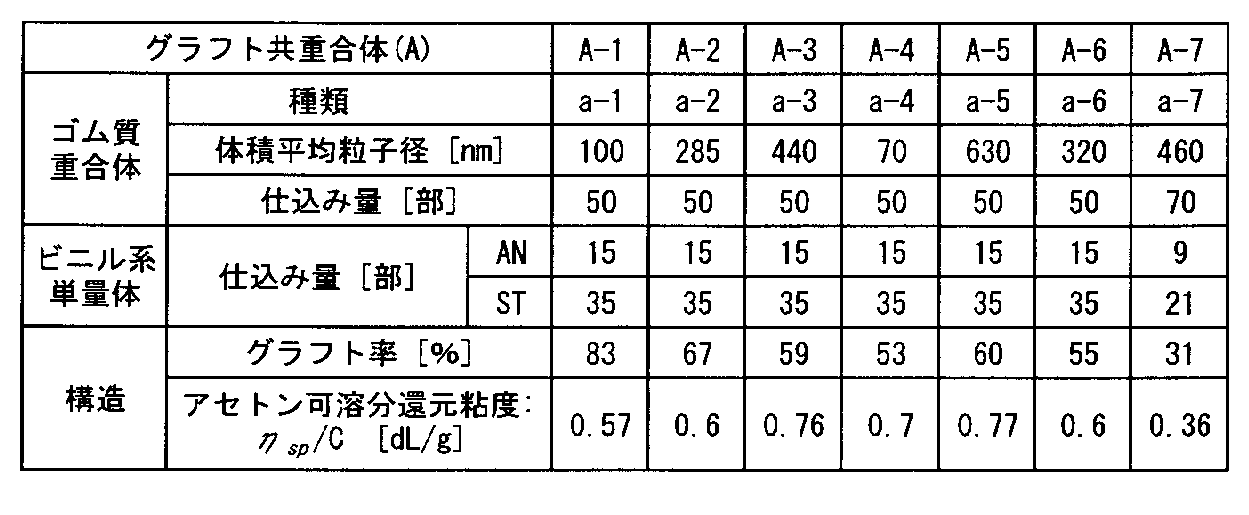
- Table 1 summarizes the monomer compositions and structures of the graft copolymers (A-1) to (A-7).
- the abbreviations in the following Table 1 and Table 2 below are as follows.
- AN Acrylonitrile ST: Styrene ⁇ MS: ⁇ -Methylstyrene MMA: Methyl methacrylate
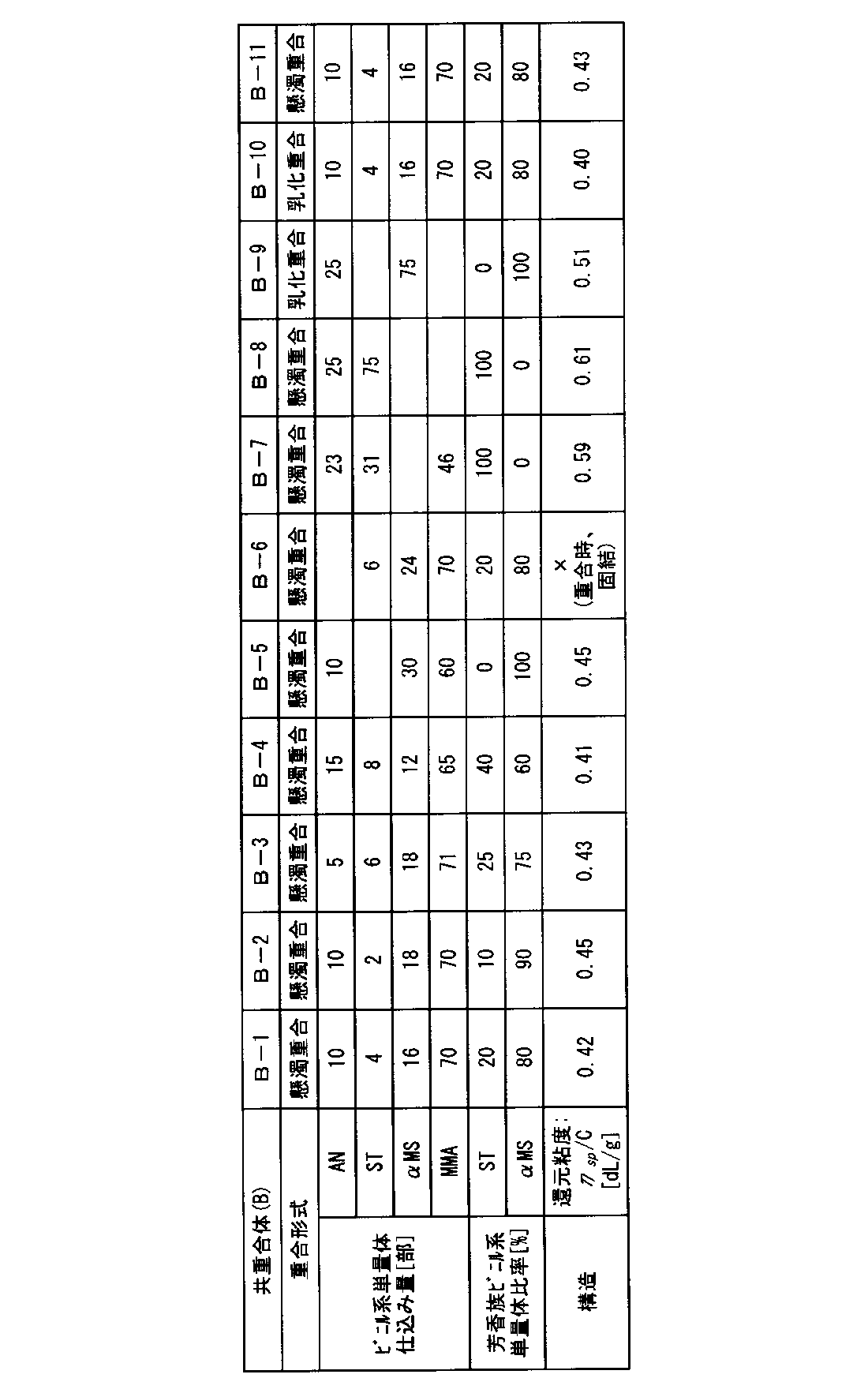
- Table 2 shows the monomer composition, polymerization method, and reduced viscosity of the copolymers (B-1) to (B-11).
- thermoplastic resin composition [Production and evaluation of thermoplastic resin composition] ⁇ Example 1> Graft copolymer (A-1) 40 parts, copolymer (B-1) 60 parts, ethylene bisstearylamide 1.0 part using Kawata super mixer (model: SMV-10B). After mixing, the mixture was shaped with a devolatilizing twin screw extruder (model: PCM-30) manufactured by Ikekai Tekko Co., Ltd., heated to a barrel temperature of 230 ° C., and pellets (hereinafter referred to as “basic pellets”). Was made.
- a mixture obtained by adding 1 part of carbon black # 960 (manufactured by Mitsubishi Chemical Co., Ltd.) as a colorant to the above composition was prepared as a color developing evaluation pellet.
- melt volume rate of the thermoplastic resin composition was measured under the conditions of a barrel temperature of 220 ° C. and a load of 98 N using basic pellets and a method based on ISO 1133.
- the melt volume rate is a measure of the fluidity of the thermoplastic resin composition.
- Charpy impact strength was measured by leaving the test piece in an atmosphere of 23 ° C. and 50% humidity for 12 hours or more by a method according to ISO 179.
- ⁇ Load deflection temperature> 10 ⁇ 80 ⁇ 4 mm strip test pieces were prepared from the basic pellets using a 55-ton injection molding machine (model: IS55FP) manufactured by Toshiba Machine Co., Ltd. under molding conditions of a molding temperature of 235 ° C. and a mold temperature of 60 ° C.
- the load deflection temperature of the molded product was measured in accordance with ISO test method 75, 1.83 MPa, 4 mm, flatwise method.
- a molded product simulating the automobile meter panel shown in FIG. 1 (external dimensions: 145 mm length, 300 mm width, 70 mm depth (maximum), 3.0 mm thickness) was produced.
- the surface appearance of the obtained molded product was evaluated according to the following evaluation criteria. In FIG.
- 1, 1 is a molded product body, 2 is a sprue and runner, and 3 is a gate.
- Cylinder temperature 250 using a 75-ton injection molding machine (model: J75EIIP) manufactured by Nippon Steel Works, using a plate mold (single point pin gate) of 100 ⁇ 100 ⁇ 2 mm, using pellets for color development evaluation. ° C, mold temperature 60 ° C, injection speed: 100 g / sec. Under the conditions, a 100 mm ⁇ 100 mm ⁇ 2 mm flat plate was obtained. The L * of the central portion of the molded plate was measured using a colorimeter CM-508D manufactured by Minolta. It shows that color development is so favorable that the numerical value of L * is small.
- ⁇ Thermal discoloration> Using a basic pellet, a 100 ⁇ 100 ⁇ 2 mm flat plate mold (single pin gate) was used, and a cylinder temperature: 250 ° C. with a 75 ton injection molding machine (model: J75EIIP) manufactured by Nippon Steel Co., Ltd. Mold temperature 60 ° C., injection speed: 100 g / sec. Under the conditions, a 100 mm ⁇ 100 mm ⁇ 2 mm flat plate was obtained. Subsequently, after weighing the resin composition, the molding operation was interrupted, and the resin composition was allowed to stay for 10 minutes in the injection molding machine.
- the degree of yellowing ( ⁇ YI) was calculated according to the following formula. It shows that the heat-resistant discoloration at the time of shaping
- ⁇ Vibration control> Using a basic pellet, a 100 ⁇ 100 ⁇ 2 mm flat plate mold (single pin gate) was used, and a cylinder temperature: 250 ° C. with a 75 ton injection molding machine (model: J75EIIP) manufactured by Nippon Steel Co., Ltd. Mold temperature 60 ° C., injection speed: 100 g / sec. Under the conditions, a 100 mm ⁇ 100 mm ⁇ 2 mm flat plate was obtained. This flat plate was cut into a strip shape of 10 mm ⁇ 45 mm ⁇ 2 mm.
- tan ⁇ The loss tangent (hereinafter referred to as tan ⁇ ), which is the ratio between the storage elastic modulus and the loss elastic modulus, was used as an index of damping properties. The larger tan ⁇ , the greater the vibration absorption and the better the damping performance.
- Examples 2 to 15 and Comparative Examples 1 to 9 Basic pellets of thermoplastic resin composition and evaluation of color developability by the same method as in Example 1 except that the blends of graft copolymer (A) and copolymer (B) were blended as shown in Tables 3 and 4. The results are shown in Tables 3 and 4 after performing the same evaluation.
- Graft copolymer (A-8) Graft copolymer obtained by graft polymerization of acrylonitrile and styrene to a composite rubber composed of polyorganosiloxane and n-butyl acrylate (trade name: Metabrene SX-006 (Mitsubishi Rayon ( stock)))
- Graft copolymer (A-9) Graft copolymer obtained by graft-polymerizing methyl methacrylate and methyl acrylate to a composite rubber composed of polyorganosiloxane and n-butyl acrylate (trade name: Metabrene S-2100) (Mitsubishi Rayon Co., Ltd.))
- Comparative Example 1 in which the number of blended parts of the graft copolymer (A) is less than the lower limit of the claimed range of the present invention and the number of blended parts of the copolymer (B) exceeds the upper limit of the claimed range of the present invention is compared with Examples 1 to 15 , Impact resistance is inferior.
- Comparative Example 2 in which the number of blended parts of the graft copolymer (A) exceeds the upper limit of the claimed range of the present invention and the number of blended parts of the copolymer (B) is less than the claimed range of the present invention is shown in Examples 1 to 15. In comparison, fluidity, heat resistance, molded product surface appearance, and thermal discoloration during retention are inferior.
- Comparative Example 3 in which the volume average particle diameter of the rubbery polymer (a) in the graft copolymer (A) is less than the lower limit of the claims of the present invention is the rubbery polymer (a) in the graft copolymer (A).
- Comparative Examples 5 to 9 in which the blending, components, and polymerization method of the monomer constituting the copolymer (B) deviate from the preferred ranges described in the present specification are those of the monomer constituting the copolymer (B). Any of fluidity, impact resistance, heat resistance, color development, molded product surface appearance, heat discoloration, and vibration control, as compared with Examples 2 and 8 to 11 whose formulation is within the preferred range described in this specification Inferior properties.
- thermoplastic resin composition of the present invention of Examples 1 to 15 containing the graft copolymer (A) and copolymer (B) of the present invention within the scope of the present invention, good characteristics can be obtained. it can.
- thermoplastic resin composition of the present invention is excellent in heat discoloration at the time of molding residence, and has excellent fluidity, impact resistance, heat resistance, molded product surface appearance, color development and vibration damping properties. It can be used for automotive materials, building materials, and household appliances where demand is expanding, and its industrial utility value is extremely high.
Landscapes
- Chemical & Material Sciences (AREA)
- Health & Medical Sciences (AREA)
- Chemical Kinetics & Catalysis (AREA)
- Medicinal Chemistry (AREA)
- Polymers & Plastics (AREA)
- Organic Chemistry (AREA)
- Compositions Of Macromolecular Compounds (AREA)
- Polymerisation Methods In General (AREA)
- Addition Polymer Or Copolymer, Post-Treatments, Or Chemical Modifications (AREA)
- Graft Or Block Polymers (AREA)
Abstract
Description
本明細書において「(メタ)アクリル」とは「アクリル」と「メタクリル」の一方または双方をさす。
グラフト共重合体(A)は、ゴム質重合体(a)の存在下に、不飽和ニトリル系単量体、芳香族ビニル系単量体、および(メタ)アクリル酸エステル系単量体のいずれかのビニル系単量体を必須とし、必要に応じて配合される上記単量体に共重合性を有するその他のビニル単量体を含む単量体成分をグラフト共重合してなるものである。
アルケニル基は、好ましくは炭素数8~22、より好ましくは炭素数12~20の、直鎖状、分岐状又は環状のアルケニル基であり、例えば各種オクテニル基、各種デセニル基、各種ドデセニル基、各種テトラデセニル基、各種ヘキサデセニル基、各種オクタデセニル基、各種イコセニル基などを挙げることができる。
当該二塩基酸の塩としては、ナトリウム塩やカリウム塩などのアルカリ金属塩が好ましい。
これらの中でも、得られる熱可塑性樹脂組成物の耐衝撃性および成形品外観特性が良好であることから、アクリロニトリルとスチレンの混合物、アクリロニトリルとスチレンとメタクリル酸メチルの混合物、メタクリル酸メチルとアクリル酸アルキルエステルの混合物が好ましい。
共重合体(B)は、不飽和ニトリル系単量体、芳香族ビニル系単量体、(メタ)アクリル酸エステル系単量体、および必要に応じて配合される上記単量体に共重合性を有するその他のビニル単量体からなり、芳香族ビニル系単量体としてスチレンおよびα-メチルスチレンを必須とするビニル系単量体混合物(以下「ビニル系単量体混合物(b)」と称す場合がある。)を共重合してなるものである。
本発明の熱可塑性樹脂組成物のグラフト共重合体(A)の配合割合は20~70質量部であり、25~60質量部が好ましく、30~50質量部がさらに好ましく、特に好ましくは40~50質量部である。本発明の熱可塑性樹脂組成物の共重合体(B)の配合割合は30~80質量部であり、40~75質量部が好ましく、50~70質量部がさらに好ましく、特に好ましくは60~70質量部である(グラフト共重合体(A)と共重合体(B)との合計で100質量部)。
本発明の熱可塑性樹脂組成物は、必要に応じて、グラフト共重合体(A)および共重合体(B)以外にポリエチレン、ポリプロピレン等のα-オレフィン重合体やそのα-オレフィン共重合体、ポリスチレン、ハイインパクトスチレン等のスチレン系樹脂、ポリカーボネート、ポリブチレンテレフタレート、ポリエチレンテレフタレート、ポリアミド、ポリメチルメタクリレート、ポリフェニレンエーテル、ポリフェニレンスルフィド、ポリスルホン、ポリエーテルスルホン、ポリイミド、ポリエーテルイミド、ポリエーテルエーテルケトン等の他の熱可塑性樹脂、更には、酸化防止剤、紫外線吸収剤、光安定剤、帯電防止剤、滑剤、染料、顔料、可塑剤、難燃剤、離型剤、ガラス繊維、カーボン繊維、金属繊維、炭素繊維、金属フレーク、タルク、マイカ、グラファイト等の種々の添加剤、補強材、充填材等を含有していても良い。
本発明の熱可塑性樹脂組成物は、グラフト共重合体(A)、共重合体(B)、および必要に応じて用いられる他の成分を均一に溶融混合することによって得ることができる。各成分の混合の順序は何ら限定されるものではない。すべての成分を一括して同時に混合してもよく、いずれかの2以上の成分を先ず予備的に混合した後、これに残余の成分を加えて混合してもよい。各成分の混合物の溶融混合に際しては、押出機、バンバリーミキサー、ロールミル等を用いることができる。
本発明の熱可塑性樹脂成形品は、本発明の熱可塑性樹脂組成物を、射出成形、シ-ト押出、異形押出成形等の押出成形、真空成形、圧空成形、圧縮成形、カレンダー成形、発泡成形、ブロー成形、インフレーション成形などにより成形することにより得ることができる。
ゴム質重合体(a)、グラフト共重合体(A)、および共重合体(B)の物性は、以下の方法で測定および評価した。
ゴム質重合体ラテックスの固形分は、ラテックス1gを正確に秤量し、200℃で20分かけて揮発分を蒸発させた後の残渣物を計量し、下記の式より求めた。

重合転化率は、前記固形分を測定し、下記の式より求めた。
日機装(株)製動的光散乱式粒子径測定装置(型式:ナノトラックUPA-EX150)で、ローディングインデックスが0.1~100となるようにゴム質重合体ラテックスを蒸留水にて希釈後、動的光散乱法より体積平均粒子径を求めた。
グラフト共重合体2.5gにアセトン80mLを加え65℃の湯浴で3時間還流し、アセトン可溶分の抽出を行った。残留したアセトン不溶物を遠心分離により分離し、乾燥した後の質量を測定し、グラフト共重合体中のアセトン不溶物の質量割合を算出した。得られたグラフト共重合体中のアセトン不溶物の質量割合より次の式を用いて、グラフト率を算出した。

グラフト共重合体のアセトン可溶分および共重合体の濃度が0.2dL/gとなるように調製したN,N-ジメチルホルムアミド溶液について、ウベローデ粘度計を用いて25℃での還元粘度:ηsp/C(単位:dL/g)を測定した。
<合成例1:酸基含有共重合体ラテックス(K)の製造>
試薬注入容器、冷却管、ジャケット加熱機および撹拌装置を備えた反応器内に、脱イオン水200部、オレイン酸カリウム2部、ジオクチルスルホコハク酸ナトリウム4部、硫酸第一鉄七水塩0.003部、エチレンジアミン四酢酸二ナトリウム0.009部、ナトリウムホルムアルデヒドスルホキシレート0.3部を仕込み、反応器内を攪拌しながら窒素置換を行った後、60℃に昇温した。60℃になった時点から、アクリル酸n-ブチル82部、メタクリル酸18部、クメンヒドロパーオキシド0.5部からなる混合物を120分かけて連続的に滴下した。滴下終了後、さらに2時間、60℃のまま熟成を行い、固形分が33%、重合転化率が96%、酸基含有共重合体の体積平均粒子径が150nmである酸基含有共重合体ラテックス(K)を得た。
試薬注入容器、冷却管、ジャケット加熱機および撹拌装置を備えた反応器内に、脱イオン水390部、アルケニルコハク酸ジカリウム(商品名:ラテムルASK(花王(株)))1.2部、アクリル酸n-ブチル100部、メタクリル酸アリル1.2部、t-ブチルヒドロパーオキシド0.25部を仕込み、反応器内を攪拌しながら窒素置換した後、内容物を昇温した。内温55℃にて、ナトリウムホルムアルデヒドスルホキシレート0.45部、硫酸第一鉄七水和物0.0002部、エチレンジアミン四酢酸二ナトリウム0.0006部、脱イオン水10部からなる水溶液を添加し、重合を開始させた。重合発熱が確認された後、ジャケット温度を75℃とし、重合発熱が確認されなくなるまで重合を継続し、さらに1時間保持して、体積平均粒子径が100nmのゴム質重合体ラテックス(a-1)を得た。
試薬注入容器、冷却管、ジャケット加熱機および撹拌装置を備えた反応器内に、脱イオン水390部、アルケニルコハク酸ジカリウム(商品名:ラテムルASK(花王(株)))1.2部、アクリル酸n-ブチル100部、メタクリル酸アリル1.2部、t-ブチルヒドロパーオキシド0.25部を撹拌下で仕込み、反応器内を窒素置換した後、内容物を昇温した。内温55℃にて、ナトリウムホルムアルデヒドスルホキシレート0.45部、硫酸第一鉄七水和物0.0002部、エチレンジアミン四酢酸二ナトリウム0.0006部、脱イオン水10部からなる水溶液を添加し、重合を開始させた。重合発熱が確認された後、ジャケット温度を75℃とし、重合発熱が確認されなくなるまで重合を継続し、さらに1時間保持した。得られたゴム質重合体の体積平均粒子径は100nmであった。
ここへ5%ピロリン酸ナトリウム水溶液を固形分として1.2部添加し、内温を70℃になる様にジャケット温度の制御を行った。
内温70℃にて、酸基含有共重合体ラテックス(K)を固形分として2.4部添加し、内温70℃を保持したまま30分撹拌し、肥大化を行い、体積平均粒子径が285nmのゴム質重合体ラテックス(a-2)を得た。
(1段目の重合反応)
試薬注入容器、冷却管、ジャケット加熱機および撹拌装置を備えた反応器内に、脱イオン水290部、アルケニルコハク酸ジカリウム(商品名:ラテムルASK(花王(株)))0.96部、アクリル酸n-ブチル80部、メタクリル酸アリル1部、t-ブチルヒドロパーオキシド0.2部を撹拌下で仕込み、反応器内を窒素置換した後、内容物を昇温した。内温55℃にて、ナトリウムホルムアルデヒドスルホキシレート0.36部、硫酸第一鉄七水和物0.0002部、エチレンジアミン四酢酸二ナトリウム0.0006部、脱イオン水10部からなる水溶液を添加し、重合を開始させた。重合発熱が確認された後、ジャケット温度を75℃とし、重合発熱が確認されなくなるまで重合を継続し、さらに1時間保持した。得られたゴム質重合体の体積平均粒子径は100nmであった。
ここへ5%ピロリン酸ナトリウム水溶液を固形分として1.2部添加し、内温を70℃になる様にジャケット温度の制御を行った。
内温70℃にて、酸基含有共重合体ラテックス(K)を固形分として3.2部添加し、内温70℃を保持したまま30分撹拌し、肥大化を行った。肥大化後の体積平均粒子径は415nmであった。
上記の1段目の重合反応終了後、内温70℃にて、ナトリウムホルムアルデヒドスルホキシレート0.054部、硫酸第一鉄七水和物0.002部、エチレンジアミン四酢酸二ナトリウム0.006部、脱イオン水80部からなる水溶液を添加し、次いでアクリル酸n-ブチル20部、メタクリル酸アリル0.24部、t-ブチルヒドロパーオキシド0.03部からなる混合液を40分にわたって滴下した。滴下終了後、温度70℃の状態を1時間保持した後に冷却し、体積平均粒子径が440nmのゴム質重合体ラテックス(a-3)を得た。
重合時に添加するアルケニルコハク酸ジカリウム(商品名:ラテムルASK(花王(株)))を2.00部、硫酸第一鉄七水和物を0.001部、エチレンジアミン四酢酸二ナトリウムを0.003部に変更した以外は合成例2と同様の手法により、体積平均粒子径が70nmのゴム質重合体ラテックス(a-4)を得た。
肥大化時に添加する5%ピロリン酸ナトリウム水溶液を固形分として3部、酸基含有共重合体ラテックス(K)を固形分として3部に変更した以外は合成例4と同様の手法により、体積平均粒子径が630nmのゴム質重合体ラテックス(a-5)を得た。
試薬注入容器、冷却管、ジャケット加熱機および撹拌装置を備えた反応器内に、スチレン単位5%、ブタジエン単位95%からなる固形分含量が33%、平均粒子径80nmのスチレン-ポリブタジエン共重合体ラテックス20部(固形分として)を仕込み、攪拌しながら内温を30℃まで昇温した。続いて、このスチレン-ポリブタジエン共重合体ラテックスに、酸基含有共重合体ラテックス(K)0.5部(固形分として)を添加し、30分間撹拌を続け、体積平均粒子径が390nmの肥大化スチレン-ポリブタジエン共重合体ラテックスを得た。
EPDM(商品名:TP-3180(三井化学(株))、エチレン/プロピレン/ジエン比率[モル%]=70/28/2)100部、低分子量変性ポリエチレン(商品名:ハイワックス2203A(三井化学(株)))15部、更に、オレイン酸カリウム2.4部を混合した。次いで、それらの混合物を(株)池貝鉄工社製二軸押出機(型式:PCM-30、L/D=40)のホッパーより6kg/時間で供給し、水酸化カリウム15%水溶液を110g/時間で連続的に供給しながら、加熱温度180℃で溶融混練して溶融物を押出した。引き続き、溶融物を同押出機先端に取り付けた冷却用一軸押出機に連続的に供給し、90℃まで冷却した。取り出した固体を85℃の温水中に投入し、連続的に分散させて、平均粒子径460nmのゴム質重合体ラテックスを得た。
試薬注入容器、冷却管、ジャケット加熱機および攪拌装置を備えた反応器に、脱イオン水(ゴム質重合体ラテックス中の水を含む)230部、ゴム質重合体ラテックス(a-1)50部(固形分として)、アルケニルコハク酸ジカリウム(商品名:ラテムルASK(花王(株)))0.5部、ナトリウムホルムアルデヒドスルホキシレート0.3部を仕込み、反応器内を十分に窒素置換した後、攪拌しながら内温を70℃まで昇温した。
用いるゴム質重合体ラテックスおよびビニル系単量体の種類と仕込量を表1に記載のものに変更した以外は合成例10と同様にして、粉末状のグラフト共重合体(A-2)~(A-6)を得た。
ゴム質重合体ラテックス(a-7)(固形分で70部)、デキストロース0.6部、硫酸第一鉄・7水塩0.01部、エチレンジアミン四酢酸ナトリウム・2水塩0.45部、脱イオン水150部を撹拌機付き反応器に仕込んだ。
なお、以下の表1および後掲の表2における各略号は以下の通りである。
AN:アクリロニトリル
ST:スチレン
αMS:α-メチルスチレン
MMA:メタクリル酸メチル
<合成例12:共重合体(B-1)の製造>
窒素置換した耐圧応器に、脱イオン水120部、アルケニルコハク酸カリウム商品名:ラテムルDSK(花王(株)))0.003部、ヒドロキシアパタイト0.55部を仕込み、アクリロニトリル10部、スチレン4部、α-メチルスチレン16部、メタクリル酸メチル70部、1,1,3,3-テトラメチルブチルパーオキシ-2-エチルヘキサノエート(商品名:パーオクタO(日油(株)))0.3部、t-ブチルパーオキシ-2-エチルヘキシルカーボネート(商品名:パーブチルE(日油(株)))0.1部からなる単量体混合物を加え、反応系を攪拌下で65℃とした後、7時間かけて120℃に昇温した。さらに120℃で2時間保持して重合を完結させた。その際の最終転化率は99%であり、得られた共重合体(B-1)の還元粘度は0.42dL/gであった。
単量体の仕込み組成を、表2に記載の組成に変更した以外は合成例12と同様にして、共重合体(B-2)~(B-10)を得た。共重合体(B-1)~(B-10)の還元粘度は表2に示す通りであった。
共重合体(B-6)は、製造中に重合安定性が悪化し、固結したため、得られなかった。
耐圧容器に、脱イオン水200部、不均化ロジン酸カリウム1部、および過硫酸カリウム0.4部を仕込み、反応系を攪拌下にて65℃に昇温した。続いて、アクリロニトリル25部、α-メチルスチレン75部からなる単量体混合物と不均化ロジン酸カリウム1.5部を含む乳化剤水溶液30部をそれぞれ5時間にわたって連続的に加えながら、反応系を80℃に昇温した。さらに、80℃で1時間保持して重合を完結した。この後、耐圧容器にて、2.5%硫酸水溶液100部を85℃に加熱した後、共重合体(B-9)ラテックス100部を徐々に滴下し、共重合体を固化させ、さらに115℃に昇温して10分間保持した。次いで、固化物を脱水、洗浄、乾燥し、粉末状の共重合体(B-9)を得た。得られた共重合体(B-9)の還元粘度は0.51dL/gであった。
単量体の仕込み組成を、アクリロニトリル10部、スチレン4部、α-メチルスチレン16部、メタクリル酸メチル70部に変更した以外は合成例14と同様にして、共重合体(B-10)を得た。共重合体(B-10)の還元粘度は0.40dL/gであった。
懸濁助剤を、アルケニルコハク酸カリウムからポリビニルアルコールに変更した以外は合成例12と同様にして、共重合体(B-11)を得た。共重合体(B-11)の還元粘度は0.43dL/gであった。
<実施例1>
グラフト共重合体(A-1)40部、共重合体(B-1)60部、エチレンビスステアリルアミド1.0部を、(株)カワタ製スーパーミキサー(型式:SMV-10B)を用いて混合し、該混合物をバレル温度230℃に加熱した(株)池貝鉄工社製脱揮式二軸押出機(型式:PCM-30)で賦形し、ペレット(以下、このペレットを「基本ペレット」という。)を作製した。
熱可塑性樹脂組成物のメルトボリュームレートは、基本ペレットを用い、ISO 1133に準拠する方法により、バレル温度220℃、加重98Nの条件で測定した。メルトボリュームレートは、熱可塑性樹脂組成物の流動性の目安となる。
基本ペレットを、東芝機械(株)製55トン射出成形機(型式:IS55FP)にて成形温度235℃、金型温度60℃の成形条件で、10×80×4mm短冊試験片(Vノッチあり試験片)を作製した。
基本ペレットを、東芝機械(株)製55トン射出成形機(型式:IS55FP)にて成形温度235℃、金型温度60℃の成形条件で、10×80×4mm短冊試験片を作製した。
基本ペレットを用いて、自動車メーターパネルを模した金型(1点サイドゲート)を使用し、住友重機械工業(株)製150トン射出成形機(型式:SG-150)により、成形温度250℃、金型温度60℃、射出速度:50mm/sec.および100mm/sec.の成形条件で図1に示す自動車メーターパネルを模した成形品(外形寸法:縦145mm、横300mm、奥行き70mm(最大)、厚み3.0mm)を作製した。得られた成形品の表面外観を以下の評価基準により評価した。図1中、1は成形品本体を示し、2はスプルーおよびランナーであり、3はゲートである。
○:ジェッティングやシルバーストリークがほとんど目立たない
△:ジェッティングやシルバーストリークがぼんやりと確認される
×:ジェッティングやシルバーストリークがはっきりと確認される
発色性評価用ペレットを用いて、100×100×2mmの平板金型(1点ピンゲート)を使用し、(株)日本製鋼所製75トン射出成形機(型式:J75EIIP)により、シリンダー温度:250℃、金型温度60℃、射出速度:100g/sec.の条件にて100mm×100mm×2mmの平板成形板を得た。この成形板中央部分を、ミノルタ(株)製測色計CM-508Dを用いてL*を測定した。L*の数値が小さいほど、発色性が良好であることを示す。
基本ペレットを用いて、100×100×2mmの平板金型(1点ピンゲート)を使用し、(株)日本製鋼所製75トン射出成形機(型式:J75EIIP)により、シリンダー温度:250℃、金型温度60℃、射出速度:100g/sec.の条件にて100mm×100mm×2mmの平板成形板を得た。続いて、樹脂組成物の計量後、成形作業を中断し、射出成形機内で樹脂組成物を10分滞留させた。その後、成形作業を再開し、5ショット目に得られた平板成形板および滞留をせずに得られた平板成形板の各中央部分について、ミノルタ(株)製測色計CM-508Dを用いて黄色度(YI)を測定した。

基本ペレットを用いて、100×100×2mmの平板金型(1点ピンゲート)を使用し、(株)日本製鋼所製75トン射出成形機(型式:J75EIIP)により、シリンダー温度:250℃、金型温度60℃、射出速度:100g/sec.の条件にて100mm×100mm×2mmの平板成形板を得た。この平板成形板を、10mm×45mm×2mmの短冊状に切り出した。
グラフト共重合体(A)および共重合体(B)の配合を表3,4に示した配合とした以外は実施例1と同様の手法により、熱可塑性樹脂組成物の基本ペレットと発色性評価用ペレットを得、同様の評価を行って結果を表3,4に示した。
グラフト共重合体(A-8):ポリオルガノシロキサンとアクリル酸n-ブチルとからなる複合ゴムに、アクリロニトリルとスチレンをグラフト重合させたグラフト共重合体(商品名:メタブレンSX-006(三菱レイヨン(株)))
グラフト共重合体(A-9):ポリオルガノシロキサンとアクリル酸n-ブチルとからなる複合ゴムに、メタクリル酸メチルとアクリル酸メチルをグラフト重合させたグラフト共重合体(商品名:メタブレンS-2100(三菱レイヨン(株)))
共重合体(B-12):アクリル樹脂(商品名:アクリペットVH-5(三菱レイヨン(株)))


表3,4より次のことが明らかである。
グラフト共重合体(A)の配合部数が本発明の請求範囲下限未満、かつ共重合体(B)の配合部数が本発明の請求範囲上限を超える比較例1は、実施例1~15に比べ、耐衝撃性が劣る。グラフト共重合体(A)の配合部数が本発明の請求範囲上限を超え、かつ共重合体(B)の配合部数が本発明の請求範囲未満である比較例2は、実施例1~15に比べ、流動性、耐熱性、成形品表面外観および滞留時の熱変色が劣る。
本出願は、2014年3月31日付で出願された日本特許出願2014-074061に基づいており、その全体が引用により援用される。
2 スプール及びランナー
3 ゲート
Claims (10)
- 体積平均粒子径が80~600nmであるゴム質重合体(a)の存在下に、不飽和ニトリル系単量体、芳香族ビニル系単量体、および(メタ)アクリル酸エステル系単量体よりなる群から選ばれるビニル系単量体をグラフト共重合してなるグラフト共重合体(A)20~70質量部と、
不飽和ニトリル系単量体、芳香族ビニル系単量体、および(メタ)アクリル酸エステル系単量体よりなる群から選ばれるビニル系単量体を含有するビニル系単量体混合物であって、芳香族ビニル系単量体としてスチレンおよびα-メチルスチレンを必須とするビニル系単量体混合物を共重合してなる共重合体(B)30~80質量部とを含有する(但し、グラフト共重合体(A)および共重合体(B)の合計は100質量部である)ことを特徴とする熱可塑性樹脂組成物。 - 前記ビニル系単量体混合物が、不飽和ニトリル系単量体5~20質量%、芳香族ビニル系単量体10~30質量%、(メタ)アクリル酸エステル系単量体50~85質量%、および他のビニル系単量体0~10質量%からなることを特徴とする請求項1記載の熱可塑性樹脂組成物。
- 前記ビニル系単量体混合物における芳香族ビニル系単量体が、スチレン5~30質量%とα-メチルスチレン70~95質量%とを含むことを特徴とする請求項1又は2に記載の熱可塑性樹脂組成物。
- 前記共重合体(B)が懸濁重合にて得られることを特徴とする請求項1ないし3のいずれか1項に記載の熱可塑性樹脂組成物。
- 前記共重合体(B)が、アルケニルコハク酸カリウムを懸濁助剤とする懸濁重合にて得られることを特徴とする請求項4に記載の熱可塑性樹脂組成物。
- 前記ゴム質重合体(a)が、アクリル酸アルキルエステル単量体単位と多官能性単量体単位を含むアクリル系ゴム、或いは、ポリオルガノシロキサンとアクリル酸アルキルエステル単量体単位と多官能性単量体単位を含むアクリル系ゴムからなるアクリル系複合ゴムであることを特徴とする請求項1ないし5のいずれか1項に記載の熱可塑性樹脂組成物。
- 前記グラフト共重合体(A)は、ゴム質重合体(a)40~80質量%の存在下に、不飽和ニトリル系単量体、芳香族ビニル系単量体、および(メタ)アクリル酸エステル系単量体よりなる群から選ばれるビニル系単量体60~20質量%をグラフト共重合してなるものであることを特徴とする請求項1ないし6のいずれか1項に記載の熱可塑性樹脂組成物。
- 前記グラフト共重合体(A)のグラフト率が20~150%であり、アセトン可溶部の還元粘度が0.30~0.70dL/gであり、前記共重合体(B)の還元粘度が0.30~0.70dL/gであることを特徴とする請求項1ないし7のいずれか1項に記載の熱可塑性樹脂組成物。
- 熱可塑性樹脂組成物全体に占めるゴム質重合体(a)の含有量が、10~30質量%の範囲であることを特徴とする請求項1ないし8のいずれか1項に記載の熱可塑性樹脂組成物。
- 請求項1ないし9のいずれか1項に記載の熱可塑性樹脂組成物を成形してなることを特徴とする熱可塑性樹脂成形品。
Priority Applications (9)
| Application Number | Priority Date | Filing Date | Title |
|---|---|---|---|
| KR1020167024622A KR20160138953A (ko) | 2014-03-31 | 2015-03-20 | 열가소성 수지 조성물 및 그 성형품 |
| CA2942285A CA2942285C (en) | 2014-03-31 | 2015-03-20 | Thermoplastic resin composition and molded article thereof |
| SG11201607502QA SG11201607502QA (en) | 2014-03-31 | 2015-03-20 | Thermoplastic resin composition and molded article of same |
| US15/125,843 US10160853B2 (en) | 2014-03-31 | 2015-03-20 | Thermoplastic resin composition and molded article thereof |
| CN201580015679.4A CN106103580B (zh) | 2014-03-31 | 2015-03-20 | 热塑性树脂组合物及其成型品 |
| MX2016012526A MX2016012526A (es) | 2014-03-31 | 2015-03-20 | Composicion de resina termoplastica y articulo moldado de la misma. |
| RU2016142226A RU2016142226A (ru) | 2014-03-31 | 2015-03-20 | Композиция на основе термопластичной смолы и изделие, отформованное из этой композиции |
| EP15774030.9A EP3127959A4 (en) | 2014-03-31 | 2015-03-20 | Thermoplastic resin composition and molded article of same |
| AU2015241622A AU2015241622B2 (en) | 2014-03-31 | 2015-03-20 | Thermoplastic resin composition and molded article of same |
Applications Claiming Priority (2)
| Application Number | Priority Date | Filing Date | Title |
|---|---|---|---|
| JP2014074061A JP6149783B2 (ja) | 2014-03-31 | 2014-03-31 | 熱可塑性樹脂組成物およびその成形品 |
| JP2014-074061 | 2014-03-31 |
Publications (1)
| Publication Number | Publication Date |
|---|---|
| WO2015151853A1 true WO2015151853A1 (ja) | 2015-10-08 |
Family
ID=54240183
Family Applications (1)
| Application Number | Title | Priority Date | Filing Date |
|---|---|---|---|
| PCT/JP2015/058443 Ceased WO2015151853A1 (ja) | 2014-03-31 | 2015-03-20 | 熱可塑性樹脂組成物およびその成形品 |
Country Status (12)
| Country | Link |
|---|---|
| US (1) | US10160853B2 (ja) |
| EP (1) | EP3127959A4 (ja) |
| JP (1) | JP6149783B2 (ja) |
| KR (1) | KR20160138953A (ja) |
| CN (1) | CN106103580B (ja) |
| AU (1) | AU2015241622B2 (ja) |
| CA (1) | CA2942285C (ja) |
| MX (1) | MX2016012526A (ja) |
| RU (1) | RU2016142226A (ja) |
| SG (1) | SG11201607502QA (ja) |
| TW (1) | TWI650366B (ja) |
| WO (1) | WO2015151853A1 (ja) |
Cited By (1)
| Publication number | Priority date | Publication date | Assignee | Title |
|---|---|---|---|---|
| CN109385072A (zh) * | 2017-08-10 | 2019-02-26 | 深圳沃海森科技有限公司 | 耐高温、耐腐蚀、环保高阻燃空调外壳复合材料及其制备方法 |
Families Citing this family (10)
| Publication number | Priority date | Publication date | Assignee | Title |
|---|---|---|---|---|
| JP6934755B2 (ja) * | 2017-06-15 | 2021-09-15 | テクノUmg株式会社 | 熱可塑性樹脂組成物およびその成形品 |
| JP6218347B1 (ja) * | 2017-07-21 | 2017-10-25 | ユーエムジー・エービーエス株式会社 | めっき用熱可塑性樹脂組成物、樹脂成形品およびめっき加工品 |
| JP2019026665A (ja) * | 2017-07-26 | 2019-02-21 | ユーエムジー・エービーエス株式会社 | グラフト共重合体、熱可塑性樹脂組成物およびその成形品 |
| JP7005990B2 (ja) * | 2017-07-28 | 2022-01-24 | テクノUmg株式会社 | ゴム質重合体、グラフト共重合体および熱可塑性樹脂組成物 |
| KR102207173B1 (ko) | 2018-08-08 | 2021-01-25 | 주식회사 엘지화학 | 그라프트 공중합체의 제조방법, 그라프트 공중합체 및 이를 포함하는 열가소성 수지 성형품 |
| JP7200542B2 (ja) * | 2018-08-24 | 2023-01-10 | テクノUmg株式会社 | アクリルゴム系グラフト共重合体および熱可塑性樹脂組成物 |
| KR102535966B1 (ko) * | 2019-03-15 | 2023-05-26 | 도레이 카부시키가이샤 | 스티렌계 열가소성 수지 조성물, 스티렌계 열가소성 수지 조성물의 제조 방법, 성형품 및 성형품의 제조 방법 |
| CN113795546B (zh) * | 2019-04-30 | 2024-06-21 | 乐天化学株式会社 | 热塑性树脂组合物及利用它而成的成型品 |
| US12600847B2 (en) * | 2021-03-08 | 2026-04-14 | Lg Chem, Ltd. | Thermoplastic resin composition and exterior material including the same |
| JP2024034963A (ja) * | 2022-09-01 | 2024-03-13 | Psジャパン株式会社 | 難燃性スチレン系樹脂組成物及び成形品 |
Citations (4)
| Publication number | Priority date | Publication date | Assignee | Title |
|---|---|---|---|---|
| JP2001253990A (ja) * | 2000-03-13 | 2001-09-18 | Kanegafuchi Chem Ind Co Ltd | 車両灯具成形用樹脂組成物及びそれを用いた車両用灯具 |
| JP2004346237A (ja) * | 2003-05-23 | 2004-12-09 | Umg Abs Ltd | 熱可塑性樹脂組成物および成形物 |
| JP2007191632A (ja) * | 2006-01-20 | 2007-08-02 | Asahi Kasei Chemicals Corp | スチレン系樹脂組成物、及び該樹脂組成物からなる成形体 |
| JP2009120705A (ja) * | 2007-11-14 | 2009-06-04 | Asahi Kasei Chemicals Corp | 熱可塑性樹脂組成物およびその押出樹脂成形体 |
Family Cites Families (10)
| Publication number | Priority date | Publication date | Assignee | Title |
|---|---|---|---|---|
| FR1533803A (fr) * | 1966-08-11 | 1968-07-19 | Japanese Geon Co Ltd | Composition résineuse de chlorure de vinyle |
| US4743646A (en) * | 1986-03-12 | 1988-05-10 | Denki Kagaku Kogyo Kabushiki Kaisha | Thermoplastic resin composition |
| JPH0641443A (ja) | 1992-07-23 | 1994-02-15 | Japan Synthetic Rubber Co Ltd | 制振材用樹脂組成物 |
| JPH11349785A (ja) | 1998-06-08 | 1999-12-21 | Sumika Abs Latex Kk | 制振材用樹脂組成物 |
| JP2000212373A (ja) | 1999-01-22 | 2000-08-02 | Kanegafuchi Chem Ind Co Ltd | 熱可塑性樹脂組成物 |
| WO2007023865A1 (ja) * | 2005-08-25 | 2007-03-01 | Techno Polymer Co., Ltd. | ゴム強化樹脂、制電性樹脂組成物、成形体及び積層体 |
| JP2009014800A (ja) * | 2007-07-02 | 2009-01-22 | Canon Inc | 騒音制御装置 |
| CN103119096B (zh) * | 2010-09-22 | 2016-01-20 | 东丽株式会社 | 阻燃性苯乙烯类热塑性树脂组合物及其成型品 |
| US9049452B2 (en) * | 2011-01-25 | 2015-06-02 | Mediatek Singapore Pte. Ltd. | Method and apparatus for compressing coding unit in high efficiency video coding |
| CA2829059C (en) * | 2011-03-29 | 2016-05-31 | Umg Abs, Ltd. | Acrylic rubber graft copolymer and thermoplastic resin composition |
-
2014
- 2014-03-31 JP JP2014074061A patent/JP6149783B2/ja active Active
-
2015
- 2015-03-20 CA CA2942285A patent/CA2942285C/en not_active Expired - Fee Related
- 2015-03-20 WO PCT/JP2015/058443 patent/WO2015151853A1/ja not_active Ceased
- 2015-03-20 KR KR1020167024622A patent/KR20160138953A/ko not_active Ceased
- 2015-03-20 MX MX2016012526A patent/MX2016012526A/es unknown
- 2015-03-20 EP EP15774030.9A patent/EP3127959A4/en not_active Withdrawn
- 2015-03-20 SG SG11201607502QA patent/SG11201607502QA/en unknown
- 2015-03-20 RU RU2016142226A patent/RU2016142226A/ru unknown
- 2015-03-20 CN CN201580015679.4A patent/CN106103580B/zh not_active Expired - Fee Related
- 2015-03-20 US US15/125,843 patent/US10160853B2/en not_active Expired - Fee Related
- 2015-03-20 AU AU2015241622A patent/AU2015241622B2/en not_active Ceased
- 2015-03-27 TW TW104110058A patent/TWI650366B/zh not_active IP Right Cessation
Patent Citations (4)
| Publication number | Priority date | Publication date | Assignee | Title |
|---|---|---|---|---|
| JP2001253990A (ja) * | 2000-03-13 | 2001-09-18 | Kanegafuchi Chem Ind Co Ltd | 車両灯具成形用樹脂組成物及びそれを用いた車両用灯具 |
| JP2004346237A (ja) * | 2003-05-23 | 2004-12-09 | Umg Abs Ltd | 熱可塑性樹脂組成物および成形物 |
| JP2007191632A (ja) * | 2006-01-20 | 2007-08-02 | Asahi Kasei Chemicals Corp | スチレン系樹脂組成物、及び該樹脂組成物からなる成形体 |
| JP2009120705A (ja) * | 2007-11-14 | 2009-06-04 | Asahi Kasei Chemicals Corp | 熱可塑性樹脂組成物およびその押出樹脂成形体 |
Non-Patent Citations (1)
| Title |
|---|
| See also references of EP3127959A4 * |
Cited By (1)
| Publication number | Priority date | Publication date | Assignee | Title |
|---|---|---|---|---|
| CN109385072A (zh) * | 2017-08-10 | 2019-02-26 | 深圳沃海森科技有限公司 | 耐高温、耐腐蚀、环保高阻燃空调外壳复合材料及其制备方法 |
Also Published As
| Publication number | Publication date |
|---|---|
| CN106103580B (zh) | 2019-08-27 |
| AU2015241622B2 (en) | 2018-04-05 |
| TWI650366B (zh) | 2019-02-11 |
| JP6149783B2 (ja) | 2017-06-21 |
| MX2016012526A (es) | 2017-01-09 |
| EP3127959A4 (en) | 2017-11-15 |
| SG11201607502QA (en) | 2016-10-28 |
| CA2942285C (en) | 2020-05-05 |
| CA2942285A1 (en) | 2015-10-08 |
| AU2015241622A1 (en) | 2016-09-22 |
| RU2016142226A (ru) | 2018-05-03 |
| TW201602213A (zh) | 2016-01-16 |
| CN106103580A (zh) | 2016-11-09 |
| JP2015196715A (ja) | 2015-11-09 |
| KR20160138953A (ko) | 2016-12-06 |
| EP3127959A1 (en) | 2017-02-08 |
| US20170002189A1 (en) | 2017-01-05 |
| US10160853B2 (en) | 2018-12-25 |
Similar Documents
| Publication | Publication Date | Title |
|---|---|---|
| JP6149783B2 (ja) | 熱可塑性樹脂組成物およびその成形品 | |
| KR101524057B1 (ko) | 아크릴 고무계 그래프트 공중합체, 및 열가소성 수지 조성물 | |
| EP3369755A1 (en) | Graft copolymer, crosslinked particles, graft crosslinked particles, rubbery polymer and thermoplastic resin composition using same | |
| JP6565652B2 (ja) | (メタ)アクリル系共重合体、樹脂組成物及びその成形体 | |
| US20120270965A1 (en) | Thermoplastic Resin Composition and Molded Product Using Same | |
| KR20120021786A (ko) | 알루미늄 증착성 및 밀착성이 우수한 열가소성 수지 조성물 | |
| CA3051180C (en) | Thermoplastic resin composition for hot plate welding, molded article thereof, and resin conjugate | |
| JP7224723B2 (ja) | 熱可塑性樹脂組成物およびその成形品 | |
| JP2011202155A (ja) | 熱可塑性樹脂組成物 | |
| JP7200542B2 (ja) | アクリルゴム系グラフト共重合体および熱可塑性樹脂組成物 | |
| JP2004210891A (ja) | 複合熱可塑性樹脂組成物及びその成形品 | |
| JP7658084B2 (ja) | ポリプロピレン系グラフト重合体、熱可塑性樹脂組成物およびその成形品 | |
| HK1225056A1 (en) | Thermoplastic resin composition and molded article of same | |
| EP3650477A1 (en) | Polymer, graft polymer, and thermoplastic resin composition | |
| JP2012158623A (ja) | 熱可塑性樹脂組成物 | |
| JP2009091420A (ja) | グラフト共重合体、熱可塑性樹脂組成物および成形品 | |
| JP2006160782A (ja) | 熱可塑性樹脂組成物および成形品 | |
| HK1188231B (en) | Acrylic rubber-based graft copolymer and thermoplastic resin composition |
Legal Events
| Date | Code | Title | Description |
|---|---|---|---|
| 121 | Ep: the epo has been informed by wipo that ep was designated in this application |
Ref document number: 15774030 Country of ref document: EP Kind code of ref document: A1 |
|
| ENP | Entry into the national phase |
Ref document number: 20167024622 Country of ref document: KR Kind code of ref document: A |
|
| ENP | Entry into the national phase |
Ref document number: 2942285 Country of ref document: CA |
|
| WWE | Wipo information: entry into national phase |
Ref document number: 15125843 Country of ref document: US |
|
| ENP | Entry into the national phase |
Ref document number: 2015241622 Country of ref document: AU Date of ref document: 20150320 Kind code of ref document: A |
|
| WWE | Wipo information: entry into national phase |
Ref document number: MX/A/2016/012526 Country of ref document: MX |
|
| NENP | Non-entry into the national phase |
Ref country code: DE |
|
| REEP | Request for entry into the european phase |
Ref document number: 2015774030 Country of ref document: EP |
|
| WWE | Wipo information: entry into national phase |
Ref document number: 2015774030 Country of ref document: EP |
|
| ENP | Entry into the national phase |
Ref document number: 2016142226 Country of ref document: RU Kind code of ref document: A |
|
| REG | Reference to national code |
Ref country code: BR Ref legal event code: B01A Ref document number: 112016021106 Country of ref document: BR |
|
| ENP | Entry into the national phase |
Ref document number: 112016021106 Country of ref document: BR Kind code of ref document: A2 Effective date: 20160913 |