WO2015152140A1 - 硬化性組成物、積層体及び自動車ヘッドランプレンズ - Google Patents
硬化性組成物、積層体及び自動車ヘッドランプレンズ Download PDFInfo
- Publication number
- WO2015152140A1 WO2015152140A1 PCT/JP2015/059881 JP2015059881W WO2015152140A1 WO 2015152140 A1 WO2015152140 A1 WO 2015152140A1 JP 2015059881 W JP2015059881 W JP 2015059881W WO 2015152140 A1 WO2015152140 A1 WO 2015152140A1
- Authority
- WO
- WIPO (PCT)
- Prior art keywords
- mass
- curable composition
- cured film
- meth
- component
- Prior art date
- Legal status (The legal status is an assumption and is not a legal conclusion. Google has not performed a legal analysis and makes no representation as to the accuracy of the status listed.)
- Ceased
Links
Images
Classifications
-
- C—CHEMISTRY; METALLURGY
- C09—DYES; PAINTS; POLISHES; NATURAL RESINS; ADHESIVES; COMPOSITIONS NOT OTHERWISE PROVIDED FOR; APPLICATIONS OF MATERIALS NOT OTHERWISE PROVIDED FOR
- C09D—COATING COMPOSITIONS, e.g. PAINTS, VARNISHES OR LACQUERS; FILLING PASTES; CHEMICAL PAINT OR INK REMOVERS; INKS; CORRECTING FLUIDS; WOODSTAINS; PASTES OR SOLIDS FOR COLOURING OR PRINTING; USE OF MATERIALS THEREFOR
- C09D7/00—Features of coating compositions, not provided for in group C09D5/00; Processes for incorporating ingredients in coating compositions
- C09D7/40—Additives
- C09D7/60—Additives non-macromolecular
- C09D7/61—Additives non-macromolecular inorganic
- C09D7/62—Additives non-macromolecular inorganic modified by treatment with other compounds
-
- B—PERFORMING OPERATIONS; TRANSPORTING
- B60—VEHICLES IN GENERAL
- B60Q—ARRANGEMENT OF SIGNALLING OR LIGHTING DEVICES, THE MOUNTING OR SUPPORTING THEREOF OR CIRCUITS THEREFOR, FOR VEHICLES IN GENERAL
- B60Q1/00—Arrangement of optical signalling or lighting devices, the mounting or supporting thereof or circuits therefor
- B60Q1/02—Arrangement of optical signalling or lighting devices, the mounting or supporting thereof or circuits therefor the devices being primarily intended to illuminate the way ahead or to illuminate other areas of way or environments
- B60Q1/04—Arrangement of optical signalling or lighting devices, the mounting or supporting thereof or circuits therefor the devices being primarily intended to illuminate the way ahead or to illuminate other areas of way or environments the devices being headlights
-
- C—CHEMISTRY; METALLURGY
- C08—ORGANIC MACROMOLECULAR COMPOUNDS; THEIR PREPARATION OR CHEMICAL WORKING-UP; COMPOSITIONS BASED THEREON
- C08F—MACROMOLECULAR COMPOUNDS OBTAINED BY REACTIONS ONLY INVOLVING CARBON-TO-CARBON UNSATURATED BONDS
- C08F2/00—Processes of polymerisation
- C08F2/44—Polymerisation in the presence of compounding ingredients, e.g. plasticisers, dyestuffs, fillers
-
- C—CHEMISTRY; METALLURGY
- C08—ORGANIC MACROMOLECULAR COMPOUNDS; THEIR PREPARATION OR CHEMICAL WORKING-UP; COMPOSITIONS BASED THEREON
- C08F—MACROMOLECULAR COMPOUNDS OBTAINED BY REACTIONS ONLY INVOLVING CARBON-TO-CARBON UNSATURATED BONDS
- C08F290/00—Macromolecular compounds obtained by polymerising monomers on to polymers modified by introduction of aliphatic unsaturated end or side groups
-
- C—CHEMISTRY; METALLURGY
- C08—ORGANIC MACROMOLECULAR COMPOUNDS; THEIR PREPARATION OR CHEMICAL WORKING-UP; COMPOSITIONS BASED THEREON
- C08J—WORKING-UP; GENERAL PROCESSES OF COMPOUNDING; AFTER-TREATMENT NOT COVERED BY SUBCLASSES C08B, C08C, C08F, C08G or C08H
- C08J7/00—Chemical treatment or coating of shaped articles made of macromolecular substances
- C08J7/12—Chemical modification
- C08J7/16—Chemical modification with polymerisable compounds
- C08J7/18—Chemical modification with polymerisable compounds using wave energy or particle radiation
-
- C—CHEMISTRY; METALLURGY
- C08—ORGANIC MACROMOLECULAR COMPOUNDS; THEIR PREPARATION OR CHEMICAL WORKING-UP; COMPOSITIONS BASED THEREON
- C08K—Use of inorganic or non-macromolecular organic substances as compounding ingredients
- C08K3/00—Use of inorganic substances as compounding ingredients
- C08K3/34—Silicon-containing compounds
- C08K3/36—Silica
-
- C—CHEMISTRY; METALLURGY
- C08—ORGANIC MACROMOLECULAR COMPOUNDS; THEIR PREPARATION OR CHEMICAL WORKING-UP; COMPOSITIONS BASED THEREON
- C08K—Use of inorganic or non-macromolecular organic substances as compounding ingredients
- C08K5/00—Use of organic ingredients
- C08K5/0008—Organic ingredients according to more than one of the "one dot" groups of C08K5/01 - C08K5/59
- C08K5/005—Stabilisers against oxidation, heat, light, ozone
-
- C—CHEMISTRY; METALLURGY
- C08—ORGANIC MACROMOLECULAR COMPOUNDS; THEIR PREPARATION OR CHEMICAL WORKING-UP; COMPOSITIONS BASED THEREON
- C08K—Use of inorganic or non-macromolecular organic substances as compounding ingredients
- C08K9/00—Use of pretreated ingredients
- C08K9/04—Ingredients treated with organic substances
- C08K9/06—Ingredients treated with organic substances with silicon-containing compounds
-
- C—CHEMISTRY; METALLURGY
- C09—DYES; PAINTS; POLISHES; NATURAL RESINS; ADHESIVES; COMPOSITIONS NOT OTHERWISE PROVIDED FOR; APPLICATIONS OF MATERIALS NOT OTHERWISE PROVIDED FOR
- C09D—COATING COMPOSITIONS, e.g. PAINTS, VARNISHES OR LACQUERS; FILLING PASTES; CHEMICAL PAINT OR INK REMOVERS; INKS; CORRECTING FLUIDS; WOODSTAINS; PASTES OR SOLIDS FOR COLOURING OR PRINTING; USE OF MATERIALS THEREFOR
- C09D201/00—Coating compositions based on unspecified macromolecular compounds
-
- C—CHEMISTRY; METALLURGY
- C09—DYES; PAINTS; POLISHES; NATURAL RESINS; ADHESIVES; COMPOSITIONS NOT OTHERWISE PROVIDED FOR; APPLICATIONS OF MATERIALS NOT OTHERWISE PROVIDED FOR
- C09D—COATING COMPOSITIONS, e.g. PAINTS, VARNISHES OR LACQUERS; FILLING PASTES; CHEMICAL PAINT OR INK REMOVERS; INKS; CORRECTING FLUIDS; WOODSTAINS; PASTES OR SOLIDS FOR COLOURING OR PRINTING; USE OF MATERIALS THEREFOR
- C09D7/00—Features of coating compositions, not provided for in group C09D5/00; Processes for incorporating ingredients in coating compositions
- C09D7/40—Additives
- C09D7/66—Additives characterised by particle size
- C09D7/67—Particle size smaller than 100 nm
-
- C—CHEMISTRY; METALLURGY
- C09—DYES; PAINTS; POLISHES; NATURAL RESINS; ADHESIVES; COMPOSITIONS NOT OTHERWISE PROVIDED FOR; APPLICATIONS OF MATERIALS NOT OTHERWISE PROVIDED FOR
- C09D—COATING COMPOSITIONS, e.g. PAINTS, VARNISHES OR LACQUERS; FILLING PASTES; CHEMICAL PAINT OR INK REMOVERS; INKS; CORRECTING FLUIDS; WOODSTAINS; PASTES OR SOLIDS FOR COLOURING OR PRINTING; USE OF MATERIALS THEREFOR
- C09D7/00—Features of coating compositions, not provided for in group C09D5/00; Processes for incorporating ingredients in coating compositions
- C09D7/40—Additives
- C09D7/66—Additives characterised by particle size
- C09D7/68—Particle size between 100-1000 nm
-
- F—MECHANICAL ENGINEERING; LIGHTING; HEATING; WEAPONS; BLASTING
- F21—LIGHTING
- F21S—NON-PORTABLE LIGHTING DEVICES; SYSTEMS THEREOF; VEHICLE LIGHTING DEVICES SPECIALLY ADAPTED FOR VEHICLE EXTERIORS
- F21S41/00—Illuminating devices specially adapted for vehicle exteriors, e.g. headlamps
- F21S41/20—Illuminating devices specially adapted for vehicle exteriors, e.g. headlamps characterised by refractors, transparent cover plates, light guides or filters
-
- G—PHYSICS
- G02—OPTICS
- G02B—OPTICAL ELEMENTS, SYSTEMS OR APPARATUS
- G02B1/00—Optical elements characterised by the material of which they are made; Optical coatings for optical elements
- G02B1/10—Optical coatings produced by application to, or surface treatment of, optical elements
-
- C—CHEMISTRY; METALLURGY
- C08—ORGANIC MACROMOLECULAR COMPOUNDS; THEIR PREPARATION OR CHEMICAL WORKING-UP; COMPOSITIONS BASED THEREON
- C08J—WORKING-UP; GENERAL PROCESSES OF COMPOUNDING; AFTER-TREATMENT NOT COVERED BY SUBCLASSES C08B, C08C, C08F, C08G or C08H
- C08J2369/00—Characterised by the use of polycarbonates; Derivatives of polycarbonates
-
- C—CHEMISTRY; METALLURGY
- C08—ORGANIC MACROMOLECULAR COMPOUNDS; THEIR PREPARATION OR CHEMICAL WORKING-UP; COMPOSITIONS BASED THEREON
- C08J—WORKING-UP; GENERAL PROCESSES OF COMPOUNDING; AFTER-TREATMENT NOT COVERED BY SUBCLASSES C08B, C08C, C08F, C08G or C08H
- C08J2483/00—Characterised by the use of macromolecular compounds obtained by reactions forming in the main chain of the macromolecule a linkage containing silicon with or without sulfur, nitrogen, oxygen, or carbon only; Derivatives of such polymers
- C08J2483/04—Polysiloxanes
- C08J2483/07—Polysiloxanes containing silicon bound to unsaturated aliphatic groups
-
- C—CHEMISTRY; METALLURGY
- C08—ORGANIC MACROMOLECULAR COMPOUNDS; THEIR PREPARATION OR CHEMICAL WORKING-UP; COMPOSITIONS BASED THEREON
- C08K—Use of inorganic or non-macromolecular organic substances as compounding ingredients
- C08K3/00—Use of inorganic substances as compounding ingredients
- C08K3/18—Oxygen-containing compounds, e.g. metal carbonyls
- C08K3/24—Acids; Salts thereof
- C08K3/26—Carbonates; Bicarbonates
-
- C—CHEMISTRY; METALLURGY
- C09—DYES; PAINTS; POLISHES; NATURAL RESINS; ADHESIVES; COMPOSITIONS NOT OTHERWISE PROVIDED FOR; APPLICATIONS OF MATERIALS NOT OTHERWISE PROVIDED FOR
- C09D—COATING COMPOSITIONS, e.g. PAINTS, VARNISHES OR LACQUERS; FILLING PASTES; CHEMICAL PAINT OR INK REMOVERS; INKS; CORRECTING FLUIDS; WOODSTAINS; PASTES OR SOLIDS FOR COLOURING OR PRINTING; USE OF MATERIALS THEREFOR
- C09D4/00—Coating compositions, e.g. paints, varnishes or lacquers, based on organic non-macromolecular compounds having at least one polymerisable carbon-to-carbon unsaturated bond ; Coating compositions, based on monomers of macromolecular compounds of groups C09D183/00 - C09D183/16
-
- G—PHYSICS
- G02—OPTICS
- G02B—OPTICAL ELEMENTS, SYSTEMS OR APPARATUS
- G02B1/00—Optical elements characterised by the material of which they are made; Optical coatings for optical elements
- G02B1/10—Optical coatings produced by application to, or surface treatment of, optical elements
- G02B1/11—Anti-reflection coatings
- G02B1/111—Anti-reflection coatings using layers comprising organic materials
-
- G—PHYSICS
- G02—OPTICS
- G02B—OPTICAL ELEMENTS, SYSTEMS OR APPARATUS
- G02B1/00—Optical elements characterised by the material of which they are made; Optical coatings for optical elements
- G02B1/10—Optical coatings produced by application to, or surface treatment of, optical elements
- G02B1/14—Protective coatings, e.g. hard coatings
-
- G—PHYSICS
- G02—OPTICS
- G02B—OPTICAL ELEMENTS, SYSTEMS OR APPARATUS
- G02B1/00—Optical elements characterised by the material of which they are made; Optical coatings for optical elements
- G02B1/10—Optical coatings produced by application to, or surface treatment of, optical elements
- G02B1/18—Coatings for keeping optical surfaces clean, e.g. hydrophobic or photo-catalytic films
-
- G—PHYSICS
- G02—OPTICS
- G02B—OPTICAL ELEMENTS, SYSTEMS OR APPARATUS
- G02B27/00—Optical systems or apparatus not provided for by any of the groups G02B1/00 - G02B26/00, G02B30/00
- G02B27/0006—Optical systems or apparatus not provided for by any of the groups G02B1/00 - G02B26/00, G02B30/00 with means to keep optical surfaces clean, e.g. by preventing or removing dirt, stains, contamination, condensation
Definitions
- the present invention relates to a curable composition, a laminate, and an automobile headlamp lens.
- Resin molded products containing polycarbonate resin, polymethyl methacrylate resin, polystyrene resin, etc. are lightweight, excellent in moldability, highly transparent, and superior in impact resistance compared to glass products. Used in lenses, window materials, instrument covers, etc.
- polycarbonate resin molded products having excellent impact resistance have been used for window glass and sunroofs in order to reduce the weight of automobiles.
- the polycarbonate resin molded product has low surface wear resistance, the surface is easily damaged by contact with other hard objects, friction, scratching, etc., and the damage generated on the surface lowers the commercial value.
- the weather resistance is also important because the automobile member is used outdoors.
- Polycarbonate resin has low weather resistance, and is deteriorated by active energy rays such as ultraviolet rays contained in sunlight, yellowing or cracking on the surface.
- active energy rays such as ultraviolet rays contained in sunlight, yellowing or cracking on the surface.
- a composition obtained by adding an ultraviolet absorber to an acrylic, melamine, urethane, or silicon resin is applied to the surface of the polycarbonate resin molded product,
- a cured film is formed by curing using active energy rays such as ultraviolet rays and electron beams.
- a curing method using an active energy ray is widely used because it has advantages such as superior productivity compared to a thermosetting method.
- a cured film having excellent weather resistance has low wear resistance.
- a material of the cured film capable of imparting both weather resistance and wear resistance in such a trade-off relationship to a polycarbonate resin molded article a composition containing silica particles surface-treated with an acrylic compound A thing is known (patent document 1).
- An object of the present invention is to provide a curable composition capable of forming a cured film having excellent wear resistance and weather resistance, and a laminate and an automobile headlamp lens provided with the cured film.
- the present invention includes the following [1] to [14].
- Average primary particle diameter d (nm) 6000 / (S ⁇ ⁇ ) S: Specific surface area (unit: cm 2 / g) measured by the BET adsorption method defined in JIS Z8830 ⁇ : density of inorganic particles (unit: g / cm 3 ).
- Silica particles (a-1) having an average primary particle diameter of 500 nm or less converted from the specific surface area measured by the BET adsorption method specified in JIS Z8830 are converted to a compound represented by the following formula (1) (a- Surface-modified silica particles (A) obtained by reacting 2), Compound (B) having one or more radically polymerizable unsaturated bonds, A compound represented by the following formula (1) and / or a condensate thereof (C), and a photopolymerization initiator (D) Including
- the content of (A) is 10 to 50% by mass relative to the total 100% by mass of (A) to (C)
- the content of (B) is 50 to 90% by mass with respect to the total of 100% by mass of (A) to (C)
- the content of (C) is 0 to 0.08 times the mass of (A)
- a curable composition having a content of (D) of 0.01 to 10 parts by mass with respect to a total of 100 parts by mass of (A) to (C).
- the content of (A) is 10 to 40% by mass with respect to the total of 100% by mass of (A) to (C)
- the content of (B) is 60 to 90% by mass with respect to the total of 100% by mass of (A) to (C)
- the ultraviolet absorber (E) is further included, and the content of (E) is 1 to 20 parts by mass with respect to 100 parts by mass in total of (A) to (C).
- the curable composition as described.
- a light stabilizer (F) is further included, and the content of (F) is 0.01 to 3 parts by mass with respect to 100 parts by mass in total of (A) to (C).
- the curable composition in any one of.
- a laminate comprising a cured film of the curable composition according to any one of [1] to [9] on a substrate.
- An automotive headlamp lens comprising a cured film of the curable composition according to any one of [1] to [9] on the surface of a resin molded product.
- a curable composition capable of forming a cured film having excellent wear resistance and weather resistance, and a laminate and an automobile headlamp lens provided with the cured film.
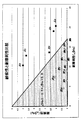
- FIG. 3 is a graph showing the relationship between weather resistance and wear resistance of Examples 1 to 12 and Comparative Examples 1 to 5.
- the inventors of the present invention have excellent wear resistance by reducing the amount of the compound that is not surface-modified in the silica particles included in the preparation of the surface-modified silica particles. It has been found that a cured film having heat resistance, weather resistance and adhesion can be obtained.
- the relationship between the haze value ⁇ Hx obtained by the following abrasion test and the haze value ⁇ Hy obtained by the following weather resistance test was ⁇ Hy ⁇ ⁇ 0.
- a cured film satisfying .3 ⁇ ⁇ Hx + 5.0 can be obtained.
- ⁇ Hy preferably satisfies ⁇ Hy ⁇ ⁇ 0.3 ⁇ ⁇ Hx + 4.5, and more preferably satisfies ⁇ Hy ⁇ ⁇ 0.3 ⁇ ⁇ Hx + 4.0.
- the abrasion resistance is evaluated by a haze value ⁇ Hx obtained by preparing a cured film having a thickness of 10 ⁇ m by the following method and obtaining the abrasion test described below.
- the weather resistance is evaluated by a haze value ⁇ Hy obtained by preparing a cured film having a thickness of 10 ⁇ m by the following method and obtaining a weather resistance test shown below.
- the curable composition was applied to a polycarbonate resin injection-molded plate (trade name: Panlite L-1225Z-100, Clear, manufactured by Teijin Ltd., thickness 3 mm) with a No. 26 bar coater and dried in a dryer at 60 ° C. Dry by heating for 90 seconds.
- a high-pressure mercury lamp in an air atmosphere, irradiated with ultraviolet rays of 1,800 mJ / cm 2 (ultraviolet integrated energy with a wavelength of 320 to 380 nm, measured with UV-351 (product name, manufactured by Oak Co., Ltd.)).
- a wear-resistant polycarbonate resin plate (laminate) having a cured film having a thickness of 10 ⁇ m is prepared. The following abrasion test and the following weather resistance test are performed on the cured film.
- (meth) acryl means “acryl” or “methacryl”.
- the curable composition according to the present invention includes a compound (B) (hereinafter also referred to as (B) component) having one or more radical polymerizable unsaturated bonds and a photopolymerization initiator (D) (hereinafter also referred to as (D) component). ) Is preferable because a cured film having excellent wear resistance and weather resistance can be produced in a short time.
- the curable composition according to the present invention is an inorganic particle (a) having an average primary particle size of 500 nm or less converted from the specific surface area measured by the BET adsorption method defined in JIS Z8830 according to the following formula (hereinafter referred to as (a): It is preferable from the viewpoint of improving the abrasion resistance of the cured film of the curable composition.
- Average primary particle diameter d (nm) 6000 / (S ⁇ ⁇ )
- S Specific surface area (unit: cm 2 / g) measured by the BET adsorption method defined in JIS Z8830 ⁇ : density of inorganic particles (unit: g / cm 3 )
- the density of inorganic particles is edited by the Chemical Society of Japan. Chemical handbook application. 3rd revised edition, Tokyo, Maruzen, 1980, 2 Inorganic industrial chemicals. The value of true specific gravity described in is used.
- the component (B) is a compound having one or more radically polymerizable unsaturated bonds.
- the component (B) is not particularly limited as long as it is a monomer or oligomer having one or more radically polymerizable unsaturated bonds.
- (Meth) acrylate may be monofunctional (meth) acrylate or polyfunctional (meth) acrylate.
- Examples of monofunctional (meth) acrylates include ethyl (meth) acrylate, butyl (meth) acrylate, ethylhexyl (meth) acrylate, 2-hydroxyethyl (meth) acrylate, isobornyl (meth) acrylate, and tetrafurfuryl (meth). Examples thereof include acrylate, pentaerythritol mono (meth) acrylate, and dipentaerythritol mono (meth) acrylate.
- (meth) acrylates include epoxy poly (meth) acrylates such as epoxy di (meth) acrylate obtained by reacting bisphenol A diepoxy and (meth) acrylic acid, and 1,6-hexamethylene diisocyanate.
- (meth) acrylate is preferable from the viewpoint of excellent polymerizability and easy curing at around room temperature.
- polyfunctional (meth) acrylate is more preferable, and among them tris (2- (meth) acryloxyethyl) isocyanurate, dipentaerythritol di (meth) acrylate, dipentaerythritol tri (meth) acrylate, dipentaerythritol Tetra (meth) acrylate, dipentaerythritol penta (meth) acrylate, dipentaerythritol hexa (meth) acrylate, caprolactone-modified dipentaerythritol hexa (meth) acrylate (addition of dipentaerythritol and ⁇ -caprolactone (meth) Acrylated product), caprolactone-modified dipentaerythritol hydroxypent
- Component (D) is a photopolymerization initiator.
- the component (D) is not particularly limited as long as it generates radicals upon irradiation with active energy rays and can polymerize the polymerizable monomer and oligomer, and can be appropriately selected from the viewpoint of compatibility in the curable composition.
- component (D) examples include benzoin, benzoin methyl ether, benzoin ethyl ether, benzoin isopropyl ether, benzoin isobutyl ether, acetoin, butyroin, toluoin, benzyl, benzophenone, p-methoxybenzophenone, diethoxyacetophenone, 2,2- Dimethoxy-2-phenylacetophenone (benzyldimethyl ketal), 2,2-dimethoxy-1,2-diphenylethane-1-one, methylphenylglyoxylate, ethylphenylglyoxylate, 4,4-bis (dimethylaminobenzophenone) ), 2-hydroxy-2-methyl-1-phenylpropan-1-one, 1-hydroxycyclohexyl phenyl ketone, 1- (4-isopropylphenyl) -2-hydroxy Carbonyl compounds such as 2-methylpropan-1-one; sulfur compounds such as tetramethyl
- the component (D) a carbonyl compound and an acylphosphine oxide compound are preferable.
- the component (D) includes benzophenone, methylphenylglyoxylate, 2-hydroxy-2-methyl-1-phenylpropan-1-one, 1-hydroxycyclohexyl phenyl ketone, 2,2-dimethoxy-1 2,2-diphenylethane-1-one and 2,4,6-trimethylbenzoyldiphenylphosphine oxide are more preferred. These may use 1 type and may use 2 or more types together.
- the average primary particle diameter of the inorganic particles as component (a) is 500 nm or less from the viewpoint of the transparency of the cured film.
- the average primary particle diameter of the inorganic particles is preferably 100 nm or less, and more preferably 50 nm or less.
- the inorganic particles include silica particles, alumina particles, silver particles, gold particles, copper oxide particles, iron oxide particles, cobalt oxide particles, titanium oxide particles, zinc oxide particles, zirconium oxide particles, cerium oxide particles, hydroxyapatite particles, Examples include fullerene particles, graphene particles, graphene oxide particles, carbon nanotube particles, diamond particles, mesoporous carbon particles, SiC particles, and TiC particles.
- These inorganic particles may or may not be surface modified.
- silica particles and / or silica particles whose surface is modified by reaction with a silane coupling agent are preferable.
- (A) is more preferable. These may use 1 type and may use 2 or more types together.
- the curable composition according to the present invention comprises silica particles (a-1) having an average primary particle diameter of 500 nm or less converted from a specific surface area measured by a BET adsorption method defined in JIS Z8830 (hereinafter referred to as component (a-1)) And surface-modified silica particles (A) (hereinafter referred to as (A)) obtained by reacting the compound (a-2) represented by the following formula (1) (hereinafter also referred to as component (a-2)) with The compound (B) having one or more radical polymerizable unsaturated bonds, the compound represented by the following formula (1) and / or its condensate (C) (hereinafter also referred to as the component (C)) ) And the photopolymerization initiator (D) are preferably contained in the following content from the viewpoint of obtaining a cured film that is superior in wear resistance and weather resistance.
- silica particles (a-1) having an average primary particle diameter of 500 nm or less converted from a specific surface area measured
- the content of the component (A) is 10 to 50% by mass with respect to the total of 100% by mass of the components (A) to (C), and the content of the component (B) is 100 masses of the total of components (A) to (C).
- % To 50% to 90% by mass, the content of the component (C) is 0 to 0.08 times the mass of the component (A), and the content of the component (D) is (A) to (C)
- the amount is 0.01 to 10 parts by mass with respect to 100 parts by mass in total.
- R 1 represents a functional group containing a (meth) acryloyl group
- R 2 represents a hydrolyzable functional group or hydroxyl group
- R 3 represents a substituent other than R 1 and R 2 .
- L is an integer of 1 to 3
- m is an integer of 1 to 3
- n is an integer of 0 to 2.
- l + m + n 4.
- the component (A) is a surface-modified silica particle, and is obtained by reacting the components (a-1) and (a-2). By this reaction, the surface of the component (a-1) which is silica particles is chemically modified by the component (a-2).
- the content of the component (A) in the curable composition is a total of 100 components (A) to (C) from the viewpoint of achieving both wear resistance and weather resistance when a cured film is formed. 10 to 50% by mass with respect to mass%.
- the content is preferably 12% by mass or more, and more preferably 15% by mass or more in order to obtain high wear resistance.
- the content is preferably 40% by mass or less, and more preferably 35% by mass or less from the viewpoint of suppressing the occurrence of appearance defects such as cracks.
- the component (a-1) is silica particles having an average primary particle size of 500 nm or less.
- the average primary particle diameter of the silica particles is 500 nm or less from the viewpoint of the transparency of the cured film.
- the average primary particle diameter of the silica particles is preferably 100 nm or less, and more preferably 50 nm or less.
- the average primary particle diameter of the silica particles is a value converted from a specific surface area measurement value (according to JIS Z8830) by a BET adsorption method, and is the same as the measurement method in the inorganic particles (a).
- silica particles examples include colloidal silica.
- colloidal silica refers to silica ultrafine particles of silicic acid dispersed in a suitable liquid solvent.
- Colloidal silica can be used in a form dispersed in water or a form dispersed in an organic solvent.
- colloidal silica is preferably used in a form dispersed in an organic solvent, from the viewpoint of uniformly dispersing the silane coupling agent as component (a-2).
- Organic solvents include methanol, isopropyl alcohol, n-butanol, ethylene glycol, dimethylacetamide, ethylene glycol mono n-propyl ether, propylene glycol monomethyl ether, propylene glycol monomethyl ether acetate, methyl ethyl ketone, methyl isobutyl ketone, ethyl acetate, acetic acid Examples thereof include n-butyl, xylene, toluene and the like. These may use 1 type and may use 2 or more types together.
- the boiling point of an organic solvent is 150 degrees C or less from a viewpoint which can adjust solid content concentration of the silica particle solution surface-modified by distillation.
- colloidal silica dispersed in an organic solvent examples include methanol-dispersed silica sol (MA-ST, MA-ST-M), isopropyl alcohol-dispersed silica sol (IPA-ST, IPA-ST-L, IPA-ST-ZL).
- IPA-ST-UP ethylene glycol-dispersed silica sol (EG-ST, EG-ST-L), dimethylacetamide-dispersed silica sol (DMAC-ST, DMAC-ST-L), xylene / butanol-dispersed silica sol (XBA-ST) , Methyl ethyl ketone dispersed silica sol (MEK-ST, MEK-ST-L, MEK-ST-ZL, MEK-ST-UP), methyl isobutyl ketone dispersed silica sol (MIBK-ST), propylene glycol monomethyl ether acetate dispersed silica sol (PMA-ST) ),vinegar Ethyl-dispersed silica sol (EAC-ST) (or in parentheses product name manufactured by Nissan Chemical Industries, Ltd.) and the like. These may use 1 type and may use 2 or more types together.
- Component (a-2) is a compound represented by the following formula (1).
- R 1 represents a functional group containing a (meth) acryloyl group
- R 2 represents a hydrolyzable functional group or hydroxyl group
- R 3 represents a substituent other than R 1 and R 2 .
- L is an integer of 1 to 3
- m is an integer of 1 to 3
- n is an integer of 0 to 2.
- l + m + n 4.
- the silane coupling agent having a (meth) acryloyl group as the component (a-2) was obtained by hydrolyzing it into a silanol compound and dehydrating and condensing with the silica particles as the component (a-1).
- the dispersion uniformity of the surface-modified silica particle (A) component and the (B) component can be improved.
- grains which can form a chemical bond with the radically polymerizable unsaturated bond in (B) component, and have active energy ray curability can be formed.
- R 1 examples include a (meth) acryloylalkyl group and a (meth) acryloyloxyalkyl group.
- alkyl group of the (meth) acryloylalkyl group and the (meth) acryloyloxyalkyl group include alkyl groups having 1 to 10 carbon atoms.
- (meth) acryloylalkyl groups include (meth) acryloylmethyl groups, (meth) acryloylethyl groups, (meth) acryloylpropyl groups, (meth) acryloylbutyl groups, and the like.
- Examples of the (meth) acryloyloxyalkyl group include a (meth) acryloyloxymethyl group, a (meth) acryloyloxyethyl group, a (meth) acryloyloxypropyl group, and the like.
- R 1 when 1 of R 1 is 2 or 3, R 1 may be the same group or different groups.
- the hydrolyzable functional group of R 2 represents a functional group that can be replaced with a hydroxyl group by reaction with water.
- the hydrolyzable functional group for R 2 include a halogen group, an alkoxy group, and an ester group.
- the halogen group include fluorine, chlorine, bromine and iodine.
- the alkoxy group include a methoxy group, an ethoxy group, and propoxy.
- R 2 may be the same group or different groups.
- R 3 is an optional substituent, and is a substituent other than R 1 and R 2 .
- R 3 include alkyl groups such as a methyl group, an ethyl group, and a propyl group.
- Examples of the component (a-2) include 2- (meth) acryloylethylmethyldimethoxysilane, 2- (meth) acryloylethyltrimethoxysilane, 2- (meth) acryloylethylmethyldiethoxysilane, 2- (meth) Acryloylethyltriethoxysilane, 2- (meth) acryloylethyltrihydroxysilane, 2- (meth) acryloylethylethyldimethoxysilane, 2- (meth) acryloylethylpropyldimethoxysilane, 3- (meth) acryloylpropylmethyldimethoxysilane, 3- (meth) acryloylpropyltrimethoxysilane, 3- (meth) acryloylpropylmethyldiethoxysilane, 3- (meth) acryloylpropyltriethoxysilane, 3- (meth) acrylo
- 2- (meth) acryloylethyltrimethoxysilane, 2- (meth) acryloylethyltriethoxysilane, 3- (meth) acryloylpropyltrimethoxy are used from the viewpoint of availability.
- Silane, 3- (meth) acryloylpropyltriethoxysilane is preferred.
- the method for producing the surface-modified silica particles that are the component (A) is not particularly limited.
- the content (solid content) of the component (a-1) in the dispersion is preferably 10 to 70% by mass. Further, from the viewpoint of improving the dispersion stability of the component (a-1), the content is more preferably 15 to 60% by mass.
- the amount of component (a-2) used is such that the amount of unreacted material with component (a-1) decreases when component (A) is produced. It is preferable that For example, the amount of the component (a-2) used is preferably 5 to 50 parts by mass, more preferably 5 to 20 parts by mass with respect to 100 parts by mass of the component (a-1).
- a dispersion solvent of component (a-1), water and a lower alcohol produced by the hydrolysis reaction are azeotroped with a nonpolar solvent such as toluene under atmospheric pressure or reduced pressure.
- a nonpolar solvent such as toluene under atmospheric pressure or reduced pressure.
- the hydrolysis reaction when the component (a-1) or the component (a-2) contains water, it is not necessary to add water, but it is preferable to add water in order to promote the reaction.
- the amount of water added is preferably 0.1 to 5 times the number of moles of component (a-2).
- there may be no catalyst but if necessary, 0.5 to 0.6 mol of 0.001 to 0.1 mol / L hydrochloric acid or acetic acid per mol of component (a-2). It is preferable to add a hydrolysis catalyst such as an aqueous solution and stir at room temperature or under heating.
- the content of the component (B) in the curable composition is a total of 100 components (A) to (C) from the viewpoint of achieving both wear resistance and weather resistance when a cured film is formed. It is 50 to 90 mass% with respect to mass%.
- the content is preferably 55 to 90% by mass, more preferably 60 to 90% by mass, and still more preferably 65 to 88% by mass.
- the component (C) is a by-product generated in the process of producing the component (a-2) and / or the component (A) used in the process of producing the component (A), and represented by the formula (1). And / or condensates thereof.
- the component (C) for example, an unreacted component (a-2) that was not coated with the component (a-1) when the component (A) was synthesized, or added separately when preparing a curable composition And the like.
- the component (C) may be the same as or different from the component (a-2).
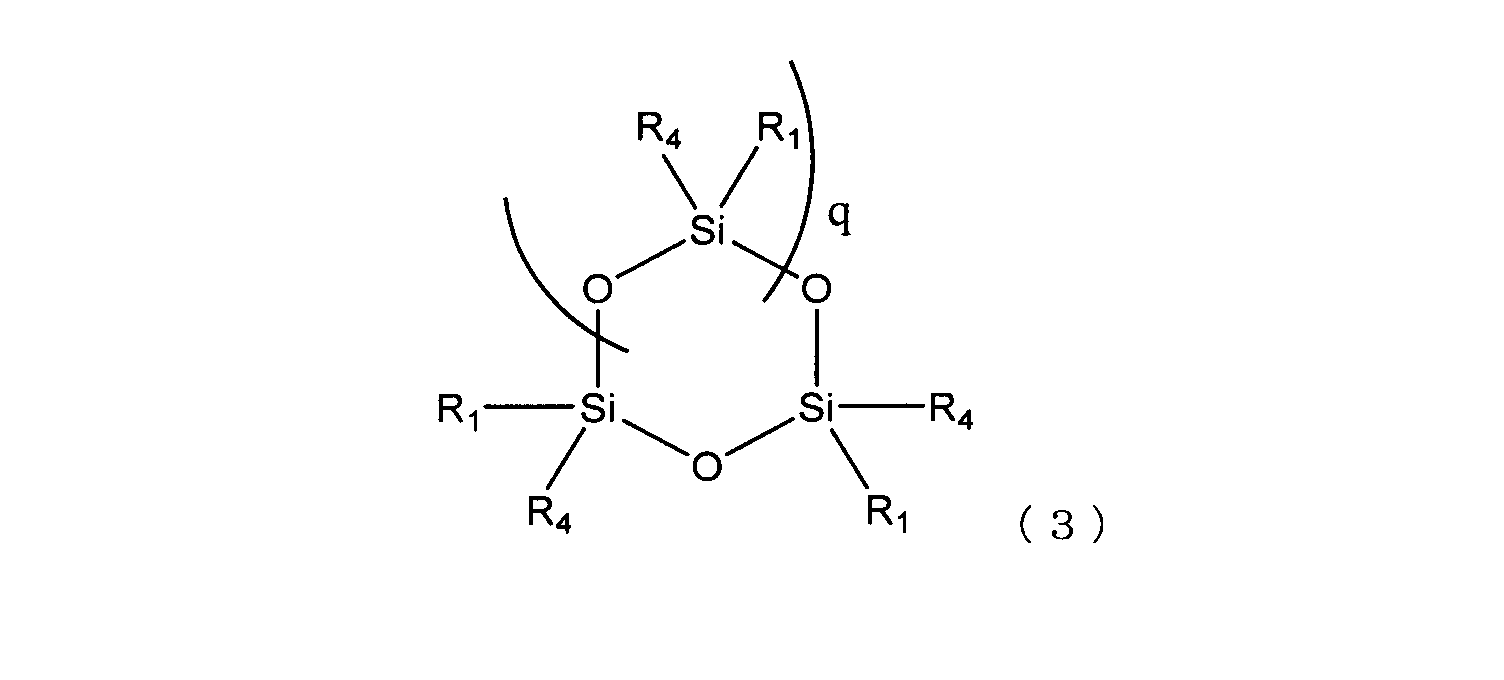
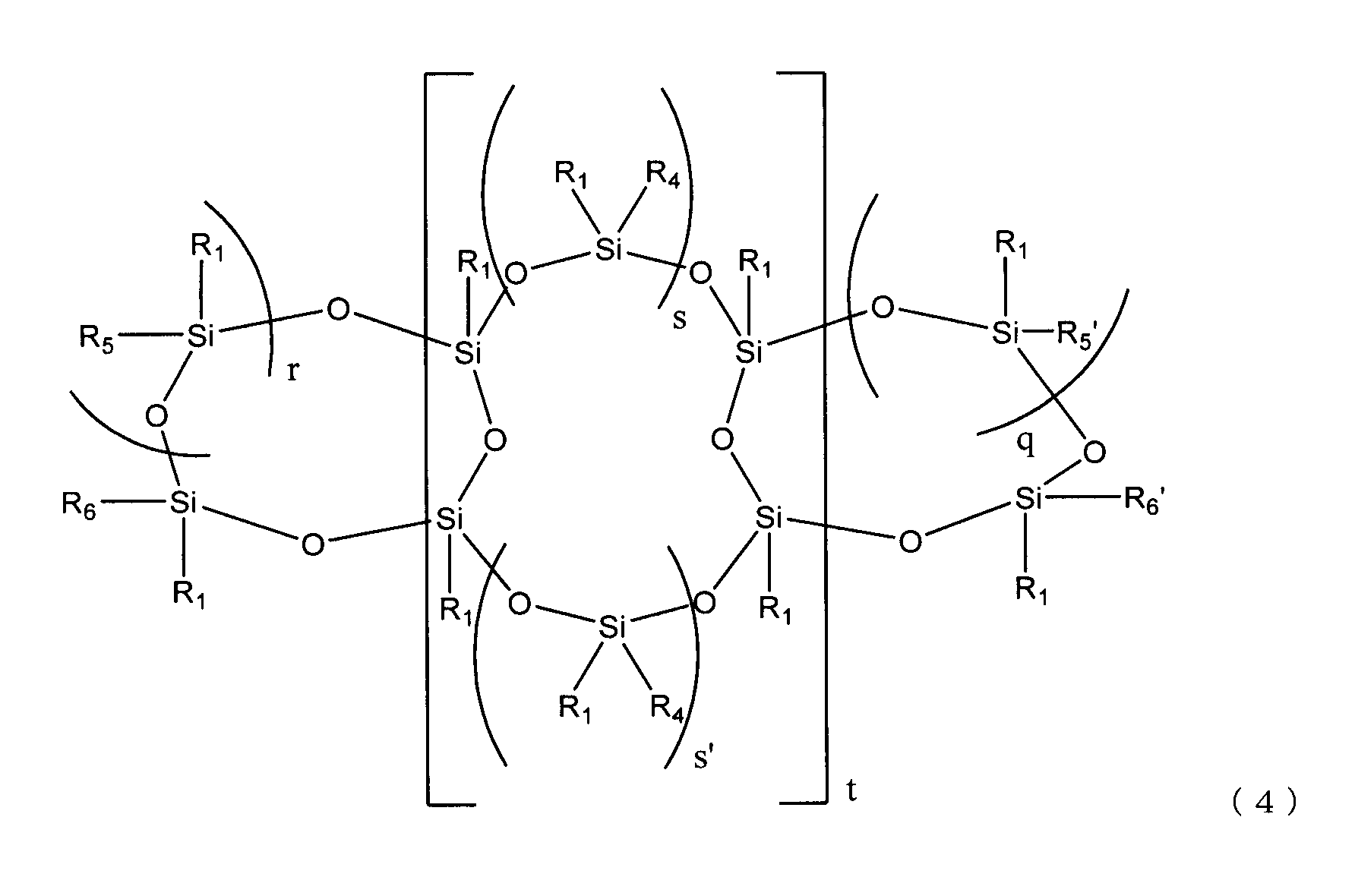
- Examples of the condensate of the compound represented by the formula (1) include compounds represented by the following formulas (2) to (4).
- R 1 is a functional group containing a (meth) acryloyl group
- R 4 is R 1 , R 2 in Formula (1)
- OH or R 7 Represents a substituent of R 7 represents a structure derived from an alcohol such as an alkoxy group contained in the component (A) or in the paint, such as a methoxy group, ethoxy group, propoxy group, isopropoxy group, n-butoxy group, i-butoxy group , T-butoxy group, and 1-methoxy-2-propoxy group.
- P represents an integer of 0 to 10.
- R 1 and R 4 have the same meaning as in formula (2).
- q represents an integer of 0 to 10.
- R 1 and R 4 have the same meaning as in formula (2).
- R 5 and R 5 ′ are R 1 , R 2 in the formula (1), R 3 in the formula (1), OH, or any one of R 7 in the formula (2) or R 5 and R It represents that 5 ' has couple
- R 6 and R 6 ′ are R 1 , R 2 in the formula (1), R 3 in the formula (1), OH, or any substituent of R 7 in the formula (2) or R 6 And R 6 ′ are bonded by an ether bond.
- r and q represent an integer of 0 to 10 and r + q ⁇ 1
- s and s ′ represent an integer of 0 to 10, and t represents an integer of 0 to 10.
- the content of the component (C) in the curable composition is 0.08 times the mass or less of the component (A) from the viewpoint of improving the weather resistance of the cured film.
- the content is preferably 0.06 times or less, more preferably 0.04 times or less. Since the weather resistance of a cured film improves, so that there is little content of (C) component, (C) component does not need to be contained. In addition, since it is not easy to completely remove the unreacted component (a-2) that is not covered with the component (a-1) when the component (A) is synthesized, the content of the component (C) is It is preferable to reduce as much as possible.
- component (C) In order to reduce the content of component (C), reduce the amount of component (a-2) used, and select a solvent that has an azeotropic boiling with water at a lower boiling point, and perform hydrolysis and dehydration condensation reactions. Is preferred. Examples of such a solvent include ethyl acetate, methyl ethyl ketone, ethanol, isopropanol and the like, and among these, ethyl acetate and methyl ethyl ketone are more preferable.
- content of (C) component can be measured with the following method.
- a reprecipitation operation is performed by adding a reaction solution obtained by reacting the components (a-1) and (a-2) to hexane. After solid-liquid separation, the hexane solution is concentrated and dried to obtain component (C). The content of the component (C) is calculated from the ratio of the mass of the reaction solution obtained by reacting the components (a-1) and (a-2) to the mass of the obtained component (C).
- the content of the component (D) in the curable composition is 0.01 to 10 parts by mass with respect to 100 parts by mass in total of the components (A) to (C).
- the content is preferably 0.01 to 8 parts by mass, more preferably 1 to 7 parts by mass, and even more preferably 2 to 6 parts by mass.
- the curable composition further includes an ultraviolet absorber (E) (hereinafter also referred to as (E) component) and a light stabilizer (F) (hereinafter also referred to as (F) component). It is preferable to contain.
- E ultraviolet absorber
- F light stabilizer
- a component is a ultraviolet absorber.
- a component is not specifically limited, If it melt
- a benzophenone-based or hydroxyphenyltriazine-based ultraviolet absorber is preferable from the viewpoint that it can be contained in a large amount in the curable composition.
- the component (E) is preferably a benzotriazole or hydroxyphenyltriazine-based ultraviolet absorber.
- benzophenone UV absorber examples include 2-hydroxybenzophenone, 5-chloro-2-hydroxybenzophenone, 2,4-dihydroxybenzophenone, 2-hydroxy-4-methoxybenzophenone, 2-hydroxy-4-octyloxybenzophenone, 4 -Dodecyloxy-2-hydroxybenzophenone, 2-hydroxy-4-octadecyloxybenzophenone, 2,2'-dihydroxy-4-methoxybenzophenone, 2,2'-dihydroxy-4,4'-dimethoxybenzophenone and the like.
- benzotriazole ultraviolet absorber examples include 2- (2-hydroxy-5-methylphenyl) benzotriazole, 2- (2-hydroxy-5-tert-butylphenyl) benzotriazole, and 2- (2-hydroxy-3 , 5-Di-tert-butylphenyl) -5-chlorobenzotriazole, 2- (2-hydroxy-3,5-di-tert-butylphenyl) benzotriazole, 2- (2-hydroxy-5-tert-octyl) Phenyl) benzotriazole, 2- (2′-hydroxy-5′-methacryloxyethylphenyl) -2H-benzotriazole, and the like.
- Hydroxyphenyl triazine-based UV absorbers include 2- [4-[(2-hydroxy-3-dodecyloxypropyl) oxy] -2-hydroxyphenyl] -4,6-bis (2,4-dimethylphenyl).
- phenyl salicylate UV absorber examples include phenyl salicylate, p-tert-butylphenyl salicylate, p- (1,1,3,3-tetramethylbutyl) phenyl salicylate, and the like.
- phenyl benzoate UV absorber examples include 3-hydroxyphenylbenzoate and phenylene-1,3-dibenzoate.
- a benzotriazole-based or hydroxyphenyltriazine-based ultraviolet absorber is preferable.
- the content of the component (E) in the curable composition is based on 100 parts by mass of the total of the components (A) to (C) from the viewpoint of imparting weather resistance to the cured film without reducing the curability. 1 to 20 parts by mass is preferable, 1 to 10 parts by mass is more preferable, and 1 to 5 parts by mass is further preferable.
- the component (F) is a light stabilizer.
- the weather resistance of the cured film can be further improved.
- the component (F) include hindered amine light stabilizers.
- hindered amine light stabilizers include bis (1,2,2,6,6-pentamethyl-4-piperidyl) sebacate, bis (2,2,6,6-tetramethyl-4-piperidyl) sebacate, 2 -(3,5-di-tert-butyl-4-hydroxybenzyl) -2-n-butylmalonate bis (1,2,2,6,6-pentamethyl-4-piperidyl), 2,4-bis [ N-butyl- (1-cyclohexyloxy-2,2,6,6-tetramethylpiperidin-4-yl) amino] -6- (2-hydroxyethylamine) -1,3,5-triazine, sebacic acid and bis And a reaction product with (2,2,6,6-tetramethyl-1- (octyloxy) -4-piperidinyl) ester.
- component (F) bis (1,2,2,6,6-pentamethyl-4-piperidyl) sebacate and sebacic acid and bis (2,2,6,6-tetramethyl-1- ( Preferred are reactants with octyloxy) -4-piperidinyl) esters. These may use 1 type and may use 2 or more types together.
- the content of the component (F) in the curable composition is 100 parts by mass in total of the components (A) to (C) from the viewpoint of imparting weather resistance and durability to the cured film without reducing the curability.
- the amount is preferably 0.01 to 3 parts by mass, more preferably 0.05 to 2 parts by mass, and still more preferably 0.05 to 1 part by mass.
- the curable composition may further include a solvent, an antioxidant, an anti-yellowing agent, a blueing material, a pigment, a leveling agent, an antifoaming agent, a thickening agent, an anti-settling agent, an antistatic agent, if necessary.
- An antifogging agent or the like may be included.
- the solvent is used in the production of the component (A), but may be used from the viewpoint of uniformly dissolving the curable composition and facilitating application.
- the solvent used as an optional component can improve the uniform solubility, dispersion stability, adhesion to the substrate, and smoothness and uniformity of the cured film of the curable composition.
- Solvents that can be used for these purposes are not particularly limited, and examples include organic solvents such as alcohols, hydrocarbons, halogenated hydrocarbons, ethers, ketones, esters, and polyhydric alcohol derivatives. These may use 1 type and may use 2 or more types together.
- the content of the solvent in the curable composition is preferably 100 to 500 parts by mass, more preferably 150 to 300 parts by mass with respect to 100 parts by mass in total of the components (A) to (C).
- the laminate according to the present invention includes a cured film of the curable composition according to the present invention on a base material.
- the thickness of the cured film is preferably 5 to 20 ⁇ m, more preferably 7 to 15 ⁇ m, from the viewpoint of producing a cured film having excellent weather resistance and wear resistance in a short time.
- the cured film can be formed by applying the curable composition according to the present invention on a substrate and irradiating with active energy rays.
- methods such as brush coating, spray coating, dip coating, flow coating, spin coating, curtain coating, and bar coater method can be used.
- the curable composition applied on the substrate is crosslinked by irradiation with active energy rays to form a cured film.
- the curable composition is cured by irradiation with ultraviolet rays
- the curable composition is applied on the substrate so that the thickness of the coating film is preferably 1 to 50 ⁇ m, more preferably 3 to 20 ⁇ m.
- ultraviolet rays having a wavelength of 340 nm to 380 nm can be irradiated with 1000 to 5000 mJ / cm 2 using a high pressure mercury lamp, a metal halide lamp, or the like.
- the atmosphere in which the active energy ray is irradiated may be air or an inert gas such as nitrogen or argon.
- the heat treatment can be performed by irradiation with a near infrared lamp, circulation of hot air, or the like.
- the substrate surface temperature in the furnace hereinafter referred to as heating temperature
- the heating time is 60 to 180 seconds
- the adhesion can be maintained outdoors for a long time.
- the heating temperature is 40 ° C. or higher
- the organic solvent and the like in the coating film can be sufficiently removed, and the water resistance and weather resistance are improved.
- the heating temperature is 90 ° C. or lower, the appearance is improved and the weather resistance is improved.
- the heating time is 60 seconds or longer, the organic solvent and the like in the coating film can be sufficiently removed, and the water resistance and weather resistance are improved. Moreover, when the heating time is 180 seconds or less, the appearance is good and the weather resistance is improved. More preferably, the heating temperature is 50 to 70 ° C., and the heating time is 90 to 120 seconds.
- the cured film obtained by curing the curable composition according to the present invention is excellent in wear resistance and weather resistance and has an excellent appearance without cracks. Therefore, the curable composition according to the present invention can be used for surface modification of various synthetic resin molded articles as a substrate.
- the synthetic resin of the synthetic resin molded product include various thermoplastic resins and thermosetting resins that are desired to be improved in wear resistance, weather resistance, and the like. Examples of these resins include polymethyl methacrylic resin, polycarbonate resin, polyester resin, poly (polyester) carbonate resin, polystyrene resin, ABS resin (acrylonitrile-butadiene-styrene copolymer resin), AS resin (acrylonitrile-styrene copolymer resin).
- Polyamide resin Polyarylate resin, polymethacrylimide resin, polyallyl diglycol carbonate resin, and the like. These may use 1 type and may use 2 or more types together.
- polymethyl methacrylic resin, polycarbonate resin, polystyrene resin, and polymethacrylimide resin are excellent in transparency and strongly desired to improve wear resistance. Therefore, application of the curable composition according to the present invention is effective. is there.
- synthetic resin molded products include sheet-shaped molded products, film-shaped molded products, and various injection molded products of these resins.
- an automotive headlamp lens provided with a cured film of the curable composition according to the present invention on the surface of a resin molded product such as a polycarbonate resin molded product, the surface is excellent in wear resistance and weather resistance, and has no cracks. Since it is covered with the cured film which has an external appearance, it is preferable.
- a laminate in which a cured film is formed by applying a curable composition to the surface of a polycarbonate resin molded article as a base material and irradiating active energy rays can be used as a polycarbonate resin molded article for automotive window glass replacement. Is preferred.
- a surface-modified silica particle ethyl acetate dispersion (EA-CS1) was prepared by the following method.
- ethyl acetate-dispersed silica sol (trade name: EAC-ST, manufactured by Nissan Chemical Industries, Ltd., dispersion medium: ethyl acetate, SiO 2 concentration: 30% by mass, average primary particle size: 15 nm, hereinafter abbreviated as EAC-ST 120 g, and (a-2) component 3-methacryloyloxypropyltrimethoxysilane (trade name: KBM-503, Shin-Etsu) 3.6 g of Chemical Industry Co., Ltd.
- EA-CS2 dispersion liquid (EA-CS2) containing surface-modified silica particles]
- KBM-503 was changed to 3.39 g of 3-acryloyloxypropyltrimethoxysilane (trade name: KBM-5103, manufactured by Shin-Etsu Chemical Co., Ltd., hereinafter abbreviated as KBM-5103). Except that, (EA-CS2) was produced in the same manner as in the production of (EA-CS1).
- silane coupling agent condensate (C1) Surface-modified silica particles by the same method as Synthesis Example 1 of Patent Document 1 except that 3-methacryloyloxypropyltrimethoxysilane was changed from TSL-8370 (trade name) manufactured by Toshiba Silicone Co., Ltd. to KBM-503 A toluene solution (TOL-CS) was prepared. Specifically, it was prepared by the method shown below.
- isopropanol silica gel (trade name: IPA-ST, manufactured by Nissan Chemical Industries, Ltd., dispersion medium: isopropanol, SiO 2 concentration: 30% by mass, primary particles Diameter: 12 nm, hereinafter abbreviated as IPA-ST) 2000 parts and KBM-503 382 parts.
- IPA-ST isopropanol silica gel
- KBM-503 382 parts KBM-503 382 parts
- component (C) contained in (TOL-CS) was confirmed by the following procedure. While stirring 10000 parts of hexane (TOL-CS), 1000 parts are slowly added to perform reprecipitation, and after solid-liquid separation, the hexane solution contained in (TOL-CS) is removed from the mass of the residue obtained by drying under reduced pressure. It was confirmed that the ring agent condensate (component (C), hereinafter (C1)) was 263 parts.
- This curable composition was applied to a polycarbonate resin injection-molded plate (trade name: Panlite L-1225Z-100, Clear, manufactured by Teijin Ltd., thickness 3 mm) with a No. 26 bar coater, and in a dryer at 60 ° C. And dried for 90 seconds.
- a high-pressure mercury lamp in an air atmosphere, irradiated with ultraviolet rays of 1,800 mJ / cm 2 (ultraviolet integrated energy with a wavelength of 320 to 380 nm, measured with UV-351 (product name, manufactured by Oak Co., Ltd.)).
- An abrasion-resistant polycarbonate resin plate (laminate) having a cured film having a thickness of 10 ⁇ m was obtained.
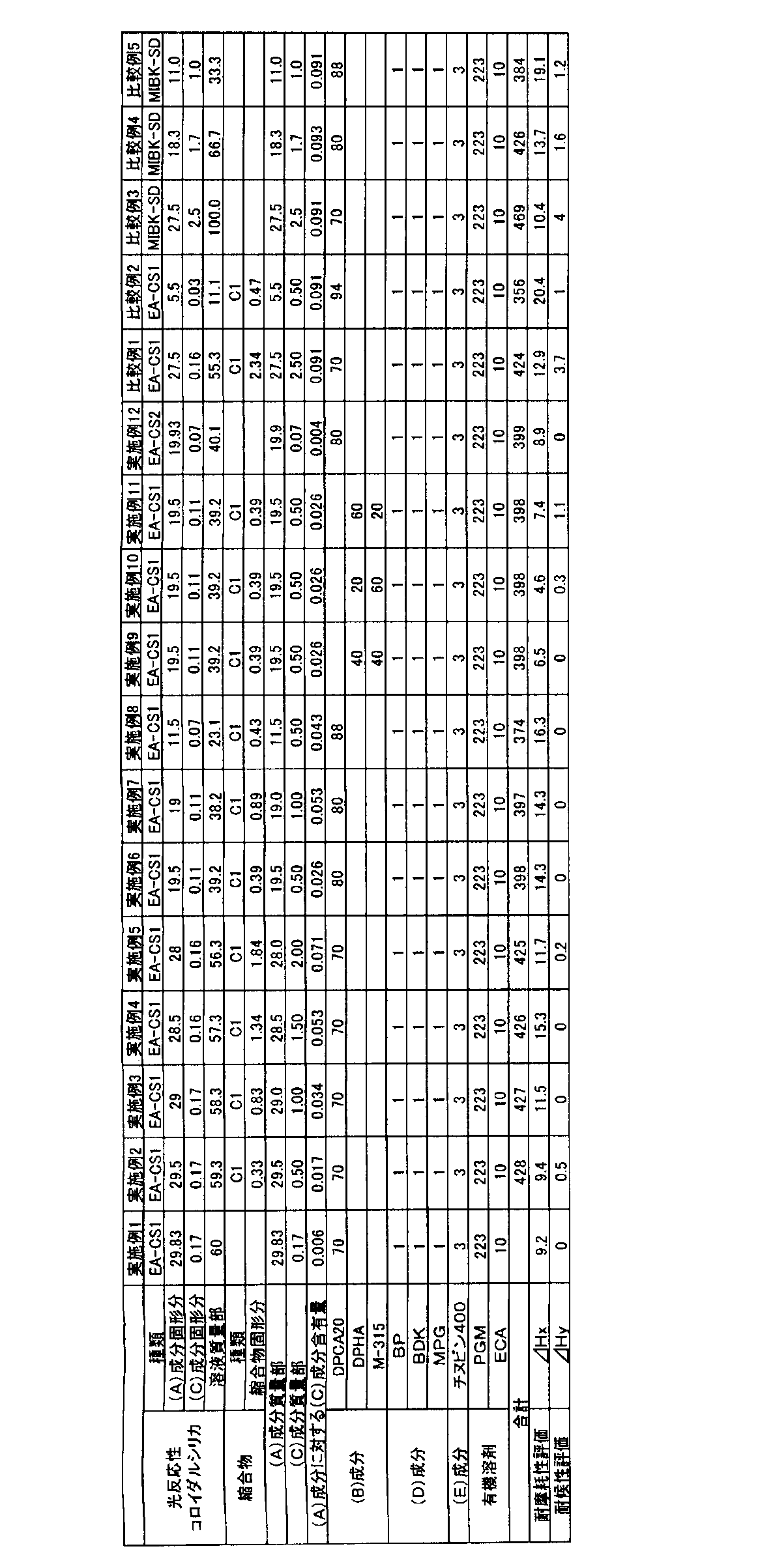
- Examples 2 to 11, Comparative Examples 1 and 2 A laminate was obtained in the same manner as in Example 1, except that (EA-CS1) was changed to (EA-CS1) and (C1) and the blending ratio was changed as shown in Table 1. It was.
- Example 12 A laminate was obtained in the same manner as in Example 1 except that (EA-CS1) was changed to (EA-CS2) in Example 1 and the compounding ratio was changed as shown in Table 1.
- each compound in Table 1 is as follows.
- MIBK-SD methyl isobutyl ketone-dispersed silica sol (manufactured by Nissan Chemical Industries, Ltd., dispersion medium: methyl isobutyl ketone, SiO 2 concentration: 30% by mass, average primary particle size: 10 to 15 nm)
- DPCA20 acrylated product of an adduct of 1 mol of dipentaerythritol and 2 mol of ⁇ -caprolactone (trade name: Kayarad DPCA-20, manufactured by Nippon Kayaku Co., Ltd.)
- DPHA Dipentaerythritol hexaacrylate (trade name: Aronix M-406, manufactured by Toagosei Co., Ltd.)
- M-315 Tris (2-acryloxyethyl) isocyanurate (trade name: Aronix M-315, manufactured by Toagosei Co., Ltd.)
- BP benzophenone BDK:
Landscapes
- Chemical & Material Sciences (AREA)
- Organic Chemistry (AREA)
- Engineering & Computer Science (AREA)
- Health & Medical Sciences (AREA)
- Chemical Kinetics & Catalysis (AREA)
- Medicinal Chemistry (AREA)
- Polymers & Plastics (AREA)
- Life Sciences & Earth Sciences (AREA)
- Materials Engineering (AREA)
- Wood Science & Technology (AREA)
- Nanotechnology (AREA)
- Physics & Mathematics (AREA)
- Toxicology (AREA)
- General Chemical & Material Sciences (AREA)
- Inorganic Chemistry (AREA)
- General Engineering & Computer Science (AREA)
- Mechanical Engineering (AREA)
- General Physics & Mathematics (AREA)
- Optics & Photonics (AREA)
- Polymerisation Methods In General (AREA)
- Laminated Bodies (AREA)
- Paints Or Removers (AREA)
- Macromonomer-Based Addition Polymer (AREA)
- Surface Treatment Of Optical Elements (AREA)
Abstract
Description
ΔHy≦-0.3×ΔHx+5.0
を満足する硬化膜を得ることができる硬化性組成物。
硬化膜の表面を、JIS K7204「摩耗輪によるプラスチック摩耗試験」に従って、摩耗輪CS-10F(商品名、TABER社製)を使用し、500g荷重(4.90N)で500回転摩耗する。
硬化膜の表面に対し、耐候性試験機(装置名:メタルウェザー、型式:ダイプラ・メタルウェザー、KU-R4Ci-W型、ダイプラ・ウィンテス(株)製)を用いて、照射強度80mW/cm2にて144時間の耐候性試験を実施する。耐候性試験では、63℃で8時間、70℃で8時間、30℃で8時間の計24時間を1サイクルとし、6サイクルを実施する。
摩耗試験又は耐侯性試験前後の硬化膜の表面のヘイズ値を、ヘイズメーター(商品名:HM-65W、(株)村上色彩技術研究所製)を用いてJIS-K7105に従い4回測定し、その平均値を算出する。摩耗試験後のヘイズ値から摩耗試験前のヘイズ値を引いた値をヘイズ値ΔHxとする。耐候性試験後のヘイズ値から耐候性試験前のヘイズ値を引いた値をヘイズ値ΔHyとする。ヘイズ値ΔHxおよびΔHyの単位は%である。
ΔHx≧0かつΔHy≧0
の関係をさらに満足する[1]に記載の硬化性組成物。
S:JIS Z8830に規定されたBET吸着法により測定した比表面積(単位:cm2/g)
ρ:無機粒子の密度(単位:g/cm3)。
一個以上のラジカル重合性不飽和結合を有する化合物(B)、
下記式(1)で表される化合物および/またはその縮合物(C)、並びに
光重合開始剤(D)
を含み、
(A)の含有量が(A)~(C)の合計100質量%に対して10~50質量%、
(B)の含有量が(A)~(C)の合計100質量%に対して50~90質量%、
(C)の含有量が(A)に対して0~0.08倍質量、
(D)の含有量が(A)~(C)の合計100質量部に対して0.01~10質量部、である硬化性組成物。
(式(1)中、R1は(メタ)アクリロイル基を含む官能基、R2は加水分解可能な官能基又は水酸基、R3はR1及びR2以外の置換基を表す。また、lは1~3の整数、mは1~3の整数、nは0~2の整数である。ただしl+m+n=4である。)。
(B)の含有量が(A)~(C)の合計100質量%に対して60~90質量%、
である[6]に記載の硬化性組成物。
硬化性組成物をポリカーボネート樹脂射出成形板(商品名:パンライトL-1225Z-100、クリヤー、帝人(株)製、厚さ3mm)に26号バーコーターで塗布し、60℃の乾燥機中で90秒加熱乾燥する。次に、空気雰囲気中において高圧水銀灯を用い、1,800mJ/cm2(波長320~380nmの紫外線積算エネルギー、UV-351(製品名、オーク(株)製)にて測定)の紫外線を照射し、厚さが10μmの硬化膜を備える耐摩耗性ポリカーボネート樹脂板(積層体)を作製する。該硬化膜に対して、下記摩耗試験及び下記耐候性試験を実施する。
硬化膜の表面を、JIS K7204「摩耗輪によるプラスチック摩耗試験」に従って、摩耗輪CS-10F(商品名、TABER社製)を使用し、500g荷重(4.90N)で500回転摩耗する。
硬化膜の表面に対し、耐候性試験機(装置名:メタルウェザー、型式:ダイプラ・メタルウェザー、KU-R4Ci-W型、ダイプラ・ウィンテス(株)製)を用いて、照射強度80mW/cm2にて144時間の耐候性試験を実施する。耐候性試験では、63℃で8時間、70℃で8時間、30℃で8時間の計24時間を1サイクルとし、6サイクルを実施する。
摩耗試験又は耐侯性試験前後の硬化膜の表面のヘイズ値を、ヘイズメーター(商品名:HM-65W、(株)村上色彩技術研究所製)を用いてJIS-K7105に従い4回測定し、その平均値を算出する。摩耗試験後のヘイズ値から摩耗試験前のヘイズ値を引いた値をヘイズ値ΔHxとする。耐候性試験後のヘイズ値から耐候性試験前のヘイズ値を引いた値をヘイズ値ΔHyとする。ヘイズ値ΔHxおよびΔHyの単位は%である。通常ΔHx≧0かつΔHy≧0を満たす。
S:JIS Z8830に規定されたBET吸着法により測定した比表面積(単位:cm2/g)
ρ:無機粒子の密度(単位:g/cm3)
なお、無機粒子の密度は、日本化学会編.化学便覧 応用編.改訂3版,東京,丸善,1980,2 無機工業薬品.に記載されている真比重の値を利用する。
(B)成分は、一個以上のラジカル重合性不飽和結合を有する化合物である。(B)成分は、一個以上のラジカル重合性不飽和結合を有するモノマーやオリゴマーであれば特に限定されない。(B)成分としては、例えば(メタ)アクリレート、スチレン化合物、マレイミド化合物、フマル酸エステル等が挙げられる。これらは一種を用いてもよく、二種以上を併用してもよい。
(D)成分は光重合開始剤である。(D)成分は活性エネルギー線の照射によりラジカルを発生し、重合性モノマー及びオリゴマーを重合できれば特に限定されず、硬化性組成物中における相溶性の観点から適宜選択することができる。
(a)成分である無機粒子の平均一次粒子径は、硬化膜の透明性の観点から500nm以下である。該無機粒子の平均一次粒子径は、100nm以下であることが好ましく、50nm以下であることがより好ましい。該無機粒子としては、シリカ粒子、アルミナ粒子、銀粒子、金粒子、酸化銅粒子、酸化鉄粒子、酸化コバルト粒子、酸化チタン粒子、酸化亜鉛粒子、酸化ジルコニウム粒子、酸化セリウム粒子、ヒドロキシアパタイト粒子、フラーレン粒子、グラフェン粒子、酸化グラフェン粒子、カーボンナノチューブ粒子、ダイヤモンド粒子、メソポーラスカーボン粒子、SiC粒子、TiC粒子などが挙げられる。これらの無機粒子は表面修飾されていてもいなくても良い。それらの中でも、耐摩耗性や硬化膜の透明性の観点から、シリカ粒子及び/又はその表面がシランカップリング剤との反応で表面修飾されたシリカ粒子が好ましく、後述する表面修飾されたシリカ粒子(A)がさらに好ましい。これらは一種を用いてもよく、二種以上を併用してもよい。
式(1)中、R1は(メタ)アクリロイル基を含む官能基、R2は加水分解可能な官能基又は水酸基、R3はR1及びR2以外の置換基を表す。また、lは1~3の整数、mは1~3の整数、nは0~2の整数である。ただしl+m+n=4である。
(A)成分は、表面修飾されたシリカ粒子であって、(a-1)成分と(a-2)成分とを反応させて得られる。該反応により、シリカ粒子である(a-1)成分の表面は(a-2)成分により化学修飾される。
(a-1)成分は、平均一次粒子径が500nm以下のシリカ粒子である。該シリカ粒子の平均一次粒子径は、硬化膜の透明性の観点から500nm以下である。該シリカ粒子の平均一次粒子径は、100nm以下であることが好ましく、50nm以下であることがより好ましい。なお、該シリカ粒子の平均一次粒子径はBET吸着法による比表面積測定値(JIS Z8830に準ずる)から換算した値であり、前記無機粒子(a)における測定方法と同様である。
(a-2)成分は、下記式(1)で表される化合物である。
式(1)中、R1は(メタ)アクリロイル基を含む官能基、R2は加水分解可能な官能基又は水酸基、R3はR1及びR2以外の置換基を表す。また、lは1~3の整数、mは1~3の整数、nは0~2の整数である。ただしl+m+n=4である。
硬化性組成物中の(B)成分の含有量は、硬化膜を形成した際に耐磨耗性と耐候性との両立が可能となる観点から、(A)~(C)成分の合計100質量%に対して50~90質量%である。該含有量は、55~90質量%が好ましく、60~90質量%がより好ましく、65~88質量%がさらに好ましい。
(C)成分は、(A)成分を製造する過程で使用される(a-2)成分および/または(A)成分を製造する過程で生成する副生物であり、前記式(1)で表される化合物および/またはその縮合物である。(C)成分としては、例えば(A)成分を合成した際に(a-1)成分に被覆されなかった未反応の(a-2)成分や、硬化性組成物を調製する際に別途添加される化合物等が挙げられる。(C)成分は(a-2)成分と同じであってもよく、異なっていてもよい。

ヘキサンに(a-1)成分と(a-2)成分とを反応させた反応液を加えて再沈殿操作を行う。固液分離した後、ヘキサン溶液を濃縮乾燥させ、(C)成分を得る。(a-1)成分と(a-2)成分とを反応させた反応液の質量と得られた(C)成分の質量との比から(C)成分の含有量を算出する。
硬化性組成物中の(D)成分の含有量は、(A)~(C)成分の合計100質量部に対して0.01~10質量部である。該含有量は0.01~8質量部が好ましく、1~7質量部がより好ましく、2~6質量部がさらに好ましい。
(E)成分は紫外線吸収剤である。(E)成分は特に限定されず、硬化性組成物に均一に溶解し、かつその耐候性が良好であれば使用可能である。(E)成分としては、硬化性組成物に対する溶解性が良好であり、耐候性改善効果が高い観点から、ベンゾフェノン系、ベンゾトリアゾール系、ヒドロキシフェニルトリアジン系、サリチル酸フェニル系、又は安息香酸フェニル系から誘導された化合物であって、それらの最大吸収波長が240~380nmの範囲である紫外線吸収剤が好ましい。特に、硬化性組成物中に多量に含有させることができる観点から、(E)成分としてはベンゾフェノン系、ヒドロキシフェニルトリアジン系の紫外線吸収剤が好ましい。また、基材としてポリカーボネート等を用いた場合にその黄変を防ぐことができる観点から、(E)成分としてはベンゾトリアゾール、ヒドロキシフェニルトリアジン系の紫外線吸収剤が好ましい。
(F)成分は光安定剤である。特に、(F)成分は(E)成分と併用することで、硬化膜の耐候性をより向上させることができる。(F)成分としては、例えばヒンダードアミン系光安定剤が挙げられる。ヒンダードアミン系光安定剤としては、例えば、ビス(1,2,2,6,6-ペンタメチル-4-ピペリジル)セバケート、ビス(2,2,6,6-テトラメチル-4-ピペリジル)セバケート、2-(3,5-ジ-tert-ブチル-4-ヒドロキシベンジル)-2-n-ブチルマロン酸ビス(1,2,2,6,6-ペンタメチル-4-ピペリジル)、2,4-ビス[N-ブチル-(1-シクロヘキシロキシ-2,2,6,6-テトラメチルピペリジン-4-イル)アミノ]-6-(2-ヒドロキシエチルアミン)-1,3,5-トリアジン、セバシン酸とビス(2,2,6,6-テトラメチル-1-(オクチロキシ)-4-ピペリジニル)エステルとの反応物等が挙げられる。これらの中でも、(F)成分としては、ビス(1,2,2,6,6-ペンタメチル-4-ピペリジル)セバケート及びセバシン酸とビス(2,2,6,6-テトラメチル-1-(オクチロキシ)-4-ピペリジニル)エステルとの反応物が好ましい。これらは一種を用いてもよく、二種以上を併用してもよい。
硬化性組成物には、さらに、必要に応じて、溶剤、酸化防止剤、黄変防止剤、ブルーイング材、顔料、レベリング剤、消泡剤、増粘剤、沈降防止剤、帯電防止剤、防曇剤等が含まれてもよい。
表面修飾されたシリカ粒子の酢酸エチル分散液(EA-CS1)を以下に示す方法で調製した。攪拌機、温度計及びコンデンサーを備える200ミリリットルの3ツ口フラスコに、(a-1)成分として酢酸エチル分散シリカゾル(商品名:EAC-ST、日産化学工業(株)製、分散媒:酢酸エチル、SiO2濃度:30質量%、平均一次粒子径:15nm、以下EAC-STと略記する)120gと、(a-2)成分として3-メタクリロイルオキシプロピルトリメトキシシラン(商品名:KBM-503、信越化学工業(株)製、以下KBM-503と略記する)3.6g、蒸留水0.78gを入れた。これを攪拌しながら昇温させ、還流下で2時間攪拌しながら加水分解及び脱水縮合反応を行った。その後、常圧、還流下で4時間攪拌しながらアルコール、水等を酢酸エチルと一緒に留出させた。さらに、酢酸エチルを留出させながら約80℃で2時間反応を行い、固形分濃度を50質量%とした。これにより(EA-CS1)を得た。(EA-CS1)は乳白色の分散液であった。
前記方法で調製した(EA-CS1)中に含まれる(C)成分量は以下の手順で確認した。ヘキサン500mlを撹拌しながら(EA-CS1)50gをゆっくり加えて再沈殿を行い、固液分離した後ヘキサン溶液を減圧濃縮して(EA-CS1)中に含まれる(C)成分の質量を測定した。(EA-CS1)中に含まれる(C)成分の含有量は0.29質量%((C)の含有量は(A)の含有量の0.006倍質量)であった。
前記(EA-CS1)の製造においてKBM-503を3-アクリロイルオキシプロピルトリメトキシシラン(商品名:KBM-5103、信越化学工業(株)製、以下KBM-5103と略記する)3.39gに変更した以外は、前記(EA-CS1)の製造と同様の方法で製造し、(EA-CS2)を得た。
(EA-CS1)を(EA-CS2)に変更した以外は(EA-CS1)中の(C)成分量の確認と同様の方法で測定を行い、(EA-CS2)中に含まれる(C)成分の含有量は0.18質量%であった。
3-メタクリロイルオキシプロピルトリメトキシシランを東芝シリコーン(株)製のTSL-8370(商品名)からKBM-503に変更した以外は特許文献1の合成例1と同じ方法で、表面修飾されたシリカ粒子のトルエン溶液(TOL-CS)を調製した。具体的には、以下に示す方法で調製した。
(EA-CS1)、(B)、(D)、(E)および有機溶媒を表1に記載の配合比で配合し、硬化性組成物を調製した。
実施例1において、(EA-CS1)を(EA-CS1)および(C1)に変更し、配合比を表1に示すように変更したこと以外は実施例1と同様の方法で積層体を得た。
実施例1において、(EA-CS1)を(EA-CS2)に変更し、配合比を表1に示すように変更したこと以外は実施例1と同様の方法で積層体を得た。
実施例1において、(EA-CS1)をMIBK-SDに変更し、配合比を表1に示すように変更したこと以外は実施例1と同様の方法で積層体を得た。
MIBK-SD:メチルイソブチルケトン分散シリカゾル(日産化学工業(株)製、分散媒:メチルイソブチルケトン、SiO2濃度:30質量%、平均一次粒子径:10~15nm)
DPCA20:ジペンタエリスリトール1モルとε-カプロラクトン2モルとの付加物のアクリレート化物(商品名:カヤラッドDPCA-20、日本化薬(株)製)
DPHA:ジペンタエリスリトールヘキサアクリレート(商品名:アロニックスM-406、東亞合成(株)製)
M-315:トリス(2-アクリロキシエチル)イソシアヌレート(商品名:アロニックスM-315、東亞合成(株)製)
BP:ベンゾフェノン
BDK:ベンジルジメチルケタール
MPG:メチルフェニルグリオキシレート
チヌビン400:2-[4-[(2-ヒドロキシ-3-ドデシロキシプロピル)オキシ]-2-ヒドロキシフェニル]-4,6-ビス(2,4-ジメチルフェニル)-1,3,5-トリアジン(商品名、BASFジャパン(株)製)
PGM:プロピレングリコールモノメチルエーテル
ECA:エチルカルビトールアセテート。
Claims (14)
- 厚さ10μmの硬化膜を作製した際、下記摩耗試験によって得られるヘイズ値ΔHxと下記耐候性試験によって得られるヘイズ値ΔHyとの関係が
ΔHy≦-0.3×ΔHx+5.0
を満足する硬化膜を得ることができる硬化性組成物。
[摩耗試験]
硬化膜の表面を、JIS K7204「摩耗輪によるプラスチック摩耗試験」に従って、摩耗輪CS-10F(商品名、TABER社製)を使用し、500g荷重(4.90N)で500回転摩耗する。
[耐侯性試験]
硬化膜の表面に対し、耐候性試験機(装置名:メタルウェザー、型式:ダイプラ・メタルウェザー、KU-R4Ci-W型、ダイプラ・ウィンテス(株)製)を用いて、照射強度80mW/cm2にて144時間の耐候性試験を実施する。耐候性試験では、63℃で8時間、70℃で8時間、30℃で8時間の計24時間を1サイクルとし、6サイクルを実施する。
[ヘイズ値ΔHxおよびΔHyの測定]
摩耗試験又は耐侯性試験前後の硬化膜の表面のヘイズ値を、ヘイズメーター(商品名:HM-65W、(株)村上色彩技術研究所製)を用いてJIS-K7105に従い4回測定し、その平均値を算出する。摩耗試験後のヘイズ値から摩耗試験前のヘイズ値を引いた値をヘイズ値ΔHxとする。耐候性試験後のヘイズ値から耐候性試験前のヘイズ値を引いた値をヘイズ値ΔHyとする。ヘイズ値ΔHxおよびΔHyの単位は%である。 - 前記ΔHx及び前記ΔHyが、
ΔHx≧0かつΔHy≧0
の関係をさらに満足する請求項1に記載の硬化性組成物。 - 一個以上のラジカル重合性不飽和結合を有する化合物(B)及び光重合開始剤(D)を含む請求項1に記載の硬化性組成物。
- JIS Z8830に規定されたBET吸着法により測定した比表面積から下記式により換算した平均一次粒子径が500nm以下の無機粒子(a)を含む請求項1に記載の硬化性組成物。
平均一次粒子径d(nm)=6000/(S・ρ)
S:JIS Z8830に規定されたBET吸着法により測定した比表面積(単位:cm2/g)
ρ:無機粒子の密度(単位:g/cm3) - 前記無機粒子(a)がシリカ粒子及び/又はその表面がシランカップリング剤との反応で表面修飾されたシリカ粒子である請求項4に記載の硬化性組成物。
- JIS Z8830に規定されたBET吸着法により測定した比表面積から換算した平均一次粒子径が500nm以下のシリカ粒子(a-1)に、下記式(1)で表される化合物(a-2)を反応させて得られる表面修飾されたシリカ粒子(A)、
一個以上のラジカル重合性不飽和結合を有する化合物(B)、
下記式(1)で表される化合物および/またはその縮合物(C)、並びに
光重合開始剤(D)
を含み、
(A)の含有量が(A)~(C)の合計100質量%に対して10~50質量%、
(B)の含有量が(A)~(C)の合計100質量%に対して50~90質量%、
(C)の含有量が(A)に対して0~0.08倍質量、
(D)の含有量が(A)~(C)の合計100質量部に対して0.01~10質量部、である硬化性組成物。
R1 l-SiR2 mR3 n (1)
(式(1)中、R1は(メタ)アクリロイル基を含む官能基、R2は加水分解可能な官能基又は水酸基、R3はR1及びR2以外の置換基を表す。また、lは1~3の整数、mは1~3の整数、nは0~2の整数である。ただしl+m+n=4である。) - (A)の含有量が(A)~(C)の合計100質量%に対して10~40質量%、
(B)の含有量が(A)~(C)の合計100質量%に対して60~90質量%、
である請求項6に記載の硬化性組成物。 - 紫外線吸収剤(E)をさらに含み、(E)の含有量が(A)~(C)の合計100質量部に対して1~20質量部である請求項6に記載の硬化性組成物。
- 光安定剤(F)をさらに含み、(F)の含有量が(A)~(C)の合計100質量部に対して0.01~3質量部である請求項6に記載の硬化性組成物。
- 基材上に請求項1~9のいずれか1項に記載の硬化性組成物の硬化膜を備える積層体。
- 硬化膜の厚さが5~20μmである請求項10に記載の積層体。
- 樹脂成形品の表面に請求項1~9のいずれか1項に記載の硬化性組成物の硬化膜を備える自動車ヘッドランプレンズ。
- 硬化膜の厚さが5~20μmである請求項12に記載の自動車ヘッドランプレンズ。
- 前記樹脂成形品がポリカーボネート樹脂成形品である請求項12に記載の自動車ヘッドランプレンズ。
Priority Applications (4)
| Application Number | Priority Date | Filing Date | Title |
|---|---|---|---|
| JP2015517305A JP6958988B2 (ja) | 2014-03-31 | 2015-03-30 | 硬化性組成物、積層体及び自動車ヘッドランプレンズ |
| US15/300,361 US11021618B2 (en) | 2014-03-31 | 2015-03-30 | Curable composition, laminate, and automobile headlamp lens |
| EP15772294.3A EP3127925B1 (en) | 2014-03-31 | 2015-03-30 | Curable composition, laminate, and automobile headlamp lens |
| CN201580016389.1A CN106133000A (zh) | 2014-03-31 | 2015-03-30 | 固化性组合物、层积体和汽车前照灯配光镜 |
Applications Claiming Priority (2)
| Application Number | Priority Date | Filing Date | Title |
|---|---|---|---|
| JP2014-071226 | 2014-03-31 | ||
| JP2014071226 | 2014-03-31 |
Publications (1)
| Publication Number | Publication Date |
|---|---|
| WO2015152140A1 true WO2015152140A1 (ja) | 2015-10-08 |
Family
ID=54240463
Family Applications (1)
| Application Number | Title | Priority Date | Filing Date |
|---|---|---|---|
| PCT/JP2015/059881 Ceased WO2015152140A1 (ja) | 2014-03-31 | 2015-03-30 | 硬化性組成物、積層体及び自動車ヘッドランプレンズ |
Country Status (6)
| Country | Link |
|---|---|
| US (1) | US11021618B2 (ja) |
| EP (1) | EP3127925B1 (ja) |
| JP (1) | JP6958988B2 (ja) |
| CN (3) | CN110028818A (ja) |
| TW (1) | TWI694105B (ja) |
| WO (1) | WO2015152140A1 (ja) |
Cited By (1)
| Publication number | Priority date | Publication date | Assignee | Title |
|---|---|---|---|---|
| US11248065B2 (en) | 2016-07-01 | 2022-02-15 | Mitsubishi Chemical Corporation | Active energy ray-curable resin composition, resin molded article, and method for producing resin molded article |
Citations (6)
| Publication number | Priority date | Publication date | Assignee | Title |
|---|---|---|---|---|
| JP2007186573A (ja) * | 2006-01-12 | 2007-07-26 | Mitsubishi Rayon Co Ltd | コーティング材組成物、硬化塗膜形成方法および成型品 |
| JP2011219623A (ja) * | 2010-04-09 | 2011-11-04 | Mitsubishi Rayon Co Ltd | 活性エネルギー線硬化性被覆材組成物及び積層体 |
| JP2012067157A (ja) * | 2010-09-22 | 2012-04-05 | Nidek Co Ltd | 樹脂組成物 |
| WO2013118713A1 (ja) * | 2012-02-10 | 2013-08-15 | 昭和電工株式会社 | 硬化性組成物およびその用途 |
| JP2013204029A (ja) * | 2012-03-29 | 2013-10-07 | Admatechs Co Ltd | 光学用樹脂組成物 |
| WO2015019941A1 (ja) * | 2013-08-09 | 2015-02-12 | 昭和電工株式会社 | 半導体ナノ粒子含有硬化性組成物、硬化物、光学材料および電子材料 |
Family Cites Families (18)
| Publication number | Priority date | Publication date | Assignee | Title |
|---|---|---|---|---|
| US5258225A (en) * | 1990-02-16 | 1993-11-02 | General Electric Company | Acrylic coated thermoplastic substrate |
| US5318850A (en) * | 1991-11-27 | 1994-06-07 | General Electric Company | UV curable abrasion-resistant coatings with improved weatherability |
| US5512181A (en) * | 1993-11-01 | 1996-04-30 | Nalco Chemical Company | Removing silica from cooling waters with colloidal alumina and dialysis |
| JP3247266B2 (ja) * | 1994-02-02 | 2002-01-15 | 三菱レイヨン株式会社 | 被覆用組成物、それを用いた表面被覆成形物、及びその製造方法 |
| ATE196919T1 (de) * | 1994-02-02 | 2000-10-15 | Mitsubishi Rayon Co | Beschichtungszusammensetzung und daraus hergestellte oberflächenbeschichtete form |
| KR100440702B1 (ko) * | 1995-09-20 | 2004-12-17 | 미쯔비시 레이온 가부시끼가이샤 | 내마모성피막형성피복조성물및그피막피복물품 |
| US5811472A (en) | 1996-07-22 | 1998-09-22 | General Electric Company | Radiation curable compositions having improved moisture resistance |
| US5990188A (en) | 1996-08-15 | 1999-11-23 | General Electric Company | Radiation curable coatings with improved weatherability |
| US6358601B1 (en) * | 1997-07-11 | 2002-03-19 | 3M Innovative Properties Company | Antistatic ceramer hardcoat composition with improved antistatic characteristics |
| US6998425B2 (en) | 2003-12-23 | 2006-02-14 | General Electric Company | UV curable coating compositions and uses thereof |
| JP2007186537A (ja) | 2006-01-11 | 2007-07-26 | Yasuo Fukutani | 切削液 |
| JP5343014B2 (ja) | 2010-01-18 | 2013-11-13 | 三菱レイヨン株式会社 | 活性エネルギー線硬化型被覆組成物及び該組成物の硬化被膜を有する成形品 |
| JP5509920B2 (ja) * | 2010-02-24 | 2014-06-04 | 帝人株式会社 | 光硬化性樹脂組成物及びその硬化皮膜を有する物品、その製造方法 |
| JP5267488B2 (ja) | 2010-03-11 | 2013-08-21 | 信越化学工業株式会社 | ポリカーボネート樹脂積層体 |
| US8999509B2 (en) * | 2011-04-27 | 2015-04-07 | Cpfilms Inc. | Weather resistant exterior film composite |
| US9441133B2 (en) * | 2011-08-26 | 2016-09-13 | Exatec, Llc | Organic resin laminate, methods of making and using the same, and articles comprising the same |
| US20150132583A1 (en) * | 2012-07-13 | 2015-05-14 | 3M Innovative Properties Company | Hardcoats comprising alkoxylated multi (meth)acrylate monomers |
| EP2786987B1 (en) * | 2013-04-01 | 2016-06-15 | Shin-Etsu Chemical Co., Ltd. | Reactive UV absorber, making method, coating composition, and coated article |
-
2015
- 2015-03-30 CN CN201811601220.4A patent/CN110028818A/zh active Pending
- 2015-03-30 US US15/300,361 patent/US11021618B2/en active Active
- 2015-03-30 CN CN201580016389.1A patent/CN106133000A/zh active Pending
- 2015-03-30 WO PCT/JP2015/059881 patent/WO2015152140A1/ja not_active Ceased
- 2015-03-30 JP JP2015517305A patent/JP6958988B2/ja active Active
- 2015-03-30 EP EP15772294.3A patent/EP3127925B1/en active Active
- 2015-03-30 CN CN202011068888.4A patent/CN112142926A/zh active Pending
- 2015-03-31 TW TW104110491A patent/TWI694105B/zh active
Patent Citations (6)
| Publication number | Priority date | Publication date | Assignee | Title |
|---|---|---|---|---|
| JP2007186573A (ja) * | 2006-01-12 | 2007-07-26 | Mitsubishi Rayon Co Ltd | コーティング材組成物、硬化塗膜形成方法および成型品 |
| JP2011219623A (ja) * | 2010-04-09 | 2011-11-04 | Mitsubishi Rayon Co Ltd | 活性エネルギー線硬化性被覆材組成物及び積層体 |
| JP2012067157A (ja) * | 2010-09-22 | 2012-04-05 | Nidek Co Ltd | 樹脂組成物 |
| WO2013118713A1 (ja) * | 2012-02-10 | 2013-08-15 | 昭和電工株式会社 | 硬化性組成物およびその用途 |
| JP2013204029A (ja) * | 2012-03-29 | 2013-10-07 | Admatechs Co Ltd | 光学用樹脂組成物 |
| WO2015019941A1 (ja) * | 2013-08-09 | 2015-02-12 | 昭和電工株式会社 | 半導体ナノ粒子含有硬化性組成物、硬化物、光学材料および電子材料 |
Non-Patent Citations (1)
| Title |
|---|
| See also references of EP3127925A1 * |
Cited By (1)
| Publication number | Priority date | Publication date | Assignee | Title |
|---|---|---|---|---|
| US11248065B2 (en) | 2016-07-01 | 2022-02-15 | Mitsubishi Chemical Corporation | Active energy ray-curable resin composition, resin molded article, and method for producing resin molded article |
Also Published As
| Publication number | Publication date |
|---|---|
| JPWO2015152140A1 (ja) | 2017-04-13 |
| TW201542641A (zh) | 2015-11-16 |
| TWI694105B (zh) | 2020-05-21 |
| JP6958988B2 (ja) | 2021-11-02 |
| CN106133000A (zh) | 2016-11-16 |
| CN112142926A (zh) | 2020-12-29 |
| EP3127925A1 (en) | 2017-02-08 |
| US11021618B2 (en) | 2021-06-01 |
| CN110028818A (zh) | 2019-07-19 |
| EP3127925A4 (en) | 2017-02-08 |
| EP3127925B1 (en) | 2019-10-09 |
| US20170183515A1 (en) | 2017-06-29 |
Similar Documents
| Publication | Publication Date | Title |
|---|---|---|
| CN102137901B (zh) | 光固化性底漆组合物和包含固化的底漆组合物的涂覆结构 | |
| CN109312038B (zh) | 活化能射线固化性树脂组合物、树脂成型品以及树脂成型品的制造方法 | |
| CN102947395B (zh) | 固化型涂覆剂组合物 | |
| JP5722210B2 (ja) | 紫外線遮蔽性積層塗膜、該積層塗膜付き基材およびその製造方法 | |
| WO2009028741A1 (ja) | 光硬化性樹脂組成物 | |
| JP7176574B2 (ja) | コーティング剤、コーティング膜及び積層体 | |
| JP2014037453A (ja) | 活性エネルギー線硬化性樹脂組成物およびそれを用いた積層体 | |
| JP3545439B2 (ja) | 紫外線硬化性被覆材の製法及びそれを用いた耐摩耗性被覆材組成物 | |
| CN1179096C (zh) | 包含具有防磨损和防污渍特征的固化陶瓷单体复合涂层的逆反射制品及制法 | |
| JP2013010921A (ja) | 活性エネルギー線硬化性組成物および積層体 | |
| JP2000063549A (ja) | 耐摩耗性薄膜を有する薄型物品、及び光学ディスク | |
| CN1934139A (zh) | 包含表面改性粒子的可固化组合物 | |
| JPWO2020066993A1 (ja) | 組成物、硬化物、積層体および耐光性塗料 | |
| JP6958988B2 (ja) | 硬化性組成物、積層体及び自動車ヘッドランプレンズ | |
| JP2006022258A (ja) | 組成物、成形物および硬化塗膜の製造方法 | |
| JP2012183520A (ja) | 複層塗膜形成方法及び塗装物品 | |
| CN119768476A (zh) | 活性能量射线固化型防雾涂料组合物、固化物、及层叠体 | |
| JP2017132975A (ja) | 硬化性組成物及び積層体 | |
| JPH05320289A (ja) | 活性エネルギ−線硬化性被覆材組成物 | |
| WO2025150226A1 (ja) | ハードコート材、ハードコート及び構造体 | |
| JP5643535B2 (ja) | 複層塗膜形成方法及び塗装物品 | |
| JP2005205783A (ja) | 成形物およびその製造方法 | |
| WO2022158031A1 (ja) | 樹脂ガラス用コーティング剤および樹脂ガラス | |
| TW202500606A (zh) | 活性能量線硬化型組成物、積層體及積層體的製造方法 | |
| WO2022158030A1 (ja) | 樹脂ガラス用コーティング剤および樹脂ガラス |
Legal Events
| Date | Code | Title | Description |
|---|---|---|---|
| ENP | Entry into the national phase |
Ref document number: 2015517305 Country of ref document: JP Kind code of ref document: A |
|
| 121 | Ep: the epo has been informed by wipo that ep was designated in this application |
Ref document number: 15772294 Country of ref document: EP Kind code of ref document: A1 |
|
| WWE | Wipo information: entry into national phase |
Ref document number: 15300361 Country of ref document: US |
|
| NENP | Non-entry into the national phase |
Ref country code: DE |
|
| REEP | Request for entry into the european phase |
Ref document number: 2015772294 Country of ref document: EP |
|
| WWE | Wipo information: entry into national phase |
Ref document number: 2015772294 Country of ref document: EP |