WO2015152188A1 - セルロース用高分子分散剤、該高分子分散剤含有の水系分散処理剤、易分散性セルロース組成物、セルロース分散樹脂組成物、及び、セルロース分散用分散剤含有樹脂組成物 - Google Patents
セルロース用高分子分散剤、該高分子分散剤含有の水系分散処理剤、易分散性セルロース組成物、セルロース分散樹脂組成物、及び、セルロース分散用分散剤含有樹脂組成物 Download PDFInfo
- Publication number
- WO2015152188A1 WO2015152188A1 PCT/JP2015/060028 JP2015060028W WO2015152188A1 WO 2015152188 A1 WO2015152188 A1 WO 2015152188A1 JP 2015060028 W JP2015060028 W JP 2015060028W WO 2015152188 A1 WO2015152188 A1 WO 2015152188A1
- Authority
- WO
- WIPO (PCT)
- Prior art keywords
- cellulose
- polymer
- resin
- polymer dispersant
- segment
- Prior art date
- Legal status (The legal status is an assumption and is not a legal conclusion. Google has not performed a legal analysis and makes no representation as to the accuracy of the status listed.)
- Ceased
Links
Classifications
-
- C—CHEMISTRY; METALLURGY
- C08—ORGANIC MACROMOLECULAR COMPOUNDS; THEIR PREPARATION OR CHEMICAL WORKING-UP; COMPOSITIONS BASED THEREON
- C08J—WORKING-UP; GENERAL PROCESSES OF COMPOUNDING; AFTER-TREATMENT NOT COVERED BY SUBCLASSES C08B, C08C, C08F, C08G or C08H
- C08J3/00—Processes of treating or compounding macromolecular substances
- C08J3/02—Making solutions, dispersions, lattices or gels by other methods than by solution, emulsion or suspension polymerisation techniques
- C08J3/03—Making solutions, dispersions, lattices or gels by other methods than by solution, emulsion or suspension polymerisation techniques in aqueous media
- C08J3/05—Making solutions, dispersions, lattices or gels by other methods than by solution, emulsion or suspension polymerisation techniques in aqueous media from solid polymers
-
- C—CHEMISTRY; METALLURGY
- C08—ORGANIC MACROMOLECULAR COMPOUNDS; THEIR PREPARATION OR CHEMICAL WORKING-UP; COMPOSITIONS BASED THEREON
- C08F—MACROMOLECULAR COMPOUNDS OBTAINED BY REACTIONS ONLY INVOLVING CARBON-TO-CARBON UNSATURATED BONDS
- C08F293/00—Macromolecular compounds obtained by polymerisation on to a macromolecule having groups capable of inducing the formation of new polymer chains bound exclusively at one or both ends of the starting macromolecule
- C08F293/005—Macromolecular compounds obtained by polymerisation on to a macromolecule having groups capable of inducing the formation of new polymer chains bound exclusively at one or both ends of the starting macromolecule using free radical "living" or "controlled" polymerisation, e.g. using a complexing agent
-
- C—CHEMISTRY; METALLURGY
- C08—ORGANIC MACROMOLECULAR COMPOUNDS; THEIR PREPARATION OR CHEMICAL WORKING-UP; COMPOSITIONS BASED THEREON
- C08G—MACROMOLECULAR COMPOUNDS OBTAINED OTHERWISE THAN BY REACTIONS ONLY INVOLVING UNSATURATED CARBON-TO-CARBON BONDS
- C08G81/00—Macromolecular compounds obtained by interreacting polymers in the absence of monomers, e.g. block polymers
- C08G81/02—Macromolecular compounds obtained by interreacting polymers in the absence of monomers, e.g. block polymers at least one of the polymers being obtained by reactions involving only carbon-to-carbon unsaturated bonds
- C08G81/021—Block or graft polymers containing only sequences of polymers of C08C or C08F
-
- C—CHEMISTRY; METALLURGY
- C08—ORGANIC MACROMOLECULAR COMPOUNDS; THEIR PREPARATION OR CHEMICAL WORKING-UP; COMPOSITIONS BASED THEREON
- C08L—COMPOSITIONS OF MACROMOLECULAR COMPOUNDS
- C08L1/00—Compositions of cellulose, modified cellulose or cellulose derivatives
- C08L1/02—Cellulose; Modified cellulose
-
- C—CHEMISTRY; METALLURGY
- C09—DYES; PAINTS; POLISHES; NATURAL RESINS; ADHESIVES; COMPOSITIONS NOT OTHERWISE PROVIDED FOR; APPLICATIONS OF MATERIALS NOT OTHERWISE PROVIDED FOR
- C09K—MATERIALS FOR MISCELLANEOUS APPLICATIONS, NOT PROVIDED FOR ELSEWHERE
- C09K23/00—Use of substances as emulsifying, wetting, dispersing, or foam-producing agents
-
- C—CHEMISTRY; METALLURGY
- C09—DYES; PAINTS; POLISHES; NATURAL RESINS; ADHESIVES; COMPOSITIONS NOT OTHERWISE PROVIDED FOR; APPLICATIONS OF MATERIALS NOT OTHERWISE PROVIDED FOR
- C09K—MATERIALS FOR MISCELLANEOUS APPLICATIONS, NOT PROVIDED FOR ELSEWHERE
- C09K23/00—Use of substances as emulsifying, wetting, dispersing, or foam-producing agents
- C09K23/52—Natural or synthetic resins or their salts
-
- C—CHEMISTRY; METALLURGY
- C08—ORGANIC MACROMOLECULAR COMPOUNDS; THEIR PREPARATION OR CHEMICAL WORKING-UP; COMPOSITIONS BASED THEREON
- C08J—WORKING-UP; GENERAL PROCESSES OF COMPOUNDING; AFTER-TREATMENT NOT COVERED BY SUBCLASSES C08B, C08C, C08F, C08G or C08H
- C08J2301/00—Characterised by the use of cellulose, modified cellulose or cellulose derivatives
- C08J2301/02—Cellulose; Modified cellulose
-
- C—CHEMISTRY; METALLURGY
- C08—ORGANIC MACROMOLECULAR COMPOUNDS; THEIR PREPARATION OR CHEMICAL WORKING-UP; COMPOSITIONS BASED THEREON
- C08J—WORKING-UP; GENERAL PROCESSES OF COMPOUNDING; AFTER-TREATMENT NOT COVERED BY SUBCLASSES C08B, C08C, C08F, C08G or C08H
- C08J2323/00—Characterised by the use of homopolymers or copolymers of unsaturated aliphatic hydrocarbons having only one carbon-to-carbon double bond; Derivatives of such polymers
- C08J2323/02—Characterised by the use of homopolymers or copolymers of unsaturated aliphatic hydrocarbons having only one carbon-to-carbon double bond; Derivatives of such polymers not modified by chemical after treatment
- C08J2323/04—Homopolymers or copolymers of ethene
- C08J2323/06—Polyethene
-
- C—CHEMISTRY; METALLURGY
- C08—ORGANIC MACROMOLECULAR COMPOUNDS; THEIR PREPARATION OR CHEMICAL WORKING-UP; COMPOSITIONS BASED THEREON
- C08J—WORKING-UP; GENERAL PROCESSES OF COMPOUNDING; AFTER-TREATMENT NOT COVERED BY SUBCLASSES C08B, C08C, C08F, C08G or C08H
- C08J2401/00—Characterised by the use of cellulose, modified cellulose or cellulose derivatives
- C08J2401/02—Cellulose; Modified cellulose
-
- C—CHEMISTRY; METALLURGY
- C08—ORGANIC MACROMOLECULAR COMPOUNDS; THEIR PREPARATION OR CHEMICAL WORKING-UP; COMPOSITIONS BASED THEREON
- C08J—WORKING-UP; GENERAL PROCESSES OF COMPOUNDING; AFTER-TREATMENT NOT COVERED BY SUBCLASSES C08B, C08C, C08F, C08G or C08H
- C08J2453/00—Characterised by the use of block copolymers containing at least one sequence of a polymer obtained by reactions only involving carbon-to-carbon unsaturated bonds; Derivatives of such polymers
Definitions
- the present invention is attracting attention for its function as an excellent filler, it is a hydrophilic substance, so that it is difficult to disperse in a resin or the like, and at present, a wide range of fine cellulose fibers whose use is not promoted.
- new technology that enables realization of various uses, specifically, a polymer dispersant for cellulose, an aqueous dispersion treatment agent containing a polymer dispersant, an easily dispersible cellulose composition, a cellulose-dispersed resin composition, and cellulose
- the present invention relates to a dispersant-containing resin composition for dispersion.
- Cellulose fiber is a basic skeletal material of all plants, has accumulated over a trillion tons on the earth, and is a resource that can be regenerated by tree planting, so its effective use is desired.
- Cellulose fibers are fibers that are 5 times stronger than steel and have a low linear thermal expansion coefficient that is 1/50 that of glass, despite being 1/5 lighter than steel.
- Patent Document 1 a technique has been proposed in which cellulose fibers are contained as a filler in a matrix such as a resin to impart mechanical strength.
- Patent Document 1 In order to further improve the mechanical strength of the cellulose fiber, the cellulose fiber is defibrated so that the cellulose nanofiber (CNF, microfibrillated plant fiber) is dispersed in the additive.
- CNF cellulose nanofiber
- CNF cellulose nanocrystals
- CNF is a fiber obtained by subjecting cellulose fibers to a treatment such as mechanical defibration, and is a fiber having a fiber width of about 4 to 100 nm and a fiber length of about 5 ⁇ m or more.
- CNC is a crystal obtained by subjecting cellulose fibers to chemical treatment such as acid hydrolysis, and is a crystal having a crystal width of about 10 to 50 nm and a crystal length of about 500 nm.
- CNF and CNC are collectively referred to as nanocellulose.
- Nanocellulose has a high specific surface area (250 to 300 m 2 / g), is lighter and has higher strength than steel.
- Nanocellulose is less thermally deformed than glass.
- Nanocellulose which has high strength and low thermal expansion, is a material that is useful as a sustainable resource material.
- composite materials, airgel materials, and CNCs that combine nanocellulose and polymer materials such as resins to achieve high strength and low thermal expansion.
- Development and creation of highly functional materials by introducing functional functional groups into nanocellulose, an optically anisotropic material using chiral nematic liquid crystal phase by self-organization of the material.
- nanocellulose since nanocellulose has abundant hydroxyl groups, it has an aspect that is inferior in compatibility with a versatile resin that is hydrophilic and strongly polar, hydrophobic and nonpolar.
- Non-Patent Document 1 a surfactant is adsorbed on cellulose nanocrystals (cellulose nanowhiskers) to improve the organic solvent dispersibility of cellulose nanocrystals.
- Non-Patent Document 2 an isotactic polypropylene (iPP) composite material using cellulose nanocrystals adsorbing a surfactant as a reinforcing material is produced, and the tensile strength is improved by about 1.4 times compared to iPP alone. Yes.
- iPP isotactic polypropylene
- the cellulose fiber when cellulose is used as a reinforcing material for a thermoplastic resin, the cellulose fiber is hydrophilic and specified for the purpose of suppressing the generation of cellulose agglomerates and uniformly dispersing the cellulose in the resin.
- An additive having a HLB value (hydrophilic / lipophilic balance) (low molecular surfactant) is used, and the cellulose fibers are dispersed in the additive.
- a polymer dispersant can be used for dispersing cellulose in a general-purpose resin, it is considered that there are technical advantages as listed below.
- polymer design with a wide variety of structures is possible by monomer design, so that molecular design according to the purpose and application becomes possible. That is, since an infinite number of structures can be designed as a polymer dispersant, synthesis of a higher performance dispersant adapted to the type of resin to be dispersed can be expected by monomer design. It is considered that various types of polymer dispersants such as olefin polymers, acrylic polymers, ester polymers, urethane polymers, and the like can be used.
- acrylic polymers can be polymerized under mild conditions and can be obtained relatively easily, and since there are a wide variety of acrylic monomers, a myriad of compositions can be selected. However, since it is easy to design a molecule according to the purpose and application, it is expected to be more useful.
- the present inventors decided to examine the use of an acrylic polymer as a polymer dispersant for cellulose. Furthermore, in this case, in order to obtain an acrylic polymer having a specific structure, which is useful for dispersing cellulose having abundant hydroxyl groups and being incompatible with hydrophobic and non-polar general-purpose resins, A new synthesis method is expected. Therefore, it was considered suitable to use a synthesis method by living radical polymerization, which is known to be able to produce an acrylic polymer having a specific structure. That is, in the living radical polymerization method, the terminal radical is stabilized, thereby preventing coupling and disproportionation, which are side reactions of radical polymerization, and controlling the molecular weight or narrowing the molecular weight distribution. it can.
- terminal radicals can be stabilized, polymerization can proceed again by adding another monomer after polymerizing one monomer, and each has a different structure by having different structures.
- a block copolymer having a polymer segment that expresses can be synthesized.
- a block copolymer structure having polymer segments having different functionalities in its structure is useful for the following reasons. It is done. Since the block copolymer has a structure in which two or more types of polymer segments having different components are contained in one polymer chain, different functionality can be imparted to each polymer segment by devising the monomer composition. There is an advantage. For example, an AB block copolymer consisting of A chain and B chain having different monomer compositions (components) will be described as an example. Polymer segment A (A chain) is a component having a high affinity with a general-purpose resin.
- the AB block copolymer can be designed so that the polymer segment B (B chain) has a component that adsorbs to cellulose, the copolymer can be used as a dispersant.
- the A chain and the B chain act effectively, and it can be expected to suppress aggregation and stabilize the dispersion of cellulose in the general-purpose resin. That is, when an AB block copolymer having a resin affinity segment A and a cellulose adsorptive segment B is used as a dispersant for a cellulose-dispersed resin composition, it is incorporated into a general-purpose resin used for various molded articles. It can be expected that the dispersibility of the cellulose becomes good and the mechanical strength of the molded body or the like as the filler is sufficiently increased.
- the living radical polymerization method is suitable for the synthesis of such a block copolymer.
- specific examples of the living radical polymerization method have been reported below.
- NMP method Niroxide polymerized polymerization, hereinafter abbreviated as NMP method
- ATRP method Atom transfer radical polymerization
- polymerization using halogen compounds as starting compounds
- RAFT method Addition-fragmentation chain transfer polymerization (Reversible addition fragmentation chain transfer polymerization)
- RAFT method methods using heavy metal compounds such as organic tellurium, organic bismuth, organic antimony, antimony halide, organic germanium,
- JP 2008-266630 A International Publication No. 2012/111408
- each of the above polymerization methods has the following problems, and as a method for producing a polymeric dispersant for cellulose that can be put to practical use, the purpose of the present invention, It's hard to say that it's optimal.
- the NMP method it is necessary to polymerize at a high temperature of 100 ° C. or higher, and in order to increase the polymerization rate, it is necessary to polymerize the monomer alone without using a solvent, and the polymerization conditions are severe.
- the reaction of methacrylate monomers generally does not proceed with the NMP method, and special nitroxide compounds are required to solve these problems, and it is complicated and difficult to synthesize special nitroxide compounds. is there.
- the ATRP method it is necessary to use heavy metal. After polymerization, there is a problem that the heavy metal remains and the resin is colored, and it is necessary to remove the heavy metal from the polymer and purify it even in a trace amount. And when purifying a polymer, since the heavy metal with a high environmental load is contained also in the waste_water
- the living radical polymerization method has various limitations such as the reaction temperature and concentration are limited, the use and removal of heavy metals are required, and special compounds are required. There is. Therefore, when a block copolymer is used as the polymer dispersant for cellulose, the conventional living radical polymerization methods listed above are not necessarily preferable methods as a method for synthesizing the block copolymer.
- the development of a living radical polymerization method that can be carried out easily without polymerization using heavy metals or special compounds is desired. The present inventors have recognized that if such a living radical polymerization method can be carried out, it is possible to easily synthesize and obtain a high-performance polymer dispersant for cellulose, which is extremely useful in practice. It came to.
- the present invention has been made in view of the background of the prior art described above, and an object of the present invention is to provide a high-performance polymer dispersant that can be applied to cellulose, which is a hydrophilic substance, simply and economically. It is to be able to provide and achieve practical application. Another object of the present invention is to provide a high-performance polymer dispersing agent for cellulose by an excellent living radical polymerization method, which is simple and does not cause the problem of using or removing heavy metals when it is carried out. Furthermore, an object of the present invention is to apply a cellulose polymer dispersant to cellulose and to disperse it in a general-purpose resin. The object is to obtain a cellulose-dispersed resin composition that realizes stable cellulose dispersion by a method that takes into account.
- the present inventors have made a living radical polymerization method using no heavy metal catalyst as a polymer dispersant for cellulose, in particular, an organic iodine compound as a starting compound, and a phosphorus compound.
- a block copolymer structure having a resin affinity segment A and a cellulose adsorptive segment B by a reversible chain transfer catalytic polymerization (RTCP) method which is a living radical polymerization method using a nitrogen compound, an oxygen compound or a carbon compound as a catalyst
- RTCP reversible chain transfer catalytic polymerization
- the polymer dispersant for cellulose thus obtained is dispersed in an aqueous medium by a surfactant to form an aqueous dispersion treatment agent, and the cellulose is treated with resin by treating the cellulose with this treatment agent.
- a surfactant to form an aqueous dispersion treatment agent
- the cellulose is treated with resin by treating the cellulose with this treatment agent.
- Can be easily dispersible, or the polymer dispersant for cellulose or the aqueous dispersion treatment agent obtained above can be kneaded with a resin to form a dispersant resin composition that easily disperses cellulose, For this reason, it was realized that cellulose can be dispersed stably and satisfactorily in the resin, and a cellulose-dispersed resin composition having excellent mechanical properties can be obtained, and the present invention has been completed.
- the present invention is a living radical polymerization method, which is a polymer dispersant for cellulose for dispersing cellulose, and the polymer dispersant does not use any of a heavy metal, a nitroxide compound, or a sulfur compound.
- RTCP reversible chain transfer catalytic polymerization
- the polymer compound is an AB block copolymer that further satisfies all the following requirements (1) to (5).
- 90% by mass or more of the constituent components of the AB block copolymer are composed of methacrylate monomers;
- the cellulose adsorbent segment B 50% by mass or more of the constituent components are composed of a methacrylate monomer having at least one hydroxyl group and / or a methacrylate monomer having a urea group, and a thermoplastic resin.
- the number average molecular weight in terms of polystyrene in the gel permeation chromatography of the resin affinity segment A is 500 to 20000, and the ratio of the resin affinity segment A in the whole AB copolymer is 5 to 95% by mass;
- the number average molecular weight in terms of polystyrene in the gel permeation chromatography of the cellulose adsorbing segment B is 500 to 20000, and the ratio of the cellulose adsorbing segment B in the whole AB copolymer is 5 to 95% by mass;
- the number average molecular weight in terms of polystyrene in the gel permeation chromatography of the AB copolymer is 3500 to 40,000, and the molecular weight distribution index (weight average molecular weight / number average molecular weight) is 1.0 to 1. .6.
- 70% by mass or more of the constituent components of the cellulose adsorbing segment B of (2) above are methacrylate monomers and / or urea groups having one or more hydroxyl groups.
- the number average molecular weight in terms of polystyrene in the gel permeation chromatography of the resin affinity segment A of (3) above is 1000 to 8000, and the AB copolymer as a whole
- the ratio of the resin affinity segment A to 30% by mass is 30 to 70% by mass
- the number average molecular weight in terms of polystyrene in the gel permeation chromatography of the cellulose adsorbing segment B of (4) is 1000 to 8000
- the ratio of the adhesive segment B is 30 to 70% by mass
- the number average molecular weight in terms of polystyrene in the gel permeation chromatography of the AB copolymer of (5) is 2000 to 16000
- the molecular weight distribution index ( (Weight average molecular weight / number average molecular weight) is 1.0 to 1.6.
- Another embodiment of the present invention is an aqueous dispersion treatment agent containing a polymer dispersant having improved dispersibility in cellulose, wherein the polymer dispersant is dispersed in an aqueous medium.
- An aqueous dispersion treating agent containing a polymer dispersing agent is provided.
- the cellulose is at least one selected from the group consisting of cellulose nanofibers, cellulose nanocrystals, pulp, lignocellulose, and wood flour. Can be mentioned.
- the present invention provides, as another embodiment, an aqueous dispersion treatment agent containing a polymer dispersant with improved dispersibility in cellulose, wherein any one of the above polymer dispersants is added to an aqueous medium by a surfactant.
- An aqueous dispersion treating agent containing a polymer dispersing agent is provided.
- the surfactant may be a cationic surfactant.
- the present invention includes, as another embodiment, any one of the above polymer dispersants for cellulose and at least one cellulose selected from the group consisting of cellulose nanofibers, cellulose nanocrystals, pulp, lignocellulose, and wood flour.
- An easily dispersible cellulose composition is provided.
- the present invention includes any one of the above aqueous dispersion treatment agents and at least one cellulose selected from the group consisting of cellulose nanofibers, cellulose nanocrystals, pulp, lignocellulose, and wood flour.
- aqueous dispersion treatment agents at least one cellulose selected from the group consisting of cellulose nanofibers, cellulose nanocrystals, pulp, lignocellulose, and wood flour.
- An easily dispersible cellulose composition is provided.
- the present invention provides a cellulose-dispersed resin composition comprising any one of the above-described easily dispersible cellulose compositions and a thermoplastic resin.
- a dispersant-containing resin composition for dispersing cellulose comprising any one of the above polymer dispersants for cellulose and a thermoplastic resin.
- the present invention provides a dispersant-containing resin composition for dispersing cellulose, comprising any one of the above aqueous dispersion treatment agents and a thermoplastic resin.
- a cellulose-dispersed resin composition comprising any one of the above dispersant-containing resin compositions for cellulose dispersion and cellulose.
- a high-performance polymer dispersant for cellulose that can be applied to cellulose, which is a hydrophilic substance, can be easily provided.
- the easily dispersible cellulose composition containing a polymer dispersing agent and a cellulose is provided by processing the said polymer dispersing agent into a cellulose in an aqueous medium.
- a cellulose-dispersed resin composition can be easily obtained by kneading the easily dispersible cellulose composition and a thermoplastic resin that is a general-purpose resin.
- a dispersant resin composition in which cellulose is easily dispersed is provided by kneading a high-performance cellulose polymer dispersant and a thermoplastic resin.
- the preferred form is a masterbatch with a high concentration of dispersant.
- a cellulose-dispersed resin composition is simply provided from such a dispersant resin composition, a dilution resin, and cellulose such as cellulose nanofiber, cellulose nanocrystal, pulp, lignocellulose, or wood flour. be able to.
- a cellulose-dispersed resin composition can be easily obtained, and the dispersibility of cellulose is enhanced, the interface between cellulose and resin is stabilized, and mechanical properties are improved. Therefore, the provided cellulose-dispersed resin composition is excellent in mechanical properties. As a result, it is a natural material that can be regenerated and has attracted attention as an excellent filler. However, it is a hydrophilic substance, so it is difficult to disperse it in thermoplastic resins. A wide use of unpromoted fine cellulose fibers can be realized.
- the present invention will be described in more detail with reference to the best mode for carrying out the invention.
- the technical feature of the present invention is that the use of a living radical polymerization method, particularly the RTCP method, which can be easily carried out, makes it possible to obtain fine cellulose fibers, which are hydrophilic substances, into thermoplastic resins, which are general-purpose resins.
- the present invention has made it possible to provide a polymer dispersant for cellulose that enables easy dispersion.
- the living radical polymerization method the terminal radical is stabilized, so that coupling and disproportionation, which are side reactions of radical polymerization, can be prevented, the molecular weight can be controlled, and the molecular weight distribution can be narrowed.
- the polymerization can proceed again by adding another monomer after polymerizing one monomer, and the block copolymer having polymer segments exhibiting different functionalities.
- a polymer can be synthesized.
- living radical polymerization is a method suitable for synthesizing a polymer having a clear structure. By using this method, a polymer compound having a structure corresponding to a desired precise design can be reliably obtained. And it becomes possible to obtain easily.
- the RTCP method used in the present invention is a conventional radical polymerization in which an organic iodine compound is used as an initiating compound and a phosphorus compound, nitrogen compound, oxygen compound or carbon compound is used as a catalyst.
- This is a living radical polymerization method that can be easily performed.
- the living radical polymerization method proceeds by the reaction mechanism represented by the general reaction formula 1 shown below, that is, the polymerization proceeds by a reversible active reaction of the dormant species Polymer-X (PX) to the growing radical. It is.
- the polymerization reaction mechanism may vary depending on the type of catalyst, but is considered to proceed as follows. In the above general reaction formula 1, P ⁇ generated from the radical initiator reacts with XA to produce catalyst A ⁇ in situ. A. acts as an activator of PX, and this catalysis activates PX at a high frequency.
- the RTCP method used in the present invention exhibits excellent living polymerizability in methacrylate monomers.
- Methacrylate monomers are known in various structures, and many monomers are commercially available as general-purpose products. Since the RTCP method can polymerize many methacrylate monomers, it is possible to design polymers having various structures by selecting the monomers to be used. That is, the RTCP method is a useful method in molecular design.
- the RTCP method can be polymerized under mild conditions. Taking the polymerization of methacrylate monomers as an example, the polymerization proceeds under mild conditions of 30 ° C. to 50 ° C. for many monomers and exhibits high living polymerizability. Further, in the RTCP method, it is not necessary to use a strong odor compound such as a heavy metal compound or a dithiocarboxylic acid ester, or a high-cost compound, and the polymerization can be easily performed.
- the organic iodine compound is not particularly limited as long as it can generate iodine radicals by the action of heat or light.
- Specific examples of the organic iodine compound include alkyl iodides such as 2-iodo-1-phenylethane and 1-iodo-1-phenylethane; 2-cyano-2-iodopropane, 2-cyano-2-iodobutane, Examples thereof include cyano group-containing iodides such as 1-cyano-1-iodocyclohexane and 2-cyano-2-iodovaleronitrile.
- organic iodine compounds may be used as they are, or organic iodine compounds synthesized by a conventionally known method may be used.
- the organic iodine compound can be obtained, for example, by reacting an azo compound such as azobisisobutyronitrile with iodine.
- organic halides having halogen atoms other than iodine such as bromine and chlorine, and iodide salts such as quaternary ammonium iodide and sodium iodide, a halogen exchange reaction is caused in the reaction system.
- Organic iodine compounds may be generated.
- a catalyst capable of generating iodine radicals by extracting iodine atoms from iodine compounds examples include phosphorus compounds such as phosphorus halides, phosphite compounds and phosphinate compounds; nitrogen compounds such as imide compounds; oxygen compounds such as phenol compounds; diphenylmethane compounds and cyclopentadiene. And hydrocarbon compounds containing an active carbon atom such as a series compound. In addition, you may use these catalysts individually by 1 type or in combination of 2 or more types.
- the polymer dispersant of the present invention comprises a resin affinity segment A synthesized by a unique living radical polymerization method that does not use any of heavy metals, nitroxide compounds, or sulfur compounds, and a cellulose adsorptive segment B. And a polymer compound having a block copolymer structure.
- the polymer compound is preferably an AB block copolymer that satisfies all the following requirements (1) to (5). (1) 90% by mass or more of the constituent components of the AB block copolymer are composed of methacrylate monomers.
- the cellulose adsorbent segment B 50% by mass or more of the constituent components are composed of a methacrylate monomer having at least one hydroxyl group and / or a methacrylate monomer having a urea group, and a thermoplastic resin. There is no compatibility with.
- the number average molecular weight in terms of polystyrene in the gel permeation chromatography of the resin affinity segment A is 500 to 20000, and the ratio of the resin affinity segment A to the entire copolymer is 5 to 95% by mass. There is.
- the number average molecular weight in terms of polystyrene in the gel permeation chromatography of the cellulose adsorptive segment B is 500 to 20000, and the proportion of the cellulose adsorbing segment B in the entire copolymer is 5 to 95% by mass. There is. (5) The number average molecular weight in terms of polystyrene in the gel permeation chromatography of the AB block copolymer is 1000 to 40000, and the molecular weight distribution index (weight average molecular weight / number average molecular weight) is 1.0 to 1. 6.
- a suitable polymer dispersant of the present invention is required to have a block copolymer structure having a resin affinity segment A and a cellulose adsorptive segment B.
- a block copolymer is composed of two or more types of monomer components having different properties, in which polymer segments formed by the monomer components are covalently bonded, and two or more types of polymer segments having different properties are combined into one polymer chain. It is an included structure. Taking an AB type block copolymer composed of two types of segments as an example, the polymer segment A and polymer segment B having different properties (functionality) are covalently bonded.
- the block copolymer has a portion where two or more types of monomer components having different properties in the polymer chain are localized for each monomer component, a random copolymer in which each monomer component is randomly arranged and In comparison, it can be expected that the performance of each component will be exhibited more. That is, by making the structure of the dispersant a block copolymer having the resin affinity segment A and the cellulose adsorptive segment B, the resin affinity performance and the cellulose adsorption performance can be sufficiently exhibited by each polymer chain. I can expect.
- the preferred polymer dispersant structure is an AB block copolymer structure having a resin affinity segment A and a cellulose adsorbing segment B.
- the preferred polymer dispersant of the present invention requires that 90% by mass or more of its constituent components are composed of methacrylate monomers. This is due to the following reasons. This is because, as described above, the RTCP method used in the present invention can exhibit excellent living polymerizability mainly in a methacrylate monomer, the polymerization yield is good, the molecular weight distribution is narrow, and the blocking or the gradient is easy. It is. More specifically, when an acrylic monomer, a styrene monomer, or a vinyl monomer is present, the molecular weight distribution is widened or the polymerization yield is deteriorated. Therefore, in the present invention, the constituent component is 90% by mass.
- the polymer dispersant of the present invention is such that 90% by mass or more of its constituent components are composed of a methacrylate monomer, so that the difference in each block structure becomes a clear block copolymer. It becomes a dispersant with excellent functionality.
- the preferred polymer dispersant of the present invention comprises a methacrylate monomer and / or a urea group in which 50% by mass or more of the constituent components of the cellulose adsorbing segment B have one or more hydroxyl groups. It is required to be composed of a methacrylate-based monomer having no compatibility with the thermoplastic resin. This is due to the following reasons. One reason is that, as described in the above (1), 90% by mass or more of the constituent components must be methacrylate monomers.
- cellulose has a hydroxyl group in its skeleton, and hydrogen bonds between the hydroxyl groups work, so cellulose is a very strong polymer that is insoluble in water.
- the proportion of the hydroxyl group component and / or urea group in the constituent components of the cellulose adsorbing segment B is preferably 60% by mass or more, and more preferably 70% by mass or more.
- the cellulose adsorptive segment B constituting the preferred polymer dispersant of the present invention should not have affinity, that is, compatibility with the resin used as the dispersion medium.
- affinity that is, compatibility with the resin used as the dispersion medium.
- the hydrogen bond is physical adsorption, and if the resin is compatible with the resin by dispersion or heating, it will be detached from the cellulose. Because there is a possibility. That is, when the compatibility with the resin is poor, the resin does not mix with the resin, and thus functions to maintain a dispersed state without being detached from the cellulose.
- the amount of the methacrylate monomer having one or more hydroxyl groups and / or the methacrylate monomer having a urea group is set to 50% by mass or more of the constituent components of the segment B. If it is less than 50% by mass, other methacrylate monomers are used as constituent components, and depending on the other methacrylate monomer components to be selected, there is a possibility that compatibility with the resin may occur. Because. As described above, also from this point, it is preferably 60% by mass or more, more preferably 70% by mass or more.
- the thermoplastic resin which is a general-purpose resin for which cellulose is to be dispersed in the present invention, generally has a low polarity. Therefore, it is different from the cellulose adsorbing segment B, which is a highly polar polymer having a large amount of hydroxyl groups and urea groups. Difficult to dissolve.
- the polymer dispersant suitable for the present invention is required to have a polystyrene-equivalent number average molecular weight of 500 to 20000 in the gel permeation chromatography of the resin affinity segment A as described in (3). Further, in order to show high resin affinity (compatibility with resin) with the resin, it is more preferably about 1000 to 8000. This is a molecular weight region where the resin affinity segment A is considered to have the highest resin affinity efficiency. Further, in the preferred polymer dispersant of the present invention, the ratio of the resin affinity segment A to the entire dispersant is required to be 5 to 95% by mass, more preferably 30 to 70% by mass.
- the resin affinity component is relatively small and the resin affinity performance tends to be insufficient.
- the cellulose adsorptive component is relatively decreased, and the cellulose adsorption performance may not be sufficiently exhibited.
- the polymer dispersant suitable for the present invention is required to have a polystyrene-equivalent number average molecular weight of 500 to 20000 in gel permeation chromatography of the resin affinity segment B as described in (4). Further, in order to show high cellulose adsorptivity with cellulose, it is more preferably about 1000 to 8000. This is considered to be a molecular weight region in which the cellulose adsorptive segment B seems to have the highest cellulose adsorption efficiency. Furthermore, in the preferred polymer dispersant of the present invention, the ratio of the cellulose adsorbing segment B to the entire dispersant is required to be 5 to 95% by mass. More preferably, it is 30 to 70% by mass.
- the amount is less than 5% by mass, the cellulose adsorptive component is relatively decreased, and therefore the cellulose adsorption performance tends to be insufficient.
- the resin affinity component is relatively reduced, and the resin affinity performance cannot be sufficiently exhibited.
- the polymer dispersant suitable for the present invention is required to have a polystyrene-equivalent number average molecular weight of 1000 to 40000 in gel permeation chromatography of the copolymer as described in (5). Further, it is more preferably about 2000 to 16000. If the molecular weight is too large, the polymer dispersant may not be effectively processed into cellulose. Further, the molecular weight distribution index (weight average molecular weight / number average molecular weight) of the copolymer is required to be 1.0 to 1.6. More preferably, it is 1.0 to 1.5.
- the molecular weight distribution index of this polymer dispersant represents the degree of molecular weight distribution, and a small value means that the molecular weight distribution of the dispersant (copolymer) is narrow, that is, the molecular weight is highly uniform. means. Narrow molecular weight distribution means that there are few large or small molecular weights, and that the properties of the polymer dispersant are uniform. The effect of giving a finely dispersed state can be further improved.
- more preferable polymer compounds that function well as the polymer dispersant of the present invention include the following. 70% by mass or more of the constituent component of the cellulose adsorbing segment B of (2) is composed of a methacrylate monomer having at least one hydroxyl group and / or a methacrylate monomer having a urea group, and a thermoplastic resin.
- the number average molecular weight in terms of polystyrene in the gel permeation chromatography of the resin affinity segment A of (3) above is 1000 to 8000, and the resin adsorbing segment A occupying the entire copolymer
- the cellulose adsorbing ratio is 30 to 70% by mass
- the number average molecular weight in terms of polystyrene in the gel permeation chromatography of cellulose segment B of (4) is 1000 to 8000
- the proportion of segment B is 30 to 70% by mass
- the resin affinity segment A hydrophobizes the surface of cellulose through the cellulose adsorptive segment B.
- the basic resin affinity is preferably similar to the structure of the target resin or has a hydrophobic property close to that of the target resin.
- the component is a methacrylate monomer.
- Specific monomer components for forming the resin affinity segment A used in the present invention include, for example, methyl methacrylate, ethyl methacrylate, n-propyl methacrylate, isopropyl methacrylate, t-butyl methacrylate, hexyl methacrylate, 2-ethylhexyl methacrylate.
- a hydrocarbon group having 1 to 18 carbon atoms having low polarity more preferably a methacrylate group to which a hydrocarbon group having 8 or more carbon atoms is bonded.
- the reason is that the compatibility with the thermoplastic resin to be used is good and the mixing property is good.
- the cellulose adsorptive segment B exhibits an interaction with a hydroxyl group present on the surface of cellulose by hydrogen bonding.
- the preferred cellulose-adsorbing segment B is a methacrylate monomer in which 50% by mass or more of the components of the cellulose-adsorbing segment B has one or more hydroxyl groups and / or a methacrylate group having a urea group. Consists of system monomers.
- the hydroxyl group which exists in the surface of a cellulose forms a hydrogen bond
- the cellulose adsorptive segment B is effectively adsorbed with cellulose, and as a result, the cellulose is hydrophobized by the effect of the resin affinity component A in the structure.
- this segment B should not have compatibility (affinity) with the resin as the dispersion medium.
- affinity means mixing with each other, and indicates compatibility. If the resin and the segment B have an affinity, the segment B adsorbed to the cellulose is detached from the cellulose due to the affinity for the resin and may not show a good dispersion state, which is not preferable.
- the main component of the cellulose adsorptive segment B is a methacrylate monomer.
- the methacrylate monomer having one or more hydroxyl groups forming the cellulose adsorptive segment B include, for example, 2-hydroxyethyl methacrylate, 2-hydroxypropyl methacrylate, 3-hydroxypropyl methacrylate, 2-hydroxybutyl methacrylate.
- Hydroxyl group-containing methacrylates such as 3-hydroxybutyl methacrylate, 4-hydroxybutyl methacrylate, polyethylene glycol monomethacrylate, polypropylene glycol monomethacrylate, and glyceryl methacrylate.
- Examples of the methacrylate monomer having a urea group that forms the cellulose adsorptive segment B include methacryloyloxyethyl urea, methacryloyloxyethyl ethylene urea, and the like.
- the other monomer constituting the cellulose adsorbing segment B the above-mentioned alkyl, alkenyl, cycloalkyl, aromatic ring, halogen-containing methacrylate can be used, and further, a methacrylate monomer having an alkoxy group and a glycidyl group. Can also be used within the above-mentioned range of use.
- 2-hydroxyethyl methacrylate, glyceryl methacrylate, and methacryloyloxyethylethyleneurea are general-purpose monomers and have a small molecular weight relative to one hydroxyl group or urea group, so that the number of functional groups is increased. This is preferable because the effect is high and the compatibility with the resin is poor.
- the cellulose adsorptive segment B constituting the preferred polymer dispersant of the present invention will be described. More preferably, it may be preferable to emulsify with as little surfactant as possible, in which case 3 to 15% by mass of the monomer component to be formed is formed in forming the cellulose adsorbing segment B. It is preferable to use a methacrylate monomer having a methacrylic acid and / or carboxy group or a methacrylate monomer having a quaternary ammonium base neutralized with an alkali. These monomers are ionized monomers.
- the cellulose adsorptive segment B As a constituent of the cellulose adsorptive segment B, if there is a water-affinity monomer such as a neutralized carboxy group or quaternary ammonium salt, in addition to the effect of increasing the adsorptivity to cellulose, however, with this configuration, it can be suitably used as an aqueous dispersion treatment agent containing a polymer dispersant. That is, by introducing a functional group such as a carboxy group or a quaternary ammonium salt into the structure of the cellulose adsorptive segment B, the segment B is dissolved in water.
- a functional group such as a carboxy group or a quaternary ammonium salt
- the resulting polymer dispersant can be made self-emulsifiable, and this structure has an effect of assisting the emulsifiability of the surfactant. As a result, an aqueous dispersion treatment agent can be easily obtained.
- methacrylate monomer having a methacrylic acid and / or carboxy group or the methacrylate monomer having a quaternary ammonium base used in this case, the following may be mentioned.
- methacrylates having carboxy groups such as methacrylic acid and methacrylate monomers having a hydroxyl group such as 2-hydroxyethyl methacrylate and a polybasic acid such as phthalic acid, dimethylaminoethyl methacrylate and diethylaminoethyl
- examples thereof include quaternary ammonium salt-containing methacrylate monomers quaternized with methyl chloride such as methacrylate, benzyl chloride, dimethyl sulfate and the like.
- quaternary ammonium salts of methacrylic acid, dimethylaminoethyl methacrylate, methyl chloride or benzyl chloride which have no possibility of being hydrolyzed, are preferable because they are highly versatile materials.
- this alkali is not specifically limited. Examples thereof include organic amines such as ammonia and dimethylaminoethanol, and hydroxides such as sodium hydroxide and potassium hydroxide.
- the amount of ionized methacrylate introduced into the cellulose adsorbing segment B is 3 to 15% by mass in the segment B.
- the amount is less than 3% by mass, the self-emulsifying property is insufficient, and a surfactant described later is required.
- the amount is more than 15% by mass, the water resistance may be deteriorated. More preferably, it is 5 to 13% by mass.
- this ionized methacrylate should not be introduced into the resin affinity segment. Since it is ionized, the compatibility is poor and the dispersibility of cellulose may be hindered.
- the present invention provides a polymer dispersant for cellulose, and examples of cellulose intended for the cellulose include cellulose nanofiber (hereinafter referred to as CNF), cellulose nanocrystal (hereinafter referred to as CNC), pulp, It is preferably at least one selected from the group consisting of lignocellulose and wood flour. In particular, it is more preferable to use CNF or CNC. In the present invention, CNF and CNC are referred to as “nanocellulose”. Hereinafter, each cellulose will be described in detail.
- Plant fibers used as raw materials for cellulose include natural cellulose obtained from natural plant materials such as wood, bamboo, hemp, jute, kenaf, cotton, beet, agricultural waste or cloth, pulp (paper) and Examples include regenerated cellulose fibers such as rayon and cellophane.
- wood include Sitka spruce, cedar, cypress, eucalyptus, acacia
- paper include, but are not limited to, deinked waste paper, corrugated waste paper, magazines, copy paper, and the like. .
- One kind of plant fiber may be used alone, or two or more kinds selected from these may be used.
- Lignocellulose is a main component of plant fibers, and is mainly composed of cellulose, hemicellulose, and lignin, and has a structure in which each is combined to form plant fibers. Pulp is obtained by removing hemicellulose and lignin from the plant fiber containing lignocellulose by mechanical treatment and / or chemical treatment to increase the pure content of cellulose. Bleaching is also performed as necessary, and the amount of delignification can be adjusted to adjust the amount of lignin in the pulp.
- pulp chemical pulp obtained by pulping plant fiber by mechanical treatment and / or chemical treatment [craft pulp (KP), sulfite pulp (SP)], semi-chemical pulp (SCP), chemi-ground pulp (CGP) Chemimechanical pulp (CMP), groundwood pulp (GP), refiner mechanical pulp (RMP), thermomechanical pulp (TWP), chemithermomechanical pulp (CTMP), and deinked waste paper pulp based on these pulps, Corrugated waste paper pulp and magazine waste paper pulp are preferable.
- KP craft pulp
- SP sulfite pulp
- SCP semi-chemical pulp
- CGP Chemimechanical pulp
- CMP groundwood pulp
- RMP refiner mechanical pulp
- TWP thermomechanical pulp
- CMP chemithermomechanical pulp
- deinked waste paper pulp based on these pulps
- Corrugated waste paper pulp and magazine waste paper pulp are preferable.
- various kraft pulps derived from conifers having strong fiber strength [unleaved kraft pulps of conifers (NUKP), unbleached kraft pulps exposed to oxygen of conifers (NOKP), and bleached kraft pulps of conifers (NBKP)] are particularly preferable.
- the lignin content in the pulp is not particularly limited, but is usually about 0 to 40% by mass, preferably about 0 to 10% by mass. The lignin content can be measured by the Klason method.
- Nanocellulose that can be suitably used in the present invention is cellulose obtained by unraveling (defibrating) a material containing cellulose fibers (such as wood pulp) to a nanosize level, and includes CNF and CNC.
- cellulose microfibrils single cellulose nanofibers
- Single cellulose nanofibers with a width of about 4 nm exist as a minimum unit and are the basic skeletal material of plants.
- Nanocellulose is composed of multiple cellulose microfibrils or cellulose microfibrils. It is a nano-sized cellulose formed as described above.
- CNF is a fiber obtained by subjecting cellulose fibers to a treatment such as mechanical defibration, and is a fiber having a fiber width of about 4 to 200 nm and a fiber length of about 5 ⁇ m or more.
- the specific surface area of the CNF preferably about 70 ⁇ 300m 2 / g, more preferably about 70 ⁇ 250m 2 / g, more preferably about 100 ⁇ 200m 2 / g.
- the average fiber diameter of CNF is usually about 4 to 200 nm, preferably about 4 to 150 nm, and particularly preferably about 4 to 100 nm.
- Examples of a method for defibrating plant fibers and preparing CNF include a method for defibrating cellulose fiber-containing materials such as pulp.
- a method for defibrating cellulose fiber-containing materials such as pulp.
- the defibrating method for example, an aqueous suspension or slurry of a cellulose fiber-containing material is mechanically ground by a refiner, a high-pressure homogenizer, a grinder, a uniaxial or multiaxial kneader (preferably a biaxial kneader), a bead mill or the like.
- a method of defibration by crushing or beating can be used. You may process combining the said defibrating method as needed.
- these defibrating methods for example, the defibrating methods described in JP2011-213754A and JP2011-195738A can be used.
- CNC is a crystal obtained by subjecting cellulose fibers to chemical treatment such as acid hydrolysis, and is a crystal having a crystal width of about 4 to 70 nm and a crystal length of about 25 to 3000 nm.
- the specific surface area of the CNC is preferably about 90 to 900 m 2 / g, more preferably about 100 to 500 m 2 / g, and still more preferably about 100 to 300 m 2 / g.
- the average crystal width of the CNC is usually about 10 to 50 nm, preferably about 10 to 30 nm, and particularly preferably about 10 to 20 nm.
- the average crystal length of the CNC is usually about 500 nm, preferably about 100 to 500 nm, and particularly preferably about 100 to 200 nm.
- a known method can be adopted as a method of preparing a CNC by defibrating plant fibers.
- a chemical method such as acid hydrolysis of the aqueous suspension or slurry of the cellulose fiber-containing material with sulfuric acid, hydrochloric acid, hydrobromic acid or the like can be used. You may process combining the said defibrating method as needed.
- the average value of the fiber diameter of nanocellulose in the present invention is an average value when measuring at least 50 nanocelluloses in the field of view of an electron microscope. It is.
- Nanocellulose has a high specific surface area (preferably about 200 to 300 m 2 / g), is lighter and has higher strength than steel. Nanocellulose also has low thermal deformation (low thermal expansion) compared to glass.
- Nanocellulose preferably has cellulose I-type crystals and a crystallinity as high as 50% or more.
- the cellulose I type crystallinity of the nanocellulose is more preferably 55% or more, and still more preferably 60% or more.
- the upper limit of the crystallinity of cellulose I type of nanocellulose is generally about 95% or about 90%.
- the cellulose type I crystal structure is, for example, as described in “The Dictionary of Cellulose”, the first edition of the first edition, pages 81 to 86, or pages 93 to 99, published by Asakura Shoten. Most natural celluloses are cellulose I Type crystal structure. On the other hand, not cellulose I type crystal structure but cellulose fibers of, for example, cellulose II, III, and IV type are derived from cellulose having cellulose I type crystal structure. Above all, the I-type crystal structure has a higher crystal elastic modulus than other structures.
- nanocellulose having an I-type crystal structure is preferable.
- a composite material having a low linear expansion coefficient and a high elastic modulus can be obtained when a composite material of nanocellulose and a matrix resin is used.
- ethanol is added to a nanocellulose slurry to prepare a nanocellulose concentration of 0.5% by mass.
- vacuum filtration (5C filter paper manufactured by Advantech Toyo Co., Ltd.) is quickly started.
- the obtained wet web is heated and compressed at 110 ° C. and a pressure of 0.1 t for 10 minutes to obtain a CNF sheet of 50 g / m 2 .
- the polymerization degree of cellulose is about 500 to 10,000 for natural cellulose and about 200 to 800 for regenerated cellulose.
- Cellulose is a bundle of several celluloses that are linearly stretched by ⁇ -1,4 bonds, which are fixed by intramolecular or intermolecular hydrogen bonds to form crystals that are elongated chains. . It has been clarified by X-ray diffraction and solid state NMR analysis that many crystal forms exist in the crystal of cellulose, but the crystal form of natural cellulose is only type I. From the X-ray diffraction and the like, it is estimated that the ratio of crystal regions in cellulose is about 50 to 60% for wood pulp and about 70% for bacterial cellulose.
- cellulose Due to the fact that cellulose is an extended chain crystal, cellulose not only has a high elastic modulus, but also exhibits a strength five times that of steel and a linear thermal expansion coefficient of 1/50 or less that of glass. Conversely, breaking the crystal structure of cellulose leads to the loss of excellent characteristics such as high elastic modulus and high strength of cellulose.
- an aqueous dispersion of a polymer dispersant using a cationic surfactant as an aqueous dispersion treatment agent and add this to cellulose.
- the present inventors have intensively studied, and as a result, in a system using water as a main medium, a simple method for obtaining a readily dispersible cellulose composition useful as a precursor for obtaining a cellulose-dispersed resin composition. I found it. That is, it is effective to introduce a methacrylate monomer having an ionic group as described above into the cellulose adsorbing segment B and self-emulsify.
- the polymer dispersant of the present invention can be prepared in a solvent containing water as a main component by using a surfactant.
- An aqueous dispersion of a molecular dispersant can be added to cellulose, and the polymer dispersant can be processed into cellulose in a system using water as the main medium.
- the polymer dispersant is dissolved in a hydrophilic organic solvent solution, a cationic surfactant is added thereto, and then water is added.
- a useful easily dispersible cellulose composition can be obtained.
- the treatment agent comprising the aqueous dispersion of the polymer dispersant thus obtained is added to cellulose, it is easy to carry out the above-mentioned reason and stirring in the treatment step, and to carry out a uniform mixing treatment. For this reason, it is preferable to use cellulose in a water-containing state.
- the cationic surfactant used above is not particularly limited, and conventionally known cationic surfactants can be used. Specific examples include alkanoic acids, phosphates, sulfonates, betaine structure activators of organic amines, and surfactants of quaternary ammonium salts.
- the amount of the surfactant used relative to the polymer dispersant is not particularly limited, but is about 5 to 30%, more preferably 10 to 20%, based on the mass, with respect to the polymer surfactant 100. . If it is less than 5%, a sufficient emulsified state cannot be obtained, and if it is more than 30%, the surfactant may adversely affect the physical properties.
- the cellulose-dispersed resin composition of the present invention can be obtained by melt-kneading the easily dispersible cellulose composition obtained as described above and a general-purpose resin.
- the resin used at this time is preferably a thermoplastic resin because it is preferable to obtain a cellulose-dispersed resin composition by melt-kneading.
- the thermoplastic resin include olefin resins, nylon resins, polyamide resins, polycarbonate resins, polysulfone resins, polyester resins, cellulose resins such as triacetylated cellulose, and diacetylated cellulose.
- Polyamide resins include polyamide 6 (PA6, ring-opening polymer of ⁇ -caprolactam), polyamide 66 (PA66, polyhexamethylene adipamide), polyamide 11 (PA11, polyamide obtained by ring-opening polycondensation of undecane lactam), Examples include polyamide resin (PA12, polyamide obtained by ring-opening polycondensation of lauryl lactam) and the like, a rubber resin before vulcanization, and the like.
- olefin-based resin when a cellulose-dispersed resin composition is used, it is preferable to use an olefin-based resin from the advantage that the reinforcing effect can be sufficiently obtained and the advantage that it is inexpensive.
- the olefin resin include polyethylene resin, polypropylene resin, vinyl chloride resin, styrene resin, (meth) acrylic resin, vinyl ether resin, and the like. These thermoplastic resins may be used alone or as a mixed resin of two or more.
- high-density polyethylene HDPE
- low-density polyethylene LDPE
- biopolyethylene and the like because of the advantage that a sufficient reinforcing effect can be obtained when used as a resin composition and the advantage of being inexpensive.
- Polyethylene resin (PE), polypropylene resin (PP), vinyl chloride resin, styrene resin, (meth) acrylic resin, vinyl ether resin and the like are preferable.
- the resulting cellulose-dispersed resin composition has good cellulose dispersibility and mechanical properties due to the polymer dispersant of the present invention.
- a dispersant-containing resin composition for cellulose dispersion having good cellulose dispersibility By kneading the polymer dispersant for cellulose dispersion of the present invention in advance with a resin, a dispersant-containing resin composition for cellulose dispersion having good cellulose dispersibility can be obtained.
- the obtained dispersant-containing resin composition becomes a precursor of the cellulose-dispersed resin composition.
- the resin and the polymer dispersant are uniformly dispersed.
- the dispersant for dispersing the cellulose using the polymer dispersant of the present invention In the containing resin composition, usually, many hydrophilic points can be secured on the resin surface that is not familiar with the hydrophilic cellulose surface.
- the concentration of the polymer dispersant in the master batch is preferably 1% to 60%. That is, if the concentration is higher than this, poor dispersion in the resin occurs, and if it is less than 1%, the cellulose aggregation suppressing ability when kneaded with cellulose cannot be sufficiently obtained. It is preferably 10% to 40%, more preferably 20% to 30%.
- thermoplastic resin As the resin used in this case, a thermoplastic resin is used because it is preferable to obtain a cellulose-dispersed resin composition by melt-kneading.
- thermoplastic resin include olefin resins, nylon resins, polyamide resins, polycarbonate resins, polysulfone resins, polyester resins, cellulose resins such as triacetylated cellulose, and diacetylated cellulose.
- Polyamide resins include polyamide 6 (PA6, ring-opening polymer of ⁇ -caprolactam), polyamide 66 (PA66, polyhexamethylene adipamide), polyamide 11 (PA11, polyamide obtained by ring-opening polycondensation of undecane lactam), And polyamide 12 (PA12, polyamide obtained by ring-opening polycondensation of lauryl lactam).
- PA6 ring-opening polymer of ⁇ -caprolactam
- PA66 polyhexamethylene adipamide
- PA11 polyamide obtained by ring-opening polycondensation of undecane lactam
- PA12 polyamide obtained by ring-opening polycondensation of lauryl lactam
- olefin-based resin when a cellulose-dispersed resin composition is used, it is preferable to use an olefin-based resin from the advantage that the reinforcing effect can be sufficiently obtained and the advantage that it is inexpensive.
- the olefin resin include polyethylene resin, polypropylene resin, vinyl chloride resin, styrene resin, (meth) acrylic resin, vinyl ether resin, and the like. These thermoplastic resins may be used alone or as a mixed resin of two or more.
- high-density polyethylene HDPE
- low-density polyethylene LDPE
- biopolyethylene and the like because of the advantage that a sufficient reinforcing effect can be obtained when used as a resin composition and the advantage of being inexpensive.
- Polyethylene resin (PE), polypropylene resin (PP), vinyl chloride resin, styrene resin, (meth) acrylic resin, vinyl ether resin, etc. are preferable.
- a cellulose-dispersed resin composition can be obtained by kneading water-containing cellulose and the above-described dispersant-containing resin composition for dispersing cellulose. In kneading, an untreated resin may be added for the purpose of adjusting the cellulose concentration and the dispersant concentration.
- the cellulose-dispersed resin composition thus obtained has good cellulose dispersibility and mechanical properties since the polymer dispersant of the present invention is used.
- Example 1 Synthesis of polymer dispersant-1 by RTCP method
- DMDG diethylene glycol dimethyl ether
- DCPOEMA dicyclopentenyloxyethyl methacrylate
- the polymerization rate referred to below is a value calculated from the solid content concentration. Further, when the molecular weight was measured by gel permeation chromatography using a tetrahydrofuran (hereinafter abbreviated as THF) solvent, the number average molecular weight (hereinafter abbreviated as Mn) was 4900 in terms of polystyrene, and the molecular weight distribution (weight average molecular weight / number). The average molecular weight (hereinafter abbreviated as PDI) was 1.33.
- the molecular weight is a molecular weight conversion of polystyrene of GPC in THF solvent.
- the polymer block A obtained above functions as a resin affinity segment, as will be described later.
- HEMA 2-hydroxyethyl methacrylate
- the polymer dispersant-1 which is the AB block copolymer of Example 1 having the polymer block of the resin affinity segment A and the polymer block of the cellulose adsorptive segment B A polymerization solution was obtained. Since the polymerization rate of the polymer block A is 85%, the residual monomer is 10.5 parts, then the polymer block B is added, and the polymerization rate is 100%, so the hydroxyl group contained in the polymer block B The content of the methacrylate monomer having is 74%.
- Example 2 Synthesis of polymer dispersant-2 by RTCP method
- GLMA glyceryl monomethacrylate
- HEMA HEMA
- the polymerization yield of the polymer block A is 80%, the number average molecular weight is 3900, the PDI is 1.28, the overall polymerization yield is almost 100%, the overall Mn is 8100, and the PDI is 1. 42.
- the content of the methacrylate having a hydroxyl group of B is 68% when calculated in the same manner as in Example 1.
- Example 2 Compared to Example 1, the amount of monomer having a hydroxyl group is small, but it is considered that the amount is sufficient when the number of hydroxyl groups is used. This was precipitated in the same manner as in Example 1 to obtain a resin solid. This is designated as Polymer Dispersant-2.
- Example 3 Synthesis of polymer dispersant-3 by RTCP method
- the AB and the block copolymer were synthesized as follows by changing the solvent and the monomer. That is, diethylene glycol diethyl ether was used as the solvent instead of DMDG, and polymer block A was synthesized using stearyl methacrylate (SMA) instead of DCPOEMA of polymer block A.
- SMA stearyl methacrylate
- the polymerization rate of the polymer block A was almost 100%, and the number average molecular weight was 5600 and PDI was 1.15.
- the polymer block B was polymerized by mixing 3 parts of the same amount of HEMA and methacrylic acid (MAA).
- the polymerization rate was almost 100%, and the number average molecular weight was 7700 and PDI 1.25.
- Example 4 Synthesis of polymer dispersant-4 by RTCP method
- the AB and the block copolymer were synthesized as follows by changing the solvent and the monomer. That is, propylene glycol monopropyl ether was used instead of DMDG as a solvent, and 100 parts of lauryl methacrylate (LMA) and 40 parts of DCPOEA were used instead of DCPOEMA of polymer block A.
- LMA lauryl methacrylate
- DCPOEA DCPOEMA of polymer block A.
- the polymerization rate of the polymer block A was almost 100%, and the number average molecular weight was 9800 and PDI was 1.15.
- the polymer block B was replaced with HEMA in a methyl methacrylate solution of methacryloyloxyethylethylene urea (manufactured by BASF, 25% by mass of an active ingredient methyl methacrylate solution by depressurizing the methyl methacrylate to remove 50% of the active ingredient). 70 parts) was added and polymerized. The polymerization rate was almost 100%, the number average molecular weight was 12000, and the PDI was 1.46. The number average molecular weight of the polymer block B is 2200, and the content of the methacrylate monomer having a urea group is 50% by mass. This was precipitated in the same manner as in Example 1 to obtain a resin solid. This is designated as Polymer Dispersant-4.
- Example 5 Synthesis of polymer dispersant-5 by RTCP method
- the polymerization time was changed to 9 hours to obtain a polymer block A.
- the polymerization rate was 100%
- the number average molecular weight was 5600
- PDI was 1.40.
- 30 parts of HEMA and 13.3 parts of 30% by mass of propylene glycol monopropyl ether of methacryloyloxyethylbenzyltrimethylammonium chloride were added and polymerized.
- the molecular weight of the obtained polymer was measured by changing from GPC in THF solvent to GPC using 10 ml / L of dimethylformamide solution of lithium bromide as a developing solvent.
- the polymerization rate was almost 100%, and the number average molecular weight was 8200 and PDI was 1.40.
- the number average molecular weight of the polymer block B is 1600, the content of the methacrylate monomer having a hydroxyl group is 88.2% by mass, and the content of the monomer having an ionic group is 11.8%.
- Comparative polymer dispersant of Comparative Example 2 which is an AB block copolymer having a polymer block of resin affinity segment A and a polymer block of cellulose adsorbing segment B by the LRP method using heavy metals as described above. 2 polymerization solution was obtained.
- the reaction system While flowing nitrogen gas, it was heated to 105 ° C. over 1 hour. Then, the reaction system was kept at 105 ° C. and polymerized for 5 hours to obtain a polymer block of resin affinity segment A. As a result of sampling a part and calculating from the solid concentration in the reaction system, the polymerization rate was 78%. Further, the molecular weight was 4200, the PDI was 1.62, and the molecular weight distribution was wide.
- Comparative Polymer Dispersant-3 of Comparative Example 3 which is an AB block copolymer having a polymer block of resin affinity segment A and a polymer block of cellulose adsorbing segment B by NMR method. A solution was obtained.
- Comparative Polymer Dispersant-4 of Comparative Example 4 which is an AB block copolymer having a polymer block of resin affinity segment A and a polymer block of cellulose adsorptive segment B by RAFT method Got.
- the obtained polymerization solution was a yellowish transparent solution, but was a resin solution having a mercapto malodor.
- the polymerization solution obtained above was precipitated in a water / methanol mixed solution in the same manner as in Example 1, washed with a water / methanol solution, and the resulting precipitate was dried at 80 ° C. for 24 hours, 98 parts of solid comparative polymer dispersant-4 of Comparative Example 4 were obtained.
- the RAFT method used in Comparative Example 4 has a very odor of sulfur compounds, and is considered to be inappropriate in terms of workability and processing steps.
- the above-described thioester compound is special, unsuitable for mass production, and considered to be disadvantageous in cost when put to practical use. Compared with this, the polymerization method defined in the present invention is very advantageous. It was suggested that
- Example 6 (Treatment of polymer dispersant-1 to cellulose) 10 parts of the polymer dispersant-1 prepared above was dissolved in 25 parts of DMDG, and 0.2 parts of oleylamine acetate as a cationic surfactant was added thereto, and the mixture was stirred uniformly. 64.8 parts were added dropwise to obtain 100 parts of a 10% by weight polymer dispersant-1 aqueous dispersion treatment solution. In the obtained solution, Polymer Dispersant-1 was dispersed in a pale yellow turbid state, and no sedimentation was confirmed even after standing for 24 hours.
- Example 7 Similarly, in place of the polymer dispersant-1 of Example 1, the same water treatment dispersion was performed using the polymer dispersant-2 of Example 2 and the polymer dispersant-4 of Example 4. A solution of the treating agent was prepared. Similarly, it was dispersed in a pale yellow turbidity, and no sedimentation was confirmed. Subsequently, CNF-1 was treated in the same manner to obtain an easily dispersible cellulose composition.
- Example 9 To 40 parts of the water-containing CNF-1 (solid content: 25%) prepared earlier, 100 parts of the aqueous dispersion treatment solution of the polymer dispersant-3 or -5 obtained above was added, and By mixing, an easily dispersible cellulose composition obtained by treating the polymer dispersant-1 with cellulose was obtained.
- Comparative Examples 5 to 8 (Processing of Comparative Polymer Dispersions-1 to 4 into Cellulose)
- the comparative polymer dispersants 1 to 4 prepared in Comparative Examples 1 to 4 were each treated with CNF-1 in the same manner as in Example 2, and each polymer dispersant was 140 parts of each of the treated cellulose compositions of Comparative Examples were obtained.
- the obtained CNF compositions were referred to as Comparative Examples 5 to 8.
- Example 11 (Preparation of kneading composition containing easily dispersible cellulose composition and resin) To 40 parts of the easily dispersible cellulose composition prepared by treating the polymer dispersant-1 prepared in Example 6 with cellulose, fine particle polyethylene [manufactured by Sumitomo Seika, Flow Beads HE3040 (trade name), hereinafter “particulate 80 parts of “PE” (abbreviated as “PE”) was added with 50 parts of water and mixed. The obtained mixture is filtered and dried to remove water and DMDG in the mixture, and cellulose, which is a mixed composition of CNF-1 treated with the polymer dispersant-1 and particulate PE 98 parts of a dispersed resin composition were obtained.
- PE fine particle polyethylene
- Examples 12 to 15 (Preparation of a kneading composition containing an easily dispersible cellulose composition and a resin) Similar cellulose-dispersed resin compositions were obtained using the easily dispersible cellulose compositions of Examples 7 to 10 instead of the easily dispersible cellulose composition of Example 11 of Example 11.
- dumbbell piece (dumbbell thickness: 2 mm), which was used as an evaluation sample.
- a tensile test was performed with a tensile tester (manufactured by Instron: Universal Tester 5900 series) at a tensile speed of 10 mm / min, and the tensile modulus and tensile strength were measured. evaluated.
- a tensile tester manufactured by Instron: Universal Tester 5900 series
- Comparative Examples 9 to 12 Kneading of resin composition containing polymer dispersant-treated CNF and resin
- a mixed composition with PE was prepared in the same manner as in Example 3, and this was used.
- Biaxial extrusion kneading, injection molding, and tensile tests were performed to evaluate the tensile modulus and tensile strength. This is designated as Comparative Examples 9-12.
- the results are summarized in Table 3.
- Example 16 (Preparation of dispersant-containing resin composition for cellulose dispersion) 119.8 parts of the polymer dispersant-1 polymer solution synthesized in Example 1 (solid content concentration: 50.1%) was added to 1000 parts of water with stirring to precipitate polymer dispersant-1. And finely pulverized in water by stirring at high speed. Next, 140 parts of the same fine particulate PE as used in Example 3 was added, stirred uniformly with the polymer dispersant-1, filtered, dried at 80 ° C., and polymer dispersant- 199 parts of a cellulose-containing dispersant-containing resin composition containing 1 and fine-particle PE were obtained.
- the biaxial extrusion kneading of this composition was carried out under a kneading condition of 140 ° C., discharged into a fine strand, cooled, and cut with a pelletizer, to obtain a kneaded composition of fine granular polymer dispersant-1 and PE resin. Obtained.
- polymer dispersant-1 and PE resin are contained in a ratio of 30% by mass and 70% by mass.
- Example 17 (Preparation of cellulose-dispersed resin kneaded composition) 40 parts of water-containing CNF-1 (solid content: 25%) was added to 500 parts of water and stirred at a high speed to make CNF-1 slurry in water. Next, 33.3 parts of the finely divided kneaded composition prepared in Example 4 and 56.7 parts of finely divided PE were added to the slurry, and the mixture was stirred and homogenized. 120 parts of a mixed composition were obtained. This mixed composition in a water-containing state contains 10 parts as Polymer Dispersant-1, 10 parts as CNF-1, 80 parts as PE resin, and 20 parts of water. This mixed composition was put into a twin screw extruder while containing water, and kneaded.
- the kneading temperature was 140 ° C., and the vent holes were opened for water removal.
- the mixture was discharged in a strand shape, cooled, and cut with a pelletizer to obtain PE resin pellets in which CNF-1 was dispersed.
- the injection molding and the tensile test were implemented similarly to Example 3, and the tensile elasticity modulus and the tensile strength were evaluated. The results are shown in Table 3.
- Table 1 summarizes the differences in the structures of the AB block copolymers obtained by polymerizing the polymer dispersants of Example-1 and Comparative Example by different polymerization methods.
- Table 2 summarizes the differences between the polymerization methods used in obtaining the polymer dispersants of Example 1 and Comparative Examples 1 to 4, respectively. Specifically, for each of the polymerization conditions, the ease of controlling the molecular structure of the resulting copolymer, the low polymerization temperature, the generation of odor, the ease of purification, and the low cost, “ ⁇ , Relative evaluation was performed in three stages, “ ⁇ , ⁇ ”, and the results are summarized in Table 2. Further, as described above, the results of comparing the mechanical properties of the kneaded resin compositions of CNF-1 and finely divided PE, which were respectively prepared using the polymer dispersants of Examples and Comparative Examples, were compared. Table 3 summarizes the results.
- an unprecedented high-performance polymer dispersing agent for cellulose that can be applied to cellulose, which is a hydrophilic substance is provided simply and economically in consideration of the environment.
- cellulose which is a hydrophilic substance
- it is a natural material that can be regenerated, and although it has attracted attention as an excellent filler, it is a hydrophilic substance, so it is difficult to disperse into general-purpose resins. It is possible to realize a wide use of fine cellulose fibers that have not been made.
- the remarkable effect of the present invention is that an unprecedented high-performance polymer dispersant for cellulose that can be applied to cellulose, which is a hydrophilic substance, is provided simply and with high yield.
- a cellulose composition that is easily dispersible in a thermoplastic resin which is a general-purpose resin containing a polymer dispersant and cellulose, can be easily obtained.
- the cellulose-dispersed resin composition provided by the present invention is expected to be widely used because it has excellent mechanical properties and high practical value.
Landscapes
- Chemical & Material Sciences (AREA)
- Organic Chemistry (AREA)
- Health & Medical Sciences (AREA)
- Chemical Kinetics & Catalysis (AREA)
- Medicinal Chemistry (AREA)
- Polymers & Plastics (AREA)
- Engineering & Computer Science (AREA)
- Materials Engineering (AREA)
- Dispersion Chemistry (AREA)
- Compositions Of Macromolecular Compounds (AREA)
- Emulsifying, Dispersing, Foam-Producing Or Wetting Agents (AREA)
- Graft Or Block Polymers (AREA)
Abstract
Description
(1)前記A-Bブロック共重合体の構成成分の90質量%以上がメタクリレート系モノマーで構成されていること;
(2)前記セルロース吸着性セグメントBは、構成成分の50質量%以上が、水酸基を1個以上有するメタクリレート系モノマー及び/又は尿素基を有するメタクリレート系モノマーで構成されており、且つ、熱可塑性樹脂との相溶性がないこと;
(3)前記樹脂親和性セグメントAのゲルパーミエーションクロマトグラフィーにおけるポリスチレン換算の数平均分子量が500~20000であり、且つ、前記A-B共重合体全体に占める該樹脂親和性セグメントAの割合が5~95質量%であること;
(4)前記セルロース吸着性セグメントBのゲルパーミエーションクロマトグラフィーにおけるポリスチレン換算の数平均分子量が500~20000であり、且つ、前記A-B共重合体全体に占める該セルロース吸着性セグメントBの割合が5~95質量%であること;
(5)前記A-B共重合体のゲルパーミエーションクロマトグラフィーにおけるポリスチレン換算の数平均分子量が3500~40000であり、且つ、分子量分布指数(重量平均分子量/数平均分子量)が1.0~1.6であること。
本発明の技術的特徴は、簡便に実施可能なリビングラジカル重合法、特にRTCP法を利用することで、親水性の物質である微細なセルロース繊維の、汎用樹脂である熱可塑性樹脂中への良好な分散を可能にする、セルロース用高分子分散剤の提供を可能にしたことにある。リビングラジカル重合法では、末端ラジカルが安定化されることにより、ラジカル重合の副反応であるカップリングや不均化を防止し、分子量を制御したり、分子量分布を狭くしたりすることができる。また、末端ラジカルが安定化できるために、あるモノマーを重合した後に、続けて別のモノマーを添加することで、再び重合を進行させることができ、異なる機能性を示す重合体セグメントを有するブロック共重合体を合成することができる。このように、リビングラジカル重合は、構造の明確な高分子を合成するのに適した方法であり、この方法を利用することで、所望する精密な設計に応じた構造の高分子化合物を確実に、且つ、簡便に得ることが可能になる。
(一般反応式1)
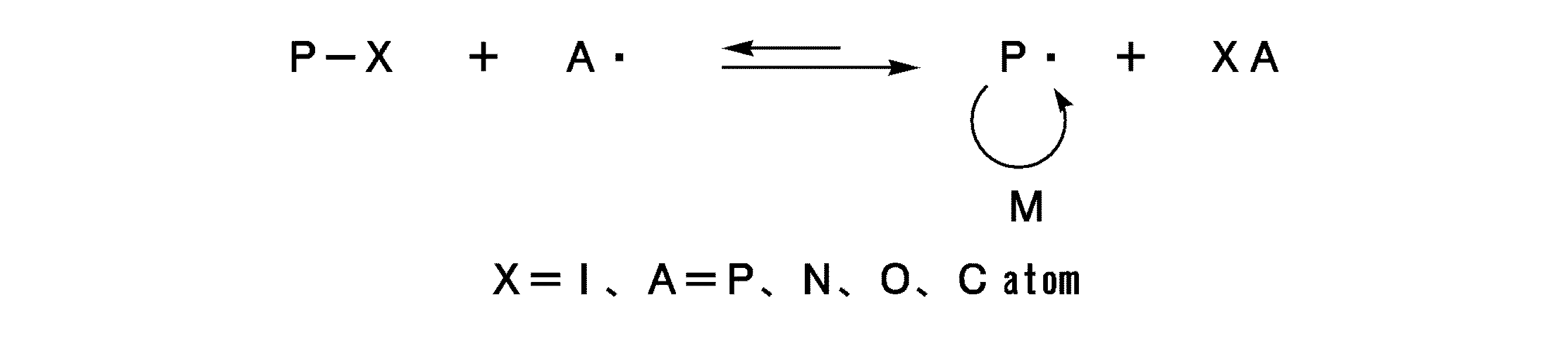
次に、本発明の高分子分散剤について詳細に説明する。本発明の高分子分散剤は、上記した理由から、重金属、ニトロキサイド化合物又は硫黄系化合物のいずれについても用いない特有のリビングラジカル重合法により合成された樹脂親和性セグメントAと、セルロース吸着性セグメントBとを有するブロック共重合体構造を有する高分子化合物であることを特徴とする。更に、高分子化合物が、下記(1)~(5)の要件をすべて満たすA-Bブロック共重合体であることが好ましい。
(1)前記A-Bブロック共重合体の構成成分の90質量%以上がメタクリレート系モノマーで構成されていること。
(2)前記セルロース吸着性セグメントBは、構成成分の50質量%以上が、水酸基を1個以上有するメタクリレート系モノマー及び/又は尿素基を有するメタクリレート系モノマーで構成されており、且つ、熱可塑性樹脂との相溶性がないこと。
(3)樹脂親和性セグメントAのゲルパーミエーションクロマトグラフィーにおけるポリスチレン換算の数平均分子量が500~20000であり、且つ、共重合体全体に占める樹脂親和性セグメントAの割合が5~95質量%であること。
(4)セルロース吸着性セグメントBのゲルパーミエーションクロマトグラフィーにおけるポリスチレン換算の数平均分子量が500~20000であり、且つ、共重合体全体に占めるセルロース吸着性セグメントBの割合が5~95質量%であること。
(5)前記A-Bブロック共重合体のゲルパーミエーションクロマトグラフィーにおけるポリスチレン換算の数平均分子量が1000~40000であり、分子量分布指数(重量平均分子量/数平均分子量)が1.0~1.6であること。
<樹脂親和性セグメントA>
樹脂親和性セグメントAは、セルロース吸着性セグメントBを介して、セルロースの表面を疎水化するものであり、この結果、親水性物質であるセルロースに本発明の高分子分散剤を適用することが可能になる。樹脂親和性の基本は、対象となる樹脂の構造に類似または対象となる樹脂に近い疎水性を有することが好ましいが、本発明の好適な高分子分散剤の構成要件(1)から、その主成分はメタクリレート系モノマーとする。本発明で用いる樹脂親和性セグメントAを形成するための具体的なモノマー成分としては、例えば、メチルメタクリレート、エチルメタクリレート、n-プロピルメタクリレート、イソプロピルメタクリレート、t-ブチルメタクリレート、ヘキシルメタクリレート、2-エチルヘキシルメタクリレート、ラウリルメタクリレート、テトラデシルメタクリレート、オクタデシルメタクリレート、シクロヘキシルメタクリレート、t-ブチルシクロヘキシルメタクリレート、ボルニルメタクリレート、イソボロニルメタクリレート、ジシクロペンタニルメタクリレート、ジシクロペンテニルオキシエチルメタクリレート、ベンジルメタクリレート、テトラヒドロフルフリルメタクリレート、オクタフルオロオクチルメタクリレート、テトラフルオロエチルメタクリレート等のアルキル、アルケニル、シクロアルキル、芳香環、ハロゲン元素含有のメタクリレート等が挙げられる。好ましくは、極性が低い炭素数1~18の炭化水素基、より好ましくは、炭素数8以上の炭化水素基が結合しているメタクリレート基がよい。その理由は、使用する熱可塑性樹脂と相溶性が良好であり、混合性が良好であるからである。
本発明者らの検討によれば、セルロース吸着性セグメントBは、セルロースの表面に存在する水酸基に対して、水素結合により相互作用を示す。前記(2)の要件の通り、好適なセルロース吸着性セグメントBは、セルロース吸着性セグメントBの構成成分の50質量%以上が、水酸基を1個以上有するメタクリレート系モノマー及び/又は尿素基を有するメタクリレート系モノマーで構成される。このように構成することで、セルロースの表面に存在する水酸基と水素結合を形成し、及び、高分子鎖において多点相互作用を示すことで、セルロース吸着性セグメントBは、セルロースと効果的に吸着するものとなる。すなわち、このセルロース吸着性セグメントBが、セルロースと効果的に吸着し、この結果、その構造中の上記した樹脂親和成分Aの効果で、セルロースが疎水化される。また、このセグメントBは、分散媒体である樹脂に相溶性(親和性)を有してはいけない。本願において、親和性とは、お互いに混ざることを示し、相溶性を示すものである。樹脂と、セグメントBに親和性があると、セルロースと吸着したセグメントBが、樹脂にも親和することによってセルロースから脱離してしまい、良好な分散状態を示さない場合があるので好ましくない。
次に、本発明のセルロース用高分子分散剤を適用するセルロースについて詳細に説明する。本発明は、セルロース用高分子分散剤を提供するものであるが、その対象とするセルロースとしては、セルロースナノファイバー(以下、CNFと記載)、セルロースナノクリスタル(以下、CNCと記載)、パルプ、リグノセルロース、木粉からなる群から選ばれる少なくとも1種であることが好ましい。特に、CNFまたはCNCを用いることがより好ましい。本発明では、CNF及びCNCを「ナノセルロース」と称す。以下、各セルロースについて、詳細に説明する。
本発明のセルロース用高分子分散剤を使用し、これをセルロースに処理することで、高分子分散剤及びセルロースを含む易分散性セルロース組成物を得ることができる。そして、得られる易分散性セルロース組成物は、本発明が最終目的としている本発明のセルロース分散樹脂組成物を得る前駆体として用いることができる。本発明者らの検討によれば、本発明の高分子分散剤をセルロースに処理する方法として、前記したように、イオン性のメタクリレートをセルロース吸着性セグメントに導入して自己乳化性とし、水系分散処理剤とすることが好ましい。より耐水性を上げたい場合には、カチオン性界面活性剤を用いた高分子分散剤の水系分散液を水系分散処理剤とし、これをセルロースへ添加することが好ましい。このように構成することで、本発明のセルロース分散樹脂組成物を得る前駆体として有用な易分散性のセルロース組成物が得られる。
上記のようにして得た易分散性のセルロース組成物と汎用樹脂等とを用い、溶融混練することで、本発明のセルロース分散樹脂組成物を得ることができる。この際に使用する樹脂としては、溶融混練してセルロース分散樹脂組成物を得ることが好ましいことから、熱可塑性樹脂が好ましい。熱可塑性樹脂としては、例えば、オレフィン系樹脂、ナイロン樹脂、ポリアミド系樹脂、ポリカーボネート系樹脂、ポリスルホン系樹脂、ポリエステル系樹脂、トリアセチル化セルロース、ジアセチル化セルロース等のセルロース系樹脂等が挙げられる。ポリアミド系樹脂としては、ポリアミド6(PA6、ε-カプロラクタムの開環重合体)、ポリアミド66(PA66、ポリヘキサメチレンアジポアミド)、ポリアミド11(PA11、ウンデカンラクタムを開環重縮合したポリアミド)、ポリアミド12(PA12、ラウリルラクタムを開環重縮合したポリアミド)等、加硫前のゴム樹脂等が例示される。
本発明のセルロース分散用高分子分散剤をあらかじめ樹脂と混練しておくことで、セルロース分散性の良好な、セルロース分散用の分散剤含有樹脂組成物を得ることができる。得られる分散剤含有樹脂組成物は、セルロース分散樹脂組成物の前駆体となる。この場合に、セルロース分散性をよくするためには、樹脂と高分子分散剤が均一に分散していることが必要であるが、本発明の高分子分散剤を用いたセルロース分散用の分散剤含有樹脂組成物では、通常、親水性のセルロース表面とはなじみの悪い樹脂表面に、多くの親水ポイントを確保することができる。また、高分子分散剤濃度の高いマスターバッチ化することで、その後工程でセルロースと混練する際に、濃度設定の自由度が上がり、より取扱い易く実用的なものになる。マスターバッチの高分子分散剤濃度は1%以上~60%以下であることが好ましい。すなわち、濃度がこれよりも高いと樹脂中での分散不良が生じ、1%未満であると、セルロースと混練した際のセルロース凝集抑制能力が十分に得られなくなる。好ましくは10%~40%で、更に好ましくは20%~30%である。
含水状態のセルロースと、上記したセルロース分散用の分散剤含有樹脂組成物を混練することで、セルロース分散樹脂組成物を得ることができる。混練には、セルロース濃度、分散剤濃度を調整する目的で、未処理樹脂を添加してよい。このようにして得られるセルロース分散樹脂組成物は、本発明の高分子分散剤が用いられていることから、セルロース分散性及び機械特性が良好なものになる。
撹拌機、還流コンデンサー、温度計及び窒素導入管を取り付けた反応装置に、ジエチレングリコールジメチルエーテル(以下、DMDGと略記)を106部、ジシクロペンテニルオキシエチルメタクリレート(以下、DCPOEMAと略記)を70部、ヨウ素を1.0部、ジフェニルメタン(以下、DPMと略記)を0.2部、開始剤として2,2’-アゾビス(4-メトキシ-2,4-ジメチルバレロニトリル)〔商品名:V-70(以下、V-70と略記)、和光純薬社製〕を5.0部添加した。そして、窒素ガスを導入しながら撹拌し、40℃に加温した。反応系を40℃に保ちながら7時間重合して、ポリマーブロックAを得た。重合の進行状況を反応系中の固形分濃度より算出したところ、重合率は85%であった。以下でいう重合率は、いずれも固形分濃度から算出した値である。また、テトラヒドロフラン(以下、THFと略記)溶媒によるゲルパーミエーションクロマトグラフィーにて分子量を測定したところ、ポリスチレン換算で、数平均分子量(以下、Mnと略記)が4900、分子量分布(重量平均分子量/数平均分子量、以下PDIと略記)が1.33であった。以下、分子量はTHF溶媒のGPCのポリスチレンの分子量換算である。上記で得られたポリマーブロックAは、後述するように、樹脂親和性セグメントとして機能するものとなる。
実施例1のHEMAに替えて、グリセリルモノメタクリレート(GLMA、日油社製)に替えた以外は、実施例1と同様にして行った。ポリマーブロックAの重合収率は80%であり、数平均分子量が3900、PDIは1.28であり、全体の重合収率はほぼ100%であり、全体Mnが8100であり、PDIは1.42であった。ポリマーブロックBについては、数平均分子量が8100-3900=4200であった。また、Bの水酸基を有するメタクリレートの含有量は、実施例1と同様に算出すると、68%である。実施例1に比べて、水酸基を有するモノマー量が少ないが、水酸基の数とすると十分な量であると考えられる。これを実施例1と同様に析出させて樹脂固体を得た。これを高分子分散剤-2とする。
実施例1と同様にして、溶媒、モノマーを替えて、下記のようにしてA-Bブロックコポリマーを合成した。すなわち、溶媒として、DMDGに替えてジエチレングリコールジエチルエーテルを使用し、ポリマーブロックAのDCPOEMAに替えて、ステアリルメタクリレート(SMA)を使用してポリマーブロックAを合成した。ポリマーブロックAの重合率はほぼ100%であり、数平均分子量5600、PDI1.15であった。次いで、ポリマーブロックBを、同量のHEMA、加えてメタクリル酸(MAA)を3部混合して重合した。重合率はほぼ100%であり、数平均分子量7700、PDI1.25であった。ポリマーブロックBの数平均分子量は、7700-5600=1900である。これは、セルロース吸着性セグメントBの90.9%が水酸基を有するメタクリレート系モノマーであり、カルホギシ基を有するモノマーが9.1%である。
実施例1と同様にして、溶媒、モノマーを替えて、下記のようにしてA-Bブロックコポリマーを合成した。すなわち、溶媒としてDMDGに替えて、プロピレングリコールモノプロピルエーテルを使用し、ポリマーブロックAのDCPOEMAに替えて、ラウリルメタクリレート(LMA)100部及びDCPOEAを40部使用した。ポリマーブロックAの重合率はほぼ100%であり、数平均分子量9800、PDI1.15であった。次いで、ポリマーブロックBは、HEMAに替えて、メタクリロイロキシエチルエチレンウレアのメタクリル酸メチル溶液(BASF社製、有効成分25質量%メタクリル酸メチル溶液を減圧してメタクリル酸メチルを抜き有効成分50%としたもの)70部を添加して重合した。重合率はほぼ100%であり、数平均分子量が12000、PDIが1.46であった。ポリマーブロックBの数平均分子量は2200であり、尿素基を有するメタクリレート系モノマーの含有量は50質量%である。これを実施例1と同様にして析出させて樹脂固体を得た。これを高分子分散剤-4とする。
実施例1と同様にして重合時間を9時間に替えて、ポリマーブロックAを得た。その重合率は100%で、数平均分子量が5600、PDIが1.40であった。次いで、HEMA30部、メタクリロイロキシエチルベンジルトリメチルアンモニウムクロライドの30質量%のプロピレングリコールモノプロピルエーテル13.3部を添加し、重合した。得られた重合物の分子量は、THF溶媒のGPCから、10ml/Lのリチウムブロマイドのジメチルホルムアミド溶液を展開溶媒とするGPCに換えて測定したところ、重合率はほぼ100%であり、数平均分子量が8200、PDIは1.40であった。ポリマーブロックBの数平均分子量は1600であり、水酸基を有するメタクリレート系モノマーの含有量は88.2質量%であり、イオン性基を有するモノマーの含有量は11.8%である。
実施例1で用いたと同様の装置を使用して、DMDGを107部仕込んで、窒素ガスを導入しながら70℃に加温した。別容器にDCPOEMAを70部、HEMAを30部、2,2’-アゾビス(2,4-ジメチルバレロニトリル)〔商品名:V-65(以下、V-65と略記)、和光純薬社製〕を5.0部仕込んで撹拌し、均一化させてモノマー混合液を調製した。次いで、滴下ロートを反応装置に装着させ、滴下ロート内に上記で調製したモノマー混合液を仕込んで2時間にわたって滴下し、更に1時間後、V-65を2部添加し、更に5時間重合して、高分子分散剤-2の重合溶液を得た。固形分測定して重合率を算出したところ、ほぼ100%の重合率であった。Mnは8000、PDIは1.81であった。
実施例1で用いたと同様の反応装置を使用して、DMDGを106部、DCPOEMAを70部、2-ブロモイソ酪酸エチルを2.2部、ペンタメチルジエチレントリアミンを2.0部仕込んで窒素ガスをバブリングして十分脱気した。次いで、臭化第一銅を1.6部添加して、銅錯体を形成させた。系は緑色に変化した。次いで、80℃に加温して3時間重合した。一部サンプリングして固形分を測定して重合率を算出したところ、81.1%であった。また、分子量を測定したところ、Mnが5000、PDI1.21であった。以上のようにして樹脂親和性セグメントAのポリマーブロックを得た。
実施例1で用いたと同様の反応装置を使用して、DMDGを106部、DCPOEMAを70部、下記構造のニトロキサイド化合物(ブロックビルダーMA、アルケマ社製)を4.3部仕込んだ。

実施例1で用いたと同様の反応装置を使用して、DMDGを106部、DCPOEMAを70部、下記構造のジチオエステル化合物(アルドリッチ社製)を3.1部、更に、V-70を1.0部仕込んだ。

まず、針葉樹漂白クラフトパルプ(NBKP)〔リファイナー処理済み、固形分:25%〕600部に、水を19400部添加し、パルプスラリー濃度0.75質量%の水懸濁液(スラリー)を調製した。次に、得られたスラリーに対し、ビーズミルを用いて機械的解繊処理を行った。解繊処理を行った後、フィルタープレスで脱水し、含水状態のCNF-1(固形分:25%)を570部得た。
先に調製した高分子分散剤-1を10部、DMDG25部に溶解させ、これに、カチオン性界面活性剤としてオレイルアミン酢酸塩を0.2部添加し、均一に撹拌しながら、次に、水64.8部を滴下して、10質量%の高分子分散剤-1の水系分散処理剤の溶液を100部得た。得られた溶液は、高分子分散剤-1が淡い黄濁状に分散しており、これを24時間静置しても沈降は確認されなかった。
また、同様にして、実施例1の高分子分散剤-1に替えて、実施例2の高分子分散剤-2、実施例4の高分子分散剤-4を用いて、同様の水処理分散処理剤の溶液を調整した。同様に淡い黄濁状に分散しており、沈降は確認されなかった。次いで、同様にして、CNF-1を処理し、易分散性セルロース組成物を得た。
先に調製した含水状態のCNF-1(固形分:25%)の40部に、上記で得た高分子分散剤-3又は-5の水系分散処理剤の溶液を100部添加し、十分に混合して、高分子分散剤-1をセルロースに処理した易分散性セルロース組成物を得た。
比較例1~4で作製した比較高分子分散剤-1~4について、それぞれ実施例2と同様にして、各高分子分散剤のCNF-1への処理を実施し、各高分子分散剤を処理した比較例のセルロース組成物をそれぞれ140部得た。得られた各CNF組成物を比較例5~8とした。
実施例6で作製した、高分子分散剤-1をセルロースに処理した易分散性セルロース組成物40部に、微粒子状ポリエチレン〔住友精化製、フロービーズHE3040(商品名)、以下「微粒子状のPE」と略す〕の80部を水50部で湿潤させた状態で添加し、混合した。得られた混合物を、ろ過及び乾燥することで、混合物中の水及びDMDGを除去して、高分子分散剤-1で処理されたCNF-1と微粒子状のPEとの混合組成物であるセルロース分散樹脂組成物を98部得た。
実施例11の実施例6の易分散性セルロース組成物に替えて、実施例7~10の易分散性セルロース組成物を用いて、同様のセルロース分散樹脂組成物を得た。
上記で得たCNF-1と微粒子状のPEとの混合組成物について、下記に述べる方法で、二軸押出混練、射出成型、引張試験による引張弾性率、引張強度の評価を実施した。具体的には、二軸押出混練を、混練温度140℃で実施し、ストランド状に吐出して冷却、ペレタイザーでカッティングして、CNF-1が分散したPE樹脂ペレットを調製した。そして、得られたCNF-1が分散したPE樹脂ペレットを用い、射出成型を実施し、ダンベル片(ダンベル厚:2mm)を作製して評価用サンプルとした。この評価用サンプルのダンベル片について、引張試験機(インストロン社製:万能試験機5900シリーズ使用)で、10mm/minの引張速度で引張試験を実施し、引張弾性率及び引張強度を測定し、評価した。上記と同様にして、実施例7~10で得られた高分子分散剤-2~5をセルロースに処理した易分散性セルロース組成物を使用して、上記と同様に試験し、評価した。その結果を表3中にまとめて示した。
比較例5~8の、比較高分子分散剤-1~4をそれぞれセルロースに処理した各セルロース組成物について、実施例3と同様にしてPEとの混合組成物を作製し、これを用いて、二軸押出混練、射出成型、引張試験を実施し、引張弾性率及び引張強度を評価した。これを比較例9~12とする。その結果を表3中にまとめて示した。
実施例1で合成した高分子分散剤-1の重合溶液(固形分濃度:50.1%)の119.8部を、水1000部に撹拌しながら添加して高分子分散剤-1を析出させ、高速に撹拌することにより水中で微粉砕状とした。次に、実施例3で使用したと同様の微粒子状のPEを140部添加し、高分子分散剤-1と均一になるよう撹拌し、ろ過、80℃で乾燥させて、高分子分散剤-1及び微粒子状のPEを含む、セルロース分散用分散剤含有樹脂組成物199部を得た。この組成物の二軸押出混練を140℃の混練条件で実施し、細いストランド状に吐出して冷却、ペレタイザーでカッティングして、細粒状の高分子分散剤-1とPE樹脂の混練組成物を得た。この混練組成物中には、高分子分散剤-1とPE樹脂が、30質量%と70質量%の比率で含んでいるものである。
含水状態のCNF-1(固形分:25%)の40部を水500部に添加し、高速撹拌してCNF-1を水中でスラリー状とした。次に、このスラリーに実施例4で作成した細粒状の混練組成物33.3部及び微粒子状のPE56.7部を添加して撹拌して均一化した後、ろ過することで、含水状態の混合組成物を120部得た。この含水状態の混合組成物には、高分子分散剤-1として10部、CNF-1として10部、PE樹脂として80部を含み、水を20部含んだ状態である。この混合組成物を含水状態のまま二軸押出機に投入し、混練を実施した。混練温度は140℃で、水分除去用にベント孔を開放して実施し、ストランド状に吐出して冷却し、ペレタイザーでカッティングしてCNF-1が分散したPE樹脂ペレットを得た。そして、実施例3と同様に射出成型、引張試験を実施し、引張弾性率、引張強度を評価した。その結果を表3中に示した。
(重合方法による高分子分散剤の分子構造の違い)
実施例-1と比較例の各高分子分散剤を構成する、それぞれに異なる重合法で重合して得たA-Bブロック共重合体の構造の違いを表1にまとめて示した。
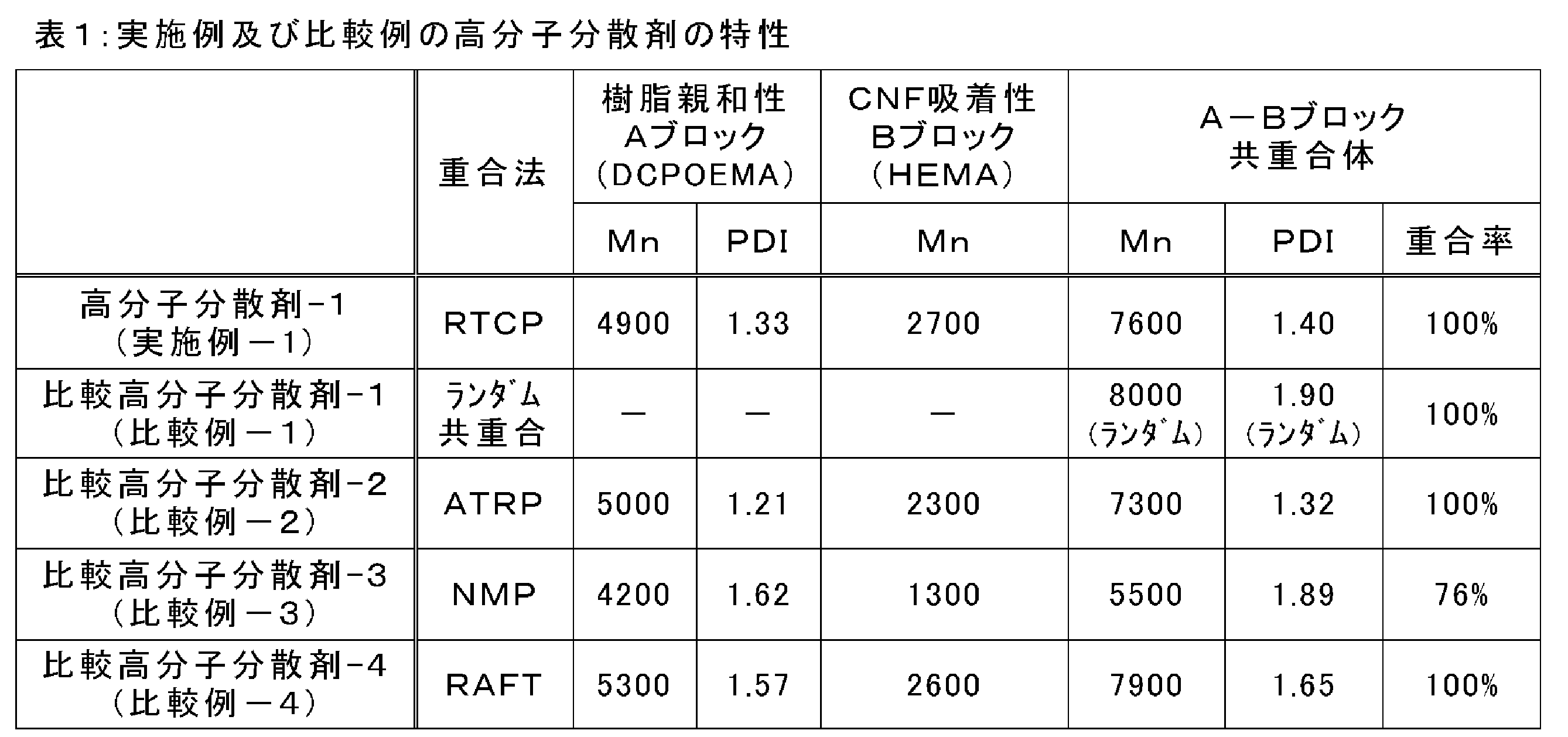
実施例1と比較例1~4の各高分子分散剤を得る際にそれぞれ用いた、各重合方法による違いを表2にまとめて示した。具体的には、重合条件を、得られる共重合体の分子構造の制御のし易さ、重合温度の低さ、臭気の発生、精製のし易さ、低コストの各項目について、「○、△、×」の3段階で相対評価し、表2にまとめて示した。また、先に述べたようにして、実施例と比較例の各高分子分散剤を用いてそれぞれ作製した、CNF-1と微粒子状のPEとの混練樹脂組成物の機械特性を比較した結果を、表3にまとめて示した。
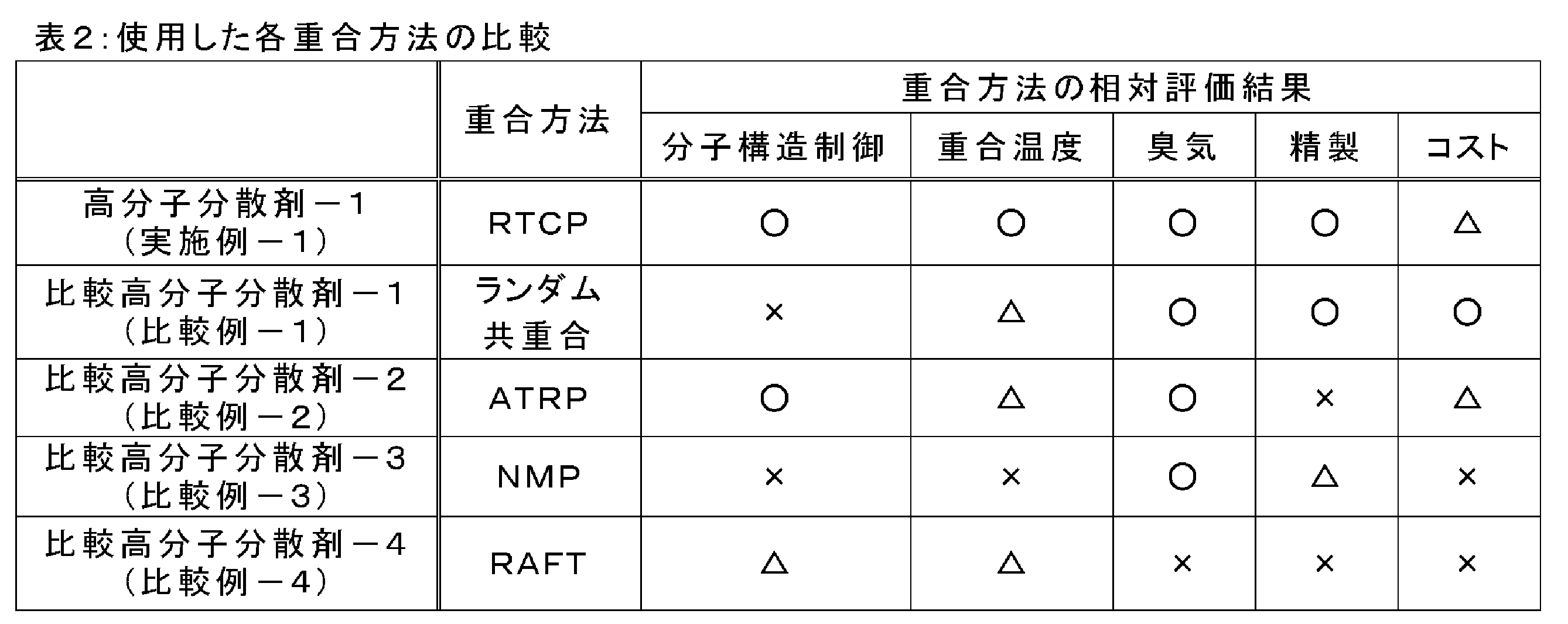

Claims (14)
- セルロースを分散させるためのセルロース用高分子分散剤であって、該高分子分散剤が、重金属、ニトロキサイド化合物又は硫黄系化合物のいずれについても用いない、リビングラジカル重合法である、有機ヨウ素化合物を開始化合物とし、リン化合物、窒素化合物、酸素化合物又は炭素化合物を触媒とする、可逆連鎖移動触媒重合(RTCP)法により合成された、樹脂親和性セグメントAと、セルロース吸着性セグメントBとを有するブロック共重合体構造を有する高分子化合物であることを特徴とするセルロース用高分子分散剤。
- 前記高分子化合物が、更に、下記(1)~(5)の要件をすべて満たすA-Bブロック共重合体である請求項1に記載のセルロース用高分子分散剤。
(1)前記A-Bブロック共重合体の構成成分の90質量%以上がメタクリレート系モノマーで構成されていること;
(2)前記セルロース吸着性セグメントBは、構成成分の50質量%以上が、水酸基を1個以上有するメタクリレート系モノマー及び/又は尿素基を有するメタクリレート系モノマーで構成されており、且つ、熱可塑性樹脂との相溶性がないこと;
(3)前記樹脂親和性セグメントAのゲルパーミエーションクロマトグラフィーにおけるポリスチレン換算の数平均分子量が500~20000であり、且つ、前記A-B共重合体全体に占める該樹脂親和性セグメントAの割合が5~95質量%であること;
(4)前記セルロース吸着性セグメントBのゲルパーミエーションクロマトグラフィーにおけるポリスチレン換算の数平均分子量が500~20000であり、且つ、前記A-B共重合体全体に占める該セルロース吸着性セグメントBの割合が5~95質量%であること;
(5)前記A-Bブロック共重合体のゲルパーミエーションクロマトグラフィーにおけるポリスチレン換算の数平均分子量が3500~40000であり、且つ、分子量分布指数(重量平均分子量/数平均分子量)が1.0~1.6であること。 - 前記(2)のセルロース吸着性セグメントBの構成成分の70質量%以上が、水酸基を1個以上有するメタクリレート系モノマー及び/又は尿素基を有するメタクリレート系モノマーで構成されており、
前記(3)の樹脂親和性セグメントAのゲルパーミエーションクロマトグラフィーにおけるポリスチレン換算の数平均分子量が1000~8000であり、且つ、前記A-B共重合体全体に占める樹脂親和性セグメントAの割合が30~70質量%であり、
前記(4)のセルロース吸着性セグメントBのゲルパーミエーションクロマトグラフィーにおけるポリスチレン換算の数平均分子量が1000~8000であり、且つ、前記A-B共重合体全体に占めるセルロース吸着性セグメントBの割合が30~70質量%であり、
前記(5)のA-B共重合体のゲルパーミエーションクロマトグラフィーにおけるポリスチレン換算の数平均分子量が2000~16000であり、分子量分布指数(重量平均分子量/数平均分子量)が1.0~1.6である請求項2に記載のセルロース用高分子分散剤。 - 前記(2)のセルロース吸着性セグメントBの構成成分の70質量%以上が、水酸基を1個以上有するメタクリレート系モノマー及び/又は尿素基を有するメタクリレート系モノマーで構成されており、更に、構成成分の3~15質量%が、アルカリで中和されたメタクリル酸及び/又はカルボキシ基を有するメタクリレート系モノマー又は第4級アンモニウム塩基を有するメタクリレート系モノマーで構成されている請求項2又は3に記載のセルロース用高分子分散剤。
- 前記セルロースが、セルロースナノファイバー、セルロースナノクリスタル、パルプ、リグノセルロース及び木粉からなる群から選ばれる少なくとも1種である請求項1~4のいずれか1項に記載のセルロース用高分子分散剤。
- 前記セルロースに対する分散性を向上させた高分子分散剤を含有する水系分散処理剤であって、請求項4に記載のセルロース用高分子分散剤を、水系媒体中に分散処理してなることを特徴とする高分子分散剤含有の水系分散処理剤。
- セルロースに対する分散性を向上させた高分子分散剤を含有する水系分散処理剤であって、請求項1~4のいずれか1項に記載のセルロース用高分子分散剤を、界面活性剤によって水系媒体中に分散処理されてなることを特徴とする高分子分散剤含有の水系分散処理剤。
- 前記界面活性剤が、カチオン性界面活性剤である請求項5に記載の水系分散処理剤。
- 請求項1~5のいずれか1項に記載のセルロース用高分子分散剤と、セルロースナノファイバー、セルロースナノクリスタル、パルプ、リグノセルロース及び木粉からなる群から選ばれる少なくとも1種のセルロースとを含んでなることを特徴とする易分散性セルロース組成物。
- 請求項6又は7に記載の水系分散処理剤と、セルロースナノファイバー、セルロースナノクリスタル、パルプ、リグノセルロース及び木粉からなる群から選ばれる少なくとも1種のセルロースとを含んでなることを特徴とする易分散性セルロース組成物。
- 請求項9又10に記載の易分散性セルロース組成物と、熱可塑性樹脂とを含んでなることを特徴とするセルロース分散樹脂組成物。
- 請求項1~5のいずれか1項に記載のセルロース用高分子分散剤と、熱可塑性樹脂とを含んでなることを特徴とするセルロース分散用分散剤含有樹脂組成物。
- 請求項6又は7に記載の水系分散処理剤と、熱可塑性樹脂とを含んでなることを特徴とするセルロース分散用分散剤含有樹脂組成物。
- 請求項12又は13に記載のセルロース分散用分散剤含有樹脂組成物と、セルロースとを含んでなることを特徴とするセルロース分散樹脂組成物。
Priority Applications (6)
| Application Number | Priority Date | Filing Date | Title |
|---|---|---|---|
| CN201580017279.7A CN106164154B (zh) | 2014-03-31 | 2015-03-30 | 纤维素用高分子分散剂、纤维素用水系分散剂、易分散性纤维素组合物、及其树脂组合物 |
| CA2944411A CA2944411C (en) | 2014-03-31 | 2015-03-30 | Polymer dispersant for cellulose, aqueous dispersion treatment agent containing same, readily dispersible cellulose composition, cellulose dispersion resin composition, and dispersant-containing resin composition for cellulose dispersion |
| EP15773476.5A EP3127954B1 (en) | 2014-03-31 | 2015-03-30 | Polymer dispersant for cellulose, aqueous dispersion treatment agent containing same, readily dispersible cellulose composition, cellulose dispersion resin composition, and dispersant-containing resin composition for cellulose dispersion |
| JP2015525663A JP5904520B2 (ja) | 2014-03-31 | 2015-03-30 | セルロース用高分子分散剤の製造方法、セルロース用高分子分散剤、高分子分散剤含有の水系分散処理剤、易分散性セルロース組成物、セルロース分散樹脂組成物、セルロース分散用分散剤含有の樹脂組成物、及び、水系分散処理剤含有の樹脂組成物 |
| US15/125,856 US10081001B2 (en) | 2014-03-31 | 2015-03-30 | Polymer dispersant for cellulose, aqueous dispersion treatment agent containing same, readily dispersible cellulose composition, cellulose dispersion resin composition, and dispersant-containing resin composition for cellulose dispersion |
| PH12016501850A PH12016501850A1 (en) | 2014-03-31 | 2016-09-21 | Polymer dispersant for cellulose, aqueous dispersion treatment agent containing same, readily dispersible cellulose composition, cellulose dispersion resin composition, and dispersant-containing resin composition for cellulose dispersion |
Applications Claiming Priority (2)
| Application Number | Priority Date | Filing Date | Title |
|---|---|---|---|
| JP2014-072482 | 2014-03-31 | ||
| JP2014072482 | 2014-03-31 |
Publications (1)
| Publication Number | Publication Date |
|---|---|
| WO2015152188A1 true WO2015152188A1 (ja) | 2015-10-08 |
Family
ID=54240509
Family Applications (1)
| Application Number | Title | Priority Date | Filing Date |
|---|---|---|---|
| PCT/JP2015/060028 Ceased WO2015152188A1 (ja) | 2014-03-31 | 2015-03-30 | セルロース用高分子分散剤、該高分子分散剤含有の水系分散処理剤、易分散性セルロース組成物、セルロース分散樹脂組成物、及び、セルロース分散用分散剤含有樹脂組成物 |
Country Status (8)
| Country | Link |
|---|---|
| US (1) | US10081001B2 (ja) |
| EP (1) | EP3127954B1 (ja) |
| JP (2) | JP5904520B2 (ja) |
| CN (1) | CN106164154B (ja) |
| CA (1) | CA2944411C (ja) |
| MY (1) | MY174331A (ja) |
| PH (1) | PH12016501850A1 (ja) |
| WO (1) | WO2015152188A1 (ja) |
Cited By (11)
| Publication number | Priority date | Publication date | Assignee | Title |
|---|---|---|---|---|
| JP2016104865A (ja) * | 2014-03-31 | 2016-06-09 | 大日精化工業株式会社 | セルロース分散用分散剤含有の樹脂組成物及びセルロース用高分子分散剤 |
| JP2017115069A (ja) * | 2015-12-25 | 2017-06-29 | 学校法人日本大学 | 複合材料及びその製造方法 |
| JP2017128630A (ja) * | 2016-01-18 | 2017-07-27 | 旭化成株式会社 | セルロース製剤 |
| WO2018012505A1 (ja) * | 2016-07-11 | 2018-01-18 | 日本製紙株式会社 | マスターバッチの製造方法 |
| US10077357B2 (en) | 2014-03-31 | 2018-09-18 | Dainichiseika Color & Chemicals Mfg. Co., Ltd. | Production method for readily dispersible cellulose composition, readily dispersible cellulose composition, cellulose dispersion resin composition, and production method for water-based dispersant for cellulose |
| WO2019088300A1 (ja) * | 2017-11-06 | 2019-05-09 | 国立大学法人京都大学 | セルロース分散用ブロック共重合体の製造方法、樹脂組成物の製造方法及び成形体の製造方法 |
| WO2020003934A1 (ja) * | 2018-06-29 | 2020-01-02 | 新中村化学工業株式会社 | セルロース繊維分散用複合体及びセルロース繊維組成物 |
| JP2020007525A (ja) * | 2018-06-29 | 2020-01-16 | 新中村化学工業株式会社 | ナノセルロース組成物 |
| JP2020084062A (ja) * | 2018-11-27 | 2020-06-04 | 東洋インキScホールディングス株式会社 | 組成物、被覆セルロース繊維、およびその製造方法 |
| KR20210013347A (ko) * | 2016-08-08 | 2021-02-03 | 닛뽕세이시 가부시키가이샤 | 셀룰로스 나노섬유 수분산액, 및 셀룰로스 나노섬유를 함유하는 식품, 화장품 및 고무 조성물 |
| US11566118B2 (en) | 2016-02-18 | 2023-01-31 | Starlite Co., Ltd. | Nanofiber dispersion, method of producing nanofiber dispersion, powdery nanofibers obtainable from the dispersion, resin composition containing the powdery nanofibers ad molding material for 3D printer using the resin composition |
Families Citing this family (7)
| Publication number | Priority date | Publication date | Assignee | Title |
|---|---|---|---|---|
| WO2019208313A1 (ja) | 2018-04-23 | 2019-10-31 | 旭化成株式会社 | セルロースナノファイバー含水分散液 |
| JP6954884B2 (ja) * | 2018-11-21 | 2021-10-27 | 大日精化工業株式会社 | セルロース分散樹脂組成物、その製造方法、及びセルロース樹脂複合材 |
| CN115243785A (zh) * | 2019-01-22 | 2022-10-25 | 格兰生物科技知识产权控股有限责任公司 | 用于脱水和干燥纳米纤维素的系统和方法 |
| CN113840864B (zh) * | 2019-05-21 | 2024-03-12 | 星光Pmc株式会社 | 树脂组合物的制造方法及树脂组合物 |
| WO2020240935A1 (ja) * | 2019-05-27 | 2020-12-03 | 中越パルプ工業株式会社 | 溶融混合物、溶融混合物の製造方法、組成物、組成物の製造方法並びに成形品 |
| CN113278110B (zh) * | 2021-05-27 | 2022-09-09 | 浙江理工大学 | 一种液体分散染料用的高分子分散剂及其合成方法和应用 |
| CN118437295B (zh) * | 2024-04-28 | 2025-01-17 | 常州厚丰新能源有限公司 | 一种基于氟化修饰纤维素的双网络凝胶吸附剂及其制备方法和应用 |
Citations (3)
| Publication number | Priority date | Publication date | Assignee | Title |
|---|---|---|---|---|
| JP2002146116A (ja) * | 2000-11-13 | 2002-05-22 | Calp Corp | ポリオレフィン系樹脂組成物 |
| JP2009138024A (ja) * | 2007-12-03 | 2009-06-25 | Chuo Rika Kogyo Corp | 繊維含有脂肪族ポリエステル系樹脂組成物、及びその製造方法 |
| WO2014133019A1 (ja) * | 2013-02-26 | 2014-09-04 | 王子ホールディングス株式会社 | セルロース及び分散剤を含む組成物 |
Family Cites Families (6)
| Publication number | Priority date | Publication date | Assignee | Title |
|---|---|---|---|---|
| JP5322470B2 (ja) | 2007-03-26 | 2013-10-23 | 国立大学法人京都大学 | 表面改質ミクロフィブリル化セルロース及びこれを含有してなる複合化樹脂 |
| JP5825640B2 (ja) * | 2010-03-02 | 2015-12-02 | 大日精化工業株式会社 | アルコキシシリル基含有ブロックコポリマー、該ブロックコポリマーの製造方法、樹脂処理顔料、および顔料分散体 |
| WO2012111408A1 (ja) | 2011-02-15 | 2012-08-23 | 日産化学工業株式会社 | 繊維状樹脂補強剤とその製造方法、およびそれを用いた樹脂組成物 |
| JP5520867B2 (ja) * | 2011-03-30 | 2014-06-11 | 大日精化工業株式会社 | 顔料着色剤組成物及び該組成物を含有してなるカラーフィルター用顔料着色剤組成物 |
| WO2015152188A1 (ja) | 2014-03-31 | 2015-10-08 | 大日精化工業株式会社 | セルロース用高分子分散剤、該高分子分散剤含有の水系分散処理剤、易分散性セルロース組成物、セルロース分散樹脂組成物、及び、セルロース分散用分散剤含有樹脂組成物 |
| CA2944415C (en) * | 2014-03-31 | 2018-05-15 | Dainichiseika Color & Chemicals Mfg. Co., Ltd. | Production method for readily dispersible cellulose composition, readily dispersible cellulose composition, cellulose dispersion resin composition, and production method for water-based dispersant for cellulose |
-
2015
- 2015-03-30 WO PCT/JP2015/060028 patent/WO2015152188A1/ja not_active Ceased
- 2015-03-30 US US15/125,856 patent/US10081001B2/en active Active
- 2015-03-30 MY MYPI2016703454A patent/MY174331A/en unknown
- 2015-03-30 CA CA2944411A patent/CA2944411C/en active Active
- 2015-03-30 CN CN201580017279.7A patent/CN106164154B/zh active Active
- 2015-03-30 EP EP15773476.5A patent/EP3127954B1/en active Active
- 2015-03-30 JP JP2015525663A patent/JP5904520B2/ja active Active
- 2015-12-18 JP JP2015247718A patent/JP2016104865A/ja not_active Withdrawn
-
2016
- 2016-09-21 PH PH12016501850A patent/PH12016501850A1/en unknown
Patent Citations (3)
| Publication number | Priority date | Publication date | Assignee | Title |
|---|---|---|---|---|
| JP2002146116A (ja) * | 2000-11-13 | 2002-05-22 | Calp Corp | ポリオレフィン系樹脂組成物 |
| JP2009138024A (ja) * | 2007-12-03 | 2009-06-25 | Chuo Rika Kogyo Corp | 繊維含有脂肪族ポリエステル系樹脂組成物、及びその製造方法 |
| WO2014133019A1 (ja) * | 2013-02-26 | 2014-09-04 | 王子ホールディングス株式会社 | セルロース及び分散剤を含む組成物 |
Non-Patent Citations (9)
| Title |
|---|
| "New Energy and Industrial Technology Development Organization (NEDO", HEISEI 22 NENDO - HEISEI 24 NENDO SEIKA HOKOKUSHO, 2013, pages 39 - 42, XP008184964 * |
| KEITA SAKAKIBARA ET AL., DIBLOCK KYOJUGOTAI TENKA NI YORU CELLULOSE NANOFIBER/JUSHI FUKUGO ZAIRYO NO SAKUSEI, vol. 20, 2013, pages 67, XP008184963 * |
| KEITA SAKAKIBARA ET AL., KOBUNSHI BUNSANZAI O MOCHIITA CELLULOSE NANOFIBER KYOKA JUSHI FUKUGO ZAIRYO NO KOSEINOKA TO KOZO HYOKA, vol. 68, no. 2, 2013, pages 72, XP008185297 * |
| KEITA SAKAKIBARA ET AL.: "Cellulose Nanofiber ni Tekishita Kobunshi Bunsanzai no Kaihatsu to Jushi Fukugo Zairyo eno Oyo", THE SOCIETY OF FIBER SCIENCE AND TECHNOLOGY, vol. 68, no. 1, 2013, pages 2H15, XP008185728 * |
| KEITA SAKAKIBARA ET AL.: "Kobunshi Bunsanzai o Mochiita Cellulose Nanofiber Kyoka Jushi Zairyo no Kaihatsu", SEIKEI KAKO, vol. 24, 2013, pages 119 - 120 * |
| KEITA SAKAKIBARA ET AL.: "Polymer Dispersants for Cellulose Nanofiber Reinforced Polyolefin Composite Materials", FUNCTION & MATERIALS, vol. 34, no. 11, 2014, pages 40 - 45, XP008184746 * |
| KEITA SAKAKIBARA: "Cellulose Nanofiber-Based Composite Materials with Polymer Brush Components", SEN'I TO KOGYO, vol. 70, no. 8, 2014, pages 276 - 280, XP008184967 * |
| See also references of EP3127954A4 * |
| YOSHINOBU TSUJII: "Kobunshi Bunsanzai ni yoru Mokuzai Yurai NC no Kaimen Kino Seigyo to Jushi Fukugo Zairyo eno Oyo", DAI 280 KAI SEIZONKEN SYMPOSIUM, 2015, pages 59 - 62, XP008184966 * |
Cited By (21)
| Publication number | Priority date | Publication date | Assignee | Title |
|---|---|---|---|---|
| JP2016104865A (ja) * | 2014-03-31 | 2016-06-09 | 大日精化工業株式会社 | セルロース分散用分散剤含有の樹脂組成物及びセルロース用高分子分散剤 |
| US10077357B2 (en) | 2014-03-31 | 2018-09-18 | Dainichiseika Color & Chemicals Mfg. Co., Ltd. | Production method for readily dispersible cellulose composition, readily dispersible cellulose composition, cellulose dispersion resin composition, and production method for water-based dispersant for cellulose |
| US10081001B2 (en) | 2014-03-31 | 2018-09-25 | Dainichiseika Color & Chemicals Mfg. Co., Ltd. | Polymer dispersant for cellulose, aqueous dispersion treatment agent containing same, readily dispersible cellulose composition, cellulose dispersion resin composition, and dispersant-containing resin composition for cellulose dispersion |
| JP2017115069A (ja) * | 2015-12-25 | 2017-06-29 | 学校法人日本大学 | 複合材料及びその製造方法 |
| JP2017128630A (ja) * | 2016-01-18 | 2017-07-27 | 旭化成株式会社 | セルロース製剤 |
| US11566118B2 (en) | 2016-02-18 | 2023-01-31 | Starlite Co., Ltd. | Nanofiber dispersion, method of producing nanofiber dispersion, powdery nanofibers obtainable from the dispersion, resin composition containing the powdery nanofibers ad molding material for 3D printer using the resin composition |
| JPWO2018012505A1 (ja) * | 2016-07-11 | 2019-04-25 | 日本製紙株式会社 | マスターバッチの製造方法 |
| WO2018012505A1 (ja) * | 2016-07-11 | 2018-01-18 | 日本製紙株式会社 | マスターバッチの製造方法 |
| KR20210013347A (ko) * | 2016-08-08 | 2021-02-03 | 닛뽕세이시 가부시키가이샤 | 셀룰로스 나노섬유 수분산액, 및 셀룰로스 나노섬유를 함유하는 식품, 화장품 및 고무 조성물 |
| KR102348203B1 (ko) | 2016-08-08 | 2022-01-10 | 닛뽕세이시 가부시키가이샤 | 셀룰로스 나노섬유 수분산액, 및 셀룰로스 나노섬유를 함유하는 식품, 화장품 및 고무 조성물 |
| WO2019088300A1 (ja) * | 2017-11-06 | 2019-05-09 | 国立大学法人京都大学 | セルロース分散用ブロック共重合体の製造方法、樹脂組成物の製造方法及び成形体の製造方法 |
| JP2019085569A (ja) * | 2017-11-06 | 2019-06-06 | Dic株式会社 | セルロース分散用ブロック共重合体の製造方法、樹脂組成物の製造方法及び成形体の製造方法 |
| JP7359375B2 (ja) | 2017-11-06 | 2023-10-11 | Dic株式会社 | セルロース分散用ブロック共重合体の製造方法、樹脂組成物の製造方法及び成形体の製造方法 |
| JP2020007525A (ja) * | 2018-06-29 | 2020-01-16 | 新中村化学工業株式会社 | ナノセルロース組成物 |
| CN112313256B (zh) * | 2018-06-29 | 2021-06-01 | 新中村化学工业株式会社 | 纤维素纤维分散用复合体及纤维素纤维组合物 |
| US11149132B2 (en) | 2018-06-29 | 2021-10-19 | Shin-Nakamura Chemical Co., Ltd. | Composite for cellulose fiber dispersion and cellulose fiber composition |
| CN112313256A (zh) * | 2018-06-29 | 2021-02-02 | 新中村化学工业株式会社 | 纤维素纤维分散用复合体及纤维素纤维组合物 |
| US11667769B2 (en) | 2018-06-29 | 2023-06-06 | Shin-Nakamura Chemical Co., Ltd. | Composite for cellulose fiber dispersion and cellulose fiber composition |
| WO2020003934A1 (ja) * | 2018-06-29 | 2020-01-02 | 新中村化学工業株式会社 | セルロース繊維分散用複合体及びセルロース繊維組成物 |
| JP2020084062A (ja) * | 2018-11-27 | 2020-06-04 | 東洋インキScホールディングス株式会社 | 組成物、被覆セルロース繊維、およびその製造方法 |
| JP7234602B2 (ja) | 2018-11-27 | 2023-03-08 | 東洋インキScホールディングス株式会社 | 組成物、被覆セルロース繊維、およびその製造方法 |
Also Published As
| Publication number | Publication date |
|---|---|
| EP3127954B1 (en) | 2021-09-01 |
| JP5904520B2 (ja) | 2016-04-13 |
| US20170001162A1 (en) | 2017-01-05 |
| MY174331A (en) | 2020-04-08 |
| CN106164154B (zh) | 2018-09-14 |
| CN106164154A (zh) | 2016-11-23 |
| US10081001B2 (en) | 2018-09-25 |
| JPWO2015152188A1 (ja) | 2017-04-13 |
| PH12016501850B1 (en) | 2016-12-19 |
| PH12016501850A1 (en) | 2016-12-19 |
| CA2944411A1 (en) | 2015-10-08 |
| EP3127954A1 (en) | 2017-02-08 |
| EP3127954A4 (en) | 2018-01-03 |
| JP2016104865A (ja) | 2016-06-09 |
| CA2944411C (en) | 2018-05-01 |
Similar Documents
| Publication | Publication Date | Title |
|---|---|---|
| JP5904520B2 (ja) | セルロース用高分子分散剤の製造方法、セルロース用高分子分散剤、高分子分散剤含有の水系分散処理剤、易分散性セルロース組成物、セルロース分散樹脂組成物、セルロース分散用分散剤含有の樹脂組成物、及び、水系分散処理剤含有の樹脂組成物 | |
| JP5825653B1 (ja) | 易分散性セルロース組成物の製造方法、及びセルロース用の水系の分散処理剤の製造方法 | |
| JP6234037B2 (ja) | セルロース及び分散剤を含む組成物 | |
| JP5188765B2 (ja) | 繊維強化複合材料およびその製造方法 | |
| Jiang et al. | Influence of chemical and enzymatic TEMPO-mediated oxidation on chemical structure and nanofibrillation of lignocellulose | |
| CN113544158B (zh) | 树脂改性剂的制造方法、树脂改性剂及复合材料 | |
| JP6591304B2 (ja) | 易分散性セルロース組成物、易分散性セルロース組成物の製造方法、セルロース分散樹脂組成物及びセルロース分散樹脂組成物の製造方法 | |
| JP2014193959A (ja) | 植物繊維含有樹脂組成物及びその製造方法 | |
| CN102666591A (zh) | 改性微纤化纤维素及含有其的树脂复合材料 | |
| JP2013018851A (ja) | セルロース繊維、セルロース繊維含有重合体、樹脂組成物及び成形体。 | |
| JP6545758B2 (ja) | セルロース及び分散剤を含む組成物 | |
| JP6954884B2 (ja) | セルロース分散樹脂組成物、その製造方法、及びセルロース樹脂複合材 | |
| JP7359375B2 (ja) | セルロース分散用ブロック共重合体の製造方法、樹脂組成物の製造方法及び成形体の製造方法 | |
| JP7424098B2 (ja) | 道路舗装用組成物および成形体 | |
| WO2022118888A1 (ja) | 樹脂組成物、樹脂組成物の製造方法、及び樹脂 | |
| JP7551102B2 (ja) | セルロース繊維複合物及びセルロース繊維複合組成物の製造方法 | |
| JP2022045900A (ja) | セルロースナノファイバー用改質剤、改質セルロースナノファイバーの製造方法、改質セルロースナノファイバー及び繊維強化複合材料 | |
| Thielemans | Lignin and carbon nanotube utilization in bio-based composites | |
| WO2024206133A1 (en) | Polymer modified nanofiber composites |
Legal Events
| Date | Code | Title | Description |
|---|---|---|---|
| ENP | Entry into the national phase |
Ref document number: 2015525663 Country of ref document: JP Kind code of ref document: A |
|
| 121 | Ep: the epo has been informed by wipo that ep was designated in this application |
Ref document number: 15773476 Country of ref document: EP Kind code of ref document: A1 |
|
| REEP | Request for entry into the european phase |
Ref document number: 2015773476 Country of ref document: EP |
|
| WWE | Wipo information: entry into national phase |
Ref document number: 2015773476 Country of ref document: EP |
|
| WWE | Wipo information: entry into national phase |
Ref document number: 15125856 Country of ref document: US |
|
| WWE | Wipo information: entry into national phase |
Ref document number: 12016501850 Country of ref document: PH |
|
| ENP | Entry into the national phase |
Ref document number: 2944411 Country of ref document: CA |
|
| NENP | Non-entry into the national phase |
Ref country code: DE |