WO2015154644A1 - 一种实现通信模式调整的方法、微基站及宏基站 - Google Patents
一种实现通信模式调整的方法、微基站及宏基站 Download PDFInfo
- Publication number
- WO2015154644A1 WO2015154644A1 PCT/CN2015/075880 CN2015075880W WO2015154644A1 WO 2015154644 A1 WO2015154644 A1 WO 2015154644A1 CN 2015075880 W CN2015075880 W CN 2015075880W WO 2015154644 A1 WO2015154644 A1 WO 2015154644A1
- Authority
- WO
- WIPO (PCT)
- Prior art keywords
- duplex mode
- communication node
- information
- base station
- full
- Prior art date
- Legal status (The legal status is an assumption and is not a legal conclusion. Google has not performed a legal analysis and makes no representation as to the accuracy of the status listed.)
- Ceased
Links
Images



Classifications
-
- H—ELECTRICITY
- H04—ELECTRIC COMMUNICATION TECHNIQUE
- H04L—TRANSMISSION OF DIGITAL INFORMATION, e.g. TELEGRAPHIC COMMUNICATION
- H04L5/00—Arrangements affording multiple use of the transmission path
- H04L5/14—Two-way operation using the same type of signal, i.e. duplex
-
- H—ELECTRICITY
- H04—ELECTRIC COMMUNICATION TECHNIQUE
- H04L—TRANSMISSION OF DIGITAL INFORMATION, e.g. TELEGRAPHIC COMMUNICATION
- H04L1/00—Arrangements for detecting or preventing errors in the information received
- H04L1/0001—Systems modifying transmission characteristics according to link quality, e.g. power backoff
-
- H—ELECTRICITY
- H04—ELECTRIC COMMUNICATION TECHNIQUE
- H04L—TRANSMISSION OF DIGITAL INFORMATION, e.g. TELEGRAPHIC COMMUNICATION
- H04L5/00—Arrangements affording multiple use of the transmission path
- H04L5/0091—Signalling for the administration of the divided path, e.g. signalling of configuration information
- H04L5/0096—Indication of changes in allocation
Definitions
- the present invention relates to a technology for implementing communication mode adjustment in a long-term evolution technology of a wireless communication system, and more particularly to a method for implementing communication mode adjustment, a micro base station, and a macro base station.
- Ultra-dense network is a key technology in the fifth generation mobile communication system, in which micro-base stations (sites with relatively low transmission power, also called small base stations, such as femto cells, micro cells, small cells ( Small cell), relay station, etc.
- wireless transmission has the advantages of short delay and flexible deployment, it needs to occupy valuable wireless spectrum resources, especially when implemented in the same-band signal transmission (in-band) mode, micro base station and upper layer network element communication and micro base station and subordinates
- the terminal communication uses the same wireless frequency band, and the wireless frequency band is occupied by time division between each other, which greatly reduces the capacity of the entire system.
- the macro base station and the micro base station implement the backhaul in band mode through the radio link, and the micro base station receives the data sent by the macro base station to the subordinate terminal while transmitting data to the subordinate terminal.
- the same-frequency simultaneous full-duplex (Full-Duplex) is a new duplex technology proposed in recent years. Its core is to achieve the same-frequency interference elimination in full-duplex systems through high-efficiency and fine self-interference and mutual interference cancellation. Guarantee normal signal reception, so as to achieve simultaneous transmission and reception of the same frequency.
- Same frequency simultaneous full duplex mode The type (hereinafter referred to as full-duplex mode) is more valuable than the traditional frequency division duplex mode or time division duplex mode, which can reduce half of the frequency waste. It is a very valuable mobile new technology in the future.
- the full duplex mode is introduced on the micro base station side to improve the utilization of wireless spectrum resources. However, let the micro base station turn on the full-duplex mode every moment, and lack flexibility in the system working process.
- the downlink data brings unnecessary computational complexity to the micro base station; when the network load is relatively light, the micro base station does not need to start the full duplex mode to meet the overall performance requirements of the system, and if the micro base station is in full double The mode of operation will cause the micro base station to send data to its own subordinate terminal while trying to receive data sent by other network nodes, but in fact, other network nodes do not send any data to it, resulting in unnecessary work of the micro base station. Consumption.
- the technical problem to be solved by the present invention is to provide a method for implementing communication mode adjustment, a micro base station, and a macro base station, so as to adjust the duplex mode of the micro base station, reduce unnecessary power consumption of the micro base station, and reduce the burden on the terminal of the micro base station.
- a method for implementing communication mode adjustment comprising:
- the first communication node sends duplex mode adjustment information to the second communication node;
- the second communication node supports at least a full duplex mode.
- the step of the first communications node sending the duplex mode adjustment information to the second communications node includes:
- the method before the step of the first communication node sending the duplex mode adjustment information to the second communication node, the method further includes:
- the second communication node notifies the duplex mode supported by the first communication node or the information related to the duplex mode supported by the second communication node.
- the method before the step of the first communication node sending the duplex mode adjustment information to the second communication node, the method further includes:
- the first communication node acquires network load or channel state information; or
- the first communication node receives duplex mode adjustment request information sent by the second communication node.
- the step of the first communications node sending duplex mode adjustment information to the second communications node includes:
- the first communication node sends the duplex mode adjustment information of the full duplex mode to the second communication node, where the network capacity acquired by the first communication node meets the requirement or the channel state information does not meet the channel quality requirement;
- the network capacity acquired by the first communication node does not meet the requirement, and the first communication node sends the duplex mode adjustment information that turns on the full duplex mode to the second communication node.
- the step of the first communications node sending the duplex mode adjusting information to the second communications node includes:
- the second communication node sends the duplex mode adjustment request information to the first communication node, and the first communication node determines whether to send the duplex mode adjustment information to the second communication node according to a network condition.
- the information about the duplex mode supported by the second communications node includes:
- Bandwidth information, and/or cache information, and/or maximum rate information, and/or version information are examples of Bandwidth information, and/or cache information, and/or maximum rate information, and/or version information.
- the duplex mode adjustment information includes:
- full-duplex mode on or off, or switching from full-duplex mode to time-division duplex mode and/or frequency-division duplex mode; or
- the duplex mode adjustment information includes: turning on/off the full duplex mode
- the opening/closing the full duplex mode includes: turning on/off a full duplex mode on a part of resources.
- the duplex mode adjustment information includes: a working time-frequency resource indicating a full duplex mode of the second communication node;
- the working time-frequency resource includes: a location of a working time-frequency resource, and/or a period of a working time-frequency.
- the duplex mode adjustment information includes: a sub-operation mode indicating the full duplex mode of the second communication node;
- the sub working mode includes:
- the second communication node sends data to the first communication node while receiving data sent by the third communication node;
- the third communication node is a node that establishes a connection with the second communication node.
- a method for implementing communication mode adjustment comprising:
- the second communication node receives the duplex mode adjustment information sent by the first communication node
- the second communication node performs communication mode adjustment according to the received duplex mode adjustment information
- the second communication node supports a full duplex mode.
- the method further includes: the second communication node sending a duplex mode supported by itself, or Information related to the duplex mode supported by the second communication node to the first communication node.
- the second communication node receives the duplex mode adjustment information sent by the first communication node.
- the method further includes:
- the second communication node sends duplex mode adjustment request information to the first communication node.
- the method further includes: the second communication node receiving the duplex mode adjustment information of the closed full duplex mode sent by the first communication node, or turning on the duplex mode adjustment information of the full duplex mode.
- the method further includes: determining, by the first communications node, whether to send the duplex mode adjustment information to the second communications node according to the received duplex mode adjustment request information and network conditions.
- the information about the duplex mode supported by the second communication node includes: bandwidth information, and/or cache information, and/or maximum rate information, and/or version information.
- the duplex mode adjustment information includes:
- full-duplex mode on or off, or switching from full-duplex mode to time-division duplex mode and/or frequency-division duplex mode; or
- the duplex mode adjustment information includes: turning on/off the full duplex mode
- the opening/closing the full duplex mode includes: turning on/off a full duplex mode on a part of resources.
- the duplex mode adjustment information includes: a working time-frequency resource indicating a full duplex mode of the second communication node;
- the working time-frequency resource includes: a location of a working time-frequency resource, and/or a period of a working time-frequency.
- the duplex mode adjustment information includes: a sub-operation mode indicating the full duplex mode of the second communication node;
- sub-working mode is:
- the second communication node sends data to the first communication node while receiving data sent by the third communication node;
- the third communication node is a node that establishes a connection with the second communication node.
- a macro base station including a first sending unit, wherein
- the first sending unit is configured to: send duplex mode adjustment information to the second communication node,
- the second communication node supports at least a full duplex mode.
- the first sending unit is configured to send duplex mode adjustment information to the second communications node in the following manner:
- the macro base station further includes an acquiring unit and a determining unit, where
- the obtaining unit is configured to: acquire network load or channel state information
- the determining unit is configured to: determine whether the acquiring unit network capacity and the channel state information meet the requirement or the channel quality requirement, and notify the first sending unit when the acquired network capacity meets the requirement or the channel state information does not meet the channel quality requirement Transmitting the duplex mode adjustment information of the full duplex mode to the second communication node; and notifying the first sending unit to send the full duplex mode to the second communication node when the acquired network capacity does not meet the requirement Duplex mode adjusts information.
- the first receiving unit is further configured to: receive duplex mode information supported by the second communications node sent by the second communications node, or information related to a duplex mode supported by the second communications node .
- the macro base station further includes: the first receiving unit is configured to: receive duplex mode adjustment request information sent by the second communications node;
- the first sending unit is further configured to: the first receiving unit receives the second communication section After the duplex mode adjustment request information is sent by the point, it is determined whether to send the duplex mode adjustment information to the second communication node according to the network condition.
- the duplex mode adjustment information includes:
- full-duplex mode on or off, or switching from full-duplex mode to time-division duplex mode and/or frequency-division duplex mode; or
- a micro base station includes: a second receiving unit and an adjusting unit; wherein
- the second receiving unit is configured to: receive duplex mode adjustment information sent by the first communications node;
- the adjusting unit is configured to: perform communication mode adjustment according to the duplex mode adjustment information received by the second receiving unit;
- the duplex mode includes at least a full duplex mode.
- the micro base station further includes a second sending unit, where
- the second sending unit is configured to: send a signal related to a duplex mode supported by itself or a duplex mode supported by the first communication node, so that the first communication node supports the double according to the micro base station
- the mode transmits the duplex mode adjustment information to the micro base station.
- the micro base station further includes an adjustment request unit, where
- the adjustment requesting unit is configured to: send duplex mode adjustment request information to the first communication node, so that the first communication node determines whether to send the duplex mode adjustment information according to a duplex mode supported by the micro base station. To the micro base station.
- the technical solution provided by the present invention includes: the first communication node sends the duplex mode adjustment information to the second communication node; and the second communication node supports at least the full duplex mode.
- the technical solution of the present invention avoids the second pass by transmitting the duplex mode adjustment information to the second communication node.
- the signaling node turns on the full-duplex mode all the time, which has an impact on system flexibility, reduces the power consumption of the full-duplex mode to the second communication node, and reduces the burden on its subordinate terminals.
- FIG. 1 is a flowchart of a method for implementing communication mode adjustment according to an embodiment of the present invention
- FIG. 2 is a structural block diagram of a macro base station according to an embodiment of the present invention.
- FIG. 3 is a structural block diagram of a micro base station according to an embodiment of the present invention.
- Figure 5 is a flow chart of the methods of Embodiments 5 to 9;
- Figure 6 is a flow chart of the method of Embodiment 10.
- Figure 7 is a flow chart of the method of the eleventh embodiment to the nineteenth embodiment
- the method for implementing communication mode adjustment according to the embodiment of the present invention includes: the first communication node sends duplex mode adjustment information to the second communication node; and the second communication node supports at least a full duplex mode.
- the first communication node sends the duplex mode adjustment information to the second communication node according to the duplex mode supported by the second communication node, so that the second communication node performs the communication mode adjustment according to the received duplex mode adjustment information.
- the method further includes: the second communication node notifying the duplex mode supported by the first communication node, or supporting the second communication node Information about the duplex mode.
- the method further includes:
- the first communication node acquires network load or channel state information; or
- the second communication node transmits duplex mode adjustment request information to the first communication node.
- the first communication node When the first communication node acquires the network load or the channel state information, the first communication node sends the duplex mode adjustment information to the second communication node according to the duplex mode supported by the second communication node, which specifically includes:
- the first communication node acquires the network capacity to meet the requirement or the channel state information does not meet the channel quality requirement, and the first communication node sends the duplex mode adjustment information of the full duplex mode to the second communication according to the duplex mode supported by the second communication node. node;
- the first communication node acquires the network capacity that does not meet the requirement, and the first communication node sends the duplex mode adjustment information that turns on the full duplex mode to the second communication node according to the duplex mode supported by the second communication node.
- the first communication node sends the duplex mode adjustment information to the second communication node according to the duplex mode supported by the second communication node, which specifically includes:
- the second communication node sends the duplex mode adjustment request information to the first communication node, and the first communication node determines whether to send the duplex mode adjustment information to the second communication node according to the network condition.
- the network condition refers to the service priority, the network resource, and the channel transmission quality in the network; for example, when the network resource is limited, the full-duplex mode of the subframe with the higher priority of the service is started according to the service priority.
- the information related to supporting the duplex mode includes at least:
- Bandwidth information, and/or cache information, and/or maximum rate information, and/or version information are examples of Bandwidth information, and/or cache information, and/or maximum rate information, and/or version information.
- the duplex mode adjustment information is: turning on/off the full duplex mode, or switching from the full duplex mode to the time division duplex mode and/or the frequency division duplex mode; or
- the duplex mode adjustment information is: turning on/off the full duplex mode
- Turning the full-duplex mode on/off includes: turning on/off the full-duplex mode on some resources.
- the duplex mode adjustment information is: a working time-frequency resource indicating a full duplex mode of the second communication node;
- the working time-frequency resources include: the location of the working time-frequency resources, and/or the period of the working time-frequency.
- the duplex mode adjustment information is: a sub-operation mode indicating a full duplex mode of the second communication node;
- the sub working mode is: the second communication node sends data to the third communication node while receiving the data sent by the first communication node; or
- the second communication node transmits data to the first communication node while receiving the data transmitted by the third communication node.
- the third communication node is a node that establishes a connection with the second communication node.
- FIG. 1 is a flowchart of a method for implementing a communication mode adjustment according to an embodiment of the present invention. As shown in FIG.
- Step 100 The second communication node receives the duplex mode adjustment information sent by the first communication node.
- the second communication node supports a full duplex mode.
- the duplex mode adjustment information is: turning on/off the full duplex mode, or switching from the full duplex mode to the time division duplex mode and/or the frequency division duplex mode; or
- the duplex mode adjustment information is: turning on/off the full duplex mode
- Turning the full-duplex mode on/off includes: turning on/off the full-duplex mode on some resources.
- the duplex mode adjustment information is: a working time-frequency resource indicating a full duplex mode of the second communication node;
- the working time-frequency resources include: the location of the working time-frequency resources, and/or the period of the working time-frequency.
- the duplex mode adjustment information is: a sub-operation mode indicating a full duplex mode of the second communication node;
- the sub working mode is: the second communication node sends data to the third communication node while receiving the data sent by the first communication node; or
- the second communication node transmits data to the first communication node while receiving the data transmitted by the third communication node.
- the third communication node is a node that establishes a connection with the second communication node.
- Step 101 The second communication node performs communication mode adjustment according to the received duplex mode adjustment information.
- the method of the embodiment of the present invention further includes: the second communication node transmitting the duplex mode supported by itself or the information related to the duplex mode determined by the second communication node to the first communication node.
- the information related to the support duplex mode includes at least: bandwidth information, and/or cache information, and/or maximum rate information, and/or version information.
- the method further includes:
- the first communication node acquires network load or channel state information; or
- the second communication node sends the duplex mode adjustment request information to the first communication node.
- the method further includes: the duplex mode adjustment information sent by the first communication node is determined by the first communication node according to the network load or the channel state information, and specifically includes:
- the first communication node acquires the network capacity to meet the requirement or the channel state information does not meet the channel quality requirement, and the first communication node sends the duplex mode adjustment information that turns off the full duplex mode to the second communication node;
- the first communication node acquires that the network capacity does not meet the requirement, and the first communication node sends the duplex mode adjustment information that turns on the full duplex mode to the second communication node.
- the method further includes: the duplex mode adjustment information sent by the first communication node is determined by the first communication node duplex mode adjustment request information, specifically including :
- the second communication node sends the duplex mode adjustment request information to the first communication node, and the first communication node determines whether to send the duplex mode adjustment information to the second communication node according to the network condition.
- FIG. 2 is a structural block diagram of a macro base station according to an embodiment of the present invention, as shown in FIG. 2, the first sending list Element 201, configured to: send duplex mode adjustment information to the second communication node,
- the second communication node supports at least a full duplex mode.
- the first sending unit 201 is specifically configured to: send, according to the duplex mode supported by the second communication node, the duplex mode adjustment information to the second communication node, so that the second communication node performs communication according to the received duplex mode adjustment information. Mode adjustment.
- the macro base station further includes an obtaining unit 202 and a first receiving unit 203;
- the obtaining unit 202 is configured to: acquire network load or channel state information
- the first receiving unit 203 is configured to: receive, by the second communications node, the duplex mode adjustment request information;
- the macro base station further includes a determining unit 204, configured to: when the acquired network capacity meets the requirement or the channel state information does not meet the channel quality requirement, send the duplex mode adjustment information of the full duplex mode to the second communication node to the second communication node. ;
- the receiving second communication node sends the duplex mode adjustment request information, and determines whether to send the duplex mode adjustment information to the second communication node according to the network condition.
- the first receiving unit 203 is further configured to: receive a duplex mode supported by the second communication node, or information related to a duplex mode supported by the second communication node.
- the duplex mode adjustment information is: turning on/off the full duplex mode, or switching from the full duplex mode to the time division duplex mode and/or the frequency division duplex mode; or
- FIG. 3 is a structural block diagram of a micro base station according to an embodiment of the present invention. As shown in FIG. 3, the method includes: a second receiving unit 301 and an adjusting unit 302;
- the second receiving unit 301 is configured to: receive duplex mode adjustment information sent by the first communications node;
- the adjusting unit 302 is configured to: perform communication mode adjustment according to the received duplex mode adjustment information;
- the duplex mode includes at least a full duplex mode.
- the micro base station further includes a second sending unit 303, configured to: send a duplex mode supported by itself or information related to the duplex mode supported by the first communication node, so that the first communication node is based on the micro
- the duplex mode supported by the base station transmits the duplex mode adjustment information to the micro base station.
- the micro base station further includes an adjustment requesting unit 304, configured to: send the duplex mode adjustment request information to the first communication node, to determine whether to send the duplex mode adjustment information to the micro base station according to the duplex mode supported by the micro base station. .
- a method for implementing communication mode adjustment comprising:
- the first communication node sends duplex mode adjustment information to the second communication node;
- the second communication node supports at least a full duplex mode.
- the step of the first communications node sending the duplex mode adjustment information to the second communications node includes:
- the method before the step of the first communication node sending the duplex mode adjustment information to the second communication node, the method further includes:
- the second communication node notifies the duplex mode supported by the first communication node or the information related to the duplex mode supported by the second communication node.
- the method before the step of the first communication node sending the duplex mode adjustment information to the second communication node, the method further includes:
- the first communication node acquires network load or channel state information; or
- the first communication node receives duplex mode adjustment request information sent by the second communication node.
- the step of the first communications node sending duplex mode adjustment information to the second communications node includes:
- the first communication node sends the duplex mode adjustment information of the full duplex mode to the second communication node, where the network capacity acquired by the first communication node meets the requirement or the channel state information does not meet the channel quality requirement;
- the network capacity acquired by the first communication node does not meet the requirement, and the first communication node sends the duplex mode adjustment information that turns on the full duplex mode to the second communication node.
- the step of the first communications node sending the duplex mode adjusting information to the second communications node includes:
- the second communication node sends the duplex mode adjustment request information to the first communication node, and the first communication node determines whether to send the duplex mode adjustment information to the second communication node according to a network condition.
- the information about the duplex mode supported by the second communications node includes:
- Bandwidth information, and/or cache information, and/or maximum rate information, and/or version information are examples of Bandwidth information, and/or cache information, and/or maximum rate information, and/or version information.
- the duplex mode adjustment information includes:
- full-duplex mode on or off, or switching from full-duplex mode to time-division duplex mode and/or frequency-division duplex mode; or
- the duplex mode adjustment information includes: turning on/off the full duplex mode
- the opening/closing the full duplex mode includes: turning on/off a full duplex mode on a part of resources.
- the duplex mode adjustment information includes: a working time-frequency resource indicating a full duplex mode of the second communication node;
- the working time-frequency resource includes: a location of a working time-frequency resource, and/or a period of a working time-frequency.
- the duplex mode adjustment information includes: a sub-operation mode indicating the full duplex mode of the second communication node;
- the sub working mode includes:
- the second communication node sends data to the first communication node while receiving data sent by the third communication node;
- the third communication node is a node that establishes a connection with the second communication node.
- a method for implementing communication mode adjustment comprising:
- the second communication node receives the duplex mode adjustment information sent by the first communication node
- the second communication node performs communication mode adjustment according to the received duplex mode adjustment information
- the second communication node supports a full duplex mode.
- the method further includes: the second communication node sending a duplex mode supported by itself, or Information related to the duplex mode supported by the second communication node to the first communication node.
- the method before the step of the second communication node receiving the duplex mode adjustment information sent by the first communication node, the method further includes:
- the second communication node sends duplex mode adjustment request information to the first communication node.
- the method further includes: the second communication node receiving the duplex mode adjustment information of the closed full duplex mode sent by the first communication node, or turning on the duplex mode adjustment information of the full duplex mode.
- the method further includes: determining, by the first communications node, whether to send the duplex mode adjustment information to the second according to the received duplex mode adjustment request information and a network situation. Communication node.
- the information about the duplex mode supported by the second communication node includes: bandwidth information, and/or cache information, and/or maximum rate information, and/or version information.
- the duplex mode adjustment information includes:
- full-duplex mode on or off, or switching from full-duplex mode to time-division duplex mode and/or frequency-division duplex mode; or
- the duplex mode adjustment information includes: turning on/off the full duplex mode
- the opening/closing the full duplex mode includes: turning on/off a full duplex mode on a part of resources.
- the duplex mode adjustment information includes: a working time-frequency resource indicating a full duplex mode of the second communication node;
- the working time-frequency resource includes: a location of a working time-frequency resource, and/or a period of a working time-frequency.
- the duplex mode adjustment information includes: a sub-operation mode indicating the full duplex mode of the second communication node;
- sub-working mode is:
- the second communication node sends data to the first communication node while receiving data sent by the third communication node;
- the third communication node is a node that establishes a connection with the second communication node.
- a macro base station including a first sending unit, wherein
- the first sending unit is configured to: send duplex mode adjustment information to the second communication node,
- the second communication node supports at least a full duplex mode.
- the first sending unit is configured to send duplex mode adjustment information to the second communications node in the following manner:
- the macro base station further includes an acquiring unit and a determining unit, where
- the obtaining unit is configured to: acquire network load or channel state information
- the determining unit is configured to: determine whether the acquiring unit network capacity and the channel state information meet the requirement or the channel quality requirement, and notify the first sending unit when the acquired network capacity meets the requirement or the channel state information does not meet the channel quality requirement Transmitting the duplex mode adjustment information of the full duplex mode to the second communication node; and notifying the first sending unit to send the full duplex mode to the second communication node when the acquired network capacity does not meet the requirement Duplex mode adjusts information.
- the first receiving unit is further configured to: receive duplex mode information supported by the second communications node sent by the second communications node, or information related to a duplex mode supported by the second communications node .
- the macro base station further includes: the first receiving unit is configured to: receive duplex mode adjustment request information sent by the second communications node;
- the first sending unit is further configured to: after the first receiving unit receives the duplex mode adjustment request information sent by the second communication node, determine, according to the network condition, whether to send the duplex mode adjustment information to the Said second communication node.
- the duplex mode adjustment information includes:
- full-duplex mode on or off, or switching from full-duplex mode to time-division duplex mode and/or frequency-division duplex mode; or
- a micro base station includes: a second receiving unit and an adjusting unit; wherein
- the second receiving unit is configured to: receive duplex mode adjustment information sent by the first communications node;
- the adjusting unit is configured to: perform communication mode adjustment according to the duplex mode adjustment information received by the second receiving unit;
- the duplex mode includes at least a full duplex mode.
- the micro base station further includes a second sending unit, where
- the second sending unit is configured to: send a signal related to a duplex mode supported by itself or a duplex mode supported by the first communication node, so that the first communication node supports the double according to the micro base station
- the mode transmits the duplex mode adjustment information to the micro base station.
- the micro base station further includes an adjustment request unit, where
- the adjustment requesting unit is configured to: send duplex mode adjustment request information to the first communication node, so that the first communication node determines whether to send the duplex mode adjustment information according to a duplex mode supported by the micro base station. To the micro base station.
- the first communication node is a macro base station and the second communication node is a micro base station.
- the present invention is clearly and in detail described by the macro base station side embodiment, and the embodiments are not intended to limit the scope of the present invention.
- the macro base station acquires network load or channel state information, and transmits duplex mode adjustment information to the micro base station based on network load or channel state information.
- the macro base station knows that the micro base station supports a full duplex mode.
- the macro base station knows information related to the support duplex mode supported by the micro base station, such as bandwidth information, and/or cache information, and/or maximum rate information, and / or version information, etc.
- the macro base station obtains network load or channel state information.
- the macro base station meets the requirement (meeting the network capacity requirement) or the current channel state cannot meet the transmission requirement (the channel transmission data is poor)
- the macro base station according to the duplex mode supported by the micro base station
- the micro base station sends duplex mode adjustment information to instruct the micro base station to turn off the full duplex mode.
- the micro base station After adjusting the information according to the received duplex mode, the micro base station turns off the full duplex mode according to the duplex mode adjustment information, or switches from the full duplex mode to the time division duplex mode and/or the frequency division duplex mode.
- the macro base station knows that the micro base station supports a full duplex mode.
- the macro base station knows information related to the support duplex mode supported by the micro base station, such as bandwidth information, and/or cache information, and/or maximum rate information, and / or version information, etc.
- the macro base station obtains network load or channel state information.
- the macro base station When the network capacity meets the requirement (meeting the network capacity requirement) or the current channel state cannot meet the transmission requirement (the channel transmission data is poor), the macro base station according to the duplex mode supported by the micro base station
- the micro base station sends duplex mode adjustment information to instruct the micro base station to close the full duplex mode on some resources.
- the full-duplex mode on the subframe 1 is turned off, and the partial operating band, for example, the sub-band 1 may be used.
- the micro base station After adjusting the information according to the received duplex mode, the micro base station turns off the full duplex mode on the corresponding resource according to the received duplex mode adjustment information.
- the macro base station knows that the micro base station supports a full duplex mode.
- the macro base station knows information related to the support duplex mode supported by the micro base station, such as bandwidth information, and/or cache information, and/or maximum rate information, and / or version information, etc.
- the macro base station obtains that the network capacity does not meet the requirement, and the macro base station sends the duplex mode adjustment information to the micro base station according to the duplex mode supported by the micro base station, instructing the micro base station to enable the full duplex mode.
- the micro base station turns on the full duplex mode according to the requirement of the received duplex mode adjustment information. For example, from time division duplex mode or frequency division duplex mode to full duplex mode.
- the macro base station knows that the micro base station supports a full duplex mode.
- the macro base station knows information related to the support duplex mode supported by the micro base station, such as bandwidth information, and/or cache information, and/or maximum rate. Information, and/or version information, etc.
- the macro base station obtains the network capacity that does not meet the requirement, and the macro base station sends the duplex mode adjustment information to the micro base station according to the duplex mode supported by the micro base station, instructing the micro base station to enable the full duplex mode on some resources.
- the full duplex mode on the subframe 1 is turned on, and it may also be a partial operating band, such as subband 1.
- the micro-base station After the micro base station adjusts the information according to the received duplex mode, the micro-base station starts the full-duplex mode on the corresponding resource according to the requirement of the received duplex mode adjustment information.
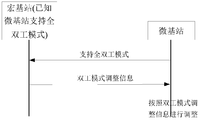
- Embodiment 5 is a flowchart of the method of Embodiment 5 to Embodiment 9. As shown in FIG. 5, the macro base station directly transmits duplex mode adjustment information to the micro base station.
- the macro base station knows that the micro base station supports a full duplex mode.
- the macro base station knows information related to the support duplex mode supported by the micro base station, such as bandwidth information, and/or cache information, and/or maximum rate information, and / or version information, etc.
- the macro base station sends the duplex mode adjustment information to the micro base station according to the duplex mode supported by the micro base station, and indicates the working time-frequency resources of the micro-base station full-duplex mode, that is, indicating which time-frequency resources the micro base station performs in the full-duplex mode.
- the macro eNB indicates that the micro base station operates in full-duplex mode in subframe 1, subframe 3, subframe 5, subframe 7, and subframe 9 (cycle 2).
- the micro base station operates in the designated duplex mode according to the indication in accordance with the requirement of the received duplex mode adjustment information.
- the macro base station knows that the micro base station supports a full duplex mode.
- the macro base station knows information related to the support duplex mode supported by the micro base station, such as bandwidth information, and/or cache information, and/or maximum rate information, and / or version information, etc.
- the macro base station sends the duplex mode adjustment information to the micro base station according to the duplex mode supported by the micro base station, and indicates the working time-frequency resources of the micro-base station full-duplex mode, that is, indicating which time-frequency resources the micro base station performs in the full-duplex mode.
- the LTE frame structure is taken as an example.
- the macro base station instructs the micro base station to operate in the full duplex mode on the frames 1 to 10 (non-period).
- the micro base station follows the indication in the corresponding subframe according to the received duplex mode adjustment information. Specifies to work on duplex mode.
- the macro base station knows that the micro base station supports a full duplex mode.
- the macro base station knows information related to the support duplex mode supported by the micro base station, such as bandwidth information, and/or cache information, and/or maximum rate information, and / or version information, etc.
- the macro base station sends the duplex mode adjustment information to the micro base station according to the duplex mode supported by the micro base station, indicating the sub-working mode of the sub-base station full-duplex mode, and the sub-working mode is that the micro base station receives the data sent by the macro base station, and gives the subordinates
- the terminal (the terminal that establishes a connection with the micro base station) transmits data.
- the micro base station operates in the designated duplex mode according to the indication in accordance with the requirement of the received duplex mode adjustment information.
- the macro base station knows that the micro base station supports a full duplex mode.
- the macro base station knows information related to the support duplex mode supported by the micro base station, such as bandwidth information, and/or cache information, and/or maximum rate information, and / or version information, etc.
- the macro base station sends the duplex mode adjustment information to the micro base station according to the duplex mode supported by the micro base station, and indicates that the micro base station performs the sub-operation mode of the full-duplex mode, and the sub-working mode is that the micro base station receives the data of the subordinate terminal and gives the macro base station. send data.
- the micro base station operates in the designated duplex mode according to the indication in accordance with the requirement of the received duplex mode adjustment information.
- the macro base station knows that the micro base station supports a full duplex mode.
- the macro base station knows information related to the support duplex mode supported by the micro base station, such as bandwidth information, and/or cache information, and/or maximum rate information, and / or version information, etc.
- the macro base station sends duplex mode adjustment information to the micro base station according to the duplex mode supported by the micro base station, and instructs the second communication node to receive the resource location of the control channel related to the full duplex mode.
- the macro base station instructs the micro base station to try to receive the control channel related to the full duplex mode on subframe 1.
- the micro base station operates according to the received duplex mode adjustment information.
- FIG. 6 is a flowchart of the method of Embodiment 10; as shown in FIG. 6, the macro base station sends duplex mode adjustment information to the micro base station according to the duplex mode supported by the micro base station, and combines the network condition of the micro base station and the supported duplex. The mode transmits duplex mode adjustment information to the micro base station.
- the macro base station knows that the micro base station supports a full duplex mode.
- the macro base station knows information related to the support duplex mode supported by the micro base station, such as bandwidth information, and/or cache information, and/or maximum rate information, and / or version information, etc.
- the micro base station sends the duplex mode adjustment information to the micro base station according to the duplex mode supported by the micro base station, and sends the duplex mode adjustment information to the micro base station according to the network condition of the micro base station and the supported duplex mode.
- the network condition refers to the service priority, the network resource, and the channel transmission quality in the network; for example, when the network resource is limited, the full-duplex mode of the subframe with the higher priority of the service is started according to the service priority.
- the micro base station operates according to the received duplex mode adjustment information.
- the first communication node is a macro base station
- the second communication node is a micro base station.
- the present invention is clearly and in detail described by the embodiment of the micro base station side. The embodiment is not intended to limit the scope of the present invention.
- Embodiment 7 is a flowchart of the method of Embodiment 11 to Embodiment 19; as shown in FIG. 7, the micro base station transmits its own full-duplex mode to the macro base station, and the micro base station performs the duplex mode adjustment information sent by the received macro base station. Communication mode adjustment.
- the micro base station transmits its own full-duplex mode to the macro base station.
- the micro base station transmits its own information related to the support duplex mode to the macro base station.
- the duplex mode supported here includes at least a full-duplex mode, such as bandwidth information, and / or cache information, and / or maximum rate information, and / or version information.
- the micro base station performs communication mode adjustment according to the duplex mode adjustment information sent by the received macro base station.
- the duplex mode adjustment information is a closed full duplex mode, for example, switching from full duplex mode to time division duplex mode and/or frequency. Divided into duplex mode.
- the micro base station transmits its own full duplex mode to the macro base station, and preferably, the micro base station sends itself and
- the duplex mode related information is supported to the macro base station, and the duplex mode supported herein includes at least a full duplex mode, such as bandwidth information, and/or cache information, and/or maximum rate information, and/or version information.
- the micro base station receives the duplex mode adjustment information sent by the macro base station to perform communication mode adjustment.
- the duplex mode adjustment information is a full duplex mode on the part of the resource indicating the micro base station is turned off.
- the full-duplex mode on the subframe 1 is turned off, and the partial operating band, for example, the sub-band 1 may be used.
- the micro base station transmits its own full-duplex mode to the macro base station.
- the micro base station transmits its own information related to the support duplex mode to the macro base station.
- the duplex mode supported here includes at least a full-duplex mode, such as bandwidth information, and / or cache information, and / or maximum rate information, and / or version information.
- the micro base station receives the duplex mode adjustment information sent by the macro base station to perform communication mode adjustment, and the duplex mode adjustment information is: turning on the full duplex mode. For example, changing from time division duplex mode or frequency division duplex mode to full duplex mode.
- the micro base station transmits its own full-duplex mode to the macro base station.
- the micro base station transmits its own information related to the support duplex mode to the macro base station.
- the duplex mode supported here includes at least a full-duplex mode, such as bandwidth information, and / or cache information, and / or maximum rate information, and / or version information.
- the micro base station receives the duplex mode adjustment information sent by the macro base station to perform communication mode adjustment, and the duplex mode adjustment information is: indicating that the micro base station turns on the full duplex mode on the part of the resources.
- the full duplex mode on the subframe 1 is turned on, and it may also be a partial operating band, such as subband 1.
- the micro base station transmits its own full-duplex mode to the macro base station.
- the micro base station transmits its own information related to the support duplex mode to the macro base station.
- the duplex mode supported here includes at least a full-duplex mode, such as bandwidth information, and / or cache information, and / or maximum rate information, and / or version information.
- the micro base station receives the duplex mode adjustment information sent by the macro base station to perform communication mode adjustment, and the duplex mode adjustment information is: indicating the working time-frequency resource of the micro-base station full-duplex mode, that is, indicating which time-frequency resources the micro base station is in accordance with the full-double
- the working mode is performed by taking the LTE frame structure as an example.
- the macro base station instructs the micro base station to follow the full double in subframe 1, subframe 3, subframe 5, subframe 7, and subframe 9 (cycle 2). Work mode work.
- the micro base station transmits its own full-duplex mode to the macro base station.
- the micro base station transmits its own information related to the support duplex mode to the macro base station.
- the duplex mode supported here includes at least a full-duplex mode, such as bandwidth information, and / or cache information, and / or maximum rate information, and / or version information.
- the micro base station receives the duplex mode adjustment information sent by the macro base station to perform communication mode adjustment, and the duplex mode adjustment information is: indicating the working time-frequency resource of the micro-base station full-duplex mode, that is, indicating which time-frequency resources the micro base station is in accordance with the full-double
- the LTE frame structure is taken as an example, and the LTE frame structure is taken as an example.
- the macro base station instructs the micro base station to operate in the full duplex mode on the frames 1 to 10 (non-period).
- the micro base station transmits its own full-duplex mode to the macro base station.
- the micro base station transmits its own information related to the support duplex mode to the macro base station.
- the duplex mode supported here includes at least a full-duplex mode, such as bandwidth information, and / or cache information, and / or maximum rate information, and / or version information.
- the micro base station receives the duplex mode adjustment information sent by the macro base station to perform communication mode adjustment, and the duplex mode adjustment information is: a sub-operation mode indicating the sub-base station full-duplex mode, and the sub-working mode is that the micro base station receives the data sent by the macro base station. Send data to the subordinate terminal (the terminal that establishes a connection with the micro base station).
- the micro base station transmits its own full-duplex mode to the macro base station.
- the micro base station transmits its own information related to the support duplex mode to the macro base station.
- the duplex mode supported here includes at least a full-duplex mode, such as bandwidth information, and / or cache information, and / or maximum rate information, and / or version information.
- the micro base station receives the duplex mode adjustment information sent by the macro base station to perform communication mode adjustment, and the duplex mode adjustment information is: a sub-operation mode indicating that the micro base station performs the full-duplex mode, and the sub-working mode is that the micro base station receives the subordinate terminal data, Send data to the macro base station.
- the micro base station transmits its own full-duplex mode to the macro base station.
- the micro base station transmits its own information related to the support duplex mode to the macro base station.
- the duplex mode supported here includes at least a full-duplex mode, such as bandwidth information, and / or cache information, and / or maximum rate information, and / or version information.
- the micro base station receives the duplex mode adjustment information sent by the macro base station to perform communication mode adjustment, and the duplex mode adjustment information is: instructing the second communication node to receive the resource location of the control channel related to the full duplex mode.
- the macro base station instructs the micro base station to try to receive the control channel related to the full duplex mode on subframe 1.
- Embodiment 8 is a flowchart of the method of Embodiment 20; as shown in FIG. 8, the difference from Embodiments 11 to 19 is that the micro base station transmits a duplex mode adjustment request in addition to transmitting its own full-duplex mode to the macro base station. Information to the macro base station.
- the micro base station transmits its own full-duplex mode to the macro base station.
- the micro base station transmits its own information related to the support duplex mode to the macro base station.
- the duplex mode supported here includes at least a full-duplex mode, such as bandwidth information, and / or cache information, and / or maximum rate information, and / or version information.
- the micro base station sends the duplex mode adjustment request information to the macro base station;
- the micro base station receives the duplex mode adjustment information sent by the macro base station to perform communication mode adjustment.
- the embodiment of the invention further discloses a computer program, comprising program instructions, when the program instruction is executed by the macro base station, so that the macro base station can perform any of the above methods for implementing communication mode adjustment.
- the embodiment of the invention also discloses a carrier carrying the computer program.
- the embodiment of the invention further discloses a computer program, comprising program instructions, when the program instruction is executed by the micro base station, so that the micro base station can perform any of the above methods for implementing communication mode adjustment.
- the embodiment of the invention also discloses a carrier carrying the computer program.
- the technical solution of the present invention avoids the impact on the system flexibility caused by the second communication node turning on the full duplex mode every moment, and reduces the full duplex mode to The power consumption of the second communication node reduces the burden on its subordinate terminals. Therefore, the present invention has strong industrial applicability.
Landscapes
- Engineering & Computer Science (AREA)
- Signal Processing (AREA)
- Computer Networks & Wireless Communication (AREA)
- Quality & Reliability (AREA)
- Mobile Radio Communication Systems (AREA)
Abstract
Description
Claims (30)
- 一种实现通信模式调整的方法,包括:第一通信节点向第二通信节点发送双工模式调整信息;所述第二通信节点至少支持全双工模式。
- 根据权利要求1所述的实现通信模式调整的方法,其中;所述第一通信节点向第二通信节点发送双工模式调整信息的步骤包括:所述第一通信节点根据所述第二通信节点支持的双工模式,向所述第二通信节点发送双工模式调整信息,以使所述第二通信节点根据接收到的所述双工模式调整信息进行通信模式调整。
- 根据权利要求1或2所述的实现通信模式调整的方法,其中,所述第一通信节点向第二通信节点发送双工模式调整信息的步骤之前,该方法还包括:所述第二通信节点通知所述第一通信节点自身支持的双工模式、或与所述第二通信节点支持的双工模式有关的信息。
- 根据权利要求1或2所述的实现通信模式调整的方法,其中,所述第一通信节点向第二通信节点发送双工模式调整信息的步骤之前,该方法还包括:所述第一通信节点获取网络负载或信道状态信息;或,所述第一通信节点接收所述第二通信节点发送的双工模式调整请求信息。
- 根据权利要求4所述的实现通信模式调整的方法,其中,当所述第一通信节点获取网络负载或信道状态信息时,所述第一通信节点向第二通信节点发送双工模式调整信息的步骤包括:所述第一通信节点获取的网络容量满足需求或所述信道状态信息不满足信道质量要求,所述第一通信节点发送关闭全双工模式的双工模式调整信息给所述第二通信节点;所述第一通信节点获取的所述网络容量不满足要求,所述第一通信节点发送开启全双工模式的双工模式调整信息给所述第二通信节点。
- 根据权利要求4所述的实现通信模式调整的方法,其中,当所述第二通信节点发送双工模式调整请求信息给所述第一通信节点时,所述第一通信节点向第二通信节点发送双工模式调整信息的步骤包括:第二通信节点发送所述双工模式调整请求信息给所述第一通信节点,所述第一通信节点根据网络情况,确定是否发送所述双工模式调整信息给所述第二通信节点。
- 根据权利要求3所述的实现通信模式调整的方法,其中,所述第二通信节点支持的双工模式有关的信息包含:带宽信息、和/或缓存信息、和/或最大速率信息、和/或版本信息。
- 根据权利要求1-6中任一项所述的实现通信模式调整的方法,其中,所述双工模式调整信息包括:开启/关闭所述全双工模式、或由全双工模式切换至时分双工模式和/或频分双工模式;或,指示所述第二通信节点全双工模式的工作时频资源;或,指示所述第二通信节点全双工模式的子工作模式;或,指示所述第二通信节点接收与所述全双工模式有关的控制信道的资源位置。
- 根据权利要求8所述的实现通信模式调整的方法,其中,所述双工模式调整信息包括:开启/关闭所述全双工模式;其中,所述开启/关闭所述全双工模式包括:开启/关闭部分资源上的全双工模式。
- 根据权利要求8所述的实现通信模式调整的方法,其中,所述双工模式调整信息包括:指示所述第二通信节点全双工模式的工作时频资源;其中,所述工作时频资源包括:工作时频资源的位置、和/或工作时频的周期。
- 根据权利要求8所述的实现通信模式调整的方法,其中,所述双工模式调整信息包括:指示所述第二通信节点全双工模式的子工作模式;其中,所述子工作模式包括:所述第二通信节点接收所述第一通信节点发送的数据的同时,给第三通信节点发送数据;或,所述第二通信节点接收第三通信节点发送的数据的同时,给所述第一通信节点发送数据;其中,所述第三通信节点为与所述第二通信节点建立连接的节点。
- 一种实现通信模式调整的方法,包括:第二通信节点接收第一通信节点发送的双工模式调整信息;所述第二通信节点根据接收的所述双工模式调整信息进行通信模式调整;所述第二通信节点支持全双工模式。
- 根据权利要求12所述的实现通信模式调整的方法,其中,所述第二通信节点接收第一通信节点发送的双工模式调整信息的步骤之前,该方法还包括:所述第二通信节点发送其自身支持的双工模式、或与所述第二通信节点支持的双工模式有关的信息给所述第一通信节点。
- 根据权利要求12所述的实现通信模式调整的方法,其中,所述第二通信节点接收第一通信节点发送的双工模式调整信息的步骤之前,该方法还包括:所述第二通信节点发送双工模式调整请求信息给所述第一通信节点。
- 根据权利要求12-14中任一项所述的实现通信模式调整的方法,该方法还包括:所述第二通信节点接收所述第一通信节点发送的关闭全双工模式的双工模式调整信息,或开启全双工模式的双工模式调整信息。
- 根据权利要求14所述的实现通信模式调整的方法,该方法还包括:所述第一通信节点根据接收到的所述双工模式调整请求信息及网络情况,确定是否发送所述双工模式调整信息给所述第二通信节点。
- 根据权利要求13所述的实现通信模式调整的方法,其中,所述第二通信节点支持的双工模式有关的信息包括:带宽信息、和/或缓存信息、和/或最大速率信息、和/或版本信息。
- 根据权利要求12~17中任一项所述的实现通信模式调整的方法,其中,所述双工模式调整信息包括:开启/关闭所述全双工模式、或由全双工模式切换至时分双工模式和/或频分双工模式;或,指示所述第二通信节点全双工模式的工作时频资源;或,指示所述第二通信节点全双工模式的子工作模式;或,指示所述第二通信节点接收与所述全双工模式有关的控制信道的资源位置。
- 根据权利要求18所述的实现通信模式调整的方法,其中,所述双工模式调整信息包括:开启/关闭所述全双工模式;其中所述开启/关闭所述全双工模式包括:开启/关闭部分资源上的全双工模式。
- 根据权利要求18所述的实现通信模式调整的方法,其中,所述双工模式调整信息包括:指示所述第二通信节点全双工模式的工作时频资源;其中,所述工作时频资源包括:工作时频资源的位置、和/或工作时频的周期。
- 根据权利要求18所述的实现通信模式调整的方法,其中,所述双工模式调整信息包括:指示所述第二通信节点全双工模式的子工作模式;其中,所述子工作模式为:所述第二通信节点接收所述第一通信节点发送的数据的同时,给第三通信节点发送数据;或,所述第二通信节点接收第三通信节点发送的数据的同时,给所述第一通信节点发送数据;其中,所述第三通信节点为与所述第二通信节点建立连接的节点。
- 一种宏基站,包括第一发送单元,其中,该第一发送单元设置成:向第二通信节点发送双工模式调整信息,所述第二通信节点至少支持全双工模式。
- 根据权利要求22所述的宏基站,其中,所述第一发送单元设置成按照如下方式向第二通信节点发送双工模式调整信息:根据所述第二通信节点支持的双工模式,向所述第二通信节点发送所述双工模式调整信息,以使所述第二通信节点根据接收到的所述双工模式调整信息进行通信模式调整。
- 根据权利要求22或23所述的宏基站,其中,所述宏基站还包括获取单元和判断单元,其中,所述获取单元设置成:获取网络负载或信道状态信息;该判断单元设置成:判断所述获取单元网络容量和信道状态信息是否满足需求或信道质量要求,当获取的网络容量满足需求或信道状态信息不满足信道质量要求时,通知所述第一发送单元向所述第二通信节点发送关闭全双工模式的双工模式调整信息;当所获取的网络容量不满足需求,通知所述第一发送单元向所述第二通信节点发送开启全双工模式的双工模式调整信息。
- 根据权利要求22、23或24所述的宏基站,其中,所述第一接收单元还设置成:接收所述第二通信节点发送的所述第二通信节点支持的双工模式信息、或与第二通信节点支持的双工模式有关的信息。
- 根据权利要求22或23所述的宏基站,该宏基站还包括所述第一接收单元设置成:接收所述第二通信节点发送的双工模式调整请求信息;所述第一发送单元还设置成:所述第一接收单元接收到所述第二通信节点发送的双工模式调整请求信息后,根据网络情况,确定是否发送所述双工模式调整信息给所述第二通信节点。
- 根据权利要求22-26中任一项所述的宏基站,其中,所述双工模式调整信息包括:开启/关闭所述全双工模式、或由全双工模式切换至时分双工模式和/或频分双工模式;或,指示所述第二通信节点全双工模式的工作时频资源;或,指示所述第二通信节点全双工模式的子工作模式;或,指示所述第二通信节点接收与所述全双工模式有关的控制信道的资源位置。
- 一种微基站,包括:第二接收单元和调整单元;其中,所述第二接收单元设置成:接收第一通信节点发送的双工模式调整信息;所述调整单元设置成:根据所述第二接收单元接收到的所述双工模式调整信息进行通信模式调整;所述双工模式至少包括全双工模式。
- 根据权利要求28所述的微基站,该微基站还包括第二发送单元,其中所述第二发送单元设置成:发送其自身支持的双工模式、或与其支持的双工模式有关的信息给所述第一通信节点,以使所述第一通信节点根据微基站支持的双工模式发送所述双工模式调整信息给所述微基站。
- 根据权利要求29所述的微基站,该微基站还包括调整请求单元,其中所述调整请求单元设置成:发送双工模式调整请求信息给所述第一通信节点,以使得所述第一通信节点确定是否根据微基站支持的双工模式,发送所述双工模式调整信息给所述微基站。
Priority Applications (3)
| Application Number | Priority Date | Filing Date | Title |
|---|---|---|---|
| US15/506,755 US20170373818A1 (en) | 2014-08-27 | 2015-04-03 | Method, Micro Base Station, and Macro Base Station for Adjusting Communications Mode |
| EP15776694.0A EP3179667A4 (en) | 2014-08-27 | 2015-04-03 | Method, micro base station, and macro base station for adjusting communications mode |
| JP2017511594A JP2017529777A (ja) | 2014-08-27 | 2015-04-03 | 通信モード調整を実現する方法、マイクロ基地局及びマクロ基地局 |
Applications Claiming Priority (2)
| Application Number | Priority Date | Filing Date | Title |
|---|---|---|---|
| CN201410427711.7 | 2014-08-27 | ||
| CN201410427711.7A CN105376841B (zh) | 2014-08-27 | 2014-08-27 | 一种实现通信模式调整的方法、微基站及宏基站 |
Publications (1)
| Publication Number | Publication Date |
|---|---|
| WO2015154644A1 true WO2015154644A1 (zh) | 2015-10-15 |
Family
ID=54287323
Family Applications (1)
| Application Number | Title | Priority Date | Filing Date |
|---|---|---|---|
| PCT/CN2015/075880 Ceased WO2015154644A1 (zh) | 2014-08-27 | 2015-04-03 | 一种实现通信模式调整的方法、微基站及宏基站 |
Country Status (5)
| Country | Link |
|---|---|
| US (1) | US20170373818A1 (zh) |
| EP (1) | EP3179667A4 (zh) |
| JP (1) | JP2017529777A (zh) |
| CN (1) | CN105376841B (zh) |
| WO (1) | WO2015154644A1 (zh) |
Families Citing this family (7)
| Publication number | Priority date | Publication date | Assignee | Title |
|---|---|---|---|---|
| CN106453164B (zh) * | 2016-11-15 | 2019-07-02 | 电子科技大学 | 一种用于超密集网络的降低回传数据量的方法 |
| TWI631833B (zh) * | 2016-12-14 | 2018-08-01 | 財團法人工業技術研究院 | 資料傳輸模式設定方法及應用其之基站裝置以及終端裝置 |
| US11178554B2 (en) | 2017-03-09 | 2021-11-16 | Nokia Technologies Oy | Method and information exchange mechanism for full duplex transmission |
| WO2022198181A1 (en) * | 2021-03-16 | 2022-09-22 | Qualcomm Incorporated | Time domain pattern switching |
| US20240305439A1 (en) * | 2021-05-31 | 2024-09-12 | Beijing Xiaomi Mobile Software Co., Ltd. | Networking method and apparatus therefor |
| WO2023206502A1 (zh) * | 2022-04-29 | 2023-11-02 | 新华三技术有限公司 | 一种tdd帧结构配置方法、装置及设备 |
| EP4429163A4 (en) * | 2022-04-29 | 2024-12-18 | New H3C Technologies Co., Ltd. | METHOD AND APPARATUS FOR CONFIGURING TDD FRAME STRUCTURE, AND DEVICE |
Citations (4)
| Publication number | Priority date | Publication date | Assignee | Title |
|---|---|---|---|---|
| CN101043399A (zh) * | 2006-06-28 | 2007-09-26 | 华为技术有限公司 | 一种以太网双工模式匹配的方法 |
| CN101151812A (zh) * | 2005-04-07 | 2008-03-26 | 诺基亚公司 | 具有可变双工性能的终端 |
| EP2332350A2 (en) * | 2008-08-11 | 2011-06-15 | Qualcomm Incorporated | Setting up a full-duplex communication session and transitioning between half-duplex and full-duplex during a communication session within a wireless communications system |
| US20140010130A1 (en) * | 2012-07-06 | 2014-01-09 | Broadcom Corporation | System and Method for Energy Efficient Ethernet with Asymmetric Traffic Profiles |
Family Cites Families (7)
| Publication number | Priority date | Publication date | Assignee | Title |
|---|---|---|---|---|
| US7230930B2 (en) * | 2004-03-23 | 2007-06-12 | Motorola, Inc. | Mode shifting communications system and method |
| US20060280132A1 (en) * | 2005-06-09 | 2006-12-14 | Intel Corporation | Techniques to identify duplex mismatch |
| CN102948089B (zh) * | 2010-05-25 | 2016-01-20 | 爱立信(中国)通信有限公司 | 无线通信网络中的方法和装置 |
| CN102469628B (zh) * | 2010-11-04 | 2016-03-30 | 华为技术有限公司 | 中继类型选择方法、设备及系统 |
| KR101973795B1 (ko) * | 2012-12-28 | 2019-04-29 | 텔레콤 이탈리아 소시에떼 퍼 아찌오니 | 이종 셀룰러 네트워크에서의 활성화되지 않은 스몰 커버리지 노드들의 활성화 |
| US9692584B2 (en) * | 2013-01-17 | 2017-06-27 | Telefonatiebolaget L M Ericsson (Publ) | Methods of radio communications using different subframe configurations and related radio and/or network nodes |
| JP6492327B2 (ja) * | 2013-09-25 | 2019-04-03 | ソニー株式会社 | 通信制御装置、通信制御方法、無線通信装置及び無線通信方法 |
-
2014
- 2014-08-27 CN CN201410427711.7A patent/CN105376841B/zh active Active
-
2015
- 2015-04-03 WO PCT/CN2015/075880 patent/WO2015154644A1/zh not_active Ceased
- 2015-04-03 EP EP15776694.0A patent/EP3179667A4/en not_active Withdrawn
- 2015-04-03 US US15/506,755 patent/US20170373818A1/en not_active Abandoned
- 2015-04-03 JP JP2017511594A patent/JP2017529777A/ja active Pending
Patent Citations (4)
| Publication number | Priority date | Publication date | Assignee | Title |
|---|---|---|---|---|
| CN101151812A (zh) * | 2005-04-07 | 2008-03-26 | 诺基亚公司 | 具有可变双工性能的终端 |
| CN101043399A (zh) * | 2006-06-28 | 2007-09-26 | 华为技术有限公司 | 一种以太网双工模式匹配的方法 |
| EP2332350A2 (en) * | 2008-08-11 | 2011-06-15 | Qualcomm Incorporated | Setting up a full-duplex communication session and transitioning between half-duplex and full-duplex during a communication session within a wireless communications system |
| US20140010130A1 (en) * | 2012-07-06 | 2014-01-09 | Broadcom Corporation | System and Method for Energy Efficient Ethernet with Asymmetric Traffic Profiles |
Non-Patent Citations (1)
| Title |
|---|
| See also references of EP3179667A4 * |
Also Published As
| Publication number | Publication date |
|---|---|
| JP2017529777A (ja) | 2017-10-05 |
| EP3179667A1 (en) | 2017-06-14 |
| CN105376841A (zh) | 2016-03-02 |
| US20170373818A1 (en) | 2017-12-28 |
| EP3179667A4 (en) | 2017-08-30 |
| CN105376841B (zh) | 2019-06-14 |
Similar Documents
| Publication | Publication Date | Title |
|---|---|---|
| WO2015154644A1 (zh) | 一种实现通信模式调整的方法、微基站及宏基站 | |
| WO2019192605A1 (zh) | 拓扑信息的管理方法及装置、系统、存储介质、电子装置 | |
| US7929477B2 (en) | Method, apparatus and system for data transmission in radio communication network | |
| EP3536043A1 (en) | Handling limited network slice availability | |
| CN104584659A (zh) | 无线通信方法、无线通信系统、无线基站以及无线终端 | |
| CN104145517A (zh) | 时分双工蜂窝通信网络中的资源管理方法及资源管理系统 | |
| CN103874078B (zh) | 一种移动通信接入网架构 | |
| JP2012527795A (ja) | リモート無線周波数ユニットの発見及びトポロジ構成の建立のシステム及び方法 | |
| WO2019154259A1 (zh) | 一种基站、用户设备中的用于无线通信的方法和装置 | |
| US10135584B2 (en) | Communication control apparatus, communication control method, communication system, and wireless terminal | |
| JP2016539602A (ja) | Drxの設定及び制御チャネルのモニタリングの方法、システム及び装置 | |
| US20240385827A1 (en) | Firmware-over-the-air (fota) update for wireless devices in an internet of things (iot) network | |
| CN118805403A (zh) | 用于在无线网络中节电的方法、设备和系统 | |
| WO2020083039A1 (zh) | 一种被用于无线通信的节点中的方法和装置 | |
| WO2016107613A1 (zh) | 数据传输方法及装置 | |
| Barua et al. | A novel approach of mobility management for the D2D communications in 5G mobile cellular network system | |
| KR101954226B1 (ko) | 기지국 장비, 자원 관리 방법 및 데이터 처리 방법 | |
| CN102045843A (zh) | 一种第二类中继站的下行子帧配置和传输方法及系统 | |
| CN107347207B (zh) | 一种窄带移动通信的方法和装置 | |
| Wong et al. | Overview of new technologies for 5G systems | |
| CN102347815A (zh) | 一种中继网络的pucch发送方法和系统 | |
| CN102970759B (zh) | 小区干扰处理方法及装置 | |
| Hwang et al. | Group handover management for V2x in moving cell based LTE-advanced system | |
| CN119923650A (zh) | 降低双侧机器学习模型多样性的方法 | |
| CN103427892A (zh) | 蜂窝网络中基站自适应协作通信的方法 |
Legal Events
| Date | Code | Title | Description |
|---|---|---|---|
| 121 | Ep: the epo has been informed by wipo that ep was designated in this application |
Ref document number: 15776694 Country of ref document: EP Kind code of ref document: A1 |
|
| ENP | Entry into the national phase |
Ref document number: 2017511594 Country of ref document: JP Kind code of ref document: A |
|
| NENP | Non-entry into the national phase |
Ref country code: DE |
|
| REEP | Request for entry into the european phase |
Ref document number: 2015776694 Country of ref document: EP |
|
| WWE | Wipo information: entry into national phase |
Ref document number: 2015776694 Country of ref document: EP |
|
| WWE | Wipo information: entry into national phase |
Ref document number: 15506755 Country of ref document: US |