WO2015163323A1 - ポリエステル樹脂、光学レンズ及び光学レンズ系 - Google Patents
ポリエステル樹脂、光学レンズ及び光学レンズ系 Download PDFInfo
- Publication number
- WO2015163323A1 WO2015163323A1 PCT/JP2015/062124 JP2015062124W WO2015163323A1 WO 2015163323 A1 WO2015163323 A1 WO 2015163323A1 JP 2015062124 W JP2015062124 W JP 2015062124W WO 2015163323 A1 WO2015163323 A1 WO 2015163323A1
- Authority
- WO
- WIPO (PCT)
- Prior art keywords
- polyester resin
- structural unit
- optical lens
- mol
- acid
- Prior art date
- Legal status (The legal status is an assumption and is not a legal conclusion. Google has not performed a legal analysis and makes no representation as to the accuracy of the status listed.)
- Ceased
Links
Classifications
-
- C—CHEMISTRY; METALLURGY
- C08—ORGANIC MACROMOLECULAR COMPOUNDS; THEIR PREPARATION OR CHEMICAL WORKING-UP; COMPOSITIONS BASED THEREON
- C08G—MACROMOLECULAR COMPOUNDS OBTAINED OTHERWISE THAN BY REACTIONS ONLY INVOLVING UNSATURATED CARBON-TO-CARBON BONDS
- C08G63/00—Macromolecular compounds obtained by reactions forming a carboxylic ester link in the main chain of the macromolecule
-
- G—PHYSICS
- G02—OPTICS
- G02B—OPTICAL ELEMENTS, SYSTEMS OR APPARATUS
- G02B1/00—Optical elements characterised by the material of which they are made; Optical coatings for optical elements
- G02B1/04—Optical elements characterised by the material of which they are made; Optical coatings for optical elements made of organic materials, e.g. plastics
-
- C—CHEMISTRY; METALLURGY
- C08—ORGANIC MACROMOLECULAR COMPOUNDS; THEIR PREPARATION OR CHEMICAL WORKING-UP; COMPOSITIONS BASED THEREON
- C08G—MACROMOLECULAR COMPOUNDS OBTAINED OTHERWISE THAN BY REACTIONS ONLY INVOLVING UNSATURATED CARBON-TO-CARBON BONDS
- C08G63/00—Macromolecular compounds obtained by reactions forming a carboxylic ester link in the main chain of the macromolecule
- C08G63/02—Polyesters derived from hydroxycarboxylic acids or from polycarboxylic acids and polyhydroxy compounds
- C08G63/12—Polyesters derived from hydroxycarboxylic acids or from polycarboxylic acids and polyhydroxy compounds derived from polycarboxylic acids and polyhydroxy compounds
- C08G63/16—Dicarboxylic acids and dihydroxy compounds
- C08G63/18—Dicarboxylic acids and dihydroxy compounds the acids or hydroxy compounds containing carbocyclic rings
- C08G63/181—Acids containing aromatic rings
- C08G63/185—Acids containing aromatic rings containing two or more aromatic rings
- C08G63/187—Acids containing aromatic rings containing two or more aromatic rings containing condensed aromatic rings
- C08G63/189—Acids containing aromatic rings containing two or more aromatic rings containing condensed aromatic rings containing a naphthalene ring
-
- G—PHYSICS
- G02—OPTICS
- G02B—OPTICAL ELEMENTS, SYSTEMS OR APPARATUS
- G02B1/00—Optical elements characterised by the material of which they are made; Optical coatings for optical elements
- G02B1/04—Optical elements characterised by the material of which they are made; Optical coatings for optical elements made of organic materials, e.g. plastics
- G02B1/041—Lenses
-
- G—PHYSICS
- G02—OPTICS
- G02B—OPTICAL ELEMENTS, SYSTEMS OR APPARATUS
- G02B3/00—Simple or compound lenses
- G02B3/02—Simple or compound lenses with non-spherical faces
-
- G—PHYSICS
- G02—OPTICS
- G02B—OPTICAL ELEMENTS, SYSTEMS OR APPARATUS
- G02B3/00—Simple or compound lenses
- G02B3/02—Simple or compound lenses with non-spherical faces
- G02B3/04—Simple or compound lenses with non-spherical faces with continuous faces that are rotationally symmetrical but deviate from a true sphere, e.g. so called "aspheric" lenses
Definitions
- the present invention relates to a polyester resin, an optical lens, and an optical lens system.
- Optical glass or optical transparent resin is used as a material for optical elements used in the optical systems of various cameras such as cameras, film-integrated cameras, and video cameras.
- Optical glass is excellent in heat resistance, transparency, dimensional stability, chemical resistance, etc., and there are many types of materials with various refractive indexes and Abbe numbers, but the material cost is high and moldability is high.
- productivity is low.
- processing to an aspheric lens used for aberration correction is a serious obstacle to practical use because it requires extremely high technology and high cost.
- optical lenses made of optically transparent resins especially thermoplastic transparent resins, have the advantage that they can be mass-produced by injection molding and that aspherical lenses can be easily manufactured. It is currently used as a lens for cameras.
- the optical transparent resin include polycarbonate made of bisphenol A, polymethyl methacrylate, and amorphous polyolefin.
- aberration correction is performed by combining a plurality of concave lenses and convex lenses.
- the chromatic aberration produced by the convex lens is counteracted by the concave lens, so that the chromatic aberration is opposite in sign to that of the convex lens.
- the concave lens is required to have high dispersion (low Abbe number).
- Patent Document 1 discloses a polyester resin composition obtained by copolymerizing a fluorene dihydroxy compound having a refractive index of 1.66 and an Abbe number of about 20 as a resin used for a concave lens for aberration correction.
- Patent Document 2 discloses a polyester composed of naphthalenedicarboxylic acid, tricyclodecane dimethylol and ethylene glycol.
- Patent Document 3 describes an optical lens made of a polyester resin having a high refractive index and a low Abbe number, having an ethylene glycol-derived unit, a diol-derived unit having 3 to 16 carbon atoms, and a naphthalenedicarboxylic acid-derived unit. .
- JP 2006-335974 A Japanese Patent Publication No. 06-037548 International Publication No. 2010/004965
- Patent Document 1 has a sufficiently large dispersion (low Abbe number), but has the following disadvantages as a resin for optical lenses. That is, since this resin copolymerizes a large amount of a bulky and rigid fluorene dihydroxy compound, the melt viscosity is very high and the moldability is poor. In order to improve the moldability, means for lowering the melt viscosity at the time of molding, that is, raising the molding temperature, can be considered. However, problems such as increased coloring during molding and contamination of the mold due to thermal decomposition products occur.
- the resin described in Patent Document 2 has a high Abbe number of 26 or more, and it cannot be said that the resin has a sufficiently large dispersion (low Abbe number). Furthermore, the resin described in Patent Document 3 is required to improve moldability such as thermal stability and to improve deterioration in a light resistance test.
- the present invention has been made in view of the above problems, and an object thereof is to provide a polyester resin, an optical lens, and an optical lens system that have a high refractive index, a low Abbe number, and excellent stability during molding.
- a polyester resin mainly containing a diol structural unit and a dicarboxylic acid structural unit 10 to 84 mol% of the diol structural unit is a structural unit derived from ethylene glycol, 16 to 90 mol% in the diol structural unit is a structural unit derived from neopentyl glycol represented by the following formula (i):
- a polyester resin, wherein 50 to 100 mol% of the dicarboxylic acid structural unit is a structural unit derived from naphthalenedicarboxylic acid.
- 20 to 84 mol% of the diol structural unit is a structural unit derived from ethylene glycol
- [7] An optical lens obtained by molding the polyester resin according to any one of [1] to [6]. [8] The optical lens according to [7], wherein the optical lens is an aspheric lens. [9] The optical lens according to [7] or [8], wherein the optical lens is a camera lens. [10] [7] An optical lens system including the optical lens according to any one of [9] and another optical lens.
- the polyester resin of the present invention has a high refractive index, a low Abbe number, and excellent stability during molding.
- the present embodiment a mode for carrying out the present invention (hereinafter simply referred to as “the present embodiment”) will be described in detail.
- the following embodiments are examples for explaining the present invention, and are not intended to limit the present invention to the following contents.
- the present invention can be implemented with appropriate modifications within the scope of the gist thereof.
- the polyester resin of this embodiment is a polyester resin mainly containing a diol structural unit and a dicarboxylic acid structural unit. Further, in the polyester resin of the present embodiment, 10 to 84 mol% in the diol structural unit is a structural unit derived from ethylene glycol, and 16 to 90 mol% in the diol structural unit is represented by the following formula (i). Neopentyl glycol. Since it is configured as described above, the polyester resin of this embodiment has a high refractive index, a low Abbe number, and excellent stability during molding. As described above, since the polyester resin of the present embodiment has a specific structural unit, it has low birefringence and exhibits excellent performance particularly when used as an optical lens.
- “mainly” means that the total proportion of the diol structural unit and the dicarboxylic acid structural unit in all the structural units of the polyester resin is 50 mol% or more. In the present embodiment, the total ratio is preferably 80 mol% or more, more preferably 90 mol% or more, and further preferably 100 mol%.
- the proportion of the structural unit derived from ethylene glycol in the diol unit is preferably 20 to 84 mol%, more preferably 20 to 82 mol%, still more preferably 30 to 80 mol%. %, More preferably 40 to 70 mol%, and the proportion of structural units derived from neopentyl glycol is preferably 16 to 80 mol%, more preferably 18 to 80 mol%, and still more preferably 20 It is ⁇ 70 mol%, more preferably 30 to 60 mol%.
- the polyester resin of the present embodiment 50 to 100 mol% of the dicarboxylic acid structural unit is a structural unit derived from naphthalenedicarboxylic acid, preferably 80 to 100 mol%, more preferably 90 to 100 mol%. It is a structural unit derived from naphthalenedicarboxylic acid.
- the polyester resin of the present embodiment can have a high refractive index and a low Abbe number, and can be suitably used as an optical lens.
- the naphthalene dicarboxylic acid structural unit is not limited to the following, but includes 1,3-naphthalenedicarboxylic acid, 1,4-naphthalenedicarboxylic acid, 1,5-naphthalenedicarboxylic acid, 2,6-naphthalenedicarboxylic acid, 2,7 -Examples of structural units derived from naphthalenedicarboxylic acid and the like.
- a structural unit derived from 2,6-naphthalenedicarboxylic acid is preferable. These may be contained alone as a dicarboxylic acid unit, or may be contained in combination of two or more. Further, it may be used as an ester of a dicarboxylic acid and an alcohol having 1 to 6 carbon atoms.
- dicarboxylic acid structural unit contained in the polyester resin of the present embodiment in addition to the structural unit derived from naphthalene dicarboxylic acid, terephthalic acid, isophthalic acid, phthalic acid, 2-methyl terephthalic acid, biphenyl dicarboxylic acid, tetralin dicarboxylic acid
- Aromatic dicarboxylic acids such as succinic acid, glutaric acid, adipic acid, pimelic acid, suberic acid, azelaic acid, sebacic acid, decanedicarboxylic acid, dodecanedicarboxylic acid, cyclohexanedicarboxylic acid, decalindicarboxylic acid, norbornane dicarboxylic acid, tricyclo Decanedicarboxylic acid, pentacyclododecanedicarboxylic acid, 3,9-bis (1,1-dimethyl-2-carboxyethyl) -2,4,8,10-tetra
- the dicarboxylic acid structural unit constituting the polyester resin of the present embodiment may be composed of one type of the exemplified structural units, or may be composed of two or more types. Further, it may be used as an ester of a dicarboxylic acid and an alcohol having 1 to 6 carbon atoms.
- the aromatic dicarboxylic acid containing naphthalenedicarboxylic acid in all the dicarboxylic acid structural units is preferably 80 to 100 mol%, more preferably 90 to 100 mol%, and still more preferably 100 mol%.
- polyester resin of this embodiment in order to adjust the melt viscoelasticity, molecular weight, etc., monoalcohol structural units such as butyl alcohol, hexyl alcohol, octyl alcohol, trimethylolpropane, Trivalent or higher polyhydric alcohol constituent units such as glycerin, 1,3,5-pentanetriol, pentaerythritol, monocarboxylic acid constituent units such as benzoic acid, propionic acid, butyric acid, trimellitic acid, pyromellitic acid, etc.
- Carboxylic acid structural units, oxyacid structural units such as glycolic acid, lactic acid, hydroxybutyric acid, 2-hydroxyisobutyric acid, and hydroxybenzoic acid may be included.
- the refractive index of the polyester resin of this embodiment is usually 1.60 or more.
- the upper limit of the refractive index is not particularly limited, but is preferably 1.7 or less in view of balance with other physical properties.
- the Abbe number is preferably 25 or less, more preferably 21 or less, and still more preferably 20 or less.
- the lower limit of the Abbe number is not particularly limited, but is preferably 18 or more in view of balance with other physical properties.
- a refractive index and an Abbe number can be made into a preferable value by adjusting the structural unit and ratio of a polyester resin as mentioned above.
- the refractive index and Abbe number can be obtained by the following measuring method.
- a polyester resin injection-molded piece annealed in an oven at a temperature (90 to 100 ° C.) about 20 ° C. lower than the midpoint glass transition temperature of the polyester resin for 10 hours was used as a measurement sample, and the refractive index was 589 nm (d line) ), And the Abbe number is a value calculated from the refractive indices measured at 656 nm (C line), 486 nm (F line), and d line.
- the refractive index measured in this way is preferably 1.60 or more, and the Abbe number is preferably 21 or less, more preferably the refractive index is 1.61 or more, and The Abbe number is 20 or less, more preferably the refractive index is 1.62 or more, and the Abbe number is 19.5 or less.
- the polyester resin of this embodiment satisfy
- the midpoint glass transition temperature measured with a differential scanning calorimeter according to JIS standard K7121 of the polyester resin of the present embodiment is not particularly limited, but is usually preferably 100 ° C or higher, more preferably 105 ° C. It is above, More preferably, it is 110 degreeC or more.
- the optical lens of the present embodiment tends to have improved resistance to surface processing such as hard coating.
- the midpoint glass transition temperature of the polyester resin is, for example, 100 ° C.
- diol such as a diol having a cyclic acetal skeleton or an aromatic hydrocarbon group or a dicarboxylic acid having a naphthalene skeleton, or a dicarboxylic acid. This can be done.
- the viscosity of the polyester resin of the present embodiment is not particularly limited, but considering that injection molding is selected as the molding method of the optical lens, and that the mechanical performance of the optical lens is sufficiently exhibited. is preferably in the range of 10 ⁇ 80cm 3 / 10min in MVR.
- MVR a value measured using a MELT INDEXER T-111 manufactured by Toyo Seiki and applying a weight of 2.16 kg at 260 ° C. can be adopted.
- the MVR of the polyester resin of the present embodiment is more preferably 15 ⁇ 60cm 3 / 10min, more preferably 20 ⁇ 60cm 3 / 10min by weight, more still preferably from 30 ⁇ 60cm 3 / 10min.
- the polyester resin of this embodiment tends to have a better balance between moldability, mechanical performance, and low birefringence. If the MVR and 10 cm 3 / 10min or more, the expression of birefringence upon molding can be effectively suppressed, they tend to be of low birefringence optical lens. If the MVR and 80 cm 3 / 10min or less, tend to be secured to the mechanical performance of better optical lenses.
- MVR can be adjusted to said preferable range by measuring the stirring torque of a reactor and extracting a polyester resin, etc. when the said stirring torque becomes a predetermined value.
- the method for producing the polyester resin of the present embodiment is not particularly limited, and conventionally known polyester production methods can be applied. Examples thereof include a melt polymerization method such as a transesterification method and a direct esterification method, or a solution polymerization method, and among them, the transesterification method is preferable.
- Various catalysts such as transesterification catalyst, esterification catalyst, polycondensation catalyst, etc. used in the production of the polyester resin of this embodiment, various stabilizers such as etherification inhibitor, heat stabilizer, light stabilizer, polymerization regulator, etc. are also conventionally used. Known ones can be used, and these are appropriately selected according to the reaction rate, the color tone of the polyester resin, safety, thermal stability, weather resistance, self-elution property, and the like.
- various catalysts include, but are not limited to, metal compounds such as zinc, lead, cerium, cadmium, manganese, cobalt, lithium, sodium, potassium, calcium, nickel, magnesium, vanadium, aluminum, titanium, antimony, and tin.
- the amount of the transesterification catalyst used in the transesterification method is preferably 0.001 to 1 mol%, more preferably 0.005 to 0.5 mol% with respect to the dicarboxylic acid unit. More preferably, a compound is used.
- the amount of the polycondensation catalyst used is preferably 0.001 to 1 mol%, more preferably 0.005 to 0.5 mol%, based on the dicarboxylic acid unit. Is more preferable.
- the polyester resin of the present embodiment includes other resins, antioxidants, light stabilizers, ultraviolet absorbers, plasticizers, extenders, matting agents, drying regulators, antistatic agents, antisettling agents, and surfactants.
- Various additives such as flow improvers, drying oils, waxes, fillers, colorants, reinforcing agents, surface smoothing agents, leveling agents, curing reaction accelerators, thickeners, and molding aids can also be added.
- a flow improver polyfunctional alcohol and fatty acid ester, especially stearic acid ester of glycerin, is preferably added to 5000 ppm or less, more preferably 3000 ppm or less, and it is preferable because troubles due to poor mold release tend to be reduced. .
- the polyester resin of the present embodiment is preferably subjected to filtration of the molten raw material, filtration of the catalyst solution, and filtration of the molten oligomer from the viewpoint of reducing the foreign matter content.
- the filter mesh is preferably 7 ⁇ m or less, more preferably 5 ⁇ m or less. Further, it is also preferable to perform filtration of the resin to be generated with a polymer filter.
- the mesh of the polymer filter is preferably 100 ⁇ m or less, more preferably 30 ⁇ m or less.
- the step of collecting the resin pellets is performed in a low dust environment, and is preferably class 1000 or less, more preferably class 100 or less.
- the polyester resin of this embodiment can be used for various applications.
- it can be used for injection molded articles, sheets, films, extruded molded articles such as pipes, bottles, foams, adhesives, adhesives, paints and the like.
- the sheet may be a single layer or a multilayer
- the film may be a single layer or a multilayer, and may be unstretched, stretched in one direction or in two directions, and laminated on a steel plate or the like.
- the bottle may be a direct blow bottle, an injection blow bottle, or an injection molded bottle.
- the foam may be a bead foam or an extruded foam.
- products that require high heat resistance and water vapor barrier properties such as products used in automobiles, packaging materials for import / export, electronic materials such as solar cell backsheets, food packaging materials for retort processing and microwave heating. It can be used suitably.
- the polyester resin of the present embodiment tends to obtain an excellent optical lens by injection molding into a lens shape with an injection molding machine or an injection compression molding machine.
- the molding environment is also performed in a low dust environment, and is preferably class 1000 or less, more preferably class 100 or less.
- the optical lens of the present embodiment is obtained by molding the polyester resin of the present embodiment, and is preferably an aspheric lens as necessary. Since an aspherical lens can substantially eliminate spherical aberration with a single lens, it is not necessary to remove spherical aberration with a combination of a plurality of spherical lenses, thus reducing weight and reducing production costs. It becomes possible. Therefore, the aspherical lens is particularly useful as a camera lens among optical lenses.
- the astigmatism of the aspheric lens is preferably 0 to 15 m ⁇ , more preferably 0 to 10 m ⁇ .
- the surface of the optical lens of the present embodiment may be provided with a coating layer such as an antireflection layer or a hard coating layer as necessary.
- the antireflection layer may be a single layer or a multilayer, and may be organic or inorganic, but is preferably inorganic. Specific examples include oxides or fluorides such as silicon oxide, aluminum oxide, zirconium oxide, titanium oxide, cerium oxide, magnesium oxide, and magnesium fluoride.
- the optical lens of this embodiment can be used for various lenses such as a pickup lens, an f- ⁇ lens, and a spectacle lens. However, since it has a high refractive index and a low Abbe number, it is particularly suitably used as a lens for correcting chromatic aberration. it can. Specifically, it is suitably used as a lens for a single-lens reflex camera, a digital still camera, a video camera, a camera-equipped mobile phone, a lens-equipped film, a telescope, a binocular, a microscope, a projector, or the like.
- the optical lens of this embodiment is a concave lens, it can be used as an optical lens system with little chromatic aberration in combination with other high Abbe number convex lenses. That is, the optical lens system of the present embodiment includes the optical lens of the present embodiment and another optical lens.
- the Abbe number of the convex lens to be combined is preferably 40 to 60, and more preferably 50 to 60.
- Resin Composition The proportions of ethylene glycol structural units, other diol structural units, and naphthalenedicarboxylic acid structural units in the polyester resin were calculated by 1 H-NMR measurement. The measurement was performed at 500 MHz using JNM-LA500FT manufactured by JEOL Ltd. Deuterated chloroform and deuterated trifluoroacetic acid were used as the solvent.
- the refractive index and Abbe number are measured using an ATAGO refractometer, the refractive index is measured at 589 nm (d line), and the Abbe number is at 656 nm (C line), 486 nm (F line), and d line. Calculated from the measured refractive index.
- MVR Measurement was performed using a MELT INDEXER T-111 manufactured by Toyo Seiki, applying a load of 2.16 kg at 260 ° C.
- NDCM dimethyl naphthalenedicarboxylate
- EG ethylene glycol
- NPG neopentyl glycol
- Example 2 NDCM / EG / NPG was charged at a molar ratio of 1/1 / 0.6, and polycondensation was performed under the same reaction conditions as in Example 1.
- the composition of the obtained polyester resin was analyzed, it contained EG / NPG in a ratio of 54/36.
- MVR 40cm ⁇ 3 > / 10min.
- the composition of the obtained polyester resin was analyzed, it contained EG / NPG in a ratio of 82/18.
- MVR 38cm ⁇ 3 > / 10min.
- Example 4 NDCM / EG / NPG was charged at a molar ratio of 1/1/1, and polycondensation was performed under the same reaction conditions as in Example 1.
- the composition of the obtained polyester resin was analyzed, it contained EG / NPG at a ratio of 21/79.
- MVR 40cm ⁇ 3 > / 10min.
- Example 5 NDCM, EG, and NPG were charged at a molar ratio of 1/1 / 0.8, and polycondensation was performed.
- the degree of polymerization was controlled using the stirring torque of the reactor as an index, and the resin was extracted when polycondensation proceeded more than in Examples 1 to 4.
- the composition of the obtained polyester resin was analyzed, it contained EG / NPG in a ratio of 43/57.
- MVR 17 cm ⁇ 3 > / 10min.
- the polyester resin of the present invention can provide an optical lens having high thermal stability and excellent moldability, a low Abbe number and a high refractive index. For this reason, it can be used in fields where expensive high refractive index glass lenses have been used, such as cameras, telescopes, binoculars, and television projectors.
- the optical lens of the present invention is useful as a high refractive index low birefringence aspheric lens, and particularly useful as a concave lens for correcting chromatic aberration.
Landscapes
- Physics & Mathematics (AREA)
- Chemical & Material Sciences (AREA)
- General Physics & Mathematics (AREA)
- Optics & Photonics (AREA)
- Health & Medical Sciences (AREA)
- Chemical Kinetics & Catalysis (AREA)
- Medicinal Chemistry (AREA)
- Polymers & Plastics (AREA)
- Organic Chemistry (AREA)
- Polyesters Or Polycarbonates (AREA)
Abstract
Description
また、特許文献2においては、ナフタレンジカルボン酸とトリシクロデカンジメチロール及びエチレングリコールからなるポリエステルが開示されている。
また、特許文献3には、エチレングリコール由来単位と炭素数3~16のジオール由来単位とナフタレンジカルボン酸由来単位とを有する高屈折率、低アッベ数のポリエステル樹脂からなる光学レンズが記載されている。
[1]
ジオール構成単位とジカルボン酸構成単位とを主として含むポリエステル樹脂であって、
前記ジオール構成単位中の10~84モル%がエチレングリコールに由来する構成単位であり、
前記ジオール構成単位中の16~90モル%が下記式(i)で表されるネオペンチルグリコールに由来する構成単位であり、
前記ジカルボン酸構成単位中の50~100モル%がナフタレンジカルボン酸に由来する構成単位である、ポリエステル樹脂。

[2]
前記ナフタレンジカルボン酸に由来する構成単位が2,6-ナフタレンジカルボン酸に由来する構成単位である、[1]に記載のポリエステル樹脂。
[3]
前記ジカルボン酸構成単位中の90~100モル%がナフタレンジカルボン酸に由来する構成単位である、[1]又は[2]に記載のポリエステル樹脂。
[4]
前記ジオール構成単位中の20~84モル%がエチレングリコールに由来する構成単位であり、
前記ジオール構成単位中の16~80モル%がネオペンチルグリコールに由来する構成単位である、[1]~[3]のいずれかに記載のポリエステル樹脂。
[5]
以下の条件(1)及び(2)を満たす、[1]~[4]のいずれかに記載のポリエステル樹脂:
(1)JIS規格K7121に準拠したプラスチックの転移温度測定方法において、前記ポリエステル樹脂の中間点ガラス転移温度の測定値が100℃以上である;
(2)前記ポリエステル樹脂のメルトボリュームレイトの測定値が10~80cm3/10minである。
[6]
以下の条件(3)を満たす、[1]~[5]のいずれかに記載のポリエステル樹脂:
(3)前記ポリエステル樹脂の成形片を90~100℃で10時間アニール処理した試験片の屈折率が1.60以上であり、かつ、当該試験片のアッベ数が21以下である。
[7]
[1]~[6]のいずれかに記載のポリエステル樹脂を成形して得られる、光学レンズ。
[8]
前記光学レンズが非球面レンズである、[7]に記載の光学レンズ。
[9]
前記光学レンズがカメラ用レンズである、[7]又は[8]に記載の光学レンズ。
[10]
[7]~[9]のいずれかに記載の光学レンズと他の光学レンズとを含む、光学レンズ系。

なお、屈折率、アッベ数は以下の測定方法により得ることができる。ポリエステル樹脂の射出成形片を当該ポリエステル樹脂の中間点ガラス転移温度より約20℃低い温度(90~100℃)としたオーブンで10時間アニール処理したものを測定サンプルとし、屈折率は589nm(d線)で測定した値であり、アッベ数は656nm(C線)、486nm(F線)、及びd線で測定した屈折率から算出した値である。
本実施形態のポリエステル樹脂においては、このように測定した屈折率が1.60以上であり、かつアッベ数が21以下であることが好ましく、より好ましくは屈折率が1.61以上であり、かつアッベ数が20以下であり、更に好ましくは屈折率が1.62以上であり、かつアッベ数が19.5以下である。
(1)JIS規格K7121にあるプラスチックの転移温度測定方法において、中間点ガラス転移温度の測定値が100℃以上を示す。
(2)メルトボリュームレイト(以下、単に「MVR」と記載する)の測定値が10~80cm3/10minを示す。
MVRがこの範囲にある場合、本実施形態のポリエステル樹脂は成形性、機械的性能、及び低複屈折性のバランスがより良好となる傾向にある。MVRを10cm3/10min以上とする場合、成形時の複屈折の発現を効果的に抑制でき、低複屈折の光学レンズとなる傾向にある。MVRを80cm3/10min以下とする場合、より良好な光学レンズの機械的性能を確保できる傾向にある。なお、反応器の撹拌トルクを測定し、当該撹拌トルクが所定の値になった時点でポリエステル樹脂を抜き出すこと等により、MVRを上記の好ましい範囲に調整することができる。
本実施例で使用したポリエステル樹脂及び光学レンズの評価方法は以下のとおりである。
ポリエステル樹脂中のエチレングリコール構成単位、他のジオール構成単位、ナフタレンジカルボン酸構成単位の割合は1H-NMR測定にて算出した。測定装置は日本電子(株)製JNM-LA500FTを用い、500MHzで測定した。溶媒には重クロロホルム及び重トリフルオロ酢酸を用いた。
示差走査熱量計(島津製作所製DSC/TA-60WS)を使用し、ポリエステル樹脂約10mgをアルミニウム製非密封容器に入れ、窒素ガス(50mL/min)気流中、昇温速度20℃/minで280℃まで加熱、溶融したものを急冷して測定用試料とし、ポリエステル樹脂の中間点ガラス転移温度を求めた。すなわち、JIS規格K7121に準拠して、該測定用試料を同条件で測定し、中間点ガラス転移温度を算出した。
得られたポリエステル樹脂を当該ポリエステル樹脂の中間点ガラス転移温度より約20℃低い温度(90~100℃)で10時間真空乾燥した後、住友重機械工業(株)製射出成型機SH50にて、シリンダー温度250℃、金型温度を樹脂のガラス転移温度より10~50℃低い温度として射出成形し、一辺が20mmの直角二等辺三角形(3mm厚)に成形した。この成形片を上記中間点ガラス転移温度より約20℃低い温度(90~100℃)のオーブンで10時間アニール処理した物を測定サンプルとした。屈折率、アッベ数の測定はATAGO(株)製屈折率計を用い、屈折率は589nm(d線)で測定し、アッベ数は656nm(C線)、486nm(F線)、及びd線で測定した屈折率から算出した。
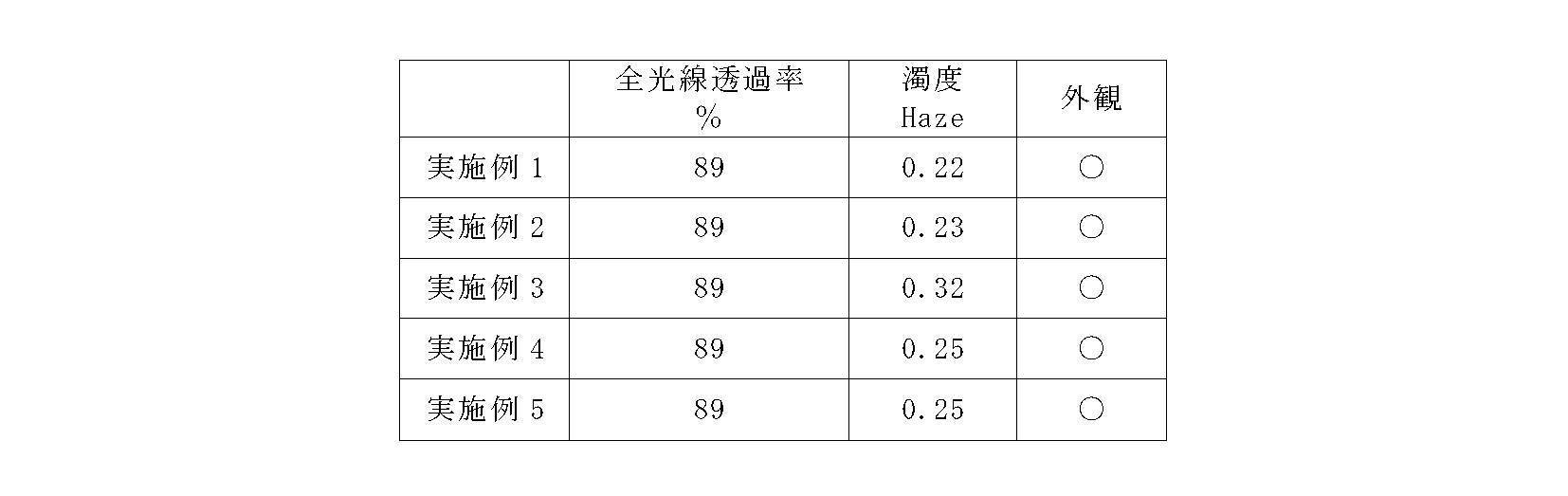
日本電色工業(株)製Spectro Color Meter SE2000とHaze Meter NDH2000を用い、実施例1~5の全光線透過率、濁度を測定した。すなわち、ポリエステル樹脂の中間点ガラス転移温度より約20℃低い温度(90~100℃)で10時間真空乾燥した後、住友重機械工業(株)製射出成型機SH50にて、シリンダー温度250℃、金型温度を樹脂のガラス転移温度より10~50℃低い温度として射出成形し、2mm厚の円板をサンプルとして使用した。なお、このサンプルの外観を、目視で評価した。すなわち、目視で濁りが認められない場合に○と評価した。
東洋精機製 MELT INDEXER T-111を使用し、260℃、2.16kg加重をかけて測定した。
充填塔式精留塔、分縮器、全縮器、コールドトラップ、撹拌機、加熱装置、窒素導入管を備えたポリエステル製造装置又は加熱装置、撹拌翼、分縮器、トラップ、温度計及び窒素ガス導入管を備えたガラス製フラスコに、後述する原料モノマーを仕込み、ジカルボン酸成分に対して酢酸亜鉛二水和物0.023モル%の存在下、窒素雰囲気下で230℃迄昇温してエステル交換反応を行った。ジカルボン酸成分の反応転化率を90%以上とした後、ジカルボン酸成分に対して酸化ゲルマニウム0.14モル%とリン酸0.12モル%を加え、昇温と減圧を徐々に行い、最終的に250~280℃、0.1kPa以下で重縮合を行った。適度な溶融粘度となった時点で反応を終了し、ポリエステル樹脂を回収した。
上記反応条件でナフタレンジカルボン酸ジメチル(以下NDCM)、エチレングリコール(以下EG)、ネオペンチルグリコール(NPG)を1/1/0.8のモル比で仕込み、重縮合を行った。得られたポリエステル樹脂の組成を分析したところ、EG/NPGを43/57の比率で含むものであった。
この樹脂の屈折率はnd=1.624、アッベ数νd=19.5であり、ガラス転移点Tgは113℃であった。またMVR=35cm3/10minであった。
NDCM/EG/NPGを1/1/0.6のモル比で仕込み、実施例1と同様の反応条件で重縮合を行った。得られたポリエステル樹脂の組成を分析したところ、EG/NPGを54/36の比率で含むものであった。
この樹脂の屈折率はnd=1.629、アッベ数νd=19.1であり、Tgは115℃であった。またMVR=40cm3/10minであった。
NDCM/EG/NPG=1/1/0.4のモル比で仕込み、実施例1と同様の反応条件で重縮合を行った。得られたポリエステル樹脂の組成を分析したところ、EG/NPGを82/18の比率で含むものであった。
この樹脂の屈折率はnd=1.635、アッベ数νd=18.8であり、Tgは118℃であった。またMVR=38cm3/10minであった。
NDCM/EG/NPGを1/1/1のモル比で仕込み、実施例1と同様の反応条件で重縮合を行った。得られたポリエステル樹脂の組成を分析したところ、EG/NPGを21/79比率で含むものであった。
この樹脂の屈折率はnd=1.618、アッベ数νd=19.8であり、Tgは110℃であった。またMVR=40cm3/10minであった。
NDCM、EG、NPGを1/1/0.8のモル比で仕込み、重縮合を行った。上記反応条件でより高粘度のポリエステル樹脂を得るべく、反応器の撹拌トルクを指標として重合度を管理し、実施例1~4よりも重縮合が進行したところで樹脂の抜き出しを行った。得られたポリエステル樹脂の組成を分析したところ、EG/NPGを43/57の比率で含むものであった。
この樹脂の屈折率はnd=1.624、アッベ数νd=19.5であり、ガラス転移点Tgは113℃であった。またMVR=17cm3/10minであった。
Claims (10)
- ジオール構成単位とジカルボン酸構成単位とを主として含むポリエステル樹脂であって、
前記ジオール構成単位中の10~84モル%がエチレングリコールに由来する構成単位であり、
前記ジオール構成単位中の16~90モル%が下記式(i)で表されるネオペンチルグリコールに由来する構成単位であり、
前記ジカルボン酸構成単位中の50~100モル%がナフタレンジカルボン酸に由来する構成単位である、ポリエステル樹脂。

- 前記ナフタレンジカルボン酸に由来する構成単位が2,6-ナフタレンジカルボン酸に由来する構成単位である、請求項1に記載のポリエステル樹脂。
- 前記ジカルボン酸構成単位中の90~100モル%がナフタレンジカルボン酸に由来する構成単位である、請求項1又は2に記載のポリエステル樹脂。
- 前記ジオール構成単位中の20~84モル%がエチレングリコールに由来する構成単位であり、
前記ジオール構成単位中の16~80モル%がネオペンチルグリコールに由来する構成単位である、請求項1~3のいずれか一項に記載のポリエステル樹脂。 - 以下の条件(1)及び(2)を満たす、請求項1~4のいずれか一項に記載のポリエステル樹脂:
(1)JIS規格K7121に準拠したプラスチックの転移温度測定方法において、前記ポリエステル樹脂の中間点ガラス転移温度の測定値が100℃以上である;
(2)前記ポリエステル樹脂のメルトボリュームレイトの測定値が10~80cm3/10minである。 - 以下の条件(3)を満たす、請求項1~5のいずれか一項に記載のポリエステル樹脂:
(3)前記ポリエステル樹脂の成形片を90~100℃で10時間アニール処理した試験片の屈折率が1.60以上であり、かつ、当該試験片のアッベ数が21以下である。 - 請求項1~6のいずれか一項に記載のポリエステル樹脂を成形して得られる、光学レンズ。
- 前記光学レンズが非球面レンズである、請求項7に記載の光学レンズ。
- 前記光学レンズがカメラ用レンズである、請求項7又は8に記載の光学レンズ。
- 請求項7~9のいずれか一項に記載の光学レンズと他の光学レンズとを含む、光学レンズ系。
Priority Applications (5)
| Application Number | Priority Date | Filing Date | Title |
|---|---|---|---|
| KR1020167027853A KR20160148523A (ko) | 2014-04-24 | 2015-04-21 | 폴리에스터 수지, 광학 렌즈 및 광학 렌즈계 |
| US15/305,483 US20170044311A1 (en) | 2014-04-24 | 2015-04-21 | Polyester resin, optical lens, and optical lens system |
| CN201580021650.7A CN106232673A (zh) | 2014-04-24 | 2015-04-21 | 聚酯树脂、光学透镜以及光学透镜系统 |
| JP2016514949A JP6516165B2 (ja) | 2014-04-24 | 2015-04-21 | ポリエステル樹脂、光学レンズ及び光学レンズ系 |
| EP15782713.0A EP3135705A4 (en) | 2014-04-24 | 2015-04-21 | Polyester resin, optical lens, and optical lens system |
Applications Claiming Priority (2)
| Application Number | Priority Date | Filing Date | Title |
|---|---|---|---|
| JP2014-090191 | 2014-04-24 | ||
| JP2014090191 | 2014-04-24 |
Publications (1)
| Publication Number | Publication Date |
|---|---|
| WO2015163323A1 true WO2015163323A1 (ja) | 2015-10-29 |
Family
ID=54332487
Family Applications (1)
| Application Number | Title | Priority Date | Filing Date |
|---|---|---|---|
| PCT/JP2015/062124 Ceased WO2015163323A1 (ja) | 2014-04-24 | 2015-04-21 | ポリエステル樹脂、光学レンズ及び光学レンズ系 |
Country Status (7)
| Country | Link |
|---|---|
| US (1) | US20170044311A1 (ja) |
| EP (1) | EP3135705A4 (ja) |
| JP (1) | JP6516165B2 (ja) |
| KR (1) | KR20160148523A (ja) |
| CN (1) | CN106232673A (ja) |
| TW (1) | TWI591092B (ja) |
| WO (1) | WO2015163323A1 (ja) |
Cited By (2)
| Publication number | Priority date | Publication date | Assignee | Title |
|---|---|---|---|---|
| WO2018062327A1 (ja) * | 2016-09-28 | 2018-04-05 | 三菱瓦斯化学株式会社 | 光学レンズ |
| WO2021200613A1 (ja) | 2020-03-31 | 2021-10-07 | 三菱瓦斯化学株式会社 | 樹脂組成物並びにそれを含む光学レンズ及び光学フィルム |
Families Citing this family (12)
| Publication number | Priority date | Publication date | Assignee | Title |
|---|---|---|---|---|
| KR102478201B1 (ko) * | 2017-03-31 | 2022-12-15 | 미츠비시 가스 가가쿠 가부시키가이샤 | 폴리카보네이트 수지 조성물 및 그것을 사용한 광학 렌즈 |
| TWI808126B (zh) | 2018-02-09 | 2023-07-11 | 日商三菱瓦斯化學股份有限公司 | 三芳基甲烷化合物 |
| WO2020080558A1 (en) | 2018-10-19 | 2020-04-23 | Mitsubishi Gas Chemical Company, Inc. | Polycyclic compounds |
| TW202016056A (zh) | 2018-10-19 | 2020-05-01 | 德商路透化學儀器公司 | 多環化合物 |
| KR20240063141A (ko) | 2021-09-10 | 2024-05-10 | 로이터 케미쉐 아파라테바우 이.카. | (헤트)아릴 치환된 비스페놀 화합물 및 열가소성 수지 |
| WO2023208837A1 (en) | 2022-04-26 | 2023-11-02 | Reuter Chemische Apparatebau E.K. | Oligomeric binaphthyl compounds and thermoplastic resins |
| CN120322420A (zh) | 2022-09-30 | 2025-07-15 | 三菱瓦斯化学株式会社 | 低聚联萘化合物和热塑性树脂 |
| WO2024115460A1 (en) | 2022-11-30 | 2024-06-06 | Reuter Chemische Apparatebau E.K. | Binaphthyl compounds and thermoplastic resins |
| WO2024184504A1 (en) | 2023-03-09 | 2024-09-12 | Reuter Chemische Apparatebau E.K. | Dibenzothiophene-substituted aromatic compounds and thermoplastic resins prepared therefrom |
| WO2024184503A1 (en) | 2023-03-09 | 2024-09-12 | Reuter Chemische Apparatebau E.K. | Sulfur-containing heterocyclic compounds and thermoplastic resins |
| WO2025088066A1 (en) | 2023-10-25 | 2025-05-01 | Reuter Chemische Apparatebau E.K. | Oligomeric binaphthyl compounds and thermoplastic resins |
| WO2025248024A1 (en) | 2024-05-29 | 2025-12-04 | Reuter Chemische Apparatebau E.K. | Binaphthyl compounds as additives in resin compositions |
Citations (6)
| Publication number | Priority date | Publication date | Assignee | Title |
|---|---|---|---|---|
| JP2000339663A (ja) * | 1999-05-24 | 2000-12-08 | Toyobo Co Ltd | 磁気記録媒体 |
| JP2000353312A (ja) * | 1999-06-09 | 2000-12-19 | Toyobo Co Ltd | 磁気記録媒体 |
| JP2009007548A (ja) * | 2007-05-30 | 2009-01-15 | Toyobo Co Ltd | 共重合ポリエステル樹脂 |
| WO2010004965A1 (ja) * | 2008-07-07 | 2010-01-14 | 三菱瓦斯化学株式会社 | 光学レンズ |
| JP2011520141A (ja) * | 2008-05-02 | 2011-07-14 | スリーエム イノベイティブ プロパティズ カンパニー | 分枝鎖又は環状のc4〜c10アルキル単位を有する複屈折ナフタレートコポリエステルを含む光学フィルム |
| US20130302582A1 (en) * | 2011-01-18 | 2013-11-14 | Toray Industries, Inc. | Laminated polyester film and hardcoat film |
Family Cites Families (4)
| Publication number | Priority date | Publication date | Assignee | Title |
|---|---|---|---|---|
| EP0576770B1 (en) | 1992-05-22 | 1999-12-22 | STMicroelectronics S.r.l. | Audio Amplifier turn-off control circuit |
| JP2006206770A (ja) * | 2005-01-28 | 2006-08-10 | Toyobo Co Ltd | 熱収縮性ポリエステル系フィルム及び熱収縮性ラベル |
| JP4908781B2 (ja) | 2005-06-06 | 2012-04-04 | 大阪瓦斯株式会社 | ポリエステル樹脂組成物および光学部品 |
| WO2012077700A1 (ja) * | 2010-12-10 | 2012-06-14 | 三菱瓦斯化学株式会社 | ポリエステル樹脂及び光学レンズ |
-
2015
- 2015-04-21 WO PCT/JP2015/062124 patent/WO2015163323A1/ja not_active Ceased
- 2015-04-21 KR KR1020167027853A patent/KR20160148523A/ko not_active Withdrawn
- 2015-04-21 US US15/305,483 patent/US20170044311A1/en not_active Abandoned
- 2015-04-21 EP EP15782713.0A patent/EP3135705A4/en not_active Withdrawn
- 2015-04-21 JP JP2016514949A patent/JP6516165B2/ja active Active
- 2015-04-21 CN CN201580021650.7A patent/CN106232673A/zh active Pending
- 2015-04-24 TW TW104113132A patent/TWI591092B/zh active
Patent Citations (6)
| Publication number | Priority date | Publication date | Assignee | Title |
|---|---|---|---|---|
| JP2000339663A (ja) * | 1999-05-24 | 2000-12-08 | Toyobo Co Ltd | 磁気記録媒体 |
| JP2000353312A (ja) * | 1999-06-09 | 2000-12-19 | Toyobo Co Ltd | 磁気記録媒体 |
| JP2009007548A (ja) * | 2007-05-30 | 2009-01-15 | Toyobo Co Ltd | 共重合ポリエステル樹脂 |
| JP2011520141A (ja) * | 2008-05-02 | 2011-07-14 | スリーエム イノベイティブ プロパティズ カンパニー | 分枝鎖又は環状のc4〜c10アルキル単位を有する複屈折ナフタレートコポリエステルを含む光学フィルム |
| WO2010004965A1 (ja) * | 2008-07-07 | 2010-01-14 | 三菱瓦斯化学株式会社 | 光学レンズ |
| US20130302582A1 (en) * | 2011-01-18 | 2013-11-14 | Toray Industries, Inc. | Laminated polyester film and hardcoat film |
Non-Patent Citations (1)
| Title |
|---|
| See also references of EP3135705A4 * |
Cited By (5)
| Publication number | Priority date | Publication date | Assignee | Title |
|---|---|---|---|---|
| WO2018062327A1 (ja) * | 2016-09-28 | 2018-04-05 | 三菱瓦斯化学株式会社 | 光学レンズ |
| KR20190060975A (ko) | 2016-09-28 | 2019-06-04 | 미츠비시 가스 가가쿠 가부시키가이샤 | 광학 렌즈 |
| US10947342B2 (en) | 2016-09-28 | 2021-03-16 | Mitsubishi Gas Chemical Company, Inc. | Optical lens |
| WO2021200613A1 (ja) | 2020-03-31 | 2021-10-07 | 三菱瓦斯化学株式会社 | 樹脂組成物並びにそれを含む光学レンズ及び光学フィルム |
| KR20220161254A (ko) | 2020-03-31 | 2022-12-06 | 미츠비시 가스 가가쿠 가부시키가이샤 | 수지 조성물 그리고 그것을 포함하는 광학 렌즈 및 광학 필름 |
Also Published As
| Publication number | Publication date |
|---|---|
| CN106232673A (zh) | 2016-12-14 |
| JPWO2015163323A1 (ja) | 2017-04-20 |
| TWI591092B (zh) | 2017-07-11 |
| JP6516165B2 (ja) | 2019-05-22 |
| EP3135705A1 (en) | 2017-03-01 |
| KR20160148523A (ko) | 2016-12-26 |
| US20170044311A1 (en) | 2017-02-16 |
| TW201544522A (zh) | 2015-12-01 |
| EP3135705A4 (en) | 2017-11-15 |
Similar Documents
| Publication | Publication Date | Title |
|---|---|---|
| JP5849967B2 (ja) | ポリエステル樹脂及び光学レンズ | |
| JP6516165B2 (ja) | ポリエステル樹脂、光学レンズ及び光学レンズ系 | |
| JP5531957B2 (ja) | 光学レンズ | |
| US9234986B2 (en) | Polyester resin and optical lens | |
| JP5741026B2 (ja) | アセナフテノン構造を有するグリコールおよびそれからなるポリエステル樹脂 | |
| JP5512618B2 (ja) | 共重合ポリエステル樹脂及びその成形体 | |
| JP2011012178A (ja) | ポリエステル樹脂組成物及び成形体 | |
| HK1176955A (en) | Polyester resin and optical lens | |
| HK1157020B (en) | Optical lens |
Legal Events
| Date | Code | Title | Description |
|---|---|---|---|
| 121 | Ep: the epo has been informed by wipo that ep was designated in this application |
Ref document number: 15782713 Country of ref document: EP Kind code of ref document: A1 |
|
| ENP | Entry into the national phase |
Ref document number: 2016514949 Country of ref document: JP Kind code of ref document: A |
|
| ENP | Entry into the national phase |
Ref document number: 20167027853 Country of ref document: KR Kind code of ref document: A |
|
| WWE | Wipo information: entry into national phase |
Ref document number: 15305483 Country of ref document: US |
|
| NENP | Non-entry into the national phase |
Ref country code: DE |
|
| REEP | Request for entry into the european phase |
Ref document number: 2015782713 Country of ref document: EP |
|
| WWE | Wipo information: entry into national phase |
Ref document number: 2015782713 Country of ref document: EP |