WO2015163416A1 - 着色ガラス板およびその製造方法 - Google Patents
着色ガラス板およびその製造方法 Download PDFInfo
- Publication number
- WO2015163416A1 WO2015163416A1 PCT/JP2015/062389 JP2015062389W WO2015163416A1 WO 2015163416 A1 WO2015163416 A1 WO 2015163416A1 JP 2015062389 W JP2015062389 W JP 2015062389W WO 2015163416 A1 WO2015163416 A1 WO 2015163416A1
- Authority
- WO
- WIPO (PCT)
- Prior art keywords
- glass plate
- terms
- colored glass
- total
- iron
- Prior art date
- Legal status (The legal status is an assumption and is not a legal conclusion. Google has not performed a legal analysis and makes no representation as to the accuracy of the status listed.)
- Ceased
Links
Classifications
-
- C—CHEMISTRY; METALLURGY
- C03—GLASS; MINERAL OR SLAG WOOL
- C03C—CHEMICAL COMPOSITION OF GLASSES, GLAZES OR VITREOUS ENAMELS; SURFACE TREATMENT OF GLASS; SURFACE TREATMENT OF FIBRES OR FILAMENTS MADE FROM GLASS, MINERALS OR SLAGS; JOINING GLASS TO GLASS OR OTHER MATERIALS
- C03C3/00—Glass compositions
- C03C3/04—Glass compositions containing silica
- C03C3/076—Glass compositions containing silica with 40% to 90% silica, by weight
- C03C3/095—Glass compositions containing silica with 40% to 90% silica, by weight containing rare earths
-
- C—CHEMISTRY; METALLURGY
- C03—GLASS; MINERAL OR SLAG WOOL
- C03C—CHEMICAL COMPOSITION OF GLASSES, GLAZES OR VITREOUS ENAMELS; SURFACE TREATMENT OF GLASS; SURFACE TREATMENT OF FIBRES OR FILAMENTS MADE FROM GLASS, MINERALS OR SLAGS; JOINING GLASS TO GLASS OR OTHER MATERIALS
- C03C3/00—Glass compositions
- C03C3/04—Glass compositions containing silica
- C03C3/062—Glass compositions containing silica with less than 40% silica by weight
-
- C—CHEMISTRY; METALLURGY
- C03—GLASS; MINERAL OR SLAG WOOL
- C03C—CHEMICAL COMPOSITION OF GLASSES, GLAZES OR VITREOUS ENAMELS; SURFACE TREATMENT OF GLASS; SURFACE TREATMENT OF FIBRES OR FILAMENTS MADE FROM GLASS, MINERALS OR SLAGS; JOINING GLASS TO GLASS OR OTHER MATERIALS
- C03C3/00—Glass compositions
- C03C3/04—Glass compositions containing silica
- C03C3/062—Glass compositions containing silica with less than 40% silica by weight
- C03C3/064—Glass compositions containing silica with less than 40% silica by weight containing boron
-
- C—CHEMISTRY; METALLURGY
- C03—GLASS; MINERAL OR SLAG WOOL
- C03C—CHEMICAL COMPOSITION OF GLASSES, GLAZES OR VITREOUS ENAMELS; SURFACE TREATMENT OF GLASS; SURFACE TREATMENT OF FIBRES OR FILAMENTS MADE FROM GLASS, MINERALS OR SLAGS; JOINING GLASS TO GLASS OR OTHER MATERIALS
- C03C3/00—Glass compositions
- C03C3/04—Glass compositions containing silica
- C03C3/076—Glass compositions containing silica with 40% to 90% silica, by weight
- C03C3/078—Glass compositions containing silica with 40% to 90% silica, by weight containing an oxide of a divalent metal, e.g. an oxide of zinc
-
- C—CHEMISTRY; METALLURGY
- C03—GLASS; MINERAL OR SLAG WOOL
- C03C—CHEMICAL COMPOSITION OF GLASSES, GLAZES OR VITREOUS ENAMELS; SURFACE TREATMENT OF GLASS; SURFACE TREATMENT OF FIBRES OR FILAMENTS MADE FROM GLASS, MINERALS OR SLAGS; JOINING GLASS TO GLASS OR OTHER MATERIALS
- C03C3/00—Glass compositions
- C03C3/04—Glass compositions containing silica
- C03C3/076—Glass compositions containing silica with 40% to 90% silica, by weight
- C03C3/083—Glass compositions containing silica with 40% to 90% silica, by weight containing aluminium oxide or an iron compound
-
- C—CHEMISTRY; METALLURGY
- C03—GLASS; MINERAL OR SLAG WOOL
- C03C—CHEMICAL COMPOSITION OF GLASSES, GLAZES OR VITREOUS ENAMELS; SURFACE TREATMENT OF GLASS; SURFACE TREATMENT OF FIBRES OR FILAMENTS MADE FROM GLASS, MINERALS OR SLAGS; JOINING GLASS TO GLASS OR OTHER MATERIALS
- C03C3/00—Glass compositions
- C03C3/04—Glass compositions containing silica
- C03C3/076—Glass compositions containing silica with 40% to 90% silica, by weight
- C03C3/083—Glass compositions containing silica with 40% to 90% silica, by weight containing aluminium oxide or an iron compound
- C03C3/085—Glass compositions containing silica with 40% to 90% silica, by weight containing aluminium oxide or an iron compound containing an oxide of a divalent metal
-
- C—CHEMISTRY; METALLURGY
- C03—GLASS; MINERAL OR SLAG WOOL
- C03C—CHEMICAL COMPOSITION OF GLASSES, GLAZES OR VITREOUS ENAMELS; SURFACE TREATMENT OF GLASS; SURFACE TREATMENT OF FIBRES OR FILAMENTS MADE FROM GLASS, MINERALS OR SLAGS; JOINING GLASS TO GLASS OR OTHER MATERIALS
- C03C3/00—Glass compositions
- C03C3/04—Glass compositions containing silica
- C03C3/076—Glass compositions containing silica with 40% to 90% silica, by weight
- C03C3/083—Glass compositions containing silica with 40% to 90% silica, by weight containing aluminium oxide or an iron compound
- C03C3/085—Glass compositions containing silica with 40% to 90% silica, by weight containing aluminium oxide or an iron compound containing an oxide of a divalent metal
- C03C3/087—Glass compositions containing silica with 40% to 90% silica, by weight containing aluminium oxide or an iron compound containing an oxide of a divalent metal containing calcium oxide, e.g. common sheet or container glass
-
- C—CHEMISTRY; METALLURGY
- C03—GLASS; MINERAL OR SLAG WOOL
- C03C—CHEMICAL COMPOSITION OF GLASSES, GLAZES OR VITREOUS ENAMELS; SURFACE TREATMENT OF GLASS; SURFACE TREATMENT OF FIBRES OR FILAMENTS MADE FROM GLASS, MINERALS OR SLAGS; JOINING GLASS TO GLASS OR OTHER MATERIALS
- C03C3/00—Glass compositions
- C03C3/04—Glass compositions containing silica
- C03C3/076—Glass compositions containing silica with 40% to 90% silica, by weight
- C03C3/089—Glass compositions containing silica with 40% to 90% silica, by weight containing boron
-
- C—CHEMISTRY; METALLURGY
- C03—GLASS; MINERAL OR SLAG WOOL
- C03C—CHEMICAL COMPOSITION OF GLASSES, GLAZES OR VITREOUS ENAMELS; SURFACE TREATMENT OF GLASS; SURFACE TREATMENT OF FIBRES OR FILAMENTS MADE FROM GLASS, MINERALS OR SLAGS; JOINING GLASS TO GLASS OR OTHER MATERIALS
- C03C3/00—Glass compositions
- C03C3/04—Glass compositions containing silica
- C03C3/076—Glass compositions containing silica with 40% to 90% silica, by weight
- C03C3/089—Glass compositions containing silica with 40% to 90% silica, by weight containing boron
- C03C3/091—Glass compositions containing silica with 40% to 90% silica, by weight containing boron containing aluminium
-
- C—CHEMISTRY; METALLURGY
- C03—GLASS; MINERAL OR SLAG WOOL
- C03C—CHEMICAL COMPOSITION OF GLASSES, GLAZES OR VITREOUS ENAMELS; SURFACE TREATMENT OF GLASS; SURFACE TREATMENT OF FIBRES OR FILAMENTS MADE FROM GLASS, MINERALS OR SLAGS; JOINING GLASS TO GLASS OR OTHER MATERIALS
- C03C4/00—Compositions for glass with special properties
- C03C4/02—Compositions for glass with special properties for coloured glass
-
- C—CHEMISTRY; METALLURGY
- C03—GLASS; MINERAL OR SLAG WOOL
- C03C—CHEMICAL COMPOSITION OF GLASSES, GLAZES OR VITREOUS ENAMELS; SURFACE TREATMENT OF GLASS; SURFACE TREATMENT OF FIBRES OR FILAMENTS MADE FROM GLASS, MINERALS OR SLAGS; JOINING GLASS TO GLASS OR OTHER MATERIALS
- C03C4/00—Compositions for glass with special properties
- C03C4/08—Compositions for glass with special properties for glass selectively absorbing radiation of specified wave lengths
-
- C—CHEMISTRY; METALLURGY
- C03—GLASS; MINERAL OR SLAG WOOL
- C03C—CHEMICAL COMPOSITION OF GLASSES, GLAZES OR VITREOUS ENAMELS; SURFACE TREATMENT OF GLASS; SURFACE TREATMENT OF FIBRES OR FILAMENTS MADE FROM GLASS, MINERALS OR SLAGS; JOINING GLASS TO GLASS OR OTHER MATERIALS
- C03C4/00—Compositions for glass with special properties
- C03C4/08—Compositions for glass with special properties for glass selectively absorbing radiation of specified wave lengths
- C03C4/082—Compositions for glass with special properties for glass selectively absorbing radiation of specified wave lengths for infrared absorbing glass
-
- C—CHEMISTRY; METALLURGY
- C03—GLASS; MINERAL OR SLAG WOOL
- C03B—MANUFACTURE, SHAPING, OR SUPPLEMENTARY PROCESSES
- C03B19/00—Other methods of shaping glass
- C03B19/02—Other methods of shaping glass by casting molten glass, e.g. injection moulding
Definitions
- the present invention relates to a colored glass plate and a method for producing the same.
- a heat ray absorbing glass plate for automobiles made of alkali-containing silica glass, which contains iron as a coloring component and has a blue or green transmitted light color tone is known (Patent Documents 1 to 4). ).
- Fe-Redox Iron in the glass exists as divalent or trivalent iron, and divalent iron has an absorption peak near a wavelength of 1100 nm, and trivalent iron has an absorption peak near a wavelength of 400 nm. Therefore, when focusing on blue or green color tone of transmitted light, the mass percentage of divalent iron in terms of Fe 2 O 3 in the total iron in terms of Fe 2 O 3 (hereinafter referred to as Fe-Redox.) Is preferably increased.
- the colored glass plate made of silica glass containing alkali contains sulfur derived from mirabilite (Na 2 SO 4 ) contained in the glass raw material as a fining agent.
- mirabilite Na 2 SO 4
- the clarification action increases as the mixing amount increases, and it becomes easier to remove bubbles during glass melting.
- sulfur derived from mirabilite is present as negative or hexavalent sulfur in the glass
- negative divalent sulfur is an amber color having a strong absorption in the vicinity of a wavelength of 380 nm
- hexavalent sulfur is colorless.
- the present invention reduces the amount of mirabilite (Na 2 SO 4 ) used as a clarifier and suppresses amber coloration derived from mirabilite, while converting to Fe 2 O 3 in the total iron converted to Fe 2 O 3.
- a colored glass plate that can stably maintain a mass ratio of valence iron at a high level and has few bubbles despite a small amount of total sulfur converted to SO 3 .
- the colored glass plate of the present invention contains each element of iron, tin, and sulfur, and the percentage of total sulfur converted to SO 3 in terms of oxide-based mass percentage is less than 0.025%, Fe 2 O the percentage of divalent iron in terms of Fe 2 O 3 in the total iron in terms of 3 is 45% or more, the percentage of divalent tin in terms of SnO 2 in the total tin in terms of SnO 2 is, It is characterized by comprising an alkali-containing silica glass having a mol percentage display of 0.1% or more and ⁇ -OH of 0.15 mm ⁇ 1 or more.
- the percentage of divalent tin in terms of SnO 2 in the total tin in terms of SnO 2 is preferably 0.2 to 40% by mole percentage display.
- the colored glass plate of the present invention preferably has a ratio of 443-420 ⁇ ⁇ -OH (mm ⁇ 1 ) ⁇ 4.8 ⁇ Fe-redox (%) of less than 100.
- Colored glass plate of the present invention the percentage of divalent iron in terms of Fe 2 O 3 in the total iron in terms of Fe 2 O 3 may be 55% or more.
- the colored glass plate of the present invention is an oxide-based mass percentage display, SiO 2 : 30 to 80%, Al 2 O 3 : 0 to 30%, B 2 O 3 : 0 to 20%, MgO: 0-30%, CaO: 0-30%, Na 2 O: 0.5 to 50%, K 2 O: 0 to 50%, Total iron in terms of Fe 2 O 3 : 0.001 to 5%, Total tin converted to SnO 2 : 0.001 to 5%, May be included.
- the colored glass plate of the present invention is a mass percentage display based on oxide, SiO 2 : 65 to 73%, Al 2 O 3 : 3 to 5%, B 2 O 3 : 0 to 1%, MgO: 0% or more and less than 2% CaO: 7 to 10%, Na 2 O: 12 to 16%, K 2 O: 1 to 5%, Total iron in terms of Fe 2 O 3 : 0.1 to 0.9%, preferably 0.3 to 0.9%, Total tin converted to SnO 2 : 0.02 to 0.3%, May be included.
- the colored glass plate of the present invention does not substantially contain B 2 O 3 and is expressed in terms of mass percentage based on oxide.
- SiO 2 65 to 73%, Al 2 O 3 : 3 to 5%, MgO: 0% or more and less than 2% CaO: 7 to 10%, Na 2 O: 12 to 16%, K 2 O: 1 to 5%, Total iron converted to Fe 2 O 3 : 0.3 to 0.9%, Total tin converted to SnO 2 : 0.02 to 0.3%, May be included.
- the colored glass plate of the present invention is a mass percentage display based on oxide, SiO 2 : 65 to 75%, Al 2 O 3 : 0 to 3%, B 2 O 3 : 0 to 1%, MgO: 2-5% CaO: 7-10%, Na 2 O: 11-15%, K 2 O: 0 to 5%, Total iron in terms of Fe 2 O 3 : 0.1 to 0.9%, Total tin converted to SnO 2 : 0.02 to 0.3%, May be included.
- the colored glass plate of the present invention may have a total sulfur ratio of 0.01% or more and less than 0.02% converted to SO 3 in terms of oxide-based mass percentage.
- the colored glass plate of the present invention may be substantially free of TiO 2 in order to obtain a blue glass plate for the purpose of adjusting the color tone of transmitted light.
- the colored glass plate of the present invention contains TiO 2 for the purpose of adjusting the color tone of transmitted light, in particular, to obtain a green glass plate, and its content is 3.0% or less in terms of oxide-based mass percentage. It may be.
- the colored glass plate of the present invention has a ratio Tv / Te of the visible light transmittance Tv (A light source, 2 degree visual field) defined by JIS R 3106 (1998) and the solar transmittance Te defined by JIS R 3106 (1998). It may be 1.3 or more in terms of 4 mm thickness of the plate.
- the colored glass plate of the present invention has a ratio Tv / Te of the visible light transmittance Tv (A light source, 2 degree visual field) defined by JIS R 3106 (1998) and the solar transmittance Te defined by JIS R 3106 (1998). It may be 1.85 or more in terms of 4 mm thickness of the plate.
- the solar transmittance Te defined in JIS R 3106 (1998) is 65% or less, preferably 50% or less in terms of 4 mm thickness of the glass plate, and JIS R 3106 (1998) defined.
- the visible light transmittance Tv (A light source, 2 degree visual field) of the glass plate may be 60% or more in terms of a 4 mm thickness conversion value.
- the method for producing a colored glass plate of the present invention includes each element of iron, tin, and sulfur, and the ratio of total sulfur converted to SO 3 in terms of oxide-based mass percentage is less than 0.025%, Fe the percentage of divalent iron in terms of Fe 2 O 3 in the total iron in terms of 2 O 3 is 45% or more, the percentage of divalent tin in terms of SnO 2 in the total tin in terms of SnO 2 However, it is characterized in that a colored glass plate having a molar percentage display of 0.1% or more and ⁇ -OH of 0.15 mm ⁇ 1 or more is obtained.
- the term “to” indicating the above numerical range is used in the sense that the numerical values described before and after it are used as the lower limit value and the upper limit value, and unless otherwise specified, “to” is the same in the following specification. Used with meaning.
- the amount of mirabilite (Na 2 SO 4 ) used as a refining agent is reduced, and the amber coloration derived from mirabilite is suppressed, and converted to Fe 2 O 3 in all iron converted to Fe 2 O 3 .
- the mass ratio of the divalent iron it is possible to stably maintain the mass ratio of the divalent iron at a high level, and it is possible to obtain a colored glass plate with few bubbles even though the total amount of sulfur converted to SO 3 is small.
- the colored glass plate of one embodiment of the present invention is an alkali-containing silica glass (for example, soda lime silica glass) containing less elements of iron and sulfur by reducing the amount of sodium nitrate (Na 2 SO 4 ) used as a refining agent.
- the ratio (mole percentage) of divalent tin converted to SnO 2 in all tin converted to SnO 2 further including tin shall be a predetermined ratio or more.
- Fe-Redox can be stably maintained at a high level, and ⁇ -OH as an index indicating the water content in the glass plate is set to a predetermined value, so that SO- Despite having a small amount of total sulfur converted to 3 , there is a feature that there are few bubbles.
- Iron in the glass exists as divalent or trivalent iron, and divalent iron has an absorption peak near a wavelength of 1100 nm, and trivalent iron has an absorption peak near a wavelength of 400 nm. Therefore, when paying attention to the blue or green color tone of transmitted light of the color tone, it is better that there is no absorption near the wavelength of 400 nm, and when expressed in Fe-Redox, it is necessary to increase the Fe-Redox. In addition, since divalent iron has an absorption peak in the vicinity of a wavelength of 1100 nm, the transmittance of heat transmitted through the colored glass plate (hereinafter referred to as Te) is small.
- the value of Fe-Redox is preferably 45% or more.
- the Te value is preferably 65% or less, preferably 50% or less, more preferably 45% or less, still more preferably 40% or less, and particularly preferably 35% or less, in terms of a 4 mm thickness converted value of the glass plate.
- the Fe-Redox in the colored glass plate of this embodiment is 45% or more. If Fe-Redox is 45% or more, Te can be kept low. On the other hand, if Fe-redox is too high, amber coloration occurs due to the production of minus divalent sulfur due to reduction of hexavalent sulfur.
- Fe-Redox is preferably 55% or more, preferably 55 to 90%, more preferably 58 to 80%, and particularly preferably 60 to 70%.
- Tin in the glass exists as divalent or tetravalent tin.
- divalent tin acts as an iron reducing agent
- Fe-Redox is high For example, over 90%
- tetravalent tin acts as an oxidizing agent for iron.
- the reduction of tin by a reducing agent such as coke occurs preferentially over the reduction of sulfur, so that the production of minus divalent sulfur can be suppressed even under conditions where Fe-Redox is 45% or more.
- tin acts as a buffer for iron or sulfur redox reactions. Therefore, in order to stably maintain Fe-Redox at a high level while suppressing amber color development, it is preferable to increase Sn-Redox.
- the Sn-Redox in the colored glass plate of this embodiment is 0.1% or more, preferably 0.1 to 50%.
- Sn-Redox is 0.1% or more, Fe-Redox can be stably maintained at a high level while suppressing amber color development. If Sn-Redox is 50% or less, reduction of hexavalent sulfur by excess divalent tin can be suppressed, and amber coloration due to the generation of minus divalent sulfur can be suppressed.
- Sn-Redox is preferably 0.2 to 40%, more preferably 1 to 40%, still more preferably 2 to 30%, and particularly preferably 3 to 10%.
- ⁇ -OH as an index indicating the water content in the colored glass plate of the present embodiment is 0.15 mm ⁇ 1 or more.
- ⁇ -OH is a value obtained by the following equation.
- ⁇ -OH (mm ⁇ 1 ) ⁇ log 10 (T 3500 cm ⁇ 1 / T 4000 cm ⁇ 1 ) / t
- T 3500 cm -1 is a wave number (wave number) 3500cm transmittance -1 (%)
- T 4000 cm -1 is the transmittance of the wave number 4000cm -1 (%)
- t is The thickness (mm) of the glass plate.
- ⁇ -OH of the heat ray absorbing glass plate of this embodiment By setting ⁇ -OH of the heat ray absorbing glass plate of this embodiment to 0.15 mm ⁇ 1 or more, the clarity can be improved and the temperature in the bending process can be lowered. 0.15 to 0.45 mm ⁇ 1 is preferable, 0.20 to 0.35 mm ⁇ 1 is more preferable, 0.23 to 0.30 mm ⁇ 1 is further preferable, and 0.25 to 0.28 mm ⁇ 1 is particularly preferable. .
- a raw material containing tin in a glass melting furnace capable of producing 3 tons of glass per day to a capacity of 3.6 m x 1.4 m x 0.65 m, and burned with a gas oxygen burner.
- ⁇ -OH can be made 0.15 mm ⁇ 1 or more.
- the colored glass plate of this embodiment is preferably made of alkali-containing silica glass having the following composition.
- SiO 2 30 to 80%
- Al 2 O 3 0 to 30%
- B 2 O 3 0 to 20%
- MgO 0-30%
- CaO 0-30%
- Na 2 O 0.5 to 50%
- K 2 O 0 to 50%
- Total iron in terms of Fe 2 O 3 0.001 to 5%
- Total tin converted to SnO 2 0.001 to 5%, including.
- SiO 2 65 to 73%, Al 2 O 3 : 3 to 5%, B 2 O 3 : 0 to 1%, MgO: 0% or more and less than 2% CaO: 7 to 10%, Na 2 O: 12 to 16%, K 2 O: 1 to 5%, Total iron in terms of Fe 2 O 3 : 0.1 to 0.9%, preferably 0.3 to 0.9%, Total tin converted to SnO 2 : 0.02 to 0.3%, including.
- the material is substantially free of B 2 O 3 and is expressed as a percentage by mass on an oxide basis, SiO 2 : 65 to 73%, Al 2 O 3 : 3 to 5%, MgO: 0% or more and less than 2% CaO: 7 to 10%, Na 2 O: 12 to 16%, K 2 O: 1 to 5%, Total iron converted to Fe 2 O 3 : 0.3 to 0.9%, Total tin converted to SnO 2 : 0.02 to 0.3%, including.
- SiO 2 65 to 75%
- Al 2 O 3 0 to 3%
- B 2 O 3 0 to 1%
- MgO 2-5%
- CaO 7-10%
- Na 2 O 11-15%
- K 2 O 0 to 5%
- Total iron in terms of Fe 2 O 3 0.1 to 0.9%
- Total tin converted to SnO 2 0.02 to 0.3%, including.
- the content of SiO 2 is preferably 50 to 80%, more preferably 60 to 75%, more preferably 65 to 75%, still more preferably 65 to 73%, and more preferably 67 to 71% in terms of mass percentage based on oxide. Is particularly preferred.
- Al 2 O 3 is a component that improves weather resistance. If the content of Al 2 O 3 is 30% or less, the meltability will be good.
- the content of Al 2 O 3 is preferably 0.5 to 15% by mass percentage based on oxides, more preferably 1-10%, more preferably 3-5%, 3.2 to 3.5% Is particularly preferred. When considering the difficulty of devitrification, 0 to 3%, more preferably 0.3 to 3% is particularly preferable.
- B 2 O 3 is a component that promotes melting of the glass raw material. If is less than 20% content of B 2 O 3, the softening point is less likely to be low.
- the content of B 2 O 3 is preferably from 0 to 10%, more preferably from 0 to 5%, further preferably from 0 to 1%, and particularly preferably substantially free from an oxide-based mass percentage. “Substantially free” means not containing any inevitable impurities (hereinafter the same).
- MgO is a component that promotes the melting of the glass raw material and improves the weather resistance. If the content of MgO is 30% or less, devitrification becomes difficult.
- the content of MgO is preferably 0 to 20%, more preferably 0 to 5%, more preferably 0 to 2%, still more preferably less than 2%, and substantially not contain, in terms of mass percentage based on oxide. Is particularly preferred. When considering the difficulty of devitrification, 2 to 5%, more preferably 3 to 5% is particularly preferable.
- CaO is a component that promotes the melting of the glass raw material and improves the weather resistance.
- the content of CaO is preferably from 0.1 to 20%, more preferably from 5 to 15%, further preferably from 7 to 10%, particularly preferably from 9 to 10% in terms of mass percentage based on oxide.
- Na 2 O is a component that promotes melting of the glass raw material.
- the content of Na 2 O is preferably 1 to 30%, more preferably 5 to 25%, further preferably 10 to 18%, further preferably 11% or more, and 12 to 16% in terms of mass percentage based on oxide. Is particularly preferable, 15% or less is more preferable, and 13 to 15% is most preferable.
- K 2 O is a component that promotes melting of the glass raw material. If 50% or less is the content of K 2 O, weather resistance is improved.
- the content of K 2 O is preferably 0 to 20%, more preferably 0 to 10%, more preferably 0.05% or more, and more preferably 5% or less in terms of mass percentage based on oxides, and 1 to 5%. More preferred is 1.1% to 2%, and most preferred is 1.3 to 1.7%.
- Fe 2 O 3 is a coloring component. If the total iron content converted to Fe 2 O 3 is 0.001% or more, Te can be kept low. If the total iron content converted to Fe 2 O 3 is 5% or less, the visible light transmittance of the glass will be good.
- the total iron content in terms of Fe 2 O 3 is preferably 0.005 to 4%, more preferably 0.01 to 3%, still more preferably 0.1 to 1% in terms of mass percentage based on oxide. 0.1 to 0.9% is more preferable, 0.15% or more is more preferable, 0.3 to 0.9% is particularly preferable, and 0.6 to 0.7% is most preferable.
- the total iron content is expressed as the amount of Fe 2 O 3 in accordance with the standard analysis method. As described above, all the iron present in the glass exists as trivalent iron. Not necessarily, but there is also divalent iron.
- SnO 2 is a component that acts as a buffer for redox reactions of iron and sulfur. If the content of total tin converted to SnO 2 is 0.001% or more, the action as a buffer can be sufficiently exhibited. If the total tin content converted to SnO 2 is 5% or less, the volatilization of SnO 2 is small and the cost can be kept low.
- the content of total tin in terms of SnO 2 is preferably 0.02% or more, preferably 0.02 to 3%, more preferably 0.05 to 1%, in terms of oxide-based mass percentage, 0.1% -0.5% is more preferable, 0.3% or less is more preferable, 0.15-0.3% is particularly preferable, and 0.17-0.25% is most preferable.
- the content of total tin is expressed as the amount of SnO 2 according to the standard analysis method.
- all tin present in the glass is present as tetravalent tin. Instead, divalent tin is also present.
- the colored glass plate of the present invention usually contains SO 3 derived from mirabilite (Na 2 SO 4 ) contained in the glass raw material as a fining agent. If the content of total sulfur converted to SO 3 is less than 0.025%, amber color development can be suppressed. In addition, when SO 3 is not included, the amber coloration derived from mirabilite becomes inconspicuous, but the clarification effect at the time of melting the glass is poor, foam residue is generated, and another work is required to remove the foam. Increase manufacturing costs.
- the total sulfur content in terms of SO 3 is preferably 0.005% or more and 0.02% or less, more preferably less than 0.02%, more preferably 0.010% or more, and 0.010 to 0.001.
- the total sulfur content is expressed as the amount of SO 3 according to the standard analysis method, but as described above, all the sulfur present in the glass exists as hexavalent sulfur. Instead, there is also negative divalent sulfur.
- the colored glass plate of the present invention is preferably substantially free of TiO 2 in order to obtain a blue glass plate, for the purpose of adjusting the color tone of transmitted light.
- the colored glass plate of the present invention contains TiO 2 for the purpose of adjusting the color tone of transmitted light, in particular, to obtain a green glass plate, and its content is 3.0% or less in terms of oxide-based mass percentage. It is preferable that TiO 2 is a component that imparts a yellow tone to transmitted light, and when used in combination with divalent iron that imparts a blue tone to transmitted light, the transmitted light has a green tone.
- the content of TiO 2 is more preferably 0.2 to 2.0%, further preferably 0.5 to 1.0%, particularly preferably 0.7 to 0.95%, and 0.8 to 0.92. % Is most preferred.
- Colored glass plate of the present invention optionally, SrO, BaO, preferably 5% or less ZrO 2 in total, more preferably 4% or less, more preferably 3% or less, still more preferably 2% or less Particularly preferably, it may contain 1% or less.
- SrO and BaO are components that promote melting of the glass raw material.
- ZrO 2 is a component that improves the elastic modulus of glass.
- the colored glass plate of the present invention may contain other colored components (CeO 2 , V 2 O 5 , CuO, CoO, Cr 2 O 3 , NiO, Se oxide) as necessary. , MnO, etc.) in a total amount, preferably 5% or less, more preferably 4% or less, and even more preferably 3% or less.
- other colored components CeO 2 , V 2 O 5 , CuO, CoO, Cr 2 O 3 , NiO, Se oxide
- the colored glass plate of the present invention may contain Sb 2 O 3 and As 2 O 3 used as other fining agents as necessary.
- the colored glass plate of the present invention has a ratio Tv / Te of solar radiation transmittance Te defined in JIS R 3106 (1998) and visible light transmittance Tv defined in JIS R 3106 (1998) (A light source, 2 degree visual field). It is preferably 1.30 in terms of 4 mm thickness of the glass plate, particularly preferably 1.85 or more. 1.9 or more is more preferable, 2.0 or more is further preferable, and 2.1 or more is particularly preferable. Te of the heat ray absorbing glass plate of the present invention is preferably 65% or less, preferably 50% or less, more preferably 40% or less, and further preferably 35% or less.
- Te of the heat ray absorbing glass plate means a value of Te when the plate thickness of the heat ray absorbing glass plate is converted to a thickness of 4 mm. Also referred to as “sales conversion (value)”. Te is the solar radiation transmittance calculated by measuring the transmittance with a spectrophotometer according to JIS R 3106 (1998) (hereinafter simply referred to as JIS R 3106).
- the Tv of the heat ray absorbing glass plate of the present invention is preferably 60% or more, more preferably 65% or more, and further preferably 70% or more.
- the Tv of the heat ray absorbing glass plate means a value of Tv when the thickness of the heat ray absorbing glass plate is converted to a thickness of 4 mm.
- Tv is the visible light transmittance calculated by measuring the transmittance with a spectrophotometer in accordance with JIS R 3106.
- a coefficient a standard A light source and a value of a 2-degree visual field are used.
- the colored glass plate of the present invention can be used for both vehicles and buildings, and is particularly suitable as a windshield for automobiles.
- a window glass for automobiles it is used as necessary, as laminated glass in which a plurality of glass plates are sandwiched between interlayer films, glass obtained by processing a flat glass into a curved surface, or glass that has been tempered.
- a multilayer glass for construction it is used as a multilayer glass composed of two colored glass plates of the present invention, or a multilayer glass of the colored glass plate of the present invention and another glass plate.
- the colored glass plate of the present invention can be produced by a known molding method such as a float method or a fusion method (down draw method).
- the colored glass plate of the present invention is produced, for example, through the following steps (i) to (v) in order.
- a glass raw material is prepared by mixing a glass mother composition raw material such as silica sand, a coloring component raw material such as an iron source and a titanium source, a reducing agent, a clarifying agent and the like so as to achieve a target composition.
- a glass raw material is continuously supplied to a melting kiln, heated to about 1500 ° C. with heavy oil, natural gas, or the like and melted to obtain molten glass.
- the molten glass is clarified, it is formed into a glass plate having a predetermined thickness by a float method or the like.
- the glass plate After slowly cooling the glass plate, it is cut into a predetermined size to obtain the colored glass plate of the present invention.
- the cut glass plate may be tempered, processed into a laminated glass, or processed into a multilayer glass.
- silica glass silica glass
- silica glass silica glass
- normal alkalis such as silica sand
- the iron source include iron powder, iron oxide powder, and bengara.
- the titanium source include titanium oxide.
- the reducing agent include coke. The reducing agent is for suppressing the oxidation of iron in the molten glass and adjusting the target Fe-Redox.
- tin acts as a buffer for the oxidation-reduction reaction of iron or sulfur. Therefore, Fe-Redox can be stably maintained at a high level while suppressing amber coloration due to divalent sulfur. Further, by setting ⁇ -OH to 0.15 mm ⁇ 1 or more, a colored glass plate with few bubbles despite the small total sulfur amount converted to SO 3 is obtained.
- Fe-Redox was calculated from the transmittance measured with a spectrophotometer (Lambda 950, manufactured by Perkin Elmer).
- the ⁇ -ray exit of the radiation source, a glass sample, a Pd filter, and a light receiving portion of a gas amplification proportional counter (manufactured by LND, model number 45431) were arranged on a straight line having a length of 300 to 800 mm.
- a gas amplification proportional counter manufactured by LND, model number 45431
- the speed of the radiation source was adjusted by using a transducer (manufactured by Toyo Research Co., Ltd.) so as to vibrate at a speed of ⁇ 10 to +10 mm / sec in the axial direction of the optical system.
- the glass sample As the glass sample, a glass plate obtained by polishing the obtained glass plate to a thickness of 3 to 7 mm was used.
- the Pd filter is for improving the measurement accuracy of ⁇ rays by the gas amplification proportional counter, and has a thickness of 50 ⁇ m for removing characteristic X-rays generated from the glass sample when the ⁇ ray is irradiated on the glass sample. Pd foil.
- the gas amplification proportional counter detects the received ⁇ -rays.
- An electric signal indicating the ⁇ dose from the gas amplification proportional counter was amplified by an amplifying device (manufactured by Kansai Electronics Co., Ltd.) to detect a light reception signal.
- the speed information was linked with a multi-channel analyzer (CMCA550, manufactured by Wissel).
- the spectrum is obtained by expressing the detection signal from the gas amplification proportional counter on the vertical axis and the velocity of the moving radiation source on the horizontal axis (Hiroshi Sato, Motomi Katada, “Mossbauer Spectroscopy”). Fundamentals and Applications ", Society Press, p. 45-64).
- the integration time required 2 to 16 days before an evaluable signal / noise ratio was obtained.
- a peak appearing near 0 mm / sec indicates the presence of tetravalent tin
- a split peak appearing near 2.5 mm / sec and 4.5 mm / sec indicates the presence of divalent tin.
- ⁇ -OH was calculated from the infrared absorption spectrum curve of the glass measured by FT-IR based on the following formula.
- ⁇ -OH (mm ⁇ 1 ) ⁇ log 10 (T 3500 cm ⁇ 1 / T 4000 cm ⁇ 1 ) / t
- T 3500 cm -1 is the wave number transmittance (wave number) 3500cm -1 (% )
- T 4000 cm -1 is the transmittance of the wave number 4000cm -1 (%)
- t is It is the thickness (mm) of the glass plate.
- Example 1 to 22 Various glass matrix composition materials such as silica sand, coke, iron source, SnO 2 , and mirabilite (Na 2 SO 4 ) were mixed so that the compositions shown in Tables 1 to 3 were obtained, thereby preparing glass materials.
- the glass raw material was put in a crucible and heated at 1500 ° C. for 2 hours to obtain molten glass.
- ⁇ -OH was controlled by bubbling with water vapor in the molten glass.
- Molten glass was poured onto a carbon plate and cooled. Both surfaces were polished to obtain a glass plate having a thickness of 4 mm.
- Fe-Redox, Sn-Redox, and ⁇ -OH were determined for the glass plate.
- Tables 1 to 3 In the composition columns of Tables 1 to 3, Fe 2 O 3 represents the total iron content, SnO 2 represents the total tin content, and SO 3 represents the total sulfur content.
- the numerical values in parentheses in Table 3 indicate calculated values.
- the colored glass plates of Examples 1 to 16 and 19 to 22 of the present invention have Sn-Redox exceeding 0.1%, Fe-Redox is maintained at a high level, and amber color development is suppressed.
- ⁇ -OH was 0.15 mm ⁇ 1 or more
- the index of the number of bubbles in the glass plate was less than 100, and the bubble gas contained in the glass plate was small.
- the glass plates of Examples 17 and 18 which are comparative examples have low ⁇ -OH, and the index of the number of bubbles in the glass plate exceeds 100, and the number of bubbles in the glass plate produced in the glass melting furnace increases.
- the method for producing a colored glass plate of the present invention is useful as a glass plate for vehicles and buildings, and is particularly suitable as a heat ray absorbing glass plate for buildings. It should be noted that the entire contents of the specification, claims and abstract of Japanese Patent Application No. 2014-089595 filed on April 23, 2014 are incorporated herein as the disclosure of the present invention.
Landscapes
- Chemical & Material Sciences (AREA)
- Life Sciences & Earth Sciences (AREA)
- Engineering & Computer Science (AREA)
- Chemical Kinetics & Catalysis (AREA)
- General Chemical & Material Sciences (AREA)
- Geochemistry & Mineralogy (AREA)
- Materials Engineering (AREA)
- Organic Chemistry (AREA)
- Glass Compositions (AREA)
Abstract
Description
芒硝(Na2SO4)を使用する場合、混入量が多いほど清澄作用が高くなり、ガラス溶解時の泡を取り除くことが容易になる。しかし、芒硝由来の硫黄はガラス中でマイナス2価または6価の硫黄として存在し、マイナス2価の硫黄は波長380nm付近に強い吸収を有するアンバー色であり、6価の硫黄は無色である。そのため、透過光が目的とする色調を有する着色ガラス板とするためには、硫黄の混入量を少なくし、また、マイナス2価の硫黄の生成(アンバー発色)をできるだけ抑えることが好ましい。しかし、硫黄の混入量が少ないと清澄作用が小さくなり、ガラス溶解時の泡を取り除くことが困難となる。
本発明は、清澄剤として使用する芒硝(Na2SO4)の量を少なくし、芒硝由来のアンバー発色を抑えつつ、Fe2O3に換算した全鉄中のFe2O3に換算した2価の鉄の質量割合を高いレベルで安定的に維持でき、SO3に換算した全硫黄量が少ないにもかかわらず泡が少ない着色ガラス板を提供する。
本発明の着色ガラス板は、SnO2に換算した全スズ中のSnO2に換算した2価のスズの割合が、モル百分率表示で0.2~40%であることが好ましい。
本発明の着色ガラス板は、443-420×β-OH(mm-1)-4.8×Fe-redox(%)が100未満であることが好ましい。
本発明の着色ガラス板は、Fe2O3に換算した全鉄中のFe2O3に換算した2価の鉄の割合が55%以上であってよい。
本発明の着色ガラス板は、酸化物基準の質量百分率表示で、
SiO2 :30~80%、
Al2O3 :0~30%、
B2O3 :0~20%、
MgO :0~30%、
CaO :0~30%、
Na2O :0.5~50%、
K2O :0~50%、
Fe2O3に換算した全鉄:0.001~5%、
SnO2に換算した全スズ:0.001~5%、
を含んでよい。
また本発明の着色ガラス板は、酸化物基準の質量百分率表示で、
SiO2 :65~73%、
Al2O3 :3~5%、
B2O3 :0~1%、
MgO :0%以上、2%未満
CaO :7~10%、
Na2O :12~16%、
K2O :1~5%、
Fe2O3に換算した全鉄:0.1~0.9%、好ましくは0.3~0.9%、
SnO2に換算した全スズ:0.02~0.3%、
を含んでよい。
また本発明の着色ガラス板は、B2O3を実質的に含まず、酸化物基準の質量百分率表示で、
SiO2 :65~73%、
Al2O3 :3~5%、
MgO :0%以上、2%未満
CaO :7~10%、
Na2O :12~16%、
K2O :1~5%、
Fe2O3に換算した全鉄:0.3~0.9%、
SnO2に換算した全スズ:0.02~0.3%、
を含んでよい。
また本発明の着色ガラス板は、酸化物基準の質量百分率表示で、
SiO2 :65~75%、
Al2O3 :0~3%、
B2O3 :0~1%、
MgO :2~5%
CaO :7~10%、
Na2O :11~15%、
K2O :0~5%、
Fe2O3に換算した全鉄:0.1~0.9%、
SnO2に換算した全スズ:0.02~0.3%、
を含んでよい。
本発明の着色ガラス板は、酸化物基準の質量百分率表示でSO3に換算した全硫黄の割合が、0.01%以上、0.02%未満であってよい。
本発明の着色ガラス板は、透過光の色調を調整する目的で、特に青色のガラス板を得るためにはTiO2を実質的に含まなくてよい。
本発明の着色ガラス板は、透過光の色調を調整する目的で、特に緑色のガラス板を得るためにはTiO2を含み、その含有量が酸化物基準の質量百分率表示で3.0%以下であってよい。
本発明の着色ガラス板は、JIS R 3106(1998)規定の可視光透過率Tv(A光源、2度視野)とJIS R 3106(1998)規定の日射透過率Teの比Tv/Teが、ガラス板の4mm厚さ換算値で1.3以上であってよい。
本発明の着色ガラス板は、JIS R 3106(1998)規定の可視光透過率Tv(A光源、2度視野)とJIS R 3106(1998)規定の日射透過率Teの比Tv/Teが、ガラス板の4mm厚さ換算値で1.85以上であってよい。
本発明の着色ガラス板は、JIS R 3106(1998)規定の日射透過率Teがガラス板の4mm厚さ換算値で65%以下で、好ましくは50%以下で、かつJIS R 3106(1998)規定の可視光透過率Tv(A光源、2度視野)がガラス板の4mm厚さ換算値で60%以上であってよい。
本発明の着色ガラス板の製造方法は、鉄、スズおよび硫黄の各元素を含み、酸化物基準の質量百分率表示でSO3に換算した全硫黄の割合が、0.025%未満であり、Fe2O3に換算した全鉄中のFe2O3に換算した2価の鉄の割合が45%以上であり、SnO2に換算した全スズ中のSnO2に換算した2価のスズの割合が、モル百分率表示で0.1%以上であり、β-OHが0.15mm-1以上である着色ガラス板を得ることを特徴とする。
上記した数値範囲を示す「~」とは、その前後に記載された数値を下限値及び上限値として含む意味で使用され、特段の定めがない限り、以下本明細書において「~」は、同様の意味をもって使用される。
本発明の一実施形態の着色ガラス板は、清澄剤として使用する芒硝(Na2SO4)の量を少なくし、鉄および硫黄の各元素を含む、アルカリ含有シリカガラス(たとえばソーダライムシリカガラス)に、さらにスズを含め、かつSnO2に換算した全スズ中のSnO2に換算した2価のスズの割合(モル百分率)(以下、Sn-Redoxと記す。)を所定の割合以上とすることによって、芒硝由来のアンバー発色を抑えつつ、Fe-Redoxを高いレベルで安定的に維持でき、ガラス板の中の水分含有量を示す指標としてのβ-OHを所定の値にすることによって、SO3に換算した全硫黄量が少ないにもかかわらず泡が少ないことに特徴がある。
また、2価の鉄は波長1100nm付近に吸収のピークを有するために、着色ガラス板を透過する熱の透過率(以下、Teと記す。)は小さくなる。Fe-Redoxを高めることはTeの点からも好ましく、Fe-Redoxの値は45%以上であることが好ましい。
その際のTeの値は、ガラス板の4mm厚さ換算値で65%以下が好ましく、50%以下が好ましく、45%以下がより好ましく、40%以下がさらに好ましく、35%以下が特に好ましい。
β-OH(mm-1)=-log10(T3500cm-1/T4000cm-1)/t
上記式において、T3500cm-1は、波数(wave number)3500cm-1の透過率(%)であり、T4000cm-1は、波数4000cm-1の透過率(%)であり、tは、ガラス板の厚さ(mm)である。
本実施形態の熱線吸収ガラス板のβ-OHを0.15mm-1以上にすることによって、清澄性を向上させることができ、かつ曲げ工程での温度を下げることができる。0.15~0.45mm-1が好ましく、0.20~0.35mm-1がより好ましく、0.23~0.30mm-1がさらに好ましく、0.25~0.28mm-1が特に好ましい。
また、我々は、1日3トンのガラスを作製できるガラス溶解炉に3.6m×1.4m×0.65mの容量となるようにスズを含む原料を入れ、ガス酸素バーナーで燃焼して作製したガラス中に含まれるFe-redoxとβ-OHを算出し、泡数を計測することで、スズを含むガラスでは、次の式に示す「ガラス板の泡数の指標」が100未満となるとガラス溶解時の泡を容易に取り除くことができることを見出した。
ガラス板の泡数の指標 = 443-420×β-OH(mm-1)-4.8×Fe-redox(%)
この指標は、100未満であることが好ましく、50未満であることがより好ましく、40未満であることがさらに好ましく、30未満であることが特に好ましい。
β-OHを高くするための手法として、ガラス溶解炉での燃焼方式を空気燃焼ではなく酸素燃焼にする、ガラス溶解炉のガラス融液中に水蒸気をバブリングする、といったことが挙げられる。これらの手法を用いることによりβ-OHを0.15mm-1以上とすることができる。
酸化物基準の質量百分率表示で、
SiO2 :30~80%、
Al2O3 :0~30%、
B2O3 :0~20%、
MgO :0~30%、
CaO :0~30%、
Na2O :0.5~50%、
K2O :0~50%、
Fe2O3に換算した全鉄:0.001~5%、
SnO2に換算した全スズ:0.001~5%、
を含む。
好ましくは、酸化物基準の質量百分率表示で、
SiO2 :65~73%、
Al2O3 :3~5%、
B2O3 :0~1%、
MgO :0%以上、2%未満
CaO :7~10%、
Na2O :12~16%、
K2O :1~5%、
Fe2O3に換算した全鉄:0.1~0.9%、好ましくは0.3~0.9%、
SnO2に換算した全スズ:0.02~0.3%、
を含む。
好ましくは、B2O3を実質的に含まず、酸化物基準の質量百分率表示で、
SiO2 :65~73%、
Al2O3 :3~5%、
MgO :0%以上、2%未満
CaO :7~10%、
Na2O :12~16%、
K2O :1~5%、
Fe2O3に換算した全鉄:0.3~0.9%、
SnO2に換算した全スズ:0.02~0.3%、
を含む。
好ましくは、酸化物基準の質量百分率表示で、
SiO2 :65~75%、
Al2O3 :0~3%、
B2O3 :0~1%、
MgO :2~5%
CaO :7~10%、
Na2O :11~15%、
K2O :0~5%、
Fe2O3に換算した全鉄:0.1~0.9%、
SnO2に換算した全スズ:0.02~0.3%、
を含む。
Al2O3の含有量が30%以下であれば、溶融性が良好となる。Al2O3の含有量は、酸化物基準の質量百分率表示で0.5~15%が好ましく、1~10%がより好ましく、3~5%がさらに好ましく、3.2~3.5%が特に好ましい。失透しにくさを考慮する場合は、0~3%、さらには0.3~3%が特に好ましい。
B2O3の含有量が20%以下であれば、軟化点が低くなりにくい。B2O3の含有量は、酸化物基準の質量百分率表示で0~10%が好ましく、0~5%がより好ましく、0~1%がさらに好ましく、実質的に含まないことが特に好ましい。実質的に含まないとは、不可避的不純物を除き含有しないことをいう(以下、同じ)。
MgOの含有量が30%以下であれば、失透しにくくなる。MgOの含有量は、酸化物基準の質量百分率表示で0~20%が好ましく、0~5%がより好ましく、0~2%がさらに好ましく、2%未満がさらに好ましく、実質的に含有しないことが特に好ましい。失透しにくさを考慮する場合は、2~5%、さらには3~5%が特に好ましい。
CaOの含有量が0.1%以上であれば、溶融性、耐候性が良好となる。CaOの含有量が30%以下であれば、失透しにくくなる。CaOの含有量は、酸化物基準の質量百分率表示で0.1~20%が好ましく、5~15%がより好ましく、7~10%がさらに好ましく、9~10%が特に好ましい。
Na2Oの含有量が0.5%以上であれば、溶融性が良好となる。Na2Oの含有量が50%以下であれば、耐候性が良好となる。Na2Oの含有量は、酸化物基準の質量百分率表示で1~30%が好ましく、5~25%がより好ましく、10~18%がさらに好ましく、11%以上がさらに好ましく、12~16%が特に好ましく、15%以下がより好ましく、13~15%が最も好ましい。
K2Oの含有量が50%以下であれば、耐候性が良好となる。K2Oの含有量は、酸化物基準の質量百分率表示で0~20%が好ましく、0~10%がより好ましく、0.05%以上が好ましく、5%以下が好ましく、1~5%がさらに好ましく、1.1%~2%が特に好ましく、1.3~1.7%が最も好ましい。
Fe2O3に換算した全鉄の含有量が0.001%以上であれば、Teを低く抑えることができる。Fe2O3に換算した全鉄の含有量が5%以下であれば、ガラスの可視光透過率が良好となる。Fe2O3に換算した全鉄の含有量は、酸化物基準の質量百分率表示で0.005~4%が好ましく、0.01~3%がより好ましく、0.1~1%がさらに好ましく、0.1~0.9%がさらに好ましく、0.15%以上がさらに好ましく、0.3~0.9%が特に好ましく、0.6~0.7%が最も好ましい。
本明細書においては、全鉄の含有量を標準分析法にしたがってFe2O3の量として表しているが、上述したように、ガラス中に存在する鉄がすべて3価の鉄として存在しているわけではなく、2価の鉄も存在する。
SnO2に換算した全スズの含有量が0.001%以上であれば、緩衝剤をしての作用を充分に発揮できる。SnO2に換算した全スズの含有量が5%以下であれば、SnO2の揮散が少なく、コストを低く抑えることができる。SnO2に換算した全スズの含有量は、酸化物基準の質量百分率表示で0.02%以上が好ましく、0.02~3%が好ましく、0.05~1%がより好ましく、0.1~0.5%がさらに好ましく、0.3%以下がさらに好ましく、0.15~0.3%が特に好ましく、0.17~0.25%が最も好ましい。
本明細書においては、全スズの含有量を標準分析法にしたがってSnO2の量として表しているが、上述したように、ガラス中に存在するスズがすべて4価のスズとして存在しているわけではなく、2価のスズも存在する。
SO3に換算した全硫黄の含有量が0.025%未満であれば、アンバー発色が抑えられる。また、SO3を含まない場合は、芒硝由来のアンバー発色は目立たなくなるが、ガラス溶解時の清澄効果が悪く、泡残りが発生したり、また、泡を抜くために別の作業が必要になったりし製造コストを押し上げる。SO3に換算した全硫黄の含有量は、0.005%以上、0.02%以下が好ましく、さらに0.02%未満が好ましく、0.010%以上がより好ましく、0.010~0.018%がさらに好ましく、0.013~0.016%が特に好ましい。
本明細書においては、全硫黄の含有量を標準分析法にしたがってSO3の量として表しているが、上述したように、ガラス中に存在する硫黄がすべて6価の硫黄として存在しているわけではなく、マイナス2価の硫黄も存在する。
本発明の熱線吸収ガラス板のTeは、65%以下が好ましく、50%以下であることが好ましく、40%以下がより好ましく、35%以下であることがさらに好ましい。本発明において、熱線吸収ガラス板のTeとは、熱線吸収ガラス板の板厚を4mmの厚さに換算としたときのTeの値を意味するものであり、本明細書において、単に「4mm厚さ換算(値)」とも表記している。Teは、JIS R 3106(1998)(以下、単にJIS R 3106と記す。)にしたがい分光光度計により透過率を測定し算出された日射透過率である。
本発明の熱線吸収ガラス板のTvは、60%以上であることが好ましく、65%以上であることがより好ましく、70%以上であることがさらに好ましい。本発明において、熱線吸収ガラス板のTvとは、熱線吸収ガラス板の板厚を4mmの厚さに換算としたときのTvの値を意味するものであり、本明細書において、単に「4mm厚さ換算(値)」とも表記している。Tvは、JIS R 3106にしたがい分光光度計により透過率を測定し算出された可視光透過率である。係数は標準のA光源、2度視野の値を用いる。
本発明の着色ガラス板は、たとえば、下記の工程(i)~(v)を順に経て製造される。
(i)目標とする組成になるように、珪砂等のガラス母組成原料、鉄源、チタン源等の着色成分原料、還元剤、清澄剤等を混合し、ガラス原料を調製する。
(ii)ガラス原料を連続的に溶融窯に供給し、重油、天然ガス等により約1500℃に加熱し溶融させて溶融ガラスとする。
(iii)溶融ガラスを清澄した後、フロート法等により所定の厚さのガラス板に成形する。
(iv)ガラス板を徐冷した後、所定の大きさに切断し、本発明の着色ガラス板とする。
(v)必要に応じて、切断したガラス板を強化処理してもよく、合せガラスに加工してもよく、複層ガラスに加工してもよい。
鉄源としては、鉄粉、酸化鉄粉、ベンガラ等が挙げられる。
チタン源としては、酸化チタン等が挙げられる。
還元剤としては、コークス等が挙げられる。還元剤は、溶融ガラス中の鉄の酸化を抑制し、目標のFe-Redoxとなるように調整するためのものである。
例1~16、19~22は実施例であり、例17、18は比較例である。
得られたガラス板について、分光光度計(Perkin Elmer社製、Lambda950)により測定した透過率からFe-Redoxを算出した。
得られたガラス板について、下記のSn-メスバウアー分光法によってガラス中の2価のスズおよび4価のスズの含有量を室温で測定し、Sn-Redoxを算出した。
119mSnから119Snへのエネルギ遷移に伴って発生するγ線(23.8keV)をプローブにして、透過法(ガラス試料を透過したγ線を計測)により、試料中の2価のスズと4価のスズとの存在割合(Sn-Redox)を測定した。具体的には、下記の通りである。
放射線源としては、10mCiの119mSnを用い、光学系の軸方向に対して放射線源を運動させ、ドップラー効果によるγ線のエネルギ変化を起こさせた。放射線源の速度はトランスデューサ(東陽リサーチ社製)を用いて、光学系の軸方向に-10~+10mm/秒の速度で振動するように調整した。
ガラス試料としては、得られたガラス板を3~7mmの厚さに研磨したガラス板を用いた。
Pdフィルタは、気体増幅比例計数管によるγ線の計測精度を向上させるためのものであり、γ線がガラス試料に照射された際にガラス試料から発生する特性X線を除去する厚さ50μmのPd箔である。
気体増幅比例計数管は、受光したγ線を検出するものである。気体増幅比例計数管からのγ線量を示す電気信号を増幅装置(関西電子社製)で増幅して受光信号を検出した。マルチチャンネルアナライザ(Wissel社製、CMCA550)で前記速度情報と連動させた。
0mm/秒付近に出現するピークが4価のスズの存在を示し、2.5mm/秒および4.5mm/秒付近に出現する2つに分裂したピークが2価のスズの存在を示す。それぞれのピーク面積に補正係数(Darja Benner、他著、「The effect of alumina on the Sn2+/Sn4+ redox equilibrium and the incorporation of tin in Na2O/Al2O3/SiO2 melts」、Journal of Non-Crystaline Solids、337、2004年、p.232-240)(4価のスズ:0.22、2価のスズ:0.49)を乗じたものの割合を計算し、Sn-Redoxを算出した。
得られたガラス板について、JIS R3106規定の可視光透過率(Tv)(A光源によるもの)を4mm厚さ換算値で求めた。
得られたガラス板について、JIS R3106規定の日射透過率(Te)を4mm厚さ換算値で求めた。
得られたガラス板について、FT-IRにより測定したガラスの赤外線吸収スペクトル曲線から下式に基づき、β-OHを算出した。
β-OH(mm-1)=-log10(T3500cm-1/T4000cm-1)/t
ここで、T3500cm-1は、波数(wave number)3500cm-1の透過率(%)であり、T4000cm-1は、波数4000cm-1の透過率(%)であり、tは、ガラス板の厚さ(mm)である。
得られたガラス板について、Fe-redoxとβ-OHを算出し、下式に基づき、ガラス板の泡数の指標を算出した。
ガラス板の泡数の指標 = 443-420×β-OH(mm-1)-4.8×Fe-redox(%)
表1~3に示す組成となるように、珪砂等の各種のガラス母組成原料、コークス、鉄源、SnO2、芒硝(Na2SO4)を混合し、ガラス原料を調製した。ガラス原料をるつぼに入れ、1500℃で2時間加熱し、溶融ガラスとした。溶融ガラス中に水蒸気でバブリングを行うことでβ-OHを制御した。溶融ガラスをカーボン板上に流し出し、冷却した。両面を研磨し、厚さ4mmのガラス板を得た。ガラス板について、Fe-Redox、Sn-Redox、β-OHを求めた。結果を表1~3に示す。
なお、表1~3の組成の欄において、Fe2O3は全鉄量を、SnO2は全錫量、SO3は全硫黄量を示している。また表3のカッコの数値は計算値を示す。

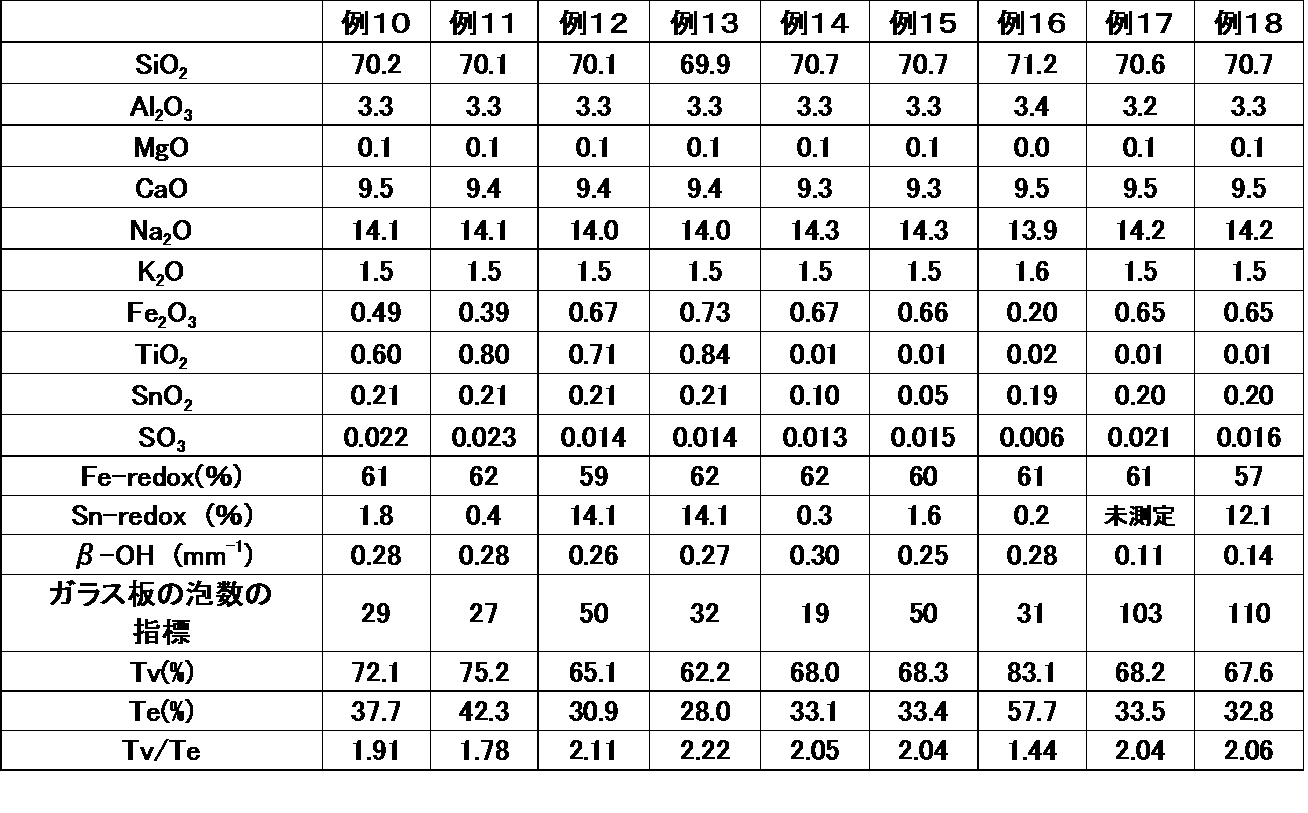
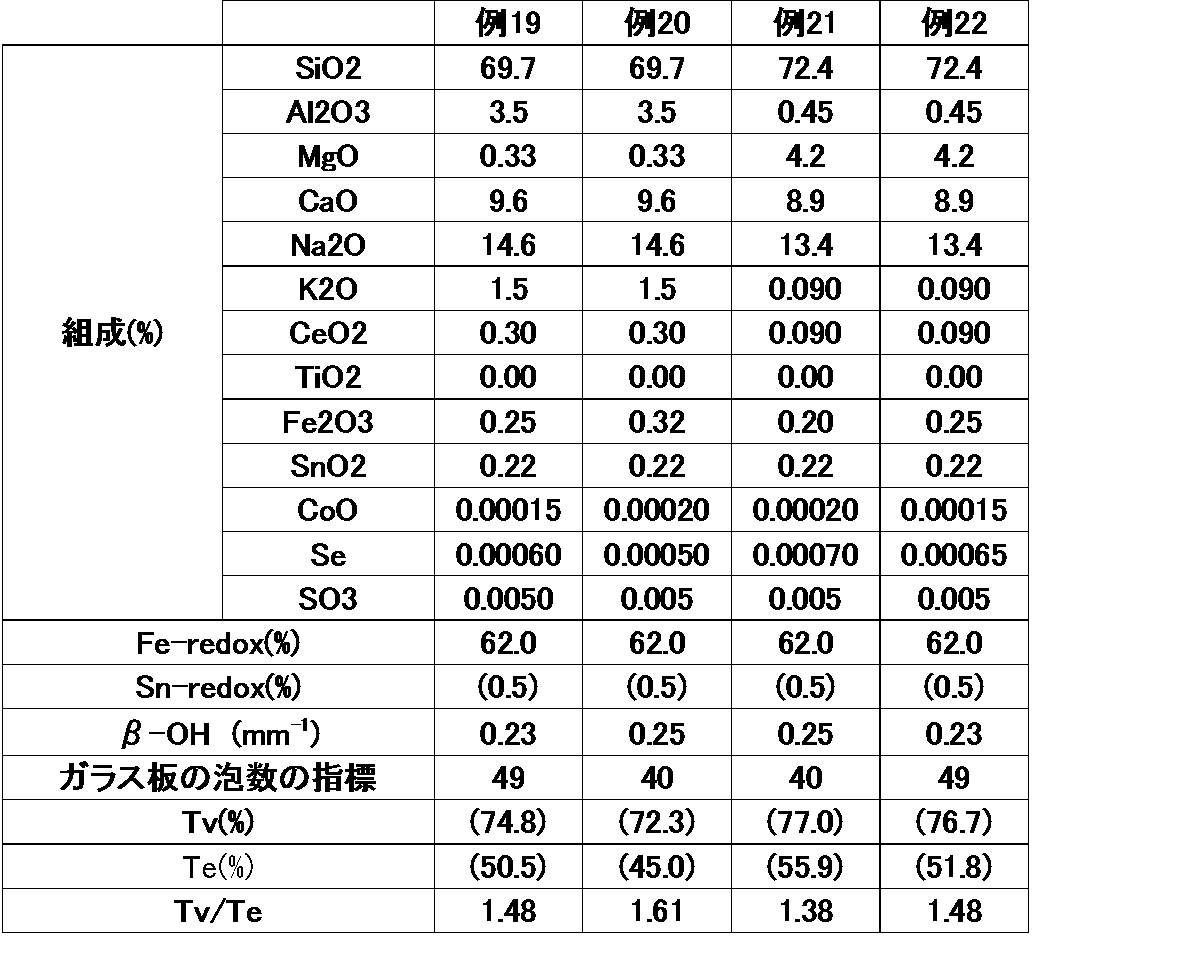
比較例である例17、18のガラス板は、β-OHが低く、ガラス板の泡数の指標が100を超えており、ガラス溶解炉で作製するガラス板の泡数が多くなる。
なお、2014年4月23日に出願された日本特許出願2014-089595号の明細書、特許請求の範囲および要約書の全内容をここに引用し、本発明の開示として取り入れるものである。
Claims (16)
- 鉄、スズおよび硫黄の各元素を含み、酸化物基準の質量百分率表示で、SO3に換算した全硫黄の割合が、0.025%未満であり、Fe2O3に換算した全鉄中のFe2O3に換算した2価の鉄の割合が45%以上であり、SnO2に換算した全スズ中のSnO2に換算した2価のスズの割合が、モル百分率表示で0.1%以上であり、β-OHが0.15mm-1以上であるアルカリ含有シリカガラスからなる、着色ガラス板。
- SnO2に換算した全スズ中のSnO2に換算した2価のスズの割合が、モル百分率表示で0.2~40%である請求項1に記載の着色ガラス板。
- 443-420×β-OH(mm-1)-4.8×Fe-redox(%)が100未満である請求項1または2に記載の着色ガラス板。
- Fe2O3に換算した全鉄中のFe2O3に換算した2価の鉄の割合が、55%以上である請求項1~3のいずれか一項に記載の着色ガラス板。
- 酸化物基準の質量百分率表示で、
SiO2 :30~80%、
Al2O3 :0~30%、
B2O3 :0~20%、
MgO :0~30%、
CaO :0~30%、
Na2O :0.5~50%、
K2O :0~50%、
Fe2O3に換算した全鉄:0.001~5%、
SnO2に換算した全スズ:0.001~5%、
を含む、請求項1~4のいずれか一項に記載の着色ガラス板。 - 酸化物基準の質量百分率表示で、
SiO2 :65~73%、
Al2O3 :3~5%、
B2O3 :0~1%、
MgO :0%以上、2%未満
CaO :7~10%、
Na2O :12~16%、
K2O :1~5%、
Fe2O3に換算した全鉄:0.1~0.9%、
SnO2に換算した全スズ:0.02~0.3%、
を含む、請求項1~5のいずれか一項に記載の着色ガラス板。 - B2O3を実質的に含まず、酸化物基準の質量百分率表示で、
SiO2 :65~73%、
Al2O3 :3~5%、
MgO :0%以上、2%未満
CaO :7~10%、
Na2O :12~16%、
K2O :1~5%、
Fe2O3に換算した全鉄:0.3~0.9%、
SnO2に換算した全スズ:0.02~0.3%、
を含む、請求項1~6のいずれか一項に記載の着色ガラス板。 - 酸化物基準の質量百分率表示で、
SiO2 :65~75%、
Al2O3 :0~3%、
B2O3 :0~1%、
MgO :2~5%
CaO :7~10%、
Na2O :11~15%、
K2O :0~5%、
Fe2O3に換算した全鉄:0.1~0.9%、
SnO2に換算した全スズ:0.02~0.3%、
を含む、請求項1~5のいずれか一項に記載の着色ガラス板。 - 酸化物基準の質量百分率表示でSO3に換算した全硫黄の割合が、0.01%以上、0.02%未満である請求項1~8のいずれか一項に記載の着色ガラス板。
- TiO2を実質的に含まない請求項1~9のいずれか一項に記載の着色ガラス板。
- TiO2を実質的に含み、その含有量が酸化物基準の質量百分率表示で3.0%以下である請求項1~9のいずれか一項に記載の着色ガラス板。
- JIS R 3106(1998)規定の可視光透過率Tv(A光源、2度視野)とJIS R 3106(1998)規定の日射透過率Teの比Tv/Teが、ガラス板の4mm厚さ換算値で1.3以上である請求項1~11のいずれか一項に記載の着色ガラス板。
- JIS R 3106(1998)規定の可視光透過率Tv(A光源、2度視野)とJIS R 3106(1998)規定の日射透過率Teの比Tv/Teが、ガラス板の4mm厚さ換算値で1.85以上である請求項1~12のいずれか一項に記載の着色ガラス板。
- JIS R 3106(1998)規定の日射透過率Teが、ガラス板の4mm厚さ換算値で65%以下で、かつJIS R 3106(1998)規定の可視光透過率Tv(A光源、2度視野)が、ガラス板の4mm厚さ換算値で60%以上である請求項1~13のいずれか一項に記載の着色ガラス板。
- JIS R 3106(1998)規定の日射透過率Teが、ガラス板の4mm厚さ換算値で50%以下で、かつJIS R 3106(1998)規定の可視光透過率Tv(A光源、2度視野)が、ガラス板の4mm厚さ換算値で60%以上である請求項1~14のいずれか一項に記載の着色ガラス板。
- ガラス原料を溶融し、成形するソーダライムシリカガラスの製造において、成形後の該ガラスが、請求項1~15のいずれか一項に記載の着色ガラス板を得る、着色ガラス板の製造方法。
Priority Applications (4)
| Application Number | Priority Date | Filing Date | Title |
|---|---|---|---|
| JP2016515205A JP6536574B2 (ja) | 2014-04-23 | 2015-04-23 | 着色ガラス板およびその製造方法 |
| EP15783654.5A EP3135644B1 (en) | 2014-04-23 | 2015-04-23 | Colored glass plate and method for manufacturing same |
| CN201580021128.9A CN106232545A (zh) | 2014-04-23 | 2015-04-23 | 着色玻璃板及其制造方法 |
| US15/290,090 US10011521B2 (en) | 2014-04-23 | 2016-10-11 | Colored glass plate and method for manufacturing same |
Applications Claiming Priority (2)
| Application Number | Priority Date | Filing Date | Title |
|---|---|---|---|
| JP2014-089595 | 2014-04-23 | ||
| JP2014089595 | 2014-04-23 |
Related Child Applications (1)
| Application Number | Title | Priority Date | Filing Date |
|---|---|---|---|
| US15/290,090 Continuation US10011521B2 (en) | 2014-04-23 | 2016-10-11 | Colored glass plate and method for manufacturing same |
Publications (1)
| Publication Number | Publication Date |
|---|---|
| WO2015163416A1 true WO2015163416A1 (ja) | 2015-10-29 |
Family
ID=54332578
Family Applications (1)
| Application Number | Title | Priority Date | Filing Date |
|---|---|---|---|
| PCT/JP2015/062389 Ceased WO2015163416A1 (ja) | 2014-04-23 | 2015-04-23 | 着色ガラス板およびその製造方法 |
Country Status (5)
| Country | Link |
|---|---|
| US (1) | US10011521B2 (ja) |
| EP (1) | EP3135644B1 (ja) |
| JP (1) | JP6536574B2 (ja) |
| CN (1) | CN106232545A (ja) |
| WO (1) | WO2015163416A1 (ja) |
Families Citing this family (7)
| Publication number | Priority date | Publication date | Assignee | Title |
|---|---|---|---|---|
| CN106232539A (zh) * | 2014-04-23 | 2016-12-14 | 旭硝子株式会社 | 热线吸收玻璃板及其制造方法 |
| RU2643832C1 (ru) * | 2017-02-27 | 2018-02-06 | Юлия Алексеевна Щепочкина | Глазурь |
| KR102898212B1 (ko) * | 2018-04-27 | 2025-12-11 | 에이지씨 가부시키가이샤 | 무알칼리 유리 |
| US12151970B2 (en) | 2018-12-06 | 2024-11-26 | Vidrio Plano De México, S.A. De C.V. | Solar control thin green glass composition |
| KR102813155B1 (ko) | 2020-02-03 | 2025-05-28 | 비트로 플랫 글래스 엘엘씨 | 고가시광 투과율을 갖는 소다 석회 실리카 유리 |
| TW202502679A (zh) * | 2023-04-05 | 2025-01-16 | 美商維托平面玻璃有限責任公司 | 防窺玻璃 |
| CN119371101A (zh) * | 2024-09-25 | 2025-01-28 | 中建材玻璃新材料研究院集团有限公司 | 一种加仑瓶用棕色玻璃及其制备方法 |
Citations (3)
| Publication number | Priority date | Publication date | Assignee | Title |
|---|---|---|---|---|
| JPH04502304A (ja) * | 1989-08-18 | 1992-04-23 | リビー―オーウェンズ―フォード・カンパニー | 赤外線吸収青色ガラス組成 |
| WO2011093284A1 (ja) * | 2010-01-26 | 2011-08-04 | 旭硝子株式会社 | 着色ガラス板 |
| WO2012102176A1 (ja) * | 2011-01-25 | 2012-08-02 | 旭硝子株式会社 | 熱線吸収ガラス板およびその製造方法 |
Family Cites Families (10)
| Publication number | Priority date | Publication date | Assignee | Title |
|---|---|---|---|---|
| US5069826A (en) | 1989-08-18 | 1991-12-03 | Libbey-Owens-Ford Co. | Infrared radiation absorbing blue glass composition |
| US5688727A (en) * | 1996-06-17 | 1997-11-18 | Ppg Industries, Inc. | Infrared and ultraviolet radiation absorbing blue glass composition |
| ES2239813T3 (es) | 1997-10-20 | 2005-10-01 | Ppg Industries Ohio, Inc. | Composicion de vidrio azul que absorbe las radiaciones infrarrojas y ultravioletas. |
| JP2002348143A (ja) | 2001-05-29 | 2002-12-04 | Central Glass Co Ltd | 紫外線赤外線吸収ガラスおよびその製法 |
| JP4715258B2 (ja) * | 2005-03-22 | 2011-07-06 | 旭硝子株式会社 | ガラスおよびガラス製造方法 |
| WO2007111079A1 (ja) * | 2006-03-27 | 2007-10-04 | Asahi Glass Company, Limited | ガラス製造方法 |
| JP2009167018A (ja) | 2006-04-26 | 2009-07-30 | Nippon Sheet Glass Co Ltd | 赤外線吸収ガラス組成物 |
| JP2010202413A (ja) * | 2007-06-27 | 2010-09-16 | Asahi Glass Co Ltd | ガラスの製造方法、ガラス原料の製造方法及びガラス原料 |
| JP5867953B2 (ja) * | 2008-06-27 | 2016-02-24 | 日本電気硝子株式会社 | 強化ガラスおよび強化用ガラス |
| CN102596839B (zh) * | 2009-10-22 | 2016-02-10 | 旭硝子株式会社 | 热线吸收玻璃板及其制造方法 |
-
2015
- 2015-04-23 CN CN201580021128.9A patent/CN106232545A/zh active Pending
- 2015-04-23 WO PCT/JP2015/062389 patent/WO2015163416A1/ja not_active Ceased
- 2015-04-23 EP EP15783654.5A patent/EP3135644B1/en active Active
- 2015-04-23 JP JP2016515205A patent/JP6536574B2/ja active Active
-
2016
- 2016-10-11 US US15/290,090 patent/US10011521B2/en active Active
Patent Citations (3)
| Publication number | Priority date | Publication date | Assignee | Title |
|---|---|---|---|---|
| JPH04502304A (ja) * | 1989-08-18 | 1992-04-23 | リビー―オーウェンズ―フォード・カンパニー | 赤外線吸収青色ガラス組成 |
| WO2011093284A1 (ja) * | 2010-01-26 | 2011-08-04 | 旭硝子株式会社 | 着色ガラス板 |
| WO2012102176A1 (ja) * | 2011-01-25 | 2012-08-02 | 旭硝子株式会社 | 熱線吸収ガラス板およびその製造方法 |
Non-Patent Citations (1)
| Title |
|---|
| See also references of EP3135644A4 * |
Also Published As
| Publication number | Publication date |
|---|---|
| EP3135644A1 (en) | 2017-03-01 |
| JPWO2015163416A1 (ja) | 2017-04-20 |
| EP3135644A4 (en) | 2017-10-11 |
| US20170029320A1 (en) | 2017-02-02 |
| JP6536574B2 (ja) | 2019-07-03 |
| US10011521B2 (en) | 2018-07-03 |
| EP3135644B1 (en) | 2020-03-11 |
| CN106232545A (zh) | 2016-12-14 |
Similar Documents
| Publication | Publication Date | Title |
|---|---|---|
| JP5757246B2 (ja) | 着色ガラス板 | |
| JP6536574B2 (ja) | 着色ガラス板およびその製造方法 | |
| JP5867415B2 (ja) | 熱線吸収ガラス板およびその製造方法 | |
| JP6368944B2 (ja) | ガラス板 | |
| JP5853700B2 (ja) | 熱線吸収ガラス板およびその製造方法 | |
| EP3287424B1 (en) | Heat-ray- and ultraviolet-absorbent glass sheet, and method for manufacturing same | |
| JP6646801B2 (ja) | 熱線吸収ガラス板およびその製造方法 | |
| JP5999111B2 (ja) | 着色ガラス板およびその製造方法 | |
| JP6561983B2 (ja) | 熱線吸収ガラス板およびその製造方法 | |
| JP5999112B2 (ja) | 着色ガラス板およびその製造方法 | |
| JP6631512B2 (ja) | 熱線吸収ガラス板およびその製造方法 | |
| JP6589860B2 (ja) | 熱線吸収ガラス板およびその製造方法 | |
| JP7127654B2 (ja) | ガラス板 |
Legal Events
| Date | Code | Title | Description |
|---|---|---|---|
| 121 | Ep: the epo has been informed by wipo that ep was designated in this application |
Ref document number: 15783654 Country of ref document: EP Kind code of ref document: A1 |
|
| ENP | Entry into the national phase |
Ref document number: 2016515205 Country of ref document: JP Kind code of ref document: A |
|
| REEP | Request for entry into the european phase |
Ref document number: 2015783654 Country of ref document: EP |
|
| WWE | Wipo information: entry into national phase |
Ref document number: 2015783654 Country of ref document: EP |
|
| NENP | Non-entry into the national phase |
Ref country code: DE |