WO2015170516A1 - 有機酸の質量分析方法、分析カラムおよび分析装置 - Google Patents
有機酸の質量分析方法、分析カラムおよび分析装置 Download PDFInfo
- Publication number
- WO2015170516A1 WO2015170516A1 PCT/JP2015/058195 JP2015058195W WO2015170516A1 WO 2015170516 A1 WO2015170516 A1 WO 2015170516A1 JP 2015058195 W JP2015058195 W JP 2015058195W WO 2015170516 A1 WO2015170516 A1 WO 2015170516A1
- Authority
- WO
- WIPO (PCT)
- Prior art keywords
- water
- mass spectrometry
- organic acid
- acid
- column
- Prior art date
- Legal status (The legal status is an assumption and is not a legal conclusion. Google has not performed a legal analysis and makes no representation as to the accuracy of the status listed.)
- Ceased
Links
Images

Classifications
-
- G—PHYSICS
- G01—MEASURING; TESTING
- G01N—INVESTIGATING OR ANALYSING MATERIALS BY DETERMINING THEIR CHEMICAL OR PHYSICAL PROPERTIES
- G01N30/00—Investigating or analysing materials by separation into components using adsorption, absorption or similar phenomena or using ion-exchange, e.g. chromatography or field flow fractionation
- G01N30/02—Column chromatography
- G01N30/50—Conditioning of the sorbent material or stationary liquid
- G01N30/52—Physical parameters
-
- G—PHYSICS
- G01—MEASURING; TESTING
- G01N—INVESTIGATING OR ANALYSING MATERIALS BY DETERMINING THEIR CHEMICAL OR PHYSICAL PROPERTIES
- G01N27/00—Investigating or analysing materials by the use of electric, electrochemical, or magnetic means
- G01N27/62—Investigating or analysing materials by the use of electric, electrochemical, or magnetic means by investigating the ionisation of gases, e.g. aerosols; by investigating electric discharges, e.g. emission of cathode
-
- B—PERFORMING OPERATIONS; TRANSPORTING
- B01—PHYSICAL OR CHEMICAL PROCESSES OR APPARATUS IN GENERAL
- B01D—SEPARATION
- B01D15/00—Separating processes involving the treatment of liquids with solid sorbents; Apparatus therefor
- B01D15/08—Selective adsorption, e.g. chromatography
- B01D15/26—Selective adsorption, e.g. chromatography characterised by the separation mechanism
- B01D15/30—Partition chromatography
- B01D15/305—Hydrophilic interaction chromatography [HILIC]
-
- B—PERFORMING OPERATIONS; TRANSPORTING
- B01—PHYSICAL OR CHEMICAL PROCESSES OR APPARATUS IN GENERAL
- B01D—SEPARATION
- B01D15/00—Separating processes involving the treatment of liquids with solid sorbents; Apparatus therefor
- B01D15/08—Selective adsorption, e.g. chromatography
- B01D15/26—Selective adsorption, e.g. chromatography characterised by the separation mechanism
- B01D15/36—Selective adsorption, e.g. chromatography characterised by the separation mechanism involving ionic interaction, e.g. ion-exchange, ion-pair, ion-suppression or ion-exclusion
- B01D15/361—Ion-exchange
- B01D15/363—Anion-exchange
-
- B—PERFORMING OPERATIONS; TRANSPORTING
- B01—PHYSICAL OR CHEMICAL PROCESSES OR APPARATUS IN GENERAL
- B01D—SEPARATION
- B01D15/00—Separating processes involving the treatment of liquids with solid sorbents; Apparatus therefor
- B01D15/08—Selective adsorption, e.g. chromatography
- B01D15/26—Selective adsorption, e.g. chromatography characterised by the separation mechanism
- B01D15/38—Selective adsorption, e.g. chromatography characterised by the separation mechanism involving specific interaction not covered by one or more of groups B01D15/265 and B01D15/30 - B01D15/36, e.g. affinity, ligand exchange or chiral chromatography
- B01D15/3847—Multimodal interactions
-
- G—PHYSICS
- G01—MEASURING; TESTING
- G01N—INVESTIGATING OR ANALYSING MATERIALS BY DETERMINING THEIR CHEMICAL OR PHYSICAL PROPERTIES
- G01N30/00—Investigating or analysing materials by separation into components using adsorption, absorption or similar phenomena or using ion-exchange, e.g. chromatography or field flow fractionation
- G01N30/02—Column chromatography
- G01N30/26—Conditioning of the fluid carrier; Flow patterns
-
- G—PHYSICS
- G01—MEASURING; TESTING
- G01N—INVESTIGATING OR ANALYSING MATERIALS BY DETERMINING THEIR CHEMICAL OR PHYSICAL PROPERTIES
- G01N30/00—Investigating or analysing materials by separation into components using adsorption, absorption or similar phenomena or using ion-exchange, e.g. chromatography or field flow fractionation
- G01N30/02—Column chromatography
- G01N30/50—Conditioning of the sorbent material or stationary liquid
- G01N30/56—Packing methods or coating methods
-
- G—PHYSICS
- G01—MEASURING; TESTING
- G01N—INVESTIGATING OR ANALYSING MATERIALS BY DETERMINING THEIR CHEMICAL OR PHYSICAL PROPERTIES
- G01N30/00—Investigating or analysing materials by separation into components using adsorption, absorption or similar phenomena or using ion-exchange, e.g. chromatography or field flow fractionation
- G01N30/02—Column chromatography
- G01N30/60—Construction of the column
- G01N30/6052—Construction of the column body
-
- G—PHYSICS
- G01—MEASURING; TESTING
- G01N—INVESTIGATING OR ANALYSING MATERIALS BY DETERMINING THEIR CHEMICAL OR PHYSICAL PROPERTIES
- G01N30/00—Investigating or analysing materials by separation into components using adsorption, absorption or similar phenomena or using ion-exchange, e.g. chromatography or field flow fractionation
- G01N30/02—Column chromatography
- G01N30/62—Detectors specially adapted therefor
- G01N30/72—Mass spectrometers
- G01N30/7233—Mass spectrometers interfaced to liquid or supercritical fluid chromatograph
-
- G—PHYSICS
- G01—MEASURING; TESTING
- G01N—INVESTIGATING OR ANALYSING MATERIALS BY DETERMINING THEIR CHEMICAL OR PHYSICAL PROPERTIES
- G01N30/00—Investigating or analysing materials by separation into components using adsorption, absorption or similar phenomena or using ion-exchange, e.g. chromatography or field flow fractionation
- G01N30/02—Column chromatography
- G01N30/88—Integrated analysis systems specially adapted therefor, not covered by a single one of the groups G01N30/04 - G01N30/86
-
- G—PHYSICS
- G01—MEASURING; TESTING
- G01N—INVESTIGATING OR ANALYSING MATERIALS BY DETERMINING THEIR CHEMICAL OR PHYSICAL PROPERTIES
- G01N30/00—Investigating or analysing materials by separation into components using adsorption, absorption or similar phenomena or using ion-exchange, e.g. chromatography or field flow fractionation
- G01N30/96—Investigating or analysing materials by separation into components using adsorption, absorption or similar phenomena or using ion-exchange, e.g. chromatography or field flow fractionation using ion-exchange
Definitions
- the present invention relates to a mass spectrometric method using a column using a hydrophilic polymer having an anion exchange group as a filler in mass spectrometry of an organic acid by a liquid chromatograph mass spectrometer, an analytical column packed with the filler, and
- the present invention relates to an analyzer.
- Organic acids are added to foods as amino acids and saccharides as umami components, and for example, succinic acid and malic acid are used.
- succinic acid and malic acid are used.
- organic acids are also used as cleaning agents for electronic materials and the like, and the demand for analyzing the organic acids is increasing.
- Patent Document 1 Japanese Patent Laid-Open No. 8-201365
- Patent Document 1 a filler in which a cation exchange group is introduced into a styrene-divinylbenzene copolymer as a base material is used, and a donnan elimination effect between a stationary phase and a mobile phase is used. Can hold and separate the organic acid.
- alkaline earth metal ions or transition metal ions have been added for the purpose of adjusting the retention.
- the cation exchange group when ion exclusion chromatography is used in combination with a mass spectrometer, the cation exchange group has low chemical stability and is easily detached from the substrate. In particular, restrictions on the organic solvent concentration are required, which may be disadvantageous for high sensitivity of mass spectrometry.
- ion chromatography is also known as a liquid chromatograph separation unit for organic acid analysis.
- Patent Document 2 a column using a styrene-divinylbenzene copolymer, polyvinyl alcohol, polymethacrylate, or the like as a base material and packed with a filler into which an anion exchange group is introduced. Is used.
- ion chromatography requires the addition of non-volatile substances such as sodium carbonate and sodium hydroxide to the mobile phase, when ion chromatography is used in combination with a mass spectrometer, these non-volatile substances are ionized. Mass spectrometry may be adversely affected by efficiency reduction or clogging due to salt precipitation of the ion source.
- Patent Document 3 discloses a packing material for ion chromatography in which a quaternary ammonium base is introduced into a base material made of polyvinyl alcohol resin. It is not suggested to be applied as a separation part of the liquid chromatograph mass spectrometer.
- the present invention has been made in view of such a situation, and it is not necessary to add a non-volatile substance to the mobile phase in the separation part of the mass analysis of the organic acid by the liquid chromatograph mass spectrometer, and the water-soluble organic solvent ratio is free.
- An object of the present invention is to provide a mass spectrometric method and an analytical column that are high in degree, can hold and separate / elute an organic acid, and as a result can detect the organic acid with high sensitivity.
- the present inventors used a hydrophilic polymer having an anion exchange group as a filler in a separation part of organic acid mass spectrometry using a liquid chromatograph mass spectrometer. It was found that this can be solved by using this as the stationary phase and using a water-soluble organic solvent-water mixed solution as the mobile phase. Furthermore, the separation mode in liquid chromatography is a mixed mode that combines hydrophilic interaction chromatography and ion exchange chromatography. By holding and separating various organic acids with a mobile phase containing a water-soluble organic solvent, The present inventors have found that an organic acid can be detected with high sensitivity in the analysis section, and have completed the present invention.
- hydrophilic interaction chromatography is a separation mode that uses the difference in affinity between the packing material and the sample
- ion exchange chromatography is a separation mode that uses the difference in ion exchange properties between the packing material and the sample.
- the preferable separation mode in the present application is a mixed mode in which the interaction due to affinity and the interaction due to ion exchange are simultaneously utilized.
- the present invention relates to the following matters.
- the anion exchange group of the hydrophilic polymer having an anion exchange group is a quaternary ammonium group, and the content of the quaternary ammonium group is 0.01 to 0.00 with respect to 1 g of the hydrophilic polymer.
- [5] The method for mass spectrometry of organic acids according to [1] to [4], wherein the water-soluble organic solvent is at least one selected from the group consisting of acetonitrile, methanol, ethanol, isopropanol, acetone, methyl ethyl ketone, and tetrahydrofuran.
- the separation mode in the liquid chromatography is a mixed mode in which hydrophilic interaction chromatography and ion exchange chromatography are combined, and an organic acid is detected by a mass spectrometer, [1]-[ [5] The method for mass spectrometry of organic acids in [5].
- a liquid chromatography column for organic acid analysis in which a hydrophilic polymer having an anion exchange group is packed in a liquid chromatography housing made of polyetheretherketone (PEEK) resin.
- PEEK polyetheretherketone
- the organic acid mass spectrometry method of the present invention is excellent in holding and separating various organic acids by combining a specific hydrophilic polymer packed column and a mobile phase, and can be detected with high sensitivity in the mass spectrometer. Therefore, it is useful in a wide range of fields such as food, cosmetics, environment, agriculture, medicine, and industrial materials, and is particularly suitable as a method for analyzing umami components such as succinic acid and malic acid in the food field.
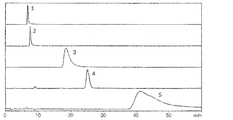
- FIG. 2 is a mass chromatogram obtained by liquid chromatography-mass spectrometry of the organic acid of Example 1.
- FIG. 2 is a mass chromatogram obtained by liquid chromatography-mass spectrometry of organic acid in Example 2.
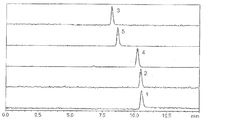
- FIG. It is the mass chromatogram obtained by the liquid chromatography-mass spectrometry of the organic acid of the comparative example.
- One embodiment of the present invention is a method for mass spectrometry of an organic acid using a liquid chromatograph mass spectrometer, wherein a column having a hydrophilic polymer having an anion exchange group as a filler is used, and a water-soluble organic solvent-water is used as a mobile phase.
- This is a method for analyzing an organic acid with high sensitivity, using a mixed solution, and preferably separating and eluting the organic acid while sufficiently retaining the organic acid by a mixed mode of hydrophilic interaction chromatography and ion exchange chromatography.
- an organic acid is an organic compound having acid properties, and includes carboxylic acid, sulfonic acid, and phenols.
- carboxylic acid is preferable.
- organic acids that can be analyzed in the present invention include aliphatic carboxylic acids, aromatic carboxylic acids, hydroxycarboxylic acids, haloacetic acids, and the like.
- Specific examples of the aliphatic carboxylic acid include fumaric acid, maleic acid, malonic acid, succinic acid and the like.
- Specific examples of the aromatic carboxylic acid include benzoic acid, phthalic acid, isophthalic acid, terephthalic acid, salicylic acid and the like.
- hydroxycarboxylic acid examples include aliphatic hydroxycarboxylic acids such as lactic acid, glycolic acid, malic acid, and tartaric acid.
- haloacetic acid examples include monochloroacetic acid, dichloroacetic acid, trichloroacetic acid and the like.
- the method of the present invention is preferably a mass of an aliphatic carboxylic acid such as lactic acid, glycolic acid, fumaric acid, maleic acid, malonic acid, succinic acid, malic acid and tartaric acid, and a carboxyl group-containing compound such as aliphatic hydroxycarboxylic acid.
- an aliphatic carboxylic acid such as lactic acid, glycolic acid, fumaric acid, maleic acid, malonic acid, succinic acid, malic acid and tartaric acid
- a carboxyl group-containing compound such as aliphatic hydroxycarboxylic acid.
- the present invention is a method for separating and detecting various organic acids by liquid chromatography, and then mass-separating ions generated by an ion source of a mass spectrometer using a mass-to-charge ratio. It can be used as a high-sensitivity analysis method in various fields such as the environment, agriculture, medical care, and industrial materials.
- the ion source corresponds to the electrospray ionization method, the atmospheric pressure chemical ionization method, and the like
- the mass separation unit includes a quadrupole type, an ion trap type, and a time-of-flight type.
- the types of the ion source and the mass separation unit can be used without particular limitation.
- the electrospray ionization method is suitable for ionization of organic acids, and in order to perform measurement with higher sensitivity, the water-soluble organic solvent ratio (described later) of the mobile phase is increased, and the flow rate is 0.1 to 1 It is preferable to use in the range of 0.0 ml / min.
- the hydrophilic polymer having an anion exchange group used as a filler in the present invention is based on a hydrophilic polymer such as polyvinyl alcohol or polyhydroxy methacrylate, and preferably based on polyvinyl alcohol.
- an anion exchange group such as a quaternary ammonium group directly or via a spacer such as epichlorohydrin, 1,4-butanediol diglycidyl ether, ethylene glycol diglycidyl ether, or glycerin diglycidyl ether.
- 0.01 to 0.1 meq preferably 0.01 to 0.07 meq, more preferably 0.01 to 0.05 meq is introduced per gram of polymer. If the amount of anion exchange groups is less than 0.01 meq, the ion exchange action may be reduced, and if it exceeds 0.1 meq, the ion exchange action becomes too strong and the organic acid may be adsorbed on the column.
- the hydrophilic polymer having an anion exchange group can be prepared, for example, according to the method described in JP-A-2006-242944 (Patent Document 3).
- the spacer refers to a chemical bonding site used for adjusting the distance between the base material and an anion exchange group such as a quaternary ammonium group.
- the spacer is used to give a function of suppressing interference between ions and the substrate and peak diffusion.
- the spacer is preferably a divalent organic residue having an ether bond at both ends, and examples thereof include those described above.
- Examples of the quaternary ammonium group include a trimethylammonium group, a triethylammonium group, an N, N-dimethylallylammonium group, and an N, N-dimethylbenzylammonium group.
- the material, size, and shape are not particularly limited.
- the shape is preferably a sphere having a volume average particle diameter of 1 to 30 ⁇ m, and more preferably a sphere having a volume of 3 to 10 ⁇ m. Further, it preferably has a strength that can withstand a pressure of 1 to 30 MPa. The volume average particle diameter is measured with a Coulter counter.
- a water-soluble organic solvent-water mixed solution that is, a mixture of water and an organic solvent can be used.
- the water-soluble organic solvent in the present application is not particularly limited as long as it is an organic solvent compatible with water, and examples thereof include an organic solvent having 1 to 5 carbon atoms compatible with water.
- the organic solvent having 1 to 5 carbon atoms means that the solvent molecule has 1 to 5 carbon atoms.
- the solvent include alcohols such as methanol, ethanol and propanol, ethers such as tetrahydrofuran, nitriles such as acetonitrile, ketones such as acetone, amides such as dimethylformamide, and sulfoxides such as dimethyl sulfoxide.
- a solvent selected from the group consisting of: These low molecular weight solvents may be used alone or as a mixed solvent of two or more.
- Preferred water-soluble organic solvents include nitriles such as acetonitrile, alcohols such as methanol, ethanol and isopropyl alcohol, ethers such as tetrahydrofuran, and ketones such as acetone and methyl ethyl ketone.
- Water and the water-soluble organic solvent can be mixed at an arbitrary ratio.
- the blending ratio of the water-soluble organic solvent is preferably 50 to 95% by volume, and 55 to 95% by volume of the entire mixed solution in order to improve the holding power by hydrophilic interaction and increase the sensitivity in the mass spectrometer. Is more preferable, and 60 to 90% by volume is most preferable.
- the ratio of the water-soluble organic solvent is lower than 50% by volume, the hydrophilic interaction may be reduced, and when it is higher than 95% by volume, the organic acid may be adsorbed in the column.
- a volatile substance such as ammonium formate and ammonium acetate can be added to the mobile phase at an arbitrary ratio. For example, 1 to 100 mmol can be added to 1 L of the mixed solution. It is possible to adjust the holding time by adding these.
- the column for liquid chromatography analysis of organic acid according to the present invention is packed with a hydrophilic polymer having an anion exchange group.
- the material of the column housing is preferably made of polyetheretherketone (PEEK) resin in order to sufficiently suppress the adsorption of the organic acid by the metal.
- the housing size there is no particular limitation on the housing size. However, it is preferable that the inner diameter is 1.0 to 4.6 mm and the length is 100 to 250 mm in order to limit the flow rate of the mass spectrometer and perform analysis with higher separation and higher sensitivity.
- the analyzer according to the present invention comprises a liquid chromatography column having a mobile phase using a filler containing a hydrophilic polymer having an anion exchange group as described above, a mixed solution of a water-soluble organic solvent and water, and Includes a mass spectrometer.
- Example 1 As a liquid chromatograph mass spectrometer, LCMS-8030 (manufactured by Shimadzu Corporation) having an electrospray ionization method as an ion source and a quadrupole type as a mass separation unit was used.
- the column was loaded with a Shodex Rpak JJ-50 2D (inner diameter 2) packed with a polyvinyl alcohol resin (particle size 5 ⁇ m) introduced so that the quaternary ammonium group was 0.03 meq / g (polymer) as an anion exchange group. 0.0 mm, length 150 mm, and the housing material was polyetheretherketone resin), and the column temperature was 30 ° C.
- a liquid mixture with a volume ratio of 100 mmol / L ammonium formate aqueous solution / acetonitrile of 30/70 was passed at 0.2 ml / min, and water / acetonitrile volume ratio of 50/50 was mixed with lactic acid. Then, 5 ⁇ L of a liquid substance added with 5 ⁇ g / ml of glycolic acid, malonic acid, succinic acid, and malic acid was injected into the above liquid chromatography-mass spectrometer. The obtained mass chromatogram is shown in FIG. All five organic acids were well separated.
- Example 2 Five organic acids, lactic acid, glycolic acid, malonic acid, succinic acid, and malic acid were analyzed under the same conditions as in Example 1 except that stainless steel was used as the housing material instead of the polyether ether ketone resin. . The obtained mass chromatogram is shown in FIG. All of the five types of organic acids were well separated, but the peak shape was affected by adsorption to stainless steel as compared with Example 1.
- 1 is a peak of lactic acid
- 2 is a peak of glycolic acid
- 3 is a peak of malonic acid
- 4 is a peak of succinic acid
- 5 is a peak of malic acid. Since the separation method is different between the example and the comparative example, the elution order is different.
Landscapes
- Chemical & Material Sciences (AREA)
- Analytical Chemistry (AREA)
- Physics & Mathematics (AREA)
- Health & Medical Sciences (AREA)
- Life Sciences & Earth Sciences (AREA)
- Biochemistry (AREA)
- General Health & Medical Sciences (AREA)
- General Physics & Mathematics (AREA)
- Immunology (AREA)
- Pathology (AREA)
- Chemical Kinetics & Catalysis (AREA)
- Electrochemistry (AREA)
- Other Investigation Or Analysis Of Materials By Electrical Means (AREA)
Abstract
Description
有機酸の分析のための液体クロマトグラフの分離部には、従来からイオン排除クロマトグラフィーが広く使用されている。たとえば、特開平8-201365号公報(特許文献1)では、基材であるスチレン-ジビニルベンゼン共重合体に陽イオン交換基を導入した充填剤が用いられ、固定相-移動相間におけるドナン排除効果により有機酸を保持および分離させることができる。このようなイオン排除クロマトグラフィーを用いる方法においては、保持の調整のためアルカリ土類金属イオンまたは遷移金属イオンを添加することも行われてきた。
[1]液体クロマトグラフ質量分析装置を用いた、液体クロマトグラフィーおよび質量分析による有機酸の質量分析において、陰イオン交換基を有する親水性ポリマーを充填剤としたカラムを用いて、移動相に水溶性有機溶媒-水混合溶液を用いる有機酸の質量分析方法。
[2]前記陰イオン交換基を有する親水性ポリマーの基材がポリビニルアルコールである[1]の有機酸の質量分析方法。
[3]前記陰イオン交換基を有する親水性ポリマーの陰イオン交換基が第4級アンモニウム基であり、第4級アンモニウム基の含有量が前記親水性ポリマー1gに対して0.01~0.1meqである、[1]または[2]の有機酸の質量分析方法。
[4]前記水溶性有機溶媒-水混合溶液が水溶性有機溶媒を体積比で50~95%含む溶液である、[1]~[3]の有機酸の質量分析方法。
[5]前記水溶性有機溶媒がアセトニトリル、メタノール、エタノール、イソプロパノール、アセトン、メチルエチルケトンおよびテトラヒドロフランからなる群から選ばれた少なくとも1種である、[1]~[4]の有機酸の質量分析方法。
[6]前記液体クロマトグラフィーにおける分離モードが親水性相互作用クロマトグラフィーおよびイオン交換クロマトグラフィーを組み合わせたミックスモードであり、質量分析装置により有機酸を検出することを特徴とする、[1]~[5]の有機酸の質量分析方法。
[7]陰イオン交換基を有する親水性ポリマーを、ポリエーテルエーテルケトン(PEEK)樹脂製の液体クロマトグラフィー用ハウジングに充填した、有機酸分析用の液体クロマトグラフィー用カラム。
[8]陰イオン交換基を有する親水性ポリマーを含む充填剤および水溶性有機溶媒と水との混合溶液を用いた移動相を備えた液体クロマトグラフィー用カラム、並びに質量分析装置を含む分析装置。
本発明の一態様は、液体クロマトグラフ質量分析装置による有機酸の質量分析方法において、陰イオン交換基を有する親水性ポリマーを充填剤としたカラムを用い、かつ移動相に水溶性有機溶媒-水混合溶液を用い、好ましくは親水性相互作用クロマトグラフィーおよびイオン交換クロマトグラフィーのミックスモードにより有機酸を十分に保持させて分離、溶出させる、高感度に有機酸を分析する方法である。
本発明で分析できる有機酸の例示としては、脂肪族カルボン酸、芳香族カルボン酸、ヒドロキシカルボン酸、ハロ酢酸などが含まれる。脂肪族カルボン酸の具体例としては、フマル酸、マレイン酸、マロン酸、コハク酸などが挙げられる。芳香族カルボン酸の具体例としては、安息香酸、フタル酸、イソフタル酸、テレフタル酸、サリチル酸などが挙げられる。またヒドロキシカルボン酸の具体例としては、乳酸、グリコール酸、リンゴ酸、酒石酸などの脂肪族ヒドロキシカルボン酸が挙げられる。ハロ酢酸の具体例としては、モノクロロ酢酸、ジクロロ酢酸、トリクロロ酢酸などが挙げられる。
本発明における有機酸分析においてはイオン源、質量分離部の種類は特に制限なく使用することができる。有機酸のイオン化にはエレクトロスプレーイオン化法が適しており、より高感度にて測定を行うためには移動相の水溶性有機溶媒比率(後述)を高くすること、および流量を0.1~1.0ml/minの範囲で使用することが好ましい。
本発明において、スペーサーは、基材と第4級アンモニウム基等の陰イオン交換基との距離を調整するために用いられる化学結合部位をいう。スペーサーは、イオンと基材との干渉及びピーク拡散を抑える機能を付与するために用いられる。基材が水酸基を有する物質の場合、スペーサーとしては両末端にエーテル結合を有する2価の有機残基が好ましく、前記のものが挙げられる。
本発明による有機酸の質量分析方法で用いる移動相は、水溶性有機溶媒-水混合溶液、つまり水および有機溶媒を混合したものを用いることができる。
該溶媒として、例えば、メタノール、エタノール、プロパノール等のアルコール系、あるいはテトラヒドロフラン等のエーテル系、あるいはアセトニトリル等のニトリル系、アセトン等のケトン系、ジメチルホルムアミド等のアミド系、ジメチルスルホキシド等のスルホキシド系からなる群から選択される溶媒が挙げられる。これら低分子量溶媒は、1種で用いてもよく、2種以上の混合溶媒として用いてもよい。
これらを添加することで保持時間を調整することが可能となる。
(実施例1)
液体クロマトグラフ質量分析装置として、イオン源にエレクトロスプレーイオン化法、質量分離部に四重極型を有する、LCMS-8030((株)島津製作所製)を用いた。
ハウジング素材としてポリエーテルエーテルケトン樹脂の代わりにステンレスを用いた以外は、実施例1と同様の条件にて、乳酸、グリコール酸、マロン酸、コハク酸、リンゴ酸の5種類の有機酸を分析した。得られたマスクロマトグラムを図2に示す。5種類の有機酸はいずれも良好に分離されたがピーク形状は実施例1と比べてステンレスへの吸着による影響が認められた。
実施例で用いた液体クロマトグラフ質量分析装置を用いてイオン排除クロマトグラフィーを分離モードとして各種有機酸の分析を実施した。検出モードには選択イオンモニタリングを用い、各有機酸のプロトン脱離分子を検出した。カラムには陽イオン交換基としてスルホ基を導入したスチレン-ジビニルベンゼン共重合体樹脂(粒子径6μm)を充填した有機酸分析用カラムShodex RSpak KC-811(内径8.0mm、長さ300mm、ハウジング素材はステンレス)(昭和電工(株)製)を用い、カラム温度40℃とした。
2 グリコール酸のピーク
3 マロン酸のピーク
4 コハク酸のピーク
5 リンゴ酸のピーク
Claims (8)
- 液体クロマトグラフ質量分析装置を用いた、液体クロマトグラフィーおよび質量分析による有機酸の質量分析において、陰イオン交換基を有する親水性ポリマーを充填剤としたカラムを用いて、移動相に水溶性有機溶媒-水混合溶液を用いる有機酸の質量分析方法。
- 前記陰イオン交換基を有する親水性ポリマーの基材がポリビニルアルコールである請求項1に記載の有機酸の質量分析方法。
- 前記陰イオン交換基を有する親水性ポリマーの陰イオン交換基が第4級アンモニウム基であり、第4級アンモニウム基の含有量が前記親水性ポリマー1gに対して0.01~0.1meqである、請求項1または2に記載の有機酸の質量分析方法。
- 前記水溶性有機溶媒-水混合溶液が水溶性有機溶媒を体積比で50~95%含む溶液である、請求項1~3のいずれか1項に記載の有機酸の質量分析方法。
- 前記水溶性有機溶媒がアセトニトリル、メタノール、エタノール、イソプロパノール、アセトン、メチルエチルケトンおよびテトラヒドロフランからなる群から選ばれた少なくとも1種である、請求項1~4のいずれか1項に記載の有機酸の質量分析方法。
- 前記液体クロマトグラフィーにおける分離モードが親水性相互作用クロマトグラフィーおよびイオン交換クロマトグラフィーを組み合わせたミックスモードであり、質量分析装置により有機酸を検出することを特徴とする、請求項1~5のいずれか1項に記載の有機酸の質量分析方法。
- 陰イオン交換基を有する親水性ポリマーを、ポリエーテルエーテルケトン(PEEK)樹脂製の液体クロマトグラフィー用ハウジングに充填した、有機酸分析用の液体クロマトグラフィー用カラム。
- 陰イオン交換基を有する親水性ポリマーを含む充填剤および水溶性有機溶媒と水との混合溶液を用いた移動相を備えた液体クロマトグラフィー用カラム、並びに質量分析装置を含む分析装置。
Priority Applications (3)
| Application Number | Priority Date | Filing Date | Title |
|---|---|---|---|
| EP15789114.4A EP3141894A4 (en) | 2014-05-08 | 2015-03-19 | Method, column, and device for analyzing organic acid by mass spectrometry |
| US15/128,310 US20170108474A1 (en) | 2014-05-08 | 2015-03-19 | Mass spectrometry method for organic acid, analytical column and analytical device |
| JP2016517834A JPWO2015170516A1 (ja) | 2014-05-08 | 2015-03-19 | 有機酸の質量分析方法、分析カラムおよび分析装置 |
Applications Claiming Priority (2)
| Application Number | Priority Date | Filing Date | Title |
|---|---|---|---|
| JP2014096646 | 2014-05-08 | ||
| JP2014-096646 | 2014-05-08 |
Publications (1)
| Publication Number | Publication Date |
|---|---|
| WO2015170516A1 true WO2015170516A1 (ja) | 2015-11-12 |
Family
ID=54392370
Family Applications (1)
| Application Number | Title | Priority Date | Filing Date |
|---|---|---|---|
| PCT/JP2015/058195 Ceased WO2015170516A1 (ja) | 2014-05-08 | 2015-03-19 | 有機酸の質量分析方法、分析カラムおよび分析装置 |
Country Status (4)
| Country | Link |
|---|---|
| US (1) | US20170108474A1 (ja) |
| EP (1) | EP3141894A4 (ja) |
| JP (1) | JPWO2015170516A1 (ja) |
| WO (1) | WO2015170516A1 (ja) |
Cited By (3)
| Publication number | Priority date | Publication date | Assignee | Title |
|---|---|---|---|---|
| CN110133124A (zh) * | 2019-04-29 | 2019-08-16 | 天津中医药大学 | 疏血通注射液中18种氨基酸的含量测定方法 |
| CN110967432A (zh) * | 2019-12-25 | 2020-04-07 | 江南大学 | 一种测定根系分泌物中有机酸含量的方法 |
| KR20210057927A (ko) * | 2019-11-13 | 2021-05-24 | 주식회사 엘지화학 | 고분자 내 잔류 유기산의 함량 분석을 위한 방법 및 시스템 |
Families Citing this family (7)
| Publication number | Priority date | Publication date | Assignee | Title |
|---|---|---|---|---|
| JP6706497B2 (ja) * | 2015-12-24 | 2020-06-10 | 昭和電工株式会社 | 親水性化合物の分離分析方法 |
| EP3444607A1 (en) | 2017-08-17 | 2019-02-20 | BP Exploration Operating Company Limited | Quantitative method for determining the organic acid content of crude oil |
| CN110632243B (zh) * | 2019-10-23 | 2021-10-12 | 中国日用化学研究院有限公司 | 一种同时测定醇醚羧酸盐中羟基乙酸、一氯乙酸和二氯乙酸含量的方法 |
| CN111841515B (zh) * | 2020-07-21 | 2023-03-28 | 镇江海关综合技术中心 | 作为富水色谱固定相的离子液体桥联杂化氧化硅及其制备方法与应用 |
| CN112326839B (zh) * | 2020-11-16 | 2022-08-02 | 山东华熙海御生物医药有限公司 | 一种乳酸残留量的检测方法 |
| CN114778735B (zh) * | 2022-04-24 | 2024-04-02 | 四川汇宇制药股份有限公司 | 氯乙酸或其盐与有关物质的分离检测方法 |
| CN114994194B (zh) * | 2022-05-09 | 2024-04-09 | 广东安纳检测技术有限公司 | 一种水质中丙二酸的测定方法及装置 |
Citations (3)
| Publication number | Priority date | Publication date | Assignee | Title |
|---|---|---|---|---|
| JP2001040032A (ja) * | 1999-05-27 | 2001-02-13 | Showa Denko Kk | 耐アルカリ性高強度陰イオン交換体及びその製造方法 |
| JP2004125453A (ja) * | 2002-09-30 | 2004-04-22 | Shimadzu Corp | 有機酸分析方法 |
| JP2008096258A (ja) * | 2006-10-11 | 2008-04-24 | Showa Denko Kk | イオンクロマトグラフィーを用いた陰イオンの同時分析方法 |
Family Cites Families (3)
| Publication number | Priority date | Publication date | Assignee | Title |
|---|---|---|---|---|
| EP1160260B1 (en) * | 2000-05-29 | 2011-04-13 | Showa Denko K.K. | Porous polymer particle, anion exchanger, producing method thereof, column for ion chromatography, and method for measuring anions |
| TW200639190A (en) * | 2005-02-04 | 2006-11-16 | Showa Denko Kk | Packing material for ion chromatography |
| US20140179018A1 (en) * | 2011-08-12 | 2014-06-26 | Shimadzu Corporation | Method for analyzing halogen oxoacids |
-
2015
- 2015-03-19 JP JP2016517834A patent/JPWO2015170516A1/ja active Pending
- 2015-03-19 WO PCT/JP2015/058195 patent/WO2015170516A1/ja not_active Ceased
- 2015-03-19 EP EP15789114.4A patent/EP3141894A4/en not_active Withdrawn
- 2015-03-19 US US15/128,310 patent/US20170108474A1/en not_active Abandoned
Patent Citations (3)
| Publication number | Priority date | Publication date | Assignee | Title |
|---|---|---|---|---|
| JP2001040032A (ja) * | 1999-05-27 | 2001-02-13 | Showa Denko Kk | 耐アルカリ性高強度陰イオン交換体及びその製造方法 |
| JP2004125453A (ja) * | 2002-09-30 | 2004-04-22 | Shimadzu Corp | 有機酸分析方法 |
| JP2008096258A (ja) * | 2006-10-11 | 2008-04-24 | Showa Denko Kk | イオンクロマトグラフィーを用いた陰イオンの同時分析方法 |
Non-Patent Citations (2)
| Title |
|---|
| JUNJI SASUGA ET AL.: "Multi-mode Column Shodex RSpak JJ-50 2D o Mochiita LC/MS ni yoru Haloacetic Acid Oyobi Kaensosan no Kokando Bunseki", DAI 22 KAI SYMPOSIUM ON ENVIRONMENTAL CHEMISTRY PROGRAM AND ABSTRACTS, 2013, pages 1PC - 25, XP008185603 * |
| See also references of EP3141894A4 * |
Cited By (4)
| Publication number | Priority date | Publication date | Assignee | Title |
|---|---|---|---|---|
| CN110133124A (zh) * | 2019-04-29 | 2019-08-16 | 天津中医药大学 | 疏血通注射液中18种氨基酸的含量测定方法 |
| KR20210057927A (ko) * | 2019-11-13 | 2021-05-24 | 주식회사 엘지화학 | 고분자 내 잔류 유기산의 함량 분석을 위한 방법 및 시스템 |
| KR102731294B1 (ko) | 2019-11-13 | 2024-11-18 | 주식회사 엘지화학 | 고분자 내 잔류 유기산의 함량 분석을 위한 방법 및 시스템 |
| CN110967432A (zh) * | 2019-12-25 | 2020-04-07 | 江南大学 | 一种测定根系分泌物中有机酸含量的方法 |
Also Published As
| Publication number | Publication date |
|---|---|
| JPWO2015170516A1 (ja) | 2017-04-20 |
| EP3141894A1 (en) | 2017-03-15 |
| EP3141894A4 (en) | 2017-11-15 |
| US20170108474A1 (en) | 2017-04-20 |
Similar Documents
| Publication | Publication Date | Title |
|---|---|---|
| JPWO2015170516A1 (ja) | 有機酸の質量分析方法、分析カラムおよび分析装置 | |
| Peng et al. | Analysis of basic compounds by reversed-phase liquid chromatography–electrospray mass spectrometry in high-pH mobile phases | |
| Ishibashi et al. | High-throughput simultaneous analysis of pesticides by supercritical fluid chromatography/tandem mass spectrometry | |
| Zwiener et al. | LC-MS analysis in the aquatic environment and in water treatment–a critical review: part i: instrumentation and general aspects of analysis and detection | |
| Sentkowska et al. | Effects of the operation parameters on HILIC separation of flavonoids on zwitterionic column | |
| Škrášková et al. | Fast and sensitive UHPLC methods with fluorescence and tandem mass spectrometry detection for the determination of tetracycline antibiotics in surface waters | |
| Du et al. | Miniaturized solid-phase extraction of macrolide antibiotics in honey and bovine milk using mesoporous MCM-41 silica as sorbent | |
| Rajski et al. | Coupling ion chromatography to Q-orbitrap for the fast and robust analysis of anionic pesticides in fruits and vegetables | |
| Chen et al. | Application of nanoring amino-functionalized magnetic polymer dispersive micro-solid-phase extraction and ultra fast liquid chromatography–tandem mass spectrometry in dicyandiamide residue analysis of powdered milk | |
| Nurmi et al. | Multiresidue method for the analysis of emerging contaminants in wastewater by ultra performance liquid chromatography–time-of-flight mass spectrometry | |
| Li et al. | Preparation of magnetic poly (diethyl vinylphosphonate-co-ethylene glycol dimethacrylate) for the determination of chlorophenols in water samples | |
| Arvaniti et al. | Simultaneous determination of eighteen perfluorinated compounds in dissolved and particulate phases of wastewater, and in sewage sludge by liquid chromatography-tandem mass spectrometry | |
| CN105431733A (zh) | 用于检测硫酸化寡糖的分析方法 | |
| Tylová et al. | Determination of antibiotics in influents and effluents of wastewater-treatment-plants in the Czech Republic–development and application of the SPE and a UHPLC-ToFMS method | |
| Dixit et al. | Application of antibiotics as chiral selectors for capillary electrophoretic enantioseparation of pharmaceuticals: a review | |
| Ahrer et al. | Analysis of low-molecular-mass inorganic and organic anions by ion chromatography–atmospheric pressure ionization mass spectrometry | |
| JP2015215320A (ja) | 異なる極性をもつ化合物を含む試料の一斉分析方法 | |
| JP2007536526A (ja) | マクロライドおよびその不純物を検出、同定および定量化するための方法ならびにシステム | |
| Figueiredo et al. | Quantitation of drugs via molecularly imprinted polymer solid phase extraction and electrospray ionization mass spectrometry: benzodiazepines in human plasma | |
| Douša et al. | Retention behavior of a homologous series and positional isomers of aliphatic amino acids in hydrophilic interaction chromatography | |
| Sanganyado et al. | Mechanistic insights on chaotropic interactions of liophilic ions with basic pharmaceuticals in polar ionic mode liquid chromatography | |
| JP2009139177A (ja) | アミノグリコシド系抗生物質の分析方法 | |
| JP6706497B2 (ja) | 親水性化合物の分離分析方法 | |
| Alberts et al. | Development of a Fast, Sensitive and Robust LC-MS/MS Method for the Analysis of Natamycin in Wine. | |
| Xiao et al. | Enantioseparation of dansyl amino acids by ultra-high pressure liquid chromatography using cationic β-cyclodextrins as chiral additives |
Legal Events
| Date | Code | Title | Description |
|---|---|---|---|
| 121 | Ep: the epo has been informed by wipo that ep was designated in this application |
Ref document number: 15789114 Country of ref document: EP Kind code of ref document: A1 |
|
| REEP | Request for entry into the european phase |
Ref document number: 2015789114 Country of ref document: EP |
|
| WWE | Wipo information: entry into national phase |
Ref document number: 2015789114 Country of ref document: EP |
|
| WWE | Wipo information: entry into national phase |
Ref document number: 15128310 Country of ref document: US |
|
| ENP | Entry into the national phase |
Ref document number: 2016517834 Country of ref document: JP Kind code of ref document: A |
|
| NENP | Non-entry into the national phase |
Ref country code: DE |