WO2015170653A1 - ポリオレフィン製積層多孔質膜、それを用いた電池用セパレータおよびそれらの製造方法 - Google Patents
ポリオレフィン製積層多孔質膜、それを用いた電池用セパレータおよびそれらの製造方法 Download PDFInfo
- Publication number
- WO2015170653A1 WO2015170653A1 PCT/JP2015/062904 JP2015062904W WO2015170653A1 WO 2015170653 A1 WO2015170653 A1 WO 2015170653A1 JP 2015062904 W JP2015062904 W JP 2015062904W WO 2015170653 A1 WO2015170653 A1 WO 2015170653A1
- Authority
- WO
- WIPO (PCT)
- Prior art keywords
- polyolefin
- laminated
- layer
- porous membrane
- resin
- Prior art date
- Legal status (The legal status is an assumption and is not a legal conclusion. Google has not performed a legal analysis and makes no representation as to the accuracy of the status listed.)
- Ceased
Links
Images


Classifications
-
- B—PERFORMING OPERATIONS; TRANSPORTING
- B32—LAYERED PRODUCTS
- B32B—LAYERED PRODUCTS, i.e. PRODUCTS BUILT-UP OF STRATA OF FLAT OR NON-FLAT, e.g. CELLULAR OR HONEYCOMB, FORM
- B32B27/00—Layered products comprising a layer of synthetic resin
- B32B27/32—Layered products comprising a layer of synthetic resin comprising polyolefins
-
- B—PERFORMING OPERATIONS; TRANSPORTING
- B29—WORKING OF PLASTICS; WORKING OF SUBSTANCES IN A PLASTIC STATE IN GENERAL
- B29C—SHAPING OR JOINING OF PLASTICS; SHAPING OF MATERIAL IN A PLASTIC STATE, NOT OTHERWISE PROVIDED FOR; AFTER-TREATMENT OF THE SHAPED PRODUCTS, e.g. REPAIRING
- B29C48/00—Extrusion moulding, i.e. expressing the moulding material through a die or nozzle which imparts the desired form; Apparatus therefor
- B29C48/16—Articles comprising two or more components, e.g. co-extruded layers
- B29C48/18—Articles comprising two or more components, e.g. co-extruded layers the components being layers
- B29C48/21—Articles comprising two or more components, e.g. co-extruded layers the components being layers the layers being joined at their surfaces
-
- B—PERFORMING OPERATIONS; TRANSPORTING
- B32—LAYERED PRODUCTS
- B32B—LAYERED PRODUCTS, i.e. PRODUCTS BUILT-UP OF STRATA OF FLAT OR NON-FLAT, e.g. CELLULAR OR HONEYCOMB, FORM
- B32B27/00—Layered products comprising a layer of synthetic resin
- B32B27/06—Layered products comprising a layer of synthetic resin as the main or only constituent of a layer, which is next to another layer of the same or of a different material
- B32B27/08—Layered products comprising a layer of synthetic resin as the main or only constituent of a layer, which is next to another layer of the same or of a different material of synthetic resin
-
- B—PERFORMING OPERATIONS; TRANSPORTING
- B32—LAYERED PRODUCTS
- B32B—LAYERED PRODUCTS, i.e. PRODUCTS BUILT-UP OF STRATA OF FLAT OR NON-FLAT, e.g. CELLULAR OR HONEYCOMB, FORM
- B32B3/00—Layered products comprising a layer with external or internal discontinuities or unevennesses, or a layer of non-planar shape; Layered products comprising a layer having particular features of form
- B32B3/26—Layered products comprising a layer with external or internal discontinuities or unevennesses, or a layer of non-planar shape; Layered products comprising a layer having particular features of form characterised by a particular shape of the outline of the cross-section of a continuous layer; characterised by a layer with cavities or internal voids ; characterised by an apertured layer
- B32B3/30—Layered products comprising a layer with external or internal discontinuities or unevennesses, or a layer of non-planar shape; Layered products comprising a layer having particular features of form characterised by a particular shape of the outline of the cross-section of a continuous layer; characterised by a layer with cavities or internal voids ; characterised by an apertured layer characterised by a layer formed with recesses or projections, e.g. hollows, grooves, protuberances, ribs
-
- B—PERFORMING OPERATIONS; TRANSPORTING
- B32—LAYERED PRODUCTS
- B32B—LAYERED PRODUCTS, i.e. PRODUCTS BUILT-UP OF STRATA OF FLAT OR NON-FLAT, e.g. CELLULAR OR HONEYCOMB, FORM
- B32B37/00—Methods or apparatus for laminating, e.g. by curing or by ultrasonic bonding
- B32B37/14—Methods or apparatus for laminating, e.g. by curing or by ultrasonic bonding characterised by the properties of the layers
- B32B37/15—Methods or apparatus for laminating, e.g. by curing or by ultrasonic bonding characterised by the properties of the layers with at least one layer being manufactured and immediately laminated before reaching its stable state, e.g. in which a layer is extruded and laminated while in semi-molten state
- B32B37/153—Methods or apparatus for laminating, e.g. by curing or by ultrasonic bonding characterised by the properties of the layers with at least one layer being manufactured and immediately laminated before reaching its stable state, e.g. in which a layer is extruded and laminated while in semi-molten state at least one layer is extruded and immediately laminated while in semi-molten state
-
- B—PERFORMING OPERATIONS; TRANSPORTING
- B32—LAYERED PRODUCTS
- B32B—LAYERED PRODUCTS, i.e. PRODUCTS BUILT-UP OF STRATA OF FLAT OR NON-FLAT, e.g. CELLULAR OR HONEYCOMB, FORM
- B32B38/00—Ancillary operations in connection with laminating processes
- B32B38/06—Embossing
-
- H—ELECTRICITY
- H01—ELECTRIC ELEMENTS
- H01M—PROCESSES OR MEANS, e.g. BATTERIES, FOR THE DIRECT CONVERSION OF CHEMICAL ENERGY INTO ELECTRICAL ENERGY
- H01M10/00—Secondary cells; Manufacture thereof
- H01M10/05—Accumulators with non-aqueous electrolyte
- H01M10/052—Li-accumulators
- H01M10/0525—Rocking-chair batteries, i.e. batteries with lithium insertion or intercalation in both electrodes; Lithium-ion batteries
-
- H—ELECTRICITY
- H01—ELECTRIC ELEMENTS
- H01M—PROCESSES OR MEANS, e.g. BATTERIES, FOR THE DIRECT CONVERSION OF CHEMICAL ENERGY INTO ELECTRICAL ENERGY
- H01M50/00—Constructional details or processes of manufacture of the non-active parts of electrochemical cells other than fuel cells, e.g. hybrid cells
- H01M50/40—Separators; Membranes; Diaphragms; Spacing elements inside cells
- H01M50/403—Manufacturing processes of separators, membranes or diaphragms
- H01M50/406—Moulding; Embossing; Cutting
-
- H—ELECTRICITY
- H01—ELECTRIC ELEMENTS
- H01M—PROCESSES OR MEANS, e.g. BATTERIES, FOR THE DIRECT CONVERSION OF CHEMICAL ENERGY INTO ELECTRICAL ENERGY
- H01M50/00—Constructional details or processes of manufacture of the non-active parts of electrochemical cells other than fuel cells, e.g. hybrid cells
- H01M50/40—Separators; Membranes; Diaphragms; Spacing elements inside cells
- H01M50/409—Separators, membranes or diaphragms characterised by the material
- H01M50/411—Organic material
- H01M50/414—Synthetic resins, e.g. thermoplastics or thermosetting resins
- H01M50/417—Polyolefins
-
- H—ELECTRICITY
- H01—ELECTRIC ELEMENTS
- H01M—PROCESSES OR MEANS, e.g. BATTERIES, FOR THE DIRECT CONVERSION OF CHEMICAL ENERGY INTO ELECTRICAL ENERGY
- H01M50/00—Constructional details or processes of manufacture of the non-active parts of electrochemical cells other than fuel cells, e.g. hybrid cells
- H01M50/40—Separators; Membranes; Diaphragms; Spacing elements inside cells
- H01M50/409—Separators, membranes or diaphragms characterised by the material
- H01M50/449—Separators, membranes or diaphragms characterised by the material having a layered structure
-
- H—ELECTRICITY
- H01—ELECTRIC ELEMENTS
- H01M—PROCESSES OR MEANS, e.g. BATTERIES, FOR THE DIRECT CONVERSION OF CHEMICAL ENERGY INTO ELECTRICAL ENERGY
- H01M50/00—Constructional details or processes of manufacture of the non-active parts of electrochemical cells other than fuel cells, e.g. hybrid cells
- H01M50/40—Separators; Membranes; Diaphragms; Spacing elements inside cells
- H01M50/489—Separators, membranes, diaphragms or spacing elements inside the cells, characterised by their physical properties, e.g. swelling degree, hydrophilicity or shut down properties
- H01M50/491—Porosity
-
- H—ELECTRICITY
- H01—ELECTRIC ELEMENTS
- H01M—PROCESSES OR MEANS, e.g. BATTERIES, FOR THE DIRECT CONVERSION OF CHEMICAL ENERGY INTO ELECTRICAL ENERGY
- H01M50/00—Constructional details or processes of manufacture of the non-active parts of electrochemical cells other than fuel cells, e.g. hybrid cells
- H01M50/40—Separators; Membranes; Diaphragms; Spacing elements inside cells
- H01M50/489—Separators, membranes, diaphragms or spacing elements inside the cells, characterised by their physical properties, e.g. swelling degree, hydrophilicity or shut down properties
- H01M50/494—Tensile strength
-
- B—PERFORMING OPERATIONS; TRANSPORTING
- B32—LAYERED PRODUCTS
- B32B—LAYERED PRODUCTS, i.e. PRODUCTS BUILT-UP OF STRATA OF FLAT OR NON-FLAT, e.g. CELLULAR OR HONEYCOMB, FORM
- B32B2305/00—Condition, form or state of the layers or laminate
- B32B2305/02—Cellular or porous
- B32B2305/026—Porous
-
- B—PERFORMING OPERATIONS; TRANSPORTING
- B32—LAYERED PRODUCTS
- B32B—LAYERED PRODUCTS, i.e. PRODUCTS BUILT-UP OF STRATA OF FLAT OR NON-FLAT, e.g. CELLULAR OR HONEYCOMB, FORM
- B32B2323/00—Polyalkenes
- B32B2323/10—Polypropylene
-
- Y—GENERAL TAGGING OF NEW TECHNOLOGICAL DEVELOPMENTS; GENERAL TAGGING OF CROSS-SECTIONAL TECHNOLOGIES SPANNING OVER SEVERAL SECTIONS OF THE IPC; TECHNICAL SUBJECTS COVERED BY FORMER USPC CROSS-REFERENCE ART COLLECTIONS [XRACs] AND DIGESTS
- Y02—TECHNOLOGIES OR APPLICATIONS FOR MITIGATION OR ADAPTATION AGAINST CLIMATE CHANGE
- Y02E—REDUCTION OF GREENHOUSE GAS [GHG] EMISSIONS, RELATED TO ENERGY GENERATION, TRANSMISSION OR DISTRIBUTION
- Y02E60/00—Enabling technologies; Technologies with a potential or indirect contribution to GHG emissions mitigation
- Y02E60/10—Energy storage using batteries
Definitions
- the present invention relates to a polyolefin laminated porous membrane suitable for lamination of a modified porous layer and a battery separator. It is a battery separator useful as a lithium ion battery separator.
- Thermoplastic resin microporous membranes are widely used as material separation, permselective and isolating materials. Examples include battery separators for lithium ion secondary batteries, nickel-hydrogen batteries, nickel-cadmium batteries, polymer batteries, separators for electric double layer capacitors, reverse osmosis filtration membranes, ultrafiltration membranes, microfiltration membranes, etc. Filters, moisture permeable waterproof clothing, medical materials, etc.
- a polyolefin porous membrane is suitably used as a separator for a lithium ion secondary battery.
- the reason for this is not only that it has ion permeability due to electrolyte impregnation and is excellent in electrical insulation, electrolyte resistance and oxidation resistance, but also has a current at a temperature of about 120 to 150 ° C. when the battery is abnormally heated. This is because it also has a hole closing effect that blocks excessive temperature rise. However, if the temperature continues to rise even after the pores are closed for some reason, a film breakage may occur at a certain temperature due to a decrease in the viscosity of the polyolefin constituting the film and a contraction of the film. This phenomenon is not limited to polyolefin, and even when other thermoplastic resin is used, it cannot be avoided beyond the melting point of the resin constituting the porous film.
- lithium-ion battery separators are deeply involved in battery characteristics, battery productivity, and battery safety. Excellent mechanical characteristics, heat resistance, permeability, dimensional stability, pore clogging characteristics (shutdown characteristics), molten film breakage Characteristics (meltdown characteristics) are required. Furthermore, in order to improve the cycle characteristics of the battery, it is required to improve the adhesion with the electrode material and to improve the electrolyte permeability to improve the productivity. For this reason, various studies have been made to stack various modified porous layers on a porous membrane.
- the modified porous layer a polyamide-imide resin, a polyimide resin, a polyamide resin and / or a fluorine-based resin excellent in electrode adhesion, which have both heat resistance and electrolyte solution permeability are preferably used.
- the modified porous layer in the present invention refers to a layer containing a resin that imparts or improves at least one function such as heat resistance, adhesion to an electrode material, and electrolyte permeability.
- the battery assembly process is expected to increase in speed, and even in such high-speed processing, there are few troubles such as peeling of the modified porous layer, and high adhesion that can withstand high-speed processing. Is required.
- the resin contained in the modified porous layer is sufficiently permeated into the polyolefin porous membrane as a base material, there is a problem that the increase in the air resistance increases. It was.
- a method of adding a low melting point component to the polyolefin microporous film is disclosed.
- a resin having a low melting point is added, the pores are likely to be clogged during the production of the microporous membrane or the battery. There was a problem that would become larger.
- Patent Document 1 polyvinylidene fluoride is applied to a polyolefin porous film having a thickness of 9 ⁇ m, and a part of the polyvinylidene fluoride resin bites into the pores of the polyolefin porous film appropriately to develop an anchor effect.
- a composite porous membrane having a peel strength (T-type peel strength) at the interface between the porous membrane and the polyvinylidene fluoride coating layer is disclosed in the range of 1.0 to 5.3 N / 25 mm.
- Patent Document 2 a heat-resistant porous layer containing a thickening agent of acrylic resin and N-vinylacetamide, or a water-soluble cellulose derivative and plate boehmite on a polyolefin porous membrane treated with corona discharge having a thickness of 16 ⁇ m.
- a separator having a peel strength at 180 ° (T-type peel strength) between a polyolefin porous membrane and a heat-resistant porous layer of 1.1 to 3.0 N / 10 mm is disclosed.
- UHMWPE ultra high molecular weight polyethylene
- HDPE high density polyethylene
- Patent Document 4 a polyolefin solution similar to that in Patent Document 3 is extruded from an extruder, and taken up with a cooling roll adjusted to 0 ° C., to obtain a gel-like molded product, and then biaxially drawn at a draw ratio of 5 ⁇ 5 times.
- a technique for producing a microporous film by stretching is disclosed.
- Example 1 of Patent Document 5 47.5 parts by mass of polyethylene having a viscosity average molecular weight of 200,000, 2.5 parts by mass of polypropylene having a viscosity average molecular weight of 400,000, 50 parts by mass of a composition comprising an antioxidant, and liquid paraffin While extruding a polyolefin solution consisting of 50 parts by mass from an extruder at 200 ° C. and drawing it with a cooling roll adjusted to 25 ° C., a gel-like molded product was obtained, and then biaxially so as to be 7 ⁇ 6.4 times. Stretching to obtain a polyolefin resin porous membrane. Next, a multilayer porous membrane obtained by laminating a coating layer made of polyvinyl alcohol and alumina particles on the surface of the polyolefin resin porous membrane is disclosed.
- Example 6 of Patent Document 6 a polyethylene solution having a weight average molecular weight of 41.50 million, a weight average molecular weight of 560,000, a polyethylene composition of 30% by weight and a mixed solvent of liquid paraffin and decalin of 70% by weight is used as an extruder. To 148 ° C., and cooled in a water bath to obtain a gel-like molded product, and then biaxially stretched to 5.5 ⁇ 11.0 times to obtain a polyolefin porous membrane. Next, a separator for a non-aqueous secondary battery obtained by further laminating a coating layer made of a meta-type wholly aromatic polyamide and alumina particles on the surface of the polyolefin porous membrane is disclosed.
- Patent Document 7 discloses a polyolefin microporous film in which unevenness of an oblique lattice pattern is formed by passing a gel sheet before stretching between an embossing roll and a backup roll.
- HDPE high density polyethylene
- PP polypropylene
- MI melt index
- a polyolefin microporous membrane in which an inner layer composed of 55 wt% liquid paraffin is laminated is disclosed.
- Patent Document 9 discloses a separator for a non-aqueous electrolyte battery in which heat resistance at high temperature is improved by laminating an inorganic filler-containing layer on a polyolefin microporous film containing a slight amount of polypropylene.
- JP 2012-037662 A Republished 2010-104127 JP 2003-003006 A JP 2004-083866 A Japanese Patent No. 4931083 Japanese Patent No. 4460028 International Publication No. 2008/053898 JP 2011-63025 A Japanese Patent No. 4789274
- An object of the present invention is to provide a polyolefin laminated porous membrane suitable for modified porous layer lamination and a battery separator in which the modified porous layer is laminated.
- the peel strength between the polyolefin laminated porous membrane and the modified porous layer in the separator is a value measured by the following method (hereinafter sometimes referred to as 0 ° peel strength).
- FIG. 1 schematically shows a side view of a laminated sample of a polyolefin porous membrane and a modified porous layer in a state of being pulled by a tensile tester (not shown).
- 1 is a laminated sample
- 2 is a polyolefin laminated porous film
- 3 is a modified porous layer
- 4 is a double-sided pressure-sensitive adhesive tape
- 5 and 5 'are aluminum plates, and the arrows in the figure are tensile directions.
- the surface of the polyolefin laminated porous membrane (2) of the separator for use is attached so that 40 mm overlaps from the end of one side of the 25 mm length of the aluminum plate (5), and the protruding portion is cut off.
- a double-sided adhesive tape is attached to one side of an aluminum plate (5 ′) having a length of 100 mm, a width of 15 mm, and a thickness of 0.5 mm. From the end of one side of the aluminum plate (5) on the 25 mm-long sample side. Paste so that 20mm overlaps.
- the aluminum plate (5) and the aluminum plate (5 ′) are pulled in parallel in opposite directions using a tensile tester at a tensile rate of 10 mm / min, and the strength when the modified porous layer is peeled is measured. If the peel strength is 100 N / 15 mm or more in this evaluation method, the laminated modified porous layer is being transported or processed even if the polyolefin porous membrane has a thickness of 10 ⁇ m or less, for example. The peeling phenomenon hardly occurs.
- the T-type peel strength or 180 ° peel strength conventionally used as a method for measuring peel strength is to peel the coating layer from the polyolefin porous film perpendicularly or obliquely backward from the surface of the polyolefin porous film. It is the peel force at the time. According to this evaluation method, it is possible to evaluate the abrasion resistance in the slit process and the battery assembly process more practically as compared with these conventional evaluation methods.
- Protrusions composed of at least two layers and made of polyolefin have 5 ⁇ m ⁇ W ⁇ 50 ⁇ m (W is the size of the protrusion) and 0.5 ⁇ m ⁇ H (H is the height of the protrusion), and 3 / cm Polyolefin having 2 or more and 200 or less / cm 2 irregularly scattered on one side, a meltdown temperature of 165 ° C. or more, an air resistance of 300 sec / 100 cc Air or less, and a film thickness of 20 ⁇ m or less Made of laminated porous membrane.
- a method for producing a polyolefin laminated porous membrane according to (1) or (2) or a battery separator according to (3) comprising the following steps (a) to (f): (A) Step of adding a molding solvent to the polyolefin resin constituting the A layer, then melt-kneading to prepare a polyolefin resin solution (b) Melting after adding the molding solvent to the polyolefin resin constituting the B layer Step (c) of kneading and preparing a polyolefin resin solution
- the polyolefin solutions A and B obtained in steps (a) and (b) are extruded from a die, and at least one of them is molded by a molding solvent removing means.
- a laminated porous membrane made of polyolefin having excellent adhesion between the modified porous layers, and a modified porous layer that does not peel even during high-speed transport are laminated on the laminated porous membrane made of polyolefin
- battery separator is obtained.
- the present invention can be obtained by highly controlling the cooling rate of a polyolefin resin solution extruded from an extruder through a die in a process for producing a polyolefin laminated porous membrane using a specific polyolefin resin solution.
- the projection referred to in the present invention is essentially different from the projection obtained by adding, for example, inorganic particles to a polyolefin laminated porous membrane.
- Protrusions obtained by adding inorganic particles to polyolefin laminated porous membranes are usually extremely small in height, and if one tries to form projections with a height of 0.5 ⁇ m or more by the same means, polyolefin laminated porous membranes It is necessary to add particles having a particle size equal to or greater than the thickness of the film. However, when such particles are added, the strength of the polyolefin laminated porous membrane is lowered, which is not realistic.
- the protrusions referred to in the present invention are those in which a part of the surface layer of the polyolefin laminated porous membrane is grown to a moderately raised shape, and do not deteriorate the basic characteristics of the polyolefin laminated porous membrane. .
- the irregularly scattered protrusions referred to in the present invention are regularity or periodicity obtained by passing through an embossing roll before or after the stretching step in the production of the polyolefin porous film.
- the arrangement is clearly different. Press work such as embossing is basically not preferred because it forms protrusions by compressing portions other than the protrusions and tends to cause a decrease in air resistance and electrolyte permeability.
- the moderately shaped protrusion as used in the present invention means a protrusion having a size of 5 ⁇ m or more and 50 ⁇ m or less and a height of 0.5 ⁇ m or more. That is, 5 ⁇ m ⁇ W ⁇ 50 ⁇ m (W is the size of the protrusion) and 0.5 ⁇ m ⁇ H (H is the height of the protrusion).
- W is the size of the protrusion
- H is the height of the protrusion.
- Such a protrusion functions as an anchor when the modified porous layer is laminated on the porous film, and as a result, the battery separator having a high 0 ° peel strength can be obtained.
- the upper limit of the height of the protrusion is not particularly limited, but 3.0 ⁇ m is sufficient.
- the 0 ° peel strength is affected by the number of protrusions having a height of 0.5 ⁇ m or more and the average height thereof.
- the lower limit of the number of projections (per one side) is 3 / cm 2 , preferably 5 / cm 2 , more preferably 10 / cm 2 .
- the upper limit of the number of protrusions is 200 / cm 2 , preferably 150 / cm 2 .
- the lower limit of the height of the protrusion is 0.5 ⁇ m, preferably 0.8 ⁇ m, more preferably 1.0 ⁇ m.
- protrusion in this invention say the value measured with the measuring method mentioned later.
- the increase in the air resistance referred to in the present invention means the difference between the air resistance of the polyolefin laminated porous membrane as the base material and the air resistance of the battery separator in which the modified porous layer is laminated. And 100 seconds / 100 cc Air or less is preferable.
- the polyolefin laminated porous membrane of the present invention is a laminated porous membrane comprising at least two layers.
- the thickness (total thickness) of the polyolefin laminated porous membrane of the present invention is 20 ⁇ m or less.
- the upper limit with preferable thickness (total thickness) of a polyolefin laminated porous membrane is 16 micrometers, More preferably, it is 12 micrometers.
- the lower limit of the thickness (total thickness) of the polyolefin laminated porous membrane is 5 ⁇ m, preferably 9 ⁇ m. If the thickness of the polyolefin laminated porous membrane is within the above preferred range, practical membrane strength and pore blocking function can be retained, and the area per unit volume of the battery case is not restricted, and will proceed in the future. It is suitable for increasing the capacity of batteries.
- the meltdown temperature of the polyolefin laminated microporous membrane of the present invention is 165 ° C. or higher, more preferably 170 ° C. or higher. If the meltdown temperature is in the above range, the stability of the battery is increased because the dimensional stability is high even at high temperatures.
- the upper limit of the air resistance of the polyolefin laminated porous membrane is 300 sec / 100 cc Air, preferably 200 sec / 100 cc Air, more preferably 150 sec / 100 cc Air.
- the lower limit of the air permeability resistance of the polyolefin laminated porous membrane is 50 sec / 100 cc Air, preferably 70 sec / 100 cc Air, more preferably 100 sec / 100 cc Air.
- the upper limit of the porosity of the polyolefin laminated porous membrane is preferably 70%, more preferably 60%, and even more preferably 55%.
- the lower limit of the porosity of the polyolefin laminated porous membrane is preferably 30%, more preferably 35%, and still more preferably 40%.
- the average pore diameter of the laminated porous membrane made of polyolefin greatly affects the pore closing performance, and is preferably 0.01 to 1.0 ⁇ m, more preferably 0.05 to 0.5 ⁇ m, and still more preferably 0.1 to 1.0 ⁇ m. 0.3 ⁇ m.
- the 0 ° peel strength of the modified porous layer can be sufficiently obtained by the anchor effect of the functional resin, and when the modified porous layer is laminated, The air resistance is not greatly deteriorated, the response to the temperature of the hole closing phenomenon is not slowed down, and the hole closing temperature due to the heating rate is not shifted to a higher temperature side.
- polystyrene resin examples include polyethylene and polypropylene.
- polyethylene examples include polyethylene and polypropylene.
- polyolefin resin used in the present invention will be described in detail.
- the polyolefin microporous film constituting the A layer of the present invention is a polyolefin resin mainly composed of polyethylene.
- the total polyolefin resin is 100% by mass
- polyethylene is preferably 80% by mass or more, more preferably 90% by mass or more, and further polyethylene. It is preferable to use it alone.
- the types of polyethylene high density polyethylene such as density exceeding 0.94 g / cm 3, density polyethylene in the range density of 0.93 ⁇ 0.94g / cm 3, density of from 0.93 g / cm 3
- low low density polyethylene, linear low density polyethylene, etc. are mentioned, it is preferable to contain a high density polyethylene and ultra high molecular weight polyethylene from a viewpoint of intensity
- the ultra high molecular weight polyethylene may be not only a homopolymer of ethylene but also a copolymer containing a small amount of other ⁇ -olefin.
- ⁇ -olefin examples include propylene, butene-1, hexene-1, pentene-1, 4-methylpentene-1, octene, vinyl acetate, methyl methacrylate, styrene and the like.
- the laminated film particularly when produced by a coextrusion method, it may be difficult to control the physical property unevenness in the width direction due to the difference in viscosity of each layer, but by using ultrahigh molecular weight polyethylene for the A layer, Since the molecular network of the entire membrane is strengthened, non-uniform deformation hardly occurs, and a microporous membrane having excellent physical property uniformity can be obtained.
- the content of the ultra high molecular weight polyethylene is within a preferable range, a sufficiently high protrusion can be obtained.
- the protrusion functions as an anchor, and extremely high peeling resistance can be obtained with respect to a force applied in parallel to the surface direction of the polyethylene porous film.
- the content of ultrahigh molecular weight polyethylene is within a preferable range, sufficient tensile strength can be obtained even when the thickness of the polyethylene porous film is reduced.
- the tensile strength is preferably 100 MPa or more. There is no particular upper limit on the tensile strength.
- the weight average molecular weight (hereinafter referred to as Mw) of the high-density polyethylene is preferably 1 ⁇ 10 5 or more, more preferably 2 ⁇ 10 5 or more.
- the upper limit of the weight average molecular weight of the high density polyethylene is preferably 8 ⁇ 10 5 , more preferably 7 ⁇ 10 5 .
- the Mw of the ultrahigh molecular weight polyethylene is preferably 1 ⁇ 10 6 or more and less than 4 ⁇ 10 6 .
- ultra high molecular weight polyethylene having an Mw of 1 ⁇ 10 6 or more and less than 4 ⁇ 10 6 , the pores and fibrils can be miniaturized and the puncture strength can be increased.
- Mw of the ultra high molecular weight polyethylene is 4 ⁇ 10 6 or more, the viscosity of the melt becomes too high, and thus there may be a problem in the film forming process such that the resin cannot be extruded from the die.
- the content of the ultrahigh molecular weight polyethylene is preferably 100% by mass with respect to the whole polyolefin resin, and the lower limit is preferably 5% by mass, more preferably 18% by mass.
- the upper limit of the content of ultrahigh molecular weight polyethylene is preferably 45% by mass, more preferably 40% by mass, based on 100% by mass of the entire polyolefin resin. When the content of the ultrahigh molecular weight polyethylene is within this range, it is easy to obtain both puncture strength and air resistance.
- the polyolefin microporous film constituting the B layer of the present invention is a polyolefin resin mainly composed of polyethylene.
- a high density polyethylene is a main component from a viewpoint of intensity
- the high-density polyethylene preferably has a weight average molecular weight (hereinafter referred to as Mw) of 1 ⁇ 10 5 or more, more preferably 2 ⁇ 10 5 or more.
- Mw weight average molecular weight
- the upper limit of the Mw of the high density polyethylene is preferably 8 ⁇ 10 5 , more preferably 7 ⁇ 10 5 .
- the B layer contains polypropylene.
- polypropylene When polypropylene is added to the B layer, the meltdown temperature can be further improved when the polyolefin microporous membrane of the present invention is used as a battery separator.
- a block copolymer and a random copolymer can be used in addition to the homopolymer.
- the block copolymer and random copolymer can contain a copolymer component with an ⁇ -olefin other than propylene, and ethylene is preferable as the other ⁇ -olefin.
- the Mw of polypropylene is preferably 5 ⁇ 10 5 or more, more preferably 6.5 ⁇ 10 5 or more, and further preferably 8 ⁇ 10 5 or more.
- the Mw of the polypropylene is within the above range, a film having a uniform film thickness can be obtained without deteriorating the dispersibility of the polypropylene during sheet formation.
- the heat of fusion ( ⁇ H m ) of polypropylene is preferably 90 J / g or more, and more preferably 95 J / g. When the ⁇ H m of polypropylene is in the above range, good meltdown characteristics can be obtained.
- the content of polypropylene is preferably less than 60% by mass relative to the total mass of the polyolefin composition. If the polypropylene content is 60% by mass or more, the permeability may be deteriorated. In particular, when the surface layer is a B layer, if the content of polypropylene is 60% by mass or more, the amount of powder generated due to the falling off of the polypropylene increases when the laminated microporous membrane is slit. If the amount of powder generated due to the falling off of polypropylene is large, defects such as pinholes may occur in the laminated microporous membrane product.
- the lower limit of the amount of polypropylene added is preferably 3% by mass or more, more preferably 10% by mass, and still more preferably 20% by mass or more. When the content of polypropylene is at least the above, good meltdown characteristics can be obtained. Further, by setting the addition amount of polypropylene within the above range, a sufficiently high protrusion can be obtained even when no ultrahigh molecular weight polyethylene
- the B layer also contains ultra high molecular weight polyethylene.
- the ultra high molecular weight polyethylene examples include ultra high molecular weight polyethylene exemplified in the A layer.
- more protrusions can be formed by containing ultrahigh molecular weight polyethylene in the B layer.
- the polyolefin microporous membrane of the present invention includes an antioxidant, a heat stabilizer, an antistatic agent, an ultraviolet absorber, an anti-blocking agent and a filler as long as the effects of the present invention are not impaired.
- Various additives such as a material or a nucleating agent may be contained.
- an antioxidant for the purpose of suppressing oxidative deterioration due to the thermal history of the polyolefin resin.
- Appropriate selection of the type and amount of antioxidants and heat stabilizers is important for adjusting or enhancing the properties of the microporous membrane.
- the polyolefin microporous membrane of the present invention does not substantially contain inorganic particles.
- substantially free of inorganic particles means, for example, a content of 50 ppm or less, preferably 10 ppm or less, most preferably the detection limit or less when inorganic elements are quantified by fluorescent X-ray analysis. Even if particles are not positively added to the polyolefin microporous membrane, contaminants derived from foreign substances and raw material resin or dirt attached to the line and equipment in the polyolefin microporous membrane manufacturing process are peeled off. It is because it may be mixed in.
- the molecular weight distribution (Mw / Mn), which is the ratio of the weight average molecular weight (Mw) and the number average molecular weight (Mn) of the polyolefin resin of the B layer together with the A layer, is preferably within the range of 5 to 200. It is more preferable that When the range of Mw / Mn is the above preferred range, it is easy to extrude the polyolefin solution, a sufficient number of protrusions are obtained, and when the thickness of the polyolefin porous membrane is reduced, sufficient Mechanical strength is obtained. Mw / Mn is used as a measure of the molecular weight distribution.
- the Mw / Mn of a single polyolefin can be appropriately adjusted by multistage polymerization of polyolefin.
- the Mw / Mn of the polyolefin mixture can be adjusted as appropriate by adjusting the molecular weight and mixing ratio of each component.
- the present inventors consider the mechanism by which protrusions are formed in the present invention as follows.
- the resin solution of the melted polyolefin resin and the molding solvent is extruded from the die, and at the same time, the crystallization of the polyolefin is started.
- the crystallization rate is increased by contacting the cooling roll and quenching.
- a spherulite having a symmetric structure having a crystal nucleus is formed (FIG. 2).
- the heat transfer rate between the cooling roll surface and the molten polyolefin resin is relatively low, the crystallization rate is low, and as a result, spherulites having relatively small crystal nuclei are formed.
- the spherulite When the heat transfer rate is high, the spherulite has a relatively large crystal nucleus.
- the crystal nuclei of these spherulites become protrusions during TD (width direction) and / or MD (machine direction) stretching, which is a subsequent process.
- Spherulites appear as ring-shaped marks on the surface of the polyolefin porous membrane (FIG. 3).
- a production method according to the purpose can be freely selected.
- phase separation is performed in terms of uniform micropores and cost. The method is preferred.
- phase separation method for example, a polyolefin and a molding solvent are heated and melt-kneaded, and the resulting molten mixture is extruded from a die and cooled to form a gel-like molded product.
- examples include a method of obtaining a porous film by stretching the product in at least a uniaxial direction and removing the molding solvent.
- a method for producing a polyolefin laminated porous membrane of the present invention will be described.
- the method for producing a polyolefin laminated porous membrane of the present invention includes the following steps (a) to (f).
- the polyolefin resin solutions A and B obtained in steps (a) and (b) are extruded from a die, and at least one of them is molded by a solvent removing means for molding.
- Step (e) of obtaining a stretched molded product (e) Extracting and removing the molding solvent from the layered stretched molded product and drying to obtain a layered porous molded product (f) Heat treatment of the layered porous molded product And further obtaining a polyolefin multilayer porous membrane (a) ⁇ a (f) before halfway, hydrophilic treatment after, also add other steps neutralization treatment.
- a redrawing process can also be provided after the (f) process.
- (A), (b) A step of adding a molding solvent to the polyolefin resin constituting the A layer and the B layer, and then melt-kneading to prepare the polyolefin resin solutions A and B. If it can melt
- the forming solvent include aliphatic or cyclic hydrocarbons such as nonane, decane, undecane, dodecane, and liquid paraffin, or mineral oil fractions having boiling points corresponding to these, but the solvent content is stable.
- a non-volatile solvent such as liquid paraffin is preferable for obtaining a gel-like molded product.
- the dissolution by heating is performed by a method in which the polyolefin composition is dissolved at a temperature at which the polyolefin composition is completely dissolved by stirring or uniformly mixing in an extruder.
- the temperature for dissolution by heating varies depending on the polymer and the solvent to be used when it is dissolved in an extruder or in a solvent while stirring, but is preferably in the range of 140 to 250 ° C., for example.
- the concentration of the polyolefin resin is 25 to 40 parts by weight, preferably 28 to 35 parts by weight, where the total of the polyolefin resin and the molding solvent is 100 parts by weight.
- concentration of the polyolefin resin is within the above preferable range, a sufficient number of crystal nuclei for forming protrusions are formed, and a sufficient number of protrusions are formed.
- concentration of the polyolefin resin is within the above preferable range, swell and neck-in are suppressed at the die outlet when extruding the polyolefin resin solution, and the moldability and self-supporting property of the extruded molded body are maintained.
- a laminated microporous film having a structure (gradient structure) in which the average pore diameter is changed in the film thickness direction can be obtained.
- the average pore diameter of the layer formed using the resin solution having the lower concentration is larger than the average pore diameter of the layer formed using the resin solution having the higher concentration.
- the concentration of the resin solution A or B can be appropriately selected according to the physical properties required for the laminated microporous membrane.
- the preferred average pore diameter is 0.01 to 0.05 ⁇ m for the inner layer.
- a coarse structure layer having a surface layer average pore diameter of 1.2 to 5.0 times that of the dense structure layer the balance between ion permeability and pin puncture strength can be improved.
- the method of melt kneading is not particularly limited, but is usually performed by uniformly kneading in an extruder. This method is suitable for preparing highly concentrated solutions of polyolefins.
- the melt kneading temperature varies depending on the polyolefin resin to be used, but the lower limit is preferably (melting point of polyolefin resin + 10 ° C.), more preferably (melting point of polyolefin resin + 20 ° C.).
- the upper limit of the melt kneading temperature is preferably (melting point of polyolefin resin + 120 ° C.), more preferably (melting point of polyolefin resin + 100 ° C.).
- the melting point refers to a value measured by DSC based on JIS K7121 (1987) (hereinafter the same).
- the lower limit of the melt kneading temperature is preferably 140 ° C., more preferably 160 ° C., and most preferably 170 ° C.
- the upper limit of the melt kneading temperature is preferably 250 ° C, 230 ° C, and most preferably 200 ° C.
- the polyolefin solution contains polypropylene, and the melt kneading temperature in that case is preferably 190 to 270 ° C.
- the melt kneading temperature is preferably low, but if it is lower than the above-mentioned temperature, an unmelted product is generated in the extrudate extruded from the die, causing film breakage or the like in the subsequent stretching step
- the temperature is higher than the above-described temperature, the thermal decomposition of the polyolefin becomes violent, and the physical properties of the resulting microporous film, such as puncture strength and tensile strength, may be inferior.
- the ratio (L / D) of the screw length (L) to the diameter (D) (L / D) of the twin screw extruder is preferably 20 to 100 from the viewpoint of obtaining good process kneadability and resin dispersibility / distributability.
- the lower limit of the ratio (L / D) is more preferably 35.
- the upper limit of the ratio (L / D) is more preferably 70.
- L / D is 20 or more, melt-kneading is sufficient.
- L / D is 100 or less, the residence time of the polyolefin solution does not increase excessively.
- the inner diameter of the twin-screw extruder is preferably 40 to 100 mm.
- the screw rotation speed (Ns) of the twin screw extruder In order to favorably disperse the polyolefin in the extrudate and to obtain an excellent microporous membrane thickness uniformity, it is preferable to set the screw rotation speed (Ns) of the twin screw extruder to 150 rpm or more. Furthermore, the ratio of the extrusion rate Q (kg / h) of the polyolefin solution to Ns (rpm), Q / Ns is preferably 0.64 kg / h / rpm or less. Q / Ns is more preferably 0.35 kg / h / rpm or less.
- the step of cooling and forming a laminated gel-like molded product Extrude the polyolefin resin solutions A and B melt-kneaded with an extruder directly or through another extruder from a die and cool with a cooling roll. A laminated gel-like molded product is formed.
- a method for obtaining a laminated gel-like molded product it is desirable to separately prepare gel-like molded products to be laminated, and then stick them together through a calender roll or the like (sticking method), or supply a polyolefin solution separately to an extruder as desired. Any method may be used such as a method of melting at a temperature of 5 ° C, joining in a polymer tube or die, coextrusion and laminating, and then forming a laminated gel-like molded product (coextrusion method). From the viewpoint of adhesion, it is preferable to use a coextrusion method.
- the gel-like molded product is formed by bringing the polyolefin resin solution extruded from the die into contact with a rotating cooling roll set at a surface temperature of 20 ° C. to 40 ° C. with a refrigerant.
- the extruded polyolefin resin solution is preferably cooled to 25 ° C. or lower.
- the cooling rate in the temperature range where crystallization is substantially performed becomes important. For example, a polyolefin resin solution extruded at a cooling rate of 10 ° C./second or more in a temperature range where crystallization is substantially performed is cooled to obtain a gel-like molded product.
- a preferable cooling rate is 20 ° C./second or more, more preferably 30 ° C./second or more, and further preferably 50 ° C./second or more.
- the cooling rate can be estimated by simulating from the extrusion temperature of the gel-shaped molded product, the thermal conductivity of the gel-shaped molded product, the thickness of the gel-shaped molded product, the molding solvent, the cooling roll, and the heat transfer coefficient of air.
- the polyolefin resin solution is cooled by being wound around a rotating cooling roll to become a gel-like molded product, but is formed on the surface of the cooling roll after being separated as a gel-like molded product.
- the solvent for use is attached, and usually comes into contact with the polyolefin resin solution again as it is.
- the method for removing the molding solvent that is, the method for removing the molding solvent from the cooling roll is not particularly limited, but a doctor blade (molding solvent removal member) is placed on the cooling roll so as to be parallel to the width direction of the gel-like molded product.
- the method of scraping off the molding solvent to such an extent that it cannot be visually recognized on the surface of the cooling roll immediately after passing through the doctor blade until the gel-like molded product comes into contact is preferably employed.
- molding on a cooling roll can also be removed by means, such as blowing off with compressed air, attracting
- the method of scraping off using a doctor blade is preferable because it can be carried out relatively easily, and it is more preferable to use a plurality of doctor blades in order to improve the removal efficiency of the forming solvent.
- the material of the doctor blade is not particularly limited as long as it is resistant to the molding solvent, but is preferably made of resin or rubber rather than metal. This is because if the material of the doctor blade is made of metal, the cooling roll may be scratched.
- the resin doctor blade include polyester, polyacetal, and polyethylene.
- the thickness of the polyolefin resin solution during extrusion is 1500 ⁇ m or less, more preferably 1000 ⁇ m or less, and still more preferably 800 ⁇ m or less.
- the cooling rate on the surface on the side of the cooling roll is preferably not slow.
- the bonding method when a laminated gel-like molded product is obtained by the bonding method, if at least one of the polyolefin resin solutions to be the A layer or the B layer is formed as a gel-like molded product under the above cooling conditions. Good.
- the bonding together it is necessary to laminate
- the polyolefin resin solution laminated and extruded from the die may be formed as a laminated gel-like molded product under the above cooling conditions.
- the structure of the layer may be at least two layers of A layer and B layer from the viewpoint of physical properties balance such as shutdown characteristics and strength and permeability, but from the viewpoint of the balance between the front and back of the final film, the A layer A three-layer structure of / B layer / A layer or B layer / A layer / B layer is more preferable.
- the protrusions may be formed on either the A layer or the B layer.
- the B layer containing polypropylene is used as the surface layer. It is preferable to do.
- the surface layer is an A layer from the viewpoint of suppressing the amount of powder generated due to the falling off of polypropylene during film formation.
- the ratio of the B layer is preferably 30% by mass or more and 80% by mass or less with respect to the mass of all layers.
- the lower limit of the ratio of the B layer is more preferably 40% by mass, and the upper limit is more preferably 70% by mass. If the ratio of the B layer is within the above range, the balance between the meltdown property, the stability of the permeability in the use range of the separator, and the puncture strength can be made a good range.
- this laminated gel-like molded product is stretched to obtain a stretched molded product.
- Stretching is performed by heating the gel-like molded product and performing normal tenter method, roll method, or a combination of these methods at a predetermined magnification in two directions of MD and TD. Stretching may be either MD and TD (machine direction and width direction) simultaneous stretching (simultaneous biaxial stretching) or sequential stretching. In the sequential stretching, the order of MD and TD is not limited, and at least one of MD and TD may be stretched in multiple stages.
- the surface ratio is preferably 9 times or more, more preferably 16 to 400 times.
- MD and TD simultaneous stretching simultaneous biaxial stretching
- stretching at the same MD and TD magnifications such as 3 ⁇ 3, 5 ⁇ 5, and 7 ⁇ 7 is preferable.
- the surface magnification is in the above preferred range, stretching is sufficient and a highly elastic, high strength porous membrane can be obtained.
- a desired air resistance can be obtained by adjusting the stretching temperature.
- the stretching temperature is preferably below the melting point of the polyolefin resin, and more preferably in the range of (polyolefin resin crystal dispersion temperature Tcd) to (polyolefin resin melting point).
- Tcd polyolefin resin crystal dispersion temperature
- the crystal dispersion temperature Tcd is determined from the temperature characteristics of dynamic viscoelasticity measured according to ASTM D 4065. Alternatively, the crystal dispersion temperature Tcd may be obtained from NMR.
- Cleaning solvents include hydrocarbons such as pentane, hexane and heptane, chlorinated hydrocarbons such as methylene chloride and carbon tetrachloride, fluorinated hydrocarbons such as ethane trifluoride, and ethers such as diethyl ether and dioxane. Volatile ones can be used.
- cleaning solvents are appropriately selected according to the molding solvent used for dissolving the polyolefin, and are used alone or in combination.
- the cleaning method can be performed by a method of immersing and extracting in a cleaning solvent, a method of showering the cleaning solvent, a method of sucking the cleaning solvent from the opposite side of the stretched molded product, or a method of a combination thereof. Washing as described above is performed until the residual solvent in the stretched molded product, which is a stretched molded product, is less than 1 wt%. Thereafter, the cleaning solvent is dried.
- the cleaning solvent can be dried by heat drying, air drying, or the like.
- Step of heat-treating the laminated porous molded product to obtain a polyolefin porous membrane The laminated porous molded product obtained by drying is further subjected to heat treatment to obtain a laminated porous membrane.
- the heat treatment temperature is preferably 90 to 150 ° C.
- the resulting polyolefin laminated porous membrane has a sufficient heat shrinkage reduction and a sufficient air resistance.
- the residence time of the heat treatment step is not particularly limited, but is usually 1 second to 10 minutes, preferably 3 seconds to 2 minutes or less.
- any of a tenter method, a roll method, a rolling method, and a free method can be adopted.
- the heat treatment step it is preferable to contract in at least one direction of MD and TD while fixing in both directions of MD (machine direction) and TD (width direction). If the MD and TD are fixed in both directions and the MD and TD are not contracted in at least one direction, the heat shrinkage reduction is deteriorated.
- the contraction rate for contracting in at least one direction of MD and TD is 0.01 to 50%, preferably 3 to 20%. When the shrinkage rate is within the above preferable range, the thermal shrinkage rate at 105 ° C. and 8 hours is improved, and the air resistance is maintained.
- TD or MD may be further performed before the heat setting treatment, or redrawing of about 5% to 20% in both directions may be performed.
- the stretched molded product, porous molded product or microporous membrane may be subjected to a hydrophilic treatment.
- a hydrophilic treatment for example, when coating the heat resistant resin layer, the adhesion between the microporous high membrane surface and the heat resistant resin layer and the uniformity of the coating film can be further improved.
- the hydrophilic treatment can be performed by monomer grafting, surfactant treatment, corona discharge or the like. Monomer grafting is preferably performed after the crosslinking treatment.
- the corona discharge treatment can be performed in air, nitrogen, or a mixed atmosphere of carbon dioxide and nitrogen.
- the modified porous layer used in the present invention is preferably laminated on the side having the projections of the polyolefin laminated porous membrane.
- a modified porous layer is provided on both sides of a polyolefin laminated porous membrane, the side where the stress parallel to the modified porous layer surface is more strongly applied by the contact of a roll or bar in the subsequent process such as the slitting process or the conveying process. It is preferable to use a surface in which a modified porous layer is laminated on the surface of the polyolefin porous membrane having protrusions, since the effect of the present invention is exhibited.
- the modified porous layer as used in the present invention is particularly limited as long as it is a layer containing a resin that imparts or improves at least one function such as heat resistance, adhesion to an electrode material, and electrolyte permeability, that is, a functional resin.
- the modified porous layer preferably contains inorganic particles or crosslinked polymer particles in addition to the functional resin.
- the functional resin for example, from the viewpoint of improving heat resistance, it is preferable to use a heat resistant resin having a glass transition temperature or melting point of 150 ° C. or higher, more preferably 180 ° C. or higher, and further preferably 210 ° C. or higher. It is not necessary to provide an upper limit for the glass transition temperature or melting point of the functional resin.
- the decomposition temperature may be in the above range.
- the lower limit of the glass transition temperature of the functional resin is within the above preferred range, a sufficient heat-resistant film breaking temperature can be obtained and high safety can be ensured.
- a resin mainly composed of polyamideimide, polyimide, or polyamide can be suitably used.
- a resin mainly composed of polyamideimide is particularly preferable.
- These resins may be used alone or in combination with other materials as a heat resistant resin.
- the functional resin is composed of a vinylidene fluoride homopolymer, a vinylidene fluoride / fluorinated olefin copolymer, a vinyl fluoride homopolymer, and a vinyl fluoride / fluorinated olefin copolymer. It is preferable to use one or more selected from the group.
- a particularly preferable functional resin is polytetrafluoroethylene. These polymers have electrode adhesion, high affinity with non-aqueous electrolytes, appropriate heat resistance, and high chemical and physical stability against non-aqueous electrolytes. Even when used, the affinity with the electrolyte can be sufficiently maintained.
- PVDF polyvinylidene fluoride
- the polyamideimide resin will be described in detail as an example of the functional resin.
- the polyamideimide resin is synthesized by a conventional method such as an acid chloride method using trimellitic acid chloride and diamine or a diisocyanate method using trimellitic anhydride and diisocyanate, but the diisocyanate method is preferable from the viewpoint of production cost. .
- the acid component used for the synthesis of the polyamideimide resin includes trimellitic anhydride (chloride), but a part of it can be replaced with other polybasic acid or anhydride thereof.
- the other polybasic acids or anhydrides thereof include pyromellitic acid, biphenyltetracarboxylic acid, biphenylsulfonetetracarboxylic acid, benzophenonetetracarboxylic acid, biphenylethertetracarboxylic acid, ethylene glycol bistrimellitate, propylene glycol bistrimethyl.
- Tetracarboxylic acids such as melittes and their anhydrides, oxalic acid, adipic acid, malonic acid, sebacic acid, azelaic acid, dodecanedicarboxylic acid, dicarboxypolybutadiene, dicarboxypoly (acrylonitrile-butadiene), dicarboxypoly (styrene) -Butadiene) aliphatic dicarboxylic acids, 1,4-cyclohexanedicarboxylic acid, 1,3-cyclohexanedicarboxylic acid, 4,4′-dicyclohexylmethanedicarboxylic acid, dimer acid, etc.
- Aromatic dicarboxylic acids such as alicyclic dicarboxylic acid, terephthalic acid, isophthalic acid, diphenylsulfone dicarboxylic acid, diphenyl ether dicarboxylic acid, naphthalenedicarboxylic acid and the like can be mentioned. Of these, 1,3-cyclohexanedicarboxylic acid and 1,4-cyclohexanedicarboxylic acid are preferable from the viewpoint of resistance to electrolytic solution. Dimer acid, dicarboxypolybutadiene having a molecular weight of 1000 or more, dicarboxypoly (acrylonitrile) are preferable in terms of shutdown characteristics. Butadiene) and dicarboxypoly (styrene-butadiene) are preferred.
- a urethane group can be introduced into the molecule by replacing part of the trimellitic acid compound with glycol.
- glycols include alkylene glycols such as ethylene glycol, propylene glycol, tetramethylene glycol, neopentyl glycol, and hexanediol, polyalkylene glycols such as polyethylene glycol, polypropylene glycol, and polytetramethylene glycol, and one or more of the above dicarboxylic acids.
- polyesters having terminal hydroxyl groups synthesized from one or two or more of the above-mentioned glycols. Among these, polyethylene glycol and polyesters having terminal hydroxyl groups are preferred because of the shutdown effect.
- the number average molecular weight of the glycol or the terminal hydroxyl group polyester is preferably 500 or more, more preferably 1000 or more.
- the upper limit of the number average molecular weight of the glycol or the terminal hydroxyl group polyester is not particularly limited, but is preferably less than 8000.
- a part of the acid component used for the synthesis of the polyamide-imide resin is at least one selected from the group consisting of dimer acid, polyalkylene ether, polyester and butadiene rubber containing any of carboxyl group, hydroxyl group and amino group at the terminal.
- dimer acid polyalkylene ether
- polyester polyalkylene ether
- butadiene rubber containing any of carboxyl group, hydroxyl group and amino group at the terminal.
- diamine (diisocyanate) component used for the synthesis of the polyamideimide resin those having o-tolidine and tolylenediamine as components are preferable.
- Aliphatic diamines such as ethylenediamine, propylenediamine, and hexamethylenediamine, and diisocyanates thereof, 1,4-cyclohexanediamine, 1,3-cyclohexanediamine, dicyclohexylmethanediamine, and the like
- Aromatics such as diisocyanate, m-phenylenediamine, p-phenylenediamine, 4,4'-diaminodiphenylmethane, 4,4'-diaminodiphenyl ether, 4,4'-diaminodiphenylsulfone, benzidine, xylylenediamine, naphthalenediamine Diamines and their diisocyanates, among which dicyclohexylmethanediamine and diisocyan
- o-tolidine diisocyanate (TODI), 2,4-tolylene diisocyanate (TDI) and blends thereof are particularly preferable.
- o-tolidine diisocyanate (TODI) having high rigidity is preferably 50 mol% or more, preferably 60 mol% or more with respect to the total isocyanate. Furthermore, it is more preferable to contain 70 mol% or more.
- Polyamideimide resin can be easily stirred in a polar solvent such as N, N'-dimethylformamide, N, N'-dimethylacetamide, N-methyl-2-pyrrolidone, and ⁇ -butyrolactone while heating to 60 to 200 ° C. Can be manufactured.
- a polar solvent such as N, N'-dimethylformamide, N, N'-dimethylacetamide, N-methyl-2-pyrrolidone, and ⁇ -butyrolactone
- amines such as triethylamine and diethylenetriamine
- alkali metal salts such as sodium fluoride, potassium fluoride, cesium fluoride, sodium methoxide, and the like can be used as a catalyst as necessary.
- the logarithmic viscosity is preferably 0.5 dl / g or more.
- the logarithmic viscosity of the polyamideimide resin is within the above preferred range, sufficient meltdown characteristics can be obtained and the polyolefin laminated porous membrane can be prevented from becoming brittle.
- the logarithmic viscosity of the polyamideimide resin is within the above preferred range, the peel strength at 0 ° is improved by the anchor effect.
- the logarithmic viscosity of the polyamideimide resin is preferably less than 2.0 dl / g in consideration of processability and solvent solubility.
- the modified porous layer of the present invention is obtained by applying a resin solution (hereinafter sometimes referred to as varnish) that is soluble in a functional resin and dissolved in a water-miscible solvent to a predetermined base material,
- varnish a resin solution
- the functional resin and the solvent are phase-separated, and the resin is solidified by adding it to a water bath (hereinafter, this water bath may be referred to as a coagulation bath). If necessary, a phase separation aid may be added to the varnish.
- Solvents that can be used to dissolve the functional resin include N, N-dimethylacetamide (DMAc), N-methyl-2-pyrrolidone (NMP), hexamethyltriamide phosphate (HMPA), N, N-dimethyl.
- DMAc N-dimethylacetamide
- NMP N-methyl-2-pyrrolidone
- HMPA hexamethyltriamide phosphate
- N, N-dimethyl examples include formamide (DMF), dimethyl sulfoxide (DMSO), ⁇ -butyrolactone, chloroform, tetrachloroethane, dichloroethane, 3-chloronaphthalene, parachlorophenol, tetralin, acetone, acetonitrile, etc. You can choose.
- the solid content concentration of the varnish is not particularly limited as long as it can be uniformly applied, but is preferably 50% by weight or more and 98% by weight or less, more preferably 80% by weight or more and 95% by weight or less.
- the modified porous layer is prevented from becoming brittle, and a sufficient peel strength of 0 ° of the modified porous layer can be obtained.
- phase separation aid used in the present invention examples include water, ethylene glycol, propylene glycol, tetramethylene glycol, neopentyl glycol, alkylene glycol such as hexanediol, polyalkylene glycol such as polyethylene glycol, polypropylene glycol, and polytetramethylene glycol, water-soluble At least one selected from water-soluble polyester, water-soluble polyurethane, polyvinyl alcohol, carboxymethyl cellulose and the like.
- the amount of the phase separation aid added is in the range of 10 to 90 wt%, more preferably 20 to 80 wt%, and still more preferably 30 to 70% with respect to the weight of the varnish solution.
- the amount of the phase separation aid added is in the range of 10 to 90 wt%, more preferably 20 to 80 wt%, and still more preferably 30 to 70% with respect to the weight of the varnish solution.
- inorganic particles or cross-linked polymer particles it is important to add inorganic particles or cross-linked polymer particles to the varnish in order to reduce curling of the polyolefin laminated porous membrane by laminating the modified porous layer.
- inorganic particles or crosslinked polymer particles By adding inorganic particles or crosslinked polymer particles to the varnish, the effect of preventing internal short circuit (dendrite prevention effect) caused by the growth of dendritic crystals of the electrode inside the battery, the reduction of thermal shrinkage, the addition of slipperiness, etc.
- the effect of can also be acquired.
- the upper limit of the amount of these particles added is preferably 98% by weight, more preferably 95% by weight.
- the lower limit of the amount of added particles is preferably 80% by weight, more preferably 85% by weight.
- Inorganic particles include calcium carbonate, calcium phosphate, amorphous silica, crystalline glass filler, kaolin, talc, titanium dioxide, alumina, silica-alumina composite oxide particles, barium sulfate, calcium fluoride, lithium fluoride, zeolite , Molybdenum sulfide, mica and the like.
- Examples of the heat-resistant crosslinked polymer particles include crosslinked polystyrene particles, crosslinked acrylic resin particles, and crosslinked methyl methacrylate particles.
- the average particle size of these particles is preferably 1.5 times or more and 50 times or less of the average pore size of the polyolefin laminated porous membrane.
- the average particle diameter of these particles is more preferably 2.0 times or more and 20 times or less than the average pore diameter of the polyolefin laminated porous membrane. If the average particle size of the particles is within the above-mentioned preferable range, the pores of the polyolefin laminated porous membrane are blocked in a state where the heat-resistant resin and the particles are mixed, and as a result, the air resistance is maintained, and the battery is assembled. In the process, the particles are prevented from falling off and causing a serious defect of the battery.
- the shape of the particle includes a true spherical shape, a substantially spherical shape, a plate shape, a needle shape, and a polyhedral shape, but is not particularly limited.
- the film thickness of the modified porous layer is 1 to 5 ⁇ m, preferably 1 to 4 ⁇ m, more preferably 1 to 3 ⁇ m.
- the battery separator obtained by laminating the modified porous layer can ensure the film breaking strength and insulation when melted / shrinked at the melting point or higher, and A sufficient pore blocking function can be obtained and abnormal reactions can be prevented.
- the film thickness of the modified porous layer is within the above preferred range, the winding volume can be suppressed, which is suitable for increasing the battery capacity.
- curling is suppressed, which leads to an improvement in productivity in the battery assembly process.
- the porosity of the modified porous layer is preferably 30 to 90%, more preferably 40 to 70%.
- the battery separator obtained by laminating the modified porous layer has a low electrical resistance of the membrane, a large current flows easily, and the membrane strength is maintained.
- the upper limit of the total film thickness of the battery separator obtained by laminating the modified porous layer is preferably 25 ⁇ m, more preferably 20 ⁇ m.
- the lower limit of the total film thickness of the battery separator obtained by laminating the modified porous layer is preferably 6 ⁇ m or more, more preferably 7 ⁇ m or more.
- the air resistance of the battery separator is one of the most important characteristics, and is preferably 50 to 600 sec / 100 cc Air, more preferably 100 to 500 sec / 100 cc Air, and still more preferably 100 to 400 sec / 100 cc Air.
- the air permeability resistance of the battery separator is within the above preferable range, sufficient insulation is obtained, and foreign matter clogging, short circuit and film breakage are prevented. Further, by suppressing the film resistance, charge / discharge characteristics and life characteristics within a practically usable range can be obtained.
- the method of laminating the modified porous layer on the polyolefin laminated porous membrane may be a method (direct method) in which the varnish is directly applied to the polyolefin laminated porous membrane and converted into a modified porous layer (direct method), After applying the varnish to a film (for example, a polypropylene film or a polyester film) and placing it in a specific humidity environment, the functional resin component and the solvent component are phase-separated to form a modified porous layer, and then a polyolefin laminated porous A method (transfer method) in which the film is transferred to a material film and laminated is also possible.
- a film for example, a polypropylene film or a polyester film
- a preferred method of laminating the modified porous layer includes steps (i) and (ii) in the production process.
- a functional resin solution in which the functional resin is dissolved in a solvent that is soluble in the functional resin and miscible with water and a varnish mainly composed of the inorganic particles or the crosslinked polymer particles are applied to the polyolefin laminated porous membrane. Then, the modified porous layer can be obtained by placing in a specific humidity environment, allowing the varnish to phase-separate, and then adding to a water bath (coagulation bath) to coagulate the functional resin.
- the absolute humidity is less than 6 g / m 3, a preferred upper limit of the absolute humidity 4g / m 3, more preferably from 3 g / m 3, the lower limit of the absolute humidity 0.5g / M 3 , preferably a zone adjusted to 0.8 g / m 3 .
- the absolute humidity is in the above preferred range, the phase separation is sufficiently performed and becomes porous, and the increase in the air resistance is suppressed. Further, in parallel with the phase separation, solidification of the resin constituting the modified porous layer is suppressed, and the penetration of the resin component constituting the modified porous layer into the polyolefin laminated porous membrane is sufficiently performed.
- a peel strength of 0 ° of the modified porous layer is obtained. Further, if the passage time in the low humidity zone is less than 3 seconds, the phase separation is not sufficiently performed, and if it exceeds 20 seconds, the resin constituting the modified porous layer is solidified, which is not preferable.
- the coating film is passed through the high humidity zone for 3 seconds or more and 10 seconds or less.
- the high humidity zone has a lower limit of absolute humidity of 6 g / m 3 , preferably 7 g / m 3 , more preferably 8 g / m 3 , and an upper limit of absolute humidity of 25 g / m 3 , preferably 17 g. / M 3 , more preferably a zone adjusted to 15 g / m 3 .
- the absolute humidity is in the above preferred range, gelation (non-fluidization) is sufficiently performed, and the penetration of the resin component constituting the modified porous layer into the polyolefin laminated porous membrane does not proceed excessively, so An increase in the air resistance can be suppressed. Also, if the absolute humidity is in the above preferred range, the progress of solidification of the resin component is suppressed, and the penetration of the functional resin component into the polyolefin porous laminate film is prevented from becoming too small, and the peel strength of 0 ° is sufficient. Is obtained.
- the temperature conditions for both the low humidity zone and the high humidity zone are not particularly limited as long as the absolute humidity is within the above range, but 20 ° C. or more and 50 ° C. or less are preferable from the viewpoint of energy saving.
- varnish application method examples include reverse roll coating method, gravure coating method, kiss coating method, roll brush method, spray coating method, air knife coating method, Meyer bar coating method, pipe doctor method, blade coating method. And a die coating method. These methods can be carried out alone or in combination.
- the resin component and particles coagulate in a three-dimensional network.
- the immersion time in the coagulation bath is preferably 3 seconds or more. When the immersion time in the coagulation bath is within the above preferred range, the resin component is sufficiently coagulated.
- the upper limit of the immersion time in the coagulation bath is not limited, but 10 seconds is sufficient.
- a final battery separator can be obtained by performing a drying process using hot air of 100 ° C. or less in this order.
- the battery separator of the present invention is desirably stored in a dry state, but when it is difficult to store in a completely dry state, it is preferable to perform a vacuum drying treatment at 100 ° C. or lower immediately before use.
- the battery separator of the present invention includes a nickel-hydrogen battery, a nickel-cadmium battery, a nickel-zinc battery, a silver-zinc battery, a secondary battery such as a lithium secondary battery, a lithium polymer secondary battery, and a plastic film capacitor, ceramic Although it can be used as a separator for a capacitor, an electric double layer capacitor, etc., it is particularly preferably used as a separator for a lithium ion secondary battery.
- a lithium ion secondary battery will be described as an example.
- a positive electrode and a negative electrode are laminated via a separator, and the separator contains an electrolytic solution (electrolyte).
- the structure of the electrode is not particularly limited, and may be a known structure.
- the positive electrode usually has a current collector and a positive electrode active material layer containing a positive electrode active material capable of occluding and releasing lithium ions formed on the surface of the current collector.
- the positive electrode active material include transition metal oxides, composite oxides of lithium and transition metals (lithium composite oxides), inorganic compounds such as transition metal sulfides, and the like.
- the transition metal include V, Mn, Fe, Co, and Ni.
- Preferred examples of the lithium composite oxide among the positive electrode active materials include lithium nickelate, lithium cobaltate, lithium manganate, and a layered lithium composite oxide based on an ⁇ -NaFeO 2 type structure.
- the negative electrode has a current collector and a negative electrode active material layer including a negative electrode active material formed on the surface of the current collector.
- the negative electrode active material include carbonaceous materials such as natural graphite, artificial graphite, cokes, and carbon black.
- the electrolytic solution can be obtained by dissolving a lithium salt in an organic solvent.
- Lithium salts include LiClO 4 , LiPF 6 , LiAsF 6 , LiSbF 6 , LiBF 4 , LiCF 3 SO 3 , LiN (CF 3 SO 2 ) 2 , LiC (CF 3 SO 2 ) 3 , Li 2 B 10 Cl 10 , Examples thereof include LiN (C 2 F 5 SO 2 ) 2 , LiPF 4 (CF 3 ) 2 , LiPF 3 (C 2 F 5 ) 3 , a lower aliphatic carboxylic acid lithium salt, LiAlCl 4 and the like. These may be used alone or in admixture of two or more.
- organic solvent examples include organic solvents having a high boiling point and a high dielectric constant such as ethylene carbonate, propylene carbonate, ethyl methyl carbonate, and ⁇ -butyrolactone, and tetrahydrofuran, 2-methyltetrahydrofuran, dimethoxyethane, dioxolane, dimethyl carbonate, diethyl carbonate, and the like.
- organic solvents having a low boiling point and a low viscosity These may be used alone or in admixture of two or more.
- a high dielectric constant organic solvent has a high viscosity
- a low viscosity organic solvent has a low dielectric constant. Therefore, it is preferable to use a mixture of both.
- the separator of the present invention can be impregnated with an electrolytic solution to impart ion permeability to the separator.
- the impregnation treatment is performed by immersing the microporous membrane in an electrolytic solution at room temperature.
- a positive electrode sheet, a separator (composite porous membrane), and a negative electrode sheet are laminated in this order, and this laminate is wound from one end to form a wound electrode element.
- a battery can be obtained by inserting this electrode element into a battery can, impregnating with the above electrolyte, and caulking a battery lid also serving as a positive electrode terminal provided with a safety valve via a gasket.
- the measured value in an Example is a value measured with the following method.
- a ring-shaped trace derived from a polyolefin spherulite as shown in FIG. 3 is displayed on a monitor as a two-dimensional image (referred to as a REAL screen in this apparatus).
- the position of the sample stage was adjusted so that the darkest part of was positioned almost at the center of the monitor screen.
- the object of the projection height measurement was such that the major axis of the ring-shaped mark derived from the polyolefin spherulites was 0.2 mm or more.
- the cursor was placed on both ends of the ring in the major axis direction in the two-dimensional image, and the length was read.
- the measurement range in the height direction was set to 15 ⁇ m above and below, with the reference height being 0 ⁇ m. Also, the scan time was 120 seconds, the STEP moving distance was 0.1 ⁇ m / Step, and the three-dimensional data was captured.
- a data processing image (referred to as a Z image in this apparatus) was displayed, and smoothing processing was performed (smoothing condition: filter size 3 ⁇ 3, matrix type SMOOTH3-0, one time). In addition, horizontal correction was performed on the horizontal correction screen as necessary.
- a cursor was placed in a horizontal direction at a position (the brightest part) passing through the highest protrusion in the data processing image, and a cross-sectional profile corresponding to the cursor was displayed on the cross-sectional profile image.
- FIG. 1 schematically shows the evaluation method.
- 1 is a laminated sample
- 2 is a polyolefin laminated porous film
- 3 is a modified porous layer
- 4 is a double-sided pressure-sensitive adhesive tape
- a double-sided adhesive tape (NW-K50 manufactured by Nichiban Co., Ltd.) 4 having the same size was attached to an aluminum plate 5 having a size of 50 mm ⁇ 25 mm and a thickness of 0.5 mm.
- a polyolefin laminated porous membrane 2 surface of sample 1 (battery separator) cut out to a width of 50 mm and a length of 100 mm is pasted thereon so that 40 mm overlaps from the end of one side of the 25 mm length of the aluminum plate 5.
- Attached and cut off the protruding part is then, a double-sided adhesive tape is attached to one side of an aluminum plate 5 ′ having a length of 100 mm, a width of 15 mm, and a thickness of 0.5 mm, so that 20 mm overlaps from the end of one side of the 25 mm long sample side of the aluminum plate 5. Pasted on.
- the aluminum plate 5 and the aluminum plate 5 ′ sandwiching the sample are attached to a tensile tester (Autograph AGS-J 1kN, manufactured by Shimadzu Corporation), and the aluminum plate 5 and the aluminum plate 5 ′ are parallel and opposite to each other in a tensile speed of 10 mm.
- the strength when the modified porous layer was peeled was measured by pulling at / min. This measurement was performed for any three points with an interval of 30 cm or more in the longitudinal direction, and the average value was defined as the 0 ° peel strength of the modified porous layer.
- Film thickness It calculated
- Average pore diameter of the surface layer The average pore diameter in the surface layer of the polyolefin laminated porous membrane was measured by the following method. The sample was fixed on the measurement cell using double-sided tape, platinum or gold was vacuum-deposited for several minutes, and the surface of the film was subjected to SEM measurement at an appropriate magnification. Arbitrary ten places were selected on the image obtained by SEM measurement, and the average value of the pore diameters at these ten places was taken as the average pore diameter of the sample.
- Air permeability resistance Gurley type densometer type B manufactured by Tester Sangyo Co., Ltd. is used to fix the polyolefin laminated porous membrane or battery separator so that wrinkles do not enter between the clamping plate and the adapter plate. And measured according to JIS P8117. The sample was a 10 cm square, the measurement points were a total of five points at the center and four corners of the sample, and the average value was used as the air resistance [sec / 100 cc Air]. When the length of one side of the sample is less than 10 cm, a value obtained by measuring five points at intervals of 5 cm may be used.
- meltdown temperature Using a thermomechanical analyzer (Seiko Denshi Kogyo Co., Ltd., TMA / SS6000), pulling a 10 mm (TD) ⁇ 3 mm (MD) test piece in the longitudinal direction of the test piece with a constant load of 2 gf The temperature at which the temperature was raised from room temperature at a rate of 5 ° C./min and the film was broken by melting was taken as the meltdown temperature.
- Weight average molecular weight (Mw) and molecular weight distribution (Mw / Mn) Mw and Mw / Mn were determined by gel permeation chromatography (GPC) method under the following conditions.
- GPC gel permeation chromatography
- ⁇ Measurement device GPC-150C manufactured by Waters Corporation Column: Shodex UT806M manufactured by Showa Denko KK -Column temperature: 135 ° C
- a linear baseline is set in the range of 85 to 175 ° C., and the amount of heat is calculated from the area surrounded by the linear baseline and the DSC curve. Was converted per sample mass.
- a resin solution or a resin solution in which a battery separator is dipped in a good solvent to dissolve only the modified porous layer is applied to a PET film (Toyobo E5001) or a polypropylene film (trade name “PYLEN, manufactured by Toyobo Co., Ltd.). (Registered trademark) -OT ”) with a suitable gap, pre-dried at 120 ° C. for 10 minutes, peeled off, and fixed to a metal frame of an appropriate size with a heat-resistant adhesive tape, and 200 under vacuum. The film was dried at ° C. for 12 hours to obtain a dry film.
- a sample having a width of 4 mm and a length of 21 mm was cut from the obtained dry film, and measured at a measurement length of 15 mm, using a dynamic viscoelasticity measuring device (DVA-220 manufactured by IT Measurement Control Co., Ltd.), 110 Hz, temperature increase rate of 4 ° C./min.
- DVA-220 manufactured by IT Measurement Control Co., Ltd.
- temperature increase rate of 4 ° C./min.
- Porosity (1 ⁇ mass / (resin density ⁇ sample volume)) ⁇ 100
- the evaluation area was 100 mm wide ⁇ 500 m long. (When the width was less than 100 mm, the length was adjusted so that the same evaluation area was obtained.) Judgment criteria ⁇ (very good): 10 or less ⁇ (good): 11 to 30 ⁇ (defect): 31 or more
- Example 1 Tetrakis [methylene as an antioxidant was added to 100 parts by weight of a composition comprising 30% by weight of ultra high molecular weight polyethylene (UHMWPE) having a weight average molecular weight of 2 million and 70% by weight of high density polyethylene (HDPE) having a weight average molecular weight of 350,000.
- UHMWPE ultra high molecular weight polyethylene
- HDPE high density polyethylene
- a polyolefin composition A to which 0.375 parts by weight of -3- (3,5-ditertiarybutyl-4-hydroxyphenyl) -propionate] methane was added was obtained.
- 30 parts by weight of this polyolefin composition A was charged into a twin screw extruder. 70 parts by weight of liquid paraffin was supplied from the side feeder of this twin screw extruder, melted and kneaded, and a polyolefin resin solution A was prepared in the extruder.
- ultra high molecular weight polyethylene with a weight average molecular weight of 2 million is 15% by weight
- high density polyethylene with a weight average molecular weight of 300,000 is 65% by weight
- the weight average molecular weight is 530,000
- the heat of fusion is 96 J /
- a polyolefin composition B was obtained. 25 parts by weight of this polyolefin composition B was charged into a twin screw extruder. 75 parts by weight of liquid paraffin was supplied from the side feeder of this twin-screw extruder, melted and kneaded, and a polyolefin resin solution B was prepared in the extruder.
- the obtained polyolefin resin solutions A and B were coextruded from a multilayer die at 190 ° C. so that the layer structure was A / B / A and the solution ratio was 1/1/1, and the internal cooling water temperature was 25 ° C.
- a laminated gel-like molded product was formed while being taken up by a cooling roll having a diameter of 800 mm kept at the same temperature. At this time, between the point where the laminated gel-like molded article is separated from the cooling roll and the point where the laminated polyolefin resin solution extruded from the die contacts the cooling roll (the laminated gel-like molded article or laminated polyolefin resin solution is the cooling roll).
- a polyester doctor blade was applied in contact with the cooling roll in parallel with the width direction of the gel-like molded product, and the liquid paraffin adhering to the cooling roll was scraped off. That is, a portion corresponding to the long side of the four outer edges of the doctor blade having a substantially plate shape is a portion that is not in contact with the laminated gel-like molded product or the laminated polyolefin resin solution at the outer peripheral portion of the cylindrical cooling roll. It pressed over the width direction of the said cooling roll. Subsequently, this laminated gel-like molded product was simultaneously biaxially stretched 5 ⁇ 5 times at a temperature of 115 ° C. to obtain a stretched molded product.
- the obtained stretched molded product was washed with methylene chloride to extract and remove the remaining liquid paraffin, and dried to obtain a porous molded product. Thereafter, the porous molded product is held in a tenter and heat-treated at 125 ° C. for 3 seconds.
- the thickness is 20 ⁇ m
- the porosity is 43%
- the average pore diameter is 0.14 ⁇ m
- the air resistance is 232 sec / 100 cc Air
- the meltdown temperature is 178 ° C.
- a laminated porous membrane made of polyolefin was obtained.
- a polyamide-imide resin solution, alumina particles with an average particle size of 0.5 ⁇ m, and N-methyl-2-pyrrolidone were blended at a weight ratio of 26:34:40, respectively, and zirconium oxide beads (trade name “Traceram (Registered by Toray Industries, Inc.) were registered. (Trademark) beads ”(diameter: 0.5 mm) and placed in a polypropylene container, and dispersed in a paint shaker (manufactured by Toyo Seiki Seisakusho) for 6 hours. Subsequently, it filtered with the filter of 5 micrometers of filtration limits, and obtained the varnish.
- the varnish was applied to the surface of the polyolefin laminated porous membrane that was in contact with the cooling roll by a blade coating method, passed through a low humidity zone at a temperature of 25 ° C. and an absolute humidity of 1.8 g / m 3 in 8 seconds, After passing through a high-humidity zone at a temperature of 25 ° C. and an absolute humidity of 12 g / m 3 for 5 seconds, it was immersed in an aqueous solution containing 5% by weight of N-methyl-2-pyrrolidone for 10 seconds. Further, after washing with pure water, the final thickness was 5 ⁇ m thicker than that of the polyolefin laminated porous membrane, and it was dried by passing through a hot air drying oven at 70 ° C. to obtain a battery separator.
- Example 2 A battery separator was obtained in the same manner as in Example 1 except that two polyester doctor blades were applied to the cooling roll at an interval of 20 mm.
- Example 3 A battery separator was obtained in the same manner as in Example 1 except that three polyester doctor blades were each applied to the cooling roll at an interval of 20 mm.
- Example 4 A battery separator was obtained in the same manner as in Example 1 except that the internal cooling water temperature of the cooling roll was maintained at 35 ° C.
- Example 5 As the polyolefin resin composition B, 5% by weight of ultra high molecular weight polyethylene (UHMWPE) having a weight average molecular weight of 2 million, 55% by weight of high density polyethylene (HDPE) having a weight average molecular weight of 300,000, and a weight average molecular weight of 530,000, A composition obtained by adding 0.375 parts by weight of an antioxidant to 100 parts by weight of a composition composed of 40% by weight of polypropylene having a heat of fusion of 96 J / g and 70 parts by weight of liquid paraffin with respect to 30 parts by weight of polyolefin composition B A separator for a battery was obtained in the same manner as in Example 1 except that the polyolefin resin solution B was obtained by supplying the parts.
- UHMWPE ultra high molecular weight polyethylene
- HDPE high density polyethylene
- Example 6 As polyolefin resin composition A, 100 parts by weight of a composition comprising 20% by weight of ultrahigh molecular weight polyethylene (UHMWPE) having a weight average molecular weight of 2 million and 80% by weight of high density polyethylene (HDPE) having a weight average molecular weight of 300,000, A battery separator was obtained in the same manner as in Example 1 except that the composition added with 0.375 parts by weight of the antioxidant was used.
- UHMWPE ultrahigh molecular weight polyethylene
- HDPE high density polyethylene
- Example 7 In the same manner as in Example 6, polyolefin solutions A and B were obtained.
- the obtained polyolefin solution A was extruded from a single-layer die so as to have a thickness of 350 ⁇ m at 190 ° C., and a gel-like molded product A was formed while being drawn by a cooling roll having a diameter of 800 mm with the internal cooling water temperature maintained at 25 ° C. .
- a cooling roll having a diameter of 800 mm with the internal cooling water temperature maintained at 25 ° C.
- the polyester doctor blade is placed in contact with the cooling roll so that the width direction of the gel-like molded product and the longitudinal end of the doctor blade are parallel to each other on the cooling roll.
- the adhering liquid paraffin was scraped off.
- the polyolefin solution B is extruded from a single-layer die so as to have a thickness of 700 ⁇ m at 190 ° C., and a gel-like molded product B is formed while being drawn by a cooling roll having a diameter of 800 mm with the internal cooling water temperature kept at 25 ° C. did.
- a doctor blade was not used for cooling the gel-like molded product B.
- the obtained gel-like molded products A and B were laminated in order of A / B / A so that the surface of the gel-like composition A in contact with the cooling roll was a surface layer, and pressure-bonded at 110 ° C. and 0.05 MPa.
- a battery separator was obtained in the same manner as in Example 1 except that the laminated gel-like molded product thus obtained was used.
- Example 8 A polyolefin resin solution A is supplied by supplying 75 parts by weight of liquid paraffin to 25 parts by weight of the polyolefin resin composition A, and a polyolefin resin solution B is supplied by supplying 70 parts by weight of liquid paraffin to 30 parts by weight of the polyolefin resin composition B.
- a battery separator was obtained in the same manner as in Example 6 except that it was obtained.
- Example 9 A battery separator was obtained in the same manner as in Example 3 except that the extrusion amounts of the polyolefin solutions A and B were adjusted so that the thickness of the polyolefin laminated porous membrane was as shown in the table.
- Example 10 As the polyolefin resin composition A, 2% by weight of ultra high molecular weight polyethylene (UHMWPE) having a weight average molecular weight of 2 million and 98% by weight of high density polyethylene (HDPE) having a weight average molecular weight of 300,000 are used as the polyolefin composition B.
- a composition comprising 60% by weight of high-density polyethylene (HDPE) having a molecular weight of 300,000, a weight average molecular weight of 530,000, and 40% by weight of polypropylene having a heat of fusion of 96 J / g is used.
- a battery separator was obtained in the same manner as in Example 1 except that the ratios were 30% by weight and 25% by weight, respectively.
- Example 11 As the polyolefin resin composition A, 30% by weight of ultra high molecular weight polyethylene (UHMWPE) having a weight average molecular weight of 2 million and 70% by weight of high density polyethylene (HDPE) having a weight average molecular weight of 300,000 are used as the polyolefin composition B.
- a composition comprising 65% by weight of high-density polyethylene (HDPE) having a molecular weight of 300,000, a weight average molecular weight of 530,000, and 20% by weight of polypropylene having a heat of fusion of 96 J / g is used.
- Polyolefin resin solutions A and B were obtained in the same manner as in Example 1 except that the ratio was 28.5 wt% and 30 wt%, respectively.
- Battery separators were obtained in the same manner as in Example 1 except that the obtained polyolefin resin solutions A and B were extruded from a multilayer die so that the layer structure was B / A / B and the solution ratio
- Example 12 A battery separator was obtained in the same manner as in Example 1 except that the polyolefin resin solution A was 35 parts by weight and the liquid paraffin was 65 parts by weight.
- Comparative Example 1 Except that only the polyolefin solution A was used to extrude from a single-layer die at 190 ° C. to form a single-layer gel-like molded product, and the obtained single-layer gel-like molded product was used instead of the laminated gel-like molded product.
- a battery separator was obtained in the same manner as in Example 1.
- Comparative Example 2 A battery separator was obtained in the same manner as in Example 6 except that a polypropylene having a weight average molecular weight of 490,000 and a heat of fusion of 70 J / g was used as the polypropylene used for the polyolefin solution B.
- the weight average molecular weight is 2 million ultra high molecular weight polyethylene (UHMWPE) 8 wt%, the weight average molecular weight is 300,000 high density polyethylene (HDPE) 32 wt%, the weight average molecular weight is 530,000,
- UHMWPE ultra high molecular weight polyethylene
- HDPE high density polyethylene
- the weight average molecular weight is 530,000
- a battery separator was obtained in the same manner as in Example 8 except that a composition comprising 60% by weight of polypropylene having a heat of fusion of 96 J / g was used.
- Comparative Example 4 A battery separator was obtained in the same manner as in Example 1 except that the internal cooling water temperature of the cooling roll was kept at 0 ° C. and the doctor blade was not used.
- Comparative Example 5 Instead of cooling the polyolefin resin solution extruded from the die with a cooling roll, a battery separator was obtained in the same manner as in Example 1 except that the polyolefin resin solution was immersed in water kept at 25 ° C. for 1 minute.
- Comparative Example 6 The polyolefin resin solution extruded from the die was cooled with a cooling roll, and when obtaining a gel-like molded product, a doctor blade was not used and the liquid paraffin adhering on the cooling roll was not scraped off. Similarly, a battery separator was obtained.
- Comparative Example 7 A battery separator was obtained in the same manner as in Example 1 except that the internal cooling water temperature of the cooling roll was kept at 50 ° C.
- Table 1 shows the characteristics of the polyolefin laminated porous membranes and battery separators obtained in Examples 1 to 12 and Comparative Examples 1 to 7.
Landscapes
- Chemical & Material Sciences (AREA)
- Chemical Kinetics & Catalysis (AREA)
- Electrochemistry (AREA)
- General Chemical & Material Sciences (AREA)
- Engineering & Computer Science (AREA)
- Manufacturing & Machinery (AREA)
- Mechanical Engineering (AREA)
- Materials Engineering (AREA)
- Cell Separators (AREA)
- Laminated Bodies (AREA)
- Manufacture Of Porous Articles, And Recovery And Treatment Of Waste Products (AREA)
Abstract
Description
(1)少なくとも2層以上からなり、ポリオレフィンからなる突起が5μm≦W≦50μm(Wは突起の大きさ)および0.5μm≦H(Hは突起の高さ)をみたし、3個/cm2以上、200個/cm2以下で片面に不規則に点在し、メルトダウン温度が165℃以上であり、透気抵抗度が300sec/100ccAir以下であり、かつ膜厚が20μm以下であるポリオレフィン製積層多孔質膜。
(a)A層を構成するポリオレフィン樹脂に成形用溶剤を添加した後、溶融混練し、ポリオレフィン樹脂溶液を調製する工程
(b)B層を構成するポリオレフィン樹脂に成形用溶剤を添加した後、溶融混練し、ポリオレフィン樹脂溶液を調製する工程
(c)工程(a)および(b)にて得られたポリオレフィン溶液A及びBをダイより押し出して、うち少なくとも一方を、成形用溶剤除去手段により成形用溶剤を除去した表面を有する冷却ロールにて冷却し、積層ゲル状成形物を形成する工程
(d)前記ゲル状成形物をMD(機械方向)およびTD(幅方向)に延伸し、延伸成形物を得る工程
(e)前記延伸成形物から前記成形用溶剤を抽出除去し、乾燥し、積層多孔質成形物を得る工程
(f)前記積層多孔質成形物を熱処理し、ポリオレフィン製積層多孔質膜を得る工程
なお、本発明における突起の大きさ及び高さは、後述する測定方法で測定した値をいう。
本発明のポリオレフィン製積層多孔質膜は、少なくとも2層以上の層からなる積層多孔質膜である。
本発明のA層を構成するポリオレフィン微多孔膜は、ポリエチレンを主成分とするポリオレフィン樹脂である。ここで、透過性と突刺強度を向上させる為には、ポリオレフィン樹脂全体を100質量%として、ポリエチレンが80質量%以上であるのが好ましく、90質量%以上であることがより好ましく、さらにポリエチレンを単独で用いることが好ましい。
本発明のB層を構成するポリオレフィン微多孔膜は、ポリエチレンを主成分とするポリオレフィン樹脂である。ポリエチレンの種類としては、強度の観点から高密度ポリエチレンを主成分とすることが好ましい。また、高密度ポリエチレンの重量平均分子量(以下、Mwという)は1×10⁵以上、より好ましくは2×10⁵以上であることが好ましい。高密度ポリエチレンのMwの上限は好ましくは8×10⁵、より好ましくは7×10⁵である。高密度ポリエチレンのMwが上記範囲であれば、製膜の安定性と最終的に得られる突刺強度とを両立することができる。
本発明のポリオレフィン製積層多孔質膜の製造方法について説明する。
本発明のポリオレフィン製積層多孔質膜の製造方法は以下の(a)~(f)の工程を含むものである。
(a)A層を構成するポリオレフィン樹脂に成形用溶剤を添加した後、溶融混練し、ポリオレフィン樹脂溶液を調製する工程
(b)B層を構成するポリオレフィン樹脂に成形用溶剤を添加した後、溶融混練し、ポリオレフィン樹脂溶液を調製する工程
(c)工程(a)および(b)にて得られたポリオレフィン樹脂溶液A及びBをダイより押し出して、うち少なくとも一方を、成形用溶剤除去手段により成形用溶剤を除去した表面を有する冷却ロールにて冷却し、積層ゲル状成形物を形成する工程
(d)前記積層ゲル状成形物をMD(機械方向)およびTD(幅方向)に延伸し、積層延伸成形物を得る工程
(e)前記積層延伸成形物から前記成形用溶剤を抽出除去し、乾燥し、積層多孔質成形物を得る工程
(f)前記積層多孔質成形物を熱処理し、ポリオレフィン製積層多孔質膜を得る工程
更に(a)~(f)の以前、途中、以降に親水化処理、除電処理等の他の工程を追加することもできる。また、(f)工程の後に、再延伸工程を設けることもできる。
(a)、(b)A層及びB層を構成するポリオレフィン樹脂に成形用溶剤を添加した後、溶融混練し、ポリオレフィン樹脂溶液AおよびBを調製する工程
成形用溶剤としては、ポリオレフィンを十分に溶解できるものであれば特に限定されない。成形用溶剤としては、例えば、ノナン、デカン、ウンデカン、ドデカン、流動パラフィンなどの脂肪族または環式の炭化水素、あるいは沸点がこれらに対応する鉱油留分などがあげられるが、溶剤含有量が安定なゲル状成形物を得るためには流動パラフィンのような不揮発性の溶剤が好ましい。加熱溶解は、ポリオレフィン組成物が完全に溶解する温度で攪拌または押出機中で均一混合して溶解する方法で行う。加熱溶解の温度は、押出機中又は溶媒中で攪拌しながら溶解する場合は使用する重合体及び溶媒により異なるが、例えば140~250℃の範囲が好ましい。
押出機で溶融混練したポリオレフィン樹脂溶液AおよびBを直接に、あるいはさらに別の押出機を介して、ダイから押し出し、冷却ロールにて冷却し、積層ゲル状成形物を形成する。積層ゲル状成形物を得る方法としては、積層するゲル状成形物を別々に作製した後、カレンダーロール等を通して貼り合わせる方法(貼りあわせ法)や、ポリオレフィン溶液を別々に押出機に供給して所望の温度で溶融させ、ポリマー管あるいはダイ内で合流させて共押出して積層させ、その後に積層ゲル状成形物とする方法(共押出法)などのどの方法を使用しても良いが、層間の密着性の観点からは、共押出法を用いることが好ましい。
次に、この積層ゲル状成形物を延伸し、延伸成形物とする。延伸は、ゲル状成形物を加熱し、通常のテンター法、ロール法、もしくはこれらの方法の組み合わせによってMD及びTDの二方向に所定の倍率で行う。延伸はMD及びTD(機械方向と幅方向の)同時延伸(同時2軸延伸)または逐次延伸のいずれでもよい。逐次延伸はMDとTDの順序は問わず、MD及びTDの少なくとも一方を多段で延伸してもよい。延伸倍率は、原反の厚さによって異なるが面倍率で9倍以上が好ましく、より好ましくは16~400倍である。MD及びTD同時延伸(同時2軸延伸)であれば3×3、5×5及び7×7などのMD及びTD同倍率での延伸が好ましい。面倍率が上記好ましい範囲であると、延伸が十分であり高弾性、高強度の多孔質膜が得られる。また延伸温度を調整することによって所望の透気抵抗度を得ることができる。
次に、延伸された延伸成形物を洗浄溶剤で処理して残留する成形用溶剤を除去し、積層多孔質膜を得る。洗浄溶剤としては、ペンタン、ヘキサン、ヘプタンなどの炭化水素、塩化メチレン、四塩化炭素などの塩素化炭化水素、三フッ化エタンなどのフッ化炭化水素、ジエチルエーテル、ジオキサンなどのエーテル類などの易揮発性のものを用いることができる。これらの洗浄溶剤はポリオレフィンの溶解に用いた成形用溶剤に応じて適宜選択し、単独もしくは混合して用いる。洗浄方法は、洗浄溶剤に浸漬し抽出する方法、洗浄溶剤をシャワーする方法、洗浄溶剤を延伸成形物の反対側から吸引する方法、またはこれらの組合せによる方法などにより行うことができる。上述のような洗浄は、延伸成形物である延伸成形物中の残留溶剤が1重量%未満になるまで行う。その後、洗浄溶剤を乾燥するが、洗浄溶剤の乾燥方法は加熱乾燥、風乾などの方法で行うことができる。
乾燥して得られた積層多孔質成形物に対して、さらに熱処理を行い、積層多孔質膜を得る。熱処理温度は90~150℃にて行うのが好ましい。熱処理温度が上記好ましい範囲であると、得られたポリオレフィン製積層多孔質膜の熱収縮率低減および透気抵抗度が十分確保される。かかる熱処理工程の滞留時間は、特に限定されることはないが、通常は1秒以上10分以下、好ましくは3秒から2分以下で行われる。熱処理は、テンター方式、ロール方式、圧延方式、フリー方式のいずれも採用できる。
改質多孔層はポリオレフィン製積層多孔質膜の突起を有する面側に積層するのが好ましい形態である。ポリオレフィン製積層多孔質膜の両面に改質多孔層を設ける場合は、スリット工程や搬送工程などの後工程において、ロールやバーなどの接触によって改質多孔層面に平行な応力がより強くかかる側をポリオレフィン多孔質膜の突起を有する面側に改質多孔層を積層した面とするのが本発明による効果が発揮されるため好ましい。
一般に、ポリアミドイミド樹脂の合成はトリメリット酸クロリドとジアミンを用いる酸クロリド法やトリメリット酸無水物とジイソシアネートを用いるジイソシアネート法等の通常の方法で合成されるが製造コストの点からジイソシアネート法が好ましい。
ポリオレフィン製積層多孔質膜へ改質多孔層を積層する方法は、前記ワニスをポリオレフィン製積層多孔質膜に直接塗工し改質多孔層に変換する方法(直接法)でもよいし、いったん基材フィルム(例えば、ポリプロピレンフィルムやポリエステルフィルム)に前記ワニス塗工してから特定の湿度環境下に置いて機能性樹脂成分と溶剤成分を相分離させて改質多孔層とした後、ポリオレフィン製積層多孔質膜に転写させて積層する方法(転写法)でもよい。
工程(i):ポリオレフィン製積層多孔質膜上に機能性樹脂と無機粒子または架橋高分子粒子を含むワニスを塗布した後、絶対湿度0.5g/m3以上、絶対湿度6g/m3未満の低湿度ゾーンと絶対湿度7.0g/m3以上、絶対湿度25.0g/m3未満の高湿度ゾーンを通過させてポリオレフィン製積層多孔質膜上に機能性樹脂膜を形成する工程。
工程(ii):工程(i)で得られた機能性樹脂膜が積層された複合膜を、凝固浴に浸漬させて機能性樹脂膜を改質多孔層に変換させ、洗浄、乾燥し、電池用セパレータを得る工程。
機能性樹脂に対して可溶で且つ水と混和する溶剤で機能性樹脂を溶解した機能性樹脂溶液と前記無機粒子または架橋高分子粒子を主成分とするワニスをポリオレフィン製積層多孔質膜に塗布し、その後に特定の湿度環境下に置き、前記ワニスを相分離させ、さらに水浴(凝固浴)に投入して機能性樹脂を凝固させることによって改質多孔層は得られる。
なお、低湿度ゾーン、高湿度ゾーンともに温度条件は絶対湿度が上記範囲内であれば特に限定されないが、省エネルギーの観点から20℃以上、50℃以下が好ましい。
突起の数と大きさは免震台上に設置したコンフォーカル(共焦点)顕微鏡(Lasertec社製 HD100)を用いて、光源を安定化させた後に測定した。
(1)実施例および比較例で得られたポリオレフィン多孔質膜を製膜時に冷却ロールに接していた面に1cm×1cmの正方形の枠を極細油性ペンで描いた。
(10)前記操作を前記1cm×1cmの正方形の枠内で繰り返し、大きさ5μm以上、50μm以下、高さ0.5μm以上、3.0μm以下の突起の数を数え1cm2当たりの突起数を求め、さらにその突起の高さ平均値を求めた。
図1に、評価方法を模式的に示す。1が積層試料、2がポリオレフィン製積層多孔質膜、3が改質多孔層、4が両面粘着テープ、5及び5'がアルミニウム板であり、図中の矢印が引張方向である。大きさ50mm×25mm、厚さ0.5mmのアルミニウム板5に同じ大きさの両面粘着テープ(ニチバン社製NW-K50)4を貼り付けた。その上に幅50mm×長さ100mmに切り出した試料1(電池用セパレータ)のポリオレフィン製積層多孔質膜2の面を前記アルミニウム板5の25mm長さの片辺の端から40mmが重なるように貼り付け、はみ出た部分を切り取った。次いで、長さ100mm、幅15mm、厚さ0.5mmのアルミニウム板5'の片面に両面粘着テープを貼り付け、前記アルミニウム板5の25mm長さの試料側の片辺の端から20mmが重なるように貼り付けた。その後、試料を挟持したアルミニウム板5とアルミニウム板5'を引張試験機(島津製作所製 Autograph AGS-J 1kN)に取り付け、アルミニウム板5とアルミニウム板5'のそれぞれを平行に反対方向に引張速度10mm/minで引っ張り、改質多孔層が剥離したときの強度を測定した。この測定を長手方向に30cm以上の間隔を空けた任意の3点について行い、その平均値を改質多孔層の0°の剥離強度とした。
接触式膜厚計(Mitutoyo社製 ライトマチック VL-50A)を使用して20点の測定値を平均することによって求めた。超硬球面測定子φ9.5mmを用い、加重0.01Nの条件で測定した。
ポリオレフィン製積層多孔質膜の表層における平均孔径は以下の方法で測定した。試料を測定用セルの上に両面テープを用いて固定し、プラチナまたは金を数分間真空蒸着させ、適度な倍率で膜の表面をSEM測定した。SEM測定で得られた画像上で任意の10箇所を選択し、それら10箇所の孔径の平均値を試料の平均孔径とした。
テスター産業(株)社製のガーレー式デンソメーターB型を使用して、ポリオレフィン製積層多孔質膜又は電池用セパレータをクランピングプレートとアダプタープレートの間にシワが入らないように固定し、JIS P8117に従って測定した。試料は10cm角とし、測定点は試料の中央部と4隅の計5点として、その平均値を透気抵抗度[sec/100ccAir]として用いた。なお、試料の1辺の長さが10cmに満たない場合は5cm間隔で5点測定した値を用いてもよい。
熱機械的分析装置(セイコー電子工業株式会社製、TMA/SS6000)を用い、10mm(TD)×3mm(MD)の試験片を、一定の荷重2gfで試験片の長手方向に引っ張りながら、5℃/minの速度で室温から昇温し、溶融により破膜した温度をメルトダウン温度とした。
MwおよびMw/Mnは以下の条件でゲルパーミエーションクロマトグラフィー(GPC)法により求めた。
・測定装置:Waters Corporation製GPC-150C
・カラム:昭和電工株式会社製Shodex UT806M
・カラム温度:135℃
・溶媒(移動相):o-ジクロルベンゼン
・溶媒流速:1.0ml/分
・試料濃度:0.1質量%(溶解条件:135℃/1h)
・インジェクション量:500μl
・検出器:Waters Corporation製ディファレンシャルリフラクトメーター
・検量線:単分散ポリスチレン標準試料を用いて得られた検量線から、所定の換算定数を用いて作製した。
約5mgの試料を予め精秤したアルミニウム製サンプルパンに入れ、次いで試料を入れたサンプルパンの質量を精秤して、サンプルパン質量との差を試料質量とした。試料を入れたサンプルパンを走査型示差熱量計(PerkinElmer,Inc.製、Diamond DSC)の試料ホルダー内に静置し、窒素雰囲気下において40℃から190℃まで10℃/minで加熱した後、190℃/10分間の熱処理を行った。続いて、40℃まで10℃/minで冷却し、40℃で2分間保持した後、10℃/minの昇温速度で190℃まで昇温した。昇温過程で得られたDSC曲線(溶融曲線)について、85~175℃の範囲に直線ベースラインを設定し、係る直線ベースラインとDSC曲線とで囲まれる部分の面積から熱量を算出し、これを試料質量当りに換算した。
耐熱性樹脂0.5gを100mlのNMPに溶解した溶液を25℃でウベローデ粘度管を用いて測定した。
走査型示差熱量計(PerkinElmer,Inc.製、Diamond DSC)を用い、窒素ガス雰囲気下で樹脂試料5mgを昇温速度20℃/分で昇温したとき観察される融解ピークの頂点温度を融点とした。
樹脂溶液または電池用セパレータを良溶媒に漬けて改質多孔層のみを溶解させた樹脂溶液を、アプリケーターによってPETフィルム(東洋紡績製E5001)あるいはポリプロピレンフィルム(東洋紡績社製商品名「パイレン(登録商標)-OT」)に適当なギャップで塗布し、120℃、10分間予備乾燥した後に剥離して、適当な大きさの金枠に耐熱粘着テープで固定した状態で、真空下で200℃、12時間乾燥し、乾式フィルムを得た。得られた乾式フィルムから幅4mm×長さ21mmの試料を切り取り、測定長15mmで動的粘弾性測定装置(アイティー計測制御製DVA―220)を用いて、110Hz、昇温速度4℃/分の条件下で、室温から450℃までの範囲で測定した時の貯蔵弾性率(E')の屈折点において、ガラス転移温度以下のベースラインの延長線と、屈折点以上における最大傾斜を示す接線との交点の温度をガラス転移温度とした。
10cm角の試料を用意し、その試料体積(cm3)と質量(g)を測定し得られた結果から次式を用いて空孔率(%)を計算した。
空孔率=(1-質量/(樹脂密度×試料体積))×100
実施例及び比較例で得られたロール状電池用セパレータの両端をスリット加工した。スリット加工はスリッター(株式会社西村製作所製 WA177A型)を用いて速度20m/分、張力50N/100mmの条件で行った。加工中、塗工面に接触するロールはハードクロムメッキロール2本(いずれもフリーロール)とした。次いで、スリット加工済のロール状電池用セパレータを巻き戻しながら目視、および拡大率10倍のスケール付きルーペ(PEAK社SCALELUPE×10)を用いて、長径0.5mm以上の改質多孔層の剥離欠点を数え、以下の判定基準で評価した。評価面積は幅100mm×長さ500mとした。(幅が100mmに満たない場合は長さを調整し、同様の評価面積になるようにした。)
判定基準
○(極めて良好):10ヶ以下
△(良好):11~30ヶ
×(不良):31ヶ以上
重量平均分子量が200万の超高分子量ポリエチレン(UHMWPE)30重量%及び重量平均分子量が35万の高密度ポリエチレン(HDPE)70重量%からなる組成物100重量部に、酸化防止剤としてテトラキス[メチレン-3-(3,5-ジターシャリーブチル-4-ヒドロキシフェニル)-プロピオネート]メタン0.375重量部を加えたポリオレフィン組成物Aを得た。このポリオレフィン組成物A30重量部を二軸押出機に投入した。この二軸押出機のサイドフィーダーから流動パラフィン70重量部を供給し、溶融混練して、押出機中にてポリオレフィン樹脂溶液Aを調製した。
温度計、冷却管、窒素ガス導入管のついた4ツ口フラスコにトリメリット酸無水物(TMA)1モル、o-トリジンジイソシアネート(TODI)0.8モル、2,4-トリレンジイソシアネート(TDI)0.2モル、フッ化カリウム0.01モルを固形分濃度が14%となるようにN-メチル-2-ピロリドンと共に仕込み、100℃で5時間攪拌した後、固形分濃度が14%となるようにN-メチル-2-ピロリドンで希釈してポリアミドイミド樹脂溶液を合成した。得られたポリアミドイミド樹脂の対数粘度は1.35dl/g、ガラス転移温度は320℃であった。
ワニスをブレードコート法にて前記ポリオレフィン製積層多孔質膜の冷却ロールに接していた面に塗布し、温度25℃、絶対湿度1.8g/m3の低湿度ゾーンを8秒間で通過させ、引き続き温度25℃、絶対湿度12g/m3の高湿度ゾーンを5秒間で通過させた後、N-メチル-2-ピロリドンを5重量%含有する水溶液中に10秒間浸漬した。さらに、純水で洗浄した後、最終厚みがポリオレフィン製積層多孔質膜よりも5μm厚くなるようにして、70℃の熱風乾燥炉を通過させて乾燥し、電池用セパレータを得た。
2枚のポリエステル製ドクターブレードを20mmの間隔で冷却ロールにあてた以外は実施例1と同様にして電池用セパレータを得た。
3枚のポリエステル製ドクターブレードをそれぞれ20mmの間隔で冷却ロールにあてた以外は実施例1と同様にして電池用セパレータを得た。
冷却ロールの内部冷却水温度を35℃に保った以外は実施例1と同様にして電池用セパレータを得た。
ポリオレフィン樹脂組成物Bとして、重量平均分子量が200万の超高分子量ポリエチレン(UHMWPE)5重量%及び重量平均分子量が30万の高密度ポリエチレン(HDPE)55重量%、重量平均分子量が53万で、融解熱が96J/gのポリプロピレン40重量%からなる組成物100重量部に、酸化防止剤0.375重量部を加えた組成物を使用し、ポリオレフィン組成物B30重量部に対して流動パラフィン70重量部を供給してポリオレフィン樹脂溶液Bを得た以外は実施例1と同様にして、電池用セパレータを得た。
ポリオレフィン樹脂組成物Aとして、重量平均分子量が200万の超高分子量ポリエチレン(UHMWPE)20重量%及び重量平均分子量が30万の高密度ポリエチレン(HDPE)80重量%からなる組成物100重量部に、酸化防止剤0.375重量部を加えた組成物を使用した以外は実施例1と同様にして、電池用セパレータを得た。
実施例6と同様にして、ポリオレフィン溶液AおよびBを得た。得られたポリオレフィン溶液Aを190℃で厚さ350μmとなるように単層ダイより押し出して、内部冷却水温度を25℃に保った直径800mmの冷却ロールで引き取りながらゲル状成形物Aを形成した。この時、ゲル状成形物が冷却ロールから離れる点と、ダイから押し出されたポリオレフィン樹脂溶液と冷却ロールとが接する点と、の間(積層ゲル状成形物や積層ポリオレフィン樹脂溶液が冷却ロールに接触していない領域)に1枚のポリエステル製ドクターブレードをゲル状成形物の幅方向と当該ドクターブレードにおける長手方向端部とが平行になるように冷却ロールに接するようにあてて、冷却ロール上に付着している流動パラフィンを掻き落とした。続いて一方、ポリオレフィン溶液Bを190℃で厚さ700μmとなるように単層ダイより押し出して、内部冷却水温度を25℃に保った直径800mmの冷却ロールで引き取りながらゲル状成形物Bを形成した。ゲル状成形物Bの冷却にはドクターブレードを用いなかった。
ポリオレフィン樹脂組成物A25重量部に対して流動パラフィン75重量部を供給してポリオレフィン樹脂溶液Aを、またポリオレフィン樹脂組成物B30重量部に対して流動パラフィン70重量部を供給してポリオレフィン樹脂溶液Bを得た以外は実施例6と同様にして、電池用セパレータを得た。
ポリオレフィン製積層多孔質膜の厚みが表に記載のとおりになるようにポリオレフィン溶液AおよびBの押し出し量を調整した以外は実施例3と同様にして、電池用セパレータを得た。
ポリオレフィン樹脂組成物Aとして、重量平均分子量が200万の超高分子量ポリエチレン(UHMWPE)2重量%及び重量平均分子量が30万の高密度ポリエチレン(HDPE)98重量%を、ポリオレフィン組成物Bとして重量平均分子量が30万の高密度ポリエチレン(HDPE)60重量%、重量平均分子量が53万で、融解熱が96J/gのポリプロピレン40重量%からなる組成物を使用し、各ポリオレフィン組成物と流動パラフィンの比率をそれぞれ30重量%と25重量%とした以外は実施例1と同様にして電池用セパレータを得た。
ポリオレフィン樹脂組成物Aとして、重量平均分子量が200万の超高分子量ポリエチレン(UHMWPE)30重量%及び重量平均分子量が30万の高密度ポリエチレン(HDPE)70重量%を、ポリオレフィン組成物Bとして重量平均分子量が30万の高密度ポリエチレン(HDPE)65重量%、重量平均分子量が53万で、融解熱が96J/gのポリプロピレン20重量%からなる組成物を使用し、各ポリオレフィン組成物と流動パラフィンの比率をそれぞれ28.5重量%と30重量%とした以外は実施例1と同様にして、ポリオレフィン樹脂溶液AおよびBを得た。
得られたポリオレフィン樹脂溶液AおよびBを、層構成がB/A/Bで溶液比率が1/1/1となるように多層ダイから押し出した以外は実施例1と同様にして、電池用セパレータを得た。
ポリオレフィン樹脂溶液Aにおいて、ポリオレフィン組成物Aを35重量部、流動パラフィン65重量部とした以外は実施例1と同様にして電池用セパレータを得た。
ポリオレフィン溶液Aのみを用いて、190℃で単層ダイから押し出しして単層ゲル状成形物を成形し、積層ゲル状成形物の代わりに得られた単層ゲル状成形物を使用した以外は実施例1と同様にして電池用セパレータを得た。
ポリオレフィン溶液Bに用いるポリプロピレンとして、重量平均分子量が49万で、融解熱が70J/gのポリプロピレンを用いた以外は実施例6と同様にして電池用セパレータを得た。
ポリオレフィン樹脂組成物Bとして、重量平均分子量が200万の超高分子量ポリエチレン(UHMWPE)8重量%及び重量平均分子量が30万の高密度ポリエチレン(HDPE)32重量%、重量平均分子量が53万で、融解熱が96J/gのポリプロピレン60重量%からなる組成物を使用した以外は実施例8と同様にして、電池用セパレータを得た。
冷却ロールの内部冷却水温度を0℃に保ち、ドクターブレードを用いなかった以外は実施例1と同様にして、電池用セパレータを得た。
ダイから押し出されたポリオレフィン樹脂溶液を冷却ロールで冷却する替わりに、25℃に保った水中に1分間浸漬した以外は実施例1と同様にして、電池用セパレータを得た。
ダイから押し出されたポリオレフィン樹脂溶液を冷却ロールで冷却し、ゲル状成形物を得る際にドクターブレードを用いず、冷却ロール上に付着している流動パラフィンを掻き落とさなかった以外は実施例1と同様にして、電池用セパレータを得た。
冷却ロールの内部冷却水温度を50℃に保った以外は実施例1と同様にして、電池用セパレータを得た。

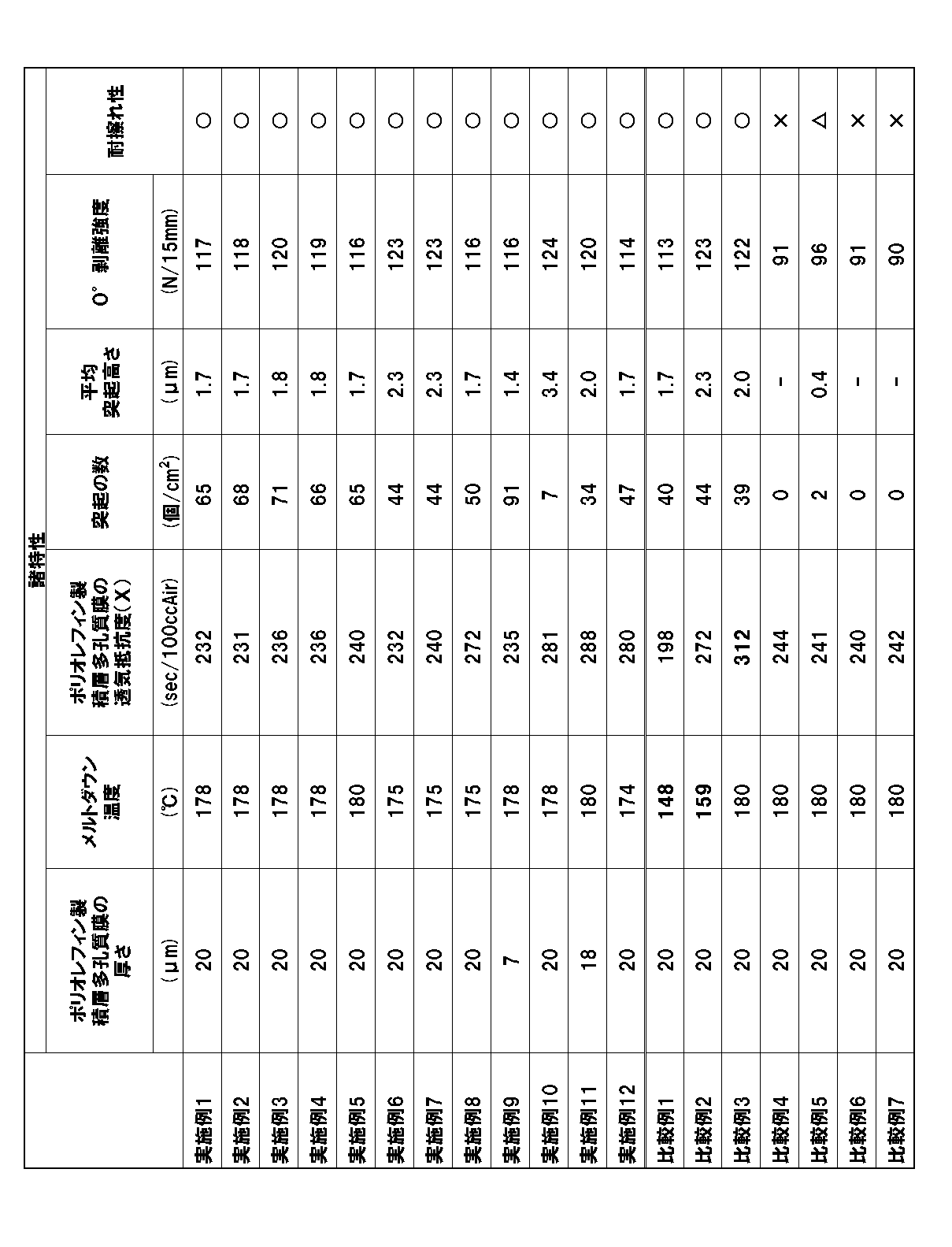
2 ポリオレフィン製積層多孔質膜
3 改質多孔層
4 両面粘着テープ
5 アルミニウム板
6 ポリオレフィン球晶の結晶核
7 ダイ
8 ポリオレフィン樹脂溶液
9 冷却ロール
10 ドクターブレード
11 ゲル状成形物
Claims (5)
- 少なくとも2層以上からなり、ポリオレフィンからなる突起が5μm≦W≦50μm(Wは突起の大きさ)および0.5μm≦H(Hは突起の高さ)をみたし、3個/cm2以上、200個/cm2以下で片面に不規則に点在し、メルトダウン温度が165℃以上であり、透気抵抗度が300sec/100ccAir以下であり、かつ膜厚が20μm以下であるポリオレフィン製積層多孔質膜。
- 少なくとも1層が、融解熱量が90J/g以上であるポリプロピレンを含んでなることを特徴とする請求項1に記載のポリオレフィン製積層多孔質膜。
- 請求項1または2に記載のポリオレフィン製積層多孔質膜の少なくとも突起を有する面に改質多孔層が積層された電池用セパレータ。
- 以下の工程(a)~(f)を含む、請求項1~2に記載のポリオレフィン製積層多孔質膜又は請求項3に記載の電池用セパレータの製造方法。
(a)A層を構成するポリオレフィン樹脂に成形用溶剤を添加した後、溶融混練し、ポリオレフィン樹脂溶液を調製する工程
(b)B層を構成するポリオレフィン樹脂に成形用溶剤を添加した後、溶融混練し、ポリオレフィン樹脂溶液を調製する工程
(c)工程(a)および(b)にて得られたポリオレフィン溶液A及びBをダイより押し出して、うち少なくとも一方を、成形用溶剤除去手段により成形用溶剤を除去した表面を有する冷却ロールにて冷却し、積層ゲル状成形物を形成する工程
(d)前記ゲル状成形物をMD(機械方向)およびTD(幅方向)に延伸し、延伸成形物を得る工程
(e)前記延伸成形物から前記成形用溶剤を抽出除去し、乾燥し、積層多孔質成形物を得る工程
(f)前記積層多孔質成形物を熱処理し、ポリオレフィン製積層多孔質膜を得る工程 - 前記(c)工程における成形用溶剤の除去手段がドクターブレードであることを特徴とする請求項4に記載のポリオレフィン製積層多孔質膜又は電池用セパレータの製造方法。
Priority Applications (8)
| Application Number | Priority Date | Filing Date | Title |
|---|---|---|---|
| EP18168704.7A EP3369549A1 (en) | 2014-05-09 | 2015-04-28 | Method for producing a multi-layer polyolefin porous membrane and a battery separator using the same |
| KR1020167030702A KR102276328B1 (ko) | 2014-05-09 | 2015-04-28 | 폴리올레핀제 적층 다공질 막, 이를 이용한 전지용 세퍼레이터 및 이의 제조 방법 |
| CN201580024263.9A CN106457804B (zh) | 2014-05-09 | 2015-04-28 | 聚烯烃制叠层多孔质膜、使用其的电池用隔膜以及它们的制造方法 |
| US15/309,782 US10343382B2 (en) | 2014-05-09 | 2015-04-28 | Multi-layer polyolefin porous membrane, battery separator obtained using the same, and method for producing the same |
| EP15789518.6A EP3141385B1 (en) | 2014-05-09 | 2015-04-28 | Polyolefin laminated porous film, battery separator using same and manufacturing method therefor |
| JP2016517884A JP6558363B2 (ja) | 2014-05-09 | 2015-04-28 | ポリオレフィン製積層多孔質膜、それを用いた電池用セパレータおよびそれらの製造方法 |
| PL15789518T PL3141385T3 (pl) | 2014-05-09 | 2015-04-28 | Poliolefinowa laminowana porowata folia, wykorzystujący ją separator baterii i sposób jej wytwarzania |
| SG11201609289PA SG11201609289PA (en) | 2014-05-09 | 2015-04-28 | Multi-layer polyolefin porous membrane, battery separatorobtained using the same, and method for producing the same |
Applications Claiming Priority (4)
| Application Number | Priority Date | Filing Date | Title |
|---|---|---|---|
| JP2014-098153 | 2014-05-09 | ||
| JP2014098153 | 2014-05-09 | ||
| JP2014183047 | 2014-09-09 | ||
| JP2014-183047 | 2014-09-09 |
Publications (1)
| Publication Number | Publication Date |
|---|---|
| WO2015170653A1 true WO2015170653A1 (ja) | 2015-11-12 |
Family
ID=54392505
Family Applications (1)
| Application Number | Title | Priority Date | Filing Date |
|---|---|---|---|
| PCT/JP2015/062904 Ceased WO2015170653A1 (ja) | 2014-05-09 | 2015-04-28 | ポリオレフィン製積層多孔質膜、それを用いた電池用セパレータおよびそれらの製造方法 |
Country Status (10)
| Country | Link |
|---|---|
| US (1) | US10343382B2 (ja) |
| EP (2) | EP3141385B1 (ja) |
| JP (1) | JP6558363B2 (ja) |
| KR (1) | KR102276328B1 (ja) |
| CN (1) | CN106457804B (ja) |
| HU (1) | HUE052664T2 (ja) |
| MY (1) | MY179092A (ja) |
| PL (1) | PL3141385T3 (ja) |
| SG (2) | SG10201809926TA (ja) |
| WO (1) | WO2015170653A1 (ja) |
Cited By (3)
| Publication number | Priority date | Publication date | Assignee | Title |
|---|---|---|---|---|
| KR20180071961A (ko) * | 2016-12-20 | 2018-06-28 | 아사히 가세이 가부시키가이샤 | 축전 디바이스용 세퍼레이터, 및 이를 사용한 적층체, 권회체 및 이차 전지 |
| JPWO2019065787A1 (ja) * | 2017-09-29 | 2020-09-10 | 東レ株式会社 | 多孔性フィルム、二次電池用セパレータ及び二次電池 |
| WO2023002818A1 (ja) * | 2021-07-19 | 2023-01-26 | 東レ株式会社 | ポリオレフィン多層微多孔膜、積層ポリオレフィン多層微多孔膜、電池用セパレータ |
Families Citing this family (5)
| Publication number | Priority date | Publication date | Assignee | Title |
|---|---|---|---|---|
| EP3340343B1 (en) * | 2016-12-20 | 2022-11-23 | Asahi Kasei Kabushiki Kaisha | Separator for power storage device, and laminated body, roll and secondary battery using it |
| JP7055662B2 (ja) * | 2017-03-03 | 2022-04-18 | 住友化学株式会社 | フィルム製造装置およびフィルム製造方法 |
| US20180254446A1 (en) * | 2017-03-03 | 2018-09-06 | Sumitomo Chemical Company, Limited | Nonaqueous electrolyte secondary battery separator |
| US10553902B2 (en) * | 2017-04-14 | 2020-02-04 | Sumitomo Chemical Company, Limited | Nonaqueous electrolyte secondary battery insulating porous layer |
| CN119855706A (zh) * | 2022-09-19 | 2025-04-18 | 阿姆泰克研究国际公司 | 由双层充油片材制成的双轴取向膜 |
Citations (5)
| Publication number | Priority date | Publication date | Assignee | Title |
|---|---|---|---|---|
| WO2007049568A1 (ja) * | 2005-10-24 | 2007-05-03 | Tonen Chemical Corporation | ポリオレフィン多層微多孔膜及びその製造方法並びに電池用セパレータ |
| JP2010502472A (ja) * | 2006-08-31 | 2010-01-28 | 東燃化学株式会社 | 微多孔膜、電池用セパレータ及び電池 |
| JP2010537845A (ja) * | 2007-08-31 | 2010-12-09 | 東燃化学株式会社 | ポリオレフィン多層微多孔膜、その製造方法、電池用セパレータ及び電池 |
| WO2013146585A1 (ja) * | 2012-03-30 | 2013-10-03 | 東レバッテリーセパレータフィルム株式会社 | ポリエチレン微多孔膜およびその製造方法 |
| WO2014132791A1 (ja) * | 2013-02-27 | 2014-09-04 | 東レバッテリーセパレータフィルム株式会社 | ポリオレフィン多孔質膜、それを用いた電池用セパレータおよびそれらの製造方法 |
Family Cites Families (25)
| Publication number | Priority date | Publication date | Assignee | Title |
|---|---|---|---|---|
| JPS4931083B1 (ja) | 1970-08-17 | 1974-08-19 | ||
| JPS60104837U (ja) * | 1983-12-21 | 1985-07-17 | 京セラミタ株式会社 | 結露除去装置 |
| JP3302754B2 (ja) * | 1993-01-26 | 2002-07-15 | 花王株式会社 | 油剤の塗工方法 |
| JPH0939075A (ja) * | 1995-07-26 | 1997-02-10 | Unitika Ltd | ポリアミドフィルムの製造方法 |
| JP4746771B2 (ja) | 2001-06-19 | 2011-08-10 | 東レ東燃機能膜合同会社 | ポリオレフィン微多孔膜の製造方法 |
| JP4344550B2 (ja) | 2002-06-25 | 2009-10-14 | 東燃化学株式会社 | ポリオレフィン微多孔膜の製造方法及びポリオレフィン微多孔膜 |
| US7780833B2 (en) * | 2005-07-26 | 2010-08-24 | John Hawkins | Electrochemical ion exchange with textured membranes and cartridge |
| JP2009529888A (ja) * | 2006-03-14 | 2009-08-27 | ユニバーシティ オブ ロチェスター | 超薄多孔質メンブレンを有する細胞培養装置およびその使用 |
| JP5202816B2 (ja) * | 2006-04-07 | 2013-06-05 | 東レバッテリーセパレータフィルム株式会社 | ポリオレフィン微多孔膜及びその製造方法 |
| KR101156248B1 (ko) | 2006-10-30 | 2012-06-13 | 아사히 가세이 케미칼즈 가부시키가이샤 | 폴리올레핀제 미다공막 |
| JP4931083B2 (ja) | 2007-01-30 | 2012-05-16 | 旭化成イーマテリアルズ株式会社 | 多層多孔膜及びその製造方法 |
| CN101611506A (zh) * | 2007-03-15 | 2009-12-23 | 日立麦克赛尔株式会社 | 电化学元件用隔膜、电化学元件用电极和电化学元件 |
| US7892672B2 (en) | 2007-06-06 | 2011-02-22 | Teijin Limited | Polyolefin microporous membrane base for nonaqueous secondary battery separator, method for producing the same, nonaqueous secondary battery separator and nonaqueous secondary battery |
| JP4789274B2 (ja) | 2007-06-06 | 2011-10-12 | 旭化成イーマテリアルズ株式会社 | 多層多孔膜 |
| US8507124B2 (en) * | 2007-11-14 | 2013-08-13 | Toray Battery Separator Film Co., Ltd. | Multi-layer, microporous membrane, battery separator and battery |
| JP5369602B2 (ja) | 2008-10-22 | 2013-12-18 | 株式会社エクォス・リサーチ | 車両 |
| US8771859B2 (en) | 2009-03-13 | 2014-07-08 | Hitachi Maxell, Ltd. | Separator for battery and nonaqueous electrolyte battery using same |
| KR101044700B1 (ko) | 2009-03-16 | 2011-06-28 | (주)베이직테크 | 엘이디 표시장치의 전원공급장치 및 전원공급방법 |
| US20100294363A1 (en) * | 2009-05-22 | 2010-11-25 | Mitsubishi Polyester Film, Inc. | Coated Polyester Film For Lamination to Ethylene-Vinyl Acetate Layers |
| EP2586611B1 (en) * | 2010-06-25 | 2018-10-03 | Toray Industries, Inc. | Composite porous membrane, method for producing composite porous membrane and battery separator using same |
| JP5495210B2 (ja) | 2010-07-21 | 2014-05-21 | 東レバッテリーセパレータフィルム株式会社 | 複合多孔質膜、複合多孔質膜の製造方法並びにそれを用いた電池用セパレーター |
| JP5629542B2 (ja) | 2010-10-04 | 2014-11-19 | 旭化成イーマテリアルズ株式会社 | ポリオレフィン製微多孔膜 |
| WO2012060147A1 (ja) * | 2010-11-05 | 2012-05-10 | 東レ株式会社 | 複合多孔質膜及びその製造方法 |
| CN105142904A (zh) | 2013-04-22 | 2015-12-09 | 东丽电池隔膜株式会社 | 层合多孔质膜及其制造方法以及电池用隔膜 |
| CN105960721B (zh) * | 2014-02-27 | 2018-09-25 | 日本瑞翁株式会社 | 二次电池多孔膜用粘合剂组合物、二次电池多孔膜用浆料、二次电池用多孔膜及二次电池 |
-
2015
- 2015-04-28 PL PL15789518T patent/PL3141385T3/pl unknown
- 2015-04-28 SG SG10201809926TA patent/SG10201809926TA/en unknown
- 2015-04-28 US US15/309,782 patent/US10343382B2/en active Active
- 2015-04-28 EP EP15789518.6A patent/EP3141385B1/en active Active
- 2015-04-28 CN CN201580024263.9A patent/CN106457804B/zh active Active
- 2015-04-28 WO PCT/JP2015/062904 patent/WO2015170653A1/ja not_active Ceased
- 2015-04-28 MY MYPI2016704100A patent/MY179092A/en unknown
- 2015-04-28 KR KR1020167030702A patent/KR102276328B1/ko active Active
- 2015-04-28 EP EP18168704.7A patent/EP3369549A1/en not_active Withdrawn
- 2015-04-28 JP JP2016517884A patent/JP6558363B2/ja active Active
- 2015-04-28 HU HUE15789518A patent/HUE052664T2/hu unknown
- 2015-04-28 SG SG11201609289PA patent/SG11201609289PA/en unknown
Patent Citations (5)
| Publication number | Priority date | Publication date | Assignee | Title |
|---|---|---|---|---|
| WO2007049568A1 (ja) * | 2005-10-24 | 2007-05-03 | Tonen Chemical Corporation | ポリオレフィン多層微多孔膜及びその製造方法並びに電池用セパレータ |
| JP2010502472A (ja) * | 2006-08-31 | 2010-01-28 | 東燃化学株式会社 | 微多孔膜、電池用セパレータ及び電池 |
| JP2010537845A (ja) * | 2007-08-31 | 2010-12-09 | 東燃化学株式会社 | ポリオレフィン多層微多孔膜、その製造方法、電池用セパレータ及び電池 |
| WO2013146585A1 (ja) * | 2012-03-30 | 2013-10-03 | 東レバッテリーセパレータフィルム株式会社 | ポリエチレン微多孔膜およびその製造方法 |
| WO2014132791A1 (ja) * | 2013-02-27 | 2014-09-04 | 東レバッテリーセパレータフィルム株式会社 | ポリオレフィン多孔質膜、それを用いた電池用セパレータおよびそれらの製造方法 |
Non-Patent Citations (1)
| Title |
|---|
| See also references of EP3141385A4 * |
Cited By (8)
| Publication number | Priority date | Publication date | Assignee | Title |
|---|---|---|---|---|
| KR20180071961A (ko) * | 2016-12-20 | 2018-06-28 | 아사히 가세이 가부시키가이샤 | 축전 디바이스용 세퍼레이터, 및 이를 사용한 적층체, 권회체 및 이차 전지 |
| KR20200030045A (ko) * | 2016-12-20 | 2020-03-19 | 아사히 가세이 가부시키가이샤 | 축전 디바이스용 세퍼레이터, 및 이를 사용한 적층체, 권회체 및 이차 전지 |
| KR102208409B1 (ko) * | 2016-12-20 | 2021-01-28 | 아사히 가세이 가부시키가이샤 | 축전 디바이스용 세퍼레이터, 및 이를 사용한 적층체, 권회체 및 이차 전지 |
| KR102208408B1 (ko) * | 2016-12-20 | 2021-01-28 | 아사히 가세이 가부시키가이샤 | 축전 디바이스용 세퍼레이터, 및 이를 사용한 적층체, 권회체 및 이차 전지 |
| JPWO2019065787A1 (ja) * | 2017-09-29 | 2020-09-10 | 東レ株式会社 | 多孔性フィルム、二次電池用セパレータ及び二次電池 |
| JP7259329B2 (ja) | 2017-09-29 | 2023-04-18 | 東レ株式会社 | 多孔性フィルム、二次電池用セパレータ及び二次電池 |
| US11742514B2 (en) | 2017-09-29 | 2023-08-29 | Toray Industries, Inc. | Porous film, separator for secondary batteries, and secondary battery |
| WO2023002818A1 (ja) * | 2021-07-19 | 2023-01-26 | 東レ株式会社 | ポリオレフィン多層微多孔膜、積層ポリオレフィン多層微多孔膜、電池用セパレータ |
Also Published As
| Publication number | Publication date |
|---|---|
| US20170282513A1 (en) | 2017-10-05 |
| CN106457804A (zh) | 2017-02-22 |
| EP3369549A1 (en) | 2018-09-05 |
| JPWO2015170653A1 (ja) | 2017-06-01 |
| JP6558363B2 (ja) | 2019-08-14 |
| PL3141385T3 (pl) | 2021-04-19 |
| MY179092A (en) | 2020-10-27 |
| US10343382B2 (en) | 2019-07-09 |
| EP3141385B1 (en) | 2020-10-21 |
| KR102276328B1 (ko) | 2021-07-12 |
| KR20170013215A (ko) | 2017-02-06 |
| SG11201609289PA (en) | 2016-12-29 |
| EP3141385A4 (en) | 2018-03-21 |
| HUE052664T2 (hu) | 2021-05-28 |
| SG10201809926TA (en) | 2018-12-28 |
| CN106457804B (zh) | 2018-12-28 |
| EP3141385A1 (en) | 2017-03-15 |
Similar Documents
| Publication | Publication Date | Title |
|---|---|---|
| JP5857151B2 (ja) | ポリオレフィン多孔質膜、それを用いた電池用セパレータおよびそれらの製造方法 | |
| JP5845381B1 (ja) | ポリオレフィン製積層多孔質膜、それを用いた電池用セパレータおよびポリオレフィン製積層多孔質膜の製造方法 | |
| JP5857155B2 (ja) | ポリオレフィン多孔質膜、それを用いた電池用セパレータおよびそれらの製造方法 | |
| JP5876629B1 (ja) | 電池用セパレータ及びその製造方法 | |
| JP6558363B2 (ja) | ポリオレフィン製積層多孔質膜、それを用いた電池用セパレータおよびそれらの製造方法 | |
| JP6323449B2 (ja) | 積層多孔質膜及びその製造方法ならびに電池用セパレータ | |
| US20170149038A1 (en) | Polyolefin multilayer microporous membrane and battery separator | |
| JP6398498B2 (ja) | ポリオレフィン製積層多孔質膜を用いた電池用セパレータおよびその製造方法 | |
| WO2015190264A1 (ja) | 電池用セパレータ及びその製造方法 | |
| JP5792914B1 (ja) | 積層多孔質膜及びその製造方法 |
Legal Events
| Date | Code | Title | Description |
|---|---|---|---|
| 121 | Ep: the epo has been informed by wipo that ep was designated in this application |
Ref document number: 15789518 Country of ref document: EP Kind code of ref document: A1 |
|
| ENP | Entry into the national phase |
Ref document number: 20167030702 Country of ref document: KR Kind code of ref document: A |
|
| ENP | Entry into the national phase |
Ref document number: 2016517884 Country of ref document: JP Kind code of ref document: A |
|
| NENP | Non-entry into the national phase |
Ref country code: DE |
|
| REEP | Request for entry into the european phase |
Ref document number: 2015789518 Country of ref document: EP |
|
| WWE | Wipo information: entry into national phase |
Ref document number: 2015789518 Country of ref document: EP |
|
| WWE | Wipo information: entry into national phase |
Ref document number: 15309782 Country of ref document: US |